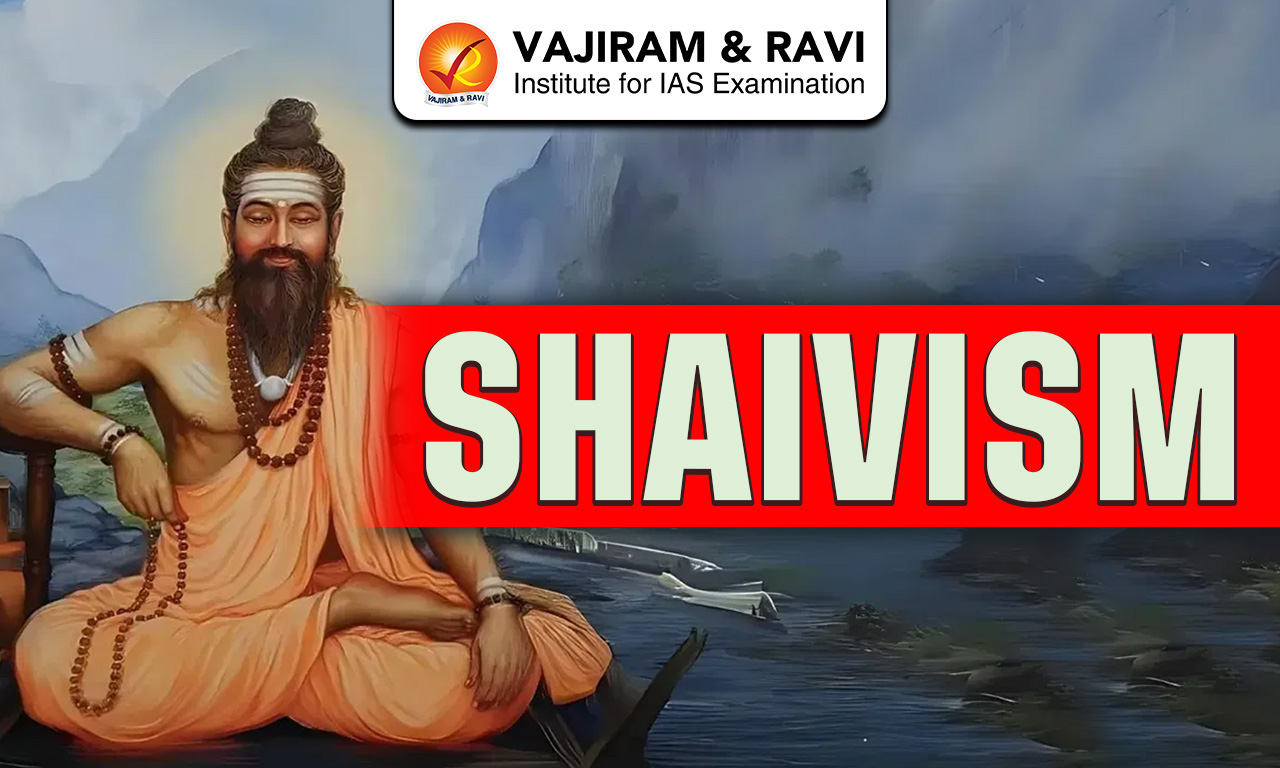
Saivism is an ancient tradition of Hinduism that worships Lord Siva as the supreme god. It sees Siva as both a protector and destroyer, combining power, wisdom, and compassion. Followers worship him in many forms, including as a meditating ascetic, a cosmic dancer, or through the linga. Saivism teaches devotion, moral living, meditation, and the path to spiritual liberation.
Saivism Origin and Development
- Ancient Roots of Saivism:
- Saivism is considered one of the oldest religions in India, and perhaps in the world. What makes it remarkable is that it is still a living religion, followed by millions of people today. It is a tradition that sees Lord Siva as the supreme deity. Scholars believe that Saivism may have started in the pre-Vedic period, long before the arrival of Aryans in India.
- Evidence from Indus Valley Civilization:
- Excavations at Mohenjadaro and Harappa have revealed statues and seals that suggest the worship of a male god, which many scholars identify as a prototype of Lord Siva. Sir John Marshall, a leading archaeologist, noted that Saivism’s roots may go back to the Chalcolithic Age, making it possibly the most ancient living faith in the world.
- Vedic and Non-Vedic Debate:
- There is debate among scholars about whether Saivism is Vedic or non-Vedic.
- Scholars like Sir John Marshall, G.U. Pope, G. Slater, and Maraimalai Adigal believe Saivism is pre-Aryan and pre-Vedic, originating from Dravidian traditions.
- Others, like K.A. Nilakanta Sastri, argue that Saivism has Vedic origins.
- Connection with Vedic Rudra:
- In the Vedic texts, a minor god named Rudra shares many qualities with Siva. Rudra is described as fierce, destructive, and associated with storms, lightning, and forest fires. He is also the lord of animal sacrifices. Over time, Rudra’s qualities merged with the concept of Siva.
- Evolution in Vedic and Upanishadic Texts:
- In the Yajurveda, Siva is described with one hundred names, including Paśupati (Lord of animals), Nilagriva (blue-necked), and Sitikantha (white-throated).
- In the Śvetāśvatara Upaniṣad, Siva is referred to as Hara, Mahādeva, Īśa, Īśāna, Maheśvara, and Bhagavat, described as the “dweller of mountains,” “thousand-eyed,” and “steadfast.”
- Role in Epics:
- The Mahābhārata mentions 1,008 names of Siva and tells the story of Siva marrying Uma, daughter of Himavān, the mountain king.
- In the Rāmāyaṇa, Siva is linked to the origin of the Ganga River, controlling her descent from heaven by holding her in his matted locks to reduce her force.
- Puranic Descriptions and Forms:
- Puranas describe Siva in various forms, such as Ardhanārīśvara (half male, half female), Dakṣiṇāmūrti (teacher of truth and yogic meditation), Mahāyogin, and Saṁhāramūrti (destroyer of evil).
- He is often depicted with matted hair, crescent moon, serpents, trident (triśūla), bull as his vehicle, and ash-smeared body.
- Siva’s third eye represents wisdom, while his hands hold fire, drum, and axe. He is also worshiped as Natarāja, the dancing lord.
- Saivism in Tamil Literature:
- Siva is widely referenced in ancient Tamil literature from the Sangam period onward.
- Devotional Tamil texts describe his 64 divine sports, epithets, qualities, deeds, ornaments, and weapons in great detail, showing his importance in South Indian culture.
- Fusion of Traditions:
- Siva’s worship dates back to the Indus Valley civilization. Over time, the Vedic god Rudra and the indigenous Siva were merged, giving Siva a central place in the Vedic pantheon.
- By the time of the Śvetāśvatara Upaniṣad, Siva was recognized as Mahadeva, the supreme god.
- Historical References:
- The earliest mention of Siva by a foreigner is by Megasthenes, the Greek ambassador.
- During the Gupta period, Siva worship gained significant prominence, particularly in South India, where the Bhakti movement of Saivism flourished and reached its peak.
Saivism Philosophical Schools
- General Concept of God in Saivism
- Lord Siva is a complex deity with both fierce and compassionate sides.
- On one hand, he has a dark and destructive aspect, inherited from the Vedic Rudra. He is said to live in cremation grounds, wear a garland of skulls, and perform the Rudra Tandava, a cosmic dance that destroys the world at the end of a Kalpa.
- On the other hand, Siva is the great ascetic, meditating peacefully on Mount Kailasa in the Himalayas. He has matted hair, a crescent moon on his head, and the sacred river Ganga flowing from it.
- Siva also shows qualities of a fertility and nature god, often called Paśupati (Lord of animals) and the patron of procreation.
- He is commonly worshipped in the form of the Liṅga, a symbol of divine energy.
- Some Siva cults practiced extreme rituals, including animal sacrifice or self-mortification, but most sects emphasize Siva as the God of love, grace, and moral guidance.
- Tamil Saivism especially highlights Siva as a compassionate father, caring for all living beings and protecting them from evil.
- The Paśupata and Kapālika Traditions
- Paśupatas are the oldest Saivite sect in North India. They emphasize asceticism and meditation, focusing on Siva as the absolute God.
- According to their philosophy:
- Siva is the cause of the universe, while souls and nature are his effects.
- Liberation means the soul becomes eternally united with Siva.
- Their yogic practices involved meditation in solitude, often in cremation grounds.
- Kapālikas, a more extreme branch, practiced radical renunciation, carried skulls (kapāla), bowls of liquor, and were known as Bhairava or “the frightful ones”.
- Both groups emphasized that detachment from the world was the path to liberation.
- Kashmiri Saivism (Trika Saivism)
- Developed in the 9th century in Kashmir, it is a monistic form of Saivism called Trika.
- Key texts: Siddhāntantra, Mālinītantra, Vāmakatantra, with systematic philosophy explained in Sivasūtra by Vasugupta.
- Prominent thinkers: Somānanda, Utpaladeva, Bhaskaracarya, Abhinavagupta, Ksemaraja.
- Core ideas:
- The Absolute (Siva), Soul, and Matter are the three principles.
- Influenced by Advaita philosophy, it teaches that Siva is the Absolute Reality, from which everything has emanated.
- The Absolute is both Siva and Shakti, representing consciousness (Siva) and dynamic energy (Shakti).
- The universe is not an illusion; it is a manifestation of Divine Energy.
- Liberation comes through knowledge of oneness between individual self and Absolute.
- Both divine grace (Kripā) and self-effort are important for salvation; one cannot succeed without the other.
- Life in the world is affirmed, not renounced. Material and spiritual existence are reconciled.
- Vīra Saivism (Lingayatism)
- It began in the 12th century in North-Western Karnataka as a reformist Saivite movement.
- Early founders include Ekorama, Panditaradhya, Revana, Marula, Visvaradhya, and the reformer Sri Basavesvara, considered an incarnation of Nandi.
- Core principles:
- Siva is supreme, and worship should be exclusive to him.
- Abandoned ritualistic Hindu practices, such as the sacred thread ceremony.
- Devotees wear a small Linga in a metal box around the neck, symbolizing purification and divine energy, not a phallic object.
- Promotes social equality: rejects caste distinctions and grants equal status to women.
- Followers are strict vegetarians, oppose magic and sorcery, and bury rather than cremate the dead.
- Believes that Siva’s inner power resides in every individual, enabling them to see the divine in all beings.
- Śaiva Siddhānta
- A major Saivite philosophical system of South India, based on Saiva Agamas, Upanishads, Tirumurais, and Meikanta Sastras.
- The term Siddhānta means “established conclusion” and represents the definitive philosophy for Siva worshippers.
- Core features:
- Combines Vedic and Agamic traditions, giving Vedas as the general source and Agamas as a special source.
- Theistic philosophy that explains the relationship between God, soul, and matter.
- Recognizes three eternal realities: God, soul, and matter.
- Souls are helped by God’s grace, which is necessary for liberation.
- God is inseparable from the universe and souls, but not identical; He dwells within them and guides them.
- Liberation is the realization of the soul’s unity with God, and enlightenment is facilitated by the guru, though Siva remains the ultimate source of grace and knowledge.


 Last updated on Sep, 2026
→ UPSC 2027 Notification will be released on 13 January 2027 at upsconline.nic.in.
→ Asian Games 2026 are being held in Aichi-Nagoya, Japan, from 19 September to 4 October.
→ Check out the latest UPSC Syllabus here.
→ Download UPSC Model Answers for Mains 2026
→ UPSC Mains Question Paper 2026 is out now for Essay & GS Paper 1, 2, 3 & 4.
→ UPSC Calendar 2027 has been released.
→ Enroll in Vajiram & Ravi’s UPSC Mains Test Series 2027 for structured answer writing practice, expert evaluation, and exam-oriented feedback.
→ Join Vajiram & Ravi’s UPSC Mentorship Program 2027 for personalized guidance, strategy planning, and one-to-one support from experienced mentors.
→ Go through the UPSC Mains Previous Year Papers to enhance your preparation.
→ UPSC has released UPSC Toppers List 2025 with the Civil Services final result on its official website.
→ Also check Best UPSC Coaching in India
Saivism FAQs
Q1. What is Saivism?+
Q2. What are the origins of Saivism?+
Q3. How is Siva described in scriptures and epics?+
Q4. What are the major philosophical schools of Saivism?+
Q5. What is the importance of the Linga in Saivism?+
Tags: history history notes shaivism