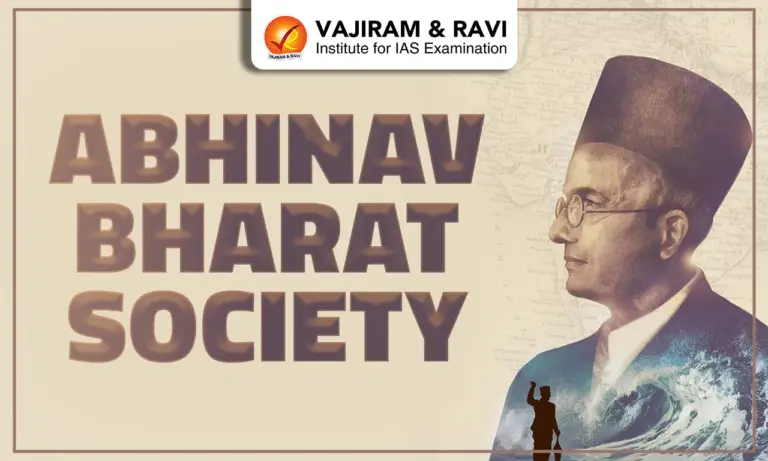
The Abhinav Bharat Society was a secret revolutionary organization founded in the early 20th century to overthrow British colonial rule in India. Established by Vinayak Damodar Savarkar (Veer Savarkar) in 1904, it became one of the earliest groups to promote armed struggle for independence. The society played a crucial role in shaping revolutionary nationalism and inspired future organizations that carried forward the freedom struggle.
Abhinav Bharat Society
The Abhinav Bharat Society was created as a platform to unite young revolutionaries under the common cause of ending British domination through force if necessary. Its name, meaning “Young India” or “New India,” reflected the aspiration for a modern and independent nation. It spread its influence in Maharashtra, Bengal, and Punjab, connecting Indian revolutionaries with global movements.
Abhinav Bharat Society Foundation
The Abhinav Society’s activities included military training, arms procurement, revolutionary literature, and organizing secret cells across India. It had a strong ideological base, largely inspired by Savarkar’s writings and the Italian revolutionary Giuseppe Mazzini. It was founded as ‘Mitra Mela’ in 1899 and later renamed as Abhinav Bharat Society. According to the National Archives of India, the society operated until 1952, when it was finally dissolved.





Abhinav Bharat Society Historical Background
The idea of Abhinav Bharat was inspired by Savarkar’s admiration for Giuseppe Mazzini, the Italian nationalist who fought for unification of Italy. Savarkar translated Mazzini’s biography into Marathi and circulated it among Indian youth, advocating the path of revolutionary nationalism. The society emerged against the backdrop of rising dissatisfaction with moderate Congress politics and the limitations of constitutional agitation.
Abhinav Bharat Society Activities
The Abhinav Society engaged in multiple activities to build revolutionary momentum in India:
- Military Training: Members practiced shooting, bomb-making, and physical drills.
- Circulation of Literature: Revolutionary pamphlets and Savarkar’s works like The First War of Independence, 1857 were distributed.
- Arms Procurement: Attempts were made to smuggle weapons from Europe into India.
- Secret Cells: Organized networks of revolutionaries in Maharashtra, Bengal, and Punjab.
- Political Assassinations: The group was linked to the assassination of British officials like A.M.T. Jackson (Collector of Nashik, 1909).
Role of Vinayak Damodar Savarkar in Abhinav Bharat
Savarkar was the ideological force behind Abhinav Bharat. While studying law in London, he mobilized Indian students, formed India House, and established international connections with revolutionaries. His book The First War of Independence, 1857 reinterpreted the revolt of 1857 as a national struggle against colonialism, inspiring future revolutionaries.
Major Incidents of Abhinav Bharat Society
Some significant incidents associated with the Abhinav Society include:
- Assassination of A.M.T. Jackson (1909): An act of retribution for the arrest of revolutionaries, carried out by Anant Laxman Kanhere, linked with Abhinav Bharat.
- London Activities: Savarkar and his associates in London, including Madan Lal Dhingra, plotted against British officers and promoted armed resistance.
- Suppression of the Group: British intelligence cracked down on its members, leading to arrests, deportations, and imprisonment.
Challenges Faced by the Abhinav Bharat Society
The society, being secretive and radical, faced several challenges:
- Lack of widespread public support due to its violent methods.
- Strong surveillance and repression by British intelligence.
- Ideological split among revolutionaries regarding armed struggle vs. political negotiations.
- Limited resources and difficulty in sustaining large-scale armed movements.
Way Forward:
Although Abhinav Bharat no longer exists, its history offers lessons for India’s freedom movement and nation-building. Acknowledging the role of such organizations ensures a comprehensive understanding of India’s independence struggle.
Trial of Savarkar
The British government viewed Vinayak Damodar Savarkar as one of the most dangerous revolutionaries linked with Abhinav Bharat. After the assassination of A.M.T. Jackson in 1909, Savarkar was arrested in London for his involvement in revolutionary activities, including arms smuggling and incitement of violence. In 1910, he was extradited to India and tried under charges of sedition and conspiracy. He was sentenced to two life imprisonments (50 years) in the Cellular Jail, Andaman Islands, which symbolized the severity of colonial repression against revolutionaries.
Dissolution of Abhinav Bharat Society
The Abhinav Bharat Society gradually weakened due to the arrests of its leaders, lack of resources, and intense British surveillance. By the 1920s, its influence declined as other revolutionary groups like HSRA and Hindustan Republican Association took prominence. After independence in 1947, the society had lost its purpose, and in 1952, it was officially dissolved. Despite its dissolution, the Abhinav Bharat Society is remembered as one of the earliest organizations to promote militant nationalism in India’s freedom movement.
Legacy of Abhinav Bharat Society
Despite limited resources, the Abhinav Bharat Society ignited a spirit of defiance against colonialism. It influenced later revolutionary groups like the Hindustan Socialist Republican Association (HSRA) and provided ideological foundations for radical nationalism.
Abhinav Bharat Society UPSC
The Abhinav Bharat Society occupies a crucial place in India’s freedom struggle as one of the earliest revolutionary organizations advocating armed resistance. Founded by Veer Savarkar in 1904, it united young revolutionaries, carried out daring acts against British officials, and inspired future generations. Although eventually suppressed, its contribution to India’s nationalist awakening remains significant.

 Last updated on March, 2026
→ UPSC Final Result 2025 is now out.
→ UPSC has released UPSC Toppers List 2025 with the Civil Services final result on its official website.
→ Anuj Agnihotri secured AIR 1 in the UPSC Civil Services Examination 2025.
→ UPSC Marksheet 2025 is now out.
→ UPSC Notification 2026 & UPSC IFoS Notification 2026 is now out on the official website at upsconline.nic.in.
→ UPSC Calendar 2026 has been released.
→ Check out the latest UPSC Syllabus 2026 here.
→ UPSC Prelims 2026 will be conducted on 24th May, 2026 & UPSC Mains 2026 will be conducted on 21st August 2026.
→ The UPSC Selection Process is of 3 stages-Prelims, Mains and Interview.
→ Prepare effectively with Vajiram & Ravi’s UPSC Prelims Test Series 2026 featuring full-length mock tests, detailed solutions, and performance analysis.
→ Enroll in Vajiram & Ravi’s UPSC Mains Test Series 2026 for structured answer writing practice, expert evaluation, and exam-oriented feedback.
→ Join Vajiram & Ravi’s Best UPSC Mentorship Program for personalized guidance, strategy planning, and one-to-one support from experienced mentors.
→ Shakti Dubey secures AIR 1 in UPSC CSE Exam 2024.
→ Also check Best UPSC Coaching in India
Abhinav Bharat Society FAQs
Q1. Who founded the Abhinav Bharat Society?+
Q2. What was the aim of Abhinav Bharat Society?+
Q3. Which incident is linked to Abhinav Bharat Society?+
Q4. Where was the Abhinav Bharat Society most active?+
Q5. When was Abhinav Bharat Society dissolved?+
Tags: abhinav bharat society