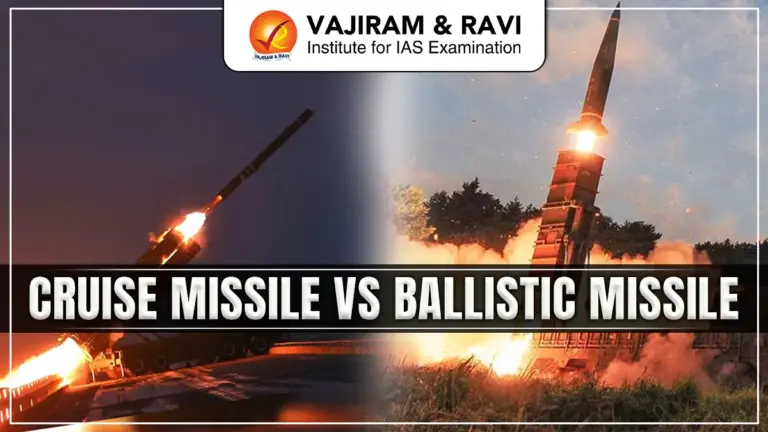
Missiles are critical elements of modern military defense and strategic planning. Among them, cruise missiles and ballistic missiles are two of the most significant types, each with a unique design, capabilities, and purposes. Understanding Cruise Missile vs Ballistic Missile helps in grasping modern warfare technology, defense strategies, and global security dynamics.
This article explores the distinctions between cruise missiles and ballistic missiles, their types, and provides a detailed comparison to clarify their roles.
Cruise Missile vs Ballistic Missile
Cruise missiles and ballistic missiles are two key types of modern weaponry, each with unique flight paths, speeds, and strategic roles. Understanding Cruise Missile vs Ballistic Missile helps in analyzing military capabilities and defense strategies.
| Cruise Missile vs Ballistic Missile | ||
| Feature | Cruise Missile | Ballistic Missile |
|
Flight Path |
Flies at low altitude, powered by jet engines, can maneuver around obstacles |
Follows a high-arching parabolic trajectory, largely unaffected by terrain |
|
Guidance System |
GPS, terrain contour matching, inertial navigation |
Inertial guidance, satellite-based mid-course corrections |
|
Speed |
Subsonic to supersonic (Mach 0.8-3); hypersonic versions exist |
Supersonic to hypersonic (Mach 5-20) |
|
Range |
Short to medium (50-2,500 km) |
Short to intercontinental (300-20,000 km) |
|
Launch Platforms |
Air, sea, and land platforms |
Land-based silos, mobile launchers, submarines |
|
Warhead Types |
Conventional or nuclear |
Conventional, nuclear, chemical, or biological |
|
Maneuverability |
Highly maneuverable, can avoid radar |
Limited maneuverability; mostly predictable path |
|
Accuracy |
Extremely high due to terrain-hugging flight and guidance |
Moderate to high, depends on missile type and technology |
|
Examples |
BrahMos, Nirbhay, Tomahawk |
Agni series, Prithvi, Trident |
Also Read: Missiles of India
What is a Cruise Missile?
A cruise missile is a guided missile that flies at low altitudes, often following the contours of the terrain to avoid radar detection. Unlike ballistic missiles, cruise missiles are powered throughout their flight by jet engines, enabling them to maintain steady speeds and precise targeting. They are commonly used for tactical strikes on strategic targets such as military bases, infrastructure, or enemy installations.




Types of Cruise Missile
Cruise missiles are classified by their speed, ranging from slow, stealthy attacks to high-speed tactical strikes.
- Hypersonic Cruise Missiles (Mach 5+) – Travel at least five times the speed of sound; e.g., BrahMos-II.
- Supersonic Cruise Missiles (Mach 2-3) – Travel faster than the speed of sound; e.g., BrahMos.
- Subsonic Cruise Missiles (Mach 0.8) – Travel slower than the speed of sound; e.g., Nirbhay.
What is a Ballistic Missile?
A ballistic missile is a weapon that follows a high-arching, parabolic trajectory to deliver warheads over long distances. Unlike cruise missiles, ballistic missiles are primarily powered during the initial phase of their flight and rely on gravity to reach their target. They can carry conventional, nuclear, or even chemical payloads and are a key component of strategic deterrence.
Ballistic missiles can travel intercontinental distances, making them central to national defense strategies, especially for countries with nuclear capabilities.
Types of Ballistic Missile
Ballistic missiles are classified by their range and operational role, from short-range tactical strikes to intercontinental deterrence.
- Short-Range (Tactical) Ballistic Missiles (SRBMs) – Range: 300-1,000 km. Used for battlefield attacks; e.g., Prithvi-I.
- Medium-Range (Theatre) Ballistic Missiles (MRBMs) – Range: 1,000-3,500 km. Designed for regional strikes; e.g., Agni-II.
- Intermediate-Range (Long-Range) Ballistic Missiles (IRBMs) – Range: 3,500-5,500 km. Targets distant regions; e.g., Agni-III.
- Intercontinental Ballistic Missiles (ICBMs) – Range: 5,500+ km. Can strike across continents; e.g., Agni-V.
- Submarine-Launched Ballistic Missiles (SLBMs) – Launched from submarines for stealth attacks; e.g., K-4 missile.

 Last updated on March, 2026
→ UPSC Final Result 2025 is now out.
→ UPSC has released UPSC Toppers List 2025 with the Civil Services final result on its official website.
→ Anuj Agnihotri secured AIR 1 in the UPSC Civil Services Examination 2025.
→ UPSC Marksheet 2025 is now out.
→ UPSC Notification 2026 & UPSC IFoS Notification 2026 is now out on the official website at upsconline.nic.in.
→ UPSC Calendar 2026 has been released.
→ Check out the latest UPSC Syllabus 2026 here.
→ UPSC Prelims 2026 will be conducted on 24th May, 2026 & UPSC Mains 2026 will be conducted on 21st August 2026.
→ The UPSC Selection Process is of 3 stages-Prelims, Mains and Interview.
→ Prepare effectively with Vajiram & Ravi’s UPSC Prelims Test Series 2026 featuring full-length mock tests, detailed solutions, and performance analysis.
→ Enroll in Vajiram & Ravi’s UPSC Mains Test Series 2026 for structured answer writing practice, expert evaluation, and exam-oriented feedback.
→ Join Vajiram & Ravi’s Best UPSC Mentorship Program for personalized guidance, strategy planning, and one-to-one support from experienced mentors.
→ Shakti Dubey secures AIR 1 in UPSC CSE Exam 2024.
→ Also check Best UPSC Coaching in India
Cruise Missile vs Ballistic Missile FAQs
Q1. Which missile is more accurate?+
Q2. Which missile travels faster?+
Q3. Can cruise missiles carry nuclear warheads?+
Q4. What are the main launch platforms?+
Q5. Are ballistic missiles easier to detect?+
Tags: cruise missile vs ballistic missile