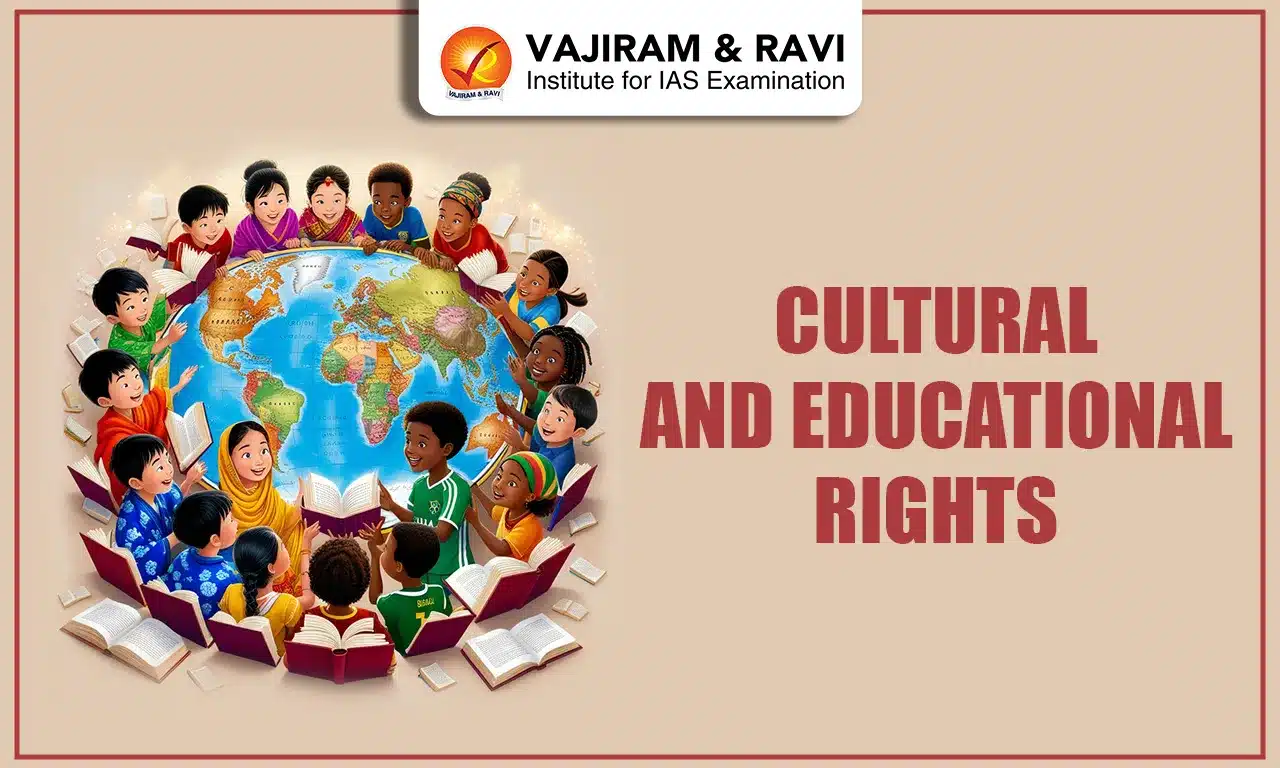
Cultural and Educational Rights under Articles 29 and 30 of the Constitution of India are designed to protect the identity, language, and educational interests of diverse communities, especially minorities. These provisions ensure that India’s pluralistic character is preserved while maintaining equality in access to education.
Article 29: Protection of Cultural and Educational Interests
Article 29(1) provides that any section of citizens residing in India, having a distinct language, script, or culture, has the right to conserve the same.
- This provision protects the collective rights of a group, enabling communities to preserve their cultural identity.
- The use of the term “any section of citizens” extends its scope to both minority and majority groups. Thus, any group with a distinct cultural identity can claim protection under this article
Article 29(2) guarantees that no citizen shall be denied admission into any educational institution maintained by the State or receiving State aid on grounds only of religion, race, caste, or language.
- This provision guarantees an individual right, ensuring equality in access to education irrespective of community identity.
Judicial Interpretation of Article 29
The scope of Article 29 has been clarified through important judicial decisions:
- In D.A.V. College v. State of Punjab, the Supreme Court held that the establishment of a university and the promotion of Punjabi language do not violate Article 29(1), thereby recognising the State’s role in promoting regional languages.
- In St. Stephen’s College v. University of Delhi, the Court held that minority institutions can admit students from their own community, provided the admission process remains fair and transparent, thereby balancing minority rights with equality principles.
- In Animal Welfare Board of India v. Union of India, the Supreme Court examined whether cultural practices like Jallikattu fall under Article 29. The Court upheld the practice within a regulated legal framework, recognising the importance of cultural rights while ensuring compliance with law.
The Court has also clarified that the right to conserve language includes the right to take steps for its protection, including advocacy.


Article 30: Right of Minorities to Establish and Administer Educational Institutions
Article 30 specifically grants rights to religious and linguistic minorities, focusing on their educational empowerment.
- Article 30(1) grants minorities the right to establish and administer educational institutions of their choice. This includes the freedom to manage internal affairs, appoint staff, and admit students.
- Article 30(1A) ensures that if the State compulsorily acquires property of a minority educational institution, the compensation must be such that it does not restrict or weaken their rights. This protection was strengthened through the 44th Constitutional Amendment Act, 1978, especially after the removal of the right to property as a Fundamental Right.
- Article 30(2) prohibits the State from discriminating against minority institutions while granting aid.
Unlike Article 29, the protection under Article 30 is exclusively available to minorities, although the Constitution does not define the term “minority.” In the T.M.A. Pai Foundation case, the Supreme Court ruled that since States were reorganized on a linguistic basis, religious and linguistic minorities must be identified in relation to the population of the State, not the whole of India. s
Minority educational institutions are of three types:
- Institutions that seek recognition as well as aid from the State;
- Institutions that seek only recognition from the State and not aid; and
- Institutions that neither seek recognition nor aid from the State.
The institutions of first and second type are subject to the regulatory power of the state with regard to syllabus prescription, academic standards, discipline, sanitation, employment of teaching staff and so on. The institutions of third type are free to administer their affairs but subject to operation of general laws like contract law, labour law, industrial law, tax law, economic regulations, and so on.
Also Read: Article 29 and 30 of Indian Constitution
Scope of Rights under Article 30
The rights under Article 30 extend beyond mere establishment to effective control and management of minority educational institutions, ensuring preservation of their distinct identity.
- Minority communities have the freedom to choose their governing body, allowing administration in line with their cultural and educational objectives.
- They have the right to appoint teaching and non-teaching staff, subject to qualifications and standards prescribed by the State to maintain academic quality.
- The right includes admission of students, with the ability to give preference to their own community, provided the process remains fair, transparent, and merit-based.
- Minority institutions enjoy autonomy to manage internal affairs, including fee structure and utilisation of resources, as long as there is no profiteering or exploitation.
- The rights under Article 30 are not absolute and do not include the right to maladministration.
- The State can impose reasonable regulations related to curriculum, academic standards, staff qualifications, service conditions, discipline, and welfare of students and employees.
- In Secretary, Malankara Syrian Catholic College v. T. Jose, the Court held that regulations aimed at maintaining educational standards do not violate minority rights.
Judicial Interpretation of Article 30
The judiciary has elaborated the scope of Article 30 through landmark cases:
- In St. Xavier’s College v. State of Gujarat, the Supreme Court upheld the autonomy of minority institutions in administration and admissions.
- In T.M.A. Pai Foundation v. State of Karnataka, the Court clarified that minority institutions have the right to establish and administer institutions, including admission and staffing decisions, but must operate within reasonable regulatory frameworks.
- In D.A.V. College v. State of Punjab, the Court recognised the right of minority institutions to appoint teachers of their choice, subject to qualifications, thereby preserving institutional character.
- In S.P. Mittal v. Union of India, the Court held that protection under Article 30 is available only to genuine religious or linguistic minorities and only when the institution is established by them. It also clarified that State action does not violate Articles 29 or 30 unless it restricts cultural or educational rights.
Difference between Article 29 and Article 30
- Nature of Right: Article 29 protects cultural and educational rights, while Article 30 specifically grants educational rights to minorities.
- Beneficiaries: Article 29 applies to any section of citizens (both majority and minority), whereas Article 30 applies only to religious and linguistic minorities.
- Objective: Article 29 aims at preserving language, script, and culture and ensuring non-discrimination in education; Article 30 focuses on empowering minorities through institutional autonomy.
- Type of Rights: Article 29 includes both group rights (29(1)) and individual rights (29(2)); Article 30 primarily deals with group rights of minorities.
- Scope in Education: Article 29(2) ensures equal access to educational institutions; Article 30 ensures the right to establish and administer educational institutions.
- Applicability: Article 29 is broader in scope, while Article 30 is narrower but more specific to minorities.
- Regulation: Rights under Article 30 are subject to reasonable State regulation, whereas Article 29 mainly operates as a protective and anti-discriminatory provision.
Significance of Cultural and Educational Rights (Articles 29–30)
Cultural and Educational Rights are essential for preserving diversity while ensuring equality in India’s constitutional framework.
- Cultural Preservation: Safeguard language, script, and traditions of diverse communities.
- Equality in Education: Prevent discrimination in admission to State-funded institutions under Article 29(2).
- Minority Empowerment: Enable minorities to establish and manage institutions under Article 30.
- Institutional Autonomy: Ensure minorities can preserve their identity through control over educational institutions.
- National Integration: Build trust among communities by protecting their identity within the State.
- Balance of Rights: Maintain harmony between individual equality and group rights.
- Regulated Freedom: Allow autonomy with reasonable State regulation as clarified in T.M.A. Pai Foundation v. State of Karnataka.
- Inclusive Development: Promote participation of all communities in education and nation-building.

 Last updated on Oct, 2026
→ UPSC 2027 Notification will be released on 13 January 2027 at upsconline.nic.in.
→ Check Nobel Prize 2026 Winners List here.
→ Download PIB PRiSM Monthly Magazine 2026 here.
→ Check UPSC Monthly Current Affairs Magazine The Recitals here.
→ Check out the latest UPSC Syllabus here.
→ Download UPSC Model Answers for Mains 2026
→ UPSC Mains Question Paper 2026 is out now for Essay & GS Paper 1, 2, 3 & 4.
→ UPSC Calendar 2027 has been released.
→ Enroll in Vajiram & Ravi’s UPSC Mains Test Series 2027 for structured answer writing practice, expert evaluation, and exam-oriented feedback.
→ Join Vajiram & Ravi’s UPSC Mentorship Program 2027 for personalized guidance, strategy planning, and one-to-one support from experienced mentors.
→ Go through the UPSC Mains Previous Year Papers to enhance your preparation.
→ UPSC has released UPSC Toppers List 2025 with the Civil Services final result on its official website.
→ Also check Best UPSC Coaching in India
Cultural and Educational Rights FAQs
Q1. Which Articles of the Constitution deal with Cultural and Educational Rights?+
Q2. Examine the scope of Article 29 and explain whether it is limited to minorities.+
Q3. Analyse the scope of Article 30 in light of judicial interpretations.+
Q4. How do Articles 29 and 30 differ?+
Q5. Explain the concept of “reasonable restrictions” under Article 30.+
Q6. How do Cultural and Educational Rights contribute to national integration?+
Tags: cultural and educational rights indian constitution indian polity