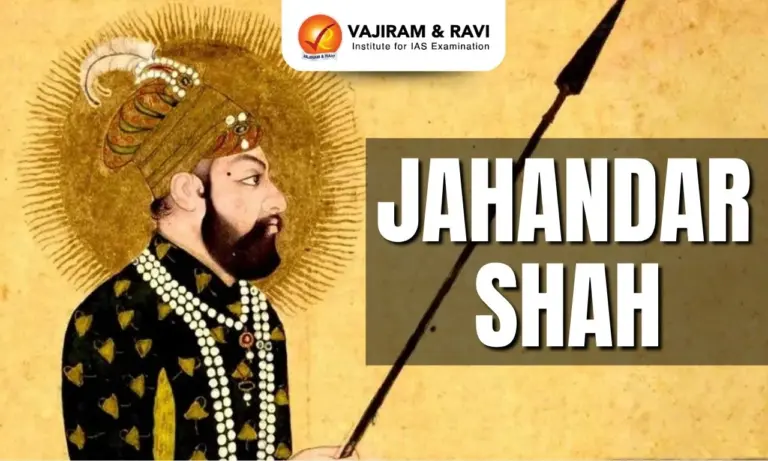
Jahandar Shah’s reign (1712-1713) marked a turning point in the decline of the Mughal Empire. Unlike his strong predecessors, he was overshadowed by his Wazir, Zulfiqar Khan, and his courtly favorites. Though marked by policy experiments like the abolition of jizya and conciliation with regional powers, his reign ultimately exposed the empire’s fragility. For UPSC preparation, Jahandar Shah’s rule shows the interplay of imperial weakness, noble dominance, and administrative experiments in the post-Aurangzeb period. In this article, we are going to cover the life of Jahandar Shah, his early life, reign and eventually his decline.
Jahandar Shah
The history of the Mughal Empire in the early 18th century is marked by rapid decline, factional struggles, and short-lived reigns. Among these rulers, Jahandar Shah occupies a unique place. Known by his full name Abu’l Fath Mu’izz-ud-Din Muhammad Jahandar Shah Sahib-i-Qiran Padshah-i-Jahan, he ruled the Mughal Empire for less than a year between 1712 and 1713. Born as Mirza Muhammad Mu’izz-ud-Din, he was the son of Emperor Bahadur Shah I and his consort Nizam Bai, the daughter of Fatehyawar Jang from Hyderabad.
Though his period of ruling was short, Jahandar Shah’s rule shows the growing influence of nobles in imperial politics, the weakening power of the Mughal throne, and experiments in revenue administration. Understanding his life and rule provides insight into the Mughal decline after Aurangzeb.
Jahandar Shah Early Life
Jahandar Shah was born in Deccan Subah during his father’s tenure there. His lineage connected him both to the grandeur of the Mughal dynasty and the aristocracy of Hyderabad through his mother.
His great-grandfather Aurangzeb had appointed him as the vizier of Balkh in 1671, giving him early administrative exposure. However, Jahandar Shah’s ambitions grew only after the death of his father, Bahadur Shah I, in February 1712.
Following Bahadur Shah’s death, his sons engaged in a bloody war of succession. Jahandar Shah and his brother Azim-ush-Shan both proclaimed themselves emperors. In the ensuing battle, Azim-ush-Shan was killed on 17 March 1712, clearing Jahandar Shah’s path to the throne.
Before becoming emperor, Jahandar Shah was known as a man of wealth and trade, having undertaken voyages across the Indian Ocean. He also served as the Subedar of Sindh. Among his children, his son Aziz-ud-Din later ruled as the Mughal Emperor (Shah Alam II) from 1754 to 1759.





Jahandar Shah’s Reign (1712–1713 AD)
The death of Bahadur Shah I plunged the Mughal court into chaos. Unlike the successions before, where the struggle was confined to princes, this phase saw nobles actively manipulating and supporting contenders.
The most powerful noble of the time, Zulfiqar Khan, also played an important role. Backed by him, Jahandar Shah emerged victorious. However, this victory also meant Jahandar Shah was dependent on Zulfiqar Khan, who virtually controlled the empire as the Wazir.
Character of Jahandar Shah
Jahandar Shah is often described by chroniclers as a weak and pleasure-loving ruler. He indulged heavily in luxury, lacked dignity, and allowed his favorite mistress, Lal Kanwar, to dominate court politics. His lack of seriousness reduced imperial prestige, further empowering ambitious nobles.
Policies under Zulfiqar Khan
Despite Jahandar Shah’s shortcomings, Zulfiqar Khan introduced pragmatic policies to stabilize the empire. This included:
- Abolition of Jizya Tax: To win Hindu support and ease tensions, the discriminatory jizya tax on non-Muslims was removed.
- Conciliation with Rajputs:
- Jai Singh of Amber was appointed Governor of Malwa and given the title of Mirza Raja Sawai.
- Ajit Singh of Marwar was made Governor of Gujarat and honored as Maharaja.
- Peace with Marathas: The Chauth and Sardeshmukhi of the Deccan were conceded to the Marathas, though collection was to be done through Mughal officials.
- Alliances with Regional Powers: Peace was made with Chhatrasal Bundela and Churaman Jat, reflecting an effort to integrate local rulers.
These moves highlight Zulfiqar Khan’s vision of balancing imperial authority with regional cooperation, though they also displayed the empire’s weakening central control.
Jahandar Shah’s Coinage
- Jahandar Shah issued gold, silver, and copper coins during his short ruling period. Some bore restored poetic couplets like Abu al-Fateh and Sahib Qiran.
- Copper coins were struck in two weight standards – 20 g and 14 g.
- The gold mohur was minted in Mustaghir ul-Mulk (meaning “Abode of the Kingdom”). His coinage reflected attempts to maintain Mughal prestige despite political instability.
Introduction of the Ijarah System
One of Jahandar Shah’s significant administrative measures was popularizing the Ijarah system of revenue farming.
- Under this system, the right to collect revenue from land was auctioned to the highest bidder.
- The bidder, or revenue farmer, was expected to pay the state nine-tenths of the revenue while retaining the remainder as profit.
- This system was used especially when peasants lacked resources or in times of crop failure.
Though revenue farming increased immediate state income, it often led to exploitation of peasants. The system became widespread in the 18th century and highlighted the fiscal distress of the Mughal Empire.
Jahandar Shah Decline
Jahandar Shah’s dependence on Zulfiqar Khan, his indulgence in pleasure, and the dominance of Lal Kanwar weakened his authority. Nobles dissatisfied with Zulfiqar Khan soon rallied behind Farrukhsiyar, another grandson of Bahadur Shah I.
In January 1713, Jahandar Shah was defeated by Farrukhsiyar with the help of the powerful Sayyid Brothers (Abdullah Khan and Hussain Ali Khan). He was captured and later executed, ending his brief period of ruling of eleven months.
Jahandar Shah UPSC
Jahandar Shah’s reign (1712-1713) reflects a crucial turning point in the decline of the Mughal Empire. Unlike his strong predecessors, he was overshadowed by his Wazir, Zulfiqar Khan, and his courtly favorites. Though marked by policy experiments like the abolition of jizya and conciliation with regional powers, his reign ultimately exposed the empire’s fragility.
For UPSC preparation, Jahandar Shah’s rule highlights the interplay of imperial weakness, noble dominance, and administrative experiments in the post-Aurangzeb period. It sets the stage for the rapid political fragmentation of the 18th century and the eventual rise of regional states.

 Last updated on March, 2026
→ UPSC Final Result 2025 is now out.
→ UPSC has released UPSC Toppers List 2025 with the Civil Services final result on its official website.
→ Anuj Agnihotri secured AIR 1 in the UPSC Civil Services Examination 2025.
→ UPSC Marksheet 2025 is now out.
→ UPSC Notification 2026 & UPSC IFoS Notification 2026 is now out on the official website at upsconline.nic.in.
→ UPSC Calendar 2026 has been released.
→ Check out the latest UPSC Syllabus 2026 here.
→ UPSC Prelims 2026 will be conducted on 24th May, 2026 & UPSC Mains 2026 will be conducted on 21st August 2026.
→ The UPSC Selection Process is of 3 stages-Prelims, Mains and Interview.
→ Prepare effectively with Vajiram & Ravi’s UPSC Prelims Test Series 2026 featuring full-length mock tests, detailed solutions, and performance analysis.
→ Enroll in Vajiram & Ravi’s UPSC Mains Test Series 2026 for structured answer writing practice, expert evaluation, and exam-oriented feedback.
→ Join Vajiram & Ravi’s Best UPSC Mentorship Program for personalized guidance, strategy planning, and one-to-one support from experienced mentors.
→ Shakti Dubey secures AIR 1 in UPSC CSE Exam 2024.
→ Also check Best UPSC Coaching in India
Jahandar Shah FAQs
Q1. Who defeated Jahandar Shah?+
Q2. Who was Jahandar Shah in the Mughal Empire?+
Q3. How long did Jahandar Shah rule?+
Q4. What were the reasons for the decline of the Mughal Empire?+
Q5. Who was Zulfiqar Khan?+
Tags: jahandar shah