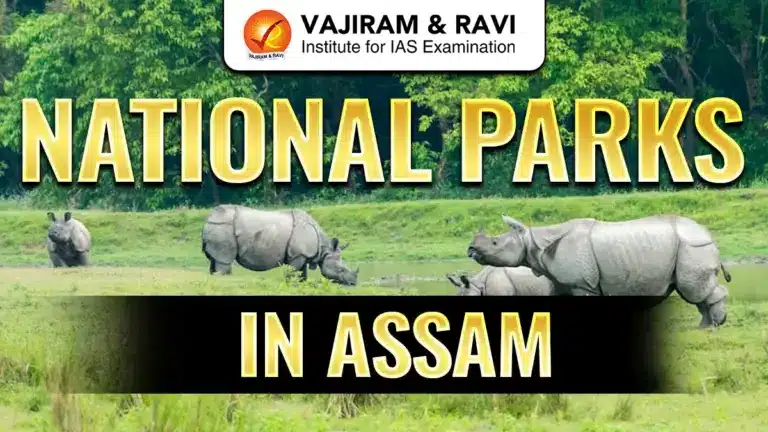
National Parks in Assam and other protected areas are legally notified regions created to conserve wildlife, forests, wetlands, and natural ecosystems. They restrict human activities like hunting, logging, and settlement. The biodiversity is protected through National Parks in India, Wildlife Sanctuaries, Tiger Reserves, Biosphere Reserves, Ramsar wetlands, and Elephant Reserves, ensuring habitat security, ecological balance, climate regulation, and long-term survival of endangered flora and fauna.
Protected Areas in Assam
The Protected Areas in Assam safeguards ecosystems across forests, wetlands, and floodplains. These include:
- National Parks: 8 legally notified parks protect core ecosystems.
- Wildlife Sanctuaries: 20 sanctuaries including proposed areas.
- Tiger Reserves: 3 reserves under Project Tiger.
- Biosphere Reserves: Manas and Dibru-Saikhowa designated.
- World Heritage Sites: Kaziranga and Manas recognised globally.
- Ramsar Site: Deepor Beel listed for wetland conservation.
- Important Bird Areas: 46 Important Bird Areas identified.
- Elephant Reserves: 5 notified elephant landscapes.
National Parks in Assam
Assam is one of India’s richest biodiversity states, located in the Eastern Himalayas and Brahmaputra floodplains. It hosts grasslands, wetlands, tropical forests, and river ecosystems. Assam has eight National Parks, two Biosphere Reserves, three Tiger Reserves, one Ramsar Site, and forty six Important Bird Areas, making it a global conservation hotspot.

Kaziranga National Park
Kaziranga represents the Brahmaputra floodplain grassland ecosystem and supports the world’s largest population of one-horned rhinoceros.
- Location and Landscape: Situated across Nagaon, Golaghat, and Sonitpur districts along Brahmaputra floodplains.
- Global Significance: Holds over seventy percent of the world’s one-horned rhinoceros population.
- Tiger Prey Base: Highest prey biomass density supporting strong tiger populations in India.
- Big Five Census: Recorded rhino 1855, wild buffalo 1431, elephant 1246, tiger 85.
- Unique Mammals: Eastern swamp deer survives only here within India.
- Bird Diversity: Home to 480 recorded bird species including 25 globally threatened.
- Aquatic Systems: Contains over 150 perennial water bodies supporting fish breeding.
- Floral Diversity: Supports more than 32 aquatic plant species.
- Reptile Presence: Hosts seven turtle and tortoise species.
- Tourism Value: Elephant and jeep safaris enable close wildlife observation.
Manas National Park
Manas lies in Himalayan foothills and showcases exceptional natural beauty with high biodiversity richness.
- Geographical Setting: Located in western Assam’s bhabar foothill zone along Bhutan border.
- Protected Status: Declared Tiger Reserve, National Park, Biosphere Reserve, World Heritage Site.
- Area Coverage: National Park covers 500 square kilometres.
- Species Protection: Hosts over twenty-two Schedule I endangered species.
- UNESCO Value: Recognised for outstanding natural beauty and ecological processes.
- Mammal Diversity: Nearly sixty mammal species recorded.
- Bird Richness: Over five hundred bird species documented.
- Floral Composition: Contains eighty-nine tree species and forty-nine shrubs.
- Butterfly Diversity: Supports more than two hundred butterfly species.
- Aquatic Fauna: Records seventy-nine fish species including rare turtles.
Dibru-Saikhowa National Park
Dibru-Saikhowa is a riverine biosphere reserve shaped by Brahmaputra dynamics.
- Area and Status: Covers 340 square kilometres as National Park and Biosphere Reserve.
- Unique Habitat: Formed after the 1950 Assam earthquake.
- Mammal Records: Thirty-six mammal species including feral horses.
- Aquatic Mammals: Supports Gangetic river dolphins.
- Bird Importance: Recognised Important Bird Area with 382 bird species.
- Migratory Birds: Major wintering site for long-distance migratory birds.
- Wetland Ecology: Extensive river islands and marsh ecosystems.
- Vegetation Feature: Noted for natural regeneration of Salix trees.
- Reptile Presence: Hosts turtles and diverse wetland reptiles.
- Conservation Role: Protects floodplain biodiversity under dynamic river systems.
Nameri National Park
Nameri protects riverine forests along Assam-Arunachal border.
- Location: Situated in Sonitpur district adjoining Arunachal Pradesh.
- Area: National Park covers 200 square kilometres.
- Tiger Reserve Core: Forms core zone of Nameri Tiger Reserve.
- River System: Jia Bhoroli river defines southwestern boundary.
- Mammal Diversity: Supports tiger, elephant, gaur, and dhole.
- Rare Species: Habitat for hispid hare and slow loris.
- Bird Significance: Known for white-winged wood duck.
- Raptors Presence: Records fish eagles and vultures.
- Reptile Diversity: Includes king cobra and softshell turtles.
- Eco-tourism: Popular for regulated river rafting activities.
Orang National Park
Orang represents floodplain grassland biodiversity on Brahmaputra’s northern bank.
- Historical Status: Oldest declared game reserve in Assam.
- Area: Covers 78.80 square kilometres.
- Breeding Ground: Important fish breeding habitat.
- Key Mammals: Supports rhinoceros and tiger populations.
- Elephant Groups: Known for male elephant bachelor herds.
- Bird Diversity: Records 222 bird species.
- Florican Habitat: Second-highest Bengal florican concentration.
- Reptiles: Hosts python and king cobra.
- Turtles: Supports seven turtle and tortoise species.
- Riverine Ecology: Maintains Brahmaputra floodplain ecosystem integrity.
Dehing Patkai National Park
Dehing Patkai protects Assam Valley tropical wet evergreen forests.
- Area: Covers 111.19 square kilometres.
- Location: Spread across Dibrugarh and Tinsukia districts.
- Forest Type: Known for dense wet evergreen forests.
- Elephant Reserve: Part of Dehing-Patkai Elephant Reserve.
- Rare Mammals: Habitat for Chinese pangolin and clouded leopard.
- Primate Diversity: Supports hoolock gibbon and macaques.
- Bird Species: Hosts hornbills and rare forest birds.
- Reptile Presence: Includes king cobra and monitor lizard.
- Historic Landmarks: Near Stillwell Road and Digboi refinery.
- Conservation Value: Protects eastern Himalayan forest biodiversity.
Raimona National Park
Raimona forms a transboundary forest landscape in Bodoland.
- Geographical Spread: Located along Indo-Bhutan international boundary.
- Connectivity: Links Bhutan and West Bengal protected areas.
- Vegetation: Moist deciduous and semi-evergreen forests dominate.
- Flagship Species: Asian elephant and Bengal tiger present.
- Golden Langur: Endemic endangered primate and Bodoland mascot.
- Avifauna: Supports white-bellied heron and Bengal florican.
- River Boundaries: Defined by Sankosh and Saralbhanga rivers.
- Landscape Role: Acts as ecological corridor.
- Forest Integrity: Maintains Himalayan foothill ecosystems.
- Biodiversity Value: Protects rare fauna across political borders.
Sikhna Jwhwlao National Park
Sikhna Jwhwlao strengthens Bodoland’s conservation network.
- Notification Year: Declared National Park in 2025.
- Area Coverage: Encompasses 316.29 square kilometres.
- Regional Importance: Third National Park in Bodoland.
- Biosphere Link: Part of Manas Biosphere Reserve.
- Ecological Corridor: Connects four protected forest landscapes.
- Butterfly Diversity: Records over 460 butterfly species.
- Flagship Mammals: Supports tiger, rhinoceros, elephant.
- Primate Species: Habitat for golden langur.
- Border Location: Lies along Indo-Bhutan boundary.
- Conservation Status: Enhances protected area coverage in Assam.





Tiger Reserves in Assam
Assam hosts three tiger reserves protecting grassland and forest tigers. Assam has three Tiger Reserves: Kaziranga, Manas and Nameri, protecting floodplain grasslands, riverine forests, and Himalayan foothills. These reserves conserve high tiger prey density, transboundary habitats, elephants, and rich biodiversity under Project Tiger, strengthening long-term wildlife protection.
- Manas Tiger Reserve
- Nameri Tiger Reserve
- Kaziranga Tiger Reserve
Manas Tiger Reserve
Manas Tiger Reserve protects transboundary tiger populations.
- Established: 1973; covering 2837.12 square kilometres.
- Landscape: Himalayan foothill forests and grasslands.
- Tiger Count: Thirty-one tigers recorded in 2016-17.
- Elephant Presence: Over one thousand elephants documented.
Nameri Tiger Reserve
Nameri secures riverine forest tigers.
- Declared: 2000; spanning 344 square kilometres.
- Core Area: National Park forms reserve core.
- Habitat Type: Riverine forests and grasslands.
- Species Protection: Supports tiger prey species.
Kaziranga Tiger Reserve
Kaziranga safeguards floodplain tigers.
- Notified: 2006; covering 858.98 square kilometres.
- High Prey Density: Supports India’s richest tiger prey base.
- Landscape: Grassland and wetland mosaic.
- Tiger Security: Ensures long-term tiger viability.
Wildlife Sanctuaries in Assam
Wildlife Sanctuaries complement National Parks by protecting specific habitats and species. Assam’s sanctuaries cover grasslands, wetlands, hill forests, and floodplains. They conserve endangered mammals, migratory birds, orchids, primates, reptiles, amphibians, and fishes. Many sanctuaries act as ecological corridors supporting seasonal wildlife movement during floods, particularly between Kaziranga, Karbi Anglong, and riverine landscapes.
Wildlife Sanctuaries in Assam List
The wildlife sanctuaries of Assam conserve diverse ecosystems and species. There are total 20 sanctuaries in Assam, as listed below:
- Garampani Wildlife Sanctuary: Hot springs and orchids support elephant, tiger, and hornbills.
- Laokhowa Wildlife Sanctuary: Floodplain grasslands support rhinoceros and wild buffalo populations.
- Bornadi Wildlife Sanctuary: Created for pygmy hog and hispid hare conservation.
- Chakrasila Wildlife Sanctuary: Second natural habitat of golden langur.
- Burachapori Wildlife Sanctuary: Grassland mosaic supports Bengal florican.
- Panidehing Wildlife Sanctuary: Wetland attracts migratory waterfowl concentrations.
- Hollongapar Gibbon Sanctuary: Protects India’s only ape species.
- Pabitora Wildlife Sanctuary: World’s highest rhino density recorded.
- Sonai Rupai Wildlife Sanctuary: Himalayan foothill forests with elephants.
- Bherjan-Borajan-Padumoni Sanctuary: Primate-rich fragmented forest blocks.
- East Karbi Anglong Sanctuary: Kaziranga landscape connectivity zone.
- Nambor Wildlife Sanctuary: Orchid-rich tropical forests.
- Marat Longri Sanctuary: Elephant reserve component.
- Nambor-Doigrung Sanctuary: Hot springs and gaur habitat.
- Amchang Wildlife Sanctuary: Urban fringe forest near Guwahati.
- Dehing Patkai Sanctuary: Wet evergreen forest biodiversity.
- Borail Wildlife Sanctuary: Moist evergreen hill forests.
- Deepor Beel Sanctuary: Wetland bird habitat near Guwahati.
- Bordoibam Bilmukh Sanctuary: Proposed bird breeding sanctuary.
- North Karbi Anglong Sanctuary: Flood refuge for Kaziranga wildlife.
Ramsar Sites in Assam
Assam has one internationally recognised Ramsar wetland at Deepor Beel declared in 2002 and covering 4.1 square kilometres of area. Its features are:
- Wetland Type: Permanent freshwater lake of Brahmaputra paleo-channel.
- Bird Richness: Records over 219 bird species.
- Migratory Birds: Hosts Siberian crane and waterfowl.
- Fish Diversity: Over fifty commercially viable fish species.
- Floral Diversity: Supports giant water lily and hydrophytes.
- Conservation Value: Important Bird Area of global priority.

 Last updated on April, 2026
→ UPSC Final Result 2025 is now out.
→ UPSC has released UPSC Toppers List 2025 with the Civil Services final result on its official website.
→ Anuj Agnihotri secured AIR 1 in the UPSC Civil Services Examination 2025.
→ UPSC Marksheet 2025 is now out.
→ UPSC Notification 2026 & UPSC IFoS Notification 2026 is now out on the official website at upsconline.nic.in.
→ UPSC Calendar 2026 has been released.
→ Check out the latest UPSC Syllabus 2026 here.
→ UPSC Prelims 2026 will be conducted on 24th May, 2026 & UPSC Mains 2026 will be conducted on 21st August 2026.
→ The UPSC Selection Process is of 3 stages-Prelims, Mains and Interview.
→ Prepare effectively with Vajiram & Ravi’s UPSC Prelims Test Series 2026 featuring full-length mock tests, detailed solutions, and performance analysis.
→ Enroll in Vajiram & Ravi’s UPSC Mains Test Series 2026 for structured answer writing practice, expert evaluation, and exam-oriented feedback.
→ Join Vajiram & Ravi’s Best UPSC Mentorship Program for personalized guidance, strategy planning, and one-to-one support from experienced mentors.
→ Shakti Dubey secures AIR 1 in UPSC CSE Exam 2024.
→ Also check Best UPSC Coaching in India
National Parks in Assam FAQs
Q1. How many National Parks are there in Assam?+
Q2. Which is the most famous National Park in Assam?+
Q3. Which National Parks in Assam are UNESCO World Heritage Sites?+
Q4. Which National Park in Assam has the highest bird diversity?+
Q5. Which is the latest National Park in Assam?+
Tags: national parks in assam