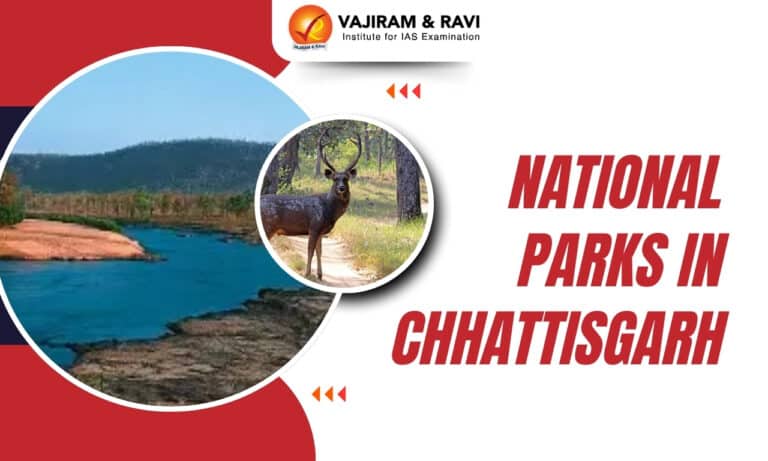
A National Park in Chhattisgarh is a protected natural area where forests, wildlife, rivers, and landscapes are conserved by law to prevent damage and ensure long term ecological balance within the State. Other protected areas include Wildlife Sanctuaries, Tiger Reserves, and Biosphere Reserves, which allow varying degrees of human activity. Together, these areas safeguard forests, rivers, flora-fauna, and endangered species while supporting scientific research, climate resilience, and sustainable livelihoods for forest-dependent communities.
Protected Areas in Chhattisgarh
Chhattisgarh has an extensive protected area network conserving Central India’s forests, rivers, wildlife corridors, and endangered species.
- National Parks: Legally protected core conservation zones with strict ecological safeguards.
- Tiger Reserves: Landscapes managed for tiger conservation and prey population recovery.
- Wildlife Sanctuaries: Areas allowing limited human use while protecting wildlife habitats.
- Biosphere Reserves: Large ecological regions balancing conservation, research, and livelihoods.
- Ramsar Wetlands: Internationally recognized wetlands important for biodiversity and water security.
National Parks in Chhattisgarh
Chhattisgarh has three National Parks in India that represent diverse forest types, river systems, and wildlife assemblages of Central India. These parks protect dry and moist deciduous forests dominated by sal, teak, and bamboo. They are ecologically significant for conserving endangered species like wild water buffalo and tigers while maintaining wildlife corridors connecting Madhya Pradesh, Jharkhand, Odisha, and Maharashtra. Rivers flowing through these parks support regional hydrology and biodiversity. Together, these national parks form the ecological backbone of Chhattisgarh’s conservation landscape.
Sanjay (Guru Ghasidas) National Park
Sanjay National Park, officially known as Guru Ghasidas National Park, lies across Chhattisgarh and Madhya Pradesh within the Narmada Valley ecosystem.
- Location: Situated near Ambikapur, Manendragarh, and Chirimiri in northern Chhattisgarh.
- Establishment: Notified as a national park in 1981 for large-scale forest conservation.
- Landscape: Part of the Narmada Valley with undulating terrain and dry deciduous forests.
- Vegetation: Dominated by sal and bamboo forests supporting diverse herbivore populations.
- Fauna: Home to tigers, leopards, sambar, chital, nilgai, chinkara, wild boar, monitor lizards.
- Rivers: Drained by Banas, Gopad, Mawai, Mahan, Kodmar, and Umrari rivers.
- Historical Significance: Last known Indian habitat of the Asiatic cheetah.
- Connectivity: Forms a vital corridor linking Bandhavgarh and Palamau Tiger Reserves.
Indravati National Park
Indravati National Park is located in southern Chhattisgarh and is one of the most biodiversity-rich forest landscapes in India.
- Location: Situated in Bijapur district, bordering Odisha and Telangana forest regions.
- River Boundary: Named after the Indravati River forming its northern boundary.
- Vegetation: Tropical moist and dry deciduous forests with bamboo, sal, and teak.
- Flagship Species: Supports one of India’s last wild water buffalo populations.
- Mammals: Tigers, gaur, blackbuck, chausingha, sambar, chital, Indian muntjac.
- Birdlife: Habitat of Bastar hill myna, the state bird of Chhattisgarh.
- Reptiles: Presence of freshwater crocodiles in riverine ecosystems.
Kanger Valley National Park
Kanger Valley National Park, also called Kanger Ghati National Park, represents unique limestone landscapes and dense forests.
- Location: Located in the Bastar region near Jagdalpur town.
- River System: Named after the Kanger River flowing through the park.
- Geology: Known for limestone caves such as Kotumsar Caves.
- Extent: Stretches from Tirathgarh Waterfalls to the Kolab River near Odisha border.
- Vegetation: Rich sal, teak, and bamboo forests.
- Mammals: Tigers, leopards, sloth bears, mouse deer, sambar, barking deer.
- Birdlife: Hill myna, spotted owlet, and steppe eagles recorded.
- Reptiles: Freshwater crocodiles inhabit perennial river stretches.





Tiger Reserves in Chhattisgarh
Chhattisgarh has four notified tiger reserves forming a critical part of the Central Indian tiger landscape, ensuring habitat connectivity and genetic flow. There are total 4 Tiger Reserves in Chhattisgarh as of 2025:
- Achanakmar Tiger Reserve
- Indravati Tiger Reserve
- Udanti-Sitanadi Tiger Reserve
- Sanjay-Dubri Tiger Reserve
Indravati Tiger Reserve
Indravati Tiger Reserve protects dense forests and riverine habitats crucial for endangered wildlife.
- Location: Situated in Bijapur district of southern Chhattisgarh.
- River System: Indravati River defines its northern ecological boundary.
- Vegetation: Tropical moist and dry deciduous forests.
- Key Species: Tigers, wild water buffalo, gaur, chital, sambar.
- Avifauna: Bastar hill myna widely recorded across forest tracts.
Udanti-Sitanadi Tiger Reserve
Udanti-Sitanadi Tiger Reserve represents a unique merged conservation landscape in central Chhattisgarh.
- Formation: Created during 2008-09 by combining Udanti and Sitanadi sanctuaries.
- Location: Lies in Gariaband district of Chhattisgarh.
- River Systems: Sitanadi and Udanti rivers feed forest ecosystems.
- Vegetation: Tropical dry deciduous mixed forests dominated by sal.
- Wildlife: Tigers, wild water buffalo, chital, sambar, chausingha.
Sanjay-Dubri Tiger Reserve Tiger Reserve
Sanjay-Dubri Tiger Reserve forms a transboundary conservation corridor in Central India.
- Composition: Includes Sanjay National Park and Dubri Wildlife Sanctuary.
- Location: Spreads across Chhattisgarh and Madhya Pradesh.
- Connectivity: Links Bandhavgarh and Palamau tiger landscapes.
- Vegetation: Dry deciduous forests with sal and bamboo dominance.
- Fauna: Tigers, leopards, nilgai, sambar, chinkara.
Achanakmar Tiger Reserve
Achanakmar Tiger Reserve is a biologically rich forested plateau supporting multiple river systems.
- Location: Lies across Chhattisgarh and Madhya Pradesh.
- Biosphere Status: Part of Achanakmar-Amarkantak Biosphere Reserve.
- Topography: Bauxite-rich soils of the Amarkantak plateau.
- Hydrology: Maniyari River flows centrally, sustaining forest life.
- Rivers Origin: Source of Narmada, Son, and Johilla rivers.
- Vegetation: Dry deciduous forests with sal and bamboo.
- Fauna: Tigers, leopards, gaur, chital, blackbuck, chinkara.
- Connectivity: Linked to Kanha Tiger Reserve via Kanha-Achanakmar Corridor.
Wildlife Sanctuaries in Chhattisgarh
Chhattisgarh hosts a wide network of wildlife sanctuaries conserving forests, grasslands, riverine ecosystems, and wildlife corridors. These sanctuaries play a vital role in protecting endangered species, supporting elephant and tiger movements, and preserving ecological connectivity across Central India. Many sanctuaries safeguard important rivers, originate tributaries, and maintain forest-based livelihoods. They complement national parks and tiger reserves by acting as buffer zones and stepping-stone habitats crucial for long-term biodiversity conservation.
Wildlife Sanctuaries in Chhattisgarh List
Chhattisgarh’s major wildlife sanctuaries protect varied landscapes from hills to river valleys.
- Achanakmar Wildlife Sanctuary: Part of biosphere reserve with sal forests and tiger movement corridors.
- Badalkhol Wildlife Sanctuary: Located in Ramgarh Hills, acting as tiger corridor to Palamau.
- Barnawapara Wildlife Sanctuary: Bounded by Mahanadi and Jonk rivers with dry deciduous forests.
- Bhairamgarh Wildlife Sanctuary: Separated from Indravati National Park by the Indravati River.
- Bhoramdev Wildlife Sanctuary: Maikal Hills corridor between Kanha and Achanakmar reserves.
- Gomardha Wildlife Sanctuary: Located near Sarangarh, conserving regional forest biodiversity.
- Pamed Wildlife Sanctuary: Established to protect wild buffalo in Dantewada district.
- Semarsot Wildlife Sanctuary: Ramgarh Hills sanctuary sharing border with Bihar.
- Sitanadi Wildlife Sanctuary: Named after Sitanadi River, supporting tiger habitats.
- Tamor Pingla Wildlife Sanctuary: Part of Surguja-Jashpur elephant reserve landscape.
- Udanti Wildlife Sanctuary: Critical habitat for endangered wild water buffalo.
Ramsar Site in Chhattisgarh
Kopra Reservoir is Chhattisgarh’s first Ramsar-recognized wetland, highlighting its international ecological importance.
- Location: Situated in Baloda Bazar-Bhatapara and Bilaspur region.
- Wetland Type: Freshwater reservoir developed from irrigation infrastructure.
- Bird Diversity: Recorded 161 bird species including 58 migratory species.
- Threatened Birds: Egyptian vulture endangered; woolly-necked stork vulnerable.
- Vegetation: Aquatic plants like Ipomea and Cyperaceae support food chains.
- Ecological Role: Enhances water security, biodiversity protection, and climate resilience.

 Last updated on April, 2026
→ UPSC Final Result 2025 is now out.
→ UPSC has released UPSC Toppers List 2025 with the Civil Services final result on its official website.
→ Anuj Agnihotri secured AIR 1 in the UPSC Civil Services Examination 2025.
→ UPSC Marksheet 2025 is now out.
→ UPSC Notification 2026 & UPSC IFoS Notification 2026 is now out on the official website at upsconline.nic.in.
→ UPSC Calendar 2026 has been released.
→ Check out the latest UPSC Syllabus 2026 here.
→ UPSC Prelims 2026 will be conducted on 24th May, 2026 & UPSC Mains 2026 will be conducted on 21st August 2026.
→ The UPSC Selection Process is of 3 stages-Prelims, Mains and Interview.
→ Prepare effectively with Vajiram & Ravi’s UPSC Prelims Test Series 2026 featuring full-length mock tests, detailed solutions, and performance analysis.
→ Enroll in Vajiram & Ravi’s UPSC Mains Test Series 2026 for structured answer writing practice, expert evaluation, and exam-oriented feedback.
→ Join Vajiram & Ravi’s Best UPSC Mentorship Program for personalized guidance, strategy planning, and one-to-one support from experienced mentors.
→ Shakti Dubey secures AIR 1 in UPSC CSE Exam 2024.
→ Also check Best UPSC Coaching in India
National Parks in Chhattisgarh FAQs
Q1. How many national parks are there in Chhattisgarh?+
Q2. Which is the largest national park in Chhattisgarh?+
Q3. Which national park in Chhattisgarh is famous for wild water buffalo?+
Q4. Which national park of Chhattisgarh has limestone caves?+
Q5. Which rivers flow through national parks in Chhattisgarh?+
Tags: national parks in chhattisgarh