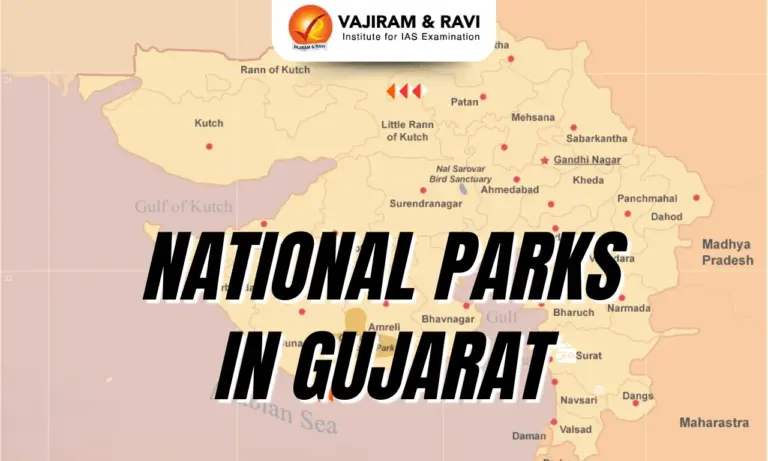
National Parks in Gujarat are legally protected areas dedicated to conserving wild flora, fauna, and natural landscapes with minimal human interference. In National Parks in India, such regions are notified under Section 35 of the Wildlife (Protection) Act 1972, providing them the highest level of protection compared to other categories like wildlife sanctuaries; activities such as grazing or resource extraction are strictly prohibited to maintain ecological integrity. National parks typically cover large ecosystems where biodiversity is preserved for scientific research, education, and controlled eco-tourism, helping sustain natural processes and endangered species habitats.
Protected Areas in Gujarat
Gujarat has an extensive protected area network safeguarding terrestrial, grassland, wetland, desert, and marine ecosystems across diverse climatic zones.
- Total protected areas: Gujarat has 27 protected wildlife areas managed by the Forest Department.
- National Parks count: The state hosts four officially notified National Parks.
- Wildlife Sanctuaries count: Gujarat has 23 notified Wildlife Sanctuaries.
- Ecosystem diversity: Protected areas cover forests, grasslands, deserts, wetlands, and marine habitats.
- Flagship species focus: Conservation emphasizes lions, wild asses, bustards, marine fauna, and migratory birds.
National Parks in Gujarat
Gujarat has four National Parks that represent distinct ecological landscapes, ranging from dry deciduous forests and tropical grasslands to coastal and marine ecosystems. These parks are vital for conserving globally significant species such as the Asiatic lion, blackbuck antelope, coral reef organisms, and marine mammals. Each park is notified with strict protection status, limiting human interference. Together, they strengthen Gujarat’s position as one of India’s most biodiversity-rich states, despite its largely arid and semi-arid geography.
Gir National Park
Gir National Park is globally renowned as the only natural habitat of the Asiatic lion, making it one of India’s most important conservation landscapes.
- Location: Situated in Kathiawar Peninsula between Girnar Hills and Arabian Sea.
- Notification status: Declared sanctuary in 1965 and National Park in 1975.
- Vegetation type: Dominated by dry deciduous forests with teak and acacia.
- Key water source: Kamleshwar Dam on Hiran River sustains wildlife year-round.
- Flagship species: Asiatic lion, listed as Endangered on IUCN Red List.
- Other mammals: Leopard, sambar, chital, chausingha, chinkara, and blackbuck.
- Reptile diversity: Mugger crocodile thrives in rivers and reservoirs.
- Conservation challenges: Floods, genetic bottleneck, poaching, and human-lion conflict.
Velavadar National Park
Velavadar National Park protects one of India’s finest tropical grassland ecosystems and supports large populations of endangered grassland fauna.
- Location: Situated in Bhal region of Saurashtra near Gulf of Khambhat.
- Habitat type: Semi-arid savanna grassland with open plains.
- Flagship species: Blackbuck antelope, a symbol of grassland conservation.
- Mammal diversity: Hyenas, jungle cats, and foxes inhabit grassland edges.
- Bird significance: Lesser florican, a critically endangered bustard species.
- Ecological role: Represents remaining natural grassland ecosystems of western India.
Marine National Park
Marine National Park conserves India’s earliest marine protected ecosystem, safeguarding coral reefs and coastal biodiversity.
- Location: Located in Gulf of Kachchh between Okha and Jodiya coastlines.
- Unique status: India’s first Marine Wildlife Sanctuary and Marine National Park.
- Geographic feature: Comprises 42 tropical islands along Jamnagar coast.
- Coral diversity: Hard and soft coral reefs around Pirotan and Narara islands.
- Marine fauna: Green turtles, olive ridleys, dugongs, dolphins, and reef fishes.
- Conservation threats: Industrial pollution, coral extraction, and mechanized fishing.
Vansda National Park
Vansda National Park preserves moist deciduous forests of southern Gujarat’s tribal belt within the Western Ghats foothills.
- Location: Situated in Navsari district along Ambika River banks.
- Ecological zone: Part of the Dangs forest landscape of Western Ghats.
- Vegetation type: Moist and dry deciduous forests with bamboo and teak.
- Mammal species: Leopard, rhesus macaque, civet, and chausingha.
- Unique fauna: Rare Indian giant squirrel found in dense canopy forests.
- Cultural link: Inhabited by Bhil, Warli, Gamit, and Kunbi tribal communities.





Wildlife Sanctuaries in Gujarat
Wildlife Sanctuaries in Gujarat protect specific species and habitats while allowing limited human activity. These sanctuaries conserve deserts, grasslands, forests, wetlands, and coastal ecosystems. Gujarat’s sanctuaries support endangered species like the Great Indian Bustard, sloth bear, Indian wild ass, and migratory birds along the Central Asian Flyway. Many sanctuaries also serve as ecological corridors connecting major forest landscapes and ensuring genetic exchange among wildlife populations.
Wildlife Sanctuaries in Gujarat List
- Balaram Ambaji Sanctuary: Dry deciduous forests protecting sloth bear and leopard near Aravalli ranges.
- Barda Sanctuary: Floristically rich Saurashtra forest proposed as second home for lions.
- Gaga Sanctuary: Coastal grassland conserving critically endangered Great Indian Bustard.
- Girnar Sanctuary: Hill ecosystem forming lion corridor between Gir forests.
- Jessore Sloth Bear Sanctuary: Aravalli foothill sanctuary protecting sloth bear populations.
- Kutch Bustard Sanctuary: Desert grassland safeguarding Great Indian Bustard breeding areas.
- Kutch Desert Sanctuary: Vast saline wetland supporting flamingo breeding colonies.
- Nal Sarovar Bird Sanctuary: Largest wetland sanctuary hosting over 250 bird species.
- Narayan Sarovar Sanctuary: Arid ecosystem protecting chinkara and desert biodiversity.
- Purna Sanctuary: Western Ghats forest protecting riverine and hill ecosystems.
- Shoolpaneshwar Sanctuary: Satpura forests supporting riverine biodiversity near Narmada.
- Thol Lake Sanctuary: Man-made wetland hosting migratory waterbirds near Ahmedabad.
- Wild Ass Sanctuary: Little Rann ecosystem protecting world’s last Indian wild ass population.
- Khijadiya Sanctuary: Freshwater and saline wetland supporting migratory waterbirds.
- Mitiyala Sanctuary: Grassland corridor connecting Gir lion landscapes.
- Porbandar Bird Sanctuary: Urban wetland protecting nesting and migratory birds.
- Ratanmahal Sanctuary: Sloth bear habitat along Gujarat-Madhya Pradesh border.
- Marine Sanctuary: Coastal waters protecting coral reefs and marine species.
- Hingolgadh Sanctuary: Dry forest supporting grassland and thorn scrub fauna.
- Jambughoda Sanctuary: Forested hills protecting leopards and ungulates.
- Rampara Sanctuary: Small dry forest preserving local biodiversity.
- Nalsarovar Satellite Wetlands: Peripheral marshes supporting migratory birds.
- Wadhvana Sanctuary Zone: Wetland area supporting wintering waterbirds.
Ramsar Site in Gujarat
Gujarat hosts internationally recognized Ramsar wetlands critical for migratory birds, water security, and wetland biodiversity.
- Khijadiya Wetland: Coastal freshwater and saline marsh ecosystem near Jamnagar.
- Nalsarovar Wetland: Largest natural freshwater lake in Gujarat’s semi-arid zone.
- Thol Lake Wetland: Man-made reservoir supporting migratory and resident waterbirds.
- Wadhvana Wetland: Irrigation reservoir supporting wintering migratory birds.
Khijadiya
Khijadiya Wetland is a unique coastal Ramsar site supporting freshwater lakes, salt marshes, mangroves, and migratory birds.
- Location: Situated near Jamnagar along Gulf of Kachchh coast.
- Ecosystem type: Combination of freshwater lakes and saline marshlands.
- Bird diversity: Over 300 migratory and resident bird species recorded.
- Flyway importance: Lies on Central Asian Flyway migration route.
- Threatened species: Pallas’s fish eagle and Indian skimmer recorded.
Nalsarovar
Nalsarovar is Gujarat’s largest freshwater Ramsar wetland and a major wintering ground for migratory birds.
- Location: Situated 64 kilometers west of Ahmedabad near Sanand.
- Wetland size: Covers over 120 square kilometers including marshes.
- Avifauna richness: Supports more than 250 wetland bird species.
- Mammal presence: Provides habitat to blackbuck and Indian wild ass.
- International status: Declared Ramsar site in 2012.
Thol Lake
Thol Lake is a man-made Ramsar wetland that supports high waterbird diversity near Ahmedabad.
- Location: Situated in Mehsana district near Thol village.
- Origin: Built as irrigation tank during Gaekwad rule in 1912.
- Bird diversity: Hosts around 150 bird species annually.
- Key species: Flamingos and sarus cranes breed and winter here.
- Ramsar status: Designated as Ramsar site in 2021.
Wadhvana Wetland
Wadhvana Wetland is an internationally important Ramsar site supporting migratory waterbirds along Central Asian Flyway.
- Location: Situated near Dabhoi in Vadodara district.
- Formation: Created by irrigation dam constructed in 1910.
- Bird importance: Supports endangered pelicans and fish eagles.
- Rare species: Red-crested pochard regularly recorded in winter.
- Ramsar status: Declared Ramsar wetland in 2021.

 Last updated on April, 2026
→ UPSC Final Result 2025 is now out.
→ UPSC has released UPSC Toppers List 2025 with the Civil Services final result on its official website.
→ Anuj Agnihotri secured AIR 1 in the UPSC Civil Services Examination 2025.
→ UPSC Marksheet 2025 is now out.
→ UPSC Notification 2026 & UPSC IFoS Notification 2026 is now out on the official website at upsconline.nic.in.
→ UPSC Calendar 2026 has been released.
→ Check out the latest UPSC Syllabus 2026 here.
→ UPSC Prelims 2026 will be conducted on 24th May, 2026 & UPSC Mains 2026 will be conducted on 21st August 2026.
→ The UPSC Selection Process is of 3 stages-Prelims, Mains and Interview.
→ Prepare effectively with Vajiram & Ravi’s UPSC Prelims Test Series 2026 featuring full-length mock tests, detailed solutions, and performance analysis.
→ Enroll in Vajiram & Ravi’s UPSC Mains Test Series 2026 for structured answer writing practice, expert evaluation, and exam-oriented feedback.
→ Join Vajiram & Ravi’s Best UPSC Mentorship Program for personalized guidance, strategy planning, and one-to-one support from experienced mentors.
→ Shakti Dubey secures AIR 1 in UPSC CSE Exam 2024.
→ Also check Best UPSC Coaching in India
National Parks in Gujarat FAQs
Q1. How many National Parks are there in Gujarat?+
Q2. Which National Park in Gujarat is famous for Asiatic lions?+
Q3. Which National Park in Gujarat protects marine biodiversity?+
Q4. Which National Park in Gujarat is known for grassland ecosystems?+
Q5. Which National Park in Gujarat is located in the Western Ghats region?+
Tags: national parks in gujarat