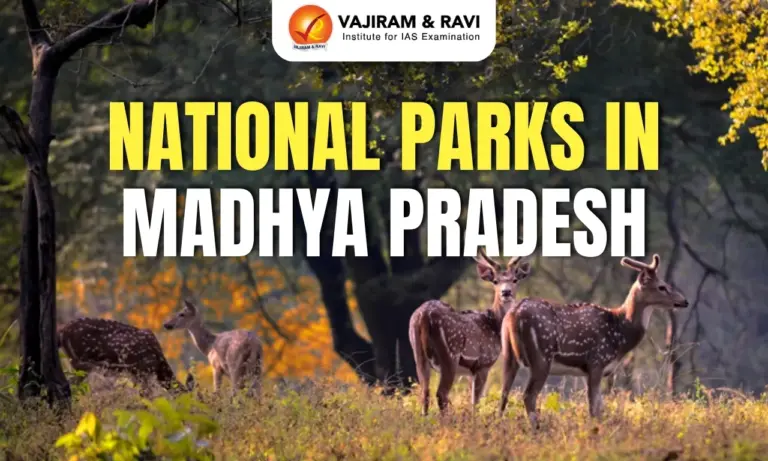
National Parks in Madhya Pradesh are established to conserve natural ecosystems, wildlife species, and ecological processes over long periods. According to the IUCN, these areas are clearly defined geographical spaces managed through legal means to protect biodiversity, ecosystem services, and cultural values. National Parks in India focus on strict protection with minimal human interference, while other protected areas like wildlife sanctuaries allow regulated activities such as tourism, research, and habitat management to ensure sustainable conservation outcomes.
Protected Areas in Madhya Pradesh
Madhya Pradesh has one of India’s largest protected area networks supporting forests, rivers, wildlife corridors, and endangered species.
- National Parks: Strictly protected ecosystems conserving flagship species and habitats.
- Wildlife Sanctuaries: Managed areas allowing controlled human activities and conservation interventions.
- Tiger Reserves: Landscapes protected under Project Tiger for long-term tiger survival.
- Biosphere Reserves: Large ecological zones integrating conservation with community livelihoods.
- Ramsar Sites: Internationally important wetlands conserving waterbirds and freshwater ecosystems.
National Parks in Madhya Pradesh
Madhya Pradesh hosts 11 National Parks, making it a biodiversity stronghold in central India. These parks span the Vindhya, Satpura, and Maikal ranges and protect forests, grasslands, wetlands, and fossil beds. They support Bengal tigers, leopards, barasingha, gharials, rare birds, and prehistoric fossils. The parks play a vital role in wildlife conservation, ecological connectivity, climate regulation, and eco-tourism, contributing significantly to India’s tiger population and protected area-based livelihoods.
Bandhavgarh National Park
Bandhavgarh National Park, located in the Vindhya Range of Umaria district, is globally known for the highest recorded density of Bengal tigers and strong historical significance.
- Location: Vindhya Range, Umaria district, eastern Madhya Pradesh.
- Declaration: National Park in 1968, Tiger Reserve in 1993.
- Historical Value: Ancient Bandhavgarh Fort linked to Ramayana-era traditions.
- Hydrology: Over 20 perennial streams feeding the Son River system.
- Vegetation: Moist and mixed deciduous forests dominated by sal and bamboo.
- Major Fauna: Bengal tiger, leopard, elephant, sambar, nilgai, striped hyena.
- Avifauna: Indian grey hornbill, lesser adjutant, Bonelli’s eagle.
- Conservation Note: Indian bison reintroduced from Kanha successfully.
Dinosaur (Ashmadha) Fossils National Park
This park preserves globally significant dinosaur nesting sites and fossilised remains dating back millions of years.
- Location: Dhar district, Narmada Valley region.
- Geological Age: Fossils dating nearly 60 million years old.
- Key Discoveries: Dinosaur eggs, skeletal remains, fossilised trees.
- Ecosystem Type: Southern tropical dry deciduous forest zone.
- Scientific Value: One of India’s richest Mesozoic fossil repositories.
Durgavati National Park
Durgavati National Park forms a critical future conservation landscape linking major tiger habitats in central India.
- Location: Spread across Sagar, Damoh, and Narsinghpur districts.
- Landscape Role: Proposed corridor between Panna and central tiger habitats.
- River Basins: Parts fall under Narmada and Yamuna basins.
- Vegetation: Dry deciduous forests dominated by teak and mixed species.
- Fauna: Tiger, leopard, wolf, chinkara, blackbuck, sloth bear.
- Cultural Site: Historic Singorgarh Fort within park landscape.
Indira Priyadarshini Pench National Park
This park represents the heart of the Pench Tiger landscape spanning Madhya Pradesh and Maharashtra.
- Location: Seoni and Chhindwara districts along Satpura foothills.
- River System: Pench River divides the park into eastern and western blocks.
- Vegetation: Moist and dry deciduous forests dominated by teak.
- Fauna: Bengal tiger, leopard, chital, sambar, four-horned antelope.
- Bird Importance: Recognised Important Bird Area of India.
- Cultural Link: Inspired Rudyard Kipling’s “The Jungle Book”.
Kanha National Park
Kanha National Park is the largest national park in central India and a global conservation success story.
- Location: Maikal Range across Mandla and Balaghat districts.
- Area: Approximately 940 square kilometres of core protected habitat.
- Vegetation: Evergreen sal forests, bamboo groves, and grasslands.
- Iconic Species: Hard-ground barasingha, state animal of Madhya Pradesh.
- Fauna: Tiger, gaur, dhole, sambar, chousingha.
- Conservation First: Introduced India’s first tiger reserve mascot.
Madhav National Park
Madhav National Park protects dry deciduous forests and important tiger corridors in northern Madhya Pradesh.
- Location: Shivpuri district within upper Vindhyan hills.
- Establishment: Declared National Park in 1959.
- Water Bodies: Sakhya Sagar and Madhav Sagar reservoirs.
- Vegetation: Dry deciduous forests and open grasslands.
- Fauna: Chinkara, nilgai, sambar, four-horned antelope.
- Corridor Role: Part of Ranthambhore-Kuno-Madhav tiger corridor.
Mandla Plant Fossil National Park
This park conserves ancient plant fossils offering insights into prehistoric vegetation patterns.
- Location: Mandla district, Narmada Valley.
- Fossil Age: Plant fossils dating between 40–150 million years.
- Scientific Importance: Evidence of Gondwana-era flora.
- Nearby Site: Proximity to Ghughua Fossil National Park.
- Conservation Focus: Geological and palaeobotanical heritage protection.
Panna National Park
Panna National Park is a major tiger conservation turnaround story in India.
- Location: Vindhya Range across Panna and Chhatarpur districts.
- River System: Ken River flows through park forming deep gorges.
- Vegetation: Fragmented deciduous forests.
- Fauna: Tiger, leopard, chital, chinkara, sambar.
- Conservation Milestone: Tiger population revived from zero post-2012.
- Recognition: UNESCO Biosphere Reserve and MAB site.
Sanjay National Park
Sanjay National Park forms part of a crucial trans-state tiger corridor landscape.
- Location: Border region of Madhya Pradesh and Chhattisgarh.
- Landscape Link: Corridor between Bandhavgarh and Palamau reserves.
- Rivers: Banas, Gopad, Mawai, and Mahan rivers.
- Vegetation: Dry deciduous sal and bamboo forests.
- Fauna: Tiger, leopard, sambar, nilgai, monitor lizard.
Satpura National Park
Satpura National Park is known for rugged terrain and diverse wildlife experiences.
- Location: Narmadapuram district in Satpura Range.
- Topography: Sandstone peaks, ravines, and plateaus.
- Highest Point: Dhoopgarh peak at 1,350 metres.
- Vegetation: Sal, teak, mahua, tendu forests.
- Fauna: Tiger, leopard, chital, blackbuck, muntjac.
Van Vihar National Park
Van Vihar is a unique urban national park combining conservation and education.
- Location: Bhopal city, Madhya Pradesh.
- Management: Operated as a zoological park with natural enclosures.
- Purpose: Wildlife conservation within urban ecosystem.
- Captive Fauna: Tiger, Asiatic lion, gharial, blackbuck.
- Public Role: Environmental awareness and biodiversity education.





Tiger Reserve in Madhya Pradesh
Madhya Pradesh is India’s leading tiger state, hosting the highest tiger population nationally. Tiger reserves here protect large forest landscapes under Project Tiger, ensuring habitat connectivity, prey availability, and genetic diversity. These reserves integrate core zones with buffer areas to balance conservation and livelihoods. MP’s tiger reserves play a critical role in national tiger recovery, landscape-level planning, and eco-tourism-driven conservation funding.
Tiger Reserves in Madhya Pradesh List
Madhya Pradesh has nine officially notified tiger reserves forming India’s core tiger conservation network.
- Bandhavgarh Tiger Reserve: Highest tiger density globally recorded.
- Kanha Tiger Reserve: Largest tiger reserve in central India.
- Pench Tiger Reserve: Inter-state tiger landscape with Maharashtra.
- Panna Tiger Reserve: Successful tiger reintroduction model.
- Satpura Tiger Reserve: Rugged terrain supporting viable tiger population.
- Sanjay-Dubri Tiger Reserve: Corridor-linked reserve between MP and Chhattisgarh.
- Madhav Tiger Reserve: Landscape-level tiger conservation zone.
- Ratapani Tiger Reserve: Proposed reserve with NTCA approval.
- Durgavati Tiger Reserve: Newly notified reserve supporting future tiger dispersal.
Wildlife Sanctuaries in Madhya Pradesh
Wildlife sanctuaries in Madhya Pradesh form the backbone of species-specific and habitat-based conservation. These sanctuaries protect grasslands, wetlands, riverine systems, forests, and migratory routes. They allow regulated human activity while focusing on endangered species recovery, ecological restoration, and scientific monitoring. Sanctuaries significantly support tigers, bustards, gharials, migratory birds, and fragile river ecosystems across the state.
Wildlife Sanctuaries in Madhya Pradesh List
These sanctuaries represent ecological diversity and targeted species conservation across Madhya Pradesh.
- Bagdara Wildlife Sanctuary: Dry deciduous forests near Son River basin supporting large mammals.
- Bori Wildlife Sanctuary: Oldest reserve forming Pachmarhi Biosphere core zone.
- Gandhi Sagar Wildlife Sanctuary: Chambal riverine sanctuary protecting mugger crocodiles.
- Ghatigaon Wildlife Sanctuary: Critical grassland habitat for Great Indian Bustard.
- Karera Wildlife Sanctuary: Bustard conservation landscape with blackbuck populations.
- Ken Gharial Wildlife Sanctuary: Captive breeding and release of gharials.
- Kheoni Wildlife Sanctuary: Corridor-linked sanctuary with tiger movement evidence.
- Narsinghgarh Wildlife Sanctuary: Malwa plateau forests rich in bird diversity.
- National Chambal Wildlife Sanctuary: Tri-state gharial and river dolphin sanctuary.
- Nauradehi Wildlife Sanctuary: Largest sanctuary spanning Yamuna and Narmada basins.
- Orchha Wildlife Sanctuary: River island sanctuary along Betwa River.
- Pachmarhi Wildlife Sanctuary: High-altitude forest sanctuary within biosphere reserve.
- Kuno Wildlife Sanctuary: Cheetah reintroduction and future Asiatic lion site.
- Panpatha Wildlife Sanctuary: Buffer to Bandhavgarh supporting dispersing tigers.
- Phen Wildlife Sanctuary: Buffer zone of Kanha tiger landscape.
- Ratapani Wildlife Sanctuary: Proposed tiger reserve with cultural heritage sites.
- Sailana Wildlife Sanctuary: Lesser florican habitat with grassland ecosystems.
- Sardarpur Wildlife Sanctuary: Lesser florican conservation based on Salim Ali’s recommendations.
- Singhori Wildlife Sanctuary: Contiguous forest linking Ratapani and Satpura landscapes.
- Son Gharial Wildlife Sanctuary: Riverine sanctuary protecting gharials and marsh crocodiles.
- Ralamandal Wildlife Sanctuary: Urban fringe sanctuary near Indore.
- Veerangna Durgavati Wildlife Sanctuary: Vindhyan sanctuary with mixed fauna.
- Panna Gangau Wildlife Sanctuary: Part of integrated Panna tiger landscape.
- Pench Sanctuary Wildlife Sanctuary: Buffer supporting Pench tiger population.
- Sanjay Dubri Wildlife Sanctuary: Corridor sanctuary enabling inter-state tiger movement.
Ramsar Sites in Madhya Pradesh
Madhya Pradesh hosts internationally recognised wetlands conserving freshwater biodiversity.
- Bhoj Wetland: Twin lakes supporting migratory waterbirds since 2002 Ramsar listing.
- Sakhya Sagar: Artificial lake with mugger crocodile populations.
- Sirpur Lake: Urban wetland recognised as Important Bird Area.
- Yashwant Sagar: Sarus crane stronghold in Indore district.
Tawa Reservoir: Large freshwater reservoir supporting aquatic biodiversity.

 Last updated on April, 2026
→ UPSC Final Result 2025 is now out.
→ UPSC has released UPSC Toppers List 2025 with the Civil Services final result on its official website.
→ Anuj Agnihotri secured AIR 1 in the UPSC Civil Services Examination 2025.
→ UPSC Marksheet 2025 is now out.
→ UPSC Notification 2026 & UPSC IFoS Notification 2026 is now out on the official website at upsconline.nic.in.
→ UPSC Calendar 2026 has been released.
→ Check out the latest UPSC Syllabus 2026 here.
→ UPSC Prelims 2026 will be conducted on 24th May, 2026 & UPSC Mains 2026 will be conducted on 21st August 2026.
→ The UPSC Selection Process is of 3 stages-Prelims, Mains and Interview.
→ Prepare effectively with Vajiram & Ravi’s UPSC Prelims Test Series 2026 featuring full-length mock tests, detailed solutions, and performance analysis.
→ Enroll in Vajiram & Ravi’s UPSC Mains Test Series 2026 for structured answer writing practice, expert evaluation, and exam-oriented feedback.
→ Join Vajiram & Ravi’s Best UPSC Mentorship Program for personalized guidance, strategy planning, and one-to-one support from experienced mentors.
→ Shakti Dubey secures AIR 1 in UPSC CSE Exam 2024.
→ Also check Best UPSC Coaching in India
National Parks in Madhya Pradesh FAQs
Q1. How many National Parks are there in Madhya Pradesh?+
Q2. Why is Madhya Pradesh called the Tiger State of India?+
Q3. What is the main difference between a National Park and a Wildlife Sanctuary?+
Q4. Which National Park in Madhya Pradesh is famous for barasingha conservation?+
Q5. How do Ramsar sites help conservation in Madhya Pradesh?+
Tags: national parks in madhya pradesh