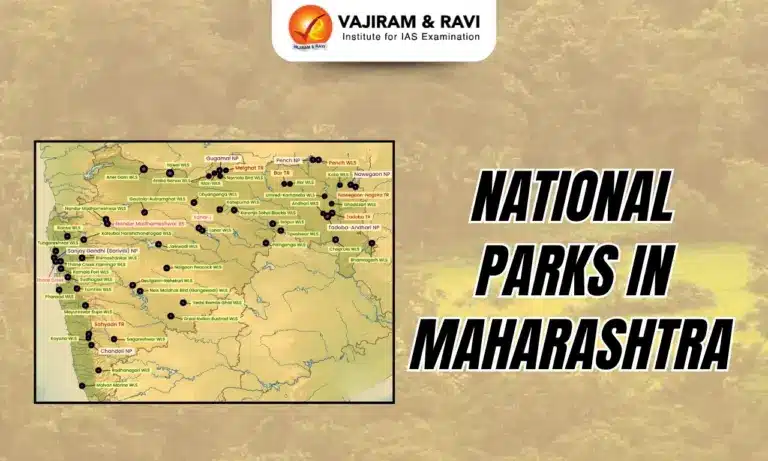
National Parks in Maharashtra are legally protected natural areas created to conserve entire ecosystems, ecological processes, and native species in their natural setting. As per the IUCN definition, protected areas are clearly defined geographical spaces managed through legal or effective means to ensure long-term conservation of biodiversity, ecosystem services, and cultural values. These areas restrict human activities like hunting, mining, and large-scale forestry, while allowing regulated research, education, and eco-tourism that supports conservation objectives and community awareness.
Protected Areas in Maharashtra
Maharashtra has a diverse protected area network covering Western Ghats, Deccan Plateau, and Vidarbha forests.
- National Parks: Strictly protected ecosystems conserving flora, fauna, and natural processes.
- Wildlife Sanctuaries: Managed habitats allowing limited human activity under zonal regulations.
- Tiger Reserves: Landscapes notified under Project Tiger for species-focused conservation.
National Parks in Maharashtra
Maharashtra hosts some of the most ecologically important National Parks in India, spread across tropical dry deciduous forests, moist deciduous Western Ghats, grasslands, wetlands, and urban forests. These parks protect flagship species such as the Bengal tiger, Indian leopard, gaur, sloth bear, and several endemic birds and reptiles. Many national parks also form core areas of tiger reserves, ensuring genetic continuity and prey base stability while safeguarding watersheds, river catchments, and climate-regulating forest systems.
Chandoli National Park
Chandoli National Park lies in the Sahyadri Range and forms the core of Sahyadri Tiger Reserve.
- Location: Western Ghats landscape across Sangli, Kolhapur, and Satara districts.
- Reserve Status: Core area of Sahyadri Tiger Reserve with Koyna Sanctuary.
- Vegetation: Moist deciduous forests with high rainfall gradients.
- Fauna: Tiger, leopard, gaur, sloth bear, giant squirrel present.
- Hydrology: Part of Krishna river basin catchment.
Gugamal National Park (Melghat)
Gugamal National Park forms the ecological heart of Melghat Tiger Reserve in Satpura ranges.
- Location: Amravati region with Gawilgarh Hills boundary.
- River System: Catchment for Khandu, Sipna, Dolar rivers.
- Vegetation: Dry deciduous teak-dominated forest.
- Fauna: Tiger, leopard, gaur, sloth bear, nilgai recorded.
- Conservation Role: One of seven protected units of Melghat landscape.
Nawegaon National Park
Nawegaon National Park is renowned for avian diversity and seasonal wetlands.
- Bird Diversity: Hosts nearly 60% of Maharashtra’s recorded bird species.
- Wetland: Nawegaon Lake attracts migratory wintering birds.
- Vegetation: Moist and dry deciduous forest mosaic.
- Fauna: Tiger, leopard, gaur, flying squirrel present.
- Landscape Link: Part of Navegaon-Nagzira Tiger Reserve complex.
Pench (Jawaharlal Nehru) National Park
Jawaharlal Nehru Pench National Park forms Maharashtra’s portion of Pench Tiger Reserve.
- Interstate Reserve: Shared landscape between Maharashtra and Madhya Pradesh.
- Forest Type: Tropical dry deciduous teak forests.
- Flora: Teak, segun, tendu dominate canopy.
- Fauna: Tiger, leopard, gaur, four-horned antelope.
- Hydrology: Pench River sustains prey-rich grasslands.
Sanjay Gandhi (Borivali) National Park
Sanjay Gandhi National Park is a rare protected forest within a megacity.
- Urban Location: Situated entirely within Mumbai metropolitan region.
- Cultural Heritage: Houses 2,400-year-old Kanheri Buddhist caves.
- Vegetation: Mixed deciduous forest with kadamba dominance.
- Fauna: Leopard, chital, macaque, flying fox recorded.
- Ecological Value: Critical green lung and groundwater recharge zone.
Tadoba National Park
Tadoba National Park is Maharashtra’s oldest and most prominent tiger habitat.
- Core Area: Central zone of Tadoba-Andhari Tiger Reserve.
- Wetlands: Tadoba Lake and Erai Reservoir support biodiversity.
- Vegetation: Dry deciduous teak and bamboo forests.
- Fauna: Tiger, gaur, dhole, marsh crocodile present.
- Threats: Human settlements and seasonal forest fires.





Tiger Reserve in Maharashtra
Tiger reserves in Maharashtra were established under Project Tiger to protect the rapidly declining Bengal tiger population. These reserves combine core, buffer, and corridor landscapes ensuring prey availability, genetic exchange, and reduced human disturbance. Maharashtra’s tiger reserves cover dry deciduous forests, river basins, and hill ranges, supporting one of India’s most stable tiger populations while also conserving associated species like leopard, sloth bear, wild dog, and ungulates.
Tiger Reserves in Maharashtra List
Maharashtra has six notified tiger reserves covering over ten thousand square kilometres.
- Melghat Tiger Reserve: India’s earliest tiger reserve with 2,768.52 square kilometres area.
- Tadoba-Andhari Tiger Reserve: Largest reserve with 1,727.59 square kilometres landscape.
- Pench Tiger Reserve: Interstate reserve spanning 741.22 square kilometres.
- Sahyadri Tiger Reserve: Western Ghats reserve covering 1,165.57 square kilometres.
- Nawegaon-Nagzira Tiger Reserve: Central Indian corridor with 1,894.94 square kilometres.
- Bor Tiger Reserve: Vidarbha reserve with dry deciduous forests and Bor Dam basin.
Wildlife Sanctuaries in Maharashtra
Wildlife sanctuaries in Maharashtra are designated to protect specific species, habitats, and ecological features through zonal management. Core zones remain disturbance-free, buffer zones allow limited forestry, and tourism zones support regulated visitation. These sanctuaries have significantly improved wildlife populations, protected river systems, grasslands, mangroves, and coastal ecosystems, and strengthened ecological connectivity between national parks and tiger reserves across the state.
List of Major Wildlife Sanctuaries in Maharashtra
These sanctuaries represent Maharashtra’s ecological diversity across forests, wetlands, grasslands, and marine systems. There are more than 50 Wildlife Sanctuaries in Maharashtra including:
- Bhimashankar Wildlife Sanctuary: Protects Malabar giant squirrel habitat surrounding Bhimashankar Jyotirlinga temple.
- Great Indian Bustard Sanctuary: Semi-arid grassland conserving critically endangered Great Indian Bustard.
- Radhanagari Wildlife Sanctuary: Maharashtra’s first sanctuary with gaur as flagship species.
- Koyna Wildlife Sanctuary: Western Ghats bird area forming Sahyadri Tiger Reserve buffer.
- Phansad Wildlife Sanctuary: Coastal Western Ghats forest preserving unique woodland ecosystems.
- Malvan Marine Sanctuary: India’s first marine sanctuary with coral and Sindhudurg Fort.
- Thane Creek Flamingo Sanctuary: Mangrove wetland supporting migratory flamingos and marine life.
- Umred-Karhandla Sanctuary: Vital tiger corridor linking Tadoba and Nagzira reserves.
- Ghodazari Wildlife Sanctuary: Forest corridor strengthening tiger movement in Vidarbha landscape.
- Lonar Wildlife Sanctuary: Meteor-impact saline lake ecosystem with rare microbial biodiversity.
Ramsar Sites in Maharashtra
Maharashtra has three internationally recognized Ramsar wetlands of ecological importance.
- Lonar Lake: Ancient meteorite crater lake with saline-alkaline water and unique microbes.
- Nandur Madhameshwar: Godavari wetland supporting vultures, fish diversity, and migratory birds.
Thane Creek: Asia’s largest mangrove creek supporting flamingos and brackish ecosystems.

 Last updated on April, 2026
→ UPSC Final Result 2025 is now out.
→ UPSC has released UPSC Toppers List 2025 with the Civil Services final result on its official website.
→ Anuj Agnihotri secured AIR 1 in the UPSC Civil Services Examination 2025.
→ UPSC Marksheet 2025 is now out.
→ UPSC Notification 2026 & UPSC IFoS Notification 2026 is now out on the official website at upsconline.nic.in.
→ UPSC Calendar 2026 has been released.
→ Check out the latest UPSC Syllabus 2026 here.
→ UPSC Prelims 2026 will be conducted on 24th May, 2026 & UPSC Mains 2026 will be conducted on 21st August 2026.
→ The UPSC Selection Process is of 3 stages-Prelims, Mains and Interview.
→ Prepare effectively with Vajiram & Ravi’s UPSC Prelims Test Series 2026 featuring full-length mock tests, detailed solutions, and performance analysis.
→ Enroll in Vajiram & Ravi’s UPSC Mains Test Series 2026 for structured answer writing practice, expert evaluation, and exam-oriented feedback.
→ Join Vajiram & Ravi’s Best UPSC Mentorship Program for personalized guidance, strategy planning, and one-to-one support from experienced mentors.
→ Shakti Dubey secures AIR 1 in UPSC CSE Exam 2024.
→ Also check Best UPSC Coaching in India
National Parks in Maharashtra FAQs
Q1. How many National Parks are there in Maharashtra?+
Q2. Which is the oldest National Park in Maharashtra?+
Q3. Which National Park is located inside Mumbai city?+
Q4. Which National Parks are part of Tiger Reserves in Maharashtra?+
Q5. Why are National Parks important in Maharashtra?+
Tags: national parks in maharashtra