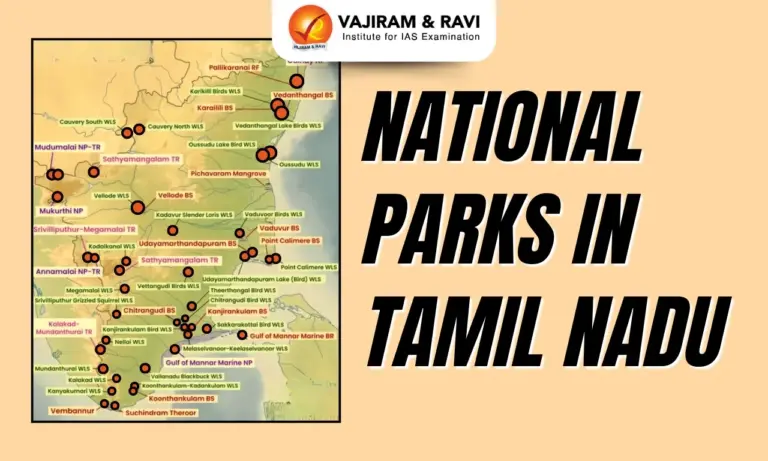
National Parks in Tamil Nadu are legally notified areas under the Wildlife Protection Act, 1972, created to conserve ecosystems, species, and landscapes of high ecological value. No human activity is allowed except those permitted by the Chief Wildlife Warden. Wildlife Sanctuaries allow limited human activities under regulation, while Biosphere Reserves focus on conservation, research, and sustainable use. There are a total 107 National Parks in India covering 44,402.95 km² and 574 Wildlife Sanctuaries covering 127,241.24 km², ensuring long term protection of biodiversity.
Protected Areas in Tamil Nadu
Protected areas conserve forests, wildlife, wetlands, and coastal ecosystems across varied landscapes of Tamil Nadu.
- National Parks: Five parks covering 307.84 km² protect flagship ecosystems.
- Wildlife Sanctuaries: Thirty four sanctuaries conserve terrestrial and wetland biodiversity.
- Biosphere Reserves: Three reserves promote conservation, research, and sustainable livelihoods.
- Tiger Reserves: Five reserves strengthen tiger conservation under Project Tiger.
- Elephant Reserves: Five landscapes ensure long term elephant movement corridors.
National Parks in Tamil Nadu
Tamil Nadu has five National Parks covering 307.84 km², representing urban forests, marine ecosystems, montane grasslands, and tropical deciduous forests. These parks safeguard endemic species like Nilgiri tahr and marine species like dugong. Established between 1976 and 1990, they form the core conservation network of the state. Strict protection, minimal human interference, and scientific management make these parks critical for biodiversity conservation and ecological stability in southern India.
Guindy National Park
Guindy National Park is one of India’s smallest and rare urban National Parks, located in Chennai city.
- Location: Situated around Raj Bhavan within Chennai metropolitan area.
- Area: Covers 2.82 km², established in 1976.
- Vegetation: Tropical dry evergreen, scrub, and thorn forests.
- Flagship Species: Blackbuck represents grassland conservation.
- Fauna: Supports chital, jackal, snakes, reptiles, and birds.
- Importance: Demonstrates biodiversity conservation within dense urban landscape.
Gulf of Mannar Marine National Park
Gulf of Mannar Marine National Park protects India’s richest marine biodiversity zone.
- Location: Ramanathapuram coast along southeast Tamil Nadu.
- Area: Covers 6.23 km², notified in 1980.
- Islands: Comprises 21 coral islands with surrounding reefs.
- Ecosystems: Coral reefs, seagrass meadows, mangroves, salt marshes.
- Flagship Species: Dugong, a vulnerable marine mammal.
- Threats: Coral mining, illegal fishing, mechanized trawling, tourism pressure.
Indira Gandhi (Annamalai) National Park
Indira Gandhi National Park lies in the Anaimalai Hills of Western Ghats.
- Location: Coimbatore and Tiruppur districts.
- Area: Covers 117.1 km², established in 1989.
- Vegetation: Wet evergreen forests, moist deciduous forests, shola grasslands.
- Fauna: Tiger, elephant, leopard, Nilgiri tahr, lion tailed macaque.
- Status: Forms core of Anamalai Tiger Reserve.
- Threats: Plantation expansion and tourism pressure.
Mudumalai National Park
Mudumalai National Park is a key conservation unit in Nilgiri landscape.
- Location: Nilgiri district bordering Karnataka and Kerala.
- Area: Covers 103.24 km², declared in 1990.
- Vegetation: Tropical moist deciduous, dry deciduous, thorn forests.
- Fauna: Tiger, elephant, leopard, sloth bear, giant squirrel.
- Birds: Hosts critically endangered Indian vultures.
- Threats: Tourism pressure and invasive lantana species.
Mukurthi National Park
Mukurthi National Park conserves montane ecosystems of Nilgiris.
- Location: Nilgiri district within Nilgiri Biosphere Reserve.
- Area: Covers 78.46 km², established in 1982.
- Vegetation: Montane grasslands with shola forest patches.
- Keystone Species: Nilgiri tahr, an endangered mountain ungulate.
- Fauna: Tiger, elephant, Nilgiri marten, Nilgiri langur.
- Threats: Invasive wattle and eucalyptus plantations.





Tiger Reserves in Tamil Nadu
Tamil Nadu has five Tiger Reserves strengthening southern tiger landscapes.
- Anamalai Tiger Reserve: Western Ghats landscape supporting tiger elephant coexistence.
- Kalakad Mundanthurai: Part of Agasthyamalai Biosphere Reserve with high endemism.
- Mudumalai Tiger Reserve: Crucial Nilgiri corridor linking Bandipur and Wayanad.
- Sathyamangalam Tiger Reserve: Eastern Ghats corridor connecting Western and Eastern Ghats.
- Srivilliputhur Megamalai Tiger Reserve (SMTR): It is the recently added reserve, incorporating the Grizzled Giant Squirrel Sanctuary.
Elephant Reserves in Tamil Nadu
There are five Elephant Reserves in Tamil Nadu to ensure genetic connectivity and long term elephant survival.
- Agasthyamalai Elephant Reserve: Southern Western Ghats corridor supporting migratory herds.
- Anamalai Elephant Reserve: Links Kerala forests with Tamil Nadu landscapes.
- Coimbatore Elephant Reserve: Protects fragmented elephant habitats around urban edges.
- Nilgiris Elephant Reserve: India’s largest elephant landscape with transboundary corridors.
- Srivilliputhur Elephant Reserve: Secures elephant movement near southern Western Ghats.
Wildlife Sanctuaries in Tamil Nadu
Tamil Nadu has thirty four Wildlife Sanctuaries (including Bird Sanctuaries) conserving diverse habitats.
- Cauvery North Sanctuary: Riverine forests linking Karnataka wildlife corridors.
- Cauvery South Sanctuary: Supports grizzled squirrel and river dependent species.
- Chitrangudi Bird Sanctuary: Wetland supporting pelicans and storks.
- Gangaikondan Sanctuary: Major spotted deer habitat outside Western Ghats.
- Indira Gandhi Sanctuary: Large Western Ghats forest protecting elephants and tigers.
- Kadavur Slender Loris Sanctuary: India’s first sanctuary for slender loris.
- Kalakad Sanctuary: Forms core of Kalakad Mundanthurai Tiger Reserve.
- Kanyakumari Sanctuary: Southernmost forest supporting tiger movement.
- Kanjirankulam Bird Sanctuary: Breeding ground for painted storks.
- Karaivetti Bird Sanctuary: Riverine wetland along Kollidam River.
- Karikili Bird Sanctuary: Wetland near Palar Cheyyar river confluence.
- Kazhuveli Bird Sanctuary: Large brackish wetland supporting migratory birds.
- Kodaikanal Sanctuary: Palani Hills forest protecting montane biodiversity.
- Koonthankulam Kadankulam Sanctuary: Community managed wetland bird habitat.
- Meghamalai Sanctuary: Buffer forest for Periyar Tiger Reserve.
- Melaselvanur Keelaselvanur Sanctuary: Seasonal wetland supporting waterbirds.
- Mudumalai Sanctuary: Oldest sanctuary forming Nilgiri landscape core.
- Mundanthurai Sanctuary: River catchment forest sustaining perennial streams.
- Nanjarayan Tank Sanctuary: Urban wetland supporting migratory birds.
- Nellai Sanctuary: Dry deciduous forest conserving southern fauna.
- Oussudu Lake Sanctuary: Transboundary wetland shared with Puducherry.
- Point Calimere Sanctuary: Dry evergreen forest conserving blackbuck.
- Point Calimere Block A and B: Extended coastal wetland habitat.
- Pulicat Lake Sanctuary: Largest brackish lagoon supporting flamingos.
- Sakkarakottai Sanctuary: Small irrigation tank supporting waterbirds.
- Sathyamangalam Sanctuary: Eastern Ghats forest and wildlife corridor.
- Srivilliputhur Sanctuary: Protects grizzled giant squirrel habitat.
- Therthangal Sanctuary: Seasonal wetland in Ramanathapuram district.
- Udayamarthandapuram Sanctuary: Floodwater storage wetland supporting birds.
- Vaduvoor Sanctuary: Large irrigation tank attracting migratory birds.
- Vallanadu Blackbuck Sanctuary: Grassland conserving blackbuck populations.
- Vedanthangal Sanctuary: Oldest bird sanctuary protected by communities.
- Vellode Sanctuary: Wetland supporting threatened river terns.
- Vettangudi Sanctuary: Small wetland critical for nesting waterbirds.
Ramsar Sites in Tamil Nadu
Ramsar Sites are internationally recognized wetlands under the Ramsar Convention for ecological importance. There are 20 officially designated Ramsar Sites in Tamil Nadu as discussed below:
- Point Calimere: Dry evergreen forest and migratory bird hotspot.
- Gulf of Mannar: South Asia’s first marine biosphere reserve.
- Vembannur Wetland: Ancient irrigation tank supporting threatened birds.
- Vellode Sanctuary: Important habitat for river terns and storks.
- Udhayamarthandapuram: Monsoon floodwater wetland sustaining birds.
- Vedanthangal: Community protected wetland improving agriculture productivity.
- Koonthankulam: Human made wetland managed by local villagers.
- Karikili: Inland wetland paired with Vedanthangal IBA.
- Pallikaranai Marsh: Chennai’s last natural coastal freshwater marsh.
- Pichavaram Mangrove: Mangrove forest buffering cyclones and tides.
- Kanjirankulam: Breeding site for painted storks and darters.
- Chitrangudi: Pelican and stork nesting wetland.
- Suchindram Theroor: Southern flyway wetland for migratory birds.
- Vaduvur: Large irrigation tank sheltering winter migrants.
- Karaivetti: River fed wetland supporting large bird congregations.
- Longwood Shola: Montane forest wetland conserving endemic flora.
- Kazhuveli: Brackish lagoon supporting coastal biodiversity.
- Nanjarayan: Urban wetland conserving migratory waterbirds.
- Sakkarakottai: Small tank supporting seasonal bird populations.
- Therthangal: Minor wetland contributing to regional waterbird networks.

 Last updated on April, 2026
→ UPSC Final Result 2025 is now out.
→ UPSC has released UPSC Toppers List 2025 with the Civil Services final result on its official website.
→ Anuj Agnihotri secured AIR 1 in the UPSC Civil Services Examination 2025.
→ UPSC Marksheet 2025 is now out.
→ UPSC Notification 2026 & UPSC IFoS Notification 2026 is now out on the official website at upsconline.nic.in.
→ UPSC Calendar 2026 has been released.
→ Check out the latest UPSC Syllabus 2026 here.
→ UPSC Prelims 2026 will be conducted on 24th May, 2026 & UPSC Mains 2026 will be conducted on 21st August 2026.
→ The UPSC Selection Process is of 3 stages-Prelims, Mains and Interview.
→ Prepare effectively with Vajiram & Ravi’s UPSC Prelims Test Series 2026 featuring full-length mock tests, detailed solutions, and performance analysis.
→ Enroll in Vajiram & Ravi’s UPSC Mains Test Series 2026 for structured answer writing practice, expert evaluation, and exam-oriented feedback.
→ Join Vajiram & Ravi’s Best UPSC Mentorship Program for personalized guidance, strategy planning, and one-to-one support from experienced mentors.
→ Shakti Dubey secures AIR 1 in UPSC CSE Exam 2024.
→ Also check Best UPSC Coaching in India
National Parks in Tamil Nadu FAQs
Q1. How many National Parks are there in Tamil Nadu?+
Q2. Which is the smallest National Park in Tamil Nadu?+
Q3. Which National Park protects marine biodiversity in Tamil Nadu?+
Q4. Which National Park is important for Nilgiri tahr conservation?+
Q5. Are human activities allowed inside National Parks?+
Tags: national parks in tamil nadu