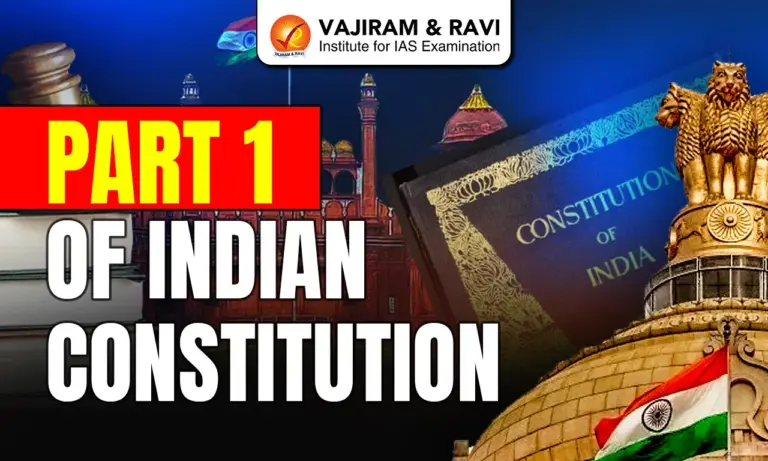
The Constitution of India is the supreme law of the country. It lays down the structure of government, division of powers, rights and duties. It is divided into 25 Parts and each Part deals with a specific subject. Part 1 of the Constitution of India deals with the provisions related to the Union and Territories (i.e. States). This Part forms the foundation of India’s federal structure and territorial identity.
Part 1 of Indian Constitution- “The Union and its Territory”
Part 1 of the Indian Constitution is titled as “The Union and its Territory.” It includes Articles 1 to 4 under which it declares India as a “Union of States” and explains the meaning of the territory of India. It also gives Parliament the authority to admit new States, establish new ones and alter the boundaries, areas or names of existing States. This Part reflects that India is federal in structure but indestructible in unity. It clarifies that States do not have the right to separate from the Union and that the country remains one integrated whole.
Article 1 of Part 1 of Indian Constitution
Article 1 of the Part 1 of Indian Constitution defines India’s name and territorial structure clearly and establishes its identity as a Union of States.
-
- Article 1 (1): It declares that “India, that is Bharat, shall be a Union of States.”
- The use of both names, India and Bharat, was adopted after debate in the Constituent Assembly.
- The term “Union of States” was preferred instead of “Federation” to show that the Indian Union is not formed by agreement among States.
- The States do not have the right to secede.
- The Union is indestructible, though States can be reorganized.
- This reflects a strong Centre with a flexible federal structure while maintaining national unity.
- Article 1 (2): The First Schedule lists the names and territorial extent of States and Union territories. At present, India has 28 States and 8 Union territories. The expression “Territory of India” is wider than “Union of India” because it includes States, Union territories and acquired territories.
- Article 1 (1): It declares that “India, that is Bharat, shall be a Union of States.”
- Article 1 (3): It further explains that the territory of India includes three categories:
-
- Article 1 (3) (a): The territories of the States
- Article 1 (3) (b): The Union territories specified in the First Schedule
- Article 1 (3) (c): Any other territories that may be acquired.




Article 2 of Part 1 of Indian Constitution
Article 2 of the Part 1 of Indian Constitution empowers Parliament to admit or establish new States into the Union on suitable terms.
- Article 2 gives Parliament the authority to admit into the Union or establish new States on such terms and conditions as it thinks fit. Parliament may admit an already existing State into the Union or create a completely new State.
- Article 2A (Repealed): It was introduced by the 35th Constitutional Amendment Act, 1974, making Sikkim an associate State. However, this arrangement did not continue. Through the 36th Constitutional Amendment Act, 1975, Sikkim was made a full fledged State of the Indian Union. Later, Article 2A was repealed. This example shows how Parliament used its power to integrate new regions into the Union framework.
Article 3 of Part 1 of Indian Constitution
Article 3 of the Part 1 of Indian Constitution authorizes Parliament to form new States and alter areas, boundaries or names of existing States.
- Article 3 (a): Allows Parliament to form a new State by separating Territory from any State or by uniting two or more States or parts of States or by uniting any territory to a part of any State.
-
- Article 3 (b): It also permits Parliament to increase or decrease the area of a State.
- Article 3 (c): Permits the Parliament to diminish the area of any State.
- Article 3 (d): The Parliament can also change the boundaries and borders of the State.
- Article 3 (e): Through this, the parliament is empowered to change the name of any State.
- In clauses (a) to (e), the word “State” also includes Union territories. However, in the proviso regarding consultation, “State” does not include Union territories.
- This Article has been used for renaming States and creating new ones such as Uttarakhand, Jharkhand, Chhattisgarh and Telangana.
- A Bill under Article 3 can be introduced in Parliament only on the recommendation of the President.
- If the proposal affects the area, boundary or name of a State, the President must refer the Bill to the concerned State Legislature for its views within a specified period. The President may extend this period.
- However, Parliament is not bound by the State Legislature’s opinion and may accept or reject it.
Article 4 of Part 1 of Indian Constitution
Article 4 of the Part 1 of Indian Constitution deals with laws made under Articles 2 and 3 and their constitutional effect.
- Article 4 (1): It states that any law made under Article 2 or Article 3 must include necessary changes in the First Schedule and the Fourth Schedule.
- The First Schedule contains the names and territorial extent of States and Union territories, while the Fourth Schedule deals with representation of States in the Council of States, that is Rajya Sabha.
- It also permits supplemental, incidental and consequential provisions, including changes in parliamentary and State legislative representation.
- Article 4 (2): It clearly provides that laws made under Articles 2 and 3 shall not be considered constitutional amendments under Article 368.
- Therefore, such laws can be passed by a simple majority through the ordinary legislative process.
- This makes the process of reorganization more flexible and practical.
- It allows Parliament to respond to political and administrative needs without following the special amendment procedure under Article 368.
Amendments of the Part 1 of Indian Constitution
Several constitutional amendments have influenced the operation and structure of Part I provisions. The major amendments include:
- Seventh Constitutional Amendment Act 1956:
- This amendment, along with the States Reorganisation Act 1956, abolished the earlier classification of States into Part A, Part B, Part C and Part D.
- These categories were originally based on historical backgrounds such as Governor’s Provinces, princely States, Chief Commissioners’ Provinces and territories under a Lieutenant Governor.
- Through this amendment, India was reorganized into 14 States and 6 Union territories by reshaping the territorial structure under Part I.
- Constitution (Application to Jammu and Kashmir) Order 2019 and Reorganisation Act 2019:
- On 5 August 2019, the President issued the order, which revoked the special status earlier given under Article 370.
- It superseded the 1954 Order that had added Article 35A.
- The Jammu and Kashmir Reorganisation Act 2019 bifurcated the State into two Union territories: Jammu and Kashmir with a legislature and Ladakh without a legislature. This action was carried out under the powers provided in Part I.
Case Laws of the Part 1 of Indian Constitution
Important judicial decisions have clarified the scope and limits of Articles 1 to 4 under the Part 1 of the Constitution of India.
- Berubari Union Case (1960):
- In the Berubari Union Case, 1960, the Supreme Court held that Parliament’s power under Article 3 to diminish the area of a State does not include the power to cede Indian territory to a foreign country.
- Such cession requires a constitutional amendment under Article 368.
- This judgment clearly distinguished between internal reorganization and transfer of territory to another country, thereby limiting the scope of Article 3.
- In Re: Article 370 of the Constitution (2023):
- In the 2023 decision relating to Article 370, the Supreme Court upheld the abrogation of Article 370 and Article 35A.
- The Court held that Parliament has the power to reorganize a State and carve out a Union territory from it.
- This judgment reinforced the authority of Parliament under Part I to alter the territorial and administrative structure of the country in accordance with constitutional provisions.

 Last updated on March, 2026
→ UPSC Final Result 2025 is now out.
→ UPSC has released UPSC Toppers List 2025 with the Civil Services final result on its official website.
→ Anuj Agnihotri secured AIR 1 in the UPSC Civil Services Examination 2025.
→ UPSC Marksheet 2025 is now out.
→ UPSC Notification 2026 & UPSC IFoS Notification 2026 is now out on the official website at upsconline.nic.in.
→ UPSC Calendar 2026 has been released.
→ Check out the latest UPSC Syllabus 2026 here.
→ UPSC Prelims 2026 will be conducted on 24th May, 2026 & UPSC Mains 2026 will be conducted on 21st August 2026.
→ The UPSC Selection Process is of 3 stages-Prelims, Mains and Interview.
→ Prepare effectively with Vajiram & Ravi’s UPSC Prelims Test Series 2026 featuring full-length mock tests, detailed solutions, and performance analysis.
→ Enroll in Vajiram & Ravi’s UPSC Mains Test Series 2026 for structured answer writing practice, expert evaluation, and exam-oriented feedback.
→ Join Vajiram & Ravi’s Best UPSC Mentorship Program for personalized guidance, strategy planning, and one-to-one support from experienced mentors.
→ Shakti Dubey secures AIR 1 in UPSC CSE Exam 2024.
→ Also check Best UPSC Coaching in India
Part 1 of Indian Constitution FAQs
Q1. What does Part 1 of Indian Constitution deal with?+
Q2. What is the significance of Article 1 of the Indian Constitution?+
Q3. What powers are granted to Parliament under Articles 2 and 3?+
Q4. Why are laws under Article 4 not considered constitutional amendments?+
Q5. What are the Case Laws related to the Part 1 of Indian Constitution?+
Tags: constitution indian polity part 1 of indian constitution parts of indian constitution