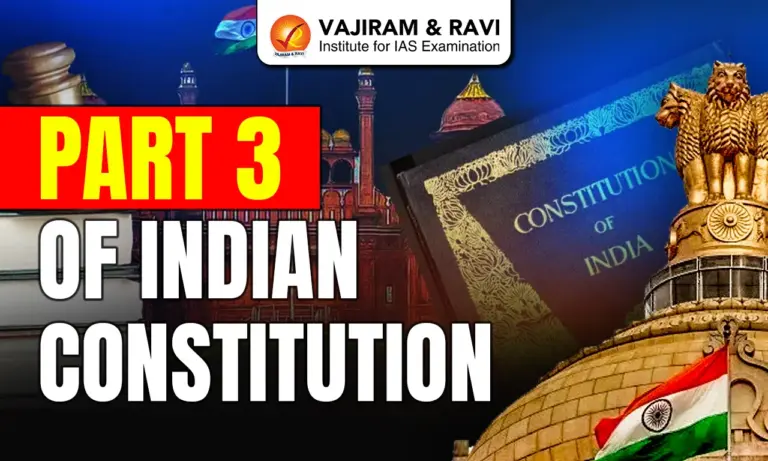
The Constitution of India guarantees Fundamental Rights through Part III, which is often described as the “Magna Carta of India.” This part consists of Articles 12 to 35 and protects civil liberties essential for democracy. They are enforceable by courts and bind the State in its actions. Fundamental Rights apply mainly to citizens and in some cases to all persons. They are grouped into six major categories and include remedies if violated. This Part ensures equality, freedom, dignity and justice within the constitutional framework.
Part 3 of Indian Constitution
Part III of the Constitution of India covers Articles 12 to 35 and lays down the Fundamental Rights structure. It defines the term “State” under Article 12 and ensures that any law inconsistent with these rights becomes void under Article 13. These rights include equality, freedom, protection against exploitation, religious liberty, cultural safeguards and constitutional remedies. Parliament may modify certain rights for armed forces or during martial law. Courts such as the Supreme Court and High Courts play a vital role in protecting these guarantees.
Articles under Part 3 of Indian Constitution
Part III contains Articles 12 to 35, covering six Fundamental Rights categories and related saving provisions.
- Article 12- Definition of State: Defines “State” to include Union and State Governments, Parliament, State Legislatures and local or other authorities within Indian territory or under Government of India control, including executive and legislative organs.
- Article 13- Laws inconsistent with Fundamental Rights: Declares pre-constitutional laws void to the extent of inconsistency and prohibits the State from making laws abridging rights. Defines “law” broadly and empowers judicial review.
- Articles 14 to 18- Right to Equality: Guarantee equality before law, prohibit discrimination on religion, race, caste, sex or place of birth, abolish untouchability and titles and allow special provisions for women, children, backward classes, Scheduled Castes, Scheduled Tribes and economically weaker sections.
- Articles 19 to 22- Right to Freedom: Protect freedoms of speech, assembly, association, movement, residence and profession. Provide safeguards against ex post facto laws, double jeopardy, self-incrimination, arbitrary arrest and detention and ensure life and personal liberty.
- Articles 23 to 24- Right against Exploitation: Prohibit trafficking, forced labour and employment of children below fourteen years in factories, mines, or hazardous occupations, thereby protecting human dignity and child welfare.
- Articles 25 to 28- Right to Freedom of Religion: Guarantee freedom of conscience and religion, management of religious affairs, restrict religious taxation and regulate religious instruction in educational institutions subject to public order, morality and health.
- Articles 29 to 30- Cultural and Educational Rights: Protect minority language, script and culture and allow religious and linguistic minorities to establish and administer educational institutions without discrimination.
- Article 31 (Omitted) and Article 31A to 31C – Saving of Certain Laws: Originally protected property rights. Article 31 was removed by the 44th Amendment. Articles 31A, 31B and 31C protect certain other laws, including those in the Ninth Schedule and those implementing Directive Principles.
- Articles 32- Right to Constitutional Remedies and Related Powers: Article 32 allows individuals to approach the Supreme Court for enforcement through writs like Habeas Corpus, Mandamus, Certiorari, Prohibition and Quo-Warranto.
- Articles 33 to 35: empower Parliament to modify rights for forces, regulate during martial law and legislate enforcement provisions.





Amendments related to Part 3 of Indian Constitution
Several constitutional amendments have modified or repealed specific provisions under Part III.
- Forty-fourth Amendment Act 1978: Repealed Article 19(1)(f) and Article 31, removing the Fundamental Right to Property and introducing Article 300A as a constitutional right instead.
- Forty-third Amendment Act 1977: Repealed Articles 31D and 32A, which dealt with anti-national activities and restrictions on State law validity under Article 32 proceedings.
- Eighty-sixth Amendment Act 2002: Inserted Article 21A, recognizing the Right to Education as a Fundamental Right, previously reflected as a Directive Principle under Article 45.
- Seventy-seventh Amendment Act 1995: Added Article 16(4A), enabling reservation in promotions for Scheduled Castes and Scheduled Tribes based on inadequate representation.
- Eighty-first Amendment Act 2000: Inserted Article 16(4B), allowing carry forward of unfilled reserved vacancies without affecting the fifty percent ceiling in the same recruitment year.
Case Laws related to Part 3 of Indian Constitution
Judicial decisions have clarified the scope, enforcement and limitations of Fundamental Rights.
- Maneka Gandhi vs Union of India 1978: Established that Articles 14, 19 and 21 form the “Golden Triangle,” ensuring that life and personal liberty must follow fair, just and reasonable procedure.
- Shreya Singhal vs Union of India 2015: Struck down Section 66A of the Information Technology Act, 2005, holding that vague and arbitrary restrictions violate freedom of speech under Article 19(1)(a).
- ADM Jabalpur vs ShivKant Shukla 1976: Known as the Habeas Corpus Case, upheld suspension of writ jurisdiction during Emergency, raising critical questions on personal liberty protection.
- I.R. Coelho Case 2007: Held that even laws placed in the Ninth Schedule under Article 31B are subject to judicial review if they damage Fundamental Rights or the Constitution’s basic structure.
- Shayara Bano vs Union of India 2017: Declared triple talaq unconstitutional, stating that it was not an essential religious practice and violated equality and dignity principles under Part III.

 Last updated on March, 2026
→ UPSC Final Result 2025 is now out.
→ UPSC has released UPSC Toppers List 2025 with the Civil Services final result on its official website.
→ Anuj Agnihotri secured AIR 1 in the UPSC Civil Services Examination 2025.
→ UPSC Marksheet 2025 is now out.
→ UPSC Notification 2026 & UPSC IFoS Notification 2026 is now out on the official website at upsconline.nic.in.
→ UPSC Calendar 2026 has been released.
→ Check out the latest UPSC Syllabus 2026 here.
→ UPSC Prelims 2026 will be conducted on 24th May, 2026 & UPSC Mains 2026 will be conducted on 21st August 2026.
→ The UPSC Selection Process is of 3 stages-Prelims, Mains and Interview.
→ Prepare effectively with Vajiram & Ravi’s UPSC Prelims Test Series 2026 featuring full-length mock tests, detailed solutions, and performance analysis.
→ Enroll in Vajiram & Ravi’s UPSC Mains Test Series 2026 for structured answer writing practice, expert evaluation, and exam-oriented feedback.
→ Join Vajiram & Ravi’s Best UPSC Mentorship Program for personalized guidance, strategy planning, and one-to-one support from experienced mentors.
→ Shakti Dubey secures AIR 1 in UPSC CSE Exam 2024.
→ Also check Best UPSC Coaching in India
Part 3 of Indian Constitution FAQs
Q1. What is the significance of Part 3 of the Indian Constitution?+
Q2. What does Article 12 define under Part 3 of the Constitution of India?+
Q3. How does Article 13 protect Fundamental Rights?+
Q4. Which rights are included under the Right to Freedom?+
Q5. What is the role of Article 32 in protecting Fundamental Rights?+
Tags: fundamental rights part 3 of indian constitution parts of indian constitution