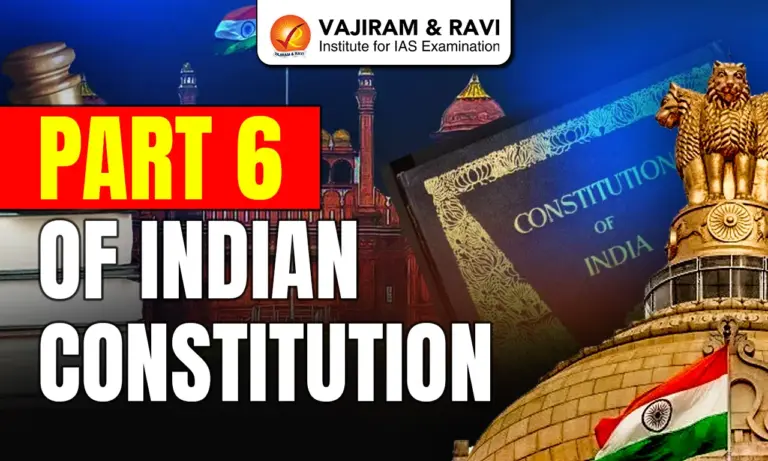
Part 6 of Indian Constitution contains Articles 152 to 237 and deals with the governance of States in India. It explains the structure of the Governor, Chief Minister, Council of Ministers, and State Legislature. It also provides provisions related to High Courts and Subordinate Courts in the States. This Part ensures proper functioning of the federal system at the state level.
Part 6 of Indian Constitution Overview
The key highlights of Part 6 of Indian Constitution have been tabulated below.
|
Component |
Articles Covered |
Subject |
|
Chapter I General |
Article 152 |
Definition of State |
|
Chapter II Executive |
Articles 153-167 |
Governor & Council of Ministers |
|
Chapter III State Legislature |
Articles 168-212 |
Legislative structure and powers |
|
Chapter IV Legislative Powers |
Articles 213 |
Ordinance-making power of Governor |
|
Chapter V High Courts |
Articles 214-231 |
Organization & jurisdiction |
|
Chapter VI Subordinate Courts |
Articles 233-237 |
District and subordinate judiciary |
Chapter I General (Article 152)
Chapter I contains only Article 152, which defines the term “State” for the purposes of Part 6. It clarifies the scope of applicability of provisions related to State Governments. This chapter ensures uniform interpretation within constitutional governance.





Chapter II The Executive
Chapter II establishes the State Executive, consisting of the Governor, Chief Minister, and Council of Ministers. It defines their appointment, powers, functions, and responsibilities. This chapter ensures democratic governance at the state level under constitutional limits.
- Governor (Articles 153-162)
- Each State shall have a Governor.
- Appointed by the President; holds office during the pleasure of the President.
- Term of 5 years (subject to pleasure doctrine).
- Executive power of the State is vested in the Governor.
- Acts on the aid and advice of the Council of Ministers (Article 163).
- Can appoint:
- Chief Minister
- Other Ministers
- Advocate General
- State Election Commissioner
- Has power to grant pardons (similar to President at state level).
- Council of Ministers (Articles 163-164)
- Headed by the Chief Minister.
- Advises the Governor in governance.
- Collectively responsible to the Legislative Assembly.
- Size capped at 15% of Assembly strength (91st Constitutional Amendment).
- Ministers must be members of the Legislature within 6 months.
- Advocate General (Article 165)
- Highest legal officer of the State.
- Appointed by the Governor.
- Must be qualified to be a High Court judge.
- Advises the government on legal matters.
Chapter III The State Legislature
Chapter III provides the constitutional structure of State Legislatures. States may have either a unicameral or bicameral legislature. It lays down rules for composition, powers, procedures, and legislative functioning.
Structure (Article 168)
- Unicameral: Only Legislative Assembly.
- Bicameral: Legislative Assembly + Legislative Council.
- States like Uttar Pradesh, Bihar, Maharashtra, Karnataka, Andhra Pradesh, and Telangana have Legislative Councils.
Legislative Assembly (Vidhan Sabha)
- Directly elected by people.
- Normal term: 5 years.
- Minimum strength: 60 (exceptions for smaller states).
- Maximum strength: 500.
- Controls the Council of Ministers.
Legislative Council (Vidhan Parishad)
- Permanent body.
- 1/3rd members retire every 2 years.
- Maximum size: 1/3rd of Assembly strength.
- Members elected through indirect methods (local bodies, graduates, teachers, etc.).
Legislative Procedure
- Ordinary Bills can be introduced in either House.
- Money Bills only in Legislative Assembly.
- Speaker decides whether a bill is a Money Bill.
- Governor’s assent required for a bill to become law.
Chapter IV Legislative Powers of the Governor
Chapter IV grants the Governor the power to promulgate ordinances when the State Legislature is not in session. This power ensures continuity of governance during emergencies. However, it is temporary and subject to legislative approval.
Governor can issue ordinance under Article 213.
- Conditions:
-
- Legislature not in session.
- Immediate action necessary.
- Ordinance has same force as a law passed by Legislature.
- Must be approved within 6 weeks of reassembly.
- Cannot violate constitutional provisions.
- Subject to judicial review.
Chapter V The High Courts in the States
Chapter V establishes High Courts for States. It defines their composition, appointment of judges, jurisdiction, and powers. High Courts safeguard constitutional rights and maintain rule of law at the state level.
-
- Every State shall have a High Court.
- Judges appointed by the President.
- Chief Justice heads the High Court.
- Security of tenure ensures judicial independence.
- Jurisdiction:
-
-
- Original Jurisdiction
- Appellate Jurisdiction
- Writ Jurisdiction (Article 226)
- Supervisory control over subordinate courts
-
- Additional Provisions:
-
- Salaries determined by Parliament.
- Removal similar to Supreme Court judges.
- Parliament may establish common High Court for two or more States.
Chapter VI Subordinate Courts
Chapter VI deals with District Courts and subordinate judiciary. It ensures independence of the lower judiciary. The High Court exercises control over these courts.
- Appointment of District Judges by Governor in consultation with High Court.
- High Court controls postings, promotions, and discipline.
- Ensures separation of judiciary from executive.
- Protects judicial independence at grassroots level.
- Forms foundation of the judicial system in States.

 Last updated on March, 2026
→ UPSC Final Result 2025 is now out.
→ UPSC has released UPSC Toppers List 2025 with the Civil Services final result on its official website.
→ Anuj Agnihotri secured AIR 1 in the UPSC Civil Services Examination 2025.
→ UPSC Marksheet 2025 is now out.
→ UPSC Notification 2026 & UPSC IFoS Notification 2026 is now out on the official website at upsconline.nic.in.
→ UPSC Calendar 2026 has been released.
→ Check out the latest UPSC Syllabus 2026 here.
→ UPSC Prelims 2026 will be conducted on 24th May, 2026 & UPSC Mains 2026 will be conducted on 21st August 2026.
→ The UPSC Selection Process is of 3 stages-Prelims, Mains and Interview.
→ Prepare effectively with Vajiram & Ravi’s UPSC Prelims Test Series 2026 featuring full-length mock tests, detailed solutions, and performance analysis.
→ Enroll in Vajiram & Ravi’s UPSC Mains Test Series 2026 for structured answer writing practice, expert evaluation, and exam-oriented feedback.
→ Join Vajiram & Ravi’s Best UPSC Mentorship Program for personalized guidance, strategy planning, and one-to-one support from experienced mentors.
→ Shakti Dubey secures AIR 1 in UPSC CSE Exam 2024.
→ Also check Best UPSC Coaching in India
Part 6 of Indian Constitution FAQs
Q1. What does Part 6 of the Indian Constitution deal with?+
Q2. Which Articles are covered under Part 6?+
Q3. What is mentioned in Article 152?+
Q4. Who is the executive head of a State under Part 6?+
Tags: indian constitution part 6 of indian constitution parts of indian constitution