Bankim Chandra Chattopadhyay

Bankim Chandra Chattopadhyay

Bankim Chandra Chattopadhyay Latest News

The family of Bankim Chandra Chattopadhyay, the writer and composer of 'Vande Mataram', recently hailed the Prime Minister’s gesture to mark the 150 years of the country's national song.

About Bankim Chandra Chattopadhyay

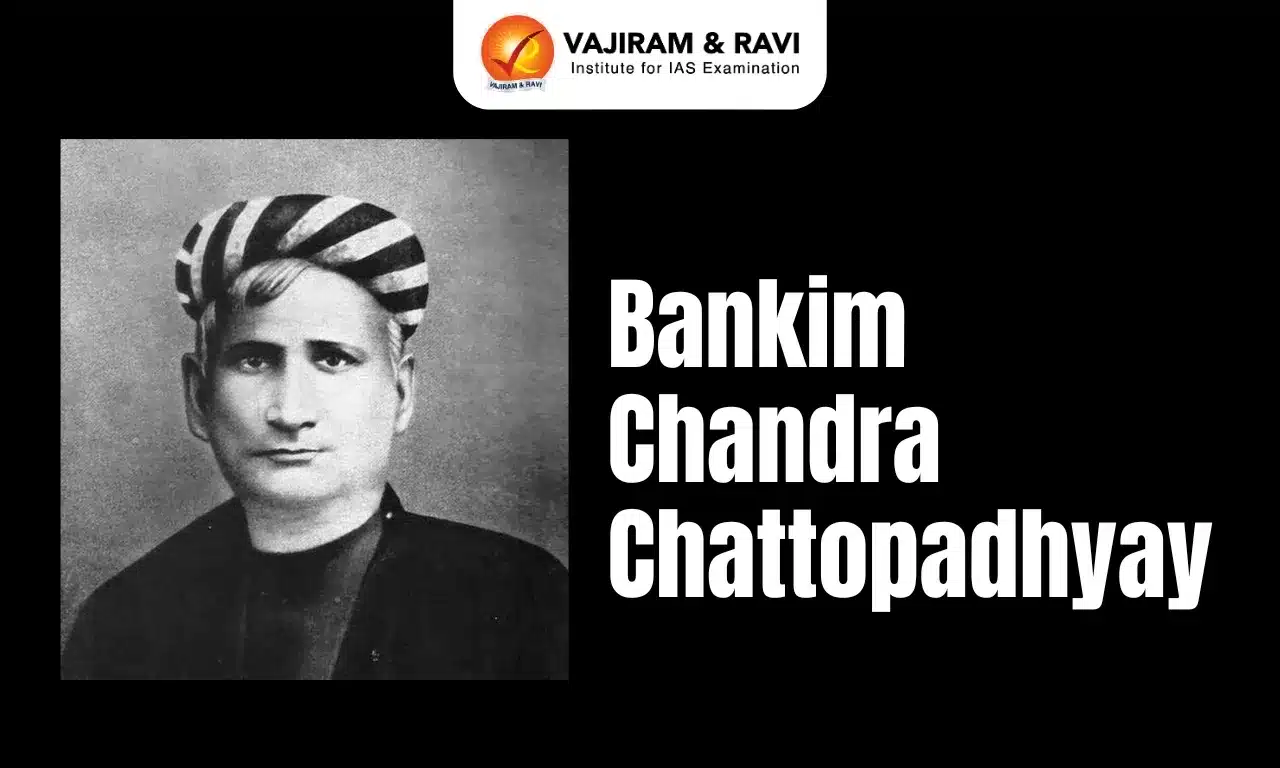
  • Bankim Chandra Chattopadhyay, also known as Bankim Chandra Chatterjee, was one of the greatest novelists and poets of India. 
  • He is famous as the author of Vande Mataram, the national song of India.
  • He was born on June 27, 1838, in the village of Kantalpara in the 24 Paraganas District of Bengal.
  • Born into the family of a government official under the British rule of India, he was one of the first two graduates of the University of Calcutta and later obtained a degree in law.
  • He began his literary career as a writer of verse. He then turned to fiction. 
  • Durgeshnandini, his first Bengali romance, was published in 1865
  • His famous novels include Kapalkundala (1866), Mrinalini (1869), Vishbriksha (1873), Chandrasekhar (1877), Rajani (1877), Rajsimha (1881), and Devi Chaudhurani (1884). 
  • Bankim Chandra Chatterjee's most famous novel was Anand Math (1882). 
    • It was set in the background of the Sannyasi Rebellion in the late 18th century. 
    • Anand Math contained the song “Vande Mataram”, which was later adopted as the national song.
      • The patriotic song was written in Sanskrit.
      • In the year 1896, Gurudev Rabindranath Tagore sang this melodic poem for the first time at the Kolkata session of the Indian National Congress. 
      • It was officially adopted as the national song by the Constituent Assembly of India on 24th January 1950.
  • Bankim Chandra Chattopadhyay passed away on April 8, 1894.
  • As a distinguished novelist, poet, and essayist, his contributions significantly influenced the development of modern Bengali prose and the articulation of an emerging Indian nationalism.
  • He is often regarded as the “Sahitya Samrat” (Emperor of Literature) in Bengali literature.

Source: NDTV

Bankim Chandra Chattopadhyay FAQs

Q1: Who authored the national song of India, “Vande Mataram”?

Ans: Bankim Chandra Chattopadhyay

Q2: What was the first Bengali romance novel written by Bankim Chandra Chattopadhyay?

Ans: Durgeshnandini

Q3: Which novel by Bankim Chandra features the patriotic song “Vande Mataram”?

Ans: Anand Math (1882)

Q4: When was “Vande Mataram” adopted as the national song of India?

Ans: It was officially adopted as the national song by the Constituent Assembly of India on 24th January 1950.


Monroe Doctrine

Monroe Doctrine

Monroe Doctrine Latest News

The US National Security Strategy, released recently, described Trump’s vision as one of “flexible realism” and argued that the U.S. should revive the 19th-century Monroe Doctrine, which declared the Western Hemisphere to be Washington’s zone of influence.

About Monroe Doctrine

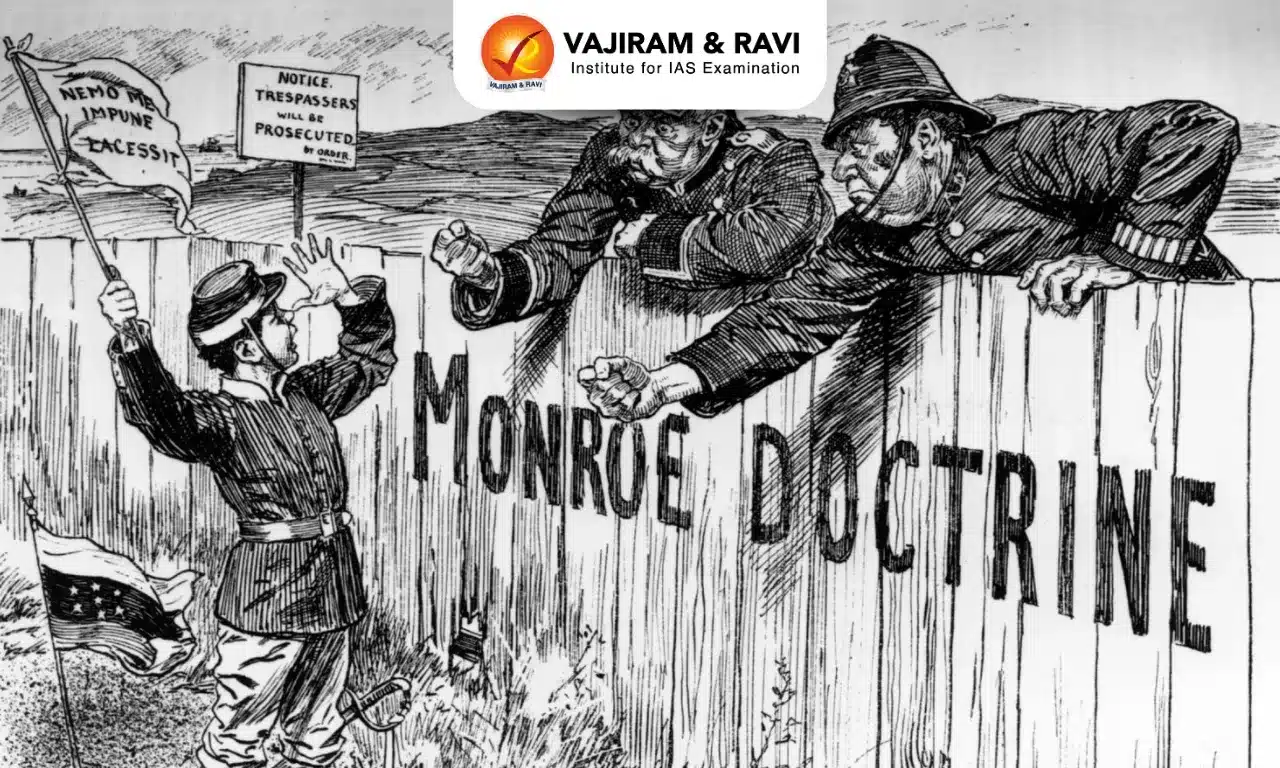
  • The Monroe Doctrine, articulated by U.S. President James Monroe in 1823, is a significant U.S. foreign policy statement aimed at preventing European intervention in the Americas.
  • Primarily the work of Secretary of State John Quincy Adams, the Monroe Doctrine forbade European interference in the American hemisphere but also asserted U.S. neutrality in regard to future European conflicts.
  • The origins of the Monroe Doctrine stem from attempts by several European powers to reassert their influence in the Americas in the early 1820s. 
    • In North America, Russia had attempted to expand its influence in the Alaska territory, and in Central and South America, the U.S. government feared a Spanish colonial resurgence. 
    • Britain too was actively seeking a major role in the political and economic future of the Americas, and Adams feared a subservient role for the United States in an Anglo-American alliance.
  • The United States invoked the Monroe Doctrine to defend its increasingly imperialistic role in the Americas in the mid-19th century.
  • However, it was not until the Spanish-American War in 1898 that the United States declared war against a European power over its interference in the American hemisphere. 
  • The doctrine has had lasting impacts on U.S. relations with its southern neighbors, reflecting America's desire to assert its influence while advocating for independence and self-determination in the region.
  • The isolationist position of the Monroe Doctrine was also a cornerstone of U.S. foreign policy in the 19th century.
  • It took the two world wars of the 20th century to draw a hesitant America into its new role as a major global power.

Source: TP

Monroe Doctrine FAQs

Q1: What is the Monroe Doctrine?

Ans: It is a significant U.S. foreign policy statement aimed at preventing European intervention in the Americas.

Q2: The Monroe Doctrine was articulated in which year?

Ans: 1823

Q3: The Monroe Doctrine was announced by which U.S. President?

Ans: James Monroe

Q4: What does Monroe Doctrine primarily aims at?

Ans: It is aimed at preventing European intervention in the Americas.

Q5: What position did the Monroe Doctrine take regarding future European conflicts?

Ans: The U.S. would remain neutral.

UN Environment Assembly

UN Environment Assembly

UN Environment Assembly Latest News

Recently, the seventh UN Environment Assembly (UNEA-7) is taking place in Nairobi, Kenya.

About UN Environment Assembly

  • It is the world’s highest-level decision-making body on the environment.
  • Member Countries: It has the universal membership of all 193 UN Member States and the full involvement of major groups and stakeholders.
  • It gathers ministers of environment in Nairobi, Kenya every 2 years.
  • Background: UNEA was created in 2012, as an outcome of the UN Conference on Sustainable Development (Rio+20), held in Brazil.

Functions of UN Environment Assembly

  • It sets the global environmental agenda, provides overarching policy guidance, and defines policy responses to address emerging environmental challenges.
  • It undertakes policy review, dialogue and the exchange of experiences, sets the strategic guidance on the future direction of the UN Environment Programme (UNEP).
  • It fosters partnerships for achieving environmental goals and resource mobilization.
  • Organisational Structure: It consists of a President and 8 Vice Presidents (forming the UNEA Bureau)
  • Seventh UNEA session (2025) Theme: "Advancing sustainable solutions for a resilient planet"

Source: New Indian Express

UN Environment Assembly FAQs

Q1: Where is the UN Environment Assembly (UNEA) held?

Ans: Nairobi, Kenya

Q2: What is the theme of UNEA-7?

Ans: Advancing sustainable solutions for a resilient planet

Sudden Stratospheric Warming Event

Sudden Stratospheric Warming Event

Sudden Stratospheric Warming Event Latest News

Recently, a meteorologist warned of another Sudden Stratospheric Warming (SSW) event that could plunge temperatures below average across parts of the U.S. later this month.

About Sudden Stratospheric Warming Event

  • It refers to a rapid rise in stratospheric temperatures that weakens or distorts the polar vortex (a cold-air mass typically stabilized over the Arctic).

Occurrence of the Event

  • It begins with large-scale atmosphere waves (called Rossby waves) getting pushed higher into the atmosphere.
  • These waves can “break” (like waves in the ocean) on top of the polar vortex and weaken it. If waves are strong enough, the winds of the polar vortex can weaken so much that they can reverse from being westerly to easterly.
  • This leads to cold air descending and warming rapidly.
  • It can lead to a displacement or splitting of the polar vortex, so instead of cold air being locked above the polar region, it can push further south into the mid-latitudes.

What is the Polar Vortex?

  • It is a large area of low pressure and cold air surrounding both of the Earth’s poles. 
  • It extends from the tropopause (the dividing line between the stratosphere and troposphere) through the stratosphere and into the mesosphere (above 50 km).
  • It always exists near the poles, but weakens in summer and strengthens in winter.
  • Many times, during winter in the northern hemisphere, the polar vortex will expand, sending cold air southward with the jet stream.
  • Jet streams are relatively narrow bands of strong wind in the upper levels of the atmosphere, typically occurring around 30,000 feet (9,100 meters) in elevation.
  • This occurs fairly regularly during wintertime and is often associated with large outbreaks of Arctic air in the United States.
  • This is not confined to the United States. Portions of Europe and Asia also experience cold surges connected to the polar vortex.

 Source: Newsweek

Sudden Stratospheric Warming Event FAQs

Q1: What is Sudden Stratospheric Warming (SSW)?

Ans: A rapid warming of the stratosphere

Q2: What is the typical altitude range where SSW occurs?

Ans: 10-30 km

INS Gharial

INS Gharial

INS Gharial Latest News

The Indian Navy recently deployed INS Gharial and three other vessels as part of the ongoing Operation Sagar Bandhu for offering humanitarian assistance and relief to the cyclone-affected regions of Sri Lanka.

About INS Gharial

  • INS Gharial (L23) is a Magar-class amphibious warfare vessel of the Indian Navy.
  • It is the second indigenously built Landing Ship Tank (Large).
  • It was built by Hindustan Shipyard Limited and Garden Reach Shipbuilders and Engineers.
  • It is one of the largest ships of the Indian Navy.
  • It was commissioned on 14 Feb 1997 and is part of the Eastern Fleet under the Eastern Naval Command. 
  • It is capable of carrying two helicopters, one in the hangar and one on deck, 10 Vijayanta tanks in her underbelly, and four Landing Craft  Assault (LCA) slung aloft.
  • It is also armed with guns and rocket launchers, which are used to "soften up" a hostile beach before the tanks go in and the LCAs charge in with assault troops.

Source: TP

INS Gharial FAQs

Q1: What is INS Gharial?

Ans: It is a Magar-class amphibious warfare vessel of the Indian Navy.

Q2: When was INS Gharial commissioned into the Indian Navy?

Ans: It was commissioned on 14 Feb 1997.

Q3: INS Gharial is part of which fleet of the Indian Navy?

Ans: It is part of the Eastern Fleet under the Eastern Naval Command.

Key Facts About Japan

Key Facts about Japan

Japan Latest News

Recently, a major earthquake rocked Japan's northern coast and also the country's meteorological agency recorded several tsunami waves.

About Japan

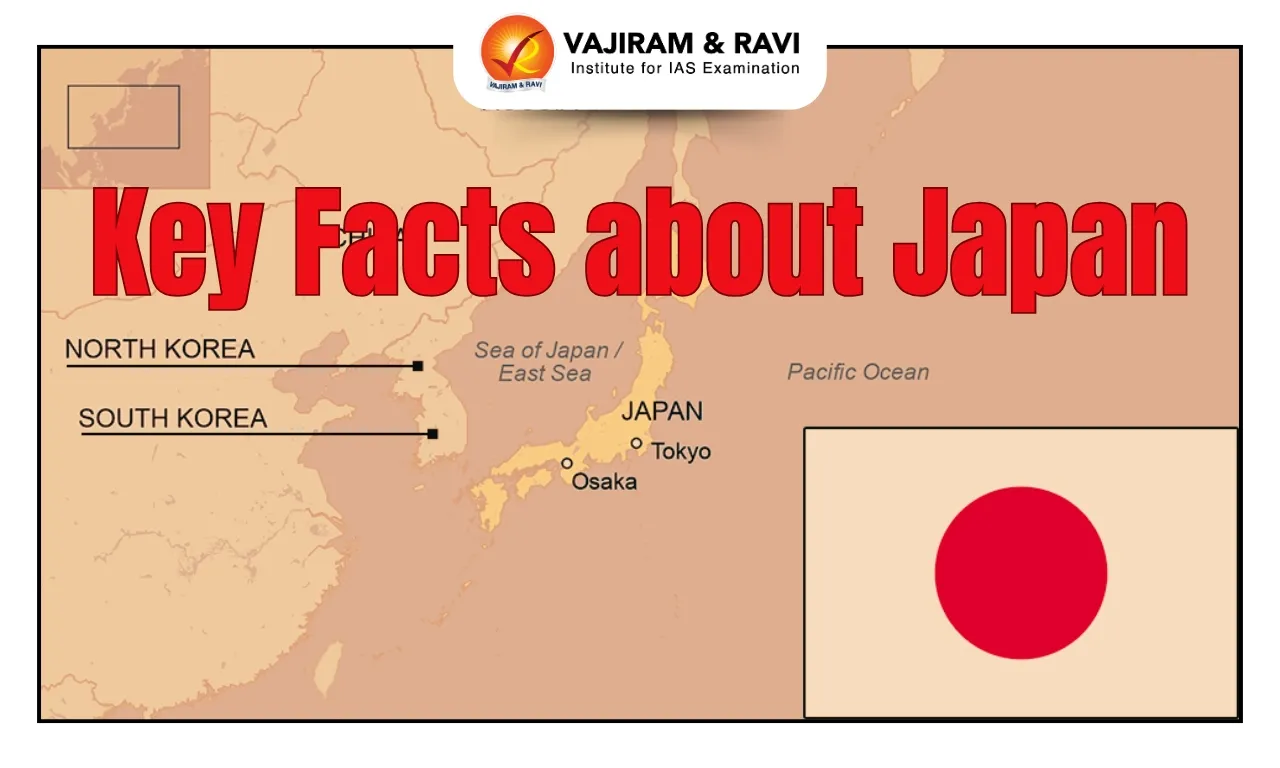
  • Location: It is an island nation in East Asia, situated in the Northwestern Pacific Ocean.
  • Maritime borders: It is bordered by the Pacific Ocean (East), Sea of Okhotsk (North), Sea of Japan (West East) and East China Sea (Southwest).
  • Political Structure: Parliamentary government under a constitutional monarchy.
  • Capital City: Tokyo, located in east-central Honshu.

Geographical Features of Japan

  • It comprises a chain of islands stretching ~1,500 miles in a northeast–southwest arc.
  • Main Islands (north to south): Hokkaido, Honshu, Shikoku, and Kyushu.
  • Terrain: Over 80% mountainous, with rugged terrain.
  • Volcanic activity: It is located on the Pacific Ring of Fire – a major zone of earthquakes and active volcanoes.
  • Highest peak: Mount Fuji (3,776 m), which is a stratovolcano.
  • Major mountain ranges: Japanese Alps.
  • Major rivers: Shinano River (longest), Tone River, Kiso River.
  • Climate: It ranges from subarctic in the north to humid subtropical in the south.
  • It is often disturbed by earthquakes, tsunamis, and volcanic eruptions due to tectonic activity.

Source: TH

Japan FAQs

Q1: What is the capital of Japan?

Ans: Tokyo

Q2: Which is the famous Japanese festival?

Ans: Cherry Blossom Festival

India International Science Festival

India International Science Festival

India International Science Festival Latest News

The 11th edition of India International Science Festival is being held in Panchkula, Haryana. 

About India International Science Festival

  • It was launched in 2015.
  • IISF aims to bring together people and the scientific community both nationally and internationally to collaborate, interact, and experience the joy of doing science for the wellbeing of India and humanity, guided by the spirit of swadeshi.
  • Mission of IISF: Bridging traditional knowledge systems with modern scientific research thereby strengthening the link between India’s indigenous knowledge heritage and contemporary scientific inquiry.

Key Facts about India International Science Festival 2025

  • It is  organised by the Ministry of Earth Sciences (MoES) and coordinated by Indian Institute of Tropical Meteorology (IITM) Pune.
  • The theme of India International Science Festival (IISF) 2025:  “Vigyan Se Samruddhi: for Aatmanirbhar Bharat”.
  • The event will feature more than 150 technical and thematic sessions across science, technology and innovation.
  •  IISF 2025 will focus on five broad themes
    • Science, Technology and Ecology of North-West India and the Himalayan Region;
    • Science for Society and Education;
    • Atmanirbhar Bharat through Science and Technology;
    • Biotechnology and Bio-economy; and
    • Integration of Traditional Knowledge with Modern Science.

Source: PIB

India International Science Festival FAQs

Q1: What is the primary objective of the India International Science Festival (IISF)?

Ans: To celebrate science and technology

Q2: Where was the 11th India International Science Festival (IISF) 2025 held?

Ans: Panchkula

National Mission on Edible Oils

National Mission on Edible Oils

National Mission on Edible Oils Latest News

The National Mission on Edible Oils (NMEO) embodies India’s commitment to realizing the vision of Atmanirbhar Bharat by transforming the edible oil sector from an import-dependent to a self-reliant one. 

About National Mission on Edible Oils

  • It aims to strengthen the country’s oilseed ecosystem and achieve Atmanirbharta in edible oil production.
  • Targets of the mission
    • It targets to increase the area coverage from 29 million ha (2022-23) to 33 million ha, primary oilseed production from 39 million tonnes (2022-23) to 69.7 million tonnes, and yield from 1,353 kg/ha (2022-23) to 2,112 kg/ha by 2030-31.
    • This mission targets domestic edible oil production at 25.45 million tonnes by 2030-31.
    • The Mission also seeks to expand oilseed cultivation by an additional 40 lakh hectares by targeting rice and potato fallow lands.
  • It has two-pronged approach which is as follows

National Mission on Edible Oils-Oil Palm

  • It is focused on expanding oil palm cultivation and increasing domestic crude palm oil output.
  • It was approved in 2021, as a Centrally Sponsored Scheme, with the aim to enhance the edible oilseeds production and oils availability in the country by area expansion and increasing Crude Palm Oil (CPO) production.
  • It focuses on increasing production of seedlings by establishment of seed garden, and nurseries of oil palm in order to assure domestic availability of seedlings as per target fixed under NMEO-OP.
  • Targets: To bring 6.5 lakh hectares under oil palm cultivation by 2025–26 and increase crude palm oil production to 28 lakh tonnes by 2029–30.
  • Implementation: The Department of Agriculture & Farmers Welfare (DA&FW) serves as the nodal central authority.

National Mission on Edible Oils– Oilseeds

  • It is aimed at improving productivity, seed quality, processing, and market linkages for traditional oilseed crops.
  • Target:  To increase oilseed production from 39 to 69.7 million tonnes by 2030–31 through cluster-based interventions and improved seed systems.
  • It was approved in 2024, for a seven-year period, from 2024-25 to 2030-31.
  • Focus: Increasing production of key primary oilseed crops such as Rapeseed-Mustard, Groundnut, Soybean, Sunflower, Sesamum, Safflower, Niger, Linseed and Castor.
  • It also focuses on increasing collection and extraction efficiency from secondary sources like cottonseed, coconut, rice bran as well as Tree-Borne Oilseeds (TBOs).
  • Implementation: It will be implemented in all States/UTs with the funding pattern of 60:40 in case of general States, Delhi & Puducherry and 90:10 in case of North-Eastern States and hill States, and 100% funding for UTs and Central Agencies.

Source: PIB

National Mission on Edible Oils FAQs

Q1: What is the primary objective of the National Mission on Edible Oils (NMEO)?

Ans: To achieve self-sufficiency in edible oil production

Q2: What is the target for oilseed production under NMEO by 2030-31?

Ans: 69.7 million tonnes

C-130J Super Hercules

C-130J Super Hercules

C-130J Super Hercules Latest News

A new defence Maintenance, Repair, and Overhaul (MRO) facility to support the C-130J Super Hercules aircraft will be established in Bengaluru.

About C-130J Super Hercules

  • It is a four-engine turboprop military transport aircraft.
  • It was developed by Lockheed Martin, a US security and aerospace company.
  • It is the US Air Force’s principal tactical cargo and personnel transport aircraft.
  • It is the current variant of the C-130 Hercules and is the airlifter of choice for 26 operators in 22 nations.
  • The largest operators are the US Air Force, US Marine Corps, Australia, Canada, India, Italy, and the United Kingdom.
  • The Indian Air Force (IAF) currently operates 12 C-130J Super Hercules.

C-130J Super Hercules Features

  • The aircraft is capable of operating from rough, dirt strips and is the prime transport for airdropping troops and equipment into hostile areas. 
  • It has reduced crew requirements. A minimal crew of three men is required to operate this aircraft, including two pilots and one loadmaster.
  • It is powered by four Rolls-Royce AE 2100D3 turboprop engines.
  • It has digital avionics, including Head-Up Display (HUD) for each pilot. 
  • Range: 6,852 km (no payload)
  • Speed: 644 km/hr
  • Endurance: 20+ hours
  • It is capable of short takeoffs and landings from unprepared runways.
  • It has a payload capacity of 19 tons.
  • It can accommodate a wide variety of oversized cargo, including everything from utility helicopters and six-wheeled armored vehicles to standard palletized cargo and military personnel.
  • Equipped with an Infrared Detection Set, the aircraft can perform precision low-level flying, airdrops, and landing in blackout conditions.

Source: TH

C-130J Super Hercules FAQs

Q1: The C-130J Super Hercules is primarily what type of aircraft?

Ans: Military transport aircraft.

Q2: The C-130J Super Hercules was developed by which country?

Ans: United States

Q3: The C-130J Super Hercules is powered by which engines?

Ans: It is powered by four Rolls-Royce AE 2100D3 turboprop engines.

Q4: What is the C-130J Super Hercules?

Ans: 6,852 km (no payload)

Bluetongue Virus (BTV)

Bluetongue Virus

Bluetongue Virus Latest News

More suspected cases of bluetongue virus (BTV) have been recently detected in Northern Ireland.

About Bluetongue Virus

  • It is responsible for causing the severe haemorrhagic disease, bluetongue (BT).
    • It is an infectious, non-contagious, vector-borne disease.
    • It can infect domestic ruminants, including cattle, sheep, and goats, along with wild animals such as buffalo, deer, antelope, and camels
    • Of the domestic species, sheep are the most severely affected. 
  • BTV is present in all continents except Antarctica. 
  • Transmission:
    • BTV is predominantly spread between ruminants through the bites of infected Culicoides midges, tiny blood-feeding insects that can be found in large numbers on most farms. 
    • Some BTV strains can be transferred from a ruminant mother to her fetus during pregnancy.
  • Can the BTV Spread to Humans? 
    • No, BTV cannot infect people. 
    • There are no food safety issues, and meat and dairy products are safe to consume.
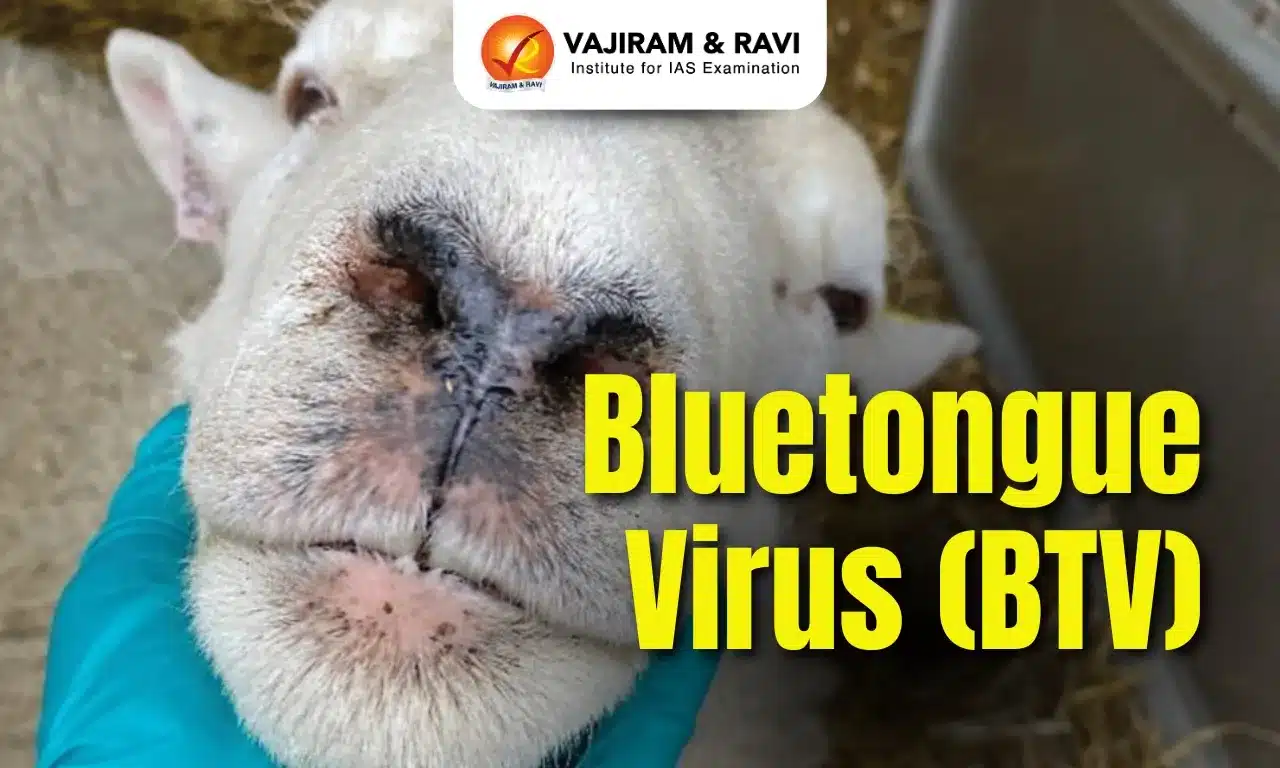
  • Clinical signs associated with bluetongue disease are usually only seen in sheep (and sometimes deer), and it can be fatal. Clinical Signs Include:
    • Fever (40°C to 42°C)
    • Swelling of the lips, tongue, and head
    • Nasal discharge
    • Lameness
    • Reddening around the coronary band (top of the hoof).
  • Some animals may show signs of a swollen, bluish-coloured tongue (hence the name ‘bluetongue’). 
    • This will not always be seen and should not be relied upon to diagnose bluetongue disease.
  • BT can result in high rates of morbidity and even mortality in flocks and herds and can affect production (e.g. milk yields) and trade.
  • Treatment:
    • There is no effective treatment for bluetongue. 
    • Vaccines are available for certain types of the disease and are used in Africa, Asia, and parts of Europe.

Source: BBC

Bluetongue Virus FAQs

Q1: Bluetongue Virus (BTV) causes which type of disease in animals?

Ans: Severe haemorrhagic disease.

Q2: Which domestic species is most severely affected by Bluetongue Virus?

Ans: Sheep

Q3: What is the primary vector responsible for transmitting Bluetongue Virus?

Ans: It is predominantly spread between ruminants through the bites of infected Culicoides midges, tiny blood-feeding insects

Q4: Can Bluetongue Virus infect humans?

Ans: No, humans cannot be infected.

Q5: What is the current treatment for Bluetongue Virus in animals?

Ans: There is no effective treatment for bluetongue but vaccines are available for certain types of the disease.

Enquire Now