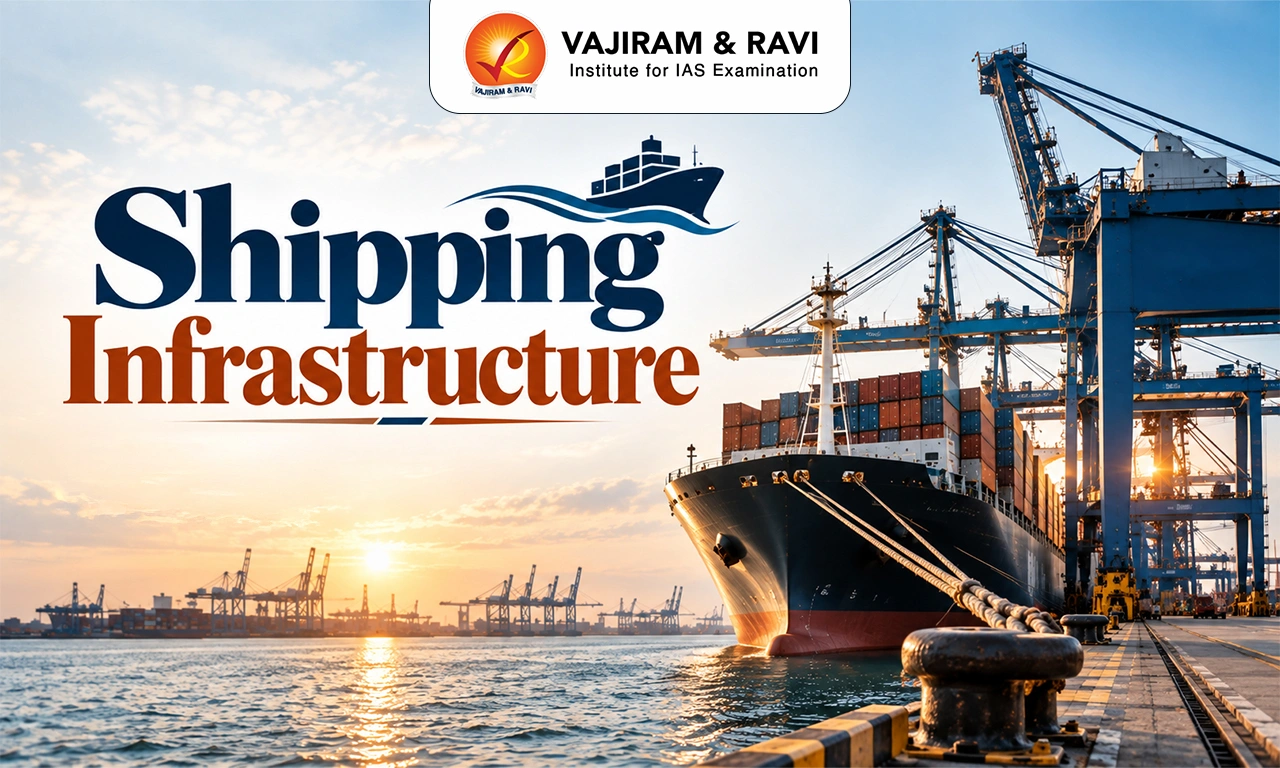
Shipping infrastructure forms the backbone of India's maritime economy and plays a crucial role in facilitating domestic and international trade. With over 95% of India's trade by volume and around 70% by value being carried through maritime transport, ports, shipping services, inland waterways, and coastal shipping have become critical drivers of economic growth, logistics efficiency, and global competitiveness.
India is undertaking a major transformation of its shipping infrastructure through initiatives such as the Sagarmala Programme, Maritime India Vision 2030, and Maritime Amrit Kaal Vision 2047, aimed at modernising ports, enhancing multimodal connectivity, promoting shipbuilding and ship repair, and positioning India as a leading global maritime nation.
Shipping Infrastructure Overview
Shipping infrastructure forms a critical pillar of India's trade, logistics, and economic development ecosystem. With an extensive network of ports and expanding inland waterways, India is undertaking significant infrastructure modernisation and policy reforms to enhance connectivity, reduce logistics costs and boost exports.
- Extensive Port Infrastructure: India's shipping infrastructure includes a coastline of over 11,000 km, which forms the backbone of India's trade and logistics network.
- Vadhvan Port in Maharashtra and Galathea Bay Port in the Andaman & Nicobar Islands are currently under development to expand future capacity.
- Rising Capacity and Port Modernisation: Major ports handled over 855 MMT of cargo in FY 2024-25, while the Sagarmala Programme is modernising shipping infrastructure and promoting port-led development.
- Massive Infrastructure Investments: Maritime India Vision 2030 and Maritime Amrit Kaal Vision 2047 in total envisage investments exceeding US$1 trillion to strengthen shipping infrastructure, shipbuilding, inland waterways, and coastal shipping.
- Integrated Multimodal Connectivity: Shipping infrastructure is being integrated with PM Gati Shakti, dedicated freight corridors and other railway infrastructure, highways, and inland waterways to improve logistics efficiency and reduce transportation costs.
- Development of Mega Ports and Waterways: New projects such as Vadhavan Port and Galathea Bay Port, along with expanded inland waterways, will enhance India's maritime capacity and reduce dependence on foreign transhipment hubs.
- Strategic Trade and Economic Role: Shipping infrastructure handles the majority of India's EXIM trade and supports energy security, supply-chain resilience, manufacturing growth, and India's emergence as a leading maritime power.
Classification of Indian Ports
Indian ports are primarily classified into Major and Minor (or Non-Major) ports based on their administration, management jurisdiction, and legal framework.
- Major Ports in India:
- Administration: Managed and governed by the Central Government of India under the Ministry of Ports, Shipping, and Waterways, under the Major Port Authorities Act, 2021.
- Constitutional Jurisdiction: Listed under the Union List of the Indian Constitution.
- Role: Handles a massive volume of international import and export cargo traffic.
- Number: There are 12 operational major ports in India (such as Mumbai, Chennai, Cochin, and Paradip) spread across the coastal states and Union Territories.
- Vadhvan Port and Galathea Bay Port are the next major ports of India.
- Minor / Non-Major Ports:
- Administration: Managed and governed by the respective maritime state governments or Union Territory administrations.
- Constitutional Jurisdiction: Listed under the Concurrent List of the Constitution.
- Role: Cater mostly to regional trade, coastal shipping, and smaller cargo volumes or fishing operations.
- Number: There are over 200 minor and intermediate ports along the Indian coastline.
- The Vizhinjam International Seaport in Kerala is India's latest and first deep-water container transshipment port, operating under the state-administered (non-major) port framework.
- Private Ports: Certain captive and private ports or terminals are developed or operated by private companies alongside public-private partnerships (PPPs).
Shipping Infrastructure Significance
Shipping infrastructure is a critical enabler of India's trade, industrial growth, and economic competitiveness. Given India's strategic maritime location and extensive coastline, efficient ports, shipping networks, and inland waterways play a vital role in reducing logistics costs, facilitating global trade, and strengthening supply chain resilience.
- Facilitates Trade and Economic Growth: Shipping infrastructure handles around 95% of India's trade by volume and about 70% by value, making it indispensable for exports, imports, and economic development.
- Reduces Logistics Costs and Improves Competitiveness: Modern ports, coastal shipping, and inland waterways provide a cost-effective mode of transport, supporting initiatives such as Sagarmala and PM Gati Shakti.
- Promotes Industrialisation and Employment: Shipping infrastructure supports port-led industrialisation, logistics parks, manufacturing clusters, shipbuilding, and allied industries, generating large-scale employment opportunities.
- Strengthens Multimodal Connectivity: Integration of shipping infrastructure with railways, highways, dedicated freight corridors, and inland waterways ensures seamless cargo movement and efficient supply chains.
- Enhances Energy and Supply Chain Security: Ports and shipping infrastructure facilitate the import of crude oil, LNG, coal, fertilisers, and other strategic commodities essential for India's energy and food security.
- Supports India's Maritime and Strategic Interests: Strong shipping infrastructure enhances India's position in the Indian Ocean Region, strengthens maritime security, and supports its ambition of becoming a leading global maritime power.


Shipping Infrastructure Government Initiatives
India is transforming its maritime sector through major government initiatives like the Sagarmala Programme and a ₹69,725 crore package for shipbuilding and maritime reforms.
- Sagarmala: Launched in 2015, this flagship MoPSW initiative focuses on port-led development across India’s 7,500+ km coastline.
- It aims to modernise existing ports, enhance multi-modal port connectivity, boost coastal shipping, and support coastal communities.
- Maritime India Vision 2030: A coordinated 10-year blueprint launched in 2021. It maps out 150 initiatives to strengthen the Blue Economy, improve port governance, drive digital tracking, and build global shipbuilding and ship-recycling hubs.
- Maritime Amrit Kaal Vision 2047: An ambitious, long-term extension of the maritime roadmap looking toward India's centenary of independence.
- It outlines over 300 action points to upscale port handling capacity to 10 billion metric tonnes annually, expand the shipping fleet, and rank India among the top 5 global shipbuilding nations.
- PM Gati Shakti: The National Master Plan for Multi-modal Connectivity. It is a digital GIS-based platform that unifies major ministries (including railways and roadways) to eliminate departmental silos and plan seamless infrastructure connections directly to economic zones and ports.
- National Logistics Policy: Designed to complement PM Gati Shakti, the NLP focuses on policy reforms, digital governance, and process streamlining.
- Its primary goal is to lower India's logistics costs to align with global benchmarks (approx. 8%), improving global trade competitiveness.
- Sagarmanthan: This refers to two initiatives under MoPSW.
- Sagarmanthan Dashboard: A comprehensive real-time digital performance monitoring dashboard to track logistics KPIs, project timelines, and maritime analytics.
- Sagarmanthan Dialogue: A flagship maritime dialogue hosted by MoPSW to facilitate discussions on India's maritime sector, blue economy, global trade and maritime cooperation.
- Harit Sagar Guidelines: Launched in 2023, these are the Green Port Guidelines providing a framework to attain zero carbon emissions and zero waste discharge.
- They mandate major ports to expand renewable energy usage (target of 60% by 2030 and 90% by 2047) and implement alternative fuel bunkering (Green Hydrogen, Ammonia, Methanol).
- Green Tug Transition Programme: An actionable roadmap under the green shipping vision to phase out fossil-fuel harbour tugboats.
- Operating through the National Centre of Excellence in Green Port & Shipping (NCoEGPS), the programme targets converting 50% of port tugs into hybrid/all-electric alternatives by 2030 and 100% by 2047.
- Cruise Bharat Mission: Launched in late 2024, this inter-ministerial mission targets a complete transformation of India's coastal, river, and island cruise tourism.
- It aims to develop world-class cruise terminals, ease regulatory clearances, and double cruise passenger traffic by 2029.
Shipping Infrastructure Legislative Reforms
To improve the shipping infrastructure in India, major legislative reforms have been made, which are described below.
- Indian Ports Act, 2025: A modern legislative framework that replaced the colonial-era Indian Ports Act, 1908.
- It aims to improve governance, safety, and sustainability across India's maritime sector.
- It gives statutory status to the Maritime State Development Council (MSDC) to coordinate policies between the central government and coastal states.
- It also formally recognises and empowers State Maritime Boards to manage non-major ports.
- The Act mandates setting up State Dispute Resolution Committees (DRCs) to handle non-major port conflicts, with appeals directed to High Courts.
- Enactment of National Waterways Act, 2016: The National Waterways Bill, 2015, was introduced and passed by the Lok Sabha on 21st December 2015 and by the Rajya Sabha on 9th March 2016.
- The National Waterways Act, 2016, came into force w.e.f. 12th April, 2016.
- 111 (106 new + 5 existing) National Waterways (NWs) were declared, increasing the total length of NWs from 4,382 km to 20,187 km.
- Recycling of Ships Act, 2019: With the objective of regulating the ship recycling industry, India has enacted the Recycling of Ships Act, 2019.
-
- India has also acceded to the Hong Kong International Convention on Recycling of Ships, with the objective of ensuring safe and environmentally sound recycling of ships.
- Major Port Authorities Act, 2021: The Act provides for the regulation, operation and planning of major ports in India and vests the administration, control and management of such ports upon the Boards of Major Port Authorities.
- The legislation empowers them to perform with greater efficiency on account of increased autonomy in decision-making and by modernising their institutional framework.
- Marine Aids to Navigation Act, 2021: The Act aims to replace the over 90-year-old Lighthouse Act, 1927, to incorporate global best practices, technological developments and India's international obligations in the field of Marine Aids to Navigation.
- The new Act will facilitate harmonised and effective functioning of aids to marine navigation and Vessel Traffic Services along the Indian coastline.
- Inland Vessels Act, 2021: It aims to replace the over 100-year-old Inland Vessels Act, 1917, and usher in the inland water transport sector to make the legislative framework user-friendly and promote ease of doing business.
- Revision of Model Concession Agreement (MCA), 2021: The new MCA will be applicable to all the future PPP projects at major ports, as well as projects which are already approved by the government but are still under the bidding stage.
- The new MCA is aimed at reducing arbitrations and litigation in the sector as well as making the sector attractive for private sector participation.
- It has not only provided more clarity for the responsibilities and obligations of the authority and private party but also introduced clauses related to the termination payment before COD, change in cargo due to unforeseen circumstances, and change in law.
- These clauses, among others, should enhance Ease of Doing Business (EoDB).
Shipping Infrastructure Challenges
Shipping infrastructure in India has witnessed substantial growth through port modernisation, enhanced maritime connectivity, and major policy initiatives. However, several structural, operational, financial, and technological challenges continue to constrain its full potential, making targeted reforms essential for improving trade competitiveness, reducing logistics costs, and achieving the objectives of Maritime India Vision 2030 and Maritime Amrit Kaal Vision 2047.
- High Logistics Costs and Connectivity Gaps: Although India's logistics cost has improved to around 7.97% of GDP in 2023–24, gaps in hinterland connectivity, first- and last-mile infrastructure, multimodal integration and cargo evacuation continue to affect logistics efficiency.
- Underutilisation of Coastal Shipping and Inland Waterways: India's shipping infrastructure has not fully leveraged the potential of coastal shipping and inland waterways, leading to excessive dependence on costlier road transport.
- Weak Shipbuilding and Maritime Ecosystem: Limited domestic shipbuilding, ship repair, and maritime service capabilities increase dependence on foreign shipyards, shipping lines, and related services.
- Port Infrastructure Bottlenecks: Although major ports have improved capacity and operational efficiency, such as major-port turnaround time, which has fallen substantially, with recent figures around 48 hours in 2026, select ports and terminals continue to face congestion, storage limitations, evacuation bottlenecks and inadequate hinterland connectivity.
- Regulatory, Technological, and Skill Challenges: Differences in regulatory procedures, the need for greater digital interoperability, cybersecurity preparedness, adoption of smart-port technologies and shortages of specialised maritime skills remain challenges.
- Environmental and Strategic Vulnerabilities: Climate-related risks, coastal erosion, and dependence on foreign maritime services, insurance, and financing pose long-term challenges to the resilience and competitiveness of India's shipping infrastructure.
Shipping Infrastructure Way Forward
Shipping infrastructure will play a pivotal role in enhancing India's trade competitiveness, reducing logistics costs, and supporting sustainable economic growth. As India seeks to emerge as a global maritime hub and achieve the objectives of Viksit Bharat 2047, strengthening shipping infrastructure through modernisation, digitalisation, multimodal integration, and green technologies will be essential.
- Modernise and Expand Shipping Infrastructure: Accelerate port modernisation, capacity augmentation, and development of deep-draft ports and international transshipment hubs under the Sagarmala and Maritime Amrit Kaal Vision 2047.
- Strengthen Multimodal Connectivity: Integrate shipping infrastructure with PM Gati Shakti, dedicated freight corridors, railways, highways, inland waterways, and logistics parks to enable seamless cargo movement and reduce logistics costs.
- Promote Coastal Shipping and Inland Waterways: Increase the share of coastal shipping and inland waterways through improved infrastructure, policy incentives, and last-mile connectivity to reduce dependence on road transport.
- Develop a Self-Reliant Maritime Ecosystem: Strengthen domestic shipbuilding, ship repair, maritime insurance, financing, and port-based industrial clusters to reduce dependence on foreign maritime services.
- Adopt Smart and Sustainable Shipping Infrastructure: Promote digital ports, automation, AI-based logistics management, blockchain-enabled documentation, and green shipping practices to improve efficiency and environmental sustainability.
- Enhance Skills, Resilience and Regulatory Efficiency: Develop a skilled maritime workforce, streamline regulatory approvals, improve climate resilience of ports, and strengthen maritime security to support long-term growth of shipping infrastructure.
Shipping Infrastructure UPSC PYQs
Q1. In what way(s) does the Vizhinjam International Seaport represent a structural shift in India's maritime trade and logistics policy? (UPSC Prelims 2026)
- By functioning exclusively as a domestic cargo hub to reduce reliance on coastal shipping and eliminate the need for foreign collaborations.
- By focusing primarily on passenger cruise tourism and heritage shipping to increase Kerala's profile as a maritime heritage destination.
- By leveraging its natural deep draft and strategic location to reduce dependence on foreign trans-shipment ports, enhance revenue retention, and reposition India in regional maritime trade.
Select the answer using the code given below:
(a) 1 only
(b) 2 and 3 only
(c) 1 and 3 only
(d) 3 only
Ans: (d)
Q2. Consider the following pairs: (UPSC Prelims 2023)
| Port | Well known as |
|
1. Kamarajar Port |
First major port in India registered as a company |
|
2. Mundra Port |
Largest privately owned port in India |
|
3. Visakhapatnam Port |
Largest container port in India |
How many of the above pairs are correctly matched?
(a) Only one pair
(b) Only two pairs
(c) All three pairs
(d) None of the pairs
Ans: (b)

 Last updated on Sep, 2026
→ UPSC 2027 Notification will be released on 13 January 2027 at upsconline.nic.in.
→ Asian Games 2026 are being held in Aichi-Nagoya, Japan, from 19 September to 4 October.
→ Check out the latest UPSC Syllabus here.
→ Download UPSC Model Answers for Mains 2026
→ UPSC Mains Question Paper 2026 is out now for Essay & GS Paper 1, 2, 3 & 4.
→ UPSC Calendar 2027 has been released.
→ Enroll in Vajiram & Ravi’s UPSC Mains Test Series 2027 for structured answer writing practice, expert evaluation, and exam-oriented feedback.
→ Join Vajiram & Ravi’s UPSC Mentorship Program 2027 for personalized guidance, strategy planning, and one-to-one support from experienced mentors.
→ Go through the UPSC Mains Previous Year Papers to enhance your preparation.
→ UPSC has released UPSC Toppers List 2025 with the Civil Services final result on its official website.
→ Also check Best UPSC Coaching in India
Shipping Infrastructure FAQs
Q1. What is shipping infrastructure?+
Q2. What is the SBFAP policy?+
Q3. Which is the largest shipyard in India?+
Q4. Which city is famous for shipbuilding in India?+
Q5. Which port is known as the Diamond Port?+
Tags: quest shipping infrastructure upsc ecomomy notes