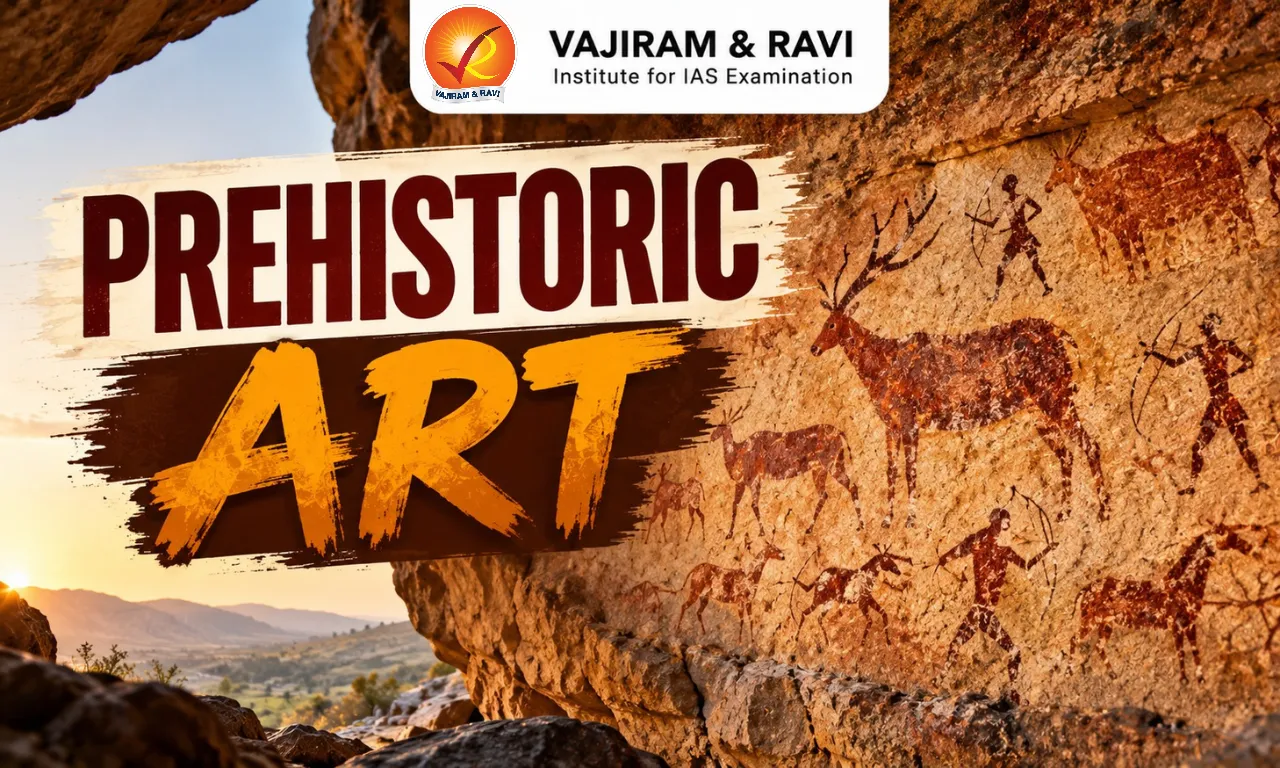
Prehistoric art refers to visual expressions created before written historical records developed in a particular society. It includes rock paintings, engravings, sculptures, decorated objects, and geometric designs that help us understand early human creativity and ways of life.
In India, prehistoric art is especially associated with rock paintings and engravings found in shelters, caves, and exposed rock surfaces. Sites such as Bhimbetka preserve depictions of animals, hunting, dancing, and community activities. These artworks provide valuable evidence of early societies, although their exact dates and meanings are not always certain.
Prehistoric Art History
Prehistoric art represents the artistic and symbolic activities of communities that did not leave written records. Archaeologists study these artworks alongside tools, habitation deposits, pottery, and other remains to reconstruct the past.
- Indian rock art has a long chronology extending from prehistoric periods into later historical times.
- At Bhimbetka, the rock paintings have been classified into successive phases beginning with the Upper Palaeolithic and continuing through the Mesolithic, Chalcolithic and historical periods, although the precise dating of the earliest paintings remains debated.
- These paintings provide valuable evidence of prehistoric communities' subsistence practices, social interactions, beliefs and artistic skills, making rock art an important source for understanding India's cultural heritage.
Prehistoric Art Types
Prehistoric art can be broadly classified according to its medium and technique, including paintings, engravings, carvings, figurines, ornaments, and geometric designs.
- Prehistoric Rock Paintings: Images painted on cave and rock surfaces using natural pigments such as red ochre, white clay, and charcoal. Animals, hunting scenes, human figures, and community activities are common themes.
- Rock Engravings (Petroglyphs): Designs and figures created by scratching, pecking, or cutting the surface of rocks. They include animals, human figures, geometric patterns, and symbolic motifs.
- Sculptures and Figurines: Small objects and figurines made from stone, bone, ivory, or clay, representing humans, animals, or symbolic forms.
- Decorative and Geometric Art: Lines, dots, circles, grids, and other geometric patterns found on rocks and early objects, reflecting experimentation with design and symbolism.
- Body and Personal Decoration: Use of beads, shells, pigments, and other natural materials for personal adornment, indicating early forms of aesthetic and social expression.


Prehistoric Art Evolution
The evolution of prehistoric art in India can be understood through changes in themes, techniques, and representations of human life across different archaeological phases.
Upper Palaeolithic Age
Early artists mainly depicted wild animals, human figures, and hunting-related subjects, using simple lines, engravings, and pigments. Animal-centred imagery, like large animals such as bison, deer, elephants and rhinoceroses, appears prominently, reflecting the close dependence of early communities on their natural surroundings.
Mesolithic Age
Mesolithic age paintings mark an important stage in prehistoric Indian art, reflecting the changing relationship between humans, animals and their environment. Compared with earlier art, these paintings placed greater emphasis on human activities, group life and movement, offering insights into the social and cultural life of prehistoric communities.
- Dynamic Human Figures: Mesolithic paintings show humans engaged in activities such as hunting, dancing, food gathering, and running. The figures often appear in motion, reflecting the active lifestyle of hunter-gatherer communities.
- Smaller and Stylised Figures: Human figures are often small, simplified, and schematic, with lines used to represent limbs and body movements. Their dynamic poses help communicate activity even with limited detail.
- Hunting Scenes and Weapons: Hunting is the dominant theme of Mesolithic paintings. Groups of hunters are shown using bows, arrows, spears, and pointed sticks; some scenes also depict traps and snares.
- Animals such as bison, deer, elephants, tigers, and antelopes frequently appear, sometimes chasing humans and sometimes being hunted by them.
- Clothing, Ornaments and Headgear: Hunters are shown wearing simple clothes and ornaments. Some figures have elaborate headgear or masks, indicating the variety of ways people represented themselves in these paintings.
Neolithic and Chalcolithic Age
Paintings of the Neolithic age and Chalcolithic age depict prehistoric human life, including farming, animal domestication, hunting, and community activities, reflecting changes in society, culture, and artistic expression.
- Changing Themes: With the growth of settled communities, agriculture, and pastoralism, artistic themes gradually reflected new forms of economic and social life.
- Geometric Motifs: Lines, circles, dots, grids, and other patterns became increasingly visible alongside human and animal figures.
- Domestic and Social Life: Representations of domesticated animals, community activities, and changing occupations provide clues about the transformation of prehistoric society.
Prehistoric Art Features
Prehistoric art is characterised by its close connection with nature, human activities and early community life. Its features can be understood through its themes, materials, techniques and style.
- Nature-Centred Themes: Animals, birds and elements of the natural environment feature prominently, reflecting the close relationship between early humans and their surroundings.
- Depiction of Human Life: Hunting, dancing, gathering and group activities provide glimpses into the daily and social life of prehistoric communities.
- Dynamic Representation: Human and animal figures are often shown in movement, particularly in hunting and dancing scenes.
- Geometric Motifs: Dots, lines, circles, and other geometric patterns occur alongside human and animal representations.
- Stylisation: Figures range from relatively naturalistic representations to simplified and schematic forms, showing variations in artistic expression.
- Superimposition: At several sites, paintings were placed over earlier paintings, indicating that rock shelters were used repeatedly by different communities.
Prehistoric Art Materials and Techniques
Prehistoric people used naturally available materials and simple techniques to create paintings and engravings on cave walls, rock shelters, and stone surfaces. These artworks provide insights into their environment, beliefs, and daily activities.
- Natural Pigments: Natural mineral pigments such as red and yellow ochres, white mineral/clay pigments, and, at some sites, green and black pigments were used.
- Simple Techniques: Artworks were created through painting, finger application, engraving, scratching, and pecking on rock surfaces.
- Finger Painting: Artists applied coloured pigments directly onto rock surfaces using their fingers. They also made handprints by pressing pigment-covered palms against the rock, leaving visible impressions.
- Brush Painting: The brush was mostly employed to portray anatomical features and contours. Simple brushes or applicators made from twigs, plant fibres, and animal hair may have been used.
- Outlining and Filling: Artists first drew the outlines of animals, human figures, or other motifs and then filled them with pigments. This technique helped define body shapes and emphasise features such as horns, limbs and movement.
- Spray Painting: Painting by spraying pigment makes it simple to produce both colour fields and lines of dots, whether they are connected or not.
Prehistoric Art in India
Prehistoric art in India represents the visual and symbolic expression of early human communities, mainly through paintings, engravings, and carvings on rocks and shelters. It developed across the Palaeolithic, Mesolithic, and Neolithic periods, with some traditions continuing into later historical phases.
- The art provides archaeological evidence of changing human interaction with the environment, animals, and community life.
- India has more than 1,000 known rock-art sites, spread across regions including Madhya Pradesh, Uttar Pradesh, Karnataka, Andhra Pradesh, Telangana, Uttarakhand and Kerala.
- The diversity of sites and artistic techniques reflects the long development of prehistoric culture in the Indian subcontinent, while sites such as Bhimbetka preserve particularly extensive sequences of rock art.
Prehistoric Art Major Sites
India's prehistoric art is preserved across rock shelters, caves, and open rock surfaces, with major concentrations in Central and southern India.
- Bhimbetka, Madhya Pradesh: A UNESCO World Heritage Site in India and one of India’s most important prehistoric art centres. Its rock shelters contain paintings from different periods, depicting animals, hunting scenes, dancing, and community activities.
- Lakhudiyar, Uttarakhand: Located near the Suyal River, the site is known for rock paintings showing human figures, animals, and geometric designs. It provides evidence of prehistoric artistic activity in the Himalayan region.
- Adamgarh, Madhya Pradesh: Situated near Hoshangabad (Narmadapuram), Adamgarh has numerous rock shelters with Mesolithic paintings, particularly depicting animals, hunting, and human activities.
- Kupgallu, Karnataka: An important South Indian prehistoric art site, known especially for rock engravings, cupules, and petroglyphs. The site demonstrates techniques different from painted rock art.
- Edakkal Caves, Kerala: Famous for prehistoric petroglyphs, including human and animal figures, weapons, symbols, and geometric motifs. Some engravings are associated with Neolithic/Mesolithic contexts, while the site also preserves later inscriptions and cultural evidence.
Prehistoric Art Significance
Prehistoric art is significant not only as an early form of artistic expression but also as an important archaeological source for reconstructing societies that left no written records. Its themes, techniques, and changing styles help researchers understand aspects of early human life and cultural development.
- Historical Source: Cave paintings and rock engravings help reconstruct aspects of life in periods without written records, alongside archaeological remains such as tools and habitation sites.
- Social Life: Scenes of hunting, dancing, group activities and, at some sites, possible musical or ritual activities provide clues about the social and cultural life of prehistoric communities.
- Human–Nature Relationship: Frequent representations of animals and changing human–animal relationships reveal how early communities interacted with their natural environment and fauna.
- Cultural Development: Changes in representations of animals, humans, and economic activities can provide clues about changing subsistence practices, mobility, pastoralism, and settlement patterns in different regions.
- Artistic Evolution: The diversity of styles, techniques, pigments, and motifs demonstrates the long development of visual expression in the Indian subcontinent.
- Cultural Heritage: India's extensive rock-art tradition represents an important part of the country's archaeological and cultural heritage and continues to be studied through multidisciplinary research.
Prehistoric Art Transformation
Prehistoric artistic traditions did not disappear at a single point. In different regions, rock art and other forms of visual expression continued and changed alongside developments in agriculture, pastoralism, settlement, technology and social organisation. The shift from prehistoric to historic cultures changed both the context and forms of artistic expression.
- Changing Lifestyle: The spread of agriculture, pastoralism and settled communities introduced new subjects and contexts, although hunting and animal imagery continued in many rock-art traditions.
- Emergence of New Artistic Forms: With the development of pottery, metalworking, terracotta and sculpture, artistic expression expanded beyond rock shelters and caves.
- Rise of Urban Cultures: The emergence of the Indus Valley civilisation (c. 2600–1900 BCE) brought new artistic mediums such as terracotta figurines, seals, pottery designs and metal objects.
- Continuation of Rock Art: Rock paintings and engravings continued into historical periods at several sites, often incorporating inscriptions and newer motifs rather than ending completely.
- Transition to Historic Art: The development of writing, organised states, temples and formal religious traditions eventually produced more structured artistic traditions, marking the broader transition from prehistoric to historic art.

 Last updated on Oct, 2026
→ UPSC 2027 Notification will be released on 13 January 2027 at upsconline.nic.in.
→ Check Nobel Prize 2026 Winners List here.
→ Download PIB PRiSM Monthly Magazine 2026 here.
→ Check UPSC Monthly Current Affairs Magazine The Recitals here.
→ Check out the latest UPSC Syllabus here.
→ Download UPSC Model Answers for Mains 2026
→ UPSC Mains Question Paper 2026 is out now for Essay & GS Paper 1, 2, 3 & 4.
→ UPSC Calendar 2027 has been released.
→ Enroll in Vajiram & Ravi’s UPSC Mains Test Series 2027 for structured answer writing practice, expert evaluation, and exam-oriented feedback.
→ Join Vajiram & Ravi’s UPSC Mentorship Program 2027 for personalized guidance, strategy planning, and one-to-one support from experienced mentors.
→ Go through the UPSC Mains Previous Year Papers to enhance your preparation.
→ UPSC has released UPSC Toppers List 2025 with the Civil Services final result on its official website.
→ Also check Best UPSC Coaching in India
Prehistoric Art FAQs
Q1. What is prehistoric art?+
Q2. What is the most famous piece of prehistoric art?+
Q3. What are the three periods of prehistoric art?+
Q4. Who discovered the first prehistoric art in India?+
Q5. What are two basic styles of prehistoric art?+
Tags: prehistoric art quest UPSC Art and Culture Notes