Classical Dances of India, List, Criteria for Recognition, Elements

Classical Dances of India

India’s classical dances are a rich embodiment of the country’s cultural, spiritual, and artistic heritage. Rooted in ancient texts like the Natyashastra and Abhinaya Darpana, these dance forms combine rhythm, expression, and storytelling to convey emotions, mythology, and devotion. Each dance is recognized for its codified technique, expressive gestures, music, and regional identity.

This article discusses the Classical Dances of India along with the criteria for recognition as a classical dance form and the elements of classical dance forms.

8 Classical Dances of India with States list

India has eight recognized classical dance forms, each deeply rooted in the cultural, spiritual, and artistic traditions of its region. These dances evolved through temple rituals, royal patronage, and codified training systems.

8 Classical Dances of India with States list
S.No. Classical Dance State

1

Bharatanatyam

Tamil Nadu

2

Kathak

Uttar Pradesh

3

Kathakali

Kerala

4

Mohiniyattam

Kerala

5

Odissi

Odisha

6

Kuchipudi

Andhra Pradesh

7

Manipuri

Manipur

8

Sattriya

Assam

Also Read: Folk Dances of India

Criteria for Recognition of Classical Dance in India

The recognition of a dance form as classical is based on well-established artistic, theoretical, and cultural parameters that distinguish it from folk or contemporary styles. These criteria ensure that the dance form possesses depth, continuity, and a codified structure.

  • Textual Foundation: Rooted in Bharata Muni’s Natyashastra or allied classical dance treatises.
  • Threefold Structure: Presence of Nritta (pure dance), Nritya (expressive dance), and Natya (dramatic narration).
  • Rasa-Bhava Framework: Ability to evoke prescribed rasas through controlled emotional expression (bhava).
  • Lasya-Tandava Balance: Integration of graceful (Lasya) and vigorous (Tandava) movement styles.
  • Codified Technique: Fixed grammar of postures, footwork, gestures, and body movements.
  • Abhinaya System: Structured use of facial expressions, eye movements, and hand gestures (mudras).
  • Guru-Shishya Parampara: Transmission through an established teacher-disciple lineage.
  • Spiritual/Thematic Depth: Themes drawn from mythology, epics, or philosophical traditions.
  • Regional Character: Distinct identity reflected in music, costume, makeup, and instruments.
  • Historical Continuity: Sustained practice and evolution over a long period.
  • Institutional Recognition: Official acknowledgment by the Sangeet Natak Akademi.

Major Classical Dance Forms of India

India has eight classical dance forms, each reflecting a unique regional, cultural, and spiritual tradition. Though diverse in form and expression, all classical dances share a common foundation in ancient aesthetic principles, codified techniques, and devotional themes.

1. Bharatanatyam (Tamil Nadu)

  • One of the oldest surviving classical dance forms, with origins in temple traditions of South India.
  • Based on the Natyashastra and Abhinaya Darpana of Nandikesvara, which define body movements, gestures, and expressions.
  • An Ekaharya style where a single dancer portrays multiple characters in one performance.
  • Strong emphasis on geometric precision, symmetry, and rhythmic footwork (adavus).
  • Uses expressive eye movements (drishti bheda) and codified hand gestures (hasta mudras).
  • Aims to evoke all Navarasas, with special emphasis on Shringara and Bhakti.
  • Accompanied by a Carnatic orchestra consisting of vocalist, mridangam, violin or veena, flute, and cymbals, led by the Nattuvanar.
  • The traditional margam includes Alarippu, Jatiswaram, Shabdam, Varnam, Padam, Tillana, and Sloka.
  • Sculptural evidence of Bharatanatyam poses is found on the gopurams of the Chidambaram Temple.
  • Revived and institutionalized in the modern period by E. Krishna Iyer and Rukmini Devi Arundale.
  • Important Personalities: Balasaraswati, Yamini Krishnamurthy, and Padma Subrahmanyam

2. Kathak (Uttar Pradesh)

  • The name Kathak is derived from Katha (story), reflecting its narrative foundation.
  • Originated as a temple and village performance where storytellers narrated episodes from epics and Puranas.
  • Evolved into a classical form during the Bhakti movement of the 15th-16th centuries.
  • Legends of Radha and Krishna were performed through Rasa Lila, blending folk and classical elements.
  • Received strong court patronage under Mughal rulers, leading to refinement in technique, costume, and musical accompaniment.
  • Reached artistic maturity under Wajid Ali Shah, the last Nawab of Awadh.
  • Characterized by intricate footwork (tatkar), rapid spins (chakkars), and rhythmic complexity.
  • Dancers wear heavy ankle bells (ghungroos) and perform with straight legs and controlled movements.
  • Unique among classical dances for its close association with Hindustani classical music.
  • Revived in the 20th century by Lady Leela Sokhey (Menaka); eminent exponents include Birju Maharaj, Sitara Devi, and Shambhu Maharaj.

3. Kathakali (Kerala)

  • Developed in Kerala under the influence of ritual theatre forms such as Chakiarkoothu, Koodiyattam, Krishnattam, and Ramanattam.
  • A highly stylized dance-drama combining dance, music, acting, and elaborate visual design.
  • Themes are primarily drawn from the Ramayana, Mahabharata, and Puranic legends.
  • Noted for its elaborate costumes, massive skirts, ornate headgear, and dramatic facial makeup.
  • Facial colors symbolize character traits: green for virtue and heroism, red for aggression, and black for evil.
  • Communication relies heavily on codified hand gestures, facial expressions, and intense eye movements.
  • The body posture places weight on the outer edges of bent feet, creating a powerful and grounded stance.
  • Musical accompaniment includes chenda, maddalam, cymbals, and vocal narration.
  • Renowned exponents include Ramankutty Nair and Kalamandalam Gopi.

4. Mohiniyattam (Kerala)

  • A classical solo dance form of Kerala named after Mohini, the enchanting female avatar of Vishnu.
  • Literary references appear in Vyavaharamala (1709) and Ghoshayatra by Kunjan Nambiar.
  • Received royal patronage and formal structuring under Maharaja Kartika Tirunal and Maharaja Swati Tirunal.
  • Characterized by gentle, circular movements, soft footwork, and subtle facial expressions.
  • Movements draw influence from Nangiar Koothu and folk dances like Kaikottikali and Tiruvatirakali.
  • Combines the grace of Bharatanatyam with the vigor of Kathakali, yet remains predominantly Lasya-oriented.
  • Costume consists of the traditional white and gold Kasavu saree with minimal ornaments.
  • Lyrics are composed in Manipravala, blending Tamil-Malayalam and Sanskrit.
  • Notable exponents include Sunanda Nair, Kalamandalam Kalyanikutty Amma, and Pallavi Krishnan.

5. Odissi (Odisha)

  • One of the oldest classical dance traditions, with origins in temple rituals of Odisha.
  • Themes focus on Vaishnavism, especially stories of Lord Krishna and verses from Jayadeva’s Gita Govinda.
  • A lyrical and graceful dance style supported by Odissi classical music.
  • Known as a “mobile sculpture” due to its sculptural poses and fluid torso movements.
  • Characterized by the Tribhanga posture and the Chowk stance.
  • Shares similarities with Bharatanatyam in mudras and expressive techniques but retains a distinct regional identity.
  • Emphasizes devotional storytelling and emotional depth.
  • Eminent performers include Kelucharan Mohapatra, Sanjukta Panigrahi, and Sonal Mansingh.

6. Kuchipudi (Andhra Pradesh)

  • Originated in Kuchipudi village of Krishna district and was earlier known as Yakshagaana.
  • Systematized in the 17th century by Siddhendra Yogi as a devotional dance-drama tradition.
  • Inspired by literary works such as Krishna-Leelatarangini by Tirtha Narayana Yogi.
  • Performed both as group dance-dramas and as solo presentations.
  • Known for brisk movements, expressive abhinaya, and dramatic storytelling.
  • Costumes are colorful and light, allowing flexibility and fast footwork.
  • Unique solo items include Manduka Shabdam, Balgopala Taranga, and Tala Chitra Nritya.
  • Musical accompaniment follows the Carnatic tradition.
  • Prominent dancers include Yamini Krishnamurthy, Raja Reddy, and Radha Reddy.

7. Manipuri (Manipur)

  • One of the most ancient dance traditions, with origins predating recorded history.
  • Closely associated with rituals, festivals, and mythological narratives of Manipur.
  • Lai Haraoba is the earliest form, symbolizing the creation of the universe through dance.
  • Performed by Maibas and Maibis, who reenact cosmic creation myths.
  • Ras Leela was systematized under King Bhagyachandra in the 18th century.
  • Major forms include Ras, Sankirtana, and Thang-Ta.
  • Sankirtana combines dance with devotional congregational singing.
  • Male dancers perform while playing the Pung (drum) and Kartal (cymbals).
  • Ankle bells are avoided to preserve the softness, fluidity, and delicacy of movements.

8. Sattriya (Assam)

  • Introduced in the 15th century by the Vaishnava saint and reformer Srimanta Sankaradeva.
  • Developed as a medium for propagating Vaishnavism through dance and drama.
  • Evolved within Sattras (Vaishnava monasteries), giving the dance its name.
  • Governed by strictly codified principles related to mudras, footwork, costume, and music.
  • Features two major streams: Bhaona-based dance-dramas and independent dance numbers.
  • Chali emphasizes grace and lyrical beauty, while Jhumura highlights vigor and majesty.
  • Music and rhythm play a central role in performance.
  • Recognized as a classical dance form in the modern period.

Elements of Classical Dance

  • Natyashastra-Based Framework: Classical dances follow the principles of Bharata Muni’s Natyashastra, which codifies technique, expression, rhythm, and aesthetics.
  • Trinity of Nritta-Nritya-Natya: Nritta focuses on pure rhythmic movement, Nritya on expressive interpretation through gestures and emotions, and Natya on dramatic storytelling.
  • Abhinaya (Modes of Expression): Expression is conveyed through Angika (body), Vachika (music/recitation), Aharya (costume and makeup), and Sattvika (inner emotion).
  • Rasa-Bhava Theory: Dancers express bhavas (emotions) to evoke rasas (aesthetic experience) in the audience, which is the ultimate goal of performance.
  • Rhythm and Musical Structure: Dance movements are synchronized with tala (rhythm) and raga (melody), integrating closely with Indian classical music traditions.
  • Lasya-Tandava and Codified Technique: Classical dance balances graceful (Lasya) and vigorous (Tandava) movements using structured postures, mudras, and footwork.

Role of Sangeet Natak Akademi in Promoting Classical Dances

  • Preservation and Recognition: Identifies and preserves classical dance forms and traditional techniques.
  • Training and Education: Conducts workshops, masterclasses, and supports the Guru-Shishya parampara.
  • Financial Support: Provides scholarships, grants, and fellowships to dancers and institutions.
  • Promotion of Performances: Organizes national and international festivals and dance tours.
  • Research and Documentation: Archives performances, publishes books, and supports scholarly research.
  • Awards and Incentives: Honors outstanding artists with awards and fellowships to encourage excellence.
Also Check Other Posts
Biosphere Reserves in India National Parks in India
Waterfalls in India Highest Peak in India
Ramsar Sites in India Wildlife Sanctuaries in India
Dams in India Tiger Reserves in India
Mountain Passes in India Longest Bridge in India

Classical Dances of India FAQs

Q1: How many classical dances are recognized in India?

Ans: India recognizes eight classical dance forms, each representing a distinct regional tradition.

Q2: Which is the oldest classical dance of India?

Ans: Bharatanatyam is considered one of the oldest surviving classical dance forms with ancient textual references.

Q3: Are classical dances only religious in nature?

Ans: While rooted in religious and spiritual traditions, classical dances also depict social themes, nature, and human emotions.

Q4: What is the importance of Natya Shastra in classical dance?

Ans: The Natya Shastra provides the theoretical foundation for movements, expressions, gestures, and aesthetics in classical dance.

Q5: Can classical dances be performed on modern themes?

Ans: Yes, many contemporary performers creatively adapt classical techniques to express modern ideas while maintaining traditional grammar.

UPSC Daily Quiz 23 December 2025

UPSC Daily Quiz

[WpProQuiz 53]

UPSC Daily Quiz FAQs

Q1: What is the Daily UPSC Quiz?

Ans: The Daily UPSC Quiz is a set of practice questions based on current affairs, static subjects, and PYQs that help aspirants enhance retention and test conceptual clarity regularly.

Q2: How is the Daily Quiz useful for UPSC preparation?

Ans: Daily quizzes support learning, help in revision, improve time management, and boost accuracy for both UPSC Prelims and Mains through consistent practice.

Q3: Are the quiz questions based on the UPSC syllabus?

Ans: Yes, all questions are aligned with the UPSC Syllabus 2025, covering key areas like Polity, Economy, Environment, History, Geography, and Current Affairs.

Q4: Are solutions and explanations provided with the quiz?

Ans: Yes, each quiz includes detailed explanations and source references to enhance conceptual understanding and enable self-assessment.

Q5: Is the Daily UPSC Quiz suitable for both Prelims and Mains?

Ans: Primarily focused on Prelims (MCQ format), but it also indirectly helps in Mains by strengthening subject knowledge and factual clarity.

John Rawls Theory of Justice, Equality Principle, Difference Principle

John Rawls Theory of Justice

John Rawls Theory of Justice is one of the most influential works in modern political philosophy. First published in 1971, the theory provides a moral framework for creating a fair and just society based on equality, liberty, and fairness. Rawls proposed this theory as an alternative to utilitarianism, which focuses on maximum happiness but often ignores individual rights and social justice. 

Who was John Rawls?

John Rawls (1921-2002) was an American moral and political philosopher and a long-time professor at Harvard University. He is considered one of the most important political philosophers of the 20th century. Rawls lived through World War II, an experience that deeply influenced his thinking on justice, fairness, and human dignity.

His most famous work, A Theory of Justice, laid the foundation for liberal egalitarianism, emphasizing that social and economic inequalities are justified only if they benefit the least advantaged members of society. Other notable works include Political Liberalism and The Law of Peoples.

John Rawls Theory of Justice

John Rawls’ Theory of Justice presents a moral framework for building a fair and equal society based on reason and impartiality. The theory challenges utilitarianism by prioritising individual rights and social justice. Rawls defines justice as fairness, where social institutions are arranged to benefit all members of society, especially the least advantaged.

1. Equality Principle (Principle of Equal Liberty)

  • John Rawls argued that every individual is entitled to the widest possible range of basic liberties, compatible with similar liberties for all.
  • These liberties include political freedom, freedom of speech and expression, liberty of conscience, freedom of thought, and freedom of association.
  • Rawls believed a just society must reconcile liberty with equality, rather than sacrificing one for the other.
  • He recognized that inequalities arise due to birth, social class, natural talents, motivation, and luck, which are beyond individual control.
  • To reduce such unfairness, Rawls emphasized fair equality of opportunity, ensuring that important positions are open to all.
  • Measures such as eliminating discrimination and providing equal access to education help achieve genuine equality.
  • Rawls introduced the Original Position, where individuals choose principles of justice behind a Veil of Ignorance, ensuring impartial decisions.
  • In this position, people would agree that everyone has equal basic freedoms and that inequalities must serve a just purpose.

2. Difference Principle

  • The Difference Principle allows social and economic inequalities only if they benefit the least-advantaged members of society.
  • Rawls did not oppose inequality itself but opposed inequality that worsens the condition of the weakest sections.
  • The principle supports policies such as minimum wages, social security, welfare schemes, and guaranteed income.
  • It aims to maximize the life prospects of the least advantaged, making justice outcome-oriented.
  • Rawls argued that morally rational individuals would accept this principle to protect their own interests under uncertainty.
  • Critics argue it gives unequal benefits to different groups, while supporters see it as essential for social justice and inclusive growth.

John Rawls' Veil of Ignorance

John Rawls’ Veil of Ignorance is a key concept in his Theory of Justice that ensures fairness and impartiality in the design of a just society. It is a thought experiment used in the Original Position, where individuals decide the principles of justice without knowing their own social or economic status.

  • The Veil of Ignorance means individuals are unaware of their caste, class, gender, religion, wealth, intelligence, talents, or social position.
  • Since no one knows whether they will be rich or poor, powerful or vulnerable, decisions are made impartially and rationally.
  • It prevents people from framing rules that favor their own group or interests.
  • Under this veil, individuals would choose equal basic liberties for all to safeguard themselves against possible disadvantage.
  • It also leads to acceptance of the Difference Principle, ensuring inequalities benefit the least advantaged.
  • The concept reflects moral values of fairness, equality, and justice rather than power or privilege.
  • Rawls used the veil to challenge utilitarianism, which may sacrifice minority rights for majority happiness.

Criticism of John Rawls’ Theory

  • Abstract Nature - Concepts like the Original Position and Veil of Ignorance are theoretical and lack practical applicability.
  • Individualistic Approach - Ignores the role of community, culture, and social identity (Communitarian critique).
  • Redistribution Objection - Nozick argues that redistribution under the Difference Principle violates property rights.
  • Status Quo Bias - Accepts capitalism and does not address structural economic exploitation (Marxist critique).
  • Vagueness of Difference Principle - Unclear criteria for defining the “least advantaged” or measuring benefit.
  • Limited Global Scope - Focuses mainly on domestic justice, offering weak guidance on global inequality.

John Rawls Theory of Justice FAQs

Q1: What is John Rawls’ Theory of Justice?

Ans: John Rawls’ Theory of Justice is a moral and political framework that explains how a fair society can be organized based on justice as fairness, equality, and liberty.

Q2: What is meant by “Justice as Fairness”?

Ans: Justice as fairness means that social institutions should distribute rights, duties, and resources in a way that is fair and acceptable to all members of society.

Q3: What is the Original Position in Rawls’ theory?

Ans: The Original Position is a hypothetical situation where individuals decide principles of justice without knowing their social or economic status.

Q4: What is the Veil of Ignorance?

Ans: The Veil of Ignorance ensures impartiality by preventing individuals from knowing their caste, class, gender, wealth, or abilities while framing rules of justice.

Q5: What are the two principles of justice proposed by Rawls?

Ans: The two principles are the Principle of Equal Liberty and the Difference Principle, which allows inequalities only if they benefit the least advantaged.

Difference Between Summer Solstice and Winter Solstice

Difference Between Summer Solstice and Winter Solstice

The Summer Solstice and Winter Solstice are two major astronomical events that mark the extremes of daylight duration in a year. They occur due to the tilt of the Earth’s axis (23.5°) and its revolution around the Sun, influencing seasons, climate, and natural cycles across the globe. The article below discusses the Difference Between Summer Solstice and Winter Solstice.

What is Summer Solstice?

The Summer Solstice is the day when a hemisphere experiences the longest day and shortest night of the year. It occurs when that hemisphere is tilted most directly toward the Sun, resulting in maximum solar radiation.

In the Northern Hemisphere, the Summer Solstice usually falls on 21 June, when the Sun appears directly overhead at the Tropic of Cancer (23.5° N latitude). This marks the beginning of the summer season.

What is Winter Solstice?

The Winter Solstice is the day when a hemisphere experiences the shortest day and longest night of the year. It occurs when that hemisphere is tilted furthest away from the Sun, receiving the least solar energy.

In the Northern Hemisphere, the Winter Solstice generally occurs on 22nd December, when the Sun is overhead at the Tropic of Capricorn (23.5° S latitude). This event marks the onset of winter.

Difference Between Summer Solstice and Winter Solstice

The Summer Solstice represents the peak of sunlight and warmth, while the Winter Solstice marks the lowest point of solar exposure. Below is a detailed comparison table highlighting the key differences:

Difference Between Summer Solstice and Winter Solstice
Summer Solstice Winter Solstice

Occurs when the North Pole is tilted closest to the Sun

Occurs when the North Pole is tilted farthest away from the Sun

Takes place on 21 June

Takes place on 22 December

Results in the longest day and shortest night in the Northern Hemisphere due to maximum tilt towards the Sun

Results in the shortest day and longest night in the Northern Hemisphere due to tilt away from the Sun

Southern Hemisphere experiences shorter nights

Southern Hemisphere experiences longer days

Sun’s vertical rays fall directly on the Tropic of Cancer (23.5° N)

Sun’s vertical rays fall directly on the Tropic of Capricorn (23.5° S)

Regions beyond the Arctic Circle witness continuous daylight (midnight sun) for about six months

Regions beyond the Antarctic Circle witness continuous daylight for about six months

Marks summer in the Northern Hemisphere and winter in the Southern Hemisphere due to greater solar heating in the north

Marks summer in the Southern Hemisphere and winter in the Northern Hemisphere due to greater solar heating in the south

Though it is the longest day, the earliest sunrise and latest sunset do not occur on the same date

Though it is the shortest day, the latest sunrise and earliest sunset occur on different dates

This variation occurs because the Earth follows an elliptical orbit, causing changes in orbital speed

This variation is also explained by the elliptical orbit of the Earth and axial tilt

The Sun appears at its highest position in the sky for most locations in the Northern Hemisphere

The Sun appears at its lowest position in the sky for most locations in the Northern Hemisphere

The event itself is astronomical and momentary, but the term is used for the entire day

The solstice is also a momentary astronomical event, commonly referred to as the whole day

Commonly associated with peak summer conditions in temperate regions

Traditionally viewed as the midpoint or beginning of winter, depending on cultural calendars

Also Check Related Articles
Difference between NITI Aayog and Inter-State Council Difference Between Economic Survey and Union Budget
Difference Between Tropical Evergreen and Tropical Deciduous Forests Difference Between Ordinary Bill and Money Bill
Difference Between Legislative and Executive Difference between Himalayan and Peninsular Plateau
Difference Between Vedas and Upanishads Difference Between Scheduled and Non-Scheduled Banks
Difference Between Written and Unwritten Constitution Difference between NITI Aayog and Planning Commission
Difference between Colonialism and Imperialism Difference between Fundamental Rights and Directive Principles of State Policy
Difference between Procedure Established by Law and Due Process of Law Difference Between Democracy and Republic
Difference between Creamy Layer and Non-Creamy Layer of OBC Difference between Rajya Sabha and Vidhan Sabha
Difference Between Western Ghats and Eastern Ghats

Difference Between Summer Solstice and Winter Solstice FAQs

Q1: Why do solstices occur?

Ans: Solstices occur due to the tilt of the Earth’s axis combined with its revolution around the Sun, causing unequal distribution of sunlight across hemispheres.

Q2: Do Summer and Winter Solstices occur on the same date every year?

Ans: No, the dates may vary by a day due to leap years and the Earth’s elliptical orbit, but they usually occur around 21 June and 21–22 December.

Q3: What happens in the Southern Hemisphere during the Summer Solstice of the Northern Hemisphere?

Ans: When the Northern Hemisphere experiences the Summer Solstice, the Southern Hemisphere simultaneously experiences the Winter Solstice, and vice versa.

Q4: Are solstices the same as equinoxes?

Ans: No, solstices mark extreme daylight conditions, while equinoxes occur when day and night are approximately equal across the Earth.

Q5: Why are solstices important?

Ans: Solstices help explain seasonal changes, influence climate patterns, agricultural activities, and have cultural and historical significance worldwide.

Difference Between Folding and Faulting, Definitions, Causes

Difference Between Folding and Faulting

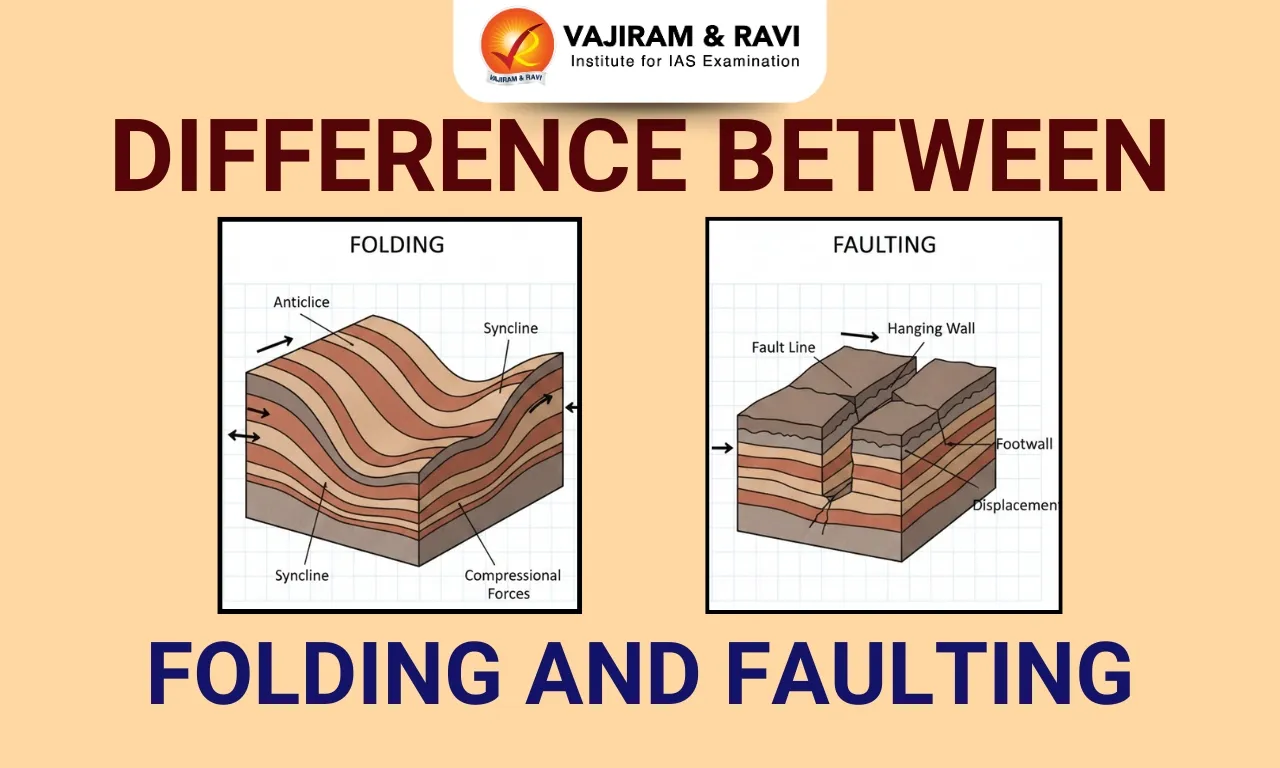
Folding and faulting are important geological processes caused by tectonic forces acting within the Earth’s crust. Both processes are responsible for shaping major landforms such as mountains, plateaus, and valleys. 

Understanding the Difference Between Folding and Faulting is essential for grasping the fundamentals of structural geology and geomorphology.

What is Folding?

Folding is a geological process in which rock layers bend or warp due to compressional forces acting deep within the Earth’s crust. These forces usually occur at convergent plate boundaries where tectonic plates move towards each other. Instead of breaking, the rock layers deform plastically, forming wave-like structures.

Folding commonly occurs in sedimentary rocks that are relatively soft and flexible under high temperature and pressure conditions. Major fold structures include anticlines (upward folds) and synclines (downward folds).

What is Faulting?

Faulting is the process by which rocks in the Earth’s crust break and move along a fracture called a fault due to intense tectonic forces. When the stress exceeds the strength of rocks, they crack and slip instead of bending. Faulting can result from compressional, tensional, or shearing forces.

This process leads to the formation of distinct landforms such as rift valleys, block mountains, and escarpments.

Difference Between Folding and Faulting

The table below provides a detailed comparison of folding and faulting, with each point explained briefly.

Difference Between Folding and Faulting
Basis of Comparison Folding Faulting

Nature of Process

Folding involves bending of rock layers without breaking due to compressional forces.

Faulting involves the breaking of rock layers followed by displacement along fractures.

Type of Stress

Mainly caused by compressional stress acting horizontally on rock strata.

Can be caused by compressional, tensional, or shearing stresses.

Rock Behavior

Rocks behave plastically and deform under high pressure and temperature.

Rocks behave brittlely and crack when stress exceeds their strength.

Depth of Occurrence

Generally occurs deep inside the Earth’s crust where rocks are ductile.

Occurs at relatively shallow depths where rocks are rigid and brittle.

Landforms Produced

Produces fold mountains, anticlines, synclines, and complex fold systems.

Produces block mountains, rift valleys, fault scarps, and grabens.

Earthquake Association

Folding rarely causes earthquakes as deformation is gradual.

Faulting is directly associated with earthquakes due to sudden rock movement.

Examples of Fold and Fault Landforms

Fold Landforms:

Major fold mountains include the Himalayas, Alps, Andes, and Rockies. These landforms are the result of prolonged compressional forces that folded thick sedimentary rock layers over millions of years.

Fault Landforms:

Important fault-related landforms include the Rhine Rift Valley, Narmada–Tapi Rift Valley, Sierra Nevada Block Mountains, and the Great Rift Valley of Africa. These features formed due to vertical or horizontal displacement along faults.

Also Check Related Articles
Difference between NITI Aayog and Inter-State Council Difference Between Economic Survey and Union Budget
Difference Between Tropical Evergreen and Tropical Deciduous Forests Difference Between Ordinary Bill and Money Bill
Difference Between Legislative and Executive Difference between Himalayan and Peninsular Plateau
Difference Between Vedas and Upanishads Difference Between Scheduled and Non-Scheduled Banks
Difference Between Written and Unwritten Constitution Difference between NITI Aayog and Planning Commission
Difference between Colonialism and Imperialism Difference between Fundamental Rights and Directive Principles of State Policy
Difference between Procedure Established by Law and Due Process of Law Difference Between Democracy and Republic
Difference between Creamy Layer and Non-Creamy Layer of OBC Difference between Rajya Sabha and Vidhan Sabha
Difference Between Western Ghats and Eastern Ghats

Difference Between Folding and Faulting FAQs

Q1: Why does folding not cause earthquakes frequently?

Ans: Folding occurs slowly under intense pressure, allowing rocks to bend gradually without sudden energy release.

Q2: Which type of rocks are most suitable for folding?

Ans: Sedimentary rocks are more suitable for folding due to their layered structure and relative softness.

Q3: Can folding and faulting occur together?

Ans: Yes, in many mountain-building processes, folding and faulting occur simultaneously or sequentially.

Q4: What is the main reason faulting leads to earthquakes?

Ans: Sudden displacement of rocks along faults releases accumulated stress in the form of seismic waves.

Q5: Which process is responsible for rift valleys?

Ans: Rift valleys are primarily formed due to tensional faulting where the crust is pulled apart.

Kuttanad Wetland Agricultural System

Kuttanad Wetland Agricultural System

Kuttanad Wetland Agricultural System Latest News

Recently, the soil tests in Kuttanad paddy fields which are part of Kuttanad Wetland Agricultural System in Kerala showed increased level of aluminium concentrations in paddy fields.

About Kuttanad Wetland Agricultural System

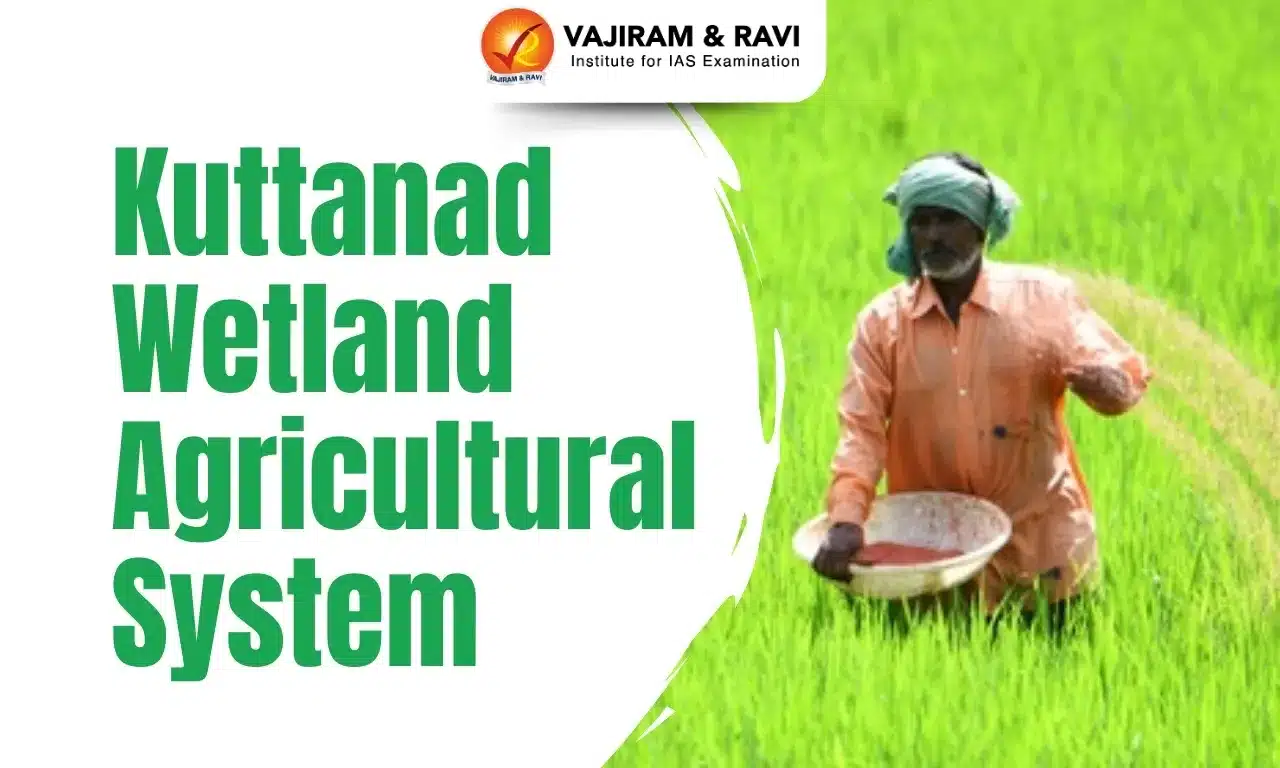
  • It is unique and the only system in India that favours rice cultivation below sea level.
  • The Kuttanad system is a complex mosaic of fragmented agricultural landscapes divided in three structures:
  • Wetlands used for paddy activities and fish catching,
  • Garden lands used for coconut, tubers and food crops plantation
  • Water areas used as inland fishing and shells
  • Recognition: The Kuttanad Below Sea-level Farming System recognised under Globally Important Agricultural Heritage Systems (GIAHS) of Food And Agriculture Organisation.

Impact of Aluminium on soil and Plants

  • Aluminium becomes more soluble and toxic as soil pH drops below five.
  • Excessive aluminium damages the plant root system and severely interferes with the absorption of essential nutrients such as phosphorus, calcium, potassium, and magnesium.

Key Facts about Globally Important Agricultural Heritage Systems

  • The Globally Important Agricultural Heritage Systems (GIAHS) is a Food and Agriculture Organization’s programme launched at the World Summit for Sustainable Development in 2002.
  • It is aiming to strike a balance between conservation, sustainable adaptation and socioeconomic development.
  • India’s GIAHS Include
    • Koraput region (Odisha): It is renowned for its subsistence paddy cultivation, predominantly on highland slopes.
    • Kuttanad system (Kerala): It is a unique below-sea-level farming landscape.
    • Saffron Park of Kashmir: It represents a rich agro-pastoral system characterized by traditional saffron cultivation.

Source: TH

Kuttanad Wetland Agricultural System FAQs

Q1: Kuttanad Wetland Agricultural System is located in?

Ans: Kerala

Q2: Kuttanad's farming involves cultivation in?

Ans: Low-lying wetland areas

GhostPairing

GhostPairing

GhostPairing Latest News

Recently, the Indian Computer Emergency Response Team (CERT-In) has issued an advisory about an active threat campaign which targets WhatsApp users by using a new technique called GhostPairing.

About GhostPairing

  • GhostPairing is a type of WhatsApp attack where hackers secretly link their own device to a victim’s WhatsApp account.
  • It gives hackers almost full access without the victim noticing.
  • GhostPairing' allows cybercriminals to take complete control of WhatsApp accounts without requiring passwords or SIM swaps.
  • The threat actors can take over WhatsApp accounts without authorisation by tricking potential victims into entering the pairing codes.

Modus Operandi of GhostPairing

  • GhostPairing begins with victims receiving a message from a trusted contact that reads: “Hi, check this photo”.
  • The message contains a link with a Facebook-style preview.
    The link leads to a fake Facebook viewer that prompts users to “verify” to see the content.
    Then, the attackers attempt to trick potential victims into entering their phone number and code.
  • By following a sequence of steps, victims unknowingly grant attackers full access to their WhatsApp accounts.

Source: IE

GhostPairing FAQs

Q1: What is the primary method used in the GhostPairing scam?

Ans: Exploiting WhatsApp's device-linking feature

Q2: How does the GhostPairing scam typically start?

Ans: Attackers send messages with links from "trusted contacts"

Anjadip Ship

Anjadip Ship

Anjadip Ship Latest News

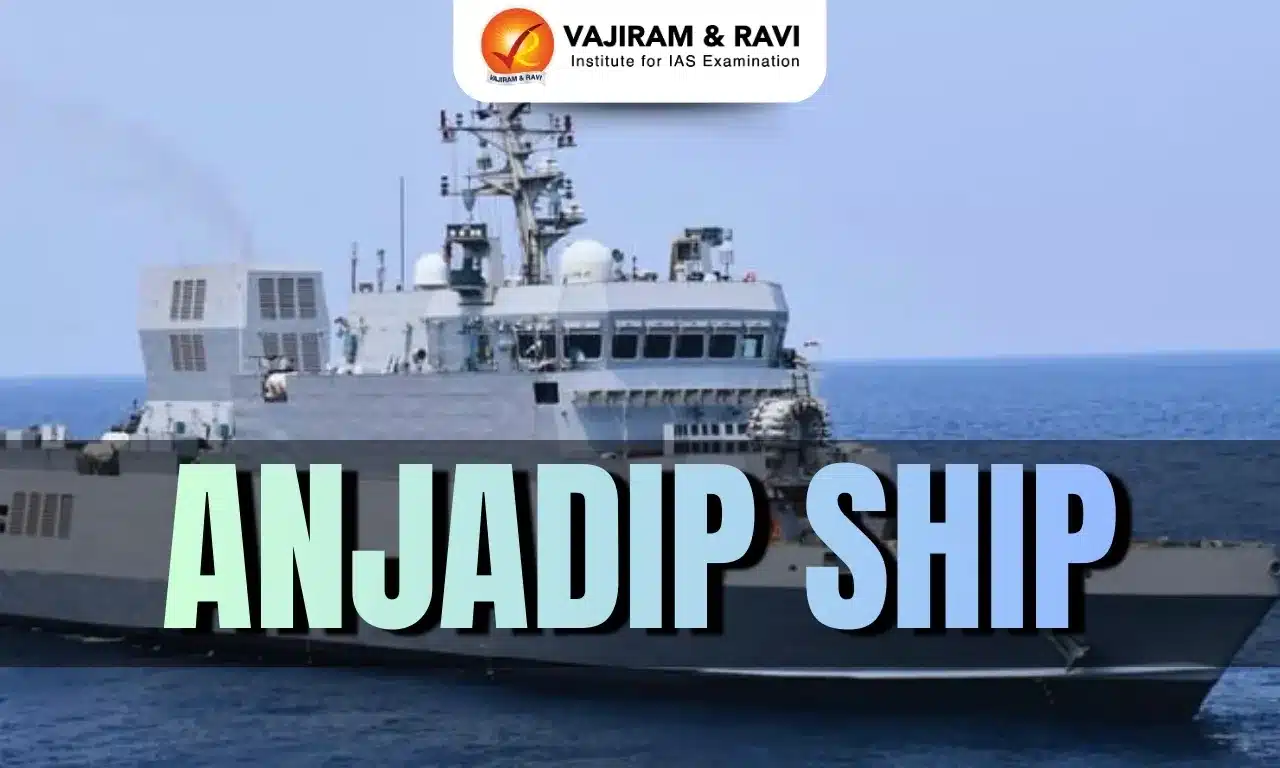
Recently, the ‘Anjadip’ Anti-Submarine Warfare Shallow Water Craft was delivered to the Indian Navy at Chennai.

About Anjadip Ship

  • It is the third of eight Anti-Submarine Warfare Shallow Water Craft.
  • It is indigenously designed and built by Garden Reach Shipbuilders and Engineers (GRSE), Kolkata.
  • The ship derives its name from Anjadip Island located off the coast of Karwar, Karnataka.
  • The ship is a reincarnation of the erstwhile INS Anjadip, a Petya class Corvette decommissioned in 2003.
    • The ASW SWC ships have been designed and constructed as per the Classification Rules of Indian Register of Shipping (IRS) under a Public-Private-Partnership (PPP) of GRSE with M/s L&T Shipyard, Kattupalli.

Features of Anjadip Ship

  • Capacity: It has displacement capacity of 900 tons with a maximum speed of 25 knots and an endurance of 1,800 nautical miles.
  • It is the largest Indian Naval Warship propelled by Waterjets.
  • These are equipped with state of the art Lightweight Torpedoes, indigenously designed Anti-Submarine Rockets and shallow water SONAR.
  • The ship stands as a testament to the growing domestic defence manufacturing ecosystem and reducing dependency on imports.
  • Significance: The ship will strengthen Navy’s Anti-Submarine, coastal surveillance and mine laying capabilities.

Source: PIB

Anjadip Ship FAQs

Q1: Which is the first indigenous anti-submarine warfare shallow water craft in India?

Ans: INS Mahe

Q2: What is the meaning of Anti-Submarine Warfare Shallow Watercraft?

Ans: Anti-Submarine Warfare (ASW) involves operations aimed at detecting, tracking, and destroying enemy submarines.

Mars Atmosphere and Volatile EvolutioN (MAVEN) Mission

Mars Atmosphere and Volatile EvolutioN (MAVEN) Mission

Mars Atmosphere and Volatile EvolutioN (MAVEN) Mission Latest News

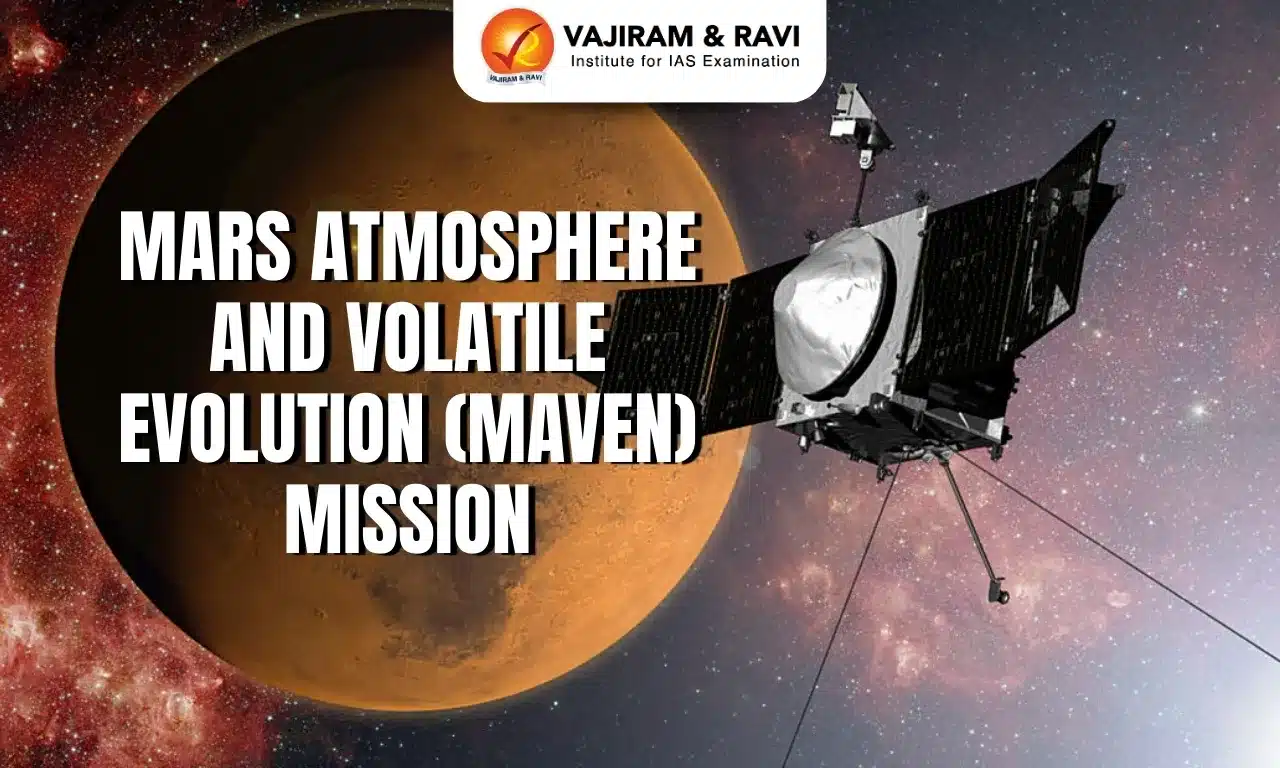
NASA has lost contact with its Mars Atmosphere and Volatile Evolution (MAVEN) spacecraft, the Mars orbiter that has worked for more than a decade to study how the planet’s atmosphere is escaping into space.

About Mars Atmosphere and Volatile EvolutioN (MAVEN) Mission

  • It is the first spacecraft mission dedicated to surveying the upper atmosphere of Mars.
  • It is part of NASA's Mars Exploration Program, an unprecedented, multi-decade campaign to comprehensively understand Mars and its suitability to host past or present life. 
  • It aims to understand the role that loss of atmospheric gas to space played in changing the Martian climate over time. 
  • It was launched in November 2013 and arrived at Mars in September 2014.
  • MAVEN orbits Mars every 3.5 hours and gets as close as 150 km to its surface.
  • It carries three packages of instruments. 
    • One package studies the solar wind and its impact on Mars’s ionosphere. (Since Mars has no magnetic field, its atmosphere would be slowly removed by interaction with the solar wind.)
    • The second package is an ultraviolet spectrometer that studies the upper atmosphere.
    • The third package is a mass spectrometer that studies the composition of the upper atmosphere.
  • MAVEN found that Mars lost about 2/3 of its early atmosphere to space.

Source: TH

Mars Atmosphere and Volatile EvolutioN (MAVEN) Mission FAQs

Q1: What is the primary focus of the MAVEN mission?

Ans: Studying the upper atmosphere of Mars.

Q2: Which space agency launched the MAVEN mission?

Ans: NASA

Q3: What does MAVEN aim to understand about Mars?

Ans: How atmospheric gases were lost to space and how it affected Martian climate.

Q4: When was the MAVEN spacecraft launched?

Ans: November 2013.

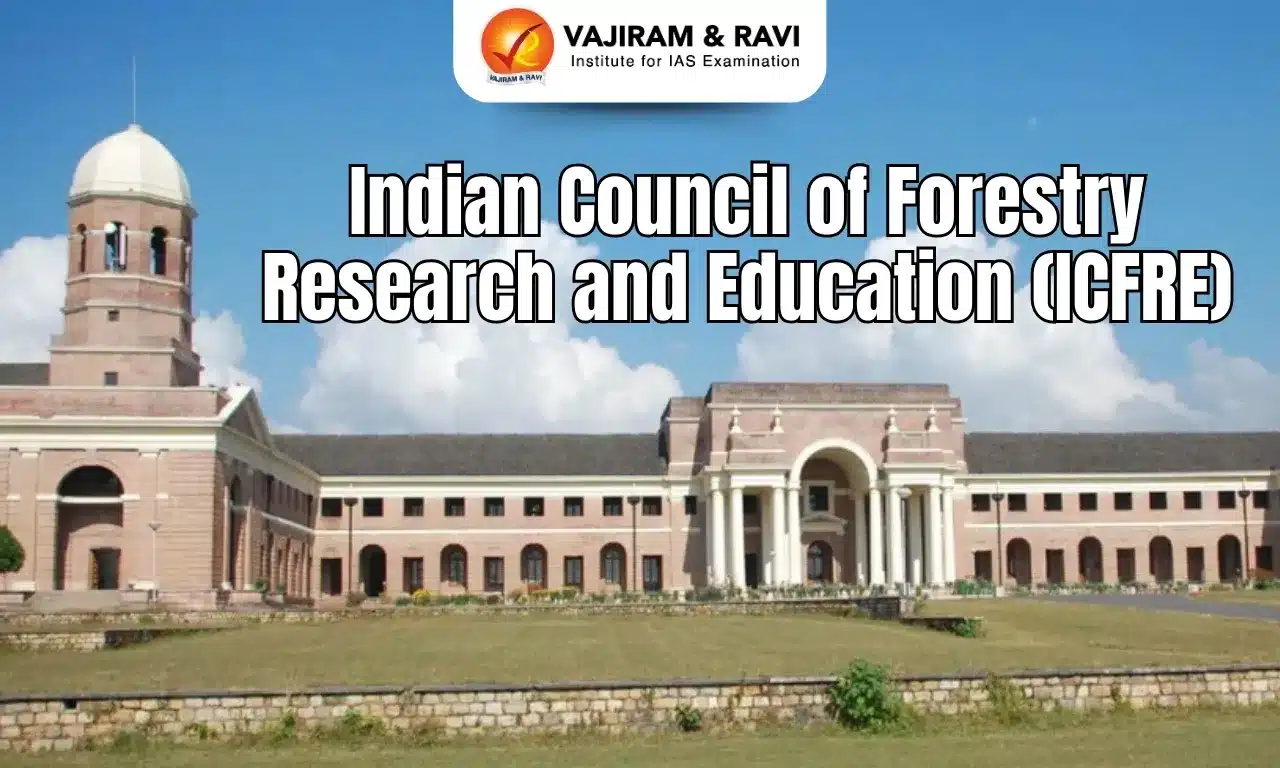
Indian Council of Forestry Research and Education (ICFRE)

Indian Council of Forestry Research and Education (ICFRE)

Indian Council of Forestry Research and Education (ICFRE) Latest News

The Indian Council of Forestry Research and Education (ICFRE) will prepare a district-wise report on which hills meet the criteria to be considered part of the Aravalli Range, but strictly for the purposes of mining, the Union Environment Minister said recently.

About Indian Council of Forestry Research and Education (ICFRE)

  • It is the apex body in the national research system in the area of forestry.
  • It is an autonomous organization under the Ministry of Environment, Forest, and Climate Change (MoEF & CC), Government of India.
  • Mission: To generate, advance, and disseminate scientific knowledge and technologies for ecological security, improved productivity, livelihood enhancement, and sustainable use of forest resources through forestry research and education.
  • Headquarters: Dehradun 
  • History:
    • The journey of ICFRE was initiated way back towards the end of the nineteenth century with the advent of scientific forestry in India and the establishment of the Forest School in Dehradun in 1878. 
    • It was on 5th June 1906, subsequently, that the Imperial Forest Research Institute was founded by the Government of India for taking forward forestry research in the country.  
    • In 1986 the ICFRE was formed as an umbrella organisation for taking care of the forestry research, education, and extension needs of the country. 
    • Finally, on 1st June 1991, the ICFRE was declared an autonomous Council under the then Ministry of Environment and Forests.
  • Presently, ICFRE, with its headquarters at Dehradun, has a pan-India presence with its 9 Regional Research Institutes and 5 Centers in different biogeographical regions of the country. 
  • The regional research institutes are located at Jodhpur, Dehradun, Shimla, Hyderabad, Coimbatore, Ranchi, Bengaluru, Jorhat, and Jabalpur, and the centres are at Agartala, Aizawl, Allahabad, Chhindwara, and Visakhapatnam.

Source: TH

Indian Council of Forestry Research and Education (ICFRE) FAQs

Q1: What is the Indian Council of Forestry Research and Education (ICFRE)?

Ans: It is the apex body in the national research system in the area of forestry.

Q2: The Indian Council of Forestry Research and Education (ICFRE) operates under which ministry?

Ans: Ministry of Environment, Forest & Climate Change.

Q3: Where is the headquarters of Indian Council of Forestry Research and Education (ICFRE) located?

Ans: Dehradun

Q4: How many Regional Research Institutes does Indian Council of Forestry Research and Education (ICFRE) currently have?

Ans: Presently, ICFRE has a pan-India presence with its 9 Regional Research Institutes.

Financial Fraud Risk Indicator (FRI)

Financial Fraud Risk Indicator

Financial Fraud Risk Indicator (FRI) Latest News

The Department of Telecommunications (DoT) recently said that the financial fraud risk indicator (or FRI) has prevented potential losses of ₹660 crore across the banking ecosystem within six months of the rollout of this initiative.

About Financial Fraud Risk Indicator (FRI)

  • It was launched in May 2025 by the Department of Telecommunications (DoT’s) Digital Intelligence Unit (DIU).
  • It is a risk-based metric that classifies mobile numbers into three categories: Medium, High, and Very High Risk based on their likelihood of involvement in financial fraud.
  • The classification draws from a comprehensive analysis using inputs from various platforms, including the Indian Cybercrime Coordination Centre’s National Cybercrime Reporting Portal (NCRP), DoT’s Chakshu platform, and intelligence shared by banks and financial institutions.
  • By flagging high-risk numbers early, the tool enables banks, non-banking financial companies (NBFCs), and UPI service providers to take appropriate measures for customer protection and transaction validation.
  • How Advance Notification Helps Prevent Fraud?
    • The DoT’s Digital Intelligence Unit (DIU) regularly disseminates the Mobile Number Revocation List (MNRL), which details mobile numbers disconnected due to involvement in cybercrime, failed verification, or exceeding permissible usage limits. 
    • These numbers often surface in financial fraud activities.
    • Given that fraudulent mobile numbers are often short-lived and verification processes can take time, a preemptive indicator such as the FRI becomes highly effective. 
    • Thus, as soon as a suspected mobile number is flagged by a stakeholder, it undergoes multidimensional analysis, and classifies it into Medium, High, or Very High financial risk associated with it. 
    • It then shares this assessment about the number immediately with all stakeholders through DoT’s Digital Intelligence Platform (DIP). 
    • Banks and financial institutions can use FRI in real time to take preventive measures such as declining suspicious transactions, issuing alerts or warnings to customers, and delaying transactions flagged as high risk.

Source: ET

Financial Fraud Risk Indicator (FRI) FAQs

Q1: When was the Financial Fraud Risk Indicator (FRI) launched?

Ans: It was launched in May 2025.

Q2: Which department developed the Financial Fraud Risk Indicator (FRI)?

Ans: The Department of Telecommunications’ (DoT) Digital Intelligence Unit (DIU).

Q3: What does the Financial Fraud Risk Indicator (FRI) classify mobile numbers into?

Ans: It classifies mobile numbers into three categories: Medium, High, and Very High Risk based on their likelihood of involvement in financial fraud.

Q4: Which platforms provide data inputs for Financial Fraud Risk Indicator (FRI) analysis?

Ans: NCRP (National Cybercrime Reporting Portal), Chakshu platform, and intelligence from banks and financial institutions.

Q5: What is the purpose of Financial Fraud Risk Indicator (FRI) for banks and UPI providers?

Ans: To help them detect and prevent suspicious or fraudulent transactions early.

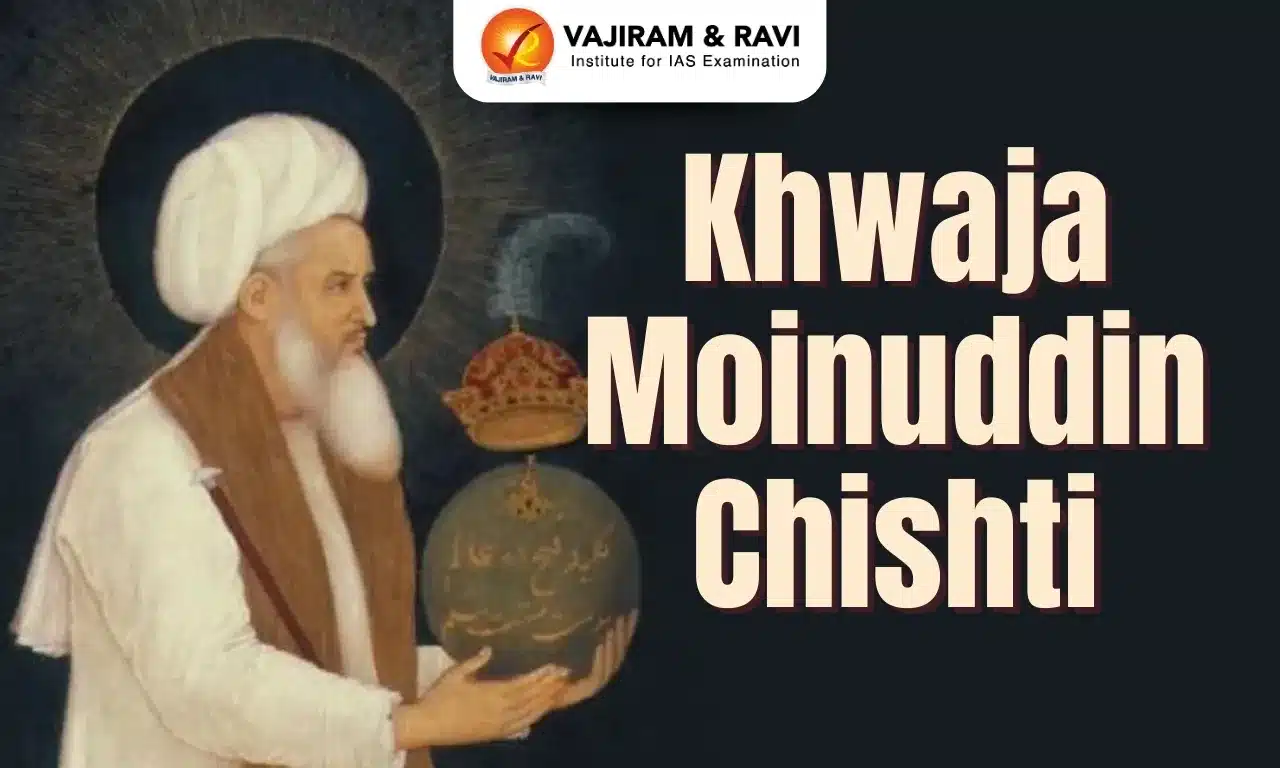
Khwaja Moinuddin Chishti

Khwaja Moinuddin Chishti

Khwaja Moinuddin Chishti Latest News

The Supreme Court recently declined urgent hearing of a plea against the practice of state-sponsored ceremonial honours or offering a 'Chadar' by the Prime Minister at the Dargah of Khwaja Moinuddin Chishti, in Ajmer.

About Khwaja Moinuddin Chishti

  • He was a very important Sufi saint. 
  • People often call him Gharīb Nawāz, which means 'Benefactor of the Poor'. 
  • He was born in 1141 CE in Sistan, a province in Persia (Iran) which borders present-day Afghanistan. 
  • His deep inclination towards spirituality led him to study in Samarkand and Bukhara, the great centres of Islamic learning.
  • A follower of Sunni Hanafi theology, he became the disciple of Hazrat Khwaja Usman Harooni, who later declared him his spiritual successor at the age of 52.
  • He came to India around the year 1192 AD. He finally settled in the city of Ajmer during the reign of Sultan Iltutmish in Delhi and Prithviraj Chauhan in Ajmer.
  • He is famous for bringing the Chishti Order of Sufism to India. 
  • He preached love, tolerance, charity, and detachment from materialism, and established a Khanqah in Ajmer to serve the poor. 
  • After his death in 1236 CE, Moinuddin Chishti was buried in Ajmer. 
  • His tomb became a very important place. It is now known as the Dargah Sharif, or the Ajmer Sharif Dargah.
    • The architectural style of Dargah Sharif purely reflects the Mughal style of architecture.
    • All Mughal rulers from Humayun to Shah Jahan have made modifications in the structure. 

The Chishti Order's Beliefs

  • The Chishti Order is a group within Sufism
  • Sufism is a way of life in Islam that focuses on finding a deeper, more personal connection with God.
  • The Chishti Order was started by a saint named Abu Ishaq Shami in Chisht, a town in Afghanistan
  • The Chishti Order is mostly followed in Afghanistan and South Asia. 
  • Moinuddin Chishti brought this order to India. 
    • The Chishti Order teaches several important things:
    • Love for all people.
    • Helping the poor and needy.
    • Living a simple life.
    • Being tolerant and peaceful.
    • Listening to spiritual music, called Qawwali, to feel closer to God.

Source: ET

Khwaja Moinuddin Chishti FAQs

Q1: Who is popularly known as Gharib Nawaz?

Ans: Khwaja Moinuddin Chishti.

Q2: Around which year did Moinuddin Chishti come to India?

Ans: Around 1192 AD.

Q3: In which Indian city did Khwaja Moinuddin Chishti finally settle?

Ans: Ajmer

Q4: Which Sufi order did Khwaja Moinuddin Chishti introduce to India?

Ans: He is famous for bringing the Chishti Order of Sufism to India.

Q5: Where was Khwaja Moinuddin Chishti buried?

Ans: Ajmer, at the Ajmer Sharif Dargah.

Rapid Financing Instrument

Rapid Financing Instrument

Rapid Financing Instrument Latest News

Recently, the International Monetary Fund has approved emergency funding of USD 206 million under its rapid finance instrument to help Sri Lanka address urgent needs arising from the catastrophic Cyclone Ditwah.

About Rapid Financing Instrument

  • It provides prompt financial assistance to any International Monetary Fund (IMF) member country facing an urgent balance of payments need.
  • It is one of the facilities under the General Resources Account (GRA) that provide financial support to countries, including in times of crisis.

Types of Rapid Financing Instrument

  • Regular Window: It is for urgent balance of payments needs caused by sources including domestic instability, exogenous shocks and fragility.
  • Under this, access up to 50 percent of quota per year and 100 percent of quota on a cumulative basis.
  • Large natural disaster Window: It is for urgent balance of payments needs arising from natural disasters where damage is assessed to be equivalent to or exceed 20 percent of the member’s GDP.
  • It provides access to up to 80 percent of quota per year and 133.33 percent of quota on a cumulative basis.

Conditionality of Rapid Financing Instrument

  • Support provided without ex-post program-based conditionality or reviews (prior actions sometimes apply).
  • Economic policies should aim at addressing the underlying balance of payments difficulties. 

Source: News On Air

Rapid Financing Instrument FAQs

Q1: What is the primary purpose of the IMF's Rapid Financing Instrument (RFI)?

Ans: Balance of payments support for economic crises

Q2: Under which IMF facility is RFI provided?

Ans: General Resources Account (GRA)

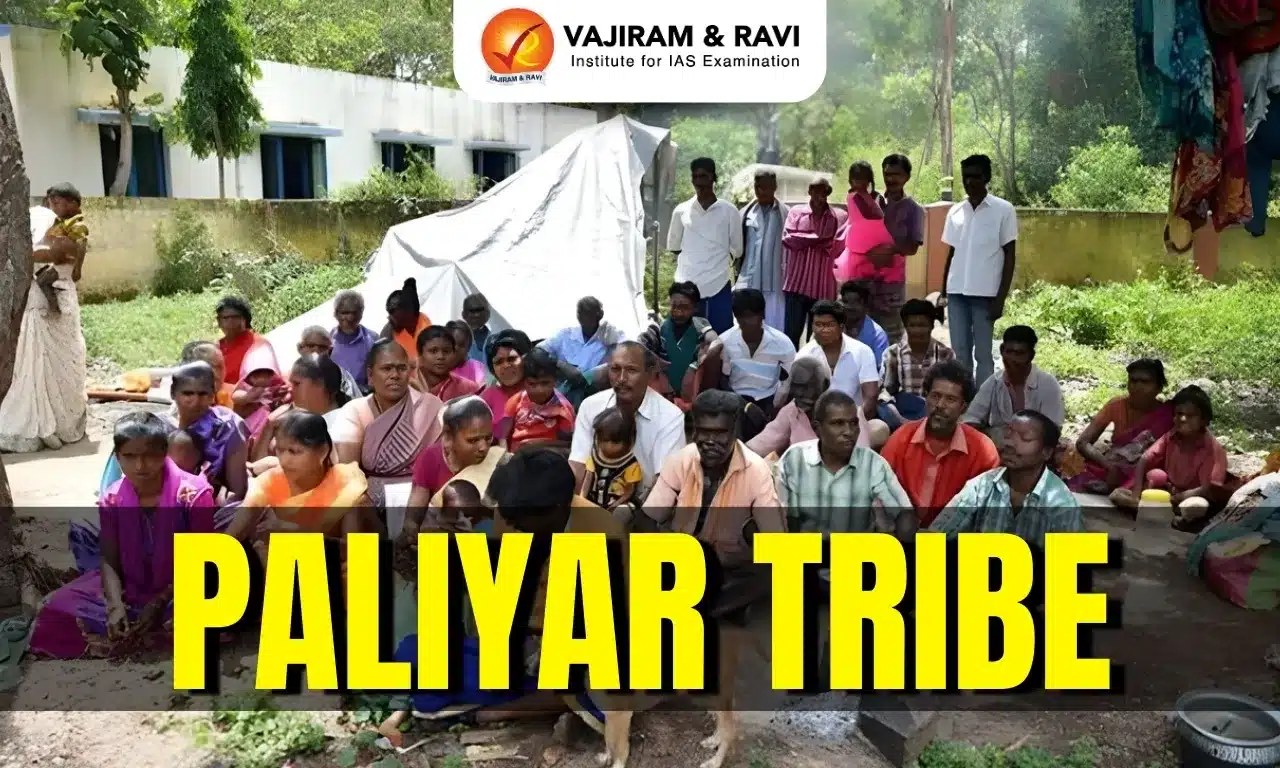
Paliyar Tribe

Paliyar Tribe

Paliyar Tribe Latest News

A total of 17 families belonging to the Paliyar Tribe in the Dindigul district have petitioned the Dindigul Collector, urging the district administration to recognise and develop their existing settlement as a formal village.

About Paliyar Tribe

  • They are an indigenous tribal community primarily found in the hilly regions of Tamil Nadu and Kerala.
  • They are and have been known by multiple names, such as the Paliyans, Pazhaiyarares, and Panaiyars. 
  • Historically, the Paliyars were spread all over the Dindigul district and the Sirumalai Palani hills, adjacent to the Western Ghats
  • As they inhabited the Palani hills, they were known as Panaiyars. 
  • Language: They primarily speak a dialect related to Tamil, reflecting their Dravidian linguistic heritage.
  • Occupation
    • Traditionally, the Paliyars were hunters and gatherers, residing in the forests of the Western Ghats. 
    • Presently, they have transformed into traders of forest products, food cultivators, and beekeepers, with some working intermittently as wage labourers, mostly on plantations.
  • They are recognized for their extensive knowledge and traditional practices pertaining to the use of medicinal plants.
  • Palliyars have small communities called kudis, sometimes living in caves or mud shelters. 
  • The Paliyar tribes never burned the dead bodies. They had the customary practice of burying the dead bodies in an area near to their residential area on the western side.
  • Their festivals involve nature-based rituals, dancing, and music.
  • They have a special ceremony to invoke rain and protect the forest spirits.

Source: TH

Paliyar Tribe FAQs

Q1: The Paliyar tribe is primarily found in which Indian states?

Ans: Tamil Nadu and Kerala

Q2: Traditionally, what was the main occupation of the Paliyars?

Ans: Traditionally, the Paliyars were hunters and gatherers.

Q3: How did the Paliyar tribe traditionally dispose of their dead?

Ans: Burial on the western side of the settlement.

Q4: What characterizes the festivals of the Paliyar tribe?

Ans: Nature-based rituals, dancing, and music.

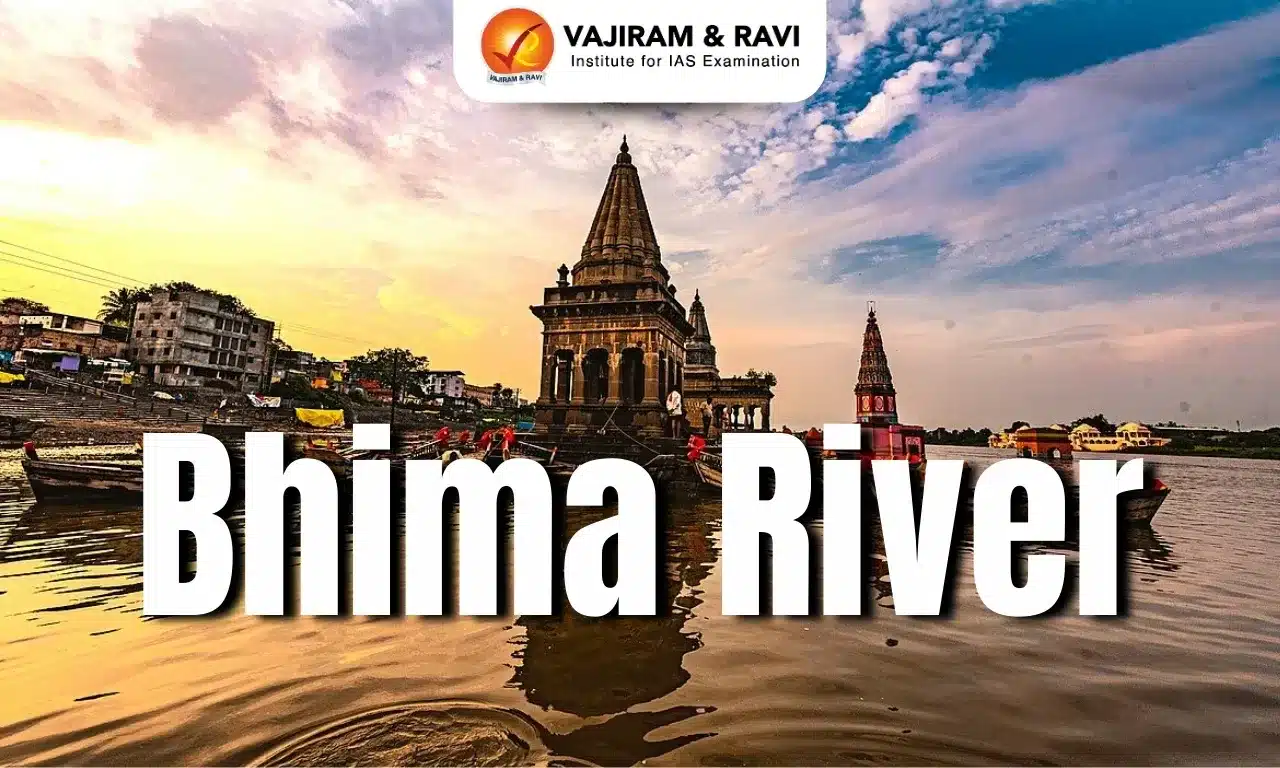
Bhima River

Bhima River

Bhima River Latest News

Recently, the Karnataka government urged the central government’s intervention over Maharashtra’s excess use of Bhima river water.

About Bhima River

  • It is a perennial river and the largest tributary of the Krishna River.
  • Origin: It originates near Bhimashankar Temple in the Bhimashankar hills in the Western Ghats.
  • It flows through the states of Maharashtra, Karnataka, and Telangana.
  • Confluence: It merges into the Krishna River in Karnataka’s Raichur district.
  • Drainage Area: The Bhima drainage area is defined by the Western Ghats (west), the Balaghat Range (north), and the Mahadeo Hills (south).
  • The total basin area of the river is 48,631 sq.km., out of which 75 percent lie in the state of Maharashtra.
  • It runs in a well-entrenched valley, and its banks are heavily populated. 
  • Major Tributaries of Bhima River
    • Right Bank: Indrayani River, Mula River, Mutha River and Pavana River.
    • Left Bank: Sina and Nira etc.
  • Spiritual Significance: Pandharpur is an important pilgrimage centre located on the right bank of the Bhima River.

Source: TOI

Bhima River FAQs

Q1: The Bhima River is a tributary of which major river?

Ans: Krishna

Q2: The Bhima River originates in which state?

Ans: Maharashtra

Right to a Healthy Environment in India – Explained

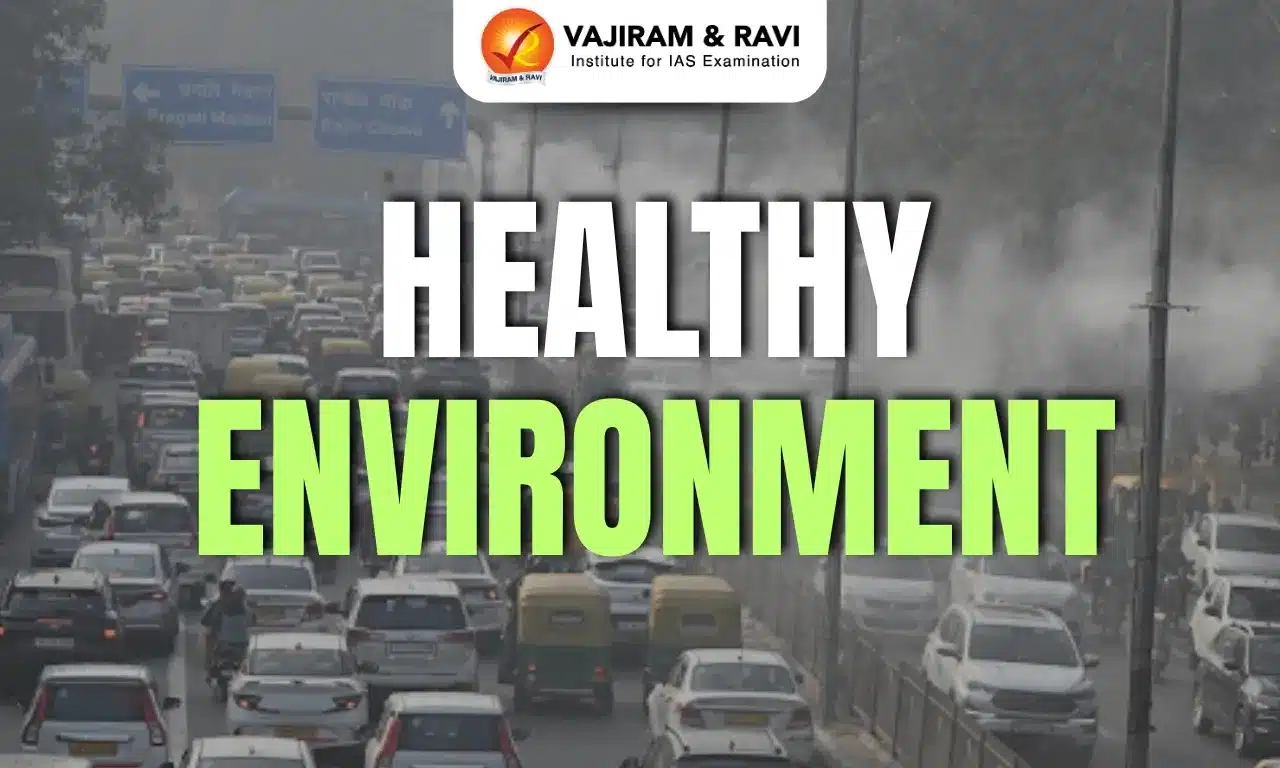
Healthy Environment

Healthy Environment Latest News

  • Rising air pollution in Delhi-NCR has renewed debate on recognising the right to a healthy environment as an explicit constitutional right.

Background: Environmental Degradation and Public Health

  • India faces recurring environmental crises, particularly during winter months, when air pollution levels in Delhi-NCR deteriorate sharply due to vehicular emissions, industrial activity, fossil fuel use, construction dust, waste burning, and agricultural residue burning. 
  • These conditions severely affect public health, leading to respiratory illnesses, cardiovascular diseases, and reduced life expectancy. 
  • The persistent nature of such crises has highlighted gaps in policy enforcement and raised questions about the legal responsibility of the State to protect environmental health.

Particulate Matter and Health Risks

  • Among various pollutants, particulate matter is considered the most harmful. PM10 particles can enter the respiratory system, while finer PM2.5 particles penetrate deep into the lungs and bloodstream. 
  • Diesel particulate matter, a sub-category of PM2.5, is especially toxic and poses serious risks to children and vulnerable populations. 
  • In response to worsening air quality, the Commission for Air Quality Management (CAQM) has strengthened the Graded Response Action Plan (GRAP), mandating school closures and staggered office timings during severe pollution phases, indicating growing administrative recognition of environmental health risks.

Constitutional Basis of Environmental Protection

  • Although the original Constitution did not explicitly guarantee environmental rights, judicial interpretation has expanded the scope of Article 21 (Right to Life) to include the right to a clean and healthy environment. 
  • This interpretation was gradually developed through landmark judgments, beginning with Maneka Gandhi v. Union of India (1978), which broadened the meaning of “life” beyond mere physical existence.
  • Subsequently, constitutional amendments strengthened environmental responsibility. 
  • Article 48A (Directive Principles) places a duty on the State to protect and improve the environment, while Article 51A(g) imposes a fundamental duty on citizens to safeguard natural resources. 
  • Together, these provisions create a shared constitutional obligation toward environmental protection.

Role of Judiciary and Public Interest Litigation

  • Since the mid-1980s, rapid industrialisation and liberalisation have intensified environmental degradation, prompting judicial intervention. 
  • The judiciary has played a proactive role by using Public Interest Litigations (PILs) under Articles 32 and 226 to address environmental harm. 
  • Courts have consistently balanced development needs with environmental sustainability, reinforcing the idea that economic growth cannot come at the cost of ecological destruction.
  • The Environment (Protection) Act, 1986, further strengthens this framework by defining the environment as an interconnected system of air, water, land, and living beings. 
  • Judicial rulings have clarified that the right to live with dignity includes the right to pollution-free air and water, making environmental protection an enforceable legal concern.

Environmental Principles in Indian Jurisprudence

  • Indian environmental law has adopted key global principles to deal with ecological harm. 
  • The principle of absolute liability was introduced to address industrial disasters involving hazardous substances, ensuring that enterprises bear full responsibility for damage regardless of fault.
  • The precautionary principle requires preventive action even in the absence of scientific certainty, while the polluter pays principle mandates that polluters bear the cost of environmental damage. 
  • These principles, affirmed by the judiciary, emphasise prevention, accountability, and sustainable development as core governance values.

Public Trust Doctrine and State Responsibility

  • The public trust doctrine reinforces the idea that natural resources are held by the State in trust for the people. 
  • Under this doctrine, the State cannot exploit environmental resources for private or commercial gain at the cost of public interest. 
  • Constitutional provisions under Article 39 further support community ownership of material resources and equitable distribution for public welfare.
  • Recent judicial recognition of climate change impacts has expanded environmental rights further. 
  • The Supreme Court’s acknowledgement of protection against adverse climate effects as part of Articles 21 and 14 reflects the evolving nature of environmental constitutionalism in India.

Need for Explicit Constitutional Recognition

  • Despite progressive judicial interpretation, the absence of an explicit fundamental right to a healthy environment limits enforceability. 
  • Since rights must be linked to Part III for direct claims, the article argues for formally incorporating the right to a clean and healthy environment into the Constitution. 
  • Such recognition would clearly define State accountability and citizen responsibility, strengthening environmental governance in an era of climate uncertainty.

Source: TH

Healthy Environment FAQs

Q1: How is the right to a healthy environment linked to Article 21?

Ans: It has been judicially interpreted as part of the right to life and human dignity.

Q2: What role does CAQM play in air pollution control?

Ans: CAQM implements measures like GRAP to manage air quality in Delhi-NCR.

Q3: What is the polluter pays principle?

Ans: It requires polluters to bear the cost of environmental damage they cause.

Q4: What is the public trust doctrine?

Ans: It holds that the State manages natural resources as a trustee for the public.

Q5: Why is explicit constitutional recognition being suggested?

Ans: To strengthen enforceability and ensure clear State responsibility for environmental protection.

Internationalisation of Higher Education in India – NITI Aayog’s Roadmap under NEP 2020

Internationalisation of Higher Education in India

Internationalisation of Higher Education in India Latest News

  • NITI Aayog released a report titled “Internationalisation of Higher Education in India: Prospects, Potential, and Policy Recommendations”.
  • The report aligns with the National Education Policy (NEP) 2020 and comes soon after the introduction of the Viksit Bharat Shiksha Adhishthan Bill, 2025, which aims to overhaul higher education regulation.
  • The focus is on correcting the severe imbalance between inbound and outbound student mobility and positioning India as a global education and research hub.

Rationale for Internationalisation

  • In 2024, for every 1 international student studying in India, 28 Indian students went abroad (1:28 ratio).
  • As of 2022, India hosted only about 47,000 international students, despite a 518% increase since 2001.
  • Forecasts suggest 7.89–11 lakh international students by 2047, depending on policy intensity.
  • Internationalisation is seen as crucial for knowledge diplomacy, talent circulation, reducing brain drain, and economic sustainability.

Key Findings of the Report

  • Economic and strategic concerns:
    • Outward remittances under RBI’s Liberalised Remittance Scheme (LRS) increased by about 2000% in the last decade.
    • Indian students’ overseas education expenditure is projected at ₹6.2 lakh crore by 2025 (~2% of GDP).
    • This spending equals about 75% of India’s trade deficit (FY 2024–25).
    • Concentration of 8.5 lakh out of 13.5 lakh outbound students in high-income countries (USA, UK, Australia).
    • Over 16 lakh Indians renounced citizenship since 2011, indicating long-term talent loss.
  • Perception and institutional gaps:
    • 41% of institutes cited limited scholarships/financial aid as a key barrier.
    • 30% institutes flagged perception of education quality in India.
    • Other constraints include inadequate international infrastructure, limited global programme offerings, weak international student support systems, and cultural adaptation challenges.

Major Policy Recommendations

  • Strategic and financial measures:
    • Bharat Vidya Kosh: As a national research sovereign wealth fund (suggesting a $10 billion corpus, of which 50% can be raised from diaspora/philanthropy + 50% from Centre).
    • Vishwa Bandhu scholarship: To attract foreign students. 
    • Vishwa Bandhu fellowship: To attract foreign research talent and faculty.
    • Bharat ki AAN (Alumni Ambassador Network): To leverage diaspora Indians who have studied at top India universities into acting as ambassadors for Indian higher education.
  • Mobility and global partnerships:
    • Europe’s Erasmus+ like programme
      • To suggest the creation of a “multilateral academic mobility framework” tailored to specific country groupings like ASEAN, BRICS, BIMSTEC, etc.
      • This could be called the “Tagore framework”, named after Asia’s first Nobel laureate, Rabindranath Tagore.
    • Promotion of “campus within campus” and more international campuses in India.
  • Regulatory and governance reforms:
    • Easier entry–exit norms for foreign students and faculty.
    • Fast-track tenure pathways for foreign faculty.
    • Competitive, internationally benchmarked salaries.
    • Single-window clearance system for visas, bank accounts, tax IDs, housing and administrative needs.
    • Alignment with non-binding internationalisation frameworks under the proposed Manak Parishad (Standards Council).
  • Branding, rankings and outreach:
    • Expansion of NIRF parameters to include outreach and inclusivity, globalisation and partnerships.
    • Bharat ki AAN: Mobilising Indian diaspora alumni as global ambassadors of Indian HEIs.
  • Curriculum and academic culture: Updated and globally relevant curricula. Emphasis on international research collaboration and cross-cultural learning ecosystems.

Methodology of the Study

  • Online survey of 160 Indian institutions.
  • Key informant interviews with 30 institutions across 16 countries.
  • National Workshop at IIT Madras.
  • Transnational Education Roundtable in the UK.

Challenges Identified and Way Forward

  • Persistent quality perception gap: Leverage diaspora capital, soft power, and civilisational knowledge.
  • Fragmented regulatory ecosystem: Ensure policy coherence between NEP 2020, regulatory reforms, and global engagement.
  • Weak internationalisation culture: Treat internationalisation as a strategic national priority, not merely an academic reform.
  • Risk of continued brain drain and capital flight: Shift from student export model to a global education destination model.

Conclusion

  • The NITI Aayog’s roadmap underscores that internationalisation of higher education is central to India’s economic resilience, strategic autonomy, and soft power projection. 
  • India can transform from a net exporter of students to a global knowledge hub, in line with the aspirations of NEP 2020 and Viksit Bharat 2047.

Source: TH

Internationalisation of Higher Education in India FAQs

Q1: Why does the NITI Aayog consider the current inbound–outbound student mobility ratio (1:28) a strategic concern for India?

Ans: It reflects severe brain drain, capital outflow, and long-term erosion of India’s global competitiveness and knowledge sovereignty.

Q2: What is the significance of the proposed Bharat Vidya Kosh in the internationalisation of Indian higher education?

Ans: It aims to create a $10 billion research sovereign wealth fund to attract global talent, strengthen research capacity, etc.

Q3: How does the proposed “Tagore Framework” align with India’s foreign policy and soft power objectives?

Ans: It integrates education diplomacy with India’s regional and global engagement.

Q4: Why has NITI Aayog recommended expanding NIRF ranking parameters under NEP 2020?

Ans: To incentivise institutions to internationalise, collaborate globally, and improve international perception of Indian higher education.

Q5: How does the internationalisation of higher education contribute to the vision of Viksit Bharat?

Ans: By reducing brain drain, retaining capital, enhancing research excellence, and strengthening India’s global knowledge leadership.

Redrawing the Aravallis: New Definition, Exclusions, and Environmental Concerns

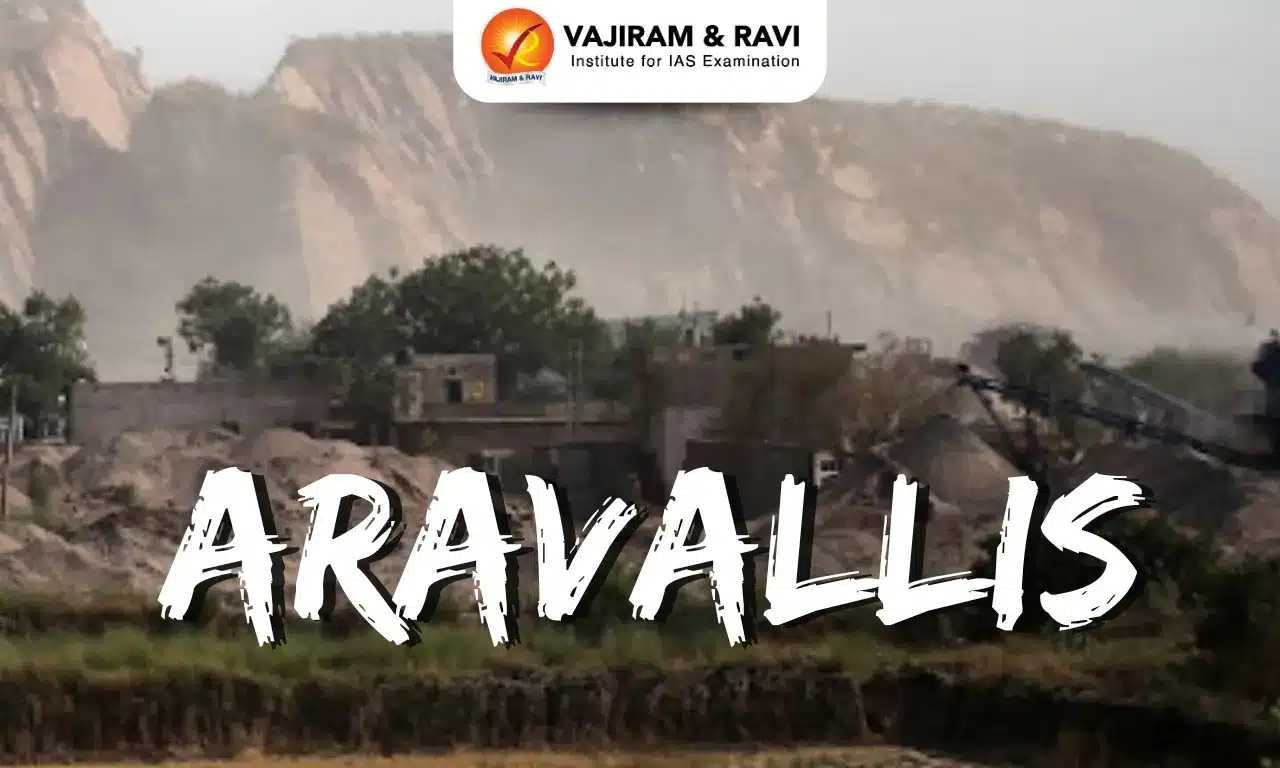
Aravallis

Aravallis Latest News

  • Amid criticism over the government’s new definition of the Aravalli Hills, the Environment Ministry said there was no immediate ecological threat and that the range remains protected, with mining allowed in only 0.19% of its total area. 
  • While the government has paused new mining leases pending further study, critics argue that official assurances do not address disputed court submissions or broader environmental threats beyond mining.

New Aravalli Definition: What Changes and Why It Matters

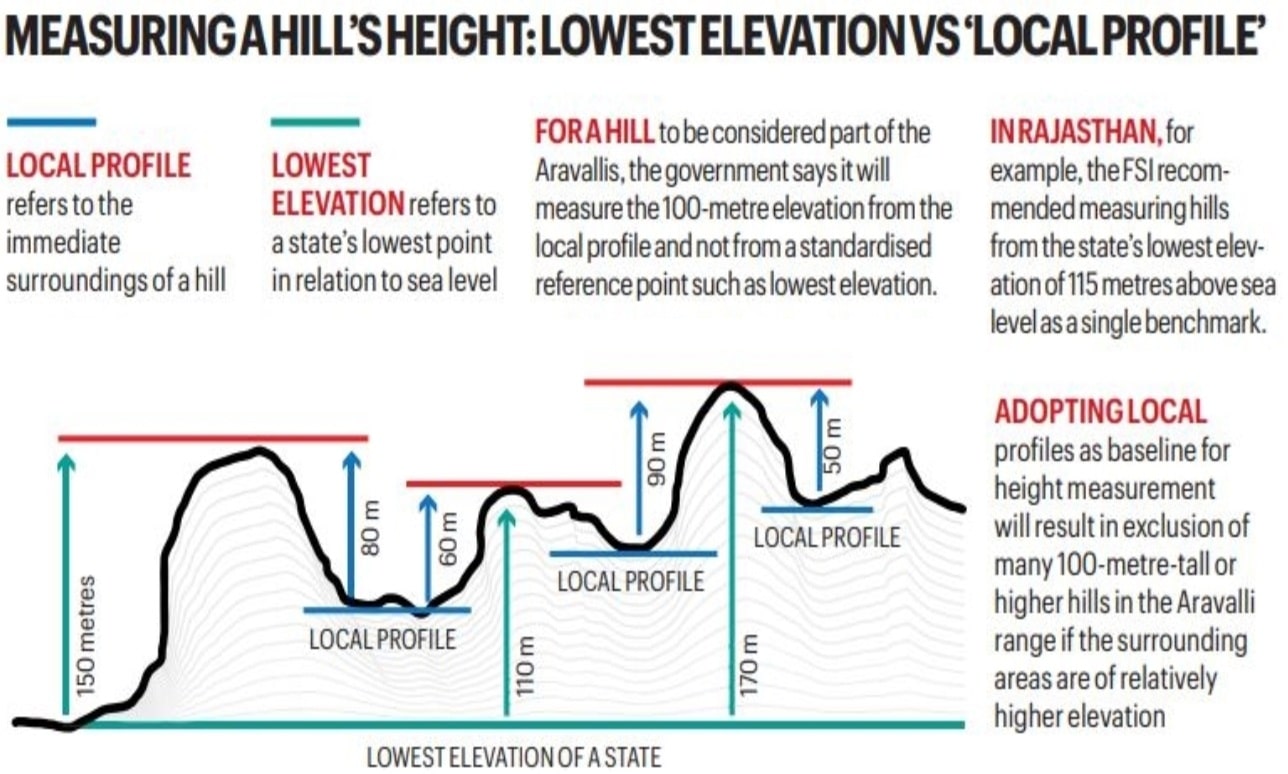
Measuring Aravali Hills

  • A new definition of the Aravalli Hills, approved by the Supreme Court in November 2025, classifies only landforms rising 100 metres or more above local relief—along with their slopes and adjoining areas—as part of the range. 
  • Critics argue that using local profile instead of a standard baseline could exclude large stretches of the Aravallis from protection. 
  • The Environment Ministry has said that no new mining leases will be granted until a detailed study is completed under the court’s order.

What Remains Protected in the Aravallis

  • Several parts of the Aravallis continue to enjoy strong legal protection, including tiger reserves, national parks, wildlife sanctuaries, eco-sensitive zones, notified wetlands, and compensatory afforestation plantations. 
  • These areas remain closed to mining or development unless explicitly permitted under wildlife or forest laws, regardless of whether they fall within the revised Aravalli definition.

Protection Is Not Always Permanent

  • However, such safeguards can be revised or diluted. 
  • A recent attempt by the Centre and Rajasthan to redefine the boundaries of the Sariska tiger reserve—which could have opened nearby areas to mining—was halted only after intervention by the Supreme Court, highlighting the fragility of regulatory protection.

How the New Benchmark Still Includes Some Areas

  • The new benchmark does not exclude all landforms below 100 metres. 
  • Any landform rising at least 100 metres above its local profile qualifies as part of the Aravalli Hills. 
  • Moreover, if two such hills are within 500 metres, the intervening land—regardless of its elevation—will also be treated as part of the Aravalli range.

What the New Aravalli Definition Excludes

  • The new parameters exclude large areas earlier identified as Aravalli under the Forest Survey of India (FSI) 3-degree slope formula, which classifies land as Aravalli if it lies above a state’s minimum elevation (115 m in Rajasthan) and has a slope of at least 3 degrees. 
  • Rajasthan—home to nearly two-thirds of the Aravalli range—faces the biggest exclusions.

Entire Districts Dropped from the Aravalli List

  • Several districts earlier counted among the 34 Aravalli districts across Gujarat, Rajasthan, Haryana, and Delhi are now excluded. Notably:
    • Sawai Madhopur (Ranthambhore Tiger Reserve; Aravalli–Vindhya convergence),
    • Chittorgarh (UNESCO World Heritage fort on an Aravalli outcrop),
    • Nagaur (where FSI mapped 1,110 sq km as Aravalli),
  • are missing from the updated list submitted to the Supreme Court.

Overstated Extent and the Mining Claim

  • While the government cited mining as limited to 0.19% of a 1.44 lakh sq km Aravalli expanse, this figure effectively covers the entire landmass of the 34 listed districts, not the actual hill range. 
  • Under the FSI method, the Aravallis span 40,483 sq km across 15 districts of Rajasthan—about 33% of those districts’ area.

Scale of Exclusion Under the 100-Metre Benchmark

  • Applying the new 100-metre local relief definition would exclude 99.12%—1,17,527 of 1,18,575—of the Aravalli hills (including slopes and surroundings) identified by the FSI in these 15 districts, dramatically shrinking the range’s officially recognised footprint.

What the Centre Told the Supreme Court

  • The Environment Ministry informed the Supreme Court that the 100-metre definition would include a larger area of the Aravallis than the 3-degree slope formula used by the Forest Survey of India (FSI). 
  • This was despite the FSI flagging concerns that the new benchmark would exclude vast tracts earlier identified as Aravalli.

Argument Based on District Averages

  • The Ministry argued that in 12 of the 34 Aravalli districts, the average slope is below 3 degrees—implying these districts would be excluded under the FSI method. 
  • Critics note this averages plains with hills, understating the slopes of actual hilly areas and thereby weakening the comparison.

Local Profile as the Baseline

  • The Ministry told the court that elevation would be measured from the local profile rather than a standardised reference point (such as Rajasthan’s lowest elevation of 115 m used by the FSI).
  • Using local profiles can exclude even 100-metre-high hills if surrounding terrain is already elevated (saddles), potentially shrinking the officially recognised Aravalli footprint despite claims to the contrary.

Inclusion vs Exclusion: The Core of the Aravalli Debate

  • Limits of the Mining Argument
    • The government has highlighted that only a small fraction of the Aravallis would be legally open to mining.
    • However, concerns persist about illegal mining, the future expansion of mining in areas excluded by the 100-metre definition, and the cumulative ecological impact of individual mining blocks on surrounding landscapes.
  • Environmental Risks Beyond Mining
    • Mining is not the only threat. 
    • By de-recognising large hilly tracts, especially in the Delhi NCR, where Aravalli ranges taper in height, the new definition could open vast areas to real estate and infrastructure development, posing serious environmental risks.
  • Committee’s Rationale: Avoiding ‘Over-Inclusion’
    • The ministry-led committee told the Supreme Court that not every hill is Aravalli and not every part of Aravalli is hilly, warning against “inclusion errors” if slope alone is used to define boundaries. 
    • It argued for caution in wrongly categorising non-Aravalli land.
  • Critics’ Concern: Exclusion Takes Priority
    • While acknowledging non-hilly stretches, the submission places greater emphasis on preventing inclusion of extra areas rather than on the risk of excluding genuine Aravalli landscapes, raising concerns that environmental protection may be weakened in the process.

Source: IE

Aravallis FAQs

Q1: What is the new Aravalli Hills definition?

Ans: The new Aravalli Hills definition recognises only landforms rising 100 metres above local relief, along with their slopes and adjoining areas, as part of the range.

Q2: Why is the new Aravalli definition controversial?

Ans: Critics argue that using local relief instead of a standard baseline could exclude most Aravalli hills earlier identified by the Forest Survey of India.

Q3: What areas remain protected despite the new definition?

Ans: Tiger reserves, wildlife sanctuaries, national parks, eco-sensitive zones, wetlands, and compensatory afforestation lands remain protected under forest and wildlife laws.

Q4: What does the new definition exclude from Aravalli protection?

Ans: Large tracts earlier identified under the FSI’s 3-degree slope method, including major districts in Rajasthan, Haryana, Gujarat, and Delhi, may be excluded.

Q5: Why does the inclusion–exclusion debate matter?

Ans: Excluding genuine Aravalli landscapes could enable mining, real estate, and infrastructure expansion, weakening ecological protection beyond the immediate mining footprint.

India–New Zealand FTA Finalised: Key Gains in Trade, Investment, and Mobility

India–New Zealand FTA

India–New Zealand FTA Latest News

  • India and New Zealand have concluded talks on a free trade agreement, granting India tariff-free access to New Zealand’s market, attracting $20 billion in investment over 15 years, and aiming to double bilateral trade to $5 billion within five years. 
  • The FTA will be formally signed in the first half of 2026.

India–New Zealand Bilateral Relations

  • India and New Zealand established diplomatic relations in 1952 and share enduring ties rooted in Commonwealth membership, common law traditions, and democratic governance. 
  • Sporting links—especially cricket, hockey, and mountaineering—and tourism have long fostered goodwill between the two societies.

Strategic Vision and Policy Frameworks

  • New Zealand has identified India as a priority partner through initiatives such as “Opening Doors to India” (2011) and the NZ Inc. India Strategy. 
  • This was further deepened by the “India–NZ 2025: Investing in the Relationship” strategy, envisioning a more enduring strategic partnership across political, economic, and people-centric domains.

Trade and Economic Ties

  • New Zealand is India's 11th largest two-way trading partner.
    • India-New Zealand total trade in 2023-24 was valued at US$ 1.75 billion.
  • Key trade sectors: Education, tourism, dairy, food processing, pharmaceuticals, renewable energy, and critical minerals.
  • Indian exports to NZ: Pharmaceuticals, precious metals & gems, textiles, motor vehicles, and non-knitted apparel.
  • Indian imports from NZ: Logs, forestry products, wool, edible fruit & nuts.

Defence and Maritime Cooperation

  • Defence ties are expanding steadily:
    • Regular naval visits and port calls by Indian Navy ships.
    • High-level naval leadership exchanges.
    • Cooperation under Combined Task Force-150, with Indian Navy personnel contributing while NZ leads the task force.
  • These engagements support maritime security and Indo-Pacific stability.

Education and Knowledge Partnerships

  • India is the second-largest source of international students in NZ (≈8,000 students).
  • Collaboration through:
    • NZ Centre at IIT Delhi
    • Joint research projects in cancer, robotics, cybersecurity, waste management, and medical technology
    • Education cooperation agreements with GIFT City and IIM Ahmedabad

People-to-People and Cultural Ties

  • Indian-origin population in NZ: ~292,000, with Hindi as the fifth most spoken language.
  • Vibrant celebration of Indian festivals and strong presence of Indian cultural institutions.
  • Deep sporting connections, including shared mountaineering heritage linked to Sir Edmund Hillary.

India–New Zealand Free Trade Agreement: A New Phase in Bilateral Ties

  • India and New Zealand have concluded a Free Trade Agreement (FTA), ending negotiations that began in March 2025.
  • FTA talks were launched during Luxon’s visit to India, and the deal was finalised in a record nine months, reflecting strong political commitment and a shared goal of deepening bilateral relations.

India–New Zealand Free Trade Agreement: Key Highlights

  • The FTA is expected to double bilateral trade within five years, deepen economic engagement, and strengthen cooperation beyond trade—covering defence, education, sports, innovation, and people-to-people ties.

Investment and Market Access Gains

  • Investment: New Zealand will invest $20 billion in India over 15 years. 
  • Healthcare: A dedicated health and traditional medicine annex—New Zealand’s first such agreement with any country—facilitates trade in health services.

Tariff Liberalisation

  • 95% of New Zealand’s exports will see tariffs eliminated or reduced.
  • 57% of exports to India will be duty-free from day one, rising to 82% on full implementation; the remaining 13% will see significant tariff cuts.
  • India protected sensitive sectorsno concessions on dairy, onions, sugar, spices, edible oils, rubber, rice, wheat, and soya.

Boost to Jobs and Exports

  • The FTA is expected to lift labour-intensive sectors—apparel, leather, textiles, rubber, footwear, home décor—and promote exports of automobiles, auto components, machinery, electronics, electricals, and pharmaceuticals.

Mobility and Services Access

  • 5,000 temporary employment visas annually for Indian professionals, valid up to three years.
  • India gains market access across 118 services sectors and MFN status in 139 sectors, expanding opportunities for Indian professionals.
    • Most Favoured Nation (MFN) status is a key WTO principle that requires countries to treat all WTO members equally in trade.
  • Coverage includes IT, engineering, healthcare, education, construction, and niche roles like AYUSH practitioners, yoga instructors, chefs, and music teachers—strengthening services trade and workforce mobility.

Source: TH | MEA | ToI

India–New Zealand FTA FAQs

Q1: What is the India–New Zealand FTA about?

Ans: The India–New Zealand FTA is a comprehensive trade pact aimed at tariff liberalisation, investment growth, services access, and deeper economic and strategic cooperation.

Q2: How will the India–New Zealand FTA impact trade and investment?

Ans: The agreement aims to double bilateral trade to $5 billion in five years and bring $20 billion in New Zealand investment into India over 15 years.

Q3: Which sectors benefit most from the India–New Zealand FTA?

Ans: Labour-intensive sectors like textiles, leather, footwear, and apparel, along with automobiles, electronics, machinery, and pharmaceuticals, are expected to gain significantly.

Q4: How does the FTA protect Indian farmers?

Ans: India has excluded sensitive agricultural products such as dairy, rice, wheat, sugar, onions, edible oils, and soya from tariff concessions to protect farmers’ interests.

Q5: What mobility benefits does the India–New Zealand FTA provide?

Ans: The FTA allows 5,000 temporary work visas annually for Indian professionals across IT, healthcare, education, construction, AYUSH, and creative sectors.

National Farmers Day 2025, Theme, History, Significance

National Farmers Day 2025

National Farmers Day 2025, also known as Kisan Diwas, is observed every year in India on 23 December to honour the invaluable contribution of farmers to the nation’s economy and food security. This day marks the birth anniversary of Chaudhary Charan Singh, India’s fifth Prime Minister and a strong advocate of farmers’ rights. National Farmers Day serves as a reminder of the pivotal role farmers play in sustaining rural livelihoods and ensuring national development.

National Farmers Day 2025 Theme

The theme “Vikasit Bharat 2047 - The Role of FPOs in Globalising Indian Agriculture” highlights the crucial role of Farmer Producer Organisations (FPOs) in transforming Indian agriculture into a globally competitive sector. FPOs empower small and marginal farmers by enabling collective bargaining, improving access to modern technology, quality inputs, institutional credit, and international markets. 

By strengthening value chains, promoting agri-exports, and encouraging sustainable and market-oriented farming, FPOs serve as key drivers in achieving the vision of Vikasit Bharat by 2047

National Farmers Day 2025 History

  • National Farmers Day, popularly known as Kisan Diwas, is observed every year on 23 December in India.
  • The day commemorates the birth anniversary of Chaudhary Charan Singh, India’s fifth Prime Minister.
  • It was officially declared as National Farmers Day by the Government of India in 2001.
  • Chaudhary Charan Singh is remembered as a strong advocate of farmers’ rights and rural development.
  • The observance highlights his role in land reforms and the abolition of the zamindari system.
  • The day aims to acknowledge the contribution of farmers to national food security and economic stability.
  • It also serves as a platform to discuss agrarian challenges, policy reforms, and farmer welfare measures.
  • Awareness programmes, seminars, and agricultural initiatives are organised nationwide on this day.
  • National Farmers Day reinforces the idea that India’s overall development is closely linked to agricultural growth.

Who Was Chaudhary Charan Singh?

Chaudhary Charan Singh was an Indian freedom fighter, eminent statesman, and agrarian reformer who served as the fifth Prime Minister of India from 1979 to 1980. Born on 23 December 1902 in a farming family in Uttar Pradesh, he developed a deep understanding of rural and agrarian issues from an early age. Charan Singh emerged as a strong voice for peasants and small farmers, consistently advocating policies centred on land reforms, rural empowerment, and agricultural-led economic development.

He strongly opposed urban-centric industrialisation at the cost of agriculture and believed that India’s progress depended on the prosperity of its villages. Owing to his lifelong dedication to farmers’ welfare, he is widely remembered as the “Champion of Farmers” in Indian political history.

Chaudhary Charan Singh’s Contribution to Farmers

  • Played a decisive role in implementing zamindari abolition laws in Uttar Pradesh (1950s), which transferred land ownership rights to millions of tenant farmers, ending the feudal agrarian structure.
  • As Revenue Minister and later Chief Minister of Uttar Pradesh, he framed land reform policies that imposed ceilings on landholdings, benefiting small and marginal farmers.
  • Authored the landmark book “India’s Poverty and Its Solution” (1939), where he argued that agricultural neglect was the root cause of rural poverty.
  • Strongly opposed excessive urban-industrial bias and stressed that over 70% of India’s population at the time depended on agriculture, making farmer welfare central to national planning.
  • Advocated remunerative prices for crops, laying the ideological foundation for price-support mechanisms to protect farmers from market volatility.
  • Promoted cooperative institutions and institutional rural credit to reduce farmers’ dependence on moneylenders charging exorbitant interest rates.
  • Emphasised strengthening the village economy as the base of Indian democracy and economic stability.
  • Consistently defended the interests of small and marginal farmers, who formed the majority of India’s agrarian population.
  • As Prime Minister (1979–80), he prioritised rural development and farmer-oriented governance in national policy discourse.

National Farmers Day 2025 Significance

  • Recognises the vital contribution of farmers to India’s food security, rural employment, and overall economic stability.
  • Highlights the fact that agriculture supports nearly half of India’s population, making farmer welfare central to inclusive growth.
  • Pays tribute to Chaudhary Charan Singh, reinforcing his vision of agriculture-led national development.
  • Creates awareness about the challenges faced by farmers, including climate change, rising input costs, and market fluctuations.
  • Encourages discussion on farmer-centric reforms, such as income support, crop insurance, and access to institutional credit.
  • Promotes sustainable and climate-resilient farming practices to ensure long-term agricultural productivity.
  • Emphasises the role of technology, digitisation, and innovation in modernising Indian agriculture.
  • Strengthens focus on Farmer Producer Organisations (FPOs) for collective bargaining and better market access.
  • Serves as a platform to review and improve government schemes aimed at farmers’ welfare.
  • Reinforces the idea that rural prosperity is essential for achieving Vikasit Bharat 2047.

National Farmers Day 2025 FAQs

Q1: When is National Farmers Day 2025 observed?

Ans: National Farmers Day 2025 is observed on 23 December.

Q2: Why is National Farmers Day celebrated in India?

Ans: It is celebrated to honour farmers’ contributions and commemorate the birth anniversary of Chaudhary Charan Singh.

Q3: Who is known as the Champion of Farmers in India?

Ans: Chaudhary Charan Singh is known as the Champion of Farmers.

Q4: How is National Farmers Day observed in India?

Ans: It is observed through awareness programmes, farmer interactions, seminars, agricultural exhibitions, and policy discussions.

Q5: What was Chaudhary Charan Singh’s major focus as a leader?

Ans: His major focus was farmers’ welfare, land reforms, and rural development.

Daily Editorial Analysis 23 December 2025

Daily Editorial Analysis

Right to Disconnect: Drawing the Line After Work

Context

  • The introduction of the Right to Disconnect Bill as a private member’s bill marks a significant moment in Indian labour law, particularly in the context of the recent consolidation of labour regulation through the four labour codes.
  • These codes govern working hours, overtime, and employer control, reflecting a framework designed primarily for physical workplaces.
  • The Bill responds to the growing reality of digital work, where technological connectivity has blurred the boundaries between professional and personal life.
  • Despite acknowledging this transformation, the Bill continues to operate within a time-based regulatory framework, giving rise to unresolved questions regarding the definition of work, the scope of the proposed right, and its constitutional character.

Definitional Gaps in the Concept of Work

  • A central limitation of the Right to Disconnect Bill lies in the absence of a definition of work in the context of the digital economy.
  • Indian labour law has traditionally been grounded in physical presence and fixed working hours.
  • While the Bill grants employees the right to refrain from responding to work-related communications beyond prescribed working hours, it does not clarify whether after-hours digital engagement constitutes work.
  • This omission becomes particularly significant when read alongside the Occupational Safety, Health and Working Conditions Code, 2020, which continues to regulate working hours and overtime.
  • The Code prescribes limits on working time but does not expressly address digital engagement outside formal hours.
  • By regulating communication without integrating it into the legal framework governing working time, the Bill creates a conceptual gap.
  • As a result, the right to disconnect risks functioning as a behavioural norm rather than a binding labour standard, weakening its enforceability.

Comparative Perspectives on Employer Control and Working Time

  • Comparative analysis highlights these shortcomings more clearly. In the European Union, judicial interpretations of working time have evolved to focus on employer control rather than physical activity alone.
  • Decisions such as SIMAP, Jaeger, and Tyco adopted an expansive understanding of working time, including on-call duties, standby periods, and other forms of availability where the employer exercises control, even in the absence of active work.
  • This jurisprudence reflects the principle that an employee’s time belongs to the employer whenever autonomy is constrained.
  • France adopts a similar approach by clearly demarcating working time and rest time, treating periods of availability under employer control as working time.
  • Digital communication is integrated through collective bargaining, allowing sector-specific flexibility while maintaining statutory protection.
  • Germany likewise enforces strict limits on working hours and mandatory rest periods.
  • These jurisdictions illustrate a shared engagement with a fundamental question: when does an employee’s time become the employer’s time?

Scope and Enforceability of the Right in Indian Labour Law

  • Within the Indian context, this question remains unresolved.
  • The labour codes combine mandatory statutory provisions, such as limits on working hours, with contractual terms negotiated through employer policies and agreements.
  • The Right to Disconnect Bill does not clarify whether the right is a mandatory labour standard or one that can be modified through contract.
  • This ambiguity weakens the normative force of the right and risks uneven application across sectors and workplaces.
  • Without clear statutory grounding, the right may remain dependent on employer discretion rather than legal obligation.

Constitutional Dimensions of the Right to Disconnect

  • The Bill also raises important constitutional concerns.
  • The freedom to disengage from work bears a clear relationship with Article 21 of the Constitution, which guarantees the right to life and personal liberty.
  • The ability to disconnect directly implicates individual autonomy, dignity, and mental well-being, all of which have been recognised as components of Article 21.
  • However, the Bill does not articulate this constitutional foundation or explain how such guarantees are to be realised within the employment relationship.
  • Consequently, it remains unclear whether the right to disconnect is purely statutory or reflective of a deeper constitutional commitment to personal autonomy at work.

Conclusion

  • The Right to Disconnect Bill recognises that digital technologies have blurred the traditional boundaries between working time and personal life.
  • But it does not adequately explain how this shift should be accommodated within the existing legal framework governing working hours, overtime, and employer control.
  • Comparative experience demonstrates that the right to disconnect becomes effective only when digital availability is treated as working time, a step yet to be taken in Indian labour law.
  • The Bill also leaves unresolved whether the right carries a constitutional dimension rooted in Article 21, allowing for divergent interpretations.
  • For these reasons, the Bill is best understood as the beginning of a broader legal and constitutional conversation, one that Indian labour law jurisprudence will eventually need to address.

Right to Disconnect: Drawing the Line After Work FAQs

 Q1. What problem does the Right to Disconnect Bill seek to address?
Ans. The Bill seeks to address the blurring of boundaries between working time and personal time caused by constant digital connectivity.

Q2. Why is the absence of a definition of “work” significant in the Bill?
Ans. The absence of a definition of “work” creates ambiguity about whether after-hours digital communication qualifies as legally recognised working time.

Q3. How do European jurisdictions conceptualise working time in relation to employer control?
Ans. European jurisdictions treat periods of availability under employer control as working time, even if no active work is performed.

Q4. What uncertainty exists regarding the enforceability of the right to disconnect in India?
Ans. It is unclear whether the right to disconnect is a mandatory labour standard or a contractual term that can be modified by employers.

Q5. How is the right to disconnect connected to Article 21 of the Constitution?
Ans. The right to disconnect is connected to Article 21 because it implicates individual autonomy, dignity, and mental well-being as components of personal liberty.

Source: The Hindu


Death Knell for the Rural Job Guarantee

Context

  • The replacement of the Mahatma Gandhi National Rural Employment Guarantee Act (MGNREGA) by the Viksit Bharat Guarantee for Rozgar and Ajeevika Mission (Gramin) (VB-G RAM G) Act, 2025 marks a decisive shift in India’s rural employment framework.
  • MGNREGA was a rights-based, decentralised and demand-driven law, whereas the new Act reflects a centralised, discretionary and fiscally restrictive approach.
  • This transition raises serious concerns regarding the constitutional right to livelihood, federalism, decentralisation, and social equity.

Constitutional and Legal Foundations of MGNREGA

  • MGNREGA drew legitimacy from Article 21 of the Constitution, which guarantees the right to life.
  • In Olga Tellis v. Bombay Municipal Corporation (1985), the Supreme Court held that the right to livelihood is an intrinsic component of the right to life.
  • MGNREGA operationalised this interpretation by recognising the right to work as a legal entitlement rather than a welfare measure.
  • The Act created justiciable rights, including employment on demand, unemployment allowance if work was not provided within 15 days, timely wage payments with compensation for delays, gender parity in wages, and minimum wage guarantees.
  • These provisions transformed rural workers into rights-holders and imposed clear legal obligations on the State, distinguishing MGNREGA from earlier public works programmes.

Achievements and Social Impact of MGNREGA

  • MGNREGA produced multiple positive outcomes.
    • First, it was universal and not targeted, reducing exclusion errors.
    • Second, it led to increased rural incomes and a decline in poverty levels.
    • Third, it significantly addressed gender and caste inequalities, with women constituting around 58% of workers in recent years.
    • Importantly, 45% of women workers had not participated in paid work prior to MGNREGA, highlighting its transformative role.
  • The programme also reduced dependence on moneylenders by 21%, improved school enrolment, and created durable assets that alleviated ecological distress.
  • As an instrument of the 73rd Constitutional Amendment, MGNREGA strengthened panchayati raj institutions through decentralised planning and execution.
  • Its effectiveness was globally acknowledged, and its role as a critical safety net during the COVID-19 pandemic further reinforced its significance.

Gradual Undermining of MGNREGA

  • Despite its success, MGNREGA faced systematic erosion over the past decade.
  • Chronic underfunding resulted in persistent wage delays and rationing of work, undermining its demand-driven character.
  • Technocratic interventions, such as photo-based attendance systems and complex payment mechanisms, led to exclusions and new avenues for corruption.
  • Additionally, staff shortages and underfunding of social audits weakened accountability structures.
  • These developments diluted the Act’s effectiveness and paved the way for legislative replacement rather than corrective reform.

Broader Implications of the VB-G RAM G Act

  • Centralisation and Fiscal Burden under the VB-G RAM G Act

    • The VB-G RAM G Act fundamentally alters the governance of rural employment.
      • Section 5(1) grants the Union government wide discretionary powers over the nature and location of public works.
      • Section 4(5) introduces State-wise normative allocations, replacing demand-driven employment with a command-driven model.
    • This shift undermines decentralisation and federal principles, placing States at the mercy of central allocations.
    • Unlike MGNREGA, the new Act removes the Union government’s obligation to compensate for wage delays, despite its dominant financial role earlier.
    • The revised Centre–State funding ratio of 60:40, coupled with the provision that States must bear expenditure beyond their allocations, imposes a severe fiscal burden.
    • These clauses risk political favouritism, as States with limited fiscal capacity may be compelled to suppress work demand, leading to higher unemployment and distress migration.
  • Reinforcing Inequality and Weakening Worker Rights

    • Several provisions of the new Act threaten to entrench existing inequalities.
      • Section 6(2) permits suspension of employment for 60 days during the agricultural season, disproportionately affecting landless workers and women, for whom year-round employment is essential.
      • This provision artificially pits farmers against labourers, despite evidence of mutual benefits under MGNREGA.
    • Although the Act promises 125 days of employment per household, this claim lacks credibility when average employment had already declined to around 50 days due to funding constraints.
    • Crucially, the new Act introduces no substantive mechanisms to address corruption, while dismantling existing safeguards.

Conclusion

  • MGNREGA embodied a rare convergence of Mahatma Gandhi’s vision of decentralised governance and B.R. Ambedkar’s commitment to enforceable rights.
  • By formalising years of dilution, the VB-G RAM G Act reduces a constitutional entitlement to a discretionary scheme, weakens federalism, and exacerbates inequality.
  • Rather than advancing inclusive development, it represents a retreat from the constitutional promise of dignity, livelihood, and social justice.

Death Knell for the Rural Job Guarantee FAQs

 Q1. How did MGNREGA derive its constitutional legitimacy?
Ans. MGNREGA derived its constitutional legitimacy from Article 21, which includes the right to livelihood as part of the right to life.

Q2. What distinguished MGNREGA from earlier public works programmes?
Ans. MGNREGA created justiciable, demand-driven employment rights instead of discretionary welfare benefits.

Q3. How did MGNREGA contribute to social equity?
Ans. MGNREGA reduced gender and caste inequalities by ensuring equal wages and high participation of women workers.

Q4. What major structural shift does the VB-G RAM G Act introduce?
Ans. The VB-G RAM G Act replaces demand-driven employment with centrally controlled, normative fund allocations.

Q5. Why is the promise of 125 days of employment under the new Act questioned?
Ans. The promise is questioned because declining funding has already reduced average employment to about 50 days per household.

Source: The Hindu

Daily Editorial Analysis 23 December 2025 FAQs

Q1: What is editorial analysis?

Ans: Editorial analysis is the critical examination and interpretation of newspaper editorials to extract key insights, arguments, and perspectives relevant to UPSC preparation.

Q2: What is an editorial analyst?

Ans: An editorial analyst is someone who studies and breaks down editorials to highlight their relevance, structure, and usefulness for competitive exams like the UPSC.

Q3: What is an editorial for UPSC?

Ans: For UPSC, an editorial refers to opinion-based articles in reputed newspapers that provide analysis on current affairs, governance, policy, and socio-economic issues.

Q4: What are the sources of UPSC Editorial Analysis?

Ans: Key sources include editorials from The Hindu and Indian Express.

Q5: Can Editorial Analysis help in Mains Answer Writing?

Ans: Yes, editorial analysis enhances content quality, analytical depth, and structure in Mains answer writing.

Enquire Now