UPSC Daily Quiz 29 September 2025

UPSC Daily Quiz

The Daily UPSC Quiz by Vajiram & Ravi is a thoughtfully curated initiative designed to support UPSC aspirants in strengthening their current affairs knowledge and core conceptual understanding. Aligned with the UPSC Syllabus 2025, this daily quiz serves as a revision resource, helping candidates assess their preparation, revise key topics, and stay updated with relevant issues. Whether you are preparing for Prelims or sharpening your revision for Mains, consistent practice with these Daily UPSC Quiz can significantly enhance accuracy, speed, and confidence in solving exam-level questions.


[WpProQuiz 82]

UPSC Daily Quiz FAQs

Q1: What is the Daily UPSC Quiz?

Ans: The Daily UPSC Quiz is a set of practice questions based on current affairs, static subjects, and PYQs that help aspirants enhance retention and test conceptual clarity regularly.

Q2: How is the Daily Quiz useful for UPSC preparation?

Ans: Daily quizzes support learning, help in revision, improve time management, and boost accuracy for both UPSC Prelims and Mains through consistent practice.

Q3: Are the quiz questions based on the UPSC syllabus?

Ans: Yes, all questions are aligned with the UPSC Syllabus 2025, covering key areas like Polity, Economy, Environment, History, Geography, and Current Affairs.

Q4: Are solutions and explanations provided with the quiz?

Ans: Yes, each quiz includes detailed explanations and source references to enhance conceptual understanding and enable self-assessment.

Q5: Is the Daily UPSC Quiz suitable for both Prelims and Mains?

Ans: Primarily focused on Prelims (MCQ format), but it also indirectly helps in Mains by strengthening subject knowledge and factual clarity.

Zero Hour in Parliament, Functions, Origin, Importance

Zero Hour in Parliament

Zero Hour in the Parliament is not mentioned in the Constitution of India or Parliamentary Rules, but is still an important part of India’s Parliamentary Democracy. This gives the MPs the opportunity to raise urgent matters, hold the government accountable and make sure that public concerns are addressed properly. This informal nature of Zero Hour complements all the other parliamentary mechanisms like Question Hour and debates, thus reinforcing the democratic principles of responsiveness of citizens' needs. In this article, we are going to cover Zero Hour, its definition and functions along with the duration, importance and impact.

Zero Hour in the Parliament of India

Zero Hour is a unique feature of the Indian Parliamentary System that starts immediately after the Question Hour, precisely at 12 noon, which is why it is called “Zero Hour.” Unlike Question Hour, Zero Hour is not mentioned in the Constitution or parliamentary rules, making it an informal, yet highly significant, component of parliamentary proceedings. During this period, Members of Parliament can raise issues of urgent public importance without prior notice, enabling them to draw the attention of the government and the House to matters that require immediate discussion. Over the years, the length and format of Zero Hour have evolved, reflecting the changing needs of parliamentary business.

Zero Hour Functions

Zero Hour refers to the period in parliamentary proceedings when MPs can raise matters of urgent public significance that have not been listed in the day’s agenda. This process allows MPs to bring up pressing issues such as natural disasters, accidents, public health emergencies, and other crises requiring immediate government attention. In practice, MPs are expected to give notice to the Lok Sabha Speaker or the Rajya Sabha Chairman by 10:00 a.m., although the approval of the Speaker or Chairman is required before the matter can be discussed. The informal nature of Zero Hour allows MPs to bypass the 10-day notice requirement typical of other parliamentary interventions, allowing for a rapid response to urgent issues.

Zero Hour is an important tool for accountability, transparency, and responsiveness in the parliamentary system. Every MP usually has three minutes to raise an issue during the 30-minute Zero Hour session in the Lok Sabha, providing a structured but flexible platform for urgent matters.

Zero Hour Origin

The practice of Zero Hour originated in India in the early 1960s. Members of Parliament started raising urgent matters immediately after Question Hour, sometimes with or without the permission of the Chairman. After the announcement of the end of Question Hour, MPs would quickly stand to highlight issues they believed required immediate attention. This practice eventually gained media coverage and recognition, formalizing the concept of Zero Hour as a recognized period for raising urgent matters in Parliament.

Zero Hour Time and Procedure

In the Lok Sabha, Zero Hour starts at 12 noon, immediately following the Question Hour, and usually lasts for 30 minutes. Every MP is allotted three minutes to present an issue. While there is no fixed time requirement under parliamentary rules, the 30-minute duration provides a practical window for discussing matters of immediate public concern. During this period, the government may respond to the issues raised, either verbally or in writing, providing clarification, updates, or the official position of the administration.

Zero Hour Importance and Impact

Zero Hour is important because it allows MPs to present urgent public issues without waiting for their inclusion in the agenda. By raising these issues, MPs can hold the government accountable, ensuring responsiveness and transparency. The topics discussed during Zero Hour can vary widely, reflecting the diverse concerns of the public and the urgency of emerging issues.

Over time, Zero Hour has addressed many important national and regional matters, including public health emergencies, national security, corruption, environmental disasters, and social issues. Notable examples include the Bhopal Gas Tragedy, the 1993 Bombay Bomb Blasts, and recent farmers’ protests. Through these interventions, Zero Hour serves as a platform for citizens’ concerns to be heard, for government accountability to be reinforced, and for transparency in governance to be promoted.

Difference Between Zero Hour and Question Hour 

While Zero Hour is closely associated with Question Hour, the two differ in purpose, procedure, and formalities. While Question Hour focuses on formal queries and structured responses from Ministers, Zero Hour allows MPs to address urgent and unforeseen issues, making it a flexible tool for governance oversight.The differences in between Zero Hour and Question Hour include: 

Parameter Zero Hour Question Hour

Timing

Begins immediately after Question Hour

First hour of the sitting

Purpose

To raise matters of urgent public importance

To ask formal questions to Ministers

Speaker’s Role

Minimal involvement; approves or disapproves issues

Conducts the proceedings

Notice Requirement

Not required

Required in advance

Type of Questions

Not applicable

Starred, Unstarred, Short Notice Questions

Answer Format

No formal answer required

Oral or written answer provided

Time Limit

Not fixed; usually 30 minutes

Fixed for each question

MP’s Role

Raises important issues

Seeks information from Ministers

Media Coverage

Often covered by media

Covered by media

Also Check Other Posts
Important Articles of Indian Constitution 9th Schedule
Schedules of Indian Constitution Anti Defection Law
5th Schedule Preamble of the Indian Constitution
6th Schedule

Zero Hour in Parliament FAQs

Q1: What is the zero hour period in Parliament?

Ans: Zero Hour is a period in the Indian Parliament, starting immediately after Question Hour at 12 noon, during which MPs can raise urgent matters of public importance without prior notice.

Q2: Which country introduced zero hour in Parliament?

Ans: Zero Hour was first introduced in India in the early 1960s.

Q3: What are the 4 types of Question Hour?

Ans: The four types of questions during Question Hour are Starred, Unstarred, Short Notice, and Questions to Private Members.

Q4: What is the time duration of zero hour in the Indian Parliament?

Ans: Zero Hour in the Indian Parliament typically lasts for about 30 minutes.

Q5: What is the purpose of Zero Hour in Parliament?

Ans: The purpose of Zero Hour is to allow MPs to draw the attention of the House and the government to urgent public issues that are not listed on the day’s agend.

Phillips Curve, Historical Background, Framework, Examples

Phillips Curve

The Phillips Curve is a foundational concept in economics that examines the relationship between inflation and unemployment. It explains that there is an inverse relationship between the two variables: when unemployment is low, inflation tends to rise, and conversely, when unemployment is high, inflation remains subdued. This theory has influenced economic policymaking around the world, helping governments and central banks balance employment generation with price stability. In this article, we are going to cover the Phillips Curve, its historical background, theoretical framework, examples, importance and limitations. 

Phillips Curve

The Phillips Curve connects two most important components of any economy: inflation and unemployment. Inflation refers to the rate at which prices of goods and services increase over time, reflecting the rising cost of living. Unemployment measures the number of people who are willing and able to work but cannot find employment. According to the Phillips Curve, low unemployment leads to higher inflation because more people earning wages increases consumer spending, which drives up demand and, consequently, prices. Conversely, high unemployment reduces overall spending, keeping demand and prices lower.

This relationship makes the Phillips Curve a valuable tool for policymakers, allowing them to understand the trade-offs involved in pursuing full employment while maintaining price stability. It serves as a guide for monetary and fiscal measures that influence both employment and inflation.

Phillips Curve Historical Background

The concept of the Phillips Curve was introduced by A.W. Phillips, a New Zealand-born economist, who in 1958 published a paper titled “The Relationship Between Unemployment and the Rate of Change of Money Wage Rates in the United Kingdom, 1861-1957.” Phillips analyzed nearly a century of data from the UK and discovered a clear inverse relationship between wage inflation and unemployment. He observed that when unemployment was low, wages rose rapidly, whereas high unemployment led to slower wage growth.

In the starting, the analysis focused on wage inflation. However, economists soon extended Phillips’ work to general price inflation, applying the concept to broader economic policy. During the 1960s, the Phillips Curve gained acceptance everywhere, specially in the United States, where policymakers used it as a tool to manage economic growth and inflation. The theory, however, faced challenges during the 1970s when many countries experienced stagflation that was a combination of high inflation and high unemployment which contradicted the original premise of the Phillip’s curve.

Phillips Curve Theoretical Framework

The Phillips Curve theory is based on a trade-off between inflation and unemployment:

  • Low unemployment = High inflation: With more people employed, aggregate spending rises, driving up demand and increasing prices.
  • High unemployment = Low inflation: Fewer people earning wages reduces spending, lowering demand and keeping prices stable.

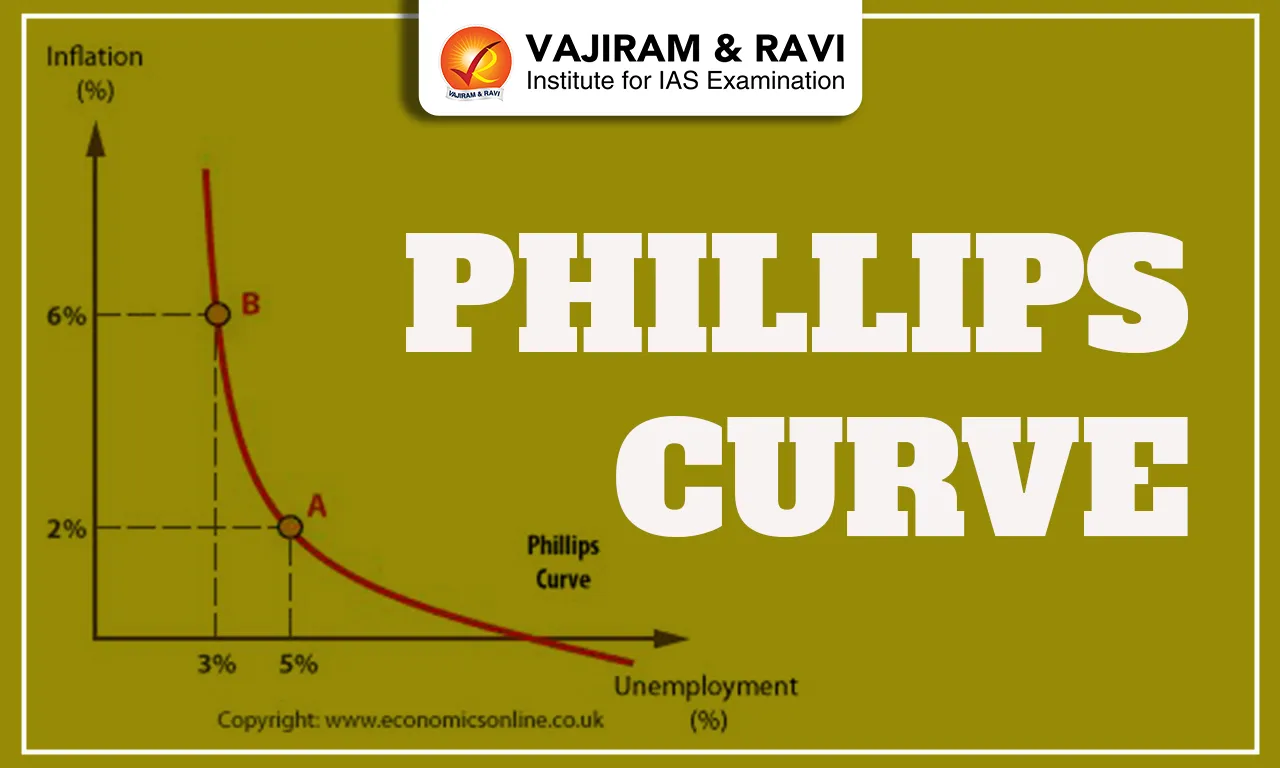
Graphically, the Phillips Curve is represented as a downward-sloping curve, illustrating the inverse relationship between the two variables. Policymakers once believed they could select a point on this curve depending on their priorities: reducing unemployment would mean accepting higher inflation, while controlling inflation would require tolerating higher unemployment. 

[my_image src="https://vajiramandravi.com/current-affairs/wp-content/uploads/2025/09/phillips-curve1.webp" size="full" align="none" alt="phillips-curve1" title="phillips-curve1"]

Over time, economists refined the theory to account for expectations. The expectations-augmented Phillips Curve suggests that anticipated inflation influences wage-setting and price behavior, weakening the apparent trade-off in the long run. Similarly, the long-run Phillips Curve indicates that the economy naturally returns to its “natural rate of unemployment,” irrespective of inflation, meaning the original inverse relationship is not sustainable over extended periods.

Phillips Curve Examples 

  1. United States in the 1960s: The U.S. economy in the beginning seemed to validate the Phillips Curve. Low unemployment coincided with rising inflation, and policymakers believed they could reduce unemployment further by tolerating moderate inflation.
  2. United States in the 1970s (Stagflation): This period challenged the Phillips Curve. The U.S. faced both high inflation and high unemployment at the same time demonstrating that the trade-off does not always hold. Stagflation highlighted the need to incorporate supply-side shocks and expectations into the analysis.

Phillips Curve Limitations

While the Phillips Curve remains an important analytical tool, it has many limitations. These limitations include: 

  • Ignores expectations: Individuals and businesses adjust their behavior if they anticipate inflation, diminishing the effectiveness of the trade-off.
  • Fails in the long run: Over time, unemployment tends toward its natural rate, making inflation ineffective in reducing unemployment.
  • Cannot explain stagflation: The simultaneous rise of inflation and unemployment in the 1970s exposed the curve’s shortcomings.
  • Vulnerability to supply-side shocks: External factors such as oil crises, wars, or pandemics can disrupt both inflation and unemployment independently.
  • Context-specific assumptions: The curve may not apply universally across different economies or economic conditions.

These limitations indicate that while the Phillips Curve is valuable for understanding short-term trends, it must be used alongside other analytical tools for comprehensive policy formulation.

Phillips Curve Importance and Policy Implications

Despite its limitations, the Phillips Curve continues to hold relevance in economics and policymaking:

  • Framing policy decisions: Central banks, including the Reserve Bank of India and the U.S. Federal Reserve, use the Phillips Curve to avoid the effects of interest rate adjustments on employment and inflation.
  • Understanding short-term dynamics: In the short run, the curve may provide useful insights into the relationship between wage pressures and price changes.
  • Encouraging balanced policymaking: Policymakers are reminded of the trade-offs between controlling inflation and promoting employment, fostering better decision-making.

Influencing wage negotiations: Both employers and employees may use Phillips Curve insights to inform salary adjustments based on expected inflation and labor market conditions.

Also Check Other Posts
Battle of Plassey Robert Clive
Battle of Buxar Anglo Mysore Wars
Dual Government in Bengal Tipu Sultan
Anglo Maratha Wars Maratha Empire
Third Battle of Panipat Chhatrapati Shivaji Maharaj
Battle of Bhima Koregaon Anglo Burmese War
Maharaja Ranjit Singh Anglo Nepal War

Phillips Curve FAQs

Q1: Why are inflation and unemployment inversely related?

Ans: Inflation and unemployment are inversely related because lower unemployment increases demand and wages, which pushes prices up, while higher unemployment reduces spending, keeping inflation low.

Q2: What is the Phillips curve?

Ans: The Phillips Curve is an economic concept showing an inverse relationship between inflation and unemployment in the short run.

Q3: What causes the Phillips curve to shift up?

Ans: The Phillips Curve shifts up due to factors like rising inflation expectations, supply shocks, or cost-push inflation, which increase prices at every level of unemployment.

Q4: What is the long-run Phillips Curve?

Ans: The long-run Phillips Curve is vertical at the natural rate of unemployment, indicating no trade-off between inflation and unemployment in the long run.

Q5: What is an example of the Phillips Curve?

Ans: An example of the Phillips Curve is the U.S. economy in the 1960s, where low unemployment was associated with rising inflation.

Silver Production in India, Industry, Consumption, Govt Policies

Silver Production in India

In India, Silver has great importance in aspects of Cultural, Economic, and Strategic, especially in Rural Areas where it is preferred over Gold for savings and rituals. Although India is not in the list of Major Producers of Silver Globally but is one of the largest consumers. According to the World Silver Survey 2023 conducted by The Silver Institute, India had about 25% of Silver demand in 2023. This highlights the growth in need of Silver for domestic, industrial and Economic purposes.

Silver Production in India

Although silver production is limited in India as compared to the demand, it plays a great role in mining sectors. The metal is largely obtained as a by-product during the refining of lead, zinc, copper, and gold ores. India’s primary silver production comes from Rajasthan, with other contributions from Jharkhand and Andhra Pradesh. According to the Indian Bureau of Mines (IBM) Annual Report 2023, India produced nearly 700 tonnes of silver in 2022 to 2023. With growth in Industrial demands in the sector of electronics, solar panel, energy storage, etc. the Silver Sector in India is strategically gaining importance.

Silver Production in India Overview

The Comprehensive overview of the Silver Production in India is tabulated below highlighting major aspects of the Metal and its features.

Silver Production in India Overview
Aspect Description

Chemical Symbol

Ag

Ores and Minerals of Silver

  • Argentite (Ag₂S)
  • Chlorargyrite (AgCl)
  • Polybasite [(Ag,Cu)₁₆Sb₂S₁₁]
  • Proustite (Ag₃AsS₃)
  • Tetrahedrite [(Cu,Fe,Zn,Ag)₁₂Sb₄S₁₃]

Major Producing State

  • Rajasthan (Khetri, Zawar, Rampura Agucha mines),
  • Jharkhand,
  • Andhra Pradesh,
  • Karnataka

Major Company

Hindustan Zinc Limited (HZL, a subsidiary of Vedanta Ltd.)

Production (2022-23)

Around 700 tonnes (IBM Report)

Global Rank

Not in top 10 producers

Demand-Supply Gap

Imports meet over 70% of demand

History of Silver Mining in India

Silver Mining in India dates back to the Ancient Times where it had been used for ornamental, rituals and minting purposes. With time under Mughal Rule, Silver Coins had become a major currency. Further, British East India Company also relied on Silver for trade and economic exchanges. Modern silver mining began with the discovery of rich lead-zinc deposits in Rajasthan, particularly in Zawar and Rampura Agucha mines, which also yield silver as a by-product.

Major Silver Producing States in India

Silver Production in India is majorly concentrated in a few areas, basically Rajasthan followed by some extractions from other mines in few states of India. The key areas that are important for the production and extraction of Silver in India are:

  • Rajasthan: It is the largest producing state of Silver in India. The Silver Mines in Rajasthan are- Rampura Agucha, Zawar, Rajpura-Dariba, and Sindesar Khurd.
  • Jharkhand: Silver is extracted from lead and copper mining areas, particularly in Singhbhum.
  • Andhra Pradesh: Khetri copper belt and other mineral-rich regions produce silver as a by-product.
  • Karnataka: Minor production through gold and copper mines.

Industries in Silver Production

The majority of India’s Silver Production is controlled by HZL with few contributions by other companies as well. The leading companies producing Silver in India are listed below:

  1. Hindustan Zinc Limited (HZL): A subsidiary of Vedanta Group, it is India’s largest silver producer, contributing over 90% of total output. Its Rampura Agucha and Sindesar Khurd mines are among the world’s richest zinc-lead-silver deposits.
  2. Hutti Gold Mines (Karnataka): Produces small quantities of silver as a by-product.
  3. National Mineral Development Corporation (NMDC): Indirectly linked to silver extraction in polymetallic mines.

Silver Production vs. Consumption in India

India produces far less silver compared to its consumption based on the comparison of the survey reports as published for World Silver Survey 2024. India’s silver imports surged in 2022-23 due to rising demand in solar photovoltaic (PV) cells, electronics, and jewelry. According to the Ministry of Commerce and Industry (GoI), silver imports were worth ₹54,000 crore in FY23, showing its economic significance. Over 7,000 tonnes of Silver was imported in 2023 from Hong Kong, UK, and Switzerland.

Comparison Table for Silver Production vs Consumption in India:

Silver Production vs. Consumption in India (Acc. to World Silver Survey 2024, IBM)

Production

Consumption

~700 tonnes

~8,100 tonnes

Government Policies for Silver Production

The Government of India has initiated several measures to boost the exploration of mines and minerals so as to reduce the import dependency. These initiatives are expected to push domestic companies to explore new reserves and expand production:

  • National Mineral Policy, 2019: Encourages private participation in exploration.
  • Atmanirbhar Bharat Mission: Focus on reducing import dependence for strategic minerals including silver.
  • FDI in Mining Sector: 100% FDI allowed in exploration and mining under automatic route.
  • Solar Energy Mission (MNRE): Expected to drive silver demand due to use in PV cells.

Applications of Silver in India

Silver is used in several sectors in India. This makes the metal highly important economically as well as strategically. Few of the uses and importance are listed below:

  • Jewelry and Silverware: Rural households hold silver as a store of value.
  • Coins and Investment: Silver coins and bars are popular during festivals and weddings.
  • Electronics and Electricals: Used in conductors, circuits, and mobile phones.
  • Solar Energy: Silver paste is essential in photovoltaic cells, boosting demand in renewable energy.
  • Medical and Industrial Uses: Silver nanoparticles are used in medicine, water purification, and antimicrobial applications.

Global Context of Silver Production

The top producers of Silver in the world are- Mexico, China, Peru, Russia, and Australia. India is not among the top 10 producers but ranks among the top 3 consumers. According to the World Silver Survey 2024, global mine production was around 26,000 tonnes in 2023, showing India’s share is very small, highlighting the dependency of India for Silver on imports.

Global Context of Silver Production
Country Production (2023, tonnes)

Mexico

~6,300

China

~3,600

Peru

~3,400

Russia

~1,400

Australia

~1,200

India

~700

Future Prospects of Silver Production in India

The demand for Silver in India is expected to grow due to the rise in renewable Energy, Electronics, Solar Energy, Investment, etc. According to the International Energy Agency (IEA) the Solar Power Expansion will significantly boost the consumption of Silver in India. Exploration of new deposits in Rajasthan, Jharkhand, and Chhattisgarh, along with recycling and refining, can help India reduce its import dependence.

Challenges in Silver Production in India

Despite Rising Demands, India faces several challenges in the production of Silver. Few of the major challenges are listed below:

  • Limited Primary Silver Ore Deposits
  • Heavy dependence on by-product mining of lead-zinc
  • High Reliance on Imports affecting Trade Balance
  • Rising Global Price impact Domestic Industries
  • Lack of Technological advancement in Refining and Mining Industry

Way Forward

India’s silver production faces the dual challenge of limited domestic reserves and heavy import dependence. To overcome these issues, a balanced approach combining exploration, technology, and policy support is required. Strengthening the domestic mining sector, diversifying sources, and boosting recycling can reduce reliance on imports and secure supply for industries like solar energy and electronics.

Also Check Other Posts
Geomorphology Major Dams in India
Composition and Structure of Atmosphere Major Ports in India
Types of Forests in India Coastal States of India
Ocean Acidification Migration in India
Deep Ocean Mission Natural Vegetation of India

Silver Production in India FAQs

Q1: Which state is the largest producer of Silver in India?

Ans: Rajasthan is the largest producer of silver in India, mainly from Rampura Agucha and Zawar mines.

Q2: How much Silver does India produce annually?

Ans: India produces around 700 tonnes of silver annually as per the Indian Bureau of Mines (2023).

Q3: Which company is the top Silver producer in India?

Ans: Hindustan Zinc Limited (HZL), a Vedanta subsidiary, produces over 90% of India’s silver.

Q4: Does India meet its Silver demand through domestic production?

Ans: No, India imports more than 70% of its silver to meet huge domestic demand.

Q5: What are the major uses of Silver in India?

Ans: Silver in India is used in jewelry, coins, electronics, solar energy, and medical applications.


Jal Prahar 2025

Jal Prahar 2025

Jal Prahar 2025 Latest News

The Indian Navy recently concluded the ‘Jal Prahar 2025’ joint exercise with the Indian Army to enhance amphibious operations along the eastern seaboard.

About Jal Prahar 2025

  • It is a biannual joint amphibious exercise conducted by the Indian Navy in close coordination with the Indian Army
  • The Jal Prahar 2025 showcased synergy, coordination, and interoperability between the Indian Navy and Indian Army, enhancing operational readiness, maritime security, and national defence capabilities.
  • The exercise was conducted in two phases. 
    • The Harbour Phase at Visakhapatnam focused on the induction and integration of army troops onboard INS Gharial. 
    • This included onboard training, safety briefings, orientation towards a mariner’s life, sports and interactions sessions to foster camaraderie, the release stated.
    • The Sea Phase witnessed the execution of amphibious operations, which included hard beaching at Kakinada, launching of LCAs and BMPs, and validation of SOPs and Joint Training Protocols.

Source: TH

Jal Prahar 2025 FAQs

Q1: Jal Prahar 2025 is a joint exercise between which two defence forces?

Ans: It is a biannual joint amphibious exercise conducted by the Indian Navy in close coordination with the Indian Army.

Q2: Where was the Harbour Phase of Jal Prahar 2025 held?

Ans: Visakhapatnam

Q3: Which naval ship was used for induction and integration of Army troops during Jal Prahar 2025?

Ans: INS Gharial

Q4: What was the main objective of conducting Jal Prahar 2025?

Ans: Showcasing synergy and interoperability between Army and Navy.

Yellow-tailed Ashy Skimmer

Yellow-tailed Ashy Skimmer

Yellow-tailed Ashy Skimmer Latest News

At the Yamuna Biodiversity Park, Yellow-tailed Ashy Skimmer (Potamarcha congener) has been recorded for the first time during a recent Dragonfly survey in Delhi.

About Yellow-tailed Ashy Skimmer

  • It is a species of dragonfly in the family Libellulidae.
  • Scientific Name: Potamarcha congener
  • It is one of two species in its group, called Potamarcha. The other species is Potamarcha puella.
  • It is also known as the common chaser, or swampwatcher. 
  • Distribution: It is common through much of its range, which stretches through parts of South Asia, Southeast Asia, and Oceania, including in countries such as India, Indonesia, China, Australia, and Vietnam.

Yellow-tailed Ashy Skimmer Features

  • It is a medium-sized dragonfly. 
  • Its body is bluish-black near the head. 
  • Its tail is yellow with black marks.
  • The face of this dragonfly can be yellowish-green to dark brown. 
  • Its eyes are reddish-brown on top. They are bluish-grey underneath.
  • Male Dragonflies: Adult males have a bluish powder-like coating. This covers their upper body and the first part of their abdomen.
  • Female Dragonflies: Females have yellow and black stripes on their sides. Their abdomen is black with dull orange marks
  • It can fly backward, showcasing incredible aerial agility uncommon in other flying insects.

Yellow-tailed Ashy Skimmer Conservation Status

It is classified as 'Least Concern' under the IUCN Red List.

Source: IE

Yellow-tailed Ashy Skimmer FAQs

Q1: What is Yellow-tailed Ashy Skimmer?

Ans: It is a species of dragonfly in the family Libellulidae.

Q2: The Yellow-tailed Ashy Skimmer is found in which regions?

Ans: South Asia, Southeast Asia, and Oceania.

Q3: What is a distinguishing feature of the male Yellow-tailed Ashy Skimmer?

Ans: Bluish powder-like coating on upper body and first part of abdomen.

Q4: What is a characteristic feature of female Yellow-tailed Ashy Skimmers?

Ans: Yellow and black stripes on sides with black abdomen and dull orange marks

Q5: What is the IUCN Red List status of the Yellow-tailed Ashy Skimmer?

Ans: Least Concern

Circular Flow of Income, Definition, Types, Phases, Importance

Circular Flow of Income

The Circular Flow of Income is an economic model that explains the continuous movement of money, goods, and services between different sectors of the economy, primarily households and firms. In this model, households provide factors of production such as labour, capital, land, and entrepreneurship to firms and, in return, earn income in the form of wages, rent, interest, and profits and Firms use these factors to produce goods and services, which households then purchase, creating a continuous cycle of spending and income generation. In this article, we are going to cover the Circular Flow of Income, its types, phases and significance. 

Circular Flow of Income 

Circular Flow of Income is an engine that keeps economic activity in motion. It is a fundamental concept in economics that explains how money, resources, and goods circulate between different sectors of an economy like households, firms, and the government. This constant exchange makes sure that production, consumption, and distribution take place in a balanced manner, ultimately sustaining the overall economic structure.

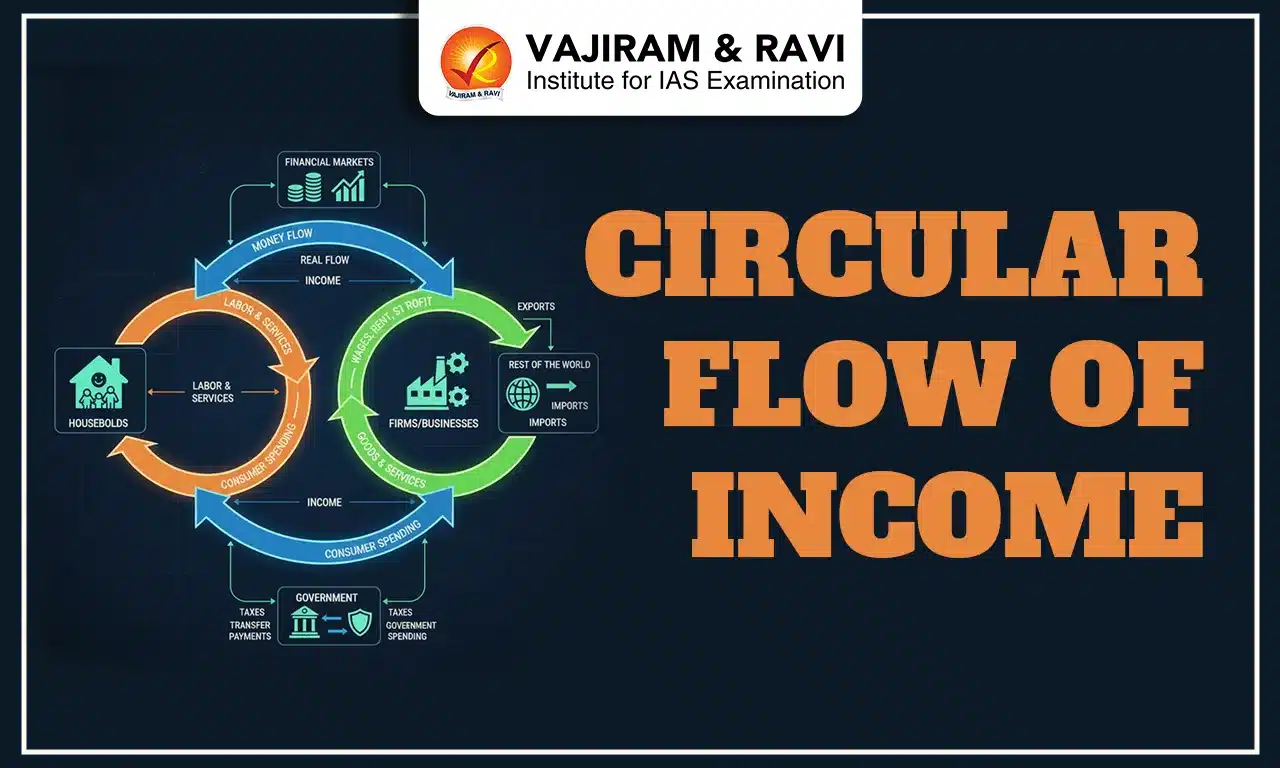
The Circular Flow of Income shows how households, as the owners of factors of production, provide labour, capital, and land to businesses, in return for which they receive wages, rent, interest, and profits as income. This income is then used by households to purchase goods and services produced by firms, creating a cycle of demand and supply. At the same time, businesses not only generate profits but also provide employment and contribute taxes to the government, which then spends on welfare, infrastructure, and public goods. In this way, the circular flow captures the cycle of production, income distribution, spending, and reinvestment that fuels economic growth.

Circular Flow of Income Types

The Circular Flow of Income can be understood by two different but complementary streams. These are: Real Flow and Money Flow. Both the streams show the dual nature of exchanges that take place in the economy. 

  1. Real Flow
    The Real flow means the actual movement of goods and services as well as factor services within the economy. Households provide factors of production like labour, capital, land, and entrepreneurship to firms. In exchange, firms utilize these inputs to produce goods and services, which then flow back to households for consumption. This flow represents the physical and tangible side of economic activity.
  2. Money Flow
    The Money Flow shows the monetary counterpart of the real flow. When firms hire factor services from households, they make payments in the form of wages, salaries, rent, interest, and profits. Households, in turn, use this income to purchase goods and services from firms, thereby generating revenue for businesses. This financial exchange forms the monetary cycle that mirrors and supports the real flow.

Together, the real flow and money flow show the symbiotic relationship between households and firms, showing how resources are transformed into goods and services and how income circulates back into the economy.

Circular Flow of Income Phases

The continuous movement of income within an economy can be studied in three important phases: Generation, Distribution, and Disposition.

  1. Generation Phase
    In the starting phase, businesses combine many inputs like labour, capital, and natural resources to produce goods and services. This production process results in the creation of economic value and contributes to the total output of the economy. The generation of income essentially begins here, as businesses add value through their productive activities.
  2. Distribution Phase
    Once goods and services are produced, the income generated from this production is distributed among the factors of production. Wages are paid to workers, rent to landowners, interest to providers of capital, and profits to entrepreneurs. In this phase, households receive their due share of income, based on their role in the production process.
  3. Disposition Phase
    In the final phase, households decide how to allocate their income. A portion is spent on consumption of goods and services, another part is saved or invested, and a share is paid as taxes to the government. The government then redistributes these resources through expenditure on welfare programmes, infrastructure, and other public services. This phase highlights the crucial choices made by households that influence demand, savings, investment, and overall economic stability.

These three phases together illustrate how income is created, distributed, and utilized, forming the backbone of the economic cycle.

Circular Flow of Income Importance

The concept of the circular flow is not just theoretical but holds practical importance in understanding and managing economies. The significance of Circular Flow of Income includes: 

  • Interdependence: Shows the close linkages between households, businesses, and the government, showing the need for balance and coordination in policies.
  • Economic Stability: Helps identify gaps or imbalances in production, income, and spending, thereby helping in policymakers in stabilizing the economy.
  • Income Distribution: Shows patterns of income distribution and enables the government to design measures for reducing inequality and ensuring inclusive growth.
  • Economic Growth: Shows the drivers of growth, including investment, consumption, and government expenditure, and provides insights for sustainable economic planning.
  • Policy Formulation: Serves as a guide for checking the impact of fiscal and monetary policies on different sectors, ensuring informed economic decision-making.
Also Check Other Posts
Care Economy Mutual Funds
Alternative Investment Funds GDP Deflator

Circular Flow of Income FAQs

Q1: What is the circular flow of income?

Ans: The circular flow of income is an economic model illustrating the continuous movement of money, goods, and services between households and firms.

Q2: What is the 4 sector circular flow of income?

Ans: The four-sector circular flow includes households, firms, government, and the foreign sector, showing income flow with taxes, government spending, imports, and exports.

Q3: What is the 5 circular flow of income model?

Ans: The five-sector model adds the financial sector to the four-sector flow, showing how banks and financial institutions facilitate saving, investment, and credit.

Q4: What are the four main points of the circular flow model?

Ans: The four main points are: income flows from firms to households, households spend on goods and services, firms produce goods using factor services, and money circulates continuously in the economy.

Q5: What are the five sectors of the economy?

Ans: The five sectors are households, firms, government, foreign sector, and financial sector, each playing a role in production, consumption, investment, and trade.

World Heart Day 2025, Theme, Importance, History, Key Facts

World Heart Day 2025

World Heart Day 2025 is celebrated on September 29 to raise awareness about cardiovascular diseases, which are the leading cause of death all over the world, and to promote preventive measures for maintaining heart health. The day focuses on vigilance, early detection, healthier lifestyle choices, and timely medical intervention under the theme “Don’t Miss a Beat”, reminding individuals and communities to prioritize cardiovascular well-being and reduce the burden of heart-related illnesses worldwide. In this article, we are going to cover World Heart Day 2025, its significance, theme and traditions. 

World Heart Day 2025

World Heart Day 2025 is observed every year on September 29th, by people all over the world. They come together to observe World Heart Day, a global initiative aimed at raising awareness about cardiovascular diseases and promoting preventive measures for heart health. Cardiovascular diseases remain the leading cause of death worldwide, making this observance important in reminding individuals and communities about the importance of maintaining a healthy heart.

World Heart Day Historical Background

World Heart Day was celebrated to unify global efforts in the fight against heart disease and to promote preventive healthcare practices. The initiative was first proposed by Antoni Baie de Luna, the former President of the World Heart Federation, and was formally established in collaboration with the World Health Organization (WHO) in 1999. The first celebration took place on September 24, 2000, and for over a decade, it was observed on the last Sunday of September each year.

In 2012, global health leaders recognized the urgent need to reduce mortality from non-communicable diseases, including cardiovascular disorders, and pledged to decrease these deaths by 25% by 2025. To align with this mission, the observance was fixed on September 29th, a date that now serves as a reminder of the ongoing fight against heart-related illnesses.

World Heart Day Importance

World Heart Day serves as a call to action for governments, health organizations, and individuals to prioritize heart health. Cardiovascular diseases such as heart attacks, strokes, and coronary heart disease are responsible for more than 20.5 million deaths annually, accounting for nearly 31% of global mortality. The day emphasizes the importance of preventive measures, including lifestyle modifications, regular medical check-ups, and timely intervention to reduce the burden of heart disease.

World Heart Day 2025 Theme

The World Heart Day 2025 theme is “Don’t Miss a Beat,” that discusses the important need for vigilance regarding heart health. It talks about the importance of early detection, preventive care, and adopting healthier lifestyle habits. Key aspects of this theme include:

  • Many cardiovascular diseases can be prevented through early screening, awareness, and consistent lifestyle improvements.
  • Individuals stay attentive to bodily signals and not ignore early warning signs of heart-related issues.
  • Scheduling regular check-ups and adopting healthier habits without delay is important to safeguard cardiovascular health.
  • Protecting the heart requires staying active, eating a balanced diet, managing stress, and avoiding unhealthy behaviors such as smoking or excessive alcohol consumption.

World Heart Day 2025 Celebrations

World Heart Day 2025 is observed all over the world by conducting many campaigns and events aimed at promoting heart health. Awareness initiatives are held via television programs, podcasts, social media campaigns, and educational posters, spreading information on risk factors and preventive strategies.

Communities and organizations organize walks, fitness events, free health checkups, fundraising campaigns, and sports activities to encourage healthier lifestyles. Pre-event scientific meetings allow cardiologists and heart health experts to share the latest research, exchange knowledge, and discuss innovative medical interventions. Such activities foster community participation and enhance public understanding of cardiovascular health.

World Heart Day 2025 Key Facts

World Heart Day 2025 acts as a reminder that heart disease is preventable and manageable through proactive measures. Important  takeaways include: 

  • Observed annually on September 29th, World Heart Day focuses on raising awareness about cardiovascular health.
  • The 2025 theme, “Don’t Miss a Beat,” emphasizes vigilance, preventive care, lifestyle improvements, and timely medical intervention.
  • Cardiovascular diseases are the leading cause of global mortality, claiming over 20.5 million lives each year, or nearly 31% of all deaths worldwide.
  • The day was first celebrated in 2000, following the establishment of the World Heart Federation in collaboration with the WHO. Initially observed on the last Sunday of September, it was later fixed on September 29th.
  • In 2012, a global pledge aimed to reduce deaths from non-communicable diseases, including cardiovascular diseases, by 25% by 2025.
  • World Heart Day traditions include awareness campaigns, TV talks, podcasts, posters, fundraising events, free checkups, fitness activities, and concerts.
  • Scientific meetings held before the day enable heart experts to share research, innovations, and new medical findings.
  • Individuals are encouraged to adopt preventive practices, including regular checkups, exercise, CPR training, balanced nutrition, stress management, and avoidance of harmful habits.
  • The day underscores that many heart diseases are preventable through awareness, lifestyle changes, and early intervention.
  • World Heart Day represents a global collaborative effort, uniting governments, NGOs, health organizations, and individuals to combat cardiovascular diseases and foster healthier communities.

World Heart Day 2025 FAQs

Q1: What is the theme for World Heart Day 2025?

Ans: The theme is “Don’t Miss a Beat”, emphasizing vigilance and proactive care for heart health.

Q2: When is Heart Day 2025?

Ans: Heart Day 2025 is observed on 29th September 2025.

Q3: Why is September 29 World Heart Day?

Ans: September 29 was chosen to unify global efforts in raising awareness about cardiovascular diseases and promoting heart health.

Q4: Why is World Heart Day celebrated?

Ans: It is celebrated to highlight the prevention, awareness, and management of cardiovascular diseases, which are the leading cause of global mortality.

Q5: When was World Heart Day celebrated for the first time?

Ans: The first World Heart Day was celebrated in 2000.

Lachipora Wildlife Sanctuary

Lachipora Wildlife Sanctuary

Lachipora Wildlife Sanctuary Latest News

District Magistrate Baramulla recently ordered the immediate closure of 14 gypsum mining units operating within the prohibited 1-km radius of Lachipora Wildlife Sanctuary.

About Lachipora Wildlife Sanctuary

  • It is situated in the Baramulla district of Jammu and Kashmir near the village of Lachipora.
  • It is located on the northern banks of the Jhelum River. 
  • Established in 1987, the sanctuary was primarily created to protect the endangered Markhor, a wild goat species known for its distinctive twisted horns.
  • It is spread over an area of 141 sq.km. 
  • The sanctuary's elevation ranges from 1,630 to 3,300 meters, contributing to alpine meadows and rich biodiversity. 
  • The sanctuary features a diverse landscape with gentle to steep slopes and rocky cliffs.
  • Flora: It supports a variety of flora, including coniferous forests of deodar, Himalayan white pine, and blue pine, and broadleaf forests with trees like birch, horse chestnut, West Himalayan fir, and Persian walnut.
  • Fauna: 
    • It is particularly renowned for being the habitat of the endangered Hangul deer, often referred to as the Kashmir stag.
    • It is also home to several other mammal species, such as the Himalayan black bear, Snow leopard, Musk deer, and many more.
    • Lachipora is also designated as an Important Bird Area (IBA). It is home to the vulnerable Western Tragopan bird species.

Source: GK

Lachipora Wildlife Sanctuary FAQs

Q1: Lachipora Wildlife Sanctuary is located in which district of Jammu and Kashmir?

Ans: Baramulla

Q2: What was the primary purpose behind the creation of Lachipora Wildlife Sanctuary?

Ans: Established in 1987, the sanctuary was primarily created to protect the endangered Markhor, a wild goat species known for its distinctive twisted horns.

Q3: On the banks of which river is Lachipora Wildlife Sanctuary located?

Ans: It is located on the northern banks of the Jhelum River.

Q4: What is the total area of Lachipora Wildlife Sanctuary?

Ans: It is spread over an area of 141 sq.km.

Agri-Stack Scheme

Agri-Stack Scheme

Agri-Stack Scheme Latest News

The Uttar Pradesh govt recently issued a stern warning to district magistrates, emphasizing that strict action will be taken against those who fail to complete farmer registration under the Agri-stack scheme within the specified timeframe.

About Agri-Stack Scheme

  • It is the digital foundation being set up by the government to enable the rollout of data-centric digital services to improve Indian agriculture and enable farmer empowerment.
  • It integrates farmer data, land records, and scheme benefits into a centralized digital platform.
  • It is being implemented by the Ministry of Agriculture and Farmer Welfare at the Centre in close collaboration with the Revenue and Agriculture departments of State governments.
  • It is an infrastructure and foundational layer that enables various government and private entities to provide farmers with tailored services by providing them access to high-quality, validated, attested, and current data. Thus, Agri Stack will:
    • Provide the right support to farmers in terms of finance and agricultural inputs at the right time.
    • Provide localized and tailored early warning systems for disasters, including pest attacks, droughts, floods, etc.
    • Simplify government scheme benefits lifecycle for farmers.
    • Enable quick and easy access to affordable finance.
    • Enable private participation in farmer service delivery, thereby increasing farmers' choices.
    • Enable ease of governance by providing required data at the right place for enhanced decision-making, policy implementation, and feedback management.
    • Improve targeting of government benefits (by maximizing inclusion and minimizing exclusion and fraud).

Building Blocks of Agri Stack

  • Farmer and Farmland Registries:
    • At the center of Agri Stack is a Farmer Registry, a federated registry of all the farmers in the country, compiled by States according to common standards, and cached by the Centre.
    • Each farmer will be assigned a unique FarmerID (a functional ID, based on Aadhaar as per IndEA 2.0) and a digitally verifiable credential.
    • The Farmer Registry will be dynamically linked to their farmland plot records for non-legal, planning and advisory, and scheme-delivery purposes only.
  • Unified Farmer Service Interface (UFSI):
    • It is the building block that enables interoperability across stakeholders in Agri Stack.
    • UFSI is envisioned to be used by government and authorized private users, such as Banks, Agri-Techs, agriculture value-chain companies, etc.
    • UFSI will enable a center-state federation of data, authorized and consent-brokered access to the core registries' data, and standards-based interactions between various public and private stakeholders.
  • Crop sown Registry:
    • It is designed to be a federated registry of crops being sown and grown across the country every season, on every farm, by each farmer.
    • It aims to streamline and improve previously prevalent paper-based methods of surveying crops by introducing smartphone- and image-based (including drone and satellite images in the future), more fool-proof methods of crop survey.
  • Agri Stack Sandbox:
    • It is a subset of the Agri Stack that will provide a simulated environment with access to the UFSI along with sample data for the various registries and databases to authorized stakeholders.
    • Purpose: To allow them to test and safely fail, or succeed and get fully authorized access to the production environments. 
  • Consent Manager:
    • The Consent Manager facilitates data-blind sharing of personal data only with persons/entities for whom the data principal (i.e., a farmer) has provided consent.
    • Consent once given may also be revoked, preventing future sharing of data.

Source: TOI

Agri-Stack Scheme FAQs

Q1: What is the main purpose of the Agri-Stack Scheme?

Ans: To enable data-centric digital services for farmer empowerment and improved agriculture.

Q2: Which ministry is responsible for implementing the Agri-Stack Scheme?

Ans: Ministry of Agriculture and Farmer Welfare

Q3: Which data sources does Agri-Stack integrate to provide services to farmers?

Ans: Agri-Stack integrates farmer data, farmland records, and government scheme benefits into a centralized digital platform.

Social Service League, Founder, Aim, Features, Key Details

Social Service League

The Social Service League is a voluntary organisation founded in 1911 by Narayan Malhar Joshi to promote social welfare in India. The aim is to improve living conditions, provide employment opportunities and raise awareness about social issues. The Service League conducted training for volunteers and initiated programs like schools, libraries, dispensaries, relief work during famines and epidemics and scouting organisations. It played an important role in modern Indian Social Work by combining education, cultural activities and community service to empower society. In this article, we are going to cover the Social Service League, its founder, goals and important activities.

Social Service League

The Social Service League was set up in 1911 by Narayan Malhar Joshi, a prominent member of the Servants of India Society, with a goal to improve the standard of living and employment opportunities for the general populace. The social service League’s primary goal was to “collect, investigate, and discuss social facts and social issues with a view to influencing public opinion on questions of social service.” It emerged as one of the pioneering initiatives to mobilize social work and public welfare in India.

The League undertook many efforts to provide educational, recreational, and social facilities to communities. These included day and night schools, libraries, dispensaries, boys’ clubs, and scouting organizations. Its work not only focused on immediate relief but also aimed at empowering citizens through education, skill development, and social awareness.

Social Service League Founder

The Social Service League was founded by Narayan Malhar Joshi (5 June 1879 – 30 May 1955) , a devoted social reformer and trade unionist. A follower of Gopal Krishna Gokhale, Joshi played an important role in labour and social reform movements in India. In 1920, alongside Lala Lajpat Rai, he co-founded the All India Trade Union Congress (AITUC), serving as its General Secretary in two tenures (1925–1929 and 1940–1948). He later left AITUC in 1931 to establish the All India Trade Union Federation, further demonstrating his commitment to workers’ welfare.

Joshi’s vision extended beyond labour issues; he sought to address broader social challenges and pioneer modern Indian social work through organized efforts like the Social Service League.

Social Service League Aim

The Social Service League focused on educating the youth about social responsibility, environmental conservation, and sustainable living. It promoted initiatives like:

  • Awareness on protection of water, air, and soil.
  • Distribution of seedlings to schools and households, encouraging vegetable gardening at home and in educational institutions.
  • Community engagement to foster environmental stewardship and hands-on learning experiences for students.

These initiatives combined social service with practical education, empowering individuals to contribute meaningfully to society.

Social Service League Features

The Social Service League conducted training programmes for volunteers, whose skills were then deployed for a variety of welfare initiatives, including:

  • Assistance to the underprivileged and impoverished.
  • Relief work during famines, epidemics, floods, and other natural calamities.
  • Promotion of community development projects to strengthen societal cohesion.

Joshi also served as President of the Bombay Textile Labour Union, showing his active involvement in improving working conditions and supporting labour welfare. He is regarded as a pioneer of modern Indian social work, blending grassroots engagement with organized social initiatives.

In addition to welfare activities, Joshi founded the Sahakari Manoranjan Mandal on 20 September 1922, which focused on training theatre performers and promoting cultural activities. The Mandal encouraged mill workers to write, direct, and perform sangeet natak (musical plays), fostering cultural expression among the working class and linking art with social awareness.

Also Check Other Posts
Battle of Plassey Robert Clive
Battle of Buxar Anglo Mysore Wars
Dual Government in Bengal Tipu Sultan
Anglo Maratha Wars Maratha Empire
Third Battle of Panipat Chhatrapati Shivaji Maharaj
Battel of Bhima Koregaon Anglo Burmese War
Maharaja Ranjit Singh Anglo Nepal War

Social Service League FAQs

Q1: Who founded the Social Service League?

Ans: Narayan Malhar Joshi founded the Social Service League in 1911.

Q2: What is the aim of the Social Service League?

Ans: Its aim was to improve living standards, promote employment, and raise awareness on social issues.

Q3: Who among the following formed the Social Service League in Bombay in 1911?

Ans: Narayan Malhar Joshi, a member of the Servants of India Society.

Q4: What are the features of the Social Service League?

Ans: It ran volunteer training, schools, libraries, dispensaries, clubs, relief work, and promoted welfare programs for the underprivileged.

Q5: What is the Social Service League?

Ans: The Social Service League is a voluntary organization established to promote social welfare, education, and community service in India.

Beddome’s Cat Skink

Beddome’s Cat Skink

Beddome’s Cat Skink Latest News

A biodiversity survey has, for the first time, recorded the presence of Beddome’s cat skink (Ristella beddomii) at the Aralam and Kottiyoor Wildlife sanctuaries.

About Beddome’s Cat Skink

  • It is also called Beddome's ristella.
  • Beddome’s cat skink is named after British naturalist Richard Henry Beddome, the species is considered rare and endemic to the Western Ghats region.
  • Appearance: It is a small reddish brown lizard with retractile claws and bicarinate scales.
  • Distribution: It is found in the forests of the Western Ghats at an altitude of 400-1,300 metres.
  • Reproduction: It is an oviparous species and egg laying coincides with the southwestern monsoons.

Key Facts about Skink

  • It is the common name for the lizards that comprise the family Scincidae.
  • It is a type of reptile that has been around since the time of the dinosaurs.
  • It is typically smooth and shiny with small or rudimentary legs.
  • They are mostly secretive ground dwellers or burrowers.
  • Behavior: Skinks are highly alert, agile and fast moving and actively forage for a variety of insects and small invertebrates. 
  • Habitat: They can be found in a variety of habitats, from deserts to rainforests, and are well-known for their ability to camouflage with their surroundings. 
  • Distribution: These are represented throughout most of the world but are especially diverse in Southeast Asia and its associated islands, the deserts of Australia, and the temperate regions of North America.

Source: TH

Beddome’s Cat Skink FAQs

Q1: Where is Beddome's Cat Skink primarily found?

Ans: Western Ghats

Q2: What is a notable behavior of Beddome's Cat Skink?

Ans: They are terrestrial to semi-fossorial. They inhabit deep leaf-litter and grasslands in montane forests and rainforests

Bhima River

Bhima River

Bhima River Latest News

Continuous heavy rains in Kalaburagi and parts of Maharashtra have led to a sharp rise in the water levels of the Bhima River recently, triggering widespread flooding in several villages.

About Bhima River

  • The Bhima River (also known as the Chandrabagha River) is the largest tributary of the Krishna River.
  • Course:
    • It originates near Bhimashankar Temple in the Bhimashankar hills on the western side of the Western Ghats in Pune District of Maharashtra.
    • Bhima flows southeast through the states of Maharashtra, Karnataka, and Telangana.
    • It merges into the Krishna River in Karnataka’s Raichur district.
    • Total Length: 861 km
  • The Bhima drainage area is defined by the Western Ghats (west), the Balaghat Range (north), and the Mahadeo Hills (south).
  • The total basin area of the river is 48,631 sq.km., out of which 75 percent lie in the state of Maharashtra. It is known as Sahyadri in Maharashtra. 
  • It runs in a well-entrenched valley, and its banks are heavily populated. 
  • Its water level is marked by monsoonal changes.
  • Tributaries: Major tributaries are the Indrayani River, Mula River, Mutha River, and Pavana River.
  • Throughout history, the Bhima River has been a lifeline for the Maratha Empire and the region surrounding Pune, with many historic battles and events occurring near its banks. 
  • The area around the Bhima River, particularly near the city of Pune, saw extensive trade and commerce routes, making it a vital hub during medieval times.
  • Pandharpur is an important pilgrimage centre located on the right bank of the Bhima River.

Source: HANS

Bhima River FAQs

Q1: The Bhima River is the largest tributary of which river?

Ans: Krishna

Q2: The Bhima River originates from which location?

Ans: It originates near Bhimashankar Temple in the Bhimashankar hills on the western side of the Western Ghats in Pune District of Maharashtra.

Q3: The Bhima River flows through which Indian states?

Ans: Maharashtra, Karnataka, Telangana

Q4: What is the total length of the Bhima River?

Ans: 861 km

Andaman Sea

Andaman Sea

Andaman Sea Latest News

The Union Petroleum Minister recently announced that natural gas has been discovered in the Andaman basin, confirming the long-held belief that the Andaman Sea is rich in natural gas.

About Andaman Sea

  • It is a semi-enclosed marginal sea in the northeastern Indian Ocean.
  • It lies between the eastern coast of India and the Malay Peninsula, with Myanmar to the north and the Indonesian island of Sumatra to the south.
  • The Bay of Bengal bounds the Andaman Sea to the west and the Strait of Malacca to the east.
  • The sea, covering an area of approximately 307,994 square miles, extends about 750 miles in length and 400 miles in width.
  • It is a complex geological region with a tectonically active plate boundary.
  • It is part of the larger Sunda Plate, which the Indian Plate borders to the northwest and the Australian Plate to the southeast. 
  • The ongoing tectonic convergence between these plates has resulted in the formation of the Andaman Basin, characterized by undersea ridges, trenches, and faults. 
  • The most prominent geological feature in the region is the Andaman Trench, which is formed by the subduction of the Indian Plate beneath the Eurasian Plate. 
  • This tectonic activity has given rise to numerous earthquakes and volcanic eruptions in the region, making the Andaman Sea seismically active.
  • It is home to extensive coral reef systems, seagrass meadows, and mangrove forests, which provide critical habitats for a multitude of marine organisms.
    • It hosts many endangered fauna species –Whale Shark, Devil Manta Ray, Dugong, several dolphin species, such as Irrawaddy Dolphin and four species of sea turtles. 
    • It is also an important site for migratory birds, with several key stopover locations along the East Asian-Australasian Flyway.
  • Islands: Most of the islands are part of the Andaman and Nicobar Islands, a Union Territory of India, while the Coco Islands and Preparis Island are part of the Yangon Region of Myanmar.
  • The climate of the Andaman Sea is tropical, with two distinct seasons: the southwest monsoon (May-September) and the northeast monsoon (November-February).

Source: NOA

Andaman Sea FAQs

Q1: The Andaman Sea is a part of which ocean?

Ans: It is a semi-enclosed marginal sea in the northeastern Indian Ocean.

Q2: What bounds the Andaman Sea to the east?

Ans: Strait of Malacca

Q3: What is the most prominent geological feature in the Andaman Sea?

Ans: Andaman Trench

Q4: What type of climate does the Andaman Sea region have?

Ans: The climate of the Andaman Sea is tropical, with two distinct seasons: the southwest monsoon (May-September) and the northeast monsoon (November-February).

Cold Desert Biosphere Reserve

Biosphere Reserve

Cold Desert Biosphere Reserve Latest News

Recently, the Cold Desert Biosphere Reserve (CDBR) in Himachal Pradesh has been included in the World Network of Biosphere Reserves (WNBR) by UNESCO.

About Cold Desert Biosphere Reserve

  • It is perched high in the trans-Himalayan region.
  • It spans approximately 7,770 sq. km. across the landscapes of Himachal Pradesh’s Lahaul-Spiti district.
  • It was declared a biosphere reserve in 2009.
  • Terrain: It encompasses windswept plateaus, glacial valleys, alpine lakes, and rugged high-altitude deserts.
  • This is India’s first high-altitude cold desert biosphere reserve and one of the coldest and driest ecosystems in UNESCO’s WNBR.
  • With this addition, India now has 13 biospheres listed in UNESCO’s World Network of Biosphere Reserves (WNBR).
  • It covers the Pin Valley National Park and its surroundings, Chandratal and Sarchu & Kibber Wildlife Sanctuary.
  • Flora: It harbours 732 species of vascular plants, including 30 endemics and 157 near-endemics of the Indian Himalayas,
  • This fragile cold desert ecosystem supports hardy alpine grasses, medicinal herbs, and rare stands of Willow-leaved sea-buckthorn, Himalayan birch and Persian juniper.
  • Fauna: It is home to leopard, Himalayan ibex, blue sheep, Himalayan wolf, and rich bird life such as the Himalayan snowcock and golden eagle.

 Source: IE

Cold Desert Biosphere Reserve FAQs

Q1: Where is the Cold Desert Biosphere Reserve located?

Ans: Himachal Pradesh

Q2: What is the Cold Desert Biosphere Reserve known for?

Ans: Snow leopard conservation efforts.

Study in India (SII) portal

Study In India (SII) Portal

Study In India (SII) Portal Latest News

The University Grant Commission (UGC) recently mandated that all foreign nationals studying in Higher Education Institutions (HEIs) and universities in the country have to register themselves in a new Study In India (SII) portal.

About Study In India (SII) Portal

  • It is a flagship project of the Ministry of Education (MoE), Government of India, to encourage international students to explore educational opportunities at top Indian universities. 
  • It is a single-window interface for international students, which facilitates submission of applications, admission processes, and visa applications for those seeking to pursue regular, short-term, or long-term courses in Indian academic institutions or HEI’s.
  • It serves as a seamless digital gateway to India’s higher education ecosystem. 
  • The website will illustrate academic programs, including undergraduate (UG), postgraduate (PG), and doctoral-level programs. 
  • It will also provide information about courses in the Indian Knowledge System, such as Yoga, Ayurveda, classical arts, etc
  • Additionally, the portal will present information about the academic facilities, research support, and related information.
  • All foreign students who wish to study in India, are mandated to register on the SII portal and submit the required information on the portal.
  • Upon registration, the portal generates a unique ID or ‘SII-ID’, which must be quoted on the student visa application.

Source: TH

Study In India (SII) Portal FAQs

Q1: The Study in India (SII) Portal is an initiative of which government body?

Ans: It is a flagship project of the Ministry of Education (MoE), Government of India.

Q2: What is the main purpose of the Study In India (SII) Portal?

Ans: To encourage international students to explore educational opportunities in India.

Q3: The SII Portal serves as a digital gateway for which level of academic programs?

Ans: Undergraduate, postgraduate, and doctoral programs.

Q4: Is registration on the SII Portal mandatory for all foreign students wishing to study in India?

Ans: Yes, all foreign students who wish to study in India, are mandated to register on the SII portal.

AstroSat

AstroSat

AstroSat Latest News

Recently, India’s first dedicated Space Astronomy Observatory, AstroSat completed a decade of operations. 

About AstroSat

  • It is the first dedicated Indian astronomy mission.
  • It was launched by PSLV-C30 (XL) rocket from Satish Dhawan Space Centre in Sriharikota  on September 28, 2015.
  • The minimum useful life of the AstroSat mission was around 5 years but still it is providing valuable information.
  • It was designed to observe the universe in the Visible, Ultraviolet, low and high energy X-ray regions of the electromagnetic spectrum simultaneously with the help of its five payloads.
  • Payloads of Astrosat: Ultra Violet Imaging Telescope (UVIT), Large Area X-ray Proportional Counter (LAXPC), Cadmium–Zinc–Telluride Imager (CZTI), Soft X-ray Telescope (SXT) and Scanning Sky Monitor (SSM).
  • The spacecraft control center at Mission Operations Complex (MOX) of ISRO Telemetry, Tracking and Command Network (ISTRAC), Bengaluru, manages the satellite during its entire mission life.

Objectives of Astrosat

  • To understand high energy processes in binary star systems containing neutron stars and black holes.
  • Estimate magnetic fields of neutron stars.
  • Study star birth regions and high energy processes in star systems lying beyond our galaxy.
  • Detect new briefly bright X-ray sources in the sky.
  • Perform a limited deep field survey of the Universe in the Ultraviolet region.

Source: TH

AstroSat FAQs

Q1: What is the primary objective of AstroSat

Ans: To observe celestial bodies in multiple wavelengths.

Q2: When was AstroSat launched?

Ans: September 28, 2015.

PM E-DRIVE Scheme

PM E-DRIVE Scheme

PM E-DRIVE Scheme Latest News

The Centre recently unveiled operational guidelines for the rollout of nearly 72,300 public electric vehicle (EV) charging stations across the country, with an outlay of Rs 2,000 crore under the Rs 10,900 crore PM E-DRIVE scheme.

About PM E-DRIVE Scheme

  • The PM E-DRIVE (Electric Drive Revolution in Innovative Vehicle Enhancement) scheme is a flagship initiative launched in October 2024 with a financial outlay of Rs.10,900 crore.
  • It came into effect from October 1, 2024, and will remain in force until March 31, 2026. Its primary aim is to accelerate the adoption of electric vehicles (EVs), establish charging infrastructure, and build a robust EV manufacturing ecosystem in the country.
  • It promotes mass mobility through the support of public transportation systems. 
  • The key objective is to speed up the transition to EVs by offering upfront incentives for EV purchases and encouraging the development of charging infrastructure. 
  • The scheme seeks to reduce transportation-related environmental impacts and improve air quality while also promoting an efficient and competitive EV manufacturing sector in line with the Aatmanirbhar Bharat initiative. 
  • This is to be accomplished through a phased manufacturing program (PMP) designed to boost domestic manufacturing and strengthen the EV supply chain.
  • The PM E-DRIVE scheme to be implemented through the following key components:
    • Subsidies: Demand incentives to be provided for electric vehicles such as e-2 wheelers (e-2W), e-3 wheelers (e-3W), e-ambulances, e-trucks, and other emerging categories of EVs.
    • Grants for creation of capital assets: Funding to be provided for the acquisition of electric buses (e-buses), the establishment of a comprehensive network of charging stations, and the upgrading testing facilities of the Ministry of Heavy Industries (MHI).
    • Administration of the Scheme including IEC (Information, Education & Communication) activities and fee for project management agency (PMA).
  • States are encouraged to offer additional fiscal and non-fiscal incentives, such as road tax waivers, reduced toll and parking fees, and permit exemptions, to further promote EV adoption. 
  • The scheme will be overseen by an inter-ministerial body, the Project Implementation and Sanctioning Committee (PISC), chaired by the Secretary of Heavy Industries. 
    • The PISC will be responsible for monitoring progress and ensuring the scheme’s successful rollout.
    • It will also have the authority to address any challenges, including revising incentives, increasing the number of e-buses, and approving guidelines for testing agencies.
  • To qualify for the PM E-DRIVE incentives, vehicles must be registered as “Motor Vehicles” under the Central Motor Vehicle Rules (CMVR) and equipped with advanced battery technology.
  • Bharat Heavy Electricals Limited (BHEL) is the nodal agency for:
    • Demand aggregation for charging infrastructure.
    • Development of a Unified EV Super App for users across India.
      • The app will offer real-time charger availability, slot booking, payment integration, and deployment progress tracking, ensuring digital ease-of-use for all EV stakeholders.

Source: TOI

PM E-DRIVE Scheme FAQs

Q1: What is the total financial outlay of the PM E-DRIVE Scheme?

Ans: Rs. 10,900 crore

Q2: What is the primary aim of the PM E-DRIVE Scheme?

Ans: To accelerate adoption of electric vehicles and build EV ecosystem.

Q3: Which entity is the nodal agency for demand aggregation and development of the Unified EV Super App under PM E-DRIVE?

Ans: Bharat Heavy Electricals Limited (BHEL)

Q4: What services will the Unified EV Super App provide to EV users?

Ans: Real-time charger availability, slot booking, payment integration, and deployment progress tracking.

CAG Report on States’ Macro-Fiscal Health – Explained

CAG Report

CAG Report Latest News

  • The CAG’s decadal analysis of States’ macro-fiscal health highlights uneven revenue sources, rising debt burdens, and the welfare paradox shaping fiscal sustainability across India.

Introduction

  • India’s States collectively manage some of the largest public budgets in the world, often surpassing those of smaller countries in size. 
  • The recently released decadal analysis of States’ macro-fiscal health by the Comptroller and Auditor General (CAG) offers a crucial snapshot of how reforms, growth, and crises such as the pandemic have shaped their fiscal trajectories. 
  • While some States reported impressive revenue surpluses, others struggle under heavy debt burdens, revealing stark disparities in fiscal sustainability and policy choices.

States’ Macro-Fiscal Landscape in India

  • In the early 2000s, Indian States were burdened with chronic deficits. Reforms in tax collection, GST implementation, and high growth during the 2010s improved finances, with some States recording surpluses. 
  • However, the pandemic reversed these gains, as shrinking revenues and soaring emergency expenditure pushed most States back into fiscal distress.
  • States today present a mixed picture: while richer States like Maharashtra fund a large share of their expenditure internally, poorer States such as Arunachal Pradesh remain highly dependent on Union transfers. 
  • This vertical imbalance in fiscal capacity underscores the unevenness of India’s federal fiscal architecture.

Uneven Revenue Sources

  • The CAG report shows that States rely on highly variable revenue streams. For example:
    • Kerala’s lotteries contributed nearly Rs. 12,000 crore in 2022-23.
    • Odisha’s mining royalties made up 90% of its non-tax income.
    • Telangana raised nearly Rs. 9,800 crore through land sales.
  • Such revenues are volatile and unsustainable: lotteries depend on sales, royalties on global commodity prices, and land cannot be sold repeatedly. 
  • Even surplus-earning States like Uttar Pradesh generated only 42% of their receipts internally, leaning heavily on central transfers.

Rising Borrowings and Debt Burden

  • The fiscal health of States is also reflected in their borrowing patterns:
    • Andhra Pradesh tripled its borrowings to Rs. 1.86 lakh crore by 2022-23, with debt reaching 35% of GSDP.
    • Bihar doubled its borrowings, pushing debt close to 39% of GSDP.
    • Kerala’s debt burden remained high at 37% of GSDP despite curbing borrowings post-pandemic.
    • Punjab continued its fiscal stress with liabilities touching 45% of GSDP.
    • In contrast, Odisha reduced borrowings, lowering debt to 15% of GSDP, the lowest in India.
  • The pandemic was a turning point: while some States like Karnataka and Maharashtra cut back borrowings after 2021, others like Andhra Pradesh, Telangana, and Rajasthan kept expanding them, signalling divergent fiscal strategies.

The Welfare Paradox

  • A striking theme of the CAG analysis is the welfare paradox
  • Despite reporting surpluses or stable debt, many States underfund key welfare sectors such as education, health, and rural infrastructure. 
  • Instead, reliance on off-budget loans, GST compensation arrears, and central transfers creates a façade of fiscal stability.
  • Political populism adds another layer. Free power, farm waivers, and cash transfers defer costs into opaque mechanisms like guarantees and special-purpose vehicles. 

Implications for Fiscal Federalism

  • The CAG findings highlight deeper structural issues in India’s fiscal federalism:
    • Dependence on volatile revenues limits the States’ capacity to plan long-term welfare.
    • Rising borrowings pose risks of debt overhang, especially in poorer and smaller States.
    • Vertical fiscal imbalance perpetuates reliance on the Centre, undermining financial autonomy.
    • Populist welfare policies erode fiscal discipline while failing to deliver sustainable outcomes.
  • The analysis suggests that India’s States must prioritise capital expenditure over routine subsidies, diversify revenue sources, and strengthen fiscal transparency. 
  • Without such reforms, India risks sustaining one of the largest welfare States in the world on one of the thinnest fiscal bases among middle-income economies.

Conclusion

  • The CAG’s decadal review underscores the complexity of States’ macro-fiscal health. 
  • While some States like Odisha demonstrate prudent fiscal management, others, such as Punjab and Kerala, remain vulnerable to debt traps and volatile revenues. 
  • The welfare paradox, lavish spending amid weak revenues, reflects the tension between developmental needs and fiscal sustainability. 
  • For India’s federal system to remain resilient, States must pursue balanced fiscal strategies that combine growth, welfare, and sustainability.

Source: TH

CAG Report FAQs

Q1: What does the CAG’s decadal report on States’ finances highlight?

Ans: It highlights uneven revenues, rising borrowings, and the welfare paradox in States’ fiscal management.

Q2: Which State has the lowest debt burden relative to GSDP?

Ans: Odisha, with liabilities at just about 15% of GSDP.

Q3: Why are States like Kerala and Telangana considered fiscally vulnerable?

Ans: Because they depend heavily on volatile revenues like lotteries and land sales.

Q4: What is meant by the welfare paradox in States’ finances?

Ans: It refers to lavish welfare spending despite weak fiscal bases and rising debt.

Q5: How does the fiscal imbalance affect Centre-State relations?

Ans: Poorer States rely heavily on Union transfers, deepening vertical fiscal imbalance and dependence on the Centre.

Delhi Loudspeaker Rules Extended for Festivals | Legal Framework & Court Rulings

Delhi Loudspeaker Rules

Delhi Loudspeaker Rules News

  • Delhi CM Rekha Gupta announced that during cultural events like Ramlila and Durga Puja, loudspeaker use will be allowed till midnight, extending the usual 10 pm limit by two hours.
  • The move aligns with legal provisions that permit state governments to relax loudspeaker restrictions during festivals and cultural occasions, while still operating within the framework of India’s Noise Pollution (Regulation and Control) Rules, 2000.

Legal Framework Governing Loudspeakers in India

  • The Noise Pollution (Regulation and Control) Rules, 2000, under the Environment (Protection) Act, 1986, regulate the use of loudspeakers. 
  • Rule 5(1) requires written permission from authorities before use, while Rule 5(2) bans their use between 10 pm and 6 am, except in closed premises like auditoriums or conference halls. 
  • The rules prescribe maximum permissible noise levels for different areas, categorised as industrial, commercial, residential and silence zones. 
    • For residential areas, the daytime limit (6 am to 10 pm) is 55 decibels (dB) while that for nighttime is 45 dB. 
      • For context, a whisper is about 30 dB, while normal conversation is about 60 dB. 
  • Importantly, Rule 5(3) allows state governments to relax restrictions, permitting loudspeaker use till midnight for up to 15 days a year during cultural or religious festivities. 
  • Delhi’s decision to extend the loudspeaker deadline for festivals falls within this legal provision.

Court Rulings on Loudspeaker Use in India

  • Over the past two decades, Indian courts have shaped a strong jurisprudence on noise pollution, balancing religious freedom with the fundamental right to a peaceful environment.

Supreme Court: Loudspeakers Not a Fundamental Right

  • In 2000, the Supreme Court ruled that no religion mandates prayers by disturbing others, rejecting the use of loudspeakers as a right under Article 25 (freedom of religion). 
  • In 2005, it further held that the right to a noise-free environment is implicit under Article 21, and “aural aggression” cannot be justified under free speech. 
  • This ruling established the 10 pm–6 am loudspeaker ban.
  • The Court upheld Rule 5(3) allowing exemptions till midnight for up to 15 days annually, but imposed strict conditions: only state governments can grant it, it must apply statewide, and silence zones remain excluded.

High Court Directions

  • High Courts have strictly enforced these principles:
    • Bombay HC (2016): Loudspeakers not essential to religion; pulled up government for lax enforcement.
    • Karnataka HC (2018): Allowed indoor concert use at night, provided boundary noise limits were respected.
    • Punjab & Haryana HC (2019): Made written permission mandatory for all religious use, set up complaint mechanisms.
    • Allahabad HC (2020): Azaan is essential, but loudspeakers are not historically required.

Recent Ruling: Bombay HC (2025)

  • The court introduced a graded penalty system: caution for first offence, fines for repeat, and seizure for continued violations. 
  • It also mandated considering cumulative noise levels from multiple sources and suggested modern enforcement, such as mobile decibel apps and auto-limiters in speakers.

Concerns Over Delhi’s Loudspeaker Extension

  • Environmental experts criticised Delhi’s decision to allow loudspeakers till midnight, calling it a backward step that undermines Noise Pollution Rules designed to protect children, patients, and residents. 
  • Activists warned that public health is being sacrificed for short-term convenience, noting that citizens already face excessive noise from construction and commercial establishments.
  • In 2024, Delhi Police received over 40,000 noise complaints, with 82% linked to DJs and loudspeakers. 
  • This prompted fresh guidelines in March, requiring written permission for loudspeaker use and booking violators under Bharatiya Nyaya Sanhita Sections 270, 292, and 293.
  • The amended order also tightened limits, mandating that private sound systems cannot exceed ambient noise standards by more than 5 dBA, compared to the earlier 10 dBA allowance.

Source: IE | IT | ToI

Delhi Loudspeaker Rules FAQs

Q1: What are Delhi’s loudspeaker rules during festivals?

Ans: Delhi permits loudspeakers till midnight for 15 festival days under Noise Rules 2000, with state-level approval and strict conditions on noise levels.

Q2: What do the Noise Pollution Rules 2000 say about loudspeakers?

Ans: They ban use between 10 pm–6 am except in closed premises, and allow states to relax restrictions during cultural or religious occasions for up to 15 days.

Q3: What has the Supreme Court said on loudspeakers?

Ans: The Supreme Court held loudspeakers are not a religious right, declared noise-free environment under Article 21, and enforced the strict 10 pm ban.

Q4: Why are activists opposing Delhi’s relaxation of loudspeaker rules?

Ans: Experts say extending timings undermines noise laws, harms public health, and worsens daily problems from construction noise and commercial establishments.

Q5: What enforcement measures are in place against violations?

Ans: Delhi Police requires written permission, uses decibel checks, and books violators under Bharatiya Nyaya Sanhita for nuisance and continued violations.

Sonam Wangchuk Detained Under NSA | Key Facts on Preventive Detention Law

National Security Act

National Security Act Latest News

  • Climate activist Sonam Wangchuk, leading the movement for Ladakh’s statehood and Sixth Schedule protections, was detained under the National Security Act (NSA) and shifted to Jodhpur jail.
  • The Centre blamed him for allegedly instigating violent protests in Leh, where four people were killed in police firing and 50 injured.
  • The case has drawn attention to the NSA, one of India’s toughest preventive detention laws, used in the past against separatists, gangsters, and radical preachers
  • The law allows governments to pre-emptively detain individuals deemed a threat to public order or national security.

About Preventive Detention

  • Preventive detention is the practice of detaining a person not for a crime already committed, but to prevent them from acting in a manner that could threaten public order, security, or essential supplies. 
  • It aims to stop potential harm before it occurs.

Difference from Punitive Detention

  • Preventive detention: Detains individuals to prevent a future act considered harmful. It is anticipatory in nature.
  • Punitive detention: Imposed as punishment after conviction for an offence already committed, based on due process of law.

Constitutional Provision

  • The Indian Constitution permits preventive detention under Article 22.
    • Article 22 has two parts—the first part deals with cases of ordinary law, which includes situations where an individual is detained as part of a criminal investigation.
    • The second part deals with cases of preventive detention law, which pertains to the detention of individuals without a trial or conviction.
  • A person can be detained up to 3 months without Advisory Board approval; beyond that, detention requires approval by an Advisory Board of judges.
  • Grounds of detention must be communicated, but certain facts may be withheld in public interest.

Preventive Detention and the NSA

  • Preventive detention in India traces back to colonial times and was institutionalised post-Independence through the Preventive Detention Act, 1950.
  • It was followed by the controversial Maintenance of Internal Security Act (MISA), 1971, repealed after the Emergency. 
  • In 1980, the National Security Act (NSA) was enacted, empowering the Centre, states, District Magistrates, and Police Commissioners (when authorised) to detain individuals pre-emptively.
  • Unlike punitive arrests under criminal law, NSA detention is preventive, aimed at stopping individuals from acting in ways “prejudicial to India’s defence, foreign relations, national security, public order, or essential supplies.” 
  • The Act gives governments wide-ranging powers to address threats, while incorporating certain procedural safeguards to check misuse.

What the NSA Provides

  • Under the National Security Act (NSA), detention orders function like warrants of arrest, allowing authorities to hold individuals in designated places, transfer them across states, and impose conditions. 
  • Grounds of detention must be communicated within 5 to 15 days, and detainees can submit a representation to the government. 
  • An Advisory Board of High Court judges must review the case within 3 weeks and order release if there is “no sufficient cause.” 
  • Detention can last up to 12 months, though it may be revoked earlier.
  • However, safeguards are limited: 
    • detainees cannot have legal representation before the Advisory Board, and 
    • the government may withhold facts citing public interest, leaving significant powers in official hands.

Wangchuk’s Legal Remedies

  • Sonam Wangchuk can challenge his detention under the NSA by filing a representation to the government or await the Advisory Board’s review within three weeks, which must order release if no sufficient cause is found.
  • He may also approach the High Court or Supreme Court under Articles 226 or 32 to contest the legality of detention. 
  • Additionally, the government itself may revoke the order at any stage.
  • Until these processes conclude, the NSA permits detention without formal charges or open-court evidence, giving authorities wide leeway in holding him.

Past Use and Misuse of the NSA

  • The National Security Act (NSA) has been invoked in several high-profile cases. 
  • In 2023, radical Sikh preacher Amritpal Singh was detained under NSA and moved to Dibrugarh jail. 
  • Earlier, Bhim Army chief Chandrashekhar Azad was booked in 2017, though the order was later revoked by the Supreme Court. 
  • During the anti-CAA protests (2020), multiple protesters in Uttar Pradesh were detained under the Act.
  • The law has also targeted individuals such as Dr Kafeel Khan, whose 2020 detention was struck down by the Allahabad High Court. 
  • States like Uttar Pradesh and Madhya Pradesh have applied NSA in “Love Jihad” cases, communal violence, cow slaughter, and habitual crime, often stretching its definition of national security.
  • Courts have intervened in cases of misuse: in 2012, the Supreme Court struck down the detention of a man accused of kerosene black-marketing as unjustified
  • These instances show a pattern where governments justify NSA as vital for security, while critics denounce it as a blunt instrument prone to abuse.

Source: IE | SCO | ET

National Security Act FAQs

Q1: Why was Sonam Wangchuk detained under NSA?

Ans: He was accused of instigating violent Ladakh protests. NSA allows preventive detention of those considered threats to national security or public order.

Q2: What is preventive detention in India?

Ans: It is anticipatory detention to prevent potential harm, unlike punitive detention, which punishes after a crime. Article 22 of the Constitution permits it.

Q3: What powers does the National Security Act provide?

Ans: NSA allows detention up to 12 months, requires grounds to be shared within 5–15 days, but denies legal counsel before Advisory Boards.

Q4: What legal remedies are available under NSA detention?

Ans: A detainee can represent to the government, await Advisory Board review, or approach the High Court/Supreme Court under Articles 226 and 32.

Q5: How has the NSA been used in the past?

Ans: NSA has been invoked against Amritpal Singh, Chandrashekhar Azad, and CAA protesters, but critics flag misuse in cases like Dr Kafeel Khan’s detention.

Corporate Average Fuel Efficiency (CAFE) – Norms to Revamp Vehicle Emissions Framework

Corporate Average Fuel Efficiency (CAFE)

Corporate Average Fuel Efficiency (CAFE) Latest News

  • India has released draft Corporate Average Fuel Efficiency (CAFE) 3 norms through the Bureau of Energy Efficiency (BEE). 
  • These norms aim to tighten fuel efficiency and emission standards while addressing industry demands for flexibility, especially for small cars and electric vehicles (EVs).

Current CAFE Framework in India

  • CAFE:
    • Introduced in 2017 by BEE, Ministry of Power, to regulate fuel consumption and carbon emissions from passenger vehicles. 
    • These norms apply to vehicles running on petrol, diesel, liquefied petroleum gas (LPG), compressed natural gas (CNG), hybrids, and electric vehicles (EVs) weighing less than 3,500 kg
    • Designed to reduce oil dependency and curb air pollution, pushing automakers to lower carbon dioxide emissions while incentivising the production of EVs, hybrids, and CNG vehicles.
  • CAFE 2: In 2022-23, the norms were tightened (fuel consumption capped at 4.78 litres/100 km, and CO₂ emissions capped at 113 g/km) with increased penalties for non-compliance.
  • Need for CAFE 3: 
    • In the USA, EU, China, Japan, smaller lightweight cars receive relaxed CO₂ norms. 
    • However, India’s current framework is inverted, giving SUVs more relaxed limits and burdening small cars.
    • So, CAFE 3 seeks to align with global best practices.

Key Features of Proposed CAFE 3 Norms

  • Applicability:
    • Covers M1 category passenger vehicles with a seating capacity of 9 people (including the driver) and a maximum weight of 3,500 kilogram.
    • Non-compliance will attract penalties under the Energy Conservation Act, 2001.
  • Efficiency targets:
    • Under CAFE 3, the efficiency formula is: [0.002 x (W – 1170) + c]. It is measured in petrol-equivalent litres per 100 kilometre.
    • Here, W is the average fleet weight, 1,170kg is the fixed constant for weight, 0.002 is a fixed constant multiplier, and ‘c’ is a constant that changes every year. 
    • Since ‘c’ continues to decrease from FY28 to FY32, the rules will become stricter over time. This constant starts at 3.7264 in FY28, then subsequently drops to 3.0139 in FY32.
    • Lighter vehicles have easier compliance compared to heavier SUVs or premium cars.
  • Incentives for small cars:
    • Additional relaxation of 3.0 g CO₂/km (capped at 9.0 g/km) for compact petrol cars (unladen mass up to 909 kg, engine capacity not exceeding 1200 cc and length not exceeding 4000 mm).
    • This is designed to revive the small car segment, which saw a 71% sales decline in six years.
    • Complementary policy: GST 2.0 reforms lowered GST on small cars from 28% to 18%.
  • Boost for EVs and alternate fuels:
    • Super credits multipliers:
      • Companies could potentially obtain relaxation in their overall efficiency target as the norms propose to offer companies “super credits” based on the type of vehicle they sell.
      • Each EV sold will be counted three times while calculating a company’s average. 
      • Plug-in hybrids will be counted 2.5 times, and strong hybrids twice. 
      • Flex-fuel ethanol cars are given a smaller multiplier of 1.5.
    • Carbon Neutrality Factor (CNF) introduced:
      • CNF offers further relaxation on the targets based on the type of fuel used in a car.
      • For example, for petrol vehicles (E20 to E30) 8% CNF on tailpipe CO2; for flex fuel ethanol vehicles and strong hybrid electric vehicles 22.3% CNF on tailpipe CO2; etc.
  • Emissions pooling:
    • Up to three carmakers can form a pool (to meet the targets jointly) and be treated as a single manufacturer.
    • Pool manager legally responsible for compliance and penalties.
    • Reduces compliance costs and encourages strategic alliances.

Conclusion

  • The proposed CAFE 3 norms mark a critical shift in India’s emission strategy—reviving small cars, incentivising EVs, and tightening long-term efficiency goals. 
  • If implemented effectively, they could reduce India’s oil import dependency, accelerate green mobility adoption, and align India’s policies with global climate commitments under the Paris Agreement
  • However, challenges remain in industry adaptation, consumer acceptance, and infrastructure readiness for alternative fuel vehicles.

Source: IE

Corporate Average Fuel Efficiency (CAFE) FAQs

Q1: What are the key features of the proposed Corporate Average Fuel Efficiency (CAFE) 3 norms in India?

Ans: CAFE 3 norms introduce stricter efficiency targets, incentives for small cars, super credits for EVs/hybrids, provisions for emissions pooling among carmakers, etc.

Q2: How do the proposed CAFE 3 norms aim to revive the small car segment in India?

Ans: By offering 3.0 g CO₂/km relaxation (capped at 9.0 g/km) for compact cars and reducing GST from 28% to 18%.

Q3: What is the concept of “super credits” under the proposed CAFE 3 framework?

Ans: Super credits assign higher weightage to EVs and hybrids in fleet average calculations, easing compliance.

Q4: What is emissions pooling under the draft CAFE 3 norms and why is it significant?

Ans: Emissions pooling allows up to three carmakers to jointly meet efficiency targets.

Q5: What is India’s current CAFE framework?

Ans: Unlike global practices (in the USA, EU, China, and Japan) that relax norms for lightweight cars, India’s framework currently favors heavier vehicles like SUVs.

Daily Editorial Analysis 29 September 2025

Daily Editorial Analysis

An Engels’ Pause in an AI-Shaped World 

Context

  • The rapid rise of Artificial Intelligence (AI) has sparked debates about its potential to transform industries, economies, and societies at large.
  • Geoffrey Hinton, Nobel Laureate and pioneer of AI, recently warned that this revolution may enrich a select few while leaving the majority poorer.
  • His cautionary note echoes a historical parallel known as the Engels’ pause, a period during the early Industrial Revolution when economic output soared but living standards for ordinary workers stagnated.
  • The question that looms today is whether the world is entering a modern Engels’ pause in the AI era, one where productivity accelerates but shared prosperity lags behind.

The Engels’ Pause in Historical Context

  • Coined by economist Robert Allen, the term Engels’ pause refers to early 19th-century Britain, where despite immense industrial expansion, real wages stagnated and inequality deepened.
  • While Britain became the workshop of the world, ordinary households saw little improvement in welfare, as food absorbed most of their income and social inequalities widened.
  • It was only decades later, through reforms, institutional changes, and new social contracts, that broad-based prosperity emerged.
  • This historical paradox frames a crucial debate in the present: whether AI, as a general-purpose technology (GPT) akin to steam power or electricity, will generate similar delays between technological progress and widespread welfare gains.

AI as a General-Purpose Technology

  • AI fits the profile of a GPT, capable of reshaping multiple industries simultaneously.
  • As Agrawal, Gans, and Goldfarb (2018) argued, its unique economic contribution lies in drastically lowering the cost of prediction.
  • Yet, as history shows, GPTs bring both growth and dislocation. They demand complementary innovations, institutional adaptation, and new skills before benefits trickle down.
  • Without such adjustments, the gains are often captured by a few entrepreneurs or dominant firms, leaving the broader workforce vulnerable to job displacement and wage stagnation.

Signs of a Modern Engels’ Pause

  • Productivity without wage growth

    • In Philippine call centres, AI copilots have boosted productivity by 30–50%, improving efficiency and cutting costs for firms.
    • Yet, workers’ wages have remained stagnant, and workloads have intensified. Rising living costs only compound the sense of declining welfare.
  • Rising costs of complements

    • To remain relevant in the AI economy, workers must constantly reskill through coding boot camps, certifications, and training programs.
    • These costs parallel the 19th-century phenomenon where higher nominal wages were offset by surging food prices, leaving workers no better off.
  • Concentration of gains and inequality

    • PwC projects that AI could add $15.7 trillion to global GDP by 2030. However, most gains are likely to accrue to the U.S., China, and a handful of firms controlling foundational models.
    • For much of the global workforce, particularly in developing economies, welfare improvements may be delayed or even denied.
  • Job displacement and task transformation

    • From AI-powered hospitals in China to AI adoption in airports and public administration, tasks are rapidly being transformed.
    • While some roles are complemented, others are displaced, raising concerns about structural unemployment and growing inequality.

Lessons from History and Policy Responses

  • The Industrial Revolution eventually delivered prosperity, but only after decades of inequality and social unrest, which prompted reforms such as trade unions, public education, and welfare institutions.
  • The same logic applies today: governance, not technology alone, determines whether AI delivers broad human welfare. Key policy responses include:
  • Skills transition programs. Initiatives like Singapore’s SkillsFuture or Abu Dhabi’s AI-focused university (MBZUAI) exemplify efforts to build human capital for an AI-driven future.
  • Redistribution of AI rents. Mechanisms such as robot taxes, Universal Basic Income (UBI), and philanthropic contributions could help spread the benefits of AI more equitably.
  • AI infrastructure as a public good. Compute power and data access, the lifeblood of AI, must not remain prohibitively expensive or monopolised. Publicly funded open AI models, such as those launched in the UAE and Switzerland, mark steps in this direction.

Counterarguments and Optimism

  • Critics of the Engels’ pause analogy argue that contemporary societies are better equipped than 19th-century Britain.
  • Stronger welfare systems, faster technological diffusion, and the potential for AI to lower costs in healthcare, education, and energy could shorten or even prevent an extended pause.
  • For instance, smartphones reached billions in under a decade, and AI assistants could follow a similar trajectory if deployed equitably.
  • However, optimism must be tempered by caution. While macroeconomic gains may appear, many individuals may still face stagnant wages, rising costs, and insecure livelihoods.
  • The challenge lies in ensuring that AI becomes a human welfare revolution, not just a productivity revolution.

Conclusion

  • The spectre of a modern Engels’ pause warns that technological progress does not automatically translate into human welfare.
  • History underscores that political will, institutional adaptation, and inclusive governance are crucial to bridging the gap between productivity and prosperity.
  • AI governance today faces a stark choice: whether to allow an era of concentrated wealth and stagnant welfare, or to craft policies that ensure AI becomes a driver of broad-based human progress.
  • The outcome, as history reminds us, will not be determined by technology alone, but by collective political and social choices.

An Engels’ Pause in an AI-Shaped World FAQs

Q1. What is meant by the term “Engels’ pause”?
Ans. The term “Engels’ pause” refers to a historical period in 19th-century Britain when industrial output increased rapidly, but workers’ wages stagnated, and inequality widened.

Q2. Why is AI compared to a general-purpose technology (GPT)?
Ans. AI is compared to a general-purpose technology because, like steam power or electricity, it has the potential to transform multiple industries and significantly reshape the economy.

Q3. What is one sign of a modern Engels’ pause in the AI era?
Ans. One sign of a modern Engels’ pause is when productivity rises due to AI, but workers’ wages remain stagnant, as seen in call centres in the Philippines.

Q4. How can governments reduce the risks of an AI-driven Engels’ pause?
Ans. Governments can reduce the risks by investing in skills transition programs, redistributing AI gains through policies like Universal Basic Income, and treating AI infrastructure as a public good.

Q5. Why do some scholars argue that the Engels’ pause analogy may be overstated today?
Ans. Some scholars argue it may be overstated because today’s societies have stronger welfare systems, faster technological diffusion, and greater potential for AI to lower costs in essential services.

Source: The Hindu


What an Empty Plate of Food Should Symbolise 

Context

  • Every year on September 29, the world observes the International Day of Awareness of Food Loss and Waste (IDAFLW).
  • Far from being symbolic, this occasion underscores a crisis that quietly undermines both global food security and climate stability.
  • Nearly one-third of all food produced worldwide is either lost or wasted, representing not only a missed opportunity to nourish people but also an immense drain on natural resources.
  • As one of the world’s largest food producers, India faces this challenge acutely, with post-harvest losses imposing heavy economic, social, and environmental costs.

The Scale of the Problem

  • India’s agricultural sector experiences substantial post-harvest losses across diverse crops and commodities.
  • A 2022 study by NABCONS revealed that losses remain alarmingly high, cutting across fruits, vegetables, cereals, and livestock products.
  • The economic toll is estimated at nearly ₹1.5 trillion annually, equivalent to 3.7% of India’s agricultural GDP.
  • Fruits and vegetables are most at risk, with 10–15% spoilage rates, while even staples like wheat (4.2%) and paddy (4.8%) are far from immune.
  • These figures translate into more than foregone nutrition; each tonne of food wasted reflects squandered water, energy, and labour.
  • When scaled across India’s vast production, millions of tonnes of food are lost annually, with grave implications for farmer incomes, national food availability, and climate stability.

Food Loss and Climate Change

  • Recent collaborative research by the FAO and NIFTEM, supported by the Green Climate Fund, quantified greenhouse gas (GHG) emissions associated with post-harvest and retail waste across 30 crops and livestock products in India.
  • Their findings were striking: modest percentage losses in cereals, particularly methane-intensive paddy, generate over 10 million tonnes of CO₂-equivalent emissions each year.
  • Losses in livestock products, given their high resource footprint, compound the environmental burden.
  • In total, food loss from these commodities contributes more than 33 million tonnes of CO₂-equivalent emissions annually.
  • Unlike high-income countries where waste occurs primarily at the consumer end, India’s food loss happens largely at early stages, handling, processing, and distribution.
  • This points to systemic challenges: inadequate infrastructure, fragmented supply chains, and limited adoption of modern technologies.

Pathways to Solutions

  • Strengthening Infrastructure

    • While the scale of India’s food loss problem is daunting, solutions are within reach. Strengthening infrastructure is the cornerstone.
    • Cold chains, encompassing pre-cooling facilities, refrigerated transport, and modern storage, are vital for perishables such as dairy, meat, fruits, and vegetables.
    • Initiatives like the Pradhan Mantri Kisan SAMPADA Yojana (PMKSY) are already working to modernise India’s food logistics
  • Affordable and Decentralized Technologies

    • In addition to large-scale infrastructure, affordable and decentralised technologies can empower smallholders.
    • Solar-powered cold storage units, low-cost cooling chambers, durable crates, and moisture-proof silos are practical tools to curb spoilage.
    • Complementing these are digital innovations: IoT sensors, AI-driven forecasting, and mobile platforms such as FAO’s Food Loss App (FLAPP), launched in 2023 and already used in over 30 countries, which help track and mitigate losses along the value chain.
  • Foodbanks and Community Kitchens

    • At the retail and consumer level, surplus food can be redirected to food banks and community kitchens, ensuring nutritional redistribution.
    • Unavoidable waste can still serve productive purposes, being converted into compost, animal feed, or bioenergy.
    • Realising these circular solutions, however, requires robust policy support, from subsidies and credit guarantees to incentives for private sector participation.
  • Shared Responsibility

    • Food loss is not a problem any single actor can solve in isolation. Governments must embed food loss reduction into national climate strategies and invest in resilient infrastructure.
    • Businesses must adopt circular economic models and scale technological innovations.
    • Civil society and academia can advance research and advocacy, while consumers must cultivate mindful practices to minimize waste and support redistribution efforts.

Conclusion

  • The observance of IDAFLW is more than a reminder, it is a call to collective action.
  • India stands at a crossroads where tackling food loss is essential not only to secure nutrition for its people but also to meet its climate goals and conserve overstretched resources.
  • Every meal saved represents not just sustenance but also a safeguard for ecosystems and livelihoods.
  • In this light, an empty plate should never signify waste; it should symbolise nourishment shared and resources preserved.

What an Empty Plate of Food Should Symbolise FAQs

 Q1. What is the significance of the International Day of Awareness of Food Loss and Waste (IDAFLW)?
Ans. The IDAFLW highlights the global challenge of food loss and waste, drawing attention to its impact on food security, resources, and climate change.

Q2. How much does India lose annually due to post-harvest losses?
Ans. India loses nearly ₹1.5 trillion annually, which is about 3.7% of its agricultural GDP.

Q3. At which stage of the supply chain does most food loss occur in India?
Ans. In India, most food loss occurs early in the supply chain during handling, processing, and distribution.

Q4. Why is food loss a climate issue?
Ans. Food loss contributes significantly to greenhouse gas emissions, with crops like paddy and livestock products generating millions of tonnes of CO₂-equivalent emissions each year.

Q5. What solutions can help reduce food loss in India?
Ans. Strengthening cold chains, adopting affordable technologies, using digital tools, and promoting circular solutions like composting and food redistribution can help reduce food loss.

Source: The Hindu

Daily Editorial Analysis 29 September 2025 FAQs

Q1: What is editorial analysis?

Ans: Editorial analysis is the critical examination and interpretation of newspaper editorials to extract key insights, arguments, and perspectives relevant to UPSC preparation.

Q2: What is an editorial analyst?

Ans: An editorial analyst is someone who studies and breaks down editorials to highlight their relevance, structure, and usefulness for competitive exams like the UPSC.

Q3: What is an editorial for UPSC?

Ans: For UPSC, an editorial refers to opinion-based articles in reputed newspapers that provide analysis on current affairs, governance, policy, and socio-economic issues.

Q4: What are the sources of UPSC Editorial Analysis?

Ans: Key sources include editorials from The Hindu and Indian Express.

Q5: Can Editorial Analysis help in Mains Answer Writing?

Ans: Yes, editorial analysis enhances content quality, analytical depth, and structure in Mains answer writing.

Enquire Now