Government Resolution on Education Policy 1913, Origin, Objectives

Government Resolution on Education Policy,1913

The Government Resolution on Education Policy 1913 emerged after prolonged debates on compulsory education in British India. Influenced by Baroda’s 1906 experiment with compulsory primary education and Gopal Krishna Gokhale’s legislative efforts in 1910 and 1911, the British government acknowledged widespread illiteracy but refused mandatory education responsibility. Instead, it adopted a gradual, province driven approach focused on primary, secondary, higher and women’s education. The resolution created a centralized Department of Education and outlined reforms while maintaining colonial administrative control over educational expansion.

Government Resolution on Education Policy 1913 Origin

During the first six decades of British rule in India, education received almost no attention from the colonial administration. Traditional learning through gurukulams, maktabs and pathshalas existed but gradually became restricted by social hierarchy and occupational divisions. By the late eighteenth century, British officials began viewing education as a cultural tool to govern effectively. The discovery of ancient Indian texts, establishment of early institutions and growing nationalist demands created pressure for reform. This environment led to the Government Resolution on Education Policy 1913, which marked a formal shift toward addressing mass illiteracy through structured educational policy.

Read about: Digital Education in India

Government Resolution on Education Policy 1913 Objectives

The Government Resolution on Education Policy 1913 aimed to focus on the below mentioned objectives:

  • Illiteracy Reduction: The policy emphasized gradual literacy improvement by expanding primary education access for underprivileged groups without imposing compulsory schooling obligations on the colonial state.
  • Provincial Responsibility: Education implementation was shifted to provincial governments to encourage localized planning while keeping financial responsibility limited for the central administration.
  • Balanced Expansion: The resolution sought to strengthen primary, secondary, higher and women’s education simultaneously to create an integrated education system.
  • Administrative Efficiency: Establishing a separate Department of Education ensured centralized supervision while reducing the administrative burden on universities.

Government Resolution on Education Policy 1913 Provisions

The provisions of the Government Resolution on Education Policy 1913 were structured category wise to regulate educational development at every level of instruction.

  • Primary Education Expansion: Lower primary schools were to include drawing, map reading, nature study and physical exercise to promote all round development beyond basic literacy.
  • Upper Primary Schools: New upper primary schools were to be opened in suitable areas, especially where population density justified educational investment.
  • Private Initiative Support: Individuals and voluntary bodies were encouraged to open schools where local authorities lacked resources, supported through grants.
  • School Infrastructure: Primary schools were required to follow hygiene standards and be constructed using low cost building designs suitable for rural regions.
  • Indigenous Institutions: Traditional schools like maktabs and pathshalas were eligible for liberal grants to integrate them into the modern education framework.
  • Inspection System: Regular inspections were mandated for all primary schools to ensure teaching quality and administrative accountability.
  • Teacher Qualifications: Primary teachers were required to hold at least a middle school pass and complete one year of professional training.
  • State Role in Secondary Education: The government accepted responsibility for secondary education, especially in regions lacking private or voluntary institutions.
  • Model Secondary Schools: Government run secondary schools were to serve as models for non government institutions in curriculum and administration.
  • Grant-in-Aid System: Liberal financial assistance was provided to private secondary schools, tied to inspection and performance standards.
  • Secondary Curriculum Reform: Subjects such as handicrafts, science and physical science were introduced to align education with practical skills.
  • Teacher Standards in Secondary Schools: Only trained graduate teachers were eligible for appointment to improve academic quality.
  • Hostel Facilities: Government secondary schools were required to provide hostel accommodation to improve access for students from distant areas.
  • University Jurisdiction Reduction: University control was limited geographically, with at least one university planned for each province.
  • Teaching Universities: Teaching focused universities were proposed, beginning with Dacca, followed by Aligarh, Banaras and Lucknow.
  • Recognition Authority Transfer: High school recognition responsibilities were shifted from universities to provincial governments and Indian states.
  • University Curriculum Reform: University syllabi were expanded and modernized to encourage intellectual growth and character development.
  • Teacher Housing: Universities were instructed to provide residential facilities for teachers to ensure academic continuity.
  • Student Hostels: Hostel accommodation for university students was emphasized to support students from rural and distant regions.
  • Women’s Schools: Separate schools for girls were encouraged to increase female participation in education.
  • Grant Relaxation for Girls’ Schools: Less rigid grant conditions were applied to female institutions to promote their establishment.
  • Curriculum for Girls: Girls’ education programs were designed considering social needs and reduced academic pressure.
  • Female Staff Representation: The appointment of more female teachers and inspectors was prioritized to improve girls’ school administration.

Read about: National Education Policy 2020

Government Resolution on Education Policy 1913 Significance

The Government Resolution on Education Policy 1913 institutionalized education reform while maintaining colonial administrative control and influencing future policy development.

  • Policy Consolidation: It unified earlier educational experiments into a structured policy covering all levels of education.
  • Teacher Standardization: Minimum qualifications and salary frameworks were introduced for primary and secondary teachers.
  • University Reform: By reducing university workload, the policy promoted higher academic specialization and teaching quality.
  • Women’s Education Growth: Focused provisions significantly expanded access to formal education for girls.
  • Foundation for Future Reforms: The resolution influenced later acts and commissions shaping modern Indian education.

Government Resolution on Education Policy 1913 Limitations

Despite reforms, the Government Resolution on Education Policy 1913 faced structural and ideological limitations under colonial priorities.

  • No Compulsory Education: The government avoided enforcing compulsory primary education, limiting mass literacy impact.
  • English Language Bias: English continued as the dominant medium in secondary education, restricting accessibility for rural populations.
  • Salary Disparity: Teachers of English received higher pay than instructors of other subjects, reinforcing subject hierarchy.
  • Colonial Objectives: Educational expansion primarily served administrative needs rather than national development.
  • Limited Public Reach: Provincial dependence and financial constraints slowed implementation in backward regions.

Government Resolution on Education Policy 1913 FAQs

Q1: What was the Government Resolution on Education Policy 1913?

Ans: It was a British policy to reduce illiteracy through provincial education expansion without enforcing compulsory primary education.

Q2: Why was compulsory education not adopted in the Government Resolution on Education Policy 1913?

Ans: The British government cited financial constraints, lack of public demand and administrative unpreparedness for compulsory schooling.

Q3: Who influenced the Government Resolution on Education Policy 1913?

Ans: Gopal Krishna Gokhale’s education bills and Baroda’s compulsory education experiment strongly influenced the 1913 resolution.

Q4: What changes were proposed for primary education in the Government Resolution on Education Policy 1913?

Ans: Primary schools were expanded with practical subjects, teacher training requirements, inspections and support for indigenous schools.

Q5: What was the major limitation of the Government Resolution on Education Policy 1913?

Ans: It prioritized colonial administrative needs and English education over universal compulsory education for the Indian population.
Dutch East India Company (1602-1799), Timeline, Settlement, Decline

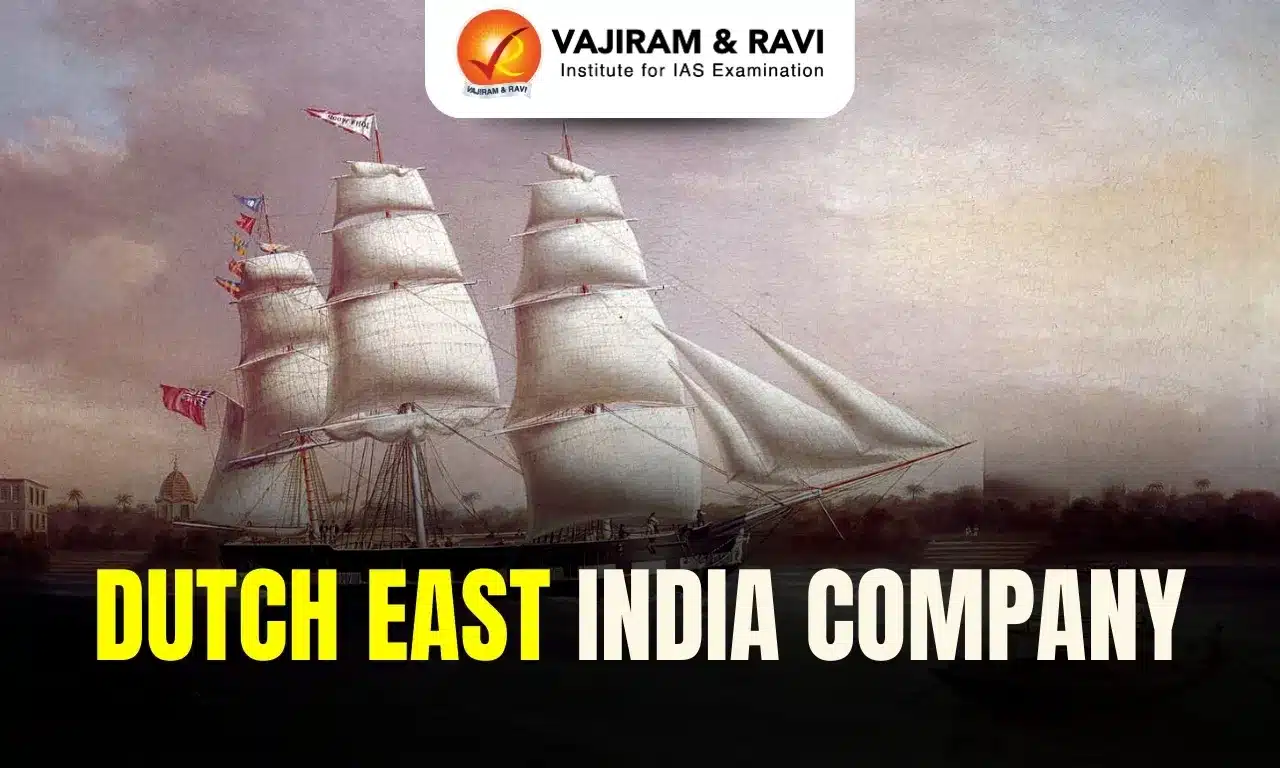
Dutch East India Company

The Dutch East India Company was one of the most powerful trading corporations in world history and a defining force of early modern globalisation. It combined private capital with state authority, creating a corporate entity that could trade, wage wars, govern territories, mint coins and administer justice. It operated across Asia, Africa and the Asia-Pacific region as a result it dominated the spice trade and pioneered institutional innovations such as joint stock ownership, permanent capital and secondary share markets.

Dutch East India Company

The Dutch East India Company was founded on 20 March 1602 through a government directed merger of competing Dutch trading firms called voorcompagnieën. It was initiated by Johan van Oldenbarnevelt and authorised by the States General of the Dutch Republic (Netherlands). It was formally named the “Vereenigde Nederlandsche Geoctroyeerde Oostindische Compagnie”, popularly known as the “VOC”. Its Global Headquarter was at Amsterdam and Batavia was its Asian administrative centre. The company was granted a 21 year Trade Monopoly over Asia. It began administration with its own Flag from 1630, which bore a distinctive ‘V-O-C’ monogram that became one of the world’s earliest corporate symbols.

Dutch East India Company Timeline

The historical evolution and origin of the Dutch East India Company can be seen through the timeline given below:

  • Formation in 1602: The States General consolidated pre-companies into one chartered entity to end internal rivalry and strengthen Dutch overseas trade.
  • Asian expansion from 1605: The VOC established its first Asian factories and trading posts, beginning systematic penetration into Indian Ocean commerce.
  • Batavia founded in 1619: Jayakarta was seized and renamed Batavia, becoming the central headquarters of Dutch operations in Asia.
  • 17th Century Peak: During the 1600s, the VOC dominated spice monopolies and paid average annual dividends of around 18%.
  • Late 18th Century Crisis: Rising corruption, administrative costs and declining trade competitiveness weakened the company.
  • Dissolution in 1799: The VOC was formally dissolved on 31 December 1799 and its assets were nationalised as the Dutch East Indies.

Read about: British East India Company

Dutch East India Company Settlement

The settlements of Dutch East India Company functioned as fortified trading, administrative and military centres across multiple continents. Along with Amsterdam and Batavia, it had established various settlements across Java, Mauritius and various regions for trade ports in Japan,Taiwan, etc.
Dutch Settlements in India were primarily commercial in nature, designed to secure textiles, spices and strategic ports rather than territorial rule. The major Indian Settlements are listed below:

  • Masulipatnam Settlement: Established in 1605, it was the first Dutch factory in India and became a key centre for textile and spice procurement on the Coromandel Coast.
  • Pulicat Headquarters: Pulicat emerged as the capital of Dutch Coromandel, coordinating regional trade, warehouses, shipping and diplomatic relations with local rulers.
  • Surat Settlement: Founded in 1616, Surat connected the VOC to western Indian textile markets and Indo-Persian trade routes.
  • Bengal Settlements: Factories at Hugli, Chinsura, Patna, Dacca and Kasimbazar supported large scale trade in silk, saltpetre, rice and indigo.
  • Malabar Coast Bases: Nagapattinam, Cochin and other ports enabled Dutch control over black pepper exports after displacing the Portuguese.

Rise of Dutch East India Company in India

The rise of Dutch East India Company in India was driven by textile demand, spice trade routes and rivalry with other European powers.

  • Entry in 1605: The first Dutch factory was established at Masulipatnam, marking the start of sustained Dutch commercial presence.
  • Textile driven expansion: Indian cotton, silk and indigo became crucial for VOC re-export trade across Southeast Asia.
  • Bengal operations from 1627: Bengal emerged as a key centre for silk, saltpetre and textile procurement.
  • Malabar dominance: The Dutch displaced Portuguese control to monopolise black pepper and spice exports.
  • Defeat of Portuguese power: Strategic victories allowed the VOC to replace Portuguese trade networks in southern India.
  • Gradual retreat: Anglo Dutch Agreements and British military victories reduced Dutch influence after the mid-eighteenth century.

Dutch East India Company Administration

The Dutch East India Company operated as a corporate-state with extensive political, military and economic authority.

  • Heeren XVII leadership: The company was governed by the Lords Seventeen, representing six Dutch chambers.
  • Quasi Sovereign powers: The VOC could wage war, sign treaties, administer justice and establish colonies.
  • Governor General system: Batavia based Governors General supervised regional officials and enforced company policies.
  • Joint Stock structure: Permanent capital and limited liability applied to both investors and managing directors.
  • Diverse workforce: At its peak, over 25,000 employees worked in Asia and 11,000 were en route.
  • Slavery practices: The Company institutionalised slavery across its colonies, relying on forced labour in agriculture, trade and logistics.

Read about: British Rule in India

Dutch East India Company Factories

Factories were commercial and logistical centres that enabled regional trade coordination.

  • Masulipatnam factory: Established in 1605, it was the VOC’s first Indian trading post.
  • Pulicat centre: Pulicat became the capital of Dutch Coromandel and a major textile hub.
  • Surat factory: Opened in 1616, Surat facilitated cotton and silk trade from western India.
  • Bengal factories: Centres at Hugli, Chinsura, Patna and Dacca supported textile and saltpetre exports.
  • Malacca factory: Captured in 1641, Malacca controlled crucial Southeast Asian maritime routes.
  • Dejima post: The Japanese factory ensured exclusive European access to Japanese trade under strict regulation.

Dutch East India Company Economy

The Dutch East India Company built a complex global economy integrating trade, agriculture, shipping and finance.

  • Capitalisation scale: Initial capital worth reached over 6.4 million guilders, dwarfing European competitors.
  • Trade volume: Nearly one million Europeans were transported on 4785 Ships between 1602 and 1796.
  • Commodity diversity: Spices, silk, porcelain, tea, coffee, sugar, rice and metals formed core trade goods.
  • Spice monopoly profits: Control of nutmeg, cloves and pepper generated extraordinary 17th century revenues.
  • Dividend policy: Average annual dividends of about 18% attracted broad public investment.
  • Slave trade role: The Dutch East India Company enslaved labour supported plantations, shipping and colonial economies across VOC territories.

Anglo Dutch Rivalry

The rivalry between the Dutch East India Company and British East India Company reshaped global trade and colonial power balances.

  • Economic competition: Both powers competed intensely for spice, textile and maritime trade dominance.
  • Amboyna incident: In 1623, Dutch officials executed English traders in Ambon, permanently damaging trust and escalating hostility between the two companies.
  • First Anglo Dutch War: Fought between 1652 and 1654 over naval supremacy and commerce.
  • Second Anglo Dutch War: The 1665 to 1667 conflict ended with the Treaty of Breda.
  • Third Anglo Dutch War: From 1672 to 1674, conflicts extended to colonial possessions worldwide.
  • Battle of Colachel: In 1741, Travancore’s victory over the Dutch weakened VOC power in India.
  • Shift of priorities: After 1667, the Dutch gradually withdrew from India to focus on their more profitable Indonesian spice trade.
  • Final confrontations: British victories, including the Battle of Hooghly in 1759, effectively ended Dutch commercial ambitions in India.

Dutch East India Company Decline

Multiple internal and external pressures led to the gradual collapse of the Dutch East India Company. The reasons behind the decline of the company has been listed below:

  • Administrative corruption: Widespread graft reduced profitability and undermined central control.
  • Smuggling losses: Illegal private trade eroded official revenues and monopolies.
  • Rising costs: Military campaigns and colonial administration became increasingly expensive.
  • Competitive pressure: British and French companies outperformed the VOC in key markets.
  • Military defeats: Losses in India and Asia reduced strategic credibility.
  • Bankruptcy: By 1799, insolvency forced state takeover and dissolution.

Dutch East India Company Criticism

The legacy of Dutch East India Company is deeply controversial due to exploitation, violence and environmental damage.

  • Monopoly abuse: Enforced trade monopolies suppressed local economies and competitors.
  • Colonial violence: Mass killings occurred in Banda Islands, Ambon, Batavia and Taiwan.
  • Slave exploitation: Enslaved populations formed the backbone of VOC colonial labour systems.
  • High mortality: Disease, shipwrecks and conflict caused extreme employee death rates.
  • Environmental harm: Forced crop destruction and deforestation disrupted ecological systems.
  • Governance failures: Bureaucratic rigidity and secrecy undermined accountability and social responsibility.

Dutch East India Company FAQs

Q1: When was the Dutch East India Company established?

Ans: It was established in 1602 by the States General of the Dutch Republic to expand Asian maritime trade.

Q2: What was the main objective of the Dutch East India Company?

Ans: Its main objective was to control Asian trade, especially spices, through monopoly rights and overseas settlements.

Q3: Which was the headquarters of the Dutch East India Company in Asia?

Ans: The Global Headquarter of the Dutch East India Company was situated in Amsterdam while Batavia (present day Jakarta) served as the administrative and political headquarters of the VOC in Asia.

Q4: What were the major battles fought between the Dutch East India Company and British East India Company?

Ans: Major conflicts include the Battle of Colachel (1741), Battle of Hooghly (1759) and engagements during Anglo Dutch Wars affecting Indian settlements.

Q5: When and why did the Dutch East India Company decline?

Ans: It declined in the late eighteenth century due to corruption, rising costs, competition and was dissolved in 1799.

UPSC Daily Quiz 22 January 2026

UPSC Daily Quiz

[WpProQuiz 74]

UPSC Daily Quiz FAQs

Q1: What is the Daily UPSC Quiz?

Ans: The Daily UPSC Quiz is a set of practice questions based on current affairs, static subjects, and PYQs that help aspirants enhance retention and test conceptual clarity regularly.

Q2: How is the Daily Quiz useful for UPSC preparation?

Ans: Daily quizzes support learning, help in revision, improve time management, and boost accuracy for both UPSC Prelims and Mains through consistent practice.

Q3: Are the quiz questions based on the UPSC syllabus?

Ans: Yes, all questions are aligned with the UPSC Syllabus 2025, covering key areas like Polity, Economy, Environment, History, Geography, and Current Affairs.

Q4: Are solutions and explanations provided with the quiz?

Ans: Yes, each quiz includes detailed explanations and source references to enhance conceptual understanding and enable self-assessment.

Q5: Is the Daily UPSC Quiz suitable for both Prelims and Mains?

Ans: Primarily focused on Prelims (MCQ format), but it also indirectly helps in Mains by strengthening subject knowledge and factual clarity.

Subhadra Yojana, Objectives, Features, Women Empowerment

Subhadra Yojana

The Subhadra Yojana is a welfare initiative launched by the State Government of Odisha to provide direct financial support to women from economically weaker sections. The scheme is designed to empower women financially through regular cash transfers, promote digital literacy, and ensure economic independence.

The scheme is named after Goddess Subhadra, the sister of Lord Jagannath, the scheme carries cultural significance and resonates emotionally with the people of Odisha, reflecting the state’s rich heritage and devotion.

Subhadra Yojana Objectives

The key objectives of the Subhadra Yojana are:

  • Financial Empowerment: To provide women with direct cash support, enabling them to manage household and personal finances independently.
  • Economic Inclusion: To ensure that women from economically weaker sections gain access to government benefits without intermediaries.
    Promotion of Digital Literacy: To encourage the use of digital banking and transactions through incentives.
  • Cultural Relevance: To align the scheme with Odisha’s traditions and heritage by naming it after Goddess Subhadra.
  • Wider Coverage: To benefit over one crore women across the state by 2028-29.

Subhadra Yojana Features

The Subhadra Yojana comes with several benefits and features that make it highly effective:

  • Annual Financial Assistance: Women receive Rs 10,000 annually in two equal installments of Rs 5,000 each. Payments are made on:
    • Rakhi Purnima (August)
    • International Women’s Day (March 8)
  • Direct Benefit Transfer (DBT): Cash is transferred directly to Aadhaar-linked bank accounts, ensuring transparency and eliminating intermediaries.
  • e-KYC Requirement: All beneficiaries undergo e-KYC to maintain accountability and reduce leakages.
  • Subhadra Debit Card: Women are issued a debit card to withdraw cash and make digital transactions conveniently.
  • Digital Transaction Incentive: Rs 500 is awarded to the top 100 beneficiaries in each gram panchayat or urban local body for maximum digital transactions.
  • Implementation Period: The scheme runs over five years (2024-25 to 2028-29) to cover a wide base of beneficiaries.

Subhadra Yojana Eligibility Criteria

To participate in Subhadra Yojana, applicants must meet the following eligibility requirements:

  • Gender: Only women are eligible.
  • Age: Women between 21 and 60 years.
  • Income: Targeted at economically weaker sections; government employees, income tax payees, and those receiving Rs 1,500 or more per month from other government schemes are excluded.
  • Residency: Must be a resident of Odisha.
  • Documentation: Aadhaar-based e-KYC and bank account details are required for enrollment.

Subhadra Yojana and Women Empowerment

Subhadra Yojana plays a crucial role in women empowerment by providing financial independence, promoting digital literacy, and encouraging economic participation. Key impacts include:

  • Economic Independence: Regular cash transfers allow women to manage personal and household finances confidently.
  • Digital Literacy: Incentives for digital transactions encourage women to adopt modern banking and financial practices.
  • Social Security: Direct cash support reduces dependency on family members and enhances women’s decision-making power.
  • Entrepreneurial Opportunities: Financial assistance can help women invest in small businesses or self-employment ventures.
  • Community Development: Empowered women contribute to the socio-economic progress of their families and communities.

Other Women's Empowerment Initiatives

The Union Government has launched several schemes to complement state-level initiatives like Subhadra Yojana:

  • Beti Bachao Beti Padhao (BBBP): Promotes girl child education and addresses declining child sex ratio.
  • Pradhan Mantri Matru Vandana Yojana (PMMVY): Provides Rs 5,000 financial assistance in three installments for first live birth to improve maternal health.
  • National Nutrition Mission (POSHAN Abhiyaan): Enhances nutrition for pregnant women, lactating mothers, and children under six.
  • Ujjwala Yojana (PMUY): Provides LPG connections to women from BPL households for better health and reduced firewood dependency.
  • Sukanya Samriddhi Yojana (SSY): Encourages savings for girl children’s education and marriage.
  • One Stop Centre Scheme (OSC): Offers medical, legal, psychological support, and temporary shelter for women facing violence.
  • Swadhar Greh Scheme: Provides shelter and rehabilitation for widows, domestic violence victims, and trafficking survivors.
  • Nirbhaya Fund: Ensures women’s safety in public spaces, transportation, and sets up fast-track courts.
  • Support the Training and Employment Program for Women (STEP): Provides skill training for self-employment and financial independence.
  • Pradhan Mantri Mahila Shakti Kendra: Promotes grassroots-level women empowerment, digital literacy, and access to government schemes.

Subhadra Yojana aligns perfectly with these initiatives, creating a comprehensive ecosystem for women’s socio-economic development.

About Goddess Subhadra and Lord Jagannath

Family and Divine Connection

  • Goddess Subhadra is the sister of Lord Jagannath and Lord Balabhadra.
  • The trio forms the triumvirate of deities worshipped in the famous Jagannath Temple of Puri, Odisha.
  • Subhadra is revered as a symbol of compassion, protection, and auspiciousness.

Cultural Significance in Odisha

  • Subhadra is worshipped alongside her brothers during major festivals like Rath Yatra, Jagannath Rathyatra, and other temple rituals.
  • Her presence symbolizes family unity, harmony, and divine protection for devotees.
  • She is considered the guardian of her siblings and devotees, offering blessings for well-being and prosperity.

Iconography and Representation

  • In temples, Subhadra is usually depicted seated between Jagannath (brother) and Balabhadra (brother).
  • She is represented with yellow attire, symbolizing auspiciousness and positivity.
  • Unlike her brothers, Subhadra’s idol is simpler and less ornate, emphasizing spiritual purity over material embellishment.

Rath Yatra and Public Worship

  • During the annual Rath Yatra (Chariot Festival) in Puri, Subhadra’s chariot is pulled between Jagannath’s and Balabhadra’s chariots, highlighting her integral role.
  • Devotees believe that offering prayers to Subhadra brings family harmony, protection, and blessings for married life.

Mythological References

  • Subhadra appears in the Mahabharata as the sister of Lord Krishna (considered Jagannath’s earthly form).
  • She was married to Arjuna, one of the Pandavas, linking her to both spiritual and royal narratives in Indian mythology.
  • She symbolizes the perfect blend of divinity, strength, and feminine grace.

Role in Festivals and Traditions

  • Apart from Rath Yatra, Subhadra is worshipped during Jagannath Puja, Snana Yatra, and other regional celebrations.
  • Special offerings, prayers, and rituals are performed in her honor, highlighting her importance in Odia culture.

Symbolism and Devotional Beliefs

  • Goddess Subhadra represents protection, auspiciousness, and familial unity.
  • Devotees believe that worshipping Subhadra ensures peace, prosperity, and protection from negative forces.

Subhadra Yojana FAQs

Q1: What is Subhadra Yojana?

Ans: A welfare scheme by the Odisha government providing direct financial support to women from economically weaker sections.

Q2: Who can apply for Subhadra Yojana?

Ans: Women aged 21-60 years, excluding government employees, income tax payees, and those receiving Rs 1,500+ from other schemes.

Q3: How much financial assistance is provided?

Ans: Rs 10,000 annually, disbursed in two installments of Rs 5,000 each via Direct Benefit Transfer.

Q4:  When are the payments made?

Ans: On Rakhi Purnima (August) and International Women’s Day (March 8).

Q5: What is the Subhadra Debit Card?

Ans: A debit card issued to beneficiaries for cash withdrawal and digital transactions.

Francisco De Almeida, Blue Water Policy, Battle of Diu

Francisco De Almeida

Francisco de Almeida was one of the most influential Portuguese commanders in Indian Ocean history. He played a crucial role in laying the foundation of Portuguese colonial dominance in India during the early 16th century. Known for introducing the famous Blue Water Policy, Almeida transformed Portugal into a powerful maritime empire.

Francisco De Almeida

Francisco de Almeida was appointed as the first Viceroy and Governor of Portuguese India in 1505 by King Manuel I of Portugal. His appointment marked the beginning of organized Portuguese political and military administration in India.

  • He arrived in India in October 1505 and made Cochin his main base of operations, as it was a friendly port and strategically important for controlling the spice trade.
  • His primary aim was not territorial conquest but establishing Portuguese supremacy over the seas, believing that control of maritime routes would ensure dominance over Asian trade.
  • Soon after his arrival, he learned that Portuguese traders at Quilon had been killed, which led him to send his son Lourenço de Almeida to punish the offenders and assert Portuguese naval power.
  • Almeida strengthened Portuguese defenses by improving Fort Manuel at Cochin and constructing forts at Anjediva and Cannanore, thereby securing Portuguese trading interests on the western coast of India.
  • He became the first European to reach Bombay by sea in 1509, which further expanded Portuguese naval influence along the western coast.
  • His growing power alarmed regional and foreign powers such as the Mamluk Sultan of Egypt, the Sultan of Gujarat, and the Zamorin of Calicut, as well as European traders like Venice who feared loss of trade.
  • In 1507, a combined fleet of the Mamluks and Gujarat defeated the Portuguese near Chaul, in which Almeida’s son Lourenço was killed, deeply affecting him.
  • Determined to avenge this defeat, Almeida personally led the Portuguese fleet in the Battle of Diu in 1509, where he defeated a powerful coalition of Egyptian, Gujarati, and Calicut forces.
  • The victory at Diu established Portuguese naval supremacy in the Indian Ocean and marked the beginning of European dominance in Asian maritime trade.

Blue Water Policy (Cartaz System)

The Blue Water Policy, also known as the Cartaz System, was the most important contribution of Francisco de Almeida to colonial history. This policy aimed at making Portugal the undisputed master of the Indian Ocean by controlling maritime routes instead of conquering large land areas.

  • This policy focused on strengthening the Portuguese navy and making it the most powerful maritime force in the Indian Ocean, enabling Portugal to dominate long-distance trade routes connecting Europe with Asia.
  • A major feature of the policy was the introduction of the Cartaz system, under which every merchant ship sailing in the Indian Ocean had to carry a Portuguese-issued permit, failing which the ship could be seized or destroyed.
  • Through this policy, the Portuguese aimed to eliminate the influence of Arab and Muslim traders who had long controlled maritime trade, particularly those of the Mamluk Sultanate, the Sultan of Gujarat, and the Zamorin of Calicut.
  • The policy emphasized controlling strategic coastal points and sea lanes rather than conquering inland territories, which allowed the Portuguese to regulate trade without maintaining a large land army.
  • The success of the Blue Water Policy was clearly demonstrated in the Battle of Diu in 1509, where the Portuguese defeated a powerful coalition of Egyptian, Gujarati, and Calicut forces, securing naval dominance for nearly a century.
  • Although the policy brought immense commercial and military success, it was later modified by Afonso de Albuquerque, who shifted focus towards territorial expansion, yet the Blue Water Policy remained the foundation of Portuguese maritime power in Asia.

Battle of Diu (1509)

  • The Battle of Diu was fought in 1509 between the Portuguese fleet led by Francisco de Almeida and a combined naval force of the Mamluk Sultanate of Egypt, Sultan of Gujarat, and the Zamorin of Calicut, supported by Venice.
  • The battle was fought to establish control over the Indian Ocean trade routes, as the Portuguese aimed to break the dominance of Arab and Muslim traders.
  • The Portuguese won a decisive victory due to their superior naval technology, heavy artillery, and better warships, completely destroying the enemy fleet.
  • The victory established Portuguese naval supremacy in the Indian Ocean for nearly a century and marked the beginning of European dominance over Asian maritime trade.

Conclusion

Francisco de Almeida was a visionary naval commander whose Blue Water Policy transformed Portugal into a global maritime power. His victory at the Battle of Diu and emphasis on sea dominance ensured Portuguese control over the Indian Ocean trade for decades. Though later overshadowed by Albuquerque’s territorial conquests, Almeida’s contribution remains a cornerstone in the history of European colonialism in India.

Francisco De Almeida FAQs

Q1: Who was Francisco de Almeida?

Ans: Francisco de Almeida was the first Portuguese Viceroy of India, appointed in 1505 by the King of Portugal.

Q2: When did Francisco de Almeida come to India?

Ans: He arrived in India in October 1505 and made Cochin his headquarters.

Q3: What was the main objective of Francisco de Almeida?

Ans: His main objective was to establish Portuguese control over sea routes and destroy Muslim dominance in Indian Ocean trade.

Q4: What is the Blue Water Policy?

Ans: The Blue Water Policy was Almeida’s naval strategy that focused on controlling seas instead of territories. It aimed to make Portugal the dominant maritime power.

Q5: What was the Cartaz System?

Ans: The Cartaz System required all ships in the Indian Ocean to carry a Portuguese-issued trade permit. Ships without it were captured or destroyed.

Orientalist-Anglicist Controversy, Lord Macaulay’s Minute, Significance

Orientalist-Anglicist Controversy

The British East India Company’s arrival in India marked a profound shift not only in politics but also in society and culture. In the first half of the 19th century, the Company officials initially followed a policy of neutrality in religion and culture, refraining from interfering in the spiritual or intellectual life of the Indian population.

However, as British influence expanded, constant pressures from various quarters, Missionaries, Liberals, Orientalists, and Utilitarians, pushed the Company to reconsider its stance.

The debate intensified over whether the Company should promote Western or Oriental education, giving rise to the historic Orientalist-Anglicist controversy, which shaped the trajectory of modern Indian education.

Orientalist-Anglicist Controversy

The Orientalist-Anglicist Controversy was a major debate in early 19th century India about the kind of education the British should promote. Orientalists supported teaching Indian classical languages and traditions like Sanskrit, Arabic, and Persian. Anglicists, on the other hand, favored Western education through English to spread modern science and ideas. This debate shaped the foundation of India’s modern education system.

The Orientalist Approach to Education

The Orientalists believed in preserving and promoting India’s classical learning traditions. Scholars like Dr. H.H. Wilson and H.T. Princep argued for Sanskrit, Arabic, and Persian as the mediums of instruction. Initially, the East India Company also supported this approach.

Some key initiatives under Orientalist guidance included:

  • Calcutta Madrasa (1781): It was established by Warren Hastings to provide education in Islamic law and culture.
  • Benaras Sanskrit College (1791): It was founded by Jonathan Duncan to promote Sanskrit learning and classical Indian knowledge.
  • Asiatic Society of Bengal (1784): It was set up by William Jones, this institution aimed at research in Indian languages, literature, and culture.

The motivations behind the Orientalist approach were largely practical and political:

  • Administrative efficiency: Teaching British officials local languages and culture improved governance.
  • Building alliances: Understanding Indian elites and their traditions helped maintain stability.
  • Cultural preservation: Promoting classical education ensured the survival of India’s rich intellectual heritage.

The Port William College (1800) in Calcutta exemplifies this approach, training civil servants in local languages to better administer the colonies.

The Anglicist Perspective

Contrasting the Orientalists, the Anglicists argued for Western education through English. Prominent advocates included Charles Trevelyan, Mountstuart Elphinstone, and progressive Indian reformers like Raja Ram Mohan Roy.

Beliefs of the Anglicists included:

  • Western education was essential to access modern scientific, political, and social knowledge.
  • English as the medium would help diffuse Western ideas more effectively.
  • Indian classical learning alone could not equip Indians to understand or implement modern democratic and scientific concepts.

The Anglicists sought to utilize the entire educational grant to promote Western education, creating a class of Indians who could bridge the gap between the British rulers and the Indian population.
Lord Macaulay’s Minute of 1835

The Orientalist-Anglicist Controversy culminated in Lord Macaulay’s Minute of 1835 on Indian Education. Lord Macaulay, the Law Member of the Supreme Council of Calcutta, argued decisively in favor of Western education through English.

  • Indian learning was considered inferior to European learning, especially in the physical and social sciences.
  • Limited resources should focus on educating a small section of the upper and middle classes.
  • The aim was to create a class “Indian in blood and color but English in taste, opinions, morals, and intellect.”
  • Mass education was neglected, as the focus was on producing interpreters who could connect the British administration with the Indian masses.

Macaulay’s system, based on the “infiltration theory,” intended to gradually spread modern ideas and Western sciences through educated intermediaries.

Wood’s Despatch of 1854

Following Macaulay, Sir Charles Wood, President of the Board of Control, issued the Wood’s Despatch of 1854, a comprehensive plan to reorganize education in India. It is regarded as the Magna Carta of English education in India.

Recommendations included are:

  • Establishment of Anglo-Vernacular Schools throughout the districts.
  • Creation of Government Colleges in important towns.
  • Formation of a University in each of the three Presidencies (Calcutta, Bombay, Madras).
  • Encouragement of Western sciences and literature, while also nurturing vernacular education.

Significance of the Orientalist-Anglicist Controversy

The Orientalist-Anglicist Controversy was more than a debate over curriculum; it reflected deeper questions about culture, identity, and colonial power.

  • It determined the medium of instruction, which shaped India’s intellectual future.
  • The controversy influenced the emergence of a Western-educated Indian elite, pivotal in social reform and the freedom movement.
  • It created a dual system of education that combined Western scientific knowledge with vernacular learning, impacting generations of Indians.

Orientalist-Anglicist Controversy FAQs

Q1: Who were the main leaders of the Orientalist school?

Ans: Dr. H.H. Wilson and H.T. Princep, advocating Sanskrit, Arabic, and Persian as mediums of education.

Q2: Who led the Anglicist movement?

Ans: Charles Trevelyan, Elphinstone, and Raja Ram Mohan Roy promoted Western education through English.

Q3: What was Macaulay’s Minute of 1835?

Ans: A policy document favoring English education, emphasizing Western sciences and literature over Indian classical learning.

Q4: What is Wood’s Despatch of 1854?

Ans: A landmark educational reform recommending Anglo-Vernacular schools, universities, and government colleges in India.

Q5: What was the goal of British education policy after Macaulay?

Ans: To create a class “Indian in blood and color but English in tastes and intellect,” serving as intermediaries between the rulers and the masses.

Kartavya Path, Historical Evolution, Symbolism of ‘Kartavya’ (Duty)

Kartavya Path

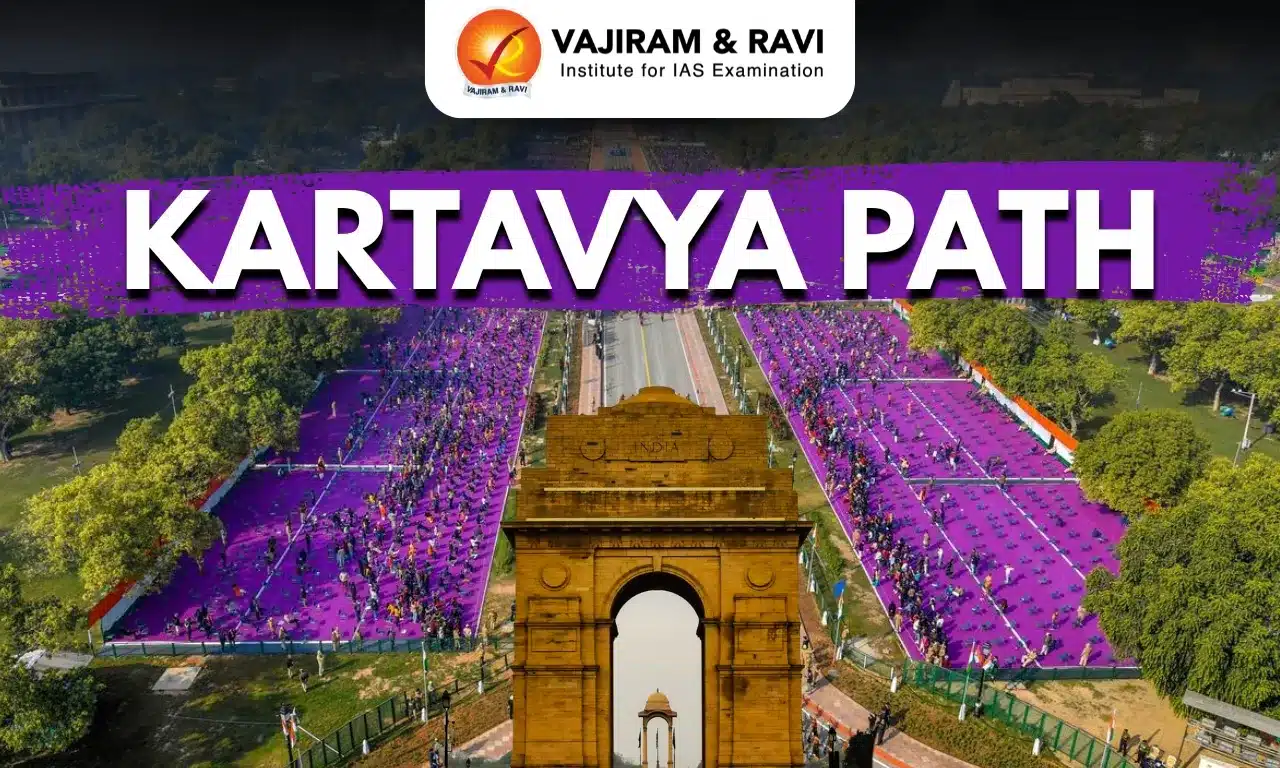
Kartavya Path is one of the most important national landmarks of India. It represents India’s journey from colonial rule to a confident and responsible democracy. Earlier known as Rajpath, it was renamed Kartavya Path in September 2022 to highlight the importance of duty in nation-building. It is located in the heart of New Delhi, Kartavya Path connects Rashtrapati Bhavan to India Gate and serves as the main ceremonial boulevard of the country.

Historical Evolution From Rajpath to Kartavya Path

Rajpath was originally built during British rule as a symbol of imperial power and authority, connecting the Viceroy’s House with India Gate. After independence, it became the venue for national celebrations like the Republic Day parade, reflecting India’s sovereignty but still carrying colonial symbolism

Colonial Period

  • Rajpath was designed during British rule by architects Edwin Lutyens and Herbert Baker.
  • It was originally called King’s Way, symbolizing British power and authority.
  • The road was meant to showcase the grandeur of the British Empire.
  • The capital of the Raj moved to New Delhi from Calcutta in 1911, and construction continued for several years thereafter.
  • It connected the Viceroy’s House (now Rashtrapati Bhavan) to India Gate.

Post-Independence Period

  • After independence in 1947, King’s Way was renamed Rajpath.
  • Rajpath became the venue for:
    • Republic Day Parade
    • Beating Retreat Ceremony
    • National celebrations
  • Though India became independent, the colonial symbolism of power remained.

Transformation into Kartavya Path (2022)

  • In 2022, Rajpath was renamed Kartavya Path, meaning “Path of Duty”.
  • The renaming was part of the Central Vista Redevelopment Project.
  • It marked a shift from colonial thinking to democratic responsibility.
  • The focus changed from rulers to citizens and their duties.

Symbolism of ‘Kartavya’ (Duty) in Indian Governance

The idea of ‘Kartavya’ highlights the importance of duty, responsibility, and moral conduct in Indian governance. It reflects the belief that rights can be meaningful only when citizens and institutions perform their duties sincerely.

  • The concept of Kartavya is deeply rooted in Indian philosophy and ancient texts like the Bhagavad Gita.
  • It emphasizes performing one’s duty selflessly for the welfare of society.
  • Reflected in Article 51A of the Indian Constitution, which lists Fundamental Duties of citizens.
  • Encourages citizens to respect the Constitution, national symbols, and unity of the country.
  • Highlights that governance is a shared responsibility of both the state and citizens.
  • Promotes ethical leadership, accountability, and transparency in administration.
  • Reinforces the idea that rights must be balanced with responsibilities.
  • The naming of Kartavya Path symbolizes a shift from authority-based rule to duty-based democracy.

Kartavya Path and Central Vista Redevelopment Project

Kartavya Path is a key component of the Central Vista Redevelopment Project, which aims to modernize India’s administrative and ceremonial infrastructure while preserving its historical importance.

  • The Central Vista Redevelopment Project was launched to redevelop the central administrative area of New Delhi, including Parliament, government buildings, and public spaces.
  • Kartavya Path forms the central axis of this project, stretching from Rashtrapati Bhavan to India Gate.
  • The redevelopment aimed to replace colonial-era infrastructure with modern, functional, and sustainable facilities.
  • The project focuses on improving public accessibility, safety, and aesthetics of the area.
  • Wide pedestrian pathways, green lawns, seating areas, and water features have been added to make it citizen-friendly.
  • Underground utilities were developed to reduce visual clutter and improve maintenance.
  • Eco-friendly measures such as energy-efficient lighting and better drainage systems were included.
  • The redevelopment supports smooth conduct of national events like the Republic Day Parade.

Kartavya Path FAQs

Q1: What is Kartavya Path?

Ans: Kartavya Path is the ceremonial boulevard in New Delhi that stretches from Rashtrapati Bhavan to India Gate. It was earlier known as Rajpath and was renamed in 2022 to reflect the idea of duty-based governance.

Q2: When was Rajpath renamed as Kartavya Path?

Ans: Rajpath was officially renamed as Kartavya Path on 8 September 2022.

Q3: Why was Rajpath renamed Kartavya Path?

Ans: The renaming was done to remove colonial symbolism and promote the idea of duty (Kartavya) over authority.

Q4: What does the word ‘Kartavya’ mean?

Ans: ‘Kartavya’ means duty or responsibility. It signifies moral obligation, ethical conduct, and service to the nation.

Q5: Who designed the original Rajpath?

Ans: Rajpath was designed by British architects Edwin Lutyens and Herbert Baker during the British colonial period.

Borax

Borax

Borax Latest News

In a tragic incident from Tamil Nadu, a 19-year-old college girl recently died after consuming borax for weight loss.

About Borax

  • Borax, also known as sodium tetraborate decahydrate, is a powdery white mineral.
  • It’s a combination of boron, sodium, and oxygen. 
  • Chemical Formula: Na2B4O7·10H2O 
  • It is used in many ways—as a component of glass and pottery glazes in the ceramics industry, as a solvent for metal-oxide slags in metallurgy, as a flux in welding and soldering, and as a fertilizer additive, a soap supplement, a disinfectant, a mouthwash, and a water softener.
  • Borax occurs naturally in evaporite deposits produced by the repeated evaporation of seasonal lakes. 
  • Borax can also be produced synthetically from other boron compounds. 
  • Naturally occurring borax is refined by the process of recrystallization.

Source: NDTV

Borax FAQs

Q1: What is Borax?

Ans: Borax, also known as sodium tetraborate decahydrate, is a powdery white mineral.

Q2: Which elements combine to form Borax?

Ans: Boron, sodium, and oxygen.

Q3: What is the chemical formula of Borax?

Ans: Na₂B₄O₇·10H₂O.

Q4: How is Borax used in agriculture?

Ans: As a fertilizer additive.

Q5: In what type of geological deposits does Borax occur naturally?

Ans: Borax occurs naturally in evaporite deposits produced by the repeated evaporation of seasonal lakes.

Solar Storm, Meaning, Impact, Latest News

Solar Storm

Solar Storm Latest News

The biggest Solar Radiation Storm hit Earth's magnetic field in past 23 years, producing spectacular auroras visible across the United States and larger parts of Europe.

About Solar Storm

  • A solar storm is a sudden explosion of particles, energy, magnetic fields, and material blasted into the solar system by the Sun.
  • What Causes a Solar Storm?
    • The Sun creates a tangled mess of magnetic fields.
    • These magnetic fields get twisted up as the Sun rotates, with its equator rotating faster than its poles. 
    • Solar storms typically begin when these twisted magnetic fields on the Sun get contorted and stretched so much that they snap and reconnect (in a process called magnetic reconnection), releasing large amounts of energy. 
  • These powerful eruptions can generate any or all of the following:
    • a bright flash of light called a solar flare.
    • a solar radiation storm, or flurry of solar particles propelled into space at high speeds.
    • an enormous cloud of solar material, called a coronal mass ejection, that billows away from the Sun.
  • How Does a Solar Storm Affect Us?
    • When directed toward Earth, a solar storm can create a major disturbance in Earth’s magnetic field, called a geomagnetic storm, that can produce effects such as radio blackouts, power outages, and beautiful auroras
    • They do not cause direct harm to anyone on Earth, however, as our planet’s magnetic field and atmosphere protect us from the worst of these storms.

What are Solar Flares?

  • A solar flare is an intense burst of radiation, or light, on the Sun. 
  • These flashes span the electromagnetic spectrum — including X-rays, gamma rays, radio waves, and ultraviolet and visible light.
  • Solar flares are the most powerful explosions in the solar system — the biggest ones can have as much energy as a billion hydrogen bombs.

What are Radiation Storms?

  • Solar eruptions can accelerate charged particles — electrons and protons — into space at incredibly high speeds, initiating a radiation storm.
  • The fastest particles travel so quickly they can zip across roughly 93 million miles from the Sun to Earth in about 30 minutes or less. 

What are Coronal Mass Ejections (CMEs)?

  • A CME is an enormous cloud of electrically charged gas, called plasma, that erupts from the Sun. 
  • A single CME can blast billions of tons of material into the solar system all at once.
  • CMEs occur in the outer atmosphere of the Sun, called the corona, and often look like giant bubbles bursting from the Sun.

Key Facts about Aditya-L1

  • It is the first space-based observatory-class Indian solar mission to study the Sun. 
  • It was launched on September 2, 2023, by the Indian Space Research Organisation (ISRO).
  • The spacecraft is placed in a halo orbit around the Lagrangian point 1 (L1) of the Sun-Earth system, which is about 1.5 million km from the Earth. 
  • A satellite placed in the halo orbit around the L1 point has the major advantage of continuously viewing the Sun without any occultation/eclipse. 
  • This provides a greater advantage of observing the solar activities continuously.
  • The spacecraft is carrying seven payloads to observe the photosphere, chromosphere, and outermost layers of the Sun using electromagnetic and particle detectors.

Source: NDTV

Solar Storm FAQs

Q1: What is a solar storm?

Ans: A sudden explosion of particles, energy, and magnetic fields from the Sun.

Q2: What causes a solar storm?

Ans: The snapping and reconnection of twisted magnetic fields on the Sun.

Q3: What is a solar flare?

Ans: A bright flash of light caused by a sudden release of energy on the Sun.

Q4: What is a coronal mass ejection (CME)?

Ans: A massive cloud of solar material blasted into space from the Sun.

Q5: Can solar storms directly harm people on Earth?

Ans: No, Earth’s magnetic field and atmosphere protect us from direct harm.

ICE Cloud

ICE Cloud

ICE Cloud Latest News

Recently, the Centre for Development of Advanced Computing (CDAC) revealed that it has significantly expanded capabilities of the Integrated Cloud Environment (ICE) platform.

About ICE Cloud

  • It is an indigenous, comprehensive digital platform for conducting complex scientific research using Artificial Intelligence (AI) and High-Performance Computing (HPC).
  • It provides ease of access to computational resources.
  • It is built indigenously to provide cloud services for research and development that is reproducible.
  • It now offers an open-access platform equipped with supercomputers and tools for software development, AI, quantum technologies, simulation studies and more.
  • The platform is available to students, scientists, researchers, start-ups and others.
  • ICE offers an array of services — storage, bioinformatics tools, virtual hosting, pipeline execution, AI visualisation, development environments on the cloud and seamless collaboration features.
  • Use Cases of ICE Cloud: Research Institutes, Researchers, Developers and Industry
  • It was funded by the Department of Biotechnology (DBT) to support scientific research.

Source: TH

ICE Cloud FAQs

Q1: Who developed the ICE cloud?

Ans: C-DAC

Q2: What does ICE stand for in C-DAC's ICE cloud?

Ans: Integrated Cloud Environment

Muna Island

Muna Island

Muna Island Latest News

The painted outline of a human hand inside a cave on the Indonesian island of Muna represents what researchers are calling the oldest example of rock art in the world, created at least 67,800 years ago.

About Muna Island

  • It is situated in the Southeast Sulawesi province of Indonesia.
  • With an area of 1,704 sq.km., it has a hilly surface, rising to 1,460 feet (445 metres). The north and northeast have teak forests.
  • It is known for its diverse culture and natural beauty, including lush forests and pristine beaches. 
  • The island is home to the Muna people, who have a rich cultural heritage and are known for their traditional crafts and dances. 
  • The economy of Muna Island is primarily based on agriculture, fishing, and local crafts. 
  • The main town and principal port is Raha, on the northeastern coast across the Strait of Buton from the neighbouring island of Buton to the east.
  • One of the most famous natural attractions on Muna Island is the Liangkobori Cave, which contains prehistoric paintings. 
  • Additionally, there is Napabale Lake, which has a natural tunnel connecting it directly to the sea.

Source: REUT

Muna Island FAQs

Q1: Where is Muna Island located?

Ans: It is located in the Southeast Sulawesi province of Indonesia.

Q2: What type of terrain characterises Muna Island?

Ans: It has a hilly surface.

Q3: What is the main town and principal port of Muna Island?

Ans: Raha

Q4: Which island lies to the east of Muna Island?

Ans: Buton Island.

Q5: Which cave on Muna Island is famous for prehistoric paintings?

Ans: Liangkobori Cave.

Kaladi

Kaladi

Kaladi Latest News

Recently, the union Minister of State for Science & Technology directed that "Kaladi" traditional dairy products be upscaled for wider food applications and recipes.

About Kaladi

  • Kaladi is a famous Dogra cuisine.
  • It is a traditional dairy product of Udhampur district, Jammu & Kashmir.
  • It has received the Geographical Indication tag (GI).

Preparation of Kaladi

  • It is traditionally prepared from raw full-fat milk using whey water as a coagulant.
  • The raw full fat milk, vigorously churned in an iron pot with a wooden plunger-like tool.
  • The molten mass of milk solids was then separated by adding sour milk or curd called mathar.
  • Once stretched, the flattened cheese was cooled on the black iron pot itself, before being placed in a bowl to solidify.
  • The solidified cheese was then sun dried to help it to lose the moisture.
  • Since the ambient temperature in the mountainous area of Udhampur remains low despite a strong sun, the Kalari dried from the outside yet remain moist inside

Key Facts about Geographical Indication Tag

  • It is a sign used on products that have a specific geographical origin and possess qualities or a reputation that are due to that origin.
  • This is typically used for agricultural products, foodstuffs, wine and spirit drinks, handicrafts and industrial products.
  • The Geographical Indications of Goods (Registration and Protection) Act, 1999 seeks to provide for the registration and better protection of geographical indications relating to goods in India.

This GI tag is valid for 10 years following which it can be renewed.

Kaladi FAQs

Q1: What is kaladi made of?

Ans: It is made using raw, full-fat milk that is churned vigorously in an iron pot.

Q2: Which organization administers GI tags in India?

Ans: eographical Indications Registry, India

The Maratha Advance into Doab and Punjab, Phases, Rulers

The Maratha Advance into Doab and Punjab

The Maratha Advance into Doab and Punjab between 1741 and 1761 marked a decisive phase in 18th century North Indian politics. It reflected the transformation of the Marathas from a Deccan power into an all India force seeking revenue rights, military influence and political control. This expansion unfolded amid the weakening Mughal authority, regional conflicts and repeated Afghan invasions. The Doab and Punjab became strategic targets due to their agricultural wealth, political centrality and role as gateways to Delhi and Lahore.

The Maratha Advance into Doab and Punjab Phases

The Maratha advance into the Doab and Punjab was divided into two clearly defined phases from 1741 to 1761. These phases were closely linked to the decline of Mughal authority, the ambitions of Maratha leaders and the rise of Ahmad Shah Abdali as a decisive force in Punjab politics.

  1. First Phase of the Maratha Advance into Doab and Punjab: The first phase focused on securing Chauth from frontier regions and preparing strategic access to North India. 
  2. Second Phase of the Maratha Advance into Doab and Punjab: The second phase involved direct intervention in Mughal politics, military campaigns in the Doab and confrontation with Afghan power. 

First Phase of the Maratha Advance into Doab and Punjab

The First Phase focused on frontier revenues, strategic positioning and indirect control, creating conditions for deeper northern expansion without direct administrative takeover.

  • Background: After Baji Rao’s death in 1740, Maratha leadership shifted towards consolidating gains through revenue extraction, especially Chauth, rather than immediate territorial annexation in North India.
  • Chauth: Between 1741 and 1752, Maratha policy emphasized securing Chauth from frontier regions to finance armies and extend influence without heavy administrative responsibility.
  • Raghuji Bhonsle’s Bengal Campaigns: In 1741-42, Raghuji Bhonsle raided Bengal, Bihar and Orissa, targeting rich provinces to extract Chauth and demonstrate Maratha military reach.
  • Conflict with Alivardi Khan: Nawab Alivardi Khan strongly resisted Maratha incursions, leading to a decade of conflict that strained Bengal’s finances and military stability.
  • Agreement of 1751: In 1751, Alivardi Khan agreed to pay Chauth fixed at Rs.12,00,000 annually and ceded southern Orissa to Raghuji Bhonsle.
  • Maratha Control over Orissa: Raghuji Bhonsle gained the authority to appoint the provincial governor, effectively placing Orissa under Maratha dominance without formal annexation.
  • Deccan Power Struggles: Simultaneously, Marathas fought Nizam-ul-Mulk and his successor Nasir Jang over Karnataka and Khandesh, reflecting multi-front Maratha expansion.
  • Impact of Bengal Engagements: Raghuji’s prolonged involvement in eastern India allowed the Nizam temporary dominance in Karnataka, delaying Maratha consolidation there.
  • Treaty of Bhalke 1751: After conflict with French backed Bussy, the Marathas secured Khandesh revenues, western Berar and Baglana through the Treaty of Bhalke.
  • Entry into Rajasthan: Rajasthan became a critical zone where Marathas intervened in succession disputes to enforce Chauth and Khandani from Rajput states.
  • Role of Holkar and Sindhia: Peshwa’s lieutenants Malhar Rao Holkar and Ranoji Sindhia coerced Jaipur, Jodhpur and other states into regular payments.
  • Decline of Mughal Arbitration: Earlier, Mughal emperors mediated Rajput succession, but Maratha intervention reflected the collapse of imperial authority.
  • Strategic Importance of Rajasthan: Rajasthan served as a tactical corridor towards Agra, Delhi and Punjab, making it central to Maratha northern ambitions.
  • Economic Strain on Rajputs: Many Rajput states depended on jagirs outside Rajasthan, making repeated Maratha demands economically destabilizing.
  • Growing Rajput Resentment: Continuous Maratha exactions created deep hostility, undermining any possibility of durable alliance with Rajput rulers.
  • Jaipur Incident of 1751: In Jaipur, citizens and followers of Madho Singh killed nearly 5,000 Marathas, reflecting intense popular anger.
  • Spread of Violence: After Jaipur, Maratha couriers were attacked in rural areas, disrupting communication and revenue collection networks.
  • Earlier Anti-Maratha Incidents: Vijai Singh of Marwar earlier murdered Jayappa Sindhia, indicating repeated violent backlash against Maratha dominance.
  • Limits of Maratha Policy: Narrow revenue focused tactics alienated potential allies, weakening long term political control in North India.
  • Outcome of First Phase: By 1752, Marathas secured access routes and revenue rights, setting the stage for direct involvement in Doab and Punjab politics.

Second Phase of the Maratha Advance into Doab and Punjab

This phase marked direct political intervention, military campaigns in the Doab and confrontation with Afghan power under Ahmad Shah Abdali.

  • Rise of Ahmad Shah Abdali: Abdali’s invasion of India in 1748 and capture of Lahore created a new geopolitical challenge in North India.
  • Imperial Appeal to Marathas: The Mughal emperor sought Maratha assistance under Balaji Baji Rao against Abdali, recognizing them as the strongest military power available.
  • Dispatch of Sindhia and Holkar: The Peshwa sent Sindhia and Holkar north, reflecting continuity with Baji Rao’s united front policy against foreign invaders.
  • Change in Maratha Strategy: The Afghan threat forced Marathas to reconsider their aim of subverting the Mughal Empire outright.
  • Appointment of Safdar Jung: After Muhammad Shah’s death in 1748, Ahmad Shah (Mughal) appointed Safdar Jung, governor of Awadh and Allahabad, as wazir.
  • Afghan Internal Threats: Ruhela Afghans and Ahmad Khan Bangash expanded control over Rohilkhand and Farrukhabad, weakening Mughal authority in the Doab.
  • Safdar Jung’s Defeat: Safdar Jung failed against Ahmad Khan Bangash, exposing Mughal military weakness.
  • Appeal to Marathas: Safdar Jung sought Maratha help, promising Rs.25,000 per day for campaign expenses.
  • Maratha Military Success: Maratha forces decisively defeated Ahmad Khan Bangash, establishing military credibility in the Doab.
  • Abdali’s Renewed Invasion: A fresh Abdali invasion forced a compromise, preventing total Afghan defeat.
  • Territorial Gains in Doab: Marathas secured parganas like Etawah, Shikohabad, Phaphund, Kora and Jahanabad under Peshwa’s authority.
  • The Maratha-Mughal Treaty of 1752 (Ahadnama): Agreement signed at Kannauj, the Emperor agreed to pay 50 lakhs, grant Agra and Ajmer subahdaris and seek Maratha protection against internal and external enemies.
  • Ambitious Maratha Claims: Marathas also claimed Chauth rights over Punjab, Sindh and the Doab, reflecting expansive ambitions.
  • Contradictions in Policy: These demands required fighting Jats, Afghans, Rajputs and Awadh rulers, who were also needed as allies against Abdali.
  • Safdarjung's Rebellion of 1753: Conflict erupted between Safdar Jung and Emperor Ahmad Shah, leading to a power struggle.
  • Rise of Imad-ul-Mulk: Sixteen year old Imad-ul-Mulk offered one crore rupees and subahs of Awadh and Allahabad to gain Maratha support.
  • Maratha Support Choice: Marathas backed Imad-ul-Mulk, believing a weak wazir would facilitate Doab Chauth collection.
  • Peak of Maratha Power: From 1753 to 1759, Maratha influence in North India reached its highest level.
  • Alienation of Allies: Alliance with Imad-ul-Mulk alienated Awadh, Rajputs, Jats and Afghans, isolating Marathas politically.
  • Moral and Political Decline: Assassinations of emperors Ahmad Shah and Alamgir II damaged Mughal prestige and tarnished Maratha reputation.
  • Northern Campaigns: Three major expeditions were launched, two under Raghunath Rao and one under Sadashiv Bhau.
  • Raghunath Rao’s Demands: He demanded one crore rupees from the Jat ruler and restoration of encroached lands.
  • Failure at Kumbher: Lack of siege artillery forced compromise after four months, yielding only partial financial promises.
  • Limited Doab Raids: Financial constraints led to weak raids, failing to secure stable revenue.
  • Abdali’s Ravages: In Maratha absence, Abdali ravaged Delhi, Mathura, Gokul and Vrindavan during 1756-57.
  • Najib-ud-Daula’s Rise: Abdali appointed Najib-ud-Daula as Mir Bakhshi, strengthening Afghan influence in Delhi.
  • Outcomes: By 1761, Marathas stood militarily powerful but politically isolated, leading to confrontation at Panipat.

Rulers in the Maratha Advance into Doab and Punjab

Key rulers shaped the Maratha advance through alliances, conflicts and policy decisions that determined the success and failure of expansion.

  • Baji Rao I: As the chief architect of Maratha northward expansion, his policies of aggressive expansion and Chauth collection laid the strategic foundation for later Maratha entry into Doab and Punjab.
  • Balaji Baji Rao (Nana Saheb Peshwa): He led the Maratha state during the second phase, combining administrative consolidation in the Deccan with forward military policies in North India through trusted generals.
  • Raghuji Bhonsle: He spearheaded Maratha campaigns in Bengal, Bihar and Orissa, secured Chauth rights and provided crucial financial resources that sustained Maratha northern expansion.
  • Malhar Rao Holkar: A key Maratha commander, he enforced Chauth in Rajasthan, intervened in succession disputes and played an active role in Doab and North Indian military campaigns.
  • Ranoji Sindhia: Founder of Sindhia power in North India, he helped establish Maratha dominance in Malwa, Rajasthan and the Doab through sustained military pressure.
  • Jayappa Sindhia: A prominent Maratha leader in Rajasthan, his assassination by Rajput rulers symbolized growing resistance against Maratha interference in regional politics.
  • Raghunath Rao: Brother of Balaji Baji Rao, he led early northern expeditions, demanded large tributes from Jat rulers and conducted limited Doab operations due to financial and logistical constraints.
  • Sadashiv Rao Bhau: A capable general and administrator, he later led the major Maratha force in North India and represented the culmination of Maratha military ambitions in the region.
  • Muhammad Shah (Mughal Emperor): His weak rule accelerated Mughal decline, indirectly enabling Maratha intervention in North Indian affairs and alliances against external invasions.
  • Ahmad Shah (Mughal Emperor): He appointed Safdar Jung as wazir and presided over critical agreements with the Marathas, reflecting Mughal dependence on Maratha military support.
  • Safdar Jung: As wazir of the Mughal Empire and governor of Awadh and Allahabad, he invited Maratha military support against Afghan chiefs, opening the Doab to Maratha entry.
  • Ghazi-ud-Din Imad-ul-Mulk: A young and politically weak wazir backed by the Marathas, his alliance marked the peak of Maratha influence but severely damaged Mughal stability.
  • Ahmad Shah Abdali: Afghan ruler whose repeated invasions of India transformed Punjab politics and posed the most serious external challenge to Maratha ambitions in North India.
  • Najib-ud-Daula (Najib Khan Ruhela): A key Afghan ally of Abdali, he emerged as a powerful figure in Delhi politics and consistently opposed Maratha expansion in the Doab.
  • Ahmad Khan Bangash: Afghan chief of Farrukhabad, defeated by Maratha forces, whose conflict with Safdar Jung facilitated Maratha military entry into the Doab.
  • Alivardi Khan: Nawab of Bengal who resisted Maratha raids but later agreed to pay Chauth, indirectly financing Maratha expansion toward northern India.
  • Madho Singh of Jaipur: Rajput ruler whose followers violently resisted Maratha exactions, highlighting strong regional opposition to Maratha interference in Rajasthan.

The Maratha Advance into Doab and Punjab FAQs

Q1: What was the time period of the Maratha advance into Doab and Punjab?

Ans: The Maratha advance took place between 1741 and 1761, divided into two distinct political and military phases.

Q2: Why was the Doab region important for the Marathas?

Ans: The Doab was agriculturally rich and strategically located between Delhi and Awadh, making it vital for revenue and political control.

Q3: What role did Chauth play in Maratha expansion?

Ans: Chauth was a revenue levy that financed Maratha armies and allowed indirect control without full administrative responsibility.

Q4: Who was the main Afghan rival of the Marathas in North India?

Ans: Ahmad Shah Abdali was the main Afghan rival whose repeated invasions challenged Maratha dominance in Punjab and North India.

Q5: Why did Maratha power decline after 1759 despite expansion?

Ans: Marathas alienated regional allies, faced financial strain and confronted Abdali without sufficient local support, leading to decline.

Metabolic Dysfunction-Associated Steatotic Liver Disease (MASLD)

Metabolic Dysfunction-Associated Steatotic Liver Disease (MASLD)

Metabolic Dysfunction-Associated Steatotic Liver Disease (MASLD), Latest News

Metabolic Dysfunction-Associated Steatotic Liver Disease, or MASLD, is emerging as a significant health concern, particularly in India.

About Metabolic Dysfunction-Associated Steatotic Liver Disease (MASLD)

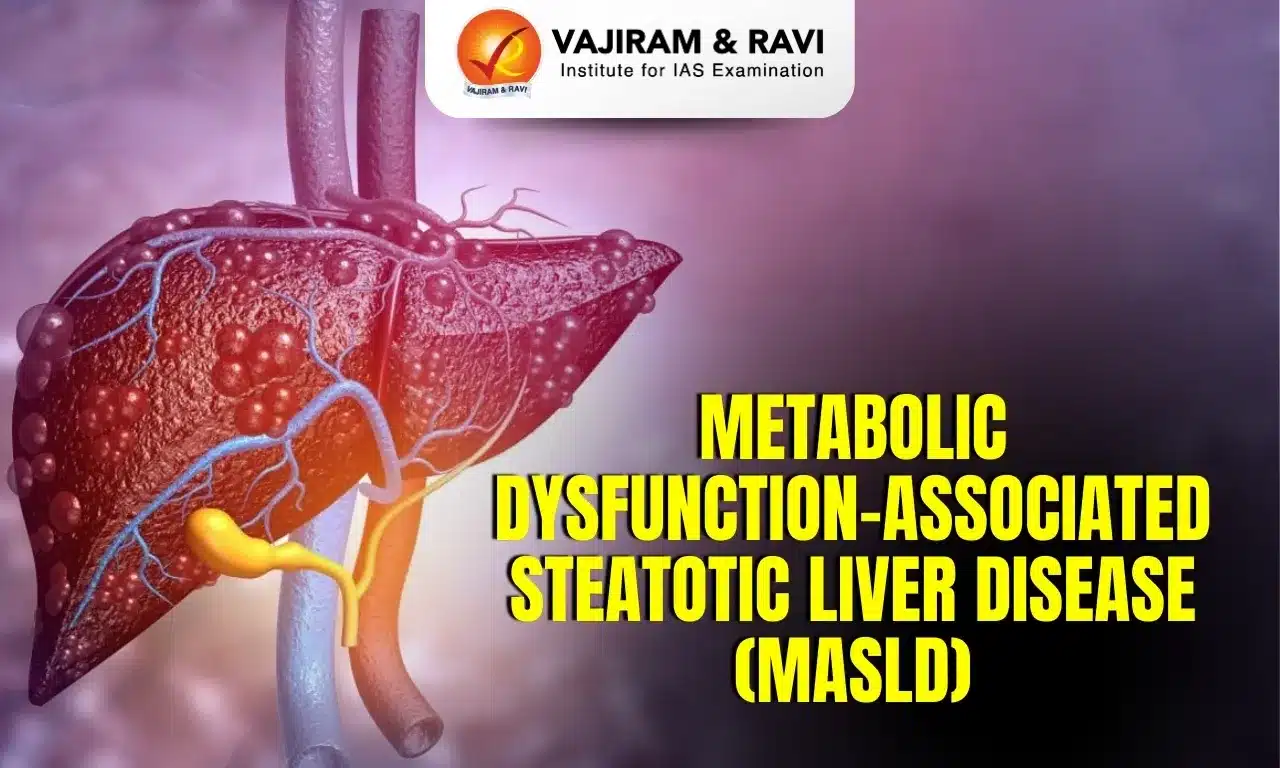
  • Often referred to as a “silent” disease, MASLD is a liver condition that can progress over time if left unaddressed. 
  • It is a long-lasting liver condition caused by having too much fat in the liver. 
  • Previously known as Non-Alcoholic Fatty Liver Disease (NAFLD), its name was changed to better reflect the condition’s underlying causes. 
  • The new term highlights that the disease is a metabolic one, linked to factors such as obesity, diabetes, and high cholesterol. 
  • It is the most common form of liver disease in the world. 
  • MASLD ranges in severity from hepatic steatosis — sometimes called diffuse hepatic steatosis, or formerly fatty liver infiltration or simply fatty liver — to a more severe form of disease called metabolic dysfunction-associated steatohepatitis (MASH), formerly called nonalcoholic steatohepatitis (NASH).
  • Symptoms
    • MASLD often has no symptoms. 
    • If symptoms begin, however, they usually include fatigue (extreme tiredness), weakness, discomfort, or pain in the abdomen.
    • If MASLD begins to advance to MASH, other symptoms may begin. 
      • These can include jaundice (yellowing of the eyes and skin), severe itching, fluid buildup in the belly (ascites), and fluid buildup in the ankles (edema).
      • Sometimes mental confusion can occur.
      • MASH causes the liver to swell and become damaged.
  • Treatment: Treating MASLD with a healthy diet, physical activity, and weight loss can slow or even reverse liver damage, especially if it is at an earlier stage.

Source: TH

Metabolic dysfunction-associated steatotic liver disease (MASLD) FAQs

Q1: What is Metabolic dysfunction-associated steatotic liver disease (MASLD)?

Ans: It is a long-lasting liver condition caused by excessive fat accumulation in the liver.

Q2: What was Metabolic dysfunction-associated steatotic liver disease (MASLD) previously known as?

Ans: Non-Alcoholic Fatty Liver Disease (NAFLD).

Q3: Which metabolic factors are linked to Metabolic dysfunction-associated steatotic liver disease (MASLD)?

Ans: Obesity, diabetes, and high cholesterol.

Q4: What is the more severe form of Metabolic dysfunction-associated steatotic liver disease (MASLD) called?

Ans: Metabolic dysfunction-associated steatohepatitis (MASH).

Q5: What lifestyle measures are recommended for treating Metabolic dysfunction-associated steatotic liver disease (MASLD)?

Ans: A healthy diet, regular physical activity, and weight loss.

Metadon Ghorpadei and Metadon Reemeri

Metadon Ghorpadei and Metadon Reemeri

Metadon Ghorpadei and Metadon Reemeri Latest News

Researchers recently discovered two rare ant-fly species in India, Metadon ghorpadei and Metadon reemeri.

About Metadon Ghorpadei and Metadon Reemeri

  • They are two new species of ant flies.
  • These insects belong to the Microdontinae subfamily of hoverflies. 
  • Metadon ghorpadei was discovered in Delhi’s Northern Ridge Forest. 
  • Metadon reemeri was found in the Siruvani Hills of the Western Ghats
  • Globally, many Microdontinae species are considered rare or threatened due to their specialised habitat requirements and patchy distribution.
    • They are known for their unique association with ants, as their larvae live inside ant nests and feed on ant broods, a specialised behaviour called myrmecophily that makes them exceptionally rare and difficult to detect. 
    • Of the 454 species reported worldwide, only 27 are known from the Indian subcontinent.

Source: TH

Metadon Ghorpadei and Metadon Reemeri FAQs

Q1: What are Metadon ghorpadei and Metadon reemeri?

Ans: They are two newly discovered species of ant flies.

Q2: Where was Metadon ghorpadei discovered?

Ans: It was discovered in Delhi’s Northern Ridge Forest.

Q3: Where was Metadon reemeri found?

Ans: It was found in the Siruvani Hills of the Western Ghats.

Q4: What unique ecological association are Microdontinae species known for?

Ans: Their larvae live inside ant nests and feed on ant broods.

Atal Pension Yojana

Atal Pension Yojana

Atal Pension Yojana Latest News

Recently, the union cabinet approved the continuation of Atal Pension Yojana (APY) up to FY 2030-31.

About Atal Pension Yojana

  • It was launched by the Government of India on 9th May 2015.
  • It was designed to encourage voluntary savings for retirement by offering defined pension benefits, linked to the age of joining and amount of contribution.

Key Features of Atal Pension Yojana

  • Target Group: It is aimed at workers in the unorganised sector.
  • It was initially available to all citizens of India between 18 and 40 years of age.
  • With effect from 1st October 2022, individuals paying income tax are not eligible to join the scheme.
  • Guaranteed Pension: Subscribers can opt for a fixed pension ranging from ₹1,000 to ₹5,000 per month, depending on the contribution made.
  • Government Co-Contribution: For subscribers who enrolled between June 1, 2015, and March 31, 2016, and met certain criteria, the government contributed 50% of the subscriber’s amount or ₹1,000 per annum for five years.
  • It is administered by the Pension Fund Regulatory and Development Authority (PFRDA).
  • Exit and withdrawal options 
    • Exit at age 60: Full pension begins.
    • Exit before age 60: Permitted only in cases of death or terminal illness.
    • Voluntary Exit: Allowed, but the subscriber only receives the contribution made (with interest) and government co-contribution (if any) is forfeited.

Source: PIB

Atal Pension Yojana FAQs

Q1: When was Atal Pension Yojana launched?

Ans: 2015

Q2: What is the primary objective of Atal Pension Yojana?

Ans: To provide pension benefits to workers in the unorganized sector

Small Industries Development Bank of India

Small Industries Development Bank of India

Small Industries Development Bank of India Latest News

Recently, the Union Cabinet has approved the equity support of Rs.5,000 crore to Small Industries Development Bank of India (SIDBI).

About Small Industries Development Bank of India

  • It was set up on 2nd April, 1990 by the Government of India under an act of the Parliament, as a wholly owned subsidiary of IDBI Bank.
  • It was delinked from IDBI on March 27, 2000. 
  • Mandate: It is mandated to serve as the Principal Financial Institution for executing the triple agenda of promotion, financing and development of the MSME sector and coordination of the functions of the various Institutions engaged in similar activities.
  • Functions of Small Industries Development Bank of India
    • Offers direct loans and refinancing to banks and NBFCs.
    • Promotes entrepreneurship and MSME growth
    • Provides venture capital and technology support
  • Financial support to MSMEs is provided by way of
    • Indirect/refinance to banks/Financial Institutions for onward lending to MSMEs
    • Direct finance in niche areas like risk capital, sustainable finance, receivable financing, service sector financing, etc..
  • SIDBI was made responsible for administering the Small Industries Development Fund and the National Equity Fund that were administered by IDBI before.
  • Major Stakeholders in SIDBI: Government of India (GOI), State Bank of India (SBI), LIC, and NABARD are among the major stakeholders in the SIDBI.
  • Headquarters: Lucknow, Uttar Pradesh

Source: PIB

Small Industries Development Bank of India FAQ's

Q1: What is the primary objective of SIDBI?

Ans: To develop and finance small-scale industries

Q2: Under which ministry does SIDBI operate?

Ans: Ministry of Finance

Bhitarkanika National Park

Bhitarkanika National Park

Bhitarkanika National Park Latest News

Bhitarkanika National Park saw a marginal increase in winged guests as compared to the previous year, according to the latest census report released by the forest department recently.

About Bhitarkanika National Park

  • It is located in the Kendrapara district of Odisha.
  • Spread across an area of 672 sq.km. of the mangrove swamp situated on the delta formed by the three rivers, namely Brahmani, Baitarani, and Dhamra, the park houses an array of creeks, backwaters, estuaries, deltas, and mudhuts.
  • The national park is surrounded by the Bhitarkanika Wildlife Sanctuary. Gahirmatha Beach and Marine Sanctuary lie to the east, and separates a swamp region covered with a canopy of mangroves from the Bay of Bengal. 
  • It is India’s second largest mangrove ecosystem after the Sunderbans
  • Proximity to the Bay of Bengal makes the soil of the area enriched with salt.
  • The vegetation and species of the sanctuary are those that are mainly found in the tropical and subtropical intertidal regions.
  • It is also designated as a Ramsar site.
  • Flora: Mangrove species, casuarinas, and grasses like the indigo bush.
  • Fauna:
    • It is home to the largest congregation of the endangered saltwater crocodile in the country.
    • The Gahirmatha Beach is the largest colony of the Olive Ridley Sea Turtles.
    • It is also home to numerous animals like hyenas, wild boar, Chitals, Sambar, Spotted Deer, Wild Boar, Jungle cat, Wild Pigs, etc., and migratory birds, which make it their home during the winter season, lending a vibrant hue to the ecosystem.
    • It is also home to eight varieties of Kingfisher birds, which is also a rarity.

Source: TP

Bhitarkanika National Park FAQs

Q1: Where is Bhitarkanika National Park located?

Ans: It is located in the Kendrapara district of Odisha.

Q2: Bhitarkanika National Park is situated on the delta formed by which rivers?

Ans: The Brahmani, Baitarani, and Dhamra rivers.

Q3: What type of ecosystem dominates Bhitarkanika National Park?

Ans: A mangrove swamp ecosystem.

Q4: Which beach and marine sanctuary lie to the east of Bhitarkanika National Park?

Ans: Gahirmatha Beach and Gahirmatha Marine Sanctuary.

Q5: Which endangered reptile has the largest congregation in Bhitarkanika National Park?

Ans: The saltwater crocodile.

Steel Slag

Steel Slag

Steel Slag Latest News

Recently, the union Minister of State (Independent Charge) for Science and Technology advocated wider adoption of steel slag–based road construction and repair technology, particularly in hilly and Himalayan regions.

About Steel Slag

  • Steel slag is an industrial byproduct obtained from the steel manufacturing industry.
  • It is produced in large quantities during steel-making operations that use electric arc furnaces.
  • It can also be produced by smelting iron ore in a basic oxygen furnace.
  • Composition: Primarily, slag consists of calcium, magnesium, manganese and aluminium silicates and oxides in various combinations.
  • The cooling process of slag is responsible mainly for generating different types of slags required for various end-use consumers

Applications of Steel Slag

  • Environmental Remediation: It has found use as a barrier material remedy for waste sites where heavy metals tend to leach into the surrounding environment.
    • Steel slag forces the heavy metals to drop out of solution in water run off because of its high oxide mineral content.
    • It has been used successfully to treat acidic water discharges from abandoned mines.
  • It can replace coarse aggregate due to a higher impact and crushing strength, and better anti-skid capacity.

Source: DD news

Steel Slag FAQs

Q1: What is steel slag primarily composed of?

Ans: Calcium, magnesium, manganese, and aluminium silicates and oxide

Q2: What is one of the applications of steel slag?

Ans: Treating acidic water discharges from abandoned mines

RBI’s ‘State of the Economy’ – Growth Resilience and Emerging Global Risks

State of the Economy

State of the Economy Latest News

  • The Reserve Bank of India (RBI), in its State of the Economy article, has assessed India’s macroeconomic conditions based on high-frequency indicators (for December 2025). 
  • The assessment points towards continued growth momentum, resilient domestic demand, and optimism about future prospects, despite elevated global geopolitical and geo-economic uncertainties.
  • The views expressed in the article are those of the authors and not the official stance of the RBI.

Key Growth Signals - Domestic Economy

  • Robust demand conditions: High-frequency indicators suggest sustained buoyancy in growth impulses. Demand conditions remain upbeat, supported by consumption and economic activity.
  • Revival of rural demand:
    • Retail automobile sales recorded broad-based growth across categories.
    • Key drivers are GST rate cuts improving affordability, year-end promotional offers, and pre-buying ahead of expected price hikes in January.
  • Commercial activity and logistics: Retail commercial vehicle sales maintained strong growth. It indicates improved goods movement, and strong underlying economic activity.
  • GST and formal economy indicators: E-way bill generation continued healthy growth due to GST rate rationalisation, stock clearance, and firms pushing year-end sales.

Macro-Economic Indicators

  • GDP growth: (National Statistics Office’s first advance estimate)
    • The real GDP growth is estimated at 7.4% in 2025-26, up from 6.5% a year ago.
  • Inflation trends: In December, the consumer price index (CPI) inflation rose to 1.3% driven by a lower rate of deflation in the food group along with an increase in core index.

Global Geopolitical and Geo-Economic Risks

  • Key developments at the start of 2026:
    • US intervention in Venezuela
    • Ongoing Middle East conflict
    • Uncertainty over Russia–Ukraine peace deal
    • Escalation of the Greenland dispute
  • Implications:
    • Elevated geo-economic risks
    • High policy uncertainty
    • Potential spillover effects on trade, energy, and capital flows

Structural Reforms and Policy Environment (2025)

  • Major reforms highlighted:
    • Rationalisation of tax structures
    • Implementation of labour codes (labour market reforms)
    • Financial sector deregulation
  • Expected outcomes:
    • Improved growth prospects
    • Enhanced productivity
    • Strengthened medium- to long-term economic fundamentals

External Sector and Trade Strategy

  • Export diversification: India has made significant efforts to diversify exports (like focusing on new markets in Africa and Latin America).
  • Trade negotiations: Ongoing talks with 14 countries/groups, covering nearly 50 nations, including European Union (EU), Gulf Cooperation Council (GCC), United States.

Challenges and Way Ahead

  • Persisting global geopolitical instability: Strengthen domestic demand while boosting export competitiveness.
  • Risk of imported inflation: Tackling imported inflation by a mix of monetary (interest rate cuts), fiscal (reducing import duties) and trade policies (boosting domestic supply chains).
  • Balancing growth and inflation management: Maintain a balanced policy approach between innovation vs. stability, and growth vs. consumer protection.
  • Ensuring inclusive and sustainable growth: Deepen structural reforms to enhance productivity and resilience. 
  • Managing policy uncertainty: Continue prudent regulation and supervision.

Conclusion

  • The RBI’s State of the Economy assessment underlines the resilience of the Indian economy, supported by strong domestic demand, improving rural consumption, robust GST indicators, and sustained reform momentum. 
  • While global uncertainties remain elevated, India’s macroeconomic fundamentals and reform-oriented policy framework provide credible grounds for optimism, positioning the economy for stronger and more stable long-term growth.

Source: IE

State of the Economy FAQs

Q1: How do high-frequency indicators reflect the current growth momentum of the Indian economy?

Ans: Indicators such as automobile sales, e-way bill generation, and commercial vehicle sales indicate sustained demand, robust economic activity.

Q2: What factors contributed to the revival of rural demand as highlighted by the RBI?

Ans: Rural demand revival was driven by enhanced affordability due to GST rate cuts, year-end discounts, etc.

Q3: Despite global uncertainties, why does the RBI express optimism about India’s growth prospects?

Ans: This is due to strong domestic demand, resilient macroeconomic fundamentals, and ongoing structural reforms.

Q4: What is the role of structural reforms undertaken in 2025 in strengthening India’s long-term growth?

Ans: Reforms such as tax rationalisation, labour code implementation, are expected to enhance productivity, formalisation, and investment-led growth.

Q5: How does India’s trade strategy contribute to economic resilience amid geo-economic uncertainties?

Ans: Export diversification and trade negotiations with the EU, GCC, and the US help reduce external vulnerability and strengthen economic resilience.

Judiciary on Prior Sanction for Corruption Probe – Explained

Corruption Probe

Corruption Probe Latest News

  • The Supreme Court has delivered a split verdict on the constitutional validity of Section 17A of the Prevention of Corruption Act, 1988, which mandates prior government approval before investigating certain corruption allegations against public servants.

Background of the Prevention of Corruption Act, 1988

  • The Prevention of Corruption Act, 1988 (PCA) is India’s primary anti-corruption legislation dealing with offences committed by public servants in the discharge of official duties. 
  • The Act traces its origin to the recommendations of the Santhanam Committee (1962-64), which highlighted the need for a strong legal framework to curb corruption in public life. 
  • The PCA consolidated existing laws and introduced penal provisions covering bribery, criminal misconduct, and abuse of official position.
  • Under the Act, a “public servant” is defined broadly to include government employees, judges, and individuals entrusted with public duties. 
  • Over time, judicial scrutiny and legislative amendments have shaped the balance between protecting honest officials and ensuring accountability for corrupt practices.

Section 17A and Its Legislative Intent

  • Section 17A was introduced through the 2018 amendment to the PCA. 
  • It mandates that prior approval of the appropriate government is required before initiating any inquiry or investigation against a public servant for decisions or recommendations made while discharging official functions.
  • The legislative rationale behind Section 17A was to address concerns that honest officers were becoming risk-averse due to fear of frivolous or malicious investigations. 
  • Policymakers argued that excessive scrutiny could lead to a “policy paralysis” where officials avoid taking bold or time-sensitive decisions, particularly in areas involving economic or administrative discretion.
  • It is important to note that the PCA already contains Section 19, which requires prior sanction before a court can take cognisance of corruption offences. 
  • Section 17A extends this protection to the pre-investigation stage.

Judicial Precedents on Prior Sanction

  • The Supreme Court has historically been cautious about executive controls over corruption investigations. 
  • In Vineet Narain vs Union of India (1998), the Court struck down the “Single Directive,” which required prior government approval before investigating senior officials. 
  • Similarly, in Subramanian Swamy vs Director, CBI (2014), Section 6A of the Delhi Special Police Establishment Act, requiring prior approval to investigate senior officers, was declared unconstitutional for violating Article 14 (equality before law).
  • These rulings established that differential treatment based on rank or position in corruption investigations undermines the principle of equal accountability under law.

Supreme Court’s Split Verdict on Section 17A

  • A two-judge Bench of the Supreme Court delivered a split verdict while examining the constitutional validity of Section 17A.
  • One judge upheld the provision, reasoning that prior approval is necessary to protect honest officers from harassment and to prevent a “play-it-safe” bureaucratic culture. 
  • However, this view came with a significant caveat: the approval mechanism should involve an independent body, such as the Lokpal or Lokayukta, rather than being controlled solely by the executive.
  • The other judge struck down Section 17A as unconstitutional, describing it as a reintroduction of previously invalidated safeguards in a new form. 
  • The judgment held that Section 17A fails the test of reasonable classification under Article 14 and that sufficient protection already exists under Section 19 of the PCA at the prosecution stage.
  • As a result of the split verdict, the matter has been referred to a larger Bench of the Supreme Court for final adjudication.

Governance and Accountability Implications

  • The case raises critical governance questions. 
  • On the one hand, excessive procedural safeguards may dilute the effectiveness of anti-corruption agencies and delay investigations. 
  • On the other hand, unchecked investigations can be misused as tools of political or administrative vendetta.
  • The debate highlights the need to balance administrative efficiency, decision-making autonomy, and constitutional principles of equality and rule of law. 
  • The outcome of the larger Bench decision will significantly shape the future of corruption control mechanisms in India.

Way Forward and Systemic Reforms

  • Beyond the constitutional question, the case underscores broader systemic issues in tackling corruption. 
  • Speedy investigation and time-bound trials are essential to ensure deterrence. 
  • Additionally, mechanisms to penalise false or malicious complaints can help prevent abuse of the investigative process without shielding genuine wrongdoing.
  • Institutional independence, transparency in approval mechanisms, and judicial oversight will be crucial in maintaining public trust in anti-corruption frameworks.

Source: TH

Corruption Probe FAQs

Q1: What is Section 17A of the Prevention of Corruption Act?

Ans: It requires prior government approval before investigating certain corruption allegations related to official decisions of public servants.

Q2: Why was Section 17A introduced?

Ans: To protect honest officials from frivolous investigations and encourage bold decision-making.

Q3: What did the Supreme Court rule on Section 17A?

Ans: A two-judge Bench delivered a split verdict, leading to referral of the case to a larger Bench.

Q4: How is Section 17A different from Section 19 of the PCA?

Ans: Section 17A applies at the investigation stage, while Section 19 applies before prosecution in court.

Q5: Why is the verdict significant for governance?

Ans: It affects the balance between administrative autonomy and accountability under anti-corruption laws.

Punjab Border Fence Shift: Why Farmers Want It Moved Closer to Pakistan Border

Punjab Border Fence

Punjab Border Fence Latest News

  • Punjab Chief Minister said the Centre has agreed in principle to move the security fence closer to the India–Pakistan border, a step that could restore access to farmland lying beyond the fence. 
  • The proposal, discussed earlier but never implemented, revives questions around its origins, security concerns, and why relief for border farmers has remained elusive.

Why Punjab’s Border Fence Has Become a Farmers’ Flashpoint

International Border in Punjab

  • Punjab’s 532-km border with Pakistan is secured by a barbed-wire fence that, due to uneven terrain, lies anywhere from a few feet to nearly 2 km inside Indian territory
  • As a result, about 21,500 acres of privately owned farmland and 10,000 acres of government land fall between the fence and the International Border.
  • Farmers cultivating this land face strict restrictions. Access gates open only for limited hours on fixed days, with caps on the number of people and tractors allowed. 
  • Each tractor must be escorted by two BSF Kisan Guards, further limiting daily access. 
  • Border farmers have long demanded that the fence be moved closer to the International Border to ease cultivation.

Why the Punjab Border Fence Was Built

  • The electrified barbed-wire fence along the Punjab–Pakistan border was first installed in 1988 across Gurdaspur, Amritsar and Ferozepur, at the height of militancy in the state. Its primary purpose was to curb infiltration, militancy and drug smuggling.
  • At the time, farmers did not protest, as dissent was often viewed with suspicion during those volatile years. 
  • In 1992, farmers formed the Border Area Sangharsh Committee to raise their concerns, but the issue has remained unresolved. 
  • With the later creation of Tarn Taran, Fazilka and Pathankot districts, the fence now affects border communities across six districts in Punjab.

Kapoor Committee and Farmer Compensation

  • The Kapoor Committee, headed by then Punjab Chief Secretary S L Kapoor, was constituted in 1986 to examine the difficulties faced by farmers whose land lay beyond the border fence. 
  • It recommended compensating affected farmers, leading to the release of an inconvenience allowance of ₹2,500 per acre in 1988. 
  • However, farmers say this compensation has been irregular and not paid annually.

Farmers Seek Fence Shift Amid Evolving Security Landscape

  • Punjab’s border farmers argue that advances in surveillance and drone monitoring have changed the nature of border security, making the current fence alignment outdated. 
  • With hundreds of acres trapped behind the fence, farmers face daily checks, delays in using machinery, and hurdles in transporting crops. 
  • They say shifting the fence closer to the International Border would ease cultivation without compromising security, given improved monitoring and adequate defence resources.

Why the Border Fence Remains Unmoved

  • Despite repeated proposals, shifting the Punjab border fence has not materialised due to practical and administrative hurdles. 
  • BSF officials say the nearly 40-year-old fence is in poor condition and moving it would require dismantling and rebuilding it with newly procured barbed wire. 
  • Farmers, meanwhile, remain sceptical, noting that similar assurances have surfaced during elections in the past without any follow-through, including in 2023 when a possible fence shift was announced but never implemented.

Source: IE | HT

Punjab Border Fence FAQs

Q1: Why is the Punjab border fence shift in the news?

Ans: The Punjab border fence shift gained attention after the Centre agreed in principle to move the fence closer to the International Border, potentially restoring farmers’ access to restricted land.

Q2: How much farmland lies beyond the Punjab border fence?

Ans: About 21,500 acres of private farmland and 10,000 acres of government land lie beyond the Punjab border fence, restricting cultivation and access for border farmers.

Q3: Why was the Punjab border fence originally built?

Ans: The Punjab border fence was installed in 1988 during militancy to prevent infiltration, terrorism and drug smuggling along the India–Pakistan border.

Q4: What problems do farmers face due to the current fence alignment?

Ans: Farmers face restricted access hours, limits on tractors and workers, mandatory BSF escorts, delays in cultivation, and difficulties in transporting crops from fenced-off fields.

Q5: Why has the Punjab border fence not been shifted so far?

Ans: The Punjab border fence shift faces logistical hurdles, poor condition of the old fence, rebuilding costs, and repeated political assurances without implementation over decades.

Bombay High Court on Protective Custody Under PITA: Care vs Detention

Protective Custody under PITA

Protective Custody under PITA Latest News

  • The Bombay High Court set aside an order placing an adult trafficking survivor in a protective home for a year, holding that such custody without legal justification violates constitutional liberty. 
  • The court clarified that protective homes under the Immoral Traffic (Prevention) Act (PITA) are meant for rehabilitation, not confinement. 
  • The court stressed that an adult survivor’s fundamental rights to personal liberty and freedom under Article 19 prevail over statutory powers, and do not stand suspended merely because she was trafficked. 
  • The case arose after a police raid in Maharashtra, where the petitioner alone was detained on the assumption that her lack of family support or income made her likely to return to sex work—an assumption the court found impermissible.

Limits of Custody Under the Immoral Traffic (Prevention) Act

  • What PITA Allows After Rescue - Under Section 17 of the Immoral Traffic (Prevention) Act, a rescued person may be kept in safe custody only briefly if immediate production before a magistrate is not possible. This initial custody is capped at 10 days.
  • Magisterial Inquiry and Time Limits - Once produced before a magistrate, the law requires an inquiry. During this stage, interim custody can continue, but only up to three weeks. Any placement beyond this period is not automatic.

When Long-Term Placement Is Permissible

  • A longer stay in a protective home — ranging from one to three years — can be ordered only if the magistrate records a clear finding that the person is “in need of care and protection”. 
  • The Bombay High Court stressed that these timelines reflect legislative intent to prevent rescue from turning into confinement.

Protective Homes vs Corrective Institutions

  • PITA draws a clear distinction:
    • Protective homes (Section 2(g)) are meant for care and rehabilitation of victims.
    • Corrective institutions (Section 2(b)) are for detention of offenders and are governed by Section 10A.
  • Only persons found guilty of offences under the Act can be sent to corrective institutions.

Constitutional Rights of Adult Survivors

  • For adults, constitutional freedoms under Article 19 — including the right to move freely, choose residence, and pursue a livelihood — remain intact even after trafficking. 
  • Unlike children, adults cannot be subjected to extended state control without consent.

Consent as the Core Principle

  • The High Court held that “care” for an adult survivor must be voluntary. 
  • Once an adult clearly expresses a desire to leave a protective home, continued confinement ceases to be care and becomes unlawful detention. 
  • In this case, the woman’s repeated refusal to stay made her consent central, not optional.

When Care Becomes Detention: The Court’s Test

  • Substance Over Labels - The Bombay High Court clarified that the difference between care and detention depends on effect, not terminology. 
    • Care involves voluntary support — counselling, shelter with consent, and help in rebuilding life — while detention is defined by compulsion.
  • Consent and Autonomy as the Core - When an adult is kept in a protective home against her wishes, with restrictions on movement and choice, it amounts to detention. 
    • Such restraint on personal liberty must be justified with concrete material on record, not assumptions.
  • Victims Are Not Offenders - The court cautioned against treating trafficking survivors as offenders by default. 
    • The Immoral Traffic (Prevention) Act (PITA) “was not meant to punish a victim of sexual exploitation”. 
    • In the absence of conduct attracting penal provisions, restrictions cannot be imposed.
  • Role of the Magistrate - Under PITA, only a magistrate, after conducting a proper inquiry, can determine whether a rescued person genuinely requires care and protection. 
    • Any placement in a protective home must follow this satisfaction and statutory safeguards.

When Detention May Be Justified

  • Detention may be permissible only in limited situations:
    • Evidence of a condition impairing decision-making capacity
    • A demonstrable danger to society if released
    • The person being an accused in a criminal case

Why Detention Failed in This Case

  • None of these conditions were met. There was no medical evidence of incapacity, no finding of danger to others, and the woman was not accused of any offence. 
  • The court rejected speculative fears — including the possibility of returning to sex work — as insufficient grounds for confinement.

What the Law Penalises Under PITA

  • Prostitution Is Not a Crime - The PITA does not criminalise prostitution itself. Courts have clarified that being engaged in sex work does not automatically make a person an offender.
  • Focus on Exploitation, Not Individuals – The Act targets the commercial exploitation surrounding prostitution. The law is aimed at those who control, profit from, or facilitate exploitation — not the individuals trapped within it.
  • Who the Act Criminally Targets
    • Criminal liability arises for:
      • Managing or running a brothel
      • Living off the earnings of another person’s prostitution
      • Procuring or trafficking persons for prostitution, even with apparent consent
      • Detaining a person for sexual exploitation
  • Limited Punishable Conduct - Certain acts linked to prostitution are punishable only when they affect public order — such as soliciting in public spaces or operating near schools, hospitals, or places of worship. 
    • Courts stress these are regulatory, not moral, provisions.

Poverty Is Not Grounds for Detention

  • The Bombay High Court rejected the view that economic vulnerability justifies confinement. 
  • Lack of family support or fear of returning to sex work cannot override constitutional rights. 
  • Poverty may warrant assistance, but never the curtailment of liberty.

Source: IE | LL

Protective Custody under PITA FAQs

Q1: What did the Bombay High Court rule on protective custody under PITA?

Ans: The Bombay High Court held that protective custody under PITA for adult trafficking survivors cannot violate constitutional liberty and must remain voluntary, time-bound, and justified by law.

Q2: How does PITA regulate protective custody after rescue?

Ans: Under PITA, protective custody is limited to 10 days initially and three weeks during inquiry; longer confinement requires a magistrate’s clear finding of need for care and protection.

Q3: Why did the court reject detention in this case?

Ans: The court found no medical incapacity, criminal charge, or danger to society, making continued protective custody under PITA unconstitutional and based on speculative assumptions.

Q4: What distinction did the court draw between care and detention?

Ans: Care under PITA involves voluntary support and rehabilitation, while detention involves forced confinement; keeping an adult against her will transforms care into unconstitutional detention.

Q5: Does PITA criminalise prostitution?

Ans: No, PITA does not criminalise prostitution itself; it targets exploitation by traffickers and brothel operators, not individuals engaged in sex work.

Daily Editorial Analysis 22 January 2026

Daily Editorial Analysis

Judicial Removal - Tough Law with a Loophole

Context

  • The notice of an impeachment motion by 107 Members of Parliament against Justice G.R. Swaminathan of the Madras High Court has renewed debate on the constitutional process for judicial removal in India.
  • The charges include alleged violations of secular constitutional principles and bias towards a particular community.
  • Beyond the specific allegations, the episode raises fundamental questions about the effectiveness of the constitutional framework governing judicial accountability while preserving independence.

Constitutional and Legal Framework for Judicial Removal and Meaning of Misbehaviour and Judicial Standards

  • Constitutional and Legal Framework for Judicial Removal

    • The Constitution of India lays down the procedure for removing judges of the Supreme Court and High Courts under Articles 124, 217, and 218.
    • While the term impeachment is reserved for the President, the process for judges emphasises removal through a rigorous parliamentary mechanism.
    • Article 124(5) empowers Parliament to regulate procedures for investigating and proving misbehaviour or incapacity, leading to the enactment of the Judges (Inquiry) Act, 1968.
    • This framework reflects a deliberate intent to make judicial removal rare and difficult, thereby safeguarding the judiciary from political pressure.
  • Meaning of Misbehaviour and Judicial Standards

    • The Constitution does not define misbehaviour, leaving interpretation to judicial pronouncements.
    • The Supreme Court has clarified that not every judicial error qualifies as misconduct.
    • Only wilful abuse of office, lack of integrity, corruption, or conduct involving moral turpitude meets the constitutional threshold.
    • These standards underline the principle that judges must adhere to exceptionally high ethical norms, as public trust in the judiciary depends on both actual and perceived impartiality.

Procedural Safeguards and the Role of Parliament

  • The removal process is deliberately stringent. A motion requires signatures from at least 100 members of the Lok Sabha or 50 members of the Rajya Sabha.
  • Final removal demands an address passed by each House with a special majority, ensuring broad political consensus.
  • Upon admission of a motion, an inquiry committee comprising senior judicial figures conducts a detailed investigation into the charges.
  • This multi-layered process is designed to prevent frivolous or politically motivated attempts to unseat judges.

The Critical Flaw: Discretion at the Threshold Stage

  • A serious flaw emerges at the preliminary stage. Under the Judges (Inquiry) Act, the Speaker of the Lok Sabha or the Chairman of the Rajya Sabha has the power to admit or reject the motion at the outset.
  • The Act does not specify criteria for this decision, granting wide discretion.
  • If the motion is rejected, the process ends immediately, regardless of the seriousness of the allegations or the number of MPs supporting it.
  • This unfettered discretion risks arbitrariness, especially since the presiding officer acts as a statutory authority rather than merely as a parliamentary functionary.
  • The absence of defined standards for admissibility makes the decision vulnerable to political considerations, undermining the credibility of the process.

Constitutional Inconsistency and Democratic Implications

  • Article 124(5) authorises Parliament to regulate procedures for investigation and proof, but it does not explicitly empower the presiding officer to block the process altogether.
  • Proof of misbehaviour is meant to arise from an impartial inquiry, not from a preliminary political filter.
  • The power to reject a motion at the threshold therefore appears inconsistent with the constitutional design.
  • The implications for democracy are significant. If the executive or ruling majority influences the presiding officer, a constitutionally sanctioned mechanism for ensuring judicial accountability can be rendered ineffective.
  • This does not strengthen judicial independence; instead, it weakens public confidence by insulating potentially errant judges from scrutiny.

Conclusion

  • India’s impeachment framework reflects a strong commitment to judicial independence through high thresholds and complex procedures.
  • However, the unchecked discretion vested in the Speaker or Chairman at the preliminary stage disrupts the intended balance between independence and accountability.
  • Revisiting this provision is essential to prevent misuse and to ensure that serious allegations against judges receive impartial examination.
  • Meaningful reform in this area would strengthen constitutional governance without compromising the autonomy of the judiciary.

Judicial Removal — Tough Law with a Loophole FAQs

Q1. What constitutional term is used for the impeachment of judges in India?
Ans. The Constitution uses the term removal rather than impeachment for judges.

Q2. On what grounds can a judge of the higher judiciary be removed?
Ans. A judge can be removed only on the grounds of proved misbehaviour or incapacity.

Q3. Which law governs the procedure for the removal of judges?
Ans. The procedure is governed by the Judges (Inquiry) Act, 1968.

Q4. What is the main procedural flaw in the current impeachment process?

Ans. The Speaker or Chairman has unchecked discretion to reject the motion at the threshold stage.

Q5. Why is this flaw considered constitutionally problematic?
Ans. It allows political discretion to prevent an impartial investigation into serious allegations against judges.

Source: The Hindu


Lowering The Age of Juvenility for Crimes is a Step Back

Context

  • A decade after the Juvenile Justice (Care and Protection of Children) Act, 2015 or the JJ Act, introduced the “transfer system,” a new Private Member’s Bill seeks to lower the age threshold for trying juveniles as adults.
  • The proposed amendment would allow children aged 14–15, accused of “heinous” offences, to face adult criminal trials and prison, raising concerns about weakening rehabilitation-focused principles in favour of punishment.
  • This article highlights why the proposal to lower the age of juvenility for heinous offences marks a regressive shift in India’s justice system, undermining rehabilitation, equality, and child-centred principles without empirical justification.

Juvenile Justice and the Transfer System

  • India’s juvenile justice framework is rooted in the belief that children differ developmentally from adults and are capable of reform.
  • However, after the 2012 Delhi gang rape case, the JJ Act, 2015 introduced the “transfer system”, allowing 16–18-year-olds accused of heinous offences to be assessed for adult trials.
  • Punitive Shift Without Evidence

    • The introduction of the transfer system lacked empirical support.
    • It was opposed by the Parliamentary Standing Committee, which found it inconsistent with domestic and international juvenile justice standards.
  • Arbitrariness in Assessments

    • Preliminary assessments by Juvenile Justice Boards focus on abstract notions like “mental capacity” and “understanding consequences,” rather than developmental stages or lived realities.
    • No reliable tools exist to measure such capacities retrospectively.
  • Inconsistent and Discriminatory Outcomes

    • Decisions often hinge on subjective factors—such as remorse or awareness of wrongdoing—leading to unequal treatment of similarly placed children.
    • Outcomes depend more on discretion than conduct.
  • Risks of Expanding the Transfer System

    • Lowering the age threshold to 14 would extend arbitrariness to younger children, undermining rehabilitation, reinforcing inequality, and weakening the core principles of care, reform, and reintegration in juvenile justice.

Adolescent Crime: Claims vs Evidence

  • Rising Crime Narrative Questioned

    • The proposed Bill claims a rise in serious crimes by 14–16-year-olds to justify lowering the age threshold. However, official data does not support this assertion.
  • What NCRB Data Shows

    • In 2023, cases involving Children in Conflict with the Law formed just 0.5% of total crimes.
      • Nearly 79% of apprehended children were aged 16–18, while only 21% were between 12–16, contradicting claims about younger adolescents driving crime.
  • Structural Vulnerability, Not Criminality 

    • Many adolescents enter the justice system due to poverty, neglect, and unmet welfare needs. Often, they are both in conflict with the law and in need of care and protection.
  • Risks of Lowering the Age Threshold 

    • Reducing the age limit would pull vulnerable children into harsher punitive processes without improving the system’s ability to distinguish vulnerability from culpability.
  • Harmful Impact of Adult Criminal Processes 

    • Exposure to adult trials disrupts education, harms cognitive development, creates stigma, and causes psychological trauma.
      • Illegal detention in police stations and adult prisons shows systemic failure, not the need for harsher laws.

Prioritising Reform Over Punishment

  • The Bill pushes juvenile justice toward earlier punishment, shifting focus away from early intervention, family support, education, mental health care, and systemic reform.
  • Diluting child-centred protections undermines core principles of child rights.
  • Addressing serious harm requires strengthening institutions and communities, not withdrawing safeguards from children least equipped to face punitive consequences.

Conclusion

  • Lowering the age of juvenility prioritises punishment over protection, ignoring evidence, developmental science and systemic failures, and risks harming vulnerable children instead of strengthening institutions meant to support them.

Lowering The Age of Juvenility for Crimes is a Step Back FAQs

Q1. What change does the proposed Private Member’s Bill seek to introduce in the JJ Act?

Ans. The Bill proposes lowering the age threshold from 16 to 14 years, allowing younger adolescents accused of heinous offences to be tried as adults.

Q2. Why is the ‘transfer system’ under the JJ Act criticised?

Ans. It relies on subjective assessments of mental capacity, lacks scientific tools, produces inconsistent outcomes, and shifts focus away from rehabilitation toward blame and punishment.

Q3. Does crime data support the claim that younger adolescents commit more serious crimes?

Ans. No. NCRB data shows that children aged 16–18 account for most juvenile cases, while those aged 12–16 form a much smaller proportion.

Q4. How does adult criminal trials affect adolescents?

Ans. Adult trials disrupt education, harm psychological development, create stigma, and expose children to trauma, often without addressing underlying vulnerabilities.

Q5. What is suggested as a better alternative to lowering the age threshold?

Ans. Strengthening early intervention, family support, education, mental health services, and accountability within juvenile institutions offers a more effective and rights-based response.

Source: TH

Daily Editorial Analysis 22 January 2026 FAQs

Q1: What is editorial analysis?

Ans: Editorial analysis is the critical examination and interpretation of newspaper editorials to extract key insights, arguments, and perspectives relevant to UPSC preparation.

Q2: What is an editorial analyst?

Ans: An editorial analyst is someone who studies and breaks down editorials to highlight their relevance, structure, and usefulness for competitive exams like the UPSC.

Q3: What is an editorial for UPSC?

Ans: For UPSC, an editorial refers to opinion-based articles in reputed newspapers that provide analysis on current affairs, governance, policy, and socio-economic issues.

Q4: What are the sources of UPSC Editorial Analysis?

Ans: Key sources include editorials from The Hindu and Indian Express.

Q5: Can Editorial Analysis help in Mains Answer Writing?

Ans: Yes, editorial analysis enhances content quality, analytical depth, and structure in Mains answer writing.

Enquire Now