Soil Fertility, Factors, Indian Aspect, Challenges, Initiatives

Soil Fertility

Soil Fertility refers to the capacity of soil to sustain plant growth by supplying essential nutrients, adequate moisture and suitable biological, chemical and physical conditions. Fertile soils support stable agricultural productivity and healthy ecosystems. They provide nutrients such as nitrogen, phosphorus, potassium, calcium and micronutrients while maintaining appropriate soil structure, microbial activity and pH conditions necessary for crop development and long term land productivity.

Factors Affecting Soil Fertility

Several Factors Affecting Soil Fertility has been listed below:

  • Soil Depth: Deep soils allow extensive root growth and better water retention. Adequate rooting depth improves nutrient absorption and supports consistent crop development during dry periods.
  • Soil Organic Matter: Organic matter improves soil structure, moisture retention and nutrient storage. It also enhances microbial activity that decomposes plant residues and releases nutrients through mineralization.
  • Soil pH Level: Most crops grow best in pH between 5.5 and 7.0. Extreme acidity or alkalinity restricts nutrient availability and reduces plant nutrient uptake efficiency.
  • Nutrients: Essential nutrients such as nitrogen, phosphorus, potassium, calcium, magnesium and sulphur must exist in plant available forms for optimal plant growth and reproduction.
  • Soil Microorganisms: Bacteria and fungi decompose organic matter and convert nutrients into usable forms. Nitrogen fixing bacteria transform atmospheric nitrogen into forms plants can absorb.
  • Drainage and Aeration: Well drained soils provide adequate oxygen for root respiration and microbial processes. Poor drainage causes waterlogging and restricts root development.
  • Soil Moisture Conditions: Adequate moisture supports microbial activity and nutrient dissolution. Excess or insufficient moisture disrupts nutrient transport to plant roots.
  • Toxic Elements: Toxic substances such as excessive ferrous ions (Fe²⁺) can create nutrient toxicity and inhibit plant growth under certain soil conditions.

Soil Fertility in India

Soil Fertility plays a central role in sustaining India’s agriculture, food security, environmental stability and rural livelihoods as highlighted below:

  • Soil Fertility sustains production of major crops like rice, wheat and pulses. India produced 329.7 million tonnes of foodgrains in 2022-23.
  • Approximately 95% of global food production depends on soil resources.
  • Alluvial soils in the Indo-Gangetic plains support cereals, while black soils in Maharashtra are suitable for cotton cultivation due to high moisture retention.
  • Fertile soils store essential macronutrients including nitrogen, phosphorus and potassium along with micronutrients required for plant metabolism and growth.
  • Soils act as natural reservoirs that regulate water infiltration and moisture storage, improving crop resilience during irregular monsoon conditions.
  • Soil organisms such as earthworms and mycorrhizal fungi improve soil aeration and nutrient absorption while contributing to ecological balance.
  • Nearly two-thirds of India’s population depends on agriculture, making Soil Fertility directly linked with farm income and employment stability.
  • Soil testing under the Soil Health Card programme shows less than 5% soils have adequate nitrogen while only 20% possess sufficient organic carbon.

Also Read: Soils of India

Soil Fertility Challenges

Several environmental, agricultural and policy related factors are degrading Soil Fertility as highlighted below:

  • Excessive Chemical Fertilizer Use: Heavy dependence on nitrogen fertilizers creates nutrient imbalance. India’s NPK ratio (percentage by weight of Nitrogen, Phosphorus and Potassium in fertilizer) is 7.7:3.1:1 compared with the recommended 4:2:1 ratio.
  • Land Degradation: About 97.85 million hectares of land, nearly 29.77% of India’s geographical area, faces degradation due to erosion and unsustainable land use.
  • Declining Soil Organic Carbon: Soil organic carbon levels declined from about 1% to nearly 0.3% over the past 70 years due to reduced organic matter inputs.
  • Soil Salinization and Waterlogging: Excess irrigation and groundwater extraction have created 6.7 million hectares of salt affected land causing annual crop losses of 11.18 million tonnes.
  • Soil Erosion and Desertification: Deforestation, mining and overgrazing accelerate soil erosion that removes nutrient rich topsoil from agricultural land.
  • Climate Change Impacts: Erratic rainfall, floods and droughts accelerate soil erosion and nutrient depletion, increasing vulnerability of agricultural soils.
  • Industrial and Urban Pollution: Heavy metals such as lead, cadmium and arsenic contaminate farmland through industrial discharge and untreated sewage.
  • Groundwater Over Extraction: Agriculture accounts for nearly 87% of India’s groundwater extraction, affecting soil moisture balance and fertility.
  • Loss of Traditional Farming Practices: Decline of crop rotation, green manure and agroforestry has reduced natural nutrient replenishment in soils.

Way Forward:

  • Promote balanced fertilization using integrated nutrient management combining organic manure, biofertilizers and controlled fertilizer application.
  • Implement watershed management, afforestation and soil conservation measures to restore degraded agricultural landscapes.
  • Encourage composting, green manure cultivation and crop residue recycling to rebuild soil organic matter.
  • Promote drip irrigation, rainwater harvesting and improved drainage systems to prevent salinity and maintain soil structure.
  • Introduce terracing, vegetative barriers and grassland restoration programmes in erosion prone areas.
  • Implement strict monitoring of industrial waste and adopt phytoremediation techniques for contaminated soils.
  • Encourage micro irrigation systems and efficient water management practices.

Soil Fertility Government Initiatives

Several national programmes aim to restore Soil Fertility, promote balanced nutrient management and support sustainable agricultural productivity.

  • Soil Health Card Scheme: Launched on 19 February 2015, the scheme provides farmers with detailed information on soil nutrient status to guide balanced fertilizer application.
  • Soil Fertility Mapping: Soil Fertility maps have been prepared in 351 villages across 34 districts of Maharashtra to identify nutrient deficiencies using geospatial technologies.
  • Biofertilizer Promotion: Agricultural policies encourage use of microbial fertilizers that enhance nitrogen fixation and nutrient availability in agricultural soils.
  • Farmer Awareness Programmes: Training programmes through agricultural institutions help farmers understand soil nutrient management and sustainable cultivation techniques.

Soil Fertility FAQs

Q1: What is Soil Fertility?

Ans: Soil Fertility is the ability of soil to supply essential nutrients and suitable conditions for healthy plant growth and agricultural productivity.

Q2: Which nutrients are essential for Soil Fertility?

Ans: Important nutrients include nitrogen, phosphorus, potassium, calcium, magnesium, sulphur and micronutrients like iron, zinc, boron and copper.

Q3: What is the role of Organic Matters in Soil Fertility?

Ans: Organic matter improves soil structure, water retention, nutrient availability and microbial activity essential for plant growth.

Q4: What is the ideal NPK ratio for balanced Soil Fertilization in India?

Ans: The recommended ratio is 4:2:1, but the current national average is about 7.7:3.1:1, indicating nutrient imbalance.

Q5: When was the Soil Health Card Scheme launched?

Ans: The Soil Health Card Scheme was launched by the Government of India on 19 February 2015 to promote balanced fertilizer use.

Geographic Information System, Types, Applications, Initiatives

Geographic Information System

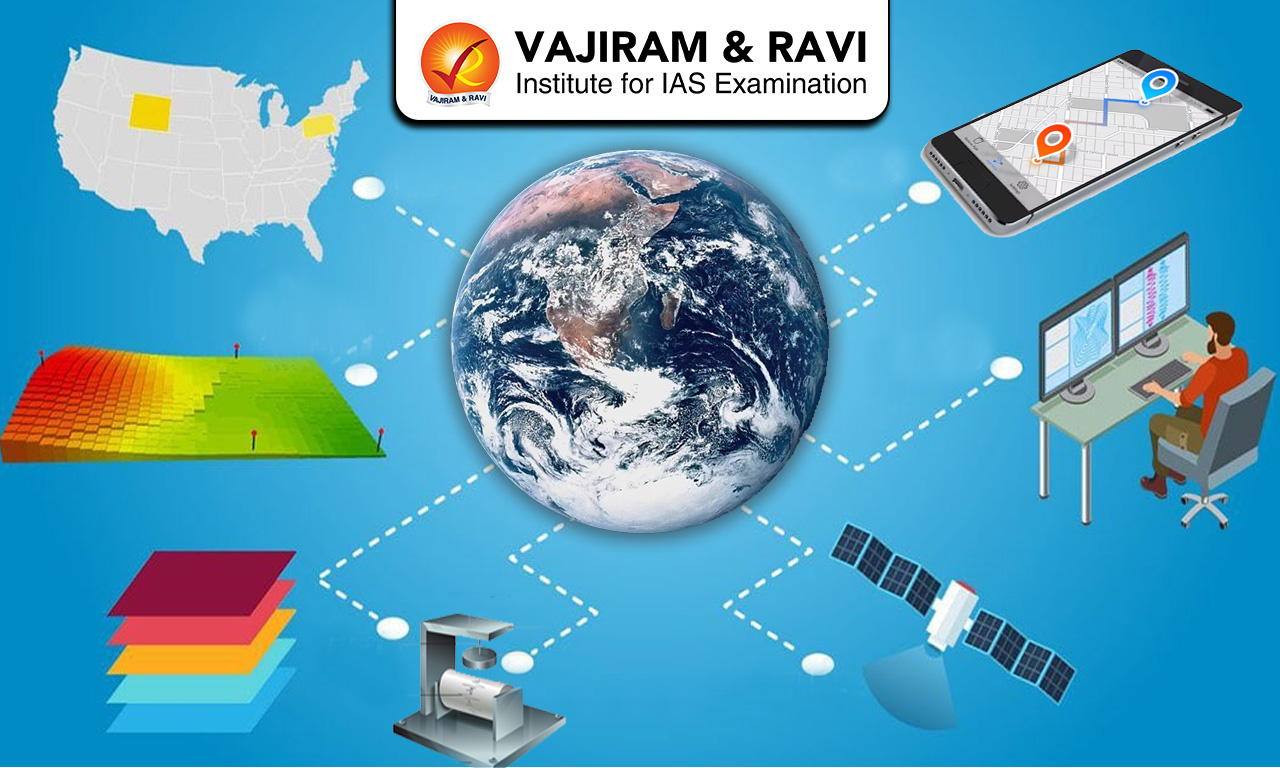
A Geographic Information System (GIS) is a computer-based system used to collect, store, manage, and display information related to locations on the Earth’s surface. It can combine different types of information such as roads, buildings, rivers, and vegetation on a single map. This helps people easily view, analyze, and understand patterns and relationships between different geographic features.

Types of Geographic Information System Data

GIS data is mainly of two types: Vector data and Raster data.

  • Vector data represents geographic features using points, lines, and polygons. Points show specific locations like schools or wells, lines represent features such as roads, rivers, and railways, and polygons indicate areas like forests, lakes, or administrative boundaries. It is useful for showing clear boundaries and precise locations on maps.
  • Raster data represents the Earth’s surface as a grid of small cells (pixels), where each cell contains a value representing features like temperature, elevation, rainfall, or land cover. It is commonly used in satellite images, aerial photographs, and environmental studies, especially for showing continuous features such as climate patterns and terrain.

Geographic Information System Applications

GIS is widely used in many fields because it helps in analyzing geographic information and improving planning and decision-making.

  • Urban Planning: GIS plays an important role in city planning and development. It helps planners map land use and divide areas into residential, commercial, industrial, and recreational zones. It also supports infrastructure planning by analyzing population distribution, terrain, and existing facilities.
  • Environmental Management: GIS is very useful for protecting natural resources and monitoring environmental changes. It helps track deforestation and changes in forest cover using satellite data. It can also identify sources of pollution in air, water, and soil. In wildlife conservation, GIS helps map animal habitats, migration routes, and areas affected by human activities, which supports better conservation planning.
  • Disaster Management: GIS is an important tool in disaster management because it helps in preparedness, response, and recovery. It can identify areas that are prone to floods by studying elevation and river systems. For earthquakes, GIS helps locate fault lines and identify vulnerable buildings and populations. During disasters, GIS can assist in planning evacuation routes, locating relief camps, and coordinating rescue operations.
  • Agriculture: GIS supports modern agriculture by helping farmers make data-based decisions. It is widely used in precision farming, where farmers analyze crop health, soil quality, and irrigation needs. GIS can also help study soil fertility, moisture levels, and pH values.
  • Space Research: GIS is also used in space exploration and planetary studies. Scientists use GIS to create maps of celestial bodies such as the Moon and Mars. These maps help researchers study surface features and choose suitable landing sites for space missions. When combined with remote sensing data, GIS helps scientists analyze both Earth’s surface and other planetary environments.

Government Initiatives Related to GIS in India

The Government of India has launched several initiatives to promote the use of Geographical Information System (GIS) and geospatial technology for better planning, governance, and development. These initiatives help improve land management, infrastructure planning, disaster response, and digital governance.

  • National Geospatial Policy 2022: Aims to make India a global leader in the geospatial sector by promoting the use of geospatial data, developing geospatial infrastructure, improving skills, and encouraging private sector participation.
  • SVAMITVA Scheme: Uses GIS and drone mapping to provide property cards to rural households and digitize land records. It helps reduce land disputes, improve financial inclusion, and support rural planning.
  • Bhuvan: A geoportal developed by Indian Space Research Organisation that provides satellite imagery and geospatial data for applications such as disaster management, environmental monitoring, and development planning.
  • Bharat Maps: Developed by the National Informatics Centre, this multi-layer GIS platform supports e-governance and digital infrastructure projects.
  • Survey of India Online Maps and Data Portal: Provides digital access to topographic maps, geospatial datasets, and mapping tools for government agencies and the public.
  • Gram Manchitra: A GIS-based platform by the Ministry of Panchayati Raj that helps Panchayati Raj Institutions prepare village development plans using spatial data.
  • Geospatial Energy Map of India: Launched by NITI Aayog with Indian Space Research Organisation, it provides GIS-based information on India’s energy resources and infrastructure to improve energy planning.
  • Sarthi Web GIS Platform: Sarthi Web GIS is a web-based GIS platform designed to provide interactive maps and data visualization tools. It helps policymakers and planners analyze geographic information and make better decisions in sectors such as infrastructure development, environmental monitoring, and public administration.

GIS Implementation Challenges

  • Inadequate Data Quality: Lack of accurate and updated geospatial data can lead to incorrect analysis and poor planning decisions.
  • High Cost: GIS systems require expensive software, satellite imagery, GPS devices, and data storage, along with regular maintenance.
  • Lack of Skilled Personnel: There is a shortage of trained professionals who can analyze spatial data and manage GIS technologies effectively.
  • Privacy and Security Concerns: GIS data may include sensitive location information, creating risks of data misuse, unauthorized access, and cyberattacks.
  • Data Integration Issues: Combining data from different sources and formats can be difficult and may affect the accuracy of analysis.

Measures to Strengthen GIS in India

  • Use of Advanced Technologies: Use satellites, drones, IoT sensors, and technologies like Artificial Intelligence and Machine Learning to improve data accuracy and real-time updates.
  • Promote Open-Source Software: Encourage affordable tools like QGIS to reduce costs and increase accessibility.
  • Training and Skill Development: Expand GIS education and training to create more skilled professionals in the geospatial sector.
  • Increase Geospatial Investment: Support startups, innovation, and infrastructure development in the geospatial industry.
  • Develop Indigenous Technologies: Promote domestic GIS software and hardware to reduce dependence on foreign technologies.
  • Strengthen Data Protection: Implement strong cybersecurity and data protection measures to protect sensitive geospatial data.

Geographic Information System FAQs

Q1: What is a Geographic Information System (GIS)?

Ans: A GIS is a computer-based system used to collect, store, analyze, and display geographic or spatial data on maps.

Q2: What are the main types of GIS data?

Ans: GIS data mainly includes Vector data (points, lines, polygons) and Raster data (grid of pixels representing features like temperature or elevation).

Q3: How is GIS useful in urban planning?

Ans: GIS helps planners analyze land use, population distribution, and infrastructure, enabling better planning of roads, transport, and public services.

Q4: How does GIS help in environmental management?

Ans: GIS helps monitor deforestation, pollution, biodiversity, and natural resources, supporting better environmental conservation.

Q5: What is the role of GIS in disaster management?

Ans: GIS helps identify disaster-prone areas, plan evacuation routes, locate shelters, and support rescue operations.

Preparing India for an Innovation-Led Economy, Initiatives, Challenges

Preparing India for an Innovation-Led Economy

India’s goal of becoming a developed nation by 2047 increasingly depends on strengthening its innovation ecosystem. Despite strong policy intent through increased funding, regulatory reforms and support for startups, outcomes remain limited due to low R&D spending, weak private sector participation and poor research-to-market linkages. Addressing these structural gaps and encouraging industry-led innovation will be crucial for translating policy ambition into sustainable technological and economic growth.

Government Initiatives to Promote an Innovation-Led Economy 

In recent years, the Government of India has taken significant steps to strengthen the country’s research and innovation ecosystem.

  • Expansion of research funding: The government has created a ₹1 lakh crore Research, Development and Innovation (RDI) Fund aimed at supporting advanced technological research and encouraging high-risk innovation projects.
  • Support for deep-tech startups: A ₹20,000 crore corpus has been announced to promote startups working in emerging technologies such as artificial intelligence, quantum computing, robotics and advanced materials.
  • Promotion of innovation culture: The expansion of Atal Tinkering Labs in schools aims to encourage scientific curiosity and experimentation among students, helping to nurture the next generation of innovators.
  • Regulatory reforms for research: Restrictions that earlier limited young deep-technology firms from accessing certain government research schemes have been removed, making the research ecosystem more accessible to startups.
  • Opening new technological domains: Legislative reforms such as the SHANTI Act, 2025 allow patents for peaceful uses of nuclear energy and radiation, creating opportunities for private sector participation in advanced scientific fields.

These initiatives indicate that India is attempting to build a supportive ecosystem for innovation and technological advancement.

Structural Challenges in India’s Innovation Ecosystem

Despite these policy initiatives, India’s innovation ecosystem continues to face several structural challenges that restrict the country’s ability to emerge as a global technology leader.

  • Low R&D expenditure: India spends only about 0.65% of its GDP on research and development, which is significantly lower than innovation leaders such as South Korea, Japan and the United States. Limited investment restricts the scale of scientific research and technological breakthroughs.
  • Limited private sector participation: In most innovation-driven economies, industry accounts for the majority of research investment. In India, however, the government still bears a large share of R&D expenditure, reflecting the private sector’s cautious approach toward long-term and high-risk innovation.
  • Weak global technological presence: Although domestic patent filings have increased in recent years, India’s share in international patent applications remains relatively small compared with major innovation powers such as China, the United States and Japan. This indicates limited global technological influence.
  • Human capital constraints: Innovation thrives in environments with strong research talent and knowledge-intensive employment. India faces shortages in skilled researchers and scientific professionals, which limits the country’s ability to generate cutting-edge innovations.
  • Gender gap in scientific research: The relatively low participation of women with advanced degrees in science and technology reduces diversity in research environments and weakens the overall innovation potential.
  • Weak research-to-market linkages: Many research findings generated in universities and public research institutions fail to reach the market because technology transfer mechanisms remain underdeveloped. Limited collaboration between academia and industry further reduces opportunities for applied research and product development.
  • Structural economic constraints: India’s development trajectory has relied heavily on services rather than large-scale industrialisation. As a result, many startups operate in service-based or platform-based models rather than deep technology sectors, reducing incentives for sustained industrial research and technological innovation.

Together, these structural challenges highlight the need for deeper reforms in the innovation ecosystem.

Way Forward

Addressing these challenges requires a comprehensive and coordinated strategy.

  • Increase national R&D expenditure to strengthen the scientific research base and support long-term technological development.
  • Encourage private sector investment in innovation through tax incentives, research partnerships and easier access to funding.
  • Strengthen industry-academia collaboration so that universities and research institutions can work closely with businesses to develop market-ready technologies.
  • Develop effective technology transfer systems within universities to facilitate the commercialisation of scientific discoveries.
  • Promote deep-tech entrepreneurship by expanding venture capital support and providing patient funding for long-gestation technologies.
  • Enhance participation of women in STEM fields in order to broaden the talent pool and improve diversity in research.
  • Strengthen advanced manufacturing capabilities to create a stronger industrial base that supports technological innovation.

Preparing India for an Innovation-Led Economy FAQs

Q1: Why is innovation important for India’s economic growth?

Ans: Innovation improves productivity, strengthens technological capability and enhances global competitiveness, making it essential for achieving the goal of a developed India by 2047.

Q2: What initiatives has the government taken to promote innovation?

Ans: Major initiatives include the ₹1 lakh crore RDI Fund, ₹20,000 crore support for deep-tech startups, expansion of Atal Tinkering Labs and regulatory reforms to encourage research and patents.

Q3: What are the key challenges in India’s innovation ecosystem?

Ans: Low R&D expenditure, weak private sector participation, limited global patent presence, human capital gaps and poor research-to-market linkages.

Q4: Why is private sector participation important for innovation?

Ans: Industry-led R&D drives technological breakthroughs, commercialises research and strengthens global competitiveness.

Q5: What steps can help India build an innovation-led economy?

Ans: Increase R&D spending, strengthen industry–academia collaboration, support deep-tech startups and improve technology transfer systems.

UPSC Daily Quiz 14 March 2026

[WpProQuiz 114]

UPSC Daily Quiz FAQs

Q1: What is the Daily UPSC Quiz?

Ans: The Daily UPSC Quiz is a set of practice questions based on current affairs, static subjects, and PYQs that help aspirants enhance retention and test conceptual clarity regularly.

Q2: How is the Daily Quiz useful for UPSC preparation?

Ans: Daily quizzes support learning, help in revision, improve time management, and boost accuracy for both UPSC Prelims and Mains through consistent practice.

Q3: Are the quiz questions based on the UPSC syllabus?

Ans: Yes, all questions are aligned with the UPSC Syllabus 2025, covering key areas like Polity, Economy, Environment, History, Geography, and Current Affairs.

Q4: Are solutions and explanations provided with the quiz?

Ans: Yes, each quiz includes detailed explanations and source references to enhance conceptual understanding and enable self-assessment.

Q5: Is the Daily UPSC Quiz suitable for both Prelims and Mains?

Ans: Primarily focused on Prelims (MCQ format), but it also indirectly helps in Mains by strengthening subject knowledge and factual clarity.

Defence Forces Vision 2047, Roadmap for a Future-Ready Indian Military

Defence Forces Vision 2047

The Government of India has released Defence Forces Vision 2047, a long-term roadmap aimed at transforming the Indian Armed Forces into a modern, integrated and technologically advanced military capable of supporting India’s aspiration to become Viksit Bharat by 2047

The vision document titled “Defence Forces Vision 2047: A Roadmap for a Future-Ready Indian Military” was released by Defence Minister Rajnath Singh in March 2026 in New Delhi. It has been prepared by the Headquarters Integrated Defence Staff and outlines reforms required to address evolving security and technological challenges.

Defence Forces Vision 2047 Objective

It envisages the transformation of the military into an integrated, multi-domain and agile force capable of deterring adversaries, responding across the full spectrum of conflict & protecting expanding strategic interests, amid the rapidly changing global and regional dynamics.

Defence Forces Vision 2047 Key Features

The vision document outlines the strategic reforms, capability enhancements and organisational changes required within the Defence Forces to effectively address the evolving geostrategic, technological & security environment. Key features of Defence Forces Vision 2047 are:

  • Jointness and Integration: Promotes greater coordination and synergy among the three services of the Indian Armed Forces to enable unified planning and execution of military operations.
  • Military Modernisation: Focuses on upgrading existing platforms and inducting advanced weapon systems and emerging technologies to strengthen combat capabilities.
  • Self-Reliance in Defence: Emphasises Aatmanirbharta by promoting indigenous defence production, innovation, and research to reduce dependence on imports.
  • Multi-Domain Warfare Capability: Prepares the military to operate effectively across land, sea, air, cyber, and space domains.
  • New Strategic Institutions: Proposes creation of specialised capabilities such as a drone force, data force, geo-spatial agency, and cognitive warfare units.
  • Space and Cyber Commands: Recommends establishing dedicated commands to address emerging threats in cyber and space domains.
  • Strengthening Air and Missile Defence: Calls for expansion of air defence and ballistic missile defence systems to protect critical infrastructure and strategic assets.
  • Human Resource Reforms: Focuses on modern training systems, higher educational standards for recruits, and strengthening the Agnipath Scheme.
  • Capability Development Roadmap: Adopts a phased transformation strategy with short-term, medium-term, and long-term capability goals leading up to 2047.
  • Whole-of-Nation Approach: Emphasises coordination between military strength, diplomacy, technology, and economic power to ensure national security.

Defence Forces Vision 2047 Implementation 

The transformation outlined in Defence Forces Vision 2047 will be implemented in phases. 

  • Transition Phase (till 2030): Initial reforms and capability upgrades.
  • Consolidation Phase (2030-2040): Strengthening and technological capabilities and integration among services.
  • Excellence Phase (2040-2047): Achieving a fully modern and globally respected military force.

Defence Forces Vision 2047 FAQs

Q1: What is Defence Forces Vision 2047?

Ans: Defence Forces Vision 2047 is a long-term strategic roadmap aimed at transforming the Indian Armed Forces into a modern, integrated and technologically advanced military by the year 2047.

Q2: Who released the Defence Forces Vision 2047 document?

Ans: The vision document titled “Defence Forces Vision 2047: A Roadmap for a Future-Ready Indian Military” was released by India’s Defence Minister Rajnath Singh in March 2026.

Q3: What is the main objective of Defence Forces Vision 2047?

Ans: The main objective is to transform the military into an integrated, multi-domain and agile force capable of deterring adversaries, responding to various types of conflicts and protecting India’s strategic interests.

Q4: What are the key focus areas of Defence Forces Vision 2047?

Ans: The vision focuses on military modernisation, jointness among the services, self-reliance in defence production, multi-domain warfare capability, and adoption of advanced technologies.

Q5: How will Defence Forces Vision 2047 be implemented?

Ans: The roadmap will be implemented in three phases: Transition Phase (till 2030), Consolidation Phase (2030-2040), and Excellence Phase (2040-2047) to gradually build a modern and globally respected military force.

Valley and Mountain Breezes, Definition, Features, Wind Process

Valley and Mountain Breezes

Valley and Mountain Breezes are localized wind systems that develop in hilly regions due to daily heating and cooling differences between mountain slopes and valley floors. These winds occur in a regular diurnal cycle, reversing direction between day and night. Meteorologists classify them as anabatic and katabatic winds because their movement is controlled by temperature driven pressure variations along slopes.

Valley Breeze

A Valley Breeze is a daytime wind that moves upward from the valley floor toward mountain slopes due to differential solar heating. During sunny conditions, mountain slopes heat faster than valley bottoms, creating low pressure along slopes. Warm air rises upslope through convection, generating gentle winds that travel upward along the valley sides.

Also Read: Mountain Ranges in India

Mountain Breeze

A Mountain Breeze is a nighttime wind that flows downward from mountain slopes into the valley. After sunset, rapid radiation cooling makes mountain air colder and denser than valley air. This heavy air moves downhill under gravity and spreads across the valley floor, forming a cool drainage wind.

Also Read: Indus Valley Civilization

Valley and Mountain Breezes Features

Valley and Mountain Breezes represent daily reversing wind systems in mountainous regions driven by temperature contrasts and pressure differences.

  • Diurnal Wind Cycle: These winds operate within a 24 hour cycle. Valley Breezes dominate during daylight while Mountain Breezes develop after sunset when cooling reverses pressure gradients.
  • Wind Process:
    • Anabatic: Valley Breezes are classified as anabatic winds. Warm, less dense air formed on heated slopes rises upward, moving from the valley toward higher mountain elevations.
    • Katabatic: Mountain Breezes represent katabatic winds. Cold, dense air formed by nighttime cooling flows downslope due to gravity toward the valley floor.
  • Daytime Heating Mechanism: On clear sunny days, mountain slopes absorb more solar radiation than valley bottoms. This uneven heating produces localized low pressure along slopes.
  • Night-time Radiation Cooling: After sunset, mountain surfaces lose heat quickly through terrestrial radiation. Cooling occurs faster on slopes than on the valley floor.
  • Pressure Distribution: During daytime, pressure becomes lower on mountain slopes and relatively higher in valleys. At night, slopes develop higher pressure while valleys remain comparatively warmer.
  • Impact on Local Temperature: Campers and travelers in mountainous regions often experience warm afternoons followed by sudden cold winds after sunset due to Mountain Breeze development.
  • Influence on Cloud Formation: Rising warm air along slopes during Valley Breezes can transport moisture upward, sometimes forming clouds near upper mountain regions.
  • Wind Direction: Valley Breeze moves upward from valley to mountain slopes, while Mountain Breeze flows downward from mountain ridges to valley floors.
  • Density Variation: Warm air in Valley Breezes has lower density and rises easily, whereas Mountain Breeze air is colder, denser and remains close to the ground.

Valley and Mountain Breezes FAQs

Q1: What are Valley and Mountain Breezes?

Ans: Valley and Mountain Breezes are local wind systems that occur in mountainous regions due to temperature and pressure differences between mountain slopes and valley floors during a daily cycle.

Q2: When does a Valley Breeze occur?

Ans: A valley breeze occurs during the daytime when solar heating warms mountain slopes faster than valley floors, causing warm air to rise upslope.

Q3: When does a Mountain Breeze occur?

Ans: A mountain breeze develops at night after mountain slopes cool rapidly through radiation, causing dense cold air to flow downhill into the valley.

Q4: What causes Valley and Mountain Breezes?

Ans: These winds are caused by temperature gradients between slopes and valleys, which create pressure differences that move air upward during the day and downward at night.

Q5: What are Anabatic and Katabatic Winds?

Ans: Anabatic winds refer to upslope winds like valley breezes, while katabatic winds refer to downslope winds such as mountain breezes driven by cold dense air.

V.O. Chidambaranar Port, India’s First Digital Twin Port

V.O. Chidambaranar Port

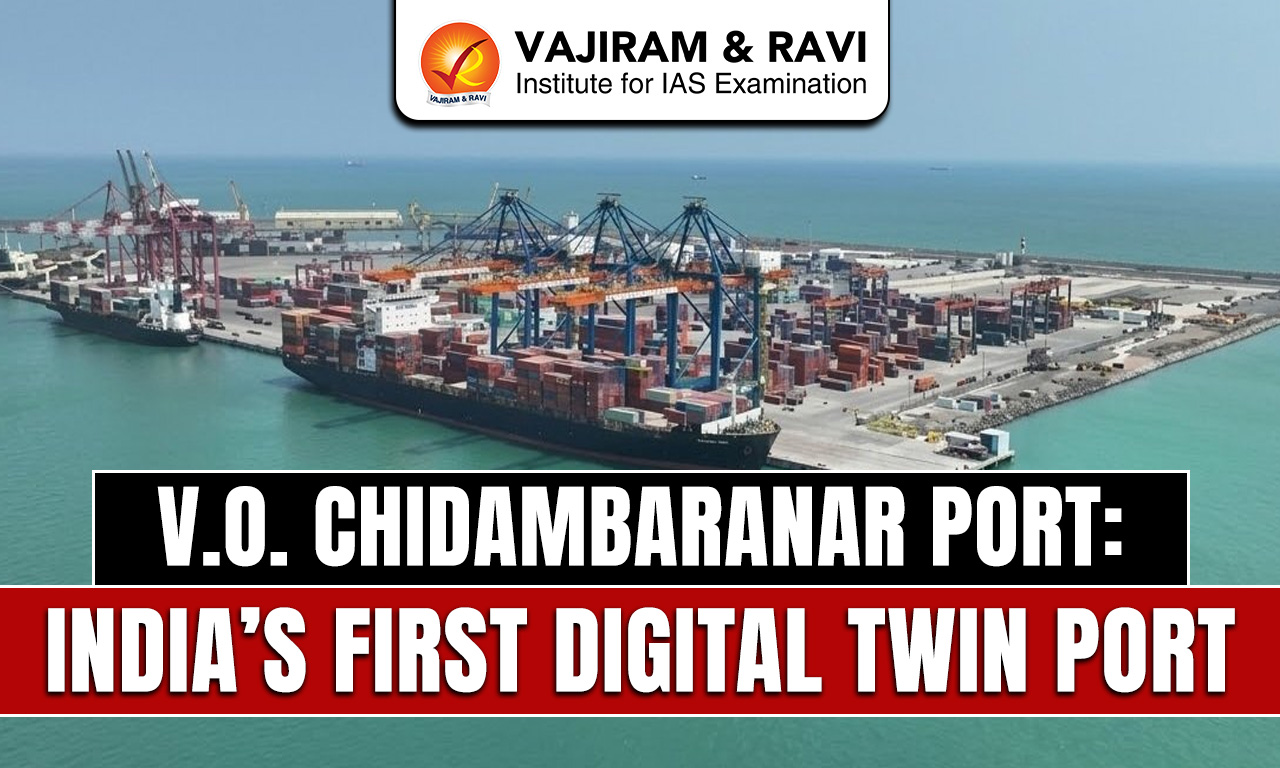
V.O. Chidambaranar Port Authority has become the first port in India to launch a Digital Twin initiative for port management.

What is a Digital Twin?

A Digital Twin is a virtual, real-time digital replica of a physical system or infrastructure. It uses sensors, data analytics, and simulation tools to mirror real-world operations in a digital environment.

In the context of ports, the Digital Twin platform creates a live virtual model of the port’s infrastructure, operational assets, vessels, and logistics activities. By continuously collecting and analyzing data from different sources, it allows port authorities to monitor operations in real time and make informed decisions. The Digital Twin system integrates several advanced technologies that help capture and analyze real-time operational data. These include:

  • Internet of Things (IoT) sensors for monitoring equipment performance and environmental conditions.
  • GPS tracking to monitor vessel movements and cargo logistics.
  • LiDAR mapping for accurate spatial mapping of port infrastructure.
  • Drone imaging for aerial monitoring and inspection of facilities.
  • CCTV networks for continuous operational surveillance.
  • Artificial Intelligence and data analytics for predictive insights and decision-making.

Together, these technologies enable a continuous flow of data that mirrors real-world port operations in the digital system.

Benefits of the Digital Twin Platform

The Digital Twin platform offers several operational and strategic benefits that can significantly improve the efficiency, safety, and sustainability of port management.

  • Real-time operational monitoring: Enables continuous tracking of berth occupancy, vessel movements, crane utilisation, and yard capacity, thereby improving operational visibility.
  • Predictive maintenance: AI-based monitoring helps identify potential equipment failures in advance, reducing downtime and improving reliability of cargo handling operations.
  • Optimised vessel scheduling: Facilitates efficient planning of ship arrivals and cargo operations, helping reduce port congestion and waiting time.
  • Reduced vessel turnaround time: Improved coordination and monitoring can reduce vessel turnaround time by up to 25%, enhancing port efficiency.
  • Enhanced operational safety: Real-time alerts and monitoring mechanisms help detect risks early and improve overall safety standards.
  • Energy efficiency and emission reduction: The platform tracks energy consumption and emissions, supporting environmentally sustainable port operations.

The initiative aligns with the broader goals of India’s maritime policy framework and supports the objectives of Maritime India Vision 2030 and Amrit Kaal Vision 2047, which aim to modernise the maritime sector and enhance the global competitiveness of Indian ports.

About V.O. Chidambaranar Port

V.O. Chidambaranar Port, located in Thoothukudi in Tamil Nadu, is one of the major ports of India and plays an important role in facilitating maritime trade in the southern region of the country.

  • It is one of the 12 major ports of India, located in Thoothukudi in Tamil Nadu along the Gulf of Mannar.
  • Earlier known as Tuticorin Port Trust, it was renamed in 2011 after freedom fighter V. O. Chidambaram Pillai.
  • The port functions under the administrative control of the Ministry of Ports, Shipping and Waterways.
  • It is an all-weather artificial deep-water port, which allows ships to operate throughout the year.
  • The port is an important gateway for trade in South India, handling cargo such as coal, containers, fertilizers, petroleum products, and other bulk cargo.
  • It plays a key role in supporting industrial and export activities in southern India and contributes significantly to the country’s maritime trade.

V.O. Chidambaranar Port FAQs

Q1: Which port in India has launched the Digital Twin initiative for port management?

Ans: V.O. Chidambaranar Port Authority in Thoothukudi, Tamil Nadu has become the first port in India to launch a Digital Twin platform for port management.

Q2: What is a Digital Twin in the context of port management?

Ans: A Digital Twin is a real-time virtual replica of the port’s physical infrastructure and operations, enabling authorities to monitor activities, analyse data, and improve decision-making.

Q3: Which technologies are used in the Digital Twin platform at the port?

Ans: The platform integrates technologies such as IoT sensors, GPS tracking, LiDAR mapping, drone imaging, CCTV networks, and Artificial Intelligence to monitor and analyse port operations in real time.

Q4: What are the key benefits of the Digital Twin platform?

Ans: The platform enables real-time monitoring of operations, predictive maintenance of equipment, better vessel scheduling, reduced congestion, and improved safety and energy efficiency.

Q5: Which national initiatives support the digital transformation of Indian ports?

Ans: The initiative aligns with the goals of Maritime India Vision 2030 and Amrit Kaal Vision 2047, which aim to modernise the maritime sector and enhance the global competitiveness of Indian ports.

Solar Insolation, Definition, Factors, Mechanism, Distribution

Solar Insolation

Solar Insolation refers to the solar energy that reaches the Earth from the Sun in the form of electromagnetic radiation. This incoming radiation is the primary source of heat for the planet. The Earth maintains a stable temperature because the absorbed solar energy is balanced by the outgoing terrestrial radiation emitted back to space.

Solar Insolation

Solar Insolation means the incoming solar radiation intercepted by the Earth’s surface and atmosphere. It consists mainly of shortwave electromagnetic energy such as ultraviolet, visible light and near infrared radiation. Only a very small fraction of the Sun’s total radiation reaches the Earth, yet it powers weather systems, supports biological processes and maintains the planet’s heat balance.

Factors Affecting Solar Insolation

Solar Insolation varies across locations and seasons because of Earth’s rotation, revolution, atmospheric properties and the geometric angle of sunlight reaching the surface. The major factors include:

  • Earth’s Rotation: The Earth rotates once every 24 hours, causing alternating day and night. Only the illuminated hemisphere receives solar radiation while the other remains in darkness, producing daily variation in insolation.
  • Earth’s Axial Tilt: The Earth’s rotational axis is inclined about 23.4° from the perpendicular of its orbital plane, or about 66.5° relative to the plane of orbit. This tilt shifts solar concentration between hemispheres, creating seasonal variations.
  • Revolution Around the Sun: As the Earth revolves in an elliptical orbit, different latitudes experience varying solar exposure through the year. Seasonal changes in solar intensity arise from this orbital motion combined with axial tilt.
  • Angle of Incidence of Sun Rays: At lower latitudes sunlight strikes the surface almost vertically, concentrating energy on a smaller area. In higher latitudes rays arrive obliquely, spreading energy over larger surfaces and reducing heat per unit area.
  • Atmosphere: Clouds, dust particles, water vapour and atmospheric gases influence the amount of radiation reaching the ground. These elements reflect, absorb, or scatter sunlight, reducing the net energy available at the surface.
  • Shape of Earth: Because the Earth is spherical, the equatorial region receives more concentrated solar energy than higher latitudes. The curvature spreads sunlight over larger areas toward the poles, lowering radiation intensity.

Solar Insolation Mechanism

The mechanism of Solar Insolation has been described below:

  • The Sun produces enormous energy through nuclear fusion at temperatures near 6000 Kelvin, releasing electromagnetic radiation including ultraviolet, visible and near infrared wavelengths.
  • By the time solar energy reaches Earth, its intensity reduces to about 1370 watts per square metre, commonly known as the solar constant.
  • A portion of incoming radiation is absorbed or scattered by atmospheric gases, aerosols and clouds, especially UV radiation.
  • The remaining radiation reaches land, water and vegetation surfaces where it is absorbed and converted into thermal energy,
  • Heating of the surface causes air to rise and generate convection currents, transferring heat upward into the atmosphere and assisting large scale atmospheric circulation.
  • The Earth system approaches equilibrium when incoming solar radiation equals the outgoing long wave terrestrial radiation emitted back into space.

Distribution of Solar Insolation

Solar Insolation is unevenly distributed across the Earth because of latitude, atmospheric conditions and surface characteristics.

  • Tropical Regions: Tropical regions receive the highest annual solar radiation, averaging about 320 watts per square metre, due to relatively vertical sun rays and consistent daylight duration throughout the year.
  • Polar Regions: Polar areas receive extremely low radiation levels, approximately 70 watts per square metre, because sunlight arrives at very low angles and passes through thicker atmospheric layers.
  • Subtropical Deserts: Subtropical desert belts receive the greatest surface insolation because cloud cover is minimal, allowing maximum solar energy to reach the ground.
  • Continental vs Oceanic Surfaces: At the same latitude, continents usually receive greater insolation than oceans because extensive cloud cover over oceans reflects more sunlight back into space.
  • Mid Latitudes: Most atmospheric heat exchange occurs between 30° and 50° latitudes, where warm and cold air masses interact, producing frequent storms and significant redistribution of solar energy.
  • Equator: Although equatorial areas receive intense sunlight, cloud formation and atmospheric circulation often redistribute part of this energy toward higher latitudes, contributing to global climatic equilibrium.

Solar Insolation FAQs

Q1: What is Solar Insolation?

Ans: Solar Insolation is the incoming solar radiation received by the Earth’s surface in the form of shortwave electromagnetic energy.

Q2: Why is Solar Insolation important for Earth?

Ans: Solar Insolation provides the primary heat source for Earth, driving climate systems, atmospheric circulation, weather patterns and biological processes like photosynthesis.

Q3: Which region receives the highest Solar Insolation?

Ans: Tropical and subtropical regions receive the highest insolation due to near vertical sun rays and relatively longer annual daylight duration.

Q4: How does the angle of sun rays affect insolation?

Ans: Vertical rays concentrate energy over smaller areas, increasing insolation, while slant rays spread energy widely, reducing heat received per unit surface.

Q5: What role does the atmosphere play in Solar Insolation?

Ans: Atmospheric gases, clouds, dust and water vapour absorb, reflect and scatter solar radiation, reducing the amount reaching Earth’s surface.

Rossby Waves, Types, Oceanic, Significance, Key Details

Rossby Waves

Rossby Waves are large, slow-moving waves in the Earth’s atmosphere that form due to the rotation of the Earth. They influence the movement of winds and weather systems across the planet. These waves play an important role in shaping global weather patterns and climate. The concept of Rossby waves was introduced by meteorologist Carl-Gustaf Rossby.

About Rossby Waves

  • Rossby Waves are a type of large-scale planetary waves that occur in the atmosphere and oceans because the Earth rotates. They form naturally in moving fluids such as air and water due to the planet’s rotation.
  • In the atmosphere, Rossby waves appear as large bends or meanders in high-altitude winds. These waves strongly influence weather patterns and are closely linked with the jet stream and different pressure systems that control the movement of storms.
  • In the oceans, Rossby waves move slowly along the thermocline, which is the boundary separating the warm surface water from the colder, deeper layers.
  • These waves develop when cold air from polar regions moves toward the Equator and warm tropical air moves toward the poles. This movement helps transfer heat from lower latitudes to higher latitudes, balancing the Earth’s climate system.
  • Rossby waves also help explain the formation and movement of high-pressure and low-pressure systems, including cyclones, which are important for the weather of middle and high latitudes.
  • For Rossby waves to occur, the fluid must behave in a barotropic manner, meaning its density mainly depends on pressure rather than temperature differences.

Rossby Waves Types

Rossby waves can mainly be divided into three types based on where they occur and how they move.

Oceanic Rossby Waves

  • Oceanic Rossby waves occur in the oceans and are extremely large waves that move slowly across the ocean surface, usually from east to west. Unlike the small waves seen near the shore, these waves are very broad and can extend for hundreds of kilometres across the ocean.
  • They travel along the thermocline, the boundary between warm surface water and colder deep water. Because of their large size and slow movement, they can influence ocean circulation and climate patterns over long periods.
  • These waves can also affect sea level variations in certain regions. When combined with phenomena such as El Niño and seasonal high tides (often called King Tides), they may contribute to coastal flooding and unusually high sea levels in some parts of the world.

Atmospheric Rossby Waves

  • Atmospheric Rossby waves occur in the upper atmosphere and appear as large bends or loops in high-altitude winds. These waves are closely associated with the Jet Stream.
  • They play an important role in redistributing heat across the Earth by moving warm air from the tropics toward the poles and cold air from polar regions toward lower latitudes. In this way, they help maintain the global balance of temperature.
  • Atmospheric Rossby waves also influence the movement of low-pressure and high-pressure systems, which determine the paths of storms and cyclones. Because these waves move slowly, they often lead to long-lasting weather conditions, such as prolonged rainfall, heat waves, or cold spells.
  • Their movement is influenced mainly by the Coriolis force and differences in atmospheric pressure. Due to Earth’s rotation, moving air turns to the right in the Northern Hemisphere and to the left in the Southern Hemisphere.

Poleward Propagating Atmospheric (Topographic) Rossby Waves

  • These Rossby waves are generated when strong heating occurs in the tropical regions, especially over very warm ocean surfaces. For example, during El Niño events, intense heating of the atmosphere leads to strong upward movement of warm air (deep convection).
  • This process can generate atmospheric Rossby waves that move toward higher latitudes (poleward) and sometimes eastward. As they travel, they influence weather patterns far away from the tropics.
  • Topographic Rossby waves can also be affected by large mountain ranges and landforms, which modify atmospheric circulation. These waves help explain the link between tropical climate events and weather changes in mid-latitude regions.

Rossby Waves Significance

  • Role in Atmospheric Circulation: Rossby waves are an important part of the Ferrel Cell and help move warm tropical air toward the poles and cold polar air toward lower latitudes, maintaining the Earth’s heat balance.
  • Weather Formation: They influence the formation and movement of cyclones (low-pressure systems) and anticyclones (high-pressure systems), which control weather conditions in middle and high latitudes.
  • Long-lasting Weather Patterns: Because Rossby waves move slowly, they can cause persistent weather events such as heat waves, cold spells, or prolonged rainfall.
  • Presence on Other Planets: Similar waves have been observed in the atmospheres of planets like Venus and Jupiter.
  • Solar and Space Studies: Rossby-type waves have also been detected on the Sun, helping scientists study space weather, which can affect satellites, GPS systems, and power grids.
  • Planetary Science: These waves may contribute to ocean heating on Europa and are also believed to occur in gas disks around forming stars.

Rossby Waves FAQs

Q1: What are Rossby Waves?

Ans: Rossby waves are large, slow-moving planetary waves in the Earth’s atmosphere and oceans formed due to the rotation of the Earth. They influence global wind patterns and weather systems.

Q2: Who introduced the concept of Rossby Waves?

Ans: The concept of Rossby waves was introduced by meteorologist Carl-Gustaf Rossby.

Q3: Why do Rossby Waves form?

Ans: Rossby waves form due to the Earth’s rotation and the Coriolis force, which affect the movement of air and water across the planet.

Q4: What are the main types of Rossby Waves?

Ans: The main types are:Oceanic Rossby Waves, Atmospheric Rossby Waves and Poleward propagating (Topographic) Rossby Waves

Q5: What is the role of Rossby Waves in weather systems?

Ans: They influence the formation and movement of cyclones and anticyclones and affect the jet stream, shaping weather patterns in middle and high latitudes.

Solstices and Equinoxes, Definition, Types, Features, Impacts

Solstices and Equinoxes

Solstices and Equinoxes are astronomical events produced by Earth’s 23.5° axial tilt and its revolution around the Sun. These events regulate the distribution of sunlight across the planet and mark seasonal transitions. A year normally contains two Solstices and two Equinoxes, occurring at specific positions in Earth’s orbit. Together, they define seasonal patterns and variations in daylight across different latitudes.

Solstices

A Solstice occurs when the Sun reaches its farthest north or south position relative to the celestial equator. This event happens twice each year, around 20-22 June and 20-22 December, producing the longest and shortest daylight durations. Solstices occur because Earth’s axis is tilted about 23.5°, causing one hemisphere to lean toward the Sun while the other tilts away. As a result, one hemisphere receives maximum sunlight while the opposite hemisphere experiences reduced daylight, creating seasonal contrasts across the globe.

Solstices Types

There are two types of Solstices as given below:

  1. Summer Solstice: Occurs between 20 and 22 June when the Northern Hemisphere tilts toward the Sun, producing the longest day and shortest night there.
  2. Winter Solstice: Occurs between 20 and 23 December when the Northern Hemisphere tilts away from the Sun, producing the shortest day and longest night.

Solstices Features

Solstices represent the extreme position of the Sun’s apparent movement in the sky, producing maximum difference in daylight duration across hemispheres.

  • Solar Declination Position: During the June Solstice, solar declination reaches about 23.5° North at the Tropic of Cancer, where the Sun appears directly overhead at noon.
  • Southern Hemisphere Reversal: When June produces summer in the Northern Hemisphere, the Southern Hemisphere simultaneously experiences winter because it tilts away from the Sun.
  • December Solar Declination: At the December Solstice, the Sun’s vertical rays fall near 23.5° South at the Tropic of Capricorn, marking peak sunlight in the Southern Hemisphere.
  • Maximum Axial Inclination Effect: Solstices occur when Earth’s axis reaches its maximum tilt toward or away from the Sun during orbital movement.
  • Subsolar Point Extremes: The subsolar point, where the Sun is directly overhead, reaches its northernmost and southernmost positions during the two Solstices.
  • Impact on Poles: Near polar regions, Solstices create phenomena such as continuous daylight called “midnight sun” or prolonged darkness known as “polar night”.

Also Read: Solar Energy

Equinoxes

An Equinox is the moment when the Sun appears directly above Earth’s equator, meaning solar rays fall perpendicular to the equatorial region. This event occurs twice annually, around 20 March and 23 September. During this time, Earth’s rotational axis is neither tilted toward nor away from the Sun. As a result, both hemispheres receive nearly equal sunlight. Equinoxes represent the points when the plane of Earth’s equator passes through the geometric center of the Sun’s disk, producing approximately equal day and night across most regions.

Equinoxes Types

There are two types of Equinoxes as highlighted below:

  1. Vernal/ Northward/ Spring Equinox: Occurring between 19 and 21 March, it marks the beginning of spring in the Northern Hemisphere and autumn in the Southern Hemisphere.
  2. Autumnal/ Fall Equinox: Occurring between 21 and 24 September, it signals autumn in the Northern Hemisphere and spring in the Southern Hemisphere.

Also Read: Solar Radiation

Equinoxes Features

Equinoxes mark the moment when the Sun crosses the celestial equator, creating nearly equal daylight and darkness across Earth.

  • Equal Day and Night: During Equinoxes, daytime and nighttime durations are approximately equal worldwide, though slight differences occur due to atmospheric refraction and the Sun’s apparent size.
  • Occurrence: Equinoxes normally occur around 20 March and 23 September, although leap years and orbital variations cause minor shifts in exact dates.
  • Direct Solar Alignment: At Equinox, the Sun appears directly above the equator, meaning solar rays strike Earth at a right angle along the equatorial region.
  • Solar Terminator: During Equinoxes, the solar terminator line dividing day and night runs almost directly through Earth’s poles.
  • Sunrise and Sunset Direction: On the Equinox day, the Sun rises almost exactly due east and sets due west for most locations on Earth.
  • Day Length Change: Around the March Equinox, daylight increases most rapidly in the Northern Hemisphere, while around September it decreases most quickly.
  • Impact on Poles: Equinoxes are the only times when both the North Pole and South Pole receive sunlight at the same moment.

Solstices and Equinoxes FAQs

Q1: What is a Solstice?

Ans: A Solstice is an astronomical event when the Sun reaches its farthest north or south position from the celestial equator, producing the longest or shortest daylight of the year.

Q2: How many Solstices occur in a year?

Ans: Two Solstices occur every year: the June Solstice around 20-22 June and the December Solstice around 20-23 December.

Q3: What is an Equinox?

Ans: An Equinox is the moment when the Sun appears directly above Earth’s equator, resulting in nearly equal durations of day and night across most parts of the world.

Q4: When do Equinoxes occur each year?

Ans: Equinoxes occur twice annually, usually around 20 March and 23 September, marking seasonal transitions between spring-autumn and autumn-spring in different hemispheres.

Q5: Why are Solstices and Equinoxes important?

Ans: They regulate seasonal cycles on Earth by marking changes in solar illumination, influencing daylight duration, climate patterns, and the beginning of astronomical seasons.

Difference between a Typhoon, Cyclone and Hurricane, Example

Difference between a Typhoon Cyclone and Hurricane

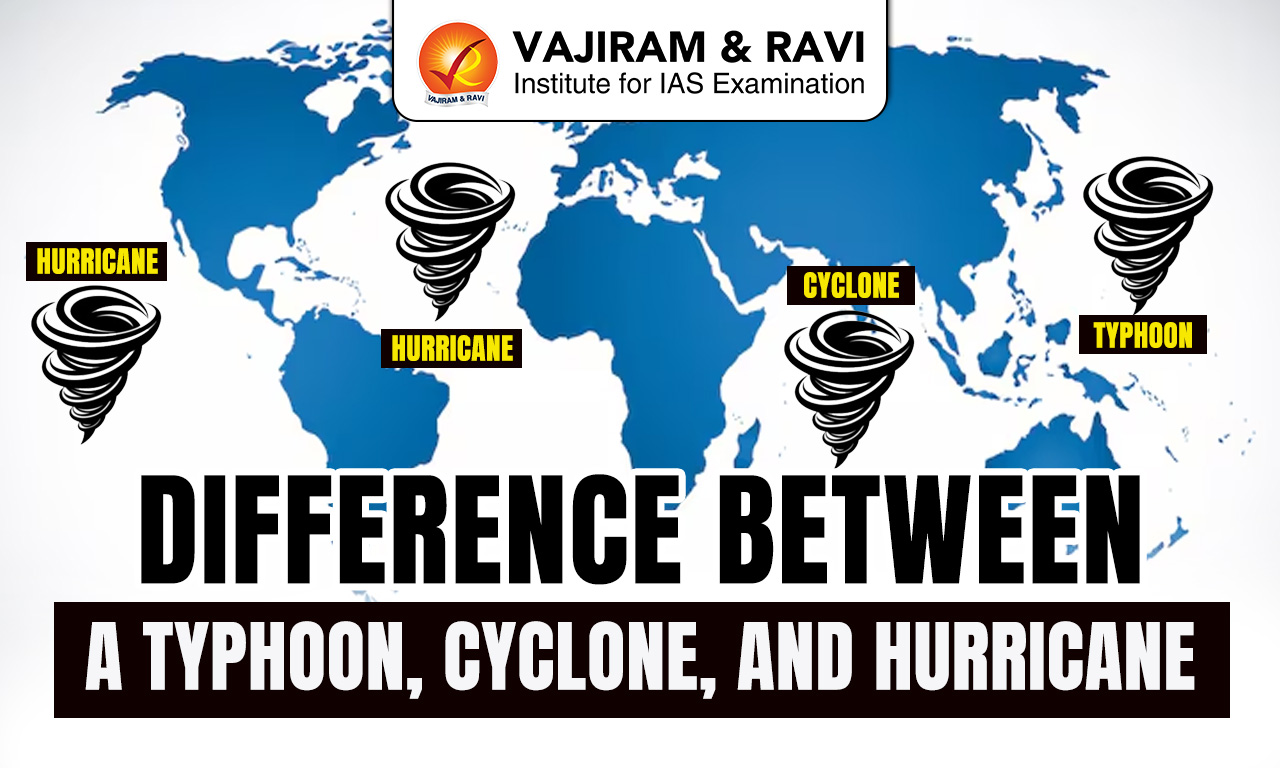
Difference between a Typhoon, Cyclone and Hurricane are closely related intense storm systems that develop over warm tropical oceans. They are all forms of tropical cyclones characterized by organized clouds, thunderstorms, strong rotating winds, and a low-pressure center, but their names differ depending on the geographical region where the storm originates.

Difference between a Typhoon, Cyclone and Hurricane

These are essentially the same tropical storm system, but the Difference between a Typhoon, Cyclone and Hurricane lies in that they are identified with different names depending on the ocean basin and regional meteorological terminology used across the world.

Difference between a Typhoon, Cyclone and Hurricane

Aspect

Typhoon

Cyclone

Hurricane

Meaning

A Typhoon is a powerful tropical cyclone that forms over warm ocean waters and rotates around a central low pressure system with thunderstorms.

Cyclone refers to a rotating low pressure storm system with organized clouds and thunderstorms developing over tropical or subtropical waters.

Hurricane is another name for a tropical cyclone with intense winds and thunderstorms rotating around a central low-pressure eye.

Distribution

Typhoons occur mainly in the Northwest Pacific Ocean, particularly around East Asia, the Philippines, and nearby island regions.

Cyclones develop primarily in the Indian Ocean and South Pacific Ocean, including regions near South Asia and Australia.

Hurricanes form mainly in the North Atlantic Ocean and the Northeast Pacific Ocean near the Americas.

Atmospheric circulation pattern

Typhoons rotate counter-clockwise in the Northern Hemisphere due to Earth’s rotation and the Coriolis effect.

Cyclones follow the same rotational pattern in the Northern Hemisphere and clockwise rotation in the Southern Hemisphere.

Hurricanes rotate counter-clockwise north of the equator and clockwise south of it, following the influence of planetary rotation.

Duration 

Typhoons may last several days over ocean waters but weaken rapidly after making landfall because the supply of warm moisture stops.

Cyclones similarly lose strength when moving inland as they lose access to oceanic heat and moisture.

Hurricanes weaken once they move over land, as their energy source from warm ocean water disappears.

Occurence

Typhoons are mainly concentrated in the western Pacific region, which records some of the world’s most intense tropical storms.

Cyclones are common across the Indian Ocean basin, especially near the northern Indian Ocean and southern Pacific regions.

Hurricanes dominate the Atlantic and eastern Pacific basins, where seasonal storm activity occurs during specific months.

Seasonal occurrence patterns

Typhoon activity often peaks during mid-year months such as July to October, when ocean waters are warmest.

Cyclones typically occur in two seasonal windows around April-June and September-December in tropical ocean basins.

Hurricanes usually develop during the June to November season, with highest activity around late summer.

Occurrence in the Indian subcontinent region

Typhoons rarely affect this region directly because they primarily develop farther east in the Pacific basin.

Cyclones frequently originate over the Bay of Bengal and Arabian Sea, making the eastern coastline particularly vulnerable.

Hurricanes do not form in this region because they are limited to Atlantic and northeastern Pacific ocean basins.

Examples

Super Typhoon Haiyan (2013), Muroto typhoon (1934), etc.

Cyclone Shakti (2025), Cyclone Montha  (2025)

Hurricane Francine (2024), Hurricane Sally (2020), etc.

Difference between a Typhoon, Cyclone and Hurricane FAQs

Q1: What is the main Difference between a Typhoon, Cyclone and Hurricane?

Ans: The main difference is the location where the storm forms. Hurricanes occur in the Atlantic and Northeast Pacific, typhoons in the Northwest Pacific, and cyclones in the Indian Ocean and South Pacific.

Q2: At what wind speed is a storm classified as a hurricane, cyclone, or typhoon?

Ans: A tropical storm is classified as a hurricane, cyclone, or typhoon when its maximum sustained wind speed reaches 74 miles per hour (119 km/h) or higher.

Q3: What conditions are necessary for the formation of a Typhoon, Cyclone and Hurricane?

Ans: They require warm ocean waters above about 26-27°C, a low-pressure system, minimal vertical wind shear, and the Coriolis effect to create rotating winds.

Q4: Why do Typhoon, Cyclone and Hurricane weaken after landfall?

Ans: They weaken after reaching land because they lose access to warm ocean moisture and heat, which act as the primary energy source for sustaining the storm.

Q5: Which of the storms commonly affect the Indian Ocean region?

Ans: Cyclones commonly develop in the Bay of Bengal and the Arabian Sea, making nearby coastal regions more vulnerable to their impacts.

Osbeckia zubeengargiana

Osbeckia zubeengargiana

Osbeckia zubeengargiana Latest News

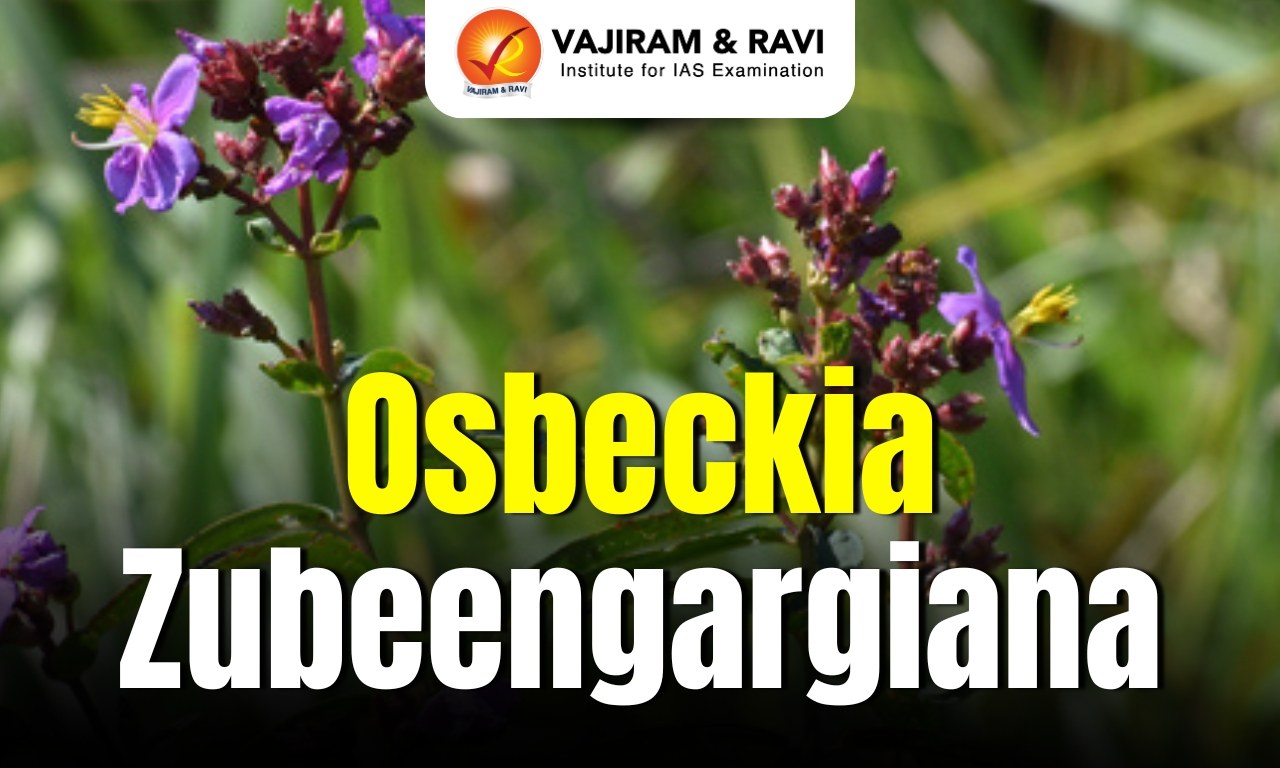
Researchers from Gauhati University recently discovered a new plant species named  Osbeckia zubeengargiana in Assam.

About Osbeckia zubeengargiana

  • It is a new plant species.
  • It was discovered in the grasslands of Manas National Park in Baksa District, Assam.
  • It has been named after celebrated Assamese singer Zubeen Garg, marking a rare tribute from the world of botany to a cultural icon of the region.
  • The plant belongs to the Melastomataceae family, a group known for its diverse flowering shrubs found across tropical and subtropical regions.
  • It is a perennial erect shrub that can grow up to 3.5 metres in height.
  • The plant is characterised by its delicate purple to pinkish four-petalled (tetramerous) flowers.
  • The shrub thrives in moist soil conditions and blooms seasonally, adding to the floral diversity of the grassland ecosystem.
  • The plant typically flowers and bears fruit between mid-September and January.

Source: IT

Osbeckia zubeengargiana FAQs

Q1: What is Osbeckia zubeengargiana?

Ans: It is a newly discovered plant species.

Q2: Where was Osbeckia zubeengargiana discovered?

Ans: It was discovered in the grasslands of Manas National Park in Baksa District.

Q3: After whom was Osbeckia zubeengargiana named?

Ans: It was named after Assamese singer Zubeen Garg.

Q4: What type of plant is Osbeckia zubeengargiana?

Ans: It is a perennial erect shrub.

Lok Adalats, Meaning, Types, Framework, Organizations, Powers

Lok Adalats

Lok Adalats represent one of India’s most people-centric justice delivery mechanisms as Alternative Dispute Redressal (ADR), designed to resolve disputes through mutual agreement rather than prolonged litigation. It is rooted in the constitutional mandate of access to justice under Article 39A. Lok Adalats aim to reduce judicial backlog while offering fast, affordable, and amicable dispute resolution. It operates across national, state, district, and taluk levels. They resolved over 10.5 crore cases in 2025 alone and 23.58 crore cases between 2022-25, according to the Ministry of Law and Justice.

Lok Adalats

Lok Adalats means “People’s Courts,” are informal forums where disputes are resolved through conciliation and consensus instead of adversarial proceedings. It is recognised statutorily under the Legal Services Authorities Act 1987. It ensures that settlements carry the legal status of a civil court decree. They function without rigid procedural laws, charge no court fees, and emphasise cooperative dialogue. Their expanding reach through National Lok Adalats, Permanent Lok Adalats, Mobile Lok Adalats, and E-Lok Adalats has significantly improved justice accessibility across India.

Also Read: Lok Sabha

Lok Adalats Framework

Lok Adalats operate under a clear statutory framework that ensures legality, uniformity, and enforceability of settlements nationwide. The major legal aspects governing the Lok Adalats have been listed below:

  1. Statutory Basis: Established under Legal Services Authorities Act 1987 for institutional dispute resolution.
  2. Constitutional Link: Strengthens Article 39A guaranteeing equal access to justice and free legal aid.
  3. Legal Status: Lok Adalat awards are deemed equivalent to civil court decree.
  4. Appeal Bar: No appeal allowed, ensuring finality and speedy closure.
  5. Court Fee: No court fee charged; paid fees refunded after settlement.

Lok Adalats Organizations

Multiple legal service institutions coordinate Lok Adalats to ensure nationwide reach and effective implementation. The major organizations regulating the Lok Adalats are:

  1. National Legal Services Authority (NALSA): Frames policy, issues calendars, monitors National Lok Adalats.
  2. State Legal Services Authorities: Organise state-level Lok Adalats headed by member secretary.
  3. High Court Legal Services Committee: Constitute benches of the Lok Adalat comprising Judges, Legal Professionals and Social workers.
  4. District Legal Services Authorities: Conduct district-level Lok Adalats and legal aid programmes.
  5. Taluk Legal Services Committees: Provide grassroots dispute resolution access.
  6. Judicial Leadership: Headed by Chief Justices or senior judicial officers.
  7. National Judicial Data Grid: Disposed off cases are updated on NJDG portal.

Also Read: Functions of Parliament

Lok Adalats Cases

Lok Adalats deal with a wide range of disputes while excluding serious non-compoundable offences. Annually it dispose off about 10 crore cases that are pending for various matters such as:

  1. Civil Disputes: Property, money recovery, and contractual matters.
  2. Family Matters: Matrimonial disputes and maintenance cases.
  3. Labour Issues: Workmen compensation and employment disputes.
  4. Criminal Cases: Only compoundable offences permitted.
  5. Excluded Matters: Non-compoundable criminal offences and constitutional cases are barred.

Lok Adalats Types

Lok Adalats have evolved into diverse formats to meet changing justice delivery needs. As of 2015, more than 14.15 Lok Adalats have been established in India, which includes:

    1. Regular Lok Adalat: Regular Lok Adalats are organized periodically by Legal Services Authorities to dispose of pending court cases and pre-litigation disputes through settlement. They function on the principle of mutual consent and cover civil cases, compoundable criminal cases, and public utility disputes. These Adalats help reduce court pendency and promote amicable dispute resolution without formal procedures.
      • Continuous Lok Adalat: Conducted at regular intervals throughout the year in court complexes to settle pending cases in a sustained manner.
      • Daily Lok Adalat: Held on a day-to-day basis in certain courts to resolve petty civil disputes and minor compoundable offences.
      • Mobile Lok Adalat: Organized in remote and rural areas using mobile units to provide legal services and dispute resolution at the doorstep of people.
      • Mega Lok Adalat: Conducted on a large scale at district or state levels, involving multiple benches to dispose of a high volume of cases in a single day.
    2. National Lok Adalat: National Lok Adalats are held across the country on a single day, usually once every quarter, under the guidance of the National Legal Services Authority. They focus on mass disposal of cases related to motor accident claims, bank recovery, matrimonial disputes, and cheque bounce cases, contributing significantly to reducing judicial backlog nationwide.
    3. Permanent Lok Adalat: Permanent Lok Adalats are statutory bodies established under Section 22B of the Legal Services Authorities Act 1987, for public utility services. They can adjudicate disputes even when parties fail to reach a settlement, provided the dispute value does not exceed the prescribed limit. They handle matters such as transport, electricity, water supply, postal services, and insurance.
    4. State Lok Adalat: State Lok Adalats are organized at the state level under the supervision of State Legal Services Authorities. They coordinate district-level Lok Adalats and focus on resolving cases involving state-level public institutions, government departments, and large-scale civil disputes.
    5. District Lok Adalat: District Lok Adalats are conducted by District Legal Services Authorities in district courts. They address civil disputes, family matters, land disputes, and compoundable criminal cases pending in district courts or at the pre-litigation stage.
    6. Taluk/ Tehsil Lok Adalat: Taluk or Tehsil Lok Adalats operate at the grassroots level under Taluk Legal Services Committees. They provide easy access to justice for rural populations by resolving local disputes, minor civil cases, and pre-litigation matters in a cost-free and informal manner.
    7. E-Lok Adalat: E-Lok Adalat is a digital dispute resolution mechanism where cases are settled through online platforms, enabling remote participation, faster disposal, reduced costs, and wider access to justice. It was established during 2019-20 amid COVID-19 pandemic.

Lok Adalats Jurisdictions

The jurisdiction of the Lok Adalats defines the scope, reach, and limits of Lok Adalats across India.

  1. Pending Court Cases: Matters already filed before any court.
  2. Pre-Litigation Disputes: Conflicts resolved before formal court filing.
  3. Territorial Reach: Jurisdiction aligned with organising authority’s area.
  4. Public Utility Services: Permanent Lok Adalats handle essential services disputes.
  5. Monetary Limit: Permanent Lok Adalats handle cases up to ₹1 Crore financial limits.

Lok Adalats Powers

Lok Adalats possess specific judicial and procedural powers ensuring enforceable outcomes. The main powers of the adalat are:

  1. Civil Court Powers: Equivalent powers under Code of Civil Procedure.
  2. Procedural Flexibility: Freedom to adopt informal settlement procedures.
  3. Judicial Proceedings Status: Proceedings treated as judicial in nature.
  4. Binding Nature: Decisions binding on all involved parties.
  5. Execution Authority: Awards executable like civil court decrees.

Also Read: Rajya Sabha

Lok Adalats Significance

Lok Adalats play a transformative role in strengthening India’s justice ecosystem through:

  1. Case Backlog Reduction: Crores of cases settled, easing court congestion.
  2. Cost Efficiency: Eliminates litigation expenses for common citizens.
  3. Speedy Justice: Disputes resolved in a single sitting.
  4. Social Harmony: Encourages amicable settlements and reconciliation.
  5. Access Expansion: Justice reaches rural and marginalised populations.

Lok Adalats Challenges

Several Challenges faced by the Lok Adalats has been discussed here:

  1. Limited Public Awareness: Many citizens, especially in rural areas, remain unaware of Lok Adalat procedures and legal validity of awards.
  2. Dependence on Mutual Consent: Cases cannot be decided unless both parties voluntarily agree, restricting dispute resolution outcomes.
  3. Exclusion of Serious Criminal Cases: Non-compoundable offences are outside jurisdiction, limiting scope in criminal justice.
  4. Inadequate Institutional Capacity: Shortage of trained conciliators and judges affects quality of settlements.
  5. Pressure for High Disposal Numbers: Emphasis on volume sometimes compromises depth of dispute resolution.
  6. Limited Suitability for Complex Cases: High-value, technical, or constitutional disputes are unsuitable for Lok Adalats.
  7. Uneven Performance Across States: Variation in infrastructure and administrative support impacts effectiveness.
  8. Digital Access Constraints: E-Lok Adalats face limitations due to internet access gaps and low digital literacy.

Way Forward

To address the challenges faced by Lok Adalats, several measures has been listed below:

  1. Legal Awareness Campaigns: Systematic outreach through Legal Services Authorities to improve citizen participation.
  2. Capacity Building: Regular training programmes for judges, lawyers, and mediators in conciliation techniques.
  3. Quality-Focused Evaluation: Shift performance metrics from case numbers to durability of settlements.
  4. Expansion of Permanent Lok Adalats: Increase coverage for public utility service disputes.
  5. Standardised Operating Procedures: Uniform guidelines to ensure consistency in settlement processes nationwide.
  6. Technology Integration: Strengthen digital platforms and hybrid models for E-Lok Adalats.
  7. Institutional Funding Support: Dedicated budgetary allocations for infrastructure and manpower.

Monitoring and Review Mechanism: Periodic assessment of awards to ensure fairness and compliance.

Lok Adalats FAQs

Q1: What are Lok Adalats?

Ans: A Lok Adalat is an alternative dispute resolution forum that settles cases through mutual consent, saving time and legal costs.

Q2: Are the decisions of Lok Adalats legally binding?

Ans: Yes, Lok Adalat awards are final, legally binding, and enforceable like a civil court decree.

Q3: Which cases can be taken up in Lok Adalats?

Ans: Civil cases, compoundable criminal cases, and disputes pending or pre-litigation stages can be resolved.

Q4: Can Lok Adalat awards be appealed?

Ans: No, there is no appeal against Lok Adalat awards, as settlements are reached with parties’ consent.

Q5: Who organizes Lok Adalats in India?

Ans: Lok Adalats are organized by Legal Services Authorities under the Legal Services Authorities Act 1987.

Kharg Island

Kharg Island

Kharg Island Latest News

Kharg Island is in the news after the United States launched airstrikes on military targets there amid escalating tensions with Iran, raising concerns about disruptions to global oil supply.

About Kharg Island

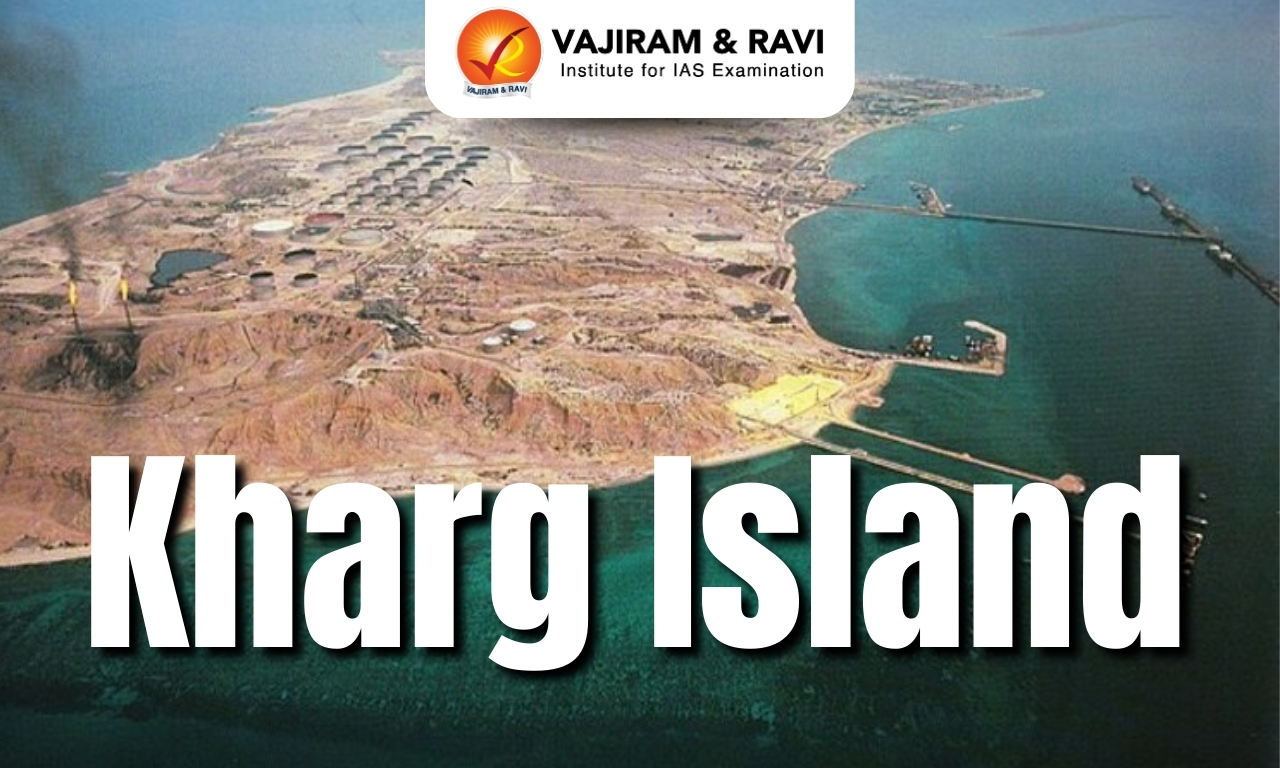
  • It is a small coral island in Iran in the northern Persian Gulf.
  • It lies about 30 Km from the Iranian mainland.
  • Its area is 25 sq.km., its length is 8 km, and its width is 4.5 km.
  • This rocky limestone island is unique because it is one of the few islands in the Persian Gulf with freshwater, which has collected within the porous limestone.
  • The island experiences hot and humid summers, and its highest point, Mount Didehban, stands at 87 meters above sea level.
  • The discovery of an offshore oil field in the waters around Kharg in the early 1960s stimulated the development of the island as a site for major petroleum and petrochemical installations. 
  • Connection by pipelines to the underwater oil fields, as well as to the oil fields in Khuzistan province, transformed Kharg into Iran's largest oil-loading terminal by the early 1970s. 
  • During the Iran–Iraq war (1980–1988), Kharg repeatedly was bombed, and its oil facilities suffered extensive damage, but they were reconstructed in the early 1990s.
  • It facilitates as much as 90 percent of the country's oil exports and is vital for Iran's economy.
  • It boasts a massive storage capacity of 28 million barrels and loading infrastructure capable of handling VLCCs and ULCCs.
  • It has a loading capacity of about 7 million barrels per day. It can load eight to nine supertankers simultaneously.
  • Its strategic significance lies in its proximity to the Strait of Hormuz, a crucial global oil passage.

Source: TELE

Kharg Island FAQs

Q1: Where is Kharg Island located?

Ans: It is a small coral island in Iran in the northern Persian Gulf.

Q2: Why is Kharg Island unique among many Persian Gulf islands?

Ans: It is one of the few islands in the Persian Gulf with freshwater, which has collected within the porous limestone.

Q3: What is the importance of Kharg Island to Iran's economy?

Ans: It facilitates as much as 90 percent of the Iran's oil exports.

Q4: What is the oil storage capacity of Kharg Island?

Ans: Around 28 million barrels.

Myiophanes kempi

Myiophanes kempi

Myiophanes kempi Latest News

Recently, researchers rediscovered Myiophanes kempi in limestone caves in the Andaman Islands after almost 100 years gap.

About Myiophanes kempi

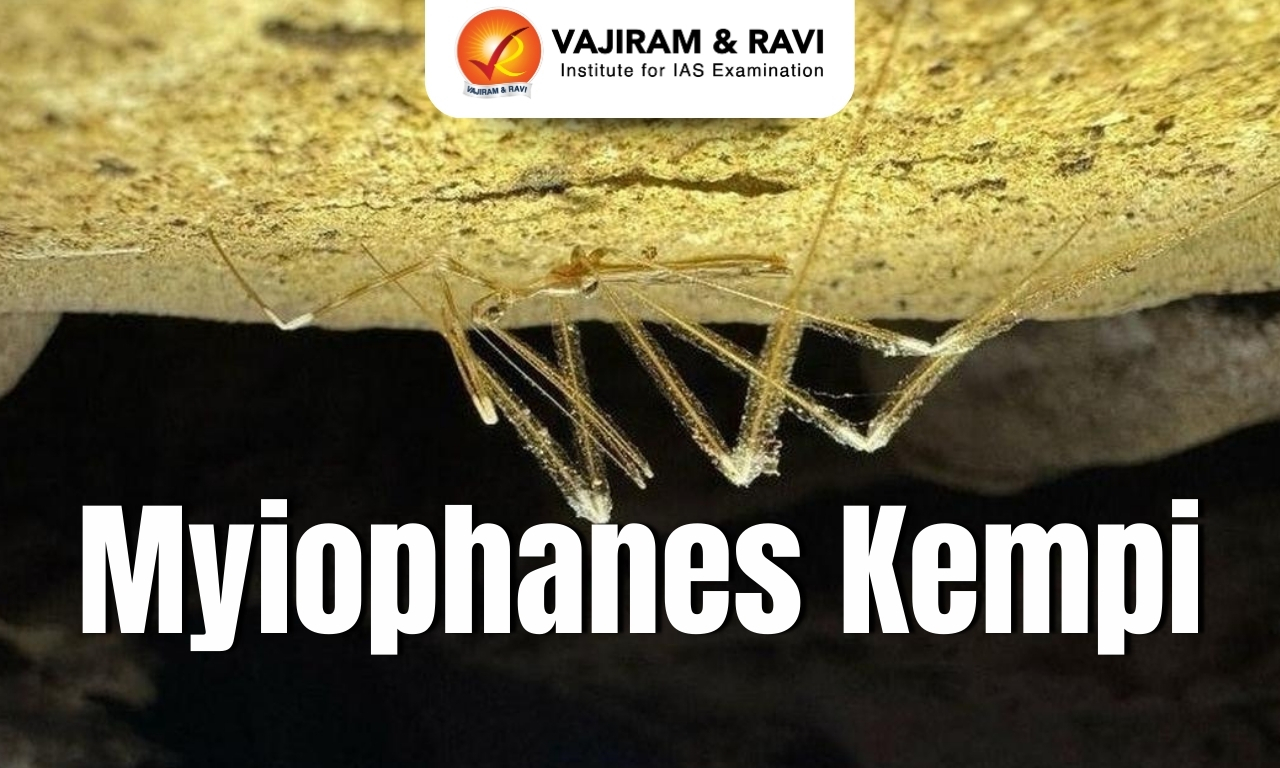
  • It is a slender-bodied assassin bug belonging to the subfamily of Reduviidae.
  • It was first described by British entomologist Willian Edward China in 1924.
  • It was previously described from Siju Cave in Meghalaya a century ago.

Characteristics of Myiophanes kempi

  • It is a specialised predator of the subterranean ecosystem and lives in its complete lifecycle in the darkness.
  • It uses the long raptorial forelegs for snatching prey -- small arthropods of the dark cave environment.

Key Facts about Siju Cave

  • Location: It is one of the longest limestone cave systems in the world situated in Garo Hills in the state of Meghalaya.
  • It is also known as Dobakkol or Bat Cave, is one of India's longest limestone caves, stretching over 4.7 km.
  • It is located near the Simsang River.
  • It is famous for its stunning rock formations and underground streams. 

Source: TH

Myiophanes kempi FAQs

Q1: Where was the Myiophanes kempi thread-legged assassin bug rediscovered?

Ans: Andaman limestone caves

Q2: What family does Myiophanes kempi belong to?

Ans: Reduviidae

Silverpit Crater

Silverpit Crater

Silverpit Crater Latest News

New research has confirmed that the Silverpit Crater was formed by a massive asteroid impact millions of years ago.

About Silverpit Crater

  • Location: It lies about 700 meters beneath the seabed in the North Sea, roughly 80 miles off the coast of Yorkshire, United Kingdom.
  • Silverpit is buried under a huge layer of sediment and was only discovered in 2002.
  • Formation: It was formed by a high-velocity space rock striking the seabed roughly 43 to 46 million years ago.
  • Scientific Evidence: Researchers identified “shocked" quartz and feldspar crystals in rock samples from a nearby oil well that only form under the extreme shock pressures of a high-velocity space impact.

Features of Silverpit Crater

  • It measures roughly three kilometres wide and is surrounded by a ring of circular faults stretching nearly 20 kilometres across.
  • It consists of a set of concentric faults up to 20 km in diameter in the southern North Sea. 
  • It is a rare and exceptionally well-preserved hypervelocity impact crater.
  • Its round shape and central peak resembled classic impact craters. 

Source: ET

Silverpit Crater FAQs

Q1: Where is the Silverpit Crater located?

Ans: North Sea

Q2: What is the Silverpit Crater believed to be?

Ans: An impact crater

Herpes Simplex Virus (HSV)

Herpes Simplex Virus (HSV)

Herpes Simplex Virus (HSV) Latest News

About 92 inmates of Jalpaiguri Central Correctional Home (JCCH) in West Bengal were infected with the Herpes Simplex Virus (HSV) between August 20, 2025, and March 9 this year, with seven of the infected inmates losing their lives.

About Herpes Simplex Virus (HSV)

  • Herpes simplex virus (HSV), known as herpes, is a common infection that can cause painful blisters or ulcers. 
  • There are two types of HSV:
    • HSV-1: This type primarily causes oral herpes, characterized by cold sores or fever blisters that appear around your mouth or on your face.
    • HSV-2: This primarily causes genital herpes, which involves sores that appear on or around your genitals, anus, buttocks, and inner thighs.

Herpes Simplex Virus (HSV) Transmission

  • HSV is highly contagious. It is spread by skin-to-skin contact with someone who carries the virus.
  • Once infected, a person will have the HSV for the rest of their life.
  • HSV can periodically reactivate, causing symptoms.

Herpes Simplex Virus (HSV) Symptoms

  • Most people with herpes have no symptoms or only mild symptoms.
  • Many people aren’t aware they have the infection and can pass along the virus to others without knowing.
  • Others might experience occasional episodes of small, fluid-filled blisters or sores. 
  • These sores and blisters are typically painful. Blisters may break open, ooze, and then crust over. 
  • New infections may cause fever, body aches, and swollen lymph nodes.
  • In rare cases, infection with HSV-1 or HSV-2 can lead to meningitis (inflammation of the covering of the brain and spinal cord) or encephalitis (inflammation of the brain).

Herpes Simplex Virus (HSV) Treatment 

  • It is treatable but not curable.
  • Antivirals and home remedies can help ease the severity of symptoms. Antiviral medication may also lead to fewer herpes episodes.

Source: TH

Herpes Simplex Virus (HSV) FAQs

Q1: What is Herpes simplex virus (HSV)?

Ans: It is a common viral infection that can cause painful blisters or ulcers on the skin.

Q2: How is the Herpes simplex virus transmitted?

Ans: It spreads through skin-to-skin contact with an infected person.

Q3: What are common symptoms of herpes infection?

Ans: Small, painful fluid-filled blisters or sores that may break open, ooze, and crust over.

Q4: Is herpes curable?

Ans: No, herpes is treatable but not curable.

Joha Rice

Joha Rice

Joha Rice Latest News

Recently, India has facilitated the export of 25 metric tonnes of Assam’s GI-tagged Joha Rice to the United Kingdom and Italy.

About Joha Rice

  • It is an indigenous rice of Assam.
  • It is an indigenous aromatic rice variety known for its distinct fragrance, fine grain texture and rich taste.
  • It is grown in the Sali/ Kharif season.
  • Major Joha varieties included in this are Kola Joha, Keteki Joha, Bokul Joha and Kunkuni Joha.
  • This rice is also rich in several antioxidants, flavonoids, and phenolics.
  • It has got a Geographical Indication (GI) tag in 2017.
  • This rice variety has two unsaturated fatty acids viz., linoleic acid (omega-6) and linolenic (omega-3) acid.
    • These essential fatty acids (which humans cannot produce) can help maintain various physiological conditions.

What is a Geographical Indication Tag?

  • It is a sign used on products that have a specific geographical origin and possess qualities or a reputation that are due to that origin.
  • This is typically used for agricultural products, foodstuffs, wine and spirit drinks, handicrafts and industrial products.
  • The Geographical Indications of Goods (Registration and Protection) Act, 1999 seeks to provide for the registration and better protection of geographical indications relating to goods in India.
  • This GI tag is valid for 10 years following which it can be renewed.

Source: News On Air

Joha Rice FAQs

Q1: Where is Joha Rice primarily grown?

Ans: Assam

Q2: What is special about Joha Rice?

Ans: It's got Geographical Indication (GI) tag

Tanzania

Tanzania

Tanzania Latest News

Recently, India has dispatched a consignment of essential life-saving medicines to Tanzania as humanitarian assistance.

About Tanzania

  • Location: It is an East African country situated just south of the Equator.
  • Bordering Countries: It shares borders with eight countries: Kenya and Uganda to the north, Rwanda, Burundi, and the Democratic Republic of the Congo to the west, and Zambia, Malawi, and Mozambique to the south. 
  • Maritime Border: The eastern border of Tanzania meets the Indian Ocean.
  • Capital: Dar es Salaam (administrative captial), Dodoma (legislative capital).

Geographical Features of Tanzania

  • Climate type: Tropical, with a long dry season and two rainy seasons.
  • Major lakes: Lake Victoria (the world’s second-largest freshwater lake, shared with Uganda and Kenya) in the north, Lake Tanganyika in the west, and Lake Nyasa in the southwest.
  • Highest Peak: Mount Kilimanjaro
  • Major rivers:  Great Ruaha, Rufiji, and Kagera rivers. 
  • Islands: It includes Zanzibar, Pemba, and Mafia, all located off the eastern coast in the Indian Ocean.

Source: News On Air

Tanzania FAQs

Q1: Tanzania is home to which famous national park?

Ans: Serengeti National Park

Q2: Which mountain in Tanzania is Africa's highest peak?

Ans: Mount Kilimanjaro

Deepor Beel

Deepor Beel

Deepor Beel Latest News

Illegal earth cutting from a wetland connected to Deepor Beel is continuing unabated in the Satmile area of Guwahati, despite prohibitory orders from the district administration and restrictions imposed by the Gauhati High Court.

About Deepor Beel

  • It is a permanent freshwater lake located on the outskirts of Guwahati, Assam. 
  • It lies in a former channel of the Brahmaputra River.
  • Beel is an Assamese local word which means ‘lake’, and the name Deepor Beel means the ‘lake of elephants’.
  • It covers an area of 4.1 sq.km. It is considered one of the biggest lakes of the Brahmaputra Valley of Lower Assam.
  • It is surrounded by steep highlands on the northern and southern sides, and its main sources of water are the Kalmani and Basistha Rivers.
  • It is the only major stormwater storage basin for the city of Guwahati
  • The lake’s outflow is the Khandajan rivulet, which joins the Brahmaputra.
  • It was recognised as a Ramsar Site in 2002 and as an Important Bird and Biodiversity Area (IBA) in 2004. It is the only Ramsar site in the state of Assam.
  • This lake is a staging site on migratory flyways, and some of the largest concentrations of aquatic birds in Assam can be seen, especially in winter. 
  • Some globally threatened birds are supported, including Spot-billed Pelican, Lesser Greater Adjutant Stork, and Baer’s Pochard.
  • About 50 fish species and aquatic resources provide livelihood support to about 1,200 households residing in about 12 villages on the fringes of the wetland.
  • The Rani and Garbhanga hills, the habitat of the Asiatic elephants on the southern side of the beel, are part of this ecosystem.

Source: SENT

Deepor Beel FAQs

Q1: Where is Deepor Beel located?

Ans: It is a permanent freshwater lake located on the outskirts of Guwahati in Assam.

Q2: Deepor Beel lies in a former channel of which river?

Ans: The Brahmaputra River.

Q3: What is the outflow channel of Deepor Beel?

Ans: The Khandajan rivulet, which later joins the Brahmaputra River.

Q4: What is the significance of Deepor Beel in Assam’s wetland network?

Ans: It is the only Ramsar site in Assam.

Deendayal Port

Deendayal Port

Deendayal Port Latest News

The Deendayal Port in Gujarat's Kandla is gearing up to handle a whopping 22 vessels over a 72-hour period over the weekend.

About Deendayal Port

  • Deendayal Port (previously called Kandla Port) is the second largest seaport of India, situated in the Kachchh District of Gujarat State in western India.  
  • It is situated in the creek of Kandla, which is at a distance of 90 kms from the Gulf of Kachchh.  
  • It is a protected natural harbor.
  • It is recognized as one of the major ports in India.
  • It was constructed in the 1950s as the chief seaport serving western India after the partition of India from Pakistan left the port of Karachi in Pakistan. 
  • It is 256 nautical miles southeast of the Port of Karachi in Pakistan and over 430 nautical miles north-northwest of the Port of Mumbai.
  • The port is specialized in handling bulk import and export cargo, including liquid cargo.
  • It features 18 berths, including 12 dry cargo berths and 6 oil jetties, handling a wide range of cargo such as petroleum, chemicals, iron ore, salt, and containers.
  • It remains India’s biggest state-owned cargo handler by volume, but it has steadily lost market share to privately owned Mundra Port (India’s largest private port), 60 km to the southwest.

Source: WEEK

Deendayal Port FAQs

Q1: What was the former name of Deendayal Port?

Ans: Kandla Port.

Q2: Where is Deendayal Port located?

Ans: It is located in Kachchh District in Gujarat.

Q3: In which creek is Deendayal Port situated?

Ans: It is situated in the Kandla Creek.

Q4: Why was Deendayal Port constructed in the 1950s?

Ans: It was built to serve as the chief seaport of western India after the Partition of India, when Port of Karachi became part of Pakistan.

Musi River

Musi River

Musi River Latest News

Several historic landmarks have been identified as part of the 55-km Musi river rejuvenation project, with authorities exploring ways to link them through heritage tourism and cultural initiatives along the river corridor.

About Musi River

  • The Musi River, also known as the Muchukunda or Musunuru River, is a major tributary of the Krishna River in the Deccan Plateau, flowing through Telangana.
  • The river gained prominence in the late 16th century when Muhammad Quli Qutb Shah, the founder of Hyderabad, established the city along its banks.
  • Course:
    • It originates from Anantagiri Hills near Vikarabad District.
    • The river is formed by the merging of two small rivulets: Esi (8 km) and Musa (13 km).
    • After originating, the Musi River flows in an eastward direction, cutting through the heart of Hyderabad city, where it historically divided the Old City from the New City.
    • The river then continues its journey through the southern Telangana plains.
    • It ultimately joins the Krishna River near Wazirabad in Nalgonda district.
  • Total Length: 240 kilometers.
  • Dams: Himayat Sagar and Osman Sagar are the two dams that are constructed over the river.
  • Hussain Sagar Lake was built on a tributary of the River Musi. It was a lake of 24 kilometres, built to meet the water and irrigation needs of the city.
  • Several historic bridges and mosques line its banks, reflecting Qutb Shahi and Nizam-era architecture.
  • The Musi River has 24 diversion weirs for irrigation, locally known as kathwas.
  • Now due to random urbanization and lack of planning the river has become a holder of all the unprocessed domestic and industrial waste drained out of Hyderabad.

Source: DC

Musi River FAQs

Q1: The Musi River is a major tributary of which river?

Ans: Krishna

Q2: What is the origin of the Musi River?

Ans: Anantagiri Hills, Vikarabad, Telangana

Q3: Which city does the Musi River flow through?

Ans: Hyderabad

Q4: What is the approximate length of the Musi River?

Ans: 240 km

Alprazolam

Alprazolam

Alprazolam Latest News

Recently, the Directorate of Revenue Intelligence (DRI) has busted a clandestine facility engaged in the production of Alprazolam in Andhra Pradesh.

About Alprazolam

  • It is a psychotropic substance under the Narcotics, Drugs and Psychotropic Substances (NDPS) Act 1985.
  • This drug falls under the benzodiazepines class of drugs, and is a tranquillizing agent used in the treatment of anxiety disorders.
    • Benzodiazepines belong to the group of medicines called central nervous system (CNS) depressants, which are medicines that slow down the nervous system.
  • Alprazolam enhances the activity of a neurotransmitter in the brain called gamma-aminobutyric acid (GABA). 
  • Used for: It is used to treat anxiety disorders, panic disorders, and anxiety caused by depression.

Key Facts about Directorate of Revenue Intelligence

  • It was constituted in 1957 as the apex anti-smuggling intelligence and investigation agency.
  • Functions: It is tasked with detecting and curbing smuggling of contraband, including drug trafficking and illicit international trade in wildlife and environmentally sensitive items, as well as combating commercial frauds related to international trade and evasion of customs duty.
  • Nodal Ministry: It works under the Central Board of Indirect Taxes & Customs (CBIC), Ministry of Finance, Government of India. 

Source: TH

Alprazolam FAQs

Q1: Which class of medications does Alprazolam belong to?

Ans: Benzodiazepines

Q2: What is Alprazolam used for?

Ans: Anxiety and panic disorders

Menstrual Leave Debate in India – Explained

Menstrual Leave

Menstrual Leave Latest News

  • The Supreme Court recently observed that making paid menstrual leave mandatory by law may unintentionally harm women’s career prospects and reduce their employment opportunities. 

Menstrual Leave in India

  • Menstrual leave refers to leave granted to women during their menstrual cycle when they may experience severe physical discomfort, such as cramps or other medical conditions. 
  • The issue has increasingly become part of discussions on gender equality, workplace welfare, and labour rights.
  • India does not currently have a nationwide law mandating menstrual leave. However, certain initiatives exist at the institutional or regional level. For example:
    • Some educational institutions have introduced menstrual leave policies for students.
    • Certain state governments have provided limited leave provisions in schools or universities.
    • Several private companies have voluntarily implemented menstrual leave policies.
  • These initiatives reflect growing awareness of menstrual health issues in workplaces and educational institutions.

Global Practices on Menstrual Leave

  • Several countries have adopted policies related to menstrual leave, though their design and implementation vary. For instance:
    • Spain introduced a law in 2023 allowing women to take 3-5 days of menstrual leave, with the cost borne by the government. 
    • Japan introduced menstrual leave legislation as early as 1947.
    • South Korea, Indonesia, China, and Zambia also have provisions that allow menstrual leave under certain conditions.
  • These international examples illustrate different approaches to addressing menstrual health in workplaces.

Supreme Court’s Observations on Mandatory Menstrual Leave

  • The debate gained attention after a petition sought directions from the Supreme Court to introduce a uniform law granting paid menstrual leave to women workers and female students across the country.
  • The Supreme Court Bench, headed by Chief Justice of India Surya Kant, observed that a mandatory legal provision for menstrual leave could negatively impact women’s careers
  • The Court highlighted several potential risks:
    • Impact on Hiring Decisions: Employers might become reluctant to hire women if they are required to provide additional mandatory leave every month.
    • Reduced Workplace Responsibilities: There is concern that employers may hesitate to assign major responsibilities to women if they perceive them as frequently unavailable during certain periods.
    • Career Growth Concerns: The Court observed that mandatory leave policies might inadvertently create a perception that women are less capable of handling demanding roles.
  • These observations were based on the broader realities of the labour market and workplace dynamics.
  • Ultimately, the Court disposed of the petition and asked the Central Government to consider the representation and explore the possibility of framing an appropriate policy in consultation with stakeholders.

Distinction Between Voluntary Policies and Legal Mandates

  • While expressing concerns about a compulsory law, the Court made an important distinction between voluntary workplace policies and statutory mandates.
  • The judges encouraged voluntary initiatives by employers or institutions that support women employees. Such policies allow organisations to adapt to their workforce needs without creating rigid legal obligations.
  • For example, some private companies and educational institutions have already introduced menstrual leave policies. Similarly, certain states have implemented limited provisions for menstrual leave in educational institutions. 
  • The Court indicated that such voluntary approaches may provide support to women without negatively affecting employment opportunities.

Broader Issues in the Debate

  • The discussion around menstrual leave highlights broader issues concerning gender equality in workplaces.
  • Supporters argue that menstrual leave recognises biological realities and promotes workplace dignity for women. It can help women manage severe menstrual pain, which may otherwise affect productivity and health.
  • Critics, however, argue that mandatory leave policies could reinforce gender stereotypes and discourage employers from hiring women.
  • Therefore, policymakers must balance workplace equality, health considerations, and labour market realities while designing such policies.

Source: TH | TOI

Menstrual Leave FAQs

Q1: What is menstrual leave?

Ans: Menstrual leave refers to leave granted to women during menstruation to manage menstrual pain or related health issues.

Q2: Why did the Supreme Court express concerns about mandatory menstrual leave?

Ans: The Court said compulsory menstrual leave could discourage employers from hiring women and affect their career opportunities.

Q3: Did the Supreme Court order a law on menstrual leave?

Ans: No, the Court asked the Central Government to consider framing a policy after consulting stakeholders.

Q4: Do any countries provide menstrual leave?

Ans: Yes, countries such as Spain, Japan, South Korea, and Indonesia have provisions related to menstrual leave.

Q5: Is menstrual leave currently mandatory in India?

Ans: No, India does not have a nationwide law mandating menstrual leave, though some institutions and companies provide it voluntarily.

Daily Editorial Analysis 14 March 2026

Daily-Editorial-Analysis

The Fate of the Washington Consensus, Once Talisman

Context

  • In the late twentieth century, the Washington Consensus emerged as a dominant framework guiding economic reform in developing countries.
  • Coined by John Williamson in 1989, the term described ten policy prescriptions widely supported by institutions in Washington as remedies for economic crises.
  • These reforms emphasised fiscal discipline, market liberalisation, privatisation, and deregulation, aiming to stabilise economies and stimulate growth.
  • Today, the Washington Consensus is seen less as a universal blueprint and more as a historically specific framework whose legacy continues to shape debates about development and global economic governance.

Origins and Core Principles of the Washington Consensus

  • The Washington Consensus emerged during severe debt crises in Latin America and other developing regions.
  • International institutions such as the International Monetary Fund and the World Bank promoted reforms intended to restore macroeconomic stability and encourage market-driven growth.
  • The ten policy prescriptions included:
    • Fiscal discipline
    • Reordering public expenditure,
    • Tax reform, interest rate liberalisation,
    • Competitive exchange rates,
    • Trade liberalisation,
    • Foreign direct investment liberalisation,
    • Privatisation of state enterprises,
    • Deregulation, and Secure Property Rights.
  • Together these reforms formed a policy framework often summarised as liberalise, privatise, and deregulate.

Implementation and Global Impact

  • The Washington Consensus operated largely through loan conditionalities imposed by international financial institutions.
  • Countries facing fiscal or balance-of-payments crises often adopted structural reforms in exchange for financial assistance from the IMF or the World Bank.
  • These reforms reshaped national economies by encouraging trade openness, financial liberalisation, and private sector expansion.
  • In some countries they contributed to improved macroeconomic stability and renewed growth. Yet outcomes varied widely across regions.

Critiques and Structural Limitations

  • A major criticism of the Washington Consensus was its rejection of industrial policy, which involves state support for strategic domestic industries.
  • Trade rules under the World Trade Organization restricted policy tools such as subsidies and investment regulations, limiting the ability of developing countries to nurture emerging sectors.
  • This restriction contrasted sharply with the historical experience of successful industrial economies.
  • Countries such as South Korea, Taiwan, and Japan relied heavily on state-led development, strategic protection, and targeted industrialisation during their formative years.
  • Structural adjustment policies also produced significant social consequences. Cuts in public spending weakened public services, increased economic inequality, and intensified poverty in several regions.

Political Backlash and the Decline of the Consensus

  • By the late 1990s, dissatisfaction with the Washington Consensus had grown widespread.
  • Protests against globalisation and international financial institutions spread across many parts of the Global South.
  • The divisions were also visible in global trade negotiations, including the 1999 Seattle WTO protests and the 2003 Cancún WTO Ministerial Conference.
  • These confrontations highlighted tensions between developed and developing nations over trade rules and development priorities.
  • After the 2008 financial crisis, scepticism toward liberalisation expanded within advanced economies as well.
  • Political movements expressing frustration with globalisation emerged in the West, including the Make America Great Again movement and the referendum leading to Brexit.
  • These developments revealed widespread disillusionment with economic globalisation and its perceived social costs.

The Emergence of a Post-Washington Consensus

  • The twenty-first century has witnessed the gradual emergence of a post-Washington consensus, which recognises that markets alone cannot ensure inclusive development.
  • Contemporary economic thinking emphasises institutional strength, public investment, social safety nets, and redistributive policies.
  • Governments increasingly focus on education, healthcare, infrastructure, and innovation systems to support long-term development.
  • Strategic industrial policy, once dismissed, has regained importance in fostering technological capabilities and competitive industries.
  • Alternative models have also gained prominence. The state-led development strategy associated with China demonstrates how state intervention, industrial strategy, and controlled liberalisation can drive rapid economic transformation.

Conclusion

  • The Washington Consensus once offered a seemingly universal formula for development based on liberalisation, privatisation, and deregulation.
  • Over time, however, financial crises, inequality, and political resistance revealed the limitations of a single policy template.
  • Contemporary economic governance reflects a more pragmatic, context-sensitive, and policy-diverse
  • Governments now combine market mechanisms with state intervention, adapting strategies to their institutional capacities and national priorities.
  • The decline of the Washington Consensus therefore marks not the end of globalisation, but the end of the belief in a single universal model of development.

The Fate of the Washington Consensus, Once Talisman FAQs

Q1. What is the Washington Consensus?
Ans. The Washington Consensus is a set of economic policy prescriptions introduced in 1989 to promote fiscal discipline, market liberalisation, and economic stability in developing countries.

Q2. Who coined the term Washington Consensus?
Ans. The term Washington Consensus was coined by economist John Williamson in 1989.

Q3. Which institutions promoted the Washington Consensus policies?
Ans. International institutions such as the International Monetary Fund and the World Bank promoted the policies associated with the Washington Consensus.

Q4. Which major crisis exposed weaknesses in the Washington Consensus model?

Ans. The Global Financial Crisis exposed major weaknesses in the market-driven policies promoted by the Washington Consensus.

Q5. What is meant by the post-Washington consensus?
Ans. The post-Washington consensus refers to a newer development approach that combines markets with state intervention, social protection, and strategic public investment.

 Source: The Hindu


LPG Cylinder - Energy Access, Social Justice and Global Geopolitics

Context

  • The Liquefied Petroleum Gas (LPG) cylinder and pressure cooker have become enduring symbols of modern domestic life in India since the mid-20th century.
  • Access to LPG not only represents technological progress and household welfare but also reflects deeper social dynamics related to class mobility, gender roles, and public policy.
  • Government initiatives such as the Pradhan Mantri Ujjwala Yojana (PMUY) have attempted to expand access to clean cooking fuel.
  • However, global geopolitical developments—particularly tensions in West Asia and disruptions (around the Strait of Hormuz)—continue to affect LPG supply and affordability in India.

LPG in India - From Household Symbol to Welfare Instrument

  • LPG cylinder as a marker of modernity
    • Since the 1950s, LPG cylinders have become a cultural symbol of modern domestic life and rising living standards.
    • In popular culture, the presence of LPG and pressure cookers signifies economic mobility, family well-being, and urban aspirations.
    • Conversely, traditional wood-burning chulhas are often used in cinema and literature to portray poverty and deprivation.
  • LPG as a tool of welfare policy
    • The Government of India launched the PMUY in 2016 to provide clean cooking fuel connections to poor and rural households, particularly women.
    • Objectives include reducing indoor air pollution, improving women’s health, reducing drudgery associated with firewood collection, and promoting clean energy transition.
    • The scheme also carries strong political and welfare symbolism, presenting LPG access as a marker of development and dignity.

Global Geopolitics and India’s LPG Security

  • Dependence on imports
    • India relies heavily on imported LPG to meet domestic demand.
    • Approximately 90% of LPG imports pass through the Strait of Hormuz, a crucial maritime energy corridor.
  • Geopolitical risks
    • Conflicts in West Asia, including tensions involving Iran and Israel, threaten supply routes.
    • Any disruption in the Strait of Hormuz can trigger supply shortages, price volatility, and energy security concerns.
    • These risks highlight the vulnerability of welfare schemes like PMUY to global energy geopolitics.
  • Economic impact beyond households
    • LPG shortages affect not only households but also the service economy, including restaurants, hotels, and small food businesses.
    • These sectors may have to curtail operating hours, highlighting the broader economic importance of LPG supply stability.

Social Dimensions of Energy Access

  • Class and poverty
    • Poor households are more dependent on biomass fuels (wood, dung, crop residues).
    • Burning biomass contributes to indoor and outdoor air pollution, disproportionately affecting the poor due to crowded settlements, poor ventilation, and high population density.
  • Caste-based inequality
    • Access to LPG shows stark disparities across social groups. For example, upper-caste households have significantly higher LPG adoption.
    • SC/ST households face barriers such as marginalised settlements, poor infrastructure and transport, and difficulty in accessing LPG distribution networks.
    • Thus, energy access intersects with caste and spatial inequality.
  • Gender dimension
    • Women and girls bear the greatest burden of biomass fuel usage due to their traditional role in cooking.
    • Consequences include higher exposure to indoor air pollution, and respiratory illnesses and long-term health risks.
    • Despite this, household fuel decisions are often taken by men, reflecting gendered power structures.

Women’s Empowerment Through LPG Access:

  • Health benefits: Reduced exposure to smoke and particulate matter lowers risks of respiratory diseases, eye irritation, and cardiovascular problems.
  • Time and labour savings: LPG reduces the time spent on collecting firewood and long cooking processes.
  • Economic and social empowerment:
    • Saved time allows women to pursue income-generating activities, participate in community life, and enjoy leisure and better health.
    • Control over time enhances personal autonomy and life opportunities for women.

Challenges and Way Forward:

  • Import dependence: Heavy reliance on LPG imports exposes India to global supply disruptions and price shocks.
    • Diversification of energy sources: Reduce import dependency by expanding domestic LPG production, and alternative clean fuels (biogas, electric cooking).
  • Infrastructure and distribution gaps: Remote and marginalised settlements often lack efficient LPG distribution networks.
    • Inclusive energy access: Improve LPG distribution infrastructure in remote and marginalised communities.
  • Social inequality: Persistent caste, class, and gender disparities in access to clean fuel.
    • Promote clean cooking alternatives: Encourage solar, induction cooking, and community biogas systems in rural areas.
  • Affordability of refills: Even with subsidies, refill costs discourage sustained usage among poor households.
    • Strengthening PMUY implementation: Ensure affordable refills and continuous usage, not just connection coverage.
  • Geopolitical vulnerability: Disruptions in energy chokepoints like the Strait of Hormuz can undermine domestic welfare policies.
    • Strategic energy security: Develop strategic LPG reserves and diversify import routes to mitigate geopolitical risks.

Conclusion

  • The LPG cylinder represents far more than a household utility in India—it embodies public health, gender justice, social mobility, and development aspirations.
  • Programmes such as PMUY have expanded access to clean cooking fuel, yet structural inequalities and geopolitical vulnerabilities continue to shape outcomes.
  • Ensuring reliable, affordable, and equitable access to clean energy is essential not only for improving household welfare but also for advancing inclusive development and energy security in India.

LPG Cylinder FAQs

Q1. How does access to LPG contribute to improving public health and gender equality in India?

Ans. It reduces indoor air pollution, improves women’s health, and saves time spent on fuel collection.

Q2. What are the socio-economic inequalities in access to clean cooking fuel in India?

Ans. Access is shaped by class, caste, gender, and rural–urban disparities, with SC/ST and poorer households facing greater barriers.

Q3. What is the significance of the PMUY in India’s clean energy transition?

Ans. The scheme has expanded LPG access to poor households, improved health and welfare outcomes for rural women, etc.

Q4. Why is India’s LPG supply vulnerable to global geopolitical developments?

Ans. India imports a large share of its LPG, with about 90% of supplies passing through the Strait of Hormuz.

Q5. What is the role of clean cooking fuel access in promoting inclusive development in India?

Ans. Clean cooking fuel access improves health, reduces gender drudgery, enhances productivity, and bridges socio-economic inequalities.

Source: IE


The India-Canada Turnaround is About Deliverables

Context

  • Canadian Prime Minister Mark Carney’s visit to India marked a significant improvement in bilateral relations after tensions during Justin Trudeau’s tenure. The visit focused on practical outcomes while avoiding contentious past issues.
  • Canada has adopted a pragmatic approach, managing domestic political sensitivities while cautiously rebuilding its relationship with India.
  • This article highlights the renewed momentum in India–Canada relations following Prime Minister Mark Carney’s visit, focusing on economic cooperation, critical minerals, energy partnerships, and pragmatic diplomacy.

Economic Focus in the India–Canada Engagement

  • The renewed engagement between India and Canada comes amid significant global geopolitical and economic disruptions.
  • Canada faces pressure from the United States due to supply-chain dependence and evolving tariff policies, while conflicts in Europe, West Asia, and the Levant have unsettled global economic stability.
  • Shared Interest in Stability and Growth
    • India and Canada share a common objective of avoiding geopolitical conflicts and focusing on economic growth and national development.
    • However, given the interconnected nature of global supply chains, both countries recognise that they cannot remain completely insulated from global disruptions.
    • Both nations view diversification in trade, energy, investment, and security partnerships as essential to reducing vulnerabilities and strengthening economic resilience.

Key Outcomes of the Carney Visit

  • Prime Minister Mark Carney’s visit resulted in at least eight agreements and contracts across important sectors.
  • A major development was the signing of terms for the Comprehensive Economic Partnership Agreement (CEPA), establishing a framework for future trade negotiations.
  • Another important outcome was a memorandum of understanding under the Australia–Canada–India Technology and Innovation Partnership.
  • This is aimed at promoting collaboration in technology and innovation and strengthening Canada’s engagement with Indo-Pacific partners.

Expanding Strategic Cooperation Between India and Canada

  • Broader Areas of Collaboration - India and Canada signed additional agreements to strengthen cooperation in research partnerships, cultural exchanges, and food and nutrition sectors, expanding the scope of bilateral engagement beyond trade and investment.
  • Key Agreements on Uranium and Critical Minerals - Two major outcomes of the visit were a commercial contract between India’s Department of Atomic Energy and Canada’s Cameco for uranium ore supply, and an MoU on critical minerals cooperation.
  • Importance of Critical Minerals - Critical minerals are essential for advanced technologies, clean energy systems, and modern industries. With global demand rising, countries are increasingly seeking to secure stable supply chains for these resources.
  • Reducing Dependence on China - Currently, supply chains for many critical minerals are concentrated in a few countries, particularly China. China’s use of mineral supply chains as geopolitical leverage has prompted other nations to diversify sources and reduce strategic dependence.
  • Alignment with Emerging Strategic Initiatives - India–Canada cooperation on critical minerals aligns with broader initiatives such as the U.S.-led Pax Silica coalition, aimed at strengthening collaboration in semiconductors, artificial intelligence, and secure technology supply chains.

Energy Cooperation at the Core of India–Canada Engagement

  • Energy cooperation emerged as a key focus in India–Canada relations, with both conventional and renewable energy gaining importance.
  • Canada’s resource wealth complements India’s rapidly growing energy demand.
  • India aims to expand clean energy usage to meet its sustainable development and zero-emission targets.
  • Reducing dependence on external energy imports while increasing domestic production is crucial for long-term energy security.
  • Expanding the Role of Nuclear Energy
    • One effective strategy for achieving energy sustainability is expanding nuclear power in India’s energy mix.
    • The Sustainable Harnessing and Advancement of Nuclear Energy for Transforming India (SHANTI) Bill, 2025 represents a step toward strengthening nuclear energy development.
    • Canada’s agreement to supply uranium ore concentrates provides long-term fuel security for India’s nuclear energy programme.
    • Along with potential nuclear reactor cooperation with the United States, it can enhance India’s energy stability.
  • Reducing Energy Vulnerabilities
    • India’s heavy reliance on external energy sources has increased vulnerability amid global conflicts.
    • The uranium deal with Canada supports India’s goals of reducing external risks, sustaining development, and achieving 100 GW of nuclear power capacity by 2047.

Conclusion

  • Overall, the India–Canada reset reflects a shift toward pragmatic, deliverable-driven cooperation in trade, energy, technology, and critical minerals, strengthening strategic resilience amid evolving global economic and geopolitical challenges.

Source: TH

Daily Editorial Analysis 14 March 2026 FAQs

Q1: What is editorial analysis?

Ans: Editorial analysis is the critical examination and interpretation of newspaper editorials to extract key insights, arguments, and perspectives relevant to UPSC preparation.

Q2: What is an editorial analyst?

Ans: An editorial analyst is someone who studies and breaks down editorials to highlight their relevance, structure, and usefulness for competitive exams like the UPSC.

Q3: What is an editorial for UPSC?

Ans: For UPSC, an editorial refers to opinion-based articles in reputed newspapers that provide analysis on current affairs, governance, policy, and socio-economic issues.

Q4: What are the sources of UPSC Editorial Analysis?

Ans: Key sources include editorials from The Hindu and Indian Express.

Q5: Can Editorial Analysis help in Mains Answer Writing?

Ans: Yes, editorial analysis enhances content quality, analytical depth, and structure in Mains answer writing.

Richter Scale vs Mercalli Scale, Know Key Differences

Richter Scale vs Mercalli Scale

The Richter Scale and the Mercalli Scale are two important methods used to measure earthquakes. The Richter Scale measures the magnitude or energy released during an earthquake using scientific instruments. In contrast, the Mercalli Scale measures the intensity and impact of the earthquake based on its effects on people, buildings, and the environment. Together, these scales help scientists understand both the strength of an earthquake and the damage it causes.

Richter Scale vs Mercalli Scale

Although earthquake waves are recorded using a Seismograph, the intensity and magnitude of earthquakes are measured using two different scales: the Richter Scale and the Mercalli Scale. Richter Scale vs Mercalli Scale has been discussed below in the table.

Richter Scale vs Mercalli Scale

Basis of Comparison

Richter Scale

Mercalli Scale

Definition

Measures the magnitude (energy released) of an earthquake.

Measures the intensity and impact of an earthquake on people and structures.

Developed by

Charles F. Richter

Giuseppe Mercalli

Year

Developed in 1935.

Developed in 1902, later modified as Modified Mercalli Intensity (MMI).

Measurement Type

Quantitative scale based on scientific instruments.

Qualitative scale based on observation and damage reports.

Scale Range

Usually ranges from 0 to 10+ magnitude.

Uses Roman numerals from I to XII.

Method of Measurement

Measured using Seismograph that records seismic waves.

Based on human observations, structural damage, and environmental changes.

Focus

Focuses on energy released at the earthquake’s focus.

Focuses on damage and shaking experienced at different locations.

Variation by Location

The magnitude remains same everywhere for the earthquake.

Intensity varies from place to place depending on distance from the epicenter.

Accuracy

Provides objective and precise measurement of earthquake energy.

Depends on human reports and damage assessment, so it is subjective.

Use in Modern Seismology

Largely replaced by Moment Magnitude Scale for large earthquakes.

Still used to describe earthquake impact and damage levels.

About Richter Scale

The Richter Scale was developed by Charles F. Richter to measure the magnitude of an earthquake, which represents the total energy released during an earthquake.

The scale is open-ended, meaning there is no fixed upper limit, although earthquakes recorded so far have rarely exceeded a magnitude of about 8.9. The Richter Scale is logarithmic with base 10, meaning each increase of one unit represents a tenfold increase in seismic wave amplitude. For example, an earthquake of magnitude 5 is 10 times stronger than magnitude 4 and 100 times stronger than magnitude 3.

About Mercalli Scale

The Mercalli Scale was originally developed by Giuseppe Mercalli to measure the intensity of an earthquake based on its effects on people, buildings, and the Earth’s surface.

Later, the scale was expanded to 12 levels of intensity by Adolfo Cancani and further modified by Harry O. Wood and Frank Neumann, leading to what is now known as the Modified Mercalli Intensity Scale.

The Mercalli Scale is a closed-ended linear scale ranging from Intensity I to Intensity XII. At Intensity I, the earthquake is barely noticeable, while Intensity XII represents total destruction and severe ground disturbance. This scale focuses on observed damage and human experience rather than instrumental measurement.

Richter Scale vs Mercalli Scale FAQs

Q1: What is the difference between the Richter Scale and the Mercalli Scale?

Ans: The Richter Scale measures the magnitude or energy released during an earthquake, while the Mercalli Scale measures the intensity and damage caused by the earthquake.

Q2: Who developed the Richter Scale?

Ans: The Richter Scale was developed in 1935 by Charles F. Richter, an American seismologist.

Q3: Who developed the Mercalli Scale?

Ans: The Mercalli Scale was developed by Giuseppe Mercalli, an Italian volcanologist and seismologist.

Q4: What does the Richter Scale measure?

Ans: The Richter Scale measures the magnitude of an earthquake based on seismic wave recordings from instruments such as a Seismograph.

Q5: What does the Mercalli Scale measure?

Ans: The Mercalli Scale measures the intensity of shaking and the effects of an earthquake on people, buildings, and the environment.

Tea Act 1953, Objectives, Provisions, Significance, Key Details

Tea Act, 1953

The Tea Act 1953 is a legislation enacted by the Parliament of India to regulate and control the tea industry across the country. It provides a comprehensive legal framework for managing tea cultivation, production, marketing, and export. The Act also established the Tea Board of India to supervise the development of the sector and promote Indian tea in global markets while ensuring quality standards and balanced growth of the industry.

Tea Act 1953 Objectives

The Tea Act 1953 was designed to regulate and promote the Indian tea industry through structured policies and administrative mechanisms.

  • The Act authorizes the Central Government to control the expansion and cultivation of tea plantations.
  • It encourages modernization of tea estates, adoption of improved agricultural practices, and development of tea processing infrastructure to increase productivity.
  • The legislation emphasizes maintaining high quality standards for tea produced in India. 
  • The Act aims to strengthen India’s position as a leading tea exporter.
  • The Tea Board is responsible for promoting scientific research, pest control methods, and technological innovations. These initiatives help improve tea yields and strengthen long term sustainability of tea plantations.
  • The Act recognizes the interests of tea growers, manufacturers, traders, workers, and consumers. 
  • It ensures coordinated development of the industry while maintaining fair economic conditions for all stakeholders.

Tea Act 1953 Provisions

The Tea Act 1953 introduced detailed provisions to regulate tea production, licensing, export management, and financial mechanisms for industry development.

  • Establishment of the Tea Board: The Act created the Tea Board of India as a statutory body headquartered in Kolkata. It consists of a Chairman and members representing tea growers, manufacturers, traders, workers, consumers, Parliament, and tea-producing states.
  • Control of Tea Cultivation: According to the Act, no person can plant tea on land that previously did not grow tea without written permission from the Tea Board. This rule helps control the expansion of plantations and maintain production stability.
  • Licensing of Manufacturers and Brokers: The legislation empowers authorities to introduce licensing systems for tea manufacturers, brokers, dealers, and tea waste traders. These licenses ensure that only regulated entities participate in the tea trade and maintain industry standards.
  • Regulation of Tea Exports: The Act provides a mechanism for controlling tea exports through export allotments and quotas. Tea estates receive export quotas for each financial year, and export licences must be obtained before tea is shipped outside India.
  • Definition of Tea and Tea Products: The Act defines tea as the product derived from the plant Camellia Sinensis. It includes green tea and other commercial varieties produced from the leaves of this plant, ensuring uniform legal interpretation across the industry.
  • Creation of the Tea Fund: A dedicated Tea Fund is established under the Act. This fund includes licence fees, grants, and other revenues which are used to finance research, promotional activities, and development projects in the tea sector.
  • Government Control and Supervision: The Central Government has the authority to issue directions to the Tea Board, inspect records, regulate prices, and control distribution of tea when necessary to protect public interest and industry stability.

Also Read: Indian Tea Industry

Tea Act 1953 Significance

The Tea Act 1953 has played a major role in organizing and strengthening the Indian tea industry through regulatory oversight and institutional support.

  • Before this Act, the tea industry lacked a centralized regulatory framework. The legislation brought the entire tea sector under Union control, enabling systematic management of production, cultivation, and export activities.
  • The creation of the Tea Board of India provided an institutional mechanism to implement government policies related to tea. The Board became the main body responsible for promotion, research, and development of the tea industry.
  • By enforcing export standards and quality control measures, the Act helped maintain the international reputation of Indian tea varieties such as Assam and Darjeeling in global markets.
  • Through financial support and research initiatives funded by the Tea Fund, the Act encouraged scientific improvements in cultivation methods, pest control, and tea processing technologies.
  • The legislation indirectly supports better working conditions in tea plantations by regulating management practices and enabling government intervention when tea estates suffer losses or mismanagement.
  • Tea is one of India’s important plantation crops and export commodities. By regulating export quotas and improving marketing strategies, the Act contributes to foreign exchange earnings and rural employment.
  • Over time, amendments and recommendations, including those suggested in the Law Commission’s 159th Report, have aimed to modernize the Act so that it addresses the evolving challenges of the tea sector and protects small tea growers.

Tea Act 1953 FAQs

Q1: What is the Tea Act 1953?

Ans: The Tea Act 1953 is a law enacted by the Parliament of India to regulate and control the tea industry, including cultivation, production, marketing, and export of tea.

Q2: Which authority was established under the Tea Act 1953?

Ans: The Act established the Tea Board of India, a statutory body responsible for promoting, regulating, and developing the tea industry in the country.

Q3: What plant is legally defined as tea under the Tea Act 1953?

Ans: The Act defines tea as products made from the leaves of the plant Camellia Sinensis, including commercial varieties such as green tea.

Q4: How does the Tea Act 1953 regulate tea exports?

Ans: The Act introduces export quotas and licensing systems, requiring tea exporters to obtain export licences before shipping tea outside India.

Q5: Why is the Tea Act 1953 important for India’s tea industry?

Ans: The Act ensures organized development of the tea sector by regulating cultivation, maintaining quality standards, promoting exports, and supporting research and industry growth.

OBC Creamy Layer Criteria: Supreme Court Verdict Clarifies Key Rules

OBC Creamy Layer

OBC Creamy Layer Latest News

  • The Supreme Court ruled that income alone cannot determine the creamy layer among OBCs and addressed the issue of equivalence between PSU/private sector employees and government employees in this context. 
  • Those classified as part of the creamy layer are not eligible for OBC reservation benefits, and the ruling clarifies long-standing uncertainties regarding the criteria used for such classification.

Supreme Court Clarifies Creamy Layer Criteria for OBCs

  • Background of the Case - The SC delivered its verdict on petitions challenging a 2004 Department of Personnel and Training (DoPT) letter that interpreted the creamy layer criteria under the 1993 Official Memorandum (OM) on OBC reservations.
  • Issue with the 2004 Clarification - The 1993 OM excluded salary and agricultural income from the income/wealth test for determining creamy layer status. However, the 2004 DoPT letter included salary income of PSU and private sector employees, leading to differential treatment compared to government employees.
  • Court’s Observation on Equality - The Bench held that excluding some candidates from reservation solely based on salary income—without considering the nature or level of employment—creates artificial distinctions among similarly placed OBC members.
  • Ruling Against Discriminatory Treatment - The Court ruled that treating children of PSU or private sector employees differently from government employees amounts to hostile discrimination. Such unequal treatment of similarly placed individuals violates the constitutional guarantee of equality under Articles 14, 15, and 16.

Origin and Evolution of the OBC Creamy Layer Concept

  • Introduction through the Mandal Verdict - The concept of the ‘creamy layer’ among OBCs was introduced by the Supreme Court in the 1992 Indra Sawhney vs Union of India (Mandal) judgment. The aim was to exclude the more advanced sections of OBCs from reservation benefits.
  • 1993 Government Guidelines - Following the ruling, the Department of Personnel and Training (DoPT) issued a circular in September 1993, defining the criteria for identifying the creamy layer within OBCs.
  • Categories Included in the Creamy Layer - The guidelines identified several categories as creamy layer, including individuals holding constitutional posts, Group A/Class I and Group B/Class II government officers, PSU employees, Armed Forces officers, professionals, businesspersons, and property owners, along with those meeting the income/wealth criteria.
  • Service-Based Criteria for Government Employees - Under these rules, children of Group A officers or those promoted to Group A before the age of 40 are excluded from OBC reservation benefits. Similarly, if both parents are Group B direct recruits, their children fall under the creamy layer.
  • Criteria for Armed Forces Personnel - For the Armed Forces, officers up to the rank of Lieutenant Colonel remain eligible for OBC reservation benefits, while those holding higher ranks are classified under the creamy layer.
  • Income Criterion for Non-Government Sector - For individuals outside government employment, the creamy layer was initially defined as those earning more than ₹1 lakh annually in 1993. This limit has been periodically revised and currently stands at ₹8 lakh per year since 2017.

DoPT Clarifications on OBC Creamy Layer: 1993 Guidelines and 2004 Interpretation

  • The 1993 OM issued by the DoPT laid down the criteria for identifying the creamy layer among OBCs, including service-based categories and income thresholds to exclude the more advanced sections from reservation benefits.
  • In October 2004, the DoPT issued a clarification stating that for employees in organisations where equivalence with government posts had not been determined, creamy layer status would be assessed based on parental income from salaries and other sources.
  • The clarification provided that if income from salary or other non-agricultural sources exceeded ₹2.5 lakh per year for three consecutive years (the then creamy layer limit), their children would be treated as belonging to the creamy layer.
  • Although issued in 2004, the clarification was not strictly implemented until 2014
    • It began to be applied effectively from the Civil Services Examination (CSE) 2015, when the DoPT started verifying caste certificates using these criteria.
  • The Union government had also considered a proposal to establish equivalence between posts in government organisations, public sector enterprises, universities, and private sector jobs for determining creamy layer status. 
    • However, the proposal did not progress to the Cabinet stage.

Income Criteria in OBC Creamy Layer and EWS Quota

  • The 1993 DoPT circular clearly stated that income from salary and agricultural land would not be counted while determining the income and wealth criteria for identifying the creamy layer among OBCs.
  • During hearings on petitions challenging the EWS reservation introduced in 2019, the Supreme Court questioned why the income limit for EWS and OBC creamy layer was the same at ₹8 lakh.
  • The government explained, based on the Ajay Bhushan Pandey Committee, that the two criteria differ in their calculation. 
  • For OBC creamy layer determination, income from salary and agriculture is excluded, whereas for EWS eligibility, income from all sources, including salary and agricultural income, is included.

Beneficiaries of the Supreme Court’s OBC Creamy Layer Ruling

  • Impact on Future Candidates - The ruling will benefit candidates appearing in upcoming examinations, as the revised interpretation of the creamy layer criteria may allow more OBC candidates to claim reservation benefits.
  • Relief for Existing Candidates in Services - Candidates already selected in government services may also benefit. Their service allocation or cadre placement could be revised, potentially enabling them to secure higher-ranked services or different cadres based on their updated OBC status.
  • Opportunities for Previously Unallocated Candidates - Some candidates who could not previously secure a service may now receive service allocation if their rank improves after being recognised as non-creamy layer OBC candidates.
  • Creation of Supernumerary Posts - The Supreme Court has directed the government to create supernumerary posts if necessary to accommodate eligible candidates affected by the ruling, provided they meet the required eligibility conditions.

Source: IE | TH

OBC Creamy Layer FAQs

Q1: What did the Supreme Court say about OBC Creamy Layer Criteria?

Ans: The Supreme Court ruled that OBC Creamy Layer Criteria cannot rely solely on income and must avoid unequal treatment between children of government employees and those in PSU or private sector jobs.

Q2: Why was the OBC Creamy Layer Criteria case filed?

Ans: The case challenged a 2004 DoPT clarification that included salary income of PSU and private sector employees in the creamy layer test, creating unequal treatment compared to government employees.

Q3: What is the origin of the OBC Creamy Layer Criteria?

Ans: The OBC Creamy Layer Criteria originated from the 1992 Indra Sawhney (Mandal) judgment, which mandated excluding socially advanced sections within OBCs from reservation benefits.

Q4: How is OBC Creamy Layer Criteria different from EWS income rules?

Ans: Under OBC Creamy Layer Criteria, salary and agricultural income are excluded while calculating income, whereas for EWS eligibility income from all sources, including salary and agriculture, is included.

Q5: Who benefits from the revised OBC Creamy Layer Criteria?

Ans: Candidates appearing in future examinations and some already selected candidates may benefit through revised service allocation, higher ranks, or new posts created to accommodate eligible non-creamy layer OBC candidates.

Seafarer Abandonment: West Asia War Raises Risks for Indian Seafarers

Seafarer Abandonment

Seafarer Abandonment Latest News

  • The ongoing West Asia conflict has highlighted the growing dangers faced by commercial sailors, particularly Indian seafarers, as tankers and merchant ships near the Persian Gulf and Strait of Hormuz come under attack. 
  • At least three Indian sailors have been killed, and industry experts warn of rising cases of “abandonment,” where shipowners stop supporting crews and vessels
  • Indians, who make up about 15% of the global seafarer workforce, account for the highest number of abandoned sailors, with 1,125 cases reported in 2025, nearly 18% of global abandonment incidents.

Meaning of Seafarer Abandonment

  • Seafarer abandonment occurs when shipowners stop providing support to crew members, leaving them stranded without wages, food, medical care, shelter, or means to return home. 
  • The Maritime Labour Convention (MLC), 2006 defines abandonment as the failure of shipowners to fulfil these essential responsibilities.
  • For many seafarers, particularly those from low-income backgrounds, leaving an abandoned vessel is difficult because they may have already paid significant amounts to agents for employment or training.
  • Port regulations or visa restrictions often prevent abandoned sailors from going ashore, forcing them to remain on board ships without support while hoping for assistance from shipowners or authorities.

Reasons Behind Seafarer Abandonment

  • Shipowners may abandon their crews when faced with rising operational costs, volatile freight rates, heavy debts, bankruptcy, or geopolitical conflicts. 
  • In such situations, some owners choose to cut ties rather than pay wages, maintain vessels, or arrange repatriation for crew members.

Role of the “Flag of Convenience” System

  • A major factor enabling abandonment is the Flag of Convenience (FOC) system, under which ships register in countries offering lenient regulations, lower taxes, and weaker labour protections. 
  • This allows shipowners to bypass strict safety and labour standards.
  • FOC registrations often hide the real ownership of vessels, enabling unscrupulous operators to avoid accountability and abandon ships and crews without facing legal consequences.
  • According to the International Transport Workers’ Federation (ITF), about 30% of the global merchant fleet sails under FOCs, and 90% of abandoned ships in 2024 were registered under such flags. 
    • Panama recorded the highest number of abandonment cases in 2025.

Impact of the West Asia Crisis

  • Experts warn that ongoing conflict in West Asia could worsen the situation. 
  • Financial stress on shipping companies operating in the region may increase the risk of more vessels and seafarers being abandoned in the future.

Recent Cases of Abandoned Indian Seafarers

  • Several recent incidents highlight the growing problem of Indian seafarers being stranded on vessels in conflict-prone or unstable maritime regions.
  • MV Manali (March 2026): Twenty Indian sailors and two others were stranded near Bandar Abbas Port in Iran during active bombings and appealed for rescue through social media.
  • During abandonment, food, fuel, and drinking water often become scarce, forcing crew members to depend on nearby ports or external assistance for basic supplies.
  • Regions with Frequent Abandonment Cases - Abandonments frequently occur in high-traffic or politically unstable maritime zones, including Turkey, the UAE, and the broader Gulf region, particularly near conflict-affected waters.
  • Repatriation Efforts - Between 2025 and 2026, more than 100 Indian seafarers were repatriated from 14 vessels stranded in ports such as Sharjah (UAE), Tartus (Syria), Shinas (Oman), and Qatar.

Why Indian Seafarers Are More Vulnerable to Abandonment

  • Many Indians view seafaring as a pathway out of poverty, especially in smaller towns and rural areas where maritime salaries are significantly higher than local earnings.
  • A rise in rogue recruitment agents has worsened the problem. These agents often charge large fees for fake job placements, forged certificates, or non-existent opportunities, leaving recruits financially burdened and vulnerable.
  • Experts point to regulatory weaknesses, such as the ease of obtaining a Continuous Discharge Certificate (CDC) through short courses, which creates unrealistic expectations of guaranteed employment.
  • With more recruits entering the maritime sector than available jobs, many Indian sailors end up working on high-risk or poorly regulated vessels, increasing their chances of abandonment.

Protections and Support Mechanisms for Seafarers

  • International Support Through ITF - Abandoned seafarers can seek assistance from International Transport Workers’ Federation (ITF) inspectors, who help with wage negotiations, legal support, and repatriation.
  • Assistance from Indian Authorities - Indian seafarers can contact the Directorate General of Shipping (DG Shipping) through its round-the-clock helpline for embassy assistance, emergency funds, and grievance redressal. Complaints can also be filed through the regulator’s website.
  • Preventive Measures for Seafarers - Experts advise sailors to verify Recruitment and Placement Service Licensees (RPSL), avoid agents demanding fees, and ensure contracts are genuine. Early contact with welfare organisations can help prevent severe crises.
  • Role of the Directorate General of Shipping - In India, the DG Shipping oversees verification of ships, shipowners, and recruitment agencies to ensure compliance with maritime regulations and protection of seafarers’ rights.

Source: IE

Seafarer Abandonment FAQs

Q1: What is seafarer abandonment?

Ans: Seafarer Abandonment occurs when shipowners stop supporting crew members, leaving them stranded without wages, food, medical care, or repatriation, violating obligations under the Maritime Labour Convention.

Q2: Why has seafarer abandonment increased recently?

Ans: Rising operational costs, economic stress on shipping companies, geopolitical conflicts, and the widespread use of flag-of-convenience ships have contributed to a surge in seafarer abandonment cases.

Q3: Why are Indian sailors heavily affected by seafarer abandonment?

Ans: Indian sailors face higher risks due to socioeconomic pressures, oversupply of seafarers, fraudulent recruitment agents, and limited awareness, which often place them on poorly regulated vessels.

Q4: What role does the flag-of-convenience system play in seafarer abandonment?

Ans: The flag-of-convenience system allows ships to register in countries with weak labour regulations, enabling owners to hide identities, avoid accountability, and abandon crews without strict legal consequences.

Q5: What protections exist for victims of seafarer abandonment?

Ans: Abandoned sailors can seek assistance from ITF inspectors, contact India’s Directorate General of Shipping helpline, report companies online, and receive support from welfare organisations for repatriation and legal help.

Enquire Now