Larak Island

Larak Island

Larak Island Latest News

Recently, Iran retaliated with ballistic missiles at US bases in Jordan after the Larak Island strike.

About Larak Island

  • Location: It is a small island located in the Straits of Hormuz.
  • It is to the south of Hormuz Island approximately 45 kms southeast of Bandar Abbas and 18 kms southeast of the eastern end of Qeshm Island.
  • It covers roughly 49 square kilometres, but its location gives it outsized strategic importance.
  • The island sits close to one of the world's most important maritime choke points. 
  • Larak's importance is closely tied to the Strait of Hormuz, the narrow waterway linking the Persian Gulf with the Gulf of Oman.

Key Facts about Straits of Hormuz

  • It is a narrow waterway between Iran and the Arabian Peninsula, specifically the United Arab Emirates, and Musandam (Oman).
  • The Gulf of Oman is on the strait’s east, while the Persian Gulf is on the west. 
  • It is the only sea channel linking the oil-rich Persian Gulf (west) with the Gulf of Oman and the Arabian Sea (southeast).
  • Iran is located on the north coast, while the UAE is on the south coast
  • Islands: Some of the islands located in the Strait of Hormuz are Hengam, Hormuz, and Qishm.

Source: NIE

Larak Island FAQs

Q1: Where is Larak Island?

Ans: It is a small island located in the Straits of Hormuz.

Q2: Where is Straits of Hormuz?

Ans: It is a narrow waterway between Iran and the Arabian Peninsula, specifically the United Arab Emirates, and Musandam (Oman).

Integrated Fertilizer Management System

Integrated Fertilizer Management System

Integrated Fertilizer Management System Latest News

Recently, the Ministry of Chemicals and Fertilizers said that the Integrated Fertilizer Management System (iFMS) has entered a new phase with the introduction of a series of digital initiatives.

About Integrated Fertilizer Management System

  • It is the digital platform for fertilizer management in India.
  • It is developed and technically supported by the National Informatics Centre (NIC) for the Department of Fertilizers.

Features Integrated Fertilizer Management System

  • It offers a range of online services related to fertilizer distribution and management.
  • It includes dealer registration, stock availability tracking, dealer search, and access to Management Information System and Direct Benefit Transfer (DBT) reports.
  • iFMS connects key stages of the fertilizer ecosystem, including production, imports, movement, stock availability, retail sale and subsidy processing.
  • It is operating at a national scale and covers more than 14 crore Aadhaar-linked fertilizer buyers, over 2.5 lakh retailers.
  • The new dashboards and analytical tools have been developed to provide officials with a consolidated view of fertilizer production, imports, dispatches, movement, stocks and retail sales.
  • These tools enable monitoring at the national, State, district and retailer levels, helping identify unusual trends and emerging supply situations at an early stage. 

Source: PIB

Integrated Fertilizer Management System FAQs

Q1: What is iFMS?

Ans: It is the digital platform for fertilizer management in India.

Q2: Who developed the iFMS?

Ans: It is developed and technically supported by the National Informatics Centre (NIC) for the Department of Fertilizers.

Hanging Glaciers

Hanging Glaciers

Hanging Glaciers Latest News

A recent study published in Nature magazine has found that there are as many as 219 hanging glaciers in the Alaknanda basin of the Garhwal Himalayas.  

About Hanging Glaciers

  • Hanging glaciers are ice masses perched on steep slopes that can detach and trigger massive avalanches.
  • Formation
    • They occur when a major valley glacier system retreats and thins, leaving the tributary glaciers in smaller valleys high above the shrunken central glacier surface.
    • If the entire system has melted and disappeared, the empty high valleys are called hanging valleys.
  • Impact of Hanging Glaciers
    • Hanging glaciers pose a significant risk of break-offs.
    • The break-offs from hanging glaciers can also trigger secondary hazards such as glacial lake outburst floods (GLOFs).
    • Glaciers in high-elevation alpine environments are highly sensitive to climate variability and warming.
    • This sensitivity is particularly pronounced in the Himalaya, where warming over the past two decades has exceeded the global average, resulting in accelerated glacier retreat.

Source: IE

Hanging Glaciers FAQs

Q1: What are Hanging Glaciers?

Ans: Hanging glaciers are ice masses perched on steep slopes that can detach and trigger massive avalanches.

Q2: What are the types of Hanging Glaciers?

Ans: Cold hanging and Temperate hanging

National Nutrition Week, Aim, Importance, Other Initiatives

National Nutrition Week

National Nutrition Week is an annual awareness initiative that promotes understanding of nutrition and encourages healthier dietary practices among people.

About National Nutrition Week

  • National Nutrition Week is observed from 1 to 7 September every year in India.
  • It aims to create awareness about the importance of nutrition, healthy diets, and appropriate dietary practices 
  • It was first observed in India in 1982 under the initiative of the Food and Nutrition Board.
  • The Week focuses on balanced diets, dietary diversity, micronutrients, maternal and child nutrition and healthy eating practices.
  • Anganwadi centres, schools, healthcare institutions and community organisations conduct nutrition education and awareness activities during the Week.
  • It seeks to promote behavioural change and community participation while complementing India's wider efforts to improve nutrition outcomes.

Other Nutrition Awareness Initiatives in India

National Nutrition Week is part of a wider set of campaigns that seek to build public awareness and community participation around nutrition.

  • Rashtriya Poshan Maah is observed during September to generate awareness and encourage community action on nutrition under the broader POSHAN framework.
  • Poshan Pakhwada is a fortnight-long campaign focused on nutrition awareness, behavioural change and community mobilisation.
  • POSHAN Abhiyaan uses a Jan Andolan approach to make nutrition a collective responsibility and promote sustained behavioural change.
  • Eat Right India promotes safe, healthy and sustainable food choices through awareness, education and food-system interventions.
  • Anaemia Mukt Bharat focuses specifically on preventing and controlling anaemia through screening, iron-folic acid supplementation, treatment and behaviour-change communication.

Why Is National Nutrition Week Important for India?

National Nutrition Week is important because India’s nutrition challenge is large, persistent and changing, requiring sustained public awareness along with government action.

  • Child undernutrition remains a concern, although stunting among children under five declined from 35.5% in NFHS-5 to 29.3% in NFHS-6 (2023–24).
  • Progress remains uneven, with underweight at 31.8% and wasting at around 19%, despite a decline in severe wasting from 7.7% to 5.2%.
  • Anaemia continues to require attention, with NFHS-5 reporting anaemia among 57% of women aged 15-49 years and 67% of children aged 6-59 months.
  • India faces a double burden of malnutrition, where undernutrition and micronutrient deficiencies coexist with overweight, obesity and diet-related diseases.

These nutrition challenges have wider consequences, as poor nutrition during pregnancy and childhood can affect growth, cognitive development, learning and future productivity. This makes nutrition awareness important alongside government schemes, particularly for promoting dietary diversity, balanced diets, appropriate infant feeding and healthier food choices. National Nutrition Week therefore provides an important platform to keep nutrition on the public agenda and translate awareness into healthier dietary practices at the household and community levels

National Nutrition Week FAQs

Q1: When is National Nutrition Week observed in India?

Ans: National Nutrition Week is observed from 1 to 7 September every year in India.

Q2: When was National Nutrition Week first observed in India?

Ans: National Nutrition Week was first observed in India in 1982 under the initiative of the Food and Nutrition Board.

Q3: What is the main purpose of National Nutrition Week?

Ans: It aims to create awareness about nutrition, balanced diets, dietary diversity and healthy eating practices and encourage behavioural change.

Q4: What are the other major nutrition initiatives in India?

Ans: Major initiatives include Rashtriya Poshan Maah, Poshan Pakhwada, POSHAN Abhiyaan, Eat Right India and Anaemia Mukt Bharat.

Q5: Why is National Nutrition Week important for India?

Ans: National Nutrition Week draws attention to India's continuing challenges of undernutrition, anaemia and micronutrient deficiencies, while also highlighting the growing problem of overweight, obesity and diet-related diseases.

Magnetars

Magnetars

Magnetar  Latest News

Recently, a magnetar called 1E 1547.0−5408 has produced the strongest observational case so far that an intense magnetic field can change how light travels through otherwise empty space. 

About Magnetar

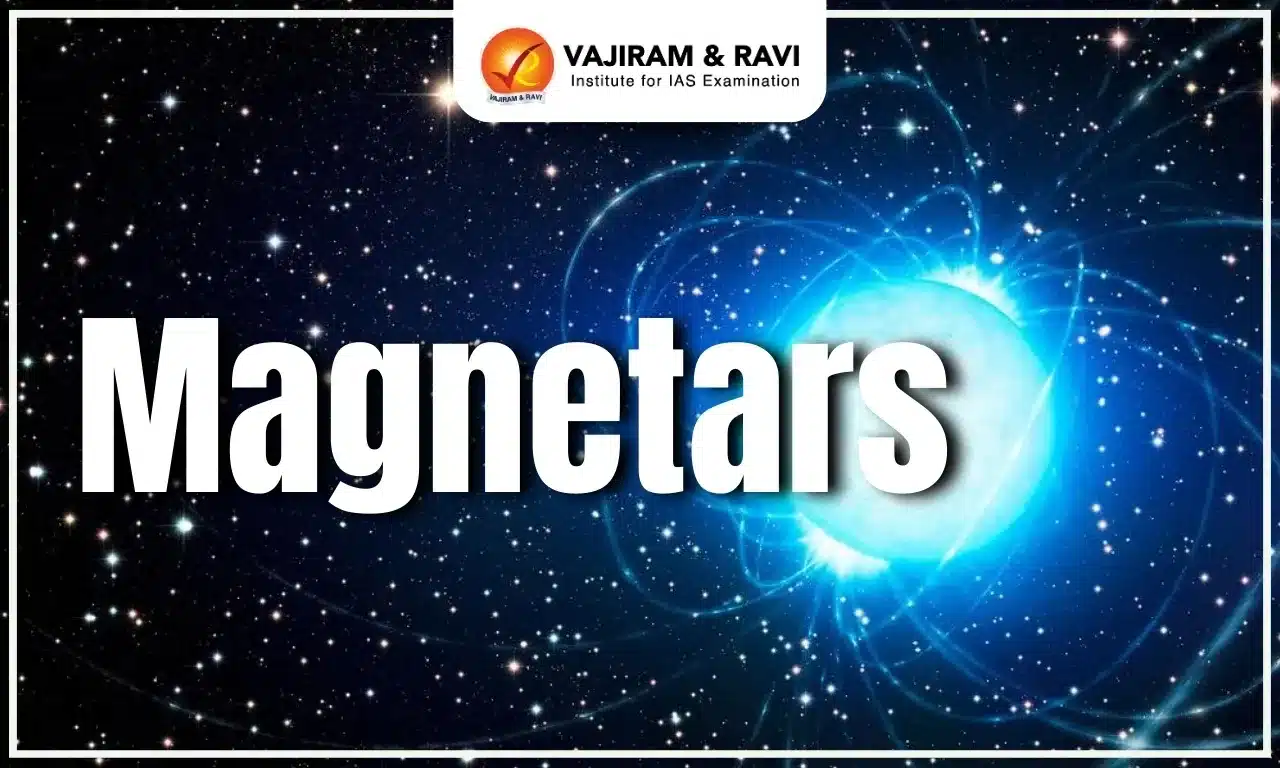
  • Magnetars are neutron stars having an ultrahigh magnetic field that are much stronger than the terrestrial magnetic field.
  • They are formed in the same way as all neutron stars, through the core-collapse of a massive star in a supernova explosion.
  • The idea of a magnetar was first proposed in 1987 and used to successfully explain soft gamma repeaters (SGR) in 1992. 

Characteristics Magnetar

  • They are characterised by exceptionally strong magnetic fields, estimated to be a thousand times stronger than typical neutron stars.
  • The magnetic field of a magnetar is over one quadrillion times stronger than the magnetic field of Earth.
  • What powers the emission of high-energy electromagnetic radiation in them is the decay of magnetic fields in these objects.
  • Besides, magnetars display strong temporal variability, typically including a slow rotation, a rapid spin-down, bright but short bursts going on upto months-long outbursts.
  • Occasionally, they emit intense bursts of energy in the form of flares.

Source: TH

Magnetar FAQ's

Q1: What are Magnetars?

Ans: Magnetars are neutron stars having an ultrahigh magnetic field that are much stronger than the terrestrial magnetic field.

Q2: What are the characteristics of Magnetars?

Ans: They are characterised by exceptionally strong magnetic fields, estimated to be a thousand times stronger than typical neutron stars.

Malaria

Malaria

Malaria Latest News

According to the Union Health Ministry India recorded a nearly 80 per cent decline in malaria cases and deaths between 2015 and 2025, while the number of high-burden districts dropped sharply from 155 to 33, 

About Malaria

  • It is a life-threatening febrile illness caused by Plasmodium parasites.
  • Transmission: It is transmitted through the bites of infected female Anopheles mosquitoes.
  • It is not contagious, but can be spread through infected blood or contaminated needles.
  • Risk: Infants, children under 5 years, pregnant women and girls, travellers and people with HIV or AIDS are at higher risk of severe infection. 
  • Symptoms
    • Symptoms appear 10–15 days after infection and include fever, chills, and headache.
    • Severe symptoms can include seizures, difficulty breathing, jaundice, dark urine, and death if untreated.
  • Treatments include
    • ACTs (Artemisinin-based Combination Therapies) for P. falciparum.
    • Chloroquine for P. vivax 
    • Primaquine to prevent relapses in P. vivax and P. ovale infections.

Source: DD News

Malaria FAQs

Q1: What is Malaria?

Ans: It is a life-threatening febrile illness caused by Plasmodium parasites.

Q2: What are the symptoms is Malaria?

Ans: Severe symptoms can include seizures, difficulty breathing, jaundice, dark urine, and death if untreated.

India’s Shift to Grain-Based Ethanol: Food and Water Security Concerns

India’s Shift to Grain-Based Ethanol

India’s ethanol programme is undergoing a major structural shift. Originally designed to support the sugar industry and sugarcane farmers, it is increasingly dependent on grain-based ethanol, particularly from maize and rice.

This shift has helped India move towards E20, but also raises concerns over food security, water stress and sustainable feedstock availability, especially as sugar stocks tighten, maize faces climate risks and FCI rice is increasingly used for ethanol.

Why Was the Ethanol Programme Introduced?

The Ethanol Blended Petrol (EBP) Programme was initially intended to address problems in the sugar sector while strengthening India’s energy security.

  • Support sugar mills: Ethanol provides sugar mills with an additional revenue stream when sugar production exceeds market demand.
  • Ensure timely cane payments: Additional ethanol revenue improves mill liquidity and helps sugar mills make timely payments to sugarcane farmers.
  • Manage sugar surplus: Diverting part of sugarcane towards ethanol reduces surplus sugar production and helps stabilise the sugar market.
  • Reduce crude oil dependence: Blending domestic ethanol with petrol reduces the requirement for imported petroleum and strengthens energy security.
  • Create an agricultural market: The programme has also created additional demand for crops such as maize, which is traditionally used for poultry and livestock feed.

How Did India Shift to Grain-Based Ethanol?

India’s shift to grain-based ethanol took place as the government expanded the feedstock base and ethanol demand increased.

  • Until 2017-18, ethanol supplied to oil marketing companies came almost entirely from C-heavy molasses, a by-product of sugar production.
  • From 2018-19, mills were encouraged to use B-heavy molasses and sugarcane juice/syrup for ethanol, which increased the quantity of sugarcane diverted towards fuel.
  • Grains initially entered as an off-season feedstock, with sugar mills using maize and rice during May-October, when sugarcane was not available for crushing.
  • Standalone grain distilleries later expanded, allowing ethanol production from maize and rice throughout the year rather than depending on the sugarcane crushing season.
  • Rising ethanol blending targets increased demand for grain-based ethanol, while high sugar prices and lower sugar stocks reduced the scope for diverting sugarcane juice and B-heavy molasses.
  • The result was a sharp reversal in the feedstock mix. Sugarcane-based feedstock supplied over 83% of ethanol in 2021-22, but grains accounted for 59.7% in 2023-24 and 72.5% of allocated ethanol for the supply year ending October 2026.

Thus, grains have evolved from a supplementary off-season feedstock into the mainstay of India’s ethanol programme.

What Are the Concerns with the Shift to Grain-Based Ethanol?

The growing dependence on grains for ethanol is creating new pressures on food security, agricultural markets, water resources and sustainable feedstock availability.

  • Using food grains for ethanol can intensify the food-versus-fuel trade-off, as maize and rice are also required for food consumption, poultry and livestock feed.
  • Rising ethanol demand can put pressure on maize supplies, as it has created a major new source of demand alongside poultry and livestock feed. Wholesale maize prices rose from around ₹13.8-17.8 per kg in 2021 to ₹22.1–24.5 per kg in 2024.
  • Greater reliance on ethanol can increase dependence on Food Corporation of India rice, particularly if maize supplies tighten and sugarcane-based ethanol remains constrained.
  • Diversion of Food Corporation of India rice raises questions about its opportunity cost, as rice used for ethanol cannot simultaneously serve as food, animal feed or a buffer against future shortages. Food Corporation of India rice was supplied to distilleries at around ₹23.2 per kg, compared with about ₹40 per kg for normal rice and ₹30 per kg for broken rice in the retail market.
  • Greater dependence on rice can worsen water stress, as rice is a water-intensive crop and rising demand for it as an ethanol feedstock can reinforce water-intensive cropping patterns.
  • Dependence on a few feedstocks increases climate vulnerability, as weather shocks affecting maize or other major crops can directly affect ethanol availability.
  • Rapid expansion of ethanol capacity can increase pressure on agricultural feedstocks, with capacity nearing 2,000 crore litres against annual offtake of around 1,050 crore litres by oil marketing companies.
  • Ethanol production can also reduce the sugar available for consumption, because some sugarcane is diverted towards ethanol instead of being converted into sugar. This diversion was 2.2 million tonnes in 2020-21, 4.3 million tonnes in 2022-23 and 3 million tonnes in 2025-26, showing that ethanol production can significantly affect the sugar supply.

Thus, the shift to grain-based ethanol may reduce dependence on sugarcane, but it also transfers pressure towards India’s food, feed and water resources.

What Is the Central Policy Dilemma?

The issue now is not whether ethanol blending should be promoted, but how rapidly it should be expanded without creating unsustainable pressure on agricultural resources.

  • Achieving E20 requires around 1,050 crore litres of ethanol annually, creating substantial and sustained demand for feedstocks.
  • The government has already notified standards for E22, E25, E27 and E30, indicating the possibility of progressively higher blending in the future.
  • Higher blending targets should be linked to the availability of sustainable feedstocks, rather than being driven primarily by installed distillery capacity.
  • The benefits of reducing fossil-fuel dependence must be balanced against the competing demands on food grains, land and water.
  • Consolidating E20 while developing alternative feedstocks and second-generation ethanol could reduce pressure to divert increasing quantities of food grains.

The central challenge is to expand ethanol blending without compromising India’s food and water security.

What Should India Do?

India needs to move from a target-driven ethanol strategy towards a diversified and resource-efficient feedstock strategy.

  • Reduce excessive dependence on FCI rice: Public food stocks should be diverted to ethanol only when they are genuinely surplus after accounting for food-security requirements.
  • Use maize within sustainable limits: Rising ethanol demand should not undermine maize availability for poultry, livestock feed and other essential uses.
  • Promote bajra and jowar: Millets offer alternative feedstocks, with their grains containing around 58-62% recoverable starch and yielding approximately 380-400 litres of ethanol per tonne.
  • Link ethanol with crop diversification: Encouraging less water-intensive feedstocks can reduce pressure on rice and sugarcane while creating additional markets for millet farmers.
  • Promote second-generation ethanol: Agricultural residues and other lignocellulosic biomass can produce ethanol without directly competing with food crops.
  • Adopt region-specific feedstock planning: Ethanol production should reflect local water availability, agro-climatic conditions and crop suitability rather than relying uniformly on rice, maize or sugarcane.
  • Avoid capacity-driven blending targets: Expansion of distillery capacity should not by itself become a reason for continuously raising blending targets.
  • Increase blending gradually: The pace of blending should remain aligned with the availability of sustainable and diversified feedstocks.
  • Reassess the pace of expansion: Chief Economic Adviser V. Anantha Nageswaran has suggested returning to E10, highlighting the need to examine whether higher blending should be pursued at the current pace.

Conclusion

India’s shift to grain-based ethanol has strengthened energy security but has also created new pressures on food grains, water and agricultural resources. The way forward is to diversify feedstocks, expand 2G ethanol and align blending targets with sustainable resource availability.

India’s Shift to Grain-Based Ethanol FAQs

Q1: What is grain-based ethanol?

Ans: Grain-based ethanol is ethanol produced from cereals by converting their starch into sugars and then fermenting them into ethanol.

Q2: Why is India promoting grain-based ethanol?

Ans: Grain-based ethanol helps increase domestic ethanol availability, support farmers by creating new demand for crops such as maize, and reduce dependence on imported crude oil.

Q3: Which grains are mainly used for ethanol production in India?

Ans: Maize and rice are the major grains used as feedstock for ethanol production.

Q4: Why is the shift to grain-based ethanol a concern for India?

Ans: The shift can intensify the food-versus-fuel dilemma, increase dependence on FCI rice and water-intensive crops, and create competition between ethanol production and food, feed and other agricultural uses.

Q5: How can India make ethanol production more sustainable?

Ans: India should promote bajra, jowar and 2G ethanol, reduce excessive dependence on FCI rice and align blending targets with sustainable feedstock availability.

Kamlang Tiger Reserve

Kamlang Tiger Reserve

Kamlang Tiger Reserve Latest News

Recently, the Wildlife Trust of India (WTI), in collaboration with The Serenity Trust and the Department of Environment, Forest and Climate Change, provided essential field gear and equipment to frontline staff of the Kamlang Tiger Reserve. 

About Kamlang Tiger Reserve

  • Location: It is located in the state of Arunachal Pradesh near the border with Myanmar.
  • It is a part of the larger Eastern Himalayan Biodiversity Hot Spot.
  • It is named after the Kamlang River, which flows through the reserve and joins the Brahmaputra.
  • It is spread between the famed Namdapha National Park on its south and the Lang River on its north.
  • The western border is formed by the Lati River, while its eastern part is bordered by the Tawe River. 
  • Topography: It encompasses a diverse range of landscapes, including dense tropical forests, grasslands, rivers, and hills.
  • Climate: It enjoys a subtropical climate as it falls within the subtropical zone.
  • Vegetation: The vegetation types include moist evergreen tropical forests in the foothills and subtropical and temperate forests in higher elevations.
  • Flora: Common species of trees in the reserve include Ammora wallichi (Amari), Gmelina arborea (Gamari), Terminalia chebula (Hillika), Canarium resigniferum (Dhuna), and many others.
  • Fauna: All four big cats, including the Snow Leopard, Clouded Leopard, Leopard and Tiger and other species like Himalayan Palm Civets, Leopard Cat, Slow Lories and Hoolock Gibbon, can also be spotted in the sanctuary.

Source: AT

Kamlang Tiger Reserve FAQs

Q1: Where is Kamlang Tiger Reserve located?

Ans: Arunachal Pradesh

Q2: Which rivers drains in Kamlang Tiger Reserve?

Ans: Kamlang River

Qualified MFN in Bilateral Investment Treaties – India’s Proposed Reforms

Qualified MFN

Qualified MFN Latest News

  • India is considering a Qualified Most Favoured Nation provision while remodelling its Bilateral Investment Treaty framework. 

Bilateral Investment Treaties

  • A Bilateral Investment Treaty (BIT) is an agreement between two countries that establishes rules for protecting investments made by investors of one country in the territory of the other.
  • BITs generally address issues such as:
    • Protection against discriminatory treatment
    • Expropriation of investments
    • Fair and equitable treatment
    • Transfer of funds
    • Investor-State Dispute Settlement (ISDS)
  • India adopted a new Model BIT in 2015, partly in response to concerns arising from earlier investment disputes. 
  • The 2015 model adopted a more cautious approach towards investor protections, including not providing an open-ended MFN clause or a full Fair and Equitable Treatment (FET) standard.

About the MFN Principle

  • The Most Favoured Nation (MFN) principle generally requires a country to provide investors from one treaty partner treatment no less favourable than that provided to investors from another country.
  • For example, if Country A gives investors from Country B more favourable treatment under a later treaty, an MFN provision could potentially allow investors from Country C to seek similar treatment if their treaty with Country A contains an applicable MFN clause.
  • India moved away from an open-ended MFN provision in its 2015 Model BIT because of concerns that investors could use provisions from treaties with third countries to make broader claims than those expressly negotiated in their own treaty.

Qualified MFN

  • A Qualified MFN provision would retain the principle of non-discrimination but place specific limitations on its application.
  • Instead of allowing investors to automatically claim the most favourable provision available in any third-country treaty, the provision could include safeguards specifying:
    • Which treaty provisions can be imported?
    • Whether the provision can apply retrospectively?
    • Whether settled disputes can be reopened?
    • What categories of treatment are covered?
  • This approach attempts to balance investor protection with the regulatory autonomy of the State.

News Summary

  • The Union Government is considering a broader restructuring of its BIT framework. The proposed reforms include Qualified MFN treatment rather than restoring the open-ended MFN rule that was removed about a decade ago.
  • The objective is to address concerns of major trading partners such as the European Union, while avoiding the risks associated with allowing investors to import favourable provisions from unrelated third-country treaties.
  • The approach could also provide negotiating leverage for Indian companies seeking similar treatment in major overseas markets such as the US and EU.

Changes to ISDS

  • The proposed framework would reduce the domestic ISDS window from five years to one year.
  • Under such a system, investors would generally be expected to pursue domestic legal remedies for one year before moving towards international arbitration.
  • The proposal is intended to expedite dispute resolution, but experts have cautioned that shorter timelines would increase the importance of strengthening India’s domestic dispute-resolution institutions.

Longer Post-Treaty Protection

  • The draft proposal also seeks to double the period of investor protection after expiry of a BIT from five years to 10 years.
  • This could provide greater certainty to investments made under a treaty even after the treaty itself has expired.

Wider Definition of Investment

  • Another proposed change is to expand the definition of “investment” to include portfolio investments and other financial assets.
  • This could potentially bring certain shares and minority or portfolio holdings within the scope of treaty protection, depending on the final wording of the agreement.
  • The proposal also seeks to ban third-party funding of investment-related litigation.

India’s FDI Context

  • The proposed reforms come against a backdrop of declining net FDI inflows into India.
  • According to the report, average annual net FDI was close to US$40 billion during FY20-FY22, but fell to approximately US$7.65 billion in FY26, based on preliminary data.
  • At the same time, Indian companies have expanded their investments overseas. This combination has increased the policy focus on making India’s investment regime more predictable and competitive.

Strategic Balance

  • The proposed reforms attempt to balance two objectives: making India more attractive to foreign investors while preserving the policy flexibility sought under the 2015 Model BIT.
  • The EU itself has moved towards an Investment Court System model while retaining non-discrimination protections. 
  • India is also negotiating around a dozen BITs, making the design of its revised framework particularly important.

Conclusion

  • India's proposed BIT reforms represent an attempt to create a more predictable investment environment without returning to unrestricted treaty protections. 
  • A Qualified MFN clause could provide investors with greater protection while limiting the possibility of importing unrelated provisions from third-country treaties. 
  • The success of the proposed framework will depend on the precise safeguards adopted, the strength of domestic dispute-resolution institutions and India's ability to balance investor confidence with regulatory autonomy.

Source: IE

Qualified MFN FAQs

Q1: What is a Bilateral Investment Treaty?

Ans: A BIT is an agreement between two countries that establishes protections and dispute-resolution mechanisms for investors of the two countries.

Q2: What is a Qualified MFN provision?

Ans: It is an MFN provision subject to specific safeguards that limit when investors can claim more favourable treatment available under another treaty.

Q3: What change is proposed in the ISDS period?

Ans: The proposed reforms would reduce the domestic dispute-resolution period before international arbitration from five years to one year.

Q4: What is proposed regarding the definition of investment?

Ans: The proposed framework may expand the definition to cover portfolio investments and other financial assets.

Q5: Why is India revisiting its BIT framework?

Ans: The review aims to improve investment predictability and competitiveness amid declining net FDI while retaining safeguards introduced through the 2015 Model BIT.

India-Uzbekistan Relations – Towards a Comprehensive Strategic Partnership

India-Uzbekistan Relations

India-Uzbekistan Relations Latest News

  • India and Uzbekistan have elevated their bilateral relationship to a Comprehensive Strategic Partnership, marking a new phase in ties on the 15th anniversary of their Strategic Partnership. 
  • During the Indian PM’s visit to Tashkent, the two sides agreed to deepen cooperation in civil nuclear energy, trade, defence, critical minerals, connectivity, counter-terrorism, pharmaceuticals, technology and education.

Civil Nuclear Cooperation - Uranium Supply

  • A major new area of cooperation is the proposed long-term arrangement for uranium supplies from Uzbekistan to India.
  • India has been exploring uranium imports to support its expanding civilian nuclear energy programme and strengthen energy security. The agreement is reportedly close to being finalised.
  • For India, diversified uranium sourcing can reduce dependence on a limited number of suppliers and support the long-term expansion of nuclear power as a low-carbon baseload energy source.

Trade and Economic Partnership

  • The two countries set an ambitious target of raising annual bilateral trade from around USD 1 billion to USD 5 billion by 2030.
  • Key areas identified include trade and investment, agriculture and pharmaceuticals, energy and critical minerals, jewellery and mining, and infrastructure and connectivity.
  • To achieve the target, India and Uzbekistan intend to address market-access barriers, connectivity constraints, banking and payment mechanisms.
  • Significance: Uzbekistan is an important gateway to Central Asia, while India seeks greater economic engagement with the resource-rich and strategically located region.

Defence and Counter-Terrorism

  • Defence cooperation:
    • It is being expanded from traditional military exchanges towards defence-industrial collaboration.
    • Both sides will promote direct linkages between defence industries. Focus will be placed on co-development and co-production of military equipment.
    • The Joint Working Group on Military Cooperation is exploring new avenues in defence-industrial cooperation.
    • The Dustlik joint military exercise continues to strengthen operational cooperation.
  • Zero tolerance on terrorism:
    • The two countries unequivocally condemned terrorism, including cross-border terrorism, and rejected its justification on any grounds.
    • They agreed to strengthen -
      • Intelligence sharing
      • Law-enforcement cooperation
      • Countering violent extremism
      • Action against terrorist financing
      • Tackling safe havens and terrorist infrastructure
      • Combating organised crime and illicit drug trafficking
      • Cooperation against cyber threats
    • This has particular significance given the security uncertainties in Afghanistan and their implications for Central Asia.

Critical Minerals and Strategic Resources

  • Critical minerals and mining have emerged as important pillars of the relationship.
  • Uzbekistan possesses significant mineral resources, while India is seeking to diversify its sources of critical minerals essential for clean energy, electronics, advanced manufacturing and strategic technologies.
  • This cooperation can contribute to India's broader objective of building resilient and diversified global supply chains.

Connectivity and People-to-People Ties

  • Connectivity remains a key challenge in India–Central Asia relations because India lacks direct overland access to the region.
  • The partnership therefore assumes significance in the context of India's broader Connect Central Asia Policy and efforts to develop alternative connectivity corridors.
  • Other measures include -
    • Uzbekistan’s decision to remove visa requirements for Indian citizens for stays up to 30 days, facilitating tourism and business.
    • Expansion of digital payment connectivity, with UPI-enabled applications expected to become usable in Uzbekistan.
    • Cooperation in tourism, culture and education.
  • Strategic relevance: Improved connectivity and digital-payment integration can strengthen India's economic and societal presence in Central Asia.

Culture, Education and Heritage

  • The partnership also has a strong civilisational dimension.
  • A Letter of Intent was agreed for restoration and conservation of the Buddhist sites of Fayaz Tepa and Kara Tepa in Uzbekistan.
  • 100 Lal Bahadur Shastri Hindi scholarships were announced.
  • An ICCR Sanskrit Chair will be established at Tashkent State University of Oriental Studies.
  • Cooperation will also cover Ayurveda, education and culture.
  • These initiatives leverage the historical links between the Indian subcontinent and Central Asia.

Institutional Mechanism and Environmental Cooperation

  • The upgraded partnership will receive stronger institutional mechanisms -
    • A Foreign Minister-level Coordination Group will be established.
    • The existing Joint Commission will be elevated from the secretary level to the ministerial level.
  • Additionally, India announced a USD 1 million grant for afforestation in the Aral Sea region, linking bilateral cooperation with environmental restoration.

Strategic Significance for India

  • Uzbekistan occupies a pivotal position in Central Asia, a region increasingly shaped by competition and cooperation involving Russia, China, Türkiye, Iran and other powers. 
  • For India, deeper engagement can help -
    • Diversify energy and critical-mineral supplies.
    • Strengthen security cooperation amid instability surrounding Afghanistan.
    • Expand India's economic footprint in Central Asia.
    • Counterbalance growing Chinese economic and strategic influence.
    • Advance connectivity and India's wider Extended Neighbourhood Policy.
    • Promote India's technological and digital public infrastructure capabilities.

Conclusion

  • The elevation to a Comprehensive Strategic Partnership will be meaningful only if the announced targets translate into implementation
  • In essence, India–Uzbekistan ties are evolving from a predominantly diplomatic and security partnership into a multidimensional strategic relationship.

Source: IE | IE

India-Uzbekistan Relations FAQs

Q1: How does the proposed long-term uranium supply arrangement with Uzbekistan contribute to India’s energy security?

Ans: It diversifies India’s nuclear fuel sources, supports expansion of low-carbon nuclear power and strengthens long-term energy security.

Q2: What is the strategic significance of India–Uzbekistan Comprehensive Strategic Partnership for India?

Ans: It strengthens India’s economic, security and diplomatic footprint in Central Asia while helping diversify supply chains.

Q3: What is the significance of India–Uzbekistan cooperation in critical minerals?

Ans: It can diversify India’s sources of minerals vital for clean energy, electronics and strategic technologies.

Q4: How can enhanced defence cooperation between India and Uzbekistan contribute to regional security?

Ans: It can strengthen bilateral capabilities and promote stability in a strategically sensitive region.

Q5: What is the role of connectivity in deepening India–Uzbekistan relations?

Ans: Improved phygital connectivity can boost trade, tourism and people-to-people contacts, advancing India’s Connect Central Asia approach.

India’s Diaspora Dividend: From Remittances to Growth Capital

India's Diaspora Dividend

India's Diaspora Dividend Latest News

  • India's global diaspora, now numbering over 35 million, is evolving from a source of remittances into a long-term participant in the country's growth story. 
  • As India retains its position as the world's largest remittance recipient, the coming decade may witness a structural shift towards sustained diaspora investment in Indian markets.

Remittances Remain Robust, But the Story Is Changing

  • India received $143.6 billion in remittances in FY26, retaining its status as the world's largest remittance recipient. 
  • These inflows have historically supported household consumption and strengthened India's external sector. 
  • However, non-resident Indians (NRIs) are increasingly viewing India not merely as a source of emotional ties, but as a compelling long-term investment destination.

Strong Macroeconomic Fundamentals Underpin Investor Confidence

  • India remains the world's sixth-largest economy in dollar terms and continues to be the fastest-growing major economy. 
  • Key strengths include:

Financial Markets Have Matured Significantly

  • India's equity market capitalisation touched $5.18 trillion in July 2026, placing it among the world's largest equity markets. 
  • Mutual fund assets under management rose to ₹85.76 lakh crore, with monthly SIP inflows hitting a record ₹31,961 crore. 
  • Diaspora investment, once concentrated in real estate, gold and bank deposits, now spans equities, debt markets, REITs, InvITs, alternative investment funds, manufacturing and renewable energy.

Digital Public Infrastructure Is Reducing Distance for Investors

  • Institutions such as the RBI, SEBI and IFSCA have strengthened governance and market integrity, while GIFT IFSC is emerging as a globally competitive financial platform. 
  • Digital public infrastructure — Aadhaar, UPI, DigiLocker and the Account Aggregator framework — has simplified cross-border investment. 
  • UPI alone processed over 23.66 billion transactions in July 2026. 
  • Simplified digital onboarding and e-KYC have made investing in India more seamless for global investors, even as regulatory complexity and documentation requirements remain perception barriers.

Diaspora Capital Extends Beyond Financial Returns

  • The Indian diaspora today comprises global CEOs, entrepreneurs, professionals, technologists and investors. 
  • Their participation — through capital markets, enterprise creation, infrastructure financing, startups and innovation — brings not just capital but also networks, expertise and global experience. 
  • Tier II and III cities, representing the "aspirations of Bharat," are emerging as new frontiers for this diaspora-linked investment.

Conclusion

  • India's diaspora is transitioning from remittance-sending to long-term capital participation, driven by strengthened macroeconomic fundamentals, matured financial markets and robust digital infrastructure. 
  • Sustained reform in taxation, regulation and cross-border investment processes remains essential to fully unlock this diaspora capital for India's development journey.

Source: BL | TH

India's Diaspora Dividend FAQs

Q1: What is India's Diaspora Dividend?

Ans: India's Diaspora Dividend refers to the growing contribution of overseas Indians through investment, entrepreneurship, expertise, networks and capital beyond traditional remittance flows.

Q2: How are remittances contributing to India's Diaspora Dividend?

Ans: Remittances remain important to India's Diaspora Dividend, with India receiving $143.6 billion in FY26, while diaspora participation increasingly shifts toward long-term investments.

Q3: Why are Indian financial markets attracting diaspora capital?

Ans: India's Diaspora Dividend is supported by mature equity markets, expanding mutual funds, stronger banking institutions and investment opportunities across equities, debt, REITs and InvITs.

Q4: How is digital infrastructure supporting India's Diaspora Dividend?

Ans: Digital infrastructure supports India's Diaspora Dividend through Aadhaar, UPI, DigiLocker, Account Aggregators, digital onboarding and e-KYC, simplifying cross-border investment processes.

Q5: How can India's Diaspora Dividend support economic development?

Ans: India's Diaspora Dividend can provide capital alongside global expertise, business networks and entrepreneurship, supporting startups, infrastructure, manufacturing, renewable energy and investment beyond major cities.

AI and Financial Cybersecurity: How RBI and SEBI Are Tightening Rules

AI and Financial Cybersecurity

AI and Financial Cybersecurity Latest News

  • As Artificial Intelligence increasingly enables sophisticated fraud, deepfakes and attacks on critical financial infrastructure, India's key financial regulators — the RBI and SEBI — are overhauling cybersecurity frameworks to safeguard the financial ecosystem.

The Rising Threat Landscape

  • AI is transforming the nature of financial fraud. Deepfake voices are being used to bypass KYC norms, while more complex scams are infiltrating critical financial institutions. 
  • Several banks have already faced cybersecurity breaches in 2026. 
  • Unlike traditional threats built around identifiable vulnerabilities and periodic assessments, AI dramatically increases the speed, scale and sophistication of attacks — from automated vulnerability discovery to autonomous cyberattacks.

SEBI's IT Resilience Index (ITRI)

  • SEBI has introduced an IT Resilience Index for Market Infrastructure Institutions (MIIs) — entities like clearing corporations and exchanges that enable trading. 
  • Key features:
    • Quantifies cyber readiness across nine parameters.
    • Availability and security: 20% weightage each.
    • Integrity, governance, reliability and monitoring, modularity and flexibility, business continuity: 10% weightage each.
    • Scalability and miscellaneous ("others"): 5% weightage each.
    • MIIs must compute ITRI half-yearly, submit comparative analysis within 60 days, and outline corrective action.
    • Framework takes effect from early 2027.
    • Includes an "early warning system" for continuous risk monitoring.

Standardised Incident Reporting: The FIRE Format

  • SEBI has aligned its cyber incident reporting portal with a standardised "Format for Incident Reporting Exchange" (FIRE). 
  • This enables staged reporting — from initial disclosure through intermediate updates to final closure — while accommodating incomplete information at the time of first reporting.

RBI's Cybersecurity Framework

  • The RBI released a comprehensive cybersecurity framework for banks and financial institutions, mandating:
    • Board-level ownership of cyber risks.
    • Dedicated committees to monitor IT risks.
    • A strict six-hour window for reporting cyber incidents.
    • A revised fraud compensation mechanism (June 2026) expanding victim eligibility and covering newer digital scams.

The "Kill Switch" Mechanism

  • Both regulators are exploring a "kill switch":
    • RBI: Would allow users to halt all financial transactions during fraud
    • SEBI: Evaluating a similar mechanism as part of upcoming AI guidelines

SEBI's Forthcoming AI Guidelines

  • SEBI plans to "shortly" issue guidelines for the responsible use of AI and machine learning in markets. 
  • It already uses AI to flag suspicious trading patterns and has constituted a dedicated team to extend AI-based surveillance to corporate investigations, including scrutiny of quarterly filings.

Expert Recommendations

  • Legal experts suggest regulators should focus on:
    • AI-specific threat modelling
    • Continuous (not periodic) testing
    • Third-party and cloud concentration risks
    • Model and data integrity
    • Deepfake-enabled fraud and supply-chain vulnerabilities
    • Clear human accountability where AI influences critical decisions
    • Technology-neutral accountability backed by technology-specific safeguards, rather than an overly prescriptive code

Conclusion

  • AI has fundamentally altered the financial fraud threat matrix, prompting RBI and SEBI to modernise cybersecurity frameworks through tools like ITRI, FIRE reporting and kill-switch mechanisms. 
  • Sustained regulatory agility, technology-neutral accountability and AI-enabled defensive systems remain critical to securing India's financial infrastructure.

Source: IE

AI and Financial Cybersecurity FAQs

Q1: Why is AI and Financial Cybersecurity becoming a regulatory priority?

Ans: AI and Financial Cybersecurity has become crucial because artificial intelligence enables faster, larger and more sophisticated fraud, deepfakes and attacks against critical financial infrastructure.

Q2: What is SEBI's IT Resilience Index under AI and Financial Cybersecurity?

Ans: The IT Resilience Index measures cybersecurity readiness of Market Infrastructure Institutions across nine parameters, requiring half-yearly assessments, comparative analysis and corrective action.

Q3: What is FIRE reporting in AI and Financial Cybersecurity?

Ans: FIRE reporting standardises cyber-incident disclosures, enabling financial institutions to provide initial reports, subsequent updates and final closure information even when details remain incomplete.

Q4: How does RBI's cybersecurity framework address AI and Financial Cybersecurity?

Ans: RBI's framework requires board-level cyber-risk ownership, dedicated IT-risk committees, six-hour incident reporting and expanded compensation for victims of newer digital frauds.

Q5: What is the kill-switch mechanism in AI and Financial Cybersecurity?

Ans: The kill-switch mechanism would allow users to halt financial transactions during suspected fraud, with RBI exploring the facility and SEBI considering a similar mechanism.

Chile

Chile

Chile Latest News

India and Chile are pushing to conclude negotiations on a Comprehensive Economic Partnership Agreement by the end of 2026. 

About Chile

  • Location: It is located in the southwestern part of South America.
  • It occupies a long, narrow coastal land strip wedged between the Andes Mountains to the east and the South Pacific Ocean to the west.
  • Bordering Countries: It is bordered by Peru to the north, Bolivia to the northeast and Argentina to the east and by the Drake Passage to the south.
  • Capital City: Santiago

Geographical Features of Chile

  • Climate: Temperate; desert in north; Mediterranean in central region; cool and damp in south.
  • Desert: Atacama Desert which is the driest non-polar desert in the world is in Chile.
  • Major River: Loa River
  • Volcano: Ojos del Salado which is the World’s highest active volcano and 2nd highest peak in South America (6,880 m).
  • It is located along the Pacific Ring of Fire.
  • Natural Resources: It is the world’s largest copper and Lithium producer. Other resources include molybdenum, iron ore, timber, hydropower, and precious metals.

Source: PIB

Chile FAQs

Q1: What is the capital of Chile?

Ans: Santiago

Q2: Where is Chile located?

Ans: Chile is located in the southwestern part of South America.

PM-SETU Scheme

PM-SETU Scheme

PM-SETU Scheme Latest News

Recently, the Ministry of Skill Development and Entrepreneurship (MSDE), Government of India, in collaboration with the Government of Uttar Pradesh organized the PM-SETU Industry Conclave in Lucknow. 

About PM-SETU Scheme

  • PM-SETU (Pradhan Mantri Skilling and Employability Transformation through Upgraded ITIs) is a Centrally Sponsored Scheme launched to strengthen India’s vocational training ecosystem.
  • It aims to modernise the ITI ecosystem by upgrading 1000 government ITIs across India into modern, industry-aligned training institutions
  • Implementation: It is implemented as a hub-and-spoke model, with 200 hub ITIs linked to 800 spoke ITIs.
    • Each hub will be equipped with advanced infrastructure, innovation and incubation centres, production units, training of trainer facilities, and placement services, while the spokes will extend access and outreach. 
  • Objectives
    • To improve the quality of training delivery in Industrial Training Institutes (ITIs) and National Skill Training Institutes (NSTIs);
    • To modernize infrastructure and equipment as per industry standards;
    • To introduce industry-aligned long-term and short-term courses, especially in new and emerging sectors;
    • To strengthen industry linkage for demand-driven skilling and better employment outcomes; and
    • To enhance the capacity of NSTIs for training of trainers.
  • Financial outlay and Time Period:  ₹60,000 crore, over a five- year period.
  • Nodal Ministry: Ministry of Skill Development and Entrepreneurship

Components of PM-SETU Scheme

  • Introduce new, demand-driven courses and revamp existing ones in collaboration with industry;
  • Special Purpose Vehicles: Set up Special Purpose Vehicles (SPVs) with credible Anchor Industry Partners to manage clusters and ensure outcome-based training;
  • Create pathways for long-term diplomas, short-term courses, and executive programs;
  • Strengthen 5 National Skill Training Institutes in – Bhubaneswar (Odisha), Chennai (Tamil Nadu), Hyderabad (Telangana), Kanpur (Uttar Pradesh), Ludhiana (Punjab), as Centres of Excellence with global partnerships.
  • The initiative is backed by global co-financing from the World Bank and Asian Development Bank.

Source: PIB

PM-SETU Scheme FAQ's

Q1: What is PM-SETU Scheme?

Ans: It is a Centrally Sponsored Scheme launched to strengthen India’s vocational training ecosystem.

Q2: Which is the nodal ministry of PM Setu scheme?

Ans: Ministry of Skill Development and Entrepreneurship

Solar Flare

Solar Flare

Solar Flare Latest News

Recently, scientists have found small, short-lived brightenings in the Sun’s atmosphere that appear in the hours before a major solar flare erupts and cluster around the very spot where the flare later occurs. 

About Solar Flare

  • A solar flare is a tremendous explosion on the Sun that happens when energy stored in 'twisted' magnetic fields (usually above sunspots) is suddenly released.
  • A flare appears as a sudden, intense brightening of a region on the Sun, lasting several minutes to hours.
  • In a matter of just a few minutes, they heat the material to many millions of degrees and produce a burst of radiation across the electromagnetic spectrum, including from radio waves to x-rays and gamma rays.
  • There are five different classes of solar flares: A, B, C, M, and X;
    • X-class flares: These are the biggest; they are major events that can trigger radio blackouts around the whole world and long-lasting radiation storms in the upper atmosphere.
    • M-class flares: These are medium-sized; they generally cause brief radio blackouts that affect Earth's Polar Regions. Minor radiation storms sometimes follow an M-class flare.
    • C-class flares: These are small with few noticeable consequences here on Earth. At its peak, a C-class flare is ten times less powerful than an M-class flare.
    • B-class flares: These are ten times smaller or weaker than C-class flares.
    • A-class flares: These are at least ten times less intense than B-class flares, with no noticeable consequences on Earth.
  • Effect of Solar Flare on Earth
    • The intense radiation emitted during a solar flare can affect satellite communications, disrupt radio signals, and even pose a risk to astronauts in space.
    • Additionally, the increased solar radiation can lead to geomagnetic storms, which may impact power grids and cause auroras (northern and southern lights) at lower latitudes.

Source: TH

Solar Flare FAQs

Q1: What is Solar Flare?

Ans: A solar flare is a tremendous explosion on the Sun that happens when energy stored in 'twisted' magnetic fields.

Q2: What are the types of Solar Flare?

Ans: There are five different classes of solar flares: A, B, C, M, and X.

Teachers’ Day 2026, Date, Theme, History & Significance

Teachers' Day 2026

Teachers' Day is celebrated every year in India on 5 September to honor the dedication, hard work, and contribution of teachers in shaping the future of students and the nation. The day also marks the birth anniversary of Dr. Sarvepalli Radhakrishnan, India's second President, a renowned philosopher, scholar, and teacher. Teachers' Day 2026 is an opportunity to express gratitude to educators who inspire learning, values, and leadership.

Why is Teachers' Day Celebrated on 5 September?

Teachers' Day is celebrated on 5 September because it is the birth anniversary of Dr. Sarvepalli Radhakrishnan (1888-1975). When he became the President of India in 1962, some of his students requested permission to celebrate his birthday. Instead, he suggested that the day should be celebrated as Teachers' Day to recognize the contribution of teachers across the country. Since then, India has observed Teachers' Day annually on 5 September.

Teachers' Day 2026 Theme

The Teachers' Day 2026 theme has not yet been officially announced. Every year, the theme highlights the importance of teachers in improving education, encouraging innovation, promoting inclusive learning, and preparing students for future challenges. Once announced by the Ministry of Education, it will guide the national celebrations.

Also Read:- Education Ministers of India

History of Teachers' Day in India

The history of Teachers' Day in India is closely associated with the life and ideals of Dr. Sarvepalli Radhakrishnan.

  • Dr. Radhakrishnan was born on 5 September 1888 in Tiruttani, Tamil Nadu.
  • He was a distinguished philosopher, educator, and statesman.
  • He served as India's first Vice President (1952–1962) and second President (1962–1967).
  • When his students wanted to celebrate his birthday, he requested them to dedicate the day to teachers instead.
  • India has celebrated Teachers' Day every year since 1962 to recognize the invaluable role of educators.

Who Was Dr. Sarvepalli Radhakrishnan?

Dr. Sarvepalli Radhakrishnan was a renowned philosopher, teacher, educationist, author, and statesman who made significant contributions to Indian education and served as the second President of India, inspiring the nation through his lifelong commitment to learning and teaching.

  • Born: 5 September 1888 in Tiruttani, Tamil Nadu
  • Profession: Distinguished philosopher, teacher, educationist, and author
  • Served as the first Vice President of India (1952–1962)
  • Served as the second President of India (1962–1967)
  • Awarded the Bharat Ratna in 1954 for his exceptional contributions
  • Played a key role in promoting higher education and Indian philosophy worldwide
  • Strongly believed that teachers are the backbone of society and nation-building
  • His birth anniversary on 5 September is celebrated as Teachers' Day in India every year
  • Authored several influential books on philosophy, religion, and education
  • Remembered as one of India's greatest scholars and educationists, whose ideas continue to inspire generations.

Also Read:- Anti Paper Leak Bill 2026

Importance of Teachers' Day

Teachers' Day highlights the invaluable role of teachers in shaping knowledge, character, values, and responsible citizens, while recognizing their contribution to the nation's educational and social development.

  • Honors the dedication and hard work of teachers.
  • Recognizes the role of teachers in nation-building.
  • Promotes quality education and lifelong learning.
  • Encourages respect for the teaching profession.
  • Inspires students to value knowledge, discipline, and ethics.
  • Strengthens the teacher–student relationship.
  • Appreciates teachers for nurturing critical thinking and leadership skills.
  • Motivates educators to adopt innovative teaching methods.
  • Highlights the importance of inclusive and equitable education.
  • Reinforces the role of education in building a skilled, informed, and responsible society.

Role of Teachers in Nation Building

developing critical thinking, and preparing responsible citizens who contribute to the country's social, economic, and cultural progress.

  • Build knowledge, skills, and character among students.
  • Instill moral values, discipline, and a sense of responsibility.
  • Promote critical thinking, scientific temper, and problem-solving abilities.
  • Encourage innovation, creativity, and lifelong learning.
  • Foster national unity, constitutional values, and social harmony.
  • Support inclusive education by ensuring equal learning opportunities for all.
  • Prepare students to become responsible citizens and future leaders.
  • Develop leadership, communication, and decision-making skills.
  • Create awareness about environmental conservation, digital literacy, and civic duties.
  • Contribute to the country's human capital development and long-term sustainable growth.

Teachers' Day 2026 FAQs

Q1: When is Teachers' Day celebrated in India in 2026?

Ans: Teachers' Day 2026 will be celebrated on 5 September 2026 (Saturday) across India.

Q2: Why is Teachers' Day celebrated on 5 September?

Ans: It is observed to commemorate the birth anniversary of Dr. Sarvepalli Radhakrishnan, a renowned teacher, philosopher, and the second President of India, who believed that teachers deserve the highest respect in society.

Q3: What is the theme of Teachers' Day 2026?

Ans: The official theme for Teachers' Day 2026 has not yet been announced. It will be released by the concerned authorities closer to the celebration.

Q4: Who was Dr. Sarvepalli Radhakrishnan?

Ans: Dr. Sarvepalli Radhakrishnan was a philosopher, educationist, author, Bharat Ratna awardee, and the second President of India. His birth anniversary is celebrated as Teachers' Day in India.

Q5: Since when has Teachers' Day been celebrated in India?

Ans: India has celebrated Teachers' Day every year since 1962, following Dr. Radhakrishnan's request to dedicate his birthday to teachers.

National Teachers’ Awards 2026, 48 Teachers, List, Importance

National Teachers' Awards 2026

National Teachers' Awards 2026 will be conferred by President Droupadi Murmu on 5 September 2026 (Teachers' Day) at Vigyan Bhawan, New Delhi. This year, 48 outstanding school teachers from across India have been selected for their exceptional contribution to education, innovation in teaching, and positive impact on students' lives. The awards are presented annually by the Ministry of Education to recognise teachers who have significantly improved the quality of school education.

National Teachers' Awards 2026

The key highlights related to the National Teachers’ Awards 2026 have been tabulated below.

National Teachers' Awards 2026 Key Highlights

Particular

Details

Award Name

National Teachers' Awards 2026

Award Presented By

President Droupadi Murmu

Date of Ceremony

5 September 2026 (Teachers' Day)

Venue

Vigyan Bhawan, New Delhi

Organised By

Ministry of Education

Total Awardees

48 School Teachers

Male Awardees

26

Female Awardees

22

Representation

27 States, 7 Union Territories, 6 Central Government organisations

Award Purpose

To honour outstanding teachers for excellence in education

Selection Process

District → State/Organisation → National Level

List of 48 Teachers Selected for National Teachers' Awards 2026

The Department of School Education and Literacy, Ministry of Education has selected 48 school teachers for the National Teachers' Awards 2026. The awardees represent States, Union Territories and Central Government organisations across India.

List of 48 Teachers Selected for National Teachers' Awards 2026

S. No.

Name of Teacher

State/UT/Organisation

School Name & Address

1

Shri J Prakash Rao

Andaman & Nicobar Islands

PM SHRI GMSSS Mayabunder, Pokadera

2

Shri Rajesh Kouluri

Andhra Pradesh

MPPS Chinamallupeta, Chinamallupeta

3

Ms. Yaku Tame

Arunachal Pradesh

Government Secondary School, G-Sector Naharlagun, Papum Pare District, Arunachal Pradesh, Ward No. 16 IMC

4

Shri Rajesh Bordoloi

Assam

Adarsha Tribal Higher Secondary School, Jorhat, Kalbari

5

Ms. Khushboo Kumari

Bihar

Urdu Primary School Bidaydih, Bidaydih

6

Ms. Pushpa Prasad

Bihar

Middle School Kuchaikote Kanya, Kuchaikote

7

Ms. Radha Rajesh

CISCE

New Horizon Public School, Indiranagar

8

Ms. Sangeeta Yadav

CBSE

St. Joseph's Convent Sr. Sec. School, Ward No. 8, Idgah Hills

9

Shri Ravi Jaiswal

Chandigarh

Govt. Model High School Maloya Colony, Chandigarh, Maloya Colony

10

Ms. Sunita Yadav

Chhattisgarh

Govt. M.S. Khichari, Khichari

11

Ms. Patel Purnima Mohanlal

Dadra and Nagar Haveli and Daman and Diu

GHS Dalwada, Dalwada

12

Ms. Suman Goel

Delhi

GSKV Pooth Kalan, Pooth Kalan

13

Md. Zafar Alam

Eklavya Model Residential Schools, Ministry of Tribal Affairs

EMRS Karanjia, Binuria (Tato)

14

Shri Mahadev Hanamant Shinde

Goa

Gujarati Samaj-Special School, Aquem

15

Shri Nitinkumar Mahendrakumar Pathak

Gujarat

Rangpur Primary School, Rangpur

16

Shri Anil Kaushik

Haryana

GMSSSS Sanghi, Rohtak, Sanghi

17

Ms. Manjari V Mahajan

Himachal Pradesh

Government Senior Secondary School, Bhaleth, Bhaleth

18

Mohd. Ayaz Raina

Jammu & Kashmir

HSS Dalhori, Dalhori

19

Ms. Munmun Bhattacharjee

Jharkhand

MS Barmasia, Barmasia

20

Ms. Rathnakumari S

Karnataka

Government Higher Primary School Samatagaru, Honnebailu

21

Ms. Amutha J

Kendriya Vidyalaya Sangathan

PM SHRI Kendriya Vidyalaya No. 2 Madurai, Madurai

22

Dr. Manisha Khetrapal

Kendriya Vidyalaya Sangathan

PM SHRI KV NFR Rangiya, Rangia

23

Shri Sunil Kumar KP

Kerala

GHSS Irikkur, Irikkur

24

Shri Mohd Mustafa Kumal

Ladakh

Govt. Middle School Zgangjing, Sankoo, Kanoor

25

Dr. Archana Shukla

Madhya Pradesh

Govt. Mahatma Gandhi Sandipani Hr. Sec. School, BHEL Bhopal, BHEL Bhopal

26

Shri Shailendra Pratap Singh

Madhya Pradesh

Government Middle School Kanjwar, Village Kanjwar, Post Pondi Jodouri, Block Majhauli, District Sidhi, Madhya Pradesh

27

Dr. Kavita Narsingrao Gitte

Maharashtra

Sane Guruji Niwasi Vidyalaya Kaij, Sane Guruji Niwasi Madhyamik Vidyalaya, Kaij-Dharur Road, Kaij

28

Ms. Kunda Jayawant Bachhav

Maharashtra

NMC School No. 18, Anandwalli, Nashik, Maharashtra

29

Shri Wanglembam Gobin Singh

Manipur

Laikon Upper Primary School, Kongba Makha Nandeibam Leikai

30

Ms. Lalnunmawii

Mizoram

Government Electric Veng High School, Electric Veng

31

Shri R Ronald Meru

Nagaland

GHSS Sechu Zubza, Sechu

32

Shri Vaibhav Vasantrao Kulkarni

Navodaya Vidyalaya Samiti

PM SHRI School Jawahar Navodaya Vidyalaya Latur, 12 No. Pati, Near Manjara Sugar Factory, Barshi Road

33

Shri Padaraj Umakanta Nayak

Odisha

Government High School Alipingal, Alipingal

34

Shri Ganesan S

Puducherry

Seenuvasan Government High School, Mettupalayam

35

Shri Dinesh Kumar

Punjab

Govt. Victoria Girls Senior Secondary School, Patiala

36

Dr. Divyendu Sen

Rajasthan

Mahatma Gandhi Government School Pachpahar, Pachpahar

37

Dr. Vartika Gulati

Rajasthan

GGUPS Tumli Ka Bas, Chaksu, Jaipur, Post Jagat Shiromani Pura

38

Shri Shivprasad Arvind Tingare

Sainik Schools under Ministry of Defence

Sainik School Satara, Satara

39

Ms. Sushma Tamang

Sikkim

PM SHRI Government Senior Secondary School Dikling, Dikling

40

Shri Thanga Raj M

Tamil Nadu

Panchayat Union Primary School Puliyampatti, Puliyampatti

41

Ms. Bhavani Bompelly

Telangana

MPPS Girls Gandhari, Gandhari

42

Shri Ranjan Debnath

Tripura

PM SHRI Sabroom Girls HS School, Sabroom

43

Dr. Renu Tripathi

Uttar Pradesh

Govt. Balika Inter College Vijay Nagar, Ghaziabad, Ward No. 14 (Municipal Area)

44

Dr. Iftkhar Khan

Uttar Pradesh

Government Inter College Ballia, Jagdishpur, Ballia

45

Ms. Shalini Kushwaha

Uttar Pradesh

Composite School Rasoolabad, Koilaha

46

Shri Gabar Singh

Uttarakhand

Govt. UPS Musyakhand, Maira

47

Shri Palash Chowdhury

West Bengal

Sri Ramkrishna Sarada Vidyapith Primary School, Ward No. 30

48

Shri Santanu Patra

West Bengal

Govt. Model School, Nayagram Block, Baranigui

What is the National Teachers' Award?

The National Teachers' Award is one of India's most prestigious honours for school teachers. It recognises teachers who have shown innovation, dedication, leadership, and excellence in improving the learning experience of students.

The award was instituted in 1958 and is presented every year on Teachers' Day (5 September) to celebrate the contribution of teachers towards nation-building. The awards are administered by the Department of School Education and Literacy, Ministry of Education.

About National Teachers' Awards 2026

The National Teachers' Awards 2026 will recognise 48 outstanding school teachers from across India, with President Droupadi Murmu scheduled to confer the awards at Vigyan Bhawan, New Delhi, on 5 September 2026, during the national Teachers' Day celebrations.

  • 48 school teachers have been selected through a three-stage selection process at the District, State/Organisation and National levels.
  • The awardees represent 27 States, 7 Union Territories and 6 Central Government organisations, reflecting the geographical and institutional diversity of India's school education system.
  • Of the 48 awardees, 26 are male and 22 are female teachers.
  • The awards recognise teachers for their outstanding contribution to school education, innovative teaching practices and efforts that enrich students' learning and overall development.
  • The selection process included online self-nominations, followed by evaluation at different levels and assessment by an Independent National Jury.
  • Short documentaries highlighting the exemplary work of each awardee will also be showcased during the award ceremony.
  • The 2026 awardees include teachers from government schools, PM SHRI schools, Kendriya Vidyalayas, Jawahar Navodaya Vidyalayas, Eklavya Model Residential Schools, Sainik Schools and other recognised institutions.
  • Sushma Tamang, a Post Graduate Teacher of Chemistry at PM SHRI Government Senior Secondary School, Dikling, Sikkim, has been selected for the National Teachers' Award 2026. Her selection has been recognised as an achievement for Sikkim's education sector.
  • The National Teachers' Awards 2026 ceremony will be broadcast live on Doordarshan and the Ministry of Education's SWAYAM PRABHA channels, besides being streamed through the Ministry's digital platforms.

Selection Process for National Teachers' Awards 2026

The National Teachers' Awards 2026 selection process follows a structured, merit-based system involving District/Regional, State/Organisation and National-level evaluation, with the final names selected by an Independent National Jury.

  • Online Self-Nomination: Teachers submit their applications and supporting portfolios through the official National Teachers' Awards portal.
  • District/Regional Level: The District/Regional Selection Committee scrutinises applications, verifies the submitted information and shortlists eligible teachers.
  • State/Organisation Level: The State Selection Committee or Organisation Selection Committee reviews the shortlisted candidates and forwards the best nominations to the national level.
  • Independent National Jury: The shortlisted candidates are assessed by an Independent National Jury, including through Virtual Conference (VC) interaction.
  • Performance-Based Assessment: Teachers are evaluated on parameters such as innovative teaching practices, improvement in learning outcomes, use of teaching-learning materials, experiential learning, co-curricular activities and community participation.
  • Final Selection: The Independent National Jury finalises the names of the awardees, followed by approval by the Union Education Minister.

Why Are the National Teachers' Awards Important?

National Teachers' Awards recognise and celebrate teachers who make an exceptional contribution to school education, student development and innovative teaching, while motivating educators across India to adopt better teaching practices.

  • Recognises teaching excellence: Honours teachers who demonstrate exceptional dedication, commitment and academic leadership.
  • Promotes innovative teaching: Encourages the use of creative, experiential and technology-enabled teaching methods in classrooms.
  • Improves learning outcomes: Highlights teachers who have made a measurable difference in students' academic performance and overall development.
  • Encourages inclusive education: Recognises efforts to create inclusive and equitable learning environments for students from diverse backgrounds.
  • Motivates teachers: National recognition boosts teacher morale and encourages educators to continuously improve their practices.
  • Shares best practices: The innovative approaches of award-winning teachers can inspire and be adopted by other schools and educators.
  • Supports education reforms: The awards complement the objectives of National Education Policy (NEP) 2020, particularly its focus on holistic, learner-centric and quality education.

National Teachers' Awards 2026 FAQs

Q1: What are the National Teachers' Awards 2026?

Ans: The National Teachers' Awards 2026 recognise outstanding school teachers for their excellence, innovation, dedication and contribution to improving the quality of school education.

Q2: When will the National Teachers' Awards 2026 be presented?

Ans: The awards will be presented on 5 September 2026, on the occasion of Teachers' Day, at Vigyan Bhawan, New Delhi.

Q3: Who will confer the National Teachers' Awards 2026?

Ans: President Droupadi Murmu will confer the National Teachers' Awards 2026 on the selected teachers.

Q4: How many teachers have been selected for the National Teachers' Awards 2026?

Ans: A total of 48 school teachers have been selected for the National Teachers' Awards 2026.

Q5: How are the 48 teachers represented?

Ans: The selected teachers come from 27 States, 7 Union Territories and 6 Central Government organisations. Among them, 26 are male and 22 are female teachers.

Daily Editorial Analysis 31 August 2026

Daily-Editorial-Analysis

Nepal’s Agony, the Himalayan Warning to India 

Context

  • The recent disaster in Nepal is a serious warning for India and the entire Himalayan region.
  • The Himalaya cannot be understood as separate geographical units divided by political borders.
  • From the Hindu Kush and Pakistan to India, Nepal, Bhutan and Tibet-China, the mountain system forms one interconnected and geologically active region.
  • Earthquakes, glacial disturbances, landslides and floods in one area can produce consequences far beyond national boundaries.
  • The central challenge is whether India will learn from Nepal’s suffering and transform scientific knowledge into effective public preparedness.

The Himalaya: One Living and Dangerous System

  • The Himalaya are a vast, interconnected and constantly changing geological system.
  • Beneath their majestic appearance lie immense seismic pressures, shifting glaciers and unpredictable geological processes.
  • Their dangers cannot be precisely forecast in terms of time, location or intensity.
  • History offers painful reminders. The Nepal-Bihar earthquake of 1934 and the Assam earthquake of 1950 revealed the catastrophic potential of Himalayan seismic activity.
  • Scientists have repeatedly warned about the possibility of a major earthquake affecting northern India.
  • Since prediction remains difficult, preparedness must become the most important defence against disasters.

The Question of Preparedness

  • India has established scientific institutions and disaster-management agencies, but the events in Nepal raise serious questions about whether existing preparations are sufficient.
  • A growing danger is posed by Glacial Lake Outburst Floods (GLOFs). Rising temperatures and global warming are accelerating glacier melt and increasing the size and instability of glacial lakes.
  • When natural barriers collapse, huge volumes of water, mud and debris can rush downstream, destroying settlements, infrastructure and farmland.
  • The crucial question is whether people living in vulnerable Himalayan regions are adequately warned and trained.
  • Scientific knowledge should not remain limited to laboratories, seminars and technical papers. Communities must understand the risks and know how to respond.
  • India possesses considerable scientific expertise, but there remains a serious gap between scientific knowledge and public awareness. Disaster preparedness must involve citizens as active participants rather than passive victims.

Whatever Happened, India Must Learn

  • The disaster in Nepal offers several urgent lessons for India.
    • First, the Himalaya must be recognised as a region of continuing natural hazards. Their sacred and cultural significance should not obscure their geological fragility.
    • Second, information about earthquakes, GLOFs, landslides and floods must be communicated clearly and rapidly to vulnerable populations.
    • Third, communities should become part of a comprehensive system of early warning, evacuation planning and emergency response.
    • Fourth, India must address dangers that extend beyond its borders. The proposed Medog hydropower project near the great bend of the Brahmaputra in Tibet raises serious concerns.
  • A major earthquake or geological disaster near such massive infrastructure could potentially release enormous quantities of water and debris towards India’s northeast.
  • Therefore, India’s engagement with China must include greater transparency and cooperation regarding transboundary environmental risks.

Rethinking Development in High-Risk Zones

  • India must critically examine infrastructure located in environmentally fragile and seismically vulnerable regions.
  • Dams, reactors and large commercial projects should not be assessed only in terms of economic benefits.
  • Their potential consequences during earthquakes, floods and landslides must also be considered.
  • Some development projects can become dangerous built hazards. A comprehensive review of infrastructure in high-risk zones is therefore necessary.
  • Where risks exceed benefits, governments must be prepared to modify or even dismantle hazardous structures.
  • Another challenge is the increasing concentration of people in vulnerable areas. A planned and time-bound decongestion of high-risk settlements, supported by safer relocation and better infrastructure, may become necessary.
  • Development without ecological responsibility can transform progress into catastrophe.

From Scientific Knowledge to Public Safeguarding

  • The most important task is to transform scientific expertise into public action.
  • India needs a stronger culture of disaster resilience involving scientists, governments, schools and local communities.
  • Risk maps, public awareness programmes, evacuation drills and reliable warning systems should become essential components of governance in Himalayan regions.
  • The objective should not be to spread fear but to build informed and prepared communities.

Conclusion

  • Nepal’s tragedy is a warning for the entire Himalayan region. India and its neighbours share the same fragile and restless geological environment.
  • Earthquakes, glacier collapse, floods and landslides do not respect political boundaries.
  • India must strengthen scientific communication, improve community preparedness, reassess hazardous infrastructure and promote regional cooperation.
  • A great nation should be capable of learning from the experience of a smaller neighbour.
  • The Himalaya are both a source of life and a source of danger. The real measure of wisdom lies not merely in responding after a disaster but in learning, preparing and acting before the next catastrophe strikes.

Nepal’s Agony, the Himalayan Warning to India FAQs

Q1. Why are the Himalaya considered dangerous?
Ans. The Himalaya are seismically active and vulnerable to earthquakes, landslides, floods and glacial hazards.

Q2. What is a GLOF?
Ans. A GLOF is a sudden flood caused by the outburst of a glacial lake.

Q3. What is the major weakness in India’s disaster preparedness?
Ans. The major weakness is the gap between scientific knowledge and public awareness.

Q4. Why should India review Himalayan infrastructure?
Ans. India should review Himalayan infrastructure because dams and other projects can become major hazards during disasters.

Q5. What should India learn from Nepal’s disaster?
Ans. India should strengthen early-warning systems, community preparedness, scientific communication and regional cooperation.

Source: The Hindu


Adopt Policies for Reuse of Treated Water

Context

  • India is facing an increasingly serious water crisis, driven by rapid urbanisation, population growth, industrial expansion, agricultural demand, and climate change.
  • Every summer, several parts of the country experience acute water shortages, while excessive dependence on groundwater extraction continues to worsen the situation.
  • In this context, the recently notified treated wastewater reuse policies of Uttar Pradesh and Uttarakhand offer an important model of contextualised policymaking.

Contextualised Policymaking for Diverse Regions

  • The policies of Uttar Pradesh and Uttarakhand are significant because they avoid a one-size-fits-all approach.
  • Both States possess considerable geographical diversity and face different water challenges. The requirements of densely populated plains differ greatly from those of remote hill communities.
  • The policies therefore incorporate fit-for-purpose reuse, ensuring that treated wastewater is used according to appropriate needs such as agriculture, industry, landscaping, and ecological restoration.
  • They also connect wastewater reuse with urban planning, river rejuvenation, community participation, blended finance, public-private partnerships, and digital monitoring.
  • This approach highlights an essential principle: while India may require a common national vision for water security, its implementation must be adapted to local conditions.

Hidden Opportunities

  • Treated Wastewater as a Reliable Resource

    • Treated wastewater represents one of India's most underutilised resources.
    • Unlike rainfall-dependent freshwater sources, it can provide a relatively reliable and drought-proof supply.
    • Its reuse can reduce pressure on rivers, lakes, reservoirs, and groundwater.
    • Agriculture, industry, urban landscaping, construction, and ecological restoration can all benefit from treated water.
    • For water-stressed cities, recycling wastewater could become a crucial component of climate resilience.
    • India's future water security may therefore depend not only on finding new sources of freshwater but also on using existing water resources more efficiently through recycling and reuse.
  • From Infrastructure to Effective Utilisation

    • National programmes such as the Atal Mission for Rejuvenation and Urban Transformation (AMRUT) have contributed to expanding sewage treatment infrastructure.
    • However, constructing sewage treatment plants alone cannot solve the problem.
    • A treatment facility that simply releases treated water into drains or rivers without productive reuse represents an incomplete system.
    • Infrastructure must be connected to users such as farmers, industries, municipalities, and ecological restoration projects.
    • India therefore needs an ecosystem that transforms treatment capacity into actual reuse.
    • This requires institutional coordination, appropriate pricing mechanisms, credible quality standards, and practical city-level implementation plans.

Role of the National Framework

  • The National Framework on Safe Reuse of Treated Water (SRTW), 2022 provides an important foundation for this transition.
  • By encouraging States to formulate their own wastewater reuse policies, it recognises that national objectives must be translated into local strategies.
  • Several States have begun setting reuse targets and measurable milestones. However, many others still lack a comprehensive approach.
  • The challenge now is to move from policy announcements to effective implementation.

An Economic and Environmental Opportunity

  • Treated wastewater should be understood not merely as a sanitation issue but as an economic opportunity.
  • Its reuse can reduce dependence on expensive freshwater supplies, support industrial growth, strengthen urban development, and contribute to low-carbon development.
  • It can also improve drought preparedness and reduce the environmental stress caused by excessive groundwater extraction.
  • However, governments and planners must clearly understand the economic value of reuse.
  • Policies are unlikely to succeed unless wastewater reuse becomes financially attractive.
  • Pricing signals, incentives, and innovative financing mechanisms can encourage industries and urban institutions to adopt recycled water.

Breaking Institutional Silos

  • One of the biggest obstacles is fragmented governance.
  • Water utilities, irrigation departments, urban authorities, industries, and environmental agencies often operate independently.
  • Successful reuse requires integrated governance and coordination across departments.
  • Financial resources can also be mobilised through convergence with existing government schemes instead of depending entirely on new budgetary allocations.
  • Blended finance and public-private partnerships can further help expand infrastructure and create sustainable business models for wastewater reuse.

The Way Forward: Need for Awareness and Public Trust

  • Public perception remains another major challenge. Many people continue to associate treated wastewater with contamination and danger.
  • Building confidence in its safety is therefore essential.
  • The use of the term Apna Jal, meaning our water, by the National SRTW Framework and the policies of Uttar Pradesh and Uttarakhand reflects an important psychological shift.
  • Water reuse requires not only new infrastructure but also a change in public attitudes.
  • Awareness campaigns, transparent quality monitoring, and strong safety standards can help build public trust.

Conclusion

  • Continued groundwater depletion and growing competition among agriculture, industry, and cities make the existing model increasingly unsustainable.
  • Treated wastewater offers a practical solution by transforming a perceived burden into a productive resource.
  • The policies of Uttar Pradesh and Uttarakhand demonstrate the importance of localised solutions, institutional coordination, economic incentives, public participation, and technological monitoring. However, these examples must become the norm rather than remain isolated successes.
  • India must move towards a future based on circular water management, where every available drop is treated, reused, and valued.

Adopt Policies for Reuse of Treated Water FAQs

Q1. What is the main purpose of treated wastewater reuse?
Ans. Treated wastewater reuse aims to strengthen water security by reducing dependence on freshwater sources.

Q2. Why are Uttar Pradesh and Uttarakhand important examples?
Ans. They have adopted context-specific policies suited to their different geographical and social conditions.

Q3. What does the SRTW Framework, 2022 provide?
Ans. The framework provides a national policy foundation for the safe reuse of treated water.

Q4. What is a major challenge to wastewater reuse?
Ans. A major challenge is the lack of public awareness and trust regarding the safety of treated water.

Q5. What is essential for successful wastewater reuse?
Ans. Successful reuse requires institutional coordination, financial innovation, quality standards, and public participation.

Source: The Hindu

Daily Editorial Analysis 2026 FAQs

Q1: What is editorial analysis?

Ans: Editorial analysis is the critical examination and interpretation of newspaper editorials to extract key insights, arguments, and perspectives relevant to UPSC preparation.

Q2: What is an editorial analyst?

Ans: An editorial analyst is someone who studies and breaks down editorials to highlight their relevance, structure, and usefulness for competitive exams like the UPSC.

Q3: What is an editorial for UPSC?

Ans: For UPSC, an editorial refers to opinion-based articles in reputed newspapers that provide analysis on current affairs, governance, policy, and socio-economic issues.

Q4: What are the sources of UPSC Editorial Analysis?

Ans: Key sources include editorials from The Hindu and Indian Express.

Q5: Can Editorial Analysis help in Mains Answer Writing?

Ans: Yes, editorial analysis enhances content quality, analytical depth, and structure in Mains answer writing.

Enquire Now