Transfer Pricing

Transfer Pricing

Transfer Pricing Latest News

The Finance Minister recently urged BRICS nations to share their experiences on treaty interpretation and multilateral negotiations in international taxation, saying global transfer pricing disputes “disproportionately” burden developing countries.

About Transfer Pricing

  • Transfer pricing refers to the prices of goods and services that are exchanged between companies under common control.
  • For instance, when a subsidiary company provides goods or services to its parent company or another subsidiary within the same group, the price set for these transactions is known as the transfer price. 
  • They represent a complex and important aspect of business, in particular for companies operating in different tax jurisdictions. 
  • The transfer pricing method is generally used by multinational companies (MNCs) and their subsidiaries or sister companies to allocate income and expenses. 
  • Effective but legal transfer pricing takes advantage of different tax regimes in different countries by raising transfer prices for goods and services produced in countries with lower tax rates. 
  • In some cases, companies even lower their expenditure on interrelated transactions by avoiding tariffs on goods and services exchanged internationally.  
  • The benefits of transfer pricing are tax savings, profit allocation among subsidiaries, and enhanced financial efficiency. 
  • However, transfer pricing must comply with international regulations to avoid issues such as tax evasion.
  • Companies must comply with the transfer pricing rules established by the countries in which they operate, adhering to the arm's length principle (ALP) to ensure transactions are priced as if they were between unrelated parties. 
    • ALP: Related parties price transactions as if they were transactions on an open market. 
    • The Indian transfer pricing regulations (ITPR) require that income arising from ‘international transactions’ between ‘associated enterprises’ be computed with reference to the ALP.
  • International transfer pricing disputes arise mainly as countries seek to ensure MNCs are subject to tax on profits attributable to their respective jurisdictions. 
  • Accordingly, differences in allocation of taxable income among countries can give rise to disputes among taxpayers and tax authorities as well as those in different jurisdictions.

News: TP

Transfer Pricing FAQs

Q1: What is transfer pricing?

Ans: Transfer pricing refers to the prices of goods and services exchanged between companies under common control.

Q2: Which type of companies commonly use transfer pricing

Ans: Multinational companies (MNCs) and their subsidiaries or sister companies commonly use transfer pricing.

Q3: What is the purpose of transfer pricing within multinational companies?

Ans: It is used to allocate income and expenses among related companies within the group.

Q4: What is the Arm's Length Principle (ALP) in transfer pricing?

Ans: The ALP requires related-party transactions to be priced as if they were conducted between unrelated parties in an open market.

Q5: Why is the Arm's Length Principle important in transfer pricing?

Ans: It helps ensure that related companies do not artificially manipulate prices to shift taxable income between jurisdictions.

OLED (Organic Light-Emitting Diode)

OLED (Organic Light-Emitting Diode)

OLED (Organic Light-Emitting Diode) Latest News

India is currently investigating LG Electronics and Samsung for allegedly paying lower tariffs on imported display parts  that go into making panels for OLEDs.

About OLED (Organic Light-Emitting Diode)

  • It refers to a class of light-emitting devices where the emissive layer is composed of carbon-based organic molecules that glow when excited by an electric current.
  • The OLED structure consists of a multilayer array of thin organic films sandwiched between two electrodes, at least one of which is transparent, allowing light emission.  When electrical current is applied, a bright light is emitted.  
  • OLEDs differ from both traditional LEDs (inorganic diodes that emit light at specific points) and LCDs (which rely on liquid crystals and a backlight). 
  • Instead, OLEDs are self-emissive surfaces, which means every pixel generates its own light. 
  • OLED displays provide the best image quality, and they can also be made transparent, flexible, foldable, and even rollable and stretchable.
  • An OLED display have the following advantages over an LCD display:
    • Improved image quality: Better contrast, higher brightness, fuller viewing angle, a wider color range, and much faster refresh rates.
    • Lower power consumption.
    • Simpler design that enables ultra-thin, flexible, foldable, and transparent displays
    • Better durability: OLEDs are very durable and can operate in a broader temperature range.
  • Advanced OLED configurations include PHOLED (Phosphorescent OLED) variants, which use phosphorescent phosphors to increase light efficiency, and WOLED (White OLED), used in lighting technology to generate white light with a wide colour spectrum.

News: TH

OLED (Organic Light-Emitting Diode) FAQs

Q1: What is OLED?

Ans: It a class of light-emitting devices that uses carbon-based organic molecules to produce light when excited by an electric current.

Q2: What is the emissive layer of an OLED made of?

Ans: It is made of carbon-based organic molecules.

Q3: What is the basic structure of an OLED?

Ans: An OLED consists of multiple thin organic films sandwiched between two electrodes, with at least one electrode being transparent.

Q4: How does an OLED produce light?

Ans: It produces light when an electric current excites the organic molecules in its emissive layer.

Q5: What does self-emissive mean in an OLED display?

Ans: It means that each pixel generates its own light and does not require a separate backlight.

Tulu Language

Tulu Language

Tulu Language Latest News

Recently, the Karnataka government decided to accord Tulu the second additional administrative language status.

About Tulu Language

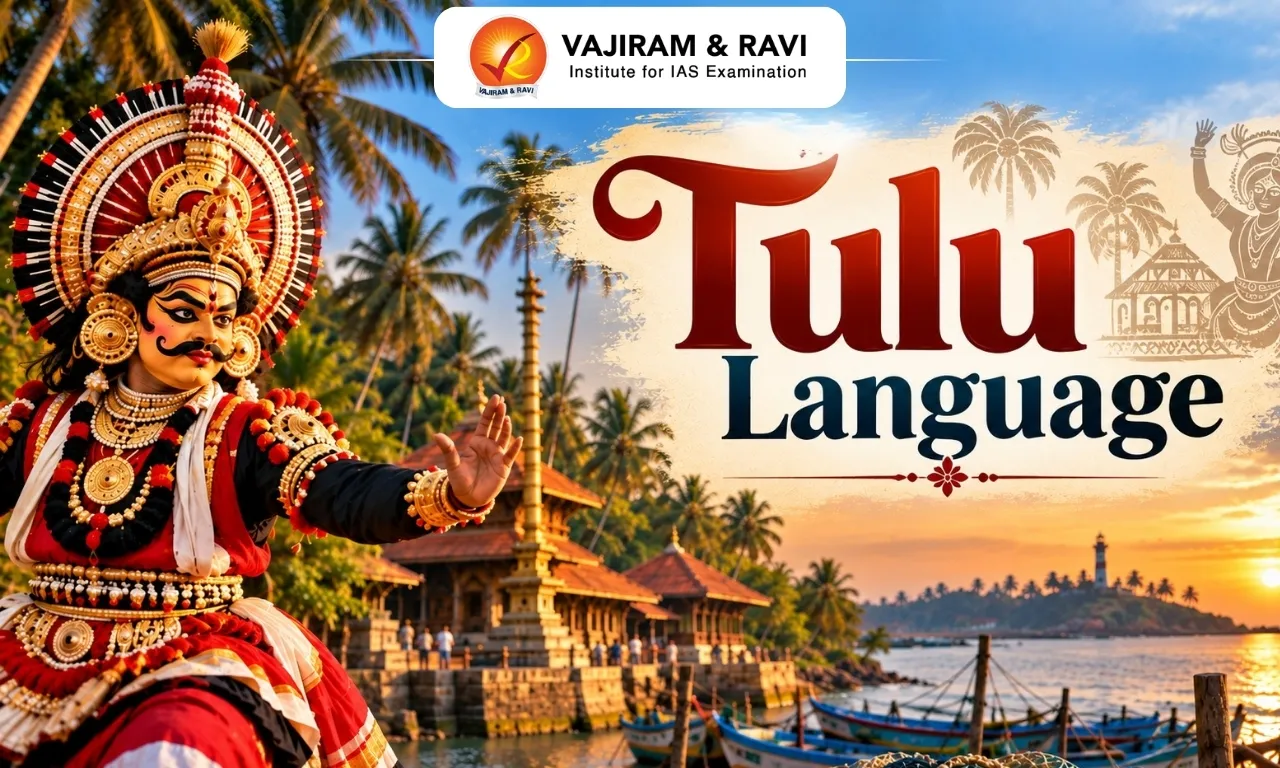
  • Tulu is classified among the five Dravidian languages, the others being Tamil, Telugu, Kannada, and Malayalam.
  • It is spoken mainly in the coastal districts of Dakshina Kannada and Udupi in Karnataka, and northern parts of Kasaragod district in Keralam.
  • It has borrowed many words from the Kannada language, but they are not closely related. 
  • Tulu Nadu has its own script called Tigalari script, which is not widely used.
  • The oldest available inscriptions in Tulu are from the period between 14th to 15th centuries AD.
  • Tulu is taught as the third optional language in schools, from Class 6 to Class 10, in Dakshina Kannada and Udupi districts since the 2010-11 academic year. 
  • Recognition: The Registrar General and Census Commissioner has recognised Tulu as an independent language of India and is also treated as an important non-scheduled language of India.
  • Cultural significance: The language has a strong oral tradition, rich folklore, and cultural practices like Yakshagana, Bhoota Kola, and others.

Source: IE

Tulu Language FAQs

Q1: Which region's people speak Tulu Language?

Ans: It is spoken mainly in the coastal districts of Dakshina Kannada and Udupi in Karnataka, and northern parts of Kasaragod district in Keralam.

Q2: Tulu language belongs to which type of language?

Ans: Dravidian languages

UNGA Meeting 2026, Theme, President, Debates Highlight, Significance

UNGA Meeting 2026

The UNGA Meeting 2026 refers to the high level activities of the 81st session of the United Nations General Assembly. The session opened on 8 September 2026 in New York. Its High level Week is being held from 18 to 28 September. The General Debate began on 22 September and brings world leaders together to discuss global challenges, development, peace and international cooperation.

What is the UNGA Meeting 2026?

The United Nations General Assembly is the UN's main forum for multilateral discussion and includes all 193 Member States. The 81st session of the UNGA Meeting 2026 runs from 8 September 2026 to 7 September 2027. Its High level Week focuses on global cooperation, the Sustainable Development Goals, climate action, health, development and peace.

United Nations General Assembly

The UN General Assembly was established under the UN Charter in 1945. It provides an equal vote platform where all 193 Member States participate in deliberations. Most General Assembly resolutions are not legally binding. The Assembly also performs key functions such as approving the UN budget and electing non permanent members of the Security Council.

UNGA Meeting Theme 2026

The UNGA Meeting Theme 2026 is “Restoring Trust, Managing Transformation: A United Nations That Delivers for All.” It focuses on rebuilding confidence in multilateral cooperation and improving the UN's ability to respond to global challenges.

The theme also reflects the presidency's focus on dialogue, cooperation and practical results. President Khalilur Rahman has linked the agenda with strengthening multilateral institutions and making the UN more responsive to changing global conditions.

UNGA Meeting 2026

The UNGA Meeting 2026 includes the General Debate and several high level meetings addressing major international issues. The programme brings together Heads of State, Heads of Government and senior representatives of the 193 Member States.

  • 81st Session Opening: The 81st session officially opened on 8 September 2026 at UN Headquarters in New York. The session will remain open until 7 September 2027.
  • High level Week: High level activities are taking place from 18 to 28 September 2026. The programme includes the SDG Moment, General Debate and thematic high level meetings.
  • General Debate: The General Debate is scheduled from 22 to 26 September and again on 28 September. Representatives present national priorities and positions on major international issues.
  • 193 Member States: All 193 UN Member States participate in the General Assembly. Each Member State has one vote in the Assembly.
  • SDG Focus: The SDG Moment on 18 September highlighted actions and initiatives aimed at accelerating progress towards the Sustainable Development Goals. It was held under General Assembly Resolution 74/4.
  • Key Discussion Areas: The 2026 programme covers sustainable development, climate action, sea level rise, pandemic preparedness, racial discrimination, nuclear disarmament and the right to development.

UNGA Meeting 2026 President

The President of the UNGA Meeting 2026 is Khalilur Rahman of Bangladesh. He was elected on 2 June 2026 from the Asia Pacific Group under the established regional rotation system.

  • Election Result: Khalilur Rahman received 99 votes against 91 votes for Andreas Kakouris of Cyprus. There were 190 valid votes, with no blank or invalid votes.
  • Second Bangladesh Presidency: Bangladesh is holding the UN General Assembly presidency for the second time. The first was during the 41st session in 1986-87.
  • Term: Khalilur Rahman presides over the 81st session for a one year term beginning with the opening of the session.
  • Role: The President presides over General Assembly meetings, guides debates and facilitates discussions among Member States.

UNGA Meeting 2026 Schedule

The UNGA Meeting 2026 schedule covers the opening session, SDG Moment, General Debate and high level thematic meetings during September 2026.

  • 8 September: The 81st session of the General Assembly opened at UN Headquarters in New York.
  • 18 September: The annual SDG Moment was held from 10 a.m. to 1 p.m. in the General Assembly Hall.
  • 22-26 September: The General Debate is being conducted as part of High level Week.
  • 23 September: Meetings covered the 40th anniversary of the Declaration on the Right to Development and climate action and the just transition.
  • 24 September: The high level meeting on the existential threats posed by sea level rise is being held.
  • 25 September: A high level meeting on pandemic prevention, preparedness and response is scheduled.
  • 28 September: The Assembly will mark the 25th anniversary of the Durban Declaration and Programme of Action.
  • 29 September: A high level plenary meeting will commemorate the International Day for the Total Elimination of Nuclear Weapons.

UNGA Meeting 2026 Highlights

The major highlights of the UNGA Meeting 2026 so far include the SDG Moment, General Debate and high level meetings on development, climate action and sea level rise.

  • SDG Moment: The 18 September event highlighted transformative national, regional and community level efforts to accelerate progress towards the Sustainable Development Goals.
  • General Debate Begins: The General Debate opened on 22 September. Heads of State, Heads of Government and other senior representatives are presenting national priorities and positions on global challenges.
  • US-Denmark Greenland Deal: The US-Denmark Greenland Deal signed a security agreement on 22 September 2026 at UN Headquarters, expanding US military access and strengthening Arctic and North Atlantic security while affirming Greenland’s self determination.
  • Right to Development: On 23 September, the Assembly commemorated the 40th anniversary of the Declaration on the Right to Development, adopted in 1986.
  • Climate Action: The 23 September climate meeting brought together major economies, developing countries, vulnerable nations and energy producers and consumers to discuss climate action, energy security and climate justice.
  • Sea Level Rise: The 24 September meeting focused on rising sea levels and international cooperation for vulnerable small island developing states and low lying coastal areas.
  • Iran and Ukraine Discussions: During the General Debate, US President Donald Trump discussed the possibility of a deal with Iran and spoke about the Russia-Ukraine conflict. French President Emmanuel Macron called for Russia and Ukraine to halt strikes on energy infrastructure and shipping.

UNGA Meeting 2026 Significance

The UNGA Meeting 2026 is significant because it brings 193 Member States together around major global challenges. Its agenda connects peace, development, climate action, health and international cooperation.

  • Multilateral Cooperation: The meeting provides a common diplomatic platform for countries to discuss international issues and seek areas of cooperation.
  • Sustainable Development: The SDG focused agenda keeps global attention on accelerating progress towards the Sustainable Development Goals amid wider international challenges.
  • Climate Vulnerability: The sea level rise meeting highlights the concerns of small island developing states and low lying coastal regions.
  • Global Health: The pandemic preparedness meeting places prevention, preparedness and response within the international cooperation agenda.
  • Development Rights: The 40th anniversary of the Declaration on the Right to Development reinforces the link between development, equality, participation and human dignity.
  • Peace and Security: The General Debate provides a major diplomatic platform for Member States to present their positions on conflicts, security and international cooperation.

UNGA Meeting 2026 FAQs

Q1: When is the UNGA Meeting 2026 being held?

Ans: The 81st UN General Assembly session opened on 8 September 2026, with the General Debate scheduled from 22 to 26 September and on 28 September 2026.

Q2: Who is the President of UNGA 2026?

Ans: Khalilur Rahman of Bangladesh is the President of the 81st session of the United Nations General Assembly.

Q3: What is the theme of UNGA 2026?

Ans: The theme is “Restoring Trust, Managing Transformation: A United Nations That Delivers for All.”

Q4: Where is the UNGA Meeting 2026 held?

Ans: The 81st session and its high level meetings are being held at the United Nations Headquarters in New York.

Q5: What are the key topics of UNGA 2026?

Ans: Key topics include sustainable development, climate action, sea level rise, pandemic preparedness, the right to development, racial justice and nuclear disarmament.

World Pharmacist Day 2026, Theme, Celebration, Importance

World Pharmacist Day 2026

World Pharmacists Day 2026 will be observed on September 25, 2026, to recognise the contribution of pharmacists to healthcare and highlight their role in improving access to medicines, promoting safe medicine use and supporting healthier communities.

In India, the Pharmacy Council of India (PCI) has aligned the 2026 celebrations with the same global theme and is promoting the overarching mission “Swastha Bharat: Combating Antimicrobial Resistance (AMR)”.

What is World Pharmacists Day?

World Pharmacists Day is observed every year on September 25 to recognise the contribution of pharmacists and the wider pharmacy profession to healthcare.

Pharmacists work across community pharmacies, hospitals, pharmaceutical industries, research institutions, regulatory organisations and other healthcare settings. Their responsibilities extend beyond dispensing medicines and include supporting appropriate medicine use, patient counselling, medication safety, health promotion and disease prevention.

World Pharmacist Day 2026 Theme

The theme of World Pharmacists Day 2026 is: “Empowering pharmacists for healthier futures”

FIP announced the theme in March 2026. It highlights the need to ensure that pharmacists have appropriate skills, recognition, education and system support to respond to changing healthcare requirements.

World Pharmacist Week 2026

World Pharmacy Week 2026 is observed from September 19 to September 25, 2026, highlighting the contribution of pharmacists and the wider pharmacy workforce to healthcare. It provides an opportunity to raise awareness about safe medicine use, patient care, public health and antimicrobial resistance. The week encourages healthcare institutions, educational organisations and pharmacy professionals to organise awareness programmes, educational activities and community initiatives. 

Why is World Pharmacists Day Celebrated?

World Pharmacists Day is celebrated to recognise the important contribution of pharmacists to individual and public health.

Pharmacists are often among the most accessible healthcare professionals, particularly in community settings. They help people understand how to use medicines correctly, identify potential medicine-related problems and seek appropriate medical care when required.

The 2026 FIP campaign highlights the importance of pharmacists in prevention, access to care, medicine use and health-system resilience.

The day also creates an opportunity to discuss how pharmacists can contribute to emerging health challenges.

Importance of World Pharmacists Day 2026

World Pharmacists Day 2026 highlights the important role of pharmacists in patient care, safe medicine use, public health and stronger healthcare systems, while promoting greater recognition and empowerment of the pharmacy profession.

  • Recognises Pharmacists: Highlights the contribution of pharmacists to healthcare and patient well-being.
  • Promotes Safe Medicine Use: Creates awareness about the correct, safe and responsible use of medicines.
  • Supports AMR Awareness: Promotes action against Antimicrobial Resistance (AMR) through responsible antimicrobial use.
  • Strengthens Healthcare Systems: Highlights how pharmacists can contribute to accessible and effective healthcare.
  • Improves Patient Care: Emphasises the role of pharmacists in patient counselling, medication safety and health education.
  • Encourages Professional Development: Supports education, training and skill development for pharmacists.
  • Promotes Public Health: Encourages pharmacists to participate in disease prevention and health-awareness activities.

Role of Pharmacists in Healthcare

Pharmacists play an important role in safe medicine use, patient care, disease prevention and public health, working across community pharmacies, hospitals, research, industry and other healthcare settings.

  • Safe Use of Medicines: Help patients understand the correct dose, timing, precautions and storage of medicines.
  • Patient Counselling: Provide guidance on medicine use, side effects, interactions and treatment adherence.
  • Medication Safety: Help identify potential drug interactions, duplicate medicines and medication-related problems.
  • Antimicrobial Stewardship: Promote responsible use of antibiotics and create awareness about Antimicrobial Resistance (AMR).
  • Disease Prevention: Support health screening, vaccination awareness and preventive healthcare within their professional scope.
  • Health Education: Educate people about medicines, healthy practices and disease prevention.
  • Chronic Disease Management: Support patients in managing conditions such as diabetes, hypertension and asthma through proper medicine use and adherence.
  • Healthcare Support: Work with doctors, nurses and other healthcare professionals to improve medication-related care.

World Pharmacists Day 2026 in India

In India, the Pharmacy Council of India is coordinating activities related to World Pharmacists Day and National Pharmacy Week 2026.

The PCI announced the September 25 celebration under the global theme “Empowering Pharmacists for Healthier Futures” and the overarching mission “Swastha Bharat: Combating Antimicrobial Resistance (AMR)”.

The PCI has also issued notices related to state-level celebrations, nodal officers and participation in World Pharmacists Day/National Pharmacy Week activities.

About Pharmacy Council of India

Pharmacy Council of India (PCI) is a statutory body established under the Pharmacy Act, 1948, responsible for regulating pharmacy education and the profession of pharmacy in India.

  • Established Under: The PCI was constituted under the Pharmacy Act, 1948.
  • Main Objective: To regulate and maintain standards of pharmacy education and professional practice in India.
  • Pharmacy Education: Prescribes minimum standards of education and training required for pharmacists.
  • Approval of Institutions: Approves pharmacy courses and institutions that meet the prescribed standards.
  • Registration of Pharmacists: Supports the regulatory framework for registration of pharmacists through State Pharmacy Councils.
  • Professional Standards: Works to ensure that pharmacy professionals receive appropriate education and training.
  • Regulatory Role: Frames and maintains standards related to pharmacy education, examinations and practical training.
  • Public Health: Its regulatory work supports the availability of qualified and trained pharmacy professionals for the healthcare system.
  • Legal Framework: Its functions are carried out under the provisions of the Pharmacy Act, 1948 and related regulations.

World Pharmacist Day 2026 FAQs

Q1: When is World Pharmacists Day 2026?

Ans: World Pharmacists Day 2026 will be observed on September 25, 2026, which falls on a Friday.

Q2: What is the theme of World Pharmacists Day 2026?

Ans: The global theme is “Empowering pharmacists for healthier futures.” It was announced by the International Pharmaceutical Federation (FIP).

Q3: What is the theme of World Pharmacists Day 2026 in India?

Ans: In India, the Pharmacy Council of India is observing the day under the global theme “Empowering Pharmacists for Healthier Futures”, with the overarching mission “Swastha Bharat: Combating Antimicrobial Resistance (AMR).”

Q4: Who organises World Pharmacists Day?

Ans: The global World Pharmacists Day campaign is led by the International Pharmaceutical Federation (FIP). In India, the Pharmacy Council of India is conducting activities related to the 2026 celebration.

Q5: Why is World Pharmacists Day celebrated?

Ans: The day recognises the contribution of pharmacists to healthcare and raises awareness about their role in safe medicine use, patient care, prevention and stronger health systems.

Asian Games 2026 Day 6, India Medal Tally, Major Achievements

Asian Games 2026 Day 6

Asian Games 2026 Day 6 brought two medals for India, with Roshibina Devi winning silver in wushu and Satnam Singh and Salman Khan securing bronze in rowing. India's men's kabaddi team also entered the semifinals after defeating Chinese Taipei, assuring the country of another medal.

With Roshibina's silver, India's medal tally reached 14 medals, 1 gold, 6 silver and 7 bronze. India was in action across rowing, wushu, athletics, shooting, kabaddi, swimming, table tennis, squash, fencing and canoe sprint on September 24.

Asian Games 2026 Day 6 India Medal Tally

India's medal tally after the latest Day 6 updates stands at: 

Asian Games 2026 Day 6 India Medal Tally

Medal

Number

Gold

1

Silver

6

Bronze

7

Total

14

India's first gold medal came from the women's cricket team, which defeated Sri Lanka by 147 runs in the final. The country's silver medals have come from shooting, weightlifting and wushu, while the bronze medals have come from shooting, MMA, soft tennis, badminton and rowing.

India's Medal Winners at Asian Games 2026

India has won 14 medals at the 2026 Asian Games, including 1 gold, 6 silver and 7 bronze medals, across sports such as shooting, cricket, weightlifting, wushu, rowing, badminton, soft tennis and mixed martial arts.

India's Medal Winners at Asian Games 2026

No.

Athlete(s)

Sport

Event

Medal

1

Elavenil Valarivan, Sonam Maskar, Vidarsa Vinod

Shooting

Women’s 10m air rifle team

Silver

2

Elavenil Valarivan

Shooting

Women’s 10m air rifle

Silver

3

Rudrankksh Patil, Parth Mane, Himanshu Dhillon

Shooting

Men’s 10m air rifle team

Silver

4

Himanshu Dhillon

Shooting

Men’s 10m air rifle

Silver

5

Rudrankksh Patil

Shooting

Men’s 10m air rifle

Bronze

6

Suchika Tariyal

Mixed Martial Arts

Women’s traditional -60kg

Bronze

7

Team India

Cricket

Women’s

Gold

8

Parinaaz Dhaliwal, Raiza Dhillon, Maheshwari Chauhan

Shooting

Women’s skeet team

Bronze

9

Anantjeet Singh Naruka, Bhavtegh Singh Gill, Mairaj Ahmad Khan

Shooting

Men’s skeet team

Bronze

10

Jay Meena

Soft Tennis

Men’s singles

Bronze

11

Mirabai Chanu

Weightlifting

Women’s 49kg

Silver

12

Team India

Badminton

Men’s team

Bronze

13

Satnam Singh, Salman Khan

Rowing

Men’s double sculls

Bronze

14

Roshibina Devi

Wushu

Women’s 60kg sanda

Silver

Roshibina Devi at Asian Games 2026

Roshibina Devi won the silver medal in the women's 60kg sanda event after losing 0-2 to China's Zhang Xiaoyu in the final. Zhang won both rounds by identical 5-0 margins.

The medal is Roshibina's third consecutive Asian Games medal. She had won bronze at the 2018 Jakarta Asian Games and silver at the 2022 Hangzhou Asian Games, before adding another silver in Nagoya. She has therefore become the first Indian woman to win wushu medals at three successive Asian Games.

Roshibina reached the final after defeating Macao's Chu Man Sin 5-0 in the quarterfinal and Indonesia's Thania Kusumaningtyas 2-0 in the semifinal. Earlier in the tournament, she also defeated Vietnam's Nguyen Thi Thu Thuy, the 2023 world champion.

Her place in India's Asian Games squad had itself been uncertain. She had been recovering from a knee injury and initially missed selection before being brought into the squad as a replacement for Divyanshi Choudhary, who suffered a high-grade ACL injury.

India's Performance in Wushu at Asian Games 2026

India's wushu campaign received a major boost from Roshibina Devi's silver medal.

Roshibina has now reached the Asian Games podium in three consecutive editions, making her one of India's most consistent wushu performers. Her medal sequence is:

  • 2018 Jakarta: Bronze
  • 2022 Hangzhou: Silver
  • 2026 Aichi-Nagoya: Silver

Her latest medal also extended India's record of podium finishes in women's wushu at the Asian Games.

Asian Games 2026 India's Rowing Campaign

Rowing produced India's first medal of Day 6 when Satnam Singh and Salman Khan won bronze in the men's double sculls.

The Indian pair clocked 6:13.25 in the final to finish third. China's Yi Xudi and Nie Yide won gold, while Uzbekistan took silver.

The medal was India's first rowing medal at the 2026 Asian Games. India had won five rowing medals at the 2022 Hangzhou Asian Games, including two silver and three bronze medals.

Balraj Panwar Finishes Fourth

India narrowly missed another rowing medal through Balraj Panwar in the men's single sculls.

Panwar remained in second position at the 500m, 1000m and 1500m marks, but lost ground in the final 500m and finished fourth with a time of 6:54.80.

His performance was particularly notable because he remained in medal position for most of the race before being overtaken in the closing stages.

Satnam Singh and Salman Khan

Satnam Singh switched to rowing in 2018 after beginning his sporting career in handball. He represented India at the 2018 Youth Olympics and was also part of India's bronze-medal-winning men's quadruple sculls crew at the 2022 Asian Games.

Salman Khan began rowing in 2018 after joining the Bombay Engineer Group of the Indian Army. He later trained at the Army Rowing Node and was inducted into the Target Olympic Podium Scheme (TOPS) in 2023.

Asian Games 2026 India's Athletics Campaign

Asian Games 2026 Day 6 marked the start of India's athletics campaign at the Games. The athletics programme featured track and field events including the heptathlon, triple jump, 10,000m, 100m and mixed 4x400m relay.

Women's Heptathlon

India began its athletics campaign in the women's heptathlon with Pooja and Anamika Kozhinjaparambil competing in the 100m hurdles.

Pooja clocked 14.61 seconds, while Anamika recorded 14.80 seconds. Both athletes also competed in the high jump.

Mixed 4x400m Relay

India qualified for the mixed 4x400m relay final after finishing second in its heat.

The Indian quartet of Manu T.S., M.R. Poovamma, Jay Kumar and Kiran recorded 3:16.23 to progress to the final.

Asian Games 2026 Day 6 Shooting

Shooting continued to be an important medal-producing sport for India.

In men's 10m air pistol qualification, Kamaljeet finished ninth with 580 points, Aakash Bhardwaj was 11th with 579 and Kedarling Uchaganve finished 35th with 568. None of the three Indian shooters reached the individual final.

In mixed team skeet, Anantjeet Singh Naruka and Parinaaz Dhaliwal qualified for the final after scoring 138 in qualification.

India had already secured several medals through shooting earlier in the Games, including individual and team medals in 10m air rifle and team medals in skeet.

India Assures Another Medal in Kabaddi

One of the biggest developments on Asian Games 2026 Day 6 came from men's kabaddi.

India defeated Chinese Taipei 37-21 in its final Pool A match and progressed to the semifinals. The result assured India of at least a bronze medal, as both losing semifinalists receive bronze medals in the Asian Games kabaddi competition.

India remained unbeaten in the group stage after recording four consecutive victories.

Asian Games 2026 Day 6 Swimming

India also featured in swimming events at the Games.

Aryan Nehra finished third in the men's 800m freestyle final with a time of 8:02.52. His performance saw him move through the field during the race before securing third position.

Asian Games 2026 Day 6 Table Tennis

Indian table tennis players also recorded wins during Day 6.

Yashaswini Ghorpade and Diya Chitale defeated Iran's Setayesh Iloukhani and Mahshid Ashtari in women's doubles. Sreeja Akula and Syndrela Das also registered a win against Mongolia.

In men's singles, Manush Shah defeated Malaysia's Qi Shen Wong in straight games.

Asian Games 2026 Day 6 Squash

India's squash campaign also produced progress on Day 6.

Joshna Chinappa and Velavan Senthilkumar defeated fellow Indians Shameena Riaz and Suraj Kumar Chand in the mixed doubles Round of 16 and advanced to the quarterfinals.

India's squash contingent includes several players competing across singles and doubles events during the Aichi-Nagoya Games.

Asian Games 2026 Day 6 Canoe Sprint

India had several entries in canoe sprint but did not add a medal from the discipline on Day 6.

Raju Rawat and Philem Gyaneshwor Singh finished ninth in the men's canoe double 500m final, while India's men's kayak four finished seventh in the 500m final.

Asian Games 2026 Day 6 Fencing

Indian fencers were also in action, with Bhavani Devi and Shreya Gupta competing in women's sabre.

The event formed part of India's wider Day 6 campaign, which included several sports beyond the medal-winning performances in rowing and wushu.

Related Articles
Asian Games 2026 Asian Games 2026 India Schedule
Asian Games 2026 Medal Tally Asian Games 2026 Sports List
Asian Games 2026 Indian Cricket Team India's medals at Asian Games 2026
Asian Games 2026 Day 3 Asian Games 2026 Day 4
Asian Games 2026 Day 5  
   

Asian Games 2026 Day 6 FAQs

Q1: How many medals has India won by Day 6 of the Asian Games 2026?

Ans: India has won 14 medals by Day 6, including 1 gold, 6 silver and 7 bronze medals.

Q2: Who won India’s medals on Day 6 of the Asian Games 2026?

Ans: Roshibina Devi won silver in women’s 60kg sanda, while Satnam Singh and Salman Khan won bronze in men’s double sculls.

Q3: Which medal did Roshibina Devi win at the Asian Games 2026?

Ans: Roshibina Devi won a silver medal in women’s 60kg sanda after losing the final to China’s Zhang Xiaoyu.

Q4: What is special about Roshibina Devi’s achievement?

Ans: Roshibina Devi won her third consecutive Asian Games medal, following a bronze in 2018 and silver in 2022/2023.

Q5: Who won the rowing bronze medal for India on Day 6?

Ans: Satnam Singh and Salman Khan won bronze in the men’s double sculls.

Asian Games 2026, Medal Tally, Participating Countries, Host Country

Asian Games 2026, officially known as the 20th Asian Games Aichi-Nagoya 2026, are being held in Japan from 19 September to 4 October 2026. Aichi Prefecture and Nagoya are hosting the continental multi-sport event, which brings together athletes from across Asia.

The Games feature 43 sports, 71 disciplines and 469 medal events. The official programme also includes newer sports such as teqball, padel, sport climbing, skateboarding, surfing, esports and mixed martial arts (MMA).

Asian Games 2026 Overview

The key highlights related to the Asian Games 2026 have been tabulated below.

Asian Games 2026 Overview

Particulars

Details

Event

20th Asian Games

Official Name

Aichi-Nagoya 2026

Host Country

Japan

Host Region

Aichi Prefecture and Nagoya

Dates

19 September – 4 October 2026

Total Indian Delegation

768

New and Emerging Sports at Asian Games 2026

Asian Games 2026 feature several new and emerging sports, reflecting the changing interests of athletes and younger audiences. These sports add more variety to the Games and give athletes from newer sporting disciplines an international platform.

  • Teqball: A football-based sport played on a curved table, making its Asian Games debut in 2026.
  • Mixed Martial Arts (MMA): Included in the Games for the first time, with competitions across different weight categories.
  • Padel: A racket sport combining elements of tennis and squash, included in men's and women's competitions.
  • Surfing: Features shortboard events for men and women.
  • Skateboarding: Includes different disciplines that test balance, speed and technical skills.
  • Sport Climbing: Includes speed, bouldering and lead events.
  • Esports: Continues to provide a competitive platform for digital sports and gaming.

Also Read:- India to Host Commonwealth Games 2030

Asian Games 2026 Participating Countries

Asian Games 2026 feature participation from 45 countries and regions across Asia. The participating delegations represent South Asia, Southeast Asia, East Asia, Central Asia and West Asia.

No. Country/Region No. Country/Region No. Country/Region
1 Afghanistan 16 Kazakhstan 31 Philippines
2 Bahrain 17 Kuwait 32 Qatar
3 Bangladesh 18 Kyrgyzstan 33 Korea
4 Bhutan 19 Lao PDR 34 Saudi Arabia
5 Brunei 20 Lebanon 35 Singapore
6 Cambodia 21 Macao, China 36 Sri Lanka
7 Chinese Taipei 22 Malaysia 37 Syria
8 DPR Korea 23 Maldives 38 Tajikistan
9 Hong Kong, China 24 Mongolia 39 Thailand
10 India 25 Myanmar 40 Timor-Leste
11 Indonesia 26 Nepal 41 Turkmenistan
12 Iraq 27 Oman 42 United Arab Emirates
13 IR Iran 28 Pakistan 43 Uzbekistan
14 Japan 29 Palestine 44 Vietnam
15 Jordan 30 China 45 Yemen

Asian Games 2026 Host Country

Japan is hosting the 20th Asian Games 2026 in Aichi-Nagoya, marking the third time the country has hosted the Asian Games. The event is being held from 19 September to 4 October 2026 across multiple venues in Aichi Prefecture and Nagoya. Japan previously hosted the Asian Games in Tokyo in 1958 and Hiroshima in 1994. The Games feature athletes from across Asia competing in a wide range of sports and disciplines.

Also Read:- India's medals at Asian Games 2026

India at Asian Games 2026

India is participating in the 20th Asian Games in Aichi-Nagoya with 503 athletes across 36 disciplines. The contingent includes 269 men and 234 women, supported by coaches, officials and other staff. India enters the Games after winning a record 107 medals at Hangzhou 2023, including 28 gold, 38 silver and 41 bronze medals.

India has won 14 medals at the Asian Games 2026, including 1 gold medal, 6 silver medals and 7 bronze medals. Indian athletes have earned these medals across events such as shooting and mixed martial arts.

No. Athlete Sport Event Medal
1 Elavenil Valarivan, Sonam Maskar, Vidarsa Vinod Shooting Women’s 10m Air Rifle Team Silver
2 Elavenil Valarivan Shooting Women’s 10m Air Rifle Silver
3 Rudrankksh Patil, Parth Mane, Himanshu Dhillon Shooting Men’s 10m Air Rifle Team Silver
4 Himanshu Dhillon Shooting Men’s 10m Air Rifle Silver
5 Rudrankksh Patil Shooting Men’s 10m Air Rifle Bronze
6 Suchika Tariyal Mixed Martial Arts Women’s Traditional -60kg Bronze
7 Team India Cricket Women’s Gold
8 Parinaaz Dhaliwal, Raiza Dhillon, Maheshwari Chauhan Shooting Women’s Skeet Team Bronze
9 Anantjeet Singh Naruka, Bhavtegh Singh Gill, Mairaj Ahmad Khan Shooting Men’s Skeet Team Bronze
10 Jay Meena Soft Tennis Men’s Singles Bronze
11 Mirabai Chanu Weightlifting Women’s 49kg Silver
12 Team India Badminton Men’s Team Bronze
13 Satnam Singh, Salman Khan Rowing Men’s Double Sculls Bronze
14 Roshibina Devi Wushu Women’s 60kg Sanda Silver

Medal Tally at Asian Games 2026

As of 24 September 2026, China leads the Asian Games 2026 medal table with 92 medals, while India is ranked 14th with 14 medals, including 1 gold, 6 silver and 7 bronze.

Rank Country Gold 🥇 Silver 🥈 Bronze 🥉 Total
1 People's Republic of China 59 23 10 92
2 Japan 15 25 32 72
3 Republic of Korea 9 8 25 42
4 Kazakhstan 8 6 8 22
5 Islamic Republic of Iran 6 7 2 15
6 Thailand 5 3 5 13
7 Hong Kong, China 3 9 7 19
8 Malaysia 3 1 5 9
9 Uzbekistan 2 7 7 16
10 Democratic People's Republic of Korea 2 1 3 6
11 Kuwait 2 1 2 5
12 Qatar 2 1 1 4
12 Tajikistan 2 1 1 4
14 India 1 6 7 14
15 Macao, China 1 4 1 6
16 Chinese Taipei 1 3 10 14
17 Singapore 1 3 2 6
18 Vietnam 1 1 9 11
19 Jordan 1 1 1 3
19 Myanmar 1 1 1 3
21 Saudi Arabia 0 2 2 4
22 Bahrain 0 2 0 2
23 Indonesia 0 1 13 14
24 Philippines 0 1 4 5
25 Afghanistan 0 1 2 3
25 Iraq 0 1 2 3
27 Lebanon 0 1 1 2
28 Sri Lanka 0 1 0 1
28 Turkmenistan 0 1 0 1
30 Cambodia 0 0 4 4
31 Kyrgyzstan 0 0 3 3
32 Pakistan 0 0 2 2
33 Bangladesh 0 0 1 1
33 Brunei Darussalam 0 0 1 1
33 Mongolia 0 0 1 1
33 Nepal 0 0 1 1
33 Syrian Arab Republic 0 0 1 1

About Asian Games

Asian Games, also known as the Asiad, are a major multi-sport event held every four years for athletes from across Asia. The Games have evolved significantly since their beginning in 1951.

  • Early Origins: The idea of an Asian multi-sport event was influenced by the Far Eastern Championship Games (1913) and the West Asian Games (1934).
  • 1948 Initiative: During the 1948 London Olympics, Asian representatives discussed creating a larger sporting event for Asian countries. Indian IOC representative Guru Dutt Sondhi played an important role in promoting the idea.
  • Asian Games Federation: The Asian Games Federation (AGF) was established in 1949 in New Delhi to organise and govern the new continental sporting event.
  • First Asian Games: The first Asian Games were held in New Delhi in March 1951, with 489 athletes from 11 countries competing in 6 sports and 57 events.
  • Expansion: The Games gradually expanded to more countries and sports, with editions held in Manila (1954), Tokyo (1958), Jakarta (1962), Bangkok (1966 and 1970) and other Asian cities.
  • Formation of OCA: In 1981, the Olympic Council of Asia (OCA) was created to replace the Asian Games Federation. It later became the main governing body for the Asian Games.
  • Modern Asian Games: The Games continued to grow, with recent editions held in Guangzhou (2010), Incheon (2014), Jakarta-Palembang (2018) and Hangzhou (2023).

Asian Games 2026 FAQs

Q1: When are the Asian Games 2026 being held?

Ans: Asian Games 2026 are being held from 19 September to 4 October 2026 in Aichi-Nagoya, Japan.

Q2: Where are the Asian Games 2026 being held?

Ans: The Games are being hosted by Aichi Prefecture and Nagoya in Japan, with competitions taking place across multiple venues.

Q3: How many sports are there in Asian Games 2026?

Ans: The official Aichi-Nagoya programme features 43 sports, 71 disciplines and 469 medal events.

Q4: How many athletes are representing India?

Ans: India has sent 503 athletes, comprising 269 men and 234 women, across 36 disciplines.

Q5: How many members are there in India's Asian Games contingent?

Ans: India's total approved contingent consists of 768 members, including 503 athletes and accompanying support staff and officials.

Asian Games 2026 Medal Tally, Country-Wise Medals and Rankings

Asian Games 2026 Medal Tally

Asian Games 2026 Medal Tally is updated as athletes from across Asia compete for medals at the 20th Asian Games in Aichi-Nagoya, Japan. The Asian Games 2026 are being held from 19 September to 4 October 2026. The event features 43 sports, 71 disciplines and 469 medal events.

China, Japan, South Korea and other Asian countries are competing across multiple sports. The medal table ranks countries based primarily on the number of gold medals, followed by silver and bronze medals. 

India has won 14 medals at the Asian Games 2026, including 1 gold medal, 6 silver medals and 7 bronze medals. Indian athletes have earned these medals across events such as shooting and mixed martial arts.

Asian Games 2026 Medal Tally

The following is the Asian Games 2026 medal tally based on the latest figures provided as of 24th September 2026.

Rank Country Gold 🥇 Silver 🥈 Bronze 🥉 Total
1 People's Republic of China 59 23 10 92
2 Japan 15 25 32 72
3 Republic of Korea 9 8 25 42
4 Kazakhstan 8 6 8 22
5 Islamic Republic of Iran 6 7 2 15
6 Thailand 5 3 5 13
7 Hong Kong, China 3 9 7 19
8 Malaysia 3 1 5 9
9 Uzbekistan 2 7 7 16
10 Democratic People's Republic of Korea 2 1 3 6
11 Kuwait 2 1 2 5
12 Qatar 2 1 1 4
12 Tajikistan 2 1 1 4
14 India 1 6 7 14
15 Macao, China 1 4 1 6
16 Chinese Taipei 1 3 10 14
17 Singapore 1 3 2 6
18 Vietnam 1 1 9 11
19 Jordan 1 1 1 3
19 Myanmar 1 1 1 3
21 Saudi Arabia 0 2 2 4
22 Bahrain 0 2 0 2
23 Indonesia 0 1 13 14
24 Philippines 0 1 4 5
25 Afghanistan 0 1 2 3
25 Iraq 0 1 2 3
27 Lebanon 0 1 1 2
28 Sri Lanka 0 1 0 1
28 Turkmenistan 0 1 0 1
30 Cambodia 0 0 4 4
31 Kyrgyzstan 0 0 3 3
32 Pakistan 0 0 2 2
33 Bangladesh 0 0 1 1
33 Brunei Darussalam 0 0 1 1
33 Mongolia 0 0 1 1
33 Nepal 0 0 1 1
33 Syrian Arab Republic 0 0 1 1

Note: The medal tally changes throughout the Asian Games as more events are completed. The table above reflects the figures provided for this update and should be treated as a live/ongoing tally rather than the final medal standings.

Asian Games 2026 Medal Tally Highlights

Asian Games 2026 medal table shows the distribution of gold, silver and bronze medals among participating countries and regions.

  • China has 59 gold, 23 silver and 10 bronze medals, giving it 92 medals in total.
  • Japan, the host country, has 15 gold, 25 silver and 32 bronze medals.
  • South Korea has won 9 gold, 8 silver and 25 bronze medals.
  • Kazakhstan has 8 gold, 6 silver and 8 bronze medals.
  • India has won 1 gold, 6 silver and 7 bronze medals, taking its total to 14 medals.
  • Several countries have won their first medals in individual events, while some countries are yet to enter the medal table.

India in Asian Games 2026 Medal Tally

India has recorded 14 medals in the provided Asian Games 2026 medal tally, including 1 gold medal, 5 silver medals and 6 bronze medals.

India in Asian Games 2026 Medal Tally

Medal

Number

Gold

1

Silver

6

Bronze

7

Total

14

Indian Medallists at Asian Games 2026

India’s athletes delivered notable performances at the 2026 Asian Games, winning medals across disciplines and adding to the country’s medal tally. Shooting emerged as one of the key contributors, with Indian athletes securing multiple silver and bronze medals in individual and team events.

No. Athlete Sport Event Medal
1 Elavenil Valarivan, Sonam Maskar, Vidarsa Vinod Shooting Women’s 10m Air Rifle Team Silver
2 Elavenil Valarivan Shooting Women’s 10m Air Rifle Silver
3 Rudrankksh Patil, Parth Mane, Himanshu Dhillon Shooting Men’s 10m Air Rifle Team Silver
4 Himanshu Dhillon Shooting Men’s 10m Air Rifle Silver
5 Rudrankksh Patil Shooting Men’s 10m Air Rifle Bronze
6 Suchika Tariyal Mixed Martial Arts Women’s Traditional -60kg Bronze
7 Team India Cricket Women’s Gold
8 Parinaaz Dhaliwal, Raiza Dhillon, Maheshwari Chauhan Shooting Women’s Skeet Team Bronze
9 Anantjeet Singh Naruka, Bhavtegh Singh Gill, Mairaj Ahmad Khan Shooting Men’s Skeet Team Bronze
10 Jay Meena Soft Tennis Men’s Singles Bronze
11 Mirabai Chanu Weightlifting Women’s 49kg Silver
12 Team India Badminton Men’s Team Bronze
13 Satnam Singh, Salman Khan Rowing Men’s Double Sculls Bronze
14 Roshibina Devi Wushu Women’s 60kg Sanda Silver

Which Country is Leading the Asian Games 2026 Medal Tally?

China is at the top of the Asian Games 2026 medal tally with 77 gold medals.

Japan is next with 15 gold medals, followed by South Korea with 8 gold medals and Kazakhstan with 5 gold medals.

The Asian Games medal table is generally arranged according to gold medals first, followed by silver and bronze medals. Therefore, the total number of medals alone does not determine the position of a country in the table.

Also Read:- Asian Games 2026 Indian Cricket Team

Asian Games 2026 Host Country

Japan is the host country of the 20th Asian Games. The event is officially called the Aichi-Nagoya 2026 Asian Games.

The Games are being organised in Aichi Prefecture and Nagoya, with competitions taking place across multiple venues. The official event programme includes 43 sports and 71 disciplines.

The Asian Games are being held from 19 September 2026 to 4 October 2026. The Opening Ceremony took place on 19 September 2026, while the Closing Ceremony is scheduled for 4 October 2026.

Also Read:- India's medals at Asian Games 2026

How is the Asian Games Medal Tally Calculated?

The Asian Games medal tally records the number of gold, silver and bronze medals won by each participating country or region.

The ranking generally follows this order:

  1. Number of gold medals
  2. Number of silver medals
  3. Number of bronze medals

For example, a country with 5 gold medals is placed above a country with 4 gold medals even if the second country has a higher overall medal count.

The Total column is calculated by adding: Gold + Silver + Bronze = Total Medals

Asian Games 2026 Medal Tally FAQs

Q1: What is the Asian Games 2026 Medal Tally?

Ans: The Asian Games 2026 Medal Tally is the country-wise record of gold, silver and bronze medals won at the Aichi-Nagoya 2026 Asian Games.

Q2: Which country is leading the Asian Games 2026 Medal Tally?

Ans: China is leading the medal tally with 59 gold medals and 92 total medals.

Q3: How many medals has India won in Asian Games 2026?

Ans: According to the provided update, India has won 14 medals, including 1 gold, 6 silver and 7 bronze medals.

Q4: How many gold medals has India won in Asian Games 2026?

Ans: India has won 1 gold medals in the provided medal tally.

Q5: When are the Asian Games 2026 being held?

Ans: Asian Games 2026 are being held from 19 September to 4 October 2026 in Aichi-Nagoya, Japan.

India’s Medals at Asian Games 2026, Medal Tally, Gold, Silver, Bronze

India's medals at Asian Games 2026

India’s Medals at Asian Games 2026 have come mainly from shooting, with India winning fourteen Medals so far: One Gold, Six Silver and Seven Bronze as of 24 September 2026. The Indian women’s cricket team defeated Sri Lanka by 147 runs in the final to win India’s first gold medal at the 2026 Asian Games.

India added three more bronze medals on 23 September. Mirabai Chanu secures her long-awaited Asian Games silver, completing her medal collection in weightlifting. Parinaaz Dhaliwal, Raiza Dhillon and Maheshwari Chauhan won bronze in the women’s skeet team event, while Anantjeet Singh Naruka, Bhavtegh Singh Gill and Mairaj Ahmad Khan secured bronze in the men’s skeet team event. Jay Meena also won bronze in the men’s singles soft tennis event, securing India’s first-ever Asian Games medal in the sport. With the Games continuing until 4 October, India’s medal tally is expected to change as athletes compete across various sports. 

India’s Medals at Asian Games 2026 Medal Tally

India has made a strong start at the Asian Games 2026 in Aichi-Nagoya, Japan. As of 24 September 2026, India has won Fourteen medals - One Gold, Six Silver and Seven Bronze. Shooting has contributed five medals, while Suchika Tariyal has added a historic bronze in mixed martial arts. The Indian women’s cricket team defeated Sri Lanka in the final to win India’s first gold medal at the 2026 Asian Games. 

  • Total medals: 14
  • Gold: 1
  • Silver: 6
  • Bronze: 7
  • Shooting: 7 medals
  • Mixed Martial Arts: 1 medal
  • Women's Cricket: 1 medal
  • Soft tennis: 1 medal
  • Weightlifting: 1 medal
  • Men's Badminton (Team India): 1 medal
  • The medal tally is ongoing and will change as more events are completed.

Also Read: Asian Games 2026 Medal Tally

India’s Gold, Silver and Bronze Medal Winners at Asian Games 2026

India's medals so far have come mainly from shooting, along with a historic bronze in MMA. The current medal winners are:

No. Athlete Sport Event Medal
1 Elavenil Valarivan, Sonam Maskar, Vidarsa Vinod Shooting Women’s 10m Air Rifle Team Silver
2 Elavenil Valarivan Shooting Women’s 10m Air Rifle Silver
3 Rudrankksh Patil, Parth Mane, Himanshu Dhillon Shooting Men’s 10m Air Rifle Team Silver
4 Himanshu Dhillon Shooting Men’s 10m Air Rifle Silver
5 Rudrankksh Patil Shooting Men’s 10m Air Rifle Bronze
6 Suchika Tariyal Mixed Martial Arts Women’s Traditional -60kg Bronze
7 Team India Cricket Women’s Gold
8 Parinaaz Dhaliwal, Raiza Dhillon, Maheshwari Chauhan Shooting Women’s Skeet Team Bronze
9 Anantjeet Singh Naruka, Bhavtegh Singh Gill, Mairaj Ahmad Khan Shooting Men’s Skeet Team Bronze
10 Jay Meena Soft Tennis Men’s Singles Bronze
11 Mirabai Chanu Weightlifting Women’s 49kg Silver
12 Team India Badminton Men’s Team Bronze
13 Satnam Singh, Salman Khan Rowing Men’s Double Sculls Bronze
14 Roshibina Devi Wushu Women’s 60kg Sanda Silver

India Medal Winners at Asian Games 2026 Sport-Wise

India's current medal tally is concentrated in shooting, mixed martial arts and women's cricket, while athletes from several other sports are still competing.

  • Shooting - 7 medals: Indian shooters have won four silver medals and one bronze across the women's and men's 10m air rifle events. The men's team of Dhillon, Patil and Mane also secured silver.
  • Mixed Martial Arts - 1 bronze: Suchika Tariyal secured bronze in the women's traditional 60kg category, giving India its first MMA medal at the Asian Games.
  • Women's cricket: India won the gold medal after defeating Sri Lanka by 147 runs in the final on 22 September 2026.
  • Weightlifting: Mirabai Chanu secures Asian Games silver and completes her major medal collection in weightlifting.
  • India also won bronze medals in women’s skeet team shooting, men’s skeet team shooting and men’s singles soft tennis, with the soft tennis medal marking India’s first-ever Asian Games medal in the sport.
  • Hockey, kabaddi, badminton and table tennis: Indian teams have also recorded notable results on Day 2. The women's hockey team defeated Indonesia 17-1, while the men's kabaddi team defeated Japan 49-23. India's women's table tennis team also defeated Pakistan 3-0 to reach the quarterfinals.

India’s Performance and Medal Highlights at Asian Games 2026

India's early performance at the Asian Games 2026 has been marked by strong results in shooting and a historic achievement in MMA.

  • Mirabai Chanu secures Asian Games silver and completes her major medal collection in weightlifting.
  • India secured bronze medals in women’s skeet team shooting and men’s skeet team shooting. Jay Meena also won bronze in men’s singles soft tennis, India’s first-ever Asian Games medal in the sport.
  • The Indian women’s cricket team defeated Sri Lanka by 147 runs in the final to win India’s first gold medal at the 2026 Asian Games.
  • Shooting has been the biggest contributor to India's medal tally so far, accounting for five of the six medals.
  • The men's 10m air rifle event produced three medals for India, with a team silver followed by individual silver and bronze medals for Himanshu Dhillon and Rudrankksh Patil.
  • Himanshu Dhillon made a notable Asian Games debut by winning individual silver in the men's 10m air rifle. He finished behind China's Sheng Lihao, who won gold with 254.2 points.
  • Suchika Tariyal's bronze marked a new milestone for Indian combat sports because MMA is part of the Asian Games programme for the first time at Aichi-Nagoya 2026.
  • India has also produced strong performances outside the medal events, including victories in women's hockey, men's kabaddi, badminton and women's table tennis.
  • Since the Asian Games 2026 are still underway, India's medal tally is provisional and will continue to change as more finals are completed.

India’s Medals at Asian Games 2026 FAQs

Q1: How many medals has India won at the Asian Games 2026?

Ans: As of 24 September 2026, India has won 14 medals, including 1 Gold, 6 Silver and 7 Bronze medals.

Q2: Which sport has contributed the most medals to India at Asian Games 2026?

Ans: Shooting has contributed the most, with 7 medals so far: four silver and three bronze.

Q3: Who won India’s first medal in MMA at Asian Games 2026?

Ans: Suchika Tariyal won a bronze medal in the women’s traditional 60kg MMA event. It was India’s first Asian Games medal in MMA.

Q4: Who won the silver medal in the men’s 10m air rifle at Asian Games 2026?

Ans: Himanshu Dhillon won the individual silver medal with a score of 252.4 points. Rudrankksh Patil won bronze in the same final.

Q5: Who won silver for India in women’s 10m air rifle at Asian Games 2026?

Ans: Elavenil Valarivan won the individual silver medal and was also part of the Indian women's 10m air rifle team that won silver. Sonam Maskar and Vidarsa K Vinod were the other members of the team.

Organization of Islamic Cooperation

Organisation of Islamic Cooperation

Organisation of Islamic Cooperation Latest News

India recently categorically rejected the references to Kashmir in the Joint Communique of the Contact Group on Jammu and Kashmir of the Organisation for Islamic Cooperation (OIC).

About Organisation of Islamic Cooperation 

  • It is the second largest intergovernmental organisation after the United Nations.
  • It has a membership of 57 states spread over four continents.
  • OIC aims to preserve Islamic values, safeguard and defend the national sovereignty and independence of member states, and contribute to international peace and security. 
  • The OIC considers itself as the “collective voice of the Muslim world” and endeavors to safeguard and protect the interests of its member states in economic, social, and political areas. 
  • History:
    • The Organization of Islamic Conference was established upon a decision of the historical summit, which took place in Rabat, Kingdom of Morocco, on 25 September 1969,  following the criminal arson of Al-Aqsa Mosque in occupied Jerusalem.
    • The organisation operates under the Charter of the OIC, originally adopted in 1972 and substantially revised in 2008 at the Dakar Summit. 
    • The name ” Organization of Islamic Conference” was changed to “Organization of Islamic Cooperation (OIC)” in June 2011 at the 38th Council of Foreign Ministers (CFM) in Astana. 
  • Headquarters: Jeddah, Saudi Arabia.
  • Its official languages are Arabic, English, and French.
  • The OIC is composed of the following main bodies:
    • Islamic Summit Conference (ISC): It is the supreme authority of the OIC, which meets every three years to lay down the Organization’s policy.
    • Council of Foreign Ministers (CFM): It meets once a year to examine the implementation of its decisions taken within the framework of the policy defined by the ISC.
    • General Secretariat: It is the executive organ of the OIC entrusted with the implementation of the decisions of the two preceding bodies.
    • Independent Permanent Human Rights Commission (IPHRC), established in 2011.
  • Specialised and affiliated institutions include the Islamic Development Bank (IsDB), the Islamic Educational, Scientific and Cultural Organization (ICESCO), and the Statistical, Economic and Social Research and Training Centre for Islamic Countries (SESRIC). 
  • The OIC partners with international mechanisms (including every specialized UN agency), governments, and civil society organizations (CSOs) to address issues of concern to its member states and Muslims worldwide.
  • Core agenda items have historically centred on the Palestinian question and the status of Jerusalem, solidarity among Muslim states, countering Islamophobia, and economic and scientific cooperation. 
  • India and OIC:
    • The 1969 Snub: India was invited to the inaugural OIC summit in Rabat, Morocco, in 1969, but was disinvited at the last minute due to pressure from Pakistan.
    • Guest of Honour (2019): In 2019, India participated for the first time in an OIC CFM meeting.
    • India has strategically bypassed the OIC as a collective bloc, instead building massive economic and security ties directly with the Gulf and Arab nations.
    • Kashmir Issue: India consistently rejects the OIC's locus standi on its internal affairs, stating that the organisation has no mandate to comment on matters regarding sovereign Indian territories.

News: TH

Organisation of Islamic Cooperation FAQs

Q1: What is the Organisation of Islamic Cooperation (OIC)?

Ans: It is an intergovernmental organisation representing the collective interests of its member states and the Muslim world.

Q2: How many member states does the Organisation of Islamic Cooperation (OIC) have?

Ans: It has a membership of 57 states spread over four continents.

Q3: Where is the headquarters of the Organisation of Islamic Cooperation (OIC) located?

Ans: Jeddah, Saudi Arabia.

Q4: When was the Organisation of Islamic Cooperation (OIC) established?

Ans: 25 September 1969.

Q5: What are the official languages of the Organisation of Islamic Cooperation (OIC)?

Ans: Arabic, English and French.

PBSHABD Platform

PBSHABD Platform

About PBSHABD Platform

  • Prasar Bharati-Shared Audio-Visuals for Broadcast and Dissemination (PB-SHABD) was launched in March, 2024.
  • It is a news feed service from Prasar Bharati, open to media users round the clock.

Features of PBSHABD Platform

  • It gives registered media organisations free, ready-to-use news in text, video, audio, photo and infographic formats. 
  • It supplies timely, authentic and ready-to-use news content from India and the world.
  • Its users are registered media organisations, digital publishers and content creators. Newspapers, news television channels and digital news publishers form the bulk of this base.
  • Format and Languages: Under this content is offered in five formats, namely text, video, audio, photographs and infographics and news is provided in 15 Indian languages and under nearly 50 news categories.
  • Coverage: It extends across national, regional and local developments.
  • The service is free of cost. Registered users pay no subscription fee for the content they download. Its free access has been assured up to March 2027.

Key Facts about Prasar Bharti

  • It is the Public Service Broadcaster of the country.
  • It is a statutory autonomous body established in 1997 under the Prasar Bharati Act 1990.
  • Objective: To conduct public broadcasting services intended to inform and entertain the public.
  • The corporation works through two constituents, Akashvani and Doordarshan. 
  • Headquarter: New Delhi

Source: PIB

PBSHABD Platform FAQs

Q1: What is PBSHABD Platform?

Ans: It is a news feed service from Prasar Bharati, open to media users round the clock.

Q2: What is the objective of BSHABD Platform?

Ans: It supplies timely, authentic and ready-to-use news content from India and the world.

Radio Signals Detected From Exoplanet, Source, Beta Pictoris B

Radio Signals Detected From Exoplanet

Radio Signals Detected From Exoplanet is a major development in the study of planets beyond the Solar System. Researchers detected repeating radio bursts from Beta Pictoris b, a gas giant which is located about 63 light-years from Earth. The signals were detected using South Africa’s MeerKAT radio telescope array. The emission is linked to auroras and provides a direct way to study the planet’s magnetic field.

Radio Signals Detected From Exoplanet

Radio signals detected from exoplanets are extremely faint and can be difficult to separate from emissions produced by their host stars. Researchers use radio telescope observations and precise position mapping to identify their source.

  • MeerKAT observations: Researchers observed the Beta Pictoris system with South Africa’s MeerKAT radio telescope array on four separate occasions during 2025 and 2026.
  • Repeating radio bursts: The observations recorded rapid, recurring and highly circularly polarized radio bursts, along with persistent radio emission from the Beta Pictoris system.
  • Frequency range: The detected radio emission occurred across frequencies of approximately 0.85 to 35 GHz. The emission pattern was consistent with electron cyclotron maser radiation.
  • Locating the source: Researchers used extremely distant quasars as fixed reference points to create a precise sky map. The radio emission aligned with Beta Pictoris b, rather than the Beta Pictoris star.
  • Auroral origin: Electron cyclotron maser radiation is associated with auroras and magnetic fields. Charged particles interacting with a planet’s atmosphere and magnetic field can produce auroral light and radio waves.

What are Exoplanets?

Exoplanets are planets that orbit stars outside our Solar System. Thousands of such worlds have been studied since the first exoplanets were discovered in the 1990s, revealing wide differences in planetary size and characteristics.

Some exoplanets are massive gas giants similar to Jupiter, Saturn, Uranus and Neptune. Their radio emissions can provide information about planetary magnetic fields.

Do Radio Signals Detected From Exoplanets Confirm Life?

Radio Signals Detected From Exoplanet do not confirm extraterrestrial life. The detected emission has been associated with auroral activity caused by the planet’s magnetic field.

  • Auroral mechanism: Energetic charged particles can move along magnetic field lines and interact with the upper atmosphere. This interaction can generate auroras and associated radio emission.
  • Solar System comparison: Auroral radio bursts are already known from planets in our Solar System. Jupiter is the strongest auroral radio source in the Solar System.
  • Earlier limitation: Earlier radio detections from exoplanetary systems could not be directly assigned to an individual planet. Scientists could not clearly separate the planet’s signal from its host star.

Beta Pictoris b

Beta Pictoris b is a young, massive gas giant orbiting the A-type star Beta Pictoris. Its radio emission has provided direct information about its magnetic field.

  • Location: Beta Pictoris b is located about 63.4 light-years from Earth.
  • Planet type: Beta Pictoris b is a gas giant exoplanet. It has a mass of about 11.7 times that of Jupiter and orbits its star at approximately 10 AU.
  • Orbital period: The planet takes about 23.6 years to complete one orbit around Beta Pictoris.
  • Discovery: The discovery of Beta Pictoris b was announced in 2008. The planet orbits the A-type star Beta Pictoris.
  • Magnetic field: The detected radio emission indicates a magnetic field strength of at least 1,250 gauss, or about 1.25 kG, where the radio waves are produced.

Radio Signals Detected From Exoplanet Significance

The discovery of Radio Signals Detected From Exoplanet provides a new method to study distant planetary magnetic fields, auroral activity and the physical conditions around giant exoplanets.

  • First direct localization: The observation is significant because the auroral radio emission was directly localized to Beta Pictoris b, rather than being attributed only to its wider planetary system.
  • Magnetic field measurement: The radio emission enabled researchers to make the first direct measurement of magnetic field strength for an exoplanet.
  • Understanding planetary interiors: The measured magnetic field can help scientists test theoretical models about magnetic fields generated by young and massive giant planets.
  • Study of planetary protection: Magnetic fields can help protect planetary atmospheres from stellar winds. Studying them can therefore improve understanding of planetary environments and conditions relevant to life.
  • Future observations: More powerful radio observatories could allow astronomers to investigate radio emissions from other giant exoplanets. This can expand knowledge of planetary magnetic fields and auroral activity beyond the Solar System.

Radio Signals Detected From Exoplanet FAQs

Q1: What is the recent discovery about radio signals from an exoplanet?

Ans: Scientists detected radio signals directly from Beta Pictoris b, a gas giant about 63 light-years away, using South Africa’s MeerKAT radio telescope.

Q2: Which exoplanet has been detected emitting radio signals?

Ans: Beta Pictoris b is the exoplanet from which the radio signals were directly detected. It orbits the A-type star Beta Pictoris at about 10 AU.

Q3: How were radio signals from Beta Pictoris b detected?

Ans: Researchers used the MeerKAT radio telescope array and distant quasars as reference points to confirm that the radio emission came from Beta Pictoris b rather than its host star.

Q4: What do the radio signals from Beta Pictoris b indicate?

Ans: The signals indicate auroral activity associated with a magnetic field. Researchers identified the emission as electron cyclotron maser radiation.

Q5: Does the radio signal from Beta Pictoris b prove the existence of aliens?

Ans: No. The radio signal is linked to a natural auroral process and does not provide evidence of an alien civilization or intentional communication.

Supreme Court Split Verdict on EC Appointment Law: What It Means

EC Appointment Law

EC Appointment Law Latest News

  • A two-judge Bench of the Supreme Court referred petitions challenging the 2023 law on appointment of the Chief Election Commissioner (CEC) and Election Commissioners (ECs) to the Chief Justice of India (CJI). 
  • Justices Dipankar Datta and Satish Chandra Sharma disagreed on the merits of the case, but agreed the matter should go before the CJI to constitute an appropriately sized bench, so proceedings are not delayed further.

Background: Where the 2023 Law Came From

  • The challenge traces back to the Supreme Court's judgment in Anoop Baranwal v. Union of India in March 2023.
    • The Court noted that Parliament had never enacted a law governing EC appointments, despite Article 324 of the Constitution contemplating one.
    • It laid down an interim mechanism: appointments would be made by a committee comprising the Prime Minister, the Leader of Opposition (LoP) in Lok Sabha, and the CJI.
    • The Bench stressed that those conducting elections must be insulated from executive influence, underlining the importance of an independent Election Commission.
  • Parliament subsequently enacted the Chief Election Commissioner and Other Election Commissioners (Appointment, Conditions of Service and Term of Office) Act, 2023.

What the 2023 Act Changed

  • The law altered the composition laid down by the Court in a crucial way.
  • It replaced the CJI on the selection committee with a Union Cabinet Minister nominated by the Prime Minister.
  • As a result, the government effectively gained two representatives — the PM and the nominated minister — on the three-member panel, alongside the LoP.
  • This shifted the committee's balance away from the judiciary-involved model the Court had temporarily designed.

Why the Bench Referred the Matter Further

  • A Genuine Split on the Core Question - The two judges disagreed on whether the present Bench could decide the case itself, or whether it needed a Constitution Bench.
    • Justice Datta held that the relevant constitutional principles are already settled; the Court only needs to test the 2023 law against them.
    • Justice Sharma held that the case raises an important constitutional question not previously decided.
  • Avoiding Further Delay - Rather than referring their disagreement to a three-judge bench — which would trigger another round of litigation — both judges agreed to place the matter directly before the CJI, to consider constituting a five-judge Constitution Bench.
  •  

Justice Datta's Key Observations

  • Though the case moves to a larger bench, Justice Datta's observations (part of the split reasoning) carry significant substantive weight.
  • Independence Must Be Visible, Not Just Real - Using a cricket analogy, he noted that even correct decisions can be viewed with suspicion if the process of choosing the umpire appears unfair. 
    • The issue, he said, is as much about public confidence as about actual independence.
  • The LoP's Role Risks Becoming Ornamental - Because a Cabinet Minister nominated by the PM is bound by collective responsibility, such a minister is unlikely to disagree with the PM within the committee. 
      • This effectively neutralises any check the LoP's presence might otherwise provide. 
      • Justice Datta observed that the petitioners' argument — that the law gives the executive overwhelming influence over EC appointments — does appear to have substance.
  • On The Collegium Comparison - The government's defenders often argue that if judges can appoint judges via the collegium without outside checks, a similar executive-heavy model for EC appointments should also be acceptable. 
    • Justice Datta pushed back on this comparison, pointing out that judicial appointments already involve the executive at the confirmation stage, and flagging concerns over the executive selectively clearing collegium recommendations. 
    • He also questioned whether the presence of a "neutral member" would even be meaningful in the EC selection process, given that the collegium itself functions without an outsider.

A Shared Concern: Delays in Constitutional Adjudication

  • Both judges, despite their disagreement on the merits, jointly flagged a systemic problem: the long time taken to decide Constitution Bench matters. 
  • They noted that several constitutional references have remained pending for years, and urged the CJI to consider setting up a Constitution Bench to resolve such matters more expeditiously.

Conclusion

  • The verdict resolves nothing yet — it only decides how the question will be decided. But its real weight lies in Justice Datta's diagnosis: an opposition seat that cannot dissent is a safeguard in name only. 
  • Whether India's election watchdog stays independent in appearance, not just in law, now awaits a Constitution Bench.

Source: IE | IE

EC Appointment Law FAQs

Q1: Why did the Supreme Court refer the EC appointment law to a larger bench?

Ans: The Supreme Court referred the matter because the two judges disagreed on whether the existing bench could decide the constitutional challenge.

Q2: What did the 2023 EC appointment law change?

Ans: The 2023 law replaced the Chief Justice of India with a Union Cabinet Minister nominated by the Prime Minister on the selection committee.

Q3: How did the 2023 law alter the appointment committee?

Ans: The 2023 law gave the government two representatives—the Prime Minister and nominated minister—alongside the Leader of Opposition on the three-member committee.

Q4: What concern did Justice Datta raise about EC appointments?

Ans: Justice Datta questioned whether the nominated minister could effectively disagree with the Prime Minister, potentially weakening the Leader of Opposition's checking role.

Q5: What issue did both judges highlight beyond the EC appointment dispute?

Ans: Both judges highlighted delays in constitutional adjudication and urged consideration of a Constitution Bench to resolve important constitutional matters more quickly.

Maharashtra Drought: Why Official Declaration Cannot Come Before October

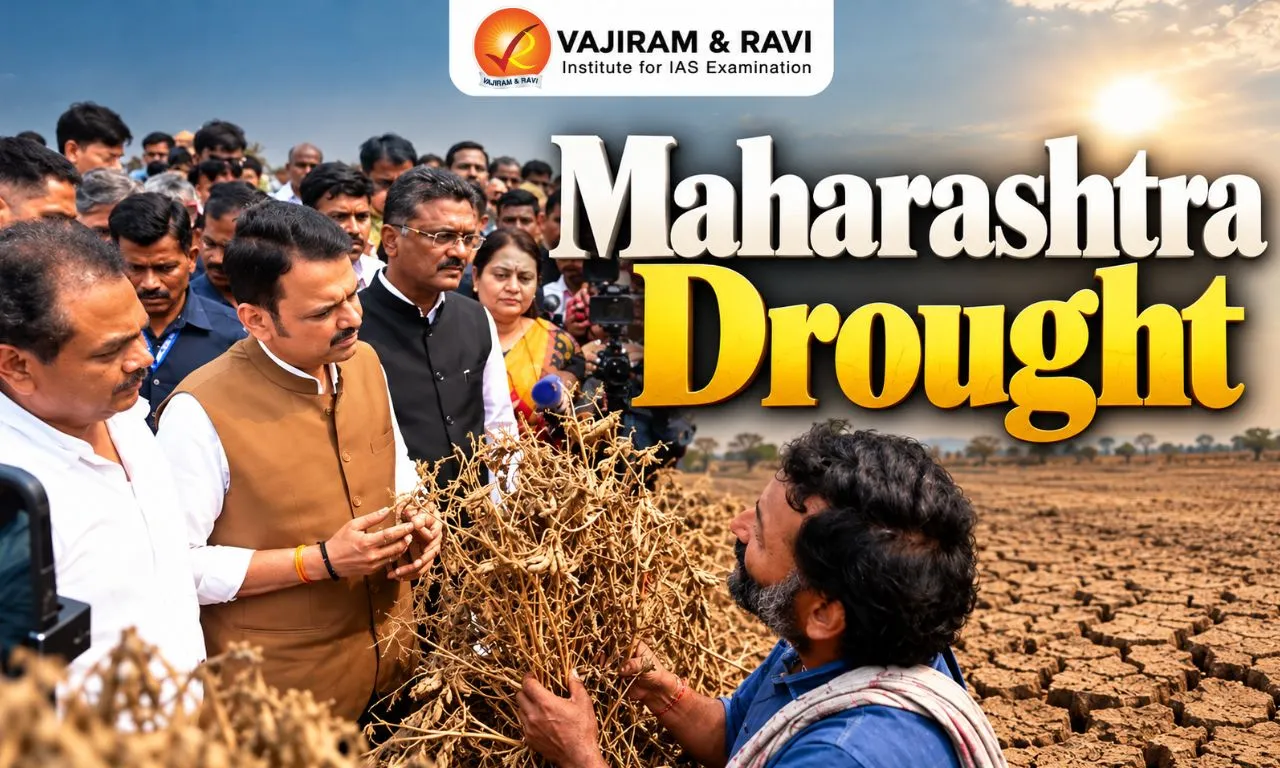
Maharashtra Drought Latest News

  • Calls to declare a drought are rising in Maharashtra, as an El Niño-driven rainfall deficit hits the state's agriculture-dependent economy hard. Water scarcity has compounded the crisis, setting back the kharif season and clouding prospects for rabi. 
  • Opposition leaders have demanded an official drought declaration. Maharashtra Chief Minister says the government is taking "all steps necessary" to address the "alarming" situation.

Why No Official Declaration Yet

  • The timing constraint comes from national disaster-relief rules, not political reluctance.
    • Under National Disaster Response Fund (NDRF) rules, drought declaration for the kharif season (June–October) requires an assessment that can begin only from October 5, once the monsoon starts withdrawing.
    • For the rabi season (October–April), assessment can be held only in March 2027.
    • There is no single, nationally accepted definition of drought. States have the authority to declare drought based on local conditions, but their report must conform to NDRF-specified parameters before the Centre releases disaster relief funds.
  • Maharashtra has decided to submit its proposal to the Centre after October 5.

The Declaration Process

  • The process runs through several defined steps:
    • State-level surveys and panchanamas (on-ground crop-loss assessments) are already underway, to quantify losses in terms of food production and finances.
    • Once the state submits its report, a central team visits the affected regions to conduct its own independent assessment.
    • Only after this verification can relief funds be unlocked by the Centre.

The NDRF Criteria for Drought

  • Drought declaration under NDRF norms rests on multiple indicators, not rainfall alone:
    • Crop loss
    • Moisture Adequacy Index (used to assess soil health)
    • Rainfall deficit
    • Decline in food production
    • Labour migration in search of work
  • Specific thresholds also apply:
    • Sowing must fall below 50% of total cultivable kharif/rabi area.
    • Drinking water shortage must be severe.
    • Groundwater tables must be shrinking.
    • There must be a fodder shortage.
    • Rainfall deficit must reach up to 70%.

How the Kharif Season Was Hit

  • Sowing this season was delayed due to erratic rainfall — instead of the usual June 10 start, sowing began only on July 15. Rain failure after sowing then stunted flowering and fruiting.
  • The worst-hit crops are soybean and cotton — the mainstay of small and marginal farmers in Marathwada and Vidarbha.
  • The dry spell has also stunted sugarcane growth in Marathwada and parts of western Maharashtra.
  • Government response: During the July monsoon session, the CM announced a Rs 40,385-crore farm loan waiver, with an additional Rs 50,000 incentive for farmers who had been repaying loans regularly.

The Water Situation

  • Drinking water scarcity is a major concern, with dam levels well below last year's figures (data as of September 20):
  • Region-wise water levels show sharp disparities:
    • Marathwada (highest dam count at 929): just 46%, down from 81% last year.
    • Amravati division: 64%
    • Nagpur division: 72%
    • Pune: 88%
    • Nashik: 83%
    • Konkan: 76%
  • Marathwada stands out as the most severely affected region.

The Rainfall Picture

  • According to the India Meteorological Department (IMD):
    • 31 of 36 districts in Maharashtra are rain-deficient.
    • 20 of these face a deficit of 25% to 58%.
    • In more than 100 of the state's 355 drought-hit talukas, gaps between rain spells have stretched to 40–60 days.
    • As a result, the main kharif crop, sown across 147 lakh hectares, has withered.
  • An unusual pattern has worsened the damage: where rain did fall, it came short and intense, damaging soil health and causing erosion in some areas, rather than providing steady, absorbable moisture.
  • Structural vulnerability: Maharashtra's agriculture is largely rain-fed. Its irrigation potential stands at under 20%, far lower than states like Uttar Pradesh and Bihar, leaving it especially exposed to monsoon variability.

Conclusion

  • Maharashtra's crisis is real on the ground but procedurally premature on paper. The NDRF's rule-bound calendar, not denial, explains the delay. 
  • What the state needs now is not just an October declaration, but a longer-term shift — greater irrigation coverage — to reduce dependence on a monsoon that keeps growing less reliable.

Source: IE

Maharashtra Drought FAQs

Q1: Why cannot Maharashtra's drought be officially assessed before October 5?

Ans: Under NDRF rules, assessment of a kharif drought can begin only from October 5, after the monsoon begins withdrawing.

Q2: What factors determine a drought declaration in Maharashtra?

Ans: Drought assessment considers crop losses, rainfall deficit, soil moisture, food production, labour migration, groundwater levels, drinking water and fodder availability.

Q3: How has rainfall affected Maharashtra's kharif season?

Ans: Erratic rainfall delayed sowing until July 15, while subsequent dry spells damaged flowering and fruiting, particularly affecting soybean and cotton crops.

Q4: Which region has been most affected by Maharashtra's drought conditions?

Ans: Marathwada has been the most severely affected region, with dam storage at 46% compared with 81% during the corresponding period last year.

Q5: How severe is the rainfall deficit in Maharashtra?

Ans: According to the IMD data cited, 31 of Maharashtra's 36 districts are rain-deficient, with 20 recording deficits ranging from 25% to 58%.

Road Accident Claim Process in India – Explained

Road Accident Claim

Road Accident Claim Latest News

  • With India recording 4,87,707 road accidents in 2024 that claimed 1,77,175 lives, understanding how compensation claims are adjudicated under the Motor Vehicles Act has become essential for claimants navigating the system.

The Scale of the Problem

  • India has the world's largest road network at about 6.7 million kilometres, larger than the US (6.59 million km) and China (5.49 million km). It also records the world's highest road fatalities.
  • According to the Road Accidents in India 2024 report by the Ministry of Road Transport and Highways, road crashes in 2024 injured 4,71,441 people, about 485 deaths a day or 20 an hour. 
  • The economic cost is estimated at around 3.14% of India's GDP, falling most heavily on dependants of those killed or permanently disabled.

The Legal Framework

  • The Motor Vehicles Act, 1988 is the principal law governing motor accident compensation. It covers the entire chain from regulation and driver duties to insurance, liability and compensation.
  • Motor Accidents Claims Tribunals
    • Section 165 empowers State governments to constitute Motor Accidents Claims Tribunals (MACTs) for specified areas to determine accident claims.
  • Evidence Considered
    • The Tribunal typically examines the FIR and chargesheet, site plan, Mechanical Inspection Report, post-mortem or medical records, insurance policy, and depositions of eyewitnesses and the investigating officer.
  • Appeals
    • Appeals under Section 173 lie before the High Court within 90 days, subject to depositing Rs. 25,000 or 50% of the awarded amount, whichever is less.

Criminal and Civil Proceedings Are Separate

  • The same accident may generate two distinct proceedings, a criminal case for rash or negligent driving, and a separate MACT claim for compensation. 
  • As held in Reena v. Managing Director, KSRTC (2026), an acquittal in the criminal case does not affect MACT proceedings, since the two apply different standards of proof.

Who Is Liable to Pay

  • Liability initially attaches to the negligent driver and, vicariously, to the owner of the offending vehicle. Where the vehicle is insured, the insurer generally satisfies the award.
  • Section 146 mandates compulsory third-party insurance, while Section 150 requires insurers to satisfy third-party awards.

Limited Defences for Insurers

  • Under Section 150(2), insurers may raise limited defences including specified policy breaches, unauthorised use, driving without a valid licence, and non-disclosure or misrepresentation in obtaining the policy.
  • Pay and Recover
    • Even where a defence is established, courts may apply the "pay and recover" principle, directing the insurer to pay the victim or legal representatives first, and recover the amount from the owner or driver afterwards. 
    • This ensures victims are not left without compensation due to a dispute between insurer and insured.
  • No-Fault Liability
    • A separate no-fault liability route dispenses with proof of negligence and provides:
      • Rs. 5 lakh for death
      • Rs. 2.5 lakh for grievous hurt
    • These amounts, revised in the 2019 amendment, are payable by the owner or authorised insurer without proof of negligence.

Calculating Compensation in Death Cases

  • Section 168 requires an award of “just” compensation. Through Sarla Verma (2009) and Pranay Sethi (2017), the Supreme Court established standardised formulas. 
  • Once rash and negligent driving is proved, compensation is calculated in three stages:
  • Foundational Facts
    • Age: Determined from the date of birth in the school-leaving certificate, not Aadhaar (Saroj, 2024). 
    • Income: Actual income after tax. For salaried persons, the immediately preceding year’s ITR is ordinarily considered; for self-employed persons, the preceding three years’ average applies (Rashmirekha Tripathy, 2026). If income is unproven, the applicable State-notified minimum wage is used. 
    • Dependants: Legal representatives, including married and earning children, can claim compensation regardless of financial dependency (Jitender Kumar, 2025). 
  • Four Heads of Compensation
    • Loss of income: Annual income + future prospects − personal expenses, multiplied by the applicable age-based multiplier. 
    • Future prospects: For permanent salaried/government employees: 50% (<40 age), 30% (40-50), 15% (50-60); none above 60. For self-employed/fixed-salary persons: 40%, 25% and 10%, respectively. 
    • Personal expenses: Usually 1/3 for 2-3 dependants, 1/4 for 4-6, 1/5 for 7+, and generally 1/2 for an unmarried deceased. 
    • Multiplier: Based solely on age, ranging from 18 for ages 15-25, progressively declining to 5 for ages 66-70. 
    • The remaining conventional heads are loss of estate (Rs. 15,000), funeral expenses (Rs. 15,000), and loss of consortium (Rs. 40,000 per eligible family member). 
    • Consortium includes spousal, parental and filial relationships. These amounts increase by 10% every three years.
  • Aggregation
    • The amounts under all four heads are aggregated to determine the compensation payable. 
    • Courts may additionally award interest under Section 171, generally around 6-9%.

Source: TH

Road Accident Claim FAQs

Q1: Who can file a road accident claim?

Ans: The injured person, the owner of damaged property, or in case of death, all or any of the deceased's legal representatives.

Q2: What is the pay and recover principle?

Ans: Where an insurer establishes a defence, courts may direct it to pay the victim first and recover the amount from the owner or driver afterwards.

Q3: What is no-fault liability compensation?

Ans: Compensation of Rs. 5 lakh for death and Rs. 2.5 lakh for grievous hurt, payable without proof of negligence.

Q4: What are the four heads of compensation in a death case?

Ans: Loss of income, loss of estate, funeral expenses, and loss of consortium.

Q5: What did the Supreme Court hold in Shishu Pal (2026)?

Ans: It recognised loss of domestic care for homemakers, fixing a minimum notional income of Rs. 30,000 per month with 10% enhancement every three years.

Election Commission of India (ECI), Structure, Framework, Composition

Election Commission of India

The Election Commission of India (ECI) is an autonomous constitutional authority responsible for administering elections to the Parliament, state legislatures, and the offices of the President and Vice-President of India. Established on 25 January 1950, the Commission ensures that elections are conducted freely, fairly, and transparently across the country. Its work upholds the democratic principle of universal adult suffrage guaranteed by the Constitution under Article 326. The ECI’s independence and credibility are vital to maintaining India’s democratic integrity.

Election Commission of India

The Election Commission of India derives its powers and responsibilities from Article 324 of the Indian Constitution. It is a constitutional body, independent of government influence, tasked with supervising the entire electoral process. Initially a single-member body, it became a multi-member Commission in 1993, consisting of the Chief Election Commissioner (CEC) and two Election Commissioners. The ECI manages over 97 crore registered voters (as per 2024 data) and conducts elections in more than 10 lakh polling stations nationwide.

Election Commission of India Structure

The Election Commission of India (ECI) is a constitutional body established under Article 324 of the Indian Constitution. It is a multi-member commission responsible for supervising elections to Parliament, State Legislatures, and the offices of the President and Vice President. Originally, it had only one Chief Election Commissioner (CEC), but since October 1993, it became a three-member body. The Commission operates as a collegiate body, ensuring collective decision-making. It has a permanent secretariat at Nirvachan Sadan, New Delhi, and functions independently of government control. Its structure ensures autonomy, impartiality, and accountability in the electoral process as mandated by the Constitution.

Election Commission of India Composition

The ECI comprises the Chief Election Commissioner (CEC) and two Election Commissioners (ECs), as provided under Article 324(2) of the Constitution. The President of India determines the number of Commissioners from time to time. All three members enjoy equal powers, salaries, and status, and decisions are taken collectively through majority vote. The Chief Election Commissioner acts as the head of the institution, ensuring smooth coordination. The administrative staff is drawn from central and state government services. This composition aims to maintain checks and balances within the Commission, upholding transparency and non-partisanship in the conduct of elections.

As of 2026 the members of Election Commission of India are:

  • Chief Election Commissioner (CEC): Shri Gyanesh Kumar
  • Election Commissioners: Dr. Sukhbir Singh Sandhu and Dr. Vivek Joshi

Chief Election Commissioner (CEC)

The Chief Election Commissioner is the head of the Election Commission of India and ensures the independence and integrity of the electoral process.

  • The CEC is appointed by the President of India under Article 324(2) of the Constitution.
  • The CEC’s role is crucial in enforcing the Model Code of Conduct (MCC), supervising voter rolls, and ensuring impartial conduct of elections.
  • The Supreme Court in T.N. Seshan vs Union of India (1995) upheld that all Election Commissioners are equal in power and status, ensuring collective functioning.
  • The CEC is considered the guardian of India’s electoral democracy, accountable only to Parliament and the Constitution.

Election Commissioners Appointment

The Chief Election Commissioner and other Election Commissioners are appointed by the President of India under Article 324(2). Though the Constitution does not specify a detailed procedure, the appointment is made on the advice of the Council of Ministers. However, several legal experts and the Supreme Court (in March 2023) have recommended a collegium system involving the Prime Minister, Leader of Opposition, and Chief Justice of India to ensure transparency until Parliament enacts law. Their appointment order is issued by the President, and their terms, conditions, and service benefits are defined under the Election Commission (Conditions of Service) Rules 1992.

Election Commissioners Tenure

Under the Election Commission (Conditions of Service of Election Commissioners and Transaction of Business) Act 1991, each Election Commissioner, including the CEC, holds office for six years or until attaining the age of 65 years, whichever is earlier. This fixed tenure provides functional independence and stability. Their salaries and allowances are equivalent to those of Judges of the Supreme Court, ensuring parity with other high constitutional offices. Article 324(5) protects their tenure by stating that their service cannot be varied to their disadvantage after appointment. Such constitutional safeguards ensure autonomy and prevent arbitrary interference by the executive branch.

Election Commissioners Resignation and Removal

Election Commissioners may resign from office by submitting a written resignation to the President of India. However, the Chief Election Commissioner (CEC) enjoys stronger constitutional protection. Under Article 324(5), the CEC can be removed only in the same manner and on the same grounds as a Judge of the Supreme Court, that is, by a special majority of both Houses of Parliament on proven misbehavior or incapacity. Other Election Commissioners can be removed only on the recommendation of the CEC. This system ensures the Commission’s independence, preventing misuse of executive power and preserving the institution’s credibility and neutrality in elections.

Election Commission of India Powers

The Commission enjoys wide-ranging powers to ensure the integrity, neutrality, and transparency of the electoral process across India.Key Powers:

  • Administrative Powers: Control over election schedules, polling arrangements, and the deployment of polling staff.
  • Advisory Powers: Advises the President and Governors on matters related to disqualification of members.
  • Quasi-Judicial Powers: Decides disputes regarding political party recognition and symbols under the Election Symbols (Reservation and Allotment) Order, 1968.
  • Regulatory Powers: Enforces the Model Code of Conduct (MCC) and monitors election expenditure.
  • Disciplinary Powers: Can direct transfers or suspension of officials for election-related misconduct.

Election Commission of India Functions

The ECI performs multiple functions to ensure free, fair, and periodic elections in accordance with democratic principles. Major Functions:

  • Conduct of Elections: Supervises, directs, and controls elections to Parliament, State Legislatures, and high offices.
  • Delimitation: The Election Commission of India (ECI) does not directly have delimitation powers; instead, it oversees the process, which is conducted by a separate, temporary Delimitation Commission established by the Central Government.
  • Electoral Rolls: Prepares, revises, and updates voter lists through continuous revision and SIR (Special Intensive Revision).
  • Registration of Political Parties: Recognizes parties and allots election symbols.
  • Voter Education: Promotes awareness under the Systematic Voters’ Education and Electoral Participation (SVEEP) program.
  • Monitoring Expenditure: Ensures transparency through election expenditure audits and monitoring teams.

Election Commission of India Constitutional Provisions

The Election Commission of India is established under Article 324 of the Constitution to ensure free and fair elections in India. Key Constitutional Provisions:

  • Article 324(1): Grants the ECI the power to conduct elections to Parliament, State Legislatures, and the offices of President and Vice-President.
  • Article 324(2): Empowers the President to appoint the Chief Election Commissioner and other Election Commissioners.
  • Article 324(5): Provides protection to the tenure and service conditions of the CEC, ensuring independence.
  • These provisions ensure the ECI acts as an autonomous constitutional authority, not subordinate to any executive or legislature.

Election Commission of India Legal Safeguards

The legal framework guarantees the Commission’s independence and shields it from executive or political influence during elections. Major Legal Provisions:

  • Article 324(5): Protects the CEC’s tenure and prevents arbitrary removal.
  • Election Commission (Conditions of Service of Election Commissioners and Transaction of Business) Act, 1991: Defines tenure, salaries, and conditions of service.
  • Representation of the People Acts (1950 & 1951): Provide detailed election procedures, voter eligibility, and dispute resolution.
  • Indian Penal Code & Conduct of Election Rules, 1961: Penalize malpractices like bribery, booth capturing, and false nominations.
  • These legal safeguards collectively ensure institutional autonomy and operational transparency.

Election Commission of India Government Policies

To strengthen electoral integrity, several policy measures and reforms have been introduced by the government in consultation with the ECI. Key Policies and Their Impact:

  • Electoral Bond Scheme (2018): Introduced to improve transparency in political funding, though under judicial scrutiny.
  • One Nation, One Election (Proposal): Aims to synchronize national and state elections, reducing expenditure and administrative burden.
  • Voter ID-Aadhaar Linking Drive (Proposal): Ensures cleaner voter rolls by removing duplicate entries.
  • Remote Voting Prototype (Proposal): Designed to allow migrant workers to vote from other locations.
  • Awareness Campaigns (SVEEP): Promotes voter education and participation, increasing turnout rates to over 67% in 2019 Lok Sabha polls.

Election Commission of India Independence

The independence of the Election Commission is fundamental to Indian democracy. The Constitution grants it autonomy, but its accountability mechanisms ensure transparency.

Accountability Measures:

  • Judicial review of Commission decisions.
  • Parliamentary oversight through questions and debates.
  • Media transparency and publication of detailed election reports.

Measures Ensuring Independence:

  • Fixed Tenure: CEC and ECs hold office for six years or till the age of 65.
  • Security of Tenure: CEC can be removed only by parliamentary impeachment similar to a Supreme Court judge.
  • Equal Status: All commissioners enjoy equal decision-making power.
  • Financial Autonomy: ECI’s budget is charged on the Consolidated Fund of India, ensuring executive non-interference.
  • Neutrality in Appointments: Recent Supreme Court directives advocate a collegium-based selection process for transparency.

Election Commission of India Case Laws

Several judicial decisions have strengthened the constitutional position and functioning of the ECI:

  • S. Subramaniam Balaji v. State of Tamil Nadu (2013): Directed the ECI to enforce the Model Code of Conduct more stringently.
  • Union of India v. Association for Democratic Reforms (2002): Mandated disclosure of candidates’ criminal, educational, and financial backgrounds.
  • PUCL v. Union of India (2003): Recognized the Right to Vote as part of the freedom of expression under Article 19(1)(a).
  • A.C. Jose v. Sivan Pillai (1984): Affirmed that the ECI has plenary powers under Article 324 to ensure free elections.
  • ADR vs. Election Commission (2024): The Supreme Court emphasized transparency in voter list revisions under SIR, ensuring uniform procedures across states.

Election Commission of India Challenges

Despite its achievements, the ECI faces several operational and institutional challenges:

  • Political Pressure and Allegations of Bias: Increasing accusations of partisanship affect its credibility.
  • Voter Exclusion: Issues in electoral roll verification, especially during Special Intensive Revisions (SIR), lead to disenfranchisement.
  • Election Expenditure: Unchecked campaign spending and unaccounted political donations undermine transparency.
  • Fake News and Electoral Manipulation: Social media misinformation impacts voter behavior.
  • Digital Divide: Limited accessibility of digital services in rural areas hinders full participation.

Way Forward:

  • Establish a collegium system for appointment of Election Commissioners.
  • Provide statutory backing for the Model Code of Conduct.
  • Expand voter education programs in marginalized communities.
  • Enhance cyber resilience through AI-based monitoring.
  • Strengthen coordination with social media platforms to curb misinformation.

Election Commission of India Technology Integration

The ECI has significantly integrated technology into election management, ensuring faster, more secure, and transparent processes. Key Digital Initiatives:

  • EVMs and VVPATs: Ensure tamper-proof voting and verifiable paper trails.
  • cVIGIL App: Allows citizens to report Model Code violations in real time.
  • ERONet and NVSP Portal: Facilitate online voter registration and roll management.
  • Suvidha and Samadhan Portals: Streamline candidate permissions and grievance redressal.
  • Garuda App: Enables Booth Level Officers (BLOs) to conduct door-to-door verification digitally.

Election Commission of India Significance

The Election Commission acts as the foundation of India’s democracy, ensuring the people’s mandate is exercised freely, fairly, and periodically.

  • Democratic Legitimacy: Upholds citizens’ right to vote under Article 326, maintaining public confidence in electoral outcomes.
  • Institutional Stability: Ensures smooth transitions of power without conflict, protecting the essence of parliamentary democracy.
  • Inclusivity: Implements initiatives like SVEEP and Accessible Elections Project to include marginalized groups, PwDs, and senior citizens.
  • Technological Reforms: Adoption of EVMs, VVPAT, and digital voter roll systems enhances transparency and reduces human error.
  • Global Recognition: India’s ECI is often cited as a model for electoral management by international organizations like the UNDP and International IDEA.

Election Commission of India Recent Developments

The Election Commission of India (ECI) has announced Phase 2 of its nationwide “Special Intensive Revision” (SIR) of electoral rolls, covering 12 states and Union Territories from November 4, 2025.

  • The exercise will affect around 51 crore electors, aiming for a final roll publication on February 7, 2026.
  • States involved include major poll-bound regions such as Tamil Nadu, Kerala, West Bengal and Puducherry. 
  • The ECI clarified that Aadhaar card and 13 other documents may be used for identity proof, though concerns over potential disenfranchisement have been raised by opposition parties. 
  • The revision follows the earlier SIR pilot in Bihar, where the ECI reported zero appeals or complaints relating to deletions. 
  • Some states have questioned the timeline and scope of the exercise, arguing that it should not proceed in a short span of 2-3 months given migration and administrative challenges.

Election Commission of India FAQs

Q1: What is the Election Commission of India?

Ans: It is a constitutional body established under Article 324 to supervise elections in India.

Q2: Who appoints the Chief Election Commissioner?

Ans: The President of India appoints the Chief Election Commissioner and other Election Commissioners.

Q3: What is the tenure of Election Commissioners?

Ans: They hold office for six years or until the age of 65, whichever is earlier.

Q4: What are the major powers of the Election Commission of India?

Ans: The ECI conducts elections, enforces the Model Code, and regulates political parties and expenditure.

Q5: How does the Election Commission of India ensure free and fair elections?

Ans: Through technology use, strict monitoring, legal powers, and transparent processes under constitutional safeguards.

Paliyar Tribe

Paliyar Tribe

Paliyar Tribe Latest News

18 families having patta in Nochiodai, a remote settlement of the Paliyar tribe located 32 km inside the Srivilliputhur-Megamalai Tiger Reserve (SMTR), recently received solar power supply.

About Paliyar Tribe

  • They are one of the many ethnic Dravidian (ethnolinguistic and cultural) tribes in Southern India. 
  • They are a Scheduled Tribe primarily located in the South Western Ghats montane rain forests of Tamil Nadu and eastern Kerala. 
  • They are and have been known by multiple names, such as the Paliyans, Palaiyars, Pazhaiyares, and Panaiyars. 
  • Language: They primarily speak a dialect related to Tamil, reflecting their Dravidian linguistic heritage.
  • Occupation: 
    • Traditionally, the Paliyars were hunters and gatherers.
    • Many have transitioned into traders of forest products, food cultivators, and beekeepers.
    • Some work as wage laborers on plantations or in nearby towns. 
  • Their major source of food is yams.  
  • They are recognized for their extensive knowledge and traditional practices pertaining to the use of medicinal plants.  
  • Palliyars have small communities called kudis, sometimes living in caves or mud shelters. 
  • They bury their dead near their homes.  
  • Their festivals involve nature-based rituals, dancing, and music.
  • They have a special ceremony to invoke rain and protect the forest spirits.

Key Facts about Srivilliputhur-Megamalai Tiger Reserve 

  • It is located in the state of Tamil Nadu.
  • It lies in the ecologically sensitive Western Ghats region.
  • It was formed in February 2021 by combining Grizzled Squirrel Wildlife Sanctuary and Megamalai Wildlife Sanctuary.
  • It functions as a connecting link between Kerala’s Periyar Tiger Reserve and Tamil Nadu’s Southern Kalakkad-Mundanthurai Tiger Reserve.
  • Rivers: The area primarily relies on three perennial rivers: Vaigai, Suruliyaru, and Shanmuganathi.
  • The climate of the reserve is influenced by both the southwest and northeast monsoons.
  • Vegetation: It’s a blend of tropical evergreen and semi-evergreen forests, dry deciduous and moist mixed deciduous woods, and grasslands.
  • Flora: Some notable plant species in the reserve include Teak, Indian Rosewood, Bamboo species, Wild fig trees, Evergreen shrubs, and medicinal plants.
  • Fauna:
    • Mammals: Elephants, Tiger, Leopard, Nilgiri Tahr, Gaur, Spotted Deer, Barking Deer, Sambar Deer, Wild Boar, Porcupine, Nilgiri Langur, Lion-Tailed Macaque, etc.
    • It is particularly celebrated as the last known stronghold of the Grizzled Giant Squirrel (Ratufa macroura), a spectacular arboreal mammal found only in a handful of locations in peninsular India and Sri Lanka. 
    • Birds: Red-Whiskered Bulbul, Common Iora, White-Browed Wagtail, Grey Wagtail, Pied Bush Chat etc.
    • Reptiles: Wood Snake, Monitor Lizard, Chameleon, etc.

News: NIE

Paliyar Tribe FAQs

Q1: Where are the Paliyar Tribe primarily located?

Ans: They are primarily located in the South Western Ghats montane rain forests of Tamil Nadu and eastern Kerala.

Q2: What are some alternative names of the Paliyar tribe?

Ans: Paliyans, Palaiyars, Pazhaiyares and Panaiyars.

Q3: Which language do the Paliyar tribe primarily speak?

Ans: They primarily speak a dialect related to Tamil.

Q4: What is the major source of food for the Paliyars?

Ans: Yams are their major source of food.

Election Commission SIR Row, 14 Objections, Powers, 3 Member Structure

Election Commission SIR Row

Election Commission of India (ECI) is in the news over reported differences among its three members during the Special Intensive Revision (SIR) of electoral rolls. Election Commissioners Sukhbir Singh Sandhu and Vivek Joshi raised objections at least 14 times over 10 months on issues related to voter registration, deletion and restoration of names, Form 6, electoral-roll databases and election software. 

Three-Member Structure of ECI

Election Commission of India (ECI) is a multi-member body consisting of one Chief Election Commissioner (CEC) and two Election Commissioners (ECs). The three members have equal powers and status, with decisions generally taken through a majority.

  • From Single to Multi-Member Body: The ECI was established in 1950 as a single-member body headed by the CEC. It became a multi-member body in October 1989 and was restored to the present three-member structure on October 1, 1993.
  • Equal Powers: The CEC and Election Commissioners have equal decision-making powers within the Commission.
  • Majority-Based Decisions: ECI decisions are generally taken by majority, meaning the CEC does not have a separate power to overrule the other Election Commissioners.
  • Salary and Status: The CEC and Election Commissioners receive salaries and benefits as provided under law; their service conditions are governed by the Chief Election Commissioner and Other Election Commissioners Act, 2023.

How Does ECI Take Decisions?

The ECI is a three-member constitutional body consisting of the Chief Election Commissioner and two Election Commissioners. The Chief Election Commissioner (CEC) is the head of the Commission, but the other Election Commissioners also participate in decision-making.

Under Section 18 of the Chief Election Commissioner and Other Election Commissioners Act, 2023, the Commission should conduct its business as far as possible unanimously. If the members differ in opinion, the matter is decided by the majority view. Therefore, in a three-member Commission:

Two members supporting a decision = majority decision

The law also provides that the Commission's procedure and allocation of work should be settled through a unanimous decision.

What is Form 6?

Form 6 is the application form used by an eligible person for inclusion of their name in the electoral roll. It is important because a person generally needs to be registered in the electoral roll to vote in an election.

According to the report, Election Commissioner Vivek Joshi objected to the change, saying that Form 6 could not be modified in this manner without following the applicable legal procedure. Sukhbir Singh Sandhu reportedly agreed with the objection.

The issue therefore concerns the relationship between statutory election rules and administrative changes to election forms.

Powers and Functions of Election Commission of India

Election Commission of India (ECI) is a constitutional authority responsible for supervising and conducting elections in India. Its powers cover the conduct of elections, electoral rolls, political parties, election symbols, the Model Code of Conduct and election-related compliance.

  • Conduct of Elections: The ECI conducts elections to the Lok Sabha, Rajya Sabha, State Legislative Assemblies, President and Vice-President. It prepares the election schedule, supervises polling and counting, and coordinates with election officials and other authorities.
  • Preparation of Electoral Rolls: The ECI supervises the preparation, revision and updating of electoral rolls. It ensures that eligible citizens can be included and that electoral records are corrected, updated or removed according to the applicable law.
  • Supervision of Election Machinery: The Commission directs and supervises election officials at different levels, including Chief Electoral Officers, District Election Officers and Electoral Registration Officers, to ensure that election-related procedures are followed.
  • Recognition of Political Parties: The ECI registers political parties and determines their recognition as National or State parties based on the criteria prescribed under election law.
  • Allotment of Election Symbols: The Commission regulates the allotment and reservation of election symbols to political parties and candidates under the Election Symbols (Reservation and Allotment) Order, 1968.
  • Model Code of Conduct: The ECI implements the Model Code of Conduct (MCC) during elections and issues directions to political parties and candidates to maintain a level playing field and ensure disciplined campaigning.
  • Monitoring Election Expenditure: The Commission monitors election expenditure by candidates and political parties and takes action in cases of violations under applicable election laws.
  • Advisory Functions: The ECI provides its opinion to the President or Governor on certain matters relating to the disqualification of Members of Parliament and State Legislatures, as provided under the Constitution.
  • Quasi-Judicial Functions: The Commission performs certain quasi-judicial functions, including matters related to political-party recognition, election symbols and disputes involving recognised political parties.
  • Ensuring Free and Fair Elections: The ECI can issue directions and take administrative measures within its constitutional and legal authority to ensure that elections are conducted in an orderly, transparent and lawful manner.

Also Read:- ECINET Form 6

Important Laws Related to ECI

Election Commission of India (ECI) functions under the Constitution and several election-related laws and rules. These laws cover electoral rolls, election conduct, voter registration, political parties and election procedures.

  • Constitution of India, Articles 324-329: Part XV of the Constitution provides the basic constitutional framework for elections. Article 324 gives the ECI superintendence, direction and control over electoral rolls and elections.
  • Representation of the People Act, 1950: Mainly deals with electoral rolls, voter registration, qualifications for registration and allocation of seats.
  • Representation of the People Act, 1951: Covers the conduct of elections, qualifications and disqualifications of candidates, corrupt practices, election offences and election disputes.
  • Registration of Electors Rules, 1960: Provides the rules and procedures for preparation, revision and correction of electoral rolls under the 1950 Act.
  • Conduct of Election Rules, 1961: Provides detailed procedures for nominations, polling, counting, declaration of results and other election processes.
  • Chief Election Commissioner and Other Election Commissioners Act, 2023: Provides the statutory framework concerning the appointment, service conditions and functioning of the Chief Election Commissioner and other Election Commissioners.
  • Election Symbols (Reservation and Allotment) Order, 1968: Provides the framework for recognition of political parties and reservation/allotment of election symbols.

Election Commission of India Act, 2023

Election Commission Act, 2023 regulates the appointment, service conditions and functioning of the Chief Election Commissioner (CEC) and Election Commissioners (ECs).

  • Appointment: President of India appoints the CEC and other Election Commissioners on the recommendation of a Selection Committee comprising the Prime Minister, Leader of Opposition in the Lok Sabha, and a Union Cabinet Minister nominated by the Prime Minister.
  • Three-member structure: The Election Commission consists of the CEC and such number of Election Commissioners as the President may fix.
  • Decision-making: ECI matters should, as far as possible, be decided unanimously; if members disagree, the majority view prevails.
  • Service conditions: Specifies provisions relating to the term of office, salary, allowances and other conditions of service of the CEC and ECs.

Removal of Election Commissioners

Chief Election Commissioner (CEC) and other Election Commissioners have different removal protections under Article 324 of the Constitution and the 2023 Act.

  • CEC: Can be removed by the President only in the same manner and on the same grounds as a Supreme Court judge.
  • Other Election Commissioners: Can be removed by the President only on the recommendation of the CEC.
  • Resignation: The CEC or any Election Commissioner can resign by submitting a written resignation to the President.
  • Protection of tenure: These provisions are intended to provide legal safeguards for the independence of the Election Commission.
  • Tenure: The CEC and other Election Commissioners hold office for 6 years or until they attain 65 years of age, whichever is earlier. 

Election Commission SIR Row FAQs

Q1: What is the Election Commission SIR Row?

Ans: The SIR row concerns reported objections raised by Election Commissioners Sukhbir Singh Sandhu and Vivek Joshi over aspects of the Special Intensive Revision (SIR) of electoral rolls, including voter registration, deletion of names, Form 6 and electoral-roll database management.

Q2: What is Special Intensive Revision (SIR)?

Ans: SIR is a detailed exercise to verify and update electoral rolls, including the inclusion, correction and deletion of voter names as required under the applicable electoral laws.

Q3: What is Form 6?

Ans: Form 6 is used by eligible individuals to apply for inclusion of their name in the electoral roll. The reported SIR row also involved changes made to Form 6 on the ECI's digital platform.

Q4: Who are the three members of the Election Commission?

Ans: The Commission currently comprises Chief Election Commissioner Gyanesh Kumar, Election Commissioner Sukhbir Singh Sandhu and Election Commissioner Vivek Joshi.

Q5: How does the Election Commission take decisions?

Ans: Under the Chief Election Commissioner and Other Election Commissioners Act, 2023, ECI business is to be transacted unanimously as far as possible. If members disagree, the majority view prevails.

Cyclone Arnab 2026, Location, Naming, Tracker, Latest Updates

Cyclone Arnab

Cyclone Arnab 2026 refers to the weather system over the Bay of Bengal that has attracted attention as the next possible cyclone name. However, as of September 23, 2026, the system remains a deep depression and is not classified as a cyclonic storm. It is moving towards the north Andhra Pradesh-South Odisha coast, with landfall expected near Kalingapatnam between Visakhapatnam and Gopalpur.

Cyclone Arnab Latest Updates

The Cyclone Arnab deep depression over the Bay of Bengal has crossed the Andhra Pradesh-Odisha coast, with the landfall process underway during the early hours of September 24, 2026. Heavy rainfall and strong winds remain the main concerns. The system crossed the coast between north Andhra Pradesh and south Odisha, close to Kalingapatnam. The front sector entered land, and the landfall process continued for about two-three hours.

Cyclone Arnab 2026

The Cyclone Arnab 2026 system is located over the westcentral and adjoining northwest Bay of Bengal and is being monitored continuously by IMD.

  • Cyclone Classification: The India Meteorological Department has indicated that the system is unlikely to intensify into a cyclone before landfall. Therefore, it is expected to retain deep depression status.
  • Name Arnab: The name Arnab means ocean in Bengali. The name was contributed by Bangladesh for the regional tropical cyclone naming system.
  • Formation Background: The system developed over the Bay of Bengal and intensified from a depression into a deep depression before approaching the north Andhra Pradesh-South Odisha coast.
  • Monitoring System: The system is under continuous observation by the Doppler Weather Radar at Visakhapatnam. Radar monitoring is tracking its movement and structure near the coast.
  • Wind Conditions: Strong winds are expected along the affected coastal areas. The system may produce gusty winds along with heavy rainfall during its approach and landfall.

Cyclone Arnab Impacts

The main concern from the Cyclone Arnab system is heavy rainfall, strong winds, rough seas, flooding and localised landslide risks across affected areas.

  • Odisha Impact: Odisha remains among the worst-affected regions. Heavy to very heavy rainfall is expected in several areas, with extremely heavy rainfall possible at isolated places.
  • Red Alert Areas: Koraput, Gajapati and Ganjam faced warnings for heavy to very heavy rainfall and isolated extremely heavy rainfall on September 24.
  • Further Rainfall: Kalahandi, Nabarangpur, Koraput and Malkangiri are expected to receive heavy rainfall during September 24-25.
  • Andhra Pradesh: Coastal Andhra Pradesh is also experiencing the system's effects. Squally weather and strong winds are expected along and off the south Odisha-north Andhra Pradesh coasts.
  • West Bengal: Parts of West Bengal are expected to receive heavy to very heavy rainfall. Darjeeling and Kalimpong were also under landslide warnings.
  • Flood Risk: Heavy rainfall can increase water levels in rivers, water bodies and dams. Low lying areas may face waterlogging and local flooding during intense rainfall.
  • Landslide Risk: Odisha authorities identified 140 landslide prone areas in Gajapati. Rain related risks were also reported from Ganjam, Malkangiri, Koraput, Rayagada and Nabarangpur.
  • Sea Conditions: Very rough seas are expected over the westcentral and northwest Bay of Bengal until the evening of September 24. Coastal waters may gradually improve afterwards.
  • Local Damage: Heavy rain has already resulted in reports of trees being uprooted, houses being damaged, rainwater entering homes and muddy water flowing down hills.

Cyclone Arnab 2026 Management

Preparedness of Cyclone Arnab 2026 focuses on evacuation, shelter management, emergency services, weather monitoring, essential supplies and protection of vulnerable communities.

  • Evacuation: At least 5,000 people were moved to safer locations in Odisha. Pregnant women and elderly persons were among those shifted to cyclone centres and temporary relief camps.
  • Emergency Services: Essential supplies, equipment, health services and emergency teams were kept ready. Disaster mitigation teams were placed on high alert for rapid response.
  • Shelter Preparedness: Cyclone and flood shelters were kept ready in vulnerable districts. Temporary relief camps were also arranged for evacuated residents.
  • Vulnerable Areas: Authorities restricted access to identified landslide prone locations. Continuous monitoring was carried out in areas considered vulnerable to landslides and mudslides.
  • Water Monitoring: Officials monitored water levels in rivers, water bodies and dams to identify possible flood risks during periods of intense rainfall.
  • Public Safety: People were advised to stay indoors during strong winds. They should avoid windows, damaged structures, trees, large hoardings, floodwater and exposed electrical equipment.
  • Emergency Kit: Residents should keep drinking water, food, medicines, first aid supplies, torches, batteries, candles, matches and power banks ready for at least two to three days.
  • Evacuation Rules: People in coastal, low lying and flood prone areas should immediately follow evacuation orders. They should move to designated shelters or safer higher ground.

Cyclone Arnab Tracker

The Cyclone Arnab 2026 is being tracked by the latest monitoring systems of the India Meteorological Department Doppler Weather Radar. It’s latest updates are shared to the authorities to improve and monitor preparations to reduce the impacts of the storm.

  • Landfall Status: The deep depression crossed the Andhra Pradesh-Odisha coast during the early hours of September 24, 2026. The landfall process was underway at 2:47 am IST.
  • Landfall Status: The deep depression crossed the Andhra Pradesh-Odisha coast during the early hours of September 24, 2026. The landfall process was underway at 2:47 am IST.
  • Landfall Location: The system crossed between Visakhapatnam and Gopalpur, close to Kalingapatnam, after moving west-northwestwards towards the coast.
  • Post-Landfall Movement: After landfall, the system is very likely to move northwestwards initially. It is expected to maintain deep depression intensity for the next 12 hours.
  • Wind Forecast: Winds may gust up to 75 kmph around the affected coastal region. Fishermen were advised not to venture into the sea along the Odisha and West Bengal coasts and the north Bay of Bengal.
  • Preparedness: Odisha placed collectors of 11 districts on high alert. Cyclone and flood shelters were kept ready, while at least 5,000 people were moved to safer locations.
  • Post-Landfall Monitoring: Authorities are continuing to monitor rainfall, flooding, landslides, water levels and wind conditions as the system moves inland after crossing the coast.

Cyclone Arnab 2026 FAQs

Q1: What is Cyclone Arnab 2026?

Ans: Cyclone Arnab 2026 refers to the deep depression over the Bay of Bengal approaching the north Andhra Pradesh-South Odisha coast.

Q2: Is Cyclone Arnab expected to become a cyclone?

Ans: No. As of September 23, 2026, the system is unlikely to intensify into a cyclonic storm before landfall.

Q3: Where will Cyclone Arnab make landfall?

Ans: The deep depression is expected to cross between Visakhapatnam and Gopalpur, close to Kalingapatnam, on September 23 night.

Q4: Which states will be affected by Cyclone Arnab 2026?

Ans: Odisha and Andhra Pradesh are expected to face major impacts, while heavy rainfall may also affect West Bengal, Chhattisgarh and Telangana.

Q5: Who named Cyclone Arnab?

Ans: The name Arnab, meaning ocean in Bengali, was contributed by Bangladesh.

Daily Editorial Analysis 24 September 2026

Daily-Editorial-Analysis

India And The Plausible Multilateralism Of BRICS

Context:

  • BRICS gatherings always trigger heated debate in India. Optimists see BRICS as an institution capable of multipolarising the global order. Sceptics highlight internal divisions and fear domination by Russia and China.
  • A third group dismisses it entirely as strategic noise, arguing India should instead focus on deepening ties with the United States.
  • The 18th BRICS Summit, held in New Delhi on September 12–13, 2026, drew special attention because of its timing and location.
  • It was the first BRICS summit since the US and Israel launched war against Iran on February 28, 2026, in India's extended neighbourhood. India — a close strategic partner of both the US and Israel — hosted the Presidents of Iran, Russia and China at the same table.
  • This article highlights how BRICS enables India to manage strategic differences with China, Russia, Iran and the United States while preserving its policy of multi-alignment and strategic autonomy.

A Difficult Consensus in Delhi

  • Building agreement among 11 member countries — including the UAE and Iran, who remain locked in an undeclared conflict — was itself an achievement.
  • The Delhi Declaration shows that despite disputes, members continue to find value in a BRICS worldview built around a more representative global order.
  • This consensus required compromise from every side, including India.

India's Balancing Act on West Asia

  • India's position had grown awkward in the run-up to the summit.
    • PM Modi visited Israel just two days before the Israel-US bombing of Iran began.
    • India initially avoided condemning the attacks or the assassination of Iran's Supreme Leader, Ayatollah Ali Khamenei — creating an impression of tilting towards Washington and Tel Aviv.
    • India also watched from the sidelines as Pakistan stepped in as a mediator between the US and Iran, seizing the diplomatic opening.
  • India then repositioned itself as West Asia's traditional balancer, using multilateral platforms to do so without damaging bilateral ties:
    • India endorsed the Bishkek resolution of the Shanghai Cooperation Organisation (SCO) in September, condemning the strikes on Iran and expressing condolences over Khamenei's killing.
    • India hosted Iran's President Masoud Pezeshkian at the Delhi summit even as the West Asia war continued.
    • The image of Modi walking hand in hand with Pezeshkian is unlikely to fade quickly in Washington or Tel Aviv.

Managing the China Relationship

  • The India-China border dispute remains unresolved and continues to simmer. But there is momentum toward resetting ties, and multilateral forums like BRICS let India and China stay engaged even without high-level bilateral visits.
  • The underlying logic: a lack of engagement between competing major powers deepens mistrust, and mistrust combined with a security dilemma can turn dangerous.
  • Staying engaged — bilaterally and multilaterally — creates guardrails for competitive coexistence.

Convergence Despite Divergence

  • On major global issues — AI regulation, global trade and finance rules, climate change, border conflicts, and the status of multilateral bodies — BRICS members hold different approaches and priorities.
  • Yet they converge on one point: unilateralism by any bloc or power harms their interests and the planet.

The "Washington Predictability"

  • Analysts frame US behaviour not as unpredictable, but as totally predictable in one sense — a consistent focus on its own dominance above all else.
  • Several BRICS members have had difficult direct experiences with this:
    • India was recently hit with varying US tariffs.
    • India was among the countries most economically affected by the US-Israel war on Iran.
    • On September 16, 2026, the US House passed the Russia sanctions Bill, threatening tariffs of up to 100% on countries including India.
  • India's foreign policy under PM Modi has sometimes been read as a tilt toward the US camp, reinforced by his early remark that India had overcome its "hesitation of history" with Washington.
  • But this coexists with the official framing of "sabke saath" — multi-alignment.
  • Experts contend that India has not abandoned the hesitations of strategic realism, even if it shed historical hesitancy.

The Lesson of Frontline States

  • History and current events both warn against becoming a frontline in great-power rivalry.
  • Pakistan's experience is one instructive example.
  • UAE and Iran — better off dealing with each other directly — found a partial corrective through their bilateral meeting on the sidelines of the Delhi BRICS summit, using a multilateral platform to address a bilateral problem.
  • Ukraine, by contrast, backed by NATO and fighting Russia for over four years, has no direct platform to engage Moscow, leaving its diplomatic options entirely dependent on Brussels and Washington.

What India Should Learn

  • The argument is not that India should downgrade ties with the US. The US partnership remains vital for India's development.
  • But India must avoid becoming a frontline in the US-China competition. BRICS lets India pursue this path without championing an anti-US agenda or undermining cooperation with Washington.
  • Washington, having previously accepted India's adherence to strategic autonomy, has reportedly been pushing to draw India into a more subordinate relationship.
  • India's answer should be to pursue multiple pathways to its rise, rather than accept unequal great-power alliances.

Why BRICS's Divisions Are Not a Weakness

  • BRICS is unlike the G-7, where American primacy and the Western order are broadly accepted by all members.
  • Its internal divisions actually prevent any single country from dominating the grouping.
  • Meanwhile, an external convergence — a shared belief that the post-war international system is unfair and needs a more representative replacement — holds the group together.
  • The dialectic between internal contradiction and external convergence is producing a synthesis. The contradictions are not a reason to question BRICS's existence — they are part of the reason it should exist and grow.

Conclusion

  • BRICS works for India not by resolving disagreement, but by managing it. The Delhi summit showed India balancing Tehran, Washington, and Beijing simultaneously — without abandoning any relationship.
  • Strategic autonomy is not neutrality; it is the deliberate refusal to become anyone's frontline.

India And The Plausible Multilateralism Of BRICS FAQs

Q1. What was significant about the 18th BRICS Summit in New Delhi?

Ans: The summit brought Iran, Russia and China together with India amid West Asian conflict, demonstrating BRICS's capacity for difficult diplomatic engagement.

Q2. How does BRICS help India manage its relationship with China?

Ans: BRICS provides India and China a multilateral platform for engagement, helping maintain communication and creating guardrails despite unresolved bilateral tensions.

Q3. What common concern unites BRICS members despite their differences?

Ans: Despite divergent priorities, BRICS members broadly converge around the view that unilateralism by any major bloc can harm their interests.

Q4. Why is strategic autonomy important for India's foreign policy?

Ans: Strategic autonomy allows India to maintain important partnerships while avoiding dependence on any single power or becoming a frontline in great-power rivalry.

Q5. Why does the article argue that BRICS's internal divisions are not necessarily a weakness?

Ans: Internal divisions can prevent domination by one member, while shared concerns about the international system provide sufficient common ground for cooperation.

Source: TH

Daily Editorial Analysis 2026 FAQs

Q1: What is editorial analysis?

Ans: Editorial analysis is the critical examination and interpretation of newspaper editorials to extract key insights, arguments, and perspectives relevant to UPSC preparation.

Q2: What is an editorial analyst?

Ans: An editorial analyst is someone who studies and breaks down editorials to highlight their relevance, structure, and usefulness for competitive exams like the UPSC.

Q3: What is an editorial for UPSC?

Ans: For UPSC, an editorial refers to opinion-based articles in reputed newspapers that provide analysis on current affairs, governance, policy, and socio-economic issues.

Q4: What are the sources of UPSC Editorial Analysis?

Ans: Key sources include editorials from The Hindu and Indian Express.

Q5: Can Editorial Analysis help in Mains Answer Writing?

Ans: Yes, editorial analysis enhances content quality, analytical depth, and structure in Mains answer writing.

Enquire Now