UPSC Daily Quiz 26 October 2026

UPSC Daily Quiz

[WpProQuiz 286]

UPSC Daily Quiz FAQs

Q1: What is the Daily UPSC Quiz?

Ans: The Daily UPSC Quiz is a set of practice questions based on current affairs, static subjects, and PYQs that help aspirants enhance retention and test conceptual clarity regularly.

Q2: How is the Daily Quiz useful for UPSC preparation?

Ans: Daily quizzes support learning, help in revision, improve time management, and boost accuracy for both UPSC Prelims and Mains through consistent practice.

Q3: Are the quiz questions based on the UPSC syllabus?

Ans: Yes, all questions are aligned with the UPSC Syllabus 2025, covering key areas like Polity, Economy, Environment, History, Geography, and Current Affairs.

Q4: Are solutions and explanations provided with the quiz?

Ans: Yes, each quiz includes detailed explanations and source references to enhance conceptual understanding and enable self-assessment.

Q5: Is the Daily UPSC Quiz suitable for both Prelims and Mains?

Ans: Primarily focused on Prelims (MCQ format), but it also indirectly helps in Mains by strengthening subject knowledge and factual clarity.

Krishak Bandhu Scheme, Eligibility, Documents, Apply Online

Krishak Bandhu Scheme

Krishak Bandhu Scheme is a farmer welfare scheme launched by the Department of Agriculture, Government of West Bengal. It aims to provide financial assistance and death benefit coverage to farmers in the state. Under this scheme, eligible farmers receive annual income support based on their landholding, while financial assistance is also available in cases of death or permanent disability, subject to the applicable conditions.

The scheme helps farmers manage agricultural expenses, support their families and reduce financial difficulties.

What Is the Krishak Bandhu Scheme?

The Krishak Bandhu Scheme is a government initiative designed to support farmers in West Bengal through direct financial assistance. It provides annual income support to eligible farmers and registered sharecroppers, helping them meet farming-related expenses.

The scheme also includes a financial protection component for eligible farmers and their families. The assistance is transferred directly to beneficiaries' bank accounts through the Direct Benefit Transfer (DBT) system.

Krishak Bandhu Scheme Key Highlights

The key highlights related to the Krishak Bandhu Scheme have been tabulated below.

Krishak Bandhu Scheme Key Highlights

Particulars

Details

Scheme Name

Krishak Bandhu Scheme

State

West Bengal

Department

Department of Agriculture, Government of West Bengal

Beneficiaries

Eligible farmers, landowners and registered sharecroppers

Annual Financial Assistance

₹4,000 to ₹10,000, depending on eligible landholding

Death Benefit

₹2 lakh, subject to scheme conditions

Payment Method

Direct Benefit Transfer (DBT)

Main Objective

To provide income support and financial protection to farmers

What Are the Benefits of the Krishak Bandhu Scheme?

The Krishak Bandhu Scheme provides annual financial assistance and a death benefit to eligible beneficiaries. Its major benefits are explained below.

1. Annual Income Support

Under the scheme, eligible farmers receive financial assistance based on their landholding.

  • Farmers with 1 acre or more: Receive ₹10,000 per year in two instalments.
  • Farmers with less than 1 acre: Receive assistance on a proportionate basis, subject to a minimum annual benefit of ₹4,000.

This financial support can help farmers purchase seeds, fertilisers and other agricultural inputs and meet cultivation expenses.

2. Death Benefit

The scheme provides a lump-sum financial benefit of ₹2,00,000 in eligible cases involving the death of a registered farmer.

The benefit is intended to provide financial support to the farmer's family after the loss of an earning member. Eligibility and claim approval depend on the scheme's applicable rules and documentation requirements.

3. Permanent Disability Benefit

Financial assistance of ₹2 lakh is also specified for eligible cases of permanent disability caused by an accident, subject to the scheme's conditions. The relevant age requirement for this benefit is 18 to 60 years.

Applicants should check the latest official guidelines to confirm the conditions and documents required for a disability claim.

4. Direct Benefit Transfer

The scheme uses the Direct Benefit Transfer (DBT) system to transfer eligible financial assistance directly into beneficiaries' bank accounts. Aadhaar-linked banking details may be required for payment verification.

This system helps beneficiaries receive financial assistance without relying on intermediaries for the transfer.

What Is the Eligibility Criteria for the Krishak Bandhu Scheme?

To receive benefits under the Krishak Bandhu Scheme, applicants must meet the eligibility conditions set by the Government of West Bengal.

The main eligibility requirements are:

  • State Residency: The applicant must be a resident of West Bengal.
  • Farmer Status: The applicant must be an eligible farmer, landowner or recorded sharecropper (Bargadar).
  • Cultivable Land: Applicants must provide valid records of cultivable land or sharecropping, as applicable.
  • Death Benefit: The benefit is available to the legal heirs of eligible farmers who die between the ages of 18 and 60 years.

What Documents Are Required for the Krishak Bandhu Scheme?

Applicants may need to submit the following documents for registration under the scheme:

  • Voter ID Card as identity proof.
  • Aadhaar Card, where required.
  • Land ownership records, such as the Record of Rights (RoR), agricultural patta or forest patta.
  • Bank passbook's first page or a cancelled cheque to verify bank account details.
  • Recent passport-size photograph.
  • Registered sharecropping records, where applicable.
  • Mobile number for communication and verification.

Additional documents may be required depending on the type of application. For a death benefit claim, the legal heirs may need to submit the death certificate, identity documents and proof of their legal-heir status.

How to Apply for the Krishak Bandhu Scheme?

Farmers can contact the Agriculture Department in their area to understand the registration process and submit the required documents.

Follow these steps:

  1. Visit the official Krishak Bandhu website.
  2. Contact the Assistant Director of Agriculture at your block-level office for registration guidance.
  3. Obtain the prescribed application form or follow the registration procedure currently in force.
  4. Fill in the required personal, landholding and bank account details.
  5. Attach the necessary documents and submit the application to the designated authority.
  6. Keep the acknowledgement or application reference details for future use.

Krishak Bandhu Scheme FAQs

Q1: What is the Krishak Bandhu Scheme?

Ans: The Krishak Bandhu Scheme is a West Bengal government initiative that provides annual financial assistance to eligible farmers and a death benefit to the families of eligible farmers.

Q2: How much money is given under the Krishak Bandhu Scheme?

Ans: Eligible farmers with one acre or more of cultivable land receive ₹10,000 per year. Farmers with less than one acre receive proportionate assistance, subject to a minimum of ₹4,000 per year.

Q3: Who is eligible for the Krishak Bandhu Scheme?

Ans: Eligible residents of West Bengal who are farmers, landowners or recorded sharecroppers may qualify, subject to the scheme's requirements.

Q4: How much is the Krishak Bandhu death benefit?

Ans: The scheme provides a one-time payment of ₹2 lakh to the legal heirs of an eligible farmer who dies between the ages of 18 and 60 years.

Q5: How many instalments are provided under the Krishak Bandhu Scheme?

Ans: Annual income assistance is paid in two equal instalments, generally during the Kharif and Rabi seasons.

Rugda Mushroom: Jharkhand’s Wild Monsoon Fungus Supports Tribal Livelihoods

Rugda Mushroom

Rugda Mushroom Latest News

Rugda mushroom which is an important non-timber forest produce providing seasonal income for many tribal households in forested villages of Jharkhand.

About Rugda Mushroom 

  • It is a wild, edible subterranean fungus.
  • It is scientifically known as Astraeus hygrometricus or Astraeus asiaticus.
  • It is commonly foraged by tribal communities in eastern and central India. 
  • It is highly prized across the Chhotanagpur Plateau, particularly in Jharkhand, Odisha, Chhattisgarh, and West Bengal
  • It appears beneath the forest floor after the first monsoon showers and is hand-foraged for only a few weeks each year.
  • It survives in a natural partnership with the roots of sal trees, exchanging nutrients through an underground fungal network. Scientists call this an ectomycorrhizal relationship. 
  • Ideal Condition for Growth
    • It relies heavily on the monsoon for growth.
    • Ideal conditions include high rainfall (around 350 cm), ample sunlight, and temperatures near 30°C.
    • The fallen Sal leaves decompose over time to form a nutrient-rich humus layer.
    • This layer is a dark, organic part of the soil that is high in moisture and essential nutrients, creating an environment that supports the healthy growth of these mushrooms.

Source: DTE

Rugda Mushroom FAQs

Q1: Where do we find Rugda Mushroom?

Ans: It is commonly foraged by tribal communities in eastern and central India. 

Q2: What type of relationship does Rugda Mushroom shows with Sal?

Ans: It survives in a natural partnership with the roots of sal trees, exchanging nutrients through an underground fungal network. Scientists call this an ectomycorrhizal relationship. 

Saidongar-1 Project Faces Opposition Over Tree Cutting in Maharashtra

Saidongar-1 Pumped Storage Project

Saidongar-1 Pumped Storage Project Latest News

Environmental activists and opposition parties recently came out against the “rampant” cutting of hundreds of trees for Torrent Power’s Saidongar-1 Pumped Storage Project in Raigad district of Maharashtra.

About Saidongar-1 Pumped Storage Project

  • The Saidongar 1 (Karjat) Off-Stream Open Loop Pumped Storage project (PSP) is a major hydro-energy initiative located in Karjat taluka, Raigad district of Maharashtra. 
  • The project is adjacent to the Bhimashankar Wildlife Sanctuary of Pune district in the Sahyadri-Western Ghats ranges. 
  • With a capacity of 3,000 MW, it will be India’s largest PSP.  
  • The project will comprise two reservoirs. 
    • The upper reservoir will be constructed on the hilltop with a maximum dam height of 27 m to create the desired storage capacity, while the lower reservoir will have a maximum height of 59 m and shall be constructed across River Pej. 
  • It comprises 10 reversible pump turbines, each of 300 MW. 
  • It is being developed by Torrent Energy Storage Solutions Private Limited, a subsidiary of Gujarat-based Torrent Power Ltd.
  • Once operational, it will reduce carbon dioxide emissions by 4.55 million tons per year, roughly equivalent to taking around 1 million cars off the road annually.  
  • With an annual energy production of 6,241 GWh, the project is expected to contribute to grid reliability and energy security in the state and other regions.

News: NIE

Saidongar-1 Pumped Storage Project FAQs

Q1: Where is the Saidongar-1 Pumped Storage Project located?

Ans: In Karjat taluka, Raigad district, Maharashtra.

Q2: Which wildlife sanctuary is located adjacent to the Saidongar-1 project?

Ans: Bhimashankar Wildlife Sanctuary.

Q3: What is the planned installed capacity of the Saidongar-1 project?

Ans: 3,000 MW.

Q4: What is the significance of the Saidongar-1 project in terms of capacity?

Ans: It is planned to be India's largest pumped storage project (PSP).

Q5: Which company is developing the Saidongar-1 Pumped Storage Project?

Ans: It is being developed by Torrent Energy Storage Solutions Private Limited, a subsidiary of Gujarat-based Torrent Power Ltd.

Ashoke Sen Becomes First Indian Physicist to Win 2026 Oskar Klein Medal

Oskar Klein Medal

Oskar Klein Medal Latest News

Professor Ashoke Sen has been awarded the Oskar Klein Medal for 2026, becoming the first Indian physicist to receive the honour.

About Oskar Klein Medal

  • It is a prestigious international award that recognises outstanding contributions to theoretical physics. 
  • Established in 1988, the medal honours the legacy of Swedish theoretical physicist Oskar Klein. 
  • The medal is awarded annually by Stockholm University and the Nobel Committee for Physics of the Royal Swedish Academy of Sciences. 
  • Past recipients of the medal have included some of the world’s top physicists, Alan Guth and Stephen Hawking, and Nobel laureates Peter Higgs, Kip Thorne, and Steven Weinberg, among others. 
  • 2026 Winner:
    • Professor Ashoke Sen, a renowned Indian theoretical physicist, was awarded the Oskar Klein Medal 2026.   
    • He is the first Indian to receive the award.
    • The award recognizes his pioneering contributions to string theory, which seeks to explain the fundamental nature of the universe, black hole entropy, and string field theory, which have significantly shaped modern theoretical physics. 
    • The 2026 Oskar Klein Memorial Lecture, titled “Gravity from Strings and Strings from Gravity,” was delivered by Prof. Sen at Stockholm University’s AlbaNova Centre on 22 October 2026. 

What is String Theory?

  • String theory is a scientific framework that attempts to explain how the universe works at its most fundamental level.
  • According to this theory, the smallest building blocks of matter are not point-like particles but tiny, one-dimensional objects called strings.
  • These strings can vibrate in different ways, with each pattern of vibration corresponding to a different particle. 
  • In this way, string theory offers a possible common framework for understanding the different particles and forces found in nature. 
  • One of its major goals is to bring gravity into the framework of quantum physics, which describes the behaviour of matter and energy at extremely small scales. 
  • Scientists have long struggled to reconcile the two, particularly in extreme environments such as black holes, where gravity and quantum effects become important.

Professor Sen's Contributions to Theoretical Physics

  • Sen's work has helped advance efforts to develop a consistent quantum theory of gravity and understand questions surrounding the quantum properties of black holes.
  • Sen has made several influential contributions to string theory, including research on S-duality, string field theory, and the precise counting of black-hole entropy.
  • S-duality explores relationships between different descriptions of a physical system, helping scientists understand connections that may not be obvious when examining a single theoretical framework.
  • His work on black-hole entropy has also helped researchers investigate how the properties of black holes can be understood using the principles of quantum physics. 

Professor Sen’s Previous Recognitions

  • He received the Breakthrough Prize in Fundamental Physics in 2012 for his contributions to establishing a unifying framework for string theory and the Dirac Medal in 2014. 
  • His other honours include the Infosys Prize in Mathematical Sciences (2009), the Shanti Swarup Bhatnagar Prize (1994), the ICTP Prize (1989), the Padma Shri (2001), and the Padma Bhushan (2013). 
  • He was elected a Fellow of the Royal Society in 1998.

News: TH

Oskar Klein Medal FAQs

Q1: What is the Oskar Klein Medal?

Ans: It is a prestigious international award recognising outstanding contributions to theoretical physics.

Q2: The Oskar Klein Medal honours the legacy of which physicist?

Ans: Swedish theoretical physicist Oskar Klein.

Q3: In which year was the Oskar Klein Medal established?

Ans: It was established in 1988.

Q4: Which institutions award the Oskar Klein Medal annually?

Ans: Stockholm University and the Nobel Committee for Physics of the Royal Swedish Academy of Sciences.

Q5: Who received the Oskar Klein Medal in 2026?

Ans: Indian theoretical physicist Professor Ashoke Sen.

Osbeckia assamensis: New Pink-Flowering Plant Found in Assam’s Manas Park

Osbeckia assamensis

Osbeckia assamensis Latest News

Researchers recently identified a new flowering plant species named Osbeckia assamensis in Assam’s Manas National Park.

About Osbeckia assamensis

  • It is a new species of flowering plant.
  • It was discovered in grasslands within Manas National Park of Assam. The area forms part of the foothills of the Himalayas.  
  • It belongs to the Melastomataceae family,  one of the ten largest families of flowering plants.
  • It is a perennial shrub that grows between 2 and 2.5 metres tall. 
  • It distinguished it from the closely related Osbeckia nayarii by examining its stem, leaves, flowers, and seeds. 
  • The new species has an inflorescence bearing 30 to 35 flowers, compared with five to 12 in O. nayarii. 
  • It has pink flowers, large opposite leaves, and a largely unbranched stem. 
  • Its flowering and fruiting season extends from September to February. 
  • It also has distinctive hairs along its stem and longer seeds. 
  • Its conservation status has been classified as ‘Data Deficient’ under the IUCN criteria.

News: NEN

Osbeckia assamensis FAQs

Q1: What is Osbeckia assamensis?

Ans: It is a newly discovered species of flowering plant.

Q2: Where was Osbeckia assamensis discovered?

Ans: In the grasslands of Manas National Park in Assam.

Q3: What is the colour of the flowers of Osbeckia assamensis?

Ans: Pink.

Q4: What are the characteristic leaf features of Osbeckia assamensis?

Ans: Large, opposite leaves.

Q5: What is the IUCN conservation status of Osbeckia assamensis?

Ans: Data Deficient (DD).

UNESCO Tentative List 2026, 3 Indian Sites Added, Total Reaches 81

UNESCO Tentative List 2026

Three Indian sites have been added to UNESCO’s World Heritage Tentative List in 2026, highlighting the country’s rich cultural, historical and geological heritage. The three sites are the Karst-mud-volcano Complex of Baratang, the Andaman Subduction Volcanoes and the Sirpur Cultural and Archaeological Landscape in Chhattisgarh. Their inclusion is an important step towards possible recognition as UNESCO World Heritage Sites.

Why Are Three Indian Sites in the News?

In October 2026, three sites from India were included in UNESCO’s World Heritage Tentative List. Two sites are located in the Andaman and Nicobar Islands, while the third is in Chhattisgarh. These sites are important for their unique geological formations, ancient temples and archaeological remains.

According to UNESCO’s official website, the additions bring the total number of Indian properties on the Tentative List to 81. However, these sites have not yet received official World Heritage status.

Which Three Indian Sites Were Added to UNESCO’s Tentative List?

The three Indian sites added to the UNESCO Tentative List are:

  • Karst-mud-volcano Complex of Baratang: Located in the Andaman and Nicobar Islands, it is known for its limestone caves, mud volcanoes and distinctive geological formations.
  • Andaman Subduction Volcanoes: This site includes Barren Island and Narcondam Island, which are known for their volcanic origins and unique ecosystems.
  • Sirpur Cultural and Archaeological Landscape: Located in Chhattisgarh, Sirpur is an ancient settlement known for its temples, Buddhist monasteries and archaeological remains.

1. Karst-mud-volcano Complex of Baratang

The Karst-mud-volcano Complex of Baratang is located in the Andaman and Nicobar Islands. It is known for its limestone caves, mud volcanoes and distinctive natural landscape.

The site is important for understanding geological processes and the development of landforms over time.

Key features of Baratang include:

  • Limestone caves: These caves formed over long periods as water gradually dissolved limestone rocks.
  • Mud volcanoes: Unlike conventional volcanoes, mud volcanoes release mud, water and gases from beneath the Earth's surface instead of molten lava.
  • Geological importance: The landscape provides valuable information about the region's geological history.
  • Natural environment: The caves and volcanic features exist within a landscape of tropical forests and coastal ecosystems.

2. Andaman Subduction Volcanoes

The Andaman Subduction Volcanoes include Barren Island and Narcondam Island in the Andaman Sea. These islands are associated with volcanic activity caused by tectonic processes in the region.

Both islands have distinct geological and ecological characteristics.

Key features of the Andaman Subduction Volcanoes include:

  • Barren Island: It is home to South Asia's only confirmed active volcano.
  • Narcondam Island: It is a volcanic island known for its steep terrain and forest-covered slopes.
  • Tectonic activity: The volcanic landscape is linked to the movement of tectonic plates in the Andaman region.
  • Biodiversity: The islands support distinctive ecosystems that have developed in relative isolation.

3. Sirpur Cultural and Archaeological Landscape

The Sirpur Cultural and Archaeological Landscape is located in Mahasamund district of Chhattisgarh, on the banks of the Mahanadi River. It is approximately 78 kilometres from Raipur, the state capital.

Historically known as Shripur, Sirpur developed as an important centre of religion, trade and culture. Its archaeological remains reflect the region's historical development and architectural traditions.

Key features of Sirpur include:

  • Ancient temples: The site contains the remains of several Hindu temples dedicated to different deities.
  • Buddhist heritage: Sirpur is known for its Buddhist monasteries and other Buddhist archaeological remains.
  • Jain influence: Archaeological evidence also reflects the presence of Jain religious traditions.
  • Cultural diversity: The remains highlight the coexistence of different religious traditions.
  • Historical importance: Sirpur's archaeological landscape reflects the development of trade, learning and architecture in ancient India.

UNESCO Tentative List of India 2026

Here is the list of UNESCO Tentative List of India 2026 from latest to oldest along with their location, as per the latest data there are currently 81 sites in India that have been added to the UNESCO World Heritage Tentative List.

UNESCO Tentative List of India 2026

S. No.

Site Name

Location

Description

Date Added

1

Karst-mud-volcano Complex of Baratang

Baratang Island, Andaman and Nicobar Islands

Geological landscape featuring karst formations and mud volcanoes.

28 Sep 2026

2

Andaman Subduction Volcanoes

Andaman and Nicobar Islands

Volcanic landscapes associated with tectonic subduction.

28 Sep 2026

3

Sirpur Cultural and Archaeological Landscape

Sirpur, Chhattisgarh

Ancient temples, monasteries and archaeological remains.

28 Sep 2026

4

The Sites of Satyagraha

Multiple locations across India

Sites associated with the development of non-violent resistance.

3 Sep 2026

5

Bagh Cave Paintings

Dhar district, Madhya Pradesh

Buddhist rock-cut caves known for ancient murals.

8 Jul 2026

6

Ginnorgarh Fort

Raisen district, Madhya Pradesh

Historic hill fort with defensive structures.

8 Jul 2026

7

Group of Temples of the Chambal Valley

Morena and Bhind region, Madhya Pradesh

Bateshwar, Padavali and Kakarmath temple complexes.

8 Jul 2026

8

Udaigiri Caves

Near Vidisha, Madhya Pradesh

Rock-cut caves featuring Hindu and Jain sculptures.

8 Jul 2026

9

Rangpur-Sivasagar Historic Ensemble

Sivasagar, Assam

Monuments reflecting the heritage of the Ahom kingdom.

19 Jun 2026

10

The Painted Haveli Towns of Shekhawati

Shekhawati region, Rajasthan

Merchant mansions decorated with elaborate frescoes.

1 Jun 2026

11

Nicobarese Cultural Continuity in the Central Group of Nicobar Islands

Central Nicobar Islands

Cultural landscape preserving Nicobarese traditions.

22 May 2026

12

Colonial Penal Settlement of Andaman Islands

Andaman Islands

Sites associated with British colonial imprisonment.

22 May 2026

13

Serial Nomination of Buddhist Triangle Sites of Odisha

Odisha

Buddhist monasteries, stupas and archaeological remains.

22 Dec 2025

14

Naga Hill Ophiolite

Nagaland

Geological formations containing ancient oceanic crust and mantle rocks.

27 Aug 2025

15

Deccan Traps at Panchgani and Mahabaleshwar

Satara district, Maharashtra

Basalt formations created by ancient volcanic lava flows.

27 Aug 2025

16

Geological Heritage of St Mary's Island Cluster

Near Malpe, Karnataka

Islands famous for columnar basalt formations.

27 Aug 2025

17

Meghalayan Age Caves

Meghalaya

Caves preserving geological formations and environmental evidence.

27 Aug 2025

18

Natural Heritage of Erra Matti Dibbalu

Visakhapatnam region, Andhra Pradesh

Distinctive red coastal sedimentary formations.

27 Aug 2025

19

Natural Heritage of Tirumala Hills

Tirupati, Andhra Pradesh

Hills with significant geological formations.

27 Aug 2025

20

Natural Heritage of Varkala

Varkala, Kerala

Coastal cliffs exposing sedimentary rock formations.

27 Aug 2025

21

Salkhan Fossil Park, Sonbhadra

Sonbhadra, Uttar Pradesh

Fossil-rich rock formations preserving evidence of ancient life.

4 Jun 2025

22

Kanger Valley National Park

Bastar, Chhattisgarh

Forests, limestone caves, waterfalls and diverse wildlife.

11 Feb 2025

23

Mudumal Megalithic Menhirs

Narayanpet, Telangana

Ancient standing stones associated with megalithic practices.

11 Feb 2025

24

Ashokan Edict Sites along the Mauryan Routes

Multiple locations across India

Inscriptions documenting Ashoka's rule and ethical principles.

11 Feb 2025

25

Chausath Yogini Temples

Multiple locations across India

Temples dedicated to the Yoginis and associated tantric traditions.

11 Feb 2025

26

Gupta Temples in North India

Northern India

Early structural temples illustrating the evolution of temple architecture.

11 Feb 2025

27

The Palace-Fortresses of the Bundelas

Bundelkhand, Madhya Pradesh and Uttar Pradesh

Forts and palaces associated with the Bundela rulers.

11 Feb 2025

28

Gwalior Fort

Gwalior, Madhya Pradesh

Hill fort featuring palaces, temples and inscriptions.

8 Feb 2024

29

Khooni Bhandara, Burhanpur

Burhanpur, Madhya Pradesh

Historic underground water-supply and filtration system.

8 Feb 2024

30

Rock Art Sites of the Chambal Valley

Chambal Valley region

Rock shelters containing prehistoric paintings.

8 Feb 2024

31

Bhojeshwar Mahadev Temple, Bhojpur

Bhojpur, Madhya Pradesh

Unfinished Shiva temple with a monumental lingam.

8 Feb 2024

32

Gond Monuments of Ramnagar, Mandla

Ramnagar, Mandla, Madhya Pradesh

Monuments linked to the historic Gond kingdom.

8 Feb 2024

33

Historic Ensemble of Dhamnar

Mandsaur district, Madhya Pradesh

Rock-cut Buddhist caves and archaeological remains.

8 Feb 2024

34

Coastal Fortifications along the Konkan Coast

Konkan coast, Maharashtra

Coastal forts reflecting maritime defence architecture.

3 Jan 2024

35

Sun Temple, Modhera and Its Adjoining Monuments

Modhera, Gujarat

Sun temple known for carvings and its stepped tank.

13 Dec 2022

36

Rock-cut Sculptures and Reliefs of Unakoti

Unakoti, Tripura

Large rock-cut sculptures and Shaivite reliefs.

13 Dec 2022

37

Vadnagar – A Multi-layered Historic Town

Vadnagar, Gujarat

Historic town with archaeological evidence of long-term settlement.

13 Dec 2022

38

Geoglyphs of Konkan Region of India

Konkan region, Maharashtra and Goa

Prehistoric rock engravings of animals and geometric forms.

17 Feb 2022

39

Jingkieng Jri: Living Root Bridge Cultural Landscapes

Meghalaya

Living bridges formed from the aerial roots of trees.

17 Feb 2022

40

Sri Veerabhadra Temple and Monolithic Bull, Lepakshi

Lepakshi, Andhra Pradesh

Vijayanagara-era temple known for murals, sculpture and Nandi.

17 Feb 2022

41

Iconic Riverfront of the Historic City of Varanasi

Varanasi, Uttar Pradesh

Historic ghats, temples and cultural traditions along the Ganga.

13 Apr 2021

42

Temples of Kanchipuram

Kanchipuram, Tamil Nadu

Historic Hindu temples representing South Indian architecture.

13 Apr 2021

43

Hire Benkal, Megalithic Site

Koppal district, Karnataka

Megalithic burial structures and prehistoric stone monuments.

13 Apr 2021

44

Bhedaghat-Lametaghat in Narmada Valley

Jabalpur, Madhya Pradesh

Marble cliffs and geological formations along the Narmada River.

13 Apr 2021

45

Satpura Tiger Reserve

Madhya Pradesh

Forest ecosystem supporting tigers and other wildlife.

13 Apr 2021

46

Historic Ensemble of Orchha

Orchha, Madhya Pradesh

Palaces, temples and cenotaphs associated with the Bundelas.

15 Apr 2019

47

Garo Hills Conservation Area

Meghalaya

Forested hills with rich biodiversity and threatened wildlife.

26 Jul 2018

48

Keibul Lamjao Conservation Area

Loktak Lake, Manipur

Floating wetland ecosystem and habitat of the endangered Sangai deer.

11 Mar 2016

49

Cold Desert Cultural Landscape of India

Himalayan cold-desert region, including Ladakh

High-altitude landscape shaped by traditional culture and livelihoods.

15 Apr 2015

50

Sites along the Uttarapath, Badshahi Sadak, Sadak-e-Azam, Grand Trunk Road

Northern and eastern India

Historic route connecting settlements through trade and travel.

15 Apr 2015

51

Evolution of Temple Architecture – Aihole-Badami-Pattadakal

Bagalkot district, Karnataka

Chalukyan temple complexes illustrating the evolution of temple design.

9 Feb 2015

52

Monuments and Forts of the Deccan Sultanate

Deccan region, including Karnataka and Telangana

Forts, mosques, tombs and palaces of the Deccan Sultanates.

15 Apr 2014

53

Cellular Jail, Andaman Islands

Port Blair, Andaman and Nicobar Islands

Colonial prison associated with Indian freedom fighters.

15 Apr 2014

54

Iconic Saree Weaving Clusters of India

Multiple weaving centres across India

Traditional handloom communities preserving saree-weaving techniques.

15 Apr 2014

55

Apatani Cultural Landscape

Ziro Valley, Arunachal Pradesh

Traditional landscape known for rice cultivation and Apatani culture.

15 Apr 2014

56

Sri Ranganathaswamy Temple, Srirangam

Srirangam, Tamil Nadu

Major Vaishnavite temple dedicated to Lord Ranganatha.

15 Apr 2014

57

Monuments of Srirangapatna Island Town

Srirangapatna, Karnataka

Fortifications, palaces and religious monuments.

15 Apr 2014

58

Chilika Lake

Odisha

Brackish-water lagoon known for migratory birds and biodiversity.

15 Apr 2014

59

Padmanabhapuram Palace

Padmanabhapuram, Tamil Nadu

Historic wooden palace associated with Travancore rulers.

15 Apr 2014

60

Sites of Satyagraha, India's Non-violent Freedom Movement

Multiple locations across India

Sites associated with Gandhi and India's non-violent freedom movement.

15 Apr 2014

61

Thembang Fortified Village

West Kameng, Arunachal Pradesh

Traditional fortified Monpa village in the Himalayan region.

15 Apr 2014

62

Narcondam Island

Andaman Sea, Andaman and Nicobar Islands

Volcanic island known for distinctive biodiversity and the Narcondam hornbill.

15 Apr 2014

63

Ekamra Kshetra – The Temple City, Bhubaneswar

Bhubaneswar, Odisha

Historic sacred landscape featuring Kalinga-style temples.

15 Apr 2014

64

Neolithic Settlement of Burzahom

Srinagar, Jammu and Kashmir

Archaeological site known for pit dwellings and Neolithic remains.

15 Apr 2014

65

Archaeological Remains of a Harappa Port-Town, Lothal

Lothal, Gujarat

Indus Valley Civilisation site linked to maritime trade.

15 Apr 2014

66

Mountain Railways of India (Extension)

Multiple locations in India

Proposal relating to mountain railway engineering and heritage.

15 Apr 2014

67

Chettinad, Village Clusters of the Tamil Merchants

Tamil Nadu

Merchant settlements known for grand mansions and traditional architecture.

15 Apr 2014

68

Bahá'í House of Worship at New Delhi

New Delhi

Lotus-shaped house of worship known for its modern architecture.

15 Apr 2014

69

Delhi – A Heritage City

Delhi

Historic urban landscape featuring monuments from different eras.

22 May 2012

70

Mughal Gardens in Kashmir

Kashmir Valley, Jammu and Kashmir

Terraced gardens reflecting Mughal landscape design.

13 Dec 2010

71

Qutb Shahi Monuments of Hyderabad

Hyderabad, Telangana

Golconda Fort, Qutb Shahi Tombs and Charminar.

10 Sep 2010

72

Silk Road Sites in India

Multiple locations, including Himalayan regions

Sites linked to historic trade and cultural exchanges.

20 Jan 2010

73

Neora Valley National Park

Kalimpong district, West Bengal

Himalayan forests rich in biodiversity.

26 May 2009

74

Desert National Park

Jaisalmer and Barmer, Rajasthan

Thar Desert ecosystem and habitat of the Great Indian Bustard.

26 May 2009

75

Namdapha National Park

Changlang, Arunachal Pradesh

Biodiverse Eastern Himalayan forest ecosystem.

15 Mar 2006

76

Wild Ass Sanctuary, Little Rann of Kutch

Gujarat

Saline desert and wetland habitat of the Indian wild ass.

15 Mar 2006

77

River Island of Majuli in the Brahmaputra River

Majuli, Assam

River island known for Vaishnavite satras and cultural traditions.

2 Mar 2004

78

Sri Harimandir Sahib

Amritsar, Punjab

Golden Temple, a major centre of Sikh worship.

5 Jan 2004

79

Temples at Bishnupur, West Bengal

Bishnupur, West Bengal

Terracotta temples associated with the Malla rulers.

3 Jul 1998

80

Mattanchery Palace, Ernakulam

Mattancherry, Kochi, Kerala

Historic palace known for murals and Kerala-style architecture.

3 Jul 1998

81

Group of Monuments at Mandu

Mandu, Madhya Pradesh

Medieval fortifications, palaces and religious monuments.

3 Jul 1998

What Is UNESCO's World Heritage Tentative List?

The UNESCO World Heritage Tentative List is an inventory of cultural and natural properties that a country intends to consider for future nomination to the World Heritage List.

Being included in the Tentative List is a necessary step before a site can be formally nominated for World Heritage status.

The process generally involves the following stages:

  1. Tentative List: The country identifies and lists a site as a potential candidate for World Heritage recognition.
  2. Nomination: The country submits a formal nomination with supporting documentation.
  3. Evaluation: The nomination is assessed through the relevant UNESCO evaluation process.
  4. Final decision: UNESCO's World Heritage Committee decides whether the property should be inscribed on the World Heritage List.

Therefore, inclusion in the Tentative List does not guarantee that a site will become a UNESCO World Heritage Site.

Why Is the Addition of These Sites Important?

The inclusion of these three Indian sites in UNESCO's Tentative List highlights the diversity of India's natural and cultural heritage.

  • Heritage conservation: It can encourage greater attention to preserving archaeological remains and geological features.
  • International recognition: The inclusion brings these sites into the international heritage nomination process.
  • Research opportunities: The sites offer opportunities to study ancient architecture, religious traditions, volcanic activity and geological formations.
  • Tourism potential: Greater recognition may help increase awareness of these destinations and support heritage tourism.
  • Cultural awareness: Sirpur's monuments highlight the historical coexistence of Hindu, Buddhist and Jain traditions.

Three Indian Sites Added to UNESCO Tentative List 2026 FAQs

Q1: Which three Indian sites were added to UNESCO's Tentative List in 2026?

Ans: The three sites are the Karst-mud-volcano Complex of Baratang, the Andaman Subduction Volcanoes and the Sirpur Cultural and Archaeological Landscape.

Q2: Where is the Sirpur Cultural and Archaeological Landscape located?

Ans: Sirpur is located in Mahasamund district of Chhattisgarh, on the banks of the Mahanadi River, approximately 78 kilometres from Raipur.

Q3: What is special about Baratang Island?

Ans: Baratang is known for its limestone caves, mud volcanoes and distinctive geological formations.

Q4: Which islands are included in the Andaman Subduction Volcanoes?

Ans: The site includes Barren Island and Narcondam Island in the Andaman Sea.

Q5: Does inclusion in UNESCO's Tentative List mean a site is a World Heritage Site?

Ans: No. Inclusion is an initial step towards possible recognition. A site must undergo the formal nomination and evaluation process before it can receive World Heritage status.

Maharishi Valmiki Jayanti 2026, Pargat Diwas, Biography

Maharishi Valmiki Jayanti 2025

Maharishi Valmiki Jayanti 2026 celebrates the birth anniversary of Maharshi Valmiki, the revered sage traditionally recognised as the author of the Ramayana and the Adi Kavi, or first poet. Also known as Balmiki Jayanti and Pargat Diwas, this occasion highlights his literary contributions, compassion, wisdom and lasting influence on Indian culture and heritage. His life and teachings remain significant for understanding India's ancient literary traditions, ethical values and spiritual heritage.

Maharishi Valmiki Jayanti 2026

Maharishi Valmiki Jayanti 2026 will be observed on the full moon day (Purnima) of the Hindu month of Ashwin. Also called Pargat Diwas, this annual occasion honours Maharishi Valmiki's birth and his contribution to Indian literature and cultural traditions. The festival holds particular importance among followers of the Balmiki religious sect. Celebrations commonly include devotional activities, processions and the remembrance of Valmiki's teachings, which continue to inspire people across generations.

Who was Maharishi Valmiki?

Maharshi Valmiki was an ancient Indian sage and poet whose literary legacy remains central to India's cultural and spiritual heritage.

  • Early Life: Traditional accounts describe different aspects of Valmiki's early life. One of the most accepted accounts states that he was born as Lohajangha and later underwent a spiritual transformation through the guidance of sages and sustained meditation.
  • Adi Kavi (First Poet): Maharishi Valmiki is traditionally known as Adi Kavi, meaning the first poet. His contribution to Sanskrit literature established an important foundation for epic poetry and influenced the development of India's literary traditions.
  • Author of the Ramayana: Valmiki is traditionally credited with composing the Ramayana, one of the two major Sanskrit Itihasas. The epic narrates the life of Rama and explores themes of duty, righteousness, relationships and moral conduct.
  • A Respected Sage: Valmiki is revered as a maharishi, or great sage, in Indian traditions. His association with penance, wisdom and spiritual learning reflects the importance of disciplined living and knowledge in ancient Indian thought.

Maharishi Valmiki Contributions

Maharishi Valmiki's contributions extend beyond poetry, reflecting the relationship between literature, ethical values, compassion and cultural continuity in Indian civilisation.

  • Composition of the Ramayana: Valmiki is traditionally credited with composing the Ramayana, an epic describing Rama's life and experiences. Its narrative explores ideals of duty, justice, family relationships and righteous conduct, making it an enduring part of India's literary heritage.
  • Development of Sanskrit Epic Poetry: The Ramayana is traditionally regarded as the first kavya, or epic poem, in Sanskrit literature. Its poetic structure and narrative form represent an important milestone in the development of classical Indian literary traditions.
  • Origin of the First Shloka: According to tradition, Valmiki's grief at the killing of a krauncha bird inspired the first shloka. This episode connects human emotion and compassion with the emergence of poetic expression.
  • Promotion of Compassion: Valmiki's response to the suffering of the bird demonstrates the importance of empathy towards living beings. His story offers an enduring ethical lesson about sensitivity, non indifference to suffering and respect for life.
  • Emphasis on Ethical Conduct: The Ramayana explores questions of responsibility, truth, loyalty and righteousness through its characters and events. These themes provide a traditional framework for understanding moral choices and the relationship between personal conduct and social responsibilities.
  • Influence on Oral Literary Traditions: The Ramayana's poetic verses made it suitable for recitation and transmission. This tradition illustrates how oral performance and memorisation helped preserve literary works and share cultural knowledge among communities.

Maharishi Valmiki Jayanti 2026 Significance

Maharishi Valmiki Jayanti 2026 holds cultural, literary and ethical significance by celebrating a sage whose legacy continues to shape India's understanding of compassion, knowledge and heritage.

  • Prime Minister's Honour: Prime Minister Narendra Modi extended greetings on Maharishi Valmiki Jayanti and highlighted the sage's contribution to Indian culture and heritage. He also shared a Sanskrit Subhashitam explaining how Valmiki's compassion inspired the first shloka and laid the foundation of the Ramayana.
  • Celebration of Indian Literary Heritage: The occasion recognises Valmiki's lasting contribution to Sanskrit literature through the Ramayana. Remembering his work helps people understand the historical importance of epic poetry in preserving cultural narratives and ethical ideas.
  • Importance for the Balmiki Community: The occasion holds particular religious and cultural importance among followers of the Balmiki sect (Balmikism or Valmikism). Devotional activities and celebrations honour Valmiki's legacy and reinforce the community's connection with its revered sage.
  • Promotion of Ethical Values: Valmiki's literary legacy highlights duty, righteousness, wisdom and responsible conduct. These values encourage reflection on individual behaviour and the importance of ethical principles in personal and social life.
  • Encouragement of Knowledge and Learning: Valmiki's role as a poet, sage and teacher highlights the value of education and intellectual development.
  • Celebration Through Shobha Yatra: In several communities, the festival is observed through processions known as Shobha Yatra. These processions may feature portraits of Valmiki, devotional singing and public participation, expressing respect for his cultural and spiritual legacy.

Maharishi Valmiki Jayanti 2026 FAQs

Q1: What is Maharishi Valmiki Jayanti 2026?

Ans: Maharishi Valmiki Jayanti 2026 marks the birth anniversary of Maharishi Valmiki, the sage traditionally credited with composing the Ramayana and revered as the Adi Kavi, or first poet.

Q2: When is Maharishi Valmiki Jayanti celebrated?

Ans: Maharishi Valmiki Jayanti is celebrated on the full moon day, or Purnima, of the Hindu month of Ashwin. The festival date follows the Hindu lunar calendar.

Q3: What is another name for Maharishi Valmiki Jayanti?

Ans: Maharishi Valmiki Jayanti is also known as Balmiki Jayanti and Pargat Diwas. These names refer to the annual observance commemorating the birth of Maharishi Valmiki.

Q4: Why is Maharishi Valmiki known as Adi Kavi?

Ans: Maharshi Valmiki is known as Adi Kavi, meaning the first poet, because Sanskrit literary tradition credits him with composing the Ramayana, regarded as the first kavya or epic poem.

Q5: What is the significance of Maharishi Valmiki Jayanti?

Ans: Maharishi Valmiki Jayanti celebrates his contributions to literature, Indian cultural heritage and ethical thought. It also highlights compassion, wisdom, spiritual discipline and the enduring influence of the Ramayana.

Indian Navy Begins Rafale Marine Trials in Goa for INS Vikrant Operations

INS Vikrant

INS Vikrant Latest News

The Indian Navy recently commenced trials of the Rafale Marine fighter aircraft at the Shore Based Test Facility in Goa to validate modifications required for operations from the indigenous aircraft carrier INS Vikrant.

About INS Vikrant

  • It is India’s first indigenously designed and manufactured aircraft carrier.
  • The ship has been designed in-house by the Indian Navy’s Warship Design Bureau and constructed by Cochin Shipyard Limited (CSL) in Kochi.
  • It is the largest warship ever constructed in the country. 
  • It takes its name from India’s first aircraft carrier, INS Vikrant (R11), bought from the UK,  which was decommissioned in 1997.  
  • It was commissioned into the Indian Navy in 2022.
  • With the induction of INS Vikrant, the Indian Navy now has two aircraft carriers in its array–INS Vikramaditya (a modified Kiev-class aircraft carrier purchased from Russia) being the other one. 
  • With it, India also joins the elite group of nations–the US, Russia, France, the UK, and China – who are capable of designing and constructing aircraft carriers. 

INS Vikrant Features

  • Size: The carrier is 262.5 metres long and 61.6 metres wide, with a displacement of approximately 45,000 tonnes.
  • The massive aircraft carrier boasts 14 decks. The ship accommodates around 1,600 personnel, including women officers and sailors, and contains approximately 2,200 compartments.
  • Indigenous Content: 76 percent of the ship is indigenously built, including around 30,000 tonnes of specialty steel supplied by Steel Authority of India Limited (SAIL).
  • Propulsion: It is powered by four gas turbines that together generate about 88 megawatts of power.
  • Speed: It can achieve a maximum designed speed of 28 knots.
  • Endurance: 8,600 miles (13,890 kilometres), and it is capable of functioning independently for up to 45 days at sea.
  • It is capable of operating an air wing consisting of 30 aircraft comprising MIG-29K fighter jets, Kamov-31, and MH-60R multi-role helicopters, in addition to indigenously manufactured Advanced Light Helicopters (ALH) and Light Combat Aircraft (LCA) (Navy). 
  • It operates on the Short Take-Off But Arrested Recovery (STOBAR) system, which allows aircraft to take off using a ski jump and land with the help of arrester wires.

News: SWAR

INS Vikrant FAQs

Q1: What is INS Vikrant?

Ans: It is India's first indigenously designed and manufactured aircraft carrier.

Q2: Which shipyard constructed INS Vikrant?

Ans: Cochin Shipyard Limited (CSL), Kochi.

Q3: When was the new INS Vikrant commissioned into the Indian Navy?

Ans: It was commissioned into the Indian Navy in 2022.

Q4: What is the approximate displacement of INS Vikrant?

Ans: 45,000 tonnes.

Q5: What type of propulsion system does INS Vikrant use?

Ans: A gas-turbine propulsion system.

India Tasks GB Pant Institute with Coordinating ICIMOD Activities

International Centre for Integrated Mountain Development (ICIMOD)

International Centre for Integrated Mountain Development Latest News

The Union ministry of environment, forest & climate change (MoEFCC) recently tasked Almora’s GB Pant National Institute of Himalayan Environment (GBPNIHE) with coordinating activities of the International Centre for Integrated Mountain Development (ICIMOD) in India.

About International Centre for Integrated Mountain Development

  • It is an intergovernmental knowledge and learning centre working on behalf of the people of the Hindu Kush Himalaya (HKH). 
  • It was formally established and inaugurated on 5 December 1983.
  • It is based in Kathmandu, Nepal. 
  • It works in and for its eight regional member countries (RMCs) of HKH: Afghanistan, Bangladesh, Bhutan, China, India, Myanmar, Nepal, and Pakistan.  
  • Mission: Build and share knowledge that drives regional policy and action and attracts investment that enables the diverse countries and communities of the HKH to transition to greener, more inclusive, and climate-resilient development. 
  • Globalization and climate change have an increasing influence on the stability of fragile mountain ecosystems and the livelihoods of mountain people. 
  • ICIMOD aims to assist mountain people to understand these changes, adapt to them, and make the most of new opportunities, while addressing upstream-downstream issues.
  • It supports regional transboundary programmes through partnerships with regional partner institutions, facilitates the exchange of experience, and serves as a regional knowledge hub. 
  • It also strengthens networking among regional and global centres of excellence. 

Key Facts about Hindu Kush Himalaya 

  • It is a vast mountain region that extends 3500 km over eight countries: Afghanistan, Bangladesh, Bhutan, China, India, Myanmar, Nepal, and Pakistan. 
  • It is considered the Third Pole (after the North and South Poles) and has significant implications for climate.
  • It forms the largest area of permanent ice cover outside of the North and South Poles and is home to 4 global biodiversity hotspots.
  • It is the source of ten large Asian river systems: the Amu Darya, Indus, Ganges, Brahmaputra, Irrawaddy, Salween, Mekong, Yangtse, Yellow River, and Tarim.
  • The basins of these rivers provide water to 1.9 billion people, a fourth of the world’s population.

News: TOI

International Centre for Integrated Mountain Development FAQ's

Q1: What is the International Centre for Integrated Mountain Development (ICIMOD)?

Ans: It is an intergovernmental knowledge and learning centre working on behalf of the people of the Hindu Kush Himalaya (HKH).

Q2: When was the International Centre for Integrated Mountain Development (ICIMOD) formally established and inaugurated?

Ans: 5 December 1983.

Q3: Where is the headquarters of International Centre for Integrated Mountain Development (ICIMOD) located?

Ans: Kathmandu, Nepal.

Q4: Which countries are the regional member countries of International Centre for Integrated Mountain Development (ICIMOD)?

Ans: Afghanistan, Bangladesh, Bhutan, China, India, Myanmar, Nepal and Pakistan.

NCB Launches Operation Trident at 38 Locations Across Northeast India

Narcotics Control Bureau

Narcotics Control Bureau Latest News

Recently, the Narcotics Control Bureau (NCB) launched ‘Operation Trident' with 38 teams striking 38 locations simultaneously across Assam, Mizoram, and Manipur.  

About Narcotics Control Bureau

Functions of Narcotics Control Bureau

  • Coordination: It coordinates among various Central and State Agencies engaged in drug law enforcement;
  • Assistance: It assists states in enhancing their drug law enforcement effort; Collection and dissemination of intelligence; analysis of seizure data, study of trends and modus operandi;
  • Liaisoning: It liaison with International agencies such as UNDCP, INCB, INTERPOL, Customs Cooperation Council, RILO etc;
  • It works as national contact point for intelligence and investigations
  • It also functions as an enforcement agency through its zonal offices.
  • It prepares National Drug Enforcement Statistics;
  • The zonal offices collect and analyse data related to seizures of narcotic drugs and psychotropic substances, study trends, modus operandi, collect and disseminate intelligence, and work in close cooperation with the Customs, State Police, and other law enforcement agencies.

Source: IT

Narcotics Control Bureau FAQs

Q1: What is Narcotics Control Bureau ?

Ans: It is the nodal drug law enforcement and intelligence agency under the Ministry of Home Affairs, Government of India.

Q2: Narcotics Control Bureau was established under which act?

Ans: Narcotic Drugs and Psychotropic Substances Act, 1985 (NDPS Act).

India Study Finds Melioidosis in 262 of 2,953 High-Risk Hospital Patients

Melioidosis

Melioidosis Latest News

A study published in The Lancet Global Health, assessed high-risk hospitalised adults at 15 Indian tertiary-care centres between 2023 -2025 and confirmed melioidosis was found in 262 of 2,953 patients, of those diagnosed, 50 (19.1%) died in hospital. 

About Melioidosis

  • It is an infectious disease caused by the environmental Gram-negative bacterium Burkholderia pseudomallei. 
    • Burkholderia pseudomallei is found in soil and water in tropical and subtropical regions.
  • It is seasonal, with 75–85% of cases occurring during the rainy season.
  • It is common in people living with: Diabetes, Alcohol use disorder, Chronic kidney disease Chronic lung disease (like cystic fibrosis or COPD).
  • Symptoms: Fever, headache, trouble breathing and Stomach or chest pain etc.
  • Transmission
    • Infection usually occurs when contaminated soil or water enters the body through cuts or wounds.
    • Inhalation of contaminated dust or water droplets and, less commonly, ingestion of contaminated water can also transmit the bacterium.
  • It is not typically transmitted from animals to humans, and human-to-human transmission is exceptionally rare.
  • Melioidosis can cause pneumonia, bloodstream infection, skin and soft-tissue infections, abscesses in organs such as the liver and spleen, septic arthritis and bone infections.
  • It is an infectious disease endemic in Southeast Asia, northern Australia, much of the Indian subcontinent, southern China, Hong Kong, and Taiwan.
  • Treatment:  Treatment has two phases: an initial intensive phase with intravenous antibiotics, followed by prolonged oral eradication therapy to reduce the risk of relapse.

Source: TH

Melioidosis FAQs

Q1: What is Melioidosis ?

Ans: It is an infectious disease.

Q2: What is the cause for Melioidosis ?

Ans: It is caused by the environmental Gram-negative bacterium Burkholderia pseudomallei. 

DR Congo Starts Bundibugyo Ebola Vaccine Trial Amid 2026 Outbreak

Democratic Republic of Congo

Democratic Republic of Congo Latest News

The head of the World Health Organisation said that the first clinical trial of an Ebola vaccine began in the Democratic Republic of Congo.

About Democratic Republic of Congo

  • Location: It is located in Central Africa with the equator passing through the country.
  • Bordering countries: It is bordered by Angola, Republic of the Congo, Central African Republic, South Sudan, Uganda, Rwanda, Burundi, Tanzania, Zambia.
  • Maritime Border: It has a coastline on the Atlantic Ocean to the southwest.
  • Capital City: Kinshasa.

Geographical Features of Democratic Republic of Congo

  • Climate: It has an equatorial climate.
  • High Point: The highest point in the Republic of the Congo is Mount Nabemba.
  • Plateau region: Katanga. The plateaus are mostly covered in savanna grasslands.
  • Major River: It is drained by the Congo River. 
  • Lakes: It has famous lakes like Lake Tanganyika, Lake Albert, Lake Edward, Lake Kivu
  • Volcanoes: Mount Nyiragongo which is an active volcano located in Virunga Mountains.
  • Natural Resources: The DRC is rich in natural resources such as industrial diamonds, cobalt, and copper etc

Source: TH

Democratic Republic of Congo FAQs

Q1: What is the capital of Democratic Republic of Congo ?

Ans: Kinshasa.

Q2: What type of climate is found in Democratic Republic of Congo ?

Ans: It has an equatorial climate.

Agrivoltaics in India: Grow Crops and Generate Solar Power

Agrivoltaics in India

Agrivoltaics in India Latest News

  • The Government recently announced plans to introduce agri-photovoltaics (agrivoltaics) under the second phase of PM-KUSUM (Pradhan Mantri Kisan Urja Suraksha evam Utthaan Mahabhiyan) — its flagship scheme to solarise irrigation. 
  • The approach combines solar power generation with crop cultivation on the same land, letting farmers keep growing crops while earning extra income from electricity generation. 
  • The announcement came at the Agrivoltaics World Conference 2026 – “Powering the Global South” in New Delhi on October 25.

What Is Agrivoltaics?

  • Agri-photovoltaics (agri-PV) involves installing solar panels on elevated structures over agricultural land.
  • This lets farmers continue cultivation underneath, while electricity is generated from the same plot.
  • Technology-wise, the photovoltaic panels themselves are identical to those used in conventional ground-mounted solar projects.
  • The key difference: the additional infrastructure needed to elevate the panels, leaving enough space below for farming activities to continue.
  • As per MNRE, panels are installed at a height of 3.5 to 4 metres above ground — enough to allow routine agricultural operations, including movement of machinery, without interruption.

Why the Government Is Pushing This

  • The govt said the approach could address the shortage of land for solar projects while letting farming continue beneath elevated panels.
  • Around 30% of India’s 160 million hectares of cropland could be suitable for agrivoltaic projects.
  • Potential capacity estimated at 1-2 terawatts (TW), or 1,000-2,000 gigawatts (GW) — a massive scale compared to India’s current total renewable capacity.
  • Agri-PV is expected to mainly help states with less non-agricultural land, enabling large-scale solar deployment without compromising food security requirements.

Not All Crops Are Suitable

  • Agrivoltaics doesn’t work uniformly across all crop types.
  • Government assessment studies show agri-PV is suitable for fruits and leafy vegetables.
  • It has not been found suitable for crops like rice and sugarcane — meaning the approach currently applies to a limited crop range.

The Cost Factor

  • Agri-photovoltaic projects cost around 25-30% more than conventional ground-mounted solar projects, due to the additional civil and structural infrastructure needed to elevate panels.
  • This higher upfront cost is a key challenge for scaling the model, especially for small and marginal farmers.

Concerns Over Crop Yields and Farmers’ Interests

  • Most agri-PV projects in India are still at the pilot stage.
  • The government faces the challenge of developing a policy framework that allows solar power generation to expand without compromising crop yields, soil health, or farmers’ livelihoods.
  • Union Agriculture Minister Shivraj Singh Chouhan, speaking at the conference, flagged several issues needing resolution before the approach can be scaled up.
  • Key farmer-equity concern: Over 85% of India’s farmers are small and marginal, with average landholding just 0.96 hectares.
  • The minister stressed that the policy must be designed to benefit small farmers and protect agricultural production — not sideline them in favour of large-scale solar developers.
  • The model must ensure farmers don’t lose control of their agricultural land or suffer a decline in crop production.
  • Since most projects remain at the pilot stage, their impact on farming must be properly assessed before scaling up.

Conclusion

  • Agrivoltaics represents a genuinely promising solution to one of India’s toughest land-use dilemmas: how to expand solar capacity without competing with agriculture for scarce land. 
  • With an estimated 1-2 terawatt potential, the approach could meaningfully advance India’s renewable energy goals while giving farmers a new income stream. 
  • However, with over 85% of India’s farmers being small and marginal landholders, and projects still largely at the pilot stage, the real test will be whether the policy framework protects farmer control over land, crop yields, and livelihoods — rather than letting higher project costs and limited crop suitability turn agrivoltaics into a model that benefits large developers more than the smallholders it is meant to serve.

Source: IE | DTE

Agrivoltaics in India FAQs

Q1: What is agrivoltaics in India?

Ans: Agrivoltaics in India involves installing elevated solar panels over agricultural land, allowing farmers to cultivate suitable crops underneath while generating electricity from the same plot.

Q2: What are the benefits of agrivoltaics in India?

Ans: Agrivoltaics in India can reduce competition for land, expand renewable energy capacity, support continued cultivation, and provide farmers with an additional source of income.

Q3: Which crops are suitable for agrivoltaics in India?

Ans: Agrivoltaics in India is considered suitable for fruits and leafy vegetables, while government assessments have not found it suitable for crops such as rice and sugarcane.

Q4: How much does agrivoltaics in India cost?

Ans: Agrivoltaics in India costs approximately 25–30% more than conventional ground-mounted solar projects because elevated panels require additional civil works and structural infrastructure.

Q5: What are the major challenges of agrivoltaics in India?

Ans: Agrivoltaics in India faces higher installation costs, limited crop suitability, uncertain effects on yields and soil health, and concerns about protecting small farmers’ land rights and livelihoods.

UN Loss and Damage Fund Nepal Payout: Significance and Challenges

UN Loss and Damage Fund Nepal Payout

UN Loss and Damage Fund Nepal Payout Latest News

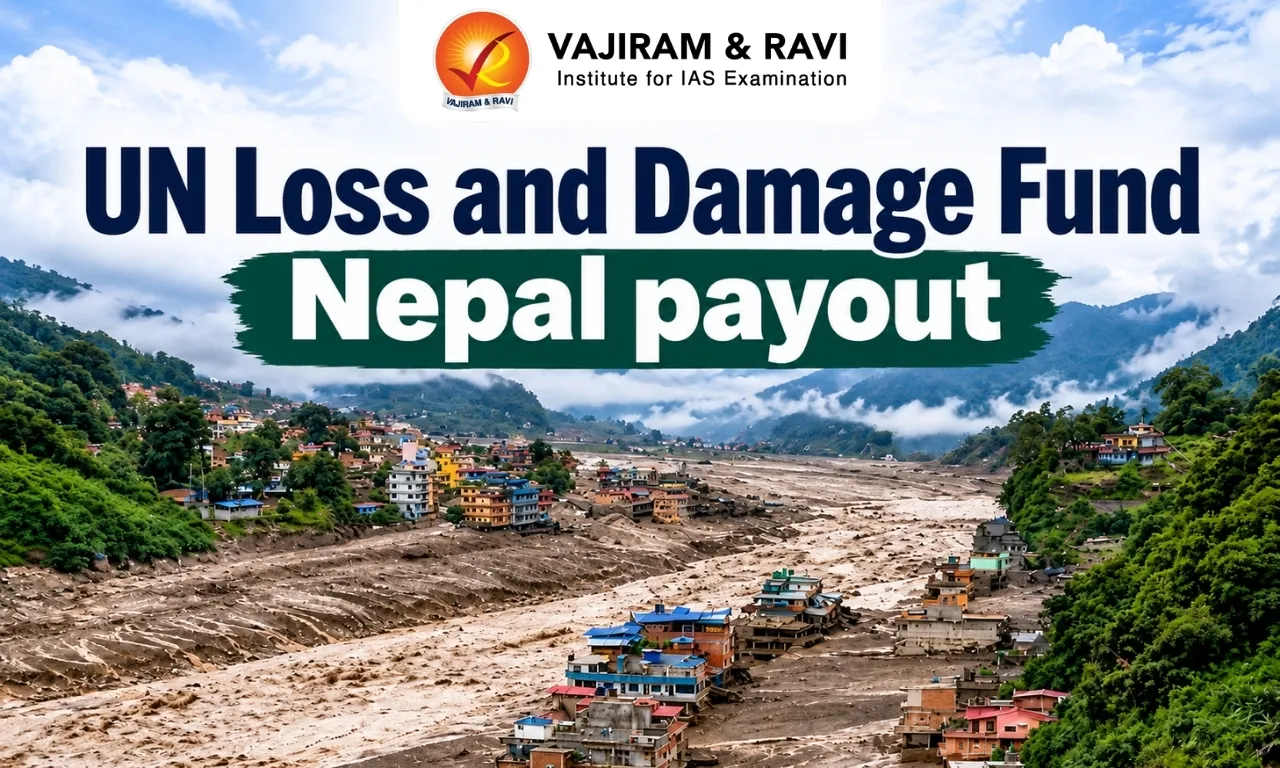
  • The UN climate convention’s Loss and Damage Fund has approved a $21.6 million payout (approx. ₹205 crore) to Nepal — its first-ever country-specific allocation — to aid rebuilding after devastating August 2026 floods. 
  • Nepal’s own request was for $20 million (~₹190 crore), against an estimated $4.75 billion (~₹44,600 crore) recovery and reconstruction need — making the payout extremely small relative to the actual damage. 
  • Still, it marks the beginning of implementation of a new international loss-and-damage regime, arriving weeks before COP31 opens in Turkiye.

What Triggered This

  • On August 26, 2026, an ice-and-rock avalanche — linked by experts to human-accelerated climate change — triggered flooding along the Bhotekoshi-Trishuli-Narayani river system.
  • Nepal’s estimated losses: at least $2.69 billion, with recovery needs of at least $4.71-4.75 billion.

What Is the Loss and Damage Fund?

  • Formally called the Fund for Responding to Loss and Damage (FRLD) — created to help developing countries vulnerable to climate change cope with economic and non-economic losses, particularly the most fragile nations facing climate-related disasters.
  • Operates under the UNFCCC’s financial mechanism.
  • Origin: Agreed at COP27 (2022); Governing Instrument adopted at COP28 (2023).
  • Current Funding Status (as of March 2026): 
    • 27 countries pledged $822.06 million (~₹7,809.6 crore); $629.70 million as grant contributions.
    • Start-up allocation: $342 million, with at least half reserved for small island states and least developed countries.
  • Top 5 donors to FRLD: Italy ($110.31M), France ($108.23M), UAE ($100M), Germany ($98.24M), UK ($91.92M).
  • First funding call drew 176 requests from 119 countries, worth ~$2.8 billion; Board deferred decisions to December 2026.
  • India has also made three requests to the FRLD — underscoring that even large developing economies are turning to this fund for climate-disaster support.

Why the Nepal Decision Is Significant

  • The first time the Fund has earmarked money for a specific country — decided at its first “extraordinary meeting” (virtual, October 22, 2026).
  • The Board approved a pilot mechanism letting Nepal submit its request outside the normal closed submission window; future exceptions need separate Board approval.
  • Nepal’s case is being treated as a template for how the mechanism should ideally work — swift consideration and quick access to money for disaster-hit nations.

How the Money Actually Flows

  • Of the $21.6 million approved, $1.6 million is oversight fees for implementing organisations.
  • Nepal must submit a formal funding request, reviewed at the Fund’s tenth meeting in Manila, December 2026 — money releases only after this approval.
  • The Fund hasn’t disclosed cash holdings beyond signed contributions — disbursement depends on donors honouring pledges.

The Larger Climate Finance Shortfall

  • Huge Demand, Limited Supply: Most pending FRLD requests involve both economic and non-economic losses — extreme weather, slow-onset events like glacial melt, sea-level rise, biodiversity loss, and desertification — requiring resilience-building, early warning systems, and psychosocial support for affected populations.
  • Broken Promises on Climate Finance: Developed nations had pledged to mobilise $100 billion/year between 2020-2025 — a target never fully delivered.
    • In 2024, developing countries assessed their actual climate finance need at $1.3 trillion/year — yet developed nations committed only to $300 billion/year, starting only from 2035.
    • Under the UNFCCC and the 2015 Paris Agreement, developed countries are mandated to fund developing nations’ climate response — but just as they’ve lagged on greenhouse gas reduction targets, they’ve similarly failed to fully meet their financial obligations.

Credibility Concerns

  • Experts noted the Fund still operates like a conventional development fund — an 11-step funding cycle from origination to Board approval, with the World Bank as interim trustee. 
  • The US withdrew its board representation in January 2025 (Trump administration), part of its Paris Agreement exit.
  • In Nepal’s case, the analysts called it landmark but noted the sum is less than 0.5% of Nepal’s reconstruction cost, risking delays since funds release only after further approvals.

Conclusion

  • The Nepal payout is a genuine procedural breakthrough, proving the Loss and Damage Fund can act on a specific crisis rather than remain an abstract pledge-collection exercise. 
  • But it also lays bare a much larger pattern: the persistent gap between what developed nations promise and what they actually deliver on climate finance — from the unmet $100-billion annual target to a $300-billion commitment pushed out to 2035, against an assessed need of $1.3 trillion a year. 
  • For Nepal, and for India’s own pending FRLD requests, this episode is a reminder that symbolic firsts matter, but without faster disbursement and genuinely scaled-up funding, the global loss-and-damage architecture risks remaining more aspiration than action.

Source: TH | ToI

UN Loss and Damage Fund Nepal Payout FAQs

Q1: What is the UN Loss and Damage Fund Nepal payout?

Ans: The UN Loss and Damage Fund Nepal payout is a $21.6 million allocation approved to support Nepal’s recovery after devastating floods in August 2026.

Q2: Why is the UN Loss and Damage Fund Nepal payout significant?

Ans: The UN Loss and Damage Fund Nepal payout marks the first country-specific allocation, demonstrating that the international climate fund can respond to an actual disaster.

Q3: How much funding did Nepal receive from the Loss and Damage Fund?

Ans: The UN Loss and Damage Fund Nepal payout totals $21.6 million, including $1.6 million in oversight fees for implementing organisations, subject to further approval.

Q4: What challenges affect the UN Loss and Damage Fund Nepal payout?

Ans: The UN Loss and Damage Fund Nepal payout faces delays, additional approval requirements, uncertain donor contributions, and a funding amount far below Nepal’s estimated reconstruction needs.

Q5: How does the UN Loss and Damage Fund Nepal payout affect developing countries?

Ans: The UN Loss and Damage Fund Nepal payout offers a potential model for disaster assistance, but it highlights the urgent need for faster disbursement and greater climate finance.

Judicial Restraint in India – Judicial Propriety and Judicial Speech

Judicial Restraint

Judicial Restraint Latest News

  • Supreme Court Judge Ujjal Bhuyan’s recent remarks on voter deletions and the right to vote have revived debate over the limits of judicial speech, judicial propriety and comments on matters pending before courts.

Meaning and Importance of Judicial Restraint

  • Judicial restraint refers to the exercise of caution by judges in interpreting laws, reviewing the actions of other branches of government and making public statements that may affect judicial proceedings.
  • It does not require judges to remain silent on every public issue. Rather, it seeks to preserve judicial independence, impartiality and public confidence in the administration of justice.
  • Judges occupy a unique constitutional position: they must protect fundamental rights and examine governmental actions while ensuring that their conduct does not create an impression of political alignment or prejudgment.
  • Judicial restraint is therefore important in maintaining the balance between judicial accountability, freedom of expression and the impartial administration of justice.

The Debate over Justice Ujjal Bhuyan’s Remarks

  • On October 4, 2026, Justice Ujjal Bhuyan, speaking at a moot court competition at NALSAR University of Law, stated that the right to vote is constitutional and integral to the basic structure of the Constitution. 
  • He argued that a process disenfranchising millions would be arbitrary and violate Articles 14 and 326. 
  • He also emphasised that voters should receive notice and an opportunity to be heard before their names are deleted, except in cases of death.
  • His remarks came while litigation concerning the Special Intensive Revision (SIR) of electoral rolls in West Bengal remained pending before the Supreme Court.
  • Former Chief Justice of India B.R. Gavai and other retired judges questioned whether commenting on an ongoing controversy was consistent with judicial propriety.

Indian Standards of Judicial Conduct

  • The Restatement of Values of Judicial Life, adopted by the Supreme Court's Full Court on May 7, 1997, establishes ethical expectations for judges.
  • Clause 8 states that judges should not enter public debate or express views on political matters or matters pending, or likely to arise, for judicial determination. Clause 1 requires judicial conduct that sustains public confidence in impartiality.
  • Although the Restatement does not prescribe a separate sanction of its own, it has been referred to in judicial decisions and remains an important ethical framework.
  • The central concern is not whether judges can discuss constitutional law, but whether a public statement could reasonably create an impression that a judge has prejudged a dispute that may come before them.

Constitutional Principles Governing the Right to Vote

  • The controversy also highlights the constitutional and statutory framework governing electoral participation.
  • Article 14: Guarantees equality before the law and equal protection of the laws, prohibiting arbitrary State action.
  • Article 326: Provides for elections to the Lok Sabha and State Legislative Assemblies on the basis of adult suffrage, subject to constitutional and statutory qualifications.
  • Articles 325 and 326: Support an inclusive electoral framework by prohibiting specified forms of exclusion and establishing adult suffrage.
  • Representation of the People Act, 1950: Provides the statutory framework for preparing and revising electoral rolls.
  • Rule 21A of the Registration of Electors Rules, 1960: Provides procedural requirements relating to notice, inquiry, hearing and reasoned determination before deletion of names in applicable circumstances.
  • In its May 27, 2026 decision in Association for Democratic Reforms v. Election Commission of India, the Supreme Court upheld the Bihar SIR while reiterating that eligible electors must be included and ineligible persons excluded through lawful procedures.
  • The ruling provides important context for Justice Bhuyan’s remarks: the constitutional right to vote is protected, but electoral rolls must also be maintained according to the law.

Comparative Standards of Judicial Speech

  • International standards recognise that judicial independence does not require complete silence on matters of law and public importance.
  • Bangalore Principles of Judicial Conduct
    • The Bangalore Principles recognise judicial freedom to write, lecture and teach on legal issues, judicial independence and the administration of justice. 
    • At the same time, judges should avoid comments that could reasonably affect proceedings before them or matters likely to come before them.
  • United States
    • The US Supreme Court's 2023 Code of Conduct allows judges to speak, write, lecture and teach, while cautioning against comments on the merits of pending or impending cases.
  • United Kingdom
    • During the 2016 Brexit litigation, Lady Hale outlined competing legal arguments but stopped short of expressing a conclusion because the case was expected to come before the Supreme Court.

Judicial Independence and Public Engagement

  • The debate over Justice Bhuyan also raises a broader question about the public role of judges.
  • Judges have addressed issues such as judicial appointments, executive influence, civil liberties, restrictive bail conditions and the criminalisation of dissent. Such interventions can contribute to public understanding of constitutional governance.
  • However, public visibility can also create concerns when remarks become closely connected to pending litigation. A judge's earlier decisions or public speeches should not automatically be treated as predictors of how they would decide a future case.
  • The appropriate assessment depends on the subject of the speech, the specificity of its conclusions and its proximity to judicial proceedings. 
  • Where a judge's remarks raise a reasonable concern about impartiality in a particular case, recusal may need to be considered.

Source: TH

Judicial Restraint FAQs

Q1: What is judicial restraint?

Ans: Judicial restraint involves exercising caution in judicial decision-making and public commentary to preserve constitutional balance and judicial impartiality.

Q2: What is the Restatement of Values of Judicial Life?

Ans: It is an ethical framework adopted by the Supreme Court in 1997 that sets standards for judges’ conduct, including restrictions on public comments about pending matters.

Q3: Why were Justice Ujjal Bhuyan’s remarks controversial?

Ans: His remarks concerned voter deletions while related SIR litigation was pending, raising questions about whether judicial commentary approached prejudgment.

Q4: Can judges publicly discuss constitutional issues?

Ans: Yes, judges can contribute to legal education and public discussion, but they should avoid comments that could reasonably affect pending or impending proceedings.

Q5: What is the central principle governing judicial speech?

Ans: Judges should be able to explain legal principles while avoiding statements that create a reasonable impression of bias or prejudgment in a specific case.

Cyclone Arnab 2026, IMD Tracker, Landfall, Latest Updates, Naming

Cyclone Arnab

Cyclone Arnab 2026 is a tropical cyclone that has developed over the Bay of Bengal and is moving towards the eastern coast of India. The India Meteorological Department (IMD) has warned of further intensification, heavy rainfall and strong winds, particularly along the Andhra Pradesh coast and adjoining southern Odisha. Understanding the cyclone's path, expected landfall, rainfall warnings and preparedness measures is important for assessing its potential effects on coastal communities, agriculture, infrastructure and disaster management.

Cyclone Arnab Latest News

As of October 26, 2026, Cyclone Arnab has intensified from a deep depression into a cyclonic storm over the east-central and adjoining west-central Bay of Bengal. The system is expected to strengthen further and cross the Andhra Pradesh coast between Bapatla and Visakhapatnam by the forenoon of October 28. The IMD has forecast maximum sustained wind speeds of 115-125 kmph, with gusts reaching 140 kmph, prompting authorities in Andhra Pradesh and Odisha to strengthen evacuation and emergency response arrangements.

What is Cyclone Arnab?

Cyclone Arnab is a tropical cyclone over the Bay of Bengal that is expected to intensify into a very severe cyclonic storm before reaching the Andhra Pradesh coast. Its development highlights the importance of timely weather forecasting and coastal disaster preparedness.

  • Origin and development: Cyclone Arnab developed from a depression over the east-central and adjoining south-east Bay of Bengal. It subsequently intensified into a deep depression and then a cyclonic storm, according to the India Meteorological Department.
  • Expected intensity: The IMD has forecast further intensification into a severe cyclonic storm, followed by a very severe cyclonic storm. The expected intensity indicates the possibility of damaging winds, heavy rainfall and coastal disruption.
  • Expected landfall: The cyclone is likely to cross the Andhra Pradesh and Yanam coasts between Bapatla and Visakhapatnam by the forenoon of October 28, 2026. Authorities are preparing vulnerable areas for the potential impact.
  • Wind speed: Maximum sustained wind speeds of 115-125 kmph are forecast during landfall, with gusts reaching 140 kmph. Such strong winds can damage structures, uproot trees and disrupt electricity and transport services.
  • Cyclone Arnab Tracker Live: The latest available position and movement information places the cyclone over the east-central and adjoining west-central Bay of Bengal. Its projected path is towards the Andhra Pradesh coast, with landfall expected between Bapatla and Visakhapatnam.

Cyclone Arnab Name Origin

The name “Arnab” was proposed by Bangladesh and forms part of the official tropical cyclone naming list adopted in April 2020. The term “Arnab” means “Sea” or “Ocean” in Bengali. Naming of a cyclone helps authorities and the public identify weather systems and communicate warnings clearly. The IMD gives the pronunciation of Arnab as “Ornab”. Using a standard name helps distinguish this weather system from other cyclones and reduces confusion during emergency communication.

Cyclone Arnab Tracker

The Cyclone Arnab Tracker provides information about the system's development, projected movement and associated rainfall warnings. The following timeline combines the available IMD updates with the seven day warning schedule issued on October 26, 2026.

  • October 26, 2026 - Cyclonic storm formation: The IMD confirmed that the deep depression intensified into Cyclone Arnab and moved nearly westwards at approximately 15 kmph during the preceding six hours. No major rainfall activity was reported in Andhra Pradesh as of the morning bulletin.
  • October 27, 2026 - Further intensification: The system is expected to intensify into a severe cyclonic storm over the west-central Bay of Bengal. Odisha is forecast to experience very heavy rainfall, accompanied by thunderstorms, lightning and squally weather.
  • October 28, 2026 - Expected landfall: Cyclone Arnab is likely to intensify into a very severe cyclonic storm and cross the Andhra Pradesh coast between Bapatla and Visakhapatnam by the forenoon. Extremely heavy rainfall is forecast for Odisha, along with thunderstorms and squally conditions.
  • October 29, 2026 - Rainfall warning continues: Odisha is expected to experience very heavy rainfall in association with the weather system. Thunderstorms, lightning and squally conditions may create additional risks for communities, transport networks and agricultural activities.
  • October 30, 2026 - Heavy rainfall forecast: The IMD's Odisha warning schedule indicates heavy rainfall accompanied by thunderstorms, lightning and squally weather. Authorities and residents should continue following official advisories and local instructions.
  • October 31, 2026 - No warning: The Odisha sub division forecast lists no warning for this date. However, residents should continue to follow updated official advisories because actual weather conditions may differ from earlier forecasts.
  • November 1, 2026 - No warning: No warning is listed for Odisha on November 1. The seven day schedule indicates a gradual reduction in forecast warning levels after the period of intense rainfall and cyclone related activity.

Cyclone Arnab Impacts

Cyclone Arnab may affect coastal communities through strong winds, heavy rainfall, flooding and disruption of essential services. Its expected landfall and associated rainfall also raise concerns about agricultural losses, electricity interruptions, transport difficulties and the safety of people living in low lying areas.

  • Heavy rainfall and flooding: Heavy to extremely heavy rainfall is forecast in parts of southern Odisha during the warning period. Intense precipitation may cause waterlogging, local flooding and disruption to movement, particularly in vulnerable and low lying areas.
  • Strong winds and structural damage: Forecast winds of 115-125 kmph, with gusts up to 140 kmph, may damage weak structures, uproot trees and affect overhead electricity lines. Coastal districts near the expected landfall require particular attention.
  • Agricultural losses: Standing paddy and vegetable crops in southern Odisha face the risk of waterlogging, lodging and physical damage. Prolonged rainfall may affect harvesting and other agricultural activities, creating concerns for farmers and rural livelihoods.
  • Electricity supply disruption: Strong winds, fallen trees and damaged electrical infrastructure may interrupt power distribution. Andhra Pradesh power utilities have mobilised personnel, machinery and electrical materials, while control rooms have been established to coordinate emergency response and restoration.
  • Fishing and coastal livelihoods: Fishing activities have been suspended as part of cyclone preparedness and more than 4,800 fishing boats have returned safely to the Kakinada coast. Such precautionary measures reduce exposure to dangerous sea conditions.
  • Transport and infrastructure: Heavy rainfall and strong winds may disrupt road movement and damage public infrastructure. Waterlogging, fallen trees and localised flooding can complicate emergency access, making advance planning for transport and essential services important.
  • Displacement of vulnerable communities: Residents of low lying and exposed coastal settlements may need to move to safer locations. Evacuation planning and the availability of relief shelters can help reduce casualties and provide temporary protection during severe weather.
  • Pressure on essential services: Cyclone related damage may increase demand for drinking water, food, medical assistance, electricity restoration and emergency transport. Coordinated action among government departments is essential to maintain basic services and support affected communities.

Cyclone Arnab Preparedness

Preparedness for Cyclone Arnab involves early warnings, evacuation, emergency response teams and continuity of essential services. Andhra Pradesh and Odisha have taken precautionary measures to reduce casualties and limit disruption, with particular attention to vulnerable coastal settlements and districts expecting intense rainfall.

  • Early warning and monitoring: The IMD issues forecasts and warnings about cyclone intensity, movement, wind speeds and rainfall. Residents should follow the latest official bulletins and local administration instructions rather than relying on outdated forecasts or unverified information.
  • Evacuation of vulnerable areas: Authorities have directed the movement of people from low lying areas to safer shelters where necessary. Timely evacuation is particularly important for coastal communities exposed to strong winds, heavy rainfall and possible flooding.
  • Cyclone Arnab Tracker Live Satellite: Satellite based weather observations can help meteorological agencies monitor cloud patterns, cyclone organisation and changes in intensity. For current operational information, the IMD's latest bulletin remains the appropriate reference for the system's location and projected movement.
  • Deployment of rescue teams: Odisha has kept 302 rescue teams ready for emergency operations. These teams can support evacuation, rescue and relief activities, helping authorities respond more effectively if the cyclone causes flooding or other damage.
  • Closure of educational institutions: Schools, colleges and Anganwadi centres in Ganjam, Gajapati, Rayagada, Koraput and Malkangiri are scheduled to remain closed on October 28 and 29. The measure reduces exposure during the period of forecast severe weather.
  • Power supply management: Andhra Pradesh power utilities have been instructed to take precautionary measures to maintain electricity supply. APEPDCL has opened 30 divisional control rooms and 11 circle level control rooms to coordinate monitoring, emergency action and power restoration.
  • Removal of dangerous structures: Andhra Pradesh authorities have directed officials to remove dangerous hoardings and remain on high alert. Securing vulnerable structures and identifying potential hazards can reduce injuries and damage during periods of strong winds.
  • Relief camps and essential supplies: Authorities have identified relief camps and reviewed arrangements for food, drinking water, medical assistance and rehabilitation. Maintaining adequate supplies helps meet immediate needs during evacuation and supports the recovery of affected communities.
  • Protection of agriculture: Odisha authorities are focusing on reducing potential damage to standing crops and restoring essential services quickly. Farmers should follow locally issued agricultural advisories and take feasible precautions to protect harvested produce and vulnerable farm assets.
  • Coordination among departments: Effective cyclone management requires cooperation among meteorological agencies, district administrations, disaster response teams, power utilities, fisheries departments and health services. Clear responsibilities and timely information sharing improve preparedness and reduce delays during emergencies.

Cyclone Arnab 2026 FAQs

Q1: What is Cyclone Arnab 2026?

Ans: Cyclone Arnab 2026 is a tropical cyclone that developed over the Bay of Bengal after a depression intensified into a deep depression and then a cyclonic storm. The IMD expects it to strengthen further before reaching the Andhra Pradesh coast.

Q2: When and where is Cyclone Arnab expected to make landfall?

Ans: Cyclone Arnab is expected to cross the Andhra Pradesh and Yanam coasts between Bapatla and Visakhapatnam by the forenoon of October 28, 2026, as a very severe cyclonic storm.

Q3: What is the expected wind speed of Cyclone Arnab?

Ans: The IMD has forecast maximum sustained wind speeds of 115-125 kmph, with gusts reaching 140 kmph during the expected landfall.

Q4: Which areas are likely to be affected by Cyclone Arnab?

Ans: The Andhra Pradesh coast, particularly the stretch between Bapatla and Visakhapatnam, faces the expected landfall. Southern Odisha is also likely to experience heavy to extremely heavy rainfall, thunderstorms, lightning and squally weather.

Q5: Who named Cyclone ‘Arnab’?

Ans: The name Cyclone 'Arnab' was given by Bangladesh which means Sea or Ocean in Bengali.

Daily Editorial Analysis 26 October 2026

Daily-Editorial-Analysis

Lessons on the Right to Assembly

Context

  • Recent protests in Delhi against the exclusion of voters during the Special Intensive Revision (SIR) of electoral rolls have raised concerns about constitutional freedoms.
  • Protesters have demanded the resignation of Chief Election Commissioner Gyanesh Kumar, while the government’s response has intensified debates over the suppression of peaceful demonstrations.
  • India has a rich tradition of protests, from the freedom struggle to movements led by farmers, students, trade unions and civil society.
  • The right to protest is a constitutional freedom, not a government privilege.

The Democratic Significance of Dissent

  • Dissent enables citizens to question government policies, demand accountability and express grievances.
  • However, a growing culture of suspicion towards dissent threatens democratic participation.
  • Questioning protesters about permissions or funding can undermine their autonomy and portray disagreement as hostility towards the government.
  • A mature democracy must recognise that peaceful criticism strengthens democratic institutions.
  • Governments should address public grievances through dialogue and accountability rather than coercion.

Constitutional Protection of the Right to Protest

  • Article 19(1)(a) guarantees freedom of speech and expression, while Article 19(1)(b) protects the right to assemble peacefully and without arms.
  • These provisions enable citizens to organise demonstrations and collectively demand policy changes.
  • However, Article 19(3) permits reasonable restrictions on peaceful assembly in the interests of sovereignty, integrity and public order.
  • The challenge lies in distinguishing reasonable regulation from arbitrary restriction.
  • Authorities may regulate the timing, location and manner of demonstrations, but such measures must not eliminate the practical exercise of fundamental rights.

Misuse of Preventive Laws and Police Powers

  • Section 163 of the Bharatiya Nagarik Suraksha Sanhita (BNSS), 2023, empowers authorities to issue preventive orders in urgent cases involving potential danger or public disturbance.
  • Although necessary during genuine emergencies, its excessive application can restrict peaceful demonstrations.
  • Reported practices, including disproportionate force, prolonged detention, restrictions on access to lawyers and essential necessities, and deportation notices to participating Overseas Citizens of India, raise concerns about civil liberties.
  • Such measures create a chilling effect on freedom of speech and assembly, discouraging citizens from expressing legitimate grievances.
  • Preventive powers must be exercised with restraint and remain subject to legal scrutiny. Public order cannot justify blanket suppression of dissent.

Judicial Precedents and the Limits of State Authority

  • In Himmat Lal K. Shah v. Commissioner of Police (1972), the Supreme Court distinguished reasonable regulation of public meetings from arbitrary exclusion.
  • It warned against restrictions that effectively eliminate opportunities for public gatherings in streets and parks.
  • The judgment establishes that accessible public spaces are essential for democratic participation. Without them, the right to assemble risks becoming merely theoretical.
  • In Babulal Parate v. State of Maharashtra (1961), the Supreme Court upheld the constitutional validity of the predecessor provision to Section 163 but observed that it was intended for emergencies.
  • These judgments underline the importance of proportionate restrictions and judicial oversight.
  • Preventive powers must not become routine instruments for suppressing political expression.

Designating protest sites

  • The denotification of Jantar Mantar, a prominent protest site in Delhi, raises concerns about access to public spaces.
  • Relocating demonstrations to distant or inaccessible locations can weaken their effectiveness by separating protesters from the public, media and policymakers.
  • On October 9, the Supreme Court directed authorities to designate suitable alternative protest sites while hearing petitions concerning a blanket transport ban affecting access to Delhi.
  • However, no interim relief was granted in the cases challenging Jantar Mantar’s denotification, leaving the site inaccessible at the time described.
  • Alternative locations must be genuinely accessible, well-connected and sufficiently visible to facilitate democratic participation.
  • Merely designating distant sites cannot adequately protect the right to assembly.
  • The judiciary must scrutinise restrictions that weaken constitutional freedoms while recognising the state’s responsibility to maintain public order.

Conclusion

  • Articles 19(1)(a) and 19(1)(b) protect expression and peaceful assembly, while Article 19(3) permits only reasonable restrictions.
  • Excessive preventive measures, disproportionate police action and inaccessible protest sites threaten civil liberties and democratic participation.
  • The government must distinguish peaceful criticism from genuine threats to public order, while courts must prevent arbitrary executive action.
  • Ultimately, a strong democracy does not fear dissent; it protects the freedom to disagree. Safeguarding peaceful protests and accessible public spaces is essential to public trust, accountability and constitutional governance.

Lessons on the Right to Assembly FAQs

Q1. What is the constitutional basis of the right to protest in India?
Ans. Articles 19(1)(a) and 19(1)(b) protect freedom of expression and peaceful assembly.

Q2. What restrictions can the government impose on protests?
Ans. The government can impose reasonable restrictions under Article 19(3) in the interests of sovereignty, integrity and public order.

Q3. What is the purpose of Section 163 of the BNSS, 2023?
Ans. Section 163 empowers authorities to issue preventive orders in urgent cases involving potential danger or public disturbance.

Q4. What did the Supreme Court establish in Himmat Lal K. Shah v. Commissioner of Police (1972)?
Ans. The Court held that reasonable regulation of public meetings must not become arbitrary exclusion.

Q5. Why are designated protest sites important?
Ans. Accessible protest sites enable citizens to express grievances and hold the government accountable.

Source: The Hindu


The Need for a National Media Council

Context

  • The crackdown on journalists during protests organised by the Cockroach Janta Party (CJP), has reignited the debate over press freedom, journalistic identity and government accreditation.
  • Freelance and independent journalists were removed and detained, while only those accredited by the Press Information Bureau (PIB) or Directorate of Information and Publicity (DIP) were allowed to cover the protests.
  • The incident raises two fundamental questions: Who qualifies as a journalist, and who has the authority to recognise one?
  • Resolving these questions is crucial to protecting freedom of expression while ensuring professional accountability.

The Crackdown on Journalists and Freedom of Expression

  • Police Action During the Protests

    • The CJP protests in July over the NEET paper leak and in October over the demand for the Chief Election Commissioner's resignation attracted journalists from established media organisations, freelancers and digital content creators.
    • During the protests, police removed several independent journalists and detained them.
    • This action raises concerns about equal access to public events and freedom of the press.
    • Independent journalists frequently document demonstrations, report police actions and present perspectives overlooked by mainstream media.
  • Judicial Debate and Competing Concerns

    • During a Public Interest Litigation seeking protection for freelance journalists and content creators, Chief Justice of India Surya Kant and Justice Joymalya Bagchi questioned whether freedom of expression entitled every citizen to become a journalist.
    • Senior advocate Indira Jaisingh advocated a national protocol preventing police from obstructing journalists carrying valid employer-issued identification.
    • Solicitor General Tushar Mehta, however, warned that individuals could misuse journalistic claims to create sensationalised or one-sided social media content for popularity and financial gain.

Recognising Journalists

  • The Legal Definition of a Working Journalist

    • The Occupational Safety, Health and Working Conditions Code, 2020, defines a working journalist as someone whose principal occupation is journalism and who is employed in newspaper, electronic or digital media.
    • Those working in managerial or administrative capacities are excluded.
    • The Central and State governments provide accreditation to eligible journalists, freelancers, camerapersons and technicians.
  • Government Accreditation and Its Limitations

    • In Delhi-NCR, the PIB facilitates coverage of the Central government, while the DIP provides accreditation for covering the Delhi government.
    • However, accreditation depends on eligibility criteria and quotas linked to newspaper circulation, news agency subscriptions, television licences and digital platforms' unique visitors.
    • Consequently, not every journalist receives official accreditation, including some working in recognised media organisations. Freelancers and journalists associated with smaller digital platforms face additional difficulties.
    • This creates a distinction between professional journalistic work and official recognition.
    • Making accreditation the sole criterion for covering public events risks excluding legitimate journalists and restricting access to information.

The Way Forward

  • The Need for a National Media Council

    • A proposed solution is establishing an independent national media council or commission to recognise journalists across different platforms.
    • Institutions such as the Bar Council of India and the Institute of Chartered Accountants of India regulate their respective professions.
    • A similar media council could establish transparent recognition procedures for working journalists, freelancers, camerapersons and technicians.
    • It could maintain a national register, issue professional identification, establish ethical guidelines and provide mechanisms for addressing complaints against journalists and authorities.
    • The Press Club of India previously drafted a Media Transparency (and Accountability) Bill, proposing a national media council. Other journalists' organisations have also demanded similar reforms.
  • Balancing Professional Accountability and Press Freedom

    • Social media has blurred the boundaries between journalists, influencers and content creators.
    • Although digital platforms have democratised information, they have also facilitated misinformation, sensationalism and unverified reporting.
    • A national media council could promote transparent accreditation, ethical standards and accountability.
    • Nevertheless, it must safeguard editorial independence and remain free from political interference.
    • Government accreditation should not become the sole criterion for practising journalism or reporting public events.
    • Restrictions should be based on legitimate security requirements, objective rules and applicable law, rather than arbitrary distinctions between accredited and non-accredited journalists.
    • Any framework must protect journalists against intimidation, unlawful detention and obstruction while ensuring that restrictions are necessary, proportionate and legally justified.

Conclusion

  • The detention of independent journalists during the CJP protests demonstrates the need to reconsider how journalists are recognised and protected in India.
  • Existing legal definitions and accreditation systems do not adequately address the challenges of freelance journalism and digital media.
  • An independent, transparent and inclusive national media council could bridge this gap, provided it promotes professional standards without monopolising the right to report.
  • Ultimately, democracy requires both responsible journalism and an independent press.

The Need for a National Media Council FAQs

Q1. What triggered the debate over journalistic recognition?
Ans. The detention of freelance journalists during the October 10 CJP protests triggered the debate.

Q2. What is the role of PIB and DIP?
Ans. The PIB and DIP provide accreditation for covering the Central and Delhi governments, respectively.

Q3. What is the main limitation of government accreditation?
Ans. Government accreditation excludes some legitimate journalists because of eligibility criteria and quotas.

Q4. Why is a national media council proposed?
Ans. A national media council could establish transparent recognition procedures and promote professional accountability.

Q5. How can press freedom be protected?
Ans. Press freedom can be protected through independent regulation, fair accreditation and safeguards against arbitrary restrictions.

Source: The Hindu


India’s Fertiliser Imbalance - Correcting the Economics of Nutrient Use

Context

  • Union Agriculture Minister Shivraj Singh Chouhan launched the ‘Khet Bachao Abhiyan’ (Save the Farm Campaign) in Karnal, Haryana, urging farmers to adopt balanced use of chemical fertilisers.
  • Excessive and imbalanced application is degrading soil health, contaminating groundwater and increasing air pollution.
  • However, farmer behaviour is strongly influenced by fertiliser prices. Despite the Nutrient-Based Subsidy (NBS) introduced in 2010 to correct nutrient imbalance, India’s fertiliser use has become more skewed towards nitrogen (N).

Worsening N:P Imbalance

  • An ICRIER policy brief (Repurposing India’s Fertiliser Policy towards Nutrient Optimisation) compares actual nutrient use with crop- and irrigation-specific recommended doses across 20 major States between 2009-10 and 2024-25.
  • Nitrogen (N) use has shifted from 7% below the recommended level to 6% above it. The phosphorus (P) deficit has narrowed only from 29% to 22%.
  • Potassium (K) deficit has widened sharply from 48% to 72%. Farmers apply only 9 kg of potash/ha against a requirement of 32 kg.
  • As a result, India’s N:P ratio is 10.5:4.1:1, against the normative 2.8:1.5:1. 11 of 20 States overuse nitrogen, while every State underuses potassium.
  • Punjab and Jharkhand are among the largest nitrogen overusers, while Haryana and Jharkhand use only around one-tenth of their required potassium.

Perverse Price Signals

  • The principal problem is the unequal subsidy structure. NBS allowed prices of phosphatic and potassic fertilisers to respond to global markets, while urea remained under a heavily controlled price regime.
  • For example, between 2010-11 and 2024-25, Diammonium phosphate (DAP) prices nearly tripled to ₹54/kg, muriate of potash (MOP) prices increased six-fold to ₹52/kg, while the price of nitrogen contained in urea rose by only 1%.
  • Consequently, farmers have a strong economic incentive to use urea. Nitrogen also produces visible short-term greening, whereas potassium deficiency often manifests gradually through lower resilience and productivity.
  • Nitrogen’s share in total NPK use has consequently returned to around 67%, comparable to the level in 1970-71.

Environmental and Nutritional Costs

  • The imbalance is damaging both soil health and human health. For example, under the Soil Health Card (SHC) programme, among 96 lakh samples tested in 2025-26 -
    • 72% were low in nitrogen;
    • 52% in organic carbon;
    • 42% in boron; and
    • 37% in zinc.
  • Excess nitrogen application is inefficient because crops absorb only 30-40% of applied nitrogen. The remainder can enter the atmosphere as nitrous oxide, a potent greenhouse gas, or leach into groundwater as nitrate.
  • Nitrate contamination above safe limits has been reported in parts of 502 districts, posing risks including infant methemoglobinemia (“blue baby syndrome”) and chronic health problems.
  • Potassium deficiency reduces crop resistance to drought and disease, while phosphorus deficiency can delay flowering.
  • Micronutrient deficiencies also reduce nutritional quality of food, contributing to hidden hunger.

Fiscal and Regional Costs

  • The fertiliser subsidy allocation for 2026-27 is ₹1.71 lakh crore. Disruptions in the Strait of Hormuz could raise this to ₹2.5-3 lakh crore, with urea accounting for about two-thirds.
  • The subsidy structure is also regionally unequal. Punjab receives around ₹25,700 of nitrogen subsidy per hectare, nearly ten times Kerala’s level.
  • Combined with MSP-based procurement and subsidised electricity, cheap fertilisers reinforce the rice-wheat cropping pattern, intensifying groundwater depletion in north-western India.

Way Forward

  • Shift from input subsidy to nutrient-neutral support:

    • Move towards per-hectare Direct Benefit Transfer (DBT) that is neutral across nutrients and crops.
    • This would expose farmers to market prices and remove urea’s artificial price advantage.
    • AgriStack’s farmer IDs and land-linked digital infrastructure could facilitate targeted transfers, although identifying tenant farmers remains a challenge.
    • Alternatively, urea could gradually be brought under NBS while reducing DAP and MOP prices.
  • Incentivise States: PM-PRANAM should be strengthened and implemented effectively to reward States that reduce excessive fertiliser use and promote nutrient balance.
  • Redirect subsidy savings: Savings should support drip irrigation, fertigation and fertiliser innovation, including customised/coated fertilisers, triple super phosphate (TSP), biofertilisers, nano-fertilisers and nitrogen-efficient seeds.
  • Promote the 4Rs:
    • Right Source, Right Rate, Right Time and Right Place — using plot-level soil-test-based recommendations.
    • Crop diversification and cereal-pulse rotations can further reduce nitrogen requirements.
    • However, meaningful change in Punjab and Haryana also requires reform of electricity pricing and procurement incentives.

Conclusion

  • India must shift the policy yardstick from the quantity of fertiliser consumed to the balanced supply of nutrients.
  • Fertiliser policy must simultaneously address soil health, groundwater depletion, fiscal sustainability, climate change and nutritional security.
  • Without correcting the underlying price and procurement incentives, awareness campaigns alone are unlikely to reverse the nutrient imbalance.

India’s Fertiliser Imbalance FAQs

Q1. Why has India’s fertiliser use become increasingly nitrogen-centric despite the NBS?

Ans. Urea’s artificially low price compared with DAP and MOP creates a strong incentive to overuse nitrogen.

Q2. What are the major environmental consequences of India’s imbalanced fertiliser use?

Ans. Soil degradation, nitrous oxide emissions and nitrate contamination of groundwater.

Q3. How does India’s fertiliser subsidy regime create fiscal and ecological distortions?

Ans. Cheap urea raises subsidy expenditure while reinforcing water-intensive rice-wheat cultivation.

Q4. What reforms can promote balanced fertiliser use in India?

Ans. Nutrient-neutral DBT, effective PM-PRANAM incentives, subsidy savings for sustainable technologies, etc.

Q5. Why must fertiliser policy be integrated with broader agricultural reforms?

Ans. Fertiliser balance cannot be achieved without simultaneously reforming MSP procurement, crop diversification, etc.

Source: IE

Daily Editorial Analysis 2026 FAQs

Q1: What is editorial analysis?

Ans: Editorial analysis is the critical examination and interpretation of newspaper editorials to extract key insights, arguments, and perspectives relevant to UPSC preparation.

Q2: What is an editorial analyst?

Ans: An editorial analyst is someone who studies and breaks down editorials to highlight their relevance, structure, and usefulness for competitive exams like the UPSC.

Q3: What is an editorial for UPSC?

Ans: For UPSC, an editorial refers to opinion-based articles in reputed newspapers that provide analysis on current affairs, governance, policy, and socio-economic issues.

Q4: What are the sources of UPSC Editorial Analysis?

Ans: Key sources include editorials from The Hindu and Indian Express.

Q5: Can Editorial Analysis help in Mains Answer Writing?

Ans: Yes, editorial analysis enhances content quality, analytical depth, and structure in Mains answer writing.

Miyawaki Forest, Method, Key Features, Benefits and Limitations

Miyawaki Forest

Miyawaki forest is an approach to afforestation and ecological restoration that focuses on establishing dense vegetation using native plant species. The method supports biodiversity conservation, urban greening, climate change mitigation and the restoration of degraded land. It is particularly relevant to sustainable urban development, as it can help increase green cover in space-constrained areas. Its effectiveness depends on local ecological conditions, appropriate species selection and long-term maintenance.

What is Miyawaki Forest?

A Miyawaki forest is a dense, multi-layered forest developed by planting diverse native tree, shrub and ground-cover species close together in a small area. Based on the ecological principles developed by Japanese botanist Akira Miyawaki, this approach aims to recreate the natural vegetation of a region. It supports biodiversity, improves green cover and helps restore suitable degraded land. Miyawaki forests are commonly established in urban areas where space is limited, but their success depends on native species selection, soil conditions, water availability and proper initial maintenance.

How does Miyawaki forest method work?

The Miyawaki Method follows a sequence of site assessment, native species selection, dense planting and initial maintenance.

  1. Site and soil assessment: Soil quality, drainage, compaction, moisture and local climatic conditions are assessed. Soil amendments are added where necessary.
  2. Selection of native species: Trees and shrubs are selected according to local vegetation, soil and climate, including canopy trees, smaller trees, shrubs and ground-cover plants.
  3. Dense planting: Saplings are planted closely together, often around 3–5 plants per square metre, depending on the site and planting design.
  4. Mulching and soil improvement: Organic mulch helps retain moisture, suppress weeds and improve soil conditions.
  5. Initial maintenance: Regular watering, weeding and monitoring are undertaken during the establishment phase, generally for the first two to three years depending on local conditions.
  6. Natural growth: As vegetation develops, competition for sunlight and other resources influences growth and forest structure, potentially reducing the need for intensive maintenance over time.

Miyawaki Forests Key Features 

Miyawaki forests are designed to replicate important structural and ecological characteristics of natural forest communities.

  • Native species diversity: Uses multiple tree and shrub species adapted to local environmental conditions.
  • High planting density: Closely spaced saplings encourage competition for sunlight and rapid canopy development.
  • Multi-layered vegetation: Includes canopy trees, smaller trees, shrubs and ground-cover plants.
  • Soil enrichment: Organic matter and mulching support soil moisture retention and biological activity.
  • Ecological restoration: Focuses on developing a functioning plant community rather than simply increasing the number of trees.
  • Small-space suitability: Enables dense green cover to be established on suitable urban plots and unused land.

Miyawaki Method Applications 

The Miyawaki Method is used in several types of environmental restoration and urban greening projects, depending on local ecological conditions and land-use requirements.

  • Urban microforests: Establishing dense green patches in school grounds, residential areas, public parks, institutional campuses and unused urban plots.
  • Restoration of degraded land: Reintroducing native vegetation on suitable degraded sites, including certain industrial and mining landscapes, after assessing soil conditions and contamination risks.
  • Coastal and slope protection: Appropriately designed native vegetation can contribute to slope stabilisation and coastal protection, depending on local ecology and the specific hazards involved.
  • Community participation: Encouraging environmental awareness through tree planting, maintenance and biodiversity-monitoring initiatives involving schools, local communities and urban local bodies.

Miyawaki Forests in India

The Miyawaki Method has attracted attention in India as a potential approach to urban greening and ecological restoration, particularly in cities experiencing shrinking green spaces, rising temperatures and increasing pressure on land.

Its applications include:

  • Urban afforestation: Creating small forests on suitable vacant plots, public spaces and institutional land.
  • Industrial and corporate campuses: Increasing native vegetation and supporting local biodiversity.
  • Educational institutions: Developing green spaces that promote environmental awareness and ecological learning.
  • Municipal greening initiatives: Supporting efforts to increase tree cover and improve the quality of urban environments.

In India, the method should be adapted to regional ecological conditions. Species suitable for a humid city may not survive equally well in an arid or semi-arid region. Local native species, water availability, soil conditions and existing habitats must therefore guide project design.

Miyawaki Forests vs Conventional Afforestation

The Miyawaki Method and conventional afforestation differ in planting density, species selection, forest structure, establishment costs and management practices.

Basis

Miyawaki Method

Conventional Afforestation

Planting density

Very high

Usually lower and more widely spaced

Species selection

Diverse native species suited to local conditions

Varies; may include mixed species or monocultures

Spatial scale

Often small urban plots

Can cover small or large areas

Forest structure

Designed to develop multiple vegetation layers

Depends on the planting model

Initial investment

Often relatively high

Varies with species and management

Early maintenance

Intensive during establishment

Depends on the site and planting technique

Main objective

Rapid establishment of dense, diverse vegetation

Tree-cover expansion, timber production, restoration or other objectives

Miyawaki Forests Benefits 

Miyawaki forests offer several ecological, environmental and social benefits, particularly in densely populated urban areas.

  • Urban greening: Increases green cover in cities where space for conventional forests is limited.
  • Biodiversity conservation: Diverse native vegetation can provide habitats and food resources for insects, birds and other organisms.
  • Climate change mitigation: Growing trees absorb and store atmospheric carbon dioxide, although carbon storage varies with species, survival and site conditions.
  • Urban heat reduction: Tree canopies provide shade and can reduce local temperatures through evapotranspiration.
  • Air pollution reduction: Vegetation can trap some airborne particles, although effectiveness depends on species, canopy structure and local pollution conditions.
  • Soil conservation: Tree roots help bind soil and may reduce erosion on suitable sites.
  • Water and soil benefits: Leaf litter and organic matter can improve soil structure, moisture retention and infiltration.
  • Human well-being: Green spaces can support recreation, environmental education and physical and mental well-being.

Miyawaki Forests Limitations and Criticism

Despite its potential, the method is not a universal solution for afforestation and ecological restoration.

  • High initial cost: Dense planting, diverse seedlings, soil preparation and early maintenance can make it more expensive than conventional approaches.
  • Water requirements: Closely planted saplings may require substantial watering during establishment, particularly in hot and dry regions.
  • Site-specific suitability: Tree planting may be unsuitable for naturally open grasslands, wetlands and other habitats where it could damage existing biodiversity.
  • Evidence gaps: Claims that Miyawaki forests always grow faster, store more carbon or support greater biodiversity than alternative restoration methods require stronger long-term, site-specific evidence.
  • Competition among saplings: High planting density can intensify competition for water, nutrients and sunlight, affecting survival under resource-limited conditions.
  • Limited spatial scale: Small urban forests cannot replace large natural forests or provide all the ecological functions of extensive, connected habitats.
  • Need for ecological monitoring: Survival rates, native species regeneration, biodiversity and carbon storage must be monitored to assess project outcomes.

Miyawaki Forest FAQs

Q1: What is a Miyawaki forest?

Ans: A Miyawaki forest is a dense, multi-layered forest developed using diverse native plant species through the Miyawaki Method.

Q2: Who developed the Miyawaki Method?

Ans: The method was developed by Akira Miyawaki, a Japanese botanist and plant ecologist.

Q3: Which plant species are used in Miyawaki forests?

Ans: Miyawaki forests primarily use diverse native tree, shrub and ground-cover species suited to the local climate, soil and natural vegetation.

Q4: What are the main benefits of Miyawaki forests?

Ans: They can increase urban green cover, support native biodiversity, absorb carbon dioxide, reduce local heat and help conserve soil.

Q5: What are the limitations of the Miyawaki Method?

Ans: Its limitations include high initial costs, water requirements, intensive early maintenance and limited suitability for certain ecosystems, such as natural grasslands and wetlands.

Ranthambore Tiger Reserve: Tigress T-2403 Spotted with Three Cubs

Ranthambore Tiger Reserve

Ranthambore Tiger Reserve Latest News

Recently, Tigress T-2403 was spotted with three cubs in Ranthambore Tiger Reserve in Sawai Madhopur.

About Ranthambore Tiger Reserve

  • Location: It is located in the Sawai Madhopur district of southeastern Rajasthan. 
  • It derives its name from the Ranthambore Fort (a World Heritage Site) situated within its precincts. 
  • It is located at the junction (great boundary fault) of the Aravalis and Vindhyan ranges. 
  • It is one of the largest tiger reserves in northern India. It spans an area of roughly 1,411 sq.km.
  • Topography: It boasts a spectacular landscape filled with boulder-strewn highland plateaus, lakes, and rivers dotted with old forts and abandoned mosques.
  • Vegetation: It is dry deciduous forests and open grassy meadow.
  • Rivers: It is bounded to the north by the Banas River and to the south by the Chambal River. 
  • There are several lakes in the park known as Padam Talab, Raj Bagh Talab, and Malik Talab.
  • Flora: Pure sands of Dhok tree (Anogeissus pendula) interspersed with grasslands at the plateaus, and other species like Acacia, Capparis, Zizyphus, Prosopis, etc are found here.
  • Fauna
    • It consists of leopard, caracal, jungle cat, sambar, chital, chinkara, and wild boar.
    • Peacocks, partridges, green pigeons, parakeets, sparrows, prinias, warblers, etc. are examples of avifauna.

Source: News On Air

Ranthambore Tiger Reserve FAQs

Q1: Where is Ranthambore Tiger Reserve located?

Ans: Rajasthan. 

Q2: What type of vegetation is found in Ranthambore Tiger Reserve ?

Ans: It is dry deciduous forests and open grassy meadow.

Enquire Now