Operation Twist, About, Working, Impact On India

Operation Twist

Operation Twist is a policy used by central banks to help the economy by changing the mix of short-term and long-term government bonds. Its main goal is to reduce long-term interest rates, making it easier for people and businesses to borrow and invest. It is called “Twist” because it shifts the focus from short-term to long-term bonds.

About Operation Twist

  • Operation Twist is a monetary policy used by the U.S. Federal Reserve (Fed) where the central bank sells short-term government bonds and uses the money to buy long-term government bonds.
  • The policy helps lower long-term interest rates, making borrowing cheaper for businesses and individuals and stimulates economic growth.
  • It was first introduced in 1961 to strengthen the U.S. dollar and support the economy and was later revived after the 2008-09 financial crisis.
  • In June 2012, Operation Twist helped the 10-year U.S. Treasury yield dropped to a 200-year low, showing its effectiveness.
  • Unlike quantitative easing (QE), Operation Twist does not increase the total money supply in the economy. It is a gentler way to support growth, as it mainly changes the mix of bonds the central bank holds rather than printing more money. By lowering long-term borrowing costs, it encourages businesses and individuals to borrow, invest, and spend, helping the economy grow without creating inflation pressures.
  • By lowering long-term interest rates, it reduces borrowing costs, encourages spending and investment and helps reduce unemployment.

Operation Twist Working

  • In Operation Twist, the central bank changes the mix of government bonds it holds to help the economy. It sells short-term bonds and uses the money to buy long-term bonds.
  • When the central bank buys long-term bonds, their prices go up, which lowers long-term interest rates. This makes it cheaper for businesses and people to take long-term loans, like for houses or big investments.
  • At the same time, selling short-term bonds can slightly raise short-term rates, but usually the central bank keeps these rates stable. By doing this “twist” in the bond market, the central bank makes borrowing cheaper over the long term without increasing the total money supply in the economy.
  • The name “Operation Twist” comes from the way this policy affects the yield curve, a graph that shows interest rates for short-term and long-term government bonds. Normally, the yield curve slopes upward, When the central bank raises short-term yields and lowers long-term rates at the same time, it creates a “twist” in the curve, which is why it got this name.

Operation Twist Impact on the Indian Economy

  • Operation Twist, though originally a U.S. policy, can influence India through global financial markets. When long-term U.S. interest rates fall due to Operation Twist, foreign investors often seek higher returns in countries like India, increasing capital inflows. This can strengthen the Indian rupee and improve liquidity in financial markets.
  • Lower long-term global interest rates can also reduce borrowing costs for Indian businesses and the government, making it cheaper to invest in infrastructure and other projects. Additionally, it can help stabilize domestic financial markets, encourage investment and spending, and indirectly support economic growth.
  • However, India needs to carefully manage the impact because sudden foreign fund inflows can cause currency volatility, affect exports and influence domestic interest rates. Overall, Operation Twist highlights how global monetary policies can affect India’s economy even without direct implementation here.

Operation Twist in the Indian Context

  • In India, the Reserve Bank of India (RBI) carried out Operation Twist through the Open Market Operations (OMO), where it bought long-term government bonds and sold short-term ones. The first operation was done in December 2019, and a larger one of ₹10,000 crore took place in April 2020 to manage liquidity in the economy. The goal was to bring down long-term interest rates, similar to the original U.S. Operation Twist.
  • Since business investment, housing, and big loans depend on long-term rates, Operation Twist aimed to make long-term borrowing cheaper.
  • The policy works as follows: when the RBI buys long-term bonds, their prices go up and their yields fall, which reduces long-term interest rates. This makes it easier for businesses and individuals to take loans at affordable rates, encouraging spending, investment, and consumption, and ultimately helping to revive the economy.

Operation Twist vs Quantitative Easing

  • Operation Twist and Quantitative Easing (QE) are both tools used by central banks to support the economy, but they work in different ways.
  • In Operation Twist, the central bank sells short-term government bonds and buys long-term bonds. This mainly lowers long-term interest rates to make borrowing cheaper for businesses and individuals. The total money supply in the economy does not increase; it just changes the mix of bonds the central bank holds.
  • In Quantitative Easing, the central bank buys a large amount of government or corporate bonds, which injects new money into the economy. This increases the money supply, lowers interest rates, and encourages people and businesses to borrow, spend, and invest.

Operation Twist FAQs

Q1: What is Operation Twist?

Ans: Operation Twist is a monetary policy where a central bank sells short-term government bonds and buys long-term bonds to lower long-term interest rates, making borrowing cheaper and encouraging investment and spending.

Q2: Why is it called “Operation Twist”?

Ans: The policy is called “Twist” because it twists the yield curve, long-term rates go down while short-term rates remain stable or slightly rise, changing the shape of the interest rate curve.

Q3: When and why was Operation Twist first used?

Ans: It was first introduced in 1961 by the U.S. Federal Reserve to strengthen the U.S. dollar, stimulate spending, and support economic recovery after a recession.

Q4: How does Operation Twist differ from Quantitative Easing (QE)?

Ans: Unlike QE, which injects new money into the economy by buying bonds, Operation Twist does not expand the money supply; it only changes the mix of short-term and long-term bonds to reduce long-term borrowing costs.

Q5: How does Operation Twist work?

Ans: The central bank sells short-term bonds and buys long-term bonds. Buying long-term bonds raises their prices and lowers their yields, making long-term loans cheaper for businesses and individuals, which boosts investment and consumption.
Integrated Rural Development Programme, Objectives, Significance

Integrated Rural Development Programme

The Integrated Rural Development Programme was launched in 1978, is a government scheme to reduce rural poverty by providing assets, skills and financial support to poor families, helping them become self-reliant and improve their livelihoods.

About Integrated Rural Development Programme

  • The Integrated Rural Development Programme (IRDP) was started by the Government of India in 1978 and put into action in 1980. It ran until 1999, after which it was merged with five other schemes and re-launched as the Swarnjayanti Gram Swarozgar Yojana (SGSY). The main aim of IRDP was to help the rural poor become self-reliant through self-employment.
  • IRDP was created by combining earlier rural schemes like the Community Area Development Programme (CADP), Drought Prone Area Programme (DPAP), Small Farmer Development Agency (SFDA), and Marginal Farmers and Agricultural Labourers Agency (MFALA). This merger allowed the government to provide a more coordinated effort to fight poverty and support rural development.
  • The scheme focused on reducing poverty, hunger and unemployment in villages. At the beginning, it was implemented in 2,000 out of the 5,004 development blocks in India. The National Common Minimum Programme (NCMP) of the central government also highlights that villages are essential for the country’s overall development and emphasizes the need to improve rural communities

Read about: United Nations Development Programme

Integrated Rural Development Programme Objectives

  • Main Goal: Help poor rural families earn extra income so they can rise above the poverty line.
  • Coverage: Around 55 million poor people benefited under the scheme at a cost of ₹13,700 per person to the government.
  • Target Groups: Sharecroppers, marginal and small farmers, laborers, artisans, Scheduled Castes (SCs), Scheduled Tribes (STs) and other rural poor.
  • Support Provided: Financial assistance, subsidies, loans, or credit to buy productive assets like tools, livestock or equipment.
  • Self-Employment: Focuses on creating opportunities for rural people to earn their own livelihood.
  • Partner Programs: Some associated schemes include:
    • Development of Women and Children in Rural Areas (DWCRA)
    • Ganga Kalyan Yojana (GKY)
    • Million Wells Scheme (MWS)
    • Supply of Improved Toolkits to Rural Artisans (SITRA)
    • Training of Rural Youth for Self-Employment (TRYSEM)
  • Sectoral Support: Promotes fisheries, livestock, poultry, social forestry and cottage industries in villages.
  • Income and Living Standards: Aims to increase income and improve the overall living conditions of poor rural families.
  • Empowerment: Helps disadvantaged people become self-reliant by giving them assets, skills and financial support.

Integrated Rural Development Programme (IRDP) Key Aspects

  • Cumulative Sectoral Development
    • Focuses on imp
    • sectors grow together for balanced rural progress.
  • Spatial Integration
    • Look at the connection between resources (like raw materials) and where production or activities happen.
    • Identifies areas that need extra attention to make development more effective.
  • Individual and Group Development
    • Ensures that development benefits reach not just a few, but the majority of rural people.
    • Promotes fair distribution of funds and opportunities so everyone can improve their living standards.
  • Socio-Economic and Environmental Balance
    • Focuses on providing essentials like food, shelter, education and health to reduce poverty.
    • Ensures that while using resources for development, the environment is protected for future generations.

Integrated Rural Development Programme (IRDP) Sixth Five-Year Plan Period

  • The Integrated Rural Development Programme (IRDP) was mainly launched to fight poverty in villages.
  • It aimed to help the poorest families get productive assets, skills, and knowledge so they could earn a stable income.
  • These families also needed basic social services like housing, healthcare, and education to improve their living standards.
  • Other important programs under this initiative included the National Rural Development Programme (NRDP) and the Minimum Needs Programme (MNP).
  • The Panchayat Samitis were responsible for implementing these programs at the local level.

Integrated Rural Development Programme (IRDP) Beneficiaries

The IRDP is meant to help people in rural areas who are poor or struggling. The main beneficiaries are:

  • Rural artisans - people in villages who make handicrafts or do traditional work.
  • Laborers - those who work as daily wage workers or farm helpers.
  • Small and marginal farmers - farmers who have very little land and income.
  • Scheduled Castes (SCs) and Scheduled Tribes (STs) - groups officially recognized by the government for special support.
  • Economically weaker people - anyone earning less than Rs. 11,000 per year.

Subsidies Provided Under Integrated Rural Development Programme (IRDP)

  • Small farmers get 25% subsidy.
  • Agricultural laborers and marginal farmers get 33.33% subsidy.
  • SC/ST families, children and persons with disabilities get 50% subsidy.
  • Maximum subsidy for SC/ST households and differently-abled persons: Rs 6,000 in general areas, Rs 5,000 in DPAP/DDP areas, Rs 4,000 in non-DPAP/non-DDP areas.
  • Women and differently-abled individuals among SC/ST candidates are given extra preference.
  • First preference is given to those with ceiling surplus land and green card holders under bonded labor or family welfare schemes.
  • The program helps rural poor, marginalized farmers and disadvantaged groups improve their income and livelihood.

Integrated Rural Development Programme (IRDP) Implementation

The Integrated Rural Development Program (IRDP) is carried out by different organizations at different levels:

  • Block-level staff: Work at the village and local level to implement the program on the ground.
  • District Rural Development Agencies (DRDAs): Coordinate and manage the program at the district level.
  • State Level Coordination Committee (SLCC): Oversees the program in each state.
  • Ministry of Rural Areas and Employment: Provides funds, makes policies, monitors progress, evaluates the program and gives guidance.

Integrated Rural Development Programme (IRDP) Funding

  • The Integrated Rural Development Program (IRDP) is a centrally sponsored scheme. The cost is shared equally between the Union Government and the States (50:50).
  • The program has been running in all blocks across the country since 1980.
  • Central funds are given to states based on how many rural poor they have compared to the total rural poor in India.
  • Financial help is also provided by banks, cooperatives and regional rural banks in the form of subsidies and loans.

Integrated Rural Development Programme (IRDP) Targeted Areas

  • Tribal areas: Madhya Pradesh and Odisha
  • Agriculturally developed areas: Punjab, Haryana, Andhra Pradesh
  • Agriculturally underdeveloped areas: Eastern Uttar Pradesh and Maharashtra
  • Hilly regions: Jammu & Kashmir, West Bengal, Tamil Nadu
  • Desert areas: Rajasthan
  • Other states: Gujarat, Kerala, Karnataka have well-managed administration, while Bihar, Himachal Pradesh, and Madhya Pradesh have weaker administration

Integrated Rural Development Programme (IRDP) Significance

The Integrated Rural Development Program (IRDP) has been helping rural India for over 44 years, benefiting more than 6 lakh families, with 60% of them from Scheduled Castes (SCs) and Scheduled Tribes (STs). Its main aim is to reduce poverty and promote equality by giving disadvantaged groups a chance to improve their income and living standards. The government has implemented the program in different stages to reach more people and make it more effective. While there have been challenges in proper execution at the local level, the program has still been largely successful in providing support to the rural poor. Overall, IRDP has played an important role in helping marginalized communities become self-reliant and in promoting social and economic inclusion across rural India.

Integrated Rural Development Programme (IRDP) FAQs

Q1: What is the Integrated Rural Development Programme (IRDP)?

Ans: IRDP is a government scheme to reduce rural poverty by providing assets, skills and financial support to poor families to make them self-reliant.

Q2: Who were the main beneficiaries of the Integrated Rural Development Programme (IRDP)?

Ans: Rural artisans, laborers, small and marginal farmers, SCs/STs, and economically weaker people earning less than Rs 11,000/year.

Q3: What kind of support does the Integrated Rural Development Programme (IRDP) provide?

Ans: Financial assistance, subsidies, loans, and credit to buy productive assets like tools, livestock, or equipment. Focus on self-employment and improving income and living standards.

Q4: How were subsidies under the Integrated Rural Development Programme (IRDP) provided?

Ans: IRDP subsidies: small farmers 25%, laborers/marginal farmers 33.33%, SC/ST, children, differently-abled 50%; max Rs 6,000 (general), Rs 5,000 (DPAP/DDP), Rs 4,000 (non-DPAP/DDP), with special preference for women, differently-abled, and disadvantaged groups.

Q5: How was the Integrated Rural Development Programme (IRDP) implemented?

Ans: IRDP was implemented through block-level staff, coordinated by DRDAs at the district level, overseen by SLCC at the state level and guided by the Ministry of Rural Areas and Employment for funds, policy and monitoring.

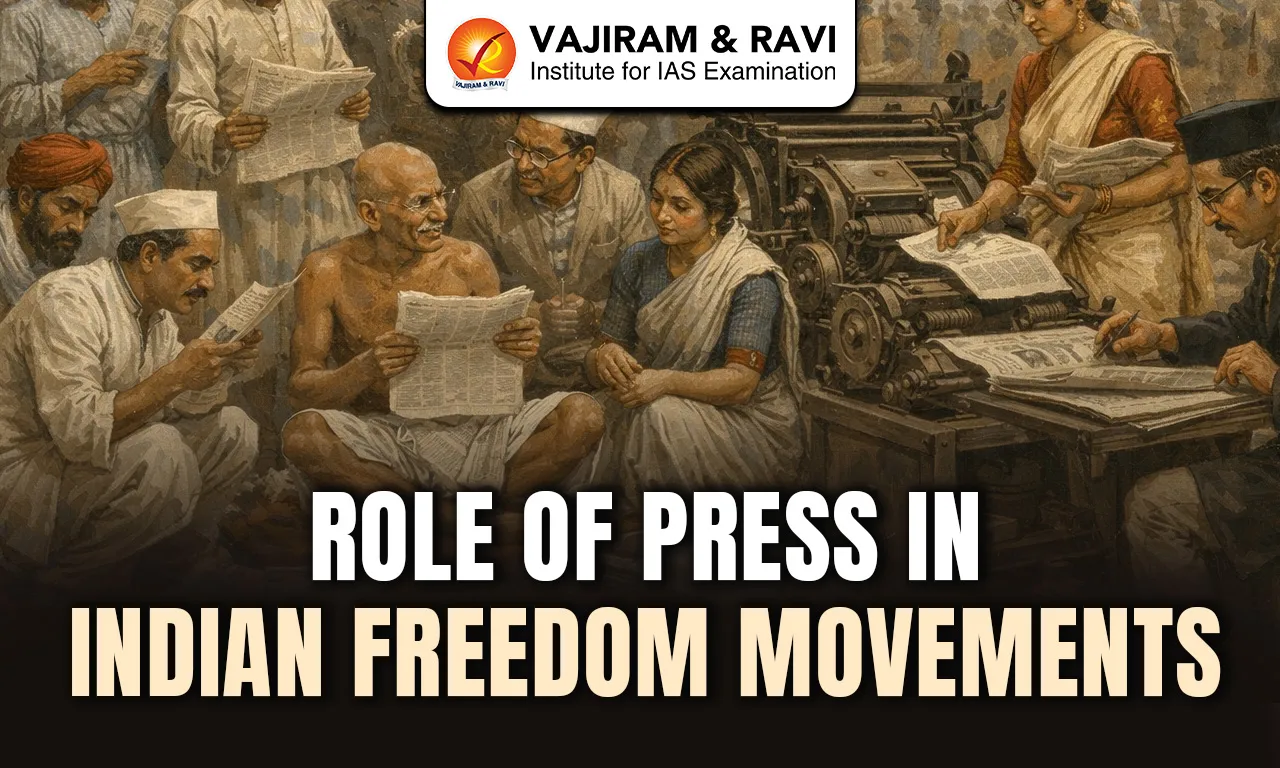
Role of Press in Indian Freedom Movement, Challenges, other Details

Role of Press in Indian Freedom Movement

The Role of Press in Indian freedom movement was extremely important in spreading freedom ideas across India. The press played a crucial role by spreading political awareness, shaping public opinion, and mobilising people against colonial rule. In an era without modern communication tools, newspapers and journals became a powerful medium to connect freedom fighters with the masses. The press helped Indians understand British policies, expose colonial exploitation, and develop a sense of national unity and identity.

Role of Press in Indian Freedom Movement

The Role of Press in Indian freedom movement was very important in spreading political awareness, exposing colonial policies, and mobilising public opinion against British rule.

  • Awareness against colonial exploitation: The Indian press created awareness about the exploitative economic and administrative policies of British rule. Publications such as Payam-e-Azadi encouraged people to stand against colonial injustice and highlighted the hardships faced by common people.
  • Platform for nationalist leaders: Leaders such as Mahatma Gandhi used Young India and Harijan to promote non-violence, social equality and self-reliance. Revolutionary groups like the Ghadar Party used Hindustan Ghadar to mobilise Indians living abroad.
  • Mobilisation of mass movements: The press played an important role in organising public opinion during major freedom struggle movements such as the Swadeshi movement, Non-Cooperation movement and Civil Disobedience movement led by Mahatma Gandhi. Newspapers helped spread calls for boycott, protests and nationalist participation.
  • Promotion of social reform movement: The press helped spread awareness against social evils such as sati, caste discrimination, child marriage. For Example, Raja Ram Mohan Roy used his newspaper Sambad Kaumudi to strongly criticise the practice of sati, helping change public opinion against it and paving the way for its abolition in 1829. 
  • Promotion of culture and nationalism: Newspapers like Kesari and Maharatta, edited by Bal Gangadhar Tilak, promoted Indian culture, art and traditions and contributed to a cultural renaissance.
  • Connecting different regions: Vernacular newspapers such as Mathrubhumi and Utkal Dipika helped reach semi-literate populations and connected local problems with the national freedom struggle.
  • Reach to rural areas: Newspapers were not limited to cities. They were read and discussed in villages, libraries and community gatherings, helping nationalist ideas reach remote populations.
  • Voice of women: Print media became an important platform for women to express their social problems, emotions and opposition to injustice in society. Rassundari Devi wrote Amar Jiban, describing her life struggles and experiences. Social reformers like Tarabai Shinde and Pandita Ramabai used writing to strongly criticise gender discrimination, caste restrictions and the poor social condition of women. 
  • Exchange of political ideas: Newspapers like The Hindu and The Statesman helped nationalist workers share political ideas across regions. International events also influenced nationalist sentiment. For example, news of Japan’s victory over Russia encouraged anti-colonial thinking.
  • Opposition to British authoritarianism: Indian newspapers criticised colonial policies. Leaders like Surendranath Banerjee were even jailed for writing critical editorials.

Challenges Faced by Press in India

The British government tried to control the press because it feared the spread of nationalist ideology. Several censorship laws were introduced. 

Censorship of Press Act 1799

  • It was the first act passed in the direction of imposing restrictions on the Indian press.
  • It was passed by Richard Wellesley, who was the Governor-General of India at the time. 
  • The Act was passed to restrict the French people from spreading any news that was against the British government. 
  • It also imposed a restriction on all the newspapers and journals that would not be published without first getting approval from the British government. 
  • All the magazines, journals, pamphlets, books, and newspapers were covered under this act after a modification in 1807. 

Licensing Regulation Act 1823

  • This ordinance was passed in 1823 by Adams, who was the Governor-General then. 
  • This act was primarily focused on the Indian newspapers or those that were at least edited by Indians. 
  • According to the Licensing Regulation, if any newspaper were published without a license, it would be considered a serious criminal violation. 
  • Publications like Mirat-ul-Akhbar of Raja Rammohan Roy were stopped under these rules.

Metcalfe Act or Press Act 1835

  • The Press Act or the Metcalfe Act came to be known as the liberator of the press.
  • The act revoked the License Regulations of 1823. It enabled the press to be more liberal, which contributed to the development of the press in India to a great extent. 
  • The main requirement of the Metcalfe Act was that the printer of the publisher of the newspaper must provide all details regarding the place of publication. If the instructions are not followed, the newspaper shall be stopped from publishing. 

Licensing Act 1857

  • The act was passed by Lord Canning, the Governor-General of India at the time. 
  • Any new publications were supposed to be published or printed only with the permission of the Government.

Vernacular Press Act 1878

  • It was passed during the viceroyalty of Lord Lytton.
  • It gave the colonial government power to monitor and control vernacular newspapers.
  • District magistrates were authorised to require publishers to provide security deposits.
  • If a newspaper published content considered “seditious” by the government, the deposit could be confiscated.
  • The decision of the magistrate was final, and there was no provision for judicial appeal.
  • The Act was specifically targeted at newspapers published in Indian languages and did not apply to the English press.

Registration Act, 1867

  • The Metcalfe act of 1835 was repealed by the Registration Act of 1867.
  • The name of the printer, publisher, and place of publication were now required to be included in the print media, and a copy was required to be submitted to the government.

Newspaper (Incitement to Offences) Act, 1908

  • The Newspaper (Incitement to Offense) Act of 1908 empowered magistrates to seize press property that published objectionable material likely to incite murder or violent acts.
  • Extremist nationalist activity during and after the Swadeshi movement of 1906 prompted this act.

Indian Press Act, 1910

  • This act was a revision of the Vernacular Act, which empowered local governments to demand a security at registration from the printer/publisher and forfeit/deregister an offending newspaper, and the printer of a newspaper was required to submit two copies of each issue to local governments.

During the Second World War, pre-censorship was imposed under the Defense of India Rules. The penalty of imprisonment was increased to five years through amendments to the Press Emergency Act.  Furthermore, the Official Secrets Act was amended to provide a maximum penalty of death or transportation for the publication of information likely to be useful to the enemy. 

Conclusion

The Role of Press in the Indian freedom movement was crucial in spreading nationalism, exposing colonial rule, and mobilising public opinion. Despite censorship, the press remained a strong medium of resistance and helped lay the foundation of democratic values in independent India.

Role of Press in Indian Freedom Movement FAQs

Q1: Why was the press important in the Indian freedom movement?

Ans: The press was important because it spread political awareness, exposed British exploitation, promoted nationalism and helped freedom fighters communicate with the masses.

Q2: Which newspapers played a major role in spreading nationalist ideas?

Ans: Newspapers like Kesari, Maharatta, Young India, Harijan, Mathrubhumi, Utkal Dipika, The Hindu and The Statesman played important roles.

Q3: How did the British control the press?

Ans: The British introduced laws such as the Censorship of Press Act (1799), Vernacular Press Act (1878), Press Act (1910) and Newspaper (Incitement to Offences) Act (1908) to restrict nationalist writings.

Q4: What was the role of vernacular newspapers?

Ans: Vernacular newspapers helped reach semi-literate and rural populations and connected local issues with the national freedom movement.

Q5: Who is called the “liberator of the Indian press”?

Ans: Lord Metcalfe is called the liberator of the Indian press because the Press Act of 1835 relaxed earlier restrictions on newspapers.

Part 15 of Indian Constitution, Articles, Amendments, Case Laws

Part 15 of Indian Constitution

Part 15 of Indian Constitution deals with elections in India. It provides the legal and institutional framework for conducting free and fair elections in the country. Since India follows democracy, elections are the main way people choose their representatives. 

Part 15 of Indian Constitution Articles

Part 15 of Indian Constitution contains Articles 324 to 329, which mainly focus on the functioning of the Election Commission of India, voter rights, and laws related to elections. 

Article 324 Role of the Election Commission

  • Article 324 provides for the establishment of the Election Commission of India. The Election Commission supervises, directs, and controls the preparation of electoral rolls and the conduct of elections for Parliament, State Legislatures, and the offices of the President and Vice-President.
  • The Election Commission of India consists of the Chief Election Commissioner and, if necessary, other Election Commissioners, the number of whom may be determined by the President from time to time. 
  • The appointments of the Chief Election Commissioner and other Election Commissioners are made by the President, subject to any law enacted by Parliament in this regard.
  • When any other Election Commissioner is appointed, the Chief Election Commissioner acts as the Chairman of the Election Commission.
  • Before every general election to the House of the People and to the State Legislative Assemblies, and before the first general election as well as subsequent biennial elections to the Legislative Council in States that have such a Council, the President may appoint Regional Commissioners after consulting the Election Commission. These Regional Commissioners are appointed whenever necessary to assist the Election Commission in performing its constitutional functions.
  • The service conditions and tenure of the Election Commissioners and Regional Commissioners are determined by the President through rules, subject to any law made by Parliament. 
  • The Constitution provides special protection to the Chief Election Commissioner by stating that he cannot be removed from office except in the same manner and on the same grounds as a Judge of the Supreme Court. 
  • Additionally, the service conditions of the Chief Election Commissioner cannot be changed to his disadvantage after appointment. 
  • Other Election Commissioners and Regional Commissioners can be removed only on the recommendation of the Chief Election Commissioner, which helps maintain the independence of the Election Commission.
  • The President or the Governor of a State is required to provide necessary staff to the Election Commission or Regional Commissioners when such a request is made by the Election Commission

Article 325 Single Electoral Roll

  • Article 325 provides that there should be one general electoral roll for each constituency. 
  • This means that voter lists cannot exclude any person on the basis of religion, caste, race, or gender. 
  • The purpose of this provision is to promote equality and prevent discrimination in the voting process. Every eligible citizen should have an equal opportunity to participate in elections.

Article 326 Adult Suffrage

  • Article 326 establishes the principle of adult suffrage in India. According to this, every citizen who is at least eighteen years of age has the right to vote in elections to the Lok Sabha and State Legislative Assemblies, provided the person is not disqualified by law.
  • Disqualification from voting may occur due to reasons such as unsoundness of mind, criminal conviction, corruption in electoral practices, or other legal restrictions. 

Articles 327 and 328 Law-making Power Regarding Elections 

  • The Constitution gives Parliament the authority to make laws related to elections to Parliament and State Legislatures (Article 327)
  • These laws may include rules regarding the preparation of voter lists, delimitation of constituencies, and other important election procedures. 
  • Similarly, State Legislatures (under Article 328) can make laws regarding elections to State Legislative bodies if Parliament has not already made such laws. 

Article 329 Protection of Election Process

  • Article 329 protects the election process from unnecessary judicial interference to ensure the smooth functioning of the electoral process.
  • It states that the validity of any law related to the delimitation of constituencies or the allocation of seats, made under Articles 327 or 328, cannot be challenged in any court.
  • Additionally, elections to Parliament or State Legislatures cannot be directly challenged in courts. Such disputes can only be raised through an election petition filed before the authority and in the manner prescribed by law made by the concerned Legislature. 

Part 15 of Indian Constitution Amendments

The 61st Constitutional Amendment Act, 1988 amended Part 15 of Indian Constitution and reduced the voting age from 21 years to 18 years under Article 326. The main objective was to encourage greater youth involvement in democracy and make the electoral system more representative.

Part 15 of Indian Constitution Related Case Laws

  • Mohinder Singh Gill v. Chief Election Commissioner (1978): The Supreme Court held that the Election Commission of India has wide powers under Article 324 to ensure free and fair elections, but it must follow natural justice principles while making decisions.
  • A.C. Jose v. Sivan Pillai (1984): The Court ruled that the Election Commission cannot go against laws made by Parliament on election matters.
  • Union of India v. Association for Democratic Reforms (2002): The Supreme Court made it mandatory for candidates to disclose criminal, financial, and educational details to ensure transparency in elections.

People’s Union for Civil Liberties v. Union of India (2013): The Court recognised the voter’s right to choose NOTA (None of the Above) as part of free expression in voting.

Part 15 of Indian Constitution FAQs

Q1: What is Part XV of the Indian Constitution?

Ans: Part 15 of the Indian Constitution deals with elections and provides the legal framework for conducting free and fair elections in the country. It contains Articles 324 to 329, which mainly regulate the functioning of the Election Commission, voter registration, and election laws.

Q2: What is the role of the Election Commission of India under Article 324?

Ans: Article 324 establishes the Election Commission of India, which is responsible for supervising, directing, and controlling the preparation of electoral rolls and the conduct of elections to Parliament, State Legislatures, and the offices of the President and Vice-President.

Q3: What is meant by universal adult suffrage under Article 326?

Ans: Universal adult suffrage means that every citizen of India who is at least eighteen years of age has the right to vote, provided the person is not legally disqualified due to reasons such as criminal conviction or unsoundness of mind.

Q4: Why is a single electoral roll important under Article 325?

Ans: A single electoral roll ensures equality in voting by preventing discrimination based on religion, caste, race, or gender. It helps maintain fairness and transparency in the electoral process.

Q5: Can election results be directly challenged in court?

Ans: No, election results cannot be directly challenged in court. Election disputes must be raised through an election petition filed according to the procedure prescribed by law.

Difference between Ecology and Ecosystem, Definition, Components

Difference between Ecology and Ecosystem

Ecology and Ecosystem are closely linked environmental concepts explaining how organisms relate to surroundings. Ecology studies relationships among living beings and their environment, while an Ecosystem represents the functional unit where biotic and abiotic components interact through energy flow and nutrient cycling. The major difference of Ecology and Ecosystem lies within the scope, nature, components and roles.

Difference between Ecology and Ecosystem

Ecology is a scientific discipline, whereas an Ecosystem is a structural and functional environmental unit formed by organism-environment interactions. The key Difference between Ecology and Ecosystem has been tabulated below:

Difference between Ecology and Ecosystem
Aspect Ecology Ecosystem

Definition

Scientific study of relationships between organisms and environment, coined by Ernst Haeckel in 1866.

Functional unit comprising living organisms and non living components interacting in a defined area.

Scope

Broad field covering all Ecosystems and environmental interactions at multiple levels.

Limited to a specific community and its surrounding physical conditions.

Nature

Theoretical and analytical branch of biological science.

Practical, observable natural system existing physically in nature.

Components 

Focuses on organisms, organism-organism and organism-environment interactions.

Categorised into Abiotic and Biotic Components which further classifies biotic components into Producer Consumer and Decomposer classes.

Energy Concept

Examines how organisms respond to environmental energy availability.

Demonstrates actual energy flow through producers, consumers and decomposers through the food chain and web.

Nutritional Categories

Classifies organisms as symbionts, parasites, predators and saprophytes.

Shows feeding relationships through the nature of nutrition dependence like autotrophs, heterotrophs, saprotrophs and parasites.

Levels

Levels of ecology include organism, population, community, ecosystem, biome and biosphere, forming hierarchical environmental organization from individuals to planet.

Levels of ecosystem are structured through trophic levels: producers, consumers and decomposers linked by energy flow and nutrient cycling.

Biotic Role

Analyses biodiversity, abundance and species distribution patterns.

Contains producers, macro-consumers and micro-consumers functioning together.

Abiotic Role

Studies impact of temperature, rainfall, humidity and soil on organisms.

Integrates abiotic factors like atmospheric gases, minerals and climatic conditions.

Classification

No fixed structural classification; divided into autEcology and synEcology.

Categorised into marine, freshwater, forest, desert, grassland and artificial systems

Interaction Focus

Explains friendly and hostile interspecies relationships.

Describes nutrient cycling and ecological balance within a community.

Origin of Term

Derived from Greek “Oikos” meaning home and “logos” meaning study.

Derived from the Greek “Oikos” and the Greek systema, meaning "organized whole".

Also Check Related Articles
Difference between NITI Aayog and Inter-State Council Difference Between Economic Survey and Union Budget
Difference Between Tropical Evergreen and Tropical Deciduous Forests Difference Between Ordinary Bill and Money Bill
Difference Between Legislative and Executive Difference between Himalayan and Peninsular Plateau
Difference Between Vedas and Upanishads Difference Between Scheduled and Non-Scheduled Banks
Difference Between Written and Unwritten Constitution Difference between NITI Aayog and Planning Commission
Difference between Colonialism and Imperialism Difference between Fundamental Rights and Directive Principles of State Policy

Difference between Ecology and Ecosystem FAQs

Q1: What is Ecology?

Ans: Ecology is the scientific study of how living organisms interact with each other and with their surrounding environment.

Q2: What is an Ecosystem?

Ans: An Ecosystem is a functional unit where plants, animals, microorganisms and non living elements interact through energy flow and nutrient cycling.

Q3: What is the major difference between Ecology and Ecosystem?

Ans: The major difference is that Ecology is a scientific field of study of how the components interact, while an Ecosystem is the actual natural system where living and non living components interact.

Q4: What are biotic and abiotic components in an Ecosystem?

Ans: Biotic components are living organisms, while abiotic components include non living factors like water, soil, sunlight and minerals.

Q5: How are Ecology and Ecosystem connected?

Ans: Ecology explains the relationships and principles, while an Ecosystem represents the practical unit where those interactions occur.

Ashoka Pillar, Features, Major & Minor Edicts, Lion Capital of Ashoka

Ashoka Pillar

The Ashoka Pillar represents one of the earliest and most refined stone monuments of ancient India, erected during the reign of Emperor Ashoka the Great. These monolithic columns, raised across the Mauryan Empire, symbolized royal authority and moral governance based on Dhamma. The pillars were carved from single blocks of sandstone and placed at key administrative, trade and pilgrimage centres. They remain among the finest surviving examples of Mauryan architecture and sculpture.

Ashoka Pillar

The Ashoka Pillars were monumental stone columns erected throughout northern India and adjoining regions as part of the emperor’s early artistic and political programme. Originally about 20-30 pillars were installed out of which only about 19 have survived till today and many are fragmented. They were transported from quarries at Mathura and Chunar and erected along trade routes, border towns and major Buddhist pilgrimage sites such as Bodh Gaya, Sarnath and Sanchi. The inscriptions engraved upon them were deciphered in the 1830s. They form part of nearly 150 Ashokan edicts discovered across India, Nepal, Pakistan, Bangladesh and Afghanistan.

Ashoka Pillar Features

The pillars display uniform design, polished finish and symbolic capitals reflecting Mauryan craftsmanship and imperial vision.

  • Monolithic Shaft: Each pillar shaft was carved from a single sandstone block, circular in cross section, slightly tapering upward and reaching 12 to 15 metres in height with mirror-like Mauryan polish.
  • Stone Types Used: Two principal stones were employed, spotted red and white sandstone from Mathura and fine buff sandstone from Chunar near Varanasi, both transported over long distances.
  • Weight and Dimensions: Average height ranged between 40 and 50 feet and each pillar weighed approximately 50 tons, demonstrating advanced engineering and coordinated labour organization.
  • Capital Structure: The capital consisted of three sections carved from one piece, joined to the shaft by a metal dowel, forming a stable and durable architectural unit.
  • Bell Shaped Base: The lower capital resembled an inverted lotus bell, symbolizing purity and spiritual awakening, reflecting both Indian symbolism and possible Achaemenid stylistic parallels.
  • Abacus Decoration: The abacus platform was either plain square or circular with carvings such as lotuses, bead and reel patterns, palmettes and rosettes inspired by Greek and Near Eastern motifs.
  • Animal Sculptures: Surviving capitals include seven animals, mainly lions, one bull and one elephant, sculpted fully in the round and representing strength, vigilance and moral sovereignty.
  • Mauryan Polish: Surfaces were polished to extraordinary smoothness, comparable to fine metalwork, reflecting technical mastery unmatched in early Indian stone architecture.
  • Script and Language: Inscriptions were engraved in Prakrit using Brahmi script, the ancestor of later Indic scripts, while some western edicts used Aramaic and Greek.
  • Geographic Spread: Major surviving pillars are located in Bihar, Uttar Pradesh, Madhya Pradesh, Haryana, Nepal and Afghanistan, marking the vast territorial extent of the Mauryan Empire.
  • Relocation: In 1356 CE, Firuz Shah Tughlaq transported two pillars from Topra and Meerut to Delhi, preserving them within medieval monuments.

Read about: Mauryan Empire

Pillars of Ashoka

The list of few of the preserved Pillars of Ashoka has been given below:

  • Sarnath Pillar: Famous for the Lion Capital, now the National Emblem of India. The polished sandstone pillar carried the Schism Edict and displays the finest Mauryan craftsmanship.
  • Sanchi Pillar: Located at the Buddhist site of Sanchi. It once had a lion capital similar to Sarnath. The pillar bears the Schism Edict and reflects early inscription techniques.
  • Allahabad Pillar (Kosambi Pillar): Originally erected at Kosambi and later moved to Allahabad Fort. It contains both Major and Minor Pillar Edicts, including the Queen’s Edict. Later rulers like Samudragupta also added inscriptions.
  • Lauriya-Araraj Pillar: Located in East Champaran district of Bihar. It contains Major Pillar Edicts and is known for its well preserved polished shaft.
  • Lauriya Nandangarh Pillar: Also situated in Champaran, Bihar. The pillar carries Major Pillar Edicts and stands near ancient burial mounds.
  • Rampurva Pillars: Two pillars were found here, one with a lion capital and another with a bull capital. One pillar bears Major Pillar Edicts, while the other is without inscription.
  • Vaishali Pillar: Features a single lion capital facing north. Unlike many others, this pillar has no inscription and marks an important Buddhist site.
  • Topra Kalan Pillar (Delhi-Topra Pillar): Originally installed at Topra in Haryana and later moved to Delhi. It contains Major Pillar Edicts including the unique Major Pillar Edict VII.
  • Lumbini Pillar (Rummindei Pillar): Marks the birthplace of the Buddha. Ashoka reduced taxes in the village and commemorated his visit with this pillar.
  • Nigali Sagar Pillar: Erected after Ashoka enlarged the stupa of Kanakamuni Buddha. The pillar commemorates his personal visit and devotion.
  • Sankisa Pillar: Located at Sankisa, an ancient Buddhist site. The pillar is now broken, but an elephant capital was discovered here, symbolizing the Buddha’s descent from heaven.
  • Delhi-Meerut Pillar (Firoz Shah Kotla): Originally from Meerut and relocated to Delhi by Firoz Shah Tughlaq in the 14th century. It carries Major Pillar Edicts and stands inside Firoz Shah Kotla.
  • Kandahar Fragment: Though mainly known for rock edicts, fragments associated with pillar inscriptions in Aramaic have been reported, showing Ashoka’s influence extended into Afghanistan.

Lion Capital of Ashoka

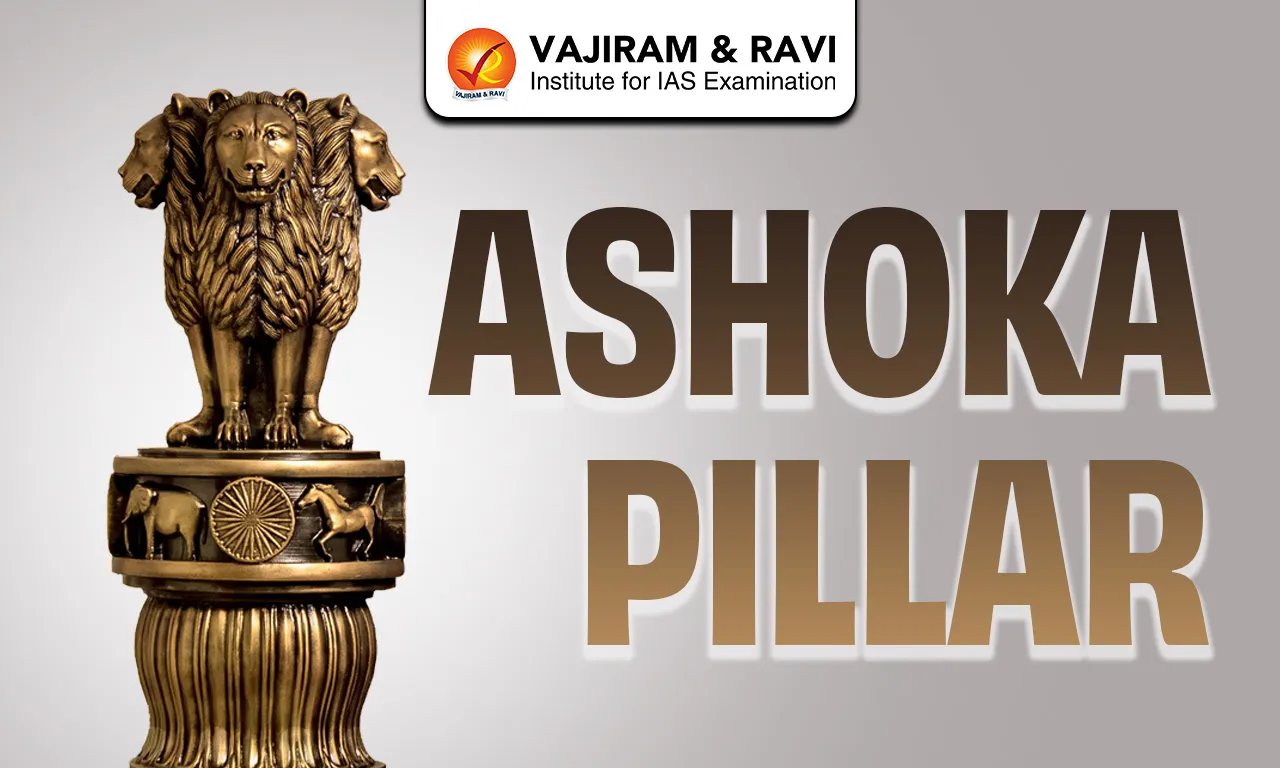
The Lion Capital of Ashoka, commonly called as “Ashoka Stambh”, is the National Emblem of India. It was built by Emperor Ashoka around 250 BCE at Sarnath. The sculpture shows four Asiatic lions standing back to back, symbolizing power, courage, pride and confidence. It is made of polished sandstone and represents truth and righteousness under the Mauryan Empire. It was adopted in 1950 as the State Emblem of India, with the Ashoka Chakra placed at the centre of the national flag.

Ashoka Pillar Edicts 

Ashoka Pillar Edicts are official inscriptions engraved on stone pillars erected by Ashoka during the 3rd century BCE. They communicate his Dhamma policy, moral teachings, administrative principles and messages of non violence, justice and religious tolerance across the Mauryan Empire.

The Ashoka Pillar Edicts have been classified into two categories:

1. Major Pillar Edicts

Major Pillar Edicts are important inscriptions of Ashoka explaining Dhamma, governance, welfare and moral duties. The seven Major Pillar Edicts were inscribed on selected pillars across the Gangetic plain.

  1. Major Pillar Edict I: Explains Ashoka’s principle of protecting his people through moral governance. It stresses welfare measures, justice and the king’s duty to ensure public safety and ethical administration.
  2. Major Pillar Edict II: Defines Dhamma as avoiding sins and practicing virtues like compassion, charity, truthfulness and purity. It presents a simple moral code for peaceful and harmonious living.
  3. Major Pillar Edict III: Advises people to avoid cruelty, anger, pride and harsh behavior. It encourages self control, kindness and moral discipline among subjects throughout the empire.
  4. Major Pillar Edict IV: Describes duties of Rajukas, officers appointed to spread Dhamma. They toured provinces every five years to guide people and ensure fair governance.
  5. Major Pillar Edict V: Lists animals and birds protected from killing on certain days and occasions. It also mentions Ashoka’s humanitarian act of releasing twenty five prisoners.
  6. Major Pillar Edict VI: Explains Ashoka’s Dhamma policy in administration. It emphasizes quick justice, public communication and the king’s concern for moral and material welfare.
  7. Major Pillar Edict VII: Summarizes works done for promoting Dhamma. It highlights religious tolerance and states that all sects value self control and purity of mind.

2. Minor Pillar Edicts

Minor Pillar Edicts are shorter inscriptions of Ashoka focusing on Sangha unity, donations and commemorative visits.

  1. Schism Edicts: Found at Sarnath, Sanchi and Allahabad, these edicts warn against division in the Buddhist Sangha. They order strict action against monks or nuns causing disunity.
  2. Queen’s Edict: Inscribed on the Allahabad pillar, it credits Ashoka’s second queen, Karuvaki, for her charitable donations like mango groves and religious institutions.
  3. Lumbini Pillar Inscription (Rummindei Edict): Records Ashoka’s visit to Lumbini, birthplace of the Buddha. He reduced taxes there and marked the sacred site with a pillar.
  4. Nigali Sagar Pillar Inscription: Mentions Ashoka enlarging the stupa of Kanakamuni Buddha and personally visiting the site to pay respect, marking it with a commemorative pillar.

Ashoka Pillar FAQs

Q1: Who built the Ashoka Pillars?

Ans: The Ashoka Pillars were built by Emperor Ashoka during the 3rd century BCE. He erected them across his empire to spread the message of Dhamma and moral values.

Q2: What is the purpose of the Ashoka Pillars?

Ans: The pillars were constructed to spread Buddhist teachings and royal orders. They carried inscriptions promoting peace, non violence, justice and ethical governance among people.

Q3: Where is the most famous Ashoka Pillar located?

Ans: The most famous Ashoka Pillar is located at Sarnath. Its Lion Capital was later adopted as the National Emblem of India.

Q4: What material was used to build the Ashoka Pillars?

Ans: The Ashoka Pillars were mainly made of polished sandstone. They are known for their smooth finish, durability and fine Mauryan craftsmanship.

Q5: What are Ashoka Pillar Edicts?

Ans: The Ashoka Pillar Edicts are inscriptions on the Pillars. There are 7 Major Pillar Edicts and 4 Minor Pillar Edicts. These inscriptions highlight moral teachings, administrative policies and principles of good governance.

Ashgabat Agreement, Objective, Significance, Key Details

Ashgabat Agreement

The Ashgabat Agreement is an important regional connectivity initiative that seeks to create a multimodal transport corridor linking Central Asia with the Persian Gulf. For India, it holds particular strategic and economic importance as it opens new pathways to Central Asia and strengthens its westward outreach.

Ashgabat Agreement Key Details 

Key details of Ashgabat Agreement are: 

  • Ashgabat Agreement is a multimodal transport and transit agreement signed in April 2011.
  • It came into force in April 2016.
  • The founding members of the Ashgabat agreement were Turkmenistan, Iran, Oman and Uzbekistan and Qatar. Qatar subsequently withdrew from the agreement in 2013.
  • Turkmenistan is the Depository State, meaning it officially keeps the original Ashgabat Agreement, records ratifications and accessions by member countries, and manages formal treaty-related communications without having decision-making authority over the agreement.
  • It aims to establish an international transport corridor between Central Asia and the Persian Gulf.
  • The main aim is to reduce transport time and costs and make trade easier across member countries.
  • Its objective is to enhance connectivity within the Eurasian region and synchronize it with other regional transport corridors, including the International North–South Transport Corridor (INSTC).
  • Kazakhstan and Pakistan joined in 2016, and India became a member in 2018.
  • For India, it supports the development of Chabahar Port in Iran as a gateway to Afghanistan and Central Asia.
  • It is purely a connectivity and trade initiative, not a defence or security alliance.

Read about: Paris Agreement

Ashgabat Agreement Significance for India

Ashgabat Agreement is significant for India due to following reasons: 

  • Direct access to Central Asia: It helps India reach Central Asian countries through Iran and Turkmenistan, since India has no direct land route due to Pakistan.
  • Strengthens Chabahar Port: The agreement increases the importance of Chabahar Port in Iran, which India is developing as a gateway to Afghanistan and Central Asia.
  • Supports INSTC connectivity: It works well with the International North-South Transport Corridor (INSTC), improving trade links between India, Russia, Central Asia and Europe.
  • Improves energy security: Central Asia has oil, gas and uranium. Better connectivity makes it easier for India to access these important resources.
  • Enhances India’s strategic presence: It increases India’s economic and geopolitical role in the Eurasian region.

Ashgabat Agreement FAQs

Q1: What is the Ashgabat Agreement?

Ans: The Ashgabat Agreement is a multimodal transport and transit pact signed in 2011 to create an international transport corridor linking Central Asia with the Persian Gulf and improving regional trade connectivity.

Q2: When did Ashgabat Agreement come into force and who are the members?

Ans: It was signed in April 2011 and came into force in April 2016. Founding members were Turkmenistan, Iran, Oman, Uzbekistan and Qatar (Qatar later withdrew). Kazakhstan and Pakistan joined in 2016, and India became a member in 2018.

Q3: What is the main objective of the Ashgabat agreement?

Ans: Its primary aim is to reduce transport time and costs, facilitate smoother transit of goods, and enhance trade cooperation by connecting Central Asia with Persian Gulf ports.

Q4: What does it mean that Turkmenistan is the Depository State?

Ans: It means Turkmenistan officially keeps the original treaty documents, records ratifications and accessions, and manages formal communications related to the agreement.

Q5: Why is the Ashgabat Agreement important for India?

Ans: It gives India better access to Central Asia through Iran, strengthens the strategic importance of Chabahar Port, supports the International North–South Transport Corridor (INSTC), and enhances India’s economic and geopolitical presence in Eurasia.

Kalinga War 261 BCE, Reasons, Course, Outcomes, Impact

Kalinga War

The Kalinga War was fought in 261 BCE between Emperor Ashoka of the Mauryan Empire and the powerful state of Kalinga. Ancient Kalinga was located in east-central India and covered present day northern Telangana, northeastern Andhra Pradesh, most of Odisha and parts of Madhya Pradesh. It was a prosperous maritime region with major ports like Kakinada, Visakhapatnam and Srikakulam and inland cities such as Rajahmundry and Vizianagaram. The war became one of the bloodiest conflicts of ancient India and deeply transformed Ashoka’s political and moral outlook.

Kalinga War Reasons

Kalinga’s strategic and economic strength made it vital for imperial control and thus resulted in the Kalinga War. The major highlighting causes of the war has been listed below:

  • Strategic Location: Kalinga lay between the Indo-Gangetic Plain and peninsular India, controlling land routes from Pataliputra to the southern regions. Its forested hinterland connected central India through tribal territories, making it militarily significant.
  • Maritime Power: Ports such as Kakinada, Visakhapatnam and Srikakulam enabled rich sea trade with Burma, Malay, Java and Ceylon. Control over these ports meant dominance over Bay of Bengal commerce.
  • Political Independence: After the fall of the Nanda dynasty in 321 BCE, Kalinga regained independence despite earlier Magadhan control under Mahapadma Nanda. Mauryan rulers Chandragupta and Bindusara failed to annex it.
  • Imperial Expansion Policy: Ashoka, in the 12th year of his reign, demanded submission from Kalinga’s ruler. The refusal directly triggered armed conflict in 261 BCE.
  • Military Strength of Kalinga: Historical accounts mention 60,000 infantry, 1,000 cavalry and 700 elephants in Kalinga’s army, indicating organized resistance capacity.

Also Read: List of maratha wars

Kalinga War Course

The Kalinga War unfolded with intense resistance and large scale mobilization of forces on both sides. The major features of the war are:

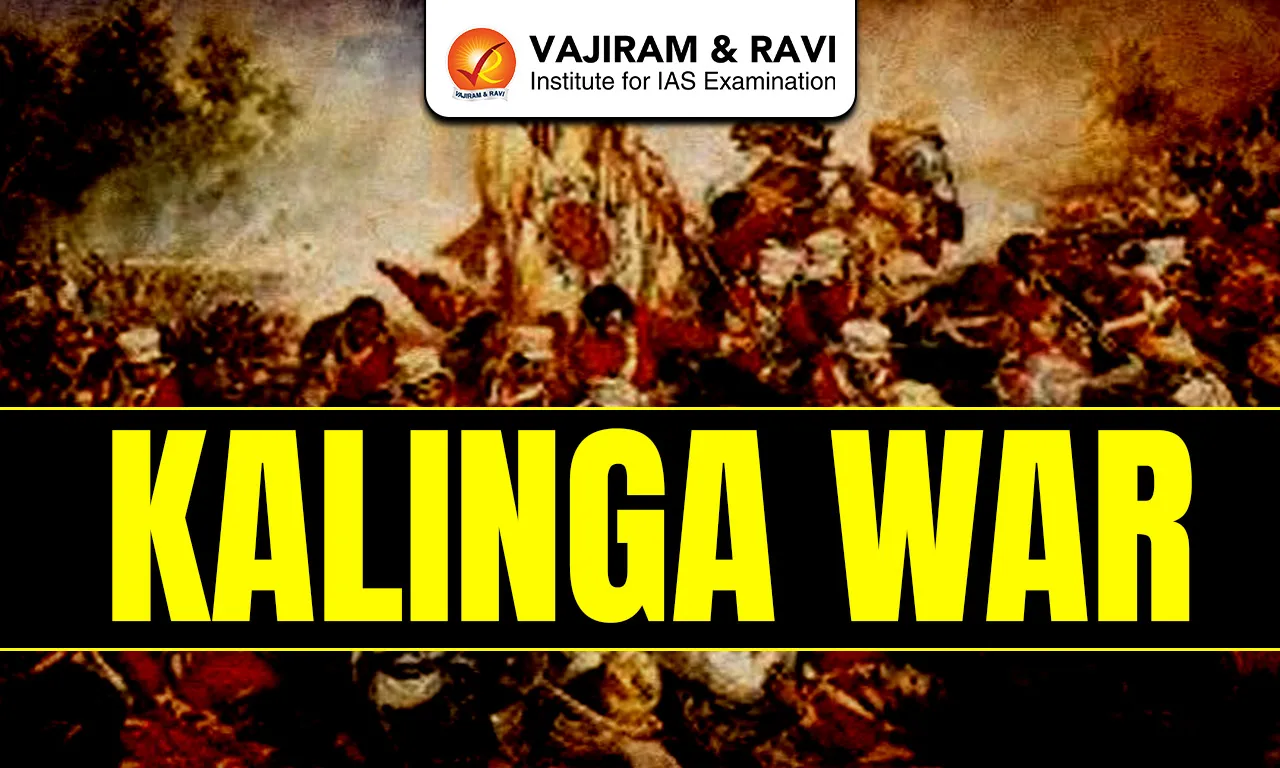
  • Battlefield Location: The main confrontation occurred near Dhauli Hills along the Daya River, turning the region into a massive battleground marked by heavy casualties.
  • Year of Conflict: The decisive campaign occurred in 261 BCE during Ashoka’s early reign.
  • Kalinga Army Strength: Approximately 60,000 infantry, 1,000 cavalry and 700 war elephants defended the state.
  • Mauryan Military Power: Greek ambassador Megasthenes described Mauryan forces as about one lakh soldiers with 1,700 horses and thousands of elephants.
  • Leadership of Kalinga: Sources mention Raja Ananta Padmanabha or republican chiefs leading resistance, reflecting either monarchical or confederated governance structure.
  • Massive War Casualties: Rock Edict XIII records 100,000 deaths and 150,000 deported captives after the battle.
  • Civilian Suffering: Many additional deaths occurred from famine, displacement and post war devastation.
  • Territorial Annexation: Kalinga was incorporated as a province within the expanding Mauryan Empire.

Kalinga War Outcomes

Ashoka won the Kalinga War and it ended with annexation but massive devastation. The major 

  • Kalinga became the fifth province of the Magadhan Empire, joining Prachaya, Avanti, Uttarapatha and Dakshinapatha under Mauryan administration.
  • Ashoka recorded the deportation of more than 150,000 people and acknowledged widespread suffering among civilians, including families and tribal communities.
  • The region’s ports and urban centers like Rajahmundry and Vizianagaram were incorporated into Mauryan fiscal and trade networks.
  • After witnessing battlefield destruction, Ashoka publicly renounced further conquest wars, marking the end of aggressive Mauryan expansion.
  • Rock Edict XIII records Ashoka’s remorse, stating sorrow over killing and deportation, especially among Brahmanas, Shramanas and householders.

Also Read: 

Kalinga War Impact

The major impacts and aftermath of the Kalinga War has been listed below:

  • Adoption of Dhamma Policy: Ashoka replaced conquest by sword with “Dharma-Vijaya,” promoting moral governance, tolerance and welfare administration across his empire.
  • Spread of Buddhism: Following the war, Ashoka supported Buddhist missions extending from the Himalayas to Ceylon and toward regions including Burma and even Greek territories.
  • Welfare Measures: He initiated public works such as planting trees, digging wells, building hospitals for humans and animals and appointing Dhamma Mahamatras for ethical oversight.
  • Long Peace Phase: The empire experienced nearly 40 years of relative internal stability after 261 BCE, with no major recorded expansionist wars.
  • Inscriptional Legacy: Ashoka’s edicts carved on rocks and pillars across the subcontinent documented moral principles, making the Kalinga episode one of the earliest recorded examples of ethical state reflection.

Kalinga War Significance

The Kalinga War stands as a transformative event in ancient Indian history. Its significance lies in:

  • It marked the conclusion of the Mauryan tradition of territorial conquest that began under Chandragupta Maurya and continued under Bindusara.
  • For the first time in recorded history, a victorious emperor openly regretted bloodshed and institutionalized nonviolence as state policy.
  • Control of eastern coastal trade routes strengthened imperial economic networks across the Bay of Bengal.
  • Royal patronage helped Buddhism expand beyond India to Sri Lanka and Southeast Asia, shaping Asian religious history for centuries.
  • The Kalinga War remains one of the bloodiest ancient battles, remembered not only for 250,000 combined casualties but for transforming imperial ideology from conquest to compassion.

Kalinga War FAQs

Q1: When was the Kalinga War fought?

Ans: The Kalinga War was fought in 261 BCE during the eighth and ninth regnal years of Emperor Ashoka.

Q2: Where did the Kalinga War take place?

Ans: The war was fought near the Daya River, close to Dhauli Hills, in the region corresponding to present-day Odisha.

Q3: Who won the Kalinga War?

Ans: Emperor Ashoka of the Mauryan Empire won the Kalinga war against the independent state of Kalinga.

Q4: What were the reasons behind the Kalinga War?

Ans: Ashoka attacked Kalinga because it was strategically located, economically prosperous and politically independent, controlling important land and sea trade routes.

Q5: Which Rock Edict mentions the Kalinga War?

Ans: Rock Edict XIII of Emperor Ashoka describes the conquest of Kalinga, records 100,000 deaths and 150,000 deportations and clearly expresses his deep remorse over the suffering caused by the war.

British Annexation of Awadh, Background, Reasons, Impact

British Annexation of Awadh

Awadh was a prosperous and strategically located kingdom in North India with its capital at Lucknow. It was one of the most fertile and revenue-rich regions of India and supplied a large number of soldiers to the British army. The Nawabs of Awadh were considered loyal allies of the British. Despite this loyalty, Awadh was annexed by the British on the ground of  “misgovernance”. 

British Annexation of Awadh Background

Since 1801, Awadh had been under a Subsidiary Alliance. Over time, the Subsidiary Alliance weakened the state financially and politically. Under subsidiary alliance, the Nawab was required to maintain British troops within his territory and bear the cost of their upkeep. In return, the British promised protection from external threats. However, this arrangement gradually reduced the independence of the Awadh administration. The heavy financial burden of maintaining subsidiary forces forced the Nawab to impose higher taxes on the people, which contributed to treasury bankruptcy and administrative decline. 

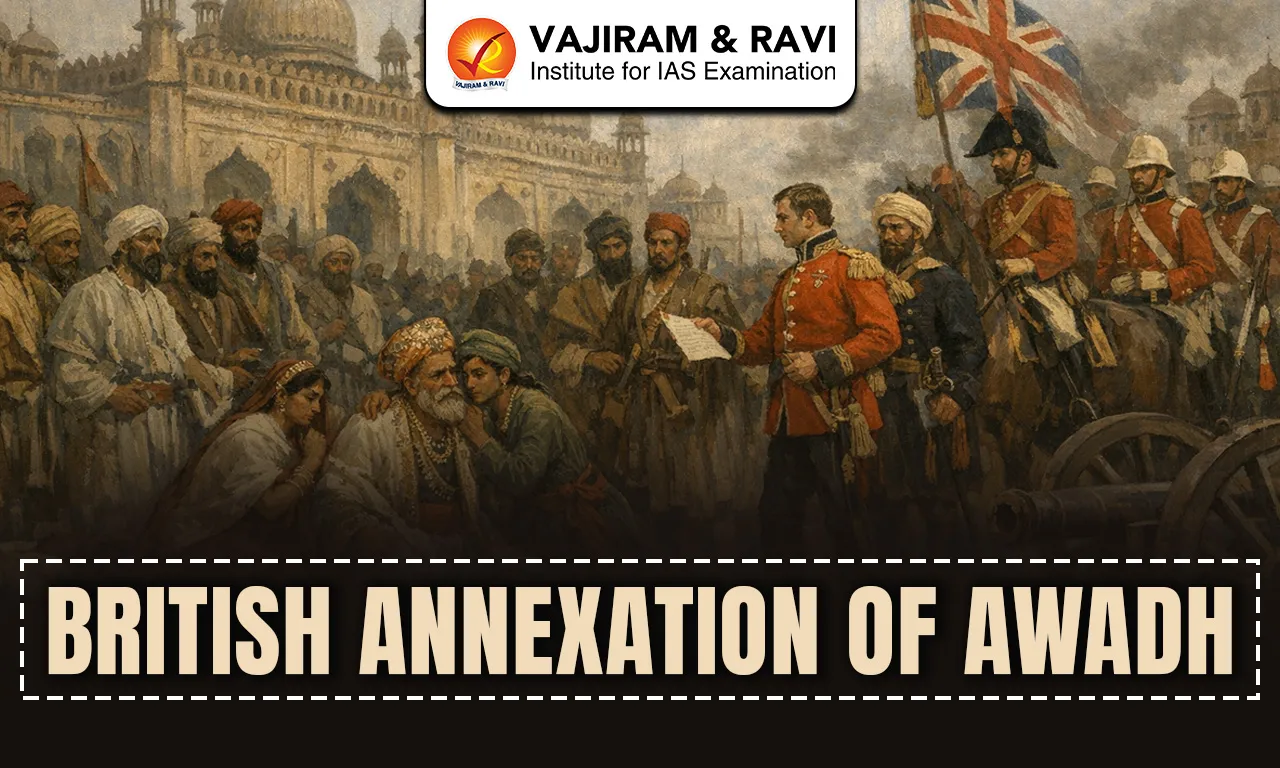
Lord Dalhousie directed Resident Sleeman to tour the state and report on its condition. Sleeman described widespread disorder, and his successor Outram confirmed these findings. Dalhousie initially preferred placing Awadh under permanent British administration while allowing the Nawab to retain his title, but the Court of Directors ordered complete annexation and abolition of the throne in 1856. Nawab Wajid Ali Shah refused to sign away his rights and was exiled to Calcutta.

Reasons for British Annexation of Awadh 

Awadh was annexed because of following reason: 

  • Lord Dalhousie, the Governor-General, accused Nawab Wajid Ali Shah of maladministration and corruption.
  • The British argued that the people of Awadh were suffering due to poor governance.
  • Dalhousie claimed annexation was necessary to ensure better administration and protect the interests of the people.
  • The real motive, however, was to expand British territory and gain direct control over Awadh’s rich resources.
  • In 1856, Awadh was formally annexed, and Wajid Ali Shah was deposed and exiled to Calcutta.

Impact on Society and Economy

  • The annexation disrupted the established social order of Awadh.
  • Many taluqdars lost large portions of their land under new revenue settlements.
  • Peasants faced higher revenue demands and stricter collection methods.
  • Local industries and traders suffered under new regulations and taxation.
  • The traditional judicial system based on Shariat and customary laws was replaced by a Western-style legal system.
  • Thousands connected to the Nawab’s court lost employment and status.
  • Instead of improving governance, the annexation created widespread economic hardship and resentment.

Role in the Revolt of 1857

  • The annexation of Awadh played a decisive role in the outbreak and spread of the Revolt of 1857.
  • Many sepoys in the British army were from Awadh and felt personally insulted by the annexation of their homeland.
  • Dispossessed taluqdars supported the rebellion to regain their lost authority.
  • Peasants joined due to heavy taxation and economic distress.
  • Lucknow became one of the most important centres of resistance.
  • The revolt in Awadh was intense and prolonged, reflecting deep-rooted anger against British rule.
  • Awadh became a symbol of British aggression and cultural insensitivity.

British Annexation of Awadh FAQs

Q1: Why was Awadh annexed by the British?

Ans: Awadh was annexed in 1856 by Lord Dalhousie on the ground of “misgovernance.” The British claimed that Nawab Wajid Ali Shah was an inefficient ruler and that the people were suffering due to poor administration. However, the real motive was territorial expansion and gaining direct control over Awadh’s fertile land and rich resources.

Q2: Was the Doctrine of Lapse used to annex Awadh?

Ans: No, Awadh was not annexed under the Doctrine of Lapse. It was annexed on the pretext of maladministration. The British justified it as an act of administrative reform rather than a succession issue.

Q3: How did the Subsidiary Alliance weaken Awadh?

Ans: Under the Subsidiary Alliance (from 1801), Awadh had to maintain British troops and pay heavy subsidies. This drained the treasury, increased taxation on the people, and gradually weakened the state financially and politically, leading to administrative decline.

Q4: What was the impact of British annexation on Awadh’s society and economy?

Ans: The annexation disrupted the traditional social structure. Taluqdars lost their lands, peasants faced higher revenue demands, court officials lost employment, and the traditional judicial system was replaced. Instead of improving governance, it created widespread resentment.

Q5: How did the British annexation of Awadh contribute to the Revolt of 1857?

Ans: The annexation played a major role in the Revolt of 1857. Many sepoys in the British army were from Awadh and felt humiliated by its annexation. Dispossessed taluqdars and distressed peasants joined the rebellion. Lucknow became one of the main centres of revolt, and the uprising in Awadh was intense and prolonged.

Pradhan Mantri Gramodaya Yojana, Features, Benefits, Eligibility

Pradhan Mantri Gramodaya Yojana

The Pradhan Mantri Gramodaya Yojana is a government scheme aimed at improving the living conditions of people in villages. It focuses on providing better health, education, roads, drinking water and sanitation facilities to make rural life easier and more sustainable. The goal is to ensure that basic development reaches all villages.

Pradhan Mantri Gramodaya Yojana Overview

The Pradhan Mantri Gramodaya Yojana (PMGY) supports poor and marginalized households through employment, basic amenities and development programs. Key features, eligibility, and benefits are discussed below.

Pradhan Mantri Gramodaya Yojana Overview
Aspects Details

Scheme Name

Pradhan Mantri Gramodaya Yojana (PMGY)

Year Started

2000

Objective

To improve rural areas, reduce the gap between villages and cities, and empower rural people

Focus Areas

Infrastructure (roads, electricity, water), livelihoods, health, education, agriculture

Main Goals

Create jobs, provide basic facilities, support farming and livestock, coordinate various rural development programs

Benefits

  • Generate employment and livelihood opportunities 
  • Provide basic amenities like drinking water, sanitation, and electricity 
  • Improve agriculture, livestock, and rural businesses 
  • Better access to healthcare and education

Who Can Benefit

  • Rural households below the poverty line
  • Marginal farmers, landless laborers, SC/ST communities, rural women 
  • Self-help groups, farmer-producer organizations, and other rural institutions

How It Works

  • Combine different rural schemes to use resources better 
  • Involve local people in planning and implementing projects 
  • Regular monitoring to check progress and make improvements

Also Read: Pradhan Mantri Shram Yogi Maandhan Yojana

Pradhan Mantri Gramodaya Yojana Features

  • Main Goal: PMGY aims to improve life in villages by focusing on infrastructure, jobs and livelihoods, health and education, and agriculture. It works to reduce poverty, provide basic facilities, and support sustainable development.
  • Core Areas: The scheme focuses on five important areas:
    1. Rural Health - Better access to healthcare services.
    2. Primary Education - Schools and education for all children in villages.
    3. Rural Shelter - Help build new houses or improve old ones for poor families (with financial support up to ₹20,000-22,000 per house).
    4. Drinking Water - Safe and clean water for every household.
    5. Nutrition - Programs to fight hunger and malnutrition.
  • Infrastructure Development: PMGY supports building roads, drainage, plantations, and providing drinking water within housing projects. It also improves schools, health centres and other village facilities.
  • Funding: The Central Government provides extra money (Additional Central Assistance) to States and Union Territories to implement the scheme.
  • Mandatory Allocation: At least 15% of funds under “Other Programmes” must be spent on each of the five core areas in every State/UT.
  • Livelihoods and Jobs: The scheme supports training and small businesses to create employment opportunities in villages.
  • Agriculture Support: Helps farmers improve crop production sustainably by providing access to technology, markets and modern farming methods.
  • Implementation: State Governments propose projects, which are then approved by a central committee to ensure proper planning and execution.
  • Focus on Basic Needs: PMGY ensures that rural areas get the minimum essential facilities for a better life, making villages healthier, educated and self-sufficient.

Also Read: Mission Indradhanush Yojana

Pradhan Mantri Gramodaya Yojana Eligibility

  • The scheme mainly helps rural families living below the poverty line.
  • Priority is given to:
    • Marginal farmers - small landholders who struggle to earn enough.
    • Landless laborers - people who work on farms but do not own land.
    • Scheduled Castes (SC) and Scheduled Tribes (ST) - socially and economically disadvantaged communities.
    • Women in rural areas, especially those who lead households or participate in self-help groups.
  • Rural institutions like self-help groups (SHGs), farmer-producer organizations, and village committees can also get support to improve livelihoods, income, and infrastructure.
  • The scheme ensures that help reaches the most needy and vulnerable sections of rural society, promoting inclusive development.

Pradhan Mantri Gramodaya Yojana Benefits

  • Jobs and Livelihoods: Helps create work opportunities in villages through programs like MGNREGA, self-help groups (SHGs) and skill development training.
  • Basic Amenities: Provides essential facilities such as pucca houses, electricity, toilets, roads and irrigation systems to improve living conditions.
  • Agriculture and Rural Income: Supports farmers, livestock owners and rural businesses to increase production and income.
  • Healthcare and Education: Improves access to hospitals, health centers and schools, strengthening services for better well-being and literacy in villages.
  • Inclusive Growth: Focuses on empowering women, marginalized communities and small farmers to reduce poverty and promote balanced rural development.

Pradhan Mantri Gramodaya Yojana FAQs

Q1: What is the Pradhan Mantri Gramodaya Yojana (PMGY)?

Ans: PMGY is a government scheme aimed at improving life in villages by providing better health, education, roads, drinking water, sanitation, and livelihood support.

Q2: When was Pradhan Mantri Gramodaya Yojana launched?

Ans: The scheme was launched in the year 2000.

Q3: What are the main objectives of Pradhan Mantri Gramodaya Yojana?

Ans: The objectives are to improve rural areas, reduce the gap between cities and villages, create jobs, provide basic facilities, support agriculture and livestock, and empower rural people.

Q4: Who are eligible beneficiaries of Pradhan Mantri Gramodaya Yojana?

Ans: Eligible beneficiaries include rural households below the poverty line, marginal farmers, landless laborers, SC/ST communities, rural women, self-help groups, farmer-producer organizations, and other rural institutions.

Q5: How is Pradhan Mantri Gramodaya Yojana implemented?

Ans: State Governments propose projects, which are approved by a central committee. The Central Government provides funds as Additional Central Assistance. Local communities are involved in planning and implementation, with regular monitoring to ensure progress and effectiveness.

Part 14 of Indian Constitution, Articles, Amendments, Case Laws

Part 14 of Indian Constitution

Part 14 of Indian Constitution (Articles 308-323) deals with services under the Union and the States. It lays down rules regarding recruitment, conditions of service and protection of civil servants. It also provides for the establishment of the Union Public Service Commission (UPSC) and State Public Service Commissions (SPSC) to ensure fair and merit-based selection of government officials. This Part is important because it gives constitutional protection to civil servants (such as under Article 311) and ensures that public administration functions in a stable, impartial and efficient manner.

Articles under Part 14 of Indian Constitution

We have discussed all the articles related to Part 14 of the Indian Constitution in detail. 

Chapter I Services

Article 308: In this Part, unless the context otherwise requires, the expression “State” does not include the State of Jammu and Kashmir.

Article 309: Recruitment and conditions of service of persons serving the Union or a State. Parliament and State Legislatures can make laws to regulate the recruitment and service conditions of government employees under the Union and States.

Until such laws are made, the President (for Union services) and the Governor (for State services) can frame rules. These rules will apply until replaced by a law made by the Legislature.

Article 310: Tenure of Office of Persons Serving the Union or a State

310 (1): Members of defence services, All India Services and civil services of the Union or a State hold office during the pleasure of the President or the Governor.

310 (2): A person appointed under a special contract may receive compensation if the post is ended before the agreed period, provided it is not due to misconduct.

Article 311: Dismissal, removal or reduction in rank of persons employed in civil capacities under the Union or a State

311 (1): A civil servant of the Union or State cannot be dismissed or removed by an authority lower than the one who appointed him/her.

311 (2): A civil servant cannot be dismissed, removed or reduced in rank unless:

  • A proper inquiry is conducted.
  • The person is informed about the charges.
  • The person is given a reasonable opportunity to defend himself/herself.

After the inquiry, punishment can be given based on the evidence found.

There is no need to give a separate chance to make a representation only about the proposed penalty.

Exceptions to Article 311(2)

This rule will not apply in the following cases:

(a) When the person is dismissed, removed or reduced in rank because of conviction in a criminal case.

(b) When the competent authority believes that it is not reasonably practicable to hold an inquiry, and records the reasons in writing.

(c) When the President or Governor believes that holding an inquiry is not in the interest of the security of the State.

311 (3): If there is a doubt about whether it is reasonably practicable to conduct the inquiry mentioned in Article 311(2), then the decision of the authority who has the power to dismiss, remove or reduce the rank of the employee will be final.

Article 312: All-India services

 312 (1): If the Council of States (Rajya Sabha) passes a resolution supported by two-thirds of members present and voting, saying it is necessary in the national interest, then Parliament can create one or more All India Services (including an All-India Judicial Service) common to both the Union and the States. Parliament will also regulate their recruitment and service conditions.

312 (2): The Indian Administrative Service (IAS) and Indian Police Service (IPS) existing at the start of the Constitution are considered as services created under this Article.

312 (3): The proposed All-India Judicial Service will not include posts below the rank of District Judge (as defined in Article 236).

312 (4): The law creating the All-India Judicial Service may make necessary changes in Chapter VI of Part VI. Such a law will not be treated as a Constitutional Amendment under Article 368.

Article 312 A: Power of Parliament to vary or revoke conditions of service of officers of certain services (inserted by the 28th Constitutional Amendment, 1972).

312 A (1): Parliament may by law-

(a) Parliament can change or cancel (even with retrospective effect) the service conditions related to salary, leave, pension, and disciplinary rights of persons who were appointed by the Secretary of State (British Government) to civil services before the Constitution and continued in service after 1972.

(b) Parliament can also change or cancel pension conditions of such persons who had retired before 1972.

Exception:

  • If such a person held high constitutional posts like:
  • Judge of the Supreme Court or High Court
  • Comptroller and Auditor-General of India
  • Member/Chairman of UPSC or State PSC
  • Chief Election Commissioner

Parliament cannot change their service conditions to their disadvantage after appointment, except to the extent related to their earlier British service.

312 A (2): Except where Parliament makes a law under this Article, other legislatures or authorities can regulate service conditions under other constitutional provisions.

312 A (3): Neither the Supreme Court nor any other court shall have jurisdiction in-

  1. Old agreements or service covenants made under British rule.
  2. Rights and liabilities under Article 314 (as originally enacted).

312 A (4): This Article overrides Article 314 (original) and any other conflicting constitutional provisions.

Article 313: Transitional provisions

Until new provisions are made under the Constitution, all the laws that were in force before the Constitution started and were related to any public service or post, will continue to apply to All India Services or services under the Union or State, as long as they are not inconsistent with the Constitution.

Article 314: Provision for protection of existing officers of certain services

Omitted by the Constitution (Twenty-eighth Amendment) Act, 1972.

Chapter II Public Service Commissions

Article 315: Public Service Commissions for the Union and for the States

315 (1): There shall be a Public Service Commission for the Union and a Public Service Commission for each State.

315 (2): Two or more States can agree to have a Joint State Public Service Commission. If the State Legislatures pass resolutions, Parliament can make a law to create such a Joint Commission.

315 (3): The law creating a Joint Commission may include necessary related and supporting provisions.

315 (4): The Union Public Service Commission can serve the needs of a State if the Governor requests it and the President approves.

315 (5): References in the Constitution to UPSC or State PSC mean the Commission serving the concerned Union or State in that particular matter.

Article 316: Appointment and term of office of members

316 (1): The Chairman and members of UPSC and Joint PSC are appointed by the President, and those of a State PSC by the Governor. As far as possible, about half the members should have at least 10 years of government service (including pre-Constitution service).

316 (2): Members hold office for 6 years or until 65 years (UPSC) and 62 years (State/Joint PSC), whichever is earlier. They may resign to the President or Governor and can be removed only under Article 317.

316 (3): A member cannot be reappointed to the same office after completing the term.

Article 317: Removal and suspension of a member of a Public Service Commission

317 (1): The Chairman or any member of a Public Service Commission can be removed by the President only on the ground of misbehaviour, after the Supreme Court conducts an inquiry (on reference by the President) and reports that the person should be removed.

317 (2): During the inquiry, the President (for UPSC/Joint PSC) or the Governor (for State PSC) may suspend the Chairman or member until the final decision is taken.

317 (3): The President may remove the Chairman or member without Supreme Court inquiry if he/she:

(a) is declared insolvent,

(b) takes up paid employment outside official duties during the term, or

(c) is unfit to continue due to mental or physical incapacity.

317 (4): If the Chairman or member has any personal interest in government contracts or gains profit from them (other than as a common shareholder), it is treated as misbehaviour under Clause (1).

Article 318: Power to make regulations as to conditions of service of members and staff of the Commission

318 (a): The President (for UPSC/Joint PSC) and the Governor (for State PSC) can decide the number of members of the Commission and their service conditions by making regulations.

318 (b): They can also decide the number of staff of the Commission and their service conditions.

The service conditions of a PSC member cannot be changed to his disadvantage after appointment.

Article 319: Prohibition as to the holding of offices by members of Commission on ceasing to be such members

319 (a): The Chairman of the Union Public Service Commission (UPSC) is not eligible for any further employment under the Government of India or any State Government.

319 (b): The Chairman of a State Public Service Commission can be appointed as the Chairman or member of UPSC or as the Chairman of another State PSC, but cannot hold any other government job.

319 (c): A member (other than Chairman) of UPSC can become the Chairman of UPSC or Chairman of a State PSC, but cannot hold any other government job.

319 (d): A member (other than Chairman) of a State PSC can become the Chairman or member of UPSC or the Chairman of that or any other State PSC, but cannot hold any other government job.

Article 320: Functions of Public Service Commissions

320 (1): It is the duty of UPSC and State PSCs to conduct examinations for appointments to Union and State services respectively.

320 (2): UPSC shall assist two or more States in joint recruitment for services requiring special qualifications, if requested.

320 (3): UPSC or State PSC must be consulted-

(a) on methods of recruitment to civil services and posts;

(b) on principles of appointments, promotions, transfers, and suitability of candidates;

(c) on disciplinary matters of civil servants, including petitions;

(d) on claims for payment of legal costs from the Consolidated Fund for acts done in official duty;

(e) on claims for pension due to injury in service and the amount of such pension. They must also advise on matters referred by the President or Governor.

The President (for Union services) and the Governor (for State services) may make regulations specifying cases where consultation with PSC is not necessary.

320 (4): Public Service Commission need not be consulted regarding matters of reservation under Article 16(4) or claims under Article 335.

320 (5): Regulations made by the President or Governor must be placed before Parliament or State Legislature for at least 14 days and may be modified or repealed by them.

Article 321: Power to extend functions of Public Service Commissions

Parliament or a State Legislature may make a law giving additional functions to the Union Public Service Commission or the State Public Service Commission in matters related to Union or State services. Such additional functions may also relate to services of local authorities, statutory bodies, or public institutions.

Article 322: Expenses of Public Service Commissions

The expenses of the Union Public Service Commission or a State Public Service Commission, including salaries, allowances and pensions of its members and staff, are charged on the Consolidated Fund of India or the Consolidated Fund of the State, as the case may be.

Article 323: Reports of Public Service Commissions

323 (1): The Union Public Service Commission must submit an annual report to the President on its work. The President places this report before both Houses of Parliament along with a note explaining cases, if any, where the Commission’s advice was not accepted and the reasons for it.

323 (2): A State Public Service Commission must submit an annual report to the Governor, and a Joint Commission must submit reports to the Governors of the concerned States. The Governor places the report before the State Legislature along with reasons for non-acceptance of the Commission’s advice, if any.

Amendments Related to Part 14 of Indian Constitution

Part 14 of Indian Constitution, which deals with Services under the Union and the States, has been amended from time to time to strengthen administrative efficiency, ensure independence of Public Service Commissions, and modify service-related provisions according to changing governance needs.

  • 7th Constitutional Amendment Act, 1956: The reorganization of States reorganized the administrative structure and adjusted services accordingly. It affected the recruitment and allocation of officers between the Union and the reorganized States. In relation to Part XIV, it laid the foundation for service conditions and cadre allocation of All-India Services under Article 312.
  • 73rd and 74th Constitutional Amendments Act, 1992: The 73rd and 74th Constitutional Amendments added Panchayats (Part IX) and Municipalities (Part IX-A) to strengthen local self-government. This led to the creation of new local bodies and required proper service structures and recruitment systems for their functioning. Indirectly, Article 321 became important because it allows Parliament or State Legislatures to extend the functions of UPSC or State PSCs to services of local authorities and public institutions. Thus, these amendments indirectly influenced service administration under Part XIV by expanding governance to the local level.
  • 28th Constitutional Amendment Act, 1972, Repeal of Article 314: Article 314 originally protected the special service conditions and privileges of former ICS (Indian Civil Service) officers after independence. It was repealed by the 28th Constitutional Amendment Act, 1972 to remove these special protections and bring uniformity in service conditions. This ensured equality among all civil servants and strengthened the principle of equal service conditions under Article 309. It also gave Parliament greater power to regulate service matters without special constitutional safeguards for pre-independence officers.

Case Laws Related to Part 14 of Indian Constitution

Part 14 deals with services under the Union and the States. Various Supreme Court judgments have interpreted these provisions and clarified issues related to service conditions, recruitment, dismissal, and the role of Public Service Commissions.

  • Jagdish Mitter v. Union of India (1963): The Supreme Court held that even a temporary or probationary employee gets protection under Article 311(2) if the termination order is punitive or stigmatic in nature. In this case, Jagdish Mitter’s service was terminated based on allegations of misconduct. The Court ruled that such termination was actually a punishment, and therefore, a proper inquiry and opportunity to be heard were required under Article 311(2).
  • Mahendra Kumar v. Union of India (2018): The Supreme Court held that a government servant who is convicted by a criminal court can be dismissed, removed, or reduced in rank under Article 311(2)(a), even if the sentence is suspended or the person is on bail while filing an appeal. The Court also stated that when an inquiry is not held under Article 311(2)(b) or (c), the disciplinary authority must clearly record the reasons in writing.
  • Sakinala Hari Nath v. State of Andhra Pradesh (1993): The Andhra Pradesh High Court held that Article 323A(2)(d), which allowed Parliament to exclude the jurisdiction of High Courts under Article 226 in matters related to Administrative Tribunals, is unconstitutional. The Court stated that the power of judicial review of High Courts under Article 226 is a basic feature of the Constitution and cannot be taken away.
  • Union of India v. Soumitra Dey (2023): The Calcutta High Court held that terminating a probationary employee without giving an opportunity to be heard violates Article 311(2) if the termination is punitive in nature. In this case, the Court found that the termination was based on allegations and amounted to punishment without proper inquiry. Since due process was not followed, the employee was reinstated.
  • Ram Pravesh Chauhan v. State of Bihar (2024): The Patna High Court set aside the dismissal of a Sub-Registrar because the disciplinary proceedings were not supported by proper evidence. The Court held that punishment cannot be based on weak or insufficient proof. It reiterated that Article 311 protects government servants from arbitrary dismissal and requires that disciplinary authorities base their decisions on clear and reliable evidence.
  • Laishram Sushil Singh v. State of Manipur (2024): The Manipur High Court set aside the dismissal of a government employee made under Article 311(2)(c). The Court held that the Governor’s satisfaction that an inquiry is not required in the interest of State security must be based on clear material evidence and not on vague or irrelevant reasons.

Part 14 of Indian Constitution FAQs

Q1: What does Part 14 of the Indian Constitution deal with?

Ans: Part 14 of Indian Constitution (Articles 308-323) deals with services under the Union and the States.

Q2: What protection does Article 311 provide to civil servants?

Ans: Article 311 protects civil servants from arbitrary dismissal, removal, or reduction in rank. It requires a proper inquiry and opportunity to be heard, except in certain exceptional cases.

Q3: What is the Doctrine of Pleasure under Article 310?

Ans: Civil servants hold office during the pleasure of the President or Governor. However, this power is limited by Article 311 safeguards.

Q4: How are All-India Services created under Article 312?

Ans: If the Rajya Sabha passes a resolution by a two-thirds majority in national interest, Parliament can create All-India Services like IAS and IPS.

Q5: What are the main functions of Public Service Commissions under Article 320?

Ans: Public Service Commissions conduct examinations, advise on recruitment, promotions, transfers, disciplinary matters, pension claims and other service-related issues.

Oligarchy, Meaning, Characteristics, Types, Key Details

Oligarchy

Oligarchy is a form of government in which power is concentrated in the hands of a small group of people. The word “oligarchy” comes from the Greek words oligos (few) and arkhein (to rule), meaning “rule by a few.” In an oligarchic system, political authority, economic power, or both are controlled by a limited number of individuals, families, corporations, military leaders, or elites.

Oligarchy Characteristics

Oligarchy has several distinct features that differentiate it from other forms of government like democracy, monarchy, or dictatorship. Below are the major characteristics:

  • Rule by a Small Group: Political power is held by a limited number of individuals rather than the general population.
  • Concentration of Wealth and Power: Economic and political authority are usually controlled by wealthy elites, influential families, or powerful groups.
  • Limited Public Participation: Ordinary citizens have little or no role in decision-making processes.
  • Control Over Key Institutions: The ruling group often controls major institutions such as the military, judiciary, media, and large industries.
  • Lack of Transparency: Decisions are typically made behind closed doors, with minimal public accountability.
  • Restricted Political Competition: Elections, if conducted, are often manipulated or limited to ensure continued dominance of the elite group.
  • Inheritance or Elite Selection: Power may be passed through family lines (aristocracy) or selected from within elite circles.
  • Policy Favoring the Elite: Laws and policies are generally designed to protect the interests of the ruling minority.
  • Social and Economic Inequality: A large gap usually exists between the ruling elite and the common population.

Oligarchy Types

Oligarchy can take different forms depending on who holds power within the small ruling group. Below are the major types of oligarchy:

  1. Plutocracy
  • A form of government controlled by the rich and wealthy individuals.
  • Power may be exercised directly (wealthy people holding official positions) or indirectly (influencing those in authority).
  • Political decisions mainly serve economic and financial interests.
  1. Aristocracy
  • Government ruled by an elite or noble class, often including royal families.
  • Power is usually hereditary, passed down through generations.
  • The ruling class enjoys social prestige, economic privilege, and political authority.
  1. Theocracy
  • A system in which supreme power is held by a religious authority.
  • Governance is carried out by members of religious institutions.
  • Example: The rule of the Pope in Vatican City or the Supreme Leader in Iran.
  1. Stratocracy
  • A government where the military officially exercises ruling power.
  • Unlike a military dictatorship, officials in a stratocracy are formally and legally granted authority to govern.
  • The armed forces play a central administrative role.
  1. Kraterocracy (Kratocracy)
  • A system where those with superior physical strength or force rule over others.
  • Political power is seized or maintained through force or threat.
  • It follows the principle of “might makes right.”
  1. Timocracy
  • A system where political power is based on honor, property ownership, or military achievement.
  • Only individuals who meet certain property or status qualifications can participate in governance.
  • Leadership is often linked to reputation and social standing.

Other Different Types of Government

  1. Monarchy
  • Hereditary Rule: Power is passed down through a royal family lineage, usually from parent to child.
  • Head of State: The king, queen, or emperor serves as the supreme authority of the nation.
  • Types of Monarchy: Can be Absolute (full control), Constitutional (limited by constitution), or Ceremonial (symbolic role only).
  • Examples: Absolute monarchy in Brunei and constitutional monarchy in United Kingdom.
  1. Theocracy
  • Religious Authority: Political power is held by religious leaders or institutions.
  • Divine Law: Laws are based on religious scriptures and doctrines.
  • Spiritual Leadership: The ruler is considered divinely guided or a representative of God.
  • Example: Vatican City, governed by the Pope.
  1. Democracy
  • Popular Sovereignty: Power ultimately rests with the people.
  • Free and Fair Elections: Citizens elect representatives through a voting system.
  • Rule of Law: Government functions under a constitution protecting fundamental rights.
  • Examples: India and United States.
  1. Republic
  • Elected Head of State: The President or leader is elected, not hereditary.
  • Constitutional Framework: Governance operates strictly under a written constitution.
  • Public Accountability: Leaders are answerable to the citizens and legislature.
  • Examples: France and India.
  1. Anarchy
  • Absence of Government: No central authority or formal governing body exists.
  • Lack of Law Enforcement: No structured system to enforce laws or regulations.
  • Political Instability: Often arises during state collapse or civil conflict.
  • Historical Example: Somalia experienced prolonged instability after 1991.
  1. Dictatorship
  • Single Ruler Control: One individual holds absolute political power.
  • Suppression of Opposition: Political dissent and opposition parties are restricted or banned.
  • Limited Civil Liberties: Media freedom and fundamental rights are often controlled or censored.
  • Example: North Korea is widely regarded as a dictatorship.

Oligarchy FAQs

Q1: What is oligarchy?

Ans: Oligarchy is a form of government in which power is concentrated in the hands of a small group of people, such as wealthy elites, military leaders, or influential families.

Q2: What does the term “oligarchy” mean?

Ans: The word oligarchy comes from the Greek words oligos (few) and arkhein (to rule), meaning “rule by a few.”

Q3: How is oligarchy different from democracy?

Ans: In a democracy, power rests with the people who elect their representatives, whereas in an oligarchy, decision-making authority is limited to a small, powerful group.

Q4: Is oligarchy the same as dictatorship?

Ans: No. In a dictatorship, power is held by one individual, while in an oligarchy, power is shared among a small group of elites.

Q5: What are common types of oligarchy?

Ans: Common types include aristocracy (rule by nobles), plutocracy (rule by the wealthy), military oligarchy, theocracy (rule by religious leaders), and corporate oligarchy.

Bharat GI, Giving India’s Heritage Products a Global Identity

Bharat GI

Bharat GI recently gained international attention when Sundar Pichai, CEO of Google and Alphabet, visited the Bharat GI Coffee Lounge during the India AI Impact Summit 2026.

The lounge was organised by the Department for Promotion of Industry and Internal Trade (DPIIT) to showcase India’s premium GI-tagged coffees. The visit brought global visibility to the Bharat GI initiative and highlighted India’s effort to promote its heritage products on international platforms.

What is Bharat GI?

  • Bharat GI is a government initiative to promote India’s Geographical Indication (GI) products under a common national brand.
  • It aims to promote India’s GI-tagged products globally under the tagline “A World Exclusive.”
  • It was launched by the Department for Promotion of Industry and Internal Trade (DPIIT) under the Ministry of Commerce and Industry.

What is a Geographical Indication (GI)?

  • GI (Geographical Indication) is a label given to products that come from a specific region and have unique qualities, reputation, or characteristics because of that origin (e.g., Darjeeling Tea, Bikaneri Bhujia, Chanderi Saree)
  • It is governed by the Geographical Indications of Goods (Registration and Protection) Act, 1999.
  • Registration and protection of GI in India is done by the GI Registry under DPIIT.
  • Bharat GI is a brand or umbrella identity created to unify and market these GI-tagged Indian products under one national campaign.

Also Read: AI Impact Summit 2026

Key Features of GI in India

Key features of Bharat GI are: 

  • GI protection is valid for 10 years and can be renewed.
  • It is a collective right given to producers of a specific region.
  • It prevents unauthorized use of the product name.
  • It promotes rural development and traditional knowledge.

Also Read: Bharat GenAI

Bharat GI Significance 

Bharat GI is significant due to following reasons: 

  • It gives a common identity to scattered GI products and improves recognition.
  • It helps Indian artisans and farmers get better prices in global markets.
  • It strengthens India’s soft power by showcasing cultural heritage.
  • It supports rural employment and traditional skills.
  • It connects local production with global demand.

Bharat GI FAQs

Q1: What is Bharat GI?

Ans: Bharat GI is a government initiative launched by the Department for Promotion of Industry and Internal Trade (DPIIT) under the Ministry of Commerce and Industry. It promotes India’s GI-tagged products under a common national brand with the tagline “A World Exclusive.”

Q2: What is a Geographical Indication (GI)?

Ans: A Geographical Indication (GI) is a label given to products that originate from a specific region and have special qualities due to that origin.

Q3: Which ministry is responsible for implementing Bharat GI?

Ans: Bharat GI is implemented by the Department for Promotion of Industry and Internal Trade (DPIIT) under the Ministry of Commerce and Industry.

Q4: Under which law are GI products protected in India?

Ans: GI products are protected under the Geographical Indications of Goods (Registration and Protection) Act, 1999.

Q5: What is the validity period of GI registration in India?

Ans: GI registration is valid for 10 years and can be renewed repeatedly for further periods of 10 years.

Bela Gram Panchayat, India’s First Net-Zero Panchayat

Bela Gram Panchayat

Why in the News?

Bela Gram Panchayat in Bhandara district of Maharashtra was recognised as India’s first net-zero panchayat. It received national attention during Mumbai Climate Week 2026 for its carbon-neutral initiatives. The recognition highlights the role of local bodies in climate action and sustainable development.

About Bela Gram Panchayat

  • Bela Gram Panchayat is located in Bhandara district of the Vidarbha region of Maharashtra.
  • It became India’s first net-zero panchayat through community-led climate initiatives.
  • Bela Gram panchayat planted more than 90.000 trees during weddings and festivals. 
  • It also advocated for a smooth energy transition from smoky chulhas to LPG.
  • It installed solar panels at homes, anganwadis, and Panchayat offices
  • Promoted waste segregation and eliminated single-use plastics.
  • It had earlier received the 2024 Rashtriya Panchayat Puraskar for excellence in governance.

Also Read: Zero Poverty Programme

What is Net-Zero?

  • Net-zero means balancing the amount of greenhouse gases emitted with the amount removed from the atmosphere.
  • This does not mean that emissions completely stop. It means we reduce them as much as possible through clean energy, energy efficiency and sustainable lifestyles.
  • The small amount that still remains is then balanced by planting trees or using other carbon absorption methods.
  • India has committed to achieving net-zero emissions by 2070.

Also Read: Pradhan Mantri Gram Sadak Yojana

Panchayat-Led Climate Initiatives in Other States

Similar panchayat-led climate initiatives are as follows:

  • Perinjanam in Kerala implemented the “Solar Gramam” project, turning households into rooftop solar prosumers.
  • Siyari in Jharkhand revived lakes and promoted solar irrigation through District Mineral Fund support.
  • Badakichab in Odisha restored forests through indigenous women-led plantation drives.
  • Garhi in Bihar built check dams and ponds to tackle water scarcity and soil erosion.
  • Kolar in Karnataka promoted climate-resilient agriculture and revived water bodies.
  • These examples show that climate governance is becoming decentralised and community-driven.

Bela Gram FAQs

Q1: Why is Bela Gram Panchayat in news?

Ans: It was recognised as India’s first net-zero panchayat during Mumbai Climate Week 2026.

Q2: Where is Bela Gram Panchayat located?

Ans: It is located in Bhandara district of Maharashtra’s Vidarbha region.

Q3: What measures helped Bela achieve net-zero status?

Ans: Tree plantation, LPG adoption, solar panels, waste segregation and elimination of single-use plastics.

Q4: What is meant by net-zero?

Ans: Net-zero means balancing greenhouse gas emissions with an equal amount removed from the atmosphere.

Q5: Name other panchayat-led climate initiatives in India.

Ans: Other panchayat-led climate initiatives in India include Perinjanam (Kerala), Siyari (Jharkhand), Badakichab (Odisha), Garhi (Bihar) and Kolar (Karnataka).

Part 14A of Indian Constitution, Amendments, Articles, Case Laws

Part 14A of Indian Constitution

Part 14A of the Indian Constitution deals with the establishment of Tribunals in India. It was added by the 42nd Constitutional Amendment Act, 1976 to provide a quicker and more efficient system for resolving certain types of disputes. This Part includes Article 323A and Article 323B.

Articles Under Part 14A of Indian Constitution

Tribunals are special bodies created to handle specific matters such as service disputes of government employees, taxation, labour issues, land reforms, and other similar cases. The main aim of introducing tribunals was to reduce the burden on regular courts and ensure faster justice through expert bodies. Thus, Part 14A strengthens the justice delivery system by introducing specialized mechanisms for dispute resolution in India.

Article 323A: Administrative tribunals

323 (1): Parliament can make a law to set up Administrative Tribunals to decide disputes related to recruitment and service conditions of people working in public services. This includes employees of the Union, States, local authorities, government-controlled bodies and government-owned corporations.

323 (2): A law made under Clause (1) may-

(a) Establish a Central Administrative Tribunal for the Union and separate tribunals for each State or for two or more States together.

(b) Define the jurisdiction, powers, and authority of these tribunals, including the power to punish for contempt.

(c) Lay down the procedure to be followed, including rules about time limits and evidence.

(d) Exclude the jurisdiction of all courts except the Supreme Court under Article 136.

(e) Transfer pending service-related cases from courts or other authorities to these tribunals.

(f) Amend or repeal any order made by the President under Article 371D(3).

(g) Include other necessary provisions (like fees and enforcement powers) for smooth and speedy functioning of the tribunals.

323 (3): This Article will have effect even if it conflicts with any other provision of the Constitution or any existing law.

Article 323 B: Tribunals for other matters

323 (1): The appropriate Legislature (Parliament or State Legislature) can make laws to establish tribunals to decide disputes, complaints, or offences related to certain specific matters over which it has law-making power.

323 (2): The matters mentioned in Clause (1) include-

(a) Taxes - levy, assessment, collection and enforcement.

(b) Foreign exchange and matters related to import and export.

(c) Industrial and labour disputes.

(d) Land reforms, including acquisition of estates, land ceilings and modification of land rights.

(e) Ceiling on urban property.

(f) Elections to Parliament and State Legislatures (except matters under Articles 329 and 329A).

(g) Production, supply, and distribution of food-stuffs and essential goods, and price control.

(h) Rent control and tenancy issues, including rights of landlords and tenants.

(i) Offences and fees related to the above matters.

(j) Any matter connected or incidental to the above subjects.

323 (3): A law made under Clause (1) may-

(a) Create a hierarchy (different levels) of tribunals.

(b) Define their jurisdiction, powers, and authority, including power to punish for contempt.

(c) Lay down their procedure, including rules of evidence and time limits.

(d) Exclude the jurisdiction of courts, except the Supreme Court under Article 136.

(e) Transfer pending cases from courts to such tribunals.

(f) Include other necessary provisions (such as fees and enforcement powers) for effective and speedy functioning.

323 (4): This Article will operate even if it conflicts with any other provision of the Constitution or any other law.

Explanation:

“Appropriate Legislature” means Parliament or a State Legislature that has the power to make laws on that subject under Part XI of the Constitution.

Case Laws related to Part 14A of Indian Constitution

  • L. Chandra Kumar v. Union of India (1997): Tribunals can examine the constitutional validity of laws and rules. However, their decisions are subject to review by the High Courts. The Court clarified that tribunals are supplementary bodies, not substitutes for High Courts. All tribunal decisions will first be reviewed by the respective High Court under Articles 226/227 before going to the Supreme Court.
  • J.B. Chopra & Others v. Union of India: The Supreme Court held that bodies like Administrative Tribunals cannot act as appellate authorities over disciplinary decisions. They cannot change or reduce punishment simply because they feel it is too harsh. 

Tribunals can interfere only when:

  • The inquiry procedure was unfair,
  • Principles of natural justice were violated,
  • The punishment is clearly arbitrary or shockingly disproportionate,
  • The decision was taken with mala fide intention.

The disciplinary authority has the primary power to decide the punishment. Tribunals must respect this power unless there is clear illegality.

  • Dr. Mahabal Ram v. Indian Council of Agricultural Research: The Supreme Court held that administrative tribunals can review service matters like promotions, transfers, and disciplinary actions, but only to ensure legality and fairness, not to replace the authority’s judgment. For disputes involving constitutional validity, a judicial member must decide. Tribunals must follow fair procedures under Articles 323A/B and 311 and can intervene only if natural justice or legal procedure is violated, not simply due to disagreement with the decision.

Part 14A of Indian Constitution FAQs

Q1: What is Part 14A of the Indian Constitution?

Ans: Part 14A deals with Tribunals in India. It allows Parliament and State Legislatures to set up specialized tribunals to handle disputes efficiently and reduce the burden on regular courts.

Q2: What is Article 323A?

Ans: It authorizes Administrative Tribunals for service matters of government employees (Union, States, local bodies, and government-owned corporations).

Q3: What is Article 323B?

Ans: It allows tribunals for other matters like taxes, labour disputes, land reforms, elections, essential goods, rent and tenancy.

Q4: Which Constitutional Amendment introduced tribunals in India?

Ans: The 42nd Constitutional Amendment Act, 1976 introduced tribunals in India by adding Part 14A (Articles 323A and 323B) to the Constitution.

Q5: What is the main purpose of tribunals?

Ans: Tribunals aim to provide faster, expert, and fair dispute resolution in specific areas like government service matters, taxation, labour, land reforms, elections, and other important subjects, reducing the burden on regular courts.

UPSC Daily Quiz 23 February 2026

[WpProQuiz 99]

UPSC Daily Quiz FAQs

Q1: What is the Daily UPSC Quiz?

Ans: The Daily UPSC Quiz is a set of practice questions based on current affairs, static subjects, and PYQs that help aspirants enhance retention and test conceptual clarity regularly.

Q2: How is the Daily Quiz useful for UPSC preparation?

Ans: Daily quizzes support learning, help in revision, improve time management, and boost accuracy for both UPSC Prelims and Mains through consistent practice.

Q3: Are the quiz questions based on the UPSC syllabus?

Ans: Yes, all questions are aligned with the UPSC Syllabus 2025, covering key areas like Polity, Economy, Environment, History, Geography, and Current Affairs.

Q4: Are solutions and explanations provided with the quiz?

Ans: Yes, each quiz includes detailed explanations and source references to enhance conceptual understanding and enable self-assessment.

Q5: Is the Daily UPSC Quiz suitable for both Prelims and Mains?

Ans: Primarily focused on Prelims (MCQ format), but it also indirectly helps in Mains by strengthening subject knowledge and factual clarity.

Rapti River

Rapti River

Rapti River Latest News

The National Green Tribunal (NGT) has directed the Uttar Pradesh government to correct official records and restore the Suav, a major tributary of the Rapti river status from a “drain” to a “river” in the revenue records and gazetteer.

About Rapti River

  • Rapti River is the most important left bank tributary of the Ghaghra River.
  • Historically, the Rapti River was known as Iravati.
  • Origin: The Rapti River originates in Nepal near Rukumkot in the Mahabharat range of the lesser Himalayas.
  • The river begins in Nepal's Mahabharat range at an elevation of 3,050 metres.
  • Topography: The entire basin's topography is made up of lofty mountains, inner and outer Tarai, and undulating plain regions.
  • It has two distinct climatic regions due to altitude differences: the mountainous region has a temperate climate, while the plain region has a subtropical climate.
  • Burhi Rapti and Rohini are the major left bank tributaries of Rapti.
  • After flowing through Nepal, it enters Eastern Uttar Pradesh.

Key Facts about National Green Tribunal

  • It has been established under the National Green Tribunal Act, 2010.
  • It is a specialized body equipped with the necessary expertise to handle environmental disputes involving multi-disciplinary issues.
  • It shall be guided by principles of natural justice.
  • Mandate: The Tribunal is mandated to make and endeavour for disposal of applications or appeals finally within 6 months of filing of the case.
  • Locations: New Delhi is the Principal Place of Sitting of the Tribunal and Bhopal, Pune, Kolkata and Chennai shall be the other four place of sitting of the Tribunal.

Composition of NGT

  • Chairperson: A retired Supreme Court judge.
  • Judicial members: Retired High Court judges.
  • Expert members: Professionals with at least 15 years of experience in fields related to environment or forest conservation.

Source: DTE

Rapti River FAQs

Q1: Where is the Rapti River located?

Ans: Flows through Nepal and India

Q2: Where does the river Rapti come from?

Ans: It rises in Nepal at an elevation of about 3048 m. in the Dregaunra range.

Takeshima

Takeshima

Takeshima Latest News

South Korea recently protested a Japanese government-backed “Takeshima Day” event, calling it an unjust assertion of sovereignty over disputed islands also claimed by Japan.

About Takeshima

  • It is a group of small islets situated in the middle of the Sea of Japan.
  • It is lying almost equidistant between the Korean Peninsula and Japan.
  • It is called Dokdo in South Korea and Takeshima in Japan.
  • It has also been known as the Liancourt Rocks, named by French whalers after their ship in 1849.
  • The islands themselves consist of two main islands and about 30 smaller rocks.
  • Administrative Control:
    • South Korea currently administers the islets, maintaining a small police detachment and facilities.
    • Japan claims sovereignty and considers the issue an unresolved territorial dispute.

Key Facts about the Sea of Japan 

  • The Sea of Japan, or East Sea, is a marginal sea of the western Pacific Ocean.
  • It is bound by Japan and Sakhalin to the east and by mainland Russia, North Korea, and South Korea to the west.
  • Connections:
    • It is connected with the East China Sea via the Tsushima and Korea straits and with the Okhotsk Sea in the north by the La Perouse and Tatar straits.
    • In the east, it is connected with the Inland Sea of Japan via the Kanmon Strait and the Pacific Ocean by the Tsugaru Strait.
  • Dohoku Seamount, an underwater volcano, is its deepest point.
  • Tides: Like the Mediterranean Sea, it has almost no tides due to its nearly complete enclosure from the Pacific Ocean. 
  • Major Ports:
    • Russia: Vladivostok, Sovetskaya Gavan, Nakhodka, Alexandrovsk-Sakhalinsky, and Kholmsk. 
    • North Korea: Hamhung, Chongjin, and Wonsan.
    • Japan: Niigata, Tsuruta, and Maizuru.

Source: FP

Takeshima FAQs

Q1: Where is Takeshima located?

Ans: It is located in the Sea of Japan (East Sea), almost equidistant between the Korean Peninsula and Japan.

Q2: How many main islands make up Takeshima?

Ans: It consists of two main islands and about 30 smaller rocks.

Q3: Which country currently administers Takeshima?

Ans: South Korea currently administers the islets.

Kole Wetlands

Kole Wetlands

Kole Wetlands Latest News

A recent scientific study conducted at the Kole wetlands, a Ramsar-listed ecosystem in Kerala, has documented a total of 12 species of pygmy grasshoppers.

About Kole Wetlands

  • The Kole wetlands are located in Central Kerala, that spreads over Thrissur and Malappuram districts. 
  • It is popular for its paddy cultivation that dates back to 300 years. 
  • The wetland gets its name from its high productivity – ‘Kole’ literally translates to ‘bumper crop’ in Malayalam.
  • The Kole areas are low-lying and have a central, narrow strip covering a long expanse, with many pockets running into cultivated land on either side.
  • The region is naturally subject to saltwater ingression. During the monsoon, the entire region, which gets submerged under water, is cultivated by draining the water and by erecting bunds. 
  • As Kole is a large sprawling wetland with human habitation all around, there are coconut and arecanut plantations, gardens, and cultivated plants.
  • It is one of largest, highly productive, and threatened wetlands in Kerala. 
  • It comes in the Central Asian Flyway of migratory birds. 
  • In terms of the number of birds, the Kole Wetlands is the third largest in India after Chilika Lake in Orissa and Amipur Tank in Gujarat. 
  • It has been recognised as one of India's Important Bird Areas by BirdLife International.
  • It was declared as a Ramsar site of international importance in 2002.

What are Pygmy Grasshoppers?

  • They are any of about 1,400 species of insects (order Orthoptera) that are small (about 15 mm [0.6 inch] long), brown, gray, or moss-green, and related to true grasshoppers. 
  • However, the pygmy grasshopper has the forewings either reduced to small pads or absent. 
  • The pygmy grasshopper is distinguished from the short-horned grasshopper by its practice of depositing its eggs singly in small grooves in the soil, rather than in underground chambers. 
  • It is abundant in fields containing short grasses and on muddy shores. 
  • Many species are dimorphic, having both a short form with reduced hindwings and a long form with functional hindwings. 
  • Sound-producing and hearing organs are absent in pygmy grasshoppers.

Source: TH

Kole Wetlands FAQs

Q1: Where are the Kole Wetlands located?

Ans: They are located in central Kerala, spread across Thrissur and Malappuram districts.

Q2: What type of agriculture is the Kole Wetlands known for?

Ans: It is known for paddy cultivation dating back about 300 years.

Q3: What is the topographical nature of the Kole Wetlands?

Ans: They are low-lying wetlands with a narrow central strip and pockets extending into cultivated lands.

Q4: When was the Kole Wetlands designated as a Ramsar site?

Ans: It was declared a Ramsar site of international importance in 2002.

Sayyad-3G Missile

Sayyad-3G Missile

Sayyad-3G Missile Latest News

  • Iran’s Islamic Revolutionary Guard Corps (IRGC) Navy recently tested the Sayyad-3G air defense missile.

About Sayyad-3G Missile

  • It is a naval surface-to-air defense missile developed by Iran.
  • Derived from the land-based Sayyad-3 missile, the Sayyad-3G has been adapted for maritime use, providing medium-range air defense for warships and naval vessels. 
  • It is launched from ships via a Vertical Launch System (VLS), offering 360-degree coverage and rapid response against aerial threats.
  • The missile is capable of intercepting multiple airborne targets, including warplanes, maritime patrol aircraft, and high-altitude UAVs. 
  • It can operate both independently and as part of an integrated naval command-and-control network, using the ship’s onboard radar while retaining autonomous tracking and targeting capability.
  • Its operational range is reported to be approximately 150 kilometers.

Source: OI

Sayyad-3G Missile FAQs

Q1: Which country has developed the Sayyad-3G missile?

Ans: Iran

Q2: What type of missile is the Sayyad-3G?

Ans: It is a naval surface-to-air defense missile.

Q3: What types of targets can the Sayyad-3G intercept?

Ans: It can intercept warplanes, maritime patrol aircraft, and high-altitude UAVs.

Q4: What is the operational range of the Sayyad-3G missile?

Ans: Its operational range is reported to be approximately 150 kilometers.

Apple Cultivation

Apple Cultivation

Apple Cultivation Latest News

According to the J&K Economic Survey 2025-26, apple production comprises 50% of the total horticulture production of J&K against pear, apricot, peach, plum, cherry, citrus, mango, walnut, almond etc. 

About Apple Cultivation

  • Apple (Malus pumila) is an important temperate fruit.
  • Climatic conditions required For Apple
    • Temperature: The average summer temperature should be around 21-24 degrees C during the active growth period.
    • It can be grown at an altitude of 1500- 2700 m above sea level.
    • Rainfall: Well-distributed rainfall of 1000-1250 mm throughout the growing season is most favourable for the optimum growth and fruitfulness of apple trees.
    • Soil: Apples grow best on well-drained, loamy soils.
  • Apple growing States in India:
    • In India apple is primarily cultivated in Jammu & Kashmir; Himachal Pradesh; the hills of Uttar Pradesh and Uttaranchal.
    • It is also cultivated to a small extent in Arunachal Pradesh; Nagaland; Punjab and Sikkim.

Source: TH

Apple Cultivation FAQs

Q1: What is the ideal temperature range for apple cultivation?

Ans: 15-25°C

Q2: Apples typically require how many chill hours?

Ans: 500-1000 hours

Vaan Island

Vaan Island

Vaan Island Latest News

A decade-long artificial reef restoration of Vaan Island generated socio-ecological benefits worth ₹61.67 crore—over twice its inflation-adjusted cost, according to a technical assessment by the Tamil Nadu Coastal Restoration Mission and its partners.

About Vaan Island

  • Vaan is one of the 21 islands in the Gulf of Mannar, which was declared a marine biodiversity park in 1986.
  • It is part of the Tuticorin group of islands.
  • It had suffered severe erosion, shrinking by 92% between 1969 and 2015. 
  • Its area was reduced from about 20 hectares to 1.53 hectares largely due to coral mining, sea-level rise, and reef degradation. 
  • To arrest the decline, scientists deployed 10,600 specially designed artificial reef modules around the island beginning in 2015
  • Geomorphic monitoring indicates the island area has expanded to over 2.3 hectares since then. 
  • The reef modules also facilitated rapid biological colonisation, supporting an average of 81 coral colonies per module.

Key Facts about Gulf of Mannar

  • It is an inlet of the Indian Ocean, between southeastern India and western Sri Lanka. 
  • It is bounded to the northeast by Rameswaram (island), Adam’s (Rama’s) Bridge (a chain of shoals), and Mannar Island. 
  • The gulf is 130–275 km wide and 160 km long. 
  • It receives several rivers, including the Tambraparni (India) and the Aruvi (Sri Lanka). 
  • The port of Tuticorin is on the Indian coast. 
  • The gulf is noted for its pearl banks and sacred chank (a gastropod mollusk).

Source: NIE

Vaan Island FAQs

Q1: Where is Vaan Island located?

Ans: It is located in the Gulf of Mannar.

Q2: To which island group does Vaan Island belong?

Ans: It is part of the Tuticorin group of islands.

Q3: What were the major causes of erosion on Vaan Island?

Ans: Coral mining, sea-level rise, and reef degradation.

Q4: What intervention was undertaken to restore Vaan Island?

Ans: Scientists deployed 10,600 specially designed artificial reef modules around the island.

Golden Triangle, Origin, Drug Trade & Impact On India

Golden Triangle

The Golden Triangle is one of the most important regions in the world in terms of narcotics production and transnational crime. Located at the tri-junction of Thailand, Myanmar, and Laos, the region lies at the confluence of the Ruak River and the Mekong River.

Along with the Golden Crescent, it has historically been one of the largest producers of opium in the world. Since the 1950s, the Golden Triangle dominated global opium production until it was overtaken by the Golden Crescent in the early 21st century.

Golden Triangle Origin

The Golden Triangle originated in the mid-20th century when opium producers shifted from China to the remote borderlands of Thailand, Myanmar, and Laos after strict anti-drug crackdowns by the Chinese Communist regime.

  • Before the Golden Triangle emerged, China dominated global opium production, especially after unequal treaties imposed by the United Kingdom following the Opium Wars in the mid-19th century.
  • After World War II, the Chinese Communist Party came to power and launched strict anti-drug campaigns, forcing addicts into rehabilitation, arresting and executing traffickers, and destroying opium fields.
  • These harsh measures compelled opium producers and traffickers to relocate southward into the mountainous and poorly governed border areas of Thailand, Myanmar, and Laos.
  • The retreating forces of the Kuomintang (KMT), supported by anti-communist networks, settled in northern Myanmar and played a key role in expanding organized opium cultivation and trade.
  • The KMT taxed local farmers heavily and encouraged large-scale opium production to finance their operations, institutionalizing the narcotics economy in the region.
  • Weak state control, rugged terrain, ethnic insurgencies, and cross-border smuggling networks helped consolidate the region as a global opium hub by the 1950s.
  • By the mid-20th century, annual production in the Golden Triangle had reached hundreds of tons, firmly establishing it as one of the world’s largest illicit opium-producing regions.

How is India Affected by the Golden Triangle?

India is significantly affected by the Golden Triangle due to its geographic proximity to Myanmar and the porous nature of its northeastern borders. The region has contributed to drug trafficking, rising addiction rates, and serious internal security challenges in India.

  • India shares a long and porous border with Myanmar, especially across the Northeast (Manipur, Mizoram, Nagaland, Arunachal Pradesh), making it vulnerable to cross-border drug smuggling.
  • Heroin from the Golden Triangle began entering India’s Northeast in the mid-1970s, and after 1984 its availability increased sharply, leading to widespread addiction.
  • Certain northeastern states witnessed an alarming rise in heroin abuse during the 1990s, creating a severe public health crisis and increasing cases of HIV/AIDS due to needle sharing.
  • Much of the heroin smuggled into the Northeast is meant for local consumption, not just transit, worsening the social and economic condition of youth in border areas.
  • Drug trafficking networks often overlap with insurgent groups in the Northeast, leading to narco-terrorism, where drug money funds armed militancy and illegal arms procurement.
  • Although Southeast Asian-origin heroin forms only a small percentage of total national seizures, repeated confiscations in cities like Guwahati, Kolkata, and Delhi indicate sustained trafficking routes.
  • Weak border infrastructure, difficult terrain, and the Free Movement Regime (FMR) along the India–Myanmar border create enforcement challenges.
  • The Golden Triangle also complicates India’s foreign policy, requiring stronger cooperation with Myanmar and Southeast Asian countries under platforms like Mekong-Ganga Cooperation.

Government Initiatives to Curb Drug Trafficing

The Government of India has adopted a multi-pronged strategy to curb drug trafficking, combining strict legal enforcement, border management, international cooperation, and demand reduction measures.

  • Implementation of the Narcotic Drugs and Psychotropic Substances (NDPS) Act, 1985, providing stringent punishment for production, possession, and trafficking of drugs.
  • Strengthening the Narcotics Control Bureau to coordinate intelligence, interstate operations, and international cooperation against drug syndicates.
  • Launch of the Nasha Mukt Bharat Abhiyaan to spread awareness, reduce drug demand, and support rehabilitation efforts.
  • Establishment of the National Investigation Agency to investigate narco-terrorism cases linked to organized crime and insurgent funding.
  • Strengthening border surveillance along vulnerable regions, especially the India–Myanmar and India–Pakistan borders, through fencing, smart monitoring systems, and joint patrols.
  • Enhanced cooperation with international agencies like the United Nations Office on Drugs and Crime for intelligence sharing and capacity building.

Way Forward

To effectively address the challenges posed by the Golden Triangle, India needs a multi-dimensional strategy combining border management, regional diplomacy, internal security reforms, and social intervention.

  • Strengthen border management along the India–Myanmar border through advanced surveillance systems, fencing in vulnerable stretches, better road connectivity, and deployment of modern technology such as drones and smart sensors.
  • Enhance intelligence sharing and coordinated operations with Myanmar, Thailand, and Laos to dismantle cross-border trafficking networks.
  • Actively utilize regional platforms like Mekong-Ganga Cooperation and BIMSTEC for joint anti-narcotics strategies and capacity building.
  • Strengthen the role of enforcement agencies such as the Narcotics Control Bureau and improve inter-agency coordination among state police, customs, and intelligence agencies.
  • Review and rationalize the Free Movement Regime (FMR) along the India–Myanmar border to prevent its misuse by drug traffickers while safeguarding local tribal interests.
  • Promote alternative livelihood programs in vulnerable border districts to reduce local collaboration with drug networks and insurgent groups.

Golden Triangle FAQs

Q1: What is the Golden Triangle?

Ans: The Golden Triangle is the tri-border region where Thailand, Myanmar, and Laos meet at the confluence of the Ruak River and the Mekong River, historically known for large-scale opium production.

Q2: Why is it called the Golden Triangle?

Ans: It is called the Golden Triangle because of the enormous profits (“gold”) generated from the illegal opium and heroin trade in this triangular border region.

Q3: Which countries are part of the Golden Triangle?

Ans: The Golden Triangle includes Thailand, Myanmar, and Laos.

Q4: What is the difference between the Golden Triangle and the Golden Crescent?

Ans: The Golden Crescent comprises Afghanistan, Iran, and Pakistan and is currently the world’s largest opium-producing region, whereas the Golden Triangle dominated production during the late 20th century.

Q5: Why did opium production shift to the Golden Triangle?

Ans: Opium production shifted after strict anti-drug crackdowns by the Chinese Communist Party forced producers to relocate from China to remote Southeast Asian border areas.

PRASHAD Scheme

PRASHAD Scheme

PRASHAD Scheme Latest News

Union Civil Aviation Minister recently said that the Centre is preparing plans to further develop tourist destinations around prominent temples in Andhra Pradesh under the PRASHAD scheme.

About PRASHAD Scheme

  • The PRASHAD (Pilgrimage Rejuvenation and Spiritual Heritage Augmentation Drive) was launched in the year 2014-2015 under the Ministry of Tourism.
  • It is a Central Sector Scheme with the objective of integrated development of identified pilgrimage destinations. 
  • The primary objective of the scheme is to develop tourism infrastructure at pilgrimage and heritage sites, ensuring a more enriching experience for pilgrims and heritage enthusiasts.
  • Under the scheme, the ministry provides financial assistance to state governments and Union Territory administrations for the development of tourism infrastructure at these sites.
  • The Central Government provides 100% funding for the project components undertaken for public funding. 
  • It also welcomes voluntary contributions made through Corporate Social Responsibility (CSR) AND Public Private Partnership (PPP). 
  • The Ministry of Tourism has set up a Mission Directorate for implementing the PRASAD scheme. 
    • The Mission Directorate identifies projects in the identified cities and coordinates with the states/UTs and other stakeholders to implement this scheme.
  • The scheme contributes to employment generation while also enhancing awareness and fostering skill and capacity development of the local communities.

Source: NOA

PRASHAD Scheme FAQs

Q1: When was the PRASHAD Scheme launched?

Ans: It was launched in 2014–15.

Q2: Which ministry implements the PRASHAD Scheme?

Ans: Ministry of Tourism.

Q3: What type of scheme is PRASHAD?

Ans: It is a Central Sector Scheme.

Q4: What is the main objective of the PRASHAD Scheme?

Ans: Integrated development of identified pilgrimage and heritage destinations.

Environmental Pollution, Causes, Effects, Types, Govt Initiatives

Environmental Pollution

Environmental Pollution is one of the biggest problems facing the world today. It occurs when harmful substances or pollutants enter our air, water, and soil, affecting the health of humans, animals, and plants. Pollution not only damages our environment but also disrupts ecosystems and contributes to climate change. With increasing industrialization, urban growth, and unsustainable practices, the problem of environmental pollution has become more urgent than ever.

What is Environmental Pollution?

Environmental pollution occurs when harmful substances, known as pollutants, enter natural resources such as air, water, and soil, leading to negative impacts on ecosystems, human health, and wildlife. It is mostly caused by human activities like industrial processes, vehicle emissions, and farming practices, but also includes other forms of pollution such as noise, heat, and radiation.

What is Pollutants?

A pollutant is any substance, form of energy (such as heat, noise, or radiation), or material that enters the environment through human actions or natural events. and causes harm. Pollutants contaminate air, water, or soil, disrupt ecosystems, and can accumulate to dangerous levels.

Types of Pollutants

Pollutants can be classified in several ways depending on their nature, persistence, and source. Understanding these types helps us know how they affect the environment and how to control them.

1. Based on Nature of Disposal

This classification looks at how pollutants break down in nature:

a) Non-Biodegradable Pollutants

  • These pollutants cannot be broken down naturally into harmless substances.
  • They accumulate in the environment and can enter the food chain, becoming more concentrated at higher levels (bioaccumulation and biomagnification).
  • Examples: Plastics, polythene bags, DDT, insecticides, pesticides, mercury, lead, arsenic, aluminium cans, synthetic fibres, glass, iron products, silver foils.

b) Biodegradable Pollutants

  • These can decompose naturally over time with the help of bacteria or other organisms.
  • They are usually less harmful because they get recycled into the ecosystem.
  • Examples: Domestic waste, sewage, urine, faecal matter, agricultural residues, paper, wood, cloth, animal dung, leather, wool, vegetable waste.

2. Based on Form of Persistence

This classification depends on how pollutants remain in the environment after being released:

a) Primary Pollutants

  • These are released directly from the source and remain in the environment in their original form.
  • Examples: Smoke, ash, dust, fumes, nitric oxide, sulphur dioxide, hydrocarbons.

b) Secondary Pollutants

  • These are formed when primary pollutants react chemically with other substances in the environment.
  • Examples: Ozone (O₃), sulphur trioxide, nitrogen dioxide, aldehydes, ketones, smog.

3. Based on Nature of Pollutants

This classification considers whether pollutants naturally exist in the environment or are artificially added:

a) Quantitative Pollutants

  • Substances that normally exist in the environment but become harmful when their concentration increases beyond safe limits.
  • Examples: Carbon dioxide (CO₂), water, nitrogen compounds.

b) Qualitative Pollutants

  • Substances that do not naturally occur in the environment and are introduced by human activity.
  • Examples: Synthetic insecticides, industrial chemicals, certain plastics, heavy metals.

Environmental Pollution Causes

Environmental Pollution is mainly caused by human activities that release harmful substances into the air, water, and soil. Natural events also contribute, but human actions are the primary drivers of pollution today.

  • Rapid Industrialization: Factories emit smoke, chemicals, and hazardous waste that pollute air, water, and soil.
  • Urbanization: Expanding cities increase traffic, construction, and waste generation, worsening pollution levels.
  • Deforestation: Cutting down trees reduces nature’s ability to absorb pollutants and carbon dioxide.
  • Agricultural Practices: Excessive use of fertilizers, pesticides, and herbicides contaminates soil and water.
  • Fossil Fuel Combustion: Burning coal, petrol, and diesel releases harmful gases like CO₂ and sulfur dioxide.
  • Improper Waste Disposal: Open dumping, untreated sewage, and plastic accumulation pollute land and water bodies.
  • Forest Fires: Wildfires release smoke and gases that contribute to air pollution.
  • Industrial Accidents and Radioactive Leaks: Accidental chemical spills or nuclear leaks release dangerous pollutants into the environment.

Environmental Pollution Effects

Environmental pollution has serious consequences for humans, animals, plants, and the planet. Its impacts are widespread, affecting health, ecosystems, climate, and the economy.

Impact on Human Health

  • Air pollution causes respiratory diseases like asthma, bronchitis, and lung cancer.
  • Contaminated water spreads cholera, typhoid, and other gastrointestinal diseases.
  • Soil pollution and chemical exposure can lead to organ damage and developmental problems.
  • Example: Exposure to lead or mercury can cause neurological issues in children.

Damage to Ecosystems and Biodiversity

  • Pollutants destroy habitats and reduce biodiversity.
  • Aquatic life suffers due to water pollution, leading to fish deaths and ecosystem imbalance.
  • Airborne toxins and soil contamination harm plants and wildlife.
  • Example: Oil spills in oceans kill marine life and disrupt coral reefs.

Climate Change Acceleration

  • Greenhouse gases like carbon dioxide and methane trap heat in the atmosphere, causing global warming.
  • Rising temperatures lead to melting glaciers, sea-level rise, and extreme weather events.
  • Example: Increased frequency of heatwaves, floods, and droughts worldwide.

Economic Consequences

  • Pollution reduces agricultural productivity and fishery yields.
  • Increased healthcare costs due to pollution-related diseases.
  • Tourism and industries dependent on natural resources also suffer.
  • Example: Crop damage from acid rain reduces farmer income.

Degradation of Quality of Life

  • Noise, air, and light pollution affect mental well-being and life satisfaction.
  • Polluted cities experience poor visibility, foul odours, and unhealthy living conditions.
  • Example: Chronic noise from traffic leads to stress and sleep disorders.

Long-Term Environmental Damage

  • Persistent pollutants like plastics and heavy metals remain in the environment for decades.
  • Bioaccumulation and biomagnification lead to higher concentrations of toxins in the food chain.
  • Example: Mercury accumulation in fish can harm predators, including humans.

Types of Environmental Pollution

Environmental pollution can be classified based on the part of the environment it affects: air, water, soil, or energy. Each type has unique causes and impacts.

1. Air Pollution

  • Air Pollution is caused by the release of harmful gases, smoke, and particulate matter into the atmosphere.
  • Major sources include vehicles, industries, and burning of fossil fuels.
  • Leads to respiratory diseases, heart problems, and asthma in humans.
  • Contributes to global warming, acid rain, and damage to plants and ecosystems.

2. Water Pollution

  • Water Pollution occurs when rivers, lakes, oceans, and groundwater are contaminated by harmful substances.
  • Caused by industrial effluents, domestic sewage, agricultural runoff, and oil spills.
  • Harms aquatic life and disrupts ecosystems.
  • Makes water unsafe for drinking and irrigation, leading to health problems.

3. Soil Pollution

  • Soil Pollution is caused by contamination of land by chemicals, pesticides, heavy metals, and industrial waste.
  • Results from improper waste disposal, excessive use of fertilizers, and industrial dumping.
  • Reduces soil fertility and affects crop production.
  • Contaminated soil can harm humans and animals through the food chain.

4. Noise Pollution

  • Noise Pollution is caused by excessive or harmful sound that negatively affects humans and wildlife.
  • Caused by traffic, construction activities, industries, and urban development.
  • Leads to stress, hearing loss, sleep disorders, and reduced concentration.
  • Affects animals by disturbing their communication and natural behaviors.

5. Thermal Pollution

  • Sudden increase or decrease in water temperature due to human activities.
  • Mainly caused by discharge of heated water from power plants and factories.
  • Reduces dissolved oxygen in water, harming aquatic organisms.
  • Promotes excessive algae growth, disrupting aquatic ecosystems.

6. Nuclear/Radiation Pollution

  • Contamination of air, water, or land by radioactive substances.
  • Caused by nuclear plant accidents, radioactive waste, and laboratory mishandling.
  • Leads to genetic mutations, cancer, and damage to human and animal cells.
  • Can persist in the environment for decades, making long-term hazards.

7. Marine Pollution

  • Introduction of harmful substances into oceans and seas.
  • Caused by industrial waste, sewage, oil spills, and plastic debris.
  • Kills marine species and disrupts food chains.
  • Reduces quality of seawater and affects human livelihoods dependent on the sea.

8. Plastic Pollution

  • Accumulation of non-biodegradable plastic in landfills, rivers, and oceans.
  • Caused by improper disposal of plastic products and industrial plastic waste.
  • Harms wildlife and marine animals through ingestion or entanglement.
  • Pollutes soil and water, affecting ecosystems and human health.

9. Light Pollution

  • Excessive artificial light that disrupts natural darkness.
  • Caused by streetlights, billboards, stadiums, and urban illumination.
  • Interferes with human sleep cycles and overall well-being.
  • Disturbs wildlife behavior and natural ecosystems.

Government Initiatives to Curb Pollution

  • Implementation of National Clean Air Programme (NCAP) to reduce air pollution in major cities.
  • Swachh Bharat Abhiyan promotes cleanliness, proper waste management, and sanitation nationwide.
  • Namami Gange Programme focuses on cleaning and rejuvenating the River Ganga.
  • Central Pollution Control Board (CPCB) & National Green Tribunal (NGT) monitor pollution levels and enforce environmental regulations.
  • National Green Tribunal (NGT) addresses environmental disputes and ensures strict compliance with environmental laws.
  • Promotion of Renewable Energy & Clean Technologies encourages solar, wind, and sustainable energy to reduce pollution from fossil fuels.

Important Laws Related to Environmental Pollution

  • Environment Protection Act, 1986 provides a framework for protecting air, water, and land from harmful pollutants.
  • Air (Prevention and Control of Pollution) Act, 1981 regulates emissions from industries and vehicles to control air pollution.
  • Water (Prevention and Control of Pollution) Act, 1974 prevents contamination of rivers, lakes, and groundwater.
  • Wildlife Protection Act, 1972 safeguards endangered species, natural habitats, and biodiversity.
  • Noise Pollution (Regulation and Control) Rules, 2000 limits noise levels from vehicles, industries, and public events.
  • Plastic Waste Management Rules, 2016 regulate the production, use, and disposal of plastic to reduce plastic pollution.

Environmental Pollution FAQs

Q1: What is environmental pollution?

Ans: Environmental pollution is the contamination of air, water, soil, or other natural resources with harmful substances that adversely affect living organisms and ecosystems.

Q2: What are the types of environmental pollution?

Ans: The main types are air, water, soil, noise, thermal, radiation, marine, plastic, and light pollution

Q3: What are the effects of environmental pollution?

Ans: It harms human health, degrades ecosystems, accelerates climate change, causes economic losses, and leads to social issues.

Q4: What are the causes of environmental pollution?

Ans: Causes of environmental pollution include industrialisation, urbanisation, deforestation, improper agriculture, fossil fuel use, and poor waste management.

Q5: What are pollutants?

Ans: Pollutants are substances that, when introduced into the environment, cause harm to living beings and disrupt natural processes.

Ferruginous Pochard

Ferruginous Pochard

Ferruginous Pochard Latest News

Recently, a lone Ferruginous Pochard was found among a flock of Common Pochards at Amoor lake, Chennai.

About Ferruginous Pochard

  • It is also known as ferruginous duck, common white-eye or white-eyed pochard (Aythya nyroca ) is a medium-sized diving duck from Eurosiberia. 
  • Habitat: It prefers quite shallow fresh water bodies with rich submerged and floating vegetation with dense stands of emergent vegetation on the margins.
  • Distribution: It is mainly found in Europe, Asia, Africa especially China, Mongolia, Portugal, France, Albania, Austria, Belgium, Bosnia.
  • The duck winters throughout the Mediterranean Basin and the Black Sea, smaller numbers migrate into sub-Saharan Africa via the Nile Valley. 
  • Diet:  They eat aquatic plants with some molluscs, aquatic insects and small fish. 
  • Threats: It is threatened by the degradation and destruction of its habitats by anthropogenic causes which are very wide and varied including impoundment, drainage, pollution and mismanagement. 
  • Conservation Status
  • IUCN Red List: Near Threatened

Source: TH

Ferruginous Pochard FAQs

Q1: What is the scientific name of Ferruginous Pochard?

Ans: Aythya nyroca

Q2: Where is Ferruginous Pochard primarily found?

Ans: Europe, Asia, Africa

Palamu Tiger Reserve

Palamu Tiger Reserve

Palamu Tiger Reserve Latest News

The south division of Palamu Tiger Reserve has launched a new initiative titled ‘Vanjeevi Didi’ across 17 identified villages to train educated women to become PTR ambassadors.

About Palamu Tiger Reserve

  • Location: It is located on the Chhotanagpur plateau in Jharkhand.
  • The reserve forms a part of the Betla National Park. 
  • It is one of the first 9 tiger reserves created in the country at the inception of ‘Project Tiger’.
    • It is the first reserve in the world in which a tiger census was carried out as a pugmark count, as early as 1932 under the supervision of J.W. Nicholson.
  • Terrain: The terrain is undulating with valleys, hills, and plains. 
  • Rivers: Three rivers, namely North Koyal, Auranga, and Burha, flow through the valleys. 
    • The area is drought-prone, with Burha being the only perennial river. 
  • The geological formation consists of gneiss and includes granite and limestone. 
  • The area is very rich in minerals like Bauxite and Coal. 
  • Vegetation: The vegetation comprises moist deciduous and dry deciduous forests.
  • Flora: It mainly consists of Sal and bamboo as the major components.
  • Fauna: Some keystone and principal species found in the reserve include Tiger, Asiatic Elephant, Leopard, Grey wolf, Wild dog, Gaur, Sloth bear and four horned antelope.

Source: TOI

Palamu Tiger Reserve FAQs

Q1: Where is Palamu Tiger Reserve located?

Ans: Jharkhand

Q2: What is the main habitat type in Palamu Tiger Reserve?

Ans: Deciduous forest

National Organ And Tissue Transplant Organization (NOTTO)

National Organ and Tissue Transplant Organization

National Organ and Tissue Transplant Organization Latest News

India has achieved a significant milestone in the field of organ donation and transplantation, with the National Organ and Tissue Transplant Organization (NOTTO) recording unprecedented progress in organ donation, allocation, and transplantation across the country.

About National Organ and Tissue Transplant Organization

  • It is a national-level organization set up under the Directorate General of Health Services, Ministry of Health and Family Welfare in New Delhi.
  • The establishment of NOTTO is mandated as per the Transplantation of human Organs and Tissues (Amendment) Act of 2011.
  • It has the following two divisions: 
    • National Human Organ and Tissue Removal and Storage Network
    • National Biomaterial Centre
  • It functions as the apex centre for all India activities of coordination and networking for:
    • procurement and distribution of organs and tissues; and 
    • registry of Organs and Tissues Donation and Transplantation in the country
  • The following activities are undertaken at National Level by NOTTO to facilitate Organ Transplantation in the safest way in the shortest possible time and to collect data and develop and publish National Registry.
    • Lay down policy guidelines and protocols for various functions.
    • All registry data from States and regions would be compiled and published.
    • Creating awareness and promotion of deceased organ donation and transplantation activities.
    • Co-ordination from procurement of organs and tissues to transplantation when organs are allocated outside the region.
    • Dissemination of information to all concerned organizations, hospitals, and individuals.
    • Monitoring of transplantation activities in the regions and States and maintaining a data-bank in this regard.
    • To assist the states in data management, organ transplant surveillance & Organ transplant and Organ Donor registry.

Source: PIB

National Organ and Tissue Transplant Organization FAQs

Q1: NOTTO is part of which ministry?

Ans: Ministry of Health and Family Welfare

Q2: Where is NOTTO headquartered?

Ans: New Delhi

Daily Editorial Analysis 23 February 2026

Daily-Editorial-Analysis

Parliament’s Historic Law, An Extended Wait for Women

Context

  • The Women’s Reservation Act, passed in September 2023, promises one-third reservation for women in the Lok Sabha and State Assemblies.
  • It seeks to correct the long-standing underrepresentation of women in Indian politics and was widely celebrated as a step toward gender equality and inclusive democracy.
  • Yet the legislation postpones its own operation. The Act links implementation to future constitutional processes, meaning women will not immediately receive guaranteed political participation.
  • The reform therefore recognises women’s rights in principle while delaying their exercise in practice, raising questions about the real pace of democratic reform.

The Constitutional Framework Behind the Delay

  • The Two Mandatory Preconditions

    • The Act makes reservation conditional upon two sequential processes:
      • A national Census conducted after 2026.
      • A delimitation exercise based on that Census.
    • Both steps are constitutionally required and cannot be bypassed.
  • The Census Timeline

    • The next Census is expected in 2027. After enumeration, the data must be verified and officially published, a process historically taking 12–18 months.
    • Only after publication can the next constitutional step begin.
  • Delimitation Process

    • After publication, the President establishes a Delimitation Commission under Article 82.
    • The Commission must redraw 543 parliamentary constituencies and thousands of Assembly constituencies while ensuring population balance, administrative boundaries, and existing SC/ST reservations, along with women’s reservation.
    • Previous commissions have taken several years. Even under optimistic conditions, delimitation is unlikely to finish before 2032–2033.

Why Implementation Before 2029 Is Impossible

  • India’s next general election is scheduled for 2029. Because both Census and delimitation cannot be completed beforehand, reservation cannot operate in that election.
  • The earliest likely implementation is around 2034.
  • The delay results from constitutional procedures rather than administrative uncertainty.
  • Until prerequisites are completed, the promised representation remains legally inoperative.

Political Logic Behind the Design

  • Avoiding Immediate Displacement

    • Immediate implementation would convert roughly 181 constituencies into women-only seats.
    • A similar number of male incumbents would lose their positions. Political parties therefore faced direct electoral cost.
  • Expansion Instead of Replacement

    • By connecting reservation to delimitation, representation is introduced alongside an expected expansion of Parliament.
    • A larger House allows new reserved seats without removing sitting members. Political loss is avoided through expansion rather than replacement, though the cost is a long delay in women’s participation.

Historical Background: A Long Wait

  • Efforts for reservation began in 1996, followed by repeated debates, amendments, and lapses. The proposal passed the Rajya Sabha in 2010 but never became law at that time.
  • The 2023 Act appeared to conclude decades of legislative struggle, yet implementation is postponed for another election cycle, extending a wait that has lasted nearly three decades.

Linkage with Delimitation and Federal Tensions

  • Delimitation redistributes seats according to population. States with higher population growth may gain representation, while others may lose proportional strength.
  • This north-south imbalance has historically caused political conflict and led to the 1976 freeze on seat redistribution, later extended in 2001.
  • By tying women’s reservation to this unresolved federal issue, the Act places women’s rights within a broader federal dispute unrelated to gender justice.
  • Any disagreement over seat allocation can postpone representation further.

Design Gaps in the Act

  • Exclusion of Upper Houses

    • Reservation applies only to directly elected bodies. The Rajya Sabha and Legislative Councils remain outside its scope.
  • Absence of OBC Sub-Reservation

    • While Scheduled Caste and Scheduled Tribe women receive proportional representation, OBC women do not receive a separate quota despite forming a major demographic group.
  • Rotation of Constituencies

    • Reserved constituencies will rotate after each election, but operational rules are unclear.
    • Frequent boundary changes and shifting constituencies may create uncertainty for candidates and parties.

Possible Solutions for Early Implementation

  • Several options could enable earlier implementation:
    • A constitutional amendment delinking reservation from delimitation.
    • Temporary reservation within existing constituencies.
    • Immediate Lok Sabha expansion with additional seats reserved for women.
  • Article 15(3) already allows special provisions for women. Implementation therefore depends primarily on political will, not constitutional impossibility.

The Larger Democratic Question

  • The Act illustrates the tension between symbolic reform and substantive reform. Legal recognition alone does not guarantee participation.
  • Representation is essential to democratic legitimacy, and prolonged postponement weakens the meaning of equality.
  • A right that cannot be exercised remains incomplete within a democratic system.

Conclusion

  • The Women’s Reservation Act acknowledges the necessity of women’s political participation but delays its realization.
  • By linking implementation to future Census and delimitation processes, the law transforms a reform into a deferred constitutional project.
  • The measure’s success will depend not on its enactment but on its execution. Democratic equality requires not only recognition but timely application.
  • Until women occupy the seats promised to them, representation remains unrealised. In democratic governance, representation delayed becomes representation denied.

Parliament’s Historic Law, An Extended Wait for Women FAQs

Q1. What does the Women’s Reservation Act, 2023 provide?
Ans. It provides one-third reservation of seats for women in the Lok Sabha and State Legislative Assemblies.

Q2. Why cannot the reservation be implemented in the 2029 general election?
Ans. The reservation cannot be implemented because it depends on a future Census and delimitation process that will not be completed before 2029.

Q3. What is delimitation?
Ans. Delimitation is the constitutional process of redrawing electoral constituencies based on updated population data.

Q4. How does the Act avoid displacing current Members of Parliament?
Ans. The Act links reservation to the expansion of parliamentary seats after delimitation, allowing new seats to be reserved without removing existing representatives.

Q5. What is the main democratic concern raised by the delay?
Ans. The main concern is that delayed implementation postpones real political representation for women despite the law being passed.

Source: The Hindu


India’s Leap, From Back Office to Global Brain Trust

Context

  • For decades, India was widely perceived as the world’s back office, a destination for low-cost outsourcing and routine business services.
  • However, India has emerged not merely as a support base for multinational corporations (MNCs), but as a strategic nerve centre that shapes global corporate decision-making and innovation.
  • The rise of Global Capability Centres (GCCs) marks a watershed moment in India’s economic history.
  • These centres have evolved from cost-cutting units into global growth engines that define product strategy, technological development, and enterprise leadership.

The Evolution of Global Capability Centres (GCCs)

  • Phase One: Labour Arbitrage and Routine Operations

    • The first wave of GCCs was driven by labour arbitrage. MNCs established captive centres in India primarily to reduce operational costs.
    • These centres handled repetitive tasks such as IT support, data processing, and back-office functions. India’s advantage lay in its large English-speaking workforce and lower wage structures.
  • Phase Two: Process Specialisation

    • Over time, GCCs expanded their scope to include specialised operational processes such as finance, analytics, human resources, and compliance.
    • While still support-oriented, these functions required higher technical and managerial capabilities.
  • Phase Three: Knowledge Integration

    • The third wave saw Indian centres participating in product development, engineering support, and advanced analytics.
    • GCCs moved beyond execution and began contributing to knowledge creation and innovation processes.
  • Phase Four (GCC 4.0): Strategic Ownership and Innovation

    • Today’s GCC 4.0 era represents a decisive shift. Indian centres now:
      • Own end-to-end product lifecycles
      • Lead global research and development (R&D)
      • Develop proprietary intellectual property (IP)
      • Deploy advanced technologies such as Agentic AI
    • Nearly 58% of GCCs are investing heavily in autonomous AI systems capable of reasoning and executing complex tasks.
    • This reflects a transition from experimentation to enterprise-scale innovation. Indian centres are now indispensable nodes in global value chains.

Strategic Benefits for Multinational Corporations

  • Access to Scale and Talent

    • India hosts over 1,800 GCCs employing nearly two million professionals. This provides MNCs with access to a multidimensional talent pool at a scale unmatched elsewhere.
    • The follow-the-sun operational model enables continuous development cycles, accelerating innovation.
  • Centres of Excellence (CoEs)

    • Indian GCCs have evolved into global Centres of Excellence in areas such as:
      • Finance
      • Legal services
      • Human resources
      • Advanced R&D
    • These centres centralise high-value corporate functions in a high-skill, high-efficiency ecosystem.
  • Shift in Corporate Power

    • In many cases, the technical depth and execution capacity within Indian GCCs rival or surpass those at traditional headquarters.
    • This has created a form of shadow leadership, where strategic influence increasingly resides in India.

Socio-Economic Impact on India

  • Creation of High-Value Employment

    • The GCC boom has generated intellectually stimulating, well-compensated jobs, contributing to the emergence of a globally competitive professional class.
    • These roles significantly exceed traditional service-sector wages.
  • Regional Economic Diversification

    • Growth is expanding beyond major technology hubs such as Bengaluru and Hyderabad into Tier-II and Tier-III cities like Coimbatore, Indore, and Kochi. This decentralisation:
      • Reduces pressure on saturated metros
      • Stimulates local infrastructure development
      • Boosts real estate and retail economies
      • Promotes balanced regional growth

Key Challenges Facing the GCC Ecosystem

  • The Talent Gap

    • While India produces millions of engineering graduates, demand for niche skills in AI security, cloud architecture, and quantum-resistant cryptography far exceeds supply.
    • This has triggered intense competition and wage inflation, potentially eroding India’s cost advantage.
  • Cybersecurity and Data Protection Risks

    • As GCCs handle increasingly sensitive global data, they have become prime targets for state-sponsored cyber-attacks.
    • Compliance with data protection regulations has increased governance pressure. Cybersecurity has emerged as the most expensive operational mandate for modern GCCs.
  • Taxation and Fiscal Uncertainty

    • The introduction of the OECD’s Global Minimum Tax (Pillar Two) reduces the tax arbitrage benefits previously enjoyed by MNCs.
    • Additionally, ongoing debates regarding transfer pricing and Safe Harbour rules create fiscal unpredictability, making regulatory clarity a top board-level concern.
  • Geopolitical Volatility and Protectionism

    • Global trade uncertainties, tariff volatility, and reshoring policies, particularly in advanced economies, pose long-term risks.
    • The growing emphasis on digital sovereignty may encourage corporations to relocate critical data operations back to domestic markets, slowing new GCC investments in India.

Policy Recommendations to Sustain the Momentum

  • Introduce a Single-Window Clearance system for GCC establishment.
  • Rationalise transfer pricing norms.
  • Provide tax safe harbours for R&D-intensive operations.
  • Strengthen industry-academia collaboration to address skill gaps.
  • Offer capital subsidies to promote expansion into Tier-II cities.

Conclusion

  • India’s transformation from the world’s outsourcing hub to a global innovation command centre represents a historic economic shift.
  • GCCs have redefined the country’s role in the global value chain, positioning it as a driver of strategy, research, and technological advancement.
  • If managed effectively, India’s GCC revolution has the potential to secure its position not merely as a participant, but as a leader in the global innovation economy for decades to come.

India’s Leap, From Back Office to Global Brain Trust FAQs

Q1. What major economic shift in India does the text describe?
Ans. The text describes India’s transformation from a low-cost outsourcing destination into a strategic innovation and decision-making centre for multinational corporations.

Q2. What are Global Capability Centres (GCCs)?
Ans. Global Capability Centres are advanced corporate hubs in India that manage research, product development, and strategic operations rather than only providing support services.

Q3. How do GCCs benefit multinational corporations?
Ans. GCCs benefit multinational corporations by providing access to a large skilled workforce, continuous global operations, and faster innovation cycles.

Q4. What challenge does the GCC ecosystem face regarding the workforce?
Ans. The GCC ecosystem faces a talent gap because demand for specialised skills in areas such as artificial intelligence and cybersecurity exceeds the available supply.

Q5. Why is government policy important for the future of GCCs in India?
Ans. Government policy is important because regulatory clarity, skill development, and supportive infrastructure are necessary to sustain investment and long-term growth.

Source: The Hindu


Street Dogs, Law and Compassion - The Need for Evidence-Based Urban Animal Management

Context:

  • Recent incidents of violence against citizens feeding street dogs — including fatal and serious assaults in Raipur, Gwalior, and Kolkata — highlight growing hostility toward animal caregivers.
  • The debate over managing India’s large free-roaming dog population has intensified, marked by legal confusion, policy inconsistency, and vigilantism.
  • These developments raise important issues related to animal welfare laws, urban governance, public health (rabies control), and citizen rights.

Rising Violence Against Animal Caregivers:

  • Recent attacks reveal increasing intolerance toward people involved in feeding, sterilising, and vaccinating street dogs, despite such activities being lawful.
  • Key concerns:
    • Citizens feeding dogs have faced physical assaults and intimidation.
    • Victims were engaged in activities consistent with legal animal welfare frameworks.
    • Public rhetoric and social media debates have contributed to anti-feeder vigilantism.
    • Weak law enforcement response has emboldened perpetrators.
  • This reflects a breakdown in rule of law and civic tolerance.

Legal Framework for Street Dog Management:

  • Animal Birth Control (ABC) Rules, 2023:

    • The ABC Rules framed under the Prevention of Cruelty to Animals Act, 1960 provide the official policy framework.
  • Core provisions:

    • Humane capture of free-roaming dogs.
    • Sterilisation to control population growth.
    • Anti-rabies vaccination.
    • Release back to original location.
    • Municipal responsibility for implementation.
  • This model emphasises humane and scientific population control.

Judicial Interventions and Policy Confusion:

  • Supreme Court directions:

    • Recent (August 2025) judicial interventions have added uncertainty.
    • The apex court directed municipal bodies in Delhi-NCR to remove street dogs and house them in shelters indefinitely.
    • The critics argued that this contradicted the ABC Rules, 2023.
  • Subsequent developments (2026 hearings):

    • The earlier orders were reversed and partially restored.
    • The court held that feeding should occur within private premises, and states could be liable for compensation if dog attacks occur.
  • Concerns:

    • Courts entering the policy-making domain. Lack of clarity for municipal authorities. Conflicting interpretations of animal welfare law.

Ecological Reality - Limits of Elimination Policies:

  • The “vacuum effect”:

    • Attempts to remove street dogs fail due to ecological dynamics, such as removed dogs being replaced by migrating animals, remaining dogs reproduce faster, and populations return to original levels.
    • This phenomenon is well-documented globally.
  • Indian experience:

    • Cities (like Chennai) attempting removal policies have seen no long-term population reduction.
    • Dogs continue to roam even where such directives are attempted.
    • Street dogs are a resilient landrace embedded in South Asia’s urban ecology.

Evidence-Based Solutions:

  • Strengthening ABC implementation: Large-scale sterilisation is the most effective strategy. Scientific data shows that around 70% sterilisation coverage slows reproduction, stabilises populations, reduces bite incidents, and controls rabies transmission.
  • Adoption of Indian-breed dogs: Encouraging adoption can reduce free-roaming populations, promote animal welfare, and reduce commercial breeding demand.
  • Legal protection for caregivers:
    • Animal caregivers fill gaps left by under-resourced municipalities, assist vaccination and monitoring.
    • Therefore, policy should recognise caregivers legally, protecting them from harassment and violence.
  • Rabies and public health measures: Dog bites can be reduced through vaccination campaigns, public awareness, safe human-animal interaction, and waste management.

Major Challenges:

  • Policy and legal ambiguity: Due to lack of coordination between courts and municipalities.
  • Administrative weakness: Poor funding for sterilisation programmes. Limited veterinary infrastructure. Inadequate municipal capacity.
  • Social polarisation: Anti-feeder sentiment, vigilante violence, and public fear of dog attacks.
  • Public health concerns: India accounts for a large share of global rabies deaths. Poor vaccination coverage.
  • Urban governance issues: Poor waste management sustains dog populations. Rapid urbanisation increases conflict.

Way Forward:

  • Policy measures: Strict implementation of ABC Rules, 2023. Dedicated funding for sterilisation and vaccination. National guidelines for municipal animal management.
  • Legal measures: Clear judicial interpretation aligned with statutory rules. Protection of lawful animal caregivers. Accountability for violence and vigilantism.
  • Administrative measures: Expand veterinary infrastructure. Create municipal animal management units. Data-driven population monitoring.
  • Social measures: Public awareness on humane coexistence, community participation in ABC programmes, and responsible pet ownership.
  • Public health measures: Universal anti-rabies vaccination, bite-prevention education, and improved waste management.

Conclusion:

  • India’s street dog issue cannot be resolved through elimination or reactionary policies.
  • Policy must be guided by science, legality, and compassion, ensuring both public safety and animal welfare.
  • A balanced approach — rooted in evidence-based governance and civic responsibility — is essential to prevent violence and build safer, more humane cities.

Street Dogs, Law and Compassion FAQs

Q1. What are the Animal Birth Control (ABC) Rules?

Ans. The Rules promote humane population control through sterilisation and vaccination, which is scientifically proven to stabilise dog populations.

Q2. Why have street dog elimination policies failed in India?

Ans. Due to the “vacuum effect”, where removed dogs are quickly replaced by migrating animals or increased reproduction.

Q3. What are the challenges posed by judicial interventions in the management of street dogs in India?

Ans. Judicial directions sometimes conflict with statutory frameworks, creating policy ambiguity and administrative confusion.

Q4. Why is it said that dog management in India is as much a governance issue as a public health issue?

Ans. Because effective management requires coordinated municipal action, sterilisation programmes, rabies control, and waste management.

Q5. How humane animal management contributes to both urban sustainability and public safety?

Ans. Sterilisation, vaccination, and community participation reduce dog populations, prevent rabies, and ensure peaceful human-animal coexistence.

Source: IE

Daily Editorial Analysis 23 February 2026 FAQs

Q1: What is editorial analysis?

Ans: Editorial analysis is the critical examination and interpretation of newspaper editorials to extract key insights, arguments, and perspectives relevant to UPSC preparation.

Q2: What is an editorial analyst?

Ans: An editorial analyst is someone who studies and breaks down editorials to highlight their relevance, structure, and usefulness for competitive exams like the UPSC.

Q3: What is an editorial for UPSC?

Ans: For UPSC, an editorial refers to opinion-based articles in reputed newspapers that provide analysis on current affairs, governance, policy, and socio-economic issues.

Q4: What are the sources of UPSC Editorial Analysis?

Ans: Key sources include editorials from The Hindu and Indian Express.

Q5: Can Editorial Analysis help in Mains Answer Writing?

Ans: Yes, editorial analysis enhances content quality, analytical depth, and structure in Mains answer writing.

India Power Grid & Data Centre Boom: Can the Grid Handle AI Demand

India Power Grid

India Power Grid Latest News

  • India’s power system is set for a major transformation as AI-driven data centres expand rapidly, according to Grid India chief. 
  • While AI depends on algorithms, it also demands vast amounts of electricity. India’s current data centre capacity of about 1.2 GW is expected to quadruple by 2030 as AI-led computing surges. 
  • This growth will significantly reshape grid planning and operations, with data centres becoming large, complex, and dynamic loads on the power network.

Rising Grid Risks from Data Centre Expansion

  • AI-driven data centres represent intense electricity loads, often requiring direct transmission-level connectivity rather than traditional sub-transmission networks.
  • Their projected growth to 8–10 GW by 2030 will significantly strain grid infrastructure.
  • Unlike conventional industrial demand, data centres exhibit sharp variability, rapid load ramps, and “silent exits” from the grid. 
  • As inverter-based systems, sudden withdrawal of 1–2 GW could destabilise grid operations.

Planning and Resource Adequacy

  • Experts emphasise the need for proactive infrastructure planning, including robust transmission networks, strong connectivity, and compliance mechanisms. 
  • Data centres must also meet resource adequacy norms, covering primary energy, reserves, and balancing requirements.
  • Given AI’s unpredictable load patterns, especially during peak processing phases, forecasting becomes difficult. 
  • Grid authorities stress that risks cannot be fully absorbed by the grid and must be managed at the demand side.

Evolving Standards and Storage Integration

  • Globally, many jurisdictions require data centres to have dedicated generation capacity. 
  • India’s grid codes, standards, and energy storage integration must evolve to accommodate these emerging large-scale, dynamic loads.

Risk of Chaos Without Strategic Planning

  • Rapid expansion of hyperscale data centres — each requiring nearly 1 GW — could severely strain the grid if not carefully planned. 
  • Such demand necessitates high-voltage substations and coordinated planning by central and state transmission utilities.
  • Since hyperscale data centres have steady baseload demand, they require long-duration, stable generation sources. 
  • While the US increasingly relies on nuclear power, India may need a diversified supply approach.

Mixed Energy and Storage Solutions

  • Experts recommend combining grid supply with captive generation, renewable energy, and long-duration battery storage (6–9 hours) to manage reliability and reduce dependence on the grid alone.
  • To avoid chaotic infrastructure expansion and rising tariffs, authorities should identify and pre-plan dedicated data centre zones. 
  • Without coordinated planning, ad hoc grid expansion could lead to inefficiencies and higher costs for consumers.

Renewables and Efficiency in Data Centre Expansion

  • Renewable energy can power new data centres through the open access route, which allows large consumers (1 MW+) to buy electricity directly from suppliers or exchanges, bypassing DISCOMs.
  • Surplus generation capacity and upcoming pump hydro projects could support affordable round-the-clock green power.

Semiconductor-Level Efficiency Gains

  • Semiconductor firms are central to the AI-driven power challenge.
  • Under Intel’s 18A process, innovations such as RibbonFET, backside power delivery, and advanced packaging improve efficiency by about 15% and reduce energy use by limiting data movement.
  • Intel also promotes a “heterogeneous AI” approach, arguing that not all AI tasks require energy-intensive GPUs. 
  • Optimised workload allocation across processors can significantly reduce total power consumption.
Hyperscalers’ Key Requirements

  • AI scaling in India is still emerging, offering time to plan. 
  • For large investments, hyperscalers prioritise assured renewable power, grid reliability, regulatory clarity, long-term price certainty, and quick power availability.

Source: IE | NDTV

India Power Grid FAQs

Q1: Why is India power grid under pressure from data centres?

Ans: India power grid faces rising strain because AI-driven data centres demand intense, transmission-level electricity loads projected to reach 8–10 GW by 2030.

Q2: How do data centres affect India power grid stability?

Ans: Data centres create sharp load ramps and sudden withdrawals, which can destabilise India power grid operations without robust transmission planning and resource adequacy measures.

Q3: What planning reforms are needed for India power grid?

Ans: India power grid requires stronger transmission infrastructure, updated grid codes, storage integration, demand-side management, and dedicated data centre zoning to prevent operational chaos.

Q4: Can renewable energy support India power grid expansion?

Ans: Yes, renewable energy through open access, pump hydro, battery storage, and captive generation can reduce stress on India power grid while ensuring sustainable AI growth.

Q5: Why is storage critical for India power grid resilience?

Ans: Energy storage and hybrid power models help India power grid manage variability, baseload demand, and peak AI workloads from hyperscale data centres efficiently.

US Tariffs 15%: How the US Tariffs 15% Impact India and Global Trade?

US Tariffs 15%

US Tariffs 15% Latest News

  • After the US Supreme Court struck down tariffs imposed by the Trump administration, President Donald Trump invoked a different legal provision — Section 122 of the 1974 Trade Act — to reimpose trade levies. 
  • He first announced a 10% tariff on all imports, later raising it to 15%, the maximum allowed under this rarely used law. However, the measure is temporary and can remain in force for only about five months unless approved by the US Congress.

Impact of the New 15% US Tariff

  • Countries Better Off Under Flat Rate - With the temporary flat 15% tariff, several major economies — including India, China, Japan, South Korea, ASEAN nations, Brazil, Mexico, and Canada — now face lower duties compared to the earlier, higher differential tariffs.
  • Countries Facing Higher Tariffs - Conversely, countries such as Russia, Australia, the UK, Saudi Arabia, the UAE, Qatar, Argentina, Colombia, and many in North and Central Africa are now subject to higher tariff rates.
  • India’s Position - India had been facing cumulative tariffs of up to 50% since August 2025 due to reciprocal tariffs and penalties linked to Russian oil imports. 
    • After a recent trade deal framework and removal of the oil penalty, Indian goods are currently taxed at 25%, with expectations of falling to 18%.
  • China’s Position - China had been subject to cumulative tariffs of around 45%, including reciprocal and fentanyl-related levies under IEEPA. With IEEPA struck down, a flat 15% tariff could temporarily put India and China on similar footing — unless new measures are introduced.

Supreme Court Ruling Curtails Trump’s Tariff Powers

  • The US Supreme Court’s decision striking down the use of International Emergency Economic Powers Act (IEEPA) has significantly limited President Trump’s ability to impose tariffs unilaterally through executive orders. 
  • Future tariff actions now require detailed justifications from government agencies and face stricter legal constraints.
  • The ruling weakens Trump’s leverage in trade negotiations, as other countries may adopt a tougher stance knowing his tariff powers are curtailed. 
  • Additionally, the administration may have to refund previously collected tariff revenues, further diminishing its bargaining position.

Mounting Legal and Political Challenges for Trump

  • More Court Battles Ahead - The administration faces additional Supreme Court cases, including efforts to end birthright citizenship and remove a Federal Reserve Board member — both seen as difficult to win.
  • Limited Congressional Path - To restore broad tariff powers, Trump would need explicit Congressional approval. With slim Republican majorities and midterm elections approaching, securing such backing appears unlikely.
  • Political Risks and Party Divisions - Tariffs have contributed to inflationary pressures, potentially alienating voters.
  • Revenue Impact and Alternative Tools - The scrapping of IEEPA tariffs could halve America’s effective tariff rate. The administration plans to rely on Section 122, Section 232 (national security), and Section 301 (unfair trade practices) to offset losses, though these provisions come with tighter legal checks and procedural requirements.

Shifting Trade Dynamics After IEEPA Ruling

  • With IEEPA-based reciprocal tariffs struck down, around 55% of India’s exports to the US could revert to standard MFN rates, easing duty burdens. 
  • However, Section 232 tariffs — 50% on steel and aluminium and 25% on certain auto parts — remain in force, while about 40% of exports such as smartphones, petroleum products, and medicines continue to be exempt.

Trade Leverage Weakens

  • Experts argue that the removal of reciprocal tariffs erodes US leverage in ongoing trade negotiations. 
  • The ruling signals a shift from executive-driven tariff policy to one constrained by legal and legislative oversight.
  • Amid uncertainty, India has postponed a planned visit by its chief trade negotiator to Washington, allowing both sides time to assess the legal and policy implications before resuming discussions.
  • Despite the setback, New Delhi anticipates that the US administration may deploy other legal mechanisms to impose tariffs, as trade measures remain central to President Trump’s foreign policy strategy.

Source: IE

US Tariffs 15% FAQs

Q1: What are US tariffs 15% under Section 122?

Ans: US tariffs 15% are temporary flat import duties imposed under Section 122 of the 1974 Trade Act after the Supreme Court struck down IEEPA-based tariffs.

Q2: How do US tariffs 15% affect India?

Ans: US tariffs 15% temporarily reduce India’s earlier cumulative tariff burden, placing it closer to China in duty incidence after removal of Russian oil penalties.

Q3: Why did the Supreme Court weaken tariff powers?

Ans: The ruling blocked IEEPA-based levies, limiting executive authority and requiring legal justification and Congressional oversight for future US tariffs 15% expansions.

Q4: Which countries benefit from US tariffs 15%?

Ans: India, China, Japan, South Korea, ASEAN nations, Brazil, Mexico, and Canada now face relatively lower duties under US tariffs 15% compared to earlier differential rates.

Q5: What happens after the five-month US tariffs 15% period?

Ans: After five months, US tariffs 15% require Congressional approval; otherwise, the administration must seek alternative legal tools like Section 232 or 301 tariffs.

Apple Traders in J&K Are Worried About Recent Trade Deals

Apple Traders

Apple Traders Latest News

  • Apple traders and political leaders in Jammu & Kashmir have raised concerns over reduced import duties on U.S. and EU apples under recent trade agreements. 

Background of the Trade Decisions

  • The controversy arises from India’s decision to reduce the basic customs duty on apples imported from the United States from 50% to 25%, while setting a Minimum Import Price (MIP) of Rs. 80 per kilogram.
  • Under the India-European Union trade deal, import duty on fresh fruits has been reduced to 20% under a Tariff Rate Quota (TRQ) system
  • Initially, 50,000 tonnes of apples per year will be allowed at the reduced rate, with the quota set to increase to 1,00,000 tonnes over the next 10 years.
  • Political leaders in J&K, including the Chief Minister and opposition figures, have termed these decisions potentially harmful to the region’s horticulture sector.

Importance of Apple Production in J&K

  • Apple cultivation is central to Jammu & Kashmir’s economy. According to the J&K Economic Survey 2025-26:
    • Apple production constitutes 50% of total horticulture output in the region.
    • The horticulture sector generates roughly Rs. 10,000 crore in revenue.
    • Around 35 lakh individuals are directly or indirectly employed in the sector.
    • About seven lakh families depend on horticulture for livelihood.
  • In 2024, apple production in J&K stood at 21 lakh metric tonnes. The region contributes more than 70% of India’s total apple production, making it the backbone of the country’s apple supply.

Structural Challenges Faced by J&K Orchardists

  • Small Landholdings
    • One major disadvantage is fragmented landholdings. Orchardists in countries such as the U.S., New Zealand, and EU nations operate on average farms of over 50 hectares, while the average orchard size in J&K is just 0.40 hectares.
  • Lower Productivity
    • Productivity is another challenge. India produces only 7-8 tonnes of apples per hectare, compared to 40-70 tonnes per hectare in countries such as the U.S., Iran, New Zealand, and China.
    • Higher productivity abroad is driven by:
      • Mechanised farming
      • Advanced pruning and harvesting techniques
      • AI-based agricultural systems
      • Better climate conditions
    • Western countries have adopted AI-driven systems for pruning, pollination, harvesting, sorting, and bagging.
  • Variety and Quality Gap
    • Popular apple varieties such as Gala apples are well-established in Western markets. India introduced the Gala variety only recently, and it has not yet reached optimal quality in terms of yield, colour, taste, and shape.
    • This creates an uneven playing field in quality perception.

Impact on Cold Storage and Off-Season Prices

  • Kashmir has heavily invested in controlled-atmosphere cold storage infrastructure to stabilise prices during the off-season. 
  • Currently, 397.08 lakh metric tonnes of apples are stored in 92 cold storage units in J&K.
  • With reduced import duties, fresh apples from countries like New Zealand may enter Indian markets at lower prices. 
  • This could directly undercut apples stored in cold facilities, destabilising off-season pricing. Traders warn that cheaper imports could:
    • Reduce the profitability of stored apples
    • Make cold storage investments economically unviable
    • Lead to distress sales by farmers 
  • The concern is that price stability mechanisms built over the years could collapse if imports dominate the market.

Political and Policy Demands

  • Political parties and trade bodies in J&K are demanding safeguards. 
  • They have urged the Centre to re-evaluate the trade agreements and consider excluding apples from the deals. Key demands include:
    • Expansion of high-density apple cultivation (currently limited to 30,000 kanals out of 30 lakh kanals).
    • Interest-free loans under the Holistic Agriculture Development Programme (HADP) to enhance competitiveness.
    • Expansion of controlled-atmosphere storage infrastructure.
    • Activation of dry port projects to improve logistics.
  • Leaders argue that without improvements in productivity and quality, local producers will struggle against better-quality imports.

Broader Economic and Policy Implications

  • The issue reflects a classic trade-off in international trade policy:
    • Lower tariffs benefit consumers through lower prices.
    • However, domestic producers may face competitive pressure.
  • The debate also highlights the need for technological upgradation, farm consolidation, and value-chain modernisation in Indian agriculture.

Source: TH

Apple Traders FAQs

Q1: Why are apple traders in J&K concerned about recent trade deals?

Ans: Reduced import duties may allow cheaper foreign apples to undercut local produce.

Q2: How much does J&K contribute to India’s apple production?

Ans: J&K contributes over 70% of India’s total apple output.

Q3: What is the productivity gap between India and Western countries?

Ans: India produces 7–8 tonnes per hectare compared to 40–70 tonnes abroad.

Q4: What is a Tariff Rate Quota (TRQ)?

Ans: It allows a limited quantity of imports at reduced duty, after which higher tariffs apply.

Q5: What safeguards are J&K leaders demanding?

Ans: They seek exclusion of apples from trade deals, better storage infrastructure, and financial support for orchardists.

Enquire Now