Nazism, History, Causes, Adolf Hitler, Impact on the World

Nazism

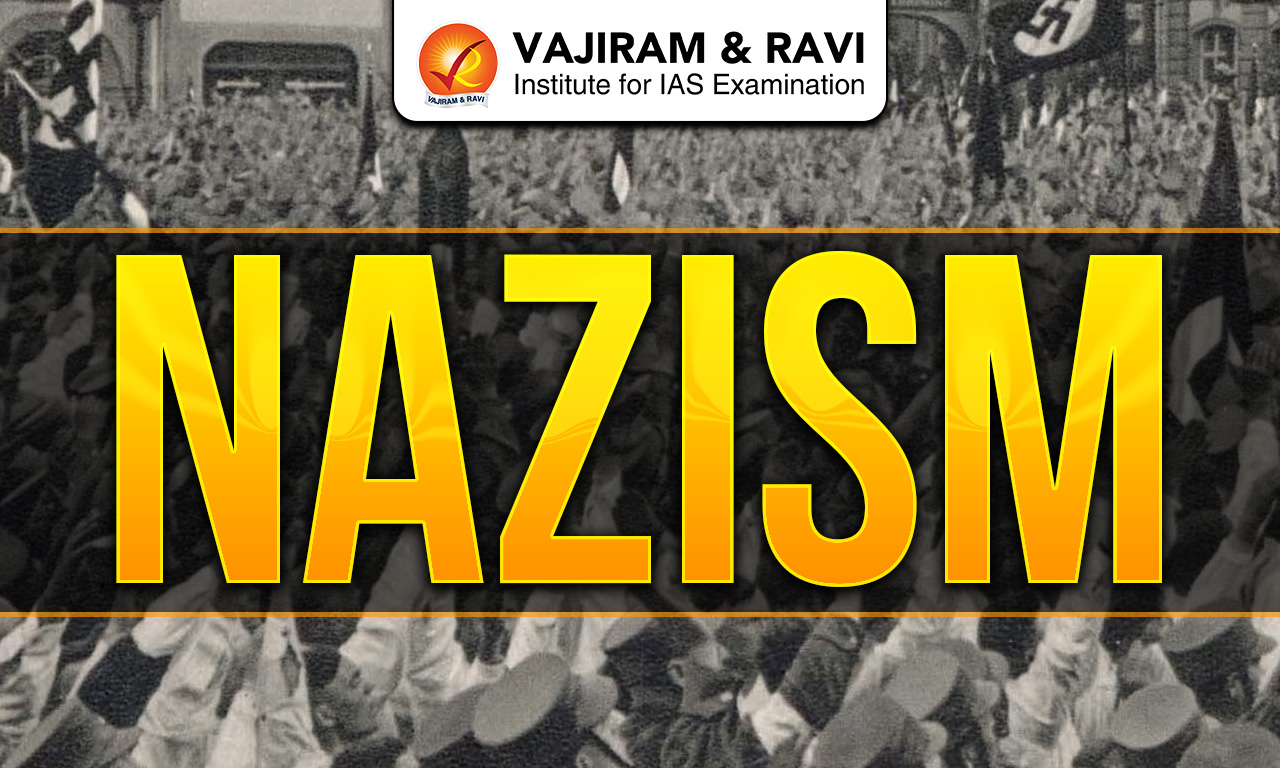
Nazism, also known as National Socialism, was an extreme authoritarian ideology led by Adolf Hitler in Germany during the early 20th century. It combined intense nationalism, racial supremacy, antisemitism, anti communism and rejection of democracy. Nazism aimed to establish total control over society and promote Aryan racial dominance. It led to the rise of Nazi Germany, triggered World War II and resulted in the Holocaust, making it one of the most destructive ideologies in modern history.

Nazism Historical Background

Nazism emerged from post World War I instability, humiliation and political crises in Germany, especially under the weak Weimar Republic system.

  • Treaty of Versailles Impact: The Treaty of Versailles imposed harsh terms on Germany, including loss of 13% territory, 75% iron, 26% coal and £6 billion reparations, creating deep resentment.
  • Collapse of German Empire: Germany’s defeat in First World War led to abdication of Kaiser and formation of Weimar Republic, which many Germans viewed as imposed and humiliating.
  • Weak Weimar Republic: Frequent coalition governments, about twenty cabinets in short duration and misuse of Article 48 weakened democracy and increased instability, reducing public faith in parliamentary system.
  • War Guilt and Humiliation: Germany was forced to accept responsibility for war damages, creating anger among citizens who blamed the Weimar leaders as “November criminals” for national disgrace.
  • Hyperinflation Crisis 1923: Excessive printing of currency caused extreme inflation where one US dollar rose from 24,000 marks to trillions, destroying savings and creating economic chaos.
  • Rise of Political Radicalism: Groups like Spartacist League and the Communist Party intensified unrest, while conservative forces demanded strong authoritarian leadership.

Nazism Causes

Nazism rose due to a combination of economic distress, political instability, fear and strong leadership that attracted mass support.

  • Great Depression Impact: The Great Depression reduced German industrial production to 40% and unemployment reached 6 million, creating desperation among citizens.
  • Fear of Communism: The success of the Russian Revolution created fear among elites, leading industrialists and conservatives to support Nazis against communist expansion.
  • Weak Democracy: The immature democratic system failed to solve economic and political crises, making dictatorship appear as a stable alternative for many Germans.
  • Economic Hardships: Farmers, middle class and small businessmen suffered due to falling prices, job losses and fear of proletarianisation, increasing attraction towards radical solutions.
  • Role of Hitler: Hitler’s speeches, promises of national revival, jobs and pride turned him into a mass leader and strengthened the Nazi Party’s popularity rapidly.
  • Propaganda Techniques: Nazis used slogans, rallies, newspapers and radio effectively to spread ideology, glorify leadership and create fear of enemies like Jews and communists.

Nazism Features

Nazism developed as a totalitarian and racial ideology with distinct features that controlled every aspect of life in Germany.

  • Totalitarian State: The Nazi regime controlled politics, economy, media and personal life, abolished civil liberties and suppressed dissent through strict surveillance and terror mechanisms.
  • Aryan Supremacy: Nazis promoted belief in Aryan racial superiority, justifying discrimination, exclusion and elimination of Jews, Roma, disabled and other minority groups.
  • Antisemitism Policy: Jews were scapegoated for Germany’s problems and subjected to discrimination, violence and eventual genocide during the Holocaust, killing nearly six million Jews.
  • Militarization and Expansion: Nazism emphasized rearmament, conscription and territorial expansion through Lebensraum, leading to aggressive invasions across Europe.
  • Propaganda Control: Media, films, education and literature were used to shape public opinion, promote Nazi ideology and create a cult like devotion to leadership.
  • Führerprinzip Principle: The leader principle placed Hitler above all institutions, making his decisions absolute and unquestionable within the state structure.

Adolf Hitler and Nazism

Nazism was closely linked with Hitler’s leadership, personality and political strategies that transformed Germany into a totalitarian state.

  • Early Political Rise: Hitler joined German Workers’ Party in 1919, later transformed into Nazi Party and became its leader due to his strong organizational and speaking skills.
  • Mein Kampf Ideology: While imprisoned after 1923 failed coup, Hitler wrote Mein Kampf outlining racial theories, anti Jewish ideas and expansionist goals.
  • Electoral Success 1932: Nazi Party became largest political party by 1932, gaining mass support from middle classes, workers and industrialists.
  • Appointment as Chancellor: In 1933, President Paul von Hindenburg appointed Hitler as Chancellor, allowing him to gain legal political power.
  • Enabling Act 1933: This act granted Hitler dictatorial powers, enabling him to rule without parliament and eliminate all political opposition.
  • Establishment of Dictatorship: Hitler banned parties, used SS and Gestapo to eliminate enemies and created a one party totalitarian regime controlling all aspects of society.

Nazism Impact

Nazism had devastating consequences for Germany and the world, reshaping global politics and human history permanently.

  • Economic Transformation: Nazi policies reduced unemployment from about 6 million to 1.5 million by 1936 through public works and rearmament, though at the cost of freedom.
  • Cultural Suppression: Books were burned, modern art banned and intellectual freedom destroyed as Nazis promoted only Aryan culture and ideology.
  • Holocaust Genocide: Systematic extermination of Jews and minorities using concentration camps and gas chambers marked one of the worst human rights tragedies.
  • Second World War: Germany’s invasion of Poland in 1939 triggered global war causing over 60 million deaths and massive destruction across Europe.
  • Axis Alliance Formation: Germany allied with Italy and Japan under Tripartite Pact to challenge global order and expand authoritarian influence worldwide.
  • Post war Consequences: After 1945 defeat, Nazi leaders were tried, United Nations was formed and Nazism was banned globally as a warning against extremism. 

Nazism FAQs

Q1: What is Nazism?

Ans: Nazism was an ultra nationalist and totalitarian ideology led by Adolf Hitler that promoted racial superiority, dictatorship and expansionism in Germany.

Q2: What were the main causes of the rise of Nazism?

Ans: Major causes included the Treaty of Versailles humiliation, economic crisis, Great Depression, weak democracy and fear of communism in Germany.

Q3: What was the Holocaust in Nazi Germany?

Ans: The Holocaust was the systematic killing of about six million Jews and other minorities under Nazi rule.

Q4: How did Hitler come to power?

Ans: Hitler became Chancellor in 1933 with support from elites and later gained absolute power through the Enabling Act, establishing dictatorship.

Q5: What was the impact of Nazism on the world?

Ans: Nazism led to World War II, mass destruction, millions of deaths and long term global efforts to promote peace and human rights.
Shadow Economy, Types, Causes, Impact, Measures

Shadow Economy

The Shadow Economy refers to economic activities that are not recorded or regulated by the government. These activities often avoid taxes and official rules, making them part of the informal or underground sector. It includes both legal but unreported work and illegal activities like smuggling. While it provides livelihood opportunities, it also reduces government revenue and affects economic transparency.

Shadow Economy Types

The shadow economy includes different kinds of unreported and unregulated activities. These can range from small informal businesses to completely illegal operations.

1. Informal Sector Activities

  • These are legal economic activities but carried out without formal registration.
  • Businesses operate on a small scale with limited capital and technology.
  • No compliance with tax rules, labor laws, or licensing requirements.
  • Workers are usually self-employed or engaged in family-based work.
  • Payments are mostly made in cash without proper records.
  • Workers do not receive job security or formal employment contracts.
  • No access to social security benefits like insurance, pension, or paid leave.
  • Common sectors include street vending, small shops, agriculture, construction, tailoring, and repair services.
  • Acts as a major source of employment for low-skilled and migrant workers.
  • Entry and exit are easy due to low regulatory barriers.

2. Illegal Activities

  • These activities are completely prohibited by law and punishable.
  • Involve production or distribution of banned goods and services.
  • Operate secretly to avoid detection by law enforcement agencies.
  • Often linked with organized crime networks and corruption.
  • Generates large amounts of black money and unaccounted wealth.
  • Includes activities like drug trafficking, smuggling, human trafficking, illegal mining, and counterfeit products.
  • No legal protection; individuals face severe penalties if caught.
  • Undermines law and order and social stability.
  • Can negatively affect public health and safety.
  • Difficult for governments to control due to hidden nature.

3. Unreported Economy

  • Refers to income that is deliberately not reported to tax authorities.
  • Activities themselves are legal, but income is hidden to avoid taxes.
  • Businesses may underreport sales, profits, or wages.
  • Transactions are often done without bills, invoices, or receipts.
  • Encourages tax evasion and reduces government revenue.
  • Common in sectors dealing with cash transactions like retail and services.
  • Difficult to track due to lack of transparency and documentation.
  • Affects fairness in the tax system and creates inequality among taxpayers.
  • Leads to misrepresentation of actual economic performance.

4. Unrecorded Economy

  • Includes activities that are not captured in official data and statistics.
  • Occurs due to weak data collection systems and poor monitoring.
  • Common in rural, remote, and underdeveloped areas.
  • Involves small-scale production, local trade, and household-based work.
  • Transactions are informal and undocumented.
  • Not always intentional; may result from lack of awareness or infrastructure.
  • Leads to an underestimation of GDP and national income.
  • Makes it difficult for governments to design accurate economic policies.
  • Reflects gaps in administrative and statistical systems.

5. Unregistered Economy

  • Consists of businesses that are not registered under legal frameworks.
  • Operate without licenses, permits, or tax identification numbers (like GST).
  • Avoid compliance with government regulations and standards.
  • Often small enterprises trying to avoid costs of formalization.
  • Workers are employed without contracts or legal safeguards.
  • Limited access to banking services, loans, and government benefits.
  • Difficult for authorities to monitor, regulate, or tax such activities.
  • Leads to loss of government revenue.
  • Contributes significantly to the growth of the informal sector.

Shadow Economy Causes

The shadow economy develops due to a mix of economic, social, and institutional factors. It often grows when people and businesses find it difficult or costly to operate within the formal system.

  • High Tax Rates and Tax Burden: When taxes are high, individuals and businesses try to avoid paying them by operating informally.
  • Complex Laws and Regulations: Lengthy and complicated procedures for business registration, licensing, and compliance discourage formal participation.
  • Unemployment and Poverty: Lack of job opportunities forces people to work in informal sectors to earn a livelihood.
  • Corruption and Weak Governance: Bribery and weak enforcement of laws allow illegal and unreported activities to continue.
  • Lack of Awareness: Many small business owners are unaware of legal procedures, tax rules, and benefits of formalization.
  • Weak Legal and Institutional Framework: Inefficient judiciary and enforcement agencies fail to detect and punish offenders effectively.
  • Cash-Based Economy: Heavy reliance on cash transactions makes it easier to hide income and avoid taxes.
  • High Cost of Compliance: Costs related to registration, taxes, and maintaining records push small businesses toward informality.

Impact of Shadow Economy

The shadow economy has both positive and negative effects on a country’s economic system. While it provides livelihood opportunities to many people, especially in developing nations, it also creates serious challenges for governance, taxation, and economic planning.

Positive Impacts of Shadow Economy

  • Employment Generation: Provides jobs to unskilled and semi-skilled workers who may not find opportunities in the formal sector.
  • Source of Livelihood: Helps low-income groups and poor households meet their basic needs.
  • Encourages Small Businesses: Allows small entrepreneurs to start businesses with low entry barriers and minimal regulations.
  • Economic Flexibility: Offers flexible working hours and informal arrangements that suit certain workers.
  • Acts as a Buffer in Economic Crisis: During recessions or job losses, people turn to informal work for survival.

Negative Impacts of Shadow Economy

  • Loss of Government Revenue: Tax evasion reduces the funds available for public services like education, healthcare, and infrastructure.
  • Unfair Competition: Informal businesses avoid taxes and regulations, creating an uneven playing field for formal businesses.
  • Poor Working Conditions: Workers face unsafe environments, low wages, and lack of job security.
  • Lack of Social Security: No benefits such as pension, insurance, or paid leave for workers.
  • Economic Inefficiency: Lack of regulation leads to low productivity and poor quality of goods and services.
  • Encourages Corruption: Hidden transactions and illegal activities promote bribery and corruption.
  • Difficulty in Economic Planning: Since activities are not recorded, governments cannot accurately estimate GDP or plan policies effectively.
  • Increased Income Inequality: Wealth distribution becomes uneven as informal workers remain underpaid and unprotected.

Measures to Control Shadow Economy

The shadow economy can be reduced through a combination of policy reforms, technological advancement, and public awareness. Governments need to create an environment where people find it easier and more beneficial to operate within the formal economy.

  • Tax Reforms: Simplifying tax structures and lowering tax rates encourages individuals and businesses to comply with tax laws instead of evading them.
  • Promotion of Digital Payments: Encouraging digital transactions (UPI, cards, net banking) reduces cash-based dealings and increases transparency.
  • Ease of Doing Business: Simplifying registration, licensing, and compliance procedures motivates small businesses to enter the formal sector.
  • Strict Law Enforcement: Strong monitoring systems and strict penalties for tax evasion, smuggling, and illegal activities help deter shadow practices.
  • Financial Inclusion: Expanding access to banking services, especially in rural areas, integrates more people into the formal financial system.
  • Awareness and Education: Educating citizens about the benefits of formalization and the risks of illegal activities promotes voluntary compliance.
  • Use of Technology and Data Analytics: Governments can track suspicious transactions and detect tax evasion using advanced technologies like AI and big data.

Difference Between Formal and Shadow Economy

The formal economy includes all economic activities that are officially registered, regulated, and taxed by the government. In contrast, the shadow economy consists of unregistered and unreported activities that operate outside government control and taxation systems.

Difference Between Formal and Shadow Economy

Basis

Formal Economy

Shadow Economy

Definition

Economic activities that are legally registered and monitored by the government

Economic activities that are not recorded or regulated by the government

Registration

Businesses and workers are officially registered

No formal registration or legal recognition

Taxation

Pays taxes regularly

Avoids or evades taxes

Government Control

Fully regulated by laws and policies

Operates outside government control

Transparency

High transparency in transactions

Low transparency, often hidden transactions

Mode of Payment

Digital payments and banking channels are common

Mostly cash-based transactions

Employment Conditions

Workers have job security, contracts, and benefits

No job security, contracts, or social benefits

Legal Status

Completely legal and recognized

May be legal (unreported) or illegal

Contribution to GDP

Included in official GDP calculations

Not included in official GDP

Access to Finance

Easy access to loans, credit, and financial services

Limited or no access to formal financial systems

Working Conditions

Regulated and safer working environment

Often unsafe and unregulated conditions

Examples

Registered companies, government jobs, corporate sector

Street vendors, unregistered shops, illegal trade

Shadow Economy FAQs

Q1: What is the shadow economy in simple terms?

Ans: It refers to economic activities that are not reported to the government and are not taxed or regulated.

Q2: Is the shadow economy illegal?

Ans: Not always. Some activities are legal but unregistered, while others are completely illegal.

Q3: Why is the shadow economy common in developing countries?

Ans: How does the shadow economy affect GDP?

Q4: Since it is not recorded, it leads to underestimation of the actual GDP.

Ans: How can the shadow economy be reduced?

Q5: By simplifying laws, promoting digital payments, improving enforcement, and increasing public awareness.

Ans: By simplifying laws, promoting digital payments, improving enforcement, and increasing public awareness.

Holkar Dynasty, Rise, Rule, and Legacy in Central India

Holkar Dynasty

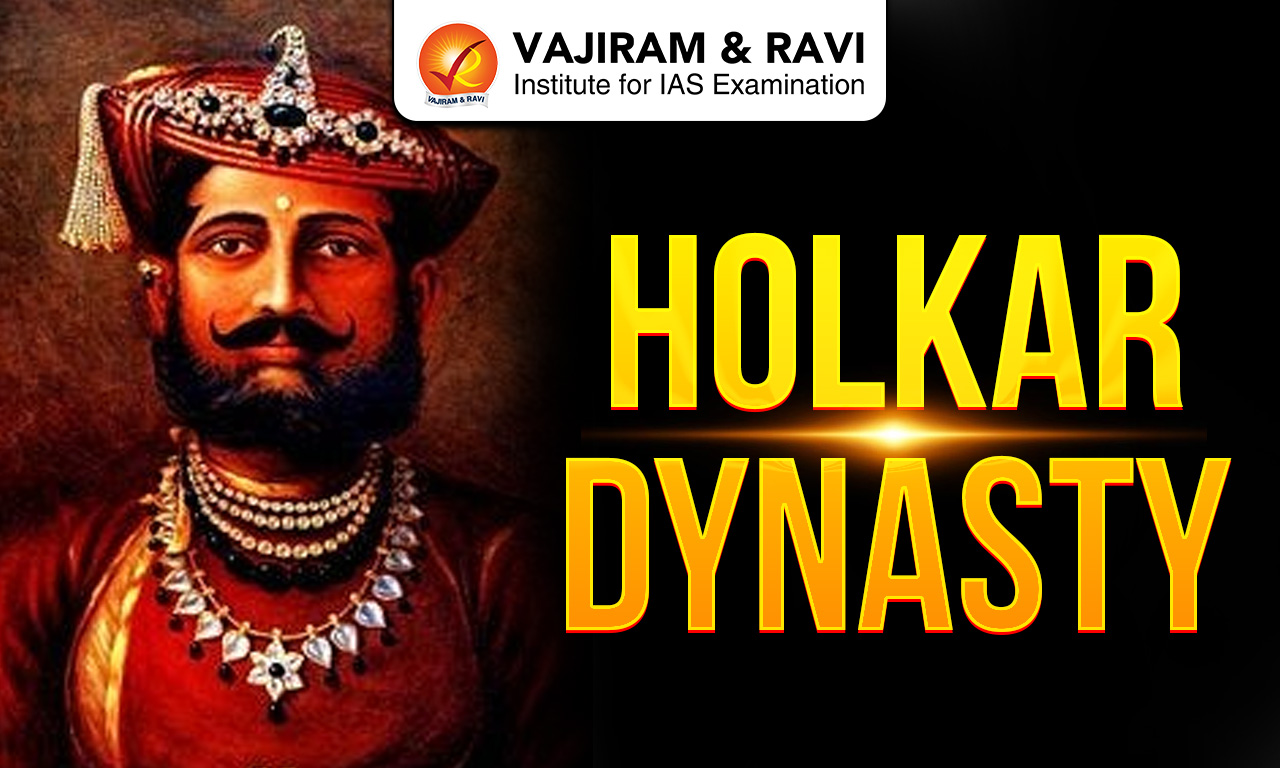
The Holkar Dynasty was a powerful ruling family in central India that played an important role in the history of the Maratha Empire. It ruled mainly over the region of Indore and nearby areas. The dynasty started in the 18th century and gradually became strong through military skill and good leadership. In general, the Holkar rulers are remembered for their contribution to administration, expansion of their territory, and maintaining stability in their region.

Holkar Dynasty Origin and Rise

  • The dynasty was founded by Malhar Rao Holkar (1694-1766), who started his career as a soldier under Baji Rao I. In 1724, he was given command of a small cavalry force, but his talent and bravery helped him rise quickly.
  • He played a major role in expanding Maratha influence in the Malwa region. By 1733, he was granted control over several territories near Indore. He established military camps and later built structures like the Rajwada palace. Over time, he became one of the most powerful chiefs in the Maratha Confederacy and the real ruler of Malwa by the time of his death.

Golden Period under Ahilyabai Holkar

  • After Malhar Rao’s death, his daughter-in-law Ahilyabai Holkar (ruled 1767-1795) took charge. Her rule is considered the golden period of the Holkar Dynasty.
  • She was known for her wise, fair, and compassionate governance. She shifted the capital to Maheshwar and focused on improving administration and public welfare. Her kingdom was peaceful and prosperous even when many parts of India were facing conflicts.
  • Ahilyabai was also a great supporter of religion and culture. She built and restored temples, ghats, and dharamshalas across India, including in Varanasi, Dwarka, and other holy places. Because of her justice and simplicity, she is still remembered as one of the best rulers in Indian history.

Later Rulers and Military Conflicts

  • After her death, Tukoji Rao Holkar became the ruler, followed by Yashwantrao Holkar (also known as Jaswant Rao). Yashwantrao was a brave and ambitious leader who tried to unite Maratha forces and resist British expansion.
  • During the Second Anglo-Maratha War, he initially stayed neutral but later fought against the British and even attacked Delhi. However, he was eventually defeated and forced to sign a peace treaty in 1805. After his death in 1811, the dynasty faced internal struggles, conflicts, and weak leadership.

British Rule and Princely State

  • After the Third Anglo-Maratha War, the Holkar kingdom lost much of its independence and became a princely state under British control. The capital was shifted back to Indore, and the rulers governed under British supervision.
  • There were also internal disputes during this time, including conflicts over succession. Some rulers supported the British, especially during the Indian Rebellion of 1857. Despite limited power, the Holkars contributed to administration, infrastructure, and development in their region.

End of the Dynasty

The Holkar rule continued under British influence until India gained independence in 1947. The last ruler, Yashwantrao Holkar II, signed the agreement to join the Indian Union. Later, the region became part of Madhya Pradesh in 1956.

Holkar Dynasty FAQs

Q1: Who founded the Holkar Dynasty?

Ans: The Holkar Dynasty was founded by Malhar Rao Holkar in the 18th century. He rose from a soldier to a powerful ruler through his skill and leadership.

Q2: Which region was mainly ruled by the Holkar Dynasty?

Ans: The dynasty mainly ruled over Indore and nearby areas in central India.

Q3: Why is Ahilyabai Holkar’s rule considered important?

Ans: Ahilyabai Holkar is known for her just and wise rule. Her period was peaceful and prosperous, and she worked for public welfare and development.

Q4: What contributions did Ahilyabai Holkar make?

Ans: Ahilyabai Holkar built and restored many temples, ghats, and dharamshalas across India, including in Varanasi and Dwarka.

Q5: Who was Yashwantrao Holkar and what was his role?

Ans: Yashwantrao Holkar was a strong ruler who tried to resist British expansion and fought during the Second Anglo-Maratha War.

Tuluva Dynasty, History, Key Rulers, Significance

Tuluva Dynasty

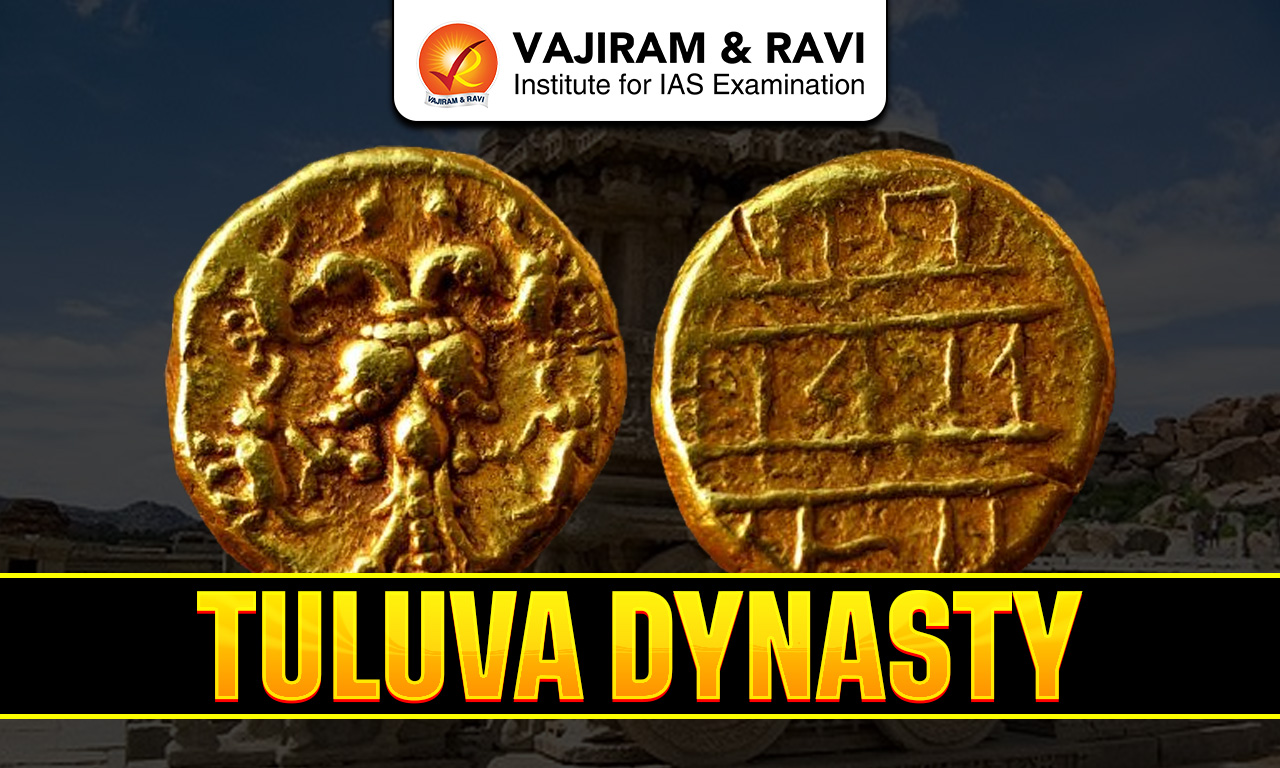
The Tuluva Dynasty was a ruling family in South India that played an important role in the history of the Vijayanagara Empire. It came to power during a time of change and helped strengthen the empire. The rulers of this dynasty contributed to the growth of administration, culture, and overall stability. In general, the Tuluva Dynasty is remembered for its role in maintaining the power and importance of the Vijayanagara Empire.

Tuluva Dynasty History

  • The Tuluva Dynasty was an important ruling family of the Vijayanagara Empire. It originally came from the Tulu-speaking region on the western coast of South India. Information about their early ancestors is found in inscriptions, such as those at the Tirumala Temple.
  • The earliest known ancestors of this dynasty were Timmabhupati and his wife Devaki. They were followed by their son Ishvara and then Narasa Bhupala, who is better known as Tuluva Narasa Nayaka. He was a powerful military leader who helped strengthen the empire by defeating enemies like the Gajapatis and some Muslim rulers.
  • After him, his son Krishnadevaraya became the most famous ruler of the dynasty. His rule is often considered the golden period of the Vijayanagara Empire. He was a capable king who maintained peace and prosperity and supported art, culture, and literature. Even though he spoke Tulu, he respected many languages and encouraged literature in Sanskrit, Tamil, Kannada, and Telugu. He especially promoted Telugu and even wrote a famous work called Amuktamalyada in that language.
  • The rulers of the Tuluva Dynasty were followers of Vaishnavism and supported its growth. Krishnadevaraya was guided by the saint Vyasatirtha.
  • After the decline of the Tuluva rulers, the Vijayanagara Empire also started to weaken. This marked the beginning of the empire’s gradual fall.

Tuluva Dynasty Key Rulers

The Tuluva Dynasty was an important ruling family of the Vijayanagara Empire. It came to power in the early 16th century after a period of political instability. Below are its main rulers and their contributions:

  • Vira Narasimha Raya (1505-1509)
    • Vira Narasimha founded the Tuluva Dynasty after taking control following the decline of the Saluva rulers. He worked to stabilize the empire and maintain control during a difficult time. Though his rule was short, he laid the foundation for future success.
  • Krishnadevaraya (1509-1529)
    • Krishnadevaraya was the greatest ruler of the Vijayanagara Empire. He was the younger brother of Vira Narasimha and made the empire very powerful. He is also known as Andhra Bhoj because of his support for literature and learning.
    • Military Achievements: He fought wars against the Bahmani Sultanates and the Gajapati rulers of Odisha. He captured important regions like Raichur Doab (1512), defeated Odisha rulers (1514), and won against the Sultan of Bijapur (1520). He also captured strong forts like Udayagiri.
    • Expansion and Foreign Relations: He expanded his control to coastal areas like Malabar and Konkan with the help of the Portuguese. He allowed them to build a fort at Bhatkal, which helped in trade and military support.
    • Administration and Tax System: He had a strong administration. Land tax was fixed based on the quality of land, and industries had to pay taxes. This helped improve the economy.
    • Architecture and Temples: He supported temple building and gave donations to places like Tirupati, Srisailam, and Kanchipuram. He added tall gopurams (temple towers) and built a victory pillar at Simhachalam. He also founded a town called Nagalapuram.
    • Culture and Literature: He was a great scholar of Telugu and Sanskrit. He wrote the famous Telugu work Amuktamalyada. He supported a group of eight famous Telugu poets called Ashtadiggajas, including Allasani Peddana and Tenali Ramakrishna. He also supported scholars from Kannada and Tamil traditions.
    • Foreign Accounts: Travellers like Domingo Paes and Fernao Nuniz praised his rule and described the richness of his empire.
    • Religious and Political Policy: Although he followed Vaishnavism, he was tolerant towards other religions. He even helped some Muslim rulers and took pride in the title “establisher of the Yavana kingdom.”
  • Achyuta Deva Raya (1529-1542)
    • After Krishnadevaraya’s death, his brother Achyuta Deva Raya became king. His rule was more difficult because the empire started facing internal problems and external threats.
    • He was supported by powerful nobles like Saluva Nayak, which helped him stay in power. Though some foreign writers described him negatively, he tried to maintain stability and protect the empire.
  • Sadasiva Raya (1543-1567)
    • Sadasiva Raya was the last ruler of the Tuluva Dynasty, but he did not have real power. The actual control was in the hands of his minister Aliya Rama Raya.
    • Role of Rama Raya: Rama Raya was a strong leader and strategist. He placed his relatives in important positions and controlled the administration.
    • Relations with Other Kingdoms: He tried to manage the Deccan Sultanates by playing them against each other. He also made a treaty with the Portuguese and controlled horse trade, which was very important for armies.
    • Conflicts and Decline: Rama Raya fought and sometimes allied with different Sultanates like Bijapur. These shifting alliances finally led to the Battle of Talikota (1565), where Vijayanagara was badly defeated.

Tuluva Dynasty Significance

  • The Tuluva Dynasty played a key role in making the Vijayanagara Empire strong and prosperous. Under rulers like Krishnadevaraya, the empire reached its peak in power, stability, and economic growth.
  • The dynasty helped in expanding the empire by defeating powerful enemies and securing important regions. It also promoted culture, literature, and art, leading to great developments in languages like Telugu, Sanskrit, Kannada, and Tamil.
  • The rulers supported temple building and architecture and maintained good relations with foreign powers like the Portuguese, which helped trade and military strength.

Tuluva Dynasty FAQs

Q1: What was the Tuluva Dynasty?

Ans: The Tuluva Dynasty was a ruling family of the Vijayanagara Empire that helped strengthen and expand the empire during the 16th century.

Q2: Where did the Tuluva Dynasty originate?

Ans: It originated from the Tulu-speaking region on the western coast of South India. Information about its early history is found in inscriptions like those at the Tirumala Temple.

Q3: Who was the founder of the Tuluva Dynasty?

Ans: Vira Narasimha Raya is considered the founder, who came to power after the decline of the Saluva rulers.

Q4: Why is Krishnadevaraya considered the greatest ruler?

Ans: Krishnadevaraya is considered the greatest because he expanded the empire, strengthened administration, supported culture, and brought prosperity.

Q5: What were the major achievements of Krishnadevaraya?

Ans: He won important battles, expanded territory, improved the tax system, supported temple construction, and promoted literature like Amuktamalyada.

Eastern Ganga Dynasty, Rulers, Capital, Economy, Architecture

Eastern Ganga Dynasty

The Eastern Ganga Dynasty was a major medieval Indian ruling house that governed Kalinga from about 498 CE and later ruled Trikalinga from 1038 to 1434-35 CE. It emerged in eastern India and controlled large parts of present day Odisha, Andhra Pradesh, West Bengal and Chhattisgarh. The dynasty is known for political expansion, temple construction and cultural patronage. It played a crucial role in shaping regional identity, religion and architecture in eastern India.

Eastern Ganga Dynasty Historical Background

The Eastern Ganga Dynasty emerged in Kalinga around the 5th century and gradually expanded their power over Trikalinga through military, political and matrimonial strategies.

  • Origin: The dynasty began around 498 CE with Indravarman I, who established rule in Kalinga with Kalinganagara as capital and Dantapuram as secondary centre of administration.
  • Expansion to Trikalinga: Vajrahasta III assumed the title Trikalingadhipat in 1028 CE and became the first ruler to control all three divisions of Kalinga, marking territorial consolidation.
  • Imperial Phase: From 1038 to 1434-35 CE, the dynasty ruled extensively over Trikalinga, expanding from the Ganga River in the north to the Godavari River in the south.
  • Political Alliances: The Eastern Gangas intermarried with the Cholas and Chalukyas, strengthening their position and engaging in continuous warfare and diplomacy with these powers.

Eastern Ganga Dynasty Rulers

The Eastern Ganga Dynasty was shaped by powerful rulers who expanded territory, resisted invasions and contributed to religion and architecture. Few of the major rulers of this dynasty are:

  • Indravarman I: The first historical ruler, he defeated the Vishnu Kundin king Indrabhattaraka and established sovereignty over Kalinga, initiating the Ganga era in 498 CE.
  • Vajrahasta III: He assumed the title Trikalingadhipat in 1028 CE, consolidating control over the three Kalinga regions and strengthening imperial authority.
  • Anantavarman Chodagangadeva: He ruled from the Ganga to Godavari, unified Utkal and Kalinga and began construction of the Jagannatha temple at Puri in the late 11th century.
  • Rajaraja I: He fought against the Cholas and Eastern Chalukyas and strengthened alliances by marrying the Chola princess Rajasundari, ensuring political stability.
  • Anangabhima III: He repulsed Muslim invasions from Bengal and constructed the Megheshvara temple at Bhuvaneshvara, reinforcing religious patronage.
  • Narasimha I: He invaded southern Bengal in 1243 CE, defeated Muslim rulers, captured Gauda and built the Sun Temple at Konark to commemorate victory.
  • Rajaraja III: He ascended in 1198 CE but failed to resist the Muslim invasion of Odisha in 1206 CE, showing a temporary weakening of central authority.

Eastern Ganga Dynasty Administration and Governance

The Eastern Ganga Dynasty administration was a centralized monarchy supported by provincial divisions and local governance institutions ensuring efficient control.

  • Administrative System: It followed Monarchy in which the king was the supreme authority and head of administration and military, assisted by ministers and commanders for governance and warfare.
  • Provincial Division: The empire was divided into Maha mandalas governed by Mahamandalikas, further subdivided into mandalas and visayas, ensuring administrative efficiency.
  • Local Governance: Villages functioned as self governing units led by Gramika, supported by officials like Karanika, Dandapani and Gramavatta.
  • Military Organization: The army had structured ranks such as Maha Senapati, Senapati, Dalapati and Nayaka, along with a naval force during Chodaganga’s reign.

Eastern Ganga Dynasty Economy

The economy of the Eastern Ganga Dynasty was agrarian and trade oriented, supported by taxation and distinctive coinage systems reflecting advanced monetary practices.

  • Agrarian Economy: Agriculture formed the economic base, supported by irrigation and fertile lands, with taxes collected from cultivators even on uncultivated land.
  • Trade and Commerce: The empire maintained flourishing trade networks and ports, linking eastern India with other regions and supporting economic prosperity.
  • Revenue System: Taxes included kara, hiranya, sulika and other levies on trade, agriculture and internal transactions, ensuring steady income.
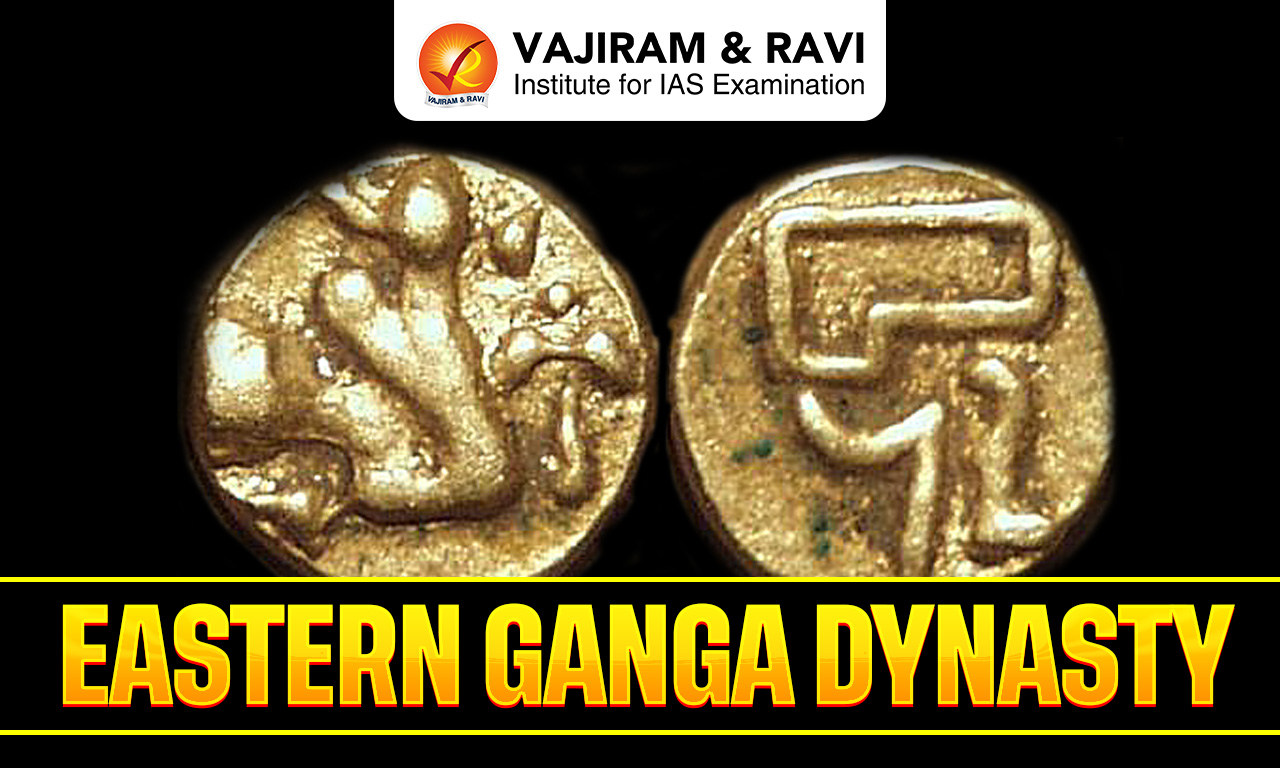
  • Coinage Features: Coins known as Ganga fanams depicted a couchant bull on obverse and the letter “sa” with regnal year on reverse, indicating monetary standardization.
  • Decimal System Innovation: Eastern Ganga coins used single digit symbols with positional value, marking one of the earliest uses of decimal system in Indian coinage.

Eastern Ganga Dynasty Society and Culture

The society under Eastern Ganga Dynasty reflected religious diversity, cultural richness and evolving traditions influenced by royal patronage and social hierarchy.

  • Religious Orientation: Initially Shaivite, the rulers later adopted Vaishnavism under Anantavarman Chodagangadeva, promoting Vishnu worship and temple endowments.
  • Social Structure: Society followed caste hierarchy, with Brahmins receiving land grants and playing key roles in religious and educational activities.
  • Cultural Patronage: The rulers supported temples, scholars and religious institutions, leading to growth of art, traditions and regional identity.
  • Language Development: Telugu served as early court language, later replaced by Odia as it evolved from Odra Prakrit during the later medieval period.

Eastern Ganga Dynasty Art and Architecture 

The Eastern Ganga Dynasty were renowned for temple architecture, sculpture, inscriptions and literary patronage, reflecting cultural excellence.

  • Temple Architecture: The Jagannath Temple at Puri and Sun Temple at Konark are masterpieces, showcasing advanced engineering and symbolic religious design.
  • Konark Sun Temple: Built by Narasimha I, it was designed as a massive stone chariot with seven horses, symbolizing the Sun God Surya in motion.
  • Sculptural Excellence: Odisha temples feature detailed carvings of celestial maidens, dancers and geometric designs, representing the peak of medieval Indian sculpture.
  • Inscriptions: Copper plates like Jirjingi, Korni and Puri grants provide detailed records of genealogy, land grants and administrative practices.
  • Literature: Sanskrit and regional literature flourished under royal patronage, with temples and courts acting as centers of intellectual activity.

Eastern Ganga Dynasty Decline

The decline of the Eastern Ganga Dynasty began after the mid 13th century due to internal weakness and external invasions.

  • Post Narasimha Decline: After Narasimha I’s death in 1264 CE, the dynasty gradually weakened due to succession issues and reduced military strength.
  • Delhi Sultanate Invasion: The Sultan of Delhi invaded Odisha in 1324 CE, weakening political authority and destabilizing the kingdom.
  • Vijayanagar Conflict: In 1356 CE, Vijayanagar defeated Odia powers, further reducing territorial control and influence.
  • Last Rulers: Narasimha IV ruled until 1425 CE, followed by Bhanudeva IV, whose weak rule marked the final phase of the dynasty.
  • End of Dynasty: Minister Kapilendra usurped the throne in 1434-35 CE and founded the Suryavamsha dynasty, ending Eastern Ganga rule. 

Eastern Ganga Dynasty FAQs

Q1: Who founded the Eastern Ganga Dynasty?

Ans: Indravarman I is considered the first historical ruler and founder of the Eastern Ganga Dynasty, establishing his rule in Kalinga around 498 CE.

Q2: Which region was ruled by the Eastern Ganga Dynasty?

Ans: The dynasty ruled Kalinga and later Trikalinga, covering present day Odisha, parts of Andhra Pradesh, West Bengal and Chhattisgarh.

Q3: Who built the Jagannath Temple at Puri?

Ans: Anantavarman Chodagangadeva, the ruler of Eastern Ganga Dynasty, initiated the construction of the famous Jagannath Temple at Puri in the late 11th century.

Q4: Why is Narasimha I famous in the Eastern Ganga Dynasty?

Ans: Narasimha I is known for defeating the Muslim ruler of Bengal and constructing the Sun Temple at Konark to commemorate his victory.

Q5: What led to the decline of the Eastern Ganga Dynasty?

Ans: The dynasty declined due to internal weakness, invasions by the Delhi Sultanate, defeat by Vijayanagar and finally the usurpation by Kapilendra in 1434-35 CE.

Maitraka Dynasty 475-775 CE, Capital, Rulers, Architecture

Maitraka Dynasty

The Maitraka Dynasty was an important ruling power in western India that governed Gujarat and Saurashtra from about 475 CE to 775 CE. It was founded by Senapati Bhatarka. The dynasty emerged after the decline of the Gupta Empire and established its capital at Vallabhi. Over nearly three centuries, the Maitrakas maintained political stability, promoted education, supported multiple religions and developed strong administrative and economic systems, making Vallabhi a major centre of learning and trade.

Maitraka Dynasty Historical Background

The Maitraka Dynasty arose in western India after the weakening of Gupta authority and quickly established itself as a regional power.

  • Origin: The dynasty began around 475 CE when Senapati Bhatarka, a Gupta military governor, took advantage of weakening central control and declared independence in Saurashtra and Gujarat.
  • Establishment of Vallabhi: Bhatarka shifted the capital to Vallabhi, which became a political, educational and economic centre due to its coastal location and trade advantages.
  • Early political position: Initial rulers continued using the title “Senapati,” indicating nominal loyalty to the Guptas, but they exercised real independence in governance and administration.
  • Territorial expansion: Under strong rulers, the kingdom extended into regions of Malwa and Rajasthan, showing the dynasty’s growing military and political strength.
  • Duration and stability: The Maitrakas ruled for nearly 300 years, providing stability in a fragmented post Gupta period and enabling growth in culture, trade and religion.

Maitraka Dynasty Rulers

The Maitraka Dynasty rulers played a crucial role in consolidating power, expanding territory and promoting culture and learning.

  • Bhatarka: Founder of the dynasty who established independence around 475 CE, set up Vallabhi as capital and maintained the title Senapati while consolidating political authority.
  • Dharasena I: Strengthened military organization and administrative control, laying the foundation for Vallabhi’s emergence as a major centre of power in western India.
  • Dhruvasena I: Known for religious tolerance, he supported Buddhist monasteries and Jain scholars and is associated with the Jain council held at Vallabhi.
  • Dhruvasena II (Baladitya): Strengthened diplomatic relations by marrying Harshavardhana’s daughter; Chinese traveller Hiuen Tsang praised his administrative ability and governance.
  • Dharasena IV: One of the most powerful rulers who assumed titles like “Chakravartin” and “Maharajadhiraja,” indicating imperial status and peak political authority.
  • Siladitya I: Recognized for administrative excellence and kindness; his reign marked stability and prosperity with continued patronage of education and religion.
  • Siladitya VII: The last ruler who faced repeated Arab invasions and was eventually defeated, marking the end of the Maitraka Dynasty.

Maitraka Dynasty Administration and Governance

The Maitraka Dynasty administration followed a structured system influenced by Gupta practices with local adaptations.

  • Central authority: The king held supreme power and used titles like Maharaja and Paramabhattaraka, symbolizing both political and religious authority.
  • Council of ministers: Important officials like Mahasandhivigrahaka and Akshapatalika assisted the king in administration, diplomacy and record keeping.
  • Administrative divisions: The kingdom was divided into Vishayas and Bhuktis, ensuring effective governance across regions with delegated authority.
  • Local governance: Villages were basic administrative units managed by local headmen and elders, enabling decentralized administration and efficient functioning.
  • Land grant system: Numerous copper plate inscriptions record land grants to Brahmanas and religious institutions, reflecting economic organization and administrative detail.

Maitraka Dynasty Economy

The Maitraka Dynasty economy was strong and supported by agriculture, trade and a structured monetary system.

  • Agricultural base: Agriculture formed the backbone of the economy, supported by fertile land in Saurashtra and systematic land revenue collection.
  • Trade networks: Coastal location enabled maritime trade across the Arabian Sea, making Vallabhi an important commercial hub connecting India with foreign regions.
  • Urban development: Vallabhi developed into a major centre of commerce and education, attracting merchants and scholars from different regions.
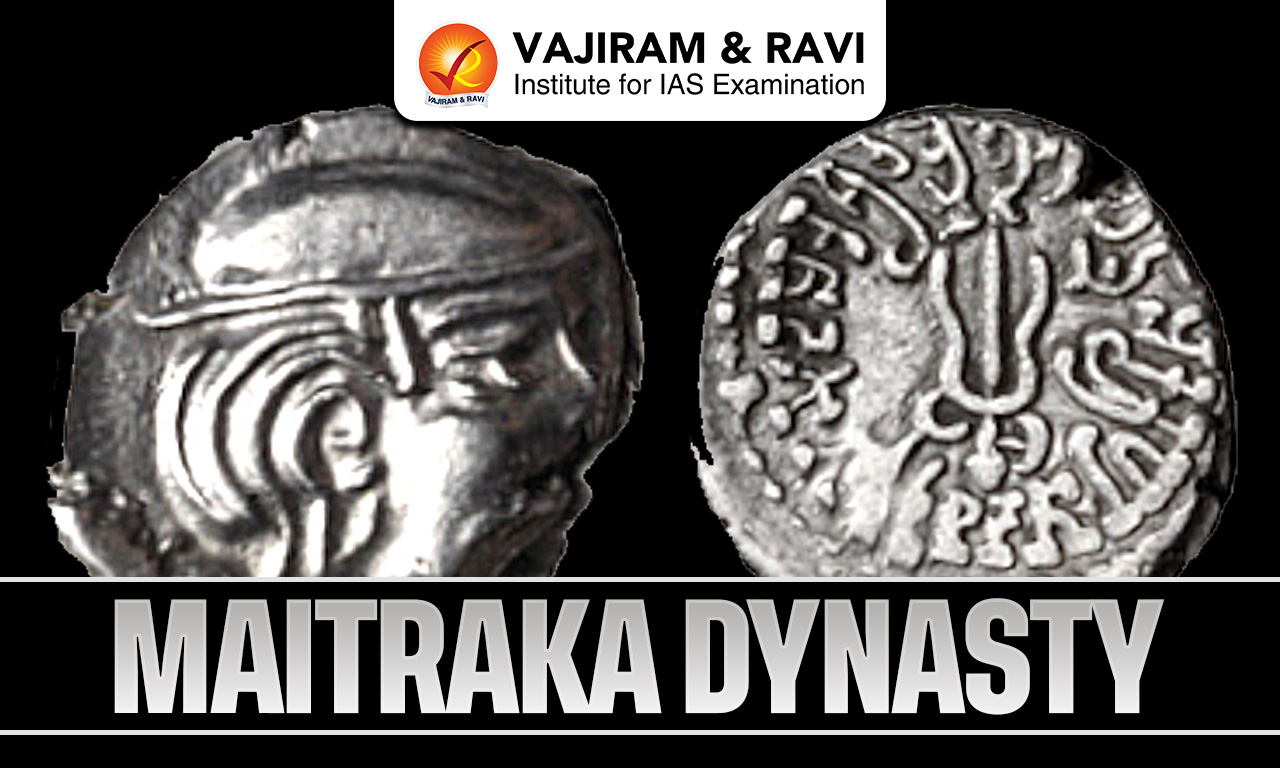
  • Coinage system: The Maitrakas issued silver and copper coins influenced by Western Kshatrapa and Gupta styles, showing continuity in monetary traditions.
  • Symbols and features: Coins featured the king’s image on the obverse and symbols like Trishula or battle axe on the reverse, reflecting Shaivite affiliation.
  • Economic changes: Later coins were often silver plated copper, indicating economic adjustments and possible decline in metal availability toward the end.

Maitraka Dynasty Society and Culture

The society under Maitraka Dynasty was diverse and marked by religious tolerance, education and cultural development.

  • Religious tolerance: Although most rulers were Shaivites, they supported Buddhism, Jainism and Vaishnavism, ensuring peaceful coexistence of multiple faiths.
  • Jain council at Vallabhi: Vallabhi became an important Jain centre where sacred texts were compiled, showing the dynasty’s support for religious scholarship.
  • Buddhist influence: Over 100 monasteries existed in the kingdom, making it a major centre of Buddhist learning and attracting scholars from different regions.
  • Vallabhi University: The university became famous for higher education in religious and secular subjects, comparable to Nalanda in importance.
  • Social harmony: The rulers maintained balance among different communities by providing grants and patronage without discrimination.

Maitraka Dynasty Art and Architecture

The Maitraka Dynasty period witnessed development in temple architecture and religious structures influenced by Gupta traditions.

  • Architectural style: Temples were built in Nagara and Saurashtra styles with square sanctums and tiered roofs, marking a transition to early medieval architecture.
  • Religious structures: Important sites included Bhartishwara Temple, Khimeshwara Monastery and Dudda Vihara, reflecting diverse religious patronage.
  • Vallabhi University structures: The university complex had viharas like Abhyantarika and Bhataraka, used for teaching and residential purposes.
  • Sculpture and art: Sculptures depicted Hindu deities and Jain figures like Shantinatha, made from local sandstone with detailed carving techniques.
  • Cultural significance: Architecture and art show the blending of religious traditions and the prosperity of the dynasty during its peak.

Maitraka Dynasty Decline

The decline of the Maitraka Dynasty was mainly due to external invasions and changing political conditions.

  • Conflict with major powers: The Maitrakas faced military pressure from the Chalukyas of the Deccan and Emperor Harsha of Kannauj, weakening their dominance.
  • Temporary revival: After Harsha’s death, the Maitrakas regained some independence and stability for a short period.
  • Arab invasions: From the early 8th century, Arab forces from Sindh launched repeated attacks, targeting coastal regions and trade centres.
  • Destruction of Vallabhi: Around 775–780 CE, Vallabhi was attacked and destroyed, severely damaging the political and economic structure of the kingdom.
  • End of the dynasty: The last ruler, Siladitya VII, was defeated and killed, leading to the final collapse of the Maitraka rule in western India. 

Maitraka Dynasty FAQs

Q1: Who founded the Maitraka Dynasty?

Ans: The Maitraka Dynasty was founded by Bhatarka around 475 CE, who was initially a military governor under the Gupta Empire and later became an independent ruler.

Q2: What was the capital of the Maitraka Dynasty?

Ans: The capital of the Maitraka Dynasty was Vallabhi, which became an important centre of administration, trade and higher education.

Q3: Which ruler made the Maitraka Dynasty most powerful?

Ans: Dharasena IV is considered one of the most powerful rulers, as he assumed imperial titles like “Chakravartin” and expanded the kingdom’s influence.

Q4: Why was Vallabhi important during the Maitraka Dynasty period?

Ans: Vallabhi was a major centre of learning and religion, known for Vallabhi University and as a place where the Jain canon was codified.

Q5: What led to the decline of the Maitraka Dynasty?

Ans: The dynasty declined mainly due to repeated Arab invasions from Sindh, which led to the destruction of Vallabhi and the defeat of the last ruler, Siladitya VII.

Abolition of Sati, Role of Raja Ram Mohan Roy, Impact

Abolition of Sati

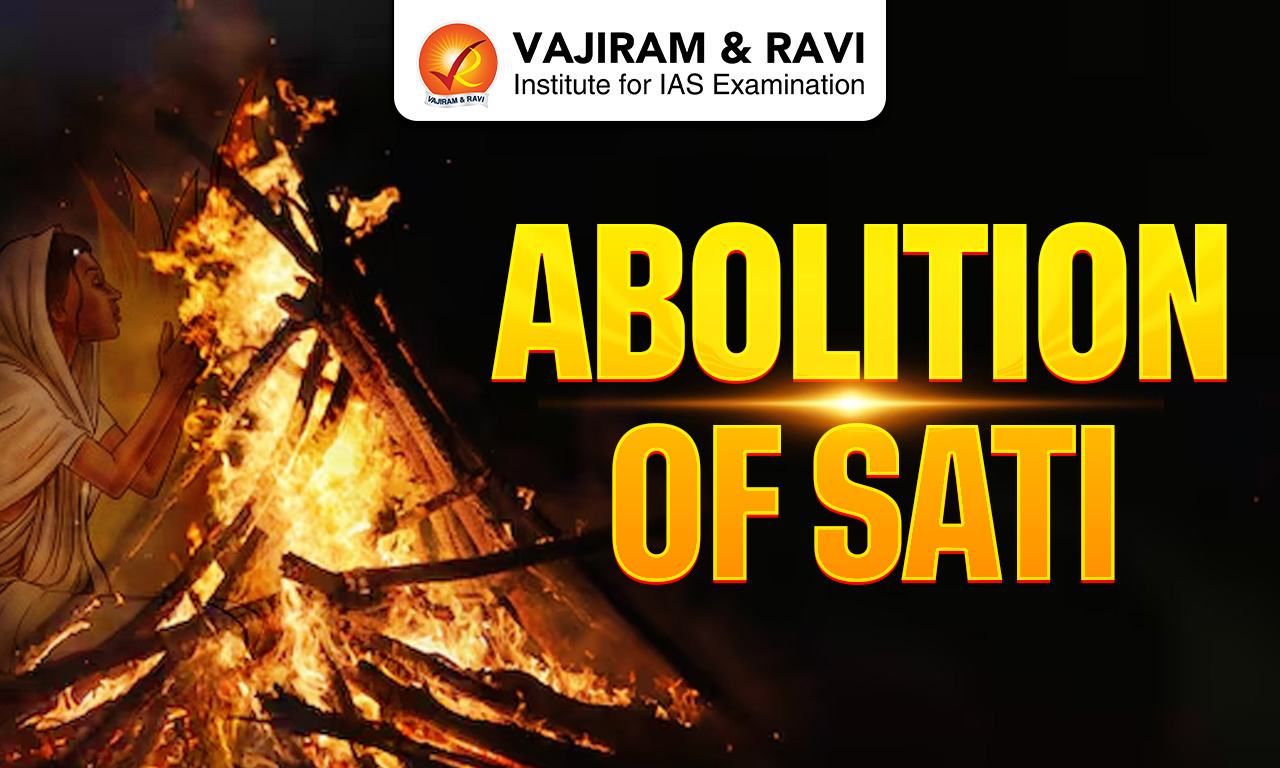
The Abolition of Sati is one of the most important social reforms in Indian history. It ended a cruel and inhuman practice where widows were forced or expected to burn themselves on the funeral pyre of their husbands. This reform not only saved countless women’s lives but also marked the beginning of a new era of social justice, women empowerment, and legal reforms in India.

What is Sati?

Sati was a traditional practice in which a widow sacrificed her life by sitting on her husband’s funeral pyre. Although some believed it was an act of devotion, in reality, many women were forced or pressured into it by family and society.

The term “Sati” is linked to Sati, who is believed to have sacrificed herself for her husband Shiva. Over time, this mythological story was wrongly used to justify the practice in society.

Causes Behind the Practice of Sati

The continuation of Sati in Indian society was not due to religion alone but a combination of social, economic, and cultural reasons.

  • Patriarchal society where women had very little independence
  • Lack of education and awareness among women
  • Misinterpretation of religious texts and traditions
  • Social pressure to maintain family honor
  • Economic dependency of widows on their families
  • Harsh and restrictive life imposed on widows
  • Fear of widow remarriage and social stigma

Role of Raja Ram Mohan Roy in Abolishing Sati

Raja Ram Mohan Roy was the most important Indian reformer who led the movement against Sati in the early 19th century. Deeply affected by real incidents of widows being forced into Sati, he used logic, religion, and activism to oppose it. His efforts played a decisive role in influencing public opinion and the British government to finally ban the practice in 1829.

  • Personal Experience Motivated Him: Raja Ram Mohan Roy was deeply disturbed after witnessing cases of Sati, including incidents involving people close to him. This inspired him to dedicate his life to abolishing the practice.
  • Used Religious Texts as Evidence: He studied Hindu scriptures like the Vedas and Upanishads and proved that Sati was not a compulsory religious duty, countering orthodox beliefs.
  • Published Articles and Pamphlets: In 1818, he published writings such as “A Conference Between an Advocate and an Opponent of the Practice of Burning Widows Alive” to expose the truth about Sati.
  • Founded Reform Movements: He established organizations like the Brahmo Sabha (1828), which later became the Brahmo Samaj, to promote social reforms and oppose harmful practices like Sati.
  • Organized Public Debates: He actively participated in debates with orthodox scholars to challenge their views and spread awareness among the masses.
  • Petitions to the British Government: He submitted several petitions urging the British authorities to ban Sati and provided evidence of its inhuman nature.
  • Advocated Women’s Rights: He supported widow rights, women’s education, and equality, which strengthened his argument against Sati.
  • Influenced Policy Makers: His strong arguments and reform efforts greatly influenced Lord William Bentinck in passing the Bengal Sati Regulation Act in 1829.
  • Faced Strong Opposition: Despite resistance from conservative groups, he continued his efforts with courage and determination.
  • Legacy in Social Reform: His role in abolishing Sati made him a pioneer of modern Indian social reform and a key figure in promoting human rights and equality.

Role of Lord William Bentinck

Lord William Bentinck played a decisive role in abolishing Sati by taking strong legal action in 1829. As the Governor-General of India, he recognized the practice as inhuman and took bold steps despite opposition from conservative sections of society.

Governor-General during Abolition (1828–1835): He served as Governor-General when the issue of Sati became a major concern, especially in Bengal.

Studied the Practice in Detail: He collected official data and reports which showed that hundreds of Sati cases were occurring every year, particularly in Bengal Presidency.

Consulted Reformers and Officials: He held discussions with Indian reformers like Raja Ram Mohan Roy, as well as British officials and scholars before taking action.

Recognized Sati as a Social Evil: After careful analysis, he concluded that Sati was not a religious necessity but a harmful social practice.

Passed Bengal Sati Regulation Act, 1829: On December 4, 1829, he officially passed the regulation banning Sati in the Bengal Presidency.

Declared Sati a Criminal Offense: The law made participation, support, or encouragement of Sati punishable under criminal law (treated as culpable homicide).

Faced Strong Opposition: Orthodox groups protested against the ban and even challenged it legally, claiming interference in religious matters.

Upheld the Ban Firmly: Despite resistance, he stood firm and ensured the law was implemented strictly.

Extended the Law to Other Regions: The ban was later extended to Madras and Bombay Presidencies, making it applicable across British India.

Abolition of Sati Act, 1829

The Abolition of Sati Act, 1829, also known as the Bengal Sati Regulation, was a landmark law that officially banned the practice of Sati in India. It was enacted by Lord William Bentinck with strong support from reformers like Raja Ram Mohan Roy.

  • Declared Sati Illegal: The regulation declared the practice of Sati as illegal and prohibited it in all forms.
  • Punishable Offense: Anyone who supported, encouraged, or participated in Sati was considered guilty of a criminal offense.
  • Treated as Culpable Homicide: The Act classified Sati-related acts as culpable homicide, meaning offenders could face severe punishment under law.
  • Initial Area of Application: It was first लागू (applied) in the Bengal Presidency, where Sati cases were more frequent.
  • Extension to Other Regions: Later, the law was extended to Madras and Bombay Presidencies, making it applicable across British India.
  • Based on Reform Movements: The Act was influenced by strong social reform movements led by Raja Ram Mohan Roy.
  • Opposition and Legal Challenge: Orthodox groups opposed the Act and challenged it in courts, but the ban was upheld.
  • Administrative Enforcement: British officials were instructed to prevent Sati and take strict action against violators.
  • Historical Significance: The Act is considered one of the earliest and most important social reform laws in India, promoting human rights and women’s dignity.

Impact of the Abolition of Sati

The abolition of Sati in 1829 brought a major transformation in Indian society by ending a cruel and inhuman practice. It not only saved the lives of countless widows but also marked the beginning of social reform and women empowerment in India.

  • Protection of Women’s Lives: The most immediate impact was that thousands of widows were saved from being forced into Sati, ensuring their right to live with dignity.
  • Improvement in Status of Women: The abolition helped in improving the social position of women, as they were no longer seen as expendable after their husband’s death.
  • Beginning of Women Empowerment: It encouraged reforms related to women’s education, widow remarriage, and property rights, laying the foundation for gender equality.
  • Reduction in Social Pressure on Widows: Widows were freed from the fear and societal pressure of committing Sati, allowing them to live independently.
  • Encouragement to Other Social Reforms: The success of this reform inspired movements against other social evils like child marriage and restrictions on widow remarriage.
  • Strengthening of Legal System: It established the role of law in bringing social change and protecting vulnerable sections of society.
  • Long-term Social Transformation: Over time, the abolition contributed to a more humane and progressive society based on equality, justice, and human rights.

Abolition of Sati FAQs

Q1: What was Sati?

Ans: Sati was a practice in which a widow was made to burn herself on the funeral pyre of her husband, often due to social pressure or force.

Q2: Who abolished Sati in India?

Ans: Sati was abolished by Lord William Bentinck in 1829 with the support of Raja Ram Mohan Roy.

Q3: What law banned Sati?

Ans: The Bengal Sati Regulation Act of 1829 declared Sati illegal and punishable by law.

Q4: What was the role of social reformers in abolishing Sati?

Ans: Reformers raised awareness, challenged religious beliefs, and influenced the government to ban the practice.

Q5: What was the role of social reformers in abolishing Sati?

Ans: Reformers raised awareness, challenged religious beliefs, and influenced the government to ban the practice.

Keynesian Economics, Meaning, Features, Principles, Importance

Keynesian Economics

Keynesian Economics is a major branch of macroeconomics developed by the British economist John Maynard Keynes during the 20th century. It focuses on how government intervention and public spending can help stabilize the economy, especially during periods of recession and unemployment. This theory became popular after the Great Depression, when traditional economic ideas failed to solve widespread economic problems.

What is Keynesian Economics?

Keynesian Economics is based on the idea that markets do not always automatically correct themselves. During economic slowdowns, people spend less, businesses produce less, and unemployment rises. In such situations, government intervention becomes necessary to boost demand and revive the economy.

Key Features of Keynesian Economics

Keynesian Economics highlights the importance of demand and government action in managing the economy. Its main features include:

  • Focus on aggregate demand as the key driver of economic activity
  • Emphasis on short-run economic analysis rather than long-term adjustments
  • Support for government intervention in times of economic crisis
  • Recognition of unemployment as a common economic problem
  • Importance of fiscal policy (government spending and taxation)
  • Belief that wages and prices are not always flexible

Principles of Keynesian Economics

Keynesian Economics, developed by John Maynard Keynes, states that aggregate demand is the main driver of output and employment. It supports government intervention to manage economic fluctuations and ensure stability.

  • Aggregate Demand Drives Economy: Output and employment depend on total demand in the economy.
  • Government Intervention: Government spending and tax policies are used to boost demand during recessions.
  • Multiplier Effect: Increase in spending leads to a multiplied rise in income and employment.
  • Importance of Consumption: Higher consumer spending increases production and growth.
  • Marginal Propensity to Consume (MPC): Higher MPC strengthens the impact of demand on income.
  • Liquidity Preference: People prefer holding cash in uncertain times, affecting interest rates.
  • Short-Run Focus: Focuses on solving immediate issues like unemployment and recession.
  • Sticky Prices and Wages: Prices and wages adjust slowly, causing economic imbalance.
  • Investment Based on Expectations: Business investment depends on future profit expectations.
  • Demand Creates Supply: Production increases only when there is sufficient demand. 

Role of Fiscal Policy in Keynesian Economics

In Keynesian theory by John Maynard Keynes, fiscal policy is used by the government to manage aggregate demand through changes in spending and taxation. It plays a key role in controlling recession, unemployment, and inflation in the economy.

  • Increases Demand During Recession: Government increases spending and reduces taxes to boost demand, production, and income.
  • Controls Inflation: Government reduces spending and increases taxes to control excess demand and rising prices.
  • Generates Employment: Public works, infrastructure projects, and welfare schemes create job opportunities.
  • Ensures Economic Stability: Helps balance economic ups and downs and prevents deep recessions or overheating.
  • Boosts Economic Growth: Investment in sectors like infrastructure, education, and health supports long-term growth.
  • Works Through Multiplier Effect: Increase in government spending leads to a multiple rise in income and demand.
  • Reduces Income Inequality: Progressive taxation and welfare spending help in fair distribution of income.
  • Encourages Private Investment: Tax benefits, subsidies, and stable demand conditions motivate businesses to invest more.

Implementation of Keynesian Economics in India

In India, Keynesian ideas have been widely applied through government spending, planning, and welfare policies to boost demand and ensure economic stability. Especially after independence, the government adopted an active role in managing growth, employment, and development.

  • Public Sector Expansion: The government established industries in key sectors like steel, energy, and transport to create jobs and boost demand.
  • Fiscal Policy Measures: Use of taxation and government spending to manage inflation and recession.
  • Welfare Schemes: Programs like MGNREGA (now VBGRAMG) generate rural employment and increase income.
  • Subsidies and Social Spending: Government provides subsidies on food, fertilizers, and fuel to support demand and reduce inequality.
  • Infrastructure Development: Large investments in roads, railways, and housing increase employment and stimulate economic activity.
  • Counter-Cyclical Policies: During slowdowns (like global crises), the government increases spending to revive growth.
  • Support to Agriculture and MSMEs: Credit schemes, subsidies, and incentives help small businesses and farmers, boosting demand in the economy.

Keynesian Economics FAQs

Q1: What is Keynesian Economics?

Ans: Keynesian Economics is a theory developed by John Maynard Keynes which states that aggregate demand (total spending) drives economic growth and employment.

Q2: Who is the father of Keynesian Economics?

Ans: John Maynard Keynes is known as the father of Keynesian Economics.

Q3: What is the main idea of Keynesian theory?

Ans: The main idea is that government intervention is necessary to manage demand and stabilize the economy during recessions and inflation.

Q4: What is aggregate demand?

Ans: Aggregate demand is the total demand for goods and services in an economy, including consumption, investment, government spending, and net exports.

Q5: What is the multiplier effect?

Ans: It is the concept that an increase in government spending leads to a greater overall increase in national income and economic activity.

WADI (Wasteland Development in India), Objectives, Impact

WADI (Wasteland Development in India)

WADI (Wasteland Development) is an important rural development approach in India that focuses on improving degraded and unused land, especially in tribal and rural areas. It helps farmers turn barren land into productive farms by promoting tree-based farming systems.

The WADI model combines agriculture, horticulture, and forestry to create a sustainable source of income for small and marginal farmers. It is widely implemented by organizations like the National Bank for Agriculture and Rural Development (NABARD).

WADI (Wasteland Development in India) Objectives

 The main aim of the WADI (Wasteland Development in India) program is to improve the economic condition of rural households while protecting the environment.

  • To convert wasteland into productive land
  • To increase farmers’ income through horticulture
  • To promote sustainable agriculture practices
  • To generate employment in rural areas
  • To reduce poverty among tribal communities
  • To improve soil and water conservation

Components of WADI Development

The WADI development model includes multiple integrated activities that focus on improving land productivity and ensuring sustainable livelihoods for rural and tribal farmers. It combines agriculture, horticulture, and natural resource management to provide both short-term and long-term benefits.

  • Plantation of fruit trees such as mango, guava, cashew, or lemon to generate long-term income and ensure economic stability for farmers
  • Intercropping with vegetables, pulses, and cereals between tree rows to provide immediate income during the initial years
  • Soil conservation measures like bunding, trenching, and contour farming to prevent soil erosion and improve fertility
  • Water resource development through farm ponds, check dams, and rainwater harvesting to ensure irrigation and water availability
  • Use of organic manure and sustainable farming practices to maintain soil health and reduce dependency on chemicals
  • Livelihood support through training, capacity building, and financial assistance for farmers to adopt improved practices
  • Promotion of allied activities such as livestock rearing, poultry, or beekeeping to diversify income sources

Role of NABARD in WADI Development

The NABARD plays a central role in planning, funding, and implementing the WADI (Wasteland Development) program in India. It acts as a key institution that supports rural and tribal development by promoting sustainable livelihood models.

  • Provides financial assistance and grants for the implementation of WADI projects across rural and tribal regions
  • Identifies suitable areas and beneficiaries, especially small and marginal farmers with wasteland
  • Partners with NGOs, community-based organizations, and local agencies for effective execution
  • Offers technical guidance on plantation, soil conservation, and water management practices
  • Supports capacity building by organizing training programs and skill development for farmers
  • Promotes integrated tribal development through WADI-based livelihood models
  • Ensures regular monitoring, evaluation, and impact assessment of projects
  • Encourages sustainable and eco-friendly farming practices to improve long-term productivity
  • Facilitates market linkages to help farmers sell their produce at better prices

Impact of WADI in India

The WADI model has brought significant positive changes in rural and tribal areas by transforming unproductive land into sustainable sources of livelihood.

  • Conversion of wasteland into productive agricultural and horticultural land, increasing overall land use efficiency
  • Rise in farmers’ income through fruit tree cultivation and intercropping practices over time
  • Generation of employment opportunities in rural areas, reducing seasonal and distress migration
  • Improvement in soil fertility and reduction in land degradation through conservation practices
  • Better water availability due to rainwater harvesting and watershed management activities
  • Strengthening of food security with the production of fruits, vegetables, and other crops
  • Promotion of sustainable and eco-friendly farming methods, reducing dependence on chemical inputs
  • Empowerment of tribal communities by enhancing their skills, confidence, and participation in development activities
  • Diversification of livelihoods through allied activities like livestock, poultry, and small enterprises

WADI (Wasteland Development in India) FAQs

Q1: What does WADI stand for?

Ans: WADI stands for Wasteland Development, a model used to improve barren land productivity.

Q2: Who implements WADI in India?

Ans: The program is mainly supported by the National Bank for Agriculture and Rural Development (NABARD) along with NGOs.

Q3: Who benefits from WADI?

Ans: Small farmers, tribal communities, and rural households benefit the most.

Q4: What crops are grown under WADI?

Ans: Fruit trees like mango, guava, and cashew along with vegetables and pulses.

Q5: Why is WADI important?

Ans: It helps in poverty reduction, environmental protection, and sustainable agriculture.

Production Linked Incentive Scheme for the Food Processing Industry

Production Linked Incentive Scheme for the Food Processing Industry

Production Linked Incentive Scheme for the Food Processing Industry Latest News

The Production Linked Incentive Scheme for the Food Processing Industry (PLISFPI) has shown encouraging results, with cumulative investment exceeding nine thousand crore rupees against a committed investment of around seven thousand crore rupees.  

About Production Linked Incentive Scheme for the Food Processing Industry

  • It was launched by the Ministry of Food Processing Industries.
  • It is a major initiative aimed at strengthening India’s food processing sector, promoting Indian brands in global markets, and creating global food manufacturing champions.
  • It focuses on increasing value addition in the food processing sector, expanding processing capacity, and generating employment, particularly in rural areas and off-farm sectors. 
  • Financial Outlay and Time Period: The scheme is being implemented for a period of six years from FY 2021–22 to FY 2026–27 with a total financial outlay of ₹10,900 crore.
  • The components of the Scheme are 
    • Incentivising manufacturing of four major food product segments viz. Ready to Cook/ Ready to Eat (RTC/RTE) foods, Processed Fruits & Vegetables, Marine Products and Mozzarella Cheese.
    • To production of Innovative / Organic products of SMEs
    • To support branding and marketing abroad to incentivize emergence of strong Indian brands for in-store Branding, shelf space renting and marketing.

Objectives of Production Linked Incentive Scheme for the Food Processing Industry

  • Support Food manufacturing entities with stipulated minimum Sales and willing to make minimum stipulated investment for expansion of processing capacity and Branding abroad to incentivise emergence of strong Indian brands.:
  • Support creation of global food manufacturing champions;
  • Strengthen select Indian brand of food products for global visibility and wider acceptance in the international markets;
  • Increase employment opportunities of off-farm jobs,
  • Ensuring remunerative prices of farm produce and higher income to farmers.

Source: PIB

Production Linked Incentive Scheme for the Food Processing Industry FAQ's

Q1: What is the primary objective of the Production Linked Incentive Scheme for Food Processing Industry?

Ans: To support food manufacturing entities

Q2: What is the total outlay of the Production Linked Incentive Scheme for Food Processing Industry?

Ans: ₹10,900 crore

Shellear fish

Shellear fish

Shellear fish Latest News

Recently, scientists have confirmed that shellear fish climb vertical waterfall 15 metres (50 feet) tall in the Democratic Republic of Congo in a behaviour ​that illustrates the surprising and ingenious ways animals can adapt to extreme environments.

About Shellear fish

  • Shellear fish, whose scientific ‌name is Parakneria thysi.
  • It is found in the upper Congo Basin, (Particularly Luvilombo Falls on the Luvilombo River)
  • Habitat: It is a benthopelagic; freshwater species.
  • Size: These fish are tiny 37–48 mm-long that can grow up to a size of around 96 mm.
  • It scales the Luvilombo Falls in the upper Congo Basin.
  • Shellear's climbing abilities are made possible by tiny, hook-like projections on specialized pads on their pectoral and pelvic fins, along with hypertrophied muscles that enable them to carry their weight.
  • Why do they do it?
    • The researchers said the fish may climb upstream to find suitable living conditions and areas of the waterway with less competition and fewer predators.
  • The researchers identified two major human threats to the species:
    • Illegal fishing using fine-mesh mosquito nets that can easily catch the fish,
    • Water extraction for irrigation which has in some years depleted the Luvilombo River

Source: Reuters

Shellear fish FAQ's

Q1: What is a notable characteristic of Shellear Fish?

Ans: Rich in omega-3 fatty acids

Q2: Where is the Shellear Fish found in relation to the Congo Basin?

Ans: Upper Congo Basin

Oak Tree

Oak Tree

Oak Tree Latest News

Recently, the Uttarakhand High Court stayed the felling of oak trees in Mussoorie for construction by the Municipal Council.

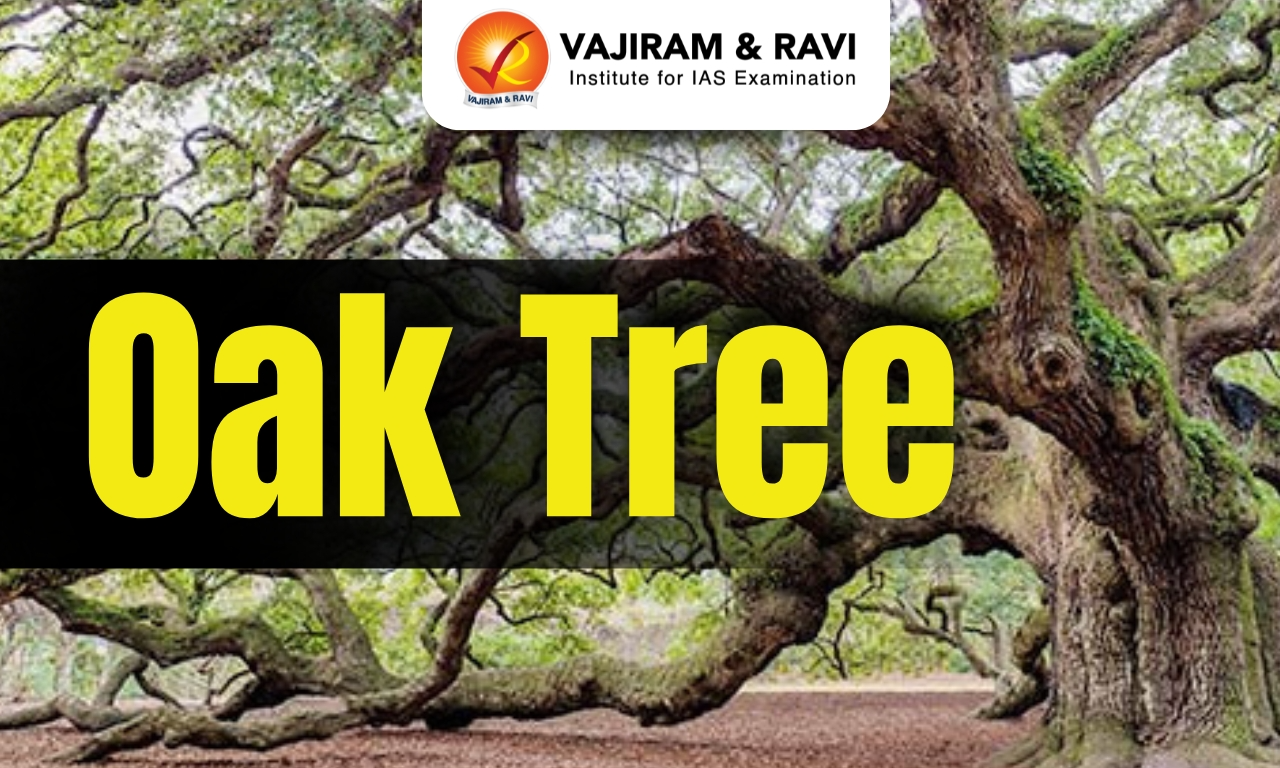
About Oak Tree

  • Oak belongs to the genus Quercus in the Fagaceae family.
  • Geographic Range: Oaks are found in diverse habitats around the world, with a broad distribution in North America, Europe, Asia, and parts of Africa.
  • They can adapt to various climates, from temperate to subtropical regions.
  • These are the dominant, climax tree species of the moist temperate forests in the Indian Himalayan region.
    • In these regions, 35 species of oaks have been reported between 800 and 3,000 metres above sea level.
    • Oaks found in Uttarakhand are Banj oak, Moru oak, Kharsu oak, Rianj oak, and Phaliath oak.

Required Climatic Conditions for Oak Tree

  • Climate: Oaks thrive in a variety of climates but are commonly found in temperate zones. They can endure cold winters and warm summers.
  • Soil: Well-drained soil is essential for oaks. They can tolerate different soil types, including sandy, loamy, and clayey soils.

Ecological Role of Oak Tree

  • Conservation Service: The species are providers of numerous ecosystem services such as conservation of soil, water, native flora and fauna, and serve as a lifeline for the local communities.
  • Watershed Protection: Oak forests assist watershed protection by promoting the recharge of springs.
  • Biodiversity Support: Oak forests support a remarkably diverse web of life. Their trees host lichens, bryophytes, pteridophytes (all three being moss-like plants).

Source: IE

Oak Tree FAQ's

Q1: What kind of organisms do Oak Trees host?

Ans: Lichens, bryophytes, pteridophytes, orchids, and other flowering plants

Q2: What type of forest ecosystem do Oak Trees often support?

Ans: Temperate forest ecosystem with diverse web of life

Sanderling

Sanderling

Sanderling Latest News

Recently, a tagged shorebird Sanderling that flew more than 7,400 km from South Australia has been spotted on the remote Narcondam Island in the Andaman and Nicobar archipelago.

About Sanderling

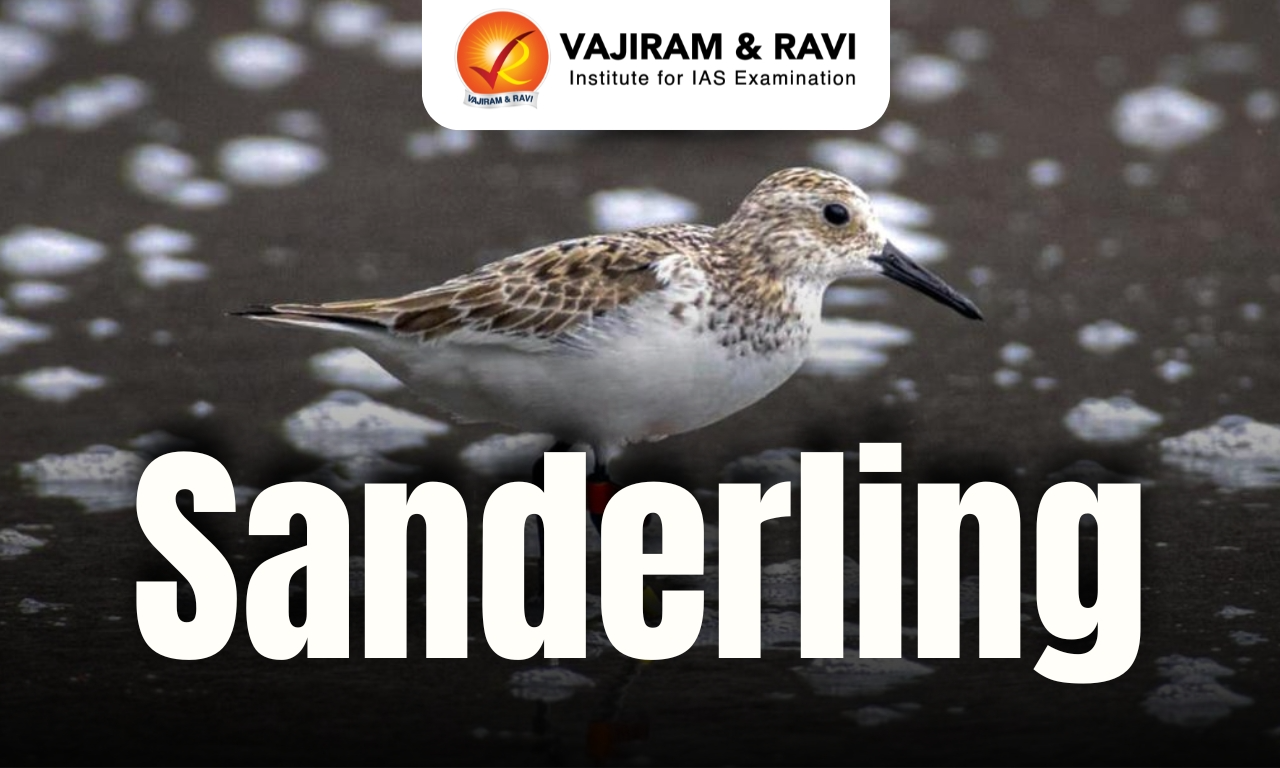
  • The sanderling (Calidris alba) is a small plump wading bird.
  • Its name comes from Old English sand-yrðling and means "sand-ploughman".
  • Appearance: During the winter the sanderling is very pale, almost white apart from a dark shoulder patch. Later in the summer, the face and throat become brick-red. 
  • Habitat: Its habitat ranges from moist sites with lots of vegetation to well-drained clay or gravel slopes, to the tops of stony ridges.
    • It can also be found on tidal sand flats, mud flats, and the shores of lakes and rivers. 
  • Distribution: It is mainly found in North America, Europe, Asia, South America, Africa, and Oceania.
  • Migration: These are complete migrants and travel between 3,000 to 10,000 km from their breeding grounds to their wintering sites.
  • Diet: Sanderlings are carnivores (mollusciovres, insectivores). They eat small crabs and other small invertebrates.
  • Threats: Loss of wetland habitats, pollution of the environment as well as the pollution from pesticides.
  • Conservation Status: IUCN Red List: Least Concern

Source: TH

Sanderling FAQ's

Q1: Where do Sanderlings typically breed?

Ans: Arctic tundra

Q2: What do Sanderlings primarily feed on?

Ans: Small invertebrates

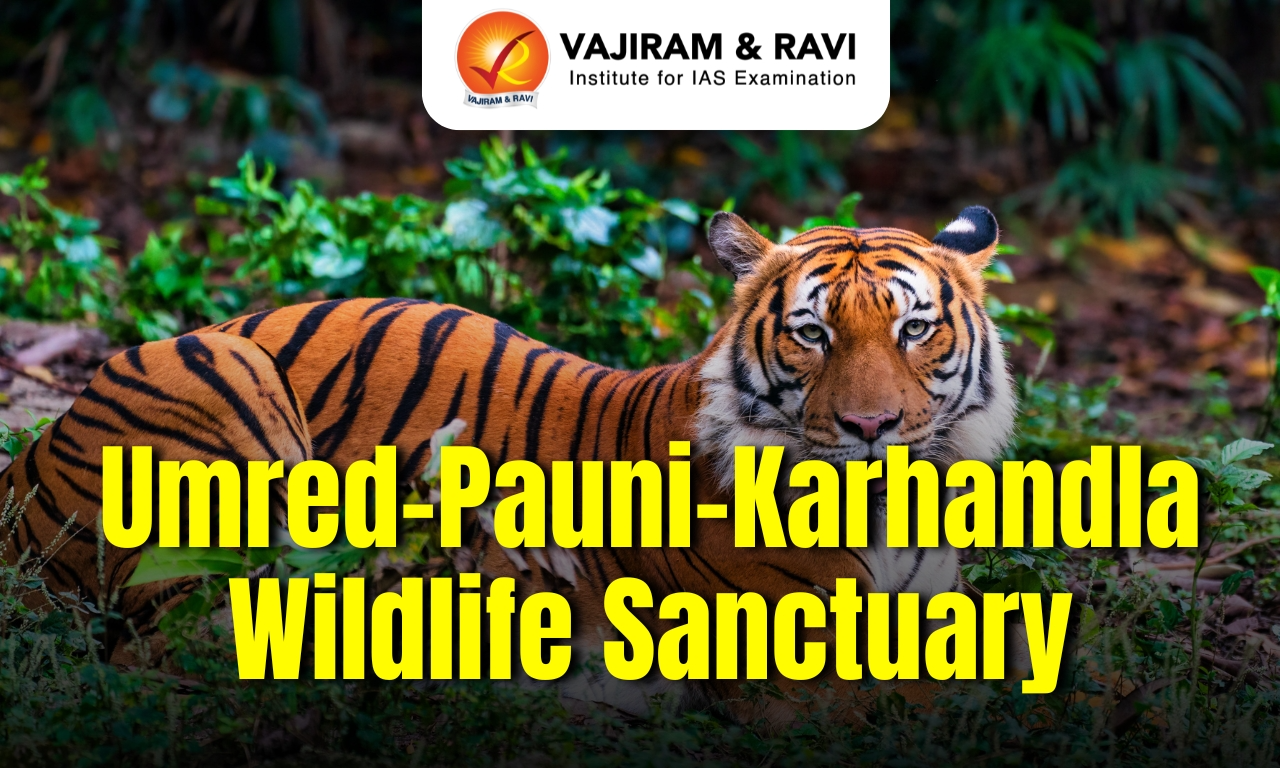
Umred–Pauni–Karhandla Wildlife Sanctuary

Umred-Pauni-Karhandla Wildlife Sanctuary

Umred–Pauni–Karhandla Wildlife Sanctuary Latest News

Recently, a melanistic (black-colored) spotted deer, commonly known as a chital, has been spotted at the Umred–Pauni–Karhandla Wildlife Sanctuary near Nagpur.

About Umred–Pauni–Karhandla Wildlife Sanctuary

  • Location: It is spread over Pauni tehsil in Bhandara district and Umred, Kuhi, and Bhivapur Taluka of Nagpur district in Maharashtra.
  • It was established in 2013 and is spread across an area of 189 sq. km. 
  • It is surrounded by the Wainganga River and the Gose Khurd Dam along the northeast boundaries of the sanctuary, while State Highway 9 and Bhiwapur Town bound the southern side.
  • The forest along the Wainganga River connects this sanctuary to the Tadoba Andhari Tiger Reserve
  • It lies 80 km from Pench Tiger Reserve and 50 kilometers southwest of Nagzira Wildlife Sanctuary.
  • Flora:
    • The forest is made up of teak, bamboo, tendu, mahua, and other indigenous tree species.
    • Teak makes up 60 percent of the crop composition. 
  • Fauna: The sanctuary is home to resident breeding tigers, herds of Gaur, wild dogs, and also rare animals like flying squirrels, pangolins, and honey badgers

Source: TLN

Umred–Pauni–Karhandla Wildlife Sanctuary FAQ's

Q1: Where is the Umred-Pauni-Karhandla Wildlife Sanctuary located?

Ans: Maharashtra

Q2: Which river forms the northeastern boundary of the sanctuary?

Ans: Wainganga River

Pradhan Mantri Mudra Yojana

Pradhan Mantri Mudra Yojana

Pradhan Mantri Mudra Yojana Lates News

Recently, the Pradhan Mantri Mudra Yojana (PMMY) — completed 11 Years of empowering Small and Micro Entrepreneurs.

About Pradhan Mantri Mudra Yojana

  • It was launched on April 8, 2015.
  • It is the Flagship Programme of the central government aimed at funding the Unfunded microenterprises and small businesses.
  • Any Indian citizen who has a business plan for a non-farm sector income generating activity such as manufacturing, processing, trading or service sector canavail loans under this yojana.

Features of Pradhan Mantri Mudra Yojana

  • MUDRA loans are being offered in four categories namely, ‘Shishu’, ‘Kishor’, ‘Tarun’ and ‘TarunPlus’
    • Shishu: covering loans upto Rs. 50,000/-
    • Kishor: covering loans above Rs. 50,000/- and up to Rs. 5 lakhs
    • Tarun: covering loans above Rs.5 lakh and upto Rs.10 lakhs
    • TarunPlus: covering loans above Rs.10lakh and upto Rs.20 lakhs
  • Loans cover term financing and working capital needs across manufacturing, trading and service sectors, including activities allied to agriculture like poultry, dairy, and beekeeping, etc.
  • These loans are given by Commercial Banks, RRBs, Small Finance Banks, MFIs and NBFCs. 
  • The interest rate is governed by RBI guidelines, with flexible repayment terms.
  • MUDRA, which stands for Micro Units Development & Refinance Agency Ltd, is a financial institution set up by the Government of India under PMMY for development and refinancing micro unit enterprises.

Source: PIB

Pradhan Mantri Mudra Yojana FAQs

Q1: Who is eligible for a loan under Pradhan Mantri Mudra Yojana?

Ans: Micro and small enterprises, including individuals and businesses

Q2: What is the primary objective of Pradhan Mantri Mudra Yojana?

Ans: Provide collateral-free loans to micro and small enterprises

Angola

Angola

Angola Latest News

Angola emerges as an important alternative to West Asia in gas supplies to India 

About Angola

  • Location: It is located on the southwestern Atlantic Coast of Africa.
  • Bordering Countries: It is bordered by the Republic of the Congo (Northwest), Democratic Republic of the Congo (North & Northeast), Zambia (Southeast) and Namibia (South)
  • Maritime Boundary: It shares a border with the Atlantic Ocean.
  • Capital City: Luanda

Geographical Features of Angola

  • Climate: It has a tropical climate with a marked dry season. The climate is largely affected by the northward flow of the cold Benguela Current off the coast, and elevation.
  • Major rivers: Cuango River and Cuanza River, vital for hydropower and inland water transport.
  • Major Water Falls:  The largest is the Calandula Waterfalls (also known as the Kalandula Falls) on the Lucala River. 
  • Highest peak: Mount Moco, the tallest mountain in Angola.
  • Natural Resources: Petroleum, diamonds, iron ore, phosphates, copper, feldspar, gold, bauxite, uranium.

Source: THB

Angola FAQs

Q1: What is the capital of Angola?

Ans: Luanda

Q2: Where is Angola located?

Ans: Southern Africa

Telecom Regulatory Authority of India

Telecom Regulatory Authority of India

Telecom Regulatory Authority of India Latest News

The Telecom Regulatory Authority of India (TRAI) has released the Draft Telecom Consumer Protection (Thirteenth Amendment) Regulation, 2026.

About Telecom Regulatory Authority of India

  • It was established under the Telecom Regulatory Authority of India Act, 1997, passed by Parliament.
  • Mandate: To regulate telecom services in India, including tariff fixation/revision, this was earlier the domain of the Central Government.
  • TRAI's mission is to create and nurture conditions for growth of telecommunications in the country in a manner and at a pace which will enable India to play a leading role in emerging global information society.
  • Functions of TRAI
    • Scope of regulation: Covers areas like tariffs, quality of service, interconnection, spectrum management, and consumer protection in the telecom sector.
    • Policy role: Issues regulations, recommendations, and orders that guide telecom policy-making and market practices.
  • Composition of TRAI
    • Chairman: It consists of a Chairperson, a maximum of two full-time members, and two part-time members.
    • Tenure: Members serve for three years or until the age of 65 years, whichever is earlier.
    • Appointments are made by the Central Government.
  • The TRAI Act was amended by an ordinance, effective from 24 January 2000 and established a Telecommunications Dispute Settlement and Appellate Tribunal (TDSAT).
    • TDSAT was set up to adjudicate any dispute between a licensor and a licensee, between two or more service providers, between a service provider and a group of consumers, and to hear and dispose of appeals against any direction, decision or order of TRAI.

Source: News On Air

Telecom Regulatory Authority of India FAQs

Q1: What is the primary objective of the Telecom Regulatory Authority of India (TRAI)?

Ans: To regulate telecom services and ensure fair competition

Q2: When was TRAI established?

Ans: 1997

INS Sunayna

INS Sunayna

INS Sunayna Latest News

Recently, the Indian Navy’s offshore patrol vessel INS Sunayna reached Male as part of its deployment under the Indian Ocean Ship (IOS) SAGAR initiative.

About INS Sunayna

  • It is the second Saryu-class offshore patrol vessel of the Indian Navy.
  • It was designed and constructed indigenously by the Goa Shipyard Limited.
  • It was commissioned at Kochi on 15th October 2013. 
  • It is based under Southern Naval Command.
  • Functions: It is designed to undertake fleet support operations, coastal and offshore patrolling, ocean surveillance and monitoring of sea lines of communications and offshore assets, and escort duties.

Features of INS Sunayna

  • Propulsion: Two diesel engines propel INS Sunayna and enable it to achieve speeds in excess of 25 knots.
  • The ship also has an automatic power management system and is fitted with the latest navigation, communication, and electronic support systems.
  • Armament: The armament fit includes one 76 mm gun with an electro-optic fire control system, Close-in Weapon Systems (CIWS) and CHAFF launchers.
  • It can also carry a helicopter.

Source: DD News

INS Sunayna FAQs

Q1: What is the speed of INS Sunayna?

Ans: Over 25 knots

Q2: What is INS Sunayna?

Ans: A Saryu-class offshore patrol vessel

Poshan Pakhwada

Poshan Pakhwada

Poshan Pakhwada Latest News

The Ministry of Women and Child Development will commemorate the 8th edition of Poshan Pakhwada from 9th to 23rd April 2026.

About Poshan Pakhwada

  • It is celebrated in the month of March/April for 15 days. 
  • Aim: It aims to raise awareness about the importance of nutrition and promote healthy eating habits through Jan Andolan and Jan Bhagidari.
  • Nodal Ministry: Ministry of Women and Child Development
  • The theme for Poshan Pakhwada 2026 is “Maximizing Brain Development in the First Six Years of Life”,
  • The key focus areas under this year’s theme include:
    • Maternal and Child Nutrition: Promoting optimal nutrition during pregnancy, exclusive breastfeeding, and age-appropriate complementary feeding.
    • Early Stimulation for Brain Development (0–3 years): Encouraging responsive caregiving and early learning interactions.
    • Play-Based Education in Early Years (3–6 years) : Supporting holistic development and school readiness.
    • Role of Parents and Community in Minimising Screen Time: Promoting healthy habits and active engagement.
    • Strengthening Anganwadi Centres through Community Participation: Enhancing infrastructure and service delivery through Jan Bhagidari and CSR

 Source: PIB

Poshan Pakhwada FAQs

Q1: What is the theme of Poshan Pakhwada 2026?

Ans: Maximizing Brain Development in the First Six Years of Life

Q2: When is Poshan Pakhwada 2026 scheduled?

Ans: April 9-23

Chera Dynasty, Geography, Rulers, Economy, Society, Cultural Legacy

Chera Dynasty

The Chera Dynasty was one of the three important kingdoms of ancient South India, along with the Chola Dynasty and the Pandya Dynasty. They ruled mainly in present-day Kerala and parts of western Tamil Nadu from around the 4th century BCE to the 12th century CE. They were also called Keralaputras.

The Cheras became powerful mainly because of their location near the sea, which helped them develop strong trade relations, especially with the Roman Empire. Their history is mostly known from Sangam literature.

Chera Dynasty Geographical Extent 

  • The Chera kingdom was located in the south-western part of the Indian subcontinent, mainly covering present-day Kerala and parts of western Tamil Nadu. 
  • Its territory lay to the west and north of the Pandya Dynasty.
  • Geographically, the Chera land was bounded by the Arabian Sea on the west, which gave it direct access to maritime trade routes. 
  • To the east, it was bordered by the Western Ghats, which acted as a natural barrier separating it from the interior regions of Tamil Nadu.
  • Beyond the Ghats, the Cheras expanded into the Kongu region (modern western Tamil Nadu), with important centres like Karur serving as inland trade hubs.
  • The northern limits of the Chera territory are generally associated with the region around present-day northern Kerala, while the southern boundary extended close to the areas near Kanyakumari, though this region often overlapped with Pandya influence.
  • One of the most important geographical features of the Chera kingdom was its coastal location, which included major ports such as Muziris (Muchiri). This port acted as a gateway for trade with the Roman Empire and West Asia, making the Chera region a key centre of international commerce.

Chera Dynasty Political History and Major Rulers

The political history of the Chera Dynasty is mainly known from Sangam literature and is marked by powerful rulers, military expansion, and frequent conflicts with neighbouring kingdoms like the Chola Dynasty and the Pandya Dynasty. The Cheras were constantly involved in wars to expand their territory and maintain their position among the three major powers of ancient South India.

Uthiyan Cheralathan

The earliest known ruler of the Chera dynasty was Uthiyan Cheralathan.

  • He is generally regarded as the founder of the Chera dynasty.
  • He is believed to have ruled around the 3rd century BCE.
  • He played an important role in establishing the Chera kingdom.
  • Under him, the Chera state began to take shape as a political power in the region.

Nedunjeral Adan

Nedunjeral Adan was one of the most important rulers of the Chera dynasty and is remembered for his military strength and achievements. 

  • He is portrayed in Sangam literature as a powerful monarch who defeated several rival kings and assumed the prestigious title of Adhiraja, which means a supreme ruler.
  • He also led successful campaigns along the Malabar Coast. During one such campaign, he is said to have captured a number of Yavana (Greek or Roman) traders. However, instead of harming them, he later released them after receiving ransom, which shows both his authority and the value of foreign traders in the region.
  • Nedunjeral Adan is also known to have fought a major battle against a ruler of the Chola Dynasty. This war is particularly notable because it ended with the deaths of both kings.
  • The expansion of the Chera kingdom continued under his family. His younger brother, Kuttuvan, played an important role in extending Chera power by conquering the Kongu region. This helped the Cheras expand their influence from the eastern parts of South India to the western coast.
  • In addition, one of Nedunjeral Adan’s sons is also described as a powerful ruler who claimed the title of Adhiraja. He is said to have worn a symbolic garland representing seven crowns and achieved victory over Anji, a local chieftain of Tagadur, further strengthening the reputation of the Chera dynasty.

Senguttuvan Chera (The Greatest Chera King)

Senguttuvan Chera, the son of Nedunjeral Adan, is considered the greatest ruler of the Chera dynasty. 

  • He is often referred to as the “Red Chera” and is remembered for both his military achievements and cultural contributions.
  • As a military leader, Senguttuvan led several successful campaigns. He defeated regional chieftains such as the ruler of Mokur and carried out expeditions in areas like Viyalur. He also captured important strongholds such as the Kodukur fortress in the Kongu region. 
  • His influence extended beyond his kingdom, as he intervened in a succession dispute in the Chola kingdom and supported one claimant by defeating the others.
  • Senguttuvan’s reign is also important for its cultural significance. He is closely associated with the Tamil epic Silappadikaram, which narrates the story of Kannagi
  • According to tradition, he undertook a northern expedition, crossed the Ganga, and brought back a sacred stone to build an idol of Kannagi, who came to be worshipped as a goddess of chastity. 

Kudakko Ilanjeral Irumporai (Last Important Sangam Ruler)

  • Kudakko Ilanjeral Irumporai is considered one of the last important rulers mentioned in Sangam texts. 
  • His reign continued to witness conflicts with both the Cholas and the Pandyas, showing that warfare remained a constant feature of Chera politics. 
  • His period marks the declining phase of the early Chera dynasty.

After the 2nd century CE, the power of the early Chera dynasty declined significantly. This decline was mainly due to continuous wars with rival kingdoms and internal weaknesses. For several centuries, there is limited historical information about the Cheras.

However, the dynasty revived again around the 8th century CE under a new line of rulers known as the Kulasekharas. One of the important rulers of this later phase was Kulasekhara Alvar, who was not only a king but also a famous Vaishnavite saint. His rule reflects the growing influence of religion and the Bhakti movement in South India during the early medieval period.

Chera Dynasty Administration and Political Structure

The Chera polity was essentially monarchical, with power concentrated in the hands of the king. However, it was not a rigidly centralized system. Instead, it exhibited a decentralized structure in which local chieftains exercised considerable autonomy. 

  • Monarchy: The Chera king was the supreme authority, responsible for law, trade, military campaigns, and overall governance. The king was assisted by a council of ministers, while the queen held a respected and influential position, participating in religious and ceremonial affairs.
  • Regional Administration: The kingdom was divided into regions governed by local chieftains or governors. These rulers collected taxes, maintained law and order, and provided military support to the king during wars.
  • Village Administration: At the village level, local councils called Manrams managed day-to-day affairs, resolved disputes, supervised community projects, and oversaw resource management.
  • Military Organization: The Cheras maintained a strong army. Local chieftains were required to contribute soldiers during campaigns, ensuring the kingdom could defend itself and expand its territory.

Chera Dynasty Economy 

  • The Chera economy was primarily based on maritime trade, which thrived due to the kingdom’s strategic location along the Arabian Sea and the Indian Ocean.
  • They were skilled sailors and developed a well-organized network of ports and harbours, enabling safe and efficient trade with distant regions.
  • Muziris (modern Kodungallur) was the most important port, serving as the main hub for commerce and foreign interactions.
  • The Cheras traded a variety of goods, including spices like pepper, textiles, precious stones, metals, ivory, pearls, and exotic items such as peacocks, which brought wealth and prosperity to the kingdom.
  • Trade with the Roman Empire was particularly significant, with evidence of Roman coins, artifacts, and even temporary Roman settlements in Chera territory to protect commercial interests.
  • Agriculture was another key part of the economy, with rice as the main crop, cultivated using advanced irrigation systems that supported farming even in areas with low rainfall.
  • The Cheras collected taxes in grain, cattle, and other goods, which funded military campaigns, infrastructure development, and trade activities.
  • The combination of maritime trade, agriculture, and an organized taxation system made the Chera kingdom prosperous, politically strong, and capable of supporting cultural and religious development.

Chera Dynasty Society

  • The Chera society was primarily agrarian, with most people engaged in rice cultivation supported by advanced irrigation systems.
  • There was a significant presence of traders, artisans, and craftsmen, contributing to economic growth and cultural richness.
  • Education, literature, and arts were highly valued; Sangam poetry provides insights into customs, morals, and daily life.
  • Music and dance were widely appreciated, with talented performers often attached to royal courts and temples.
  • Society was hierarchical, with kings, nobles, and chieftains at the top, and farmers, traders, and laborers forming the lower strata, though social mobility was possible through bravery, merit, or economic success.
  • Women enjoyed a relatively respected position, could inherit property, participate in religious ceremonies, and were praised in literature for intelligence and virtue.
  • Festivals, fairs, and public performances reinforced community bonds and cultural identity.

Chera Dynasty Culture 

The Chera dynasty had a rich cultural heritage, excelling in literature, music, dance, and art. 

  • The Cheras were strong patrons of the Tamil language, and many renowned works of Tamil literature, including Sangam poems and songs, were composed during their rule.
  • The Cheras valued music and dance, and the Natyashastra mentions the Chera kingdom as a region where performing arts were highly developed. Their style of music and dance was known for its grace and elegance, and many accomplished musicians and dancers emerged under their patronage.
  • The dynasty made significant contributions to architecture, including the construction of temples, palaces, and other monumental buildings. Their architectural style was largely Dravidian, with detailed carvings and sculptural work.
  • The famous Sabarimala Temple in Kerala, one of the most important Hindu pilgrimage sites, is closely associated with the Cheras. According to legend, it was built by Chera king Rajasekhara, who was a devotee of Lord Ayyappa. The temple continues to attract millions of devotees, and the Makaravilakku festival, which involves lighting a lamp on the hilltop, is said to have been initiated during the Chera period.
  • The Cheras were also expert shipbuilders, which supported their thriving maritime trade with regions across the Indian Ocean, including West Asia and the Roman Empire.
  • Religion played an important role in Chera culture. They were strong supporters of Hinduism, commissioning many temples and supporting religious activities. At the same time, they displayed tolerance towards other religions, with evidence suggesting that Buddhism and Jainism were also practiced in the kingdom.
  • Overall, Chera culture reflected a blend of literary excellence, artistic expression, religious devotion, and maritime expertise, which contributed to the prosperity and prominence of their kingdom in ancient South India.

Chera Dynasty FAQs

Q1: What was the geographical extent of the Chera Dynasty?

Ans: The Chera Dynasty ruled present-day Kerala and western Tamil Nadu, from the Arabian Sea to the Western Ghats, with key centres like Karur and ports like Muziris for trade.

Q2: Who were the major rulers of the Chera Dynasty?

Ans: Key rulers include Uthiyan Cheralathan, Nedunjeral Adan, Senguttuvan Chera, Kudakko Ilanjeral Irumporai, and in the later period, Kulasekhara Alvar.

Q3: How was the Chera Dynasty administered?

Ans: It was a monarchy with local chieftains managing regions and village councils (Manrams) handling day-to-day affairs, combining central authority with local autonomy.

Q4: What was the economy of the Chera Dynasty based on?

Ans: Maritime trade, especially through Muziris, agriculture with rice as the main crop, and a structured taxation system. Trade included spices, textiles, precious stones, and exotic goods.

Q5: How was society structured under the Chera Dynasty?

Ans: Chera society was primarily agrarian but economically diverse, with farmers, traders, and artisans contributing to prosperity. It was hierarchical, yet social mobility was possible through merit or wealth. Women enjoyed respected roles, could inherit property, and participate in religious and cultural activities.

Chief Election Commissioner – Appointment, Powers and Removal Process

Chief Election Commission

Chief Election Commission Latest News

  • Notices seeking the removal of Chief Election Commissioner Gyanesh Kumar were rejected due to a lack of evidence. 

Office of the Chief Election Commissioner

  • The Chief Election Commissioner (CEC) is the head of the Election Commission of India, a constitutional body established under Article 324 of the Constitution.
  • The Commission is responsible for conducting free and fair elections to Parliament, State Legislatures, and the offices of the President and Vice-President.

Appointment of CEC

  • The CEC is appointed by the President of India.
  • As per the Chief Election Commissioner and Other Election Commissioners Act, 2023, the appointment is made on the recommendation of a selection committee comprising: 
    • Prime Minister, 
    • Leader of the Opposition in the Lok Sabha, and 
    • One Union Cabinet Minister.
  • This aims to bring transparency and balance in the selection process.

Tenure

  • The CEC holds office for a term of six years or until the age of 65 years, whichever is earlier.
  • The conditions of service cannot be varied to their disadvantage after appointment, ensuring independence.

Powers and Functions

  • The Election Commission, headed by the CEC, enjoys wide-ranging powers under Article 324.
  • These include:
    • Superintendence, direction, and control of elections. 
    • Preparation and revision of electoral rolls. 
    • Conduct of free and fair elections. 
    • Monitoring election expenditure and enforcing the Model Code of Conduct. 
  • The Commission also has plenary powers to act in areas where laws are silent, ensuring the integrity of the electoral process.

Removal Process

  • The removal of the CEC is similar to that of a Supreme Court judge.
  • Under Article 324(5), the CEC can be removed only on grounds of proved misbehaviour or incapacity. The process requires:
    • A motion passed in both Houses of Parliament. 
    • Special majority (majority of total membership and two-thirds of members present and voting). 
  • This high threshold ensures institutional independence and protects the office from arbitrary removal.

News Summary

  • Rajya Sabha Chairman C.P. Radhakrishnan and Lok Sabha Speaker Om Birla rejected notices submitted by Opposition MPs seeking the removal of Chief Election Commissioner Gyanesh Kumar. 
  • The presiding officers held that the Opposition failed to provide sufficient proof and that the allegations did not establish a prima facie case of “misbehaviour,” which is a constitutional requirement for removal. 
  • The notices were signed by 63 Rajya Sabha members and 130 Lok Sabha members and included seven charges against the CEC. These charges were examined in detail and subsequently rejected. 
  • The presiding officers stated that the allegations either lacked evidence, related to matters already adjudicated, or were currently under judicial consideration. 
  • They emphasised that such issues did not meet the “high constitutional bar” required to initiate removal proceedings under Articles 324(5) and 124(4)

Allegations Made Against the CEC

  • Several specific allegations were addressed. Claims regarding the CEC’s appointment being “tainted” were dismissed, as the pendency of a legal challenge does not constitute misbehaviour. 
  • Similarly, allegations of bias or differential treatment between the government and the opposition lacked demonstrable evidence. 
  • The refusal to share electoral data or provide machine-readable electoral rolls was found to be consistent with legal provisions and Supreme Court directions, including considerations of privacy under the Puttaswamy judgment
  • Issues related to the Special Intensive Revision (SIR) of electoral rolls were also examined. 

Basis of Rejection of the Allegations

  • The presiding officers reiterated that the Election Commission has plenary powers under Article 324 and that the Supreme Court has affirmed its competence in such matters. 
  • Allegations of contempt of court and lack of institutional independence were rejected as either falling under judicial jurisdiction or being vague and unsupported by evidence. 
  • Overall, the decision reinforced the constitutional safeguards surrounding the office of the CEC and highlighted the stringent standards required for initiating removal proceedings.

Source: TH

Chief Election Commissioner FAQs

Q1: Who appoints the Chief Election Commissioner?

Ans: The President of India appoints the CEC on the recommendation of a selection committee.

Q2: What is the tenure of the CEC?

Ans: Six years or until the age of 65 years, whichever is earlier.

Q3: Under which Article is the Election Commission established?

Ans: Article 324 of the Constitution.

Q4: How can the CEC be removed?

Ans: Through a parliamentary process similar to the removal of a Supreme Court judge.

Q5: Why was the recent removal plea rejected?

Ans: Due to lack of evidence and failure to meet the constitutional standard of “misbehaviour.”

India NDC Update: Key Targets and Challenges in India NDC

NDC

NDC Latest News

  • India’s revised Nationally Determined Contributions (NDCs) under the Paris Agreement reflect a careful and measured approach to climate action.
  • The government has chosen continuity and gradual progress, rather than major changes to earlier commitments.
  • Despite challenges in energy and development, India is confident its targets are sufficient and aligned with its fair share of global climate responsibility.
  • The approach is consistent with climate justice principles and India’s status as a developing country.

India’s Updated NDCs: Three Key Climate Goals

  • Emissions intensity reduction: From 45% (by 2030) to 47% below 2005 levels by 2035.
  • Clean energy capacity: 60% of installed power capacity from non-fossil fuels.
  • Carbon sink expansion: Increase forest and tree cover to absorb 3.5–4 billion tonnes of CO₂ equivalent above 2005 levels.

India’s Climate Policy: Structural Constraints and Evolving Priorities

  • India’s climate policy is shaped by its structural constraints as a lower middle-income country, which limit its choices.
  • These constraints have remained largely unchanged, reinforcing India’s emphasis on the UNFCCC framework.
  • At the same time, the Paris Agreement’s requirement of periodic updates has increased the role of short-term considerations.
  • A worsening global climate environment has further influenced the formulation of recent commitments.

India’s Climate Action: Enthusiasm Amid Constraints

  • India continues to show strong commitment to climate action despite structural constraints. 
  • Both central and state governments are actively promoting initiatives such as electric vehicles, energy efficiency, expansion of non-fossil fuel energy, green hydrogen, and carbon capture and storage, with significant public and private investment.
  • However, given its current developmental stage, India considers it premature to convert all these efforts into stricter NDC commitments, which involve higher accountability and regular reporting through Biennial Transparency Reports to the UNFCCC.

Debate Over Adequacy of Targets

  • India’s updated NDCs have sparked debate. 
  • Some critics argue they are insufficient for achieving the 1.5°C global temperature goal, while others downplay them as easily achievable or suggest alternative metrics like renewable energy generation instead of installed capacity.
  • Even among supporters, there is uncertainty about whether the current commitments represent India’s maximum possible effort at this stage.

The Cost of Going Green: Challenges in India’s Climate Transition

  • India’s reliance on coal means that reducing emissions is not a natural outcome of growth but requires deliberate policy choices. 
  • Expanding renewable energy involves costs such as reducing coal-based generation, even when it is cheaper or readily available, thereby increasing the overall cost of climate commitments.

High Costs of Renewable Energy and Storage

  • While renewable energy and battery storage projects are expanding, scaling up storage capacity to meet future needs will require investments of several trillion rupees. 
  • Much of this burden may fall on the government, diverting resources from other sectors. 
  • Options like pumped hydropower are limited due to environmental, regulatory, and water-use constraints.

Infrastructure and Grid Challenges

  • Renewable energy expansion faces significant challenges, including inadequate transmission capacity and grid balancing issues. 
  • These hidden costs are often not accounted for when assessing the affordability of renewable energy.

Operational Inefficiencies and Curtailment

  • Since coal remains essential for backup when solar and wind are unavailable, renewable energy use often has to be curtailed. 
  • This cyclical operation increases maintenance and operational costs for thermal power plants, adding to the overall cost burden.

Broader Economic Costs of Transition

  • India is also investing in energy efficiency, industrial emissions targets, and rapid adoption of electric vehicles, alongside stricter emission norms. 
  • These measures represent significant economic costs that are often underestimated.

Lack of Climate Finance and Cost Assessment

  • Despite substantial domestic investment in climate mitigation since COP26, there is limited international climate finance support. 
  • Moreover, the total cost of India’s mitigation efforts so far has not been reliably estimated, creating a major knowledge gap.

Accounting for India’s Developmental Future in Climate Commitments

  • Limits of Current Economic Extrapolation - India’s mitigation strategy cannot rely on simply extending current economic trends. Its future requires space for industrial growth, expanded services, and rapid urbanisation, which are still at early stages.
  • Development vs Climate Expectations - Arguments that “India can do more” overlook the need to protect long-term development goals. Climate commitments must not constrain India’s ability to meet rising economic and social demands.
  • Constraints of Global Climate Goals - India cannot align its NDCs strictly with the 1.5°C target, as it is increasingly unattainable and beyond India’s capacity to influence, given its low per capita emissions.
  • Inequitable Distribution of Climate Efforts - Under the Paris framework, benefits of India’s emissions reductions largely accrue to major global emitters, especially when leading historical polluters reduce commitments or withdraw from climate action.
  • Need for Strategic and Context-Based Commitments - India’s climate policy must remain strategic and cautious, with NDCs shaped by its national circumstances, balancing development needs with global climate responsibilities.

Source: TH

NDC FAQs

Q1: What is India NDC?

Ans: India NDC refers to India’s climate commitments under the Paris Agreement, including emission reduction, renewable energy expansion, and increasing carbon sinks for climate mitigation.

Q2: What are the key targets in India NDC?

Ans: India NDC includes reducing emissions intensity, increasing non-fossil fuel power capacity, and expanding forest carbon sinks to strengthen climate action efforts.

Q3: Why is India NDC considered cautious?

Ans: India NDC is cautious because it balances climate goals with development needs, ensuring economic growth and energy security while gradually enhancing climate commitments.

Q4: What challenges affect India NDC implementation?

Ans: India NDC faces challenges like dependence on coal, high renewable energy costs, storage limitations, infrastructure gaps, and limited international climate finance support.

Q5: Why is India NDC debated globally?

Ans: India NDC is debated due to concerns about adequacy for the 1.5°C target, though India argues its commitments align with fairness and its lower per capita emissions.

Artemis II Mission: How Artemis II Set New Spaceflight Record

Artemis II

Artemis II Latest News

  • The Artemis II mission astronauts travelled about 406,771 km from Earth, setting a new record for the farthest human spaceflight.
  • The Orion spacecraft reached this distance while looping around the far side of the Moon.
    • The previous record was set by Apollo 13 (1970), which went farther due to an emergency deviation.
  • In contrast, Artemis II’s distance was planned, but it is not the main objective—rather a result of its mission trajectory.

Artemis II Flight Path: Free-Return Trajectory

  • Artemis II is a crewed lunar flyby mission, not a landing mission. Unlike earlier missions like Apollo 8, which used a circular lunar orbit, Orion follows an elliptical free-return trajectory.
  • This path uses the Moon’s gravity to slingshot the spacecraft back to Earth, reducing the need for engine burns.
  • The mission is designed to test the Orion spacecraft’s capabilities under controlled conditions.

How the Free-Return Trajectory Works in Artemis II

  • High Earth Orbit (HEO) Phase
    • The mission begins with Orion entering an elliptical orbit around Earth, extending to about 74,000 km. 
    • This phase provides a 42-hour window for astronauts to test critical systems like environmental control and life support. 
    • If any issue arises, the spacecraft remains within Earth’s gravity, allowing a quick abort and safe splashdown.
  • Translunar Slingshot Phase
    • After system clearance, Orion is propelled toward the Moon, targeting a point about 10,300 km beyond the lunar far side. 
    • The Moon’s gravity then captures and slingshots the spacecraft around it, directing it back toward Earth without requiring additional propulsion.
    •  
  •  

Why the Free-Return Trajectory is Advantageous

  • The flight path provides a built-in safety mechanism, ensuring the spacecraft can return to Earth even if engines fail, preventing astronauts from being stranded.
  • It is highly fuel-efficient, as it avoids the heavy deceleration and acceleration burns required for a circular lunar orbit.
  • By using the Moon’s gravity for direction change, the mission conserves propellant.
  • Lower fuel needs also reduce launch weight and allow reserve fuel for emergencies.

Next Steps in the Artemis Programme

  • The main goal of Artemis II is to test whether the Orion spacecraft and its systems can safely support human life in deep space conditions.
  • The 10-day mission evaluates its ability to match Artemis I distances while ensuring crew safety.
  • Orion’s return will provide critical data on performance and life-support systems for future missions.
  • These insights will help prepare upcoming missions aimed at returning humans to the Moon and building a Moon Base.

Source: IE | NASA

Artemis II FAQs

Q1: What is Artemis II mission?

Ans: Artemis II is NASA’s first crewed lunar flyby mission since 1972, designed to test Orion spacecraft systems and human survival in deep space conditions.

Q2: Why is Artemis II important?

Ans: Artemis II is important because it tests human spaceflight beyond Earth orbit, setting a new distance record and validating systems for future Moon missions.

Q3: What is the Artemis II flight path?

Ans: Artemis II follows a free-return trajectory, using the Moon’s gravity to loop around it and return to Earth without requiring major propulsion burns.

Q4: How does Artemis II ensure safety?

Ans: Artemis II ensures safety through a passive return path, allowing the spacecraft to return to Earth even if propulsion systems fail during the mission.

Q5: What comes after Artemis II?

Ans: After Artemis II, NASA will analyse mission data to improve systems for future lunar missions, aiming to land humans on the Moon and build a lunar base.

Daily Editorial Analysis 8 April 2026

Daily-Editorial-Analysis

Delimitation, Women’s Reservation, Political Dynamics

Context

  • The Constitution (One Hundred and Sixth Amendment) Act, 2023, also known as the Nari Shakti Vandan Adhiniyam, marks a historic step in India’s democratic journey by mandating one-third reservation for women in the Lok Sabha and State Legislative Assemblies.
  • While the reform promises to address gender imbalance in political representation, its implementation raises significant questions regarding timing, methodology, and broader structural consequences.
  • The intersection of women’s reservation with delimitation and seat expansion suggests a deeper transformation of India’s representative system.

Background and Delay in Implementation

  • Although the Act has been passed, its implementation is contingent upon the completion of the next Census and a subsequent delimitation exercise.
  • This has led to criticism from opposition parties and women’s rights groups, who argue that such conditionality unnecessarily delays a long-pending reform.
  • The government initially defended this sequencing on the grounds of fairness and administrative feasibility, asserting that updated population data is essential for equitable representation.
  • However, recent developments indicate a shift in this stance, with proposals to conduct delimitation based on the 2011 Census instead of waiting for new data.

Changing Strategy and Political Calculations

  • Shift in Government Approach

    • The emerging plan to proceed with delimitation using older Census data suggests a deliberate change in strategy.
    • Alongside this, the proposal to expand the Lok Sabha from 543 to approximately 816 seats indicates a major restructuring of legislative representation.
  • Electoral Implications

    • By advancing women’s reservation, the government positions itself as the enabler of a historic reform. This move is likely to:
      • Mobilise women voters in upcoming elections
      • Strengthen political support in the medium term
      • Serve as a key campaign narrative for future general elections
    • Thus, the reform is not only a social measure but also a strategic political tool.

Delimitation and Federal Concerns

  • Population-Based Representation Debate

    • Delimitation raises a fundamental question: should representation be based solely on population, or should it also consider economic and social factors?
    • A strictly population-based approach would increase the representation of northern States with higher fertility rates, while reducing the relative influence of southern States that have stabilised population growth.
  • North–South Divide

    • These dynamic risks intensifying the existing north–south divide, as southern States may feel penalised for successful population control.
    • Such an imbalance could strain India’s federal structure and disrupt the equilibrium of inter-State representation.

Seat Expansion and Its Implications

  • Rationale and Concerns

    • The proposed 50% increase in legislative seats is intended to ease the transition and maintain proportional representation.
    • However, even with proportional expansion, more populous States would gain significantly in absolute terms.
  • Impact on Political Balance

    • In a first-past-the-post system, numerical strength determines electoral outcomes. As a result:
      • Northern States could gain disproportionate political influence
      • Less populous regions may face structural disadvantages
      • The balance of power within Parliament could shift significantly

The Issue of Data

  • Limitations of the 2011 Census

    • Using the 2011 Census as the basis for delimitation is problematic due to substantial demographic changes over the past decade, including:
      • Rapid urbanisation
      • Migration patterns
      • Effects of the COVID-19 pandemic
    • Relying on outdated data risks misrepresenting current population realities.
  • Implications of the Upcoming Census
    • The forthcoming Census is expected to include caste data, which may intensify demands for:
      • Greater representation of backward classes
      • Sub-quotas within women’s reservation
    • By proceeding without this updated data, the government may be postponing rather than resolving these issues.

Operational Challenges in Women’s Reservation

  • Rotation of Constituencies

    • A key unresolved issue is the mechanism for rotating reserved constituencies. This has significant implications for:
      • Political accountability
      • Continuity in governance
      • Constituency development
    • Frequent rotation could disrupt long-term representation, while limited rotation might create unequal advantages.
  • Lack of Clarity

    • The Act provides only a broad framework, leaving critical operational details undefined.
    • This lack of clarity could affect the effectiveness of the reform.

The Need for Deliberation

  • Scale of Structural Change

    • Women’s reservation, delimitation, and seat expansion are interconnected reforms that will collectively reshape India’s political landscape. They will determine:
      • Who gets represented
      • From which regions
      • In what proportions
  • Importance of a Thoughtful Approach

    • Given the magnitude of these changes, implementation must be based on:
      • Updated and reliable data
      • Transparent processes
      • Broad political consensus
    • Rushing the process risks undermining the very objectives of the reform.

Conclusion

  • The introduction of women’s reservation is a necessary and long-overdue step toward gender equality in India’s political system.
  • However, its linkage with delimitation and seat expansion transforms it into a far-reaching structural reform with significant implications for federal balance and democratic representation.
  • As India stands on the brink of a major reconfiguration of its electoral framework, the challenge lies in ensuring that the pursuit of gender justice is aligned with principles of fairness, inclusivity, and institutional integrity.

Delimitation, Women’s Reservation, Political Dynamics FAQs

Q1. What does the Nari Shakti Vandan Adhiniyam provide?
Ans. The Act provides one-third reservation for women in the Lok Sabha and State Legislative Assemblies.

Q2. Why has the implementation of women’s reservation been delayed?
Ans. The implementation has been delayed because it is linked to the next Census and delimitation exercise.

Q3. What concern arises from using the 2011 Census for delimitation?
Ans. Using the 2011 Census may misrepresent current population realities due to demographic changes.

Q4. How could delimitation affect the balance between northern and southern States?
Ans. Delimitation based on population could increase the political power of northern States and reduce that of southern States.

Q5. Why is the rotation of reserved constituencies important?
Ans. The rotation of reserved constituencies is important because it affects political accountability and continuity in governance.

Source: The Hindu


Reinforcing The Case For a One Health approach

Context

  • The 1995 film Outbreak portrayed a fictional zoonotic virus caused by human activities like deforestation and wildlife trade, spreading rapidly across countries.
  • Though fictional at the time, it foreshadowed the real-world COVID-19 pandemic decades later.
  • The film also reflected early ideas of One Health, highlighting the link between human, animal, and environmental health.
  • Today, One Health is widely recognised, but its implementation remains slow.
  • This article highlights the growing relevance of the One Health approach in addressing global health challenges, linking human, animal, and environmental health while examining lessons from pandemics, climate change, and policy responses.

From Fiction to Reality: The Rise of the One Health Approach

  • Global Recognition of One Health

    • The World Health Day theme highlights the need for a One Health approach and scientific collaboration.
    • Coordination challenges across governments and nations hinder effective crisis response.
  • Evolution of One Health Concept

    • The term “One Health” emerged in 2003–04 during SARS (severe acute respiratory syndrome) and gained importance with avian influenza (H5N1).
    • The Manhattan Principles (2004) recognised links between human, animal, and environmental health.
      • Manhattan Principles were derived at a 2004 Wildlife Conservation Society meeting.
    • Drivers of Zoonotic Diseases

      • Most emerging diseases originate in animals due to:
        • Ecosystem changes and land use
        • Agricultural intensification
        • Urbanisation and global travel
      • One Health Framework
        • Defined as an integrated approach balancing the health of people, animals, and ecosystems.
        • Requires multi-sectoral collaboration to address health and environmental challenges.
      • Lessons from COVID-19
        • The pandemic highlighted both lack of coordination and benefits of global collaboration.
        • Initiatives like data sharing and vaccine development showcased the importance of cooperation.
        • The WHO Pandemic Agreement (2025) aims to strengthen global preparedness and equitable access.
      • Institutional Efforts
        • Globally led by the Quadripartite (WHO, FAO, UNEP, WOAH - World Organisation for Animal Health) with a Joint Plan of Action (2022).
        • India launched the National One Health Mission to improve surveillance and pandemic preparedness.
      • Climate Change and Health Link
        • Climate change is increasing stress on ecosystems, making integrated responses essential.
        • Continuous monitoring and mitigation efforts are needed.
      • State-Level Initiatives in India
        • Examples include:
          • Odisha’s Climate Budget
          • Kerala’s carbon-neutral plan
          • Tamil Nadu’s Green Climate initiatives
        • These serve as models for broader implementation.

Coordinated Solutions: Advancing the One Health Approach

  • Focus of the One Health Summit

    • The summit in Lyon addresses key drivers of disease, including:
      • Zoonotic diseases and vectors
      • Antimicrobial resistance (AMR)
      • Food systems and pollution
    • Aim of the Summit
      • To promote international and interdisciplinary dialogue.
      • To propose solutions for:
        • Stronger health systems
        • Better global coordination
        • Reformed institutional frameworks
      • Growing Global Consensus
        • Increasing political support for One Health as a practical and necessary approach.
        • Recognised as important for public health, economic stability, and global cooperation.
      • Core Message
        • In an interconnected world, effective solutions require integrated approaches that link human, animal, and environmental health.

Conclusion

  • One Health offers a comprehensive framework for tackling interconnected health risks, but its success depends on stronger coordination, sustained political commitment, and effective implementation across sectors and nations.

Reinforcing The Case For a One Health approach FAQs

Q1. What is the One Health approach?

Ans. One Health is an integrated approach that connects human, animal, and environmental health, promoting coordinated efforts to prevent diseases and ensure sustainable global health outcomes.

Q2. How did COVID-19 strengthen the case for One Health?

Ans. COVID-19 exposed gaps in global coordination and showed the importance of data sharing, collaboration, and integrated responses in managing pandemics and preventing future health crises.

Q3. What are the main drivers of zoonotic diseases?

Ans. Zoonotic diseases are driven by ecosystem changes, deforestation, agricultural intensification, urbanisation, and increased global travel, all linked to human activity.

Q4. What role do international institutions play in One Health?

Ans. Organisations like WHO, FAO, UNEP, and WOAH coordinate global efforts, promote collaboration, and implement frameworks like the One Health Joint Plan of Action.

Q5. Why is climate change important in the One Health framework?

Ans. Climate change disrupts ecosystems, increases disease risks, and stresses health systems, making integrated approaches essential for managing environmental and public health challenges.

Source: TH

Daily Editorial Analysis 8 April 2026 FAQs

Q1: What is editorial analysis?

Ans: Editorial analysis is the critical examination and interpretation of newspaper editorials to extract key insights, arguments, and perspectives relevant to UPSC preparation.

Q2: What is an editorial analyst?

Ans: An editorial analyst is someone who studies and breaks down editorials to highlight their relevance, structure, and usefulness for competitive exams like the UPSC.

Q3: What is an editorial for UPSC?

Ans: For UPSC, an editorial refers to opinion-based articles in reputed newspapers that provide analysis on current affairs, governance, policy, and socio-economic issues.

Q4: What are the sources of UPSC Editorial Analysis?

Ans: Key sources include editorials from The Hindu and Indian Express.

Q5: Can Editorial Analysis help in Mains Answer Writing?

Ans: Yes, editorial analysis enhances content quality, analytical depth, and structure in Mains answer writing.

Enquire Now