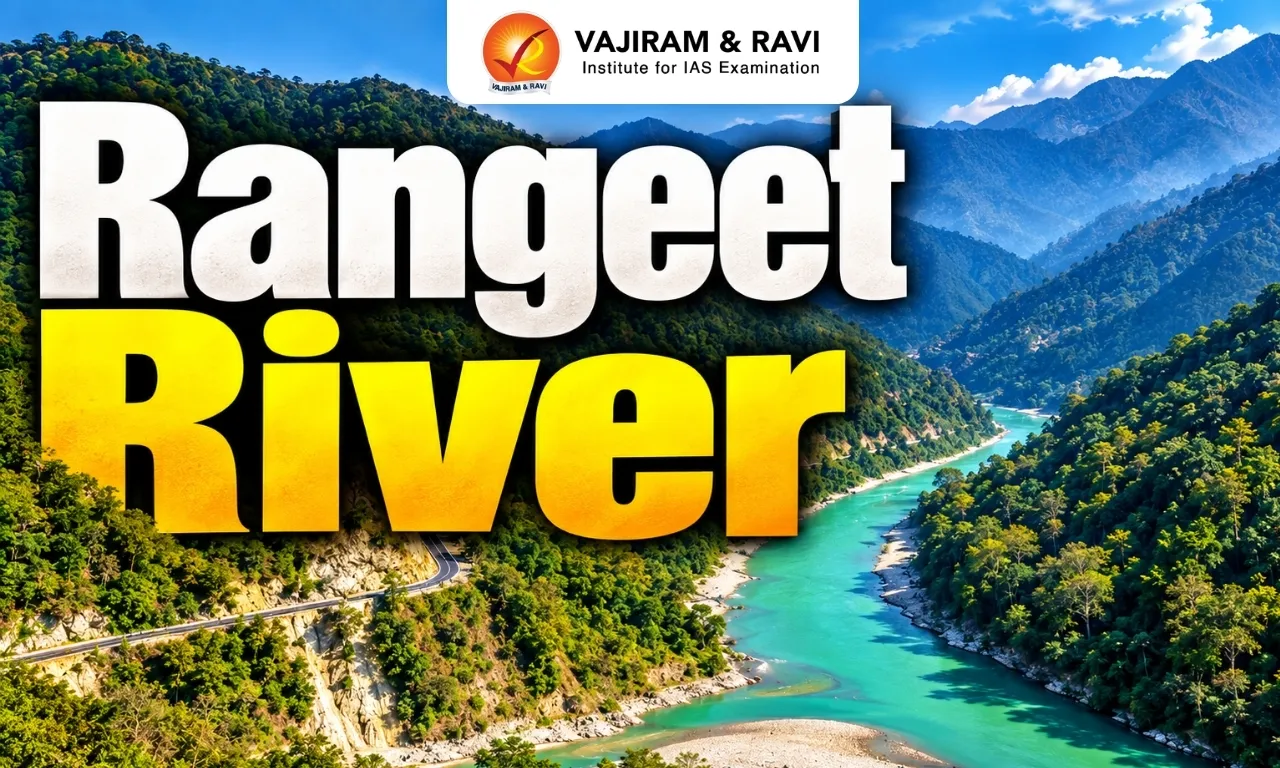
Rangeet River

Rangeet River

Rangeet River Latest News

Anglers in Sikkim will organise a three-day river festival on the banks of the Rangeet river near Jorethang  late this month, , seeking to blend catch-and-release fishing with river conservation, adventure tourism and local culture.

About Rangeet River

  • The Rangeet, or Rangit, is a major tributary of the Teesta River, the largest river in Sikkim. 
  • Course:
    • It originates from a glacier of Mount Kabru at the lower Kanchenjunga region. 
    • The river begins its course from the Himalayan Mountains in the West Sikkim district. 
    • A perpetual river, Rangeet is fed by the melting snow of the Himalayas in early summer and the monsoon rains in June-September. 
    • The convoluted river joins the Teesta at Teesta Bazaar on the periphery of West Bengal and Sikkim. 
    • During its final few kilometres, it forms the boundary between the Sikkim and Darjeeling districts of West Bengal.  
    • The river flows past the towns of Pelling, Jorethang, and Legship. 
  • It is important ecologically as a mountain river system that supports cold-water fisheries (notably trout), provides irrigation and freshwater to local communities, and supplies water for small hydropower projects.
  • The banks of the river are enveloped by thick forest cover. Certain areas of the banks are used for terrace farming. 
  • It is popular among white water rafting enthusiasts because of its turbulent waters. 
  • The Rangeet Dam is built on this river, which started operating in 2000.
    • It has a 60 MW capacity.   
    • It is a 45-metre-high concrete gravity structure of 100 metres length.

News: TP

Rangeet River FAQs

Q1: Which is the major river to which the Rangeet is a tributary?

Ans: The Teesta River.

Q2: Where does the Rangeet River originate?

Ans: It originates from a glacier of Mount Kabru in the lower Kanchenjunga region.

Q3: Where does the Rangeet River join the Teesta River?

Ans: Where does the Rangeet River join the Teesta River?

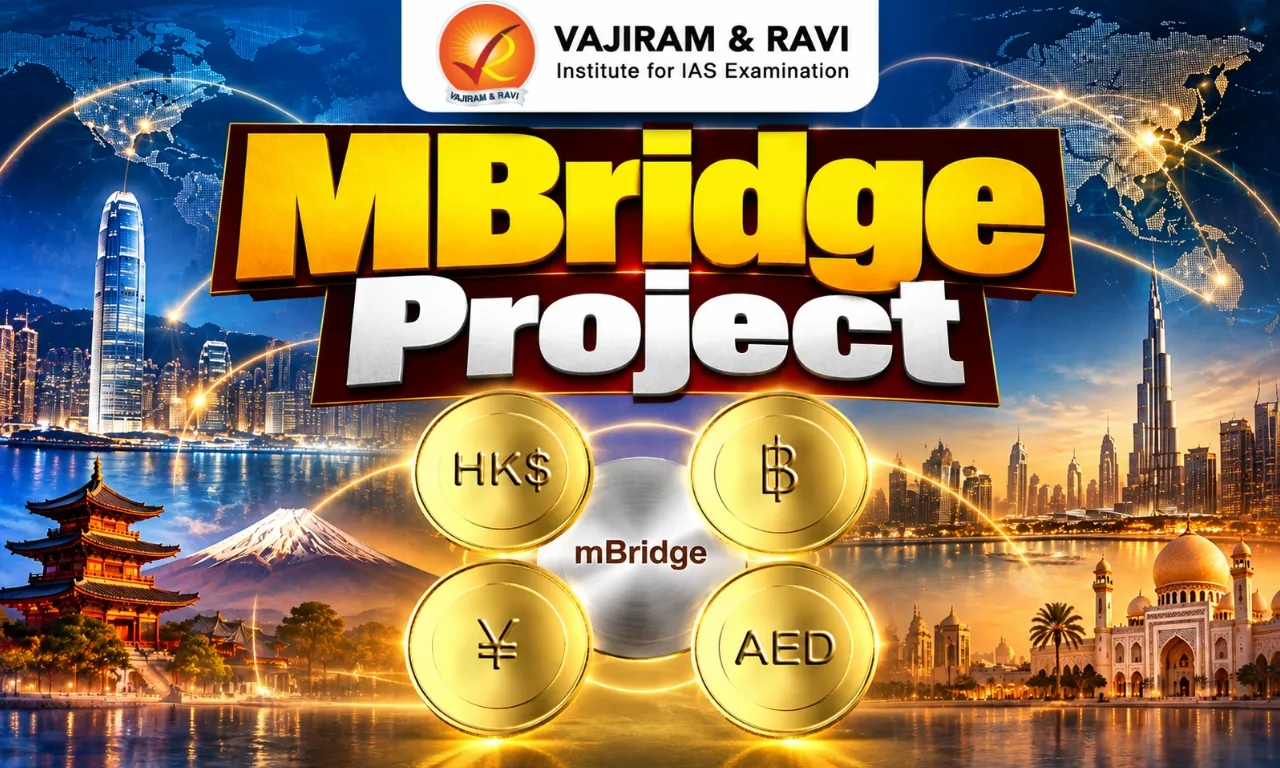
mBridge Project

mBridge Project

mBridge Project Latest News

Saudi Arabia quietly exited the China-led mBridge digital currency project in 2025, saying it was part of its original plan. 

About mBridge Project

  • mBridge is a cross-border payments platform designed to allow central banks to transact directly using central bank digital currencies (CBDCs). 
  • It is a joint project launched in 2021 between the Bank for International Settlements (BIS) innovation hub and the Bank of Thailand, the Central Bank of the United Arab Emirates, the Digital Currency Institute of the People’s Bank of China, and the Hong Kong Monetary Authority. 
  • The project aimed to explore a multi-CBDC platform shared among participating central banks and commercial banks, built on distributed ledger technology (DLT) to enable instant cross-border payments and settlement. 
  • Need for mBridge:
    • The project aimed to tackle key inefficiencies in cross-border payments, including high costs, low speed, and operational complexities. 
    • It also aims to address financial inclusion concerns, particularly in jurisdictions where correspondent banking (which connects countries to the global financial system) has been in retreat, causing additional costs and delays. 
    • The system is designed to potentially reduce the need for the US dollar to act as an intermediary currency.
  • How does mBridge work?
    • The platform uses blockchain technology, which makes all the participating banks connect to the same network, which is shared among them. 
    • The blockchain is a shared digital record which helps keep in tracking the transactions, including maintaining who has paid whom and how much. 
    • Participating central banks as well as monetary organisations use their own computers on the mBridge network, which are called as validating nodes.
    • They play a role in maintaining the transactions that have taken place as well as also help in maintaining the shared digital record to maintain clarity on the transactions that have taken place. 
    • This means that international payments no longer pass through several banks, rather they are settled directly through one shared platform, mBridge in this case.
  • Why is it seen as China-led?
    • The mBridge platform is often said to be a China-led cross-border digital currency project. 
    • China has been involved in this project since the very beginning in 2021, as the Digital Currency Institute of the People’s Bank of China was one of the founding partners.

News: MC

mBridge Project FAQs

Q1: What is the mBridge Project?

Ans: mBridge is a cross-border payments platform designed to enable central banks to transact directly using central bank digital currencies (CBDCs).

Q2: Which central banks and monetary authorities were founding partners of mBridge?

Ans: The Bank of Thailand, Central Bank of the United Arab Emirates, Digital Currency Institute of the People’s Bank of China, and Hong Kong Monetary Authority, along with the BIS Innovation Hub.

Q3: hat technology underpins the mBridge platform?

Ans: Distributed ledger technology (DLT), including blockchain-based technology.

Q4: What are the major inefficiencies in cross-border payments that mBridge seeks to address?

Ans: High costs, slow transaction speeds, and operational complexities.

Q5: What role does blockchain technology play in mBridge?

Ans: It provides a shared digital record of transactions among participating institutions.

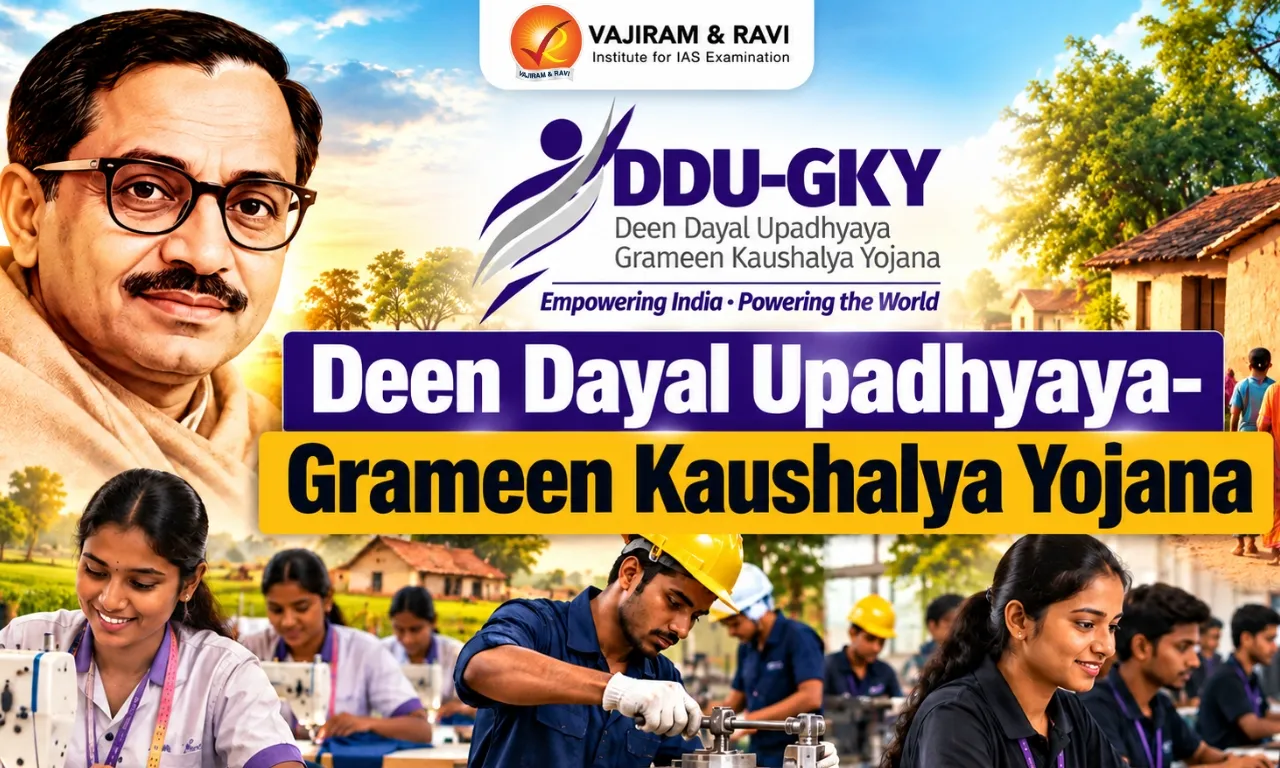
Deen Dayal Upadhyaya- Grameen Kaushalya Yojana

Deen Dayal Upadhyaya- Grameen Kaushalya Yojana

Deen Dayal Upadhyaya- Grameen Kaushalya Yojana Latest News

The Ministry of Rural Development is set to roll out Deen Dayal Upadhyaya- Grameen Kaushalya Yojana (DDU-GKY) 2.0 training batches across most of the States/UTs from October 2026 

About Deen Dayal Upadhyaya- Grameen Kaushalya Yojana 

  • It is a Centrally Sponsored Scheme launched on 25 September 2014, under the National Rural Livelihoods Mission.
  • It provides placement linked skill training to poor rural youth.
  • Nodal Ministry: Ministry of Rural Development
  • Key Features
    • Target: It has been providing placement-linked skill training to rural youth aged 15-35 years from poor households.
    • Social Inclusion: It also promotes social inclusion through mandatory coverage of SC/ST communities (50%), women (33%), and persons with disabilities (5%).
    • The Government notified the upgraded DDU-GKY 2.0 Guidelines in May 2025 and the framework provides training across multiple sectors based on industry requirements, including aerospace and aviation, agriculture, beauty and wellness, green jobs, healthcare, textiles, and others.

Initiatives under DDU-GKY 2.0

  • Roshni 
    • It addresses the specific needs of Left-Wing Extremism (LWE)-affected districts notified by the Ministry of Home Affairs.
    • It mandates residential skill training, with 40% coverage for women candidates. The initiative has been extended to Aspirational Districts, focusing on local infrastructure, education, health, natural resources, and traditional skills.
  • Himayat
    • It is a special DDU-GKY scheme for Jammu & Kashmir and Ladakh. It covers rural and urban youth, including BPL and APL persons, and supports wage, self, and gig employment. 
    • It is 100% centrally funded and implemented with State support through dedicated Mission Management Units.
  • North East: Acknowledging the challenges of unique topography of the North Eastern States, out of the total allocation for DDU-GKY, 10% is earmarked for the North-Eastern States.
  • Hard to reach Areas: There is provision for Special Area Allowance where Project implementing agencies shall be eligible for a payment at the rate of an additional 10% of the Base training cost per candidate.

Source: PIB

Deen Dayal Upadhyaya- Grameen Kaushalya Yojana FAQs

Q1: What is Deen Dayal Upadhyaya- Grameen Kaushalya Yojana?

Ans: It is a Centrally Sponsored Scheme launched on 25 September 2014, under the National Rural Livelihoods Mission.

Q2: Which is the nodal ministry of Deen Dayal Upadhyaya- Grameen Kaushalya Yojana?

Ans: Ministry of Rural Development

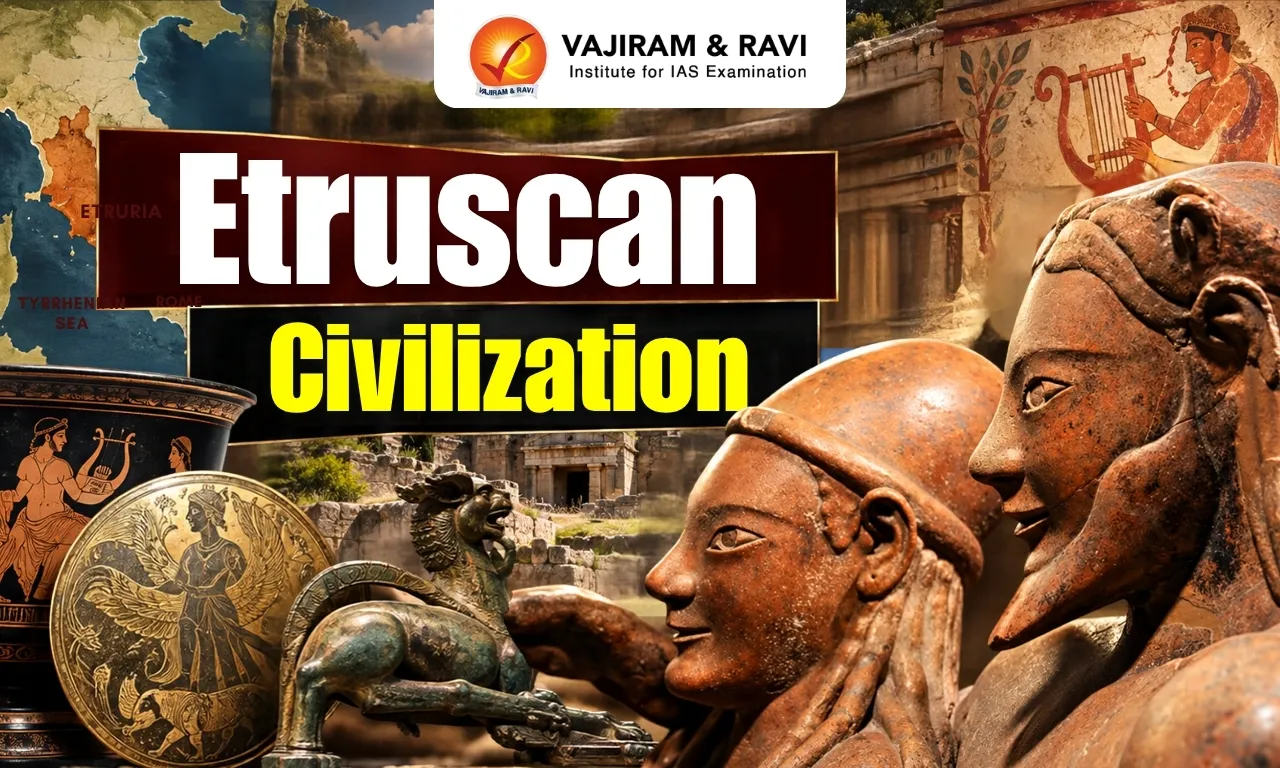
Etruscan Civilization

Etruscan Civilization

Etruscan Civilization Latest News

Archaeologists recently unearthed a monumental 2,700-year-old tomb at Vulci, an important ancient Etruscan town north of Rome.

About Etruscan Civilization

  • They were a pre-Roman Mediterranean civilization that flourished between the 8th and 3rd centuries BCE.
  • The Etruscans, also known as the Tyrrhenians, inhabited the area that is now Italy.
  • Their country was called Tuscia, or Etruria, which was located in the central part of the Italian peninsula. 
  • Etruria was bounded on the west by the Tyrrhenian Sea, on the north by the Arno River, and on the east and south by the Tiber River.
  • They played a significant role in the cultural and political development of early Rome. 
  • They established a confederation of twelve city-states. 
  • One of the key features of Etruscan society was their system of government. 
    • The Etruscans were ruled by a series of kings, who were elected by the members of the aristocratic families. 
    • This system of government was highly decentralised, with each city-state having its own king and its own system of laws and governance. 
  • Etruscan society was marked by a high degree of leisure and luxury, evident in their art, elaborate burial practices, and the status of women, who experienced more equality compared to many contemporary cultures. 
  • The Etruscans were skilled traders and builders, known for their wealth derived from local metal deposits and fertile agricultural land. 
  • The Etruscans possessed the biggest iron reserves in the whole of the western Mediterranean.
  • They had a strong navy and dominated the seas on the western coast of Italy.
  • They developed advanced architectural techniques, including the use of the arch and vault.
  • Etruscans were the first in the Mediterranean region to construct a city on the basis of a grid plan. 
    • In this plan, most of the streets were laid in a north-south direction with a few streets crossing them from the east-west direction. 
  • Despite their many accomplishments, the Etruscan civilization began to decline in the 5th c. BC, as they were gradually absorbed into the expanding Roman Republic. 
  • The Romans were heavily influenced by Etruscan culture and adopted many of their traditions and practices, such as their system of government, their religious beliefs, and urban planning.

News: LS

Etruscan Civilization FAQs

Q1: What was the Etruscan Civilization?

Ans: The Etruscan Civilization was a pre-Roman Mediterranean civilization that flourished between the 8th and 3rd centuries BCE.

Q2: Who were the Etruscans?

Ans: The Etruscans, also known as the Tyrrhenians, were a pre-Roman people who inhabited the region that is now Italy.

Q3: What was the country of the Etruscans called?

Ans: Their country was called Tuscia or Etruria.

Q4: How was the Etruscan system of government organised?

Ans: The Etruscans were ruled by kings who were elected by members of aristocratic families.

Q5: What was significant about Etruscan urban planning?

Ans: The Etruscans were among the first Mediterranean peoples to construct cities based on a grid plan.

National Commission for Allied and Healthcare Professions

National Commission for Allied and Healthcare Professions

National Commission for Allied and Healthcare Professions Latest News

Recently, the National Commission for Allied and Healthcare Professions (NCAHP) notified the Registration of Allied and Healthcare Professionals Regulations, 2026. 

About National Commission for Allied and Healthcare Professions

  • It is a statutory body established under the NCAHP Act 2021. 
  • It was established under the Ministry of Health and Family Welfare.
  • It aims to enhance the quality of healthcare services by ensuring that all practitioners in the allied health fields meet established national standards. 
  • It focuses on a broad range of professions which covers 57 Allied and Healthcare Professions categorized under 10 broad recognized categories.

Key Functions National Commission for Allied and Healthcare Professions 

  • Standardization: It provides a framework for the evaluation of educational institutions and training programs and ensures that practitioners are equipped with the necessary skills for high-quality patient care.
  • Registration and Accreditation: It oversees the registration, training, and accreditation of various allied healthcare practitioners. 
  • Continuous Professional Development:  It promotes continuous learning among allied healthcare professionals, encouraging them to update their skills in accordance with the latest advancements in the healthcare industry. 
  • Research and Development: It engages in research and development and adoption of latest scientific advancement and connected matters.

Source: TH

National Commission for Allied and Healthcare Professions FAQs

Q1: What is National Commission for Allied and Healthcare Professions?

Ans: It is a statutory body established under the NCAHP Act 2021. 

Q2: What is the aim of National Commission for Allied and Healthcare Professions?

Ans: It aims to enhance the quality of healthcare services by ensuring that all practitioners in the allied health fields meet established national standards. 

Tokay Gecko

Tokay Gecko

Tokay Gecko Latest News

Recently, the Directorate of Revenue Intelligence intercepted two persons at Bandar Chalia Gaon Ground, Mariani, Assam and seized 86 live Tokay Geckos from them.

About Tokay Gecko

  • The tokay gecko or gekko gecko is an arboreal lizard species.
  • It is one of the largest gecko species.
  • There are two variants of tokay geckos: a red-spotted and a black-spotted.
  • Appearance: Its body is bluish-grey with bright orange, red, or yellow spots.
  • Habitat: They live in tropical rainforests, rock crevices or manmade environments with a variety of microhabitats. 
  • Distribution:  They are found across southeast and east Asia.

Characteristics of Tokay Gecko

  • Males are highly territorial and will defend their chosen area against other geckos and intruders.
  • They are solitary, nocturnal hunters and are more likely to sit and wait for prey than to actively forage.
  • They use their nostrils and tongues together to capture scent particles and transfer them to the Jacobson's organ, allowing them to effectively "taste" the air.
  • The tokay gecko can cast off its tail in defense, breaking it off at several sections.
  • Communication: This species communicates vocally, using calls to find members of the opposite sex during the breeding season and as a means of defense. 
  • Diet: They are carnivores (insectivores) that feed mainly on insects and small vertebrates. 

Conservation Status of Tokay Gecko

Source: PIB

Tokay Gecko FAQs

Q1: What is Tokay Gecko?

Ans: The tokay gecko or gekko gecko is an arboreal lizard species.

Q2: Where do we find Tokay Gecko?

Ans: They live in tropical rainforests, rock crevices or manmade environments with a variety of microhabitats. 

Technology Development Fund Scheme

Technology Development Fund Scheme

Technology Development Fund Scheme Latest News

Recently, the Defence Research and Development Organisation has signed the “first high-value deep tech project agreement” with a start-up, collaborating for indigenous development of a dilution refrigerator under the Technology Development Fund (TDF) scheme. 

About Technology Development Fund Scheme

  • It has been established to promote self-reliance in Defence Technology as a part of the ‘Make in India’ initiative.
  • Objective: It encourages the participation of public/private industries, especially MSMEs and startups, so as to create an ecosystem for enhancing cutting-edge technology capability in the defence sector.
  • Project Duration: The maximum development period will be four (4) years.
  • Nodal Ministry: Ministry of Defence.
  • It is executed by DRDO to promote self-reliance in cutting-edge defence and aerospace technologies.
  • Funding Support
    • The project cost of up to INR 50 crore will be considered for funding.
    • The funding may be up to 90% of the total project cost.

Eligibility Criteria of Technology Development Fund Scheme

  • Entity Type 
    • A public limited company, a private limited company, a partnership firm, a limited liability partnership, a one-person company, or a sole proprietorship registered as per applicable Indian laws registered in India especially MSMEs and Startups.
    • The industry must be owned and controlled by a resident Indian citizen.
    • An entity with excess of 49 percent foreign investment is not eligible.
  • Start up
    • Startups must be recognized by the Department for Promotion of Industry and Internal Trade (DPIIT) as per Government of India (GOI) guidelines.
    • Startups incorporated for less than three years from date of submission of application will be considered as nascent startups.
    • A nascent Startup should be incubated at one of the Central/State government assisted incubators.
    • Startups should not have received any grants/grants-in-aid by any government scheme for a similar technology.
    • The startup must be owned and controlled by a Resident Indian citizen with a shareholding of at least 51%.

Source: PIB

Technology Development Fund Scheme FAQs

Q1: What is Technology Development Fund Scheme?

Ans: It has been established to promote self-reliance in Defence Technology as a part of the ‘Make in India’ initiative.

Q2: Which organisation is executing the Technology Development Fund Scheme?

Ans: Defence Research and Development Organisation

Exercise Varuna

Exercise Varuna 2025

Exercise Varuna Latest News

Recently, INS Trishul reached Toulon, France to participate in the exercise ‘VARUNA’.

About Exercise Varuna

  • It is the bilateral maritime exercise conducted between the Indian Navy and the French Navy.
  • This year it is the 24th edition of exercise Varuna.
  • Phases: It will witness professional engagements in harbour and at sea, including cross-deck visits, operational interactions and sporting engagements.
  • These engagements will provide opportunities for both Navies to share experiences and Best Practices, enhance interoperability and foster greater mutual understanding.
  • Other India-France Military Exercises
    • FRINJEX: Army Joint Exercise.
    • GARUDA: Air Force Exercise.

Key Facts about INS Trishul

  • It is a front-line Talwar-class guided missile frigate of the Indian Navy,
  • It joined the arsenal of the Indian Navy in 2003.
  • It is equipped for multi-dimensional maritime operations.
  • Capacity: It has a carrying capacity of 3,700-tonne.
  • Speed: It has a top speed in excess of 30 knots and an endurance of 30 days at sea.
  • Armaments
    • Trishul became the second Indian warship to incorporate an eight cell KBSM 3S-14NE Vertical Launcher.
    • It was the first to upload the new Indian/Russian designed missile, the supersonic BrahMos PJ-10 AShCM (anti-sub/ship/surface cruise missile).

Source: PIB

Exercise Varuna FAQs

Q1: What is Exercise Varuna?

Ans: It is the bilateral maritime exercise conducted between the Indian Navy and the French Navy.

Q2: What is the significance of Exercise Varuna?

Ans: It enhance interoperability and foster greater mutual understanding.

Daily Editorial Analysis 25 September 2026

Daily-Editorial-Analysis

Policing The Line Between Publicity And Justice

Context

  • Within minutes of an arrest anywhere in India, a face — handcuffed, flanked by policemen, sometimes garlanded with placards cataloguing the crime — starts circulating on social media, often before the accused is even produced before a magistrate.
  • A Supreme Court PIL seeking a nationwide media protocol for police briefings has forced a question Indian policing has quietly avoided: under what law is this done, should it be done, and where should it stop?
  • In this context, this article highlights the legal uncertainty surrounding police publicity of accused persons, examining investigative necessity, constitutional safeguards, presumption of innocence and the need for a uniform national protocol.

Why the Practice Exists

  • The justification for publicity is genuine. Photographs of wanted persons and reward notices have:
    • Solved crimes.
    • Helped recover missing children.
    • Brought fugitives to book years after trails went cold.
  • The public, once alerted, has achieved what a thinly stretched police force alone could not. But as the experts note, the justification is strong; the legal architecture is weak.

The Legal Patchwork

  • No single statute permits or prohibits police from publishing photographs of accused persons.
  • Instead, a patchwork of colonial-era regulations and general procedural powers is stretched to cover the practice.
  • Absconder Proclamations

    • Section 84 of the BNSS, 2023 (earlier Section 82 of the CrPC) allows courts to proclaim absconders and publish proclamations in newspapers.
    • It says nothing about photographs — attaching one is merely settled practice.
    • Crucially, this process triggers only after a warrant fails; it offers no legal basis for publicity at the earlier investigation stage.
  • Investigation-Stage Publicity

    • This rests on the general powers of an Investigating Officer (IO) — every person must assist police in preventing and investigating offences, and an IO may examine anyone with relevant information.
    • Publishing photographs to solicit identification or trace absconders is essentially a digital-age extension of the colonial-era "Hue and Cry Notice" found in State Police Manuals, whose broad language ("description of the subject") is stretched to plausibly cover photographs.
  • Reward Announcements

    • These announcements stand on firmer but narrower ground — governed by State Police Regulations under the Police Act, 1861, with sanctioning authority ranging from the Station House Officer (SHO) to the State government.
    • This requires no prior warrant; it is purely administrative discretion.
  • A Common Misconception

    • The Criminal Procedure (Identification) Act, 2022 governs the taking, storage and use of identification measurements, including photographs.
    • It is often wrongly cited as authorising their publication — but it says nothing about circulation at all.

The Constitutional Concern

  • Jurisprudence around Article 21 has sharpened, not softened, on this issue. The presumption of innocence remains central to criminal justice.
  • Courts increasingly recognise that broadcasting an arrested person's face as a fait accompli of guilt, before any charge is even framed, can cause real, irreversible harm.
  • The Rajasthan High Court termed such practices "institutional humiliation."
  • Digital circulation is permanent, searchable, and indifferent to a later acquittal — the damage cannot be undone even if the person is cleared.

Policy Developments So Far

  • July 2024: The Bureau of Police Research and Development (BPRD) prepared a draft manual on media briefings by police and shared it with the Ministry of Home Affairs.
  • January 2026: The Supreme Court noted that an amicus had prepared a Police Manual for Media Briefing and directed States to evolve appropriate policies based on it within three months.
  • Existing Absolute Red Lines
    • A juvenile in conflict with law cannot be identified except in the child's best interest, and only with the Juvenile Justice Board's permission.
    • A sexual assault survivor's identity is legally protected.
  • The real, unsettled debate concerns the ordinary adult — accused, arrested, but not yet tried.

The Distinction That Matters

  • Publication of an accused's photograph sits on a scale:
    • One end: Legitimate investigative necessity — crime prevention, public order, law-and-order purposes.
    • Other end: Showcasing police achievements — where photographs are released merely to serve police optics at the accused's expense, prejudicing public opinion before trial even begins.

How Other Countries Handle It

  • United States: "Wanted" notices are treated as public-record exceptions to privacy law, but agencies are trained to frame them carefully — using terms like "alleged" and "wanted for questioning" — to preserve the presumption of innocence even while seeking public help.
  • United Kingdom: A more conservative approach — police withhold arrested persons' identities altogether.

What Is Needed

  • An outright ban on soliciting public assistance would be legally unwarranted and self-defeating.
  • Instead, India needs a codified, uniform national protocol that:
    • Distinguishes proportionate, need-based disclosure from prejudicial publicity.
    • Mandates blackout categories — juveniles, sexual-offence complainants.
    • Requires time-bound review and takedown once the investigative purpose is served, or the accused is discharged or acquitted.
    • Applies uniformly across States, ending the current patchwork.

Conclusion

  • Public help has genuinely solved crimes — but convenience is not the same as legality.
  • Before any photograph goes out, one question should decide it: is the disclosure necessary to the investigation, or merely convenient to the narrative?
  • Until that question is codified into law, India's policing will keep confusing publicity with justice.

Policing The Line Between Publicity And Justice FAQs

Q1. Why do police publish photographs of accused persons?

Ans: Police publicity can help identify suspects, trace absconders, recover missing children, solve crimes and obtain public assistance during investigations.

Q2. Is there a specific law authorising police to publish accused persons' photographs?

Ans: No single statute expressly permits or prohibits publication; authorities rely on procedural powers, police manuals and regulations forming a legal patchwork.

Q3. What constitutional concern arises from police publicity?

Ans: Publicly portraying an accused as guilty can undermine the presumption of innocence and cause irreversible reputational harm through permanent digital circulation.

Q4. What safeguards already exist for certain individuals?

Ans: Juveniles cannot ordinarily be identified, while sexual assault survivors have legally protected identities under existing safeguards and judicial requirements.

Q5. What protocol does the article propose for police publicity?

Ans: The article proposes uniform rules distinguishing necessary disclosure from prejudicial publicity, with review, takedown requirements and protected categories.

Source: TH


Greater One-Horned Rhinoceros - From Recovery to Landscape-Level Conservation

Context

  • The Greater One-Horned Rhinoceros (Rhinoceros unicornis) is an iconic species of India’s Brahmaputra and Terai floodplains and grasslands.
  • Historically, its range extended across the northern Indian subcontinent along the Indus, Ganga and Brahmaputra river systems. Today, wild populations in India are concentrated mainly in Assam, Uttar Pradesh and West Bengal.
  • India’s conservation approach is increasingly shifting from merely protecting existing rhino populations to expanding the species across suitable parts of its historical range.

From Protection to Population Recovery

  • Rhino conservation in India is fundamentally a story of recovery. The population has increased by nearly 170% — from around 1,500 animals to more than 4,000 by September 2024.
  • To consolidate this recovery, the National Conservation Strategy for the Greater One-Horned Rhinoceros (2019) provides a long-term framework based on -
    • Strengthening existing populations.
    • Restoring suitable former habitats.
    • Maintaining genetic security and habitat connectivity.
    • Scientifically planned translocations.
    • Building climate resilience into conservation planning.
  • Phase I - 2026–2031

    • The proposed five-year Phase I programme, with ₹77.39 crore in support through the National CAMPA Authority, covers Assam, Arunachal Pradesh, Bihar, Uttar Pradesh and West Bengal.
    • Its priorities include scientific monitoring and protection, habitat restoration and management, translocation planning, community coexistence, and capacity building.
    • Expansion of rhino populations into suitable areas of Bihar and Arunachal Pradesh is also a priority.

Rhino Conservation is Equal to Ecosystem Conservation

  • The survival of the rhino is inseparable from the health of alluvial and Terai grasslands and wetlands.
  • These ecosystems also support species such as swamp deer, wild buffalo, elephants, tigers and grassland birds.
  • Grasslands are dynamic ecosystems and require active, science-based management to prevent habitat degradation, inappropriate ecological succession, and invasive species proliferation.
  • The Rhino Conservation Action Plan therefore focuses on mapping and assessing grasslands and wetlands, identifying invasive species, prioritising restoration sites and developing Protected Area-specific management protocols.

Comprehensive Assessment of Indian Grasslands

  • A complementary five-year initiative (2026–2031), with ₹20.86 crore, will assess Indian grasslands through the Wildlife Institute of India (WII), Indian Council of Forestry Research and Education (ICFRE) and Forest Survey of India (FSI).
  • It will examine grassland extent and ecological condition, biodiversity and degradation, ecosystem services, and carbon potential.
  • It is expected to contribute to a National Grassland Atlas, restoration priorities and long-term management guidelines.
  • This reflects a shift from species-centric conservation towards landscape-level and ecosystem-based conservation, where protecting a flagship species simultaneously safeguards wider ecological functions.

Climate Resilience and Technology

  • Flooding is a natural component of ecosystems such as Kaziranga, but increasing frequency and intensity of extreme climatic events can create additional conservation pressures.
  • Future conservation therefore requires access to higher ground, ecological connectivity, protection of dispersal routes, landscape-scale habitat management, and climate-resilient conservation planning.
  • Technology can further strengthen conservation through modern surveillance, spatial monitoring, veterinary diagnostics, genetic tools and decision-support systems.
  • However, technology cannot replace frontline personnel — forest guards, watchers, mahouts, veterinarians and field officers — who remain the foundation of wildlife protection.

Conservation at Different Levels

  • Communities as conservation partners:

    • Long-term rhino conservation depends on communities living around rhino habitats.
    • Conservation must therefore be treated as a shared enterprise, rather than merely a government activity.
    • Community participation can help address human-wildlife conflict, strengthen local stewardship and make conservation outcomes more sustainable.
  • Regional and international cooperation:

    • Rhino conservation also requires cooperation beyond administrative and national boundaries.
    • At the Second Asian Rhino Range States Conservation Meeting in New Delhi (2019), India, Bhutan, Indonesia, Malaysia and Nepal adopted the New Delhi Declaration to strengthen cooperation for Asian rhinoceros conservation.
    • Such cooperation is important for addressing shared challenges such as habitat fragmentation, illegal wildlife trade, genetic conservation and transboundary ecological connectivity.

Way Forward

  • India’s rhino recovery demonstrates that species decline is not necessarily irreversible when supported by sustained political commitment, scientific management and field-level protection.
  • The conservation of the Greater One-Horned Rhinoceros ultimately extends beyond a single species.
  • Protecting rhino habitats means protecting rivers, wetlands, grasslands, forests, biodiversity and local communities that form interconnected ecological landscapes.

Conclusion:

  • India’s recovery of the Greater One-Horned Rhinoceros is a significant conservation achievement.
  • The challenge now is to consolidate these gains while expanding populations into suitable historical habitats.
  • The rhino’s recovery is a national achievement; ensuring its long-term survival is a national responsibility.

Greater One-Horned Rhinoceros FAQs

Q1. What is the significance of the Greater One-Horned Rhino for India’s ecosystem?

Ans. It is a flagship species of the Brahmaputra and Terai landscapes, whose conservation ensures conservation of the entire ecosystem.

Q2. What are the objectives of the National Conservation Strategy for the Greater One-Horned Rhino?

Ans. It aims to strengthen existing populations, ensure habitat connectivity, scientific translocation, and climate resilience.

Q3. Why is grassland restoration crucial for rhino conservation?

Ans. Scientific management prevents degradation, invasive species and inappropriate ecological succession.

Q4. How is climate change influencing rhino conservation in India?

Ans. It necessitates higher-ground access, ecological connectivity, protection of dispersal routes, etc.

Q5. Why is community participation important for the long-term conservation of the Rhino?

Ans. Communities around rhino habitats are essential conservation partners, making wildlife protection a shared enterprise.

Source: IE

Daily Editorial Analysis 2026 FAQs

Q1: What is editorial analysis?

Ans: Editorial analysis is the critical examination and interpretation of newspaper editorials to extract key insights, arguments, and perspectives relevant to UPSC preparation.

Q2: What is an editorial analyst?

Ans: An editorial analyst is someone who studies and breaks down editorials to highlight their relevance, structure, and usefulness for competitive exams like the UPSC.

Q3: What is an editorial for UPSC?

Ans: For UPSC, an editorial refers to opinion-based articles in reputed newspapers that provide analysis on current affairs, governance, policy, and socio-economic issues.

Q4: What are the sources of UPSC Editorial Analysis?

Ans: Key sources include editorials from The Hindu and Indian Express.

Q5: Can Editorial Analysis help in Mains Answer Writing?

Ans: Yes, editorial analysis enhances content quality, analytical depth, and structure in Mains answer writing.

Asian Games 2026 Day 7, India Medal Tally, Results & Highlights

Asian Games 2026 Day 7

Asian Games 2026 Day 7 brought a strong start for the Indian contingent in Aichi-Nagoya, Japan, with India winning two shooting medals, including its second gold medal of the Games. Suruchi Singh and Kamaljeet won gold in the 10m air pistol mixed team event, while Niraj Kumar, Aishwary Pratap Singh Tomar and Rudrankksh Patil secured silver in the men’s 50m rifle 3 positions team event.

India also secured medals in table tennis and squash, while the women’s hockey team defeated Japan and the women’s kabaddi team reached the halfway point of its semifinal against Nepal with a 31-17 lead. Several Indian athletes also progressed in swimming, badminton and squash.

Asian Games 2026 Day 7 Highlights

The major highlights from India's campaign on Day 7 include:

  • Suruchi Singh and Kamaljeet won gold in the 10m air pistol mixed team event.
  • Niraj Kumar, Aishwary Pratap Singh Tomar and Rudrankksh Patil won silver in the men's 50m rifle 3 positions team event.
  • Manush Shah and Diya Chitale entered the mixed doubles table tennis semifinals, assuring India a medal.
  • Joshna Chinappa and Velavan Senthilkumar reached the mixed doubles squash semifinals, securing another medal.
  • India women's hockey team defeated Japan 3-1.
  • India women's kabaddi team led Nepal 31-17 at half-time in the semifinal.
  • Abhay Singh reached the men's singles squash semifinals.
  • Anahat Singh defeated Tanvi Khanna and entered the women's singles squash semifinals.
  • Sajan Prakash qualified for the men's 200m butterfly final.
  • Unnati Hooda began her badminton singles campaign with a straight-games victory.
  • India's men's foil and women's epee teams were eliminated in the round of 16.

India’s Second Gold Medal at Asian Games 2026

Suruchi Singh and Kamaljeet won India's second gold medal of the Asian Games in the 10m air pistol mixed team event.

The Indian pair scored 484.6 points in the final to finish ahead of South Korea, which won silver. The duo had qualified for the final after scoring 587 points in qualification, equalling the Asian record.

The gold was particularly significant because both shooters had faced disappointment in their individual events. Paired at the last minute, they converted their second opportunity into a gold medal for India.

India Wins Silver in Men’s 50m Rifle 3 Positions Team Event

India also won a silver medal in the men's 50m rifle 3 positions team event.

The Indian team comprising Niraj Kumar, Aishwary Pratap Singh Tomar and Rudrankksh Patil finished with 1762 points, narrowly behind China, which scored 1766 points to win gold.

Niraj Kumar and Aishwary Pratap Singh Tomar also qualified for the individual final, while Rudrankksh Patil finished ninth with a score of 585.

Manush Shah and Diya Chitale Assure Table Tennis Medal

Manush Shah and Diya Chitale created a significant moment in Indian table tennis by reaching the mixed doubles semifinals.

The Indian pair defeated Hong Kong's Wong Chun-Ting and Doo Hoi Kem to secure a medal. It will be India's second mixed doubles medal in table tennis at the Asian Games, following the bronze won by Sharath Kamal and Manika Batra in Jakarta. It is also India's fourth table tennis medal in Asian Games history.

The pair will face China's Wang Chuqin and Sun Yingsha in the semifinal.

Meanwhile, Harmeet Desai and Yashaswini Ghorpade lost their mixed doubles quarterfinal against China's Lin Shidong and Kuai Man in straight games.

Squash Produces Two More Medal Assurances

India also secured medals in squash on Day 7.

Joshna Chinappa and Velavan Senthilkumar defeated the Philippines' David Pelino and Jemyca Aribado 11-3, 11-5 to reach the mixed doubles semifinals. The pair will face Hong Kong's Lee Ka Yi and Tang Ming Hong in the semifinal.

In men's singles, Abhay Singh defeated Japan's Ryunosuke Tsukue in straight games to enter the semifinals.

Anahat Singh also progressed to the women's singles semifinals after defeating compatriot Tanvi Khanna 11-2, 11-5, 11-3. She will face Japan's Satomi Watanabe in the next round.

India Women Defeat Japan in Hockey

The Indian women's hockey team defeated hosts Japan 3-1 in their penultimate Pool B match.

Before the match, both India and Japan had nine points and were at the top of the pool standings. The victory helped India maintain its position at the top of the group.

India Women Lead Nepal in Kabaddi Semifinal

The Indian women's kabaddi team made a strong recovery after a slow start against Nepal in the semifinal.

India led 31-17 at half-time, after Nepal initially managed to collect points through raids. India's defence improved as the first half progressed, allowing the team to establish a significant lead.

The Indian men's kabaddi team was also scheduled to face Thailand in its semifinal.

Swimming: Sajan Prakash Qualifies for Final

Indian swimmer Sajan Prakash qualified for the men's 200m butterfly final after clocking 2:00.94 in the heats.

Rishabh Das and Utkarsh Patil also qualified for the men's 200m backstroke final. Das finished fourth overall in the heats with a time of 2:00.53, while Patil qualified ninth with 2:02.13.

However, India missed out on the men's 400m freestyle final, with Dhanashan Shashikumar and Aneesh Gowda finishing 18th and 17th respectively. Dhanush Suresh also failed to qualify for the 50m breaststroke final.

Badminton: Unnati Hooda Starts with a Win

Unnati Hooda began her women's singles campaign with a comfortable victory over North Korea's Yu Mi Song.

She won the match 21-9, 21-10 in straight games. India's mixed doubles pair of Dhruv Kapila and Tanisha Crasto also defeated Maldives' Aminath Abdul Razzaq and Nibal Ahmed 21-8, 21-7 in the first round.

Fencing: India Knocked Out in Two Team Events

India suffered defeats in both team fencing events on Day 7.

The men's foil team lost 27-45 to Hong Kong, while the women's epee team was defeated 29-45 by Uzbekistan in the round of 16.

The Indian men's foil team included Aditya, Hemash Singh Sanasam and Sachin, while the women's epee team featured Taniksha Khatri, Yashkeerat Kaur Hayer and Mitva Jesangbhai Chaudhari.

Surfing Makes Asian Games Debut

Surfing made its Asian Games debut at Aichi-Nagoya on September 25.

Indian surfers Sugar Shanti Gayen and Kamali Prakash competed in the women's shortboard opening-round heats. Gayen scored 3.84 and finished third in her heat, while Kamali scored 3.74. Both were scheduled to return for the second-round heats.

India's men's challenge in surfing includes Kishore Kumar Anbarashu and Sivaraj Babu.

India’s Medal Tally on Day 7

Before the start of Day 7, India had 17 medals, including one gold. The Indian Express live update recorded India's medal tally at 19 medals after the two shooting medals won on Day 7. The tally comprised 2 gold, 7 silver and 10 bronze medals.

Medal

Number

Key Events

Gold

2

Women's cricket; 10m air pistol mixed team

Silver

7

Shooting, weightlifting, wushu, athletics

Bronze

10

Shooting, MMA, badminton, soft tennis, rowing and athletics

Total

19

As of the latest Day 7 update


Related Articles
Asian Games 2026 Asian Games 2026 India Schedule
Asian Games 2026 Medal Tally Asian Games 2026 Sports List
Asian Games 2026 Indian Cricket Team India's medals at Asian Games 2026
Asian Games 2026 Day 3 Asian Games 2026 Day 4
Asian Games 2026 Day 5 Asian Games 2026 Day 6
   

Asian Games 2026 Day 7 FAQs

Q1: What is the date of Day 7 of the Asian Games 2026?

Ans: Day 7 of the Asian Games 2026 is being held on 25 September 2026 in Aichi-Nagoya, Japan.

Q2: How many medals did India win on Day 7 of the Asian Games 2026?

Ans: India won two medals in shooting on Day 7: a gold medal in the 10m air pistol mixed team event and a silver medal in the men’s 50m rifle 3 positions team event.

Q3: Who won India’s second gold medal at the Asian Games 2026?

Ans: Suruchi Singh and Kamaljeet won India’s second gold medal in the 10m air pistol mixed team event on Day 7.

Q4: Who won silver for India in shooting on Day 7?

Ans: Aishwary Pratap Singh Tomar, Rudrankksh Patil and Niraj Kumar won the silver medal in the men’s 50m rifle 3 positions team event.

Q5: Which Indian table tennis pair assured a medal on Day 7?

Ans: Manush Shah and Diya Chitale assured India a medal by reaching the mixed doubles semifinals.

Make in India at 12 – Manufacturing Growth, Achievements and Challenges

Make in India

Make in India Latest News

  • Make in India, launched on 25 September 2014, has completed 12 years amid significant gains in manufacturing capacity but continuing challenges in investment, exports and the sector's overall economic contribution.

Make in India: Objectives and Evolution

  • Make in India was launched to position India as a global hub for manufacturing, design and innovation. 
  • Its initial focus was on facilitating investment, fostering innovation, developing infrastructure and improving business processes.
  • The initiative was later expanded under Make in India 2.0, which covers 27 sectors, including 15 manufacturing and 12 services sectors. 
  • The manufacturing ecosystem has also been supported by initiatives such as the Production Linked Incentive (PLI) schemes, National Single Window System (NSWS), PM GatiShakti and India Industrial Land Bank.

Manufacturing Growth and Sectoral Gains

  • Manufacturing GVA at constant prices recorded a 10.88% CAGR between 2022-23 and 2025-26 under the revised national accounts series.
  •  The manufacturing component of the Index of Industrial Production also grew 7% during April-July 2026 compared with the corresponding period of 2025. 
  • Several sectors have recorded substantial increases:
  • Electronics
    • Electronics production increased nearly sevenfold, from approximately Rs. 1.9 lakh crore in 2014-15 to Rs. 13.11 lakh crore in 2025-26. 
    • Mobile-phone production increased around 33 times, from Rs. 18,000 crore to Rs. 6.27 lakh crore, making India the world's second-largest mobile-phone manufacturer by volume. 
  • Automobiles and Pharmaceuticals
    • Vehicle production reached 31.03 million units in 2024-25, around 33% higher than in 2014-15. 
    • India's pharmaceutical industry recorded annual turnover of Rs. 4,71,898 crore in 2024-25, while domestic medical-device manufacturing increased from Rs. 28,000 crore in 2019-20 to Rs. 41,500 crore. 
  • Steel and Defence
    • Crude steel production increased from 81.7 million tonnes in 2014-15 to 170 million tonnes in 2025-26. 
    • Indigenous defence production rose from Rs. 46,429 crore to Rs. 1.78 lakh crore over the same period. 
  • Components and Strategic Technologies
    • Manufacturing capabilities are increasingly extending beyond finished goods. 
    • Solar-module manufacturing capacity rose from 2.3 GW in 2014 to 192 GW by June 2026, while solar-cell capacity increased from 1.2 GW to about 30 GW. 
    • India has also developed indigenous microprocessors for space applications and established a pilot facility for Nd-Fe-B rare-earth permanent magnets. 

Investment and PLI Schemes

  • The 14 PLI schemes attracted Rs. 2.40 lakh crore in investment, generated more than Rs. 22.66 lakh crore in production and sales, supported over Rs. 15.20 lakh crore in exports and created more than 14 lakh jobs as of June 2026. 
  • However, the gains are concentrated. Solar modules, pharmaceuticals, automobiles and components, speciality steel and large-scale electronics account for nearly 83% of PLI investment. 

Key Challenges

  • The broader data presents a more mixed picture. Manufacturing has not materially increased its share of India's economic output, employment or global exports over the period examined. 
  • Under the revised national accounts, its share in GVA increased only marginally from 14.6% in 2022-23 to 15.6% in 2025-26. 
  • Non-petroleum goods exports increased from $253.5 billion in 2014-15 to $388.3 billion in 2025-26, but India's share of global merchandise exports remained around 1.7%, the same level as in 2013. 
  • Private-sector GFCF as a share of GDP has declined in recent years. Manufacturing FDI has also grown more slowly than overall FDI in seven of the 12 years examined. 
  • Capacity utilisation has improved but remains below the 80% level generally associated with fresh capacity creation. 

Recent Policy Push

  • The next phase increasingly focuses on domestic value addition and strategic capabilities. 
  • Semicon 2.0 has an allocation of Rs. 1,27,500 crore for semiconductor design, manufacturing, packaging, materials, equipment, research and talent. 
  • BHAVYA has Rs. 33,660 crore for 100 investment-ready industrial parks, while Rs. 7,280 crore has been allocated for integrated manufacturing of sintered rare-earth permanent magnets. 

Way Forward

  • India's manufacturing strategy needs to move from increasing production to building competitive domestic value chains. 
  • Greater private investment, stronger component ecosystems, higher capacity utilisation, technology development and deeper integration with global value chains will be important.

Conclusion

  • Twelve years of Make in India have created significant manufacturing capabilities across electronics, automobiles, pharmaceuticals, steel, defence and strategic technologies. 
  • However, the evidence also shows that these gains have not yet translated into a proportionate increase in manufacturing's share of economic output, investment and global exports. 
  • The next phase must therefore focus on broad-based and technology-intensive manufacturing growth.

Source: TH | PIB

Make in India FAQs

Q1: When was Make in India launched?

Ans: Make in India was launched on 25 September 2014 to establish India as a global manufacturing, design and innovation hub.

Q2: How many sectors are covered under Make in India 2.0?

Ans: Make in India 2.0 covers 27 sectors, comprising 15 manufacturing and 12 services sectors.

Q3: How much investment has the PLI scheme attracted?

Ans: The 14 PLI schemes attracted ₹2.40 lakh crore in investment as of June 2026.

Q4: What is India's share of global merchandise exports?

Ans: India's share of global merchandise exports remained around 1.7% in 2025-26, similar to its share in 2013.

Q5: What is the major challenge for Make in India?

Ans: The major challenge is converting sector-specific production gains into broader growth in manufacturing's output, investment, employment and global export share.

Cyclone Arnab 2026, Location, Naming, Tracker, Latest Updates

Cyclone Arnab

Cyclone Arnab 2026 refers to the weather system over the Bay of Bengal that has attracted attention as the next possible cyclone name. However, the system remains a deep depression and is not classified as a cyclonic storm. It is moving towards the north Andhra Pradesh-South Odisha coast, with landfall expected near Kalingapatnam between Visakhapatnam and Gopalpur.

Cyclone Arnab Latest Updates

According to the latest IMD Tropical Weather Outlook issued on September 25, 2026, the system has moved north-northwestwards and weakened from a deep depression into a depression over south interior Odisha and adjoining south Chhattisgarh. At 05:30 AM on September 25, it was located close to Nuapada in Odisha and about 120 km southeast of Raipur in Chhattisgarh.
The system is very likely to continue moving north-northwestwards and maintain depression intensity for the next 12 hours. It is then expected to weaken into a well-marked low-pressure area during the following 12 hours.

Cyclone Arnab 2026

The Cyclone Arnab 2026 system is located over the westcentral and adjoining northwest Bay of Bengal and is being monitored continuously by IMD.

  • Cyclone Classification: The India Meteorological Department has indicated that the system is unlikely to intensify into a cyclone before landfall. Therefore, it is expected to retain deep depression status.
  • Name Arnab: The name Arnab means ocean in Bengali. The name was contributed by Bangladesh for the regional tropical cyclone naming system.
  • Formation Background: The system developed over the Bay of Bengal and intensified from a depression into a deep depression before approaching the north Andhra Pradesh-South Odisha coast.
  • Monitoring System: The system is under continuous observation by the Doppler Weather Radar at Visakhapatnam. Radar monitoring is tracking its movement and structure near the coast.
  • Wind Conditions: Strong winds are expected along the affected coastal areas. The Bay of Bengal Deep Depression 2026 may produce gusty winds along with heavy rainfall during its approach and landfall.

Cyclone Arnab Impacts

The main concern from the Cyclone Arnab system is heavy rainfall, strong winds, rough seas, flooding and localised landslide risks across affected areas.

  • Odisha Impact: Odisha remains among the worst-affected regions. Heavy to very heavy rainfall is expected in several areas, with extremely heavy rainfall possible at isolated places.
  • Red Alert Areas: Koraput, Gajapati and Ganjam faced warnings for heavy to very heavy rainfall and isolated extremely heavy rainfall on September 24.
  • Further Rainfall: Kalahandi, Nabarangpur, Koraput and Malkangiri are expected to receive heavy rainfall during September 24-25.
  • Andhra Pradesh: Coastal Andhra Pradesh is also experiencing the system's effects. Squally weather and strong winds are expected along and off the south Odisha-north Andhra Pradesh coasts.
  • West Bengal: Parts of West Bengal are expected to receive heavy to very heavy rainfall. Darjeeling and Kalimpong were also under landslide warnings.
  • Flood Risk: Heavy rainfall can increase water levels in rivers, water bodies and dams. Low lying areas may face waterlogging and local flooding during intense rainfall.
  • Landslide Risk: Odisha authorities identified 140 landslide prone areas in Gajapati. Rain related risks were also reported from Ganjam, Malkangiri, Koraput, Rayagada and Nabarangpur.
  • Sea Conditions: Very rough seas are expected over the westcentral and northwest Bay of Bengal until the evening of September 24. Coastal waters may gradually improve afterwards.
  • Local Damage: Heavy rain has already resulted in reports of trees being uprooted, houses being damaged, rainwater entering homes and muddy water flowing down hills.

Cyclone Arnab 2026 Management

Preparedness of Cyclone Arnab 2026 focuses on evacuation, shelter management, emergency services, weather monitoring, essential supplies and protection of vulnerable communities.

  • Evacuation: About 8,000 people were moved to safer locations in Odisha. Pregnant women and elderly persons were among those shifted to cyclone centres and temporary relief camps.
  • Emergency Services: Essential supplies, equipment, health services and emergency teams were kept ready. Disaster mitigation teams were placed on high alert for rapid response.
  • Shelter Preparedness: Cyclone and flood shelters were kept ready in vulnerable districts. Temporary relief camps were also arranged for evacuated residents.
  • Vulnerable Areas: Authorities restricted access to identified landslide prone locations. Continuous monitoring was carried out in areas considered vulnerable to landslides and mudslides.
  • Water Monitoring: Officials monitored water levels in rivers, water bodies and dams to identify possible flood risks during periods of intense rainfall.
  • Public Safety: People were advised to stay indoors during strong winds. They should avoid windows, damaged structures, trees, large hoardings, floodwater and exposed electrical equipment.
  • Emergency Kit: Residents should keep drinking water, food, medicines, first aid supplies, torches, batteries, candles, matches and power banks ready for at least two to three days.
  • Evacuation Rules: People in coastal, low lying and flood prone areas should immediately follow evacuation orders. They should move to designated shelters or safer higher ground.

Cyclone Arnab Tracker

The Cyclone Arnab 2026 is being tracked by the latest monitoring systems of the India Meteorological Department Doppler Weather Radar. It’s latest updates are shared to the authorities to improve and monitor preparations to reduce the impacts of the storm.

  • Current Bay of Bengal Deep Depression 2026 Status: According to the IMD update of September 25, 2026, the system has weakened from a deep depression into a depression over south interior Odisha and adjoining Chhattisgarh.
  • Landfall Location: The system crossed between Visakhapatnam and Gopalpur, close to Kalingapatnam, after moving west-northwestwards towards the coast.
  • Post-Landfall Movement: The system is now moving north-northwestwards after landfall. IMD expects it to maintain depression intensity for the next 12 hours and then weaken into a well-marked low-pressure area during the subsequent 12 hours.
  • Wind Forecast: At 05:30 AM on September 25, the depression had maximum sustained surface winds of 45-55 kmph, gusting to 65 kmph. IMD forecasts winds of 35-45 kmph, gusting to 55 kmph, by 05:30 PM on September 25, followed by further weakening.
  • Preparedness: Odisha placed collectors of 11 districts on high alert. Cyclone and flood shelters were kept ready, while at least 5,000 people were moved to safer locations.
  • Post-Landfall Monitoring: Authorities continue to monitor the system as it moves inland across Odisha and adjoining Chhattisgarh. IMD expects associated extreme weather over east, east-central and subsequently adjoining northern plains during the next 3-4 days.
  • Current Location: As of September 25, the depression was located near 20.5°N and 82.5°E, close to Nuapada in Odisha.
  • Expected Weakening: The system is likely to weaken further because of its movement over land. IMD forecasts that it will become a well-marked low-pressure area by September 26, 2026.

Cyclone Arnab 2026 FAQs

Q1: What is Cyclone Arnab 2026?

Ans: Cyclone Arnab 2026 refers to the deep depression over the Bay of Bengal approaching the north Andhra Pradesh-South Odisha coast.

Q2: Where is Cyclone Arnab now?

Ans: As of 25 September 2026, The depression is currently over south interior Odisha and adjoining Chhattisgarh, near 20.5°N and 82.5°E, close to Nuapada in Odisha

Q3: Did Cyclone Arnab make landfall?

Ans: The system crossed the Andhra Pradesh-Odisha coast near Kalingapatnam during the early hours of September 24, 2026, as a deep depression.

Q4: What is the latest status of Cyclone Arnab 2026?

Ans: As of 25 September 2026, The system is moving north-northwestwards and is expected to maintain depression intensity for the next 12 hours before weakening into a well-marked low-pressure area.

Q5: Who named Cyclone Arnab?

Ans: The name Arnab, meaning ocean in Bengali, was contributed by Bangladesh.

Chief Election Commissioner Gyanesh Kumar Removal Process

Chief Election Commissioner

Chief Election Commissioner Latest News

  • The Opposition will soon move a motion in both Houses of Parliament to remove Chief Election Commissioner (CEC) Gyanesh Kumar. 
  • This follows an Indian Express investigation revealing internal criticisms raised by Election Commissioners Sukhbir Singh Sandhu and Vivek Joshi against the ECI's decisions and processes over recent months.

Structure of the Election Commission

  • The ECI has three Election Commissioners, including the CEC.
    • The CEC is "first among equals" — not necessarily the seniormost member.
    • Decisions are to be taken unanimously by all three, as far as possible.
  • This structural detail matters because internal dissent from two Commissioners against the CEC's decisions is itself unusual and significant.

How Election Commissioners Are Appointed

How a CEC Can Be Removed

  • The removal bar is deliberately set very high, to shield the ECI from political pressure.
  • Constitutional Basis - Article 324(5) states the CEC can be removed only "in like manner and on the like grounds as a Judge of the Supreme Court." 
    • This is echoed in Section 11(2) of the 2023 Act. 
    • Notably, any other Election Commissioner can be removed only on the CEC's own recommendation — a different, lower threshold.
  • Grounds For Removal - Borrowing from Article 124(4) (the process for removing a Supreme Court judge), removal requires "proved misbehaviour or incapacity."
    • Misbehaviour can include corrupt practices or abuse of office. 
    • Courts have interpreted this to also cover actions incompatible with the CEC's office, or failure to discharge official duties.
    • Incapacity refers to an inability to perform duties.

Also Read:- Election Commission SIR Row

The Step-by-Step Removal Process

  • Notice of Motion - Members of Parliament must bring a notice of motion explicitly alleging misbehaviour or incapacity.
  • Admission Threshold - The motion needs signatures from at least 100 MPs in the Lok Sabha or 50 MPs in the Rajya Sabha to be admitted.
  • Presiding Officer's Discretion - The Speaker/Chairman can consult people and materials before deciding whether to admit or reject the motion.
  • Inquiry - If admitted, a committee is formed to investigate the evidence of misbehaviour or incapacity.
  • Parliamentary Vote - The motion must be passed by a two-thirds majority "present and voting" in both Houses.
  • Presidential Order - Once passed, the President orders the removal. At this final stage, the President has no discretion — the President acts strictly on Parliament's advice.

Has a CEC Ever Been Removed?

  • No. No Chief Election Commissioner has ever been impeached in India.
  • A recent attempt failed at the first hurdle. In March 2026, the Opposition in submitting impeachment motions in both Houses — 130 MPs signed in the Lok Sabha, 63 in the Rajya Sabha. 
  • These motions cited the ECI's ongoing Special Intensive Revision (SIR) of electoral rolls, alleging "partisan and discriminatory conduct" by the CEC and "obstruction of investigation into electoral fraud and SIR."
  • In April 2026, both the Rajya Sabha Chairman and Lok Sabha Speaker rejected these impeachment motions, without assigning any reason — a decision the Opposition criticised.

What's New Now

  • The fresh push follows the Indian Express investigation's revelation that the two other Election Commissioners themselves raised internal concerns about SIR-related processes.
  • This development gives the Opposition's renewed demand for removal additional weight, since the criticism now comes from within the Commission itself, not only from political rivals.

Conclusion

  • The removal bar for a CEC is constitutionally identical to that for a Supreme Court judge — by design, nearly impossible to clear. That very difficulty is meant to protect the ECI's independence from political vendettas. 
  • But when internal dissent from sitting Commissioners joins the Opposition's criticism, the question shifts from procedure to substance: is this safeguard protecting independence, or shielding unaccountability?

Source: IE

Chief Election Commissioner FAQs

Q1: How can the Chief Election Commissioner be removed from office?

Ans: The Chief Election Commissioner can be removed through a parliamentary process based on proved misbehaviour or incapacity, followed by a presidential removal order.

Q2: What grounds are required to remove the Chief Election Commissioner?

Ans: The Chief Election Commissioner can be removed only for proved misbehaviour or incapacity, following the constitutional standard applicable to Supreme Court judges.

Q3: How many MPs must support a removal motion?

Ans: A removal motion requires signatures from at least 100 Lok Sabha MPs or 50 Rajya Sabha MPs before it can be admitted.

Q4: What majority is required to remove the Chief Election Commissioner?

Ans: Removal requires the motion to secure a two-thirds majority of members present and voting in both Houses of Parliament.

Q5: Has any Chief Election Commissioner ever been removed in India?

Ans: No Chief Election Commissioner has ever been removed in India, although removal motions were submitted in both Houses during March 2026.

Blue Bonds in India: Financing the Ocean Economy Through Capital Markets

Blue Bonds

Blue Bonds Latest News

  • India's maiden blue bond, under the Sagarmala programme, seeks to bring the ocean economy to the capital markets. Doubts linger on its timing, given signs of hardening global interest rates. 
  • As much as ₹1,000 crore is slated to be raised through a blue bond issuance by Sagarmala Finance Corporation Ltd. (SMFCL), the financing arm associated with Sagarmala — one of the critical components of India's mammoth multimodal infrastructure programme, PM GatiShakti.

About Blue Bond

  • Like a conventional bond, a blue bond is an instrument through which an issuer raises money from investors, promising periodic interest and repayment of principal at maturity. 
  • The difference lies in its environmental purpose: proceeds must go towards clearly identified water- and ocean-related projects.
  • Key requirements for issuers:
    • A framework explaining where the money will be invested.
    • Impact measurement mechanisms.
    • Periodic reporting, to avoid "bluewashing" — the water-sector equivalent of greenwashing.
      • Greenwashing is the deceptive practice of making a product, service, or company appear more environmentally friendly than it actually is.
  • The Securities and Exchange Board of India (SEBI) has already recognised blue bonds as part of sustainable finance instruments and highlighted their potential for India's blue economy.

Why Sagarmala Needs This Bond

  • The government aims to significantly increase the maritime sector's contribution to GDP by expanding ports, inland waterways, shipbuilding and coastal infrastructure — all of which require massive capital.
  • For SMFCL specifically, the bond serves a strategic financial purpose: correcting an asset-liability mismatch. 
  • Its infrastructure loans span around 12 years, while its existing borrowing tenure is shorter. A longer-duration bond would:
    • Better match the maturity of assets and liabilities.
    • Diversify borrowing sources.
    • Attract investors such as insurance companies, pension funds, and global sustainability-focused funds.

Important Caveat

  • Not all Sagarmala projects qualify for blue bond financing — only those demonstrating measurable ocean or water-related sustainability outcomes are eligible. 
  • It should be noted that the proposed ₹1,000 crore issuance represents just 0.17% of Sagarmala's total identified project cost (over ₹6 lakh crore). 
  • Its significance lies in the precedent it sets, since infrastructure financing with long gestation periods has traditionally relied on bank loans, budgetary support and conventional bonds.

Who Stands to Benefit

  • Sagarmala has identified over 200 projects under coastal shipping and inland water transport. Key beneficiary segments:
    • Ro-Ro and Ro-Pax ferry services
    • Inland water terminals
    • Coastal cargo movement
    • Cruise infrastructure — including terminals at Mumbai, Kochi and Chennai
  • Port modernisation is the largest investment segment under Sagarmala, worth nearly ₹2.9 lakh crore. 
  • Future investments could include energy-efficient cargo handling, electrification of port operations, shore power facilities for vessels, and cleaner logistics systems. 
  • Fishing harbour upgrades and coastal livelihood programmes, needing more modest capital, are also well-suited to blue bond financing.

Global Experience with Blue Bonds

  • According to the World Bank, cumulative blue bond issuance crossed $15 billion by mid-2025, up sharply from about $222 million in 2018. 
  • Most issuances have come from emerging markets with large marine ecosystems and climate vulnerability.
    • October 2018 - Seychelles, with World Bank support, issued the world's first sovereign blue bond.
    • 2019 - Nordic Investment Bank issued one of the earliest institutional blue bonds.
    • 2021 - Belize restructured ~$553 million of external debt with support from The Nature Conservancy — billed as the largest ocean conservation-linked transaction.
  • The US, despite deep municipal bond markets, has historically lagged Asia and Europe in blue-labelled issuance, though activity is rising. 
  • Asia-Pacific now accounts for the largest share of cumulative blue and water-labelled bonds.

Why Blue Bonds Lag Behind Green Bonds

  • Several structural challenges hold the segment back:
    • No standard definition — there is no universally accepted "blue taxonomy," unlike established green bond standards.
    • Valuation difficulty — it is hard to attach pecuniary value to coral restoration, biodiversity improvement, or fish stock recovery.
    • Narrow investor base — most blue bonds are bought by specialised impact investors, not mainstream pension funds.
    • Project readiness gap — many countries have ocean strategies but lack investment-ready projects.

India's Blue Bond Pipeline

  • India's pipeline of potential blue bond issuers is still at an early stage. Unlike green bonds — where Indian issuers have already raised thousands of crores — blue bonds are only now moving from concept to first issuance.
  • The Scale of Opportunity: No official market-size forecast exists yet, since large-scale issuance hasn't begun. But the potential is significant — India has a coastline of about 7,500 km, and around 95% of trade by volume moves through maritime routes.

Conclusion

  • SMFCL's blue bond is small in size but large in intent — the first test of whether India's ocean economy can tap capital markets directly. 
  • Its success will determine whether blue bonds become a mainstream infrastructure financing tool, or remain a niche sustainability product limited to specialised investors.

Source: TH

Blue Bonds FAQs

Q1: What are blue bonds?

Ans: Blue bonds are debt instruments that raise capital for clearly identified ocean- and water-related projects while requiring impact measurement and periodic reporting.

Q2: Why is India issuing blue bonds through Sagarmala?

Ans: Blue bonds can provide Sagarmala with longer-duration financing, diversify borrowing sources and better match infrastructure loans with their long-term asset maturities.

Q3: How much is India's proposed blue bond issuance?

Ans: India's proposed blue bond issuance through Sagarmala Finance Corporation Ltd. is ₹1,000 crore, representing a small share of identified Sagarmala projects.

Q4: What projects can receive blue bond financing?

Ans: Eligible projects include sustainable ports, inland waterways, cleaner logistics, energy-efficient cargo handling, fishing harbour upgrades and coastal livelihood programmes.

Q5: Why do blue bonds lag behind green bonds?

Ans: Blue bonds face challenges including the absence of a universal taxonomy, difficult environmental valuation, limited investors and insufficient investment-ready ocean projects.

Asian Games 2026 Medal Tally, Country-Wise Medals and Rankings

Asian Games 2026 Medal Tally

Asian Games 2026 Medal Tally is updated as athletes from across Asia compete for medals at the 20th Asian Games in Aichi-Nagoya, Japan. The Asian Games 2026 are being held from 19 September to 4 October 2026. The event features 43 sports, 71 disciplines and 469 medal events.

China, Japan, South Korea and other Asian countries are competing across multiple sports. The medal table ranks countries based primarily on the number of gold medals, followed by silver and bronze medals. 

India has won 15 medals at the Asian Games 2026, including 1 gold medal, 6 silver medals and 8 bronze medals. Indian athletes have earned these medals across events such as shooting and mixed martial arts.

Asian Games 2026 Medal Tally

The following is the Asian Games 2026 medal tally based on the latest figures provided as of 24th September 2026.

Rank Country Gold Silver Bronze Total
1 China 85 30 20 134
2 Japan 21 36 38 95
3 South Korea 11 14 29 54
4 Kazakhstan 8 8 10 26
5 Uzbekistan 6 15 8 29
6 Iran 6 10 6 22
7 Thailand 6 4 7 17
8 Hong Kong, China 4 10 9 23
9 North Korea 3 3 3 9
10 Bahrain 3 2 0 5
11 Malaysia 3 1 5 9
12 India 2 8 9 19
13 Kuwait 2 1 2 5
14 Qatar 2 1 1 4
15 Tajikistan 2 1 1 4
16 Indonesia 1 4 17 22
17 Chinese Taipei 1 4 12 17
18 Macao, China 1 4 1 6
19 Singapore 1 3 2 6
20 Vietnam 1 1 16 18
21 Philippines 1 1 4 6
22 Jordan 1 1 1 3
23 Myanmar 1 1 1 3
24 Saudi Arabia 0 2 2 4
25 Kyrgyzstan 0 1 3 4
26 Afghanistan 0 1 2 3
27 Iraq 0 1 2 3
28 Lebanon 0 1 1 2
29 Sri Lanka 0 1 0 1
30 Turkmenistan 0 1 0 1
31 Cambodia 0 0 4 4
32 Pakistan 0 0 2 2
33 Bangladesh 0 0 1 1
34 Brunei Darussalam 0 0 1 1
35 Mongolia 0 0 1 1
36 Nepal 0 0 1 1
37 Syria 0 0 1 1

Note: The medal tally changes throughout the Asian Games as more events are completed. The table above reflects the figures provided for this update and should be treated as a live/ongoing tally rather than the final medal standings.

India in Asian Games 2026 Medal Tally

India has recorded 19 medals in the provided Asian Games 2026 medal tally, including 2 gold medal, 8 silver medals and 9 bronze medals.

India in Asian Games 2026 Medal Tally

Medal

Number

Gold

2

Silver

8

Bronze

9

Total

19

Indian Medallists at Asian Games 2026

India’s athletes delivered notable performances at the 2026 Asian Games, winning medals across disciplines and adding to the country’s medal tally. Shooting emerged as one of the key contributors, with Indian athletes securing multiple silver and bronze medals in individual and team events.

No. Athlete/Team Sport Event Medal
1 Elavenil Valarivan, Sonam Maskar, Vidarsa Vinod Shooting Women's 10m Air Rifle Team Silver
2 Elavenil Valarivan Shooting Women's 10m Air Rifle Silver
3 Rudrankksh Patil, Parth Mane, Himanshu Dhillon Shooting Men's 10m Air Rifle Team Silver
4 Himanshu Dhillon Shooting Men's 10m Air Rifle Silver
5 Rudrankksh Patil Shooting Men's 10m Air Rifle Bronze
6 Suchika Tariyal Mixed Martial Arts Women's Traditional -60kg Bronze
7 Team India Cricket Women's Team Gold
8 Parinaaz Dhaliwal, Raiza Dhillon, Maheshwari Chauhan Shooting Women's Skeet Team Bronze
9 Anantjeet Singh Naruka, Bhavtegh Singh Gill, Mairaj Ahmad Khan Shooting Men's Skeet Team Bronze
10 Jay Meena Soft Tennis Men's Singles Bronze
11 Mirabai Chanu Weightlifting Women's 49kg Silver
12 Team India Badminton Men's Team Bronze
13 Satnam Singh, Salman Khan Rowing Men's Double Sculls Bronze
14 Roshibina Devi Wushu Women's 60kg Sanda Silver
15 Anantjeet Singh Naruka, Parinaaz Dhaliwal Shooting Mixed Skeet Team Bronze
16 Seema Athletics Women's 10,000m Bronze
17 India Mixed 4x400m Relay Team Athletics Mixed 4x400m Relay Silver
18 Kamaljeet, Suruchi Singh Shooting 10m Air Pistol Mixed Team Gold
19 Aishwary Pratap Singh Tomar, Rudrankksh Patil, Niraj Kumar Shooting Men's 50m Rifle 3 Positions Team Silver

India at Asian Games 2026 Day-Wise Medal Updates

India have won 15 medals at the Asian Games 2026 in Aichi-Nagoya so far, comprising one gold, six silver and eight bronze medals. The medals have come across eight sports, with shooting contributing the largest share.

25 September Update

India added two medals on 25 September, including a gold medal in shooting. Kamaljeet and Suruchi Singh won the 10m Air Pistol Mixed Team event, securing India's second gold medal of the Games and India's first shooting gold.

India also won a silver medal in the Men's 50m Rifle 3 Positions Team event, with Aishwary Pratap Singh Tomar, Rudrankksh Patil and Niraj Kumar finishing second.

Athlete/Team Sport Event Medal
Kamaljeet & Suruchi Singh Shooting 10m Air Pistol Mixed Team Gold
Aishwary Pratap Singh Tomar, Rudrankksh Patil & Niraj Kumar Shooting Men's 50m Rifle 3 Positions Team Silver

Following these results, India's medal tally stands at 2 Gold, 8 Silver and 9 Bronze, 19 medals in total.

24 September Update Wushu Silver and Rowing Bronze

  • Roshibina Devi – Silver (Wushu): Won silver in the women's 60kg sanda category after losing the final to China's Zhang Xiaoyu. This is her third consecutive Asian Games medal, following bronze in 2018 and silver in 2023.
  • Satnam Singh and Salman Khan – Bronze (Rowing): Won bronze in the men's double sculls, clocking 6:13.25. It is India's first Asian Games medal in the men's double sculls.
  • Anantjeet Singh Naruka and Parinaaz Dhaliwal: Qualified for the mixed skeet team final, keeping India in contention for another shooting medal.
  • Balraj Panwar: Finished fourth in the men's single sculls after staying in medal contention for much of the race.

23 September Update India's Five-Medal Day

  • Mirabai Chanu – Silver (Weightlifting): Won silver in the women's 49kg category, ending India's 28-year wait for an Asian Games weightlifting medal since Karnam Malleswari's bronze in 1998.
  • Women's skeet team – Bronze (Shooting): Parinaaz Dhaliwal, Raiza Dhillon and Maheshwari Chauhan won bronze.
  • Men's skeet team – Bronze (Shooting): Anantjeet Singh Naruka, Bhavtegh Singh Gill and Mairaj Ahmad Khan secured bronze.
  • Jay Meena – Bronze (Soft Tennis): Won India's first-ever Asian Games medal in soft tennis in the men's singles.
  • Men's badminton team – Bronze: India secured bronze after reaching the semi-finals.
  • Women's hockey: India defeated Thailand 20-1, with Deepika Sehrawat scoring nine goals.
  • Women's kabaddi: The defending champions defeated Iran 37-23 to record their second consecutive group-stage win.

22 September Update India Wins First Gold

  • Women's cricket team – Gold: India defeated Sri Lanka by 147 runs in the final to retain the Asian Games women's cricket title.
  • Record total: India scored 216/3, the highest team total in Asian Games cricket, with Smriti Mandhana scoring 79, Shafali Verma 48 and Richa Ghosh remaining unbeaten on 49.
  • Shooting: Elavenil Valarivan and Parth Mane finished fourth in the 10m air rifle mixed team event.
  • Swimming: India's men's 4x100m medley relay team qualified for the final with the seventh-fastest time.
  • Karate: Chetan Bhatt missed a bronze medal in the men's 84kg kumite event.

Which Country is Leading the Asian Games 2026 Medal Tally?

China is at the top of the Asian Games 2026 medal tally with 76 gold medals.

Japan is next with 18 gold medals, followed by South Korea with 10 gold medals and Kazakhstan with 8 gold medals.

The Asian Games medal table is generally arranged according to gold medals first, followed by silver and bronze medals. Therefore, the total number of medals alone does not determine the position of a country in the table.

Also Read:- Asian Games 2026 Indian Cricket Team

Asian Games 2026 Host Country

Japan is the host country of the 20th Asian Games. The event is officially called the Aichi-Nagoya 2026 Asian Games.

The Games are being organised in Aichi Prefecture and Nagoya, with competitions taking place across multiple venues. The official event programme includes 43 sports and 71 disciplines.

The Asian Games are being held from 19 September 2026 to 4 October 2026. The Opening Ceremony took place on 19 September 2026, while the Closing Ceremony is scheduled for 4 October 2026.

Also Read:- India's medals at Asian Games 2026

How is the Asian Games Medal Tally Calculated?

The Asian Games medal tally records the number of gold, silver and bronze medals won by each participating country or region.

The ranking generally follows this order:

  1. Number of gold medals
  2. Number of silver medals
  3. Number of bronze medals

For example, a country with 5 gold medals is placed above a country with 4 gold medals even if the second country has a higher overall medal count.

The Total column is calculated by adding: Gold + Silver + Bronze = Total Medals

Asian Games 2026 Key facts for UPSC Prelims

20th Asian Games, hosted by Aichi Prefecture and Nagoya, Japan, are being held from 19 September to 4 October 2026, featuring 43 sports, 71 disciplines and 469 medal events under the Olympic Council of Asia (OCA).

Parameter Details
Edition 20th Asian Games (XX Asian Games)
Host Aichi Prefecture and Nagoya, Japan
Dates 19 September – 4 October 2026
Sports / Disciplines / Events 43 / 71 / 469
Governing Body Olympic Council of Asia (OCA), headquartered in Kuwait City
Debut Sport Mixed Martial Arts (MMA)
India’s Firsts in 2026 First MMA medal – Suchika Tariyal; first soft tennis medal – Jay Meena; first wushu medals at three consecutive Games – Roshibina Devi
First Asian Games New Delhi, India – 1951
India at Hangzhou 2023 106 medals (28 Gold, 38 Silver, 40 Bronze) – 4th position; India’s first 100+ medal haul
Next Editions Doha 2030 and Riyadh 2034

Asian Games 2026 Medal Tally FAQs

Q1: What is the Asian Games 2026 Medal Tally?

Ans: The Asian Games 2026 Medal Tally is the country-wise record of gold, silver and bronze medals won at the Aichi-Nagoya 2026 Asian Games.

Q2: Which country is leading the Asian Games 2026 Medal Tally?

Ans: China is leading the medal tally with 85 gold medals and 134 total medals.

Q3: How many medals has India won in Asian Games 2026?

Ans: According to the provided update, India has won 19 medals, including 2 gold, 8 silver and 9 bronze medals.

Q4: How many gold medals has India won in Asian Games 2026?

Ans: India has won 2 gold medals in the provided medal tally.

Q5: When are the Asian Games 2026 being held?

Ans: Asian Games 2026 are being held from 19 September to 4 October 2026 in Aichi-Nagoya, Japan.

India’s Medals at Asian Games 2026, Medal Tally, Gold, Silver, Bronze

India's medals at Asian Games 2026

India’s Medals at Asian Games 2026 have come mainly from shooting, with India winning fourteen Medals so far: Two Gold, Eight Silver and Nine Bronze as of 25 September 2026. The Indian women’s cricket team defeated Sri Lanka by 147 runs in the final to win India’s first gold medal at the 2026 Asian Games.

India added three more bronze medals on 23 September. Mirabai Chanu secures her long-awaited Asian Games silver, completing her medal collection in weightlifting. Parinaaz Dhaliwal, Raiza Dhillon and Maheshwari Chauhan won bronze in the women’s skeet team event, while Anantjeet Singh Naruka, Bhavtegh Singh Gill and Mairaj Ahmad Khan secured bronze in the men’s skeet team event. Jay Meena also won bronze in the men’s singles soft tennis event, securing India’s first-ever Asian Games medal in the sport. With the Games continuing until 4 October, India’s medal tally is expected to change as athletes compete across various sports. 

India’s Medals at Asian Games 2026 Medal Tally

India has made a strong start at the Asian Games 2026 in Aichi-Nagoya, Japan. As of 25 September 2026, India has won Nineteen medals - Two Gold, Eight Silver and Nine Bronze. Shooting has contributed five medals, while Suchika Tariyal has added a historic bronze in mixed martial arts. The Indian women’s cricket team defeated Sri Lanka in the final to win India’s first gold medal at the 2026 Asian Games. 

  • Total medals: 19
  • Gold: 2
  • Silver: 8
  • Bronze: 9
  • Shooting: 7 medals
  • Mixed Martial Arts: 1 medal
  • Women's Cricket: 1 medal
  • Soft tennis: 1 medal
  • Weightlifting: 1 medal
  • Men's Badminton (Team India): 1 medal
  • The medal tally is ongoing and will change as more events are completed.

Also Read: Asian Games 2026 Medal Tally

India’s Gold, Silver and Bronze Medal Winners at Asian Games 2026

India has won 19 medals at the Asian Games 2026, including 2 gold medal, 8 silver medals and 9 bronze medals. Indian athletes have earned these medals across events such as shooting and mixed martial arts.

No. Athlete/Team Sport Event Medal
1 Elavenil Valarivan, Sonam Maskar, Vidarsa Vinod Shooting Women's 10m Air Rifle Team Silver
2 Elavenil Valarivan Shooting Women's 10m Air Rifle Silver
3 Rudrankksh Patil, Parth Mane, Himanshu Dhillon Shooting Men's 10m Air Rifle Team Silver
4 Himanshu Dhillon Shooting Men's 10m Air Rifle Silver
5 Rudrankksh Patil Shooting Men's 10m Air Rifle Bronze
6 Suchika Tariyal Mixed Martial Arts Women's Traditional -60kg Bronze
7 Team India Cricket Women's Team Gold
8 Parinaaz Dhaliwal, Raiza Dhillon, Maheshwari Chauhan Shooting Women's Skeet Team Bronze
9 Anantjeet Singh Naruka, Bhavtegh Singh Gill, Mairaj Ahmad Khan Shooting Men's Skeet Team Bronze
10 Jay Meena Soft Tennis Men's Singles Bronze
11 Mirabai Chanu Weightlifting Women's 49kg Silver
12 Team India Badminton Men's Team Bronze
13 Satnam Singh, Salman Khan Rowing Men's Double Sculls Bronze
14 Roshibina Devi Wushu Women's 60kg Sanda Silver
15 Anantjeet Singh Naruka, Parinaaz Dhaliwal Shooting Mixed Skeet Team Bronze
16 Seema Athletics Women's 10,000m Bronze
17 India Mixed 4x400m Relay Team Athletics Mixed 4x400m Relay Silver
18 Kamaljeet, Suruchi Singh Shooting 10m Air Pistol Mixed Team Gold
19 Aishwary Pratap Singh Tomar, Rudrankksh Patil, Niraj Kumar Shooting Men's 50m Rifle 3 Positions Team Silver

India Medal Winners at Asian Games 2026 Sport-Wise

India's current medal tally is concentrated in shooting, mixed martial arts and women's cricket, while athletes from several other sports are still competing.

  • Shooting - 7 medals: Indian shooters have won four silver medals and one bronze across the women's and men's 10m air rifle events. The men's team of Dhillon, Patil and Mane also secured silver.
  • Mixed Martial Arts - 1 bronze: Suchika Tariyal secured bronze in the women's traditional 60kg category, giving India its first MMA medal at the Asian Games.
  • Women's cricket: India won the gold medal after defeating Sri Lanka by 147 runs in the final on 22 September 2026.
  • Weightlifting: Mirabai Chanu secures Asian Games silver and completes her major medal collection in weightlifting.
  • India also won bronze medals in women’s skeet team shooting, men’s skeet team shooting and men’s singles soft tennis, with the soft tennis medal marking India’s first-ever Asian Games medal in the sport.
  • Hockey, kabaddi, badminton and table tennis: Indian teams have also recorded notable results on Day 2. The women's hockey team defeated Indonesia 17-1, while the men's kabaddi team defeated Japan 49-23. India's women's table tennis team also defeated Pakistan 3-0 to reach the quarterfinals.

India’s Performance and Medal Highlights at Asian Games 2026

India’s campaign at the Asian Games 2026 in Aichi-Nagoya has continued to gather momentum, with the Indian contingent reaching 19 medals, 2 gold, 8 silver and 9 bronze as of 25 September 2026. Shooting has emerged as a major contributor, while India has also secured medals in cricket, weightlifting, wushu, rowing, soft tennis, mixed martial arts, badminton and athletics.

  • Kamaljeet and Suruchi Singh won gold in the 10m Air Pistol Mixed Team event on 25 September. Their score of 484.6 also set a new Asian Games record, giving India its second gold medal of the Games and its first gold in shooting.
  • Aishwary Pratap Singh Tomar, Rudrankksh Patil and Niraj Kumar added a silver medal in the men's 50m Rifle 3 Positions Team event. India finished with 1762-94x, behind China's 1766-95x.
  • The Indian women's cricket team won the country's first gold medal of the Games by defeating Sri Lanka in the final. This was India's first gold before the latest shooting gold took the overall tally to two.
  • Shooting has been India's leading medal-producing sport, with medals coming from the 10m air rifle, skeet and 10m air pistol events, including both individual and team competitions.
  • Himanshu Dhillon won silver in the men's 10m air rifle individual event, while Rudrankksh Patil secured bronze. China's Sheng Lihao won gold with 254.2 points.
  • Elavenil Valarivan made a strong contribution in shooting by winning silver in both the women's 10m air rifle team and individual events.
  • India won bronze medals in the women's skeet team and men's skeet team events. The mixed skeet team of Anantjeet Singh Naruka and Parinaaz Dhaliwal also secured bronze.
  • Jay Meena won bronze in men's singles soft tennis, giving India a medal in the sport at the Asian Games.
  • Mirabai Chanu secured silver in the women's 49kg weightlifting event, adding another major international medal to her career.
  • Suchika Tariyal won bronze in the women's Traditional -60kg category in mixed martial arts (MMA), marking India's medal achievement in the sport at its Aichi-Nagoya Asian Games debut.
  • India also secured medals in wushu, rowing, badminton and athletics, showing that the medal tally is not limited to shooting and cricket.
  • India has also remained competitive in several non-medal events, with Indian teams and athletes progressing through competitions in hockey, kabaddi, badminton, table tennis, squash and other disciplines. The 25 September schedule included knockout and medal opportunities across several of these sports.
  • India's medal tally remains provisional, as the Asian Games are being held from 19 September to 4 October 2026 and more medal events are still to be completed.

India’s Medals at Asian Games 2026 FAQs

Q1: How many medals has India won at the Asian Games 2026?

Ans: As of 25 September 2026, India has won 19 medals, including 2 Gold, 8 Silver and 9 Bronze medals.

Q2: Which sport has contributed the most medals to India at Asian Games 2026?

Ans: Shooting has contributed the most, with 7 medals so far: four silver and three bronze.

Q3: Who won India’s first medal in MMA at Asian Games 2026?

Ans: Suchika Tariyal won a bronze medal in the women’s traditional 60kg MMA event. It was India’s first Asian Games medal in MMA.

Q4: Who won the silver medal in the men’s 10m air rifle at Asian Games 2026?

Ans: Himanshu Dhillon won the individual silver medal with a score of 252.4 points. Rudrankksh Patil won bronze in the same final.

Q5: Who won silver for India in women’s 10m air rifle at Asian Games 2026?

Ans: Elavenil Valarivan won the individual silver medal and was also part of the Indian women's 10m air rifle team that won silver. Sonam Maskar and Vidarsa K Vinod were the other members of the team.

Super El Nino, Causes, Development, Global Effects, Impact

Super El Nino

Super El Nino is an informal term for an exceptionally strong El Nino event, characterised by unusually high sea-surface temperatures in the central and eastern equatorial Pacific Ocean. The impact of Super El Nino can extend far beyond the Pacific, influencing global temperatures, rainfall, agriculture, water security and extreme weather events.

Super El Nino Meaning 

Super El Nino is not an officially recognised scientific category with a universally accepted definition. It generally refers to an exceptionally strong El Nino, often associated with sea-surface temperature anomalies of around +2°C or more in the Nino 3.4 region, along with a strong atmospheric response.

  • El Nino is the warm phase of the El Nino-Southern Oscillation (ENSO), which also includes La Nina and neutral conditions.
  • “Godzilla El Nino” is an informal popular term used to describe an exceptionally powerful El Nino event.

Why Is Super El Nino Called “Godzilla El Nino”?

The term “Godzilla El Nino” is a popular nickname used to highlight the exceptional strength and widespread effects of a major El Nino event. 

  • It became particularly popular during the 2015-16 El Nino, one of the strongest events recorded. 
  • The name compares the enormous scale of the climate event with the fictional monster Godzilla.
  • It is not an official scientific classification used by the World Meteorological Organization or meteorological agencies.

How Does Super El Nino Develop?

Super El Nino develops when weakening Pacific trade winds allow warm surface water to move eastwards, triggering major changes in oceanic and atmospheric circulation.

  • Normally, easterly trade winds push warm surface water towards Indonesia and Australia.
  • Warm water accumulates in the western Pacific, while cold, nutrient-rich water rises near the eastern Pacific through upwelling.
  • When trade winds weaken, warm water moves towards the central and eastern Pacific. This raises sea-surface temperatures in the Nino regions and weakens normal upwelling.
  • The main zone of rising, moisture-laden air and rainfall shifts eastwards.
  • When these oceanic and atmospheric changes become exceptionally strong, the event is informally described as a Super El Nino.

Role of the Walker Circulation: The Walker Circulation is a large-scale east-west circulation of air over the tropical Pacific.

  • Under normal conditions, warm, moist air rises over the western Pacific and air sinks over the relatively cooler eastern Pacific.
  • During El Nino, warming in the central and eastern Pacific shifts the main zone of rising air eastwards.
  • This alters atmospheric pressure, winds and rainfall patterns across the tropics.

These changes can influence distant regions through teleconnections.

Super El Nino Historical Events

Only a few El Nino events have reached exceptionally strong levels in the modern instrumental record.

  • 1982-83: One of the strongest El Nino events of the 20th century, associated with major disruptions in global rainfall and temperature patterns.
  • 1997-98: A particularly powerful event associated with widespread floods, droughts, heatwaves and disruptions to agriculture and marine ecosystems.
  • 2015-16: One of the strongest El Nino events on record, associated with severe drought conditions in several parts of Asia and exceptionally high global temperatures.

These events show that the impact of Super El Nino depends not only on its intensity but also on its interaction with other climate drivers and regional weather systems.

Super El Nino Impact on Global Climate

The impact of Super El Nino on global climate is significant because it disrupts normal atmospheric circulation and produces contrasting weather conditions across different regions.

  • Extreme heat: It can add natural warming to the atmosphere and intensify heatwaves. The 2015-16 El Nino contributed to exceptionally high global temperatures.
  • Drought: It can suppress rainfall in some regions, increasing the risk of water shortages and agricultural losses. Australia and parts of Southeast Asia, for instance, often face increased drought risk during El Nino events.
  • Heavy rainfall and floods: Altered atmospheric circulation can produce excessive rainfall and flooding in other regions, including parts of South America.
  • Agriculture and food security: Erratic rainfall and extreme temperatures can reduce crop yields and increase food-price pressures.
  • Marine ecosystems: Reduced upwelling of nutrient-rich water near the coasts of Peru and Ecuador can affect fisheries.
  • Coral bleaching: Warmer ocean temperatures can increase stress on coral ecosystems.
  • Water security: Drought can reduce river flows, groundwater recharge and reservoir levels, while intense rainfall can damage infrastructure.

Thus, the same Super El Nino event can produce drought in one region and excessive rainfall in another

Super El Nino Impact on India

The primary impact of Super El Nino on India is an increased likelihood of a weaker and more uneven southwest monsoon. However, the actual outcome depends on the interaction between El Nino, the Indian Ocean Dipole and regional weather systems.

  • El Nino weakens the large-scale atmospheric circulation that supports the Indian summer monsoon, reducing moisture transport towards the Indian subcontinent.
  • Its influence is generally stronger during the latter half of the monsoon season, making July-September more vulnerable than the onset phase in June.
  • The greatest concern is often not merely lower seasonal rainfall but its uneven spatial and temporal distribution, with prolonged dry spells proving more damaging than moderate rainfall deficits.
  • Delayed rainfall and long breaks in the monsoon can adversely affect kharif sowing, crop growth and agricultural productivity, particularly in rain-fed regions.
  • Reduced rainfall lowers reservoir storage, groundwater recharge and hydroelectric generation while increasing the risk of heatwaves and agricultural stress.
  • Lower agricultural production may create supply shortages and contribute to food inflation.
  • Since 1950, nearly three-fifths of El Nino years have experienced below-normal monsoon rainfall, and several major drought years including 1972, 1982, 2009 and 2015 coincided with El Nino events.
  • Nevertheless, El Nino increases the probability of a weaker monsoon rather than guaranteeing drought across the entire country.

Why Doesn’t Every Super El Nino Cause Drought in India?

Although a Super El Nino increases the probability of a weaker southwest monsoon, it does not invariably lead to drought. The eventual monsoon outcome depends on the interaction between the Indian Ocean Dipole (IOD) and regional atmospheric systems.

  • A positive IOD, characterised by warmer waters in the western Indian Ocean than in the eastern Indian Ocean, enhances moisture transport towards India and can partly or substantially offset El Nino-induced rainfall suppression.
  • The 1997-98 Super El Nino is the best example, when a strongly positive IOD helped India receive about 2% above-normal monsoon rainfall despite one of the strongest El Nino events on record.
  • Conversely, a weak or neutral IOD provides little support against El Nino-induced monsoon weakening, increasing the likelihood of below-normal seasonal rainfall.

Why Can India Experience Cloud Cover and Heavy Rainfall Despite Super El Nino? 

El Nino primarily influences the seasonal probability of rainfall, whereas day-to-day weather is governed by regional atmospheric systems.

  • Low-pressure systems, upper-air cyclonic circulations and a favourable monsoon trough can transport abundant moisture from the Arabian Sea and the Bay of Bengal, leading to widespread cloud cover and rainfall.
  • Heat-driven convection and the interaction between Western Disturbances and monsoon winds can further enhance rainfall, particularly over northern and central India.

Consequently, episodes of widespread rainfall can occur even during a Super El Nino without contradicting the broader seasonal outlook.

However, short periods of heavy rainfall do not necessarily indicate monsoon recovery, as the overall performance of the monsoon depends on the June-September seasonal rainfall and its spatial and temporal distribution.

Super El Nino FAQs

Q1: What is Super El Nino?

Ans: Super El Nino is an informal term for an exceptionally strong El Nino event, generally associated with sea-surface temperature anomalies of around +2°C or more in the Niño 3.4 region, leading to significant global climatic impacts.

Q2: Why is Super El Nino called “Godzilla El Nino”?

Ans: “Godzilla El Nino” is an informal nickname for an exceptionally strong Super El Nino, reflecting its enormous scale and widespread global impacts. The term became popular during the 2015-16 Super El Nino, one of the strongest events on record, but it is not an official scientific classification.

Q3: How does Super El Nino affect India?

Ans: Super El Nino increases the likelihood of a weaker and more uneven southwest monsoon, raising the risk of prolonged dry spells, agricultural stress, water scarcity and heatwaves.

Q4: Why does Super El Nino not always cause drought in India?

Ans: A positive Indian Ocean Dipole (IOD) and favourable regional weather systems can offset El Nino’s drying effect, allowing India to receive normal or even above-normal rainfall.

Q5: Can India experience heavy rainfall during a Super El Nino?

Ans: Yes. Super El Nino influences seasonal rainfall, while day-to-day rainfall is driven by low-pressure systems, cyclonic circulations, the monsoon trough and Western Disturbances, which can produce widespread rainfall.

Enquire Now