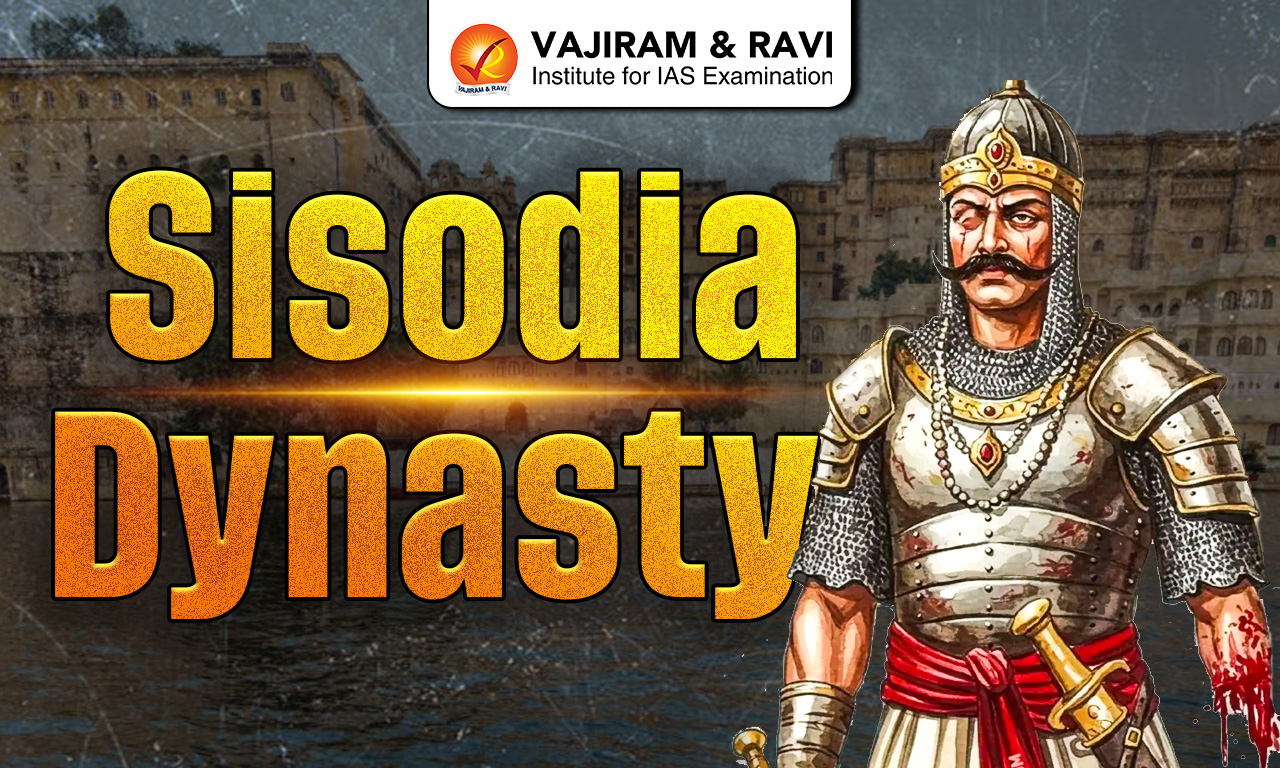
The Sisodia Dynasty was a prominent Rajput ruling lineage of Mewar in present day Rajasthan. The Dynasty played a crucial role in medieval Indian history through continuous resistance against powerful Sultanates and the Mughal Empire. It is widely known for their valor, cultural patronage and strong identity. The Sisodia Dynasty maintained political independence for long periods and contributed significantly to regional stability, architecture and literary traditions in western India.
Sisodia Dynasty Historical Background
The Sisodia Dynasty emerged from the Guhila lineage and established strong political control in Mewar after early medieval conflicts.
- The Sisodia Dynasty traced its lineage to Rahapa, son of Guhila king Ranasimha in the 12th century, establishing their early identity and linking themselves to the prestigious Suryavansha tradition of solar lineage.
- Rahapa founded the village of Sisoda in present day Rajsamand district and his descendants came to be known as Sisodias, forming a distinct branch within the larger Guhila dynasty.
- The main Guhila branch declined after the Siege of Chittorgarh in 1303 by Alauddin Khalji, creating a political vacuum that later allowed the Sisodia Dynasty to rise.
- In 1326, Rana Hammir of the Sisodia branch recaptured Chittor with support from local allies, re-establishing Mewar and laying the foundation of the Sisodia Dynasty.
- The Sisodia rulers constantly fought against regional powers like Malwa, Gujarat, Nagor and Delhi Sultanate, which strengthened their military traditions and regional influence.
- Genealogical texts like Rajprashasti Mahakavyam blended mythology and history, linking Sisodias to ancient rulers of Ayodhya and reinforcing their royal legitimacy and prestige.
Sisodia Dynasty Features
The Sisodia Dynasty developed a strong political system, military tradition and cultural identity in Mewar over several centuries.
- Founder: Rana Hammir I is regarded as the founder of the Sisodia Dynasty, who re-established Mewar’s sovereignty in 1326 and adopted the title ‘Maharana’ for future rulers.
- Time period: The Sisodia Dynasty ruled from approximately 1326 AD to 1947, making it one of the longest surviving Rajput dynasties in Indian history with continuous political relevance.
- Capital cities: Initially, Chittorgarh served as the capital, later shifted to Udaipur by Udai Singh II in the 16th century for better strategic security against invasions.
- Territorial extent: The Sisodia Dynasty controlled the Kingdom of Mewar in Rajasthan, a region known for its strategic forts, trade routes and resistance against external domination.
- Military tradition: The dynasty is known for practices like Saka (last stand battle) and Jauhar (self sacrifice by women), particularly during sieges such as those in 1303, 1535 and 1567.
- Relations with Mughals: Unlike other Rajput clans, the Sisodia Dynasty resisted Mughal authority for long periods and did not intermarry with the Mughal royal family, maintaining distinct political identity.
- Cultural patronage: Sisodia rulers promoted art, architecture and literature, commissioning temples, forts, lakes and scholarly works that reflected both religious devotion and royal authority.


Sisodia Dynasty Rulers and their Contributions
The Sisodia Dynasty produced several powerful rulers who shaped the political and cultural landscape of Mewar through warfare, administration and patronage.
- Rana Hammir (1326-1364): He restored Mewar after Khalji conquest, defeated Muhammad-bin-Tughluq and was called “Visham Ghati Panchanan” in inscriptions, symbolizing bravery in adverse conditions.
- Rana Lakha (1382-1421): He strengthened the economy and ordered construction of Pichola Lake in Udaipur, contributing to irrigation, water management and urban development in the region.
- Maharana Kumbha (1433-1468): He defeated Mahmud Khilji of Mandu, built Kumbhalgarh Fort, constructed Vijay Stambh and authored important works on music and literature, showcasing intellectual excellence.
- Rana Sanga (1508-1528): He expanded Mewar’s power, defeated Ibrahim Lodhi and Malwa Sultan, but lost to Babur in the Battle of Khanwa (1527), marking a turning point in North Indian politics.
- Udai Singh II (1540-1572): He founded the city of Udaipur as a secure capital after repeated attacks on Chittor, ensuring the continuity of Sisodia political power.
- Maharana Pratap (1572-1597): Famous for resisting Mughal emperor Akbar, he fought the Battle of Haldighati (1576) and symbolized Rajput valor and independence despite limited resources.
- Amar Singh I (1597-1620): He continued resistance against Mughals, defeated Sultan Khan in the Battle of Dewair (1606) and later signed the Treaty of 1615 with Jahangir ending prolonged conflict.
- Jai Singh (1680-1698): He opposed Aurangzeb and constructed Dhebar Lake (Jaisamand) in 1685, one of the largest artificial lakes, enhancing water management and regional economy.
Sisodia Dynasty Princely States
The Sisodia Dynasty expanded its influence through several princely states and branches across western and central India.
- Kingdom of Mewar: The core state ruled by the Sisodia Dynasty, centered in Rajasthan, served as the political and cultural heart of their authority for centuries.
- Shahpura State: A branch state established by Sisodia descendants, contributing to regional governance and maintaining Rajput traditions under local rulers.
- Dungarpur State: This princely state emerged under Sisodia lineage, playing an important role in local administration and maintaining ties with the parent Mewar kingdom.
- Banswara State: Another Sisodia ruled region in southern Rajasthan, known for tribal interactions and frontier administration during medieval and early modern periods.
- Pratapgarh State: It developed under Sisodia influence and became significant for maintaining Rajput political presence in southeastern Rajasthan.
- Barwani and Dharampur States: These states in central India and Gujarat region reflected the geographical spread and political reach of the Sisodia Dynasty beyond Rajasthan.
Sisodia Dynasty Significance
The Sisodia Dynasty holds great importance in Indian history due to its political resistance, cultural achievements and long lasting legacy.
- Symbol of resistance: The Sisodia Dynasty consistently resisted powerful empires like Delhi Sultanate and Mughals, becoming a symbol of independence and courage in Indian history.
- Cultural contributions: They promoted architecture such as forts, temples and lakes, along with literature and music, enriching the cultural heritage of Rajasthan.
- Political continuity: The dynasty survived from medieval period to Indian independence in 1947, demonstrating administrative adaptability and long term political stability.
- Distinct identity: The Sisodia Dynasty maintained a unique Rajput identity through traditions, refusal of matrimonial alliances with Mughals and promotion of elite lineage narratives.
- Influence on other dynasties: Clans like the Bhonsle of the Maratha Empire and even the Rana dynasty of Nepal claimed descent from Sisodia lineage, reflecting their extensive historical prestige.
- Legacy in modern India: The Sisodia Dynasty continues symbolically through titular Maharanas, preserving heritage, culture and historical memory associated with the House of Mewar.

 Last updated on Oct, 2026
→ UPSC 2027 Notification will be released on 13 January 2027 at upsconline.nic.in.
→ Check Nobel Prize 2026 Winners List here.
→ Download PIB PRiSM Monthly Magazine 2026 here.
→ Check UPSC Monthly Current Affairs Magazine The Recitals here.
→ Check out the latest UPSC Syllabus here.
→ Download UPSC Model Answers for Mains 2026
→ UPSC Mains Question Paper 2026 is out now for Essay & GS Paper 1, 2, 3 & 4.
→ UPSC Calendar 2027 has been released.
→ Enroll in Vajiram & Ravi’s UPSC Mains Test Series 2027 for structured answer writing practice, expert evaluation, and exam-oriented feedback.
→ Join Vajiram & Ravi’s UPSC Mentorship Program 2027 for personalized guidance, strategy planning, and one-to-one support from experienced mentors.
→ Go through the UPSC Mains Previous Year Papers to enhance your preparation.
→ UPSC has released UPSC Toppers List 2025 with the Civil Services final result on its official website.
→ Also check Best UPSC Coaching in India
Sisodia Dynasty FAQs
Q1. Who founded the Sisodia Dynasty?+
Q2. Which region was ruled by the Sisodia Dynasty?+
Q3. Who was the most famous ruler of the Sisodia Dynasty?+
Q4. What was the capital of the Sisodia Dynasty?+
Q5. When did the Sisodia Dynasty rule?+
Tags: history history notes indian history sisodia dynasty