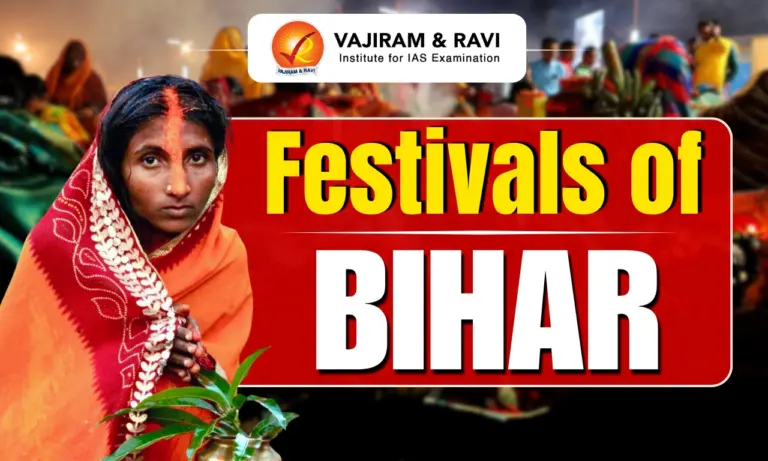
Bihar is a land of rich cultural traditions and vibrant celebrations. Festivals here reflect the deep faith, history, and social harmony of its people. They are often connected with nature, seasons, and religious beliefs, and are celebrated with great devotion and enthusiasm. These festivals not only bring people together but also showcase the unique cultural identity and heritage of the state. Festivals of Bihar are discussed in detail in this article.
Major Festivals of Bihar
The major festivals of Bihar reflect the state’s rich cultural heritage, religious traditions, and seasonal diversity. These festivals are celebrated with great devotion and enthusiasm, bringing people together and strengthening social harmony. Some of the most important festivals are discussed below, highlighting their significance and unique features.
1. Chhath Puja
- Chhath Puja is a major Hindu festival dedicated to the Sun God (Surya) and Chhathi Maiya, mainly celebrated in Bihar with great faith and devotion.
- It is observed during Kartik Shukla Paksha (October-November), just after Diwali, and marks a time of seasonal change and gratitude towards nature.
- The festival lasts for four days and is known for its strict rituals, including a 36-hour fast without food and water, showing strong discipline and purity.
- A unique feature of this festival is that there is no idol worship, as devotees directly pray to the Sun and natural elements while standing in rivers or water bodies.
- Four Days of Rituals
- Nahay-Khaay: Devotees take a holy bath, bring clean water home, and eat pure vegetarian food while maintaining cleanliness.
- Kharna: A day-long fast is observed and broken in the evening with kheer, after which the 36-hour fast begins.
- Sandhya Arghya: Devotees gather at riverbanks to offer prayers to the setting Sun with traditional offerings in bamboo baskets.
- Usha Arghya: The final prayer is offered to the rising Sun, and the fast ends with Prasad distribution among family and community.
- Historical and Mythological Significance
- Chhath Puja is considered an ancient form of nature worship, reflecting early human respect for natural forces like the Sun, which sustains life on Earth.
- In the Mahabharata, Karna, the son of Surya, is believed to have performed rituals to worship the Sun, while Draupadi observed this fast for strength and restoration of her kingdom.
- In the Ramayana, it is believed that Lord Ram and Goddess Sita performed Sun worship after returning to Ayodhya, adding to its religious importance.
2. Sonepur Cattle Fair
- The Sonepur Cattle Fair, also known as the Harihar Kshetra Mela, is one of the largest livestock fairs in Asia, held annually in Sonepur (Bihar) at the sacred confluence of the Ganga and Gandak rivers, making it both a commercial and religious gathering.
- The fair begins on the auspicious occasion of Kartik Purnima (full moon of Kartik month, around November) and continues for nearly a month, attracting large numbers of traders, pilgrims, and tourists from different parts of India and beyond.
- It has been popular since ancient times as a major center for livestock trading, where animals like horses, cattle, birds, and historically even elephants were bought and sold, giving it the identity of a traditional ‘Pashu Mela’.
- Historical Significance
- The fair has deep historical roots, and it is believed that even Chandragupta Maurya used this place to purchase horses and elephants, highlighting its importance in ancient military and trade networks.
- Historical accounts suggest that traders from Central Asia visited this fair, making it an important hub of international trade in earlier times, especially for war elephants.
- Prominent historical figures such as Emperor Akbar, Veer Kunwar Singh, and even Robert Clive (who built a horse stable in 1803) are associated with this fair, showing its continued importance across different periods.
- The fair was originally held in Hajipur but was later shifted to Sonepur during the reign of Mughal Emperor Aurangzeb, giving it its present location.
3. Makar-Sankranti
- Makar Sankranti is a major pan-India harvest festival and is known for its seasonal importance, agricultural significance, and cultural diversity across different regions
- Unlike most Indian festivals that follow the lunar calendar, Makar Sankranti is based on the solar cycle, which is why it falls on almost the same date every year, making it unique among Hindu festivals
- The festival marks the time when the Sun changes its direction and begins its northward movement (Uttarayan), entering the Makara (Capricorn) zodiac sign, which is considered highly auspicious
- It also indicates a change in season, as the days gradually become longer and warmer, symbolizing the end of winter and a shift away from a period of inactivity towards growth and energy
- Makar Sankranti is mainly a harvest festival, marking the end of the winter crop season and the beginning of a new agricultural cycle, especially important for farmers
- It is a time to express gratitude towards nature, the Sun, and agricultural resources for providing a successful harvest and sustaining life
- The festival is celebrated in different parts of India with different names and customs, reflecting the country’s cultural diversity.
- In Tamil Nadu, it is celebrated as Pongal, a four-day festival
- In Punjab, it is known as Lohri, marked by bonfires, folk songs
- In Assam, it is celebrated as Magh Bihu
- In Bihar, it is often called Khichdi
- In states like Gujarat and Rajasthan, the festival is famous for kite flying
- The festival encourages values like sharing, gratitude, and community bonding, bringing people closer and strengthening social relationships
4. Pitrapaksha Mela
- The Pitru Paksha Mela is a world-famous religious event held in Gaya (Bihar), where lakhs of devotees from India and abroad gather to perform Pind Daan and Tarpan for the peace and salvation of their ancestors’ souls
- It is observed for about 16 days during Ashwin Krishna Paksha (from Bhadrapada Purnima to Ashwin Amavasya/Mahalaya), a period considered highly sacred for Shraddha rituals in Hindu tradition
- The main ritual, Pind Daan, is believed to grant moksha (liberation) to ancestors from the cycle of birth and death, making Gaya one of the most important pilgrimage sites for ancestral worship
- Key ritual locations include the Vishnupad Temple, the banks of the Phalgu River, Pretshila, Sita Kund, and other sites, with around 48 designated altars where rituals are performed under the guidance of priests
- According to beliefs, Lord Rama performed Pind Daan here for his father Dasharatha, and Goddess Sita also offered rituals on the Phalgu River, giving rise to traditions like Sita Pind Daan
- During this period, the entire city is filled with devotion and spiritual energy, as large numbers of pilgrims and priests participate together in rituals and prayers
5. Rajgir Mahotsav
- The Rajgir Festival is a popular cultural event that highlights the history, religion, art, and heritage of Rajgir and Nalanda
- It started in 1986 and is celebrated every year in December, gaining recognition at the state, national, and international levels
- This is a three-day festival organised by the Tourism Department, Art and Culture Department, and the Nalanda district administration of Bihar
- The main venue is the Rajgir Convention Centre (RICC) and its surrounding areas, where various events are held
- The festival includes classical music and dance performances, folk arts, cultural programs, food fairs, and heritage exhibitions
- Many famous artists, singers, and dancers from across India and abroad perform live, making the festival lively and engaging
- Over time, the festival has combined traditional and modern elements, helping to promote Rajgir and Nalanda as major tourist destinations
6. Bihula
- The Bihula Mahotsav, also known as Bihula-Bishari Puja, is an important cultural and religious festival mainly celebrated in the Bhagalpur district of Bihar
- It is observed every year in August, where people worship Goddess Manasa (the serpent goddess) for the safety and well-being of their families
- The festival is based on the folk story of Bihula and Lakhindar, which highlights true love, devotion, and determination
- According to the legend, Bihula’s strong faith and efforts brought her husband back to life after he died from a snake bite
- A major attraction of the festival is Manjusha art, a traditional art form with snake designs and mythological stories
- The celebration includes local fairs, folk songs, traditional dances, and dramatic performances based on the story of Bihula
- Special rituals and prayers are performed by priests and devotees, mainly to seek protection from snake bites and blessings for children
7. Buddha Jayanti
- Buddha Jayanti, also known as Buddha Purnima or Vesak, is the most important festival for Buddhists in Bihar
- It marks the birth, enlightenment, and death (nirvana) of Lord Buddha, making it a very sacred occasion
- The festival is celebrated on the full moon day of the Vaisakha month (usually in April or May)
- In Bihar, the main celebrations take place in Bodh Gaya, where Lord Buddha attained enlightenment under the Bodhi Tree
- The Mahabodhi Temple Complex in Bihar becomes the center of activities, attracting devotees from across India and around the world
- A major highlight is a religious procession (Dhamma Yatra) along with prayers, meditation, and chanting
- Devotees offer flowers, robes, candles, and kheer (sweet dish) as a sign of respect and devotion
- Overall, the festival in Bihar spreads the message of peace, wisdom, and compassion, which are the core teachings of Buddha
8. Jivitputrika
- Jivitputrika, also called Jitiya Vrat, is an important festival in Bihar, especially celebrated by mothers
- It is observed for the health, long life, and prosperity of their children
- The festival lasts for three days, each with its own significance
- Day 1 (Nahai-Khai): Mothers take a holy bath and eat a proper meal to prepare for the fast
- Day 2 (Fasting Day): Mothers observe a strict fast, often without food and water, showing their deep love and dedication
- Day 3 (Paaran): The fast is ended with a meal, marking the completion of the ritual
- The festival is linked to the story of King Jimutavahana, who is remembered for his selfless sacrifice and kindness
9. Madhushravani
- Madhushravani is a traditional festival of Bihar, mainly celebrated by newly married women in the Mithila region
- It takes place during the monsoon month of Sawan and lasts for about 13-15 days
- The festival focuses on love in marriage, husband’s long life, and harmony with nature
- Newlywed women usually celebrate it at their parents’ home, where they follow rituals with family support and guidance
- They worship Lord Shiva, Goddess Parvati, serpent deities (Nagas), and Navagrahas, offering fruits, sweets, and flowers
- Women collect seasonal flowers and leaves in baskets and take part in traditional songs and prayers
- Elder women share mythological and folk stories, helping pass on traditions and cultural values
- On the final day, a traditional ritual is performed to show the bride’s patience and devotion
- The festival reflects the cultural richness of Bihar and highlights marital bonding, faith, and tradition
Role of Festivals in Preserving Bihar’s Art, Culture, and Traditions
- Festivals like Chhath Puja and Makar Sankranti help preserve ancient rituals, seasonal practices, and traditional beliefs, keeping Bihar’s cultural roots strong and meaningful even in modern times
- Cultural events such as the Rajgir Festival promote classical music, folk dances, and traditional performances, providing a platform for artists and helping these art forms continue to thrive
- Festivals like Bihula Mahotsav play an important role in protecting local art forms such as Manjusha painting, encouraging artists and keeping these unique styles alive
- Celebrations like Madhushravani and Jitiya Vrat help in passing down traditions, folk stories, and family values from elders to the younger generation through rituals and storytelling
- Religious gatherings such as the Pitru Paksha Mela preserve spiritual practices and age-old customs, strengthening people’s connection with their heritage and beliefs
- These festivals also boost tourism and the local economy, as events attract visitors from different places, increasing awareness and appreciation of Bihar’s rich culture and traditions


 Last updated on Sep, 2026
→ UPSC 2027 Notification will be released on 13 January 2027 at upsconline.nic.in.
→ Asian Games 2026 are being held in Aichi-Nagoya, Japan, from 19 September to 4 October.
→ Check out the latest UPSC Syllabus here.
→ Download UPSC Model Answers for Mains 2026
→ UPSC Mains Question Paper 2026 is out now for Essay & GS Paper 1, 2, 3 & 4.
→ UPSC Calendar 2027 has been released.
→ Enroll in Vajiram & Ravi’s UPSC Mains Test Series 2027 for structured answer writing practice, expert evaluation, and exam-oriented feedback.
→ Join Vajiram & Ravi’s UPSC Mentorship Program 2027 for personalized guidance, strategy planning, and one-to-one support from experienced mentors.
→ Go through the UPSC Mains Previous Year Papers to enhance your preparation.
→ UPSC has released UPSC Toppers List 2025 with the Civil Services final result on its official website.
→ Also check Best UPSC Coaching in India
Festivals of Bihar FAQs
Q1. What is the most important festival of Bihar?+
Q2. Why is Chhath Puja unique among Indian festivals?+
Q3. What is the Sonepur Cattle Fair famous for?+
Q4. How is Makar Sankranti celebrated in Bihar?+
Q5. What is the significance of Pitrapaksha Mela in Gaya?+
Q6. What is Rajgir Mahotsav known for?+
Q7. What is the story behind the Bihula festival?+
Q8. Where is Buddha Jayanti mainly celebrated in Bihar?+
Tags: art and culture art and culture notes festivals of bihar