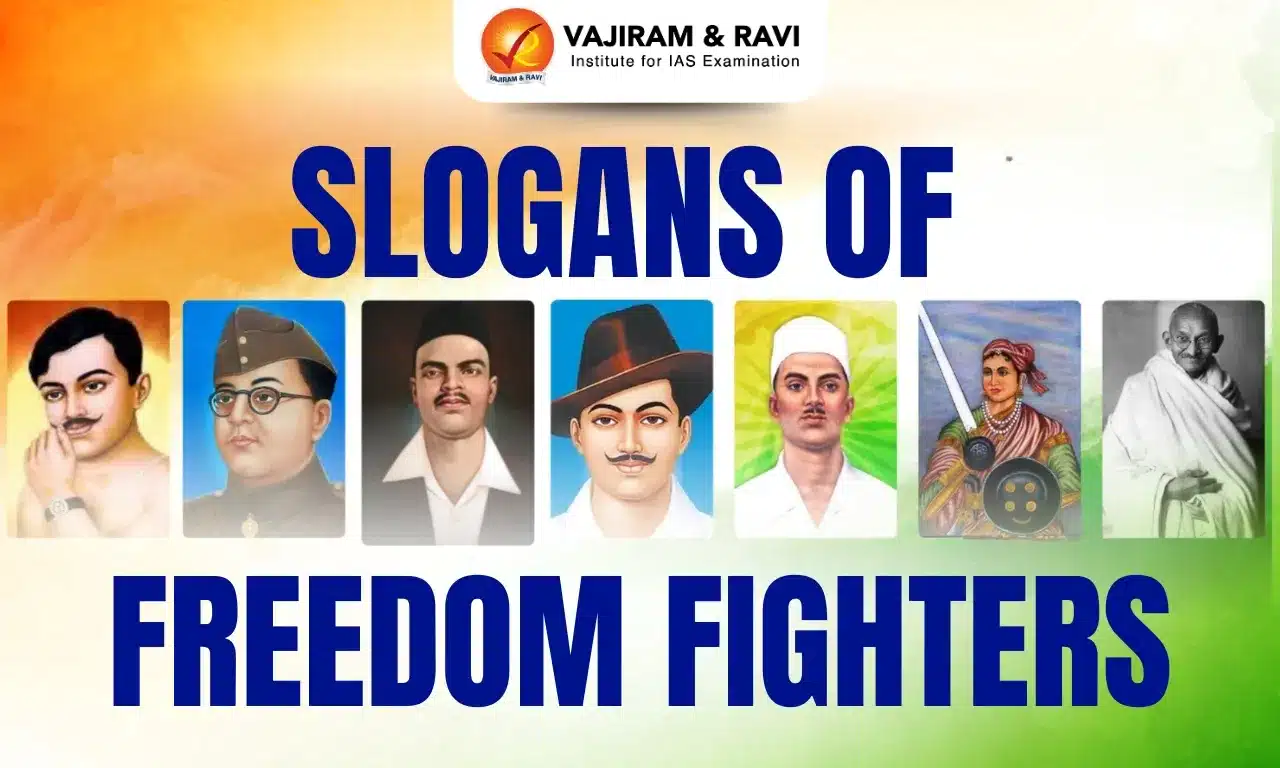
India’s freedom struggle was shaped not only by movements, protests, and sacrifices but also by powerful slogans that inspired millions. These slogans created emotional unity, political awareness, and national identity during the long battle against British colonial rule. They helped mobilize masses, strengthen resistance, and communicate complex ideas in simple words. Many of these slogans continue to guide India even today, reminding us of the courage and vision of our freedom fighters.
Slogans of Freedom Fighters
Slogans were short, impactful statements used to motivate people, communicate political messages, and unify the masses. During the independence movement, leaders used slogans to demand freedom, oppose injustice, and awaken national consciousness. These slogans played a major role in public mobilization and collective action, making them an essential part of India’s political history.
Slogans of Freedom Fighters Historical Background
The use of Slogans of Freedom Fighters intensified during the major phases of India’s freedom movement. These slogans became symbolic expressions of resistance and courage.
- Swadeshi Movement (1905): Use of slogans promoting indigenous goods.
- Home Rule Movement (1916): Short political phrases encouraging self-rule.
- Non-Cooperation Movement (1920): Mass use of slogans for boycotts and unity.
- Civil Disobedience Movement (1930): Slogans promoting salt satyagraha and national pride.
- Quit India Movement (1942): The most powerful and unified slogans demanding immediate freedom.


Major Slogans of Freedom Fighters
The major Slogans of Freedom Fighters with their background and significance has been listed below:
- “Do or Die”
- Given by Mahatma Gandhi on 8 August 1942 during Quit India Movement.
- Called for complete commitment to independence.
- Aimed to push British rule out of India immediately.
- “Satyameva Jayate”
- Promoted by Gandhi during social and political reform.
- Originally from the Mundaka Upanishad.
- Meaning- Truth Alone Triumphs
- “Give me blood and I shall give you freedom”
- Delivered by Netaji Subhash Chandra Bose at a rally in Burma in 1944.
- Encouraged Indians to join the INA.
- “Jai Hind”
- Adopted by the INA under Bose.
- Earlier used by Chempakaraman Pillai
- Later became India’s national salutation.
- “Inquilab Zindabad”
- Meaning- Long Live the Revolution
- Popularised by Bhagat Singh, used first by Maulana Hasrat Mohani.
- Became the rallying cry of revolutionary nationalism.
- “Down with Imperialism”
- Used by Bhagat Singh during trials and writings.
- Represented resistance to colonial oppression.
- “Simon Go Back”
- Lala Lajpat Rai delivered it during protests against the Simon Commission (1928).
- Became a symbol of rejecting imperial policies without Indian participation.
- “Swaraj is my birthright and I shall have it”
- Originally expressed by Gopal Krishna Gokhale.
- Bal Gangadhar Tilak popularised it widely.
- “Aaram haram hai”
- Meaning- Rest is forbidden
- Used by Nehru to motivate youth for national service.
- “Jana Gana Mana” (National Anthem)
- Delivered by Rabindranath Tagore
- A patriotic composition expressing India’s unity.
- Publicly adopted as the national anthem in 1950.
- “Vande Mataram”
- Written in the novel Anandamath (1882) by Bankim Chandra Chattopadhyay.
- Became a national song inspiring Swadeshi and early nationalism.
- “We will face bullets but will not bow before the British”
- Strongly associated with Chandrashekhar Azad’s revolutionary ideology.
- “I am proud to die for my motherland”
- Ashfaqulla Khan expressed before his execution.
- Symbolised sacrifice and unity beyond religion.
- “Quit India”
- Used widely by masses during the 1942 uprising.
- “Britishers Leave India”
- Demonstrated urgency for independence.
Slogans of Freedom Fighters Classification
India’s freedom movement witnessed a wide range of slogans that inspired courage, unity, and resistance against British rule. These slogans can be understood better when grouped into meaningful categories, as each reflects a specific phase, emotion, or ideological direction of the struggle.
1. Revolutionary Nationalist Slogans
This category includes slogans that sparked aggressive resistance and encouraged people to rise against colonial oppression. They were powerful calls for immediate action and sacrifice.
Examples:
- “Inquilab Zindabad”
- “Vande Mataram”
2. Non-Violent Mass Mobilization Slogans
These slogans promoted peace, truth, and civil disobedience. They were central to movements like Non-Cooperation and Quit India, helping mobilize millions without violence.
Examples:
- “Do or Die”
- “Satyameva Jayate”
3. Social Reform and Unity Slogans
These slogans highlighted equality, harmony, and the need to break social barriers that weakened national unity.
Examples:
- “Sarfaroshi ki Tamanna”
- “Jai Hind”
Slogans of Freedom Fighters List
The List for the Slogans of Freedom Fighters based on the Personalities has been given below:
| List of Freedom Fighters and Their Slogans | ||
| S. No. | Freedom Fighter | Slogans |
|
1 |
|
|
|
2 |
Subhas Chandra Bose |
|
|
3 |
Bhagat Singh |
|
|
4 |
|
|
|
5 |
Ram Prasad Bismil |
|
|
6 |
Ashfaqulla Khan |
Our Blood Will Bring Freedom One Day |
|
7 |
Sardar Vallabhbhai Patel |
|
|
8 |
|
|
|
9 |
Lala Lajpat Rai |
|
|
10 |
Bipin Chandra Pal |
|
|
11 |
Gopal Krishna Gokhale |
What Bengal Thinks Today, India Thinks Tomorrow |
|
12 |
Jawaharlal Nehru |
|
|
13 |
Rabindranath Tagore |
|
|
14 |
Vande Mataram |
|
|
15 |
Sri Aurobindo |
|
|
16 |
Annie Besant |
Better remain silent, better not even think, if you are not prepared to act |
|
17 |
Maulana Abul Kalam Azad |
|
|
18 |
Hasrat Mohani |
Inquilab Zindabad (original coinage) |
|
19 |
Mangal Pandey |
Maaro Firangi Ko (war cry, 1857) |
|
20 |
Main Apni Jhansi Nahi Doongi |
|
|
21 |
Tatya Tope |
Desh Ke Liye Ladna Hai |
|
22 |
Kunwar Singh |
Chalo Dilli Angrezi Hatao |
|
23 |
Bhikaji Cama |
Vande Mataram (flag at Stuttgart, 1907) |
|
24 |
Sukhdev Thapar |
Freedom Demands Courage |
|
25 |
Udham Singh |
I Will Avenge Jallianwala Bagh |
|
26 |
Matangini Hazra |
Vande Mataram (last words) |
|
27 |
Sarojini Naidu |
Rise for Freedom |
|
28 |
Birsa Munda |
Abua Dishum, Abua Raj (Our Land, Our Rule) |
|
29 |
C. Rajagopalachari |
Peace Leads to Freedom |
|
30 |
Khan Abdul Ghaffar Khan |
There is Nothing Greater than Peace |
|
31 |
Vinayak Damodar Savarkar |
|
|
32 |
Pandit Madan Mohan Malaviya |
|
|
33 |
Mahatma Jyotiba Phule |
|
|
34 |
|
|
|
35 |
Alluri Sitarama Raju |
Fight Till Your Last Breath |
|
36 |
Velu Nachiyar |
Victory to My Land (battle cry) |
|
37 |
Tiruppur Kumaran |
Do Not Drop the National Flag |
|
38 |
Surya Sen (Master-da) |
Chittagong Will Be Free |
|
39 |
Jatin Das |
Death is Preferable to Surrender |
|
40 |
Aruna Asaf Ali |
March Forward With Courage |
|
41 |
Durgawati Devi (Durga Bhabhi) |
The Fight Must Continue |
|
42 |
Tantia Bhil |
We Shall Not Submit |
|
43 |
Lakshmi Sahgal (INA) |
March to Freedom |
|
44 |
Captain Lakshmi (Azad Hind Fauj) |
Women Will Fight for Freedom |
|
45 |
Jhalkari Bai |
Jhansi Will Never Fall |
|
46 |
Chakali Ilamma |
We Will Resist Oppression |
|
47 |
Peer Ali Khan |
We Shall Not Live as Slaves |
|
48 |
Kanaklata Barua |
Do Not Move, I Will Carry the Flag |
|
49 |
Thakkar Bapa |
Serve the Poor, Serve the Nation |
|
50 |
Syama Prasad Mukherjee |
|
|
51 |
V. O. Chidambaram Pillai |
Freedom Through Swadeshi |
|
52 |
Lokenath Bal |
Take Up Arms for Freedom |
|
53 |
Benoy-Badal-Dinesh |
Death Before Dishonour |
|
54 |
Pritilata Waddedar |
Down With Imperialism |
|
55 |
Veerapandiya Kattabomman |
We Shall Never Bow to the British |
Slogans of Freedom Fighters Impact
The Impact of the Slogans of Freedom Fighters can be seen in several aspects as given below:
- Political Impact
- United people against colonial policies.
- Strengthened the call for self-rule.
- Created emotional pressure on the British government.
- Social Impact
- Spread awareness among illiterate masses.
- Brought diverse communities together.
- Built national identity and collective consciousness.
- Psychological Impact
- Boosted courage in times of suppression.
- Made freedom fighters fearless.
- Converted passive citizens into active participants.
- Cultural Impact
- Inspired literature, songs, and theatre.
- Helped create a nationalist cultural renaissance.
Slogans of Freedom Fighters Significance
Significance of Slogans of Freedom Fighters in India’s Freedom Movement is discussed here:
- Made the freedom struggle accessible to the masses.
- Strengthened emotional unity across regions.
- Served as tools of peaceful and revolutionary resistance.
- Created memorable symbols of national identity.
- Guided strategies of both moderate and revolutionary movements.
Slogans of Freedom Fighters UPSC
Slogans were powerful weapons in India’s freedom struggle. They shaped the political mindset of the people, awakened national consciousness, and inspired sacrifices. Each slogan carried the emotions, courage, and determination of the leaders and common citizens who fought for independence. Even today, these slogans remain part of India’s collective memory, reminding us of the values of unity, bravery, truth, and patriotism that formed the foundation of modern India.

 Last updated on Oct, 2026
→ UPSC 2027 Notification will be released on 13 January 2027 at upsconline.nic.in.
→ Check Nobel Prize 2026 Winners List here.
→ Download PIB PRiSM Monthly Magazine 2026 here.
→ Check UPSC Monthly Current Affairs Magazine The Recitals here.
→ Check out the latest UPSC Syllabus here.
→ Download UPSC Model Answers for Mains 2026
→ UPSC Mains Question Paper 2026 is out now for Essay & GS Paper 1, 2, 3 & 4.
→ UPSC Calendar 2027 has been released.
→ Enroll in Vajiram & Ravi’s UPSC Mains Test Series 2027 for structured answer writing practice, expert evaluation, and exam-oriented feedback.
→ Join Vajiram & Ravi’s UPSC Mentorship Program 2027 for personalized guidance, strategy planning, and one-to-one support from experienced mentors.
→ Go through the UPSC Mains Previous Year Papers to enhance your preparation.
→ UPSC has released UPSC Toppers List 2025 with the Civil Services final result on its official website.
→ Also check Best UPSC Coaching in India
Slogans of Freedom Fighters FAQs
Q1. Which is the most famous slogan of the freedom struggle?+
Q2. Who gave the slogan “Do or Die”?+
Q3. Which slogan is associated with Subhas Chandra Bose?+
Q4. Who popularised “Swaraj is my birthright”?+
Q5. What role did slogans play in the freedom movement? +
Tags: slogans of freedom fighters