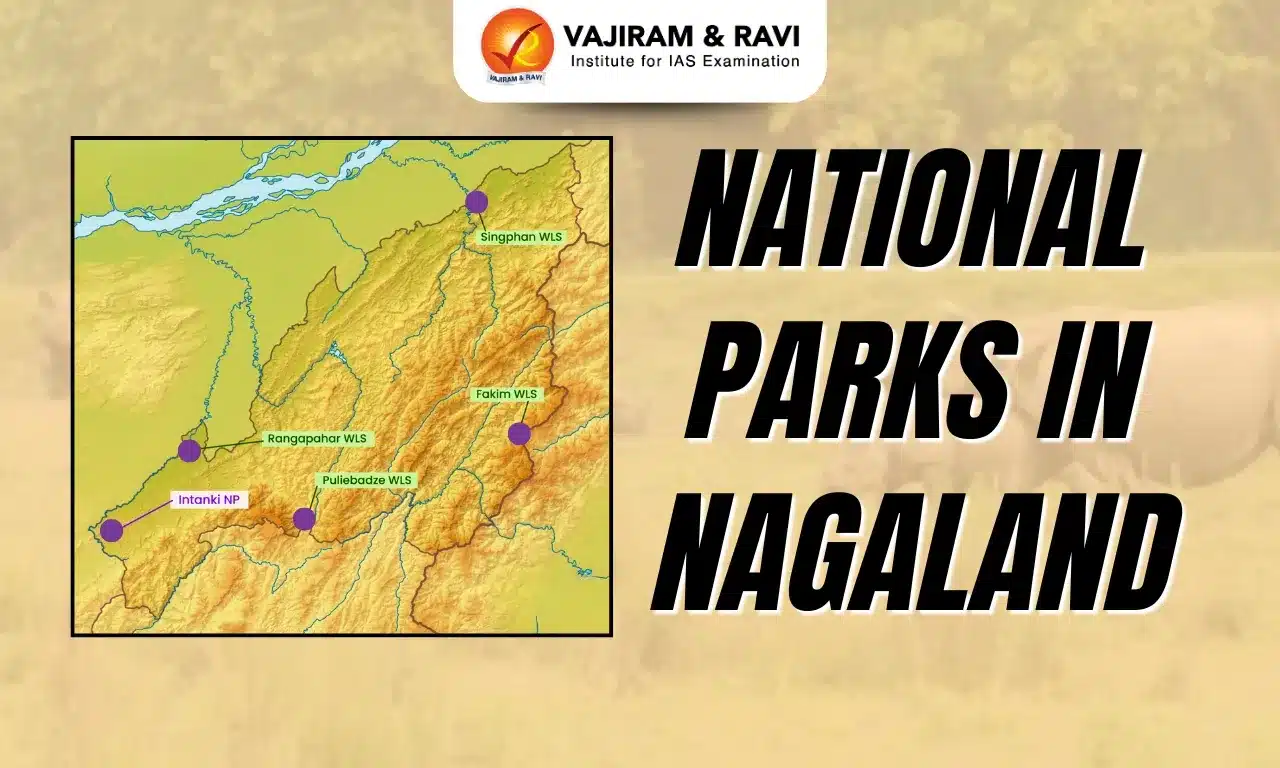
National Parks and protected areas are legally defined spaces created to conserve natural ecosystems, wildlife, and ecological processes over the long term. As per the IUCN definition, these areas are clearly demarcated and managed through legal or effective means to protect biodiversity, ecosystem services, and cultural values. National Parks specifically safeguard large habitats, allowing natural processes to function with minimal human interference while supporting scientific research, education, recreation, and conservation-based livelihoods in an environmentally compatible manner.
Protected Areas in Nagaland
Nagaland has diverse protected areas conserving forests, wildlife, rivers, and tribal cultural landscapes across varied altitudes.
- Ecological diversity: Forests range from tropical evergreen to moist deciduous and bamboo-dominated landscapes.
- Geographic variation: Altitude spans from 200 meters plains to 3,840 meters hill ecosystems.
- Legal protection: Areas notified under Wildlife Protection Act for long-term conservation.
- Community context: Protected areas coexist with tribal villages and traditional land-use systems.
- Biodiversity role: Habitats support mammals, birds, primates, and endemic plant species.
Nagaland has only one notified National Park, reflecting its limited geographical area but high ecological richness. Despite covering just 16,579 square kilometers, the state supports dense forests, mountain ranges, and river systems. The single National Park plays a critical role in conserving flagship species, maintaining ecological connectivity with Assam forests, and preserving Eastern Himalayan biodiversity. Its location near international and inter-state borders further enhances its importance for wildlife movement, climate resilience, and long-term conservation planning in Northeast India.
Intangki National Park
Intangki National Park, also known as Ntangki National Park, is Nagaland’s only National Park, notified in 1993.
- Location: Situated in Peren district near the western edge of the Barail Range.
- Area coverage: Spreads across 202 square kilometers of protected forest.
- Geographic setting: Lies in the foothills of the Patkai range within Eastern Himalayas.
- River systems: Dhansiri River and tributaries Monglu, Intanki, and Duilong support habitats.
- Forest types: Tropical evergreen forests, bamboo brakes, and grassland patches.
- Major mammals: Tiger, clouded leopard, leopard cat, golden cat, sloth bear.
- Primate diversity: Hoolock gibbon and golden langur present.
- Avifauna richness: Blyth’s tragopan, hornbills, and black stork recorded.
- Connectivity: Contiguous with Dhansiri Reserve Forest of Assam enabling wildlife movement.
Also Read: National Parks in India
Elephant Reserves in Nagaland
Elephant Reserves in Nagaland focus on conserving the endangered Asian elephant and its migratory corridors. These reserves form part of broader inter-state landscapes connecting Assam and Nagaland forests. They support seasonal elephant movement, reduce habitat fragmentation, and address human-elephant conflict through monitoring and community engagement. Declared under Project Elephant, these reserves integrate habitat protection, biodiversity conservation, and livelihood-sensitive management. Nagaland’s elephant reserves, though limited in size, are ecologically vital for maintaining genetic flow and landscape-level conservation.
Intangki Elephant Reserve
The Intangki Elephant Reserve lies within Intangki National Park and was declared in 2005.
- Location: Located in Peren district within Intanki National Park boundaries.
- Conservation status: Declared Elephant Reserve under Project Elephant.
- Target species: Asian elephant populations using forest corridors.
- Habitat richness: Dense rainforests and riverine ecosystems support large mammals.
- Associated fauna: Tigers, wild buffalo, hoolock gibbon, golden langur.
- Landscape role: Connects Nagaland forests with Assam elephant habitats.
Singphan Elephant Reserve
Singphan Elephant Reserve was declared in 2018 and is the smallest elephant reserve in India.
- Location: Situated in Mon district along the Nagaland-Assam border.
- Area size: Covers approximately 23.57 square kilometers.
- Declaration year: Notified as Elephant Reserve in 2018.
- Landscape function: Facilitates seasonal elephant movement between states.
- Forest types: Tropical wet evergreen, moist deciduous, bamboo forests.
- Management authority: Administered by Nagaland Forest Department.
- Conservation focus: Habitat protection, corridor maintenance, conflict mitigation.


Wildlife Sanctuaries in Nagaland
Wildlife Sanctuaries in Nagaland protect smaller yet ecologically significant habitats across districts. These sanctuaries conserve birds, primates, ungulates, and forest ecosystems while supporting local biodiversity hotspots. Many sanctuaries lie within the Eastern Himalayas biodiversity region and hold historical, cultural, and ecological value. Established between 1980 and 2009, they collectively safeguard critical species, support forest regeneration, and contribute to ecological balance in a largely rural, tribal-dominated state landscape.
Fakim Wildlife Sanctuary
Fakim Wildlife Sanctuary is a small but ecologically important protected area in eastern Nagaland.
- Location: Situated in Kiphire district near the India-Myanmar border.
- Year established: Notified as a wildlife sanctuary in 1980.
- Area extent: Covers about 6.42 square kilometers.
- Bird significance: Part of Eastern Himalayas Endemic Bird Area.
- Key mammals: Clouded leopard and barking deer recorded.
- Conservation value: Important site for avifaunal diversity.
Singphan Wildlife Sanctuary
Singphan Wildlife Sanctuary supports elephant corridors and rich forest biodiversity.
- Location: Located in Mon district bordering Assam forests.
- Year notified: Declared a wildlife sanctuary in 2009.
- Area size: Encompasses approximately 23.57 square kilometers.
- Vegetation types: Evergreen, moist deciduous, bamboo-dominated forests.
- Plant diversity: Over 180 plant species documented.
- Key fauna: Asian elephant, hoolock gibbon, jackal.
- Conservation role: Integral to elephant movement landscape.
Puliebadze Wildlife Sanctuary
Puliebadze Wildlife Sanctuary combines ecological and historical importance near Kohima.
- Location: Situated in Kohima district of Nagaland.
- Year established: Notified as a wildlife sanctuary in 1980.
- Area coverage: Spreads across 9.23 square kilometers.
- Elevation feature: Named after Mount Puliebadze at 2,296 meters height.
- Bird diversity: Known habitat for pheasants including Blyth’s tragopan.
- Historical relevance: Area witnessed World War II battles at Kohima.
Rangapahar Wildlife Sanctuary
Rangapahar Wildlife Sanctuary protects lowland forest ecosystems near Dimapur.
- Location: Situated in Dimapur district of Nagaland.
- Year notified: Declared a wildlife sanctuary in 1986.
- Area extent: Covers around 4.7 square kilometers.
- Key mammals: Indian giant squirrel, sambar deer, barking deer.
- Ecotourism context: Located near Dzukou Valley and Japfu Peak.
- Cultural sites: Proximity to Kachari ruins and regional caves.

 Last updated on Oct, 2026
→ UPSC 2027 Notification will be released on 13 January 2027 at upsconline.nic.in.
→ Asian Games 2026 are being held in Aichi-Nagoya, Japan, from 19 September to 4 October.
→ Check Nobel Prize 2026 Winners List here.
→ Download PIB PRiSM Monthly Magazine 2026 here.
→ Check UPSC Monthly Current Affairs Magazine The Recitals here.
→ Check out the latest UPSC Syllabus here.
→ Download UPSC Model Answers for Mains 2026
→ UPSC Mains Question Paper 2026 is out now for Essay & GS Paper 1, 2, 3 & 4.
→ UPSC Calendar 2027 has been released.
→ Enroll in Vajiram & Ravi’s UPSC Mains Test Series 2027 for structured answer writing practice, expert evaluation, and exam-oriented feedback.
→ Join Vajiram & Ravi’s UPSC Mentorship Program 2027 for personalized guidance, strategy planning, and one-to-one support from experienced mentors.
→ Go through the UPSC Mains Previous Year Papers to enhance your preparation.
→ UPSC has released UPSC Toppers List 2025 with the Civil Services final result on its official website.
→ Also check Best UPSC Coaching in India
National Parks in Nagaland FAQs
Q1. How many National Parks are there in Nagaland?+
Q2. Which is the largest Protected Area in Nagaland?+
Q3. Are there Elephant Reserves in Nagaland?+
Q4. Which Wildlife Sanctuary is important for bird conservation in Nagaland?+
Q5. Which is the smallest Elephant Reserve in India located in Nagaland?+
Tags: national parks in nagaland