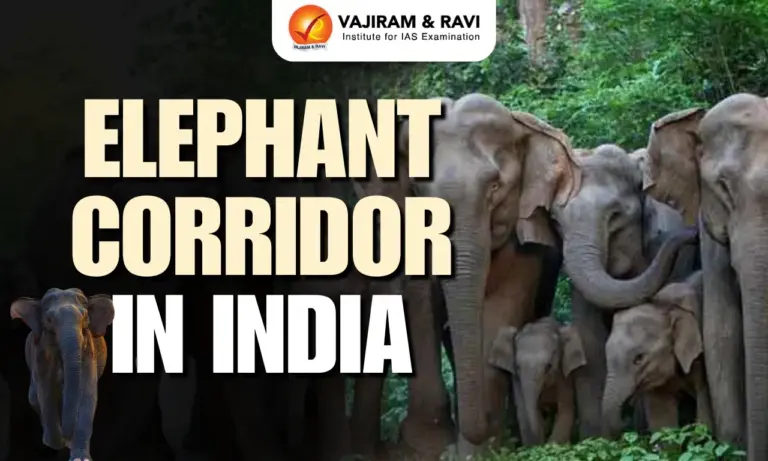
Elephants are keystone species that shape forest ecosystems by dispersing seeds, creating clearings, and maintaining ecological balance. India hosts nearly 60% of the global wild Asian elephant population, giving it a critical responsibility for elephant conservation. Rapid habitat fragmentation, infrastructure expansion, and human settlements have disrupted traditional elephant migration routes, increasing human-elephant conflict. Elephant corridors in India play a vital role in enabling safe seasonal movement between forest habitats, supporting genetic diversity, reducing conflict, and ensuring long term survival of elephants across landscapes.
Elephant Corridor in India
An Elephant Corridor in India refers to a defined strip of land that allows elephants to move between two or more suitable forest habitats. According to the Elephant Corridors of India Report 2023, India has 150 ground validated elephant corridors across 15 elephant range states, a 40% increase from 88 corridors identified in 2010. These corridors connect 33 Elephant Reserves spread across 10 major elephant landscapes, enabling seasonal migration, genetic exchange, and access to food and water. West Bengal alone accounts for 26 corridors, the highest in the country.
Elephant Corridor in India Features
Elephant corridors in India function as ecological lifelines, balancing elephant survival needs with human development pressures across multiple landscapes.
- Ecological Connectivity: Corridors maintain landscape level connectivity, preventing habitat isolation and supporting long distance movement between feeding, breeding, and water areas.
- Genetic Diversity Preservation: Continuous movement allows inter breeding between elephant groups, preventing genetic bottlenecks and maintaining healthy populations.
- Human-Elephant Conflict Reduction: Well protected corridors reduce crop raids and accidental encounters by guiding elephants away from villages and farmlands.
- Keystone Species Protection: Elephants shape forests by seed dispersal and vegetation modification, making corridor conservation critical for entire ecosystems.
- Habitat Restoration Needs: Around 10 corridors require immediate restoration due to infrastructure barriers, mining, agriculture, or linear development projects.
- Usage Pattern Changes: Approximately 29 corridors show declining usage due to fragmentation, while 59 corridors report stable or increased elephant movement.
- Cultural and Heritage Value: Elephants are India’s National Heritage Animal, deeply embedded in traditions, reinforcing strong public and institutional conservation support.
- Landscape Ecology Application: Modern corridor identification integrates satellite imagery, long term field data, GIS analysis, and adaptive algorithms.
- Disaster Risk Linkages: Hydropeaking risks from projects like Lower Subansiri hydropower threaten corridor safety, especially for calves during sudden water releases.
- Forest Regeneration Role: Corridors aid forest regeneration by enabling seed dispersal across degraded patches, benefiting multiple wildlife species including tigers.





Elephant Corridor in India Legal Aspects
Elephant corridor protection in India is supported by constitutional duties, wildlife laws, judicial rulings, and national conservation initiatives.
- Wildlife Protection Act, 1972: Corridors can be legally notified as Conservation Reserves under Section 36A or Community Reserves under Section 36C.
- Project Elephant Framework: Launched in 1992, Project Elephant provides financial and technical assistance for corridor protection, habitat management, and conflict mitigation.
- MoEFCC Coordination: The Ministry of Environment, Forest and Climate Change coordinates corridor identification and validation with state forest departments.
- Supreme Court Recognition: The Supreme Court upheld the “right of passage” for elephants, affirming state responsibility to protect migratory routes.
- Madras High Court Ruling: The court validated Tamil Nadu’s notification of the Sigur Plateau corridor, citing Article 51A(g) of the Constitution.
- Article 51A(g): This constitutional duty mandates citizens and governments to protect forests, wildlife, and show compassion for living creatures.
- National Elephant Corridor Project: This initiative aims to secure and manage corridors to ensure long term elephant survival within India’s political boundaries.
- MIKE Programme: Monitoring of Illegal Killing of Elephants operates in 10 Indian elephant reserves, tracking poaching trends under CITES since 2003.
- Technology Driven Measures: LiDAR based habitat mapping, real time conflict portals like “Surakshya,” and Project RE-HAB bee-fencing enhance corridor safety.
- State Specific Actions: Kerala declared human-animal conflict a state specific disaster, while Assam and Arunachal Pradesh were directed to notify the Dulung-Subansiri corridor.
Elephant Corridor in India List
India has 150 ground validated elephant corridors across 15 elephant range states, as identified by the Ministry of Environment, Forest and Climate Change in coordination with State Forest Departments. East-Central India hosts 52 corridors (35%), the North-East has 48 corridors (32%), Southern India has 32 corridors (21 %), and Northern India has 18 corridors (12%).
| State Wise List of Elephant Corridors in India | |
| State | Names of Elephant Corridors |
|
Andhra Pradesh |
Tri-Junction Corridor; Rayala ER |
|
Arunachal Pradesh |
Pakke-Doimara at Dedzelling; Dulung-Subansiri; Dering-Mebo (Sigar Nalla); Pakke-Papum Longka Nalla; Pakke-Papum Seijosa Nalla; Pakke-Doimara at Tippi; Durpong-Doimukh at Khundakhuwa; D’ering-Mebo at Kongkul |
|
Assam |
Deosur; Bogapani (Upper Dihing East-West); Panbari; Kotha Buridehing; Kanchanjuri; Hatidandi; Haldhibari; Golai-Pawai (Upper Dihing East-West); Kukurakata-Bagser at Amguri; Charduar-Singri Hill |
|
Assam & Arunachal Pradesh |
D’ering-Dibru Saikhowa; Kalapahar-Doigrung |
|
Bihar |
Jamui-Jhajha-Chakayi |
|
Chhattisgarh |
Charmar-Jingol; Nagdhara-Baraud; Hati-Kudmura; Chaal-Kartala; Korondha-Rupunga; Balco-Etma Nagar; Balco-Katghora; Khod-Rihand; Ghat Pendari-Pakni |
|
Jharkhand |
Bhagabilla-Ratnasai; Jampani-Bhagabilla; Sangajata-Haldipokhar; Lepang-Dumuria; Ankua-Ambia; Raibera-Pulbaburu; Dalapani-Suklara; Dalma-Chandil; Dumariya-Nayagram; Silli-Angara; Bharno-Bero-Kara / Sisai-Karra; Dalma-Asanbani; Dalma-Rugai; Siyaljora-Dhobadhobin; Dumriya-Kundaluka-Murakanjia |
|
Jharkhand & West Bengal |
Dalapani-Kankrajhor; Chandil-Matha; Gobarghusi-Jhunjhaka-Banduan |
|
Karnataka |
Kaniyanpura-Moyar; Edayarahalli-Doddasampige; Edayarahalli-Guthiyalathur; Talamalai-Chamrajnagar (Pununjur); Karadikkal-Madeshwara |
|
Karnataka & Kerala |
Begur-Brahmagiri |
|
Karnataka & Tamil Nadu |
Talamalai-Chamrajnagar (Muddahalli); Thalli-Bilikal; Bilikal-Jawalagiri |
|
Kerala |
Kudrakote-Thirunelly; Kottiyur-Peria; Peria-Pannippad; Nilambur-Appankappu |
|
Kerala & Tamil Nadu |
Nilambur Kovilakam-New Amarambalam; Mudumalai-Nilambur via O’ Valley |
|
Meghalaya |
Rewak-Emangre; Nokrek-Emangre; Siju-Rewak; Balpakram-Baghmara; Ranggira-Nokrek; Saipung-Narpuh |
|
Nagaland |
Geleki-Sitap; Abhaypur-Singphan; Hollongapar-Longtho; Daldali-Dimapur; Geleki-Tuli; Desoi-Changdang; Tirutilip-Longchem |
|
Odisha |
Telkoi-Pallahada; Karo-Karampada; Similipal-Hadagarh-Kuldiha; Maulabhanja-Jiridamali-Anantapur; Kanheijena-Anantapur; Nuagaon-Baruni; Buguda-Central RF; Tal-Kholgarh; Barapahad-Tarva-Kantamal; Kotagarh-Chandrapur; Karlapat-Urlandi |
|
Odisha & West Bengal |
Deuli-Suliapada |
|
Odisha & Jharkhand |
Badampahar-Dhobadhobin; Badampahar-Karida East |
|
Tamil Nadu |
Srivilliputur-Saptur; Kallhatti-Sigur (Glencorin); Avarahalla at Sigur; Kalmalai-Singara-Avarahalla; Moyar-Avarahalla; Siluvaimedu-Kadamparai; Anamalai-Waterfalls Estate; Sholayar Dam (Vazhachal-Anaimalai); Topslip-Navamalai; TANTEA (Ryan route); Talamalai-Guttiyalattur; Mukurthi-Mudumalai; Anaikatti North-South; Anamalai-Punachi; Kallar-Gandhapallayam |
|
Uttar Pradesh |
Basanta; Laljhadi; Chhedia; Dudhwa-Katarniaghat; Khata; Laggabagga-Tatarganj-Shukhlaphanta; Shiwalik; Rawasan-Sonanadi (Rajaji-Corbett) |
|
Uttarakhand |
Kansrau-Barkote; Motichur-Barkote (Teenpani); Motichur-Gohri; Chilla-Motichur; Rawasan-Sonanadi (Upper Arm); Malani-Kota (Kosi); Chilkiya-Kota (Kosi); Fatehpur-Gadgadia; Kilpura-Khatima; Gorai Tanda (Gola) |
|
West Bengal |
Titi-Dumchi-Reti; Titi-Reti; Kalikunda-Chandra (Manikpara); Nayagram-Jamboni (Keshorrekha); Chandabila-Tapoban-Dhumsi; Kalaikunda-Chandra (Satpadi Ghat); Gidhni-Jamboni; Chandua-Joka; Kankrajhore-Lalgarh; Apalchand-Mahananda; Apalchand-Gorumara; Apalchand-Kalimpong (Meenglass); Apalchand-Kalimpong (Sylee); Nimati-Chilpata; Buxa-Titi (Beech-Bharnobari); Buxa-Titi (Torsha); Buxa-Ripu (Sankosh); Mahananda-Kolabari-Tukriajhar; Mahilong-Kalimati; Jhalda-Baghmundi; Chapramari-Kalimpong; Moraghat-Central Daina; Reti-Central Daina; Moraghat-Reti |

 Last updated on March, 2026
→ UPSC Final Result 2025 is now out.
→ UPSC has released UPSC Toppers List 2025 with the Civil Services final result on its official website.
→ Anuj Agnihotri secured AIR 1 in the UPSC Civil Services Examination 2025.
→ UPSC Marksheet 2025 is now out.
→ UPSC Notification 2026 & UPSC IFoS Notification 2026 is now out on the official website at upsconline.nic.in.
→ UPSC Calendar 2026 has been released.
→ Check out the latest UPSC Syllabus 2026 here.
→ UPSC Prelims 2026 will be conducted on 24th May, 2026 & UPSC Mains 2026 will be conducted on 21st August 2026.
→ The UPSC Selection Process is of 3 stages-Prelims, Mains and Interview.
→ Prepare effectively with Vajiram & Ravi’s UPSC Prelims Test Series 2026 featuring full-length mock tests, detailed solutions, and performance analysis.
→ Enroll in Vajiram & Ravi’s UPSC Mains Test Series 2026 for structured answer writing practice, expert evaluation, and exam-oriented feedback.
→ Join Vajiram & Ravi’s Best UPSC Mentorship Program for personalized guidance, strategy planning, and one-to-one support from experienced mentors.
→ Shakti Dubey secures AIR 1 in UPSC CSE Exam 2024.
→ Also check Best UPSC Coaching in India
Elephant Corridor in India FAQs
Q1. What is an Elephant Corridor in India?+
Q2. How many Elephant Corridors are there in India?+
Q3. Which state has the highest number of Elephant Corridor in India?+
Q4. Why are Elephant Corridors in India important?+
Q5. Which law protects the Elephant Corridor in India?+
Tags: elephant corridor in india