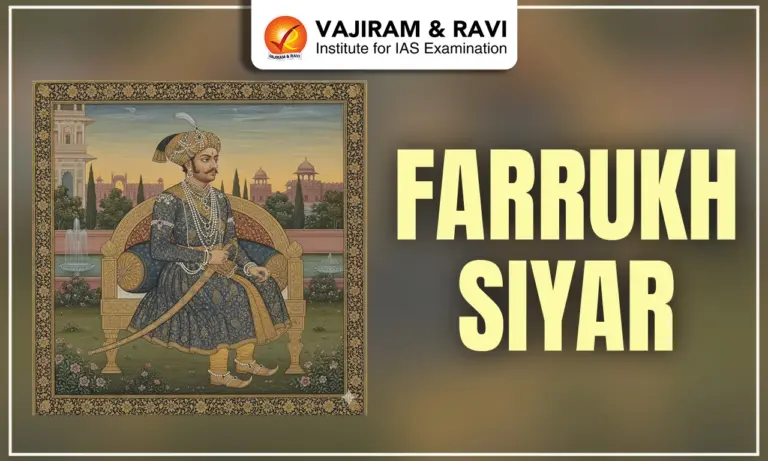
Farrukh Siyar was a Mughal emperor who reigned from 1713 to 1719, as a puppet ruler under the control of the Sayyid Brothers. He is known for granting trade privileges to the British East India Company in Bengal and for his weak leadership, which contributed to the further decline of the Mughal Empire. He was eventually deposed and executed by the Sayyid Brothers in 1719. In this article, we are going to cover Farrukh Siyar, his reign, farman and historical significance.
Farrukh Siyar
- Farrukh Siyar was a weak and indecisive ruler who was killed by the Sayyid Brothers in 1719, having the same faith as Jahandar Shah.
- During the beginning of his reign, Farrukh Siyar was backed by two influential Mughal Nobles, the Sayyid Brothers named Syed Hassan Ali Khan Barha and Syed Hussain Ali Khan Barha.
- The British East India Company secured the duty-free trading rights in Bengal from him in 1717 for a small annual payment of Rs. 3000, a concession with long-term implications.
- As tensions began to grow, in between Farrukh Siyar and the Sayyid brothers, his authority was reduced to just a formality, leaving him as a puppet ruler.
- Eventually the Sayyid Brothers deposed him and subjected him to imprisonment, starvation and blinding, before having him executed.
- In 1719, his cousin Rafi ud-Darajat was installed as emperor.
Farrukh Siyar’s Reign
- The fall of Jahandar Shah in 1713 in Agra made the way for Farrukh Siyar’s succession. His rise to power was facilitated by Abdullah Khan (Wazir) and Hussain Ali Khan (Mir Bakshi) also known as the Sayyid Brothers.
- The Sayyid Brothers assumed de facto control over the Mughal administration.
- By securing their position and halting the empire’s decline, the Sayyid Brothers believed that effective governance required real power to remain in their hands while Farrukh Siyar continued as a nominal monarch.
- This rivalry created a prolonged struggle for dominance between the Emperor and the Sayyids, which culminated in this deposition and execution in 1719.
Farrukh Siyar’s Farman (1717)
Farrukh Siyar issued a Farman in 1717, granting the English East India Company many privileges.
These privileges included exemption from custom duties for trade in Bengal, Bihar and Orissa, a privilege obtained by persistent lobbying by the company.
The arrangement required only a fixed annual payment while sparing company traders from traditional taxes and transit duties like the rahadari.
Before this, precedents like Shah Jahan’s Farman of 1650, granted limited exemptions, but Farrukh Siyar’s concessions marked a turning point. They undermined Mughal economic interests while strengthening English commercial dominance in the region.
Farrukh Siyar’s Historical Importance
Farrukh Siyar’s time of ruling witnessed both military campaigns and political missteps. He gained power against the Sikhs by capturing and executing Banda Singh Bahadur and temporarily subduing rebellious Rajput Chiefs.
However, his bad concession decisions to the English East India Company weakened the empire’s economic base.
The 1717 Farman, granted under pressure, allowed the company to expand its trading monopoly and eventually paved the way for British colonial dominance in Bengal.
These acts highlighted the emperor’s inability to assess the long-term consequences of his decisions, making his reign an important turning point in Mughal decline.
Farrukh Siyar’s Final Crisis
- Farrukh Siyar’s authority crumbled when his strained relations with nobles like Ajit Singh of Marwar alienated important allies.
- In 1718, Hussain Ali Khan marched from Aurangabad toward Delhi with 10,000 Maratha soldiers under Peshwa Balaji Vishwanath, isolating Farrukh Siyar with limited support from Jai Singh.
- Hussain Ali justified his move by presenting a supposed heir of Prince Akbar, though it was a political ploy.
- In February 1719, Farrukh Siyar was captured, deposed, and soon executed.
The deposition caused unrest in Delhi, where 2,000 Maratha troops were killed, and the Sayyids faced resentment for eliminating the emperor. - They were thereafter seen as tyrannical usurpers rather than protectors of imperial order. This perception enabled other factions, including the Turani nobles (the “Chin”), to rise as defenders of the Timurid lineage and the fragile Mughal sovereignty.






 Last updated on March, 2026
→ UPSC Final Result 2025 is now out.
→ UPSC has released UPSC Toppers List 2025 with the Civil Services final result on its official website.
→ Anuj Agnihotri secured AIR 1 in the UPSC Civil Services Examination 2025.
→ UPSC Marksheet 2025 is now out.
→ UPSC Notification 2026 & UPSC IFoS Notification 2026 is now out on the official website at upsconline.nic.in.
→ UPSC Calendar 2026 has been released.
→ Check out the latest UPSC Syllabus 2026 here.
→ UPSC Prelims 2026 will be conducted on 24th May, 2026 & UPSC Mains 2026 will be conducted on 21st August 2026.
→ The UPSC Selection Process is of 3 stages-Prelims, Mains and Interview.
→ Prepare effectively with Vajiram & Ravi’s UPSC Prelims Test Series 2026 featuring full-length mock tests, detailed solutions, and performance analysis.
→ Enroll in Vajiram & Ravi’s UPSC Mains Test Series 2026 for structured answer writing practice, expert evaluation, and exam-oriented feedback.
→ Join Vajiram & Ravi’s Best UPSC Mentorship Program for personalized guidance, strategy planning, and one-to-one support from experienced mentors.
→ Shakti Dubey secures AIR 1 in UPSC CSE Exam 2024.
→ Also check Best UPSC Coaching in India
Farrukh Siyar FAQs
Q1. What is the significance of Farrukh Siyar’s Farman?+
Q2. Who assassinated Farrukh Siyar?+
Q3. Who ruled after Farrukh Siyar?+
Q4. Who were the Sayyid Brothers?+
Q5. What led to the decline of the Mughal Empire?+
Tags: farrukh siyar