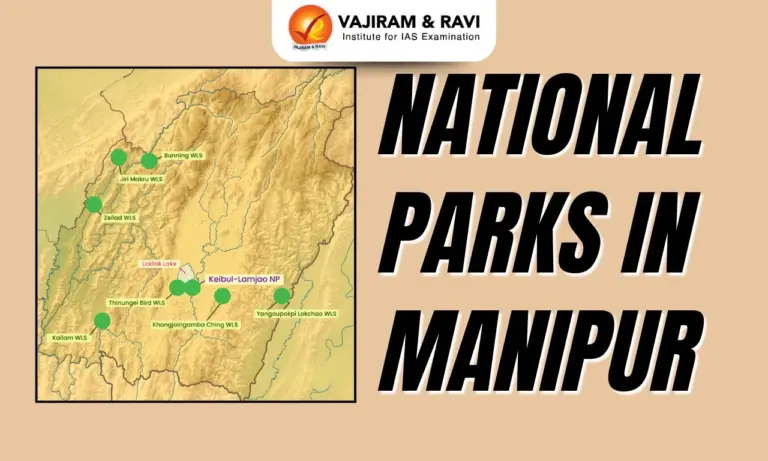
National Parks in Manipur are legally defined geographical spaces created to conserve nature, ecosystems, wildlife, and associated cultural values over the long term. As per the IUCN definition, these areas are managed through effective legal means to protect ecological processes, species diversity, and habitats. National Parks in India specifically focus on preserving large natural ecosystems with minimal human interference, while also supporting scientific research, environmental education, recreation, and cultural values. In India, protected areas form the backbone of biodiversity conservation and ensure survival of endangered and endemic species.
Protected Areas in Manipur
Manipur has an extensive protected area network supporting biodiversity conservation across hills, wetlands, and forests.
- Biodiversity hotspot location: Lies at the junction of Himalayan and Indo-Myanmar global biodiversity hotspots.
- High forest cover: About 77.20% of the state’s geographical area is under forests.
- Protected Area Network: Around 3.7% of the state area legally notified for wildlife protection, including National Parks, Sanctuaries, Community Reserves, Ramsar Convention, etc.
- Ecosystem diversity: Includes wetlands, floating meadows, evergreen forests, and montane ecosystems.
- Species richness: Supports thousands of plant species and hundreds of animal and bird species.
National Parks in Manipur
Manipur has two notified National Parks that play a critical role in conserving rare ecosystems and endemic species. These parks represent unique habitats, ranging from floating wetland ecosystems to high-altitude Himalayan landscapes. They protect flagship species like the Sangai deer and the Shirui Lily, both globally rare and culturally significant. National Parks in Manipur also support endangered mammals, migratory birds, orchids, medicinal plants, and traditional ecological knowledge of indigenous communities. Their legal protection ensures in-situ conservation, ecological stability, and long-term biodiversity security in the state.
Keibul Lamjao National Park
Keibul Lamjao National Park is globally unique as the only floating national park in the world, located on Loktak Lake.
- Unique ecosystem: World’s only floating park formed by phumdi vegetation mats.
- Flagship species: Sole natural habitat of Sangai, the endangered brow-antlered deer.
- Conservation history: Notified in 1977 after Sangai rediscovery and population collapse.
- Sangai population growth: Increased from 14 in 1975 to about 260 in 2016.
- Ramsar linkage: Forms an integral ecological part of Loktak Lake Ramsar site.
- Habitat diversity: Combines wetland, aquatic vegetation, and semi-evergreen forest ecosystems.
- Other fauna: Supports hog deer, Asian golden cat, civets, otters, and wetland birds.
Shirui National Park
Shirui National Park protects high-altitude Himalayan biodiversity and the rare Shirui Lily.
- Location: Situated in Ukhrul district within the Shirui Kashong range.
- Establishment year: Declared National Park in 1982 for floral conservation.
- Endemic flower: Natural habitat of Shirui Lily, Manipur’s state flower.
- Altitudinal range: Located around 2,835 meters in Eastern Himalayan ecosystem.
- Cultural value: Closely linked with Tangkhul Naga traditions and Shirui Lily Festival.
- Faunal diversity: Supports clouded leopard, deer, wild boar, and rare pheasants.
- Floral richness: Dominated by oak, rhododendron, magnolia, and conifer species.





Wildlife Sanctuaries in Manipur
Wildlife Sanctuaries in Manipur protect diverse habitats such as riverine forests, hill ranges, wetlands, and international border landscapes. These sanctuaries conserve endangered mammals, primates, birds, reptiles, and aquatic species. They also play a vital role in maintaining ecological connectivity between forest patches and supporting migratory bird routes like the East Asian flyway. Many sanctuaries are located in forest-rich hill districts where communities depend on forest resources, making conservation efforts closely linked with livelihoods and sustainable resource management.
Yangoupokpi Lokchao Wildlife Sanctuary
Yangoupokpi Lokchao Wildlife Sanctuary lies along the Indo-Myanmar border with rich forest biodiversity.
- Strategic location: Situated in Tengnoupal district near international border forests.
- Ecological connectivity: Forms a corridor with Myanmar forests and Keibul Lamjao region.
- Forest type: Dominated by tropical moist deciduous and semi-evergreen forests.
- Key fauna: Habitat for hoolock gibbon, deer, elephants, and carnivores.
- Bird diversity: Supports resident and migratory birds from regional flyways.
Jiri-Makru Wildlife Sanctuary
Jiri-Makru Wildlife Sanctuary protects riverine and hill ecosystems in western Manipur.
- Geographic setting: Located between Jiri and Makru rivers near Assam border.
- Primate conservation: Important habitat for hoolock gibbon and capped langur.
- Forest structure: Characterized by dense tropical evergreen and moist deciduous forests.
- Faunal richness: Supports leopards, deer, wild boar, and small carnivores.
- Hydrological role: Forests help regulate Barak river tributary catchments.
Kailam Wildlife Sanctuary
Kailam Wildlife Sanctuary is known for hornbill diversity and intact hill forests.
- District location: Situated in Churachandpur district of southern Manipur.
- Avian importance: Home to Great Indian Hornbill and other hornbill species.
- Mammalian fauna: Supports hoolock gibbon, barking deer, and clouded leopard.
- Forest composition: Dense evergreen and semi-evergreen hill forests dominate landscape.
- Conservation value: Protects high biodiversity in community-influenced forest areas.
Bunning Wildlife Sanctuary
Bunning Wildlife Sanctuary conserves forest ecosystems of the Barail hill range.
- Location: Situated in Tamenglong district within Barail Range.
- Forest type: Tropical evergreen and moist deciduous forests predominate.
- Faunal diversity: Supports birds, small mammals, and forest-dependent species.
- Ecological role: Maintains forest continuity across western Manipur hills.
- Conservation significance: Protects lesser-known but ecologically vital habitats.
Zeilad Wildlife Sanctuary
Zeilad Wildlife Sanctuary is notable for its lake systems and forest biodiversity.
- Geographic feature: Comprises a group of natural lakes within forested hills.
- District location: Located in Tamenglong district of Manipur.
- Wildlife similarity: Faunal composition similar to Kailam Wildlife Sanctuary.
- Aquatic habitats: Supports wetland birds, amphibians, and aquatic organisms.
- Ecological importance: Lakes enhance habitat diversity and water availability.
Khongjeingamba Wildlife Sanctuary
Khongjeingamba Wildlife Sanctuary protects lowland forest ecosystems near Loktak region.
- Location: Situated in Bishnupur district of Manipur.
- Habitat type: Includes forested hills and valley-edge ecosystems.
- Key species: Supports hog deer and small carnivores.
- Conservation role: Acts as buffer to Loktak Lake ecosystems.
- Biodiversity value: Important for maintaining regional wildlife movement.
Thinungei Bird Sanctuary
Thinungei Bird Sanctuary is Manipur’s first notified bird sanctuary.
- District location: Located in Bishnupur district near Loktak wetlands.
- Habitat type: Floodplain wetland ecosystem with seasonal water spread.
- Avifaunal importance: Supports resident and migratory water birds.
- Conservation status: Declared specifically for bird protection.
- Ecological role: Enhances wetland bird conservation in Loktak basin.
Ramsar Site in Manipur (Loktak Lake)
Loktak Lake is a globally significant wetland supporting floating ecosystems and biodiversity.
- Largest freshwater lake: Biggest natural freshwater lake in northeast India.
- Floating meadows: Characterized by phumdi mats supporting Keibul Lamjao Park.
- Ramsar recognition: Designated for international wetland importance.
- Montreux Record: Listed in 1993 due to ecological threats and degradation.
- Biodiversity support: Habitat for Sangai deer, fish species, and migratory birds.

 Last updated on March, 2026
→ UPSC Final Result 2025 is now out.
→ UPSC has released UPSC Toppers List 2025 with the Civil Services final result on its official website.
→ Anuj Agnihotri secured AIR 1 in the UPSC Civil Services Examination 2025.
→ UPSC Marksheet 2025 is now out.
→ UPSC Notification 2026 & UPSC IFoS Notification 2026 is now out on the official website at upsconline.nic.in.
→ UPSC Calendar 2026 has been released.
→ Check out the latest UPSC Syllabus 2026 here.
→ UPSC Prelims 2026 will be conducted on 24th May, 2026 & UPSC Mains 2026 will be conducted on 21st August 2026.
→ The UPSC Selection Process is of 3 stages-Prelims, Mains and Interview.
→ Prepare effectively with Vajiram & Ravi’s UPSC Prelims Test Series 2026 featuring full-length mock tests, detailed solutions, and performance analysis.
→ Enroll in Vajiram & Ravi’s UPSC Mains Test Series 2026 for structured answer writing practice, expert evaluation, and exam-oriented feedback.
→ Join Vajiram & Ravi’s Best UPSC Mentorship Program for personalized guidance, strategy planning, and one-to-one support from experienced mentors.
→ Shakti Dubey secures AIR 1 in UPSC CSE Exam 2024.
→ Also check Best UPSC Coaching in India
National Parks in Manipur FAQs
Q1. How many National Parks are there in Manipur?+
Q2. Why is Keibul Lamjao National Park unique?+
Q3. Which endangered animal is found only in Manipur?+
Q4. What is Shirui National Park famous for?+
Q5. Which Ramsar site is located in Manipur?+
Tags: national parks in manipur