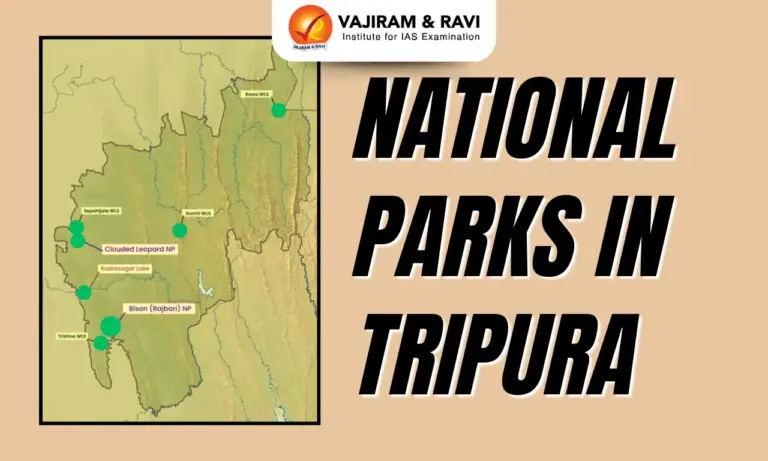
National Parks in Tripura are legally notified regions created to conserve wildlife, forests, and natural ecosystems of high ecological value. Under the Wildlife Protection Act, 1972, National Parks allow almost no human activity, while Wildlife Sanctuaries permit limited regulated use. There are currently 107 National Parks in India covering 44,402.95 square kilometres and 574 Wildlife Sanctuaries covering 127,241.24 square kilometres, together forming the backbone of biodiversity conservation. These areas protect threatened species, maintain ecological balance, conserve river systems, and safeguard unique landscapes for future generations.
Protected Areas in Tripura
Tripura has a compact yet ecologically rich protected area network supporting Indo-Burmese biodiversity.
- Legal Framework: Protected under Wildlife Protection Act, 1972 for biodiversity conservation.
- Ecological Zone: Part of Indo-Burma biodiversity hotspot with high species endemism.
- Coverage Type: Includes National Parks, Wildlife Sanctuaries, and Ramsar wetland site.
- Habitat Diversity: Tropical semi-evergreen forests, bamboo brakes, wetlands, and riverine systems.
- Conservation Focus: Protection of threatened mammals, primates, reptiles, and freshwater ecosystems.
National Parks in Tripura
Tripura has two National Parks, both embedded within larger Wildlife Sanctuaries, ensuring landscape-level conservation. These parks are unique because they were carved out of pre-existing sanctuaries to give stronger legal protection to ecologically sensitive core zones. The parks safeguard rare mammals like the Indian Gaur and Clouded Leopard, preserve tropical semi-evergreen forests, and protect river-fed ecosystems linked to the Gumti River system. Their strategic location between sanctuaries and wetlands ensures habitat connectivity, species movement, and long-term ecological stability within a small northeastern state with high forest dependence.

Bison National Park
Bison National Park, also known as Rajbari National Park, lies within the Trishna Wildlife Sanctuary and focuses on megafauna conservation.
- Location: Situated inside Trishna Wildlife Sanctuary in southern Tripura.
- Primary Objective: Established to restore natural habitat of Indian Gaur (Vulnerable).
- Vegetation Type: Tropical semi-evergreen forests mixed with savannah grasslands and bamboo.
- Key Mammals: Indian Gaur, multiple deer species, and Golden Langur populations.
- Ecological Link: Separated from Sipahijola Sanctuary by Gumti River natural boundary.
- Landscape Role: Forms southern forest corridor connecting riverine and forest ecosystems.
Clouded Leopard National Park
Clouded Leopard National Park is carved from Sipahijola Wildlife Sanctuary and emphasizes carnivore conservation.
- Administrative Location: Lies within Sipahijola Wildlife Sanctuary of Tripura.
- Year of Establishment: Declared a National Park in 2007.
- Flagship Species: Clouded Leopard listed as Vulnerable globally.
- Water Source: Gumti River acts as primary perennial water system.
- Habitat Features: Woodland ecosystem with artificial lake and zoological gardens.
- Conservation Value: Protects forest predators and prey species simultaneously.





Wildlife Sanctuaries in Tripura
There are 4 Wildlife Sanctuaries in Tripura as detailed below:
- Sepahijala Wildlife Sanctuary: Located south of Agartala, it is a forested area famous for Clouded Leopard conservation and houses Clouded Leopard National Park, botanical gardens, artificial lake, and zoological diversity supporting long-term environmental education and tourism.
- Trishna Wildlife Sanctuary: Established primarily to restore Indian Gaur habitat, it supports threatened primates like Hoolock Gibbon (Endangered), Golden Langur (Endangered), and Capped Langur (Vulnerable), making it Tripura’s most faunally diverse sanctuary.
- Gumti Wildlife Sanctuary: Located in southeastern Tripura, named after the Gumti River, and ecologically linked with Dumbur Lake or Gumti Reservoir, forming an important river-wetland-forest continuum supporting aquatic and terrestrial biodiversity.
- Rowa Wildlife Sanctuary: Situated in Panisagar subdivision of North Tripura district, it is one of the smallest sanctuaries in India, crucial for protecting lowland forest patches and acting as a biodiversity refuge amid expanding human settlements.
Ramsar Site in Tripura (Rudrasagar Lake)
Rudrasagar Lake is Tripura’s only Ramsar Site and a vital wetland ecosystem with cultural importance. The key features of the Rudrasagar Lake have been highlighted below:
- Geographical Location: Located in Melaghar Block, Sonamura subdivision, Sipahijala district.
- Historical Origin: Artificial lake built by Ahom King Lakshmi Singha honoring King Rudra Singha.
- Alternative Name: Also known as Twijilikma and functions as sedimentation reservoir.
- Hydrological System: Fed by three perennial streams draining into the Gomti River.
- Biodiversity Importance: Ideal habitat for critically endangered Three-Striped Roof Turtle.
- Cultural Value: Major tourist attraction during Vijaya Dashami festival season.

 Last updated on March, 2026
→ UPSC Final Result 2025 is now out.
→ UPSC has released UPSC Toppers List 2025 with the Civil Services final result on its official website.
→ Anuj Agnihotri secured AIR 1 in the UPSC Civil Services Examination 2025.
→ UPSC Marksheet 2025 is now out.
→ UPSC Notification 2026 & UPSC IFoS Notification 2026 is now out on the official website at upsconline.nic.in.
→ UPSC Calendar 2026 has been released.
→ Check out the latest UPSC Syllabus 2026 here.
→ UPSC Prelims 2026 will be conducted on 24th May, 2026 & UPSC Mains 2026 will be conducted on 21st August 2026.
→ The UPSC Selection Process is of 3 stages-Prelims, Mains and Interview.
→ Prepare effectively with Vajiram & Ravi’s UPSC Prelims Test Series 2026 featuring full-length mock tests, detailed solutions, and performance analysis.
→ Enroll in Vajiram & Ravi’s UPSC Mains Test Series 2026 for structured answer writing practice, expert evaluation, and exam-oriented feedback.
→ Join Vajiram & Ravi’s Best UPSC Mentorship Program for personalized guidance, strategy planning, and one-to-one support from experienced mentors.
→ Shakti Dubey secures AIR 1 in UPSC CSE Exam 2024.
→ Also check Best UPSC Coaching in India
National Parks in Tripura FAQs
Q1. How many National Parks are there in Tripura?+
Q2. Where is Bison National Park located?+
Q3. Which species is Clouded Leopard National Park famous for?+
Q4. Which river connects the major protected areas of Tripura?+
Q5. What is the Ramsar Site of Tripura?+
Tags: national parks in tripura