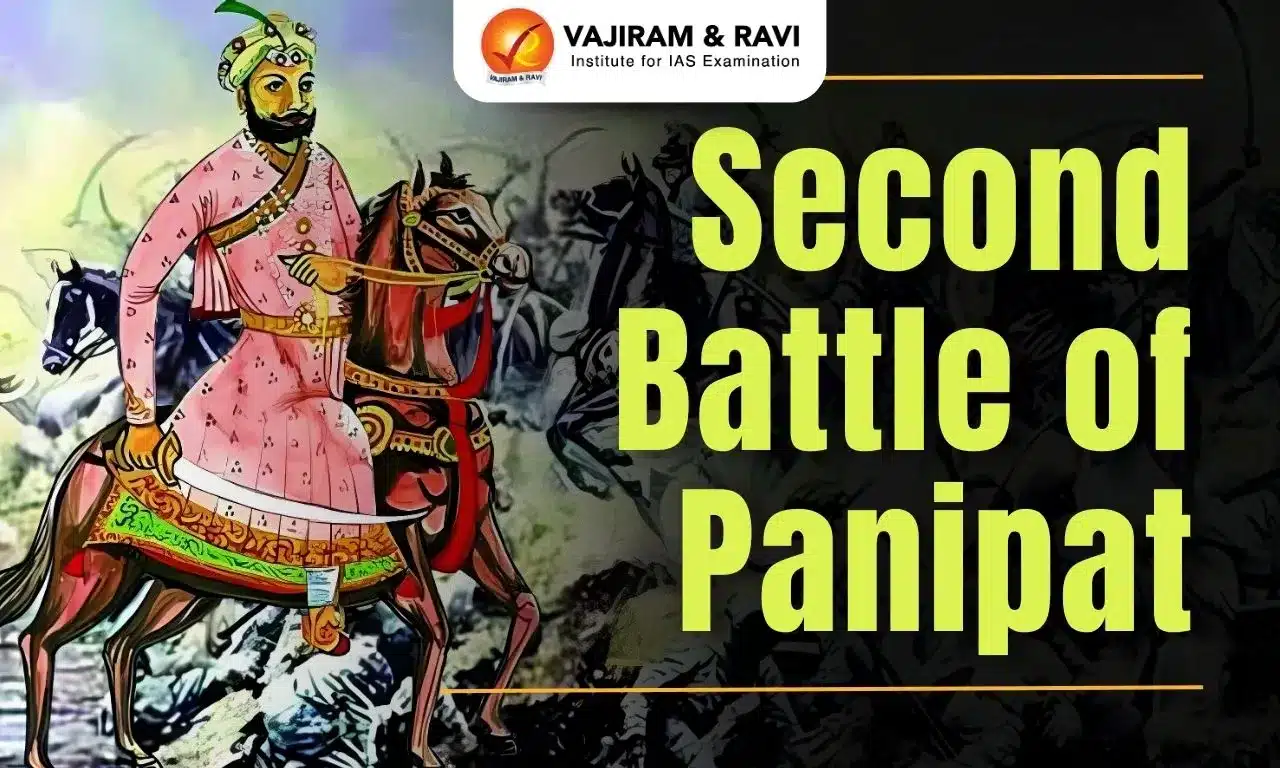
The Second Battle of Panipat was a decisive battle fought on 5 November 1556 at Panipat, in present-day Haryana. The battle was fought between the forces of Samrat Hem Chandra Vikramaditya, popularly known as Hemu, and the Mughal army fighting in the name of the young Emperor Akbar under the leadership of his regent, Bairam Khan.
The Mughal victory in this battle restored Mughal control over Delhi and Agra. It also laid the political foundation for Akbar’s long reign and the later expansion of the Mughal Empire across large parts of the Indian subcontinent.
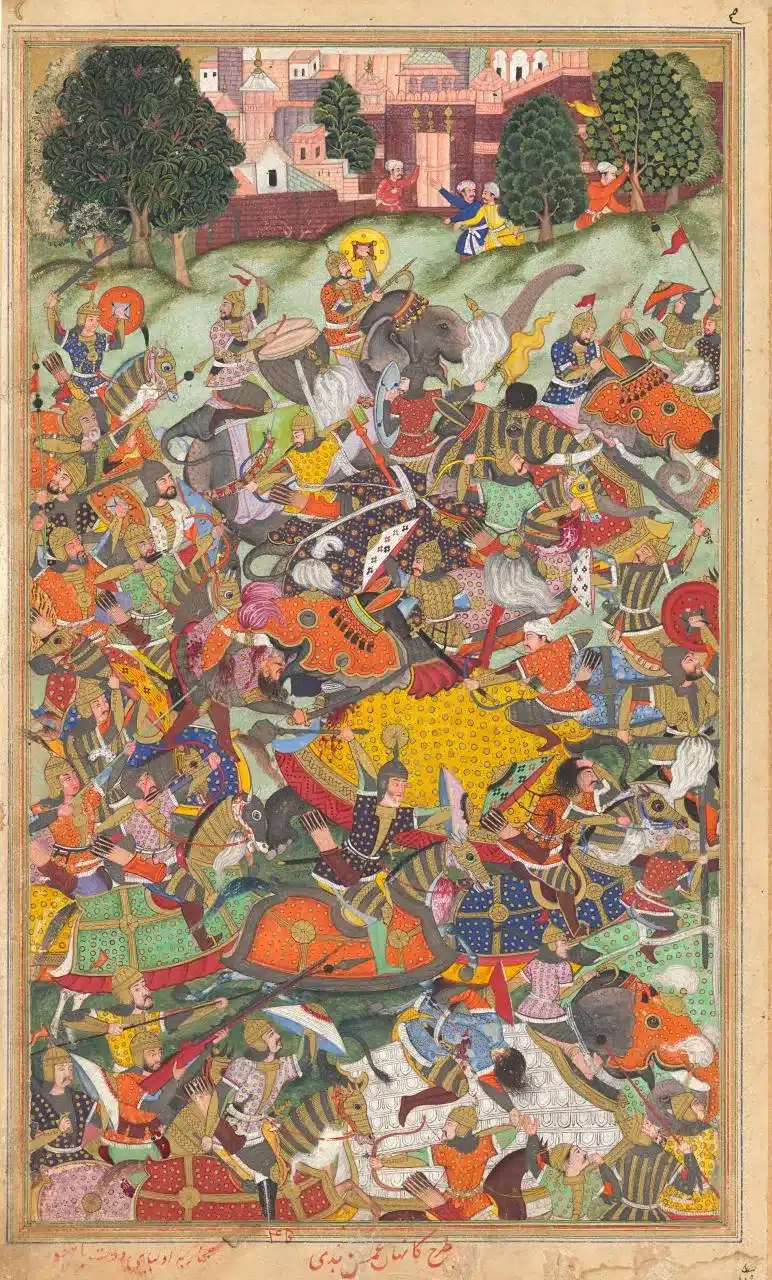
Second Battle of Panipat Overview
The Second Battle of Panipat was fought between Hemu’s army and the Mughal forces of Emperor Akbar. Since Akbar was still very young at the time, the Mughal army was effectively commanded by Bairam Khan, with important support from generals such as Khan Zaman I.
- Hemu's army, despite consisting of 1500 war elephants, 30,000 horsemen, and artillery, was defeated by the Mughal army of 10,000 cavalry and 5000 veteran soldiers.
- The significant victory of Akbar’s generals, Khan Zaman I and Bairam Khan, in the battle demonstrated that battlefield tactics are more important than numerical superiority in wars.
Second Battle of Panipat Background
Second Battle of Panipat happened in the background of Hemu’s rise to power and the succession of thirteen-year-old Akbar to the throne of Delhi after the death of Mughal Emperor Humayun in 1556. Hemu, a strong military leader from Rewari, gained prominence for defeating the Mughal Army and briefly establishing Hindu control in Delhi.
- Hemu’s Rise: Hemu was the Prime Minister and commander of Adil Shah Suri’s army of the Sur dynasty. Hemu won 22 battles between 1553 and 1556. At the time of Humayun's death, Hemu was in Bengal, suppressing a rebellion. Humayun's death provided him with the perfect opportunity to defeat the Mughals.
- Strategy of Hemu: Hemu attacked Agra and captured the Etawah, Kalpi, and Agra provinces, which were earlier under Mughal command. After strengthening his army at Gwalior Fort by recruiting more Hindus, Hemu moved towards Delhi, where his army encountered Mughal resistance, leading to the Battle of Tughlaqabad.
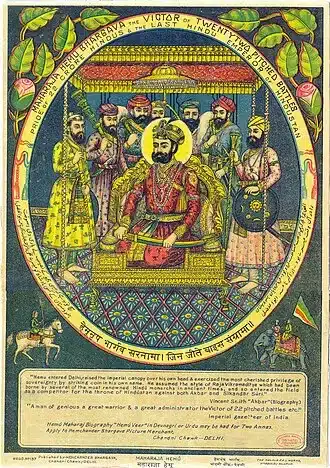
- Hemu’s Accession to the throne: Mughal forces, under the command of Tardi Beg, lost the Battle of Tughlaqabad. Hemu took possession of Delhi and was crowned at Purana Qila on 7 October 1556.
- He also assumed the title of Raja Hemchandra Vikramaditya.
- Future Plan: After his conquest of Delhi, Hemu started making several changes in his army, preparing for an attack on Kabul, as Abul Fazal stated in Akbarnama.
Battle of Tughlaqabad
Battle of Tughlaqabad (also called the Battle of Delhi) was fought on 7 October 1556 between Hemu and Mughal forces under the command of Tardi Beg Khan. Hemu emerged victorious. Around 3000 soldiers were killed, and Tardi Beg Khan fled the Battle. Hemu took control of Delhi and declared his independent status. He also assumed the title of Vikramaditya or Bikramjit at Purana Qila, Delhi.


Second Battle of Panipat Causes
The Second Battle of Panipat was fought on November 5, 1556, just weeks after Hemu captured Delhi. Other causes include the Mughals' perceived threat due to Hemu’s rise, differences in military capability, and so on. The causes are as follows:
- Threat to Mughal Rule: After Humayun died in 1556, Akbar, a young ruler, faced significant threats from Hemu's ambitious reign. Hemu's victories in 1553-1556, including North India, Bengal, and Delhi, prompted Akbar and Bairam Khan to act.
- Rising status of Hemu: In 1556, Hemu defeated Akbar's forces in the Battle of Delhi, just a month before the second battle of Panipat. He crowned himself as Samrat Hemachandra Vikramaditya.
- Mughal Retaliation: In November 1556, Akbar counterattacked Hemu at Panipat, seizing control of Delhi. This led to escalation of conflict between Hemu and the Mughals.
Second Battle of Panipat Timeline
Second Battle of Panipat timeline tracks the key events of 1556, showing how young Akbar and Bairam Khan defeated Hemu to rebuild the Mughal Empire. Bairam Khan led the Mughal army towards Delhi, and on 5 November 1556, both armies met at Panipat, where Babur defeated Ibrahim Lodi in the First Battle of Panipat, 1526.
- Akbar remained protected: Akbar and Bairam Khan stayed 8 miles away from the battlefield and did not directly participate in the war. Bairam Khan also gave Akbar a special guard of 5000 experienced and faithful soldiers.
- Hemu’s Leadership: Hemu’s army included 1500 war elephants and 30,000 experienced Afghan and Rajput cavalry. Hemu commanded his army from the forefront, sitting on an elephant named Hawai.
- Mughal army: Mughal forces were composed of 10,000 cavalry, and the formation of Mughal troops was based on traditional lines, with left and right wings supporting the center backed by a vanguard.
- Abul Fazl described the war as “ Two armies so collided that struck fire out of the water, the air was all crimsoned.”
- Defeat of Hemu: Hemu was hit by a Mughal arrow in his eye, which made King Hemu fall unconscious, making his army disorganized, breaking the formation, and finally being defeated.
Second Battle of Panipat Outcome
Second Battle of Panipat resulted in the defeat of Hemu, who was captured alive while severely wounded by Shah Quli Khan, Governor of Narnaul, and brought to the Mughal tent. General Bairam Khan beheaded Hemu. Several relatives and supporters of Hemu were also beheaded. Following the victory in the second Battle of Panipat, the Mughals took over Delhi and Agra, establishing Akbar’s absolute authority over Delhi.
Second Battle of Panipat Significance
The significance of the Second Battle of Panipat lies in its role as a decisive turning point in 1556, saving the nascent Mughal dynasty from total collapse and laying the groundwork for Akbar's extensive empire.
- Restoration of Mughal Rule: Akbar reclaimed Delhi and Agra, preventing the complete expulsion of the Mughal line from Northern India following Humayun's sudden death.
- Crushed Afghan Resistance: The defeat and death of Hemu effectively broke the backbone of the Sur Empire and ended formidable Afghan political challenges to Delhi.
- Initiated Imperial Consolidation: Securing the political heartland provided Akbar with a stable base to embark on nearly five decades of administrative integration and territorial expansion across the subcontinent.
- Shift in Sovereign Power: Terminated brief local Hindu rule under Samrat Hemchandra Vikramaditya, firmly re-establishing Mughal supremacy over North India.
Second Battle of Panipat UPSC PYQs
Q1: The third battle of Panipat was fought in 1761. Why were so many empire-shaking battles fought at Panipat? (UPSC Mains 2014)

 Last updated on Sep, 2026
→ UPSC Mains Question Paper 2026 is out now for Essay & GS Paper 1, 2, 3 & 4.
→ UPSC Mains GS Paper 1 2026 is out now.
→ UPSC Mains GS Paper 2 2026 is out now.
→ UPSC Mains GS Paper 3 2026 is out now.
→ UPSC Mains GS Paper 4 2026 is out now.
→ UPSC Mains Indian Language Paper & English Compulsory Paper are out now.
→ Check out the latest UPSC Syllabus 2026 here.
→ UPSC Mains Admit Card 2026 is now out.
→ Enroll in Vajiram & Ravi’s UPSC Mains Test Series 2027 for structured answer writing practice, expert evaluation, and exam-oriented feedback.
→ Join Vajiram & Ravi’s UPSC Mentorship Program 2027 for personalized guidance, strategy planning, and one-to-one support from experienced mentors.
→ Go through the UPSC Mains Previous Year Papers to enhance your preparation.
→ Download UPSC Mains Essay Paper 2025, UPSC Mains GS Paper-I 2025, UPSC Mains GS Paper-II 2025, UPSC Mains GS Paper-III 2025, UPSC Mains GS Paper-IV 2025, UPSC Mains English (Compulsory) Paper 2025, UPSC Mains Hindi (Qualifying) Paper 2025 here.
→ UPSC has released UPSC Toppers List 2025 with the Civil Services final result on its official website.
→ UPSC Calendar 2027 has been released.
→ Also check Best UPSC Coaching in India
Second Battle of Panipat FAQs
Q1. Who fought the second Battle of Panipat?+
Q2. When was the Second Battle of Panipat fought?+
Q3. Who fought the 2nd Battle of Panipat?+
Q4. Who won the 3rd battle of Panipat?+
Q5. Why is the Second Battle of Panipat important?+
Tags: quest second battle of panipat UPSC Medieval History