Zoonotic Diseases, Causes, Examples, Classification, Modes

Zoonotic Diseases

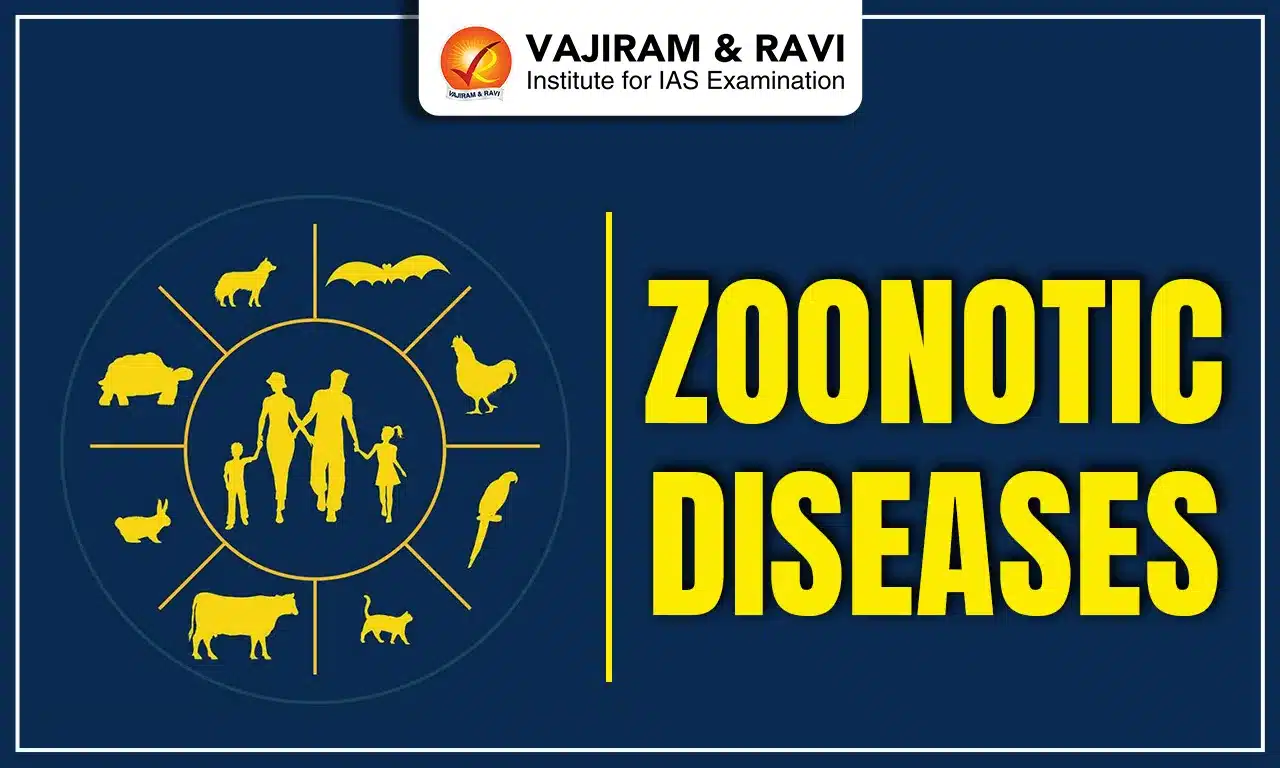
Zoonotic diseases are infections that spread between animals and humans. These diseases pose a major challenge to public health, agriculture, and the global economy. According to the World Health Organization (WHO), around 60% of known infectious diseases and 75% of emerging infectious diseases are zoonotic. They spread through direct contact, contaminated food, vectors, or the environment. 

Zoonotic Diseases

Zoonotic diseases, also known as zoonoses, are illnesses caused by pathogens such as bacteria, viruses, parasites, or fungi that can be transmitted naturally from animals to humans. They may spread through animal bites, contact with body fluids, or consumption of contaminated food. Common examples include rabies, avian influenza, anthrax, and COVID-19.

Zoonoses

The term “Zoonotic Disease”/ “Zoonoses” is derived from the Greek words “zoon” (animal) and “nosos” (disease). The study of zoonotic diseases highlights the interconnectedness of animal, human, and environmental health, forming the basis of the One Health approach. Understanding and managing zoonotic diseases are essential to preventing global outbreaks and ensuring sustainable health systems.

Zoonotic Diseases History

Historically, zoonotic diseases emerged with animal domestication and agriculture (circa 10,000 BCE). Early hunter-gatherer communities had limited contact with animals, restricting outbreaks. However, as humans began farming and keeping livestock, new diseases like tuberculosis, influenza, and measles evolved from animal strains (WHO, 2020).

The first major medical breakthrough against zoonosis was Edward Jenner’s smallpox vaccine (1796), derived from cowpox virus (while it is a subject of historical debate). This laid the foundation for modern immunization and eventually eradicated smallpox globally by 1980.

Zoonotic Diseases Modes of Transmission

Zoonotic diseases are infections transmitted between animals and humans under natural conditions. Common Modes of Transmission:

  • Direct transmission: Through animal bites, saliva, or air (e.g., Rabies, Influenza).
  • Indirect transmission: Via contaminated food, water, or surfaces.
  • Vector-borne transmission: Spread through mosquitoes, fleas, or ticks.
  • Intermediate host transmission: Pathogen passes through a secondary host before reaching humans (e.g., Nipah virus in pigs).
  • Host genetics also plays a role; viruses that require fewer mutations to adapt to humans pose higher risks (University of California, Davis Study, 2021).

Zoonotic Disease Causes

The rise in zoonotic outbreaks in the 21st century is linked to both environmental and socio-economic causes:

  • Deforestation and Land Use Change: Human encroachment into wildlife habitats increases contact with reservoir species.
  • Climate Change: Alters habitats of vectors like mosquitoes and bats, expanding disease zones.
  • Industrial Farming: Intensive livestock production facilitates viral recombination (e.g., swine flu 2009).
  • Wildlife Trade and Bushmeat: Wet markets and wild meat consumption expose humans to novel pathogens.
  • Urbanization and Population Growth: Bring animals and humans into close, unsanitary contact.
  • Global Travel and Trade: Enable rapid international spread of emerging zoonoses.
  • A UNEP-ILRI 2020 report identified climate change, unsustainable agriculture, and wildlife exploitation as the three leading drivers of new zoonotic pandemics under seven drivers of disease emergence.

Zoonotic Diseases Classification

Zoonotic diseases can be classified based on the type of pathogen that causes them, mode of transmission, etc as given below. Understanding these categories helps in designing effective prevention and control measures. Bacteria cause the highest share (42%) of zoonotic diseases globally

Zoonotic Diseases Classification
Basis of Classification Type / Category Examples Animal Hosts / Reservoirs Transmission Route / Key Features

Etiological (by pathogen type)

Bacterial

Anthrax, Brucellosis, Leptospirosis, Plague, Tuberculosis

Cattle, goats, pigs, rodents

Direct contact, inhalation, ingestion


Viral

Rabies, Avian Influenza, Ebola, HIV, SARS

Dogs, bats, monkeys, birds

Bite, aerosol, body fluids


Parasitic

Toxoplasmosis, Giardiasis, Trichinosis, Malaria

Cats, pigs, ruminants

Foodborne, vector-borne


Fungal (Mycotic)

Ringworm, Aspergillosis, Histoplasmosis

Dogs, cattle, birds

Skin contact, inhalation


Rickettsial

Q-Fever, Scrub Typhus

Cattle, rodents

Tick-borne, aerosol


Chlamydial

Psittacosis, Chlamydiosis

Parrots, goats, cats

Airborne, direct contact


Mycoplasma

Mycoplasma pneumonia

Livestock

Airborne droplets


Protozoal

Leishmaniasis, Trypanosomiasis, Giardiasis

Dogs, cattle, bats

Vector-borne


Prion-related

Mad Cow Disease, CJD

Cattle, sheep

Ingestion, neurological

Direction of Transmission

Anthropozoonoses

Rabies, Brucellosis

Animals → Humans

Animal to human infection


Zooanthroponoses

Tuberculosis in monkeys

Humans → Animals

Reverse zoonosis


Amphixenoses

Staphylococcal infections

Both

Bidirectional


Euzoonoses

Taenia solium

Humans act as the obligatory host

Parasitic cycle

Quantitative Distribution (by Origin)

Bacteria (42%), Parasites (29%), Viruses (22%), Fungi (5%), Prions (2%)

-

-

Indicates relative global burden

Transmission-Based

Direct Zoonoses

Rabies, Anthrax, Avian Influenza

Dogs, cattle, birds

Direct contact, bite, aerosol


Vector-Borne (Metazoonoses)

Dengue, Chikungunya, Lyme Disease

Mosquitoes, ticks

Vector transmission


Food/Water-Borne

Salmonellosis, Cryptosporidiosis

Livestock, poultry

Contaminated food or water

Ecological / Environmental

Synanthropic

Urban Rabies, Ringworm

Pets, livestock

Domestic or urban cycle


Exoanthropic

Wildlife Rabies, Arboviroses

Wild animals

Natural or sylvatic cycle

Reservoir-Based

Sapronoses

Histoplasmosis, Aspergillosis

Soil, organic matter

Pathogens replicate in non-living matter


Saprozoonoses

Fungal or bacterial infections

Soil + animal hosts

Environmental + animal stages


Cyclozoonoses

Taenia solium

Pigs, humans

Two vertebrate hosts


Metazoonoses

Arbovirus infections

Vertebrate + invertebrate

Needs vector host

Reverse Zoonoses (Zooanthroponoses)

Human-to-Animal Transmission

Tuberculosis, Influenza A, Staphylococcus infections

Cattle, elephants, pets

Reverse transmission from humans

Emerging / Integrated Classification

Cross-Domain (One Health)

COVID-19, Ebola, Nipah Virus

Wildlife, bats, pigs

Integrated human - animal - environment cycle

Zoonotic Diseases in India

India has recorded several significant zoonotic diseases that impact both human and animal health. Each disease has a specific causative agent, mode of transmission, and region of occurrence.

Zoonotic Diseases in India
Disease Causative Agent Transmission Affected Regions / States

Rabies

Rabies virus

Dog bites

Nationwide (urban and rural)

Avian Influenza (Bird Flu)

H5N1, H5N8 virus

Contact with infected poultry

Kerala, Haryana, Maharashtra

Nipah Virus

Henipavirus

Fruit bats, contaminated fruits

Kerala

Kyasanur Forest Disease (KFD)

Flavivirus

Tick bites

Karnataka, Goa, Maharashtra

Leptospirosis

Leptospira bacteria

Water contaminated by animal urine

Gujarat, Tamil Nadu

Brucellosis

Brucella bacteria

Contact with livestock or unpasteurized milk

Rajasthan, Uttar Pradesh

Anthrax

Bacillus anthracis

Handling infected animals

Odisha, Jharkhand

Japanese Encephalitis

Flavivirus

Mosquito bites

Assam, Uttar Pradesh, Bihar

Government Policies for Zoonotic Diseases

The Indian government has implemented multiple programs and policies to prevent and control zoonotic diseases under the One Health approach, which integrates human, animal, and environmental health efforts.

Government Policies for Zoonotic Diseases
Policy / Programme Objective Impact

Integrated Disease Surveillance Programme (IDSP)

Early detection and monitoring of zoonotic diseases

Improved outbreak reporting and rapid response systems

One Health Mission (2021)

Coordinate surveillance between human and animal health sectors

Promotes joint research and information sharing

National Rabies Control Programme

Eradicate rabies through vaccination and awareness

Significant reduction in rabies cases in pilot states

National Animal Disease Control Programme (NADCP)

Control Foot and Mouth Disease and Brucellosis

₹13,000 crore initiative for livestock vaccination

National Centre for Disease Control (NCDC)

Coordinate inter-sectoral zoonotic disease management

Strengthened diagnostic and surveillance capacities

ICMR-NIVEDI Collaboration

Joint research and database sharing on zoonotic pathogens

Improved data accuracy and interdepartmental coordination

National Action Plan on AMR (2017)

Combat antimicrobial resistance due to animal antibiotic misuse

Encourages rational use of antibiotics in livestock

Role of Wildlife Trade in Zoonotic Diseases

Illegal wildlife trade increases spillover risk by bringing multiple species into confined markets. The origin of COVID-19 is linked to wildlife trade in wet markets (WHO-China Joint Mission Report, 2021). Similar connections exist for Ebola, SARS, and HIV, where bushmeat consumption led to cross-species transmission.

The CDC warns that bushmeat practices, especially in Africa and Southeast Asia, expose communities to zoonotic pathogens. Preservation methods like drying or smoking are insufficient to destroy viruses, heightening infection risk

Zoonotic Disease Challenges

Despite institutional support and growing awareness, controlling zoonotic diseases in India faces several challenges related to infrastructure, coordination, and public behavior.

Key Challenges:

  1. Limited Surveillance: Fragmented systems between animal and human health sectors.
  2. Underreporting: Rural areas often fail to record outbreaks promptly.
  3. Lack of Awareness: People ignore hygiene and vaccination practices for pets and livestock.
  4. Climate Change: Expands the range of disease-carrying vectors.
  5. Antimicrobial Resistance (AMR): Overuse of antibiotics in animals contributes to resistant pathogens.
  6. Inadequate Veterinary Infrastructure: Lack of trained veterinarians and diagnostic labs in remote areas.

Way Forward:

  1. One Health Integration: Strengthen collaboration between ICMR, NCDC, and DAHD for joint response systems.
  2. Surveillance Expansion: Extend IDSP coverage to all districts with real-time digital reporting.
  3. Public Awareness: Launch national campaigns on hygiene, vaccination, and pet care.
  4. Strengthening Laboratories: Upgrade human testing facilities under the Integrated Public Health Labs Scheme (2021).
  5. Vaccine Development: Invest in indigenous vaccines for rabies, Nipah, and brucellosis.
  6. Data Sharing and Training: Create shared national databases and train field workers in zoonotic disease management.
  7. Climate Adaptation: Integrate disease control with environmental and wildlife conservation policies.

Zoonotic Diseases Impact

Zoonotic diseases have far-reaching consequences on global health, economy, and food security. The World Bank (2021) estimates global economic losses from zoonotic outbreaks at over USD 100 billion annually, with developing countries like India being most affected due to poor veterinary infrastructure and dense population.

In India, repeated outbreaks have led to human deaths, loss of livestock, and increased health expenditure. A cross-sectional analysis of India's Integrated Disease Surveillance Program (IDSP) data from 2018-2023, conducted by the Indian Council of Medical Research (ICMR), reported that 8.3% of the total recorded infectious disease outbreaks were zoonotic They also affect trade due to bans on animal exports and poultry products during outbreaks.

The COVID-19 pandemic, of probable zoonotic origin, further highlighted the global need for integrated disease surveillance and cross-sector collaboration.

Zoonotic Diseases Recent Outbreak

The case study of the recent Zoonotic Diseases outbreak has been provided below:

  • COVID-19 Pandemic (2019-Present): Caused by SARS-CoV-2, likely originating from wildlife reservoirs. It resulted in over 15 million deaths globally (WHO, 2022). WHO declared an end to the Public Health Emergency of International Concern (PHEIC), on May 5, 2023. However, the virus has continued to circulate, with varying levels of impact.
  • Nipah Virus in Kerala (2023): Linked to fruit bats; prompt surveillance and containment by the ICMR and NCDC prevented wider spread. The outbreak was officially confirmed in Kozhikode, Kerala, in September 2023.
  • Avian Influenza (2021): Detected in poultry across several Indian states including Kerala, Haryana, Madhya Pradesh, and Maharashtra; controlled through biosecurity and culling measures. The risk to humans was considered low, though India did report a fatal human case of H5N1 avian influenza in July 2021.
  • Ebola Outbreaks (Africa, 2014-2016): Transmitted through contact with infected wildlife; WHO declared it a Public Health Emergency of International Concern (PHEIC). It was the largest and most complex Ebola outbreak ever, with more than 28,600 cases and 11,325 deaths.

Also Read: Bacteria

Zoonotic Diseases UPSC

The Press Information Bureau and NCDC have released key data highlighting the extent and management of zoonotic diseases in India:

  • Rabies: India accounts for 36% of global rabies deaths (WHO).
  • Leptospirosis: Reported in over 14 states, affecting coastal and flood-prone areas.
  • Nipah Virus: Recorded outbreaks in Kerala (2018, 2019, 2023) with mortality rates over 70% (88.8% in 2018)
  • Avian Influenza: Outbreaks recorded in 10 states (PIB, 2025), affecting poultry trade.
  • Brucellosis: Estimated to cause ₹9,212 crore annual loss to the livestock sector.

Kyasanur Forest Disease (KFD): The cases are reported yearly from Western Ghats regions. In 2016 outbreak of Maharashtra, confirmed 130 cases in one district alone

Zoonotic Diseases FAQs

Q1: What are Zoonotic Diseases?

Ans: Zoonotic Diseases are infections naturally transmitted between animals and humans, caused by bacteria, viruses, parasites, fungi, or prions.

Q2: How do Zoonotic Diseases spread?

Ans: Zoonotic Diseases spread through direct contact, contaminated food or water, vectors like mosquitoes or ticks, and intermediate animal hosts.

Q3: What are the main causes of Zoonotic Diseases?

Ans: Causes include deforestation, climate change, industrial farming, wildlife trade, urbanization, population growth, and global travel or trade.

Q4: How are Zoonotic Diseases classified?

Ans: Zoonotic Diseases are classified by pathogen type, transmission mode, reservoirs, and ecological or host-based categories, including bacteria, viruses, parasites, and prions.

Q5: What is India’s approach to Zoonotic Diseases?

Ans: India manages Zoonotic Diseases via One Health Mission, IDSP, rabies control, NADCP, NCDC coordination, public awareness, and vaccination programs.

Exchange Rate, Meaning, Types, Systems, NEER, REER, PPP

Exchange Rate

Exchange Rate is an important element in the global economic framework, shaping trade, investment flows, macroeconomic policy, and international competitiveness. It reflects the relative value of one currency in terms of another and plays a decisive role in influencing a country's economic health, including inflation, exports, imports, and capital flows. Understanding exchange rate systems, currency valuation mechanisms, and factors affecting exchange rates is essential for policymakers, investors, and economists alike. This article provides an in-depth examination of Exchange Rate, its meaning, various types, related concepts such as Nominal Effective Exchange Rate (NEER), Real Effective Exchange Rate (REER), Devaluation, Revaluation, Purchasing Power Parity (PPP), and foreign exchange reserves.

What is the Exchange Rate?

Exchange Rate, also called the rate of exchange, is the price at which one country's currency can be exchanged for another's. It represents the relative value of currencies in the international market and indicates how much of one currency is required to buy a unit of another.

For instance, if the US Dollar (USD) is stronger than the Indian Rupee (INR), it implies that the USD can purchase more INR, reflecting higher demand for the USD compared to the Rupee. The exchange rate thus mirrors the demand for a country's goods, services, and assets internationally.

  • A higher demand for a foreign currency relative to the domestic currency results in appreciation of the foreign currency.
  • Exchange rates are influenced by trade flows, capital movements, inflation differentials, and interest rate variations.

Exchange Rate Systems Types

Countries adopt different exchange rate systems depending on their economic goals, market openness, and policy priorities. The major systems are:

1. Fixed Exchange Rate System (Pegged System)

In a fixed system, the government or central bank sets the value of its currency relative to a benchmark, which may be gold, silver, or another major currency (e.g., USD or Euro). Characteristics include: 

  • Ensures stability in international trade and capital flows.
  • Government intervention is necessary to maintain the fixed rate through buying and selling foreign currency.
  • Requires large reserves of foreign currency to defend the peg.

Pegging:
When a currency is tied to the value of another currency or commodity (like gold), it is said to be pegged. For example, the Hong Kong Dollar is pegged to the US Dollar.

2. Flexible Exchange Rate System (Floating Rate)

In a floating system, the currency’s value is determined by market forces, the supply and demand of currencies in the foreign exchange market. Characteristics include: 

  • No direct government intervention.
  • Exchange rates fluctuate continuously based on trade flows, capital movements, and investor sentiment.
  • Helps automatically correct imbalances in trade and capital accounts.

3. Managed Floating Rate System (Dirty Floating)

A hybrid between fixed and flexible systems. While the rate is primarily determined by market forces, the central bank intervenes periodically to prevent excessive volatility. Examples include: India uses a managed float, where the Reserve Bank of India (RBI) intervenes to stabilize the Rupee against excessive swings.

Fixed vs Flexible Exchange Rate Systems 

Fixed and Flexible Exchange Rate Systems have the following differences: 

Basis Fixed Exchange Rate Flexible Exchange Rate

Determination

Officially fixed by the government

Market forces of supply and demand

Government Control

Full control, only government can change rate

Minimal or no control; fluctuates freely

Stability

Stable; small variation possible

Continuous fluctuations

Currency Impact

Devaluation or revaluation possible

Appreciation or depreciation occurs naturally

Government Bank

Determines rate

Not involved

Foreign Reserve Requirement

High; to defend the peg

Not necessary

BOP Impact

Deficit may not adjust automatically

Automatically corrects deficits or surpluses

Devaluation

Devaluation refers to a deliberate reduction in the value of a domestic currency by the government in a fixed exchange rate system.

Impact:

  • Makes exports cheaper and more competitive internationally.
  • Increases the cost of imports.
  • Can improve trade balance if export response is strong.

Revaluation

Revaluation is an increase in the value of domestic currency relative to foreign currencies in a fixed system. Redenomination, which changes the face value of a currency without affecting its exchange rate, is distinct from revaluation.

Devaluation vs Depreciation 

The difference in between devaluation and depreciation is: 

Aspect Devaluation Depreciation

Meaning

Official reduction in currency value by government

Decline in currency value due to market forces

Occurrence

Fixed exchange rate system

Flexible exchange rate system

Cause

Government policy

Supply and demand in forex market

Currency Manipulation

Currency manipulation refers to artificially lowering the domestic currency’s value to gain a trade advantage. Countries can boost exports by making them cheaper internationally, potentially creating trade imbalances.

  • The US Treasury monitors currency practices of major trading partners under the Trade Facilitation and Trade Enforcement Act of 2015.

  • A country may be labeled a currency manipulator if it meets criteria regarding trade surplus, current account surplus, and foreign currency purchases.

Types of Exchange Rate Markets 

Exchange Rate Markets are of two types. Spot Market and Forward Market.

1. Spot Market

  • Deals with immediate purchase and sale of foreign currency, typically settled within 2 days.
  • The exchange rate for transactions is the spot exchange rate.

2. Forward Market

  • Deals with buying/selling foreign currency at a future date at a pre-agreed rate.
  • Useful for hedging risks against exchange rate fluctuations.

Exchange Rates Affecting Factors

Exchange rates are influenced by multiple economic and financial factors:

  1. Central Bank Intervention: RBI or other central banks buy/sell foreign currency to stabilize the domestic currency.
  2. Inflation Rate: Higher domestic inflation reduces currency demand, causing depreciation.
  3. Interest Rate Differentials: High interest rates attract foreign capital, leading to currency appreciation.
  4. Trade Balance: Higher exports boost domestic currency; higher imports may depreciate it.
  5. Capital Flows: Foreign direct investment (FDI), portfolio investment, and external commercial borrowings affect currency value.
  6. Other Factors: Tourism, NRI remittances, political stability, and global economic conditions also influence exchange rates.

Nominal and Real Effective Exchange Rates

Nominal and Real Effective Exchange Rates means the following: 

Nominal Effective Exchange Rate (NEER)

  • NEER is the weighted average of bilateral nominal exchange rates of a country against major trading partners.
  • Weights are based on trade volume with each country.
  • Not adjusted for inflation.

Real Effective Exchange Rate (REER)

  • REER adjusts NEER for relative inflation rates, reflecting the real competitiveness of a currency.
  • Weights depend on trade balance with each partner country.

Forex Reserves of India

Foreign exchange reserves are assets held by the central bank in foreign currencies, gold, SDRs, and reserve tranches to support currency stability and international obligations. Components of FOREX:

  1. Foreign Currency Assets (FCA): USD, Euro, Yen, etc.; includes deposits and government securities.
  2. Gold Reserves: To back currency issuance and manage emergencies.
  3. Special Drawing Rights (SDRs): IMF-created international reserve asset based on a basket of major currencies.
  4. Reserve Tranche: Portion of IMF quota that can be freely accessed by member countries.

Purchasing Power Parity (PPP)

PPP compares currencies using a basket of goods approach. Two currencies are at parity if the same basket of goods costs the same in both countries when adjusted for exchange rates.

Importance of Purchasing Power Parity:

  • Useful for comparing real living standards.
  • Helps assess whether a currency is overvalued or undervalued.
  • Often used to calculate GDP at PPP, reflecting true purchasing power.

Nominal GDP vs Real GDP vs GDP at PPP 

The differences in Nominal, Real and GDP at PPP are: 

Metric Definition

Nominal GDP

Total monetary value of goods/services at current market prices.

Real GDP

Adjusted for inflation to reflect true output growth.

GDP at PPP

Converts local currency into USD considering relative costs of goods/services. Reflects actual purchasing power.

Example: A smartphone costing ₹3,000 in India may cost $40 in the US. Using PPP, economists adjust for relative cost of living and exchange rates for meaningful comparisons.

Exchange Rate UPSC

The exchange rate is an important indicator and tool in global finance. It reflects relative currency demand and supply, influences trade, investment, inflation, and economic policy, and serves as a benchmark for international competitiveness.

Understanding the various exchange rate systems are fixed, flexible, and managed float and mechanisms like devaluation, revaluation, NEER, REER, and PPP is important for informed policymaking and strategic economic decision-making.

Furthermore, foreign exchange reserves act as a buffer against external shocks, enabling governments to maintain stability in their currency and meet international obligations.

Mastering the dynamics of exchange rates equips policymakers, investors, and economists with the knowledge to navigate the complexities of international finance effectively, ensuring sustainable economic growth and stability.

Also Check Other Posts
Care Economy Mutual Funds
Alternative Investment Funds GDP Deflator

Exchange Rate FAQs

Q1: What is the meaning of exchange rate?

Ans: The exchange rate is the price of one country’s currency in terms of another currency.

Q2: What are the types of exchange rates?

Ans: The main types are Fixed (pegged), Flexible (floating), and Managed Floating (dirty float) systems.

Q3: Why is exchange rate important?

Ans: Exchange rates influence trade, investment, inflation, and overall economic stability.

Q4: What are the types of exchange rate markets?

Ans: The two main types are the Spot market and the Forward market.

Q5: What is Purchasing Power Parity (PPP)?

Ans: PPP is an economic concept that compares currencies based on the cost of a common basket of goods to reflect their real purchasing power.

UPSC Daily Quiz 13 October 2025

UPSC Daily Quiz

The Daily UPSC Quiz by Vajiram & Ravi is a thoughtfully curated initiative designed to support UPSC aspirants in strengthening their current affairs knowledge and core conceptual understanding. Aligned with the UPSC Syllabus 2025, this daily quiz serves as a revision resource, helping candidates assess their preparation, revise key topics, and stay updated with relevant issues. Whether you are preparing for Prelims or sharpening your revision for Mains, consistent practice with these Daily UPSC Quiz can significantly enhance accuracy, speed, and confidence in solving exam-level questions.

[WpProQuiz 94]  

UPSC Daily Quiz FAQs

Q1: What is the Daily UPSC Quiz?

Ans: The Daily UPSC Quiz is a set of practice questions based on current affairs, static subjects, and PYQs that help aspirants enhance retention and test conceptual clarity regularly.

Q2: How is the Daily Quiz useful for UPSC preparation?

Ans: Daily quizzes support learning, help in revision, improve time management, and boost accuracy for both UPSC Prelims and Mains through consistent practice.

Q3: Are the quiz questions based on the UPSC syllabus?

Ans: Yes, all questions are aligned with the UPSC Syllabus 2025, covering key areas like Polity, Economy, Environment, History, Geography, and Current Affairs.

Q4: Are solutions and explanations provided with the quiz?

Ans: Yes, each quiz includes detailed explanations and source references to enhance conceptual understanding and enable self-assessment.

Q5: Is the Daily UPSC Quiz suitable for both Prelims and Mains?

Ans: Primarily focused on Prelims (MCQ format), but it also indirectly helps in Mains by strengthening subject knowledge and factual clarity.

Royal Commission on Decentralisation, History, Major Findings

Royal Commission on Decentralisation

The Royal Commission on Decentralisation (RCD) was a landmark initiative taken by the British Government to evaluate and address the growing concerns over the excessive centralisation of authority in India’s colonial administration. Functioning between 1907 and 1909, the Commission aimed to propose reforms that would strengthen local governance by granting greater administrative and financial autonomy to regional and local institutions. Although the Commission’s recommendations laid a significant foundation for decentralised governance, their limited implementation revealed the colonial administration’s reluctance to share real power with local bodies. In this article, we are going to cover the Royal Commission on Decentralisation, its major findings, recommendations and resolutions. 

Royal Commission on Decentralisation

The Royal Commission on Decentralisation (1907–1909) was a pioneering step towards conceptualising local self-government in India. It recognised that excessive centralisation stifled administrative efficiency and citizen participation. By advocating for empowered Village Panchayats, Sub-District Boards, and Municipalities, the Commission envisioned a governance system rooted in community initiative and local responsibility.

However, the British Government’s reluctance to implement these recommendations highlighted the inherent contradictions of colonial rule, it sought administrative efficiency without political empowerment. As a result, the Commission’s legacy remained largely theoretical until later reforms and the rise of nationalist movements renewed the call for self-governance and decentralised democracy.

The Royal Commission on Decentralisation thus remains a key milestone in India’s constitutional and administrative history, marking an early yet incomplete attempt to institutionalise local governance and participatory administration under colonial rule.

Royal Commission on Decentralisation Historical Background

By the early 20th century, British India’s governance had become increasingly centralised, especially in financial and administrative affairs. This excessive concentration of authority in the hands of central and provincial bureaucracies led to inefficiency and alienation at the local level. The government realised that such centralisation hindered the responsiveness of local institutions, weakened community participation, and slowed administrative functioning.

To address these challenges, the British Government established the Royal Commission on Decentralisation in 1907 under the chairmanship of Sir Henry William Primrose. The six-member commission was tasked with examining the relationship between the Government of India and provincial governments, as well as between the provincial authorities and local bodies such as municipalities, district boards, and village panchayats. Its main objective was to suggest ways to relax rigid central control, streamline administrative structures, and promote local initiative in governance.

Royal Commission on Decentralisation Major Findings 

The Royal Commission on Decentralisation inquiry showed that one of the primary impediments to effective local administration was the lack of adequate financial resources. Local bodies, though responsible for essential public functions such as sanitation, education, and infrastructure, lacked independent sources of revenue. Their dependence on grants and approvals from higher authorities restricted their autonomy and efficiency.

The Commission also said that decentralisation was not merely a matter of transferring functions but required granting both administrative and financial freedom to local bodies. It stressed that genuine decentralisation would only succeed if local institutions had sufficient funds and authority to make independent decisions. Without financial empowerment, local governance structures would remain weak and ineffective.

Royal Commission Recommendations for Village Panchayats

Recognising the importance of rural self-governance, the Royal Commission on Decentralisation placed great emphasis on the revival and empowerment of Village Panchayats, viewing them as the cornerstone of rural administration. It recommended that these Panchayats be given both administrative and limited judicial powers to make them more effective and relevant to local needs.

The major recommendations included:

  1. Judicial Authority: Village Panchayats should be granted summary jurisdiction over petty civil and criminal cases. This measure aimed to reduce the burden on district courts and ensure quicker, community-based justice.
  2. Sanitation and Maintenance: Panchayats should manage village sanitation, including cleaning, drainage, and maintenance of minor public works. This would encourage self-reliance and improve living conditions.
  3. Education Management: They should oversee the construction and supervision of village schools to promote education and ensure community involvement in maintaining school standards.
  4. Resource Management: Panchayats were to maintain small reserves for fuel and fodder to meet the daily needs of the village population efficiently.

These recommendations sought to make the Panchayat not just a ceremonial institution but an active administrative unit capable of addressing local issues.

Royal Commission Recommendations for Sub-District Boards

The Royal Commission on Decentralisation also recognised the need for an intermediary level of administration between the district and village. It proposed the establishment of Sub-District Boards (at the taluka or tehsil level) in every region. These boards were envisioned as supervisory bodies responsible for coordinating rural administration and ensuring the smooth implementation of development programmes.

The Sub-District Boards would act as a bridge between district authorities and village Panchayats, facilitating communication, overseeing resource allocation, and resolving administrative bottlenecks. They were expected to play an important role in ensuring accountability and coordination in rural governance.

Royal Commission Recommendations for Municipalities

For urban administration, the Royal Commission on decentralisation made many forward-looking recommendations aimed at strengthening municipal governance. It recommended that the restrictions on municipal taxation powers be removed to allow towns and cities to generate their own revenue. In addition, the Commission proposed that municipalities receive regular grants-in-aid from provincial governments, ensuring they could undertake developmental works without excessive interference from higher authorities.

The Commission also suggested that:

  • For large-scale projects such as water supply and drainage, provincial governments should provide direct assistance to municipalities.
  • Municipalities should assume responsibility for primary education and, where feasible, middle vernacular education.
  • However, they should be relieved of responsibilities such as secondary education, hospital administration, famine relief, and policing so that they could focus more effectively on local civic services.

These proposals aimed to create self-reliant urban local bodies capable of addressing citizens’ everyday needs efficiently while maintaining accountability.

Royal Commission Government of India Resolution of 1915

In 1915, the Government of India issued a formal resolution expressing its stance on the recommendations of the Royal Commission on Decentralisation. While the resolution acknowledged the importance of decentralisation and agreed in principle with several suggestions, the actual implementation remained minimal.

The reforms failed to bring any substantial change in the relationship between central, provincial, and local bodies. The structure of local governance largely remained as it had been since the reforms of Lord Ripon (1882). The British government’s unwillingness to devolve real power to local institutions meant that local self-government remained weak and heavily dependent on higher authorities.

Other Related Posts
Home Rule Movement Swaraj Party
Annie Besant Swarajists vs No Changers
Lucknow Pact Simon Commission
Non Cooperation Movement Nehru Report
Khilafat Movement Jinnah's 14 Points
Rowlatt Act Jallianwala Bagh Massacre

Royal Commission on Decentralisation FAQs

Q1: Who headed the Royal Commission on Decentralisation 1908?

Ans: It was headed by Sir Henry William Primrose.

Q2: What was the Royal Commission on Decentralisation?

Ans: It was a six-member commission set up to examine excessive centralisation in British India and recommend measures to empower local self-government bodies.

Q3: What is the Royal Commission of India?

Ans: A Royal Commission of India refers to any committee appointed by the British Crown to investigate and recommend reforms in Indian administration.

Q4: Which commission is known as the Royal Commission?

Ans: The Royal Commission on Decentralisation (1907-1909) is commonly referred to as the Royal Commission for its role in proposing administrative and financial decentralisation in British India.

Vakataka Dynasty, Origins, Time Period, Region, Rulers, Decline

Vakataka Dynasty

The Vakataka Dynasty was one of the most influential ruling houses in ancient India, flourishing in the Deccan region between the 3rd and 5th centuries CE. Emerging after the decline of the Satavahanas, the Vakatakas played an important role in shaping the political, cultural, and artistic landscape of peninsular India. Known for their close political and marital ties with the Gupta Empire, they stood as a link between northern and southern India during a formative period of classical Indian civilisation. Their remarkable patronage of art and architecture most notably the Ajanta Caves marked a golden era of cultural development in the Deccan. In this article, we are going to cover about the Vakatakas Dynasty, its origin, geography, rulers, branches, cultural achievements and decline of the Vakataka Dynasty. 

Vakataka Dynasty 

The Vakataka Dynasty occupies an eminent place in the annals of Indian history for its political significance and cultural patronage. Acting as a cultural bridge between North and South India, the Vakatakas ensured the diffusion of Gupta ideals into the Deccan. Their rule was marked by administrative efficiency, religious tolerance, and a deep appreciation of art and learning.

Under rulers like Pravarsena I, Prabhavatigupta, and Harisena, the dynasty achieved political strength and artistic brilliance. The splendour of the Ajanta Caves remains their most visible legacy, a timeless symbol of India’s spiritual and artistic excellence.

Although their power eventually waned due to internal discord and external threats, the Vakatakas left behind a legacy of cultural integration, architectural innovation, and artistic mastery that profoundly shaped the Deccan’s historical and cultural identity.

Vakataka Dynasty Origins and Rise

The Vakatakas succeeded the Satavahanas and rose to power around the mid-3rd century CE. They established themselves as the dominant power in central India and the northern Deccan plateau. Their reign lasted until the early 6th century CE, covering nearly three centuries of political influence and cultural patronage. Vindhyashakti was the founder of Vakataka Dynasty. 

Inscriptions from the Ajanta Caves mention him as an “illustrious warrior” and the founder of the Vakataka line. His efforts laid the groundwork for the dynasty’s subsequent expansion under his successors.

The first great ruler of the dynasty was Pravarsena I, who transformed the Vakataka kingdom into a major empire. He was the first to assume the title of Samrat and successfully expanded his territory by defeating the Naga kings of central India. Under Pravarsena I, the Vakataka Empire became an important political entity, extending from the southern parts of Malwa and Gujarat to the Tungabhadra River in the south.

Vakataka Dynasty Geographical Extent of the Empire

The Vakataka Empire was vast and strategically located, controlling key regions of Central and South India. At its peak, it stretched from Malwa and Gujarat in the north to Tungabhadra River in the south. Its western borders reached the Arabian Sea, while in the east, it extended up to the borders of present-day Chhattisgarh.

This geographical expanse enabled the Vakatakas to control vital trade routes that connected northern India with the southern peninsula, promoting economic prosperity and cultural exchange. Their dominion also included important urban centres such as Nandivardhana (modern-day Nagpur), Vatsagulma (modern-day Washim), and Pravarapura (likely near Paunar).

Vakataka Dynasty Important Rulers and Political Developments

After Pravarsena I, the Vakataka Dynasty witnessed both consolidation and division. The Vakatakas eventually split into four branches, among which two- the Pravarpura-Nandivardhana branch and the Vatsagulma branch were the most important.

1. Pravarpura-Nandivardhana Branch

This branch, with its capital at Nandivardhana, played an important role in forging ties with the Guptas.

  • Rudrasena II (380–385 CE) was one of its notable rulers who strengthened the Vakataka position by marrying Prabhavatigupta, the daughter of the Gupta emperor Chandragupta II (Vikramaditya). This marital alliance linked the two great empires of India that is the Gupta and Vakataka culturally and politically.
  • After Rudrasena II’s early death, Prabhavatigupta ruled as regent on behalf of her minor sons, Divakarasena and Damodarasena (Pravarsena II), for nearly two decades (385-405 CE). Her reign brought the Vakatakas into close alignment with Gupta administrative and cultural practices, ushering in a period of stability and prosperity.
  • Pravarsena II, one of the most celebrated kings of this branch, founded the new capital Pravarapura and issued numerous copper plate grants that shed light on the governance and land administration of his time.
  • The last known ruler of this branch, Prithvisena II, was succeeded by Harisena of the Vatsagulma branch, marking the political unification of the dynasty under a single ruler before its decline.

2. Vatsagulma Branch

The Vatsagulma branch was founded by Sarvasena, the second son of Pravarsena I. Its capital was Vatsagulma, corresponding to modern-day Washim in Maharashtra. This branch produced some of the most illustrious rulers of the Vakataka line.

  • Sarvasena, the founder, established the branch as a strong regional power.
  • His successor, Pravarasena II (400-415 CE), was praised for his efficient and benevolent administration. The Cave XVI inscription at Ajanta lauds his virtues and his support for learning and religion.
  • The dynasty reached its zenith under Harisena (475-500 CE), the most celebrated ruler of the Vakatakas. Harisena expanded the empire to include Avanti, Kosala, Kalinga, Andhra, and other adjoining regions. His reign was marked by peace, prosperity, and remarkable cultural achievements.

Vakataka Dynasty Cultural Contributions and Patronage

The Vakatakas were not only skilled administrators but also great patrons of art, architecture, and literature. Their reign witnessed a fusion of northern Gupta cultural ideals with Deccan artistic traditions.

1. Ajanta Caves

Their most enduring contribution of the Vakataka Dynasty to Indian art is the Ajanta Caves, located near modern Aurangabad, Maharashtra. These magnificent Buddhist rock-cut caves, containing chaityas (prayer halls) and viharas (monastic dwellings), flourished under the patronage of King Harisena.

The Ajanta murals and sculptures, depicting scenes from the Jataka tales and the life of the Buddha, represent the pinnacle of Indian classical art. The delicate brushwork, graceful figures, and spiritual depth of the paintings reflect both technical mastery and profound religious devotion.

2. Literature and Learning

The Vakatakas also encouraged Sanskrit literature and learning. Their close association with the Gupta Empire facilitated the spread of classical Sanskrit culture across the Deccan. Scholars, poets, and artists received royal patronage, contributing to the intellectual vitality of the era.

3. Architecture and Religion

Apart from Buddhist monuments, the Vakatakas supported Hindu temples and Brahmanical traditions. Their inscriptions reveal generous land grants to Brahmins and temples, reflecting a syncretic religious atmosphere where Buddhism and Hinduism coexisted harmoniously.

The architectural style developed during their reign influenced later dynasties such as the Chalukyas of Badami and Rashtrakutas, marking the Vakatakas as a crucial link in the evolution of Deccan architecture.

Vakataka Dynasty Administration and Economy

The Vakataka Dynasty rulers followed a well-organised system of administration influenced by both Satavahana and Gupta models. The empire was divided into provinces and districts governed by local officials. Land revenue was the primary source of income, while trade and agriculture ensured economic prosperity.

The many copper plate inscriptions issued during their reign provide valuable insights into land grants, taxation, and the social hierarchy. The Vakatakas Dynasty economic stability supported their grand architectural projects and sustained the flourishing of art and education.

Vakataka Dynasty Decline

The decline of the Vakataka Dynasty began soon after the death of Harisena. According to Dandin’s Dasakumaracharita, written around 125 years later, Harisena’s son, though gifted and learned, neglected statecraft and indulged in luxury. Taking advantage of this weakness, the ruler of Ashmaka, with the support of the Vanavasi king, invaded the Vakataka territory.

In the ensuing battle on the banks of the Varada River, Harisena’s son was betrayed by his own feudatories and killed. This internal treachery and external aggression led to the disintegration of the Vakataka Empire. Subsequently, the Chalukyas of Badami emerged as the dominant power in the Deccan, marking a new chapter in South Indian history.

Also Check Other Posts
Jainism Mauryan Administration
Vardhaman Mahavira Ashoka
Jain Councils Post Mauryan Period
Sects of Jainism Indo-Greek Kingdom
Buddhism and Jainism Sangam Age
Mauryan Empire Kushan Empire
Pallavas of Kanchi
Post-Gupta Era

Vakataka Dynasty FAQs

Q1: Who was the founder of the Vakataka dynasty?

Ans: The founder of the Vakataka dynasty was Vindhyashakti.

Q2: Where is the Vakataka dynasty located?

Ans: The Vakataka dynasty was located in the Deccan region, covering parts of Maharashtra, Madhya Pradesh, and Chhattisgarh.

Q3: Who was the successor of the Vakataka dynasty?

Ans: The Chalukyas of Badami succeeded the Vakataka dynasty in the Deccan region.

Q4: Where are the Ajanta Caves located?

Ans: The Ajanta Caves are located near Aurangabad in Maharashtra.

Q5: Where are the Ellora Caves?

Ans: The Ellora Caves are situated near Verul village, about 30 km from Aurangabad in Maharashtra.

Privatisation of Public Sector Banks, Benefits, Risks, Impact

Privatisation of Public Sector Banks

Privatisation of Public Sector Banks (PSBs) in India has been a recurrent theme in economic discussions and policy considerations, especially as a potential tool to improve efficiency and competitiveness in the Indian banking system. Over the decades, India’s banking sector has evolved significantly, yet Public Sector Banks continue to face structural and operational challenges that impede their full potential. While privatisation seems to offer promising benefits, it is not without risks and controversies. In this article, we are going to cover the Privatisation of Public Sector Banks, its meaning, rationale, needs, advantages, disadvantages, constraints.

Privatisation of Public Sector Banks 

Privatisation of PSBs refers to reducing or eliminating the direct ownership and active involvement of the Central Government in the functioning and management of public sector banks. It involves offloading a majority stake in these banks to private investors, thereby transferring operational autonomy and financial responsibilities to private entities.

For banks, this translates into increased competition, greater market discipline, reduced dependence on government funding, and a stronger focus on commercial viability. The main objective is to create a more efficient, responsive, and competitive banking sector capable of meeting the demands of a rapidly expanding economy.

Privatisation of PSBs Rationale

India’s banking sector is disproportionately dominated by public sector banks, which account for nearly 70% of total banking assets. While this provides a significant leverage for financial inclusion and social welfare, it also creates systemic inefficiencies and limited competition. The rationale for privatisation includes:

  1. Improving Efficiency: Public Sector Banks are often perceived as less efficient than New Private Banks (NPBs). The inefficiencies are reflected in lower profitability, higher non-performing assets (NPAs), and slower credit delivery. Privatisation is seen as a mechanism to infuse market discipline and efficiency into the sector.
  2. Encouraging Competition and Innovation: Privatization creates competition, leading to innovation in products, services, and technology. Large private banks often adopt advanced digital solutions faster, improving customer experience.
  3. Reducing Fiscal Burden: Recapitalisation of PSBs to comply with Basel III norms is a recurring fiscal burden for the government. Privatisation reduces this dependency on taxpayer funds.
  4. Leveraging Market Mechanisms for Social Goals: Privatised banks can still contribute to social welfare objectives such as direct benefit transfers (DBT), wage payments under MGNREGA, and financial inclusion initiatives like the Pradhan Mantri Jan Dhan Yojana, albeit with greater efficiency and accountability.
  5. Limited Impact of Nationalisation: Historical evidence suggests that nationalisation of banks in 1969 and 1980, while expanding banking reach and credit flow to priority sectors, did not fully achieve its intended socio-economic outcomes. For example:

    • Rural Banking Expansion: While the number of rural branches increased tenfold between 1969 and 1980, financial inclusion remained incomplete. Initiatives like PMJDY in 2014 had a more decisive impact.
    • Agricultural Credit: Agricultural credit quadrupled post-nationalisation, yet a significant portion of the poor remained unbanked for decades.

Privatisation of Public Sector Banks Pros

Privatisation of Public Sector Banks have the following benefits: 

  1. Efficiency Gains: Private ownership incentivises management to adopt market-driven strategies, reduce NPAs, and improve profitability.
  2. Large and Competitive Banks: Privatization allows the emergence of large-scale banks that can compete globally and domestically, reducing the monopolistic influence of government-owned banks.
  3. Reduced Fiscal Stress: By decreasing government ownership, the burden of recapitalisation falls on private investors, freeing public funds for other developmental needs.
  4. Better Allocation of Credit: Private banks are more likely to allocate credit based on commercial viability, thereby improving resource allocation efficiency.
  5. Evidence from Strategic Disinvestment: Past experience with partial privatisation and strategic disinvestment of certain PSBs has shown improvements in operational efficiency and shareholder returns.
  6. Promoting Innovation: Private sector participation encourages technological upgrades, digital banking, and customer-centric innovations.

Privatisation of Public Sector Banks Cons

Privatisation of Public Sector Banks has the following disadvantages: 

  1. Governance and Autonomy Issues: Inefficiency in PSBs is often attributed to political interference rather than ownership structure. Improving governance, autonomy, and accountability could yield efficiency gains without privatisation.
  2. Performance of Private Banks: Not all private banks are highly efficient. Instances like the Yes Bank crisis demonstrate that private ownership alone does not guarantee sound management.
  3. Banking Frauds: High-value banking frauds are not confined to PSBs; private banks have also experienced significant irregularities, indicating that robust governance and regulatory oversight are crucial.
  4. Social Objectives at Risk: PSBs often serve priority sectors, rural populations, and social welfare schemes. Privatisation may prioritise profitability over inclusive growth unless regulated appropriately.

Constraints Faced by Public Sector Banks in India

Many external and structural constraints impact the performance of Public Sector Banks: 

  1. Dual Regulation: PSBs are subject to oversight by both the Reserve Bank of India (RBI) and the Ministry of Finance, which can delay decision-making. Private banks operate under comparatively streamlined regulations.
  2. Board Appointments: Board positions in PSBs are often filled based on political considerations rather than merit, undermining strategic governance.
  3. Short Tenures of Executives: Frequent turnover of Chairmen and Executive Directors limits long-term planning and board empowerment.
  4. External Vigilance: Oversight by bodies like the CVC and CBI restricts risk-taking, limiting the banks’ ability to adopt commercially viable strategies.
  5. Excessive Focus on Rules: A culture of strict adherence to procedures over outcomes fosters red-tapism and slows decision-making.

Privatisation of PSBs Advantages

Privatisation of Public Sector Banks have the following advantages: 

  1. Market Discipline: Private ownership incentivises efficiency, profitability, and customer-centric practices.
  2. Capital Efficiency: Banks operate without relying on government recapitalisation, improving fiscal prudence.
  3. Technological Adoption: Private sector banks typically adopt advanced digital and technological solutions faster than PSBs.
  4. Global Competitiveness: Large, privatised banks can compete effectively in international markets.
  5. Improved Credit Allocation: Commercial lending decisions are guided by viability, reducing NPAs and resource misallocation.

Privatisation of PSBs Disadvantages

Privatisation of Public Sector Banks has the following disadvantages: 

  1. Potential Neglect of Social Objectives: Profit-driven banks may reduce focus on rural credit, priority sectors, and financial inclusion initiatives.
  2. Job Security Concerns: Privatisation could affect employment conditions of existing PSB employees.
  3. Market Volatility Exposure: Private banks are more exposed to market pressures, potentially affecting stability during economic shocks.
  4. Regulatory Oversight Required: Effective regulatory frameworks are essential to balance profit motives with social objectives.

Privatisation of Public Sector Banks UPSC

Privatisation of Public Sector Banks in India presents both opportunities and challenges. On one hand, it promises efficiency gains, enhanced competitiveness, and reduced fiscal burden. On the other hand, it requires careful consideration of social objectives, governance mechanisms, and regulatory oversight.

The key to successful privatisation lies in:

  • Balancing profitability with inclusive growth objectives.
  • Strengthening governance and reducing political interference.
  • Ensuring robust regulatory frameworks to protect depositors and maintain financial stability.
  • Leveraging private sector efficiency while maintaining a safety net for social welfare schemes.

In conclusion, Privatisation of Public Sector Banks could be an important step toward building a dynamic, resilient, and competitive banking sector in India. However, its success will depend on thoughtful implementation, regulatory safeguards, and a commitment to inclusive development, ensuring that the benefits of a privatised banking system reach all sections of society.

Privatisation of Public Sector Banks FAQs

Q1: What is privatization of the public sector?

Ans: Privatization of the public sector refers to transferring ownership and control of government-owned enterprises to private entities to improve efficiency and competitiveness.

Q2: What is privatization in the banking sector?

Ans: Privatization in the banking sector involves reducing government ownership in public sector banks and allowing private investors to hold majority stakes.

Q3: Which bank converts government to private?

Ans: Banks undergo privatization when the government offloads its majority stake, transferring control to private investors.

Q4: What is bank privatization?

Ans: Bank privatization is the process of transferring government-owned banks into private ownership to enhance operational efficiency, profitability, and competitiveness.

Q5: Which banks have been privatized in India?

Ans: Banks like IDBI Bank (partial), Bank of Baroda (planned mergers and disinvestments), and various smaller regional banks have undergone or are proposed for privatization.

Nobel Prize 2025 in Economic Sciences, Winner Name, Contribution

Nobel Prize 2025 in Economic Sciences

The Sveriges Riksbank Prize in Economic Sciences in Memory of Alfred Nobel, also called Nobel Prize in Economic Sciences 2025, established in 1968, recognizes outstanding contributions to economic theory, policy, and societal welfare. Awarded by the Royal Swedish Academy of Sciences, Stockholm, it follows the same principles as other Nobel Prizes and highlights work that deepens understanding of markets, institutions, and economic development, inspiring research and policy globally.

Nobel Prize in Economic Sciences 2025

The Nobel Prize in Economic Sciences 2025 was announced on Monday, 13 October 2025, at 11:45 CEST. This year, the prize recognizes Joel Mokyr, Philippe Aghion, and Peter Howitt for their pioneering research on innovation-driven economic growth. Mokyr identified the historical prerequisites for sustained technological progress, while Aghion and Howitt developed the theory of creative destruction, showing how new innovations replace old products. Since 1969, the prize has been awarded 57 times to 97 laureates, reflecting contributions from both emerging and experienced economists.

Also Check: Nobel Prize 2025 in Medicine

Nobel Prize in Economic Sciences Historical Background

The Nobel Prize in Economic Sciences was established to honor research that improves human understanding of economic systems and societal welfare.

  • 1968- Prize created by Sveriges Riksbank, funding a donation to the Nobel Foundation on its 300th anniversary.
  • 1969- First prize awarded; institutionally aligned with other Nobel Prizes.
  • Focused on theoretical and empirical analysis of economic processes, including growth, trade, and consumption.
  • Early emphasis on quantitative modeling and dynamic economic systems.
  • Expanded in scope to include behavioral economics, governance, welfare, and development.

Also Check: Nobel Prize Winners 2025 in Physics

Nobel Prize in Economic Sciences Laureates

This table presents all Nobel Prize winners in Economic Sciences from 1969 to 2025, showing the laureates and their contributions:

Nobel Prize in Economic Sciences Laureates
Year Laureate(s) Contribution / Citation

2025

Joel Mokyr; Philippe Aghion and Peter Howitt

“for having explained innovation-driven economic growth” 

  • One half to Joel Mokyr “for having identified the prerequisites for sustained growth through technological progress” 
  • Other half jointly to Philippe Aghion and Peter Howitt “for the theory of sustained growth through creative destruction.”

2024

Daron Acemoglu, Simon Johnson, James A. Robinson

For studies of how institutions are formed and affect prosperity

2023

Claudia Goldin

For advancing understanding of women’s labour market outcomes

2022

Ben Bernanke, Douglas Diamond, Philip Dybvig

For research on banks and financial crises

2021

David Card

For his empirical contributions to labour economics

2021

Joshua D. Angrist, Guido W. Imbens

For methodological contributions to analysis of causal relationships

2020

Paul R. Milgrom, Robert B. Wilson

For improvements to auction theory and inventions of new auction formats

2019

Abhijit Banerjee, Esther Duflo, Michael Kremer

For experimental approach to alleviating global poverty

2018

William D. Nordhaus

For integrating climate change into long-run macroeconomic analysis

2018

Paul M. Romer

For integrating technological innovations into long-run macroeconomic analysis

2017

Richard H. Thaler

For contributions to behavioural economics

2016

Oliver Hart, Bengt Holmström

For contributions to contract theory

2015

Angus Deaton

For analysis of consumption, poverty, and welfare

2014

Jean Tirole

For analysis of market power and regulation

2013

Eugene F. Fama, Lars Peter Hansen, Robert J. Shiller

For empirical analysis of asset prices

2012

Alvin E. Roth, Lloyd S. Shapley

For theory of stable allocations and market design

2011

Thomas J. Sargent, Christopher A. Sims

For empirical research on cause and effect in the macroeconomy

2010

Peter A. Diamond, Dale T. Mortensen, Christopher A. Pissarides

For analysis of markets with search frictions

2009

Elinor Ostrom

For analysis of economic governance, especially the commons

2009

Oliver E. Williamson

For analysis of economic governance, especially boundaries of the firm

2008

Paul Krugman

For analysis of trade patterns and location of economic activity

2007

Leonid Hurwicz, Eric S. Maskin, Roger B. Myerson

For laying the foundations of mechanism design theory

2006

Edmund S. Phelps

For analysis of intertemporal tradeoffs in macroeconomic policy

2005

Robert J. Aumann, Thomas C. Schelling

For understanding conflict and cooperation through game theory

2004

Finn E. Kydland, Edward C. Prescott

For contributions to dynamic macroeconomics and business cycles

2003

Robert F. Engle III

For analyzing economic time series with time-varying volatility (ARCH)

2003

Clive W.J. Granger

For analyzing economic time series with common trends (cointegration)

2002

Daniel Kahneman

For integrating insights from psychology into economic science

2002

Vernon L. Smith

For establishing lab experiments as a tool in empirical economic analysis

2001

George A. Akerlof, A. Michael Spence, Joseph E. Stiglitz

For analyses of markets with asymmetric information

2000

James J. Heckman

For theory and methods for analyzing selective samples

2000

Daniel L. McFadden

For theory and methods for analyzing discrete choice

1999

Robert Mundell

For analysis of monetary and fiscal policy and optimum currency areas

1998

Amartya Sen

For contributions to welfare economics

1997

Robert C. Merton, Myron Scholes

For a new method to determine the value of derivatives

1996

James A. Mirrlees, William Vickrey

For contributions to economic theory of incentives under asymmetric information

1995

Robert E. Lucas Jr.

For developing and applying rational expectations, transforming macroeconomic analysis

1994

John C. Harsanyi, John F. Nash Jr., Reinhard Selten

For pioneering analysis of equilibria in non-cooperative games

1993

Robert W. Fogel, Douglass C. North

For renewing economic history research with theory and quantitative methods

1992

Gary Becker

For extending microeconomic analysis to human behaviour including nonmarket behaviour

1991

Ronald H. Coase

For clarifying significance of transaction costs and property rights

1990

Harry M. Markowitz, Merton H. Miller, William F. Sharpe

For pioneering work in theory of financial economics

1989

Trygve Haavelmo

For probability foundations of econometrics and analysis of simultaneous economic structures

1988

Maurice Allais

For contributions to theory of markets and efficient utilization of resources

1987

Robert M. Solow

For contributions to theory of economic growth

1986

James M. Buchanan Jr.

For contractual and constitutional bases for economic and political decision-making

1985

Franco Modigliani

For pioneering analyses of saving and financial markets

1984

Richard Stone

For contributions to development of national accounts for empirical economic analysis

1983

Gerard Debreu

For incorporating new analytical methods and reformulating general equilibrium theory

1982

George J. Stigler

For studies of industrial structures, markets, and effects of public regulation

1981

James Tobin

For analysis of financial markets and relation to expenditure, employment, production, prices

1980

Lawrence R. Klein

For creating econometric models for economic fluctuations and policies

1979

Theodore W. Schultz, Sir Arthur Lewis

For pioneering research into economic development of developing countries

1978

Herbert Simon

For research into decision-making within economic organizations

1977

Bertil Ohlin, James E. Meade

For contribution to theory of international trade and capital movements

1976

Milton Friedman

For achievements in consumption analysis, monetary theory, and stabilization policy

1975

Leonid V. Kantorovich, Tjalling C. Koopmans

For contributions to theory of optimum allocation of resources

1974

Gunnar Myrdal, Friedrich von Hayek

For pioneering work in theory of money, economic fluctuations, and interdependence of phenomena

1973

Wassily Leontief

For development of input-output method and application to economic problems

1972

John R. Hicks, Kenneth J. Arrow

For contributions to general economic equilibrium and welfare theory

1971

Simon Kuznets

For empirical interpretation of economic growth and social structure

1970

Paul A. Samuelson

For developing static and dynamic economic theory and raising level of analysis

1969

Ragnar Frisch, Jan Tinbergen

For developing and applying dynamic models for analysis of economic processes

Nobel Prize 2025 in Economic Sciences FAQs

Q1: When will the Nobel Prize in Economic Sciences 2025 be announced?

Ans: It was announced on Monday, 13 October 2025 at 11:45 CEST.

Q2: Who awards the Nobel Prize in Economic Sciences?

Ans: The Royal Swedish Academy of Sciences, Stockholm awards the prize under Nobel principles.

Q3: How many times has the Nobel Prize in Economic Sciences 2025 been awarded?

Ans: From 1969 to 2024, it has been awarded 57 times to 97 laureates.

Q4: When was the Nobel Prize in Economic Sciences 2025 established?

Ans: It was established in 1968 by Sveriges Riksbank on its 300th anniversary.

Q5: Are women recognized in the Nobel Prize in Economic Sciences 2025?

Ans: Yes, three women have been awarded, highlighting gradual inclusion in the field of economics.

IUCN’s World Commission on Protected Areas

IUCN’s World Commission on Protected Areas

IUCN’s World Commission on Protected Areas Latest News

Recently, the Director of Kaziranga National Park and Tiger Reserve has received the Kenton R. Miller Award, constituted by the IUCN World Commission on Protected Areas (WCPA). 

About IUCN’s World Commission on Protected Areas

  • IUCN World Commission on Protected Areas is one of six technical commissions of the International Union for Conservation of Nature (IUCN).
  • It was established in 1948 as a global network dedicated to the conservation of nature and the sustainable use of natural resources.
  • Functions: It specializes in protected area governance, management, and policy, supporting the creation and effective management of protected areas globally, including national parks, reserves, and marine protected areas.

Key Facts about Kenton R. Miller Award

  • It was established in 2006.
  • It is presented every two years by the IUCN-WCPA for Innovation in National Parks and Protected Area Sustainability.
  • It was named after a former Director General of the IUCN.
  • The award recognises individuals or teams whose innovations in planning, management, finance, governance, monitoring, capacity building, and communication have a significant impact and peer recognition without prior international awards.
  • The Kenton Miller Award comes with a US $5,000 cash prize. 

Source: TH

IUCN’s World Commission on Protected Areas FAQs

Q1: What is the primary function of the World Commission on Protected Areas (WCPA)?

Ans: To provide scientific and technical advice on protected areas.

Q2: What is the purpose of the IUCN's Protected Planet Report?

Ans: To evaluate the global status of protected and conserved areas.

Naked Mole Rat

Naked Mole Rat

Naked Mole Rat Latest News

A new study of the naked mole rat shows that these animals have evolved a DNA repair mechanism that could explain their longevity.

About Naked Mole Rat

  • It is a small, hairless burrowing rodent native to parts of East Africa.
  • Distribution: They are predominantly found in southern Ethiopia, Kenya, Somalia, and Djibouti.
  • Habitat: They inhabit drier parts of the tropical grasslands and savanna.
  • Food: They are herbivores and feed primarily on very large tubers.
  • Social Structure: It is eusocial, meaning they live in large colonies in which only one female breeds and the majority of workers (both males and females) spend their entire lives working for the colony. 
  • Conservation Status: IUCN: Least Concern

Characteristics of Naked Mole Rat

  • It is famous for living an astonishingly long time, up to around 37 years, nearly 10x longer than mammals of similar size. 
  • It lacks pain sensitivity in its skin and has very low metabolic and respiratory rates.
  • It is also remarkable for its longevity and its resistance to cancer and oxygen deprivation.
  • Their lifestyle is more akin to that of bees and wasps and other eusocial insects.
  • They live in underground burrows that may stretch to 5 km, in colonies of around 70 animals.
  • It is cold-blooded, unable to control their body temperature and dependent on the prevailing outside temperature.

Key Findings of Researchers

  • The cyclic GMP-AMP synthase (cGAS) functions differently in naked mole rats compared to humans and mice. (GMP –AMP synthesis which modulates various cellular processes)
  • Key differences in cGAS function
    • Humans and Mice: cGAS interferes with DNA repair, increasing the risk of aging and cancer
    • Naked Mole Rats: cGAS enhances DNA repair, promoting genome stability and potentially contributing to their longevity.
    • This is due to four amino acid substitutions in the cGAS structure that allow it to bind to DNA longer and facilitate repair by bringing together repair proteins FANCI and RAD50.

Source: TH

Naked mole rat FAQs

Q1: What is the habitat of Naked Mole Rats?

Ans: Arid regions of East Africa.

Q2: What is unique about naked mole rats' pain perception?

Ans: They lack pain sensitivity in their skin, particularly to acids and capsaicin.

E-Governance in India, Objectives, Pillars, Govt Policies, Challenges

E-Governance in India

E-Governance in India refers to the use of information and communication technology (ICT) by the government to deliver services, share information, and ensure transparent administration. It aims to make governance faster, simpler, and more citizen-friendly. Through E-Governance, government functions are digitized to reduce manual intervention, minimize corruption, and improve accessibility. The idea reflects the broader national vision of “Minimum Government, Maximum Governance.” 

E-Governance in India

E-Governance in India began as an administrative reform, evolving into a comprehensive system of public service delivery using technology. It integrates departments, simplifies access to government benefits, and enables citizens to engage directly with the government. With major projects like Digital India (2015), India is transforming how citizens interact with the government at every level.

National E-Governance Plan 2006

The National e-Governance Plan (NeGP) launched in 2006, laid the foundation for digital public services. Later, the Digital India Mission (2015) expanded this vision by connecting villages, enabling digital transactions, and ensuring that every citizen could access government services online. According to the Ministry of Electronics and Information Technology (MeitY), E-Governance in India now covers more than 31 Mission Mode Projects (MMPs), including areas like income tax filing, land records, passports, pensions, and rural development.

E-Governance Objectives

The objectives of E-Governance are aimed at improving administrative efficiency, ensuring citizen-centric services, and promoting transparency. The Indian government views E-Governance not just as a technical reform but as a tool for good governance and inclusive development. Key Objectives of E-Governance:

  1. Transparency and Accountability: Make government functioning visible and open to citizens through online platforms and databases.
  2. Efficiency in Service Delivery: Reduce time, cost, and paperwork by digitizing processes and ensuring real-time service availability.
  3. Citizen Empowerment: Provide citizens easy access to services and platforms to voice feedback and participate in decision-making.
  4. Reduction of Corruption: Eliminate middlemen and ensure direct delivery of benefits through digital platforms like DBT (Direct Benefit Transfer).
  5. Inclusion and Accessibility: Bridge the digital divide between rural and urban India by promoting digital literacy and broadband penetration.
  6. Economic Development: Encourage innovation, start-ups, and e-commerce by building strong digital infrastructure.
  7. Policy Integration: Connect various government departments under a single digital framework for coherence and coordination.

Pillars of E-Governance

E-Governance in India rests on several pillars that provide the foundation for digital transformation. As per the Digital India Mission, nine pillars define the structure of e-Governance. Each one addresses a crucial part of the country’s digital ecosystem.

Pillars of E-Governance
Pillar Objective Major Initiatives / Achievements

Broadband Highways

Ensure internet connectivity across the country

As of January 2025, BharatNet has connected 2,14,323 Gram Panchayats.

Universal Access to Mobile Connectivity

Provide mobile connectivity to all citizens

Over 1.2 billion mobile users and 4G access to 99% population (TRAI 2024).

Public Internet Access Programme

Promote common service centers (CSCs) for rural services

More than 5 lakh CSCs operational across India.

e-Governance: Reforming Government through Technology

Simplify and digitize government procedures

e-Office, e-HRMS, and e-Procurement systems introduced.

e-Kranti: Electronic Delivery of Services

Transform all public services digitally

1,700+ services accessible through UMANG App.

Information for All

Promote transparency and citizen awareness

Open Government Data (OGD) platform for public access to datasets.

Electronics Manufacturing

Strengthen domestic production of electronic goods

Incentives under PLI Scheme (2020) increased electronics output by 76%.

IT for Jobs

Build digital skills and employment opportunities

Over 2 crore youth trained under PMGDISHA and Skill India programs.

Early Harvest Programmes

Implement short-term impactful projects

MyGov portal, e-Greetings, biometric attendance, and SMS-based governance alerts.

Major Government Policies on E-Governance

India’s progress in digital governance has been guided by multiple government policies and programs aimed at efficiency, inclusion, and security. These initiatives work in coordination with the Digital India Mission and the National e-Governance Plan.

Major Government Policies on E-Governance
Initiative / Policy Objective Impact Source

National e-Governance Plan (NeGP), 2006

Digitize government-to-citizen services

Laid foundation for e-governance with 31 MMPs

MeitY

Digital India Mission, 2015

Transform India into a digital society and knowledge economy

Improved service delivery and internet access nationwide

MeitY, 2024

Aadhaar (UIDAI)

Provide unique digital identity to citizens

Over 1.35 billion Aadhaar numbers issued

UIDAI, 2024

UMANG App

One-stop mobile access to government services

Offers 1,700+ services across departments

MeitY

DigiLocker

Secure cloud-based document repository

As of September 21, 2023, over 6.27 billion documents were issued.

digitalindia.gov.in

BharatNet Project

Provide broadband in rural India

Connected 2.8 lakh Gram Panchayats

DoT, 2024

MyGov Portal

Enable citizen participation in policymaking

25 million registered users by 2024

MeitY

National Cyber Security Policy, 2013

Secure government data and online infrastructure

Strengthened data protection across public systems

MeitY

National Data Governance Policy, 2023

Ensure transparent data management and access

Enhances accountability and open governance

MeitY, 2023

Impact of E-Governance in India

The digital transformation of government processes has had a deep impact on India’s socio-economic landscape. E-Governance has improved the speed, transparency, and inclusiveness of service delivery. Key Impacts:

  • Improved Transparency: Portals like RTI Online and MyGov promote open government and citizen feedback.
  • Financial Inclusion: Through Jan Dhan-Aadhaar-Mobile (JAM) Trinity, over 47 crore people have gained access to formal banking.
  • Ease of Doing Business: Online filing, e-Procurement, and GSTN systems have simplified compliance.
  • Social Inclusion: Schemes and subsidies reach citizens directly through DBT, reducing leakages.
  • Education and Health: Platforms like DIKSHA and Ayushman Bharat Digital Mission provide online access to essential services.
  • Rural Connectivity: BharatNet and CSCs ensure last-mile digital delivery.
  • Environmental Benefits: Paperless offices and e-documents reduce administrative waste.

According to the UN E-Government Survey 2022, India ranked 61st in e-participation, reflecting the growing trust in digital governance.

E-Governance in India Challenges

Despite notable achievements, E-Governance in India faces multiple structural and operational challenges that need policy attention and innovative solutions. Key Challenges:

  1. Digital Divide: Rural areas still suffer from limited internet access and digital literacy gaps.
  2. Cybersecurity and Privacy Concerns: Rising incidents of data breaches and lack of robust cybersecurity infrastructure.
  3. Low Awareness: Citizens, especially in remote regions, are often unaware of digital platforms.
  4. Inter-Departmental Coordination: Overlapping jurisdictions slow down policy implementation.
  5. Infrastructural Limitations: Poor connectivity and power shortages hinder ICT expansion.
  6. Resistance to Change: Traditional bureaucratic culture slows digital adoption among officials.

Way Forward:

By focusing on inclusion, transparency, and data protection, India can ensure that E-Governance becomes a bridge between citizens and a more responsive government.

  1. Strengthening Digital Infrastructure: Expand BharatNet Phase-II and promote 5G connectivity for rural areas.
  2. Cybersecurity Framework: Implement stronger data protection laws and centralized monitoring under CERT-In.
  3. Digital Literacy Programs: Expand Pradhan Mantri Gramin Digital Saksharta Abhiyan (PMGDISHA) to all panchayats.
  4. Public-Private Partnerships: Collaborate with tech firms and startups for scalable solutions.
  5. Regional Language Integration: Offer e-services in local languages to improve accessibility.
  6. Performance Audits: Conduct regular audits of e-Governance projects for accountability and efficiency.
  7. AI and Data Analytics: Integrate AI tools for predictive governance, grievance redressal, and real-time decision-making.

E-Governance in India UPSC

These achievements demonstrate how E-Governance has shifted India’s administrative framework toward inclusivity and efficiency.

  • As of October 2024, BharatNet connected 2,14,283 Gram Panchayats, falling short of the targeted 2,22,343. (PIB)
  • As of September 2023, DigiLocker had issued over 6.27 billion documents to over 196 million users
  • As of August 2025, the Pradhan Mantri Jan Dhan Yojana (PMJDY) had opened over 53 crore accounts.
  • In August 2025, UPI recorded 20.01 billion transactions amounting to ₹24.85 lakh crore.
  • India's E-Government Development Index (EGDI) rank is 97 out of 193 countries
  • As of October 2024, over 5.84 lakh Common Services Centres (CSCs) were operational across the country, including 4.63 lakh at the Gram Panchayat level.
  • Tripura's West Majlishpur Gram Panchayat: Awarded second place in the 2024-2025 e-Governance awards for grassroots-level service delivery. 

Suakati Panchayat, Odisha: Honored with the 'Jury Award' at the National Awards for e-Governance 2025 for leveraging technology in public service delivery.

Also Check Other Posts
Civil Society FCRA
India's Ranking in Different Indexes 1st ARC Report

E-Governance in India FAQs

Q1: What is E-Governance in India?

Ans: E-Governance in India uses ICT to deliver citizen-centric services, ensure transparency, reduce corruption, and simplify government processes nationwide.

Q2: What are the main objectives of E-Governance?

Ans: E-Governance aims to improve service efficiency, promote transparency, empower citizens, reduce corruption, enhance inclusion, and boost economic development.

Q3: What are the key pillars of E-Governance?

Ans: Key pillars include Broadband Highways, Mobile Connectivity, Public Internet Access, e-Governance reforms, e-Kranti, Information for All, IT for Jobs, and Electronics Manufacturing.

Q4: Which major policies support E-Governance in India?

Ans: Policies include the National e-Governance Plan, Digital India Mission, Aadhaar, UMANG App, DigiLocker, BharatNet, MyGov Portal, and National Cyber Security Policy.

Q5: What challenges does E-Governance face in India?

Ans: Challenges include the digital divide, low awareness, cybersecurity concerns, inter-departmental coordination issues, infrastructural limitations, and bureaucratic resistance to change.

Maitri II Station

Maitri II Station

Maitri II Station Latest News

Recently, the Finance Ministry has granted approval for Maitri II — the country’s newest research station proposed to come up in eastern Antarctica.

About Maitri II Station

  • It is India’s newest research station proposed to come up in eastern Antarctica.
  • It will be larger than Maitri I, with plans to design it as a green research base.
  • The proposal includes using renewable energy sources — solar power for summer expeditions and wind energy to harness the strong Antarctic winds — to run the station’s operations. 
  • It is planned to deploy automated instruments onboard Maitri II which will keep recording data and relay it to mainland India, even if the station remains unmanned for some period.
  • The construction of the research station is expected to be completed by January 2029.
  • Nodal Agency: National Centre for Polar and Ocean Research (NCPOR) under the Ministry of Earth Sciences (MoES) is the nodal agency responsible for operating and organising missions to Antarctica and the Arctic.

Key Facts about Maitri Station

  • It has been hosting researchers since 1989, and is located along the Schirmacher Oasis — a 20 km-long ice-free landmass in East Antarctica.
  • It comprises the main building, a fuel farm, a fuel station, a lake water pump house, a summer camp, and several smaller containerised modules.
  • Maitri can accommodate between 25 and 40 scientists, depending on mission requirements and season.
  • India’s other research base in Antarctica: Dakshin Gangotri (first base in Antarctica), operated for a few years. Bharati which is operational since 2012.

Source: IE

Maitri II Station FAQs

Q1: Where is India's Maitri research station located?

Ans: Schirmacher Oasis, Antarctica.

Q2: What is the primary purpose of India's research stations in Antarctica?

Ans: To carry out scientific research and exploration.

Financial Institutions in India, Types, History, Regulation, Initiatives

Financial Institutions in India

Financial institutions play a pivotal role in India’s economic development. They serve as intermediaries between savers and borrowers, mobilizing funds and channeling them into productive sectors. Beyond providing loans and credit, these institutions facilitate investment, implement monetary policy, and support financial inclusion. Their operations strengthen the financial system, promote economic growth, and ensure stability. Both banking and non-banking institutions together contribute to national development.

Financial Institutions in India

In India, financial institutions are broadly categorized into banking institutions and non-banking financial institutions (NBFIs). Banking institutions, including commercial banks, cooperative banks, and regional rural banks, focus on deposits, loans, and payment services. NBFIs, including insurance companies, mutual funds, pension funds, development banks, and microfinance institutions, provide long-term finance and specialized services. Collectively, these institutions ensure smooth credit flow, mobilize savings, and support sectors ranging from agriculture and industry to infrastructure, exports, and social welfare schemes.

Financial Institutions in India History

India’s financial institutions have evolved over centuries, shaped by colonial legacies and post-independence reforms:

  • Pre-Independence Era: Banks like State Bank of India (SBI), Allahabad Bank, and Punjab National Bank offered basic banking services, primarily to urban areas.
  • Post-Independence (1947-1991): Nationalization of 14 banks in 1969 and 6 banks in 1980 expanded credit to rural and priority sectors.
  • Liberalization Era (1991 onwards): Private sector banks and foreign banks entered, modernizing the banking system with technology-driven services.

Types of Financial Institutions in India

Financial institutions in India can be classified as follows:

  • Banking Institutions:
      • Commercial Banks: Public, private, and foreign banks offering deposits, loans, and payment services.
      • Cooperative Banks: Focused on rural and semi-urban populations, promoting agricultural lending.
      • Regional Rural Banks (RRBs): Provide credit to farmers and small businesses in rural areas.
  • Non-Banking Financial Institutions (NBFIs):
    • Insurance Companies: Life and non-life insurance, mobilizing long-term savings.
    • Mutual Funds: Pool resources from investors for equity and debt investment.
    • Development Financial Institutions (DFIs): Provide project and export finance.
    • Microfinance Institutions (MFIs): Small loans for low-income groups.
    • Pension Funds: Manage retirement savings and long-term investments.

Banking Institutions in India

Banking institutions form the backbone of India’s financial system. They have been classified into:

  1. Commercial Banks: Public, private, and foreign commercial banks provide deposits, loans, credit facilities, and payment services, supporting economic growth and financial inclusion.
  2. Cooperative Banks: Cooperative banks serve rural and semi-urban areas, offering agricultural credit, supporting farmers, small businesses, and promoting local economic development.
  3. Regional Rural Banks (RRBs): RRBs provide affordable credit to farmers, rural entrepreneurs, and small businesses, bridging financial gaps in remote and underserved areas.

Role of Banking Financial Institutions in India:

  • Mobilizing Savings: Convert household savings into productive investments.
  • Providing Credit: Offer personal, business, agricultural, and industrial loans.
  • Implementing Government Schemes: Banks facilitate programs like PM-KISAN, Pradhan Mantri Mudra Yojana, and rural employment financing.
  • Financial Stability: The RBI supervises banks to ensure liquidity and solvency.

Non-Banking Financial Institutions (NBFIs) in India

NBFIs provide long-term finance and specialized services that conventional banks may not fully offer.

  • Development Financial Institutions (DFIs): SIDBI supports MSMEs; NABARD focuses on agriculture and rural development; EXIM Bank provides export-import financing.
  • Insurance Companies: LIC and private insurers mobilize savings and provide risk coverage. LIC, for instance, has over 28 crore policyholders as of 2022.
  • Mutual Funds: Pool investor resources into equity, debt, and government securities; total mutual fund assets in India reached ₹42 lakh crore in 2023.
  • Microfinance Institutions (MFIs): Provide microloans to low-income households, promoting entrepreneurship.
  • Pension Funds: NPS and EPF support retirement planning, covering over 4 crore subscribers under NPS.

Financial Institutions in India Regulation

India’s financial institutions operate under a robust regulatory framework:

Key Regulatory Measures: Basel III norms for capital adequacy, Priority Sector Lending targets, and digital banking regulations.

Basel Norms in India

The Basel Norms are international banking regulations created by the Basel Committee on Banking Supervision (BCBS) to strengthen global financial stability and reduce risk. India implements these norms through the Reserve Bank of India (RBI).

  • Basel I (1988) introduced an 8% capital adequacy rule
  • Basel II (2004) focused on risk sensitivity and supervision
  • Basel III (2010) enhanced capital quality and liquidity standards
  • Basel IV (proposed 2023) refines risk assessment consistency.
  • Indian banks follow Basel III with a minimum 9% CRAR requirement, ensuring financial resilience, depositor protection, and greater confidence in the national banking system.

Financial Inclusion Initiatives

Financial inclusion ensures that rural and low-income populations have access to formal banking and insurance services. India has launched several programs to expand banking access:

  • Pradhan Mantri Jan Dhan Yojana (PMJDY): Over 47 crore bank accounts opened, ensuring financial inclusion.
  • Jan Suraksha Schemes: Provide insurance and pension benefits to unorganized sector workers.
  • Rural Credit Programs: Cooperative banks and RRBs ensure credit availability for agriculture and small enterprises.

Digital Banking

Digital finance has transformed India’s financial landscape. Digital banking enhances transparency, reduces transaction costs, and increases accessibility, especially in rural areas.

  • Unified Payments Interface (UPI): Over 10,000 crore transactions processed in 2023.
  • Mobile Wallets and Internet Banking: Facilitate convenient, cashless transactions.

Digital Innovations in Financial Institutions in India

India’s financial sector is evolving rapidly with the rise of digital finance, fintech platforms, and innovative investment options. Beyond traditional banking and NBFCs, new services like digital gold, peer-to-peer lending, and neo-banks are reshaping access to credit, savings, and investments.

  1. Digital Gold and E-Gold Platforms
  • What it is: Digital gold allows users to buy, sell, and store gold in electronic form, backed by physical gold.
  • Institutions involved: Banks, fintech platforms, and NBFCs like Paytm, PhonePe, and ICICI Bank offer digital gold services.
  • Relevance: Promotes investment diversification and financial inclusion, especially among small investors who cannot buy physical gold.
  • Regulation: Regulated under SEBI (for gold ETFs) and RBI guidelines (for e-gold backed by banks).
  1. FinTech Lending Platforms (P2P Lending)
  • What it is: Peer-to-peer (P2P) lending connects borrowers directly with lenders through digital platforms. (FinTech = Financial Technology) 
  • Institutions involved: NBFC-P2P platforms like Faircent, LendenClub, and LenDen provide microloans and SME financing.
  • Regulation: RBI regulates P2P lending platforms as NBFC-P2Ps.
  • Significance: Enhances credit accessibility for underbanked populations and small businesses.
  1. Digital Payment Banks and Neo-Banks
  • What it is: Specialized banks that operate entirely online or as apps, offering payment, savings, and credit services without physical branches.
  • Institutions involved: Paytm Payments Bank, Airtel Payments Bank, and various neo-banks tied to existing banks.
  • Relevance: Supports financial inclusion, reduces cash dependency, and integrates with UPI.
  1. Green Finance and ESG-Focused Institutions
  • What it is: Financing institutions that provide loans or investment for sustainable development, renewable energy, and ESG-compliant projects.
  • Institutions involved: SIDBI, banks issuing green bonds, and mutual funds with ESG mandates.
  • Significance: Aligns finance with sustainable development goals and climate action.
  1. Digital Lending and Buy-Now-Pay-Later (BNPL) Services
  • What it is: Short-term credit offered digitally for purchases, often by fintech companies.
  • Institutions involved: Fintech lenders, banks in partnership with BNPL apps.
  • Regulation: RBI and consumer protection laws increasingly cover digital lending.
  • Significance: Promotes easy credit access but comes with risk of over-indebtedness.

Major Financial Institutions in India

The list of major Financial Institutions in India have been given below:

  1. Reserve Bank of India (RBI)
  • Type: Central Bank of India
  • Established: 1 April 1935
  • Role: Regulates the monetary system, issues currency, manages foreign exchange, and ensures financial stability.
  • Functions:
    • Implements monetary policy to control inflation and liquidity.
    • Supervises banks and NBFCs.
    • Acts as a lender of last resort.
    • Regulates payment systems and credit flow.
  • Significance: RBI ensures financial stability and supports economic growth, acting as the backbone of India’s banking system.
  1. National Bank for Agriculture and Rural Development (NABARD)
  • Type: Development Financial Institution
  • Established: 12 July 1982
  • Role: Provides credit and development support to agriculture, rural infrastructure, and cooperative banks.
  • Functions:
    • Refinance loans to Regional Rural Banks (RRBs) and cooperative banks.
    • Promotes financial inclusion and rural development.
    • Supports farm mechanization, irrigation, and microfinance.
  • Significance: NABARD ensures rural financial stability and empowers farmers and small enterprises across India.
  1. Export-Import Bank of India (EXIM Bank)
  • Type: Development Financial Institution
  • Established: 1 January 1982
  • Role: Provides financial assistance for India’s international trade.
  • Functions:
    • Provides loans and guarantees for export and import projects.
    • Supports Indian companies in global markets.
    • Advises the government on trade policies.
  • Significance: EXIM Bank facilitates international trade, boosts exports, and strengthens India’s global economic presence.
  1. Securities and Exchange Board of India (SEBI)
  • Type: Regulatory Authority
  • Established: 12 April 1992
  • Role: Regulates securities markets, protects investors, and ensures transparency.
  • Functions:
    • Regulates stock exchanges, mutual funds, and listed companies.
    • Prevents fraud and insider trading.
    • Encourages market development and investor education.
  • Significance: SEBI ensures confidence in capital markets, protecting investors and maintaining market integrity.
  1. Small Industries Development Bank of India (SIDBI)
  • Type: Development Financial Institution
  • Established: 2 April 1990
  • Role: Provides financing and support to micro, small, and medium enterprises (MSMEs).
  • Functions:
    • Offers direct loans and refinancing to banks and NBFCs.
    • Promotes entrepreneurship and MSME growth.
    • Provides venture capital and technology support.
  • Significance: SIDBI promotes MSME sector growth, contributing to employment and industrial development.
  1. Life Insurance Corporation of India (LIC)
  • Type: Insurance Company (Public Sector)
  • Established: 1 September 1956
  • Role: Provides life insurance and mobilizes long-term savings.
  • Functions:
    • Offers life insurance policies and pension plans.
    • Invests in government and corporate bonds, infrastructure, and social development projects.
  • Significance: LIC is a major source of long-term capital for India, supporting both social security and infrastructure financing.
  1. Mutual Funds and Regulatory Framework
  • Key Regulators: SEBI
  • Major Mutual Funds: HDFC Mutual Fund, SBI Mutual Fund, ICICI Prudential Mutual Fund
  • Role: Pool resources from investors for diversified investments.
  • Functions:
    • Invest in equities, debt, and government securities.
    • Provide risk diversification and professional management.
  • Significance: Mutual funds expand access to capital markets for retail and institutional investors.
  1. National Pension System (NPS) and Employees’ Provident Fund (EPF)
  • Type: Pension and Social Security Institutions
  • Established: NPS- 2004, EPF- 1952
  • Role: Manage retirement savings for individuals in public and private sectors.
  • Functions:
    • Collect contributions from subscribers.
    • Invest funds in government securities, equities, and corporate bonds.
    • Disburse pensions at retirement.
  • Significance: These institutions ensure financial security for retirees and promote long-term investment in India.

Government Policies for Financial Institutions in India

The Government of India has implemented several policies and reforms to strengthen financial institutions, promote inclusive growth, and ensure economic stability. These initiatives aim to improve access to credit, support priority sectors, encourage digital finance, and regulate institutions for transparency.

Government Policies for Financial Institutions in India
Policy / Scheme Objective Impact

Pradhan Mantri Jan Dhan Yojana (PMJDY)

Financial inclusion by providing bank accounts to all citizens

Over 47 crore accounts opened, enhancing banking access in rural areas

Priority Sector Lending (PSL)

Ensure credit flow to agriculture, MSMEs, and weaker sections

Boosted agricultural productivity and MSME growth

Bank Consolidation

Merge public sector banks for efficiency

Improved capitalization and operational efficiency

Basel III Norms

Strengthen banks’ capital adequacy and risk management

Better financial stability and reduced systemic risk

Digital Banking & FinTech Initiatives

Promote digital payments and financial inclusion

Over 10,000 crore UPI transactions in 2023, reduced cash dependency

Green Finance Guidelines

Support renewable energy and ESG-compliant projects

Increased financing for sustainable development and climate action

Financial Institutions in India Challenges

Indian financial institutions have made significant progress, but they continue to face several challenges that affect efficiency, stability, and outreach. Addressing these issues is critical to strengthen the financial system, enhance credit flow, and promote inclusive growth. Key Challenges and Solutions:

  • High NPAs:
    • NPAs of public sector banks were ₹2.83 lakh crore crore in March 2025, affecting profitability.
    • Solution: Strengthen Insolvency and Bankruptcy Code (IBC) enforcement and encourage Asset Reconstruction Companies (ARCs).
  • Limited Rural Reach:
    • Despite RRBs and cooperative banks, many remote areas lack banking access.
    • Solution: Expand digital banking, mobile banking units, and promote financial literacy campaigns under PMJDY and NABARD initiatives.
  • Regulatory Compliance Burden:
    • Smaller banks and NBFCs face high compliance costs.
    • Solution: Simplify compliance with tiered regulatory frameworks based on size and risk.
  • Cybersecurity Risks:
    • Digitalization increases exposure to fraud and data breaches.
    • Solution: Strengthen IT security frameworks and educate customers on safe banking practices.
  • Funding and Liquidity Gaps:
    • MSMEs and infrastructure sectors often face limited long-term financing.
    • Solution: Promote long-term credit through DFIs, green bonds, and public-private partnerships (PPPs).
  • Financial Literacy Issues:
    • Lack of awareness limits effective use of financial services.
    • Solution: Conduct National Financial Literacy Week, training programs, and educational campaigns.

Financial Institutions in India UPSC

These initiatives strengthen India’s financial system and support sustainable economic growth:

  • Bank Consolidation: Public sector bank mergers to improve efficiency and capitalization.
  • Green Finance: Lending for renewable energy projects and ESG-compliant investments.
  • Fintech Regulation: RBI and SEBI supervising digital and online financial platforms.
  • Microfinance Expansion: Focus on rural entrepreneurship and small-scale industries.

Financial Institutions in India FAQs

Q1: What are the Types of Financial Institutions in India?

Ans: Financial Institutions in India include Banking Institutions, Non-Banking Financial Institutions, Development Banks, Insurance Companies, Mutual Funds, Microfinance, and Pension Funds.

Q2: How do Digital Gold Platforms Work in India?

Ans: Digital Gold allows Financial Institutions in India to provide gold investment online, backed by physical gold, promoting accessible savings and investment.

Q3: What is the Role of FinTech and P2P Lending in India?

Ans: FinTech platforms and P2P Lending in India connect borrowers and lenders digitally, improving credit access for individuals, SMEs, and underserved populations.

Q4: Which Regulatory Bodies Oversee Financial Institutions in India?

Ans: Financial Institutions in India are regulated by RBI, SEBI, IRDAI, and NABARD, ensuring financial stability, transparency, and investor protection.

Q5: How Are Green Finance and Digital Innovations Shaping Indian Finance?

Ans: Financial Institutions in India promote Green Finance, Neo-Banks, and BNPL services, enhancing sustainable investments, digital access, and financial inclusion nationwide.

Somnath Temple

Somnath Temple

Somnath Temple Latest News

The President, on a three-day visit to Gujarat, offered prayers at the historic Somnath Mahadev temple in Gir Somnath district recently.

About Somnath Temple

  • It is a Hindu temple dedicated to Lord Shiva.
  • It is located in Prabhas Patan near Veraval in Saurashtra on the western coast of Gujarat.
  • It is the first of the 12 jyotirlinga shrines in India that are regarded as the manifestation of the Lord Shiva Himself.
  • The site of Somnath has been a pilgrimage site from ancient times on account of being a Triveni Sangam: the confluence of three rivers, namely Kapila, Hiran, and Saraswati. 
  • The ancient temple’s timeline can be traced from 649 BC but is believed to be older than that. 
  • The temple was reconstructed several times in the past after repeated destruction by multiple Muslim invaders and rulers, notably starting with an attack by Mahmud Ghazni in the 11th century.
    • The present temple was reconstructed in the Chalukya style of Hindu temple architecture and completed in May 1951.
    • The reconstruction was completed by Vallabhbhai Patel.

Source: TH

Somnath Temple FAQs

Q1: The Somnath Temple is dedicated to which Hindu deity?

Ans: Lord Shiva

Q2: Where is the Somnath Temple located?

Ans: It is located in Prabhas Patan near Veraval in Saurashtra on the western coast of Gujarat.

Q3: Who was the first major invader to destroy the Somnath Temple in the 11th century?

Ans: Mahmud Ghazni

Q4: In which architectural style was the present Somnath Temple reconstructed?

Ans: Chalukya style

Q5: When was the reconstruction of the present Somnath Temple completed?

Ans: 1951

India-UK Connectivity and Innovation Centre (CIC)

India-UK Connectivity and Innovation Centre

India-UK Connectivity and Innovation Centre (CIC) Latest News

India and the United Kingdom recently announced the launch of the India-UK Connectivity and Innovation Centre.

About India-UK Connectivity and Innovation Centre (CIC)

  • It is a strategic partnership between India and the United Kingdom launched at India Mobile Congress 2025.
  • The initiative aims to advance digital inclusion and shape the future of secure, innovative, and resilient communications between the two nations. 
  • It will be implemented under the UK-India Technology Security Initiative, jointly delivered by the UK Research and Innovation (UKRI) and India’s Department of Telecommunications (DoT).
  • The Centre will bring together the complementary strengths of India and the UK in advanced connectivity – linking cutting-edge university research with lab testing, field trials, and pathways for market deployment.
  • Over the next four years – a critical phase for shaping the technological and commercial contours of 6G – the Centre will focus on three strategic areas:
    • Transforming Telecom with AI: Using advanced artificial intelligence tools to optimise networks, enhance efficiency, and enable new digital services.
    • Non-Terrestrial Networks (NTNs): Developing satellite and airborne systems to deliver high-speed, reliable connectivity to rural and remote regions.
    • Telecoms Cybersecurity: Strengthening network resilience through open, interoperable, and secure communication systems for businesses and consumers.
  • Funding
    • Both nations have jointly committed an initial £24 million (approximately ₹250 crore) over four years to drive the initiative.
    • The funding will support applied research through collaborations between academic and industry partners, establishment of joint testbeds, and participation in global standards development for emerging telecommunications technologies.

Source: DDN

India-UK Connectivity and Innovation Centre (CIC) FAQs

Q1: What is the main objective of the India-UK Connectivity and Innovation Centre (CIC)?

Ans: It aims to advance digital inclusion and shape the future of secure, innovative, and resilient communications between the two nations.

Q2: What is the total initial funding committed under the India-UK Connectivity and Innovation Centre (CIC) initiative?

Ans: Both India and UK have jointly committed an initial £24 million (approximately ₹250 crore) over four years to drive the initiative.

Q3: Under which initiative will the India-UK Connectivity and Innovation Centre (CIC) be implemented?

Ans: It will be implemented under the UK-India Technology Security Initiative.

Chowna Buku Chulu

Chowna Buku Chulu

Chowna Buku Chulu Latest News

Arunachal Pradesh scientists recently identified a new Begonia species in Basar, boasting striking red leaves. Named 'Chowna Buku Chulu'.

About Chowna Buku Chulu

  • It is a new species of Begonia discovered in Basar in the Leparada District of Arunachal Pradesh.
  • The new species has been named ‘Chowna Buku Chulu (Aryarakta)’, meaning “Noble Red”, in honour of Deputy Chief Minister Chowna Mein.
  • It is a vibrant red-leafed begonia found in the region's natural habitat.

Key Facts about Begonia

  • It is a genus of perennial flowering plants in the family Begoniaceae. 
  • The genus contains more than 1,800 different plant species. 
  • They are native to moist subtropical and tropical climates. 
  • Some species are commonly grown indoors as ornamental houseplants in cooler climates.
  • In cooler climates some species are cultivated outside in summertime for their bright colourful flowers, which have sepals but no petals.

Source: TOI

Chowna Buku Chulu FAQs

Q1: Where was the new species of Begonia named ‘Chowna Buku Chulu (Aryarakta)’ discovered?

Ans: Basar in Leparada District, Arunachal Pradesh.

Q2: To which plant family does the Begonia genus belong?

Ans: Begonia is a genus of perennial flowering plants in the family Begoniaceae.

Q3: In which type of climate are Begonias naturally found?

Ans: Moist subtropical and tropical climates.

Fomoflation

Fomoflation

Fomoflation Latest News

The recent signing of a proclamation by the U.S. president raising the annual fee for H-1B visas to $100,000 a year led to a sudden panic-driven demand that pushed ticket prices higher, illustrating a textbook case of fomoflation.

About Fomoflation

  • Fomoflation occurs when consumer behaviour (demand psychology) and market or supply pressures combine to create rapid inflation even in essentials, where prices rise faster than underlying economic factors would justify.
  • The cycle of panic-driven demand and resultant price surges illustrates how fomoflation operates.
  • Therefore, it is the fear of ‘scarcity’ or the Fear Of Missing Out (FOMO) which triggers buying frenzy, setting off an ‘artificial demand’ loop and eventual price rises.
  • Unlike usual inflation, which is an outcome of macroeconomic factors, fomoflation arises from behavioral psychology, often amplified by social media.
  • It can also be seen in consumer goods. 
    • For example, during festive seasons, demand for staples such as pulses and cooking oil spikes after media reports highlight potential shortages or price hikes. 
    • Influenced by the reports, consumers rush to stock up, pushing prices higher even when supply is sufficient.

Source: TH

Fomoflation FAQs

Q1: What best describes the term ‘Fomoflation’

Ans: Price rise driven by fear-based consumer behaviour rather than actual supply shortages.

Q2: What triggers Fomoflation in an economy?

Ans: Fear of scarcity or ‘Fear Of Missing Out’ among consumers.

Q3: Which factor amplifies Fomoflation in the modern economy?

Ans: Social media-induced panic buying.

Q4: How does Fomoflation differ from usual inflation?

Ans: It arises from behavioural psychology rather than macroeconomic causes.

Exercise AUSTRAHIND

Exercise AUSTRAHIND

Exercise AUSTRAHIND Latest News

Recently, an Indian Army contingent comprising 120 personnel departed for Irwin Barracks, Perth, Australia, to participate in the fourth edition of Exercise AUSTRAHIND 2025.

About Exercise AUSTRAHIND

  • It is an annual joint military exercise held between India and Australia.
  • This edition, Indian Army contingent is being led by a Battalion of Gorkha Rifles along with troops from other arms and services.
  • It is aimed at enhancing military cooperation, improving interoperability and providing a platform for participating armies to exchange tactics, techniques and procedures in the domains of sub conventional warfare in urban/ semi urban terrain.
  • It will focus on joint company level operations in open and semi desert terrain, wherein troops will undertake missions ranging from joint planning, tactical drills and special arms skills.
  • It will offer a valuable opportunity to hone operational capabilities, integrate emerging technologies and operate jointly in a combat environment.
  • Other Exercises between India and Australia are AUSINDEX, and PITCHBLACK. 

Source: PIB

Exercise AUSTRAHIND FAQs

Q1: What is Exercise AUSTRAHIND?

Ans: A joint military exercise between India and Australia

Q2: How often is Exercise AUSTRAHIND conducted?

Ans: Annually

Agriculture Schemes in India, Features, Benefits, Eligibility

Schemes for Agriculture & Allied Sector

Agriculture and Allied Sectors is the backbone of India’s economy acting as the primary source of livelihood for many and contributing highly to India’s GDP. This sector includes crop production, horticulture, livestock, fisheries, and forestry, and plays an important role in providing food security, generating employment, and fostering rural development. Apart from economic contributions, agriculture supports social stability and poverty alleviation, especially among small and marginal farmers who form the majority of India’s farming community. Recognizing the strategic importance of this sector, the Government of India has launched many schemes and initiatives with the goal of modernizing agricultural practices, improving productivity, ensuring sustainability, and enhancing farmers’ income. In this article, we are going to cover the Agriculture and Allied Sector of India and the different schemes launched to support this sector. 

Agriculture Schemes & Allied Sector in India

The Agriculture and Allied Sector in India is diverse, including traditional farming practices as well as complementary activities like horticulture, animal husbandry, fisheries, and forestry. These activities not only generate income but also improve nutritional security, promote sustainable livelihoods, and support rural economies. The sector’s contributions include:

  • Food Security: Ensuring availability and accessibility of essential food grains and other agricultural produce for the growing population.
  • Employment Generation: Providing direct and indirect employment, especially in rural areas where agriculture is the primary occupation.
  • Rural Development: Encouraging entrepreneurship, improving infrastructure, and creating opportunities for allied industries.
  • Income Support: Supplementing farmer incomes through modern techniques, subsidies, insurance, and income-support programs.

The government’s interventions are focused on addressing structural challenges, including low productivity, water scarcity, fragmented land holdings, post-harvest losses, and market inefficiencies. These schemes also encourage diversification into allied activities like horticulture, fisheries, and animal husbandry to make farming more sustainable and profitable.

Agriculture Schemes & Allied Sector

The Government of India has launched a number of schemes in order to support the Agriculture and Allied Sector of India and the economy: 

Pradhan Mantri Krishi Sinchayee Yojana (PMKSY), 2015

PMKSY aims to improve irrigation coverage under the motto “Har Khet Ko Pani” and promote efficient water use through the principle of “More Crop per Drop.” Water conservation and management is the main focus of this scheme, which seeks an end-to-end solution related to water source creation, distribution, management, and field-level application. Features include: 

  • Combines earlier schemes like the Accelerated Irrigation Benefit Programme (AIBP), Integrated Watershed Management Programme (IWMP), and On-Farm Water Management (OFWM).
  • Overseen by the Inter-Ministerial National Steering Committee (NSC) and the National Executive Committee (NEC) under NITI Aayog.
  • Establishes a Long-term Irrigation Fund under NABARD to fast-track pending major and medium irrigation projects.
  • Implements water budgeting for agriculture, households, and industries to ensure efficient allocation.

PMKSY Objectives:

  • Promote investment convergence in irrigation projects at the field level.
  • Improve aquifer recharge and encourage sustainable water practices.
  • Explore the use of treated municipal wastewater for peri-urban agriculture.
  • Attract private investment and promote water management awareness among farmers and field-level workers.

Rashtriya Krishi Vikas Yojana-Raftaar (RKVY-RAFTAAR), 2007

The Rashtriya Krishi Vikas Yojana scheme was started to provide the holistic development of agriculture and allied sectors, giving states flexibility to plan according to local agro-climatic conditions. In 2017, it was restructured as RKVY-RAFTAAR to focus on pre- and post-harvest infrastructure, promote agri-entrepreneurship, and support innovations. Features include: 

  • Decentralized planning through District and State Agriculture Plans.
  • Incentivizes states to increase allocation for agriculture and allied sectors.
  • Promotes private investment and post-harvest infrastructure development.
  • Fund allocation: 60:40 between Centre and states; 90:10 for North Eastern and Himalayan states.

RKVY Objectives include:

  • Make farming a remunerative economic activity.
  • Promote agribusiness entrepreneurship and youth skill development.
  • Address national priorities through sub-schemes supporting innovation and technology adoption.

National Food Security Mission (NFSM), 2007

The National Food Security Mission was launched to overcome stagnating food grain production and rising consumption needs. The NFSM focuses on increasing the production of rice, wheat, pulses, coarse cereals, and commercial crops.

NFSM Salient Features:

  • Bridges the yield gap by disseminating improved technologies and farm practices.
  • Prioritizes districts with high potential but relatively low productivity.
  • Components include separate missions for rice, wheat, pulses, coarse cereals, and commercial crops.

NFSM Objectives:

  • Increase crop production by expanding cultivated area and improving yield.
  • Rejuvenate soil fertility and productivity on individual farms.
  • Enhance farmers’ economic conditions sustainably.

National Horticulture Mission (NHM), 2005

The National Horticulture Mission was designed to promote the development of the horticulture sector using region-specific strategies. It was later integrated into the Mission for Integrated Development of Horticulture (MIDH).

NHM Objectives:

  • Boost horticulture production and enhance nutritional security.
  • Harmonize and integrate existing horticulture programs for better implementation.
  • Promote technology transfer and combine traditional knowledge with scientific practices.
  • Generate employment opportunities, particularly for rural youth and unskilled workers.

Soil Health Card Scheme, 2015

The Soil Health Card Scheme provides farmers with information on the nutrient status of their soil and customized recommendations for fertilizers and amendments.

Salient Features include: 

  • Implemented across all states and union territories.
  • Provides crop-wise recommendations for each farm based on soil testing.
  • Assesses 12 soil parameters including macronutrients (N, P, K), secondary nutrients (S), micronutrients (Zn, Fe, Cu, Mn, Bo), and physical parameters (pH, EC, OC).

Soil Health Cards Scheme Objectives:

  • Issue soil health cards to all farmers every three years to address nutrient deficiencies.
  • Strengthen Soil Testing Laboratories (STLs) and promote collaboration with ICAR and State Agricultural Universities.
  • Build capacity among district- and state-level staff as well as progressive farmers to adopt nutrient management practices.

Pradhan Mantri Fasal Bima Yojana (PMFBY), 2016

The Pradhan Mantri Fasal Bima Yojana (PMFBY) is a government-sponsored crop insurance scheme that combines farmers, insurance companies, banks, and the government on a single platform. The goal is to provide risk coverage to farmers against crop loss due to natural disasters, pests, and diseases, thereby stabilizing income and sustaining agricultural activities. Features Include:

  • PMFBY replaced all other crop insurance schemes except the Restructured Weather-Based Crop Insurance Scheme (RWBCIS), which compensates farmers for crop loss based on weather parameters.
  • Farmers pay a nominal premium: 2% for Kharif crops, 1.5% for Rabi crops, and 5% for horticultural crops.
  • Government subsidies have no upper limit; farmers can claim the full insured sum without deductions.
  • The difference between the actuarial premium and the farmers’ contribution is equally shared by the central and state governments.
  • The scheme is optional for both loanee farmers (taking crop loans) and non-loanee farmers for notified crops in designated areas.
  • It covers non-preventable risks like natural fires, lightning, storms, hailstorms, cyclones, typhoons, tempests, hurricanes, tornadoes, floods, inundation, landslides, droughts, dry spells, pests, diseases, and post-harvest losses.
  • Technology integration, including smartphones, drones, and remote sensing, facilitates efficient claims processing and minimizes dependence on manual crop-cutting experiments.

PMFBY Objectives includes:

  • Provides insurance coverage and financial assistance to farmers impacted by natural disasters, pests, and diseases.
  • Stabilize farm income, encouraging continuous agricultural engagement and adoption of modern practices.
  • Ensure availability of credit in the agricultural sector.
  • Benefit all farmers, including sharecroppers and tenant farmers, growing notified crops in designated areas.

Kisan Rath App

The Kisan Rath App was launched by the Government of India to complement agricultural logistics, as a platform connecting farmers, farmer producer organizations (FPOs), and logistics service providers. The app facilitates the transportation of agricultural and horticultural produce from farm gates to markets, warehouses, processing units, railway stations, airports, and retail centers. The platform helps reduce post-harvest losses, improve supply chain efficiency, and enhance farmer income by ensuring timely market access.

National Mission for Sustainable Agriculture (NMSA), 2014

The National Mission for Sustainable Agriculture (NMSA) focuses on improving agricultural productivity in rainfed areas while promoting climate-resilient and resource-efficient farming practices.

Features include:

  • Promotes Integrated Farming Systems combining crops, livestock, and horticulture for improved productivity and sustainability.
  • Encourages efficient water management to increase crop output per unit of water (“More Crop Per Drop”).
  • Implements soil health management based on soil fertility maps and optimal fertilizer use.
  • Builds capacities of farmers, extension workers, and stakeholders to adopt climate-resilient practices.
  • Coordinates with other missions like the National Food Security Mission (NFSM) and National Initiative on Climate Resilient Agriculture (NICRA).
  • Pilot models are tested using resources from MGNREGS, IWMP, and RKVY to improve rainfed farming productivity.

NMSA Objectives include:

  • Promote location-specific integrated farming that is productive, sustainable, and climate-resilient.
  • Conserve natural resources through efficient soil and moisture management.
  • Improve water-use efficiency and expand coverage of irrigation and rainwater harvesting.
  • Strengthen institutional coordination and resource utilization under the National Action Plan on Climate Change (NAPCC).

Paramparagat Krishi Vikas Yojana (PKVY), 2015

The Paramparagat Krishi Vikas Yojana (PKVY) is a flagship scheme under the Soil Health Management (SHM) component of NMSA, promoting organic farming through a cluster-based approach.

Salient Features:

  • Farmers form clusters of 50 or more, covering at least 50 acres per cluster.
  • Aims to create 10,000 clusters covering 5 lakh acres in three years.
  • Provides Rs. 20,000 per acre over three years for seeds, crop harvesting, and transportation to markets.
  • Farmers are not liable for certification costs, and organic produce is linked to market channels.
  • Emphasizes traditional resource use, organic input production, and market linkage for certified organic products.

PKVY Objectives:

  • Promote commercial organic production and pesticide-free produce.
  • Improve consumer health and increase domestic organic product certification.
  • Increase farmer income and generate market opportunities for traders.
  • Encourage sustainable natural resource management by farmers.

PKVY Components:

  • Participatory Guarantee System (PGS) certification via cluster formation, training, and quality control.
  • Adoption of organic villages for manure management and biological nitrogen harvesting.
  • Branding, packaging, and marketing support for organic products.

PKVY Beneficiaries:

  • Organic farmers, especially in North Eastern states like Sikkim.
  • Food processing industries and organic export sectors.

e-National Agriculture Market (e-NAM), 2016

The e-NAM Portal connects existing Agricultural Produce Market Committee (APMC) mandis to create a unified national market for agricultural commodities.

e-Nam Features include:

  • Implemented by the Small Farmers Agribusiness Consortium (SFAC).
  • Provides a single-window service for APMC information, commodity arrivals, prices, trade offers, and transactions.
  • Grants up to Rs. 30 lakh per mandi for infrastructure upgrades.
  • Features include mobile apps, BHIM payments, MIS dashboards, grievance redressal mechanisms, and integration with farmer databases.
  • Funded via the Agrotech Infrastructure Fund (AITF).

e-NAM Objectives:

  • Increase commodity trading and trader participation.
  • Promote inter-mandi trade and cashless transactions.
  • Provide soil testing and grading facilities to farmers.
  • Improve transparency, accountability, and market efficiency.

e-NAM Beneficiaries:

  • Farmers, local traders, bulk buyers, exporters, and the overall economy.

Krishi Vigyan Kendras (KVKs), 1974

Krishi Vigyan Kendras are knowledge and resource centers under the National Agricultural Research System (NARS) that show location-specific technologies and link research with extension services.

Features include:

  • Funded 100% by the Government of India and sanctioned to Agricultural Universities, ICAR institutes, government departments, and NGOs.
  • 645 KVKs are operational, with 106 more in the pipeline.
  • Focus on skill development of rural youth, farm women, and farmers.
  • Provide technological inputs such as seeds, planting materials, and bio-products.
  • Advise on climate-resilient technologies and enterprise development.

KVK’s Objectives:

  • Serve as frontline agricultural extension centers.
  • Build capacity and demonstrate technology adoption.
  • Bridge the gap between research, extension, and farmers’ needs.

Price Stabilization Fund (PSF), 2014

The Price Stabilization Fund was created to manage price volatility of agri-horticultural commodities like onions, potatoes, and pulses.

Salient Features:

  • Supports market interventions for price control and procurement.
  • Initially focused on onions and potatoes; later expanded to pulses.
  • Losses shared between the Centre and State Governments.
  • Provides interest-free loans for procurement and distribution of commodities.
  • Managed centrally by the Price Stabilization Fund Management Committee (PSFMC).

PSF Objectives:

  • Protect farmers’ interests when market prices fall below thresholds.
  • Ensure affordable prices for consumers while stabilizing farmers’ income.

Umbrella Scheme: Green Revolution – Krishonnati Yojana, 2016

This umbrella scheme consolidates many agricultural programs to ensure holistic development.

The schemes included are: 

  • Mission for Integrated Development of Horticulture (MIDH)
  • National Mission on Oil Seeds and Oil Palm (NMOOP)
  • National Food Security Mission (NFSM)
  • National Mission for Sustainable Agriculture (NMSA)
  • Sub-Mission on Agriculture Extension (SMAE)
  • Sub-Mission on Seeds and Planting Material (SMSP)
  • Sub-Mission on Agricultural Mechanization (SMAM)
  • Sub-Mission on Plant Protection & Quarantine (SMPPQ)
  • Integrated Scheme on Agriculture Census, Economics and Statistics (ISACES)
  • Integrated Scheme on Agricultural Cooperation (ISAC)
  • Integrated Scheme on Agricultural Marketing (ISAM)
  • National e-Governance Plan (NeGP-A)

Focus Areas:

  • Improve production and productivity.
  • Reduce input costs.
  • Strengthen market infrastructure and marketing linkages.

Pradhan Mantri Annadata Aay Sanrakshan Abhiyan (PM-AASHA), 2018

PM-AASHA makes sure farmers receive remunerative prices for their crops via a combination of procurement and price deficiency mechanisms.

Components:

  • Price Support Scheme (PSS): Physical procurement of pulses, oilseeds, and copra through central and state agencies.
  • Price Deficiency Payment Scheme (PDPS): Covers all oilseeds; farmers receive the difference between MSP and market price directly into bank accounts.
  • Private Procurement & Stockist Scheme (PPPS): Pilots private sector participation in MSP-based procurement.

PM-AASHA Objectives:

  • Provides remunerative prices and enhances farmer income.
  • Support procurement operations efficiently with active state government coordination.

Pradhan Mantri Kisan Maan Dhan Yojana (PM-KMY), 2019

PM-KMY provides a pension of Rs. 3,000/month to small and marginal farmers (up to 2 hectares of land) on reaching 60 years of age.

Salient Features:

  • Voluntary, contributory pension scheme for farmers aged 18-40.
  • Monthly contributions: Rs. 55–200 based on entry age; matched equally by the Central Government.
  • Aims to provide social security to small farmers lacking savings or alternative income.

Pradhan Mantri Kisan Samman Nidhi (PM-KISAN), 2018

Pradhan Mantri Kisan Samman Nidhi provides income support of Rs. 6,000/year to all land-holding farmer families in three equal installments.

Salient Features:

  • Covers all farmers regardless of landholding size.
  • Family definition: husband, wife, and minor children.
  • State/UT governments identify eligible families; funds transferred directly to bank accounts.
  • Dedicated PM Kisan portal ensures transparency and streamlined operations.

PM-Kisan Objectives:

  • Supplement farmers’ financial needs for inputs and crop management.
  • Stabilize farm income and improve agricultural productivity.

Schemes for Agriculture & Allied Sector FAQs

Q1: What are the five schemes of the government for agriculture?

Ans: PM Fasal Bima Yojana, PM-Kisan, Pradhan Mantri Kisan Maan Dhan Yojana, e-NAM, and Rashtriya Krishi Vikas Yojana.

Q2: What are the allied sectors of agriculture?

Ans: Livestock, fisheries, horticulture, forestry, and poultry are allied sectors of agriculture.

Q3: What is the PM Modi scheme for agriculture?

Ans: PM Fasal Bima Yojana, which provides crop insurance to protect farmers from losses due to natural disasters, pests, and diseases.

Q4: What is the PM-Kisan Scheme?

Ans: A scheme providing income support of ₹6,000 per year to all land-holding farmer families in three equal installments.

Q5: What is Krishi Vigyan Kendras?

Ans: Knowledge and resource centers that provide location-specific agricultural technology, training, and extension services to farmers.

Kiru Hydroelectric Project

Kiru Hydroelectric Project

Kiru Hydroelectric Project Latest News

The 624-megawatt Kiru hydroelectric project recently reached a significant milestone with the completion of 10 lakh cubic meters of Dam Concreting, out of a total target of 12 lakh cubic meters.

About Kiru Hydroelectric Project

  • It is a 624-megawatt (MW) run-of-river project being developed over the Chenab River near the villages of Patharnakki and Kiru in Kishtwar District, Jammu and Kashmir (J&K).
  • It is located between the Kirthai II hydroelectric project to its upstream and the Kwar hydroelectric project to its downstream.
  • The project will include the construction of a concrete gravity dam with a height of 135 m and an underground powerhouse located on the left bank of the river that will comprise four vertical Francis turbines with a capacity of 156 MW each. 
  • The project will provide much-needed power for the grid in northern India. 
  • It is being developed by Chenab Valley Power Projects (CVPP), a joint venture between 
    • National Hydroelectric Power Corporation (NHPC, 49%)
    • Jammu & Kashmir State Power Development Corporation (JKSPDC, 49%) 
    • Power Trading Corporation (PTC, 2%).

Source: STATES

Kiru Hydroelectric Project FAQs

Q1: Where is the Kiru Hydroelectric Project located?

Ans: Kishtwar District, Jammu and Kashmir.

Q2: Over which river is the Kiru Hydroelectric Project being developed?

Ans: Chenab River

Q3: What is the total installed capacity of the Kiru Hydroelectric Project?

Ans: 624 MW

Q4: The Kiru Hydroelectric Project is classified as which type of hydro project?

Ans: Run-of-river project.

Daily Editorial Analysis 13 October 2025

Daily Editorial Analysis

Great Nicobar Revives the Issue of Nature’s Legal Rights

Context

  • The Andaman and Nicobar Islands, celebrated as one of the planet’s major biodiversity hotspots, occupy a crucial ecological position as carbon reservoirs and climate regulators.
  • Yet, these fragile ecosystems now face severe threats from development policies largely influenced by mainland India’s economic agenda.
  • The Government of India’s multi-crore mega-plan for Great Nicobar Island, encompassing a power plant, transshipment port, township, and airport, poses an imminent danger to approximately 13,000 hectares of pristine forest.

Ecological Significance and Developmental Disruption

  • The Andaman and Nicobar Islands represent a rare ecological sanctuary, hosting unique biodiversity and playing a vital role in regulating the global climate.
  • However, their development trajectory has historically been dictated by mainland India, which often overlooks the islands’ delicate environmental balance.
  • The proposed Great Nicobar project epitomises this dissonance: while aimed at boosting infrastructure and economic output, it threatens to destabilise ecosystems that sustain both human and non-human life.
  • Such developmental ambitions mirror a larger global trend where short-term economic gains often override long-term ecological sustainability, turning once-thriving ecosystems into collateral damage in the race for progress.

The Niyamgiri Precedent: Legal Recognition of Indigenous Rights

  • A powerful legal analogy to the Great Nicobar issue can be found in the 2013 Niyamgiri Hills judgment (Orissa Mining Corporation Ltd. vs Ministry of Environment & Forest and Ors.).
  • In this landmark case, the Supreme Court of India upheld the rights of the Dongoria Kondh tribe to protect their sacred land from bauxite mining, recognising the competence of the gram sabha to safeguard cultural identity, traditions, and community resources.
  • The Court’s decision underscored the principle that environmental justice must include the voices of local and indigenous populations most affected by ecological degradation.
  • In the case of Great Nicobar, serious concerns have emerged regarding the violation of this very principle.
  • Reports suggest that the Andaman and Nicobar Islands Administration falsely represented to the Centre that the forest rights of the Nicobarese tribes had been settled, without allowing the Tribal Council to certify such settlement as required under the Forest Rights Act, 2006.

Beyond Anthropocentrism: The Emergence of ‘Rights of Nature’

  • The repeated failure of environmental laws to prevent ecological damage has prompted several nations to adopt an alternative jurisprudential approach, earth jurisprudence or rights of nature.
  • This philosophy, embraced by countries such as Bolivia, Ecuador, Colombia, and New Zealand, redefines nature not as a resource to be exploited but as a rights-bearing entity deserving of legal recognition and protection.
  • The intellectual roots of this movement trace back to Christopher Stone’s seminal 1972 article, Should Trees Have Standing?
  • Stone argued that environmental protection laws were inherently anthropocentric, offering remedies only for human harm rather than for the degradation of nature itself.

Indian Legal Experiments and the Challenge of Guardianship

  • India’s flirtation with the rights of nature framework emerged in 2017 when the Uttarakhand High Court declared the Ganga and Yamuna rivers and their glaciers as legal persons.
  • Although the Supreme Court later stayed this judgment, it signalled a growing willingness to explore innovative legal mechanisms for ecological protection.
  • The concept of appointing guardians to represent natural entities, humans legally obligated to act on behalf of ecosystems, offers a promising avenue for translating philosophical recognition into practical enforcement.
  • However, such recognition also raises complex legal questions. Can natural entities, like human persons, bear responsibilities or engage in legal transactions?

Lessons from Colombia: The Atrato River and Biocultural Rights

  • Colombia’s Atrato River case (2016) offers valuable guidance for integrating indigenous and ecological rights.
  • The Colombian Constitutional Court recognised the river as a legal subject and introduced the concept of biocultural rights, acknowledging the intertwined existence of local communities and their natural environment.
  • This judgment mandated the formation of a commission of guardians, including representatives from affected indigenous groups, to oversee the river’s protection.
  • Such a model could be transformative for India’s island ecosystems.
  • By recognising the biocultural connection between Nicobarese tribes and their forested lands, India could design a legal framework that simultaneously protects cultural survival and environmental integrity.

Conclusion

  • The Great Nicobar project encapsulates the persistent clash between economic expansion and ecological preservation.
  • As history and jurisprudence demonstrate, sustainable development cannot emerge from policies that silence indigenous communities or commodify ecosystems.
  • The lessons from the Niyamgiri Hills, the rights of nature movement, and the Atrato River case collectively point toward a more inclusive and ecocentric legal philosophy, one that transcends the limitations of human-centred law.
  • The survival of Great Nicobar’s forests, and indeed the planet’s ecological future, depends not merely on conserving biodiversity but on reimagining our relationship with the natural world, one founded on respect, responsibility, and recognition of nature as a living legal subject.

Great Nicobar Revives the Issue of Nature’s Legal Rights FAQs

Q1. What is the main environmental concern regarding the Great Nicobar project?
Ans. The main concern is that the project will destroy around 13,000 hectares of pristine forest, threatening the island’s rich biodiversity and fragile ecology.

Q2. How does the Niyamgiri Hills case relate to the Great Nicobar issue?
Ans. The Niyamgiri Hills case established that local tribal communities have the right to decide on projects affecting their land and culture, a principle that should apply to the Nicobarese tribes as well.

Q3. What is meant by the “rights of nature” approach?
Ans. The “rights of nature” approach recognises natural entities like rivers, forests, and mountains as legal persons with rights that can be defended in court.

Q4. Which country’s legal case introduced the idea of “biocultural rights”?
Ans. Colombia’s Atrato River case introduced the idea of biocultural rights, linking the protection of nature with the rights of indigenous communities.

Q5. What solution is suggested for protecting Great Nicobar’s ecology?
Ans. Granting legal personhood to natural entities and ensuring that indigenous communities participate directly in environmental decision-making.

Source: The Hindu


Global Doors, Measured Steps

Context

  • Not long ago, the notion of India as a global destination for resolving international commercial disputes would have seemed improbable.
  • Historically, India’s judiciary was celebrated for its activist role in safeguarding constitutional rights rather than facilitating high-stakes business arbitration. Yet today, that narrative is shifting.
  • Through deliberate institutional reforms and a growing openness to international legal collaboration, India is positioning itself as a credible centre for dispute resolution and cross-border investment adjudication.
  • This evolution reflects not only legal reform but also a broader transformation in India’s self-conception, from a cautious, inward-looking legal system to one that embraces global engagement.

Historical Resistance to Foreign Participation and A New Era for Indian Arbitration

  • Historical Resistance to Foreign Participation

    • Despite this newfound enthusiasm, India’s relationship with foreign legal participation has long been fraught.
    • From the 1990s onwards, when liberalisation first opened the economy, foreign law firms eyed India as a promising market.
    • However, the domestic legal sector was then fragmented, under-resourced, and struggling to retain talent.
    • In such a context, the entry of global firms posed the risk of overwhelming local players.
    • The judiciary, recognising this imbalance, intervened repeatedly, through landmark decisions such as Lawyers Collective (2009) and A.K. Balaji (2012), to restrict foreign law firms from practising in India.
    • The Supreme Court’s 2018 ruling reinforced this stance, allowing only limited fly-in, fly-out advice.
    • Critics labelled this approach insular, but India’s caution was rooted not in insecurity but in timing: the legal ecosystem needed to mature before competing on equal footing.
  • A New Era for Indian Arbitration

    • The India Alternative Dispute Resolution (ADR) Week, organised by the Mumbai Centre for International Arbitration across multiple cities, stands as a powerful symbol of this transformation.
    • The participation of leading global arbitration practitioners alongside the Indian Bar and Bench marks an unprecedented exchange of expertise.
    • What once seemed unimaginable, India sharing the stage with New York, London, or Singapore as an arbitration hub, now feels within reach.
    • This shift indicates growing confidence in India’s legal infrastructure, procedural sophistication, and the professional capacity of its lawyers.

The Rise of a Mature Legal Profession

  • That maturation has now taken place. Indian law firms, once small and fragmented, have grown exponentially, some now employing over a thousand lawyers with international exposure.
  • This organic growth, achieved without foreign capital or institutional intervention, stands out in a globalised economy.
  • Indian lawyers today are not only locally respected but internationally competitive, often qualified across multiple jurisdictions and occupying senior roles in global firms.
  • This organic strengthening has set the stage for the next phase of India’s legal evolution: calibrated liberalisation.

Regulating Global Integration: The 2025 Bar Council Rules

  • The Bar Council of India’s 2025 Rules for Registration and Regulation of Foreign Lawyers and Law Firms mark a turning point.
  • Building on the Council’s 2023 acknowledgment of the need to open India’s legal market, these rules create a formalised framework for foreign participation.
  • They allow foreign firms to advise on their home-country and international law, and to participate in international arbitrations seated in India, but crucially, they prohibit the practice of Indian law or courtroom advocacy without proper enrolment.
  • This dual approach, openness balanced by regulation, embodies what the author calls Aristotle’s Golden Mean: a middle path between reckless liberalisation and defensive insularity.
  • Moreover, the principle of reciprocity ensures fairness, foreign firms may operate in India only if Indian lawyers receive equivalent rights abroad.

Challenges and the Way Forward: Cautious Progress and National Confidence

  • The new regulatory regime is not without challenges.
  • Compliance requirements, ministry certifications, and caps on unregistered work may appear burdensome.
  • Yet these safeguards ensure that foreign expertise complements rather than eclipses the domestic profession.
  • Abraham Lincoln’s words, I walk slowly, but I never walk backward, should be used to frame India’s journey as steady, deliberate, and forward-looking.
  • Similarly, Tagore’s reflection that everything comes to us that belongs to us if we create the capacity to receive it captures the philosophical underpinning of India’s transformation: the belief that national readiness, not mere openness, determines sustainable progress.

Conclusion

  • India’s evolving legal landscape mirrors its broader economic and institutional journey, from protectionist hesitation to confident global participation.
  • The country’s measured embrace of international legal collaboration demonstrates a maturing self-assurance: one that values both sovereignty and exchange.
  • With its expanding legal infrastructure, globally trained lawyers, and balanced regulatory framework, India is poised to become not just a participant but a leader in global dispute resolution.
  • The transition from isolation to integration reflects not only institutional reform but also a deeper narrative of national confidence, a slow, deliberate stride toward global parity, without ever walking backward.

Global Doors, Measured Steps FAQs

Q1. What major change has occurred in India’s legal landscape in recent years?
Ans. India has transformed from a domestically focused legal system into a growing hub for international commercial dispute resolution.

Q2. Why did India initially restrict foreign law firms from practising in the country?
Ans. India restricted foreign law firms because its domestic legal industry was still developing and not ready to compete with established global firms.

Q3. What do the Bar Council of India’s 2025 Rules aim to achieve?
Ans. The 2025 Rules aim to regulate foreign law firms’ entry into India, allowing collaboration while protecting Indian legal practice.

Q4. What should be India’s approach to legal reform?
Ans. India’s approach should be cautious and deliberate, balancing openness with protection, similar to Aristotle’s Golden Mean.

Q5. What is the larger about India’s progress?
Ans. India’s progress in the legal field reflects national confidence and readiness to engage with the global legal community.

Source: The Hindu


India’s Economic Leap of Confidence - From Self-Belief to Self-Reliance

Context

  • Amid global economic turbulence marked by rising protectionism, trade barriers, and demographic challenges in developed economies, India has pursued an inwardly strengthened yet outwardly confident growth model.
  • The article illustrates India’s economic resurgence powered by self-belief, resilience, and reform-driven transformation.

India Amid Global Protectionism

  • Return of protectionism:

    • The United States has imposed a $1,00,000 fee on H-1B visa petitions and 100% tariffs on branded pharmaceuticals, reflecting growing economic nationalism and demographic anxiety.
    • Such measures highlight the inward turn of developed nations seeking job protection and trade barriers.
  • India’s counter approach:

    • India’s response has been to strengthen its internal foundations — the three pillars of “Scale, Skill, and Self-Reliance.”
    • This shift is not isolationist but a strategy to convert adversity into economic acceleration.

Demographic Dividend and Reform Momentum

  • Youth as India’s strength

    • India’s median age is below 29, with two-thirds of its population under 35, unlike ageing China (median age above 40).
    • This demographic advantage, combined with education, skilling, and entrepreneurship, positions India as the growth engine of the world economy.
  • Reform and economic resilience

    • Over the past decade, reforms in infrastructure, manufacturing, taxation (GST), and digital governance have bolstered India’s global standing.
    • RBI’s FY26 GDP forecast stands at 6.8%, supported by strong domestic demand, investment flows, and monsoon prospects.
    • GST collections consistently exceed ₹1.8 lakh crore monthly, showing robust consumption and formalisation.
    • Forex reserves at $700 billion can cover 11 months of imports — a sign of macroeconomic stability.

Growth Indicators and Festive Momentum

  • Economic performance

    • Purchasing Managers’ Indexes (PMI): The manufacturing PMI held strong at 57.7 and services at 60.9, reaffirming India’s status as the world’s fastest-growing large economy.
    • Exports: In 2024-25, India’s overall exports of goods and services reached an all-time high of about $825 billion, while merchandise exports alone were about $437 billion.
    • Renewable capacity: Surpassed 220 GW.
    • Inflation: Inflation is moderate and fiscal prudence is matched by record public capital expenditure.
  • Consumer confidence

    • Festive retail and e-commerce sales (Dussehra 2025): ₹3.7 lakh crore, 15% higher than 2024.
    • Online gross merchandise value (GMV): Over ₹90,000 crore, reflecting a digitally empowered middle class.

Atmanirbhar Bharat - Redefining Self-Reliance

  • Clarifying the concept

    • Critics misunderstand Atmanirbhar Bharat as isolationism. In reality, it represents “strength turned outward.”
    • The initiative fosters Make in India for the World, enabling decentralised, inclusive growth.
  • Production-Linked Incentive (PLI) impact:

    • Catalysed investments in mobile phones, defence, solar modules, and medical devices.
    • Generated employment, innovation, and export capacity.

Technology, Innovation, and Global Integration

  • Digital Public Infrastructure (DPI)

    • UPI handles 650 million transactions daily, surpassing Visa.
    • Aadhaar, DigiLocker, ONDC form a population-scale ecosystem connecting citizens and enterprises.
    • Global collaborations — UPI partnerships with Singapore, UAE — underscore India’s tech diplomacy.
  • R&D and Start-up ecosystem

    • Anusandhan National Research Foundation (ANRF): ₹50,000 crore outlay to boost R&D and innovation.
    • Fund-of-funds for start-ups and expanded PLI deepen technological self-sufficiency.

Diaspora Strength - Economic and Cultural Ambassadors

  • Indian diaspora: Over 32 million strong diaspora, is among the world’s most successful and respected. Remittances of $135 billion in 2024 are not just inflows of wealth, they are affirmations of trust.
  • 11 Fortune 500 companies led by Indian-origin CEOs representing $6 trillion in market cap.
  • This reflects India’s global human capital advantage.

Skilling India for the World

  • Next step: Global Skilling Mission
  • Integrate: Make in India, Startup India, and Skill India under a unified framework.
  • Focus: Internationally aligned curricula, language training, pre-departure orientation, and social security portability.
  • Aim: Make the Indian worker the preferred professional globally.

Way Forward

  • Expand human capital diplomacy: Through bilateral skilling and mobility agreements.
  • Sustain reform momentum: In manufacturing, logistics, and financial inclusion.
  • Boost R&D spending: Encourage private sector innovation under NRF.
  • Strengthen green transition: Accelerate renewable energy and sustainable manufacturing.
  • Enhance trade resilience: Through diversification of export markets and free trade agreements.

Conclusion

  • India’s economic journey is a leap of self-belief and confidence.
  • India is not retreating behind walls but building capabilities and capacity, emerging as a civilisationally confident, modern, and globally integrated economy.
  • Amid global uncertainty, India remembers its strength — and leaps ahead.

India’s Economic Leap of Confidence FAQs

Q1. How does the concept of ‘Atmanirbhar Bharat’ redefine the idea of self-reliance?

Ans. Atmanirbhar Bharat signifies strength turned outward—enhancing India’s domestic capabilities to engage the world on equal terms.

Q2. In what ways has India’s demographic advantage contributed to its position as the world’s growth engine?

Ans. With two-thirds of its population under 35, India’s youthful workforce drives consumption, entrepreneurship, and innovation.

Q3. What role does India’s DPI play in promoting inclusive economic growth?

Ans. Platforms like UPI, Aadhaar, DigiLocker, and ONDC have democratised access to finance, services, and markets.

Q4. How have recent economic indicators reflected India’s macroeconomic stability and resilience?

Ans. Strong GST collections, rising forex reserves, robust PMI indices, demonstrate India’s sustained growth momentum.

Q5. Why is the symbolism of Hanuman’s leap relevant to understanding India’s economic transformation?

Ans. It represents India’s rediscovery of self-belief—leveraging internal strength, reforms, and confidence to overcome global barriers.

Source: IE

Daily Editorial Analysis 13 October 2025 FAQs

Q1: What is editorial analysis?

Ans: Editorial analysis is the critical examination and interpretation of newspaper editorials to extract key insights, arguments, and perspectives relevant to UPSC preparation.

Q2: What is an editorial analyst?

Ans: An editorial analyst is someone who studies and breaks down editorials to highlight their relevance, structure, and usefulness for competitive exams like the UPSC.

Q3: What is an editorial for UPSC?

Ans: For UPSC, an editorial refers to opinion-based articles in reputed newspapers that provide analysis on current affairs, governance, policy, and socio-economic issues.

Q4: What are the sources of UPSC Editorial Analysis?

Ans: Key sources include editorials from The Hindu and Indian Express.

Q5: Can Editorial Analysis help in Mains Answer Writing?

Ans: Yes, editorial analysis enhances content quality, analytical depth, and structure in Mains answer writing.

India’s Ethanol Revolution Driven by Grains – Explained

Ethanol Revolution

Ethanol Revolution Latest News

  • India’s ethanol blending programme has undergone a major shift, with grain-based ethanol, especially from maize, surpassing sugarcane-based production for the first time, marking a structural change in the country’s biofuel strategy.

Evolution of India’s Ethanol Blending Programme

  • India’s ethanol blending programme (EBP), launched to reduce crude oil imports and support sugarcane farmers, has undergone a remarkable transformation. 
  • Initially conceived to enable sugar mills to generate additional revenue and make timely payments to cane growers, the programme has evolved into a multi-feedstock ethanol industry powered largely by grains, especially maize and rice.
  • This shift marks a major structural change in India’s biofuel policy. What began as a sugarcane-linked project is now driven by grain-based distilleries, which have received over Rs. 40,000 crore in investments, reshaping the dynamics of rural industry, fuel policy, and agricultural markets.

Sugarcane as the Foundation

  • Ethanol production in India began through the fermentation of sucrose from molasses, a by-product of sugarcane processing. 
  • Until 2017-18, sugar mills mainly used C-heavy molasses, the final by-product of sugar extraction. 
  • However, the introduction of higher procurement prices for ethanol made from B-heavy molasses and direct cane juice or syrup encouraged mills to divert cane from sugar production to ethanol.
  • Between 2013-14 and 2018-19, ethanol supplies to oil marketing companies (OMCs) surged from 38 crore litres to nearly 189 crore litres, raising the average blending rate from 1.6% to 4.9%
  • The policy was hailed as a success in stabilising the sugar sector, especially during periods of price volatility and excess production.

The Shift from Sugar to Grain

  • Starting from the 2018-19 fiscal year, the government allowed ethanol production from grains such as maize, rice, and damaged foodgrains, setting differential ex-distillery prices for each. 
  • Initially, this was meant to help sugar mills operate their distilleries year-round by using grains during the off-season (May-October).
  • However, with attractive pricing and flexible feedstock regulations, standalone grain-based ethanol plants began proliferating across India, particularly in Punjab, Haryana, Bihar, Andhra Pradesh, Madhya Pradesh, Maharashtra, Karnataka, Rajasthan, and Chhattisgarh.
  • By 2023-24, this transition became strikingly visible. Out of the 672.49 crore litres of ethanol supplied to OMCs, only 270.27 crore litres (40.2%) came from sugarcane-based sources, while 402.22 crore litres (59.8%) were grain-based, mostly maize and broken rice.

Maize Becomes the Mainstay

  • The current 2024-25 ethanol supply year reflects the dominance of grains. Out of the 920 crore litres likely to be procured, about 620 crore litres are expected to come from grain-based sources, with maize contributing nearly 420 crore litres.
  • Two main factors explain this shift:
  • Reduced Sugarcane Availability: Droughts in 2023-24 and 2024-25 hit sugarcane production, prompting the government to restrict ethanol derived from cane juice and B-heavy molasses to safeguard sugar supplies for domestic consumption.
    • Sugar diverted for ethanol fell from 45 lakh tonnes in 2022-23 to 24-35 lakh tonnes in the subsequent two years.
    • Sugar production declined from 359 lakh tonnes (2021-22) to an estimated 261 lakh tonnes (2024-25).
  • Pricing Advantage: Ethanol from maize fetches Rs. 71.86 per litre, compared to Rs. 57.97 from C-heavy molasses, Rs. 60.73 from B-heavy, and Rs. 65.61 from cane juice/syrup. This made maize ethanol more lucrative for distillers.

Growth, Capacity and Policy Implications

  • For 2025–26, OMCs invited tenders for 1,050 crore litres of ethanol to achieve the 20% blending target, but received offers totalling 1,776 crore litres, far exceeding requirements. Of this, 1,304 crore litres were from grain-based sources, mainly maize and FCI rice.
  • Currently, India has 499 operational distilleries with a combined production capacity of 1,822 crore litres annually
  • The massive expansion, driven by private and cooperative investment, shows the sector’s potential but also raises policy challenges.

Challenges and Sustainability Concerns

  • Excess Production Capacity
    • With ethanol demand capped by blending limits (20% being the technical ceiling for current vehicles), the sector faces a looming oversupply risk. Balancing production capacity and consumption will require strategic planning to avoid price distortions.
  • The Food vs. Fuel Debate
    • India’s ethanol policy now faces the global dilemma of diverting food grains for fuel. Producing 420 crore litres of ethanol from maize consumes about 11 million tonnes of grain, roughly 26% of India’s total maize output (42 mt).
    • Since maize is a critical input for poultry, dairy, and livestock feed, rising ethanol demand could pressure feed costs and food inflation.
    • Similarly, ethanol from rice depends on surplus stocks held by the Food Corporation of India (FCI), which may not persist every year.
  • Environmental Considerations
    • While ethanol is a cleaner-burning fuel that reduces greenhouse gas emissions, large-scale grain diversion raises sustainability concerns related to water use, land allocation, and fertiliser intensity, particularly in maize cultivation.

Government’s Future Strategy

  • To ensure balance, the government is likely to adopt a dual-feedstock policy, encouraging both sugarcane and grain-based ethanol while closely monitoring the food security implications. 
  • Efforts are also underway to develop second-generation (2G) biofuels using agricultural residues like paddy straw, which could help achieve the 20% blending target by 2025-26 sustainably.
  • The government’s continued focus on ethanol reflects its commitment to energy transition, rural income diversification, and reducing crude oil imports, which cost over $160 billion annually.

Source: IE

Ethanol Revolution FAQs

Q1: What was the original purpose of India’s ethanol blending programme?

Ans: It was introduced to help sugar mills make timely payments to farmers and reduce crude oil imports.

Q2: Which feedstock currently dominates India’s ethanol production?

Ans: Maize has overtaken sugarcane as the primary feedstock for ethanol in India.

Q3: What percentage of ethanol in 2023–24 came from sugarcane?

Ans: Only about 40% of total ethanol supply was sugarcane-based; the rest came from grains.

Q4: Why has sugarcane-based ethanol declined recently?

Ans: Drought conditions and government limits on using cane juice and molasses reduced sugarcane ethanol output.

Q5: What are the main challenges of grain-based ethanol?

Ans: Excess capacity, the food-versus-fuel conflict, and sustainability of maize and rice supply are key challenges.

India’s 4G Stack: A Step Toward Telecom Self-Reliance and Global Digital Exports

4G Stack

4G Stack Latest News

  • PM Modi, at the India Mobile Congress 2025, announced that India’s indigenously developed 4G stack would not only enhance connectivity and internet access within the country but also be exported globally.
  • The 4G stack, comprising both telecom hardware and software, is part of India’s strategy to challenge China’s dominance in building telecom infrastructure across the developing world, especially in Africa. 
  • Though less advanced than Chinese systems from Huawei and ZTE, India aims to expand its footprint through affordable, secure, and locally developed solutions.
  • Additionally, New Delhi plans to export its ‘India Stack — a set of digital public infrastructure tools for identity, data management, and payments — positioning itself as a key player in digital transformation for developing nations.

About 4G

  • 4G (fourth-generation wireless) represents the broadband mobile communication standard that succeeded 3G and paved the way for 5G. 
  • It delivers high-speed internet, enabling HD video streaming and wireless broadband connectivity without wired ISP networks.
  • Technologies such as LTE, MIMO, and OFDM power 4G networks, offering higher bandwidth, lower latency, and improved efficiency.

India’s Indigenous 4G Technology Stack: A Step Toward Telecom Self-Reliance

  • India has achieved a landmark milestone by launching its first indigenously developed 4G network, featuring 98,000 Swadeshi 4G towers powered entirely by homegrown technology. 
  • The initiative — led by C-DOT (core network), Tejas Networks (radio access), and TCS (system integration) — marks a major stride towards Aatmanirbhar Bharat and digital self-reliance.
  • Previously reliant on foreign technology for 2G, 3G, and 4G, India built this stack from scratch during the Covid-19 pandemic, demonstrating resilience, innovation, and supply-chain independence. 
  • The BSNL 4G stack, designed to be cloud-native and 5G-ready, provides seamless connectivity and ensures easy future upgrades.
  • Complementary initiatives such as the Bharat 6G Alliance, Telecom Technology Development Fund, and 100 5G/6G labs are accelerating India’s journey toward Viksit Bharat 2047 and global digital leadership.

Key Features of India’s 4G Stack

  • End-to-End Indigenous Stack: Combines Tejas Networks’ Radio Access Network, C-DOT’s Core Network, and TCS integration, cutting reliance on foreign vendors.
  • Cloud-Native Software Architecture: Enables scalability, rapid upgrades, and smooth migration to 5G.
  • Future-Proof Design: The network is 5G-ready, allowing upgrades without replacing existing infrastructure.
  • Nationwide Reach: Deployed across 92,000+ sites, bringing connectivity to 22 million citizens, including tribal and remote areas.

Benefits and Impact of the Indigenous 4G Stack

  • Strategic Autonomy and Digital Sovereignty - Empowers India to control its telecom infrastructure, ensuring security, independence, and reduced dependence on global tech providers.
  • Digital Inclusion: Enhances access to education, healthcare, and agriculture services through reliable internet in remote regions.
  • Secure Connectivity for Armed Forces: Strengthens national security and ensures secure communications for defense personnel.
  • Employment and Supply-Chain Development - Boosts domestic manufacturing, generates jobs, and nurtures a skilled workforce, reinforcing India’s telecom ecosystem.
  • Global Export Potential - The indigenous 4G stack meets domestic needs while holding export potential, with interest from multiple developing nations.
  • Rapid Indigenous Development - Developed in just 22 months, the project highlights India’s engineering capability and agility in telecom innovation.
  • Swadeshi Principle in Action - Reflects the Swadeshi ethos, promoting domestic production, local skills, and community enterprise, driving inclusive growth.

India’s 4G Export Plan as a Response to China’s Digital Silk Road

  • For years, China’s telecom giants like Huawei and ZTE have dominated developing markets by offering low-cost telecom infrastructure, backed by state funding and easy loans.
  • According to the Organisation for Research on China and Asia, this strategy forms part of China’s Digital Silk Road (DSR) — a key component of the Belt and Road Initiative aimed at expanding digital connectivity across the developing world.
  • The DSR promotes Chinese technology, goods, and services, including cellular networks, mobile apps, and payment platforms, while cementing China’s role as the global supplier of digital infrastructure
  • It represents a state–industry alliance, supported by policy banks and political backing, to strengthen China’s technological and geopolitical influence.


Source: IE | PIB | IE

4G Stack FAQs

Q1: What is India’s 4G stack?

Ans: India’s 4G stack is a fully indigenous telecom solution developed by C-DOT, Tejas, and TCS, offering cloud-ready, 5G-compatible infrastructure and digital sovereignty.

Q2: Why is the 4G stack important for India?

Ans: It ensures strategic autonomy, enhances digital self-reliance, reduces dependence on foreign technology, and supports India’s Aatmanirbhar Bharat and Viksit Bharat 2047 vision.

Q3: How does the 4G stack challenge China’s Digital Silk Road?

Ans: By offering affordable, homegrown telecom infrastructure and digital tools, India positions itself as a credible alternative to China’s global technology dominance.

Q4: What are the key features of India’s 4G stack?

Ans: It’s cloud-native, 5G-ready, scalable, and integrates radio, core, and software systems domestically, enabling seamless upgrades and wide network deployment.

Q5: What impact will this have globally?

Ans: The indigenous stack enables India to meet domestic demand and export telecom technology to developing nations, strengthening its global digital footprint.

India’s Quantum Breakthrough in Cybersecurity: True Random Numbers for Unhackable Encryption

Digital Security

Digital Security Latest News

  • In a major advancement for cybersecurity, researchers at Bengaluru’s Raman Research Institute have successfully developed and certified a quantum-based method for generating true random numbers.
  • Using a general-purpose quantum computer, the team experimentally demonstrated authentic randomness, a crucial element for creating unhackable encryption systems.
  • This marks the first time such a technique is ready for real-world deployment, potentially laying the foundation for next-generation, hack-proof digital security.

Random Numbers in the Quantum Computing Era

  • Random numbers are the foundation of modern digital security, forming the basis for encryption keys, passwords, and authentication systems. 
  • Their strength lies in being completely unpredictable, ensuring data remains secure from hacking attempts.

Pseudorandom Numbers and Their Limits

  • Currently, most systems use pseudorandom numbers — numbers generated through computer algorithms that only simulate randomness. 
  • While these are nearly impossible to predict without knowing the algorithm and input seed, they are not truly random.
  • These pseudorandom systems are sufficiently secure for now; even with brute-force attacks, traditional computers would take centuries to break their encryption.
  • However, the emergence of quantum computers, which exploit quantum properties like superposition and entanglement, poses new vulnerabilities to current encryption systems.
  • Quantum computers can process data exponentially faster, potentially decoding existing cryptographic protections that rely on pseudorandomness.

The Need for True Randomness

  • As quantum computing advances, there’s a growing need to upgrade digital security using truly random numbers generated from quantum processes.
  • Such quantum randomness could make future encryption systems virtually unbreakable, protecting sensitive data in the post-quantum era.

Randomness in Nature and Its Role in Quantum Security

  • Unlike algorithmic generation, true randomness exists in natural phenomena such as radioactive decay, weather fluctuations, and especially quantum behaviour of microscopic particles. 
  • In the quantum realm, particles like photons or electrons exist in multiple states simultaneously, and only upon measurement do they randomly collapse into a definite state — a process that cannot be predicted.

How Quantum Random Number Generators Work

  • A Quantum Random Number Generator (QRNG) uses this unpredictability. 
  • For instance, when a stream of photons is measured for a specific property, outcomes are assigned as 0 or 1, creating a truly random binary sequence.
  • However, if the device is biased or faulty, the randomness can be compromised — introducing vulnerabilities that can be exploited by hackers.

The Challenge of Certification

  • Even with quantum systems, verifying that numbers are genuinely random is difficult. 
  • This problem of certification arises because external interference or internal defects can mimic randomness, making authenticity uncertain.
  • Cybersecurity must assume that malicious actors possess limitless hacking potential. 
  • Thus, the aim is not merely to make systems hard to hack, but to make hacking theoretically impossible under known physical laws — a goal that quantum-certified randomness seeks to achieve.

From Entanglement to True Randomness

  • Quantum physicists at the Raman Research Institute (RRI) have pioneered a device-independent method for generating true random numbers, leveraging a quantum property known as entanglement.
  • In entanglement, two particles remain mysteriously linked, with the behaviour of one instantly influencing the other, regardless of distance. 
  • Randomness is confirmed when their measurement outcomes violate Bell’s Inequality, a signature of genuine quantum behaviour.
    • The violation of Bell's Inequality means that the quantum world cannot be explained by a local, predetermined plan. It confirms two major things:
      • Genuine Randomness: The results of quantum measurements are truly, fundamentally random.
      • Spooky Connection (Non-locality): Particles can be instantaneously linked across vast distances, a connection that is stronger than any "classical" signal could achieve.

Global Significance and Future Potential

  • The current achievement represents the first major globally relevant output from India’s National Quantum Mission, aligning perfectly with its goals of advancing quantum technologies.
  • While still in the laboratory stage, the method could evolve into a commercial-grade system for hack-proof digital security with further support from government and private funding.
  • This marks a transformative step in quantum cryptography and cybersecurity, positioning India among global leaders in quantum technology innovation.

Source: IE | ToI

Digital Security FAQs

Q1: What did Indian scientists achieve in quantum security?

Ans: Researchers at Bengaluru’s Raman Research Institute developed a quantum-based method to generate true random numbers, vital for unbreakable encryption and secure communication.

Q2: Why are random numbers crucial for digital security?

Ans: They form the foundation of encryption keys, passwords, and authentication systems, ensuring unpredictability and preventing cyberattacks.

Q3: How do quantum random number generators work?

Ans: They measure unpredictable quantum events, like photon behaviour, to produce truly random sequences, unlike algorithm-based pseudorandom systems.

Q4: What does the violation of Bell’s Inequality prove?

Ans: It confirms genuine quantum randomness and non-local entanglement, proving that results are fundamentally unpredictable and not governed by hidden patterns.

Q5: What is the global significance of this discovery?

Ans: The breakthrough positions India as a leader in quantum cryptography and aligns with the National Quantum Mission’s goal of advancing secure digital technologies.

Nobel Prize 2025 in Chemistry, Winner Name, Contribution

Nobel Prize 2025 in Chemistry

Susumu Kitagawa, Richard Robson, and Omar Yaghi are the recipients of the 2025 Nobel Prize in Chemistry for their groundbreaking contributions to molecular architecture. They created a novel molecular structure where metal ions serve as cornerstones linked by extended organic (carbon-based) molecules. 

Established by the will of Alfred Nobel, the Swedish inventor of dynamite, the Nobel Prize in Chemistry has been awarded annually since 1901. It honors individuals who have made significant contributions to the advancement of chemistry. The prize includes a medal, a diploma, and a cash award, which in 2024 amounted to 11 million Swedish kronor (approximately ₹10 crore).

Nobel Prize 2025 in Chemistry

Susumu Kitagawa, Richard Robson, and Omar Yaghi have been awarded the Nobel Prize in Chemistry 2025 for their pioneering work in molecular architecture. They developed a new type of molecular structure in which metal ions act as cornerstones, connected by long organic (carbon-based) molecules. Together, these components form crystalline structures with large internal cavities. These highly porous materials are known as metal-organic frameworks (MOFs). By altering the building blocks, chemists can design MOFs to capture and store specific substances, facilitate chemical reactions, or even conduct electricity.

Also Check:

Nobel Prize in Chemistry Historical Background

The Nobel Prize in Chemistry is one of the most prestigious awards in the field of science, established in accordance with the will of Alfred Nobel, the Swedish industrialist, chemist, and inventor of dynamite. Alfred Nobel’s vision was to reward individuals whose work “conferred the greatest benefit to humankind”, and the chemistry prize was meant to honor outstanding achievements in chemical research and innovation.

  • Founder: Alfred Nobel (1833-1896), Swedish chemist, engineer, and inventor of dynamite.
  • Purpose: To reward contributions that benefit humanity, especially in chemistry.
  • First Awarded: 1901, with Jacobus H. van 't Hoff as the inaugural laureate.
  • Administered by: Royal Swedish Academy of Sciences.
  • Selection Process: Nominations and recommendations are reviewed by experts, ensuring originality, scientific merit, and impact.
  • Prize Components: Medal, diploma, and cash award.
  • Scope: Recognizes both fundamental research and applied chemistry, including biochemistry, organic/inorganic chemistry, molecular biology, and chemical engineering.
  • Global Influence: Encourages international collaboration and inspires generations of chemists.
  • Historical Significance: Demonstrates the evolution of chemistry and highlights landmark discoveries that have shaped modern science.

Also Check:

Nobel Prize Winners in Chemistry List (2024-1901)

Since its inception in 1901, the Nobel Prize in Chemistry has been awarded 116 times to a total of 197 laureates between 1901 and 2025. Remarkably, two chemists, Frederick Sanger and K. Barry Sharpless, have each been honored twice for their groundbreaking contributions. Accounting for these multiple awards, a total of 195 individuals have received the prestigious prize.

Nobel Prize Winners in Chemistry List (2025-1901)
Year Winners Contribution

2025

Susumu Kitagawa, Richard Robson and Omar Yaghi

For metal-organic frameworks (MOF)

2024

David Baker

For computational protein design

2024

Demis Hassabis, John Jumper

For protein structure prediction

2023

Moungi Bawendi, Louis Brus, Aleksey Yekimov

For the discovery and synthesis of quantum dots

2022

Carolyn Bertozzi, Morten Meldal, K. Barry Sharpless

For the development of click chemistry and bioorthogonal chemistry

2021

Benjamin List, David W.C. MacMillan

For the development of asymmetric organocatalysis

2020

Emmanuelle Charpentier, Jennifer A. Doudna

For the development of a method for genome editing

2019

John B. Goodenough, M. Stanley Whittingham, Akira Yoshino

For the development of lithium-ion batteries

2018

Frances H. Arnold

For the directed evolution of enzymes

2018

George P. Smith, Sir Gregory P. Winter

For the phage display of peptides and antibodies

2017

Jacques Dubochet, Joachim Frank, Richard Henderson

For developing cryo-electron microscopy for high-resolution structure determination of biomolecules in solution

2016

Jean-Pierre Sauvage, Sir J. Fraser Stoddart, Bernard L. Feringa

For the design and synthesis of molecular machines

2015

Tomas Lindahl, Paul Modrich, Aziz Sancar

For mechanistic studies of DNA repair

2014

Eric Betzig, Stefan W. Hell, William E. Moerner

For the development of super-resolved fluorescence microscopy

2013

Martin Karplus, Michael Levitt, Arieh Warshel

For the development of multiscale models for complex chemical systems

2012

Robert J. Lefkowitz, Brian Kobilka

For studies of G-protein-coupled receptors

2011

Dan Shechtman

For the discovery of quasicrystals

2010

Richard F. Heck, Ei-ichi Negishi, Akira Suzuki

For palladium-catalyzed cross couplings in organic synthesis

2009

Venkatraman Ramakrishnan, Thomas A. Steitz, Ada E. Yonath

For studies of the structure and function of the ribosome

2008

Osamu Shimomura, Martin Chalfie, Roger Y. Tsien

For the discovery and development of the green fluorescent protein, GFP

2007

Gerhard Ertl

For his studies of chemical processes on solid surfaces

2006

Roger D. Kornberg

For his studies of the molecular basis of eukaryotic transcription

2005

Yves Chauvin, Robert H. Grubbs, Richard R. Schrock

For the development of the metathesis method in organic synthesis

2004

Aaron Ciechanover, Avram Hershko, Irwin Rose

For the discovery of ubiquitin-mediated protein degradation

2003

Peter Agre

For the discovery of water channels

2003

Roderick MacKinnon

For structural and mechanistic studies of ion channels

2002

John B. Fenn, Koichi Tanaka

For development of soft desorption ionisation methods for mass spectrometric analyses of biological macromolecules

2002

Kurt Wüthrich

For development of nuclear magnetic resonance spectroscopy for determining 3D structure of biological macromolecules in solution

2001

William Knowles, Ryoji Noyori

For work on chirally catalysed hydrogenation reactions

2001

K. Barry Sharpless

For work on chirally catalysed oxidation reactions

2000

Alan Heeger, Alan MacDiarmid, Hideki Shirakawa

For the discovery and development of conductive polymers

1999

Ahmed Zewail

For studies of the transition states of chemical reactions using femtosecond spectroscopy

1998

Walter Kohn

For development of the density-functional theory

1998

John Pople

For development of computational methods in quantum chemistry

1997

Paul D. Boyer, John E. Walker

For elucidation of the enzymatic mechanism underlying ATP synthesis

1997

Jens C. Skou

For first discovery of an ion-transporting enzyme, Na+, K+-ATPase

1996

Robert F. Curl Jr., Sir Harold Kroto, Richard E. Smalley

For discovery of fullerenes

1995

Paul J. Crutzen, Mario J. Molina, F. Sherwood Rowland

For work in atmospheric chemistry, especially on ozone formation and decomposition

1994

George A. Olah

For contribution to carbocation chemistry

1993

Kary B. Mullis

For invention of polymerase chain reaction (PCR) method

1993

Michael Smith

For contributions to site-directed mutagenesis for protein studies

1992

Rudolph A. Marcus

For contributions to the theory of electron transfer reactions in chemical systems

1991

Richard R. Ernst

For contributions to the development of high-resolution NMR spectroscopy

1990

Elias James Corey

For the development of the theory and methodology of organic synthesis

1989

Sidney Altman, Thomas R. Cech

For discovery of catalytic properties of RNA

1988

Johann Deisenhofer, Robert Huber, Hartmut Michel

For determination of the 3D structure of a photosynthetic reaction centre

1987

Donald J. Cram, Jean-Marie Lehn, Charles J. Pedersen

For development and use of molecules with structure-specific interactions of high selectivity

1986

Dudley R. Herschbach, Yuan T. Lee, John C. Polanyi

For contributions concerning dynamics of chemical elementary processes

1985

Herbert A. Hauptman, Jerome Karle

For development of direct methods for determination of crystal structures

1984

Bruce Merrifield

For development of methodology for chemical synthesis on a solid matrix

1983

Henry Taube

For work on mechanisms of electron transfer reactions, especially in metal complexes

1982

Aaron Klug

For development of crystallographic electron microscopy and structural elucidation of nucleic acid-protein complexes

1981

Kenichi Fukui, Roald Hoffmann

For theories concerning the course of chemical reactions, developed independently

1980

Paul Berg

For fundamental studies of the biochemistry of nucleic acids, especially recombinant DNA

1980

Walter Gilbert, Frederick Sanger

For contributions concerning the determination of base sequences in nucleic acids

1979

Herbert C. Brown, Georg Wittig

For development of boron- and phosphorus-containing compounds as reagents in organic synthesis

1978

Peter Mitchell

For contribution to understanding of biological energy transfer via chemiosmotic theory

1977

Ilya Prigogine

For contributions to non-equilibrium thermodynamics, particularly dissipative structures

1976

William Lipscomb

For studies on structure of boranes illuminating problems of chemical bonding

1975

John Cornforth

For work on stereochemistry of enzyme-catalyzed reactions

1975

Vladimir Prelog

For research into stereochemistry of organic molecules and reactions

1974

Paul J. Flory

For achievements in physical chemistry of macromolecules

1973

Ernst Otto Fischer, Geoffrey Wilkinson

For pioneering work on organometallic “sandwich” compounds

1972

Christian Anfinsen

For work on ribonuclease connecting amino acid sequence to biologically active conformation

1972

Stanford Moore, William H. Stein

For understanding connection between chemical structure and catalytic activity of ribonuclease

1971

Gerhard Herzberg

For contributions to knowledge of electronic structure and geometry of molecules, particularly free radicals

1970

Luis Leloir

For discovery of sugar nucleotides and their role in carbohydrate biosynthesis

1969

Derek Barton, Odd Hassel

For contributions to the development of concept of conformation and its application in chemistry

1968

Lars Onsager

For discovery of reciprocal relations fundamental for thermodynamics of irreversible processes

1967

Manfred Eigen, Ronald G.W. Norrish, George Porter

For studies of extremely fast chemical reactions using short pulses of energy

1966

Robert S. Mulliken

For fundamental work on chemical bonds and electronic structure using molecular orbital method

1965

Robert B. Woodward

For outstanding achievements in the art of organic synthesis

1964

Dorothy Crowfoot Hodgkin

For determination by X-ray techniques of structures of important biochemical substances

1963

Karl Ziegler, Giulio Natta

For discoveries in chemistry and technology of high polymers

1962

Max F. Perutz, John C. Kendrew

For studies of structures of globular proteins

1961

Melvin Calvin

For research on carbon dioxide assimilation in plants

1960

Willard F. Libby

For method to use carbon-14 for age determination in various sciences

1959

Jaroslav Heyrovsky

For discovery and development of polarographic methods of analysis

1958

Frederick Sanger

For work on structure of proteins, especially insulin

1957

Lord Todd

For work on nucleotides and nucleotide co-enzymes

1956

Sir Cyril Hinshelwood, Nikolay Semenov

For researches into mechanism of chemical reactions

1955

Vincent du Vigneaud

For work on biochemically important sulfur compounds, especially first synthesis of a polypeptide hormone

1954

Linus Pauling

For research into nature of chemical bond and elucidation of complex substances

1953

Hermann Staudinger

For discoveries in macromolecular chemistry

1952

Archer J.P. Martin, Richard L.M. Synge

For invention of partition chromatography

1951

Edwin M. McMillan, Glenn T. Seaborg

For discoveries in chemistry of transuranium elements

1950

Otto Diels, Kurt Alder

For discovery and development of diene synthesis

1949

William F. Giauque

For contributions in chemical thermodynamics, especially at extremely low temperatures

1948

Arne Tiselius

For research on electrophoresis and adsorption analysis of serum proteins

1947

Sir Robert Robinson

For investigations on plant products of biological importance, especially alkaloids

1946

James B. Sumner

For discovery that enzymes can be crystallized

1946

John H. Northrop, Wendell M. Stanley

For preparation of enzymes and virus proteins in pure form

1945

Artturi Virtanen

For research and inventions in agricultural and nutrition chemistry, especially fodder preservation method

1944

Otto Hahn

For discovery of fission of heavy nuclei

1943

George de Hevesy

For use of isotopes as tracers in study of chemical processes

1942

No Nobel Prize awarded

Prize money allocated to special fund

1941

No Nobel Prize awarded

Prize money allocated to special fund

1940

No Nobel Prize awarded

Prize money allocated to special fund

1939

Adolf Butenandt

For work on sex hormones

1939

Leopold Ruzicka

For work on polymethylenes and higher terpenes

1938

Richard Kuhn

For work on carotenoids and vitamins

1937

Norman Haworth

For investigations on carbohydrates and vitamin C

1937

Paul Karrer

For investigations on carotenoids, flavins, and vitamins A and B2

1936

Peter Debye

For contributions to molecular structure via dipole moments and X-ray/electron diffraction in gases

1935

Frédéric Joliot, Irène Joliot-Curie

In recognition of their synthesis of new radioactive elements

1934

Harold C. Urey

For discovery of heavy hydrogen

1933

No Nobel Prize awarded

Prize money allocated to special fund

1932

Irving Langmuir

For discoveries and investigations in surface chemistry

1931

Carl Bosch, Friedrich Bergius

In recognition of contributions to the invention and development of chemical high-pressure methods

1930

Hans Fischer

For researches into the constitution of haemin and chlorophyll and synthesis of haemin

1929

Arthur Harden, Hans von Euler-Chelpin

For investigations on fermentation of sugar and fermentative enzymes

1928

Adolf Windaus

For research into constitution of sterols and their connection with vitamins

1927

Heinrich Wieland

For investigations of constitution of bile acids and related substances

1926

The Svedberg

For work on disperse systems

1925

Richard Zsigmondy

For demonstration of heterogeneous nature of colloid solutions and methods fundamental to colloid chemistry

1924

No Nobel Prize awarded

Prize money allocated to special fund

1923

Fritz Pregl

For invention of method of micro-analysis of organic substances

1922

Francis W. Aston

For discovery of isotopes in non-radioactive elements using mass spectrograph and enunciation of whole-number rule

1921

Frederick Soddy

For contributions to chemistry of radioactive substances and investigations into origin and nature of isotopes

1920

Walther Nernst

In recognition of his work in thermochemistry

1919

No Nobel Prize awarded

Prize money allocated to special fund

1918

Fritz Haber

For synthesis of ammonia from its elements

1917

No Nobel Prize awarded

Prize money allocated to special fund

1916

No Nobel Prize awarded

Prize money allocated to special fund

1915

Richard Willstätter

For researches on plant pigments, especially chlorophyll

1914

Theodore W. Richards

For accurate determinations of atomic weight of many chemical elements

1913

Alfred Werner

For work on linkage of atoms in molecules, opening new fields especially in inorganic chemistry

1912

Victor Grignard

For discovery of Grignard reagent advancing organic chemistry

1912

Paul Sabatier

For method of hydrogenating organic compounds in presence of finely disintegrated metals, advancing organic chemistry

1911

Marie Curie

For discovery of radium and polonium, isolation of radium, and study of its compounds

1910

Otto Wallach

For services to organic chemistry and chemical industry via pioneering work on alicyclic compounds

1909

Wilhelm Ostwald

For work on catalysis and investigations into principles governing chemical equilibria and reaction rates

1908

Ernest Rutherford

For investigations into disintegration of elements and chemistry of radioactive substances

1907

Eduard Buchner

For biochemical research and discovery of cell-free fermentation

1906

Henri Moissan

For investigation and isolation of fluorine and development of Moissan electric furnace

1905

Adolf von Baeyer

For advancement of organic chemistry and chemical industry through work on dyes and hydroaromatic compounds

1904

Sir William Ramsay

For discovery of inert gaseous elements in air and determination of their place in periodic system

1903

Svante Arrhenius

For extraordinary services to chemistry via electrolytic theory of dissociation

1902

Emil Fischer

For extraordinary services via work on sugar and purine syntheses

1901

Jacobus H. van 't Hoff

For discovery of laws of chemical dynamics and osmotic pressure in solutions

Nobel Prize 2025 in Chemistry FAQs

Q1: Who won the Nobel Prize in Chemistry 2025?

Ans: The Nobel Prize in Chemistry 2025 was awarded to Susumu Kitagawa, Richard Robson, and Omar Yaghi for their pioneering work in molecular architecture and the development of metal-organic frameworks (MOFs).

Q2: What are metal-organic frameworks (MOFs)?

Ans: MOFs are porous crystalline materials made of metal ions linked by long organic molecules, forming structures with large internal cavities.

Q3: Why was this research important?

Ans: The development of MOFs has revolutionized chemistry and materials science. They are used in carbon capture, water harvesting, gas storage, and catalysis.

Q4: When and where was the Nobel Prize announced?

Ans: The prize was announced on Wednesday, October 8, 2025, by the Royal Swedish Academy of Sciences at 11:45 CEST (3:15 PM IST).

Q5: How do MOFs benefit everyday life?

Ans: MOFs can be applied to harvest water from desert air, store toxic gases safely, reduce carbon emissions, and improve chemical manufacturing processes.

Sundarbans National Park

Sundarbans Tiger Reserve

Sundarbans National Park Latest News

Recently, the International Union for Conservation of Nature (IUCN) revealed that Sundarbans National Park has experienced a deterioration in its conservation outlook status from ‘Good with Some Concerns’ to ‘Significant Concerns’ in the last five years.

About Sundarbans National Park

  • Location: It is located in the southeastern region of West Bengal, near Kolkata, and forms part of the Gangetic Delta.
  • It is part of the larger Sundarbans mangrove forest, one of the largest in the world.
  • It was established in 1973 under India's Project Tiger initiative to protect the endangered Royal Bengal Tiger.
  • It was designated as a World Heritage Site by UNESCO in 1987 for its natural ecosystem and tiger habitat.
  • It was declared as a Biosphere Reserve in 1989 by the Government of India.
  • In 2001, it was included in the UNESCO World Network of Biosphere Reserves for its role in biodiversity conservation and sustainable development.
  • In 2019, the Sundarbans Wetland was recognized as a Ramsar Site, adding its importance for migratory birds and environmental sustainability.
  • Rivers: The Sundarbans delta is formed by the coming together of three rivers, Ganga, Brahmaputra and Meghna. 
  • Flora: Some of the common species of plants which are found include Sundari tree, Golpati, Champa, Dhundul, Genwa and Hatal. 
  • Fauna: Royal Bengal Tiger, fishing cats, macaques, leopard cats, Indian grey mongoose, wild boar, flying fox, pangolin, and Indian grey mongoose. 

Source: DTE

Sundarbans National Park FAQs

Q1: Where is Sundarbans National Park located?

Ans: West Bengal

Q2: What type of forest is found in Sundarbans National Park?

Ans: Mangrove forest

Enquire Now