Amartya Sen Biography, Career, Contribution, Books and Award

Amartya Sen

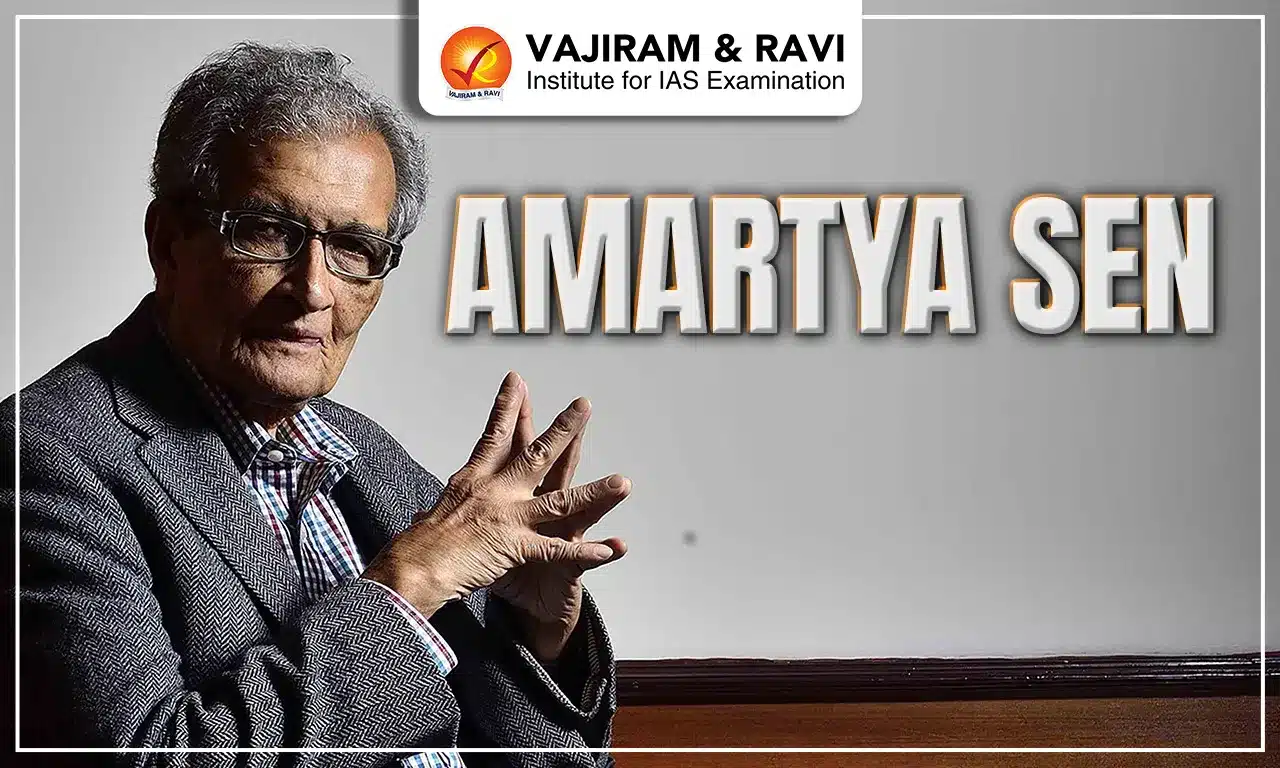
Amartya Sen is one of India’s most respected economists, philosophers, and public intellectuals whose work reshaped global understanding of poverty, welfare, and human development. He won the Nobel Prize in Economic Sciences in 1998 for his contributions to welfare economics and social choice theory. Sen’s ideas bridged economics with ethics, focusing on freedom, justice, and equality. His theories continue to influence Indian policymaking, especially in education, health, and poverty alleviation programs.

Amartya Sen

Amartya Kumar Sen was born on 3 November 1933 in Santiniketan, West Bengal. He studied at Presidency College (Calcutta), and later at Trinity College, Cambridge, where he earned his Ph.D. in economics. Deeply inspired by Bengal’s social realities and the 1943 Bengal Famine, Sen developed a lifelong interest in inequality, hunger, and human capability. Over his career, he taught at renowned institutions such as the London School of Economics, University of Oxford, and Harvard University.

Amartya Sen Career

Amartya Sen’s academic career spans more than six decades, influencing both economic theory and public policy. He served as the Master of Trinity College, Cambridge (1998-2004) and taught at Harvard University as Thomas W. Lamont University Professor. Sen has also worked with international organizations like the World Bank, UNDP, and UNESCO on issues of development and welfare. His interdisciplinary approach combined philosophy, ethics, and economics to address practical concerns like poverty, gender inequality, and social justice. Key roles:

  • Professor of Economics at Jadavpur University (1956-58)
  • Lecturer and Fellow at Trinity College, Cambridge
  • Professor at Delhi School of Economics (1963-71)
  • Visiting professor at London School of Economics, University of Oxford, Harvard University
  • UNDP Human Development Report contributor and advisor

Amartya Sen Contributions

Amartya Sen’s intellectual contributions span various fields of economics and philosophy. His theories have transformed how nations measure welfare and human progress.

  1. Capability Approach: Sen’s Capability Approach argues that development should be evaluated by people’s ability to live the lives they value, not just by income. It became the foundation for the UNDP’s Human Development Index (HDI), first introduced in 1990, developed by Mahbub ul Haq.
  2. Welfare Economics: Sen expanded welfare economics by incorporating ethical dimensions. He criticized the idea that GDP alone measures well-being and instead proposed measuring individual freedom, access, and opportunities.
  3. Poverty and Famine Studies: His book “Poverty and Famines: An Essay on Entitlement and Deprivation” (1981) explained that famine occurs due to lack of access to food, not its shortage. This theory transformed famine prevention policies globally.
  4. Gender Inequality and Social Justice: Sen’s works such as “More Than 100 Million Women Are Missing” (1990) highlighted gender discrimination in developing countries, drawing global attention to women’s empowerment.
  5. Democracy and Development: He argued that no major famine has ever occurred in a functioning democracy, emphasizing the role of transparency and political freedom in preventing human suffering.

Amartya Sen Books

Amartya Sen’s writings are widely read by scholars, policymakers, and students worldwide. His work emphasize freedom, rational debate, and moral responsibility in governance and economics. Some of his most influential books include:

  • Poverty and Famines (1981)
  • Development as Freedom (1999)
  • The Idea of Justice (2009)
  • Identity and Violence: The Illusion of Destiny (2006)
  • The Argumentative Indian (2005)
  • Collective Choice and Social Welfare (1970)

Amartya Sen Awards and Honours

Amartya Sen has received numerous prestigious awards for his groundbreaking contributions to economics, ethics, and social sciences. Major National and International Awards:

  • Nobel Prize in Economic Sciences (1998) for welfare economics and social choice theory
  • Bharat Ratna (1999), India’s highest civilian award, for his contributions to economic thought
  • Order of Companion of Honour (UK, 2000)
  • National Humanities Medal (USA, 2011)
  • Eisenhower Medal (2010) and Leontief Prize (2000)
  • Honorary doctorates from over 90 universities worldwide, including Harvard, Oxford, and Delhi University
  • Named among the “World’s 100 Most Influential Thinkers” by Foreign Policy

Amartya Sen’s Philosophy

Sen’s philosophy integrates economics with human values. He believes that development is not merely about income growth but about enhancing human freedoms- political, social, and economic. His framework emphasizes public reasoning, education, and healthcare as essential for achieving equality. Key ideas include:

  • Freedom is both a means and an end of development.
  • Democracy ensures accountability and prevents disasters like famines.
  • Gender equality is central to human progress.
  • Ethical reasoning must guide economic policy.

Amartya Sen’s Impact on Indian Policies

Amartya Sen’s theories have deeply influenced India’s social and economic policy.

  1. His ideas inspired India’s Human Development Reports and state-level HDI assessments.
  2. The Right to Education Act (2009) and National Rural Health Mission (2005) reflect Sen’s advocacy for human capability enhancement.
  3. His focus on public goods encouraged policies like mid-day meals and women’s empowerment programs.
  4. His critique of market inequality influenced NITI Aayog’s inclusive growth strategy.
  5. Sen’s debates with economist Jagdish Bhagwati on “growth vs. welfare” shaped India’s policy discourse.

Amartya Sen’s Influence on Development

Sen’s emphasis on human development has guided several government initiatives. These programs reflect Sen’s belief that social investment drives economic growth by expanding people’s real freedoms:

  • National Food Security Act (2013): Ensures access to subsidized food grains.
  • Integrated Child Development Services (ICDS): Focus on nutrition and early childhood care.
  • Sarva Shiksha Abhiyan (2001): Universal elementary education.
  • Mahatma Gandhi National Rural Employment Guarantee Act (MGNREGA, 2005): Promotes livelihood security.
  • Ayushman Bharat (2018): Focuses on affordable healthcare.

Amartya Sen Criticism

Amartya Sen’s ideas have not been without criticism. Some economists argue that his focus on welfare over market efficiency slows growth. Others suggest that his ideal of democracy as a famine deterrent may not fit authoritarian but efficient economies like China. Despite this, his moral economics remains widely respected for addressing inequality and human dignity. Despite his influence, Sen’s ideas face practical challenges in implementation.

  • India’s welfare schemes often suffer from corruption and bureaucratic delays.
  • Regional disparities in health and education persist despite human development programs.
  • Data measurement issues make it difficult to assess capability enhancement accurately.
  • Critics argue that focusing on rights and welfare sometimes overshadows economic competitiveness.

However, Sen himself advocates that economic efficiency must be balanced with ethical responsibility and inclusiveness.

Amartya Sen’s International Contributions

Amartya Sen played a vital role in shaping the UNDP Human Development Reports, which assess development beyond GDP. He collaborated with Mahbub ul Haq to design the Human Development Index (HDI), used by the UN since 1990. Sen’s advisory work with the World Health Organization (WHO) and International Labour Organization (ILO) has guided global poverty reduction, health equity, and education reforms.

Amartya Sen UPSC

Amartya Sen’s work continues to inspire economists, policymakers, and students across the world. His ideas shaped a new moral dimension in economics, blending compassion with logic. In India, his influence remains visible in debates on welfare, education, and social equity. Sen’s emphasis on dialogue, democracy, and justice ensures his relevance in contemporary policy discussions. His intellectual legacy endures as a guiding light for creating an equitable and humane world economy.

In a recent address to students in Kolkata on 22 August 2025, Sen emphasised that migration is essential for globalisation and human progress. He cited the fact that global migration reached approximately 281 million people in 2020, about 3.6% of the world’s population, underscoring how people-mobility underpins economic, cultural and scientific exchange.

Sen also stressed that India, with over 18 million citizens living abroad, stands as the largest country of origin for international migrants, illustrating the scale of movement and remittances in shaping development. 

He argued that migration is not a problem to be controlled but a force to be harnessed: remittances, skill-flows and diversity enrich societies and sustain welfare systems. 

Amartya Sen FAQs

Q1: Who is Amartya Sen?

Ans: Amartya Sen is an Indian economist and philosopher known for his work on welfare economics and human development.

Q2: What did Amartya Sen win the Nobel Prize for?

Ans: He received the 1998 Nobel Prize in Economics for his contributions to welfare economics and social choice theory.

Q3: What is the Capability Approach?

Ans: Sen’s Capability Approach measures development by people’s real freedoms and choices, not merely income or GDP.

Q4: How did Amartya Sen influence Indian policies?

Ans: His ideas inspired welfare policies like MGNREGA, Right to Education, and National Food Security Act.

Q5: Which book of Amartya Sen is most famous?

Ans: His book Development as Freedom (1999) is among his most influential works on economics and ethics.
Lata Mangeshkar, the Nightingale of India, Contribution, Awards

Lata Mangeshkar

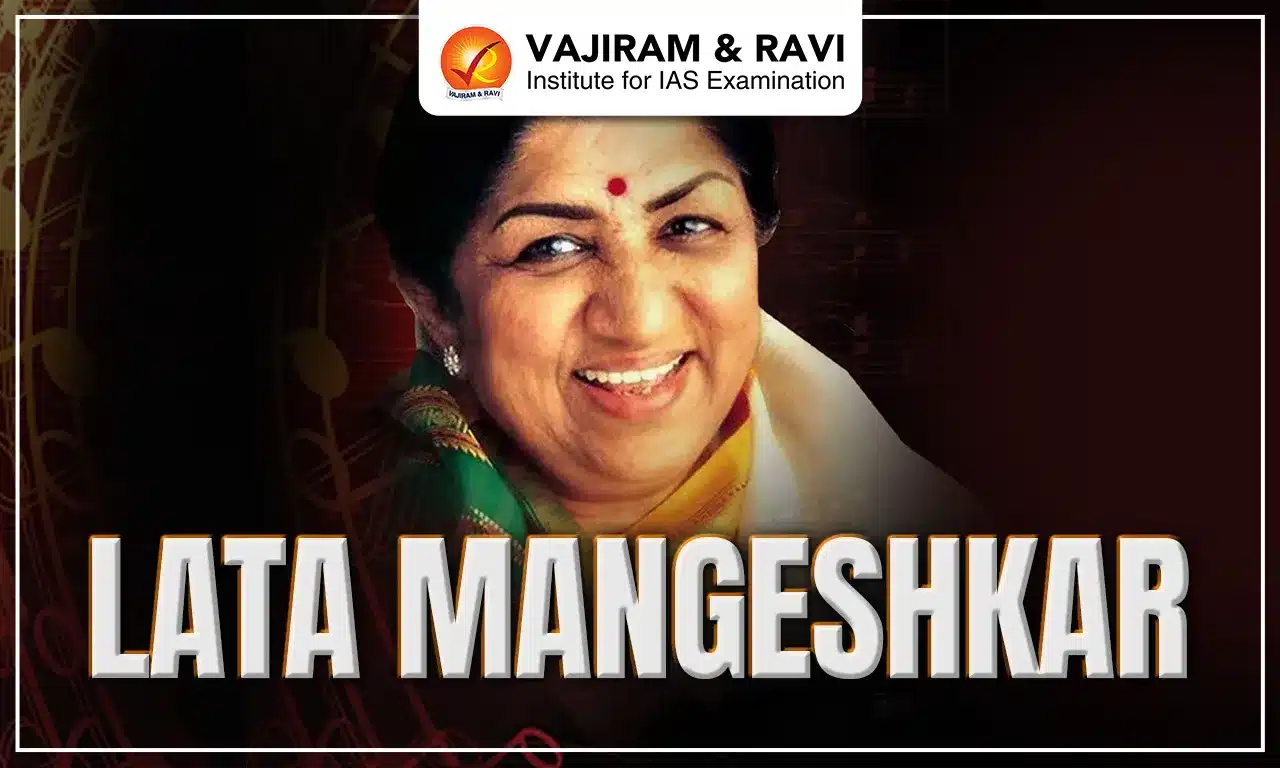
Lata Mangeshkar, widely known as the “Nightingale of India,” remains one of the most celebrated playback singers in the world. Her mesmerizing voice, emotional depth, and unmatched versatility transformed Indian music across generations. With a career spanning nearly eight decades, she became the defining voice of Indian cinema, earning admiration from audiences, musicians, and leaders alike. Lata Mangeshkar’s songs continue to symbolize India’s cultural identity and musical excellence.

Lata Mangeshkar

Born into a family deeply rooted in music, Lata Mangeshkar began singing at the age of five. Her father’s theatrical background provided her early exposure to performing arts. After moving to Mumbai, she struggled initially due to her accent and high-pitched voice, but persistence and training helped her refine her craft.

By the 1950s, she had emerged as Bollywood’s leading playback singer. Despite competition and industry challenges, she maintained her dominance through discipline, vocal control, and adaptability to changing musical trends. Her life story remains an inspiration to aspiring artists in India and abroad.

Lata Mangeshkar Early Life

Lata Mangeshkar was born on 28 September 1929 in Indore, Madhya Pradesh, to Pandit Deenanath Mangeshkar, a classical singer and theatre actor, and Shevanti Mangeshkar. Trained initially by her father in Hindustani classical music, she developed her unique tone and emotional range at a very young age. Following her father’s death in 1942, she took charge of supporting her family through music, marking the beginning of her remarkable journey in playback singing.

Lata Mangeshkar Musical Journey

Lata Mangeshkar’s first Hindi film song, “Mata Ek Sapoot Ki Duniya Badal De Tu” (1943), marked her entry into the hindi film industry. Her breakthrough came with “Aayega Aanewala” from Mahal (1949), composed by Khemchand Prakash, which made her a household name. She went on to sing for leading composers like S.D. Burman, Shankar-Jaikishan, Madan Mohan, Laxmikant-Pyarelal, and A.R. Rahman.

Her voice became synonymous with leading actresses such as Madhubala, Nargis, Waheeda Rehman, Hema Malini, and Sridevi. Over her illustrious career, Lata Mangeshkar recorded songs in more than 36 Indian languages and a few foreign languages, amassing an estimated not less than 30,000 recordings, as per Guinness World Records (1974).

Lata Mangeshkar’s Contribution to Indian Cinema

Lata Mangeshkar’s contribution to Indian cinema is unparalleled. She defined the golden era of Bollywood music from the 1950s to the 1980s. Her voice carried the emotions of love, sorrow, patriotism, and devotion, bringing characters to life through song.

Her patriotic song “Ae Mere Watan Ke Logon” (1963), composed by C. Ramchandra, moved Prime Minister Jawaharlal Nehru to tears and became a timeless symbol of national pride. She lent her voice to several classics such as “Lag Ja Gale,” “Tere Bina Zindagi Se,” “Ajeeb Dastan Hai Yeh,” and “Pyar Kiya To Darna Kya.”

Her collaboration with music directors like R.D. Burman and Madan Mohan created some of the most iconic melodies in Indian cinema, shaping its emotional and cultural landscape.

Lata Mangeshkar Awards and Recognitions

Lata Mangeshkar’s contribution to music has been acknowledged with numerous national and international honors. She received the Bharat Ratna (2001), India’s highest civilian award, recognizing her lifetime dedication to Indian music. Other notable awards include:

  • Padma Bhushan (1969) and Padma Vibhushan (1999)
  • Dadasaheb Phalke Award (1989) for outstanding contribution to Indian cinema
  • National Film Awards (several times) for Best Female Playback Singer
  • Filmfare Awards (several times) including Lifetime Achievement
  • Legion of Honour (2007) from the French government

In 1974, Lata Mangeshkar became the first Indian to perform at the Royal Albert Hall in London, marking India’s growing influence on the global music stage.

Lata Mangeshkar Musical Style

Lata Mangeshkar’s voice stood out for its clarity, range, and emotive expression. Her ability to adapt to different genres- classical, devotional, romantic, and patriotic, reflected her mastery over the craft. After moving to Mumbai in 1945, she took Hindustani classical music lessons from Ustad Aman Ali Khan, a prominent exponent of the Bhendi Bazaar gharana.

Her diction, breath control, and emotional expression were unparalleled. Lata’s singing not only influenced generations of artists like Asha Bhosle, Alka Yagnik, Shreya Ghoshal, and Sunidhi Chauhan, but also inspired musicians across South Asia. She remains a benchmark for musical excellence in playback singing.

Lata Mangeshkar Social Contributions

Beyond music, Lata Mangeshkar was deeply involved in philanthropy. She established the Lata Mangeshkar Medical Foundation in Pune, providing healthcare to the underprivileged. She also contributed to disaster relief funds, including the Prime Minister’s National Relief Fund and initiatives supporting artists during the COVID-19 pandemic.

Her humility and dedication to social causes reflected her belief that art must serve humanity. Despite her immense fame, she remained grounded, often avoiding public events and maintaining a simple lifestyle dedicated to music and service.

Lata Mangeshkar’s Role in Nation Building

Lata Mangeshkar’s songs carried themes of patriotism, unity, and hope, strengthening India’s emotional fabric after independence. Songs like “Ae Mere Watan Ke Logon” and “Vande Mataram” became anthems of collective national spirit.

She also represented India globally, performing at international events and promoting Indian culture. Her artistry bridged linguistic and regional divides, making her voice a unifying symbol of India’s diversity.

Her close association with leaders such as Jawaharlal Nehru, Lal Bahadur Shastri, and Atal Bihari Vajpayee reflected her role as both a cultural and moral icon of post-independence India.

Lata Mangeshkar’s Legacy

Lata Mangeshkar’s voice became India’s emotional chronicle, from independence to modernization. Her songs continue to define the country’s musical identity, shaping emotional connections across generations. She remains a timeless figure whose music transcends time, geography, and language. Her contribution not only elevated Indian cinema but also represented the power of art in uniting a diverse nation. The Government of India and various international bodies continue to celebrate her work through retrospectives, awards, and digital archives.

Lata Mangeshkar UPSC

Following her passing on 6 February 2022, India declared a two-day national mourning, with the national flag flown at half-mast. Her final rites at Shivaji Park, Mumbai, were attended by Prime Minister Narendra Modi and several dignitaries.

In her memory, the “Lata Deenanath Mangeshkar Award” was instituted in 2022 to recognize excellence in public service and national contribution. Her name was also immortalized with the Lata Mangeshkar Chowk in Ayodhya, honoring her everlasting impact.

Lata Mangeshkar FAQs

Q1: Who was Lata Mangeshkar?

Ans: Lata Mangeshkar was India’s most celebrated playback singer, known as the “Nightingale of India,” with over 25,000 recorded songs.

Q2: When was Lata Mangeshkar born?

Ans: She was born on 28 September 1929 in Indore, Madhya Pradesh, into a family of musicians.

Q3: What was Lata Mangeshkar’s first Hindi film song?

Ans: Her first Hindi film song was “Mata Ek Sapoot Ki Duniya Badal De Tu” (1943) in the film Gajaabhaau.

Q4: Which awards did Lata Mangeshkar receive?

Ans: She received the Bharat Ratna (2001), Padma Vibhushan (1999), and Dadasaheb Phalke Award (1989), among others.

Q5: When did Lata Mangeshkar pass away?

Ans: She passed away on 6 February 2022 in Mumbai due to health complications, marking the end of an era in Indian music.

Aruna Asaf Ali Biography, Activism, Contribution, Achievements

Aruna Asaf Ali

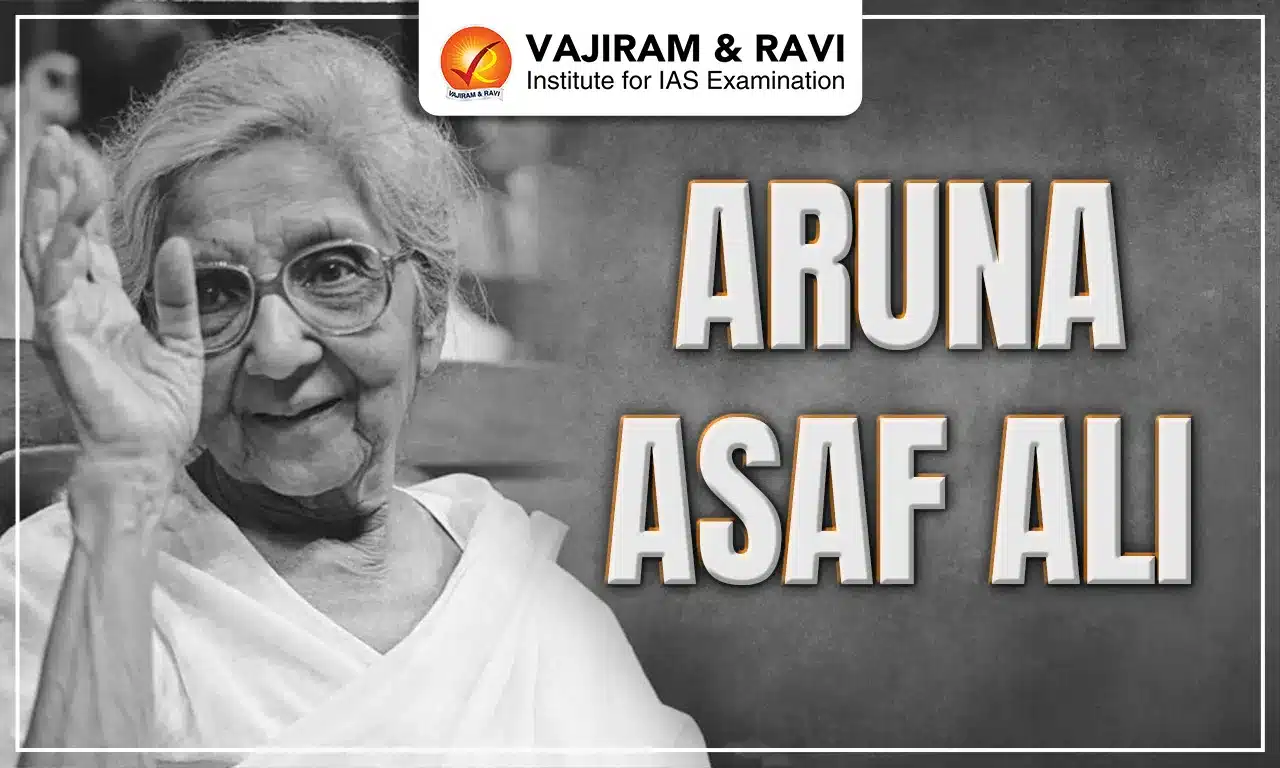
Aruna Asaf Ali was one of the most fearless women leaders of India’s freedom struggle, remembered for her pivotal role in the Quit India Movement of 1942. Her courage, leadership, and lifelong commitment to social justice earned her the title of the “Grand Old Lady of Indian Independence.” Aruna’s political journey reflects a blend of patriotism, women’s empowerment, and socialist ideals, making her an inspiring icon in India’s modern history.

Aruna Asaf Ali

Aruna Asaf Ali was born on 16 July 1909 in Kalka, Haryana, into a Bengali Brahmin family. Educated at Sacred Heart Convent, Lahore, she later became a teacher at Gokhale Memorial School, Calcutta. Her life took a significant turn after marrying Asaf Ali, a Muslim lawyer and freedom fighter, in 1928-a bold interfaith marriage that broke social barriers of the time. Influenced by her husband and contemporaries like Jawaharlal Nehru and Mahatma Gandhi, she joined the Indian National Congress and dedicated herself to the independence movement.

Aruna Asaf Ali Political Career

Aruna Asaf Ali’s entry into politics came through her active participation in the Civil Disobedience Movement (1930). She was arrested for hoisting the Congress flag at a public park in 1932 and became known for her defiance during imprisonment. However, her most historic act occurred during the Quit India Movement in August 1942, when she hoisted the Indian National Flag at the Gowalia Tank Maidan in Bombay, signaling the start of a nationwide civil uprising against British rule. This act made her a national symbol of resistance.

She went underground for several years, organizing underground radio broadcasts, distributing pamphlets, and coordinating revolutionary activities. Her leadership in mobilizing youth and women made her one of the most wanted leaders of the time by the British authorities.

Aruna Asaf Ali Contribution to the Freedom Movement

Aruna Asaf Ali’s contribution extended beyond symbolism; she played a crucial organizational role. Key highlights of her contribution include:

  • Civil Disobedience Activism (1930-1932): Participated in protests against British laws and imprisonment of Congress leaders.
  • Quit India Movement (1942): Hoisted the national flag at Bombay’s Gowalia Tank Maidan and inspired mass protests.
  • Underground Resistance: Operated secret communications and inspired revolutionaries like Usha Mehta in underground radio movements.
  • Socialist Advocacy: After independence, she worked closely with socialist leaders like Jayaprakash Narayan and Ram Manohar Lohia.

Aruna Asaf Ali Role in Post-Independence India

After independence, Aruna Asaf Ali remained committed to building a democratic and socially just India. Her post-independence work reflected her belief that political freedom must lead to social and economic transformation. Some of her major roles include:

  • Delhi’s First Mayor (1958): She was elected the first female Mayor of Delhi and promoted urban development, public health, and civic welfare.
  • Support to Socialist Movements: Advocated for land reforms, workers’ rights, and labor unionization.
  • Women’s Empowerment: Continued her activism through organizations like the NFIW, promoting gender equality and political participation.
  • Journalism and Education: Co-founded the weekly journal Link and the newspaper Patriot, providing a platform for progressive thought and political discussion.

Aruna Asaf Ali Philosophy

Aruna’s political thought evolved from Gandhian non-violence to a socialist worldview. Initially inspired by Gandhi’s principles of truth and non-violence, her underground activism during the Quit India Movement reflected a more militant and action-oriented approach. After independence, she supported the idea of a welfare state, emphasizing labor rights, women’s participation, and social equality.

She became one of the founding members of the National Federation of Indian Women (NFIW) in 1954, linked to the Communist Party of India (CPI), which focused on improving women’s economic and political conditions.

Aruna Asaf Ali Achievements

Aruna’s achievements remain a lasting legacy in India’s freedom and social movements. Her life reflected the synthesis of patriotism, socialism, and feminism, all rooted in the ideal of national service.

  • Hoisting the Indian National Flag during Quit India Movement (1942)- a defining act of courage.
  • Pioneering role as Delhi’s first woman Mayor.
  • Advocacy for women’s political representation and labor welfare.
  • Establishing NFIW to champion women’s rights and equal opportunities.
  • Influencing India’s socialist and democratic discourse post-independence.

Aruna Asaf Ali Awards and Honours

Aruna Asaf Ali received numerous national honors for her contribution to India’s freedom and society. Her major awards include:

  • International Lenin Peace Prize (1964) for promoting peace and friendship among nations.
  • Jawaharlal Nehru Award for International Understanding (1991) for her role in social and political progress.
  • Bharat Ratna (Posthumous, 1997)- India’s highest civilian honor recognizing her lifelong service to the nation.
  • Padma Vibhushan (1992)- for distinguished service in public affairs.

Women Empowerment by Aruna Asaf Ali

Aruna remains a trailblazer in Indian women’s history. At a time when women’s public participation was limited, she defied stereotypes and became a leading figure in national politics. Her activism inspired thousands of women to join freedom movements and public life.

She later championed causes like equal pay, education for girls, and political inclusion. Her leadership within the National Federation of Indian Women made her a key figure in post-independence women’s movements, influencing feminist thought in India.

Aruna Asaf Ali Associations

In the 1950s and 1960s, Aruna Asaf Ali was closely associated with the Socialist and Communist movements in India. She saw socialism as a continuation of the freedom struggle, focusing on economic justice and equality.

She worked alongside leaders like E.M.S. Namboodiripad, P.C. Joshi, and Indrajit Gupta, participating in political campaigns that promoted peace, workers’ dignity, and cooperative reforms. Her journal Patriot became a voice for the Left-leaning intellectual discourse in India.

Aruna Asaf Ali Women Activist Safeguards

Aruna Asaf Ali’s struggle highlighted the need for constitutional protection for women and activists in India. After independence, India’s Constitution guaranteed fundamental rights under Articles 14, 15, and 16, ensuring equality, non-discrimination, and equal opportunities for women.

Her activism complemented the early constitutional and policy efforts toward women’s equality and rights. She remains symbolic of the intersection between constitutional equality and real-world activism.

Aruna Asaf Ali UPSC

Aruna passed away on 29 July 1996 in New Delhi. She continues to be remembered as one of the most fearless women of India’s freedom movement. Her memorial, the Aruna Asaf Ali Marg in Delhi, and her life story in history textbooks remind generations of her dedication.

Her name is synonymous with courage, intellect, and patriotism, serving as an enduring inspiration for civil rights movements and women leaders across India.

Aruna Asaf Ali FAQs

Q1: Who was Aruna Asaf Ali?

Ans: Aruna Asaf Ali was an Indian freedom fighter and social reformer known for hoisting the flag during the Quit India Movement.

Q2: When was Aruna Asaf Ali born?

Ans: She was born on 16 July 1909 in Kalka, Haryana, into a Bengali Brahmin family.

Q3: What was Aruna Asaf Ali’s contribution to Indian independence?

Ans: She led protests, organized underground resistance, and inspired women’s participation during the Quit India Movement of 1942.

Q4: Which major awards did Aruna Asaf Ali receive?

Ans: She was posthumously awarded the Bharat Ratna (1997) and Padma Vibhushan (1992) for her lifelong contribution to national service.

Q5: What organization did Aruna Asaf Ali establish for women’s rights?

Ans: She co-founded the National Federation of Indian Women (NFIW) in 1954 to advocate for gender equality and social justice.

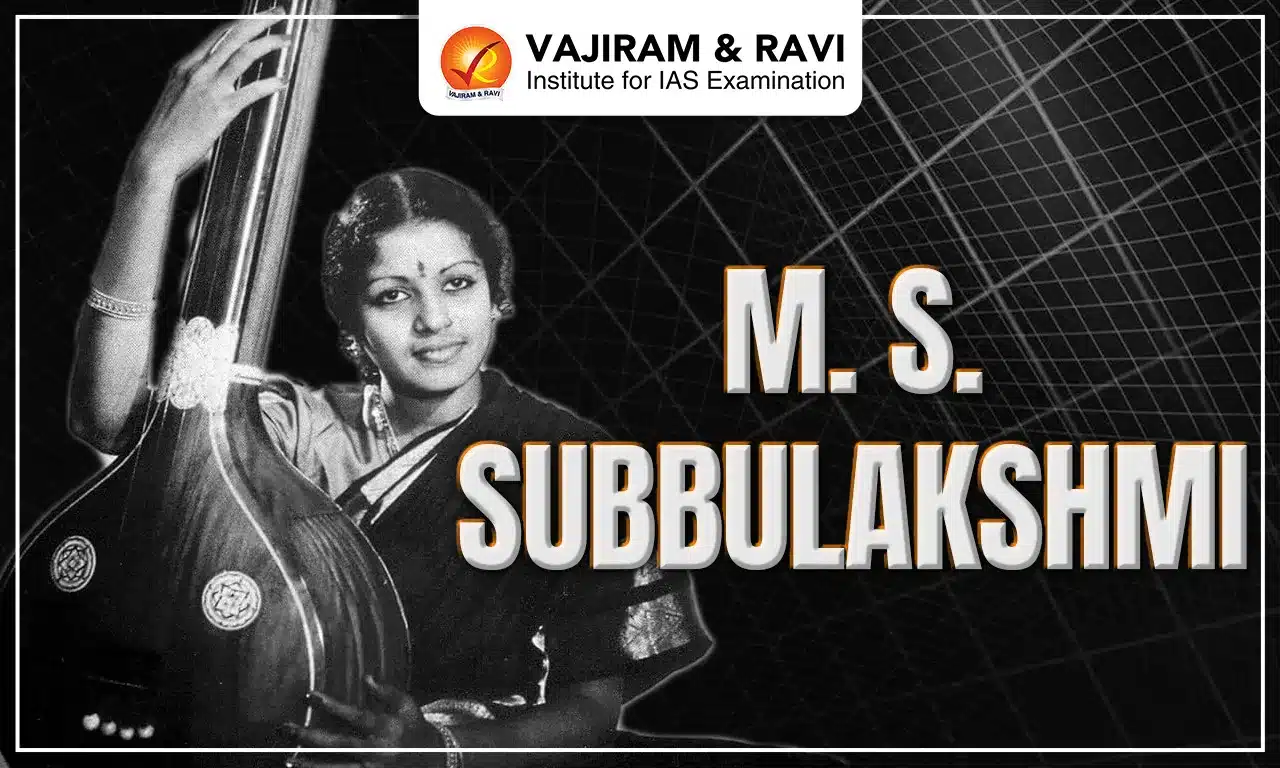
M. S. Subbulakshmi Biography, Early Life, Career, Awards, Contributions

M. S. Subbulakshmi

M. S. Subbulakshmi, often called the “Queen of Carnatic Music,” was one of India’s most revered classical singers. Born on 16 September 1916 in Madurai, Tamil Nadu, she became the first musician ever to receive the Bharat Ratna. Her voice represented devotion, purity, and cultural depth, making her not just an artist but a global ambassador of Indian music. Her contribution to Carnatic music, social causes, and India’s cultural diplomacy remains unmatched even decades after her passing.

M. S. Subbulakshmi

Madurai Shanmukhavadivu Subbulakshmi, known as M. S. Subbulakshmi, began her musical journey under her mother, Shanmukhavadivu Ammal, a veena player. She gave her first public performance at Kumbakonam in 1929, at the age of thirteen. Her deep, resonant voice and emotional depth soon drew attention across South India. She broke gender barriers in classical music, earning the title of “Kunjamma” among admirers. Subbulakshmi’s concerts combined technical perfection with spiritual devotion, spreading Indian music to international stages including the United Nations in 1966.

Read About: Atal Bihari Vajpayee

M. S. Subbulakshmi Early Life

Born into a family rooted in musical tradition, M. S. Subbulakshmi’s early exposure to Carnatic music shaped her artistic foundation. Her mother’s veena performances often inspired her. Despite limited formal education, her musical education was intensive and guided by masters like Semmangudi Srinivasa Iyer and Ariyakudi Ramanuja Iyengar. Her early recordings for His Master’s Voice (HMV) label gained immense popularity. By her teenage years, she was performing alongside leading male musicians, uncommon for women of her time, marking the start of her revolutionary journey in Indian classical music.

M. S. Subbulakshmi Rise to Fame

M. S. Subbulakshmi’s rise to fame was gradual yet steady. Her performances at the Madras Music Academy in the 1930s established her as a musical prodigy. She was renowned for her renditions of kritis by Tyagaraja, Muthuswami Dikshitar, and Syama Sastri. Her ability to convey complex ragas with clarity and devotion earned her national recognition. She also ventured into cinema briefly, starring in films like Sevasadanam (1938) and Meera (1945). The film Meera, based on the life of saint-poet Meera Bai, showcased her devotional singing and brought her nationwide fame, making her the musical voice of India’s spiritual renaissance.

M. S. Subbulakshmi Contributions

M. S. Subbulakshmi’s music transcended entertainment; it became a form of spiritual expression and cultural identity. Her concerts were known for their devotional intensity and technical precision. Key contributions include:

  • Popularizing Carnatic Music Worldwide- Her performances at the UN General Assembly (1966), Edinburgh Festival, and Carnegie Hall introduced global audiences to Indian classical music.
  • Devotional Recordings- Her renditions of the Venkatesa Suprabhatam, Bhajagovindam, and Vishnu Sahasranamam remain benchmarks in devotional music.
  • Cultural Diplomacy- She served as India’s cultural ambassador, blending artistry with national representation.
  • Preservation of Tradition- By adhering to classic compositions while maintaining emotional sincerity, she ensured the timelessness of Carnatic tradition.

M. S. Subbulakshmi Awards and Recognition

M. S. Subbulakshmi received numerous national and international honors recognizing her unparalleled contribution to music and society. She was the first musician to receive the Bharat Ratna (1998). Earlier, she was honored with the Padma Bhushan (1954), Padma Vibhushan (1975), and Ramon Magsaysay Award (1974) for Public Service, making her the first Indian musician to win it. She also received the Sangeet Natak Akademi Award (1956) and Sangeetha Kalanidhi (1968) from the Madras Music Academy. UNESCO and international universities also recognized her role in promoting India’s musical heritage.

M. S. Subbulakshmi Social Works

Beyond music, Subbulakshmi was deeply committed to philanthropy and social welfare. She performed countless charity concerts to raise funds for causes like education, healthcare, and women’s welfare. Some notable contributions include:

  • Donated concert earnings to the Prime Minister’s National Relief Fund and Tirupati Devasthanam.
  • Supported Ramakrishna Mission, Bharat Seva Samaj, and Indira Gandhi Memorial Trust.
  • Helped establish educational initiatives for underprivileged children in Tamil Nadu.
    Her humility and service-oriented approach reflected her belief that music should serve humanity, a philosophy rooted in her devotion and compassion.

M. S. Subbulakshmi International Recognition

Subbulakshmi’s contribution extended beyond India. She was invited by U Thant, the then UN Secretary-General, to perform at the United Nations General Assembly in 1966, where she sang compositions in Sanskrit and regional Indian languages, earning global acclaim. Her performances abroad, particularly in London, New York, Moscow, and Tokyo, showcased the richness of Indian classical traditions. The United States Congress also recognized her for strengthening cultural ties between India and the world. Her efforts established Carnatic music as a respected global art form.

M. S. Subbulakshmi Cultural Impact

M. S. Subbulakshmi redefined the role of women in Indian performing arts. At a time when female artists faced social stigma, she commanded respect through her discipline, humility, and talent. Her impact can be seen in:

  • Inspiring generations of female vocalists in South India.
  • Bridging classical and devotional music for mass audiences.
  • Strengthening India’s soft power through cultural diplomacy.
  • Reviving interest in traditional bhajans and kritis across all sections of society.
    Her music continues to influence both artists and listeners, symbolizing the union of art and spirituality.

M. S. Subbulakshmi Portrayal in Books and Films

M. S. Subbulakshmi’s life inspired numerous books, documentaries, and research works. Biographies such as M. S. Subbulakshmi: The Definitive Biography by T. J. S. George and films like “M. S. Subbulakshmi- A Life in Music” highlight her artistic journey and human values. Her portrayal in cinema and literature often celebrates her simplicity, devotion, and pioneering role in Indian cultural history. Her song “Hari Tum Haro” was even broadcast on All India Radio during India’s wars, reflecting her emotional connection with the nation.

M. S. Subbulakshmi Philosophy

Subbulakshmi’s life was guided by humility, discipline, and devotion. She maintained a strict routine of practice and meditation, emphasizing that music was a form of worship rather than performance. Her personal integrity and modest lifestyle earned her universal admiration. Despite global fame, she lived a simple life dedicated to her art and faith. For her, music was a medium of bhakti (devotion)- a means to connect with the divine and humanity alike.

M. S. Subbulakshmi UPSC

M. S. Subbulakshmi’s biography reflects the story of a woman who transcended social, gender, and cultural boundaries through her music. Rising from a modest background in Madurai, she became the voice of India’s spiritual and musical identity. From singing at local temples to performing at the United Nations, her journey embodies dedication, humility, and artistic brilliance. Her life remains a testament to India’s cultural richness and the power of devotion expressed through music.

Even today, M. S. Subbulakshmi remains an enduring icon of Indian music. Her songs continue to be broadcast daily on All India Radio and devotional platforms. The M. S. Subbulakshmi Award has been instituted by the Central Sangeet Natak Akademi to honor female musicians carrying forward her legacy. In 2016, on her birth centenary, the Government of India released a commemorative coin and stamp in her honor. Her home in Madurai has been preserved as a cultural heritage site.

M. S. Subbulakshmi FAQs

Q1: Who was M. S. Subbulakshmi?

Ans: M. S. Subbulakshmi was India’s legendary Carnatic vocalist, known for devotional renditions and global cultural contributions.

Q2: When was M. S. Subbulakshmi born?

Ans: She was born on 16 September 1916 in Madurai, Tamil Nadu, into a family of musicians.

Q3: Which award was given to M. S. Subbulakshmi?

Ans: She received the Bharat Ratna (1998), India’s highest civilian honor, and the Ramon Magsaysay Award (1974).

Q4: What was M. S. Subbulakshmi’s famous song?

Ans: Her rendition of Venkatesa Suprabhatam and Bhajagovindam remain among the most loved devotional songs in India.

Q5: Where did M. S. Subbulakshmi perform internationally?

Ans: She performed at the United Nations (1966), Carnegie Hall, and international festivals, showcasing Indian music to global audiences.

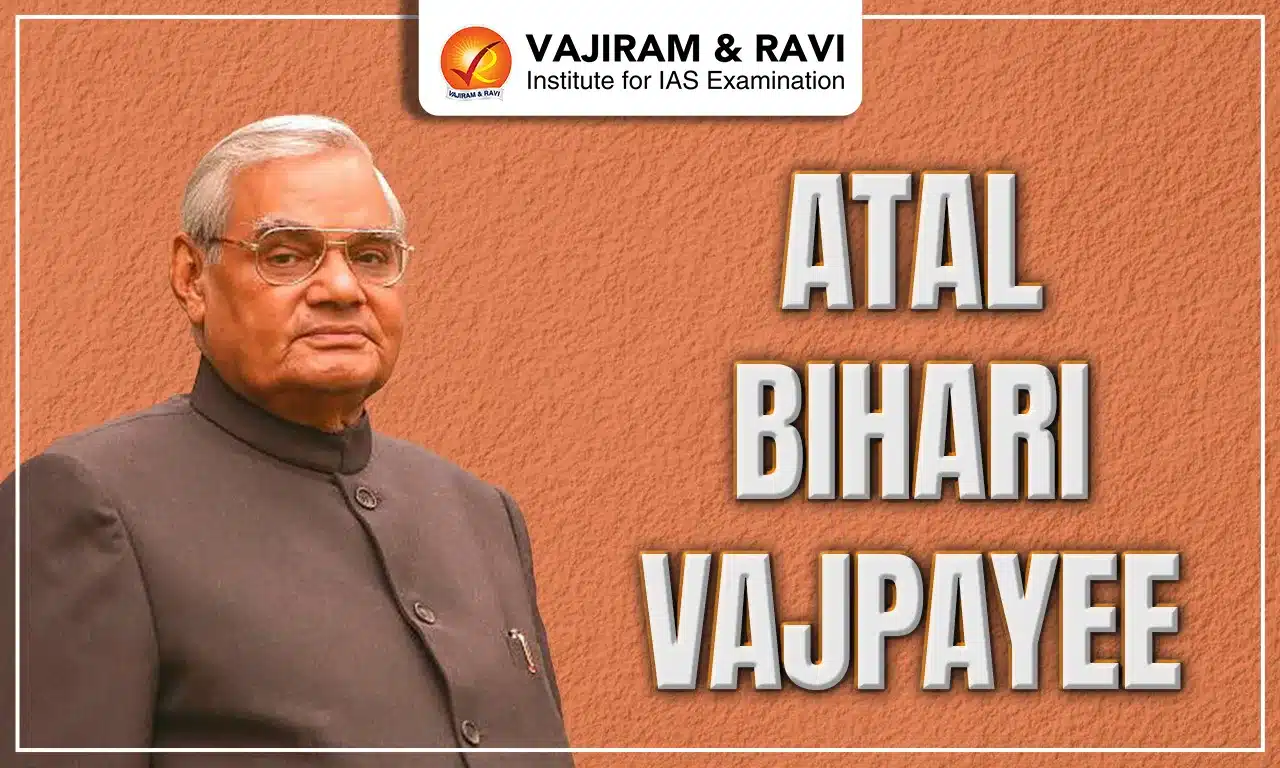
Atal Bihari Vajpayee, Biography, Political Journey, Policies, Awards

Atal Bihari Vajpayee

Atal Bihari Vajpayee was one of India’s most respected leaders, known for his vision, eloquence, and statesmanship. A freedom fighter turned parliamentarian, he played a pivotal role in shaping modern India through his policies of development, diplomacy, and national security. Serving three times as Prime Minister, Vajpayee’s leadership marked a new era of governance, combining economic reforms with national pride and inclusive growth.

Atal Bihari Vajpayee

Atal Bihari Vajpayee was a visionary leader, poet, and statesman who shaped modern Indian politics with integrity and inclusiveness. Born on 25 December 1924 in Gwalior, he began as a freedom activist and later co-founded the Bharatiya Jana Sangh and Bharatiya Janata Party (BJP). Known for his eloquence and moderate politics, he served thrice as India’s Prime Minister, emphasizing economic reforms, diplomacy, and national unity. His poetic works reflected his deep love for India and human values.

Atal Bihari Vajpayee Early Life

Atal Bihari Vajpayee was born on December 25, 1924, in Gwalior, Madhya Pradesh. His father, Krishna Bihari Vajpayee, was a school teacher, and his mother, Krishna Devi, was a homemaker. He attended Saraswati Shishu Mandir and later completed his post-graduation in Political Science from DAV College, Kanpur. During his student life, he was deeply influenced by nationalist ideas and joined the Rashtriya Swayamsevak Sangh (RSS) in 1939, marking the beginning of his political journey.

Read About: Mahatma Gandhi

Atal Bihari Vajpayee Political Journey

Vajpayee’s political career began with his association with the Bharatiya Jana Sangh (BJS), the predecessor of today’s Bharatiya Janata Party (BJP). He entered the Indian Parliament for the first time in 1957 from Balrampur, Uttar Pradesh. Known for his oratory, Vajpayee soon became one of the most respected opposition leaders.

In 1980, after the dissolution of the Janata Party, he co-founded the Bharatiya Janata Party (BJP) and became its first president. Under his guidance, BJP adopted the slogan “Gandhian Socialism,” emphasizing both economic progress and cultural integrity.

Atal Bihari Vajpayee as Prime Minister of India

Atal Bihari Vajpayee served as the Prime Minister of India three times- briefly in 1996, and later from 1998 to 2004. His government introduced several landmark reforms and policies that transformed India’s economic and strategic standing globally.

His governance was marked by stability, inclusive development, and visionary leadership. Vajpayee’s tenure was also significant for strengthening democratic institutions, promoting coalition politics, and ensuring India’s place in the global community. His government was the first non-Congress government to complete a full five-year term (1999-2004).

Atal Bihari Vajpayee Policies and Reforms

Vajpayee’s leadership was known for his focus on infrastructure, economic liberalization, and strategic independence. Some key initiatives include:

  1. Golden Quadrilateral Project: Launched in 2001 under the National Highways Development Project, connecting Delhi, Mumbai, Chennai, and Kolkata to boost trade and transport.
  2. Sarva Shiksha Abhiyan (SSA): A flagship programme to ensure universal elementary education.
  3. Pradhan Mantri Gram Sadak Yojana (PMGSY): Initiated in 2000 to improve rural road connectivity.
  4. Telecom Revolution: Liberalization of the telecom sector led to rapid expansion of mobile networks and internet access.
  5. Nuclear Tests at Pokhran (1998): Demonstrated India’s nuclear capability, making the country a recognized nuclear power.
  6. Economic Reforms: Continued liberalization policies to attract foreign investment and promote privatization of public enterprises.

Atal Bihari Vajpayee Diplomacy

Vajpayee was a strong advocate of peace and diplomacy. His foreign policy combined strength with dialogue.

  • Pokhran-II Nuclear Tests (1998): Despite international criticism, Vajpayee maintained India’s sovereign right to security while initiating peaceful relations with world powers.
  • Lahore Summit (1999): In a historic move, he traveled by bus to Pakistan to meet Prime Minister Nawaz Sharif, promoting peace between the two nations.
  • Kargil War (1999): After Pakistan’s betrayal, he led India to victory with restraint and strategic planning, earning global respect.
  • Strengthening Ties: His tenure improved relations with the United States, Russia, and neighboring countries, enhancing India’s global stature.

Atal Bihari Vajpayee Role in Economic Development

Vajpayee’s economic vision emphasized sustainable and inclusive growth. He encouraged private investment, infrastructure development, and balanced fiscal management. His policies led to GDP growth averaging around 6% per annum during his tenure.

The Fiscal Responsibility and Budget Management (FRBM) Act, 2003 was a key reform that promoted transparency in government expenditure and reduced fiscal deficits. His balanced approach helped India maintain macroeconomic stability and build investor confidence.

Atal Bihari Vajpayee Social Vision

Atal Bihari Vajpayee believed in the idea of “India First”- promoting unity in diversity. His government focused on cultural revival while maintaining secular values. Initiatives such as the celebration of Good Governance Day on his birthday reflect his vision for transparent, citizen-centered administration.

He was also a poet, philosopher, and writer, whose works inspired millions. His poetry often reflected deep patriotism and empathy for humanity.

Challenges Faced by Atal Bihari Vajpayee During Tenure

Despite his success, Vajpayee faced several challenges.

  • Kargil Conflict (1999): Tested his leadership during wartime.
  • Parliament Attack (2001): Exposed India’s internal security vulnerabilities.
  • Coalition Politics: Managing alliances under the National Democratic Alliance (NDA) required constant negotiation and compromise.
  • Economic Slowdown: Global recession in early 2000s affected India’s growth temporarily.

Vajpayee handled these challenges with maturity and diplomatic skill, maintaining stability and progress.

Atal Bihari Vajpayee Philosophy

Atal Bihari Vajpayee’s literary works reveal his emotional depth and philosophical insight. His poetry collections, such as “Meri Ekyavan Kavitayein”, express patriotism, spirituality, and human compassion. He viewed politics as a moral duty guided by service and harmony, not power. Vajpayee’s philosophy combined cultural nationalism with democratic values, emphasizing dialogue over conflict. His poetic voice continues to inspire Indians toward courage, peace, and optimism in public life.

Atal Bihari Vajpayee Awards and Honours

Atal Bihari Vajpayee received several national and international honors in recognition of his leadership, diplomacy, and contributions to India’s development. His awards not only reflect his political achievements but also his stature as a statesman respected across the globe.

  • National Awards:
    • Bharat Ratna (2015): India’s highest civilian award, conferred for his lifelong service to the nation, contributions to democratic governance, and vision for India’s progress.
    • Padma Vibhushan (1992): Awarded for exceptional and distinguished service in the field of public affairs.
    • Best Parliamentarian Award (1994): Presented by the Indian Parliament to honor his exemplary conduct, oratory, and commitment to democratic values.
    • Lokmanya Tilak Award (1994): Recognized his leadership during a period of political and economic reform in India.
    • Pt. Govind Ballabh Pant Award (1992): Given for his literary contribution and efforts in strengthening parliamentary democracy.
  • International Recognition:
    • Bangladesh Liberation Honour (2021, posthumously): Awarded by the Government of Bangladesh for Vajpayee’s decisive role in supporting Bangladesh’s independence in 1971 as India’s Foreign Minister under Prime Minister Indira Gandhi.
    • International Recognition at the United Nations (1977): As India’s External Affairs Minister, Vajpayee delivered India’s first speech in Hindi at the UN General Assembly, a milestone moment in Indian diplomacy.
    • Asian Statesman of the Year Award (2001): Presented by the Harvard University’s India Caucus for his role in strengthening Indo-US relations and promoting South Asian peace and stability.
    • Honorary Doctorate (Doctor of Laws) by Kanpur University: For his contributions to politics, literature, and the strengthening of India’s democratic foundations.
  • Political and Literary Achievements:
    • UN Hindi Speech (1977): His historic use of Hindi at the United Nations General Assembly strengthened India’s linguistic identity on the global stage.
    • Golden Jubilee Speech (1997): His address during India’s 50th Independence anniversary in Parliament highlighted his vision for a strong, united, and prosperous India.
    • Literary Works: His collections of poems such as “Meri Ekyavan Kavitayein” express deep patriotism, moral reflection, and compassion- showcasing the emotional depth behind his political persona.
    • Leadership of the NDA (1998-2004): As head of the National Democratic Alliance, he managed a coalition of over 20 parties- a testament to his diplomatic skill and inclusive approach.
  • Legacy Honours:
    • Statues and Memorials: His statue was unveiled in the Parliament House (2018) and Lucknow’s Hazratganj (2020), symbolizing his enduring influence on Indian politics.
    • Film: A biographical film titled “Main Atal Hoon” (2024) was released to honor Atal Bihari Vajpayee’s life, ideals, and political journey.
    • Schemes Named After Him:
      • Atal Pension Yojana (2015): Social security scheme for unorganized sector workers.
      • Atal Mission for Rejuvenation and Urban Transformation (AMRUT): Focused on improving urban infrastructure.
      • Atal Innovation Mission (AIM): Launched to promote innovation and entrepreneurship among youth.
      • Atal Setu (Goa) and Atal Tunnel (Himachal Pradesh): Infrastructure projects named in his memory celebrating his development-oriented leadership.

Atal Bihari Vajpayee UPSC

After his passing in August 2018, world leaders including the United States, Japan, Russia, and Bangladesh paid tribute to his statesmanship. The United Nations observed a moment of silence in his honor, reflecting his global stature. In India, December 25 is celebrated as Good Governance Day every year, marking his commitment to transparency, accountability, and citizen-centric governance.

Atal Bihari Vajpayee’s legacy transcends party politics. He symbolized moderation, humanity, and political maturity. His vision for “India as a developed nation by 2020” inspired future leaders and policy makers. His ability to balance economic reform with social welfare made him one of India’s most beloved leaders. Today, projects like Pradhan Mantri Gram Sadak Yojana and Golden Quadrilateral continue to impact millions. His leadership laid the foundation for India’s modern political and economic landscape.

Atal Bihari Vajpayee FAQs

Q1: Who was Atal Bihari Vajpayee?

Ans: Atal Bihari Vajpayee was India’s former Prime Minister, poet, and statesman known for his inclusive leadership and reforms.

Q2: When was Atal Bihari Vajpayee born?

Ans: He was born on 25 December 1924 in Gwalior, Madhya Pradesh, and his birthday is celebrated as Good Governance Day.

Q3: What are Atal Bihari Vajpayee’s major achievements?

Ans: His achievements include the Pokhran-II nuclear tests, Golden Quadrilateral project, and strengthening India’s foreign relations through peaceful diplomacy.

Q4: Which award was given to Atal Bihari Vajpayee?

Ans: He was awarded the Bharat Ratna in 2015, India’s highest civilian honor, recognizing his lifelong contribution to national development.

Q5: What is the film based on Atal Bihari Vajpayee’s life?

Ans: The biopic “Main Atal Hoon” (2024) celebrates his political legacy, leadership, and personal philosophy through cinematic portrayal.

Chief Ministers of Delhi from 1952 to 2025, List, Tenure, Facts

Chief Ministers of Delhi

The capital city, Delhi has seen many influential leaders who have served as Chief Minister of Delhi from 1952 to 2025, acting as the head of the executive board of government, responsible for crafting policies, overlooking administration, and development. Each leader has contributed their part in the development of the state be it the infrastructure, reforms in education and healthcare, each leader has contributed uniquely.

Rekha Gupta is the current Chief Minister of Delhi, representing the Bharatiya Janata Party (BJP). A first-time MLA from Shalimar Bagh, she assumed office on 20 February 2025, marking the BJP’s return to power in the national capital after 27 years. At 50 years of age, she became the fourth woman to hold the position of Chief Minister of Delhi. This article includes the List of Chief Ministers of Delhi from 1952 to 2025, their tenures and other important facts.

New CM of Delhi Latest News

The National Capital Delhi witnessed a grand oath ceremony as Rekha Gupta, the New CM of Delhi. The event was attended by Chief Ministers and Deputy Chief Ministers from 20 states, senior BJP leaders, and party workers who actively participated in the Delhi election campaign. More than 50 film stars and industrialists are expected to be present on the occasion. Popular singer Kailash Kher will deliver a musical performance before the oath-taking ceremony, making it a vibrant and culturally rich event.

Rekha Gupta's appointment as New CM of Delhi as first BJP Chief Minister in 27 years in the assembly elections, where it secured 48 out of 70 seats. With a six-member council comprising Manjinder Sirsa, Ashish Sood, Pankaj Kumar Singh, Ravinder Indraj Singh, Kapil Mishra, and Parvesh Verma, the new Cabinet is expected to focus on governance, infrastructure development, and anti-corruption measures.

List of Chief Ministers of Delhi from 1952 to 2025

Chaudhary Brahm Prakash was the first Chief Minister of Delhi who was a member of Indian Congress Party, serving from March 17, 1952, until February 12, 1955. Check out the List of Chief Ministers of Delhi from 1952 to 2025 in the table below.

List of Chief Ministers of Delhi from 1952 to 2025

Chief Ministers

Took Office

Left office

Party Name

Rekha Gupta

20 Feb 2025

-

Bharatiya Janata Party

Atishi Singh

17 Sept 2024

20 Feb 2025

Aam Aadmi Party

Arvind Kejriwal

14 Feb 2015

17 Sept 2024

Aam Aadmi Party

President’s rule

14 Feb 2014

14 Feb 2015


Arvind Kejriwal

28 Dec 2013

14 Feb 2014

Aam Aadmi Party

Sheila Dikshit

29 Oct 2008

28 Dec 2013

Indian National Congress

Sheila Dikshit

01 Dec 2003

29 Oct 2008

Indian National Congress

Sheila Dikshit

03 Dec 1998

01 Dec 2003

Indian National Congress

Sushma Swaraj

12 Oct 1998

03 Dec 1998

Bharatiya Janata Party

Sahib Singh Verma

26 Feb 1996

12 Oct 1998

Bharatiya Janata Party

Madan Lal Khurana

02 Dec 1993

26 Feb 1996

Bharatiya Janata Party

Gurmukh Nihal Singh

12 Feb 1955

01 Nov 1956

Indian National Congress

Chaudhary Brahm Prakash

17 Mar 1952

12 Feb 1955

Indian National Congress

First Chief Minister of Delhi

Chaudhary Brahm Prakash was born in 1918 in Nairobi, Kenya and became the First Chief Minister of Delhi at the age of 34 on March 17, 1952, representing the Nangloi Jat constituency, his tenure lasted until February 12, 1955, during which he focused on Delhi's rural development and social justice policies.

Chaudhary Brahm Prakash was a member of the Indian National Congress who began his political journey during India’s struggle for independence. He emphasized on the importance of agricultural reforms to empower farmers. Chaudhary Brahm Prakash passed away in 1993, but his contributions to social justice, rural development, and cooperative movements inspired many political figures.

Rekha Gupta Delhi CM

Rekha Gupta, a first-time Bharatiya Janata Party (BJP) Member of the Legislative Assembly (MLA) from Shalimar Bagh, is the Current Chief Minister of Delhi today, marking the BJP's return to power in the national capital after 27 years. At 50, she becomes the fourth woman to hold this position in Delhi, following in the footsteps of Sushma Swaraj, Sheila Dikshit, and Atishi Singh. As the Current Chief Minister of Delhi, Rekha Gupta aims to bring a fresh perspective to governance, emphasizing community development and women's empowerment.

Deputy CM of Delhi

Parvesh Verma, the Bharatiya Janata Party (BJP) MLA from the New Delhi constituency is appointed as the Deputy CM of Delhi. He has secured his victory by defeating Aam Aadmi Party (AAP) chief and former Chief Minister Arvind Kejriwal. He has been appointed for the position to balance the leadership in the Union Capital. As the son of former Delhi Chief Minister Sahib Singh Verma, he brings both legacy and leadership skills to the role. His presence in the government is expected to strengthen BJP’s position in Delhi. By appointing a woman Chief Minister, Rekha Gupta, and a male Deputy CM, the BJP has made a strategic balance in its leadership team.

First Woman Chief Minister of Delhi

Sushma Swaraj was the First Woman Chief Minister of Delhi in 1998. A prominent figure of the Bharatiya Janata Party (BJP). Despite her brief tenure, she left a remarkable impression in areas like education and women empowerment. The resignation of Sahib Singh Verma, resulted in appointing Sushma Swaraj as the First Woman Chief Minister of Delhi. 

Sushma Swaraj was the Chief Minister from October 13, 1998, to December 3, 1998, a brief span of just 51 days. She focused on critical issues, majorly on improving the education system and women empowerment during her tenure. 

Longest Serving Chief Minister of Delhi

Born on March 31, 1938, in Kapurthala, Punjab, Sheila Dikshit served as the Chief Minister of Delhi and shaped Delhi's infrastructure and governance. She was a member of Indian National Congress (INC) and held the office for 15 years , from December 3, 1998, to December 28, 2013. Her tenure established her as the Longest Serving Chief Minister of Delhi.

Also Check Other State CM List
Chief Ministers of Haryana Chief Ministers of Delhi
Chief Ministers of Maharashtra Chief Ministers of Jharkhand
Chief Ministers of Jammu and Kashmir Chief Ministers of Assam
Chief Ministers of Bihar Chief Ministers of Kerala
Chief Ministers of Tamil Nadu Chief Ministers of West Bengal
Chief Ministers of Puducherry Chief Ministers of Punjab
Chief Ministers of Uttarakhand Chief Ministers of Uttar Pradesh
Chief Ministers of Gujarat Chief Ministers of Madhya Pradesh
Chief Ministers of Himachal Pradesh Chief Ministers of Rajasthan
Chief Ministers of Telangana Chief Ministers of Andhra Pradesh
Chief Ministers of Meghalaya Chief Ministers of Tripura
Chief Ministers of Nagaland Chief Ministers of Karnataka
Chief Ministers of Mizoram
Chief Ministers of Arunachal Pradesh
Chief Ministers of Odisha Chief Ministers of Sikkim

List of Chief Ministers of Delhi FAQs

Q1: How many times did Kejriwal CM in Delhi?

Ans: He was the chief minister from 2013 to 2014 and from 2015 to 2024.

Q2: What is the salary of CM of Delhi?

Ans: ₹390,000 (US$4,500) (Including Salary received as MLA).

Q3: Who is the first deputy chief minister of Delhi?

Ans: Manish Sisodia of Aam Aadmi Party is the Chief Minister of Delhi

Q4: Who has become the 8th Chief Minister of Delhi?

Ans: Atishi Marlena Singh was the 8th Chief Minister of Delhi

Q5: Who is the current CM of Delhi?

Ans: Rekha Gupta is the Chief Minister of Delhi

UPSC Daily Quiz 27 October 2025

UPSC Daily Quiz

The Daily UPSC Quiz by Vajiram & Ravi is a thoughtfully curated initiative designed to support UPSC aspirants in strengthening their current affairs knowledge and core conceptual understanding. Aligned with the UPSC Syllabus 2025, this daily quiz serves as a revision resource, helping candidates assess their preparation, revise key topics, and stay updated with relevant issues. Whether you are preparing for Prelims or sharpening your revision for Mains, consistent practice with these Daily UPSC Quiz can significantly enhance accuracy, speed, and confidence in solving exam-level questions.

[WpProQuiz 7]  

UPSC Daily Quiz FAQs

Q1: What is the Daily UPSC Quiz?

Ans: The Daily UPSC Quiz is a set of practice questions based on current affairs, static subjects, and PYQs that help aspirants enhance retention and test conceptual clarity regularly.

Q2: How is the Daily Quiz useful for UPSC preparation?

Ans: Daily quizzes support learning, help in revision, improve time management, and boost accuracy for both UPSC Prelims and Mains through consistent practice.

Q3: Are the quiz questions based on the UPSC syllabus?

Ans: Yes, all questions are aligned with the UPSC Syllabus 2025, covering key areas like Polity, Economy, Environment, History, Geography, and Current Affairs.

Q4: Are solutions and explanations provided with the quiz?

Ans: Yes, each quiz includes detailed explanations and source references to enhance conceptual understanding and enable self-assessment.

Q5: Is the Daily UPSC Quiz suitable for both Prelims and Mains?

Ans: Primarily focused on Prelims (MCQ format), but it also indirectly helps in Mains by strengthening subject knowledge and factual clarity.

Districts of India, State Wise Number of Districts, Population

Districts of India

India comprises 28 states and 8 Union Territories which further subdivided into multiple districts. These Districts of India are the administrative divisions, facilitating governance, public administration, and the execution of government initiatives. The district is administered by a District Collector or District Magistrate. As of 2025, India has nearly 800 districts spread across its 28 states and 8 Union Territories. The number of districts has steadily increased over time due to administrative reorganization and population growth

What are Districts?

In India, a district serves as the administrative body within a state or Union Territory which is governed by a District Magistrate (DM) or District Collector who operates as a semi-autonomous body, overseeing the implementation of government policies, maintaining law and order, managing revenue collection, and developmental initiatives. To make the administration process smoother, districts are further divided into talukas, tehsils, or subdivisions.

Current Number of Districts in India

By the records of 2024, there are 800 Districts of India, with a latest update of 787 Districts of India, from which Uttar Pradesh has 75 districts, Rajasthan includes 50 districts, and Tamil Nadu with 38 districts.

  • Total number of districts: Around 800
  • Source for data: Government of India’s Local Government Directory 
  • Key states with high district count: Uttar Pradesh, Rajasthan, Tamil Nadu

List of Districts of India State Wise

Uttar Pradesh has the highest number of districts in India, with a total population of 199,812,341. In contrast, Goa has the fewest districts, with just two, and a population of 1,458,545.

List of Districts of India State Wise
S.No. State/Union Territory No. of districts Population

1

Uttar Pradesh

75

199,812,341

2

Madhya Pradesh

57

72,626,809

3

Rajasthan

55

68,548,437

4

Bihar

38

104,099,452

5

Tamil Nadu

38

72,147,030

6

Maharashtra

36

112,374,333

7

Assam

35

31,205,576

8

Gujarat

33

60,439,692

9

Telangana

33

35,003,674

10

Chhattisgarh

33

25,545,198

11

Karnataka

31

61,095,297

12

West Bengal

30

91,276,115

13

Odisha

30

41,974,218

14

Andhra Pradesh

26

49,577,103

15

Arunachal Pradesh

26

1,383,727

16

Jharkhand

24

32,988,134

17

Punjab

23

27,743,338

18

Haryana

22

25,351,462

19

Uttarakhand

17

10,086,292

20

Manipur

16

2,570,390

21

Nagaland

16

1,978,502

22

Kerala

14

33,406,061

23

Himachal Pradesh

13

6,864,602

24

Meghalaya

12

2,966,889

25

Mizoram

11

1,097,206

26

Tripura

8

3,673,917

27

Sikkim

6

610,577

28

Goa

2

1,458,545

List of Districts in Union Territory

Jammu and Kashmir has the highest number of districts among Union Territories, with a total of 20 and a population of 12,258,093. On the other hand, Lakshadweep has the fewest, comprising just one district with a population of 64,473.

List of Districts in Union Territory
Sno. Union Territory No. of districts Population

1

Jammu and Kashmir

20

12,258,093

2

Delhi

11

16,787,941

3

Puducherry

4

1,247,953

4

Ladakh

4

290,492

5

Dadra and Nagar Haveli and Daman and Diu

3

586,956

6

Andaman and Nicobar Islands

3

380,581

7

Chandigarh

1

1,055,450

8

Lakshadweep

1

64,473

Largest and Smallest District in India

  1. Largest district: Kutch, Gujarat, with an area of 45,652 km2
  2. Smallest district: Mahé, Puducherry, with an area of 8.69 km2
  3. Most populated district: North 24 Parganas, West Bengal, with a population of 10,082,852
  4. Least populated district: Dibang Valley, Arunachal Pradesh, with a population of 8,004

Largest District in India

Kachchh district in Gujarat is the Largest District in India. It shares its northern and northwestern borders with Pakistan and its northeastern boundary with Rajasthan. Covering an area of 45,674 square kilometers, it accounts for 23.27% of Gujarat’s total geographical area.

Smallest District in India

Mahe is one of the four districts of the Union Territory of Puducherry, covering the entire Mahe region. It holds the distinction of being the smallest district in India by area. Completely surrounded by the North Malabar region of Kerala, Mahe stands as an enclave within the state.

Most Populated District in India

As per the Census 2011, Thane district in Maharashtra was the most populated District in India, with a population of 11,060,148. On the other hand, Dibang Valley in Arunachal Pradesh had the lowest population, with just 8,004 population. The most populous states in the country include Uttar Pradesh, Maharashtra, and Bihar. Below is a list of the top 10 Most Populated District in India as of December 19, 2023, based on provisional population estimates for Q2 FY 2023-24.

Most Populated District in India
S.No. District State Population (lakhs)**

1

Thane

Maharashtra

180.55

2

North 24 Parganas

West Bengal

160.9

3

Bangalore

Karnataka

126.7

4

Delhi East

Delhi

120.12

5

Delhi North

Delhi

118.34

6

Mumbai Suburban

Maharashtra

115.06

7

Kolkata

West Bengal

112.09

8

Hyderabad

Telangana

95.7

9

Pune

Maharashtra

94.27

10

Ahmedabad

Gujarat

87.79

Districts of India FAQs

Q1: How many districts are in India?

Ans: As of 2024, India has approximately 800 districts.

Q2: Which is the 36 district in India?

Ans: Maharashtra is divided into 36 districts, which are grouped into six divisions.

Q3: Are there 75 districts in UP?

Ans: Uttar Pradesh, the most populous state in India, has 75 districts and 1 temporary district.

Q4: Which is India's biggest district?

Ans: Kachchh district of Gujarat is the largest district in India.

Q5: Which is the 1st district in India?

Ans: Salem district was the first district to be formed in India on 4 April 1792 that spread over 7,530 km2.

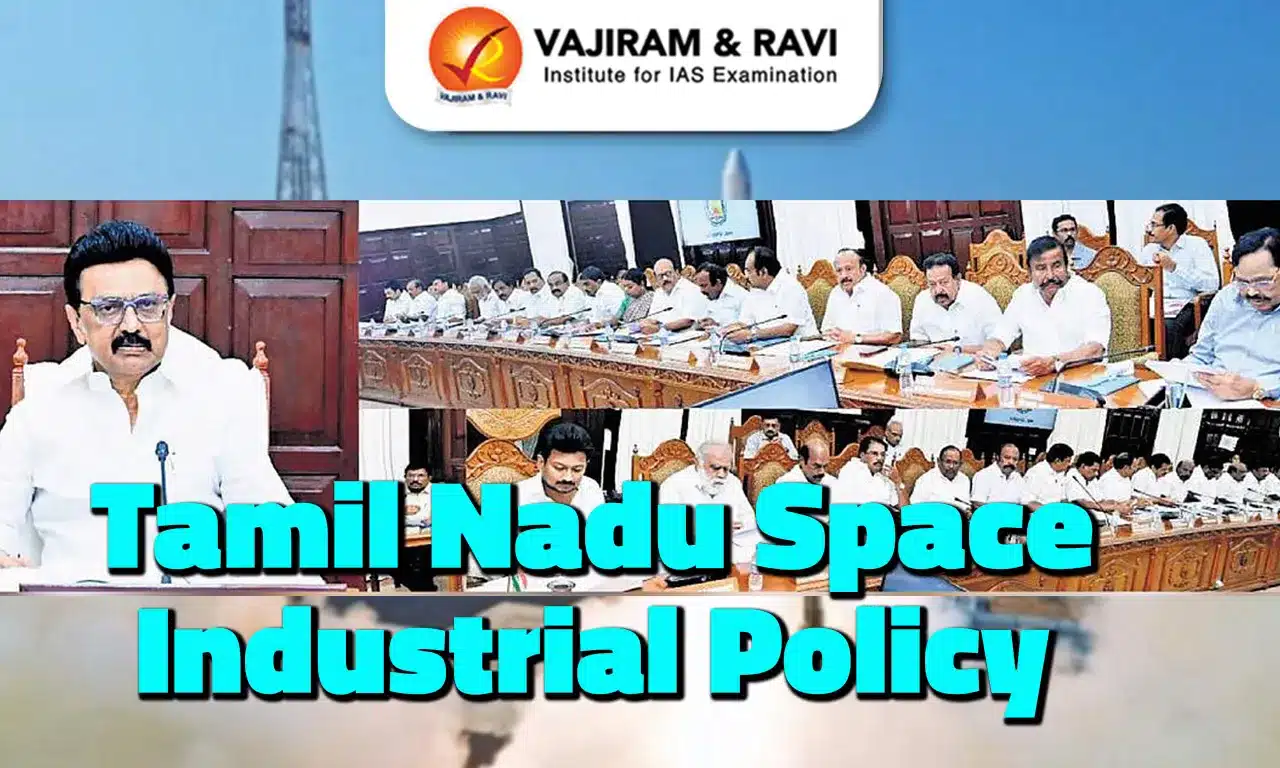
Tamil Nadu Space Industrial Policy: A Strategic Boost to India’s Space Sector

Tamil Nadu Space Industrial Policy

Tamil Nadu Space Industrial Policy Latest News

  • Recently, the Tamil Nadu Cabinet approved the State’s Space Industrial Policy to boost development and attract investments in the space sector, following the example of Karnataka and Gujarat. 
  • The policy focuses on areas such as satellite manufacturing, launch services, and satellite-based applications. This move aligns with the Indian Space Policy 2023 introduced by the Union government to strengthen the national space ecosystem.

Indian Space Policy 2023 – Key Points

  • Goal: Provide a comprehensive framework to enable private participation and strengthen the space ecosystem.
  • Key Features
    • IN-SPACe (Indian National Space Promotion and Authorization Center) 
      • Acts as a single-window agency for authorizing space activities by non-government entities.
    • ISRO's Role
      • To focus on R&D, new technologies, and capacity building.
      • Operational activities (like satellite launches and commercial use) to be increasingly shifted to private sector.
    • Private Sector Involvement
      • Encourages participation in end-to-end activities — from design and manufacturing to launch and data services.
    • Department of Space
      • Retains overall policy direction and regulatory functions.

Tamil Nadu's Strategic Role in India's Space Sector

  • Presence of Key ISRO Facilities
    • ISRO Propulsion Complex (IPRC), Mahendragiri (Tirunelveli):
      • Specializes in testing earth-storable and cryogenic engines, and undertakes R&D and technology development for launch vehicles.
    • Upcoming Spaceport at Kulasekarapattinam (Thoothukudi):
      • Set to become India’s second spaceport, aimed at expanding the country's satellite launch capacity.
  • Growing Ecosystem of Space Startups
    • The State hosts multiple space tech startups engaged in:
      • Launch vehicle development
      • Reusable launch technologies
      • In-space refueling and manufacturing
      • Advanced satellite data fusion
  • Academic and Incubation Support
    • Space Technology Incubation Centre (STIC) at NIT Tiruchi: Acts as a regional hub for ISRO-led innovation, fostering student and faculty-driven space technology projects.

Drivers Behind Tamil Nadu's Space Industrial Policy

  • Recommendation from IN-SPACe
    • The Indian National Space Promotion and Authorisation Centre (IN-SPACe), under the Department of Space, advised the Tamil Nadu government to formulate a dedicated space policy.
    • This is to promote and regulate Non-Government Entities (NGEs) in the sector.
  • Foundation in Existing Policy Framework
    • Tamil Nadu had already launched an Aerospace and Defence (A&D) Industrial Policy three years ago, which identified space technology as a priority area for development and investment.
  • Strong Vendor Ecosystem
    • The State has a well-established vendor base of over 250 suppliers catering to ISRO’s needs, indicating a mature and capable supply chain for space-related components and services.
  • Strategic Collaboration with IN-SPACe
    • TIDCO (Tamil Nadu Industrial Development Corporation) signed an MoU with IN-SPACe to facilitate:
      • Manufacturing and service activities
      • Design and R&D efforts
      • Strategic electronics manufacturing
      • Development of space-grade components

Objectives and Key Provisions of Tamil Nadu’s Space Industrial Policy

  • Investment and Employment Goals
    • The policy aims to attract ₹10,000 crore in investments over the next five years.
    • It is expected to generate direct and indirect employment for nearly 10,000 people during this period.
  • Leveraging State Strengths
    • The policy is designed to capitalize on Tamil Nadu’s strengths in electronics, precision manufacturing, and allied sectors.
    • It also promotes the integration of space technologies in governance to improve public services across sectors such as:
      • Disaster management
      • Agriculture and fisheries
      • Transport and revenue
      • Health and municipal administration
  • Financial Incentives and Support
    • Payroll Subsidy: Offered to companies involved in R&D or those setting up Global Capability Centres in the space sector.
    • Space Bays: Selected regions will be notified as Space Bays, where firms investing below ₹300 crore can avail structured incentive packages.
    • Industrial Housing Incentive: Developers of space industrial parks can avail 10% subsidy on the cost of residential facilities, capped at ₹10 crore over 10 years.
    • Green Initiatives Support: Projects adopting green and sustainable practices will receive a 25% capital subsidy, capped at ₹5 crore.

Tamil Nadu Space Industrial Policy FAQs

Q1. What is Tamil Nadu's Space Industrial Policy?

Ans. A state policy to boost space tech investment, startups, and employment through strategic incentives and infrastructure.

Q2. How much investment does Tamil Nadu aim to attract?

Ans. The policy targets ₹10,000 crore in investments over the next five years.

Q3. What are the employment goals of the policy?

Ans. It aims to generate direct and indirect employment for nearly 10,000 people.

Q4. Which key ISRO facility is located in Tamil Nadu?

Ans. The ISRO Propulsion Complex (IPRC) in Mahendragiri, Tirunelveli.

Q5. What incentives are offered under the policy?

Ans. Subsidies for R&D, Space Bays, industrial housing, and green initiatives.

Source: TH | IT

Vice Presidents of India from 1952 to 2025, List, Powers, Tenure

Vice Presidents of India

The Vice President of India hold the second-highest constitutional office after the President. As per Article 65 of the Indian Constitution, the Vice President is in charge during situations where the President is unable to fulfill their duties whether due to resignation, removal, death, impeachment, or incapacity. By default, the Vice Presidents of India also serves as the ex-officio Chairman of the Rajya Sabha, presiding over its sessions and ensuring the smooth conduct of proceedings. Since the role was established, 15 strong personalities have been Vice Presidents of India.

Vice Presidents of India

Unlike the President, the Vice Presidents of India are elected only by the members of both houses of Parliament, Lok Sabha and Rajya Sabha. State legislatures have no role in this election. C. P. Radhakrishnan serving as the 15th Vice President of India since September 9, 2025. The first to hold the position was Dr. Sarvepalli Radhakrishnan, who served from May 13, 1952, to May 12, 1957. 

Mohammad Hamid Ansari remains the only Vice President to complete two full terms, serving from August 11, 2007, to August 11, 2017. He was succeeded by M. Venkaiah Naidu, who held the post under President Ram Nath Kovind until August 2022. The Vice Presidents of India serve a five-year term but continue in office until a successor is elected.

Current Vice President of India

C. P. Radhakrishnan has been elected as the 15th and Current Vice President of India. He secured a total of 452 votes, comfortably crossing the required majority mark of 391 votes, and won the contest by a margin of 152 votes.

The Vice President of India holds the second-highest constitutional office in the country. By virtue of this position, the Vice-President also serves as the ex-officio Chairman of the Rajya Sabha. The election to this office is conducted by an electoral college consisting of members from both Houses of Parliament. Unlike the presidential election, the State Legislatures have no role in this process.

List of Vice Presidents of India from 1952 to 2025

Dr. Sarvepalli Radhakrishnan was First Vice President of India, took oath at Rashtrapati Bhavan on May 13, 1952. Below is the complete List of Vice Presidents of India from 1952 to 2025:

List of Vice Presidents of India from 1952 to 2025
S. No. Vice-President Tenure (From) Tenure (To) President(s) During Tenure
1 Dr. Sarvepalli Radhakrishnan 13 May 1952 12 May 1962 Dr. Rajendra Prasad
2 Dr. Zakir Hussain 13 May 1962 12 May 1967 Dr. Sarvepalli Radhakrishnan
3 Varahagiri Venkata Giri 13 May 1967 20 July 1969 Dr. Zakir Hussain
4 Gopal Swarup Pathak 31 August 1969 30 August 1974 V. V. Giri, Dr. Fakhruddin Ali Ahmed
5 Basappa Danappa Jatti 31 August 1974 30 August 1979 Dr. Fakhruddin Ali Ahmed, Neelam Sanjiva Reddy
6 Justice Muhammad Hidayatullah 31 August 1979 30 August 1984 Neelam Sanjiva Reddy, Giani Zail Singh
7 Ramaswamy Venkataraman 31 August 1984 24 July 1987 Giani Zail Singh
8 Shankar Dayal Sharma 7 September 1987 24 July 1992 Ramaswamy Venkataraman
9 Kocheril Raman Narayanan 21 August 1992 24 July 1997 Shankar Dayal Sharma
10 Krishan Kant 21 August 1997 27 July 2002 K. R. Narayanan, A. P. J. Abdul Kalam
11 Bhairon Singh Shekhawat 19 August 2002 21 July 2007 A. P. J. Abdul Kalam
12 Mohammad Hamid Ansari 11 August 2007 10 August 2017 Pratibha Patil, Pranab Mukherjee, Ram Nath Kovind
13 M. Venkaiah Naidu 11 August 2017 11 August 2022 Ram Nath Kovind
14 Jagdeep Dhankhar 11 August 2022 21 July 2025 Droupadi Murmu
15 C. P. Radhakrishnan 09 September 2025 Incumbent Droupadi Murmu

Vice Presidents of India Constitutional Provision

The Vice Presidents of India holds an important constitutional position, acting as the second-highest authority in the country and playing a key legislative and executive role. The provisions related to the office of the Vice Presidents of India are discussed in Articles 63 to 70 of the Indian Constitution. These articles outline the eligibility, method of election, tenure, powers, functions, and procedures in case of vacancies. The table below includes overview of Vice President of India Constitutional Provision:

Vice President of India Constitutional Provision
Article Details

Article 63

There will be an Indian Vice President

Article 64

The Vice-President shall not hold any other paid post and shall serve as the Council of States’ de facto Chairman

Article 65

When there are brief gaps in the office or when the president is not present, the vice president fills in for him or herself.

Article 66

The members of an electoral college made up of representatives from both Houses of Parliament will choose the vice president. The Vice-President is not permitted to serve in either the House of Representatives or the House of the Legislature of any State.

Article 67

From the time of his appointment, the Vice-tenure President’s in office must be for a period of five years.

Article 68

Before the term’s expiration, a vote must be held to fill any vacancies caused by the vice president’s tenure coming to an end. Elections must be held as soon as possible to fill any vacancies left by the vice president’s death, resignation, or removal.

Article 69

Each Vice President must take an oath or affirmation before the President, or a person he has nominated in that capacity.

Article 70

President’s duties are discharged in other emergencies

First Vice President of India

Dr. Sarvepalli Radhakrishnan was First Vice President of India. He was born on September 5, 1888, to Shri S. Veerasamiah. A renowned scholar and philosopher, Radhakrishnan held several academic honours, including an M.A., and multiple honorary degrees such as D.Litt., LL.D., D.C.L., and D.L. He was also a Fellow of the British Academy (F.B.A.) and the Royal Society of Literature (F.R.S.L.), and an Honorary Fellow at All Souls College, Oxford.

Vice Presidents of India Eligibility Criteria

To be eligible for the position of Vice President of India, a candidate must meet certain constitutional criteria. These qualifications ensure that the office is held by an individual with sufficient experience, integrity, and independence. Below are the key Vice Presidents of India Eligibility Criteria.

If elected while still a member of either House, he is considered to have vacated that seat from the day he takes office. Also, the Vice Presidents of India cannot hold any salaried position under the central, state, or local governments, or any public authority during the term.

  1. Must be a citizen of India.
  2. Must be at least 35 years old.
  3. Must not hold any office of profit under the central or state government, or any public or local authority.

Vice Presidents of India Tenure

The Vice Presidents of India assumes office on the date he begins his term, which lasts for five years. However, he can choose to resign before completing the term. Apart from resignation, there are several other situations where the office of the Vice President can become vacant:

  1. Completion of the five-year term
  2. Voluntary resignation
  3. Removal through a formal process
  4. Death while in office
  5. If the election is declared invalid by the Supreme Court

Vice Presidents of India Impeachment

Article 67(b) of the Indian Constitution deals with the removal of the Vice-President of India. It states that the Vice-President may be removed from office by a resolution of the Rajya Sabha (Council of States) passed by a majority of all its then members and agreed to by the Lok Sabha (House of the People). However, such a resolution cannot be moved unless at least 14 days’ notice has been given of the intention to move it.

Vice Presidents of India Powers and Functions

  • Chairman of Rajya Sabha: The Vice Presidents of India serves as the ex-officio Chairman of the Rajya Sabha. In this role, his powers and functions are similar to those of the Speaker of the Lok Sabha.
  • Acts as President: He is  an Acting President if the President resigns, is removed, dies, or otherwise becomes unable to serve. However, he can hold the office for a maximum of six months until a new President is elected.
  • Temporary Duties: The Vice President also performs the duties of the President during temporary absences due to illness, travel, or any other reason.
  • Similarity to U.S. System: His role resembles that of the Vice President of the United States, who presides over the Senate (the upper house of Congress).
  • Legal Continuity: If the Supreme Court later declares an election of Vice Presidents of India void, all decisions and actions made before that judgment remain valid and are not reversed.

Vice Presidents of India Important Facts

  • The Vice Presidents of India is the ex-officio Chairman of the Rajya Sabha and presides over its sessions.
  • The Vice President’s office may fall vacant due to:
    • Resignation
    • Removal
    • Death
    • Absence caused by illness or incapacity
  • When the Vice President discharges the functions of the President, the Deputy Chairman of the Rajya Sabha takes over the Vice President’s duties in the House.
  • Articles 63 to 71 of the Constitution discusses the Vice Presidents of India.
  • The 11th Constitutional Amendment changed the method of election. Earlier, both Houses met in a joint sitting to elect the Vice President. Now, they vote separately.
  • Parliament determines the salary of the Vice Presidents of India. The current monthly salary of the Rajya Sabha Chairman (ex-officio the Vice President of India) is ₹4 lakh.
Also Check Related Post
Vice Presidents of India Education Ministers of India
Foreign Ministers of India Finance Ministers of India
Cabinet Ministers of India Prime Ministers of India
Deputy Prime Minister of India Presidents of India
Ministry of External Affairs

Vice President of India FAQs

Q1: How many vice presidents are there in India?

Ans: India has had 15 Vice Presidents since independence, each serving as the second-highest constitutional office after the President.

Q2: Who is the 17th vice president of India?

Ans: CP Radhakrishnan is the 17th Vice President of India, elected in September 2025.

Q3: Who is the vice president of India now?

Ans: CP Radhakrishnan is the Vice President of India.

Q4: What are the powers of the Vice President of India?

Ans: The Vice President is Rajya Sabha Chairman, presides over its sessions, maintains order, decides rules, and acts as President in case of vacancy, resignation, or absence.

Q5: Who was the first woman vice president of India?

Ans: India has never had a woman Vice President as of 2025.

UN Official: Gaza Hunger Crisis is Human-Made, Not Natural

Gaza Hunger Crisis

Gaza Hunger Crisis Latest News

  • Around 50 people were shot and injured in Rafah recently as thousands of Palestinians crowded a Gaza Humanitarian Foundation (GHF) aid distribution site amid severe food shortages. 
  • Gaza had faced a total blockade for nearly three months. The UN Relief and Works Agency for Palestinian Refugees in the Near East (UNRWA) has distanced itself from GHF, and the NGO’s head, Jake Wood, resigned on May 25, citing violations of humanitarian principles.

Famine Looms Over Gaza: A Human-Made Crisis

  • Since the UN-backed Integrated Food Security Phase Classification (IPC) report on May 12, conditions in Gaza have deteriorated rapidly.
    • IPC is a global, multi-stakeholder initiative that provides a framework for analyzing and classifying the severity and magnitude of food insecurity and malnutrition. 
    • It involves governments, UN agencies, NGOs, civil society, and other relevant actors working together. 

Impact of the Ceasefire and Blockade

  • During the January 19–March 18 ceasefire, aid was scaled up to minimal acceptable levels, temporarily easing hunger. 
  • However, following the ceasefire’s collapse and the renewed blockade, aid deliveries stopped for nearly 11 weeks, pushing Gaza into acute food insecurity.

Violation of International Law

  • The denial of food aid violates international humanitarian law, specifically Article 54 of Additional Protocol I to the Geneva Conventions, which prohibits starvation as a method of warfare. 
  • Using food as leverage for political or military gains is unlawful.

Gaza Aid Still Far Below Minimum Needs

  • Recently, Israel reported that 665 aid trucks had entered Gaza. However, the UN World Food Programme deemed this a "drop in the bucket." 
  • Gaza requires a minimum of 500–600 aid trucks per day to meet survival needs. Confusion persists about how many trucks actually reach civilians, with past inspection rules forcing trucks to be half-empty, possibly still in practice.

Why the UN and NGOs Rejected GHF’s Aid Model

  • UN and aid agencies refuse to partner with the GHF because its collection-point model violates key humanitarian principles—humanity, neutrality, impartiality, and independence. 
  • Aid must reach all in need, including the disabled and immobile, not just those who can travel to distribution hubs.

Risks of Forced Displacement

  • Restricting aid to certain locations encourages further displacement. 
  • Already, Gazans have been displaced once a month on average since the war began, often to so-called "safe zones" that are unsafe in reality. 
  • This approach undermines both aid access and human dignity.

Legal Ban on UNRWA Disrupts Critical Services

  • Two Israeli laws enacted in October 2024, effective from January 2025, have severely disrupted UNRWA’s operations, particularly in East Jerusalem and across the Palestinian territories.

Impact in East Jerusalem

  • UNRWA was prohibited from operating in what Israel considers its sovereign territory, including East Jerusalem, which international law views as occupied. 
  • As a result:
    • Visas of international staff were curtailed
    • UNRWA’s facilities were vacated
    • Schools were forcibly closed, affecting around 800 students
    • There is a looming threat of clinic closures, impacting over 70,000 Palestinians

Operational Breakdown in West Bank and Gaza

  • A second law barred all direct contact between UNRWA and Israeli officials, dismantling vital coordination systems. 

UNRWA’s Ongoing Role in Gaza

  • UNRWA remains fully operational in Gaza, as the Israeli legal ban applies only to Israel’s sovereign territories. 
  • It is the largest humanitarian agency in the Strip, with 12,000 staff members, compared to just 300 across the rest of the UN system.

Key Services Provided

  • Logistics & Aid Distribution: Operates warehouses and manages a wide aid distribution network.
  • Mobile Healthcare: UNRWA staff provide tent-to-tent medical services and have established mobile healthcare points.
  • Education & Psychosocial Support: Over 20,000 children participate in the ‘Back to Learning’ initiative offering basic education, play, and psychological care.
  • Sanitation: Labourers clean refugee camps and collect waste, though UNRWA does not manage the camps, only services them.

Accountability & Neutrality Measures

  • UNRWA maintains strict neutrality protocols.
  • Allegations are addressed through internal disciplinary action.
  • Of 19 staff members accused by Israel in 2023, UNRWA suspended all immediately, and UN oversight took charge of investigations.
  • Evidence was scarce, but nine terminations were upheld based on a balance of probability, though no specific breaches were clearly substantiated.

India’s Potential Role in Gaza Crisis

  • Countries like India, which support multilateralism, can play a vital role by advocating for international law and ensuring that the decisions of the International Court of Justice (ICJ) and the UN General Assembly are upheld in Gaza.
  • While multilateralism is not flawless, it remains the best available system to maintain global order. Undermining it would lead to a more dangerous world.

Gaza Hunger Crisis FAQs

Q1. What triggered Gaza’s hunger crisis?

Ans. Blockades and disrupted aid after the ceasefire led to severe food shortages and potential famine conditions.

Q2. What is the required daily aid for Gaza?

Ans. Gaza needs 500–600 aid trucks daily, but current deliveries fall far short, worsening humanitarian conditions.

Q3. Why did UN reject GHF aid model?

Ans. GHF’s limited access points violated humanitarian principles, excluding immobile individuals and increasing forced displacement risk.

Q4. How has Israel’s law affected UNRWA?

Ans. Laws banned UNRWA from East Jerusalem, disrupted schooling, clinics, and coordination with Israeli forces in Gaza.

Q5. What role can India play in Gaza?

Ans. India can support international law and multilateralism, advocating for UN and ICJ decisions to be enforced.

Source: IE | IE

Axiom-4 Mission: Shubhanshu Shukla’s Flight Boosts India’s Human Spaceflight Plans

Shubhanshu Shukla Axiom-4

Shubhanshu Shukla Axiom-4 Latest News

  • Indian astronaut Shubhanshu Shukla’s trip to the International Space Station (ISS) on the Axiom-4 mission will be a big step forward for India’s space journey.
  • In recent years, ISRO has done many important missions, like the Chandrayaan-3 Moon landing, which made India one of the few countries with advanced space technology.
  • Shukla’s spaceflight is not India’s own human space mission yet, but it is closely linked to our plans. It will give useful information for the upcoming Gaganyaan mission and future space projects. This shows that India is getting ready for bigger achievements in space.

image3.webp

From Rakesh Sharma to Shubhanshu Shukla: A Journey of Progress

  • Rakesh Sharma’s journey to space in 1984 was a proud moment for India and sparked public imagination. 
  • However, at that time, India’s space program was still very young, with limited infrastructure and no clear long-term human spaceflight plans. 
  • As a result, his achievement remained more symbolic than practical.

Shubhanshu Shukla’s Mission: A Step Towards the Future

  • Shukla’s flight on the Axiom-4 mission is different. It comes at a time when ISRO is a globally respected space agency, capable of handling complex missions. 
  • His mission is not just inspirational, but will also provide valuable experience and data for future projects, especially the Gaganyaan mission.
    • India’s first human space mission, Gaganyaan, was initially planned for 2022. Though delayed, the Axiom-4 mission helps bridge the gap.

Gaganyaan: A Complex and Critical Mission

  • India’s first human spaceflight mission, Gaganyaan, is far more complex than uncrewed missions due to the safety protocols and human factors involved. 
  • This adds layers of difficulty for ISRO as it prepares to send astronauts into space for the first time.

Why Shubhanshu Shukla’s Experience Matters

  • Shubhanshu Shukla, as the pilot of the Axiom-4 mission, will gain real-time experience that is invaluable for Gaganyaan. 
  • His hands-on learning in decision-making, orbital navigation, and spacecraft operations will bring real-world insights that cannot be replicated in simulations.
  • Currently, only Rakesh Sharma has such experience, but that was with older technologies. Shukla’s updated exposure will help guide future Indian astronauts.

India’s First Astronaut on the ISS

  • Shukla will also become the first Indian to visit the International Space Station (ISS). 
  • His time aboard the ISS will provide him with key observations about how space stations function, which will be crucial for ISRO’s long-term plan to build its own space station.

Building Institutional Knowledge for the Future

  • Countries with successful space programs benefit when astronauts transfer their learning to future missions. 
  • Shukla’s two-week space mission will lay the groundwork for developing India’s future space capabilities, both for Gaganyaan and the proposed Indian space station.

ISRO’s First Customised Space Experiments

  • The Axiom-4 mission marks ISRO’s first chance to conduct specially designed experiments in space, laying the foundation for future space research tied to India’s needs.

Zero-Gravity and Muscle Behaviour Study

  • One key biology experiment focuses on understanding muscle degradation in zero-gravity. 
  • Unlike Earth, where gravity affects muscle function, space allows researchers to isolate and study natural muscle changes, potentially offering insights into human health and aging.

Indian-Specific Biological Experiments

  • ISRO is also conducting experiments on moong dal sprouts and micro-algae, designed to explore space agriculture and food sustainability. 
  • These are especially important for long-duration space missions and for India’s own future space station plans.

A New Chapter in India’s Space Journey

  • Shubhanshu Shukla’s spaceflight marks the beginning of a roadmap that aims for an Indian human Moon mission by 2040, reflecting ISRO’s long-term vision.

Building a Strong Space Ecosystem

  • To achieve such ambitious goals, India needs a robust space ecosystem with active private sector participation. 
  • This will lower costs, drive innovation, speed up technology development, and attract talent.

Unlocking the Space Economy’s Potential

  • The global space market is valued at $500 billion, expected to double by 2030. 
  • Despite ISRO’s global standing, India currently holds only a 2% share. 
  • The goal is to raise this to at least 10%, boosting national economic growth.

Inspiring the Next Generation

  • Events like Shukla’s mission can ignite young minds, especially school children, encouraging them to pursue careers in space. 
  • Unlike 40 years ago, today’s youth have real opportunities to be part of this growing sector.

Shubhanshu Shukla Axiom-4 FAQs

Q1. Why is Shubhanshu Shukla’s mission important?

Ans. It provides real-life spaceflight experience ahead of India’s Gaganyaan human spaceflight mission, expected in the near future.

Q2. What is the significance of the Axiom-4 mission for ISRO?

Ans. It offers critical technical insights, experiment data, and operational experience linked to India’s future space missions.

Q3. Which experiments is ISRO conducting on Axiom-4?

Ans. Experiments include muscle behaviour, moong dal sprouts, and micro-algae in zero-gravity to aid future space research.

Q4. How does Shukla's flight inspire the youth?

Ans. It captures young imaginations, encouraging interest in space science and careers in India’s growing space economy.

Q5. What is India’s long-term space goal post-Axiom-4?

Ans. ISRO aims for a human Moon landing by 2040 and plans to build its own space station.

Source: IE | IE

WHO Adopts First-Ever Pandemic Agreement: Key Highlights from World Health Assembly 2024

WHO Pandemic Agreement

WHO Pandemic Agreement Latest News

  • Member States of the World Health Organization (WHO) have unanimously adopted the world’s first Pandemic Agreement at the 78th World Health Assembly. 
  • This historic decision follows over three years of negotiations initiated in response to the COVID-19 pandemic.
  • The agreement, which is legally binding, aims to strengthen global preparedness, response, and equity in handling future pandemics.

World Health Assembly (WHA)

  • The World Health Assembly (WHA) is the decision-making body of the World Health Organization (WHO).
  • It is composed of delegates from all WHO Member States.
  • The Assembly meets annually to determine policies, approve budgets, and review work programs.
  • The assembly is held at Geneva, Switzerland.

Functions

  • Sets WHO’s policies and priorities.
  • Appoints the Director-General of WHO.
  • Approves WHO’s budget and work programs.
  • Adopts international treaties and agreements under Article 19 of the WHO Constitution.
  • Monitors global health trends and coordinates international responses.

Notable Achievements

  • Adoption of the International Health Regulations (IHR) – legal framework for global health security.
  • Eradication of Smallpox (1980) – declared by WHA.
  • Framework Convention on Tobacco Control (2003) – the first international health treaty.
  • Pandemic Influenza Preparedness Framework (2011).
  • Adoption of the WHO Pandemic Agreement (2025) – historic legal agreement post-COVID-19.

Recent Focus Areas

  • COVID-19 response and pandemic preparedness
  • Universal Health Coverage (UHC)
  • Antimicrobial resistance (AMR)
  • Health equity and access to essential medicines
  • Non-communicable diseases (NCDs) and mental health

Key Highlights of WHO Pandemic Agreement

  • The pandemic agreement was adopted at the 78th World Health Assembly.
  • Full implementation awaits the finalization of key mechanisms by May 2026, followed by ratification by at least 60 countries for it to enter into force.

Legal Framework and Historical Significance

  • This is only the second international legal agreement under Article 19 of the WHO Constitution.
    • The first was the WHO Framework Convention on Tobacco Control (2003).
  • It marks a milestone in global health governance and pandemic resilience.

Objective

  • The agreement aims to strengthen global pandemic prevention, preparedness, and response, guided by equity, solidarity, transparency, and scientific evidence. 
  • It also respects the sovereign rights of states.

Prevention and Surveillance

  • Countries are encouraged to:
    • Develop and implement national pandemic prevention plans.
    • Improve early detection and control of infectious diseases.
    • Focus on areas like routine immunisation, lab safety, antimicrobial resistance, and zoonotic disease prevention.

Sustainable Local Production

  • Nations should:
    • Ensure equitable distribution and rapid scale-up of pandemic-related health products (e.g., vaccines).
    • Aim for sustainable, timely, and fair access to these products during pandemics.

Technology Transfer

  • Technology and knowledge transfer, particularly to developing countries, should be encouraged on mutually agreed terms.
  • Use of licensing, financing, and regulatory incentives to facilitate transfer.
  • Promote regional/global tech hubs coordinated by WHO.

Pathogen Access and Benefit Sharing (PABS)

  • A new system (PABS) will enable rapid sharing of pathogen data with manufacturers.
  • In return, manufacturers must provide 20% of real-time production to WHO (10% as donations, rest at affordable prices).
  • Participation is open to all companies, regardless of location.
    • Detailed mechanism to be negotiated and finalized by May 2026.

Supply Chain and Logistics

  • A Global Supply Chain and Logistics Network will be established for equitable and timely access to health products.
  • Countries should use the network during emergencies to ensure need-based, fair distribution.
  • WHO will coordinate its structure and operations.

Respect for National Sovereignty

  • The agreement does not grant WHO authority to impose or mandate national laws or pandemic response actions (e.g., lockdowns, vaccine mandates, travel bans).
  • It ensures state sovereignty is preserved in all aspects of implementation.

Absence of USA from the Pact

  • The US’ absence from the agreement casts a long shadow over its effectiveness.
  • U.S. negotiators left discussions about the accord after President Donald Trump began a 12-month process of withdrawing the U.S. from the agency when he took office in January.

WHO Pandemic Agreement FAQs

Q1. What is the WHO Pandemic Agreement?

Ans. A global treaty to improve pandemic response, prevention, and preparedness through equity, science, and cooperation.

Q2. When was the agreement adopted?

Ans. At the 78th World Health Assembly in 2024, after three years of negotiation.

Q3. What is PABS?

Ans. The Pathogen Access and Benefit-Sharing system ensures rapid pathogen data sharing and equitable product distribution.

Q4. Does the agreement affect national sovereignty?

Ans. No. WHO cannot impose laws or actions like lockdowns or vaccine mandates.

Q5. When will the agreement come into force?

Ans. After 60 countries ratify it and finalise mechanisms by May 2026.

Source: TH | WHO | NDTV

Assessing the Effectiveness of India’s Insolvency and Bankruptcy Code (IBC)

India Insolvency and Bankruptcy Code

Insolvency and Bankruptcy Code Latest News

  • According to the latest data from the Insolvency and Bankruptcy Board of India (IBBI), creditors have realised Rs. 3.89 lakh crore under the Insolvency and Bankruptcy Code (IBC).

 Introduction

  • India's Insolvency and Bankruptcy Code (IBC), enacted in 2016, marked a transformative shift in the way the country approaches distressed assets and corporate resolution. 
  • As a consolidated and time-bound framework, the IBC aimed to reverse the borrower-friendly environment that had led to a ballooning of non-performing assets (NPAs), and instead instil credit discipline and accountability. 
  • Eight years into its journey, the Code has seen landmark resolutions, policy adjustments, and also raised serious questions about its long-term effectiveness.

India’s Insolvency Landscape Pre-IBC

  • Before 2016, India had a patchwork of debt recovery mechanisms, the SARFAESI ActDebt Recovery Tribunals (DRTs), and Company Law Board proceedings, often resulting in prolonged litigation and poor recovery rates. 
  • The introduction of IBC centralized the resolution mechanism and aimed to conclude proceedings within 330 days from the date of admission by the National Company Law Tribunal (NCLT), failing which the company would go into liquidation.

News Summary: Eight Years of IBC - Outcomes and Challenges

  • As of March 2025, the IBC has helped rescue 1,194 companies and led to creditors recovering Rs. 3.89 lakh crore, with a recovery rate of 32.8% against admitted claims. 
  • It has emerged as the dominant recovery tool, contributing 48% of bank recoveries in FY 2023-24. Other channels like SARFAESI (32%), DRTs (17%), and Lok Adalats (3%) lag behind. 
  • On average, resolution plans fetched 93.41% of the fair value of assets and over 170% of their liquidation value.
  • Experts note that despite its moderate numerical recovery rate, the IBC has significantly altered borrower behaviour, with 30,310 cases (worth Rs. 13.78 lakh crore) settled before admission, indicating a deterrent effect
  • A study by IIM-Bangalore highlighted its positive influence on credit discipline, reducing the gross NPAs of scheduled commercial banks from 11.2% in March 2018 to 2.8% in March 2024. 
  • It also improved credit terms for distressed firms and strengthened corporate governance.
  • However, nearly 78% of ongoing CIRP cases exceed the 270-day limit, primarily due to delays at the NCLT. 
  • Recent judgments, like the Supreme Court verdict in the Bhushan Power and Steel case, raise concerns over post-resolution certainty and discourage potential resolution applicants fearing future legal reversals.
  • Analysts argue that while the framework is strong, India must invest in tribunal infrastructure, introduce clearer norms for modern assets (like IP and employee dues), and avoid excessive judicial interference after resolution approval. Without such measures, the credibility and efficiency of the IBC could be undermined despite its foundational strengths.

Structural Strengths of the IBC

  • Resolution over Liquidation
    • Unlike legacy frameworks, the IBC emphasizes reviving distressed firms rather than pushing them into liquidation. This approach safeguards jobs, preserves asset value, and sustains credit flow in the economy.
  • Creditor-Centric Design
    • The IBC shifts control from debtors to creditors through the Committee of Creditors (CoC), which evaluates resolution plans and makes decisions, with NCLT acting as an adjudicator.
  • Pre-admission Settlements
    • The credible threat of insolvency has resulted in a surge in out-of-court settlements, reducing the load on formal institutions and accelerating repayments.

Key Challenges and Bottlenecks

  • Judicial Delays
    • A major concern is the inability of the NCLT to process cases within the stipulated time. These delays often derail viable resolutions and lead to lower recovery.
  • Legal Uncertainty
    • Cases like Bhushan Power and Steel, where resolution outcomes were reopened years after implementation, erode commercial certainty and dampen investor confidence.
  • Haircuts and Recovery Rates
    • While numerical recoveries are better than pre-IBC levels, haircuts remain high, averaging nearly 67%. Stakeholders call for better valuation and bidding frameworks to minimize such losses.
  • Future-Readiness
    • Emerging insolvency cases involving tech firms, startups, and IP-centric businesses demand updated resolution norms beyond traditional asset-heavy models. There is also a growing need for pre-packaged insolvency mechanisms to fast-track smaller cases.

Way Forward

  • To fully realize the IBC’s potential, India must:
    • Strengthen NCLT capacity through digitization and more benches.
    • Protect commercial decisions from prolonged judicial scrutiny.
    • Encourage pre-pack insolvency and faster implementation of resolution plans.
    • Codify rules for emerging sectors and provide better treatment for employee claims and tech-based businesses.
    • With continued institutional reforms and jurisprudential clarity, the IBC can remain central to India's aspiration of becoming a $5 trillion economy.

India’s Insolvency and Bankruptcy Code FAQs

Q1. What is the primary objective of the IBC?

Ans. The IBC aims to provide a time-bound, creditor-led framework for resolving corporate insolvencies and improving debt recovery.

Q2. How effective has the IBC been in debt recovery?

Ans. As of March 2025, creditors recovered ₹3.89 lakh crore with a recovery rate of 32.8% under the IBC framework.

Q3. What are the major challenges faced by IBC?

Ans. Key challenges include judicial delays, high haircuts, and legal uncertainty in post-resolution cases.

Q4. How has the IBC impacted borrower behavior?

Ans. The IBC has led to a shift in borrower conduct, with over ₹13.78 lakh crore in defaults settled before admission.

Q5. What is the concern arising from the Bhushan Steel verdict?

Ans. The verdict has raised concerns about the legal finality of resolution plans and its impact on investor confidence.

Source: TH

IATA AGM 2024: India’s Aviation Milestones & PM Modi’s Vision for Global Connectivity

IATA AGM 2025

IATA AGM 2025 Latest News

  • The International Air Transport Association’s (IATA) 81st Annual General Meeting and World Air Transport Summit is being held in India from 1st to 3rd June, marking the country's first hosting of the event in 42 years. 
  • The summit will address major industry issues such as airline economics, air connectivity, energy security, sustainable aviation fuel, decarbonisation financing, and innovation.

International Air Transport Association (IATA) 

  • IATA is a global trade association of the world’s airlines. It represents, leads, and serves the airline industry, aiming to ensure safe, secure, efficient, and economical air transport.
  • It represents 82% of global air traffic.
  • It is headquartered at Montreal, Canada.

Origin & Members

  • IATA was founded in Havana, Cuba, on 19 April 1945. 
    • It is the successor to the International Air Traffic Association founded in the Hague in 1919 - the year of the world's first international scheduled services.
  • At its founding, IATA had 57 members from 31 nations, mostly in Europe and North America. 
  • Today it has some 350 members from 120 nations in every part of the globe.

Functions of IATA

  • Industry Standards & Regulations: Develops global commercial and operational standards for airlines (e.g. ticketing, cargo handling).
  • Advocacy: Represents airline interests in global policy debates and with international organizations and governments.
  • Financial Systems: Manages global financial systems like BSP (Billing and Settlement Plan) and CASS (Cargo Accounts Settlement System) for efficient fund transfers.
  • Training & Certification: Provides training, certification, and operational guidance to improve safety and efficiency.
  • Sustainability: Supports the transition to net-zero emissions and promotes Sustainable Aviation Fuels (SAF).
  • Data & Research: Publishes reports and forecasts on industry trends, economics, safety, and performance.

Key Highlights of the PM Modi’s speech at the Summit

  • PM Modi welcomed global aviation leaders, noting the return of the IATA AGM to India after 42 years.
  • Highlighted India’s transformation into a more confident nation with global relevance in aviation, space convergence, and inclusive development.

Three Pillars of India's Aviation Growth

  • Vast Market – Driven by an aspirational society.
  • Talent Pool – Youth excelling in AI, robotics, and clean energy.
  • Supportive Policies – Enabling industry-wide growth and innovation.

Milestones in Indian Aviation

  • India is now the 3rd largest domestic aviation market.
  • Under the UDAN scheme, over 1.5 crore passengers have availed affordable air travel.
  • Annual passenger traffic has reached 240 million, projected to touch 500 million by 2030.
  • Air cargo stands at 3.5 million metric tons, to grow to 10 million by decade's end.

Infrastructure & Fleet Expansion

  • Airports increased from 74 (2014) to 162.
  • Indian carriers have ordered 2,000+ new aircraft.
  • Airports can now handle 500 million passengers annually.

Technology & Sustainability

  • Emphasis on green mobility and sustainable aviation fuels.
  • Showcased Digi Yatra as a paperless, digital travel model using facial recognition, setting global standards.
  • India is investing in green technologies to reduce aviation’s carbon footprint.

Legislative & Industrial Reforms

  • Announced the Protection of Interest in Aircraft Objects Bill aligning India with the Cape Town Convention.
  • Gift City incentives and tax reforms have made India attractive for aircraft leasing.
  • The Bharatiya Vayuyan Adhiniyam, 2024, which replaces the Aircraft Act of 1934, brings Indian aviation laws in line with global best practices.

Boost to Maintenance, Repair & Overhaul (MRO) Sector

  • India aims to build a $4 billion MRO hub by 2030.
  • MRO facilities grew from 96 (2014) to 154.
  • 100% FDI, GST reductions, and tax simplification boosted the sector.

Inclusive & Gender-Responsive Aviation Growth

  • Over 15% of pilots in India are women—three times the global average.
  • 86% of cabin crew and growing numbers of women engineers outpace global trends.
  • Drones empower women in agriculture, logistics, and services.

Safety, Global Cooperation & Open Skies

  • India aligned aviation regulations with International Civil Aviation Organization (ICAO) standards.
  • ICAO audit and Delhi Declaration highlight India’s safety and global commitment.
  • Reaffirmed commitment to Open Skies and Chicago Convention for global connectivity.

IATA AGM 2025 FAQs

Q1. What is IATA?

Ans. IATA is a global airline trade association representing 82% of global air traffic, headquartered in Montreal, Canada.

Q2. When was IATA founded and where?

Ans. IATA was founded on April 19, 1945, in Havana, Cuba, succeeding a 1919 association.

Q3. What are IATA’s main functions?

Ans. It sets standards, advocates for policy, manages finances, supports training, and promotes sustainability in global aviation.

Q4. What key reforms did PM Modi highlight?

Ans. Modi discussed aviation law updates, airport expansion, Digi Yatra, and a $4 billion MRO goal by 2030.

Q5. Why is India important to global aviation?

Ans. India is the 3rd largest domestic market, rapidly expanding infrastructure, fleet, and policy leadership in aviation.

Source: TH | PIB | IATA

National Sport of India, is Hockey the National Sport of India?

National Sport of India

The concept of a national sport holds cultural and emotional value for any country. There is a widespread belief that hockey is the National Sport of India due to its glorious history. However, the Government of India has clarified that no sport has been officially designated as the National Game. Despite this, hockey remains deeply rooted in India’s sporting history. This article discusses how national symbols are interpreted beyond legal declarations.

National Sport of India

India does not have an officially recognized National Sport of India. While hockey is commonly believed to hold this status, the Ministry of Youth Affairs and Sports has denied this in response to an RTI filed in 2020. The assumption began from India’s exceptional past performances in hockey, especially during the Olympic games. Cricket, kabaddi, and other sports are also popular but have no official status assigned to them. This reflects India's diverse sporting culture and the government's inclusive approach to promoting multiple disciplines.

Hockey as Indian Legacy

From 1928 to 1980, India won 8 gold medals, with a record six consecutive wins from 1928 to 1956. Globally recognised players like Dhyan Chand, Balbir Singh Sr., and Dhanraj Pillai contributed to this golden era. Hockey was not just a sport but a symbol of national pride during the pre- and post-independence era. This legacy, more than anything else, explains why hockey is often viewed as the National Sport of India.

Common Misconceptions Hockey as National Sport of India

A common misconception is that hockey is the National Sport of India. This belief is not legally or constitutionally supported. No official government notification has declared hockey or any sport as National Sport of India. Similarly, cricket, though the Most Popular Sport in India, has never held official status. Kabaddi, despite India’s dominance at international events, is also not recognized officially.

National Game of India

Hockey was regarded as the de facto National Game of India due to India’s strong international presence. The Indian Hockey Federation was formed in 1925, and the country’s first international tour against New Zealand marked the beginning of a winning streak. However, the Indian government promotes all sports equally, aiming to create a multi-disciplinary sporting environment. This balanced approach encourages equal opportunity for growth in every sport rather than prioritizing one.

No National Game in India-Why?

In 2020, a teacher filed an RTI asking when hockey was declared National Sport of India. The Ministry of Youth Affairs responded that India does not have any officially designated National Game of India. The reason lies in the government's inclusive sports policy that seeks to promote all disciplines instead of favoring one. Recognizing only one sport could undermine others that are also flourishing, such as wrestling, badminton, and athletics. Thus, India celebrates sporting diversity rather than limiting itself to one symbol.

Calls for Official Recognition

India's historic performance at the Tokyo Olympics 2020, where the men’s hockey team won a bronze medal, revived public calls to officially declare hockey as the National Sport of India. A PIL was filed seeking government intervention, but the Supreme Court dismissed the petition, stating the matter lies within the government's purview. While emotional sentiments support hockey’s recognition, official status remains unprovided. The debate highlights the interplay between public opinion, legal frameworks, and cultural pride.

National Sports Day of India

National Sports Day of India is celebrated on August 29th every year, marking the birth anniversary of Major Dhyan Chand, India's legendary hockey player. The day was first observed in 2012 and focuses on promoting physical fitness and sporting spirit. Various events are organized across the country, including awards like the Rajiv Gandhi Khel Ratna (now Major Dhyan Chand Khel Ratna). It reflects India’s commitment to honoring its sports heritage and encouraging youth participation in athletics.

Father of Indian Hockey

Major Dhyan Chand, a three-time Olympic gold medalist, is revered as the Father of Indian Hockey. His dominance in international matches, especially at the 1928, 1932, and 1936 Olympics, remains unmatched in hockey history. His exceptional dribbling skills and goal-scoring abilities earned him global admiration. Dhyan Chand’s contributions turned hockey into a symbol of Indian excellence and earned the sport a special place in the country’s heart. His legacy continues to inspire generations of Indian athletes.

Hockey Team of India Achievements

The Hockey Team of India is one of the most successful in Olympic history. Between 1928 and 1980, India won eight gold, one silver, and three bronze medals. The golden period saw six consecutive gold medals, an achievement unparalleled in world hockey. After a long medal drought, the team returned to the Olympic podium with a bronze medal at Tokyo 2020 and again at Paris 2024.

Hockey Team of India Achievements

Venue/Olympics Name

Year

Achievements

Amsterdam Olympics

1928

Gold Medal

Los Angeles Olympics

1932

Gold Medal

Berlin Olympics

1936

Gold Medal

London Olympics

1948

Gold Medal

Helsinki Olympics

1952

Gold Medal

Melbourne Olympics

1956

Gold Medal

Rome Olympics

1960

Silver Medal

Tokyo Olympics

1964

Gold Medal

Mexico City Olympics

1968

Bronze Medal

Munich Olympics

1972

Bronze Medal

Montreal Olympics

1976

7th Position

Moscow Olympics

1980

Gold Medal

Los Angeles Olympics

1984

5th Position

Seoul Olympics

1988

5th Position

Barcelona Olympics

1992

6th Position

Atlanta Olympics

1996

8th Position

Sydney Olympics

2000

7th Position

Athens Olympics

2004

7th Position

Beijing Olympics

2008

Did Not Qualify

London Olympics

2012

12th Position

Rio Olympics

2016

8th position

Tokyo Olympics

2021

Bronze Medal

Paris Olympics

2024

Bronze Medal

National Game of India Important Facts

  • No official National Game of India has been declared by the Government of India.
  • Hockey is widely regarded as the National Sport of India due to historical dominance.
  • India won 8 Olympic gold medals in hockey, most between 1928 and 1980.
  • The Bengal Hockey Association was India’s first governing body for hockey.
  • The Khelo India scheme promotes grassroots sports development across the country.
  • Other popular sports in India include cricket, kabaddi, badminton, and wrestling.
  • The Ministry of Youth Affairs and Sports encourages multi-sport development, not just hockey.
  • Dhyan Chand’s birth anniversary is celebrated as National Sports Day.

National Sport of India FAQs

Q1: Is hockey the national sport of India?

Ans: No, hockey is not officially recognized as the national sport of India.

Q2: Why is hockey considered India’s national game?

Ans: Due to India’s Olympic achievements and legendary players like Dhyan Chand, hockey is widely regarded as the de facto national sport.

Q3: Has the Indian government declared any national game?

Ans: No, the government has clarified that no sport holds the status of a national game.

Q4: What is National Sports Day in India?

Ans: It is celebrated on August 29, the birth anniversary of Major Dhyan Chand, to promote sports and fitness.

Q5: Who is called the Father of Indian Hockey?

Ans: Major Dhyan Chand is honored as the Father of Indian Hockey due to his remarkable achievements.

Asia-Pacific Economic Cooperation (APEC)

Asia-Pacific Economic Cooperation

Asia-Pacific Economic Cooperation (APEC) Latest News

US President Donald Trump and his Chinese counterpart Xi Jinping are likely to meet at the Asia-Pacific Economic Cooperation (APEC) summit in South Korea.

About Asia-Pacific Economic Cooperation (APEC)

  • It is a regional economic forum established in 1989 to leverage the growing interdependence of the Asia-Pacific.
  • It aims to create greater prosperity for the people of the region by promoting balanced, inclusive, sustainable, innovative, and secure growth and by accelerating regional economic integration.
  • The focus of APEC has been on trade and economic issues, and hence, it terms the countries as “economies”.
  • It has been operating on the basis of non-binding commitments, with decisions taken through commitments and consensus undertaken on a voluntary basis.
  • There are no binding commitments or treaty obligations. 
  • Member Countries:
    • Currently, APEC has 21 members.
    • The criterion for membership, however, is that each member must be an independent economic entity, rather than a sovereign state.
    • The grouping’s current members are Australia, Brunei, Hong Kong, New Zealand, Papua New Guinea, the Philippines, Indonesia, China, Japan, South Korea, Russia, Canada, the United States, Mexico, Peru, Chile, Malaysia, Vietnam, Singapore, Thailand, and Taiwan.
  • The APEC Secretariat is based in Singapore and operates as the core support mechanism for the APEC process. 
  • APEC's member economies are home to more than 2.9 billion people and make up over 60 percent of global GDP.

Source: FP

Asia-Pacific Economic Cooperation (APEC) FAQs

Q1: When was the Asia-Pacific Economic Cooperation (APEC) established?

Ans: It was established in 1989 to leverage the growing interdependence of the Asia-Pacific.

Q2: What is the primary aim of Asia-Pacific Economic Cooperation (APEC)?

Ans: To create greater prosperity through balanced and sustainable economic growth.

Q3: The Asia-Pacific Economic Cooperation (APEC) Secretariat is headquartered in which country?

Ans: The APEC Secretariat is based in Singapore.

Q4: How many members does Asia-Pacific Economic Cooperation (APEC) currently have?

Ans: 21

Panna Tiger Reserve

Panna Tiger Reserve

Panna Tiger Reserve Latest News

Vatsala', considered to be Asia's oldest elephant, died recently at the age of more than 100 years at the Panna Tiger Reserve in Madhya Pradesh.

About Panna Tiger Reserve

  • Location: It is located in the Vindhyan mountain range in the northern part of Madhya Pradesh.
  • Standing over an area of 542 sq.km., it is the only tiger reserve in the entire Bundhelkhand region.
  • It falls in biogeographic zones of the Deccan Peninsula and the Biotic Province of the Central highlands.
  • It was declared a Project Tiger Reserve by the Government of India in 1994. 
  • Landscape:
    • It is characterized by a ‘Table Top’ topography.
    • It consists of extensive plateaus and gorges.
    • Two plateaus run parallel to each other from southwest to northeasterly direction. 
  • River: The Ken River flows from south to north through the reserve.
  • The reserve is also dotted with two-thousand-year-old rock paintings.
  • The region surrounding the reserve is home to various indigenous tribes, each with its distinct culture and traditions. The Baiga and Gond tribes are among the prominent ones. 
  • Flora:
    • The dominant vegetation type is dry deciduous forest interspersed with grassland areas.
    • In the north, it is surrounded by teak forest, and in the east, it is surrounded by Teak-Kardhai mixed forest. It is the northernmost boundary of the natural distribution of teak (Tectona grandis).
    • The tree species Acacia catachu dominates the dry, steep slopes of the plateaus here.
  • Fauna:
    • It supports a sizable population of Tiger, Sloth Bear, Leopard, and Striped Hyena.
    • Other prominent carnivores are Jackal, Wolf, Wild Dog, Jungle Cat, and Rusty Spotted Cat.

Source: TH

Panna Tiger Reserve FAQs

Q1: Which state is Panna Tiger Reserve in?

Ans: Madhya Pradesh

Q2: Which major river flows through the Panna Tiger Reserve?

Ans: Ken River

Q3: What is the dominant vegetation type in the Panna Tiger Reserve?

Ans: Dry deciduous forest interspersed with grassland areas.

Q4: What is the approximate area of Panna Tiger Reserve?

Ans: 542 sq.km.

Sri Lankan president Dissanayake meets PM Modi for Bilateral Ties

Sri Lankan president Dissanayake meets PM Modi for Bilateral Ties

What’s in today’s article?

  • Why in News?
  • A Brief About Bilateral Ties
  • Key Highlights of Sri Lankan President’s Visit to India
  • Conclusion

Why in News?

  • Sri Lankan President Anura Kumara Dissanayake, on his first bilateral visit to India, assured Prime Minister Narendra Modi that Sri Lankan territory will not be used in ways detrimental to Indian interests.
  • Both leaders emphasised strengthening cooperation in defence, economic development, and regional security.

A Brief About Bilateral Ties:

India-Sri Lanka Geographical Location.webp
  • Historical ties: Relations date back to ancient times with strong cultural and religious ties, particularly Buddhism, which originated in India. Many Sri Lankans trace their ancestry to India.
  • Key areas of cooperation:
    • Trade and economic bonds:
      • India is Sri Lanka’s third-largest export destination, with over 60% of exports benefiting from the India-Sri Lanka Free Trade Agreement.
      • FDI from India amounted to USD 1.7 billion (2005-2019).
    • Energy cooperation: A multi-product petroleum pipeline is planned from southern India to Sri Lanka to ensure affordable and reliable energy supplies.
    • Defence and security: Regular military (Mitra Shakti) and naval (SLINEX) exercises are conducted. Sri Lanka is part of BIMSTEC and SAARC, where India plays a significant role.
    • People-to-People ties: India was the largest source of tourists to Sri Lanka in 2022, with over 100,000 visitors. Enhancing digital payments will facilitate easier business and tourism exchanges.
  • Significance of India-Sri Lanka relations:
    • Geopolitical importance: Sri Lanka’s strategic location in the Indian Ocean at the crossroads of major shipping lanes makes it vital for India’s trade and security interests.
    • Regional development: Sri Lanka’s integration with the Southern economy aligns with India’s regional growth vision.
    • Ease of business and connectivity: Digital platforms like UPI and fintech integration simplify trade and tourism, strengthening economic ties.
  • Challenges in India-Sri Lanka relations:
    • Fisheries dispute: Indian fishermen often cross into Sri Lankan waters, leading to arrests and tensions.
    • Katchatheevu Island dispute: The 1974 agreement recognised Katchatheevu as Sri Lankan territory but allowed Indian fishermen to access surrounding waters. A 1976 pact restricted these rights, creating friction.
    • Border security: The porous maritime border enables smuggling of narcotics and illegal immigration.
    • Tamil ethnic issue: India remains concerned about the Tamil minority’s rights in Sri Lanka, with historical sensitivities tied to the ethnic conflict.
    • China’s influence: Increasing Chinese investments (e.g., Hambantota port, Colombo port projects) raise concerns about regional strategic imbalances.

Key Highlights of Sri Lankan President’s Visit to India:

  • Security cooperation:
    • Mutual security commitments:
      • President Dissanayake assured India that Sri Lanka’s territory will not harm Indian interests.
      • Both leaders stressed interconnected security interests and agreed to finalise a defence cooperation agreement, and emphasised a safe, secure, and free Indian Ocean Region while countering traditional and non-traditional threats.
    • Defence collaboration: Key measures -
      • Exploring a framework agreement on defence cooperation.
      • Augmenting Sri Lanka’s defence capabilities via defence platforms and joint exercises.
      • Enhancing maritime surveillance, defence training, and dialogues.
      • The Colombo Security Conclave will focus on maritime security, cyber security, and counter-terrorism.
  • Addressing Tamil minority issues:
    • Modi highlighted the need for reconciliation and reconstruction for Tamil minorities.
    • He expressed hope for full implementation of Sri Lanka’s Constitution and the holding of provincial council elections.
    • Notably, the 13th Amendment and war crime investigations were not discussed in the joint statement.
    • Dissanayake emphasised unity, social protection, and sustainable development.
  • Fishermen issues:
    • Both sides discussed the livelihood challenges of fishermen.
    • Agreement:
      • Adopt a humanitarian approach to address disputes.
      • Avoid aggressive behavior and focus on a long-term solution.
      • Leaders instructed officials to continue dialogue for resolution.
  • Economic and energy cooperation:
    • Investment-led growth: Modi emphasised a futuristic vision for economic growth with a focus on investment-led development and enhanced connectivity (physical, digital, and energy).
    • Key initiatives:
      • India’s support during Sri Lanka’s economic crisis (worth US$ 5 billion).
      • Boosting energy ties through:
        • Electricity grid connectivity.
        • Multi-product petroleum pipelines.
        • Solar power projects in Sampur.
        • LNG supply to Sri Lanka’s power plants.
        • Trilateral cooperation among India, Sri Lanka, and UAE for a petroleum pipeline.
      • Digital transformation: Plans to expedite -
        • Sri Lanka Unique Digital Identity (SLUDI) project.
        • Adoption of UPI digital payments.
        • Integration of platforms like Aadhaar, GeM, PM Gati Shakti, and DigiLocker.
  • Connectivity and tourism: Launch of a ferry service between Rameshwaram (India) and Talaimannar (Sri Lanka). Promotion of Ramayana and Buddhist circuits to boost tourism.
  • Capacity building and scholarships: India announced -
    • Rehabilitation of Sri Lanka’s railway signalling system.
    • Scholarships for Sri Lankan university students.
    • Training for 1,500 civil servants over five years.
  • Diplomatic engagements and agreements: Sri Lanka and India signed pacts on -
    • Avoidance of double taxation.
    • Capacity building and training.
    • Dissanayake invited PM Modi for a bilateral visit to Sri Lanka.

Conclusion:

  • President Dissanayake’s visit reinforced the strong bilateral relationship between India and Sri Lanka, emphasising shared security interests, economic cooperation, and inclusive development.
  • Both leaders reaffirmed their commitment to addressing key challenges while building a prosperous future for both nations.

Q.1. What is String of Pearls?

The String of Pearls is a geopolitical theory that refers to China's network of commercial and military bases and ports in the Indian Ocean region. The network includes ports in Pakistan, Sri Lanka, Djibouti, and other countries.

Q.2. Why is Hambantota port in Sri Lanka a cause of worry for India?

India had opposed the docking of the Chinese ships at the Hambantota port as it feared that China could use the port, which is close to the main Asia-Europe shipping route, as a military base.

News: Sri Lankan president Dissanayake meets PM Modi, vows not to let the country’s territory be used for anti-India activities

Severe Heatwave in India

Severe Heatwave in India

What’s in today’s article?

  • Why in the News?
  • What is Heat wave?
  • What is Criterion for Declaring Heat wave?
  • How India Meteorological Department (IMD) Monitors the Heat wave?
  • How Does Heatwave Affect Human Body?
  • How to Avoid Heat Stroke?
  • News Summary
  • Why Has April Month Been so Hot?

Why in the News?

  • India continues to battle temperatures soaring to record levels, especially in April.
  • The month has brought unusually intense heat, affecting even hill stations and other regions not usually associated with the weather.
  • The southern peninsular and southeastern coast regions, which include Maharashtra, West Bengal, Telangana, and Andhra Pradesh, among others, have been worst affected.

What is Heat wave?

  • Qualitatively, heat wave is a condition of air temperature which becomes fatal to human body when exposed.
  • Quantitatively, it is defined based on the temperature thresholds over a region in terms of actual temperature or its departure from normal.
  • In certain countries it is defined in term of the heat index based on temperature and humidity or based on extreme percentile of the temperatures.

What is Criterion for Declaring Heat wave?

  • Heat wave is considered if maximum temperature of a station reaches at least 400C or more for Plains and at least 300C or more for Hilly regions.
  • For coastal regions –
    • When maximum temperature departure is 4.50C or more from normal, Heat Wave may be described provided actual maximum temperature is 370C or more.
  • Period of Heat wave over India –
    • It is occurring mainly during March to June and in some rare cases even in July. The peak month of the heat wave over India is May.
  • Heat wave prone areas of India –
    • Heat wave generally occurs over plains of northwest India, Central, East & north Peninsular India during March to June.

How India Meteorological Department (IMD) Monitors the Heat wave?

  • IMD has a big network of surface observatories covering entire country to measure various metrological parameters like Temperature, Relative humidity, pressure, wind speed & direction etc.
  • Based on daily maximum temperature station data, climatology of maximum temperature is prepared for the period 1981-2010 to find out normal maximum temperature of the day for particular station.
  • Thereafter, IMD declared heat wave over the region as per its definition.

How Does Heatwave Affect Human Body?

  • We all feel drained and tired after stepping out on an extremely hot day.
  • This is referred to as heat exhaustion, which happens when the body sweats excessively to keep the core temperature low.
  • A heat stroke happens when the ambient temperature is so high that the body is unable to sweat to regulate the core temperature, which shoots up to 400C.
  • In these cases, there is a severe imbalance of salts such as sodium and potassium in the body.
  • The high core temperature coupled with salt imbalances disrupts organs, leading to a host of symptoms.
  • It can affect the brain, making a person foggy, drowsy, and in severe cases may also lead to a person going into a coma.
  • It can lead to kidney and liver damage as well. A cascade of such symptoms leads to death due to heat stroke.

How to Avoid Heat Stroke?

  • The primary aim should be to bring down the core temperature of the body fast.
  • This can be done by pouring cold water over the person, making them drink cold drinks, and giving them electrolytes to balance salt levels.
  • To prevent heat stroke, it is better to avoid stepping out in direct sunlight, especially between noon and 3 pm. You should avoid strenuous activity during this time.

News Summary

April Heatwave
  • According to The Indian Express, the Core Heatwave Zone (CHZ) spanning central, north, and peninsular India is prone to heatwave annually, between March and June.
  • Rajasthan, Punjab, Haryana, Chandigarh, Delhi, West Madhya Pradesh, Uttar Pradesh, Chhattisgarh, Odisha, Vidarbha in Maharashtra, parts of Gangetic West Bengal, coastal Andhra Pradesh, and Telangana are the most heatwave-prone states or regions, the report explains.
  • However, this month, large areas of Karnataka, Kerala, Sikkim, Bihar, and Jharkhand also felt the heat, indicating that the temperatures are rapidly soaring during summers.

Why Has April Month Been so Hot?

  • In its forecast for April, the IMD warned of extreme heat and prolonged heatwave conditions to prevail over large parts of the country during the month. There are two main reasons for this.
  • One, 2024 is a year that began in an El Niño state.
    • El Niño, a weather pattern, refers to an abnormal warming of surface waters in the equatorial Pacific Ocean, which leads to extreme heat in many parts of the world and the ocean.
    • It developed in June 2023 and generally, the years which begin in an El Niño state, experience extreme temperatures, harsh, multiple and extended heatwave spells, and lack of pre-monsoon rainfall.
  • Two, the persistent presence of anticyclone systems over southern peninsular and south-eastern coastal areas.
    • These high-pressure systems, which exist at about the altitude of 3 km and extend between 1,000 and 2,000 km in length, push the air underneath them towards the Earth, in a process called air subsidence.
    • As a result, the forcefully sunk air generates more heat on the surface closer to the Earth.
    • The presence of anticyclone systems also leads to wind flow from land towards the sea and prevents the incoming cooler sea breeze, which is otherwise responsible for cooling land from time to time.
  • El Niño and anticyclone systems collectively created sweltering hot conditions and heatwaves during April, especially over Gangetic West Bengal, Odisha, Andhra Pradesh, Telangana, Tamil Nadu, Kerala, Karnataka, and Maharashtra.
  • The Intergovernmental Panel on Climate Change (IPCC) reports and analysis of weather models indicate that heatwaves in India shall no longer remain contained over only those regions traditionally believed to be prone.

Newer areas, especially from the southern peninsular India, are already experiencing heatwaves.


Q1. What is Loo?

The Loo is a strong, dusty, gusty, hot and dry summer wind from the west which blows over the Indo-Gangetic Plain region of North India and Pakistan. It is especially strong in the months of May and June. Due to its very high temperatures, exposure to it often leads to fatal heatstrokes.

Q2. What do you mean by La Nina?

La Nina is a cooling of the water in the equatorial Pacific, which occurs at irregular intervals, and is associated with widespread changes in weather patterns complementary to those of El Niño, but less extensive and damaging in their effects.

Source: Heatwaves in several parts of India: Why has April been hotter than usual? | ToI

Women Entrepreneurship Program

Women Entrepreneurship Program

About Women Entrepreneurship Program: 

  • It is designed to address the distinct challenges that women face when starting and growing businesses.
  • This initiative aims to empower approximately 25 lakh women across India, providing them with the skills, knowledge, and resources needed to start and grow successful businesses.
  • It is in partnership with Britannia Industries Limited.
  • The initiative will also offer financial grants and feature their products and services on the Skill India Digital Hub, reflecting a strong commitment to fostering an inclusive environment for women entrepreneurs.
  • NSDC, with support from the National Institute for Entrepreneurship and Small Business Development (NIESBUD), will offer free online self-learning entrepreneurship courses through the Skill India Digital Hub (SIDH).
  • These courses, available in multiple languages, will cover crucial topics such as entrepreneurial skills, enterprise setup, finance basics, digital skills, and market analysis.

Key facts about the National Skill Development Corporation

  • It was established on July 31, 2008, as a not-for-profit public limited company under section 25 of the Companies Act, 1956.
  • It operates as a unique Public Private Partnership (PPP) model under the Ministry of Skill Development & Entrepreneurship (MSDE).

Q1: What is Skill India Digital (SID) Platform?

Skill India Digital (SID) Platform serves as India’s Digital Public Infrastructure (DPI) for the skill development, education, employment and entrepreneurship ecosystem. This Platform aims to bring all skilling initiatives under a single umbrella and provide skill development and entrepreneurial support to people.

Source: Women Entrepreneurship Program launched to empower women entrepreneurs and spurring economic growth

SEBI’s New Regulations: Stricter Norms for Financial Influencers, Simplified Delisting Rules

India’s Financial Sector 2025

What’s in today’s article?

  • Why in News?
  • What are Finfluencers?
  • New rules by SEBI

Why in News?

The Securities and Exchange Board of India (SEBI), India’s markets regulator, has asked brokers and mutual funds to stop using the services of unregulated financial influencers for marketing and advertising campaigns.

In addition to regulating finfluencers, SEBI has introduced a fixed price process for delisting frequently traded shares and established a delisting framework for Investment and Holding Companies (IHC).

What are Finfluencers?

  • About
    • Finfluencers are people with public social media platforms offering advice and sharing personal experiences about money and investment in stocks. 
    • Their videos cover budgeting, investing, property buying, cryptocurrency advice and financial trend tracking.
  • Popularity of finfluencers
    • The popularity of finfluencers is evident from their massive subscriber counts, often exceeding those of leading broking firms. 
    • This has resulted in substantial earnings for the most successful finfluencers, with estimates ranging from Rs 15 lakh to Rs 30 lakh per month.
    • However, the low barriers to entry in this space have also led to increased exposure to potential bad actors and questionable advice.
  • Need to regulate finfluencers
    • There has been a sharp rise in the number of various ‘unregistered’ investment advisors giving unsolicited social media ‘stock’ tips on various social media platforms.
      • The rise of finfluencers can be attributed to India's low financial literacy rate of 27% and the influx of new investors during the Covid-19 pandemic. 
      • With the democratization of trading through new-age broking apps and affordable smartphones, many first-time investors turned to finfluencers for guidance.
      • However, the lack of financial education and the focus on market updates by business news channels created a vacuum that finfluencers have been filling.
    • There were also reports that certain companies used social media platforms to boost their share prices through such finfluencers.
    • Recently, an online portal claimed that finfluencers get paid Rs 7 to 9 lakh per endorsement to push financial products on social media.
    • There are two important aspects which requires attention:
      • It is unclear if these influencers have any educational or professional qualification to offer such financial advice, and 
      • If there is any kind of monetary transaction that happens between them and the entity they are promoting.
  • Criticism
    • Critics have raised the concerns in this regard. They claim that finflencers render advice to their followers which comes under the ambit of Freedom of Expression of the Constitution.
    • Followers are not forced to take action based on the recommendations of these finfluencers.
    • They point towards the fact that often celebrities endorse certain products without having any expertise. Also, they take money to promote the products.
    • In this context, these critics claim that regulating the finfluencers would be improper. 

New rules by SEBI

  • SEBI Tightens Norms on Financial Influencers
    • Under the new rules, brokers and mutual funds are prohibited from using the services of unregulated financial influencers for marketing and advertising campaigns. 
    • However, financial influencers engaged in investor education will be exempt from these restrictions. 
    • The regulated entities will be responsible for ensuring that the individuals they associate with adhere to the rules of conduct set by SEBI, including avoiding promises of assured returns.
  • Changes to Derivative Trading Regulations
    • SEBI has introduced new criteria to determine which stocks can be linked to derivative products, such as futures and options. 
    • The total number of stocks eligible for derivative trading is expected to increase slightly.
  • Eased Delisting Rules
  • The regulator has approved changes to delisting rules, making it easier for companies to exit from stock exchanges. 
    • Currently, delisting is carried out via reverse book-building.
    • Reverse book-building is primarily used by companies that wish to delist their shares from a stock exchange. 
    • The objective is to determine the exit price at which shareholders are willing to sell their shares back to the company or promoters.
  • Companies can now offer their shareholders fixed prices for shares as an alternative to the current reverse book-building mechanism. 
  • The fixed price must be at least 15% above a floor price, which will be determined by rules set by the regulator.
  • The regulator has also decided to remove financial disincentives for the managing director and chief technology officer of exchanges and other market infrastructure institutions (MIIs) in the event of technical glitches.

Q.1. What is the Securities and Exchange Board of India (SEBI)?

SEBI, the Securities and Exchange Board of India, is the regulatory body tasked with overseeing and regulating the securities market in India. It ensures investor protection and promotes fair and orderly functioning of the markets.

Q.2. What is reverse book-building?

Reverse book-building is a process used to determine the price at which a company's shares will be delisted from a stock exchange. Shareholders indicate the minimum price they are willing to accept for their shares during this period.

Source: SEBI tightens norms on financial influencers, eases rules for delisting | Times of India

4 Key Space Projects Receive the Go-Ahead from Cabinet

Default Image

What’s in today’s article?

  • Why in News?
  • What are the 4 Space Projects Approved by the Cabinet?
  • About the Chandrayaan-4 Mission
  • About the Venus Orbiter Mission (VOM)
  • About the Bharatiya Antariksh Station (BAS)
  • About the Next Generation Launch Vehicle (NGLV)

Why in News?

  • The Union Cabinet approves four important space endeavours to be launched by the Indian Space Research Organisation (ISRO) in the near future.
  • In total, the Cabinet cleared funds of more than ₹22,750 crore for the developmental costs of these four programmes, which are in line with the Vision 2047 mapped by the space agency.

What are the 4 Space Projects Approved by the Cabinet?

  • Chandrayaan-4 - the 4th iteration of India’s lunar mission;
  • The development of Venus Orbiter Mission (VOM);
  • The building of the first unit of India’s indigenous space station, dubbed Bharatiya Anatriksh Station (BAS), by extending the scope of Gaganyaan programme; and
  • The development of the Next Generation Launch Vehicle (NGLV).

About the Chandrayaan-4 Mission:

  • Budget allocated and launch date:
    • India’s 4th mission to the Moon, for which a budget of ₹2,104.06 crore was cleared, is slated for launch in 2027.
    • The approved cost for the mission includes -
      • Spacecraft development and realisation,
      • Two launches of Launch Vehicle Mark-3 (LVM-3),
      • External deep space network support, and
      • Conducting special tests for design validation.
  • Objectives:
    • Chandrayaan-4 will be a remote mission, aiming to bring rock samples from the lunar surface back to Earth after a soft landing.
    • It will build on the success of Chandrayaan-3, with which India became the first country to land a probe on the lunar south pole.
  • Significance:
    • It will expand on the technology developed in Chandrayaan-3 by adding elements like lunar docking, precision landing, sample collection and a safe journey back to Earth.
    • This will make India even more self-reliant in space technologies, boosting innovation and supporting academia.
    • This mission will achieve the foundational technologies capabilities eventually for an Indian landing on the Moon (planned by year 2040) and return safely back to Earth.

About the Venus Orbiter Mission (VOM):

  • Budget allocated and launch date: The ₹1,236crore VOM mission has set a target of March 2028. This will be India’s 2nd mission to a planet, after the Mars Orbiter Mission in 2014.
  • Objectives:
    • India’s first scientific mission to Venus involves sending an orbital spacecraft to study the planet closest to Earth.
    • It aims to enable scientists to better understand the Venusian atmosphere, and geology and generate data that gives information into the planet’s thick atmosphere.
  • Significance:
    • Venus is thought to have developed under Earth-like conditions, but a runaway greenhouse effect caused the planet to deviate, rendering it inhospitable for life. 
    • It offers a unique opportunity to understand how planetary environments can evolve very differently.

About the Bharatiya Antariksh Station (BAS):

  • Budget allocated and launch date:
    • India’s most ambitious space project and the Gaganyaan follow-on mission, the project saw a net additional funding of ₹11,170 crore.
    • The first module of the project (dubbed BAS-1) targets a launch in 2028 and the target to complete the entire project is for 2035.
  • Objectives: BAS aims to establish an Indian space station that will orbit 400 km above the Earth’s surface. It will allow astronauts to stay in orbit for 15-20 days.
  • Significance: The massive 52-tonne machine will serve as a research platform for Indian astronauts and scientists to conduct experiments in microgravity, astronomy, and Earth observation.

About the Next Generation Launch Vehicle (NGLV):

  • Budget allocated and launch date:
    • In total, ₹8,240 crore was approved for NGLV, which includes development costs, three developmental flights, essential facility establishment, programme management and launch campaign.
    • It will take 96 months - with the first launch taking place in 84 months.
  • Objective:
    • It will be a new launch vehicle that is capable of high payload, and will be cost-effective, reusable, and has the potential to be commercially viable.
    • This launch vehicle is one of the requirements for setting up a BAS.
  • Significance:
    • NGLV will have three times the present payload capability with 1.5 times the cost compared to LVM-3.
    • It will also have reusability resulting in low-cost access to space and modular green propulsion systems.

Q.1. What was the ISRO's Mars Orbiter Mission (MOM)?

MOM is India's first interplanetary mission to the red planet Mars launched on board PSLV-C25 on Nov 05, 2013. ISRO has become the 4th space agency to successfully send a spacecraft to Mars orbit. Though the designed mission life is 6 months, it completed 7 years in its orbit on Sept 24, 2021.

Q.2. What is India's Gaganyaan mission?

Gaganyaan project envisages demonstration of human spaceflight capability by launching a crew of 3 members to an orbit of 400 km for a 3 days mission and bring them back safely to earth, by landing in Indian sea waters.

Source: Union Cabinet approves Venus mission, Indian space station among 4 key Isro projects | HT

INS Mahe

INS Mahe

INS Mahe Latest News

Cochin Shipyard Limited (CSL) recently delivered the first of the eight anti-submarine warfare shallow water craft (ASW-SWC), INS Mahe, indigenously designed and built by it to the Indian Navy.

About INS Mahe

  • It is the first of the eight anti-submarine warfare shallow water craft (ASW-SWC) of the Indian Navy.
  • It is indigenously designed and built by the Cochin Shipyard Limited (CSL).
  • Designed for a wide range of coastal defence missions, Mahe is equipped for underwater surveillance, search and rescue duties, Low Intensity Maritime Operations (LIMO), and complex mine-laying tasks. 

INS Mahe Features

  • The ship’s design reflects extensive indigenous input, with over 90 percent of components sourced domestically.
  • The 78-meter-long vessel is the largest Indian naval warship powered by a diesel engine-waterjet propulsion system.
  • This advanced propulsion system ensures superior manoeuvrability and a reduced acoustic signature, crucial in anti-submarine operations carried out in littoral waters.
  • Its compact design and high agility make it ideal for operations in shallow waters where conventional destroyers and frigates face navigational constraints.
  • These ships are equipped with one RBU-6000 anti-submarine rocket launcher and two sets of light-weight torpedo-tube launchers for launching anti-submarine torpedoes.

Source: TH

INS Mahe FAQs

Q1: INS Mahe is primarily designed for which type of naval operation?

Ans: Anti-submarine warfare in shallow waters.

Q2: Which Indian shipyard designed and built INS Mahe?

Ans: Cochin Shipyard Limited (CSL).

Q3: What is the propulsion system used in INS Mahe?

Ans: Diesel engine with waterjet propulsion.

India’s Military Space Doctrine: Preparing for the Final Frontier

India’s Military Space Doctrine: Preparing for the Final Frontier

What’s in Today’s Article?

  • Military Space Doctrine India Latest News
  • Need For a Space Security Doctrine
  • India's Key Developments in Space Security
  • Conclusion: Towards a Space-Ready Military
  • Military Space Doctrine India FAQs

Military Space Doctrine India Latest News

  • Chief of Defence Staff (CDS) General Anil Chauhan announced that India is in the final stages of formulating a Military Space Doctrine, expected to be released within two to three months. 
  • A National Military Space Policy is also under development. This is an important step as the world is on the “cusp of an era” where space is becoming a key domain of warfare, necessitating preparedness through structured doctrines, research, and institutional frameworks.

Need For a Space Security Doctrine

  • Rising Global Concerns Over Weaponisation of Outer Space
    • In April 2024, Russia vetoed a UN Security Council resolution (drafted by the US and Japan) to prevent an arms race in outer space.
      • UN has called for a legally binding instrument to prevent arms race in outer space, but Russia and China rejected the 2024 draft resolution.
    • This follows fears of Russia developing nuclear anti-satellite (ASAT) weapons.
    • Military use of space has been ongoing since Sputnik (1957), with increasing threats of space warfare and space-based defence systems.
  • Militarization Trends: Space as the Fifth Operational Domain
    • NATO declared space a fifth operational domain in 2019, reflecting its critical role in defence.
    • Countries like the US and Russia have created independent space forces and formulated doctrines to secure space dominance.
    • The failure of global consensus on responsible behaviours (e.g., the 2023 Working Group report) reflects growing mistrust among major powers.
  • Geopolitical and Astropolitical Tensions
    • India faces growing geopolitical and astropolitical tensions, especially with China and Pakistan.
    • China's space advancements, including the Space Silk Road and PLA’s restructured security forces (including Aerospace and Cyberspace), pose direct security challenges.
  • Other Factors
    • Rising threats such as orbital, kinetic, electronic warfare, and cyber threats necessitate resilient space-based systems.
    • India's expanding space capabilities demand clear institutional frameworks to integrate civil, commercial, and military space activities.
    • Military space operations are critical for - Safeguarding national security; Addressing vulnerabilities of space-based systems; Tackling emerging space-based threats.

India's Key Developments in Space Security

  • Adherence to Space Norms
    • India adheres to major international space treaties including:
      • 1967 Outer Space Treaty (OST)
      • 1968 Rescue Agreement
      • 1972 Liability Convention
      • 1974 Registration Convention
      • Signatory to the 1979 Moon Agreement
    • India is a member of the Inter-Agency Space Debris Coordination Committee (IADC) and follows the 2008 Debris Mitigation Guidelines.
  • India's Key Developments in Space Security
    • 2019 ASAT Test (Mission Shakti): India demonstrated its counter-space capabilities, joining the US, Russia, and China.
    • 2010 – Integrated Space Cell: Enhanced coordination between the Department of Space and Armed Forces.
    • 2018 – Defence Space Agency (DSA): Formed to address space-based military threats.
      • DSA is playing a central role in: Drafting the military space doctrine; Building an integrated satellite communication grid; Identifying and countering threats to national security from both state and non-state actors.
    • 2023 – Indian Space Policy (ISP): First formal space policy, although it lightly touches upon “national security”.
    • 52-Satellite Constellation for Defence: The government has approved the launch of a 52-satellite constellation for intelligence, surveillance, and reconnaissance (ISR).
      • 31 satellites to be built by the private sector
      • Execution in partnership with ISRO and private players
      • Aimed at bridging operational gaps and preparing for future threats
    • GSAT-9 (2017): Used space diplomacy through the South Asia Satellite, strengthening regional influence (excluding Pakistan).
    • International Partnerships: India is strengthening space cooperation with QUAD, France, and others.

Conclusion: Towards a Space-Ready Military

India’s ongoing reforms in the space sector and the development of military space doctrines and policies reflect a strategic shift towards embracing space as a crucial frontier for national security. These initiatives aim to build resilience, foster innovation, and integrate military, civil, and private capabilities for a robust space defence architecture.

Military Space Doctrine India FAQs

Q1. Why is India creating a Military Space Doctrine?

Ans. To address rising space-based threats and assert strategic preparedness in the rapidly militarizing space domain.

Q2. What is Mission Shakti?

Ans. India’s 2019 anti-satellite (ASAT) test demonstrating its capability to neutralize satellites, joining global space powers.

Q3. What challenges does India face in space?

Ans. India faces growing astropolitical threats, especially from China’s military space advancements and space-based warfare capabilities.

Q4. What role does the Defence Space Agency play?

Ans. It drafts the doctrine, builds space systems, and coordinates responses to space-based military threats.

Q5. What is the significance of the 52-satellite constellation?

Ans. To boost India's surveillance, intelligence, and reconnaissance capacity in collaboration with private players and ISRO.

Source: TH | NUJS

Plea on maintainability of CBI probes

Plea on maintainability of CBI probes

What’s in today’s article?

  • Why in News?
  • What is Article 131 of the Constitution of India?
  • What is Central Bureau of Investigation (CBI)?
  • Consent Required by the CBI for Conducting Investigation in a State
  • Centre’s Plea on maintainability of CBI probes

Why in News?

Supreme Court has reserved its verdict on the West Bengal government's suit alleging that the CBI is pressing ahead with investigation into post-poll violence cases in the state, without securing its prior nod as per the law.

Earlier, the Centre had told SC that West Bengal’s original suit under Article 131 of the Constitution against it to not allow probe by the agency in the state was not maintainable and is an abuse of legal process.

What is Article 131 of the Constitution of India?

  • Article 131 of the Constitution of India gives the Supreme Court (SC) the power to exclusively decide disputes between different units of the Indian Federation. 
  • These disputes include:
    • Between the Government of India and one or more states
    • Between the Government of India and any state(s) on one side and one or more states on the other
    • Between two or more states, if the dispute involves a question of law or fact on which the existence or extent of a legal right depends 

What is Central Bureau of Investigation (CBI)?

  • About
    • The CBI is the premier investigating agency of India operating under the jurisdiction of the Ministry of Personnel, Public Grievances and Pensions.
    • It traces its origin from the Delhi Special Police Establishment (DPSE) Act, 1946, which regulates the CBI.
    • As the DPSE Act is not passed by Parliament of India, CBI is created by an executive order of the government, hence not a statutory body yet and is exempted from the purview of theRight to Information (RTI) Act.
    • Originally set up to probe cases of corruption in the government departments, CBI’s jurisdiction expanded to include several economic crimes, special crimes, cases of corruption and other cases. 
    • Investigating powers of CBI are divided into: 
    • Anti-Corruption Division: It investigates cases against central government employees, public servants working under state governments (entrusted to the CBI by the state).
    • The Economic Offences Division: It investigates financial crimes, bank frauds, money laundering, illegal money market operations, graft in PSUs and banks.
    • The Special Crimes Division: It handles cases of conventional nature such as offences relating to internal security, espionage, narcotics and psychotropic substances, etc. 

Consent Required by the CBI for Conducting Investigation in a State:

  • Legal basis: Section 6 of the DPSE Act authorises the central government to direct CBI to probe a case within the jurisdiction of any state but only with the consent of the concerned state government.
    • However, the SC and HCs can order CBI to investigate such a crime anywhere in the country without the consent of the state.
  • Types of consent:
    • General consent: When a state gives a general consent to the CBI for probing a case, the agency is not required to seek fresh permission every time it enters that state in connection with investigation or for every case.
  • It is normally given by states to help the CBI in the seamless investigation of corruption cases against central government employees in their states.
  • Specific consent: When a general consent is withdrawn, CBI needs to seek case-wise (specific) consent for investigation from the concerned state government. 
    • If specific consent is not granted, the CBI officials will not have the power of police personnel when they enter that state, preventing the CBI from conducting a thorough inquiry. 
  • States which have withdrawn general consent so far
  • So far, 10 States have withdrawn the general consent to CBI to probe the case. These are:
    • Punjab, Jharkhand, Kerala, Rajasthan, Chhattisgarh, West Bengal, Mizoram, Telangana, Meghalaya, and Tamil Nadu.
  • Withdrawal of General Consent and its Impact:
    • The withdrawal of general consent does not stop CBI probes in all cases.
    • The CBI continues to probe in old cases until specifically taken back by the state government. 
    • Further, it continues to investigate cases that were given to it by a court order.
    • The CBI can also challenge the decision (of withdrawal of general consent) in a court showcasing its progress of investigation in the case. 
    • When the CBI does not have a general consent, it can approach a local court (as per a provision in theCrPC) for a search warrant and conduct investigation. 

Centre’s Plea on maintainability of CBI probes

  • Background
    • The Supreme court was hearing an original suit filed by the State of West Bengal under Article 131 of the Constitution.
    • The WB Govt has accused the Union govt of interfering in cases originating within the State’s jurisdiction by unilaterally authorising the CBI to probe them.
  • Stand of WB Govt
    • The Centre continues to employ the CBI regardless of the fact that the State had withdrawn its general consent to CBI investigations within its territory.
      • WB had withdrawn the consent under Section 6 of the Delhi Special Police Establishment (DSPE) Act, 1946 way back in November 2018. 
    • The CBI has registered over 15 cases in West Bengal.
  • Stand of Centre
    • The Solicitor General had argued that the suit was not maintainable and should be dismissed at the outset. 
    • West Bengal had wrongly made the Union the defendant in the suit. The petitioners were wrong to term the CBI as the “police force of the Union”. 
    • The Centre had no role in where and how the CBI conducted its investigation, he contended.
    • It also argued that the suit could not be amended to make CBI a defendant as it was not a ‘state’ under Article 131. 
      • The original suits under Article 131 could only be filed for disputes involving the Centre and States.
  • Observations made by the SC
    • Questioning the claim of the Centre, the SC highlighted Section 5(1) of the DSPE Act, the statute which governs the premier probe agency.
      • Section 5(1) allows the Central government to give the Delhi Special Police Establishment (CBI) jurisdiction over areas in states, including railway areas, to investigate specific offenses.

Q.1. What is general consent to the CBI? 

General consent is a form of consent that a state government can give to the Central Bureau of Investigation (CBI) to investigate crimes within their territory. With general consent, the CBI can operate without needing to apply for consent on a case-by-case basis. However, if a state government withdraws its general consent, the CBI cannot register new cases involving central government officials or private individuals in that state without the state government's prior permission. 

Q.2. What is the role of Ministry of Personnel, Public Grievances and Pensions?

The Ministry of Personnel, Public Grievances and Pensions is the coordinating agency of the Central Government in personnel matters specially issues concerning recruitment, training, career development, staff welfare as well as the post retirement dispensation.

Source: In Supreme Court, Centre says it sends CBI to States for probes | Indian Express | Times of India

Bhagavad Gita and Natyashastra Added to UNESCO’s Memory of the World Register

Bhagavad Gita and Natyashastra Added to UNESCO's Memory of the World Register

What’s in Today’s Article?

  • UNESCO Memory of the World Latest News
  • UNESCO’s Memory of the World Programme: A Global Effort to Preserve Documentary Heritage
  • India’s Contributions to UNESCO’s Memory of the World Register
  • Natyashastra: A Pillar of Indian Performing Arts
  • Bhagavad Gita: A Timeless Spiritual Dialogue
  • UNESCO Memory of the World FAQs

UNESCO Memory of the World Latest News

  • The manuscripts of the Bhagavad Gita and Bharata’s Natyashastra have been added to UNESCO’s Memory of the World Register among 74 new entries. 
  • PM Modi hailed this as a proud moment for all Indians, noting that these ancient texts have shaped civilization and continue to inspire globally.

UNESCO’s Memory of the World Programme: A Global Effort to Preserve Documentary Heritage

  • Launched in 1992, UNESCO’s Memory of the World (MoW) Programme aims to protect valuable archive holdings and library collections worldwide. 
  • It seeks to prevent "collective amnesia" by ensuring the preservation and wide accessibility of the world’s documentary heritage.

Objective and Vision

  • The programme upholds that the world’s documentary heritage belongs to all and must be preserved, protected, and made permanently accessible, respecting cultural contexts and practicalities.

The MoW Register

  • At the heart of the programme is the Memory of the World Register — a curated list of documents, manuscripts, oral traditions, audio-visual materials, and archival holdings of global significance and universal value.

Updates and Submissions

  • The Register has been updated biennially since 1997, with exceptions between 2017 and 2023.
  • A maximum of two submissions per country are considered for inclusion in any given year.
  • The number of new additions ranges from 9 (in 1999) to 78 (in 2017).

Current Status and Notable Inclusions

  • The Register now features 570 entries.
  • Examples include:
    • Mahavamsa (Sri Lanka’s historical chronicle)
    • Drawings by Sakubei Yamamoto (Japan, Meiji era)
    • Over 11,000 Shaiva Siddhanta manuscripts
    • 430 hours of Frankfurt Auschwitz trial recordings (1963–65)
    • Video of Sheikh Mujibur Rahman’s March 7, 1971 speech

India’s Contributions to UNESCO’s Memory of the World Register

  • India has made 13 submissions to the Register, including two joint entries with other nations.

Range of Submissions

  • India’s entries span ancient scriptures, philosophical works, and modern political archives:
    • Rig Veda (added in 2005)
    • Works of Shaivite philosopher Abhinavagupta (added in 2023)
    • Archives of the first Non-Aligned Movement (NAM) summit, Belgrade, 1961 (added in 2023)
    • Archives of the Dutch East India Company (added in 2003)

Joint Submissions

  • NAM summit archives: Jointly submitted with Algeria, Egypt, India, Indonesia, and Serbia
  • Dutch East India Company archives: Jointly submitted with Indonesia, Netherlands, South Africa, and Sri Lanka

Recent Additions Highlight Literary Heritage

  • India’s 2024 submissions focus on ancient manuscripts — specifically preserved versions of the Bhagavad Gita and Natyashastra — maintained by the Bhandarkar Oriental Research Institute in Pune. 
  • These reflect the country’s enduring contribution to world literature and philosophical thought.

Natyashastra: A Pillar of Indian Performing Arts

  • Traditionally attributed to sage Bharata, the Natyashastra is an ancient Sanskrit treatise on performing arts. 
  • It comprises around 36,000 verses detailing drama (natya), performance (abhinaya), music (sangita), emotions (bhava), and aesthetic experience (rasa).

Date and Compilation

  • Scholars estimate its compilation between 500 BCE and 500 CE, with UNESCO citing around the 2nd century BCE as the most likely period.

Core Contribution: The Concept of Rasa

  • The Natyashastra is renowned for its exposition of rasa — the “essence” or emotional flavor of a performance. 
  • Bharata declared, “no meaning can blossom forth without rasa,” making it central to all artistic expression.
  • According to Wallace Dace, while actors imitate emotions, the audience “tastes” them — a distinct, aesthetic experience separate from real-life emotions.
  • Susan L. Schwartz adds that this process transports audiences into a “parallel reality,” enabling reflection on spiritual and moral dimensions of life.

UNESCO Recognition

  • UNESCO hails the Natyashastra as a profound contribution to world literature, highlighting its influence on global theories of aesthetics and performance.

Bhagavad Gita: A Timeless Spiritual Dialogue

  • Traditionally ascribed to sage Vyasa, the Bhagavad Gita is a Sanskrit scripture consisting of 700 verses divided into 18 chapters. 
  • It is embedded within the sixth book (Bhishma Parva) of the epic Mahabharata.

Philosophical Synthesis

  • UNESCO describes the Gita as a cornerstone of India’s intellectual tradition, synthesising diverse schools of thought including Vedic, Buddhist, Jain, and Charvaka philosophies.

Dating and Composition

  • While the text is generally dated to the first or second century BCE, some scholars, like Winthrop Sargeant, suggest it was first written down in the second or third centuries CE after an earlier oral tradition.

Core Narrative and Themes

  • The Gita presents a profound dialogue between warrior Arjuna and his charioteer Krishna, an incarnation of Lord Vishnu, on the eve of the great war of the Mahabharata.
  • Faced with the moral dilemma of fighting his own kin, Arjuna seeks guidance, and Krishna's response unfolds the Gita’s central themes: duty (dharma), righteousness, detachment, devotion, and self-realization.

UNESCO Memory of the World FAQs

Q1. What is UNESCO's Memory of the World Programme?

Ans. Launched in 1992, it preserves and ensures global access to documentary heritage, including manuscripts and oral traditions.

Q2. What is the significance of Bhagavad Gita's inclusion?

Ans. It represents India's intellectual tradition and philosophical synthesis, with timeless themes of duty, devotion, and self-realization.

Q3. What is the Natyashastra?

Ans. An ancient Sanskrit treatise on performing arts, detailing drama, music, emotions, and aesthetics, attributed to sage Bharata.

Q4. When was the Natyashastra likely compiled?

Ans. It was compiled between 500 BCE and 500 CE, with around the 2nd century BCE being the most likely period.

Q5. What is the role of UNESCO's Memory of the World Register?

Ans. It curates global documents and manuscripts of significant cultural value, ensuring their preservation and accessibility.

Source: IE | ToI | HT

Government to Restore Indexation Benefit for Property Sales

Government to Restore Indexation Benefit for Property Sales

What’s in today’s article?

  • Why in News?
  • What is Capital Gain Tax?
  • Indexation benefits
  • Govt to restore indexation benefit for property

Why in News?

Following criticism over the Budget proposal to remove the indexation benefit on long-term capital gains (LTCG) from selling unlisted assets, the government has decided to offer taxpayers a choice.

For properties acquired before July 23, 2024, taxpayers can either pay LTCG tax at 20% with the indexation benefit or pay LTCG tax at the new rate of 12.5% without the indexation benefit.

This change comes from amendments made by the government in the Finance Bill.

What is Capital Gain Tax?

  • About
    • A capital gains tax is a tax imposed on the sale of an asset. It is calculated as the difference between the sale price of the property and its purchase price.
    • Any gain or loss incurred from the sale of a house property may be subject to tax under the 'Capital Gains' head.
    • Similarly, capital gains or losses may arise from sale of different types of capital assets such as stocks, mutual funds, bonds and other investments.
  • Types
    • Depending of the period an asset is held with the owner, there are two types of capital gains - Short-term Capital Gains and Long-term Capital Gains.
  • Budget 2024 and Capital Gain Tax
    • For classifying assets into long-term and short-term, there will only be two holding periods: 12 months and 24 months.
  • The 36-month holding period has been removed.
    • All listed securities with a holding period exceeding 12 months are considered Long-Term. The holding period for all other assets is 24 months.
    • The taxation of Short-Term Capital Gain for listed equity shares, a unit of an equity-oriented fund, and a unit of a business trust has been increased to 20% from 15%.
  • Other financial and non-financial assets which are held for short term shall continue to attract the tax at slab rates.
    • The limit on the exemption of Long-Term Capital Gains on the transfer of equity shares or equity-oriented units or units of Business Trust has increased from Rs.1 Lakh to Rs.1.25 lakh per year.
  • However, the rate at which it is taxed has increased from 10% to 12.5%.
    • The tax on long-term capital gains on other financial and non-financial assets is reduced from 20% to 12.5%.

Indexation benefits

  • About
    • In case of property sale, indexation helps in adjusting its purchase price according to the prevailing inflation rate.
    • So basically, the adjustment inflates the purchase price of a property considering the inflation over the invested years.
    • This ultimately brings down the taxable capital gains on the sale of the property.
    • Through indexation, investors can accurately determine their capital gains and be assured that they are paying taxes only on the real gains after inflation is adjusted.
  • Calculation
    • The government releases cost inflation index (CII) numbers to index capital gains on specified assets.
  • CII number takes into account the prevailing inflation for the particular financial year.
    • Formula to calculate the adjusted purchase price using the cost inflation index is:
  • Indexed cost = Purchase Amount * (CII in year of sale / CII in year of purchase).
  • Initially, I-T department had set 1981 as the base year and later shifted it to 2001, with a base value of 100.
  • Each year’s index is computed relative to this base.
    • This adjustment ensures that the taxable gain reflects the real increase in the asset’s value, not just the effect of inflation.
  • Possible impact of removal of indexation benefit
    • Slowdown in the resale market
      • It may discourage owners of older residential properties and land from selling, as the increased tax liability reduces their potential profit.
    • Rise in cash transactions
      • There’s a concern that this change could incentivize under-the-table cash deals to avoid the higher tax burden, counteracting efforts to formalize the real estate sector.
    • Higher property prices
      • Sellers may attempt to offset the increased tax burden by raising property prices, effectively transferring the cost to buyers.

Govt to restore indexation benefit for property

  • Background
    • The budget 2024 had announced the removal of the indexation benefits available on the property sale. It introduced a 12.5% LTCG tax rate without indexation.
    • The indexation benefit that was previously available on sale of long-term assets, has now been done away with.
    • So, any sale of long-term asset made after 23rd July, 2024, will attract tax rate of 12.5% only without indexation benefit.
  • The indexation benefit, however, can be taken on the sale of property bought or inherited before 2001.
  • Indexation benefits on property transactions to stay on
    • After backlash from different quarters, the Centre has decided to revisit its decision to scrap the indexation benefits on property transactions.
    • The government amended the Finance Bill, 2024, allowing people to choose between a 12.5% LTCG tax rate without indexation or a 20% rate with indexation for property acquired before July 23, 2024.
  • Now a resident tax payer can opt for tax rate which is more beneficial for properties acquired prior to 23 July 2024.
  • Initially, there was no grandfathering for properties bought after April 1, 2001.

Q.1. What is cost inflation index (CII)?

The Cost Inflation Index (CII) is a measure used in India to account for inflation in the computation of long-term capital gains tax. Published annually by the Central Board of Direct Taxes (CBDT), it adjusts the purchase price of assets to reflect inflation, thereby reducing the taxable capital gains.

Q.2. What is Central Board of Direct Taxes (CBDT)?

The Central Board of Direct Taxes (CBDT) is a part of the Department of Revenue under the Ministry of Finance in India. It is responsible for administering direct tax laws, including the Income Tax Act, and ensures tax compliance, policy formulation, and enforcement. The CBDT also advises the government on tax-related matters.

Source: After backlash, govt roll back: indexation benefits available on LTCG tax on sale of property | Financial Express | Live Mint

Should Fossil Fuels Be Regulated Like Nuclear Weapons

Should Fossil Fuels Be Regulated Like Nuclear Weapons

What’s in today’s article?

  • Why in News?
  • What is the Fossil Fuel Non-Proliferation Treaty (FF-NPT)?
  • Need and Significance of the FF-NPT
  • Understanding the FF-NPT Framework and Challenges
  • India's Position on the FF-NPT and Way Ahead for the FF-NPT
  • Conclusion

Why in News?

  • A growing coalition of governments and civil society organisations is advocating for a Fossil Fuel Non-Proliferation Treaty (FF-NPT), aimed at phasing out fossil fuels and promoting a just transition to renewable energy.

What is the Fossil Fuel Non-Proliferation Treaty (FF-NPT)?

  • About: Conceptualised in 2016 and officially launched in 2019, the FF-NPT proposes to make it legally binding on nations to end fossil fuel extraction, wind down existing production, and manage a just transition to renewable energy.
  • Objective: Inspired by international treaties regulating nuclear weapons, this initiative seeks to address the escalating climate crisis by curbing fossil fuel production and ensuring equitable global energy access.
  • Origins and evolution: Conceptualised around the time the Paris Agreement was signed, the FF-NPT has gained endorsements from notable entities, including former UN Secretary-General Ban Ki-Moon, indigenous communities, and small island states.
  • Recent developments:
    • At COP29 to the UNFCCC in Baku (Azerbaijan), 10 more countries joined discussions on FF-NPT, though their identities remain undisclosed.
    • The treaty has been endorsed by 13 Small Island Developing States in the Pacific, such as Vanuatu and Tuvalu, and major coal-producing nations like Colombia.
  • Financial institutions' support: A collective endorsement by 25 members of the Global Alliance for Banking on Values marks the initiative's first major backing from the financial sector.

Need and Significance of the FF-NPT:

  • Need:
    • The proponents of FF-NPT argue that the Paris Agreement, despite its significance, fails to directly address fossil fuel production.
    • Tzeporah Berman, chair of the FF-NPT initiative, highlighted the dire state of global emissions at COP29:
      • Fossil fuel emissions in 2024 are projected to be 8% higher than in 2015 - the year the Paris Agreement was signed.
      • 2024 is likely to be the hottest year on record, with fossil fuel production incompatible with limiting global warming to 1.5°C.
      • Current policies may lead to 3°C of warming, risking catastrophic consequences for humanity.
    • As fossil fuel emissions continue to rise, global temperatures are on track to exceed safe limits, threatening the planet's future.
  • Significance: The proposed treaty will support the work of the Paris Agreement, whether through the implementation of -
    • The New Collective Quantified Goal, which aims to establish a new financial target to assist developing countries in their climate actions post-2025, or
    • Through Nationally Determined Contributions (the climate action plans submitted by countries) and Just Transition Work Programmes.

Understanding the FF-NPT Framework and Challenges:

  • Framework: The FF-NPT rests on 3 core pillars:
    • Non-proliferation: Halting the expansion of coal, oil, and gas production through international cooperation.
    • Fair phase-out: Equitably reducing existing fossil fuel production, with wealthier, historically high-emission nations transitioning first.
    • Just transition: Accelerating renewable energy adoption and diversifying economies to ensure no community, worker, or nation is left behind.
  • Challenges:
    • Since its official launch in 2019, the treaty has faced significant financial hurdles, particularly in aiding climate-vulnerable nations to transition away from fossil fuels.
    • Without substantial funding, developing nations cannot transition to renewables or mitigate climate change impacts.

India's Position on the FF-NPT and Way Ahead for the FF-NPT:

  • India's position: While India has not been extensively engaged, the FF-NPT initiative recognises its significance:
    • As a major fossil fuel consumer, India’s emissions are projected to rise by 4.6% in 2024, according to the Global Carbon Project.
    • Advocates believe India could benefit from the treaty, ensuring justice and equity in the global energy transition.
  • Way ahead: The treaty must align with the Paris Agreement's goals, supporting financial mechanisms like the New Collective Quantified Goal.

Conclusion:

  • The FF-NPT offers a bold vision for tackling the climate crisis by regulating fossil fuel production akin to nuclear disarmament.
  • With increasing support from governments, financial institutions, and vulnerable nations, the initiative underscores the urgent need for global cooperation and equitable solutions.
  • However, financial and political challenges must be overcome to turn this vision into a legally binding reality.

Q.1. What is the Treaty on the Non-Proliferation of Nuclear Weapons (NPT)?

The NPT is an international treaty that aims to prevent the spread of nuclear weapons and promote cooperation in the peaceful uses of nuclear energy. The treaty was signed in 1968 and entered into force in 1970.

Q.2. What is the New Collective Quantified Goal (NCQG)?

The NCQG is a target for climate finance that aims to mobilize funds to assist developing countries in adapting to climate change and transitioning to low-carbon economies. The goal was set by the Paris Agreement in 2015.

News: Can fossil fuels be regulated like nuclear weapons? The group that is trying, the success achieved so far

India Joins IPEF’s Clean and Fair Economy Agreements to Boost Economic Collaboration

India Joins IPEF's Clean and Fair Economy Agreements to Boost Economic Collaboration

What’s in today’s article?

  • Why in News?
  • What is Indo-Pacific Economic Framework (IPEF)?
  • Initiatives under IPEF
  • India signs clean, fair economy agreements of IPEF

Why in News?

India has signed the US-led 14-member Indo-Pacific Economic Framework for Prosperity (IPEF) bloc’s agreements on a clean and fair economy.

The agreements were signed during PM Modi’s visit to the US. These are aimed at facilitating development, access, and deployment of clean energy and climate-friendly technologies. They also aim to strengthen anti-corruption measures and promote tax transparency within member countries.

What is Indo-Pacific Economic Framework (IPEF)?

  • Background: Origin
    • US President Biden first spoke about the IPEF at the October 2021 East Asia Summit.
    • At this summit, he said that the United States will explore with partners the development of an Indo-Pacific economic framework.
    • This framework will define our shared objectives around:
      • trade facilitation, standards for the digital economy and technology, supply chain resiliency, decarbonization and clean energy, infrastructure, worker standards, and other areas of shared interest.
      • The IPEF will not include market access commitments such as lowering tariff barriers, as the agreement is more of an administrative arrangement.
  • About
    • Launched in Tokyo, in May 2023, IPEF aims to strengthen economic engagement among the member countries to advance growth, peace and prosperity in the region.
    • According to an insight paper on IPEF put out by the US Congressional Research Service, the IPEF is not a traditional trade agreement.
    • Rather, it would include different modules (four pillars) covering various aspects.
  • Four Pillars of IPEF
    • Pillar I - Fair and resilient trade,
    • Pillar II - Supply chain resilience,
    • Pillar III – Clean economy (infrastructure and decarbonization), and
    • Pillar IV – Fair Economy (tax and anticorruption).
  • Countries would have to sign up to all of the components within a module (pillar), but do not have to participate in all modules.
  • Members
    • The IPEF has 14 partner countries including Australia, Brunei, Fiji, India, Indonesia, Japan, Republic of Korea, Malaysia, New Zealand, Philippines, Singapore, Thailand, Vietnam and the US.
  • Significance
    • The 14-nation IPEF bloc is seen as crucial as it accounts for about 40 per cent of the world’s GDP and 28 per cent of the world’s trade in goods and services.
    • It is seen as an economic and trade strategy backed by the US to counter China’s economic influence in the region.
  • India and IPEF
    • In September 2022, India joined three pillars of the IPEF.
    • These are the supply chain, clean economy, and fair economy pillars of the IPEF.
    • However, it had decided to remain out of the trade pillar. India has an observer status on the trade pillar negotiations.

Initiatives under IPEF

  • IPEF Upskilling Initiative
    • The IPEF Upskilling Initiative, launched in September 2022, aims to promote sustainable and inclusive economic growth by offering digital skills training, especially for women and girls in emerging and middle-income IPEF partner countries.
    • Over the past two years, 14 US companies and the Asia Foundation have provided 10.9 million upskilling opportunities under this initiative, with India benefiting from 4 million of these opportunities.
    • The initiative focuses on empowering women and girls by enhancing their digital skills for economic development.
  • Critical Mineral Dialogue
    • The ongoing dialogue within the IPEF focuses on key areas such as comprehensive mapping of mineral resources, promoting trade by tracking trade flows within the region, and fostering technical collaboration for mineral recovery and recycling.
    • These initiatives aim to strengthen the critical mineral supply chain and ensure sustainable mining practices across IPEF partner countries.
  • Tech Council
    • The initiative's main objectives are to coordinate and cooperate on key technologies among IPEF partners.
    • This will be done by sharing best practices and standards, strengthening digital infrastructure resilience, promoting investment, and fostering innovation through workforce development.
    • Current collaboration areas include cybersecurity, undersea cables, and artificial intelligence.
  • Cooperative Work Program (CWP)
    • CWP aims to facilitate joint efforts among IPEF countries to advance the objectives of the Clean Economy Agreement.
    • So far, 8 CWP proposals have been announced in IPEF Ministerial meetings.
    • These proposals cover areas such as hydrogen supply chains, carbon markets, clean electricity, sustainable aviation fuel, just transition, emissions intensity accounting, small modular reactors, and India's proposal on e-waste urban mining.

India signs clean, fair economy agreements of IPEF

  • About
    • India signed and exchanged the first-of-its-kind agreements focused on Clean Economy, Fair Economy, and the IPEF Overarching arrangement under IPEF.
  • IPEF Clean Economy Agreement (Pillar-III)
    • The Agreement on Clean Economy aims to foster cooperation in clean energy and climate technologies to accelerate energy security, climate resilience, and greenhouse gas (GHG) emissions reduction.
    • It promotes technical cooperation, workforce development, capacity building, and research collaborations.
    • The agreement will also facilitate investments, project financing, and joint projects, with a focus on supporting MSMEs and integrating Indian companies into global value chains, especially in the Indo-Pacific.
    • These goals will be achieved through joint initiatives such as Cooperative Work Programmes, the IPEF Catalytic Capital Fund, and the IPEF Accelerator.
  • IPEF Fair Economy Agreement (Pillar-IV)
    • The Agreement under the IPEF aims to create a more transparent and predictable trade and investment environment by enhancing anti-corruption efforts, including preventing bribery and improving tax transparency.
    • It focuses on boosting information sharing, facilitating asset recovery, and strengthening cross-border investigations and prosecutions.
    • These measures will support India's fight against corruption, money laundering, and terror financing.
    • The partners will also collaborate on Technical Assistance and Capacity Building (TACB) initiatives to effectively implement anti-corruption measures and improve the efficiency of tax administration.
  • Overarching IPEF Agreement
    • The Overarching Agreement under the IPEF establishes a high-level Ministerial oversight mechanism to guide the implementation of various IPEF agreements.
    • It sets general goals, providing political oversight and long-term stability to the IPEF partnership.
    • This agreement aims to ensure the effective implementation of subject agreements (Pillars II-IV), enhancing India’s productive capacity, supply chain integration, and innovation in line with the Atmanirbhar Bharat initiative.

Q.1. What agreements did India sign under the IPEF?

India signed agreements focusing on clean economy, fair economy, and an overarching IPEF framework, aimed at enhancing clean energy access, climate resilience, and strengthening anti-corruption measures among member countries.

Q.2. What are the main objectives of the IPEF clean economy agreement?

The IPEF clean economy agreement seeks to promote cooperation in clean energy technologies, facilitate investments, support MSMEs, and integrate Indian companies into global value chains, ultimately aiming for enhanced energy security and reduced greenhouse gas emissions.

Source: India signs US-led IPEF bloc’s clean, fair economy agreements | PIB | Business Standard

UK Assisted Dying Bill: Key Features and Comparison with Indian Law

UK Assisted Dying Bill: Key Features and Comparison with Indian Law

What’s in today’s article?

  • Why in News?
  • Assisted Dying and debate around it
  • What is the current UK law on this issue? 
  • What is the procedure provided in the bill? 
  • How does it compare to the law in India?

Why in News?

The Terminally Ill Adults (End of Life) Bill was introduced in the UK to provide terminally ill patients with the option to seek assistance to end their lives. The Bill addresses ethical and humanitarian concerns for patients with no hope of recovery, ensuring dignity in their final days.

The Bill was backed by a majority of 330 to 275, with 38 MPs not voting. The Bill will now be sent to a public bill committee which will vote on any proposed amendments before being voted on again in the House of Commons. 

It will then be sent to the House of Lords, where further changes could be made, before a final vote is held.

Assisted Dying and debate around it

  • Definition
    • Assisted dying generally refers to a person who is terminally ill receiving lethal drugs from a medical practitioner, which they administer themselves.
    • Assisted suicide is intentionally helping another person to end their life, including someone who is not terminally ill. 
      • That could involve providing lethal medication or helping them travel to another jurisdiction to die.
    • Euthanasia is the act of deliberately ending a person's life to relieve suffering in which a lethal drug is administered by a physician/doctor. 
      • Patients may not be terminally ill.
      • There are two types: voluntary euthanasia, where a patient consents; and non-voluntary, where they cannot because, for example, they are in a coma.
  • Arguments in Favor of Assisted Dying
    • Control and Dignity: Allows terminally ill patients to choose a humane way to end their suffering.
    • Limitations of End-of-Life Care: Proponents argue that such care often fails to alleviate pain and symptoms effectively.
    • Suicide Prevention: A legal framework could deter impulsive suicides and prevent family members from being involved in illegal assistance.
    • Arguments Against Assisted Dying
  • Risk of Misuse: Potential for coercion, especially among vulnerable groups like the elderly and disabled.
  • Impact on Vulnerable Populations: Detractors fear it could lead to undue pressure on patients to opt for assisted dying.
  • Focus on Care Improvements: Critics advocate for enhancing end-of-life care instead of legalizing assisted dying.

What is the current UK law on this issue?

  • Current UK Law
    • Both assisted dying and euthanasia are prohibited. Assisted suicide is a punishable offence with up to 14 years in prison.
  • History of Assisted Dying Bills in the UK
    • Since 2013, at least three bills have been introduced to legalize assisted dying.
    • The debate remains polarised, reflecting deep ethical and social concerns.

What is the procedure provided in the bill?

  • Eligibility Criteria for Assisted Dying
    • Age and Residency: Patient must be 18 or older, mentally capable, and residing in England or Wales for at least 12 months.
    • Terminal Illness Definition: The illness must be irreversible, worsening, and likely to cause death within six months.
    • Exclusions: Persons with disabilities or mental disorders are explicitly excluded.
  • Initial Request and Assessment Process
    • First Declaration:
      • Patient signs in the presence of a coordinating doctor and a witness.
      • Coordinating doctor conducts a first assessment to confirm eligibility and voluntariness.
    • Independent Assessment:
      • Request is referred to an independent doctor for verification after a minimum seven-day reflection period.
      • Disagreements between doctors may lead to a referral to another independent doctor (only once).
    • Judicial Review
  • If both doctors approve, the request is sent to the High Court of Justice for verification of compliance.
    • High Court may question the patient and doctors.
    • Rejections can be challenged in the Court of Appeal.
  • Final Confirmation and Administration
    • Second Period of Reflection:
      • A 14-day waiting period follows High Court or Court of Appeal approval.
      • Patient signs a second declaration, witnessed by the coordinating doctor, the independent doctor, and a third person.
    • Self-Administration:
      • Approved substance is provided to the patient by the coordinating doctor or designated practitioner.
      • Patient must self-administer the substance; the doctor is prohibited from administering it.

How does it compare to the law in India?

  • Supreme Court of India’s Recognition of Passive Euthanasia
    • In Common Cause v. Union of India (2018), the Supreme Court ruled that the “right to die with dignity” is part of the fundamental right to life under Article 21 of the Indian Constitution.
    • Legality of passive euthanasia was established, allowing withdrawal of life support for terminally ill patients or those in a permanent vegetative state.
      • Passive euthanasia enables natural death without medical interventions, differing from assisted dying.
  • Guidelines for Passive Euthanasia
    • Living Will or Advance Medical Directive
      • Patients can leave directives for withdrawal of life support.
      • Must be signed in the presence of two witnesses and a Judicial Magistrate.
    • Approval Process
      • Requires consent from the treating physician, a medical board, and an external medical board with local administration representation.
    • Challenges and Modifications
      • In 2019, the Indian Society of Critical Care Medicine sought changes, terming the guidelines cumbersome and impractical.
      • In 2023, the Supreme Court modified the guidelines to introduce strict timelines and reduce the involvement of the Judicial Magistrate.
      • Awareness and implementation of these guidelines remain limited across India.
    • Draft Guidelines by Ministry of Health (2024)
      • In August 2024, the Ministry of Health and Family Welfare issued draft guidelines similar to the Supreme Court’s recommendations.

Q.1. What are the key provisions of the UK’s Assisted Dying Bill?

The bill allows terminally ill adults, meeting strict eligibility criteria, to request assistance to end their lives. The process involves assessments, judicial approval, and self-administration of the approved substance.

Q.2. How does India’s passive euthanasia law differ from the UK’s bill?

India permits passive euthanasia, allowing withdrawal of life support for terminally ill patients. Unlike the UK’s active assisted dying bill, it relies on legal and medical approvals for a natural death without intervention.

News: What UK’s assisted dying bill says, how it compares to Indian law | BBC

Ollo Tribe

Ollo Tribe

Ollo Tribe Latest News

In an effort to promote self-reliance and inclusive growth, the Khonsa Battalion of the Assam Rifles recently launched a skill-based initiative to empower women of the Ollo tribe under Operation Sadbhavana.

About Ollo Tribe

  • It is an indigenous tribe inhabiting the Laju Circle of the Tirap district in Arunachal Pradesh, India, and parts of Myanmar.
  • The Ollo people are also known as Oloh or Lazu Naga.
  • Even though they live in two distinct countries, they maintain a close relationship.
    • They speak the same dialect, practice the same religion, and follow the same traditions and customs.
  • They are organised by clan-based systems with a hereditary chieftaincy system. 
  • The Ollo society is deeply patriarchal, with well-defined roles based on gender and lineage. 
    • Family, kinship, and leadership are governed by strict traditional norms that prioritise male succession and property rights.
  • Historically known for their distinctive facial tattoos and once-practiced headhunting traditions, the tribe today continues to embrace development while preserving its cultural heritage.
  • The Ollos construct houses made of stilts, although the chief's houses of the villages are constructed with massive carved blocks and wooden pillars.
  • According to the 2011 Census, the total population of the Ollo tribe in India is just over 1500.

Source: IT

Ollo Tribe FAQs

Q1: The Ollo Tribe primarily inhabits which Indian state?

Ans: Arunachal Pradesh

Q2: The Ollo people are also known by which other name?

Ans: Oloh or Lazu Naga

Q3: What is the distinctive architectural feature of traditional Ollo houses?

Ans: The Ollos construct houses made of stilts.

Q4: As per the 2011 Census, what is the approximate population of the Ollo Tribe in India?

Ans: Just over 1,500

Comprehensive Nuclear-Test-Ban Treaty Organization (CTBTO)

Comprehensive Nuclear-Test-Ban Treaty Organization (CTBTO)

About Comprehensive Nuclear-Test-Ban Treaty Organization (CTBTO):

  • It is an international organization based in Vienna, Austria, established to implement the Comprehensive Nuclear Test-Ban Treaty (CTBT), which aims to ban all nuclear explosions worldwide.
  • CTBT is a multilateral treaty opened for signature in 1996 by which states agree to ban all nuclear explosions in all environments, for military or civilian purposes
  • The treaty envisages the mechanisms that control such prohibition, including distant monitoring and data collection.
  • It was signed by 183 states and ratified by 164 but has not entered into force as eight specific states among 44 (so-called Annex-2 states whose signatures are required for the Treaty to enter into force, namely the US, China, Iran, Egypt, Israel, India, Pakistan, and North Korea) have not ratified the treaty yet
  • In order to verify compliance with its provisions, the treaty establishes a global network of monitoring facilities and allows for on-site inspections of suspicious events.

Q1: What is a Nuclear Weapon?

A nuclear weapon is a type of explosive device that derives its destructive power from nuclear reactions, either fission (splitting atomic nuclei) or a combination of fission and fusion (combining atomic nuclei). These reactions release massive amounts of energy in the form of an explosion, along with radiation and heat, making nuclear weapons the most powerful weapons known.

News: ‘Global N-monitoring system transparent’

PM Modi Reiterates Support for UCC, Quotes Ambedkar & KM Munshi’s 1948 Debate Views

PM Modi Reiterates Support for UCC, Quotes Ambedkar & KM Munshi's 1948 Debate Views

What’s in today’s article?

  • Why in News?
  • What is Uniform Civil Code (UCC)?
  • UCC debate in Constituent Assembly
  • KM Munshi’s Support for the UCC
  • Ambedkar’s Support for UCC in Principle
  • Outcome of the Debate on Article 35

Why in News?

PM Modi reiterated his support for a nationwide Uniform Civil Code (UCC) during a discussion in the Lok Sabha on the 75-year journey of the Constitution.

He highlighted that the Constituent Assembly extensively debated the UCC and envisioned its implementation by future governments. The Prime Minister quoted Dr. B.R. Ambedkar, who advocated for ending religion-based personal laws, and K.M. Munshi, who viewed the UCC as essential for national unity and modernization.

Emphasizing the vision of the Constitution’s drafters, he stated that the government is working with full commitment to establish a “secular civil code.”

What is Uniform Civil Code?

  • About
    • A UCC would provide for one law for the entire country, applicable to all religious communities, in their personal matters such as marriage, divorce, inheritance, adoption etc.
    • In other words, UCC is a set of rules/regulations, which proposes to replace the personal laws based on the scriptures and customs of each major religious community in the country with a common set governing every citizen.
  • Constitutional position
    • Article 44 of the Constitution lays down that the state shall endeavour to secure a UCC for citizens throughout the territory of India.
  • Article 44 is among the Directive Principles of State Policy.
  • Directive Principles are not enforceable by court, but are supposed to inform and guide governance.

UCC debate in Constituent Assembly

  • Background of the UCC Debate
    • On November 23, 1948, the Constituent Assembly debated a draft Article 35 (now Article 44) on the UCC, which was included in the Directive Principles of State Policy (DPSP).
    • The draft stated that the State would aim to secure a UCC for all citizens of India.\
    • However, concerns were raised about its impact on religious communities, leading to its non-binding inclusion under the DPSPs.
  • Opposition to the UCC
    • Several members expressed apprehensions.
    • Mohamad Ismail Sahib of the Indian Union Muslim League argued that a uniform code would not necessarily ensure harmony but could lead to discontent by interfering with personal laws.
    • Naziruddin Ahmad echoed similar concerns, stating that religious laws, deeply connected with beliefs and practices, should remain untouched.

KM Munshi’s Support for the UCC

Supported UCC

  • K.M. Munshi strongly advocated for the UCC, countering the criticism that it would be “tyrannical” to minorities.
  • He pointed out that even advanced Muslim countries had not treated personal laws as sacrosanct to hinder a civil code.
  • Munshi also addressed Hindu opposition to the UCC, particularly regarding laws on inheritance and succession, which were seen as part of religion.
  • He argued that without a UCC, gender equality could not be achieved.
  • Highlighting discrimination against women in Hindu law, Munshi stated that a civil code was essential to elevate the position of women to equality with men, as enshrined in the Fundamental Rights.
  • UCC and National Unity
    • Munshi linked the UCC to national integration, urging the Muslim members to abandon an “isolationist outlook.”
    • He emphasized that religion should be confined to its legitimate sphere, while the rest of life must be regulated to unify and strengthen the nation.
    • He argued that the UCC would not be tyrannical to minorities but instead foster a stronger, consolidated nation.

Ambedkar’s Support for UCC in Principle

  • Ambedkar’s position
    • Dr. B.R. Ambedkar, while advocating for Article 35 (now Article 44), refrained from discussing the merits or demerits of implementing a Uniform Civil Code (UCC).
    • However, he defended its inclusion in the Directive Principles of State Policy.
  • India’s Existing Uniformity in Laws
    • Ambedkar countered the argument that a uniform code was unfeasible in a diverse and vast country like India.
    • He highlighted the existence of a uniform legal system in areas such as criminal law, which is uniformly enforced through the Indian Penal Code (IPC) and the Criminal Procedure Code (CrPC).
  • Challenging the Notion of Uniformity in Muslim Personal Law
    • Ambedkar questioned the claim that Muslim personal law had always been uniform across India. He cited examples:
  • North-West Frontier Province followed Hindu Law in matters of succession until 1935.
  • Regions like United Provinces, Central Provinces, and Bombay periodically operated under Hindu law in specific matters.
  • Limiting Religion’s Jurisdiction
    • Ambedkar argued against religion having “vast, expansive jurisdiction” that would prevent legislative reforms.
    • He stressed the need for liberty to reform India’s social system, which he described as rife with “inequities, inequalities, and discrimination.”
    • He opposed excluding personal laws from the jurisdiction of the State.
  • Power to Legislate, Not Immediate Enforcement
    • Ambedkar reassured apprehensive members that granting the State the power to legislate on personal laws did not mean immediate or objectionable enforcement.
    • He emphasized that the government must respect and reconcile with the sentiments of different communities while exercising this power.

Outcome of the Debate on Article 35

  • At the end of the debate, Article 35 was put to vote and passed. It was later renumbered as Article 44 of the Indian Constitution.
  • Constitutional law experts noted that while Article 44 states, “the state shall endeavour”, other Directive Principles use stronger phrases like “shall in particular direct its policy” or “shall be obligation of the state”.
  • This indicates that the state's duty to implement Article 44 is comparatively less emphasized than other Directive Principles.

Q.1. What did PM Modi highlight about UCC in the Lok Sabha?

PM Modi reiterated his support for a nationwide Uniform Civil Code (UCC), quoting Ambedkar’s advocacy for ending religion-based personal laws and KM Munshi’s view of UCC as essential for national unity and modernization.

Q.2. What was Ambedkar’s stance on UCC during the 1948 debate?

Ambedkar supported the inclusion of UCC in the Directive Principles but refrained from discussing its immediate implementation. He emphasized that personal laws should not be immune to legislative reforms and that UCC was necessary to address inequalities in the social system.

News: PM Modi recalls 1948 debate on Uniform Civil Code: What Ambedkar, KM Munshi said | Indian Express

Article 31C of the Indian Constitution

Article 31C of the Indian Constitution

What’s in today’s article?

  • Why in News?
  • What is Article 31C of the Indian Constitution?
  • Introduction of Article 31C
  • The Journey of Article 31C
  • The Ongoing Case in SC
  • What are the Arguments in the SC?

Why in News?

While hearing a case to decide whether the government can acquire and redistribute private property, a 9-judge Bench of the SC decided to take up another issue of “radical constitutional consequence”: does Article 31C still exist?

What is Article 31C of the Indian Constitution?

  • Article 31C protects laws enacted to ensure -
    • The “material resources of the community” are distributed to serve the common good (Article 39(b)) and
    • That wealth and the means of production are not “concentrated” to the “common detriment” (Article 39(c)).
  • As per Article 31C, these particular directive principles (Articles 39(b) and 39(c)) cannot be challenged by invoking the right to equality (Article 14) or the rights under Article 19 (freedom of speech, right to assemble peacefully, etc).

Introduction of Article 31C

  • Article 31C was introduced by the Constitution (25th) Amendment Act 1971.
    • The amendment specifically mentioned the “Bank Nationalisation Case”, in which the SC stopped the Centre from acquiring control of 14 commercial banks by enacting the Banking Companies (Acquisition and Transfer of Undertakings) Act, 1969.
    • In this case, the court held that the ‘right to compensation’ was not appropriately ensured by the Banking Act.
  • The 25th Amendment sought to surmount the difficulties placed in the way of giving effect to the Directive Principles of State Policy. One of the means employed to do so was the introduction of Article 31C.

The Journey of Article 31C

  • The 25th amendment was challenged in the Kesavananda Bharati case (1973) in which 13 judges held by a narrow 7-6 majority that the Constitution has a “basic structure” that cannot be altered, even by a constitutional amendment.
  • As a part of this verdict, the court struck down the last portion of Article 31C, which states that no law giving effect to DPSP shall be called in question in any court on the ground that it does not give effect to such policy.
    • This opened the door for the court to examine laws that had been enacted to further Articles 39(b) and 39(c).
  • In 1976, Parliament enacted the Constitution (42nd) Amendment Act, which expanded the protection under Article 31C.
    • As a result, every single directive principle (Articles 36-51) was protected from challenges under Articles 14 and 19 of the Constitution.
    • It was meant to give precedence to the directive principles over those fundamental rights which hinders socio-economic reforms for implementing the directive principles.
  • In 1980, in the Minerva Mills v. UoI case, the SC struck down the above clause of the 42nd Amendment.
    • The five-judge Bench held that Parliament’s power to amend the Constitution was limited, and it could not be used to remove these limitations and grant itself “unlimited” and “absolute” powers of amendment.
  • However, the ruling resulted in a conundrum - By striking down part of the 25th amendment, did the court strike down Article 31C as a whole.

The Ongoing Case in SC

  • The court is hearing a challenge to Chapter VIII-A of the Maharashtra Housing and Area Development Act, 1976 (MHADA).
    • This chapter, introduced by an amendment in 1986, allows the government to acquire “cessed” properties in Mumbai, citing the obligation under Article 39(b) of the Constitution.
  • In 1991, the Bombay High Court upheld the amendment, citing the protection granted by Article 31C to laws enacted in furtherance of Article 39(b).
  • This decision was appealed at the SC in 1992, where the question eventually became whether “material resources of the community” under Article 39(b) included private resources such as cessed properties.

What are the Arguments in the SC?

  • When the hearing began, the 9-judge Bench seemed to agree with the Centre’s submission that the case should be restricted to interpreting Article 39(b).
  • However, the very next day, the Bench stated that the question of whether Article 31C still lives following the Minerva Mills decision has to be decided to avoid “constitutional uncertainty”.
  • Senior Advocate (appearing for the petitioners) argued that the original version of Article 31C was ‘substituted’ with the expanded version provided in the 42nd Amendment.
    • Therefore, when this new Article 31C was struck down in Minerva Mills, the older provision would not automatically be revived.
  • On the other hand, the Solicitor General (appearing for the Centre) argued that the doctrine of revival must apply in this case, and the post-Kesavananda Bharati position on Article 31C must be restored.
    • To explain the doctrine and justify its application, he relied on Justice Kurian Joseph’s observations in the case where the court struck down the Constitution (99th) Amendment Act (NJAC).
    • Justice Joseph held that once the process of substitution and insertion by way of a constitutional amendment is itself held to be bad and impermissible, the pre-amended provisions automatically resurface and revive.

Q.1. What is the doctrine of the Basic Structure of the Indian Constitution?

The Basic Structure doctrine refers to the principle established by the Indian Judiciary (in the Kesavananda Bharti case) that certain core principles and features of the Constitution are inviolable and cannot be amended or altered by the Parliament.

Q.2. What is the 42nd Amendment to the Indian Constitution?

The 42nd Amendment Act 1976 attempted to reduce the power of the SC and HCs. It laid down the Fundamental Duties of Indian citizens and brought about the most widespread changes to the Constitution in its history. Owing to its size, it is nicknamed the Mini-Constitution.

What is Intergovernmental Negotiating Committee on Plastic Pollution?

What is Intergovernmental Negotiating Committee on Plastic Pollution?

About Intergovernmental Negotiating Committee on Plastic Pollution:

  • In March 2022, at the fifth session of the UN Environment Assembly, a historic resolution was adopted to develop an international legally binding instrument (ILBI) on plastic pollution, including in the marine environment.
  • The resolution requested the Executive Director of the UN Environment Programme (UNEP) to convene an Intergovernmental Negotiating Committee (INC) to develop "the instrument," which is to be based on a comprehensive approach that addresses the full life cycle of plastic, including its production, design, and disposal.
  • The objective of the global plastics treaty is to set a global framework of standards around accountability, responsibilities, financing, material/chemical standards, import/export restrictions, targets. 
  • From this global framework, countries will be tasked with implementing globally aligned policies that meet the targets set.
  • An INC has been established, which will meet five times to develop the specific content of the new ILBI by the end of 2024.
  • The INC began its work during the second half of 2022, with the ambition to complete the negotiations by the end of 2024.
  • The first session of the INC (INC-1) took place in Punta del Este, Uruguay, from 28 November to 2 December 2022, followed by a second session (INC-2) from 29 May to 2 June 2023 in Paris, France, and a third session (INC-3) from 13 to 19 November 2023 in Nairobi, Kenya.
  • INC-5, scheduled for 25 November to 1 December 2024 in Busan, Republic of Korea, is intended as the end of the INC process.

It will be followed by a Diplomatic Conference where Heads of State will sign the agreement.


Q1: What is the UN Environment Programme (UNEP)?

UNEP is the leading global authority on the environment. UNEP’s mission is to inspire, inform, and enable nations and peoples to improve their quality of life without compromising that of future generations. It works with governments, civil society, the private sector and UN entities to address humanity’s most pressing environmental challenges - from restoring the ozone layer to protecting the world's seas and promoting a green, inclusive economy.

Source: Pivotal fourth session of negotiations on a global plastics treaty opens in Ottawa

Plastic Pollution in India

Plastic Pollution in India

What’s in today’s article?

  • Why in News?
  • What are the Findings of the Study About Plastic Pollution?
  • Effort to Regulate Plastic Use

Why in News?

According to a new study, India has secured the top spot as the biggest plastic polluter in the world.

What are the Findings of the Study About Plastic Pollution?

Top Plastic Polluters in the World.webp
  • Highlights:
    • The study assesses five sources of plastic pollution: uncollected waste, littering, collection systems, uncontrolled disposal, and rejects from sorting and reprocessing.
    • The findings reveal that global plastic waste emissions reached 52.1 million tonnes (Mt) in 2020.
    • Notably, 69% of global plastic waste emissions originate from 20 countries, including 4 low-income, 9 lower-middle-income, and 7 upper-middle-income nations.
    • Littering was the predominant source of emissions in the Global North, while uncollected waste was the major source in the Global South.
    • High-income countries, despite having higher plastic waste generation rates, are not in the top 90 polluters due to their comprehensive waste collection and controlled disposal systems.
  • Case of India:
    • India has emerged as the world's top plastic polluter, releasing 9.3 Mt of plastic annually and amounting to roughly one-fifth of global plastic emissions.
    • Plastic emissions are greenhouse gases (GHGs) released throughout the life cycle of plastic, from production to disposal.
    • While India’s official plastic waste generation rate (which is about 0.12 kilograms per capita per day) is likely underestimated, waste collection figures are inflated.
    • This discrepancy may stem from the exclusion of data from rural areas, the open burning of uncollected waste, and waste recycled by the informal sector.
  • Case of other countries:
    • After India, it’s Nigeria and Indonesia that hold the 2nd and 3rd position in the plastic emissions, with 3.5 Mt and 3.4 Mt, respectively.
    • China, which was identified as the top global polluter, has dropped to 4th position, mainly due to progress in waste management, including investments in incineration and controlled landfills over the past 15 years.
  • Significance of the study:
    • These insights are crucial for the upcoming Global Plastics Treaty, which aims to create a legally binding agreement on plastic pollution by 2024.
    • The findings offer a new baseline for countries to assess and address their plastic pollution, helping shape future action plans and improve waste management strategies.
  • Concerns regarding study: This comprehensive study may still underestimate emissions from some high-income countries as it excluded plastic waste exports.

Effort to Regulate Plastic Use:

  • India - The Plastic Waste Management Amendment Rules (2021):
    • In 2022, India brought into effect the Plastic Waste Management Amendment Rules (2021) that banned 19 categories of ‘single-use plastics’ - disposable goods that are made with plastic but are generally use-and-throw.
  • Global:
    • Resolution to end plastic pollution: The United Nations Environment Assembly (UNEA) passed a resolution to “end plastic pollution” in 2022.
    • Global Plastics Treaty: In 2022, 175 nations agreed to develop a legally binding agreement on plastic pollution by 2024 to reduce GHG emissions from plastic production, use and disposal.
      • However, after multiple rounds of extensive discussions and negotiations, the world seems to be nowhere near an agreement on how to deal with the plastic waste menace.

Q.1. How the Indian state of Sikkim is working to end plastic pollution?

Sikkim, which in 1998 became the first Indian state to ban disposable plastic bags, is also among the first to target single-use plastic bottles.

Q.2. What is the theme of world earth day 2024 and its significance?

The theme for World Earth Day 2024 (April 22) is "Planet vs. Plastics," which highlights the pressing issue of plastic pollution and aims to raise awareness about the need to reduce plastic production and usage to protect the planet's health and ecosystems.

Source: India emerges as the world's largest plastic polluter: Study reveals 9.3 Million tonnes a year | DTE

CMS-03 Satellite

CMS-03 Satellite

CMS-03 Satellite Latest News

The Indian Space Research Organisation (ISRO) will launch military communications satellite CMS-03 from the Satish Dhawan Space Centre in Sriharikota.

About CMS-03 Satellite

  • It is a communication satellite, also known as GSAT-7R, and will be launched by the Launch Vehicle Mark 3 (LVM3).

Features of CMS-03 Satellite

  • It is a multi-band communication satellite that will provide services over a wide oceanic region including the Indian landmass.
  • It is weighing about 4400kg, will be the heaviest communication satellite
  • It will be launched to Geosynchronous Transfer Orbit (GTO).
  • It will provide sharper connectivity and increased bandwidth for civil, strategic, and maritime users.

What is Geosynchronous Orbit?

  • It is a prograde (in the direction of Earth’s rotation), low inclination, High Earth orbit around Earth.
  • A spacecraft in this orbit appears at a constant longitude above the Earth.
  • The geosynchronous orbit is also called the Clarke orbit, as it was first popularised by the science fiction author Arthur C. Clarke.

Source: TH

CMS-03 Satellite FAQs

Q1: What is the primary objective of ISRO?

Ans: To develop space technology for national development

Q2: What is the primary purpose of LVM3?

Ans: Launching heavy payloads into space

White-Cheeked Partridge

White-Cheeked Partridge

White-Cheeked Partridge Latest News

Recently, a White-cheeked Partridge (Arborophila atrogularis) was rescued near Dehing Patkai National Park.

About White-Cheeked Partridge

  • It is a species of partridge in the family Phasianidae.
  • Habitat: It inhabits dense undergrowth in primary and secondary evergreen forest; this sometimes includes adjacent areas of scrub, bamboo, grassland and cultivated land.
  • In India, the species occurs generally at altitudes below 750 m, but may be found at up to 1,220 m in South-East Asia.
  • Distribution: It is found mainly in Northeast India, northern Myanmar, and northeast Bangladesh.
  • Lifestyle: It is a terrestrial and non-migrant species.
  • Threats: It is principally threatened by habitat loss and persecution.
  • Conservation Status: IUCN: Near Threatened

Key Facts about Dehing Patkai National Park

  • Location: It is located in the state of Assam.
  • It is situated at the foothills of Patkai Hill Ranges, on the banks of the River Dehing and adjacent to the Namdapha Wildlife Sanctuary.
  • It is often referred to as the ‘Amazon of the East‘owing to its expanse and thick forest.
  • The climate of the region is mostly tropical with an annual rainfall of more than 4,000 mm.
  • Vegetation: The park is a deciduous rainforest with semi-evergreen and lush green flora.
  • Flora: Hollong, Nahor, Mekai, Paroli, Simul, various orchids, ferns, cane, and bamboo.
  • Fauna: Slow loris, pig-tailed macaque, stump-tailed macaque, capped langur, Himalayan black bear, clouded leopard, barking deer, Chinese pangolin etc.

Source: NENOW

White-Cheeked Partridge FAQs

Q1: What is the main threat to the White-Cheeked Partridge's survival?

Ans: Habitat loss and hunting

Q2: Where is the White-Cheeked Partridge primarily found?

Ans: Northeast India, northern Myanmar, and northeast Bangladesh

Key Facts about Lake Bolsena

Key Facts about Lake Bolsena

About Lake Bolsena:

  • It is a volcanic lake located in the northern part of the province of Viterbo in the Lazio region of Italy.
  • It is the largest volcanic lake in Europe, covering a total area of 113.5 sq. km.
  • It is 13.5 km (8.4 miles) in length and 12 km (7.5 miles) in diameter.
  • Its formation began 370,000 years ago following the collapse of a caldera of the Vulsini volcano, which stayed active until 104 BC.
  • It is known for a strange phenomenon, known locally as “sessa”, which causes tidal-like movements in the lake.
  • The two islands, Martana and Bisentina, in the southern part of the lake were formed by underwater eruptions.
  • The shores of the lake are characterised by almost untouched nature, with forests, reed beds, and quiet coves, as well as cultivated fields, olive groves, and vineyards.
  • Towns Bordering: Capodimonte and Bolsena

What is a Volcanic Lake?

  • A volcanic lake is a body of water that forms within a volcanic crater, caldera, or a volcanic depression.
  • These lakes can develop after a volcanic eruption when the crater or caldera left behind fills with water, either from precipitation, groundwater, or melting ice and snow.

Q1: What is a Caldera?

A caldera is a large depression formed when a volcano erupts and collapses. During a volcanic eruption, magma present in the magma chamber underneath the volcano is expelled, often forcefully. When the magma chamber empties, the support that the magma had provided inside the chamber disappears. As a result, the sides and top of the volcano collapse inward. Calderas vary in size from one to 100 kilometers (0.62 to 62 miles) in diameter.

Source: Italy: Ancient 3000-year-old clay figurine discovered underwater with fresh finger prints

What is Steriphopus Wangala?

What is Steriphopus Wangala?

About Steriphopus Wangala:

  • It is a newly discovered species of spider from the West Garo Hills district of Meghalaya.
  • It has been named after the Garo community's harvest festival, the Wangala festival, or the 100 Drums Festival.
  • This spider belongs to the Palp-Footed Spider family, characterized by their disproportionately powerful and heavily sclerotized first pair of legs.
  • It has a characteristic reddish-brown colour.

What is the Wangala festival?

  • Wangala festival, also known as the 100 drums festival, is a popular festival among the Garos of Meghalaya.
  • The Wangala Festival marks the end of the agricultural season. This is followed by thanking the spirits and deities for a bountiful harvest and seeking their blessings for the upcoming year.
  • It is the occasion when the tribals offer sacrifices to please their main deity, Saljong, the Sun God.
  • It also signifies the onset of winter.
  • The highlight of Wangala is the rhythmic beat of a hundred drums. These drums are a big part of Garo culture, and they are traditionally made out of tree trunks
  • Towards the end of the festival (which continues for days), the largest batch of dancers converge on the main celebration area with multiple drumsand perform the ceremonial and traditional dances.
  • The dance is characterised by dancers moving to the rhythmic drumming.

Who are Garos?

  • The Garos call themselves Achik-mande.
  • Garos form the second largest tribe in the state of Meghalaya.
  • They are one of the last remaining matrilineal tribes in the world.
  • Two mountain ranges, the Arabella range and the Tura range, passthrough the Garo Hills, forming the great Balpakram valley in between.
  • Balpakram area is considered sacred for the Garo community due to their belief that the spirits of the dead sojourn here.
  • The highest pointin the Garo Hills is Nokrek Peak, with an elevation of 1412 m, which is covered by a thick film of lush forest.

The region is home to the esteemed Nokrek National Park, protects a highly diverse plant and animal diversity. In 2009, the park was designated a biosphere reserve by UNESCO.


Q1: What is a Biosphere Reserve (BR)?

Biosphere Reserve (BR) is an international designation by UNESCO for representative parts of natural and cultural landscapes extending over a large area of terrestrial or coastal/marine ecosystems or a combination thereof. They are sites for testing interdisciplinary approaches to understanding and managing changes and interactions between social and ecological systems, including conflict prevention and management of biodiversity. Biosphere reserves are nominated by national governments and remain under the sovereign jurisdiction of the states where they are located.

Source: A Spider named after Wangala festival of Meghalaya

CRYODIL

CRYODIL

CRYODIL Latest News

Scientists at the National Institute of Animal Nutrition and Physiology (NIANP), Bengaluru, under the Indian Council of Agricultural Research (ICAR), have developed a ready-to-use, egg yolk-free solution – CRYODIL.

About CRYODIL

  • It is an egg yolk-free, ready to use semen extender for buffaloes.
  • It is developed by the National Institute of Animal Nutrition and Physiology (NIANP), Bengaluru, under the Indian Council of Agricultural Research (ICAR).
  • It has a higher shelf-life (≥18 months), developed for cryopreservation of buffalo semen for the first time in India.
  • The post-thaw progressive motility of cryopreserved buffalo sperm in CRYODIL was significantly higher (P≤ 0.05) as compared to that in traditional egg-yolk-based semen extenders.
    • Post-thaw sperm movement i. e how actively sperm can swim after being frozen and thawed, a key factor that determines whether insemination will lead to pregnancy and viability which are critical factors for successful fertilisation.
  • CRYODIL is cheaper to produce than traditional egg yolk-based extenders. 

Key Facts about Indian Council of Agricultural Research

  • It is an autonomous organisation under the Department of Agricultural Research and Education (DARE), Ministry of Agriculture and Farmers Welfare, Government of India. 
  • Background: It was formerly known as the Imperial Council of Agricultural Research, it was established on 16 July 1929 as a registered society under the Societies Registration Act, 1860, in pursuance of the report of the Royal Commission on Agriculture. 
  • Functions: The Council is the apex body for coordinating, guiding, and managing research and education in agriculture, including horticulture, fisheries, and animal sciences, throughout the country
  • Headquarters: New Delhi. 

Source: TH

CRYODIL FAQs

Q1: Where is the National Institute of Animal Nutrition and Physiology (NIANP) located?

Ans: Bengaluru

Q2: What is the main objective of NIANP?

Ans: To improve animal productivity through nutritional and physiological approaches.

What is Montreal Protocol?

What is Montreal Protocol?

About Montreal Protocol:

  • The Montreal Protocol on Substances that Deplete the Ozone Layer is a landmark multilateral environmental agreement that regulates the production and consumption of nearly 100 man-made chemicals referred to as ozone depleting substances (ODS).
  • ODS are substances that are commonly used in products such as refrigerators, air conditioners, fire extinguishers, and aerosols. 
  • When released into the atmosphere, those chemicals damage the stratospheric ozone layer, Earth’s protective shield that protects humans and the environment from harmful levels of ultraviolet radiation from the sun. 
  • The Montreal Protocol sits under the Vienna Convention for the Protection of the Ozone Layer (the Vienna Convention).
  • Adopted on 16 September, 1987, the Protocol is, to date, one of the rare treaties to achieve universal ratification.
  • The Montreal Protocol phases down the consumption and production of the different ODS in a step-wise manner, with different timetables for developed and developing countries (referred to as “Article 5 countries”). 
  • Under this treaty, all parties have specific responsibilities related to the phase out of the different groups of ODS, control of ODS trade, annual reporting of data, national licensing systems to control ODS imports and exports, and other matters. 
  • Developing and developed countries have equal but differentiated responsibilities, but most importantly, both groups of countries have binding, time-targeted, and measurable commitments.
  • The Meeting of the Parties is the governance body for the treaty, with technical support provided by an Open-ended Working Group, both of which meet on an annual basis.
  • The Parties are assisted by the Ozone Secretariat, which is based at UN Environment Programme headquarters in Nairobi, Kenya.
  • Kigali Amendment:
    • In 2016, parties to the Montreal Protocol adopted the Kigali Amendment to phase down production and consumption of hydrofluorocarbons (HFCs) worldwide.
    • HFCs are widely used alternatives to ODS, such as hydrochlorofluorocarbons (HCFCs) and chlorofluorocarbons (CFCs), which are already controlled under the Protocol. 
    • HFCs are powerful greenhouse gases, and global implementation of the Kigali Amendment is expected to avoid up to half a degree Celsius of temperature rise by 2100.
    • It will phase down HFC consumption and production based on the carbon dioxide equivalent (CO2e) by 80-85 percent by 2045.

Q1: What is Ozone?

It is a gas composed of three atoms of oxygen. It is both a natural and a man-made product that occurs in the Earth's upper atmosphere (Stratospheric ozone) and lower atmosphere (the troposphere). Stratospheric ozone is formed naturally through the interaction of solar ultraviolet (UV) radiation with molecular oxygen (O2). The "ozone layer," approximately 6 to 30 miles above the Earth's surface, reduces the amount of harmful UV radiation reaching the Earth's surface.

Source: A class of ozone-depleting chemicals is declining, thanks to the Montreal Protocol

Bhimgad Wildlife Sanctuary

Bhimgad Wildlife Sanctuary

Bhimgad Wildlife Sanctuary Latest News

The forest department's relocation drive at Bhimgad Wildlife Sanctuary (BWS) in Khanapur taluk has hit a hurdle, as residents of Amagaon village have set several conditions before agreeing to move out.

About Bhimgad Wildlife Sanctuary

  • It spans over the Western Ghats in the Belgaum district of Karnataka.
  • It is spread across an area of 190 sq.km.
  • The sanctuary has been named after the Bhimgad Fort, constructed by Chhatrapati Shivaji Maharaj in the 17th century as a strategic outpost to guard against Portuguese expansion from Goa. 
  • It shares its boundary with the north of Dandeli Wildlife Sanctuary, north-west of the Bhagwan Mahaveer Sanctuary and Mollem National Park, north of Netravali Wildlife Sanctuary, and east of Mhadei Wildlife Sanctuary.
  • BWS forms the headwaters of a number of rivers like Tillari, Malaprabha, and Mhadei and several perennial streams.
  • The sanctuary is most famous for the Barapede Caves, the only known breeding ground of the Wroughton’s Free-tailed Bat, a threatened species on the verge of extinction.
  • Vegetation: The dominant vegetation of the forest comprises tropical and subtropical moist broadleaf forests. 
  • Flora
    • Forests are dominated by towering trees like Malabar teak, rosewood, and various species of dipterocarps
    • It also hosts a number of medicinal plants. 
  • Fauna
    • It provides habitat for several endangered species, such as the Indian sloth bear, Indian pangolin, and the elusive black panther. 
    • Other notable residents include the Malabar giant squirrel, gaur, sambar deer, and a plethora of bird species, including the Malabar trogon and the great Indian hornbill.
    • One of the unique features of Bhimgad is the presence of large, isolated rock formations that serve as ideal breeding grounds for the King Cobra, the world’s longest venomous snake.

Source: TOI

Bhimgad Wildlife Sanctuary FAQs

Q1: Bhimgad Wildlife Sanctuary is located in which Indian state?

Ans: Karnataka

Q2: Bhimgad Wildlife Sanctuary derives its name from a fort constructed by which historical ruler?

Ans: Chhatrapati Shivaji Maharaj

Q3: Which rivers have their headwaters originating in the Bhimgad Wildlife Sanctuary?

Ans: It forms the headwaters of a number of rivers like Tillari, Malaprabha, and Mhadei and several perennial streams.

Q4: What is the dominant type of vegetation found in Bhimgad Wildlife Sanctuary?

Ans: Tropical and subtropical moist broadleaf forest.

Ladla Bhai Yojana Maharashtra, Eligibility, Age Limit, Apply Online

Ladla Bhai Yojana Maharashtra, Eligibility, Age Limit, Apply Online

The Ladla Bhai Yojana is a welfare scheme introduced by the Maharashtra government to provide financial assistance and skill development opportunities to male youth. Inspired by the success of the Ladli Behna Yojana (which focuses on girls), this scheme aims to support young men in their educational pursuits and prepare them for gainful employment.Modeled after the successful 'Ladki Bahini Yojana', this initiative represents a significant investment of Rs 5,500 crore.

Ladla Bhai Yojana 2024

The scheme was announced by Chief Minister Eknath Shinde during his visit to the Vitthal temple in Pandharpur on the auspicious occasion of Ashadhi Ekadashi. It reflects the government’s commitment to addressing unemployment and promoting skill development among male students.

The Department of Skills, Employment, Entrepreneurship, and Innovation, along with the Mukhyamantri Jan Kalyan Kaksh (Chief Minister's Welfare Cell), is responsible for implementing the scheme.

Ladla Bhai Yojana Benefits

Ladla Bhai Yojana aims to reduce unemployment, promote higher education, and foster self-reliance among the youth of Maharashtra. The scheme aims to provide the following benefits to the youth: 

  1. Financial Support Based on Educational Qualifications:
    • 12th Grade Pass: Youth who have completed their 12th grade will receive a monthly stipend of Rs 6,000.
    • Diploma Holders: Those pursuing a diploma will be eligible for a stipend of Rs 8,000 per month.
    • Graduates: Graduates will receive a monthly stipend of Rs 10,000.
  2. One-Year Apprenticeship in Factories:
    • Under the scheme, eligible youth will undergo a one-year apprenticeship in factories.
    • This practical work experience will enhance their employability and help them secure jobs.
    • The government will pay stipends to youth during their apprenticeship, ensuring they become proficient in their chosen fields.

Ladla Bhai Yojana Eligibility Criteria

According to the resolution released by the implementing agencies, eligible candidates should be between the ages of 18 and 35 and residents of Maharashtra. The internships will last six months, and candidates will receive their monthly stipend through Direct Benefit Transfer (DBT).

Ladla Bhai Yojana Age Limit

Applicants applying for Ladla Bhai Yojana should be above 18 years of age. 

Ladla Bhai Yojana Eligibility Criteria for Youth

  • Must have passed Class 12, hold an ITI or diploma, or have a graduate degree.
  • Monthly stipends: Rs 6,000 for Class 12 pass, Rs 8,000 for ITI/diploma holders, and Rs 12,000 for graduates.

Ladla Bhai Yojana Eligibility Criteria for Employers

  • Must operate in Maharashtra.
  • Registered with the Skills, Employment, Entrepreneurship, and Innovation web portal as an employer.
  • Established for at least three years.
  • Registered with EPF, ESIC, GST, DPIT, and Udyog Aadhaar.
  • Must have a certificate of incorporation. 

Ladla Bhai Yojana Documents Required

List of documents required to be eligible to apply for Ladla Bhai Yojana: 

  • Domicile Certificate
  • Educational Qualification Certificate
  • PAN Card
  • Aadhaar Card
  • Passport Size Photo
  • Caste Certificate
  • Income Certificate
  • Mobile Number 

Ladla Bhai Yojana Maharashtra Apply Online

To apply for the Ladla Bhai Yojana , follow the simple steps below to complete your online registration:

  1. Visit the Official Website: Go to the official website of MH Ladla Bhai Yojana.
  2. Start the Application: Click on the “Apply Here” option on the home screen.
  • Fill Out the Application Form: Enter required details such as your Name, Aadhaar Number, Age, Address, etc.
  1. Upload Necessary Documents: Upload all required documents in the specified sections of the form.
  2. Submit the Application: Click the Submit button at the bottom of the form.
  • Complete the Registration: You will receive a Username & Password for login via your email ID.

By following these steps, you can successfully submit your application for the Ladla Bhai Yojana Online Registration 2024.

The Ladla Bhai Yojana represents a historic step towards empowering male youth, bridging the gap between education and employment. By providing financial support and practical training, the government aims to create a skilled workforce that contributes not only to Maharashtra’s industries but also to the nation as a whole. Let’s celebrate this initiative as it paves the way for a brighter future for our young men! 

Other Related Yojna

Atal Bhujal Yojna

Pradhan Mantri Van Dhan Vikas Yojna

Gramodyog Vikas Yojana

Ladla Bhai Yojana FAQs

Q1. Who is eligible for ladla bhai yojana?

Ans. Applicants above 18 years of age who have completed their Class 12th are eligible for Ladla Bhai Yojana. 

Q2. What is the Sabla program in UPSC?

Ans. The Sabla program is a government initiative aimed at improving the health, nutrition, and education of adolescent girls in India.

Q3. Which scheme is known as Sabla scheme?

Ans. The Rajiv Gandhi Scheme for Empowerment of Adolescent Girls (RGSEAG) is known as the Sabla scheme.

Q4. When was Kishori Shakti Yojana launched?

Ans. Kishori Shakti Yojana was launched in the year 2000

OPCW- The Hague Award

Default Image

About OPCW- The Hague Award:

  • The Organisation for the Prohibition of Chemical Weapons established the ‘OPCW-The Hague Award’ in collaboration with the Municipality of The Hague in 2014.
  • Itis part of the OPCW’s ongoing effort to highlight significant contributions made by individuals and organisations, widely from academia, researchers, chemical industry, and civil society to achieve a world free of chemical weapons.
  • Recipient of the award receives a medallion, a certificate and share of the €90,000 award fund.

Key facts about the Indian Chemical Council

  • It is India's premier body representing the chemical industry which was established in 1938.
  • It is the apex national body representing all branches of the Chemical Industry in India such as Organic & Inorganic Chemicals, Plastics & Petrochemicals & Petroleum Refineries etc.
  • The Ministry of Commerce & Industry, Government of India, has authorised all ICC offices (Mumbai, New Delhi, Kolkata and Chennai) to issue the CERTIFICATE OF ORIGIN for the exporters.
  • Initiatives of ICC:
    • ICC’s ‘Nicer Globe’ initiative has had a substantial impact on chemical transportation safety in India, offering real-time monitoring and emergency response capabilities.
    • It has conducted other activities to promote chemical safety and security through its ‘Responsible Care’ (RC) programme and the introduction of the Security Code of RC.

Do you know?

  • The Organisation for the Prohibition of Chemical Weaponsis the implementing body of the Chemical Weapons Convention (CWC).
  • Its mission isto implement the provisions of the Chemical Weapons Convention (CWC) in order to achieve the OPCW’s vision of a world that is free of chemical weapons and of the threat of their use, and in which cooperation in chemistry for peaceful purposes for all is fostered.
  • It receives states-parties’ declarations detailing chemical weapons-related activities or materials and relevant industrial activities.
  • The OPCW was awarded the Nobel Peace Prize in 2013.
  • Headquarters: Hague, Netherlands.

Q1: What is the Chemical Weapons Convention?

It is a multilateral treaty that bans chemical weapons and requires their destruction within a specified period of time.It entered into force on April 29, 1997.

News: Indian Chemical Council Wins 2024 OPCW-The Hague Award

Expansion of Ayushman Bharat Health Insurance for Senior

Expansion of Ayushman Bharat Health Insurance for Senior

What’s in today’s article?

  • Why in News?
  • What is Ayushman Bharat Pradhan Mantri Jan Arogya Yojana (AB-PMJAY)?
  • What is Ayushman Bharat health insurance for senior citizens?

Why in News?

The Union Cabinet has cleared the expansion of the Ayushman Bharat Pradhan Mantri Jan Arogya Yojana (AB PM-JAY) to provide health coverage to all senior citizens aged 70 years and above irrespective of their income.

What is Ayushman Bharat Pradhan Mantri Jan Arogya Yojana (AB-PMJAY)?

  • About
    • Launched in September 2018, the scheme aimed to offer secondary and tertiary care services to the vulnerable population in the society.
    • It was launched as a second component of the ‘Ayushman Bharat’ scheme.
    • This scheme aimed to offer medical coverage of Rs. 5 lakh per family per year for secondary and tertiary care hospitalisation to poor and vulnerable families.
    • The scheme covers over nearly 40% of the population targeted towards poorest and the vulnerable.
  • Eligibility
    • The scheme is targeted to cover 10.74 crore poor, deprived rural families and identified occupational category of urban worker’s families.
    • The beneficiaries as identified by latest Socio-Economic Caste Census (SECC) data.
  • Benefits
    • It provides cashless access to health care services for the beneficiary at the point of service, i.e., the hospital.
    • Under the scheme every eligible family will be given Rs 5 lakh Insurance coverage benefit per year.
    • It offers Health Benefit Packages which covers surgery, medical and day care treatments, cost of medicines and diagnostics.
  • Role of National Health Authority (NHA)
    • NHA is the apex body responsible for implementing India’s flagship public health insurance/assurance scheme – AB PMJAY.
    • It has been entrusted with the role of: 
      • designing strategy, building technological infrastructure and 
      • implementation of National Digital Health Mission to create a National Digital Health Eco-system.
      • To implement the scheme at the State level, State Health Agencies (SHAs) in the form of a society/trust have been set up by respective States.
  • Performance
Performance of AB-PMJAY.webp

What is Ayushman Bharat health insurance for senior citizens?

  • About the news
    • The Union Cabinet has expanded the AB PM-JAY to provide health coverage to people aged 70 years and above, regardless of their income level, public healthcare.
    • Currently, the scheme is income-based and provides Rs 5 lakh shared annual coverage to all members of eligible families, irrespective of their age.
      • In its current form, the scheme is estimated to comprise the bottom 40 per cent of the population economically.
  • Extension of the scheme
    • The extension will now cover all citizens aged 70 years and above, offering Rs 5 lakh annual coverage per family
    • This expansion is expected to benefit an additional 6 crore elderly people from 4.5 crore families.
  • Coverage under new plan
    • Senior citizens aged 70 and above, and belonging to families already covered under AB PM-JAY, will get an additional (shared) top-up cover up to Rs 5 lakh per year for themselves.
      • Shared top-up coverage - If there are two senior citizens (70 years+) in a family, then the Rs 5 lakh coverage will be shared between them.
    • Those benefiting from other public health insurance schemes like CGHS, ECHS, or Ayushman CAPF can either continue with their current schemes or opt for AB PM-JAY. 
    • Additionally, senior citizens under private health insurance policies or the Employees’ State Insurance Scheme will also be eligible to avail the benefits of AB PM-JAY.
  • Other features
    • This is a demand-based scheme; as the demand goes up, the coverage will also be increased.
    • Each beneficiary aged 70 and above will receive a new health card, ensuring streamlined access to healthcare benefits.
  • Benefits
    • This expansion is expected to provide substantial relief to a demographic that often struggles with managing disease burdens without a reliable social security net.
    • This move is essential as India witnesses a shift towards nuclear family structures, where the financial burden on elderly individuals is more pronounced.
    • Although the Ayushman Bharat scheme aimed at universal health coverage, this will be the first age group to receive full coverage.

Q.1. What is the new expansion in Ayushman Bharat PM-JAY for senior citizens? 

The Union Cabinet has expanded Ayushman Bharat PM-JAY to cover all citizens aged 70 and above, offering an additional Rs 5 lakh annual health coverage. This will benefit around 6 crore elderly people, enhancing their access to healthcare and reducing financial burdens.

Q.2. How will the extension impact senior citizens under other health schemes? 

Senior citizens aged 70 and above, currently under schemes like CGHS, ECHS, or private insurance, can either continue with their existing coverage or opt for the expanded Ayushman Bharat PM-JAY, providing them flexibility and additional healthcare benefits.

Source: Cabinet clears health insurance cover of Rs 5 lakh for all aged 70 years and above |National Health Authority | The Hindu | Business Today

World Federation for Medical Education (WFME)

World Federation for Medical Education (WFME)

About World Federation for Medical Education (WFME)

  • WFME is a global organization concerned with the education and training of medical doctors.
  • WFME’s mission is to strive for better health care for all mankind.
  • WFME’s primary objective is to enhance the quality of medical education worldwide, with the promotion of the highest scientific and ethical standards in medical education
  • This objective is met through 
    • The development of standards in medical education;
    • The promotion of accreditation of medical schools;
    • The development of databases on medical education;
    • Projects on the future of medicine and medical education;
    • Publications and partnerships;
  • It was founded in 1972 and is headquartered in Ferney-Voltaire, France.
  • It is the organisation that officially and globally represents medical teachers and medical teaching institutions before the World Health Organization (WHO).
  • WFME's accreditation program plays a pivotal role in ensuring that medical institutes meet and uphold the highest international standards of education and training
  • Importance of WFME Recognition Status to NMC:
    • It will enable Indian medical graduates to practice or pursue post-graduation in countries including the US, Canada, Australia and New Zealand, where WFME recognition is a prerequisite.
    • All 706 existing medical colleges in India have received WFME accreditationAny new medical colleges established in the next 10 years will also automatically gain WFME accreditation status.
    • It will enable the commission to enhance the quality and standards of medical education in India by aligning it with global best practices and benchmarks.
    • It will also augment the international recognition and reputation of Indian medical institutions and professionals, foster academic collaborations and exchanges, and promote ongoing improvements and innovation in medical education.


Key Facts about National Medical Commission (NMC):

  • NMC is a statutory body established under the National Medical Commission Act, 2019.
  • The NMC replaced the erstwhile Medical Council of India (MCI), which was established in 1934.
  • Functions:
    • NMC regulates medical education and medical professionals.
    • The Commission grants recognition of medical qualificationsgives accreditation to medical schools, grants registration to medical practitioners, monitors medical practice and assesses the medical infrastructure in India.
  • Headquarters: New Delhi
  • Organisational structure of NMC:
    • It consists of 33 members, including Chairman (medical professionals only), 10 ex-officio members and 22 part-ime members.
    • Medical Advisory Council: It provides the platform through which the states or UTs can put forth their views and concerns before the NMC and advises the NMC on measures to determine and maintain minimum standards of medical education.


Q1) What is the World Health Organization (WHO)?

WHO is a specialized agency of the United Nations (UN) responsible for international public health. Established on April 7, 1948, the WHO's primary objective is to promote and protect global health, as well as to provide leadership on international public health issues.

Source: India gets WFME accreditation, medical students can now practice in US, other countries

What is Jiyo Parsi Scheme?

What is Jiyo Parsi Scheme?

About Jiyo Parsi Scheme:

  • It is a unique Central Sector Scheme implemented by the Ministry of Minority Affairsfor arresting the population decline of the Parsi Community in India.
  • The scheme was launched in 2013-14.
  • The objective of the scheme is to reverse thedeclining trend of the Parsi population by adopting scientific protocols and structured interventions to stabilize their population in India.
  • The scheme has three components: Medical Assistance, Advocacy, and Health of Community.
    • Under the Medical Component of the scheme, financial assistance is provided to Parsi Couples for medical treatment under standard medical protocol.
    • Under the Health of Community Component, financial assistance is provided to Parsi Couples for child care and assistance of elderly people.
    • Under the Advocacy Component, advocacy/outreach programmes are conducted to generate awareness among the Parsi population.

Q1: What is a central sector scheme?

Central Sector Schemes are those that are implemented by a central agency and 100% funded by the center on subjects within the union list.

Source: Kiren Rijiju launches portal for Jiyo Parsi Scheme

International Council on Monuments and Sites

International Council on Monuments and Sites

About International Council on Monuments and Sites: 

  • It was established in 1965 in Warsaw (Poland) as a result of the Venice Charter of 1964 and offers advice to UNESCO on World Heritage Sites.
  • It is an international non-governmental organisation that is composed of professionals, experts, representatives from local authorities, companies and heritage organisations, and is dedicated to the conservation and enhancement of the architectural and landscape heritage throughout the world.

Key facts about Moidams

  • The Moidams (also Maidams) are the mound-burial system of the Ahom dynasty (13th century-19th century).
  • The mound-burial system of the royals of the Ahom dynasty in Assam’s Charaideo district can be likened to the royal tombs of ancient China and the Pyramids of the Egyptians Pharaohs (kings of ancient Egypt).
    • The Ahom rule lasted for about 600 years until the British annexed Assam in 1826.
    • Charaideo, more than 400 km east of Guwahati, was the first capital of the Ahom dynasty founded by Chao Lung Siu-Ka-Pha in 1253.
  • However, after the 18th century, the Ahom rulers adopted the Hindu method of cremation, entombing the cremated bones and ashes in a Moidam at Charaideo.
  • The Moidams enshrine the mortal remains of Ahom royalty and are highly venerated.
  • With the shift of Ahom capital south and eastwards, Moidams have been seen in different parts of Northern Vietnam, Laos, Thailand, Northern Burma, Southern China and Northeast India - together defining the region where Tai-Ahom culture prevailed.

Q1: What is the Global Geoparks Network?

It is a non-profit International Association officially established in 2014 subject to French legislation. It is the official partner of UNESCO for the operation of the UNESCO Global Geoparks.

Source: Ahom 'Moidam' recommended for inclusion in UNESCO World Heritage List

Role of a Lok Sabha’s Leader of Opposition

Role of a Lok Sabha’s Leader of Opposition

What’s in today’s article?

  • Why in News?
  • The Position of Leader of Opposition in Lok Sabha and Rajya Sabha
  • Powers of the Leader of Opposition (LoP) in the House

Why in News?

  • Congress leader Rahul Gandhi is Leader of Opposition (LoP) in the 18th Lok Sabha, a position that lay vacant for 10 years because no party had numbers equalling a tenth of the strength of the House.
  • The LoP is the parliamentary chairperson of the largest political party/ coalition in the Lok Sabha that is not in government.

The Position of Leader of Opposition in Lok Sabha and Rajya Sabha:

  • Statutory recognition:
    • It was officially described in the Salary and Allowances of Leaders of Opposition in Parliament Act 1977.
    • The Act describes the Leader of Opposition as:
      • A member of the Council of States or the House of the People (as the case may be),
      • Who is the Leader in that House of the party (having the greatest numerical strength and recognised as such by the Chairman/ the Speaker) in opposition to the Government.
  • Numerical strength: According to a conventional understanding, in order to get the post of Leader of Opposition a party must have at least 10% of MPs in the House.
  • Debate over numerical strength:
    • According to the former Lok Sabha Secretary General PDT Achary, the law is clear that the Speaker is required to recognise the leader of the numerically largest party in opposition as the leader of opposition.
    • There is no such rule, which requires a party to have at least 10% of the members of the House for recognising someone as the Leader of the Opposition.
    • Before the BJP in 2014 and 2019, the Congress (having 415 members in Lok Sabha) in 1984 denied TDP (with 30 MPs) the post of Leader of Opposition, on the basis of the above mysterious rule.
  • Salary and sumptuary allowances: S/he shall be entitled to receive a salary and allowances as are specified in the Salary, Allowances and Pension of Members of Parliament Act 1954.

Powers of the Leader of Opposition (LoP) in the House:

  • Order of precedence: The LoP in Lok Sabha and Rajya Sabha come at No. 7, along with
    • Union Cabinet Ministers,
    • The National Security Advisor,
    • The Principal Secretary to the PM,
    • The Vice-Chairperson of the NITI Aayog,
    • Former PMs, and Chief Ministers.
  • Sitting position in the House:
    • The LoP sits in the front row to the left of the Chair, and enjoys certain privileges on ceremonial occasions like escorting the Speaker-elect to the rostrum (Chair of the Speaker).
    • The LoP is also entitled to a seat in the front row during the Address by the President to both Houses of Parliament.
  • The main duty of the LoP:
    • It is to serve as the voice of the opposition in the House and is considered as a shadow Prime Minister with a shadow Cabinet.
    • This means, s/he is ready to take over the administration if the Government resigns or is defeated on the floor of the House.
    • Because the parliamentary system is based on "mutual forbearance" (acknowledging that we do not all have to agree on everything), the LoP is free to disagree while yet allowing the PM to rule.
    • His/her proactive role in facilitating smooth functioning of the business of the House is as important as that of the Government.
  • Practical role and responsibility:
    • Most importantly, the LoP is the opposition’s representative in the high-powered committees headed by the PM for appointment to key posts such as
      • The Director of CBI,
      • The Central Vigilance Commissioner and Chief Information Commissioner,
      • The Chairperson and Members of the National Human Rights Commission, and
      • The Lokpal.
    • She/he will also be a member of crucial committees, including Public Accounts, Public Undertakings, Estimates and several Joint Parliamentary Committees.

Q.1. What is a shadow cabinet?

The shadow cabinet/ ministry is a feature of the Westminster system of government. It consists of a senior group of opposition spokespeople who, under the leadership of the Leader of the Opposition, form an alternative cabinet to that of the government.

Q.2. What role does opposition play in a parliamentary system?

The Opposition's main role is to question the government of the day and hold them accountable to the public. This also helps to fix the mistakes of the Ruling Party.

Source: Leader of Opposition role a huge opportunity IE

Highest Peak in India, List, State Name, Height, Range

Highest Peak in India

List of Highest Peak in India: India is a land full of diversity, known not only for its rich culture and history but also for its amazing landscapes. The country has everything from high mountain peaks and deep valleys to flowing rivers and lush vegetation. Some of the world's Highest Peak in India are found, especially in the Karakoram, Garhwal, and Kangchenjunga ranges. These ranges hold peaks like Nanda Devi and Kangchenjunga, located mainly in the states of Uttarakhand and Sikkim. The beauty of these mountains, along with the unique plants and animals found here, makes India a true natural wonder.

Highest Peak in India

Kanchenjunga, reaching a height of 8,586 meters (28,169 feet), is the Highest Peak in India. Located on the border between India and Nepal in the Himalayan range, this peak towers over Sikkim with its impressive elevation. It’s the third-highest mountain worldwide. Down in the Western Ghats, Anamudi stands as South India's highest point and is also the tallest peak in this range, showcasing the natural beauty of southern India.

List of Highest Peak in India

The List of Highest Peaks in India, their heights, and the states they are in are shown in the table below.

List of Highest Peak in India

Peak

Range/ Region

State

Height

Arma Konda

Eastern Ghats

Andhra Pradesh

1680 m

Kangto

Eastern Himalaya

Arunachal Pradesh

7090 m

Someshwar Fort

West Champaran District

Bihar

880 m

Bailadila Range

Dantewada District

Chhattisgarh

1276 m

Sosogad

Western Ghats

Goa

1022 m

Girnar

Junagadh District

Gujarat

1145 m

Karoh Peak

Morni Hills

Haryana

1499 m

Reo Purgyil

Western Himalaya

Himachal Pradesh

6816 m

K2

Karakoram

Jammu and Kashmir

8611 m

Parasnath

Parasnath Hills

Jharkhand

1366 m

Mullayanagiri

Western Ghats

Karnataka

1925 m

Anamudi

Western Ghats

Kerala

2695 m

Dhupgarh

Satpura

Madhya Pradesh

1350 m

Kalsubai

Western Ghats

Maharashtra

1646 m

Mount Iso

Senapati District

Manipur

2994 m

Shillong Peak

Khasi Hills

Meghalaya

1965 m

Phawngpui

Saiha District

Mizoram

2165 m

Mount Saramati

Naga Hills

Nagaland

3841 m

Deomali

Eastern Ghats

Odisha

1672 m

Unnamed point on the Naina Devi

Rupnagar District

Punjab

1000 m

Guru Shikhar

Aravali

Rajasthan

1722 m

Kanchenjunga

Eastern Himalaya

Sikkim

8598 m

Doddabetta

Nilgiri Hills

Tamil Nadu

2636 m

Laxmidevipalli

Deccan Plateau

Telangana

670 m

Betalongchhip

Jampui Hills

Tripura

1097 m

Amsot Peak

Shivalik Hills

Uttar Pradesh

957 m

Nanda Devi

Garhwal Himalaya

Uttarakhand

7816 m

Sandakphu

Eastern Himalaya

West Bengal

3636 m

Second Highest Mountain Peak in India

Nanda Devi is the second highest mountain peak in India and the 23rd highest peak in the world, with an elevation of 7,816 meters (25,643 feet) above sea level. It is located in the Chamoli district of Uttarakhand and forms part of the Garhwal Himalayas. Nanda Devi is considered a sacred mountain and is named after the goddess Nanda Devi, believed to be the patron goddess of the region. The Nanda Devi National Park, surrounding the peak, is a UNESCO World Heritage Site known for its unique flora and fauna and stunning Himalayan landscapes.

Top 10 Highest Peaks in India

Here are the Top 10 Highest Peaks in India, each with its own story and breathtaking elevation.

Kangchenjunga – Sikkim

  • Height: 8,586 meters

Known as the "Five Treasures of Snows," this is India's tallest mountain and the third-highest in the world, standing majestically on the India-Nepal border.

Nanda Devi – Uttarakhand

  • Height: 7,816 meters

The tallest peak entirely within India, Nanda Devi is revered locally and stands as a symbol of Uttarakhand’s natural beauty.

Kamet – Uttarakhand

  • Height: 7,756 meters

The highest peak in the Zaskar range, Kamet is remote and challenging, making it a favorite among seasoned mountaineers.

Saltoro Kangri – Jammu & Kashmir

  • Height: 7,742 meters

This peak dominates the Saltoro range in the Karakoram, known for its closeness to the Siachen Glacier.

Saser Kangri – Jammu & Kashmir

  • Height: 7,672 meters

Located in the Saser Muztagh range, this peak is one of five towering summits that add to the  beauty of the Karakoram.

Mamostong Kangri – Jammu & Kashmir

  • Height: 7,516 meters

Rising in the Rimo range, Mamostong Kangri is known for its proximity to Siachen and is India’s sixth-highest peak.

Rimo – Jammu & Kashmir

  • Height: 7,385 meters

Near the Karakoram Pass, Rimo I is the tallest of the Rimo peaks, historically part of ancient trade routes.

Hardeol – Uttarakhand

  • Height: 7,151 meters

Often called the "Temple of God," Hardeol stands in the Kumaon Himalayas, neighboring the Nanda Devi sanctuary.

Chaukhamba – Uttarakhand

  • Height: 7,138 meters

The highest peak in the Gangotri group, Chaukhamba is recognized for its four-pointed structure and scenic prominence in Garhwal.

Trisul – Uttarakhand

  • Height: 7,120 meters

Named after Lord Shiva's trident, Trisul is located near Nanda Devi and is a favorite in the Kumaon region.

Highest Mountain Peak in the Western Ghats

The highest mountain peak in the Western Ghats is Anamudi, located in the Idukki district of Kerala. It stands at an impressive height of 2,695 meters (8,842 feet) above sea level. Anamudi is often called the “Everest of South India” due to its towering height and prominence. The peak lies within the Eravikulam National Park and is home to rich biodiversity, including the endangered Nilgiri Tahr and Neelakurinji flowers.

Highest Mountain Peak in the Eastern Ghats

The highest mountain peak in the Eastern Ghats is Arma Konda, also known as Jindhagada Peak, located in the Alluri Sitharama Raju district of Andhra Pradesh. It rises to an elevation of about 1,680 meters (5,512 feet) above sea level. Arma Konda is part of the hilly terrain of the Araku Valley region and is surrounded by lush forests and tribal villages. The area is known for its scenic beauty and rich biodiversity, making it a popular trekking and nature exploration destination.

Highest Peak in India FAQs

Q1: Which is the highest mountain peak in India?

Ans: Kangchenjunga is the highest peak in India. It is the third highest mountain in the world with an elevation of 8,586 meters.

Q2: What is the height of Kanchenjunga?

Ans: The height of Kanchenjunga is 8586 meters.

Q3: Is k2 the highest mountain peak in India?

Ans: Mount K2 also known as Godwin-Austen is taller than Kangchenjunga but it is located in Pak occupied Kashmir (POK). K2 is the world's second tallest mountain.

Q4: Which is the highest mountain peak in the world?

Ans: Mount Everest is the highest peak in the world. It is 8,848 meters (29,029 feet) above sea level.

Q5: Which is the second highest peak in India?

Ans: Nanda Devi is the second highest peak in India. It has a height of 7816 meters.

50th Year of the Imposition of Emergency in India

Default Image

What’s in today’s article?

  • Why in News?
  • Emergency Provisions - Now and Then
  • Impacts of the Declaration of Emergency on India’s Federal Structure
  • The Political and Social Circumstances in India Leading up to the Emergency
  • End of Emergency and Afterwards
  • What Happened During the Emergency?
  • How did the Emergency Change Indian Politics?

Why in News?

  • A dark chapter in modern Indian history that left a wide-ranging and lasting impact on Indian politics, a state of Emergency declared by the then-PM Indira Gandhi on June 25, 1975, lasted for 21 months.
  • India entered the fiftieth year of the imposition of the Emergency, which saw the suspension of civil liberties, curtailment of press freedom, mass arrests, the cancellation of elections, and rule by decree.

Emergency Provisions - Now and Then:

  • Under Article 352 of the Constitution of India, the President may (on the advice of the Council of Ministers headed by the PM) issue a proclamation of emergency if the security of India or any part of the country is threatened by -
    • War or
    • External aggression or
    • Armed rebellion.
  • Article 358 frees the state of all limitations imposed by Article 19 (“Right to freedom”) as soon as an emergency is imposed.
  • Article 359 empowers the President to suspend the right of people (except under Articles 20 and 21) to move court for the enforcement of their rights during an emergency.
  • In 1975, the ground of “internal disturbance” (instead of armed rebellion) was available to the government to proclaim an emergency.
    • This was the only instance of proclamation of emergency due to “internal disturbance”.
    • The other two occasions in which an emergency was proclaimed earlier (on October 26, 1962, and December 3, 1971), were both on grounds of war.
  • This ground of “internal disturbance” was removed by the Constitution (44th Amendment) Act 1978 by the Janata government that came to power after the Emergency.

Impacts of the Declaration of Emergency on India’s Federal Structure:

  • Converts the federal structure into a unitary one:
    • Though not suspended, the state governments come under the complete control of the Centre.
    • Parliament makes laws on subjects in the State List, and extends the Union’s executive powers to the states.
    • The Union acquires the right to give any direction to state governments.
  • Term of Lok Sabha: Parliament may by law extend the (five-year) term of Lok Sabha one year at a time.
  • Allocation of financial resources: The President can modify, with parliamentary approval, constitutional provisions on the allocation of financial resources between the Union and states.

The Political and Social Circumstances in India Leading up to the Emergency:

  • January 1966: Indira Gandhi elected prime minister.
  • November 1969: The Congress splits after Gandhi is expelled for violating party discipline.
  • 1973-75: Surge in political unrest and demonstrations against the Indira Gandhi-led government.
  • 1971: Political opponent Raj Narain lodges complaint of electoral fraud against Indira Gandhi.
  • June 12, 1975: Allahabad High Court found Gandhi guilty over discrepancies in the electoral campaign.
  • June 24, 1975:
    • The Supreme Court granted a conditional stay on the Allahabad HC verdict, declaring Gandhi's election to the Lok Sabha null and void.
    • The SC also asked Gandhi to stay away from parliamentary proceedings.
  • June 25, 1975: Declaration of Emergency by president Fakhruddin Ali Ahmed on the advice of Indira Gandhi.
    • According to the government’s press note, certain persons were inciting the police and armed forces to not discharge their duties.
  • June 26, 1975: Indira Gandhi addresses the nation on All India Radio.

End of Emergency and Afterwards:

  • January 18, 1977: Indira Gandhi calls for fresh elections and releases all political prisoners.
    • The elections of 1977 led to a comprehensive defeat for Indira and Morarji Desai became India’s first non-Congress (Janata Party) Prime Minister.
  • March 23, 1977: Emergency officially comes to an end.
    • The Shah Commission, constituted by the Janata government, found the decision to impose Emergency to be unilateral and adversely affecting civil liberties.
    • The Janata government (through the 44th Amendment) reversed many of the constitutional changes effected by the 42nd Amendment Act 1976.
    • For example, it made judicial review of a proclamation of emergency possible again, and mandated that every proclamation of emergency be laid before both Houses of Parliament within a month of the proclamation.
    • Unless it was approved by both Houses by a special majority (a majority of the total strength of the House and not less than two-thirds of the members present and voting), the proclamation would lapse.

What Happened During the Emergency?

  • Suspension of civil liberties:
    • Almost all opposition leaders (including JP) were detained and about 36,000 people were put in jail under the Maintenance of Internal Security Act (MISA).
    • Newspapers were subjected to pre-censorship.
    • In September 1976, Sanjay Gandhi initiated a mass forced sterilization program in Delhi.
  • Legal changes pushed through by Parliament:
    • With the opposition in jail, Parliament passed the Constitution (38th Amendment) Act that barred judicial review of the Emergency.
    • The Constitution (39th Amendment) Act said that the election of the Prime Minister could not be challenged in the Supreme Court.
    • The Constitution (42nd Amendment) Act made changes to a range of laws,
      • Taking away the judiciary’s right to hear election petitions,
      • Widening the authority of the Union to encroach on State subjects,
      • Made any law passed by Parliament to implement any or all directive principles of state policy immune to judicial review, etc.
  • Changes pushed through by the Courts: In the famous case of ADM Jabalpur vs Shivkant Shukla (1976), the SC ruled that detention without trial was legal during an emergency.

How did the Emergency Change Indian Politics?

  • Dented the Congress’ reputation: A party that led the struggle for civil liberties against the colonial state.
  • First non-Congress government: The Janata experiment gave India its first non-Congress government, but its collapse also demonstrated the limits of anti-Congressism.
  • Emergence of young leaders: The Emergency gave India a crop of young leaders (Lalu Prasad Yadav, George Fernandes, Arun Jaitley, Ram Vilas Paswan, etc) who would dominate politics for decades to come.
  • Coming together of the social forces:
    • This resulted in the increase of the representation of OBCs in Parliament.
    • As a result, the Janata government appointed the Mandal Commission to look into OBC quotas, which would go on to make the rise of the OBCs in North India irreversible.
  • The Emergency has become a part of political vocabulary in India: Every perceived act of high-handedness by a government being attributed to an “Emergency mindset”.

Q.1. Why were emergencies in India proclaimed on October 26, 1962, and December 3, 1971?

National Emergency was proclaimed in India on October 26, 1962, due to "external aggression" during the Sino-Indian War. National Emergency was imposed December 3, 1971, on the grounds of "external aggression" during the Indo-Pakistani War.

Q.2. What are the major changes introduced by the 44th Amendment of the Indian Constitution?

The 44th amendment has removed the right to property from the list of fundamental rights [Article 19 (1)(f)] and gave it the status of a legal right under Article 300A.

Source: 1975 Emergency explained: A look back at India's 'dark days of democracy' | IE

World Bank Revises India’s GDP Growth Estimate

World Bank Revises India’s GDP Growth Estimate

What’s in today’s article?

  • Why in News?
  • Highlights of the WB’s Forecast on the Indian Economy
  • Opportunities and Challenges for the Indian Economy

Why in News?

The World Bank (WB) revised its forecast for India's GDP growth to 7% for FY25 from 6.6% previously, citing increases in household real estate investments and investments in infrastructure.

Highlights of the WB’s Forecast on the Indian Economy:

  • GDP growth: India was the fastest-growing major economy at 8.2% last fiscal and is expected to grow at 7% this fiscal year and 6.7% in FY26.
  • Industrial growth: It is expected to slow to 7.3% in FY26 compared to 7.6% in FY25. Industrial growth has recovered to 9.5% in FY24 after Covid-19 related disruptions.
  • Gross Fixed Capital Formation (GFCF): GFCF is expected to slow to 7.8% in FY25 compared to 9.0% in FY24. The GFCF growth rate stood at 6.6% in FY23.
  • Service sector growth: Amid a globally weakening IT investment climate, the service sector growth is also expected to slip to 7.4% in FY25 and to 7.1 per cent in FY26, compared to 7.6 per cent in FY24.
  • Agricultural growth: It is expected to register a sharp jump to 4.1% in FY25, compared to 1.4% in FY24.
  • Export-Import: The World Bank predicted 7.2% growth in the exports of goods and services during FY25 compared to FY24. The growth of imports is expected to be 4.1% in FY25 compared to 10.9% in FY24.

Opportunities and Challenges for the Indian Economy:

  • Export sector:
    • India can expand its export portfolio by increasing its exports of electronics, green technology items, textiles, garments, and footwear in addition to its strengths in IT, business services, and pharmaceuticals.
    • However, India has been losing ground to rivals in the labour-intensive apparel and footwear sectors.
    • India’s share in global apparel exports fell from 4% in 2018 to 3% in 2022 due to increased production costs and decreasing productivity.
    • Meanwhile, countries like Bangladesh, Vietnam, Poland, Germany, and France have managed to increase their global export share in major job-creating sectors by up to 2% between 2015 to 2022.
  • Trade barriers:
    • The global trade landscape has witnessed increased protectionism in recent years. The post-pandemic reconfiguration of global value chains has created opportunities for India.
    • India has boosted its competitiveness through the National Logistics Policy (NLP) and digital initiatives that are reducing trade costs.
    • However, tariff and non-tariff barriers have increased and could limit the potential for trade-focused investments.
  • Current account deficit (CAD):
    • The CAD stood at 0.7% in FY24 compared to 2% in FY23.
    • Foreign exchange reserves reached an all-time high of $670.1 billion (in August 2023), equivalent to 11 months' worth of spending, thanks to a falling CAD and robust inflows from foreign portfolio investments.
    • However, the WB predicted a steady widening of the CAD from 1.1% in FY25 to 1.2% in FY26 and 1.6% in FY27.
  • Jobs in India:
    • While India is the fastest-growing major economy, urban youth unemployment remains high at 17%.
    • Jobs in India generated directly and indirectly connected to international trade have declined over the last decade.
    • The country has missed out on the export opportunity presented by China’s withdrawal from labour-intensive manufacturing sectors.
    • To create more trade-related jobs, India can integrate more deeply into global value chains, which will also create opportunities for innovation and productivity growth.

Q.1. What is the National Logistics Policy (NLP)?

India's NLP is a transformative initiative launched by the government (in 2022) to increase efficiency across the logistics and supply chain sector. It aims to decrease the overall logistics cost from an estimated 13-14% of the GDP to a competitive 8%, aligning India with global standards.

Q.2. Why is the growth of labour-intensive sectors important for India?

According to the International Labour Organization (ILO), there is “no alternative” for India to have growth led by labour-intensive manufacturing at least for the next 10 years to absorb seven-eight million youths who will join the labour force annually.

Source: World Bank pegs India’s growth at 7% in FY25 | IE | IE

Did Corporate Tax Cuts Increase Wages?

Did Corporate Tax Cuts Increase Wages?

What’s in today’s article?

  • Why in the News?
  • About Hydrogen
  • Types of Hydrogen
  • India’s Green Hydrogen Production goals w.r.t. other countries
  • Present Capacity
  • Challenges associated with Green Hydrogen
  • News Summary
  • About SIGHT Program

Why in the News?

  • The Ministry of New and Renewable Energy (MNRE) has exempted export-oriented green hydrogen projects from its solar module shortlist of domestic manufacturers.
  • This aimed at enabling green hydrogen projects to lower costs to the level of grey hydrogen.

About Hydrogen

  • Hydrogen is the lightest chemical element.
  • It is colourless, odourless, tasteless, non-toxic, and highly combustible.
  • It is the 3rd most abundant element in the human body.
    • The two most abundant elements in human body are Oxygen and Carbon.
  • Hydrogen is the most abundant chemical substance in the universe, constituting roughly 75% of all normal matter.
  • Hydrogen can be produced from a range of resources including fossil fuels, nuclear energy, biomass and renewable energy sources.

Types of Hydrogen

  • Depending on production methods, hydrogen can be Grey, Blue or Green.
  • Grey Hydrogen:
    • Grey hydrogen is created from natural gas, or methane, using Steam Methane Reformation (SMR) but without capturing the greenhouse gases made in the process.
    • In SMR, high-temperature steam (700°C–1,000°C) is used to produce hydrogen from a methane source, such as natural gas.
    • The CO2 produced in this process is released directly into the atmosphere.
    • Unfortunately this accounts from roughly 95% of the hydrogen produced in the world today.
  • Blue Hydrogen:
    • Hydrogen is labelled blue whenever the carbon generated from steam reforming is captured and stored underground through industrial carbon capture and storage (CSS).
    • Blue hydrogen is, therefore, sometimes referred to as carbon neutral as the emissions are not dispersed in the atmosphere.
    • However, some argue that “low carbon” would be a more accurate description, as 10-20% of the generated carbon cannot be captured.
    • It has significant cost and emissions advantages.
  • Green Hydrogen:
    • Green hydrogen is produced by using clean energy from surplus renewable energy sources, such as solar or wind power, to split water into two hydrogen atoms and one oxygen atom through a process called electrolysis.
    • This makes green hydrogen the cleanest option – hydrogen from renewable energy sources without CO2 as a by-product.
    • It currently makes up about 0.1% of overall hydrogen production, but this is expected to rise as the cost of renewable energy continues to fall.

India’s Green Hydrogen Production goals w.r.t. other countries

  • In August 2021, Prime Minister Narendra Modi announced the National Hydrogen Mission as a step towards environmental security and to make India a global hub for the production and export of green hydrogen.
  • India plans to manufacture 5 million tonnes of green hydrogen per year by 2030.
    • This would be half of the European Union’s 2030 target of 10 million tonnes.
  • On the other hand, China announced a relatively shorter-term target to produce up to 2,00,000 tonnes per year of green hydrogen by 2025.
  • Spain, Germany and France have announced their commitment to install 4 GW, 5GW and 6.5 GW of green hydrogen respectively, by 2030.

Present Capacity

  • There are 26 hydrogen projects in India, with a total capacity of 255,000 tonnes per year.
  • However, a majority of these announced projects are still in their early stages.
  • Only around 8,000 tonnes per year of capacity is expected to be operational by 2024.

Challenges associated with Green Hydrogen

  • Technology:
    • Electrolysis is the process of using electricity to split water into hydrogen and oxygen.
    • By running an electrical current through water, the membrane and electrolyte can separate the water into hydrogen and oxygen.
    • Green hydrogen needs electrolysers to be built on a scale larger than we've yet seen.
  • Transportation & Storage:
    • Either very high pressures or very high temperatures are required, both with their own technical difficulties.
  • Electricity:
    • Creating green hydrogen needs a huge amount of electricity, which means an exponential increase in the amount of wind and solar power to meet global targets.

News Summary

  • The Ministry of New and Renewable Energy (MNRE) has granted exemptions to export-oriented green hydrogen projects from its Approved List of Models and Manufacturers (ALMM), which mandates the use of domestically produced solar modules.
  • This exemption allows such projects to use cheaper imported modules, significantly reducing production costs and enhancing cost-competitiveness against grey hydrogen.
  • This move aims to expand global demand for green hydrogen, where India has a focus on exports. India aims to produce 5 million metric tons of green hydrogen by 2030, with projects already announced for 7.5 MMT.
  • MNRE has also allocated Rs 17,490 crore under its SIGHT program for electrolyser manufacturing and green hydrogen capacity, along with Rs 400 crore for R&D projects.
  • Other incentives include the waiving of transmission charges and environmental clearance requirements for green hydrogen projects.

About SIGHT Program

  • The SIGHT (Strategic Interventions for Green Hydrogen Transition) program is an initiative by the Government of India aimed at promoting the production and adoption of green hydrogen in the country.
  • Key Features Include:
    • Focus on Electrolyser Manufacturing: The program aims to boost domestic manufacturing of electrolysers, which are essential for producing green hydrogen through renewable energy sources.
    • Green Hydrogen Production: It also encourages the establishment of green hydrogen production facilities in India, with an emphasis on making the country a global leader in green hydrogen exports.
    • Financial Allocation: The Indian government has allocated Rs 17,490 crore under the SIGHT program. This financial support is intended to incentivize investments in electrolyser manufacturing, green hydrogen projects, and other related infrastructure.
    • Boosting Employment and Investment: By fostering a green hydrogen industry, the program is expected to create job opportunities and attract both domestic and international investments in clean energy technologies.
    • Incentives and Policy Support: The program includes incentives such as waiving transmission charges for green hydrogen projects and providing funds for research and development (R&D).

Q1. What is green hydrogen?

Green hydrogen is defined as hydrogen produced by splitting water into hydrogen and oxygen using renewable electricity.

Q2. What is India's 2030 target for renewable energy?

India aims to increase renewables capacity to 500 GW by 2030, meet 50% of energy requirements from renewables, reduce cumulative emissions by one billion tonnes by 2030, and reduce the emissions intensity of India's gross domestic product (GDP) by 45% by 2030.

Source: Exempted export-oriented green hydrogen projects from solar module shortlist to lower costs: MNRE Sec

Muslim Reservation in India

Muslim Reservation in India

What’s in today’s article?

  • Why in News?
  • What are the Fundamental Constitutional Questions Around Religion-Based Reservation?
  • The Concept of Equality and Equity
  • Reservation and the Constitution of India
  • The Observations of SC on Muslim Reservation
  • How Indian States Dealt with Muslim Quota Question?

Why in News?

In election season, India is debating fundamental constitutional questions around religion-based reservation.

What are the Fundamental Constitutional Questions Around Religion-Based Reservation?

  • Can a secular country like India have religion-based reservation?
  • Have Muslims ever been given reservation by reducing the quota for Scheduled Castes (SCs), Scheduled Tribes (STs), or Other Backward Classes (OBCs)?
  • Does reservation for SCs that is limited to only certain religious denominations amount to reservation based on religion?

The Concept of Equality and Equity:

  • The Constitution of India moved away from equality (equal treatment for all) to equity, which ensures fairness and may require differential treatment or special measures for some groups.
  • On the other hand, substantive equality is concerned with equality of outcomes. Affirmative action promotes this idea of substantive equality.
  • As a result,
    • The Mandal Commission (1980), following the example set by several states, included a number of Muslim castes in the list of OBCs.
    • The Justice Rajinder Sachar Committee (2006) found that the Muslim community as a whole was almost as backward as SCs and STs, and more backward than non-Muslim OBCs.
    • The Justice Ranganath Misra Committee (2007) suggested 15% reservation for minorities, including 10% for Muslims.

Reservation and the Constitution of India:

  • Article 15 (1) specifically prohibits the state from discriminating against citizens on grounds only of both religion and caste (along with sex, race, and place of birth).
  • The first constitutional amendment inserted Article 15(4), which empowered the state to make any special provision for the advancement of any socially and educationally backward classes of citizens or for the SCs or STs.
  • Article 16 (1) states that there shall be equality of opportunity for all citizens in matters relating to employment or appointment to any office under the State.
  • Article 16 (2) specifically prohibits the state from discriminating against citizens on grounds only of religion, race, caste, sex, descent, place of birth, residence or any of them, in respect of any employment or office under the State.
  • Article 16(4) enables the state to make any provision for reservation in favour of any backward class of citizens which is not adequately represented in the services under the state.

The Observations of SC on Muslim Reservation:

  • In M R Balaji (1962), the SC held that while castes among Hindus may be an important factor to take into account when assessing the social backwardness of certain groups or classes of citizens, it cannot be the only test in this regard.
    • Therefore, it is possible that in some states certain Muslims, Christians or Jains form socially backward groups.
  • In the E P Royappa vs State Of Tamil Nadu (1973), the SC has held that equality is a dynamic concept and cannot be confined within traditional limits.
  • After the SC’s judgement in State of Kerala vs N M Thomas (1975), reservation is considered not an exception to the equality, but as an extension of equality. The crucial word in Articles 15 and 16 is ‘only’ - which implies that -
    • If a religious, racial, or caste group constitutes a weaker section (under Article 46) or
    • Constitutes a backward class, it would be entitled to special provisions for its advancement.
    • For example, some Muslim castes were given reservation without reducing the quota for SCs, STs, and OBCs by creating a sub-quota within the OBCs.
  • The SC in Indra Sawhney (1992) laid down that any social group, if found to be backward under the same criteria as others, will be entitled to be treated as a backward class.

How Indian States Dealt with Muslim Quota Question?

  • Kerala: Muslims, who constituted 22% of the population, were included within the OBCs in 1952.
  • Karnataka: In 1995, the State government implemented 4% Muslim reservation within the OBC quota. 36 Muslim castes which are part of the central list of OBCs were included in the quota.
  • TN: The State government passed a law in 2007 that provided within the 30% OBC quota, a subcategory of Muslims with 3.5% reservation. This did not include upper-caste Muslims.
  • Andhra Pradesh (undivided): In 2004, the State government provided 5% reservation, treating the entire community as backward.
    • The HC struck down the quota on the technical ground.
    • However, it held that reservations for Muslims or sections/ groups among them, in no manner militate against secularism, which is part of the basic structure of the constitution.
  • Telangana: After the bifurcation of Andhra Pradesh in 2014, the Telangana government passed a law in 2017 proposing 12% reservation for OBC Muslims.
    • Since the proposal would take reservation beyond the 50% cap mandated by the SC (in 1992), it was referred to the central government for inclusion in the Ninth Schedule.
    • But the Centre did not bring the proposal to Parliament.

Q.1. Why was Mandal Commission set up?

The Mandal Commission or the Socially and Educationally Backward Classes Commission (SEBC), was established in India in 1979 by the Janata Party government under PM Morarji Desai with a mandate to identify the socially or educationally backward classes of India.

Q.2. What do you mean by affirmative action?

Government measures designed to assist members of underprivileged groups that have historically experienced discrimination in education, employment, etc., are collectively referred to as affirmative action.

Source: Expert Explains: The Muslim quota question

What is J&K’s Enemy Agents Ordinance

What is J&K’s Enemy Agents Ordinance

What’s in today’s article?

  • Why in News?
  • What is the Background of the J&K Enemy Agents Ordinance?
  • What are the Salient Provisions of the J&K Enemy Agents Ordinance?

Why in News?

  • According to the J&K Director General of Police (DGP), investigating agencies should prosecute anyone discovered aiding militants in J&K under the Enemy Agents Ordinance 2005.
  • The Enemy Agents Ordinance 2005 is more stringent than the Unlawful Activities (Prevention) Act (UAPA) and has the punishment of either a life term or a death sentence.

What is the Background of the J&K Enemy Agents Ordinance?

  • It was first issued in 1917 by the then Dogra Maharaja of J&K and is referred to as an ‘ordinance’ since laws made during the Dogra rule were called ordinances.
  • After Partition in 1947, the ordinance was incorporated as a law in the erstwhile state and was also amended.
  • The Enemy Agents Ordinance 2005 (1948) was promulgated under Section 5 of the Jammu and Kashmir Constitution Act 1996.
  • In 2019, when Article 370 of the Constitution was repealed, J&K’s legal framework also underwent several changes.
    • The J&K Reorganisation Act listed out state laws that were to continue while several others were repealed and replaced with Indian laws.
    • For example, while the security laws such as Enemy Agents Ordinance and Public Safety Act remained, the Ranbir Penal Code was replaced with the Indian Penal Code.

What are the Salient Provisions of the J&K Enemy Agents Ordinance?

  • Who is an “enemy” agent? Anyone who conspires with another person to carry out an act intended to aid the enemy.
  • Punishment: Enemy agents shall be punished with death or rigorous imprisonment for life or with rigorous imprisonment for a term which may extend to 10 years and shall also be liable to fine.
  • Trials under the ordinance:
    • Trials under the ordinance are conducted by a special judge who is appointed by the government in consultation with the High Court.
    • Under the ordinance, the accused cannot engage a lawyer to defend herself unless permitted by the court.
  • Appeal against the verdict:
    • There is no provision for appeal against the verdict.
    • The decision of the special judge can only be reviewed by a person chosen (by the Govt) from the judges of the HC and the decision of that person shall be final.
  • Bar on ordinance: The ordinance also bars (without the previous authorisation of the Government) any disclosure or publication of the case tried under it.

Has this ordinance resulted in any trials? There are several Kashmiris who are or have been tried and sentenced under the Enemy Agents Ordinance.


Q.1. What is the Unlawful Activities (Prevention) Act (UAPA)?

The UAPA is the "Anti-terror law" of India. The 2019 amendment of the UAPA has made it possible for the Union Government to designate individuals as terrorists without following any formal judicial process.

Q.2. What is the J&K Reorganisation Act 2019?

The J&K Reorganisation Act 2019 enacted by the Indian parliament reconstitutes the Indian-administered state of Jammu and Kashmir into two Indian-administered union territories called Jammu and Kashmir and Ladakh.

Source: Those helping terrorists should be tried under Enemy Agents law: J&K DGP | IE

Waqf Amendment Bill, 1995

Waqf Amendment Bill, 1995

What’s in today’s article?

  • Why in the News?
  • What is Waqf?
  • Regulation of Waqf in India
  • Role of Waqf Board
  • Unified Waqf Management, Empowerment, Efficiency, and Development Act, 2024
  • Key Changes Proposed in the Amendment Bill

Why in the News?

The Union government has referred the Waqf Amendment Bill to a Joint Parliamentary Committee (JPC), after opposition from various political parties.

What is Waqf?

  • In Islamic law, a "waqf" refers to a property dedicated to God for religious or charitable purposes.
  • This can include both movable and immovable assets set aside to serve the public good.
  • Establishing a waqf is seen as an act of piety that allows Muslims to continue their charitable contributions even after death.
  • A waqf can be formally created through a deed or may be recognized as such if a property has been used for religious or charitable activities over a long period.
  • The income generated from these properties is typically used for maintaining mosques, funding educational institutions, or supporting the poor.
  • Notably, once a property is designated as waqf, it cannot be inherited, sold, or transferred.
  • Non-Muslims can also establish a waqf, provided the purpose aligns with Islamic principles.

Regulation of Waqf in India

  • In India, waqf properties are governed by the Waqf Act of 1995.
  • The identification and documentation of these properties are carried out through a survey conducted by the State government.
  • A survey commissioner, appointed under the Act, investigates the properties, gathers witness testimonies, and reviews public documents to identify waqf assets.
  • Once identified, these properties are officially recorded in the State's gazette, and a detailed list is maintained by the State Waqf Board.
  • The management of each waqf is overseen by a mutawalli, or custodian, who is responsible for its administration.
  • While similar to trusts established under the Indian Trusts Act of 1882, waqfs differ in that they cannot be dissolved by a governing board.

Role of Waqf Board

  • State Waqf Boards:
    • The Waqf Act of 1995 establishes Waqf Boards in each State to oversee the management of waqf properties within their jurisdiction.
    • These Boards are legal entities with the ability to sue or be sued in court.
    • Each State Waqf Board is led by a chairperson and includes representatives from the State government, Muslim legislators, recognized Islamic scholars, and mutawallis of waqfs.
    • The Act mandates the appointment of a full-time Chief Executive Officer (CEO) for each Board.
    • The CEO must be a Muslim and hold at least the rank of Deputy Secretary in the State government.
  • Powers & Responsibilities:
    • he Waqf Board is empowered to manage waqf properties and recover any assets that have been lost.
    • It can approve the transfer of immovable waqf property through sale, gift, mortgage, exchange, or lease, but such actions require the approval of at least two-thirds of the Board members.
    • Amendments made to the Waqf Act in 2013 further strengthened the Board’s authority, making it nearly impossible to sell waqf properties, as neither the mutawalli nor the Board can sell waqf assets without stringent conditions.
  • Central Waqf Council:
    • In addition to the State Waqf Boards, the legislation also establishes the Central Waqf Council, a national advisory body under the Ministry of Minority Affairs.
    • This Council, headed by the Union Minister of Minority Affairs, ensures uniform administration of waqf properties across India.
    • It advises the Union government on various waqf-related issues, including policy development, implementation of waqf laws, and resolving inter-State disputes.
    • This structured framework aims to preserve the religious and charitable intent behind waqf properties, ensuring their proper management and protection under Indian law.
  • Unified Waqf Management, Empowerment, Efficiency, and Development Act, 2024
    • The Union government on August 8 introduced a Bill in the Lok Sabha to amend the 1995 Waqf Act (1995 Act).
    • The proposed amendments seek to significantly reform the law by enhancing the Centre’s regulatory authority over waqf properties and, for the first time, permitting the inclusion of non-Muslim members in Waqf Boards.
    • The draft legislation is proposed to be renamed the Unified Waqf Management, Empowerment, Efficiency, and Development Act, 2024.

Key Changes Proposed in the Amendment Bill

  • Revised Definition of ‘Waqf’:
    • Only lawful property owners who have practiced Islam for at least five years can now create waqf properties through formal deeds.
    • The concept of ‘waqf by use,’ which allowed properties to be deemed waqf based on usage even if the original deed was disputed, has been abolished.
    • Government properties cannot be recognized as waqf.
    • Widows, divorced women, and orphans can benefit from waqf proceeds.
  • Role of District Collectors:
    • District collectors (or equivalent officers) will now survey waqf properties, replacing survey commissioners.
    • A centralized registration system for waqf properties will be established, and all details must be uploaded within six months of the law’s enactment.
    • New waqf properties must be registered through this system.
    • The district collector will have the final say on whether a property is waqf, and a Waqf Board cannot control disputed land until the collector submits the final report.
  • Inclusion of Non-Muslims:
    • Non-Muslims can now be included in key waqf institutions like the Central Waqf Council, State Waqf Boards, and waqf tribunals.
    • The Central Waqf Council will include three Members of Parliament, who do not necessarily have to be Muslim.
    • State Waqf Boards must now include two non-Muslims and two women.
    • Waqf tribunals will now be reduced to a two-member body, consisting of a district judge and a State government officer, and must resolve disputes within six months.
  • Financial Oversight:
    • The Centre can order audits of any waqf property by an auditor appointed by the Comptroller and Auditor-General of India.
    • Waqf Boards must audit their accounts annually, using auditors from a State government panel.
    • Penalties will be imposed on mutawallis (custodians) who fail to maintain proper accounts.
  • Judicial Review:
    • Courts can now intervene in waqf disputes, allowing appeals to be made directly to the High Court, increasing judicial oversight over waqf decisions.

Q1. What is meant by Jizya Tax?

The Jizya, a tax imposed on non-Muslims in the Islamic world, acted as a source of revenue and a pact of protection for those living under Muslim rule

Q2. What is Right to Property in India?

Article 300-A (right to property act) was added to the Constitution in 1978. It states that “no person shall be deprived of his property except by authority of law”. It means that nobody can take away someone's property. However, it gives authority to the government to do it, if needed.

Source: Waqf Amendment Bill

Prevention of Money Laundering Act

Prevention of Money Laundering Act

Prevention of Money Laundering Act (PMLA) Latest News

The Enforcement Directorate (ED) has significantly intensified actions under the PMLA since 2014, reflecting a heightened institutional response to economic offences in India.

About the Prevention of Money Laundering Act (PMLA), 2002

  • The Prevention of Money Laundering Act (PMLA), 2002 was enacted in January 2003 to combat money laundering and confiscate proceeds of crime.
  • Section 3 defines money laundering as any attempt to project criminal proceeds as untainted assets.
  • The main objectives of the Act are:
    • To prevent and control money laundering,
    • To attach and confiscate assets derived from crime,
    • To address related economic offences in India.
  • PMLA has undergone major amendments in 2009 and 2012 to expand its scope and enforcement powers.
  • As of 2024-25, the ED has initiated 775 new investigations under the PMLA and filed 333 prosecution complaints, demonstrating increased legal action against money laundering.

Enforcement Directorate (ED) Role

  • ED is the chief enforcement agency under PMLA, empowered to investigate, attach property, and file prosecution complaints.
  • The Act mandates record maintenance and client identity verification by banks, financial institutions, and intermediaries.
  • Key institutions include:
    • Adjudicating Authority (for attachment confirmation),
    • Appellate Tribunal, and
    • Special Courts (designated sessions courts for PMLA trials).
  • The Act allows international cooperation through treaties and MoUs with foreign governments.

Focus Areas for 2025

  • Foreign Exchange Management Act (FEMA) cases are a key enforcement priority this year.
  • Under the Fugitive Economic Offenders Act, 2018, applications were filed against 24 individuals, and 14 have been declared fugitive economic offenders.
    • Over ₹900 crore worth of assets have been confiscated so far.

Source: TH

Prevention of Money Laundering Act FAQs

Q1: What is the objective of the Prevention of Money Laundering Act (PMLA)?

Ans: PMLA, 2002 aims to prevent money laundering and confiscate properties derived from laundered money.

Q2: Which agency enforces PMLA in India?

Ans: The Enforcement Directorate (ED) is the key agency responsible for investigating offences under PMLA.

Q3: What is a scheduled offence under PMLA?

Ans: A scheduled offence is a predicate offence listed in the schedule of the Act, and it must be proved before prosecuting money laundering.

Roadmap for One Nation, One Election in India

Roadmap for One Nation, One Election in India

What’s in today’s article?

  • Why in News?
  • History of Elections in India
  • Roadmap for Simultaneous Polls

Why in News?

The Union Cabinet has approved a proposal for simultaneous elections to the Lok Sabha, state Assemblies, and local government bodies, as recommended by the High Level Committee on One Nation, One Election, led by former President Ram Nath Kovind. 

As per the govt, implementation will occur in two phases: first, aligning Lok Sabha and Assembly elections, and second, holding local body elections within 100 days of the first phase.

History of Elections in India

  • Era of simultaneous elections
    • The first general elections of free India held simultaneously to the Lok Sabha and the Legislative Assemblies of the States in 1951. 
    • The next three cycles of elections also witnessed concurrent Lok Sabha and Legislative Assembly elections barring a few stray cases like: 
      • Kerala where a mid-term election was held in 1960 on the pre-mature dissolution of the Assembly, and 
      • in Nagaland and Pondicherry where the Assembly was created only after the 1962 general elections. 
    • The last occasion when we had near-simultaneous elections was in 1967.
  • Beginning of the end of simultaneous elections
    • The fourth Lok Sabha constituted in 1967 was dissolved prematurely in 1971. This was the beginning of the end of simultaneous elections. 
    • Extension of the term of Lok Sabha during the National Emergency declared in 1975 and the dissolution of Assemblies of some States after the 1977 Lok Sabha election further disturbed the cycle of concurrent elections. 
  • Current status
    • After the two pre-mature dissolutions of the Lok Sabha in 1998 and 1999, only four State Assemblies have been going to polls along with the Lok Sabha elections in the last two decades.
    • We now have at least two rounds of Assembly general elections every year.

Roadmap for Simultaneous Polls

Simultaneous Polls - How the numbers stand in new Parliament.webp
  • Steps needed after the approval from the Union Cabinet
    • The One Nation, One Election project requires two Constitutional Amendment Bills to be passed by Parliament, needing broad agreement across various parties.
    • To build consensus, the government may refer the bills to a parliamentary committee, which includes opposition members. 
    • Additionally, to include local bodies in simultaneous elections, at least half of the states must ratify the Constitutional amendment. 
      • Although the BJP currently governs in over a dozen states, upcoming Assembly elections in Haryana, Maharashtra, and Jharkhand could impact this distribution.
  • Changes needed in the Constitution
    • The transition to a simultaneous election system requires two Constitutional Amendment Bills.
    • First Amendment Bill: This bill needs a 'special majority' in both the Lok Sabha and Rajya Sabha, which involves:
      • At least half of the total membership of both houses must vote in favor.
      • Two-thirds of members present and voting must approve the amendment.
    • Second Amendment Bill: This bill aims to align local body elections with the simultaneous elections. It must satisfy the same conditions as the first bill, plus:
      • Ratification by at least half of the state legislatures is required. 
      • This is because local government is under the State List, giving states the authority to pass laws related to it.
  • What will happen if these Bills are passed by Parliament?
    • According to the Kovind Committee's roadmap:
    • Implementation
      • The President will issue a notification during the first Lok Sabha sitting after a general election, activating Article 82A from the first Constitution Amendment Bill, which marks the "appointed date."
      • Article 82A — a new article that will be introduced through the first Bill to facilitate the transition to simultaneous elections.
    • State Assemblies
      • Any state Assemblies elected after this "appointed date" will be dissolved when the Lok Sabha’s term ends. 
      • Some state Assemblies will dissolve before their five-year term ends to align with the Lok Sabha elections.
    • Mid-Term Elections
      • If a state Assembly or Lok Sabha is dissolved early, a mid-term election will occur. 
      • The newly elected body will serve only until the next scheduled simultaneous elections. This interim period is called the "unexpired term."
    • Election Commission Role
      • If the ECI determines that a state Assembly election cannot be held simultaneously, it can recommend a delay. 
      • However, future elections will still be conducted simultaneously.
    • Single Electoral Roll
      • The ECI will create a unified electoral roll for all elections, including Lok Sabha, state Assemblies, municipalities, and panchayats, in collaboration with State Election Commissions. 
      • This amendment also needs ratification by at least half of the states.

Q.1. What is One Nation One Election? 

One Nation One Election refers to a proposal to conduct simultaneous elections for the Lok Sabha, state assemblies, and local bodies, thereby reducing the frequency of electoral cycles in India

Q.2. What are the challenges in implementing simultaneous elections? 

Implementing simultaneous elections requires constitutional amendments, broad political consensus, and ratification by at least half the states, along with changes to election laws and logistics.

Source: As Cabinet gives nods to simultaneous elections, what next? | Indian Express

Government Doubles Mudra Loan Limit to Rs 20 Lakh in New ‘Tarun Plus’ Category

Default Image

What’s in today’s article?

  • Why in News?
  • Pradhan Mantri Mudra Yojana (PMMY)

Why in News?

The government has increased the loan limit under the Pradhan Mantri Mudra Yojana (PMMY) from Rs 10 lakh to Rs 20 lakh, introducing a new ‘Tarun Plus’ category aimed at supporting emerging entrepreneurs. 

This enhancement will aid entrepreneurs in growth and expansion, furthering the Mudra Scheme’s mission to "fund the unfunded" and strengthen India's entrepreneurial ecosystem. 

Finance Minister Nirmala Sitharaman initially announced the increase in her July 2024 Union Budget, specifying that it applies to those who have availed and successfully repaid previous loans in the 'Tarun' category.

Pradhan Mantri Mudra Yojana (PMMY)

  • About
    • PMMY was launched in April 2015 for providing loans up to 10 lakh to the non-corporate, non-farm small/micro enterprises. 
    • These loans are classified as MUDRA loans under PMMY. These loans are given by Commercial Banks, RRBs, Small Finance Banks, MFIs and NBFCs. 
    • Institution created - MUDRA 
    • MUDRA, which stands for Micro Units Development & Refinance Agency Ltd., is the financial institution set up by the Government to provide these loans.
    • It provides funding to the non-corporate small business sector through various last-mile financial institutions like Banks, Non-Banking Financial Companies (NBFCs) and Micro Finance Institutions (MFIs).
    • Eligible person can avail benefits under PMMY by applying for loan from any of the above-mentioned institutions.
      • MUDRA does not lend directly to micro-entrepreneurs/individuals.
  • Categories of Loans under PMMY
    • Under the aegis of PMMY, MUDRA has created three products namely 'Shishu', 'Kishore' and 'Tarun' to signify the stage of growth/development and funding needs of the beneficiary micro unit/entrepreneur.
      • Shishu – Covering loan up to Rs. 50,000/-
      • Kishore – Covering loans above Rs 50,000/- and up to Rs. 5 lakh
      • Tarun – Covering loans above Rs. 5 lakh and up to Rs. 10 lakh
  • Eligibility for PMMY
    • Any Indian Citizen who has a business plan for a non-farm income generating activity such as manufacturing, processing, trading or service sector.
    • The applicant should not be a defaulter to any bank or financial institution and should have a satisfactory credit track record.
    • The borrower can approach any of the lending institutions mentioned above or can apply online through this portal www.udyamimitra.in .
  • Interest on Mudra loans
    • Interest on Mudra loans by PSBs and private banks ranges from 9.15 per cent -12.80 per cent and 6.96 per cent –28 per cent, respectively based on the cost of funds, risk profile of the borrower, tenure of loans, etc.
  • Benefits of PMMY: 
    • No Collateral Security: The borrowers do not need to furnish any form of collateral to procure these loans. Hence, one doesn't need to risk one’s personal or business property in order to secure some funds. 
    • Easily Available: This loan is easily available to entrepreneurs trying to set up micro-sized enterprises anywhere in India and in almost every industry domain. 
    • Defaulting Procedure: In case of defaulting the loan legally, due to unforeseen circumstances or for losses due to natural causes, the government bears the responsibility to repay the loan.
    • Quick Capital: The loans under the MUDRA scheme are available to micro-sized enterprises in a quick, effortless manner. Loans of up to 10 lakh can be easily availed in this process. 
    • Empowering Women: Women entrepreneurs have added special concessional benefits to the loans offered under the MUDRA scheme.
    • Rural Empowerment: The MUDRA Yojana loans are equally available to small-scale businesses in both rural and urban areas. Besides, rural locales benefit more from such loans due to greater accessibility.
    • Flexible Repayments: Although one can choose to repay the loan in a shorter period, the time frame of loan repayment can also be extended for a period of up to 7 years.
    • Multiple Credit Possibilities: The MUDRA scheme offers multiple opportunities to expand one’s micro-unit enterprise with facilities like cash credit, equipment financing, etc.
    • MUDRA Card: You can also apply for a MUDRA card that provides instant and seamless access to funds and overdraft facilities.
  • Achievement 
PMMY Data Sheet.webp
  • According to government data, 66.8 million loans were sanctioned under PMMY in 2023-24, amounting to Rs 5.4 trillion. 
  • As of June 2024, more than 487.8 million loans totaling Rs 29.79 trillion have been sanctioned since the inception of the scheme.
  • Non-performing assets (NPA) of public sector banks in Mudra loans have decreased to 3.4 per cent in FY24, down from a high of 4.77 per cent in 2020-21, and 4.89 per cent in 2019-20.
    • In contrast, the gross NPA of scheduled commercial banks in the country is 2.8 per cent as of March 2024.

Q.1. What is the new loan limit for Mudra loans under the ‘Tarun Plus’ category?

The Pradhan Mantri Mudra Yojana (PMMY) has introduced a ‘Tarun Plus’ category, raising the Mudra loan limit from Rs 10 lakh to Rs 20 lakh. This increase aims to support emerging entrepreneurs who have previously availed and repaid loans, boosting business growth and expansion opportunities.

Q.2. How does the increased Mudra loan limit benefit emerging entrepreneurs?

By raising the Mudra loan ceiling, the government seeks to empower new entrepreneurs with enhanced access to capital. This move aligns with the mission to “fund the unfunded,” enabling businesses to scale more effectively and contributing to the growth of India’s entrepreneurial ecosystem.

News: Mudra Yojana: FinMin notifies increase in loan limit to Rs 20 lakh for micro, small enterprises | MUDRA | Business Standard

Kerala Seeks Amendment to Wildlife Act to Tackle Rising Animal Attacks

Wildlife Conflict in Kerala

Wildlife Conflict in Kerala Latest News

  • Kerala has requested the Centre to amend the Wildlife (Protection) Act, 1972, seeking permission to kill wild animals that enter human habitats and threaten lives or property.

The Wildlife Conflict Crisis in Kerala

  • Kerala is facing a surge in wildlife attacks, with 273 out of 941 village local bodies identified as conflict hotspots.

Problematic Species

  • Key animals involved include tiger, leopard, elephant, bison, wild boar, bonnet macaque, and peafowl. 
  • While bonnet macaques and peafowls are not dangerous to humans, their crop raids have forced farmers to abandon large areas of farmland.

Human Casualties

  • Between 2016-17 and January 2025, wildlife attacks have claimed 919 lives and injured 8,967 people, highlighting the urgency of the issue.

Causes of Rising Human-Wildlife Conflict in Kerala

  • Habitat Degradation and Displacement
    • Declining quality of forest habitats is forcing wild animals to move into human settlements in search of food and space.
  • Population Imbalance
    • A surge in populations of wild pigs and monkey species has significantly increased incidents of crop raiding and property damage.
  • Human Activities Near Forests
    • Grazing of domestic cattle in forest areas and changes in cropping patterns near forest fringes are contributing to increased encounters.
  • Ecological Imbalance
    • Regional fluctuations in wildlife populations have disturbed the natural balance, intensifying conflicts between humans and animals.

Why Kerala Seeks Amendment to the Wildlife Act

  • Legal Hurdles in Emergency Response
    • Current laws require the state to exhaust all options—capture, tranquilisation, or relocation—before considering the killing of Schedule I protected animals, delaying timely action in emergencies.
    • Even when animals are captured, they cannot be kept in confinement, limiting the effectiveness of interventions.
  • Multiple Regulatory Layers
    • Apart from the Wildlife Act, Kerala must adhere to guidelines from the Tiger Conservation Authority and Project Elephant Scheme, further complicating decision-making during conflicts.
  • Limited Powers of Local Authorities
    • Although district collectors can order removal of public nuisances, court rulings restrict the use of these powers for dealing with wild animals, reducing the state’s ability to act swiftly.

Kerala Government’s Stand on Culling Wild Animals

  • The state government has urged the Centre to amend the Wildlife Protection Act, 1972, to permit the killing of all man-eating wild animals.

Not Indiscriminate, But Controlled Culling

  • The state is seeking limited, regulated culling—restricted by region, season, and threat level—to protect lives and agriculture, not blanket permissions.

Failure of Preventive Measures

  • Fencing and other preventive efforts have failed to deter wild animal intrusions into human habitats.

Ineffective Wild Boar Control

  • The current wild boar control system involving licensed shooters is bogged down by impractical rules, such as checking for pregnancy before shooting, rendering it ineffective.

Need for Wildlife Population Control

  • The govt emphasized that unchecked growth of certain wildlife populations is escalating threats to both human life and livelihoods.

Changing the Legal Status of Problematic Wildlife

  • Wild Boars as Vermin
    • Kerala seeks to classify wild boars as vermin under Section 62 of the Wildlife Protection Act for a specific period to allow controlled culling.
      • This section empowers the Central Government to declare any wild animal specified in Schedule II to be vermin for a specific area and period. 
      • Once declared vermin, the animal is deemed not to be included in Schedule II for that area and period, effectively removing its protection from hunting.
        • Schedule II of the act - Trade is generally prohibited, but they can be hunted under certain circumstances, such as a threat to human life. 
  • Revisiting Bonnet Macaque’s Protection Status
    • The state wants the bonnet macaque removed from Schedule I of the Act. 
      • Schedule I of the Act lists species that receive the highest level of protection, with severe penalties for any violation. 
      • These are generally endangered species, and hunting them is prohibited except in cases of direct threat to human life. 
    • Its inclusion in 2022 restricts the chief wildlife warden from taking immediate action against the species despite growing conflicts.
    • Before 2022, wardens could capture and relocate nuisance monkeys. 
    • The revised protection status now hampers timely intervention in human-wildlife conflict cases involving bonnet macaques.

Wildlife Conflict in Kerala FAQs

Q1. Why is Kerala seeking changes to the Wildlife Act?

Ans. To enable swift action against wild animals threatening human life and property in inhabited areas.

Q2. Which animals are causing the most conflict in Kerala?

Ans. Tigers, leopards, elephants, wild boars, bonnet macaques, and peafowls frequently invade human spaces.

Q3. How many people have been affected by wildlife attacks?

Ans. Between 2016–2025, 919 killed and 8,967 injured due to wildlife attacks in Kerala.

Q4. Why is the current law seen as inadequate?

Ans. It delays emergency response due to strict conditions on capturing or killing protected animals.

Q5. What specific legal changes is Kerala demanding?

Ans. Reclassifying wild boars as vermin and removing bonnet macaques from Schedule I protection.

Source: IE | PRS

What are Supercapacitors?

What are Supercapacitors?

About Supercapacitors: 

  • A supercapacitor is a next-generation energy storage device which is also known as an ultracapacitor.
  • It has advantages such as high-power density, long durability, and ultrafast charging characteristics as compared to conventional capacitors and Lithium-Ion batteries (LIB).
  • The main components of supercapacitors include an electrode, electrolyte, separator, and current collector.
  • An electrode is a solid electric conductor that carries electric current into non-metallic solids, liquids, gases, plasmas, or vacuums.
  • An electrolyte is a substance that produces an electrically conducting solution when dissolved in a polar solvent, such as water. 

Key findings

  • It is found that the prototype supercapacitors made of coconut husk-derived activated carbon to be four-times more efficient that the existing supercapacitors.
  • This innovative method not only saves time, but also yields activated carbon with an impressive surface area of 1,200 m2 g-1 and highly porous structures, making it an ideal material for various applications.
  • The device’s high-power output is capable of powering two LEDs for 20 minutes.

What is a microwave-assisted method?

  • It is relatively inexpensive and exhibits exceptional supercapacitor capability.
  • By utilising an advanced microwave pyrolysis reactor one can produce high-quality carbon within five minutes, eliminating impurities like ash and generating zero waste.

Q1: What is Electrolysis?

Electrolysis is the process of using electricity to split water into hydrogen and oxygen. This reaction takes place in a unit called an electrolyzer.

Source: Researchers devise method to develop eco-friendly supercapacitors using activated carbon produced from coconut husks

Hokersar wetland

Hokersar wetland

About Hokersar wetland:

  • It is known as the ‘Queen Wetland of Kashmir’, Hokersar (also known as Hokera) is a designated Ramsar site is located in Srinagar, Jammu and Kashmir.
  • It is a natural perennial wetland contiguous to the Jhelum basin.
  • It gets water from the Doodhganga River (Tributary of Jhelum).
  • It is located at the northwest Himalayan biogeopgraphic province of Kashmir, back of the snow-draped Pir Panchal.
  • Fauna: It is the only site with remaining reedbeds of Kashmir and pathway of 68 waterfowl species like Large Egret, Great Crested Grebe, Little Cormorant, Common Shelduck, Tufted Duck and endangered White-eyed Pochard, 
  • It is an important source of food, spawning ground and nursery for fishes, besides offering feeding and breeding ground to a variety of water birds. 

What is the Ramsar Convention?

  • This convention was signed on 2nd February 1971 to preserve the ecological character of their wetlands of international importance.
  • It is named after Ramsar, the Iranian city where the treaty was signed in 1971, and places chosen for conservation under it are given the tag ‘Ramsar site’.

Q1: Which are the main tributaries of Jhelum River?

The largest tributary of the Jhelum is the Kishenganga (Neelum) River, which joins near Muzaffarabad and enters the Punjab province, Pakistan. Kunhar River is the second largest tributary of the river, which connects Pakistan-occupied Kashmir (PoK) and Pakistan on the Kohala Bridge of Kanghan valley. Other tributaries include Sandran River, Bringi River, Arapath River, Watlara River, Lidder River and Veshaw River.

News: Lack of rainfall impacts arrival of migratory birds in Kashmir Valley’s Hokersar wetland

Teal Carbon

Teal Carbon

About Teal Carbon:

  • It refers to carbon stored in non-tidal fresh water wetlands, encompassing carbon sequestered in vegetation, microbial biomass, and dissolved and particulate organic matter.
  • These ecosystems are considered to be more effective at carbon capture and storage than terrestrial forest ecosystems, and can store and sequester more carbon than any other type of terrestrial ecosystem.
  • The concept of teal carbon is a recent addition to the environmental science pertaining to organic carbon in inland fresh wetlands. 
  • It is a colour-based terminology that reflects the classification of the organic carbon based on its functions and location rather than its physical properties.
  • At the global level, the storage of teal carbon across the ecosystems is estimated to be 500.21 petagrams of carbon (PgC), which is a unit to measure carbon.
  • Major sources of Teal carbon: Peatlands, freshwater swamps, and natural freshwater marshes account for a significant amount of this storage.
  • Threats: Though these wetlands play a crucial role in regulating greenhouse gases, they are vulnerable to degradation from pollution, land use changes, water extraction, and landscape modifications.

Q1: What are Peatlands?

Peatlands are terrestrial wetland ecosystems in which waterlogged conditions prevent plant material from fully decomposing. Consequently, the production of organic matter exceeds its decomposition, which results in a net accumulation of peat.

Source: India’s first ‘teal carbon’ study bets on wetlands to address the challenges of climate adaptation and resilience

Harnessing Biotechnology for Sustainable Economic Growth

Harnessing Biotechnology for Sustainable Economic Growth

What’s in today’s article?

  • Why in News?
  • What is Biotechnology?
  • What are the benefits of BioE3 policy?

Why in News?

The Centre recently introduced the BioE3 (Biotechnology for Economy, Environment, and Employment) policy, aimed at transforming industrial and manufacturing processes to be more sustainable and environmentally friendly.

While it appears to be a routine effort to boost the biotech sector, the policy focuses on using biotechnology to develop manufacturing methods that mimic natural biological processes. Experts describe it as a significant move toward the industrialization of biology, which could have a major impact on the economy.

What is Biotechnology?

  • About
    • Biotechnology is a field of science that involves using living organisms, biological systems, or their components to develop products and technologies that improve various aspects of life.
    • It combines biology with technology to create solutions in areas like medicine, agriculture, environmental management, and industrial processes.
  • Applications
    • Medical Biotechnology: Developing new drugs, vaccines, gene therapies, and diagnostic tools.
    • Agricultural Biotechnology: Creating genetically modified crops that are more resistant to pests, diseases, and environmental conditions, or have improved nutritional content.
    • Environmental Biotechnology: Using microorganisms to clean up pollutants in the environment, such as in bioremediation.
    • Industrial Biotechnology: Producing biofuels, biodegradable plastics, and other materials through biological processes instead of traditional chemical methods.
  • Benefits
    • Emerging Possibilities in Biotechnology
      • Recent advancements in gene editing, protein synthesis, enzyme production using genetically modified organisms, and enhanced data processing with artificial intelligence have expanded the scope of biotechnology.
      • These breakthroughs have enabled the development of environment-friendly alternatives to traditional products and the replacement of chemical processes in industries with less polluting biological processes.
    • Sustainable Alternatives
      • Animal-Free Milk: Produced through precision fermentation, animal-free milk offers the same taste, texture, and nutritional benefits as natural milk, with a lower carbon footprint and increased supply.
      • Bioplastics: Biodegradable plastics like polylactic acid, made from renewable resources such as corn starch or sugarcane, can replace traditional plastics, reducing environmental hazards.
    • Carbon Capture and Storage
      • Biotechnology offers innovative solutions for capturing and utilizing carbon dioxide.
      • Unlike traditional chemical-based carbon capture methods, biological processes using microorganisms can convert CO2 into useful compounds like biofuels, eliminating the need for storage.
    • Synthetic Biology and Organ Engineering
      • Synthetic biology enables the design of novel organisms and biochemicals with specific functions.
      • Organogenesis, or organ engineering, allows for the growth of organs in laboratories, potentially reducing the reliance on organ donors for transplants.
    • The Future of Biotechnology
      • While some biotechnological alternatives, like animal-free milk, are already available in certain markets, many technologies are still under development.
      • Challenges such as scalability, financial constraints, and regulatory hurdles remain, but the potential of biotechnology is vast and continues to unfold.

What are the benefits of BioE3 policy?

  • Introduction to BioE3 Policy
    • The BioE3 policy is India's strategic initiative to prepare for a future where biotechnology plays a critical role in transforming the economy and industrial processes.
    • Although not expected to yield immediate economic benefits, the policy aims to build competencies, promote research, and train talent for long-term gains as these technologies mature.
  • Economic Impact of Biomanufacturing
    • Biomanufacturing projected to have a significant economic impact, estimated to be worth $2-4 trillion over the next decade.
  • Biomanufacturing involves using biological organisms or processes in industrial production.
    • This is just one aspect of the broader integration of biology into economic processes that the BioE3 policy seeks to advance.
  • Strategic Alignment with Other Initiatives
    • The BioE3 policy is aligned with other recent government missions, such as the Artificial Intelligence Mission, Quantum Mission, and Green Hydrogen Mission.
    • These initiatives aim to position India at the forefront of emerging technologies that will soon become essential to the global economy and address critical challenges like climate change and energy security.
  • Establishment of Biomanufacturing Hubs
    • The policy envisions the creation of several biomanufacturing hubs across India.
    • These hubs will serve as centers where industry partners and start-ups can produce specialized chemicals, smart proteins, enzymes, functional foods, and other bio-products. The focus will be on six key areas:
  • Bio-Based Chemicals and Enzymes
  • Functional Foods and Smart Proteins
  • Precision Biotherapeutics
  • Climate Resilient Agriculture
  • Carbon Capture and Utilisation
  • Futuristic Marine and Space Research
  • Futuristic Marine and Space Research
    • The policy also emphasizes futuristic research, such as developing life support systems for astronauts that recycle waste and produce oxygen and food in space.
    • This involves growing special plants or microorganisms in space habitats.
    • Marine research under the policy could lead to the production of novel compounds and enzymes from marine organisms, with applications in pharmaceuticals and cosmetics.

Q.1. What is the BioE3 policy?

The BioE3 policy is India's strategic initiative to use biotechnology for transforming industrial processes, making them more sustainable and environmentally friendly, with a long-term goal of boosting the economy through biomanufacturing and related innovations.

Q.2. How will biomanufacturing impact India's economy?

Biomanufacturing is expected to have a significant economic impact, projected at $2-4 trillion over the next decade. It involves using biological processes in industrial production, contributing to the broader integration of biology into economic systems.

Source: How can biotechnology be harnessed for economic development?

National Household Income Survey – Explained

Income Survey

Income Survey Latest News

  • The Ministry of Statistics and Programme Implementation (MoSPI) is set to launch India’s first-ever National Household Income Survey to collect reliable data on household income distribution across the country.

First National Household Income Survey

  • The Ministry of Statistics and Programme Implementation (MoSPI) is preparing to launch the country’s first-ever National Household Income Survey (NHIS) in February 2026, a landmark initiative to gather comprehensive income data from Indian households. 
  • The survey aims to fill a critical information gap in India’s economic landscape by providing a reliable estimate of income distribution, data that has long been missing from the country’s statistical system.
  • According to MoSPI, the NHIS will be one of the “toughest” surveys ever conducted by the ministry due to the sensitive nature of the data being collected. 
  • The results of the survey are expected to be available by mid-2027.

Background and Need for the Survey

  • While India regularly conducts large-scale surveys on consumption, employment, and household expenditure, there has never been a successful nationwide effort to measure household income
  • Earlier attempts, dating back to the 1950s, failed because the income data collected were often inconsistent, in many cases showing household income to be lower than the sum of consumption and savings.
  • The absence of reliable income data has long hindered evidence-based policymaking
  • Policymakers have had to rely on consumption data as a proxy for income distribution, which often masks the true extent of income inequality, underemployment, and informal sector earnings.
  • Recognising this gap, MoSPI had earlier announced that the income survey was “vital” to understanding structural changes in India’s economy over the past 75 years, particularly the shifts from agriculture to services and the rise of informal work.

Challenges in Conducting Income Surveys

  • Income surveys are considered among the most complex and sensitive statistical exercises worldwide, owing to respondents’ reluctance to disclose accurate information about their earnings. 
  • According to MoSPI’s pre-survey testing conducted in August 2025, 95% of respondents found income-related questions “sensitive” and were uncomfortable disclosing income details from different sources. 
  • Most also refused to answer questions related to taxes paid.
  • This hesitation stems from cultural and psychological barriers, concerns about privacy, and fear of disclosure to tax authorities. 
  • To address this, MoSPI has emphasised public awareness, transparency, and anonymity assurances as critical factors for the survey’s success.

Pre-Survey Findings and Strategy

  • The pre-survey testing of the NHIS questionnaire revealed that:
    • 73% of respondents found the questionnaire relevant.
    • 84% had a partial-to-good understanding of the survey’s purpose.
    • 95% considered income-related data “sensitive” and required assurance of confidentiality.
  • To overcome these challenges, MoSPI will conduct an extensive communication campaign to inform households about the survey’s objectives and the strict anonymity protocols. 
  • Field staff will be trained to build rapport with households, clarify misconceptions, and assure respondents that the data will be used solely for statistical purposes.
  • At the operational level, MoSPI will develop a Standard Operating Procedure (SOP) for surveyors to ensure uniformity, accuracy, and privacy protection during data collection.

Institutional Framework and Expert Oversight

  • The ministry has established a Technical Expert Group (TEG) chaired by Surjit S. Bhalla, former Executive Director of India at the International Monetary Fund (IMF). 
  • The TEG will guide the survey’s methodology, oversee implementation, and provide recommendations on the presentation and release of results.
  • The MoSPI would take a decision on the final release of results only after the expert group’s review to ensure data credibility. 
  • This cautious approach follows the controversy surrounding the non-release of the 2017-18 Consumer Expenditure Survey, which was withheld due to data quality concerns.

Significance of the Survey

  • The NHIS will provide critical insights into income inequality, taxation patterns, and the structure of household earnings across urban and rural India. The data will help policymakers design more effective welfare schemes, social security programmes, and fiscal redistribution policies.
  • It will also support India’s efforts to align with global statistical standards such as those set by the United Nations System of National Accounts (SNA) and the OECD’s Guidelines for Income and Wealth Distribution.
  • By capturing detailed information on sources of income, including wages, self-employment, agriculture, remittances, and government transfers, the NHIS will enable a more accurate mapping of India’s economic reality, particularly for informal sector workers who make up nearly 80% of the workforce.

Source: IE

Income Survey FAQs

Q1: What is the National Household Income Survey (NHIS)?

Ans: The NHIS is India’s first-ever nationwide survey to measure household income distribution and earnings from various sources.

Q2: When will the NHIS be launched?

Ans: The survey will be launched in February 2026, and results are expected by mid-2027.

Q3: Why are income surveys difficult to conduct?

Ans: People are often reluctant to disclose their earnings or tax details due to privacy concerns and fear of misuse.

Q4: Who will oversee the NHIS?

Ans: The survey will be overseen by a Technical Expert Group chaired by economist Surjit S. Bhalla.

Q5: What is the objective of the NHIS?

Ans: The survey aims to provide credible data on household income distribution to guide policy and welfare programmes.

Periodic Labour Force Survey (PLFS)

Periodic Labour Force Survey (PLFS)

Periodic Labour Force Survey Latest News

According to the Monthly Bulletin of the Periodic Labour Force Survey (PLFS), India's unemployment rate fell to 5.2% in July 2025 from 5.6% in June 2025.

About Periodic Labour Force Survey

  • It gives estimates of key employment and unemployment indicators like the Labour Force Participation Rate (LFPR), Worker Population Ratio (WPR), Unemployment Rate (UR), etc.
  • The sample design of the Periodic Labour Survey (PLFS) has been revamped from January 2025.
  • As part of revamping of the sample design monthly rotational panel scheme has been implemented for both rural and urban areas wherein each selected household is visited four times in four consecutive months
  • The redesigned PLFS aims to achieve the following objectives
    • To generate key employment and unemployment indicators every month for both rural and urban areas at the all-India level under the Current Weekly Status (CWS).
    • To extend the Quarterly PLFS results to rural areas, thereby producing quarterly estimates of labour market indicators for both rural and urban India under the CWS framework.
    • To provide annual estimates of key employment and unemployment indicators in both usual status (ps+ss) and Current Weekly Status (CWS) for rural as well as urban areas.
  • This survey is conducted by the National Sample Survey (NSO), working under the Ministry of Statistics and Programme Implementation (MoSPI).

Source: PIB

Periodic Labour Force Survey FAQs

Q1: Who published the PLFs survey?

Ans: National Sample Survey Office (NSSO)

Q2: What is Labour Force Participation Rate (LFPR)?

Ans: LFPR is defined as the percentage of persons in labour force (i.e. working or seeking or available for work) in the population.

Armed Forces (Special Powers) Act (AFSPA),1958

Armed Forces (Special Powers) Act (AFSPA),1958

Armed Forces (Special Powers) Act (AFSPA),1958 Latest News

The Assam government recently extended the Armed Forces (Special Powers) Act (AFSPA), 1958, in three districts for another six months.

About Armed Forces (Special Powers) Act (AFSPA),1958

  • It is a law enacted by the Parliament in 1958 which gives the armed forces special powers and immunity to maintain public order in “disturbed areas”. 
  • When is it applied? It can be applied only after an area has been declared “disturbed” under section 2 of the Act.
  • Declaration of Disturbed Areas:
    • Defined under Section 3 of the Act, a “disturbed area” is where the use of armed forces is deemed necessary to support civil authorities in maintaining law and order.
    • An area can be declared disturbed due to conflicts or disputes between various religious, racial, linguistic, regional, or caste-based communities.
    • The central government, Governor of the state, or the administrator of the Union Territory can declare the whole or part of a state or union territory as a disturbed area.
    • Once declared, the region is maintained as disturbed for at least three months under The Disturbed Areas (Special Courts) Act, 1976.
    • The scope and duration of AFSPA can vary depending on the region’s security situation. 
  • The ‘special powers’ of armed forces under AFSPA are: 
    • They have the authority to prohibit a gathering of five or more persons in an area, can use force even to cause death or even open fire after giving due warning, if they feel a person is in contravention of the law. 
    • If reasonable suspicion exists, the army can also arrest a person without a warrant, enter or search a premises without a warrant, and ban the possession of firearms.
    • Any person arrested or taken into custody may be handed over to the officer in charge of the nearest police station along with a report detailing the circumstances that led to the arrest.
    • These armed forces are immune from prosecution unless the Union Government provides sanction to the prosecuting agencies.
    • Where is AFSPA in force now? Currently, AFSPA is active in Assam, Manipur, Nagaland, Arunachal Pradesh, and the UT of J&K.

Source: NOA

Armed Forces (Special Powers) Act (AFSPA), 1958 FAQs

Q1: The Armed Forces (Special Powers) Act (AFSPA) was enacted by the Parliament in which year?

Ans: 1958

Q2: Who has the authority to declare an area as “disturbed” under AFSPA?

Ans: The Central Government, Governor of the state, or UT Administrator.

Q3: AFSPA is currently in force in which regions?

Ans: Odisha, Himachal Pradesh, Nagaland, Sikkim

Is the Caste Census a Useful Exercise?

Is the Caste Census a Useful Exercise?

What’s in today’s article?

  • Introduction
  • Historical Context
  • Challenges in Conducting a Caste Census
  • Proportional Representation: A Flawed Approach
  • Implications of a Caste Census
  • Conclusion

Introduction

  • The debate around conducting a caste census in India has gained momentum, with proponents arguing for its utility in determining caste populations to allocate resources, reservations, and policy benefits proportionally.
  • However, historical experiences and current complexities suggest significant challenges in executing such an exercise.

Historical Context

  • The history of caste censuses dates back to the colonial era:
    • 1871-72 Census: The first detailed caste census was conducted, revealing arbitrary and inconsistent classifications across regions.
Surname-Caste Inconsistency.webp
  • 1931 Census: Identified 4,147 castes but highlighted inaccuracies as communities claimed different identities in different regions.
  • Post-Independence: The Socio-Economic and Caste Census (SECC) 2011 recorded 46.7 lakh caste categories, with 8.2 crore acknowledged errors, exposing the complexity of caste classification.

Challenges in Conducting a Caste Census

  • Caste Mobility and Misclassification:
    • Upward Mobility: Communities might report affiliation with higher castes for perceived social prestige.
    • Downward Mobility: Post-independence, some communities claim lower caste status to benefit from reservations.
    • Similar-Sounding Castes: Confusion arises from identical or similar surnames, leading to misclassification (e.g., 'Dhanak', 'Dhanuk', and 'Dhanka' in Rajasthan).
  • Enumerator Bias:
    • Sensitive nature of caste questions often causes enumerators to make assumptions based on surnames rather than direct inquiries.
  • Data Accuracy:
    • Historical records and current surveys, such as the Bihar Caste Census 2022, reveal inconsistencies, further undermining reliability.

Proportional Representation: A Flawed Approach

  • The concept of proportional representation in caste-based reservations has been criticized as impractical:
    • Reservation Mechanism:
      • Reserved seats are distributed proportionally (e.g., every 4th position for OBCs at 27% reservation).
    • Impracticality:
      • India's population of 1.4 billion includes over 6,000 castes. The average caste size is 2.3 lakh.
      • Smaller castes, such as those with 10,000 members, would require over 1.4 lakh vacancies to secure one reserved seat, a scale unfeasible in recruitment processes like UPSC.

Implications of a Caste Census

  • Policy Implementation:
    • While proponents argue for equitable resource distribution, the data complexities risk exacerbating social divisions.
  • Exclusion of Minor Castes:
    • Smaller castes risk being excluded due to disproportionately low representation, undermining the objective of inclusivity.
  • Administrative Burden:
    • A caste census would require massive logistical and financial resources, diverting focus from other pressing developmental priorities.

Conclusion

  • While the idea of a caste census is rooted in achieving equity, historical and contemporary evidence highlights significant challenges in execution, data reliability, and fairness.
  • Alternative approaches that prioritize socio-economic development and inclusivity without exacerbating caste divisions may offer more sustainable solutions.

Q1. When was the term ‘Creamy Layer’ defined?

The Supreme Court of India defined the "creamy layer", quoting an Indian government office memorandum dated 8 September 1993. The term was originally introduced in the context of reservation of jobs for certain groups in the Indra Sawhney & Others v. Union of India case in 1992.

Q2. What percentage of the population in India is OBC?

Between 2019 and 2021, Other Backward Class (OBC) constituted the largest part of Indian households accounting for about 42 percent.

News: Is the caste Census a useful exercise?

‘Bal Vivah Mukt Bharat’ Campaign

‘Bal Vivah Mukt Bharat’ Campaign

About ‘Bal Vivah Mukt Bharat’ Campaign:

  • It was launched by the Ministry of Women and Child Development, Government of India.
  • It seeks to engage multiple stakeholders in a collective effort to eliminate child marriage in India.
  • It will focus on the seven high-burden states-West Bengal, Bihar, Jharkhand, Rajasthan, Tripura, Assam, and Andhra Pradesh-and nearly 300 high-burden districts where child marriage rates are high as compared to the national average. 
  • The campaign will call on every State and Union Territory to devise an action plan aimed at reducing the child marriage rates below 5% by 2029.
    • Child marriage rates dropped from 47.4% in 2006 to 23.3% in 2019-21, according to government data.
  • A key feature of the initiative is the launch of the Child Marriage Free Bharat portal, a platform to raise awareness, report cases, and monitor progress.
    • The portal is designed to facilitate effective monitoring of Child Marriage Prohibition Officers (CMPOs) by strengthening supervision and evaluation mechanisms to ensure their active role in preventing child marriages and supporting affected individuals. 
    • People will be able to register their complaints pertaining to child marriage, and these will be directed straight to the concerned CMPOs anywhere in the country.
    • All states have been directed to log on to the portal and register the CMPOs so that there is real-time monitoring of cases.
    • Nodal officers will be assigned at the Centre for monitoring the portal.
    • It seeks to enhance public access to information, making it easily available to enable better communication and support.

Q1: What is the Prohibition of Child Marriage Act (PCMA), 2006?

PCMA came into force in 2006 to prevent child marriage and ensure the eradication of the practice. It replaced the Child Marriage Restraint Act of 1929. The primary object of the Act is to prohibit solemnization of child marriage. This Act is armed with enabling provisions to prohibit child marriages, provide relief to victims, and enhance punishment for those who abet, promote, or solemnize such marriages. As per the act, the age of marriage for boysis 21, and for girls, it is 18, and any marriage of people below this age will be considered a child marriage which is illegal, an offence, and is punishable under the law.

News: Child marriage free India campaign: Minister Annapurna Devi launches portal

What is Agriculture Infrastructure Fund (AIF) Scheme?

What is Agriculture Infrastructure Fund (AIF) Scheme?

About Agriculture Infrastructure Fund (AIF) Scheme:

  • It is a Central Sector Scheme which was launched in 2020.
  • Objective: The scheme shall provide a medium- to long-term debt financing facility for investment in viable projects for post-harvest management infrastructure and community farming assets through interest subvention and financial support.
  • The duration of the Scheme shall be from FY2020 to FY2032 (10 years).
  • Who are eligible?
    • Primary Agricultural Credit Societies (PACS)
    • Marketing Cooperative Societies
    • Farmer Producers Organizations (FPOs)
    • Farmers
    • Self Help Group (SHG)
    • Joint Liability Groups (JLG)
    • Multipurpose Cooperative Societies
    • Agri-entrepreneurs and Startups
    • Central/State agency or Local Body sponsored Public-Private Partnership Projects.
  • Exclusions: Public Sector Undertakings (PSU’s) are directly not eligible under the scheme, but projects sponsored by the munder PPP are eligible.
  • All scheduled commercial banks, scheduled cooperative banks, Regional Rural Banks (RRBs), Small Finance Banks, Non-Banking Financial Companies (NBFCs), and National Cooperative Development Corporation (NCDC) may participate to provide this financing facility.
  • If required, need-based refinance support will be made available by NABARDto all eligible lending entities, including cooperative banks and RRBs, as per its policy.
  • Features:
    • All loans up to a limit of ₹ 2 crores under this financing facility will have interest subvention of 3% per annum. This subvention will be available for a maximum period of 7 years.
    • An applicant can put up to 25 projects in different locations, and each of such projects will be eligible under the scheme for a loan upto ₹ 2 crore.
    • This limit of 25 projects is applicable to private sector entities, such as farmers, Agri entrepreneurs, and start-ups.
    • This limitation of 25 projects will not be applicable to state agencies, cooperatives, national and state federations of cooperatives, FPOs, federations of FPOs, SHGs, and federations of SHGs.
    • Multiple projects in one location are also eligible with an overall cap of ₹2 crore.
    • Under the scheme, it is mandatory for borrowers to contribute at least 10% of total project cost, irrespective of available capital subsidy.
    • The moratorium for repayment under this financing facility may vary, subject to a minimum of 6 months and a maximum of 2 years.
    • 24% of total grants–in–aid under the scheme should be utilized for SC/ST entrepreneurs (16% for SC and 8% for ST).
    • Besides this, lending institutions would ensure adequate coverage of entrepreneurs belonging to women, and other weaker segments of society may be provided loans on a priority basis.
    • Credit guarantee coverage will be available for eligible borrowers from this financing facility under the Credit Guarantee Fund Trust for Micro and Small Enterprises (CGTMSE) scheme for a loan up to Rs. 2 crores. The fee for this coverage will be paid by the Government.
    • In the case of FPOs, the credit guarantee may be availed from the facility created under the FPO promotion scheme of the Department of Agriculture, Cooperation & Farmers Welfare (DACFW).

Q1: What is a central sector scheme?

Central Sector Schemes are those that are implemented by a central agency and 100% funded by the center on subjects within the union list.

Source: Centre approves expansion of Agricultural Infrastructure Fund scheme

India-Malaysia Bilateral Relationship

India-Malaysia Bilateral Relationship

What’s in today’s article?

  • Why in the News?
  • India – Malaysia Bilateral Relationship
  • Challenges and Prospects in India-Malaysia Economic Ties

Why in the News?

  • Malaysian Prime Minister Dato Seri Anwar bin Ibrahim is scheduled to visit India from August 19-21, marking his first visit as Malaysia's Prime Minister.

India – Malaysia Bilateral Relationship

  • India established diplomatic relations with the Federation of Malaya (predecessor state of Malaysia) in 1957.
  • The two countries enjoyed a strong relationship in the 1960s as a result of the personal friendship between Prime Ministers Nehru and Tunku Abdul Rahman Putra.
  • Presently, India and Malaysia have developed close political, economic and socio-cultural relations.
  • Malaysia is home to over 2.95 million large Indian diaspora and the second largest PIO community in the world after the US.
  • Economic & Commercial Relations:
    • Malaysia has emerged as 13th largest trading partner for India while India figures among the ten largest trading partners for Malaysia.
    • A bilateral Comprehensive Economic Cooperation Agreement (CECA) covering goods, services and investment has come into effect from 2011.
India-Malaysia Trade Numbers.webp
  • Major Exports:
    • Mineral fuels, mineral oils, aluminum and articles thereof, meat and edible meat offal, iron and steel, copper and articles thereof, etc.
  • Major Imports:
    • palm oil, mineral fuels, mineral oils, electrical machinery and equipment; animal or vegetable fats and oils, etc.
  • Investments:
    • As per official figures (DPIIT), Malaysia ranks as the 26th largest investor in India with FDI inflow of US$ 1.16 billion during the period April 2000 to September 2022.
    • The largest presence of Malaysian construction companies outside Malaysia is in India.
    • Indian companies have invested in around 250 manufacturing projects of over US$ 2.62 billion.
    • Presently, there are more than 150 Indian companies, including 61 Indian joint ventures and 3 Indian Public Sector Undertakings operating in Malaysia.
    • Trade Settlement in Indian Rupees: Trade between India and Malaysia can now be settled in Indian Rupee (INR) in addition to the current modes of settlement in other currencies.
  • Defense and Security:
    • India-Malaysia defense relations have developed steadily since the signing of a Memorandum of Understanding (MOU) on Defence Cooperation in 1993.
    • Both nations participate in each other's biennial defense exhibitions, LIMA and MILAN.
    • Additionally, India is involved in the Cooperative Mechanism on the Straits of Malacca and Singapore (SOMS), contributing to projects that enhance navigational safety and environmental protection.

Challenges and Prospects in India-Malaysia Economic Ties

  • The business relationship between India and Malaysia faces challenges that could slow down economic growth, such as geopolitical tensions, global demand stagnation, and higher import tariffs.
  • However, the strong trade ties between the two countries are expected to persist.
  • Despite these challenges, India and Malaysia have formed a strong strategic partnership, with both countries being members of important global forums like the Commonwealth of Nations, NAM, G-15, and G-77, which support their cooperation.
  • There are many opportunities to strengthen bilateral relations further.
  • Efforts like avoiding double taxation, mutual customs assistance, improving air connectivity, and collaborations among airlines can boost trade and tourism.
  • Additionally, factors such as a vibrant diaspora, steady GDP growth, a younger population compared to China, expected increases in Foreign Direct Investment (FDI), and rapid digitization are promising for future trade.
  • The recent revival of the India-Malaysia Joint Commission Meeting after 12 years shows renewed commitment to cooperation.
  • The upcoming amendment to the Malaysia-India Comprehensive Economic Partnership Agreement (MICECA), which will include new economic sectors, is aimed at reaching a trade volume of US$25 billion within the next three years.

By exploring new sectors, diversifying trade, and fostering beneficial collaborations, both countries can support India's goal of becoming the world's third-largest economy by 2027 and strengthen ties with ASEAN.


Q1. Where is Strait of Malacca located?

The Straits of Malacca is a narrow stretch of water in South East Asia that is 550 miles long and is located between the east coast of the Indonesian island of Sumatra and the west coast of the Malay Peninsula.

Q2. When was ASEAN established?

The Association of Southeast Asian Nations, or ASEAN, was established on 8 August 1967 in Bangkok, Thailand, with the signing of the ASEAN Declaration (Bangkok Declaration) by the Founding Fathers of ASEAN: Indonesia, Malaysia, Philippines, Singapore and Thailand.

Source: Malaysian Prime Minister Anwar Ibrahim to visit India next week | GOV.IN

Western Ghats Under Threat: IUCN Flags Biodiversity Risks in India’s Natural Heritage

IUCN Report

IUCN Report Latest News

  • The IUCN has classified India’s Western Ghats, along with Manas National Park (Assam) and Sundarbans National Park (West Bengal), as sites of “significant concern” in its World Heritage Outlook 4 report.

IUCN World Heritage Outlook

  • The IUCN World Heritage Outlook is the only global assessment that evaluates all natural and mixed World Heritage sites every 3–5 years. 
  • It tracks their conservation status, identifies threats, and highlights best management practices to enhance long-term preservation.
  • Implemented by the IUCN World Heritage Team and World Commission on Protected Areas (WCPA), it provides reliable, transparent, and independent data about the state and prospects of these globally significant natural sites.
  • This initiative supports stakeholders in aligning conservation strategies with the Kunming-Montreal Global Biodiversity Framework (KM-GBF) goals for 2030.

IUCN’s Global Conservation Assessment

  • The IUCN’s World Heritage Outlook 4 report identifies climate change, tourism, invasive species, and road development as the four major threats to biodiversity loss in South Asia. 
  • It categorises sites as “good,” “good with some concerns,” “significant concern,” and “critical,” reflecting their conservation status and urgency of action.
  • Based on four assessment cycles since 2014, the report finds that 40% of World Heritage sites face conservation concerns, with climate change emerging as the most pervasive threat and a decline in the number of sites showing positive conservation outlooks for the first time.

India’s Conservation Outlook: Mixed Picture for World Heritage Sites

  • The IUCN World Heritage Outlook 4 (2025) shows a decline in global conservation health — only 57% of 228 sites assessed now have a positive outlook, down from 63% in 2014, 2017, and 2020.
  • In Asia, climate change has replaced hunting as the most serious threat, followed by tourism, invasive species, and, for the first time, roads and railways, which are now among the top five dangers to natural heritage. 
    • Other growing threats include forest fires, encroachment, illegal logging, waste disposal, and road construction.
  • In India, four sites are rated “good with some concerns” — The Great Himalayan National Park, Kaziranga, Keoladeo, and Nanda Devi–Valley of Flowers — while Khangchendzonga National Park (Sikkim) remains the only site rated “good.”
  • The Western Ghats, though globally renowned for their ancient ecosystems and 325 threatened species, including the Nilgiri tahr, are now listed under “significant concern”.
  • This highlights urgent conservation needs for one of the world’s richest biodiversity hotspots.

Why the Western Ghats Are Becoming Increasingly Fragile

  • The Western Ghats, one of the world’s richest biodiversity hotspots, face escalating threats from hydropower projects, tourism, plantations, and climate change.
  • Projects like the Sillahalla Pumped Storage Hydroelectric Project in the Nilgiris involve dam construction across the Sillahalla and Kundah rivers, endangering forest ecosystems and river habitats.
  • Unregulated tourism has led to garbage accumulation, often eaten by wildlife such as elephants, aggravating human-animal conflict. 
  • Commercial plantations are replacing natural forests, while invasive species like eucalyptus and acacia—introduced during colonial times—are spreading rapidly.
  • Climate change is driving species like the Nilgiri flycatcher and black-and-orange flycatcher to shift to higher altitudes due to rising temperatures.
  • Elsewhere, in the Sundarbans, salinity, pollution, over-extraction of resources, and sea level rise are eroding mangrove biodiversity and threatening iconic species like the swimming tigers.

A Glimmer of Hope for Global Biodiversity Conservation

  • Despite alarming trends, the IUCN report highlights positive examples of effective conservation and collaboration worldwide.

Global Conservation Successes

  • Seven sites in China, including the Badain Jaran Desert, Chengjiang Fossil Site, and Mount Huangshan, are recognised as “best protected and managed” areas
  • Such examples show that focused policies and community involvement can reverse ecological decline.

A Call to Action

  • Though Natural World Heritage sites cover less than 1% of Earth’s surface, they nurture over 20% of global species richness, hosting 75,000 plant species and 30,000 animal species — making them vital for ecological stability.
  • The report aligns with the Kunming-Montreal Global Biodiversity Framework, urging nations to halt biodiversity loss through better integration of nature and culture in conservation.
  • Hope lies in local participation and youth engagement, as seen in Mount Wuyi (China) and Sinharaja Forest Reserve (Sri Lanka), where community-driven stewardship has improved protection and awareness.

Conclusion

  • Described as a “guide for action”, the IUCN’s 10-year analysis serves as a litmus test for conservation efforts — reminding nations that coordinated global action can still secure the planet’s most precious ecosystems.

Source: TH | IUCN

IUCN Report FAQs

Q1: Why did the IUCN red-flag the Western Ghats?

Ans: The IUCN cited hydropower projects, tourism, plantations, and invasive species as key threats causing biodiversity loss in the Western Ghats.

Q2: What is the IUCN World Heritage Outlook report?

Ans: It’s a global conservation assessment conducted every 3–5 years to monitor and evaluate the condition of natural and mixed World Heritage sites

Q3: How are India’s other World Heritage sites performing?

Ans: Four sites — Kaziranga, Keoladeo, Nanda Devi, and Great Himalayan National Park — are rated “good with some concerns,” while Khangchendzonga is “good.”

Q4: What threats are most prevalent in South Asia’s natural sites?

Ans: Climate change, tourism, invasive species, and road expansion are the top four threats impacting ecosystems across the region.

Q5: Is there hope for conservation?

Ans: Yes. Community-led models in sites like Mount Wuyi (China) and Sinharaja (Sri Lanka) show that local participation can help restore biodiversity.

Central Consumer Protection Authority (CCPA)

Central Consumer Protection Authority (CCPA)

Why in news?

  • CCPA passed orders against the five e-commerce players for violation of consumer rights and unfair trade practice under the Consumer Protection Act, 2019.

About CCPA:

  • It is a regulatory body established in 2020 based on the provisions of the Consumer Protection Act, 2019.
  • Nodal Ministry: The Ministry of Consumer Affairs.
  • Composition
    • It will have a Chief Commissioner as head, and only two other commissioners as members one of whom will deal with matters relating to goods while the other will look into cases relating to services.
    • The CCPA will have an Investigation Wing that will be headed by a Director General.
    • District Collectors too, will have the power to investigate complaints of violations of consumer rights, unfair trade practices, and false or misleading advertisements.
  • Objective: To promote, protect and enforce the rights of consumers as a class.
  • It will be empowered-
    • To conduct investigations into violation of consumer rights and institute complaints / prosecution,
    • Order recall of unsafe goods and services,
    • Order discontinuation of unfair trade practices and misleading advertisements,
    • Impose penalties on manufacturers/ endorsers/ publishers of misleading advertisements.


Q1) What are the work of Nodal Ministry in India

The role of the Nodal agency is as below: Notify all the guidelines, formats, advisories, Best Practices required for implementation of the project from time to time. Appraise the DPRs before putting up to the Monitoring Committee. Monitor physical and financial progress of the projects including quality of works.

Source: Centre issues order against Amazon, Flipkart and others for selling seat belt alarm stopper clips, directs to delist

Aligarh Muslim University (AMU)

Aligarh Muslim University (AMU)

About Aligarh Muslim University:

  • It is a government-run education institution situated in Aligarh, Uttar Pradesh.
  • History:
    • It was originally established by social reformer Sir Syed Ahmad Khanas the Mohammedan Anglo-Oriental College in 1875
    • In the aftermath of the 1857 Indian War of Independence, the College was built on Khan’s conviction that it was important for Muslims to gain education and become involved in public life and government services in India.
    • Raja Jai Kishan helped Sir Syed establish the college.
    • Muhammadan Anglo-Oriental College became AMU in 1920, following the Aligarh Muslim University Act.
  • From its very inception, it has kept its door open to members of all communities and from all corners of the country and the world.
  • The university is open to all irrespective of caste, creed, religion, or gender.
  • AMU is recognised by the University Grant Commission (UGC) and the Association of Indian Universities (AIU). 
  • AMU offers more than 300 courses in the traditional and modern branches of education.
  • It draws students from all states in India and from different countries, especially Africa, West Asia, and Southeast Asia.
  • In some courses,seats are reserved for students from SAARC and Commonwealth Countries.
  • It has three off-campus centres: AMU Malappuram Campus (Kerala), AMU Murshidabad Centre (West Bengal), and Kishanganj Centre (Bihar).

Minority Status of AMU:

  • In 1967, a five-judge Constitution bench in the Azeez Basha vs. Union of India case held that since AMU was a central university, it cannot be considered a minority institution.
  • AMU got back its minority status when Parliament passed the AMU (Amendment) Act in 1981.
  • In January 2006, the Allahabad High Court struck down the provision of the 1981 law by which AMU was accorded the minority status.
  • Later, appeals were filed in the Supreme Court challenging the high court verdict.
  • On January 9, 2024, a seven-judge bench of the Supreme Court commenced hearing arguments on the vexed question of minority status of AMU.
    • It overruled judgement in the 1967 Azeez Basha case and also said that a new bench will decide on the minority status of the AMU.
    • The judgement underlined the importance of identifying the university's actual point of origin-its genesis-to establish its minority status.

Q1: What is the University Grant Commission (UGC)?

The University Grants Commission (UGC) came into existence on 28th December, 1953 and became a statutory Organization of the Government of India by an Act of Parliament in 1956, for the coordination, determination and maintenance of standards of teaching, examination and research in university education.

News: Aligarh Muslim University minority status case: SC overrules 1967 judgement

Global Gender Gap Report 2024

Global Gender Gap Report 2024

About Global Gender Gap Report:

  • It is an annual index designed to measure gender equality.
  • It benchmarks gender-based gaps in four areas: economic participation and opportunity; educational attainment; health and survival; and political empowerment.
  • It is released by the World Economic Forum (WEF).
  • It is the longest-standing index tracking the progress of numerous countries’ efforts towards closing these gaps over time since its inception in 2006.
  • Highlights of 2024 Report:
    • The global gender gap score in 2024 for all 146 countries stands at 68.5%, a 0.1 percentage point improvement on last year.
    • At the current pace, it will take another 134 years to achieve full gender parity.
    • India slipped two places to 129th place as Iceland retained its top position in the rankings for the 15th consecutive year.
    • It was followed in the top 10 by Finland, Norway, New Zealand, Sweden, Nicaragua, Germany, Namibia, Ireland, and Spain.
    • With a population of over 1.4 billion, India closed 64.1% of its gender gap in 2024.
    • In South Asia, India was ranked fifth after Bangladesh, Nepal, Sri Lanka, and Bhutan, while Pakistan was ranked last.
    • In the world, Sudan was ranked last on the index of 146 countries, while Pakistan fell three places to 145th.
    • India was among the economies with the lowest levels of economic parity, with Bangladesh, Sudan, Iran, Pakistan, and Morocco, as all of them registered less than 30 percent gender parity in estimated earned income. 
    • India showed the best gender parity in terms of enrolment in secondary education and ranked 65th globally on political empowerment of women.
    • With regard to parity in number of years with female/male heads of state for the last 50 years, India ranked 10th.

Q1: What is the World Economic Forum (WEF)?

The WEF is the International Organization for Public-Private Cooperation. It provides a global, impartial and not-for-profit platform for meaningful connection between stakeholders to establish trust, and build initiatives for cooperation and progress. It convenes an annual winter conference, traditionally in Davos, Switz., for the discussion of global commerce, economic development, political concerns, and important social issues. Some of the world’s most prominent business leaders, politicians, policy makers, scholars, philanthropists, trade unionists, and representatives of nongovernmental organizations (NGOs) attend the meetings.

Source: WEF Global Gender Gap Report 2024: Parity for Women remains five generations away

Understanding ED’s Arrest Powers Under PMLA

Understanding ED's Arrest Powers Under PMLA

What’s in today’s article?

  • Why in News?
  • What is Section 19 of the PMLA?
  • Questions raised over ED’s power to arrest under Section 19 of PMLA
  • Analysis of the remarks made the apex court

Why in News?

The Supreme Court has granted interim bail to Delhi Chief Minister Arvind Kejriwal. A two-judge bench of SC referred some questions on the ED’s power to arrest under Section 19 of the stringent Prevention of Money Laundering Act (PMLA), 2002 to a larger bench.

What is Section 19 of the PMLA?

  • About
    • Section 19 of the PMLA grants the ED Director the authority to arrest individuals.
    • According to Section 19(1):
      • if the Director "has on the basis of material in his possession, reason to believe (that reason for such belief to be recorded in writing) that any person has been guilty of an offence punishable under this Act, he may arrest such person and shall, as soon as may be, inform him of the grounds for such arrest."
  • Power of arrest under this section
    • Under Section 19 of the PMLA, an ED officer must have "reason to believe," based on the material in their possession, that the accused is guilty of the offence. This belief must be recorded and communicated to the accused at the time of arrest.
      • Essentially, the provision states that the arrest has to be on the basis of material in possession of evidence with the ED.
      • However, at times, the ED emphasizes the phrase "reason to believe" in Section 19.
      • It contends that the Director's belief, which is subjective and can evolve during the investigation, is sufficient for an arrest without necessarily delving into the materials.
  • Stricter than ordinary criminal law
    • This standard under Section 19 of PMLA is stricter than ordinary criminal law, where police can arrest based on reasonable suspicion under Section 41 of the CrPC.
    • The PMLA also imposes a reverse burden of proof, requiring the accused to prove their innocence, unlike in ordinary law where the prosecution must prove guilt.
    • For bail under the PMLA, the court must find prima facie that the accused is not guilty.
      • In the Vijay Madanlal Chaudhary case, the SC upheld the stringent bail provisions.
      • The Court noted that the narrower power to arrest under the PMLA justified these stricter requirements.
  • The legal validity
    • In the 2022 Vijay Madanlal Chaudhary ruling, the Supreme Court upheld the constitutional validity of Section 19 of the PMLA.
    • While the court did not address the necessity of arrest or the standard of evidence required (proportionality aspects), it affirmed that the extensive power to arrest is not unconstitutional.
    • The SC endorsed a key argument by the ED that only high-ranking officials, after recording reasons in writing, can authorize an arrest.
    • The court noted that granting this power to high-ranking officials, combined with the requirement to provide reasons in writing, ensures reasonableness and minimizes the risk of arbitrariness.

Questions raised over ED’s power to arrest under Section 19 of PMLA

  • Observations made by the SC
    • The Supreme Court has clarified the interpretation of "reasons to believe" under Section 19 of the PMLA.
    • The court held that the ED must meet a higher standard, requiring reasons that are almost equivalent to "evidence admissible in court" to establish guilt, rather than just a subjective finding by the ED.
    • The SC emphasized that the material in possession must lead the designated officer to form an opinion of guilt based on admissible evidence, not on inadmissible evidence.
    • The court highlighted that arrests must not be arbitrary and must be based on valid "reasons to believe" that adhere to legal parameters.
    • The Supreme Court emphasized that the clear language of Section 19(1) must be upheld to ensure stringent safeguards against pre-trial arrests during ongoing investigations.
    • The court distinguished between the power to arrest and the process of framing charges and conducting a trial.
    • It noted that an individual can face charges and undergo trial while on bail, underscoring that arrest should not be equated with the commencement of trial proceedings.
  • Need to scrutinize the ED's use of its arrest powers
    • The Supreme Court did not rule on the legality of Kejriwal's arrest but found sufficient grounds to scrutinize the ED's use of its arrest powers.
    • The court stated that this issue needs "in-depth consideration" by a larger Bench.
      • Meanwhile, given that the Delhi CM Kejriwal had been incarcerated for over 90 days, the court ordered his release on bail until the larger Bench addresses the matter.

Analysis of the remarks made the apex court

  • Necessity for clear guidelines to prevent potential misuse of authority
    • The ruling, while deferring the key question of when an arrest is legally necessitated to a larger Bench, raises significant concerns about how the ED exercises its extensive powers under the PMLA.
    • This decision highlights the need for a thorough examination of the ED's arrest procedures and underscores the necessity for clear guidelines to prevent potential misuse of authority.
  • Raised the bar for arrest by the ED under the PMLA
    • Arrest, after all, cannot be made arbitrarily and on the whims and fancies of the authorities. It is to be made on the basis of the valid ‘reasons to believe’, meeting the parameters prescribed by the law.

Q.1. What is Enforcement Directorate (ED)?

The Enforcement Directorate (ED) is a specialized financial investigation agency in India under the Department of Revenue, Ministry of Finance. It enforces laws related to economic crimes, such as the Prevention of Money Laundering Act (PMLA) and the Foreign Exchange Management Act (FEMA), focusing on combating money laundering and foreign exchange violations.

Q.2. What is Prevention of Money Laundering Act (PMLA), 2002?

The Prevention of Money Laundering Act (PMLA), 2002, is an Indian law enacted to combat money laundering. It provides a legal framework for investigating and prosecuting money laundering offenses, seizing assets, and ensuring compliance with financial regulations.

Source: Kejriwal gets interim bail in ED’s excise policy case: The questions on agency’s powers to arrest | Indian Express | The Hindu

India AI Mission: MeitY Relaxes AI Compute Procurement Norms to Accommodate Start-ups

India AI Mission: MeitY Relaxes AI Compute Procurement Norms to Accommodate Start-ups

What’s in today’s article?

  • Why in News?
  • What is India's AI Mission?
  • 7 Key Features of India AI Mission
  • Significance of India AI Mission
  • Changes Introduced by the MeitY under its AI Mission

Why in News?

  • Under its ambitious AI Mission, the Ministry of Electronics and IT (MeitY) has relaxed some provisions in its norms to procure computing capacity for artificial intelligence (AI) solutions, addressing concerns from smaller companies.

What is India’s AI Mission?

  • The PM of India at the Global Partnership on Artificial Intelligence (GPAI) Summit 2023 (New Delhi) announced that India will launch an artificial intelligence (AI) mission.
  • Under the India AI Mission [to be implemented by the ‘IndiaAI’ Independent Business Division (IBD) under Digital India Corporation (DIC)], the MeitY will look -
    • To establish a computing capacity of more than 10,000 graphics processing units (GPUs), which is an electronic circuit that processes images and accelerates the rendering of 3D computer graphics, and
    • To help develop foundational models trained on datasets covering major Indian languages for priority sectors like healthcare, agriculture, and governance.
  • AI Curation Units (ACUs) will also be developed in 50-line ministries and AI marketplace will be designed to offer AI as a service and pre-trained models to those working on AI applications.
  • The implementation of this AI compute infrastructure will be done through a public-private partnership model with 50% viability gap funding.
  • Of the total outlay (of Rs 10,372 crore), Rs 4,564 crore has been earmarked for building computing infrastructure.

7 Key Features of India AI Mission:

  • India AI Compute Capacity: This pillar will build a high-end scalable AI computing ecosystem to cater to the increasing demands from India’s rapidly expanding AI start-ups and research ecosystem.
  • India AI Innovation Centre: The Centre will undertake the development and deployment of indigenous Large Multimodal Models (LMMs) and domain-specific foundational models in critical sectors.
  • India AI Datasets Platform: This will streamline access to quality non-personal datasets for AI Innovation.
  • India AI Application Development Initiative: This will promote AI applications in critical sectors for the problem statements sourced from Central Ministries, State Departments, etc.
  • India AI FutureSkills: It is conceptualised to mitigate barriers to entry into AI programmes and will increase AI courses in undergraduate, Masters level, and Ph.D. programmes.
  • India AI Startup Financing: This pillar is conceptualised to support and accelerate deep-tech AI startups and provide them with streamlined access to funding to enable futuristic AI projects.
  • Safe & Trusted AI: This pillar will enable the implementation of responsible AI projects including the development of indigenous tools and frameworks.

Significance of India AI Mission:

  • The India AI Mission will further the vision of Making AI in India and Making AI Work for India.
  • It seeks to showcase the international community the positive applications of the revolutionary technology for societal benefit, thereby elevating India's global competitiveness.
  • It will establish a comprehensive ecosystem catalysing AI innovation through strategic programmes and partnerships across the public and private sectors.
  • It will drive forward creativity and enhance internal capabilities, safeguarding India's technological autonomy.
  • Additionally, it will generate employment opportunities that require advanced skills, tapping into the country's demographic advantage.

Changes Introduced by the MeitY under its AI Mission:

  • Key changes include:
    • Lowered annual turnover requirements:
      • For primary bidders, it has been reduced from Rs 100 crore to Rs 50 crore, and
      • For non-primary members, it has been halved to Rs 25 crore.
  • This adjustment aims to include more start-ups in the bidding process.
    • Reduced computing capacity requirements: For instance, the requirement for FP16 performance has been cut from 300 TFLOPS to 150 TFLOPS, and AI compute memory has been reduced from 40 GB to 24 GB.
    • Experience criteria: Companies must now demonstrate prior experience in providing AI services, including the number of clients served and minimum billing of Rs 10 lakh over the past three financial years.
    • Local sourcing mandate: Bidders are required to source components for cloud services from Class I or Class II local suppliers, promoting the 'Make in India' initiative.
    • Data sovereignty: All AI services must be delivered from data centers within India, ensuring that user data remains within the country's borders.
    • Public-Private Partnership (PPP) model: The implementation will follow a PPP model, with 50% viability gap funding. A significant portion of the budget (Rs 4,564 crore) is allocated for building computing infrastructure.
  • Significance of these changes: These changes are expected to facilitate greater participation from smaller firms, enhancing the AI landscape in India.

Q.1. What is data sovereignty?

Data sovereignty is the idea that data is subject to the laws of the country or region where it's generated or stored. It's important because it protects data from unauthorized access and breaches, and ensures businesses have access to their data in case of a disaster.

Q.2. Which law governs data sovereignty in India?

India's data sovereignty laws are governed by the Digital Personal Data Protection Act (DPDPA), which was passed by the Indian Parliament in 2023.

Source: To accommodate start-ups, MeitY relaxes AI compute procurement norms

Foreign Universities in India: Why They’re Coming and What It Means for Students

Foreign Universities in India

Foreign Universities in India Latest News

  • UK Prime Minister Keir Starmer’s recent visit to India underscored the growing international interest in India’s higher education sector. 
  • His 125-member delegation included 14 university vice-chancellors, highlighting education as a key area of cooperation.
  • The initiative stems from India’s National Education Policy (NEP) 2020, which allows top 100 global universities to set up campuses in India to promote the internationalisation of education.
  • In 2023, the University Grants Commission (UGC) issued detailed regulations for foreign universities to operate in India. 
  • Earlier, under the International Financial Services Centres Authority (IFSCA) regulations of 2022, foreign universities were allowed to open campuses in Gujarat’s GIFT City.
  • So far, 17 foreign universities have received approval to establish campuses in India, including three already operational in Mumbai, the NCR (Gurgaon, Noida, Greater Noida), Chennai, and Bengaluru.
  • The move is part of India’s effort to raise global academic standards, retain students who go abroad for higher studies, and position India as an international education hub.

Foreign Universities Setting Up Campuses in India

  • Under the UGC’s 2023 regulations, foreign universities ranked within the top 500 globally can apply to establish campuses in India.
  • A total of 17 foreign universities have announced plans to set up campuses across India, most from the United Kingdom, with QS World University Rankings 2026 positions ranging from 51 to 558.
    • Many of these UK universities already operate international branch campuses in Malaysia, China, Qatar, and Greece, but for some, such as Bristol, the India campus will be their first abroad.
  • Six Australian universities have announced India plans. Among them:
    • Deakin University and University of Wollongong have already begun operations in GIFT City.
    • Italy’s Istituto Europeo di Design, a renowned fashion school, will set up in Mumbai.
  • From the United States, Illinois Tech will be the first to establish a campus in Mumbai, while globally, US universities lead with 84 overseas campuses, followed by UK institutions with 46.

Courses and Offerings by UK Universities in India

  • Most UK universities setting up campuses in India will offer:
    • Three-year undergraduate (UG) courses and one-year master’s (PG) programmes.
    • Popular disciplines include Business Management, Computer Science, Accounting and Finance, Economics, Data Science, and Artificial Intelligence (AI).
  • As per UGC regulations, these universities must ensure identical curriculum, academic quality, and assessment standards as their home campuses
  • They can hire faculty from both India and abroad.

Campus Capacity and Expansion Plans

  • University of Bristol (Mumbai): To start with 250 students in the first year, growing to 2,500. Faculty will be a mix of Indian and Bristol-based staff.
  • University of Liverpool (Bengaluru): Capacity for 2,500 students by 2030.
  • University of Southampton (Gurgaon): Began in 2025 with 140 students, aiming to grow to 5,500 in the coming years.
  • Tuition fees are significantly lower than studying in the UK — roughly half the cost.
  • The new UK campuses in India aim to offer world-class, globally recognised degrees at more affordable costs, making international-quality education accessible to Indian students without the burden of overseas expenses.

Why UK Universities Are Expanding to India

  • During UK PM Keir Starmer’s visit, a joint statement highlighted the “explosion in demand for higher education in India”, creating a major opportunity for UK universities seeking new funding streams. 
  • India’s growing youth population and the government’s push to internationalise education under the NEP 2020 have made it a prime destination for global universities.

Financial Pressures in the UK

  • UK universities are facing a deep financial crisis:
    • Tuition fee freeze for domestic students (for several years) and rising inflation have squeezed budgets.
    • Institutions became dependent on international students, who pay higher fees.
    • But with falling international enrolments, revenue has declined sharply.

Search for New Revenue Sources

  • The UK higher education sector is in a volatile environment and must “find new sources of revenue” while maintaining quality. 
  • Establishing Indian campuses provides a sustainable model for income generation, job protection, and research expansion.

Strategic Partnerships with India

  • UK universities view India not just as a market but as a strategic partner for long-term collaboration. 
  • Partnerships with Indian institutions can help them:
    • Diversify student bases.
    • Strengthen global research collaborations.
    • Support India’s rise as an international education hub.

What UK Campuses in India Mean for Indian Students

  • The UGC regulations enabling foreign campuses in India come amid a sharp drop in Indian students going overseas post-Covid due to stricter immigration policies in destination countries.
    • The UK issued 1.39 lakh study visas to Indian students in 2022, but this dropped to 88,732 in 2024.
  • The UK now restricts foreign students from bringing dependents and plans to reduce graduate visa duration from two years to 18 months.
  • Similar immigration curbs in Canada and the US have led to fewer Indian students pursuing higher education there.

Access to Global Education at Home

  • With these restrictions, the arrival of foreign universities in India offers a viable alternative. Students can:
    • Access the same curriculum, degree, and pedagogy as their parent campuses.
    • Potentially study a semester or year abroad through exchange programs.
    • Avoid the high cost of living and tuition overseas.
  • However, experts caution that studying at an India campus won’t automatically guarantee international job opportunities or post-study work visas, which require physical presence abroad.

Source: IE | TW

Foreign Universities in India FAQs

Q1: Why are foreign universities setting up campuses in India?

Ans: Rising demand for higher education in India and financial pressures on UK universities are driving this expansion to tap India’s large student base.

Q2: Which foreign universities are opening campuses in India?

Ans: Seventeen universities, mostly from the UK and Australia, including Bristol, Liverpool, Deakin, and Wollongong, are establishing campuses across major Indian cities.

Q3: What courses will UK universities in India offer?

Ans: They will offer business, finance, data science, AI, and management courses with the same curriculum, standards, and degrees as their UK campuses.

Q4: How do these Indian campuses benefit students?

Ans: They provide globally recognised degrees at nearly half the cost, with access to international pedagogy and exchange opportunities without high living expenses abroad.

Q5: Will studying at these campuses help students work abroad?

Ans: Not directly. Post-study work visas typically require on-site study abroad, though these campuses prepare students for international education systems.

Uri-I Hydroelectric Project

Uri-I Hydroelectric Project

About Uri-I Hydroelectric Project:

  • It is an operating hydroelectric power plant located in the Jhelum River of Uri town in the Baramulla district of Jammu & Kashmir. 
  • It is located very near the Line of Control (LOC), the de facto border between India and Pakistan.
  • The power project was commissioned in 1997 with a total installed capacity of 480 MW.
  • It is owned by the Central Government, and the operating company of the plant is National Hydroelectric Power Corporation Limited (NHPC).
  • The unit size of the power plant is 480 MW, having 4 units of 120 MW each.

Key Facts about Jhelum River:

  • It is a river that flows in India and Pakistan.
  • It is a tributary of the Indus River.
  • It is the main waterway of the Kashmir valley.
  • It is the largest and most western of the five rivers of Punjab and passes through the Jhelum District in the north of Punjab province, Pakistan.
  • Course:
    • Origin: It originates at the Verinag Spring at Anantnag, at the foot of the Pir Panjal range in the Kashmir Valley.
    • It then flows via Srinagar and Wular Lake prior to entering Pakistan.
    • The river makes a deep, narrow gorge on its way to Pakistan.
    • It joins the Chenab River near Trimmu, Pakistan.
    • Length: It has a total length of about 725 km (450 mi).
  • Major Tributaries:
    • The largest tributary of the Jhelum is the Kishenganga (Neelum) River, which joins near Muzaffarabad and enters the Punjab province, Pakistan.
    • Kunhar River is the second largest tributary of the river, which connects Pakistan-occupied Kashmir (PoK) and Pakistan on the Kohala Bridge of Kanghan valley.
    • Other tributaries include the Sandran River, Bringi River, Arapath River, Watlara River, Lidder River, and Veshaw River.

Q1: Which are the main tributaries of the Jhelum River?

The largest tributary of the Jhelum is the Kishenganga (Neelum) River, which joins near Muzaffarabad and enters the Punjab province, Pakistan. Kunhar River is the second largest tributary of the river, which connects Pakistan-occupied Kashmir (PoK) and Pakistan on the Kohala Bridge of Kanghan valley. Other tributaries include Sandran River, Bringi River, Arapath River, Watlara River, Lidder River and Veshaw River.

Source: EAC defers proposal for grant of EC to Stage-II of Uri-I Hydroelectric Project

Sone River

Sone River

Sone River Latest News

Bodies of two persons, who had gone missing while bathing in the Sone river on the occasion of the Chhath festival, were fished out in Jharkhand's Palamu district recently.

About Sone River

  • The Sone River, also called Son, is a principal southern tributary of the Ganges (Ganga) River after the Yamuna River. 
  • It flows through the states of Madhya Pradesh, Uttar Pradesh, Jharkhand, and Bihar.
  • Course:
    • It originates in the Amarkantak highlands in Madhya Pradesh, in the east direction of the origin of the Narmada River.
    • It then flows in the north-northwest direction through Madhya Pradesh before turning in the east direction where it meets the Kaimur range.
    • The river starts flowing in the parallel direction of the Kaimur range in the east-northeast direction through Uttar Pradesh and Bihar and joins the Ganga River just above Patna.
  • Total Length: 784 km
  • It is a wide and shallow river and forms pools of water in the remaining parts of the river.
  • The floodplain of the river is narrow and is only 3 to 5 kilometers wide. 
  • The river’s flow is seasonal, and the Sone is unimportant for navigation. 
  • The Sone valley is geologically almost a continuation of that of the Narmada River to the southwest. It is largely forested and sparsely populated.
  • The valley is bordered by the Kaimur Range to the north and the Chota Nagpur plateau to the south. 
  • Tributaries: The main tributaries are the Rihand River and the Koel River. The other tributaries are the Gopad River and the Kanhar River.
  • Dehri is the major town situated on the Sone River.
  • Dams and Hydroelectric Projects:
    • Bansagar Dam in Madhya Pradesh.
    • Rihand Dam in Uttar Pradesh 
    • Indrapuri Barrage in Bihar.

Source: PTI

Sone River FAQs

Q1: The Sone River is a principal southern tributary of which major river in India?

Ans: Ganga River

Q2: The Sone River originates from which region?

Ans: It originates in the Amarkantak highlands in Madhya Pradesh.

Q3: The Sone River joins the Ganga River near which major city?

Ans: Patna

Q4: What is the total length of the Sone River?

Ans: 784 km

India’s Protection of Interests in Aircraft Objects Bill: A New Legal Framework for Aviation

India’s Protection of Interests in Aircraft Objects Bill: A New Legal Framework for Aviation

What’s in Today’s Article?

  • Aircraft Objects Bill Latest News
  • Background
  • Aligning with Global Aviation Norms
  • The Need for Legal Reform
  • Legal Certainty for Lessors and Airlines
  • Industry Reception and Remaining Concerns
  • Boost to India’s Aviation Ecosystem
  • Conclusion
  • Protection of Interests in Aircraft Objects Bill FAQs

Aircraft Objects Bill Latest News

  • Recently, Parliament passed the Protection of Interests in Aircraft Objects Bill, 2025.

Background

  • Passed by Parliament in April 2025, Protection of Interests in Aircraft Objects Bill establishes a standardized legal mechanism to manage disputes between airlines and aircraft lessors. 
  • It aligns India’s domestic aviation framework with global practices under the Cape Town Convention and Protocol. 
  • Amid growing aircraft fleet expansions and recent airline bankruptcies, the Bill aims to create a more investor-friendly environment, particularly in light of past insolvency cases involving GoFirst and Kingfisher Airlines.

Aligning with Global Aviation Norms

  • The Bill marks India’s full implementation of the Cape Town Convention and Protocol, a United Nations treaty adopted by the International Civil Aviation Organization (ICAO) in 2001. 
  • India acceded to the treaty in 2008 but lacked a domestic enforcement mechanism. The new legislation addresses this gap by giving the treaty legal force in India.
  • Key provisions include:
    • Empowering the Directorate General of Civil Aviation (DGCA) as the Registry Authority.
    • Mandating record submission of airline dues.
    • Granting lessors the right to repossess aircraft within two months of default.
    • Overriding conflicting domestic laws such as the Insolvency and Bankruptcy Code (IBC).

The Need for Legal Reform

  • The need for this legislation became urgent after complications in past airline insolvency proceedings. Notably:
    • GoFirst’s 2023 insolvency left lessors unable to reclaim aircraft due to court-imposed moratoriums.
    • Similar issues arose during the closure of Kingfisher Airlines and in disputes with SpiceJet.
  • India’s inconsistent application of the Cape Town Protocol led to its low compliance score (50) in the Aviation Working Group’s index. 
  • The passage of this Bill has already helped raise the score to 62, with further improvement expected.

Legal Certainty for Lessors and Airlines

  • By clearly defining remedies and dispute resolution timelines, the Bill brings a new level of predictability and transparency for aircraft leasing contracts. 
  • According to Civil Aviation Minister Ram Mohan Naidu, the Bill could reduce leasing costs by 8-10%, which may indirectly benefit passengers by lowering airfares.
  • The legislation also aims to strengthen GIFT City (Gujarat International Finance Tec-City)as a hub for domestic aircraft leasing by simplifying legal procedures and encouraging foreign lessors to operate in India.

Industry Reception and Remaining Concerns

  • While the Bill has been welcomed as a progressive move, the international leasing industry remains cautious. Concerns include:
    • India's complex taxation system, which often imposes additional burdens on foreign lessors.
    • Lack of clarity regarding Special Purpose Vehicles (SPVs) and their tax obligations under Indian law.
    • Scepticism about claims of lower airfares, as market dynamics, rather than lease rates, primarily determine ticket prices.
  • Executives from major lessors noted that airline creditworthiness and growth prospects, particularly for carriers like IndiGo and Air India, will continue to be more influential in shaping leasing terms than legal reforms alone.

Boost to India’s Aviation Ecosystem

  • Despite these reservations, the Bill is expected to foster increased confidence among investors and lessors. By mitigating risk and offering legal clarity, it may facilitate:
    • More competitive leasing terms for start-up airlines and regional operators.
    • Streamlined aircraft repossession processes, reducing litigation delays.
    • Improved compliance with global aviation norms, enhancing India’s standing in the international aviation community.

Conclusion

  • The Protection of Interests in Aircraft Objects Bill, 2025, is a pivotal reform in India’s aviation sector. 
  • It modernizes the legal landscape for aircraft leasing, offers safeguards to creditors, and seeks to restore global confidence in India’s aviation infrastructure. 
  • While implementation challenges remain, particularly around taxation and regulatory consistency, the Bill signifies a bold step toward transforming India into a major aircraft leasing and aviation hub.

Protection of Interests in Aircraft Objects Bill FAQs

Q1. What is the Protection of Interests in Aircraft Objects Bill, 2025?

Ans. It is legislation aimed at resolving disputes between airlines and lessors and aligning India’s aviation law with international standards.

Q2. What global treaty does this Bill implement in India?

Ans. It implements the Cape Town Convention and Protocol, adopted by ICAO.

Q3. Why was this legislation considered urgent?

Ans. It addresses past complications in aircraft repossession during airline insolvencies like GoFirst and Kingfisher.

Q4. What is the role of DGCA under this Bill?

Ans. The DGCA is designated as the Registry Authority to oversee aircraft registration, de-registration, and compliance.

Q5. Will the Bill reduce airfares in India?

Ans. While it may reduce leasing costs, experts say airfares are mainly driven by market demand and supply.

Source: TH

What is Kayakalp Scheme?

What is Kayakalp Scheme?

About Kayakalp Scheme:

  • It is an initiative launched by the Ministry of Health and Family Welfare (MoHFW) on May 15, 2015, under Swachh Bharat Abhiyan to promote cleanliness and enhance the quality of healthcare facilities in India.
  • Objectives:
    • To promote cleanliness, hygiene, infection control, and environment-friendly practices in Public Health Facilities (PHFs).
    • To incentivise and recognise PHFs that show exemplary performance in adhering to standard cleanliness and infection control protocols.
    • To inculcate a culture of ongoing assessment and peer review of performance related to hygiene, cleanliness, and sanitation.
    • To create and share sustainable practices related to improved cleanliness in PHFs linked to positive health outcomes.
  • The Kayakalp assessment is a three-tier process involving internal, peer, and external assessment. At the beginning of each financial year, a health facility is assessed, scored, and documented using the pre-defined assessment tool.
  • The parameters on which the performance of the facility would be judged are as follows:
    • Hospital/Facility Upkeep
    • Sanitation and Hygiene
    • Waste Management
    • Infection Control
    • Support Services
    • Hygiene Promotion
  • To appreciate the hard work and dedication of the healthcare centres, five awards are provided under this scheme:
    • Two best district hospitals.
    • Two best community health centres or sub-district hospitals
    • One primary health centre in every district.
  • Cash awards and citations are provided to the winners judged by the set criteria.

Q1: What is Swachh Bharat Abhiyan?

Swachh Bharat Abhiyan is a nationwide campaign launched by the Government of India to promote cleanliness, hygiene, and sanitation in urban and rural areas. It was launched by Prime Minister Narendra Modi on October 2, 2014, on the occasion of Mahatma Gandhi’s birth anniversary.

News: Rajasthan govt. draws flak over its order to paint college walls orange

DIKSHA Platform

DIKSHA Platform

About DIKSHA Platform: 

  • It is a national platform for school education, an initiative of National Council for Education Research and Training (NCERT), Ministry of Education.
  • It provides e-content for schools via an online portal and a mobile application.
  • It was developed based on the core principles of open architecture, open access, open licensing, choice and autonomy.
  • It is built on open source technology that is made in India and for India, incorporating internet scale technologies and allowing for a variety of use-cases and solutions for teaching and learning.
  • Features
    • The core building blocks of DIKSHA comprise majority of National Digital Education Architecture (NDEAR) building blocks, having enabled some successful use-cases of NDEAR such as: energized textbooks, online courses, content authoring, content sourcing, interactive quizzes, question banks, chatbot, analytics and dashboard.
    • To aid teaching and learning for Children With Special Needs (CWSN), a large number of audio books, ISL (Indian Sign Language) Videos and Dictionary have been made available on DIKSHA for CWSN.


Key facts about National e-Governance Division

  • It was created by the Ministry of Electronics & Information Technology as an Independent Business Division under the Digital India Corporation.
  • Since 2009, NeGD has been playing a pivotal role in supporting MeitY in Programme Management and implementation of the e-Governance Projects; provide technical and advisory support to Ministries/ Departments, both at Central and State levels along with other Government organisations.
  • It has developed and is managing several National Public Digital Platforms such as DigiLocker, UMANG, Rapid Assessment System, OpenForge, API Setu, Poshan Tracker, Academic Bank of Credits, etc.


Q1) What is the National Council of Educational Research and Training?

It is an autonomous organization in India that was established in 1961 under the Ministry of Education. NCERT is responsible for advising and assisting the central and state governments on academic matters related to school education.

Source: Centre’s Digital Infrastructure for Knowledge Sharing education platform to offer AI help

Krishi-Decision Support System

Krishi-Decision Support System

About Krishi-Decision Support System: 

  • It is a first-of-its-kind geospatial platform specifically designed for Indian agriculture.
  • Features
    • It captures minute details from the vast expanse of fields to the smallest soil particle.
    • The platform provides seamless access to comprehensive data including satellite images, weather information, reservoir storage, groundwater levels and soil health information, which can be easily accessed from anywhere at any time.
    • It’ll also give near real-time information on various indicators such as soil moisture, water storage, crop condition, dry spells, etc.
    • One nation-one soil information system of Krishi-DSS will give comprehensive soil data with embedded information on soil type, soil pH (potential of hydrogen), soil health, etc.
  • Significance
    • It will enable the government to understand cropping patterns by analysing parcel-level crop maps of different years.
    • The feature on drought monitoring in this platform will help the government to stay ahead of drought.
    • It will enable the government to accurately identify field-parcel units, which will help in understanding each parcel's unique needs, and cropping patterns, for targeted interventions.
    • Soil data will help the government in assessing crop suitability and land capability for implementing soil-water conservation measures, officials said.
    • That apart, the ground-truth data library of Krishi-DSS will help in fostering innovation by providing essential resources for different crops to researchers and the industry.
    • By integrating data sources available on Krishi-DSS, various farmer-centric solutions — such as right individual advisories to farmers, early disaster warnings like pest attacks, heavy rain, hailstorms, etc. — can be developed.
  • It is developed jointly by the Ministry of Agriculture and the Department of Space.

Q1: What is Hydrology?

It is the study of the distribution and movement of water both on and below the Earth's surface, as well as the impact of human activity on water availability and conditions.

Source: MoS Shri Bhagirath Choudhary launches the digital geo-spatial platform, Krishi-Decision Support System

Materiovigilance Programme of India

Materiovigilance Programme of India

About Materiovigilance Programme of India: 

  • It was launched on July 6, 2015 to monitor the safety of medical devices in the country.
  • It aims to collect data on medical device related adverse events systematically and scientifically analyze them to aid in regulatory decisions and recommendations on safe use of medical devices.
  • Objective: To improve Indian patient safety by monitoring, recording and analysing the root cause of adverse events or risks associated with the use of medical devices including in-vitro diagnostics by healthcare professionals or patients/users and suggesting regulatory bodies for appropriate action with the sole intention of improving patient safety.
  • It is an important program for reporting of adverse events, coordinated analysis etc related to the medical devices including in-vitro diagnostic devices.
  • The Indian Pharmacopoeia Commission (IPC) functions as National Coordination Centre (NCC) since 2018.
  • It is regulated by the Central Drugs Standards Control Organization (CDSCO).
    • Medical devices consist of electronic equipment, implant, consumables and disposables, surgical instruments and in-vitro diagnostic reagents, among others.
    • Currently, all medical devices in India are regulated by the Drugs and Cosmetics Act, 1940 and Medical Device Rule, 2017.
    • At present, India is 80% dependent on imports for medical devices.
  • Nodal Ministry: Ministry Of Health and Family Welfare

Key facts about Drugs Controller General of India

  • Drugs Controller General of India is the head of the department of the CDSCO of the Government of India responsible for approval of licences of specified categories of drugs such as blood and blood products, IV fluids, vaccines and sera in India.
  • DCGI also sets standards for the manufacturing, sales, import, and distribution of drugs in India.

Q1: What is the Central Drugs Standard Control Organization (CDSCO)?

CDSCO is the National Regulatory Authority (NRA) of India for the medical devices industry under the provisions of the Drugs & Cosmetics Rules.It works under the Ministry of Health & Family Welfare.

Source: DCGI calls for strict reporting of side-effects related to medical devices

Latakia Port

Latakia Port

About Latakia Port:

  • It isthe principal port of Syria.
  • It is located in the Eastern part of the Mediterranean coast.
  • This port exports bitumen and asphalt, cereals, cotton, fruit, eggs, vegetable oil, pottery, and tobacco. 
  • It consists of an extensive agricultural hinterland producing abundant crops of tobacco, cotton, cereal grains, and fruits. 
  • Other industries: Cotton ginning, vegetable oil processing, tanning, and sponge fishing are local industries present in this port city.

Key facts about the Mediterranean Sea

  • It is an intercontinental sea that is bordered by the continent of Europe in the north, by Asia in the east, and by Africa in the south.
  • In the west, the Mediterranean Sea is connected to the Atlantic Ocean via the narrow Strait of Gibraltar.
  • In the extreme northeast, it is connected to the Black Sea via the Dardanelles Strait, the Sea of Marmara, and the Bosporus Strait. 
  • The Mediterranean Sea is also connected to the Red Sea via the Suez Canal in the southeast.
  • Bordering Countries: 22 countries and one territory (Gibraltar - a British Overseas Territory) have coasts on the Mediterranean Sea.
  • Rivers: Ebro, Rhone, Po, Nile, Tiber, etc drain into this sea.
  • Islands: Corsica, Crete, Cyprus, Chios, Euboea, Lesbos, Mallorca, Rhodes, Sicily, and Sardinia are present in this sea.

Q1: What is a Port of Call?

It is an intermediate stop for a ship on its scheduled journey for cargo operation or transporting supplies or fuel. It is a port where a ship stops except its home port.

News: Israel’s military strikes in Syria: A response to strategic threats

India Submits Formal Bid to Host the 2036 Olympic Games

India Submits Formal Bid to Host the 2036 Olympic Games

What’s in today’s article?

  • Why in News?
  • What is International Olympic Committee (IOC)?
  • Process of selection of host country
  • India makes formal bid to host 2036 Olympics

Why in News?

The Indian Olympic Association (IOA) submitted a 'Letter of Intent' to the International Olympic Committee (IOC) expressing India’s interest in hosting the 2036 Olympics and Paralympics.

With other strong contenders like Saudi Arabia, Qatar, and Turkey also in the race, a decision won’t be made until after the IOC elections next year. The competition among these countries will go through a rigorous selection process, led by the IOC's Future Host Commission.

What is International Olympic Committee (IOC)?

  • About
    • The International Olympic Committee is the guardian of the Olympic Games and the leader of the Olympic Movement.
    • The vision of the International Olympic Committee is to Build a Better World through Sport.
  • As an organisation
    • In 1892, Pierre de Coubertin of France declared his intention to spearhead a movement to revive the ancient Greek Olympics.
    • His efforts led to the establishment of IOC in June 1894 as a not-for-profit independent international organisation.
    • It is based in Lausanne, Switzerland, the Olympic Capital.
  • Roles & Responsibilities
    • IOC is the authority responsible for organising the modern (Summer, Winter, and Youth) Olympic Games.
    • It is the governing body of the National Olympic Committees (NOCs).

Process of selection of host country

  • Background
    • An Olympic host election is the result of a close collaborative partnership between the IOC and the potential host, together with its National Olympic Committee (NOC), to explore every aspect of the proposed Games vision and plan.
    • The host election process is overseen by two Future Host Commissions, one for Summer, and one for Winter Games. 
      • The Commission aims to explore, create and oversee interest in future Games of the Olympiad.
      • The commission considers factors such as the region’s infrastructure, sustainability plans, economic impact, and cultural relevance to ensure each host city aligns with the Olympic Movement’s strategic goals.
  • Informal Dialogue
    • As per the selection policy, the IOC first gets into an informal dialogue with interested host countries.
    • This process gets started with the submission of a ‘Letter of Intent’.
  • Targeted dialogue
    • If the world body is satisfied with the planning and capability of the candidate, then it enters a targeted dialogue when the IOC’s Executive Board invites the “preferred host” to refine and present their proposal.
  • No fixed timeframe
    • There is no fixed timeframe for electing the hosts.
  • What IOC looks at
    • The IOC looks at multiple factors: 
      • candidate city’s funding strategy, the ability to deliver the Games, transport infrastructure, accommodation capacity, 
      • alignment of venues with local development plans, socio-economic and geo-political factors, and public support.

India makes formal bid to host 2036 Olympics

  • About the news
    • The Indian Olympic Association (IOA) has formally expressed India’s interest in hosting the 2036 Olympic and Paralympic Games by submitting a Letter of Intent to the International Olympic Committee’s (IOC) Future Host Commission. 
      • Los Angeles in the USA will host the 2028 Summer Olympics, and Brisbane, Australia, will host the 2032 Games.
    • This move aligns with Prime Minister Narendra Modi's vision of bringing the Games to India.
  • Ahmedabad as Potential Host City
    • The 2010 Commonwealth Games in New Delhi was India’s last major international multi-sport event. 
    • Ahmedabad is currently a leading candidate to host the 2036 Games if India’s bid is successful. 
    • IOA President PT Usha and other sports officials promoted the bid during the 2024 Paris Olympics and maintain close ties with IOC officials, reinforcing India's readiness to host the Games.
  • India’s Push for Inclusion of Regional Sports
    • India aims to include yoga, a significant element of its cultural heritage, in the Olympic sports program. 
    • The Sports Ministry’s Mission Olympics Cell has identified six sports — yoga, Twenty20 cricket, kabaddi, chess, squash, and kho kho — for potential inclusion. 
    • Under IOC rules, a host nation can propose sports popular in its region for inclusion in that edition of the Games.

Q.1. What is India’s proposal for the 2036 Olympics?

India, through the Indian Olympic Association, has submitted a formal bid to host the 2036 Olympics, supported by Prime Minister Modi’s vision. Ahmedabad is a proposed host city, with additional support from India’s sports officials who are lobbying with the IOC.

Q.2. Which sports does India want to include in the Olympics?

India is keen on adding regionally significant sports to the Olympics, such as yoga, cricket (Twenty20), kabaddi, chess, squash, and kho kho. Under IOC guidelines, host nations can propose popular local sports for consideration.

News: 2036 Olympics: India makes hosting bid with ‘Letter of Intent’ to International Olympic Committee | International Olympic Committee | India Today

ASEAN-India Trade in Goods Agreement (AITIGA)

ASEAN-India Trade in Goods Agreement (AITIGA)

ASEAN-India Trade in Goods Agreement Latest News

The 10-nation Association of Southeast Asian Nations (ASEAN) is stonewalling the review of the ASEAN-India Trade in Goods Agreement (AITIGA), a senior official said recently.

About ASEAN-India Trade in Goods Agreement

  • It is a trade deal between the ten member states of ASEAN and India.
  • It was signed at the 7th ASEAN Economic Ministers-India Consultations in Bangkok, Thailand, in 2009. The agreement entered into force on 1 January 2010.
  • The agreement originated out of the Framework Agreement on Comprehensive Economic Cooperation between India and ASEAN created in 2003
  • This framework agreement set the basis for India and ASEAN to conclude further agreements.
  • AITIGA covers trade in physical goods and products; it does not apply to trade in services. 
  • ASEAN and India signed a separate ASEAN-India Trade in Services Agreement in 2014. 
  • Along with the ASEAN-India Investment Agreement, the three agreements collectively form the ASEAN-India Free Trade Area.
  • Eliminating Tariffs on Goods:
    • Under the AITIGA, ASEAN and India have committed to progressively eliminating duties on 76.4 percent of goods and to liberalize tariffs on over 90 percent of goods.
    • Because of the uneven levels of development and differing economic policies within ASEAN, the agreement applies two different classes of tariff rates depending on whether or not they are WTO members. 
    • Generally speaking, the agreement grants less developed ASEAN members with less liberalized economies, such as Myanmar and Laos, a longer timeframe to reduce their tariffs.
    • The agreement allows the parties to maintain tariffs of four to five percent for some sensitive products. 
    • Moreover, the agreement includes unique tariff reduction provisions for India’s “special products”, which are crude and refined palm oil, coffee, black tea, and pepper.
    • Finally, parties are permitted to place some tariff lines into “highly sensitive lists” to manage tariff reductions for sensitive products, as well as an “exclusion list” for products excluded from the Agreement, which the parties must review annually.
  • Other Provisions:
    • In addition to reducing tariffs, the Agreement calls on all parties to establish predictable, consistent, and transparent trade practices to reduce non-tariff barriers. 
    • This includes simplifying customs procedures, ensuring permissible non-tariff measures are transparent, and preventing countries from instituting or maintaining non-tariff measures not in accordance with the WTO.
    • The Agreement also establishes a Joint Committee formed from representatives of the parties.
    • Among other responsibilities, the Joint Committee reviews the implementation and operation of the Agreement, considers and recommends amendments, and supervises and coordinates the work of sub-committees established under the Agreement.
    • Other provisions in the agreement include references to the ASEAN-India DSM agreement for dispute resolution, exemptions for protecting security interests, and safeguard measures to protect against tariff cuts resulting in such significant import increases that foreign products overwhelm domestic ones.

Source: FE

ASEAN-India Trade in Goods Agreement FAQs

Q1: When did the ASEAN-India Trade in Goods Agreement (AITIGA) enter into force?

Ans: 1 January 2010

Q2: The AITIGA originated from which earlier agreement?

Ans: AITIGA originated out of the Framework Agreement on Comprehensive Economic Cooperation between India and ASEAN created in 2003.

Q3: Under AITIGA, what percentage of goods are to have duties progressively eliminated?

Ans: 76.4%

Q4: What provision does AITIGA have for less developed ASEAN member countries?

Ans: Longer timeframes to reduce tariffs

Late Blight disease

Late Blight disease

About is Late Blight Disease:

  • Late blight (Phytophthora infestans) is one of the most serious fungal diseases that can affect tomatoes and potatoes.
  • Transmission:
    • It is spread from infected transplants, volunteer potato or tomato plants, and certain weeds botanically related to tomatoes. 
    • Spores of this fungus can be airborne and travel great distances in storms. Rain deposits spores on plants, causing infection. 
    • Late blight is favored by cool, wet weather and will cycle repeatedly if weather conditions are favorable.
  • Symptoms:
    • When plants have become infected, lesions (round or irregularly shaped areas that range in colour from dark green to purplish black and resemble frost injury) appear on the leaves, petioles, and stems.
    • A whitish growth of spore-producing structures may appear at the margin of the lesions on theunder leaf surfaces.
    • Potato tubers develop rot up to 15 mm (0.6 inch) deep.
    • Secondary fungi and bacteria (particularly Erwinia species) often invade potato tubers and produce rotting that results in great losses during storage, transit, and marketing.
  • The disease can be managed with a timely application of fungicide, though epidemics can occur rapidly once crops are infected.

Q1: What are Fungi?

Fungi, along with Animalia (animals), Plantae (plants), Protista, Archaea/Archaebacteria, and Bacteria or Eubacteria form the six ‘kingdoms’ of biology. They are eukaryotic organisms; i.e., their cells contain membrane-bound organelles and clearly defined nuclei. Fungi usually reproduce both sexually and asexually. Fungi are either terrestrial or aquatic, the latter living in freshwater or marine environments. They are found in all temperate and tropical regions of the world where there is sufficient moisture to enable them to grow.

Source: CPRI issues advisory as late blight disease threatens potato crops

Daily Editorial Analysis 27 October 2025

Daily Editorial Analysis

The Contours of Constitutional Morality

Context

  • The relationship between law and morality has long occupied jurists, philosophers, and lawmakers alike.
  • It is an enduring question: should the law enforce moral standards, or should it remain neutral, detached from ethical imperatives?
  • From the ancient notion of dharma to the modern constitutional framework, India’s legal evolution reflects this tension between moral values and legal obligations.
  • The dialogue between morality and law, far from being a relic of philosophical discourse, remains crucial to the vitality of modern constitutional democracy.

Law and Morality: A Historical Context

  • The debate over the intersection of law and morality reached its zenith during the Hart–Devlin debate (1960s).
  • Lord Devlin argued that law must enforce moral standards to preserve societal cohesion, while H.L.A. Hart warned against conflating moral disapproval with legal prohibition.
  • This theoretical divide found reflection in Shaw v. DPP (1962 AC 220), where the House of Lords affirmed a residual power to conserve not only the safety and order but also the moral welfare of the State.
  • The Indian judiciary has also recognised this relationship. In Rathinam v. Union of India (1994), the Supreme Court quoted Justice Frankfurter’s observation in Solesbee v. Balkcom (1949) that the law embodies a system of rights based on moral principles … which comports with the deepest notions of what is fair and right and just.
  • This understanding resonates with India’s civilisational ethos, the ancient concept of dharma, which unified legal duty and moral virtue.
  • The Tirukkural, for instance, emphasised Aram (virtue) as the foundation of righteous living, demonstrating that law and morality were once inseparable in Indian thought.

Dynamic Interaction Between Law and Morality

  • The interplay between law and morality is neither static nor one-dimensional. Sometimes, law leads morality, as seen in the abolition of untouchability, which preceded full social acceptance.
  • At other times, law follows morality, as in the gradual recognition of gender equality shaped by evolving public consciousness.
  • This dynamic underscores the law’s dual function: to reflect society’s ethical standards and to guide them toward higher ideals.
  • Yet, this also presents a challenge: laws must embody fundamental ethical imperatives, not merely majoritarian opinions or transient sentiments.
  • For a diverse and pluralistic democracy like India, such balance is essential to ensure justice, inclusivity, and legitimacy.

Constitutional Morality: The Indian Perspective

  • The Supreme Court of India has deepened this moral discourse through the doctrine of constitutional morality.
  • In State (NCT of Delhi) v. Union of India, the Court held that constitutional morality is more than mere allegiance to constitutional text.
  • It includes liberal values, participatory governance, and ethical conduct by constitutional functionaries.
  • Similarly, in Justice K.S. Puttaswamy (Retd.) v. Union of India, the Court affirmed that constitutional morality requires the state to act within the bounds of the rule of law and to respect judicial orders.
  • These judgments collectively affirm that constitutional morality serves as a normative compass, ensuring that power is exercised with fairness, accountability, and restraint.
  • Thus, morality in governance is not optional, it is a constitutional obligation.

Beyond the Courts: Accountability and Democratic Ethics

  • Breaches of constitutional morality may not always be legally punishable.
  • They can manifest as violations of constitutional conventions or democratic principles, which are best remedied through political and civic accountability, in Parliament, the media, or by the electorate.
  • This broader understanding reminds us that courts are not the sole guardians of constitutional ethics.
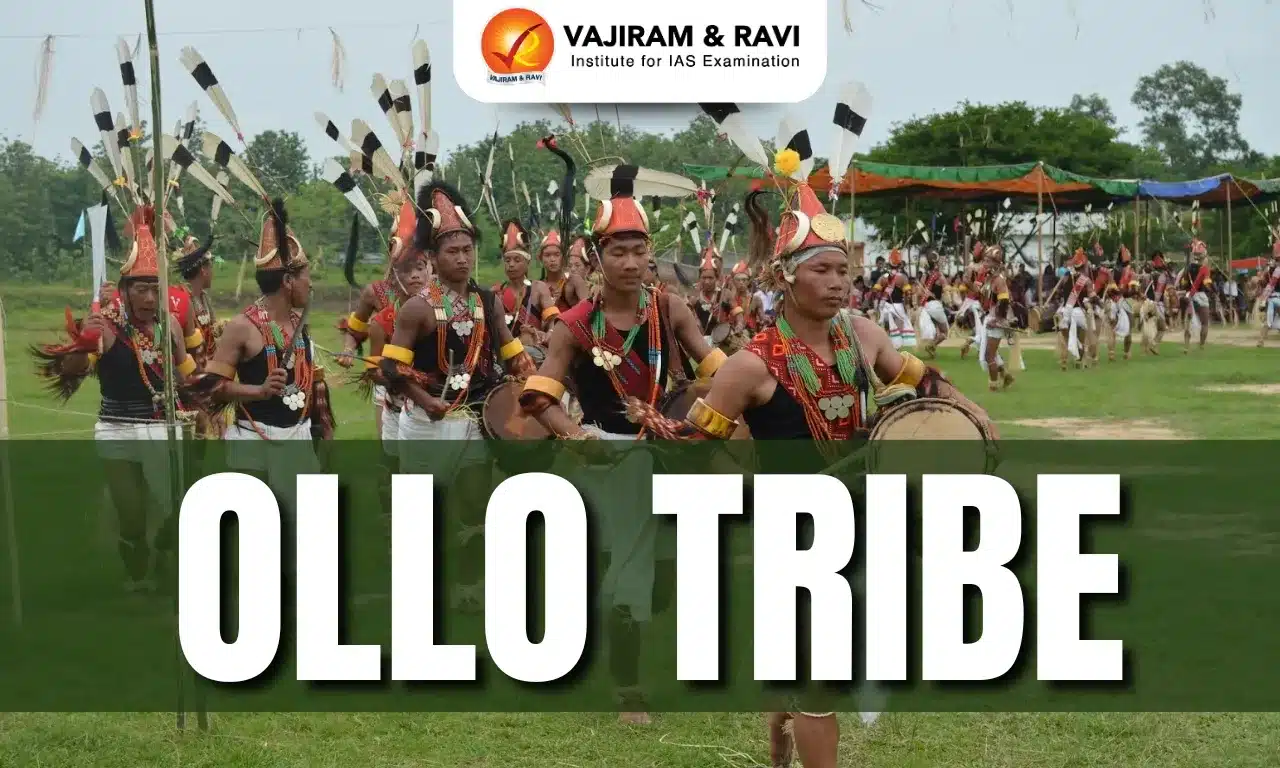
  • The preservation of constitutional morality is a shared responsibility, among citizens, lawmakers, and public institutions.

The Road Ahead: Nurturing Constitutional Morality

  • The future of India’s democracy depends on the cultivation of constitutional morality among lawmakers, judges, and citizens alike.
  • As Dr. B.R. Ambedkar wisely cautioned, constitutional morality is not a natural sentiment, it has to be cultivated.
  • When nurtured, it transforms the Constitution from a legal document into a living moral charter, one that guarantees justice, equality, and inclusion.
  • In an era of rapid change, constitutional morality provides the ethical foundation necessary to uphold human dignity and democratic stability.

Conclusion

  • The relationship between law and morality is both timeless and evolving.
  • From the ancient principle of dharma to modern constitutional jurisprudence, morality has remained the soul of justice.
  • To ensure that democracy is not a mere top dressing on Indian soil but its vital ingredient, India must continue to nurture constitutional morality.
  • It is this moral consciousness that will determine whether the Constitution remains a document of ideals or becomes a vibrant, equitable reality, the living embodiment of justice in action.

The Contours of Constitutional Morality FAQs

Q1. What central issue around the morality of the constitution?
Ans. The essay explores the complex relationship between law and morality, focusing on how they influence and shape each other in legal and constitutional contexts.

Q2. What was the main point of disagreement in the Hart–Devlin debate?
Ans. The Hart–Devlin debate centred on whether the law should enforce moral standards, with Devlin supporting moral enforcement and Hart opposing it.

Q3. How has the Supreme Court of India interpreted the idea of constitutional morality?
Ans. The Supreme Court has defined constitutional morality as adherence to liberal values, ethical governance, and respect for the rule of law and judicial authority.

Q4. What role does constitutional morality play in a democracy?
Ans. Constitutional morality ensures that power is exercised with fairness and accountability, making democracy a moral and living system rather than a mere legal structure.

Q5. What advice did Dr. B.R. Ambedkar give about constitutional morality?
Ans. Dr. B.R. Ambedkar advised that constitutional morality is not inherited but must be cultivated and practiced to sustain a just and vibrant democracy.

Source: The Hindu


Winding Up the Clock of India-Nepal Economic Ties

Context

  • On October 1, 2025, Reserve Bank of India (RBI) Governor Sanjay Malhotra announced a set of measures aimed at internationalising the Indian rupee (INR).
  • While these initiatives have broad regional implications, they hold special promise for strengthening the economic relationship between India and Nepal.
  • The new RBI policies, allowing authorised dealer (AD) banks to lend rupees to non-residents, permitting Special Rupee Vostro Accounts (SRVAs) to invest in corporate instruments, and establishing transparent reference rates for major currencies, signal a deepening of financial and trade cooperation.
  • For Nepal, these developments could mean easier access to credit, stronger trade integration, and a potential transformation in its macroeconomic resilience.

The RBI’s Measures: Pathways to Integration

  • The first measure allows AD banks in India to extend rupee-denominated loans to non-residents from Nepal, Bhutan, and Sri Lanka for cross-border trade.
  • This reform addresses a long-standing gap in institutional credit, particularly for industries engaged in India–Nepal trade.
  • The second measure expands the scope of Special Rupee Vostro Accounts to include investments in corporate bonds and commercial papers, thus enhancing cross-border capital flows.
  • The third initiative, establishing a transparent reference rate for major currencies, introduces predictability and reduces exchange rate volatility, making INR-based transactions more efficient and reliable.
  • Collectively, these steps not only promote the rupee’s international role but also facilitate smoother trade settlements and stronger financial cooperation between India and its neighbours, particularly Nepal.

Nepal’s Domestic Constraints and the Credit Challenge

  • Despite steady remittance inflows, Nepal continues to face structural weaknesses in its economy.
  • After a partial recovery from the COVID-19 pandemic, its industrial performance remained stagnant due to a lack of business confidence and restricted access to credit.
  • Nepalese banks, often controlled by large industrial houses, have been conservative in lending to small and medium enterprises (SMEs).
  • This has resulted in credit bottlenecks, weak supply chains, and limited employment opportunities, fuelling economic instability and political unrest.
  • By allowing Indian banks to lend directly in INR, the RBI’s policy provides alternative credit channels for Nepalese enterprises.
  • Access to competitively priced loans could encourage industrial expansion, improve liquidity, and boost participation in cross-border trade, thus offsetting Nepal’s domestic financial rigidity.

The Dynamics of India–Nepal Trade

  • The India–Nepal economic relationship is defined by deep interdependence. India accounts for nearly 65% of Nepal’s international trade, with exports from India exceeding $8 billion and imports from Nepal around $1 billion.
  • Indian firms remain major investors in Nepal, contributing 33% of total FDI worth approximately $670 million.
  • Despite the asymmetry, the partnership serves as a vital economic lifeline for Nepal, offering market access, investment capital, and technological linkages.
  • The exchange rate peg of 1.6 Nepalese rupees to 1 Indian rupee has provided monetary stability and shielded Nepal from sharp currency depreciations.
  • Maintaining this peg, while enabling new credit and investment avenues, reinforces macroeconomic confidence and trade-led growth.
  • Thus, the RBI’s measures can deepen financial interlinkages without disturbing the existing monetary equilibrium.

Strategic and Economic Multiplier Effects

  • Beyond trade, the RBI’s measures have strategic implications. Increasing the use of INR in Nepal’s transactions will reduce dependency on the U.S. dollar and mitigate exposure to global currency volatility.
  • This can ease pressure on foreign exchange reserves, narrow the Current Account Deficit (CAD), and enhance financial stability.
  • A robust INR–NPR financial ecosystem may also promote joint ventures, industrial clustering, and value-added processing for export-oriented growth.
  • From India’s standpoint, these steps align with its ambition to make the rupee a regional trade currency, thereby strengthening India’s financial influence and economic diplomacy amid a changing global monetary landscape.

The Way Forward: Implementation and Institutional Coordination

  • The success of these policies depends on institutional cooperation.
  • The Nepal Rastra Bank (NRB) must interpret, adapt, and implement the RBI’s framework while safeguarding Nepal’s monetary interests.
  • Developing compliance mechanisms, risk assessment protocols, and prudential norms will be essential for effective adoption.
  • Collaboration on sovereign guarantees, Letters of Credit, and country risk ratings will help institutionalise bilateral trust.
  • The RBI’s reputation for prudence, combined with the NRB’s reciprocation and adaptability, could lay the groundwork for a sustainable financial partnership that enhances regional monetary stability and trade competitiveness.

Conclusion

  • The RBI’s October 2025 announcements mark a turning point in India–Nepal economic relations.
  • By promoting the internationalisation of the rupee in a regionally inclusive manner, these reforms offer Nepal an opportunity to overcome its credit constraints and enhance its trade competitiveness.
  • At the same time, India consolidates its position as a regional financial anchor and a driver of South Asian integration.
  • The ultimate success of these initiatives will depend on regulatory synchronisation, institutional readiness, and a shared economic vision.

Winding Up the Clock of India-Nepal Economic Ties FAQs

Q1. What was the main objective of the RBI’s October 2025 announcement?
Ans. The main objective of the RBI’s October 2025 announcement was to promote the internationalisation of the Indian rupee (INR) and strengthen regional economic and trade cooperation, especially with countries like Nepal, Bhutan, and Sri Lanka.

Q2. How can Indian banks lending in INR benefit Nepalese businesses?
Ans. Indian banks lending in INR can provide easier access to institutional credit for Nepalese businesses, helping them expand operations, improve liquidity, and enhance participation in cross-border trade with India.

Q3. Why is the INR–NPR exchange rate peg important for Nepal?
Ans. The INR–NPR exchange rate peg of 1.6 Nepalese rupees to one Indian rupee is important because it maintains monetary stability and protects Nepal’s currency from sharp depreciation against major foreign currencies.

Q4. What larger impact might the RBI’s measures have on Nepal’s economy?
Ans. The RBI’s measures could reduce Nepal’s dependence on the U.S. dollar, ease foreign exchange pressures, and boost industrial growth and employment, leading to greater economic stability and resilience.

Q5. What role does the Nepal Rastra Bank (NRB) play in implementing these changes?
Ans. The Nepal Rastra Bank (NRB) must adapt and enforce the RBI’s framework, ensure compliance and financial safeguards, and coordinate policies to fully realise the benefits of India’s rupee internationalisation strategy.

Source: The Hindu

Daily Editorial Analysis 27 October 2025 FAQs

Q1: What is editorial analysis?

Ans: Editorial analysis is the critical examination and interpretation of newspaper editorials to extract key insights, arguments, and perspectives relevant to UPSC preparation.

Q2: What is an editorial analyst?

Ans: An editorial analyst is someone who studies and breaks down editorials to highlight their relevance, structure, and usefulness for competitive exams like the UPSC.

Q3: What is an editorial for UPSC?

Ans: For UPSC, an editorial refers to opinion-based articles in reputed newspapers that provide analysis on current affairs, governance, policy, and socio-economic issues.

Q4: What are the sources of UPSC Editorial Analysis?

Ans: Key sources include editorials from The Hindu and Indian Express.

Q5: Can Editorial Analysis help in Mains Answer Writing?

Ans: Yes, editorial analysis enhances content quality, analytical depth, and structure in Mains answer writing.

Critical Minerals

Critical Minerals

Critical Minerals Latest News

India’s first auction of deep-sea blocks of critical minerals, which are vital for electric vehicles, defence equipment and renewable energy, has been delayed indefinitely following a poor response from bidders.

About Critical Minerals

  • Critical minerals are those that are essential for modern technologies and national security but have supply chain risks due to their limited availability or geographical concentration.
  • Their ‘criticality’ changes over time depending on technological demand and supply dynamics.
  • Applications:
    • They are used to manufacture advanced technologies, including mobile phones, computers, fibre-optic cables, semiconductors, banknotes, and defence, aerospace, and medical applications.
    • Many are used in low-emission technologies, such as electric vehicles, wind turbines, solar panels, and rechargeable batteries.
    • Some are also crucial for common products, such as stainless steel and electronics.
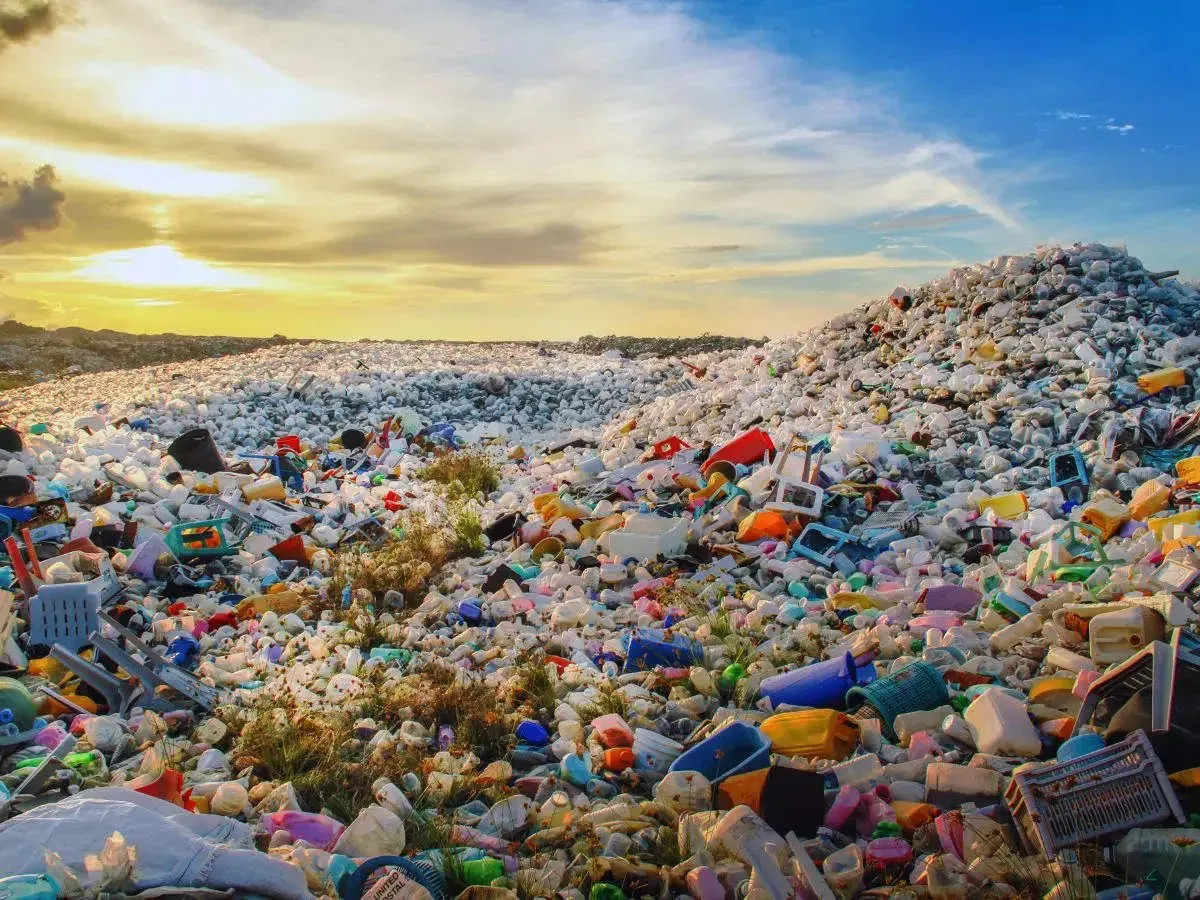
  • Top Producers: Chile, Indonesia, Congo, China, Australia, and South Africa.
  • Countries identify minerals critical for them based on their national priorities.
  • In 2023, the Ministry of Mines released a list of 30 critical minerals for India. 
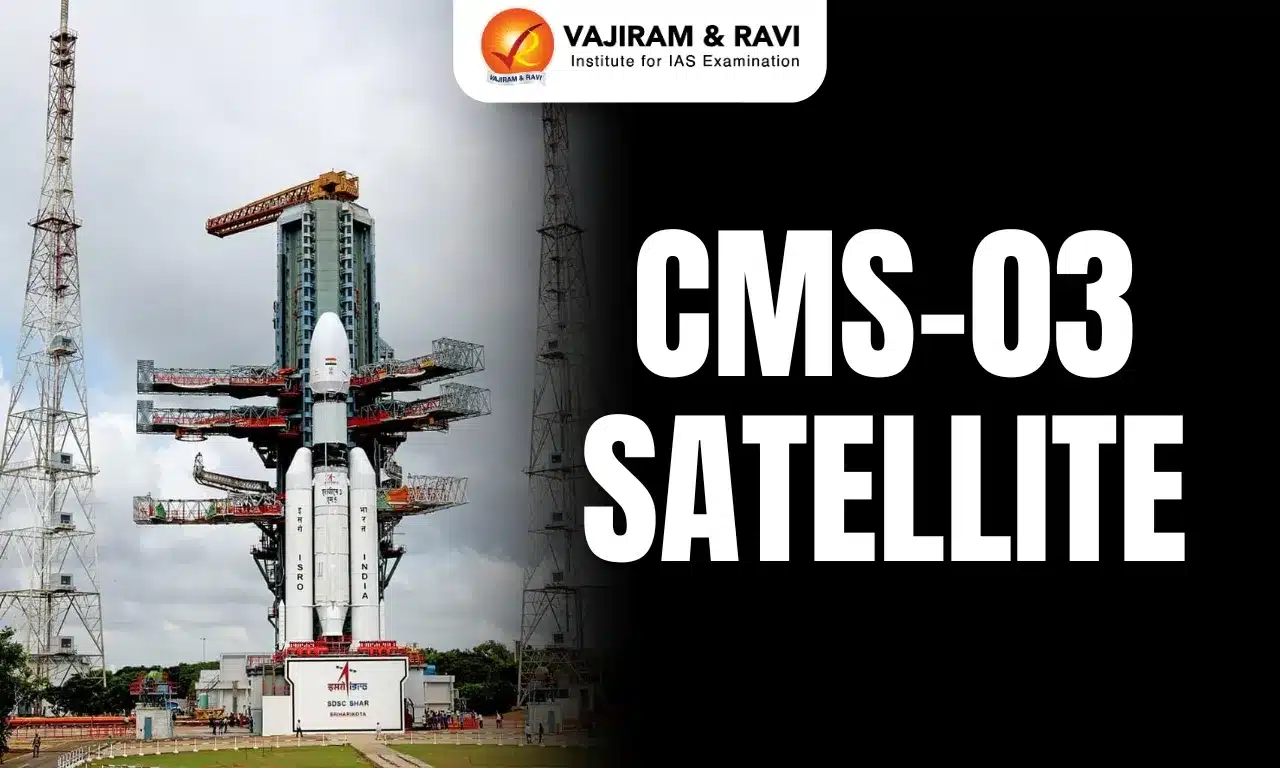
    • These minerals are Antimony, Beryllium, Bismuth, Cobalt, Copper, Gallium, Germanium, Graphite, Hafnium, Indium, Lithium, Molybdenum, Niobium, Nickel, PGE, Phosphorous, Potash, REE, Rhenium, Silicon, Strontium, Tantalum, Tellurium, Tin, Titanium, Tungsten, Vanadium, Zirconium, Selenium, and Cadmium.
    • 24 minerals added to Part D of Schedule I of the Mines and Minerals (Development and Regulation) Act, 1957 (MMDR Act), granting Central Government exclusive auctioning powers.
    • A Centre of Excellence for Critical Minerals (CECM) will regularly review the mineral list and advise policy.

National Critical Mineral Mission (NCMM)

  • The Government of India launched the NCMM in 2025 to establish a robust framework for self-reliance in the critical mineral sector. 
  • The NCMM encompasses all stages of the value chain, including mineral exploration, mining, beneficiation, processing, and recovery from end-of-life products. 
  • Exploration
    • Under this mission, the Geological Survey of India (GSI) has been tasked with conducting 1,200 exploration projects from 2024-25 to 2030-31, with an aim of ensuring domestic production of at least 15 critical minerals (such as graphite, lithium, potash, REEs).
    • The NCMM also aims for Indian companies to acquire 50 mining assets worldwide. 
    • To achieve these targets, it seeks to create a fast-track regulatory approval process for mining projects.
  • Recycling: The NCMM seeks to set up an incentive scheme for mineral recycling with a budget of INR 1500 crore (USD 170 million), with a target of recovering 400 kilotonnes (kt) of recycled material. 
  • Stockpiling: The NCMM foresees the creation of a National Critical Minerals Stockpile comprising at least 5 critical minerals to mitigate the risks from global supply chain disruptions.
  • Research: 
    • The NCMM seeks to promote research in critical mineral technologies with a target of achieving self-sufficiency in processing at least 5 critical minerals and generating 1000 patents across the critical mineral value chains by 2031. 
    • It also proposes setting up 4 regional mineral processing parks and 3 Centres of Excellence on Critical Minerals.
  • Governance: The NCMM envisages the formation of an Empowered Committee on Critical Minerals that would coordinate and implement the initiatives under the NCMM.

Source: MC

Critical Minerals FAQs

Q1: Why does the criticality of minerals change over time?

Ans: Their ‘criticality’ changes over time depending on technological demand and supply dynamics.
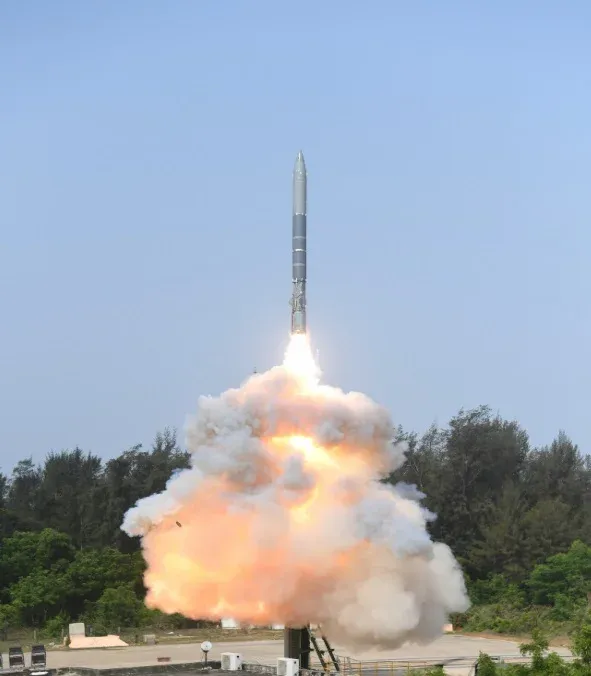
Q2: Which countries are the top global producers of critical minerals?

Ans: Chile, Indonesia, Congo, China, Australia, and South Africa.

Q3: How many critical minerals were identified by India’s Ministry of Mines in 2023?

Ans: In 2023, the Ministry of Mines released a list of 30 critical minerals for India.

Right to be Forgotten

Right to be Forgotten

What’s in today’s article?

  • Why in News?
  • What is the Right to be Forgotten?
  • How is the 'Right to be Forgotten' Interpreted in India?
  • When can the ‘Right to be Forgotten’ be Asserted?
  • Questions to be Addressed by the SC in the ‘Right to be Forgotten’ Case

Why in News?

  • The Supreme Court agreed to hear a case by online legal chronicler (Indian Kanoon), whose outcome will likely shape the contours of the “right to be forgotten”.
  • The online portal challenged a Madras HC order, which after reversing a trial court judgment convicting a person of sexual assault charges, had directed the portal to remove the conviction judgment.

What is the Right to be Forgotten?

  • It is the right to have publicly available personal information removed from the internet, search engines, databases, websites or any other public platforms.
  • One can seek this right when their personal information is no longer necessary or relevant and the presence of his/her digital footprint violates their right to privacy.
  • This right has been recognised as a statutory right in the EU (as “right to erasure”) under the General Data Protection Regulation (GDPR) and has been upheld by a number of courts in the UK and elsewhere in Europe.

How is the 'Right to be Forgotten' Interpreted in India?

  • Position in India:
    • In India, there is no statutory framework that prescribes the right to be forgotten.
    • However, the Personal Data Protection Bill 2019 and court rulings have expressly recognised this right.
  • The Personal Data Protection (PDP) Bill 2019:
    • The Bill gave an individual the right to restrict or prevent the continued disclosure of their personal data when such data -
      • Has served the purpose for which it was collected.
      • Was made with the individual's consent, which has since been withdrawn.
      • Was made contrary to the PDP Bill or any law in force.
  • The court rulings:
    • The SC in the landmark KS Puttaswamy or Right to privacy judgement (2017) recognised that the right to control his/her own life would also encompass his/her right to control their existence on the internet.
    • Since the right to privacy verdict, high courts have taken a broader view of the issue. For example,
      • In 2019, the Delhi HC said the “right to be forgotten” and “right to be left alone” are inherent aspects of the right to privacy.
      • In 2021, the Delhi HC extended the right to be forgotten to even a criminal case by ruling to take down search results relating to an American law student (acquitted in a customs case).
      • In 2020, the Orissa HC held that the right to be forgotten is a thorny issue in terms of practicality and technological nuances and needs a widespread debate.

When can the ‘Right to be Forgotten’ be Asserted?

  • The SC of India clarified in its right to privacy decision that -
    • An individual should be able to remove his/her personal data, if such data or information is no longer necessary, relevant or incorrect and serves no legitimate interest.
    • This right cannot be exercised where the information or data is
      • Necessary for exercising the right of freedom of expression,
      • In compliance with legal obligations,
      • In public interest, etc.
  • The Delhi HC also noted that the right to privacy should be balanced with the right to information of the public and maintenance of transparency in judicial records.
  • Therefore, the issue underscores the tension between the “right to be forgotten” of the acquitted person and citizens’ “right to be informed”.

Questions to be Addressed by the SC in the ‘Right to be Forgotten’ Case:

  • The top court has to decide whether the right to be forgotten is a fundamental right and, if so, how it relates to other fundamental rights guaranteed by the Constitution of India.
  • Two questions before the SC:
    • Can a person, upon reversal of his conviction in a criminal case by a higher court, demand erasure from the websites the earlier judgement that had convicted him/her?
    • Would a higher court that acquits an accused in a criminal case (by reversing the earlier judgement) be within its jurisdiction to order a web portal to expunge the earlier conviction judgement to honour the acquitted person’s right to be forgotten?

Q.1. How the Supreme Court of India significantly expanded citizens' fundamental rights?

The Supreme Court has by judicial interpretation expanded the scope of the fundamental rights, particularly in relation to Article 21, and this has included more civil and political rights which were not explicit in Part III of the Constitution.

Q.2. What is the General Data Protection Regulation (GDPR)?

GDPR is a European Union (EU) regulation on information privacy in the EU and the European Economic Area. It lists the rights of the data subject, meaning the rights of the individuals whose personal data is being processed.

Source: Can right to be forgotten beat right to info? SC to decide | IE

Overnight Index Swap

Overnight Index Swap

About Overnight Index Swap: 

  • It is a derivative instrument where returns under a fixed rate asset are swapped against a pre-determined published index of a daily overnight reference rate for an agreed period of time.
  • Purpose: The primary purpose of an OIS is to manage interest rate risk, particularly the risk associated with fluctuations in the overnight lending rate.
  • An overnight index swap rate is calculated each day.
  • This interest rate is based on the average interest rate institutions with loans based on the overnight rate have paid for that day.

How does an OIS work?

  • These are instruments that allow financial institutions to swap the interest rates they are paying without having to refinance or change the terms of their existing loan.
  • When two financial institutions create an overnight index swap, one of the institutions is swapping an overnight (floating) interest rate and the other institution is swapping a fixed short-term interest rate.
  • To get the swap rolling, both the firms would agree to continue servicing their loans, but at the end of a specified time period whoever ends up paying less interest will make up the difference to the other firm.

Q1: What are Derivatives?

Derivatives refers to a type of financial contract whose value is dependent on an underlying asset, group of assets, or benchmark. These contracts can be used to trade any number of assets and carry their own risks.

Source: Monetary policy review: FPI investment limit in OIS market under review

Missile-Assisted Torpedo Release System

Missile-Assisted Torpedo Release System

What’s in today’s article?

  • Why in News?
  • What is Supersonic Missile Assisted Torpedoes (SMART)?

Why in News?

The Defence Research and Development Organisation (DRDO) has successfully tested a long-range Supersonic Missile Assisted Torpedo (SMART). It is aimed at boosting the Navy’s anti-submarine warfare capabilities.

What is Supersonic Missile Assisted Torpedoes (SMART)?

  • Background: Torpedo
    • Torpedoes, self-propelled weapons that travel underwater to hit a target, are limited by their range. 
    • In the mid-2010s, DRDO undertook a project to build capacity to launch torpedoes assisted by missiles.
  • About SMART
    • SMART system comprises a mechanism by which the torpedo is launched from a supersonic missile system with modifications.
    • These modifications would take the torpedo to a far longer range than its own.
    • For example, a torpedo with a range of a few kilometres can be sent a distance to the tune of 1000 km by the missile system from where the torpedo is launched.
  • Institutions involved
    • A number of DRDO laboratories have developed the technologies required for SMART. These include: 
      • Defence Research and Development Laboratory (DRDL) and Research Centre Imarat (RCI), both in Hyderabad; 
      • Aerial Delivery Research and Development Establishment (ADRDE) in Agra; and 
      • Naval Science and Technology Laboratory (NSTL) Visakhapatnam.
  • Features
    • The system can be launched from both coasts and warships.
    • The canister-based missile system comprises several advanced subsystems including two-stage solid propulsion and precision inertial navigation. 
      • Canister enables smooth and safe launch of article. Also, canister serves the purpose of transportation, storage and launching of missiles. 
      • These Canisters are filled with inert gases to provide protection from outside environment during Storage and transportation.
    • It carries an advanced lightweight torpedo missile as a payload along with a parachute-based release mechanism.
  • Significance
    • This missile-based mechanism to launch lightweight torpedoes can target submarines hundreds of kilometres away — far beyond the conventional range of lightweight torpedoes. 
    • It will be particularly employed in the absence of other assets for immediate action when an enemy submarine is detected.

Q.1. What is Torpedo?

A torpedo is a self-propelled, cigar-shaped underwater missile that is launched from a submarine, surface vessel, or airplane to destroy ships by rupturing their hulls below the waterline.

Q.2. What is DRDO?

DRDO stands for Defence Research and Development Organisation, and it is India's largest research organization. It is an agency under the Ministry of Defence, and its headquarters are in New Delhi.

Government Proposal to Factor in Class 9-11 Performance in Class 12 Report Card

Government Proposal to Factor in Class 9-11 Performance in Class 12 Report Card

What’s in today’s article?

  • Why in News?
  • What is PARAKH (Performance Assessment, Review and Analysis of Knowledge for Holistic Development)?
  • Recommendations by PARAKH

Why in News?

A recent report by PARAKH, a unit established within NCERT to standardize assessments across school boards, recommends that a student’s performance in Classes 9, 10, and 11—based on exams and continuous classwork—should contribute to their final marks at the end of Class 12. 

This recommendation aligns with the National Education Policy and aims to ensure common assessment standards, develop capacity, conduct achievement surveys, and establish equivalence among different school boards.

What is PARAKH (Performance Assessment, Review and Analysis of Knowledge for Holistic Development)?

  • About
    • National Assessment Centre- PARAKH was set up in NCERT as an independent body in 2023.
    • PARAKH team will consist of leading assessment experts with a deep understanding of the education system in India and internationally. 
    • PARAKH will eventually become the national single-window source for all assessment-related information and expertise, with a mandate to assist all forms of learning assessment, both nationally and globally.
  • Objective
    • To fulfil the basic objectives of setting norms, standards, guidelines and implement activities related to student assessment along with other tasks as mandated by the National Education Policy (NEP) 2020.
  • Four major areas of focus for PARAKH
    • Capacity Development in Competency-Based Assessment:Project Vidyasagar – 
      • PARAKH is organizing workshops across India to familiarize educators with the new pedagogical and policy changes in the National Curriculum Framework 2023. 
      • The goal is to bridge gaps in implementing competency-based learning and teaching.
    • Large-Scale Achievement Survey:
      • PARAKH conducted the State Educational Achievement Survey in November 2023, assessing students in Grades 3, 6, and 9 across 30 States/UTs. 
      • The survey aims to monitor and assess educational competencies in foundational literacy, numeracy, language, and mathematics.
    • Equivalence of School Boards:
      • PARAKH is working to standardize examination reforms across all Indian school boards. 
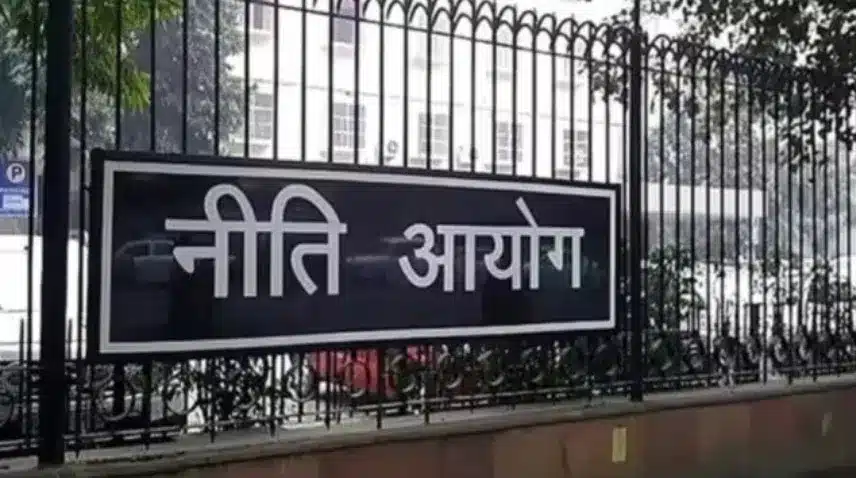
      • Regional workshops were held to collect data on administration, curriculum, assessments, and infrastructure. 
      • A report was prepared, and national workshops were conducted to discuss and draft policy recommendations for equivalence. T
      • The goal is to allocate credit points to academic, vocational, and experiential learning.
    • Holistic Progress Cards
      • The Holistic Progress Card, or HPC, will no longer depend on marks or grades to evaluate a student’s academic performance. Instead, it will rely on a 360-degree evaluation.
      • Under the HPC model, the students will be regularly assessed through class activities where they are not just passive learners but active agents. 
      • The activities will prompt students to apply diverse skills and competencies that will demonstrate whether they have been able to grasp concepts. 
  • Significance:
    • Uniformity: PARAKH would be expected to address the issue of differences in scores among students associated with different boards, who are at a disadvantage during college admissions when compared to their CBSE peers.
    • Standardisation: It will establish and implement technical standards for test design, administration, analysis and reporting at all levels of schooling.
    • Skill development: It will encourage and help school boards to shift their assessment patterns towards meeting the skill requirements of the 21st century.

Recommendations by PARAKH

  • Include performance from Classes 9, 10, and 11 in final assessment for class 12
    • Include performance from Classes 9, 10, and 11 in the final Class 12 report card, with a weight of 15% for Class 9, 20% for Class 10, 25% for Class 11, and 40% for Class 12.
  • Evaluation using combined method
    • Evaluation should be a combination of: 
      • formative assessments (continuous classroom assessments through holistic progress cards, group discussions, projects) and 
      • summative assessments (term-end examinations).
    • In Class 9, 70% of the final score be drawn from formative assessments and 30% from summative assessments. 
    • In Class 10, the final score will be based 50% on formative assessments and 50% on summative assessments. 
    • For Class 11, it will be 40% formative and 60% summative assessments. 
    • In Class 12, the weight for formative assessments will drop to 30% with 70% of the final score based on summative assessments.
  • Assessments be in terms of credits
    • PARAKH has also suggested that the assessments be in terms of credits: a student can earn 40 credits in Classes 9 and 10 each, and 44 credits in Classes 11 and 12 each. 
    • In Classes 9 and 10, 32 credits will be subject-specific (12 credits in three languages; four credits in mathematics; four for science, four for social science etc).
  • Facilitate credit transfer in line with the National Credit Framework
    • Recommendations include that boards should develop a system of credit transfer in line with the National Credit Framework.

Q.1. What is National Credit Framework?

The National Credit Framework (NCrF) is an initiative by the Indian government designed to integrate and standardize education and skill development across the country. It aims to create a unified credit-based system that recognizes academic, vocational, and experiential learning, facilitating mobility and flexibility for learners across different educational and career pathways.

Q.2. What is New Education Policy (NEP) 2020?

The New Education Policy (NEP) 2020 is a comprehensive framework introduced by the Indian government to transform the country's education system. It emphasizes holistic and multidisciplinary education, flexible curricula, skill development, and the integration of technology. The policy aims to improve access, equity, and quality in education from primary to higher levels.

Source: Factor in Class 9-11 performance for Class 12 report card: Govt proposal | Indian Express | The Hindu

Centre Reconstitutes NITI Aayog: New Structure, Key Members, and Strategic Goals

Centre Reconstitutes NITI Aayog: New Structure, Key Members, and Strategic Goals

What’s in today’s article?

  • Why in News?
  • What is National Institution for Transforming India (NITI) Aayog?
  • Performance of NITI
  • NITI Aayog: Promoting Federalism
  • Reconstitution of NITI Aayog

Why in News?

The Centre has reconstituted the NITI Aayog with 15 union ministers, including those from NDA allies and four full-time members, being a part of the government think-tank. The government reconstituted NITI Aayog after changes were made in the council of ministers.

What is National Institution for Transforming India (NITI) Aayog?

  • About:
    • NITI Aayog, was formed via a resolution of the Union Cabinet on 1 January 2015. It was constituted to replace the Planning Commission - instituted in 1950. 
    • It is the premier policy think tank of the Government of India, providing directional and policy inputs.
    • NITI Aayog acts as a platform to bring the States to act together in national interest and thereby fosters cooperative federalism.
  • Composition
    • Chairperson: The Prime Minister of India

Full time organisational framework:

  • Vice Chairperson: Appointed by the PM, s/he enjoys the rank of a Cabinet Minister.
  • Full-Time Members: Enjoys the rank of a Minister of State.
  • Part-Time Members: Maximum 2.
  • Ex-Officio Members: Maximum of 4 members of the Union Council of Minister to be nominated by the PM.
    • Chief Executive Officer (CEO): Appointed by the PM for a fixed tenure, s/he enjoys the rank of Secretary to the Government of India.
    • Special Invitees: These will be experts with relevant domain knowledge to be nominated by the PM.
  • Governing Council of NITI Aayog:
    • The council is the premier body tasked with evolving a shared vision of national priorities and strategies, with the active involvement of States.
    • It presents a platform to discuss inter-sectoral, inter-departmental and federal issues to accelerate the implementation of the national development agenda.
  • Composition of Governing Council:
    • It is chaired by the PM and comprises Chief Ministers of all the States and UTs with legislatures and Lt Governors of other Union Territories.
    • The council also comprises of Vice Chairman, NITI Aayog; Full-Time Members, NITI Aayog; and Special Invitees.

Performance of NITI:

  • As an action Tank: By collecting fresh and new ideas and sharing them with the government at the Central and State level, it ensures that there is no inactivity in any organisation or institution.
  • Improving innovation: A commendable work has been done by the Atal Innovation Mission (established under NITI Aayog), which has helped in improving the innovation ecosystem in India.
  • Bringing greater responsibility in the system: Development Monitoring and Evaluation Office (DMEO) has been established by the NITI Aayog, which collects performance data of various Ministries on a real-time basis.
    • These data are then used at the highest policy-making levels to improve performance and establish accountability.
  • Some important initiatives of NITI Aayog: Some of the initiatives like Ayushman Bharat, water conservation measures, approach towards artificial intelligence, have been conceptualised in NITI Aayog and respective Ministries are taking them forward.
    • POSHAAN ABHIYAAN by NITI Aayog is cutting across the silos within the government and helping in reducing malnourished children in India.

NITI Aayog: Promoting Federalism

  • Cooperative Federalism
    • NITI has provided a platform for direct issue-based interaction between States and Central Ministries thereby helping quick resolution of outstanding issues.
    • The NITI Forum for North East has been constituted and tangible sectoral proposals are being implemented by the States in partnership with the North East council.
    • NITI has designed some major initiatives for island development which are being implemented under the overall guidance of the Ministry of Home Affairs.
    • It is also envisaged that like the NITI Forum for the North East, other regional councils of contiguous States could be formed.
      • The first step has been taken by forming the Himalayan States Regional Council and forming a coalition of all thirteen central universities in these states.
  • Competitive Federalism
    • It promotes competitive federalism principally through pushing its sectoral indices which are put out in the public domain.
      • The indices on water, education, health, innovation, export preparedness, and Sustainable Development Goals (SDGs) have attracted significant positive attention.
    • It has also introduced a competition element in ‘Aspirational Districts Program’ by focusing on governance improvement on the ground.
      • These districts have shown significant improvement in indicators pertaining to health and nutrition, education etc.
    • Besides, several best practices in governance have emerged from these districts which are now being scaled up and replicated at the block level in some states.

Reconstitution of NITI Aayog

  • About
    • The government reconstituted the NITI Aayog, expanding the number of special invitees from five to eleven.
    • This new group of special invitees includes five ministers from the BJP's allied parties.
  • Key post holders
    • Prime Minister Narendra Modi remains the Chairperson and economist Suman K Bery will continue to be the Vice Chairperson of NITI Aayog.
    • Scientist V K Saraswat, agricultural economist Ramesh Chand, paediatrician V K Paul and macro-economist Arvind Virmani will also continue to be full-time members of the government think-tank.
    • BVR Subrahmanyam will also remain the CEO.
    • The four ex-officio members will be:
      • Union Ministers Rajnath Singh (Defence), Amit Shah (Home), Shivraj Singh Chouhan (Agriculture) and Nirmala Sitharaman (Finance).

Q.1. What are Sustainable Development Goals (SDGs)?

Sustainable Development Goals (SDGs) are a set of 17 global objectives established by the United Nations in 2015 to address pressing global challenges. They aim to achieve a better and more sustainable future by 2030, encompassing economic, social, and environmental dimensions.

Q.2. What is Cooperative Federalism?

Cooperative federalism is a governance model where national, state, and local governments collaborate to solve common problems and achieve shared goals. This approach fosters cooperation and coordination across different levels of government, enhancing policy implementation and promoting unity while respecting the autonomy of each governmental unit.

Source: Centre reconstitutes NITI Aayog, brings in allies as special invitees | PIB | The Hindu | India Today

Why India Needs a Caste Census – An In-depth Analysis

Why India Needs a Caste Census - An In-depth Analysis

What’s in today’s article?

  • Why in News?
  • Census in India
  • Need for caste Census
  • Argument against caste census
  • The case for OBC inclusion in Census
  • Attempt at caste Census failed
  • Way forward

Why in News?

Peter Drucker’s quote, “Only what gets measured gets managed,” highlights the necessity of collecting data on group identities to address discrimination effectively. This approach is essential for informed policymaking and inclusive development. 

For example, Germany’s census does not record racial data, disadvantaging Black communities. In response, Black people initiated the Afrozensus survey in 2020, revealing widespread, institutional anti-Black racism in Germany.

Census in India

  • About
    • Population Census provides basic statistics on state of human resources, demography, culture and economic structure at local, regional and national level.
    • Beginning in the year 1872, when the first census was conducted non-synchronously, the census enumeration exercise in India is carried out in every 10 years.
      • The first synchronous census was taken under British rule in 1881, by W.C. Plowden, Census Commissioner of India.
    • The responsibility of conducting the decadal census rests with the Office of the Registrar General and Census Commissioner of India, Ministry of Home Affairs.
  •  Legal/Constitutional basis of Census in India
    • Population census is listed in Union List (entry 69) of Seventh Schedule in Indian Constitution.
    • Census is conducted under the provisions of the Census Act, 1948.
  • Caste census
    • Caste was enumerated in British India Censuses (1881-1931). 
    • Post-Independence, the 1951 Census excluded caste enumeration except for SCs and STs, who continue to be counted. 
    • In 1961, the GOI recommended states conduct their own surveys for state-specific OBC lists, as there were no central reservations for OBCs at that time.
    • Though Census is a Union subject, the Collection of Statistics Act, 2008 allows States and local bodies to gather necessary data, as seen in Karnataka (2015) and Bihar (2023).

Need for caste Census

  • Social Imperative
    • Caste remains a key social structure in India, evidenced by low inter-caste marriages, prevalent caste surnames and marks, residential segregation, etc.
      • Only about 5% of Indian marriages were inter-caste as of 2011-12.
    • Choices of candidates for elections and ministers for Cabinets continue to be dictated by caste considerations.
  • Legal Imperative
    • Constitutionally-mandated social justice policies, including reservations in various sectors, require detailed caste data. 
    • Although the Constitution mentions class instead of caste, the Supreme Court has ruled caste as a significant criterion for defining backward classes and supporting reservation policies.
  • Administrative Imperative
    • Detailed caste data:
      • helps correct wrongful caste inclusions/exclusions, 
      • prevents dominant castes within reserved categories from monopolizing benefits, 
      • aids in sub-categorizing castes, and 
      • determines the creamy layer income/wealth criterion.
  • Moral Imperative
    • Lack of caste data has allowed elites among upper castes and dominant OBCs to disproportionately control national assets, income, and power.

Argument against caste census

  • Socially Divisive
    • Critics say it could deepen social divisions.
      • However, it should be noted that India has had deep social divides for nearly 3,000 years. 
      • Census counts of SCs and STs since 1951 haven't led to conflicts among these groups. 
      • Additionally, the Census already includes potentially divisive categories like religion, language, and region. 
      • Casteism will not wither away by not counting caste in the Census, any more than communalism, and regionalism will disappear by not enumerating religion, language and region.
  • Administrative Nightmare
    • Many opponents claim that that it is an administrative nightmare. 
      • Despite concerns, caste enumeration is feasible. 
      • Unlike the fuzzy concept of race, caste identity is clear. 
      • The GOI has successfully enumerated 1,234 SC castes and 698 ST tribes. 
      • Counting the 4,000-odd other castes, mostly state-specific, should not be overly problematic.
    • Fueling Demands for Increased Reservations
      • Opponents say that it would fuel demands for increased reservations.
      • Rather than fueling demands, detailed caste data could help curb arbitrary reservation demands. 
      • It would allow for objective policymaking and informed debates on reservation claims from groups like Marathas, Patidars, and Jats. 
      • Governments often prefer vague data, allowing them to implement reservations arbitrarily for electoral gains.

The case for OBC inclusion in Census

  • Reservations for OBCs in education and public employment
    • The Constitution permits reservations for OBCs in education and public employment (Articles 15(4) and 16(4)), similar to SCs and STs. 
    • Following the Mandal Commission, OBCs also have reservations in the Central government. 
    • The Supreme Court's Indra Sawhney case (1992) ruling requires periodic revision of the OBC list, which is based on the 1931 Census.
  • No reservation in electoral constituencies for MPs and MLAs
    • While OBCs lack reservations in MP and MLA constituencies, the 73rd and 74th amendments (1993) mandate reservations in panchayats and municipalities for SCs, STs, and OBCs (Articles 243D(6) and 243T(6)).
    • Accurate caste-wise data of OBCs is needed for this, which the GOI should have collected in the 2001 Census but did not.
  • Judiciary demands caste-wise data to uphold reservations
    • States like Uttar Pradesh, Madhya Pradesh, Gujarat, Maharashtra, Karnataka, Odisha, and Jharkhand have faced judicial stays on OBC reservations in local elections due to the absence of caste-wise data. 
    • While the judiciary demands this data, the executive has avoided collecting it.

Attempt at caste Census failed

  • In 2010, after significant lobbying, the Parliament unanimously resolved to include caste enumeration in the 2011 Census. 
    • The last caste enumeration in the 1931 Census identified 4,147 castes. 
  • However, the Socio Economic and Caste Census (SECC)-2011, which was not conducted under the Census Act, 1948, failed due to poor design and execution, resulting in an implausible figure of 46 lakh castes. 
  • The SECC-2011’s failure was because of the fact that it was not conducted under the Census Act, 1948 as the Act was not amended to include caste as a parameter. 
  • It was conducted through the Union Ministries of Rural Development and Urban Development which did not have prior experience of conducting sociological/anthropological surveys. 
  • Additionally, the questionnaire was poorly designed and asked open-ended questions about caste. 
    • The enumerators couldn’t distinguish between genuine castes, alternative caste names, larger caste groups, sub-castes, surnames, clan names, gotras, etc.

Way forward

  • To address the failures of SECC-2011, the Census Act, 1948, should be amended to mandate caste enumeration, removing the discretion of the Union executive. 
  • Caste data should be collected during the regular Census by the Census Commissioner, with relevant questions added to the questionnaire. 
  • Sociological and anthropological experts should draft state-specific caste lists, publish them online for public input, and finalize them before providing them to enumerators. 
  • The questionnaire should include questions about sub-caste, caste, larger caste group, and caste surname. 
  • Using internet-enabled devices with preloaded details would simplify and ensure accurate data collection.

Q.1. What is the purpose of the socio economic and caste census in 2011?

The main objectives behind conducting SECC 2011 have been outlined as: (a) To enable ranking of households based on their socio economic status. (b) To make available authentic information on caste wise population enumeration. of various castes and sections of population.

Q.2. What is Population Census?

Population Census is a periodic national survey conducted in India to gather demographic, social, and economic data of all residents. It provides crucial information for policy-making, resource allocation, and planning across various sectors of the economy and society.

Source: The case for a caste Census | Census Division | Office of Registrar General and census Commissioner

National Crisis Management Committee

National Crisis Management Committee 

National Crises Management Committee Latest News

Recently, the Cabinet Secretary chaired a meeting of the National Crises Management Committee (NCMC) to review preparedness for the impending cyclone in Bay of Bengal.

About National Crises Management Committee

  • It is established under the Disaster Management Act, 2005 by the central government.
  • The committee shall be the apex body for dealing with the situation arising out of a major disaster.
  • Composition of National Crises Management Committee
    • Chairperson: It is headed by the cabinet secretary.
    • Members: Members will constitute the Union home secretary, defence secretary, secretary (co-ordination), cabinet secretariat and member and head of department, the National Disaster Management Authority.
    • The chairperson of the NCMC can co-opt experts or officers from central/state governments or any organisation, based on the nature of the crisis. 

Role of National Crisis Management Committee

  • It shall evaluate preparedness to respond to any threatening disaster situation, emerging disaster situation or disaster and give directions, where necessary, for enhancing such preparedness.
  • It shall coordinate and monitor actions of the concerned ministries or departments of the government of India, state governments, national authority, state authorities, governmental and non-governmental organisations in relation to disaster response.
  • It shall give directions as may be necessary for the proper coordination and monitoring of disaster response in the country.

Source: PIB

National Crises Management Committee FAQs

Q1: Who chairs the National Crisis Management Committee (NCMC)?

Ans: Cabinet Secretary

Q2: What is the primary objective of the NCMC?

Ans: To coordinate disaster response and relief efforts

Enquire Now