Liberalism in India, Meaning, Types, Criticism, Impact, Key Details

Liberalism

Liberalism is a philosophy that emphasizes freedom, equality, and individual rights. In India, it has influenced politics, economy, and social reforms, shaping modern governance and society. There are different types of liberalism, such as classical, social, economic, and political, each focusing on freedom in different ways. While liberalism has brought progress and democracy, it also faces criticisms like inequality and cultural conflicts, affecting its implementation.

What is Liberalism?

Liberalism is a political and social philosophy that emphasizes freedom, equality, and individual rights. It is based on the idea that every person should have the ability to make choices about their life without unnecessary restrictions from the state or society. 

Liberalism also advocates for rule of law, democracy, and protection of human rights, ensuring that individuals can live with dignity and fairness. It seeks a balance between personal freedom and social responsibility, promoting both individual growth and collective progress.

Types of Liberalism

Liberalism is not uniform; it has several branches that interpret freedom and equality differently. Each type focuses on certain aspects of social, political, or economic life, providing a framework for how governments and societies should operate.

Main Types of Liberalism:

  1. Classical Liberalism
    • Advocates for minimal government interference.
    • Supports free markets and private property.
    • Focuses on individual freedom over social equality.
  1. Social Liberalism
    • Balances freedom with social justice.
    • Supports welfare policies, education, and healthcare to reduce inequality.
    • Believes that the state should help people achieve equal opportunities.
  1. Economic Liberalism
    • Promotes capitalism, free trade, and entrepreneurship.
    • Encourages private ownership and competition.
    • Government’s role is limited to ensuring economic stability.
  1. Political Liberalism
    • Focuses on democratic governance and rule of law.
    • Ensures civil liberties, freedom of speech, and political rights.
    • Advocates for transparent and accountable governance.

Liberalism in India

Liberalism in India emphasizes individual freedom, democracy, and equality, as reflected in the Constitution. It has influenced political rights, social reforms, and economic policies, shaping modern India’s development.

  • Economic Liberalization: Policies since 1991 promoting privatization, foreign investment, and free markets.
  • Democratic Governance: Free elections, rule of law, and protection of civil liberties.
  • Social Reforms: Empowerment of women, education initiatives, and social justice programs.
  • Legal Framework: Fundamental rights guarantee equality, freedom of speech, and religious freedom.

Impact of Liberalism on Society and Politics

  1. Liberalism has strengthened democracy by promoting free and fair elections, citizen participation, and transparent governance.
  2. It ensures protection of rule of law, equality before law, and civil liberties like freedom of speech, press, and religion.
  3. Liberal economic policies encourage free markets, entrepreneurship, competition, and foreign investment, leading to overall growth.
  4. It advances social development through education, skill-building, gender equality, and empowerment of marginalized communities.
  5. Liberalism fosters cultural tolerance, secularism, and respect for diverse religions and opinions, promoting social harmony.
  6. Globally, liberal values influence human rights, international treaties, and cooperative governance, contributing to peace and global development.

Criticisms of Liberalism

  • Excessive Individualism: Focuses on personal freedom over community welfare.
  • Economic Inequality: Free-market policies may benefit the rich more than the poor.
  • Cultural Conflicts: Emphasis on freedom can clash with traditional or local values.
  • Over-reliance on Government: Social liberalism may lead to dependency on state welfare.
  • Fragmented Society: Prioritizing individual rights may weaken social cohesion.
  • Implementation Challenges: Liberal policies may not always reach marginalized groups effectively.

Conclusion

Liberalism is a philosophy that emphasizes freedom, equality, and social progress, shaping modern societies and governance. It has strengthened democracy, human rights, and economic growth while promoting education, equality, and cultural tolerance. Despite some criticisms, liberalism remains a key force for building inclusive and progressive communities.

Liberalism FAQs

Q1: What is the main aim of liberalism?

Ans: To promote individual freedom, equality, democracy, and protection of human rights.

Q2: Who are the major thinkers of liberalism?

Ans: John Locke, Adam Smith, John Stuart Mill, and T.H. Green are key contributors.

Q3: How does liberalism affect the economy?

Ans: Encourages free markets, private enterprise, entrepreneurship, and competition, Social liberalism supports government welfare programs to ensure equality of opportunity.

Q4: Is liberalism the same in all countries?

Ans: No, it adapts to cultural, political, and economic conditions of each country.

Q5: Can liberalism coexist with traditional values?

Ans: Yes, but it requires balancing personal freedom with respect for cultural norms and social cohesion.

Difference between Ethics and Morality, Meaning, Origin, Role

Difference between Ethics and Morality

The Difference between Ethics and Morality is embedded in origin, authority, scope, and application, even being closely related concepts that guide human behaviour. Ethics generally refers to systematic principles developed by institutions, professions, and philosophical traditions, while morality arises from personal beliefs, cultural traditions, religion, and social norms. 

Ethics is a formal branch of philosophy that evaluates right and wrong conduct using reason, whereas Morality reflects lived values shaped by society and upbringing. Understanding this distinction is essential in governance, law, public administration, medicine, and justice systems.

Difference between Ethics and Morality

Ethics and morality differ in source, authority, flexibility, universality, enforcement, and role in professional and public decision-making. The key Difference between Ethics and Morality has been tabulated below:

Difference between Ethics and Morality
Aspect Ethics Morality

Meaning

Ethics is a system of rational principles that define right and wrong conduct in specific contexts, especially professions and institutions.

Morality refers to personal or societal beliefs about right and wrong shaped by culture, religion, tradition, and family values.

Origin

Originates from philosophy, law, professional bodies, and formal reasoning traditions such as Aristotle’s Nicomachean Ethics and Kant’s Groundwork of the Metaphysics of Morals.

Emerges from social customs, religious teachings, community practices, and historical traditions passed across generations.

Authority

Authority comes from institutions, codes, constitutions, courts, and professional councils like medical or civil service bodies.

Authority lies in individual conscience, social approval, religious faith, and collective cultural acceptance.

Nature

Ethics is systematic, codified, written, and reason-based, designed to be applied consistently across cases.

Morality is informal, unwritten, intuitive, and emotionally driven, varying between individuals and societies.

Universality

Ethical principles aim for universality and consistency, such as human rights ethics under the Universal Declaration of Human Rights (1948).

Moral values differ across cultures, religions, regions, and time periods, making them relative rather than universal.

Flexibility

Ethics evolves through debate, judicial interpretation, scientific progress, and institutional reforms.

Morality changes slowly, often resisting reform due to deep emotional and cultural attachment.

Enforcement Mechanism

Enforced through formal mechanisms such as laws, disciplinary action, professional sanctions, and judicial penalties.

Enforced through social approval, guilt, praise, shame, or ostracism rather than legal punishment.

Application Area

Applied in governance, administration, medicine, business, research, law enforcement, and public policy decision-making.

Applied mainly in personal life, family relations, community behaviour, and religious observance.

Objective vs Subjective

Ethics strives for objectivity using logic, evidence, and shared standards to reduce bias.

Morality is subjective, shaped by individual experiences, upbringing, emotions, and faith.

Also Check Related Articles
Difference between NITI Aayog and Inter-State Council Difference Between Economic Survey and Union Budget
Difference Between Tropical Evergreen and Tropical Deciduous Forests Difference Between Ordinary Bill and Money Bill
Difference Between Legislative and Executive Difference between Himalayan and Peninsular Plateau
Difference Between Vedas and Upanishads Difference Between Scheduled and Non-Scheduled Banks
Difference Between Written and Unwritten Constitution Difference between NITI Aayog and Planning Commission
Difference between Colonialism and Imperialism Difference between Fundamental Rights and Directive Principles of State Policy
Difference between Procedure Established by Law and Due Process of Law Difference Between Democracy and Republic
Difference between Creamy Layer and Non-Creamy Layer of OBC Difference between Rajya Sabha and Vidhan Sabha
Difference Between Western Ghats and Eastern Ghats

Difference between Ethics and Morality FAQs

Q1: What is the basic difference between ethics and morality?

Ans: Ethics are institutional and rule-based principles, while morality is personal and culturally shaped beliefs about right and wrong.

Q2: Are Ethics and Morality the same across Societies?

Ans: Ethics aims for universal application, but morality varies widely across cultures, religions, and social traditions.

Q3: Who enforces Ethics and Morality?

Ans: Ethics is enforced by institutions, laws, and professional bodies, whereas morality is enforced by conscience and social norms.

Q4: Can Ethics override personal morality?

Ans: Yes, in public and professional roles, ethical codes can override personal moral beliefs to ensure fairness and accountability.

Q5: Why is Ethics important in governance and administration?

Ans: Ethics ensures consistency, transparency, and accountability in decision-making, which personal morality alone cannot guarantee.

Difference between Magistrate and Judge, Meaning, Role, Salary

Difference between Magistrate and Judge

The Difference between Magistrate and Judge lies in their level of authority, jurisdiction, appointment, and nature of cases handled within India’s judicial system. Magistrates primarily deal with minor criminal cases at the subordinate level, while Judges preside over higher courts and handle both civil and serious criminal matters. Their powers are defined by constitutional provisions and procedural laws such as the Bharatiya Nagarik Suraksha Sanhita (BNSS), and constitutional articles governing the judiciary. Understanding this distinction is essential for clarity on India’s criminal justice hierarchy.

Difference between Magistrate and Judge

Magistrates and Judges perform judicial functions but differ significantly in appointment method, powers, jurisdiction, court hierarchy, and types of cases handled.

Difference between Magistrate and Judge Comparison
Aspect Magistrate Judge

Meaning

A Magistrate is a judicial officer who handles minor criminal cases and oversees arrests, investigations, and preliminary trials.

A Judge is a senior judicial authority who decides serious civil, criminal, and constitutional cases in higher courts.

Legal Basis

Appointed under statutory law; functions governed mainly by BNSS (earlier CrPC)

Appointed under Articles 124, 125. 217, 233 and 244 of the Constitution of India

Level in Judiciary

Part of the subordinate judiciary

Belong to District Judiciary, High Courts, or Supreme Court

Appointment

Appointed by State Government in consultation with High Court

District Judges by Governor in consultation with High Court; HC and SC Judges by President of India

Types

Judicial Magistrate First Class (JMFC) & Second Class, Chief Judicial Magistrate (CJM), Metropolitan Magistrate, Special/ Sub-divisional Magistrate

Civil Judge (Junior/ Senior), District Judge, High Court Judge, Supreme Court Judge

Nature of Cases

Deals mainly with minor criminal cases like theft, assault, public order offences

Handles civil, criminal, constitutional, and appellate matters

Trial Powers

Conducts summary trials and warrant cases under BNSS

Conducts sessions trials, civil suits, writs, and constitutional cases

Punishment Powers

CJM can award imprisonment up to 7 years and fine (BNSS)

Supreme Court Judges can award life imprisonment or Capital Punishment

Court of First Instance

Often the first court where criminal cases are registered and heard

District Judges may act as trial and appellate courts

Jurisdiction

District Courts (for minor criminal offences), Metropolitan courts, and Specialized Lower Courts (family, labour, etc.)

District Courts, High Courts and Supreme Court

Independence Level

Judicially independent but administratively under High Court control through district judiciary

High constitutional independence with security of tenure

Appeals From Their Orders

Appeals lie before District Court or High Court

Appeals from District Judge go to High Court, from HC to Supreme Court

Qualification Requirement

Law degree (not always mandatory) with judicial service examination conducted by states

Minimum 3 years of judicial or legal practice for entry level, and 7-10 depending on further levels

Role in Criminal Procedure

Authorises arrest warrants, remand, search warrants, cognizance of offences

Conducts full-fledged trials, hears appeals, and interprets law

Salary

For JMFC: ₹77840 - ₹1,36,520 as per 2nd National Judicial Pay Commission

For Junior Civil Judge: ₹77840 - ₹1,36,520 as per 2nd National Judicial Pay Commission

Difference between Magistrate and Judge FAQs

Q1: What is the main Difference between Magistrate and Judge?

Ans: A Magistrate handles minor criminal cases, while a Judge deals with serious criminal, civil, and constitutional matters.

Q2: Who appoints a Magistrate and a Judge?

Ans: A Magistrate is appointed by the State Government, while Judges are appointed by the President or Governor.

Q3: Can a Magistrate hear civil cases?

Ans: No, a Magistrate deals only with criminal matters, whereas a Judge can hear both civil and criminal cases.

Q4: Who has higher punishment powers, Magistrate or Judge?

Ans: A Judge has higher powers, including life imprisonment or death penalty, unlike a Magistrate.

Q5: In which courts do Magistrates and Judges work?

Ans: Magistrates work in subordinate criminal courts, while Judges serve in District Courts, High Courts, and the Supreme Court.

Soil Conservation, Meaning, Methods, Government Initiatives

Default Image

Soil is a finite natural resource that forms the foundation of food security, ecosystems, and climate resilience. In India, nearly 37% of land faces varying degrees of soil erosion, directly threatening agricultural productivity and livelihoods. Every year, about 5.3 billion tonnes of soil are lost due to water and wind erosion, reducing fertility, crop yields, and water-holding capacity. Soil degradation also increases vulnerability to floods, droughts, and climate change impacts, making soil conservation a national environmental and economic priority.

Soil Conservation

Soil conservation refers to the systematic management of soil to prevent erosion, nutrient depletion, salinisation and structural degradation while maintaining long term productivity. It includes physical, biological, agronomic and technological practices that protect topsoil and enhance soil health. In India, soil organic carbon has declined from 1% to 0.3% over 70 years which highlights urgent conservation needs. Effective soil conservation improves water retention, nutrient cycling, biodiversity, and climate resilience, directly supporting sustainable agriculture and environmental stability.

Soil Conservation Methods

Soil conservation methods integrate traditional knowledge, scientific practices, and modern technology to reduce erosion, improve fertility, and restore degraded lands. The key methods of Soil Conservation are listed below:

Terracing

Terracing converts steep slopes into step-like fields, reducing runoff velocity, preventing soil erosion, increasing water retention, and enabling cultivation in hilly regions such as the Himalayas and Western Ghats.

Contour Ploughing

Ploughing along contour lines reduces surface runoff, enhances infiltration, and lowers soil erosion by 10-50%, especially effective in gently sloping rainfed agricultural landscapes.

Strip Cropping

Alternating strips of erosion-prone crops with soil-binding crops breaks wind and water flow, reduces erosion, improves soil structure, and stabilises yields in semi-arid and sloping areas.

Gully Plugging

Small check structures like brushwood dams and loose boulder barriers stabilise gullies, slow water flow, trap sediments, and prevent further land degradation during intense rainfall events.

Afforestation

Planting trees increases root binding, improves soil organic matter, reduces surface runoff, enhances infiltration, and significantly lowers erosion rates in degraded catchments and upland watersheds.

Windbreaks and Shelterbelts

Rows of trees and shrubs reduce wind speed, protect topsoil from erosion, improve microclimate, and are highly effective in arid and semi-arid regions like Rajasthan.

Cover Cropping

Growing legumes or grasses between main crops keeps soil covered, prevents erosion, enhances nitrogen fixation, improves microbial activity, and increases soil organic carbon content naturally.

Crop Rotation

Systematic rotation of crops prevents nutrient depletion, breaks pest cycles, enhances soil structure, and improves fertility by alternating deep-rooted and shallow-rooted crops.

Agroforestry

Integrating trees with crops and livestock improves soil stability, increases organic matter, enhances biodiversity, and provides long-term economic and ecological benefits to farming systems.

Biochar Application

Biochar enhances soil carbon storage, improves nutrient retention, increases water-holding capacity, and supports microbial activity, making soils more resilient to drought and nutrient loss.

Biofertilisers

Use of microbial inoculants like Rhizobium and Azotobacter enhances nutrient availability, reduces chemical fertiliser dependency, and improves soil biological health without structural degradation.

No-Till Farming

Minimal soil disturbance preserves soil structure, reduces erosion, improves moisture retention, increases organic matter accumulation, and lowers fuel and labour costs in agriculture.

Keyline Design

Landscape-level contour planning redistributes water evenly across fields, reduces runoff concentration, enhances soil moisture storage, and improves productivity in rainfed farming systems.

Salinity Management

Application of gypsum, organic matter, and improved drainage reclaims salt-affected soils, restoring productivity across nearly 8 million hectares of degraded agricultural land.

Organic Amendments

Addition of compost, farmyard manure, and green manure improves soil aggregation, enhances nutrient cycling, increases water retention, and restores long-term soil fertility.

Soil pH Correction

Liming acidic soils or applying sulphur in alkaline soils optimises nutrient availability, enhances root growth, and improves microbial activity essential for healthy soil functioning.

Precision Agriculture

Use of GPS, sensors, and drones enables site-specific nutrient and water application, reducing wastage, preventing soil degradation, and improving overall soil use efficiency.

Regenerative Agriculture

Practices like multi-species cover crops, reduced tillage, and livestock integration rebuild soil carbon, improve resilience, and restore degraded agricultural ecosystems sustainably.

Flood Control Measures

Check dams, embankments, and retention ponds reduce sediment loss, regulate water flow, prevent erosion during floods, and protect fertile topsoil in river basins.

Ravine Reclamation

Engineering structures combined with vegetation stabilise ravines like Chambal, preventing further erosion and converting degraded lands into productive agroforestry systems.

Other Measures

Other significant and widely used methods for the conservation of soil are:

  • Mulching to reduce evaporation and surface erosion
  • Integrated Nutrient Management for balanced soil fertility
  • Check dams for sediment control
  • Conservation agriculture practices
  • Watershed-based land use planning
  • Remote sensing for soil degradation monitoring
  • Addition of minerals and soil organisms
  • Reduced use of pesticides

Soil Conservation Government Initiatives

The government has launched integrated schemes to address soil erosion, fertility loss, and sustainable land use nationwide.

  • Soil Health Card Scheme (2015): This scheme provides farmers with soil test-based recommendations on nutrients and fertiliser use, improving soil fertility, reducing input costs, and preventing nutrient imbalance.
  • National Mission for Sustainable Agriculture (NMSA): NMSA promotes climate-resilient agricultural practices such as integrated nutrient management, soil moisture conservation, and agroforestry to enhance long-term soil productivity.
  • Paramparagat Krishi Vikas Yojana (PKVY): PKVY encourages organic farming through cluster-based approaches, increasing soil organic carbon, microbial activity, and reducing chemical degradation of soils.
  • Neem-Coated Urea (2015): Neem coating slows nitrogen release, improves nitrogen-use efficiency, reduces soil pollution, and prevents excessive fertiliser application, supporting sustainable soil management.
  • Nutrient Based Subsidy Scheme (NBS): NBS promotes balanced fertiliser use by subsidising nutrients rather than products, helping correct soil nutrient deficiencies and prevent overuse of nitrogenous fertilisers.
  • NABARD RIDF Scheme: The Rural Infrastructure Development Fund finances watershed projects, irrigation structures, and land development works that support soil erosion control and moisture retention.
  • Rashtriya Krishi Vikas Yojana (RKVY): RKVY supports state-level soil conservation projects, including land reclamation, soil testing labs, and adoption of improved soil management technologies.
  • National Policy for Management of Crop Residues (NPMCR): This policy promotes in-situ crop residue management to improve soil organic matter, reduce stubble burning, and enhance soil structure and nutrient cycling.
  • Integrated Watershed Management Programme (IWMP): IWMP adopts a ridge-to-valley approach for soil and water conservation through contour bunding, check dams, afforestation, and sustainable land-use planning.
  • National Soil Policy (Draft): The draft policy aims to address soil degradation, desertification, and loss of fertility by promoting sustainable soil use, monitoring, and conservation frameworks.
  • Mahatma Gandhi National Rural Employment Guarantee Act (MGNREGA): It supports soil conservation through afforestation and water conservation measures.
  • Role of Panchayati Raj Institutions (PRIs): PRIs play a key role in planning, implementing, and monitoring local soil conservation activities, ensuring community participation and sustainable land management.

Soil Conservation Challenges

Soil conservation faces structural, economic, and governance challenges requiring coordinated solutions.

  • High Soil Erosion Rates: In India, 3% land faces catastrophic erosion exceeding 100 tonnes per hectare annually and nearly 37% of land is degraded at minor level.
  • Low Organic Carbon: Decline to 0.3% reduces fertility and water retention capacity.
  • Water Mismanagement: Around 70% irrigation water wasted, causing salinity and waterlogging.
  • Fragmented Landholdings: Average size of 1-1.21 hectare limits adoption of conservation technologies.
  • Chemical Overuse: Excess fertilisers degrade soil biology and structure over time.
  • Unsustainable Farming Practices: Excessive tillage, monocropping, and chemical fertilisers degrade soil structure, lower organic carbon levels, and reduce long-term soil resilience.
  • Climate Change Impacts: Increased frequency of floods, droughts, and extreme rainfall accelerates soil erosion, nutrient loss, and desertification, especially in rainfed and coastal regions.
  • Weak Implementation and Awareness: Limited farmer awareness, fragmented landholdings, and poor implementation of conservation schemes reduce adoption of scientific soil management practices.
  • Urbanisation and Infrastructure Pressure: Rapid urban expansion, mining, roads, and industrial projects lead to irreversible topsoil loss and disrupt natural drainage and soil ecosystems.

Way Forward:

  1. Promotion of Sustainable Agriculture: Encouraging crop rotation, cover cropping, agroforestry, and conservation tillage improves soil structure, organic carbon, and long-term productivity.
  2. Integrated Watershed Management: Catchment-based planning with check dams, contour bunding, and afforestation reduces runoff, enhances groundwater recharge, and controls erosion.
  3. Climate-Resilient Soil Practices: Adoption of drought-tolerant crops, mulching, biochar, and precision irrigation minimises climate risks and protects soil moisture and nutrients.
  4. Policy Support and Incentives: Linking soil conservation with MSP, carbon credits, and financial incentives motivates farmers to adopt eco-friendly soil management practices.
  5. Awareness, Research, and Technology: Expanding soil health card coverage, digital soil mapping, and farmer training ensures data-driven decisions and widespread adoption of conservation measures.

Soil Conservation FAQs

Q1: What is Soil Conservation?

Ans: Soil conservation refers to methods used to prevent soil erosion, maintain fertility, and ensure sustainable agricultural productivity.

Q2: Why is Soil Conservation important for India?

Ans: India loses about 5.3 billion tonnes of soil annually due to erosion, directly affecting food security and agricultural sustainability.

Q3: What are the major causes of Soil Degradation?

Ans: Over-irrigation, deforestation, excessive fertiliser use, improper land use, and climate-induced extreme rainfall are major causes.

Q4: What are the major Government Schemes for the Conservation of Soil in India?

Ans: Soil Health Card Scheme and Integrated Watershed Management Programme are key initiatives promoting soil conservation in India.

Q5: How does Soil Conservation support sustainable development?

Ans: It improves crop yields, conserves water, enhances carbon storage, and helps achieve long-term environmental and economic sustainability, aligning with SDG 15.

Lok Adalats, Meaning, Types, Framework, Organizations, Powers

Lok Adalats

Lok Adalats represent one of India’s most people-centric justice delivery mechanisms as Alternative Dispute Redressal (ADR), designed to resolve disputes through mutual agreement rather than prolonged litigation. It is rooted in the constitutional mandate of access to justice under Article 39A. Lok Adalats aim to reduce judicial backlog while offering fast, affordable, and amicable dispute resolution. It operates across national, state, district, and taluk levels. They resolved over 10.5 crore cases in 2025 alone and 23.58 crore cases between 2022-25, according to the Ministry of Law and Justice.

Lok Adalats

Lok Adalats means “People’s Courts,” are informal forums where disputes are resolved through conciliation and consensus instead of adversarial proceedings. It is recognised statutorily under the Legal Services Authorities Act 1987. It ensures that settlements carry the legal status of a civil court decree. They function without rigid procedural laws, charge no court fees, and emphasise cooperative dialogue. Their expanding reach through National Lok Adalats, Permanent Lok Adalats, Mobile Lok Adalats, and E-Lok Adalats has significantly improved justice accessibility across India.

Also Read: Lok Sabha

Lok Adalats Framework

Lok Adalats operate under a clear statutory framework that ensures legality, uniformity, and enforceability of settlements nationwide. The major legal aspects governing the Lok Adalats have been listed below:

  1. Statutory Basis: Established under Legal Services Authorities Act 1987 for institutional dispute resolution.
  2. Constitutional Link: Strengthens Article 39A guaranteeing equal access to justice and free legal aid.
  3. Legal Status: Lok Adalat awards are deemed equivalent to civil court decree.
  4. Appeal Bar: No appeal allowed, ensuring finality and speedy closure.
  5. Court Fee: No court fee charged; paid fees refunded after settlement.

Lok Adalats Organizations

Multiple legal service institutions coordinate Lok Adalats to ensure nationwide reach and effective implementation. The major organizations regulating the Lok Adalats are:

  1. National Legal Services Authority (NALSA): Frames policy, issues calendars, monitors National Lok Adalats.
  2. State Legal Services Authorities: Organise state-level Lok Adalats headed by member secretary.
  3. High Court Legal Services Committee: Constitute benches of the Lok Adalat comprising Judges, Legal Professionals and Social workers.
  4. District Legal Services Authorities: Conduct district-level Lok Adalats and legal aid programmes.
  5. Taluk Legal Services Committees: Provide grassroots dispute resolution access.
  6. Judicial Leadership: Headed by Chief Justices or senior judicial officers.
  7. National Judicial Data Grid: Disposed off cases are updated on NJDG portal.

Also Read: Functions of Parliament

Lok Adalats Cases

Lok Adalats deal with a wide range of disputes while excluding serious non-compoundable offences. Annually it dispose off about 10 crore cases that are pending for various matters such as:

  1. Civil Disputes: Property, money recovery, and contractual matters.
  2. Family Matters: Matrimonial disputes and maintenance cases.
  3. Labour Issues: Workmen compensation and employment disputes.
  4. Criminal Cases: Only compoundable offences permitted.
  5. Excluded Matters: Non-compoundable criminal offences and constitutional cases are barred.

Lok Adalats Types

Lok Adalats have evolved into diverse formats to meet changing justice delivery needs. As of 2015, more than 14.15 Lok Adalats have been established in India, which includes:

    1. Regular Lok Adalat: Regular Lok Adalats are organized periodically by Legal Services Authorities to dispose of pending court cases and pre-litigation disputes through settlement. They function on the principle of mutual consent and cover civil cases, compoundable criminal cases, and public utility disputes. These Adalats help reduce court pendency and promote amicable dispute resolution without formal procedures.
      • Continuous Lok Adalat: Conducted at regular intervals throughout the year in court complexes to settle pending cases in a sustained manner.
      • Daily Lok Adalat: Held on a day-to-day basis in certain courts to resolve petty civil disputes and minor compoundable offences.
      • Mobile Lok Adalat: Organized in remote and rural areas using mobile units to provide legal services and dispute resolution at the doorstep of people.
      • Mega Lok Adalat: Conducted on a large scale at district or state levels, involving multiple benches to dispose of a high volume of cases in a single day.
    2. National Lok Adalat: National Lok Adalats are held across the country on a single day, usually once every quarter, under the guidance of the National Legal Services Authority. They focus on mass disposal of cases related to motor accident claims, bank recovery, matrimonial disputes, and cheque bounce cases, contributing significantly to reducing judicial backlog nationwide.
    3. Permanent Lok Adalat: Permanent Lok Adalats are statutory bodies established under Section 22B of the Legal Services Authorities Act 1987, for public utility services. They can adjudicate disputes even when parties fail to reach a settlement, provided the dispute value does not exceed the prescribed limit. They handle matters such as transport, electricity, water supply, postal services, and insurance.
    4. State Lok Adalat: State Lok Adalats are organized at the state level under the supervision of State Legal Services Authorities. They coordinate district-level Lok Adalats and focus on resolving cases involving state-level public institutions, government departments, and large-scale civil disputes.
    5. District Lok Adalat: District Lok Adalats are conducted by District Legal Services Authorities in district courts. They address civil disputes, family matters, land disputes, and compoundable criminal cases pending in district courts or at the pre-litigation stage.
    6. Taluk/ Tehsil Lok Adalat: Taluk or Tehsil Lok Adalats operate at the grassroots level under Taluk Legal Services Committees. They provide easy access to justice for rural populations by resolving local disputes, minor civil cases, and pre-litigation matters in a cost-free and informal manner.
    7. E-Lok Adalat: E-Lok Adalat is a digital dispute resolution mechanism where cases are settled through online platforms, enabling remote participation, faster disposal, reduced costs, and wider access to justice. It was established during 2019-20 amid COVID-19 pandemic.

Lok Adalats Jurisdictions

The jurisdiction of the Lok Adalats defines the scope, reach, and limits of Lok Adalats across India.

  1. Pending Court Cases: Matters already filed before any court.
  2. Pre-Litigation Disputes: Conflicts resolved before formal court filing.
  3. Territorial Reach: Jurisdiction aligned with organising authority’s area.
  4. Public Utility Services: Permanent Lok Adalats handle essential services disputes.
  5. Monetary Limit: Permanent Lok Adalats handle cases up to ₹1 Crore financial limits.

Lok Adalats Powers

Lok Adalats possess specific judicial and procedural powers ensuring enforceable outcomes. The main powers of the adalat are:

  1. Civil Court Powers: Equivalent powers under Code of Civil Procedure.
  2. Procedural Flexibility: Freedom to adopt informal settlement procedures.
  3. Judicial Proceedings Status: Proceedings treated as judicial in nature.
  4. Binding Nature: Decisions binding on all involved parties.
  5. Execution Authority: Awards executable like civil court decrees.

Also Read: Rajya Sabha

Lok Adalats Significance

Lok Adalats play a transformative role in strengthening India’s justice ecosystem through:

  1. Case Backlog Reduction: Crores of cases settled, easing court congestion.
  2. Cost Efficiency: Eliminates litigation expenses for common citizens.
  3. Speedy Justice: Disputes resolved in a single sitting.
  4. Social Harmony: Encourages amicable settlements and reconciliation.
  5. Access Expansion: Justice reaches rural and marginalised populations.

Lok Adalats Challenges

Several Challenges faced by the Lok Adalats has been discussed here:

  1. Limited Public Awareness: Many citizens, especially in rural areas, remain unaware of Lok Adalat procedures and legal validity of awards.
  2. Dependence on Mutual Consent: Cases cannot be decided unless both parties voluntarily agree, restricting dispute resolution outcomes.
  3. Exclusion of Serious Criminal Cases: Non-compoundable offences are outside jurisdiction, limiting scope in criminal justice.
  4. Inadequate Institutional Capacity: Shortage of trained conciliators and judges affects quality of settlements.
  5. Pressure for High Disposal Numbers: Emphasis on volume sometimes compromises depth of dispute resolution.
  6. Limited Suitability for Complex Cases: High-value, technical, or constitutional disputes are unsuitable for Lok Adalats.
  7. Uneven Performance Across States: Variation in infrastructure and administrative support impacts effectiveness.
  8. Digital Access Constraints: E-Lok Adalats face limitations due to internet access gaps and low digital literacy.

Way Forward

To address the challenges faced by Lok Adalats, several measures has been listed below:

  1. Legal Awareness Campaigns: Systematic outreach through Legal Services Authorities to improve citizen participation.
  2. Capacity Building: Regular training programmes for judges, lawyers, and mediators in conciliation techniques.
  3. Quality-Focused Evaluation: Shift performance metrics from case numbers to durability of settlements.
  4. Expansion of Permanent Lok Adalats: Increase coverage for public utility service disputes.
  5. Standardised Operating Procedures: Uniform guidelines to ensure consistency in settlement processes nationwide.
  6. Technology Integration: Strengthen digital platforms and hybrid models for E-Lok Adalats.
  7. Institutional Funding Support: Dedicated budgetary allocations for infrastructure and manpower.

Monitoring and Review Mechanism: Periodic assessment of awards to ensure fairness and compliance.

Lok Adalats FAQs

Q1: What are Lok Adalats?

Ans: A Lok Adalat is an alternative dispute resolution forum that settles cases through mutual consent, saving time and legal costs.

Q2: Are the decisions of Lok Adalats legally binding?

Ans: Yes, Lok Adalat awards are final, legally binding, and enforceable like a civil court decree.

Q3: Which cases can be taken up in Lok Adalats?

Ans: Civil cases, compoundable criminal cases, and disputes pending or pre-litigation stages can be resolved.

Q4: Can Lok Adalat awards be appealed?

Ans: No, there is no appeal against Lok Adalat awards, as settlements are reached with parties’ consent.

Q5: Who organizes Lok Adalats in India?

Ans: Lok Adalats are organized by Legal Services Authorities under the Legal Services Authorities Act 1987.

Indian Tea Industry, History, Climatic Conditions, Government Policies

Indian Tea Industry

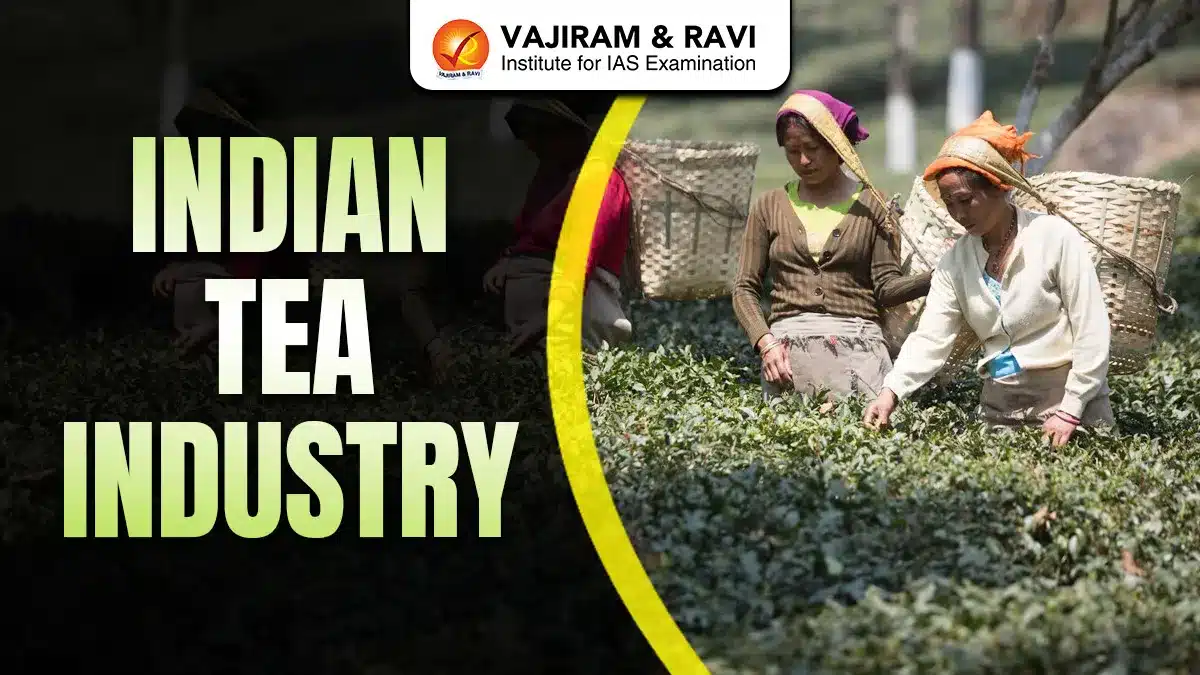
The Indian tea industry is one of the oldest and most important agro-based industries in the country, providing livelihood to millions of people. India is among the world’s largest producers and consumers of tea, with strong domestic demand and a steady export market. Tea cultivation depends heavily on specific climatic conditions such as temperature, rainfall, and soil quality. To support the sector, the government has introduced various policies and schemes to improve productivity, sustainability, and farmer welfare.

Historical Evolution of Tea Cultivation in India

Tea cultivation in India began in the early 19th century during British rule, after Robert Bruce discovered wild tea plants in Assam in 1823. The first Indian tea was exported from Assam to the United Kingdom in 1838, marking the start of India’s tea industry.

  • 1823: Discovery of Camellia sinensis in the Upper Brahmaputra Valley, Assam
  • Early plantations started in Assam and later in Saharanpur near Kumaon
  • 1833: Charter Act ended East India Company’s monopoly with China
  • 1834: Tea Committee set up under Governor-General William Bentinck
  • 1838: First Indian tea from Assam sent to the UK for public sale
  • 1850s: India emerged as one of the world’s leading tea producers
  • Post-independence: Growth of Indian tea brands and mass domestic consumption

Major Tea-Producing Regions of India

Tea cultivation in India is region-specific due to its dependence on climate and soil conditions. Nearly 96% of India’s tea production comes from a few key states.

Major tea-producing regions:

  • Assam: Assam Valley and Cachar; the largest producer, known for strong and malty tea
  • West Bengal: Darjeeling, Dooars, and Terai regions
  • Tamil Nadu: Nilgiri hills, famous for fragrant and smooth teas
  • Kerala: Produces high-range teas with bright liquor
  • Karnataka: Smaller but quality-focused production

Other states such as Tripura, Himachal Pradesh, Uttarakhand, Arunachal Pradesh, Sikkim, and Bihar produce tea on a smaller scale. The Kangra Valley in Himachal Pradesh is especially known for its green teas.

India ranks as the second-largest producer and consumer of tea in the world and is also the third-largest exporter. In comparison, Kenya, the world’s leading tea exporter, exports almost its entire production, while China stands as the second-largest tea exporter globally.

Climatic Conditions Required for Tea Cultivation

Tea is a climate-sensitive crop that thrives in tropical and sub-tropical regions. Any deviation in weather patterns directly affects yield and quality.

Ideal growing conditions for tea:

  • Temperature range of 15°C–23°C (optimal growth)
  • Warm and humid climate with at least 5 hours of sunlight daily
  • Annual rainfall of 150–300 cm, evenly distributed
  • Slightly acidic, calcium-free soil with porous sub-soil
  • Sloping terrain to ensure proper drainage

Types of Tea Produced in India

India produces a wide variety of teas, catering to both domestic consumption and international markets. Differences in climate, altitude, processing methods, and tea varieties give Indian teas their distinct taste, aroma, and quality.

  • Black Tea: The most widely produced and consumed tea in India; forms the largest share of production and exports
  • CTC Tea: Processed using Crush–Tear–Curl method; commonly used for regular tea and tea bags
  • Orthodox Tea: Handcrafted using traditional methods; known for superior quality and mainly exported
  • Green Tea: Minimally processed and rich in antioxidants; demand is rising due to health awareness
  • White Tea: Made from young tea buds; rare, delicate, and produced in limited quantities

Oolong Tea: Partially oxidized tea; produced in small volumes for niche markets

Role of Tea Board of India

The Tea Board of India is the apex regulatory and promotional body for the tea sector. It was established under the Tea Act, 1953 and functions under the Ministry of Commerce.

  • Established in 1953; operational since 1954
  • Headquarters in Kolkata with 17 domestic offices
  • Overseas offices in Dubai and Moscow
  • Board consists of 31 members representing producers, traders, governments, and workers
  • The Tea Board is reconstituted every three years.

Major functions:

  • Promote tea cultivation, production, and exports
  • Provide financial and technical assistance
  • Ensure quality control and certification
  • Support research and development
  • Protect the identity of Indian teas

Government Policies and Schemes for Tea Development

The Government of India supports the tea industry through policy interventions and targeted schemes to improve productivity, quality, and sustainability.

  • Tea Development and Promotion Scheme (2021–26): Aims to enhance productivity, quality, and sustainability of tea cultivation across India.
  • Plantation Development Support: Financial assistance for replantation, rejuvenation of old tea bushes, and expansion of tea areas, especially for small growers.
  • Market Promotion and Export Support: Subsidies for participation in international fairs, exhibitions, and branding of Indian tea abroad.
  • Worker Welfare Measures: Support for housing, healthcare, education, and skill development of plantation workers.
  • Research and Development Initiatives: Funding for scientific research to improve yield, quality, and climate resilience.
  • Digital and Regulatory Reforms: Introduction of online licensing systems with auto-renewal and simplified compliance procedures.
  • Chai Sahyog Mobile App: A digital platform to address issues faced by small tea growers and improve access to information and services.

Tea Industry and Women Workforce Participation

Women play a vital role in the Indian tea industry and form a large share of the plantation workforce, particularly in leaf plucking, sorting, and processing activities. In many tea-growing regions, women account for nearly half or more of the total workforce, making the sector an important source of rural female employment.

The tea industry provides women with regular income, contributing to household financial stability and social empowerment in economically backward areas. 

However, challenges such as wage disparities, limited leadership opportunities, lack of adequate healthcare, and poor working conditions persist. 

Challenges Faced by the Indian Tea Industry

  • Climate Change Impact: Erratic rainfall, rising temperatures, droughts, and floods are reducing tea yield and quality, especially in major producing regions like Assam.
  • Rising Input Costs: Costs of labour, fertilizers, pesticides, fuel, and electricity have increased significantly, while tea prices have not risen proportionately.
  • Aging Tea Bushes: A large portion of tea plantations have old bushes, leading to low productivity and higher maintenance costs.
  • Stagnant and Low Prices: Tea auction prices remain largely stagnant, affecting profitability for both estates and small tea growers.
  • Global Competition: Strong competition from countries like Kenya, Sri Lanka, China, and Indonesia in CTC, orthodox, and green tea segments.
  • Small Tea Growers’ Vulnerability: Many small growers lack land ownership, access to credit, modern technology, and organized markets.
  • Labour Issues: Shortage of skilled labour, rising wages, and welfare-related challenges increase operational costs.
  • Export Dependence on Black Tea: Over-reliance on black tea limits diversification and value realization in exports.

Way Forward

  • Shift from Quantity to Quality: Promote GI-tagged, specialty, organic, and orthodox teas to improve value realization in domestic and export markets.
  • Climate-Resilient Practices: Encourage climate-smart agriculture, drought-resistant varieties, and sustainable farming to reduce climate-related risks.
  • Support Small Tea Growers: Strengthen Farmer Producer Organizations (FPOs), improve access to credit, technology, and transparent auction systems.
  • Value Addition and Branding: Expand processing, packaging, and branding of Indian tea to capture premium global markets.
  • Diversify Export Markets: Reduce dependence on traditional markets by targeting South America, Middle East, Africa, and emerging economies.
  • Modernisation and Mechanisation: Adopt modern machinery and digital tools to reduce costs and improve efficiency.
  • Skill Development and Worker Welfare: Invest in training, healthcare, housing, and social security for plantation workers, especially women.
  • Learning from Global Best Practices: Adopt successful models like Kenya’s farmer training systems to improve quality and sustainability.

Indian Tea Industry FAQs

Q1: Why is the tea industry important for India?

Ans: The tea industry generates large-scale employment, supports rural livelihoods, and contributes significantly to export earnings.

Q2: Which state is the largest producer of tea in India?

Ans: Assam is the largest tea-producing state, contributing more than half of India’s total production.

Q3: What makes Darjeeling tea unique?

Ans: Darjeeling tea has a distinctive aroma and flavor and was India’s first product to receive a GI tag.

Q4: How much tea does India consume domestically?

Ans: Around 80% of India’s tea production is consumed within the country.

Q5: What is the future outlook of the Indian tea industry?

Ans: With emphasis on quality, sustainability, and value addition, the Indian tea industry has strong long-term growth potential.

Highest Peak in India, List, State Name, Height, Range

Highest Peak in India

List of Highest Peak in India: India is a land full of diversity, known not only for its rich culture and history but also for its amazing landscapes. The country has everything from high mountain peaks and deep valleys to flowing rivers and lush vegetation. Some of the world's Highest Peak in India are found, especially in the Karakoram, Garhwal, and Kangchenjunga ranges. These ranges hold peaks like Nanda Devi and Kangchenjunga, located mainly in the states of Uttarakhand and Sikkim. The beauty of these mountains, along with the unique plants and animals found here, makes India a true natural wonder.

Highest Peak in India

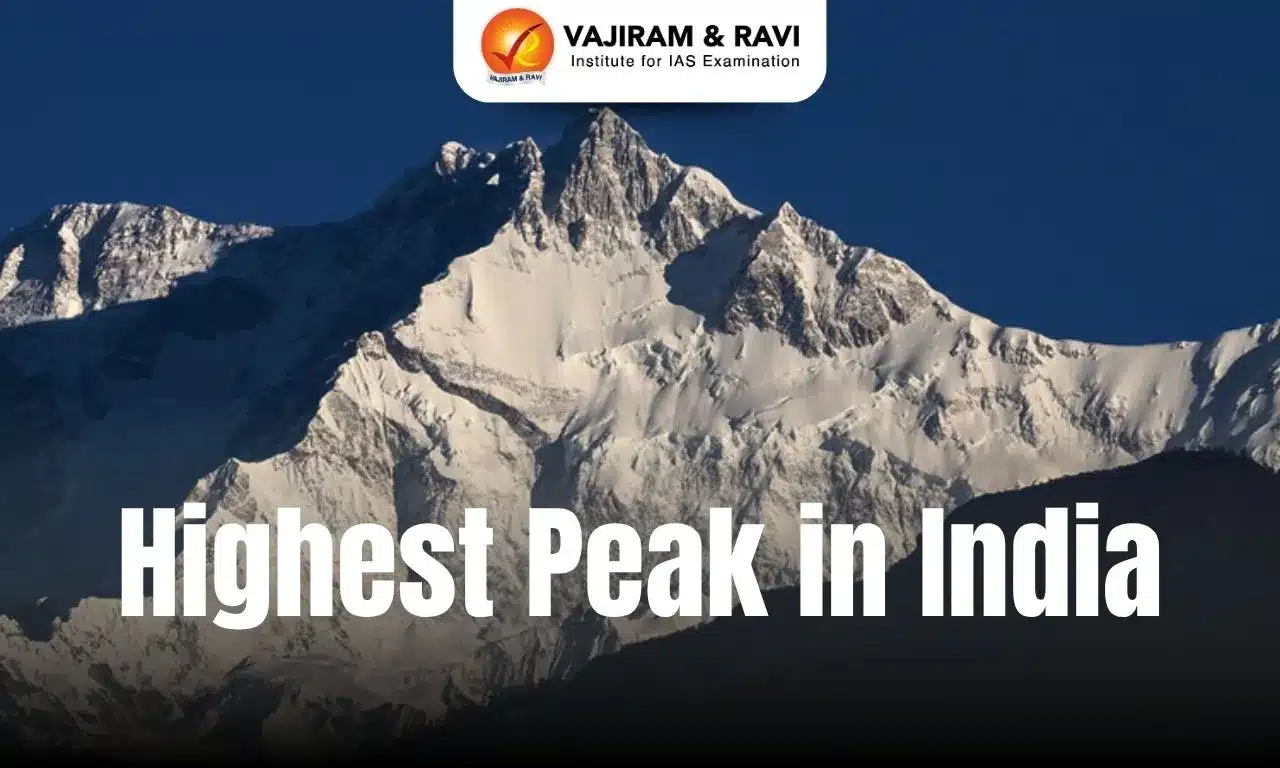
Kanchenjunga, reaching a height of 8,586 meters (28,169 feet), is the Highest Peak in India. Located on the border between India and Nepal in the Himalayan range, this peak towers over Sikkim with its impressive elevation. It’s the third-highest mountain worldwide. Down in the Western Ghats, Anamudi stands as South India's highest point and is also the tallest peak in this range, showcasing the natural beauty of southern India.

List of Highest Peak in India

The List of Highest Peaks in India, their heights, and the states they are in are shown in the table below.

List of Highest Peak in India

Peak

Range/ Region

State

Height

Arma Konda

Eastern Ghats

Andhra Pradesh

1680 m

Kangto

Eastern Himalaya

Arunachal Pradesh

7090 m

Someshwar Fort

West Champaran District

Bihar

880 m

Bailadila Range

Dantewada District

Chhattisgarh

1276 m

Sosogad

Western Ghats

Goa

1022 m

Girnar

Junagadh District

Gujarat

1145 m

Karoh Peak

Morni Hills

Haryana

1499 m

Reo Purgyil

Western Himalaya

Himachal Pradesh

6816 m

K2

Karakoram

Jammu and Kashmir

8611 m

Parasnath

Parasnath Hills

Jharkhand

1366 m

Mullayanagiri

Western Ghats

Karnataka

1925 m

Anamudi

Western Ghats

Kerala

2695 m

Dhupgarh

Satpura

Madhya Pradesh

1350 m

Kalsubai

Western Ghats

Maharashtra

1646 m

Mount Iso

Senapati District

Manipur

2994 m

Shillong Peak

Khasi Hills

Meghalaya

1965 m

Phawngpui

Saiha District

Mizoram

2165 m

Mount Saramati

Naga Hills

Nagaland

3841 m

Deomali

Eastern Ghats

Odisha

1672 m

Unnamed point on the Naina Devi

Rupnagar District

Punjab

1000 m

Guru Shikhar

Aravali

Rajasthan

1722 m

Kanchenjunga

Eastern Himalaya

Sikkim

8598 m

Doddabetta

Nilgiri Hills

Tamil Nadu

2636 m

Laxmidevipalli

Deccan Plateau

Telangana

670 m

Betalongchhip

Jampui Hills

Tripura

1097 m

Amsot Peak

Shivalik Hills

Uttar Pradesh

957 m

Nanda Devi

Garhwal Himalaya

Uttarakhand

7816 m

Sandakphu

Eastern Himalaya

West Bengal

3636 m

Second Highest Mountain Peak in India

Nanda Devi is the second highest mountain peak in India and the 23rd highest peak in the world, with an elevation of 7,816 meters (25,643 feet) above sea level. It is located in the Chamoli district of Uttarakhand and forms part of the Garhwal Himalayas. Nanda Devi is considered a sacred mountain and is named after the goddess Nanda Devi, believed to be the patron goddess of the region. The Nanda Devi National Park, surrounding the peak, is a UNESCO World Heritage Site known for its unique flora and fauna and stunning Himalayan landscapes.

Top 10 Highest Peaks in India

Here are the Top 10 Highest Peaks in India, each with its own story and breathtaking elevation.

Kangchenjunga – Sikkim

  • Height: 8,586 meters

Known as the "Five Treasures of Snows," this is India's tallest mountain and the third-highest in the world, standing majestically on the India-Nepal border.

Nanda Devi – Uttarakhand

  • Height: 7,816 meters

The tallest peak entirely within India, Nanda Devi is revered locally and stands as a symbol of Uttarakhand’s natural beauty.

Kamet – Uttarakhand

  • Height: 7,756 meters

The highest peak in the Zaskar range, Kamet is remote and challenging, making it a favorite among seasoned mountaineers.

Saltoro Kangri – Jammu & Kashmir

  • Height: 7,742 meters

This peak dominates the Saltoro range in the Karakoram, known for its closeness to the Siachen Glacier.

Saser Kangri – Jammu & Kashmir

  • Height: 7,672 meters

Located in the Saser Muztagh range, this peak is one of five towering summits that add to the  beauty of the Karakoram.

Mamostong Kangri – Jammu & Kashmir

  • Height: 7,516 meters

Rising in the Rimo range, Mamostong Kangri is known for its proximity to Siachen and is India’s sixth-highest peak.

Rimo – Jammu & Kashmir

  • Height: 7,385 meters

Near the Karakoram Pass, Rimo I is the tallest of the Rimo peaks, historically part of ancient trade routes.

Hardeol – Uttarakhand

  • Height: 7,151 meters

Often called the "Temple of God," Hardeol stands in the Kumaon Himalayas, neighboring the Nanda Devi sanctuary.

Chaukhamba – Uttarakhand

  • Height: 7,138 meters

The highest peak in the Gangotri group, Chaukhamba is recognized for its four-pointed structure and scenic prominence in Garhwal.

Trisul – Uttarakhand

  • Height: 7,120 meters

Named after Lord Shiva's trident, Trisul is located near Nanda Devi and is a favorite in the Kumaon region.

Highest Mountain Peak in the Western Ghats

The highest mountain peak in the Western Ghats is Anamudi, located in the Idukki district of Kerala. It stands at an impressive height of 2,695 meters (8,842 feet) above sea level. Anamudi is often called the “Everest of South India” due to its towering height and prominence. The peak lies within the Eravikulam National Park and is home to rich biodiversity, including the endangered Nilgiri Tahr and Neelakurinji flowers.

Highest Mountain Peak in the Eastern Ghats

The highest mountain peak in the Eastern Ghats is Arma Konda, also known as Jindhagada Peak, located in the Alluri Sitharama Raju district of Andhra Pradesh. It rises to an elevation of about 1,680 meters (5,512 feet) above sea level. Arma Konda is part of the hilly terrain of the Araku Valley region and is surrounded by lush forests and tribal villages. The area is known for its scenic beauty and rich biodiversity, making it a popular trekking and nature exploration destination.

Also Check Other Posts
Biosphere Reserves in India National Parks in India
Waterfalls in India Highest Peak in India
Ramsar Sites in India Wildlife Sanctuaries in India
Dams in India Tiger Reserves in India
Mountain Passes in India Longest Bridge in India

Highest Peak in India FAQs

Q1: Which is the highest mountain peak in India?

Ans: Kangchenjunga is the highest peak in India. It is the third highest mountain in the world with an elevation of 8,586 meters.

Q2: What is the height of Kanchenjunga?

Ans: The height of Kanchenjunga is 8586 meters.

Q3: Is k2 the highest mountain peak in India?

Ans: Mount K2 also known as Godwin-Austen is taller than Kangchenjunga but it is located in Pak occupied Kashmir (POK). K2 is the world's second tallest mountain.

Q4: Which is the highest mountain peak in the world?

Ans: Mount Everest is the highest peak in the world. It is 8,848 meters (29,029 feet) above sea level.

Q5: Which is the second highest peak in India?

Ans: Nanda Devi is the second highest peak in India. It has a height of 7816 meters.

Ramsar Sites in India, State-wise List, Largest, Smallest & Oldest Sites

ramsar sites in india

India is home to 96 Ramsar Sites across 28 states and union territories, each recognized for its ecological, hydrological, and biodiversity significance. The largest Ramsar site is the Sundarban Wetland in West Bengal (4,230 km²), while the smallest sites include Renuka Lake in Himachal Pradesh and Vembannur Wetland Complex in Tamil Nadu (both under 1 km²). The oldest Ramsar sites, Chilika Lake in Odisha and Keoladeo Ghana National Park in Rajasthan, were designated in 1981, reflecting India’s long-standing commitment to wetland conservation.

What is a Ramsar Site?

A Ramsar Site is a wetland recognized under the Ramsar Convention (1971) for its international importance in conserving biodiversity and sustaining ecological balance. These wetlands provide critical habitats for migratory birds, endangered species, and unique flora and fauna. They help in groundwater recharge, flood control, and climate regulation, while supporting local livelihoods like fishing and agriculture. India currently has 96 Ramsar Sites spread across 28 states and union territories, highlighting the country’s rich wetland diversity.

Ramsar Sites in India State-wise List

India has 96 Ramsar sites spread across 28 states and union territories, each recognized for its ecological, hydrological, and biodiversity significance. These wetlands range from large brackish lagoons to small freshwater lakes, supporting unique flora, fauna, and migratory birds.

Ramsar Sites in India State-wise List

S.No

Ramsar Site

State/UT

Designated Year

Area (km²)

1

Kolleru Lake

Andhra Pradesh

2002

901

2

Deepor Beel

Assam

2002

40

3

Kanwar (Kabar) Taal

Bihar

2020

26.2

4

Nagi Bird Sanctuary

Bihar

2023

2

5

Nakti Bird Sanctuary

Bihar

2023

3.3

6

Nanda Lake

Goa

2022

0.42

7

Khijadia WLS

Gujarat

2021

6

8

Nalsarovar BS

Gujarat

2012

123

9

Thol Lake

Gujarat

2021

6.99

10

Wadhvana Wetland

Gujarat

2021

10.38

11

Bhindawas WLS

Haryana

2021

4.11

12

Sultanpur NP

Haryana

2021

142.5

13

Chandra Taal

Himachal Pradesh

2005

0.49

14

Pong Dam Lake

Himachal Pradesh

2002

156.62

15

Renuka Lake

Himachal Pradesh

2005

0.2

16

Ranganathituu BS

Karnataka

2022

5.18

17

Magadi Kere Conservation Reserve

Karnataka

2024

0.5

18

Ankasamudra Bird Conservation Reserve

Karnataka

2024

0.98

19

Aghanashini Estuary

Karnataka

2024

4.8

20

Ashtamudi Wetland

Kerala

2002

614

21

Sasthamkotta Lake

Kerala

2002

3.73

22

Vembanad-Kol Wetland

Kerala

1905

1,512.5

23

Bhoj Wetland

Madhya Pradesh

2002

32

24

Sakhya Sagar

Madhya Pradesh

2022

2.48

25

Sirpur Wetland

Madhya Pradesh

2022

1.61

26

Yashwant Sagar

Madhya Pradesh

2022

8.22

27

Tawa Reservoir

Madhya Pradesh

2024

200

28

Lonar Lake

Maharashtra

2020

4.27

29

Nandur Madhameshwar

Maharashtra

2019

14

30

Thane Creek

Maharashtra

2022

65.21

31

Loktak Lake

Manipur

1990

266

32

Pala Wetland

Mizoram

2021

18.5

33

Ansupa Lake

Odisha

2021

2.31

34

Bhitarkanika Mangroves

Odisha

2002

650

35

Chilika Lake

Odisha

1981

1,165

36

Hirakud Reservoir

Odisha

2021

654

37

Satkosia Gorge

Odisha

2021

981.97

38

Tampara Lake

Odisha

2021

3

39

Beas CnR

Punjab

2019

64

40

Harike Wetland

Punjab

1990

41

41

Kanjli Wetland

Punjab

2002

1.83

42

Keshopur-Miani CmR

Punjab

2019

34

43

Nangal WLS

Punjab

2019

1

44

Ropar Wetland

Punjab

2002

13.65

45

Keoladeo National Park

Rajasthan

1981

28.73

46

Sambhar Lake

Rajasthan

1990

240

47

Chitrangudi BS

Tamil Nadu

2021

2.6

48

Gulf of Mannar Marine BR

Tamil Nadu

2022

526.72

49

Kanjirankulam BS

Tamil Nadu

2022

0.96

50

Karikili BS

Tamil Nadu

2022

0.584

51

Koonthankulam BS

Tamil Nadu

2021

0.72

52

Pallikaranai Marsh Reserve Forest

Tamil Nadu

2022

12.475

53

Pichavaram Mangrove

Tamil Nadu

2022

14.786

54

Point Calimere WLS & BS

Tamil Nadu

2002

389

55

Suchindram Theroor Wetland Complex

Tamil Nadu

2022

0.94

56

Udhayamarthandapuram BS

Tamil Nadu

2022

0.44

57

Vaduvur BS

Tamil Nadu

2022

1.12

58

Vedanthangal BS

Tamil Nadu

2022

0.4

59

Vellode BS

Tamil Nadu

2022

0.77

60

Vembannur Wetland Complex

Tamil Nadu

2022

0.2

61

Karaivetti Bird Sanctuary

Tamil Nadu

2024

4.5

62

Longwood Shola Reserve Forest

Tamil Nadu

2024

1.16

63

Nanjarayan Bird Sanctuary

Tamil Nadu

2024

1.3

64

Kazhuveli Bird Sanctuary

Tamil Nadu

2024

1,513

65

Rudrasagar Lake

Tripura

2005

2.4

66

Hokera Wetland

UT of Jammu & Kashmir

2005

13.75

67

Hygam Wetland CnR

UT of Jammu & Kashmir

2022

8.02

68

Shallbugh Wetland CnR

UT of Jammu & Kashmir

2022

16.75

69

Surinsar-Mansar Lakes

UT of Jammu & Kashmir

2005

3.5

70

Wular Lake

UT of Jammu & Kashmir

1990

189

71

Tso Kar

UT of Ladakh

2020

95.77

72

Tsomoriri

UT of Ladakh

2002

120

73

Bakhira WLS

Uttar Pradesh

2021

28.94

74

Haiderpur Wetland

Uttar Pradesh

2021

69

75

Nawabganj BS

Uttar Pradesh

2019

2

76

Parvati Arga BS

Uttar Pradesh

2019

7

77

Saman BS

Uttar Pradesh

2019

5

78

Samaspur BS

Uttar Pradesh

2019

8

79

Sandi BS

Uttar Pradesh

2019

3

80

Sarsai Nawar Jheel

Uttar Pradesh

2019

2

81

Sur Sarovar (Keetham Lake)

Uttar Pradesh

2020

4.31

82

Upper Ganga River (Brijghat to Narora)

Uttar Pradesh

2005

265.9

83

Asan Barrage

Uttarakhand

2020

4.44

84

East Kolkata Wetlands

West Bengal

2002

125

85

Sundarban Wetland

West Bengal

2019

4,230

86

Sakkarakottai Bird Sanctuary

Tamil Nadu

2025

87

Therthangal Bird Sanctuary

Tamil Nadu

2025

88

Khecheopalri Wetland

Sikkim

2025

89

Udhwa Lake

Jharkhand

2025

90

Khichan (Phalodi)

Rajasthan

2025

91

Menar (Udaipur)

Rajasthan

2025

92

Gokul Jalashay

Bihar

2025

93

Udaipur Jheel

Bihar

2025

94

Gogabeel Lake

Bihar

2025

-

95

Siliserh Lake

Rajasthan

2025

-

96

Kopra Jalashay

Chhattisgarh

2025

-

Newly Added Ramsar Sites in India

In 2025, India added 11 new Ramsar Sites, reflecting its ongoing commitment to wetland conservation and biodiversity protection. These sites span several states and union territories, including Tamil Nadu, Chhattisgarh, Sikkim, Jharkhand, Rajasthan, and Bihar.

Newly Added Ramsar Sites in India

S.No

Ramsar Site

State/UT

Designated Year

1

Sakkarakottai Bird Sanctuary

Tamil Nadu

2025

2

Therthangal Bird Sanctuary

Tamil Nadu

2025

3

Khecheopalri Wetland

Sikkim

2025

4

Udhwa Lake

Jharkhand

2025

5

Khichan (Phalodi)

Rajasthan

2025

6

Menar (Udaipur)

Rajasthan

2025

7

Gokul Jalashay

Bihar

2025

8

Udaipur Jheel

Bihar

2025

9

Gogabeel Lake

Bihar

2025

10

Siliserh Lake

Rajasthan

2025

11

Kopra Jalashay

Chhattisgarh

2025

Ramsar Sites in India Description

This table provides a comprehensive list of all 96 Ramsar Sites in India, including their state/UT and a brief description highlighting ecological, cultural, and conservation importance. It serves as a handy reference for understanding India’s wetlands and their significance for biodiversity, migratory birds, and local livelihoods.

Ramsar Sites in India Description

S.No

Ramsar Site

State/UT

Description

1

Kolleru Lake

Andhra Pradesh

Nutrient-rich freshwater lake between Godavari and Krishna basins, supports fisheries and agriculture; endangered Spot-Billed Pelican.

2

Deepor Beel

Assam

Permanent freshwater lake near Guwahati; habitat for Grey Pelican, Lesser & Greater Adjutant Storks, Baer’s Pochard.

3

Kanwar Taal

Bihar

Oxbow lake in Indo-Gangetic plain; hosts critically endangered vultures and waterbirds like Baer’s Pochard.

4

Nagi Bird Sanctuary

Bihar

Created from damming Nagi River; wintering site for Baer’s Pochard and steppe eagle; large bar-headed goose congregation.

5

Nakti Bird Sanctuary

Bihar

Man-made wetland from Nakti Dam; habitat for red-crested pochard and vulnerable catfish.

6

Gokul Jalashay

Bihar

Oxbow lake on Ganga’s southern edge; supports 50+ bird species; local communities depend on it for fishing and agriculture.

7

Udaipur Jheel

Bihar

Oxbow lake in Udaipur WLS; home to 280 plant species and migratory birds including vulnerable common pochard.

8

Nanda Lake

Goa

Freshwater marsh near Zuari River; supports aquatic biodiversity despite small size (0.42 km²).

9

Khijadia WLS

Gujarat

Freshwater wetland in Jamnagar; endangered Pallas’s Fish-Eagle, Indian Skimmer, and Bdellium-Tree.

10

Nalsarovar BS

Gujarat

Largest natural freshwater lake in Thar Desert; supports endangered Indian Wild Ass and Sociable Lapwing.

11

Thol Lake

Gujarat

Human-made reservoir; supports Blackbucks and endangered birds like White-Rumped Vulture.

12

Wadhvana Wetland

Gujarat

Semi-arid man-made wetland; habitat for Pallas’s Fish-Eagle, Sarus Crane, Common Pochard.

13

Bhindawas WLS

Haryana

Human-made freshwater wetland; hosts Egyptian Vultures and Pallas’s Fish-Eagle.

14

Sultanpur NP

Haryana

Near Delhi; IBA wetland supporting Sociable Lapwing, Egyptian Vultures, Saker Falcon, Black-Bellied Tern.

15

Chandra Taal

Himachal Pradesh

High-altitude lake; habitat for Snow Leopard, Himalayan Ibex, Blue Sheep; threatened by overgrazing.

16

Pong Dam Lake

Himachal Pradesh

Reservoir on Beas River; lies on Trans-Himalayan Flyway for migratory waterfowl.

17

Renuka Lake

Himachal Pradesh

Freshwater wetland with karst formations; named after sage Parshuram’s mother.

18

Udhwa Lake

Jharkhand

Oxbow wetland; supports Oriental White-Backed Vulture, Pallas’s Fish Eagle, Lesser Adjutant.

19

Aghanashini Estuary

Karnataka

Free-flowing river estuary; mangroves support fish, prawns, and bird diversity; important nutrient cycling.

20

Ankasamudra Bird CnR

Karnataka

Near Hampi; 175 bird species including 11 IUCN-listed species; nesting and breeding site.

21

Magadi Kere CnR

Karnataka

Saline wetland attracting migratory waterfowl; hosts bar-headed goose, Grey & Purple Herons.

22

Ranganathituu BS

Karnataka

Part of Kaveri River; habitat for Mugger Crocodile, Smooth-Coated Otter, Painted Stork, Grey Pelican.

23

Ashtamudi Wetland

Kerala

Backwater ecosystem; second-largest estuary in Kerala; supports fisheries and National Waterway 3.

24

Sasthamkotta Lake

Kerala

Largest freshwater lake in Kerala; exceptionally pure water supporting diverse aquatic life.

25

Vembanad-Kol Wetland

Kerala

Largest brackish lake in Kerala; supports paddy cultivation and migratory birds; second-largest Ramsar site in India.

26

Bhoj Wetland

Madhya Pradesh

Two human-made lakes in Bhopal; habitat for Sarus Crane.

27

Sakhya Sagar

Madhya Pradesh

Reservoir near Madhav National Park; hosts Mugger, Smooth-Coated Otter, Hump-Backed Mahseer.

28

Sirpur Wetland

Madhya Pradesh

Human-made wetland in Indore; supports Common Pochard, Egyptian Vulture, Indian River Tern.

29

Tawa Reservoir

Madhya Pradesh

Within Satpura Tiger Reserve; fish spawning ground and habitat for Indian giant squirrel.

30

Yashwant Sagar

Madhya Pradesh

IBA wetland in Indore region; important for migratory and resident birds.

31

Lonar Lake

Maharashtra

Meteorite crater lake; hypersaline and alkaline, hosts haloarchaea producing pink pigment.

32

Nandur Madhameshwar

Maharashtra

Created by Godavari-Kadwa confluence; hosts leopards and endangered bird species.

33

Thane Creek

Maharashtra

Large brackish water creek; fringed by mangroves; supports flamingos and diverse avifauna.

34

Loktak Lake

Manipur

Largest freshwater lake in northeast India; features floating phumdis and Keibul Lamjao, the only floating national park.

35

Pala Wetland

Mizoram

Natural lake in Indo-Burma hotspot; supports Sambar Deer, Barking Deer, Hoolock Gibbon.

36

Ansupa Lake

Odisha

Freshwater oxbow of Mahanadi River; largest freshwater lake in Odisha; endangered birds and fish.

37

Bhitarkanika Mangroves

Odisha

Part of Bhitarkanika WLS; supports Olive Ridley Turtles, Saltwater Crocodiles.

38

Chilika Lake

Odisha

India’s first Ramsar site (1981); brackish water lagoon; home to Irrawaddy dolphins; major migratory bird hub.

39

Hirakud Reservoir

Odisha

Large earthen dam; moderates floods in Mahanadi delta.

40

Satkosia Gorge

Odisha

Mosaic of rivers and forests; home to tigers and endangered turtles.

41

Tampara Lake

Odisha

Formed during 1766 battle; now connected to Rushikulya River for flood control.

42

Beas CnR

Punjab

189 km stretch of Beas River; hosts Indus River dolphin and reintroduced Gharial.

43

Harike Wetland

Punjab

Shallow reservoir at Beas-Sutlej confluence; important for migratory birds.

44

Kanjli Wetland

Punjab

Associated with Guru Nanak; freshwater wetland supporting local biodiversity.

45

Keshopur-Miani CmR

Punjab

Mosaic of marshes and ponds; supports Common Pochard, Spotted Pond Turtle.

46

Nangal WLS

Punjab

Bhakra-Nangal reservoir; historically significant; endangered Indian Pangolin and Leopard.

47

Ropar Wetland

Punjab

Formed by Sutlej River barrage; supports Smooth Indian Otter, Hog Deer, Sambar.

48

Keoladeo NP

Rajasthan

Complex of seasonal marshes; invasive grasses threaten Siberian Crane; on Montreux Record in 1990.

49

Sambhar Lake

Rajasthan

India’s largest inland saltwater lake; wintering site for flamingos.

50

Khichan Wetland

Rajasthan

Thar Desert wetland; wintering site for migratory demoiselle cranes.

51

Menar Wetland Complex

Rajasthan

Monsoon-fed freshwater ponds; supports vultures, waterbirds, and local flora.

52

Khecheopalri Wetland

Sikkim

Sacred lake in Demazong valley; revered by Hindus and Buddhists; near Kanchenjunga.

53

Chitrangudi BS

Tamil Nadu

IBA adjacent to Kanjirankulam; supports Grey Pelican, Painted Stork, Little Egret.

54

Gulf of Mannar Marine BR

Tamil Nadu

First marine biosphere reserve in South Asia; Dugong, Hawksbill Turtle, Humpback Dolphin.

55

Kanjirankulam BS

Tamil Nadu

Affected by invasive Prosopis trees; hosts Painted Stork, Oriental Darter.

56

Karaivetti BS

Tamil Nadu

Irrigation tank; freshwater feeding ground for migratory birds like Bar-headed Goose.

57

Karikili BS

Tamil Nadu

Near Kanchipuram; supports Oriental Darter, Spot-Billed Pelican.

58

Kazhuveli BS

Tamil Nadu

Brackish lake; important migratory bird path and spawning ground for fish.

59

Koonthankulam BS

Tamil Nadu

Human-made wetland; IBA maintained by local community.

60

Longwood Shola RF

Tamil Nadu

Urban shola forest in Nilgiris; retains water, regulates microclimate.

61

Nanjarayan BS

Tamil Nadu

Historical freshwater lake; nesting habitats for waterbirds and flapshell turtles.

62

Pallikaranai Marsh RF

Tamil Nadu

Coastal marsh; buffers Chennai floodwaters.

63

Pichavaram Mangrove

Tamil Nadu

Large mangrove forest; spiritual value; supports endangered birds and Olive Ridley Turtle.

64

Point Calimere WLS & BS

Tamil Nadu

Last remnants of dry evergreen forests; hosts Spoon-Billed Sandpiper and Grey Pelican.

65

Suchindram Theroor Wetland Complex

Tamil Nadu

IBA; inland perennial man-made tank on Central Asian flyway.

66

Udhayamarthandapuram BS

Tamil Nadu

Stores monsoon floodwaters; maintains dry-season water flow.

67

Vaduvur BS

Tamil Nadu

Large human-made tank; shelter for migratory birds.

68

Vedanthangal BS

Tamil Nadu

Freshwater wetland; protected by locals; guano enriches agriculture.

69

Vellode BS

Tamil Nadu

Supports Indian River Tern, Oriental Darter, Painted Stork.

70

Vembannur Wetland Complex

Tamil Nadu

Human-made inland tank; habitat for Spot-Billed Pelican and Spotted Greenshank.

71

Karaivetti BS

Tamil Nadu

Freshwater lake; attracts migratory waterbirds.

72

Rudrasagar Lake

Tripura

Reservoir fed by perennial streams; habitat for Three-Striped Roof Turtle.

73

Hokera Wetland

UT of JK

Natural wetland near Srinagar; hosts White-Eyed Pochard.

74

Hygam Wetland CnR

UT of JK

Downstream of Wular Lake; threatened by siltation.

75

Shallbugh Wetland CnR

UT of JK

Prevents flooding; supports Steppe Eagle, Pallas’s Fish-Eagle.

76

Surinsar-Mansar Lakes

UT of JK

Composite freshwater lake; semi-arid Punjab plains; linked to Mahabharata mythology.

77

Wular Lake

UT of JK

Largest freshwater lake in India; fed by Jhelum; supports rich biodiversity.

78

Tso Kar

UT of Ladakh

High-altitude hypersaline and freshwater lakes; breeding site for Black-Necked Cranes.

79

Tsomoriri

UT of Ladakh

Freshwater-brackish lake; only breeding site in India for Black-Necked Cranes and Bar-Headed Geese.

80

Bakhira WLS

Uttar Pradesh

Freshwater marsh near Gorakhpur; hosts Egyptian Vultures, Greater Spotted Eagle.

81

Haiderpur Wetland

Uttar Pradesh

Formed by Madhya Ganga Barrage; supports Gharial, Golden Mahseer, Hog Deer.

82

Nawabganj BS

Uttar Pradesh

Shallow marsh near Lucknow; renamed Chandra Shekhar Azad BS; Egyptian Vulture and Pallas’s Fish Eagle.

83

Parvati Arga BS

Uttar Pradesh

Freshwater oxbow lakes; home to Red-Headed Vulture, Indian Vulture.

84

Saman BS

Uttar Pradesh

Seasonal oxbow lake on Ganges floodplain; Sarus Crane, Greater Spotted Eagle.

85

Samaspur BS

Uttar Pradesh

Perennial lowland marsh; Egyptian Vulture, Pallas’s Fish Eagle.

86

Sandi BS

Uttar Pradesh

Freshwater wetland; supports Sarus Crane.

87

Sarsai Nawar Jheel

Uttar Pradesh

Marsh; name from Sarus Crane; pilgrimage site nearby.

88

Sur Sarovar (Keetham Lake)

Uttar Pradesh

Created for Agra water supply; supports Greater Spotted Eagle.

89

Upper Ganga River

Uttar Pradesh

Stretch from Brijghat to Narora; endangered Ganges River Dolphin and Gharial.

90

Asan Barrage

Uttarakhand

Formed by damming Asan River; supports Red-Headed Vulture, White-Rumped Vulture, Baer’s Pochard.

91

East Kolkata Wetlands

West Bengal

Multiple-use wetland; feeds world’s largest wastewater-fed aquaculture.

92

Sundarban Wetland

West Bengal

Largest Ramsar site in India; mangrove forest; Northern River Terrapin, Irrawaddy Dolphin.

93

Newly Added Sites (2025)

Multiple States

Includes Sakkarakottai BS, Therthangal BS (TN), Khecheopalri Wetland (Sikkim), Udhwa Lake (Jharkhand), Khichan (Rajasthan), Menar (Rajasthan), Gokul Jalashay, Udaipur Jheel (Bihar), Gogabeel Lake (Bihar), Siliserh Lake (Rajasthan), and Kopra Jalashay (Chhattisgarh).

Ramsar Sites in India Largest, Smallest and Oldest

The detailed list of Lagest, Smallest and Oldest Ramsar Sites in India have been listed below.

The Sundarban Wetland, Kazhuveli Bird Sanctuary, and Vembanad-Kol Wetland are among India’s largest Ramsar sites, spanning over 1,500 km² each. These wetlands play a crucial role in biodiversity conservation, supporting diverse flora, fauna, and migratory birds.

Largest Ramsar Sites in India

Rank

Ramsar Site

State

Area (km²)

1

Sundarban Wetland

West Bengal

4,230

2

Kazhuveli Bird Sanctuary

Tamil Nadu

1,513

3

Vembanad-Kol Wetland

Kerala

1,512.5

4

Chilika Lake

Odisha

1,165

5

Satkosia Gorge

Odisha

981.97

6

Kolleru Lake

Andhra Pradesh

901

Renuka Lake, Vembannur Wetland Complex, and Vedanthangal Bird Sanctuary are India’s smallest Ramsar sites, each under 1 km² in area. Despite their size, these sites are ecologically significant, providing critical habitats for endangered species and local communities.

Smallest Ramsar Sites in India

Rank

Ramsar Site

State

Area (km²)

1

Renuka Lake

Himachal Pradesh

0.2

2

Vembannur Wetland Complex

Tamil Nadu

0.2

3

Vedanthangal BS

Tamil Nadu

0.4

4

Nanda Lake

Goa

0.42

5

Udhayamarthandapuram BS

Tamil Nadu

0.44

Chilika Lake and Keoladeo Ghana National Park were the first Indian wetlands recognized under the Ramsar Convention in 1981. They are internationally renowned for their rich biodiversity, especially migratory waterbirds, and long-standing conservation importance.

Oldest Ramsar Sites in India

Rank

Ramsar Site

Year of Designation

1

Chilika Lake

1981

2

Keoladeo Ghana NP

1981

Importance of Ramsar Sites in India

Ramsar sites are wetlands of international importance that support biodiversity, regulate water cycles, and sustain livelihoods of local communities. They play a vital role in flood control, groundwater recharge, and climate regulation. 

  • Provide habitat for migratory and endangered species.
  • Support fisheries, agriculture, and tourism-based livelihoods.
  • Act as natural water purifiers and carbon sinks.
  • Help in flood mitigation and groundwater replenishment.
  • Contribute to climate regulation and ecosystem services.

Montreux Record in India

The Montreux Record is a register of Ramsar sites facing ecological changes due to human activities or natural factors. Inclusion highlights wetlands requiring priority conservation and restoration efforts. There are only 2 Ramsar Sites in India in the Montreux Record.

Indian Ramsar Sites on the Montreux Record

Ramsar Site

State

Reason for Inclusion

Year Listed

Keoladeo Ghana National Park

Rajasthan

Water shortage and unbalanced grazing

1990

Loktak Lake

Manipur

This lake is affected by factors such as human-induced changes and pollution

1993

Also Check Other Posts
Biosphere Reserves in India National Parks in India
Waterfalls in India Highest Peak in India
Ramsar Sites in India Wildlife Sanctuaries in India
Dams in India Tiger Reserves in India
Mountain Passes in India Longest Bridge in India

Ramsar Sites in India FAQs

Q1: What is a Ramsar Site?

Ans: A Ramsar Site is a wetland designated as being of international importance under the Ramsar Convention (1971) for its biodiversity, ecological, and hydrological value.

Q2: How many Ramsar Sites are there in India?

Ans: India has 96 Ramsar Sites spread across 28 states and union territories.

Q3: Which is the largest Ramsar Site in India?

Ans: The Sundarban Wetland in West Bengal is the largest Ramsar Site in India, covering 4,230 km².

Q4: Which is the smallest Ramsar Site in India?

Ans: The Renuka Lake (Himachal Pradesh) and Vembannur Wetland Complex (Tamil Nadu) are the smallest Ramsar Sites, each under 1 km².

Q5: Which are the oldest Ramsar Sites in India?

Ans: Chilika Lake (Odisha) and Keoladeo Ghana National Park (Rajasthan), both designated in 1981, are the oldest Ramsar Sites.

National Parks in India 2025, State Wise List, Map, Facts

National Parks in India

National Parks in India: India is home to a diversity of National Parks and Wildlife Sanctuaries, each serving as a hub for biodiversity conservation. These government-protected areas are established to safeguard native wildlife, conserve plant and animal species, and help restore ecological balance. Currently, there are 107 National Parks in India and 544 Wildlife Sanctuaries across the country, with Madhya Pradesh and the Andaman & Nicobar Islands leading in numbers, each hosting nine National Parks.

National Parks in India

National Parks in India play a vital role in protecting wildlife and their natural habitats. These areas have strict rules that ban hunting, poaching, industrial activities, and farming to keep the environment undisturbed. With secure boundaries, no outside activities are allowed near or within these parks. The main purpose of National Parks in India is to conserve India’s diverse wildlife. Below is a List of National Parks in India 2025, which is useful for competitive exams and general knowledge.

List of National Parks in India 2025 State-wise

India proudly hosts around 107 national parks, each dedicated to preserving its remarkable biodiversity and distinctive landscapes. Here’s a List of National Parks in India 2025 State-wise, for easy reference.

List of National Parks in India 2025 State-wise

State/Union Territory

Total Parks

National Parks Name

Establishment Year

Andaman & Nicobar Islands

9

Campbell Bay National Park

1992

Galathea Bay National Park

1992

Mahatama Gandhi Marine (Wandoor) National Park

1982

Middle Button Island National Park

1987

Mount Harriett National Park

1987

North Button Island National Park

1987

Rani Jhansi Marine National Park

1996

Saddle Peak National Park

1987

South Button Island National Park

1987

Andhra Pradesh

3

Papikonda National Park

2008

Rajiv Gandhi (Rameswaram) National Park

2005

Sri Venkateswara National Park

1989

Arunachal Pradesh

2

Mouling National Park

1986

Namdapha National Park

1983

Assam

5

Dibru-Saikhowa National Park

1999

Kaziranga National Park

1974

Manas National Park

1990

Nameri National Park

1998

Rajiv Gandhi Orang National Park

1999

Bihar

1

Valmiki National Park

1989

Chhattisgarh

3

Guru Ghasidas (Sanjay) National Park

1981

Indravati (Kutru) National Park

1982

Kanger Valley National Park

1982

Goa

1

Mollem National Park

1992

Gujarat

4

Vansda National Park

1979

Blackbuck (Velavadar) National Park

1976

Gir National Park

1975

Marine (Gulf of Kachchh) National Park

1982

Haryana

2

Kalesar National Park

2003

Sultanpur National Park

1989

Himachal Pradesh

5

Great Himalayan National Park

1984

Inderkilla National Park

2010

Khirganga National Park

2010

Pin Valley National Park

1987

Simbalbara National Park

2010

Jammu and Kashmir

4

City Forest (Salim Ali) National Park

1992

Dachigam National Park

1981

Kishtwar National Park

1981

Jharkhand

1

Betla National Park

1986

Karnataka

5

Anshi National Park

1987

Bandipur National Park

1974

Bannerghatta National Park

1974

Kudremukh National Park

1987

Nagarhole National Park

1988

Kerala

6

Anamudi Shola National Park

2003

Eravikulam National Park

1978

Mathikettan Shola National Park

2003

Pambadum Shola National Park

2003

Periyar National Park

1982

Silent Valley National Park

1984

Madhya Pradesh

9

Bandhavgarh National Park

1968

Fossil National Park

1983

Pench National Park

1975

Kanha National Park

1955

Madhav National Park

1959

Panna National Park

1981

Sanjay National Park

1981

Satpura National Park

1981

Van Vihar National Park

1979

Maharashtra

6

Chandoli National Park

2004

Gugamal National Park

1975

Nawegaon National Park

1975

Pench (Jawaharlal Nehru) National Park

1975

Sanjay Gandhi (Borivali) National Park

1983

Tadoba Andhari National Park

1955

Manipur

1

Keibul-Lamjao National Park

1977

Meghalaya

2

Balphakram National Park

1985

Nokrek Ridge National Park

1986

Mizoram

2

Murlen National Park

1991

Phawngpui Blue Mountain National Park

1992

Nagaland

1

Intanki National Park

1993

Odisha

2

Bhitarkanika National Park

1988

Simlipal National Park

1980

Rajasthan

5

Mukundra Hills National Park

2006

Desert National Park

1992

Keoladeo Ghana National Park

1981

Ranthambhore National Park

1980

Sariska National Park

1992

Sikkim

1

Khangchendzonga National Park

1977

Tamil Nadu

5

Guindy National Park

1976

Gulf of Mannar Marine National Park

1980

Indira Gandhi (Annamalai) National Park

1989

Mudumalai National Park

1990

Mukurthi National Park

1990

Ladakh

1

Hemis National Park

1981

Telangana

3

Kasu Brahmananda Reddy National Park

1994

Mahaveer Harina Vanasthali National Park

1994

Mrugavani National Park

1994

Tripura

2

Clouded Leopard National Park

2007

Bison (Rajbari) National Park

2007

Uttar Pradesh

1

Dudhwa National Park

1977

Uttarakhand

6

Corbett National Park

1936

Gangotri National Park

1989

Govind National Park

1990

Nanda Devi National Park

1982

Rajaji National Park

1983

Valley of Flowers National Park

1982

West Bengal

6

Buxa National Park

1992

Gorumara National Park

1992

Jaldapara National Park

2014

Neora Valley National Park

1986

Singalila National Park

1986

Sunderban National Park

1984

National Parks in India Map

National Parks in India Map

There are 107 National Parks in India as of 2025 covering around 44,403 km2 covering the diverse including the Himalayas to coastal regions. The First National Park in India is Jim Corbett National Park which was initially known as Hailey National Park established in 1936 in Uttarakhand where as South Button Island NP in the Andaman & Nicobar Islands, which is referred as the Smallest National Park in India about 5 km². Below we have provided the National Park of India Map for the reference.

What is a National Park?

A National Park is a protected area established by the government under the Wildlife Protection Act, 1972 to conserve wildlife, flora, and natural ecosystems. These parks aim to safeguard biodiversity and provide a secure habitat for endangered species. Human activities like hunting, poaching, and commercial use of resources are strictly prohibited within their boundaries. National Parks also promote eco-tourism, environmental education, and scientific research to maintain ecological balance and awareness.

National Park in India Features

  • Legal Protection: National Parks are legally protected; activities like hunting, grazing, and forestry are prohibited.
  • Wildlife Conservation: They serve as safe habitats for endangered and native species of animals and birds.
  • Ecological Balance: Helps in preserving ecosystems, biodiversity, and natural landscapes.
  • Public Access: Generally open to visitors for education and eco-tourism under strict rules.
  • Scientific Research: Provide opportunities for research, wildlife monitoring, and conservation studies.

Oldest National Parks in India

Corbett National Park, established in 1936, is the Oldest National Parks in India. Located in the Himalayas in Uttarakhand, it was initially named Hailey National Park. Renowned for its rich biodiversity, the park is especially famous for being the first area to come under the Project Tiger initiative in 1973. Jim Corbett Tiger Reserve is home to Bengal tigers, elephants, leopards, and hundreds of bird species, making it one of the most prominent wildlife sanctuaries in India.

Oldest National Parks in India

S.No

National Parks in India

Location

Year

1

Corbett National Park

Uttrakhand

1936

2

Kanha National Park

Madhya Pradesh

1955

3

Tadoba National Park

Maharashtra

1955

Smallest National Parks in India

South Button Island National Park is the Smallest National Parks in India covering an area of just 5 sq.km. It is located in the Andaman and Nicobar Islands, off the southeastern coast of the Indian mainland. Despite its small size, the park is rich in marine biodiversity, offering vibrant coral reefs, sea turtles, and exotic fish species. It forms part of the Rani Jhansi Marine National Park and is a popular site for scuba diving.

Smallest National Parks in India

Rank

National Park

Location

Area (km^2)

1

South Button Island NP

Andaman and Nicobar Islands

0.03

2

Fossil National Park

Madhya Pradesh

0.3

4

North Button Island National Park

Andaman and Nicobar Islands

0.4

5

Middle Button Island National Park

Andaman and Nicobar Islands

0.9

7

Dinosaur Fossils National Park

Madhya Pradesh

1.4

8

Pambadum Shola National Park

Tamil Nadu

1.4

Newest National Parks in India

Dihing Patkai National Park is the Newest National Parks in India, established in June 2021. It is located in the Dibrugarh and Tinsukia districts of Assam and spans an area of 231.65km2. Known as the "Amazon of the East," the park is rich in biodiversity and forms part of the largest stretch of lowland rainforest in India. It is home to rare and endangered species like the clouded leopard, hoolock gibbon, and several species of hornbills.

Newest National Parks in India

Rank

National Parks 

Location

Year

1

Dihing Patkai National Park

Assam

2021

2

Raimona National Park

Assam

2021

3

Jaldapara National Park

West Bengal

2014

Largest National Parks in India

Hemis National Park is the Largest National Parks in India in India by area. It is located in the eastern part of Ladakh (previously part of Jammu and Kashmir) in northern India and spans an area of approximately 4,400 square kilometers. Nestled in the trans-Himalayan region, this park is renowned for being the highest altitude national park in the country and serves as a vital sanctuary for the elusive snow leopard, along with other rare wildlife like the Tibetan wolf, red fox, and bharal (blue sheep).

Largest National Parks in India

Rank

National Park

Location (State/UT)

Area (km²)

1

Hemis National Park

Ladakh

3,350

2

Desert National Park

Rajasthan

3,162

3

Gangotri National Park

Uttarakhand

2,390

4

Namdapha National Park

Arunachal Pradesh

1,808

5

Khangchendzonga National Park

Sikkim

1,784

6

Guru Ghasidas (Sanjay) National Park

Chhattisgarh

1,441

7

Sundarbans National Park

West Bengal

1,330

8

Indravati (Kutru) National Park

Chhattisgarh

1,258

9

Papikonda National Park

Andhra Pradesh

1,013

10

Kanha National Park

Madhya Pradesh

940

11

Bandipur National Park

Karnataka

874

12

Kaziranga National Park

Assam

859

13

Simlipal National Park

Odisha

846

14

Rajaji National Park

Uttarakhand

820

15

Great Himalayan National Park

Himachal Pradesh

754

16

Khirganga National Park

Himachal Pradesh

710

17

Pin Valley National Park

Himachal Pradesh

675

18

Nagarahole National Park

Karnataka

643

19

Nanda Devi National Park

Uttarakhand

625

20

Kudremukh National Park

Karnataka

600

21

Satpura National Park

Madhya Pradesh

585

22

Panna National Park

Madhya Pradesh

543

23

Corbett National Park

Uttarakhand

521

24

Manas National Park

Assam

500

25

Dudhwa National Park

Uttar Pradesh

490

26

Mouling National Park

Arunachal Pradesh

483

27

Govind National Park

Uttarakhand

472

28

Sanjay National Park

Madhya Pradesh

467

29

Bandhavgarh National Park

Madhya Pradesh

449

30

Campbell Bay National Park

Andaman & Nicobar Islands

426

National Parks in India 2025 Facts

  1. Hemis National Park (Jammu & Kashmir): The largest national park in India, famous for its snow leopard population.
  2. South Button Island National Park (Andaman & Nicobar Islands): The smallest national park in India, known for its coral reefs and marine life.
  3. Rann of Kutch (Gujarat): The largest wildlife sanctuary in India, home to the Indian wild ass and migratory birds.
  4. Bor Tiger Reserve (Maharashtra): The smallest wildlife sanctuary in India, critical for tiger conservation.
Also Check Other Posts
Biosphere Reserves in India National Parks in India
Waterfalls in India Highest Peak in India
Ramsar Sites in India Wildlife Sanctuaries in India
Dams in India Tiger Reserves in India
Mountain Passes in India Longest Bridge in India

National Parks in India FAQs

Q1: How many National Parks are there in India?

Ans: There are a total of 107 National Parks in India.

Q2: Which is the largest national park in India?

Ans: Hemis National Park, situated in the Leh district of Jammu and Kashmir, holds the distinction of being India's largest national park, covering an expansive area of approximately 4,400 square kilometers.

Q3: Which state has the maximum number of national parks?

Ans: Madhya Pradesh and Andaman and Nicobar Islands are the leaders in India when it comes to the number of National Parks, each boasting a total of nine parks.

Q4: Which is the first national park in India?

Ans: India's inaugural national park was Hailey National Park, established in 1936. It is currently known as Jim Corbett National Park.

List of Waterfalls in India, Highest Waterfalls with Location, Height

Waterfalls in India

List of Waterfalls in India: India is home to a stunning variety of waterfalls, each showcasing the country's diverse natural beauty. From the majestic heights of the Himalayas to the lush, beautiful landscapes of the Western Ghats, these waterfalls captivate visitors from around the globe. Below is a List of Waterfalls in India, along with key details about each:

Waterfalls in India

A waterfall is formed when river water falls steeply down from higher ground. Typically, waterfalls are found in the upper reaches of rivers, where the terrain is mountainous and steep. Due to the specific geographical conditions, many waterfalls are located over solid bedrock and are often fed by small tributaries, making them seasonal. As a result, these waterfalls are usually temporary and are most visible during heavy rainfalls. In this article, we have shared the List of Major Waterfalls in India for general awareness.

List of Waterfalls in India

India is renowned for its waterfalls, each possessing its own unique beauty and charm. The following List of Waterfalls in India, offering a brief into the stunning waterfalls that can be found across the nation.

List of Waterfalls in India

Waterfalls in India

Location

Height Metre/Feet

Kunchikal Falls

Shimoga district, Karnataka

455 metres (1,493 ft)

Barehipani Falls

Mayurbhanj district, Odisha

399 metres (1,309 ft)

Nohkalikai Falls

East Khasi Hills district, Meghalaya

340m (1115 feet)

Nohsngithiang Falls or Mawsmai Falls

East Khasi Hills district, Meghalaya

315 metres (1,033 ft)

Dudhsagar Falls

Karnataka and Goa

310 m(1017 feet)

Kynrem Falls

East Khasi Hills district, Meghalaya

305 metres (1,001 ft)

Meenmutty Falls

Wayanad district, Kerala

300 metres (984 feet)

Thalaiyar Falls

Batlagundu, Dindigul district, Tamil Nadu

297 metres (974 ft)

Barkana Falls

Shimoga district, Karnataka

259 metres (850 ft)

Jog Falls

Shimoga district, Karnataka

253 meters (830ft)

Top 10 Highest Waterfalls in India

India, known for its diverse landscapes and rich natural beauty, is home to stunning waterfalls. Below are the Top 10 Highest Waterfalls in India, along with their locations and impressive heights. These waterfalls not only add to the natural charm of their regions but also provide a vital source of livelihood for the local communities. For those who love nature and adventure, exploring these waterfalls is an unforgettable experience.

Kunchikal Falls

Kunchikal Falls is the highest waterfall in India and the second tallest in Asia, standing at an impressive height of 1,493 feet. Located near Agumbe in Shimoga district, Karnataka, the falls are nestled in one of the rainiest areas of India, Agumbe Valley. This area is also home to India’s only permanent rainforest research station. 

Barehipani Falls

Barehipani Falls, located in Simlipal National Park in Mayurbhanj district, Odisha, is the second tallest waterfall in India at 712 feet. The waterfall, nestled in dense forests, is known for its two distinct drops, with the taller one falling from a height of 259 meters (850 feet).

Nohkalikai Falls

Situated near Cherrapunji in the East Khasi Hills district of Meghalaya, Nohkalikai Falls is one of India’s tallest waterfalls, measuring 1,120 feet. It is also the highest plunge waterfall in the country. The falls are located in one of the wettest places on Earth and offer a breathtaking view of the surrounding hills and valleys. 

Nohsngithiang Falls (Seven Sisters Falls)

Nohsngithiang Falls, also known as the Seven Sisters Falls, is located in the East Khasi Hills of Meghalaya. The waterfall drops from a height of 1,033 feet and is segmented into seven distinct sections, creating a stunning visual. The falls are a seasonal phenomenon, flowing during the monsoon, and are symbolic of the seven sister states of Northeast India.

Dudhsagar Falls

Known as the "Sea of Milk," Dudhsagar Falls is one of the most famous Waterfalls in India, located on the Goa-Karnataka border. This majestic waterfall stands at 1,020 feet and is a popular tourist attraction due to its grandeur and the surrounding scenic beauty of the Western Ghats. It’s an excellent spot for a day trip for nature lovers and adventurers.

Kynrem Falls

Located in Thangkharang Park in Cherrapunji, Meghalaya, Kynrem Falls is a beautiful three-tiered waterfall. It falls from a height of 1,000 feet, making it one of the Highest Waterfalls in India. The waterfall is part of the park's natural splendor and adds to the beauty of Cherrapunji’s landscape.

Meenmutty Falls

Meenmutty Falls, situated in Wayanad district, Kerala, is the tallest waterfall in the state, falling from a height of 980 feet. The falls are a major tourist attraction in South India and are surrounded by lush forests. The waterfall is divided into three tiers, making it a spectacular sight, especially during the monsoon when it is at its most powerful.

Thalaiyar Falls (Rat Tail Falls)

Thalaiyar Falls, also known as Rat Tail Falls, is located in the Dindigul district of Tamil Nadu. Standing at 974 feet, it is one of the tallest waterfalls in India. The waterfall is difficult to access, as there are no roads leading to the site, but its stunning drop and the surrounding dark caves make it a unique and adventurous spot for those who can reach it.

Barkana Falls

Barkana Falls, located in the Shimoga district of Karnataka, is one of the ten tallest waterfalls in India, with a height of 850 feet. The waterfall, which forms from the Seetha River, is primarily known for its role in hydroelectric power generation in Karnataka. It’s an ideal spot for those visiting Agumbe, often referred to as the "Cherrapunji of the South."

Jog Falls

Jog Falls, created by the Sharavathi River in the Shimoga district of Karnataka, is one of the most impressive plunge waterfalls in India. With a height of 829 feet, it ranks as the second-tallest waterfall in India. The falls are a significant tourist attraction and are associated with the nearby Linganamakki Dam, which harnesses the power of the Sharavathi River.

Also Check Other Posts
Biosphere Reserves in India National Parks in India
Waterfalls in India Highest Peak in India
Ramsar Sites in India Wildlife Sanctuaries in India
Dams in India Tiger Reserves in India
Mountain Passes in India Longest Bridge in India

Waterfalls in India FAQs

Q1: Which is the highest waterfall in India?

Ans: Kunchikal falls is the highest waterfall in India with a height of 455 meters.

Q2: What is the height of Kunchikal falls?

Ans: The height of Kunchikal falls is 1493 feet.

Q3: Which place is known as Cherrapunji of South India?

Ans: Western Ghats is known as the Cherrapunji of South India.

Q4: Where is the Kunchikal Fall?

Ans: The Kunchikal Fall is in Shimoga District of Karnataka.

Q5: Where is Jog Fall?

Ans: Jog falls is in Shimoga District Karnataka.

Dams in India, State Wise List, Longest & Highest Dams in India

Dams in India

India, often referred to as the land of rivers, surrounded the Himalayas in the north, the plateaus in central India, and the Western and Eastern Ghats in the south along the oceanic boundaries. These varied terrains provide an ideal setting for dam construction. With approximately 4,300 large dams already built and several more under development, India continues to expand its water management infrastructure through projects aimed at irrigation, hydroelectric power generation, and flood control.

List of Dams in India

Below in the table is the List of Dams in India as they play a crucial role in water conservation, irrigation, hydroelectric power generation, and flood control. 

List of Dams in India
Name of Dam State Name River Name

Nizam Sagar Dam

Telangana

Manjira River

Somasila Dam

Andhra Pradesh

Pennar River

Srisailam Dam

Andhra Pradesh

Krishna River

Singur dam

Telangana

Manjira River

Ukai Dam

Gujarat

Tapti River

Dharoi Dam

Gujarat

Sabarmati River

Kadana dam

Gujarat

Mahi River

Dantiwada Dam

Gujarat

Banas River

Pandoh Dam

Himachal Pradesh

Beas River

Bhakra Nangal Dam

Himachal Pradesh and Punjab Border

Sutlej River

Nathpa Jhakri Dam

Himachal Pradesh

Satluj River

Chamera Dam

Himachal Pradesh

Ravi River

Baglihar Dam

Jammu and Kashmir

Chenab River

Dumkhar Hydroelectric Dam

Jammu and Kashmir

Indus River

Uri Hydroelectric Dam

Jammu and Kashmir

Jhelum River

Maithon Dam

Jharkhand

Barakar River

Chandil Dam

Jharkhand

Swarnarekha River

Panchet Dam

Jharkhand

Damodar River

Tunga Bhadra Dam

Karnataka

Tungabhadra River

Linganamakki dam

Karnataka

Sharavathi River

Kadra Dam

Karnataka

Kalinadi River

Alamatti Dam

Karnataka

Krishna River

Supa Dam

Karnataka

Kalinadi or Kali river

Krishna Raja Sagara Dam

Karnataka

Kaveri River

Harangi Dam

Karnataka

Harangi River

Narayanpur Dam

Karnataka

Krishna River

Kodasalli Dam

Karnataka

Kali River

Malampuzha Dam

Kerala

Malampuzha River

Peechi Dam

Kerala

Manali River

Idukki Dam

Kerala

Periyar River

Kundala Dam

Kerala

Kundala Lake

Parambikulam Dam

Kerala

Parambikulam River

Walayar Dam

Kerala

Walayar River

Mullaperiyar Dam

Kerala

Periyar River

Neyyar Dam

Kerala

Neyyar River

Rajghat Dam

Uttar Pradesh and Madhya Pradesh Border

Betwa River

Barna Dam

Madhya Pradesh

Barna River

Bargi Dam

Madhya Pradesh

Narmada River

Bansagar Dam

Madhya Pradesh

Sone River

Gandhi Sagar Dam

Madhya Pradesh

Chambal River

Yeldari Dam

Maharashtra

Purna river

Ujani Dam

Maharashtra

Bhima River

Pawna Dam

Maharashtra

Maval River

Mulshi Dam

Maharashtra

Mula River

Koyna Dam

Maharashtra

Koyna River

Jayakwadi Dam

Maharashtra

Godavari River

Bhatsa Dam

Maharashtra

Bhatsa river

Wilson Dam

Maharashtra

Pravara River

Tansa Dam

Maharashtra

Tansa river

Panshet Dam

Maharashtra

Ambi River

Mula Dam

Maharashtra

Mula river

Kolkewadi Dam

Maharashtra

Vashishti River

Girna Dam

Maharashtra

Girana river

Vaitarna Dam

Maharashtra

Vaitarna river

Radhanagari Dam

Telangana

Bhogawati River

Lower Manair Dam

Telangana

Manair River

Mid Manair Dam

Telangana

Manair River and SRSP Flood Flow Canal

Upper Manair Dam

Telangana

Manair River and Kudlair River

Khadakwasla Dam

Maharashtra

Mutha River

Gangapur Dam

Maharashtra

Godavari river

Jalaput Dam

Andhra Pradesh and Odisha Border

Machkund River

Indravati Dam

Odisha

Indravati River

Hirakud Dam

Odisha

Mahanadi River

Vaigai Dam

Tamil Nadu

Vaigai River

Perunchani Dam

Tamil Nadu

Paralayar River

Mettur Dam

Tamil Nadu

Kaveri River

Govind Ballabh Pant Sagar Dam / Rihand dam

Uttar Pradesh

Rihand River

Tehri Dam

Uttarakhand

Bhagirathi River

Dhauli Ganga Dam

Uttarakhand

Dhauli Ganga River

Longest Dam in India

Hirakud Dam, the longest dam in India, stretches over 25.79 km across the Mahanadi River in Sambalpur district, Odisha. Completed in 1953, this composite dam serves multiple purposes, including flood control, irrigation, and hydroelectric power generation. It has a total reservoir capacity of 47,79,965 acre-feet, making it one of the most significant water infrastructure projects in India.

Highest Dam in India

Tehri Dam, standing at 260.5 meters, is the tallest dam in India and ranks 12th among the tallest dams in the world. Constructed on the Bhagirathi River in New Tehri, Tehri Garhwal district, Uttarakhand, this massive structure plays a crucial role in hydroelectric power generation, irrigation, and water supply. The dam has a length of 575 meters, and its first phase was completed in 2006. It operates under THDC India Ltd. and is a key component of the Tehri Hydroelectric Complex.

Oldest Dam in India

The Kallanai Dam, built on the Kaveri River, is the oldest dam in India and one of the oldest water-regulation structures in the world still in use. Located in the Thanjavur district of Tamil Nadu, it was originally constructed between 100 BC and 100 AD by the Chola king Karikalan. The dam continues to serve as a crucial irrigation structure, benefiting agriculture in the region. Today, it is operated by the Government of Tamil Nadu and remains a remarkable testament to ancient Indian engineering expertise.

Uses of Dams in India

  • Water Supply for Domestic and Urban Use – Dams help in storing and supplying water for households, cities, and industries, ensuring a consistent and reliable source of clean water.
  • Irrigation Support – They provide essential water resources for agriculture, helping farmers sustain crop production even in drought-prone areas.
  • Industrial Utility – Many industries rely on a steady water supply from dams for manufacturing, processing, and cooling purposes.
  • Hydroelectric Power Generation – Dams facilitate renewable energy production by controlling the power of flowing water, contributing to sustainable electricity generation.
  • River Navigation – Dams regulate river flow, making inland water transport more feasible and economical, which is the cheapest mode of transportation.
  • Livelihood and Recreation – Reservoirs created by dams support fishing, boating, and tourism, providing employment opportunities to local communities.
  • Flood Control – By regulating river flow, dams help in preventing floods and mitigating damage to life and property.
Also Check Other Posts
Biosphere Reserves in India National Parks in India
Waterfalls in India Highest Peak in India
Ramsar Sites in India Wildlife Sanctuaries in India
Dams in India Tiger Reserves in India
Mountain Passes in India Longest Bridge in India

Dams in India FAQs

Q1: Which is the 5 biggest dam in India?

Ans: Sardar Sarovar Dam, Hirakud Dam, Nagarjuna Sagar Dam, ndira Sagar Dam, Koyna Dam.

Q2: How many dams are there in India?

Ans: India has 5334 dams with 447 being very important.

Q3: Which is the smallest dam in India?

Ans: The smallest dam is Cheruthoni Dam, constructed upon the Periyar River, which is only 138.2 metres tall.

Q4: What is the 7th largest dam?

Ans: Longtan Dam is the 7th largest dam.

Q5: Which is the oldest dam in India?

Ans: Kallanai Dam built across the Kaveri river of Tamil Nadu is the oldest dam (first dam) in India.

Tiger Reserves in India, State Wise List, Established Date

Tiger Reserves in India

The Bengal Tiger was officially declared the National Animal of India in April 1973 as part of the Project Tiger initiative. Before this the Lion held the status of National Animal of India. The decision was made as Bengal Tiger was listed as Endangered in the IUCN Red Data Book. Tiger Reserves in India network was established in 1973.

Tiger Reserves in India

India is home to 80% of the world's tiger population. According to the Tiger Census Report 2022, conducted every 4 years, the tiger population in India increased from 2,967 in 2018 to 3,682 in 2022. In 2022, Madhya Pradesh had the highest number of tigers (785), followed by Karnataka (563), Uttarakhand (560), and Maharashtra (444). Among the Tiger Reserves in India, Corbett National Park (Uttarakhand) had the highest tiger population (260), followed by Bandipur (150) and Nagarhole (141) in Karnataka. Currently, India has 58 tiger reserves, governed under Project Tiger and administered by the National Tiger Conservation Authority (NTCA). 

List of Tiger Reserves in India

India is home to 58 Tiger Reserves, established under Project Tiger. The latest addition is Madhav National Park in Madhya Pradesh, which was added in 2025. Here is the List of Tiger Reserves in India.

List of Tiger Reserves in India
Sl No Tiger Reserve (TR) State TR Notifcn Year Total Area (sq km)
1 Bandipur Karnataka 2007 1456.3
2 Corbett Uttarakhand 2010 1288.31
3 Amanagarh buffer Uttar Pradesh 2012 80.60
4 Kanha Madhya Pradesh 2007 2051.79
5 Manas Assam 2008 2837.10
6 Melghat Maharashtra 2007 2768.52
7 Palamau Jharkhand 2012 1129.93
8 Ranthambore Rajasthan 2007 1411.29
9 Simlipal Odisha 2007 2750.00
10 Sunderban West Bengal 2007 2584.89
11 Periyar Kerala 2007 925.00
12 Sariska Rajasthan 2007 1213.34
13 Buxa West Bengal 2009 757.90
14 Indravati Chhattisgarh 2009 2799.07
15 Namdapha Arunachal Pradesh 1987 2052.82
16 Nagarjunsagar Sagar Andhra Pradesh 2007 3296.31
17 Dudhwa Uttar Pradesh 2010 2201.77
18 Kalakad Mundanthurai Tamil Nadu 2007 1601.54
19 Valmiki Bihar 2012 899.38
20 Pench Madhya Pradesh 2007 1179.63
21 Tadobha Andhari Maharashtra 2007 1727.59
22 Bandhavgarh Madhya Pradesh 2007 1536.93
23 Panna Madhya Pradesh 2007 1598.10
24 Dampa Mizoram 2007 988.00
25 Bhadra Karnataka 2007 1064.29
26 Pench – MH Maharashtra 2007 741.22
27 Pakke Arunachal Pradesh 2012 1198.45
28 Nameri Assam 2000 464.00
29 Satpura Madhya Pradesh 2007 2133.31
30 Anamalai Tamil Nadu 2007 1479.87
31 Udanti Sitanadi Chhattisgarh 2009 1842.54
32 Satkoshia Odisha 2007 963.87
33 Kaziranga Assam 2007 1173.58
34 Achanakmar Chhattisgarh 2009 914.02
35 Kali Karnataka 2007 1097.51
36 Sanjay Dhubri Madhya Pradesh 2011 1674.50
37 Mudumalai Tamil Nadu 2007 688.59
38 Nagarhole Karnataka 2007 1205.76
39 Parambikulam Kerala 2009 643.66
40 Sahyadri Maharashtra 2012 1165.57
41 Biligiri Ranganatha Temple Karnataka 2007 574.82
42 Kawal Telangana 2012 2015.44
43 Sathyamangalam Tamil Nadu 2013 1408.40
44 Mukundara Rajasthan 2013 759.99
45 Nawegaon Nagzira Maharashtra 2013 1894.94
46 Amrabad Telangana 2015 2611.39
47 Pilibhit Uttar Pradesh 2014 730.25
48 Bor Maharashtra 2014 816.27
49 Rajaji Uttarakhand 2015 1075.17
50 Orang Assam 2016 492.46
51 Kamlang Arunachal Pradesh 2017 783.00
52 Srivilliputhur Megamalai Tamil Nadu 2021 1016.57
53 Ramgarh Vishdhari Rajasthan 2022 1501.89
54 Ranipur Uttar Pradesh 2022 529.36
55 Veerangana Durgavati Madhya Pradesh 2023 2339.12
56 Dholpur – Karauli Rajasthan 2023 599.64
57 Guru Ghasidas – Tamor Pingla Chhattisgarh 2024 2829.39
58 Ratapani Madhya Pradesh 2024 1271.47
59 Madhav Madhya Pradesh 2025 1651.39
Total 84487.83

State-Wise List of Tiger Reserves in India

India is home to 58 Tiger Reserves spread across 18 states, dedicated to protect the endangered Bengal tiger and its natural habitat. These reserves operate under Project Tiger, launched in 1973 to ensure the recovery of tiger populations and the preservation of their ecosystems.

State-Wise List of Tiger Reserves in India
State Number of Tiger Reserves Tiger Reserves (TR)
Andhra Pradesh 1 Nagarjunsagar Sagar
Arunachal Pradesh 3 Namdapha, Pakke, Kamlang
Assam 4 Manas, Nameri, Kaziranga, Orang
Bihar 1 Valmiki
Chhattisgarh 4 Indravati, Udanti Sitanadi, Achanakmar, Guru Ghasidas – Tamor Pingla
Karnataka 5 Bandipur, Bhadra, Kali, Nagarhole, Biligiri Ranganatha Temple
Kerala 2 Periyar, Parambikulam
Madhya Pradesh 9 Kanha, Pench, Bandhavgarh, Panna, Satpura, Sanjay Dhubri, Veerangana Durgavati, Ratapani, Madhav
Maharashtra 6 Melghat, Tadobha Andhari, Pench – MH, Sahyadri, Nawegaon Nagzira, Bor
Rajasthan 5 Ranthambore, Sariska, Mukundara, Ramgarh Vishdhari, Dholpur – Karauli
Tamil Nadu 5 Kalakad Mundanthurai, Anamalai, Mudumalai, Sathyamangalam, Srivilliputhur Megamalai
Telangana 2 Kawal, Amrabad
Uttar Pradesh 4 Dudhwa, Amanagarh buffer, Pilibhit, Ranipur
Uttarakhand 2 Corbett, Rajaji
West Bengal 2 Sunderban, Buxa
Mizoram 1 Dampa
Odisha 2 Simlipal, Satkoshia

Top 10 Largest Tiger Reserves in India

Each Tiger Reserves in India plays a major role in wildlife conservation. Below are the Top 10 Largest Tiger Reserves in India, known for their diverse ecosystems.

Nagarjunsagar-Srisailam Tiger Reserve (3,296.31 sq. km.) Andhra Pradesh & Telangana

Nagarjunsagar-Srisailam Tiger Reserve is spanning across 5 districts in Andhra Pradesh and Telangana, this tiger reserve is the Largest Tiger Reserve in India, offering a vast habitat for Bengal tigers, leopards, pangolins, Indian rock pythons, and several other species. The Srisailam and Nagarjunasagar Reservoirs enhance the biodiversity of this reserve, making it an ecologically significant area.

Manas Tiger Reserve (3,150.92 sq. km.) Assam

Manas Tiger Reserve is located in the Himalayas, Manas Tiger Reserve is not just a national park but also a UNESCO World Heritage Site, an Elephant Reserve, and a Biosphere Reserve. It is home to some of the rarest and most endangered species, including the one-horned rhinoceros, Asiatic elephant, clouded leopard, and hoolock gibbons. The Manas River, which flows through the park, adds to its scenic beauty and ecological richness.

Melghat Tiger Reserve (2,768.52 sq. km.) Maharashtra

Melghat Tiger Reserve is situated in the Satpura Hill Range, and is an important part of central India's biodiversity. The reserve serves as a catchment area for five major rivers, which support its diverse flora and fauna. Apart from tigers, Melghat Tiger Reserve is home to species like Indian gaur, sambar deer, wild boars, and many bird species, making it a haven for wildlife enthusiasts.

Similipal Tiger Reserve (2,750 sq. km.) Odisha

Located in the Mayurbhanj district of Odisha, Similipal is known for its dense forests, unique biodiversity, and stunning waterfalls. The reserve is home to Royal Bengal tigers, elephants, leopards, barking deer, and rare orchids. The cool breeze from the forests and the presence of various streams make it a refreshing natural habitat. Similipal is an essential part of India's wildlife conservation efforts.

Amrabad Tiger Reserve (2,611.39 sq. km.) Telangana

Amrabad Tiger Reserve is situated in the Nallamala Hills, Amrabad Tiger Reserve is one of the largest reserves in South India. It has a rich tribal heritage, with the Chenchu tribe coexisting with the wildlife. The Amrabad Tiger Reserve is home to Bengal tigers, rusty-spotted cats, mugger crocodiles, Indian rock pythons, and a variety of bird species. 

Sundarbans Tiger Reserve (2,584.89 sq. km.) West Bengal

Sundarbans Tiger Reserve is the largest mangrove forest in the world and a UNESCO World Heritage Site. Located in West Bengal, it is famous for the Royal Bengal tigers, which have adapted to swimming in the saline waters. The forest gets its name from the Sundari trees, which dominate the landscape. The Sundarbans are also home to saltwater crocodiles, Gangetic dolphins, and various bird species, making it one of the most unique tiger reserves in India.

Dudhwa Tiger Reserve (2,201.77 sq. km.) Uttar Pradesh

Dudhwa Tiger Reserve is located along the India-Nepal border, and is a crucial part of Uttar Pradesh’s wildlife conservation efforts. It is the only place in the state where both tigers and one-horned rhinos coexist. The reserve features dense forests, vast grasslands, and wetland ecosystems, providing an ideal habitat for a diverse range of species, including elephants, swamp deer, and migratory birds.

Satpura Tiger Reserve (2,133.30 sq. km.) Madhya Pradesh

Satpura Tiger Reserve is situated south of the Narmada River, Satpura Tiger Reserve is known for its rich biodiversity and unique terrain. Apart from tigers, the reserve is home to leopards, chital, nilgai, blackbuck, Indian giant squirrels, and flying squirrels. The landscape consists of rugged hills, deep valleys, and dense forests, making it one of the most picturesque wildlife sanctuaries in India.

Namdapha Tiger Reserve (2,052.82 sq. km.) Arunachal Pradesh

Namdapha Tiger Reserve is located in Arunachal Pradesh, is the only tiger reserve in the world to host all four big cat species: tiger, leopard, snow leopard, and clouded leopard. This makes it one of the most ecologically significant reserves in India. It is part of the Eastern Himalayan Biodiversity Hotspot, featuring a mix of tropical, subtropical, and alpine ecosystems.

Kanha Tiger Reserve (2,051.79 sq. km.) Madhya Pradesh

Kanha Tiger Reserve, the inspiration behind Rudyard Kipling’s Jungle Book, is one of India’s most famous tiger reserves. It is home to the hard ground swamp deer (Barasingha), Bengal tigers, Indian wild dogs, and leopards. The lush green meadows and dense forests of Kanha make it an ideal wildlife habitat and a popular destination for nature lovers.

Also Check Other Posts
Biosphere Reserves in India National Parks in India
Waterfalls in India Highest Peak in India
Ramsar Sites in India Wildlife Sanctuaries in India
Dams in India Tiger Reserves in India
Mountain Passes in India Longest Bridge in India

Tiger Reserves in India FAQs

Q1: Which is India's 57th tiger reserve?

Ans: Ratapani Tiger Reserve in Madhya Pradesh is the India’s 57th tiger reserve.

Q2: What is the 54th tiger reserve of India?

Ans: Dholpur-Karauli Tiger Reserve is the 54th tiger reserve of India.

Q3: Which is the 53rd Tiger Reserve in India?

Ans: Guru Ghasidas National Park of Chhattisgarh is the 53rd Tiger Reserve in India.

Q4: Where are 52 tiger reserves in India?

Ans: Ramgarh Vishdhari wildlife sanctuary is the 52nd Tiger Reserve in India.

Q5: Which is 55th tiger reserve in India?

Ans: Dholpur – Karauli Tiger Reserve in Rajasthan is the 55th Tiger Reserve in India.

Mountain Passes in India, State Wise List, Significance

Mountain Passes in India

Mountain Passes in India is a natural route through or across a mountain range, often formed by geological activity, glacial movement, or erosion from rain and snow. At lower elevations, such routes are commonly referred to as hill passes. Mountain Passes in India may range from narrow high-altitude mountains to wide valleys stretching across several miles. They are commonly located near rivers fed by precipitation and snowmelt. While a Mountain Passes in India need not be entirely flat, it is characteristically much lower in elevation compared to the surrounding peaks, providing a navigable pathway through otherwise difficult terrain.

Mountain Passes in India

Mountain Passes in India are navigable routes through mountainous terrain formed due to natural gaps or breaks. These serve as vital connectors between regions separated by mountain ranges. In India, passes such as Khardung La, Nathu La, and Rohtang Pass hold strategic, commercial, and touristic significance. Many of these are located in geopolitically sensitive areas, influencing defense strategy and international diplomacy. Mountain Passes in India are also crucial for supply chains and emergency access. Their accessibility often depends on weather, especially in snow-bound regions.

Mountain Passes in India Overview

Mountain Passes in India act as vital links between geographically isolated regions. Many are located in the Himalayas, connecting India to countries like China, Nepal, and Pakistan. These passes support military logistics, border management, and trade. Some like Rohtang and Zoji La also serve as popular tourist routes. The below table includes the Mountain Passes in India Overview:

Mountain Passes in India Overview

Key Aspect

Details

Geopolitical Importance

Mountain passes such as Nathu La and Khardung La connect India to neighbouring countries and act as strategic international borders. These passes are crucial for maintaining diplomatic and military relations, especially with countries like China, Nepal, and Pakistan.

Tourism and Adventure

Passes like Rohtang and Zojila attract tourists for their beauty and adventure activities like trekking, biking, and snow sports. These passes are major for tourism, especially in the Himalayan regions, promoting the local economy.

Weather Conditions

Mountain passes experience extreme weather with heavy snowfall and frequent landslides, especially during winter. Passes like Baralacha La and Zoji La often become unreachable due to harsh conditions, requiring road closures.

Military Significance

Passes such as Karakoram Pass and Bomdi-La are critical for military operations and supply chains. These high-altitude passes are vital for army movements and maintaining defence strategies along India’s borders.

Cultural Exchange

Historically, passes like Shipki La facilitated trade and cultural exchanges through routes such as the ancient Silk Route. These routes played a key role in the movement of goods, ideas, and cultures between India and its neighbours.

Environmental Challenges

High-altitude passes are prone to climate extremes, and their accessibility is often limited by changing weather patterns. Passes also face environmental concerns like glacial melts and landslides, impacting transportation and local communities.

List of Mountain Passes in India

There are various Mountain Passes in India across the Himalayas, Western Ghats, and Eastern Ghats. Some of the most prominent ones include Khardung La (Ladakh), Zoji La (Jammu & Kashmir), Nathu La (Sikkim), and Rohtang Pass (Himachal Pradesh). The passes have historically enabled the movement of armies, traders, and pilgrims across the subcontinent.

List of Mountain Passes in India

State

Mountain Pass

Description

Leh-Ladakh

Chang La

One of the highest motorable passes (17,590 ft), connecting Leh to Pangong Lake. Known for its extreme cold and low oxygen; DRDO center is nearby.


Bara-Lacha La

Connects Lahaul (Himachal) with Leh; considered the “Gateway to Ladakh.” Once a vital trade route.


Khardung La

Among the world’s highest motorable roads. Managed by BRO, it provides access to Nubra Valley and supports Siachen supply.


Imis La

Connects Ladakh with Tibet; opens into the historic and spiritually significant Hanle Valley.


Tanglang La

At 17,480 ft, it's one of the highest passes, linking Debring and Gya. Offers stunning Himalayan views.


Zoji La

Connects Kashmir Valley with Ladakh. Faces heavy snowfall; Zoji La Tunnel construction is underway to ease access.

Jammu & Kashmir

Karakoram Pass

Located in the Karakoram range, it links India and China. Once a major trade route, it's now a high-altitude barren corridor.


Pir Panjal Pass

Connects Kashmir Valley to Rajouri. Part of the Mughal Road. Significant for India-Pakistan connectivity.


Banihal Pass

Located in the Pir Panjal range. Once a key route from Jammu to Srinagar; now bypassed by Jawahar Tunnel.


Burzail Pass

Connects Astore Valley (Kashmir) with Deosai Plains (Ladakh); strategically important and scenic.


Pensi La

Connects Kashmir to Kargil through the Zanskar Range; vital route for transportation and tourism.

Himachal Pradesh

Rohtang Pass

Connects Kullu Valley with Lahaul-Spiti; heavily congested due to short open period (May–Oct).


Shipki La

On the India–Tibet border in Kinnaur; mostly used for Indo-Tibetan trade. Entry restricted for civilians.


Bara-Lacha La

Also lies partly in Himachal; important for connecting Manali to Leh via Zanskar Range.


Debsa Pass

Discovered in 1995 by Joydeep Sircar’s team; links Kullu to Spiti, offering trekking potential.

Uttarakhand

Mana Pass

At 18,478 ft, it connects Uttarakhand to Tibet; part of Nanda Devi Biosphere Reserve. Very strategic.


Niti Pass

Historic Indo-Tibet route closed since 1962. Lies in Chamoli district.


Lipu Lekh

A tri-junction between India, Tibet, and Nepal. Crucial for the Kailash Mansarovar Yatra and India-China trade.


Traill’s Pass

Located at the Pindari Glacier's end. Links Pindari and Milam valleys; difficult and steep trek.


Mangsha Dhura

Strategic Himalayan pass connecting India and Tibet; relevant during Kailash Yatra.


Muling La

Seasonal pass north of Gangotri at 5669m. Snow-covered in winter; links Uttarakhand and Tibet.

North-Eastern States

Nathu La (Sikkim)

Connects Sikkim with Tibet. Important for Indo-China trade and military communication; requires permit for civilians.


Jelep La (Sikkim)

Historic Indo-Tibet trade route, now closed since 1962. Offers smoother terrain.


Bom Di La (Arunachal)

Connects Arunachal Pradesh to Tibet. Located at 8,556 ft; key military post.


Diphu Pass (Arunachal)

Located on tri-junction of India, China, and Myanmar. Important strategic and trade route.


Dihang La (Arunachal)

Connects Arunachal with Burma; lies at 4000 m. Less used, but geopolitically important.


Pangsau Pass (Arunachal)

Connects Arunachal with Myanmar; offers direct access to Burma from Assam plains. Also called "Hell’s Pass" during WWII.

Western Ghats

Bhor Ghat (Maharashtra)

Important rail-road link between Palasdari and Khandala; vital for Mumbai-Pune route.


Thal Ghat (Maharashtra)

On the Mumbai–Nashik highway. Noted for steep gradient and scenic train route.


Palakkad Gap (Kerala-TN)

A low mountain pass at 460 ft that links Tamil Nadu and Kerala through the Nilgiri range.


Shencottah Gap (TN-Kerala)

Connects Madurai (TN) with Kottayam (Kerala). Second-largest pass in Western Ghats.

Mountain Passes in India Importance

  1. Mountain Passes in India are the most convenient routes for crossing difficult mountainous terrain, aiding human movement and migration.
  2. Historically, they played a crucial role in trade, cultural exchange, and settlement between regions separated by mountains.
  3. Mountain Passes in India often provide the only flat or gentle terrain in mountainous regions, making them ideal for building villages or defensive outposts.
  4. Their strategic locations made them easier to defend, often serving as military checkpoints or fortified locations in ancient and modern conflicts.
  5. Mountain Passes in India act as vital links between different civilizations and cultures, promoting socio-economic interaction.
  6. Example: Khyber Pass has connected Central and South Asia for thousands of years, linking modern-day Kabul and Peshawar and serving as a critical trade and invasion route.

List of Mountain Passes in India State Wise

List of Mountain Passes in India - State Wise helps understand their geographical distribution. For instance, Ladakh has Khardung La and Chang La; Sikkim has Nathu La and Jelep La; Himachal Pradesh hosts Baralacha La and Rohtang Pass. In the Western Ghats, Maharashtra has Thal Ghat and Bhor Ghat, while Kerala and Tamil Nadu share the Palakkad and Shenkottai Passes. Eastern Ghats include passes like Panchpatmali (Odisha) and Ganjikunta (Andhra Pradesh).

List of Mountain Passes in India State Wise List

Mountain Pass

State/Region

Height (m)

Area

Significance

Aghil Pass

Jammu and Kashmir

4,885

Karakoram Range

Links Ladakh with Xinjiang, China

Auden’s Col

Uttarakhand

5,490

Garhwal Himalayas

Popular trekking route, but difficult to access

Banihal Pass

Jammu and Kashmir

2,832

Pir Panjal Range

Links Jammu with Srinagar

Bara-lacha-la

Himachal Pradesh

4,890

Zanskar Range

Connects Lahaul district in Himachal to Ladakh

Bilafond La

Jammu and Kashmir

5,450

Siachen Glacier

Critical pass in the India-Pakistan border conflict zone

Bomdila

Arunachal Pradesh

2,217

Eastern Himalayas

Strategic military pass linking Tawang with the rest of India

Changla Pass

Ladakh

5,360

Ladakh Range

Links Leh to Pangong Lake

Chankan Pass

Jammu and Kashmir

4,900

Ladakh

Important route towards China’s border

Chanshal Pass

Himachal Pradesh

4,520

Shimla

Connects Rohru with Dodra Kwar

Dehra Compass

Uttarakhand

N/A

Garhwal Himalayas

Trekking route

Debsa Pass

Himachal Pradesh

5,360

Spiti Valley

High-altitude trekking pass

Dihang Pass

Arunachal Pradesh

4,049

Eastern Himalayas

Connects India with Tibet

Diphu Pass (Dipher Pass)

Arunachal Pradesh

4,587

Indo-Myanmar-China tri-junction

Tri-junction of India, Myanmar, and China

Dongkhala

Sikkim

4,880

Himalayas

Strategic importance near Indo-China border

Fotu La

Ladakh

4,108

Zanskar Range

The highest point on the Srinagar-Leh highway

Goecha La

Sikkim

4,940

Himalayas

Gateway to Kanchenjunga Base Camp

Gyong La

Jammu and Kashmir

5,680

Siachen Glacier

Critical in the India-Pakistan border conflict

Haldighati Pass

Rajasthan

607

Aravalli Range

Historical battlefield between Maharana Pratap and the Mughals

Hpungan Pass

Arunachal Pradesh

4,488

Eastern Himalayas

Links India with Myanmar

Imis La

Jammu and Kashmir

5,350

Karakoram Range

Located near the Siachen Glacier

Indrahar Pass

Himachal Pradesh

4,342

Dhauladhar Range

Popular trekking pass between Kangra and Chamba

Jalori Pass

Himachal Pradesh

3,120

Kullu Valley

The scenic route connecting Kullu to Shimla

Jelep La

Sikkim

4,267

Indo-China border

Ancient Indo-Tibet trade route

Kalindi Pass

Uttarakhand

5,950

Garhwal Himalayas

High-altitude trekking route

Karakoram Pass (Qara Tagh La)

Jammu and Kashmir

5,540

Karakoram Range

Strategic Indo-China trade route

Khardung La

Ladakh

5,359

Ladakh Range

World’s highest motorable road

Khunjerab Pass

Jammu and Kashmir

4,693

Karakoram Range

Connects Gilgit-Baltistan with China

Kongka Pass

Jammu and Kashmir

5,171

Aksai Chin

The disputed region between India and China

Kumjawng Pass

Arunachal Pradesh

N/A

Eastern Himalayas

Close to Indo-China border

Kaldang Kildang La

Himachal Pradesh

5,300

Zanskar Range

Trekking route

Kunzum Pass

Himachal Pradesh

4,590

Lahaul and Spiti

Links Lahaul to Spiti Valley

Lamkhaga Pass

Uttarakhand

5,282

Garhwal Himalayas

High-altitude trekking pass connecting Uttarakhand and Himachal

Lanak Pass

Jammu and Kashmir

5,409

Aksai Chin

The disputed area between India and China

Lekhapani Pass

Arunachal Pradesh

N/A

Indo-Myanmar border

Entry point to the Stilwell Road

Lipulekh Pass

Uttarakhand

5,334

Indo-China-Nepal tri-junction

The trade route to Tibet

Lungalacha La

Himachal Pradesh

5,059

Zanskar Range

Part of the Leh-Manali highway

Mana Pass

Uttarakhand

5,545

Indo-Tibet border

Highest vehicle-accessible pass in India

Mangsha Dhura

Uttarakhand

N/A

Garhwal Himalayas

Trekking route

Marsimik La

Ladakh

5,582

Ladakh Range

Higher than Khardung La, important for defence

Mayodia Pass

Arunachal Pradesh

2,655

Eastern Himalayas

Known for snowfall and strategic military importance

Mintaka Pass

Jammu and Kashmir

4,709

Karakoram Range

Old Silk Route link

Muling La

Himachal Pradesh

5,700

Zanskar Range

Trekking route

Nama Pass

Uttarakhand

N/A

Kumaon Range

Historical trade route

Namika La

Ladakh

3,700

Zanskar Range

Part of the Srinagar-Leh highway

Nathu La

Sikkim

4,310

Indo-China border

Trade route between India and China

Niti Pass

Uttarakhand

5,070

Indo-Tibet border

Important for defence and trade

Palakkad Gap

Kerala-Tamil Nadu

300

Western Ghats

The widest gap in the Western Ghats connects Kerala and Tamil Nadu

Pangsau Pass

Arunachal Pradesh

1,136

Indo-Myanmar border

Part of the Stilwell Road

Parpik Pass

Jammu and Kashmir

N/A

Karakoram Range

Important for trekking

Pensi La

Ladakh

4,400

Zanskar Range

Connects the Zanskar Valley with the Suru Valley

Pir-Panjal Pass

Jammu and Kashmir

3,490

Pir Panjal Range

Historic route linking Jammu with the Kashmir Valley

Rezang La

Jammu and Kashmir

5,500

Ladakh Range

Site of a famous battle in the 1962 Indo-China war

Rohtang Pass

Himachal Pradesh

3,978

Pir Panjal Range

Links Manali to Lahaul and Spiti

Sasser Pass

Jammu and Kashmir

5,411

Karakoram Range

Part of the route to the Siachen Glacier

Sela Pass

Arunachal Pradesh

4,170

Eastern Himalayas

Connects Tawang to the rest of Arunachal Pradesh

Sengottai

Tamil Nadu-Kerala

1,300

Western Ghats

Important transport route between Tamil Nadu and Kerala

Shashi La

Jammu and Kashmir

4,900

Karakoram Range

Strategic pass near Siachen

Shingo La

Himachal Pradesh

5,091

Zanskar Range

Important for trekking and border patrols

Shipki La

Himachal Pradesh

4,722

Indo-Tibet border

The trade route between India and Tibet

Sia La

Jammu and Kashmir

5,490

Siachen Glacier

Part of the Siachen conflict zone

Sin La

Uttarakhand

5,495

Garhwal Himalayas

Trekking route

Spangur Gap

Jammu and Kashmir

5,230

Indo-China border

Strategic military importance

Tanglang La (Thang La)

Ladakh

5,328

Ladakh Range

Second-highest motorable pass in India

Thamarassery

Kerala

900

Western Ghats

The scenic route connecting Kozhikode with Wayanad

Traill’s Pass

Uttarakhand

5,200

Kumaon Himalayas

High-altitude trekking pass

Umling La

Ladakh

5,882

Ladakh Range

Highest motorable road in the world

Yonggyap Pass

Himachal Pradesh

5,090

Zanskar Range

Remote trekking route

Zojila Pass

Jammu and Kashmir

3,528

Zanskar Range

Connects the Kashmir Valley to Ladakh

Also Check Other Posts
Biosphere Reserves in India National Parks in India
Waterfalls in India Highest Peak in India
Ramsar Sites in India Wildlife Sanctuaries in India
Dams in India Tiger Reserves in India
Mountain Passes in India Longest Bridge in India

Mountain Passes in India FAQs

Q1: How many mountain passes are there in India?

Ans: India has over 100 mountain passes, spanning the Himalayas, Western and Eastern Ghats, and other ranges, serving vital roles in trade, defense, and connectivity.

Q2: What are the 7 mountain ranges of India?

Ans: The seven major mountain ranges in India are the Himalayas, Aravalli, Western Ghats, Eastern Ghats, Satpura, Vindhya, and Purvanchal ranges, each holding geographical and ecological significance.

Q3: Which is the highest pass in India?

Ans: Khardung La in Ladakh is considered the highest motorable pass in India, at around 5,359 meters, crucial for strategic defense and access to Nubra Valley.

Q4: What are the passes of India?

Ans: India’s famous passes include Khardung La, Zoji La, Nathu La, Shipki La, and Rohtang Pass, enabling transport across mountain ranges and linking various cultural regions.

Q5: What is a mountain pass called?

Ans: A mountain pass is often called a "La" in Tibetan regions or simply a "ghati" in local languages; it’s a navigable route through mountain terrain.

Longest Bridge in India, List of Longest Bridges in India

Longest Bridge in India

List of Longest Bridge in India 2025: Bridges are vital structures that span water bodies, valleys, or roads, facilitating smooth travel and transport. The Indian engineers community has risen to the occasion, constructing a variety of bridges, including roadways, rail-cum-road bridges, and other remarkable innovations. These structures not only represent the country’s engineering efficiencies but also serve as vital links between regions, stimulating economic growth by connecting key locations. Bridges in India form an integral part of the nation's infrastructure, enhancing connectivity and boosting overall productivity.

Longest Bridge in India 2025

The Dhola–Sadiya Bridge, officially known as the Dr. Bhupen Hazarika Setu, is the Longest Bridge in India 2025. Spanning approximately 9.15 kilometers over the Lohit River, a tributary of the Brahmaputra in Assam, it connects Dhola in Tinsukia district with Sadiya near Arunachal Pradesh. Inaugurated in May 2017, the bridge plays a vital role in improving road connectivity, boosting regional trade, and enhancing defense movement in India’s northeastern region.

List of Longest Bridge in India 2025

Dr. Bhupen Hazarika Bridge stands as the longest river bridge in India, stretching 9.15 kilometers over the Brahmaputra River in Assam. The bridge plays a vital role in improving connectivity between the northern and southern banks of the Brahmaputra River, offering enhanced transportation for both passengers and goods. Below is a List of Longest Bridge in India 2025:

List of Longest Bridge in India 2025
 

Name

Distance

Year of Opening

Connecting

Water Body/Location

1

Dhola Sadiya bridge

9.15 Km

2017

Assam and Arunachal Pradesh

Lohit River, Tinsukia, Assam

2

Dibang River Bridge

6.2 Km

2018

Arunachal Pradesh

Dibang River

3

Mahatma Gandhi Setu

5.75 Km

1982

South Patna to Hajipur

Ganga, Patna, Bihar

4

Bandra-Worli Sea Link (BWSL)

5.57 Km

2009

Bandra to Worli (South Mumbai)

Mahim Bay, Mumbai

5

Bogibeel Bridge

4.94 Km

2018

Dhemaji to Dibrugarh

Brahmaputra River, Assam

6

Vikramshila Setu

4.70 Km

2001

Bhagalpur to Naugachia

Ganga, Bhagalpur, Bihar

7

Vembanad Rail Bridge

4.62 Km

2011

Edappally to Vallarpadam

Vembanad Lake, Kochi, Kerala

8

Digha–Sonpur Bridge

4.55 Km

2016

Digha, Patna to Sonpur, Saran

Ganga, Patna, Bihar

9

Arrah–Chhapra Bridge

4.35 Km

2017

Arrah to Chhapra

Ganga, Saran, Bihar

10

Godavari Bridge

4.13 Km

2015

Kovvur to Rajahmundry

Godavari river, Rajahmundry, Andhra Pradesh

Second Longest Bridge in India

The Dibang River Bridge, also known as the Sisseri Bridge, is the Second Longest Bridge in India. Located in Arunachal Pradesh, it spans around 6.2 kilometers and connects important regions in the northeast, improving connectivity to the India-China border areas. This engineering marvel plays a crucial role in enhancing transportation and defense logistics in the region.

Top 10 Longest Bridge in India

Here is a brief description for the Top 10 Longest Bridge in India:

Dhola Sadiya Bridge (9.15 km)

The Dhola Sadiya Bridge, also called the Bhupen Hazarika Setu, is the Longest Bridge in India that spans over water. Stretching across the Brahmaputra River, this 9.15 km bridge was inaugurated by Prime Minister Narendra Modi. It connects the state of Assam to Arunachal Pradesh, reducing the distance between the two regions by 165 km and saving up to 5 hours of travel time. The bridge plays a vital role in improving regional connectivity and facilitating economic growth.

Dibang River Bridge (6.2 km)

The Dibang River Bridge, also known as the Sikang Bridge, is the second Longest Bridge in India, measuring 6.2 km in length. Located in Arunachal Pradesh, this bridge is crucial for national security, significantly reducing the time required for the Indian Army to access the China border.

Mahatma Gandhi Setu (5.6 km)

Bridge Over the Ganges Connecting Patna and Hajipur in Bihar, the Mahatma Gandhi Setu was once the Longest Bridge in India. Measuring 5.6 km, it stands as a major transportation over the Ganges River. Inaugurated by Indira Gandhi in 1982, it continues to be a key landmark and tourist attraction in Bihar.

Bandra Worli Sea Link (5.57 km) 

The Bandra Worli Sea Link, also known as the Rajiv Gandhi Sea Link, is a cable-stayed bridge that links Bandra to Worli in Mumbai. Spanning 5.57 km, it is not only a major traffic route but also an important part of Mumbai’s skyline. The bridge is a crucial part of the Western Freeway Project.

Bogibeel Bridge (4.94 km)

The Bogibeel Bridge is the longest rail-cum-road bridge in India, measuring 4.94 km. This strategic bridge connects Dhemaji and Dibrugarh districts, and is built to withstand earthquakes of up to magnitude 7. It is Asia’s second-longest such bridge and serves both civilian and military purposes.

Vikramshila Setu (4.7 km)

The Vikramshila Setu, spanning 4.7 km, crosses the Ganges River near Bhagalpur, Bihar. It is named after the ancient Vikramashila Mahavihara. This bridge is an important link for the region’s economic activities, reducing travel time and boosting connectivity.

Vembanad Rail Bridge (4.62 km)

The Vembanad Rail Bridge in Kerala is the Longest Railway Bridge in India at 4.62 km. This bridge connects Edappally and Vallarpadam in Kochi, primarily serving freight trains. It is set against the backdrop of Vembanad Lake, Kerala’s largest lake.

Digha Sonpur Bridge (4.55 km)

The Digha Sonpur Rail Road Bridge, also known as the J.P. Setu, connects Digha Ghat and Pahleja Ghat in Bihar. At 4.55 km, it is a vital infrastructure link, facilitating both road and rail transport between the northern and southern parts of the state.

Arrah Chhapra Bridge (4.35 km)

The Arrah Chhapra Bridge, also known as the Veer Kunwar Singh Setu, is a multi-span bridge across the Ganges River. Measuring 4.35 km, it has significantly reduced travel time between Arrah and Chhapra, promoting economic and cultural exchange between the two regions.

Godavari Bridge (4.13 km)

The Godavari Fourth Bridge, or Kovvur-Rajahmundry 4th Bridge, spans 4.13 km across the Godavari River in Andhra Pradesh. This bridge plays a crucial role in reducing the travel distance between Kolkata and Chennai, making the transportation and boosting regional economic integration easy.

Also Check Other Posts
Biosphere Reserves in India National Parks in India
Waterfalls in India Highest Peak in India
Ramsar Sites in India Wildlife Sanctuaries in India
Dams in India Tiger Reserves in India
Mountain Passes in India Longest Bridge in India

Longest Bridge in India FAQs

Q1: Which is the Longest Bridge in India?

Ans: Dhola Sadiya bridge (Dr. Bhupen Hazarika Bridge) is the longest bridge in India.

Q2: Which is the longest rail cum road bridge in India?

Ans: Bogibeel Bridge is the longest rail cum road bridge in India.

Q3: What is the length of the Longest Bridge in India?

Ans: 9.15 Km is the length of the Longest Bridge in India.

Q4: What is the length of the longest rail cum road bridge in India?

Ans: 4.94 Km is the length of longest rail cum road bridge in India.

Q5: Which is the second Longest Bridge in India?

Ans: Dibang River Bridge is the second Longest Bridge in India.

Ekam AI and SAMBHAV

Ekam AI and SAMBHAV

Ekam AI and SAMBHAV Latest News

Recently, the Indian Army showcased a wide range of homegrown technologies Ekam AI and SAMBHAV project during Vijay Diwas celebration.

About Ekam AI

  • It is a fully indigenous and secure artificial intelligence platform designed for sensitive environments.
  • Features of Ekam AI
    • It enables users to analyse information, manage documents, and support decision-making without dependence on foreign software or external cloud systems.
    • It allows personnel at different levels to leverage AI-enabled support without requiring specialised technical expertise.
  • Significance: It ensures complete data security and sovereignty, Ekam AI marks a significant step towards building trusted national digital systems.

About SAMBHAV

  • It is a portable communication system that provides mobile connectivity using satellite support.
  • Features: The system can be deployed quickly in remote or disaster-affected areas, improving communication for both soldiers and civilians.
  • Significance: The project highlights how defence innovation can also strengthen national communication infrastructure.

What is Vijay Diwas?

  • Vijay Diwas is commemorated on December 16 every year to honor the victory of the Indian armed forces over Pakistan in the 1971 war which led to the liberation of Bangladesh.

Source: PIB

Ekam AI and SAMBHAV FAQs

Q1: What is SAMBHAV?

Ans: A portable communication system

Q2: What is the primary purpose of SAMBHAV?

Ans: To provide satellite-based communication support.

Channa Bhoi

Channa Bhoi

Channa bhoi Latest News

Scientists recently discovered a new species of snakehead fish named Channa bhoi from Meghalaya.

About Channa bhoi

  • It is a new species of snakehead fish.
  • It was discovered from a small mountain stream near Iewmawlong village in the Ri-Bhoi district of Meghalaya.
  • It has been named Channa bhoi, after the indigenous Bhoi people of the Khasi tribe who inhabit the Ri-Bhoi region.
  • It belongs to the “Gachua group” of snakehead fishes, a group known for its high diversity in the Eastern Himalayan region. 
  • It can be distinguished from its close relatives by a unique colour pattern.
  • It is characterised by a bluish-grey body marked with minute black spots on each scale, forming eight to nine horizontal rows of broken lines along the sides. 
  • The fish also exhibits distinctive banding patterns on its pectoral fins.
  • Phylogenetic analysis identified it as a sister species to Channa bipuli, another snakehead found in Northeast India.
  • The discovery brings the total number of Channa species recorded from India to 26.

Source: IS

Channa bhoi FAQs

Q1: What is Channa bhoi?

Ans: It is a newly discovered species of snakehead fish.

Q2: Where was Channa bhoi discovered?

Ans: It was discovered in a small mountain stream near Iewmawlong village in the Ri-Bhoi district of Meghalaya.

Q3: Channa bhoi is named after which community?

Ans: It is named after the indigenous Bhoi people of the Khasi tribe who inhabit the Ri-Bhoi region.

Q4: What is the characteristic body colour of Channa bhoi?

Ans: It has a bluish-grey body with minute black spots forming eight to nine horizontal rows.

National Digital Livestock Mission

National Digital Livestock Mission

National Digital Livestock Mission Latest News

Recently, the Minister of Fisheries, Animal Husbandry and Dairying, Government of India, informed the Lok  Sabha about the National Digital Livestock Mission (NDLM).

About National Digital Livestock Mission

  • It was launched by the Department of Animal Husbandry and Dairying, Government of India for creating a digital database of livestock and related services across the country. 
  • Aims: To enhance livestock productivity and breed improvement, strengthen disease surveillance and control, enable traceability of livestock products and create a farmer-centric digital ecosystem for efficient service delivery. 
  • It has been implemented across all States in India.
  • The digital backbone of the mission is the ‘Bharat Pashudhan’ platform.
    • Bharat Pashudhan’ platform includes mobile and web-based applications used by field workers to record livestock-related activities.
    • Each animal is assigned a unique 12-digit bar-coded ear tag, which serves as its digital identity.
    • Using this system, field workers capture data on animal registration, artificial insemination and breeding, ownership changes, vaccinations, disease reporting, milk recording, ration balancing and e-prescriptions.

Objectives of the National Digital Livestock Mission

  • Improving breeding outcomes suited to India’s diverse agro-climatic conditions.
  • Enabling real-time disease monitoring and control, and establishing a robust traceability mechanism for livestock products.
  • The mission also focuses on empowering farmers by providing easy access to information on government schemes and livestock-related services.

Source: PIB

National Digital Livestock Mission FAQs

Q1: What is the primary objective of National Digital Livestock Mission (NDLM)?

Ans: To create a farmer-centric, technology-enabled ecosystem.

Q2: Which ministry is responsible for implementing NDLM?

Ans: Ministry of Fisheries, Animal Husbandry and Dairying

DHRUV64

DHRUV64

DHRUV64 Latest News

Recently, India unveiled its first fully indigenously developed microprocessor DHRUV64.

About DHRUV64

  • It is a fully indigenously developed microprocessor of India.
  • It is developed by the Centre for Development of Advanced Computing (C-DAC) under the Microprocessor Development Programme (MDP).

Key Features of DHRUV64

  • Processor Core & Speed: It is a 64-bit dual-core processor running at 1.0 GHz, giving it the ability to handle multiple tasks smoothly.
  • Execution Method: It uses superscalar execution, which allows the processor to start more than one instruction in the same moment for better speed.
  • Instruction Handling: It supports out-of-order processing, meaning it can complete instructions that are ready first, improving overall efficiency.
  • Packaging & Integration: It includes built-in communication and control functions inside an advanced FCBGA package, making the chip compact and ready for use in many systems.

Potential Application of DHRUV64

  • It is capable of supporting strategic and commercial applications.
  • DHRUV64 is suitable for sectors such as 5G infrastructure, automotive systems, consumer electronics, industrial automation and the Internet of Things (IoT).
  • It provides homegrown microprocessor technology designed for startups, academia, and industry to build, test, and scale indigenous computing products without relying on foreign processors.
  • DHRUV64 supports prototype development for new system architectures at lower cost.

Source: PIB

DHRUV64 FAQs

Q1: What is the primary application of DHRUVA64?

Ans: It can be used in strategic autonomy and critical infrastructure.

Q2: Who developed DHRUVA64?

Ans: Centre for Development of Advanced Computing (C-DAC)

Natyashastra

Natyashastra

Natyashastra Latest News

The Indira Gandhi National Centre for the Arts (IGNCA) recently organised the academic programme titled ‘Natyashastra – Synthesis of Theory and Praxis’ during the 20th Session of UNESCO’s Intergovernmental Committee for the Safeguarding of Intangible Cultural Heritage at the iconic Red Fort, Delhi.

About Natyashastra

  • It is an ancient Sanskrit treatise on performing arts.
  • The title is a combination of two Sanskrit words – Natya and Shastra. 
    • Natya refers to the technique of dance and drama, and shastra refers to science.
  • It was composed by the sage Bharata Muni.
  • It has been dated to between the second century BCE and the second century CE. 
  • It is the earliest known treatise on performative arts in South Asia. 
  • Its primary importance lies in its justification of Indian drama as a vehicle of religious enlightenment.
  • It comprises around 36,000 verses detailing drama (natya), performance (abhinaya), music (sangita), emotions (bhava), and aesthetic experience (rasa).
  • One of the text's most profound contributions is the articulation of the concept of Rasa, the essential emotional essence that lies at the heart of any great work of art. 
    • Bharata Muni identified eight primary Rasas - Shringara (love), Hasya (humor), Karuna (compassion), Raudra (anger), Veera (heroism), Bhayanaka (fear), Bibhatsa (disgust), and Adbhuta (wonder).
    • He also explained how the skilled performer, through the skillful deployment of bhava (emotional expression), could evoke these sentiments in the audience.
  • UNESCO added Natyashastra to its Memory of the World Register, recognizing its global cultural significance.

Key Facts about Indira Gandhi National Centre for the Arts (IGNCA)

  • It was established as an autonomous body by the Government of India, under the Ministry of Culture.
  • Mandate
    • Document, preserve, conserve and disseminate the Indian arts and cultural heritage.
    • Train competent professionals to work in the specialized field of culture. 
  • The IGNCA has six functional units:
    • Kalanidhi, the multi-form library; 
    • Kalakosa, devoted mainly to the study and publication of fundamental texts, predominantly in Sanskrit; 
    • Janapada Sampada, the division engaged in lifestyle studies; 
    • Kaladarsana, the executive unit which transforms researches and studies emanating from the IGNCA into visible forms through exhibitions; 
    • Cultural Informatics Lab, which applies technology tools for cultural preservation and propagation;
    • Sutradhara, the administrative section that acts as a spine supporting and coordinating all the activities.

Source: PIB

Natyashastra FAQs

Q1: What is the Natyashastra?

Ans: It is an ancient Sanskrit treatise on performing arts.

Q2: Who composed the Natyashastra?

Ans: The Natyashastra was composed by the sage Bharata Muni.

Q3: During which period is the Natyashastra believed to have been composed?

Ans: It is dated between the second century BCE and the second century CE.

Q4: Which aspects of performing arts are discussed in the Natyashastra?

Ans: It discusses drama (natya), performance (abhinaya), music (sangita), emotions (bhava), and aesthetic experience (rasa).

Q5: How many primary Rasas were identified by Bharata Muni?

Ans: He identified eight primary Rasas.

Biosphere Reserves in India, List, Origin, Structure, Importance

Biosphere Reserve in India

Biosphere Reserves in India are designated by UNESCO (United Nations Educational, Scientific and Cultural Organization) to protect representative parts of natural and cultural landscapes. These areas may cover large terrestrial, coastal, or marine ecosystems, or a combination of both. It protects and maintains the diversity of flora, fauna, and ecosystems and promotes economic and social development that aligns with ecological conservation.

Biosphere Reserves serve as living examples of coexistence between humans and nature, demonstrating how development and conservation can progress together while respecting each other’s needs.

Biosphere Reserves

Biosphere Reserves are established by countries and recognized under UNESCO’s Man and the Biosphere (MAB) Programme. Their main goal is to promote sustainable development through local community involvement and scientific management.

These reserves encompass terrestrial, marine, and coastal ecosystems, conserving all forms of life in situ along with their support systems. They also act as reference sites for monitoring and evaluating ecological changes over time.

Part of UNESCO’s Man and Biosphere (MAB) framework since 1971, Biosphere Reserves are nominated by national governments. There are over 500 reserves across more than 100 countries, highlighting their importance in preserving ecosystems while supporting human development.

Biosphere Reserves Origin

The Biosphere Reserves programme was initiated by UNESCO in 1971, with the first reserve established in 1979. Since then, the network has grown to 686 reserves across 122 countries, including 20 transboundary sites.

Biosphere Reserves are nominated by national governments and remain under the sovereign jurisdiction of the countries where they are located. Despite this, their status is internationally recognized, highlighting their global importance in biodiversity conservation and sustainable development.

Biosphere Reserves Structure

Biosphere Reserves are structured into three interconnected zones, each designed to balance conservation with sustainable use. These zones work together to protect biodiversity while supporting research, education, and local livelihoods.

Biosphere Reserve Structure

Zone

Description

Purpose/Function

Core Area

Strictly protected ecosystem.

Conserves landscapes, ecosystems, species, and genetic variation.

Buffer Zone

Surrounds or adjoins the core area.

Supports ecological practices, scientific research, monitoring, training, and education.

Transition Area

Outermost zone with human settlements and activities.

Encourages sustainable economic and human development, blending ecological and socio-cultural needs.

Biosphere Reserves Designation Criteria

The core area should represent a typical bio-geographical unit and be large enough to sustain viable populations across all trophic levels.

  • It must include an effectively protected and minimally disturbed core zone with significant value for nature conservation.
  • The site should have potential for preserving traditional tribal or rural lifestyles that reflect harmonious use of the environment.
  • The management authority must involve and cooperate with local communities to integrate biodiversity conservation with socio-economic development.
  • Efforts should focus on managing and containing conflicts while using community knowledge and experience for sustainable outcomes.

Difference Between Biosphere Reserves and National Park & Wildlife Sanctuaries

To understand conservation in India better, it’s important to know Difference Between Biosphere Reserve and National Park & Wildlife Sanctuaries. Both aim at protecting biodiversity, but their objectives, legal backing, and approach vary.

Difference Between Biosphere Reserves and National Park & Wildlife Sanctuaries

National Park/Wildlife Sanctuary

Biosphere Reserves

National Parks, Wildlife Sanctuaries, Conservation Reserves, Community Reserves and Tiger Reserves are established as per provisions of the Wildlife Protection Act, of 1972

There is no law as such under which these Reserves are established.

No grazing or private tenurial rights land rights are allowed in National Parks.

Biosphere reserves serve as ‘living laboratories’ for testing out and demonstrating integrated management of land, water and biodiversity. Thus, limited economic activity (sand and stone mining) is permitted

Wildlife sanctuaries and national parks are set up for the protection of mammals normally

They envisage protection of plant species, Invertebrates and biotic community as a whole

List of Biosphere Reserves in India 2025

India is home to a rich natural heritage, with ecosystems, to preserve this biodiversity and promote sustainable development, the country has established 18 Biosphere Reserves. Many of these are also recognized under UNESCO’s Man and Biosphere (MAB) Programme, highlighting their global importance. These reserves not only safeguard endangered species but also protect diverse ecosystems and cultural heritage. Below is the complete List of Biosphere Reserves in India 2025, along with their year of establishment, states covered, and key species protected.

List of Biosphere Reserves in India 2025

Year

Biosphere Reserves

State(s)

Key Species

Area (km²)

1986

Nilgiri

Tamil Nadu, Karnataka, Kerala

Nilgiri Tahr, Tiger

5,520

1988

Nanda Devi

Uttarakhand

Snow Leopard, Musk Deer

5,860

1988

Nokrek

Meghalaya

Red Panda, Hoolock Gibbon

820

1989

Gulf of Mannar

Tamil Nadu

Dugong, Olive Ridley Turtle

10,500

1989

Sundarbans

West Bengal

Royal Bengal Tiger

9,630

1989

Manas

Assam

Asiatic Elephant, Golden Langur

2,837

1989

Great Nicobar

Andaman & Nicobar

Saltwater Crocodile, Nicobar Megapode

885

1994

Simlipal

Odisha

Gaur, Tiger, Elephant

4,374

1998

Dihang-Dibang

Arunachal Pradesh

Takin, Red Panda

5,112

1997

Dibru-Saikhowa

Assam

Gangetic Dolphin, Bengal Tiger

765

1999

Pachmarhi

Madhya Pradesh

Indian Giant Squirrel

4,981

2000

Khangchendzonga

Sikkim

Red Panda, Snow Leopard

2,620

2001

Agasthyamalai

Kerala, Tamil Nadu

Nilgiri Tahr, Elephant

3,500

2005

Achanakmar-Amarkantak

Madhya Pradesh, Chhattisgarh

Wild Dog, Sarus Crane

3,835

2008

Great Rann of Kutch

Gujarat

Indian Wild Ass

12,454

2009

Cold Desert

Himachal Pradesh

Snow Leopard

7,770

2010

Seshachalam Hills

Andhra Pradesh

Slender Loris

4,755

2011

Panna

Madhya Pradesh

Bengal Tiger, Chinkara

2,998

First Biosphere Reserve in India

The Nilgiri Biosphere Reserve, established in 1986, holds the distinction of being the First Biosphere Reserve in India. Spread across Tamil Nadu, Karnataka, and Kerala, it forms part of the Western Ghats, a global biodiversity hotspot. This reserve shelters a wide range of unique flora and fauna, including the endangered Nilgiri Tahr, the Lion-tailed Macaque, and the Malabar Giant Squirrel. Its diverse landscapes, from montane forests to grasslands, make it a vital ecological region, balancing conservation with the livelihood needs of local communities.

Smallest Biosphere Reserve in India

Nokrek Biosphere Reserve in Meghalaya is known as the Smallest Biosphere Reserve in India covering only 820 km². The location provides shelter to Red Panda, Hoolock Gibbon and unique citrus plant species.

Biosphere Reserve Importance

  • Conservation of Biodiversity - Protects endangered species, rare plants, animals, and ecosystems.
  • Sustainable Development - Encourages eco-tourism, organic farming, and traditional practices supporting local communities.
  • Climate Change Mitigation - Forests and wetlands act as carbon sinks, reducing global warming.
  • Research and Education - Provides opportunities for scientific research, wildlife studies, and conservation awareness.
  • Cultural Preservation - Safeguards indigenous tribes, their traditions, and sustainable lifestyles.

Biosphere Reserve Challenges

  • Human Encroachment - Expansion of agriculture, grazing, and settlements disrupts natural habitats.
  • Deforestation & Poaching - Illegal logging, hunting, and wildlife trade reduce biodiversity.
  • Climate Change - Alters rainfall, temperature, and ecosystem balance, affecting species survival.
  • Lack of Funding - Limited financial support weakens conservation and monitoring programs.
  • Tourism Pressure - Unregulated tourism leads to waste generation and habitat degradation.

Conflict with Locals - Restrictions on resource use often clash with community livelihood needs.

Also Check Other Posts
Biosphere Reserves in India National Parks in India
Waterfalls in India Highest Peak in India
Ramsar Sites in India Wildlife Sanctuaries in India
Dams in India Tiger Reserves in India
Mountain Passes in India Longest Bridge in India

Biosphere Reserves in India FAQs

Q1: What is meant by biosphere reserve?

Ans: A biosphere reserve is a protected area conserving biodiversity, supporting sustainable development, and prompting research and education for environmental protection.

Q2: How many biosphere reserves are in India?

Ans: India has 18 biosphere reserves, of which 12 are part of UNESCO’s World Network of Biosphere Reserves.

Q3: Is biosphere reserve class 8?

Ans: Yes, the concept of biosphere reserves is introduced in Class 8 NCERT Geography to explain biodiversity conservation.

Q4: What is the difference between a national park and a biosphere reserve?

Ans: A national park protects specific wildlife, while a biosphere reserve conserves biodiversity, includes human settlements, and promotes sustainable use.

Q5: Which is the largest biosphere reserve in India?

Ans: The Gulf of Mannar Biosphere Reserve in Tamil Nadu is the largest in India.

Narpuh Wildlife Sanctuary

Narpuh Wildlife Sanctuary

Narpuh Wildlife Sanctuary Latest News

Recently, scientists warned that Narpuh Wildlife Sanctuary is undergoing conservation challenges particularly from limestone mining and cement factories.

About Narpuh Wildlife Sanctuary

  • Location: It is situated in East Jantia Hills in Jowai, Meghalaya.
  • It was declared a wildlife sanctuary in 2014 and is the only protected area in the Jaintia Hills.
  • The Sanctuary is bounded by Reserve Forests on all sides except a part in South West which shares a boundary with the State of Assam.
  • Rivers: The northern part of the sanctuary is bounded by Lukha River forming a physical barrier.
  • It is prone to extremely heavy rainfall, averaging more than 6,000 mm, from the southwest monsoon.
  • Its climate is favorable for the propagation and sustenance of a rich and wide variety of wild, endangered Flora and Fauna.
  • Vegetation: Some of the tallest evergreen and semi-evergreen forests remaining in Meghalaya are found in this region.
  • Fauna: Hoolock Gibbon, Serow, Slow Loris, Sloth Bear, Large Indian Civet, Leopard Cat, Clouded Leopard, Barking Deer etc are found here.
  • Flora : Castanopsis indica, C. tribuloides, Dysoxylum Sp., Elaeocarpus Sp., Engelhardtia spicata, Syzygium Sp. Etc.

Source: HubNetwork

Narpuh Wildlife Sanctuary FAQs

Q1: Where is Narpuh Wildlife Sanctuary located?

Ans: East Jaintia Hills District, Meghalaya

Q2: What type of forest is found in Narpuh Wildlife Sanctuary?

Ans: Evergreen forest and Semi-evergreen forest are found here.

Nitrofurans

Nitrofurans

Nitrofurans Latest News

Recently, FSSAI launched an egg safety drive after ‘nitrofurans presence’ triggers uproar.

About Nitrofurans

  • Nitrofurans are synthetic broad-spectrum antibiotics.
  • There are four parent compounds that comprise the nitrofuran class: furazolidone, furaltadone, nitrofurazone, and nitrofurantoin.
  • The defining structural component is a furan ring with a nitro group.
  • These were once widely used in poultry, pigs, shrimp and other livestock because they are cheap and highly effective.

Key Features of Nitrofurans

  • These are synthetic chemotherapeutic agents with a broad antimicrobial spectrum.
  • They are active against both gram-positive and gram-negative bacteria, including Salmonella and Giardia spp, trichomonads, amebae, and some coccidial species.
  • They are much more active in acidic environments (a pH of 5.5 is optimal for nitrofurantoin activity). 
  • They are primarily bacteriostatic, but at high doses they are also bactericidal.

Impacts on Human Health

  • Carcinogenic potential: Some nitrofurans have shown carcinogenic effects in animal studies.
  • Toxicity concerns: Potential toxicity and side effects in humans, particularly with prolonged use or high doses.

Source: New India Express

Nitrofurans FAQs

Q1: What is the primary use of Nitrofurans?

Ans: Antibacterial agents

Q2: What is the mechanism of action of Nitrofurans?

Ans: What are the applications of Nitrofurans?

Arun-3 Hydropower Project

Arun-3 Hydropower Project

Arun-3 Hydropower Project Latest News

The Chairman and Managing Director (CMD) of SJVN recently visited the 900 MW Arun-3 hydroelectric project (HEP) in Nepal to review the status of construction and assess progress across key components of the project.

About Arun-3 Hydropower Project

  • It is a 900 MW run-of-the-river hydropower project located on the Arun River in the Sankhuwasabha District of Eastern Nepal. 
    • Arun is a tributary of the Koshi River in Nepal.
  • It envisages about 70 m high concrete gravity dam and Head Race Tunnel (HRT) of 11.74 km with an underground Power House containing four generating units of 225 MW each on the Left Bank.
  • Estimated to cost more than $1.6 bn, the hydropower plant will produce 4,018.87 million units of electricity a year.
  • Once completed, it will be the biggest hydroelectric facility in Nepal.
  • SJVN Arun-III Power Development Company (SAPDC), a wholly-owned subsidiary of India’s Satluj Jal Vidyut Nigam (SJVN), is developing the project on a build-own-operate-transfer (BOOT) basis. 
    • SJVN is a joint venture between the Government of India and the Government of Himachal Pradesh.
  • SAPDC will operate the facility for a period of 25 years, excluding the construction period of five years, before transferring ownership to the Nepal government.
  • Nepal will receive 21.9% of the electricity generated at the power plant as free power during these initial 25 years of commercial operations.
  • The project will provide surplus power to India, strengthening economic linkages with Nepal. 
  • The power from the project shall be exported from Dhalkebar in Nepal to Muzaffarpur in India.

Source: WPM

Arun-3 Hydropower Project FAQs

Q1: What is the Arun-3 Hydropower Project?

Ans: It is a run-of-the-river hydropower project in eastern Nepal.

Q2: The Arun River is a tributary of which major river system?

Ans: It is a tributary of the Koshi River.

Q3: What is the total installed capacity of the Arun-3 project?

Ans: The total installed capacity is 900 MW.

Q4: Which company is developing the Arun-3 project?

Ans: SJVN Arun-III Power Development Company (SAPDC), a wholly-owned subsidiary of India’s Satluj Jal Vidyut Nigam (SJVN)

Indus River System, Origin, Map, Major Tributaries, Key Features

Indus River System

The Indus River System is one of the three major Himalayan river basins and world’s largest and most ancient river basins. With its vast network of tributaries, it sustains diverse ecosystems and human settlements, contributing significantly to agriculture, culture, and the economy of both the countries it is flowing into that is India and Pakistan. This article provides an in-depth study of the Indus River System, covering its origin, course, major tributaries, and significance.

Indus River System

The Indus River System is among the largest and oldest river basins in the world. Originating in the Himalayas, it covers India and Pakistan, nourishing fertile lands and supporting diverse ecosystems. The system includes six major rivers, Indus, Jhelum, Chenab, Ravi, Beas, and Satluj which have played a crucial role in shaping South Asian history and culture. The Indus Waters Treaty (1960) governs water distribution between India and Pakistan. Under this agreement, Pakistan controls the Indus, Jhelum, and Chenab, while India manages Ravi, Beas, and Satluj.

Indus River System Map

[my_image src="https://vajiramandravi.com/current-affairs/wp-content/uploads/2025/12/Indus-River-System-Map.webp" size="full" align="none" width="auto" height="443px" alt="Indus River System Map" title="Indus River System Map"]

The Indus River System is one of the largest and major river systems in the Indian subcontinent, spanning India, Pakistan, and parts of Tibet. A map of this system illustrates the course of the Indus River from its origin in the Tibetan Plateau to its delta in the Arabian Sea. It also displays the network of its major tributaries including the Jhelum, Chenab, Ravi, Beas, and Satluj rivers.

Indus River System Origin

The Indus River originates from a glacier near Bokhar Chu in the Tibetan region, within the Kailash Mountain Range, close to Mansarovar Lake. The river flows northwest and enters India’s Ladakh region at Demchok. Within India, it flows between the Karakoram and Ladakh ranges, shaping the region’s unique topography. In Tibet, the Indus River is revered and known as ‘Singi Khamban’, meaning ‘Lion’s Mouth’ due to its flow.

Indus River System Left Bank Tributaries

The left bank tributaries of the Indus River System include the Zanskar, Suru, Soan, Jhelum, Chenab, Ravi, Beas, Sutlej, and Panjnad rivers. These tributaries rise from the Himalayas, Zaskar Range, Pir Panjal, and the Kailash region, contributing major volumes of snowmelt and perennial flow to the Indus.

Zanskar River

The Zanskar River is an important left-bank tributary of the Indus, flowing through the cold desert region of Ladakh. It originates in the Zanskar Range and cuts through some of the deepest gorges of the Himalayas. Due to harsh climate and terrain, human settlements are very limited along its course.

  • Originates from the Zanskar Range in Ladakh
  • Joins the Indus at Nimmu (near Leh)
  • Known for deep gorges and rugged terrain
  • Famous for the winter Chadar Trek on its frozen surface

Suru River

The Suru River originates from the Panzella Glacier in the Ladakh region and flows through the fertile Suru Valley near Kargil. It provides essential water for agriculture in an otherwise cold and arid environment. The river’s course supports barley and apricot cultivation and sustains several villages in the valley.

  • Originates from the Panzella Glacier in Ladakh
  • Flows through the Suru Valley and supports local agriculture
  • Major source of irrigation for Kargil region
  • Drains into the Indus River downstream

Indus River

The Indus River, the primary watercourse of the Indus River System, originates from glaciers in the Kailash Range, near Mansarovar Lake in Tibet. It flows for approximately 2,880 kilometers, of which 710 kilometers pass through the Indian Union Territory of Ladakh, before continuing its course through Pakistan and Tibet. The river’s journey is shaped by diverse landscapes, including:

  • The Himalayan Mountains,
  • The Hindu Kush,
  • The Karakoram Range,
  • The semi-arid plains of Pakistan.

Jhelum River

  1. Tributary of the Indus River System; known as Vitusta (Rigveda), Hydaspes (Greek), and Veth (Kashmir).
  2. Originates from Chashma Verinag Glacier, Pir Panjal Range, Jammu & Kashmir.
  3. It flows through Srinagar and Wular Lake (one of India's largest freshwater lakes).
  4. Jhelum River travels 720 km; enters Pakistan via Baramulla and Muzaffarabad.
  5. Merges with the Chenab River in Pakistan.

Chenab River

  1. Chenab River is also known as Asskini Chandrabhaga in ancient texts.
  2. Formed by the confluence of Chandra and Bhaga rivers near Keylong, Himachal Pradesh.
  3. The River originates from glacial meltwater at Baralacha La Pass.
  4. Largest tributary of the Indus River System.
  5. Flows through India and Pakistan, where it merges with the Indus River.

Ravi River

  1. Ravi River is known as Iravati (ancient) and “The River of Lahore.”
  2. It originates near Rohtang Pass in Chamba district, Himachal Pradesh.
  3. Ravi River flows 720 km before merging with the Chenab in Pakistan.
  4. Passes through Shahdara Bagh, site of Mughal tombs (Jahangir and Noor Jahan).
  5. Supports agriculture between Pir Panjal and Dhauladhar Ranges.

Beas River

  1. Beas River originates from Beas Kund near Rohtang La Pass in Himachal Pradesh.
  2. The River travels 470 km through Himachal Pradesh and Punjab.
  3. It merges with the Satluj River in Punjab.
  4. Crucial for irrigation, hydroelectric power, and sustaining biodiversity.

Satluj River

  1. Satluj River is the longest tributary of the Indus River System.
  2. It Originates from Lake Rakshastal near Mansarovar, Tibet.
  3. Enters India through Shipki La Pass, Himachal Pradesh.
  4. Flows 1,450 km (1,050 km in India) through Himachal and Punjab.
  5. Enters Pakistan and joins the Indus River near Mithankot.

Indus River System Right Bank Tributaries

The right bank tributaries of the Indus River System include the Shyok, Gilgit, Hunza, Swat, Kunnar, Kurram, Gomal, Tochi, and Kabul rivers. These rivers rise mainly from the Karakoram, Hindu Kush, and western Himalayan ranges, bringing snowmelt and seasonal flows from Ladakh, Afghanistan, and northwest Pakistan.

1. Shyok River

The Shyok River originates from the Rimo Glacier in the Karakoram Range and flows through northern Ladakh. It widens at the confluence with the Nubra River and forms a unique V-shaped bend around the Karakoram. Its course is highly braided and dynamic due to glacial melt.

  • Origin: Rimo Glacier, Karakoram Range
  • Meets Nubra River in Ladakh
  • Forms a distinct V-shaped bend
  • Major right-bank tributary of the Indus

2. Nubra River

The Nubra River rises from the Nubra Glacier and flows through the cold desert region of the Nubra Valley. It meanders southeast and joins the Shyok River at the base of the Ladakh Range. The river supports limited agriculture and settlements in the valley.

  • Origin: Nubra Glacier
  • Flows through Nubra Valley
  • Joins Shyok River downstream
  • Supports local agriculture in Ladakh

3. Gilgit River

The Gilgit River originates from the Shandur region and flows through the Gilgit Valley in northern Pakistan. It receives water from several glaciers before meeting the Indus near Juglot. The river sustains agriculture and settlements across Gilgit-Baltistan.

  • Origin: Shandur region
  • Flows through Gilgit Valley
  • Joins Indus near Juglot
  • Supplies irrigation to mountain settlements

4. Hunza River

The Hunza River is formed by the Hispar and Batura glaciers in the Karakoram Range. Flowing through the picturesque Hunza Valley, it merges with the Gilgit River. Its waters are crucial for irrigation and glacial runoff management.

  • Origin: Hispar & Batura Glaciers
  • Drains the Hunza Valley
  • Merges with Gilgit River
  • Important for irrigation in Karakoram region

Indus River System State Covered

The Indus River originates in Tibet (China) near Lake Mansarovar and flows northwest into Ladakh (India) before entering Pakistan. In Pakistan, it passes through Gilgit–Baltistan, Khyber Pakhtunkhwa, Punjab, and Sindh, serving as the major freshwater source. Along its course, it forms fertile plains and supports extensive irrigation networks. Finally, it drains into the Arabian Sea near Karachi after traversing diverse terrains and climates.

Indus River System Features

  1. The Indus River is about 3,180 km long. Its drainage basin covers approximately 1.16 million square kilometers, spanning Tibet (China), India, and Pakistan.
  2. Originates from Bokhar Chu Glacier, near Mansarovar Lake in Tibet. Flows through Ladakh (India), Punjab (Pakistan), and merges into the Arabian Sea near Karachi.
  3. Right Bank Tributaries include Shyok, Gilgit, Kabul, Gomal and Left Bank Tributaries include Jhelum, Chenab, Ravi, Beas, Satluj.
  4. Forms fertile alluvial plains in Punjab and Sindh regions. Creates deep gorges in Ladakh and Gilgit-Baltistan.
  5. The Indus River System supports agriculture in India and Pakistan.
  6. Several dams and hydroelectric projects use Indus River System water.
  7. Indus Water Treaty (1960) was signed to govern water-sharing between India and Pakistan.

Indus Water Treaty 1960

  • The Indus Water Treaty of 1960 is a historic agreement between India and Pakistan, mediated by the World Bank, to regulate the distribution of the Indus River System's waters. 
  • Under the treaty, India was allocated control over the three eastern rivers—Ravi, Beas, and Sutlej, while Pakistan was granted rights over the three western rivers—Indus, Jhelum, and Chenab. 
  • This agreement is widely regarded as one of the most successful water-sharing treaties, offering a structured framework for cooperation and conflict resolution between the two nations despite ongoing geopolitical tensions. 
  • The treaty permits India to utilize the western rivers for non-consumptive purposes, including hydropower generation, navigation, and irrigation, while ensuring an uninterrupted downstream flow to Pakistan, thereby maintaining a balance of water rights and usage.
Also Check Other River System
Godavari River System Tapti River System
Kaveri River System Mahanadi River System
Ganga River System Narmada River System
Yamuna River System Krishna River System
Indus River System
Brahmaputra River System

Indus River System FAQs

Q1: Where do 5 rivers meet Indus?

Ans: Jhelum and Ravi join Chenab, Beas joins Sutlej, and then Sutlej and Chenab join to form Panjnad, 10 miles north of Uch Sharif in Muzaffar Garh district.

Q2: What are the Indus water systems?

Ans: The Indus River system comprises six rivers: Indus, Jhelum, Chenab, Ravi, Beas, and Sutlej.

Q3: Which river is called the father of rivers?

Ans: Indus River, great trans-Himalayan river of South Asia.

Q4: What are the 5 tributaries of the Indus River?

Ans: Jhelum, Chenab, Ravi, Beas, and Satluj—from the Panchnad.

Q5: What is the other name of Indus River system?

Ans: The river Indus is also known as Sindhu.

Apache AH-64E Attack Helicopter

Apache AH-64E Attack Helicopter

AH-64E Apache Attack Helicopter Latest News

The Indian Army recently received the final batch of three AH-64E Apache attack helicopters, completing its six-unit fleet at the 451 Army Aviation Squadron based in Jodhpur, Rajasthan.

About AH-64E Apache Attack Helicopter

  • It is the world’s most advanced multi-role combat helicopter.
  • It is widely used for advanced reconnaissance, precision strikes, and close air support missions globally.
  • Country of Origin: United States
  • Manufacturer: Boeing
  • It is also known as the Apache Guardian.
  • The AH-64E attack helicopter is the latest version of the Apache used by the US Army.
  • Other purchasers: India, Egypt, Greece, Indonesia, Israel, Japan, South Korea, Kuwait, Netherlands, Qatar, Saudi Arabia, Singapore, UAE, and UK.
  • Apache for Indian defence forces: The Indian Air Force has a fleet of 22 AH-64E Apache attack helicopters, and in 2020, Boeing signed an agreement with the Government of India for the acquisition of six more Apache helicopters for the Indian Army.

AH-64E Apache Attack Helicopter Features

  • Length: 17.8 m 
  • Max Speed: 300 kph 
  • It has a maximum operating weight of 10,432 kg and can climb up to more than 2,800 feet per minute.
  • It is a heavily armed, twin-engine ground-attack helicopter.
  • Armed with Hellfire missiles, 70 mm rockets, and a 30 mm chain gun, the helicopter can engage tanks, vehicles, troop concentrations, communications and logistics centres, etc. 
  • It can also fire short-range air-to-air missiles like the Stinger.
  • The AH-64E includes a new integrated infrared laser that allows for easier target designation and enhanced infrared imagery that blends infrared and night vision capabilities.
  • It can track up to 128 targets per minute and prioritise threat levels.

Source: TH

AH-64E Apache Attack Helicopter FAQs

Q1: What is the AH-64E Apache?

Ans: It is the world’s most advanced multi-role combat attack helicopter.

Q2: Which country developed the AH-64E Apache?

Ans: The United States developed the AH-64E Apache.

Q3: Which company manufactures the AH-64E Apache attack helicopter?

Ans: It is manufactured by Boeing.

Q4: How many AH-64E Apache helicopters are currently operated by the Indian Air Force?

Ans: The Indian Air Force operates 22 AH-64E Apache helicopters.

Q5: What are the primary weapons carried by the AH-64E Apache?

Ans: It carries Hellfire missiles, 70 mm rockets, a 30 mm chain gun, and Stinger air-to-air missiles.

Sabka Bima Sabki Raksha Bill 2025 – Strengthening Insurance Regulation

Insurance Regulation

Insurance Regulation Latest News

  • The Union government has introduced the Sabka Bima Sabki Raksha (Amendment of Insurance Laws) Bill, 2025, in the Lok Sabha.

Background: India’s Insurance Sector

  • India’s insurance sector plays a critical role in financial security, risk mitigation, and long-term savings. 
  • Despite steady growth in insurance penetration, the sector has faced persistent challenges such as mis-selling of policies, opaque commission structures, weak enforcement against intermediaries, and delays in grievance redressal.
  • Insurance distribution has expanded rapidly through agents, brokers, banks, NBFCs, fintech platforms, and web aggregators. 
  • However, regulatory capacity has not always kept pace with this expansion, creating gaps in supervision. 
  • The new Bill seeks to address these gaps by strengthening IRDAI’s legal authority and enforcement mechanisms.

Overview of the Sabka Bima Sabki Raksha Bill, 2025

  • The Bill proposes amendments to existing insurance laws to give IRDAI stronger supervisory, investigative, and enforcement powers
  • It marks a shift from a largely compliance-based regulatory model to a more proactive enforcement-driven framework.
  • The proposed changes apply not only to insurance companies but also to a wide range of insurance intermediaries, including agents, brokers, corporate agents (such as banks and NBFCs), web aggregators, third-party administrators (TPAs), surveyors, and insurance marketing firms. 

Expanded Search and Seizure Powers

  • A key feature of the Bill is granting the IRDAI Chairperson the authority to order searches, seizures, and inspections
  • These powers can be exercised when there is reason to believe that regulated entities are:
    • Withholding or concealing information,
    • Failing to produce the required documents, or
    • Attempting to tamper with or destroy records.
  • The Chairperson may authorise senior officers to enter premises, inspect documents, seize records, and even break open locks if keys are unavailable. 
  • This brings IRDAI’s powers closer to those already exercised by regulators such as SEBI. 

Stronger Enforcement and Penalty Framework

  • The Bill also empowers IRDAI to disgorge wrongful gains made by insurers or intermediaries through illegal practices such as excess commissions, rebates, or mis-selling.
  • Further, IRDAI will have enhanced authority to issue binding directions to insurers in the public interest. 
  • These directions may be aimed at protecting policyholders, preventing mismanagement, or ensuring sound corporate governance. 
  • While insurers will be given an opportunity to be heard, compliance with such directions will be mandatory. 

Regulation of Commissions and Intermediaries

  • Another significant provision relates to tighter control over commissions and remuneration paid to agents and intermediaries. IRDAI will be empowered to:
    • Prescribe commission limits,
    • Mandate disclosure norms, and
    • Regulate payment structures.
  • The objective is to curb mis-selling driven by high commissions and ensure that policyholder interests remain central to insurance distribution. 
  • This is particularly important in the context of growing digital and fintech-led insurance platforms. 

Significance for Policyholders and Governance

  • For policyholders, the Bill promises stronger safeguards against fraud, mis-selling, and unfair practices. 
  • Enhanced enforcement powers are expected to improve trust in the insurance system and strengthen grievance redressal mechanisms.
  • From a governance perspective, the Bill reinforces IRDAI’s role as a modern financial regulator capable of proactive supervision rather than post-facto action. 
  • It aligns insurance regulation with global best practices in financial sector oversight.

Challenges and Way Forward

  • While the Bill strengthens regulation, concerns may arise regarding excessive concentration of powers and the need for safeguards against arbitrary use. 
  • Effective implementation will depend on transparency, due process, and institutional capacity within IRDAI.
  • Going forward, regulatory reforms must be complemented by consumer awareness, digital literacy, and faster dispute resolution mechanisms to ensure inclusive insurance growth.

Source: IE | Fortune

Insurance Regulation FAQs

Q1: What is the Sabka Bima Sabki Raksha Bill, 2025?

Ans: It is an amendment Bill aimed at strengthening IRDAI’s regulatory and enforcement powers in the insurance sector.

Q2: Which authority gains search and seizure powers under the Bill?

Ans: The Insurance Regulatory and Development Authority of India (IRDAI).

Q3: Who are covered as insurance intermediaries under the Bill?

Ans: Agents, brokers, banks, NBFCs, fintech platforms, web aggregators, TPAs, surveyors, and insurance marketing firms.

Q4: Why does the Bill regulate commissions more strictly?

Ans: To curb mis-selling and protect policyholder interests.

Q5: How does the Bill benefit insurance consumers?

Ans: It strengthens oversight, reduces unfair practices, and enhances consumer protection.

Revising India’s GDP Framework – Phasing Out ‘Discrepancies’ for Greater Statistical Credibility

Revising India’s GDP Framework

Revising India’s GDP Framework Latest News

  • As part of the ongoing revision of India’s GDP data series, the Ministry of Statistics and Programme Implementation (MoSPI) has proposed eliminating the contentious ‘discrepancies’ component from GDP estimates. 
  • This reform is outlined in MoSPI’s discussion paper on methodological improvements and coincides with the new GDP base year of 2022–23, scheduled for launch on 27 February 2026. 
  • The GDP back series under the revised base year is expected by February 2027.

‘Discrepancies’ in GDP

  • GDP compilation methods: Production (value-added/income) approach; expenditure approach.
  • Reason for discrepancies:
    • Due to differences in data sources, coverage, valuation methods, and time lags, GDP estimates from these two approaches often do not match.
    • This difference is recorded as ‘discrepancies’ under the expenditure-side GDP, which is considered relatively less accurate.
  • Interpretation:
    • Positive discrepancy: Production-side GDP is higher than Expenditure-side GDP
    • Negative discrepancy: Expenditure-side GDP is higher than Production-side GDP

Why are Discrepancies Problematic

  • They obscure the true drivers of GDP growth, complicating macroeconomic analysis. Large discrepancies can lead to significant future revisions in GDP growth rates.
  • Example (July–September quarter):
    • Real GDP growth: 8.2%
    • Discrepancies: ₹1.63 lakh crore (3.3% of GDP) in real terms
    • In nominal terms: (–)₹2.46 lakh crore ([–]2.9% of GDP)
  • The post-pandemic period has seen volatile swings, e.g., (–)3% of GDP (Jan–Mar 2023), +3.3% of GDP (Apr–Jun 2023).

Proposed Reform - Removing Discrepancies

  • MoSPI plans to integrate Supply and Use Tables (SUTs) with annual national accounts. Use SUTs to ensure that total supply is equal to total use for every good and service.
  • It aims to limit discrepancies in early GDP estimates, eliminate them entirely in final estimates once full data becomes available.
  • SUTs:
    • Map domestic production and imports against intermediate consumption, final consumption, capital formation, and exports.
    • Follow System of National Accounts (SNA) accounting constraints.

Expert Opinion

  • Economists view the move positively:
    • Eliminating discrepancies will improve transparency and interpretability of GDP data.
    • Persistent or rising discrepancies in past revisions have undermined confidence in growth estimates.
  • However, concerns remain about data quality, especially reliance on outdated survey data (over a decade old).

Challenges and Way Forward

  • Inherent complexity: Of GDP estimation in a large, informal, and diverse economy. Improve institutional capacity for national accounts compilation.
  • Outdated surveys and data gaps: Particularly in services and informal sectors. Regularly update surveys and base-year datasets.
  • Time lags and uneven quality of administrative data: Strengthen administrative data systems and real-time data collection.
  • Transparency concerns
    • Risk that eliminating discrepancies may involve judgement-based adjustments, raising transparency concerns. 
    • Ensure methodological transparency while adjusting data to remove discrepancies. Align closely with international best practices under SNA.

Conclusion

  • The proposed removal of ‘discrepancies’ from India’s GDP estimates marks a significant methodological reform aimed at enhancing statistical credibility, consistency, and policy relevance. 
  • While integration of Supply and Use Tables can improve accuracy, the success of this reform ultimately depends on robust, updated data sources and transparent statistical practices. 
  • For policymakers, investors, and analysts, a cleaner GDP framework will enable better interpretation of India’s growth dynamics.

Source: IE

Revising India’s GDP Framework FAQs

Q1: What are ‘discrepancies’ in India’s GDP estimates and why do they arise?

Ans: Discrepancies arise due to differences in data sources, coverage, valuation and time lags between the production and expenditure approaches to GDP estimation.

Q2: Why has MoSPI proposed the elimination of ‘discrepancies’ from GDP calculations?

Ans: Because large and volatile discrepancies distort interpretation of growth drivers and lead to significant revisions in GDP estimates.

Q3: How will the integration of Supply and Use Tables (SUTs) help improve GDP estimation in India?

Ans: SUTs ensure balance between total supply and total use of goods and services, thereby limiting and eventually eliminating discrepancies in GDP estimates.

Q4: What risks do large GDP discrepancies pose for economic policymaking?

Ans: Large discrepancies undermine data credibility, obscure sectoral growth trends, and can result in sharp future revisions affecting policy decisions.

Q5: What structural challenges in India’s GDP estimation remain?

Ans: Dependence on outdated survey data, data gaps in the informal sector, etc.

MGNREGS and Farm Labour Availability: What the Data Really Shows

MGNREGS and Farm Labour

MGNREGS and Farm Labour Latest News

  • The Viksit Bharat-Guarantee for Rozgar and Ajeevika Mission Gramin (VB-G RAM G) Bill proposes a 60-day pause on rural employment works during peak sowing and harvesting seasons. 
  • Notified in advance by States, the measure aims to ensure adequate farm labour availability. 
  • The Bill seeks to replace MGNREGA, which has long been criticised for contributing to agricultural labour shortages, a concern earlier raised even by former Agriculture Ministers.

Rural Wages Under MGNREGA: What the Data Show

  • MGNREGA is often credited with tightening rural labour markets and strengthening workers’ bargaining power. 
  • However, this has not translated into a strong or sustained rise in wages.
  • Labour Bureau data covering 25 occupations across 20 States show that all-India rural wage growth for male workers ranged between 3.6% and 6.4% annually over the past decade.
  • In four of the ten years (2015-16, 2019-20, 2021-22 and 2022-23), nominal rural wage growth lagged behind consumer price inflation, implying a fall in real wages. 
    • Real wage growth exceeded 1% only in 2017-18.
  • Agricultural wages grew faster than overall rural wages in eight out of ten years. Only in 2015-16 and 2019-20 did non-farm rural wages grow faster.

Limited Gains Despite MGNREGA

  • Even agricultural wages merely kept pace with inflation, showing no significant surge over the past decade. 
  • Overall, the data suggest that despite MGNREGA, rural wage growth under the current government has remained modest and often inflation-adjusted stagnant.

Why Rural Wage Growth Has Remained Modest

  • A key factor behind tepid rural wage growth is the sharp rise in women’s participation in the rural workforce. 
  • According to the Periodic Labour Force Survey, rural female LFPR rose from 24.6% in 2017-18 to 47.6% in 2023-24 — almost doubling in seven years, significantly expanding labour supply.
    • Labour Force Participation Rate (LFPR) measures the share of people aged 15+ who are working or seeking work.

Role of Government Welfare Schemes

  • The Economic Survey 2023-24 attributes this rise to schemes like Ujjwala, Har Ghar Jal, Saubhagya and Swachh Bharat, which reduced women’s unpaid household burdens by improving access to LPG, water, electricity and sanitation.

Expansion of Rural Labour Supply

  • By freeing women’s time for paid work, these schemes increased the size of the rural workforce. Economically, this “rightward shift” in labour supply exerted downward pressure on wages.

Questioning the Farm Labour Shortage Narrative

  • The data weakens the claim that MGNREGA created a widespread labour shortage. Increased female participation, especially in nearby farm work, may have offset workers drawn into MGNREGA.
  • While farmers face seasonal labour shortages, directly blaming MGNREGA — and justifying work curbs during peak seasons — requires stronger, ground-level evidence rather than broad assumptions.

Alternative Causes of Farm Shortage

  • Low Farm Wages: Agricultural wages are often lower than both MGNREGS wages and non-farm wages, making farm work less attractive.
  • Poor Working Conditions: Farm labourers frequently suffer from health issues like musculoskeletal disorders due to harsh working conditions. MGNREGS work is often perceived as less toilsome with less supervision.
  • Out-migration: A significant cause of labour shortage is the long-standing trend of rural out-migration to urban areas for better-paying jobs and opportunities, a trend that predates the implementation of NREGS.
  • Increased Bargaining Power: MGNREGS has provided a baseline of employment security, increasing the bargaining power of rural workers for better wages in both the farm and non-farm sectors, which some farmers interpret as a "shortage".

Conclusion

  • Policy discussions have explored improved alignment with farm cycles, including temporary work suspensions during peak seasons or permitting MGNREGS activities on private farms for specific agricultural operations.
  • While some farmers attribute labour shortages to MGNREGS, broader evidence points to deeper structural issues in agriculture and the availability of better work options for rural labourers.

Source: IE

MGNREGS and Farm Labour FAQs

Q1: Does MGNREGS significantly increase rural wages?

Ans: Data show rural wage growth remained modest, often below inflation, with real wages declining in several years despite MGNREGS, indicating no major wage surge.

Q2: Why have agricultural wages not risen sharply under MGNREGS?

Ans: Agricultural wages largely tracked inflation, as rising labour supply—especially from increased female participation—offset any tightening effect caused by MGNREGS.

Q3: How has women’s labour force participation affected rural wages?

Ans: Rural female LFPR nearly doubled since 2017–18, expanding labour supply and exerting downward pressure on wages, limiting real wage growth.

Q4: Is MGNREGS the main reason for farm labour shortages?

Ans: Evidence suggests otherwise; structural issues like low farm wages, migration, and working conditions play a larger role than MGNREGS.

Q5: What policy solutions are being discussed?

Ans: Options include aligning MGNREGS work with lean seasons, temporary peak-season pauses, or permitting limited work on private farms for agriculture-related activities.

Post-Maoist India and the Next Phase of Governance in Scheduled Areas

Post-Maoist India

Post-Maoist India Latest News

  • Discussions on the rise of the Maoist movement in the 1990s and early 2000s have largely focused on underdevelopment and structural socio-economic deprivation in India’s Red Corridor. 
  • Most official and scholarly analyses traced the insurgency to poverty and marginalisation, prompting the State to adopt a two-pronged strategy combining security operations with development initiatives. 
  • While governance and justice delivery have occasionally featured in policy debates, there has been limited effort to systematically examine how governance failures, weak institutions, and poor grievance redressal mechanisms deepened and sustained cycles of Maoist insurgency.

Governance Failures in Scheduled Areas

  • The contemporary Maoist insurgency is largely concentrated in Fifth Schedule areas of central and eastern India, regions with significant tribal populations. 
  • These areas were envisaged by the Constitution as a special social contract for Adivasis, recognising their distinct needs and vulnerabilities.

Promise of the Fifth Schedule

  • The Fifth Schedule created a dedicated governance framework for tribal regions.
  • This included Tribal Advisory Councils with substantial Adivasi representation, financial support through the Tribal Sub-Plan, and discretionary powers for Governors to prevent land alienation and safeguard tribal interests.

Reality of State Neglect and Exploitation

  • Despite these safeguards, tribal communities experienced persistent discrimination, exploitation, and marginalisation. 
  • The Planning Commission’s Expert Committee (2008) highlighted how resource-rich regions were reduced to extreme poverty due to weak governance and state neglect. 
  • Social and economic indicators for tribal populations remained far below national averages, with multidimensional poverty levels worse than Sub-Saharan Africa.

Land Alienation and Dispossession

  • The gravest challenge for Adivasis has been the loss of land and forest rights. 
  • Despite constitutional protections, millions were dispossessed, particularly after economic liberalisation. 
  • Studies show that tribal land alienation has been at its highest in the post-liberalisation period.

Structural Governance Deficit

  • Successive governments failed to build governance structures suited to tribal realities. 
  • Colonial-era administrative systems, complex legal processes, and inaccessible justice mechanisms were retained in Scheduled Areas, leaving low-literacy tribal communities unable to effectively assert their rights or benefit from constitutional protections.

Alienation Through Administrative Exclusion

  • A key factor deepening Adivasi alienation in Fifth Schedule areas has been the near-total absence of local representation in administrative structures. 
  • Officials implementing tribal safeguards were overwhelmingly outsiders, often carrying social bias and limited understanding of local realities.

Institutional Failure to Protect Tribal Interests

  • Constitutional and statutory bodies such as the Ministry of Tribal Welfare, the National Commission for Scheduled Tribes, and State Governors—formally entrusted with safeguarding tribal rights—largely failed in practice. 
  • The Mungekar Committee (2009) observed that these institutions did little to curb exploitation, while Governors rarely exercised their discretionary powers in Scheduled Areas. 
  • Weak service delivery in health, education, policing, revenue administration, and the judiciary compounded these failures.

PESA: Promise and Persistent Violations

  • The Panchayat Extension to Scheduled Areas (PESA) Act, 1996, was a notable exception, aiming to promote tribal self-governance and empower Gram Sabhas over land, resources, and livelihoods. 
  • While PESA improved political representation at the grassroots, its core provisions—especially those related to land acquisition—were routinely violated, as highlighted by the Planning Commission’s Expert Committee (2008).

Governance Deficits and Maoist Mobilisation

  • Chronic governance failures, weak grievance redressal, and low political priority accorded to the Fifth Schedule created fertile ground for Maoist mobilisation. 
  • Adivasi frustrations and distrust in state institutions drove many to support Maoist ideology, which promised justice, land rights, and dignity under the slogan Jal, Jungle, Zameen.

Parallel Governance Structures

  • In regions like Dandakaranya, persistent underdevelopment enabled Maoists to establish parallel administrations.
  • They started offering basic services such as healthcare, schooling, food distribution, and swift—though extrajudicial—justice. 
  • These “Janatana Sarkars” filled governance vacuums left by the state, further entrenching Maoist influence.

Reimagining Governance in Post-Maoist Regions

  • Recent years have seen improvements in welfare delivery and core infrastructure—roads, electricity, telecom—across Maoist-affected Fifth Schedule areas, aided by digital platforms and direct benefit transfers. 
    • However, critical institutions—justice, health, education, policing, and revenue—remain weak and understaffed, limiting effective governance.

Structural Bottlenecks and Under-Representation

  • A core paradox persists: local Adivasi under-representation in administration. 
  • Despite quotas at local levels, real power and finances remain with a largely non-tribal permanent bureaucracy, rendering representation largely symbolic and undermining trust.

Erosion of Rights-Based Frameworks

  • Key protective laws face dilution:
    • Forest Rights Act (FRA): Central to Adivasi and forest-dweller livelihoods, its implementation has been weakened by violations, amendments, and judicial interventions.
    • CAF Act, 2016: Expanded compensatory afforestation has diluted safeguards and harmed forest-based livelihoods.
    • PESA: Despite its promise of self-governance, States—especially mineral-rich ones like Chhattisgarh—have undermined Gram Sabha consent powers, particularly for mining and land acquisition.

Political Push Needed

  • Revitalising FRA and PESA requires strong political will from the Centre and States to restore original mandates and enforce safeguards against land alienation and resource extraction without consent.

Toward a New Governance Charter

  • Post-Maoist governance must reverse political and administrative under-representation, empower local institutions with real autonomy and finances, and rebuild trust. 
  • Adapting elements from Sixth Schedule models—Autonomous District/Zonal Councils—could offer a viable path.

Source: TH

Post-Maoist India FAQs

Q1: Why is governance central to understanding Maoist insurgency?

Ans: Beyond poverty, weak institutions, poor justice delivery, and administrative exclusion in Fifth Schedule areas deepened alienation and sustained Maoist mobilisation.

Q2: What was the original promise of the Fifth Schedule?

Ans: It aimed to protect tribal rights through special governance, land safeguards, Tribal Advisory Councils, and Governor oversight, but failed in implementation.

Q3: How did land alienation affect Adivasi communities?

Ans: Despite constitutional protections, large-scale land dispossession—especially post-liberalisation—undermined livelihoods and intensified distrust in state institutions.

Q4: What role did PESA play, and why did it fall short?

Ans: PESA promised tribal self-governance via Gram Sabhas, but routine violations—especially in land acquisition—eroded its effectiveness.

Q5: What reforms are needed in post-Maoist regions?

Ans: India needs a new governance charter focusing on local representation, stronger FRA and PESA enforcement, and possibly adapting Sixth Schedule-style autonomy models.

Daily Editorial Analysis 17 December 2025

Daily Editorial Analysis

India and the U.S.: 2005 versus 2025

Context

  • The trajectory of India–United States relations over the past two decades reflects a fundamental shift in American strategic thinking.
  • In 2005, the relationship was anchored in confidence, optimism, and a belief that the rise of responsible powers strengthened the global order.
  • By contrast, the 2025 U.S. National Security Strategy (NSS) reveals a more inward-looking America, focused on minimising burdens and reassuring itself of relevance.
  • This transformation carries significant implications for India’s strategic choices and expectations.

The Spirit of 2005: Confidence and Strategic Generosity

  • The strategic moment of 2005 was defined by American self-assurance and strategic generosity.
  • Washington’s declaration that it wished to help India become a major world power reflected a worldview in which the ascent of others was not seen as a threat but as a stabilising force.
  • This belief underpinned the civil nuclear agreement and a broader partnership that treated India’s rise as an end in itself.
  • Mutual confidence lay at the core of this engagement. India’s strategic autonomy was accommodated because it was embedded in a shared sense of possibility.
  • Global leadership was viewed as a responsibility to be exercised, not a liability to be avoided. The partnership was expansive, aspirational, and future-oriented.

The 2025 NSS: Retrenchment and National Reassurance

  • The 2025 NSS marks a sharp departure from this earlier outlook. Its tone is assertive yet defensive, saturated with claims of unprecedented achievement.
  • Rather than offering a roadmap for shaping the international system, the strategy functions as an exercise in national reassurance, projecting certainty in a world that increasingly resists American control.
  • Where the language of 2005 emphasised partnership, the language of 2025 emphasises burdens.
  • The declaration that the U.S. will no longer prop up the entire world order like Atlas signals a retreat from confident global leadership.
  • Engagement is framed as a cost to be reduced rather than an investment to be sustained, and leadership becomes conditional and transactional.

India Reframed: From Strategic End to Tactical Means

  • This intellectual shift is most visible in the treatment of India. Cooperation remains important, but it is explicitly instrumental.
  • India is framed less as a civilisational power with intrinsic value and more as a component of America’s China-balancing strategy, particularly within the Indo-Pacific and the Quad framework.
  • In 2005, India’s rise was a strategic objective; in 2025, it is a strategic function. This narrowing reflects a broader retreat from internationalist confidence.
  • The assertion of unilateral autonomy and hemispheric exclusivity highlights an irony: strategic autonomy once questioned when articulated by India is now embraced by the U.S. and labelled realism.

Strategy as Performance and the Limits of Engagement

  • The NSS’s tone reinforces this inward turn. Its enumeration of diplomatic successes across diverse regions reads less as strategic assessment and more as performance aimed at domestic audiences.
  • Strategy becomes a narrative of achievement rather than a framework for managing global complexity.
  • For India, the implications are stark. The U.S. that once sought to expand India’s strategic space is now preoccupied with its own vulnerabilities and burden management.
  • It demands more from partners while offering fewer assurances in return. Shared interests persist, but shared responsibilities are receding, and burden-sharing increasingly resembles burden-shifting.

Recalibrating India’s Strategic Outlook

  • This shift does not negate the value of India–U.S. cooperation; it redefines its basis.
  • India can no longer assume that Washington will invest in India’s rise as a matter of strategic design.
  • The partnership must rest on converging interests rather than expansive expectations.
  • As the NSS itself underscores, partners are expected to assume primary responsibility for their regions, signalling that U.S. support will be selective and conditional.
  • The lesson of 2005 remains instructive. Transformative partnerships require confidence on both sides and a belief that another’s rise reinforces one’s own strength.
  • The 2025 strategy lacks this confidence, shaped instead by grievance over past overreach, scepticism of institutions, and a desire to restore an earlier conception of American primacy.

Conclusion

  • The era of widening horizons that enabled the civil nuclear breakthrough has given way to contracting American ambition and expanding Indian responsibility.
  • India’s emergence as a major world power will depend not on external sponsorship but on its own strategic confidence and material capacity in a fragmented global order.
  • Paradoxically, the narrowing of American commitments creates greater strategic space for others.
  • India’s challenge is not to fill a vacuum but to craft a role aligned with its scale, interests, and civilisational temperament.
  • While the assumptions of 2005 may not return, the aspiration that animated them remains India’s to realise.

India and the U.S.: 2005 versus 2025 FAQs

Q1. How did the U.S. view India’s rise in 2005?
Ans. The United States viewed India’s rise as a strategic objective that would strengthen the global order.

Q2. What core shift does the 2025 U.S. National Security Strategy reflect?
Ans. It reflects a shift from confident international leadership to burden minimisation and strategic retrenchment.

Q3. How is India positioned in the 2025 NSS?
Ans. India is positioned instrumentally, primarily as a partner within the U.S. strategy to balance China in the Indo-Pacific.

Q4. What does the emphasis on burden-sharing imply for U.S. partners?
Ans. It implies that partners are expected to assume greater regional responsibility with more limited U.S. support.

Q5. What determines India’s rise in the current global order?
Ans. India’s rise is determined by its own strategic confidence and material capacity rather than external sponsorship

Source: The Hindu

Daily Editorial Analysis 17 December 2025 FAQs

Q1: What is editorial analysis?

Ans: Editorial analysis is the critical examination and interpretation of newspaper editorials to extract key insights, arguments, and perspectives relevant to UPSC preparation.

Q2: What is an editorial analyst?

Ans: An editorial analyst is someone who studies and breaks down editorials to highlight their relevance, structure, and usefulness for competitive exams like the UPSC.

Q3: What is an editorial for UPSC?

Ans: For UPSC, an editorial refers to opinion-based articles in reputed newspapers that provide analysis on current affairs, governance, policy, and socio-economic issues.

Q4: What are the sources of UPSC Editorial Analysis?

Ans: Key sources include editorials from The Hindu and Indian Express.

Q5: Can Editorial Analysis help in Mains Answer Writing?

Ans: Yes, editorial analysis enhances content quality, analytical depth, and structure in Mains answer writing.

Brahmaputra River System, Origin, Length, Tributaries

brahmaputra river system

The Brahmaputra River System is one of Asia's largest and most significant river systems. It originates from the Chemayungdung Glacier, near Mount Kailash, in the Angsi Glacier region in southwestern Tibet. It then passes through Assam and Bangladesh, eventually merging with the Bay of Bengal. 

The river spans across the Indian states of Assam and Arunachal Pradesh and plays a crucial role in the northeastern region of India. The Brahmaputra River rises in the eastern Tibetan Plateau course through India and Bangladesh. The river supports a diverse ecosystem, serving as shelter to a wide range of flora and fauna, including rare and endangered species.

Brahmaputra River System

The Brahmaputra River System is surrounded by the Himalayas to the north, the Patkai Hills to the east, the Assam Hills to the south, and the Himalayas again to the west. The Himalayan regions of Sikkim and Arunachal Pradesh, which form part of the Brahmaputra Basin, experience heavy snowfall. These regions also account for 55.48% of India’s total forest cover, making them some of the greenest areas in the country.

One of the most remarkable features of the Brahmaputra River System is Majuli, an island in Assam, which holds the distinction of being the world’s largest and oldest inhabited river island, recognized by UNESCO. The river system also has a significant hydropower potential of 66,065 MW, making it a crucial resource for renewable energy development.

As the Brahmaputra River flows from Kobo to Dhubri in Assam, it accumulates a large amount of sediment from its 20 tributaries on the north bank and 13 on the south bank. The region receives the majority of its annual rainfall during the South-West monsoon season, with 85% of the total precipitation occurring between May and September.

Brahmaputra River System Origin

The Brahmaputra, meaning "Son of Brahma," originates from the Chemayungdung glacier in southwestern Tibet. Its source lies in proximity to the origins of the Indus and Sutlej rivers. Despite its location at a remarkably high altitude, the Tsangpo River maintains a gentle gradient. It flows at a slow pace, forming a broad river channel that stretches for nearly 640 kilometers.

Brahmaputra River System Map

The Brahmaputra River has its origin in the Chemayungdung Glacier in southwestern Tibet. From there, it flows eastward across the Tibetan Plateau as the Yarlung Tsangpo River. This majestic river later enters India through Arunachal Pradesh, marking the beginning of its long journey across Northeast India. The Brahmaputra River System Map has been shared below.

Brahmaputra River System

Brahmaputra River System Tributaries

The Brahmaputra River System Tributaries play a significant role in shaping its flow and water volume. The rivers in the Himalayan region are primarily glacier-fed, experiencing a rise in water levels during the monsoon season. Heavy rainfall, occurring between May and September due to the southwest monsoon, often leads to flooding in these rivers, impacting the Brahmaputra’s overall flow. The tributaries of the Brahmaputra are classified into two categories: northern (left-bank) tributaries and southern (right-bank) tributaries. These rivers contribute significantly to the river’s strength, often causing seasonal flooding.

Brahmaputra River System Tributaries

Northern (Left-bank) Tributaries

Southern (Right-bank) Tributaries

Lhasa River

Kameng River

Nyang River

Manas River

Parlung Zangbo River

Beki River

Lohit River

Raidak River

Dhanashri River

Jaldhaka River

Kolong River

Teesta River


Subansiri River

Brahmaputra River System Left Tributaries

The Brahmaputra River is fed by several significant tributaries that originate across Tibet, Arunachal Pradesh, and the Northeast Indian region. These rivers not only enrich the water volume of the Brahmaputra but also support hydropower generation, agriculture, flood regulation, and ecological balance. Below is a detailed table including the Brahmaputra River System Left Tributaries, their origins, the states or regions they pass through, and their key contributions to the river system and surrounding ecosystems.

Brahmaputra River System Left Tributaries

Tributary Name

Origin

States/Regions Covered

Key Significance

Lhasa River

Tibet (Lhasa Plateau)

Tibet

Major tributary of Yarlung Tsangpo; contributes to Brahmaputra's upper flow

Nyang River

Nyangtri Prefecture, Tibet

Tibet

Enhances flow in Tibet; important for hydro development

Parlung Zangbo River

Tibet

Tibet

One of the easternmost contributors to the Tsangpo system

Subansiri River

Tibet

Arunachal Pradesh, Assam

Largest tributary; site of major hydropower projects

Kameng River

Tawang, Arunachal Pradesh

Arunachal Pradesh, Assam

Supports agriculture and biodiversity in West Kameng

Lohit River

Eastern Tibet

Arunachal Pradesh, Assam

Joins Siang & Dibang to form Brahmaputra; prone to floods

Dhanashri (Dhansiri)

Laisang Peak, Nagaland

Nagaland, Assam

Important for irrigation; passes through ecologically sensitive zones

Kolong River

Distributary of Brahmaputra

Assam

Supports inland navigation and local livelihoods

Brahmaputra River System Right Tributaries

The Brahmaputra River System is enriched by various tributaries that originate in the Eastern Himalayas and the hills of Northeast India. These tributaries, flowing through diverse terrains and states like Assam, Meghalaya, Sikkim, and even Bhutan and Bangladesh, play an important role in shaping the region’s ecology, economy, and culture. Each river contributes uniquely, be it through hydroelectric potential, biodiversity support, irrigation, or transboundary cooperation. The following table highlights the Brahmaputra River System Right Tributaries detailing their origin, the regions they flow in, and their key significance.

Brahmaputra River System Right Tributaries

Tributary Name

Origin

States/Regions Covered

Key Significance

Manas River

Bhutan Himalayas

Bhutan, Assam

A UNESCO World Heritage Site; supports rich biodiversity and wildlife sanctuaries.

Beki River

Himalayas in Bhutan

Assam

Important for fisheries, floodplain cultivation, and a tributary of the Manas River.

Raidak River

Northern Bhutan

Bhutan, West Bengal, Assam

Supports irrigation and hydropower; merges with the Brahmaputra near Dhubri.

Jaldhaka River

Bitang Lake (Sikkim-Bhutan border)

Sikkim, West Bengal, Bangladesh

Transboundary river; key for farming, hydroelectricity, and cross-border cooperation.

Teesta River

Pauhunri Glacier, Eastern Himalayas

Sikkim, West Bengal, Bangladesh

Major eastern Himalayan river; vital for hydro projects and Indo-Bangladesh water sharing.

Kopili River

Meghalaya Hills (Sapong Reserve)

Meghalaya, Assam

Major source for power and irrigation; joins Brahmaputra near Nagaon.

Kulsi River

Khasi Hills, Meghalaya

Meghalaya, Assam

Seasonal river; known for river dolphins; prone to flooding during monsoon.

Dhansiri (South)

Patkai Hills, Eastern Himalayas

Arunachal Pradesh, Assam

Important for floodplain agriculture and biodiversity; passes through Golaghat.

Krishnai River

West Garo Hills, Meghalaya

Assam

Seasonal river supporting agriculture; joins with Dudhnoi before meeting Brahmaputra.

Dudhnoi River

East Garo Hills, Meghalaya

Assam

Converges with Krishnai River; crucial for local irrigation systems.

Jinjiram River

East Garo Hills, Meghalaya

Meghalaya, Assam

Seasonal waterway; significant for flood management in the Goalpara district.

Sonkosh (Sankosh)

Bhutan

Bhutan, Assam

Borders Assam and West Bengal; joins Brahmaputra near Srirampur; irrigation support.

States Through Which the Brahmaputra River Flows

The majestic Brahmaputra River, one of the longest and most important rivers in India, flows through several northeastern states before entering Bangladesh. In India, the Brahmaputra River passes through the states of Arunachal Pradesh, Assam, Meghalaya, Nagaland, West Bengal, and Sikkim. Originating from the Angsi Glacier in Tibet (where it is known as the Yarlung Tsangpo), the river enters India through Arunachal Pradesh as the Siang or Dihang River, flows majestically across Assam, and finally travels toward West Bengal before entering Bangladesh as the Jamuna River.

Cities Located on the Brahmaputra River

The Brahmaputra River flows through several important cities that play a key role in the cultural, economic, and geographical landscape of Northeast India. Major cities situated along the banks of the Brahmaputra River include Pasighat, Dibrugarh, Tezpur, Guwahati, and Goalpara.

  • Pasighat (Arunachal Pradesh): One of the oldest towns in Arunachal Pradesh, Pasighat lies near the entry point of the Brahmaputra into India and is known for its scenic beauty.
  • Dibrugarh (Assam): Often called the "Tea City of India," Dibrugarh is a major commercial hub located on the banks of the Brahmaputra.
  • Tezpur (Assam): A historical and cultural city, Tezpur sits gracefully along the river, surrounded by lush landscapes.
  • Guwahati (Assam): The largest city in Assam, Guwahati is an important river port and urban center along the Brahmaputra.
  • Goalpara (Assam): Located in Lower Assam, Goalpara is another significant town positioned along the river’s fertile plains.

Brahmaputra River System List of Dams and Hydro Projects

Brahmaputra River System has its vast network of tributaries, it sustains diverse ecosystems and human settlements, contributing significantly to agriculture, culture, and the economy. Below in the table includes the Brahmaputra River System List of Dams and Hydro Projects:

Brahmaputra River System List of Dams and Hydro Projects

Dam

Location

Status

Zangmu Dam

Tibet, China

Operational

Jiacha Dam

Tibet, China

Under construction

Dagu Dam

Tibet, China

Proposed

Jiexu Dam

Tibet, China

Proposed

Upper Subansiri Hydroelectric Project

India

Under construction

Lower Subansiri Hydroelectric Project

India

Under construction

Teesta-V (NHPC) Dam

India

Completed

Teesta-III Dam

India

Under construction

Rangit Dam

India

Completed

Jaldhaka Hydroelectric Project

India and Bhutan

Operational

Kurichu Hydroelectric Project

Bhutan

Operational

Chukha Hydroelectric Project

Bhutan

Operational

Tala Hydroelectric Project

Bhutan

Operational

Daguchu Hydroelectric Project

Bhutan

Operational

Different Names of Brahmaputra River

The Brahmaputra River is known by different names across its journey through various regions, reflecting diverse linguistic and cultural identities. Originating from Tibet, where it is revered as Tsangpo meaning "The Purifier," the river flows through China, India, and Bangladesh. In each of these regions, it adopts unique names.

Different Names of Brahmaputra River

Region

Name

Tibet

Tsangpo (meaning ‘The Purifier’)

China

Yarlung Zangbo, Jiangin

Assam Valley

Dihang or Siang, South of Sadiya: Brahmaputra

Bangladesh

Jamuna River

Padma River: Combined Waters of Ganga and Brahmaputra

Meghana: From the confluence of Padma and Meghna 

Also Check Other River System
Godavari River System Tapti River System
Kaveri River System Mahanadi River System
Ganga River System Narmada River System
Yamuna River System Krishna River System
Indus River System
Brahmaputra River System

Brahmaputra River System FAQs

Q1: What is the river system of Brahmaputra?

Ans: The river originates from the Kailash ranges of Himalayas at an elevation of 5300 M.

Q2: What are the four names of Brahmaputra River?

Ans: Brahmaputra or Luit in Assamese, Yarlung Tsangpo in Tibetan, the Siang/Dihang River in Arunachali, and Jamuna River in Bengali.

Q3: Which glacier is the origin of the Brahmaputra River?

Ans: The Brahmaputra River originates from the Chemayungdung Glacier.

Q4: What is Brahmaputra called in China?

Ans: Tsangpo, the Brahmaputra is also known by its Chinese name.

Q5: Why is Brahmaputra called the red river?

Ans: The soil of this region is naturally rich in iron content, bringing the colour red to the river with a high concentration of red and yellow soil sediments.

Param Vir Chakra

Param Vir Chakra

Param Vir Chakra Latest News

Portraits of all 21 Param Vir Chakra awardees are now on display at Rashtrapati Bhavan, replacing the previously displayed portraits of 96 British Aide-de-Camps (ADCs).

About Param Vir Chakra

  • It is India’s highest military decoration, awarded for displaying the most exceptional acts of valour, courage, and self-sacrifice during war.
  • It was introduced on January 26, 1950, on the first Republic Day with retrospective effect from 15 August 1947.
  • Literally, Param Vir Chakra means ‘Wheel (or Cross) of the Ultimate Brave’.
  • It can be awarded to officers, men, and women of all ranks of the Army, the Navy, and the Air Force; of any of the Reserve Forces, of the Territorial Army Militia; and of any other lawfully constituted Armed Forces. 
  • It can be, and often has been, awarded posthumously. 
  • It is similar to the British Victoria Cross, the US Medal of Honor, the French Legion of Honor, or the Russian Cross of St. George.
  • Design: 
    • The medal was designed by Mrs. Savitri Khanolkar. 
    • The medal is cast in bronze and circular in shape.
    • In the centre, on a raised circle, is the state emblem, surrounded by four replicas of Indra’s Vajra, flanked by the sword of Shivaji.  
    • On its reverse, it shall have embossed Param Vir Chakra both in Hindi and English with two lotus flowers between Hindi and English.  The fitting will be swivel mounting.
    • The decoration is suspended from a straight swiveling suspension bar and is held by a 32 mm purple ribbon.
  • First winner: Major Somanth Sharma, from the Kumaon regiment.
  • Till now, only 21 people had been given the Param Vir Chakra award, of which 14 are posthumous.

What are Gallantry Awards?

  • They have been instituted by the Government of India to honour the acts of bravery and sacrifice of the officers/personnel of the Armed Forces, other lawfully constituted forces, and civilians.
  • They are announced twice in a year – first on the occasion of the Republic Day and then on the occasion of the Independence Day.
  • All the gallantry awards may be awarded posthumously.
  • India’s Gallantry Awards in the Order of Precedence:
    • Param Vir Chakra
    • Ashoka Chakra
    • Mahavir Chakra
    • Kirti Chakra
    • Vir Chakra
    • Shaurya Chakra.
  • The President awards the gallantry awards to the awardees or their next of kin at the Defence Investiture Ceremony held every year at the Rashtrapati Bhawan.
  • However, the Param Vir Chakra and the Ashoka Chakra are conferred by the President to the awardees on the occasion of the Republic Day Parade at the Rajpath.

Source: TH

Param Vir Chakra FAQs

Q1: What is the Param Vir Chakra?

Ans: It is India’s highest military decoration for exceptional acts of valour, courage, and self-sacrifice during war.

Q2: When was the Param Vir Chakra instituted?

Ans: t was introduced on January 26, 1950, with retrospective effect from 15 August 1947.

Q3: What does the term ‘Param Vir Chakra’ literally mean?

Ans: It means “Wheel of the Ultimate Brave.”

Q4: Can the Param Vir Chakra be awarded posthumously?

Ans: Yes, it can be and has often been awarded posthumously.

Q5: Who designed the Param Vir Chakra medal?

Ans: The medal was designed by Mrs. Savitri Khanolkar.

Enquire Now