Pacific Ocean, Features, Depth, Countries, Deepest Point

Pacific Ocean

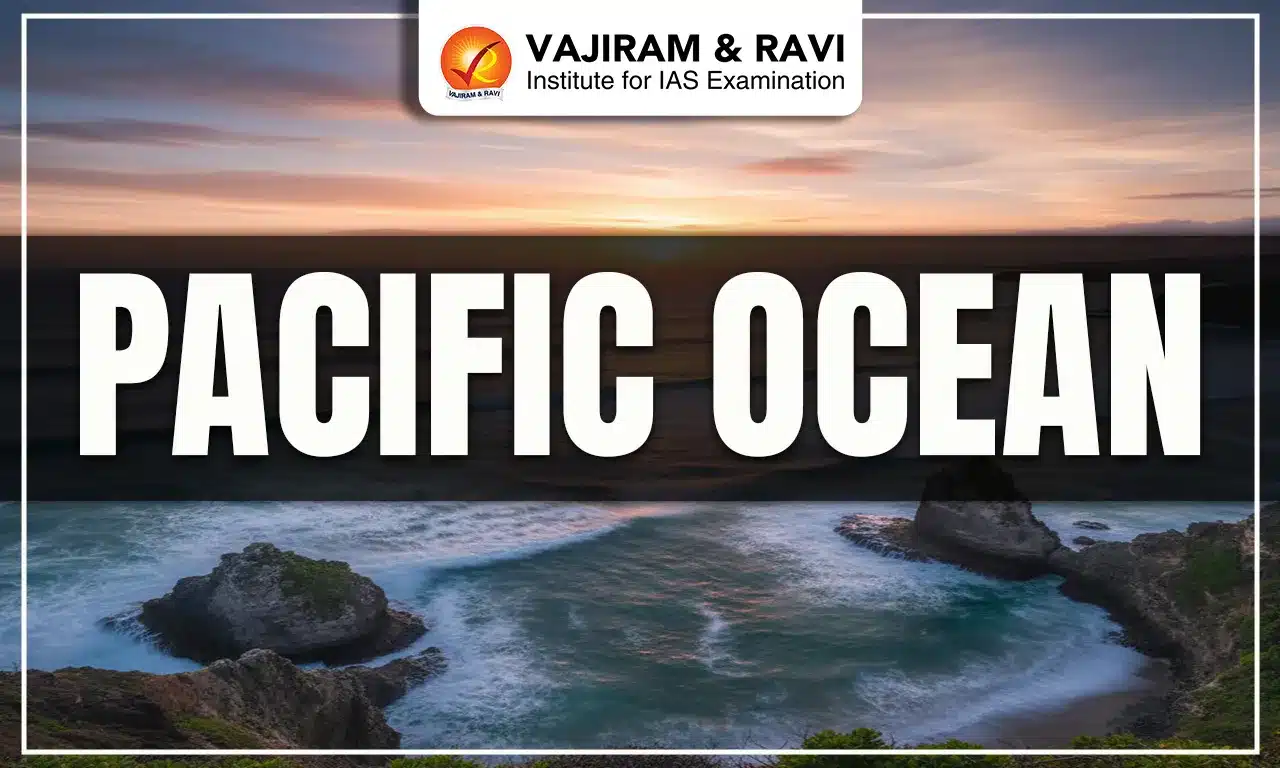
The Pacific Ocean is the Largest and Deepest Ocean on Earth, covering roughly one-third of the planet’s surface. Its average depth is around 7,300 meters, making it the most voluminous of all oceans. The ocean has a roughly triangular shape, with its apex in the north at the Bering Strait. Along its extensive boundaries, the Pacific is dotted with numerous marginal seas, bays, and gulfs, providing diverse marine environments. Nearly 20,000 islands are scattered across the Pacific, contributing to its rich geographical and ecological diversity.

Pacific Ocean

The Pacific Ocean spans both the Western and Southern Hemispheres and is the largest ocean in the world, covering approximately 329 million square kilometers. It is flanked by Asia on the west and the Americas on the east, holding more than half of Earth’s total water. The ocean hosts both warm and cold currents, shaped by the movement of major tectonic plates, including the Pacific Plate drifting northwest toward South America and the North American Plate moving southwest toward Asia. 

This tectonic activity creates regions of varying temperatures across the ocean. The Pacific Ocean is commonly divided into three main sections: the East China Sea, the South China Sea, and the Pacific portion adjoining the Indian Ocean, with the Bering Strait acting as a narrow separation between some of these regions.

Pacific Ocean Features

The Mariana Trench, situated near the Mariana Islands, is the deepest point on Earth, plunging to a depth of 11,034 meters, far deeper than the height of Mount Everest. The Pacific Ocean largely rests on the Pacific Plate, a massive section of the Earth’s crust that slowly moves over the mantle. Surrounding the Pacific Plate are numerous other tectonic plates, and their collisions trigger earthquakes and volcanic activity. This intense tectonic activity has created a ring of volcanoes encircling the Pacific Ocean, famously known as the “Ring of Fire.”

North Pacific Ocean

The North Pacific refers to the portion of the Pacific Ocean basin located north of the equator. It stretches from the eastern coastlines of Asia to the western coasts of North and South America and extends northward toward the Arctic region, encompassing a vast expanse of oceanic waters within the Northern Hemisphere.

South Pacific Ocean

The South Pacific is the largest marine region on Earth, situated in the Southern Hemisphere. It encompasses a vast area that includes Maritime Southeast Asia and the islands of Oceania, such as Melanesia, Micronesia, and Polynesia, and is home to numerous islands and archipelagos spread across its waters.

Pacific Ocean Depth

The Pacific Ocean has an average depth of about 4,280 metres, with its deepest point reaching 11,034 metres in the Mariana Trench, making it the deepest ocean on Earth.

Pacific Ocean Ring of Fire

The Ring of Fire stretches about 40,000 kilometers and is shaped by the movement of several tectonic plates, including the Pacific, Juan de Fuca, Cocos, Indian-Australian, Nazca, North American, and Philippine Plates. It forms a vast horseshoe-shaped zone that runs along the western coasts of North and South America, passes through the Aleutian Islands in Alaska, continues down the eastern coast of Asia, extends to New Zealand, and reaches the northern edge of Antarctica. 

Countries and regions within this zone include Bolivia, Chile, Ecuador, Peru, Costa Rica, Guatemala, Mexico, the United States, Canada, Russia, Japan, the Philippines, Australia, Papua New Guinea, Indonesia, New Zealand, and Antarctica. This area is highly active geologically, known for frequent earthquakes and volcanic eruptions.

Pacific Ocean Islands

The Pacific Ocean contains around 25,000 islands, making it the most island-rich ocean on Earth. These islands are spread across vast distances and are grouped into three major regions: Micronesia, Melanesia, and Polynesia. Micronesia consists of small islands in the western Pacific, Melanesia includes larger islands such as New Guinea, Fiji, and the Solomon Islands, while Polynesia stretches across the central and southern Pacific, covering a wide triangular area with Hawaii, New Zealand, and Easter Island as its corners. These island groups are not only geographically distinct but also culturally diverse.

Pacific Ocean Islands

Name

Region

Sub-region

New Guinea

Oceania

Melanesia

Honshu

Asia

East Asia

Sulawesi

Asia

Southeast Asia

South Island

Oceania

Australasia / Polynesia

North Island

Oceania

Australasia / Polynesia

Luzon

Asia

Southeast Asia

Mindanao

Asia

Southeast Asia

Tasmania

Oceania

Australasia

Hokkaido

Asia

East Asia

Sakhalin

Asia

North Asia

Taiwan Island (Formosa)

Asia

East Asia

Kyushu

Asia

East Asia

New Britain

Oceania

Melanesia

Vancouver Island

North America

Northern America

Shikoku

Asia

East Asia

Grande Terre

Oceania

Melanesia

Palawan

Asia

Southeast Asia

Hawaii

Oceania

Polynesia

Viti Levu

Oceania

Melanesia

Pacific Ocean Countries

The Pacific region is home to a diverse group of island nations and territories, many of which are independent states. Seventeen countries are recognized as part of this vast region: Australia, Fiji, Japan, Kiribati, Marshall Islands, Micronesia, Nauru, New Zealand, Palau, Papua New Guinea, the Philippines, Samoa, Solomon Islands, Taiwan (Republic of China), Tonga, Tuvalu, and Vanuatu. These nations are spread across the Pacific Ocean and are closely connected through their shared geography, maritime traditions, and cultural ties.

Pacific Ocean Deepest Point

The Challenger Deep, located at the southern end of the Mariana Trench, is the deepest known point on Earth. It lies several hundred kilometers southwest of the U.S.-owned island of Guam in the western Pacific Ocean. This part of the trench reaches an astonishing depth of about 10,935 meters (35,876 feet), making it the most extreme point in the world’s oceans and a site of great scientific interest.

Pacific Ocean Mariana Trench

The Mariana Trench, also called the Marianas Trench, is the deepest oceanic trench on Earth, located in the western Pacific Ocean about 200 kilometers east of the Mariana Islands. It is crescent-shaped, stretching about 2,550 kilometers in length and around 69 kilometers in width. This geological feature marks one of the most extreme environments on the planet, both in depth and scale.

Also Check Other Posts
Geomorphology Major Dams in India
Composition and Structure of Atmosphere Major Ports in India
Types of Forests in India Coastal States of India
Ocean Acidification Migration in India
Deep Ocean Mission Natural Vegetation of India

Pacific Ocean FAQs

Q1: In which country is the Pacific Ocean?

Ans: The Pacific Ocean is not in one country; it borders Australia, USA, Japan, China, Canada, Chile, Peru, Philippines, and many Pacific Island nations.

Q2: Where is the Pacific Ocean located?

Ans: The Pacific Ocean lies between Asia and Australia in the west and the Americas in the east, stretching from the Arctic in the north to Antarctica.

Q3: What are the 7 oceans of the world?

Ans: The seven oceans are: Pacific, Atlantic, Indian, Southern, Arctic, Coral, and Southern Indian Ocean (though generally only five are officially recognized).

Q4: Why is the Pacific Ocean so famous?

Ans: The Pacific is famous as the largest ocean, key for global trade, the Ring of Fire, World War history, rich biodiversity, and Pacific islands.

Q5: What is the biggest ocean?

Ans: The Pacific Ocean is the world’s largest, covering about 63 million square miles, holding more than 50% of Earth’s water, and influencing global climate.
Atlantic Ocean, Countries, Location, Area, Deepest Point

Atlantic Ocean

The Atlantic Ocean, the second-largest ocean on Earth, extends from the Northern to the Southern Hemisphere, covering roughly one-fifth of the planet’s surface. Its ocean currents have a profound impact on global climate, particularly shaping the weather patterns of northwestern Europe and northwestern Africa. Beyond climate, these currents support rich marine ecosystems, such as the Grand Banks off Newfoundland, Canada, which remain among the most productive fishing grounds in the world.

Atlantic Ocean

The Atlantic Ocean, a vast body of saltwater covering roughly one-fifth of the Earth’s surface, separates Europe and Africa to the east from North and South America to the west. Its name, derived from Greek mythology, means the “Sea of Atlas.” As the world’s second-largest ocean, it spans about 106.46 million sq.km and has an average depth of 3,646 meters. 

Formed through the westward drift of the American continents due to plate tectonics, the Atlantic has a distinctive S-shaped outline. Its currents, influenced by wind, the Earth’s rotation, sunlight, and water density, play a key role in shaping the climate of northwestern Europe and Africa.

Atlantic Ocean

Size

Second largest Ocean  in the world

Location

Body of water between Africa, Europe, the Arctic Ocean, the Americas, and the Southern Ocean

Area

85.133 million sq km

Coastline Length

111,866 km

Ocean Volume

23.3% of the world

Atlantic Ocean Countries

The Atlantic Ocean comprises several important seas, each bordered by different countries. The table below lists these seas along with the nations that share their coastlines.

Atlantic Ocean Countries

Name of Sea 

Bordering Countries

Argentine Sea

Argentina, Uruguay, Antarctica

Baltic Sea

Sweden, Denmark, Germany, Poland, Lithuania, Latvia, Estonia, Russia, Finland

Black Sea

Bulgaria, Romania, Ukraine, Russia, Georgia, Turkey

Gulf of Mexico

US, Mexico, Cuba

Greenland Sea

Greenland, Iceland, Svalbard (Norway)

Caribbean Sea

Cuba, Jamaica, Dominican Rep, Puerto Rico, Costa Rica, Nicaragua, Guatemala, Honduras Belize, Venezuela, Columbia, Panama

Hudson Bay

Quebec, Ontario, Manitoba, and Nunavut provinces of Canada

Irminger Sea

Iceland, Greenland, Canada

James Bay

Quebec and Ontario provinces of Canada

Labrador Sea

Labrador peninsula of Canada, Greenland

Atlantic Ocean Deepest Point

The Milwaukee Depth is the Atlantic Ocean Deepest Point, reaching a depth of 8,380 meters. It is located approximately 100 miles (160 km) northwest of Puerto Rico and forms part of the Puerto Rico Trench, lying between the North Antillean Arc and the Puerto Rico Ridge.

Atlantic Ocean Water Circulation

The Atlantic Ocean, the World’s Second-Largest Ocean, covers roughly one-fifth of the Earth’s surface and is shaped by prevailing winds and surrounding landmasses. Its currents circulate vast amounts of water, playing a crucial role in regulating the climates of Northwestern Europe and Northwestern Africa. Beyond climate influence, these currents support some of the richest fishing grounds on the planet, such as the Grand Banks off Newfoundland, Canada.

Atlantic Ocean Currents

Atlantic Ocean Currents are continuous, directed movements of seawater influenced by several key factors. Solar heating warms the water, causing it to expand and drive motion. Winds blowing across the ocean surface push the water along, while gravity creates pressure differences that guide flow. 

The Coriolis effect also plays a crucial role, deflecting currents to the right in the Northern Hemisphere and to the left in the Southern Hemisphere. Together, these forces shape the patterns of currents in the Atlantic Ocean.

Equatorial Atlantic Ocean Currents

The equatorial region of the Atlantic Ocean features three major currents, all influenced by the Easterly Trade Winds and the sun’s heating, making them warm currents.

  • North Equatorial Current: This current flows between the equator and 10° N latitude, moving from east to west. It is formed when cold water rises along the west coast of Africa. Upon reaching the mid-Atlantic Ridge near 15° N, it turns north briefly before bending south. Near Brazil’s east coast, the current splits into the Antilles Current and the Caribbean Current.
  • South Atlantic Equatorial Current: Flowing from the west coast of Africa to the east coast of South America between the equator and 20° S, this warm current splits upon reaching Brazil. One branch moves north to join the North Equatorial Current near Trinidad, while the other flows south along South America’s east coast.
  • Counter-Equatorial Current: Situated between the north and south equatorial currents, this current flows eastward and is known as the Guinea Stream. It is warmer and less dense than the surrounding currents, making it a prominent feature of the equatorial Atlantic circulation.

North Atlantic Ocean Currents

In the Northern Hemisphere, the trade winds help maintain steady east-to-west currents, giving rise to several important oceanic flows in the Atlantic Ocean.

  • Gulf Stream: Originating in the Gulf of Mexico around 20° N latitude, the Gulf Stream is a system of interconnected currents flowing northeast along North America’s eastern coast and reaching Western Europe near 70° N. It consists of three main components: the Florida Current (from the Florida Strait to Cape Hatteras), the Gulf Stream proper (Cape Hatteras to Grand Banks), and the North Atlantic Drift (Grand Banks to Western Europe).
  • Canaries Current: This cold current flows southward along the coast of the Canary Islands after turning near Spain. It cools the warm waters off Western Africa between Madeira and Cape Verde and moves at an average speed of 8-30 nautical miles per day.
  • Labrador Current: Flowing from Baffin Bay and Davis Strait near Greenland, the Labrador Current is a cold current along the coasts of Newfoundland and the Grand Banks. It carries icebergs, posing navigation hazards, and meets the warm Gulf Stream near 50° W longitude, resulting in dense fog.

South Atlantic Ocean Currents

In the Southern Hemisphere, the South Atlantic Ocean features a set of major currents that generally mirror the Northern Hemisphere’s flows but in opposite directions.

  • Falkland Current: A cold current originating from the Antarctic Sea, it flows north along the east coast of South America, reaching Argentina. Around 30°S latitude, it is particularly strong and can carry icebergs from Antarctica to the coast.
  • Brazilian Current: Formed when the South Equatorial Current splits at Cape São Roque in Northeast Brazil, this warm current flows south along the east coast of South America up to 40°S latitude. The Westerlies and Earth’s rotation then push it eastward, where it meets the cold Falkland Current.
  • South Atlantic Drift: Also known as the Westerlies Drift or Antarctic Drift, this cold current is the eastward continuation of the Brazilian Current, driven by the Westerlies as it moves south toward the southern tip of Africa.

Benguela Current: When the South Atlantic Drift splits at Africa’s southern tip, the branch flowing up the west coast of South Africa is called the Benguela Current. This cold current eventually merges with the South Equatorial Current, completing the circuit of the South Atlantic currents.

Also Check Other Posts
Geomorphology Major Dams in India
Composition and Structure of Atmosphere Major Ports in India
Types of Forests in India Coastal States of India
Ocean Acidification Migration in India
Deep Ocean Mission Natural Vegetation of India

Atlantic Ocean FAQs

Q1: In which country is the Atlantic Ocean?

Ans: The Atlantic Ocean borders multiple countries, including the USA, UK, Spain, Portugal, Brazil, Argentina, Morocco, and Senegal, spanning North and South America, Europe, and Africa.

Q2: What are the 7 oceans of the world?

Ans: The seven oceans are: Pacific, Atlantic, Indian, Southern (Antarctic), Arctic, Coral, and Southern Indian Ocean. Commonly only five recognized officially.

Q3: Why is the Atlantic Ocean so famous?

Ans: The Atlantic Ocean is famous for trade routes, historical explorations, the Middle Passage, transatlantic shipping, climate influence, and connecting Europe, Africa, and the Americas.

Q4: What 8 countries border the Atlantic Ocean?

Ans: Eight countries bordering the Atlantic include USA, Canada, UK, Spain, Portugal, France, Brazil, and Argentina, among others in Europe, Africa, and South America.

Q5: What is the biggest ocean?

Ans: The Pacific Ocean is the largest, covering over 63 million square miles, connecting Asia, Oceania, and the Americas, and holding more than half of Earth’s water.

Aluminium Ore, Distribution, Advantages, Uses, Significance

Aluminium Ore

Aluminium Ore derived from bauxite, is one of the most abundant, versatile, and strategically important metals in the world. Its production is closely tied to energy availability and raw material reserves, making it a cornerstone of modern industry. For India, bauxite mining and aluminium production are not just industrial activities but also a matter of economic growth, energy planning, and resource management. In this article, we are going to cover Aluminium Ore, its processing, distribution and uses. 

Aluminium Ore

Aluminium, one of the most versatile and widely used metals in the modern world, derives primarily from bauxite ore. Nearly all global aluminium production depends on bauxite, making it a mineral resource of great strategic and economic importance.

Bauxite is not a single mineral but a sedimentary rock composed mainly of aluminium-bearing minerals such as gibbsite, boehmite, and diaspore. It typically forms in tropical and subtropical regions where lateritic soils undergo intense chemical weathering, leading to the leaching of silica and concentration of aluminium oxides. Depending on the presence of iron oxides and impurities, bauxite exhibits colours ranging from white and grey to reddish-brown. With its earthy lustre, low specific gravity (2.0–2.5), and soft texture, it is a distinctive ore of global significance.

Processing of Aluminium from Bauxite

The transformation of bauxite into aluminium is a two-stage industrial process:

  1. Bayer Process: The raw bauxite is first crushed and treated with sodium hydroxide to separate aluminium hydroxide. This is then calcined (heated strongly) to produce alumina (Al₂O₃).
  2. Hall- Héroult Process: The alumina is smelted using electrolytic reduction, requiring enormous amounts of electricity, which makes aluminium one of the most energy-intensive metals to produce.

It takes 6 tonnes of bauxite to produce just 1 tonne of aluminium, reflecting the high raw material requirement of the industry. This also explains why aluminium smelting industries are often located in regions with abundant and cheap hydroelectric power (e.g., Canada).

Aluminium Ore Mining and Industry Challenges

Bauxite, being a bulky raw material, is preferably processed near mining areas to reduce transport costs. Since power costs account for 30–35% of aluminium production expenses, the industry’s viability depends on the availability of cheap electricity.

Globally, aluminium demand is rising by over 1 million tonnes annually, while supply grows only at about 0.5 million tonnes. In India, this imbalance creates a significant challenge, as setting up power-intensive smelters in resource regions is difficult due to infrastructural and environmental constraints.

What is Bauxite?

  • Bauxite is a sedimentary rock with high aluminium content.
  • Appearance is Reddish-brown, grey, or yellow.
  • It is found mainly in tropical and subtropical regions.
  • Bauxite is the primary source for aluminium production.
  • About 90% of global bauxite is refined into alumina.

Global Distribution of Bauxite

The majority of bauxite reserves are concentrated in tropical and subtropical belts.

  • Guinea : World leader in bauxite reserves and exports.
  • Australia: Second-largest producer, with key mines in Weipa, Cape York Peninsula.
  • China: Major consumer and importer for its large aluminium industry.
  • Brazil: Rich deposits in the Amazon basin.
  • USA & CIS countries: Limited reserves, found in Arkansas, Georgia, and the Urals.

Aluminium Ore Distribution in India

India ranks 7th in the world in bauxite reserves and is a major aluminium producer, contributing about 5.3% of global output. Production is highly concentrated in specific states:

  1. Odisha: The leading producer, accounting for over 50% of national output (Kalahandi & Koraput belt). Reserves: 1,370.5 million tonnes.
  2. Jharkhand: About 63.5 million tonnes, with high-grade ore in Lohardaga and Ranchi districts.
  3. Maharashtra: Nearly 10% of total output, mainly from Kolhapur district.
  4. Chhattisgarh: About 6% of production; Maikala ranges and Amarkantak plateau are key areas.
  5. Madhya Pradesh: Deposits in Amarkantak plateau, Maikala range, and Kotni (Jabalpur).

Other reserves exist in Andhra Pradesh, Kerala, Rajasthan, Uttar Pradesh, Jammu & Kashmir, and Goa

Aluminium Ore Advantages

Aluminium is regarded as a strategic metal, second only to iron and steel in industrial importance.

  • Lightweight & corrosion-resistant: Ideal for transportation and construction.
  • Versatile fabrication: Can be cast, machined, extruded, or rolled into foils.
  • Recyclable: Retains its original properties and requires only 5% of the energy compared to primary production.
  • Cost-efficient : Use of recycled aluminium reduces dependency on fresh mining.

Aluminium Ore Uses 

Aluminium Ore is useful in many ways. These include: 

  • Transport: Aircraft, automobiles, ships, and rail coaches.
  • Household & Packaging: Utensils, appliances, and aluminium foils.
  • Infrastructure: Doors, windows, screens, and cladding.
  • Electrical: Good conductor, used in transmission lines.
  • Strategic Applications: Defence, nuclear industries, and aerospace.

Aluminium Industry in India Significance

  • The Aluminium Industry in India is the fastest-growing metal industry. Aluminium consumption has increased almost 20 times in 60 years.
  • The industry helps generate employment for over 800,000 workers and supports 4,000 SMEs.
  • It plays a critical role in India’s industrial economy as a raw material for multiple sectors.
  • The industry is supported by the National Mineral Exploration Trust to ensure raw material security.
Also Check Other Posts
Geomorphology Major Dams in India
Composition and Structure of Atmosphere Major Ports in India
Types of Forests in India Coastal States of India
Ocean Acidification Migration in India
Deep Ocean Mission Natural Vegetation of India

Aluminium Ore FAQs

Q1: What are the three ores of aluminium?

Ans: The three main ores of aluminium are Bauxite, Cryolite, and Corundum.

Q2: Is cryolite an ore of aluminium?

Ans: Yes, cryolite is a minor ore of aluminium, though it is rare in nature.

Q3: What is the ore for aluminium?

Ans: The principal ore of aluminium is Bauxite.

Q4: Which state produces the maximum aluminium ore?

Ans: Odisha produces the maximum aluminium ore (bauxite) in India.

Q5: What is bauxite?

Ans: Bauxite is a sedimentary rock rich in aluminium oxides, and it is the chief ore of aluminium.

Caribbean Sea, Map, Bordering Countries, Location, Climatalogy

Caribbean Sea

The Caribbean Sea is a large tropical sea in the western Atlantic Ocean, southeast of the Gulf of Mexico, surrounded by the coasts of Central and South America and the islands of the Greater and Lesser Antilles. In this article, we are going to cover the Caribbean Sea, its boundaries and islands, climate and significance.

Caribbean Sea

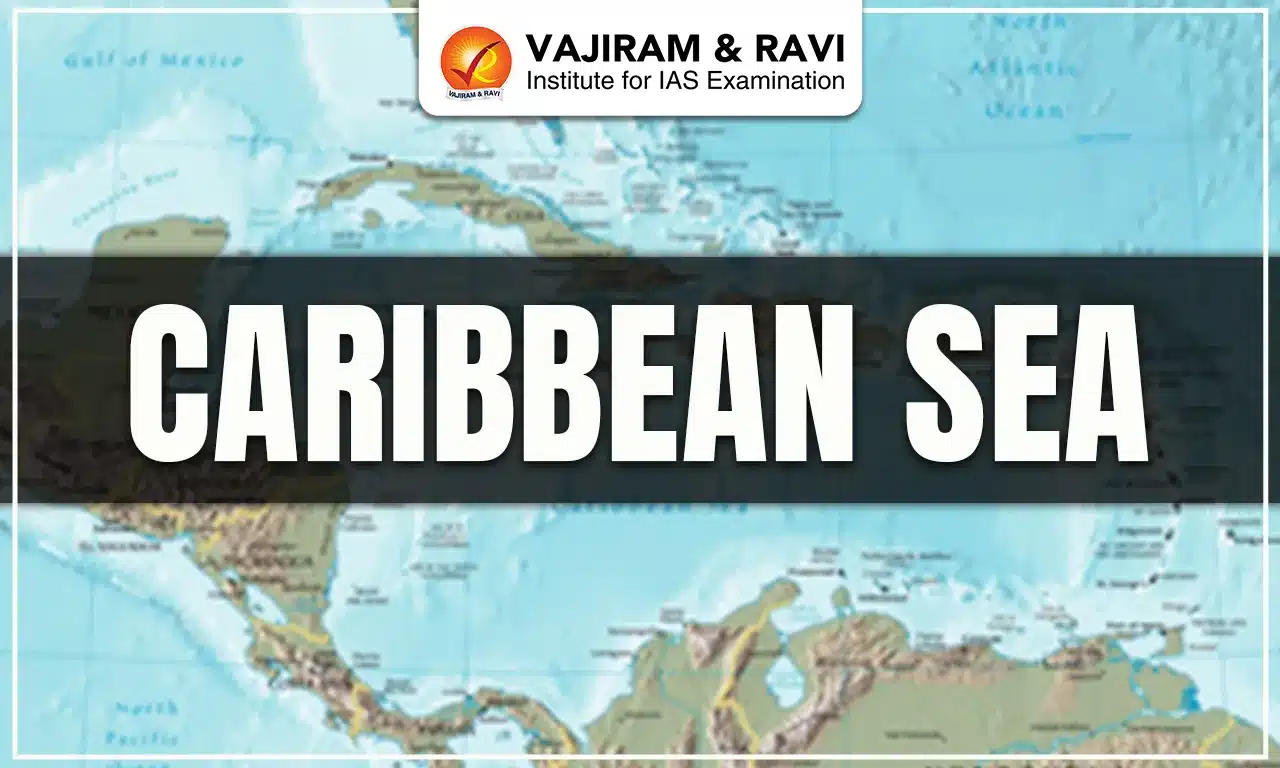
The Caribbean Sea is one of the largest tropical seas in the world, situated in the western Atlantic Ocean, spreading between latitudes 9° and 22° N and longitudes 89° and 60° W. It covers an area of nearly 2,753,000 square kilometers, making it a vital part of the Earth’s marine geography.

  • Southern boundary: Venezuela, Colombia, and Panama.
  • Western boundary: Costa Rica, Nicaragua, Honduras, Guatemala, Belize, and Mexico’s Yucatán Peninsula.
  • Northern boundary: The Greater Antilles, which include Cuba, Hispaniola (Haiti and the Dominican Republic), Jamaica, and Puerto Rico.
  • Eastern boundary: The Lesser Antilles, a chain of smaller islands stretching from the Virgin Islands down to Trinidad and Tobago.

Among these, Jamaica, situated south of Cuba, is the largest island in the Caribbean.

The Caribbean Sea, along with the Gulf of Mexico, is sometimes also called the American Mediterranean, since both are enclosed between major landmasses. However, they differ greatly in their climate, currents, and water characteristics. The Cayman Trench, the deepest part of the Caribbean, plunges to about 7,686 meters below sea level, making it a significant geological feature.

Caribbean Sea on World Map

Positioned southeast of the Gulf of Mexico and forming part of the Atlantic Ocean, the Caribbean Sea holds a crucial spot in the Western Hemisphere. 

[my_image src="https://vajiramandravi.com/current-affairs/wp-content/uploads/2025/09/Caribbean.webp" align="none" size="medium" title="Caribbean Sea on World Map" alt="Caribbean Sea on World Map"]

Caribbean Sea Islands and Boundaries

The Caribbean region is encircled by a diverse set of countries and islands. These islands and boundaries include: 

  • South: Venezuela, Colombia, and Panama.
  • West: Central American nations like Costa Rica, Nicaragua, Honduras, Guatemala, and Belize.
  • North: The Greater Antilles (Cuba, Jamaica, Hispaniola, and Puerto Rico).
  • East: The Lesser Antilles, including territories like Anguilla, a British overseas territory.

Caribbean Sea Importance

The Caribbean Sea is important because of its geography, economy, biodiversity, and culture:

  1. Strategic Location: Acts as a vital maritime route connecting the Atlantic Ocean with the Gulf of Mexico, enabling international trade and naval movements.
  2. Tourism Hub: Known worldwide for its tropical climate, turquoise waters, coral reefs, and white sandy beaches, attracting millions of tourists annually.
  3. Natural Resources: Rich in petroleum, natural gas, and minerals, supporting the economies of several Caribbean nations.
  4. Biodiversity Hotspot: Home to unique marine ecosystems, coral reefs, and rare plant and animal species, contributing to global ecological balance.
  5. Cultural Heritage: A vibrant blend of African, indigenous, and European influences, giving rise to unique music, art, festivals, and cuisines.

Caribbean Sea Climatalogy 

The Caribbean experiences a predominantly tropical climate, but variations occur due to mountains, ocean currents, and trade winds.

  • Rainfall Distribution: Highly uneven: Bonaire receives as little as 25 cm annually, whereas Dominica can get up to 900 cm.
  • Trade Winds: The northeast trade winds are a defining feature, blowing at 16–32 km/h, influencing weather patterns.
  • Hurricanes: The region is highly prone to tropical cyclones (hurricanes), especially from June to November, with peak activity in August–September.
  • Ocean Currents: The North Equatorial Current plays a dominant role in regulating temperatures and climate.
  • Climate Zones:
    • Tropical Rainforest: Found in lowland regions like Costa Rica, Belize, Puerto Rico, and the Dominican Republic.
    • Tropical Savanna/Dry Climate: Seen in Cuba and northern Venezuela, with occasional droughts.
Also Check Other Posts
Geomorphology Major Dams in India
Composition and Structure of Atmosphere Major Ports in India
Types of Forests in India Coastal States of India
Ocean Acidification Migration in India
Deep Ocean Mission Natural Vegetation of India

Caribbean Sea FAQs

Q1: Which country is the Caribbean Sea located in?

Ans: The Caribbean Sea is not in one country but is bordered by multiple countries in Central America, South America, and the Caribbean islands.

Q2: Why is it called the Caribbean Sea?

Ans: It is named after the Carib people, one of the indigenous groups of the region.

Q3: Why is the Caribbean Sea famous?

Ans: The Caribbean Sea is famous for its turquoise waters, tropical islands, rich biodiversity, and tourism.

Q4: Which countries border the Caribbean Sea?

Ans: The Caribbean Sea is bordered by countries like Mexico, Belize, Guatemala, Honduras, Nicaragua, Costa Rica, Panama, Colombia, Venezuela, and island nations such as Cuba, Jamaica, Haiti, Dominican Republic, and Puerto Rico.

Adjusted Gross Revenue, Meaning, Components, Impact

Adjusted Gross Revenue

Adjusted Gross Revenue is the share of revenue that telecom operators in India needed to pay to the Department of Telecommunications as part of their license agreement. It includes earnings from telecom services (like calls, data, SMS, roaming, value-added services) as well as non-telecom revenues like interest income, asset sales, rent and foreign exchange gains to the Department of Telecom Communication. In this article, we are going to cover Adjusted Gross Revenue, its components, supreme court decisions.

Adjusted Gross Revenue 

Adjusted Gross Revenue is the metric used by the Department of Telecommunications in India to calculate the license fee and spectrum usage charges payable by telecom operators. According to the DoT, Adjusted Gross Revenue is not limited to core revenues from telecom services alone; it also includes earnings from non-telecom sources, such as interest from deposits, gains from asset sales, rental income, and dividends.

AGR Supreme Court Verdict (2019)

In October 2019, the Supreme Court of India delivered a landmark judgment upholding the DoT’s definition of Adjusted Gross Revenue. The Court ruled that telecom operators must include non-core revenues in their AGR calculations. Consequently, it directed the companies to pay dues amounting to over ₹1.47 lakh crore including license fees, SUC, accrued interest, penalties, and interest on the penalties. This ruling finally increased the financial liability of telecom operators.

AGR Legal Dispute and Supreme Court Decisions 

The Supreme Court’s verdict on Adjusted Gross Revenue had the following legal implication: 

  • The AGR controversy dates back to the early 2000s when telecom companies challenged the inclusion of non-telecom revenues in AGR, arguing it unfairly inflated their dues.
  • The Supreme Court sided with the DoT’s broader interpretation, thereby increasing the payable dues exponentially.
  • On May 19, 2025, the Supreme Court rejected petitions by Vodafone Idea, Bharti Airtel, and Tata Teleservices seeking waiver of interest and penalties on AGR dues. The Court described these appeals as “misconceived,” reaffirming its strict stance.

Adjusted Gross Revenue Components

Adjusted Gross Revenue has the following components:

  1. Telecom Service Revenues: Includes earnings from call charges, SMS, data services, roaming, interconnection charges, and value-added services.
  2. Non-Telecom Revenues: Covers interest income, dividend earnings, capital gains, rental income, foreign exchange gains, etc.
  3. Exclusions: Certain items, such as GST (if already part of gross revenue) and revenue shared with other service providers (like roaming charges), are excluded.

AGR Financial Impact on Telecom Operators

The Adjusted Gross Revenue had the following impact on telecom operators:

  • Vodafone Idea (Vi): With AGR dues of about ₹58,000 crore, Vi has warned of severe financial distress, stating it may not survive beyond FY 2025–26 without government intervention.
  • Bharti Airtel: Liable for around ₹43,980 crore in AGR dues. Although financially stronger than Vi, Airtel also sought relief, which was denied by the Court.
  • Tata Teleservices: Similarly burdened, facing significant dues that worsen its financial challenges.
  • The AGR dispute has become a turning point in India’s telecom sector. While the government has announced reforms to ease industry-wide financial pressure, the Supreme Court’s uncompromising interpretation of AGR limits the scope for relief. The case highlights the tension between revenue protection for the exchequer and the survival of private telecom players.
Also Check Other Posts
Care Economy Mutual Funds
Alternative Investment Funds GDP Deflator

Adjusted Gross Revenue FAQs

Q1: What is AGR in the telecom industry?

Ans: AGR is the revenue on which Indian telecom operators pay license fees and spectrum usage charges to the government.

Q2: How is AGR calculated?

Ans: AGR is calculated by including all revenue earned by a telecom company, both from telecom services and non-telecom sources like interest, asset sales, and rent.

Q3: What was the financial impact of AGR?

Ans: AGR dues have imposed massive financial burdens on operators, with companies like Vodafone Idea and Bharti Airtel owing tens of thousands of crores.

Q4: What is Adjusted Gross Revenue?

Ans: Adjusted Gross Revenue is the total revenue of a telecom operator, including both core telecom income and non-core earnings, used to determine government dues.

Q5: What are the components of Adjusted Gross Revenue?

Ans: Components include revenue from telecom services (calls, data, SMS, roaming) and non-telecom sources (interest, dividends, asset sales, rent, foreign exchange gains).

Hartog Committee, Primary, Secondary & Higher Education, Impact

Hartog Committee

The Hartog Committee was a committee appointed by the British Indian government in 1929 to study the state of education in India and recommend reforms, with a focus on improving quality, reducing wastage, and prioritizing mass education over higher education. In this article, we are going to cover the Hartog Committee, its objectives and observations and educational reforms. 

Hartog Committee

The Hartog Committee was appointed by the British Indian government to check and improve the standards of education in India. The appointment came during the time when the rapid increase in the number of schools and colleges had not translated into better educational outcomes; instead, they were leading to a visible decline in standards. The Committee submitted its final report in 1929, prioritizing mass education over secondary and higher education, and highlighting the wastage, stagnation, and inefficiency in primary, secondary, and postsecondary education. Its primary aim was to analyze the state of education and recommend reforms to improve quality, access, and efficiency across India.

Hartog Committee Important Insights and Observations

The Hartog Committee took a detailed survey of the Indian education system, analyzing issues at all levels and providing recommendations. These observations included:

  1. Progress in Education: The Committee noted that education in India had progressed significantly. The general populace recognized the importance of education, and enrollment in elementary schools was steadily increasing. The growth reflected a social and political awakening, indicating that education was becoming a national priority.
  2. Rising Social Awareness: Alongside population growth, there was increasing participation in education by women, Muslims, and lower social classes. This suggested that educational awareness was gradually spreading across different sections of society, highlighting the potential for inclusive development through mass education.
  3. Persistent Literacy Challenges: Despite these positive developments, the Committee expressed concern that literacy levels were still low, and many students were leaving school before completing elementary education. The awareness of education’s importance had not yet translated into effective learning outcomes.

Hartog Committee Primary Education Reforms

The Committee focused extensively on primary education, identifying it as the foundation for the entire educational system. It highlighted critical issues such as high dropout rates, poor teaching quality, and inefficient use of resources. For instance, during 1925–26, only 18 out of every 100 students in Class IV could read properly, indicating that much of the investment in primary education was wasted. To address these problems, the Committee proposed the following measures:

  • Reducing exclusive reliance on local governments for managing primary education.
  • Introducing primary education gradually rather than making it immediately compulsory for all children.
  • Increasing the number of elementary school inspectors to ensure quality control.
  • Closing down non-functional primary schools to optimize resources.
  • Ensuring a minimum four-year duration for primary schooling.
  • Incorporating practical courses that would make learning more relevant to students’ lives.
  • Making primary schools centers for village transformation, including adult education programs, recreational activities, and community engagement.
  • Employing qualified and trained teachers to ensure better learning outcomes.
  • Enhancing teacher training, including specialized courses for working educators.
  • Improving teachers’ pay and working conditions to boost morale and effectiveness.
  • Taking steps from the outset to reduce stagnation and wastage within the system.

These recommendations emphasized the need for systematic monitoring and long-term planning, aiming to strengthen primary education as the cornerstone of national literacy and social development.

Hartog Committee Secondary Education Reforms

The Committee also analyzed secondary education and identified high levels of wastage due to excessive matriculation exam failures and slow class progression. Many students were found to be unfit for higher education, yet they continued through the system, consuming resources without acquiring meaningful skills. To address these issues, the Committee recommended:

  • Revising the middle school curriculum to include utilitarian and practical subjects that would benefit students in everyday life.
  • Conducting public examinations at the middle school level, with guidance for students to pursue vocational and technical training based on aptitude.
  • Introducing vocational and technical subjects in the secondary school curriculum to prepare students for employment and practical professions.
  • Designing alternative courses at the high school level to allow students to choose subjects aligned with their interests and abilities.
  • Recruiting trained and competent teachers, establishing appropriate teacher training courses, and offering refresher programs for current teachers.
  • Increasing teachers’ pay, improving working conditions, and ensuring employment security throughout the academic year.

These reforms were intended to reduce inefficiency, improve learning outcomes, and make secondary education more relevant to students’ future careers.

Hartog Committee Higher Education Reforms

While the Hartog Committee praised the growth of affiliated colleges, it criticized declining standards due to indiscriminate admissions, poor learning environments, and lack of focus on quality education. Universities were failing to develop a taste for learning and prepare students for leadership roles in society. Observations included overcrowding, neglect of honors courses, inadequate libraries, and unhealthy competition based on student numbers rather than academic quality. Key recommendations included:

  • Establishing institutions dedicated to research and teaching excellence.
  • Developing libraries, laboratories, and research facilities to support higher learning.

  • Offering honors programs superior in quality to general courses.
  • Introducing industrial and technical education programs to enhance employability.
  • Setting up employment bureaus in universities to guide students toward appropriate job opportunities.
  • Regulating college and university admissions strictly, ensuring that only capable and competent students enroll.

These measures were aimed at improving the quality of higher education, fostering research, and linking academic learning to societal and economic needs.

Hartog Committee Legacy and Impact

  • The Hartog Committee aimed to stabilize and consolidate education during the 1930s, showing that just expansion of educational institutions without attention to quality was wasteful and counterproductive. 
  • Its recommendations were forward-looking and comprehensive, but most were not implemented effectively. 
  • The 1930–31 global economic depression further hindered educational progress, leaving many proposals unfulfilled. 
  • Despite this, the Committee’s work remains significant for its focus on quality, inclusivity, and systematic reform, offering valuable insights into the early challenges and priorities of India’s educational development.
Also Check Other Posts
Battle of Plassey Robert Clive
Battle of Buxar Anglo Mysore Wars
Dual Government in Bengal Tipu Sultan
Anglo Maratha Wars Maratha Empire
Third Battle of Panipat Chhatrapati Shivaji Maharaj
Battel of Bhima Koregaon Anglo Burmese War
Maharaja Ranjit Singh Anglo Nepal War

Hartog Committee FAQs

Q1: What was the aim of the Hartog Committee?

Ans: To review the state of education in India and recommend reforms to improve quality, especially focusing on primary and mass education.

Q2: Who was the chairman of the Hartog Committee in 1929?

Ans: Sir Philip Hartog.

Q3: What was the Commission of 1929?

Ans: It was a body set up to examine educational policies and propose measures to improve standards across India.

Q4: Why was the Hartog Committee established?

Ans: To address the decline in education standards due to the rapid increase in schools and colleges.

Q5: What was the Hunter Commission?

Ans: A commission (1882) set up to study primary education in India and recommend improvements in access, quality, and administration.

UPSC Daily Quiz 26 September 2025

UPSC Daily Quiz

The Daily UPSC Quiz by Vajiram & Ravi is a thoughtfully curated initiative designed to support UPSC aspirants in strengthening their current affairs knowledge and core conceptual understanding. Aligned with the UPSC Syllabus 2025, this daily quiz serves as a revision resource, helping candidates assess their preparation, revise key topics, and stay updated with relevant issues. Whether you are preparing for Prelims or sharpening your revision for Mains, consistent practice with these Daily UPSC Quiz can significantly enhance accuracy, speed, and confidence in solving exam-level questions.

[WpProQuiz 80]  

UPSC Daily Quiz FAQs

Q1: What is the Daily UPSC Quiz?

Ans: The Daily UPSC Quiz is a set of practice questions based on current affairs, static subjects, and PYQs that help aspirants enhance retention and test conceptual clarity regularly.

Q2: How is the Daily Quiz useful for UPSC preparation?

Ans: Daily quizzes support learning, help in revision, improve time management, and boost accuracy for both UPSC Prelims and Mains through consistent practice.

Q3: Are the quiz questions based on the UPSC syllabus?

Ans: Yes, all questions are aligned with the UPSC Syllabus 2025, covering key areas like Polity, Economy, Environment, History, Geography, and Current Affairs.

Q4: Are solutions and explanations provided with the quiz?

Ans: Yes, each quiz includes detailed explanations and source references to enhance conceptual understanding and enable self-assessment.

Q5: Is the Daily UPSC Quiz suitable for both Prelims and Mains?

Ans: Primarily focused on Prelims (MCQ format), but it also indirectly helps in Mains by strengthening subject knowledge and factual clarity.

Difference Between Bail, Parole and Furlough, Definition, Details

Default Image

Bail, Parole and Furlough are important mechanisms in the criminal justice system that allow individuals to be temporarily released from custody under certain conditions. While they all involve release from confinement, each serves a distinct purpose and is governed by different rules and authorities.

Understanding the Difference Between Bail, Parole and Furlough is essential, as they impact the rights of the accused, the rehabilitation of convicts, and the overall functioning of the judicial and correctional systems.

Bail

Bail is a pre-trial release granted to an accused individual while their case is pending in court. It is a conditional measure that allows the person to remain free, but it does not imply innocence or guarantee acquittal. The primary purpose of Bail is to ensure that the accused appears for their court hearings and does not pose a danger to society during the trial process.

Parole

Parole is a conditional release given to an inmate who has served part of their prison sentence, intended both as a reward for good behaviour and as a means to facilitate reintegration into society. Individuals on parole, known as Parolees, remain under supervision and are required to comply with specific conditions, such as regularly reporting to a parole officer, remaining within a designated geographic area, and avoiding any involvement in criminal activity. Failure to adhere to these conditions can result in the revocation of parole and a return to prison.

Furlough

Furlough is a temporary release granted to an inmate for a specific purpose, such as attending a family funeral, visiting a seriously ill family member, or addressing other urgent personal matters. It is typically approved for a short duration, and the inmate is required to return to prison at the end of the Furlough period.

Before granting Furlough, prison authorities consider factors such as the reason for the request, the inmate’s behavior and conduct in prison, and the risk of escape. If an inmate violates the terms of the furlough, they may face consequences including denial of future furloughs, disciplinary action within the prison, and in some cases, an extension of their sentence.

Difference Between Bail, Parole and Furlough

Bail, Parole and Furlough are all mechanisms that allow a person to be temporarily released from custody, but they serve different purposes, have different eligibility criteria, and are granted by different authorities. Understanding their distinctions is important for grasping how the criminal justice system balances the rights of the individual with public safety.

Difference Between Bail, Parole and Furlough

Aspect

Furlough

Parole

Bail

Definition

Short-term, temporary release from prison granted to convicts as a reformative measure.

Conditional release from prison before the completion of a sentence, on the promise of good behaviour.

Temporary release of an accused person awaiting trial, usually on condition of a security being given.

Purpose

To maintain family ties and help prisoners adjust to life outside prison.

To rehabilitate or reintegrate prisoners into society, often for long-term inmates.

To ensure the accused’s appearance in court while allowing them to live normally until trial.

Eligibility

Generally for convicts with good conduct and long sentences; not usually for serious crimes.

Usually for long-term prisoners with good conduct; not for serious offences like murder or rape.

Available to most accused persons, except in cases of serious crimes or if considered a flight risk.

Duration

Short-term, usually a few days to weeks.

Longer than furlough, can be extended depending on circumstances.

Lasts until trial concludes or bail conditions are revoked or modified.

Granting Authority

Prison authorities.

Prison authorities or the court, depending on jurisdiction.

Court.

Conditions

Reporting to a police station, staying in a specified area, returning to prison on time.

Regular reporting to police, avoiding illegal activities, sometimes restricted movement.

Regular court appearances, no criminal activity, possible travel restrictions or house arrest.

Legal Nature

Administrative measure under prison rules.

Mix of administrative and legal oversight.

Judicial process and a fundamental legal right.

Also Check Related Articles
Difference between NITI Aayog and Inter-State Council Difference Between Economic Survey and Union Budget
Difference Between Tropical Evergreen and Tropical Deciduous Forests Difference Between Ordinary Bill and Money Bill
Difference Between Legislative and Executive Difference between Himalayan and Peninsular Plateau
Difference Between Vedas and Upanishads Difference Between Scheduled and Non-Scheduled Banks
Difference Between Written and Unwritten Constitution Difference between NITI Aayog and Planning Commission
Difference between Colonialism and Imperialism Difference between Fundamental Rights and Directive Principles of State Policy
Difference between Procedure Established by Law and Due Process of Law Difference Between Democracy and Republic
Difference between Creamy Layer and Non-Creamy Layer of OBC Difference between Rajya Sabha and Vidhan Sabha
Difference Between Western Ghats and Eastern Ghats

Difference Between Bail, Parole and Furlough FAQs

Q1: What is the difference between parole and furlough?

Ans: Parole is early conditional release after serving part of a sentence. Furlough is temporary leave from prison for personal reasons, not reducing the sentence.

Q2: What is the difference between bail and parole?

Ans: Bail is temporary pre-trial release to appear in court. Parole is conditional release after conviction, granted by authorities based on behavior and rehabilitation.

Q3: What is furlough in jail?

Ans: Furlough is a short-term leave from prison for emergencies, family functions, or personal reasons, usually without reducing the prison term.

Q4: How many times can furlough be given?

Ans: Furlough frequency varies by state and prison rules, generally granted once or twice a year, depending on behavior and necessity.

Q5: Who grants parole and furlough?

Ans: Parole and furlough are granted by the State Government or Prison Authorities, following legal provisions and prison manuals.

Khoe-San

Khoe-San

Khoe-San Latest News

Recently, a new genetic study published in the Cell Press journal reveals that European colonisation strongly altered the genetic ancestry of the indigenous Khoe-San peoples of southern Africa.

About Khoe-San

  • Khoe-San is a collective term for the indigenous peoples of southern Africa, encompassing:
    • San (Bushmen): Hunter-gatherers.
    • Khoekhoe (Khoi): Cattle, goat, and sheep pastoralists.
  • They represent one of the earliest divergent human lineages, with exceptionally high genetic diversity.
  • The research highlights sex-biased migration, where European male settlers displaced Khoe-San men, while Khoe-San women contributed significantly to present-day genetic lineages.
  • The study also shows the impact of the slave trade, where enslaved women from South Asia, Southeast Asia, Eastern Africa, and Madagascar were brought to the Cape by the Dutch East India Company (VOC).

Historical Interactions

  • ~2,000 years ago: Eastern African pastoralists and Bantu-speaking agro-pastoralists arrived, influencing and displacing many Khoe-San groups.
  • Last 1,500 years: Bantu-speaking groups largely replaced or assimilated Khoe-San populations in eastern South Africa.
  • 1652 onwards: Dutch East India Company (VOC) established Cape Town; European settlers arrived in waves over 250 years.
  • Slave Trade (1652–1808): VOC enslaved ~63,000 people from Africa and Asia, mostly women, reshaping genetic ancestry.
  • Indigenous Khoe-San were also recruited as labourers.

Source: DTE

Khoe-San FAQs

Q1: Who are the Khoe-San?

Ans: The Khoe-San are indigenous peoples of southern Africa, comprising San (hunter-gatherers) and Khoekhoe (pastoralists), known for their high genetic diversity and status as one of the earliest human lineages.

Q2: Why are Khoe-San significant in human history?

Ans: They represent the earliest divergence among human populations, making them crucial for understanding human origins, genetic diversity, and early migration patterns.

BRICS

BRICS

BRICS Latest News

The Indian Prime Minister recently met the Russian Deputy Prime Minister to discuss establishing a BRICS Grain Exchange to enhance agricultural trade among member countries.

About BRICS

  • The acronym ‘BRIC’ was coined by Jim O’Neill (Goldman Sachs economist) in 2001 to denote four emerging economies – Brazil, Russia, India, and China.
  • BRIC held its first meeting in 2006 during the G8 Outreach Summit and its first standalone summit in Russia in 2009.
  • With the inclusion of South Africa in 2010, BRIC became BRICS.
  • In 2024, Iran, Egypt, the UAE, and Ethiopia joined.
  • In 2025, Indonesia joined as a full member.
  • Saudi Arabia has not formalised its membership, while Argentina opted out despite initial plans to join.

Membership (2025)

  • Core Members (10): Brazil, Russia, India, China, South Africa, Iran, Egypt, UAE, Ethiopia, Indonesia.
  • Partner Countries (11): Belarus, Bolivia, Kazakhstan, Cuba, Nigeria, Malaysia, Thailand, Vietnam, Uganda, Uzbekistan.

Source: TH

BRICS FAQs

Q1: What is BRICS?

Ans: BRICS is an intergovernmental forum of major emerging economies, Brazil, Russia, India, China, and South Africa, expanded in 2024–25 to include Iran, UAE, Egypt, Ethiopia, and Indonesia.

Q2: When and how did BRICS come into existence?

Ans: The concept was coined in 2001 by Jim O’Neill. It became a formal grouping in 2006, held its first summit in 2009, and expanded to BRICS with South Africa’s inclusion in 2010.

Q3: What are the major institutions created by BRICS?

Ans: The New Development Bank (NDB, 2014) and Contingent Reserve Arrangement (CRA) are two flagship institutions. Other initiatives include the BRICS Grain Exchange (2025, proposed) and STI Framework Programme (2015).

SQUAD Grouping of USA, Background, Members, Objectives, Challenges

SQUAD Grouping of USA

The Squad is an informal security grouping consisting of the United States, Japan, Australia, and the Philippines. Its purpose is to enhance cooperation on maritime security, intelligence sharing, joint military drills, and regional deterrence against rising challenges, especially China’s assertive behavior in contested maritime zones.

The group first met in mid-2023, during the Shangri-La Dialogue in Singapore. In April 2024, the Squad nations carried out joint maritime patrols in the Philippine’s exclusive economic zone, reflecting operational cooperation.

One of the important motivations is countering China’s increasing presence and influence in the South China Sea. The Philippines, in particular, sees the alliance as a way to strengthen its defense posture. There are ongoing discussions about possibly expanding the Squad to include India and South Korea to broaden its strategic weight.

SQUAD Grouping of USA

The SQUAD Grouping of USA is an informal military partnership comprising the United States, Australia, Japan, and the Philippines. Its primary aim is to enhance security cooperation through intelligence sharing, joint military drills, and coordinated operations, particularly to counterbalance China’s growing influence in the Indo-Pacific region.

Since 2023, the four nations have carried out joint maritime operations within the Philippines’ Exclusive Economic Zone (EEZ) in the South China Sea. These exercises focus on improving interoperability, strengthening maritime security, and asserting freedom of navigation in contested waters.

India’s Relationship with the SQUAD Alliance

  • Not a Formal Member: India is not part of the SQUAD alliance, which includes the US, Japan, Australia, and the Philippines.
  • Shared Strategic Objectives: Despite not being in the grouping, India aligns with its core goals, countering China’s assertiveness and maintaining a rules-based Indo-Pacific order.
  • Intersection with the Quad: India plays a leading role in the Quadrilateral Security Dialogue (Quad), which overlaps with SQUAD’s objectives of ensuring a free, open, and inclusive Indo-Pacific.
  • Strong Bilateral Relations: India maintains close defence and strategic partnerships with all SQUAD members through joint exercises, dialogues, and intelligence-sharing.
  • Strategic Autonomy: Guided by its non-aligned principles, India avoids formal military blocs, prioritising independent decision-making in foreign policy.
  • Broader Regional Engagement: Beyond Indo-Pacific security, India focuses on connectivity, economic cooperation, and maritime security in the Indian Ocean region.
  • Selective Collaboration: While not a member, India engages with SQUAD Grouping of USA on specific issues of mutual interest through trilateral dialogues and joint exercises.

SQUAD Grouping of USA Background

  • Expanding Presence: China’s growing influence and military footprint in the Indo-Pacific has raised concerns for regional security.
  • South China Sea Disputes: The South China Sea has become a major flashpoint, with Beijing’s territorial claims and militarisation sparking tensions with neighbouring states.
  • Strategic Response: The “Squad” alliance (US, Japan, Australia, and the Philippines) emerged as a coordinated effort to counterbalance China’s assertiveness.
  • Objective: Its core aim is to maintain regional stability, safeguard maritime routes, and uphold international law in the Indo-Pacific.

SQUAD Grouping of USA Members

The “Squad” alliance brings together four countries, United States, Japan, Australia, and the Philippines each contributing distinct strengths to balance China’s growing presence in the Indo-Pacific. The table below highlights their roles and motivations.

SQUAD Grouping of USA Members

Country

Role and Contribution

United States

Leading member with strong military and diplomatic influence. Focused on protecting the rules-based order and ensuring freedom of navigation in the Indo-Pacific.

Japan

Close US ally with advanced military technology and strategic location. Concerned about China’s maritime assertiveness and committed to regional security initiatives.

Australia

Strategic partner with key interests in maritime stability. Its geographic proximity to the South China Sea strengthens its ability to counterbalance China.

Philippines

Recently strengthened ties with Western allies under President Marcos Jr. Its firm position on territorial disputes in the South China Sea supports the alliance’s objectives.

SQUAD Grouping of USA Objectives

The “Squad” alliance focuses on strengthening collective security and maintaining a stable balance of power in the Indo-Pacific. Its core objectives include:

  • Promoting peace, stability, and deterrence in the Indo-Pacific region.
  • Enhancing military interoperability by conducting joint patrols and exercises to address evolving security challenges.
  • Bolstering intelligence-sharing and maritime cooperation to safeguard critical sea lanes and deter assertive actions.

SQUAD Grouping of USA Challenges

  • China’s Opposition: Beijing perceives the alliance as an attempt to contain its rise, which could intensify regional tensions and trigger stronger countermeasures in the South China Sea.
  • Divergent Member Interests: While the members share common concerns, differing strategic priorities, similar to the frictions occasionally seen within the Quad, may limit the alliance’s long-term cohesion and effectiveness.

SQUAD Grouping of USA Implications

  • Reshaping the Indo-Pacific Order: The rise of the “Squad” marks a shift in the regional balance of power, reinforcing collective security efforts in response to China’s assertiveness.
  • US-China Rivalry: It underscores the deepening contest between a US-led coalition and China for strategic dominance in the Indo-Pacific.

Broader Implications: Beyond security, the alliance influences global trade routes, maritime freedom, and economic stability, making it a key factor in international relations.

Also Check Other Posts
India Pakistan Relations India China Relations
Shanghai Cooperation Organisation QUAD Countries
BRICS

SQUAD Grouping of USA FAQs

Q1: Who are the members of the Squad grouping?

Ans: In the US Congress context, “The Squad” includes progressive Democratic Representatives: Alexandria Ocasio-Cortez, Ilhan Omar, Ayanna Pressley, Rashida Tlaib.

Q2: Who are the US Squad members?

Ans: The US “Squad” (Congressional) members are: Alexandria Ocasio-Cortez, Ilhan Omar, Ayanna Pressley, Rashida Tlaib, Greg Casar, Summer Lee, and Delia Ramirez.

Q3: What is “squad” in America?

Ans: In American politics, “The Squad” is a nickname for a group of progressive Democratic House Representatives who advocate left-leaning policies and increased accountability.

Q4: How many countries are there in Squad?

Ans: In the Indo-Pacific “Squad” sense (security group), there are 4 countries: US, Japan, Australia, and Philippines.

Q5: Which country will host QUAD 2025?

Ans: India will host the Quad Leader’s Summit in 2025.

Nightmare Bacteria

Nightmare Bacteria

Nightmare Bacteria Latest News

According to scientists at the US Centers for Disease Control and Prevention (CDC), drug-resistant ‘nightmare bacteria’ driven by the NDM gene are spreading faster than ever in the United States.

About Nightmare Bacteria

  • The term “nightmare bacteria” is used to describe Carbapenem-resistant Enterobacteriaceae (CRE).
  • This group of bacteria, which includes Klebsiella pneumoniae and Escherichia coli (E. coli), has developed resistance to carbapenems (a class of “last-resort” antibiotics usually reserved for severe infections).
  • The CDC calls them “nightmare” because they: Spread resistance genes easily to other bacteria. Cause deadly infections in the bloodstream, lungs, or urinary tract.
  • Do not respond to most antibiotics, making treatment difficult.

Symptoms of Nightmare Bacteria infections

  • Urinary tract infections: Feeling a burning sensation, a constant urge to urinate or ‘cloudy’ urine
  • Bloodstream infections: High fever, rapid heartbeat or very low blood pressure
  • Pneumonia or lung infection: Cough, shortness of breath or chest pain.

What is the NDM-1 gene?

  • NDM-1 (New Delhi Metallo-beta-lactamase-1) is an enzyme that makes bacteria resistant to a wide range of powerful antibiotics.
  • The gene for NDM-1 encodes beta-lactamase enzymes called carbapenemases, which makes bacteria resistant to antibiotics, including carbapenem, which is used to treat other superbugs such as methicillin-resistant Staphyloccus aureus (MRSA).

Source: FE

Nightmare Bacteria FAQs

Q1: What is a common characteristic of Nightmare Bacteria?

Ans: They are resistant to multiple antibiotics

Q2: What are Bacteria?

Ans: These are microscopic single-celled prokaryotic organisms that play a crucial role in the ecosystem and have a significant impact on human health.

Mahendragiri Hills

Mahendragiri Hills

Mahendragiri Hills Latest News

Recently, environmentalists warn of unchecked tourism projects in Odisha’s Mahendragiri hills

About Mahendragiri Hills

  • Location: It is located in the Gajapati district of Odisha in the middle of Eastern Ghats.
  • It was declared as a Biodiversity Heritage Site in 2022 due to its rich flora and fauna.
  • It is part of an almost unbroken chain of hills between the Mahanadi and the Godavari rivers.
  • It is situated amongst the Eastern Ghats at an elevation of 1,501 metres above sea level.
  • Tribal Communities: It is home to the Saora (Saura) and Kondh tribes.
  • Biodiversity: It supports 1,348 species of plants and 388 species of animals, many of them endemic and threatened.
  • Rivers: The major river in the area is the Mahendra Tanaya, originating from the hill top of Mahendragiri.
  • Vegetation: The vegetation of the region is marked with the presence of tropical dry and wet deciduous forest range.
  • The principal rock types of the hill range are granite, charnokite, khondalite with intrusive veins of chert, chalcedony, quartz of both crystalline and opec forms.
  • The site also attracts pilgrims to its Panchpandava temples.

Source: DTE

Mahendragiri Hills FAQs

Q1: Where is Mahendragiri Hills located?

Ans: Odisha

Q2: Which river originates from Mahendragiri Hills?

Ans: Mahendratanaya River

Forum for India-Pacific Islands Cooperation

Forum for India-Pacific Islands Cooperation

Forum for India-Pacific Islands Cooperation Latest News

Recently, Indian External Affairs hosted a meeting of the foreign ministers of the Forum for India-Pacific Islands Cooperation (FIPIC) in New York. 

About Forum for India-Pacific Islands Cooperation

  • It is a multilateral platform established by India to enhance cooperation with the Pacific Island countries.
  • It was established in 2014 during the Prime Minister of India’s visit to Fiji
  • Member countries: FIPIC includes 14 of the island countries – Cook Islands, Fiji, Kiribati, Marshall Islands, Micronesia, Nauru, Niue, Palau, Papua New Guinea, Samoa, Solomon Islands, Tonga, Tuvalu, and Vanuatu.
  • In line with the "Act East Policy", through FIPIC, India has primarily focused its efforts on the Pacific Islands.
  • Economic Cooperation: · At this moment, total annual trade of about $300 million between the Indian and Pacific Island countries, whereas exports are around $200 million and imports are around $100 million.
  • FIPIC Summits held: Since 2014 three FIPIC summits have been held, 1st 2014 (Suva, Fiji), 2nd 2015 (Jaipur, India), 3rd 2023 (Port Moresby, Papua New Guinea).

Key Initiatives of India related to FIPIC

  • Setting up of a special USD one million fund for adapting to climate change and clean energy, establishing a trade office in India,
  • Pan Pacific Islands e-network to improve digital connectivity,
  • Visa on arrival at Indian airports for all the 14 Pacific Island countries,
  • Cooperation in space technology applications for improving the quality of life of the islands, and training to diplomats from Pacific Island countries.

Source: News On Air

Forum for India-Pacific Islands Cooperation FAQs

Q1: Where was the first FIPIC summit held?

Ans: Suva, Fiji

Q2: What is the purpose of the Pacific island Forum?

Ans: The Pacific Islands Forum brings the region together to address pressing issues and challenges, and foster collaboration and cooperation in the pursuit of shared goals.

UNEP Young Champions of the Earth Prize

UNEP Young Champions of the Earth Prize

UNEP Young Champions of the Earth Prize Latest News

Recently, three entrepreneurs from India, Kenya and the United States have been awarded the UN Environment Programme’s 2025 Young Champions of the Earth prize.

About UNEP Young Champions of the Earth Prize

  • It is the UN Environment Programme’s flagship initiative on youth engagement.
  • It was established in 2017, relaunched in 2025 in partnership with Planet A.
  • Eligibility: The annual prize recognises individuals under 30 for pioneering solutions to the planet’s most pressing environmental challenges.
  • Prize money: Each winner receives $20,000 in seed funding, mentoring and access to a global platform to scale their ideas.
  • The 2025 Young Champions of the Earth are:
    • Jinali Mody (India):  Founded Banofi Leather, which produces leather alternatives made from banana crop waste. This reduces water use, toxic waste, and CO₂ emissions.
    • Joseph Nguthiru (Kenya):  Started HyaPak company converts the invasive species hyacinth in Lake Naivasha into packaging bags and biodegradable seedling wrappers.
    • Noemi Florea (US):  She has founded Cycleau, a compact water reuse system, in consultation with dozens of marginalized communities. The company transforms greywater into drinking water.

What is the UN Environment Programme?

  • UNEP is the leading global voice on the environment founded in 1972, 
  • It has served as a neutral convener of Member States, civil society, the private sector and UN agencies to address humanity’s most pressing environmental challenges.

 Source: DTE

UNEP Young Champions of the Earth Prize FAQs

Q1: What is the UNEP Champions of the Earth award?

Ans: It is an annual awards programme to recognize outstanding environmental leaders from the public and private sectors and from civil society.

Q2: What is the highest award in UNEP?

Ans: The Champions of the Earth award

Adriatic Sea, Location, Countries, Depth, Climate, Importance

Adriatic Sea

The Adriatic Sea is the northernmost arm of the Mediterranean Sea, stretching from the Strait of Otranto in the southeast to the Po Valley in the northwest, and lies between the Italian Peninsula and the Balkan Peninsula. In this article, we are going to cover the Adriatic Sea, its basins, islands and climate.

Adriatic Sea

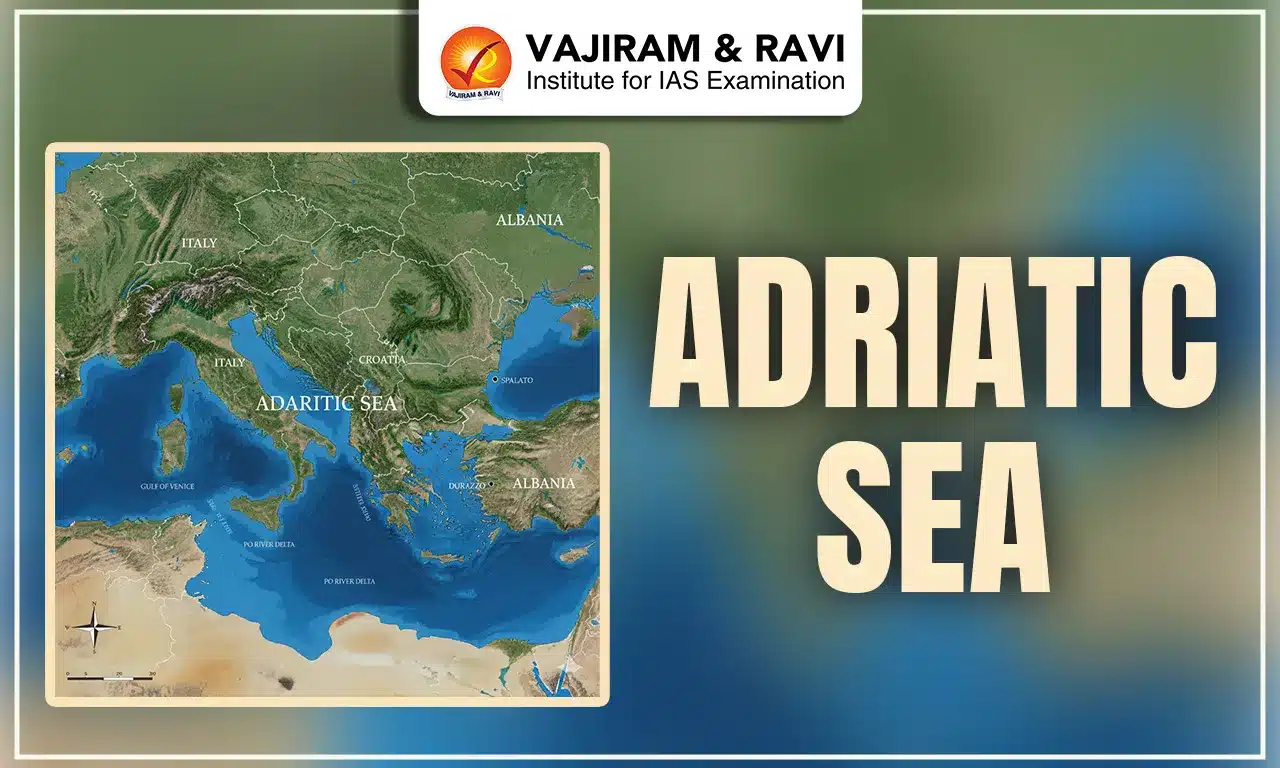
The Adriatic Sea is a marginal sea of the Mediterranean, known for its rich cultural history, economic importance, and diverse ecological features. It stretches from the Strait of Otranto in the southeast, linking it to the Ionian Sea, up to the Po Valley in the northwest. This makes the Adriatic the northernmost arm of the Mediterranean Sea. Geographically, it acts as a natural divider between the Italian Peninsula on the west and the Balkan Peninsula on the east.

The Strait of Otranto, only about 72 km wide, is the narrow southern gateway of the Adriatic, connecting it directly to the Ionian Sea. Around its coasts, the sea borders six modern nations: Italy, Slovenia, Croatia, Bosnia and Herzegovina, Montenegro, and Albania. Furthermore, the Adriatic is dotted with around 1300 islands and islets, the vast majority of which are located along the eastern coastline, especially in Croatia.

Adriatic Sea Basins

The Adriatic Sea is divided into three main basins, each with distinct geographical and oceanographic features:

  • The Northern Basin: This is the shallowest, with depths averaging only 40-45 meters, making it highly influenced by river inflows and coastal processes.
  • The Middle Basin: Slightly deeper, it acts as a transitional area between the shallow north and the deep south.
  • The Southern Basin: This is the deepest part, reaching a maximum depth of about 1233 meters. 

Adriatic Sea Features

  • A significant underwater ridge known as the Otranto Sill plays an important role by regulating water exchange between the Adriatic and the Ionian Seas. 
  • The Adriatic Sea has lower salinity levels compared to the rest of the Mediterranean because it receives almost one-third of the total freshwater inflow into the entire Mediterranean basin.
  • Many important rivers contribute to this freshwater input, including the Po, Soča, Krka, Neretva, Bojana, Drin, and Vjosë.
  • These rivers not only maintain the hydrological balance but also enrich the basin with sediments and nutrients, supporting vibrant marine ecosystems.

Adriatic Sea Bordering Countries and Geographical Location

The Adriatic Sea lies at the heart of Southern Europe, bordered by six countries:

  • Italy to the west
  • Slovenia
  • Croatia
  • Bosnia
  • Herzegovina
  • Montenegro
  • Albania along the eastern coast
  • At its southernmost end, the Strait of Otranto separates Albania’s Salento Peninsula from the “boot-shaped” Italian Peninsula. 
  • South of this strait lies the Ionian Sea, thereby placing the Adriatic within the broader Mediterranean marine system.
  • The Adriatic is known by different names in local languages, such as Mare Adriatico in Italian, Jadransko More in Croatian, Bosnian, and Montenegrin, and Deti i Adriatikut in Albanian.

Adriatic Sea Islands

The Adriatic Sea is known for its islands over 1300 in total, most concentrated along the Croatian coast. Out of these, 1246 islands, islets, and rocks belong to Croatia.

  • The largest islands are Cres and Krk, each covering an area of approximately 406 square kilometers.
  • The tallest island is Brač, with its highest point, Vidova Gora, reaching 780 meters above sea level.
  • Lošinj Island is separated from Cres by a narrow canal; in ancient times, the Greeks referred to Cres as Apsyrtides.
  • Of these islands, 47 are permanently inhabited, with Krk, Korčula, and Brač hosting the largest populations. 
  • On the western side, Italy’s Adriatic islands are fewer and smaller, although historically significant Venice itself was famously built on 117 islands.
  • According to the International Hydrographic Organization (IHO), the northern boundary of the Adriatic is marked at the Greek island of Corfu.

Adriatic Sea Climate

The Adriatic Sea experiences many climatic conditions due to its latitudinal stretch.

  • Southern Adriatic: Has a hot-summer Mediterranean climate, with dry summers and mild, wet winters.
  • Northern and Upper Adriatic: Has a humid subtropical climate, with wetter summers and colder winters compared to the south.
  • Temperature variations can reach up to 20°C between seasons, and the sea is also shaped by two dominant winds:
    • The Bora Winds: A cold, dry, and often violent wind blowing from the northeast, most intense near Trieste, Senj, and Split. Wind gusts can reach up to 180 km/h, making it one of the strongest winds in Europe.
    • The Sirocco Winds: A warm, humid wind that carries Saharan dust across the sea, often resulting in rain mixed with sand particles, affecting visibility and weather conditions.

Adriatic Sea Economic and Cultural Importance

The Adriatic Sea has served as a major maritime route, allowing trade, cultural exchange, and strategic naval importance since ancient times. It plays an important role in the economies of bordering nations through:

  • Tourism: Famous coastal cities like Dubrovnik, Split, Venice, and Trieste attract millions of visitors each year.
  • Fisheries: The nutrient-rich waters support diverse marine life, forming the backbone of local fishing industries.
  • Maritime Transport: Many ports along the Adriatic serve as important hubs for international trade.
Also Check Other Posts
Geomorphology Major Dams in India
Composition and Structure of Atmosphere Major Ports in India
Types of Forests in India Coastal States of India
Ocean Acidification Migration in India
Deep Ocean Mission Natural Vegetation of India

Adriatic Sea FAQs

Q1: Which country has the Adriatic Sea?

Ans: The Adriatic Sea borders Italy, Slovenia, Croatia, Bosnia and Herzegovina, Montenegro, and Albania.

Q2: What is special about the Adriatic Sea?

Ans: The Adriatic Sea is unique for its low salinity, over 1,300 islands, and as a major link between Central Europe and the Mediterranean.

Q3: Is the Adriatic Sea warm or cold?

Ans: The Adriatic Sea is generally warm in summer and mild in winter, with regional variations in temperature.

Q4: What are the bordering countries of the Adriatic Sea?

Ans: The countries bordering the Adriatic Sea are Italy, Slovenia, Croatia, Bosnia and Herzegovina, Montenegro, and Albania.

Daily Editorial Analysis 26 September 2025

Daily Editorial Analysis

Eight States with International Borders, 0.13% of Exports

Context

  • When the United States imposed a 25% tariff hike on Indian imports in August 2025, New Delhi’s response was predictable: muted rhetoric, quiet diplomacy, and no open retaliation.
  • This familiar choreography, Washington striking, India absorbing, was framed as another episode in turbulent bilateral ties.
  • Yet beneath the surface, these tariffs revealed not merely a dispute between two capitals, but deeper structural weaknesses within India’s own economic geography.

The Geography of Export Concentration

  • India’s export economy is far from evenly distributed.
  • Four states, Gujarat, Maharashtra, Tamil Nadu, and Karnataka, dominate, accounting for over 70% of merchandise exports, with Gujarat alone contributing more than 33%.
  • This dominance is no accident; it reflects decades of infrastructure development, policy incentives, and political continuity concentrated in these zones.
  • In contrast, the populous heartland states of Uttar Pradesh, Bihar, and Madhya Pradesh together muster barely 5% of outbound trade, underscoring the stark disparities in India’s export geography.

The Marginalisation of the Northeast

  • Nowhere is this imbalance more evident than in the northeast, a region of eight states sharing 5,400 kilometres of international borders but contributing just 0.13% to national exports.
  • The exclusion is not accidental; it is structural.
  • There are no operational trade corridors linking the northeast to global markets, no logistical infrastructure capable of supporting volume, and no institutional presence in national trade policymaking bodies.
  • Flagship export schemes, such as the Remission of Duties and Taxes on Exported Products (RoDTEP) and the Production-Linked Incentive (PLI), are implemented in industrial belts of western and southern India.
  • While the northeast remains symbolically embraced but economically orphaned.
  • Even the Directorate General of Foreign Trade’s 2024 strategic export plan omitted the region entirely, a silence that elicited no protest, as if its exclusion were natural.
  • The consequences are tangible. Assam’s tea industry, responsible for more than half of India’s tea output, remains vulnerable due to low value-addition and dependence on bulk CTC-grade auctions.

Borders as Bottlenecks

  • The northeast’s trade potential has also been crippled by its borders.
  • India’s once-promising gateways to Myanmar, Zokhawthar in Mizoram and Moreh in Manipur, have withered into securitised outposts.
  • Since Myanmar’s 2021 coup, cross-border trade has thinned, infrastructure has stagnated, and the 2024 scrapping of the Free Movement Regime severed not only commerce but also kinship economies.
  • Instead of functioning as bridges to the Association of Southeast Asian Nations (ASEAN), these frontiers have become grids of containment.
  • Goods do not flow; troops do. Roads exist largely on paper, customs offices are understaffed, and logistical facilities are absent.
  • China, meanwhile, consolidates its foothold in northern Myanmar through investments and alliances, outpacing India’s rhetoric of Act East with hard infrastructure.

Broader Implication and the Way Forward

  • Broader Implication: Asia Moves, India Hesitates

    • This paralysis contrasts starkly with the dynamism elsewhere in Asia.
    • China and Southeast Asia are actively repositioning capital, building corridors, and restructuring supply chains to adapt to global shifts.
    • India, by contrast, negotiates trade agreements with Western powers while leaving its eastern frontier disconnected from the substance of global commerce.
    • The assumption that trade can remain tethered to colonial-era ports and post-independence clusters ignores geography and undercuts resilience.
    • Without integrating the northeast into national and regional trade frameworks, India undermines its claim to Indo-Pacific centrality.
  • The Way Forward: Toward a Cohesive Economy

    • Trump’s tariffs will not, on their own, derail India’s economy. But they expose the fragility of an export model concentrated in a few enclaves while neglecting entire regions.
    • A cohesive national economy requires dispersion of capacity, not dependence; infrastructure that connects peripheries, not just coasts; and governance that recognises geography, not just electoral arithmetic.
    • The northeast does not demand slogans. It needs the minimum grammar of statecraft: roads that connect to markets, policies that incorporate its geographies, and representation in institutions that shape trade strategy.
    • For decades, it has been asked to wait, through insurgencies, ceasefires, and empty acronyms, while the world reconfigures its trade flows. Delay now resembles design.

Conclusion

  • India cannot claim regional heft while its eastern flank remains economically brittle.
  • Tariffs may be episodic, but the structural omission of the northeast corrodes the promise of a cohesive economy.
  • Resilience must be reframed: not as the strength of a few export hubs, but as the capacity of the entire country to absorb shocks and participate in global trade.
  • Until then, India’s blind spot remains intact, and its ambitions in the Indo-Pacific rest on shaky foundations.

Eight States with International Borders, 0.13% of Exports FAQs

Q1. What structural weakness did the U.S. tariffs of 2025 expose in India’s economy?
Ans. The tariffs exposed India’s overdependence on a few coastal states for exports and the neglect of regions like the northeast in national trade strategies.

Q2. Which four states dominate India’s export economy, and why?
Ans. Gujarat, Maharashtra, Tamil Nadu, and Karnataka dominate India’s exports because they have long benefited from strong infrastructure, policy incentives, and political stability.

Q3. Why does the northeast contribute so little to India’s exports?
Ans. The northeast contributes little because it lacks trade corridors, logistical infrastructure, institutional representation, and policies tailored to its geographic realities.

Q4. How has the India-Myanmar border shifted from a trade gateway to a bottleneck?
Ans. The India-Myanmar border has become a bottleneck due to militarisation, poor infrastructure, and the suspension of the Free Movement Regime, which replaced commerce with surveillance.

Q5. What key steps are recommended to make India’s trade economy more resilient?
Ans. India should diversify export geography, build infrastructure in the northeast, reorient border policy, invest in value addition, ensure institutional representation, and complete strategic trade corridors with ASEAN.

Source: The Hindu


The Saudi-Pakistan Deal Upends India’s Strategic Thought

Context

  • The recent announcement of a Strategic Mutual Defence Agreement between Pakistan and Saudi Arabia has sent ripples across the subcontinent, particularly in India.
  • At the core of the agreement lies a clause that treats aggression against one party as an attack on both, a formulation that echoes collective defence commitments.
  • While such rhetoric has historical precedent in bilateral pacts, the timing, context, and wider geopolitical realignments have lent this deal far greater significance than a routine defence partnership.
  • For India, which has invested heavily in deepening its engagement with West Asia over the past decade, the development underscores both the fragility of its strategic balancing act and the risks of complacency in an era of shifting alliances.

India’s Diplomatic Setback Post-Pahalgam Attack

  • The agreement comes in the wake of the April 2025 terror attack in Pahalgam, Jammu and Kashmir, which triggered the most intense military confrontation between India and Pakistan since the 1971 war.
  • New Delhi responded with a concerted diplomatic campaign to isolate Pakistan internationally, alongside the launch of Operation Sindoor, aimed at striking terrorist camps within Pakistani territory.
  • Yet, these efforts have yielded mixed results. While India received sympathy and support from some partners, its attempt to impose a diplomatic quarantine on Islamabad faltered.
  • The Saudi-Pakistan pact, emerging amidst these tensions, represents a symbolic diplomatic victory for Islamabad and a clear rebuke of India’s efforts to delegitimise its neighbour on the world stage.

Riyadh’s Balancing Act and Historical Context

  • The move is not unprecedented and Saudi Arabia has long relied on Pakistan’s military as a source of strategic depth, given Islamabad’s extensive combat experience, largely against India, and its possession of nuclear weapons.
  • The relationship, however, has not always been smooth. In 2015, Pakistan refused Riyadh’s request to contribute troops to its Yemen campaign, straining ties significantly.
  • Today, with Washington perceived as a less reliable security partner and with regional tensions heightened by conflicts such as the Israel-Hamas war of 2023 and the 12-day war between Israel and Iran, Riyadh appears to be recalibrating its security partnerships.
  • The renewed embrace of Islamabad can be read as a return to tradition: a pragmatic convergence of Sunni solidarity, shared ideological roots, and hard-nosed military calculus.

Geopolitical Reverberations Beyond South Asia

  • While the immediate impact of the pact is felt in South Asia, its deeper resonance lies in West Asia’s evolving strategic order.
  • Since 2023, the region has been marked by volatility, with shifting alliances and new power equations emerging amid ongoing conflicts.
  • Riyadh’s decision to bind itself closer to Islamabad must be seen through its pursuit of strategic autonomy, multipolarity, and multi-alignment, principles that India too espouses in its foreign policy.
  • Yet, as Saudi Arabia’s choices demonstrate, these goals do not always align neatly with Indian interest
  • Instead, they may place New Delhi and Riyadh on opposing sides of regional fault lines.

Implications for India’s Strategic Thought

  • For India, the pact is not an existential threat, but it is a warning sign.
  • It underscores that New Delhi’s engagement with West Asia, despite its visible expansion, cannot erase the deep-rooted ideological and religious bonds that tie Pakistan to Arab states.
  • More crucially, it exposes the limits of India’s risk-averse strategic culture. By clinging to an idealised self-image as a cautious, pacifist power, India risks falling behind in a rapidly transforming global order.
  • The Pakistan-Saudi deal is less about military commitments and more about the symbolism of unity, the leveraging of disruptions in the global system, and the opportunism of weaker powers to punch above their weight

Conclusion

  • It continues Riyadh’s long tradition of engaging Islamabad as a security partner, while simultaneously rupturing India’s narrative of having diplomatically cornered Pakistan.
  • More broadly, it reflects the fragmentation of the post-Cold War order into a multipolar and unstable configuration where alignments are fluid, and symbolism often outweighs substance. For India, the lesson is sobering. I
  • If New Delhi fails to shed its strategic hesitation and embrace the risks inherent in great power politics, it risks ceding space to rivals who are more adept at exploiting global disorder.

The Saudi-Pakistan Deal Upends India’s Strategic Thought

Q1. What is the central concern for India regarding the Saudi-Pakistan defence pact?
Ans. India is concerned that the pact strengthens Pakistan’s diplomatic position and challenges India’s security interests, especially after the Pahalgam terror attack.

Q2. Why is Saudi Arabia renewing its security ties with Pakistan?
Ans. Saudi Arabia is renewing ties because it views Pakistan’s military experience and nuclear capability as vital for its security, particularly as U.S. reliability in the region declines.

Q3. How does this agreement reflect broader geopolitical changes in West Asia?
Ans. The agreement reflects Saudi Arabia’s pursuit of strategic autonomy, multipolarity, and multialignment in a rapidly changing regional order.

Q4. What limitation of India’s foreign policy does the pact highlight?
Ans. The pact highlights India’s culturally risk-averse strategic thought and its reluctance to embrace bold, power-driven policies.

Q5. What is the key lesson for India from this development?
Ans. The key lesson for India is that it must act with greater resolve and adaptability in global politics, or risk losing influence to rivals who exploit instability more effectively.

Source: The Hindu

Daily Editorial Analysis 26 September 2025 FAQs

Q1: What is editorial analysis?

Ans: Editorial analysis is the critical examination and interpretation of newspaper editorials to extract key insights, arguments, and perspectives relevant to UPSC preparation.

Q2: What is an editorial analyst?

Ans: An editorial analyst is someone who studies and breaks down editorials to highlight their relevance, structure, and usefulness for competitive exams like the UPSC.

Q3: What is an editorial for UPSC?

Ans: For UPSC, an editorial refers to opinion-based articles in reputed newspapers that provide analysis on current affairs, governance, policy, and socio-economic issues.

Q4: What are the sources of UPSC Editorial Analysis?

Ans: Key sources include editorials from The Hindu and Indian Express.

Q5: Can Editorial Analysis help in Mains Answer Writing?

Ans: Yes, editorial analysis enhances content quality, analytical depth, and structure in Mains answer writing.

Foreign Contribution Regulation Act (FCRA)

Foreign Contribution Regulation Act

Foreign Contribution Regulation Act (FCRA) Latest News

Recently, the Union Home Ministry revoked the FCRA licence of the Students Educational and Cultural Movement of Ladakh (SECMOL), founded by climate activist Sonam Wangchuk.

About the Foreign Contribution Regulation Act (FCRA)

  • The Foreign Contribution (Regulation) Act (FCRA) was originally enacted in 1976 during the Emergency to prevent foreign influence on India’s internal affairs through financial contributions.
  • The FCRA, 2010, currently in force, regulates the acceptance and utilisation of foreign funds by individuals, associations, and companies in India.
  • Its primary objective is to ensure that foreign donations do not compromise national sovereignty, integrity, or internal security, and are used only for legitimate developmental purposes.

Amendments to FCRA

FCRA (Amendment), 2010

  • Consolidated the 1976 law.
  • Expanded coverage to associations, NGOs, and companies.
  • Strengthened the regulatory framework.

FCRA (Amendment), 2020  Key Changes

  • Ban on Transfers: Prohibits NGOs from transferring foreign contributions to other NGOs or individuals.
  • Mandatory Aadhaar: All office bearers must provide Aadhaar/passport/OCI details for registration.
  • FCRA Account: All contributions must be received only in the designated SBI branch, New Delhi.
  • Reduced Administrative Expenses: Limit cut from 50% to 20% of foreign funds.
  • Renewal of Licence: Renewal contingent on government scrutiny for fictitious entities or misuse.
  • Suspension Extension: Suspension of registration can last up to 360 days.
  • Surrender Provision: Organisations can voluntarily surrender their FCRA licence, subject to approval.
  • Bar on Public Servants: Public servants are prohibited from receiving foreign contributions.

FCRA Rules (Amendment), 2022

  • Increased the annual limit for foreign remittances from relatives abroad from ₹1 lakh to ₹10 lakh without prior intimation.
  • Simplified compliance for smaller transactions but reinforced safeguards against foreign funds that may threaten national interests.

Categories under FCRA

  • Prohibited Recipients: Candidates for elections, journalists, media houses, judges, government servants, members of legislatures, political parties, and organisations of political nature.
  • Permitted Use: NGOs, educational, cultural, economic, and social associations, provided they comply with regulations.
  • Validity: Registration valid for 5 years, renewable upon application at least 6 months before expiry.

Source: TH

Foreign Contribution Regulation Act (FCRA) FAQs

Q1: What is the FCRA?

Ans: The Foreign Contribution Regulation Act (FCRA) is a law enacted to regulate the acceptance and use of foreign contributions by individuals, NGOs, and organisations, ensuring they are used for lawful purposes without harming national interests.

Q2: Can the government cancel an FCRA licence?

Ans: Yes. The MHA can cancel or suspend an organisation’s licence if it finds violations such as misuse of funds, a threat to sovereignty, or poor compliance with FCRA provisions.

Q3: Under which Ministry does FCRA fall?

Ans: The FCRA is administered by the Ministry of Home Affairs (MHA), Government of India.

Agni-Prime Missile

Agni-Prime Missile

Agni-Prime Missile Latest News

DRDO in collaboration with the Strategic Forces Command (SFC), has carried out the successful launch of Intermediate Range Agni-Prime Missile from a Rail based Mobile launcher system.

About Agni-Prime Missile

  • Agni-P is a new generation nuclear-capable medium-range ballistic missile (MRBM).
  • Agni Prime Ballistic Missile was tested for the first time in June 2021. It is lighter than any of the previous Agni missiles.
  • Features of Agni-Prime Missile
    • It is a two-stage canisterised solid propellant ballistic missile.
    • This is a surface-to-surface ballistic missile
    • Range: 1000 to 2000 km.
    • Payload: Around 1,000 Kg (It can carry high explosive, thermobaric or nuclear warheads).
    • It incorporates upgrades such as propulsion systems, composite rocket motor casings, and advanced navigation and guidance systems.
    • Agni-Prime may be launched by train or road and stored for an extended period of time.
  • Thus far, only Russia, the US, China, and possibly North Korea had the capability of launching long range ballistic missiles from rail-based platforms.
  • Rail-based mobile launcher is a first-of-its-kind capability for India.
    • This launcher can seamlessly move across the rail network without any preconditions and offers cross-country mobility.
    • It is designed to deliver a quick reaction time, operate with reduced visibility, and is self-sustained with independent launch features
    • It also comes fitted with advanced communication systems and robust protection mechanisms, ensuring reliability even in high-threat environments.

Source: PIB

Agni-Prime Missile FAQs

Q1: Who developed the Agni-Prime missile?

Ans: Defence Research and Development Organisation

Q2: What is Agni-Prime missile?

Ans: Medium-range nuclear-capable ballistic missile

Pallikaranai Marshland

Pallikaranai Marshland

Pallikaranai Marshland Latest News

Recently, the southern bench of the National Green Tribunal has ordered a halt on all construction activity within one kilometre of the Pallikaranai Marshland until a scientific study is conducted.

About Pallikaranai Marshland

  • Location: It is a freshwater marsh and partly saline wetland situated about 20 kilometres south of the city of Chennai, Tamil Nadu.
  • It serves as an aquatic buffer of the flood-prone Chennai and Chengalpattu districts.
  • It encompasses 65 wetlands, through two outlets, viz., Okkiyam Madavu and the Kovalam Creek, and falls into the Bay of Bengal.
  • On its eastern periphery, the Marsh is flanked by the Buckingham Canal.
  • It is one of the Ramsar sites in India.
  • Fauna
    • The diverse ecosystem of the marshland supports some 115 bird species, ten mammals, 21 reptiles, ten amphibians, 46 fish, nine molluscs, five crustaceans, and seven butterfly species.
    • These include notable species such as Russell’s viper (Daboia siamensis) and birds such as the glossy ibis (Plegadis falcinellus), grey-headed lapwings (Vanellus cinereus), and Pheasant-tailed jacana (Hydrophasianus chirurgus).
  • Although tropical in bio-climate, the influence of the Bay of Bengal has been significant on the Marsh.
  • Threats: It continues to face significant anthropogenic pressures, including encroachments and sewage discharge.

Source: TH

Pallikaranai Marshland FAQs

Q1: Where is Pallikaranai Marshland located?

Ans: Tamil Nadu

Q2: What is a Ramsar site?

Ans: Ramsar Sites are wetlands of international importance designated under the Convention on Wetlands.

India Successfully Tests Agni-Prime Missile from Rail-Based Launcher | Strategic Significance Explained

Agni-Prime Missile

Agni-Prime Missile Latest News

  • The Defence Research and Development Organisation (DRDO) successfully test-fired the Agni-Prime (Agni-P) missile from a rail-based mobile launcher
  • This launch has placed India among a select group of nations — Russia, the US, China, and possibly North Korea — with the capability to launch long-range ballistic missiles from railway platforms using canisterised launch systems.

Agni Series of Missiles

  • The Agni series is India’s family of nuclear-capable ballistic missiles, developed under the Integrated Guided Missile Development Programme (IGMDP) by the Defence Research and Development Organisation (DRDO). 
  • They are a key element of India’s strategic deterrence capability.
  • Agni-I (1989): A medium-range ballistic missile (MRBM) with a range of 700–1,000 km. It was India’s first in the series and is road- and rail-mobile.
  • Agni-II (1999): A two-stage solid-fuel missile with a range of 2,000–3,000 km, capable of carrying nuclear warheads.
  • Agni-III (2006): An intermediate-range ballistic missile (IRBM) with a range of 3,500–5,000 km, providing wider regional coverage.
  • Agni-IV (2011): Improved navigation and accuracy, range of 3,500–4,000 km, lighter and more advanced than Agni-III.
  • Agni-V (2012): An intercontinental ballistic missile (ICBM) with a range of 5,000–8,000 km, extending India’s deterrence to cover much of Asia and parts of Europe and Africa.
  • Agni-P (Agni-Prime, 2021): A next-generation variant with a range of 1,000–2,000 km, combining advanced technologies from Agni-IV and V, lighter, more accurate, and canisterised.
  • Agni-VI (under development): Expected range of 8,000–10,000 km, with potential multiple independently targetable re-entry vehicle (MIRV) capability.

Agni-P: The Next-Generation Upgrade to Agni-I

  • India’s Agni missile series, developed since the late 1980s, began with the Agni-I medium range ballistic missile (700–1,000 km range) tested in 1989. 
  • While Agni-I remains in service, defence planners sought upgrades, leading to the development of Agni-P (Agni-Prime).
  • Agni-P combines Agni-I’s range with advanced propulsion and navigation technologies from Agni-IV and Agni-V.
    • It is the sixth missile in the Agni series. 
  • Weighing 11,000 kg, it is a two-stage, solid-fuel missile with an operational range of 1,000–2,000 km, capable of carrying high explosive, thermobaric, or nuclear warheads.
  • A nuclear-capable version tested in 2021 drew praise from the then Defence Minister, who said it would further bolster India’s Credible Deterrence capabilities.

Mobile Launch Platforms and India’s Second-Strike Capability

  • Mobile launch systems are vital to a nation’s second-strike capability, enabling it to retaliate after a nuclear attack. 
  • For India, which follows a “no first use” nuclear doctrine, such survivability is critical.
  • Advances in satellite imagery, missile accuracy, and sensing technologies have made stationary silos increasingly vulnerable. 
  • As noted by defence experts, silos face heightened risks from both conventional and nuclear strikes.
  • To counter this, militaries rely on mobile launch platforms — submarines, aircraft, and road or rail-based launchers — which are harder to detect and more resilient in an all-out conflict.

Advantages of Rail-Based Missile Launchers

  • Rail-based missile platforms offer distinct advantages over road or sea systems. 
  • While road-based launchers are constrained by road width and quality, India’s 70,000-km railway network enables nationwide mobility without major preparation.
  • The numerous railway tunnels provide natural hiding spots, allowing launchers to evade enemy satellite surveillance and remain concealed until deployment.
  • Compared to submarine-launched ballistic missiles (SLBMs), rail-based platforms are also cheaper to build and maintain, making them a more efficient and scalable option for strengthening strategic deterrence.

Countries with Rail-Based Missile Technology

  • India’s recent test places it among a select group of nations with rail-based missile launch capability. 
  • The idea dates back to the Cold War, when both the US and USSR explored rail-mobile ICBMs.
  • The US studied rail launchers for its Minuteman ICBMs in the 1950s and again planned Peacekeeper deployment in the 1980s, but abandoned both due to cost and the Soviet collapse. 
  • The Soviet Union successfully deployed the RT-23 Molodets rail-based ICBM system, later dismantled under the START Treaty
    • Russia later considered reviving the concept with the Barguzin system but shelved it in favour of hypersonic missile development.
  • In 2016, China reportedly tested a rail-mobile version of its DF-41 ICBM. 
  • North Korea has also tested rail-based short-range ballistic missiles (SRBMs), demonstrating their mobility and survivability.
  • Experts note that rail-based missiles are a cheap, reliable option for enhancing nuclear force survivability, with Russia pioneering it, the US considering it, and North Korea actively pursuing it.

Source: IE | FP | PIB

Agni-Prime Missile FAQs

Q1: What is the Agni-Prime missile?

Ans: Agni-Prime is a two-stage, solid-fuel ballistic missile with a 1,000–2,000 km range, carrying nuclear or conventional warheads.

Q2: Why is the Agni-Prime test significant?

Ans: It marks India’s entry into the select group of nations capable of rail-based missile launches, enhancing survivability and deterrence.

Q3: How does a rail-based launcher help India?

Ans: Rail-based platforms provide mobility, concealment in tunnels, and lower costs compared to submarine-based missile systems, strengthening second-strike capability.

Q4: Which countries have rail-based missile technology?

Ans: Russia, the US, China, and North Korea have developed or tested such systems, with India now joining this elite group.

Q5: What role does Agni-Prime play in India’s nuclear doctrine?

Ans: It supports India’s “no first use” policy by ensuring survivability and credible second-strike deterrence against adversaries.

India’s Urban Blind Spot: Why Outdated Census Definitions Must Change

India Urban Definition

India Urban Definition Latest News

  • The Registrar General of India has proposed retaining the 2011 Census definition of urban areas for Census 2027, ensuring comparability and consistency in analysing urbanisation trends.

Criteria for Urban Classification

  • In 2011, an urban unit was defined as either:
    • Statutory Towns – formally notified by State governments with urban local bodies such as municipal corporations, municipal councils, or nagar panchayats.
    • Census Towns – settlements meeting three conditions:
      • Population of at least 5,000
      • At least 75% of the male main working population engaged in non-agricultural activities
      • Population density of at least 400 persons per sq. km
  • By these criteria, only 31.2% of India is considered urban, though the actual extent is believed to be much higher.
  • Though census towns are administratively rural, they function like urban areas, creating a gap between governance and ground realities.

Global Comparisons

  • Unlike India’s strict three-criteria approach, most countries rely on one or two measures such as demographics, density, or infrastructure. 
  • The World Bank’s Agglomeration Index estimated that 55.3% of India’s population lived in urban-like areas in 2010, showing “hidden urbanisation” outside statutory limits.

DEGURBA: A Global Framework

  • To harmonise global urban definitions, six international organisations developed the Degree of Urbanisation (DEGURBA) method, endorsed by the UN in 2020.
    • It uses satellite imagery and population grids of 1 km².
    • Settlements are classified into seven sub-categories: urban centres, dense/semi-dense clusters, peri-urban, and various rural categories.
  • This approach captures the real spatial extent of urbanisation beyond administrative boundaries.
  • DEGURBA helps detect settlement patterns, improve service monitoring, and guide financial targeting. 
  • However, its low-density thresholds may misclassify croplands or peri-urban fringes as urban. 
  • As it relies on algorithms and satellite data, risks of under- or over-detection remain.

Limitations of Current Urban Definition

  • India’s binary definition of urban and rural fails to capture the complex realities of evolving settlements. 
  • While urban local bodies enjoy autonomy and better governance, Panchayati Raj institutions are limited, leaving many fast-urbanising areas under inadequate rural administration. 
  • Villages transforming into towns often remain unrecognised, despite dense populations, non-agricultural livelihoods, and urban lifestyles. 
  • As a result, census towns and peri-urban regions are excluded from proper governance and infrastructure, creating gaps in planning and services. 
  • For example, Census data show that 251 towns identified as urban in 2001 continued to be governed as rural areas even in 2011. 
  • West Bengal, with the highest rise in census towns, illustrates this mismatch, as many newly classified urban settlements were never converted into statutory towns with elected bodies, leaving them underprepared for infrastructure and planning needs.

Implications of Outdated Urban Definition

  • As India prepares for Census 2027, retaining the old definition of “urban” risks undercounting millions and excluding rapidly growing settlements from governance and services. 
  • Studies show India’s true urban population in 2011 may have been 35–57%, much higher than the official 31%. 
  • The rigid rules — such as the 75% male workforce engaged in non-agricultural jobs — are outdated, ignoring women’s informal work and the rise of industries, service jobs, and gig economy employment in semi-urban and rural areas. 
  • Many settlements that function as urban clusters remain unrecognised because they fall outside municipal boundaries or are divided administratively. 
  • Seasonal workers who straddle agriculture and urban jobs also fall through the cracks. 
  • Thus, continuing with the narrow, binary definition will misclassify urbanisation trends, leaving infrastructure, planning, and services ill-suited to India’s evolving settlement patterns.

Source: TH | TH | WRI

India Urban Definition FAQs

Q1: What is India’s current definition of urban?

Ans: Urban areas include statutory towns and census towns meeting criteria of 5,000 population, 400 density, and 75% male non-agricultural workforce.

Q2: Why is this definition outdated?

Ans: It ignores women’s work, gig economy jobs, and peri-urban clusters, misclassifying millions living in urban-like conditions.

Q3: How much of India is truly urbanised?

Ans: Though officially 31.2% in 2011, alternative studies suggest India’s urban population could be 35–57% using modern criteria.

Q4: What is DEGURBA and why is it important?

Ans: DEGURBA is a UN-backed framework using satellite data and population grids, offering nuanced classification beyond binary rural-urban definitions.

Q5: What are the risks of not updating India’s urban definition?

Ans: Misclassification leads to poor planning, misallocation of funds, and exclusion of settlements from governance and infrastructure services.

Regulation of Social Media – Karnataka High Court on Sahyog Portal

Regulation of Social Media

Regulation of Social Media Latest News

  • The Karnataka High Court rejected social media platform X’s plea against the Central Government’s Sahyog Portal - a digital mechanism to issue content takedown notices.
  • The Court upheld the State’s right to regulate social media, calling Sahyog an “instrument of public good” and a “beacon of cooperation” between citizens, state, and platforms.
  • The Court stressed that social media platforms cannot operate in a state of “anarchic freedom.”

Sahyog Portal - A Public Good

  • Launched: October 2024 by the Union Home Ministry, and maintained by the Indian Cyber Crime Coordination Centre (I4C).
  • Purpose: A centralised channel (which connects central agencies, state police, and online intermediaries to combat cybercrime) for issuing takedown notices to intermediaries.
  • Legal basis: Section 79(3)(b), IT Act, 2000 – intermediaries lose “safe harbour protection” if they fail to act upon government notices of unlawful content.
  • Operational data:
    • 65 intermediaries and nodal officers onboarded by April 2025.
    • 130 takedown notices issued (Oct 2024 – Apr 2025) to platforms including Google, YouTube, Amazon, Microsoft.

X Corporation’s Challenge

  • Claim: Sahyog is a “censorship portal” creating a parallel, extra-legal content blocking regime.
  • Arguments:
    • Section 79(3)(b) notices bypass stricter procedural safeguards under Section 69A IT Act. Unlike Section 69A, notices under Section 79(3)(b) lack transparency, hearing, and written reasoning.
    • Violates Shreya Singhal (2015) judgment, in which the apex court had specified that a takedown order under Section 79(3)(b) -
      • Could only be issued pursuant to a court order or a government notification and 
      • Must relate to grounds similar to those in Section 69A.
    • State governments and police issuing notices via Sahyog expands censorship arbitrarily.
  • Support: Supporting X’s challenge, Digipub (collective of 92 digital publishers) argued that blocking orders through Sahyog threatens media freedom.

Government’s Defence

  • Necessity: Social media requires stricter regulation due to algorithmic amplification and rapid spread of harmful content.
  • ‘Safe harbour’ is not absolute: It is a statutory privilege conditional upon due diligence.
  • Separation of powers: Section 79(3)(b) and Section 69A operate independently.
    • Section 79(3)(b): Failure to comply results in loss of safe harbour.
    • Section 69A: Blocking power on grounds of sovereignty, security, public order.
  • Efficiency: Sahyog is an efficient, transparent mechanism to expedite unlawful content removal.
  • X Corp - a foreign entity: Hence, it cannot invoke Article 19 rights (available only to Indian citizens).

High Court’s Ruling

  • The judgment outlined three red lines for social media companies - 
    • Social media cannot remain unregulated.
    • Companies must comply with the laws of the land.
    • Past precedents like Shreya Singhal (2015) cannot be used to interpret new regulatory frameworks under IT Rules 2021.

Key Legal Issues Touched upon by the HC

  • Need for regulation:
    • The spread of information has always been regulated across civilizations.
    • Social media as a “modern amphitheater of ideas” cannot exist in anarchic freedom.
    • Regulation is essential, especially for offences against women to safeguard the constitutional right to dignity.
    • Regulation of social media is not unique to India, it is a global practice.
  • Law of the Land - India is not a playground:
    • Platforms cannot operate in India while ignoring its statutory framework.
    • Liberty is tied to responsibility and accountability.
    • X complies with the Take It Down Act in the US but refuses to follow similar takedown orders in India.
    • American legal principles cannot be transplanted into the Indian constitutional framework.
  • Shreya Singhal not applicable - New law, new interpretation:
    • X argued that the 2015 Shreya Singhal judgment allowed censorship only via courts or under Section 69A, IT Act.
    • Court held -
      • Shreya Singhal judgment applied to the 2011 IT Rules (now obsolete).
      • The 2021 IT Rules are distinct, requiring a new interpretative lens.
  • Precedents cannot bind evolving regulatory regimes.
  • Extent of Article 19 of the Indian Constitution: It applies only to Indian citizens; X, as a foreign corporation, cannot claim these protections.

Implications of the HC Ruling

  • For intermediaries: Non-compliance with Sahyog notices may result in the loss of safe harbour protection - establishing legal liability.
  • Digital governance: Shows India’s move towards platform accountability.
  • Cybersecurity: Strengthens mechanisms against cybercrime, misinformation, and online harms.
  • Law and constitution: Reasserts sovereign right to regulate speech, balancing Article 19(1)(a) – freedom of Speech with reasonable restrictions.
  • Policy relevance: Demonstrates how courts interpret technological evolution in line with national context.

Conclusion

The ruling reaffirms India’s sovereign regulatory authority over digital platforms, emphasizes the balance between free speech and accountability, and calls for continuous legal adaptation in line with technological advancements.

Source: IE | IE

Regulation of Social Media FAQs

Q1: Why did X Corporation challenge the Union Government’s Sahyog portal in the Karnataka HC?

Ans: X argued that Sahyog created a parallel “censorship portal” under Section 79(3)(b) of the IT Act.

Q2: What is the significance of “safe harbour” protection under Section 79 of the IT Act, 2000?

Ans: Safe harbour grants intermediaries immunity from liability for user-generated content, but this protection is lost if they fail to act upon government notices of unlawful content.

Q3: How did the Karnataka HC justify the need for regulation of social media platforms?

Ans: The Court held that social media cannot be left in “anarchic freedom”.

Q4: On what constitutional ground did the Court reject X Corporation’s claim to free speech rights?

Ans: The Court ruled that Article 19 rights apply only to Indian citizens, and hence a foreign entity like X cannot invoke them.

Q5: What broader implications does the Karnataka HC’s ruling on the Sahyog portal hold for internet intermediaries in India?

Ans: The judgment places a clear onus on intermediaries to comply with takedown notices, strengthening India’s digital sovereignty and regulatory framework.

Right to Cooling in the Global South – Explained

Right to Cooling

Right to Cooling Latest News

  • The government’s proposal to regulate air conditioner efficiency has reignited debate on the Right to Cooling as a public health and climate justice imperative in India and the Global South.

Introduction

  • The intensifying heatwaves across the Global South, including India, have turned cooling into an essential public health safeguard rather than a luxury. 
  • In June 2025, the Government of India proposed regulations requiring all new air conditioners to function within a temperature range of 20°C to 28°C, with 24°C as the default setting. 
  • While the Bureau of Energy Efficiency (BEE) projects that such a move could save 20 billion units of electricity annually and cut emissions by 16 million tonnes, the debate extends far beyond efficiency. 
  • It raises urgent questions of equity, climate justice, and the universal right to cooling.

Access to Cooling in India and the Global South

  • Cooling access in India remains severely inadequate. In 2021, only 13% of urban households and 1% of rural households owned air conditioners, with overall national penetration at around 5%. 
  • The disparity is stark: Delhi reports 32% household ownership, while low-income states such as Bihar and Odisha report just 1%, despite recording extreme heat conditions.
  • Globally, the contrast is sharper. Nearly 90% of households in the U.S. and Japan own an air conditioner, compared to 22% in Latin America and just 6% in Sub-Saharan Africa. 
  • Per capita electricity consumption for cooling in the U.S. is 28 times higher than in India. 
  • Despite these inequities, the discourse on cooling in the South is often framed as a climate burden, while in the North it is justified as a health necessity.

Health and Productivity Implications

  • Extreme heat is no longer just a climate phenomenon but a direct public health hazard. 
  • According to the World Health Organisation (WHO), heat exposure caused 489,000 global deaths between 2000 and 2019, with India recording over 20,000. 
  • The lack of reliable electricity, inadequate thermally secure housing, and under-equipped public health infrastructure amplify vulnerabilities.
  • The International Labour Organisation (ILO) estimates that over 70% of the global workforce was exposed to excessive heat in 2020, causing 23 million occupational injuries and nearly 19,000 deaths. 
  • In India, where 80% of workers are in agriculture, construction, or street vending, the absence of heat-resilient workspaces threatens both health and livelihoods.

Policy Interventions and Heat Action Plans

  • Several Indian states and cities have initiated heat action plans, including early warning systems, public shelters, and awareness drives. 
  • However, weak institutional capacity, limited funding, and poor legal backing have restricted their effectiveness. Millions remain vulnerable to heat-related illnesses, productivity losses, and income insecurity.
  • The government’s regulatory approach to air conditioner efficiency is commendable for energy savings, but risks being symbolic if not paired with stronger investments in affordable cooling access for the vulnerable.

Climate Justice and the Right to Cooling

  • Developed countries historically invested heavily in heating systems, often backed by subsidies and unchecked emissions. 
  • Today, developing nations like India face a similar need for cooling but with fewer resources and under mounting international pressure to decarbonise.
  • Global emissions from cooling stand at one billion tonnes annually, far lower than heating-related emissions, yet the cooling demand is projected to triple by 2050, with India’s share growing eightfold. 
  • For the Global South, the challenge is twofold: achieving efficient cooling while ensuring universal access.
  • Thus, cooling must be recognised not merely as a mitigation liability but as a development right tied to health, equity, and livelihood security. 
  • Bridging the gap requires financial and technological support from developed nations, large-scale public investment, and integration of cooling into climate adaptation strategies.

Source: TH

Right to Cooling FAQs

Q1: Why has cooling become a frontline adaptation need in India?

Ans: Because rising heatwaves are directly affecting health, livelihoods, and productivity, making cooling essential for survival.

Q2: What proportion of Indian households own air conditioners?

Ans: Only about 5% nationally, with 13% in urban areas and 1% in rural households.

Q3: How does India compare with developed countries in cooling access?

Ans: Nearly 90% of households in the U.S. and Japan own ACs, while only 5% of Indian households do.

Q4: What are the health impacts of heat exposure globally?

Ans: Between 2000 and 2019, heat contributed to 489,000 deaths worldwide, including over 20,000 in India.

Q5: Why is cooling linked to climate justice?

Ans: Because developed countries had universal access to heating, while developing countries now face a similar cooling need but with limited resources and pressure to cut emissions.

National Geoscience Awards 2024

National Geoscience Awards 2024

National Geoscience Awards 2024 Latest News

The President of India will confer the prestigious National Geoscience Awards (NGA) 2024 at a function to be held at the Rashtrapati Bhavan Cultural Centre, New Delhi.

About National Geoscience Awards 2024

  • The National Geoscience Award was instituted in 1966 by the Ministry of Mines, Government of India.
  • The National Geoscience Awards (formerly known as the National Mineral Awards until 2009) are among the country’s oldest and most prestigious honors in the field of geosciences.
  • Objective: To honour individuals and teams for extraordinary achievements and outstanding contributions in various fields of geosciences i.e. mineral discovery & exploration, Mining Technology & Mineral Beneficiation, fundamental/ applied geosciences.
  • Eligibility: Any citizen of India with significant contribution in any field of geosciences is eligible for the award.
  • It is awarded annually under the following three categories:
    • National Geoscience Award for Lifetime Achievement
    • National Geoscience Award
    • National Young Geoscientist Award
  • For the year 2024, 12 awards have been finalized under these three award categories, which include 09 individual and 03 team awards.

Source: PIB

National Geoscience Awards 2024 FAQ's

Q1: Who is eligible for National Geoscience Award?

Ans: Any citizen of India with significant contribution in any field of earth sciences is eligible for the Award.

Q2: Which ministry instituted the National Geoscience Award?

Ans: Ministry of Mines, Government of India

Enquire Now