Part 18 of Indian Constitution, Articles, Amendments, Case Laws

Part 18 of Indian Constitution

Part 18 of Indian Constitution deals with Emergency Provisions. These provisions enable the Union to assume extraordinary powers during situations that threaten the security, stability, or financial integrity of the nation. The framers of the Constitution included these provisions to protect the sovereignty and unity of India in times of grave crisis. 

Part 18 contains three types of emergencies: National Emergency under Article 352, State Emergency or President’s Rule under Article 356, and Financial Emergency under Article 360.

Part 18 of Indian Constitution Related Articles 

Part 18 of Indian Constitution contains Articles 352 to 360, which deal with different types of emergencies and related constitutional powers.

  • Article 352 - Proclamation of National Emergency
  • Article 353 - Effect of Proclamation of Emergency
  • Article 354 - Application of provisions relating to distribution of revenues during Emergency
  • Article 355 - Duty of the Union to protect States
  • Article 356 - Provisions in case of failure of constitutional machinery in States (President’s Rule)
  • Article 357 - Exercise of legislative powers under proclamation of Emergency
  • Article 358 - Suspension of provisions of Article 19 during National Emergency
  • Article 359 - Suspension of enforcement of Fundamental Rights during Emergency
  • Article 360 - Provisions relating to Financial Emergency

Article 352 National Emergency

  • Article 352 empowers the President to proclaim a National Emergency if satisfied that the security of India or any part thereof is threatened by war, external aggression, or armed rebellion
  • Originally, the expression used was “internal disturbance,” but this was replaced by “armed rebellion” by the 44th Constitutional Amendment Act, 1978 to prevent misuse.
  • A proclamation must be approved by both Houses of Parliament within one month
  • Once approved, it remains in force for six months and can be extended with parliamentary approval. 

Article 353 Effect of Proclamation of Emergency

Article 353 provides that during a National Emergency, the executive power of the Union extends to directing any State, and Parliament gains the power to legislate on subjects in the State List.

Article 354 Application of Provisions Relating to Distribution of Revenues

This Article allows the President to modify constitutional provisions relating to the distribution of financial resources between the Union and the States during a National Emergency.

Article 355 Duty of the Union to Protect States

Article 355 imposes a duty on the Union to protect every State against external aggression and internal disturbance and to ensure that the government of every State is carried on in accordance with the Constitution.

Article 356 Failure of Constitutional Machinery in States

Article 356 provides for President’s Rule in a State if the President is satisfied that the governance of the State cannot be carried on in accordance with the Constitution. The President may assume the functions of the State government and dissolve or suspend the State Legislative Assembly.

The proclamation must be approved by Parliament within two months and can continue for six months at a time, subject to constitutional limits.

Article 357 Exercise of Legislative Powers Under Proclamation

Article 357 enables Parliament to confer legislative powers of the State Legislature on the President or any other authority during President’s Rule.

Article 358 Suspension of Provisions of Article 19

Article 358 provides that when a National Emergency is declared on the ground of war or external aggression, the freedoms guaranteed under Article 19 are automatically suspended for the duration of the Emergency. The 44th Amendment restricted this automatic suspension only to emergencies declared on the grounds of war or external aggression and not armed rebellion.

Article 359 Suspension of Enforcement of Fundamental Rights

Article 359 empowers the President to suspend the right to move courts for enforcement of specified Fundamental Rights during a National Emergency. However, after the 44th Amendment, rights under Articles 20 and 21 cannot be suspended even during an Emergency.

Article 360 Financial Emergency

Article 360 provides for the declaration of Financial Emergency if the financial stability or credit of India or any part thereof is threatened. During such an Emergency, the Union may issue financial directions to States, and salaries of government officials, including judges, may be reduced. Notably, no Financial Emergency has been declared in India so far.

Part 18 of Indian Constitution Related Constitutional Amendments

All the constitutional amendments related to Part 18 of Indian Constitution have been discussed below.

38th Constitutional Amendment Act, 1975 

  • It made the President’s satisfaction in declaring an Emergency final and beyond judicial review. 

42nd Constitutional Amendment Act, 1976 

  • It is often called the “Mini Constitution” because it expanded the powers of the central government during emergencies. 
  • It extended the duration of President’s Rule from six months to one year in certain situations and strengthened Union authority during crises. 
  • Proclamation of a National Emergency may be applicable to the entire country or part of it.

44th Constitutional Amendment Act, 1978 

  • It replaced the term “internal disturbance” with “armed rebellion” in Article 352 to reduce the possibility of arbitrary emergency declaration. 
  • It also made it mandatory that the President can proclaim Emergency only on the written advice of the Cabinet.
  • Parliamentary approval of National Emergency under Article 352 was originally required within two months, but the 44th Constitutional Amendment Act, 1978 reduced this period to one month.
  • Originally, the proclamation of National Emergency required approval by Parliament by a simple majority, but the 44th Constitutional Amendment Act, 1978 introduced the requirement of a special majority for approval and continuation of Emergency to strengthen parliamentary control and prevent arbitrary use of emergency powers.
  • Originally, once a National Emergency was approved by Parliament, it could remain in force for an indefinite period at the discretion of the executive, but the 44th Constitutional Amendment Act, 1978 provided that the Emergency can be continued indefinitely only with parliamentary approval every six months.
  • The President must revoke the emergency if Lok Sabha passes a resolution disapproving its continuation. (Earlier Lok Sabha had no role in revocation). 1/10th of Lok Sabha members need to give written notice to the speaker or president (if LS is not in session). A special session is held within 14 days to consider such a resolution.
  • It also introduced the provision that the Lok Sabha can pass a resolution disapproving the continuation of the Emergency by a simple majority, which will result in its immediate termination.
  • The President cannot suspend the right to move the court for the enforcement of Fundamental Rights under Article 20 & 21.
  • Beyond one year, the president’s rule can be extended by 6 months at a time only if following conditions are met: If a national emergency is in operation in whole India or any part of the state or If the Election Commission certifies that elections cannot be held due to difficulties.
  • Six Fundamental Rights under Art.19 can be suspended only when National Emergency is declared on the grounds of “war or external aggression” and not the ground of “armed rebellion”. Only those laws which are related to emergency are protected from judicial review and no other laws.

Part 18 of Indian Constitution Related Case Laws

  • In Kesavananda Bharati v. State of Kerala (1973), although not directly about Emergency, the Supreme Court evolved the Basic Structure doctrine, which later acted as a safeguard against misuse of Emergency provisions.
  • In A.D.M. Jabalpur v. Shivkant Shukla (1976), popularly known as the Habeas Corpus case, the Supreme Court held that during Emergency the right to move courts for enforcement of Article 21 could be suspended; this judgment was widely criticised and later effectively overruled in spirit by the 44th Amendment and subsequent constitutional jurisprudence.
  • In Minerva Mills v. Union of India (1980), the Supreme Court emphasised that limited government and judicial review are part of the basic structure of the Constitution, thereby restricting excessive Emergency powers.
  • In S.R. Bommai v. Union of India (1994), the Court held that the imposition of President’s Rule under Article 356 is subject to judicial review and cannot be used arbitrarily for political purposes.
  • In Rameshwar Prasad v. Union of India (2006), the Court reaffirmed that proclamations under Article 356 are subject to judicial scrutiny.

Part 18 of Indian Constitution FAQs

Q1: What are the three types of emergencies under Part 18?

Ans: The Constitution provides for National Emergency (Article 352), State Emergency or President’s Rule (Article 356), and Financial Emergency (Article 360).

Q2: When can a National Emergency be declared?

Ans: A National Emergency can be declared if the security of India is threatened by war, external aggression, or armed rebellion.

Q3: Can Fundamental Rights be suspended during Emergency?

Ans: Yes, but after the 44th Constitutional Amendment, rights under Articles 20 and 21 cannot be suspended even during Emergency.

Q4: Has Financial Emergency ever been declared in India?

Ans: No, Financial Emergency under Article 360 has never been declared in India.

Q5: Is the proclamation of Emergency subject to judicial review?

Ans: Yes, Supreme Court judgments like S.R. Bommai v. Union of India (1994) established that Emergency proclamations are subject to judicial scrutiny.

1st Constitutional Amendment Act, Features, Importance

1st Constitutional Amendment Act

The 1st Constitutional Amendment Act also known as the Constitutional (First Amendment) Act, was enacted in 1951, making many changes to the fundamental rights provisions of the Indian Constitution. This amendment brought in a meaning to restrict freedom of speech and expression, validation of zamindari abolition laws and provided a clarification for right to equality and a special consideration for weaker sections of society. In this article, we are going to cover all about the 1st Constitutional Amendment Act, 1951. 

First Constitutional Amendment Act 1951

The Constitution (First Amendment) Act, 1951 was introduced by Prime Minister Jawaharlal Nehru on 10 May and passed by Parliament on 18 June as the first major constitutional change in India. This amendment set a precedent for amending the Constitution of India to override judicial rulings that hindered the government's policy objectives especially in land reform and freedom of speech.

Important highlights of the amendment include:

  • Amendment to Fundamental Rights: It imposed reasonable restrictions on freedom of speech and expression on new grounds like public order, friendly relations with foreign states, and incitement to an offence.
  • Support for Land Reforms: Allowed abolition of zamindari and protected agrarian laws from being struck down by courts.
  • Explained Article 15: Allowed special provisions for weaker sections without violating the right to equality.
  • Article Additions: Introduced Articles 31A and 31B, and created the Ninth Schedule to shield specific laws from judicial review.
  • Trade and Business: Stated that nationalization or state trading cannot be challenged as violating the right to trade or business.

It amended Articles 15, 19, 85, 87, 174, 176, 341, 342, 372, and 376, reshaping India’s legal and political landscape.

Also Check: 103rd Constitutional Amendment Act

1st Constitutional Amendment Act Features

The First Amendment to the Indian Constitution was enacted to tackle legal and constitutional challenges faced by the nascent Republic. Its purpose was to adapt key constitutional provisions in line with the emerging socio-political realities and the State’s policy goals, particularly around land reforms and social justice.

  • Land Reform and Right to Property
    • Amended Articles 19(1)(f) and 31 to empower the State to impose reasonable restrictions on the right to property.
    • Enabled land reform and acquisition for public welfare, essential to dismantle the zamindari system.
  • Freedom of Speech and Expression
    • Revised Article 19(2) to expand the grounds for restrictions on free speech.
    • Included public order, security of the state, and foreign relations as valid reasons for imposing limitations.
  • Social Justice for SCs and STs
    • Inserted Articles 15(4) and 16(4) to allow reservations in education and employment for Scheduled Castes, Scheduled Tribes, and other socially and educationally backward classes.
  • Validation of Land Reform Laws
    • Added Article 31A to protect agrarian reform laws from being struck down for violating property rights.
    • Inserted Article 31B and the Ninth Schedule to insulate such laws from judicial review.
  • Directive for Upliftment of Weaker Sections
    • Strengthened Article 46, directing the State to promote the educational and economic interests of SCs, STs, and other weaker sections with special care.

1st Constitutional Amendment Act FAQs

Q1: What was the First Amendment Act of 1951?

Ans: It was the first change to the Indian Constitution, enacted to overcome judicial challenges and facilitate land reforms and social justice measures.

Q2: What was the main object of the First Constitutional Amendment in 1951?

Ans: To enable land reforms, impose reasonable restrictions on fundamental rights, and introduce reservations for backward classes.

Q3: What is Amendment 1 in the Indian Constitution?

Ans: The First Amendment added Articles 15(4), 31A, and 31B, and modified Articles 19 and 31 to support land reforms and social equity.

Q4: Why was the First Amendment Act 1951 implemented?

Ans: It was implemented to resolve legal obstacles in enforcing land reform laws and to clarify limits on fundamental rights like free speech and property rights.

Q5: What was the 2nd Amendment Act Features?

Ans: The Second Amendment (1952) modified Article 81(1)(b) to remove the population cap for Lok Sabha seat allocation, ensuring proportional representation.

Difference Between Monarchy and Dictatorship, Key Differences

Difference Between Monarchy and Dictatorship

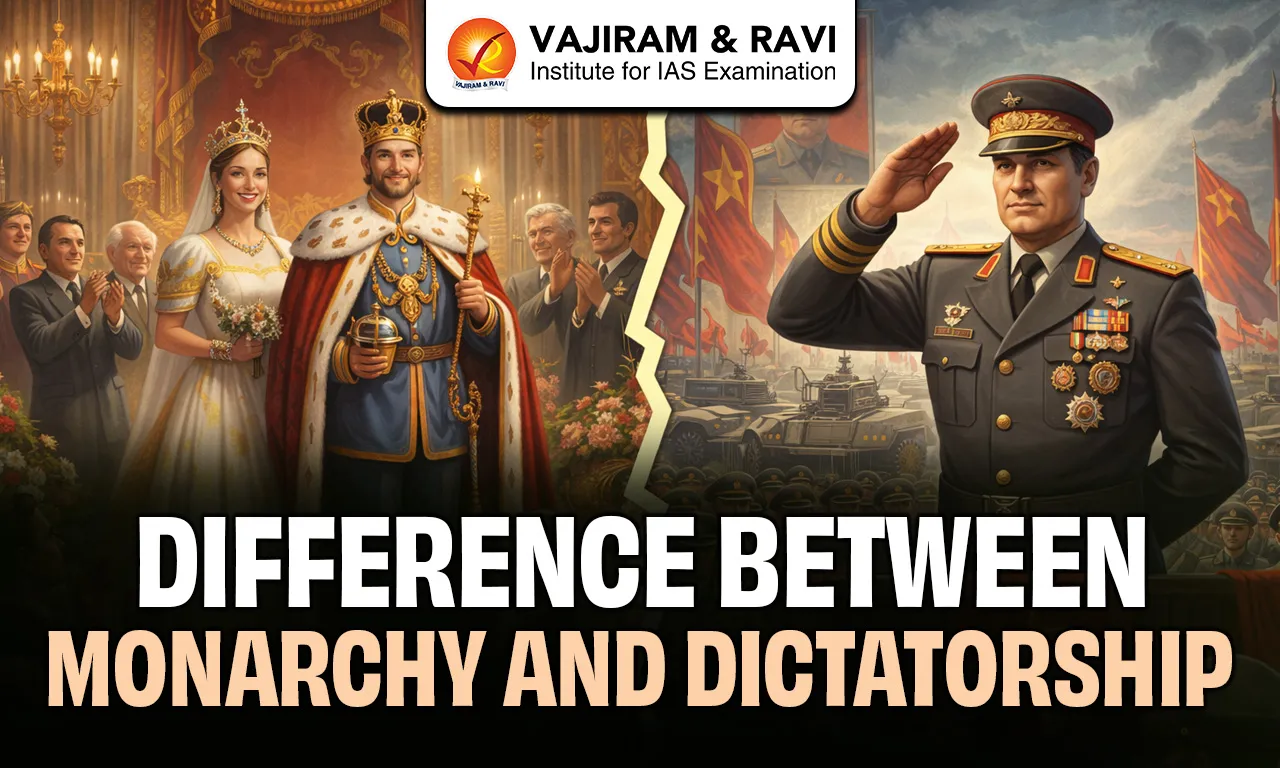
Monarchy and dictatorship are both forms of government where a single person holds supreme power, but the Difference Between Monarchy and Dictatorship lies in how that power is obtained and exercised. In a monarchy, power is usually inherited within a royal family, and the ruler, called a king, queen, or emperor may either have absolute authority or share power under a constitution. In contrast, a dictatorship is a system where one individual, known as a dictator, takes control by force, political manipulation, or other means, often ruling without the consent of the people. While monarchs inherit their position, dictators seize or maintain power through control, yet both systems involve centralized authority in the hands of one person.

Difference between Monarchy and Dictatorship

The table below discusses Difference between Monarchy and Dictatorship, highlighting how they differ in gaining power, governing, succession, civil liberties, and stability. It shows the key ways these two systems of rule operate and affect people’s lives.

Difference between Monarchy and Dictatorship
Aspect Dictatorship Monarchy

Source of Power

Dictators usually take power by force, such as military coups or revolutions. They may not have any hereditary claim.

Monarchs inherit power through their family. Authority passes by birthright or tradition.

Legitimacy & Governance

Power is justified through propaganda, ideology, or personality cult. The ruler has absolute authority with little room for opposition.

Monarchs gain legitimacy from tradition, history, or national identity. Constitutional monarchs follow laws and may share power with elected governments.

Rules & Accountability

Dictators control institutions like courts and legislature, leaving little accountability.

Constitutional monarchs are bound by laws and act on advice of elected officials. Absolute monarchs may act freely but usually have advisers.

Succession

Uncertain and often depends on power struggles or military support. Some dictators try to establish dynasties, but not always.

Predictable and guided by tradition or laws, ensuring stable transitions within the royal family.

Civil Liberties

Freedoms like speech, press, assembly, and political participation are often restricted.

Constitutional monarchies protect rights through laws. Absolute monarchs may limit freedoms depending on their policies.

Stability

Stability depends on the dictator’s control; regimes can collapse suddenly if challenged.

Monarchies, especially constitutional ones, are usually stable due to tradition and institutions; they can also adapt over time.

Economic & Social Impact

Often centralizes resources and decision-making; citizens have little say in governance.

Can vary: constitutional monarchies allow citizen participation, while absolute monarchies may centralize wealth and power.

Adaptability

Harder to adapt to changing needs since power is concentrated in one person.

Constitutional monarchies can evolve with society; absolute monarchies may resist change but traditions provide continuity.

Monarchy

A monarchy is a form of government where a king, queen, emperor, or sultan leads the country. Usually, the position is inherited, meaning it passes from one generation of the royal family to the next. In the past, monarchs had full control over the country, but today most monarchies are constitutional, where the king or queen mainly has a ceremonial role and does not make day-to-day decisions. Monarchies are often seen as stable because leadership stays within the same family, and traditions play a big role in how the government works.

Features of Monarchy

  • Hereditary Succession: In a monarchy, the leadership usually stays within one family. The next ruler is often chosen based on rules like the eldest child inheriting the throne.
  • Types of Monarchy:
    • Absolute Monarchy: The king or queen has full control over the country and can make decisions without needing approval from anyone else.
    • Constitutional Monarchy: The monarch has limited powers, mostly symbolic or ceremonial, while elected representatives run the government.
  • Legitimacy and Tradition: Monarchs are often accepted because of long-standing traditions, culture and history. People respect them as part of the nation’s identity.
  • Rules and Limits: In constitutional monarchies, laws limit what the monarch can do. In absolute monarchies, the ruler can act freely without legal restrictions.
  • Stability and Continuity: Because the throne usually stays within the same family, monarchies can provide stability and a sense of continuity in the country.

Examples of Monarchies

  • United Kingdom: The UK is a constitutional monarchy. Here, the king or queen mainly performs ceremonial duties, while the elected parliament runs the government.
  • Saudi Arabia: Saudi Arabia is an absolute monarchy. The king has strong control over politics, laws, and even religious matters.
  • Bhutan: Bhutan is a constitutional monarchy that mixes tradition with modern democracy. The king works together with elected leaders, balancing culture and governance.

Dictatorship

A dictatorship is a type of government where one person or a small group holds all the power. In this system, the ruler makes decisions without following democratic rules or being accountable to the people. In a dictatorship, the dictator controls the government completely. They often come to power by force, like through a military takeover, or by unfair elections. Unlike a monarchy, they do not inherit their position. Dictators can make laws, enforce rules and even limit citizens’ freedoms without checks or balances. Dictatorships often suppress opposition, restrict free speech and violate human rights to maintain control. Some modern examples include North Korea, Equatorial Guinea, Chad and Burundi.

Features of a Dictatorship

  • Centralised Power: In a dictatorship, all power is held by one person or a small group. There are usually no checks or balances, so the ruler can make decisions freely.
  • How Power is Gained: Dictators often come to power by force, such as military takeovers, revolutions, or when previous governments fail. They do not usually get their position through elections or inheritance.
  • Suppression of Opposition: Political parties, free media and public protests are often banned or strictly controlled to prevent anyone from challenging the ruler.
  • Restriction on Freedoms: Citizens have limited rights. Freedom of speech, assembly, and press are often curtailed. People can face punishment, surveillance or harsh measures if they oppose the government.
  • Leadership and Succession: Some dictatorships revolve around one leader’s personality and can collapse when they leave power. Others may have succession rules, but these are often unclear and unpredictable.

Examples of Dictatorships

  • North Korea: Ruled by the Kim family, with strict control over citizens’ lives and almost no personal freedoms.
  • Syria: Under the Assad regime, the government controls the military and politics, limiting freedoms and punishing opposition.
Also Check Related Articles
Difference between NITI Aayog and Inter-State Council Difference Between Economic Survey and Union Budget
Difference Between Tropical Evergreen and Tropical Deciduous Forests Difference Between Ordinary Bill and Money Bill
Difference Between Legislative and Executive Difference between Himalayan and Peninsular Plateau
Difference Between Vedas and Upanishads Difference Between Scheduled and Non-Scheduled Banks
Difference Between Written and Unwritten Constitution Difference between NITI Aayog and Planning Commission

Difference between Monarchy and Dictatorship FAQs

Q1: What is a monarchy?

Ans: A monarchy is a system of government where a king, queen or emperor rules, usually inheriting power from their family. Monarchs can have full control (absolute monarchy) or mostly ceremonial roles (constitutional monarchy).

Q2: What is a dictatorship?

Ans: A dictatorship is a government where one person or a small group has all the power. Dictators often take control by force or unfair elections and are not accountable to the people.

Q3: How do monarchs and dictators get power?

Ans: Monarchs inherit power through family lines. Dictators seize power through force, revolutions, or political manipulation.

Q4: How is governance different in monarchy and dictatorship?

Ans: In a monarchy, rulers may share power with elected officials in constitutional systems. Dictators rule alone, often suppressing opposition and controlling institutions.

Q5: What about civil liberties in both systems?

Ans: Constitutional monarchies protect citizens’ rights through laws. Absolute monarchs may limit freedoms. Dictatorships often restrict speech, press, assembly, and political rights.

73rd Constitutional Amendment Act, Features, Panchayati Raj Structure

73rd Constitutional Amendment Act

The 73rd Constitutional Amendment Act 1992 constitutionally recognised the Panchayati Raj System in India. This amendment helped promote decentralisation of power especially in the local form of governance and give power to local bodies and make sure democratic participation is encouraged at grassroots level. In this article, we are going to cover all about the 73rd Constitutional Amendment Act 1992. 

73rd Constitutional Amendment Act

The Panchayati Raj System acts at the level of local governance. The system is divided into three tiers: Gram Panchayat at village level, Mandal Parishad or Block Samiti of Panchayat Samiti and Zila Parishad at District level.

The 73rd Amendment Act helped Panchayati Raj System get a constitutional status in 1992. 

At present, Panchayati Raj System exists in almost all states in India except  Nagaland, Meghalaya and Mizoram as well as Delhi.

Also Check: 103rd Constitutional Amendment Act

73rd Amendment Act Features

Following are the features of 73rd Constitutional Amendment Act: 

  • Gram Sabha (Article 243A): The Gram Sabha consists of people listed in the electoral rolls of a village within a Panchayat’s jurisdiction. It forms the core of the Panchayati Raj system and may exercise powers and perform functions as provided by State legislation.
  • Three-Tier System (Article 243B): The Constitution mandates a three-tier Panchayati Raj structure—village, intermediate, and district levels—for all States. However, States with populations below 20 lakhs can skip the intermediate level.
  • Election of Members and Chairpersons (Article 243C): Panchayat members at all levels are directly elected. Chairpersons at the intermediate and district levels are elected indirectly from among elected members. The method of electing village-level Chairpersons is determined by the State.
  • Reservation of Seats (Article 243D): Seats are reserved for Scheduled Castes and Scheduled Tribes in proportion to their population in each Panchayat. One-third of all seats are reserved for women. States may provide further reservations for backward classes.
  • Duration of Panchayats (Article 243E): The standard term is five years. If dissolved prematurely, elections must be held unless the remainder of the term is less than six months.
  • Disqualification of Members (Article 243F): A person is disqualified if deemed so under State law. However, those above 21 years of age cannot be disqualified solely for not having reached 25 years.
  • Powers and Functions (Article 243G): State legislatures may empower Panchayats to function as institutions of self-government. This includes preparing plans for economic development, social justice, and implementing government schemes.
  • Finances (Article 243H): States may allow Panchayats to collect taxes, receive State-assigned revenues, grants, and establish local funds.
  • Finance Commission (Article 243I): The Governor appoints a Finance Commission to evaluate Panchayat finances and recommend tax-sharing principles and permissible levies.
  • Audit of Accounts (Article 243J): State legislatures decide procedures for maintaining and auditing Panchayat accounts.
  • State Election Commission (Article 243K): Responsible for preparing electoral rolls and conducting Panchayat elections in a free and fair manner.
  • Application to Union Territories (Article 243L): The President may apply the 73rd Amendment to Union Territories with necessary modifications.
  • Exempted States and Areas (Article 243M): The Act does not apply to Nagaland, Meghalaya, Mizoram, and certain scheduled and tribal areas, unless Parliament decides otherwise.
  • Continuance of Existing Laws (Article 243N): Existing State laws related to Panchayats remain valid for one year post-implementation, unless repealed earlier.
  • Judicial Non-Interference (Article 243O): Courts cannot interfere in Panchayat elections or challenge seat allocations and delimitation. Election disputes must follow procedures laid out by State law.

Also Check: 104th Constitutional Amendment Act

Panchayati Raj Structure

The Panchayati System in India has the following structure: 

  • Division into three-tier Panchayati Raj System: The 73rd Constitutional Amendment Act established a three-tier Panchayati Raj System in every state, including Panchayats at village, intermediate and district levels. 
  • Enable Uniformity: The decentralisation of power ensures uniformity in the structure of Panchayati Raj System all over the country. 
  • Optional for smaller states: A state with population not exceeding 20 lakh has the option to either constitute or not constitute Panchayats at intermediate level.

73rd Constitutional Amendment Act FAQs

Q1: What is the 73rd Amendment Act 1992?

Ans: The 73rd Amendment Act, 1992, granted constitutional status to the Panchayati Raj institutions and introduced Part IX in the Constitution.

Q2: When was the Panchayati Raj System established in India?

Ans: The Panchayati Raj System was formally established on 24th April 1993 with the implementation of the 73rd Amendment Act.

Q3: What is Gram Sabha?

Ans: Gram Sabha is the assembly of all registered voters in a village within a Panchayat area, serving as the foundation of the Panchayati Raj system.

Q4: What are the Articles covered under the Panchayati Raj System?

Ans: Articles 243 to 243-O under Part IX of the Constitution cover the Panchayati Raj System.

Q5: Which states have not adopted the Panchayati Raj System in India?

Ans: Nagaland, Meghalaya, and Mizoram have not adopted the Panchayati Raj system due to the prevalence of traditional tribal governance.

Waqf Board, Functions, Legal Provision, Waqf Property

Waqf Board

Waqf is permanent dedication of movable or immovable property for religious, pious, or charitable purposes under Islamic law. In India, waqf properties include mosques, graveyards, schools, orphanages, hospitals and shelter homes. Once a property is declared waqf, it becomes irrevocable and non transferable because ownership is considered to vest in God. The system is governed by specific legislation and supervised through a structured institutional framework to ensure lawful administration, protection of assets and utilization of income strictly for community welfare objectives.

Waqf Board in India

A Waqf Board is a statutory body that manages properties permanently dedicated for religious, pious, or charitable purposes under Islamic law. It is a corporate entity that can acquire, hold, manage and transfer property and can sue or be sued in court. It administers waqf assets created through a deed, instrument, or long continued religious or charitable usage. The creator, known as the waqif, must be of sound mind and lawful owner of the property. Waqfs may be public for community welfare or private for descendants, but in all cases the dedication is permanent and cannot be reversed.

Waqf Board Organization

The governance structure ensures supervision at central and state levels through statutory composition and regulated representation. The organization and working of the Waqf Board in India is highlighted below:

Central Waqf Council

  • It is the National Apex Body established in 1964 under the Waqf Act, 1954 and continued under the Waqf Act, 1995, it functions under the Ministry of Minority Affairs as the top advisory authority.
  • Chairperson: The Union Minister in charge of Waqf serves as Chairperson, heading the Council and guiding national level policy direction.
  • Members: Up to 20 members are appointed by the Government of India to advise on uniform administration and governance standards.
  • Function: The Council supervises and advises all State Waqf Boards to ensure consistency, compliance and coordinated policy implementation.

State Waqf Boards

  • These are Primary Administrative Units which are constituted in every state under the Waqf Act, 1995, these Boards directly manage and regulate waqf properties within state jurisdiction.
  • Chairperson: Heads the State Waqf Board, presides over meetings and oversees execution of decisions and property administration.
  • Chief Executive Officer (State Level Executive Authority): Appointed under Section 23, acts as administrative head and ex officio secretary, responsible for implementation of Board resolutions.
  • Government Nominees: One or two members nominated by the State Government ensure regulatory linkage and administrative coordination.
  • Legislative Representatives: Muslim Members of Parliament and State Legislatures are included to incorporate representative participation in governance.
  • Legal Experts: Muslim members of the State Bar Council provide legal expertise in dispute resolution and statutory compliance.
  • Recognised Islamic Scholars: Scholars of Islamic theology ensure that property management aligns with religious principles and donor intentions.
  • Mutawali Representatives: Managers of waqfs with annual income of Rs 1 lakh or above participate to reflect ground level administrative experience.
  • Sunni and Shia Waqf Boards: Separate Sunni and Shia Boards function in relevant states to address sect specific religious and administrative requirements.
  • Non Muslim Representation Cap: As per recent judicial directions, State Boards may include not more than 3 non Muslims and the Central Council not more than 4, ensuring minority character remains protected.

Waqf Board Functions

The Waqf Board performs regulatory, supervisory, financial and developmental roles for effective waqf management.

  • Property Administration: It supervises mosques, graveyards, educational institutions and charitable establishments to ensure usage strictly matches declared religious or welfare objectives.
  • Revenue Collection: It ensures systematic collection of income from waqf assets and channels funds into education, healthcare, orphan support and poverty relief programmes.
  • Recovery of Encroachments: The Board initiates legal action to reclaim illegally occupied waqf lands and restore them for lawful charitable utilization.
  • Approval of Transfers: Sale, mortgage, exchange, gift, or lease of immovable waqf property requires approval by at least two thirds of Board members.
  • Appointment of Custodians: It appoints managers and supervisory officials to safeguard property and ensure income is not diverted from designated purposes.
  • Registration and Records: All waqfs must be registered and central registers are maintained for documentation, inspection and verification.
  • Budget Preparation: Annual financial statements and maintenance budgets are prepared to promote fiscal discipline and structured expenditure.
  • Audit and Transparency: Regular audits are conducted to prevent misuse, strengthen accountability and improve administrative efficiency.
  • Dispute Handling: Waqf related disputes are addressed through statutory mechanisms including tribunals and, under recent reforms, judicial oversight.
  • Digitalisation Efforts: Modern reforms promote digital record management to enhance transparency, tracking and public accountability.

Waqf Board Legal Provisions

The Waqf Boards in India are managed by several legal regulations as highlighted below:

  • Waqf Act 1954: This Act provided the initial statutory basis for regulating waqf properties in independent India and led to the establishment of the Central Waqf Council in 1964 for national level supervision.
  • Waqf Act 1995: It replaced the 1954 law and introduced a comprehensive governance structure, establishing State Waqf Boards, defining powers of Chief Executive Officers and mandating structured administration of waqf assets.
  • Waqf (Amendment) Act 2013: This amendment strengthened transparency measures, improved documentation standards, enhanced oversight powers of Boards and reinforced accountability in record keeping and inspections.
  • Waqf (Amendment) Act 2025: This reform modernised waqf administration by introducing documentary proof requirements, judicial review provisions, centralised registration, inclusivity in representation and safeguards for stakeholder rights.
  • Mussalman Wakf Act 1923 (Repealed in 2025): This colonial era legislation governed certain waqf categories and its repeal consolidated all regulation under a unified modern statutory framework.
  • UMEED Portal (2025): The government of India has launched a portal for the mandatory registration of Waqf along with details of the Waqif as well as land boundaries.

Waqf Board Property in India

Waqf Properties in India constitute one of the largest categories of religious charitable land holdings.

  • The Waqf Management System of India records approximately 8.5 million properties spread across more than 8 million hectares of land.
  • These include agricultural land, urban plots, buildings, mosques, dargahs, cemeteries, schools, colleges and hospitals.
  • Income generated supports widows, divorced women, economically weaker Muslim communities and marginalized groups including Pasmanda sections.
  • Several medieval mosques and dargahs fall under waqf administration.
  • In 2014, About 123 prime properties linked to the Delhi Waqf Board were examined following Supreme Court directions and committee review.
  • Authorities such as the Delhi Development Authority have acted to remove illegal occupations near protected heritage areas.
  • The Union Government clarified that Boards act as trustees of waqf properties rather than absolute owners.
  • Ownership is deemed to vest in God, ensuring assets remain permanently dedicated for charitable and religious purposes.
  • The 2025 amendment mandates registration of all waqf properties within six months under a centralised system.
  • Efficient management of such vast land resources directly influences educational, religious and welfare infrastructure serving millions.

Waqf Board FAQs

Q1: What is a Waqf Board?

Ans: A Waqf Board is a statutory legal body that manages properties permanently dedicated for religious or charitable purposes under Islamic law. It supervises administration, protects assets and ensures income is used strictly for welfare objectives.

Q2: Which law governs Waqf properties in India?

Ans: Waqf properties are regulated under the Waqf Act, 1995, along with later amendments including the 2013 reforms and the Waqf (Amendment) Act, 2025, which introduced documentation rules, judicial oversight and centralized registration.

Q3: Who appoints the members of a State Waqf Board?

Ans: Members of a State Waqf Board are appointed by the respective State Government. The board includes legislators, Bar Council members, Islamic scholars, mutawalis and government nominees under a defined statutory structure.

Q4: Can Waqf property be sold or transferred?

Ans: Waqf property is permanently dedicated and generally non transferable. Any sale, lease, mortgage, or exchange requires approval of at least two thirds of the Board members and must comply with legal provisions.

Q5: How many Waqf properties are recorded in India?

Ans: According to the Waqf Management System of India, there are around 8.5 million registered Waqf properties spread across more than 8 million hectares, making it one of the largest religious charitable land holdings in the country.

97th Constitutional Amendment Act, Objective, Key Details

97th Constitutional Amendment Act

After confirmation from the Supreme Court to a decision by Gujarat High Court in 2013 which invalidated some parts of the 97th Constitutional Amendment Act in 2011. Part IX was introduced to elaborate the terms of existing cooperative society. The act basically focused on overcoming the challenges and hurdles experienced by cooperative societies and tried to install effective techniques to manage them. Under the act, amendments were added to the words or co-operative societies after the words or unions in Article 19(i). Other than this, Article 43B was included to Part IV of the Indian Constitution which mentions that “the State shall endeavour to promote voluntary formation, autonomous functioning, democratic control, and professional management of cooperative societies” and “the State shall endeavour to promote voluntary formation, autonomous functioning, democratic control, and professional management of cooperative societies”. Part IX-B was added after IX-A. Article 243ZH through 243ZT was added to Part IX-B.

Also Check: 103rd Constitutional Amendment Act

97th Constitutional Amendment Act

The 97th Constitutional Amendment Act came into existence in 2011, for the first time, cooperative societies were given formal constitutional backing, elevating their status in the country’s political and economic framework. This amendment did three key things which includes, It made the right to form cooperative societies a fundamental right under Article 19(1)(c), putting it on par with the right to form unions or associations, It added Article 43B to the Directive Principles of State Policy, stating that the state shall promote voluntary formation, autonomous functioning, democratic control, and professional management of cooperative societies. It introduced Part IX-B (Articles 243-ZH to 243-ZT), which lays out the framework for how cooperative societies should function covering everything from the composition of their boards to their elections, audits, and dispute resolution.

97th Constitutional Amendment Act FAQs

Q1: What is the 97th Constitutional Amendment Act?

Ans: The 97th Amendment, enacted in 2011, granted constitutional status and protection to cooperative societies in India.

Q2: When did the 97th Constitutional Amendment come into force?

Ans: It came into effect on 15th February 2012.

Q3: What was the main objective of the 97th Amendment?

Ans: To encourage the development of cooperative societies as democratic, autonomous, and professional institutions.

Q4: Which part of the Constitution was amended by the 97th Amendment?

Ans: It amended Part III (Fundamental Rights), Part IV (Directive Principles), and added Part IXB to the Constitution.

Q5: What article was inserted into the Fundamental Rights by this amendment?

Ans: What article was inserted into the Fundamental Rights by this amendment?

North Eastern Science & Technology Cluster (NEST), About, Components

North Eastern Science & Technology Cluster (NEST)

The Government of India has approved the establishment of the North Eastern Science & Technology Cluster (NEST) to accelerate research, innovation, skill development and entrepreneurship in the North Eastern Region (NER). It was sanctioned in July 2025 with a financial outlay of ₹22.98 crore under the schemes of the North Eastern Council and the Ministry of Development of North Eastern Region.

About North Eastern Science & Technology Cluster (NEST)

  • The North Eastern Science & Technology Cluster (NEST) is a collaborative research and innovation platform established to strengthen the Science, Technology and Innovation (STI) ecosystem in North East India.
  • It aims to connect universities, research institutes, national laboratories and industry to promote region-specific research and development.
  • It is funded under the Schemes of the North Eastern Council (NEC), Ministry of Development of North Eastern Region (DoNER) and implemented by Indian Institute of Technology Guwahati.
  • The project is designed to operate through four thematic verticals, selected based on emerging technologies, regional needs, and future growth potential:
    • Innovation Hub on Grassroot Technologies;
    • Technology Hub for Semiconductor and Artificial Intelligence;
    • Centre of Excellence for Innovation in Bamboo-Based Technology, Entrepreneurial Promotion & Skill Development; and 
    • Skill Development and Innovation Centre on Biodegradable and Ecofriendly Plastics

North Eastern Science & Technology Cluster (NEST) Key Components 

The key components of the Project include:

  • Training Programs for technology creation and start-ups;
  • Incubation and Tinkering Laboratories;
  • Technology transfer, commercialization and product marketing support; and
  • Development of enabling infrastructure for research, innovation and skill development.

North Eastern Science & Technology Cluster (NEST) Objectives 

The specific objectives of the NEST clusters include:

  • Empowerment of young people in the North Eastern Region (NER) with emphasis on SC, ST, women, and Divyangjan to consider self-employment or entrepreneurship among the career options.
  • Promotion of new enterprises by handholding from ideation to commercialization, capacity building of existing MSMEs and inculcating entrepreneurial culture in the NER in priority areas.
  • It focuses on strengthening research and innovation infrastructure. Through a Hub-and-Spoke model, institutions across the region will be supported in developing laboratories, conducting applied research and organizing training-cum-enterprise programmes.
  • Strengthening the existing grassroot practices through scientific interventions. Traditional technologies and local innovations will be standardised, certified and improved using Industry 4.0 approaches, enabling efficient commercialization and integration into national and global markets.

The NEST cluster works as a hub and spoke model to connect academia, industry, research and Govt. agencies. The hub institution is IIT Guwahati, which will coordinate research, funding, training and monitoring activities. Several institutions across the region will function as spokes, facilitating decentralised implementation. Among the identified institutions are the 

  • North East Cane and Bamboo Development Council, 
  • North Eastern Regional Institute of Science and Technology
  • Indian Institute of Management Shillong,
  • Tezpur University, and 
  • CSIR North East Institute of Science and Technology, along with multiple National Institutes of Technology across the region.

This collaborative structure ensures that research outcomes are translated into grassroots-level skill development and entrepreneurship, rather than remaining confined to academic publications.

About North East Council

  • The North Eastern Council was constituted in 1971 by an Act of Parliament.
  • It is the nodal agency for the economic and social development of the North Eastern Region.
  • It consists of the eight states - Arunachal Pradesh, Assam, Manipur, Meghalaya, Mizoram,Nagaland, Sikkim and Tripura.
  • The council includes the Governors and Chief Ministers of the eight states, along with three members nominated by the President of India.
  • The Union Home Minister serves as the ex-officio Chairman of the NEC.
  • The Minister for Development of North Eastern Region (DoNER) serves as the ex-officio Vice-Chairman.

North Eastern Science & Technology Cluster (NEST) FAQs

Q1: What is the North Eastern Science & Technology Cluster (NEST)?

Ans: The North Eastern Science & Technology Cluster (NEST) is a government-approved initiative aimed at strengthening research, innovation, skill development, and entrepreneurship in the North Eastern Region (NER).

Q2: What are the key focus areas of North Eastern Science & Technology Cluster (NEST)?

Ans: NEST operates through four thematic verticals: grassroots technology innovation, semiconductor and artificial intelligence development, bamboo-based technology and entrepreneurship, and biodegradable & eco-friendly plastics.

Q3: What are the primary objectives of North Eastern Science & Technology Cluster (NEST)?

Ans: The cluster aims to empower youth especially SC/ST, women, and Divyangjan by promoting entrepreneurship and self-employment. It also seeks to strengthen MSMEs, enhance research infrastructure, and modernize traditional practices through scientific intervention and commercialization support.

Q4: How does the Hub-and-Spoke model function in North Eastern Science & Technology Cluster (NEST)?

Ans: IIT Guwahati serves as the central hub coordinating research, funding, and training. Several regional institutions, including the North East Cane and Bamboo Development Council, Indian Institute of Management Shillong, and CSIR North East Institute of Science and Technology, function as spokes to implement activities across the NER.

Q5: Why is NEST significant for the North Eastern Region?

Ans: North Eastern Science & Technology Cluster (NEST) promotes inclusive and technology-driven development, reduces regional disparities, encourages sustainable industries like bamboo and eco-friendly plastics, and integrates the NER into emerging sectors such as AI and semiconductors.

Nizam of Hyderabad, History, List of Nizams, Contributions

Nizam of Hyderabad

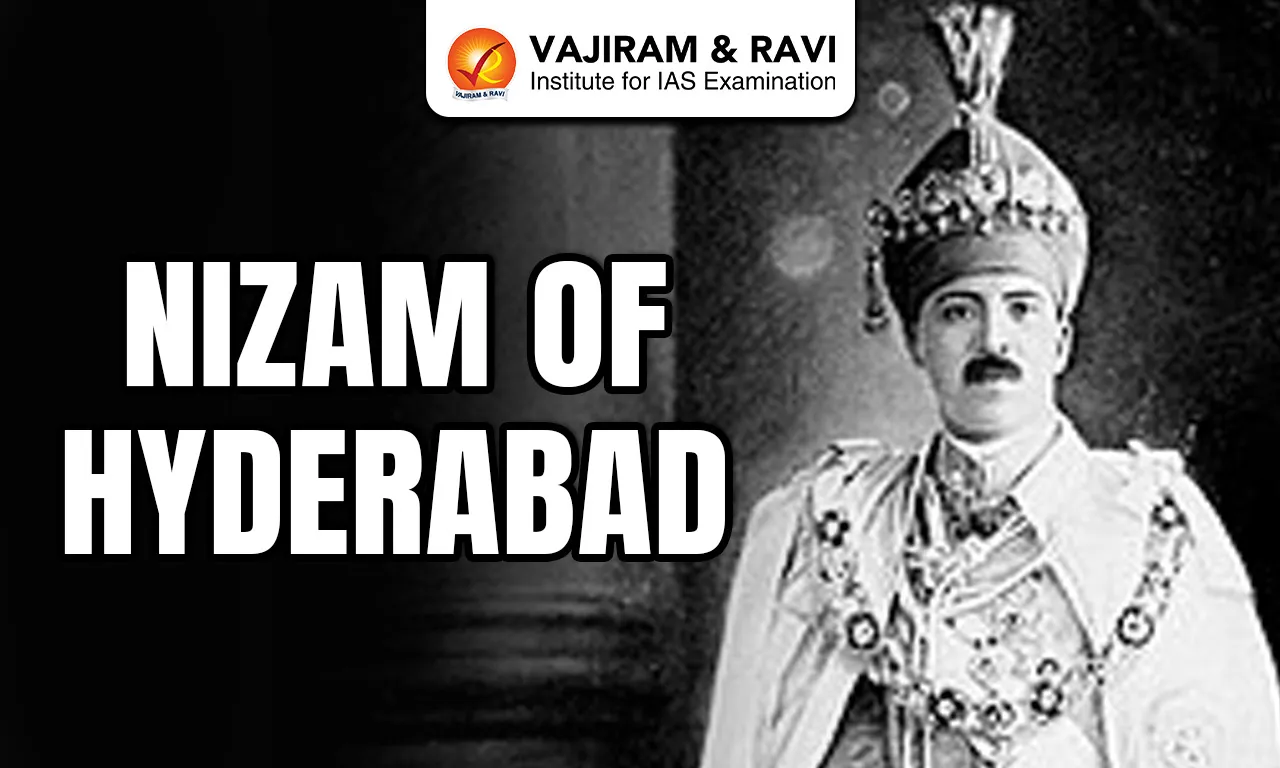
The Nizam of Hyderabad was the hereditary ruler of Hyderabad State, a vast princely dominion covering present day Telangana, Marathwada in Maharashtra and Kalyana Karnataka. The title originated from the Persian phrase Nizam-ul-Mulk, meaning “Administrator of the Realm,” first granted to Mir Qamar-ud-din Khan by Mughal Emperor Farrukhsiyar. Beginning in 1724, the Asaf Jahi dynasty governed this region for 224 years until Hyderabad’s integration into the Indian Union on 17 September 1948, shaping the political, economic and cultural character of the Deccan.

Nizam of Hyderabad

The word “Nizam” derives from Persian niẓām, meaning order or arrangement. The Nizams were semi-independent sovereigns who emerged from the weakening Mughal Empire and later functioned as princely allies under British paramountcy. Asaf Jahi Dynasty was founded by Chin Qilich Khan (Mir Qamar-ud-din Khan), titled Asaf Jah I and Nizam-ul-Mulk, the dynasty maintained nominal allegiance to the Mughal emperor while exercising autonomous control from Hyderabad. Over time, the Nizams navigated conflicts with the Marathas, treaties with the British East India Company and global political shifts. By the twentieth century, Hyderabad had become the largest princely state in India, ruled by seven officially recognized Nizams.

Nizam of Hyderabad History

The evolution of the Nizam of Hyderabad authority reflects Mughal decline, Maratha pressure and British expansion across the Deccan region.

  • Appointment: In 1713, Mughal Emperor Farrukhsiyar appointed Mir Qamar-ud-din Khan as Viceroy of the Deccan and conferred the honorific Nizam-ul-Mulk, marking the formal beginning of Asaf Jahi authority.
  • Early Mughal Career: Mir Qamar-ud-din earlier served under Emperor Aurangzeb and held prominent court positions, including the office of wazir under Emperor Muhammad Shah before returning permanently to the Deccan.
  • Foundation of Autonomy: In 1724, he defeated Mubariz Khan and established effective independence in Hyderabad while continuing symbolic recognition of Mughal sovereignty through coinage and Friday sermons.
  • Asaf Jahi Dynasty: The dynasty, named after the title Asaf Jah, ruled from Hyderabad city and maintained its own court, army and revenue system for more than two centuries.
  • Period of Succession Conflict: After the death of Asaf Jah I in 1748, Nasir Jung, Muzaffar Jung and Salabat Jung contested succession for about 13 years, creating political instability without firm imperial recognition.
  • Nizam-Maratha Conflicts: From the 1720s onward, the Nizams fought multiple campaigns against the Marathas, including battles at Palkhed, Bhopal, Rakshasbhuvan and Kharda, ultimately agreeing to pay Chauth as tribute.
  • Nizam-British Relations: Following defeat at Kharda and changing power balances, the Nizam accepted British protection, aligning Hyderabad with the East India Company’s expanding authority.
  • Treaty of Machilipatnam 1768: Asaf Jah II signed this treaty, surrendering coastal territories in exchange for fixed annual rent, formally deepening British influence in Hyderabad’s external affairs.
  • Princely State under British Crown: After 1858, Hyderabad became part of the British Indian Empire as an autonomous princely state under the Crown, while retaining internal administrative control.
  • Entitlement by British: The Nizams received the unique style “His Exalted Highness” and were regarded as “Faithful Ally of the British Government” for military support during key imperial conflicts.
  • Berar Separation 1903: The Berar region was separated from Hyderabad and merged with the Central Provinces to form Central Provinces and Berar under British administration.
  • Military Contribution in World War II: During the Second World War, around 80,000 troops raised by the Nizam formed the 19th Hyderabad Regiment, serving in Malaya, North Africa, Persia, Singapore and Burma.
  • Hyderabad’s Territorial Extent: At its height, Hyderabad covered approximately 223,000 square kilometers, making it the largest princely state in India before independence.
  • Revenue and Population: By 1948, Hyderabad had nearly 17 million inhabitants and generated an estimated annual revenue of £90,029,000, reflecting substantial economic capacity.
  • Currency System: Hyderabad maintained its own currency known as the Hyderabadi Rupee until 1951, signifying fiscal autonomy even under British paramountcy.
  • Golconda Mines: The prosperity of the state was linked to the Golconda mines, once the principal global source of diamonds before South African discoveries altered the market.
  • Operation Polo 1948: On 13 September 1948, the Indian Army launched Operation Polo; within five days the Nizam surrendered and Hyderabad formally acceded to India on 17 September 1948.
  • Post-Accession Role: After accession of Hyderabad, the last Nizam served as Rajpramukh of Hyderabad State before his death on 24 February 1967, marking the formal end of dynastic political authority.

Nizam of Hyderabad List of Rulers

Seven officially recognized Nizams governed Hyderabad between 1724 and 1948 under the Asaf Jahi line.

  • Asaf Jah I (1724-1748): Mir Qamar-ud-din Khan founded the dynasty, secured Deccan autonomy in 1724 and maintained symbolic Mughal allegiance while exercising practical sovereignty from Hyderabad.
  • Nasir Jung (1748-1750): Mir Ahmed Ali Khan briefly ruled during the succession crisis after his father’s death, reflecting instability rather than consolidated dynastic authority.
  • Muzaffar Jung (1750-1751): Mir Hidayat Muhi-ud-din Sa’adullah Khan ascended with external backing but died within months, preventing durable governance.
  • Salabat Jung (1751-1762): Mir Sa’id Muhammad Khan held power during continued turbulence until displaced, concluding the prolonged interregnum phase.
  • Asaf Jah II (1762-1803): Mir Nizam Ali Khan restored stability, signed the 1768 Machilipatnam treaty and managed complex relations with both Marathas and the British.
  • Asaf Jah III (1803-1829): Mir Akbar Ali Khan, known as Sikander Jah, ruled during expanding British supremacy, maintaining Hyderabad’s internal administration under indirect rule.
  • Asaf Jah IV (1829-1857): Mir Farqunda Ali Khan governed amid fiscal challenges, navigating debt pressures and territorial adjustments with British authorities.
  • Asaf Jah V (1857-1869): Mir Tahniyath Ali Khan’s tenure coincided with administrative reforms, including modernization of communication networks and infrastructure expansion.
  • Asaf Jah VI (1869-1911): Mir Mahbub Ali Khan ascended as a minor and ruled during rapid institutional development, overseeing modernization in railways and civic services.
  • Asaf Jah VII (1911-1948): Mir Osman Ali Khan became globally renowned for immense wealth, established Osmania University and ruled until Hyderabad’s Accession in 1948.

Nizam of Hyderabad Contributions

The Nizams significantly shaped governance, infrastructure, education, philanthropy and cultural institutions across Hyderabad State. The major contributions of the Nizam of Hyderabad include:

  • Railway Development: The Nizam’s Guaranteed State Railway expanded connectivity across the Deccan, facilitating industrial growth and linking interior regions with major trade centers.
  • Irrigation Reservoirs: Major reservoirs such as Osman Sagar and Himayat Sagar were commissioned to improve water supply, urban planning and agricultural sustainability.
  • Nagarjuna Sagar Dam: Preliminary survey work for the Nagarjuna Sagar Dam began during Nizam rule, though final construction occurred after independence.
  • Architecture: Landmark buildings including Telangana High Court, City College, Jubilee Hall, Asafia Library and the Assembly building were constructed during their reign. Grand residences such as Chowmahalla Palace, Purani Haveli, Falaknuma Palace, King Kothi Palace and Hill Fort Palace reflect architectural patronage.
  • Medical Infrastructure: Institutions such as Niloufer Hospital and Osmania Medical College strengthened public healthcare and medical education in Hyderabad.
  • Osmania University Establishment: Founded during the reign of the seventh Nizam, it became the first princely state university using Urdu as medium of instruction.
  • Hyderabad Civil Service: Inspired by the Indian Civil Service model, the Nizams created a structured Hyderabad Civil Service for efficient internal administration.
  • Military Organization: The Hyderabad State Forces, including the 19th Hyderabad Regiment, demonstrated organized military capacity within princely frameworks.
  • Fiscal Administration Reform: Mir Osman Ali Khan cleared state debts, restored budget surplus and rationalized revenue management during his early reign.
  • Global Wealth Recognition: In 1937, Mir Osman Ali Khan was regarded as the richest person globally, with an estimated ₹660 crores, later valued by adjusted calculations at over US$200 billion.
  • Interfaith Philanthropy: The Nizams donated a large amount of financial and land grants to various Hindu temples, churches and Sikh gurudwaras.
  • Modernization: Electricity, roadways and early aviation infrastructure were introduced, transforming Hyderabad into a modern administrative capital.

Nizam of Hyderabad FAQs

Q1: Who was the first Nizam of Hyderabad?

Ans: The first Nizam was Mir Qamar-ud-din Khan, titled Asaf Jah I. He established autonomous rule in Hyderabad in 1724 after defeating Mubariz Khan and founded the Asaf Jahi dynasty.

Q2: How long did the Nizams rule Hyderabad?

Ans: The Nizams ruled Hyderabad State for 224 years, from 1724 until 17 September 1948, when Hyderabad was integrated into the Indian Union after Operation Polo.

Q3: Why was the last Nizam of Hyderabad famous worldwide?

Ans: Mir Osman Ali Khan, the seventh Nizam, was known as one of the richest individuals in the world in 1937, with vast wealth from state revenues and diamond resources.

Q4: What was Operation Polo?

Ans: Operation Polo was a military action launched by the Indian Army on 13 September 1948 to integrate Hyderabad into India. The Nizam surrendered on 17 September 1948.

Q5: What were the major contributions of the Nizam of Hyderabad?

Ans: The Nizams developed railways, reservoirs like Osman Sagar, established Osmania University, built major public buildings, maintained a separate currency and supported interfaith philanthropy.

UPSC Daily Quiz 24 February 2026

[WpProQuiz 100]

UPSC Daily Quiz FAQs

Q1: What is the Daily UPSC Quiz?

Ans: The Daily UPSC Quiz is a set of practice questions based on current affairs, static subjects, and PYQs that help aspirants enhance retention and test conceptual clarity regularly.

Q2: How is the Daily Quiz useful for UPSC preparation?

Ans: Daily quizzes support learning, help in revision, improve time management, and boost accuracy for both UPSC Prelims and Mains through consistent practice.

Q3: Are the quiz questions based on the UPSC syllabus?

Ans: Yes, all questions are aligned with the UPSC Syllabus 2025, covering key areas like Polity, Economy, Environment, History, Geography, and Current Affairs.

Q4: Are solutions and explanations provided with the quiz?

Ans: Yes, each quiz includes detailed explanations and source references to enhance conceptual understanding and enable self-assessment.

Q5: Is the Daily UPSC Quiz suitable for both Prelims and Mains?

Ans: Primarily focused on Prelims (MCQ format), but it also indirectly helps in Mains by strengthening subject knowledge and factual clarity.

Maikal Range, Geography, Biodiversity, Conservation, Significance

Maikal Range

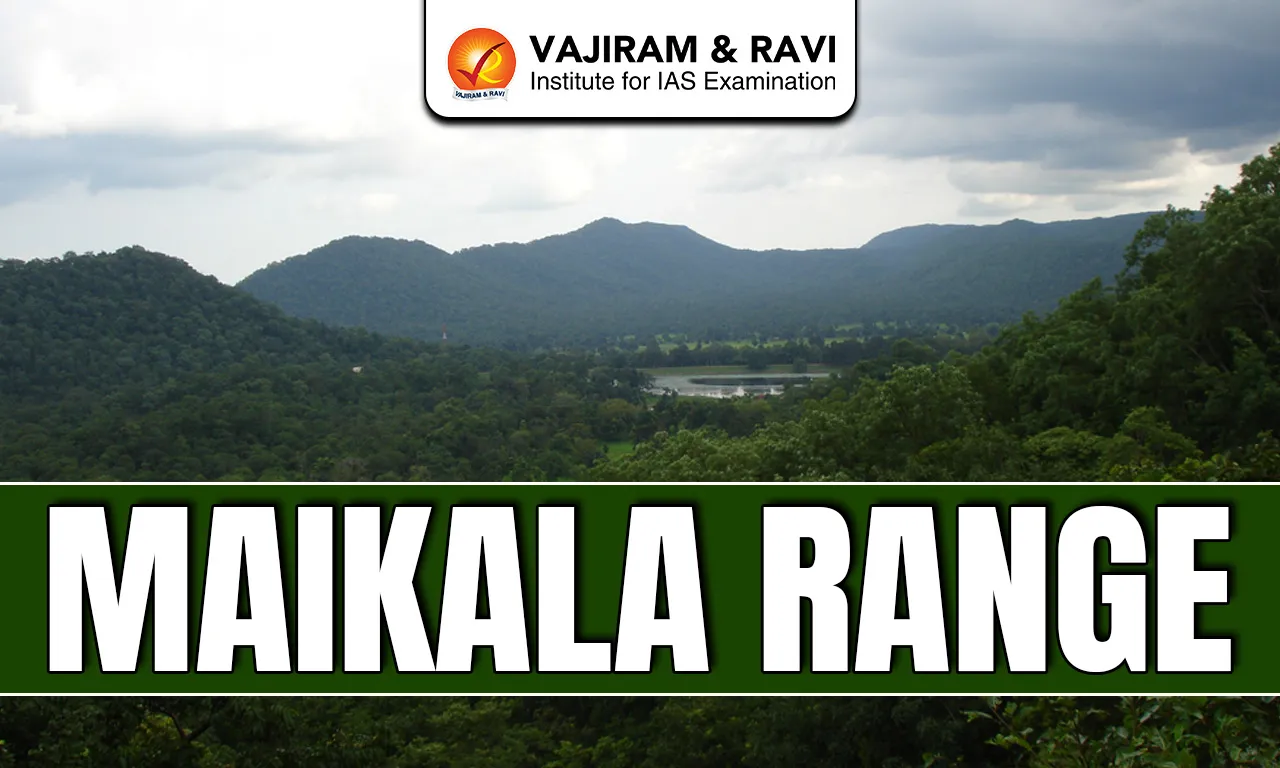
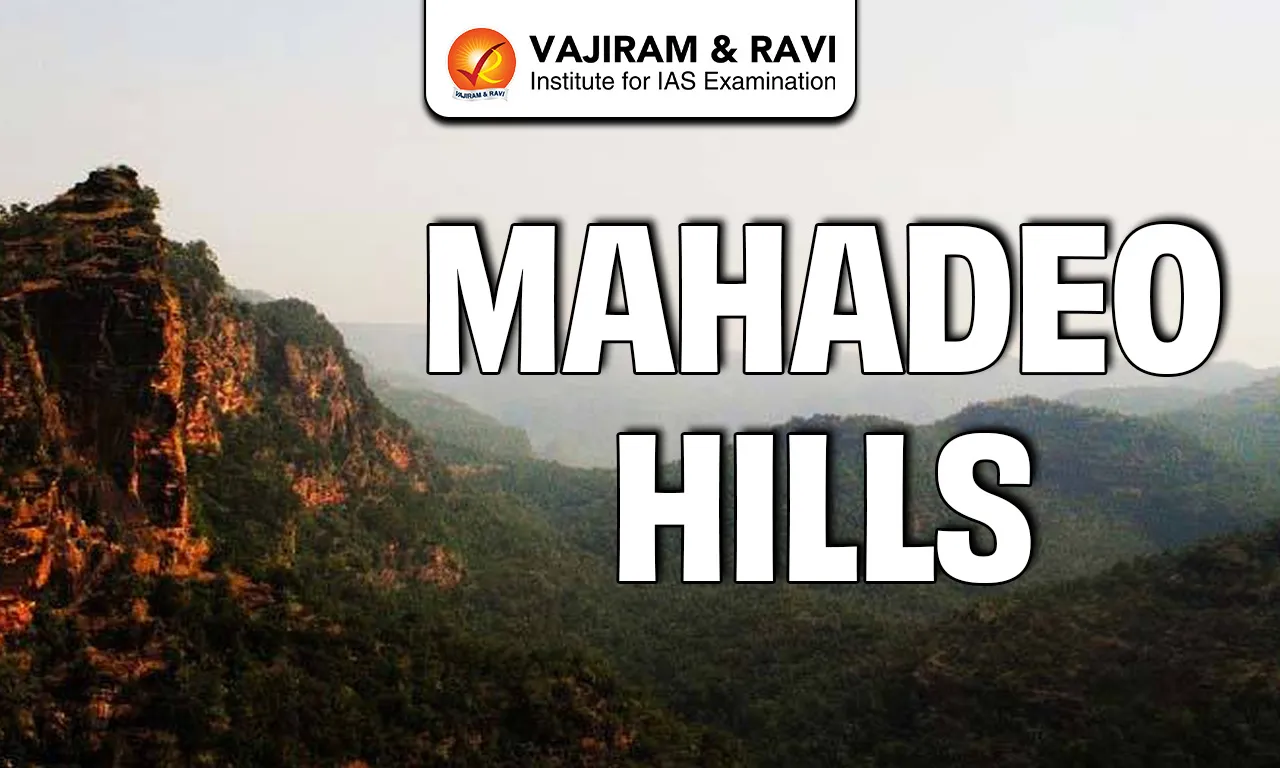
The Maikal Range is a mountain range in central India. It forms the eastern part of the Satpura Hills and is mainly spread across Madhya Pradesh and Chhattisgarh. The region has forested hills and plateaus and is known for its natural beauty. The famous Amarkantak plateau is located here. The Maikal Range is important for its rivers, forests and tribal culture and it plays a key role in the geography of central India.

About Maikal Range

  • The Maikal Range is an important mountain range in Madhya Pradesh in central India. It runs mainly in a north-south direction and forms the eastern part of the Satpura Range. The hills are made up of flat-topped plateaus called “pats” and their height ranges between about 600 to 900 metres. 
  • Many important rivers originate or flow through this region. The Narmada and Son rivers rise near Amarkantak, which lies in the Maikal Hills. Other rivers like Rihand, Kanhar and Banas also drain this region. These rivers have formed wide valleys and fertile basins, which support agriculture.
  • The natural vegetation varies from grasslands and thorny bushes to tropical deciduous forests. Important trees include teak and sal. The region is rich in biodiversity and includes famous protected areas like Kanha National Park, which is known for tigers and barasingha deer.
  • Agriculture is the main occupation of the people. Crops such as rice, wheat, maize, gram, pulses and oilseeds are grown in the fertile valleys. The region is also rich in minerals like coal, limestone, bauxite, marble and dolomite, which support small industries such as cement, stone cutting and brick making.
  • The Maikal region is also important culturally. It is home to tribal communities such as the Gonds, Baigas and Korkus. Historical places like the fort at Mandla show the legacy of the Gond rulers.

Maikal Range Geography

  • The Maikal Hills are located in central India and form the eastern extension of the Satpura Range. They are mainly spread across eastern Madhya Pradesh in districts such as Anuppur, Mandla, Balaghat and Dindori and extend into northern Chhattisgarh. The hills stretch in a north-south direction and have an average height of about 600 to 900 metres. The landscape is made up of plateaus, ridges and forested slopes.
  • The Maikal Hills play an important role in shaping the drainage system of central India. They act as a watershed that separates the Narmada River basin from the Mahanadi River basin. Near Amarkantak, which lies in this region, important rivers like the Narmada and the Son originate.
  • The region is rich in forests and wildlife. It includes famous protected areas such as Kanha National Park and Achanakmar Wildlife Sanctuary. The hills are also home to tribal communities and have cultural and historical importance. Overall, the Maikal Hills are a significant physical and ecological feature of central India.

Biodiversity and Conservation of the Maikal Hills

  • The Maikal Hills are known for their rich biodiversity and dense forests. A major part of this region comes under the Achanakmar-Amarkantak Biosphere Reserve, which plays an important role in protecting plants and animals. 
  • The natural vegetation mainly consists of tropical moist deciduous forests. Sal trees dominate the region, along with teak and bamboo. Many medicinal plants such as safed musli are also found here, which are important for local communities.
  • The hills support a wide range of wildlife. Animals like the Bengal tiger, gaur (Indian bison), sloth bear, leopard, sambar and chital are commonly found. The hard-ground barasingha, which once faced the danger of extinction, has successfully recovered due to protection efforts in Kanha National Park. The region is also rich in birdlife and reptiles, adding to its ecological importance.
  • Earlier, deforestation and hunting reduced wildlife populations. With the establishment of protected areas and better forest management, conservation has improved. Today, the Maikal Hills are an important example of biodiversity conservation and ecological balance in central India.

Protected Areas and Reserves in the Maikal Hills

  • The Maikal Hills contain several important protected areas that help conserve forests and wildlife in central India. These areas are especially important for tiger conservation and for maintaining ecological balance.
  • The most famous protected area in this region is Kanha National Park, established in 1955 and later declared a Tiger Reserve under Project Tiger. It is located in Mandla and Balaghat districts of Madhya Pradesh. 
  • Kanha is well known for the successful conservation of the hard-ground barasingha, whose population increased due to careful habitat protection and management. The park has sal forests and grasslands that provide a suitable habitat for tigers, leopards, gaur, deer and many bird species.
  • Another important protected area is Achanakmar Tiger Reserve, located in Chhattisgarh. It was first declared a wildlife sanctuary and later upgraded to a Tiger Reserve. It acts as a corridor connecting Kanha with other forest areas. Such corridors are important because they allow animals, especially tigers, to move freely and maintain healthy populations.
  • The Barnawapara Wildlife Sanctuary is another protected area in the Maikal region. It supports leopards, deer and many species of birds in its teak forests and grasslands.
  • Together, these parks and sanctuaries form part of the larger Satpura-Maikal landscape, which is recognized as an important tiger corridor in India. This network of protected areas helps in wildlife conservation, protects biodiversity and supports sustainable development by promoting eco-tourism and involving local tribal communities in conservation efforts.

Maikal Range Significance

  • Geographical Importance - Forms the eastern part of the Satpura Range and acts as a watershed. Rivers like the Narmada, Son and Kanhar flow through the hills, influencing drainage and water supply.
  • Ecological Importance - Covered with tropical forests of sal, teak, and bamboo, supporting wildlife like tigers, leopards, barasingha and numerous birds and reptiles.
  • Conservation Role - Hosts protected areas such as Kanha National Park, Achanakmar Tiger Reserve, and Barnawapara Wildlife Sanctuary, helping conserve tigers and maintain ecological balance.
  • Economic Significance - Forests provide timber, bamboo and other products. Agriculture in valleys and plateaus supports local livelihoods.
  • Cultural and Tourism Importance - Home to tribal communities and historical sites. Eco-tourism and wildlife tourism attract visitors, supporting the local economy and conservation awareness.
  • Overall Importance - Plays a key role in water management, biodiversity, forest resources, local economy and cultural heritage in central India.

Maikal Range FAQs

Q1: What is the Maikal Range and where is it located?

Ans: The Maikal Range is a mountain range in central India, forming the eastern part of the Satpura Hills. It is mainly spread across eastern Madhya Pradesh and northern Chhattisgarh.

Q2: What is the geographical importance of the Maikal Range?

Ans: It acts as a watershed between the Narmada River basin in the west and the Mahanadi River basin in the east. Important rivers like the Narmada, Son and Kanhar originate or flow through this region.

Q3: What types of forests are found in the Maikal Hills?

Ans: The hills have tropical moist deciduous forests dominated by sal, teak and bamboo, with grasslands and medicinal plants like safed musli.

Q4: Which animals are found in the Maikal Hills?

Ans: The region is home to Bengal tigers, leopards, gaur (Indian bison), sloth bears, barasingha, sambar, chital and many bird and reptile species.

Q5: What are the major protected areas in the Maikal Range?

Ans: Kanha National Park, Achanakmar Tiger Reserve and Barnawapara Wildlife Sanctuary protect wildlife, especially tigers and maintain ecological balance.

Tropical Deciduous Forests in India, Characteristics, Types

Tropical Deciduous Forests in India

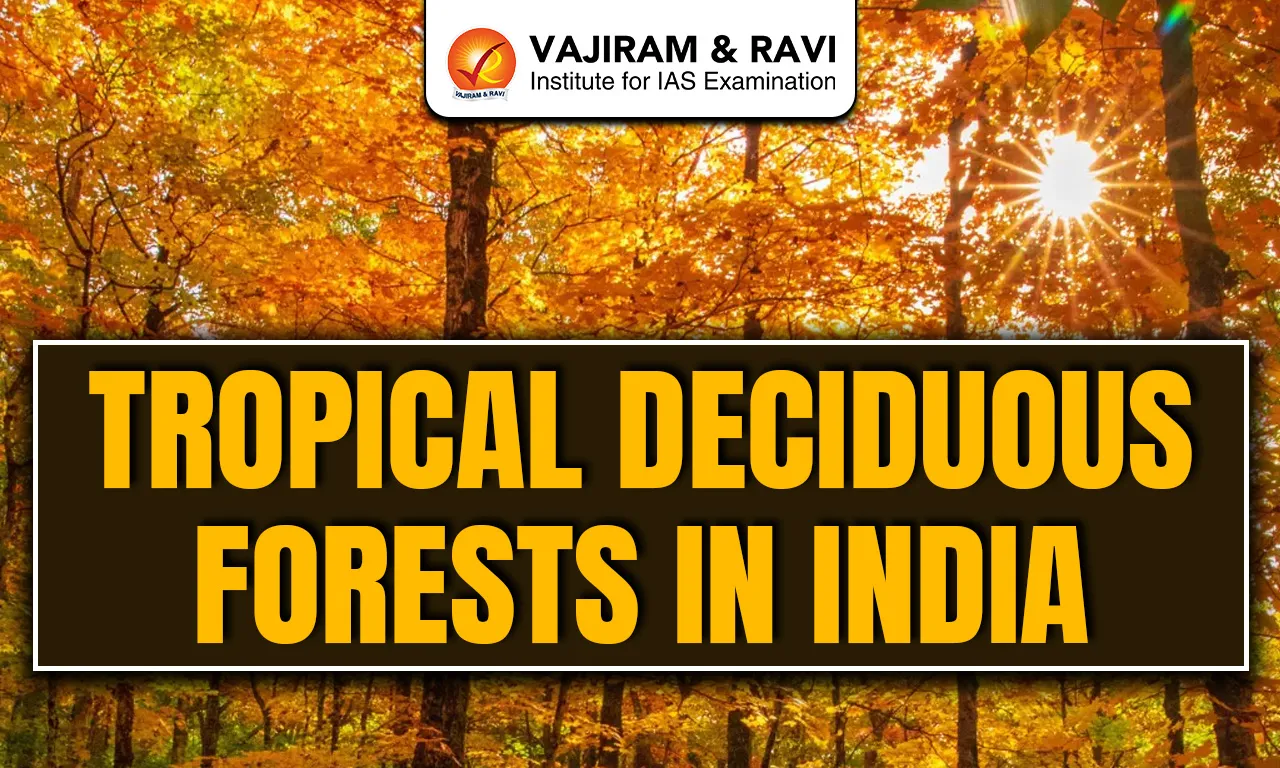
Tropical Deciduous Forests in India are the most widespread type of natural vegetation in the country. India lies in the tropical zone between the Tropic of Cancer and the Tropic of Capricorn, which makes tropical forests dominant here. Around 65-70% of India’s total forest cover consists of tropical deciduous forests, making them the backbone of India’s forest ecosystem.

Tropical Deciduous Forests in India Characteristics

Tropical Deciduous Forests in India are the most widespread type of natural vegetation in the country. They are also called Monsoon Forests because their growth depends mainly on seasonal rainfall.

  • Found in regions receiving 70 cm to 200 cm of annual rainfall.
  • Experience a distinct wet and dry season, with monsoon rains and a long summer dry period.
  • Trees shed their leaves during the dry season (4-6 months) to conserve water.
  • Average temperature ranges between 20°C and 32°C, suitable for hardwood species.
  • Forest canopy is moderately dense, less thick than tropical evergreen forests.
  • Trees generally grow between 15 to 30 meters in height.
  • Soil is mostly fertile and loamy, suitable for agriculture after clearing forests.
  • Support rich biodiversity including tigers, elephants, deer, leopards, monkeys, and many bird species.
  • Major tree species include Teak (Tectona grandis), Sal (Shorea robusta), Neem, Mahua, Bamboo, and Shisham.
  • Economically important for timber, fuelwood, medicinal plants, bamboo, and non-timber forest products.
  • Play a key role in preventing soil erosion, storing carbon, and maintaining ecological balance.

Types of Tropical Deciduous Forests in India

Tropical Deciduous Forests in India are mainly classified into two types based on the amount of rainfall and moisture availability. These are Moist Deciduous Forests and Dry Deciduous Forests, both of which are influenced by the monsoon climate.

1. Moist Deciduous Forests

Moist Deciduous Forests are a type of tropical deciduous forest found in regions with high monsoon rainfall and a short dry season. These forests are dense, tall, and economically very important due to valuable timber species.

  • Receive annual rainfall between 100 cm and 200 cm.
  • Experience warm climate with average temperature around 24°C–30°C.
  • Have a short dry season (3-4 months) during which trees shed leaves.
  • Forest canopy is dense and multi-layered, though less dense than evergreen forests.
  • Trees usually grow up to 20–30 meters in height.
  • Found mainly in Jharkhand, Odisha, Chhattisgarh, West Bengal and eastern slopes of the Western Ghats.
  • Major tree species include Teak (Tectona grandis), Sal (Shorea robusta), Shisham, Bamboo, Mahua, and Arjun.
  • Support rich wildlife such as tigers, elephants, deer, leopards, and many bird species.
  • Provide valuable resources like timber, fuelwood, bamboo, and medicinal plants.

2. Dry Deciduous Forests

Dry Deciduous Forests are a type of tropical deciduous forest found in regions with moderate to low rainfall and a longer dry season. These forests are more open and less dense compared to moist deciduous forests and are adapted to drought conditions.

  • Receive annual rainfall between 70 cm and 100 cm.
  • Experience high temperatures (23°C–32°C) with a long dry season of about 5–6 months.
  • Trees shed their leaves during summer, making the forest look dry and grass-like.
  • Forest canopy is open and scattered, allowing more sunlight to reach the ground.
  • Trees are generally shorter (10–20 meters) compared to moist deciduous forests.
  • Widely found in Madhya Pradesh, Uttar Pradesh, Bihar, Maharashtra and parts of Karnataka.
  • Major tree species include Teak, Neem (Azadirachta indica), Palash (Butea monosperma), Khair, Bel, Peepal, and Axlewood.
  • Support wildlife such as deer, langurs, wild boars, foxes, reptiles, and various bird species.
  • Economically important for timber, firewood, tendu leaves, and grazing land.

Tropical Deciduous Forests Vegetation

The vegetation of Tropical Deciduous Forests is specially adapted to survive seasonal rainfall and long dry periods. These forests remain green and dense during the monsoon but shed their leaves in summer to conserve water.

Main Features of Vegetation

  • Trees shed leaves for 4–6 months during the dry season.
  • Forest canopy is moderately dense, not as thick as tropical evergreen forests.
  • Trees usually grow 15–30 meters tall.
  • Many trees have thick bark to reduce water loss and protect from fire.
  • Deep root systems help plants absorb underground water.
  • Sunlight reaching the forest floor allows grasses and shrubs to grow.

Major Tree Species

The following important trees dominate tropical deciduous forests:

  • Teak (Tectona grandis) – High-quality hardwood used for furniture and construction.
  • Sal (Shorea robusta) – Strong timber used for railway sleepers and buildings.
  • Shisham (Dalbergia sissoo) – Valuable wood for furniture and carving.
  • Neem (Azadirachta indica) – Medicinal tree with antibacterial properties.
  • Mahua (Madhuca longifolia) – Flowers used for food and local beverages.
  • Palash (Butea monosperma) – Known for bright orange flowers and medicinal uses.
  • Bamboo – Used in paper industry, handicrafts, and construction.
  • Arjun (Terminalia arjuna) – Bark used in heart medicines.

Adaptations of Vegetation

Plants in tropical deciduous forests show several adaptations:

  • Leaf Shedding – Reduces water loss during dry season.
  • Thick Bark – Protects from heat and forest fires.
  • Deep Roots – Help absorb water from deep soil layers.
  • Smaller or Waxy Leaves – Reduce transpiration.

Tropical Deciduous Forests Importance

Tropical Deciduous Forests are one of the most important forest types in India because they provide valuable timber, support rich wildlife, and help maintain ecological balance.

  • Major Source of Timber – Provide high-quality wood like teak and sal used in furniture, construction, railway sleepers, and shipbuilding.
  • Supports Biodiversity – Habitat for animals such as tiger, elephant, deer, leopard, and many bird species, helping maintain the food chain.
  • Livelihood Support – Tribal and rural communities depend on forest products like bamboo, tendu leaves, mahua flowers, honey, and medicinal plants.
  • Soil Conservation – Tree roots prevent soil erosion and maintain soil fertility, especially during heavy monsoon rains.
  • Climate Regulation – Absorb carbon dioxide and help reduce the impact of climate change.
  • Water Cycle Maintenance – Improve groundwater recharge and regulate local rainfall patterns.
  • Economic Contribution – Support forest-based industries such as paper, plywood, handicrafts, and herbal medicine production.
  • Ecological Balance – Maintain temperature, humidity, and biodiversity in tropical regions.

Tropical Deciduous Forests in World

Tropical Deciduous Forests are found in regions with seasonal rainfall and a long dry period. These forests lie mostly between the Tropic of Cancer and the Tropic of Capricorn between between 10° and 20°N latitude and the other between 10° and 20°S latitude and are common in parts of Asia, Africa, and the Americas.

1. South and Southeast Asia

  • Found widely in India, Myanmar, Thailand, Laos, and Cambodia.
  • India has one of the largest areas under tropical deciduous forests, covering nearly 65-70% of its total forest area.
  • Dominant trees include teak, sal, bamboo, and sandalwood.
  • These forests support rich wildlife such as elephants, deer, and tigers.
  • Found in regions with 100–200 cm annual rainfall and a dry season of 4–6 months.

2. Africa

  • Present in parts of Nigeria, Ghana, Tanzania, and Mozambique.
  • Often found on the edges of tropical rainforests and savanna regions.
  • Trees shed leaves during the dry season to survive hot climates.
  • Important species include acacia, baobab, and mahogany.
  • Support wildlife such as antelope, giraffe, and elephants.

3. Central and South America

  • Found in Brazil, Mexico, Venezuela, and parts of Colombia.
  • Occur on the margins of the Amazon rainforest and in seasonal tropical zones.
  • Trees include mahogany, ceiba, and tropical hardwood species.
  • These forests experience distinct wet and dry seasons.
  • Play an important role in carbon storage and biodiversity conservation.

4. Northern Australia

  • Located in the tropical parts of Australia, especially in Northern Territory and Queensland.
  • Known as “monsoon forests” due to seasonal rainfall.
  • Trees shed leaves during dry months to conserve water.
  • Vegetation includes eucalyptus and acacia species.
  • Support unique wildlife like kangaroos and various bird species.

Tropical Deciduous Forest Vs Tropical Rainforest

Tropical Deciduous Forests and Tropical Rainforests are both found in warm tropical regions, but they differ mainly in rainfall pattern, vegetation density, and biodiversity. While deciduous forests shed their leaves during the dry season, rainforests remain green throughout the year due to continuous heavy rainfall.

Tropical Deciduous Forest Vs Tropical Rainforest
Feature Tropical Deciduous Forest Tropical Rainforest

Other Name

Monsoon Forest

Evergreen Forest

Rainfall

70–200 cm annually

More than 200 cm annually

Dry Season

Present (4–6 months)

No distinct dry season

Climate

Wet and dry tropical climate

Hot and humid throughout the year

Leaf Pattern

Trees shed leaves in dry season

Trees remain evergreen

Tree Height

15-30 meters

40-70 meters

Forest Density

Moderate

Very dense and multi-layered

Forest Layers

Usually 1–2 layers

Four layers - Emergent, Canopy, Understory, Forest Floor

Soil Type

Relatively fertile

Nutrient-poor due to heavy leaching

Biodiversity

Moderate

Extremely high

Common Trees

Teak, Sal, Neem, Palash, Bamboo

Mahogany, Ebony, Rubber, Orchids

Wildlife

Tigers, Elephants, Deer, Leopards

Monkeys, Jaguars, Snakes, Frogs, Parrots

Location in India

Madhya Pradesh, Chhattisgarh, Jharkhand, Odisha

Western Ghats, North-East India, Andaman and Nicobar Islands

Economic Use

Timber, fuelwood, medicines

Timber, spices, medicinal plants

Major Threats

Agriculture, fire, overgrazing

Deforestation, mining, plantations

Tropical Deciduous Forests in India FAQs

Q1: What are Tropical Deciduous Forests in India?

Ans: Tropical Deciduous Forests are forests found in regions with seasonal rainfall where trees shed their leaves during the dry season.

Q2: Why are they called Monsoon Forests?

Ans: They are called Monsoon Forests because they receive most of their rainfall during the southwest monsoon and remain dry for several months. Trees shed leaves in the dry season to conserve water.

Q3: What percentage of India’s forest cover is tropical deciduous forest?

Ans: Around 65–70% of India’s total forest area is covered by tropical deciduous forests, making them the most widespread forest type in the country.

Q4: What are the two types of Tropical Deciduous Forests?

Ans: They are classified into: Moist Deciduous Forests (100–200 cm rainfall) and Dry Deciduous Forests (70–100 cm rainfall).

Q5: Where are Tropical Deciduous Forests mainly found in India?

Ans: They are widely found in central and northern India, especially in Madhya Pradesh, Chhattisgarh, Jharkhand, Odisha, Uttar Pradesh and Maharashtra.

101st Constitutional Amendment Act, Importance, Key Details

101st Constitutional Amendment Act

Under 101st Constitutional Amendment Act, Goods and Service tax which is popularly known as GST was included in the Constitution of India. Article 366(12A) discusses the same which also refers to tax applied to the supply of goods, services or even both from which sale of alcohol is exempted.

The Goods and Services Tax (GST) marked a major shift in the Indirect Tax System of India. It merged several Central and State taxes into a single tax, resolving the issue of double taxation. For consumers, one of the biggest benefits was the expected drop in the overall tax burden on goods earlier around 25-30%. It also made the cost of taxes more transparent, so people could actually see how much they were paying.

101st Constitutional Amendment Act

Article 246 of the Indian Constitution splits legislative powers, including taxation, between the Parliament and State Legislatures. The Constitution ensures that fiscal powers of the Centre and the States are clearly separated, with minimal overlap.

The Centre can tax the manufacture of goods except alcoholic beverages for human use, opium, and narcotic drugs. States are allowed to tax the sale of goods, but not their manufacture. For inter-state sales, the Centre levies a tax called the Central Sales Tax, but the revenue goes entirely to the state where the sale originated.

When it comes to services, only the Centre is allowed to impose a service tax. States cannot levy taxes on the import or export of goods; this power lies solely with the Centre. The Centre also collects additional customs duties (CVD and SAD) to make up for taxes like excise duty and VAT that would apply if the same goods were made domestically.

With the launch of GST, the Constitution had to be amended to give both the Centre and States the power to tax and collect GST.

Also Check: 103rd Constitutional Amendment Act

Legislative Basis Of GST

The GST Bill was first introduced in the 16th Lok Sabha in 2014. It was passed by the Lok Sabha in May 2015 and, after a few changes, cleared the Rajya Sabha in August 2016. Once the required number of states ratified it, the Bill received the President’s assent on September 8, 2016, and became the 101st Constitutional Amendment. The GST Council was formed soon after, on September 12, 2016, with a dedicated Secretariat to guide its work. To ensure a smooth rollout of GST, several committees and sector-specific groups were created, including representatives from both the Centre and the States.

Important provisions of the Bill

  • Central GST (CGST) subsumes excise duty, service tax, and other central levies
  • State GST (SGST) covers VAT, luxury tax, and other state-level taxes.
  • For interstate trade, GST is applied through the Integrated GST (IGST). IGST isn’t a separate tax but a mechanism to coordinate tax sharing between the Centre and the States. 
  • To enable this framework, the Constitution was amended to include Articles 246A, 269A, and 279A, along with key changes to the 7th Schedule.

Key aspects of Article 246 (A)

Article 246A establishes that both the Union and the States can make laws on goods and services tax. In the case of intra-state trade, both the Centre and the State have the authority to levy GST. However, when it comes to inter-state trade and commerce, only the central government has the exclusive power to impose GST.

Key aspects of Article 269 A

Article 269A deals with the taxation of inter-state trade under GST. It discusses that the Government of India will collect this tax and then distribute it between the Centre and the States, based on the recommendations of the GST Council.

Key aspects of Article 279-A

Article 279A mandates the President to establish a GST Council within sixty days of the Act coming into force. The Council is chaired by the Union Finance Minister, with the Union Minister of State for Revenue or Finance as a member. Each state nominates one minister in charge of finance or taxation. In terms of decision-making, the Centre holds one-third of the voting power, while the states share the remaining two-thirds. Any decision requires a three-fourths majority to pass.

Key Aspects of List I

  • The Article mandates the President to constitute a GST Council within sixty days of the GST Act coming into effect.
  • The GST Council will be headed by the Union Finance Minister, who will serve as its Chairman.
  • The Union Minister of State in charge of Revenue or Finance will also be a member of the Council.
  • Each state will nominate one member who is in charge of finance or taxation.
  • The Council's structure ensures that the central government holds one-third of the total voting power.
  • The remaining two-thirds of the voting power rests with the states collectively.
  • For any decision to be passed in the Council, a three-fourths majority vote is required.

Also Check: 104th Constitutional Amendment Act

Main Features of GST

  • Levied on Supply: GST applies to the supply of goods and services, replacing earlier taxes on manufacturing, sales, or service provision.
  • Destination-Based Tax: It follows a destination-based model, meaning the tax revenue goes to the state where goods or services are consumed, not where they're produced.
  • Dual Structure: GST has two components, Central GST (CGST) levied by the Centre and State GST (SGST) levied by the States both charged on the same transaction.
  • Import as Inter-State Supply: Imports are treated as inter-state supplies and attract Integrated GST (IGST), along with customs duties.
  • Rates Decided by GST Council: GST rates for CGST, SGST, and IGST are decided through mutual agreement between the Centre and States, based on recommendations by the GST Council.

Multiple Tax Slabs: GST was introduced with multiple tax rates 5%, 12%, 18%, and 28% with goods and services classified under each slab by the GST Council.

101st Constitutional Amendment Act FAQs

Q1: What is the 101st Constitutional Amendment Act?

Ans: It introduced the Goods and Services Tax (GST) in India, unifying multiple indirect taxes into a single nationwide tax regime.

Q2: When was the 101st Constitutional Amendment passed?

Ans: The Amendment was passed by Parliament in August 2016 and came into effect on 1st July 2017.

Q3: What is the main objective of the 101st Amendment?

Ans: Its main aim is to create a unified national market by replacing various indirect taxes with a single tax, GST.

Q4: Which Article was inserted by the 101st Amendment?

Ans: It inserted Article 279A into the Constitution, which provides for the establishment of the GST Council.

Q5: What is the GST Council?

Ans: The GST Council is a constitutional body that recommends tax rates, exemptions, and regulations related to GST in India.

Dak Karmayogi, Objectives, Features, Benefits, Significance

Dak Karmayogi

Dak Karmayogi is an online learning and capacity-building portal developed by the Department of Posts under the broader vision of Mission Karmayogi. It aims to improve the efficiency, skills, and service quality of postal employees and Gramin Dak Sevaks (GDS) by providing structured, standardized, and technology-driven training programs.

This initiative reflects the governance philosophy of “Minimum Government, Maximum Governance”, ensuring faster, transparent, and citizen-friendly public service delivery.

About Dak Karmayogi

  • Dak Karmayogi is an in-house digital training portal launched by the Department of Posts to improve workforce efficiency.
  • It is aligned with the vision of Mission Karmayogi, which focuses on civil services capacity building.
  • The initiative supports the governance principle of “Minimum Government, Maximum Governance.”
  • It provides uniform and standardized training content to postal employees across India.
  • The portal offers online and blended learning modes, combining digital modules with campus-based training.
  • It focuses on improving the skills of Gramin Dak Sevaks (GDS) and departmental employees.
  • The training modules cover financial services, postal operations, digital services, and customer handling skills.
  • It strengthens delivery of G2C (Government to Citizen) services such as savings schemes, insurance, DBT payments, and Aadhaar-related services.
  • The platform promotes continuous learning and self-paced training for employees.
  • Online assessment and certification ensure accountability and performance tracking.
  • It enhances digital literacy among postal staff, especially in rural areas.
  • The initiative improves customer satisfaction by reducing service delays and errors.
  • It supports better implementation of government schemes at the grassroots level.
  • Overall, Dak Karmayogi contributes to administrative reforms and modernization of India’s postal system.

About Mission Karmayogi

  • Mission Karmayogi is a National Programme for Civil Services Capacity Building (NPCSCB) launched by the Government of India to reform and modernize the civil services system.
  • It was approved in September 2020 with the aim of transforming India’s bureaucracy into a more efficient, transparent, and accountable system.
  • The mission was conceptualized under the leadership of Prime Minister Narendra Modi.
  • It focuses on shifting from rule-based administration to role-based administration, emphasizing competency over seniority.
  • The programme promotes continuous online learning through a digital platform called iGOT Karmayogi (Integrated Government Online Training).
  • It aims to build future-ready civil servants equipped with domain knowledge, digital skills, and behavioral competencies.
  • The mission encourages a competency-driven human resource management system in government departments.
  • It covers around 46 lakh central government employees, making it one of the largest civil service reform initiatives.
  • The reform emphasizes values such as integrity, professionalism, and citizen-centric governance.
  • Overall, Mission Karmayogi seeks to improve public service delivery and ensure the effective implementation of government schemes across India.

Dak Karmayogi FAQs

Q1: What is Dak Karmayogi?

Ans: Dak Karmayogi is a digital training portal developed by the Department of Posts to enhance the skills and efficiency of postal employees and Gramin Dak Sevaks.

Q2: Under which initiative was Dak Karmayogi launched?

Ans: It was launched under the vision of Mission Karmayogi, a national program aimed at civil services reform and capacity building.

Q3: What is the main objective of Dak Karmayogi?

Ans: The main objective is to upgrade the skills of employees and GDS to provide better Government to Citizen (G2C) services and improve customer satisfaction.

Q4: Who can access the Dak Karmayogi portal?

Ans: Postal department employees and Gramin Dak Sevaks across India can access the training modules through the portal.

Q5: What type of training is provided on Dak Karmayogi?

Ans: The portal provides standardized training in postal operations, financial services, digital services, customer service management, and government scheme implementation.

Mahadeo Hills, Geography, Physical Features, Flora, Fauna

Mahadeo Hills

Mahadeo Hills are a part of the Satpura Range in central India, mainly located in Madhya Pradesh. They form the central and higher section of the Satpura Mountains. The famous hill station Pachmarhi and the highest peak of the Satpura Range, Dhoopgarh is located here. The region is covered with forests and is important for wildlife.

About Mahadeo Hills

  • Mahadeo Hills are sandstone hills located in the northern part of the Satpura Range in southern Madhya Pradesh, central India. They form an important physical feature of the Peninsular Plateau
  • The hills were formed millions of years ago and have small plateaus and steep slopes. The northern side has a gentle slope, while the southern side is steep and drops sharply in height.
  • To the north of the Mahadeo Hills flows the Narmada River, which runs in a valley between the Mahadeo Hills and the Vindhya Range. The hills act as an important watershed between the Narmada and Tapi river basins. Several small streams and reservoirs, such as the Tawa reservoir are connected to this region.
  • The area is covered with brown soil and dense deciduous forests. Trees like teak, sal, and bamboo are common. The hills are part of the Satpura Tiger Reserve and the Pachmarhi Biosphere Reserve, making them important for wildlife conservation. Animals such as tigers and leopards are found here.
  • The region also has ancient rock shelters with prehistoric paintings.

Mahadeo Hills Geography

  • The Mahadeo Hills are located in southern Madhya Pradesh in central India. They mainly spread across the districts of Betul, Chhindwara, Seoni and Narmadapuram. These hills form the northern part of the Satpura Range and stretch in an east-west direction for about 150-200 km.
  • Geographically, the hills lie in the central Indian highlands around 22°N latitude and 78°E longitude. The region is completely within Madhya Pradesh, although the western part in Betul district is close to the Maharashtra border.
  • The Mahadeo Hills are very important from a river and drainage point of view. They act as a watershed divide. The Narmada River flows to the north of the hills, while rivers like Wainganga and Wardha flow towards the south and later join the Godavari River system. Because of this, the hills influence water flow and river systems in central India.
  • They are also connected to the larger Satpura-Maikal region, forming an important part of the upland system of central India.

Mahadeo Hills Topography and Physical Features

  • The Mahadeo Hills are an important sub-range of the Satpura Mountains and have a rugged and uneven landscape. The region includes steep hills, narrow valleys, deep gorges, flat hilltops, and small plateaus. The height of the hills generally ranges from about 600 metres to more than 1,300 metres above sea level. Because of these height differences, different types of vegetation and wildlife are found in different parts of the hills.
  • The northern side of the Mahadeo Hills has comparatively gentle slopes that gradually descend towards the Narmada Valley. In contrast, the southern side is much steeper and drops sharply towards the Deccan Plateau. This difference in slope gives the hills an escarpment-like appearance, especially along the southern edge.
  • Some of the highest peaks of central India are located here. Mahadeo Peak (about 1,330 m), Dhoopgarh (1,352 m - the highest point in Madhya Pradesh) and Chauragarh (around 1,308 m) are important peaks in this region. 
  • The hills are mainly made up of sandstone rocks, especially the Pachmarhi sandstone, which forms steep cliffs and rocky surfaces.
  • Many small streams and rivers flow through the hills, cutting deep valleys and shaping the landscape over time.

Mahadeo Hills Vegetation and Forests

  • The Mahadeo Hills are covered mainly with tropical moist deciduous forests. These forests grow well in areas that receive seasonal monsoon rainfall. During the dry season, many trees shed their leaves to conserve water and new leaves grow again in the rainy season.
  • Teak is the most common tree in this region. Sal is also found here, though it is more common in eastern India. Other important trees include mahua, tendu and bamboo. Many medicinal plants, such as amla (Indian gooseberry), are also found in these forests. Because of this rich plant life, the region has both ecological and economic importance.
  • The forests have different layers - tall trees form the upper layer, smaller trees and shrubs grow below them and grasses and herbs cover the ground. Dense bamboo thickets are common in valleys and near streams. These forests help in soil conservation, prevent erosion during heavy rains and maintain the water cycle.

Mahadeo Hills Fauna and Wildlife

  • The Mahadeo Hills fall within the famous Satpura Tiger Reserve, which is known for its rich wildlife. The area supports many species of mammals, birds, and reptiles.
  • Major animals found here include the Bengal tiger, leopard, sloth bear, gaur (Indian bison), sambar deer and wild dog (dhole). Tigers and leopards are top predators and help maintain balance in the ecosystem by controlling herbivore populations.
  • The region is also rich in birdlife, with more than 300 species of birds recorded. Vultures nest on rocky cliffs, and many migratory birds visit wetlands during winter.
  • Among reptiles, the Indian rock python, monitor lizard and mugger crocodile are important species. The hills also have some rare and locally found species, which show their ecological importance.

Satpura Tiger Reserve

  • The Satpura Tiger Reserve was declared under Project Tiger in the year 2000 to protect tigers and their habitat. It includes Satpura National Park (established in 1981) along with Bori and Pachmarhi Wildlife Sanctuaries. The reserve spreads across the districts of Narmadapuram, Betul and Chhindwara in Madhya Pradesh and covers more than 2,100 sq km, including both core and buffer areas.
  • A large part of the Mahadeo Hills lies within this reserve. The core area is specially protected as a critical tiger habitat, while the buffer zone allows limited human activities with regulation.
  • The region is rich in biodiversity and supports animals like tigers, leopards, sloth bears, gaur, and many bird species. The Denwa River flows through the reserve, adding to its ecological importance.
  • The area is also known for its natural beauty and heritage sites. Pachmarhi plateau has many prehistoric rock shelters that show evidence of early human life.

Mahadeo Hills FAQs

Q1: Where are the Mahadeo Hills located?

Ans: The Mahadeo Hills are located in southern Madhya Pradesh in central India. They form the northern part of the Satpura Range and spread across Betul, Chhindwara, Seoni, and Narmadapuram districts.

Q2: What are the major peaks of the Mahadeo Hills?

Ans: Important peaks include Dhoopgarh (1,352 m), the highest point of Madhya Pradesh, Mahadeo Peak (1,330 m), and Chauragarh (1,308 m).

Q3: What type of forests are found in the Mahadeo Hills?

Ans: The region mainly has tropical moist deciduous forests. Common trees include teak, sal, mahua, tendu, and bamboo.

Q4: Why are the Mahadeo Hills important for wildlife conservation?

Ans: A large part of the hills lies within the Satpura Tiger Reserve and Pachmarhi Biosphere Reserve. The area supports species like tiger, leopard, sloth bear, gaur, and many bird species.

Q5: What is the significance of Satpura Tiger Reserve?

Ans: Declared under Project Tiger in 2000, it protects critical tiger habitat and includes Satpura National Park, Bori Wildlife Sanctuary, and Pachmarhi Wildlife Sanctuary. It promotes biodiversity conservation and eco-tourism.

Part 19 of Indian Constitution, Articles, Amendments, Case Laws

Part 19 of Indian Constitution

Part 19 of Indian Constitution contains miscellaneous provisions that grant immunities to high constitutional authorities and provide interpretative and transitional provisions to ensure smooth constitutional functioning.

Part 19 of Indian Constitution Related Articles

  • Article 361 deals with protection of the President and Governors.
  • Article 361A provides protection for publication of parliamentary proceedings.
  • Article 361B disqualifies defectors from holding remunerative political posts.
  • Article 362 (repealed) earlier dealt with rights and privileges of rulers of Indian States.
  • Article 363 bars courts from interfering in disputes related to pre-Constitution treaties and agreements.
  • Article 363A abolishes recognition of rulers and privy purses.
  • Article 364 relates to special provisions regarding major ports and aerodromes.
  • Article 365 provides consequences of failure to comply with Union directions.
  • Article 366 contains definitions of constitutional terms.
  • Article 367 provides rules for interpretation of the Constitution.

Article 361 Protection of the President and Governors

  • Article 361 grants constitutional immunity to the President of India and the Governors of States in respect of their official acts. 
  • They are not answerable to any court for the exercise and performance of their powers and duties. 
  • No criminal proceedings can be initiated against them during their term of office. 
  • However, civil proceedings relating to personal acts may be instituted after giving two months’ prior notice.

This protection is intended to ensure that these constitutional authorities can perform their duties independently and without fear of litigation.

Article 361A Protection of Publication of Parliamentary Proceedings

  • Article 361A provides legal protection to persons publishing a substantially true report of proceedings of Parliament or State Legislatures. 
  • This protection does not apply to secret sittings.

Article 361B Disqualification for Remunerative Political Post

  • Article 361B states that a member disqualified under the Tenth Schedule (anti-defection law) is also disqualified from being appointed to any remunerative political post. 
  • This provision was introduced to prevent defectors from being rewarded with office and to strengthen the anti-defection framework.

Article 362 (Repealed)

Article 362 originally required the State to respect the rights and privileges of former rulers of Indian States. However, it was repealed by the 26th Constitutional Amendment Act, 1971, which abolished privy purses and ended official recognition of princely rulers.

Article 363 Bar to Interference by Courts

Article 363 bars courts from adjudicating disputes arising out of treaties, agreements, or covenants entered into before the commencement of the Constitution between the Government of India and rulers of Indian States. These matters were treated as political rather than judicial issues.

Article 363A Abolition of Privy Purses

Article 363A abolished the recognition of rulers of Indian States and discontinued privy purses and privileges granted to them after independence. This marked the completion of political integration and reinforced the principle of equality in a democratic republic.

Article 364 Special Provisions Regarding Major Ports and Aerodromes

Article 364 empowers the President to issue directions concerning the administration of major ports and aerodromes in certain circumstances. 

Article 365 Effect of Failure to Comply with Union Directions

Article 365 provides that if a State fails to comply with or give effect to directions given by the Union, the President may consider that a situation has arisen in which the government of the State cannot be carried on in accordance with the Constitution. This provision is closely connected with the imposition of President’s Rule under Article 356.

Article 366 Definitions

Article 366 provides definitions of various constitutional terms such as “Scheduled Castes,” “Scheduled Tribes,” and other expressions used throughout the Constitution. These definitions ensure clarity and uniform interpretation.

Article 367 Interpretation

Article 367 lays down rules for interpreting the Constitution and refers to the General Clauses Act, 1897 for guidance in understanding terms and expressions. It helps avoid ambiguity in constitutional interpretation.

Part 19 of Indian Constitution Related Constitutional Amendments

Here we have discussed all the constitutional amendments related to Part 19 of Indian Constitution.

26th Constitutional Amendment Act, 1971

  • This amendment repealed Article 362 and inserted Article 363A.
  • It abolished the recognition of rulers of Indian States and discontinued privy purses and privileges. 

44th Constitutional Amendment Act, 1978

  • This amendment inserted Article 361A.
  • It provided constitutional protection for the publication of substantially true reports of parliamentary and state legislature proceedings. 

91st Constitutional Amendment Act, 2003

  • This amendment inserted Article 361B.
  • It disqualified members who are disqualified under the Tenth Schedule (anti-defection law) from being appointed to any remunerative political post, thereby strengthening the anti-defection framework.

Part 19 of Indian Constitution Related Case Laws

  • Rameshwar Prasad v. Union of India (2006): The Supreme Court held that although the Governor enjoys immunity under Article 361, his actions and reports can be judicially reviewed, and constitutional immunity does not place his decisions beyond scrutiny.
  • S.R. Bommai v. Union of India (1994): While primarily related to Article 356, the Court clarified that Article 365 does not give absolute power to the Union, and the President’s satisfaction regarding failure of constitutional machinery is subject to judicial review.
  • Madhav Rao Scindia v. Union of India (1971): The Supreme Court struck down the Presidential order abolishing privy purses, leading to the 26th Constitutional Amendment and insertion of Article 363A abolishing recognition of rulers and privy purses.
  • Kehar Singh v. Union of India (1989): The Court held that although the President enjoys immunity under Article 361, the exercise of his powers (such as pardon under Article 72) can be subject to limited judicial review.
  • P.V. Narasimha Rao v. State (1998): The Supreme Court interpreted constitutional immunities relating to legislative functioning and clarified the scope of protection for actions connected with parliamentary proceedings, relevant to Article 361A.
  • Raja Ram Pal v. Hon’ble Speaker, Lok Sabha (2007): The Court held that even though parliamentary proceedings enjoy protection, they are not completely immune from judicial review if there is a substantive constitutional violation, reinforcing constitutional supremacy.

Part 19 of the Indian Constitution FAQs

Q1: What does Part 19 of the Indian Constitution deal with?

Ans: Part 19 contains miscellaneous provisions relating to constitutional immunities, interpretation, definitions, and certain special matters.

Q2: Does the President enjoy immunity from legal proceedings?

Ans: Yes, under Article 361, the President is not answerable to any court for official acts and no criminal proceedings can be initiated during the term of office.

Q3: What happened to Article 362?

Ans: Article 362, which protected the rights and privileges of former rulers, was repealed by the 26th Constitutional Amendment Act, 1971.

Q4: What does Article 363 provide?

Ans: Article 363 bars courts from adjudicating disputes arising out of pre-Constitution treaties and agreements with former princely rulers.

Q5: What is the purpose of Article 365?

Ans: Article 365 allows the President to treat a State’s failure to comply with Union directions as a breakdown of constitutional machinery.

Baba Dayal Das, Background, Contributions, Nirankari Movement

Baba Dayal Das

Baba Dayal Das (1783-1855) was a Sikh religious reformer from Punjab. He is known as the founder of the Nirankari Movement. He believed in the worship of one formless God and wanted people to follow the original teachings of the Sikh Gurus. He opposed idol worship and unnecessary rituals and encouraged a simple and moral way of life based on the Guru Granth Sahib.

Baba Dayal Das Background

  • Baba Dayal Das was born in 1783 in Peshawar in a Malhotra Khatri family. In his early life, he followed religious customs and rituals like others around him. After the death of his parents, he moved to Rawalpindi, where he started a small medicine shop.
  • As he grew older, he became unhappy with the condition of religion in society. He felt that Sikhism had moved away from the true teachings of the Sikh Gurus and had become influenced by superstitions, idol worship and Brahmanical rituals. He believed that Sikhism should return to its original form.
  • In the 1840s, he began preaching the worship of one formless God (Nirankar). He opposed idol worship, unnecessary rituals and the role of Brahman priests in Sikh ceremonies. He encouraged people to follow the teachings of Guru Nanak and accept the Adi Granth (Guru Granth Sahib) as the main source of authority.
  • He asked his followers to live a simple and moral life. He introduced simple birth, marriage and death ceremonies without the involvement of Brahman priests. His ideas faced opposition from religious authorities and for some time the movement worked quietly. Later, it became more open during British rule in Punjab.

Baba Dayal Das Contributions

  • His followers worshipped the formless God (Nirankar) and strictly followed the teachings (Shabad) of the Adi Granth. They showed humility by serving the congregation, including cleaning shoes and feet.
  • He laid down clear religious rules for householders, teaching that a person could live a family and social life while following moral and religious values.
  • He opposed idol worship, idol-related rituals and the role of Brahman priests in Sikh ceremonies. He also rejected those Sikhs who supported such practices.
  • He emphasized that Guru Nanak’s teachings and the Adi Granth were the ultimate sources of authority and knowledge in Sikhism.
  • He introduced reforms in social customs:
    • Women should not be treated as impure during childbirth.
    • Astrology and horoscopes should not decide the timing of ceremonies.
    • Dowry should not be displayed at marriages.
    • Ritual practices like placing lamps or prasad in rivers should be avoided.
  • He discouraged paying Brahmans for performing rituals.
  • He prohibited immoral practices such as meat and alcohol consumption, lying, cheating and using false weights.
  • Through these reforms, he worked for the purification and revival of Sikhism in the 19th century.

Baba Dayal Das and the Nirankari Movement

  • Baba Dayal Das founded the Nirankari Movement in the 19th century as a reform movement to purify Sikhism and restore it to the original teachings of Guru Nanak and the early Sikh Gurus. He emphasized the worship of one formless God (Nirankar) and rejected idol worship and ritualistic practices.
  • The movement accepted the Adi Granth as the supreme religious authority and encouraged followers to strictly follow its teachings. The Nirankaris issued Hukamnamas (religious instructions) and established their own worship centres with dedicated leaders to guide the community.
  • It opposed Brahmanical influence in Sikh practices and discouraged superstitions, astrology and ritual payments to priests. The movement promoted simple ceremonies for birth, marriage and death without unnecessary rituals.
  • The Nirankaris stressed moral discipline and social reform, discouraging alcohol consumption, dishonesty, cheating and other immoral activities, while encouraging humility, honesty, and simple living.
  • The movement did not oppose British rule and expanded during the colonial period. It played an important role in clearly defining Sikh identity and distinguishing Sikh practices from Hindu customs.
  • After Baba Dayal Das’s death in 1855, the movement was continued by his son Baba Darbara Das, making it a lasting reform movement within Sikhism.

Baba Dayal Das Legacy

Baba Dayal Das is remembered as an important 19th-century Sikh reformer who worked to purify Sikhism and restore it to its original teachings. Through the Nirankari Movement, he emphasized the worship of one formless God (Nirankar) and upheld the authority of Guru Nanak and the Adi Granth. He opposed idol worship, superstition and Brahmanical influence in Sikh practices, thereby contributing to social and religious reform in Punjab. His efforts helped in clearly defining Sikh identity and distinguishing it from Hindu rituals during the colonial period. The movement continued under his successors, making his reform legacy a lasting influence in Sikh religious history.

Baba Dayal Das FAQs

Q1: Who was Baba Dayal Das?

Ans: Baba Dayal Das (1783-1855) was a 19th-century Sikh religious reformer from Punjab. He is known as the founder of the Nirankari Movement and worked to purify Sikhism by returning it to the original teachings of the Sikh Gurus.

Q2: What was the main aim of Baba Dayal Das?

Ans: His main aim was to restore Sikhism to its original form by promoting the worship of one formless God (Nirankar) and removing idol worship, superstitions, and Brahmanical rituals from Sikh practices.

Q3: What is the Nirankari Movement?

Ans: The Nirankari Movement was a Sikh reform movement started by Baba Dayal Das in the 19th century. It emphasized monotheism, moral living, rejection of idol worship, and strict adherence to the Guru Granth Sahib as the supreme authority.

Q4: What social reforms were introduced by Baba Dayal Das?

Ans: He opposed treating women as impure during childbirth, rejected astrology and horoscopes, discouraged dowry display, and prohibited ritual payments to Brahman priests. He also promoted simple ceremonies for birth, marriage, and death.

Q5: How did he define religious authority in Sikhism?

Ans: He declared Guru Nanak’s teachings and the Adi Granth (Guru Granth Sahib) as the ultimate religious authority and rejected priestly dominance and ritualism.

Bahadur Shah Zafar (1775-1862), Biography, Last Mughal, Contributions

Bahadur Shah Zafar

Bahadur Shah Zafar, also known as Abu Zafar Siraj-ud-din Muhammad and Bahadur Shah II, was the twentieth and final Mughal emperor of India. He ruled from 1837 until 1857, when the uprising against the East India Company ended his authority. His rule was mostly limited to the Walled City of Delhi yet in 1857 he was proclaimed Emperor of India by rebel forces. A noted Urdu poet writing under the title “Zafar,” he witnessed exile to Rangoon (present day Yangon) in December 1857, bringing the nearly 500 year old Timurid dynasty to the end.

Bahadur Shah Zafar Biography

Bahadur Shah Zafar was born on 24 October 1775 in Delhi to Akbar II. He was not the preferred heir as another prince, Mirza Jahangir, had earlier been projected for succession. However, after Jahangir attacked Archibald Seton, the British Resident at the Red Fort, and was exiled by the Company, Zafar’s path to the throne became clear. He succeeded his father in 1837 at the age of 62. By then, Mughal authority had shrunk to Delhi and nearby Palam. The East India Company paid him a pension and controlled revenue collection and military presence in the city. His consort was Zeenat Mahal. He passed away while being in exile at Rangoon in November 1862.

Bahadur Shah Zafar in Revolt of 1857

In 1857, rebel sepoys declared Bahadur Shah Zafar as the Emperor of India despite his limited authority and advanced age.

  • On 12 May 1857, sepoy regiments reached the Mughal court and attended his first formal audience in years. They insisted on his leadership, arguing that without his symbolic authority, their campaign against the Company would fail.
  • Initially, he expressed inability to support them due to lack of resources. However, under pressure, he allowed his name and seal to legitimize their cause, transforming a military revolt into a broader political challenge.
  • On 16 May 1857, fifty-two European prisoners were executed under a peepul tree near the palace despite his objections. Though not proven to have ordered it, he was later treated as morally responsible.
  • Delhi’s governance during the uprising became disorganized. The emperor appointed his eldest son, Mirza Mughal, as commander. Yet sepoys rejected centralized command, and city administration functioned in a disorderly manner.
  • As British forces closed in during September 1857, he sought refuge at Humayun’s Tomb. Major William Hodson captured him on 20 September. Shortly after, Hodson executed his sons Mirza Mughal and Mirza Khizr Sultan, and grandson Mirza Abu Bakht near the Delhi Gate.
  • In April 1858, he faced a 21-day trial with 19 hearings, 21 witnesses, and over 100 Persian and Urdu documents translated into English. Charges included aiding mutiny, waging war, assuming sovereignty, and involvement in killings.
  • At 82, he argued that sepoys forced decisions upon him and even used his seal without consent. Though spared execution, he was exiled on 7 October 1858 to Rangoon (Yangon) in Burma under British escort.
  • He arrived in Burma (Myanmar) at the age of 83 and lived under strict supervision. His health declined, and by November 1862 he suffered paralysis in the throat region. He died on 7 November 1862 and was buried near the Shwedagon Pagoda.

Also Read: Mughal Empire

Bahadur Shah Zafar Contributions

Despite political weakness, Bahadur Shah Zafar left enduring literary, cultural, and spiritual legacies as highlighted below:

  • Urdu Poetry and Ghazals: He composed numerous Urdu ghazals reflecting exile, faith, and loss. Though some manuscripts were destroyed in 1857, surviving works were compiled into the Kulliyyat-i-Zafar, preserving his poetic voice.
  • Patronage of Scholars: His court hosted distinguished literary figures such as Mirza Ghalib, Daagh Dehlvi, Momin Khan Momin, and Mohammad Ibrahim Zauq, who also mentored him. This made Delhi a major center of Urdu culture.
  • Sufi Identity: Regarded as a Sufi Pir, he accepted disciples and was described by Delhi Urdu Akhbaar as a leading saint of his time. Before accession, he reportedly lived like a modest scholar rather than a royal prince.
  • Religious Harmony: In his verses, he expressed that Hinduism and Islam shared a common spiritual essence. His court celebrated festivals like Holi, Diwali, and Rakhi alongside Islamic observances, reflecting composite Mughal culture.
  • Belief in Spiritual Practices: He trusted ta'aviz, charms, and spiritual remedies. During illness, he consulted Sufi pirs and even distributed cows, elephants, and horses to religious institutions and the poor as acts of devotion.
  • Symbol of Resistance: After defeat, he recited lines- “गाजियों में बू रहेगी जब तलक ईमान की, तख्त-ए- लंदन तक चलेगी तेग हिन्दुस्तान की।”. These words elevated him as a moral symbol of resistance.
  • End of Timurid Dynasty: His exile formally ended the Timurid Dynasty founded by Timur and followed by Babur as the Mughal Dynasty. With his removal, governance of India shifted fully under British Crown authority.
  • Exile: Initially buried in an unmarked grave in Yangon, his resting place later became the Bahadur Shah Zafar Dargah after restoration in 1991, symbolizing remembrance beyond imperial power.

Bahadur Shah Zafar FAQs

Q1: Who was Bahadur Shah Zafar?

Ans: Bahadur Shah Zafar was the twentieth and last Mughal emperor of India, ruling from 1837 to 1857. Born on 24 October 1775, he was also a respected Urdu poet and the symbolic leader of the Revolt of 1857.

Q2: What was the role of Bahadur Shah Zafar in the Revolt of 1857?

Ans: During the Revolt of 1857, rebel sepoys declared him Emperor of India to unite resistance against the East India Company. Though elderly and politically weak, his name gave legitimacy to the uprising.

Q3: What were the main charges against Bahadur Shah Zafar?

Ans: In 1858, he was tried at the Red Fort on four charges, including supporting mutiny, waging war against the British, claiming sovereignty, and involvement in the killing of Christians.

Q4: Where was Bahadur Shah Zafar exiled?

Ans: After his trial, he was exiled in October 1858 to Rangoon in Burma, now Yangon in Myanmar, where he lived under British supervision until his death in 1862.

Q5: Who were some famous poets in Bahadur Shah Zafar’s court?

Ans: His court included renowned Urdu poets such as Mirza Ghalib, Daagh Dehlvi, Momin Khan Momin, and Mohammad Ibrahim Zauq, making Delhi a major literary center during his reign.

Part 17 of Indian Constitution, Articles, Legislation, Case Laws

Part 17 of Indian Constitution

Part 17 of Indian Constitution deals with the official language of the Union and the States. It lays down provisions regarding the language to be used for official purposes of the Government of India, communication between the Union and States, proceedings of courts and legislatures, and the development of Hindi.

Part 17 of Indian Constitution Articles

  • Articles 343-344 deal with the official language of the Union.
  • Articles 345-347 deal with the official language of States.
  • Articles 348-349 deal with language of courts, legislation and special procedures.
  • Articles 350-350B provide safeguards for linguistic minorities.
  • Article 351 gives directions for the development of the Hindi language.

Article 343 Official Language of the Union

  • Hindi in Devanagari script is declared as the official language of the Union.
  • The form of numerals to be used for official purposes is the international form of Indian numerals.
  • However, for a period of 15 years from the commencement of the Constitution (i.e., till 1965), English was to continue for official purposes.
  • Even after 1965, English continues to be used for official purposes under parliamentary law (Official Languages Act, 1963).

Article 344 Commission and Committee on Official Language

  • The President shall appoint a Commission after five years from the commencement of the Constitution, and thereafter at ten-year intervals.
  • The Commission makes recommendations regarding - Progressive use of Hindi, Restrictions on English, and Language for communication between Union and States.
  • A Parliamentary Committee examines the recommendations and submits its report to the President.

Article 345 Official Language of a State

  • A State Legislature may adopt any one or more languages in use in the State or Hindi as the official language of that State.
  • Until such adoption, English continues for official purposes.

Article 346 Official Language for Communication Between States

  • Communication between one State and another, or between a State and the Union, shall normally be in Hindi.
  • However, if two States agree, they may use English for communication.

Article 347 Special Provision Relating to Language Spoken by a Section of Population

  • If a substantial proportion of a State’s population demands recognition of a particular language, the President may direct that such language be officially recognised within that State.

Article 348 Language of Supreme Court, High Courts and Legislation

  • Proceedings in the Supreme Court and High Courts shall be in English.
  • Authoritative texts of all Bills, Acts, Ordinances, rules and regulations shall be in English.
  • However, the Governor of a State may, with the President’s consent, authorise the use of Hindi or another language in High Court proceedings (but judgments must be in English unless approved otherwise).

Article 349 Special Procedure for Language-Related Laws

  • Parliament cannot make laws altering language provisions without considering the recommendations of the Commission under Article 344 during the initial 15-year period.

Article 350 Language to be Used in Representations

  • Every person has the right to submit representations for redress of grievances to any authority of the Union or State in any of the languages used in the Union or State.

Article 350A Instruction in Mother Tongue at Primary Stage

  • It was added by the 7th constitutional amendment act 1956.
  • It is the duty of every State to provide adequate facilities for instruction in the mother tongue at the primary stage of education to children belonging to linguistic minority groups.

Article 350B Special Officer for Linguistic Minorities

  • It was added by the 7th constitutional amendment act 1956.
  • The President appoints a Special Officer for Linguistic Minorities.
  • The officer investigates matters relating to safeguards for linguistic minorities and reports to the President.
  • The reports are laid before Parliament and State Legislatures.

Article 351 Directive for Development of Hindi

  • The Union has the duty to promote the spread of Hindi.
  • Hindi should be developed to serve as a medium of expression for all elements of India’s composite culture.
  • It should draw vocabulary from Sanskrit and other Indian languages.

Important Legislation Related to Part 17 of Indian Constitution

Due to India’s vast linguistic diversity and concerns of non-Hindi speaking States, Parliament enacted important legislations such as the Official Languages Act, 1963 and its subsequent amendment in 1967 to ensure administrative continuity, national unity, and protection of linguistic interests

Official Languages Act, 1963

  • The Constitution originally provided that English would continue for official purposes of the Union for only fifteen years after its commencement, that is, until 1965. However, considering administrative convenience and concerns raised by non-Hindi speaking States, Parliament enacted the Official Languages Act, 1963.
  • Official Languages Act, 1963 provided that English would continue to be used along with Hindi for official purposes of the Union, even after the expiry of the initial 15-year period. 
  • It also allowed the use of English in parliamentary proceedings, legislative documents, and communication between the Union and States.

Official Languages (Amendment) Act, 1967

  • The 1967 Amendment further strengthened the safeguards relating to the use of English. It clearly assured non-Hindi speaking States that English would continue indefinitely for official purposes of the Union, unless all States agreed otherwise.
  • The amendment also ensured that communication between the Union and States that had not adopted Hindi as their official language would continue in English. 

Part 17 of Indian Constitution Related Case Laws 

  • Murasoli Maran v. Union of India (1977): The Supreme Court upheld the constitutional validity of the Official Languages Act, 1963, and affirmed that the continued use of English for official purposes of the Union does not violate Article 343. The Court recognised Parliament’s authority to provide for the use of English beyond the initial 15-year period.
  • English Medium Students Parents Association v. State of Karnataka (1994): The Supreme Court held that the State cannot compel students to study exclusively in a particular language. The judgment reinforced the protection of linguistic choice and minority rights under Articles 29, 30 and safeguards linked to Article 350A.
  • State of Karnataka v. Associated Management of English Medium Primary and Secondary Schools (2014): The Court ruled that the mother tongue cannot be imposed as the sole medium of instruction in primary schools. Parents have the right to choose the medium of instruction for their children, reinforcing linguistic freedom within the constitutional framework.
  • Gujarat University v. Krishna Ranganath Mudholkar (1963): The Supreme Court examined the validity of prescribing a regional language as the sole medium of instruction at the university level. The Court recognised the importance of regional languages but also stressed that language policy must align with constitutional provisions and broader national interests.

Part 17 of the Indian Constitution FAQs

Q1: What does Part 17 of Indian Constitution deal with?

Ans: Part 17 deals with the official language of the Union and States and related linguistic safeguards.

Q2: What is the official language of the Union under Article 343?

Ans: Hindi in Devanagari script is the official language of the Union.

Q3: Who appoints the Official Language Commission under Article 344?

Ans: The President appoints the Official Language Commission.

Q4: Can States choose their own official language?

Ans: Yes, under Article 345, a State Legislature may adopt any language in use in the State or Hindi as its official language.

Q5: What is the language of the Supreme Court and High Courts?

Ans: Under Article 348, proceedings in the Supreme Court and High Courts are conducted in English.

Nawab Wajid Ali Shah (1822-1887), Biography, Contributions

Nawab Wajid Ali Shah

Mirza Wajid Ali Shah, also known as Nawab Wajid Ali Shah, was the eleventh and last ruler of Awadh  (Oudh). He governed from 13 February 1847 to 11 February 1856. He inherited a politically fragile yet culturally vibrant kingdom. Though removed by the British East India Company, he emerged as one of the most remarkable cultural monarchs of nineteenth century India. His reign reflects the intersection of colonial expansion, regional politics, and extraordinary artistic brilliance that transformed Lucknow into a celebrated cultural capital.

Nawab Wajid Ali Shah Biography

Nawab Wajid Ali Shah was born on 30 July 1822 in a royal family of Oudh. He was the son of Nawab Amjad Ali Shah and later became the final sovereign of Awadh. He ascended the throne on 13 February 1847 and ruled for nine years. He is known for his compassionate temperament and administrative interest. He combined governance with artistic dedication. After the British annexed Awadh on 11 February 1856, he moved to Metiabruz near Kolkata, where he recreated the refined cultural environment of Lucknow and continued his literary and musical pursuits until his death on 1 September 1887.

Nawab Wajid Ali Shah of Awadh

Nawab Wajid Ali Shah ruled Awadh during intense colonial pressure and strategic British expansion in North India. The major features of his reign are:

  • He succeeded Nawab Amjad Ali Shah and became the eleventh ruler of Awadh, assuming authority at a time when British political control had already deepened through earlier treaties.
  • Under a prior treaty signed in 1801, large territories of Awadh were ceded, and the kingdom bore the heavy expense of maintaining the Bengal Army, weakening its financial independence.
  • After accession, he actively supervised justice delivery, introduced reforms, and reorganised the armed forces to strengthen internal administration.
  • General William Sleeman, the British Resident at Lucknow, submitted a report alleging maladministration and lawlessness, which later became the official ground for annexation.
  • On 11 February 1856, just before the ninth anniversary of his coronation, the East India Company annexed Awadh under the expansionist policy of Governor-General Lord Dalhousie.
  • The removal of Wajid Ali Shah and the takeover of Awadh generated deep resentment among soldiers and elites, becoming one of the major triggers of the Revolt of 1857.
  • His second wife, Begum Hazrat Mahal, assumed leadership in Lucknow during 1857 and acted as regent of Awadh in open resistance against British authority.
  • After annexation of awadh, he travelled via Kanpur to Calcutta by steamer and arrived at Bichali Ghat near Metiabruz on 13 May 1856 with a large entourage of musicians, attendants, and court members.
  • During the uprising of 1857, British authorities detained him at Fort William fearing he might inspire rebel sepoys, while one of his sons was symbolically placed on the Awadh throne.
  • However the claims of exile has been denied through a recent translation of biography by the Great-Grandson of Nawab. He claimed that nawab left the city for signing a petition in London but due to restrictions, his journey was adjourned and had to stay in Calcutta.
  • Settled at Garden Reach in Metiabruz, he lived on a pension and established a miniature version of Lucknow known as Matiya Burj, preserving courtly traditions despite political loss.

Nawab Wajid Ali Shah Contributions

Nawab Wajid Ali Shah reshaped nineteenth century North Indian culture through music, dance, literature, and architecture. Few of his major contributions are listed below:

  • Pen Names and Literary Identity: He wrote under pen names such as “Akhtar” and “Qaisar,” composing Urdu and Persian poetry.
  • Poetic Collection: His celebrated work Sawat-ul-Qalub contains 44,562 couplets.
  • Writing: In Huzn-i-Akhtar, he described personal suffering and political humiliation after British intervention, offering insight into royal displacement. Another composition Ishqnamah was written in Urdu verse and explores themes of love and emotional sensitivity.
  • Patron of Mirza Ghalib: The renowned poet Mirza Ghalib received his patronage, reflecting the Nawab’s encouragement of high literary culture in Lucknow.
  • Musical Training: He received instruction from eminent ustads Basit Khan, Pyar Khan, and Jafar Khan, who were direct descendants of Mian Tansen, linking him to classical musical lineage.
  • Adoption of ‘Akhtarpiya’: Under the name Akhtarpiya, he composed ghazals and thumris, and his collections Diwan-i-Akhtar and Husn-i-Akhtar preserve these works.
  • Thumri: He enriched the light classical form thumri, and popular belief credits him with shaping its refined emotional style.
  • Raginis: During his reign, simpler raginis such as tilak, pilu, sendura, khammach, bhairvi, and jhanjhauti became widely appreciated, replacing the dominance of complex dhrupad styles.
  • Madanul Moosiqui: Much information about music in Nawabi Lucknow is preserved in the text Madanul Moosiqui, highlighting the structured musical culture of his court.
  • Revival of Kathak: Originally performed in temples, Kathak flourished under his patronage and was formally established as the official court dance of Awadh.
  • Creation of Rahas: He introduced Rahas, a choreographed dance-drama blending acting, music, and expressive storytelling with changing settings.
  • Religious Raas: He also promoted Raas, a devotional performance beginning with dhrupad singing and rooted in spiritual themes.
  • Lucknow Gharana: His encouragement led to the emergence of the Lucknow Gharana of Kathak, known for elegance, graceful movements, and emphasis on abhinaya or expressive gestures.
  • Hindustani Theatre: Grand spectacles such as Jogia Jashan integrated poetry, music, and dance, laying foundations for modern Hindustani theatre traditions.
  • Architecture: Soon after accession, he initiated construction of the Qaiser Bagh palace complex between 1848 and 1850, reflecting royal grandeur and artistic taste.
  • Paintings: Awadh-style watercolour paintings flourished in his period, alongside miniature traditions and Mughal-influenced illustrated manuscripts.
  • Culinary: Introduced saffron potatoes in Kolkata biryani, promoted dum-pukht cooking, aromatic flavours, eggs addition, and created melt-in-mouth Galawati kebab.
  • Unique Dressing Style: Popularised the Angarkha in muslin, chikankari, brocade and velvet, styled with overlapping side-tied panels and distinctive exposed opening.
  • Ganga-Jamuni tehzeeb: He showed deep respect for Hindu culture and devotional traditions, blending cultural elements and strengthening Awadh’s composite heritage.

Nawab Wajid Ali Shah FAQs

Q1: Who was Nawab Wajid Ali Shah?

Ans: Nawab Wajid Ali Shah was the eleventh and last ruler of Awadh who reigned from 1847 to 1856. He is remembered for his deep interest in music, dance, poetry, and architecture, along with his political removal by the British.

Q2: Why was Awadh annexed in 1856?

Ans: Awadh was annexed by the British East India Company on 11 February 1856 on the grounds of alleged misgovernance during Wajid Ali Shah’s rule, which later became a major cause behind the Revolt of 1857.

Q3: What was Wajid Ali Shah’s contribution to Kathak?

Ans: He revived and institutionalised Kathak as the official court dance of Lucknow, introduced Rahas and Raas performances, and supported the development of the elegant Lucknow Gharana style.

Q4: Which literary works were written by Wajid Ali Shah?

Ans: His important works include Sawat-ul-Qalub with 44,562 couplets, Huzn-i-Akhtar (autobiography), Ishqnamah, and Bani, a treatise on music and dance traditions.

Q5: Where did Wajid Ali Shah spend his later years?

Ans: After the annexation of Awadh, he settled in Metiabruz near Kolkata, where he recreated a cultural environment similar to Lucknow and continued supporting music, poetry, and theatre until his death in 1887.

Part 16 of Indian Constitution, Articles, Amendments, Case Laws

Part 16 of Indian Constitution

Part 16 of Indian Constitution contains special provisions for the protection and development of socially and educationally backward sections of society. The main purpose of these provisions is to ensure political representation, social justice, and equal opportunities for Scheduled Castes (SCs), Scheduled Tribes (STs), and other backward classes.

Part 16 of Indian Constitution Articles 

  • Articles 330-334 provide for reservation of seats for Scheduled Castes (SCs) and Scheduled Tribes (STs) in the Lok Sabha and State Legislative Assemblies and the reservation of offices of Chairpersons in Panchayats.
  • Article 335 deals with claims of SCs and STs in services and posts. 
  • Articles 338 and 338A provide for the National Commissions for Scheduled Castes and Scheduled Tribes respectively.
  • Article 338B establishes the National Commission for Backward Classes. 
  • Articles 339-342 relate to the administration of Scheduled Areas and the specification of SCs and STs by the President.

Article 330 Reservation of Seats in Lok Sabha

  • Article 330 provides reservation of seats in the House of the People (the Lok Sabha) for Scheduled Castes and Scheduled Tribes. 
  • The number of reserved seats is decided in proportion to the population of SCs and STs in a State or Union Territory. This ensures fair political representation of weaker sections in the Parliament.
  • The population data used for this purpose is taken from the last published census, until the census conducted after 2026 is published, the 2001 census data is considered for determining reservation distribution.

Article 331 Nomination of Anglo-Indian Members in Lok Sabha

  • Article 331 allowed the President to nominate members from the Anglo-Indian community to the Lok Sabha if it was felt that the community was not adequately represented.
  • The maximum number of nominated members under this provision was two.
  • However, this provision has now become inactive after constitutional amendments that discontinued Anglo-Indian nominations (104th Constitutional Amendment Act 2019).

Article 332 Reservation in State Legislative Assemblies

  • Article 332 provides reservation of seats for Scheduled Castes and Scheduled Tribes in State Legislative Assemblies.
  • Seats are reserved in proportion to the population of SCs and STs in the State.
  • Special provisions are also made for autonomous tribal districts, especially in northeastern states.
  • In States like Arunachal Pradesh, Meghalaya, Mizoram, and Nagaland, reservation arrangements for Scheduled Tribes continue until the delimitation or readjustment of seats based on the census after 2026.
  • In Assam, constituencies reserved for autonomous tribal districts cannot include areas outside those districts. Also, only candidates belonging to Scheduled Tribes of that district can contest from such reserved constituencies.

Article 333 Nomination of Anglo-Indian Members in State Assemblies

  • Article 333 allowed the Governor of a State to nominate one Anglo-Indian member to the State Legislative Assembly if the community was not adequately represented.
  • Like Article 331, this provision was also gradually phased out through constitutional amendments (104th Constitutional Amendment Act 2019)

Article 334 Time Limit for Reservation

  • Article 334 originally provided that reservation of seats and nomination of Anglo-Indian members would be temporary arrangements.
  • The Constitution initially fixed a period of 60 years from the commencement of the Constitution for these provisions.
  • However, Parliament extended the reservation provisions through amendments to the constitution. 104th Constitutional Amendment Act 2019 extended reservation of seats for SCs and STs in Lok Sabha and State Assemblies till 2030

Article 335 Claims of SCs and STs in Government Services

  • Article 335 states that the claims of Scheduled Castes and Scheduled Tribes must be considered while making appointments to Union and State government services.
  • However, this consideration must not compromise administrative efficiency.
  • The provision also permits relaxation in qualifying marks, evaluation standards, and allows reservation in promotions for SCs and STs. This provision aims to improve representation of these communities in public employment.

Article 336 Service Reservation for Anglo-Indian Community

  • Article 336 provided reservation for members of the Anglo-Indian community in certain government services such as railways, postal services, customs, and telegraph departments.
  • Initially, these reservations followed pre-independence service patterns.
  • The reservation percentage was gradually reduced by about 10 percent every two years.
  • After ten years from the commencement of the Constitution, this special reservation was completely discontinued.
  • However, Anglo-Indian candidates could still be appointed on merit if they were qualified.

Article 337 Educational Grants

  • Article 337 provided special financial assistance for Anglo-Indian educational institutions.
  • In the first few years after the Constitution came into force, grants were maintained at the same level as in 1948.
  • These grants were gradually reduced by 10 percent every three years.
  • After ten years, special concession-based grants were expected to end.
  • Additionally, institutions receiving such grants were required to reserve at least 40 percent of admissions for students from communities other than the Anglo-Indian community.

Article 338 National Commission for Scheduled Castes

  • Article 338 establishes the National Commission for Scheduled Castes as a constitutional body.
  • The Commission consists of a Chairperson, a Vice-Chairperson, and three other members appointed by the President.
  • The main functions of the Commission include monitoring constitutional safeguards provided to Scheduled Castes, investigating complaints related to violation of rights, and advising the government on welfare policies.
  • The Commission has powers similar to a civil court while investigating cases. It can summon witnesses, demand documents, and collect evidence.
  • The Union and State governments are expected to consult the Commission on important policy matters affecting Scheduled Castes.

Article 338A National Commission for Scheduled Tribes

  • Article 338A establishes the National Commission for Scheduled Tribes.
  • The structure and functions of this Commission are similar to the SC Commission.
  • It works to protect tribal rights, monitor welfare schemes, and investigate complaints related to Scheduled Tribes.
  • The Commission also has civil court powers and advises governments on tribal development policies.

Also Read: Indian Constitution

Article 339 Administration of Scheduled Areas

  • The President can appoint a commission to review the administration of Scheduled Areas and the welfare of Scheduled Tribes.
  • The Union Government also has the power to direct State Governments to implement welfare schemes for tribal development.

Article 340 Backward Classes Commission

  • Under Article 340, the President can appoint a commission to investigate the conditions of socially and educationally backward classes.
  • The commission studies the social and economic problems faced by backward communities and suggests measures for their improvement.
  • It also recommends financial assistance and development programs to both Union and State governments.

Article 341 Identification of Scheduled Castes

  • The President can issue a public notification specifying castes, races, or groups that will be considered Scheduled Castes for a particular State or Union Territory.
  • Parliament has the authority to include or exclude communities from the Scheduled Castes list through legislation.

However, once notified, the list cannot be changed by any other authority except Parliament.

Article 342 Identification of Scheduled Tribes

Similar to Article 341, Article 342 allows the President to notify tribal communities as Scheduled Tribes for a State or Union Territory. Parliament can later modify the list by law by adding or removing communities.

Part 16 of Indian Constitution Amendments 

  • Constitution (8th Amendment) Act, 1960: Extended reservation of seats for Scheduled Castes and Scheduled Tribes and nomination of Anglo-Indian members in the Lok Sabha and State Legislative Assemblies under Articles 330, 332, and 333.
  • Constitution (23rd Amendment) Act, 1969: Continued reservation provisions for SCs and STs and allowed further extension of special representation arrangements.
  • Constitution (45th Amendment) Act, 1980: Extended reservation of seats for Scheduled Castes and Scheduled Tribes in Parliament and State Legislatures.
  • Constitution (62nd Amendment) Act, 1989: Extended reservation and nomination provisions for SCs, STs, and Anglo-Indian members in legislatures up to the year 2000.
  • Constitution (79th Amendment) Act, 1999: Further extended reservation of seats for SCs and STs in the Lok Sabha and State Legislative Assemblies up to 2010.
  • Constitution (95th Amendment) Act, 2009: Extended reservation of seats for Scheduled Castes and Scheduled Tribes in legislatures up to 2020.
  • Constitution (104th Amendment) Act, 2020: Extended SC and ST reservation in Lok Sabha and State Assemblies up to 2030 and abolished the nomination of Anglo-Indian members in Parliament and State Legislatures by amending Articles 331 and 333.

Part 16 of Indian Constitution Case Laws

  • Indra Sawhney v. Union of India (1992): The Supreme Court upheld 27% reservation for Other Backward Classes (OBCs) and introduced important principles such as the 50% ceiling on total reservations and the creamy layer exclusion for socially advanced members of backward classes.
  • M. Nagaraj v. Union of India (2006): The Court upheld constitutional amendments allowing reservation in promotions but required proof of backwardness, inadequate representation, and administrative efficiency before implementing such reservations.
  • Jarnail Singh v. Lachhmi Narain Gupta (2018): The Supreme Court modified the Nagaraj judgment and held that proof of backwardness is not required for Scheduled Castes and Scheduled Tribes for promotion reservations, while applying the creamy layer principle.
  • State of Kerala v. N.M. Thomas (1976): The Court ruled that reservation and relaxation in qualifying standards for Scheduled Castes and Scheduled Tribes are consistent with the equality principle under the Constitution.

Part 16 of Indian Constitution FAQs

Q1: What is the purpose of Part 16 of Indian Constitution?

Ans: Part 16 aims to promote social justice by ensuring political representation, equality of opportunity, and institutional protection for Scheduled Castes, Scheduled Tribes, and other backward classes.

Q2: How does the Constitution provide political representation to SCs and STs?

Ans: Articles 330 and 332 reserve seats for Scheduled Castes and Scheduled Tribes in the Lok Sabha and State Legislative Assemblies in proportion to their population to ensure fair participation in law-making bodies.

Q3: Has the reservation under Part 16 of Indian constitution been time-bound?

Ans: Yes, Article 334 originally provided a temporary period, but Parliament has repeatedly extended it, most recently through the Constitution (104th Amendment) Act, 2019, which continues SC/ST reservation in legislatures till 2030.

Q4: What safeguards exist for SCs, STs, and Backward Classes under Part 16 of Indian Constitution?

Ans: Articles 338, 338A and 338B establish constitutional commissions to monitor safeguards, investigate complaints, and advise governments on welfare and development policies concerning these communities.

Q5: Under Part 16 of Indian Constitution, who has the authority to identify Scheduled Castes and Scheduled Tribes?

Ans: Under Articles 341 and 342, the President has the authority to notify the list of Scheduled Castes and Scheduled Tribes for each State or Union Territory

Difference between Sexual and Asexual Reproduction, Definition, Comparison

Difference between Sexual and Asexual Reproduction

Difference between Sexual and Asexual Reproduction explains how plants produce new individuals through two fundamentally different biological processes. Reproduction is the biological process through which plants produce new individuals to ensure continuity of species. In plants, reproduction occurs mainly through two fundamental modes: sexual and asexual reproduction. 

Sexual reproduction involves flowers, gametes, fertilization, and seed formation, leading to genetic variation. In contrast, Asexual Reproduction occurs without seeds or gamete fusion and produces genetically identical offspring.

Difference between Sexual and Asexual Reproduction

The Difference between Sexual and Asexual Reproduction has been tabulated below:

Difference between Sexual and Asexual Reproduction Comparison
Aspects Sexual Reproduction Asexual Reproduction

Definition

Sexual reproduction in plants involves formation of male and female gametes in flowers, followed by their fusion during fertilization, resulting in seed formation and development of a new genetically unique plant individual.

Asexual reproduction in plants involves production of new plants from vegetative parts or spores without formation or fusion of gametes, resulting in offspring genetically identical to the parent plant.

Number of parents

Sexual reproduction generally involves two parents or two types of gametes, male and female, even if they are produced within the same bisexual flower of a single plant.

Asexual reproduction involves only one parent plant, and no second parent or complementary reproductive structure is required for producing new individuals.

Types in plants

Sexual reproduction in plants occurs through unisexual or bisexual flowers, depending on whether stamens and pistils are present separately or together within the same flower.

Asexual reproduction in plants occurs through vegetative propagation, budding, fragmentation, and spore formation, each using non reproductive plant parts for multiplication.

Cell division involved

Both meiosis and mitosis occur, where meiosis produces haploid gametes and mitosis supports growth of zygote into embryo and mature plant.

Only mitotic divisions occur, ensuring direct duplication of genetic material without any reduction or recombination.

Chromosome number

Chromosome number alternates between haploid gametes and diploid zygote, maintaining genetic balance across generations through fertilization.

Chromosome number remains unchanged and diploid, as offspring are produced directly from parent cells without meiosis.

Genetic variation

Offspring show genetic variation due to fusion of gametes and recombination, which increases adaptability to changing environmental conditions.

Offspring are genetically identical to the parent, known as clones, showing no variation unless influenced by environmental mutations.

Speed of reproduction

Sexual reproduction is relatively slow because it involves flowering, pollination, fertilization, seed development, and germination stages.

It is rapid and efficient, allowing plants to multiply quickly under favorable conditions without complex processes.

Occurrence in plants

Common in higher plants such as flowering plants where flowers, seeds, and fruits are well developed and functional.

Common in lower plants and also in many higher plants through vegetative methods like stem cuttings, tubers, and leaf buds.

Examples

Seen in plants like mustard, rose, petunia, wheat, and peas, where seed formation follows pollination and fertilization.

Seen in plants like Bryophyllum, potato, ginger, sweet potato, algae, fungi, mosses, and ferns through vegetative parts or spores.

Also Check Related Articles
Difference between NITI Aayog and Inter-State Council Difference Between Economic Survey and Union Budget
Difference Between Tropical Evergreen and Tropical Deciduous Forests Difference Between Ordinary Bill and Money Bill
Difference Between Legislative and Executive Difference between Himalayan and Peninsular Plateau
Difference Between Vedas and Upanishads Difference Between Scheduled and Non-Scheduled Banks
Difference Between Written and Unwritten Constitution Difference between NITI Aayog and Planning Commission
Difference between Colonialism and Imperialism Difference between Fundamental Rights and Directive Principles of State Policy
Difference between Procedure Established by Law and Due Process of Law Difference Between Democracy and Republic
Difference between Creamy Layer and Non-Creamy Layer of OBC Difference between Rajya Sabha and Vidhan Sabha
Difference Between Western Ghats and Eastern Ghats

Difference between Sexual and Asexual Reproduction FAQs

Q1: What is the main Difference between Sexual and Asexual Reproduction in plants?

Ans: Sexual reproduction involves gamete fusion and seed formation, while asexual reproduction occurs without gametes and produces identical offspring.

Q2: Why does Sexual Reproduction create genetic variation?

Ans: Genetic Variation occurs as male and female gametes fuse, combining genetic material from different sources and producing genetically diverse offspring.

Q3: Which type of Reproduction is faster in Plants?

Ans: Asexual reproduction is faster as it skips pollination, fertilization, and seed formation stages.

Q4: Why are plants produced by Asexual Reproduction called clones?

Ans: They are genetically identical to the parent plant since no genetic recombination occurs.

Q5: Which plant parts are involved in Asexual Reproduction?

Ans: Roots, stems, leaves, buds, and spores act as reproductive units in asexual reproduction.

Traditional Knowledge Digital Library

Traditional Knowledge Digital Library

Traditional Knowledge Digital Library Latest News

Recently, the National Institute of Industrial Property (INPI), Brazil and the Council of Scientific and Industrial Research (CSIR), India have entered into a cooperation arrangement on access to the Traditional Knowledge Digital Library.

About Traditional Knowledge Digital Library

  • It is a unique initiative, established in 2001 by the Government of India through collaboration between CSIR and the Ministry of AYUSH.
  • Objective: Its primary objective is to prevent the erroneous grant of patents on Indian traditional knowledge and to safeguard the country’s knowledge heritage from misappropriation.

Features of Traditional Knowledge Digital Library

  • It currently contains information on over 5.2 lakh formulations and practices drawn from Indian systems of medicine such as Ayurveda, Unani, Siddha and Sowa Rigpa, as well as Yoga, sourced from authoritative traditional texts.
  • Under this, knowledge from multiple languages and disciplines is translated, structured and linked with modern scientific and technical terminology.
  • Languages: The database is available in five international languages—English, German, French, Japanese and Spanish.
  • To this platform, access is provided to patent offices through Non-Disclosure Agreements.
  • With the inclusion of INPI, Brazil, the number of patent offices worldwide with access to the TKDL rises to eighteen.
  • The TKDL is widely regarded as a global benchmark for the defensive protection of traditional knowledge.

Source: PIB

Traditional Knowledge Digital Library FAQs

Q1: What is the primary goal of TKDL?

Ans: Protect India's traditional knowledge

Q2: TKDL is a collaboration between?

Ans: CSIR and Ministry of AYUSH

Contarinia icardiflores

Contarinia icardiflores

Contarinia icardiflores Latest News

Scientists from the ICAR-Directorate of Floricultural Research (ICAR-DFR), Pune, recently discovered a new species of blossom midge, Contarinia icardiflores sp. nov.

About Contarinia icardiflores

  • It is a new species of blossom midge.
    • Blossom midges of the genus Contarinia are small insects known to be serious pests of ornamental and food crops worldwide.
    • The larvae feed inside flower buds or blossoms, often causing severe yield loss in agricultural and horticultural crops.
  • C. icardiflores has been named in honour of ICAR-DFR, acknowledging the institute’s contributions to floriculture research.
  • It was found causing significant economic losses in jasmine cultivation, especially in some parts of Maharashtra, Tamil Nadu, Andhra Pradesh, and Karnataka.
  • The pest ― about 1.5 to 2 mm in size - completes its life cycle in 16 to 21.
  • Although C. icardiflores closely resembles C. maculipennis — the only other midge known to attack jasmine — it is genetically distinct.
  • The findings provide essential biological insights and lay the groundwork for developing targeted and eco-friendly pest management strategies for jasmine farmers in the country.

Source: ICAR

Contarinia icardiflores FAQs

Q1: What is Contarinia icardiflores?

Ans: It is a newly identified species of blossom midge that affects jasmine crops.

Q2: In whose honour has Contarinia icardiflores been named?

Ans: It has been named in honour of ICAR-Directorate of Floricultural Research.

Q3: What is the duration of the life cycle of Contarinia icardiflores?

Ans: Approximately 16 to 21 days.

Tetrodotoxin (TTX)

Tetrodotoxin

Tetrodotoxin Latest News

Food safety authorities and doctors suspect that the severe illness in people who consumed seafood at a restaurant in Vizhinjam, Kerala, was caused by contamination with a highly potent marine neurotoxin, likely tetrodotoxin (TTX).

About Tetrodotoxin

  • It is an extremely potent marine neurotoxin.
  • It is a crystalline, weakly basic, colorless organic substance. It darkens above 220° C.
  • Chemical Formula: C11H17N3O8. 
  • It naturally occurs in the skin, intestine, and liver of some fish in the family Tetraodontidae. 
  • Examples include puffer fish, porcupine fish, ocean sunfish, and some species of newts and salamanders.
  • Human poisonings occur when the flesh and/or organs of the fish are improperly prepared and eaten. 
  • TTX interferes with the transmission of signals from nerves to muscles and causes an increasing paralysis of the muscles of the body. 
  • Its toxicity is more than 1000 times greater than sodium cyanide.
  • TTX poisoning can be fatal.
  • It has no known antidote. Treatment is mainly supportive.

Source: TH

Tetrodotoxin FAQ's

Q1: What is Tetrodotoxin (TTX)?

Ans: It is an extremely potent marine neurotoxin.

Q2: What are the physical characteristics of Tetrodotoxin?

Ans: It is a crystalline, weakly basic, colorless organic substance that darkens above 220°C.

Q3: In which family of fish is Tetrodotoxin commonly found?

Ans: It is found in fish belonging to the family Tetraodontidae.

Q4: How does Tetrodotoxin affect the human body?

Ans: It blocks nerve signal transmission, leading to progressive muscle paralysis.

Q5: Is there a specific antidote for Tetrodotoxin poisoning?

Ans: No, there is no known antidote.

Lunar New Year

Lunar New Year

Lunar New Year Latest News

Moscow recently marked the Lunar New Year with vibrant celebrations featuring panda-themed events, cultural performances and festive displays highlighting Chinese traditions.

About Lunar New Year

  • It marks the beginning of a new year in the lunisolar calendar, which was developed in ancient China.
  • Often known in the West as Chinese New Year, the Lunar New Year occurs on the first new moon of the lunar calendar. 
    • Lunar calendars consist of 12 months, each month corresponding roughly to one cycle of the moon.
    • Because 12 lunar cycles do not fill a whole year an extra month is added periodically to Lunar calendars to stay close to the solar year.
  • Since the lunar calendar is based on the cycles of the moon, the date of Lunar New Year is different each year. 
  • However, it is usually in January or February. In 2026 it was on 17 February. 
  • Commonly known as the Spring Festival in China, Lunar New Year is a fifteen-day celebration marked by many traditions. 
  • It is the most important holiday of the year for China
  • It is also celebrated widely in Taiwan and across Southeast Asia in countries with large Chinese populations, such as Singapore, the Philippines, and Malaysia. 
  • In Korea, the Lunar New Year is called Seollal; in Vietnam, Tet; and in Tibet, Losar.
  • Each year is symbolised by one of the 12 animals of the Chinese zodiac.
    • The zodiacs and their orders are Rat, Ox, Tiger, Rabbit, Dragon, Snake, Horse, Goat, Monkey, Rooster, Dog, and Pig.

Source: WION

Lunar New Year FAQs

Q1: What does the Lunar New Year mark?

Ans: It marks the beginning of a new year in the lunisolar calendar developed in ancient China.

Q2: Why does the date of Lunar New Year change every year?

Ans: Because it is based on the cycles of the moon.

Q3: In which months does the Lunar New Year usually fall?

Ans: It usually falls in January or February.

Q4: What is the Lunar New Year commonly called in China?

Ans: It is known as the Spring Festival.

Lake Baikal

Lake Baikal

Lake Baikal Latest News

In a tragic incident, seven bodies have been recently recovered from Lake Baikal in Siberia after a tour bus carrying eight Chinese tourists broke through the ice and plunged into the water.

About Lake Baikal

  • It is located in the southern part of eastern Siberia, south-central Russia, near the border with Mongolia.
  • It is the oldest existing freshwater lake on Earth (20 million–25 million years old). 
  • It covers about 31,722 sq.km., making it the world’s largest freshwater lake. 
  • It has a length of 636 km and an average width of 48 km. 
  • It is also the world’s deepest lake, with a maximum depth of 1,642 meters below the water surface. 
  • Below the lake’s bottom lie sediments of about 7 kilometers, making it the Earth’s deepest continental rift, with a rift floor of 8-11 kilometers. 
  • It is also the world’s largest freshwater lake by volume. It contains roughly 20 percent of the world’s surface fresh water. 
  • There are 45 islands and islets in Lake Baikal, of which Olkhon is the largest island.
  • Up to 330 rivers drain into Lake Baikal, of which Barguzini, Selenga, Upper Angara, Sarma, and Turka are the major ones. 
  • However, the lake has only one outlet, the Angara River.
  • Baikal’s climate is much milder than that of the surrounding territory. The lake surface freezes in January and thaws in May or June.
  • It is also home to the Buryat people, who follow the Tibetan Buddhist religion and reside on the eastern side of the lake, rearing goats, camels, cattle, and sheep.
  • The lake was declared a UNESCO World Heritage Site in 1996. 
  • Known as the 'Galapagos of Russia', its age and isolation have produced one of the world's richest and most unusual freshwater faunas.

Source: N18

Lake Baikal FAQs

Q1: Where is Lake Baikal located?

Ans: It is located in southern eastern Siberia in Russia, near the border with Mongolia.

Q2: Why is Lake Baikal considered the oldest freshwater lake in the world?

Ans: Because it is estimated to be about 20–25 million years old.

Q3: What is the surface area of Lake Baikal?

Ans: It covers about 31,722 sq.km., making it the world’s largest freshwater lake.

Q4: Why is Lake Baikal significant in terms of freshwater volume?

Ans: It contains about 20% of the world’s surface freshwater, making it the largest freshwater lake by volume.

Fishing Cat

Fishing Cat

Fishing Cat Latest News

Recently, the first scientific assessment of the fishing cat (Prionailurus viverrinus) has established Kaziranga National Park and Tiger Reserve as a stronghold of the small feline species.

About Fishing Cat

  • It is a stocky and powerfully built medium-sized wild cat species.
  • Habitat
  • It is found in a variety of wetland habitats, mangrove forests, swamps, marshes.
  • The species is adapted to both fresh and saltwater habitats, and is able to tolerate a wide range of weather conditions, from tropical rain forests to temperate regions.
  • Distribution
  • It is native to South and Southeast Asia.
  • It inhabits the peninsular region of India, Sri Lanka, Malaysia, Thailand, Java, and Pakistan.
  • In India, fishing cats are mainly found in the mangrove forests of the Sundarbans, on the foothills of the Himalayas along the Ganga and Brahmaputra river valleys, and in the Western Ghats.

Features of Fishing Cat 

  • Fishing cats are powerfully built with short limbs and a stocky body. 
  • They have a long head and a short tail that is roughly one-third the length of their body. 
  • Their fur is coarse and brownish gray in color with distinctive dark markings.
  • The fishing cat is an adept swimmer and enters water frequently to prey on fish, as its name suggests. It is known to even dive to catch fish.
  • They show strong sexual dimorphism. Males are considerably larger. 
  • They are nocturnal. 

Conservation Status of Fishing Cat 

  • IUCN Red List: Vulnerable
  • Wildlife Protection Act of 1972: Schedule I

Source: TH

Fishing Cat FAQs

Q1: What is the scientific name of Fishing Cat?

Ans: Prionailurus viverrinus

Q2: Where is Fishing Cat primarily found?

Ans: Wetlands of India and Southeast Asia

International Mother Language Day 2026

International Mother Language Day 2026

International Mother Language Day Latest News

On International Mother Language Day (21 February), UNESCO reaffirms the importance of promoting and supporting Indigenous Peoples in using their mother tongue, in line with the framework of the International Decade of Indigenous Languages (2022-2032).

About International Mother Language Day

  • It is observed every year on February 21 to promote linguistic and cultural diversity across the world. 
  • The day highlights the importance of preserving mother languages and encouraging multilingual education for inclusive and sustainable societies.
  • With over 40% of the world's 6,000 to 7,000 languages vulnerable, the day reinforces the global commitment to safeguarding languages that are at risk of disappearing.
  • History
    • The day commemorates the 1952 Bengali Language Movement in Bangladesh, where students protested for recognition of their mother tongue. 
    • Their sacrifice led to global recognition of linguistic rights and diversity.
    • The day was first proposed by Bangladesh.
    • In 1999, UNESCO declared February 21 as International Mother Language Day, and it has been observed worldwide since 2000.
  • Theme for 2026: This year’s theme, “Youth voices on multilingual education,” emphasises the crucial role young people play in preserving and promoting linguistic diversity.

Source: UNESCO

International Mother Language Day FAQs

Q1: When is International Mother Language Day observed?

Ans: It is observed every year on 21 February.

Q2: What is the main objective of International Mother Language Day?

Ans: To promote linguistic and cultural diversity and multilingual education.

Q3: Which country proposed the observance of International Mother Language Day?

Ans: Bangladesh.

Q4: Which organization declared February 21 as International Mother Language Day in 1999?

Ans: UNESCO

Q5: What is the theme for International Mother Language Day 2026?

Ans: “Youth voices on multilingual education.”

86th Constitutional Amendment Act, Objectives, Key Details

86th Constitutional Amendment Act

The 86th Constitutional Amendment Act protects the citizen’s right to education. It covers all about the challenges related to education in India. The amendment adds three provisions in the constitution of India that target the rights to free and compulsory education for children in the age group between 6 to 14 years as a fundamental right.

86th Constitutional Amendment Act, 2002

The 86th Constitutional Amendment Act, 2002 is also known as the Right of Children to Free and Compulsory Education (RTE). The amendment added provisions about the necessity of a child to receive free and compulsory education as a fundamental right. 

Under Article 21A of the Indian Constitution, every child aged between 6 to 14 years has the fundamental right to receive free and compulsory elementary education of an equitable and satisfactory quality. It places the responsibility on State Governments to ensure this right is fulfilled.

A significant implicant of this amendment is that all schools catering to this age group are mandated to provide free and compulsory education. Moreover, no private unaided school is permitted to deny admission to eligible children, and failure to comply may invite penalties and legal action.

Additionally, the amendment emphasizes the role of local authorities in implementing this provision. They are required to develop and enforce suitable schemes involving parents, teachers, and school management committees to ensure the effective realization of this constitutional right.

86th Amendment Act 2002 Objectives

86th Amendment Act 2002 has the following objectives: 

  • The amendment makes sure that every child below 14 years of age is getting free and compulsory education in the form of formal schooling. 
  • Article 21A provides guarantee of right to education, making education a fundamental right for children aged 6 to 14 years. 
  • It is mandatory for the state to provide free and compulsory education to children in the form of proper schooling. 
  • Schools should be established in the vicinity of residential areas, making enrollment easy. 
  • The 86th Amendment Act, 2002 also lays down the responsibility on the parents to send their children to school.
    The Act further ensures that children are not only enrolled but also provided an environment conducive to learning, including early childhood care and opportunities for quality education.

Right to Education

The Right to Education Act, introduced in 1995, is a landmark legislation aimed at securing free and compulsory education for all children aged 6 to 14 years, regardless of their religion, caste, culture, or background.

  1. The Act makes sure that every child who wants to receive an education and complete primary schooling is entitled to do so.
  2.  Many children are deprived of education due to financial constraints, lack of infrastructure, and limited access to resources. This Act seeks to eliminate those barriers.
  3. It recognizes that families may struggle to afford education or may be unaware of their children's rights. The Act empowers them by offering legal backing and institutional support.
  4. By making education a fundamental right, the Act provides families and communities with a platform to demand schooling for their children.
  5. The overall aim is to create an environment where no child is left behind, and where quality education is not a privilege but a guaranteed right.

86th Constitutional Amendment Act FAQs

Q1: What is the 86th Constitutional Amendment Act?

Ans: The 86th Constitutional Amendment Act, 2002 made education a fundamental right for children aged 6 to 14 years by inserting Article 21A.

Q2: Which fundamental duty was added by the 86th amendment Act 2002?

Ans: The duty of parents or guardians to provide opportunities for education to children aged 6 to 14 was added as Article 51A.

Q3: What is the 86th Constitution amendment Bill significance?

Ans: It made free and compulsory education for children aged 6–14 a justiciable fundamental right under Article 21A.

Q4: Is Right to Education a fundamental right?

Ans: Yes, the Right to Education is a fundamental right under Article 21A of the Constitution.

Q5: Which article of Indian Constitution ensures right to education?

Ans: Article 21A of the Indian Constitution ensures the Right to Education.

Key Facts about Cuba

Cuba

Cuba Latest News

Cuban security advisers and doctors are withdrawing from Venezuela due to mounting U.S. pressure.

About Cuba

  • Location: It is the largest island country located in the north western Caribbean at the confluence of the Atlantic Ocean, Caribbean Sea and the Gulf of Mexico.
  • Cuba shares its maritime borders with the US, Haiti, Honduras, The Bahamas, Jamaica and Mexico.
  • Water bodies: It is surrounded by the Atlantic Ocean, Cayman Trench, Gulf of Mexico, Straits of Florida and the Caribbean Sea.
  • Capital City: Havana

Geographical Features of Cuba

  • Topography:  It is relatively flat, gradually transitioning into hills.
  • Climate: In Cuba, the climate is tropical, with a dry and relatively cool season from late November to mid-April, and a rainy and muggy season from late April to early November.
  • Mountain ranges: Sierra Maestra.
  • River: The country’s longest river is the Cauto.
  • Lakes and Reservoirs: Laguna de Leche and man-made Zaza Reservoir
  • Natural Resources: Cuba has plenty of natural resources such as nickel, cobalt, petroleum, arable land, forests.

Source: Devd

Cuba FAQs

Q1: What is the capital of Cuba?

Ans: Havana

Q2: What is the currency of Cuba?

Ans: Cuban Peso

Lenacapavir

Lenacapavir

Lenacapavir Latest News

Recently, Zimbabwe has begun rolling out lenacapavir, a long-acting injectable HIV prevention medicine.

About Lenacapavir

  • It is the new long-acting injectable HIV-prevention drug.
  • It is the first twice-yearly injectable pre-exposure prophylaxis (PrEP) for HIV, offering a highly effective, long-acting alternative to daily oral pills.
  • PrEP is a medication that can reduce the risk of HIV infection for individuals who are HIV-negative but are at risk of contracting the virus.
  • The results of two key studies have shown that it helps prevent 99.9 per cent of all HIV transmission.
  • It is developed by Gilead Sciences and marketed under the brand name Yeztugo.

How does Lenacapavir work?

  • Lenacapavir is a capsid inhibitor, a class of drugs that blocks the protein shell (capsid) the HIV virus needs to replicate.
  • Unlike oral PrEP pills that must be taken daily, lenacapavir is administered as an injection once every six months, providing a discreet and highly effective method of prevention.

Source: DTE

Lenacapavir FAQs

Q1: What is Lenacapavir used for?

Ans: Treatment and prevention of HIV

Q2: What is the mechanism of action of Lenacapavir?

Ans: Targets HIV-1 capsid protein

PM Surya Ghar: Muft Bijli Yojana

PM Surya Ghar_ Muft Bijli Yojana

PM Surya Ghar: Muft Bijli Yojana Latest News

Recently, the Union minister said that installation of rooftop solar power systems has crossed 30 lakh households since February 2024 under the central government's PM Surya Ghar: Muft Bijli Yojana.

About PM Surya Ghar: Muft Bijli Yojana

  • It was launched in 2024 with an aim to provide free electricity to households in India.
  • Under the scheme, households will be provided with a subsidy to install solar panels on their roofs.
  • Subsidy: The scheme provides for a subsidy of 60% of the solar unit cost for systems up to 2 kW capacity and 40 percent of additional system cost for systems between 2 to 3 kW capacity. 
  • The subsidy has been capped at 3 kW capacity.
  • Another component of the scheme is the development of Model Solar Village in each district of the country.
    • Under the component Incentives to Local Bodies, the scheme has provision of providing an incentive at Rs 1,000 per rooftop solar installation in the respective jurisdiction of the Urban Local Bodies (ULBs) and Panchayat Raj Institutions (PRIs) at the Gram Panchayat level.
  • Implementing agency: It is implemented by a National programme Implementation Agency (NPIA) at the National level and by the State Implementation Agencies (SIAs) at the state level. 
    • Under the scheme, DISCOMs are designated as State Implementation Agencies (SIAs) responsible for facilitating various measures, including net meter availability, timely inspection, and commissioning of installations. 
    • DISCOMs will receive incentives based on their achievement in the installation of additional grid-connected rooftop solar capacity beyond a baseline level.

Eligibility Criteria for PM Surya Ghar Muft Bijli Yojana

  • The household must be an Indian citizen.
  • The household must own a house with a roof that is suitable for installing solar panels.
  • The household must have a valid electricity connection.
  • The household must not have availed any other subsidy for solar panels.

Source: THBL

PM Surya Ghar: Muft Bijli Yojana FAQs

Q1: What is the primary goal of PM Surya Ghar: Muft Bijli Yojana?

Ans: Provide free electricity to households

Q2: Who is eligible for PM Surya Ghar: Muft Bijli Yojana?

Ans: Indian citizens with a valid electricity connection

Goods and Services Tax, History, Components, Benefits

Goods and Services Tax

The Goods and Services Tax was an important reform introduced on 1st July 2017 by the Government of India to reform the indirect tax structure of the country. This new initiative also helped in improving Ease of Doing Business (EoDB) of India as well as unified and simplified the existing tax system. In this article, we are going to study about the Goods and Services Tax, its features, objectives and benefits. 

Goods and Services Tax (GST)

  • Goods and Services Tax (GST) is an indirect tax levied on the supply of goods and services for domestic consumption across India. 
  • While consumers pay this tax at the point of purchase, it is collected and deposited with the government by the businesses providing these goods and services. GST has unified and replaced a range of previous indirect taxes levied by both the Central and State Governments. 
  • It is implemented nationwide and is based on the principle of value addition at each stage of the supply chain.

GST History and Evolution in India

  • The Kelkar Task Force on Indirect Tax, suggested the implementation of Goods and Services Tax in 2003, on the lines of Value Added Tax. 
  • In 2006, the National Goods and Services Tax implementation was suggested in the Budget Speech. 
  • The ‘One Nation One Tax’ system bill was introduced in 2014 as the 122nd Amendment. The bill got passed in 2016. 
  • The Goods and Services Tax was finally implemented in India on 1st July 2017.  

Goods and Services Tax Constitutional Framework

In 2014, the Goods and Services Tax was introduced in the Parliament in order to provide it a constitutional status. The bill got passed in 2016 as the Constitutional 101st Amendment Act. This amendment brought in 3 new articles to the constitution: 

  • Article 246A- The Parliament and State Legislatures both get concurrent powers to make laws about GST. The Parliament will have the power to legislate in inter state trade of goods and services. 
  • Article 269A- the inter-state trade is collected by the central government and then distributed between the centre and state on the basis of the numbers recommended by the GST Council. 
  • Article 279A- The President of India has the power to outline the functioning and composition of the GST Council. 

Goods and Services Tax Features

  1. Tax on Supply, Not Sale or Manufacture:
    GST is levied on the supply of goods and services, unlike the earlier regime where tax was imposed at multiple stages like manufacture or sale.
  2. Destination-Based Consumption Tax:
    GST follows the destination principle—tax revenue goes to the state where goods or services are consumed, not where they are produced.
  3. Dual GST Structure:
    India has adopted a dual model, allowing both the Centre and States to levy GST simultaneously on a common base.
  4. Four Components of GST:
  • CGST (Central Goods & Services Tax)
  • SGST (State Goods & Services Tax)
  • UTGST (Union Territory GST)
  • IGST (Integrated GST on inter-state supply)
  1. Harmonised Tax Rates:
    Tax rates are finalized through mutual agreement between the Centre and States, based on GST Council recommendations.
  2. Multiple Tax Slabs:
    Different goods and services are taxed under various slabs—currently, 7 for goods and 5 for services.
  3. Threshold Exemptions:
    Small businesses with turnover below specified limits are exempt from GST. The exact exemption threshold varies by category and region.

Goods and Services Tax Components

The Goods and Services Tax can be be divided into 4 components: 

Central Goods and Services Tax (CGST) 

  • Levied on intra-state and intra-UT on Goods and services. 
  • The Central Government can levy as well as collect this tax. 
  • All the transactions occurring all over India are to charge this tax alongside the State GST. 
  • CGST is charged uniformly all over the country. 

State Goods and Services Tax (SGST) 

  • The State Government levies and collects this tax from their respective states. 
  • Applied on all transactions happening in the state along with CGST. 
  • The state government has the power to decide their own rates. 

Union Territories Goods and Services Tax (UTGST) 

  • The Union Territory that has its own legislature can collect this tax. 
  • CGST is also collected alongside  the UT translation. 
  • Each union territory has the authority to decide their own GST rates. 

Integrated Goods and Services Tax (IGST)

  • Levied on inter-state supply of goods and services. This is also known as a combined tax.
  • The central government levies and collects this tax and the collected amount is distributed between the centre and the state.  
  • The IGST rate remains uniform all over the country. 

Indirect Taxes Subsumed under GST 

The following indirect taxes are subsumed under the GST: 

Central Taxes Subsumed under GST

The Goods and Services Tax replaced the following taxes levied and collected by the Centre:

  • Service Tax
  • Central Sales Tax
  • Central Excise Duty
  • Duties of Excise (Medicinal and Toiletries Preparations)
  • Additional Duties of Excise (Goods of Special Importance)
  • Additional Duties of Excise (Textiles and Textile Products)
  • Additional Duties of Customs (commonly known as CVD)
  • Special Additional Duty of Customs (SAD)
  • Central Surcharges and Cess, so far as they relate to the supply of goods and services.

State Taxes Subsumed under GST

State taxes subsumed under the Goods and Services Tax are:

  • State VAT/Sales Tax
  • Purchase Tax
  • Entertainment and Amusement Tax (other than those levied by the local bodies)
  • Luxury Tax
  • Octroi Duty and all other forms of Entry Tax
  • Taxes on lotteries, betting and gambling
  • Mandi Tax
  • Taxes on advertisements
  • State Surcharges and Cess, so far as they relate to the supply of goods and services.

Taxes Exempted from GST 

While maximum indirect taxes have been subsumed under the Goods and Services tax, there are a few taxes that still stand independent. These taxes are: 

  • Basic Customs Duty charged on goods imported in India.
  • Surcharge on Customs Duty.
  • Customs Cess.
  • Motor Vehicle Tax.
  • Stamp Duty.
  • Excise Duty on Liquor (which is levied by State Governments)
  • Excise Duty on Petroleum Products (which is levied by Central Government)
  • VAT on Petroleum Products
  • VAT on Tobacco Products
  • Anti-Dumping Duty and Safeguard Duty
  • Toll Tax and Entertainment Tax levied by Local Bodies

Goods and Services Tax Council (GST Council)

The 101st Constitutional Amendment Act introduced Article 279A, empowering the President to establish the GST Council to oversee the implementation and administration of the GST framework in India.

The GST Council plays a central role in recommending key aspects of GST—such as tax rates, exemptions, laws, and procedural rules.

To explore the composition, functioning, and powers of the GST Council in detail, refer to our comprehensive article on the GST Council.

Goods and Services Tax Benefits

The implementation of Goods and Services taxes had the following benefits: 

  • Establishment of a Unified National Market: By subsuming numerous Central and State taxes into a single tax structure, GST has facilitated the formation of a seamless national market.
  • Elimination of Cascading Taxes: GST has removed the burden of tax-on-tax, thereby reducing overall tax incidence and improving business efficiency.
  • Boost to Competitiveness: Lower indirect tax rates have enhanced the cost competitiveness of Indian goods and services, both domestically and globally.

For Business and Industry

  • Simplified Compliance: GST is supported by a robust IT infrastructure, streamlining return filing and tax payments.

  • Uniform Taxation: Harmonized tax rates and structures across the country bring predictability and reduce complexities.

  • Enhanced Competitiveness: Lower transaction costs and removal of cascading taxes improve overall business efficiency and competitiveness.

For Central and State Governments

  • Simplified Administration: Replaces multiple indirect taxes with a single tax, making the system easier to manage through a unified digital platform.

  • Reduced Tax Evasion: Digital trail and simplified procedures enhance transparency and reduce leakages.

  • Improved Revenue Efficiency: Lower cost of tax collection and increased compliance lead to more efficient revenue mobilization.

For Consumers

  • Lower Tax Burden: Elimination of tax-on-tax and rationalized rates reduce the overall tax burden on goods and services.

  • Price Stability: Transparency and efficiency help curb inflationary pressures, offering relief to end consumers.

For States

  • Wider Tax Base: States can now tax the full value chain, including services, expanding their revenue scope.
  • Greater Revenue Autonomy: Empowered to tax the fast-growing service sector, boosting state revenues.
  • Investment Boost: As a destination-based tax, GST benefits consuming states and enhances the investment climate.
  • Higher Compliance: Uniform tax rates across states discourage tax arbitrage and improve tax discipline.

Goods and Services Tax FAQs

Q1: What is the meaning of Goods and Services Tax?

Ans: GST is a comprehensive indirect tax levied on the supply of goods and services across India.

Q2: What is the GST tax in India?

Ans: GST in India is a multi-stage, destination-based tax that replaces multiple indirect taxes and is levied at every point of sale.

Q3: How can I check my GST status online?

Ans: You can check your GST status on the official GST portal: www.gst.gov.in using your GSTIN or PAN.

Q4: Who heads the GST Council?

Ans: The Union Finance Minister is the Chairperson of the GST Council.

Q5: What are the benefits of GST implementation?

Ans: GST simplifies taxation, reduces tax cascading, promotes ease of doing business, and creates a unified national market.

Daily Editorial Analysis 24 February 2026

Daily-Editorial-Analysis

The Quiet Crisis of Adolescent Mental Health in India

Context

  • The deaths of three adolescent girls in Ghaziabad reveal a deeper structural problem rather than an isolated tragedy.
  • India is confronting a growing crisis in child mental health and adolescent wellbeing, shaped by early psychological vulnerability, social stigma, academic pressure, and an increasingly unregulated digital environment.
  • This convergence has created a public health emergency insufficiently addressed by families, schools, healthcare systems, and policy frameworks.

Early Vulnerability and Misunderstanding of Childhood Mental Health

  • Mental illness is often perceived as an adult issue, yet emotional and behavioural disorders appear in early childhood, sometimes as early as four or five years.
  • Anxiety, depression, and behavioural disorders emerge during critical developmental stages.
  • Early trauma, neglect, and chronic stress interfere with emotional and cognitive growth, often resurfacing with greater intensity during adolescence.
  • Childhood experiences accumulate rather than disappear. When early distress remains unrecognised, it later manifests in more severe psychological difficulties.
  • Disorders have also become more complex. Increasingly, children experience comorbidity: ADHD accompanied by anxiety, depression linked with compulsive screen use, and learning disorders associated with emotional distress.
  • Early warning signs, withdrawal, impulsivity, or sudden behavioural change, are frequently dismissed as misbehaviour, allowing long-term emotional harm to develop.

The Structural Gap: Data, Resources, and Access to Care

  • Survey data suggests that 7–10% of Indian adolescents have diagnosable mental health conditions, while 5–7% of school-aged children show symptoms of ADHD.
  • Yet institutional capacity remains inadequate. India has fewer than 10,000 psychiatrists for over 1.4 billion people, and only a small proportion specialise in child psychiatry.
  • The shortage of clinical psychologists, child specialists, and psychiatric social workers forces families to navigate fragmented care systems alone.
  • This imbalance between demand and infrastructure leads to delayed diagnosis, untreated distress, and crisis-driven intervention.
  • The issue therefore represents a wider public health failure rather than merely a clinical challenge.

The Digital Environment as an Intensifying Factor

  • The expansion of smartphones and affordable internet access has transformed childhood.
  • Hundreds of millions of children now interact daily with connected devices, a trend accelerated during the COVID-19 pandemic.
  • Education, communication, and entertainment occur on the same screen, blurring behavioural boundaries.
  • Excessive exposure does not directly cause neurodevelopmental disorders, but it intensifies vulnerabilities.
  • Internet addiction, marked by sleep disruption, irritability, and social withdrawal, has become common.
  • Prolonged screen exposure weakens attention, emotional regulation, and sleep patterns while displacing essential human interaction during periods of neuroplasticity.
  • Reduced real-world engagement undermines emotional development and delays recognition of underlying problems.

Families, Schools, and Social Institutions

  • Families function as the first protective layer. Trauma-informed parenting, attentive listening, and early help-seeking significantly improve outcomes.
  • Parent and peer support groups reduce isolation and encourage resilience.
  • Schools, however, remain a major weakness. Educational systems prioritise academic performance, examinations, and rankings over emotional wellbeing.
  • Without emotional regulation and stress management, academic achievement becomes fragile.
  • Teachers often lack training to identify warning signs, and healthcare consultations focus mainly on physical growth rather than psychological health.

Policy and Social Response

  • Recent policy discussions acknowledge rising youth mental health concerns, and some regions are considering limits on adolescent social media
  • Effective action requires prevention, education, and support rather than punishment.
  • Key measures include school-based screening, teacher training, stronger referral networks, community counselling, and expansion of tele-mental health
  • Clear digital-use guidelines and accessible care for low-income families are essential. Cultural barriers remain significant; fear of labelling discourages families from seeking help.
  • Normalising conversations about mental wellbeing is therefore a national priority.

Reframing Childhood: A Cultural Argument

  • Modern childhood has become intensely competitive. Success is increasingly measured by grades rather than wellbeing.
  • Healthy development requires resilience, emotional security, and social connection alongside achievement.
  • Neglecting psychological health produces long-term social and economic consequences, including reduced productivity and strained relationships.

Conclusion

  • The Ghaziabad incident underscores interconnected causes: early vulnerability, institutional neglect, inadequate resources, digital overexposure, and social pressure.
  • Families, schools, healthcare providers, and policymakers share responsibility. Early detection, supportive parenting, school reform, responsible technology use, and stigma reduction are essential.
  • Protecting childhood wellbeing is not peripheral; it is central to national development and long-term societal stability.

The Quiet Crisis of Adolescent Mental Health in India FAQs

Q1. Why is child and adolescent mental health considered a growing crisis in India?
Ans. Child and adolescent mental health is a growing crisis in India due to rising cases of anxiety, depression, ADHD, and limited access to trained mental health professionals.

Q2. How does early trauma affect children’s psychological development?
Ans. Early trauma disrupts emotional and cognitive development, often leading to more severe mental health challenges during adolescence.

Q3. In what way does excessive screen use impact children?
Ans. Excessive screen use can worsen existing vulnerabilities by affecting sleep, attention, emotional regulation, and reducing meaningful human interaction.

Q4. Why are schools considered a weak link in addressing mental health?
Ans. Schools are considered a weak link because they prioritize academic performance over emotional wellbeing and often lack structured mental health support.

Q5. What measures can help prevent mental health crises among young people?
Ans. Early screening, trauma-informed parenting, teacher training, community support systems, and responsible digital regulation can help prevent mental health crises.

Source: The Hindu


India’s Energy Shift Through the Green Ammonia Route

Context

  • At India Energy Week (IEW) 2026, investment opportunities worth nearly $500 billion were announced in the energy sector, reflecting a transition from energy security to energy independence.
  • The long-term success of this shift depends on affordable clean fuels, particularly green hydrogen and its derivative green ammonia.
  • Owing to its practicality and scalability, green ammonia is emerging as a central component of India’s clean-energy pathway and a potential influence on global energy markets.

Understanding Green Ammonia

  • What is Green Ammonia?

    • Green ammonia is produced by combining nitrogen with hydrogen generated using renewable electricity.
    • Unlike grey ammonia, which depends on fossil fuels, it is largely carbon-free and aligns with decarbonisation goals.
  • Why It Matters and Its Application

    • Hydrogen faces challenges of storage and transport. Green ammonia resolves these constraints because it can be liquefied, stored, and shipped using existing infrastructure.
    • It therefore acts as a practical carrier of hydrogen energy. Green ammonia has multiple uses:
      • Fertiliser production
      • Marine fuel for shipping
      • Power generation
      • Industrial processes
    • Its versatility enables large-scale adoption of clean fuel systems.

Creating a Market: The Role of Procurement Mechanisms

  • Energy transitions require functioning markets. Governments have introduced aggregated procurement systems to guarantee demand and reduce investor uncertainty.
  • Major initiatives include the European Union’s H2Global programme, South Korea’s Clean Hydrogen Portfolio Standard, and India’s SIGHT (Strategic Interventions for Green Hydrogen Transition) programme under the National Green Hydrogen Mission.
  • These mechanisms encourage private participation by ensuring predictable demand and revenue streams.

India’s Green Ammonia Auction Model

  • The SECI Tender

    • The Solar Energy Corporation of India (SECI) issued a tender in 2024 to procure 724,000 tonnes of green ammonia annually for 13 fertiliser plants.
    • Successful bidders received 10-year offtake agreements and initial production subsidies, creating strong investment certainty.
  • Participation and Outcomes

    • Fifteen companies participated and seven secured thirteen contracts, including a large allocation of 370,000 tonnes annually to a single bidder.
    • Revisions to the tender addressed risk allocation, payment security, and pricing clarity, producing a balanced framework acceptable to both producers and buyers.

Economic Viability and Price Competitiveness

  • Price Discovery

    • Prices ranged from ₹49.75–₹64.74 per kg (about $572–$744 per tonne). Conventional grey ammonia costs roughly $515 per tonne.
    • The gap narrowed significantly due to subsidies and long-term contracts, improving commercial feasibility.
  • Global Significance

    • Auction prices were about 40–50% lower than some international benchmarks, establishing strong price competitiveness and demonstrating the economic practicality of clean fuels.

Logistics, Infrastructure, and Strategic Benefits

  • Delivery and Transportation

    • Pre-identified delivery points were located near coastal fertiliser plants, enabling efficient shipping logistics and reduced transport costs.
  • Economic and Strategic Impact

    • The contracted supply could replace nearly 30% of imports, lowering exposure to gas price volatility, currency fluctuations, and geopolitical risks.
    • In regions with higher production costs, green ammonia becomes particularly attractive for scaling.

India’s Global Leadership Potential

  • India combines low renewable costs, a large domestic fertiliser market, effective contract design, and targeted incentives.
  • Many countries seeking clean fuels for industry, power generation, and transport may rely on imports, positioning India as a major exporter and potential architect of a new clean-fuel trade network.

Challenges and Policy Requirements

  • Responsibilities of Developers

    • Project developers must ensure technical due diligence, integrate hybrid renewable systems with storage, and maintain transparent monitoring for long-term reliability.
  • Responsibilities of Policymakers

    • Authorities need stable regulatory frameworks, reliable grid access, clear energy banking rules, strengthened safety standards, and internationally aligned certification systems.
  • Financial Support

    • Expansion requires blended finance, extended contracts, and risk-mitigation instruments to improve project bankability and attract private capital.

Conclusion

  • India’s green ammonia initiative demonstrates that environmental sustainability and economic growth can progress together.
  • By combining incentives, assured demand, and infrastructure planning, clean fuels are approaching commercial viability.
  • Continued regulatory stability and financial support can help achieve energy independence while fostering a global clean-fuel market, positioning India as a significant leader in the twenty-first-century energy economy.

India’s Energy Shift Through the Green Ammonia Route FAQs

Q1. What policy shift is India making in its energy sector?
Ans. India is moving from energy security toward energy independence based on clean and domestic energy sources.

Q2. Why is green ammonia important in the clean-energy transition?
Ans. Green ammonia is important because it allows hydrogen energy to be stored, transported, and used more easily across industries.

Q3. What role did the SECI tender play in the market?
Ans. The SECI tender created investment certainty by offering long-term offtake agreements and assured demand for producers.

Q4. How has price competitiveness improved for green ammonia?
Ans. Subsidies and long-term contracts have narrowed the cost gap between green ammonia and conventional grey ammonia.

Q5. What could be India’s global impact in the future energy market?
Ans. India could become a major exporter and leader in shaping the international clean-fuel trade system.

Source: The Hindu


India AI Impact Summit 2026 - Building a Sovereign and Inclusive AI Ecosystem

Context:

  • India hosted the India AI Impact Summit 2026, the first global AI summit organised by a Global South country, signalling India’s ambition to shape the future of Artificial Intelligence (AI) governance, infrastructure, and innovation.
  • The summit brought together over 20 heads of state, 60 ministers, and over 500 AI leaders from over 100 countries, marking a major multilateral moment for AI policy.

Civilisational Inspiration:

  • Drawing inspiration from India’s civilisational traditions of structured knowledge — from Panini’s grammar to Nalanda’s institutional scholarship — the summit emphasised the importance of structured, inclusive and sovereign AI systems.
  • India presented an alternative vision to the technology-dominated models of advanced economies.

India’s Vision for AI Governance:

  • The MANAV framework: The Indian Prime Minister outlined the MANAV vision as a guiding framework for AI governance -
    • M - Moral and Ethical System
    • A - Accountable Governance
    • N - National Sovereignty
    • A - Accessible and Inclusive
    • V - Valid and Legitimate
  • Key principles of the vision: Ethical guardrails for responsible AI development, data sovereignty to prevent data exploitation, inclusive access ensuring benefits reach all citizens, democratic oversight, etc.
  • The approach emphasises “AI with human control”, combining innovation with regulatory oversight.

Delhi Declaration - Global South AI Blueprint:

  • The summit adopted the Delhi Declaration, considered the first major AI governance framework emerging from the Global South.
  • Key features:
    • Development-oriented AI governance: Focus on development priorities rather than purely commercial interests. Flexible techno-legal regulatory approach. Avoidance of rigid compliance regimes.
    • Three-pillar framework:
      • People – Inclusive AI access
      • Planet – Sustainable technology use
      • Progress – Economic growth and innovation
    • Global initiatives proposed:
      • Population-scale AI solutions: BharatGen supporting 22 Indian languages.
      • Global compute bank: Modelled on subsidised GPU access in India (~₹65/hour).
      • Data sovereignty: Preventing AI extractivism (use of developing-country data to train proprietary models).

India’s Digital Public Infrastructure (DPI) as Foundation:

  • India’s AI strategy builds on its successful DPI ecosystem.
  • Key achievements:
    • UPI processed 228 billion transactions in 2025 (~$3.4 trillion).
    • JAM Trinity enabled welfare savings of ₹3.48 lakh crore since 2015.
    • Integrated architecture: Digital identity, payments, welfare delivery.
  • This infrastructure provides a base for population-scale AI deployment.

AI Infrastructure Expansion:

  • Existing gap: Though India generates around 20% of global data, it hosts only about 3% of global data centre capacity. Bridging this gap is central to India’s AI strategy.
  • Major investment announcements:
    • Global technology companies:
      • Microsoft: $50 billion Global South plan (including $17.5 billion for India).
      • Google: $15 billion America–India Connect initiative.
      • Amazon Web Services: $8.3 billion investment in Maharashtra.
    • Indian industry:
      • Adani Group: $100 billion renewable-powered AI data centres by 2035.
      • Yotta Data Services: Over $2 billion AI computing hub using advanced chips.
      • L&T–Nvidia partnership: For gigawatt-scale AI factory.
    • National AI infrastructure: The IndiaAI Mission’s national compute cluster has crossed 38,000 GPUs and is scaling to 58,000, available to startups at roughly one-third of global cost.
    • Investment target: $200 billion AI infrastructure investment in next two years.

Policy Support and Budgetary Measures:

  • The Union Budget 2026–27 supports AI growth through key measures like -
    • Tax holiday until 2047 for foreign companies using Indian data centres.
    • $1.1 billion VC fund for AI and advanced manufacturing startups.
  • National Critical Mineral Mission: Secures the lithium, cobalt, and rare earths that AI and semiconductor manufacturing depend on.

Democratisation of AI:

  • India emphasised AI for social transformation, not only industrial competitiveness.
  • Human capital initiatives:
    • 5 lakh students pledged responsible AI innovation.
    • 30 Data and AI Labs operational in Tier-2 and Tier-3 cities (Target: 570 AI labs nationwide).
  • Public AI infrastructure: AIKosh platform offers over 7,500 datasets and 273 models as shared public infrastructure.
  • Education expansion: IITs increased from 16 in 2014 to 23 today.

Sovereign AI Capability:

  • India is transitioning from an AI consumer to an AI producer.
  • New sovereign AI models: Sarvam AI LLM, BharatGen Param2.
  • India is now among countries building indigenous Large Language Models (LLMs).

Strategic Partnerships and Global Role:

  • Co-building capacity: India is shifting from technology licensing to technology co-development.
  • Key partnerships:
    • Tata–OpenAI: Beginning with 100 MW of AI-ready data centre capacity under the Stargate initiative and scaling to one gigawatt, signals that Indian industry is moving to the supply side of global intelligence.
    • Pax Silica Declaration: Places India in the US-led coalition, securing supply chains for AI, semiconductors, and critical minerals.
    • India–US AI Opportunity Partnership: Commits both nations to pro-innovation approaches on critical technologies.
    • India–France Year of Innovation 2026: Organised around joint skilling and measurable outcomes.

Key Challenges and Way Forward:

  • Infrastructure deficit: Limited data centre capacity relative to data generation.
    • Expand DPI 0 - AI integrated with DPI platforms.
  • Technological dependence: Reliance on foreign chips and advanced AI hardware.
    • Strengthen sovereign AI ecosystem - Indigenous chips and models, domestic cloud infrastructure.
  • Skill gaps: Shortage of AI researchers and advanced engineers.
    • Human capital development - AI education and research funding, skilling programmes in Tier-2 and Tier-3 cities.
  • Regulatory complexity: Balancing innovation and ethical safeguards.
    • Ethical and democratic governance - Transparent AI regulation, algorithmic accountability.
  • Data governance issues: Implementing data sovereignty without restricting innovation.
    • Global South leadership - Build coalitions for equitable AI governance, promote development-oriented AI models.

Conclusion:

  • The India AI Impact Summit 2026 marks a turning point in the global AI landscape, positioning India as a norm-setter rather than a rule-taker.
  • By combining data sovereignty, DPI, sovereign AI models, and global partnerships, India is attempting to build a structured and inclusive AI ecosystem.
  • If executed effectively, this approach could allow India not only to benefit from the AI revolution but also to shape a more equitable global technological order.

India AI Impact Summit 2026 FAQs

Q1. How India AI Impact Summit 2026 reflects India’s ambition to shape global AI governance?

Ans. It positioned India as a norm-setter through the Delhi Declaration, MANAV framework.

Q2. What is the role of DPI in strengthening India’s Artificial Intelligence ecosystem?

Ans. India’s DPI such as UPI and JAM Trinity provides population-scale digital data and delivery platforms.

Q3. What is meant by “AI extractivism” and how India seeks to address it?

Ans. It refers to the use of developing countries’ data to train foreign AI models, which India counters through sovereign AI models.

Q4. What is the significance of sovereign AI infrastructure?

Ans. Domestic data centres, compute clusters and indigenous LLMs reduces technological dependence and strengthens strategic autonomy.

Q5. What are the challenges India faces in becoming a global AI hub?

Ans. Limited data centre capacity, dependence on foreign chips, skill shortages, and high energy requirements for AI infrastructure.

Source: IE

Daily Editorial Analysis 24 February 2026 FAQs

Q1: What is editorial analysis?

Ans: Editorial analysis is the critical examination and interpretation of newspaper editorials to extract key insights, arguments, and perspectives relevant to UPSC preparation.

Q2: What is an editorial analyst?

Ans: An editorial analyst is someone who studies and breaks down editorials to highlight their relevance, structure, and usefulness for competitive exams like the UPSC.

Q3: What is an editorial for UPSC?

Ans: For UPSC, an editorial refers to opinion-based articles in reputed newspapers that provide analysis on current affairs, governance, policy, and socio-economic issues.

Q4: What are the sources of UPSC Editorial Analysis?

Ans: Key sources include editorials from The Hindu and Indian Express.

Q5: Can Editorial Analysis help in Mains Answer Writing?

Ans: Yes, editorial analysis enhances content quality, analytical depth, and structure in Mains answer writing.

Prahaar Counter-Terrorism Policy: India’s First Comprehensive Anti-Terror Doctrine Explained

Prahaar Counter-Terrorism Policy

Prahaar Counter-Terrorism Policy Latest News

  • The Centre has launched ‘Prahaar’, India’s first comprehensive counter-terrorism policy. Built on a zero-tolerance approach, it emphasises intelligence-led prevention and coordinated responses to extremist violence. 
  • The framework aims to dismantle terror networks by cutting off access to funding, weapons, and safe havens, both within India and abroad, targeting not just terrorists but also their financiers and supporters.

India’s First Counter-Terrorism Policy: Prahaar

  • The Centre has unveiled India’s first comprehensive counter-terrorism policy, “Prahaar”, aimed at strengthening the country’s fight against extremist violence through a coordinated, intelligence-driven approach.

Core Objective

  • Prahaar aims to:
    • Criminalise all terrorist acts.
    • Starve terrorists, their financiers and supporters of funding, weapons, safe havens and cyber resources.
    • Strengthen coordinated action among central and state agencies.

Guiding Principles

  • Zero Tolerance: No justification for terrorism under any circumstances.
  • Victim-Centric Approach: India stands firmly with victims of terror.
  • No Religious Attribution: Terrorism is not associated with any religion, ethnicity, or civilisation.
  • Concern Over State Sponsorship: Notes that some countries in the region have used terrorism as an instrument of state policy.

Seven Key Pillars of Prahaar

  • Each letter of the acronym represents a strategic pillar:
  • Prevention
    • Intelligence-led, proactive measures to stop attacks before they occur.
    • Continuous disruption of overground worker networks and cyber activities.
  • Responses
    • Swift, proportionate, and graded counter-terror responses.
    • Uniform anti-terror structures and standard operating procedures across levels of governance.
  • Aggregating Internal Capacities
    • Whole-of-government approach.
    • Modernisation of law enforcement agencies (LEAs) with advanced tools, technology, and weaponry.
    • Enhanced coordination in intelligence collection and investigation.
  • Human Rights and Rule of Law
    • Safeguarding due process with multiple levels of redressal and appeal.
    • Legal reforms in the counter-terror framework as required.
  • Attenuating Enabling Conditions
    • Graded police response to radicalisation.
    • Legal action based on degree of radicalisation.
    • Addressing socio-economic vulnerabilities of youth through education, engagement and de-radicalisation programmes.
  • Aligning International Efforts
    • Strengthening global cooperation.
    • Use of treaties, extradition and deportation under UN norms.
    • Collaboration to counter misuse of ICT by terrorists.
  • Recovery and Resilience
    • Whole-of-society approach to rebuilding and strengthening community resilience after terror incidents.

Key Threat Perceptions

  • Cross-Border and State-Sponsored Terror
    • India has faced cross-border sponsored terrorism, including jihadist outfits and their frontal organisations.
    • Global terror groups like Al-Qaeda and ISIS have attempted to incite violence through sleeper cells.
    • Terror handlers abroad have used drones and advanced technologies to facilitate attacks, especially in Punjab and Jammu & Kashmir.
    • Terror groups increasingly collaborate with criminal networks for logistics and recruitment.
  • Technology-Driven Terrorism
    • Use of drones in Punjab and J&K.
    • Exploitation of encryption, dark web and cryptocurrencies for anonymity.
    • Use of social media and encrypted messaging apps for propaganda, recruitment, and funding.
    • Risks related to CBRNED materials (chemical, biological, radiological, nuclear, explosive, digital).
    • Threats from misuse of drones, robotics, and cyberattacks by state and non-state actors.
  • Organised Crime Nexus
    • Terror groups leveraging criminal networks for logistics and recruitment.
    • Collaboration between foreign-based and local outfits for transnational attacks.

Counter-Measures and De-Radicalisation

  • Proactive disruption of online terror propaganda and recruitment networks.
  • Strengthening intelligence and counter-terror operations.
  • Community-based reintegration efforts involving doctors, psychologists, lawyers, NGOs, and religious leaders to prevent radicalisation and rehabilitate affected individuals.

Strategic Way Forward

  • Greater collaboration among intelligence and security agencies.
  • Continuous capacity-building at the state level.
  • Investment in technology and partnerships with private enterprises.
  • Uniform structures and standard procedures across central, state and district levels.

Conclusion

  • Prahaar institutionalises India’s counter-terror strategy as a doctrine rooted in proactive intelligence, coordinated governance, technological preparedness, legal safeguards and international cooperation, aimed at comprehensively dismantling terror networks and strengthening national security.


Source: IE | ToI | TH

[youtube url="https://www.youtube.com/watch?v=IiwlzRN6wyw" width="560" height="315"]

Prahaar Counter-Terrorism Policy FAQs

Q1: What is the Prahaar Counter-Terrorism Policy?

Ans: Prahaar Counter-Terrorism Policy is India’s first comprehensive anti-terror doctrine focused on zero tolerance, intelligence-led prevention, and coordinated national and international counter-terror strategies.

Q2: What are the seven pillars of the Prahaar Counter-Terrorism Policy?

Ans: The Prahaar Counter-Terrorism Policy rests on prevention, response, aggregating capacities, human rights compliance, counter-radicalisation, international alignment, and recovery through a whole-of-society approach.

Q3: How does the Prahaar Counter-Terrorism Policy address modern terror threats?

Ans: The Prahaar Counter-Terrorism Policy tackles encrypted communication, drones, cyberattacks, dark web funding, organised crime nexus, and CBRNED risks through technological modernisation and proactive intelligence operations.

Q4: Does the Prahaar Counter-Terrorism Policy safeguard human rights?

Ans: Yes, the Prahaar Counter-Terrorism Policy ensures due process, legal safeguards, multi-level appeals, and rule-of-law compliance while maintaining a strict zero-tolerance stance against terrorism.

Q5: Why is the Prahaar Counter-Terrorism Policy significant for India?

Ans: The Prahaar Counter-Terrorism Policy institutionalises India’s intelligence-driven doctrine, strengthens inter-agency coordination, modernises law enforcement, and enhances resilience against cross-border and technology-driven terrorism.

India IEA Membership: Why India’s Bid for Full IEA Membership Faces Legal Hurdles

India IEA Membership

India IEA Membership Latest News

  • At its recent ministerial meeting in Paris, the International Energy Agency (IEA) acknowledged progress on India’s request for full membership. 
  • India is currently an associate member of the Paris-based body, which focuses on energy security, global energy policy, climate change, and energy transitions.
  • However, India’s bid for full membership is complex because the IEA’s founding legal framework allows only OECD countries to become members. 
  • Granting India membership would therefore require amendments to these rules, making the process challenging rather than automatic.

The International Energy Agency (IEA): Origins and Role

  • The IEA was established in 1974 in response to the global oil crisis triggered by the Arab oil embargo during the Yom Kippur War. 
  • The embargo led to soaring oil prices and fuel shortages, exposing the vulnerability of major industrial economies dependent on imported oil.
  • In response, member countries of the Organisation for Economic Cooperation and Development (OECD) decided to collaborate to manage energy security and reduce dependence on imported oil. As a result, 17 OECD nations founded the IEA.

Core Mandate and Emergency Mechanism

  • The IEA’s primary objective was to safeguard stable oil supplies and anticipate future disruptions through coordinated action.
  • A key feature of its framework is the requirement that each member maintain minimum strategic oil stocks to cushion supply shocks.
  • This emergency mechanism has been activated multiple times, including during the 1991 Gulf War and after Russia’s invasion of Ukraine in 2022.

Membership Structure

  • Although more countries joined over time, full membership remained restricted to OECD members.
  • The IEA currently has 32 full members. At the recent ministerial meeting, Colombia became the 33rd member after joining the OECD in 2020, thereby qualifying for IEA membership.

Expansion of IEA Membership

  • In 2015, the IEA allowed non-OECD countries to join as associate members
  • While they participate in policy discussions and activities, they do not have decision-making powers. 
  • India became an associate member in 2017, and there are currently 13 associate members.

Evolving Role of the IEA

  • With diversification of energy sources, technological advances, and growing climate concerns, the IEA’s mandate has expanded beyond oil security.
  • The agency now works extensively on renewable energy, decarbonisation, and energy transition. 
  • It has also recently launched a critical minerals programme, reflecting the changing energy landscape.

Changing Global Energy Dynamics

  • Countries like China, India, and Brazil have emerged as major energy producers and consumers, reshaping global energy markets.
  • At its founding, IEA members accounted for over 60% of global energy demand. 
  • This share fell to about 40% a decade ago despite more members joining.
  • However, including associate members such as India, China, Brazil, South Africa, Indonesia, Egypt, and Thailand, the broader IEA family now represents about 80% of global energy demand, highlighting its expanded global relevance.

India’s Quest for Full IEA Membership

  • India has been pursuing full membership of the International Energy Agency (IEA) for several years and formally submitted its request in October 2023. 
  • The issue has also featured in India-US bilateral discussions.

Why India Seeks Full Membership

  • As an associate member, India participates in discussions but lacks voting rights.  Full membership would give India a voice in IEA’s decision-making processes.
  • The IEA plays a crucial role not only in energy security and emergency response but also as a leading knowledge platform on energy transition, climate change, and clean technologies. 
  • It maintains one of the world’s most comprehensive energy databases, increasing its global influence.

Legal and Structural Hurdles

  • IEA membership is currently limited to OECD countries. Since India does not intend to join the OECD, granting it full membership would require:
    • Amending the IEA’s founding charter, or
    • Making a special exception.
  • Discussions indicate that a legal amendment may be considered. Brazil, another non-OECD country, has also sought full membership.

IEA’s Support for India

  • The IEA has expressed strong support for India’s bid, highlighting:
    • India’s growing central role in global energy security.
    • Its expected leadership in inclusive energy transitions and climate action.
    • The projection that India will see the largest growth in energy demand over the next three decades.
  • At the recent ministerial meeting, delegates welcomed progress in discussions following India’s request.

Growing India-IEA Engagement

  • Expanded Cooperation - IEA’s engagement with India has deepened significantly, with multiple India-focused reports and data initiatives.
  • LiFE Initiative Collaboration - IEA prepared a special report on India’s LiFE (Lifestyle for Environment) initiative, estimating that widespread lifestyle changes could avoid up to 2 billion tonnes of global emissions by 2030.

Source: IE | ZN

India IEA Membership FAQs

Q1: Why is India IEA membership important?

Ans: India IEA membership would give India voting rights and influence in global energy security, climate policy, clean energy transitions, and international energy governance decision-making processes.

Q2: Why is India IEA membership not straightforward?

Ans: India IEA membership requires amendment of IEA’s founding charter, which currently restricts full membership to OECD countries, making India’s request legally complex.

Q3: What role does India currently play in the IEA?

Ans: Under India IEA membership as an associate member since 2017, India participates in discussions and activities but does not possess decision-making authority.

Q4: How has IEA’s role evolved globally?

Ans: The agency now focuses on renewables, decarbonisation, critical minerals, climate transition, and global energy databases, expanding beyond oil security to broader energy governance.

Q5: Does the IEA support India IEA membership?

Ans: Yes, the IEA has publicly supported India IEA membership, recognising India’s central role in future global energy demand growth and climate transition leadership.

42nd Constitutional Amendment Act, Provisions, Key Details

42nd Constitutional Amendment Act

42nd Constitutional Amendment Act, 1976 is the most important constitutional amendment and also known as the ‘mini constitution’ of India. Indira Gandhi was heading the Indian Congress when these changes were implemented. In this article, we are going to cover the 42nd Constitutional Amendment Act, 1976 and its importance and major changes that were implemented. 

42nd Constitutional Amendment Act, 1976

The 42nd Constitutional Amendment Act, 1976 introduced some major changes in the Constitution of India. Also known as the constitution act, 1976, this act made the following changes in the constitution: 

  • Reduce the power of the supreme court and the high court
  • Laid down fundamental duties for citizens
  • Terms- socialist, secular and integrity were added to the Preamble 

42nd Constitutional Amendment as a ‘Mini Constitution’

The 42nd Constitutional Amendment Act 1976 altered the basic structure of the Constitution of India. The changes include: 

Changes in Provisions by the 42nd Amendment Act

Details of the Amendment

Preamble

  • For the words “Sovereign Democratic Republic”, the words “Sovereign
    Socialist Secular Democratic Republic” was substituted
  • For the words “unity of the Nation”, the words “unity and
    integrity of the Nation” was substituted.

7th Schedule

Transferred five subjects from the state list to the concurrent list:

  1. Education
  2. Forests
  3. Weights & Measures
  4. Protection of Wild Animals and Birds
  5. Administration of Justice

Article 51A

10 Fundamental Duties added for the citizens. (The Fundamental Duties of citizens were added upon the recommendations of the Swaran Singh Committee that was constituted by the government in 1976)

Parliament

  1. Made President bound to the advice of the cabinet
  2. Allowed Centre to deploy central forces in State to deal with the conflicting situations of law and order (Article 257A)
  3. Gave special discretionary powers to the speaker of  the Lok Sabha and Prime Minister (Article 329A)
  4. Directive Principles were given precedence over Fundamental Rights and any law made to this effect by the Parliament was kept beyond the scope of judicial review by the Court

Judicial Powers of HC

Curtailed the judicial review power of the High Courts

Articles 323A and 323B, Part XIV-A 

Part XIV-A added entitled as ‘Tribunals dealing with Administrative matters’ and ‘Tribunals for other matters’

DPSPs 

Three new DPSPs (Directive Principles of State Policy) were added to the existing list of DPSPs and one was amended:

  1. To secure opportunities for the healthy development of children (Article 39)
  2. To promote equal justice and to provide free legal aid to the poor (Article 39 A)
  3. To take steps to secure the participation of workers in the management of industries (Article 43 A)
  4. To protect and improve the environment and to safeguard forests and wildlife (Article 48 A)

42nd Constitutional Amendment Act FAQs

Q1: What is the 42nd amendment of India?

Ans: It is the Constitutional (42nd Amendment) Act, 1976, which made extensive changes to the Indian Constitution during the Emergency.

Q2: Which words are added in the Preamble by the 42nd amendment?

Ans: The words "Socialist", "Secular", and "Integrity" were added to the Preamble.

Q3: When was the 42nd amendment Act implemented?

Ans: It came into effect on 3 January 1977.

Q4: What were the major changes of the 42nd Constitutional Amendment?

Ans: It added Fundamental Duties, strengthened Directive Principles, curtailed judicial review, extended legislatures’ terms, and altered the Preamble.

Q5: Why is the 42nd amendment act also called a mini constitution?

Ans: The 42nd Constitutional amendment brought the most comprehensive and wide-ranging changes to the Constitution since its adoption.

Independence of the Election Commission – Explained

Election Commission

Election Commission Latest News

  • The Independence of the Election Commission has come under debate following allegations of irregularities in electoral roll revisions and a proposed motion to remove the Chief Election Commissioner (CEC).

Importance of Free and Fair Elections

  • Free and fair elections form part of the Basic Structure of the Constitution, as recognised by the Supreme Court in Indira Gandhi vs. Raj Narain (1975)
  • Adult franchise under Article 326 guarantees the right to vote to every citizen above 18 years of age, subject to reasonable restrictions.
  • Recent controversies have revolved around alleged “vote theft” and manipulation of electoral rolls during the Special Intensive Revision (SIR) exercise
  • It has been claimed that lakhs of names were deleted from voter lists in certain States, raising concerns about procedural fairness and the sanctity of electoral democracy.
  • Any perceived dilution in the electoral process directly impacts public trust in democratic institutions.

Constitutional Status of the Election Commission

  • Article 324 of the Constitution provides for a permanent Election Commission of India (ECI) with powers of superintendence, direction, and control over elections to Parliament, State Legislatures, and the offices of President and Vice-President.
  • This constitutional status ensures:
    • Institutional permanence
    • Autonomy from routine executive interference
    • Wide discretionary powers in conducting elections
  • The Election Commission may consist of a Chief Election Commissioner and other Election Commissioners. Since 1993, it has functioned as a multi-member body, a structure upheld by the Supreme Court in T.N. Seshan vs. Union of India (1995).
  • The CEC acts as the Chairperson of the Commission, and decisions are generally taken collectively.

Appointment of the Election Commissioners

  • The appointment process became controversial after the enactment of the Chief Election Commissioner and Other Election Commissioners (Appointment, Conditions of Office and Terms of Office) Act, 2023.
  • Under the 2023 Act:
    • The CEC and Election Commissioners are appointed by the President.
    • A Selection Committee comprising the Prime Minister, a Union Minister, and the Leader of the Opposition recommends names.
  • Critics argue that the exclusion of the Chief Justice of India from the Selection Committee weakens institutional independence. 
  • This change followed the Supreme Court’s 2023 judgment in Anoop Baranwal vs. Union of India, which had temporarily mandated the inclusion of the CJI in the selection panel until Parliament enacted a law.
  • The validity of the 2023 Act is currently under judicial scrutiny.

Safeguards for Independence

  • The Constitution incorporates strong safeguards to protect the Election Commission from executive pressure.
  • Removal of the CEC
    • Article 324(5) provides that the CEC can be removed only in the same manner and on the same grounds as a Supreme Court judge under Article 124(4). The grounds are: 
      • Proved misbehaviour, Incapacity
    • The removal process is rigorous and quasi-judicial:
      • A motion must be signed by at least 100 Lok Sabha members or 50 Rajya Sabha members.
      • The Speaker or Chairman may admit the motion.
      • A three-member inquiry committee is constituted, comprising:
        • A Supreme Court judge
        • A Chief Justice of a High Court
        • A distinguished jurist
    • The CEC is given the opportunity to defend themselves, ensuring adherence to principles of natural justice.
    • Both Houses of Parliament must pass the motion by a special majority.
  • Removal of Other Election Commissioners
    • Other Election Commissioners can be removed by the President on the recommendation of the CEC. However, the Supreme Court in Vineet Narain vs. Union of India (1997) clarified that such advice should not be arbitrary.
    • These mechanisms create a balance between executive oversight and institutional independence.

Special Intensive Revision and Electoral Concerns

  • The recent controversy relates to the Special Intensive Revision (SIR) of electoral rolls. Allegations include:
    • Large-scale deletion of names from voter lists
    • Targeting of specific demographic groups
    • Rushed revision processes
  • Since electoral rolls form the foundation of democratic participation, any irregularity in revision exercises can undermine public confidence. 
  • Challenges to such revisions have reached the Supreme Court.
  • The issue highlights the delicate balance between administrative efficiency and constitutional guarantees of universal adult suffrage.

Source: TH

Election Commission FAQs

Q1: Under which Article is the Election Commission established?

Ans: The Election Commission is established under Article 324 of the Constitution of India.

Q2: How can the Chief Election Commissioner be removed?

Ans: The CEC can be removed in the same manner as a Supreme Court judge, on grounds of proved misbehaviour or incapacity.

Q3: What is the Special Intensive Revision (SIR)?

Ans: It is a process undertaken to update and revise electoral rolls comprehensively.

Q4: What was the controversy regarding the 2023 Appointment Act?

Ans: The Act removed the Chief Justice of India from the selection committee for appointing Election Commissioners.

Q5: Why is the Election Commission’s independence important?

Ans: It ensures free and fair elections, which form part of the Basic Structure of the Constitution.

Difference between President and Prime Minister, Status, Powers

Difference between President and Prime Minister

The offices of the President and the Prime Minister form the core of India’s parliamentary executive. While the President is the Constitutional Head of the State, the Prime Minister is the Real Head of Government who exercises actual executive authority through the Council of Ministers.

What is the Difference between President and Prime Minister?

The main Difference between President and Prime Minister lies as: the President functions as the constitutional guardian and formal repository of Union executive authority, while the Prime Minister leads governance, policy direction and administration. The President ensures continuity, neutrality and constitutional compliance, whereas the Prime Minister shapes legislative agenda, coordinates ministries and manages national administration. Together, these offices reflect a carefully designed balance between constitutional form and political substance within India’s parliamentary framework.

Major Difference between President and Prime Minister 

Both offices derive authority from the Constitution, yet their roles, powers, tenure, accountability and methods of removal differ significantly in structure and practice. The major Difference between President and Prime Minister has been tabulated  below:

Difference between President and Prime Minister

Aspect for Comparison

President

Prime Minister

Constitutional Status

Established under Article 52, the President is the Head of State and first citizen, symbolizing national unity.

Recognized under Articles 74 and 75, the Prime Minister heads the Council of Ministers and leads the real executive.

Nature of Executive Power

Under Article 53, executive power of the Union is formally vested in the President.

Exercises actual executive authority; cabinet decisions guide governance and policy implementation.

Method of Election / Appointment

Elected indirectly by an Electoral College under Articles 54-55 through proportional representation and single transferable vote.

Appointed by the President under Article 75(1), usually the leader commanding majority support in Lok Sabha.

Electoral College Composition

Consists of elected MPs of both Houses and elected MLAs of States, Delhi and Puducherry; nominated members excluded.

No electoral college; selection depends on majority support in the lower House of Parliament.

Minimum Qualifications

Must satisfy Article 58: citizen of India, 35 years of age, eligible for Lok Sabha membership, no office of profit.

Must meet Article 84 and 75 conditions: citizen of India, member of either House, age 25 (Lok Sabha) or 30 (Rajya Sabha).

Oath

Takes oath under Article 60 to preserve, protect and defend the Constitution and serve the people.

Sworn in by the President to bear true faith to the Constitution and discharge duties faithfully.

Tenure

Fixed five-year term under Article 56, eligible for re-election under Article 57.

No fixed term; continues as long as majority confidence in Lok Sabha is maintained under Article 75(3).

Removal Process

Can be removed only by impeachment under Article 61 for violation of the Constitution, requiring two-thirds majority.

Removed through vote of no-confidence in Lok Sabha or resignation; tenure linked to legislative majority.

Relationship with Council of Ministers

Acts on aid and advice of Council under Article 74(1); advice binding after reconsideration.

Heads the Council; allocates portfolios, presides over meetings, and can recommend dismissal of ministers.

Legislative Interface

Summons, prorogues Parliament and dissolves Lok Sabha under Article 85; gives assent to Bills under Article 111.

Advises President on summoning and dissolution; introduces policies and ensures passage of legislation.

Ordinance Power

May promulgate ordinances under Article 123 when Parliament is not in session.

Advises issuance of ordinances and determines policy necessity behind them.

Judicial Powers

Grants pardons, reprieves and commutations under Article 72, including in death sentence cases.

Has no independent clemency power; decisions flow through cabinet advice.

Emergency Powers

Can proclaim National, State or Financial Emergency under Articles 352, 356 and 360 on cabinet advice.

Advises President during emergencies; leads political and administrative response.

Appointment Authority

Appoints judges of Supreme Court and High Courts, Governors, CAG and other constitutional authorities.

Recommends names for such appointments and guides selection through cabinet processes.

Accountability

Not answerable to Parliament for day-to-day decisions; protected except through impeachment.

Collectively responsible to Lok Sabha under Article 75(3) and must justify policies before Parliament.

Difference between President and Prime Minister FAQs

Q1: What is the basic Difference between President and Prime Minister?

Ans: The President is the constitutional Head of State under Article 52, while the Prime Minister is the Head of Government who exercises real executive powers under Articles 74 and 75.

Q2: How are the President and Prime Minister chosen?

Ans: The President is indirectly elected by an Electoral College under Articles 54–55, whereas the Prime Minister is appointed by the President and must command majority support in the Lok Sabha.

Q3: Who has more executive power: President or Prime Minister?

Ans: Although executive power is vested in the President under Article 53, it is actually exercised by the Prime Minister and Council of Ministers according to Article 74.

Q4: How can the President and Prime Minister be removed from office?

Ans: The President can be removed only through impeachment under Article 61, while the Prime Minister can be removed by a no-confidence motion in the Lok Sabha.

Q5: Do the President and Prime Minister have fixed tenures?

Ans: The President serves a fixed five-year term under Article 56, whereas the Prime Minister has no fixed tenure and continues as long as majority support exists in the Lok Sabha.

106th Constitutional Amendment Act, Provisions, Concerns

106th Constitutional Amendment Act

The 106th Amendment Act, 2023 provided for one-third reservation of seats in the Lok Sabha and State assemblies. The goal was to increase women participation in politics and work on overcoming the challenges associated with the patriarchal political landscape. In this article, we are going to cover the 106th Constitutional Amendment Act, 2023. 

106th Constitutional Amendment Act 2023

  • The Women’s reservation bill has faced many challenges since its introduction. 
  • The bill was introduced multiple times in both the parliament as well as the state assembly in 1996, 1998, 1999 and 2008. 
  • The bill lapsed the first three times due to dissolution of assemblies in the Lok Sabha
  • The bill finally got passed in 2008 in the Rajya Sabha but again got lapsed in the Lok Sabha due to dissolution. 
  • In 2023, the Women Reservation Bill, also known as the Nari Shakti Vandan Adhiniyam bill got strong support from both the Lok Sabha as well as the Rajya Sabha.
  • The bill makes sure that women receive one-third reservation in the Lok Sabha, state assemblies and the Legislative Assembly of Delhi. 
  • However, the bill will only be implemented after the completion of the decennial census and delimitation of seats.

Women Reservation Act 2023

The Women Reservation Act was introduced for the first time in 1996 in the Lok Sabha. The Bill can be traced on the following timeline: 

  • The bill has passed by the Parliament in India to provide one-third reservation for women in the Lok Sabha, State Assemblies and the Legislative Assembly of Delhi. 
  • The bill will be implemented after the delimitation has been conducted.  

106th Amendment Act Key Provisions

The 106th Constitutional Amendment has the following key provisions: 

  • Article 239AA – One-third reservation for women in Delhi Legislative Assembly.
  • Article 330A – One-third reservation for women in Lok Sabha, including SC/ST seats.
  • Article 332A – One-third reservation for women in State Assemblies, including SC/ST seats.
  • Article 334A – Implementation post-delimitation, 15-year sunset clause, with provisions for extension and rotation.

106th Constitutional Amendment Act Concerns

There have been a few concerns related to 106th constitutional amendment act: 

  • Equality vs. Reservation: Some critics argue that reserving seats for women may conflict with the principle of merit-based competition and equality, as enshrined in the Constitution.
  • Restriction on Voter Choice: By mandating the reservation of certain seats for women, the Act may limit the voters’ ability to choose candidates freely from the entire pool of eligible contestants.
  • Lack of Homogeneity: Women, unlike caste groups, do not form a homogeneous category. Therefore, a uniform reservation policy may not address the diverse challenges faced by women from different socio-economic backgrounds.
  • Risk of Proxy Representation: Without deeper political reforms, there is a possibility that women representatives might act as nominal heads, with real political power being exercised by male relatives, as seen in the Sarpanch Pati phenomenon at the Panchayat level.
  • Uneven State Impact: The rotation of reserved seats and differences in state-wise implementation could lead to uneven representation and unpredictable political outcomes.
  • Exclusion of Upper Houses: The Act does not provide for any reservation in the Rajya Sabha (Upper House of Parliament) or in State Legislative Councils, which means women’s representation will remain limited to directly elected lower houses.

106th Constitutional Amendment Act FAQs

Q1: What is the 106th amendment of the Indian Constitution?

Ans: It is the Constitutional (106th Amendment) Act, 2023, providing one-third reservation for women in the Lok Sabha, State Assemblies, and the Delhi Legislative Assembly.

Q2: What is the 107th Constitutional Amendment?

Ans: The 107th Amendment to the Constitution of India pertains to reorganization of the northeastern states, specifically Arunachal Pradesh, Nagaland, and Mizoram (enacted in 2003).

Q3: What is the 106th amendment Nari Shakti?

Ans: It refers to the Nari Shakti Vandan Adhiniyam, 2023, which reserves one-third of seats for women in Parliament and State Assemblies.

Q4: When was the 106th Constitutional Amendment Act implemented?

Ans: It was passed in September 2023, but will be implemented after the next delimitation exercise following a census.

Q5: What is the Women’s Reservation Bill 2023?

Ans: It is the bill that became the 106th Constitutional Amendment, ensuring one-third reservation for women in Parliament and State Assemblies.

Important Constitutional Amendments in India, Types, Procedures

Constitutional Amendments in India

The Constitution of India, adopted on 26th January 1950, is a dynamic document that has continuously evolved to meet the changing needs of society, politics, and governance. To adapt to shifting social, political, and economic conditions, Constitutional Amendments have been introduced periodically. These amendments reflect the growth of Indian democracy, highlight policy priorities, and mark shifts in power structures. Some amendments have made minor procedural changes, while others like the 42nd and 44th Amendments have fundamentally reshaped the Constitution's spirit and framework.

Constitutional Amendments in India

The Constitutional Amendments in India are formal changes to the text of the Constitution. These changes may modify, add, or remove provisions to adapt to new circumstances. Article 368 of the Indian Constitution grants Parliament the power to amend the Constitution while safeguarding the basic structure.

Dr. B.R. Ambedkar once said, “The Constitution is a dynamic document. It must be capable of growth and change.”

Constitutional Amendments in India Types

According to Article 368, there are three types of constitutional amendments which are discussed in the table below:

Constitutional Amendments in India Types
Type of Amendment Majority Required Examples

By Simple Majority of Parliament

More than 50% of members present and voting (Not under Article 368)

  • Admission or establishment of new states (Article 2)
  • Alteration of state boundaries or names

By Special Majority of Parliament

Majority of total membership + 2/3 of members present and voting in each House

  • Amendment to Fundamental Rights
  • Directive Principles
  • Election of President

By Special Majority + State Ratification

Special majority + Approval by half of the state legislatures

  • Changes in federal structure
  • Representation of states in Parliament
  • Distribution of powers

Important Constitutional Amendments in India

The Constitution of India, as a living document, has evolved over the decades through a series of significant amendments. These constitutional amendments reflect the dynamic needs of governance, societal transformation, and legal reform in a developing democracy. The following table includes the Important Constitutional Amendments in India:

Important Amendments in the Indian Constitution
Constitution Amendment Changes Introduced

1st Amendment Act, 1951

  • Provided for the saving of laws, providing for the acquisition of estates, etc. 
  • Addition of the Ninth Schedule to protect the land reform and other laws included in it from judicial review. 
  • Empowerment of the state to make special provisions for the advancement of socially and economically backward classes. 
  • Added three more grounds of restrictions on freedom of speech and expression, public order, friendly relations with foreign states, and incitement to an offence. Also, it made the restrictions “reasonable” and thus justiciable in nature.
  • The act also provided that state trading and nationalisation of any trade or business by the state is not invalid on the grounds such as violation of the right to trade or business. 
  • Insertion of 31A and 31 B.

2nd Amendment Act, 1952

  • Readjustment of the scale of representation in the Lok Sabha by providing that one member could represent even more than 7,50,000 persons. 

7th Amendment Act, 1956

  • Abolition of the existing classification of states into four categories, i.e., Part A, Part B, Part C, and Part D state, and reorganised them into 14 states and 6 union territories. 
  • Extension of the jurisdiction of high courts to union territories and establishment of a common high court for two or more states. 
  • Provided for the appointment of additional and acting judges of the high court. 
  • Amendment of Second Schedule.
  • Modifications to the lists relating to the acquisition and requisition of property in the seventh schedule of the Constitution.

10th Amendment Act, 1961

  • Incorporation of Dadra and Nagar Haveli in the Indian Union in order to enable the President to make regulations for the peace, progress, and good government of the territory.

15th Amendment Act, 1963 

  • The High Courts were enabled to issue writs to any person or authority, even outside its territorial jurisdiction, if the cause of action arose within its territorial limits. Increase in the retirement age of high court judges from 60 to 62 years. 
  • Amendment in articles 297, 311, and 316.
  • Provision for appointment of retired judges of the high courts as acting judges of the same court.
  • Provided compensatory allowance to judges who are transferred from one high court to another. 
  • Enabling the retired judge of a high court to act as an ad-hoc judge of the Supreme Court. 

24th Amendment Act, 1971

  • Affirmation of the power of Parliament to amend any part of the Constitution, including fundamental rights.
  • It was made compulsory for the president to give his assent to a Constitutional Amendment Bill.
  • The act seeks to amend article 13 of the Constitution to make it inapplicable to any amendment of the Constitution under article 368.

25th Amendment Act, 1971

  • Introduction of new Article 31C.
  • The amendment act aims to overcome the obstacles that stand in the way of putting the Directive Principles of State Policy into action.
  • The act limited the fundamental right to property. 

26th Amendment Act, 1971

  • Omission of Articles 291 and 362 and insertion of new article 363A that states recognition granted to Rulers of Indian States to cease and privy purses to be abolished.

34th Amendment Act, 1974

  • This amendment act proposed to amend the Ninth Schedule to the Constitution to include the revised ceiling laws. 
  • The act also included twenty more land tenure and land reform acts of various states in the Ninth Schedule.

38th Amendment Act, 1975

  • The 38th amendment act of the Constitution seeks to amend articles 123, 213, 239B, 352, 356, 359, and 360 of the Constitution.
  • The emergency was declared as non-justiciable by the president of India. 
  • The promulgation of ordinances by the president, governors, and administrators of union territories was made non-justiciable. 
  • Empowerment of the president to declare different proclamations of national emergency on different grounds simultaneously.

42nd Amendment Act, 1976 (Mini Constitution)

  • Three new words were added in the 42nd Amendment Act, i.e., socialist, secular, and integrity, which were added in the Preamble. 
  • Fundamental Duties were added by the citizens (new Part IV A). 
  • President shall act in accordance with the advice of the Council of Ministers in the discharge of his functions under Article 74.
  • Provided provision for administrative tribunals and tribunals for other matters (Added Part XIV A). 
  • Maintenance of seats in the Lok Sabha and state legislative assemblies on the basis of the 1971 census till 2001. 
  • Constitutional amendments were made beyond judicial scrutiny. 
  • The tenure of Lok Sabha and state legislative assemblies was raised from 5 to 6 years. 
  • As long as certain Fundamental Rights are not violated, laws enacted to implement Directive Principles cannot be deemed invalid by the courts.
  • Added three new Directive Principles of state policy, viz., equal justice and free legal aid, participation of workers in the management of industries, and protection of the environment, forests, and wildlife. 
  • Facilitating the proclamation of national emergency in a part of the territory of India.
  • Extension of the one-time duration of the President’s rule in a state from 6 months to one year. 
  • Five subjects, including education, forests, wild animal and bird protection, weights and measures and administration of justice, Constitution, and organisation of all courts aside from the Supreme Court and the high courts, were moved from the state list to the concurrent list.
  • Establishment of All-India Judicial Service. 

44th Amendment Act, 1978

  • In the 44th Amendment Act, some of the powers of the Supreme Court and high courts were restored.
  • Replacement of the term “internal disturbance” with “armed rebellion” in respect of national emergency. 
  • Made the President declare a national emergency only on the written recommendation of the cabinet.
  • Deletion of the right to property from the list of Fundamental Rights, making it a legal right.
  • Provided that the fundamental rights guaranteed by Articles 20 and 21 cannot be suspended during a national emergency. 

51st Amendment Act, 1984

  • Provision of the reservation of seats in the Lok Sabha for Scheduled Tribes in Meghalaya, Arunachal Pradesh, Nagaland, and Mizoram, as well as in the Legislative Assemblies of Meghalaya and Nagaland.

52nd Amendment Act, 1985

  • This amendment act is also known as Anti Defection Law
  • The act provided for the disqualification of members of Parliament and state legislatures on the grounds of defection
  • Addition of a new Tenth Schedule containing the details in this regard.

61st Amendment Act, 1989

  • Reduced the voting age from 21 years to 18 years for the Lok Sabha and Assembly elections.

65th Amendment Act, 1990

  • Provision for the establishment of a National Commission for Scheduled Castes and Scheduled Tribes in the place of a Special Officer or SCs and STs.

69th Amendment Act, 1991

  • Made Delhi the ‘National Capital Territory of Delhi’ along with the provision of a 70-member assembly and a 7-member Council of Ministers for Delhi.

73rd Amendment Act, 1992

  • Panchayati Raj Institutions were included under the Eleventh Schedule that enumerated the powers and functions of Panchayati Raj Institutions.
  • Provisions for a three-tier model of Panchayati Raj, reservation of seats for SCs and STs in proportion to their population, and one-third reservation of seats for women were granted.

74th Amendment Act, 1992

  • This act granted Constitutional status and protection to the urban local bodies. 
  • For this purpose, the Amendment has added a new Part IX-A entitled “the municipalities.” 
  • A new Twelfth Schedule was added containing 18 functional items of the municipalities.

76th Amendment Act, 1994

  • The act included the Tamil Nadu Reservation Act of 1994, which provides for 69 percent reservation of seats in educational institutions and posts in state services in the Ninth Schedule in order to protect it from judicial review. 
  • In 1992, the Supreme Court ruled that the total reservation should not exceed 50 percent.

77th Amendment Act, 1995

  • The Scheduled Castes and the Scheduled Tribes have been enjoying the reservation in the promotion since 1955.
  • This act provided for reservation in promotions in government jobs for SCs and STs. 
  • Nullification of the Supreme Court ruling with regard to reservation in promotions.

80th Amendment Act, 2000

  • An alternative scheme of devolution of revenue for sharing taxes between the Union and the State was enacted. 

85th Amendment Act, 2001

  • Provided provision for “consequential seniority” in the case of promotion by virtue of the rule of reservation for the government servants belonging to the Scheduled Castes and Scheduled Tribes.

86th Amendment Act, 2002

  • Elementary education was made a fundamental right
  • The newly-added Article 21-A declares that “the State shall provide free and compulsory education to all children of the age of six to fourteen years in such manner as the State may determine.”
  • Changed the subject matter of Article 45 in Directive Principles.
  • Addition of a new fundamental duty under Article 51-A, which reads – It shall be the duty of every citizen of India who is a parent or guardian to provide opportunities for education to his child or ward between the age of six and fourteen years.

91st Amendment Act, 2003

  • Limited the size of the Council of Ministers at the Center and in the States to debar defectors from holding public offices and to strengthen the anti-defection law.

93rd Amendment Act, 2005

  • Reservation for the socially and educationally backward classes in private unaided educational institutions except for the minority educational institutions

97th Amendment Act, 2012

  • This act gave Constitutional status and protection to co-operative societies.

99th Amendment Act, 2014

  • Replacement of the collegium system of appointing judges to the Supreme Court and High Courts with a new body called the National Judicial Appointments Commission (NJAC). 
  • However, in 2015, the Supreme Court declared this amendment act unconstitutional and void. Consequently, the earlier collegium system became operational.

100th Amendment Act, 2015

  • This act amended the Constitution of India to give effect to the acquiring of territories by India and the transfer of certain territories to Bangladesh in pursuance of the agreement and its protocol entered into between the Governments of India and Bangladesh.

101st  Amendment Act, 2016

  • It introduced the Goods and Services Tax (GST) in India.
  • This amendment was passed by the Parliament and the states, and came into effect on July 1, 2017. 

102nd Amendment Act, 2018

  • Provided Constitutional status to the National Commission for Backward Classes.
  • This act relieved the National Commission for Scheduled Castes from its functions with regard to the backward classes. 
  • It also empowered the President to specify the socially and educationally backward classes in relation to a state or union territory. 

103rd Amendment Act, 2019

  • Empowered the state to make any special provision for the advancement of any economically weaker sections (EWS) of citizens. 
  • An EWS Certificate is needed in order to avail benefits of the EWS category. 
  • The state was permitted to set aside up to 10% of seats for certain sections when it came to admission to educational institutions, including private educational institutions that were either assisted or unassisted by the state, with the exception of minority educational institutions. This additional reservation of up to 10% would be made in addition to the ones already made.

104th Amendment Act, 2020

  • Extension of deadline for the cessation of seats for SCs and STs in the Lok Sabha and state assemblies from 70 to 80 years.
  • Removal of the reserved seats for the Anglo-Indian community in the Lok Sabha and state assemblies.

105th Amendment Act, 2020

  • It restored the power of state governments and union territories to identify and recognize Socially and Educationally Backward Classes (SEBCs).
  • The amendment came into effect on August 15, 2021. 

106th Amendment Act, 2020

  • Also known as the Women's Reservation Act.
  • It reserves one-third of seats in the Lok Sabha and state assemblies for women.
  • The amendment was passed in September 2023 and received the President's assent on September 28, 2023. 

Scope of Amenability of the Indian Constitution

The Indian Constitution is designed with enough flexibility to adapt to changing needs while ensuring the preservation of its foundational principles. The scope of Parliament's power to amend the Constitution is broad, yet it is subject to important limitations to safeguard the democratic ethos and integrity of the Constitution.

One of the most significant limitations arises from the doctrine of the “Basic Structure,” which was propounded by the Supreme Court in the landmark Kesavananda Bharati case (1973). According to this doctrine, Parliament cannot amend those elements of the Constitution that form its basic structure.

Key Features of the Basic Structure Include:

  • Sovereignty of the people
  • Rule of law
  • Separation of powers
  • Judicial review
  • Federalism
  • Republican form of government
  • Secularism
  • Equality
  • Liberty
  • Justice

Additional Restrictions on Parliamentary Amendments:

  • Parliament cannot pass an amendment that seeks to extend or curtail its own term of office.
  • The Constitution cannot be amended to abolish key democratic institutions such as the office of the President or the Supreme Court.
  • Amendments that affect federal provisions such as the representation of states in Parliament or the powers of the states, require ratification by at least half of the state legislatures.

Procedure for Making Constitutional Amendments in India

The Procedure for Making Constitutional Amendments in India is provided under Article 368. It ensures that amendments reflect a balance between flexibility and rigidity, preserving the core framework of the Constitution while allowing necessary changes.

The amendment process involves the following steps:

  1. Initiation of the Bill: An amendment bill can be introduced in either House of Parliament Lok Sabha or Rajya Sabha. It can be proposed by a minister or any private member. However, it cannot be introduced in any of the state legislatures.
  2. Parliamentary Approval: The bill must be passed in each House of Parliament by a special majority. This means:
    • A majority of the total membership of the House, and
    • A majority of not less than two-thirds of the members present and voting.
  3. State Ratification (if required): In the case of amendments affecting federal provisions such as the distribution of powers between the Centre and the states, or representation of states in Parliament, the bill must be ratified by at least half of the state legislatures through a simple majority.
  4. Presidential Assent: Once passed by Parliament and ratified by states (if required), the bill is sent to the President. The President is constitutionally obligated to give assent and cannot withhold or return the bill.

Enactment: Upon receiving the President’s assent, the bill becomes a Constitutional Amendment Act. It is then formally incorporated into the Constitution.

Constitutional Amendments in India FAQs

Q1: How many constitutional amendments have been made in India till 2025?

Ans: A total of 106 amendments have been enacted as of 2025.

Q2: What is the most significant constitutional amendment?

Ans: The 42nd Amendment Act (1976) is considered the most comprehensive, often called the Mini Constitution.

Q3: Which amendment introduced Fundamental Duties?

Ans: The 42nd Amendment Act inserted Article 51A, introducing Fundamental Duties.

Q4: Which amendment granted constitutional status to Panchayati Raj?

Ans: The 73rd Amendment Act, 1992.

Q5: What is the 103rd Amendment Act?

Ans: It provides 10% reservation to Economically Weaker Sections (EWS) in educational institutions and government jobs.

Enquire Now