Hadley Cell, Formation, Structure, Importance, Global Circulation

Hadley Cell

The Hadley Cell is one of the most important atmospheric circulation systems on Earth. It plays a major role in controlling global climate, rainfall patterns, trade winds, and the distribution of deserts and tropical forests. It operates between the equator (0°) and about 30° latitude in both the Northern and Southern Hemispheres.

Formation of the Hadley Cell

The Hadley Cell forms due to uneven heating of the Earth’s surface.

  • The equator receives maximum solar energy, making the air warm and light.
  • Warm air rises upward due to convection.
  • As air rises, it creates a low-pressure zone near the equator.
  • At higher altitudes, the air spreads toward the poles.
  • As it moves, the air cools and becomes dense.
  • Around 30° latitude, the cooled air sinks, creating high-pressure zones.
  • The air then flows back toward the equator near the surface, completing the cycle.

Structure of the Hadley Cell

The Hadley Cell has a well-defined structure consisting of rising air at the equator, horizontal movement in the upper atmosphere, sinking air in subtropical regions, and return flow at the surface. This continuous circulation loop helps in heat redistribution and maintains global climate balance.

  • Equatorial Rising Zone (ITCZ): Strong solar heating at the equator causes air to become warm, expand, and rise, creating a low-pressure belt with heavy rainfall and cloud formation.
  • Upper Tropospheric Flow: After rising, the air moves poleward (north and south) at high altitudes, spreading energy away from the equator.
  • Cooling of Air Aloft: As the air travels away from the equator, it gradually loses heat, becomes denser, and prepares to descend.
  • Subtropical Descending Zone (30° Latitude): The cooled air sinks in subtropical regions, forming high-pressure belts associated with clear skies and dry conditions.
  • Surface Return Flow: The air moves back toward the equator along the surface, completing the circulation cycle.
  • Formation of Trade Winds: The returning surface winds are deflected due to Earth’s rotation (Coriolis Effect), forming the northeast and southeast trade winds.
  • Closed Circulation Loop: All these processes together create a continuous loop of air movement known as the Hadley Cell circulation system. 

Role of Trade Winds

Trade winds are steady surface winds that blow from subtropical high-pressure regions toward the equator, forming an essential part of the Hadley Cell circulation.

  • Maintain Air Circulation: Trade winds help complete the Hadley Cell cycle by carrying air from subtropical high-pressure areas back to the equatorial low-pressure zone.
  • Transport Heat: They move warm air from subtropical regions toward the equator, helping balance global temperature differences.
  • Bring Moisture and Rainfall: As trade winds blow over oceans, they pick up moisture and bring heavy rainfall to equatorial regions, especially near the Intertropical Convergence Zone (ITCZ).
  • Formation of ITCZ: Trade winds from both hemispheres converge at the equator, leading to rising air, cloud formation, and intense rainfall.
  • Influence on Ocean Currents: These winds drive major ocean currents, especially in tropical regions, affecting marine ecosystems and climate.
  • Direction due to Coriolis Effect: Trade winds are deflected:
    • To the right in the Northern Hemisphere (Northeast Trade Winds)
    • To the left in the Southern Hemisphere (Southeast Trade Winds)
  • Support for Navigation: Historically, trade winds were crucial for sea travel and trade routes, helping ships move across oceans.

Effects of Climate Change on the Hadley Cell

Climate change is altering the structure, intensity, and extent of the Hadley Cell, leading to noticeable shifts in global weather and climate patterns. These changes are impacting rainfall distribution, wind systems, and the location of climatic zones.

  • Expansion of the Hadley Cell: The Hadley Cell is gradually expanding toward higher latitudes, pushing subtropical dry zones further poleward.
  • Shift in Rainfall Patterns: Rain-bearing regions near the Intertropical Convergence Zone are shifting, causing some areas to receive more rainfall while others face drought.
  • Increase in Drought Conditions: Subtropical regions are becoming drier due to the widening of descending air zones, increasing the risk of desertification.
  • Changes in Wind Systems: Trade winds and other circulation patterns are being modified, affecting global atmospheric circulation and weather systems.
  • Impact on Monsoon Systems: Variations in the Hadley Cell influence monsoon circulation, leading to irregular rainfall, delayed onset, or early withdrawal.
  • Rising Temperature Effects: Higher global temperatures increase atmospheric instability, which can intensify convection near the equator.
  • Poleward Shift of Climate Zones: Tropical and subtropical climate zones are moving toward the poles, affecting ecosystems and biodiversity.

Hadley Cell FAQs

Q1: What is the Hadley Cell?

Ans: It is a tropical atmospheric circulation system where warm air rises at the equator and sinks at 30° latitude.

Q2: Why is the Hadley Cell important?

Ans: It controls climate, rainfall, wind patterns, and the formation of deserts and rainforests.

Q3: What causes the Hadley Cell?

Ans: Unequal heating of the Earth’s surface, especially strong heating at the equator.

Q4: What are trade winds?

Ans: They are surface winds formed due to the movement of air in the Hadley Cell.

Q5: Where do deserts form in the Hadley Cell?

Ans: Deserts form around 30° latitude where air sinks and creates dry conditions.
Central Highlands, Location, Regions, Rivers, Biodiversity

Central Highlands

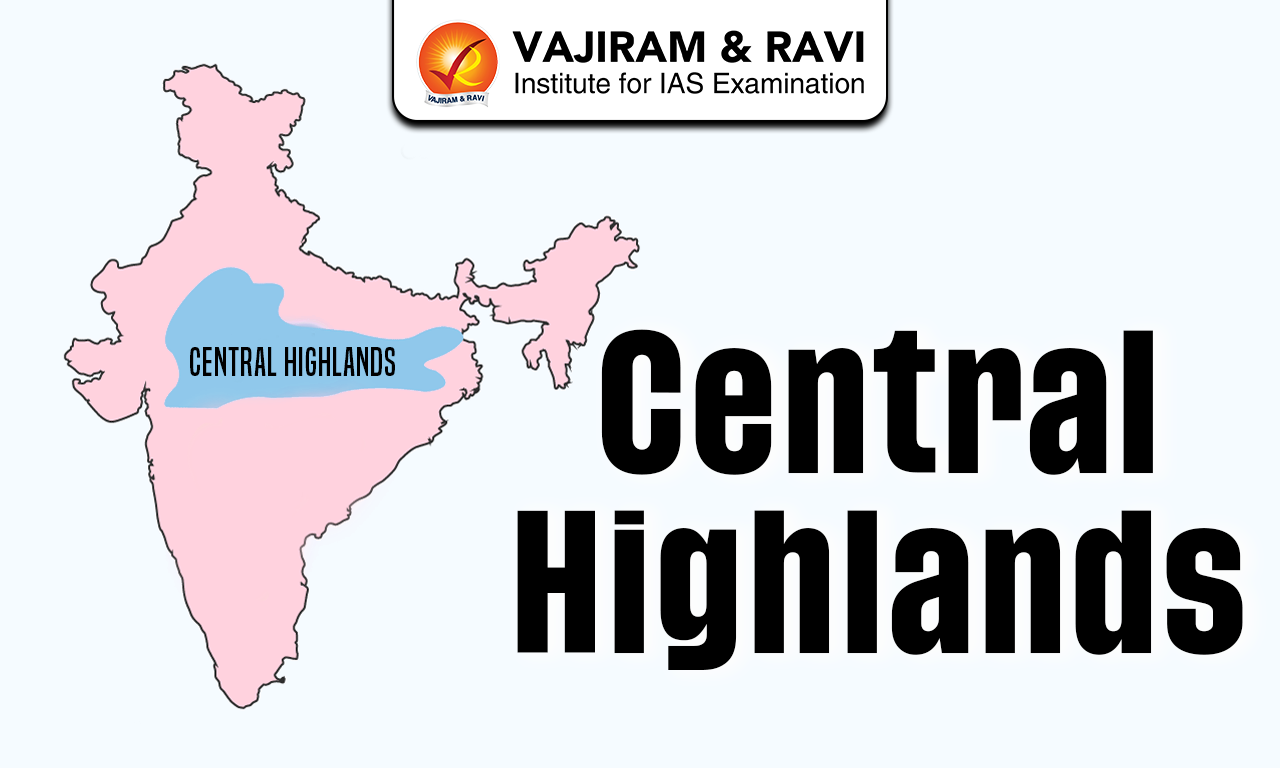
The Central Highlands represent a transitional zone between the Peninsular Plateau and the northern plains, marked by old, eroded landforms and structural hills. This region forms the northern boundary of the Peninsular Plateau and shows a clear slope from southwest to northeast. It is wider in the west and becomes narrower towards the east, extending into Bundelkhand, Baghelkhand and further into the Chotanagpur Plateau. It also forms a significant bio-geographic zone with diverse physical and ecological characteristics shaped over long geological time.

Central Highlands Features

The Central Highlands display varied relief with plateaus, hills and river valleys, shaped by ancient geological processes and erosion over millions of years. The key features of the highlands has been highlighted below:

  • Relief and Elevation: The region lies between 700 and 1,000 metres above mean sea level with a general slope towards north and northeast, clearly reflected in river flow directions and drainage patterns.
  • Location and Structural Boundaries: It is bordered by the Aravalli Range in the northwest and the Vindhyan Range to the south, while the Satpura Range lies further south forming a parallel system.
  • Width Variation: The highlands are broader in the western part, particularly across the Malwa Plateau and gradually narrow towards the east as they extend into smaller plateaus.
  • Relict Mountain System: These highlands are examples of relict mountains, meaning they are highly eroded ancient mountains that now exist as discontinuous and forested hill ranges.
  • Geological Composition: The region contains metamorphic rocks such as marble, slate and gneiss, indicating long geological history and transformation through pressure and temperature changes.

Central Highlands Regions

The Central Highlands consist of several sub regions including mountain ranges, plateaus and uplands that together form a complex physiographic unit.

  • Aravalli Range: Extending about 800 km from Delhi to near Ahmedabad, this ancient fold mountain is highly eroded, with Guru Shikhar (1,722 m) as its highest peak. It acts as a barrier against desert expansion.
  • Malwa Plateau: Located in western Madhya Pradesh and southeastern Rajasthan, it has an average elevation of 450-500 metres, fertile black soil and slopes northward, supporting agriculture and drainage systems.
  • Vindhyan Range: Stretching about 1,050 km from Gujarat to Bihar, it forms the southern boundary of the highlands and consists mainly of sandstone formations with escarpments and stepped plateaus.
  • Bundelkhand Upland: Situated between the Yamuna River and the Vindhyan scarplands, this region has rocky terrain, thin soils and represents eastern extension of the Central Highlands.
  • Baghelkhand Region: Located further east, this area forms another extension with plateau features and links the Central Highlands to the Chotanagpur Plateau.
  • Chotanagpur Plateau: Covering about 65,000 sq km, it is rich in minerals like coal, iron ore and bauxite, with stepped topography and major river valleys like the Damodar.
  • Satpura Range and Maikal Hills: These run parallel to the Vindhyas and form a connecting link through Maikal hills, with dense forests covering around 34% of the region across multiple states.

Central Highlands River System

The river systems of the Central Highlands reflect the slope and structural pattern of the region, with most rivers flowing from southwest to northeast.

  • Rivers like Chambal, Betwa, Ken and Sindh flow from southwest to northeast, indicating the general slope of the land towards the Ganga basin.
  • Most tributaries of the Yamuna originate in the Vindhyan and Kaimur ranges, contributing significantly to the northern river system.
  • The Chambal River and its tributaries drain large parts of the western highlands, with Banas being the only major tributary flowing westward from the Aravallis.
  • Important rivers such as Narmada, Tapti, Sone, Wainganga and Wardha have their headwaters in this region, making it hydrologically significant.
  • The Chotanagpur Plateau is drained by the Damodar River, forming a rift valley system and supporting major coalfields in its basin.

Central Highlands Challenges

The Central Highlands face several environmental and socio-economic challenges due to natural conditions and human activities.

  • Deforestation: Increasing human activities and resource extraction have led to loss of forest cover, especially in mineral rich regions like the Chotanagpur Plateau.
  • Soil Erosion: The rocky terrain and seasonal rainfall contribute to soil erosion, reducing agricultural productivity in upland areas like Bundelkhand.
  • Water Scarcity: Despite river systems, uneven rainfall and poor water management create seasonal water shortages in many parts of the region.
  • Mining Pressure: Intensive mining of coal, iron ore and bauxite leads to land degradation, pollution and displacement of local populations.
  • Tribal Issues: The region has a large tribal population facing socio-economic challenges, including displacement and limited access to development resources.

Central Highlands Significance

The Central Highlands hold immense geographical, ecological and economic importance due to their location and resource base.

  • Bio-geographic Zone: It is recognized as a distinct bio-geographic region with diverse ecosystems, linking northern plains with the Peninsular Plateau.
  • Geological Importance: The presence of ancient metamorphic rocks indicates long geological evolution and provides insights into Earth’s structural history.
  • Natural Barrier: The Aravalli Range acts as a barrier preventing the expansion of the Thar Desert towards the fertile northern plains.
  • Mineral Resources: Regions like the Chotanagpur Plateau are rich in minerals, making them important for industrial development and energy production.
  • Hydrological Role: The origin of major rivers supports irrigation, agriculture and water supply across central and northern India.

Central Highlands Biodiversity

The Central Highlands support diverse flora and fauna due to their tropical climate and forest cover.

  • Forest Types: The eastern part is dominated by Sal (Shorea robusta) forests, while the western part mainly has Teak (Tectona grandis), along with mixed dry deciduous vegetation.
  • Plant Diversity: Other important species include Butea, Acacia, Bombax and Boswellia, along with shrubs like Ziziphus and Prosopis adapted to dry conditions.
  • Wildlife Habitat: Dense forests provide habitat for various mammals and birds, making it an ecologically significant zone for biodiversity conservation.
  • Climate Influence: The tropical monsoon climate with rainfall mainly from June to August supports seasonal vegetation growth and wildlife diversity.

Difference between Central Highlands and Deccan Plateau

The Central Highlands and the Deccan Plateau differ in location, structure and physical characteristics despite both being parts of the Peninsular Plateau.

  • Location: The Central Highlands lie north of the Narmada River, while the Deccan Plateau is located south of it, covering a larger area of southern India.
  • Relief Features: Central Highlands consist of plateaus and relict mountains, whereas the Deccan Plateau is more uniform with extensive lava formations known as Deccan Traps.
  • Geological Structure: The Central Highlands show metamorphic rocks and ancient erosion surfaces, while the Deccan Plateau is largely composed of basaltic lava flows.
  • Drainage Pattern: Rivers in the Central Highlands flow towards the Ganga system, while Deccan rivers like Godavari and Krishna flow eastward to the Bay of Bengal.
  • Extent and Shape: The Central Highlands are narrower and discontinuous, whereas the Deccan Plateau is broader, more continuous and covers a larger geographical area. 

Central Highlands FAQs

Q1: Where are the Central Highlands located?

Ans: The Central Highlands are located to the north of the Narmada River and form the northern part of the Peninsular Plateau, covering much of the Malwa Plateau.

Q2: Which are the major rivers of the Central Highlands?

Ans: Important rivers include Chambal, Betwa, Ken, Sindh, Narmada, Tapti and Sone, most of which flow from southwest to northeast.

Q3: What are the main regions of the Central Highlands?

Ans: Key regions include the Aravalli Range, Malwa Plateau, Vindhyan Range, Bundelkhand, Baghelkhand and the Chotanagpur Plateau.

Q4: What type of climate is found in the Central Highlands?

Ans: The region has a tropical climate with most rainfall received during the southwest monsoon from June to August.

Q5: Which type of vegetation is found in the Central Highlands?

Ans: The region mainly has tropical dry deciduous forests, with Sal forests in the east and Teak forests dominating the western parts.

Ashok Mehta Committee, Background, Recommendations, Significance

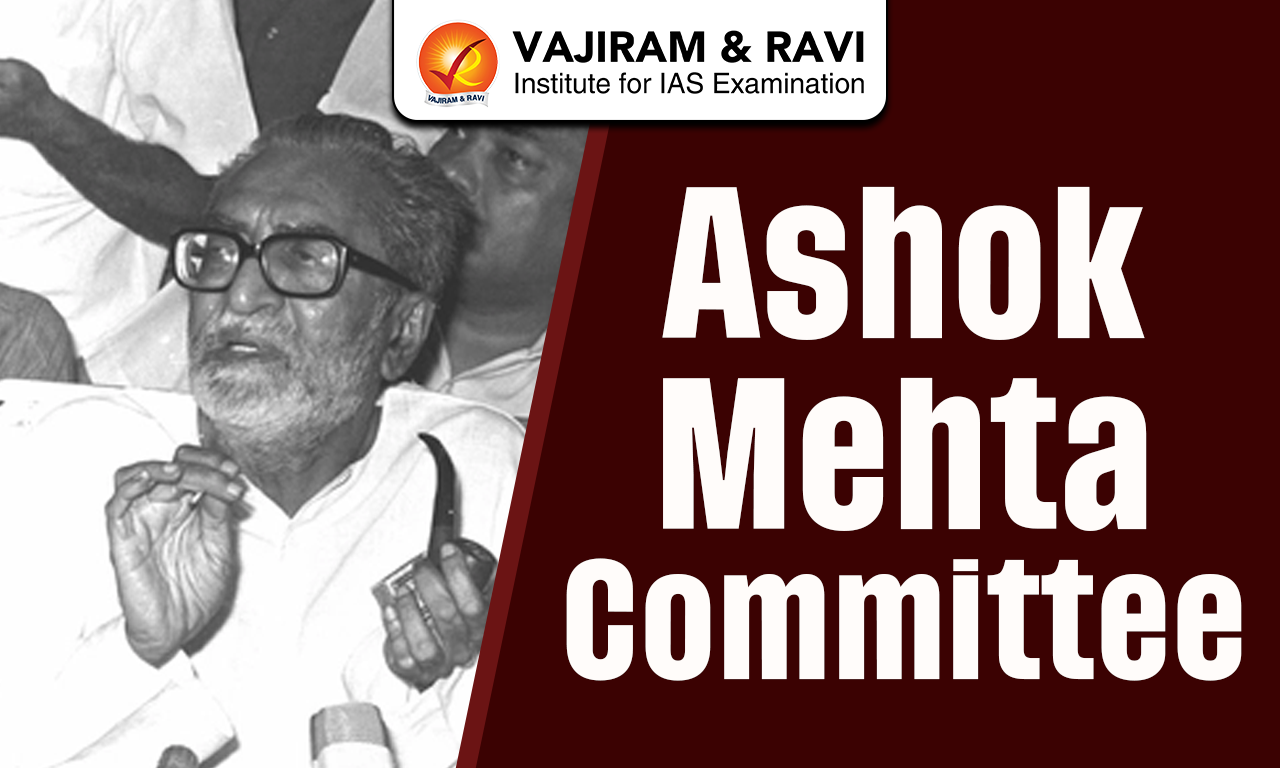
Ashok Mehta Committee

The Ashok Mehta Committee was set up by the Government of India to review and improve the system of local self-government in rural areas. At that time, it was felt that the existing Panchayati Raj system was not working effectively in many parts of the country. The committee was asked to suggest ways to make local governance stronger, more active, and more responsive to people’s needs. Its work helped in bringing attention to the importance of strengthening grassroots democracy and improving the functioning of local institutions.

Ashok Mehta Committee Historical Background

  • The system of village panchayats started developing during the British period, mainly as a response to the growing demand for local self-governance and participation of people in administration.
  • During this time, efforts were made to give people some control over local matters, which allowed citizens to access governance at the grassroots level, especially in rural areas.
  • The Government of India Act, 1935 gave more powers to provinces (states) to make their own laws, which also encouraged the development of local self-government institutions.
  • After independence, India focused more seriously on strengthening local governance, and an important step was taken when the Balwantrai Mehta Committee (1957) provided a proper framework for democratic decentralisation, which was later adopted by many states.
  • These developments together helped in shaping the modern Panchayati Raj system, which aims to involve people directly in decision-making and rural development.

Ashok Mehta Committee Recommendations

  • The committee suggested replacing the old three-tier Panchayati Raj system with a two-tier system, where there would be a Zila Parishad at the district level and a Mandal Panchayat at a lower level, which would include a group of villages with a population of about 15,000 to 20,000 people.
  • It recommended that the district should be the main level of decentralisation, meaning that most planning and decision-making should start from the district under the supervision of elected representatives.
  • The Zila Parishad should act as the main executive body, responsible for planning, implementing, and managing development programmes at the district level.
  • The committee suggested that political parties should be allowed to take part in Panchayat elections, as this would make the system more organised, competitive, and accountable.
  • It emphasized that Panchayati Raj institutions should have their own financial powers, including the authority to impose certain taxes, so that they can generate funds and work independently.
  • The committee also recommended regular social audits, so that people can check how funds are being used and ensure transparency in local governance.
  • It stated that if Panchayati Raj institutions are dissolved or suspended, then fresh elections should be held within six months to restore democratic functioning quickly.
  • It suggested appointing a separate Minister for Panchayati Raj at the state level to give more importance and attention to local self-government.
  • The committee supported reservation of seats for Scheduled Castes (SCs) and Scheduled Tribes (STs) to ensure representation of weaker sections in local governance.
  • Finally, it strongly recommended giving constitutional status to Panchayati Raj institutions, so that they become more stable, secure, and protected from political interference.

Ashok Mehta Committee Significance

  • The committee highlighted the weaknesses of the existing Panchayati Raj system and brought attention to the need for reforms.
  • It strengthened the idea of democratic decentralisation by giving more importance to the district level in governance.
  • It promoted political participation by allowing political parties in Panchayat elections, making the system more active and accountable.
  • It emphasized financial independence of Panchayati Raj institutions for better functioning.
  • It encouraged transparency and accountability through measures like social audits.
  • Its recommendations influenced later reforms and contributed to the demand for constitutional status, which was finally achieved through the 73rd Constitutional Amendment Act (1992).

Ashok Mehta Committee FAQs

Q1: What was the Ashok Mehta Committee?

Ans: The Ashok Mehta Committee (1977) was set up to review the working of the Panchayati Raj system and suggest ways to make local self-government more effective.

Q2: Why was the committee formed?

Ans: It was formed because the Panchayati Raj system was not functioning properly due to weak powers, lack of funds, and poor implementation in many states.

Q3: What was the main recommendation of the committee?

Ans: It recommended a two-tier Panchayati Raj system with Zila Parishad at the district level and Mandal Panchayat for a group of villages.

Q4: What role was given to the district level?

Ans: The district was made the main unit of decentralisation, responsible for planning and development activities.

Q5: What did the committee say about political participation?

Ans: It allowed political parties to participate in Panchayat elections to make the system more democratic and accountable.

Balwant Rai Mehta Committee, Background and Recommendations

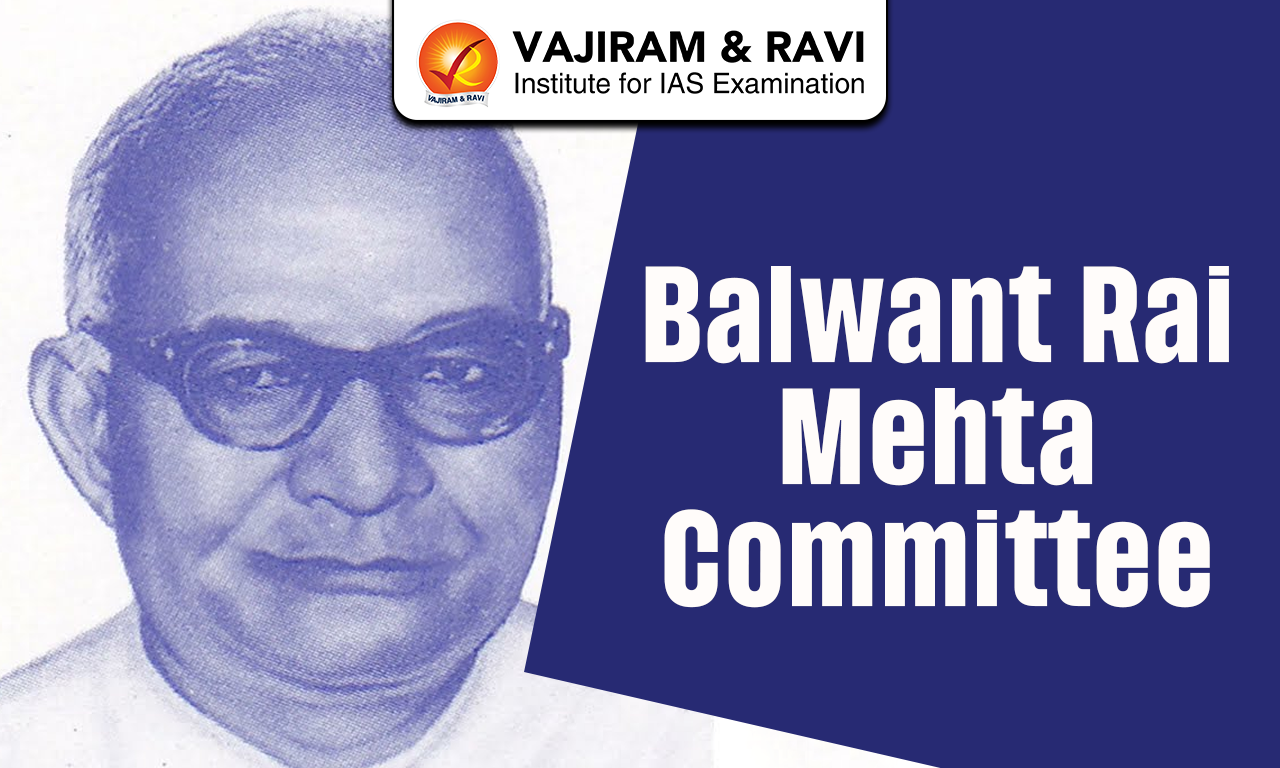
Balwant Rai Mehta Committee

The Balwant Rai Mehta Committee was an important committee set up by the Government of India to improve local self-government in rural areas. It was formed in 1957 to study how development programs were working at the village level. The committee suggested strengthening democracy at the grassroots by giving more power to local bodies. Its recommendations led to the introduction of the Panchayati Raj system in India, which allows people in villages to take part in their own governance.

About Balwant Rai Mehta Committee

  • The Balwantrai Mehta Committee was an important committee set up by the Government of India in 1957. Its main aim was to find ways to improve rural development and involve people more actively in local governance.
  • The committee played a key role in shaping the Panchayati Raj system, which is the system of local self-government in villages. Its recommendations became the foundation of democratic decentralisation in India.
  • The committee submitted its report in November 1957. It was considered very important because it suggested a proper system to bring democracy to the village level.

 Balwant Rai Mehta Committee Background

  • After independence in 1947, India focused strongly on rural development. To improve village conditions, the government started:
    • Community Development Programme (1952)
    • National Extension Service (1953)
  • However, these programmes did not work as expected. By the mid-1950s, several problems were noticed:
    • Too much control by government officials (bureaucracy)
    • Very little involvement of local people
    • Lack of coordination between departments
    • Weak accountability
    • Villagers had almost no role in planning development work
  • Because of these issues, the government decided to review these programmes and find better ways to involve people at the grassroots level.
  • So, on 16 January 1957, the Balwantrai Mehta Committee was formed under the leadership of Balwantrai G. Mehta, a Member of Parliament.

Balwant Rai Mehta Committee Objective

  • To study how the Community Development Programme and National Extension Service were working
  • To identify their weaknesses
  • To suggest improvements
  • To recommend ways to increase people’s participation
  • To design a system for democratic decentralisation

Major Recommendations

  • Three-Tier Panchayati Raj System: The committee recommended a three-tier Panchayati Raj system consisting of Zila Parishad at the district level, Panchayat Samiti at the block level, and Gram Panchayat at the village level, where the Gram Panchayat would act as the basic unit and all three levels would be properly connected to ensure smooth coordination and effective implementation of development programmes.
  • Democratic Composition: It suggested that all members of Panchayati Raj institutions should be elected by the people either directly or indirectly, so that these bodies become democratic in nature, accountable to the public, and encourage active participation of citizens in governance.
  • Devolution of Powers and Responsibilities: The committee emphasized devolution of real powers and responsibilities to local bodies, meaning that Panchayati Raj institutions should be given authority to plan, implement, and supervise development programmes along with sufficient administrative control and financial resources so that they can function effectively and independently.
  • Importance of Panchayat Samiti: It identified the Panchayat Samiti at the block level as the most important unit, responsible for planning and development activities, as well as coordinating between the Gram Panchayats and the Zila Parishad to ensure that local needs are properly reflected in district-level plans.
  • Role of Officials: The committee highlighted the need for close cooperation between government officials and elected representatives, where officials provide technical and administrative support while elected members represent the people’s interests, ensuring efficient governance and better execution of policies.
  • Role of Zila Parishad: It recommended that the Zila Parishad should function as an advisory, coordinating, and supervisory body at the district level, overseeing the work of Panchayat Samitis and ensuring that development programmes are properly planned and implemented across the district.
  • Financial Resources: The committee stressed that Panchayati Raj institutions should have adequate financial resources, including the power to raise local taxes and receive grants from the state government, so that they can operate independently without excessive dependence on higher authorities.
  • Relationship with State Government: It suggested that the state government should play a supportive role by providing guidance, training, and supervision, but should avoid interfering in the daily functioning of Panchayati Raj institutions, thereby maintaining their autonomy and effectiveness.
  • Training and Capacity Building: Finally, the committee emphasized the importance of training and capacity building for both elected representatives and officials, so that they can better understand planning, administration, and leadership, and perform their roles more efficiently in serving the community.

Implementation and Adoption of Panchayati Raj

  • After the recommendations of the Balwantrai Mehta Committee were accepted by the National Development Council (NDC) in 1958, many states in India started taking steps to introduce the Panchayati Raj system in their regions in order to strengthen local self-government and improve rural development.
  • Rajasthan became the first state to implement the Panchayati Raj system, and it was officially inaugurated on 2 October 1959 in Nagaur district, which was symbolically important as the day marks the birth anniversary of Mahatma Gandhi, who strongly supported village self-governance.
  • Soon after Rajasthan, Andhra Pradesh became the second state to adopt the Panchayati Raj system, and gradually other states also began implementing similar structures according to their own administrative needs and political conditions.
  • Different states adopted the system in slightly different ways, which led to variations in structure, powers, and functioning of Panchayati Raj institutions across the country.
  • The introduction of Panchayati Raj marked an important step towards decentralisation of power, as it transferred decision-making authority from the central and state governments to local bodies at the grassroots level.
  • It also increased people’s participation in governance, allowing villagers to take part in planning and implementing development programmes that directly affected their lives.
  • Over time, Panchayati Raj institutions helped in improving rural development, local administration, and democratic awareness, although their success varied from state to state depending on implementation and support.
  • This system strongly reflected the Gandhian idea of Gram Swaraj (village self-rule), where villages are empowered to govern themselves and manage their own affairs.

Evaluation and Criticism of the Balwantrai Mehta Committee

  • Although the committee played an important role in introducing democratic decentralisation, its implementation faced several challenges across different states.
  • There was uneven adoption, as states followed different structures and powers, leading to lack of uniformity.
  • Bureaucratic dominance reduced the real authority of elected representatives and weakened local democracy.
  • Insufficient financial powers made Panchayati Raj institutions dependent on state governments.
  • Lack of training and awareness among representatives and people affected effective functioning.
  • Political interference at the state level also limited their autonomy.
  • Despite these issues, the committee’s recommendations laid the foundation of Panchayati Raj and influenced later reforms like the 73rd Constitutional Amendment.

Post-Committee Developments

  • The Balwantrai Mehta Committee laid the foundation for Panchayati Raj in India and inspired many later committees and reforms to strengthen local self-government.
  • The Ashok Mehta Committee (1977) suggested a two-tier system and emphasized greater political decentralisation and stronger local bodies.
  • The G.V.K. Rao Committee (1985) and L.M. Singhvi Committee (1986) recommended giving constitutional status to Panchayati Raj institutions to make them more stable and effective.
  • All these efforts finally led to the 73rd Constitutional Amendment Act (1992), which gave constitutional recognition to Panchayati Raj and made a uniform three-tier system compulsory across India.

Balwantrai Mehta Committee Significance

  • The committee introduced the concept of democratic decentralisation, transferring power to local bodies at the grassroots level.
  • It laid the foundation of the Panchayati Raj system through a clear three-tier structure of governance.
  • It promoted people’s participation in decision-making and rural development.
  • It improved local administration by involving Panchayats in planning and implementation of programmes.
  • It supported the idea of Gram Swaraj (village self-rule).
  • Its recommendations influenced later reforms, especially the 73rd Constitutional Amendment Act (1992).

Balwant Rai Mehta Committee FAQs

Q1: What was the Balwant Rai Mehta Committee?

Ans: The Balwant Rai Mehta Committee (1957) was set up by the Government of India to study rural development programmes and suggest ways to strengthen local self-government and people’s participation.

Q2: Why was the committee formed?

Ans: It was formed because programmes like the Community Development Programme (1952) and National Extension Service (1953) failed due to bureaucratic control, lack of public participation, and poor coordination.

Q3: What was the main recommendation of the committee?

Ans: The committee recommended a three-tier Panchayati Raj system consisting of Gram Panchayat (village), Panchayat Samiti (block), and Zila Parishad (district).

Q4: What is democratic decentralisation according to the committee?

Ans: It means transferring power and decision-making from central and state governments to local bodies, allowing people to participate directly in governance.

Q5: Which state first implemented Panchayati Raj?

Ans: Rajasthan was the first state to implement Panchayati Raj on 2 October 1959 in Nagaur district, followed by Andhra Pradesh.

Worker Population Ratio (WPR), Meaning, Formula, Importance

Worker Population Ratio

The Worker Population Ratio (WPR) is an important indicator used to understand the employment situation in a country. It tells us what proportion of the total population is actively working. This concept is widely used in economics and labor studies to assess how effectively a country is utilizing its human resources.

What is Worker Population Ratio?

The Worker Population Ratio (WPR) is defined as the ratio of the total number of workers to the total population, expressed as a percentage.

Formula: Worker Population Ratio = (Total Number of Workers / Total Population) × 100

  • If the ratio is high, it means more people are actively engaged in economic activities.
  • If the ratio is low or moderate, it indicates that a large section of the population is not directly involved in productive work.

This ratio is a key measure to evaluate employment levels and economic participation in any country.

Related Concepts

Understanding WPR becomes easier when studied along with related employment concepts. These concepts help in analyzing different types of unemployment and labor participation.

  • Disguised Unemployment: More workers are employed than required, reducing productivity
  • Frictional Unemployment: Temporary unemployment during job transitions
  • Seasonal Unemployment: Employment available only during certain seasons
  • Labour Force Participation Rate: Percentage of working or job-seeking population
  • Structural Unemployment: Caused by structural changes in the economy
  • Unemployment Rate: Percentage of unemployed people in the labour force

Worker Population Ratio in India

The Worker Population Ratio in India provides a clear picture of how many people are actively engaged in economic activities. It is an important indicator to assess employment trends, gender participation, and the overall utilization of the workforce in the country.

Latest Data and Key Highlights 2025

The Worker Population Ratio (WPR) in usual status (ps+ss) for persons aged 15 years and above was 57.4% in 2025, remaining almost unchanged compared to 2024.

Gender-wise Worker Population Ratio 2025

The data highlights a significant gap between male and female workforce participation in India. While male participation remains high, female participation continues to lag behind.

  • Male WPR: 76.6%
  • Female WPR: 38.8%
  • Male participation is nearly double that of females
  • Gender disparity remains a major concern in employment

Reasons for Not Being in Labour Force

A large section of the population is not part of the labour force due to various social and economic reasons. These reasons differ significantly between males and females.

  • Among males:
    • 69.8% reported continuing education as the main reason
    • Indicates higher focus on education and skill development
  • Among females:
    • 44.4% cited childcare and household responsibilities
    • Reflects social norms and unpaid domestic work burden

Worker Population Ratio (WPR) FAQs

Q1: What is Worker Population Ratio (WPR)?

Ans: Worker Population Ratio (WPR) is the percentage of people who are employed out of the total population. It shows how many people are actively engaged in economic activities.

Q2: What is the formula of Worker Population Ratio?

Ans: The formula of WPR is: WPR = (Total Number of Workers / Total Population) × 100. It is expressed in percentage terms.

Q3: What does a high Worker Population Ratio indicate?

Ans: A high WPR indicates that a larger proportion of the population is working. It reflects better employment opportunities and higher economic participation.

Q4: What does a low Worker Population Ratio mean?

Ans: A low WPR means that fewer people are engaged in work. It may indicate unemployment, underemployment, or a high dependency ratio in the economy.

Q5: Who calculates the Worker Population Ratio in India?

Ans: In India, WPR is calculated by the National Statistical Office through surveys like the Periodic Labour Force Survey.

Ferrel Cell, Location, Mechanism, Climate, Importance

Ferrel Cell

The Ferrel Cell is a part of Earth’s wind system that lies between the tropical and polar regions. It plays an important role in moving air and heat across the middle latitudes. It shows a general pattern of circulation, but is disturbed by cyclones and anticyclones, helping to balance temperatures between warmer and colder areas. Although it is not as strong as other wind cells, the Ferrel Cell is important for shaping weather patterns in many parts of the world.

About Ferrel Cell

The Ferrel Cell is one of the three main wind circulation systems of the Earth. It is found in the middle latitudes, between the tropical and polar regions. It helps in moving heat and air, and plays an important role in controlling weather patterns.

  • Location
    • The Ferrel Cell is located between 30° and 60° latitude in both the Northern and Southern Hemispheres.
    • It lies between the Hadley Cell (towards the equator) and the Polar Cell (towards the poles)
  • How the Ferrel Cell Works
    • The movement of air in the Ferrel Cell is different from other cells and is more complex.
    • The Ferrel Cell is not directly driven by temperature differences like the Hadley Cell. Instead, it is an indirect (secondary) circulation driven by: Mid-latitude cyclones and Interaction between the Hadley Cell and Polar Cell
    • These air masses meet and mix, creating a circulation pattern.
    • At ~60° latitude, air rises due to convergence of warm westerlies and cold polar winds (Polar Front)
    • At ~30° latitude, air sinks due to influence of the Hadley Cell (subtropical high pressure)
    • This circulation helps in transferring heat from warmer areas to cooler regions.
  • Direction of Winds
    • The Ferrel Cell is responsible for the westerly winds.
    • Winds blow from west to east in this region
    • These winds are called Westerlies.
    • They influence the climate of many regions, especially in Europe and North America
  • Climate and Weather
    • The Ferrel Cell plays a major role in weather conditions.
    • It is associated with changing weather patterns.
    • Frequent cyclones and storms occur in this region.
    • Weather is often changeable and uncertain because warm and cold air masses meet and interact in this region.
  • Importance of the Ferrel Cell
    • The Ferrel Cell is very important for the Earth’s climate system.
    • Helps in balancing heat between equator and poles.
    • Influences rainfall and storms.
    • Affects climate in mid-latitude regions.
    • Supports global wind circulation.
  • Comparison with Other Cells
    • Hadley Cell: Strong and directly driven by heat from the Sun
    • Ferrel Cell: Indirect and less stable, depends on other cells
    • Polar Cell: Cold and located near the poles

Ferrel Cell FAQs

Q1: What is the Ferrel Cell?

Ans: The Ferrel Cell is a part of Earth’s wind system found in the middle latitudes that helps move air and heat across the planet.

Q2: Where is the Ferrel Cell located?

Ans: It is located between 30° and 60° latitudes in both hemispheres, between the Hadley Cell and the Polar Cell.

Q3: How does the Ferrel Cell work?

Ans: Warm air moves toward cooler regions and cold air moves toward warmer regions. These air masses meet, causing air to rise at 60° and sink at 30°.

Q4: What type of winds are associated with the Ferrel Cell?

Ans: It produces Westerlies, which blow from west to east.

Q5: How does the Ferrel Cell affect weather?

Ans: It causes changing and unstable weather, with frequent storms and cyclones due to mixing of warm and cold air.

India Hosts 1st BRICS Youth Coordination Meeting, Key Initiatives

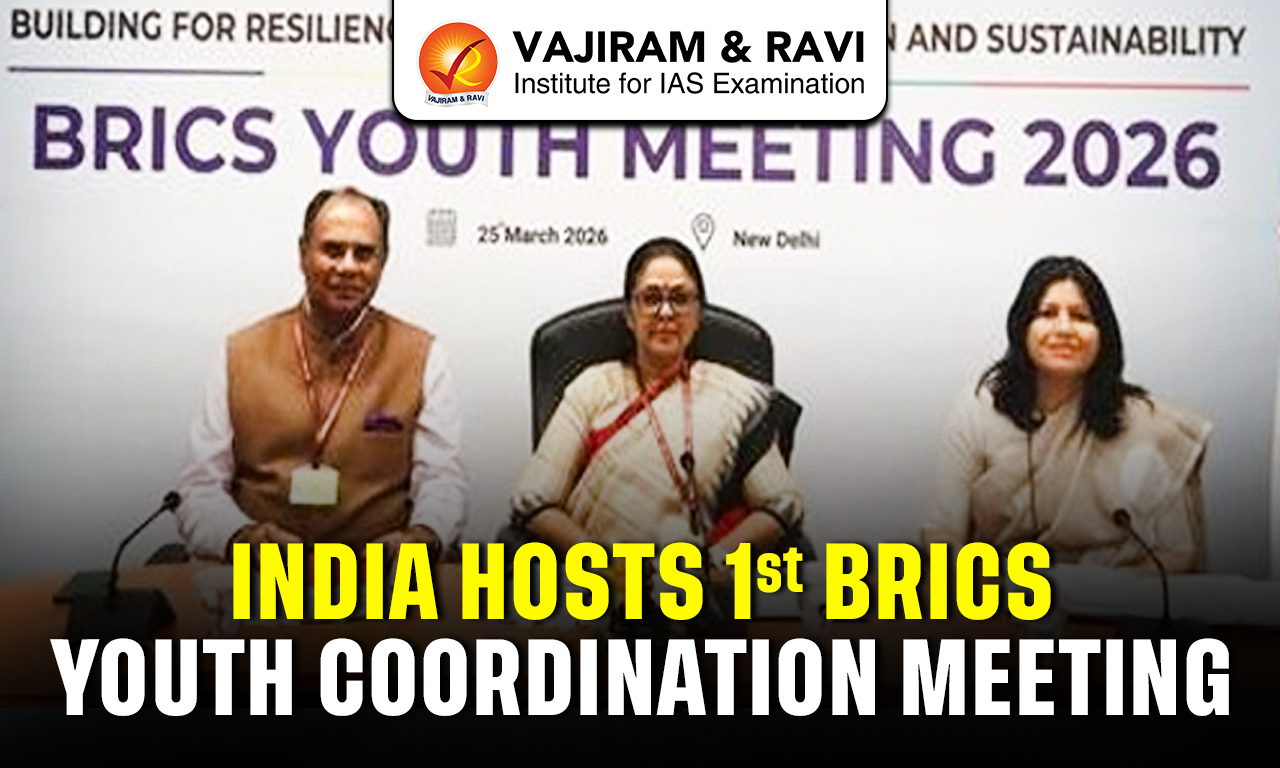
India Hosts 1st BRICS Youth Coordination Meeting

India recently conducted the first BRICS Youth Coordination Meeting 2026 on March 25, 2026, in a virtual format. Representatives from all BRICS member countries took part in the discussions, and the meeting helped align member countries on key thematic areas of cooperation. This event marked the formal commencement of youth engagements under India’s BRICS Chairship for 2026.

About BRICS Youth Coordination Meeting 2026 

  • Organised by: BRICS Youth Coordination Meeting 2026  was organized by the Department of Youth Affairs under the Ministry of Youth Affairs and Sports. 
  • Theme: The meeting was held under the theme “Building for Resilience, Innovation, Cooperation and Sustainability”, reflecting India’s vision of fostering youth-driven collaboration among the BRICS nations.
  • Objective: To strengthen youth cooperation and promote collaboration among BRICS nations. 

By focusing on youth engagement, India aims to create a platform where young leaders from member countries can contribute meaningfully to inclusive and sustainable development, innovation, and global dialogue. The meeting also provided an opportunity for member nations to align on common thematic priorities and lay the groundwork for further initiatives during India’s Chairship.

Key Initiatives under BRICS Youth Track 2026

During the meeting, India presented the roadmap for the BRICS Youth Track 2026, which includes a series of structured engagements throughout the year. These initiatives are designed to enhance collaboration, learning, and active participation among the youth of member countries. The key initiatives include:

  • Working Group Meetings and Thematic Engagements: Regular sessions to discuss sector-specific youth concerns and strategies.
  • Serve BRICS Volunteering Activities: Opportunities for youth to participate in social and community service initiatives across BRICS nations.
  • Youth Development Forum: A platform for knowledge-sharing, networking, and capacity-building among young leaders.
  • Youth Council Meeting and Youth Summit: High-level discussions to formulate youth-centric policies and strategies.
  • Youth Ministerial Meeting: Interaction between ministers and youth representatives to ensure policy alignment and support.

These initiatives aim to create a comprehensive ecosystem for youth engagement, where young leaders can exchange ideas, share best practices, and collaborate on innovative solutions to common challenges.

BRICS Youth Coordination Meeting Priority Areas for Cooperation

The discussions during the meeting highlighted several priority pillars for collaboration among BRICS nations:

  • Education and Skills Development: Promoting access to quality education and enhancing employability skills among youth.
  • Youth Entrepreneurship: Encouraging innovation, start-ups, and entrepreneurial ventures.
  • Science and Innovation: Supporting research, technological innovation, and scientific collaboration.
  • Social Participation and Inclusion: Ensuring representation of marginalized youth groups and promoting social cohesion.
  • Health and Sports: Promoting physical well-being, mental health awareness, and sports diplomacy.
  • Environment and Sustainability: Encouraging green initiatives, climate action, and sustainable development practices.
  • Interfaith Dialogue and Youth Exchange: Fostering cultural understanding, peace, and international youth collaboration.

These focus areas provide a strategic framework for sustained youth cooperation, enabling BRICS countries to collectively contribute to global development objectives while building resilience and innovation within their societies.

Significance of India’s Chairship

By hosting this meeting, India has demonstrated its commitment to strengthening people-to-people connections and promoting the role of youth in international diplomacy. The meeting not only established the framework for the BRICS Youth Track 2026 but also reinforced India’s leadership in shaping youth-centric policies, fostering regional cooperation, and advancing the broader BRICS agenda in the domains of sustainability, innovation, and social development.

India Hosts 1st BRICS Youth Coordination Meeting FAQs

Q1: What is the objective of the 1st BRICS Youth Coordination Meeting?

Ans: The objective of 1st BRICS Youth Coordination Meeting is to strengthen youth cooperation among BRICS nations by promoting collaboration, dialogue, and participation of young leaders in areas such as innovation, sustainability, and inclusive development.

Q2: Who organised the 1st BRICS Youth Coordination Meeting hosted by India?

Ans: The 1st BRICS Youth Coordination Meeting hosted by India was organised by the Department of Youth Affairs under the Ministry of Youth Affairs and Sports.

Q3: What was the theme of the 1st BRICS Youth Coordination Meeting?

Ans: The theme of the 1st BRICS Youth Coordination Meeting was “Building for Resilience, Innovation, Cooperation and Sustainability.”

Q4: What are the priority areas discussed during India hosting the 1st BRICS Youth Coordination Meeting?

Ans: During India hosting the 1st BRICS Youth Coordination Meeting, priority areas such as education and skills development, entrepreneurship, science and innovation, social inclusion, health, and environmental sustainability were identified.

Q5: What initiatives were announced during the 1st BRICS Youth Coordination Meeting?

Ans: During the 1st BRICS Youth Coordination Meeting, initiatives such as Youth Development Forum, Youth Summit, Working Group Meetings, and volunteering activities under Serve BRICS were outlined.

Jan Vishwas (Amendment of Provisions) Bill 2026, Key Features

Jan Vishwas (Amendment of Provisions) Bill, 2026

The Jan Vishwas (Amendment of Provisions) Bill, 2026 has been passed by both Houses of Parliament, marking an important step towards improving Ease of Doing Business and Ease of Living.

The Bill seeks to amend around 80 central laws to decriminalise and rationalise offences and penalties. It replaces the earlier Jan Vishwas (Amendment of Provisions) Bill, 2025, which covered only 17 Acts and was referred to a Select Committee of the Lok Sabha.

Jan Vishwas (Amendment of Provisions) Bill, 2026 Key Features 

The following are the key features of the Jan Vishwas (Amendment of Provisions) Bill, 2026, which reflect a shift towards trust-based governance, proportionate regulation, and a compliance-oriented framework:

Decriminalising offences:

The Bill decriminalises several offences, and instead imposes civil penalties for such offences. For example: 

  • Under the Drugs and Cosmetics Act, 1940, activities such as manufacturing or selling cosmetics in violation of the law earlier attracted imprisonment of up to one year, along with a fine or both. The Bill replaces this with a civil penalty, which may extend to ₹1 lakh or up to three times the value of the confiscated goods, whichever is higher.
  • In a similar manner, under the National Highways Act, 1956, actions that make a highway unsafe or obstruct its use were previously punishable with imprisonment of up to five years. The Bill removes the jail term and instead prescribes a monetary penalty ranging from ₹10 lakh to ₹1 crore.

Removal of imprisonment term:

In some cases, the Bill removes the imprisonment term for an offence. For example, under the Indian Succession Act, 1925, failure to surrender revoked probate or letters of administration is punishable with imprisonment up to three months, a fine, or both. Under the Electricity Act, 2003, non-compliance with an order or a direction is punishable with imprisonment up to three months, a fine, or both. The Bill instead imposes only a fine, and also increases the maximum amount of fine.

Omission of offences:

The Bill eliminates a number of offences that are considered outdated or unnecessary. These include acts such as raising a false fire alarm under the Delhi Police Act, 1978, not reporting births and deaths as required under the Delhi Municipal Corporation Act, 1957, and making incorrect entries in copyright records under the Copyright Act, 1957.

Revision of fines and penalties: 

The Bill revises the monetary value of fines and penalties for several offences. It further provides that fines and penalties specified by it will increase by 10% of the respective minimum amount every three years.

Warnings on first and second offences:  

The Bill amends some Acts to provide for advisories or warnings in the first or second instances of an offence.  For example, under the Apprentices Act, 1961, offences punishable with fines include refusing to furnish information, and requiring an apprentice to work overtime. The Bill provides that an advisory will be issued for the first contravention, and a warning will be issued for the second contravention.  A civil penalty will be imposed for subsequent contraventions. 

Improvement notices:  

The Bill introduces the concept of improvement notices under the Legal Metrology Act, 2009. Earlier, offences such as using or selling non-standard weights and measures were directly punishable with fines. Under the new approach, a first-time violation may lead to an improvement notice, giving the person time to correct the non-compliance. If the violation continues, a civil penalty may be imposed for the second offence, while repeated violations can attract a criminal fine.

Adjudication of penalties: 

The Bill amends certain Acts to provide for the appointment of adjudicating officers to hold inquiries and adjudicate penalties. It also provides for appointment of appellate authorities to hear appeals against decisions of adjudicating officers.

Property tax and advertisement tax in New Delhi municipal area: 

  • The Bill makes changes to the New Delhi Municipal Council Act, 1994 to simplify the property tax system. It clearly separates property tax into two parts, tax on buildings and tax on vacant land.
  • It provides for the creation of a Municipal Valuation Committee, which will suggest how property values should be calculated and revised over time, making the system more transparent.
  • It also sets up a Hardship and Anomaly Committee to handle complaints and difficulties faced by taxpayers, ensuring better grievance redressal.
  • In addition, the Bill removes the provision for advertisement tax, thereby simplifying the overall taxation structure in the municipal area.

Manner of revision of fines and penalties under Jan Vishwas Act of 2023:  

The Jan Vishwas (Amendment of Provisions) Act, 2023 provides for revision of fines and penalties specified by it every three years. The Bill adds that if any Act already prescribes its own method of revision, the method in that Act will apply.

Jan Vishwas (Amendment of Provisions) Bill 2026 Significance 

The government has highlighted that the Jan Vishwas (Amendment of Provisions) Bill, 2026 is a major step towards promoting ease of doing business, improving ease of living, and establishing a trust-based regulatory framework.

  • Economic Significance: The Bill is expected to improve the Ease of Doing Business by reducing compliance burden and eliminating the fear of imprisonment for minor and technical violations. This will create a more predictable and investor-friendly environment, encouraging entrepreneurship and investment.
  • Administrative Significance: The Bill aims to reduce the burden on courts by shifting minor offences to adjudicating officers and appellate authorities. This will enable faster and more efficient resolution of cases, improving overall governance efficiency.
  • Governance Reform: The Bill promotes a shift towards trust-based governance by replacing criminal penalties with civil penalties and graded enforcement. It focuses on encouraging compliance rather than imposing strict punishment.
  • Ease of Living: The government has stated that the Bill will enhance Ease of Living by simplifying legal procedures and reducing hardships faced by citizens. The use of advisories, warnings, and improvement notices will make the system more citizen-friendly.
  • Legal and Regulatory Clarity: The Bill removes outdated provisions and rationalises penalties, ensuring that laws are clearer and penalties are proportionate to the nature of offences. This will improve transparency and consistency in enforcement.

Jan Vishwas (Amendment of Provisions) Bill 2026 FAQs

Q1: What is the Jan Vishwas (Amendment of Provisions) Bill, 2026?

Ans: The Jan Vishwas (Amendment of Provisions) Bill, 2026 is a reform measure that amends around 80 central laws to decriminalise minor offences and replace criminal punishment with civil penalties.

Q2: What is the main objective of the Jan Vishwas (Amendment of Provisions) Bill, 2026?

Ans: The main objective of the Jan Vishwas (Amendment of Provisions) Bill, 2026 is to promote ease of doing business and ease of living by reducing unnecessary criminal provisions and encouraging voluntary compliance.

Q3: How many laws are covered under the Jan Vishwas (Amendment of Provisions) Bill, 2026?

Ans: The Jan Vishwas (Amendment of Provisions) Bill, 2026 covers around 80 central Acts, making it a wide-ranging reform across multiple sectors.

Q4: How is the Jan Vishwas (Amendment of Provisions) Bill, 2026 different from the 2025 Bill?

Ans: The Jan Vishwas (Amendment of Provisions) Bill, 2026 is more comprehensive than the 2025 version, as it expands the scope from 17 laws to around 80 laws based on committee recommendations.

Q5: How will the Jan Vishwas (Amendment of Provisions) Bill, 2026 impact businesses and citizens?

Ans: It will reduce compliance burden, lower the risk of criminal prosecution for minor mistakes, and make legal processes simpler and more predictable, thereby benefiting both businesses and citizens.

Andhra Pradesh Reorganisation (Amendment) Bill 2026, Provisions

Andhra Pradesh Reorganisation (Amendment) Bill 2026

Parliament has passed the Andhra Pradesh Reorganisation (Amendment) Bill, 2026. The bill amends the Andhra Pradesh Reorganisation Act, 2014 and accords statutory status to Amaravati as the sole and permanent capital of Andhra Pradesh.

Andhra Pradesh Reorganisation (Amendment) Bill, 2026 Background

The issue of Andhra Pradesh’s capital emerged after the enactment of the Andhra Pradesh Reorganisation Act, 2014, which led to the bifurcation of the state and the creation of Telangana. Hyderabad was designated as the common capital for both states for a period of ten years, after which Andhra Pradesh was expected to establish its own capital. However, the Act did not clearly define the process or timeline for finalising the new capital. 

In the initial phase, the Union Government appointed the K.C. Siva Ramakrishnan Committee, which recommended a decentralised approach and cautioned against building a large greenfield capital due to financial and environmental concerns. Despite this, the Andhra Pradesh government in 2016 officially notified Amaravati as the capital via executive action and initiated a land pooling scheme involving thousands of farmers, aiming to build a world-class city.

However, the capital issue soon became politically contested. A change in state government led to the proposal of a three-capital model, with Visakhapatnam as the executive capital, Kurnool as the judicial capital, and Amaravati as the legislative capital. This shift, justified in the name of regional balance, triggered widespread protests, particularly by farmers in Amaravati, along with legal challenges and administrative uncertainty. The lack of policy continuity resulted in governance disruptions, declining investor confidence, and stalled infrastructure development.

Amid this prolonged uncertainty, the Andhra Pradesh Legislative Assembly, on March 28, 2026, passed a resolution urging the Union Government to amend the Andhra Pradesh Reorganisation Act, 2014 to grant statutory recognition to Amaravati as the capital. Acting on this request, the Union Government introduced the Andhra Pradesh Reorganisation (Amendment) Bill, 2026 in Parliament. The Bill was subsequently passed by both Houses of Parliament and accorded statutory status to Amaravati as the sole and permanent capital of Andhra Pradesh.

Key Provisions of the Andhra Pradesh Reorganisation (Amendment) Bill, 2026. 

  • Statutory Recognition of Amaravati: The Bill amends Section 5 of the 2014 Act to explicitly designate Amaravati as the sole and permanent capital of Andhra Pradesh. This moves beyond executive notification and gives the decision legal sanctity.
  • Retrospective Effect: The law provides retrospective recognition to Amaravati from 2 June 2024, marking the end of the 10-year common capital arrangement with Telangana.
  • Rejection of the Three-Capital Model: By legally establishing Amaravati as the sole capital, the Bill effectively nullifies earlier proposals for Visakhapatnam as executive capital, Kurnool as judicial capital and Amaravati as legislative capital. This ensures a centralised administrative structure.
  • First-of-its-Kind Legislative Precedent: This is the first instance in independent India where Parliament has enacted a law specifically declaring a particular city as the permanent capital of a state.

Andhra Pradesh Reorganisation (Amendment) Bill, 2026 Significance 

  • Legal Clarity: The Bill definitively establishes Amaravati as the permanent capital, ending prolonged ambiguity.
  • Administrative Stability: It enables a unified governance structure by avoiding fragmentation across multiple locations.
  • Policy Certainty: The legislation ensures continuity by protecting the capital decision from future political reversals.
  • Investment Boost: Clear capital status improves investor confidence and facilitates long-term economic planning.
  • Infrastructure Push: It accelerates planned development of Amaravati as a modern administrative and urban centre.
  • Economic Growth: A stable capital contributes to employment generation and overall state development.
  • Political Closure: It resolves a decade-long contentious issue, bringing stability to governance.
  • National Precedent: The law sets an example of Parliament formally designating a state capital.

Semiconductor Industry in India, Market Size, Opportunities, Challenges

Semiconductor Industry in India

The semiconductor industry in India is in focus as Prime Minister Narendra Modi recently inaugurated an OSAT (Outsourced Semiconductor Assembly and Test) facility in Gujarat, highlighting India’s growing role in the global chip ecosystem.

State of Semiconductor Industry in India

India’s semiconductor market is valued at around $45-50 billion in FY 2024-25 and is projected to grow significantly in the coming decade. The sector is expected to reach nearly $120 billion by 2030 and $300 billion by 2035, driven by demand from electronics, automotive, AI, and data infrastructure.

However, India still relies heavily on imports, meeting more than 90% of its semiconductor needs from abroad. This dependence is expected to decline gradually as domestic manufacturing capacity expands.

At present, India is developing its semiconductor ecosystem through investments in fabrication units (fabs), compound semiconductors, and assembly and testing facilities. Alongside manufacturing, India has emerged as a strong hub for chip design, with global companies increasingly undertaking advanced R&D work in the country.

Opportunities Shaping the Growth of India’s Semiconductor Market

  • Rising Domestic Demand: The rapid expansion of smartphones, electronics manufacturing, electric vehicles, and digital services is creating sustained demand for semiconductors across sectors.
  • AI, 5G, and Data Centre Expansion: The growth of Artificial Intelligence, rollout of 5G networks, and increasing investments in data centres are driving demand for high-performance and specialised chips.
  • Global Supply Chain Diversification: Geopolitical uncertainties and disruptions in traditional semiconductor hubs have encouraged companies to diversify supply chains, positioning India as an alternative manufacturing destination.
  • Strong Design Ecosystem: India’s established base in semiconductor design and engineering talent provides a competitive advantage in moving towards high-value segments of the value chain.
  • Employment and Investment Potential: The sector is expected to generate large-scale employment and attract significant investments, with multiple projects already approved and more in the pipeline.

Initiatives to Promote India’s Semiconductor Industry

  • India Semiconductor Mission (ISM) 1.0: India Semiconductor Mission (ISM) 1.0 was launched in 2021. It aims to build a strong semiconductor and display ecosystem, positioning India as a global hub for electronics manufacturing and design, while serving as the nodal agency for the efficient and seamless implementation of semiconductor and display schemes. With a large financial outlay of 76000 crore , ISM 1.0 laid the foundation for semiconductor manufacturing by providing up to 50% fiscal support for fabs, packaging units, and design initiatives. 
  • India Semiconductor Mission (ISM) 2.0 (2026): Announced in the Union Budget 2026-27, ISM 2.0 marks a shift from capacity creation to ecosystem deepening. It focuses on domestic production of semiconductor equipment and materials, development of full-stack Indian intellectual property, and strengthening supply chains. It also emphasises industry-led research and training centres, with a budgetary allocation of ₹1,000 crore. 
  • Electronics Components Manufacturing Scheme (2025-26 expansion): The government has significantly increased the outlay for component manufacturing to strengthen the upstream ecosystem, reduce import dependence, and support semiconductor manufacturing. 
  • Design Linked Incentive (DLI) Scheme: This scheme supports startups and MSMEs engaged in chip design by providing financial assistance and access to design infrastructure, encouraging indigenous innovation.
  • Production Linked Incentive (PLI) Scheme: PLI schemes for electronics and IT hardware promote domestic manufacturing and create demand for semiconductors within the country.
  • Infrastructure and Cluster Development: Schemes such as SPECS (Scheme for Promotion of Manufacturing of Electronic Components and Semiconductors) and Electronics Manufacturing Clusters (EMC 2.0) focus on building infrastructure and strengthening the electronics ecosystem.
  • Chips to Startup (C2S) Programme: C2S is an umbrella capacity building programme initiated at academic organizations spread across the country to generate 85 thousand number of industry-ready manpower at B.Tech, M.Tech, and PhD levels specialized in semiconductor chip design.
  • Global Partnerships and Investments: Strategic collaborations with global companies and countries are facilitating technology transfer, investment inflows, and integration into global semiconductor value chains. For example, India has seen major global engagement with Micron Technology and Kaynes Semicon setting up advanced semiconductor facilities in Gujarat’s Sanand under the India Semiconductor Mission, linking domestic manufacturing directly to international markets. At these plants, products such as Intelligent Power Modules are being exported to global customers, strengthening India’s role in global supply chains. 

Challenges

The growth of India’s semiconductor industry, while promising, is accompanied by several critical challenges that need to be addressed to ensure sustainable development and global competitiveness.

  • High Capital and Technological Barriers: Semiconductor manufacturing requires extremely high investment and advanced technology, making entry difficult for new players.
  • Import Dependence and Limited Indigenous IP: India continues to depend on imports for chips, materials, and intellectual property, limiting technological self-reliance.
  • Skill Gap: There is a shortage of highly specialised workforce required for fabrication, packaging, and advanced semiconductor research.
  • Global Competition: Established players such as Taiwan, South Korea, and the US dominate the semiconductor industry, making competition intense.
  • Infrastructure and Policy Constraints: Reliable power, water, logistics, and efficient regulatory systems are essential but still evolving in India.
  • Environmental Concerns: Semiconductor manufacturing involves high energy use and hazardous materials, raising sustainability challenges.

Way Forward

India must adopt a long-term and integrated strategy to emerge as a global semiconductor hub. 

  • Strengthening research and development, promoting indigenous intellectual property, and building advanced manufacturing capabilities will be essential.
  • There is also a need to expand skill development through industry-academia collaboration and specialised training programmes. 
  • Policy stability, faster clearances, and better coordination between the Centre and states will be crucial for attracting investments.
  • India should leverage global partnerships and focus on niche areas such as semiconductor design, compound semiconductors, and advanced packaging. 

With sustained policy support and execution, India has the potential to transition from a major semiconductor consumer to a key player in the global semiconductor ecosystem.

Semiconductor Industry in India FAQs

Q1: What is the current size of India’s semiconductor market?

Ans: India’s semiconductor market was valued at around $45-50 billion in FY 2024-25 and is projected to reach $120 billion by 2030 and $300 billion by 2035.

Q2: Why is India focusing on semiconductors now?

Ans: Semiconductors are critical for electronics, AI, telecom, automotive, defence, and space. Rising domestic demand, AI, 5G rollout, and global supply chain diversification make India a strategic hub.

Q3: How dependent is India on semiconductor imports?

Ans: India currently imports over 90% of its semiconductor requirements, though domestic manufacturing capacity is gradually expanding.

Q4: What initiatives are driving India’s semiconductor ecosystem?

Ans: Key initiatives include the India Semiconductor Mission (ISM 1.0 & 2.0), Design Linked Incentive (DLI) Scheme, Production Linked Incentive (PLI) schemes, Electronics Components Manufacturing Scheme, Chips to Startup (C2S) Programme, and infrastructure schemes such as SPECS and Electronics Manufacturing Clusters (EMC 2.0).

Q5: What are the main challenges facing India’s semiconductor industry?

Ans: High capital and technological barriers, import dependence, skill shortages, intense global competition, infrastructure gaps, and environmental concerns are key challenges.

Bimal Jalan Committee, Objectives, Key Recommendations

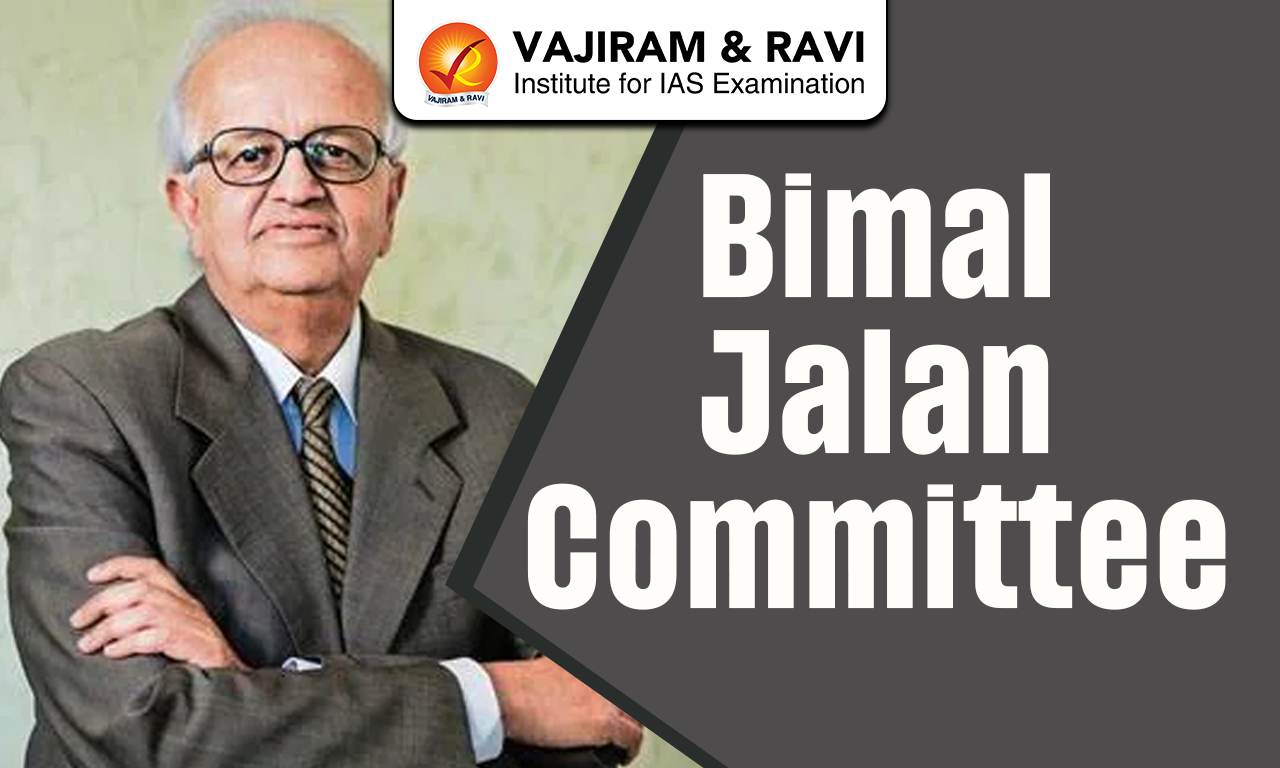
Bimal Jalan Committee

The Bimal Jalan Committee on Economic Capital Framework was set up in 2018 by the Reserve Bank of India in consultation with the Government of India. The committee was chaired by Bimal Jalan, a former RBI Governor.

The main purpose of this committee was to review how much capital the RBI should keep as reserves and how much surplus it can safely transfer to the government. The committee submitted its report in 2019, which became an important step in strengthening India’s financial stability framework.

Bimal Jalan Committee Objectives

The Bimal Jalan Committee was formed with several key objectives:

  • To review the existing capital framework of the RBI
  • To determine the ideal level of reserves the RBI should maintain
  • To ensure financial stability and risk protection
  • To create a transparent and rule-based system for surplus distribution
  • To align RBI practices with global central banking standards

Bimal Jalan Committee Recommendations

  • The committee recommended that the Contingency Fund (CF) should be maintained between 5.5% to 6.5% of the RBI’s balance sheet to ensure adequate risk coverage during financial crises.
  • It advised that only realized profits (actual earnings) should be transferred to the government, while unrealized gains (like revaluation reserves) should not be distributed as they are not actual income.
  • The committee suggested a clear surplus distribution policy, making the transfer process more transparent, rule-based, and less discretionary.
  • It recommended that the Economic Capital Framework should be reviewed every five years to keep it updated with changing economic conditions and global financial risks.
  • The RBI should allow interim dividends only in exceptional situations, avoiding frequent or unnecessary payouts that may weaken its financial position.
  • The committee proposed aligning the RBI’s financial year with the government’s fiscal year, improving coordination in budgeting and economic planning.
  • It emphasized maintaining a proper balance between risk provisioning and surplus transfer, ensuring that the RBI remains financially strong while supporting the economy.
  • The recommendations also focused on strengthening the RBI’s ability to handle market risks, credit risks, operational risks, and currency fluctuations effectively.
  • Overall, the committee aimed to create a robust, transparent, and internationally aligned framework for managing the RBI’s capital and reserves.

About the Economic Capital Framework (ECF)

The Economic Capital Framework (ECF) refers to the system used by the RBI to manage its capital, reserves, and risk buffers. It ensures that the central bank remains financially strong even during economic crises.

Economic capital includes:

  • Realized Equity: Profits that have already been earned and can be distributed.
  • Unrealized Reserves (Revaluation Balances): Gains or losses due to changes in currency value, gold prices, or foreign assets. These are not actual cash profits but accounting values.

This framework helps the RBI balance two important goals:

  • Supporting the government financially
  • Maintaining its own financial safety

Bimal Jalan Committee FAQs

Q1: What is the Bimal Jalan Committee?

Ans: The Bimal Jalan Committee was set up in 2018 by the Reserve Bank of India to review its Economic Capital Framework and suggest how much reserve the RBI should maintain.

Q2: Who chaired the Bimal Jalan Committee?

Ans: The committee was chaired by Bimal Jalan, a former Governor of the RBI.

Q3: Why was the Bimal Jalan Committee formed?

Ans: It was formed to decide the optimal level of capital reserves and create a clear policy for surplus transfer to the Government of India.

Q4: What is Economic Capital Framework (ECF)?

Ans: It is a framework that defines how the RBI manages its capital, reserves, and risk buffers to ensure financial stability.

Q5: What are realized and unrealized reserves?

Ans: Realized reserves are actual profits earned, while unrealized reserves are notional gains due to changes in asset values like gold or foreign currency.

Urjit Patel Committee, Background, Recommendations, Impacts

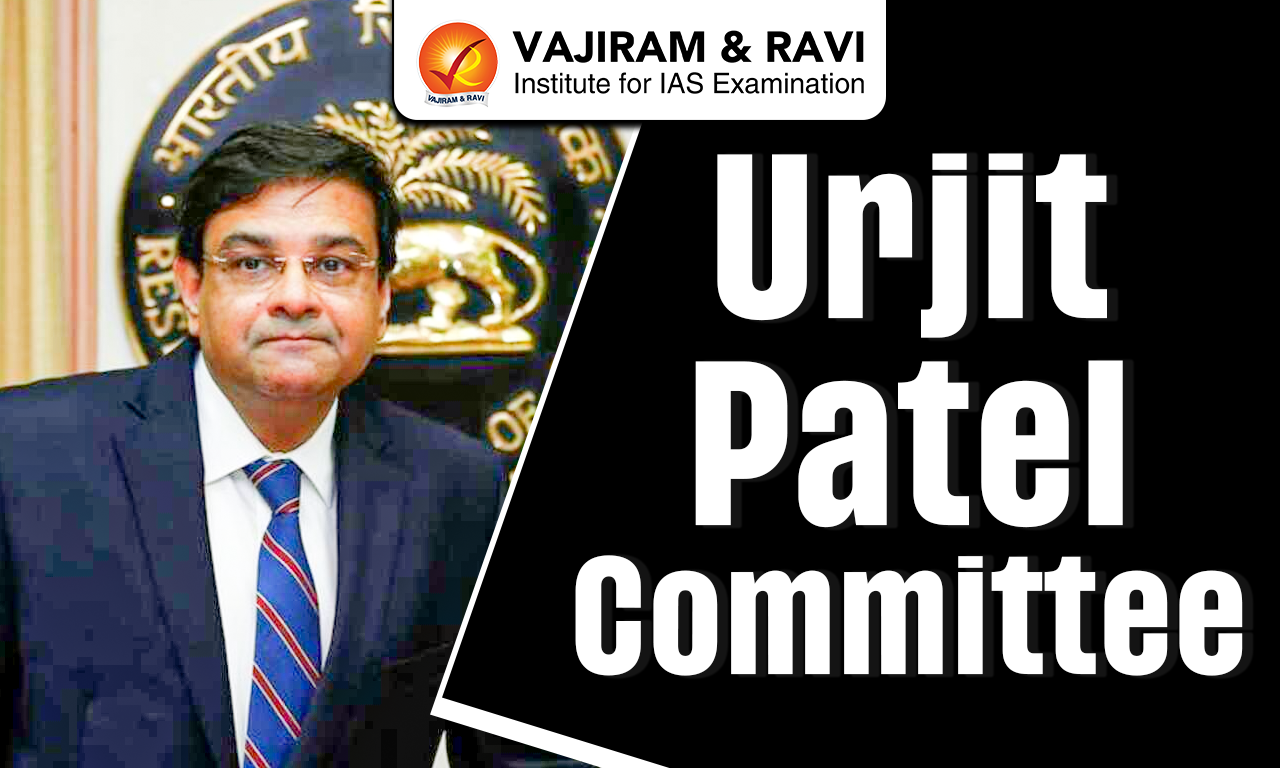
Urjit Patel Committee

The Urjit Patel Committee is formally known as the Expert Committee to Revise and Strengthen the Monetary Policy Framework. It was constituted in 2013 to reform India’s monetary policy system. The committee was chaired by Dr. Urjit R. Patel. It aimed to improve transparency, credibility and effectiveness of policy decisions. Its recommendations led to a major shift towards inflation targeting, strengthening macroeconomic stability and aligning India’s monetary policy framework with global best practices.

Urjit Patel Committee Background

The Urjit Patel Committee was formed to address issues of policy ambiguity and high inflation in India’s economy.

  • Multiple Objectives Issue: Earlier, monetary policy targeted growth, inflation and exchange rate simultaneously, causing confusion and weakening interest rate signalling, thereby reducing policy effectiveness in controlling inflation.
  • High Inflation Phase: Persistent and volatile inflation during late 2000s and early 2010s highlighted the need for a clear nominal anchor to stabilise prices and ensure macroeconomic stability.
  • Formation: The Reserve Bank of India, in consultation with the Government of India, constituted the committee in 2013 under Raghuram Rajan to recommend structural reforms.
  • Need for Nominal Anchor: The committee emphasized the importance of a single measurable anchor to guide policy decisions and anchor inflation expectations across the economy.
  • Global Alignment: It aimed to align India’s monetary policy framework with global best practices, ensuring improved transparency, credibility and institutional strength in policy making processes.

Urjit Patel Committee Recommendations

The Urjit Patel Committee proposed a comprehensive overhaul of India’s monetary policy framework with focus on inflation targeting.

  • Inflation Targeting Framework: Recommended adopting flexible inflation targeting with Consumer Price Index as the nominal anchor to ensure price stability and guide policy decisions effectively.
  • CPI as Primary Indicator: Suggested replacing Wholesale Price Index with CPI as it captures retail inflation and includes services, making it more relevant for policy formulation.
  • Inflation Target Range: Proposed a medium term inflation target of 4% with a tolerance band of ±2%, ensuring inflation remains within 2% to 6% range.
  • Monetary Policy Committee: Recommended establishment of a Monetary Policy Committee comprising RBI officials and external members to decide policy rates collectively, improving transparency and accountability.
  • Single Mandate for RBI: Emphasized that RBI should focus primarily on price stability rather than multiple objectives to improve clarity and effectiveness of monetary policy.
  • Repo Rate as Policy Tool: Suggested using repo rate as the primary policy instrument, maintaining it above inflation to ensure effective control over price rise.
  • Transparency and Communication: Proposed publishing MPC decisions, voting patterns and rationale to enhance policy predictability and credibility among financial markets.
  • Accountability Mechanism: Recommended that RBI should explain failure to meet inflation targets, suggest corrective measures and specify timelines for achieving targets.
  • Institutional Independence: Highlighted the need for greater operational independence of RBI to protect monetary policy decisions from political interference.
  • Supporting Fiscal Measures: Suggested government actions such as reducing administered prices, implementing fiscal consolidation and following FRBM targets to complement monetary policy efforts.

Urjit Patel Committee Impacts

The implementation of the Urjit Patel Committee’s recommendations significantly transformed India’s monetary policy and financial system.

  • Adoption of Inflation Targeting: India formally adopted flexible inflation targeting in 2016, with CPI based target of 4% ±2%, improving price stability and anchoring inflation expectations.
  • Establishment of MPC: Creation of Monetary Policy Committee introduced a rule based and committee driven approach, replacing discretionary decision making by RBI Governor alone.
  • Improved Policy Transparency: Regular publication of MPC statements, voting patterns and reasoning enhanced transparency, accountability and public trust in monetary policy decisions.
  • Better Monetary Transmission: Clear policy signals strengthened transmission of repo rate changes to lending and deposit rates, improving efficiency in banking operations and credit markets.
  • Impact on Banking Sector: Predictable interest rate movements enabled banks to better manage assets and liabilities, improving risk assessment and lending decisions.
  • Financial Market Stability: Reduced uncertainty led to more stable bond yields, improved functioning of interest rate derivatives and increased responsiveness of markets to policy signals.
  • Macroeconomic Stability: Lower and stable inflation helped protect purchasing power, encourage savings and support long term investment planning in the economy.
  • Policy Coordination: Clear division of roles improved coordination between fiscal and monetary policy, strengthening overall macroeconomic governance.
  • Structural Transformation: The framework redefined India’s monetary policy architecture, making it more credible, transparent and aligned with global standards, enhancing economic resilience. 

Urjit Patel Committee FAQs

Q1: What was the Urjit Patel Committee?

Ans: It was an expert committee set up in 2013 by the Reserve Bank of India under Raghuram Rajan to revise and strengthen India’s monetary policy framework.

Q2: What was the main recommendation of the Urjit Patel Committee?

Ans: The committee recommended adopting flexible inflation targeting with CPI as the nominal anchor and a target of 4% with a ±2% band.

Q3: What is the Monetary Policy Committee (MPC)?

Ans: It is a statutory body proposed by the committee to decide policy interest rates collectively, ensuring transparency, accountability and better decision making.

Q4: Why did Urjit Patel Committee preferred CPI over WPI?

Ans: CPI reflects retail inflation and includes services, making it more relevant for monetary policy compared to WPI, which measures wholesale prices only.

Q5: What impact did the Urjit Patel Committee have on India’s economy?

Ans: It improved price stability, strengthened monetary policy transparency, enhanced banking efficiency and helped align India’s policy framework with global standards.

UPSC Daily Quiz 3 April 2026

UPSC Daily Quiz

[WpProQuiz 128]

UPSC Daily Quiz FAQs

Q1: What is the Daily UPSC Quiz?

Ans: The Daily UPSC Quiz is a set of practice questions based on current affairs, static subjects, and PYQs that help aspirants enhance retention and test conceptual clarity regularly.

Q2: How is the Daily Quiz useful for UPSC preparation?

Ans: Daily quizzes support learning, help in revision, improve time management, and boost accuracy for both UPSC Prelims and Mains through consistent practice.

Q3: Are the quiz questions based on the UPSC syllabus?

Ans: Yes, all questions are aligned with the UPSC Syllabus 2025, covering key areas like Polity, Economy, Environment, History, Geography, and Current Affairs.

Q4: Are solutions and explanations provided with the quiz?

Ans: Yes, each quiz includes detailed explanations and source references to enhance conceptual understanding and enable self-assessment.

Q5: Is the Daily UPSC Quiz suitable for both Prelims and Mains?

Ans: Primarily focused on Prelims (MCQ format), but it also indirectly helps in Mains by strengthening subject knowledge and factual clarity.

Fynbos Vegetation, Location, Features, Flora, Fauna

Fynbos Vegetation

Fynbos vegetation is a unique and highly diverse type of shrubland found in the Western Cape of South Africa. It is part of the Cape Floristic Region, one of the world’s richest floral kingdoms, known for its exceptional plant diversity and endemism.

This vegetation is characterized by small, hard-leaved shrubs adapted to a Mediterranean climate with wet winters and dry summers. Fynbos is especially rich in plant species like proteas, ericas, and restios, many of which are not found anywhere else in the world.

Fynbos Vegetation

Fynbos vegetation is a fire-adapted shrubland ecosystem with remarkable biodiversity, thriving in nutrient-poor soils and a Mediterranean climate. It plays a crucial ecological role and is globally recognized for its conservation importance.

  • Found mainly in the Western Cape region of South Africa.
  • Part of the Cape Floristic Region, a UNESCO World Heritage Site.
  • Dominated by plant groups such as proteas, ericas (heaths), and restios (reed-like plants).
  • Contains over 9,000 plant species, with nearly 70% being endemic.
  • Adapted to frequent wildfires, which help in seed germination and regeneration.
  • Grows in sandy, nutrient-poor soils with low fertility.
  • Supports diverse wildlife, including insects, birds, and small mammals.
  • Faces threats from urbanization, agriculture, and invasive species.

Flora of Fynbos Vegetation

  • Proteas: Large, colorful flowering plants symbolizing the region.
  • Ericas (heaths): Small shrubs with bell-shaped flowers, highly diverse.
  • Restios: Grass-like plants adapted to poor soils.
  • Geophytes: Bulbous plants like lilies and orchids that bloom after rains.
  • Shrubs with hard, needle-like leaves to reduce water loss.

Fauna of Fynbos Vegetation

  • Small mammals like rodents and antelopes such as the Cape grysbok.
  • Rich bird diversity including sunbirds and sugarbirds (important pollinators).
  • Numerous insects, especially beetles and butterflies.
  • Reptiles like lizards and snakes adapted to dry conditions.
  • Amphibians in wetter microhabitats.
  • Pollinators play a key role in maintaining plant diversity.

Fynbos Vegetation FAQs

Q1: What is Fynbos vegetation?

Ans: Fynbos is a type of shrubland vegetation found in South Africa, known for its rich biodiversity and unique plant species.

Q2: Where is Fynbos vegetation located?

Ans: It is mainly found in the Western Cape region within the Cape Floristic Region.

Q3: What type of climate supports Fynbos vegetation?

Ans: Fynbos thrives in a Mediterranean climate with cool, wet winters and hot, dry summers.

Q4: Why is Fynbos vegetation important?

Ans: It is one of the world’s richest biodiversity hotspots, with a high level of endemic plant species.

Q5: What are the main plants found in Fynbos?

Ans: Proteas, ericas, and restios are the dominant plant species in Fynbos vegetation.

Justice Verma Committee 2012, Background, Recommendations

Justice Verma Committee

The Justice Verma Committee was a landmark initiative in India’s legal history aimed at reforming laws related to crimes against women. It was constituted on December 23, 2012 by the serving Prime Minister Manmohan Singh. The committee was chaired by Justice J.S. Verma and the report of the committee was submitted on January 23, 2013. The committee adopted a rights based, constitutional approach to gender justice and emphasized equality, dignity and accountability in addressing sexual violence.

Justice Verma Committee Background

The Justice Verma Committee was set up after the December 2012 Delhi gang rape to address urgent gaps in laws and ensure stronger protection for women.

  • Need for committee: The brutal incident exposed serious deficiencies in criminal law, policing and justice delivery, creating an immediate need for comprehensive legal reforms to prevent sexual violence and ensure swift punishment.
  • Objectives: It was tasked with reviewing existing criminal laws and suggesting amendments to strengthen provisions related to sexual offences, victim protection and institutional accountability.
  • Formation: Appointed on December 23, 2012, by Prime Minister Manmohan Singh, the committee was chaired by Justice J.S. Verma (former Chief Justice of India) with members Justice Leila Seth (former Judge of the Delhi High Court and Gopal Subramaniam (Senior Advocate and former Solicitor General of India).
  • Public Participation: It received more than 80,000 suggestions from civil society, including contributions by students, advocates, etc. reflecting wide public involvement.
  • Approach and Scope: The committee adopted a broad, constitutional approach, addressing not only legal reforms but also social norms, gender justice and systemic barriers affecting women’s safety and dignity. 
  • Report Timeline: The 630 page report was completed within 29 days, demonstrating urgency and efficiency in addressing systemic gaps in laws related to sexual offences.

Justice Verma Committee Recommendations

The Justice Verma Committee proposed extensive reforms covering legal definitions, punishments, institutional accountability and victim protection mechanisms.

  • Rape: Defined rape as a crime of power, expanded to include all non consensual penetration and recommended removing the marital rape exception, asserting marriage cannot imply permanent consent.
  • Sexual Assault: Broadened definition to include all non consensual, non penetrative acts with penalties up to five years imprisonment or fines, addressing gaps in earlier legal provisions.
  • Verbal Sexual Assault: Proposed criminalizing unwelcome sexual words, gestures, or threats, making such acts punishable by up to one year imprisonment or fines.
  • Medical Examination: Recommended banning the Two Finger Test and stated that a victim’s past sexual history should not influence investigation or trial outcomes.
  • Sexual Harassment at Workplace: Proposed replacing Internal Complaints Committees with Employment Tribunals, including domestic workers, holding employers liable and ensuring compensation to victims.
  • Acid Attack: Recommended a minimum punishment of ten years imprisonment and creation of a dedicated compensation fund, treating acid attacks as distinct crimes.
  • Child Sexual Abuse: Suggested redefining “harm” and “health” under the Juvenile Justice Act to include both physical and mental aspects for stronger child protection.
  • Trafficking: Called for comprehensive anti trafficking laws beyond prostitution, covering coercion and exploitation, along with protective homes monitored by High Courts.
  • Women in Conflict Zones: Recommended reviewing AFSPA provisions, removing prior sanction for prosecuting armed forces in sexual offences and appointing special commissioners for monitoring cases.
  • Death Penalty: Opposed death penalty and chemical castration for rape, advocating life imprisonment as a more effective and reform oriented punishment approach.
  • Police Reforms: Suggested greater police accountability, increased personnel, gender sensitive training and enabling online FIR registration to improve reporting and responsiveness.
  • Judiciary Reforms: Emphasized speedy trials, victim support systems and witness protection mechanisms to ensure fair and efficient justice delivery.
  • Case Management: Recommended setting up Rape Crisis Cells, improving coordination among agencies and ensuring community policing for better prevention and response.
  • Workplace Law Criticism: Termed existing Sexual Harassment Act “unsatisfactory,” stating it failed to reflect Vishakha guidelines and discouraged complaints due to in house mechanisms.

Justice Verma Committee Impact

The report of Justice Verma Committee significantly influenced legal reforms and public discourse on gender justice, though not all recommendations were fully implemented.

  • Criminal Law (Amendment) Act, 2013: Many recommendations led to expanded definitions of rape and sexual offences, stricter punishments and improved victim protection mechanisms in law.
  • Death Penalty Debate: Despite committee opposition, the government introduced death penalty provisions under Sections 376A and 376E and later expanded them in 2018 amendments.
  • Institutional Changes: Recommendations led to increased focus on police reforms, victim support systems and establishment of mechanisms like crisis centers and better reporting processes.
  • Continuing Challenges: While widely praised nationally and internationally, gaps remain in full implementation, particularly regarding marital rape, AFSPA reforms and systemic accountability. 

Justice Verma Committee FAQs

Q1: What is the Justice Verma Committee?

Ans: It was a three member committee formed on December 23rd, 2012, to recommend reforms in laws related to crimes against women after the Delhi gang rape incident.

Q2: Who were the members of the Justice Verma Committee?

Ans: The committee was chaired by Justice J.S. Verma and included Justice Leila Seth and Gopal Subramaniam as members.

Q3: What was the recommendations of Justice Verma Committee on Rape Laws?

Ans: The committee expanded the definition of rape to include all non consensual penetration and recommended removing the marital rape exception.

Q4: What was Justice Verma Committee’s opinion on Death Penalty for Rape?

Ans: The Justice Verma Committee opposed the death penalty and recommended life imprisonment as a more appropriate punishment.

Q5: What was the impact of the recommendations laid by the Justice Verma Committee?

Ans: Its recommendations led to the Criminal Law (Amendment) Act, 2013, which strengthened laws on sexual offences and improved victim protection.

Multi-Hazard Early Warning Decision Support System

Multi-Hazard Early Warning Decision Support System

Multi-Hazard Early Warning Decision Support System Latest News

The Multi-Hazard Early Warning Decision Support System represents a decisive transformation in India’s approach to weather forecasting and disaster risk reduction. 

About Multi-Hazard Early Warning Decision Support System

  • It is an advanced digital forecasting platform developed by the Indian Meteorological Department (IMD) using open-source technology and in-house expertise.
  • It is a digital transformation initiative under Mission Mausam.
  • It was officially launched in January 2024.
  • It operates in real time using tools such as Geographic Information System (GIS) maps, enabling forecasters to quickly collect, analyse, and disseminate weather information in a clear and user-friendly manner.
  • Nodal Ministry: Ministry of Earth Sciences (MoES)

Features of Multi-Hazard Early Warning Decision Support System

  • Automated Weather Data Processing: Over 90% of weather data collection, quality checks, and integration are automated, enabling faster detection of weather systems and their possible impacts.
  • Better Use of Forecast Models: More than 95% of numerical weather prediction model inputs are now used in forecasting, improving risk assessment for different weather hazards.
  • Re-engineered Forecasting System: The entire forecasting and warning generation process has been re-engineered, enabling real-time alerts and faster decision-making.
  • Longer Forecast Lead Time: Forecast lead time has increased from 5 days to 7 days, allowing authorities and communities to prepare in advance.
  • Faster Forecast Preparation: The time required to prepare forecasts has reduced by about 3 hours from 6 hours, enabling quicker dissemination of warnings.

Source: PIB

Multi-Hazard Early Warning Decision Support System FAQs

Q1: Why are Multi-Hazard Early Warning Systems important?

Ans: They reduce disaster risk and impacts

Q2: What type of hazards does a Multi-Hazard Early Warning System cover?

Ans: Multiple hazards like floods, cyclones, and earthquakes

United Nations Interim Force in Lebanon

United Nations Interim Force in Lebanon

United Nations Interim Force in Lebanon Latest News

Recently, India condemned the recent killing of three Indonesian peacekeepers who were deployed in south Lebanon as part of the UNIFIL (United Nations Interim Force in Lebanon).

About United Nations Interim Force in Lebanon

  • It is a peacekeeping mission in south Lebanon.
  • It was established by the Security Council in 1978.
  • Background: Originally, UNIFIL was created by the Security Council in March 1978 to confirm Israeli withdrawal from Lebanon.
  • The mandate had to be adjusted twice, due to the developments in 1982 and 2000.
  • In 2006, the UN Security Council strengthened UNIFIL’s mandate to monitor the cessation of hostilities, among other tasks.
  • Objectives: UNIFIL's objectives include:
    • Confirming Israeli withdrawal
    • Restoring international peace and security
    • Assisting the Lebanese Government in restoring its authority
    • Monitoring the cessation of hostilitiesProtecting civilians and humanitarian workers
  • UNIFIL has around 7,505 peacekeepers coming from 47 troop-contributing.
  • It has the Maritime Task Force which is a naval peacekeeping force.
  • It was deployed in October 2006 at the request of the Lebanese Government to help the Lebanese Navy secure the country’s sea borders and other maritime entry points
  • India is also one of the troops contributing countries.

Source: TH

United Nations Interim Force in Lebanon FAQs

Q1: When was UNIFIL established?

Ans: 1978

Q2: What is UNIFIL's primary objective?

Ans: To restore international peace and security

Earthquake Lights

Earthquake Lights

Earthquake Lights Latest News

Recently, small earthquakes shook parts of the Aegean Sea near Turkey and Greece and floating lights appear in the sky after an earthquake near Turkey which is called earthquake lights by the scientists.

About Earthquake Lights

  • Earthquake lights are flashes, streaks, balls, or tall pillars of light that sometimes appear in the sky right before, during, or just after an earthquake.
  • Formation
    • Earthquakes happen when huge tectonic plates push and grind against each other.
    • This stress squeezes rocks in the crust, especially those containing quartz or certain minerals.
    • The pressure creates electric charges inside the rocks.
    • These charges then flow upward through cracks and faults until they reach the surface. Once there, they bump into air molecules and ionise them, stripping electrons and creating glowing plasma.
    • The result is visible flashes or steady beams with no heat or fire.
    • Scientists have noted that lights appear more often in places with straight, vertical faults, like rift zones, which act like easy pathways for electricity.

Source: IT

Earthquake Lights FAQs

Q1: What are Earthquake Lights?

Ans: Bright lights seen during earthquakes

Q2: What causes Earthquake Lights?

Ans: Electrical charges building up in rocks

SAMPANN Platform

SAMPANN Platform

SAMPANN Platform Latest News

Recently, the Goa government and the Cochin Port Authority have taken a significant step towards modernizing pension disbursement by signing agreements to onboard the SAMPANN digital platform.

About SAMPANN Platform

  • SAMPANN (System for Accounting and Management of Pension) is the flagship digital pension and financial management platform of the Department of Telecommunications.
  • It is managed by the Office of the Controller General of Communication Accounts (CGCA).
  • It was designed to streamline pension sanction, authorisation, accounting and payment through a single digital platform.
  • It was launched on 29th December, 2018.
  • It provides direct credit of pension into the bank accounts of pensioners.
  • Features of SAMPANN Platform
    • It is a cloud-based, end-to-end pension management system of the Department of Telecommunications.
    • Direct disbursement of pension on a timely basis without intermediaries
    • Single window system for complete pension process
    • Online grievance management for the pensioners, reducing paperwork
    • Tracking of pension status from home encourages transparency and accountability
    • Faster processing of arrears and revision of pension

Source: PIB

SAMPANN Platform FAQs

Q1: What is SAMPANN?

Ans: A pension management system

Q2: Who launched SAMPANN?

Ans: Ministry of Communications

Gangotri National Park

Gangotri National Park

Gangotri National Park Latest News

Recently the Gangotri National Park reopened after a six-month winter break.

About Gangotri National Park

  • Location: It is located in the state of Uttarakhand.
  • It sits along the upper catchment of the Bhagirathi River. 
  • International boundary: The northeastern section of the park forms the international boundary of India and Tibet (China). 
  • The area enclosed by the park also borders Kedarnath Wildlife Sanctuary and Govind National Park.
  • The mountains in the park are part of the Gangotri Group of the Garhwal Himalayas, which are a subrange of the eastern Himalayas.
  • Important Peaks: Major peaks within the park include Chaukhamba I, Satopanth, Chaukhamba II, Chaukhamba III, and Kedarnath Main.
  • The famous Gangotri Glacier is located in the park boundaries and is known for being one of the primary sources of the Ganges.
  • Flora: Western Himalayan subalpine conifer forests dominate the lower elevation landscapes. These forests are filled with fir trees intermixed with deodar, oak, spruce, and rhododendron trees.
    • Higher elevations in the park are home to Western Himalayan alpine shrubs
  • Fauna: It is mainly home to Snow leopard, brown bear, blue sheep, musk deer, Asian black bear, and the Himalayan tahr etc.

Source: NIE

Gangotri National Park FAQs

Q1: Which river originates in Gangotri National Park?

Ans: Bhagirathi

Q2: Where is Gangotri National Park located?

Ans: Uttarakhand

Non-Deliverable Derivative

Non-Deliverable Derivative

Non-Deliverable Derivative Latest News

Recently, the Reserve Bank of India’s (RBI) gave a directive to bar banks from non-deliverable derivative (NDD) contracts in the rupee.

About Non-Deliverable Derivative

  • An NDD is a derivative contract where two parties agree on a future exchange rate for the rupee, but settle the difference in cash, usually in US dollars.
  • Reason for formation: As India has capital controls, offshore investors can’t freely trade in the rupee in physical form. This led to the creation of the NDD markets in the rupee.
  • Participating Parities: The NDD market is widely used by foreign investors, hedge funds and global banks who cannot freely access and play in the Indian rupee market.
  • These trades take place offshore, outside the control of the RBI.
  • This often acts as a price discovery mechanism for the rupee, even influencing expectations before Indian markets open.
  • Issues with NDD
    • Distort Price Discovery: These instruments have long been criticised for distorting price discovery.
    • Used For Speculation: Some participants would cancel and re-enter contracts to take advantage of favourable movements, effectively turning hedging tools into speculative instruments.

Source: IE

Non-Deliverable Derivative FAQs

Q1: What is a Non-Deliverable Derivative (NDD)?

Ans: A contract settling difference in cash (usually USD)

Q2: Who typically uses NDD markets?

Ans: Foreign investors, hedge funds, and global banks [

Customs Duty Exemption on Petrochemicals – Explained

Petrochemicals

Petrochemicals Latest News

  • The government has exempted customs duty on critical petrochemical products to address supply disruptions amid the West Asia crisis. 

Petrochemical Industry in India

  • Petrochemicals are chemical products derived primarily from crude oil and natural gas. 
  • They form the backbone of modern manufacturing and are used as key inputs across multiple industries.
  • Major petrochemical products include polymers such as polyethene and polypropylene, synthetic fibres, chemicals like methanol and ammonia, and intermediates such as styrene and toluene.
  • In India, petrochemicals are crucial for sectors such as plastics, textiles, pharmaceuticals, fertilisers, and automobiles. The industry is closely linked with refining and natural gas processing.
  • India is both a producer and importer of petrochemicals. However, domestic production is often insufficient to meet rising industrial demand, making imports essential.

Importance of Petrochemicals in the Economy

  • Petrochemicals play a strategic role in industrial development and economic growth.
  • They serve as feedstock for manufacturing value-added products.
  • They support employment generation across downstream industries.
  • They are critical for sectors such as packaging, infrastructure, healthcare, and consumer goods.
  • Any disruption in petrochemical supply chains can have cascading effects on industrial output and inflation.

India’s Dependence on Imports

  • India relies significantly on imports for certain petrochemical products and feedstock.
  • A large portion of imports originates from West Asia, due to proximity and established trade routes. However, geopolitical tensions in the region can disrupt supply chains and increase prices.
  • Additionally, domestic petrochemical production has been affected due to the diversion of feedstock such as propane and butane for LPG production. 
  • This highlights the structural vulnerability in India’s petrochemical supply chain.

News Summary

  • The Union government has announced a full customs duty exemption on around 40 critical petrochemical products until June 30, 2026. 
  • The exemption is designed as a temporary and targeted relief measure. It aims to ensure the availability of key petrochemical inputs, reduce cost pressures on industries, and stabilise supply chains. 
  • The list of exempted products includes chemicals and intermediates such as methanol, acetic acid, toluene, styrene, polypropylene, polyvinyl chloride, and polycarbonates. 
  • The government expects that the measure will provide relief not only to industries but also to consumers by moderating the prices of final goods. 
  • However, the exemption will result in an estimated revenue loss of about Rs. 1,800 crore for the government over the three-month period
  • The policy decision is also linked to rising crude oil prices following geopolitical tensions, including conflicts involving Iran. This has led to increased costs of petrochemical inputs and disruptions in shipping routes. 
    • For example, the textile industry has faced sharp increases in raw material prices such as Purified Terephthalic Acid (PTA) and Mono Ethylene Glycol (MEG), which are essential for synthetic fibres. 
  • The government has also taken complementary measures, such as increasing the allocation of commercial LPG to industries, to address fuel and feedstock shortages. 

Impact on Industries

  • The exemption is expected to provide immediate relief to several sectors.
    • Textiles. Reduction in input costs for synthetic fibre production. 
    • Automobiles. Improved availability of inputs such as paints and chemicals. 
    • Pharmaceuticals. Stabilisation of supply chains for chemical intermediates. 
    • Packaging and Plastics. Lower raw material costs, benefiting consumer goods. 
  • Overall, the measure is aimed at maintaining industrial production and preventing supply shocks.

Challenges and Concerns

  • Despite its benefits, the policy raises certain concerns.
    • The revenue loss of Rs. 1,800 crore may impact fiscal balances. 
    • The exemption is temporary, and long-term supply vulnerabilities remain. 
    • Continued dependence on imports exposes India to geopolitical risks. 
  • Additionally, domestic production constraints need to be addressed to reduce reliance on imports.

Way Forward

  • India needs a multi-pronged strategy to strengthen its petrochemical sector.
    • Expand domestic petrochemical production capacity. 
    • Diversify import sources beyond West Asia. 
    • Develop strategic reserves of critical inputs. 
    • Promote research and innovation in alternative materials. 
  • Such measures will enhance resilience against global supply disruptions.

Source: TH | IE

Petrochemicals FAQs

Q1: What are petrochemicals?

Ans: Petrochemicals are chemical products derived from crude oil and natural gas used in manufacturing industries.

Q2: Why has India exempted customs duty on petrochemicals?

Ans: To reduce cost pressures and ensure supply stability amid the West Asia crisis.

Q3: How many products are covered under the exemption?

Ans: Around 40 petrochemical products are included.

Q4: What is the duration of the exemption?

Ans: The exemption is valid until June 30, 2026.

Q5: What is the estimated revenue loss for the government?

Ans: Approximately Rs. 1,800 crore.

NDD Ban Explained: How NDD Ban Impacts Rupee Speculation and Forex Market Stability

NDD Ban

NDD Ban Latest News

  • The RBI has barred banks from non-deliverable derivative (NDD) contracts in the rupee, a segment often linked to speculative trading by large currency players.
  • This move signals a push for greater control and transparency in the forex market, aiming to curb speculation and strengthen the onshore market.
  • Following the directive, the rupee recovered sharply from below 95 to 93.10 per dollar, helped by reduced speculative pressure. The step is intended to stabilise the currency amid rising oil prices and capital outflows due to the West Asia conflict.

About NDD Market

  • Non-Deliverable Derivatives (NDDs) are financial contracts used to hedge or speculate on currencies that are not freely convertible — like the Indian rupee — without any actual exchange of the underlying currency. 
  • Instead of physically delivering the currency at settlement, the difference between the agreed contract rate and the actual market rate is settled in a freely convertible currency, typically the US dollar.
  • Basically, NDDs are offshore currency contracts that allow participants to bet on the rupee’s future value without actual delivery of the currency.
  • NDDs are traded outside India in global financial hubs such as: Singapore; Hong Kong; London; Dubai.
  • These markets operate beyond the direct regulatory control of the RBI.
  • NDD markets often act as a price discovery mechanism, shaping expectations about the rupee even before Indian markets open.

How NDDs Work

  • Cash-Settled Contracts - In an NDD, two parties agree on a future exchange rate for the rupee, but the contract is settled in cash (usually US dollars) instead of exchanging the actual currency.
  • Reason for Their Existence - Due to India’s capital controls, foreign investors cannot freely trade the rupee. This led to the development of offshore NDD markets.

Who Uses the NDD Market

  • Foreign investors and hedge funds 
  • Global banks 
  • Companies hedging currency risk 
  • They use NDDs to speculate on or hedge against rupee movements without accessing the domestic market.

Concerns and Criticism of NDD Market

  • Offshore sentiment can diverge from domestic fundamentals
  • Leads to distorted price signals and potential manipulation
  • Contributes to higher volatility in the rupee

Misuse of the NDD Market

  • The NDD market, originally meant for hedging, was often misused by participants for speculative gains. 
  • Some traders would cancel and re-enter contracts to benefit from favourable currency movements, effectively turning a risk-management tool into a speculative instrument.
  • During periods of global uncertainty, such as the West Asia conflict, large offshore traders took aggressive positions betting on rupee depreciation
  • These actions influenced the onshore market in India, increasing volatility and weakening the currency.

RBI’s Crackdown on Loopholes

  • The RBI’s move aims to close regulatory arbitrage opportunities that allowed such practices. 
  • By restricting NDD-related activities, the central bank is tightening oversight and limiting misuse in offshore markets.
  • Another key step is the restriction on transactions with related parties, addressing concerns over intra-group dealings that could hide actual risk exposure or shift profits across jurisdictions. 
  • Aligning rules with global accounting standards reflects RBI’s effort to improve transparency and credibility.
  • In the short term, these measures are likely to reduce speculative activity and stabilise the rupee, leading to lower volatility and improved investor confidence in India’s forex market.

Source: IE | MC

NDD Ban FAQs

Q1: What is the NDD market?

Ans: The NDD market involves offshore derivative contracts where traders bet on currency movements without actual delivery, settling differences in dollars instead of exchanging the rupee.

Q2: Why did RBI impose the NDD ban?

Ans: The RBI imposed the NDD ban to curb rupee speculation, reduce offshore market manipulation, and strengthen control over currency price discovery and volatility.

Q3: Who uses NDD markets?

Ans: NDD markets are used by foreign investors, hedge funds, global banks, and companies to hedge or speculate on currency movements without direct access to domestic markets.

Q4: How was the NDD market misused?

Ans: Traders misused NDD markets by repeatedly entering and exiting contracts to profit from exchange rate changes, turning hedging tools into speculative instruments influencing rupee volatility.

Q5: What impact will the NDD ban have?

Ans: The NDD ban is expected to reduce speculative pressure, stabilise the rupee, limit offshore influence, and improve investor confidence in India’s foreign exchange market.

Form 6 Row Explained: How Form 6 Voter Enrolment Controversy Shook Bengal Rolls

Form 6

Form 6 Spread Latest News

  • Ahead of the freezing of electoral rolls for the April 23 and 29 West Bengal polls, allegations have surfaced of a last-minute push to add voters from Bihar and Uttar Pradesh.
  • It has been claimed that large numbers of Form 6 applications (used for new voter enrolment) were submitted, with concerns raised that this could alter the state’s electoral demography.

What is Form 6

  • Form 6 is the official application form used to enrol new voters in the electoral rolls, as per the Registration of Electors Rules, 1960. 
  • It is submitted to the Electoral Registration Officer (ERO) of the concerned Assembly constituency (or Parliamentary constituency in Union Territories without an Assembly).
  • Basically, Form 6 is the primary gateway for voter enrolment, combining document verification with self-declaration, while placing responsibility on the ERO for scrutiny and final inclusion in electoral rolls.

Role of the Electoral Registration Officer (ERO)

  • The ERO, a local official appointed by the Election Commission in consultation with the state government, is responsible for:
    • Maintaining electoral rolls 
    • Accepting new voter applications 
    • Processing deletions 
    • Conducting hearings in case of objections

Citizenship Requirement

  • Under Article 326 of the Constitution, only Indian citizens aged 18 or above are eligible to vote. 
  • However, Form 6 does not require documentary proof of citizenship. 
  • Instead, it includes a self-declaration, and false claims can attract penalty or imprisonment up to one year.

Mode of Application

  • Form 6 can be:
    • Filled online via the ECI’s ECINET portal, or 
    • Submitted offline to the ERO, typically a Sub-Divisional Magistrate or equivalent officer

Processing of Form 6 Applications

  • After a Form 6 is submitted, the Booth-Level Officer (BLO) verifies the applicant’s details. 
  • The Electoral Registration Officer (ERO) then assesses whether the applicant is ordinarily resident in the constituency, above 18 years of age, and a citizen. If satisfied, the applicant is added to the electoral roll.

Types of Voter Roll Updates

  • There are two ways in which names are added to electoral rolls:
    • Special Summary Revision (SSR) - This is an annual or pre-election revision process where large-scale updates are made.
    • Continuous Updation - This process runs throughout the year, except during the period between the last date of nomination and declaration of election results.
    • In election years, an additional supplement is generated to include changes made during continuous updation up to the nomination deadline.

Objection and Verification Process

  • The ERO must provide at least seven days for objections by displaying proposed additions on a notice board.
  • Given the timeline, this objection window has closed, meaning new Form 6 applications cannot be accepted in the normal course.

Exceptional Situation in West Bengal

  • However, due to a Special Intensive Revision in West Bengal and the involvement of judicial officers appointed by the Supreme Court to decide voter eligibility, the timeline remains uncertain.
  • It is unclear how long affected individuals will have to appeal or resolve disputes over inclusion in the electoral rolls.

Allegations of Large-Scale Form 6 Submissions

  • Over the past week, allegations have been made that thousands of Form 6 applications were submitted in a short span at the West Bengal Chief Electoral Officer’s office. 
    • It has been claimed that around 30,000 forms were filed within 6–7 hours, raising concerns over possible procedural violations.
    • It has been pointed out that, as per Election Commission rules, Booth Level Agents can submit a maximum of 50 forms per day. 
  • The unusually high volume of submissions has led to questions about compliance with these limits and the transparency of the process.
  • Another key allegation is that some applications were for individuals already registered as voters in states like Bihar and Uttar Pradesh, which would violate the Representation of the People Act, 1950. 
  • Form 6 requires applicants to declare that they are not enrolled elsewhere, making duplicate entries illegal.
  • Such allegations of last-minute additions and deletions in voter rolls are not new. 
  • Similar concerns have been raised in previous elections, including Karnataka (2023), Maharashtra (2024), and Delhi (2025).

Election Commission’s Response

  • So far, the Election Commission (EC) has not issued an official response to the allegations regarding large-scale Form 6 submissions.
  • The West Bengal Chief Electoral Officer stated that while documents were received at the office, he was not aware of their contents. 
  • He clarified that the CEO does not have the authority to add or delete voters from the electoral rolls.
  • According to the CEO, any complaints regarding fake or ineligible voters are forwarded to the Electoral Registration Officer (ERO), who is responsible for verification and decision-making. The CEO’s role is limited to issuing directions and forwarding cases.

Source: IE

Form 6 FAQs

Q1: What is Form 6 in elections?

Ans: Form 6 is the official application used for new voter registration under electoral rules, allowing eligible citizens above 18 years to apply for inclusion in electoral rolls.

Q2: Why is the Form 6 voter enrolment controversy in news?

Ans: The Form 6 voter enrolment controversy arose due to allegations of mass applications adding voters from other states, potentially altering electoral demographics before polls.

Q3: Who verifies Form 6 applications?

Ans: Booth-Level Officers verify details, and the Electoral Registration Officer decides eligibility based on residence, age, and self-declared citizenship before adding names to electoral rolls.

Q4: Can duplicate voter registrations happen?

Ans: Duplicate registrations are illegal. Applicants must declare they are not enrolled elsewhere, and violations under election laws can lead to penalties or imprisonment.

Q5: What has the Election Commission said?

Ans: The Election Commission clarified that only Electoral Registration Officers can add voters, and the CEO cannot directly alter electoral rolls, ensuring decentralised verification.

Daily Editorial Analysis 3 April 2026

Daily-Editorial-Analysis

ECI Transfer Controversy, Top Court’s Clarifications

Context

  • The conduct of free and fair elections is a cornerstone of any democratic system, and in India, this responsibility is entrusted to the Election Commission of India.
  • However, recent actions by the ECI, specifically the transfer of senior officials in election-bound States such as West Bengal, Assam, Kerala, Tamil Nadu, and the Union Territory of Puducherry, have sparked a serious constitutional debate.
  • The abrupt removal of top bureaucrats, including the Chief Secretary and Director General of Police in West Bengal, raises critical questions about the scope, legality, and limits of the ECI’s powers under the Constitution.

Constitutional Basis and Scope of ECI’s Powers

  • The ECI derives its authority primarily from Article 324 of the Constitution of India, which vests in it the superintendence, direction and control of elections.
  • This provision has been interpreted by the Supreme Court of India as conferring broad, plenary powers upon the Commission to ensure the integrity of elections.
  • In the landmark case Mohinder Singh Gill vs Chief Election Commissioner, the Court described Article 324 as a reservoir of powers, enabling the ECI to act decisively in situations where existing laws are silent.
  • However, this interpretation is not without limits. The Court clearly emphasised that such plenary powers can only be exercised in areas where no statutory provisions exist.
  • Where laws enacted by Parliament or State legislatures govern a particular field, the ECI is bound to act in conformity with those laws.
  • Additionally, the exercise of these powers must adhere to principles of fairness, reasonableness, and natural justice.

Conflict with Statutory Framework

  • The controversy surrounding the transfer of senior officials lies in its apparent conflict with established statutory provisions.
  • Officers belonging to the All India Services are governed by the All India Services Act, which places their appointment, posting, and transfer under the jurisdiction of the respective government, primarily the State governments when officers are serving in State cadres.
  • Moreover, under the constitutional scheme, particularly the Seventh Schedule, public services fall within the domain of the Union and State governments.
  • The ECI’s authority to requisition staff for election purposes is explicitly provided under Article 324(6), but this does not extend to unilateral transfers of top administrative or police officials without the knowledge or consent of the State government.
  • Importantly, neither the Representation of the People Act, 1950 nor the Representation of the People Act, 1951 grants the ECI the power to transfer senior officers.
  • This absence of statutory backing raises serious concerns about the legality of such actions.
  • While it may be argued that these laws do not directly deal with administrative transfers, bypassing them altogether risks undermining the constitutional balance of power.

Implications for Federalism and Governance

  • The sudden transfer of top officials, particularly without prior consultation, disrupts administrative continuity and may even paralyse governance in States.
  • This raises a fundamental question: can the objective of ensuring free and fair elections justify such sweeping interventions in State administration?
  • Furthermore, the underlying assumption behind these transfers, that certain officials may compromise electoral integrity, remains largely unexplained.
  • The absence of a transparent procedure to determine bias or misconduct weakens the legitimacy of these decisions and risks creating a perception of arbitrariness.

The Problem of Unchecked Power

  • A deeper concern emerging from this issue is the potential normalisation of unchecked institutional power.
  • The ECI has historically relied on the cooperation of State officials to conduct elections, given that it lacks its own administrative machinery.
  • Casting doubt on the integrity of these officials and removing them abruptly may demoralise the civil services and erode trust between institutions.
  • The Supreme Court, even while affirming the breadth of Article 324, has cautioned against such overreach.
  • In the same judgment, it asserted that no authority in India operates above the law and that all actions must conform to principles of fairness and accountability.
  • The idea that unchecked power is alien to our system serves as a vital reminder that constitutional bodies, however important, are not beyond scrutiny.

Conclusion

  • The recent actions of the Election Commission highlight a delicate constitutional tension between the need to ensure electoral integrity and the imperative to respect legal and institutional boundaries.
  • While Article 324 provides the ECI with significant authority, this power is neither absolute nor unregulated.
  • Ultimately, the legitimacy of elections depends not only on their fairness but also on the fairness of the processes employed to ensure them.
  • Upholding the rule of law, respecting institutional boundaries, and ensuring transparency in decision-making are essential to preserving both democratic integrity and constitutional order.

ECI Transfer Controversy, Top Court’s Clarifications FAQs

Q1. What is the main role of the Election Commission of India?
Ans. The Election Commission of India is responsible for conducting free and fair elections.

Q2. Which constitutional provision gives powers to the ECI?
Ans. Article 324 of the Constitution of India grants powers to the ECI.

Q3. What did the Supreme Court of India say about Article 324?
Ans. The Supreme Court stated that Article 324 provides plenary powers but with limitations.

Q4. Which law governs the transfer of All India Service officers?
Ans. The All India Services Act governs the transfer of such officers.

Q5. Why are the ECI’s recent transfers controversial?
Ans. The transfers are controversial because they may lack statutory backing and could undermine federal principles.

Source: The Hindu


A Path to Peace in West Asia Beyond Pakistan Talks

Context

  • The recent diplomatic engagements hosted by Pakistan, involving Saudi Arabia, Türkiye, and Egypt, signal a cautious attempt to address the escalating conflict in West Asia.
  • Parallel outreach to Iran and China reflects growing diplomatic activity.
  • However, these efforts remain limited, revealing the complexity, fragility, and constraints of modern conflict resolution where political intent, military realities, and mutual distrust intersect.

The Centrality and Challenge of a Ceasefire and Exhaustion Without Resolution

  • The Centrality and Challenge of a Ceasefire
    • A ceasefire remains the most critical yet elusive first step.
    • The opposing sides, United States/Israel and Iran, lack both clarity of objectives and strategic alignment.
    • Under Donald Trump, shifting goals, from denuclearisation to regime change to surrender, weaken negotiation prospects.
    • Israel’s expectations of an internal uprising following actions against Ali Khamenei appear unrealistic.
    • Such uprisings require timing, leadership, and coordination, none of which are present.
    • Instead, Israel’s likely goal is the complete degradation of Iran’s strike capability, a target not yet achieved.
    • With neither victory nor stalemate in sight, the path to ceasefire remains blocked.
  • Exhaustion Without Resolution
    • Signs of military fatigue and domestic pressure are visible but insufficient to force compromise.
    • Protests in the United States indicate public discontent, while reports of logistical strain suggest operational limits.
    • Israel continues to face attacks despite advanced defence systems, and Iran is experiencing significant attrition.
    • Yet, both sides maintain rigid positions. The absence of trust, especially after military actions during negotiations, undermines diplomacy.
    • Even if a ceasefire emerges, ensuring compliance without credible guarantees remains a serious challenge.

The Problem of Enforcement and the Role of the United Nations

  • A sustainable ceasefire requires enforcement mechanisms, typically through peacekeeping forces authorised by the United Nations Security Council.
  • However, geopolitical divisions and declining faith in multilateralism make this unlikely. The reluctance of the United States to rely on the UN further complicates the situation.
  • Historical precedent offers an alternative.
  • During the Suez Crisis, the UN General Assembly bypassed the UNSC through the Uniting for Peace resolution.
  • This succeeded largely due to the decisive role of Dwight D. Eisenhower, highlighting that institutional success depends on great power backing and political will.

Regional Dynamics and the Limits of Mediation

  • Potential mediators such as Egypt, Türkiye, and Pakistan face credibility issues due to their strategic alignments.
  • Egypt’s ties with Israel, Türkiye’s NATO membership, and Pakistan’s defence commitments to Saudi Arabia introduce bias and limit neutrality.
  • Regional distrust further complicates efforts. Iran remains wary of United Arab Emirates and Saudi Arabia, both perceived as aligned with U.S. objectives.
  • Past tensions involving Pakistan and Türkiye deepen suspicion. China’s role, while significant, lacks security guarantees or direct commitments, reducing its effectiveness as a mediator.

India and the Global South: An Alternative Approach

  • India can adopt a cautious yet proactive strategy. Rather than direct mediation, it can mobilise the Global South to build a collective diplomatic front.
  • Collaboration with Southeast Asian nations and others affected by the conflict can amplify calls for de-escalation and peace at the United Nations.
  • This approach reflects evolving global dynamics where middle powers play a growing role.
  • A unified stance can generate the political momentum needed to revive multilateral diplomacy and push for a durable ceasefire.

Conclusion

  • The Islamabad initiative underscores both the importance and limitations of diplomacy in a deeply polarised environment.
  • The absence of clear objectives, mutual trust, and enforcement capacity continues to hinder progress.
  • Historical lessons show that peace efforts require not just institutions but also decisive leadership and strategic consensus.
  • In this context, broader coalitions led by emerging powers may offer a more viable path toward lasting stability.

A Path to Peace in West Asia Beyond Pakistan Talks FAQs

Q1. Why is a ceasefire difficult to achieve?
Ans. A ceasefire is difficult because there is a lack of trust and no clear agreement on objectives among the conflicting sides.

Q2. What weakens the negotiation process for the United States?
Ans. The negotiation process is weakened by shifting and unclear goals under Donald Trump.

Q3. Why are regional mediators seen as ineffective?
Ans. Regional mediators are seen as ineffective due to their strategic biases and lack of neutrality.

Q4. What role does the United Nations struggle to perform?
Ans. The United Nations Security Council struggles to enforce peace due to geopolitical divisions.

Q5. What alternative role can India play?
Ans. India can lead the Global South to collectively push for de-escalation and a ceasefire.

Source:The Hindu


India’s Smartphone PLI Success - A Blueprint for Manufacturing Transformation

Context

  • India’s emergence as a global manufacturing hub—particularly in electronics—marks a significant shift from its earlier dominance in IT services.
  • The Production-Linked Incentive (PLI) Scheme for smartphones (2020) has delivered remarkable outcomes, positioning India as a key player in global value chains (GVCs).
  • However, the uneven success of PLIs across sectors raises important policy questions.

Key Achievements of Smartphone PLI

  • Surge in production and investment:
    • For example, an investment of about $1.2 billion under the scheme has driven $64 billion in production by FY 2025 — more than double the $30 billion in 2020.
  • Employment generation:
    • With total investment in the broader smartphone ecosystem (including non-PLI participants) is estimated at ~$8 billion, it created about 1.5-2 lakh jobs.
    • This has also resulted in expansion of supply chains (e.g., Apple ecosystem, with 40 firms, creating 1.2 lakh additional jobs).
  • Export growth and global integration:
    • Exports have soared from $3.1 billion to $24 billion, lifting India’s share of global smartphone exports from 1 to 8%.
  • Forward linkages - component ecosystem:
    • Building on the success of the PLI, the government has launched the Electronics Component Manufacturing Scheme to nurture a domestic component ecosystem.
    • Against an expected investment of Rs 59,350 crore, applications worth twice that amount have poured in, with 1.4 lakh jobs committed versus 91,600 originally envisaged.

Why did Smartphone PLI Succeed?

  • Export-oriented strategy (plugging into GVCs):
    • A clear export focus, targeting two segments - phones with an invoice value of over Rs 15,000 (critical for exports), and cheaper phones better suited to the domestic market.
    • The sales and investment thresholds were different for each segment, ensuring that (unlike many industrial policies that focus on import substitution) the smartphone PLI aimed to plug India into GVCs.
    • Insight: Export orientation is critical for scaling manufacturing and job creation.
  • Downstream focus (assembly-led growth model):
    • Target: Global assemblers like Foxconn, Pegatron, Wistron.
    • Strategy: “Assembly first, ecosystem later” (China/Vietnam model).
    • Impact: Rapid scaling of manufacturing capacity, creation of MSME supplier networks, and large-scale employment (labour-intensive assembly).
  • Leveraging India’s labour advantage:
    • High employment intensity, for example, Foxconn (Chennai unit providing over 40,000 jobs). Its new facility in Bengaluru adds another 25,000.
    • Tata Electronics employs more than 80,000 people — 80% of them women — at its three manufacturing plants.
    • Insight: Aligning policy with factor endowments (labour abundance) enhances success.
  • Rational tariff policy (input cost competitiveness):
    • Reduction of import duties on PCB assemblies, camera modules, connectors, microphones, USB cables.
    • Outcome: Lower input costs and improved global competitiveness. Avoided “tariff inversion” seen in other sectors.
  • Administrative responsiveness and Ease of Doing Business (EoDB):
    • For instance, infrastructure upgrades (e.g., Chennai airport cargo expansion), state facilitation during labour issues, and quick resolution of export bottlenecks.
    • Insight: Policy success depends on implementation efficiency, not just design.
  • Industry-government collaboration:
    • Extensive consultations during policy design, and continued engagement in ECMS rollout.
    • Takeaway: A partnership model fosters investor confidence and adaptability.

Challenges and Limitations

  • Uneven PLI performance: Though the total PLI outlay was ₹1.97 lakh crore, only 10% is disbursed across sectors.
  • Weakness in other sectors: Lack of export focus, tariff barriers raising input costs, poor integration with global value chains.
  • Limited upstream capabilities: Dependence on imports for high-value components, need to deepen domestic value addition.
  • Global headwinds: Rising protectionism, supply chain realignments, competition from countries like Vietnam.

Way Forward:

  • Replicate export-led strategy: Prioritise global markets over domestic substitution. Integrate sectors into global value chains.
  • Adopt assembly-first approach: Build scale in downstream manufacturing. Gradually move to upstream component production.
  • Focus on labour-intensive sectors: Target industries like textiles & garments, footwear, toys, etc.
  • Rationalise tariff structures: Remove input bottlenecks, ensure competitive cost structures.
  • Strengthen ecosystem via ECMS: Promote domestic component manufacturing, encourage MSME participation.
  • Institutionalise industry consultation: Continuous feedback loops, flexible and adaptive policy design.
  • Sustained industrial policy support: Learn from China’s long-term support (China has spent an estimated 1.7-2% of its GDP annually over three decades supporting industry). Ensure policy stability and consistency.

Conclusion

  • India’s smartphone PLI success offers a clear policy template: focus on exports, leverage labour advantages, build scale through assembly, and ensure a business-friendly ecosystem.
  • It demonstrates that strategic industrial policy, when aligned with global markets and domestic strengths, can deliver transformative outcomes.
  • The real test now lies in scaling this model across sectors, converting early gains into broad-based manufacturing competitiveness and employment generation.
  • This will be a critical step toward achieving India’s ambition of becoming a global manufacturing powerhouse.

India’s Smartphone PLI Success FAQs

Q1. What are the key factors behind the success of India’s smartphone PLI scheme?

Ans. The scheme succeeded due to its export orientation, focus on downstream assembly, competitive tariff structure, etc.

Q2. How has the smartphone PLI scheme contributed to India’s integration into GVCs?

Ans. By prioritising exports and attracting global assemblers, the scheme enabled India to scale production and increase exports.

Q3. Why is an assembly-first strategy considered effective in building a manufacturing ecosystem?

Ans. Assembly-led growth generates scale, employment, and demand for components, which gradually fosters a domestic supplier ecosystem.

Q4. What is the role of tariff rationalisation in enhancing the competitiveness of India’s manufacturing sector?

Ans. Lowering import duties on key inputs reduces production costs, avoids tariff inversion, and improves export competitiveness.

Q5. What lessons from the smartphone PLI can be applied to other labour-intensive sectors in India?

Ans. Policies should emphasise export-led growth, leverage labour advantages, ensure ease of doing business, etc.

Source: IE

Daily Editorial Analysis 3 April 2026 FAQs

Q1: What is editorial analysis?

Ans: Editorial analysis is the critical examination and interpretation of newspaper editorials to extract key insights, arguments, and perspectives relevant to UPSC preparation.

Q2: What is an editorial analyst?

Ans: An editorial analyst is someone who studies and breaks down editorials to highlight their relevance, structure, and usefulness for competitive exams like the UPSC.

Q3: What is an editorial for UPSC?

Ans: For UPSC, an editorial refers to opinion-based articles in reputed newspapers that provide analysis on current affairs, governance, policy, and socio-economic issues.

Q4: What are the sources of UPSC Editorial Analysis?

Ans: Key sources include editorials from The Hindu and Indian Express.

Q5: Can Editorial Analysis help in Mains Answer Writing?

Ans: Yes, editorial analysis enhances content quality, analytical depth, and structure in Mains answer writing.

Newcastle Disease

Newcastle Disease

Newcastle Disease Latest News

Recently, reports of Newcastle disease circulating across Europe, poultry producers across the UK are being urged to step up vigilance as the virus continues its westward spread. 

About Newcastle Disease

  • It is caused by avian paramyxovirus serotype 1, affects chickens and a wide range of other birds. 
  • It is a highly contagious and often severe disease found worldwide that affects birds including domestic poultry.
  • The disease appears in three forms: lentogenic or mild, mesogenic or moderate and velogenic or very virulent.
  • The lentogenic strains are very widespread but cause few disease outbreaks.
  • Transmission: Infected birds shed virus in exhaled air, respiratory discharge, and feces.
  • The virus can remain alive in manure for up to 2 months and in dead carcasses for up to 12 months, however, it is easily killed by disinfectants, fumigants and direct sunlight.
  • Symptoms
    • It usually presents as a respiratory disease, but depression, nervous manifestations, or diarrhoea may be the predominant clinical form.
    • Respiratory signs – gasping, coughing, sneezing and rales
    • Nervous signs – tremors, paralyzed wings and legs, twisted necks, circling, spasms, and paralysis
    • Apartial or complete drop in egg production may occur. Eggs may be abnormal in color, shape, or surface, and have watery albumen
  • Treatment: There is no treatment for Newcastle Disease, although treatment with antibiotics to control secondary infections may assist.

Source: PW

Newcastle Disease FAQs

Q1: What is Newcastle Disease?

Ans: A viral disease affecting birds

Q2: What is the causative agent of Newcastle Disease?

Ans: Virus

General Anti Avoidance Rules

General Anti Avoidance Rules (GAAR)

General Anti Avoidance Rules Latest News

India has amended income tax rules and has clarified that gains arising from assets acquired before April 1, 2017, will remain outside the ambit of general anti-avoidance rules (GAAR).

About General Anti Avoidance Rules

  • It is an anti-tax avoidance law in India to curb tax evasion and avoid tax leaks.
  • It came into effect on 1st April 2017. The GAAR provisions come under the Income Tax Act, 1961.
  • It was recommended by the Parthasarathi Shome Committee.
  • GAAR is a tool for checking aggressive tax planning, especially those transactions or business arrangements that are entered into with the objective of avoiding tax.
  • Aim: It is specifically aimed at cutting revenue losses that happen to the government due to aggressive tax avoidance measures practiced by companies.
  • It is meant to apply to transactions that are prima facie legal, but result in tax reduction.
  • GAAR applies only if the tax benefit exceeds ₹3 crore in a financial year.
  • GAAR provisions give wide powers to tax authorities to treat any arrangement or a transaction as an ‘impermissible avoidance arrangement’ (IAA) and re-compute income and consequent tax implications.

Source: ET

General Anti Avoidance Rules FAQs

Q1: What is the primary purpose of GAAR?

Ans: To counter aggressive tax planning

Q2: When was GAAR implemented in India?

Ans: 1 April 2017

Burkina Faso

Burkina Faso

Burkina Faso Latest News

Recently, India has sent a consignment of one thousand metric tonnes of rice to Burkina Faso as humanitarian assistance.

About Burkina Faso

  • It is a landlocked country in western Africa.
  • Bordering countries: It shares its borders with six other nations: Mali to the north and west, Niger to the east, and Benin to the southeast, while to the south it touches Togo, Ghana, and Ivory Coast.
  • Capital City: Ouagadougou

Geographical Features of Burkina Faso

  • Terrain: It is predominantly characterized by savannahs, plateaus, and low mountains in the southwest.
  • The northern region, known as the Sahel, is arid and desert-like.
  • Highest mountain: Mount Tenakourou
  • Rivers: Black Volta, Red Volta, and White Volta (These 3 converge in Ghana and form the Volta River).
  • Lakes:  The country's largest lake, Lake Bam, lies near the center of the country.
  • Natural Resources: It is rich in mineral resources, and produces gold, silver, zinc, manganese, phosphate and limestone in substantial quantities.

Source: News on Air

Burkina Faso FAQs

Q1: Where is Burkina Faso located?

Ans: West Africa

Q2: What is the capital of Burkina Faso?

Ans: Ouagadougou

Trade Enablement and Marketing Initiative

Trade Enablement and Marketing Scheme

Trade Enablement and Marketing Initiative Latest News

Recently, the Minister of State for Micro, Small and Medium Enterprises informed the Lok Sabha about the Trade Enablement and Marketing Initiative.

About Trade Enablement and Marketing Initiative

  • It is a Central Sector Scheme under the Raising and Accelerating MSME Performance (RAMP) Programme.
  • The initiative will empower MSMEs with digital tools and guidance to effectively utilize the e-commerce marketplace.
  • The key objectives of the TEAM 
    • Facilitating onboarding of MSMEs onto the ONDC network to enable digital commerce participation.
    • Supporting MSMEs in creation of digital product catalogues, branding and packaging improvements.
    • Providing training and capacity building on e-commerce operations, digital marketing, logistics and online payments.
    • Strengthening market linkages and increasing online sales opportunities for participating enterprises.
  • Duration: 3 years from 2024 to 2027.
  • Eligibility Criteria: All the Udyam registered Micro and Small Enterprises (MSEs) under manufacturing and services sectors will be eligible for benefits under the Initiative.
  • Targeted beneficiaries: It envisages benefiting 5 lakh Micro and Small Enterprises (MSEs) of which 50% are to be women owned MSEs.
  • Implementing Agency: National Small Industries Corporation (NSIC)
  • It has been launched by the Ministry of Micro, Small and Medium Enterprises (MoMSME).

Source: PIB

Trade Enablement and Marketing Initiative FAQs

Q1: Which ministry or department implement the TEAM Scheme?

Ans: Ministry of Micro, Small and Medium Enterprises (MoMSME).

Monthly Current Affairs April 2026 for UPSC Prelims and Mains

Monthly Current Affairs April 2026

Monthly Current Affairs April 2026 are a vital component of the UPSC Civil Services Examination (CSE) Syllabus. Current affairs refer to important events and developments taking place in India as well as globally across areas like polity, economy, society, culture, environment, science, technology and sports. In this article, we present a detailed compilation of UPSC Current Affairs for April 2026, covering topics relevant for both Prelims and Mains examination.

Monthly Current Affairs April 2026

Monthly Current Affairs April 2026 play a significant role in UPSC preparation. To assist aspirants, Vajiram & Ravi provide the Monthly Current Affairs Magazine- The Recitals, along with Daily Prelims Pointers, Mains Articles, Daily Editorial Analysis and The Analyst- Newspaper Analysis Video. These resources compile important issues of the month in a structured and easy to understand format. The content is prepared using authentic sources such as PIB, Yojana, Kurukshetra, The Hindu, Indian Express, Economic Times and Down to Earth. It is presented through simple text, charts, tables and infographics to improve clarity and retention.

Monthly Current Affairs April 2026 for Prelims & Mains

The UPSC Current Affairs for April 2026 include Daily Prelims Pointers, Mains Articles and Editorial Analysis, which are curated by subject experts and updated daily. These topics are mainly sourced from The Hindu and The Indian Express, ensuring relevance to the UPSC syllabus. Prelims Pointers provide short and fact based notes for objective questions, while Mains Articles help aspirants develop analytical and answer writing skills. The Analyst- Newspaper Analysis Video explains important news in detail and includes a summarized handout in bullet points for quick revision and better understanding.

UPSC Current Affairs April 2026

Each day, the platform releases ten Prelims Pointers, four Mains Articles and three Editorial Analyses to ensure complete monthly coverage. Along with this, a Daily MCQ Quiz and The Analyst- Newspaper Analysis Video are provided for practice and conceptual strengthening. Below is the complete list of links for Daily Prelims Pointers, Mains Articles, Editorial Analysis and The Analyst Videos for April 2026:

Monthly Current Affairs April 2026

April 2026 Date

Prelims Pointers Link

Mains Articles Link

Editorial Analysis

The Analyst- Newspaper Analysis Video

1 April 2026

Link

Link

Link

Link

2 April 2026

Link

Link

Link

Link

3 April 2026

To be Updated

To be Updated

To be Updated

To be Updated

4 April 2026

To be Updated

To be Updated

To be Updated

To be Updated

5 April 2026

To be Updated

To be Updated

To be Updated

To be Updated

6 April 2026

To be Updated

To be Updated

To be Updated

To be Updated

7 April 2026

To be Updated

To be Updated

To be Updated

To be Updated

8 April 2026

To be Updated

To be Updated

To be Updated

To be Updated

9 April 2026

To be Updated

To be Updated

To be Updated

To be Updated

10 April 2026

To be Updated

To be Updated

To be Updated

To be Updated

11 April 2026

To be Updated

To be Updated

To be Updated

To be Updated

12 April 2026

To be Updated

To be Updated

To be Updated

To be Updated

13 April 2026

To be Updated

To be Updated

To be Updated

To be Updated

14 April 2026

To be Updated

To be Updated

To be Updated

To be Updated

15 April 2026

To be Updated

To be Updated

To be Updated

To be Updated

16 April 2026

To be Updated

To be Updated

To be Updated

To be Updated

17 April 2026

To be Updated

To be Updated

To be Updated

To be Updated

18 April 2026

To be Updated

To be Updated

To be Updated

To be Updated

19 April 2026

To be Updated

To be Updated

To be Updated

To be Updated

20 April 2026

To be Updated

To be Updated

To be Updated

To be Updated

21 April 2026

To be Updated

To be Updated

To be Updated

To be Updated

22 April 2026

To be Updated

To be Updated

To be Updated

To be Updated

23 April 2026

To be Updated

To be Updated

To be Updated

To be Updated

24 April 2026

To be Updated

To be Updated

To be Updated

To be Updated

25 April 2026

To be Updated

To be Updated

To be Updated

To be Updated

26 April 2026

To be Updated

To be Updated

To be Updated

To be Updated

27 April 2026

To be Updated

To be Updated

To be Updated

To be Updated

28 April 2026

To be Updated

To be Updated

To be Updated

To be Updated

29 April 2026

To be Updated

To be Updated

To be Updated

To be Updated

30 April 2026

To be Updated

To be Updated

To be Updated

To be Updated

Importance of Current Affairs April 2026 for UPSC Aspirants

Current Affairs continue to form the core of UPSC preparation, reflecting ongoing developments in India and across the world. Covering diverse areas such as governance, economy, environment, science and social issues, the Current Affairs for April 2026 help aspirants enhance their knowledge base, improve analytical ability and stay updated with real world situations, an essential requirement for both Prelims and Mains examination.

Testing Awareness and Analytical Ability

Current Affairs for April 2026 go beyond factual learning and emphasize understanding the context and impact of major events. They assess an aspirant’s awareness of national and international developments and their ability to analyze causes, effects and possible outcomes. This strengthens critical thinking and decision making skills, which are essential qualities for a civil servant.

Linking Static and Dynamic Syllabus

April 2026 Current Affairs act as a connecting link between static subjects and current developments. Topics like government policies, international relations and economic changes can be linked with subjects such as polity, geography, history and economy. This integration helps aspirants apply theoretical concepts in practical scenarios and improves the quality of answers in the Mains examination.

Dynamic Nature of UPSC Preparation

The importance of Current Affairs April 2026 lies in their continuously evolving nature. Since current events change regularly, aspirants need to stay updated on a daily basis. This dynamic aspect of preparation ensures that candidates develop adaptability and remain prepared for unexpected questions in the examination. It also encourages continuous learning rather than rote memorization.

Relevance to Civil Services and Administration

Current Affairs April 2026 are directly linked to real life governance and administration. They provide insights into policy making, socio-economic challenges, environmental concerns and global relations. These topics are particularly important for the UPSC interview stage, where aspirants are evaluated on their awareness, opinions and ability to present balanced and informed views on current issues.

Monthly Current Affairs April 2026 FAQs

Q1: How to prepare Current Affairs for UPSC CSE?

Ans: Regularly read newspapers, follow monthly compilations and revise key topics with answer writing practice.

Q2: Why are Current Affairs important for UPSC?

Ans: They connect static subjects with real world events and are important for Prelims, Mains and Interview stages.

Q3: What are Vajiram & Ravi Prelims Pointers?

Ans: They are concise daily notes covering important current affairs topics for quick revision for UPSC Prelims.

Q4: Which newspaper should be followed for UPSC preparation?

Ans: The Hindu and The Indian Express are the most recommended newspapers for UPSC aspirants.

Q5: How to make effective newspaper notes?

Ans: Focus on relevant issues, summarize them in points and organize under GS topics for easy revision.

Orange River, Location, Physiography, Climate, Biodiversity, Economy

Default Image

The Orange River is one of the most significant rivers in southern Africa. It originates in the Drakensberg Mountains of Lesotho, flows in a generally westerly direction across Lesotho, South Africa, and Namibia, and finally drains into the Atlantic Ocean near Alexander Bay.The river plays a vital role in shaping the physical, ecological, and socio-economic landscape of the region.

Orange River Location and Course

  • The Orange River is the longest river in South Africa and one of the most significant river systems in southern Africa, flowing through Lesotho, South Africa, and Namibia.
  • Originating in the Drakensberg Mountains of Lesotho as the Senqu River, it flows westward, forming the southwestern boundary of Free State, bisecting parts of the Kalahari and Namib Deserts, and draining into the Atlantic Ocean at Alexander Bay.
  • Its total length is approximately 1,300-1,400 miles (2,100-2,200 km), and it has a drainage basin of nearly 376,000 sq. miles, covering almost three-quarters of South Africa.

Orange River Physiography and Geology

  • The river rises at an altitude of 3,300 metres on a dissected plateau in the Lesotho Highlands, extending from the Drakensberg escarpment in the east to the Maloti Mountains in the west, flowing over volcanic lava and sedimentary rocks, contributing rich silt deposits downstream.
  • Major headwater streams at the source include the Seati (Khubedu) River and the Malibamatso River, the latter being one of the sites of the Lesotho Highlands Project.
  • In South Africa, the river passes through sandstones, shales, and mudstones, and encounters dolerite outcrops that form small hills and flat-topped mountains.
  • The middle course features deep gorges carved through quartzite and ironstone “barrier zones,” while near Upington, the river spreads over a granite surface and splits into multiple channels with islands, reaching nearly 4 miles in width in places.
  • Augrabies Falls, located about 20 miles below Kakamas, is a significant natural feature where the river descends through a series of rapids into a deep pool before flowing through an almost vertical-sided gorge for approximately 11 miles.

Orange River Climate and Hydrology

  • In the Lesotho Highlands, rainfall averages 700-800 mm per year, and together with snowmelt from the highlands, this headwater region supplies nearly 60% of the Orange River’s total annual flow.
  • As the river moves westward, rainfall decreases to 11-16 inches between the Caledon and Vaal confluence, and below the Vaal confluence, precipitation drops to less than 2 inches near the Namib Desert.
  • Evaporation increases dramatically from east to west, with water loss in the lower reaches potentially amounting to 12 times the total local precipitation, creating highly variable flow patterns; in dry years, water does not even reach the river mouth.
  • The river is heavily regulated by dams and irrigation projects, significantly altering its natural hydrology downstream.

Ecosystem and Biodiversity

  • The Orange River contains wetlands, salt marshes, river islands, and bank vegetation, which provide important habitats for freshwater animals and migratory birds.
  • Its river mouth is considered the sixth-most-important coastal wetland in southern Africa for waterfowl, supporting 20,000–26,000 birds. Out of 57 recorded wetland species, 14 are rare or endangered according to South African or Namibian Red Data Books.
  • The river is home to the endangered largemouth yellowfish, found only in its lower stretches, and supports three bird species endemic to southwestern Africa — the Cape cormorant, Damara tern, and Hartlaub’s gull — in numbers exceeding 1% of their global populations.
  • Mammals such as the Cape clawless otter also inhabit the river system. However, pollution, dam regulation, and climate change are creating growing challenges for both biodiversity and local communities.

Orange River Human Use and Economy

  • The river supports intensive agriculture, especially in irrigated zones between Upington and the Augrabies Falls, where cotton, grapes, lucerne (alfalfa), and dates are cultivated.
  • Upper valleys and adjacent plateaus in Lesotho are used by the Southern Sotho (Basuto) people for grazing livestock, while maize is cultivated between the Lesotho border and Maletswai.
  • Hydroelectric power generation is significant, with major dams including the Gariep Dam (1972), the largest reservoir in South Africa and the Van der Kloof Dam (1977), storing water for energy production, irrigation, and urban supply.
  • The Orange River Project comprises a network of dams, canals, and tunnels that supply water to industrial cities including Bloemfontein, Kimberley, and Gqeberha (formerly Port Elizabeth); the complementary Lesotho Highlands Water Project adds further storage capacity from the headwater rivers.
  • Navigation along the Orange River is not possible because of rapids, waterfalls, and heavy silt, but bridges, with the largest at Upington, provide important crossings.

Orange River Strategic and Environmental Significance

  • The Orange River acts as a formal geopolitical boundary between South Africa and Namibia along much of its lower course, and is governed under the Orange-Senqu River Commission (ORASECOM), a multilateral body managing transboundary water resources among Lesotho, South Africa, Namibia, and Botswana.
  • It supports water security across arid regions, underpins agriculture and hydroelectric production, and sustains internationally recognized wetland ecosystems at its mouth.

Orange River FAQs

Q1: Where does the Orange River originate?

Ans: The Orange River is the longest river in South Africa, originating in the Drakensberg Mountains of Lesotho as the Senqu River and flowing westward into the Atlantic Ocean.

Q2: What countries does the Orange River flow through?

Ans: The Orange River flows through Lesotho, South Africa, and Namibia, forming part of the South Africa–Namibia border in its lower course.

Q3: What is the significance of the Orange River for agriculture and hydroelectricity?

Ans: The Orange River supports extensive irrigation for crops like cotton, grapes, and maize, and provides hydroelectric power through major dams such as the Gariep and Van der Kloof Dams.

Q4: Which species and ecosystems are supported by the Orange River?

Ans: The Orange River sustains wetlands, salt marshes, river islands, and bank vegetation, supporting freshwater fish like the endangered largemouth yellowfish, migratory birds, and mammals such as the Cape clawless otter.

Q5: How is the Orange River managed and governed?

Ans: The Orange River is managed through major water projects and the Orange-Senqu River Commission (ORASECOM), ensuring transboundary water sharing, flood control, irrigation, and ecological conservation.

Enquire Now