Wainganga River, Origin, Course, Tributaries, Basin Features

Wainganga River

The Wainganga River is an important tributary of the Godavari River and forms a crucial part of the river systems of Central India. The name “Wainganga” means “Arrow of Water,” derived from Goddess Ganga and the Puranic king Venu or Benu. It is locally regarded as “Vriddha-Ganga,” reflecting its cultural and spiritual importance.

Wainganga River Origin and Course

The Wainganga River originates in the Satpura region and flows through varied terrain before joining the Godavari system

  • Origin: The river rises from a spring in the Mahadeo Hills, located in the southern slopes of the Satpura Range.
  • Course: Initially, the river flows northward, but its direction changes when it meets a part of the Satpura mountain range, after which it flows southward.
  • States covered: It flows through Madhya Pradesh and Maharashtra, covering districts such as Seoni, Balaghat, Bhandara, Gondia, Nagpur, Chandrapur, and Gadchiroli.
  • Total Length: Approximately 580 km (360 miles). 
  • Confluence: The Wainganga joins the Wardha River at Chaprala in Gadchiroli district of Maharashtra.
  • After this confluence, the combined stream is known as the Pranahita River, which empties into the Godavari at Kaleshwaram, Telangana.

Wainganga River Drainage Basin and Physical Features

The Wainganga basin is a major hydrological unit that influences the ecology and economy of Central India.

  • The Wainganga River basin area is approximately 49,000-51,000 sq. km. 
  • It drains regions such as the eastern Nagpur plains and areas around Seoni and Chhindwara.
  • The river exhibits a strongly meandering course, especially between Gadchiroli and Markanda, forming a hook-like pattern.
  • The terrain includes forested areas, fertile plains, and gently sloping landscapes suitable for agriculture.
  • During the monsoon season, the river becomes partially navigable for short distances.

Wainganga River Tributaries

The Wainganga River system is supported by numerous tributaries, which contribute to its discharge and ecological diversity.

  • Important tributaries include Kanhan, Pench, Bawanthadi, Andhari, Chulband, Garhvi, Thanwar, and Kathani rivers.
  • These tributaries provide water, sediments, nutrients, and organic matter, enriching the river system.
  • Settlements are concentrated along the river due to fertile soils and water availability.
  • Important towns along the river include Kamptee, Bhandara, Tumsar, Balaghat, and Pauni.

Wainganga River Forests and Biodiversity

The Wainganga basin is ecologically rich and represents one of the key biodiversity zones of Central India.

  • The region is dominated by tropical dry deciduous forests with species such as Sal, Mahua, Tendu, and bamboo.
  • Grasslands are also present, especially around the Kanhan River.
  • The basin supports a wide range of wildlife, including rare and endangered species.
  • Important protected areas include Pench National Park, Tadoba-Andhari Tiger Reserve, Nagzira Wildlife Sanctuary, and Navegaon National Park.

Wainganga River Historical and Cultural Significance

The Wainganga basin has a long and rich historical legacy, shaped by various dynasties and cultural traditions.

  • The region was ruled by dynasties such as the Mauryas, Satavahanas, Vakatakas, Rashtrakutas, Chalukyas, and Yadavas. Later, it came under Gond rulers, followed by Marathas and British rule.
  • The basin contains megalithic structures, especially in Bhandara district, indicating ancient settlements.
  • The classical poet Kalidasa is believed to have composed Meghaduta near Ramtek.
  • Important towns such as Pauni and Chamorshi are located along the river.
  • The Markanda temple reflects Hemadpanthi architectural style, and forts like Wairagadh highlight Gond political history.

Wainganga River Traditional Water Management System

The Wainganga basin is notable for its indigenous water conservation practices, especially the Malguzari tank system.

  • Malguzari tanks originated during the Gond period and were later continued under British administration. These tanks were constructed by revenue collectors known as Malguzars from the 16th century onwards.
  • After the abolition of the Malguzari system in 1950, these tanks became government property.
  • Thousands of tanks exist across Bhandara, Gondia, Gadchiroli, Chandrapur, Nagpur, and Balaghat regions.
  • These tanks provide irrigation for paddy cultivation and support fisheries and rural livelihoods. They also help in groundwater recharge and ecological balance. Local water user groups and fisheries cooperatives manage their maintenance.

Wainganga River FAQs

Q1: Wainganga River is the tributary of which river?

Ans: Wainganga River is a major tributary of the Godavari River in Central India.

Q2: Where does the Wainganga River originate?

Ans: The Wainganga River origin lies in the Mahadeo Hills on the southern slopes of the Satpura Range.

Q3: What is the length of the Wainganga River?

Ans: The Wainganga River length is approximately 580 km, which is the standard figure used in exams.

Q4: Which are the major tributaries of the Wainganga River?

Ans: Major Wainganga River tributaries include Kanhan, Pench, Bawanthadi, and Andhari rivers.

Q5: Where does the Wainganga River meet the Godavari?

Ans: The Wainganga River joins the Wardha River to form the Pranhita River, which meets the Godavari at Kaleshwaram.
Koppen Climate Classification, Climate Zones, Subtypes, Examples

Koppen Climate Classification

The Koppen Climate Classification system is one of the most widely used methods for classifying the climates of the world. It was developed by the German botanist and climatologist Wladimir Koppen at the end of the nineteenth century. 

Basis of Koppen Climate Classification

The Koppen Climate Classification system classifies climate regions mainly on the basis of temperature, precipitation, and natural vegetation patterns. Koppen observed that vegetation is closely related to climate conditions, since the type of plants that grow in a region depends largely on the amount of rainfall and the prevailing temperature. Therefore, the distribution of vegetation provides a useful indicator for identifying different climate zones across the world.

  • Regions with high rainfall and warm temperatures usually support dense forests.
  • Regions with low rainfall tend to have grasslands or deserts. 
  • Seasonal variations in temperature and precipitation determine subtypes within each major climate group.

By analysing long-term temperature and precipitation data, Koppen divided the world into different climatic zones that correspond to major vegetation types

Koppen Climate Classification System Major Climate Zones

The Koppen Climate Classification divides the world into five major climate zones, each represented by a capital letter.

Tropical Climate (Zone A)

This climate zone occurs mainly near the equator and is characterized by high temperatures throughout the year and abundant rainfall. Dense forests and tropical vegetation dominate these regions. On climate maps, this zone is often represented by shades of blue.

Dry Climate (Zone B)

Dry climates are characterized by low precipitation and high evaporation, which limits vegetation growth. These areas include deserts and semi-arid regions where rainfall is scarce. On maps, this zone is usually shown in shades of red, pink, or orange.

Temperate Climate (Zone C)

Temperate climates are found mainly in the middle latitudes and are characterized by moderate temperatures with distinct seasonal variations. Summers are generally warm while winters are mild. These regions support forests and grasslands and are usually represented by green colors on climate maps.

Continental Climate (Zone D)

Continental climates occur mainly in the interior parts of large continents. These regions experience large seasonal temperature variations, with warm summers and cold winters. On koppen maps, these areas are often shown using purple, violet, or light blue colors.

Polar Climate (Zone E)

Polar climates occur in the high-latitude regions near the poles. These areas experience extremely low temperatures for most of the year and have very limited vegetation. On climate maps they are typically represented by grey shades.

Subdivisions of Climate Zones

Each major climate zone in the Koppen system is further divided into smaller subcategories based on temperature patterns and seasonal rainfall distribution. For example, 

Tropical Humid Climates (A)

  • Af – Tropical Wet (Rainforest Climate):
    • No dry season; rainfall occurs throughout the year.
    • High temperatures persist all year, with minimal variation.
    • Dense evergreen forests with large biodiversity dominate these regions.
    • Examples: Amazon Basin (South America), Western Africa, Andaman & Nicobar Islands (India).
  • Am – Tropical Monsoon Climate:
    • Short dry season; heavy rainfall mainly during the summer.
    • Annual temperature range is low; overall climate hot and humid.
    • Found in regions influenced by the monsoon system.
    • Examples: Indian subcontinent, Northeastern South America.
  • Aw – Tropical Wet and Dry (Savanna Climate):
    • Distinct winter dry season; summer is wet.
    • High temperatures throughout the year with a longer dry season than Af or Am.
    • Vegetation consists of deciduous forests and tree-shredded grasslands.
    • Examples: Parts of India (Odisha, Maharashtra), Central Africa, Brazil.

Dry Climates (B)

  • BSh – Subtropical Steppe:
    • Semi-arid climate with low and highly variable rainfall.
    • Supports sparse grasslands rather than dense forests.
    • Often experiences droughts due to irregular rainfall.
    • Examples: Gujarat, Haryana, interior Rajasthan (India).
  • BWh – Subtropical Desert:
    • Extremely low rainfall and very high temperatures.
    • Soil is often sandy or rocky; vegetation is scarce.
    • Receives occasional short intense thundershowers.
    • Examples: Thar Desert (India), Sahara Desert (Africa).
  • BSk – Mid-latitude Steppe:
    • Semi-arid climate in continental interiors.
    • Winters are cold, summers warm; rainfall insufficient for dense forests.
    • Examples: Central Asia, Great Plains (USA).
  • BWk – Mid-latitude Desert:
    • Cold desert climate with very low rainfall.
    • Large diurnal and seasonal temperature variations.
    • Vegetation is extremely sparse.
    • Examples: Ladakh (India), Gobi Desert (China/Mongolia).

Warm Temperate (Mid-latitude) Climates (C)

  • Cwa – Humid Subtropical Climate:
    • Hot summers, dry winters.
    • Found in areas influenced by summer monsoon winds.
    • Examples: North Indian plains, South China plains.
  • Cfa – Humid Subtropical Climate:
    • No dry season; rainfall occurs throughout the year.
    • Summers are warm and humid, winters mild.
    • Examples: Eastern USA, Southern China.
  • Cs – Mediterranean Climate:
    • Hot, dry summers and mild, rainy winters.
    • Occurs in subtropical western margins of continents.
    • Examples: California, Central Chile, Mediterranean coast.
  • Cfb – Marine West Coast Climate:
    • Mild summers and moderate winters.
    • Rainfall is evenly distributed throughout the year.
    • Examples: Western Europe, New Zealand.

Cold Snow-Forest (Continental) Climates (D)

  • Df – Cold Climate with Humid Winters:
    • Severe winters with snow; no dry season.
    • Large seasonal temperature variation.
    • Examples: Northern Europe, interior USA.
  • Dw – Cold Climate with Dry Winters:
    • Pronounced dryness in winter; monsoon-like reversal of winds in summer.
    • Winters are very severe; summers moderately warm.
    • Examples: Northeastern Asia.

Polar Climates (E)

  • ET – Tundra Climate:
    • Short summer season; permafrost present.
    • Vegetation consists of low-growing mosses, lichens, and some flowering plants.
    • Examples: High Arctic, very high Himalayas.
  • EF – Ice Cap Climate:
    • Permanent ice cover; temperatures below freezing throughout the year.
    • Minimal to no vegetation; glaciers dominate the landscape.
    • Examples: Greenland, Antarctica.

Highland Climate (Zone H)

Some modern revisions of the koppen system also include a sixth category known as Highland Climate (Zone H). This type of climate is found in mountainous regions where temperature and precipitation vary significantly with altitude. High mountain areas often have unique climatic conditions that differ from the surrounding lowlands.

Although Koppen first introduced his climate classification map in the early twentieth century, he continued to revise and improve it throughout his life until his death in 1940. Later climatologists, particularly Rudolf Geiger, further refined the system and updated the climate maps. Because of these improvements, the system is sometimes referred to as the Koppen-Geiger Climate Classification

Koppen Climate Classification System Significance

The Koppen Climate Classification remains highly important in geography, climatology, and environmental studies. 

  • It helps scientists understand global climate patterns, study vegetation distribution, and analyse ecological systems. 
  • The system is also useful in agriculture, environmental planning, and climate change research. 
  • Due to its clear structure and strong link between climate and vegetation, the koppen system continues to be widely used by researchers and geographers around the world.

Koppen Climate Classification FAQs

Q1: What is the Koppen Climate Classification?

Ans: The Koppen Climate Classification is a system used to divide the world’s climates based on temperature, rainfall, and natural vegetation. Developed by Wladimir Koppen, it helps show how climate affects plants and ecosystems in different regions.

Q2: What are the main groups in the Koppen Climate Classification?

Ans: The Koppen Climate Classification has six main groups: Tropical Humid (A), Dry (B), Warm Temperate or Mid-latitude (C), Cold Snow-Forest or Continental (D), Polar (E), and Highland (H) for mountainous areas.

Q3: How does the Koppen Climate Classification divide subtypes?

Ans: Within each group, the Koppen Climate Classification uses small letters to show seasonal rainfall and temperature differences. For example, f means no dry season, m means monsoon, w means winter dry, and s means summer dry. Dry climates also use S for steppe and W for desert.

Q4: Why is the Koppen Climate Classification important?

Ans: The Koppen Climate Classification helps understand global climate patterns, vegetation distribution, and ecological systems.

Q5: What are examples of climate types in India according to the Koppen Climate Classification?

Ans: Tropical Humid climates are found in the Andaman & Nicobar Islands, northeastern India, Odisha, and Maharashtra. Dry climates occur in Gujarat, Haryana, the Thar Desert, and Ladakh. Warm Temperate climates are in the North Indian plains and eastern India, Cold Snow-Forest climates in the Himalayas, and Highland climates in mountainous regions.

Bottom Topography of Atlantic Ocean, Zones, Divisions, Map

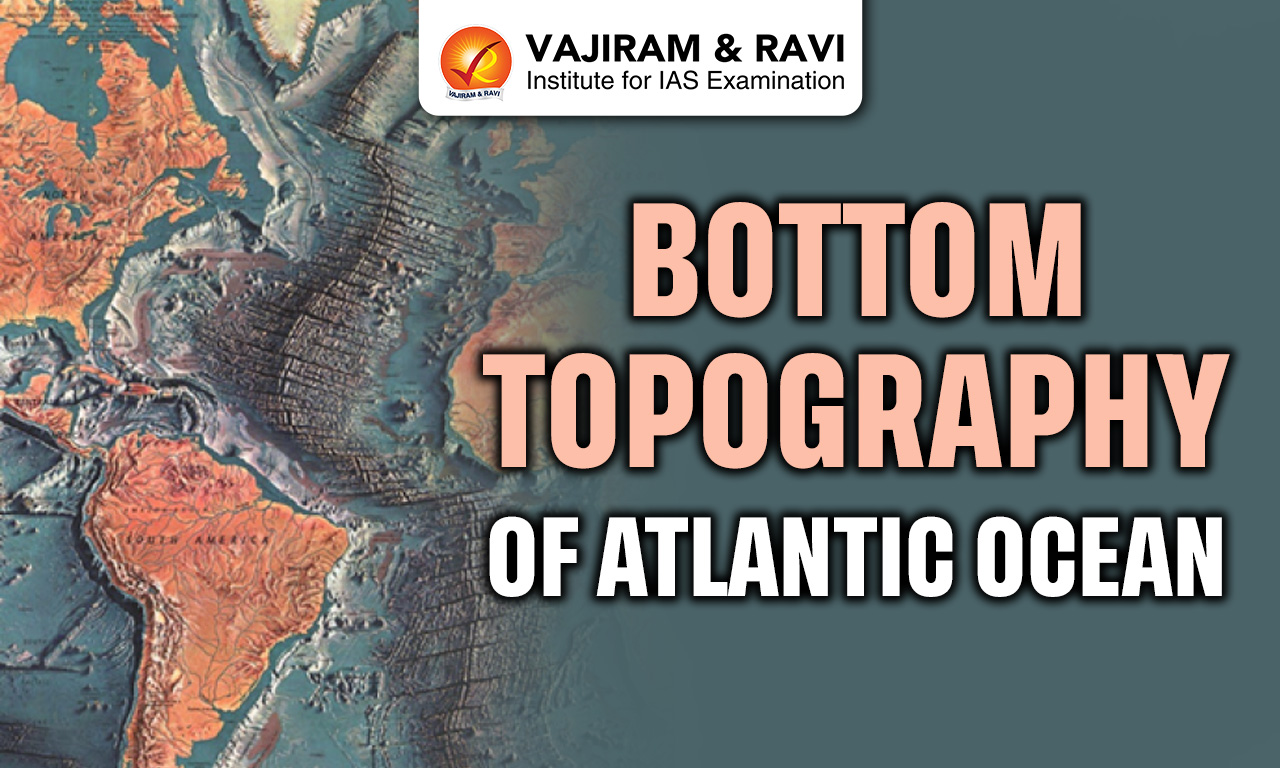
Bottom Topography of Atlantic Ocean

The Atlantic Ocean is the second largest ocean on the earth. It covers about one-fifth of Earth’s surface and separates Europe and Africa from the Americas. It has an S shaped form and extends from the Arctic to the Southern Ocean. Its area is about 81.76 million square km without seas and 85.13 million square km with them. It has an average depth of 3,646 metres and maximum depth of 8,380 metres. The Bottom Topography of Atlantic Ocean plays a vital role in global climate, drainage and human activities.

Bottom Topography of Atlantic Ocean

The Atlantic Ocean floor is highly varied, with an average depth of 3,646 metres and extensive continental margins and basins. The most striking feature is the Mid Atlantic Ridge running centrally. The ocean is relatively shallow compared to the Pacific due to wide continental shelves. About 24% of the area of Bottom Topography of Atlantic Ocean is less than 915 metres deep, reflecting strong sedimentation, gentle slopes and broad abyssal plains.

Atlantic Ocean Zones

The Atlantic Ocean is divided into distinct zones based on depth, light penetration and geomorphological characteristics, each supporting unique physical and biological conditions of the Bottom Topography of Atlantic Ocean.

  • Continental Zone: Extends from coastline to shelf edge, usually up to 200 metres depth, receiving sediments from rivers like Amazon and Congo and supporting rich marine biodiversity and fisheries.
  • Bathyal Zone: Lies between 200 and 2000 metres depth, covering continental slope regions with steep gradients, submarine canyons and reduced sunlight, making it ecologically transitional.
  • Abyssal Zone: Extends from 2000 to 6000 metres depth, forming vast abyssal plains covered with fine sediments such as calcareous ooze and red clay, representing stable deep sea environments.
  • Hadal Zone: Found in deep trenches exceeding 6000 metres, such as Puerto Rico Trench, characterized by extreme pressure, darkness and unique geological and biological conditions.

Atlantic Ocean Topographic Divisions

The Bottom Topography of Atlantic Ocean floor is divided into major physiographic units shaped by tectonic processes, sedimentation and crustal movements over millions of years.

  • Continental Shelf & Slope: Shallow margins with varying width from 2 km to 400 km, formed by sediment deposition and erosion, acting as transition zones between land and deep ocean.
  • Ocean Ridge: The Mid Atlantic Ridge is a continuous mountain chain extending about 14,450 km, marking divergent plate boundaries and seafloor spreading zones.
  • Ocean Rises: Broad elevated features such as Walvis Ridge and Rio Grande Rise connect ridge systems to continental margins, influencing ocean circulation and sediment deposition.
  • Ocean Basin: Deep depressions divided into eastern and western basins by the ridge, containing several sub basins like Labrador and Brazilian basins.
  • Ocean Deep & Trenches: Narrow, steep depressions such as Puerto Rico Trench and Romanche Deep, formed by tectonic activity, reaching depths beyond 8000 metres.
  • Abyssal Plains: Extensive flat regions formed by deposition of fine sediments, representing some of the smoothest surfaces on Earth.

Atlantic Continental Shelf & Slope

Continental margins of the Atlantic Ocean are well developed and significantly influence ocean depth, sediment distribution and economic activities such as fishing and resource extraction affecting Bottom Topography of Atlantic Ocean.

  • Shelf Width Variation: Continental shelves vary from 2-4 km to over 400 km wide, with wider shelves along northeastern North America and northwestern Europe and narrower shelves along African and Brazilian coasts.
  • Major Shelf Regions: Important shelf areas include Grand Bank near Newfoundland and Dogger Bank near British Isles, known for rich fishing grounds and shallow depths.
  • Marginal Seas Presence: North Atlantic shelves host marginal seas such as Baltic Sea, North Sea and Hudson Bay, while South Atlantic has fewer such features.
  • Continental Slope Characteristics: The slope marks a steep descent from shelf to deep ocean, often cut by submarine canyons transporting sediments into deeper basins.
  • Continental Rise Formation: Formed by accumulated sediments at base of slope, reaching depths of 2400-4500 metres and extending up to 500 km wide in some regions.

Mid Atlantic Ridge

Ridges are the most prominent features of Atlantic Ocean floor, reflecting tectonic activity and continuous formation of new oceanic crust.

  • Mid Atlantic Ridge Structure: Extends from Iceland to Bouvet Island with an S shaped alignment, about 1000 miles wide, forming the central backbone of the ocean.
  • Plate Boundary Role: Represents divergent boundary where American plates move westward and Eurasian and African plates move eastward, causing seafloor spreading.
  • Ridge Branches: Includes Newfoundland Rise, Azores Rise, Sierra Leone Rise and Rio Grande Rise, extending toward continents and shaping basin structures.
  • Fracture Zones: Major fracture zones like Gibbs, Kane and Romanche offset the ridge and indicate transform fault activity and crustal movements.
  • Volcanic Activity: Ridge is volcanically active with basaltic lava formation and seamounts, some rising above sea level forming islands like Iceland and Azores.

Also Read: Bottom Topography of Indian Ocean

Atlantic Ocean Basin

The Atlantic Ocean basin is divided into eastern and western parts by the Mid Atlantic Ridge, containing numerous smaller basins with distinct characteristics.

  • Labrador Basin: Located between Greenland and Newfoundland, extending from 40°N to 50°N with depths ranging between 4000 and 4500 metres.
  • North American Basin: Largest basin extending between 12°N and 40°N with depths exceeding 5000 metres and some deeps beyond 6000 metres.
  • Brazilian Basin: Located between equator and 30°S, bounded by Brazil coast and Para Rise, with depths greater than 4000 metres.
  • Canary and Cape Verde Basins: Located near African coast, both reaching depths around 5000 metres and influenced by ocean currents and sedimentation.
  • Southern Basins: Include Argentina Basin, Cape Basin and Agulhas Basin with depths ranging between 5000 and 6000 metres, forming major southern depressions.

Atlantic Ocean Deeps & Trenches

Ocean deeps and trenches in the Atlantic are fewer compared to the Pacific but are significant indicators of tectonic activity and structure of Bottom Topography of Atlantic Ocean.

  • Puerto Rico Trench: Deepest point at 8380 metres, located north of Puerto Rico, marking a major tectonic boundary and subduction related feature.
  • Romanche Deep: One of the deepest equatorial features reaching about 9370 metres, associated with fracture zones and plate movements.
  • Hatteras and Nares Deeps: Important deep sea depressions with depths exceeding 5000-6000 metres, found in North Atlantic basin regions.
  • South Sandwich Trench: Located in South Atlantic, associated with island arc systems and subduction of South American Plate beneath Scotia Plate.
  • Distribution Pattern: Total of about 29 deeps identified, mostly located along island arcs and tectonic boundaries rather than widespread distribution.

Also Read: Bottom Topography of Pacific Ocean

Atlantic Abyssal Plains

Abyssal plains are extensive flat regions of the Bottom Topography of Atlantic Ocean formed by long term sediment deposition and represent stable geological environments.

  • Formation Process: Created by accumulation of fine sediments like calcareous ooze and red clay transported by turbidity currents and ocean currents.
  • Depth Range: Generally found between 3000 and 6000 metres depth, covering large portions of ocean basins on both sides of Mid Atlantic Ridge.
  • Sediment Composition: Dominated by globigerina ooze, diatom ooze in southern latitudes and red clay in deeper regions below 5000 metres.
  • Surface Characteristics: Extremely smooth and level surfaces compared to other ocean floor features, with occasional abyssal hills and seamounts.
  • Distribution Pattern: More extensive in South Atlantic, especially between Argentina and Africa, while narrower in central and northern regions.

Atlantic Ocean Surface Features

The Bottom Topography of Atlantic Ocean also includes several secondary features such as islands, canyons and seamounts that add complexity to its topography.

  • Submarine Canyons: Deep valleys like Hudson Canyon and Amazon Canyon transport sediments from continental shelves to deep ocean basins through turbidity currents.
  • Oceanic Islands: Include Iceland, Azores, Canary, Cape Verde, Ascension and Tristan da Cunha formed mainly by volcanic activity or uplifted ridge segments.
  • Island Arcs: Lesser Antilles and South Sandwich Islands represent tectonically active arcs associated with subduction zones and deep trenches.
  • Seamounts and Guyots: Numerous underwater mountains formed by volcanic processes, some flattened into guyots due to erosion and subsidence.
  • Marginal Seas: Caribbean Sea, Mediterranean Sea and Gulf of Mexico are enclosed or semi enclosed basins connected to Atlantic, influencing circulation and sedimentation.

Bottom Topography of Atlantic Ocean Significance

The Bottom Topography of Atlantic Ocean has immense importance in understanding geological processes, climate systems and economic resources.

  • Plate Tectonics Evidence: Mid Atlantic Ridge provides clear evidence of seafloor spreading and continental drift, supporting modern geological theories of Earth’s evolution.
  • Resource Availability: Continental shelves and rises contain large reserves of petroleum, natural gas and minerals due to thick sediment accumulation.
  • Climate Influence: Ocean floor features control deep ocean currents and thermohaline circulation, significantly affecting global climate patterns.
  • Marine Biodiversity: Diverse habitats such as ridges, trenches and plains support varied marine ecosystems, including unique deep sea organisms.
  • Navigation and Communication: Knowledge of ocean floor helps in laying submarine cables, planning shipping routes and conducting scientific exploration.

Bottom Topography of Atlantic Ocean FAQs

Q1: What is the average depth of the Atlantic Ocean?

Ans: The average depth of the Atlantic Ocean is about 3,646 metres (11,962 feet), which is less than the Pacific Ocean due to wider continental shelves.

Q2: Which is the deepest point in the Atlantic Ocean?

Ans: The deepest point is the Puerto Rico Trench, reaching about 8,380 metres (27,493 feet) below sea level.

Q3: What is the Mid Atlantic Ridge?

Ans: It is a long underwater mountain range running through the centre of the Atlantic Ocean, formed by divergent tectonic plate movement and seafloor spreading.

Q4: Why are continental shelves important in the Atlantic Ocean?

Ans: They are shallow regions rich in marine life and natural resources like petroleum and natural gas, making them economically and ecologically significant.

Q5: Are trenches common in the Bottom Topography of Atlantic Ocean?

Ans: No, trenches are fewer compared to the Pacific Ocean, but important ones like the Puerto Rico Trench and South Sandwich Trench still exist.

Transboundary Rivers of India, Country Wise List, Key Details

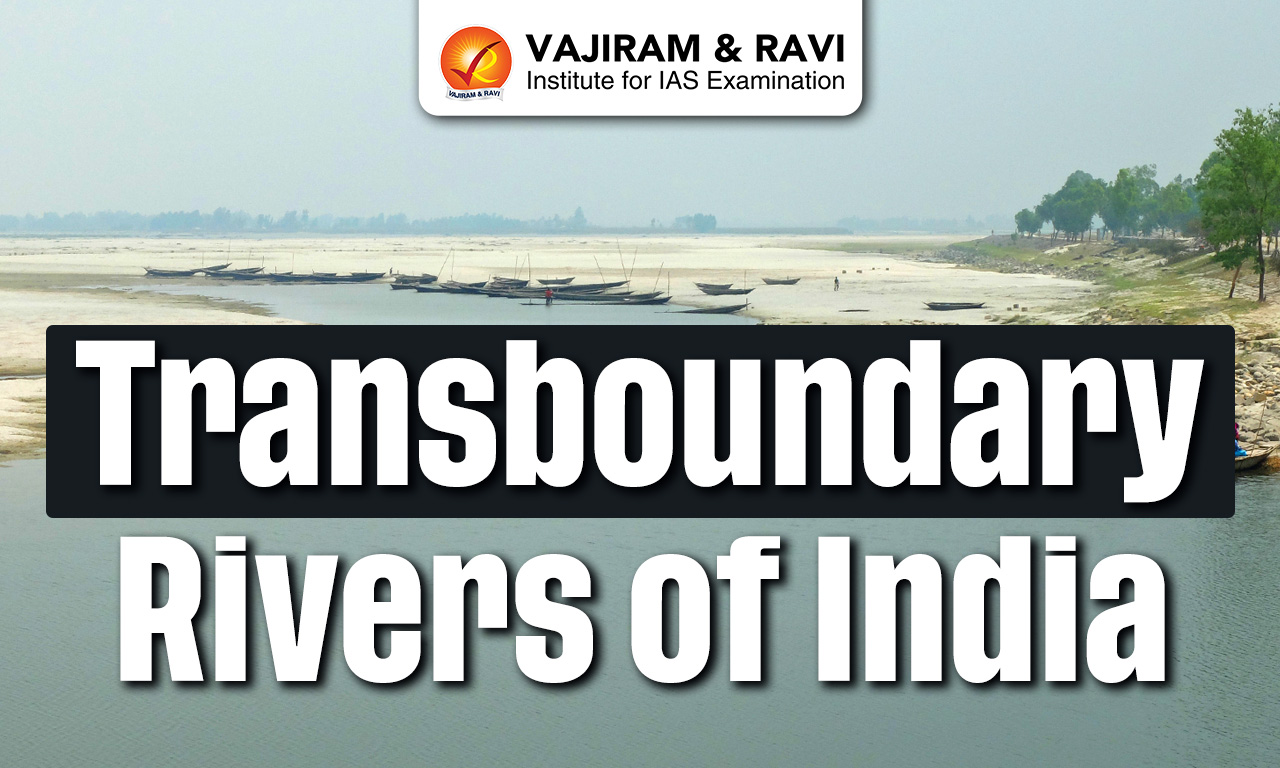
Transboundary Rivers of India

Transboundary rivers are those rivers that flow across international borders or form natural boundaries between countries. India shares major river systems with Bangladesh, China, Pakistan, and Nepal. 

In India, such rivers are of immense geographical, economic, and strategic importance. They sustain agriculture, support livelihoods, enable hydropower generation, and significantly influence India’s relations with its neighboring countries. 

India-Bangladesh Transboundary Rivers

India and Bangladesh share 54 rivers, many of which originate in India and flow into the Bay of Bengal through Bangladesh. Among these, the Ganga-Padma river system is the most significant.

Ganga-Padma River System: The Ganga, known as the Padma in Bangladesh, is the most significant transboundary river between the two countries.

  • The Ganga originates from the Gangotri Glacier in the Indian Himalayas and flows across the vast Gangetic plains before entering Bangladesh, where it is known as the Padma. 
  • Left-bank tributaries: Gomti, Ghaghara, Gandak, Kosi. These rivers originate largely from the Himalayas and bring heavy sediment and floodwaters
  • Right-bank tributaries: Yamuna, Son, Punpun, Damodar. These rivers drain the peninsular and central highlands. 
  • The Ghaghara originates in the Tibetan Plateau and is known for high monsoon discharge.
  • In Bangladesh, the Ganga has limited tributaries (notably Mahananda) but develops an extensive distributary network such as Ichamati, Bhairab, Kumar, Madhumati, and Arial Khan before merging with the Meghna

The Ganga Water Treaty was signed between India and Bangladesh on December 12, 1996. It is a 30-year bilateral agreement between India and Bangladesh to share the Ganges waters at the Farakka Barrage during the dry season (January 1-May 31). The treaty ensures a 50:50 sharing formula when flows are 70,000 cusecs or less, with specific guarantees, and is scheduled to expire in December 2026. 

Teesta River: The Teesta originates in the eastern Himalayas and flows through Sikkim and West Bengal before entering Bangladesh.

  • It is crucial for irrigation in North Bengal and northwestern Bangladesh.
  • Seasonal variation in flow creates tension, especially during lean months.
  • Despite prolonged negotiations, a final water-sharing agreement is still pending, making it a major diplomatic issue.

Feni River: Flows near Tripura and forms part of the India-Bangladesh border. The Maitri Setu bridge has been constructed over it to enhance bilateral connectivity. Tributaries include Muhuri, Chandkhira, and Ryang rivers.
Kushiyara River: The Kushiyara is a distributary of the Barak River. It originates at the India-Bangladesh border where the Barak splits into Surma and Kushiyara. It flows through Assam and receives tributaries from Nagaland and Manipur.
Brahmaputra-Jamuna System: The Brahmaputra originates in Tibet as the Yarlung Tsangpo, enters India through Arunachal Pradesh, flows through Assam, and enters Bangladesh where it is called the Jamuna. It merges with the Padma (Ganga) and eventually forms the Meghna estuary before draining into the Bay of Bengal.
Meghna River: The Upper Meghna is formed in Bangladesh by the confluence of the Surma and Kushiyara rivers - both originating from the Barak River system in Assam, India. The Lower Meghna forms when this combined flow meets the Padma (Ganga-Brahmaputra). It ultimately drains into the Bay of Bengal.

India-China Transboundary Rivers

India shares transboundary rivers with China primarily through rivers originating in the Tibetan Plateau. Here, China holds an upper riparian advantage, making this relationship strategically sensitive.India shares two major river systems with China.

  1. Brahmaputra River System (Eastern Sector): The Brahmaputra river system originates in Tibet, where it is known as the Yarlung Tsangpo (or Tsangpo). It enters India as the Siang River, which forms the main channel of the Brahmaputra. Important tributaries in India include the Subansiri and Lohit rivers, which significantly contribute to its volume and flow dynamics.
  2. Indus River System (Western Sector): The Indus river system also has its origins in the Tibetan Plateau. It includes the Indus River along with its major tributary, the Sutlej. These rivers flow into India before continuing towards Pakistan, forming a crucial part of the northwestern river network.

India-Pakistan Transboundary Rivers

The Indus River system governs the most significant river relationship between India and Pakistan, regulated by the Indus Waters Treaty (1960), brokered by the World Bank.

The Indus River originates in Tibet near Lake Mansarovar, flows through Ladakh, and enters Pakistan before draining into the Arabian Sea. Major tributaries include:

  • Sutlej: originates in Tibet; enters India through Himachal Pradesh and flows into Punjab.
  • Beas: originates near Rohtang Pass; joins the Sutlej at Harike in Punjab.
  • Ravi: originates in Himachal Pradesh; flows into Punjab before entering Pakistan.
  • Chenab: originates from the confluence of the Chandra and Bhaga rivers in Himachal Pradesh; flows into Pakistan.
  • Jhelum: originates from Verinag spring in Jammu & Kashmir; joins the Chenab in Pakistan.

Under the Indus Waters Treaty, the waters of the three eastern rivers - Ravi, Beas, and Sutlej are allocated predominantly to India, while the waters of the three western rivers - Indus, Jhelum, and Chenab  are allocated predominantly to Pakistan. 

India-Nepal Transboundary Rivers

India and Nepal share several important transboundary rivers, of which the Kosi and Gandak are the most prominent. Other significant rivers include the Rapti, Narayani, and Kali (Mahakali).Most of these rivers originate in the Himalayan ranges and the Tibetan Plateau, and flow southwards into the plains of northern India, playing a crucial role in irrigation, agriculture, and flood dynamics.

Kosi River:

  • The Kosi is a major transboundary river flowing through China, Nepal, and India, and is one of the largest tributaries of the Ganga.
  • It is formed by the confluence of the Sun Kosi, Arun, and Tamur rivers in the Himalayas.
  • After flowing through Nepal, it enters Bihar and eventually joins the Ganga.
  • The river is highly unstable, frequently changing its course and causing severe floods, which has earned it the name “Sorrow of Bihar.”

Gandak River (Narayani):

  • Also known as the Gandaki or Narayani, this river flows through Nepal and northern India.
  • It originates in the high Himalayas near the Tibet–Nepal border at a high altitude.
  • The river flows into Bihar and Uttar Pradesh before joining the Ganga near Patna.
  • Important tributaries include Trisuli, Budhi Gandak, and other Himalayan streams, making it a significant source of water for irrigation.

Sharda / Kali / Mahakali River:

  • This river originates at Kalapani in Uttarakhand and forms part of the boundary between India and Nepal.
  • In the upper reaches, it is known as the Kali or Mahakali, while in the plains it is called the Sharda River.
  • It eventually joins the Ghaghara River system.
  • The proposed Pancheshwar Dam Project is a joint India-Nepal initiative aimed at hydropower generation and irrigation development.
  • However, differences persist between the two countries over the interpretation of the Sugauli Treaty (1816), particularly regarding the exact source of the river, which affects boundary demarcation.

Transboundary Rivers of India FAQs

Q1: What are transboundary rivers?

Ans: Transboundary rivers are rivers that flow across international borders or form boundaries between countries and are important for water sharing and regional relations.

Q2: Why is the Kosi River called the Sorrow of Bihar?

Ans: Kosi river is called Sorrow of Bihar because it frequently changes course and causes severe floods in Bihar.

Q3: How many rivers does India share with Bangladesh?

Ans: India shares 54 rivers with Bangladesh, with the Ganga-Padma system being the most important.

Q4: What is the Ganga Water Treaty (1996)?

Ans: It is an agreement between India and Bangladesh to share Ganga waters at Farakka during the dry season.

Q5: Which rivers are allocated to India under the Indus Treaty?

Ans: Ravi, Beas, and Sutlej are mainly allocated to India.

Judicial Review, Definition, Evolution, Types, Constitutional Provisions

Judicial Review

Judicial Review is a process that courts use to review the laws made by the government to check whether they are made based on the basic structure of the Constitution. If any law is found to be inconsistent with the Constitution, the courts can cancel it or modify it, or ask the government to make better laws. This system of judicial review safeguards citizens' rights, upholds the rule of law in the country.

Judicial Review Evolution

The concept of Judicial Review evolved gradually through constitutional debates and landmark judgments. It originated from the U.S. case Marbury v. Madison (1803), which heavily influenced Indian constitutional framers.

In India, the Supreme Court expanded Judicial Review through cases such as Shankari Prasad (1951), Golaknath (1967), and the historic Kesavananda Bharati (1973) judgment.

  • 1950s: Courts upheld Parliament’s power to amend Fundamental Rights (Shankari Prasad, 1951).
  • 1960s: SC restricted this power, stating Parliament cannot amend Fundamental Rights (Golaknath, 1967).
  • 1970s: Judicial Review became part of the Basic Structure (Kesavananda Bharati, 1973).
  • 1980s-1990s: Review strengthened in areas like judicial appointments, environment, elections, and rights expansion.
  • 2000s-2020s: Courts expanded review over ordinances, privacy, Aadhaar, electoral bonds, and constitutional amendments.

Types of Judicial Review

Judicial Review in India operates at multiple levels. Each type helps check different types of governmental actions. Courts use these powers to strike down unconstitutional, arbitrary, or ultra vires decisions.

  • Constitutional Judicial Review: Courts examine whether legislative acts, executive orders, and administrative decisions are consistent with the Constitution. If any action violates constitutional provisions, courts can strike it down.
  • Statutory Judicial Review: Courts interpret and assess the validity of statutes, rules, and regulations. This ensures that laws are applied correctly and remain consistent with other legal provisions.
  • Administrative Judicial Review: Courts review decisions and actions taken by administrative or regulatory agencies. The review checks if agencies followed the law, maintained fairness, and stayed within their authority.
  • Procedural Judicial Review: It focuses on whether proper legal procedures and due process were followed while making decisions. It ensures fairness, transparency, and adherence to established rules.
  • Substantive Judicial Review: Courts examine the content, fairness, and reasonableness of laws or decisions. It goes beyond procedure and evaluates whether the decision is just and lawful in substance.

Judicial Review Constitutional Provisions

Judicial Review in India is supported by various constitutional provisions that empower the Supreme Court and High Courts to examine the constitutionality of laws, executive actions, and state-centred disputes.

Judicial Review Constitutional Provisions
Article Provision / Role in Judicial Review

Article 13

Declares that all laws inconsistent with Fundamental Rights are null and void.

Article 32

Guarantees the right to move the Supreme Court for the enforcement of Fundamental Rights and empowers SC to issue writs.

Article 131

Provides original jurisdiction of the Supreme Court in Centre-State and inter-state disputes.

Article 132

Provides appellate jurisdiction of the Supreme Court in constitutional cases.

Article 133

Provides appellate jurisdiction of the Supreme Court in civil cases.

Article 134

Provides appellate jurisdiction of the Supreme Court in criminal cases.

Article 134A

Deals with the certificate for appeal to the Supreme Court from High Courts.

Article 135

Empowers the Supreme Court to exercise powers of the Federal Court under any constitutional law.

Article 136

Authorizes the Supreme Court to grant special leave to appeal from any court or tribunal (except military courts).

Article 143

Authorizes the President to seek the Supreme Court’s opinion on any question of law or fact, including pre-constitution matters.

Article 226

Empowers High Courts to issue directions, orders, or writs for enforcement of Fundamental Rights or other legal purposes.

Article 227

Vests High Courts with power of superintendence over all courts and tribunals within their jurisdiction (except military courts).

Article 245

Deals with the territorial extent of laws made by Parliament and State Legislatures.

Article 246

Defines subjects of laws made by Parliament and State Legislatures (Union List, State List, Concurrent List).

Articles 251 & 254

Provide that in case of conflict between central and state laws, central law prevails; state law becomes void.

Article 372

Deals with continuance in force of pre-constitution laws.

Judicial Review and Basic Structure Doctrine

Judicial Review in India is closely linked with the Basic Structure Doctrine, which ensures that certain fundamental features of the Constitution cannot be altered by Parliament, even through constitutional amendments.

Features of the Basic Structure Doctrine

  • Introduced by the Supreme Court in Kesavananda Bharati v. State of Kerala (1973).
  • Parliament can amend the Constitution, but cannot alter its “basic structure”.
  • Protects fundamental elements like:
    • Supremacy of the Constitution
    • Rule of Law
    • Separation of Powers
    • Judicial Review
    • Fundamental Rights
    • Federalism
    • Democracy and Free Elections
  • Acts as a check on arbitrary amendments by Parliament.

Judicial Review in the Ninth Schedule

The Ninth Schedule of the Indian Constitution was added by the First Amendment (1951) to protect certain laws, primarily land reform and agrarian legislation, from judicial review.

  • Purpose: To ensure smooth implementation of socio-economic reforms, especially land redistribution, without being struck down by courts.
  • Scope of Judicial Review: Originally, laws in the Ninth Schedule could not be challenged under Articles 14, 19, or 31 (Fundamental Rights).
  • Judicial Intervention: In I.R. Coelho v. State of Tamil Nadu (2007), the Supreme Court ruled that even laws in the Ninth Schedule are subject to judicial review if they violate the basic structure of the Constitution.
  • Criteria for Review: Laws added after April 24, 1973 (Kesavananda Bharati case) are subject to judicial review and can be declared unconstitutional if they violate the basic structure of the Constitution.

Judicial Review vs Judicial Activism

Judicial Review is the power of courts to examine laws and government actions for constitutionality, while Judicial Activism involves proactive intervention by courts to protect rights, fill legal gaps, or address social issues. Here are the key differences between Judicial Review and Judicial Activism.

Judicial Review vs Judicial Activism
Aspect Judicial Review Judicial Activism

Nature

Reactive power to check constitutionality

Proactive judicial intervention

Scope

Limited to legality and constitutionality

Broader, can address policy, rights, and welfare

Initiation

Usually on petition by affected party

Can be suo motu or public interest litigation

Objective

Ensure laws and actions follow the Constitution

Protect rights, fill gaps, promote justice

Example

Kesavananda Bharati v. State of Kerala (1973) - Supreme Court struck down constitutional amendments that violated the Basic Structure.

Vishaka v. State of Rajasthan (1997) - Supreme Court laid down guidelines to prevent sexual harassment at workplace through proactive intervention (PIL)

Judicial Review in India vs USA

Judicial Review exists in both India and the USA, but its scope, origin, and application differ. In the USA, it originated through judicial precedent (Marbury v. Madison, 1803). 

In India, it is constitutionally embedded through Articles 13, 32, 226, and 368, and covers not only laws and executive actions but also constitutional amendments.

Judicial Review in India vs USA
Feature India USA

Scope

Narrower

Broader

Basis

"Procedure established by law"

"Due process of law"

Grounds for Review

Primarily substantive (e.g., unconstitutional)

Both substantive (e.g., illegal) and procedural (e.g., unreasonable)

Judicial Activism

Judiciary has used activism to broaden scope, sometimes adopting "due process" concept

"Due process" clause gives broad power to review laws for reasonableness and fairness

Judicial Review of Constitutional Amendments

Supreme Court and High Courts can review amendments on procedural and substantive grounds

Courts generally refrain from reviewing constitutional amendments on either ground

Judicial Review Importance

Judicial Review is important because it protects the Constitution and Fundamental Rights, ensures that laws and government actions follow the Constitution, and prevents misuse of power.

  • Protection of Fundamental Rights: Ensures that citizens’ rights are not violated by laws, executive actions, or policies.
  • Supremacy of the Constitution: Keeps all laws and government actions in line with constitutional provisions.
  • Check on Arbitrary Power: Prevents the legislature or executive from acting beyond their authority.
  • Ensures Justice and Fairness: Makes sure decisions are reasonable, fair, and follow the rule of law.
  • Maintains Federal Balance: Resolves conflicts between Centre and State laws, ensuring harmony in a federal system.
  • Promotes Accountability and Transparency: Holds government and public authorities responsible for their actions.
  • Safeguards Democracy: Acts as a guardian of democratic principles and prevents authoritarian misuse of power.

Contemporary Issues Related to Judicial Review

Judicial Review protects the Constitution and Fundamental Rights, but modern challenges affect its effectiveness in India.

  • Legitimacy vs Majority Rule: Unelected judges striking down laws can seem to undermine elected representatives. Judicial review ensures protection of Fundamental and minority rights against “tyranny of the majority.”
  • Activism vs Overreach: Courts act proactively to protect rights or fill gaps, but excessive intervention can be seen as overreach.
  • Intervention occurs mainly when the legislature or executive fail in their duties.
  • Separation of Powers: Judicial Review maintains checks and balances, but repeated or broad interventions can create conflicts with other government branches.
  • Policy and Economic Decisions: Courts review complex matters like infrastructure projects or economic reforms.
  • Appointments and Accountability: India’s collegium system ensures judicial independence but raises concerns about limited accountability and transparency.
  • Backlog and Access to Justice: Over 5 crore cases pending in India; 88,000+ in SC, 63 lakh in High Courts.

Conclusion

Judicial Review is a key part of India’s democracy that makes sure all laws and government actions follow the Constitution. It protects citizens’ Fundamental Rights, preserves the core principles of the Constitution, and keeps a balance between the legislature, executive, and judiciary. Despite challenges like case backlogs and judicial overreach, Judicial Review is essential for ensuring justice, democracy, and the rule of law in India.

Judicial Review FAQs

Q1: What is Judicial Review?

Ans: Judicial Review is the power of courts to examine laws, executive actions, and constitutional amendments to ensure they comply with the Constitution.

Q2: Which courts can exercise Judicial Review in India?

Ans: Both the Supreme Court (Articles 32, 136) and High Courts (Article 226) can exercise Judicial Review.

Q3: What is the Basic Structure Doctrine?

Ans: The Basic Structure Doctrine prevents Parliament from altering the core features of the Constitution, such as Fundamental Rights, separation of powers, and democracy, even through constitutional amendments.

Q4: Can laws in the Ninth Schedule be reviewed?

Ans: Yes. After I.R. Coelho v. State of Tamil Nadu (2007), laws in the Ninth Schedule can be reviewed if they violate the basic structure of the Constitution.

Q5: What is the difference between Judicial Review and Judicial Activism?

Ans: Judicial Review is the reactive power to check constitutionality of laws, while Judicial Activism is proactive intervention by courts to protect rights, fill gaps, or address social issues.

Trade Deficit, Types, Causes, Formula, Implications, Measures

Trade Deficit

A trade deficit happens when a country buys more goods and services from other countries than it sells to them. In simple terms, more money is going out than coming in through trade. This is a common situation for many countries and is not always a bad thing, as it can mean people have access to more products and choices. However, if it continues for a long time, it may affect the country’s economy and balance of payments.

About Trade Deficit

  • A trade deficit happens when a country imports more goods and services than it exports, leading to a negative balance of trade. Trade includes goods, services, and their overall balance, and it is part of the current account, which also covers income from investments and transfers.
  • It occurs due to changes in currency value, economic conditions, consumer demand, and government policies. If imports remain higher for a long time, it can lead to lower domestic production, job losses in some sectors, and higher dependence on foreign borrowing.
  • Countries can reduce trade deficits by strengthening industries where they are competitive, increasing exports, and improving production capacity. Governments may also use tariffs, import controls, and trade agreements to support local industries.
  • However, a trade deficit is not always negative, as it can also reflect strong global trade links and high domestic demand. In the long run, managing it requires investment in education, infrastructure, innovation, and competitiveness.
  • Basic Formula to calculate the Trade Deficit is given as: Trade Deficit = Total value of Import - Total value of Export 

Types of Trade Deficit

The different types of trade deficit have been highlighted below.

  • Merchandise (Goods) Trade Deficit: This happens when a country imports more physical goods than it exports, such as electronics, machinery, clothes, or oil. It is the most common form of trade deficit and focuses only on tangible products.
  • Services Trade Deficit/Surplus: This is related to services instead of goods, such as tourism, banking, IT, transport, and insurance. A country may have a deficit if it imports more services than it exports, or a surplus if it earns more from services than it spends on them.
  • Bilateral Trade Deficit: This occurs when a country has a trade imbalance with a specific country, meaning it buys more from that country than it sells to it. It focuses on trade between two nations only, not overall global trade.

Also Read: Gross Domestic Product (GDP)

Causes of Trade Deficit

  • A trade deficit can happen when a country’s imports are higher than its exports, often because people and businesses prefer more foreign goods and services.
  • One major reason is the gap between savings and investment. When a country invests more money than it saves, it often depends on foreign goods and funding, which increases imports.
  • High demand from consumers also plays a big role. When people spend more on foreign products like electronics, clothes, or food, imports rise faster than exports.
  • Currency value changes affect trade too. If the local currency becomes strong, imported goods become cheaper, but exports become more expensive for other countries, reducing export demand.
  • In many fast-growing economies, rising income levels lead to higher spending on imported goods, which can increase the trade deficit.
  • Other factors like weak domestic industries, low production capacity, and lack of competitiveness in global markets can also reduce exports and widen the gap between imports and exports.

Implications of Trade Deficit

  • A trade deficit can have both positive and negative effects on a country’s economy. In some cases, it shows that people have access to a wide variety of goods and cheaper products, which can improve their standard of living.
  • However, if a trade deficit continues for a long time, it may create economic pressure, as the country may need to borrow money from other nations to pay for its imports, increasing national debt.
  • It can also affect local industries, as cheaper imported goods may reduce demand for domestic products. This can lead to job losses in some sectors and lower income for workers, although some industries that rely on imported materials may benefit.
  • A long-term trade deficit can also put pressure on a country’s currency value, making imports more expensive and increasing overall economic instability.
  • Because of these effects, governments closely monitor trade deficits and try to maintain a balance between imports and exports to keep the economy stable.
  • It can also influence policy decisions and international relations, as countries may introduce trade rules or agreements to manage imports and protect local industries.

Role of Tariffs in Managing Trade Deficit

  • Tariffs are taxes imposed on imported goods, making foreign products more expensive in the domestic market.
  • When import prices increase due to tariffs, people and businesses may prefer locally made products, which can help reduce imports and support domestic industries.
  • In this way, tariffs are used to control excessive imports and try to reduce the trade deficit by encouraging more local production and consumption.
  • Governments sometimes apply tariffs on selected goods to protect local manufacturers from foreign competition and improve the balance between imports and exports.
  • However, tariffs can also have some drawbacks, such as higher prices for consumers, since imported goods become costlier.
  • Other countries may respond with retaliatory tariffs, which can reduce exports and create trade tensions.
  • Tariffs alone cannot fully solve a trade deficit because the issue is also linked to economic structure, productivity, and currency conditions.
  • Therefore, tariffs work best when combined with other measures like strong domestic industries, better production and balanced trade policies.

Measures to Control Trade Deficit

  • One way to reduce a trade deficit is by increasing domestic savings, so the country can rely less on foreign borrowing and more on its own resources for investment and growth.
  • Countries can also focus on boosting exports by making local products more competitive in global markets and signing better trade agreements with other nations.
  • Currency management and monetary policies can help balance trade by influencing exchange rates, which affects the cost of imports and exports.
  • Governments may use tariffs or limited trade barriers to protect certain local industries, but these should be applied carefully to avoid higher prices or trade conflicts.
  • Strong support for local manufacturing, innovation, and research helps reduce dependence on imported goods and improves self-reliance.
  • In addition, investing in infrastructure, skill development, and technology can improve production quality and help industries compete better globally, further reducing the trade gap.

India’s Trade Performance

  • Total Trade Overview
    • India’s total exports (goods and services combined) in FY 2025-26 are estimated at US$ 860.09 billion, compared to US$ 825.26 billion in FY 2024-25.
    • This shows a growth of 4.22%.
    • Total imports are estimated at US$ 979.40 billion, compared to US$ 919.92 billion last year, showing a growth of 6.47%.
    • Overall, India has a trade deficit of US$ 119.30 billion, meaning imports are higher than exports.
  • Merchandise (Goods) Trade
    • Merchandise exports: US$ 441.78 billion (slightly higher than US$ 437.70 billion last year), a growth of 0.93%.
    • Merchandise imports: US$ 774.98 billion, up from US$ 721.20 billion.
    • Merchandise trade deficit: US$ 333.19 billion, which is higher than the previous year’s US$ 283.50 billion.
  • Services Trade
    • Services exports: US$ 418.31 billion, up from US$ 387.55 billion, showing strong growth.
    • Services imports: US$ 204.42 billion, slightly higher than last year.
    • Services trade shows a surplus of US$ 213.89 billion, meaning India earns more from services exports than it spends on imports.
  • Non-Petroleum and Non-Gems & Jewellery Trade
    • Exports: US$ 387.88 billion, up from US$ 374.32 billion
    • Imports: US$ 601.03 billion, up from US$ 535.42 billion
  • Key Export Growth Sectors (March 2026)
    • Other cereals: 108.23% growth
    • Mica, coal and minerals: 11.27% growth
    • Handicrafts: 8.51% growth
    • Petroleum products: 5.88% growth
    • Engineering goods: 1.13% growth
  • Major Trade Partner Trends
    • Export growth destinations: Singapore: 158.55%, Tanzania: 100.54%, Sri Lanka: 88.31%, Malaysia: 84.47%, China: 28.1%
    • Import growth sources: Peru: 267.67%, Oman: 112.01%, Thailand: 64.53%, China: 24.81%, USA: 14.4%

Trade Deficit FAQs

Q1: What is a Trade Deficit?

Ans: A Trade Deficit occurs when a country imports more goods and services than it exports, meaning more money goes out than comes in through trade.

Q2: What are the main types of Trade Deficit?

Ans: The main types are merchandise deficit (goods), services deficit or surplus (services), and bilateral deficit (trade with a specific country).

Q3: What causes a Trade Deficit?

Ans: It is mainly caused by high import demand, low domestic production, strong consumer spending, currency changes, and lower savings compared to investment.

Q4: What are the effects of the Trade Deficit?

Ans: A Trade Deficit can increase foreign borrowing, weaken local industries, affect jobs in some sectors, and put pressure on the currency.

Q5: How can a Trade Deficit be reduced?

Ans: It can be reduced by increasing exports, improving domestic production, supporting local industries, and using trade policies like tariffs carefully.

Exchange Rate, Meaning, Types, Systems, NEER, REER, PPP

Exchange Rate

Exchange Rate is an important element in the global economic framework, shaping trade, investment flows, macroeconomic policy, and international competitiveness. It reflects the relative value of one currency in terms of another and plays a decisive role in influencing a country's economic health, including inflation, exports, imports, and capital flows. Understanding exchange rate systems, currency valuation mechanisms, and factors affecting exchange rates is essential for policymakers, investors, and economists alike. This article provides an in-depth examination of Exchange Rate, its meaning, various types, related concepts such as Nominal Effective Exchange Rate (NEER), Real Effective Exchange Rate (REER), Devaluation, Revaluation, Purchasing Power Parity (PPP), and foreign exchange reserves.

What is the Exchange Rate?

Exchange Rate, also called the rate of exchange, is the price at which one country's currency can be exchanged for another's. It represents the relative value of currencies in the international market and indicates how much of one currency is required to buy a unit of another.

For instance, if the US Dollar (USD) is stronger than the Indian Rupee (INR), it implies that the USD can purchase more INR, reflecting higher demand for the USD compared to the Rupee. The exchange rate thus mirrors the demand for a country's goods, services, and assets internationally.

  • A higher demand for a foreign currency relative to the domestic currency results in appreciation of the foreign currency.
  • Exchange rates are influenced by trade flows, capital movements, inflation differentials, and interest rate variations.

Exchange Rate Systems Types

Countries adopt different exchange rate systems depending on their economic goals, market openness, and policy priorities. The major systems are:

1. Fixed Exchange Rate System (Pegged System)

In a fixed system, the government or central bank sets the value of its currency relative to a benchmark, which may be gold, silver, or another major currency (e.g., USD or Euro). Characteristics include: 

  • Ensures stability in international trade and capital flows.
  • Government intervention is necessary to maintain the fixed rate through buying and selling foreign currency.
  • Requires large reserves of foreign currency to defend the peg.

Pegging:
When a currency is tied to the value of another currency or commodity (like gold), it is said to be pegged. For example, the Hong Kong Dollar is pegged to the US Dollar.

2. Flexible Exchange Rate System (Floating Rate)

In a floating system, the currency’s value is determined by market forces, the supply and demand of currencies in the foreign exchange market. Characteristics include: 

  • No direct government intervention.
  • Exchange rates fluctuate continuously based on trade flows, capital movements, and investor sentiment.
  • Helps automatically correct imbalances in trade and capital accounts.

3. Managed Floating Rate System (Dirty Floating)

A hybrid between fixed and flexible systems. While the rate is primarily determined by market forces, the central bank intervenes periodically to prevent excessive volatility. Examples include: India uses a managed float, where the Reserve Bank of India (RBI) intervenes to stabilize the Rupee against excessive swings.

Fixed vs Flexible Exchange Rate Systems 

Fixed and Flexible Exchange Rate Systems have the following differences: 

Basis Fixed Exchange Rate Flexible Exchange Rate

Determination

Officially fixed by the government

Market forces of supply and demand

Government Control

Full control, only government can change rate

Minimal or no control; fluctuates freely

Stability

Stable; small variation possible

Continuous fluctuations

Currency Impact

Devaluation or revaluation possible

Appreciation or depreciation occurs naturally

Government Bank

Determines rate

Not involved

Foreign Reserve Requirement

High; to defend the peg

Not necessary

BOP Impact

Deficit may not adjust automatically

Automatically corrects deficits or surpluses

Devaluation

Devaluation refers to a deliberate reduction in the value of a domestic currency by the government in a fixed exchange rate system.

Impact:

  • Makes exports cheaper and more competitive internationally.
  • Increases the cost of imports.
  • Can improve trade balance if export response is strong.

Revaluation

Revaluation is an increase in the value of domestic currency relative to foreign currencies in a fixed system. Redenomination, which changes the face value of a currency without affecting its exchange rate, is distinct from revaluation.

Devaluation vs Depreciation 

The difference in between devaluation and depreciation is: 

Aspect Devaluation Depreciation

Meaning

Official reduction in currency value by government

Decline in currency value due to market forces

Occurrence

Fixed exchange rate system

Flexible exchange rate system

Cause

Government policy

Supply and demand in forex market

Currency Manipulation

Currency manipulation refers to artificially lowering the domestic currency’s value to gain a trade advantage. Countries can boost exports by making them cheaper internationally, potentially creating trade imbalances.

  • The US Treasury monitors currency practices of major trading partners under the Trade Facilitation and Trade Enforcement Act of 2015.

  • A country may be labeled a currency manipulator if it meets criteria regarding trade surplus, current account surplus, and foreign currency purchases.

Types of Exchange Rate Markets 

Exchange Rate Markets are of two types. Spot Market and Forward Market.

1. Spot Market

  • Deals with immediate purchase and sale of foreign currency, typically settled within 2 days.
  • The exchange rate for transactions is the spot exchange rate.

2. Forward Market

  • Deals with buying/selling foreign currency at a future date at a pre-agreed rate.
  • Useful for hedging risks against exchange rate fluctuations.

Exchange Rates Affecting Factors

Exchange rates are influenced by multiple economic and financial factors:

  1. Central Bank Intervention: RBI or other central banks buy/sell foreign currency to stabilize the domestic currency.
  2. Inflation Rate: Higher domestic inflation reduces currency demand, causing depreciation.
  3. Interest Rate Differentials: High interest rates attract foreign capital, leading to currency appreciation.
  4. Trade Balance: Higher exports boost domestic currency; higher imports may depreciate it.
  5. Capital Flows: Foreign direct investment (FDI), portfolio investment, and external commercial borrowings affect currency value.
  6. Other Factors: Tourism, NRI remittances, political stability, and global economic conditions also influence exchange rates.

Nominal and Real Effective Exchange Rates

Nominal and Real Effective Exchange Rates means the following: 

Nominal Effective Exchange Rate (NEER)

  • NEER is the weighted average of bilateral nominal exchange rates of a country against major trading partners.
  • Weights are based on trade volume with each country.
  • Not adjusted for inflation.

Real Effective Exchange Rate (REER)

  • REER adjusts NEER for relative inflation rates, reflecting the real competitiveness of a currency.
  • Weights depend on trade balance with each partner country.

Forex Reserves of India

Foreign exchange reserves are assets held by the central bank in foreign currencies, gold, SDRs, and reserve tranches to support currency stability and international obligations. Components of FOREX:

  1. Foreign Currency Assets (FCA): USD, Euro, Yen, etc.; includes deposits and government securities.
  2. Gold Reserves: To back currency issuance and manage emergencies.
  3. Special Drawing Rights (SDRs): IMF-created international reserve asset based on a basket of major currencies.
  4. Reserve Tranche: Portion of IMF quota that can be freely accessed by member countries.

Purchasing Power Parity (PPP)

PPP compares currencies using a basket of goods approach. Two currencies are at parity if the same basket of goods costs the same in both countries when adjusted for exchange rates.

Importance of Purchasing Power Parity:

  • Useful for comparing real living standards.
  • Helps assess whether a currency is overvalued or undervalued.
  • Often used to calculate GDP at PPP, reflecting true purchasing power.

Nominal GDP vs Real GDP vs GDP at PPP 

The differences in Nominal, Real and GDP at PPP are: 

Metric Definition

Nominal GDP

Total monetary value of goods/services at current market prices.

Real GDP

Adjusted for inflation to reflect true output growth.

GDP at PPP

Converts local currency into USD considering relative costs of goods/services. Reflects actual purchasing power.

Example: A smartphone costing ₹3,000 in India may cost $40 in the US. Using PPP, economists adjust for relative cost of living and exchange rates for meaningful comparisons.

Exchange Rate UPSC

The exchange rate is an important indicator and tool in global finance. It reflects relative currency demand and supply, influences trade, investment, inflation, and economic policy, and serves as a benchmark for international competitiveness.

Understanding the various exchange rate systems are fixed, flexible, and managed float and mechanisms like devaluation, revaluation, NEER, REER, and PPP is important for informed policymaking and strategic economic decision-making.

Furthermore, foreign exchange reserves act as a buffer against external shocks, enabling governments to maintain stability in their currency and meet international obligations.

Mastering the dynamics of exchange rates equips policymakers, investors, and economists with the knowledge to navigate the complexities of international finance effectively, ensuring sustainable economic growth and stability.

Also Check Other Posts
Care Economy Mutual Funds
Alternative Investment Funds GDP Deflator

Exchange Rate FAQs

Q1: What is the meaning of exchange rate?

Ans: The exchange rate is the price of one country’s currency in terms of another currency.

Q2: What are the types of exchange rates?

Ans: The main types are Fixed (pegged), Flexible (floating), and Managed Floating (dirty float) systems.

Q3: Why is exchange rate important?

Ans: Exchange rates influence trade, investment, inflation, and overall economic stability.

Q4: What are the types of exchange rate markets?

Ans: The two main types are the Spot market and the Forward market.

Q5: What is Purchasing Power Parity (PPP)?

Ans: PPP is an economic concept that compares currencies based on the cost of a common basket of goods to reflect their real purchasing power.

Delhi-Dehradun Economic Corridor, Key Features, Challenges

Delhi-Dehradun Economic Corridor

Recently, Prime Minister Shri Narendra Modi inaugurated the Delhi-Dehradun Economic Corridor, a world class Infrastructure project aimed at improving connectivity between the national capital and the capital of Uttarakhand.

About Delhi-Dehradun Economic Corridor

The Delhi-Dehradun Economic Corridor is a six-lane, access-controlled expressway developed to reduce travel time and improve regional integration. It is a flagship infrastructure project with both economic and environmental significance.

  • The corridor is approximately 210-213 km long and has been constructed at a cost of around ₹11,868 crore under the Ministry of Road Transport and Highways and executed by the National Highways Authority of India.
  • It reduces the distance between Delhi and Dehradun from about 235 km to nearly 210 km, and travel time from 6-6.5 hours to around 2-2.5 hours.
  • The expressway passes through Delhi, Uttar Pradesh, and Uttarakhand, connecting key districts such as Baghpat, Shamli, Muzaffarnagar, and Saharanpur.
  • The corridor is designed as a high-speed expressway with a minimum speed of 100 km/h, ensuring faster and safer travel.
  • It includes a spur connection to Haridwar, which links the corridor with the Char Dham highway network and promotes religious tourism.

Delhi-Dehradun Economic Corridor Key Features

  • The Delhi-Dehradun Economic Corridor has been divided into multiple sections based on geographical conditions, traffic requirements, and construction feasibility to ensure efficient design and execution.
    • The first section focuses on decongesting Northeast Delhi and includes elevated stretches in both Delhi and Uttar Pradesh, ensuring smooth traffic flow in urban areas.
    • The second section enhances connectivity in western Uttar Pradesh by passing through major agricultural districts, thereby supporting economic activities and market access.
    • The third section, from Saharanpur Bypass to Ganeshpur, is a four-lane stretch that provides a transition from plains to hilly terrain.
    • The fourth section passes through ecologically sensitive forest areas, including the Rajaji National Park, and incorporates multiple environmental safeguards.
  • A major highlight of the project is the 20 km eco-sensitive stretch featuring a 10.97 km-long animal underpass and an elevated wildlife corridor, which facilitates safe movement of animals, including elephants.
  • The project includes the 340 metre Daat Kali tunnel, which improves connectivity and ensures safer travel through the hilly region.
  • Wildlife protection measures such as sound barriers and light barriers have been installed in collaboration with the Wildlife Institute of India to minimize ecological disturbance.
  • The corridor is expected to reduce carbon emissions and improve fuel efficiency due to smoother traffic flow and reduced congestion.

Delhi-Dehradun Economic Corridor Concerns / Challenges

The Delhi-Dehradun Economic Corridor has faced certain environmental and administrative challenges during its development phase.

  • The project required diversion of forest land and led to the felling of thousands of trees, although compensatory afforestation has been undertaken.
  • It passes through ecologically sensitive areas such as the Shivalik forests and Rajaji National Park, raising concerns about biodiversity impact.
  • Land acquisition disputes, particularly in Ghaziabad, created legal challenges during construction.
  • Ensuring long-term effectiveness of wildlife mitigation measures and environmental safeguards remains a key challenge.

Delhi-Dehradun Economic Corridor FAQs

Q1: What is the Delhi-Dehradun Economic Corridor?

Ans: The Delhi-Dehradun Economic Corridor is a six-lane, access-controlled expressway connecting Delhi and Dehradun, inaugurated in 2026 to improve high-speed connectivity, reduce travel time, and promote regional economic development.

Q2: Which organization constructed the Delhi-Dehradun Economic Corridor?

Ans: The Delhi-Dehradun Economic Corridor has been developed by the National Highways Authority of India under the Ministry of Road Transport and Highways.

Q3: What is the total length of the Delhi-Dehradun Economic Corridor?

Ans: The Delhi-Dehradun Economic Corridor is approximately 210-213 km long, reducing the earlier distance between the two cities and ensuring faster travel.

Q4: How much time will the Delhi-Dehradun Economic Corridor save?

Ans: The Delhi-Dehradun Economic Corridor reduces travel time from about 6-6.5 hours to nearly 2-2.5 hours, significantly improving transport efficiency.

Q5: Which areas does the Delhi-Dehradun Economic Corridor connect?

Ans: The Delhi-Dehradun Economic Corridor connects Delhi with Dehradun via key districts such as Baghpat, Shamli, Muzaffarnagar, and Saharanpur across Uttar Pradesh and Uttarakhand.

Energy Crisis in India, Reasons, Consequences, Initiatives

Energy Crisis in India

An Energy Crisis happens when the demand for energy becomes higher than its supply, leading to problems in the economy, international relations, and environmental management. It occurs because the natural resources used to produce energy, like fossil fuels, are limited and are being used faster than they can be replaced. Since these resources take a very long time to form, their increasing consumption raises concerns about future availability. The Energy Crisis in India has been discussed in detail in this article.

Energy Crisis in India Reasons

  • Conflict in West Asia and Supply Disruptions 
    • The ongoing conflict involving Iran has disrupted the Strait of Hormuz, through which a large share of India’s crude oil and nearly 30% of its natural gas is transported. 
    • This has led to reduced shipments from key suppliers like Qatar and Abu Dhabi, forcing companies such as Petronet LNG to declare force majeure, thereby creating supply shortages, price instability, and fuel scarcity in India.
  • Price Rise and Economic Pressure
    • The geopolitical tensions have caused a sharp rise in global oil prices, with fears of prices crossing $100 per barrel. 
    • Since India depends heavily on imports, even a small increase in crude oil prices significantly raises the import bill (about $13-14 billion for every $10 increase), leading to inflation, higher fuel costs, and pressure on the overall economy.
  • High Import Dependence and Limited Reserves
    • India imports around 88% of its crude oil and a large portion of natural gas, making it highly dependent on external sources. 
    • At the same time, its strategic reserves are limited, with petroleum reserves lasting only about 10 days and LPG/LNG reserves lasting a few weeks, which reduces the country’s ability to handle sudden supply shocks.
  • Infrastructure and Transmission Bottlenecks 
    • Despite increasing renewable energy production, India faces challenges in transmitting power efficiently due to weak grid infrastructure and limited capacity. 
    • As a result, renewable energy generated in states like Rajasthan often remains underutilized, highlighting inefficiencies in energy distribution and management.
  • Rising Demand due to Heatwaves and Industrial Growth 
    • Unusually early heatwaves have increased electricity demand for cooling, while strong industrial growth has further pushed energy consumption, with industries accounting for nearly half of total power usage. 
    • This sudden surge in demand has put additional strain on already limited energy supplies.
  • Depletion of Fossil Fuels and Growing Global Demand: The continued dependence on limited fossil fuels such as coal, oil, and natural gas, combined with rising global population, urbanization, and improved living standards, has led to a steady increase in energy demand, creating long-term supply concerns and intensifying the energy crisis.
  • Geopolitical Instability and Chokepoints: Political instability, conflicts, sanctions, and control over key energy routes such as the Suez Canal and the Strait of Hormuz disrupt global energy supply chains, making countries like India vulnerable to external shocks and fluctuations in supply and prices.
  • Policy, Technological, and External Disruptions
    • Challenges such as slow adoption of renewable energy, lack of advanced storage technology, underinvestment in infrastructure, and policy gaps further worsen the crisis.
    • Additionally, factors like natural disasters, pipeline failures, labour strikes, and even terrorist attacks on energy infrastructure can disrupt supply, while the global economy’s heavy dependence on oil means that even minor disruptions can have widespread economic impacts.

Energy Crisis Consequences

  • Business Closures and Job Losses
    • The shortage of LPG and fuel has severely affected businesses, especially small and medium enterprises. In cities like Mumbai, around 20% of hotels and restaurants have already shut down, and many more are at risk. 
    • Industrial areas like Morbi have seen about 170 factories close, leading to job losses for nearly one lakh workers.
  • Slower Economic Growth: High energy prices and supply disruptions are slowing down India’s economic growth. Experts estimate that GDP growth could fall by around 0.15% to 0.4%, and in extreme situations, a major rise in oil prices could reduce GDP by more than 2%, affecting overall economic stability.
  • Rising Inflation: The increase in energy prices has raised production and transportation costs across sectors. This leads to higher prices of goods and services, pushing inflation up by about 0.3% to 0.5%, which directly impacts the cost of living for people.
  • Pressure on Government Finances and Economy: As oil prices rise, India’s import bill increases significantly, with every $10 rise adding around $13-14 billion. This puts pressure on government finances, increases the current account deficit, and weakens the Indian Rupee.
  • Fertilizer and Agricultural Impact: Fertilizer plants are receiving only about 70% of their required gas supply, which can reduce fertilizer production. This may affect farming, especially during important crop seasons, and could lead to lower yields and higher food prices in the future.
  • Household LPG Shortages: Although the government is prioritizing households, many people are still facing LPG shortages. In some areas, cylinders are being sold in the black market at very high prices, creating difficulties for daily cooking needs.
  • Shortage of CNG and Transport Issues: There is a shortage of CNG and auto-LPG in cities, leading to long queues at fuel stations. In some places, the number of auto-rickshaws has dropped by nearly 30% because drivers are unable to find fuel, affecting daily transport.
  • Impact on Aviation Sector: Airlines are facing higher costs due to the rise in Aviation Turbine Fuel (ATF) prices. This is likely to result in increased airfares, especially during peak travel seasons, making air travel more expensive for passengers.

Initiatives to Overcome the Energy Crisis in India

  • Government Intervention through Essential Commodities Act (ECA), 1955 
    • The government has taken strong action by invoking the Essential Commodities Act, 1955 through the Natural Gas (Supply Regulation) Order, 2026 to control the situation. 
    • A priority system has been introduced where PNG for households, CNG for transport, and LPG production are given top priority with full supply ensured, while industries are facing reduced gas supply. 
    • Fertilizer plants are getting only about 70% of their usual supply, and other industries around 80%, as gas is being diverted to essential uses. To prevent panic buying and hoarding of LPG, a rule of a 25-day gap between cylinder bookings has also been introduced.
  • Diversification of Energy Supply Sources: To reduce dependence on disrupted routes like the Strait of Hormuz, India has started importing oil and gas from alternative countries such as Algeria, Norway, Canada, and Australia. These supplies are being transported through longer but safer routes like the Cape of Good Hope to ensure continuity of energy supply.
  • Increased Oil Imports from Russia: India has increased its purchase of oil from Russia to make up for shortages caused by disruptions in West Asia. This has been supported by a temporary relaxation in Western sanctions, allowing India to secure additional supplies and maintain energy stability.
  • Boosting Domestic Energy Production: The government has also focused on increasing domestic production, especially of LPG. Oil refineries have been instructed to maximize output, leading to about a 10% increase in LPG production in a short time. This additional supply is mainly being directed towards households to reduce shortages and ensure basic energy needs are met.

Way Forward to Tackle the Energy Crisis

  • Increasing Domestic Fossil Fuel Production
    • India needs to reduce its heavy dependence on imports by increasing its own oil and gas production. Under initiatives like Mission Samudra Manthan, the government plans to expand deep-sea exploration by increasing the number of drilling wells significantly in the coming years. 
    • This will help tap into unexplored offshore reserves and boost domestic production over time, reducing reliance on foreign energy sources and improving energy security.
  • Expanding Strategic Energy Reserves
    • India must strengthen its emergency reserves to handle sudden supply disruptions. Currently, petroleum reserves cover only about 10 days of imports, but the goal is to increase this significantly by adding more storage capacity. 
    • Along with oil, creating a strategic gas reserve will provide an additional safety cushion during global crises or geopolitical conflicts.
  • Investing in Energy Storage Systems
    • Since renewable energy sources like solar and wind are not always available (due to weather conditions), India needs to invest heavily in energy storage technologies. 
    • Plans include large-scale deployment of battery storage systems and pumped hydro storage to store excess energy and use it when needed, ensuring a stable and reliable power supply.
  • Promoting Green Hydrogen as Future Fuel 
    • Green hydrogen is being seen as a long-term clean energy solution. India aims to produce large quantities of green hydrogen to reduce dependence on imported natural gas, especially in sectors like fertilizers and steel. 
    • This will not only improve energy security but also support climate goals and reduce carbon emissions.
  • Diversifying Energy Sources and Suppliers 
    • India should avoid depending on a single country or region for energy imports. Instead, it should diversify its supply by sourcing energy from multiple regions such as Russia, Africa, the United States, and Latin America. 
    • At the same time, the country should explore alternative energy sources like tidal energy, geothermal energy, and hydrogen to build a more balanced and resilient energy mix.
  • Expanding Nuclear Energy Capacity: Nuclear energy can provide a stable and low-carbon source of power. India can take advantage of its large thorium reserves to develop long-term nuclear energy solutions. Additionally, new technologies like small modular reactors (SMRs) can be promoted as efficient and safer options for future energy needs.
  • Improving Energy Efficiency and Conservation: Reducing energy demand is as important as increasing supply. India should focus on energy-efficient technologies in industries, buildings, and transport systems. Measures like smart grids, energy-efficient appliances, and better urban planning can help save energy, reduce costs, and lower dependence on imports.
  • Strengthening Policy and Private Sector Participation: A clear and stable policy framework is needed to attract investment in the energy sector. Encouraging private companies and startups to participate in renewable energy, storage, and innovation can improve efficiency and accelerate growth. Public-private partnerships can play a key role in building a strong and sustainable energy system.

Energy Crisis in India FAQs

Q1: What is an Energy Crisis?

Ans: An energy crisis is a situation where energy demand exceeds supply, causing shortages, price rise, and economic problems.

Q2: Why is India highly vulnerable to an energy crisis?

Ans: India is vulnerable due to its heavy dependence on imported oil and gas and limited emergency reserves.

Q3: How do geopolitical conflicts impact India’s energy security?

Ans: Conflicts disrupt supply routes like the Strait of Hormuz, leading to shortages and higher energy prices.

Q4: What are the major economic impacts of the energy crisis in India?

Ans: It increases inflation, raises import bills, and slows down economic growth.

Q5: How does the energy crisis affect daily life and industries?

Ans: It causes fuel shortages, higher costs, transport issues, and industrial shutdowns.

Difference Between Money Bill & Financial Bill, Articles, Key Points

Difference Between Money Bill & Financial Bill

Understanding the difference between Money Bills and Financial Bills is essential because these bills form the backbone of India’s budgeting and taxation process. While both deal with government revenue and expenditure, the Constitution lays down distinct procedures, powers, and limitations for each. Money Bills enjoy a special status under Article 109 and Article 110, whereas Financial Bills are governed by Article 117 with broader legislative implications. The Difference Between Money Bill & Financial Bill have been discussed below in detail.

What is Money Bill?

Money Bill refers to a special category of legislation that deals exclusively with financial matters such as taxation, borrowing, expenditure from the Consolidated Fund of India, and other related fiscal provisions. It is defined under Article 110, which clearly states what qualifies as a Money Bill. The unique feature of a Money Bill is that it can be introduced only in the Lok Sabha, and the Rajya Sabha has limited powers, as explained under Article 109, which allows the Upper House only to make recommendations but not to amend or reject it. 

What is Finance Bill?

A Finance Bill is a legislative proposal presented every year to implement the government’s financial measures announced in the Union Budget. It deals with taxation, alteration of existing tax laws, and other revenue-related provisions. Unlike a Money Bill, a Finance Bill can include both financial and non-financial matters depending on its category (Finance Bill I or II).

Types of Finance Bill

The Constitution classifies Finance Bills into two types, based on the nature of provisions they contain and the procedure required for their passage. All Finance Bills deal with taxation or revenue matters, but not all qualify as Money Bills.

1. Financial Bills (i): Article 117 (1)

This category contains all Money Bill provisions as defined under Article 110, but it also includes additional matters that do not strictly fall under the Money Bill definition. Since it contains non-Money Bill provisions, it is not treated as a Money Bill, even if a large part is financial.

  • Introduced under Article 117(1)
  • Requires President’s recommendation
  • Rajya Sabha can amend or reject (unlike a Money Bill)
    Must be passed in both Houses

2. Financial Bills (ii): Article 117 (3)

This category contains provisions related to taxation or expenditure, but none of the provisions fall under Article 110 (Money Bill definition). Therefore, it is simply an Ordinary Bill dealing with finances and follows the normal legislative procedure.

  • Introduced under Article 117(3)
  • the recommendation of the President is not required at the introduction stage but is required at the consideration stage
  • Must be passed by both Houses of Parliament
  • Rajya Sabha has full powers to amend, reject, or delay

Difference Between Money Bill & Financial Bill

The difference between a Money Bill and a Financial Bill lies in their scope and constitutional treatment: Money Bills contain only Article 110 matters, while Financial Bills may include additional legislative provisions.

Difference Between Money Bill & Financial Bill
Feature Money Bill Finance Bill – I Finance Bill – II

President’s Recommendation

Required before introduction.

Required before introduction.

the recommendation of the President is not required at

the introduction stage but is required at the consideration stage

Role of Rajya Sabha

Cannot amend or reject; can only recommend changes.

Can amend or reject the bill.

Can amend or reject the bill.

Speaker’s Certification

Speaker of Lok Sabha decides whether it is a Money Bill.

No certification from Speaker is needed.

No certification from Speaker is needed.

Place of Introduction

Can be introduced only in Lok Sabha.

Can be introduced only in Lok Sabha.

Can be introduced in Lok Sabha or Rajya Sabha.

Joint Sitting Provision

No joint sitting allowed for resolving deadlock.

Joint sitting can be summoned by the President.

Joint sitting can be summoned by the President.

Constitutional Article

Governed by Article 110.

Governed by Article 117(1).

Governed by Article 117(3).

Scope of Provisions

Contains only matters listed in Article 110.

Contains Article 110 provisions + general legislative matters.

Relates to expenditure from Consolidated Fund of India but not covered under Article 110.

Constitutional Provisions Related to Money and Financial Bills

The Constitution of India lays down a structured framework to regulate how Parliament introduces, debates, and passes Money Bills and Financial Bills. Articles 110 and 117 clearly define the nature, scope, and conditions attached to each category of financial legislation.

Constitutional Provisions Related to Money and Financial Bills
Articles Category What It Defines / Regulates Key Points

Article 110

Money Bill

Specifies which subjects qualify a bill as a Money Bill.

Covers taxation, government borrowings, appropriation of funds, Consolidated Fund withdrawals, and audit-related provisions.

Article 109

Money Bill

Outlines the special procedure in Rajya Sabha for Money Bills.

Rajya Sabha cannot amend or reject; may only recommend changes within 14 days.

Article 117(1)

Finance Bill - I

Financial Bills containing provisions of Article 110 plus other matters.

Requires President’s recommendation and can be introduced only in Lok Sabha.

Article 117(3)

Finance Bill - II

Financial Bills that involve expenditure from Consolidated Fund but do not fall under Article 110.

Can be introduced in either House; requires President’s recommendation if expenditure is involved.

Article 117(2)

General Financial Procedure

Restricts introduction of certain amendment bills without President’s recommendation.

Ensures executive oversight on proposals involving increased expenditure.

Article 111

Assent to Bills

Lays down the President’s power to give, withhold, or return a bill.

Money Bills cannot be returned for reconsideration.

Article 265

Taxation

States that no tax can be levied or collected without authority of law.

Forms constitutional basis for taxation powers exercised through these bills.

Article 114

Appropriation Bills

Deals with withdrawal of money from Consolidated Fund for government expenditure.

Appropriation Bills must follow the passage of the Budget.

Article 112

Annual Financial Statement

Presents the government's estimated receipts and expenditures (Union Budget).

Forms the foundation for subsequent Money and Financial Bills.

Similarities Between Money Bills and Financial Bills

Money Bills and Financial Bills share a common purpose in shaping India’s financial governance and ensuring that public revenue and expenditure follow constitutional norms. Both types of bills deal with subjects that affect the nation’s fiscal structure, such as taxation, spending, and usage of the Consolidated Fund of India.

Similarities Between Money Bills and Financial Bills
Similarity Explanation

Financial Nature

Both relate to financial matters such as taxation, government spending, borrowings, or fiscal administration.

Introduction During Budget Cycle

Both are commonly introduced as part of the government’s annual financial exercise and align with budget-related proposals.

Parliamentary Approval Required

Both must pass through parliamentary scrutiny and cannot become law without approval from Parliament.

Impact on Consolidated Fund of India

Both can include provisions that affect the Consolidated Fund, either by imposing charges or authorizing withdrawals.

President’s Assent Required

Both types of bills require the assent of the President before becoming law.

Can Be Government Bills

Both are introduced by the government, since financial legislation is primarily an executive responsibility.

Lok Sabha’s Primacy in Finance

In both cases, the Lok Sabha plays a central role because financial accountability is anchored in the directly elected House.

Cannot Be Ordinances Without Financial Justification

If promulgated as ordinances, both require clear financial justification and constitutional backing.

Difference Between Money Bill & Financial Bill FAQs

Q1: Can a Money Bill be introduced in the Rajya Sabha?

Ans: No. A Money Bill can be introduced only in the Lok Sabha.

Q2: Is every Finance Bill a Money Bill?

Ans: No. Only those Finance Bills that contain exclusively Article 110 provisions can be certified as Money Bills. The moment a bill includes even one clause outside Article 110, it becomes a Finance Bill Category I, not a Money Bill.

Q3: Who certifies a bill as a Money Bill?

Ans: The Speaker of the Lok Sabha certifies a bill as a Money Bill, and this decision is final and cannot be challenged in Parliament.

Q4: Can the Rajya Sabha amend a Money Bill?

Ans: No. Rajya Sabha can only make recommendations, which the Lok Sabha may accept or reject. For Finance Bills (Category I and II), Rajya Sabha can amend, reject or delay the bill like any ordinary bill.

Q5: What happens if the Rajya Sabha does not return a Money Bill within 14 days?

Ans: If Rajya Sabha does not return the Money Bill within 14 days, the bill is considered passed by both Houses, exactly in the form approved by the Lok Sabha.

Amaravati Quantum Reference Facility (AQRF), Features, Significance

Amaravati Quantum Reference Facility

On 14 April 2026, the World Quantum Day, the Government of Andhra Pradesh inaugurated the Amaravati Quantum Reference Facility (AQRF) at Amaravati.

What is Amaravati Quantum Reference Facility (AQRF)?

The Amaravati Quantum Reference Facility (AQRF) is India’s first indigenous, open-access platform for testing quantum computing technology in real-world conditions. It helps scientists and companies check how well quantum machines perform and compare different systems.

It has two main parts:

  • Amaravati 1S: Located at SRM University-AP, this system is meant for students, researchers, and academic work. It allows open access for learning, experiments, and research in quantum computing.
  • Amaravati 1Q: Located at Medha Towers (Vijaywada), this system focuses on industry use. It supports companies in testing quantum technologies and working on practical applications.

Together, these two facilities make Andhra Pradesh the first state in India to set up a dedicated quantum testing platform, helping it take a lead in developing advanced quantum technology infrastructure.

Amaravati Quantum Reference Facility (AQRF) Key Features 

Indigenous Development:

  • The AQRF has been developed with nearly 85% indigenous components, marking the first time a full-stack quantum system has been assembled in India. 
  • It involved collaboration among premier institutions such as Tata Institute of Fundamental Research, Indian Institute of Science, Defence Research and Development Organisation, and IIT Bombay, along with startups like Qubitech and Qbit Force.

Open-Access Architecture:

  • Unlike many imported quantum systems that function as closed “black boxes,” AQRF allows full access to hardware and systems. 
  • This enables researchers, students, and startups to experiment, innovate, and understand the underlying technology in a hands-on manner.

Extreme Operating Conditions:

  • The facility operates at temperatures close to absolute zero (−273°C), which is essential for stabilizing quantum bits (qubits) and ensuring reliable quantum operations.

Advanced Hardware Approach:

  • AQRF focuses on diamond-based quantum computing, particularly using Nitrogen-Vacancy (NV) centres in synthetic diamonds. 
  • This allows for longer coherence times and even opens pathways toward room-temperature quantum systems.
  • Additionally, research is being conducted on superconducting devices and advanced materials like tantalum for high-fidelity quantum processors.

The AQRF is part of a larger strategy to transform Andhra Pradesh into a deep-tech hub. The state envisions a Quantum Valley in Amaravati, a Space City in Tirupati, a Drone Hub in Orvakal, and Semiconductor and med-tech clusters in cities like Visakhapatnam and Anantapur.

Amaravati Quantum Reference Facility Institutional Framework

The Amaravati Quantum Reference Facility (AQRF) is part of the larger Amaravati Quantum Valley (AQV) initiative, which aims to develop Amaravati into a global hub for quantum technologies.

  • The project operates within the framework of India’s National Quantum Mission, which seeks to build a robust quantum ecosystem.
  • AQV is expected to host advanced quantum systems, including a 100+ qubit-class computer, and has already attracted multiple academic and industrial partnerships.
  • The collaboration between the state government and SRM University-AP through a formal agreement makes it the first academic institution in India to host such a facility.

Amaravati Quantum Reference Facility (AQRF) Functions and Capabilities

The Amaravati Quantum Reference Facility (AQRF) serves as a national-level shared platform with multiple critical functions:

  • It enables validation and benchmarking of quantum processors, cryogenic systems, and control electronics under real conditions.
  • It provides a pathway for certification of quantum components, which is essential for building trust in industrial applications.
  • It supports research across domains, including quantum electronics, quantum materials, quantum communication, and quantum machine learning.
  • It promotes hands-on skill development, bridging the gap between theoretical knowledge and practical expertise.

Amaravati Quantum Reference Facility (AQRF) Significance

  • Technological Self-Reliance: AQRF contributes directly to India’s goal of Atmanirbhar Bharat by reducing dependence on imported quantum technologies and breaking global monopolies in critical subsystems.
  • Strategic and Economic Impact: The technologies developed through AQRF, such as cryogenics and precision electronics, have applications in defence, healthcare, and semiconductor industries.
  • Workforce Development: By providing real access to quantum hardware, the facility helps train a new generation of engineers and scientists equipped for the quantum era.
  • Building a National Network: AQRF is envisioned as the first node in a future network of quantum reference facilities across India, similar to global models.
  • Sectoral Applications: Quantum computing enabled by such facilities has the potential to transform sectors like drug discovery, agriculture optimisation, and climate modelling.

Amaravati Quantum Reference Facility FAQs

Q1: What is the Amaravati Quantum Reference Facility (AQRF)?

Ans: The Amaravati Quantum Reference Facility (AQRF) is India’s first indigenous, open-access quantum computing testbed designed to validate, benchmark, and certify quantum hardware under real-world conditions.

Q2: When was the Amaravati Quantum Reference Facility (AQRF) launched?

Ans: The Amaravati Quantum Reference Facility (AQRF) was inaugurated on 14 April 2026, coinciding with World Quantum Day.

Q3: Where is the Amaravati Quantum Reference Facility (AQRF) located?

Ans: The Amaravati Quantum Reference Facility (AQRF) operates through two centres at SRM University-AP and Medha Towers in Andhra Pradesh.

Q4: What are Amaravati 1S and Amaravati 1Q under the Amaravati Quantum Reference Facility (AQRF)?

Ans: Amaravati 1S is the academic research system at SRM University-AP, while Amaravati 1Q is the industry-oriented system at Medha Towers designed for applied and commercial use.

Q5: What is the core objective of the Amaravati Quantum Reference Facility (AQRF)?

Ans: The core objective of the Amaravati Quantum Reference Facility (AQRF) is to enable testing, validation, and certification of indigenous quantum technologies, thereby strengthening India’s technological self-reliance.

Bottom Topography of Indian Ocean, Zones, Division, Features

Bottom Topography of Indian Ocean

The Indian Ocean is often described as a “half ocean” because it is landlocked in the north by Asia, unlike the Atlantic and Pacific. It is bounded by Africa, Asia, Australia and Antarctica and plays a key role in monsoon circulation and global maritime trade. Bottom Topography of Indian Ocean is highly complex, shaped by tectonic activity, sedimentation and oceanic processes, making it crucial for understanding ocean dynamics and resource distribution.

Bottom Topography of Indian Ocean

The Bottom Topography of Indian Ocean floor is marked by diverse features such as mid oceanic ridges, deep basins, trenches and plateaus. It has an average depth of about 3741 m. Its structure is tectonically active due to interactions among the Indo-Australian, African, Eurasian and Antarctic plates. The ocean widens southward and is divided by ridges into multiple basins, while marginal seas and islands add to its structural complexity.

Indian Ocean Zones

The Indian Ocean is divided into distinct zones based on regional and oceanographic characteristics, reflecting variations in depth, structure and geological features within the Bottom Topography of Indian Ocean.

  • Western Zone: Located between the African coast and Mid-Indian Oceanic Ridge, it has numerous islands and an average depth of about 3650 m, indicating relatively shallow and fragmented oceanic structure.
  • Eastern Zone: This is the deepest zone with steep continental slopes and narrow shelves. It shows intense tectonic activity and significant depth variation, making it structurally complex and geologically active.
  • Central Zone: This zone represents the mid oceanic ridge region where volcanic activity forms numerous small islands, reflecting ongoing seafloor spreading and tectonic divergence.

Indian Ocean Topographic Divisions

The Bottom Topography of Indian Ocean is divided into several major relief divisions formed by tectonic, volcanic and depositional processes.

  • Continental Shelf: Shallow submerged margins surrounding continents, varying widely in width, supporting fisheries and sediment deposition, especially along the Arabian Sea and Bay of Bengal.
  • Mid Ocean Ridge: A continuous underwater mountain chain running north-south, forming new oceanic crust through seafloor spreading and dividing the ocean into major basins.
  • Ocean Basin: Deep, flat regions located between ridges and continental margins, containing thick sediment deposits and forming the largest part of the ocean floor.
  • Ocean Deeps & Trenches: Narrow, elongated depressions formed at subduction zones, representing the deepest parts of the ocean and associated with earthquakes and volcanic activity.
  • Abyssal Plains: Extensive flat areas covered with fine sediments, located at depths between 3600 m and 6000 m, forming the most widespread feature of the ocean floor.

Continental Shelf

The continental shelf shows significant variation in width and structure across the Indian Ocean margins.

  • Western Shelves: Very wide shelves averaging about 640 km are found along the eastern coast of Africa and around Madagascar, supporting rich marine resources and sediment accumulation.
  • Northern Shelves: Extensive shelves occur in the Arabian Sea and Bay of Bengal, influenced by large river systems like the Ganga and Indus that deposit massive sediments.
  • Eastern Shelves: Narrow shelves averaging 160 km are found along Java and Sumatra, with steep slopes due to tectonic activity and proximity to subduction zones.
  • Southern Shelves: Shelves become extremely narrow near Antarctica due to glacial and tectonic influences, limiting sediment deposition and marine productivity.

Mid Ocean Ridge

The Mid Indian Oceanic Ridge is the most prominent structural feature shaping the ocean floor.

  • Central Ridge System: Extends from the southern tip of the Indian Peninsula to Antarctica, forming a continuous highland chain with an average width of about 320 km.
  • Laccadive-Chagos Ridge: Northern segment of the ridge, also known as Maldive Ridge, connecting Lakshadweep and Maldives islands formed due to volcanic activity.
  • Chagos-St. Paul Ridge: Extends between the equator and 30°S latitude, maintaining similar width and showing active tectonic processes and spreading centers.
  • Amsterdam-St. Paul Plateau: Widens significantly up to 1600 km between 30°S and 50°S, representing an elevated plateau region of the ridge system.
  • Ridge Bifurcation: South of 50°S, the ridge splits into Kerguelen-Gaussberg Ridge in the west and Indian-Antarctic Ridge in the east, indicating plate divergence zones.
  • Carlsberg Ridge Branch: Extends northwest from 5°S towards the Gulf of Aden, linking with African plate boundaries and influencing regional tectonics.
  • Ninety East Ridge: A major aseismic ridge running parallel to 90°E longitude from Myanmar to 40°S, formed due to hotspot volcanic activity.

Indian Ocean Basin

The Indian Ocean basins are extensive and formed by tectonic subsidence and sediment deposition processes.

  • Arabian Basin: Circular basin between Laccadive-Chagos and Socotra-Chagos ridges, with depths ranging from 3600 m to 5486 m, important for marine circulation.
  • Somali Basin: Located near East Africa, bounded by multiple ridges with average depth around 3600 m, reflecting tectonic stability and sediment deposition.
  • Oman Basin: Lies near the Gulf of Oman with average depth of 3658 m, formed on continental shelf margins with thick sediment layers.
  • Mauritius Basin: Extends from 20°S to 40°S with depths up to 6391 m, representing one of the deeper basins influenced by surrounding ridges.
  • Mascarene Basin: Oval shaped basin between Madagascar and Seychelles-Mauritius Ridge, showing moderate depth and sediment accumulation.
  • Agulhas-Natal Basin: Elongated basin near South Africa, bounded by ridges and continental margins, with average depth around 3600 m.
  • West Australian Basin: Largest basin with rectangular shape and depths reaching 6459 m, bounded by Ninety East Ridge and Australian shelf.
  • Mid Indian Basin: Located centrally with depths ranging from 3600 m to 6800 m, influenced by surrounding ridges and sediment influx.

Indian Ocean Deeps & Trenches

Trenches and deeps are limited but significant features of the Bottom Topography of Indian Ocean.

  • Java (Sunda) Trench: Deepest trench with depth around 7450 m, formed due to subduction of Indo-Australian Plate beneath Eurasian Plate.
  • Ob Trench: Located in the eastern Indian Ocean with depth about 6875 m, associated with tectonic activity and plate convergence.
  • Mauritius Trench: A smaller trench located near the Mascarene Plateau, representing localized tectonic depression zones.
  • Amirante Trench: Found near Seychelles region, formed due to crustal deformation and minor subduction processes.
  • Deep Sea Plains: About 60 percent of the ocean consists of plains with depths between 3600 m and 5487 m, indicating relatively stable tectonic regions.

Abyssal Plains

Abyssal Plains form the largest and flattest Bottom Topography of Indian Ocean floor.

  • Somali Abyssal Plain: Located near East Africa, formed by sediment accumulation and characterized by smooth surface and moderate depth.
  • Ceylon Abyssal Plain: Found near Sri Lanka, shaped by riverine sediment deposits and ocean currents, supporting deep sea ecosystems.
  • Indian Abyssal Plain: Extensive flat region with average depth around 4380 m, formed by long term deposition of fine sediments.
  • Sediment Thickness: In regions like Bay of Bengal, sediment thickness exceeds 7 miles due to heavy river discharge, especially from Ganga-Brahmaputra system.
  • Marine Ecology: Supports specialized deep sea organisms adapted to high pressure and low temperature, contributing to biodiversity.

Indian Ocean Surface Features

Surface and near surface features of the Bottom Topography of Indian Ocean complement its bottom relief and reflect geological and oceanographic processes.

  • Marginal Seas: Important seas include Arabian Sea, Bay of Bengal, Andaman Sea, Red Sea, Persian Gulf and Mozambique Channel, showing limited marginal seas compared to other oceans.
  • Islands: Major islands include Madagascar and Sri Lanka, while smaller islands like Maldives, Seychelles, Comoros and Andaman-Nicobar are mostly volcanic or coral in origin.
  • Submarine Canyons: Large canyons such as Indus and Ganga canyons cut across continental slopes, transporting sediments and forming deep sea fans like the Bengal Fan.
  • Coral Reefs and Atolls: Extensive coral formations are found around Maldives, Lakshadweep and Seychelles, indicating warm tropical conditions and biological activity.
  • Coastal Features: The coasts include estuaries, deltas, mangroves and beaches, with notable formations like Sundarbans mangroves and Indus delta reflecting high sedimentation.

Bottom Topography of Indian Ocean Significance

The Bottom Topography of Indian Ocean holds immense importance for global systems, economic resources and environmental processes.

  • Strategic Importance: The Indian Ocean hosts major global shipping routes connecting Asia, Africa and Europe, making its seabed structure vital for navigation, ports and geopolitical control.
  • Climatic Influence: Ocean floor features influence currents and monsoon systems, especially the Indian Ocean Dipole, which affects rainfall patterns across Asia and Africa.
  • Economic Resources: Continental shelves and deep sea beds contain oil, gas and polymetallic nodules rich in manganese, nickel, cobalt and copper, supporting marine based economies.
  • Blue Economy: Fisheries, marine biodiversity, seabed mining and renewable energy depend on ocean topography, contributing to sustainable economic development in coastal regions.
  • EEZ Significance: Coastal nations derive Exclusive Economic Zones from continental shelves, enabling control over marine resources and enhancing economic and strategic advantages.
  • Scientific Research: The tectonic complexity, ridge systems and sediment deposits provide insights into plate tectonics, ocean evolution and climate history.
  • Biodiversity Support: Features like seamounts, ridges and coral reefs create diverse habitats supporting marine ecosystems, including deep sea organisms and commercially important species.
  • Hazard Assessment: Trenches and tectonic zones are associated with earthquakes and tsunamis, as seen in the Sunda Trench region, making topography crucial for disaster management.
  • Sediment Dynamics: Large sediment deposits from rivers like Ganga and Indus form abyssal plains and fans, influencing nutrient cycles and ocean productivity.
  • Global Connectivity: The Indian Ocean connects with Atlantic and Pacific near Antarctica and its topography influences global thermohaline circulation and energy exchange systems. 

Bottom Topography of Indian Ocean FAQs

Q1: What is the average depth of the Indian Ocean?

Ans: The average depth of the Indian Ocean is about 3741 meters, with deeper regions found in trenches like the Java (Sunda) Trench.

Q2: Why is the Indian Ocean called a half ocean?

Ans: It is called a half ocean because it is landlocked in the north by Asia, unlike the Pacific and Atlantic Oceans which are more open.

Q3: What is the most important feature of the Indian Ocean floor?

Ans: The Mid Indian Oceanic Ridge is the most important feature, as it divides the ocean into eastern and western basins and is a zone of seafloor spreading.

Q4: Which is the deepest trench in the Indian Ocean?

Ans: The Java (Sunda) Trench is the deepest trench in the Indian Ocean, with a depth of around 7450 meters.

Q5: Why is the Bottom Topography of Indian Ocean important?

Ans: It is important for understanding monsoon patterns, marine resources, tectonic activity and global trade routes passing through the ocean.

UPSC Daily Quiz 16 April 2026

UPSC Daily Quiz

[WpProQuiz 138]

UPSC Daily Quiz FAQs

Q1: What is the Daily UPSC Quiz?

Ans: The Daily UPSC Quiz is a set of practice questions based on current affairs, static subjects, and PYQs that help aspirants enhance retention and test conceptual clarity regularly.

Q2: How is the Daily Quiz useful for UPSC preparation?

Ans: Daily quizzes support learning, help in revision, improve time management, and boost accuracy for both UPSC Prelims and Mains through consistent practice.

Q3: Are the quiz questions based on the UPSC syllabus?

Ans: Yes, all questions are aligned with the UPSC Syllabus 2025, covering key areas like Polity, Economy, Environment, History, Geography, and Current Affairs.

Q4: Are solutions and explanations provided with the quiz?

Ans: Yes, each quiz includes detailed explanations and source references to enhance conceptual understanding and enable self-assessment.

Q5: Is the Daily UPSC Quiz suitable for both Prelims and Mains?

Ans: Primarily focused on Prelims (MCQ format), but it also indirectly helps in Mains by strengthening subject knowledge and factual clarity.

Bottom Topography of Pacific Ocean, Zones, Divisions, Features

Bottom Topography of Pacific Ocean

The Pacific Ocean is the largest and deepest ocean, extending from 60° S in the south to the Arctic in the north, between Asia-Australia and the Americas. It occupies nearly one-third of Earth’s surface by covering about 62.5 million square miles. The ocean stretches about 9,000 miles north-south and nearly 12,000 miles east-west. It has a mean depth of 14,040 feet and maximum depth of 36,201 feet in the Mariana Trench. The Bottom Topography of Pacific Ocean plays a critical role in global climate, tectonics and ocean circulation systems.

Bottom Topography of Pacific Ocean

The Pacific Ocean floor exhibits highly complex and varied relief shaped by tectonic activity, sedimentation and volcanism. Its average depth is about 4,280 metres, with vast abyssal plains, deep trenches, ridges and basins. The eastern margin is narrow and steep, while the western margin is irregular with island arcs and marginal seas. The Bottom Topography of Pacific Ocean includes extensive ridges, fracture zones and more than 2,000 islands, making it the most structurally diverse ocean basin.

Pacific Ocean Zones

The Pacific Ocean can be divided into major zones based on the physical geography and structural characteristics.

  • Northern Pacific Zone: This is the deepest region with average depths between 5,000 and 6,000 metres and connects with the Arctic via the Bering Strait. It forms an important cold water region.
  • Central Pacific Zone: Characterized by numerous volcanic and coral islands, including about 160 flat topped seamounts identified by H.H. Hess. It forms sub parallel island chains called Oceanides.
  • South-West Pacific Zone: Contains extensive continental shelves, marginal seas, trenches and dense island distribution which makes it structurally complex and geologically active compared to other regions.
  • South-East Pacific Zone: Dominated by the East Pacific Rise, this region shows pronounced relief but lacks marginal seas, indicating distinct tectonic and geomorphic characteristics.

Pacific Ocean Topographic Divisions

The Pacific Ocean floor is divided into several major physiographic units of Bottom Topography of Pacific Ocean reflecting tectonic processes and sedimentation patterns.

  • Continental Shelf: Shelves vary greatly, being narrow along American coasts but broad along Asian and Australian margins, supporting marginal seas and numerous island systems.
  • Ocean Ridges: Includes major features like the East Pacific Rise and Hawaiian Ridge, formed due to seafloor spreading and volcanic activity along divergent plate boundaries.
  • Ocean Rises: Elevated broad regions such as the Hawaiian Rise and Lord Howe Rise, formed due to volcanic buildup and tectonic uplift processes.
  • Ocean Basins: Large depressions separated by ridges, including the Philippine, Fiji and Peru basins, with depths ranging from 4,000 to 6,000 metres.
  • Ocean Deep & Trenches: Deep elongated depressions like the Mariana and Peru-Chile trenches formed due to subduction of tectonic plates.
  • Abyssal Plains: Extensive flat regions formed by sediment deposition, covering large parts of the Pacific floor at depths of 3,000-6,000 metres.

Continental Shelf

The continental shelf in the Pacific shows strong regional variation due to tectonic setting and coastal morphology.

  • Western Shelf Characteristics: Broad shelves along Asia and Australia range from 160 km to 1,600 km wide and reach depths between 1,000-2,000 metres, hosting marginal seas and island arcs.
  • Eastern Shelf Characteristics: Narrow shelves along the Americas average about 80 km in width due to proximity of cordilleran mountain systems and steep continental slopes.
  • Associated Marginal Seas: Shelves support seas like the Bering Sea, Sea of Okhotsk, Yellow Sea, East China Sea and Coral Sea, influencing regional oceanography.
  • Island Distribution: Many islands such as Japan, Philippines and Indonesia are located on continental shelves, indicating tectonic uplift and sedimentary accumulation.

Pacific Ridges and Rises

Ridges and rises form important structural features of the Pacific floor shaped by tectonic activity and volcanism.

  • East Pacific Rise: A major mid ocean ridge extending from near New Zealand to California, about 1,600 km wide, acting as a divergent boundary creating new oceanic crust.
  • Galapagos Ridge: A minor ridge running parallel to the East Pacific Rise, branching into Carnegie Ridge and Cocos Ridge, contributing to regional tectonic complexity.
  • Hawaiian Rise: Extends between 35°N and 17°N, about 2,640 km wide, formed by hotspot volcanism creating the Hawaiian island chain.
  • New Zealand Ridge: Located between Australia and New Zealand, lying 200-2,000 metres below sea level and expanding near Fiji into the Fiji Plateau.
  • Other Ridges: Includes Nazca Ridge, Lord Howe Rise, Norfolk Ridge and Caroline-Solomon Ridge, showing widespread tectonic uplift and volcanic processes.

Pacific Ocean Basin

Pacific Ocean basins are large depressions separated by ridges and characterized by significant depth variations and tectonic boundaries.

  • Philippine Basin: Located east of the Philippines, extending from Japan to 5°N latitude, with depths between 5,000-6,000 metres and divided by Kyushu-Palau Ridge.
  • Fiji Basin: Situated south of Fiji between 10°S and 32°S, with average depth around 4,000 metres and divided into North and South Fiji basins.
  • East Australian Basin: Found between eastern Australia and New Zealand Ridge, with depths exceeding 5,000 metres, indicating deep oceanic depression.
  • South Australian Basin: Also called Jeffreys Basin, located southeast of Australia with an average depth of about 5,000 metres.
  • Peru Basin: Extends west of Peru coast between 5°S and 24°S with average depth around 4,000 metres and bounded by major ridges.
  • Pacific-Antarctic Basin: Located southwest of Chile between 40°S and 60°S, extending to 130°W longitude, representing a major southern basin.

Pacific Ocean Deep & Trenches

The Ocean Trenches are the deepest parts of the Pacific Ocean, formed mainly by subduction processes along plate boundaries.

  • Mariana Trench: The deepest point on Earth at 36,201 feet (11,034 metres), formed by subduction of the Pacific Plate beneath the Mariana Plate.
  • Peru-Chile Trench: Located along western South America, formed by subduction of Nazca Plate beneath South American Plate, associated with Andes Mountain Formation.
  • Japan Trench: Situated off Japan, created by Pacific Plate subducting beneath North American Plate, known for frequent earthquakes and tsunamis.
  • Tonga Trench: A deep trench in the southwest Pacific formed by subduction of the Pacific Plate beneath the Tonga Plate.
  • Philippine Trench: Located east of the Philippines, representing an active subduction zone contributing to high seismic activity.

Abyssal Plains

Abyssal plains are vast flat regions of the Bottom Topography of Pacific Ocean floor formed by deposition of fine sediments over long geological time.

  • Formation Process: Created by gradual accumulation of clay, silt and biological remains, resulting in smooth and extensive flat surfaces.
  • Depth Range: Typically found at depths between 3,000 and 6,000 metres, covering large portions of the Pacific basin.
  • Sediment Composition: Includes red clay, radiolarian ooze and diatom ooze, depending on depth and biological productivity.
  • Mineral Deposits: Contain polymetallic nodules composed of manganese, iron, nickel and cobalt formed through chemical precipitation.
  • Global Importance: Play a key role in carbon storage, sediment cycles and provide habitat for deep sea organisms.

Pacific Ring of Fire

The Pacific Ring of Fire represents a major zone of tectonic activity surrounding the Bottom Topography of Pacific Ocean.

  • Tectonic Setting: Formed by interaction of multiple plates including Pacific, Nazca and Eurasian plates, leading to subduction and volcanic activity.
  • Volcanic Activity: Contains a majority of the world’s active volcanoes due to magma generation along subduction zones.
  • Seismic Activity: Experiences frequent earthquakes due to plate movements and faulting along convergent and transform boundaries.
  • Spatial Extent: Extends about 40,000 km around the Pacific margins from Alaska to New Zealand forming a horseshoe shaped belt.
  • Geomorphic Impact: Responsible for formation of trenches, island arcs and mountain systems shaping Pacific bottom topography.

Pacific Ocean Surface Features

Surface and near surface of the Bottom Topography of Pacific Ocean features complement the bottom relief and reflect geological and oceanographic processes.

  • Submarine Canyons: Deep valleys on continental slopes formed by turbidity currents transporting sediments from land to deep ocean basins.
  • Islands and Archipelagos: Over 2,000 islands including volcanic and coral types, concentrated mainly in the western Pacific forming Melanesia, Micronesia and Polynesia.
  • Seamounts and Guyots: Underwater volcanic mountains, often flat topped due to erosion, indicating past volcanic activity and plate movement.
  • Coral Reefs: Extensive reef systems like those in the South Pacific formed by biological processes, contributing to biodiversity and coastal protection.
  • Fracture Zones: Linear features like Mendocino and Clipperton fracture zones marking plate boundaries and influencing ocean floor structure.

Bottom Topography of Pacific Ocean Significance

The Bottom Topography of Pacific Ocean has major strategic, economic, climatic and geological importance globally.

  • Tectonic Significance: Active plate boundaries explain earthquakes, volcanoes and mountain building, providing key evidence for plate tectonics theory.
  • Climatic Influence: Ocean-atmosphere interactions lead to phenomena like El Niño and La Niña, affecting global weather patterns and monsoons.
  • Mineral Resources: Abyssal plains contain polymetallic nodules rich in manganese, nickel, cobalt and copper, especially in Clarion-Clipperton Zone (CCZ).
  • Biodiversity Support: Diverse habitats such as trenches, reefs and seamounts support unique marine ecosystems and high biological productivity.
  • Strategic Importance: Major shipping routes connect Asia, Americas and Oceania, making the Pacific crucial for global trade and economic activities. 

Bottom Topography of Pacific Ocean FAQs

Q1: What is the average depth of the Pacific Ocean?

Ans: The Pacific Ocean has an average depth of about 4,280 metres (14,040 feet), making it the deepest ocean on Earth.

Q2: Which is the deepest trench in the Bottom Topography of Pacific Ocean?

Ans: The Mariana Trench is the deepest trench, reaching about 36,201 feet (11,034 metres) at the Challenger Deep.

Q3: What are abyssal plains in the Pacific Ocean?

Ans: Abyssal plains are vast, flat regions of the ocean floor formed by the slow deposition of fine sediments at depths of 3,000 to 6,000 metres.

Q4: Why is the Pacific Ring of Fire important?

Ans: The Pacific Ring of Fire is important due to its intense volcanic and earthquake activity caused by tectonic plate interactions around the Pacific basin.

Q5: What are polymetallic nodules found in the Pacific Ocean?

Ans: Polymetallic nodules are mineral deposits on the ocean floor containing manganese, iron, nickel and cobalt, mainly found on abyssal plains.

Vinayak Damodar Savarkar, Early Life, Contribution

Vinayak Damodar Savarkar

Vinayak Damodar Savarkar, widely known as Veer Savarkar, was a brave freedom fighter, thinker, writer, and social reformer of India. He played an important role in the struggle against British rule and is also known for his ideas about nationalism and Hindutva. His life is remembered for courage, strong beliefs, and also some controversies.

Vinayak Damodar Savarkar Early Life

Vinayak Damodar Savarkar was born on 28 May 1883 in Bhagur village in Maharashtra. From childhood, he showed qualities of leadership and bravery.

  • He lost his parents at a young age, which made him mentally strong and independent.
  • He was deeply influenced by stories of Indian heroes and the injustice of British rule.
  • During his school days, he formed groups of young students to spread patriotic ideas.
  • He believed that India should be free and encouraged others to think the same.

Savarkar later studied at Fergusson College in Pune, where his nationalist thinking became stronger. He formed a secret organization called Abhinav Bharat Society, which aimed to fight against British rule. He then went to London to study law, where he stayed at India House, a center for Indian revolutionaries. This period played a major role in shaping his revolutionary ideas.

Contribution to India’s Freedom Struggle

Savarkar was one of the early leaders who believed that India’s freedom could be achieved through strong action and sacrifice.

  • He inspired many young Indians to join the revolutionary movement.
  • He supported armed resistance against British rule.
  • In 1910, he was arrested in London for his involvement in revolutionary activities.
  • While being brought to India, he made a brave escape attempt at Marseilles (France), but he was caught again.

In 1911, he was sentenced to two life imprisonments (50 years) and sent to the Cellular Jail in the Andaman and Nicobar Islands, also known as Kala Pani.

Life in jail was extremely harsh:

  • Prisoners were forced to do hard labor.
  • They were kept in isolation and treated badly.
  • Despite this, Savarkar remained strong and continued to motivate others.

Vinayak Damodar Savarkar Writings and Books

Savarkar was not only a freedom fighter but also a powerful writer. His writings inspired many people.

  • His famous book “The Indian War of Independence 1857” described the 1857 revolt as India’s first war for freedom.
  • He wrote “Hindutva: Who is a Hindu?”, where he explained his idea of national identity.
  • He also wrote poems and essays, many of which were created during his time in jail.
  • Since writing materials were not allowed, he memorized his work and later rewrote it after release.

Vinayak Damodar Savarkar Social Reform Work

After his release from jail in 1924, Savarkar was kept under restrictions in Ratnagiri. During this time, he focused on improving society.

  • He worked against untouchability and caste discrimination.
  • He promoted equality among all sections of society.
  • He encouraged people from different castes to eat and live together.
  • He supported temple entry for lower castes.

Vinayak Damodar Savarkar Legacy

The legacy of Vinayak Damodar Savarkar is marked by his courage as a freedom fighter, his powerful writings, and his efforts for social reform. He inspired many people with his strong nationalist ideas and dedication to India’s independence. His concept of Hindutva continues to influence political and cultural discussions in India. At the same time, his life remains debated, making him one of the most important and discussed figures in Indian history.

Vinayak Damodar Savarkar FAQs

Q1: Who was Vinayak Damodar Savarkar?

Ans: He was an Indian freedom fighter, revolutionary, writer, and political thinker who played an important role in India’s struggle against British rule.

Q2: Why is he called Veer Savarkar?

Ans: He is called “Veer” (brave) because of his courage, revolutionary activities, and fearless resistance against British rule.

Q3: When and where was Savarkar born?

Ans: He was born on 28 May 1883 in Bhagur village, Maharashtra.

Q4: What was Savarkar’s role in the freedom struggle?

Ans: He promoted revolutionary activities, inspired youth, supported armed resistance, and suffered long imprisonment in the Cellular Jail.

Q5: What are Savarkar’s famous books?

Ans: His famous works include The Indian War of Independence 1857 and Hindutva: Who is a Hindu?

Child Abuse, Different Aspects, Provisions, Status in India, Initiatives

Child Abuse

Child abuse is a serious problem where children are harmed or treated badly by adults or others around them. It can be physical, emotional, or sexual, and can also include neglect, where a child’s basic needs like food, care, and safety are not met. Child abuse affects a child’s health, development, and mental well-being. Every child deserves love, protection, and a safe environment to grow and live a healthy life.

Different Aspects of Child Abuse

Child abuse can happen in different ways, and sometimes more than one type can occur together.

  • Physical Abuse: This happens when a child is intentionally hurt or injured, such as hitting, beating, or causing physical harm.
  • Sexual Abuse: This includes any kind of sexual activity involving a child. It can be physical contact or even non-contact actions like showing inappropriate content, making sexual comments, or exploiting a child.
  • Emotional Abuse: This involves hurting a child’s feelings or self-confidence. It includes constant scolding, insulting, ignoring, or making the child feel unwanted or unloved.
  • Medical Abuse: This happens when someone gives false information about a child’s illness or makes the child go through unnecessary medical treatment, which can harm them.
  • Neglect: This means not taking proper care of a child. It includes not providing enough food, clothing, shelter, education, healthcare, love, or supervision.

Constitutional Provisions Regarding Safeguarding for Children

The Constitution of India provides strong safeguards to protect the rights, safety, and development of children. It also allows the government to make special laws and policies for their welfare.

  • Article 14: Ensures equality before law for all, including children.
  • Article 15(3): Allows the government to make special laws and schemes for children.
  • Article 19(1)(a): Gives children the right to freedom of expression.
  • Article 21: Guarantees the right to life with dignity, which includes protection from abuse and exploitation.
  • Article 21A: Provides free and compulsory education for children aged 6 to 14 years.
  • Article 23: Prohibits human trafficking and forced labour.
  • Article 24: Bans employment of children below 14 years in hazardous jobs like factories and mines.
  • Article 39(e): Directs the State to protect children from abuse and harmful work.
  • Article 39(f): Ensures children grow in a healthy environment with dignity and proper opportunities.
  • Article 45: Promotes early childhood care and education for children below 6 years.
  • Article 51A(k): Makes it a duty of parents or guardians to provide education to children between 6 and 14 years.

Child Abuse Status in India

  • Child Marriage in India
    • India has made progress in reducing child marriage, but it is still a major issue:
    • 1 in 4 girls (aged 20–24) were married before 18 (NFHS 2019–21)
    • Around 1.5 million girls under 18 get married every year
    • About 16% of girls aged 15–19 are currently married
    • Child marriage reduced from 47% (2005–06) to 27% (2015–16)
    • Child marriage affects girls’ education, health, and future. It increases risks of domestic violence, early pregnancy, and even death during childbirth.
  • Children Without Family Care
    • Many children in India do not live with their families due to poverty, trafficking, or abandonment. These children are highly vulnerable.
    • In 2018, about 370,227 children needed care and protection
    • 7,422 children were in conflict with the law
    • In 2020, there were 227,518 children in institutional care and 8,614 children in conflict with the law
    • Although efforts are being made to promote family-based care, many children still live in institutions or on the streets, which can harm their development.
  • Sexual Violence and Abuse
    • Sexual violence against children is often underreported.
    • According to NFHS (2019-21), 1.5% of women aged 18–29 experienced sexual violence before age 18
    • In most cases, the abuser is someone known to the child
    • Awareness is increasing, and more cases are now being reported than before.

Impacts of Child Abuse

Child abuse can have serious and long-lasting effects on a child’s life. It not only harms their body but also affects their mind, emotions, and future.

  • Physical and Mental Health Problems: Abused children may suffer from injuries, disabilities, anxiety, depression, and stress. They may also develop serious health issues later in life.
  • Emotional and Psychological Impact: Abuse can lower a child’s self-confidence and make them feel scared, lonely, or unsafe. It can lead to long-term emotional trauma.
  • Poor Learning and School Performance: Children who face abuse often struggle to concentrate and learn properly. Many may perform poorly in school or even drop out.
  • Risky Behaviour in Future: As they grow up, abused children are more likely to develop harmful habits like smoking, alcohol or drug use, and risky behaviour.
  • Cycle of Violence: Some children who experience abuse may either become victims again or may show violent behaviour later in life.
  • Social and Economic Impact: Child abuse increases healthcare costs and reduces a person’s ability to work and live a stable life, affecting society as a whole.

Detection and Intervention Challenges

  • Hidden and Unreported Cases: Many cases of child abuse are never reported, so children do not get the help they need. Emotional abuse and neglect are especially hard to notice compared to physical abuse.
  • Difficulties for Professionals: Doctors, teachers, and other workers may find it hard to identify abuse due to lack of proper training, experience, or clear guidelines. They may also feel afraid to question parents or take action.
  • Social and Cultural Beliefs: In some places, harsh punishment is seen as normal, which makes it difficult to recognize it as abuse and stop it.
  • Lack of Resources and Support Systems: Many areas do not have enough child protection services, counselling, or rehabilitation centres, making it harder to protect and support affected children.

Government Initiatives to Prevent Child Abuse

India has several laws (Acts) and schemes/programmes to protect children and support their development.

  • Juvenile Justice (Care and Protection of Children) Act: This law focuses on children in need of care and protection and those in conflict with the law. It promotes rehabilitation and family-based care instead of punishment.
  • Protection of Children from Sexual Offences (POCSO) Act, 2012: Protects children from sexual abuse and exploitation. It provides strict punishment and ensures child-friendly legal procedures.
  • Prohibition of Child Marriage Act, 2006: Prevents child marriage and protects children, especially girls, from early marriage and its harmful effects.
  • Child Labour (Prohibition and Regulation) Act, 1986 (amended 2016): Prohibits employment of children in hazardous work and regulates working conditions to protect them from exploitation.
  • Right to Education (RTE) Act, 2009: Ensures free and compulsory education for children aged 6 to 14 years, promoting learning and reducing child labour.
  • POCSO e-Box: An online complaint system where children or others can safely report sexual abuse cases for quick action.
  • NCPCR (National Commission for Protection of Child Rights): A statutory body that ensures child rights are protected and laws are properly implemented.
  • Integrated Child Protection Scheme (ICPS): Aims to create a safe environment for vulnerable children through care, protection, and rehabilitation with support from government and NGOs.
  • Operation Smile (Muskaan): Helps in tracing, rescuing, and rehabilitating missing children and reuniting them with their families.
  • Beti Bachao, Beti Padhao: Focuses on protecting the girl child, improving education, and promoting gender equality.

Child Abuse FAQs

Q1: What is child abuse?

Ans: Child abuse is when a child is harmed or treated badly by others. It can be physical, emotional, sexual, or neglect, and it affects a child’s health, safety, and overall development.

Q2: What are the different types of child abuse?

Ans: Child abuse includes physical abuse (hurting the body), sexual abuse, emotional abuse (hurting feelings), medical abuse, and neglect (not providing basic needs like food, care, and safety).

Q3: What are the main constitutional provisions for child protection in India?

Ans: The Constitution provides rights like equality (Article 14), protection from exploitation (Articles 23-24), right to life with dignity (Article 21), and free education (Article 21A), along with special provisions for children’s welfare.

Q4: What is the situation of child abuse in India?

Ans: Child abuse is still a major issue in India. Problems like child marriage, sexual abuse, trafficking, and child labour continue to affect many children, though awareness and reporting are increasing.

Q5: What are the impacts of child abuse?

Ans: Child abuse can cause physical injuries, mental health issues, poor academic performance, emotional trauma, and risky behaviour in later life. It also affects society by increasing healthcare and economic burdens.

Women in STEM, Government Initiatives, Role of Education, Challenges

Women in STEM

Women in STEM (Science, Technology, Engineering, and Mathematics) are central to driving innovation, research, and sustainable development in the modern world. While women have made remarkable contributions to scientific progress, their participation, especially in leadership and research roles, remains limited. In recent years, however, India has witnessed encouraging trends supported by data-driven policies and targeted government initiatives.

What is STEM?

STEM stands for Science, Technology, Engineering, and Mathematics, which are critical disciplines driving modern economies. These fields contribute to advancements in healthcare, infrastructure, digital technology, artificial intelligence, and environmental sustainability. Women’s participation in STEM ensures diversity of thought, better problem-solving, and inclusive innovation.

Historical Contributions of Women in STEM

Women have contributed significantly to science and technology throughout history, often overcoming systemic barriers.

  • Vedic Period (Philosophy & Early Scientific Thought): Gargi Vachaknavi contributed to early inquiry into cosmology and nature through logical debates in ancient texts; Maitreyi explored knowledge systems related to existence and natural philosophy.
  • 19th Century (Modern Medicine Begins): Anandibai Joshi became one of the first Indian women trained in Western medicine, while Kadambini Ganguly became one of the first practicing female doctors, advancing healthcare access.
  • Early–Mid 20th Century (Scientific Research Growth): Janaki Ammal contributed to plant genetics and crop improvement; Asima Chatterjee developed drugs for malaria and epilepsy, strengthening pharmaceutical research.
  • Late 20th Century (Space & Global Recognition): Kalpana Chawla became the first Indian-born woman in space, contributing to aerospace research and inspiring STEM participation.
  • 21st Century (Space Technology Leadership): Ritu Karidhal played a key role in the Mars Orbiter Mission; Muthayya Vanitha led the Chandrayaan-2 mission, marking women’s leadership in space missions.
  • Contemporary India (Defence, Health & Global Science): Tessy Thomas leads advanced missile projects; Gagandeep Kang contributes to vaccine research; Soumya Swaminathan plays a global leadership role in public health and scientific policy. 

Current Status of Women in STEM

  • High Participation in STEM Education: As per the All-India Survey on Higher Education (AISHE) 2021–22, women constitute 43% of total enrolment in STEM disciplines at the higher education level, indicating strong entry-level participation.
  • Global Comparison Advantage: India has one of the highest shares of women STEM graduates globally (around 42–43%), higher than countries like the US, UK, and Germany, reflecting a strong academic base.
  • Sharp Drop in Workforce Participation: Despite high enrolment, women account for only 18.6% of the STEM workforce in research and development (R&D), showing a significant gap between education and employment.
  • Sector-wise Representation in R&D: Among women working in STEM R&D:
  • 45.87% are employed in government institutions
  • 27.62% in higher education

Government Initiatives to Promote Women in STEM

The Government of India has taken several initiatives to promote women in STEM. A few of the initiatives have been highlighted below.

  • Women in Science and Engineering–KIRAN (WISE-KIRAN): Implemented by the Department of Science and Technology, this flagship scheme promotes participation and retention of women in STEM careers. It provides research grants, fellowships, and re-entry opportunities for women scientists, especially those who have taken career breaks, enabling them to resume work in basic and applied sciences.
  • Women Scientist Scheme (WOS-A, WOS-B, WOS-C): A key initiative under DST that supports women researchers at different levels.
    • WOS-A supports research in basic and applied sciences.
    • WOS-B focuses on science and technology interventions for societal benefit.
    • WOS-C (WISE-IPR) provides training in Intellectual Property Rights, helping women develop expertise in patent laws and innovation management.
  • Vigyan Jyoti Programme: Launched to encourage girls from school level (especially Class 9–12) to pursue STEM education. It provides mentoring, exposure visits, science camps, and interaction with women scientists to build confidence and interest in scientific careers.
  • INSPIRE Scheme (Innovation in Science Pursuit for Inspired Research): Conducted by the Department of Science and Technology, this program offers scholarships, fellowships, and internships to meritorious students, including girls, to pursue higher education and research in science.
  • WISE–PhD and WISE–Post Doctoral Fellowship (PDF): These schemes provide financial and institutional support for women pursuing doctoral and post-doctoral research, ensuring career continuity and advancement in academic and research fields.
  • WIDUSHI Programme (Women’s Instinct for Developing and Ushering in Scientific Heights & Innovation): Focuses on promoting innovation and leadership among women scientists by supporting advanced research, innovation projects, and capacity-building initiatives.
  • Biotechnology Career Advancement and Re-orientation (BioCARe): Implemented by the Department of Biotechnology, this scheme supports women scientists in biotechnology by providing research grants and facilitating re-entry into active research after career breaks.
  • CSIR-ASPIRE (A Special Call for Research Grants for Women Scientists): Launched in 2023 by the Council of Scientific and Industrial Research, this initiative promotes women-led research projects and supports career advancement in scientific fields through dedicated funding.
  • AICTE Pragati Scholarship Scheme: Managed by the All India Council for Technical Education, this scheme provides financial assistance to girls pursuing technical education (engineering, technology, and diploma courses), helping reduce financial barriers.

Role of Education in Promoting Women in STEM

Education plays a foundational role in encouraging women to enter and succeed in STEM fields by building skills, confidence, and equal opportunities from an early stage. A strong and inclusive education system helps bridge gender gaps and ensures long-term participation of women in science and technology.

  • Early Exposure to STEM Subjects: Introducing girls to science and mathematics at the school level helps develop interest, curiosity, and confidence in STEM careers.
  • Breaking Gender Stereotypes: Gender-inclusive curricula and teaching practices challenge traditional beliefs that STEM is only for men.
  • Access to Quality Education: Ensuring equal access to schools, laboratories, digital tools, and learning resources enables girls to compete equally.
  • Scholarships and Financial Support: Financial assistance reduces economic barriers and encourages girls to pursue higher education in STEM fields.
  • Role Models in Curriculum: Highlighting achievements of women scientists inspires students and provides relatable success stories.
  • STEM-Based Activities and Practical Learning: Science fairs, innovation labs, coding programs, and hands-on experiments increase engagement and practical understanding.
  • Mentorship and Career Guidance: Providing guidance through teachers, mentors, and industry interactions helps girls make informed career choices.
  • Encouraging Higher Education and Research: Promoting participation in undergraduate, postgraduate, and doctoral programs ensures continuity in STEM careers.
  • Digital Literacy and Skill Development: Training in digital tools, coding, and emerging technologies prepares women for modern STEM careers.

Challenges Faced by Women in STEM

Women in STEM face multiple structural, social, and institutional barriers that limit their entry, retention, and advancement in scientific and technical careers.

  • Gender Stereotypes and Social Norms: Persistent beliefs that STEM fields are male-dominated discourage girls from pursuing science and technology from an early stage.
  • Leaky Pipeline Phenomenon: Although women enter STEM education in large numbers, many drop out at different career stages due to personal, social, and workplace-related challenges.
  • Career Breaks and Work-Life Balance: Responsibilities related to marriage, childcare, and family often lead to career interruptions, affecting long-term growth and opportunities.
  • Workplace Bias and Discrimination: Women frequently face unequal pay, limited promotions, lack of recognition, and gender bias in hiring and evaluation processes.
  • Lack of Mentorship and Networking: Limited access to mentors, professional networks, and role models restricts career guidance and advancement opportunities.
  • Underrepresentation in Leadership Roles: Women are less likely to occupy senior positions, decision-making roles, and leadership posts in STEM organizations.
  • Limited Opportunities in Core STEM Fields: Women are underrepresented in engineering, technology, and research-intensive domains compared to life sciences and education sectors.
  • Safety and Mobility Concerns: In some regions, safety issues and lack of mobility restrict women’s access to education institutions and workplaces.
  • Institutional Barriers: Lack of supportive policies such as flexible working hours, maternity benefits, and childcare facilities contributes to higher attrition rates.
  • Digital and Resource Divide: Unequal access to technology, digital tools, and quality education resources limits participation, especially in rural areas.

Women in STEM FAQs

Q1: What does STEM stand for?

Ans: STEM stands for Science, Technology, Engineering, and Mathematics, which are key fields driving innovation, research, and economic development.

Q2: What is the current status of women in STEM in India?

Ans: Women constitute about 43% of STEM enrolment in higher education (AISHE 2021–22), but only 18.6% of the workforce in research and development (R&D), showing a gap between education and employment.

Q3: Why are women underrepresented in STEM careers?

Ans: Major reasons include gender stereotypes, career breaks due to family responsibilities, workplace bias, lack of mentorship, and limited leadership opportunities.

Q4: What is the “leaky pipeline” in STEM?

Ans: It refers to the gradual decline of women participation at different stages from education to employment and leadership, despite high initial enrolment.

Q5: How can women participation in STEM be increased?

Ans: By improving access to education, mentorship, financial support, flexible work policies, and eliminating workplace bias, along with promoting role models.

MyLIC and Super Sales Saathi Mobile Applications

MyLIC and Super Sales Saathi Mobile Applications

MyLIC and Super Sales Saathi Latest News

Life Insurance Corporation of India (LIC) recently launched two advanced mobile applications—MyLIC and Super Sales Saathi.

About MyLIC and Super Sales Saathi

  • These are two advanced mobile applications launched by Life Insurance Corporation of India (LIC); MyLIC for customers and Super Sales Saathi for its vast network of intermediaries.
  • MyLIC App:
    • It offers a comprehensive, 360-degree digital experience, integrating multiple services into a single platform. 
    • Designed to reduce paperwork and improve convenience, it empowers policyholders to manage their insurance needs seamlessly.
    • Key features include:
      • View and manage entire insurance portfolio in one place
      • Instant premium payments
      • Real-time tracking of policy benefits
      • Paperless policy loans
      • Online policy updates and revival of lapsed policies
      • Digital purchase of new insurance plans
      • Fast and secure e-KYC
    • The app aims to put customers in control of their financial protection journey while ensuring faster and more transparent services.
  • Super Sales Saathi App:
    • It is tailored for LIC's intermediaries and agents, enabling them to enhance productivity and customer service through advanced digital tools.
    • Key capabilities include:
      • Digital sales and marketing tools
      • Real-time policy status tracking
      • Automated reminders for follow-ups
      • Integrated communication with customers
      • AI-driven insights to improve customer value
      • Digital sales kits and product explainers
      • Performance dashboards for tracking targets and achievements
    • This platform is expected to significantly improve efficiency across LIC's vast distribution network.
  • Both applications are built on LIC's DIVE (Digital Innovation & Value Enhancement) platform, which provides a secure, integrated, and scalable digital infrastructure.
  • The platform is designed to deliver a seamless experience across customers, intermediaries, and employees—ensuring faster processing, enhanced security, and improved service delivery.

Source: PIB

MyLIC and Super Sales Saathi FAQs

Q1: What are MyLIC and Super Sales Saathi?

Ans: They are mobile applications launched by LIC for customers and intermediaries respectively.

Q2: What is the primary purpose of the MyLIC app?

Ans: To provide a 360-degree digital experience for LIC customers.

Q3: Can premium payments be made through the MyLIC app?

Ans: Yes, instant premium payments are available.

Q4: Who is the Super Sales Saathi app designed for?

Ans: LIC intermediaries and agents.

Q5: What is the main objective of the Super Sales Saathi app?

Ans: To enhance productivity and customer service.

National Backward Classes Finance and Development Corporation (NBCFDC)

National Backward Classes Finance and Development Corporation

National Backward Classes Finance and Development Corporation (NBCFDC) Latest News

The National Backward Classes Finance and Development Corporation achieved a record disbursement of Rs 613.75 crore in FY 2025-26, benefiting over 61,000 people.

About National Backward Classes Finance and Development Corporation (NBCFDC)

  • It is a Govt. of India undertaking under the aegis of the Ministry of Social Justice and Empowerment. 
  • NBCFDC was incorporated on 13th January, 1992, under the Companies Act, 1956 (currently a company under Section 8 of the Companies Act, 2013), as a non-profit entity.
  • The objective of the corporation is to promote economic and developmental activities for the benefit of the backward classes and to assist the poorer section of these classes in skill development and self-employment ventures.
  • The mission of NBCFDC is to provide concessional financial assistance to eligible members of the Backward Classes for self-employment ventures and skill development training. 
  • NBCFDC provides financial assistance through State Channelizing Agencies (SCAs) nominated by the State Governments/UTs and Banks (PSBs & RRBs).
  • The schemes introduced under NBCFDC are listed below:
    • General Loan Scheme
    • Micro Finance Scheme
    • Skill Development Training Programme 
    • Vocational Education and Training Loan Scheme (VETLS)
    • Technology Upgradation of Clusters 

Source: DEVD

National Backward Classes Finance and Development Corporation (NBCFDC) FAQs

Q1: What is the National Backward Classes Finance and Development Corporation (NBCFDC)?

Ans: It is a Govt. of India undertaking under the aegis of the Ministry of Social Justice and Empowerment.

Q2: When was National Backward Classes Finance and Development Corporation (NBCFDC) incorporated?

Ans: NBCFDC was incorporated on 13th January, 1992, under the Companies Act, 1956.

Q3: What is the primary objective of National Backward Classes Finance and Development Corporation (NBCFDC)?

Ans: To promote economic and developmental activities for backward classes.

Q4: Which sections of society are mainly targeted by National Backward Classes Finance and Development Corporation (NBCFDC)?

Ans: Backward classes, especially the poorer sections.

Q5: What is the mission of National Backward Classes Finance and Development Corporation (NBCFDC)?

Ans: To provide concessional financial assistance for self-employment and skill development.

Painted Leopard Gecko

Painted Leopard Gecko

Painted Leopard Gecko Latest News

A rare nocturnal reptile - a Painted Leopard Gecko - was recently spotted at Dilmili railway station in Chhattisgarh’s Bastar district, drawing the attention of the forest department.

About Painted Leopard Gecko

  • It is a colourful terrestrial gecko species.
  • Scientific Name: Eublepharis pictus
  • Eublepharis is a small genus in the lizard family Eublepharidae, which contains 44 species in six genera distributed in parts of North and Central America, West and East Africa, Middle East, South Asia, and the Malayan Archipelago.
  • First described in 1827, the genus is currently represented by seven species, of which five are known from India.

Painted Leopard Gecko Habitat and Distribution

  • It was scientifically described in 2022 from the Eastern Ghats of Andhra Pradesh and Odisha.
  • The Brahmani River, which runs through the Eastern Ghats, separates it geographically from the East Indian Leopard Gecko, with which it shares a lot of similar traits.
  • It prefers dry evergreen forests mixed with scrub and meadows.

Painted Leopard Gecko Features

  • It measures 11.7 cm (4.6 inches) in length.
  • It is usually brown and yellow in colour.
  • Its tail stands out, marked with contrasting black and white bands, unlike the rest of its body. 
  • It possesses over two dozen large, pointed scales.
  • It is strictly nocturnal, actively foraging along trails in forest after dusk. 
  • While foraging, the species has been observed licking surfaces as it moves, likely the tongue is used as a sensory organ. 
  • During daylight, it remains concealed inside burrows, under rocks, or within dense shrubs.

Source: ETVB

Painted Leopard Gecko FAQs

Q1: What is the Painted Leopard Gecko?

Ans: It is a colourful terrestrial gecko species.

Q2: What is the scientific name of the Painted Leopard Gecko?

Ans: Eublepharis pictus.

Q3: Where was the Painted Leopard Gecko discovered?

Ans: In the Eastern Ghats of Andhra Pradesh and Odisha.

Q4: What is the general colour of the Painted Leopard Gecko?

Ans: Brown and yellow.

Q5: Is the Painted Leopard Gecko diurnal or nocturnal?

Ans: Nocturnal

Byzantine Empire

Byzantine Empire

Byzantine Empire Latest News

Researchers have identified a fortified hilltop complex in southeastern Spain as a rare Byzantine stronghold established by soldiers and clergy in the late sixth century.

About Byzantine Empire

  • It traces its beginnings to the year 330 CE, when Emperor Constantine split the Roman Empire into a western and eastern half. 
  • It was the eastern half of the Roman Empire that survived for nearly 1,000 years after the western half of the empire collapsed. 
  • It is often called the Eastern Roman Empire or simply Byzantium. 
  • It was based at Constantinople (modern-day Istanbul), and at its peak it controlled territory stretching from southern Spain to Syria. 
    • Strategically located on the Bosphorus Strait, Constantinople quickly rose to become Europe’s most significant urban hub.
  • Throughout their history, the Byzantines rarely controlled Rome and spoke mainly Greek. Despite this, the people of Byzantium continued to refer to themselves as "Romans," .
  • Their broader empire was considered to be a "Roman" empire even though it rarely controlled Rome.
  • The Byzantine Empire flourished and experienced a "golden age" during the reign of Justinian (A.D. 527 to 565), during which the empire's territories extended into Western Europe, and the emperor's builders constructed the Hagia Sophia, a great cathedral that still stands and is now used as a mosque.
  • The governance of the Byzantine Empire was marked by the absolute authority of emperors, who were seen as divinely appointed rulers.
  • The Byzantines developed their own political systems, religious practices, art, and architecture.
  • However, the empire faced numerous challenges, including territorial losses to emerging Muslim powers and internal religious schisms that eventually led to the split between the Roman Catholic and Eastern Orthodox Churches.
  • Decline:
    • After Justinian's death, the Byzantine Empire weakened and lost territory. 
    • In 1204, during the Crusades, the Byzantines were betrayed when crusaders from the west sacked Constantinople in an attempt to gain money. 
    • The Byzantine Empire eventually fell when Constantinople was conquered by the Ottoman Empire in 1453 CE following a siege.
    • The Byzantine Empire was the longest-lasting medieval power, and its influence continues today, especially in the religion, art, architecture, and laws of many Western states, Eastern and Central Europe, and Russia.

Source: EARTH

Byzantine Empire FAQs

Q1: How did the Byzantine Empire originate?

Ans: From the division of the Roman Empire into eastern and western halves.

Q2: What is another name for the Byzantine Empire?

Ans: Eastern Roman Empire or Byzantium.

Q3: Which city was the capital of the Byzantine Empire?

Ans: Constantinople.

Q4: Which language was mainly spoken in the Byzantine Empire?

Ans: Greek.

Q5: Which empire conquered Constantinople in 1453?

Ans: The Ottoman Empire.

Dillenia nagalim

Dillenia nagalim

Dillenia nagalim Latest News

A team of researchers recently discovered a new plant species in Manipur’s Kamjong district, naming it Dillenia nagalim.

About Dillenia nagalim

  • It is a new plant species discovered in Manipur’s Kamjong district.
  • The name “nagalim” is derived from “Naga” (referring to the indigenous Naga communities) and “lim,” meaning land, reflecting the plant’s origin in a region predominantly inhabited by the Tangkhul Naga tribe near the Indo-Myanmar border.
  • The species is currently known only from a single location, making it endemic to the area. 
  • It is a small shrub growing up to about 1.2 metres, with bright yellow flowers and distinctive double-serrated leaves. 
  • While it resembles related species such as Dillenia pentagyna and Dillenia hookeri, it differs in several features, including its shorter size, larger flowers, and a higher number of stamens and carpels.
  • The plant grows in open tropical deciduous forests at altitudes of 250–350 metres and flowers between May and June. 
  • The local communities are familiar with the plant. Its tender leaves are eaten as vegetables, while the fruits are edible and described as having a sweet, pungent flavour.
  • The species has been provisionally classified as “Critically Endangered” under IUCN criteria.

Source: NEN

Dillenia nagalim FAQs

Q1: What is Dillenia nagalim?

Ans: It is a newly discovered plant species.

Q2: Where was Dillenia nagalim discovered?

Ans: In Kamjong district of Manipur.

Q3: What is the colour of the flowers of Dillenia nagalim?

Ans: Bright yellow.

Q4: In what type of habitat does Dillenia nagalim grow?

Ans: Open tropical deciduous forests.

Q5: What is the conservation status of Dillenia nagalim?

Ans: It has been provisionally classified as “Critically Endangered” under IUCN criteria.

Potomac River

Potomac River

Potomac River Latest News

American Rivers, a United States conservation organisation working to make every river clean and healthy for people and wildlife, has nominated the Potomac, the river that flows through Washington, DC as America’s most endangered river for 2026.

About Potomac River

  • It is a river in the east central United States.
  • Course
    • It rises in North and South branches in the Appalachian Mountains of West Virginia. 
    • It flows through West Virginia, Maryland, Virginia, Pennsylvania, and Washington, D.C., before entering Chesapeake Bay, the largest U.S. estuary.
  • Its course is 616 km, of which 188 km are tidal.  
  • It is the fourth largest river along the Atlantic coast and the 21st largest in the United States.
  • The Potomac’s tributaries include the Shenandoah, the Monocacy, and the Anacostia.
  • The river is navigable to Washington, D.C., above which it descends from the Piedmont in a series of rapids and falls, including Great Falls, a cataract about 35 feet (11 metres) high.
  • The Potomac, noted for its beauty, is also rich in historical significance. 
    • The Potomac River is situated in an area rich in American history, which has led to the river's nickname, "The Nation's River".
    • During the Civil War, the Potomac River divided the Union from the Confederacy.  It also gave name to the Union's largest army, the Army of the Potomac.
    • In 1864, Washington, D.C. began using the Potomac River as its principal source of drinking water when the Washington Aqueduct was opened.
    • Mount Vernon, home of George Washington, is on its banks below Washington, D.C. 
    • The river’s name derives from “Patawomeck,” as it was recorded by the colonist John Smith in 1608.

Source: DTE

Potomac River FAQs

Q1: Where is the Potomac River located?

Ans: In the east-central United States.

Q2: Where does the Potomac River originate?

Ans: In the Appalachian Mountains of West Virginia.

Q3: What is the total length of the Potomac River?

Ans: 616 km.

Q4: Up to which city is the Potomac River navigable?

Ans: Washington, D.C.

Tibetan Antelope

Tibetan Antelope

Tibetan Antelope Latest News

Recently, a New Delhi court has convicted an art gallery owner for attempting to illegally export Shahtoosh shawls – made Tibetan Antelope. 

About Tibetan Antelope

  • The Tibetan antelope or chiru (Pantholops hodgsonii) is a medium-sized antelope.
  • Appearance
    • Male Tibetan antelopes are significantly larger than females, and can also be readily distinguished by the presence of horns and by black stripes on the legs, both of which the females lack.
    • The fur of Tibetan antelopes is distinctive, and consists of long guard hair and a silky undercoat of shorter fibers
  • : They inhabit open alpine, montane valleys, and cold steppe environments with sparse vegetation cover.
  • Distribution: They are found almost entirely in China, where they inhabit Tibet, southern Xinjiang, and western Qinghai; a few are also found across the border in Chang Thang, Ladakh, India.
  • Migration: They are a migratory species, often travelling as much as 400 kilometres between their summer and winter grounds. 
  • Diet: They are herbivores (folivores, graminivores) and feed on forbs, grasses, herbs, shrubland, and sedges.

Conservation Status of Tibetan Antelope

  • IUCN Red List: Near Threatened
  • CITES: Appendix I
  • Wildlife (Protection) Act, 1972: Schedule I

What are Shahtoosh Shawls?

  • These are made from the hair of the Tibetan Antelope.
  • It offers high levels of smoothness and warmth, Shahtoosh shawls became a highly expensive commodity.
  • The Shahtoosh shawl trade has been banned globally since 1975 under CITES.

Source: PIB

Tibetan Antelope FAQs

Q1: What is the Scientific name of Tibetan Antelope?

Ans: Pantholops hodgsonii

Q2: What is the average lifespan of Tibetan Antelope?

Ans: 8-10 years

Scarborough Shoal

Scarborough Shoal

Scarborough Shoal Latest News

China is employing ships and a barrier to tighten control of the entrance to the Scarborough Shoal in the South China Sea amid roiling tension with the Philippines over the disputed feature.

About Scarborough Shoal

  • It is a disputed atoll in the South China Sea, claimed by both China and the Philippines as part of their territory.    
  • It is called Huangyan Island by China and Panatag Shoal, or Bajo de Masinloc by the Philippines.
  • It was named for the HMS Scarborough, an English ship chartered by the East India Company that struck the atoll in the 18th century. 
  • It lies roughly 220 km west of Luzon, the Philippines’ main island, and more than 800 km southeast of Hong Kong.
  • It is the largest atoll in the South China Sea.
  • It covers an area of 150 sq.km. which includes a shallow navigable lagoon. 
  • Most of the atoll is submerged at high tide, but several rocks, the most prominent of which is called South Rock, remain above water.
  • What is the Dispute?
    • China’s claim: China makes a historical claim to the area, stating that they can trace their ownership of the area back to the Yuan Dynasty of the 1200s.
    • Philippines claim: The Philippines claim the area on the basis of geography, as it is much closer to the Philippines’ main island of Luzon, which contains the capital, Manila, but lies over 500 miles from China.
  • It is considered within the Philippines’ 200-nautical mile exclusive economic zone, based on the 1982 United Nations Convention on the Law of the Sea (UNCLOS).
  • There are no structures built on Scarborough Shoal, but the feature is effectively controlled by China, which has maintained a constant coast guard presence at the feature since 2012.
  • Commercial Significance: The surrounding waters have rich fishing grounds, and the seabed is believed to hold substantial mineral resources, including petroleum and natural gas.

Source: IT

Scarborough Shoal FAQs

Q1: What is Scarborough Shoal?

Ans: It is a disputed atoll in the South China Sea.

Q2: Which countries claim Scarborough Shoal?

Ans: China and the Philippines.

Q3: Which country currently exercises effective control over Scarborough Shoal?

Ans: China.

Q4: Why is Scarborough Shoal commercially important?

Ans: Due to rich fishing grounds and potential mineral resources.

Sedimentary Basins of India, Types, Major Basins, Significance

Sedimentary Basins of India

Sedimentary basins are large structural depressions in the Earth’s crust where sediments such as sand, silt, clay, and organic matter accumulate over millions of years. These basins are highly significant as they act as major repositories of petroleum, natural gas, coal, groundwater, and other mineral resources.

India, with its diverse geological history, contains extensive sedimentary formations both onshore and offshore. According to the Directorate General of Hydrocarbons (DGH), India has 26 sedimentary basins, covering about 3.14 million sq. km (nearly 39% of the total geographical area including offshore regions).

Sedimentary Basins in India Classification

The sedimentary basins of India are classified based on their hydrocarbon potential and level of exploration:

  • Category I Basins: These are well-explored basins with established commercial production such as Mumbai Offshore, Krishna-Godavari, and Assam Basin.
  • Category II Basins: These basins have discovered hydrocarbons but are still under active exploration, such as Rajasthan, Cauvery, and Vindhyan basins.
  • Category III Basins: These basins show limited hydrocarbon indications with few exploratory wells, such as Andaman, Kutch, and Himalayan Foreland basins.
  • Category IV Basins: These are frontier and largely unexplored deep-sea basins with high uncertainty but potential for future discoveries.

Major Sedimentary Basins of India

  • Mumbai Offshore Basin: The Mumbai Offshore Basin lies along the western continental shelf and is India’s most productive hydrocarbon basin. It is home to the Mumbai High oilfield, discovered in 1974 by ONGC. The basin originated due to rifting of the Indian plate during the Mesozoic era and remains a key contributor to India’s crude oil production.
  • Krishna-Godavari (KG) Basin: The KG Basin is located along the eastern coast of Andhra Pradesh and extends into offshore regions. It is one of India’s richest natural gas basins, with major discoveries in the KG-D6 block operated by private companies. The basin has strong potential for future energy security.
  • Assam and Assam-Arakan Basin: This is India’s oldest producing sedimentary basin. Oil was first discovered at Digboi in 1889, making it one of the earliest oilfields in the world. The basin lies in the Brahmaputra valley and extends into the Indo-Myanmar orogenic belt, reflecting its complex tectonic origin.
  • Rajasthan Basin: The Rajasthan Basin is a major onshore basin located in the Thar Desert region. It gained prominence after large discoveries in the Barmer (Mangala) oilfields, transforming the region into an important hydrocarbon-producing area.
  • Cauvery Basin: The Cauvery Basin lies along the southeastern coast, mainly in Tamil Nadu and adjacent offshore areas. It contains both oil and gas reserves, with fields such as Narimanam and Kovilappal contributing to regional energy supply.
  • Vindhyan Basin: The Vindhyan Basin is a large intracratonic basin covering parts of Madhya Pradesh, Uttar Pradesh, and Rajasthan. It remains under active exploration and is considered to have significant untapped hydrocarbon potential.
  • Cambay Basin: The Cambay Basin in Gujarat is one of India’s most productive onshore basins. It hosts major oil and gas fields such as Ankleshwar and Kalol. It is a rift basin formed during the Paleogene period and has been a long-standing contributor to India’s petroleum output.

Offshore Sedimentary Basins

India’s offshore region, within its Exclusive Economic Zone (EEZ) of about 2.37 million sq. km, contains several important sedimentary basins:

  • Western Offshore Basins: Mumbai Basin, Kutch Basin, and Kerala-Konkan Basin
  • Eastern Offshore Basins: Krishna-Godavari, Mahanadi, and Bengal Basins
  • Andaman Basin: A frontier deep-sea basin in the Bay of Bengal with largely unexplored hydrocarbon potential

Sedimentary Basins of India Significance

Sedimentary basins play a critical role in India’s resource and energy landscape:

  • They are the primary source of hydrocarbons such as oil and natural gas, supporting India’s energy security.
  • They also contain coal deposits (Gondwana basins like Damodar Valley) and serve as important groundwater reservoirs (Indo-Gangetic Basin).
  • They provide industrial minerals such as limestone and phosphates, supporting industrial development.
  • Their exploration is supported by policies like Hydrocarbon Exploration and Licensing Policy (HELP) and Open Acreage Licensing Policy (OALP), 2017.
  • Despite their potential, India imports nearly 70% of its energy needs, making these basins strategically important for self-reliance.

Sedimentary Basins of India FAQs

Q1: What are sedimentary basins?

Ans: Sedimentary basins are large depressions in the Earth’s crust where sediments accumulate over millions of years, often forming reservoirs of oil, gas, coal, groundwater, and other minerals.

Q2: How many sedimentary basins are there in India?

Ans: India has 26 sedimentary basins identified by the Directorate General of Hydrocarbons, covering about 3.14 million sq. km including offshore areas.

Q3: Why are sedimentary basins important for India?

Ans: They are crucial because they hold most of India’s oil and natural gas resources and also support groundwater, coal, and mineral availability, making them vital for energy security and economic development.

Q4: Which is the most productive sedimentary basin in India?

Ans: The Mumbai Offshore Basin is the most productive, mainly due to the Mumbai High oilfield, which is a major contributor to India’s crude oil production.

Q5: What is the importance of the Krishna-Godavari Basin?

Ans: The Krishna-Godavari Basin is one of India’s richest natural gas basins and plays a key role in future energy security due to significant offshore and onshore reserves.

Andaman Sea

Andaman Sea

Andaman Sea Latest News

Recently, at least 250 people, including Rohingya refugees and Bangladeshi nationals, were missing after a boat capsized in the Andaman Sea.

About Andaman Sea

  • It is a semi-enclosed marginal sea in the northeastern Indian Ocean.
  • Borders
    • It lies between the eastern coast of India and the Malay Peninsula, with Myanmar to the north and the Indonesian island of Sumatra to the south.
    • The Bay of Bengal bounds the Andaman Sea to the west and the Strait of Malacca to the east.
  • It is a complex geological region with a tectonically active plate boundary.
  • It is part of the larger Sunda Plate, which the Indian Plate borders to the northwest and the Australian Plate to the southeast. 
  • Climate: The climate of the Andaman Sea is tropical, with two distinct seasons: the southwest monsoon (May-September) and the northeast monsoon (November-February)
  • Biodiversity: It is home to extensive coral reef systems, seagrass meadows, and mangrove forests, which provide critical habitats for a multitude of marine organisms.

Source: TH

Andaman Sea FAQs

Q1: Which strait connects the Andaman Sea to the South China Sea?

Ans: Strait of Malacca

Q2: Which group of islands separate the Bay of Bengal from the Andaman Sea?

Ans: Andaman and Nicobar Islands

Jan Vishwas Bill 2026 – India’s Major Decriminalisation Reform

Jan Vishwas Bill

Jan Vishwas Bill Latest News

  • Parliament has passed the Jan Vishwas (Amendment of Provisions) Bill, 2026, expanding India’s decriminalisation exercise across multiple laws.

Jan Vishwas Bill 2026

  • The Jan Vishwas Bill, 2026, is a major legislative reform aimed at rationalising criminal provisions across various laws.
  • It builds upon the earlier Jan Vishwas Act, 2023, which amended 183 provisions across 42 laws.
  • The 2026 Bill significantly expands the scope by:
    • Amending 784 provisions across 79 Central laws. 
    • Decriminalising or rationalising 1,018 offences. 
  • The reform reflects a shift from punitive criminal enforcement to a more balanced regulatory approach.

Scope and Coverage

  • The Bill spans a wide range of sectors affecting both businesses and citizens.
    • Industry and business laws: Tea Act, Coir Industry Act, Legal Metrology Act. 
    • Municipal governance: Delhi Development Act, Municipal Corporation laws, Cantonments Act. 
    • Infrastructure and transport: Motor Vehicles Act, Coastal Shipping Act, pipeline laws. 
    • Colonial-era laws: Cattle Trespass Act, Livestock Importation Act, Indian Succession Act. 
  • This wide coverage indicates a systemic overhaul rather than a sector-specific reform.

Key Features of the Bill

  • Decriminalisation
    • A total of 805 offences are decriminalised. 
    • Criminal penalties such as imprisonment are replaced with civil penalties or warnings. 
    • These offences are removed from the criminal justice system. 
  • Omission of Offences
    • 125 obsolete or redundant offences are removed. 
    • Some offences are omitted because they are already covered under general criminal law, such as BNS. 
  • Compounding of Offences
    • 35 offences are made compoundable. 
    • This allows settlement through payment, reducing litigation burden. 
  • Rationalisation of Punishments
    • 53 offences see reduced or revised penalties. 
    • Disproportionate punishments such as life imprisonment are removed. 

Shift from Criminal to Civil Enforcement

  • A key conceptual change is the distinction between fines and penalties.
    • Fines are imposed by courts and involve criminal proceedings. 
    • Penalties are civil in nature and imposed by adjudicating officers. 
  • This shift aims to:
    • Reduce burden on courts. 
    • Enable faster resolution of minor violations. 
    • Improve regulatory efficiency. 

Types of Offences Addressed

  • Outdated and Minor Offences
    • Removal of trivial offences such as minor public nuisances. 
    • Elimination of obsolete provisions from colonial-era laws. 
  • General Contraventions
    • Omnibus provisions criminalising any violation are reduced. 
    • Example: Under the Motor Vehicles Act, first violations may now attract warnings instead of criminal action. 
  • Procedural Defaults
    • Minor compliance failures such as filing delays are decriminalised. 
    • Example: Failure to furnish returns under the Tea Act now attracts civil penalties. 
  • Obstruction-Related Offences
    • Vaguely defined offences like “obstruction of public servants” are rationalised or removed. 

Graded Enforcement Mechanism

  • The Bill introduces a progressive enforcement framework.
  • Instead of immediate criminal penalties, it provides:
    • Warnings for first-time violations. 
    • Improvement notices to correct behaviour. 
    • Escalation to penalties or sanctions for repeated violations. 
  • For instance, some laws now follow a sequence of notice, suspension, and cancellation for repeated non-compliance. 
  • This ensures proportionality in enforcement.

Need for the Reform

  • India’s regulatory landscape has been characterised by excessive criminalisation.
    • There were 7,305 criminal offences across 370 Central laws
    • Around 5,333 offences carried imprisonment provisions
    • Over 74% of these laws were regulatory, not core criminal laws
  • This created:
    • High compliance burden. 
    • Fear of criminal prosecution for minor lapses. 
    • Inefficiencies in the criminal justice system. 

Significance of the Bill

  • The Jan Vishwas Bill represents a structural shift in governance philosophy.
    • Promotes ease of doing business
    • Reduces overcriminalisation in regulatory laws. 
    • Enhances trust-based governance
    • Improves the efficiency of legal enforcement mechanisms
  • It reflects a move from a control-based state to a facilitative regulatory framework.

Source: TH | IE

Jan Vishwas Bill FAQs

Q1: What is the objective of the Jan Vishwas Bill 2026?

Ans: To decriminalise minor offences and improve ease of doing business.

Q2: How many laws are amended under the Bill?

Ans: 79 Central laws are amended.

Q3: What is meant by decriminalisation in this context?

Ans: Replacing criminal penalties with civil penalties or warnings.

Q4: What are compoundable offences?

Ans: Offences that can be settled by paying a prescribed amount without trial.

Q5: Why was this reform necessary?

Ans: To reduce overcriminalisation and improve regulatory efficiency.

Bacille Calmette-Guerin (BCG) Vaccine

Bacille Calmette-Guerin (BCG) Vaccine

Bacille Calmette-Guerin (BCG) Vaccine Latest News

Recently, India announced that it has supplied 13 tonnes of Bacille Calmette-Guerin (BCG) vaccines to Afghanistan.

About Bacille Calmette-Guerin (BCG) Vaccine

  • It is the live attenuated vaccine form of Mycobacterium bovis.
  • It is used to prevent tuberculosis and other mycobacterial infections.
  • Developed By: It was developed by Calmette and Guérin and was first administered to human beings in 1921.
  • It is the only vaccine against tuberculosis.
  • Other Uses
    • It is the most widely administered vaccine and usually a part of the routine newborn immunization schedule.
    • It also offers protection against non-tuberculous mycobacterial infections like leprosy and Buruli ulcer.
    • It is also used in the treatment of superficial carcinoma of the bladder.
  • The vaccine is administered intradermally.
  • BCG vaccine should be stored and transported between +2 °C and +8°C.
  • It has two components, a freeze-dried vaccine and a diluent to be used to reconstitute the vaccine, presented in amber glass ampoules and colourless ampoules respectively.

Key Facts about Tuberculosis (TB)

  • It is caused by bacteria (Mycobacterium tuberculosis) that most often affect the lungs.
  • It is curable and preventable disease
  • Transmission of TB
    • TB is spread from person to person through the air.
    • When people with lung TB cough, sneeze or spit, they propel the TB germs into the air.
    • Even after inhaling a few drops of these germ, a person can get infected.
  • Symptoms of TB
    • Persistent cough for more than 3 weeks, often with blood
    • Weight loss, night sweats, high fever, fatigue, loss of appetite, chest pain, swollen lymph nodes.
  • Treatment: The Bacillus Calmette-Guérin (BCG) vaccine provides moderate protection, mainly for severe TB in infants and children.

Source: DD News

Bacille Calmette-Guerin (BCG) Vaccine FAQs

Q1: BCG vaccine contains which type of organism?

Ans: Live attenuated Mycobacterium bovis

Q2: How BCG vaccine is supplied?

Ans: Freeze-dried vaccine in amber ampoule and diluent in colourless ampoule

MLFF Tolling Explained: How MLFF Tolling and FASTag Rules Are Changing India’s Highways

MLFF Tolling

MLFF Tolling Latest News

  • The National Highway Authority of India (NHAI) has directed FASTag-issuing banks to verify and validate vehicle registration numbers (VRNs) linked to FASTags
  • This follows complaints of mismatches between scanned and actual license plates. Banks have been asked to blacklist incorrect or invalid FASTags. 
  • The move is crucial for the rollout of the Multi-Lane Free Flow (MLFF) tolling system, which requires accurate VRN mapping for seamless, high-speed toll collection without stopping at plazas.

Multi-Lane Free Flow (MLFF) Tolling

  • MLF tolling is a barrier-less, electronic system that allows vehicles to pay tolls at highway speeds (100+ kmph) without stopping or slowing down. 
  • It uses overhead gantries with RFID readers, ANPR cameras, and GNSS to automatically identify vehicles and deduct charges via FASTag.

Advantages of MLFF Tolling

  • Seamless and Faster Toll Collection - The MLFF system enables vehicles to pass through toll points without stopping or slowing down, unlike the current system that requires halts at toll plazas. This significantly improves traffic flow and reduces congestion, especially on busy highways.
  • Improved Efficiency for Commuters and Transporters - By eliminating manual checks and physical barriers, MLFF ensures quicker transit for both private and commercial vehicles, saving time and fuel while enhancing overall travel efficiency.

How MLFF Works

  • MLFF relies on:
    • Radio Frequency Identification (RFID) readers linked to FASTags 
    • Automatic Number Plate Recognition (ANPR) cameras
  • These systems capture vehicle details and deduct tolls automatically without human intervention.
  • Unlike traditional toll plazas, MLFF operates without boom barriers, making toll collection fully automated and continuous.

Challenges and Importance of Accurate Data

  • Risk of Revenue Leakage - Without human verification, mismatches between FASTag data and vehicle registration numbers (VRNs) can allow vehicles to pass without paying tolls.
  • Dependence on Verified Vehicle Data - Effective enforcement—such as electronic notices for non-payment—depends on accurate and validated vehicle identification.
  • Legacy Issues in FASTag Data - Many mismatches arise from older FASTags issued before integration with the VAHAN database, when validation relied heavily on manual processes, leading to inconsistencies.

Additional Measures to Strengthen MLFF Tolling

  • To ensure smooth implementation of the MLFF system and prevent misuse, the government has introduced new toll enforcement rules
  • In cases of unpaid toll, commuters must pay double the fee, but if payment is made within 72 hours, only the original amount is charged. 
  • An e-notice system has been introduced, detailing vehicle information, location, and payable fee. 
  • Additionally, a grievance redressal mechanism allows users to challenge notices within 72 hours; if unresolved within five days, the toll claim is cancelled.

Rollout of MLFF Tolling in India

  • The Ministry of Road Transport and Highways (MoRTH) has awarded tenders for 16 toll plazas to implement the Multi-Lane Free Flow (MLFF) system. 
  • These include key locations across multiple states such as Haryana, Gujarat, Rajasthan, Delhi, Tamil Nadu, Andhra Pradesh, and Maharashtra. 
  • The initiative aims to eliminate queues, reduce congestion, save travel time, and improve fuel efficiency and toll collection.

First Barrier-Free Toll Plaza

  • The Choryasi toll plaza in Gujarat is set to become India’s first fully barrier-free toll plaza, marking the beginning of MLFF implementation in the country.
  • The government has already invited bids for an additional 36 toll plazas, indicating a phased expansion of MLFF across the national highway network.
  • Major toll plazas selected include:
    • Haryana: Gharaunda, Badarpur Faridabad 
    • Gujarat: Choryasi, Boariach 
    • Rajasthan: Daulatpura, Manoharpura, Shahjahanpur 
    • Delhi: Mundaka 
    • Tamil Nadu: Nemili, Chenasamudram, Paranur 
    • Andhra Pradesh: Kasepalli, Amakathadu, Marur 
    • Maharashtra: Chalakwadi, Hiwargaon Pavsa

Scale of FASTag-Based Tolling

  • Currently, FASTag-enabled tolling on national highways is already substantial:
    • Average daily collection: ~₹186 crore 
    • Average daily transactions: ~1.05 crore (FY 2025–26 till December 2025)

Conclusion

  • The phased rollout of MLFF marks a major shift towards fully digital, high-speed tolling infrastructure, with significant potential to enhance efficiency, reduce congestion, and modernise India’s highway ecosystem.

Source: IE | ToI

MLFF Tolling FAQs

Q1: What is MLFF tolling?

Ans: MLFF tolling is a barrier-less system where vehicles pass toll points at high speed, and tolls are collected automatically using FASTag, RFID, and ANPR technology.

Q2: Why is FASTag validation important for MLFF tolling?

Ans: MLFF tolling depends on accurate vehicle data. Incorrect FASTag-VRN mapping can lead to revenue loss and enforcement challenges in automated toll collection.

Q3: What new rules has the government introduced?

Ans: New rules mandate double toll for non-payment, with relaxation if paid within 72 hours, along with e-notices and grievance mechanisms for disputes.

Q4: What are the advantages of MLFF tolling?

Ans: MLFF tolling reduces congestion, saves fuel, improves travel time, and enhances efficiency by eliminating the need to stop at toll plazas.

Q5: Where is MLFF tolling being implemented in India?

Ans: MLFF tolling is being introduced at 16 toll plazas across multiple states, with Choryasi in Gujarat becoming India’s first barrier-free toll plaza.

Delimitation Reform in India: How Delimitation Will Reshape Lok Sabha Representation

Delimitation

Delimitation Latest News

  • Parliament’s Budget Session has reconvened to consider two major constitutional changes that could significantly reshape Indian democracy. 
  • The first proposes expanding the Lok Sabha from 543 to up to 850 seats through a new delimitation exercise led by a Delimitation Commission. The second links this process to the implementation of the Women’s Reservation Act (2023), which provides for one-third reservation for women in Parliament and state Assemblies, pending seat reallocation. 
  • Together, these reforms aim to make India’s democratic system more representative, inclusive, and equitable.

Delimitation Fast-Tracked to Enable Women’s Reservation

  • Although women’s reservation was constitutionally approved in 2023, its implementation was tied to a delimitation exercise expected after the post-2026 Census. 
  • The government has now decided to expedite delimitation by amending provisions that had earlier imposed a freeze on it. 
  • This move makes delimitation the central focus of the current Parliamentary session, aimed at enabling the early rollout of women’s reservation in elections.

Constitutional Basis of Delimitation in India

  • Delimitation is guided by the constitutional principle that each vote should carry equal weight. 
  • This requires constituencies across the country to have roughly equal populations, ensuring fair representation.

Constitutional Provisions Governing Delimitation

  • Article 82 mandates the readjustment of Lok Sabha and Assembly constituencies after every Census, which may involve changing seat numbers or boundaries. 
  • Article 81 ensures that the ratio of population to seats is similar across states, so MPs represent comparable population sizes. 
  • This framework also applies to state Assemblies.

Freeze on Delimitation Since 1976

  • Delimitation has not been conducted since 1976, primarily due to concerns from states with slower population growth. 
    • A 1976 Constitutional amendment froze delimitation for 25 years.
    • In 2001, the freeze was extended for another 25 years until 2026.
  • These states feared a loss of representation compared to faster-growing states.

Emerging Debate on Ending the Freeze

  • The current government has indicated it will not extend the freeze beyond 2026. 
  • However, states with slower population growth remain concerned about widening representation disparities due to demographic differences.

Government’s Delimitation Proposal: Key Changes

  • The government has proposed increasing the Lok Sabha strength from 543 to up to 850 seats (815 from States and 35 from Union Territories). 
  • While earlier assurances suggested a uniform 50% increase across states, the Bill does not explicitly guarantee this.
  • The idea of proportional increase was aimed at protecting states with slower population growth from losing representation. 
  • However, the absence of a clear provision in the Bill leaves uncertainty over seat distribution.

Major Constitutional Changes Proposed

  • Delinking Delimitation from Census - The amendment removes the requirement of conducting delimitation after every Census. Delimitation can now be carried out whenever Parliament approves it.
  • Flexible Use of Census Data - Instead of using the latest Census, Parliament can decide which Census to use. This changes the definition of population from “last preceding Census” to “as determined by Parliament”.
  • Enabling Immediate Delimitation - The changes allow the government to conduct delimitation based on the 2011 Census, without waiting for the next Census (expected around 2027). This provides greater flexibility in seat allocation and timing.

Delimitation Debate: Balancing Representation and Vote Value

  • Uncertainty Over Seat Allocation - The absence of a clear provision for a uniform 50% increase in seats across states has created uncertainty, potentially leading to political disagreements over seat distribution.
  • Trade-off: Proportionality vs Equality - A flat increase in seats across states may preserve existing representation proportions, but it would undermine the principle of “one vote, one value”, as population differences remain unaddressed.

Unequal Value of Votes

  • Currently, disparities already exist: 
    • An MP in Himachal Pradesh represents ~17.16 lakh people 
    • An MP in Haryana represents ~25.35 lakh people 
  • This means a voter in Haryana has less representational weight than one in Himachal Pradesh. 
  • The goal of delimitation is to minimise such disparities by aligning constituencies closely with population size, ensuring more equal representation.

Impact of Population-Based Redistribution

  • Strict population-based seat allocation could significantly alter state representation: 
    • Uttar Pradesh seats may rise from 80 to around 140 
    • Tamil Nadu may increase only marginally (39 to ~51) 
  • This could lead to major shifts in political power among states.

Opposition Criticism and Government Response on Delimitation Bills

  • Opposition parties argue that the Bills do not guarantee maintaining the existing proportion of seats across states, contradicting earlier government assurances.
  • They contend that the proposals may benefit states with higher population growth, effectively “rewarding” those that did not successfully implement family planning.
  • The Opposition has also criticised the idea of a 50% increase in seats for all states, warning that it would widen the absolute gap between states with stabilised and growing populations.
  • Telangana Chief Minister Revanth Reddy proposed a hybrid model combining population with economic indicators like GSDP

Government’s Response

  • Proposal to Add a Schedule - The government has indicated it will include a Schedule in the Bill specifying the proportionate increase in seats for each state.
  • Addressing Southern States’ Concerns - This move aims to reassure southern states that their share of Lok Sabha seats will not decline.
  • Greater Transparency in Allocation - The Schedule is expected to provide clear details on seat distribution, helping reduce uncertainty and political opposition.

Source: IE

Delimitation FAQs

Q1: What is delimitation and why is it important?

Ans: Delimitation is the process of redrawing constituencies based on population to ensure equal representation, upholding the principle of “one vote, one value” in democracy.

Q2: What changes are proposed in delimitation reforms?

Ans: The reforms propose increasing Lok Sabha seats to 850, delinking delimitation from Census, and allowing Parliament to decide timing and data used.

Q3: How will delimitation affect states differently?

Ans: Delimitation may increase seats in populous states like Uttar Pradesh and Bihar, while southern states may see relatively smaller gains, altering political balance.

Q4: What is the main criticism of delimitation proposals?

Ans: Critics argue delimitation may reward high population growth states, reduce federal balance, and lacks clarity on maintaining proportional representation across states.

Q5: How is delimitation linked to women’s reservation?

Ans: Women’s reservation implementation depends on delimitation, as one-third of seats will be reserved only after constituencies are redrawn.

Maharatna Companies in India 2026, List, Eligibility, Benefits

Maharatna Company in India

The Government of India classifies Central Public Sector Enterprises (CPSEs) into three categories: Maharatna, Navratna, and Miniratna based on specific eligibility criteria. As of 2026, there are 14 Maharatna Companies in India with the latest addition of Hindustan Aeronautics Limited (HAL) in the year 2024. This article outlines the criteria for achieving these statuses and provides a detailed list of Maharatna companies, along with key information about each.

Maharatna Company Eligibility Criteria

Public Sector Undertakings (PSUs) in India are also classified based on their specific non-financial objectives and are registered under Section 8 of the Companies Act, 2013 (formerly Section 25 of the Companies Act, 1956). In 2010, the government introduced the Maharatna category to recognise higher-performing PSUs.

Eligibility Criteria for a Maharatna Company:

  • Must hold Navratna status.
  • Listed on the Indian stock exchange with the required minimum public shareholding as per Securities and Exchange Board of India (SEBI) regulations.
  • Should have an average annual net profit after tax exceeding Rs. 5,000 crore over the last three years.
  • Must maintain an average annual turnover of Rs. 25,000 crore for three years, or
  • An average annual net worth of Rs. 15,000 crore for three years.
  • Must demonstrate a global presence or international operations.

Maharatna Companies Benefits

Maharatna status is a prestigious designation granted to select Central Public Sector Enterprises (CPSEs) in India. Here are some key benefits of Maharatna status:

  1. Greater Autonomy: Maharatna companies enjoy greater operational and financial autonomy compared to other CPSEs. This allows them to make quicker and more efficient decisions.
  2. Investment Capabilities: These companies can invest up to ₹5,000 crore or 15% of their net worth in a single project without requiring government approval.
  3. Strategic Flexibility: Maharatna companies have the freedom to undertake mergers, acquisitions, and strategic investments both domestically and internationally.
  4. Human Resource Management: The Board of Directors of Maharatna companies has the authority to create posts below the level of the Board of Directors and make decisions related to human resource management and training.
  5. Global Expansion: The status aims to empower these companies to expand their operations and emerge as global giants.
  6. Financial Performance: To qualify for Maharatna status, companies must demonstrate exceptional financial performance, including high turnover, net worth, and profitability over the past three years.

List of 14 Maharatna Companies in India

Here is the list of 14 Central Public Sector Enterprises that are classified as Maharatna Companies: 

Sl.No

Central Public Sector Enterprises (CPSE – Maharatna Company)

1

NTPC Limited (NTPC)

2

Oil and Natural Gas Corporation Limited (ONGC)

3

Steel Authority of India Limited (SAIL)

4

Bharat Heavy Electricals Limited (BHEL)

5

Indian Oil Corporation Limited (IOCL)

6

Hindustan Petroleum Corporation Limited (HPCL)

7

Coal India Limited (CIL)

8

GAIL India Limited (GAIL)

9

Bharat Petroleum Corporation Limited (BPCL)

10

Power Grid Corporation of India Limited (POWERGRID)

11

Power Finance Corporation

12

Rural Electrification Corporation Limited

13

Oil India Ltd

14

Hindustan Aeronautics Limited (HAL)

14 Maharatna Company in India Details 

Brief Details about 14 Public Sector Maharatna Companies: 

  • National Thermal Power Corporation (NTPC)
    NTPC, founded on 7th November 1975, was granted Maharatna status in May 2010 by the Government of India. Operating from 70 locations in India and abroad (Sri Lanka and Bangladesh), NTPC has five regional headquarters. It offers services in electricity generation, distribution, and natural gas exploration, production, and distribution.
  • Oil and Natural Gas Corporation (ONGC)
    Established on 14th August 1956, ONGC is India’s largest crude oil and natural gas company, responsible for 75% of the country’s domestic production. With over 11,000 km of pipelines, it holds Maharatna status since 2010. ONGC has subsidiaries like ONGC Videsh Limited (OVL), Hindustan Petroleum Corporation Limited (HPCL), and ONGC Mangalore Petrochemicals Limited (OMPL).
  • Steel Authority of India Limited (SAIL)
    SAIL, based in New Delhi, is the 20th largest steel producer in the world and the third largest in India. It operates five integrated steel plants and three special steel plants across the country.
  • Bharat Heavy Electricals Limited (BHEL)
    BHEL specializes in the design, engineering, and servicing of products for core sectors such as power, transportation, renewable energy, oil & gas, and defense. It supplies locomotives to Indian Railways and defense equipment like naval guns and simulators.
  • Indian Oil Corporation Limited (IOCL)
    IOCL is India’s largest commercial oil company, with ventures into alternative energy and international downstream operations. It operates across the entire hydrocarbon value chain, including refining, pipeline transportation, and petrochemicals.
  • Coal India Limited (CIL)
    CIL, granted Maharatna status in 2011, is the world’s largest coal producer. Founded in 1975, it is headquartered in Kolkata and operates through subsidiaries like Western Coalfields Limited (WCL), Central Coalfields Limited (CCL), and others.
  • Gas Authority of India Limited (GAIL)
    Founded in 1984, GAIL is India’s largest state-owned natural gas processing and distribution company. It received Maharatna status in February 2013 and is under the Ministry of Petroleum and Natural Gas.
  • Bharat Petroleum Corporation Limited (BPCL)
    BPCL, India’s second-largest fuel retailer, was granted Maharatna status in 2017.
  • Power Grid Corporation of India Limited (POWERGRID)
    Incorporated in 1989, POWERGRID handles electric power distribution, transmission, and energy trading. It is headquartered in Gurugram and holds Maharatna status.
  • Power Finance Corporation (PFC)
    PFC, a non-banking financial corporation established in 1986, serves as the financial backbone of India’s power sector.
  • Rural Electrification Corporation Limited (REC)
    REC, incorporated in 1969, provides long-term financing for infrastructure projects. It is a Public Financial Institution (PFI) and a Non-Banking Finance Company (NBFC) under the Ministry of Power.
  • Oil India Ltd (OIL)
    OIL, founded in 1959, is India’s second-largest national oil and gas company, engaged in the exploration and production of crude oil, natural gas, and LPG. It operates under the Ministry of Petroleum and Natural Gas.
  • Hindustan Aeronautics Limited (HAL) Founded in 1940 and granted Maharatna status in 2024, Hindustan Aeronautics Limited (HAL) is a Bengaluru-based government-owned aerospace and defence giant that designs, manufactures, and maintains aircraft, helicopters, engines, avionics, and related systems. It plays a crucial role in strengthening India’s military and civil aviation capabilities while also supporting ISRO in key space missions through advanced engineering and collaborative technology development.

Maharatna Companies in India FAQs

Q1: What is the 12th Maharatna company in India?

Ans: Power Finance Corporation (PFC) is the 12th Maharatna company in India.

Q2: Which is the 13th Maharatna company?

Ans: Rural Electrification Corporation Limited (REC) is the 13th Maharatna company.

Q3: How many Maharatna companies are there in India now?

Ans: There are 14 Maharatna companies in India now.

Daily Editorial Analysis 16 April 2026

Daily-Editorial-Analysis

Women’s Reservation and Delimitation Should be Delinked

Context

  • The introduction of the Constitution (131st Amendment) Bill and the Delimitation Bill, 2026, marks a significant moment in the debate on women’s reservation in India.
  • While these proposals promise one-third reservation for women in Parliament and State Assemblies, they simultaneously tie implementation to delimitation, Census, and seat expansion.
  • This approach raises serious concerns about delays, political intent, and the dilution of democratic reforms.

Unnecessary Linkages and Delayed Implementation

  • The linking of women’s reservation to a future Census and delimitation exercise has created avoidable delays.
  • The earlier 2010 Bill enabled immediate implementation, but the later framework introduced through the Nari Shakti Vandan Adhiniyam (NSVA) made it conditional.
  • As a result, reservation could not be implemented in the 2024 general elections or subsequent Assembly elections.
  • The consequences are visible in declining representation. Women’s participation in Parliament dropped to 6%, and in State Assemblies, it remained below 10%.
  • These figures highlight how procedural conditions have obstructed gender equality rather than advancing it.
  • Instead of strengthening political representation, the policy has effectively postponed it, leaving women underrepresented in legislative bodies.

Motives Behind the Linkages

  • The combination of delimitation, 2011 Census, and seat increase suggests deeper political calculations.
  • Using outdated Census data weakens the urgency for updated demographic data, including demands for a caste census.
  • At the same time, linking reservation to boundary redrawing introduces a process that is historically contentious and open to manipulation.
  • Past delimitation exercises, particularly in regions like Assam and Jammu & Kashmir, have faced criticism for partisan bias and undemocratic practices.
  • The redrawing of constituencies can influence electoral outcomes by altering the composition of voters.
  • Linking women’s reservation to such a process risks undermining both reforms, as the legitimacy of reservation becomes tied to a disputed exercise.
  • Additionally, the inclusion of seat expansion adds another layer of complexity.
  • Instead of implementing a straightforward reform, the policy creates multiple dependencies, delaying outcomes and increasing the scope for political advantage.

Implications for Marginalised Communities

  • Delimitation based on outdated population data has serious implications for Scheduled Castes (SCs) and Scheduled Tribes (STs).
  • Reservation for these communities is determined by their population share, and any miscalculation leads to underrepresentation.
  • If delimitation ignores current population growth, the number of reserved seats for SCs and STs may not reflect their actual demographic strength.
  • This directly affects SC/ST women, whose representation depends on the intersection of caste and gender quotas.
  • A reduced number of reserved seats results in fewer opportunities for women from marginalised communities.
  • Such an outcome contradicts the broader goal of social justice and weakens the inclusiveness of democratic institutions.

The Case for a Stand-Alone Law

  • Women’s reservation is fundamentally a stand-alone reform that should not depend on unrelated processes.
  • The earlier legislative model demonstrated that reservation could be implemented without linking it to delimitation or Census updates.
  • Reintroducing such linkages transforms a clear reform into a delayed and conditional promise.
  • Separating reservation from delimitation disputes would ensure immediate implementation and prevent the shifting of responsibility onto those who question boundary changes.
  • It would also safeguard the reform from being used as a tool for broader political strategies.
  • A simple legislative amendment, removing the condition that reservation will begin only after delimitation and Census updates, can enable immediate enforcement.
  • Issues like seat increase and boundary adjustments can be addressed independently through parliamentary debate and consensus-building.

Conclusion

  • By linking women’s reservation to Census timelines, delimitation processes, and seat expansion, the policy postpones implementation and introduces uncertainty.
  • This approach undermines both democratic principles and the long-standing demand for gender justice.
  • Restoring the original vision requires removing all conditional linkages and ensuring immediate implementation.
  • Women’s reservation should not be contingent on other reforms or used to justify contentious processes.
  • A clear and independent law would strengthen democracy, enhance representation, and uphold the principles of equality and fairness.

Women’s Reservation and Delimitation Should be Delinked FAQs

Q1. What is the main issue with the current women’s reservation Bills?
Ans. The main issue is that women’s reservation is linked to delimitation, Census, and seat expansion, causing delays in its implementation.

Q2. How have these linkages affected women’s political representation?
Ans. These linkages have reduced women’s representation, with only 13.6% in Parliament and less than 10% in State Assemblies.

Q3. Why is the use of the 2011 Census controversial?
Ans. The use of the 2011 Census is controversial because it ignores current population data and may distort fair representation.

Q4. How does delimitation impact marginalized communities?
Ans. Delimitation based on outdated data can reduce reserved seats for SCs and STs, negatively affecting their representation, especially for women.

Q5. What is the suggested solution to implement women’s reservation effectively?
Ans. The suggested solution is to make women’s reservation a stand-alone law without linking it to delimitation or Census processes.

Source: The Hindu


Implications of Increasing the Size of the Lok Sabha

Context

  • The government has introduced three Bills on delimitation and women’s reservation, likely to be taken up in the extended Budget session.
  • The Constitution (131st Amendment) Bill proposes to increase the Lok Sabha strength from 550 to 850, with seats allocated to States based on their population share, using a Census specified by Parliament.
  • It also states that one-third reservation for women will take effect after delimitation and remain valid for 15 years.
  • The Delimitation Bill provides for the creation of a Delimitation Commission, similar to the 2002 body, and mandates the use of the latest published Census (likely 2011) for redrawing constituencies.
  • The third Bill extends these provisions to Union Territories with legislatures—Delhi, Jammu & Kashmir, and Puducherry.
  • This article highlights the far-reaching implications of increasing the size of the Lok Sabha through proposed delimitation reforms, examining their impact on federal balance, legislative functioning, and democratic representation in India.

Implications of the Proposed Delimitation Reforms

  • Redistribution of Lok Sabha Seats Across States

    • The freeze on seat allocation until the post-2026 Census is proposed to be removed.
    • Seats will instead be based on the 2011 Census, altering the balance of representation.
    • Losers: Kerala and Tamil Nadu
    • Gainers: Rajasthan, Bihar, and Uttar Pradesh
    • MPs from states like U.P. and Bihar could hold greater influence (around 25% of seats), reshaping national policymaking.
    • While this equalises the value of each vote, it raises concerns about regional imbalance.
  • Greater Flexibility for Parliament in Delimitation

    • The amendment allows Parliament to decide:
      • When delimitation should occur
      • Which Census data should be used
    • This departs from the current constitutional mandate of delimitation after every Census.
    • Since decisions require only a simple majority, the ruling government can effectively control delimitation timing and basis.
  • Weakening of the Rajya Sabha’s Relative Role

    • While the Lok Sabha’s size is proposed to increase, no change is planned for the Rajya Sabha.
    • This widens the power gap between the two Houses:
      • Current ratio: Lok Sabha has 2.2 times Rajya Sabha strength
      • Proposed ratio: Could rise to 3.3 times
    • In joint sittings, this gives the Lok Sabha a decisive advantage, enabling governments to pass Bills even with weaker support in the Rajya Sabha.
    • It also affects elections for President and Vice-President, where all MPs have equal votes.
  • Expansion of the Council of Ministers

    • The Constitution caps the Council of Ministers at 15% of Lok Sabha strength.
    • With Lok Sabha expanding (e.g., to ~815 members), the Cabinet size could increase from 81 to around 122 ministers.
  • Reduced Participation Opportunities for MPs

    • A larger Lok Sabha reduces individual MPs’ chances to:
      • Ask questions
      • Raise issues during Zero Hour
    • Since these opportunities are often allocated by lottery, increased membership lowers the probability of selection.
    • This problem is worsened by the fact that Parliament functions for less than 70 days annually.

Global Comparisons and Lessons for India

  • Large Legislatures: International Practices

    • Countries like the United Kingdom have large legislatures; the House of Commons has 650 members.
    • To ensure effective participation, the U.K.:
      • Holds over 150 sittings annually
      • Uses a strong parliamentary committee system to enhance deliberation
    • Role of Parliamentary Committees
      • In the U.K., every Bill is examined by committees of both Houses.
      • In contrast, in India less than 20% of Bills are referred to committees.
      • This indicates weaker institutional support for detailed legislative scrutiny.
    • Implications for State Legislatures
      • Though the Bills do not directly address State legislatures, the Delimitation Commission may apply similar logic.
      • If assembly sizes increase by around 50%:
        • Uttar Pradesh could exceed 600 seats
        • West Bengal and Maharashtra could approach 450 seats
      • This could lead to oversized legislatures, raising concerns about efficiency and manageability.

Need for Wider Deliberation

  • The Bills are being introduced with minimal public discussion, despite their far-reaching implications.
  • There is a strong case for referring these Bills to a Parliamentary Committee to:
    • Engage experts
    • Gather public input
    • Ensure informed decision-making

Conclusion

  • Expanding the Lok Sabha may improve representation but risks weakening federal balance, reducing deliberative quality, and concentrating power unless supported by stronger institutions and broader consultation.

Implications of Increasing the Size of the Lok Sabha FAQs

Q1. What is the main proposal regarding the Lok Sabha?

Ans. The proposal seeks to increase Lok Sabha strength from 550 to 850 seats, allocating them based on population share using a Census specified by Parliament.

Q2. How will delimitation impact State representation?

Ans. Delimitation based on the 2011 Census will shift seats towards populous states like Uttar Pradesh and Bihar, reducing representation for states like Kerala and Tamil Nadu.

Q3. Why is the Rajya Sabha’s role expected to weaken?

Ans. With no increase in Rajya Sabha seats, the expanded Lok Sabha will dominate joint sittings and influence key decisions, reducing the Upper House’s relative importance.

Q4. What challenges arise from a larger Lok Sabha?

Ans. A larger Lok Sabha may reduce MPs’ participation opportunities, weaken deliberations, and strain parliamentary functioning, especially with limited sitting days.

Q5. Why is greater deliberation on these Bills necessary?

Ans. Given their major constitutional impact, the Bills require detailed scrutiny, expert consultation, and public debate to ensure balanced reforms and protect democratic principles.

Source: TH


Labour Codes in India - Bridging Reform Design and Ground Reality

Context

  • Recent strikes by gig workers and protests by factory workers in Uttar Pradesh over low wages and poor working conditions highlight the implementation challenges of labour reforms.
  • India’s consolidation of 29 central labour laws into four labour codes marks a significant structural reform, but its real impact depends on execution, not just legislation.

Overview of the Four Labour Codes

  • Code on Wages (2019): Universalisation of minimum wages and introduction of a national floor wage.
  • Code on Social Security (2020): Expansion of social security to gig and platform workers.
  • Industrial Relations Code (2020): Regulates hiring, firing, and dispute resolution.
  • Occupational Safety, Health and Working Conditions Code (2020): Ensures worker safety and welfare.

What the Codes Promise and Where they Fall Short

  • Wages and inequality

    • For instance, the Code on Wages has the potential to correct chronic wage suppression and reduce inequality at the lower end of the wage distribution.
    • However, its effectiveness hinges on where the national floor wage is pegged relative to prevailing market wages.
    • While a floor set too low is meaningless, too high a floor wage without adequate support risks job losses.
  • Labour productivity

    • The codes create enabling conditions for productivity improvement — through better worker protection, reduced compliance fragmentation, and more efficient labour allocation.
    • However, gains are unlikely to be automatic or uniform.
  • The large firm vs. SME divide

    • Large firms stand to benefit most — they can absorb compliance costs and gain from reduced worker turnover and improved workforce stability.
    • SMEs (Small and Medium Enterprises), which form the backbone of India's employment structure, face disproportionate compliance burdens that can offset any productivity gains.
    • This risks a regressive outcome of the very reforms meant to help workers.

Key Challenges

  • Implementation: Weak enforcement, especially in the informal sector.
  • Policy design: Wage floors that are non-binding or poorly calibrated.
  • Structural: SMEs burdened by compliance costs.
  • Coverage gap: Gig/platform workers excluded from social security.
  • Regulatory architecture: Threshold-based distortions discouraging firm formalisation.
  • Institutional: Fragmented central-state coordination.

Way Forward - Nine Policy Imperatives

  • Strengthen enforcement mechanisms (critical priority)

    • Weak enforcement is India's Achilles' heel in labour governance. Minimum wages remain non-binding in large parts of the informal economy.
    • The government must invest in digital wage payment systems, electronic employment records, risk-profiling-based targeted inspections to reduce rent-seeking, and building administrative capacity at both central and state levels.
  • Calibrate wage policy carefully

    • The national floor wage must be binding yet sustainable, factoring in regional cost-of-living variations and sectoral productivity differences.
    • Periodic revisions linked to inflation and productivity growth are essential to prevent real wage erosion.
  • Support SMEs through the transition

    • Without dedicated support, the codes risk benefiting large corporates while crushing smaller enterprises.
    • Necessary interventions include compliance subsidies and tax incentives, simplified reporting requirements, and access to affordable credit and technology for formalisation.
  • Expand and deepen social security coverage

    • Thresholds for EPF (Employees' Provident Fund) and ESIC (Employees' State Insurance Corporation) have eroded in real terms.
    • Key actions needed revise and index thresholds to inflation, operationalise the Social Security Fund for gig and platform workers.
    • Notify contribution rates and design tangible benefit schemes, proactive outreach to informal workers — not passive reliance on gradual formalisation.
  • Remove threshold-based distortions

    • Regulatory thresholds currently incentivise firms to stay small or fragment operations to avoid compliance obligations.
    • Graduated, smoother regulatory frameworks are needed to encourage organic firm growth and formalisation.
  • Invest in skill development and human capital

    • Higher wages must be matched by higher productivity.
    • This requires expanding vocational training access, strengthening industry-academia linkages, and promoting continuous skill upgrading at the workplace level.
  • Ensure cross-sectoral policy coordination

    • Labour reforms cannot work in isolation.
    • They must be supported by industrial policy, trade liberalisation, infrastructure development, and investment promotion.
    • This will facilitate translating productivity gains into expanded employment, not merely cost savings for firms.
  • Improve administrative and institutional integration

    • A genuine single-window system for compliance and benefit delivery is essential.
    • Greater centre-state coordination is critical to prevent regulatory fragmentation and ensure uniform, credible implementation across states.
  • Leverage the digital architecture of the codes

    • The codes provide an opportunity to build integrated labour databases, real-time compliance monitoring systems, and publicly accessible data on workplace safety and employment conditions.
    • This can significantly enhance transparency, accountability, and evidence-based policymaking — transforming labour governance from reactive to proactive.

Conclusion

  • The Labour Codes represent a transformative but incomplete reform in India’s labour ecosystem.
  • While they promise improvements in formalisation, productivity, and wage equity, their success hinges on robust enforcement, institutional capacity, and complementary policy support.
  • Without addressing structural constraints—especially in the informal sector and among SMEs—the reforms risk remaining aspirational rather than impactful.

Labour Codes in India FAQs

Q1. What are the key objectives of India’s labour codes?

Ans. They aim to rationalise labour laws, leading to incremental and compositional changes in employment with limited direct job creation.

Q2. How does the Code on Wages seek to address wage inequality in India?

Ans. It aims to reduce wage inequality by establishing a national floor wage, contingent on proper calibration.

Q3. What are the challenges faced by MSMEs in the implementation of labour codes?

Ans. MSMEs face disproportionate compliance burdens that may offset productivity gains and discourage formalisation.

Q4. Why is enforcement considered the weakest link in India’s labour reforms?

Ans. Weak enforcement, especially in the informal sector, renders minimum wages and social security provisions largely ineffective.

Q5. What measures are required to ensure effective implementation of labour codes in India?

Ans. Strengthening enforcement, supporting MSMEs, expanding social security, and leveraging digital compliance systems.

Source: IE

Daily Editorial Analysis 16 April 2026 FAQs

Q1: What is editorial analysis?

Ans: Editorial analysis is the critical examination and interpretation of newspaper editorials to extract key insights, arguments, and perspectives relevant to UPSC preparation.

Q2: What is an editorial analyst?

Ans: An editorial analyst is someone who studies and breaks down editorials to highlight their relevance, structure, and usefulness for competitive exams like the UPSC.

Q3: What is an editorial for UPSC?

Ans: For UPSC, an editorial refers to opinion-based articles in reputed newspapers that provide analysis on current affairs, governance, policy, and socio-economic issues.

Q4: What are the sources of UPSC Editorial Analysis?

Ans: Key sources include editorials from The Hindu and Indian Express.

Q5: Can Editorial Analysis help in Mains Answer Writing?

Ans: Yes, editorial analysis enhances content quality, analytical depth, and structure in Mains answer writing.

Gig Economy in India, Types, Government Initiatives, Challenges

Gig Economy

Gig Economy in India has emerged as one of the most important transformations in the country’s labor market. With the rapid growth of digital platforms, urbanization, and changing work preferences, millions of Indians are now engaged in flexible, short-term, and task-based jobs instead of traditional full-time employment. This shift has significantly impacted economic growth, employment patterns, and social security systems.

What is the Gig Economy?

The gig economy refers to a labor market where individuals work on a temporary, flexible, or freelance basis, often through digital platforms or contracts rather than permanent jobs. Workers are usually paid per task, project, or assignment. This system allows workers to choose when and how much they want to work, offering flexibility and independence.

In India, gig workers include:

  • App-based drivers
  • Food delivery agents
  • Freelancers (writers, designers, coders)
  • Home service providers (electricians, plumbers)

Types of Gig Workers in India

Gig Workers in India can be broadly classified based on the nature of work, skill level, and the platforms through which they operate.

  • Platform-Based Workers: These workers depend on digital platforms or mobile apps to find work, such as ride-sharing drivers, food delivery agents, and logistics personnel. Their work is managed through algorithms, ratings, and customer feedback.
  • Freelancers (Independent Professionals): Individuals who offer specialized services like content writing, graphic designing, software development, and consulting. They usually work on projects for multiple clients without long-term commitments.
  • Contractual Gig Workers: These workers are hired for a specific duration or project by companies. They may work in roles such as marketing, HR, IT support, or research, often with defined deliverables and timelines.
  • On-Demand Service Providers: Workers who provide services like home cleaning, plumbing, beauty services, or repair work when requested. They often operate through service-based apps or local networks.
  • Creative Gig Workers: Individuals involved in creative fields such as photography, music, filmmaking, and digital content creation. They earn through projects, collaborations, or online platforms.
  • High-Skilled Gig Workers: Professionals with advanced expertise in fields like data science, artificial intelligence, finance, or legal consulting. They typically earn higher incomes and work with global clients.
  • Low-Skilled Gig Workers: Workers engaged in tasks requiring minimal formal education, such as delivery, warehouse handling, or basic services. They form a large share of the gig workforce in India.
  • Crowdworkers (Micro-task Workers): These workers perform small online tasks like data entry, content moderation, or surveys through global platforms. The work is usually repetitive and paid per task.
  • Part-Time Gig Workers: Individuals such as students or salaried employees who take up gig work alongside their primary occupation to earn extra income.
  • Self-Employed Gig Workers: Workers who independently offer services without relying entirely on platforms, often using personal networks, social media, or local contacts to find gigs.

Government Initiatives Supporting Gig Economy in India

Government Initiatives Supporting Gig Economy in India aim to provide social security, legal recognition, and welfare benefits to gig and platform workers.

  • Code on Social Security, 2020: For the first time, gig and platform workers are legally recognized under labor laws, enabling access to benefits like life insurance, health coverage, maternity benefits, and old-age protection, along with the creation of a Social Security Fund.
  • e-Shram Portal (2021): A national database for unorganized workers that provides a Universal Account Number (UAN), helping gig workers access welfare schemes, job opportunities, and social security benefits.
  • Mandatory Registration of Gig Workers: The government has directed platform companies to register gig workers on e-Shram to ensure better policy planning, identification, and delivery of benefits.
  • Ayushman Bharat (PM-JAY) Coverage: Gig workers are being included under public health insurance schemes, providing free medical treatment up to ₹5 lakh per family annually.
  • Union Budget 2025–26 Initiatives: Announcements include identity cards for gig workers, nationwide registration drives, and expansion of social security coverage through digital integration of databases.
  • Aggregator Module for Platforms: Introduced to onboard companies like ride-hailing and delivery apps, ensuring that platforms contribute to worker welfare and maintain proper records.
  • Labour Codes (2025 Implementation): The four new labor codes modernize labor laws and aim to extend protections such as wages, safety, and social security to gig workers.
  • Social Security Fund for Gig Workers: The government plans to create a fund supported by contributions from central/state governments and digital platforms to finance welfare schemes.
  • Skill Development and Employment Support: Gig workers registered on e-Shram are linked with skill development programs and employment opportunities under national initiatives.

Challenges Faced by Gig Workers

Challenges Faced by Gig Workers arise due to the informal and flexible nature of gig employment, where workers often lack the protections and benefits available in traditional jobs.

  • Lack of Job Security: Gig workers do not have permanent contracts, and work availability depends on demand, leading to uncertainty in employment.
  • Absence of Social Security: Most gig workers do not receive benefits such as health insurance, pension, paid leave, or maternity benefits.
  • Irregular and Unstable Income: Earnings vary based on the number of tasks completed, demand fluctuations, and platform policies, making income unpredictable.
  • Long and Uncertain Working Hours: To earn sufficient income, many workers have to work extended hours, often without fixed schedules.
  • No Legal Protection: Gig workers are usually classified as independent contractors, limiting their access to labor rights and legal safeguards.
  • Algorithmic Control and Ratings Pressure: Work allocation, incentives, and earnings are controlled by digital algorithms, and poor ratings can reduce job opportunities.
  • High Competition: Increasing number of workers on platforms leads to intense competition, reducing earnings per worker.
  • Lack of Skill Development Opportunities: Many gig jobs, especially low-skilled ones, offer limited scope for career growth or skill enhancement.
  • Workplace Risks and Safety Issues: Delivery agents and drivers face risks such as road accidents, harassment, and unsafe working conditions.
  • Delayed or Unfair Payments: Payment disputes, deductions, or delays can occur due to platform policies or technical issues.
  • Digital Dependency: Workers are heavily dependent on apps and internet access, and any technical failure can disrupt their livelihood.

Measures to Strengthen India’s Gig Economy

  • Implement Social Security Benefits: Launch schemes for health insurance, accident cover, and pensions; ensure universal registration through e-Shram for benefit access and portability.
  • Fix Minimum Pay Standards: Set legally binding minimum earnings (per hour/per km + waiting time) with regular revision based on inflation and fuel costs.
  • Ensure Fair Deactivation Rules: Mandate prior notice, written reasons, and an appeal system before worker account suspension or termination.
  • Mandate Algorithm Transparency: Require platforms to disclose rules for ratings, incentives, and job allocation; allow workers access to data for dispute resolution.
  • Set National Framework with State Execution: Define uniform standards on wages, safety, and welfare at the national level; implement through state welfare boards and funds.
  • Improve Safety and Working Conditions: Provide mandatory insurance, safety gear, regulated working hours, and safer delivery infrastructure.
  • Strengthen Grievance Redressal Systems: Create formal mechanisms and tripartite bodies (government–platform–workers) for dispute resolution and policy input.

Gig Economy in India FAQs

Q1: What is the gig economy in India?

Ans: It is a system where people work in short-term, flexible jobs, often through digital platforms, instead of permanent employment.

Q2: Who are gig workers?

Ans: Gig workers are individuals who earn income by completing tasks, projects, or services on a temporary or freelance basis.

Q3: Is the gig economy growing in India?

Ans: Yes, it is growing rapidly due to digitalization, startups, and increasing demand for flexible work.

Q4: What are the main challenges in the gig economy?

Ans: Lack of job security, absence of social benefits, irregular income, and limited legal protection.

Q5: What steps has the government taken to transform the Gig Economy?

Ans: The government introduced the Code on Social Security, 2020 and initiatives like the e-Shram portal to support gig workers.

Enquire Now