India’s Carbon Storage, meaning, Key Findings, Regional Trends

India’s Carbon Storage

A recent study published in Environmental Research: Climate suggests that India’s forests could nearly double their carbon storage by 2100, highlighting both opportunities for climate mitigation and emerging ecological risks.

What is Carbon Storage?

Carbon storage refers to the process by which carbon is absorbed and stored in natural systems such as forests, soils, and oceans.

  • Forests store carbon in tree biomass, vegetation, and soil.
  • This reduces the concentration of greenhouse gases in the atmosphere.
  • It is essential for maintaining ecological balance and mitigating global warming.

Key Findings of the Study

The recent modelling study provides a detailed and future-oriented assessment of India’s forest carbon potential.

  • Vegetation carbon biomass is expected to increase by about 35 percent under a low-emissions scenario, 62 percent under a medium-emissions pathway, and up to 97 percent under a high-emissions scenario by 2100.
  • The study highlights that the most rapid increase in carbon storage is likely to occur after 2050.
  • The increase is driven by higher atmospheric carbon dioxide levels, which enhance photosynthesis and water-use efficiency, along with increased precipitation that supports vegetation growth.
  • The highest relative gains in carbon storage are projected in semi-arid and desert regions such as Rajasthan, Gujarat, and western Madhya Pradesh, rather than traditional forest-rich areas.
  • Ecologically dense regions such as the Western Ghats and the Himalayas are expected to show relatively smaller increases due to ecological saturation and climatic pressures.

The study’s projections differ from data provided by the Forest Survey of India (FSI). FSI estimates show a steady increase in carbon stock from about 6.94 billion tonnes in 2013 to 7.29 billion tonnes in 2023, with projections of 8.65 billion tonnes by 2030. These figures are based on observed data from field surveys and remote sensing. In contrast, the new study uses long-term climate models, leading to different projections, especially for the end of the century.

The “Masked Stress” Concern

The projected increase in carbon storage may not necessarily indicate a healthy forest ecosystem.

  • Current models often do not fully account for factors such as soil nutrient limitations.
  • Climate-driven disturbances like wildfires, droughts, pest outbreaks, and deforestation can weaken forests.

As a result, rising carbon storage may mask underlying ecological stress and instability. There is also a risk that stressed forests could release large amounts of stored carbon in the future.

India’s Carbon Storage FAQs

Q1: What is meant by carbon storage in forests?

Ans: Carbon storage refers to the ability of forests to absorb and store carbon dioxide in biomass and soil, helping reduce greenhouse gases and mitigate climate change.

Q2: What does the recent study say about India’s forest carbon storage?

Ans: A study published in Environmental Research: Climate suggests that India’s forests could nearly double their carbon storage by 2100, depending on emission scenarios, indicating both increased carbon sink potential and ecological risks.

Q3: Why is carbon storage expected to increase in India’s forests?

Ans: The increase is mainly driven by higher atmospheric carbon dioxide levels that enhance plant growth and increased precipitation that supports vegetation.

Q4: Which regions in India are expected to see the highest increase in carbon storage?

Ans: Semi-arid and desert regions such as Rajasthan, Gujarat, and western Madhya Pradesh are projected to see the highest relative gains, rather than traditional forest regions.

Q5: Why are regions like the Western Ghats and Himalayas expected to show lower increases?

Ans: These ecologically rich regions are already saturated with vegetation and face climatic pressures, which limits further significant growth in carbon storage.

Ashwagandha Regulation by FSSAI, Rules, Permitted Parts, Safety Concerns

Ashwagandha Regulation by FSSAI

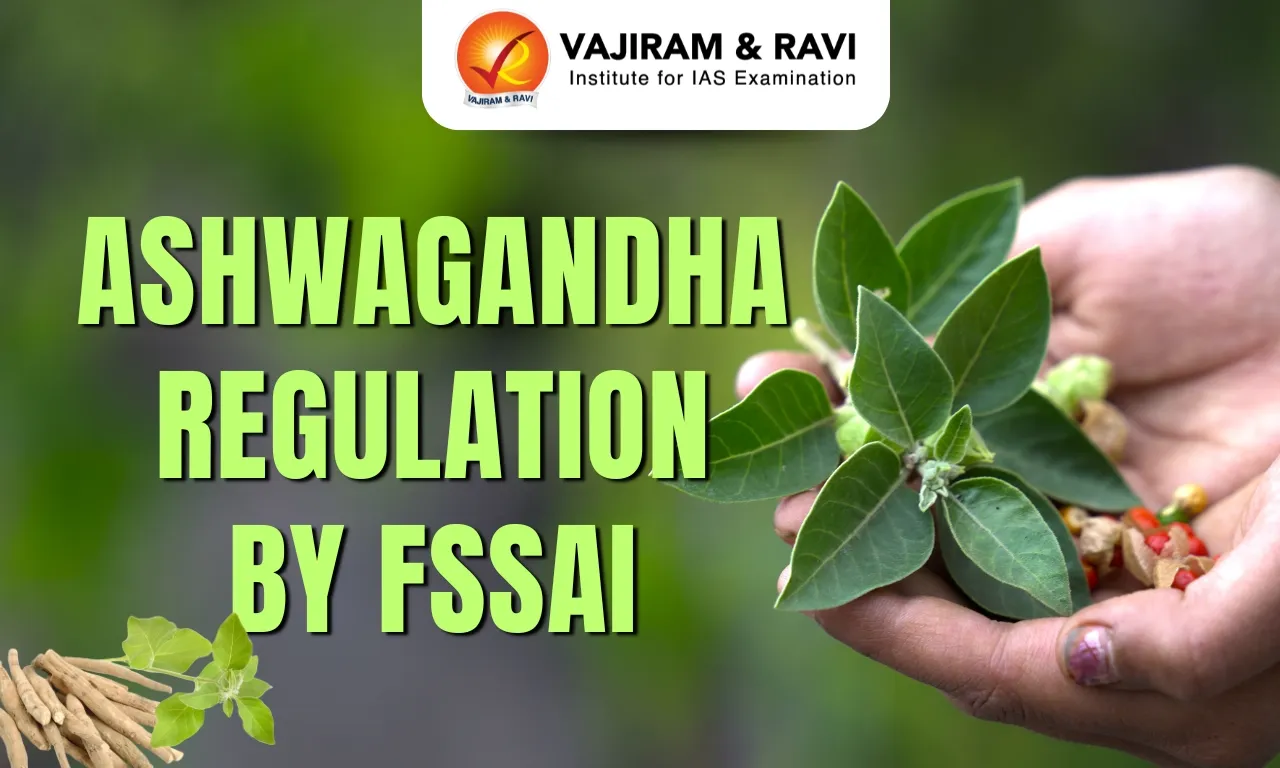
The Food Safety and Standards Authority of India issued an advisory stating that Ashwagandha leaves cannot be used in food products or supplements in any form.

FSSAI Advisory on Ashwagandha

The Food Safety and Standards Authority of India issued an advisory to clarify the permitted use of Ashwagandha in food products and supplements.

  • Under the Food Safety and Standards (Health Supplements and Nutraceuticals) Regulations 2016, there is a fixed list of approved plants and their specific parts that can be used in such products.
  • According to this list (Schedule IV), only the root of Ashwagandha (Withania somnifera) and its extracts are allowed, and even these must be used within prescribed safety limits.
  • The authority observed that some manufacturers were using Ashwagandha leaves and leaf extracts in their products, which is not permitted under the rules.
  • Therefore, the advisory clearly states that Ashwagandha leaves cannot be used in any form, whether raw, powdered, or as an extract, in food products or health supplements.
  • It directs all Food Business Operators (FBOs) to strictly follow these regulations and stop using unapproved parts of the plant.
  • It also warns that any violation will lead to legal action under the Food Safety and Standards Act, 2006.
  • Overall, the advisory aims to ensure consumer safety, standardisation, and proper regulation of herbal ingredients in the food and nutraceutical sector.

About Ashwagandha

Ashwagandha (Withania somnifera), also known as Indian ginseng or winter cherry, is a well-known medicinal plant in Ayurveda.

  • The term “Ashwagandha” comes from “ashwa” (horse) and “gandha” (smell), indicating strength and the root’s distinct aroma.
  • Traditionally classified as a “rasayana” herb, it is believed to promote longevity, improve immunity, and strengthen the nervous system.
  • It is widely used for its adaptogenic properties, helping the body cope with stress and restore balance.

Scientific Evidence on Ashwagandha Leaves

Emerging studies suggest that Ashwagandha leaves possess bioactive properties, but their use remains under scientific evaluation.

  • Research indicates that leaf extracts contain compounds such as Withaferin D, which may show anti-cancer properties by targeting tumour cells.
  • Studies also highlight potential neuroprotective, anti-inflammatory, antimicrobial, cardioprotective, and anti-diabetic effects.
  • However, these findings are largely experimental and not yet fully translated into approved food safety standards.

Ashwagandha Regulation by FSSAI FAQs

Q1: What is Ashwagandha?

Ans: Ashwagandha (Withania somnifera) is a traditional medicinal herb used in Ayurveda, known for improving strength, reducing stress, and promoting overall health and balance in the body.

Q2: Why has the Food Safety and Standards Authority of India restricted the use of Ashwagandha leaves?

Ans: The Food Safety and Standards Authority of India has restricted Ashwagandha leaves because they are not part of the approved plant components listed under existing nutraceutical regulations, and their safety and standardised usage in food products have not been sufficiently established.

Q3: Which part of Ashwagandha is permitted in food products and supplements?

Ans: Only the root of Ashwagandha (Withania somnifera) and its extracts are permitted, as they have established usage in both traditional medicine and regulated food standards.

Q4: What happens if manufacturers continue using Ashwagandha leaves?

Ans: Manufacturers who use Ashwagandha leaves in violation of the advisory may face legal action under the Food Safety and Standards Act, 2006, as compliance with approved ingredients is mandatory.

Q5: What is the main aim of this regulation?

Ans: The main aim is to ensure safety, standardisation, and proper regulation in the growing nutraceutical industry.

Srimanta Sankaradeva (1449-1568), Biography, Batadrava Than

Srimanta Sankaradeva

Srimanta Sankaradeva was a 15th-16th century Bhakti saint, reformer and cultural icon of Assam who transformed religion, literature and society. He founded the Neo-Vaishnavite movement called Ekasarana Dharma and promoted devotion to Krishna through simple practices. His efforts united diverse communities and created a strong Assamese cultural identity through literature, music, dance and institutions like Namghars and Satras.

Srimanta Sankaradeva Biography

Srimanta Sankaradeva was born in 1449 at Alipukhuri near Bordowa in present day Nagaon district. Sankaradeva belonged to the Siromani Bhuyan family. He undertook a major pilgrimage across India in 1481, composed his first Borgeet at Badrikashrama and later spread Bhakti ideas in Assam. Despite opposition from orthodox groups and rulers, he continued reforms and passed away in 1568, leaving a lasting socio-cultural legacy.

Srimanta Sankaradeva Literary Contributions

Srimanta Sankaradeva revolutionised Assamese literature by composing devotional texts, translating scriptures and creating new literary forms in simple language for common people.

  • Kirtana-ghosha: His most important work, it is a collection of devotional songs used in congregational prayer and remains one of the four sacred texts regularly recited in Namghars across Assam.
  • Bhagavata translation: He translated eight books of the Bhagavata Purana into Brajavali, making complex Sanskrit scriptures accessible, especially the Adi Dasama describing Krishna’s childhood.
  • Gunamala: A concise summary of the Bhagavata Purana composed in a single night, presenting essential teachings in six kirtans for easy understanding and recitation.
  • Philosophical texts: Works like Nimi Nava Siddhi Samvada and Bhakti Pradipa explain devotion and reject worship of multiple deities, emphasising exclusive surrender to Krishna.
  • Poetic innovations: He introduced Bhatimas, a new poetic form praising God or Guru, enriching devotional literature and shaping Assamese literary tradition.
  • Early compositions: Texts like Harischandra-upakhyana and Rukmini Harana Kavya reflect his narrative skill and contribution to early Assamese literary development.

Srimanta Sankaradeva Reforms

Srimanta Sankaradeva introduced wide ranging reforms in religion, society, art and institutions, transforming Assam into a unified cultural region based on equality and devotion.

  • Namghars and Satras: He established Namghars as community prayer halls and Satras as monasteries, which became centres for worship, education, art and social interaction open to all communities.
  • Social equality: He opposed caste hierarchy and Brahmanical rituals, allowing participation of tribes, lower castes and even non Hindus, promoting inclusivity and universal brotherhood.
  • Cultural integration: His movement united diverse ethnic and linguistic groups of Assam under a shared spiritual and cultural framework based on Bhakti and collective participation.
  • Borgeets music: He composed about 240 devotional songs based on ragas and talas, forming a classical musical tradition still performed in religious gatherings.
  • Ankiya Naat and Bhaona: He pioneered one act plays blending drama, music and philosophy, performed as Bhaona, making religious teachings accessible through visual storytelling.
  • Sattriya dance: He created Sattriya, a codified classical dance performed in Satras, later recognised as one of India’s classical dance forms.
  • Language development: He developed Brajavali, a literary language combining Assamese and Maithili elements, enabling wider communication of religious ideas.
  • Influence on kingdoms: His Neo-Vaishnavite movement influenced Koch and Ahom kingdoms and later shaped socio-religious developments in the Brahmaputra valley.
  • Ethical reforms: He discouraged practices like animal sacrifice and ritual excesses, promoting moral discipline, simplicity and devotion based spirituality.
  • Institutional legacy: His institutions continue to function as centres of cultural preservation, manuscript writing, performing arts and community governance in Assam.

Batadrava Than

Batadrava Than is the birthplace and earliest spiritual centre of Srimanta Sankaradeva, symbolising the origin of Neo-Vaishnavite movement in Assam.

  • Situated in Nagaon district about 130 km from Guwahati, it is regarded as the most sacred site for Assamese Vaishnavites and marks Sankaradeva’s birthplace.
  • Sankaradeva established the first Kirtan Ghar here to propagate Ekasarana Dharma, making it the earliest organised centre of congregational worship in Assam.
  • The Than became a nucleus for religious, literary and artistic activities, shaping Assamese identity through devotional practices, performances and social participation.
  • The surrounding 8 km area is preserved for indigenous communities, reflecting its deep cultural and spiritual importance in Assamese society.
  • Recently it has been redeveloped and inaugurated at the national level and continues to represent heritage, pilgrimage and revival of Sankaradeva’s teachings.

Srimanta Sankaradeva Ekasarana Dharma

Ekasarana Dharma is the Neo-Vaishnavite religious system founded by Srimanta Sankaradeva, centred on devotion to a single God and social equality.

  • Core philosophy: It emphasises worship of one deity, Vishnu as Krishna, based on the principle of complete surrender (sarana) and rejects polytheism and ritualism.
  • Key practices: Focuses on Sravana (listening to God’s name) and Kirtana (chanting), simplifying devotion and making it accessible to common people.
  • Four principles: Based on Deva (God), Naam (prayer), Guru (spiritual guide) and Bhakat (devotee community), forming the foundation of religious practice.
  • Egalitarian nature: Rejects caste distinctions and promotes equality, attracting people from diverse social and religious backgrounds into a unified fold.
  • Scriptural base: The Bhagavat of Sankaradeva and Kirtana-ghosha serve as central texts guiding beliefs and practices of the faith.
  • No idol worship: Emphasises internal devotion and congregational prayer rather than temple rituals or image worship, distinguishing it from other traditions.
  • Institutional spread: Propagated through Namghars and Satras, which acted as decentralised centres of religious and social life.
  • Sub sects: After his death, the movement evolved into four sanghatis- Brahma, Purush, Nika and Kala, each interpreting principles differently.
  • Cultural impact: It shaped Assamese identity by integrating religion with music, dance, literature and community participation.

Srimanta Sankaradeva FAQs

Q1: Who was Srimanta Sankaradeva?

Ans: Srimanta Sankaradeva was a 15th-16th century Bhakti saint, reformer and cultural figure from Assam who founded Ekasarana Dharma and transformed Assamese society, literature and art.

Q2: What is Ekasarana Dharma of Srimanta Sankaradeva?

Ans: Ekasarana Dharma is a Neo-Vaishnavite faith founded by Sankaradeva that focuses on devotion to one God, Krishna, through practices like listening and chanting God’s name.

Q3: What are the major literary works of Srimanta Sankaradeva?

Ans: His important works include Kirtana-ghosha, Gunamala, Bhagavata translations, Bhakti Pradipa and several devotional poems, songs and plays.

Q4: What is Batadrava Than?

Ans: Batadrava Than is the birthplace of Sankaradeva in Assam and the first centre where he established his religious teachings and congregational worship.

Q5: What were the key reforms introduced by Srimanta Sankaradeva?

Ans: He promoted social equality, opposed caste discrimination, simplified religious practices and established institutions like Namghars and Satras for community worship and cultural activities.

Impact of Global Warming on Sea Breezes

Impact of Global Warming on Sea Breezes

Sea breezes are a crucial local weather system in coastal regions that help regulate temperature and improve air quality. However, global warming is altering their intensity, frequency, and effectiveness, raising concerns for coastal climate and urban livability.

What are Sea Breezes?

Sea breezes are local wind systems caused by differential heating between land and sea.

  • During the day, land heats faster than the sea, creating low pressure over land and drawing cooler air from the sea.
  • At night, land cools faster, reversing the flow from land to sea, known as land breeze.

This daily cycle plays a vital role in moderating coastal temperatures.

Impact of Global Warming on Sea Breezes

Global warming is disrupting the basic temperature gradients that drive sea breeze circulation.

  • Rising sea surface temperatures reduce the land-sea thermal contrast, weakening sea breeze formation.
  • A study published in Nature Climate Change shows that warming oceans are leading to weaker sea-land breezes in coastal regions.
  • In cities like Mumbai and Miami, the number of sea-breeze days has declined by around 3 percent due to higher ocean temperatures.
  • Weaker sea breezes reduce their ability to cool coastal areas, making cities more vulnerable to extreme heat.
  • Warmer oceans increase humidity levels, making the incoming air more moist and increasing the “feels-like” temperature.
  • In urban areas, the urban heat island effect further weakens the penetration of sea breezes, reducing their cooling impact.

Implications for Coastal Regions

Changes in sea breeze patterns have significant environmental and socio-economic impacts.

  • Urban Heat and Livability: Coastal cities rely on sea breezes for natural cooling. Weakening breezes increase dependence on artificial cooling, raising energy demand.
  • Air Quality: Reduced wind flow limits the dispersion of pollutants, worsening air quality in cities.
  • Public Health: Higher humidity and reduced cooling increase heat stress, leading to health risks such as heat exhaustion and heatstroke.
  • Climate and Weather Patterns: Changes in sea breeze circulation can affect local rainfall patterns, cloud formation, and coastal weather systems.

Significance for India

India has a long coastline along the Arabian Sea and the Bay of Bengal, making it highly dependent on sea breeze systems.

  • Major cities such as Mumbai, Chennai, and Kolkata rely on sea breezes for moderating temperatures. Weakening of these winds can intensify urban heat, strain infrastructure, and increase climate vulnerability.

Impact of Global Warming on Sea Breezes FAQs

Q1: What are sea breezes?

Ans: Sea breezes are local wind systems formed due to temperature differences between land and sea. They play a crucial role in cooling coastal areas, improving air circulation, and maintaining local climate balance.

Q2: How is global warming affecting sea breeze systems?

Ans: Global warming is increasing sea surface temperatures, which reduces the temperature contrast between land and sea, thereby weakening the formation and intensity of sea breezes.

Q3: What empirical evidence supports the impact of global warming on sea breezes?

Ans: Research published in Nature Climate Change shows a measurable decline in sea-breeze days in coastal cities such as Mumbai and Miami, indicating a direct link between rising sea temperatures and weakened local wind systems.

Q4: Why is the weakening of sea breezes a concern for coastal urban climates?

Ans: Sea breezes act as a natural cooling and ventilation system in coastal cities, and their weakening reduces heat dispersion, increases urban temperatures, and worsens air pollution levels.

Q5: What are the broader climatic implications of changes in sea breeze patterns?

Ans: Alterations in sea breeze circulation can disrupt local weather systems, influencing rainfall patterns, cloud formation, and overall coastal climate stability.

UPSC Daily Quiz 22 April 2026

UPSC Daily Quiz

[WpProQuiz 143]

UPSC Daily Quiz FAQs

Q1: What is the Daily UPSC Quiz?

Ans: The Daily UPSC Quiz is a set of practice questions based on current affairs, static subjects, and PYQs that help aspirants enhance retention and test conceptual clarity regularly.

Q2: How is the Daily Quiz useful for UPSC preparation?

Ans: Daily quizzes support learning, help in revision, improve time management, and boost accuracy for both UPSC Prelims and Mains through consistent practice.

Q3: Are the quiz questions based on the UPSC syllabus?

Ans: Yes, all questions are aligned with the UPSC Syllabus 2025, covering key areas like Polity, Economy, Environment, History, Geography, and Current Affairs.

Q4: Are solutions and explanations provided with the quiz?

Ans: Yes, each quiz includes detailed explanations and source references to enhance conceptual understanding and enable self-assessment.

Q5: Is the Daily UPSC Quiz suitable for both Prelims and Mains?

Ans: Primarily focused on Prelims (MCQ format), but it also indirectly helps in Mains by strengthening subject knowledge and factual clarity.

India’s Heat Crisis, Causes, Impacts on Health and Economy

India’s Heat Crisis

India’s heat crisis has become a major climate, economic, and public health challenge, moving beyond seasonal discomfort to a structural issue affecting productivity, livelihoods, agriculture, and urban systems.

According to the India Meteorological Department (IMD), 2024 was India’s warmest year since 1901, with temperatures about 0.65°C above the long-term average, reflecting a clear climate change-driven warming trend and rising heat extremes.

India’s Heat Crisis Nature

India’s heat crisis is becoming more widespread, frequent, and intense, turning into a major climate risk for the country.

  • Heatwaves that were earlier concentrated in the arid northwest and central India are now affecting humid coastal regions and even traditionally moderate areas. 
  • Recent assessments show that over 57 percent of India’s districts are now heat-prone, covering nearly 76 percent of the population.
  • 2024 recorded one of the longest heatwaves in India, with several states experiencing temperatures above 40°C for extended periods.
  • Cities like Delhi and Rajasthan recorded extreme temperatures nearing 50°C during peak heat events (IMD reports, 2024).
  • The urban heat island effect is further intensifying temperatures in densely populated areas due to concretisation, reduced vegetation, and high energy use.
  • Seasonal patterns are becoming unstable, with early onset of heat as seen in 2026 when warm conditions began in February. As a result, the duration of heat exposure is increasing, leading to longer and more continuous periods of heat stress

Reasons for India’s Rising Heat Crisis

The growing heat crisis is driven by a combination of global, regional, and structural factors.

  • Climate Change and Global Warming: Rising global temperatures have increased the frequency and intensity of heatwaves. The IPCC Sixth Assessment Report confirms that heatwaves have become more frequent and intense globally due to anthropogenic warming.
  • Rapid Urbanisation and Urban Heat Island Effect: Unplanned urban expansion, concrete infrastructure, and high population density trap heat in cities, creating urban heat islands that significantly raise local temperatures.
  • Deforestation and Loss of Green Cover: According to Forest Survey of India reports, urban green cover in several metropolitan regions has declined due to infrastructure expansion. Reduced vegetation cover limits natural cooling, disrupts microclimates, and increases surface temperatures.
  • Industrialisation and Energy Emissions: Growing industrial activity and transport emissions contribute to greenhouse gas accumulation and localized heat generation. During heatwaves in 2024, India’s electricity demand reached record highs (reported by Power Ministry and GRID-India), further increasing heat stress. 
  • Geographic Vulnerability: India’s tropical and semi-arid geography naturally predisposes large regions to high baseline temperatures, which are now being intensified by climate change.
  • Weak Adaptation Systems: Limited urban planning for heat resilience, inadequate cooling infrastructure, and weak public health preparedness further amplify vulnerability.

Impact of India’s Heat Crisis

India’s heat crisis has wide-ranging consequences across social, economic, environmental, and public health dimensions. Its impacts are increasingly systemic, affecting both productivity and human well-being, with a disproportionate burden on vulnerable populations.

  • Thermal Injustice: The concept of thermal injustice highlights how heat burden is unequal across society. Heatwaves disproportionately affect the poor, elderly, children, and informal workers. According to CEEW, vulnerable groups such as construction workers, gig workers, and slum dwellers face the highest exposure to heat stress.
  • Economic Impact: Studies suggest potential GDP loss of up to 4.5 percent by 2030 due to heat stress (CEEW analysis).
  • Labour and Informal Sector Impact: Unlike those with access to private cooling, construction workers, street vendors, and delivery partners have zero cooling autonomy; even small temperature increases reduce their productivity and income, forcing them to choose between health and livelihood.
  • Agricultural Impact: Heat stress reduces crop yield, increases irrigation demand, and disrupts sowing cycles. This threatens food security, especially for heat-sensitive crops like wheat.
  • Public Health Impact: Heatwaves increase heatstroke, dehydration, and cardiovascular stress. In 2024, India reported over 44,000 heatstroke cases during peak summer conditions (CEEW and media reports). However, underreporting remains a major issue due to weak surveillance systems.

Government Initiatives

India has taken several policy and administrative measures to reduce heat-related risks, although their implementation and effectiveness vary across regions.

  • Heat Action Plans (HAPs): Implemented in multiple states and cities, these plans focus on early warning systems, public advisories, and inter-agency coordination; the Ahmedabad Heat Action Plan is widely cited as a successful example in reducing heat-related mortality.
  • India Meteorological Department (IMD) Alerts: The India Meteorological Department issues heatwave warnings, colour-coded alerts, and improved district-level forecasts to enable timely preparedness and response.
  • NDMA Guidelines: The National Disaster Management Authority provides a national framework for heatwave management, focusing on awareness, preparedness, and emergency response mechanisms.
  • Public Health Measures: Governments have established heatstroke wards in hospitals, launched awareness campaigns, and ensured the availability of safe drinking water in public spaces during peak summer.
  • Urban Cooling Measures: Initiatives such as cool roofs, shaded infrastructure, and public water kiosks have been introduced in some cities to reduce urban heat exposure.

Legal and Policy Gaps in Heat Governance

Despite existing efforts, significant legal and institutional gaps continue to limit India’s ability to effectively manage the heat crisis.

  • Heatwaves Not Notified as a Disaster: Heatwaves are not recognised under the Disaster Management Act, 2005, which restricts access to national disaster funds and large-scale mitigation efforts.
  • Weak Labour Law Coverage: Laws such as the Factories Act, 1948 exclude most outdoor workers, while the Occupational Safety, Health and Working Conditions Code, 2020 lacks enforceable heat safety provisions.
  • Non-Binding Heat Action Plans: Most HAPs remain advisory in nature, without legal backing, dedicated funding, or strict implementation mechanisms.
  • No Income Protection: Informal workers suffer wage losses during heatwaves without compensation or social security support.
  • Gig Economy Vulnerability: Delivery and platform workers face algorithm-driven pressure to meet targets even during extreme heat, without rest periods or hazard pay.
  • Inadequate Heat Measurement System: India relies mainly on temperature-based criteria, ignoring humidity, which leads to underestimation of actual heat stress levels.

Measures Needed to Address India’s Heat Crisis

Addressing India’s heat crisis requires a shift from reactive measures to a comprehensive and proactive governance framework.

  • Recognise Heatwaves as a National Disaster: Heatwaves should be included in the notified disaster list, as recommended for the Finance Commission cycle, to enable better funding and institutional response.
  • Adopt Heat Index-Based Warning System: The India Meteorological Department should adopt the heat index, which combines temperature and humidity, for more accurate heatwave assessment.
  • Strengthen Labour Protection: The government must enforce mandatory work-rest cycles, ensure employer responsibility for hydration and protective equipment, and regulate outdoor working hours.
  • Protect Informal and Gig Workers: Legal safeguards should be introduced to prevent wage loss, remove penalties during heat alerts, and ensure safe working conditions.
  • Recognise Right to Cooling: Building on the M.K. Ranjitsinh & Ors. v. Union of India & Ors, access to cooling infrastructure such as shelters, shaded spaces, and drinking water should be treated as part of the right to life under Article 21.
  • Introduce Compensation Mechanisms: The government should promote heat insurance and income protection schemes, such as those developed by the Self-Employed Women’s Association, to support workers during extreme heat conditions.

India’s Heat Crisis FAQs

Q1: Why are heatwaves increasing in India?

Ans: Heatwaves are rising due to a combination of climate change, rapid urbanisation, loss of green cover, and high emissions, along with India’s natural geographic vulnerability and weak adaptation systems.

Q2: How many districts in India are heat-prone?

Ans: Recent assessments indicate that over 57 percent of India’s districts are classified as heat-prone, covering nearly 76 percent of the population, highlighting the widespread nature of the heat crisis.

Q3: How has the spatial distribution of heatwaves in India changed?

Ans: Heatwaves have expanded beyond the traditional hotspots of northwest and central India to coastal and previously moderate regions, indicating a structural shift in climatic patterns.

Q4: What are the major impacts of extreme heat in India?

Ans: Extreme heat leads to health risks like heatstroke, reduces labour productivity and income, affects crop yields, increases energy demand, and puts pressure on water and urban infrastructure systems.

Q5: What is meant by “thermal injustice” in the Indian context?

Ans: Thermal injustice refers to the unequal impact of heat, where poorer and vulnerable populations suffer more due to lack of access to cooling, safe housing, and protective infrastructure.

Access and Benefit Sharing (ABS), Principles, Nagoya Protocol

Access and Benefit Sharing (ABS)

Access and Benefit Sharing (ABS) is a principle under biodiversity governance that ensures that when biological resources (like plants, animals, microbes) or traditional knowledge are used, the benefits arising from their use are shared fairly with the local communities or countries that own them.

India has submitted its first national report on the implementation of the Nagoya Protocol to the Convention on Biological Diversity, highlighting the country’s progress in ensuring fair and equitable sharing of benefits arising from the use of biological resources. The report showcases India’s strong legal and institutional framework, particularly under the Biological Diversity Act, 2002, and its efforts to promote sustainable use and conservation of biodiversity.

Access and Benefit Sharing (ABS) Background

The concept of ABS gained global importance with the adoption of the Convention on Biological Diversity (CBD) during the Rio Earth Summit 1992.

Earlier, biological resources were treated as the “common heritage of mankind,” but this led to exploitation by developed countries. ABS changed this approach by recognizing sovereign rights of nations over their biological resources

Later, the Nagoya Protocol strengthened the ABS mechanism globally.

Access and Benefit Sharing (ABS) Key Principles

Access and Benefit Sharing (ABS) is based on the following core principles:

  • Prior Informed Consent (PIC): Permission must be taken before accessing biological resources.
  • Mutually Agreed Terms (MAT): Terms for benefit sharing must be decided between users and providers.
  • Fair and Equitable Sharing: Benefits (monetary and non-monetary) must be shared fairly.
  • Sustainable Use: Resources should be used without harming biodiversity.

About Nagoya Protocol

The Nagoya Protocol is an international agreement under the Convention on Biological Diversity that provides a legal framework for fair and equitable sharing of benefits arising from the use of genetic resources. It strengthens Access and Benefit Sharing (ABS) by ensuring that countries and communities receive benefits when their biodiversity is used.

  • Adopted in 2010 (Nagoya, Japan): Came into force in 2014 to operationalize ABS globally.
  • Objective:
    • Fair and equitable sharing of benefits from genetic resources
    • Conservation of biodiversity
    • Sustainable use of its components
  • Scope:
    • Covers genetic resources and traditional knowledge associated with them
    • Applies to research, biotechnology, pharmaceuticals, agriculture, etc.
  • Prior Informed Consent (PIC):
    • Users must obtain permission from the provider country before accessing resources
  • Mutually Agreed Terms (MAT):
    • Terms of benefit sharing must be negotiated and agreed upon
  • Benefit Sharing Mechanism:
    • Includes both monetary (royalties, fees) and non-monetary (technology transfer, training) benefits
  • Compliance Measures:
    • Countries must ensure that users within their jurisdiction follow ABS rules
  • Traditional Knowledge Protection:
    • Recognizes rights of indigenous and local communities over their knowledge
  • Access and Benefit-Sharing Clearing-House (ABS-CH):
    • A global platform for sharing information related to ABS
  • National Implementation:
    • Countries must create laws and institutions to implement ABS (e.g., India’s Biological Diversity Act, 2002)
  • Global Significance:
    • Prevents biopiracy and promotes fairness between developed and developing countries

About  Biological Diversity Act 2002

The Biological Diversity Act, 2002 is India’s key law for the conservation of biological diversity, sustainable use of its components, and fair sharing of benefits arising from biological resources.

  • Objectives:
    • Conservation of biodiversity
    • Sustainable use of biological resources
    • Fair and equitable sharing of benefits (ABS)
  • Three-Tier Institutional Structure:
    • National Biodiversity Authority (NBA) – National level
    • State Biodiversity Boards (SBBs) – State level
    • Biodiversity Management Committees (BMCs) – Local level
  • Regulation of Access:
    • Foreign individuals and companies must take approval from NBA
    • Indian entities need permission from State Biodiversity Boards
  • Access and Benefit Sharing (ABS):
    • Ensures benefits are shared with local communities
    • Funds go to Local Biodiversity Fund (LBF)
  • Protection of Traditional Knowledge:
    • Safeguards indigenous knowledge from misuse and biopiracy
  • Biodiversity Registers:
    • Preparation of People’s Biodiversity Registers (PBRs) at local level
  • Restrictions on IPR (Intellectual Property Rights):
    • Prior approval of NBA required before applying for patents based on biological resources
  • Offences and Penalties:
    • Violations can lead to fines and imprisonment
  • Exemptions:
    • Local communities using resources for traditional purposes are exempted 

Access and Benefit Sharing (ABS) FAQs

Q1: What is Access and Benefit Sharing (ABS)?

Ans: ABS is a system that ensures fair and equitable sharing of benefits arising from the use of biological resources and traditional knowledge.

Q2: Which international agreement governs ABS?

Ans: ABS is governed by the Nagoya Protocol under the Convention on Biological Diversity.

Q3: What is the main objective of ABS?

Ans: The main objective is to ensure fairness in benefit sharing while promoting biodiversity conservation and sustainable use.

Q4: What is Prior Informed Consent (PIC)?

Ans: PIC means obtaining permission from the resource-providing country or community before accessing biological resources.

Q5: What are Mutually Agreed Terms (MAT)?

Ans: MAT are negotiated agreements that define how benefits from biological resources will be shared.

Distributed Energy Resources, Types, Benefits, Challenges, Schemes

Distributed Energy Resources

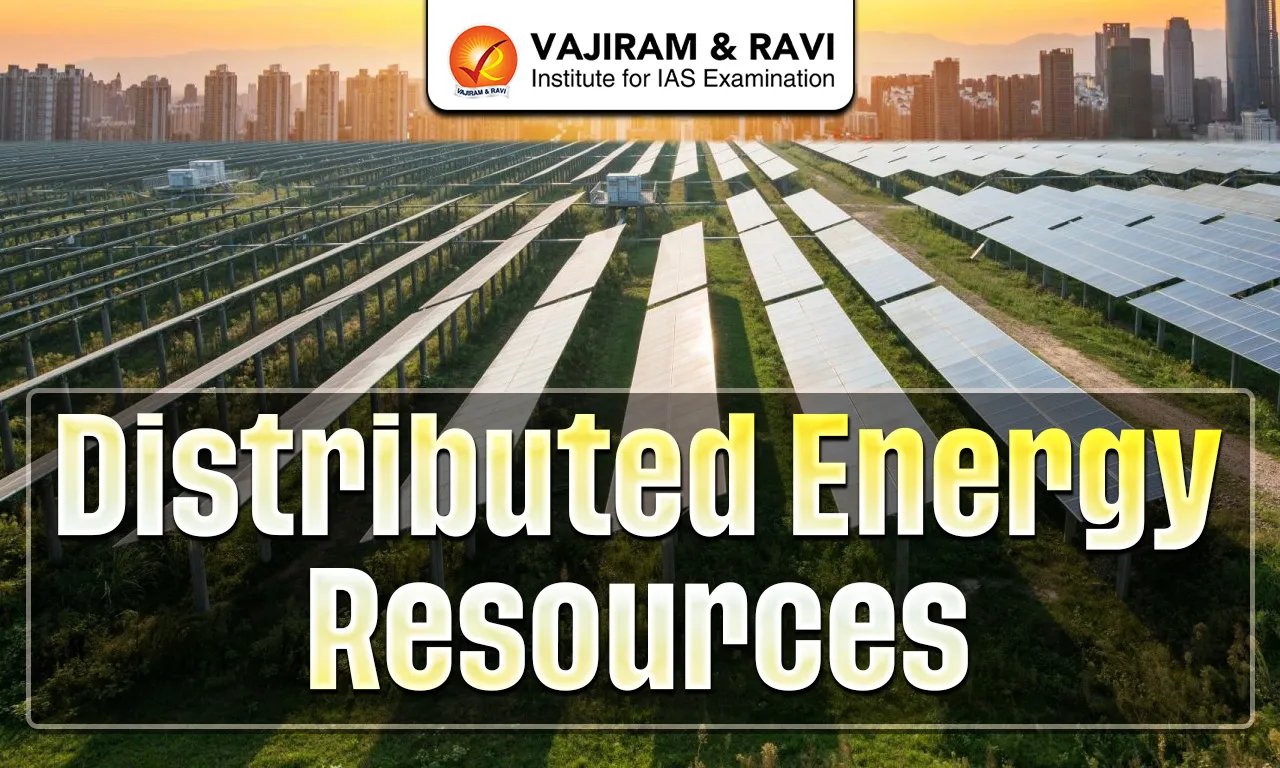
Distributed Energy Resources (DERs) are small-scale energy systems that generate or store electricity close to where it is used. Instead of relying only on large power plants, these resources help supply energy locally. They make the energy system more flexible, efficient, and reliable.

About Distributed Energy Resources

  • Distributed Energy Resources (DERs) are small and flexible energy systems located close to where electricity is used, such as homes or businesses, instead of large central power plants. They are usually connected to the local grid but can also work independently.
  • These systems can provide electricity, heat, or mechanical energy and are often installed on the consumer’s side (“behind the meter”), allowing users to generate and manage their own energy.
  • DERs include various technologies such as renewable energy sources, energy storage systems, and energy-efficient devices. Common examples are rooftop solar panels, wind turbines, battery storage, electric vehicle batteries, biomass generators, fuel cells, small hydro systems, gas turbines, and diesel engines.
  • A related concept is distributed generation, which means producing electricity near the place of use rather than relying only on centralized power plants. However, not all DER systems are limited to being behind the meter.
  • Many DERs use renewable energy like solar and wind, helping reduce pollution and carbon emissions, while even those using natural gas produce fewer emissions compared to traditional power plants.
  • DERs improve energy reliability and resilience by providing backup power during outages or extreme weather and also help meet rising electricity demand by supporting the main grid during peak times.

Distributed Energy Resources Technologies & Types

  • DER technologies include both traditional fossil fuel-based systems and modern clean energy technologies. Older systems like oil and diesel-based engines produce high greenhouse gas emissions, while newer technologies focus on reducing or eliminating pollution.
  • Solar energy systems (solar PV) convert sunlight directly into electricity using solar panels. These are widely used in homes and businesses and have seen rapid growth in recent years.
  • Wind turbines (distributed wind) generate electricity from wind. They can be very small (less than 1 kW for small uses) or large enough (up to 100 kW) to power industrial sites.
  • Fuel cells produce electricity through a chemical process using fuels like hydrogen. While hydrogen is often made from natural gas, it can also be produced using renewable energy (called green hydrogen). Fuel cells are used in some electric vehicles and power systems.
  • Cogeneration (Combined Heat and Power - CHP) systems produce electricity and useful heat at the same time from a single fuel source. They can run on natural gas or renewable fuels like biomass, making them more efficient.
  • Microturbines are small engines that run on fuels like natural gas, biogas, or propane. Even though each unit produces a small amount of electricity (15-300 kW), multiple units together can supply power to large facilities.
  • Small-scale hydropower systems use flowing water to generate electricity and are useful in areas with rivers or streams.
  • Energy storage systems like batteries store extra electricity (especially from solar or wind) so it can be used later. Thermal storage systems store heat or cold to help balance energy demand.
  • Microgrids are small, local energy systems that can operate independently from the main grid during emergencies, improving reliability and resilience.
  • Demand response technologies help reduce or shift electricity use during peak demand times, making the overall system more efficient.
  • Electric vehicles (EVs) can act as mobile batteries, storing energy and even supplying power back to the grid when needed.

Distributed Energy Resources Benefits

  • Better reliability and resilience: DERs reduce dependence on large power plants by generating energy locally. This helps keep the power supply stable and provides backup during power cuts, extreme weather, or other disruptions.
  • Environmental benefits: DERs promote the use of renewable energy like solar and wind, which lowers greenhouse gas emissions, reduces air pollution, and decreases dependence on fossil fuels.
  • Cost savings for consumers: By producing energy closer to where it is used, DERs reduce transmission losses and can lower electricity bills. They also help avoid expensive upgrades to the main grid and can even generate income through systems like net metering or energy markets.
  • Energy independence and security: DERs allow countries and individuals to use a mix of energy sources, reducing reliance on imported fuels and improving overall energy security.
  • Support for modern energy systems: DERs help in building a smarter, more flexible, and decentralized power system, making it easier to manage energy demand and supply efficiently.
  • Efficient use of energy storage: DERs make use of energy storage technologies that store extra energy for later use, ensuring energy is not wasted and can be used when needed.
  • Battery storage advantages: Batteries are the most common storage systems. They can be installed at homes or businesses (“behind the meter”) to store extra electricity and use it later, improving reliability and reducing costs.
  • Electric vehicles as energy sources: Electric vehicles (EVs) can act like mobile batteries. With vehicle-to-grid (V2G) technology, they can send unused energy back to the grid, helping balance electricity demand.
  • Thermal storage using water heaters: Electric water heaters can store energy in the form of heat and release it later when needed. This helps support the grid and improves overall energy efficiency.

Distributed Energy Resources Challenges

  • Integration and coordination issues: Renewable sources like solar and wind do not produce energy all the time, which makes it difficult to maintain a stable power supply. Also, managing and coordinating many small energy systems together and connecting them smoothly to the existing grid is a big challenge.
  • Regulatory and policy barriers: Different rules and regulations in various regions can make it difficult to adopt DERs widely. There is a need for clear and supportive government policies to encourage their use.
  • High initial costs and financial concerns: Some DER technologies require a large investment at the beginning. This makes it important to have proper financing options and business models that make these systems affordable and profitable for users.
  • Technical and system compatibility issues: Different DER systems need to work together efficiently, which requires proper communication and compatibility between technologies. Ensuring smooth operation between various systems can be complex.
  • Cybersecurity risks: As energy systems become more digital and connected, they become vulnerable to cyberattacks. Protecting these systems from hacking and data breaches is an important challenge.
  • Need for skilled management: Operating and maintaining multiple small energy systems requires proper planning, skilled workforce, and advanced monitoring systems.

Government Initiatives for Renewable Energy

  • The Government of India has set a major goal of achieving 500 GW of power capacity from non-fossil fuel sources by 2030, as announced by the Prime Minister at COP26.
  • To achieve this target, the government is actively spreading awareness about renewable energy through various schemes, campaigns, and media outreach.
  • Solar Parks & Ultra Mega Solar Projects: Aimed at setting up 40,000 MW capacity, this scheme provides ready infrastructure like land, roads, water, and power connections, making it easier and faster to develop large-scale solar projects.
  • CPSU Scheme Phase-II (Government Producer Scheme): Supports government companies to set up solar power projects using domestically made solar panels, with financial support (VGF). The power generated is used by government bodies or DISCOMs.
  • Production Linked Incentive (PLI) Scheme: Focuses on boosting domestic manufacturing of high-efficiency solar PV modules at a large (GW) scale under different phases.
  • PM-KUSUM Scheme: Promotes solar energy in agriculture through solar power plants, solar pumps, and solarisation of existing pumps. It benefits farmers, reduces subsidy burden on states, and provides cheaper electricity to DISCOMs.
  • Rooftop Solar Programme Phase II: Encourages installation of solar panels on rooftops, especially in homes. It provides subsidies to households and incentives to DISCOMs for increasing solar capacity.
  • Green Energy Corridors (GEC): Focuses on building transmission systems to carry renewable energy efficiently. Financial support is given to states for infrastructure under Phase I and Phase II.
  • Bio-Energy and Waste-to-Energy Programmes
    • Waste to Energy Programme: Converts urban, industrial, and agricultural waste into useful energy.
    • Biomass Programme: Supports production of biomass fuels like briquettes and pellets and promotes their use in industries.
    • Biogas Programme: Encourages setting up small biogas plants for households, especially in rural areas.

Distributed Energy Resources FAQs

Q1: What are Distributed Energy Resources (DERs)?

Ans: DERs are small-scale energy systems that generate or store electricity close to where it is used, like homes or businesses.

Q2: What are some common examples of DERs?

Ans: Examples include rooftop solar panels, wind turbines, battery storage systems, electric vehicles (EVs), biomass generators, fuel cells, and small hydropower systems.

Q3: How do DERs improve energy reliability?

Ans: DERs provide local power generation and backup during outages or extreme weather. They also support the main grid during peak demand, making the system more stable and resilient.

Q4: What are the environmental benefits of DERs?

Ans: DERs use renewable energy like solar and wind, which helps reduce greenhouse gas emissions, lowers air pollution, and decreases dependence on fossil fuels.

Q5: What are the main challenges of DERs?

Ans: Key challenges include difficulty in managing variable energy sources (like solar/wind), high initial costs, complex regulations, technical compatibility issues, and cybersecurity risks.

India’s Deportation Policy, Key Features, Need, Challenges

India’s Deportation Policy

The Union Ministry of Home Affairs has introduced a new deportation policy to speed up the process of identifying and removing illegal migrants, especially from Bangladesh and Myanmar.

Deportation Meaning

Deportation is the formal legal process through which a foreign national is removed from a country for entering illegally or staying without valid documents. It involves proper identification, verification of nationality, and sending the person back to their home country through legal procedures.

To make this process more effective and streamlined, the Government of India has introduced a new deportation policy. The policy aims to ensure faster identification and removal of illegal migrants, particularly from Bangladesh and Myanmar, by creating a structured system at the district and state levels.

Key Features of the New Deportation Policy

The new policy introduces several administrative and operational measures to improve enforcement on the ground.

District-Level Special Task Forces:  The policy directs every State and Union Territory to establish a district-level task force to detect, identify and deport illegal migrants from Bangladesh and Myanmar.

  • States must submit a monthly report to the Union Ministry of Home Affairs on missing foreigners and those overstaying their visas to ensure continuous monitoring.

Time-Bound Verification Process: The policy emphasizes faster verification of suspected migrants to avoid delays.

  • An upper limit of 90 days has been fixed to verify the antecedents of suspected Bangladeshi or Myanmarese nationals.
  • This is especially important in cases where the person claims to be living in another state, so that authorities can check their details properly without unnecessary delay.

Establishment of Holding Centres: States must set up holding centres or camps with strong security arrangements.

  • Private buildings could also be hired to run as holding centres, if government land was not available.
  • These centres should have a 10-feet-high boundary wall with barbed wire fencing to restrict movement.
  • They are not meant to function as prisons but as temporary facilities for migrants awaiting deportation.

Facilities in Holding Centres: To ensure basic dignity, certain minimum facilities must be provided

  • Holding centres should not be run from jails, States may also consider the engagement of language interpreters, mobile medical dispensaries, and 24×7 ambulances, and special attention may be given to women/nursing mothers, transgender inmates, children, etc.
  • It also suggested creche facilities for children, and educational facilities for child inmates, by admitting them in local schools nearby.
  • The holding centre should have separate enclosures for men and women, and should be equipped with all amenities, including an LPG connection in the kitchen, fire safety system, strict access control measures and adequate security personnel for round-the-clock security
  • Apart from the basic facilities to be provided like living area, toilets and bathrooms, kitchen, dining hall etc., other facilities like covered lobby outside rooms, open area, library, recreational facilities, space for indoor games, space for yoga and meditation and open space for outdoor games etc. may be provided depending upon availability of space.

Application to Foreigners’ Tribunals: The policy extends beyond newly identified migrants.

  • The guidelines for holding centres also apply to individuals declared as foreigners by Foreigners’ Tribunals, particularly in Assam.

Document Cancellation and Blacklisting: To prevent misuse of identity systems, the policy includes strict measures on documentation.

  • Documents obtained illegally, such as Aadhaar cards, PAN cards, and driving licenses, must be uploaded on a designated portal for cancellation.
  • Deported individuals will be blacklisted by the Bureau of Immigration, preventing their re-entry into India.

Foreigners Identification Portal (FIP): A specialised digital platform has been introduced to record the biometric details, such as fingerprints and facial images, along with basic personal information of illegal foreign nationals who are intercepted.

Deportation Process: Migrants intercepted at land or maritime borders are to be returned to their country of origin after recording their biometric details. 

  • In cases where individuals are found to have crossed the border unintentionally and are not involved in any unlawful activity, they may be handed over to the border guarding authorities of the concerned country instead of being detained.

New Deportation Policy Need 

The introduction of this policy is driven by multiple long-standing concerns.

  • Historical and Ongoing Migration: Illegal migration into India has deep historical roots, beginning with the Partition of 1947 and increasing during the 1971 Bangladesh Liberation War. Even today, migration continues due to economic inequality, environmental stress, and political instability in neighbouring regions. Estimates suggest that India may have anywhere between 12 million to 20 million illegal migrants, although exact numbers remain uncertain due to lack of reliable data. 
  • Internal Security Concerns: Undocumented migrants may pose risks related to security, illegal activities, and identity fraud, making monitoring necessary. In several instances, authorities have found undocumented migrants using forged identity documents and being linked to smuggling networks or illegal activities. 
  • Pressure on Resources: Large-scale and unregulated migration places pressure on public services such as housing, healthcare, and employment, particularly in border states.
  • Demographic and Social Impact: Migration has also influenced the demographic composition of certain regions, especially in states like Assam, and sometimes resulting in social tensions.

Challenges in Implementation of New Deportation Policy

While the New Deportation Policy is comprehensive, its implementation faces several practical difficulties.

  • Identification Challenges: Many people lack proper documents, making it difficult to clearly distinguish between illegal migrants and Indian citizens, especially among poor and marginalized groups.
  • Diplomatic Issues: Deportation requires the cooperation of the migrant’s home country. If the country refuses to accept them, migrants may remain in holding centres for long periods.
  • Human Rights Concerns: Long detention periods can affect mental and physical well-being. There are concerns about living conditions and treatment in holding centres.
  • Administrative Constraints: Local authorities may face shortage of manpower, training, and resources, making implementation difficult.

Way Forward

To make the policy more effective and balanced, certain steps are necessary.

  • Transparent and Fair Verification: The identification process must be accurate and fair to avoid wrongful detention of citizens.
  • Better Diplomatic Coordination: India should work with neighbouring countries to ensure smooth and timely acceptance of deported individuals.
  • Ensure Humane Conditions: Holding centres must provide decent living conditions and basic rights, especially for women and children.
  • Strengthen Border Management: Improving surveillance and infrastructure at borders can reduce illegal entry at the source.
  • Improve Documentation Systems: Better identity systems and stricter verification can prevent misuse of documents.

India’s Deportation Policy FAQs

Q1: What is meant by deportation in India?

Ans: Deportation is the legal process of removing a foreign national who has entered illegally or overstayed in India, after verifying their identity and nationality and following due procedure.

Q2: Why has India introduced a new deportation policy?

Ans: The policy has been introduced to address concerns related to illegal migration, national security, pressure on resources, and the need for a more organised and time-bound system of identification and deportation.

Q3: Which countries are mainly targeted under the policy?

Ans: The policy mainly focuses on illegal migrants from Bangladesh and Myanmar.

Q4: What is the time limit for verification under the policy?

Ans: Authorities have a maximum of 90 days to verify the identity and nationality of suspected migrants.

Q5: What is the role of district-level task forces in the deportation policy?

Ans: District-level task forces are responsible for identifying illegal migrants, initiating deportation processes, and regularly reporting cases of overstaying or missing foreigners.

Ramsar COP-15 2025, Objectives, Theme, Resolution, Indian Context

Ramsar COP-15

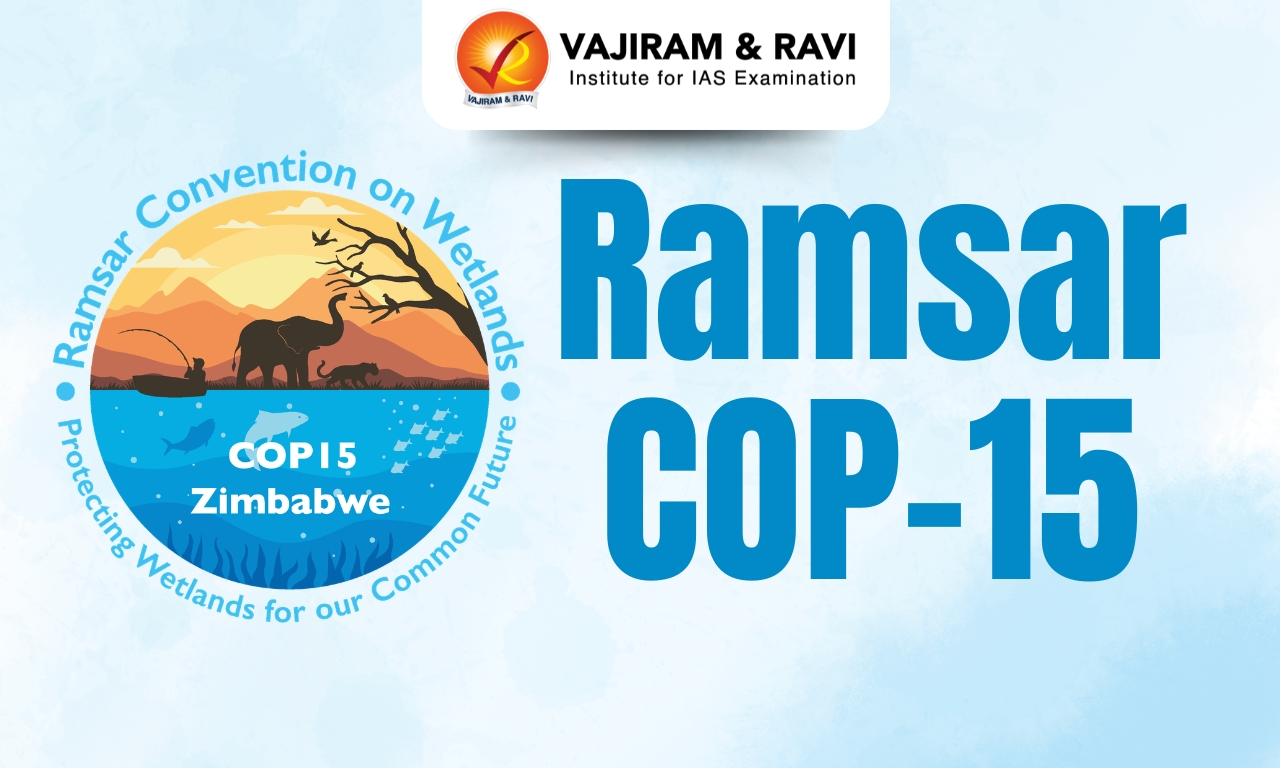
Ramsar COP-15 is the 15th meeting of the Conference of the Contracting Parties to the Ramsar Convention on Wetlands, scheduled from 23-31 July 2025 at Victoria Falls. It brings together 172 Contracting Parties to strengthen global commitments for wetland conservation, sustainable use and restoration, while enhancing international cooperation and aligning wetlands with biodiversity, climate resilience and sustainable development goals.

Ramsar COP-15 Objectives

Ramsar COP-15 aims to strengthen international commitments, promote conservation and enhance sustainable wetland use globally.

  • Around 172 Contracting Parties, along with NGOs and intergovernmental organizations, participate to review progress and adopt policies for wetland conservation, ensuring stronger international cooperation and coordinated global environmental governance.
  • The conference promotes scaling up commitments under the Freshwater Challenge, encouraging restoration of degraded wetlands and protection of freshwater ecosystems to improve water security and ecological sustainability worldwide.
  • COP-15 focuses on integrating wetlands into global biodiversity and climate frameworks, ensuring alignment with international agreements and enhancing their visibility in environmental policy and planning processes.
  • It supports development of the Strategic Plan 2025-2034 with measurable targets, indicators and monitoring mechanisms for effective wetland conservation and sustainable management globally.

Ramsar COP-15 Theme

The theme of Ramsar COP-15 was “Protecting Wetlands for Our Common Future”, highlighting wetlands as critical ecosystems for biodiversity, climate stability and human well being. It emphasizes their role in ecological balance, freshwater security and sustainable livelihoods, while aligning with global biodiversity frameworks and climate targets. The theme also promotes collective action, encouraging countries to scale up restoration commitments and integrate wetlands into national development strategies for long term environmental sustainability.

Ramsar COP-15 Features

Ramsar COP-15 serves as a global platform showcasing initiatives, partnerships and innovations in wetland conservation and sustainable development.

  • Host Nation: Zimbabwe hosts COP-15 and holds the Convention presidency for three years, showcasing its conservation leadership and highlighting its seven Ramsar Sites, including the globally recognized Victoria Falls ecosystem.
  • Global Wetlands Outlook: A Special Edition 2025 report is released, providing updated data on wetland health, conservation priorities and policy recommendations to guide sustainable wetland management globally.
  • Wetland City: The Wetland City Accreditation recognizes cities protecting urban wetlands, promoting urban ecological planning and highlighting the role of cities in maintaining biodiversity and ecosystem services.
  • Side Events and Partnerships: Events on transboundary wetlands and nature based solutions are organized with partners like IUCN and WWF, focusing on practical conservation tools and collaborative solutions.

Ramsar COP-15 Indian Context

India actively contributed to Ramsar COP-15, highlighting its initiatives and leadership in sustainable wetland management and conservation.

  • Resolution leadership: India introduced and secured adoption of the resolution on “Promoting Sustainable Lifestyles for the Wise Use of Wetlands”, supported by 172 Parties and aligned with global sustainability frameworks.
  • Mission LiFE: India promotes sustainable lifestyles through Mission LiFE, introduced at UNFCCC COP 26, encouraging behavioural changes and community participation in environmental protection.
  • Ramsar network: India has 99 Ramsar Sites covering 1.36 million hectares of area, the largest network in Asia and third globally.
  • Community initiatives: Campaigns like “Save Wetlands” and Mission Sahbhagita engaged over 2 million volunteers, mapping more than 170,000 wetlands and demarcating nearly 120,000 wetlands across India.

Ramsar COP-15 Resolutions

Ramsar COP-15 adopted key resolutions focusing on sustainable lifestyles, conservation strategies and global cooperation for wetlands.

  • Sustainable lifestyles resolution: The adopted resolution emphasizes pro planet behaviour, encouraging individuals and communities to reduce environmental impact and promote sustainable consumption patterns for wetland conservation.
  • Policy alignment: It aligns with global frameworks like UNEA Resolution 6/8 and promotes integration of sustainable lifestyle approaches into wetland management plans, investments and governance systems.
  • Enabling conditions: The resolution calls for education, awareness and public private collaboration to create enabling conditions for adopting sustainable practices supporting wetland conservation.
  • Whole of society approach: It promotes inclusive participation, recognizing that governments, communities and stakeholders must collectively act to ensure effective conservation and restoration of wetlands.

Ramsar COP-15 Significance

Ramsar COP-15 holds major importance for global environmental governance, biodiversity conservation and climate resilience.

  • Ecological importance: Wetlands are vital ecosystems providing flood control, carbon storage and biodiversity habitats, yet 35% have been lost since 1970, making conservation efforts urgent and essential.
  • Climate resilience: Wetlands and peatlands act as major carbon sinks, disappearing three times faster than forests, posing serious risks to climate stability and global environmental sustainability.
  • Livelihood support: Billions depend on wetlands for water, food and livelihoods, while nearly 25% of freshwater species face extinction threats, highlighting the need for immediate conservation action.
  • Global cooperation: COP-15 strengthens multilateral cooperation, enhances governance and promotes integration of wetlands into national development planning, ensuring long term protection and sustainable use worldwide. 

Ramsar COP-15 FAQs

Q1: What is Ramsar COP-15?

Ans: Ramsar COP-15 is the 15th global meeting of countries under the Ramsar Convention to discuss wetland conservation and sustainable use.

Q2: Where was Ramsar COP-15 held?

Ans: Ramsar COP-15 was held at Victoria Falls in Zimbabwe from 23 to 31 July 2025.

Q3: What is the theme of Ramsar COP-15?

Ans: The theme is “Protecting Wetlands for Our Common Future,” focusing on conservation, biodiversity and climate resilience.

Q4: How many countries participated in Ramsar COP-15?

Ans: Around 172 Contracting Parties participated, along with international organizations and observers.

Q5: What resolution did India introduce at Ramsar COP-15?

Ans: India introduced a resolution on promoting sustainable lifestyles for the wise use and conservation of wetlands.

Naupada Swamp, Location, Formation, Spot-billed Pelicans

Naupada Swamp

Naupada Swamp, also called Naupada Wetland, lies in Srikakulam district of Andhra Pradesh. It is a freshwater ecosystem formed by river inflows and seasonal rainfall. It supports rich biodiversity and acts as an important bird habitat, especially at Telineelapuram Important Bird Area. The wetland is ecologically significant due to its role in sustaining migratory birds, aquaculture linked food chains and regional hydrology without direct marine influence.

Naupada Swamp

Naupada Swamp is a freshwater wetland sustained by rivers and rainfall, located near Palasa town in Andhra Pradesh. It supports diverse aquatic life and bird habitats.

  • Location: Situated in Santha Bommali mandal of Srikakulam district.
  • Formation: it is a freshwater swamp formed by river inflows and monsoon rains.
  • Ecological Importance: The wetland supports fish, snails and invertebrates, forming a complex aquatic food chain that sustains migratory birds and maintains biodiversity in the region.
  • Telineelapuram IBA: This swamp includes Telineelapuram Important Bird Area, known for hosting thousands of migratory birds including pelicans and painted storks breeding seasonally.
  • Human Influence: Aquaculture practices around the swamp contribute to ecological changes and have been linked to parasite transmission affecting bird populations.

Spot-billed Pelicans of Naupada Swamp

Spot-billed pelicans, scientifically called Pelecanus philippensis, are key migratory birds in Naupada Swamp but face threats from nematode infestation affecting survival.

  • Migration and Habitat: Thousands migrate from Siberian regions to Telineelapuram IBA for breeding, preferring freshwater and coastal wetlands across South and Southeast Asia.
  • Nematode Infestation Issue: Since December 2021, nematode parasites linked to aquaculture ponds have caused mass mortality, with over 160 deaths and about five birds dying daily.
  • Species Characteristics: These pelicans are grey-white birds with orange-yellow facial skin, social in nature, strong fliers and skilled fish hunters in shallow waters.
  • Conservation Status: Listed as Near Threatened by IUCN, experts from Wildlife Institute of India, BNHS and ZSI are involved in mitigation efforts to control mortality. 

Naupada Swamp FAQs

Q1: Where is Naupada Swamp located?

Ans: Naupada Swamp is located in Srikakulam district of Andhra Pradesh near Palasa town in Santha Bommali mandal.

Q2: Why is Naupada Swamp important?

Ans: It is an important freshwater wetland supporting biodiversity and hosting migratory birds at Telineelapuram Important Bird Area.

Q3: What is causing pelican deaths in Naupada Swamp?

Ans: Nematode infestation linked to aquaculture ponds and aquatic organisms like fish and snails is causing mass mortality.

Q4: What is the scientific name of Spot-billed Pelican?

Ans: The scientific name of Spot-billed Pelican is Pelecanus philippensis.

Q5: What is the conservation status of Spot-billed Pelican?

Ans: It is listed as Near Threatened under the IUCN Red List.

Torrential Rain, Causes, Consequences, Mitigation Strategies

Torrential Rain

Torrential Rain refers to extremely heavy rainfall occurring over a short period, often leading to waterlogging, flash floods, and widespread disruption. It is associated with intense weather systems such as monsoons, cyclones, or thunderstorms. In countries like India, torrential rain is a recurring phenomenon during the southwest monsoon season and plays a crucial role in agriculture while also posing significant disaster risks. With increasing climate variability, such extreme rainfall events are becoming more frequent and unpredictable.

Torrential Rain Causes

Torrential rainfall is triggered by a combination of natural and anthropogenic factors:

  • Monsoon Dynamics: The southwest monsoon winds bring moisture-laden air from oceans, leading to intense rainfall over the Indian subcontinent.
  • Cyclonic Systems: Low-pressure systems and cyclones over the Bay of Bengal and Arabian Sea often cause heavy precipitation.
  • Orographic Effect: When moist air rises over mountain ranges like the Western Ghats, it cools and condenses, causing heavy rainfall.
  • Convective Activity: High surface temperatures lead to rapid evaporation and cloud formation, resulting in sudden downpours.
  • Climate Change: Global warming increases atmospheric moisture, intensifying rainfall events.
  • Urbanization: Reduced green cover and poor drainage systems in cities exacerbate the impact of heavy rainfall.

Torrential Rain Consequences

The impacts of torrential rain are widespread and multifaceted:

  • Flooding and Waterlogging: Excess rainfall overwhelms drainage systems, leading to urban and rural flooding.
  • Loss of Life and Property: Severe floods can cause casualties and damage infrastructure.
  • Agricultural Damage: Crops may be destroyed due to waterlogging and soil erosion.
  • Disruption of Transport: Roads, railways, and air transport often face disruptions.
  • Health Hazards: Waterborne diseases like cholera and dengue increase after heavy rains.
  • Environmental Degradation: Soil erosion, landslides, and loss of biodiversity occur in vulnerable regions.

Case Studies of Torrential Rain in India

  • Mumbai Floods 2005: Mumbai received over 900 mm of rainfall in 24 hours, leading to massive flooding, loss of life, and economic paralysis.
  • Kerala Floods 2018: Unprecedented rainfall combined with dam releases caused severe flooding, affecting millions and causing extensive damage.
  • Chennai Floods 2015: Heavy rainfall and poor urban planning led to widespread inundation, highlighting the vulnerability of metropolitan cities.

Mitigation Strategies and Sustainable Solutions

To reduce the impact of torrential rain, a multi-pronged approach is essential:

  • Improved Drainage Systems: Modern and efficient urban drainage infrastructure can prevent waterlogging.
  • Afforestation: Increasing green cover helps in water absorption and reduces runoff.
  • Floodplain Zoning: Restricting construction in flood-prone areas minimizes damage.
  • Early Warning Systems: Advanced forecasting technologies can help in timely evacuation and preparedness.
  • Sustainable Urban Planning: Smart city initiatives should incorporate climate-resilient infrastructure.
  • Water Harvesting: Rainwater harvesting systems can reduce excess runoff and conserve water.
  • Disaster Management: Strengthening institutions like the National Disaster Management Authority ensures better response and recovery.

Way Forward

Addressing the challenges of torrential rain requires integrated and long-term strategies. Governments must focus on climate-resilient infrastructure, improved forecasting systems, and community awareness. Coordination between central and state agencies, investment in sustainable development, and strict enforcement of environmental regulations are crucial. Additionally, incorporating traditional knowledge with modern technology can enhance resilience against extreme weather events.

Torrential Rain FAQs

Q1: What is torrential rain?

Ans: Torrential rain is extremely heavy rainfall occurring in a short duration, often causing flooding and damage.

Q2: What causes torrential rainfall?

Ans: It is caused by monsoons, cyclones, convection, orographic effects, and climate change.

Q3: Why is torrential rain increasing in India?

Ans: Rising global temperatures and changing climate patterns are increasing the frequency of extreme rainfall events.

Q4: What are the major impacts of torrential rain?

Ans: Flooding, infrastructure damage, crop loss, and health risks are major impacts.

Q5: How can torrential rain disasters be managed?

Ans: Through early warning systems, better drainage, sustainable planning, and effective disaster management strategies.

Totalitarianism, Features, Totalitarianism Vs Authoritarianism

Totalitarianism

Totalitarianism is a system of government where the state has complete control over society and people’s lives. Individual freedom is very limited, and the government often controls ideas, media, and daily activities. In such systems, power is usually held by a single leader or party. People are expected to follow the rules strictly, with little or no opposition allowed.

About Totalitarianism

  • Totalitarianism is a type of government where the state has complete control over people’s lives and individual freedom is almost completely absent. The government tries to control not just politics, but also people’s thoughts, actions, and daily activities.
  • The term was first used by Benito Mussolini in the early 1920s to describe his fascist rule in Italy. He believed that everything should be under the control of the state, with no opposition allowed.
  • By the time of World War II, totalitarianism became associated with strict, one-party rule that suppresses freedom. Examples include the Soviet Union under Joseph Stalin, Nazi Germany under Adolf Hitler, China under Mao Zedong, and North Korea ruled by the Kim dynasty.

Totalitarianism Features

  • Totalitarianism is a system where a strong central authority controls all aspects of people’s lives - political, social, and even personal, often using force and strict rules.
  • Early examples include the Mauryan Dynasty, Qin Dynasty, and the rule of Shaka Zulu, while modern forms like Nazi Germany under Adolf Hitler and the Soviet Union under Joseph Stalin gained mass support through charismatic leadership and modern communication.
  • It differs from dictatorship by completely replacing old political, legal, and social systems with new ones controlled by the state, removing traditional institutions and practices.
  • The state focuses on a single major goal (like industrialization or expansion) and directs all resources toward it, supporting anything that helps achieve it and suppressing anything that does not.
  • A strong ideology is used to justify all actions of the state, leaving no room for opposition; any dissent is treated as a threat or enemy.
  • Traditional social and religious institutions are weakened, and people are encouraged or forced to join state-controlled organizations, reducing individual identity and promoting uniform thinking.
  • Large-scale violence is often justified, with specific groups blamed for problems such as Jews in Nazi Germany and kulaks in the Soviet Union to gain public support.
  • The police and security forces have extreme and often unpredictable powers, creating fear; even if laws exist, real authority lies with the leader, such as Adolf Hitler and Joseph Stalin, who can change or ignore them at will.

Totalitarianism Vs Authoritarianism

Totalitarianism and Authoritarianism are systems of government where power is concentrated in the hands of one leader or a small group, with limited freedom for people. While both restrict opposition, totalitarianism goes further by controlling almost every aspect of life. Their key differences and features are discussed below.

Totalitarianism Vs Authoritarianism

Aspect

Authoritarianism

Totalitarianism

Meaning

A system where power is concentrated in one central authority, such as a single ruler or a small group.

A modern and more extreme form of autocracy where the state controls almost every aspect of life.

Power Structure

Power is absolute and held by one centre, with little or no accountability.

Power is also absolute but extends deeply into society, influencing both public and private life.

Control Method

Relies mainly on force and authority to suppress opposition.

Uses force along with propaganda, ideology, and mass mobilization to control people.

Role of Institutions

Institutions like courts or assemblies may exist but have limited or no real power.

Democratic-like institutions (parliament, elections, parties) are created, but they are mostly symbolic and act as a facade.

Constitution & Laws

Laws may exist but do not effectively limit the ruler’s authority.

Constitutions often use democratic language, but in practice they do not check the power of the ruling authority.

Ideology

May not depend on a strong or fixed ideology.

A strong official ideology is imposed, explaining and justifying all actions of the state.

Freedom of Opinion

Limited freedom; opposition is controlled or suppressed.

Almost no freedom of thought or expression; disagreement is treated as a threat to the state.

Use of Police

Police are used to maintain order and suppress resistance.

Secret police and state agencies actively monitor, control, and punish people to enforce obedience and ideology.

Political System

May allow multiple parties or none at all, depending on the ruler.

Usually a single-party system, fully controlled and made up of loyal supporters.

Social Control

Focuses mainly on political control and maintaining authority.

Extends control to social life, culture, beliefs, and even personal thinking, creating uniformity.

Example 

Venezuela under Hugo Chávez, and Cuba under Fidel Castro

Soviet Union under Joseph Stalin, Nazi rule in Germany under Adolf Hitler.

Totalitarianism FAQs

Q1: What is Totalitarianism?

Ans: Totalitarianism is a system of government where the state has complete control over society and people’s lives, with very limited individual freedom and no opposition.

Q2: Who introduced the term Totalitarianism?

Ans: The term was introduced by Benito Mussolini in the early 1920s to describe his fascist rule in Italy.

Q3: What are the key features of Totalitarianism?

Ans: It includes absolute power, a single leader or party, strong ideology, control over society and thoughts, suppression of opposition, and use of force and fear.

Q4: How is Totalitarianism different from Authoritarianism?

Ans: While both concentrate power in one centre, totalitarianism goes further by controlling not just politics but also people’s personal lives, thoughts, and beliefs.

Q5: How does a Totalitarian state maintain control?

Ans: It uses propaganda, strict laws, secret police, and force, along with a strong ideology, to control people and prevent any opposition.

India Cooling Action Plan, Targets, Sectors Covered, Role

India Cooling Action Plan

The India Cooling Action Plan (ICAP) is a long-term national policy framework launched in March 2019 by the Ministry of Environment, Forest and Climate Change (MoEFCC). It provides a 20-year roadmap (up to 2037-38) to address India’s rapidly rising cooling demand in an energy-efficient, climate-friendly, and socially inclusive manner. 

About India Cooling Action Plan

The India Cooling Action Plan is a strategic framework to manage cooling demand across sectors while reducing environmental impact.

  • It addresses cooling needs across residential buildings, commercial spaces, transport, industries, and cold chain logistics.
  • It integrates cooling with energy efficiency, climate action, and sustainable development goals.
  • It aims to ensure access to affordable and sustainable cooling for all sections of society.
  • It treats cooling as an essential requirement for economic growth and human well-being.

India Cooling Action Plan Key Targets

India Cooling Action Plan sets clear long-term quantitative targets:

  • Reduce overall cooling demand by 20-25 percent across sectors.
  • Reduce refrigerant demand by 25-30 percent.
  • Reduce cooling energy consumption by 25-40 percent.
  • Promote research and innovation in cooling technologies under national science programmes.
  • Strengthen skills by training and certifying 1,00,000 servicing technicians (initial target under Skill India Mission framework).
  • Ensure sustainable cooling access for Economically Weaker Sections (EWS) and Low Income Groups (LIG).
  • Align cooling strategy with India’s climate commitments under global environmental agreements.

India Cooling Action Plan Need

Cooling has become a critical developmental and environmental challenge in India.

  • Cooling systems contribute significantly to global emissions, with refrigeration and air conditioning responsible for a substantial share of energy-related emissions.
  • India is experiencing rising temperatures, heatwaves, and urban heat stress, increasing demand for cooling.
  • Rapid urbanisation and rising incomes are accelerating air conditioner adoption.
  • Many cooling systems in use are energy inefficient.
  • Refrigerant leakage from untrained servicing practices contributes to greenhouse gas emissions.
  • Cooling demand is expected to grow sharply in the coming decades, increasing pressure on electricity infrastructure.

India Cooling Action Plan Institutional and Policy Framework

India Cooling Action Plan functions as a cross-sectoral policy framework involving multiple ministries and institutions.

  • It promotes energy-efficient appliances through labelling and minimum performance standards.
  • It encourages passive cooling techniques such as natural ventilation, reflective roofs, and climate-sensitive building design.
  • It supports expansion of cold chain infrastructure for agriculture, healthcare, and food security.
  • It promotes research into low global warming potential refrigerants and energy-efficient technologies.
  • It strengthens skill development and certification in the cooling servicing sector.
  • It is aligned with national programmes such as Smart Cities Mission, Pradhan Mantri Awas Yojana, and energy efficiency initiatives.

India Cooling Action Plan International Environmental Alignment: 

  • ICAP is aligned with the Montreal Protocol (1987) for ozone protection.
  • It is specifically linked to the Kigali Amendment (2016), which India ratified in 2021.
  • The Kigali Amendment focuses on the phase-down of hydrofluorocarbons (HFCs), which are powerful greenhouse gases used in cooling systems.
  • This alignment ensures that India’s cooling growth supports both ozone protection and climate change mitigation.

India Cooling Action Plan Performance and Implementation Progress

Since its launch, India Cooling Action Plan has influenced several policy and market developments:

  • The Bureau of Energy Efficiency (BEE) has strengthened appliance efficiency standards and expanded the Star Labeling Programme.
  • Energy Efficiency Services Limited (EESL) has promoted super-efficient air conditioning technologies.
  • Cold chain and refrigeration infrastructure have expanded, supporting agriculture and healthcare logistics.
  • Awareness of sustainable cooling has increased among industries and policymakers.

However, structural challenges remain:

  • Cooling demand is still rising faster than efficiency gains.
  • Adoption of low-GWP refrigerants is slow.
  • Monitoring and coordination across sectors is fragmented.

India Cooling Action Plan FAQs

Q1: What is the India Cooling Action Plan?

Ans: It is a national policy framework launched in 2019 to manage India’s growing cooling demand in a sustainable and energy-efficient manner while reducing environmental impact up to 2037-38.

Q2: Why was the India Cooling Action Plan introduced?

Ans: It was introduced because cooling demand is rising rapidly due to urbanisation, heatwaves, and increasing use of air conditioning, which is also driving higher energy consumption and greenhouse gas emissions.

Q3: What are the main targets of India Cooling Action Plan?

Ans: India Cooling Action Plan aims to reduce cooling demand by 20-25 percent, refrigerant demand by 25–30 percent, and cooling energy consumption by 25-40 percent by 2037-38, while promoting efficient and sustainable cooling solutions.

Q4: How does the India Cooling Action Plan support climate action in India?

Ans: It aligns with the Montreal Protocol and Kigali Amendment by promoting phase-down of harmful refrigerants and improving energy efficiency, thereby helping reduce emissions from cooling systems.

Q5: Which sectors are covered under the India Cooling Action Plan?

Ans: ICAP covers residential and commercial buildings, transport, industries, agriculture through cold chains, and healthcare systems where refrigeration and cooling are essential.

Operation Shield, Objectives, Key Activities, Significance

Operation Shield

In recent times, India faced heightened security concerns, particularly along its western frontier with Pakistan. Following a tragic terrorist attack in Pahalgam, which resulted in 26 fatalities, the Government of India intensified its civil defence measures. The Ministry of Home Affairs announced the second edition of a nationwide civil defence mock drill named “Operation Shield”. This exercise aimed to boost preparedness against potential hostile attacks and strengthen emergency response systems

Operation Shield Objectives

Operation Shield is aimed at strengthening India’s civil defence preparedness and ensuring a quick, coordinated response to modern security threats. It focuses on identifying weaknesses in existing systems while enhancing the efficiency of emergency protocols and personnel training.

  • Improve readiness of civil defence forces to handle emergencies like air raids and drone attacks
  • Identify gaps and shortcomings in current preparedness systems
  • Strengthen coordination between civil authorities, police, and defence forces
  • Test the effectiveness of emergency response and communication systems
  • Train personnel and volunteers through real-time simulation exercises
  • Enhance public awareness about safety measures and evacuation procedures
  • Ensure quick and organized response during potential hostile situations

Operation Shield Key Activities

Operation Shield involved a series of detailed and realistic simulations designed to test India’s emergency preparedness and response mechanisms under hostile conditions.

  • Activation of centrally controlled air raid sirens to simulate early warning systems and assess public alert response time
  • Enforcement of complete blackout protocols in selected civilian areas to replicate wartime conditions and reduce visibility to potential aerial threats
  • Large-scale mock evacuation drills, especially from areas near military stations and sensitive installations, to test safe and timely relocation procedures
  • Simulation of drone attacks and aerial strikes to evaluate defence preparedness against modern warfare tactics
  • Deployment of civil defence volunteers and emergency services to practice rescue, relief, and first-aid operations
  • Testing inter-agency coordination between civil defence teams, police, armed forces, fire services, and local administration
  • Assessment of communication systems, including wireless networks and control rooms, to ensure uninterrupted information flow during crises
  • Crowd management and traffic control exercises to prevent chaos and ensure smooth evacuation routes
  • Training sessions for personnel on handling panic situations, emergency medical care, and disaster response protocols
  • Public awareness initiatives to educate citizens on safety measures, shelter usage, and emergency guidelines

Also Read: Pahalgam Terror Attack

Operation Shield Significance

Operation Shield holds immense importance in strengthening India’s national security and disaster preparedness framework.

  • Improves Crisis Management: Enhances the ability of authorities to respond quickly and efficiently during emergencies.
  • Boosts Public Confidence: Citizens gain confidence knowing that systems are in place for their safety.
  • Strengthens National Security: Helps in preparing for modern threats such as drone warfare and hybrid attacks.
  • Encourages Community Participation: Involves civilians in safety drills, making preparedness a collective responsibility.
  • Reduces Panic During Real Emergencies: Familiarity with procedures ensures calm and organized responses.

Operation Shield FAQs

Q1: What is Operation Shield?

Ans: Operation Shield is a nationwide civil defence mock drill conducted to test India’s preparedness against security threats.

Q2: Which authority conducted Operation Shield?

Ans: The Ministry of Home Affairs is responsible for organizing the drill.

Q3: Which regions are included in the drill?

Ans: Regions like Jammu and Kashmir, Punjab, Rajasthan, Gujarat, Haryana, and Chandigarh are part of the exercise.

Q4: What activities are included in the mock drill?

Ans: Activities include air raid sirens, blackout protocols, evacuation drills, and simulation of attacks.

Q5: Why is Operation Shield important?

Ans: It enhances national preparedness, improves emergency response systems, and ensures public safety during crises.

Peacock Tarantula, Location, Habitat, IUCN Status

Peacock Tarantula

The Peacock Tarantula is one of the most stunning and rare spider species in the world, known for its vibrant metallic blue coloration and unique patterns. Scientifically called Poecilotheria metallica, this species belongs to the arboreal tarantulas found primarily in India. Due to its limited habitat and exotic beauty, it has become highly popular among wildlife enthusiasts and conservationists.

About Peacock Tarantula

  • The Peacock Tarantula (Poecilotheria metallica) is one of the rarest and most visually striking spiders in the world, famous for its metallic blue coloration.
  • It belongs to the Theraphosidae family and is classified as a tarantula species with unique ornamental patterns.
  • This species is endemic to India, primarily found in parts of Andhra Pradesh.
  • Its natural habitat in India is only limited to some forest areas, which makes the species highly vulnerable to environmental changes and habitat destruction.
  • In its natural habitat, it is an arboreal species, meaning it lives on trees, occupying tree holes, bark crevices, and elevated surfaces.
  • It is also known as the Gooty Sapphire Ornamental Tarantula, named after the region where it was first discovered.
  • The spider has a distinctive bright blue body with yellow and white markings, forming geometric patterns on its legs and abdomen.
  • It can grow up to 6–8 inches in leg span, making it a large and impressive spider.
  • The Peacock Tarantula is a nocturnal hunter, remaining hidden during the day and becoming active at night.
  • It is an active predator that does not rely on webs but instead uses speed and venom to capture prey such as insects and small animals.
  • Known for being fast and agile, it can move quickly and climb vertical surfaces with ease.
  • Although it is venomous, its bite is not fatal to humans but can cause pain, swelling, and irritation.
  • Females have a long lifespan (up to 15 years), while males have a shorter life cycle.
  • During reproduction, females lay egg sacs containing around 50–150 eggs, which they guard until hatching.
  • The species is listed as Critically Endangered by the International Union for Conservation of Nature (IUCN) due to its declining population.
  • Major threats include deforestation, habitat loss, and illegal collection for the pet trade.
  • It plays an important ecological role by controlling insect populations and supporting biodiversity.
  • Its blue coloration is due to structural coloration, where microscopic structures reflect light rather than pigments producing the color.

UPSC CSE Prelims PYQ

Regarding Peacock tarantula (Gooty tarantula), consider the following statements:

  1. It is an omnivorous crustacean.
  2. Its natural habitat in India is only limited to some forest areas.
  3. III. In its natural habitat, it is an arboreal species.

Which of the statements given above is/are correct?

  1. I only
  2. I and III
  3. II only
  4. II and III

Peacock Tarantula FAQs

Q1: What is the Peacock Tarantula?

Ans: The Peacock Tarantula (Poecilotheria metallica) is a rare and brightly colored arboreal spider known for its metallic blue appearance.

Q2: Where is the Peacock Tarantula found?

Ans: It is found only in limited forest regions of Andhra Pradesh, India.

Q3: Why is the Peacock Tarantula called so?

Ans: It is named for its vibrant blue color and patterns that resemble the beauty of a peacock.

Q4: Is the Peacock Tarantula endangered?

Ans: Yes, it is classified as Critically Endangered by the International Union for Conservation of Nature due to habitat loss and illegal trade.

Q5: What type of habitat does it live in?

Ans: It lives in forested areas and is an arboreal species that resides in trees, bark crevices, and tree holes.

Siliserh Lake, Location, Man Made Wetland, Biodiversity

Siliserh Lake

Siliserh Lake is a human made wetland located in a semi arid region of Rajasthan. It is important for water supply and biodiversity conservation. It lies within the buffer zone of Sariska Tiger Reserve. The lake covers about 7 km² of area and supports diverse flora and fauna, making it ecologically significant and recently recognised as a Ramsar site of international importance.

Siliserh Lake Features

Siliserh Lake is a Man Made Freshwater Lake in Rajasthan that provides water security and ecological benefits.

  • Location: Situated about 8 miles southwest of Alwar city, the lake lies within the Sariska Tiger Reserve buffer zone.
  • Physical Characteristics: The wetland spans around 7 km² and is surrounded by dense woodland, with historical cenotaphs along its embankment, reflecting a blend of natural and cultural heritage.
  • Hydrological Importance: It acts as a key water source in a water scarce region, supporting groundwater recharge, drinking water supply and sustaining local ecosystems and livelihoods.
  • Ecotourism Value: The scenic surroundings, boating facilities and proximity to wildlife habitats make it a popular destination for tourism and birdwatching activities.

Siliserh Lake History

Siliserh Lake has historical significance as a 19th century water management structure built for urban supply.

  • Construction Background: The lake was constructed in 1845 by Maharaja Vinay Singh of Alwar by building an embankment across a tributary of the Ruparel River.
  • Purpose of Creation: It was primarily developed to supply drinking water to Alwar city, demonstrating early engineering solutions to water scarcity in semi arid regions.
  • Historical Structures: Old aqueducts around the lake indicate its original water distribution system, while a nearby palace built for the king’s wife adds architectural value.
  • Cultural Integration: The presence of cenotaphs and palace structures around the lake reflects integration of water infrastructure with royal heritage and regional architecture.

Siliserh Lake Ramsar Site

Siliserh Lake has been designated as a Ramsar site due to its ecological importance and biodiversity richness.

  • It is recognised under the Ramsar Convention as Site number 2581, marking its global ecological importance.
  • With its inclusion in December 2025, India’s total Ramsar sites increased to 96, reflecting commitment towards wetland conservation and sustainable use.
  • The Ramsar status ensures better conservation frameworks, promotes wise use of resources and strengthens ecological monitoring and protection.
  • The lake supports biodiversity, water security, climate resilience and livelihood opportunities, making it a critical wetland in a semi arid ecosystem.

Siliserh Lake Biodiversity

Siliserh Lake hosts rich biodiversity, including numerous bird and mammal species, making it an important habitat.

  • Avifaunal Diversity: The lake supports around 149 bird species, including migratory and resident birds such as cranes and kingfishers, making it a major birdwatching site.
  • Threatened Bird Species: It hosts the vulnerable river tern (Sterna aurantia) and supports about 1% of the global population of black stork (Ciconia nigra).
  • Mammalian Fauna: Around 17 mammal species are found, including the endangered Tiger (Panthera tigris), highlighting its connection with the Sariska Tiger Reserve landscape.
  • Reptilian Species: It is a significant habitat for more than 300 Mugger Crocodiles
  • Ecological Functions: The wetland supports food chains, breeding habitats and ecological balance, contributing to regional biodiversity conservation.

Siliserh Lake Challenges

Siliserh Lake faces environmental pressures that threaten its ecological balance and sustainability.

  • Agricultural Pressure: Intensive agriculture in surrounding areas increases nutrient runoff and water extraction, affecting water quality and ecological health of the lake.
  • Urban Expansion: Growing human settlements around the lake lead to habitat fragmentation, pollution and increased demand for water resources.
  • Resource Exploitation: Overuse of water for domestic and agricultural purposes reduces water levels, impacting biodiversity and ecosystem services.
  • Conservation Efforts: A restoration plan is underway focusing on sustainable management, habitat protection and maintaining ecological character under Ramsar guidelines. 

Siliserh Lake FAQs

Q1: Where is Siliserh Lake located?

Ans: Siliserh Lake is located in Alwar district of Rajasthan, about 8 miles southwest of Alwar city, within the buffer zone of Sariska Tiger Reserve.

Q2: Why was Siliserh Lake constructed?

Ans: It was built in 1845 by Maharaja Vinay Singh to supply drinking water to Alwar city by creating an embankment on a tributary of the Ruparel River.

Q3: What are the animals found at Siliserh Lake?

Ans: The lake supports significant animals including tiger (Panthera tigris), mugger crocodile, black stork, river tern and diverse mammals and migratory birds.

Q4: What is the Ramsar status of Siliserh Lake?

Ans: Siliserh Lake is recognised as a Ramsar Site (Site no. 2581), marking it as a wetland of international importance under the Ramsar Convention.

Q5: What are the major challenges faced by Siliserh Lake?

Ans: The lake faces threats from agricultural intensification, expansion of human settlements and pressure on water resources, affecting its ecological balance.

Stauranthera aureoglossa

Stauranthera aureoglossa

Stauranthera aureoglossa Latest News

A team of botanists recently discovered a new plant species with a unique ‘golden tongue’ in the shaded streams of the Himalayas, named Stauranthera aureoglossa.

About Stauranthera aureoglossa

  • It is a new plant species.
  • It was discovered in the dense, mid-elevation evergreen forests of the Kamle and Upper Subansiri districts of Arunachal Pradesh.
  • It is a perennial herb clinging to damp rocks and soil right beside flowing streams and rivulets.
  • The plant stands out from its closest relatives with a distinct, bell-shaped, bluish-purple flower. 
  • Unlike similar species, its flower lacks a tubular projection called a spur at its base. 
  • Instead, it features a raised, bumpy, yellow patch inside the lower lip of its petals. 
  • This striking feature inspired its new scientific name, with “aureoglossa” translating to the golden-yellow, tongue-like appendage seen on the flower.
  • It has diamond- or spear-shaped leaves. 
  • Because their fragile streamside habitats are being actively damaged by logging, landslides, and road-widening projects, the scientists have provisionally classified this rare, golden-tongued herb as an endangered species.

Source: RM

Stauranthera aureoglossa FAQs

Q1: What is Stauranthera aureoglossa?

Ans: It is a newly discovered plant species.

Q2: Where was Stauranthera aureoglossa discovered?

Ans: It was discovered in the Kamle and Upper Subansiri districts of Arunachal Pradesh.

Q3: In what type of habitat is Stauranthera aureoglossa found?

Ans: It is found in dense, mid-elevation evergreen forests.

Q4: How have scientists provisionally classified Stauranthera aureoglossa?

Ans: As an endangered species.

Druzhba Pipeline

Druzhba Pipeline

Druzhba Pipeline Latest News

The Druzhba pipeline that carries Russian oil through Ukraine to Hungary and Slovakia has been repaired and can resume operations, the Ukrainian President has announced recently, ending a months-long standoff between Kyiv and Budapest.

About Druzhba Pipeline

  • The Druzhba Pipeline, also known as the Friendship Pipeline, is one of the biggest crude oil pipeline networks in the world. 
  • It was built in the 1960s to supply oil from the USSR to countries in Europe
  • Today, it is the largest principal artery for the transportation of Russian (and Kazakh) oil across Europe.
  • The total length of the pipeline system, including all its branches, is around 5500 km. 
  • The official beginning of the Druzhba network is in Almetyevsk in the Russian Federation, where pipelines carrying crude oil from Siberia, the Urals, and the Caspian Sea meet. 
  • Druzhba runs to Mozyr in Belarus, where it splits into a northern and a southern branch. 
  • The northern branch continues via Belarus and Poland to Germany. 
  • The southern branch runs through Ukraine, splitting in Uzhgorod, into Druzhba 1, continuing to Slovakia (where it splits again and goes to the Czech Republic in one branch and Hungary in another), and Druzhba 2, continuing to Hungary. 
  • The current capacity of Druzhba is 1.2–1.4 million barrels a day, with the possibility to increase up to 2 million barrels a day.

Source: MSN

Druzhba Pipeline FAQs

Q1: What is another name for the Druzhba Pipeline?

Ans: It is also known as the Friendship Pipeline.

Q2: When was the Druzhba Pipeline built?

Ans: It was built in the 1960s to supply oil from the USSR to countries in Europe.

Q3: What is the present significance of the Druzhba Pipeline?

Ans: It is the largest principal artery for transporting Russian (and Kazakh) oil across Europe.

Q4: What is the approximate total length of the Druzhba Pipeline system?

Ans: Around 5500 km.

Q5: Where does the Druzhba Pipeline officially begin?

Ans: Almetyevsk in the Russian Federation, where pipelines carrying crude oil from Siberia, the Urals, and the Caspian Sea meet.

Aspero

Aspero

Aspero Latest News

Archaeologists in Peru recently uncovered a structure at Áspero that appears to have been used to observe the sky, adding detail to what is known about early scientific practices in the Caral Civilisation.

About Aspero

  • It is a late preceramic archaeological site associated with the Norte Chico civilization (also called Caral-Supe civilization), one of the oldest known civilizations in the Americas.
  • It is located in Peru on the right bank of the Supe River, only 500 meters from the Pacific Ocean.
  • Once a major fishing centre for the city of Caral, Áspero was inhabited throughout the Late Archaic period from before 3000 BC to approximately 1800 BC.
  • It was a major urban center with monumental architecture, including large platform mounds and sunken circular plazas, serving as a hub for trade, agriculture, and religious rituals.
  • Aspero was the main supplier of marine products during this period.
  • Researchers have identified 25 architectural complexes that demonstrate a complex social organization, based on the use of marine resources and exchange with populations from the coast, the highlands, and the jungle.
  • Among the site’s most notable findings are elite funerary contexts such as the Lady of the Four Tupus, the Elite Male, and the recent burial of a high-status girl. 
  • Áspero functioned not only as a fishing center but also as a place for the development of scientific and ritual knowledge. 
  • Astronomical observations conducted there helped its inhabitants understand and predict environmental changes, highlighting the settlement’s advanced knowledge of its natural surroundings.

Source: HD

Aspero FAQs

Q1: What is Áspero?

Ans: It is a late preceramic archaeological site.

Q2: With which civilization is Áspero associated?

Ans: The Norte Chico civilization (Caral-Supe civilization).

Q3: Where is Áspero located?

Ans: In Peru on the right bank of the Supe River.

Q4: What is the approximate time span of Áspero’s habitation?

Ans: From before 3000 BC to around 1800 BC.

Mookambika Wildlife Sanctuary

Mookambika Wildlife Sanctuary

Mookambika Wildlife Sanctuary Latest News

Sewage from commercial activities related to religious tourism in Kollur has emerged as a threat to the Mookambika Wildlife Sanctuary in Udupi district, with the depleted Souparnika river carrying sewage and sludge to the core area in summer.

About Mookambika Wildlife Sanctuary

  • It is located in the Udupi district of Karnataka.
  • Set in the Western Ghats, the sanctuary covers an area of approximately 370 sq.km.
  • The sanctuary is named after the presiding deity of the Kollur Mookambika Temple, which is located within its boundaries. 
  • It forms a vital connecting link between Someshwara Wildlife Sanctuary located on the southern side and Sharavathi Wildlife Sanctuary located on the northern side.
  • At the heart of the sanctuary lies the revered Kodachadri Peak, often referred to as a “botanical paradise.”
  • The sanctuary boasts two significant rivers – River Chakra and River Souparnika.
  • It is home to many beautiful waterfalls such as Koosalli waterfalls and Belkal Theertha waterfalls. 
  • Vegetation: The vegetation type is a mix of evergreen, semi-evergreen, and moist deciduous forests covering the steep slopes typical of the Western Ghats Mountains. 
  • Flora
    • Some of the eminent tree species are found in this region, including trees like Dipterocarpus Indicus, Calophyllum Tomentosum, and Hopea Parviflora. 
    • A rare species of the climber, Coscinium Fenestratum, is found here.
    • Small patches of teak plantations are also there. 
  • Fauna: It is known for the presence of rare animals like the slender loris and lion-tailed macaque, alongside larger wildlife such as tiger, leopard, sloth bear, sambar deer, chital, wild pig, barking deer, gaur, porcupine, and otter.

Source: DH

Mookambika Wildlife Sanctuary FAQs

Q1: Where is Mookambika Wildlife Sanctuary located?

Ans: In the Udupi district of Karnataka.

Q2: In which mountain range is the sanctuary situated?

Ans: The Western Ghats.

Q3: After which temple is the sanctuary named?

Ans: Kollur Mookambika Temple.

Q4: Which rivers flow through the sanctuary?

Ans: River Chakra and Souparnika River.

Q5: What types of vegetation are found in the sanctuary?

Ans: Evergreen, semi-evergreen, and moist deciduous forests.

Germany

Germany

Germany Latest News

Recently, the Ministry of Defence called for enhanced India-Germany defence industrial partnerships during an address to German Parliamentarians in Berlin.

About Germany

  • Location: It is located in central Europe.
  • Bordering Countries: Denmark (North), Poland and Czech Republic (East), Austria and Switzerland (South), and France, Luxemburg, Belgium and Netherlands (West).
  • Maritime Border: It is bounded by the North Sea in the northwest and by the Baltic Sea in the northeast.
  • Capital City: Berlin

Geographical Features of Germany

  • Climate: It is favored with a generally temperate climate.
  • Major mountain Ranges: Alps & Bavarian highlands
  • Major River: The most substantial rivers in Germany are the Rhine, the Elbe, and the Danube. 
  • Lake: Lake Constance is the largest freshwater lake, bordering Germany, Austria, and Switzerland.
  • Natural Resources: Germany possesses a wide range of natural resources, including lignite, coal, natural gas, iron ore, copper, nickel, potash, uranium.

Source: PIB

Germany FAQs

Q1: What is the capital of Germany?

Ans: Berlin

Q2: What are the two houses of the German parliament called?

Ans: Bundestag & Bundesrat

Prajna System

Prajna System

Prajna System Latest News

The Union Ministry of Home Affairs recently received an indigenously developed AI-enabled satellite imaging system, ‘Prajna’.

About Prajna System

  • It is an indigenously developed satellite imaging system to enhance the real-time decision support for the security agencies.
  • The AI-enabled system was developed by the DRDO's Centre for Artificial Intelligence and Robotics (CAIR).
  • It is intended to strengthen the country’s internal security by monitoring sensitive regions and aiding counter-terrorism operations.
  • The system integrates satellite imagery with advanced AI-driven analytics to provide actionable insights in real time.
  • It is designed to significantly improve situational awareness and support faster, more accurate decision-making during critical operations.
  • By leveraging artificial intelligence, it can process vast volumes of satellite data, identify patterns and flag anomalies that may otherwise go unnoticed through conventional methods.

Source: NIE

Prajna System FAQs

Q1: What is the Prajna System?

Ans: It is an indigenously developed satellite imaging system.

Q2: What is the main purpose of the Prajna System?

Ans: To enhance real-time decision support for security agencies.

Q3: Which organization developed the Prajna System?

Ans: Defence Research and Development Organisation (DRDO).

Q4: Which DRDO lab developed the Prajna System?

Ans: Centre for Artificial Intelligence and Robotics (CAIR).

Q5: How does the Prajna System enhance internal security?

Ans: By monitoring sensitive regions and aiding counter-terrorism operations.

Shekha Jheel Bird Sanctuary

Shekha Jheel Bird Sanctuary

Shekha Jheel Bird Sanctuary Latest News

Recently, the Shekha Jheel Bird Sanctuary in Aligarh, Uttar Pradesh was designated as a Ramsar site, taking India’s total to 99.

About Shekha Jheel Bird Sanctuary

  • Location: It is located in the state of Uttar Pradesh.
  • It is a typical monsoonal wetland of the Gangetic plains.
  • It is a fresh water perennial water body that came into existence after the formation of the Upper Ganges Canal in 1852 which flows adjacent to the lake. 
  • It acts as a crucial stopover on the Central Asian Flyway.
  • Vegetation
    • The submerged vegetation consists of Hydrilla verticillata, Ceratophyllum demersum, Vallisneria spiralis, Potamogeton crispus and Najas.
    • Free-floating vegetation consists of Salvinia and Azolla, Eichhornia crassipes. Rooted floating vegetation includes Nymphoides cristata and Nymphoides indica.
  • Fauna: It is providing a vital habitat for migratory birds such as the Bar-headed Goose, Painted Stork and various ducks during the winter season. 

What are Ramsar Sites?

  • It is a wetland recognized under the Ramsar Convention (1971) for its international importance in conserving biodiversity and sustaining ecological balance.
  • These wetlands provide critical habitats for migratory birds, endangered species, and unique flora and fauna.
  • They help in groundwater recharge, flood control, and climate regulation, while supporting local livelihoods like fishing and agriculture.
  • India currently has 99 Ramsar Sites spread across 28 states and union territories.

Source: PIB

Shekha Jheel Bird Sanctuary FAQs

Q1: How did Shekha Jheel come into existence?

Ans: Formed after construction of Upper Ganges Canal in 1852

Q2: Where is Shekha Bird Sanctuary located?

Ans: Aligarh district, Uttar Pradesh

Truck Mounted Attenuator

Truck Mounted Attenuator

Truck Mounted Attenuator Latest News

Recently, the Ministry of Road Transport and Highways (MoRTH) has introduced a truck mounted safety system i.e Truck Mounted Attenuator to reduce risks in construction and maintenance zones.

About Truck Mounted Attenuator

  • Truck Mounted Attenuators are specially designed impact-absorbing safety devices that play a critical role in protecting both workers and road users.

Functions of Truck Mounted Attenuators

  • In the event of a collision, these systems absorb and dissipate kinetic energy, reducing the force of impact. This helps:
    • Protect maintenance crews working ahead of the vehicle
    • Reduce injury risks for occupants of the impacting vehicle
    • Minimize the severity of accidents in highway work zones
  • Early warnings that prevent accidents: These TMAs are equipped with high-intensity wig-wag warning lights, designed to flash in alternating patterns that form directional arrows.
    • These signals provide clear and timely warnings to approaching drivers.
    • It is especially valuable on high-speed highway corridors, during night-time operations and in foggy or low-visibility conditions
    • By alerting drivers well in advance, these systems help prevent collisions before they occur.

Source: PIB

Truck Mounted Attenuator FAQs

Q1: What is a Truck Mounted Attenuator (TMA)?

Ans: A crash-absorbing device mounted on trucks to protect highway workers in construction zones

Q2: What does NHAI aim to develop using technologies like TMA?

Ans: Zero-fatality corridors on national highways

Kala Sanskriti Vikas Yojana (KSVY), Objectives, Features, Significance

Kala Sanskriti Vikas Yojana

Kala Sanskriti Vikas Yojana (KSVY) is an umbrella scheme launched by the Ministry of Culture to promote, preserve, and develop India’s rich art and cultural heritage. It supports artists, cultural organizations, and institutions by providing financial assistance for various cultural activities and infrastructure development. It is a Central Sector Scheme, which means it is fully funded and implemented by the Central Government of India.

Kala Sanskriti Vikas Yojana Objectives

The main aim of Kala Sanskriti Vikas Yojana (KSVY) is to strengthen India’s cultural ecosystem. Its key objectives include:

  • Promote Art & Culture: Support cultural programs, festivals, exhibitions, and performances across India.
  • Preserve Heritage: Protect both tangible and intangible cultural heritage.
  • Financial Support: Provide grants to artists, NGOs, and cultural institutions.
  • Develop Infrastructure: Build and upgrade auditoriums, museums, and cultural centers.
  • Safeguard Intangible Heritage: Preserve traditions recognized by UNESCO.
  • Encourage Inclusivity: Promote participation of rural, tribal, and marginalized communities.
  • Capacity Building: Support training, workshops, and skill development for artists.
  • Promote Cultural Exchange: Encourage national and international cultural collaborations.
  • Boost Cultural Tourism: Promote culture-based tourism and local economies.
  • Digitization & Documentation: Record and digitally preserve cultural assets.

Kala Sanskriti Vikas Yojana Key Features

The key features of Kala Sanskrit Vikas Yojana have been discussed below.

  • Financial Assistance: Provides grants to artists, cultural organizations, NGOs, and institutions for conducting programs and activities.
  • Support for Cultural Programs: Encourages organization of festivals, exhibitions, seminars, workshops, and performances at various levels.
  • Infrastructure Development: Offers funding for creation and modernization of cultural infrastructure like auditoriums, museums, and cultural centers.
  • Focus on Intangible Heritage: Aims to safeguard traditions such as music, dance, crafts, and rituals, including those recognized by UNESCO.
  • Inclusive Approach: Promotes participation from rural areas, tribal communities, and underrepresented groups.
  • Pan-India Coverage: Ensures cultural development and outreach across all states and regions of India.
  • Flexible Implementation: Supports a wide range of cultural activities depending on regional and institutional needs.
  • Encouragement to Cultural Institutions: Strengthens the role of cultural bodies, academies, and organizations in preserving heritage.
  • Promotion of Cultural Awareness: Helps in spreading awareness about India’s diverse cultural traditions among citizens and globally.

Also Read: Pradhan Mantri Gram Sadak Yojana

Major Components of Kala Sanskriti Vikas Yojana

The Kala Sanskriti Vikas Yojana (KSVY), implemented by the Ministry of Culture, consists of key components aimed at promoting, preserving, and developing India’s cultural sector.

Scheme of Financial Assistance for Promotion of Art and Culture

  • Grants for festivals, exhibitions, seminars, and workshops
  • Support to artists, NGOs, and cultural groups
  • Promotion of traditional and contemporary art forms

Scheme of Financial Assistance for Creation of Cultural Infrastructure

  • Funding for auditoriums, museums, and cultural centers
  • Support for renovation and modernization
  • Improved public access to cultural facilities

Scheme for Safeguarding the Intangible Cultural Heritage

  • Safeguarding of music, dance, crafts, rituals, and oral traditions
  • Promotion of heritage recognized by UNESCO
  • Documentation and transmission to future generations

Support for Cultural Organizations and Capacity Building

  • Training programs and workshops for artists
  • Skill development initiatives
  • Strengthening institutions and cultural bodies

Kala Sanskriti Vikas Yojana Significance

The Kala Sanskriti Vikas Yojana (KSVY), implemented by the Ministry of Culture, plays a crucial role in strengthening India’s cultural landscape. Its significance can be understood through the following points:

  • Preservation of Cultural Heritage: Protects and promotes India’s rich traditions, including art, music, dance, crafts, and rituals, ensuring they are passed on to future generations.
  • Support to Artists and Artisans: Provides financial assistance and opportunities to artists, helping sustain their livelihoods and encouraging continued cultural practices.
  • Promotion of Intangible Heritage: Safeguards traditions recognized by UNESCO, enhancing global recognition of India’s cultural diversity.
  • Development of Cultural Infrastructure: Encourages the creation and modernization of cultural centers, auditoriums, and museums, improving access to cultural spaces.
  • Boost to Cultural Tourism: Promotes festivals and heritage-based activities, attracting tourists and generating economic benefits for local communities.
  • Strengthening National Identity: Reinforces India’s cultural identity and unity by celebrating its diverse traditions and practices.
  • Inclusive Cultural Growth: Ensures participation from rural, tribal, and marginalized communities, making cultural development more inclusive.

Kala Sanskriti Vikas Yojana FAQs

Q1: What is Kala Sanskriti Vikas Yojana (KSVY)?

Ans: Kala Sanskriti Vikas Yojana is an umbrella scheme launched by the Ministry of Culture to promote, preserve, and develop art and culture in India through financial assistance.

Q2: Is KSVY a Central Sector Scheme?

Ans: Yes, KSVY is a Central Sector Scheme fully funded and implemented by the Government of India.

Q3: Who are the beneficiaries of KSVY?

Ans: The beneficiaries of KSVY include artists, cultural organizations, NGOs, and institutions working in the field of art and culture.

Q4: What type of support is provided under KSVY?

Ans: KSVY provides financial assistance for cultural programs, infrastructure development, and heritage preservation activities.

Q5: What are the major components of KSVY?

Ans: The major components of KSVY include promotion of art and culture, creation of cultural infrastructure, and safeguarding of intangible heritage.

Jamun

Jamun

Jamun Latest News

According to a new study, Jamun has been found to have originated much earlier than previously believed, with India playing a central role in its evolutionary history.

About Jamun

  • It is an important indigenous minor fruit of commercial value.
  • It is also known as black plum, Indian black cherry, Ram jamun etc. in different parts of India.
  • Distribution: The original home of jamun is India and also found in Thailand, Philippines, Madagascar and some other countries.
    • In India, the maximum number of jamun trees are found scattered throughout the tropical and subtropical regions.
    • It also occurs in the lower range of the Himalayas up to an elevation of 1,300 meters and in the Kumaon hills up to 1,600 meters.

Required Climatic Conditions for Jamun

  • Soil: It can be grown in deep loam and a well-drained soil is needed.
  • Jamun can grow well under salinity and waterlogged conditions too.
  • It prefers to grow under tropical and subtropical climate.
  • It requires dry weather at the time off towering and fruit setting.
  • In subtropical areas, early rain is considered to be beneficial for ripening of fruits and proper development of its size, colour and taste.

Source: PIB

Jamun FAQs

Q1: Which plant part of Jamun is traditionally used for managing diabetes?

Ans: Seed powder/kernel

Q2: What compound gives Jamun fruit its deep purple colour?

Ans: Anthocyanin

Hathigumpha Inscription, Location, Dynasty, Details Mentioned

Hathigumpha Inscription

Hathigumpha Inscription is an important ancient record describing the life and achievements of King Kharavela of Kalinga. It is carved in a cave in Udayagiri Hills near Bhubaneswar in Odisha. It is written in Prakrit using Brahmi script and consists of seventeen lines. This inscription gives detailed information about political power, military campaigns, administration, religion and society of eastern India during Kharvela.

Hathigumpha Inscription Features

Hathigumpha Inscription provides detailed information about King Kharavela’s reign, including administration, military campaigns, religion, public works and socio-cultural life in ancient Kalinga region.

  • Location: The inscription is engraved in Hathigumpha cave at Udayagiri Hills near Bhubaneswar. It is placed on the cave’s overhanging rock surface, making it visible publicly, showing its purpose as a royal proclamation of achievements.
  • Authorship and Dynasty: It was issued by King Kharavela of the Mahameghavahana dynasty. He ruled Kalinga in the second century BCE and is considered one of the most prominent rulers of this dynasty.
  • Language and Script: The text is written in Prakrit, specifically Ardha-Magadhi, using Brahmi script. This reflects early Indian epigraphic tradition and shows the use of regional spoken language instead of Sanskrit.
  • Date and Chronology: Scholars generally place the inscription between second century BCE and first century BCE or early first century CE. Paleographic analysis suggests around 150 BCE as a probable time period.
  • Structure of Inscription: It consists of seventeen lines carved across a rock surface of about 15 feet by 5.5 feet. Many sections are damaged, especially middle lines, making interpretation difficult.

Also Read: Chedi Dynasty

Hathigumpha Inscription Details Mentioned

Hathigumpha Inscription is a biographical inscription describing King Kharavela’s life from youth to rule. It includes details of education, coronation, achievements and governance, making it one of the earliest royal autobiographical records.

  • Early Life Description: The inscription records that Kharavela was trained in administration, finance, law and military science. He served as Yuvaraja before becoming king at around twenty  four years of age.
  • Military Campaigns: It describes campaigns against Magadha, Satakarni, Tamil states and other regions. It also mentions conflicts involving Nanda and Maurya lineages, showing continued importance of Magadha in politics.
  • Indo-Greek Reference: The inscription refers to a Yavana king who retreated to Mathura after Kharavela’s campaign.
  • Public Works: It highlights construction of canals, reservoirs, roads and gardens. A major canal built by Nanda rulers was extended to the capital.
  • Tax Policy: It claims that Kharavela remitted taxes and cesses during his reign.
  • Cultural Activities: The inscription mentions music, dance, festivals and performances. Kharavela was skilled in Gandharva Veda.
  • Religious Patronage: Kharavela supported Jainism and provided caves for monks at Udayagiri.
  • Religious Tolerance: Though a Jain follower, he is described as respectful to all religions. The Hathigumpha Inscription mentions donations to Brahmins and other religious groups, indicating inclusive governance.
  • Historical Importance: It mentions rulers like Satakarni and Brihaspatimitra, helping in reconstructing chronology. The use of the term Bharatavarsha is one of the earliest references to the Indian subcontinent.

Hathigumpha Inscription FAQs

Q1: What is Hathigumpha Inscription?

Ans: It is a seventeen line Prakrit inscription carved in a cave at Udayagiri, describing King Kharavela’s life and achievements.

Q2: Where is Hathigumpha Inscription located?

Ans: It is located in Hathigumpha cave at Udayagiri Hills near Bhubaneswar in Odisha.

Q3: Who issued Hathigumpha Inscription?

Ans: It was issued by King Kharavela of the Mahameghavahana dynasty of Kalinga.

Q4: Which language and script are used in Hathigumpha Inscription?

Ans: It is written in Prakrit language using the Brahmi script.

Q5: Which religion is associated with Hathigumpha Inscription?

Ans: It is closely associated with Jainism, as King Kharavela was a follower and patron of Jain religious traditions.

Sri Ramanujacharya Jayanti 2026, Biography, Contributions

Sri Ramanujacharya Jayanti

Sri Ramanujacharya Jayanti 2023 marks the birth anniversary of Ramanujacharya. He was a major South Indian philosopher and theologian of Hinduism. He shaped devotional traditions through his doctrine of Vishishtadvaita and strengthened the Bhakti movement. Celebrated widely in southern India, this occasion honours his teachings on devotion, equality and spiritual discipline, which continue to influence temple practices and philosophical thought across the Indian subcontinent.

Sri Ramanujacharya Jayanti 2026

Sri Ramanujacharya Jayanti 2026 will commemorate the 1009th birth anniversary of Ramanuj. The occasion holds deep importance, especially in South India, where his teachings shaped religious practices. Devotees remember his contributions to Vaishnavism and Bhakti traditions. The celebration reflects his enduring legacy in temple worship, philosophy and social equality, along with his efforts to make devotion accessible to all sections of society.

Also Read: Important Days in April 2026

Ramanuj Biography

Ramanujacharya was born in 1017 CE at Sriperumbudur to Kanthimathi and Asuri Kesava Somayaji. He was originally named as Lakshamana and later became known as Ramanuja. He studied Advaita Vedanta at Kanchipuram but developed independent views. He served as a priest at Varadaraja Perumal Temple and later settled at Srirangam, where he organized temple worship. He passed away in 1137 CE.

Contributions of Ramanujacharya

Ramanujacharya made lasting contributions to philosophy, religion and society by integrating devotion with intellectual traditions of Hinduism.

  • Vishishtadvaita Philosophy: He propounded Vishishtadvaita or qualified non dualism, asserting that God, soul and matter are real, with Brahman identified as a personal god, Vishnu.
  • Bhakti Movement Influence: He gave a strong philosophical base to bhakti by emphasizing devotion as a path to liberation, aligning popular religious practices with formal Vedantic philosophy.
  • Literary Works: His major works include Vedartha Sangraha, Sri Bhashya and Bhagavad Gita Bhashya, which interpret core Hindu scriptures like Vedas, Brahma Sutras and Bhagavad Gita.
  • Temple Reforms: He organized systematic temple worship and rituals, especially at Srirangam and Tirupati and established around 74 centres to propagate Vaishnavism teachings.
  • Social Reforms: He opposed caste based discrimination and encouraged inclusion, allowing wider sections of society to participate in devotional practices and spiritual learning.
  • Legacy: His teachings influenced Sri Vaishnavism and later Bhakti traditions across India, shaping religious practices, philosophical debates and devotional literature for centuries. 

Sri Ramanujacharya Jayanti 2026 FAQs

Q1: Why is Sri Ramanujacharya Jayanti 2026 celebrated?

Ans: Sri Ramanujacharya Jayanti celebrates the birth anniversary of Ramanujacharya, honouring his contributions to Vaishnavism, Bhakti tradition and Vishishtadvaita philosophy.

Q2: When was Ramanujacharya born?

Ans: Ramanujacharya was born in 1017 CE at Sriperumbudur in present day Tamil Nadu.

Q3: What is Vishishtadvaita philosophy of Ramanujacharya?

Ans: Vishishtadvaita is a qualified non dualism doctrine which states that God, soul and matter are real, with Vishnu as the supreme personal Brahman.

Q4: What are the major works of Ramanujacharya?

Ans: His important works include Vedartha Sangraha, Sri Bhashya and Bhagavad Gita Bhashya, which explain key Hindu scriptures.

Q5: Why is Ramanujacharya famous?

Ans: Ramanujacharya is known for strengthening the Bhakti movement, promoting equality in religion, organizing temple worship and providing a strong philosophical base for devotion.

Judicial Accountability in India – The Justice Varma Case

Judicial Accountability

Judicial Accountability Latest News

  • The resignation of Justice Yashwant Varma during an ongoing inquiry has raised questions about judicial accountability and the fate of such investigations.

Removal of Judges in India: Constitutional Framework

  • The removal of judges in India is governed by Article 124(4) and Article 217 of the Constitution. 
  • These provisions ensure judicial independence while also providing a mechanism for accountability.
  • A judge of the Supreme Court or High Court can be removed only on grounds of proved misbehaviour or incapacity. The process is deliberately rigorous to prevent arbitrary removal.
  • The procedure begins with a motion in Parliament. 
    • If admitted, a three-member inquiry committee is constituted under the Judges (Inquiry) Act, 1968. This committee investigates the charges and submits a report.
    • If the committee finds the charges proved, both Houses of Parliament must pass a removal motion with a special majority. The final removal is done by the President.
  • This process separates the investigative stage from the political decision-making stage, ensuring due process and institutional balance.

Judges Inquiry Committee: Structure and Functioning

  • The inquiry committee plays a central role in establishing facts. It typically consists of a Supreme Court judge, a High Court Chief Justice, and a distinguished jurist.
  • The committee conducts hearings, examines witnesses, and reviews evidence. Proceedings are often held in-camera to maintain confidentiality.
  • Importantly, the committee operates under a statutory framework and is expected to follow principles of natural justice. It ensures that the judge concerned gets an opportunity to defend themselves.
  • The outcome of the inquiry determines whether Parliament proceeds with impeachment.

Issue of Resignation During Inquiry

  • A key legal issue arises when a judge resigns during the inquiry process. The Constitution and the Judges (Inquiry) Act do not clearly specify whether the inquiry should continue in such cases.
  • Past instances show inconsistency. In some cases, inquiries were discontinued after resignation, while in others, committees continued their work and submitted findings.
  • Legal experts argue that the investigative stage is independent and serves a public purpose. 
  • It helps establish truth and accountability, even if removal becomes redundant after resignation. 
  • If inquiries are automatically terminated upon resignation, it may allow judges to avoid adverse findings by stepping down at a strategic stage. This raises concerns about institutional credibility.

News Summary: Justice Yashwant Varma Case

  • The case against Justice Yashwant Varma originated from allegations of unaccounted cash discovered at his official residence following a fire incident
  • A parliamentary inquiry committee was constituted under the Judges (Inquiry) Act, 1968. The panel conducted multiple in-camera hearings and examined several witnesses as part of the investigation. 
  • During the proceedings, assisting counsel informed the committee that the evidence was sufficient to substantiate the charges. These included possession of unexplained cash, interference with material evidence, and furnishing misleading explanations. 
  • The inquiry had reached an advanced stage and was about to enter the defence phase when the judge chose to withdraw from the proceedings. 

Resignation and Its Implications

  • Justice Varma submitted his resignation during the inquiry and alleged procedural unfairness in the process. 
  • Following the resignation, the committee concluded that the impeachment process could not continue, as it applies only to a sitting judge. The panel formally closed proceedings and submitted its report to the Lok Sabha. 
  • The Union government rejected allegations of bias and defended the conduct of the inquiry. 
  • However, the resignation does not completely end accountability. Since the judge is no longer in office, criminal proceedings may still be initiated under ordinary law, subject to approval. 
  • The case has triggered a broader debate on whether resignation should terminate statutory inquiries, highlighting gaps in the current legal framework governing judicial accountability.

Source : TH | TOI | HT

Judicial Accountability FAQs

Q1: What are the grounds for removal of judges in India?

Ans: Judges can be removed for proved misbehaviour or incapacity.

Q2: Which law governs the inquiry against judges?

Ans: The Judges (Inquiry) Act, 1968 governs the investigative process.

Q3: What happens if a judge resigns during impeachment proceedings?

Ans: The removal process ends, but legal ambiguity remains regarding continuation of inquiry.

Q4: Can criminal proceedings continue after resignation?

Ans: Yes, criminal proceedings can continue under ordinary law after resignation.

Q5: Why is the Justice Varma case significant?

Ans: It highlights gaps in judicial accountability mechanisms and raises questions about procedural loopholes.

Pahalgam Attack Security Shift: How Pahalgam Attack Security Shift Transformed J&K Strategy

Pahalgam Attack

Pahalgam Attack Latest News

  • The April 22, 2025 Pahalgam attack, in which terrorists killed 26 people—mostly tourists—marked a major turning point in Jammu & Kashmir’s security approach. 
  • It exposed critical vulnerabilities, especially the unprecedented targeting of tourists, and forced a reassessment of existing strategies.
  • In response, the security framework has shifted from urban, reactive measures to a more dispersed, intelligence-driven model, focusing on high-altitude dominance, stronger local intelligence networks, and enhanced surveillance with precision operations. 
  • While the situation has stabilised and tourism is recovering, the gaps revealed by the attack continue to influence security planning in the region.

Pahalgam Attack: Exposing Security Gaps in J&K’s ‘Normalcy’ Narrative

  • Breakdown of the ‘Normalcy’ Assumption - The Pahalgam attack disrupted the prevailing narrative of stability in Jammu & Kashmir, where declining urban violence and rising tourism had encouraged wider access to remote regions.
  • Expansion into Strategically Vulnerable Areas - Nearly 75 high-altitude tourist destinations across the Pir Panjal range—such as Sinthan Top and Boota Pathri—were opened post-pandemic. However, many of these areas lay close to historical infiltration routes, where militant presence persisted intermittently.
  • Misreading of Threat Perception - Security agencies largely assumed militants would continue traditional patterns of attacks in urban centres or against security forces. The possibility of tourists being targeted in remote, lightly secured areas was not adequately anticipated.
  • Emergence of ‘Soft Frontiers’ - These newly opened tourist zones effectively became “soft frontiers”—areas accessible to civilians but lacking sufficient security coverage, exposing vulnerabilities in the system.
  • Corrective Measures and Realisation - Following the attack, over 50 tourist sites were closed, reflecting an acknowledgment that tourism expansion had outpaced security preparedness.

Post-Pahalgam Security Shift in J&K: From Terrain Control to Intelligence-Led Operations

  1. From Road Security to Terrain Dominance
  • Deployment in High-Altitude Zones - Security forces have established 43 Temporary Operating Bases (TOBs) across the Pir Panjal range, with personnel stationed at altitudes of 3,000–9,000 feet. Units like the Central Reserve Police Force and Rashtriya Rifles now occupy strategic heights.
  • Strategic Shift: “Holding the Ridge” - The focus has moved from road-centric security to controlling ridgelines and forested terrain, aiming to disrupt militant infiltration routes and deny them geographic advantage.
  1. Technology Integration and the ‘Human Firewall’
  • Aadhaar-Linked Identification System - Over 50,000 individuals in the tourism ecosystem (guides, pony handlers, vendors) have been integrated into an Aadhaar-linked database with QR-coded IDs.
  • Enhanced Surveillance Mechanisms – It included measures like: Deployment of Facial Recognition Devices at transit points; Use of drone corridors for aerial monitoring of vulnerable areas; and Focus on non-intrusive security presence to sustain tourism.
  1. Intelligence-Led Precision Operations
  • Operation Mahadev (2025) - Security forces neutralised the Pahalgam attackers using human intelligence and drone surveillance, marking a shift toward proactive operations.
  • Busting of Terror Networks
    • “Doctor Module” (2025): Led to seizure of 350 kg explosives in Haryana, preventing wider attacks 
    • Kishtwar-Doda Operations: Neutralisation of the Saifullah group 
    • Crackdown on a transnational Lashkar-e-Taiba recruitment network 
  • Shift to “Intel-First” Strategy
    • Operations now prioritise:
      • Deep network tracking across regions 
      • Precision strikes with minimal collateral damage 
      • Moving beyond reactive responses to preventive security measures

Limits of Security Adaptation in J&K

  • Despite recent reforms, the security framework in Jammu & Kashmir remains porous and evolving, with key challenges continuing to undermine complete control.

Challenges in Border Surveillance

  • Delays in deploying all-weather surveillance systems, partly due to setbacks in satellite missions, have restricted continuous monitoring.
  • Surveillance remains inconsistent, especially in harsh weather conditions.
  • Ground sensors and drones, though useful, are affected by extreme terrain and climate, reducing their reliability. 

Intelligence Deficit in Difficult Terrain

  • Dense forests in the Pir Panjal range limit effective intelligence gathering.
  • The terrain allows militants to remain concealed and mobile.
  • Small, flexible “hybrid” militant modules can evade detection temporarily, exploiting gaps in surveillance and intelligence.

External Factors and Continued Threats

  • Continued cross-border infiltration pressures sustain the threat environment. 
  • Security officials note that as long as external support persists, sporadic incidents are likely to continue, even if reduced.

Source: IE | TH

Pahalgam Attack FAQs

Q1: What is the Pahalgam attack security shift?

Ans: Pahalgam attack security shift refers to the transformation in Jammu and Kashmir’s security strategy after the 2025 attack, focusing on intelligence-led and terrain-based operations.

Q2: Why did the Pahalgam attack security shift occur?

Ans: The Pahalgam attack security shift occurred because the attack exposed vulnerabilities in tourist areas and forced a rethink of traditional urban-centric security approaches.

Q3: What changes were introduced under the Pahalgam attack security shift?

Ans: The Pahalgam attack security shift introduced high-altitude deployments, drone surveillance, Aadhaar-linked verification systems, and intelligence-driven precision operations.

Q4: What are the limitations of the Pahalgam attack security shift?

Ans: Despite reforms, the Pahalgam attack security shift faces challenges like infiltration, difficult terrain, weak human intelligence, and technological limitations in surveillance systems.

Q5: How does the Pahalgam attack security shift affect national security?

Ans: The Pahalgam attack security shift strengthens counter-terrorism by focusing on proactive intelligence and terrain dominance, though long-term challenges remain in maintaining security stability.

3D Glass Semiconductor: How 3D Glass Semiconductor India Is Transforming Chip Technology

3D Glass Semiconductor

3D Glass Semiconductor Latest News

  • The foundation stone for India's first advanced 3D chip packaging unit was laid in Bhubaneswar, Odisha. 
  • Approved under the India Semiconductor Mission (ISM) at a cost of ₹1,934 crore, the facility is led by US-based 3D Glass Solutions and has received investments from Intel, Lockheed Martin, and other venture capital and private equity funds. 
  • It is being described as the project that will put India "at the cutting edge of technology" in advanced chip packaging.

What are Semiconductors and Why Do They Matter

  • A semiconductor is a material (usually silicon) that can conduct electricity under certain conditions — making it the foundation of all modern electronics, from smartphones and laptops to missiles and satellites. 
  • Chips (or integrated circuits) are tiny devices made from semiconductors that process and store information. 
  • Every digital device —phone, car, ATM — runs on chips. Countries that can design and manufacture chips hold enormous technological, economic, and strategic power.

Moore's Law and its Limitations

  • Moore's Law, formulated in 1965 by Gordon Moore (co-founder of Intel), states that the number of transistors on a chip doubles approximately every two years, driving exponential improvements in computing power while reducing costs. 
  • For decades, this was the guiding principle of the semiconductor industry — chips kept getting smaller, faster, and cheaper.
  • However, chips are now approaching physical and thermal limits — one simply cannot keep shrinking transistors indefinitely. 
  • As a result, the industry is now pursuing alternative strategies to sustain performance improvements — the most promising of which are advanced packaging, chiplets, and 3D integration.

Traditional Chips vs. 3D Glass Chips — What's the Difference

  • Traditional chips are built on silicon wafers, with all components arranged side by side on a flat, planar surface. 
  • This works well up to a point, but as one tries to fit more and more components onto the same flat surface, he/she inevitably hit physical limits.
  • There is only so much space on a single layer, and beyond a certain point, components simply cannot be made any smaller or packed any tighter without causing errors, overheating, or signal interference.

3D Glass Chips — The Next Generation

  • Think of 3D chips as skyscrapers instead of bungalows — instead of spreading components sideways, stack them vertically, dramatically increasing computing power within the same physical footprint. 
  • Key advantages of glass-based 3D chips include:
    • Better thermal stability — glass handles heat more efficiently than silicon.
    • Lower signal loss — signals travel more cleanly through glass substrates.
    • Higher precision — enables more advanced and finer chip nodes.
    • Heterogeneous Integration — allows combining different types of chips (logic processors, memory chips, sensors) into a single 3D package, enabling faster AI models, more efficient data centres, and advanced defence electronics.
  • The Odisha facility specifically uses glass substrates (instead of traditional silicon) and 3D Heterogeneous Integration (3DHI) technology — making it genuinely cutting-edge and novel even by global standards.

About the Odisha Facility

  • Location - Bhubaneswar, Odisha
  • Cost- ₹1,934 crore
  • Technology - 3D Glass Chip Packaging and 3DHI modules
  • Lead Company - 3D Glass Solutions (USA)
  • Key Investors - Intel, Lockheed Martin, VC/PE funds
  • Applications - Artificial Intelligence, 5G, Defence, Data Centres
  • This is the only project among the ten approved under ISM that represents truly advanced packaging — making it strategically distinct from all other approved plants.

India Semiconductor Mission (ISM) — Overview

  • Launched in 2021 with a total outlay of ₹76,000 crore, ISM was conceived as India's state-backed push to build a full-stack chip ecosystem — covering fabrication, packaging, testing, design, and display manufacturing.
  • Key Achievements So Far:
    • 10 semiconductor projects approved across six states.
    • Total investments attracted: over ₹1.6 lakh crore.
  • Projects include: 
    • Chip fabrication plant by Tata Group.
    • OSAT (Outsourced Semiconductor Assembly and Test) units — including Micron Technology (USA).
      • OSAT - the stage after chip fabrication where chips are assembled into usable packages and tested for quality. 
      • India currently has more OSAT capacity than fabrication capacity, reflecting where it is in the semiconductor value chain.
    • The Odisha 3D glass packaging facility.

ISM 2.0 — What's Next

  • The government is working on the next iteration of ISM with an expected outlay of approximately $11 billion. 
  • Key shifts from ISM 1.0 to ISM 2.0:
    • [my_image src="https://d35xcwcl37xo08.cloudfront.net/current-affairs-wp-uploads/2026/04/ISM-1.0-Vs-2.0.jpg" size="full" align="none" width="auto" height="285px" alt="" title="ISM 1.0 Vs 2.0"]
  • ISM 2.0 reflects a more mature, ecosystem-wide approach — moving beyond just building plants to strengthening the entire semiconductor supply chain within India.

Conclusion

  • This development highlights the fact that India is moving beyond basic chip assembly toward genuinely cutting-edge packaging technology that even advanced nations are only beginning to deploy. 
  • From a strategic perspective, investments by Lockheed Martin and Intel signal that India's semiconductor push is being taken seriously by global defence and technology majors. 
  • From an economic perspective, ISM is a textbook example of industrial policy — using state support to build strategic industries that the private sector alone would not develop fast enough. 
  • From a geopolitical perspective, reducing dependence on imported chips — especially from Taiwan and China — is directly tied to India's supply chain resilience and strategic autonomy.

Source: IE

3D Glass Semiconductor FAQs

Q1: What is 3D glass semiconductor India project?

Ans: 3D glass semiconductor India project refers to India’s advanced chip packaging initiative using glass substrates and 3D integration to improve performance, efficiency, and computing power.

Q2: Why is 3D glass semiconductor India important?

Ans: 3D glass semiconductor India is important because it helps India enter advanced chip technology, reducing dependence on imports and strengthening technological and strategic capabilities.

Q3: How does 3D glass semiconductor India differ from traditional chips?

Ans: 3D glass semiconductor India uses vertical stacking of components and glass substrates, unlike flat silicon chips, enabling better thermal stability, faster performance, and higher efficiency.

Q4: What is the role of India Semiconductor Mission in 3D glass semiconductor India?

Ans: The India Semiconductor Mission supports 3D glass semiconductor India by funding projects, building infrastructure, and promoting a complete semiconductor ecosystem in the country.

Q5: How does 3D glass semiconductor India impact global supply chains?

Ans: 3D glass semiconductor India strengthens supply chain resilience, reduces reliance on countries like China and Taiwan, and positions India as a global semiconductor hub.

United Nations Economic and Social Commission for Asia and the Pacific

United Nations Economic and Social Commission for Asia and the Pacific

United Nations Economic and Social Commission for Asia and the Pacific Latest News

A recent report released by the United Nations Economic and Social Commission for Asia and the Pacific (ESCAP), projects that inflation in developing economies in the region will climb to 4.6 per cent in 2026, up from 3.5 per cent in 2025.

About United Nations Economic and Social Commission for Asia and the Pacific

  • It is the most inclusive intergovernmental platform in the Asia-Pacific region.
  • It was established in 1947.
  • Mandate: To promote economic and social development in the Asian and Pacific region by fostering cooperation between its members and associate members.
  • Members: The Commission promotes cooperation among its 53 member States and 9 associate members in pursuit of solutions to sustainable development challenges.
  • It is one of the five regional commissions of the United Nations.
  • Functions: One of the main functions of UNESCAP is to promote economic and social development through regional and subregional cooperation and integration.
  • It carries out work in the areas like 
    • Macroeconomic Policy, Poverty Reduction and Financing for Development, Trade, Investment and Innovation, Transport, Environment and Development, Information and Communications Technology and Disaster Risk Reduction and Social Development etc.
  • Headquarters: Bangkok, Thailand

Source: DTE

United Nations Economic and Social Commission for Asia and the Pacific FAQ's

Q1: How many member states and associate members does UNESCAP have?

Ans: 53 member states + 9 associate members

Q2: Where is the headquarters of UNESCAP located?

Ans: Bangkok

PM Kisan Samman Nidhi Yojana, Launch Date, Objectives, Eligibility

PM Kisan Samman Nidhi Yojana

The Central Sector Scheme named PM Kisan Samman Nidhi Yojana was introduced under the Government of India to facilitate income support to farmers and their families. The scheme was implemented as the Rythu Bandhu Scheme in Telangana by their state government where a fixed amount was transferred directly to the farmers who were eligible for the scheme. During the Interim Union Budget of India on 1 February 2019, Piyush Goyal announced the project as a country wise project.

Pradhan Mantri Kisan Samman Nidhi Yojana was launched on 24th February 2019 by the Prime Minister Narendra Modi in Gorakhpur, Uttar Pradesh. According to this scheme, all the small and marginal farmers will receive Rs. 6000 per year in three installments directly to the bank accounts. The budget for this scheme is set to be Rs. 75000 crore, financed by the Union Government.

PM Kisan Samman Nidhi Yojana

The Pradhan Mantri Kisan Samman Nidhi (PM-KISAN) was launched in February 2019 to offer direct financial aid to small and marginal farmers. Under this scheme, eligible farming families receive ₹6,000 a year, paid in three instalments of ₹2,000 each, credited into their bank accounts directly.

The core idea behind PM Kisan Samman Nidhi Yojana is to promote farmer’s income, helping them manage agricultural costs and household needs more effectively. It specifically targets those with limited land, aiming to improve rural livelihoods and strengthen the rural economy. PM KISAN also aligns with the broader goal of increasing the farmer’s income and tackling rural struggles, making it a pillar in the country’s agricultural support system.

PM Kisan Samman Nidhi Yojana (PM KISAN) 21st Installment

The PM Kisan Samman Nidhi Yojana (PM KISAN) 21st Installment provides ₹2,000 to each eligible small and marginal farmer as part of the annual ₹6,000 aid. More than 10 crore farmers across the country benefit from this direct financial transfer. The scheme plays a crucial role in empowering farmers and promoting sustainable growth in the agricultural sector. The PM Kisan Samman Nidhi Yojana (PM KISAN) 21st Installment of ₹2,000 is expected to be released before Diwali, bringing festive relief to farmers. The scheme ensures that farmers receive timely monetary support to manage agricultural expenses and household needs.

PM Kisan Samman Nidhi Yojana Overview

The 21st Installment of PM Kisan Samman Nidhi Yojana amount is expected to be released in October 2025. Below mentioned table includes PM Kisan Samman Nidhi Yojana Overview:

PM Kisan Samman Nidhi Yojana Overview

Name of the scheme

PM-KISAN Yojana

Full-Form

Pradhan Mantri Kisan Samman Nidhi Yojana

Date of launch

24th February 2019

Government Ministry

Ministry of Agriculture and Farmers Welfare

Official Website

https://pmkisan.gov.in/

PM Kisan Samman Nidhi Yojana Features

  1. The PM Kisan Samman Nidhi Yojana is introduced to support around 12 crore small and marginal farmers across India. With an annual budget of ₹75,000 crore, it stands as one of the largest direct income support programs in the country.
  2. Every farmer who is eligible receives ₹6,000 per year, distributed in three equal instalments of ₹2,000. This amount is transferred straight into their bank accounts via Direct Benefit Transfer (DBT), cutting out delays and eliminating middlemen.
  3. This scheme ensures a basic, reliable income for farming families. With timely payments every four months, it provides expected support for managing agricultural and household expenses.
  4. There are no restrictions on how the money should be spent. Whether it’s seeds, fertilizers, family needs, or medical expenses, farmers are free to use the funds as they see fit.
  5. The scheme is entirely financed by the central government. From its introduction, the Centre has committed ₹75,000 crore annually, ensuring a consistent flow of funds through the DBT system.
  6. To access the benefits of PM Kisan Samman Nidhi Yojana, Aadhaar authentication is required. Farmers without Aadhaar can get enrolled at the nearest Common Service Centre (CSC) to become eligible for the scheme.
  7. The process has been made user-friendly. Farmers can register themselves using the PM-KISAN mobile app or visit a CSC for assistance. This self-registration setup ensures broader and quicker access.
  8. A centralized call center has been established to handle queries, resolve issues, and assist farmers with registration or any problems they might face with the scheme.

PM Kisan Samman Nidhi Yojana Objectives

The Pradhan Mantri Kisan Samman Nidhi Yojana (PM-KISAN) is a scheme launched by the Government of India to increase the income of small and marginal farmers. It serves as a direct support mechanism for rural households dependent on agriculture. PM Kisan Samman Nidhi Yojana Objectives are as follow:

  1. The PM Kisan Samman Nidhi Yojana aims to provide assured income support to eligible farmer families with cultivable land, helping them manage both agricultural and household expenses.
  2. PM-KISAN also helps farmers purchase essential inputs like seeds, fertilizers, and equipment. The goal is to promote better crop health and improve farm productivity, thereby stabilizing farm income.
  3. The government plans to expand the scheme’s coverage to nearly 14.5 crore farmers, up from the current base, with a target of including 2 crore more beneficiaries.
  4. PM Kisan Samman Nidhi Yojana coverage is expected to cost ₹87,217.50 crore, fully financed by the Central Government.

PM Kisan Samman Nidhi Yojana Eligibility Criteria

To be eligible for the Pradhan Mantri Kisan Samman Nidhi Yojana (PM-KISAN), small and marginal farmers must not fall under certain exclusion categories. The scheme is meant for land-owning farmers, and specific individuals and groups are banned from receiving its benefits.

  • Institutional landholders - Any land owned by institutions rather than individuals is excluded.
  • High-ranking public officials which includes:
    • Former and current holders of constitutional posts.
    • Ex or current Union and State Ministers.
    • Sitting or former Members of Parliament (Lok Sabha or Rajya Sabha) or State Legislatures.
    • Former and present Mayors of Municipal Corporations.
    • Former and current Chairpersons of District Panchayats.
  • Government employees and retirees - Any serving or retired employee of Central or State Government departments, offices, or ministries is ineligible. This also applies to retirees drawing a monthly pension of ₹10,000 or more.
  • Income taxpayers - Anyone who paid income tax in the most recent assessment year is automatically excluded.
  • Professionals practicing independently - Registered doctors, engineers, lawyers, chartered accountants, and architects actively practicing their profession are not eligible, even if they own agricultural land.

Documents required for verification by eligible farmers:

  • Valid proof of Indian citizenship
  • Landholding documents to prove ownership
  • Aadhaar card for identity authentication
  • Active bank account details to receive DBT transfers

PM Kisan Samman Nidhi Yojana Advantages

  1. One of the PM Kisan Samman Nidhi Yojana Advantages is the direct transfer of money to farmer’s bank accounts. An example was on December 25, 2020, when ₹18,000 crore was deposited into the accounts of 9 crore farmers in the presence of Prime Minister Narendra Modi. This kind of direct benefit transfer ensures speed, transparency, and zero leakage.
  2. All beneficiary details are maintained on a central digital platform. This has streamlined both registration and fund distribution, making the process more efficient and reliable. The digital shift has also helped in reducing errors and eliminating duplication.
  3. By providing timely financial assistance, PM Kisan Samman Nidhi Yojana helps ease the cash issues that farmers often face, especially during sowing or harvest seasons. This support can make a real difference in managing day-to-day farming and household expenses.
  4. With improved financial support, farmers are in a better position to adopt improved practices, invest in inputs, or even explore new technologies.
  5. The selection of beneficiaries is based on eligibility criteria, leaving no room for bias or political interference.

PM Kisan Samman Nidhi Yojana Challenges

  1. While the intent is to offer income support, the ₹6,000 annual aid may not be enough to meaningfully improve the financial stability of small farmers. The fixed amount also doesn’t consider the size of landholding or varying cost of living across regions, limiting its real impact.
  2. Despite being positioned as a poor welfare scheme, data suggests that the benefits often reach relatively better-off farmers, those who already had access to land and resources even before the pandemic, leaving out some of the most vulnerable rural households.
  3. One of the major drawbacks is the exclusion of landless agricultural workers. Since eligibility is only restricted to land ownership, millions of rural households who work on leased land or as laborers don’t qualify, even though they form a critical part of the rural economy.
  4. The PM Kisan Samman Nidhi Yojana follows a top-down structure, where the central government funds and directs it while states identify beneficiaries. This model often faces coordination issues, delays in updating records, and gaps in last-mile delivery which reduces its overall effectiveness.
  5. As more focus and funding shift toward cash transfer schemes like PM-KISAN, there’s growing concern that critical long-term investments like those in irrigation, infrastructure, and market support which will affect the agricultural sector in a longer run.

PM Kisan Samman Nidhi Yojana FAQs

Q1: What is PM Kisan Samman Nidhi Yojana?

Ans: It is a Central Sector Scheme launched by the Government of India that provides ₹6,000 per year to eligible farmers in three equal installments directly into their bank accounts.

Q2: Who is eligible for the PM Kisan Scheme?

Ans: All landholding farmer families with cultivable land, as per official land records, are eligible. However, income tax payers, institutional landholders, and professionals like doctors or engineers are excluded.

Q3: How can a farmer register for PM Kisan?

Ans: Farmers can register through the official PM Kisan portal (pmkisan.gov.in), local CSC centers, or through the agriculture department of their respective states.

Q4: What documents are required for PM Kisan registration?

Ans: Aadhaar card, bank account details, land ownership proof, and mobile number are required for registration.

Q5: How is the PM Kisan amount disbursed?

Ans: The amount of ₹2,000 is transferred thrice a year, usually in April-July, August-November, and December-March directly into the beneficiary’s Aadhaar-linked bank account.

World Earth Day 2026, Theme, History, Government Initiatives

World Earth Day 2026

World Earth Day 2026 is observed globally to promote environmental protection and sustainable living. It was initiated in 1970 and has become the largest civic event with over one billion participants across 193 countries, highlighting urgent issues like climate change, pollution, biodiversity loss and resource depletion. It encourages individuals, governments and organisations to take responsibility for protecting the planet and ensuring long term ecological balance through collective and continuous environmental action.

World Earth Day 2026 Historical Background

World Earth Day began as a mass environmental movement in 1970 in the United States and later expanded into a global initiative.

  • Origin: Initiated by Senator Gaylord Nelson after the 1969 Santa Barbara oil spill that released over 3 million gallons of crude oil, raising public awareness about environmental destruction and the urgent need for policy action.
  • Role of Denis Hayes: Environmental activist Denis Hayes organised the first Earth Day on April 22, 1970.
  • Policy Impact: The first Earth Day directly contributed to the creation of the United States Environmental Protection Agency and landmark laws like the Clean Air Act and Clean Water Act.
  • Global Expansion: In 1990, Earth Day became a global movement with participation from 200 million people across 141 countries, making environmental issues a worldwide concern.
  • Paris Agreement: In 2016, 175 world leaders signed the Paris Climate Agreement on Earth Day, reinforcing its importance in global environmental governance and climate action.

World Earth Day 2026 Theme

The theme for World Earth Day 2026 highlights the importance of renewable energy and collective environmental responsibility worldwide. The 2026 theme “Our Power, Our Planet” focuses on empowering individuals and communities to actively participate in protecting the Earth through sustainable practices and environmental awareness.

World Earth Day 2026 Events

World Earth Day 2026 will witness global participation through awareness campaigns, educational activities and environmental action programmes.

  • Global Participation: More than one billion people across 193 countries are expected to participate in Earth Day activities, making it the largest civic environmental movement globally.
  • Awareness Campaigns: Organisations and communities will conduct campaigns on climate change, pollution control and biodiversity conservation to educate people and promote sustainable living practices.
  • Educational Activities: Schools, colleges and institutions organise lectures, quizzes and workshops to spread knowledge about environmental issues and encourage youth participation in conservation efforts.
  • Clean up Drives: Large scale clean up campaigns in cities, beaches and forests help reduce waste and promote responsible waste management practices among citizens.
  • India based Events: Institutions like the National Science Centre, New Delhi host lectures such as Antarctic exploration sessions and quiz competitions to enhance scientific awareness and environmental education.

World Earth Day 2026 Significances

World Earth Day plays a crucial role in raising awareness and driving action towards solving global environmental challenges.

  • Renewable Energy Goal: The theme calls for tripling global renewable energy production by 2030, encouraging countries to reduce dependence on fossil fuels and shift towards clean energy systems.
  • People Centric Approach: It emphasises that environmental progress depends on daily actions of individuals, communities, educators and workers rather than only government policies or global agreements.
  • Climate Action Focus: The theme highlights reducing greenhouse gas emissions, limiting global warming and adopting sustainable energy solutions as essential steps to combat climate change effectively.
  • Global Participation: It encourages worldwide collaboration among governments, industries and citizens to achieve long term environmental sustainability and ecological balance.
  • Awareness Generation: Earth Day highlights critical issues such as climate change, pollution, deforestation and biodiversity loss, helping people understand the urgency of environmental protection.
  • Policy Influence: It has influenced major environmental laws and agreements globally, encouraging governments to adopt stricter environmental regulations and sustainability policies.
  • Behavioural Change: The day promotes eco friendly habits like reducing plastic use, conserving energy and adopting sustainable lifestyles at individual and community levels.
  • Global Unity: It unites people across nations, cultures and societies for a common goal of protecting the planet, reinforcing the idea of shared responsibility.
  • Scientific Engagement: Earth Day encourages research, innovation and scientific discussions to develop sustainable solutions for environmental problems and climate resilience.

World Earth Day 2026 Challenges

Despite global awareness, several challenges continue to hinder effective environmental protection and sustainability efforts worldwide.

  • Climate Change Crisis: Global temperatures have already risen by more than 1.1°C above pre industrial levels due to greenhouse gas emissions, leading to extreme weather events and ecological disruptions.
  • Deforestation: Large scale forest loss continues worldwide, especially in tropical regions, reducing biodiversity and accelerating climate change through loss of carbon sinks.
  • Plastic Pollution: Millions of tonnes of plastic waste enter oceans annually, harming marine ecosystems and entering the human food chain through microplastics.
  • Policy Rollbacks: Over 400 environmental regulations have been weakened globally in recent years, creating challenges for effective environmental governance and conservation efforts.
  • Biodiversity Loss: Scientists warn of a sixth mass extinction event, with species disappearing at rates far higher than natural levels due to habitat destruction and human activities.

World Earth Day 2026 Government Initiatives

Governments, especially India, have launched multiple initiatives aligned with Earth Day goals to promote sustainability and environmental protection.

  • National Action Plan on Climate Change: This policy framework includes missions on solar energy, energy efficiency and sustainable agriculture to address climate change challenges systematically.
  • International Solar Alliance: Led by India and France, this initiative aims to mobilise one trillion dollars in solar investments by 2030 to promote clean energy globally.
  • Green India Mission: This mission targets increasing forest cover by 5 million hectares and enhancing carbon sequestration capacity to combat climate change effectively.
  • LiFE Movement: Launched by India, Lifestyle for Environment promotes sustainable living practices such as reducing waste, reusing resources and conserving energy at the individual level.
  • Swachh Bharat Mission: This initiative focuses on cleanliness, waste management and sanitation, helping reduce pollution and improve environmental health across urban and rural areas.

World Earth Day 2026 FAQs

Q1: What is World Earth Day 2026?

Ans: World Earth Day is a global event observed annually to support environmental protection and promote awareness about climate change, pollution and sustainability.

Q2: When is World Earth Day 2026 observed?

Ans: World Earth Day 2026 is observed on April 22 across the world with large scale environmental activities and campaigns.

Q3: What is the theme of World Earth Day 2026?

Ans: The theme for 2026 is “Our Power, Our Planet,” focusing on renewable energy and collective action for environmental protection.

Q4: Who started World Earth Day?

Ans: World Earth Day was founded by Gaylord Nelson in 1970 with support from activist Denis Hayes to raise environmental awareness.

Q5: What are major Government initiatives linked to World Earth Day?

Ans: Key initiatives include the National Action Plan on Climate Change, International Solar Alliance, Green India Mission and LiFE movement promoting sustainable living.

Daily Editorial Analysis 22 April 2026

Daily-Editorial-Analysis

India Must Draw a Red Line on U.S. Unilateral Sanctions

Context

  • The ongoing geopolitical turmoil stemming from the United States–Israel war against Iran has triggered wide-ranging economic consequences.
  • India faces mounting pressure from rising energy prices, disrupted trade routes, and escalating geopolitical tensions.
  • The crisis has intensified existing vulnerabilities, especially as external economic shocks combine with policy constraints imposed by unilateral sanctions.

Economic Fallout and Strategic Vulnerability

  • India’s economic stability has been significantly affected by disruptions in the Strait of Hormuz, a critical artery for global oil supply.
  • Increased shipping costs, higher insurance premiums, and rising fuel prices have contributed to inflation, energy insecurity, and supply chain disruptions.
  • Exports have declined, and the depreciation of the rupee has weakened India’s global economic standing, as reflected in projections by the International Monetary Fund.
  • These developments reveal deep economic vulnerability tied to dependence on imported resources.
  • The compounded impact of conflict and trade restrictions underscores the urgency of strengthening economic resilience and reducing exposure to external shocks.

The Burden of Sanctions Compliance

  • India’s alignment with U.S. sanctions has constrained its ability to diversify energy imports and maintain economic flexibility.
  • Restrictions on oil purchases from Iran and Venezuela, particularly under Donald Trump and Barack Obama, have increased reliance on limited suppliers.
  • The fluctuating nature of sanctions, marked by waivers, extensions, and policy reversals, has created persistent uncertainty.
  • The Office of Foreign Assets Control oversees a vast sanctions regime, making the United States the dominant global sanctioning authority.
  • This pattern of unilateral sanctions reflects growing economic coercion, complicating long-term planning and undermining stable trade relationships.

Costs of Compliance vs. Benefits of Defiance

  • India has foregone access to discounted crude oil from Iran and Venezuela, limiting its ability to build strategic reserves and manage costs.
  • In contrast, selective resistance, such as the acquisition of defence systems under the Countering America’s Adversaries Through Sanctions Act, has strengthened national security without triggering penalties.
  • Delays in developing infrastructure projects like the Chabahar Port and the International North South Transport Corridor have increased dependence on vulnerable maritime routes.
  • Greater investment in connectivity, logistics infrastructure, and trade corridors could have reduced exposure to disruptions.

Strategic Autonomy and Global Leadership

  • Adherence to external sanctions challenges India’s commitment to strategic autonomy, a core principle of its foreign policy.
  • Continued compliance risks weakening sovereignty and reinforcing dependence on Western economic systems.
  • It also diminishes the role of multilateralism, as unilateral actions overshadow institutions like the United Nations.
  • A shift toward independent decision-making could enhance India’s position within the Global South.
  • Developing alternative financial frameworks, including BRICS cooperation, non-dollar trade, and independent payment systems, would strengthen economic independence.
  • Expanding renewable energy, energy diversification, and domestic capabilities would further reduce reliance on external actors.

Historical Lessons and Future Directions

  • Historical experience offers a clear precedent. During the 1960s, policies under Lyndon B.
  • Johnson leveraged food aid to influence India’s decisions, creating a ship-to-mouth existence.
  • In response, Indira Gandhi accelerated reforms that led to the Green Revolution, achieving agricultural self-sufficiency and long-term stability.
  • This episode demonstrates how external pressure can catalyse transformative change.
  • Today, a similar approach focused on energy independence, policy assertiveness, and domestic capacity building could strengthen India’s position.
  • Establishing alternative trade mechanisms, insulating financial systems from external control, and pursuing self-reliance are critical steps forward.

Conclusion

  • The current crisis presents a decisive moment. Continued alignment with unilateral sanctions risks prolonged economic strain and diminished policy freedom.
  • A recalibrated approach centred on national interest, economic sovereignty, and strategic independence offers a pathway to resilience.
  • By reducing dependence, investing in domestic strengths, and asserting its role globally, India can navigate present challenges while shaping a more balanced international order.

India Must Draw a Red Line on U.S. Unilateral Sanctions FAQs

Q1. How has the United States–Israel war against Iran affected India’s economy?
Ans. The conflict has increased energy prices, disrupted supply chains, and contributed to inflation and export decline in India.

Q2. Why is the Strait of Hormuz important for India?
Ans. The Strait of Hormuz is crucial because it is a major route for oil imports, and disruptions there raise costs and threaten energy security.

Q3. What role does the Office of Foreign Assets Control play in global sanctions?
Ans. The Office of Foreign Assets Control administers and enforces U.S. sanctions, influencing international trade and economic policies.

Q4. How did India respond to the Countering America’s Adversaries Through Sanctions Act?
Ans. India proceeded with its defence purchases despite the law and did not face penalties, strengthening its security capabilities.

Q5. What lesson did India learn from policies under Lyndon B. Johnson?
Ans. India learned the importance of self-reliance, which led to reforms that achieved agricultural self-sufficiency.

Source: The Hindu


India’s LPG Crisis is the Wake-Up Call It Cannot Ignore

Context

  • The gas crisis of 2026, marked by LPG shortages, volatile LNG prices, and rising import bills, reflects a deeper structural weakness.
  • For a country aiming at sustained economic growth and global manufacturing leadership, energy insecurity is a major strategic risk.
  • The urgency now lies in rapidly transitioning toward self-reliance and reducing dependence on external energy sources.

A Growing and Unsustainable Energy Gap

  • India’s energy demand continues to rise sharply, while domestic supply lags behind.
  • With crude oil import dependence at 88.6% and domestic production meeting only half the gas requirement, reliance on LNG imports is increasing. Energy demand is projected to triple by 2047, widening the gap further.
  • This imbalance exposes the economy to global price shocks, geopolitical disruptions, and currency volatility, which fuel inflation and strain public finances.
  • Infrastructure limitations worsen the issue. Despite high regasification capacity, utilisation remains low due to pipeline constraints and demand mismatches.
  • Additionally, LPG supply chains depend heavily on imports from West Asia, making them fragile.
  • Recent shortages in major cities, accompanied by extreme price spikes, demonstrate the system’s vulnerability.
  • While short-term government interventions offer relief, they fail to address the root problem of import dependence and systemic inefficiency.

Compressed Biogas: A Strategic Opportunity

  • Compressed Biogas (CBG) presents a powerful solution that integrates energy security, environmental sustainability, and rural development.
  • India has an estimated potential of 62 MMT annually from agricultural residues, animal waste, and municipal waste, yet current production remains minimal.
  • This gap reflects an execution failure, not a resource shortage. Government initiatives like SATAT and GOBAR-DHAN provide policy support, financial incentives, and assured offtake.
  • However, progress is hindered by fragmented feedstock supply, delayed financing, complex regulatory approvals, and an underdeveloped digestate market.
  • Without a strong operational ecosystem, scaling CBG remains difficult despite clear policy intent.

Steps to Unlock the Full Potential of CBG

  • Feedstock Security Framework
    • Reliable biomass supply must be ensured through state-wise mapping, efficient aggregation models, and long-term contracts.
    • Aligning feedstock types with appropriate technologies will enhance efficiency and project viability
  • Simplified Regulatory and Financial Systems
    • A single-window clearance mechanism can reduce delays significantly.
    • Financial innovation through viability gap funding, green bonds, and carbon credits can improve project economics and attract private investment.
  • Promotion of Energy Crops
    • India should promote energy crops such as Napier grass.
    • Allocating a small share of agricultural land can create a stable biomass base without affecting food security.
    • This approach supports diversification and strengthens supply reliability.

Toward Meaningful Energy Reform

  • With timely action, India can scale CBG production to 20 MMT by 2030. The benefits extend beyond energy.
  • A strong CBG ecosystem can reduce stubble burning, improve air quality, generate rural employment, and increase farmer incomes.
  • It also supports a circular economy by converting waste into valuable energy.
  • Incremental changes are insufficient and a structural shift in energy production and consumption is necessary.
  • The success of the ethanol blending programme proves that transformation is possible with clear policy direction and effective implementation.

Conclusion

  • The choice lies between continued reliance on volatile global markets and building a resilient domestic energy system.
  • CBG offers a practical pathway toward energy transition and long-term stability.
  • The path forward is clear; what remains is decisive and timely action.

India’s LPG Crisis is the Wake-Up Call It Cannot Ignore FAQs

Q1. What is the main concern highlighted by India’s 2026 gas crisis?
Ans. The main concern is India’s growing energy insecurity due to heavy dependence on imported fuels.

Q2. Why is India’s energy gap considered unsustainable?
Ans. It is unsustainable because energy demand is rising rapidly while domestic production remains insufficient.

Q3. What makes Compressed Biogas (CBG) a viable solution?
Ans. CBG is viable because it enhances energy security, supports environmental sustainability, and promotes rural development.

Q4. What is a key challenge in scaling up CBG production?
Ans. A key challenge is the lack of a reliable and well-organised feedstock supply system.

Q5. What kind of reform does India need in its energy sector?
Ans. India needs a structural shift toward domestic, sustainable, and self-reliant energy production.

Source: The Hindu


Tadoba Model of Human-Wildlife Coexistence

Context

  • India is home to the world's largest wild tiger population, spread across 58 tiger reserves in over 25 states.
  • With growing middle-class aspirations, wildlife tourism has surged into a multi-crore industry.
  • Yet, the central challenge of Indian conservation remains unresolved: how do we protect apex predators while safeguarding the livelihoods and lives of forest-edge communities?
  • The Tadoba-Andhari Tiger Reserve (TATR) in Chandrapur district, Maharashtra — home to approximately 100 tigers — offers a nuanced, instructive case study in this balancing act.

India’s Tiger Conservation Success Story

  • India hosts the largest number of wild tigers (70% of the world's, with the population of about 3700) in the world.
  • Growing tiger numbers indicate successful conservation under initiatives such as:
    • Project Tiger (1973)
    • National Tiger Conservation Authority (NTCA)
    • Expansion of protected areas and tiger reserves
    • Anti-poaching measures
    • Habitat restoration
  • Tiger sightings have also made wildlife tourism an important economic activity.

The Ground Reality in TATR

  • TATR attracts enormous tourist footfall — 1,17,000 visitors in the core zone and 2,63,000 in the buffer zone in a single year — reflecting wildlife tourism's explosive growth.
  • Yet the same landscape records approximately 10 tiger-related human deaths annually within TATR, and around 45 deaths in Chandrapur district as a whole, alongside significant cattle losses.
  • This coexistence of thriving tourism and lethal conflict makes TATR a uniquely revealing case.

Key Conservation Concepts in TATR

  • Core vs. buffer zone
    • The core zone (625 sq. km.) has been cleared of human settlements through voluntary village relocation, resulting in zero recorded conflict deaths within it.
    • The buffer zone (over 1,000 sq. km.) contains 95 villages and a population of 1.25 lakh, making human-wildlife interface inevitable as tiger numbers grow and territories expand.
  • Tiger dispersal problem
    • As conservation succeeds and tiger populations rise, animals naturally disperse beyond protected boundaries into human-dominated landscapes — a direct driver of conflict that no reserve boundary can fully contain.

The Management Model in TATR

  • Financial decentralisation and community stake:
  • At least half of local households receive direct employment from the Forest Department, 400 locals serve as safari guides alone.
  • Annual safari ticket revenues of ₹40 crore are significantly redistributed toward conflict mitigation, livelihood support, and awareness programmes.
  • Livelihood diversification:
  • Support for value-added forest produce — honey, amla — gives communities economic alternatives.
  • A zero-waste management programme employs local women.
  • An in-house water bottling plant creates employment and eliminates single-use plastics for tourists.
  • Swift and credible compensation:
  • Quick disbursement of compensation for both human and cattle deaths builds trust — a critical but often neglected administrative practice in conflict zones.
  • Diversified tourism:
  • TATR plans to develop agrotourism, stargazing, cycling, boating, Ayurvedic spas, and butterfly parks — reducing over-dependence on tiger sightings and distributing tourism benefits more broadly.
  • Safety and education:
  • Structured safety protocol training for communities.
  • School trips to build ecological literacy among children.
  • Online regulated booking across 22 gates, calibrated to the forest's carrying capacity.

The Contrast - Nagarahole's Warning

  • The Nagarahole Tiger Reserve in Karnataka offers a cautionary parallel.
  • Local farmers, frustrated by unresolved human-wildlife conflict, shut down all tourism for six months during peak season.
  • The closure failed to resolve the conflict but caused severe losses to the local tourism economy and public exchequer — particularly significant since parks like Kabini operate as government monopolies.
  • A negotiated multi-stakeholder compromise is now being worked out.
  • The lesson is clear: without genuine community ownership, even world-class biodiversity assets become ungovernable.

Challenges

  • Artificial water holes: Increase prey density unnaturally, inflating predator populations and intensifying human-wildlife conflict.
  • Minor forest produce access: Relocated villagers lose traditional access to resources like mahua, creating resentment.
  • Cultural and spiritual displacement: Forest-edge communities carry centuries of ecological knowledge and cultural ties; these cannot be dismissed.
  • Scaling the model: What works in TATR requires institutional will, consistent leadership, and financial devolution — rare across India's 58 reserves.

Way Forward

  • Institutionalise: The TATR model across underperforming reserves through NTCA-mandated financial decentralisation and local employment quotas.
  • Revisit: Artificial water hole policies with scientific review to prevent ecological imbalance.
  • Strengthen: The Forest Rights Act implementation so conservation does not come at the cost of tribals and forest-dwelling communities.
  • Invest: In conflict-mitigation infrastructure — early warning systems, predator-proof livestock enclosures, and rapid compensation mechanisms.
  • Develop: Tourism beyond the flagship species to build economic resilience and reduce pressure on core habitats.
  • Train and professionalise: Local guides and naturalists as a long-term livelihood pathway.

Conclusion

  • India's tiger conservation story is, at its best, a story of negotiated coexistence.
  • TATR demonstrates that when communities are made genuine partners rather than passive bystanders, conflict can be managed, poaching can be controlled, and biodiversity can flourish.
  • Therefore, India must accept and intelligently manage the risks of sharing landscapes with tigers in exchange for the ecosystem services and natural heritage they anchor.
  • The goal is not zero conflict, but maximum natural capital with minimum loss of life — a standard that demands both ecological wisdom and administrative integrity.

 Human-Wildlife Coexistence FAQs

Q1. Why is it said that Tiger conservation in India cannot succeed without community participation?

Ans. Tadoba model shows that stakeholder inclusion makes communities active partners in conservation.

Q2. How increasing tiger population in India has created new governance challenges?

Ans. Increased habitat dispersal, human-wildlife conflict, and livestock loss.

Q3. How can eco-tourism become a tool of conservation rather than exploitation?

Ans. Regulated eco-tourism with carrying capacity norms, local jobs, revenue redistribution, can support both livelihoods and biodiversity.

Q4. What are the solutions to minimise human-wildlife conflict in India?

Ans. Solutions include timely compensation, early warning systems, habitat corridors, community-based conservation incentives, etc.

Q5. Why must India aim for maximum natural capital regeneration with minimum loss of life?

Ans. Sustainable conservation requires balancing ecological protection with human safety, livelihoods, and inclusive governance.

Source: IE

Daily Editorial Analysis 22 April 2026 FAQs

Q1: What is editorial analysis?

Ans: Editorial analysis is the critical examination and interpretation of newspaper editorials to extract key insights, arguments, and perspectives relevant to UPSC preparation.

Q2: What is an editorial analyst?

Ans: An editorial analyst is someone who studies and breaks down editorials to highlight their relevance, structure, and usefulness for competitive exams like the UPSC.

Q3: What is an editorial for UPSC?

Ans: For UPSC, an editorial refers to opinion-based articles in reputed newspapers that provide analysis on current affairs, governance, policy, and socio-economic issues.

Q4: What are the sources of UPSC Editorial Analysis?

Ans: Key sources include editorials from The Hindu and Indian Express.

Q5: Can Editorial Analysis help in Mains Answer Writing?

Ans: Yes, editorial analysis enhances content quality, analytical depth, and structure in Mains answer writing.

Enquire Now