Mountain Railways of India, History, Routes & UNESCO Heritage

Mountain Railways of India

Mountain Railways of India are historic railway routes built across the country’s hilly and mountainous regions. Developed to improve connectivity in difficult terrains, these railways are known for their scenic landscapes, unique routes, engineering techniques and rich heritage. They continue to connect important hill areas while also serving as popular attractions for travellers interested in India’s history, nature and railway heritage.

Mountain Railways of India

  • The Mountain Railways of India are a group of historic hill railways that were built to connect difficult mountainous regions with the plains. They are known for their unique engineering, scenic routes and historical importance.
  • The UNESCO World Heritage property originally includes three mountain railways: the Darjeeling Himalayan Railway in West Bengal, the Nilgiri Mountain Railway in Tamil Nadu and the Kalka-Shimla Railway in Himachal Pradesh.
  • These railways were developed between 1881 and 1908 and used innovative engineering methods to overcome steep slopes, sharp curves and other challenges created by mountainous terrain.
  • All three railways are still fully operational, making them living examples of the engineering skills and transportation technology of the late 19th and early 20th centuries.
  • The railways also played an important role in the social and economic development of the regions they connected by making remote hill areas more accessible to people, goods and tourists.

Also Read : History of Indian Railways

Mountain Railways of India History, Routes and Features

  • The history of India's mountain railways is closely linked with the development of hill stations during the colonial period. These railways were built to provide easier access to important mountainous settlements.
  • The Darjeeling Himalayan Railway was opened in 1881 and connected the plains at New Jalpaiguri with Darjeeling. It became one of the earliest and most remarkable examples of a hill passenger railway.
  • The Nilgiri Mountain Railway was first proposed in 1854, but the difficult mountainous terrain delayed construction. Work finally began in 1891, and the railway was completed in 1908.
  • The Kalka-Shimla Railway was built to connect Kalka with the highland town of Shimla. Its 96.6-km single-track route was designed to overcome the challenging Himalayan foothills and became operational in 1903.
  • These railways use special engineering techniques such as sharp curves, loops, zigzags, tunnels, bridges and steep-gradient systems to safely move trains through mountainous terrain.
  • The Darjeeling Himalayan Railway has 88.48 km of 2-foot gauge track and connects New Jalpaiguri with Darjeeling through Ghoom, reaching an altitude of about 2,258 metres.
  • The Nilgiri Mountain Railway is around 45.88 km long and uses a metre-gauge single track. It climbs from about 326 metres to 2,203 metres and uses a distinctive rack-and-pinion system to manage steep gradients.
  • The Kalka-Shimla Railway is around 96.6 km long and is famous for its numerous tunnels, bridges, curves and viaducts, reflecting the impressive engineering efforts used to build a railway through the hills.

UNESCO World Heritage Mountain Railways in India

  • The Mountain Railways of India are recognised by UNESCO as a World Heritage property because of their outstanding engineering, historical importance and contribution to the development of mountainous regions.
  • The Darjeeling Himalayan Railway was the first of the three to receive UNESCO World Heritage recognition, being inscribed in 1999.
  • The Nilgiri Mountain Railway was added to the World Heritage property in 2005, expanding the recognition of India's historic mountain railway system.
  • The Kalka-Shimla Railway was also included in the UNESCO World Heritage property, bringing together the three major historic mountain railways under the name Mountain Railways of India.
  • The UNESCO property covers the Darjeeling Himalayan Railway in West Bengal, Nilgiri Mountain Railway in Tamil Nadu and Kalka-Shimla Railway in Himachal Pradesh.
  • UNESCO considers these railways outstanding examples of innovative transportation systems built across difficult mountainous terrain. Their continued operation also makes them important examples of living railway heritage.

Major Mountain Railways of India

The major mountain railways of India are discussed below, highlighting their history, routes, unique features and importance as some of the country’s most notable hill railways. 

Darjeeling Himalayan Railway

  • The Darjeeling Himalayan Railway (DHR) is one of India's most famous heritage railways and was opened in 1881. It connects New Jalpaiguri with Darjeeling through the scenic hills of West Bengal.
  • The railway covers about 88.48 km and uses a 2-foot (0.610 metre) gauge track. It passes through Ghoom, which is located at an altitude of around 2,258 metres.
  • Its route includes zigzag reverses, loops, sharp curves and bridges, allowing the train to gain height while travelling through the steep Himalayan terrain.
  • The railway passes through the beautiful landscapes of Darjeeling's tea gardens, rolling hills and mountain scenery, making the journey an important tourist attraction as well as a heritage experience.

Nilgiri Mountain Railway

  • The Nilgiri Mountain Railway (NMR) is located in the Nilgiri Hills of Tamil Nadu and covers around 45.88 km. It connects the plains with the hill station of Udhagamandalam (Ooty).
  • The railway was proposed in 1854, construction began in 1891, and the complete route was finished in 1908 because of the difficult mountainous terrain.
  • One of its most distinctive features is the rack-and-pinion traction system, which helps the train negotiate steep gradients. It is also India's only rack railway.
  • The railway passes through forests, ravines, tea plantations and scenic mountain landscapes, making it both an important engineering achievement and a popular tourist attraction.

Kalka-Shimla Railway

  • The Kalka-Shimla Railway is a historic 96.6-km single-track railway connecting Kalka with Shimla in Himachal Pradesh.
  • The railway became operational in 1903 and was built to provide a rail connection to Shimla, the important hill station that served as the summer capital during the British period.
  • The route is known for its numerous tunnels, bridges, viaducts, sharp curves and mountain landscapes, showing the technical skill required to construct a railway through the Himalayan foothills.
  • The railway continues to provide a memorable journey through the hills and remains an important example of India's railway heritage.

Matheran Hill Railway

  • The Matheran Hill Railway connects Neral with Matheran in Maharashtra and began operations in 1907.
  • The narrow-gauge railway is known for its sharp curves, switchbacks and scenic mountain route, providing access to the hill station of Matheran.
  • The route includes the well-known One Kiss Tunnel and is popular among tourists for its heritage character and beautiful surroundings.
  • While it is often discussed alongside India's historic hill railways, it is not one of the three railways included in the UNESCO World Heritage property titled Mountain Railways of India.

Mountain Railways of India Significance

  • The Mountain Railways of India represent some of the finest examples of engineering innovation in difficult geographical conditions. They show how railway technology was adapted to steep and mountainous landscapes.
  • These railways helped improve connectivity and accessibility to remote hill regions by linking them with the plains and making the movement of people and goods easier.
  • They contributed to the social and economic development of their respective regions and supported the growth of important hill settlements and tourism centres.
  • The railways also have considerable historical and cultural value because they preserve railway technology and construction techniques from the late 19th and early 20th centuries.
  • Their continued operation makes them more than just historical monuments. They remain living examples of India's railway heritage and continue to serve both local communities and tourists.
  • The scenic routes, historic trains and distinctive engineering features have made these railways important tourist attractions, especially for travellers interested in heritage and mountain landscapes.
  • Together, the Darjeeling Himalayan Railway, Nilgiri Mountain Railway and Kalka-Shimla Railway demonstrate how innovative transportation systems helped overcome geographical barriers and connect India's mountainous regions.

Mountain Railways of India FAQs

Q1: What are the Mountain Railways of India?

Ans: The Mountain Railways of India are historic hill railways built through difficult mountainous terrain to improve connectivity and showcase innovative railway engineering.

Q2: How many railways are included in the UNESCO Mountain Railways of India?

Ans: The UNESCO World Heritage property includes three railways: the Darjeeling Himalayan Railway, Nilgiri Mountain Railway and Kalka-Shimla Railway.

Q3: Which is the oldest Mountain Railway in India?

Ans: The Darjeeling Himalayan Railway is the first among the three major mountain railways, opening in 1881.

Q4: When did the Darjeeling Himalayan Railway start?

Ans: The Darjeeling Himalayan Railway began operations in 1881, connecting the plains with Darjeeling in West Bengal.

Q5: Which Mountain Railway uses a rack-and-pinion system?

Ans: The Nilgiri Mountain Railway uses a distinctive rack-and-pinion traction system to help trains negotiate steep gradients.

SEMICON India 2026, Theme, Date, Venue, Exhibition, Significance

SEMICON India 2026

SEMICON India 2026 is the fifth edition of India’s premier semiconductor conference and exhibition. It will be held from 17 to 19 September 2026 at Yashobhoomi in Dwarka, New Delhi. Prime Minister Narendra Modi will inaugurate the event on 17 September. The event will bring together global companies, policymakers, industry leaders, researchers, startups, students and semiconductor ecosystem partners.

What is SEMICON India 2026?

SEMICON India 2026 is a major semiconductor and electronics industry event jointly organised by the India Semiconductor Mission, Ministry of Electronics & Information Technology and SEMI. It will provide a platform for investment, manufacturing, innovation, policy dialogue, supply chain partnerships and talent development. The event aims to strengthen India’s position in the global semiconductor and electronics ecosystem.

SEMICON India Theme 2026

The official theme of SEMICON India 2026 is “Silicon to Systems: Building the Ecosystem”. The theme reflects India’s effort to develop a complete semiconductor value chain covering design, manufacturing, packaging, supply chains, research, innovation, skills and electronic systems. The event will also introduce a “Sand to Silicon to Systems” Value Chain Experience to showcase this wider ecosystem.

SEMICON India 2026 Background

India’s semiconductor programme has expanded through policy support, approved projects, design initiatives and international industry participation. The fifth edition reflects the shift from ecosystem building towards commercial production and broader value chain development.

  • Semicon India Programme: The India Semiconductor Mission is implementing the Semicon India Programme to develop a strong and resilient semiconductor and display ecosystem in India.
  • Semicon 1.0 Projects: Twelve semiconductor projects were approved under Semicon 1.0. These projects represent combined investments of more than Rs 1.64 lakh crore across Gujarat, Assam, Uttar Pradesh, Punjab, Odisha and Andhra Pradesh.
  • Semicon 2.0: The Union Cabinet approved Semicon 2.0 on 15 July with an outlay of Rs 1,27,500 crore. Its programme period has been extended to 12 years from the earlier five years.

SEMICON India 2026 Overview

SEMICON India 2026 will serve as a three day meeting point for semiconductor manufacturers, technology companies, governments, investors, academia, startups and workforce stakeholders from India and abroad.

  • SEMICON India 2026 Dates: The event will take place from 17 September to 19 September 2026. Prime Minister Narendra Modi will inaugurate the fifth edition on 17 September.
  • SEMICON India 2026 Venue: The Semicon India 2026 Venue is Yashobhoomi, also known as the India International Convention and Expo Centre, in Dwarka, New Delhi.
  • Organisers: The event is jointly organised by the India Semiconductor Mission, Ministry of Electronics & Information Technology and SEMI.
  • International Participation: SEMICON India 2026 will have more than 240 international companies and delegations from more than 40 countries.
  • Country Pavilions: Six international country pavilions will represent Japan, South Korea, Singapore, Malaysia, Germany and the Netherlands.
  • State Participation: The exhibition will include 10 State Government Pavilions. These will showcase state level opportunities and initiatives linked with the semiconductor ecosystem.
  • Participants: SEMICON India 2026 participants will include government officials, industry leaders, investors, researchers, academics, students, startups, supply chain partners and international companies.
  • CEO Roundtable: Prime Minister Narendra Modi will meet global semiconductor chief executives at a roundtable on 16 September 2026, one day before the inauguration.
  • Companies: Major participating companies include ASML, Applied Materials, Teradyne, Infineon, Ebara, Jabil, IBM Research, NXP, Tata Electronics, Micron, Merck KGaA, Rapidus, Lam Research, CG Power, Uno Minda, Advantest, Inox Air Products, HORIBA STEC, SCREEN, Everspin Technologies, Brewer Science, Polar Semiconductor and Tokyo Electron.

SEMICON India 2026 Exhibition Details

The exhibition will connect different parts of the semiconductor and electronics value chain through technology showcases, policy discussions, innovation platforms, country participation and workforce programmes.

  • Conference Tracks: Sessions will cover Manufacturing & Technology, AI & Digital Transformation, Supply Chain, Chemicals, Gases & Materials, Policy & Government Programs, Sustainability & ESG, Product Creation & Design, Startups & Innovation, Talent & Skilling, India Brands & Market Development and Leadership & Strategic Forums.
  • Startup Pavilion: A dedicated Startup Pavilion and Innovation Showcase will provide space for emerging companies and new ideas within the semiconductor ecosystem.
  • SEMICON India Hackathon 2026: A Student Hackathon is expected to form part of the exhibition programme. 
  • Workforce Development: A Workforce Development Pavilion and dedicated workforce development session will focus on building talent for semiconductor manufacturing and related areas.
  • Women Leadership: A dedicated session on Women Empowerment & Leadership will address participation of women in the semiconductor industry and their progression into senior roles.
  • Industry Associations: A special session titled “Stronger Together: Industry Associations Collaborating for India’s ESDM Growth” will focus on industry collaboration for electronics system design and manufacturing.
  • Value Chain Experience: The new “Sand to Silicon to Systems” Value Chain Experience will demonstrate India’s expanding capabilities across the semiconductor value chain.
  • Previous Edition: The 2025 edition in New Delhi attracted more than 350 exhibitors, over 20,750 attendees and 2,500 delegates from 48 countries, showing the event’s growing international reach.

SEMICON India Government Initiatives

Government initiatives supporting the semiconductor sector cover manufacturing, design, research, startups, equipment, materials, packaging and workforce development under an expanding policy framework.

  • India Semiconductor Mission: ISM is the nodal agency for implementing semiconductor and display ecosystem schemes. It aims to establish India as a global hub for electronics manufacturing and design.
  • Semicon 2.0: The second phase covers chip design, machines and materials, fabrication units, assembly and testing with advanced packaging, research and development and talent development.
  • Atmanirbhar Bharat: The semiconductor initiatives support the broader vision of Atmanirbhar Bharat by strengthening domestic capabilities in design, manufacturing, packaging, supply chains and electronic systems.

SEMICON India 2026 Significance

SEMICON India 2026 is significant because it connects India’s semiconductor policy with commercial production, global partnerships, technology development, investment and workforce creation.

  • Global Demand: Global semiconductor requirements are expected to increase from around $1 trillion to $2 trillion. India’s semiconductor requirement is projected to rise from around $100 billion to $200 billion.
  • Supply Chain Position: The event seeks to strengthen India’s role in the global semiconductor supply chain. Its focus extends beyond participation towards becoming an integral part of the global ecosystem.
  • Manufacturing Capability: The commercial production of three approved projects provides evidence of progress under Semicon 1.0. The event will highlight this transition from policy approval to operational capacity.
  • Investment Platform: Participation from international companies, investors and governments creates opportunities for investments, technology partnerships and supply-chain collaboration.
  • Complete Ecosystem: The focus on design, fabrication, packaging, materials, equipment, research and talent reflects an effort to develop a complete semiconductor value chain.
  • Human Capital: Workforce development is important because India has established strengths in chip design but still needs greater manufacturing capabilities and specialised talent.
  • International Partnerships: Six country roundtables and participation from more than 40 countries provide a platform for international cooperation. They can support partnerships across manufacturing, technology and supply chains.
  • Strategic Importance: Semiconductor capability is increasingly linked with electronics manufacturing, digital transformation and technological resilience. SEMICON India 2026 therefore marks an important stage in India’s effort to build a robust, resilient and sustainable semiconductor ecosystem.

SEMICON India 2026 FAQs

Q1: What are the SEMICON India 2026 dates?

Ans: SEMICON India 2026 will be held from 17th to 19th September 2026 in New Delhi.

Q2: Where will SEMICON India 2026 be held?

Ans: SEMICON India 2026 will be held at Yashobhoomi, India International Convention and Expo Centre, Dwarka, New Delhi.

Q3: Who will inaugurate SEMICON India 2026?

Ans: Prime Minister Narendra Modi will inaugurate SEMICON India 2026 on 17th September 2026.

Q4: What is the theme of SEMICON India 2026?

Ans: The theme of SEMICON India 2026 is “Silicon to Systems: Building the Ecosystem”.

Q5: How many exhibitors will participate in SEMICON India 2026?

Ans: More than 500 exhibitors will participate in SEMICON India 2026, including over 240 international companies from the global semiconductor ecosystem.

Osbeckia ulotricha

Osbeckia ulotricha

Osbeckia ulotricha Latest News

Recently, scientists from the Botanical Survey of India have discovered a new flowering plant in the Western Ghats and named it Osbeckia ulotricha. 

About Osbeckia ulotricha

  • It is a newly identified flowering plant belonging to the Melastomataceae family. 
  • It has been discovered in the shola grasslands of the Agasthyamala Biosphere Reserve in the Western Ghats.

Characteristics of Osbeckia ulotricha

  • It is a woolly-haired species endemic to elevations of 1,200–1,500 metres.
  • It leaves clustered at the apex, a sub-globose hypanthium (or an almost round flower base) and an ovary crowned with true bristles, meaning fine, stiff hairs at the top.
  • It has an urn-shaped hypanthium (a cup-like flower base) with a neck. The species flowers and fruits between February and May
  • Habitat: It grows mainly in the damp margins of Tropical Montane Wet Temperate Forest (shola) and Montane Temperate Grassland ecosystems.

Key Features of Agasthyamala Biosphere Reserve

  • Location: It is located in the southern part of the Western Ghats in India, spreading across Kerala and Tamil Nadu.
  • The reserve was established in 2001 and later included in the UNESCO World Network of Biosphere Reserves in 2016.
  • Vegetation: It consists of variety of vegetation types such as tropical evergreen forests, semi-evergreen forests, moist deciduous forests, montaneAgasthyamalai B rainforests, and shola-grassland ecosystems.
  • Rivers: Important Rivers such as Thamirabarani, Neyyar, and Karamana originate from this region.
  • The biosphere reserve includes several important protected regions namely; Shendurney Wildlife Sanctuary, Peppara Wildlife Sanctuary, Neyyar Wildlife Sanctuary and Kalakkad-Mundanthurai Tiger Reserve.

Source: DTE

Osbeckia ulotricha FAQs

Q1: What is Osbeckia ulotricha?

Ans: It is a newly identified flowering plant belonging to the Melastomataceae family. 

Q2: Where was Osbeckia ulotricha discovered?

Ans: Agasthyamala Biosphere Reserve in the Western Ghats.

Ophiorrhiza assamensis

Ophiorrhiza assamensis

Ophiorrhiza assamensis Latest News

Botanists recently discovered a new plant species, Ophiorrhiza assamensis, near Guwahati, Assam.

About Ophiorrhiza assamensis

  • It is a new species of flowering plant.
  • It was found growing in a moist, shaded patch of habitat near Guwahati, Assam
  • It is a perennial herb with large, ribbed leaves and clusters of small white flowers. 
  • It belongs to the genus Ophiorrhiza, which sits in the Rubiaceae family, the same family that gives us coffee. 
  • The Ophiorrhiza genus is known as a natural source of camptothecin, a compound used in the development of medicines for cancers, including colon cancer.
  • It is currently known only from a highly localised population, making it vulnerable to deforestation and development-related changes in its habitat. 
  • As the species’ total population remains unknown, the researchers classified it as ‘Data Deficient’ under the IUCN criteria. 

News: WION

Ophiorrhiza assamensis FAQs

Q1: What is Ophiorrhiza assamensis?

Ans: It is a newly discovered species of flowering plant.

Q2: Where was Ophiorrhiza assamensis discovered?

Ans: Near Guwahati in Assam.

Q3: What type of habitat does Ophiorrhiza assamensis grow in?

Ans: A moist and shaded habitat.

Q4: What type of plant is Ophiorrhiza assamensis?

Ans: A perennial herb.

Q5: What is the significance of the Ophiorrhiza genus in medicinal research?

Ans: It is a natural source of camptothecin, a compound used in the development of medicines for cancers.

Reverse Vaccinology

Reverse Vaccinology

Reverse Vaccinology Latest News

Recently, a team of British scientists have taken an important first step in developing a vaccine against pneumonia by using reverse vaccinology.

About Reverse Vaccinology

  • It is an emerging concept in the field of vaccine development.
  • It is defined as an innovative approach to vaccine development that utilizes bioinformatics and computational analysis.
  • It identifies potential vaccine targets within pathogen genomes, allowing for the modeling of epitopes and the creation of tailored vaccines for improved efficacy and safety.
  • Reverse vaccinology is a term coined by Rino Rappuoli in 2000.
  • He described it as a method for vaccine design that uses the information obtainable from whole-genome analysis 
  • It was first applied to development of a vaccine against serogroup B Neisseria meningitidis (MenB). 
  • The concept of reverse vaccinology has also successfully been applied to many other pathogens, for example, Bacillus anthracis, Streptococcus pneumonia, M. tuberculosis.
  • Mechanism
    • Genome Sequencing: It involves the cloning and expression of all the proteins in an organism’s genome sequence that are predicted in silico to be surface exposed or secreted.
    • Screening: Then each protein is screened, through high-throughput immunization.
    • Laboratory Testing: Scientists make the chosen proteins in a lab and test them in animal models to see if they safely cause immunity.

Source: TH

Reverse Vaccinology FAQs

Q1: Who coined the term Reverse Vaccinology ?

Ans: Rino Rappuoli in 2000

Q2: What is Reverse Vaccinology?

Ans: It is defined as an innovative approach to vaccine development that utilizes bioinformatics and computational analysis.

Limiting Overshoot Report

Limiting Overshoot Report

Limiting Overshoot Report Latest News

A new Limiting Overshoot report suggests the world will likely “overshoot”, or temporarily breach, the 1.5°C target of warming above preindustrial temperatures within the next few years. 

About Limiting Overshoot Report

  • It is released by the United Nations Environment Programme (UNEP).
  • It has for the first time set out an overshoot, peak and decline pathway, warning that breaching the 1.5°C global warming limit is now unavoidable.

Key Highlights of the Report Limiting Overshoot Report

  • Even a scenario in which every country delivers on its national climate plan and net-zero target puts peak warming at 1.8°C.
  • According to the report, current policies point to a rise of about 2.6°C by 2100, with a range of 1.9–3.6°C.
  • Time spent above 1.5°C carries compounding costs such as faster sea-level rise, coral reef collapse, glacier loss exceeding a quarter of global mass by 2100, declines of up to 14% in global food production by 2050 without effective adaptation,
  • Irreversible tipping points in the West Antarctic and Greenland ice sheets, the Atlantic Meridional Overturning Circulation and the Amazon.
  • It placed significant stress on methane and suggested that cutting it is described as the most effective way to slow warming in the near term.

Source: IE

Limiting Overshoot Report FAQs

Q1: Which organisation published Limiting Overshoot Report?

Ans: United Nations Environment Programme

Q2: Where is the United Nations Environment Programme headquarter located?

Ans: Nairobi, Kenya.

Northern Goshawk

Northern Goshawk

Northern Goshawk Latest News

Recently, a rare hawk Northern Goshawk which is Punjab’s State Bird has created a flutter in the poll ring.

About Northern Goshawk

  • It is a large, powerful bird of prey belonging to the Accipitridae family.
  • Distribution: It is widely distributed across Europe, Asia, and parts of North America.
  • Habitat: It is found in dense forests, particularly coniferous and mixed woodlands.
  • Conservation Status: IUCN Red List: Least Concern

Features of Northern Goshawk

  • Appearance: It has relatively short, broad wings and a long tail. Females are significantly larger than males.
  • These are partial migrants, generally migrating between September and November and February to April in the spring.
  • These birds are diurnal and are always found singly or in pairs.
  • They are highly territorial and maintain their home ranges in display flights.
  • These are powerful hunters and mainly use a perch-hunting style;
    • Perch-hunting style includes a series of quick flights low to the ground, interspersed with brief periods of scanning for unsuspecting prey from elevated perches (short duration sit-and-wait predatory movements).

Source: IE

Northern Goshawk FAQs

Q1: Where do we find Northern Goshawk?

Ans: It is widely distributed across Europe, Asia, and parts of North America.

Q2: What is the IUCN status of Northern Goshawk?

Ans: Least Concern

BIO-NIVESH Platform

BIO-NIVESH Platform

BIO-NIVESH Platform Latest News

Recently, the Union Minister of State (Independent Charge) for Science & Technology launched the BIO-NIVESH platform. 

About BIO-NIVESH Platform

  • It is aimed at connecting biotechnology startups with investors and increasing private capital for innovations that are ready for scale-up and commercialisation.
  • It is envisaged as a recurring platform, with subsequent editions proposed across different cities to broaden participation, connect regional biotechnology innovation ecosystems.
  • It has been designed as a two-way engagement mechanism which enables innovators to understand the investment lens while giving investors deeper insight into the scientific, regulatory and development pathways of biotechnology.
  • The inaugural BIO-NIVESH edition brought together 20 high-potential biotechnology and deep-tech startups and around 50 investors.
    • The first session featured direct startup-investor interactions, with startups selected on the basis of innovation, development stage, market potential, scalability and regulatory readiness.
    • The second session involved an interaction between ministers, investors and startups on access to capital, commercialisation, scale-up and measures to support innovation-led growth.
  • Significance: It would help build the bridge required to take promising ideas from research and entrepreneurship to industry, scale and markets.

Source: PIB

BIO-NIVESH Platform FAQs

Q1: What is the aim of BIO-NIVESH Platform?

Ans: It is aimed at connecting biotechnology startups with investors and increasing private capital for innovations that are ready for scale-up and commercialisation.

Q2: How many start ups have been selected under inaugural BIO-NIVESH edition?

Ans: 20 high-potential biotechnology and deep-tech startups and around 50 investors.

AgriStack

AgriStack

AgriStack Latest News

Telangana recently secured a total of ₹599 crore in central incentives for achieving key milestones under the Centre’s AgriStack programme.

About AgriStack

  • It is a Digital Public Infrastructure (DPI) for the farm sector.
  • It is an initiative under the Digital Agriculture Mission (DAM) and was approved by the Union Cabinet in September 2024.
  • It comprises three foundational registries or databases in the agriculture sector: 
  • The Farmer Registry, Geo-referenced village maps, and the Crop Sown Registry, all created and maintained by the State Governments or Union Territories.
  • Farmer Registry:
    • Under the AgriStack, farmers are given digital identities (Farmer ID), which are linked dynamically to the State’s land records, livestock ownership, crops sown, demographic details, family details, schemes, and benefits availed.
    • Target: The government aims to create digital identities for 11 crore farmers.
    • The Centre has allocated financial support to states to create their respective registries under the Special Assistance to States for Capital Investment.
    • Advantage: A farmer would be able to access benefits and services digitally.
    • The Centre aims to complete the Farmer Registry with dynamic Records of Rights (RoR) synchronisation by March 2027. In the Northeastern States, the target was set to March 2028.
  • Crop Sown Registry:
    • It includes details on crops planted by farmers.
    • This is recorded through mobile-based Digital Crop Surveys on the ground each season.
  • Geo-Referenced Village Map Registry:
    • It comprises geographic information of land records linked with their locations (latitudes and longitudes).
    • The target is to cover all villages by March 2027.
  • Once fully implemented, Agristack will enable farmers to receive several benefits through a paperless and contactless digital ecosystem, including:
    • Paperless and contactless crop loan facilities.
    • Transparent and efficient crop insurance claim settlement.
    • Timely availability of agricultural inputs.
    • Personalized advisories on pests and diseases.
    • Direct Benefit Transfer (DBT) of government scheme benefits.
    • Procurement of agricultural produce at the Minimum Support Price (MSP).
  • Agristack will enable the Government to deliver services to farmers in a more transparent, efficient, and technology-driven manner while improving the accessibility and effectiveness of agricultural support systems.

News: TOI

AgriStack FAQs

Q1: What is AgriStack?

Ans: AgriStack is a Digital Public Infrastructure (DPI) for the farm sector.

Q2: What are the three foundational registries of AgriStack?

Ans: Farmer Registry, Geo-referenced Village Map Registry, and Crop Sown Registry.

Q3: Who creates and maintains the foundational registries under AgriStack?

Ans: State Governments or Union Territories.

Q4: What type of ecosystem will AgriStack create once fully implemented?

Ans: A paperless and contactless digital ecosystem for farmers.

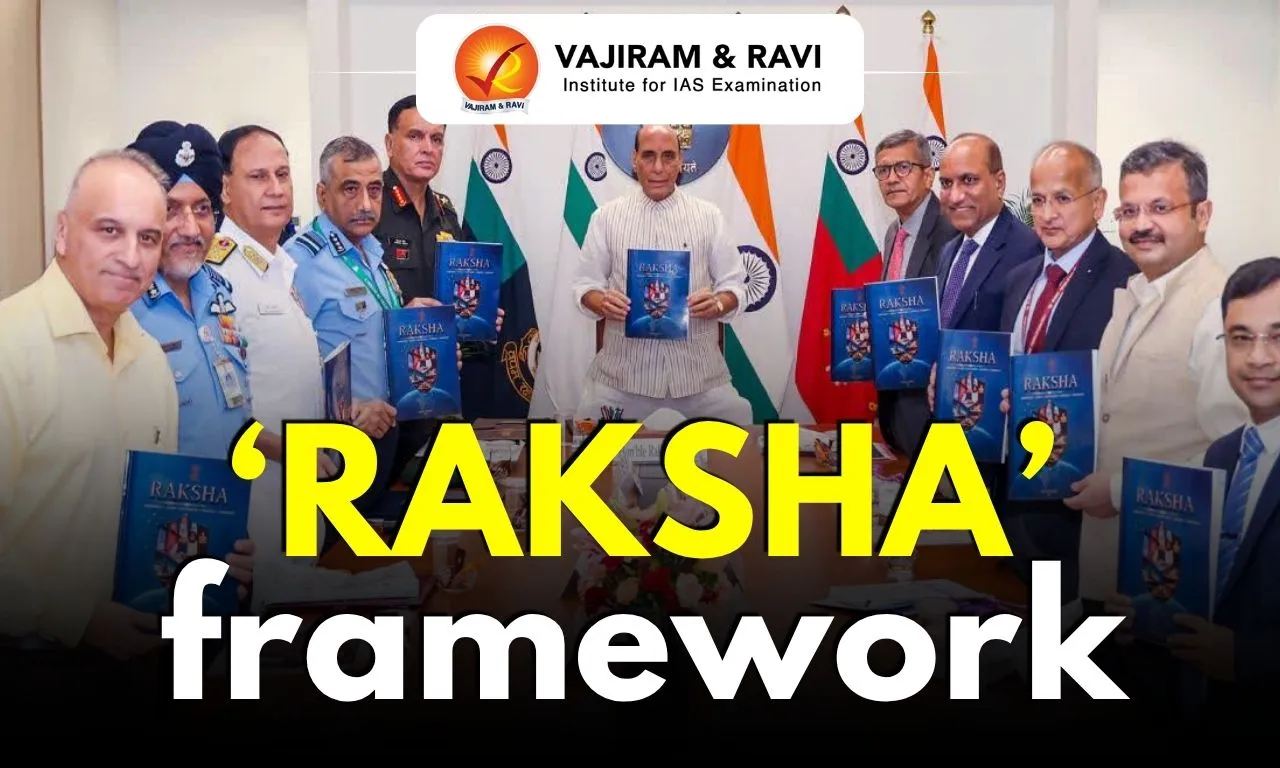
‘RAKSHA’ Framework

‘RAKSHA’ Framework

‘RAKSHA’ Framework Latest News

The Defence Minister recently released ‘Raksha’, a comprehensive strategic framework outlining India’s roadmap and vision for defence diplomacy and global defence partnerships over the next 10 years.

About ‘RAKSHA’ Framework

  • It is a comprehensive strategic framework outlining India’s road map and vision for defence diplomacy and global defence partnerships over the next 10 years. 
  • The document seeks to strengthen India’s strategic engagement with friendly nations by aligning national security objectives with proactive international cooperation.
  • It lays down an actionable vision aimed at promoting long-term stability, strengthening partnerships, and advancing India’s role in an evolving global security environment. 
  • Key pillars highlighted in the strategic blueprint include:
    • Strategic Partnerships: Deepening bilateral and multilateral security cooperation.
    • Capacity Building: Enhancing joint military exercises, training programmes, and sharing best practices with friendly nations.
    • Indigenous Exports: Promoting Make-in-India defence platforms to establish the nation as a reliable global defence manufacturing hub.
    • Maritime security: Strengthening India’s role as a Net Security Provider and First Responder in the Indian Ocean Region.

News: TH

‘RAKSHA’ framework FAQs

Q1: What is the ‘RAKSHA’ framework?

Ans: It is a comprehensive strategic framework outlining India’s roadmap and vision for defence diplomacy and global defence partnerships over the next 10 years.

Q2: What is the main objective of the RAKSHA framework?

Ans: To strengthen India’s strategic engagement with friendly nations through proactive international cooperation.

Q3: What are the four key pillars highlighted in the RAKSHA framework?

Ans: Strategic Partnerships, Capacity Building, Indigenous Exports and Maritime Security.

Pichavaram Mangrove Forest

Pichavaram Mangrove Forest

Pichavaram Mangrove Forest Latest News

A recent study of the Pichavaram mangrove ecosystem estimated its Total Economic Value (TEV) at ₹2,485.38 crore ($289 million), with a per-hectare value of ₹1.83 crore, reflecting the ecological, economic and social benefits it provides.

About Pichavaram Mangrove Forest

  • It is located near Chidambaram in Tamil Nadu. 
  • These mangroves are the second largest mangroves in the world after Sundarbans. 
  • The forest is spread over 1,100 hectares and joins the Bay of Bengal, where it's separated by a lengthy sand bank.  
  • It lies between two important estuaries: the Vellar estuary to the north and the Coleroon estuary to the south. 
  • This mangrove ecosystem is part of the Vellar-Coleroon complex, which shapes the Killai backwater and Pichavaram mangroves.  
  • The Pichavaram forest spans across various habitats, including channels, creeks, gullies, mud flats, and sand flats. 
  • Apparently, the forest has more than 50 islands of various sizes and 4,400 big and small canals. 
  • The trees grow in water that's 3 to 10 feet deep in different places.  
  • It provides a home to more than 200 species of birds. Some of the bird species commonly spotted here include Snipes, Egrets, Cormorants, Storks, Herons, Spoonbills, and Pelicans. 
  • Also, you can spot various marine life such as seaweed, fish, prawns, crabs, and oysters, as well as turtles and otters in this diverse ecosystem. 
  • It was designated a Ramsar Site in 2022.

News: TH

Pichavaram Mangrove Forest FAQs

Q1: Where is the Pichavaram Mangrove Forest located?

Ans: Near Chidambaram in Tamil Nadu.

Q2: Which major water body is connected to the Pichavaram Mangrove Forest?

Ans: The Bay of Bengal.

Q3: Between which two important estuaries is the Pichavaram Mangrove Forest located?

Ans: The Vellar estuary and the Coleroon estuary.

Q4: Which of the following habitats are found in the Pichavaram Mangrove Forest?

Ans: Channels, creeks, gullies, mud flats and sand flats.

Joint Parliamentary Committee on FCRA Bill 2026, Need, Structure

Joint Parliamentary Committee on FCRA Bill 2026

The Joint Parliamentary Committee on FCRA Bill 2026 was constituted to examine proposed changes to the Foreign Contribution (Regulation) Act, 2010. The 31 member panel is chaired by Lok Sabha MP Sanjay Jaiswal. Both Houses approved referral of the Bill to a JPC on 12 August 2026. The committee will examine provisions concerning foreign contributions, organisational assets, regulatory oversight, accountability and compliance before submitting its report to the Lok Sabha.

What is the Joint Parliamentary Committee on FCRA Bill 2026?

The Joint Parliamentary Committee on FCRA Bill 2026 is a 31 member parliamentary panel formed for detailed scrutiny of the Foreign Contribution (Regulation) Amendment Bill 2026. Lok Sabha Speaker Om Birla constituted the committee. Sanjay Jaiswal was appointed its chairperson. The panel includes members from both Lok Sabha and Rajya Sabha. It has been directed to submit its report by the last day of the first week of Parliament's Winter Session.

What is a Joint Parliamentary Committee (JPC)?

A Joint Parliamentary Committee is a temporary committee of Parliament formed by both Houses to examine specific bills, issues, or matters in greater detail. It includes members from both Lok Sabha and Rajya Sabha.

  • Purpose: A JPC conducts detailed examination of a Bill or specific matter referred to it by Parliament.
  • Formation: A JPC is constituted through a motion adopted by Parliament. Its composition generally reflects the strength of political parties in Parliament.
  • Chairperson: The committee is headed by a chairperson appointed as per parliamentary procedure. The chairperson conducts meetings and guides the committee's proceedings.
  • Functions: A JPC examines provisions, hears views of stakeholders, studies relevant evidence and submits its findings and recommendations to Parliament.
  • Temporary Nature: A JPC is constituted for a specific purpose and period. It ceases to exist after completing its assigned task and submitting its report.

Joint Parliamentary Committee on FCRA Background

The Joint Parliamentary Committee FCRA provides Parliament with an opportunity to examine the proposed amendments, regulatory concerns and stakeholder objections before legislative consideration.

  • Referral to JPC: Both Houses of Parliament adopted motions on 12 August 2026 to refer the Foreign Contribution (Regulation) Amendment Bill 2026 for detailed parliamentary scrutiny.
  • Need for scrutiny: The Bill proposes tighter oversight of foreign contributions and NGOs. Opposition parties raised concerns about its possible impact on minorities and civil society organisations.
  • Government's position: The government rejected allegations that the Bill discriminates against minorities. It challenged the Opposition to identify any provision that specifically targets minorities.
  • Northeastern concerns: Nagaland Chief Minister Neiphiu Rio and Mizoram Chief Minister Lalduhoma sought parliamentary examination. Meghalaya Chief Minister Conrad K Sangma also raised concerns regarding provisions of the Bill.
  • Asset management issue: The Bill proposes a designated authority to manage and dispose of assets linked to organisations whose FCRA registration is cancelled, surrendered or ceases.

Joint Parliamentary Committee on FCRA Structure

The Joint Parliamentary Committee has 31 members drawn from both Houses, with representation from several political parties and a defined deadline for submitting its findings.

  • Chairperson: Lok Sabha MP Sanjay Jaiswal of the BJP is the chairperson of the Joint Parliamentary Committee examining the FCRA Amendment Bill 2026.
  • Constitution: Lok Sabha Speaker Om Birla constituted the 31 member panel. It comprises 14 BJP members and five Congress members, besides representation from other parties.
  • Major Lok Sabha Members: Sanjay Jaiswal, Bhartruhari Mahtab, Tejasvi Surya, Kamlesh Jangde, Mukeshkumar Chandrakaant Dalal, Nishikant Dubey, Vishnu Dayal Ram, Ananta Nayak and Arvind Dharmapuri are included.
  • Major Rajya Sabha members: C Sadanandan Master, Harsh Vardhan Shringla, Ujjwal Deorao Nikam, Alka Gurjar and P Wilson are included.
  • Timeline: The Bill was introduced in Lok Sabha on 25 March 2026. Both Houses approved its JPC referral on 12 August 2026. The report is due before the first week of the Winter Session ends.
  • Core function: The committee will scrutinise the FCRA Amendment Bill 2026, examine its provisions and consider concerns raised by political parties and other stakeholders before reporting to Parliament.

What is FCRA Act?

The Foreign Contribution (Regulation) Act regulates receipt and use of foreign contributions in India. The 2026 Bill seeks further changes focused on transparency, accountability and regulatory clarity.

  • The Foreign Contribution (Regulation) Act, 2010 governs foreign contributions received by individuals, associations, NGOs, trusts and companies from sources outside India.
  • The FCRA is administered by the Ministry of Home Affairs. It regulates eligibility, receipt, utilisation, accounting and reporting of foreign contributions.

Foreign Contribution (Regulation) Act Amendment Bill 2026

The Foreign Contribution (Regulation) Amendment Bill 2026 was introduced in Lok Sabha on 25 March 2026. It proposes further amendments to the 2010 Act.

  • Main objective: The Foreign Contribution (Regulation) Act Amendment Bill 2026 seeks greater transparency and accountability in the receipt, management and utilisation of foreign contributions.
  • Designated authority: The Bill proposes a designated authority for safeguarding, managing and disposing of assets connected with organisations whose FCRA registration ends.
  • Asset vesting: Foreign funded assets would be provisionally vested when registration ends. Restoration of registration would allow return of assets and unused funds under the proposed framework.
  • Permanent vesting: Permanent vesting would apply if registration is not restored within the prescribed period. The assets would be used for public purposes, with sale proceeds credited to the Consolidated Fund of India.
  • Religious sites: The proposed framework requires preservation of the religious character of places of worship. The designated authority cannot convert, repurpose or secularise such institutions.
  • Judicial remedy: An organisation affected by an order of the designated authority may seek revision within 90 days. A further appeal can be made before the District Judge.
  • Punishment: The FCRA Amendment Bill 2026 proposes reducing the maximum imprisonment for FCRA violations from five years to one year.
  • Investigations: State governments and agencies would require Central Government approval before initiating investigations under the FCRA, aiming to prevent parallel proceedings.

Joint Parliamentary Committee on FCRA Bill 2026 FAQs

Q1: What is the JPC on FCRA Bill 2026?

Ans: It is a 31 member parliamentary committee formed to examine the Foreign Contribution (Regulation) Amendment Bill 2026 in detail.

Q2: Who is the chairman of the FCRA JPC?

Ans: Lok Sabha MP Sanjay Jaiswal is the chairperson of the Joint Parliamentary Committee on the FCRA Amendment Bill 2026.

Q3: When was the FCRA Amendment Bill 2026 referred to the JPC?

Ans: Both Houses of Parliament approved its referral to the Joint Parliamentary Committee on 12 August 2026 for detailed scrutiny.

Q4: When was the FCRA Amendment Bill 2026 introduced?

Ans: The Foreign Contribution (Regulation) Amendment Bill 2026 was introduced in the Lok Sabha on 25 March 2026.

Q5: What is the purpose of the FCRA Amendment Bill 2026?

Ans: The Bill seeks to strengthen transparency, accountability and regulatory oversight concerning foreign contributions and organisations receiving such funds.

Subarnarekha River

Subarnarekha River

Subarnarekha River Latest News

Over 45,000 people in 22 gram panchayats across three blocks of Balasore were affected by floods as the Subarnarekha river breached its banks again recently.

About Subarnarekha River

  • It is an important east-flowing river in India, flowing through Jharkhand, Odisha, and West Bengal.  
  • Subarnarekha means a "streak of gold" in English. The name is associated with the traditional presence of gold particles in its riverbed, particularly near its source. 
  • Course:
    • It originates near Nagri village in the Ranchi district of Jharkhand, at an elevation of 600 meters above sea level. 
    • From here, it flows eastward through the Chhotanagpur Plateau, a region rich in mineral resources like copper. 
    • As it moves across this plateau, the river passes through Hundrugbagh Waterfall, which marks its exit from the plateau. 
    • After covering a distance of 395 kilometers, the Subernarekha finally drains into the Bay of Bengal at Kirtania port in Odisha.  
  • Tributaries: Along the way, it is joined by several important tributaries, including the Kanchi, Kharkai, and Karkari rivers. 
  • Basin
    • Geographically, the Subarnarekha Basin lies between the Damodar River to the north and the Brahmani and Baitarani rivers to the south. 
    • To the west, it’s bordered by the Chhotanagpur Plateau, and to the southeast, it flows into the Bay of Bengal. 
    • The basin extends over States of Jharkhand, Odisha, and a comparatively smaller part in West Bengal.
    • The basin is generally influenced by the Southwest monsoon, which onsets in the month of June and extends up to October.
  • Dams and Reservoirs: Getalsud Reservoir, Chandil Dam, Galudih Barrage, and Icha Dam.
  • Cities along its course:
    • Ranchi (Jharkhand)
    • Jamshedpur (Jharkhand)
    • Chaibasa (Jharkhand)
    • Bhadrak (Odisha)
    • Kirtania Port (Odisha)

News: NIE

Subarnarekha River FAQ's

Q1: Which Indian states does the Subarnarekha River flow through?

Ans: Jharkhand, Odisha and West Bengal.

Q2: Where does the Subarnarekha River originate?

Ans: Near Nagri village in Ranchi district of Jharkhand.

Q3: Through which major physiographic region does the Subarnarekha River flow after its origin?

Ans: The Chhotanagpur Plateau.

Q4: Which waterfall marks the exit of the Subarnarekha River from the Chhotanagpur Plateau?

Ans: Hundrugbagh Waterfall.

Q5: Where does the Subarnarekha River ultimately drain?

Ans: Into the Bay of Bengal.

Marine Fish Resources in India: Valuing Ocean Wealth and the Blue Economy

Marine Fish Resources in India

Marine Fish Resources in India Latest News

  • India's Ministry of Statistics and Programme Implementation (MoSPI) has launched an unusual and significant experiment — assigning a monetary value to the country's marine fish stocks.
  • This move, aimed at measuring the wealth hidden in India's oceans, could reshape how the country accounts for its natural resources and manages its blue economy.

What Is MoSPI Trying to Do?

  • MoSPI has released a concept paper titled 'Methodological Approach for Compilation of Experimental Monetary Asset Accounts of Marine Fish Resources'
  • It is based on the UN System of Environmental-Economic Accounting (SEEA) — a global framework that links environmental data with economic accounts.
  • The basic idea is simple: fish in the sea are a natural capital asset. When fish are caught, this represents a flow of economic benefit drawn from that asset — much like income generated from any other resource. 
  • By valuing this properly, India can track whether its fish wealth is growing, shrinking, or staying stable over time.

Why Fisheries Matter to India

  • Fishing is a cornerstone of India's blue economy:
    • India is the second-largest fish producer in the world, accounting for 8% of global production.
    • Total fish production in FY25 was 19.77 million metric tonnes (MMT) — 77% from inland sources and 23% from marine sources.
    • The sector contributed an estimated ₹1.76 lakh crore, or 1.09% of national GVA, in 2023-24.
    • Marine fish production rose from 34.43 lakh tonnes (2013-14) to 46.15 lakh tonnes (2024-25).
    • Fisheries support nearly 30 million livelihoods.
    • Over 350 varieties of marine products reach 130 countries; FY25 exports stood at 1.7 MMT worth ₹62,408.45 crore, growing 3.11% annually in volume.
  • Despite these impressive numbers, raw production data has a blind spot: it doesn't reveal whether individual fish species or regional stocks can sustain similar output in the future, or how fishing pressure and climate change are affecting them.

Joining a Select Global Club

  • If successful, India would join a small group of countries — Australia, the Netherlands, Norway, Canada, the UK, France, the US, and New Zealand — that have attempted to bring ocean wealth into their national accounts.
  • The OECD notes that only a handful of countries currently compile monetary accounts for aquatic resources, unlike more mature accounting fields like forests or minerals. 
  • Even the global guidance framework (SEEA-Fisheries) is considered somewhat outdated.
  • India has been building environmental accounts since 2018 through its EnviStats India programme, covering land, water, forests, minerals and pollination. 
  • However, it still lacks a regular, comprehensive "blue economy GDP" series — though current estimates suggest the blue economy contributes around 4% of India's GDP.

The Bigger Push Behind Blue Economy

  • The government's commitment is reflected in budget allocations: the latest Union Budget earmarked a record ₹2,761.8 crore for the sector, with the Pradhan Mantri Matsya Sampada Yojana (PMMSY) receiving ₹2,500 crore for 2026-27 as its central pillar.
  • India's strengths in this space are considerable:
    • A coastline of about 11,100 km;
    • An Exclusive Economic Zone (EEZ) spanning over 2 million sq km;
    • Rich marine biodiversity, supporting India's ambition of a $100-billion blue economy by 2030.
  • However, ocean space isn't used by fisheries alone — it's shared with ports, tourism, offshore energy, and coastal development. 
  • Proper accounting can make trade-offs between these competing uses more transparent, and help decide whether India should invest in more fishing capacity, stock restoration, or deep-sea fisheries. 
  • Notably, NITI Aayog estimates India's EEZ resource potential at around 7.16 MMT, while cautioning that some deep-sea resources remain vulnerable to overexploitation.

How Will the Valuation Actually Work?

  • The accounting process involves a few clear steps:
    • Identify important species — selecting commercially, economically, or ecologically significant marine fish stocks.
    • Assess stock health — using ten years of species-wise landing data as a proxy to check whether a stock is regenerating, stable, or depleting, by comparing current landings to historical peaks.
    • Estimate "asset life" — how long a resource can keep generating value, linking fisheries science with economics.
    • Calculate resource rent — the income attributable purely to the natural resource, after deducting labour costs, operating expenses, depreciation, and normal returns on fishing vessels.
    • Project future value — expected future resource rents are projected over the stock's asset life and discounted at a proposed 2% real rate to estimate present value.
  • The final output is a marine fish asset account — a record combining both physical condition and economic value of fish stocks. 
  • Unlike simple annual catch figures, this account shows whether the resource base supporting future fishing income is being maintained, depleted, or regenerated. 
  • It's worth noting this remains an experimental estimate, built largely on proxy methods due to existing data limitations in the marine fisheries sector.

Conclusion

  • India's blue economy stands at an important crossroads — balancing genuine opportunities for growth against the responsibility of sustainable resource use. 
  • The exercise should not become mere "statistical spectacle." Its real value will be judged by whether it leads to better catch limits, more sustainable harvesting practices, stronger coastal livelihoods, and a clearer national picture of how ocean wealth is changing over time.

Source: TH

Marine Fish Resources in India FAQs

Q1: Why are Marine Fish Resources in India being given a monetary value?

Ans: Marine Fish Resources in India are being valued to measure natural wealth, track stock conditions and improve sustainable management of ocean resources.

Q2: How important are Marine Fish Resources in India to the economy?

Ans: Marine Fish Resources in India support fisheries, exports, livelihoods and the broader blue economy, making their sustainable management economically significant.

Q3: How will Marine Fish Resources in India be valued?

Ans: Marine Fish Resources in India will be assessed using stock health, asset life, resource rents and discounted future economic benefits.

Q4: What is the significance of valuing Marine Fish Resources in India?

Ans: Valuing Marine Fish Resources in India can reveal whether resource wealth is being maintained, depleted or regenerated beyond annual catch statistics.

Q5: What challenges affect valuation of Marine Fish Resources in India?

Ans: Valuation of Marine Fish Resources in India remains experimental because limited fisheries data requires researchers to rely substantially on proxy-based methods.

India Manufacturing GDP: Understanding the 41% Gap in Official GVA Estimates

India Manufacturing GDP

India Manufacturing GDP Latest News

  • The National Statistical Office (NSO) recently released new National Accounts Statistics (NAS), showing manufacturing sector's Gross Value Added (GVA) at ₹38.6 lakh crore for 2023-24 — 14.7% of GDP. 
  • But when researchers cross-checked, this figure using other official data sources, they found a much lower number, raising questions about the reliability of the official estimate.

Understanding Manufacturing's Two Parts

  • India's manufacturing sector is made up of two segments:
    • The organised sector — registered factories and companies, tracked by the Annual Survey of Industries (ASI).
    • The unorganised sector — small, informal workshops and household units, tracked by the Annual Survey of Unincorporated Sector Enterprises (ASUSE).
  • Together, these two surveys should capture almost all of India's manufacturing output. 
  • So, researchers added up the GVA from both surveys to create an "Alternative Estimate" and compared it with the official figure.

The Gap: A 41% Difference

  • The Alternative Estimate, based on ASI and ASUSE data, works out to just ₹27.4 lakh crore — significantly lower than the official ₹38.6 lakh crore
  • That's a difference of nearly 41%, far too large to be explained by minor definitional or methodological differences between surveys.
  • Since the unincorporated sector uses the same ASUSE data in both calculations, it cannot explain this gap. 
  • The unorganised sector, in any case, contributes only about 14% of total manufacturing GVA. 
  • This means the real mismatch lies somewhere in how the organised (company) sector's output is being calculated.

Where Does the Official Data Come From?

  • For the organised sector, the NAS doesn't rely only on ASI data. 
  • Instead, since the last major revision (base year 2011-12), it has increasingly used company balance-sheet data from the Ministry of Corporate Affairs' database, known as MCA-21
  • This database is built from annual statutory filings that registered companies are legally required to submit — and this practice continues in the latest revision too.

Checking the Numbers Using Employment Data

  • One way to sanity-check GVA figures is to look at how many workers are actually employed and estimate what they could realistically produce. 
  • This is where an interesting discrepancy shows up:
    • The Periodic Labour Force Survey (PLFS) estimates 697.5 lakh workers in manufacturing for 2023-24.
    • But ASI and ASUSE data together account for only 532.9 lakh workers.
    • This leaves 164.6 lakh "residual workers" unaccounted for — likely employed in smaller non-factory companies or informal units too small to be captured by ASUSE
  • Using standard production ratios, researchers estimated that these residual workers could plausibly add about ₹3.6 lakh crore in GVA. 
  • Adding this to the earlier Alternative Estimate of ₹27.4 lakh crore brings the potential total to ₹31.0 lakh crore.

The Unexplained Gap Still Remains

  • Even after this adjustment, the potential estimate of ₹31.0 lakh crore is still 24.5% short of the official ₹38.6 lakh crore figure. 
  • In other words, all identifiable workers — in both companies and informal units — can only account for about 80% of the official GVA estimate. 
  • That leaves roughly ₹7.6 lakh crore worth of manufacturing output that remains genuinely unexplained.

Possible Explanations — And Why This Matters

  • The NSO has suggested that ASI, being a factory-based survey, may miss value addition happening outside the factory floor — such as at head offices, in marketing, distribution, or R&D activities. 
  • However, researchers point out that available evidence does not really support this explanation.
  • An alternative possibility is that the NSO's method of scaling up sample data — extrapolating from a sample of companies to represent the entire universe of registered companies — may be inflating the estimate, especially since the true size and composition of India's vast company universe remains unclear and largely unverified.
  • Manufacturing GVA is a key input for calculating India's overall GDP. 
  • Inflated or unreliable estimates can distort our understanding of the economy's real structure and health — affecting policy decisions on industrial growth, employment planning, and sectoral targeting.

Conclusion

  • The significant, unexplained gap between the official manufacturing GVA and independently verified estimates raises serious questions about India's statistical methodology, especially the use of scaled-up corporate filings. 
  • Resolving this puzzle requires the NSO to make its MCA data and estimation methods public for independent scrutiny — essential for maintaining confidence in India's economic statistics.

Source: TH | BL

India Manufacturing GDP FAQs

Q1: Why is India Manufacturing GDP facing scrutiny?

Ans: India Manufacturing GDP is under scrutiny because alternative estimates using official survey data produce significantly lower GVA than the government's published figure.

Q2: What is the difference between the official and alternative India Manufacturing GDP estimates?

Ans: The official India Manufacturing GDP estimate is ₹38.6 lakh crore, while the alternative estimate is ₹27.4 lakh crore, creating nearly a 41% difference.

Q3: How does MCA-21 affect India Manufacturing GDP estimates?

Ans: MCA-21 company balance-sheet data increasingly contributes to India Manufacturing GDP estimates, replacing exclusive reliance on factory survey data for organised manufacturing.

Q4: What does employment data reveal about India Manufacturing GDP?

Ans: Employment data suggests that identifiable manufacturing workers cannot fully explain official India Manufacturing GDP, leaving approximately ₹7.6 lakh crore unexplained.

Q5: Why does the India Manufacturing GDP discrepancy matter?

Ans: The India Manufacturing GDP discrepancy matters because unreliable GVA estimates could distort economic assessment, industrial policy, employment planning and sectoral targeting.

India Belgium Bilateral Relationship – Explained

India Belgium Bilateral Relationship

India Belgium Bilateral Relationship Latest News

  • India and Belgium have agreed to strengthen cooperation in defence, intelligence-sharing, trade, semiconductors, fintech and renewable energy during Belgian Prime Minister Bart De Wever's visit to India, the first by a Belgian Prime Minister in two decades.

India Belgium Bilateral Relations

  • India and Belgium share close economic and diplomatic relations, with trade and investment traditionally forming the core of bilateral engagement
  • The India-Belgium-Luxembourg Economic Union Joint Commission, established in 1997, is an important institutional mechanism for economic cooperation. 
  • Belgium is particularly important to India because of its role as a major global centre for diamond trading, with Antwerp serving as a key hub. 
  • Bilateral cooperation has also expanded into science and technology, healthcare, renewable energy and other sectors.
  • India's engagement with Belgium also has a wider European dimension. Belgium's position within the European Union makes bilateral cooperation relevant to India's broader relationship with the EU.

Economic Relations

  • Bilateral trade reached US$13.01 billion in 2025-26, while Belgian FDI inflows into India amounted to approximately US$4.2 billion between April 2000 and December 2025
  • Diamond trade remains a significant component of bilateral commerce. 
  • The two countries are seeking to diversify this economic relationship through fintech, semiconductors, manufacturing, renewable energy and technology.

News Summary

  • Defence and security emerged as a major area of cooperation during the recent meeting.
  • India and Belgium exchanged a Letter of Intent establishing a framework for structured defence cooperation. It covers:
    • Military training and exchanges
    • Research and development
    • Joint exercises and seminars
    • Maritime security
    • Defence industrial cooperation
  • The two sides also agreed to strengthen intelligence-sharing and cooperation between security agencies to combat crime. 
  • Around 15 Belgian defence companies participated in discussions with Indian defence industry representatives. 

Defence Industrial Cooperation

  • The discussions identified opportunities in drones, rockets, ammunition, mine-countermeasure systems, tanks, radar, electro-optical sensors and counter-drone systems. 
  • Several industrial collaborations were highlighted. New Lachaussée and Tembo Classic Engineering will establish an ammunition production line with an annual capacity of about 100 million rounds, under a project valued at €50 million. 
  • Exail Belgium and Larsen & Toubro are cooperating on autonomous systems for mine-countermeasure vessels, initially covering 12 vessels with potential expansion to 59. 
  • Other collaborations involve 70 mm rocket assembly, weapons and counter-drone systems, electro-optical systems for Arjun tanks, the Zorawar light tank, air-defence software and marine engines. 

Trade, Investment and Fintech

  • India has established an Investment Fast-Track Mechanism for Belgian companies and agreed to make the India-Belgium Business Forum a regular platform.
  • Both countries also intend to strengthen coordination among their financial, fintech and regulatory institutions. They have set an objective of doubling bilateral trade over the next five years. 

Semiconductors and Renewable Energy

  • The two sides agreed to deepen cooperation in semiconductors, an area of growing importance for resilient global supply chains.
  • They also agreed to work towards a renewable energy pact, expanding bilateral cooperation into clean-energy technologies and the energy transition. 

Maritime Security

  • Maritime security is another emerging area of cooperation. India is seeking stronger capabilities in mine countermeasures, autonomous maritime systems, underwater robotics and advanced sensors, along with protection of critical infrastructure such as ports, pipelines and subsea data cables. 
  • The cooperation is significant for both countries because secure maritime routes are important for international trade and supply chains.

Global and Regional Issues

  • India and Belgium also discussed international developments, including Ukraine and West Asia. Both sides emphasised dialogue, diplomacy and respect for the principles of the UN Charter and international law.
  • They also stressed the importance of maintaining safe and unimpeded maritime shipping. 

Significance

  • The recent developments indicate a broadening of India-Belgium relations beyond traditional trade and investment. 
  • Defence manufacturing, maritime security, semiconductors, fintech and renewable energy are emerging as important areas of cooperation.
  • For India, Belgium can provide access to specialised European technologies and industrial capabilities, while Indian manufacturing capacity and market opportunities can support Belgian companies. 
  • The partnership also contributes to India's wider engagement with Europe and the European Union.

Conclusion

  • India-Belgium relations are evolving into a broader partnership combining economic engagement with defence, technology and strategic cooperation. 
  • The recent agreements and proposed industrial collaborations provide a framework for deeper engagement, while the emphasis on trade diversification, semiconductors, maritime security and renewable energy reflects the changing priorities of both countries.

Source: IE | TH

India Belgium Bilateral Relationship FAQs

Q1: What is the main economic pillar of India-Belgium relations?

Ans: Trade and investment have traditionally been the main economic pillars of India–Belgium relations.

Q2: What was India's bilateral trade with Belgium in 2025-26?

Ans: Bilateral trade reached approximately US$13.01 billion in 2025-26.

Q3: What areas are covered by the new defence cooperation framework?

Ans: The framework covers military exchanges, training, research and development, joint exercises, seminars and maritime security.

Q4: What is the target for bilateral trade?

Ans: India and Belgium have set a target of doubling bilateral trade over the next five years.

Q5: Which emerging sectors are being prioritised?

Ans: The two countries are expanding cooperation in semiconductors, defence technology, fintech and renewable energy, alongside existing economic ties.

ISRO Successfully Launches EOS-05 Earth Observation Satellite

ISRO EOS-05 Launch 2026

The Indian Space Research Organisation (ISRO) has launched the GSLV-F17/EOS-05 mission on September 4, 2026, at 2:55 AM IST. The mission lift off from the Second Launch Pad (SLP) at Satish Dhawan Space Centre (SDSC-SHAR), Sriharikota.

The GSLV-F17 carried EOS-05, an advanced Earth observation satellite, and placed it into a Sub-Geosynchronous Transfer Orbit (Sub-GTO). A major feature of the mission is that EOS-05 is India's first imaging satellite designed for operation from a geosynchronous orbit.

What is GSLV-F17?

GSLV-F17 is the launch vehicle assigned to place EOS-05 into its designated orbit. It belongs to India's Geosynchronous Satellite Launch Vehicle (GSLV) family, which is designed to launch heavier spacecraft into high-energy orbits.

For the GSLV-F17 mission, ISRO is using a 4-metre diameter Ogive composite payload fairing. The fairing protects the satellite from atmospheric conditions during the initial phase of flight.

The vehicle will inject EOS-05 into a Sub-Geosynchronous Transfer Orbit (Sub-GTO). From there, the spacecraft can be manoeuvred towards its operational orbit.

What is EOS-05?

EOS-05 is a state-of-the-art Earth observation spacecraft developed by ISRO. It is particularly significant because it is described by ISRO as India's first-ever imaging satellite from a geosynchronous orbit.

Earth observation satellites collect information about the Earth's surface and atmosphere. Their data can support applications such as:

  • Land and resource monitoring
  • Agricultural assessment
  • Disaster management
  • Environmental monitoring
  • Weather and climate-related studies
  • Mapping and planning

EOS-05 and Geosynchronous Orbit

A key aspect of the mission is the use of a geosynchronous orbit for Earth imaging.

A geosynchronous satellite has an orbital period approximately equal to Earth's rotation period. Such an orbit allows a satellite to repeatedly observe a particular region at regular intervals.

The use of geosynchronous orbit for Earth observation can be particularly useful for frequent monitoring of large areas. This makes the EOS-05 mission important from the perspective of India's remote sensing and Earth observation capabilities.

What is Sub-Geosynchronous Transfer Orbit?

The Sub-Geosynchronous Transfer Orbit (Sub-GTO) is the target orbit into which GSLV-F17 will place EOS-05.

A transfer orbit is used to move a spacecraft from the launch vehicle's initial injection conditions towards its intended operational orbit. After reaching the transfer orbit, the satellite can undertake additional orbital manoeuvres to reach its final position.

The distinction between GTO, Sub-GTO, geosynchronous orbit and geostationary orbit is important while understanding India's space missions.

ISRO EOS-05 Launch 2026 Significance

GSLV-F17/EOS-05 Mission is significant for strengthening India’s Earth observation capabilities and demonstrating the use of a geosynchronous orbit for imaging applications.

  • First geosynchronous imaging satellite: EOS-05 is India’s first-ever imaging satellite from a geosynchronous orbit.
  • Strengthens Earth observation: The mission will enhance India’s ability to obtain space-based Earth observation data.
  • Advances satellite applications: Earth observation data can support resource monitoring, environmental studies, agriculture and disaster management.
  • Demonstrates GSLV capability: GSLV-F17 marks the 19th flight of the GSLV, adding to India’s experience with high-energy orbital missions.
  • Technological advancement: The mission reflects progress in developing advanced spacecraft and launch vehicle technologies.
  • Strategic importance: Improved space-based observation capabilities can contribute to better planning, monitoring and management of natural resources.
  • Expands orbital applications: EOS-05 demonstrates the potential of geosynchronous orbit for Earth imaging, broadening India's remote-sensing capabilities.

Importance of Earth Observation Satellites

Earth observation satellites are an important part of modern space-based infrastructure. They provide data that can be used by governments, researchers and other organisations for monitoring changes on Earth.

Their applications include:

  • Agriculture: Monitoring crops and agricultural conditions.
  • Disaster Management: Assessing floods, cyclones, landslides and other disasters.
  • Water Resources: Monitoring water bodies and changes in water resources.
  • Forestry: Tracking forest cover and environmental changes.
  • Urban Planning: Supporting mapping and development planning.
  • Environmental Monitoring: Studying changes in ecosystems and land use.
  • Climate Studies: Providing observations useful for understanding environmental and climatic changes.

ISRO EOS-05 Launch 2026 FAQs

Q1: What is ISRO EOS-05 Launch 2026?

Ans: The ISRO EOS-05 Launch 2026 took place on 4 September, India’s advanced Earth observation satellite into Sub-GTO.

Q2: When will EOS-05 be launched?

Ans: The GSLV-F17/EOS-05 mission has been launched on September 4, 2026, at 2:55 AM IST.

Q3: Which launch vehicle launched EOS-05?

Ans: EOS-05 has been launched using GSLV-F17, which is the 19th flight of India's Geosynchronous Satellite Launch Vehicle (GSLV).

Q4: Where will the EOS-05 launch take place?

Ans: The launch took place from the Second Launch Pad (SLP) at Satish Dhawan Space Centre, Sriharikota.

Q5: What type of satellite is EOS-05?

Ans: EOS-05 is an Earth observation satellite developed by ISRO. Its primary application is Earth observation.

Dadabhai Naoroji Birth Anniversary 2026, History, Significance

Dadabhai Naoroji Birth Anniversary 2026

Dadabhai Naoroji Birth Anniversary 2026 is commemorated on September 4, marking the 201st birth anniversary of Dadabhai Naoroji, one of the leading figures of India's early nationalist movement. Popularly known as the “Grand Old Man of India,” he played an important role in highlighting the economic exploitation of India under British rule.

Who Was Dadabhai Naoroji?

Dadabhai Naoroji was an influential Indian nationalist, economist and political leader who worked to bring attention to the economic and political problems faced by Indians under British rule.

He believed that India's growing poverty was closely connected with colonial economic policies. Through his speeches, writings and political activities, he explained how India's resources and wealth were being transferred to Britain.

Naoroji also believed that Indians should have greater participation in government and administration. His moderate political approach initially focused on constitutional methods, political representation and administrative reforms.

What Was Dadabhai Naoroji's Drain of Wealth Theory?

Drain of Wealth Theory is one of Dadabhai Naoroji's most important contributions to Indian economic thought. He argued that a substantial amount of India's wealth was flowing to Britain without providing an equivalent economic benefit to India.

Naoroji identified several channels through which this economic drain took place. These included the salaries and pensions of British officials, payments made outside India and the remittances and profits of British personnel and businesses.

His arguments challenged the British claim that colonial rule was economically beneficial to India. Naoroji later presented his ideas in detail in his famous book, Poverty and Un-British Rule in India.

Dadabhai Naoroji and the Indian National Congress

Dadabhai Naoroji was one of the important early leaders associated with the Indian National Congress (INC). He served as the president of the Congress three times.

His three terms as INC president were:

  • 1886: Calcutta Session
  • 1893: Lahore Session
  • 1906: Calcutta Session

During his political career, Naoroji consistently raised questions about India's economic condition, political representation and administrative reforms.

His presidency of the 1906 Calcutta Session was particularly significant because the Congress adopted Swaraj as one of its major political objectives.

Dadabhai Naoroji in the British House of Commons

A major milestone in Dadabhai Naoroji's political career came in 1892, when he was elected to the British House of Commons from Finsbury Central.

He became the first Indian to become a Member of the British Parliament. His election was significant because it gave an Indian political leader an opportunity to raise India's concerns within the British political system itself.

While serving as an MP, Naoroji continued to speak about India's economic problems and argued for greater fairness in British policies towards India

Why Is Dadabhai Naoroji Called the “Grand Old Man of India”?

Dadabhai Naoroji is popularly called the “Grand Old Man of India” because of his long and influential contribution to Indian public life and the nationalist movement.

He was among the earliest Indian leaders to systematically study the economic effects of British rule. His economic arguments helped create greater awareness about colonial exploitation and India's economic condition.

His political work also influenced later nationalist leaders and contributed to the development of Indian economic nationalism.

Dadabhai Naoroji Birth Anniversary 2026 Significance

Dadabhai Naoroji Birth Anniversary 2026 is significant for remembering his contribution to Indian nationalism, economic thought, political representation and the freedom movement, particularly his Drain of Wealth Theory and efforts to secure Swaraj.

  • Economic Nationalism: Exposed the economic impact of British colonial policies on India.
  • Drain of Wealth Theory: Explained the continuous transfer of India's wealth to Britain.
  • Indian National Congress: Served as INC President three times in 1886, 1893 and 1906.
  • British Parliament: Became the first Indian elected to the British House of Commons in 1892.
  • Swaraj: Strengthened the early nationalist demand for self-government.
  • Nationalist Thought: His writings and political activities influenced the development of Indian nationalism.

Dadabhai Naoroji Birth Anniversary 2026 FAQs

Q1: When is Dadabhai Naoroji Birth Anniversary 2026 commemorated?

Ans: Dadabhai Naoroji Birth Anniversary 2026 is commemorated on September 4, 2026.

Q2: When was Dadabhai Naoroji born?

Ans: Dadabhai Naoroji was born on September 4, 1825, in Bombay, now Mumbai.

Q3: What is Dadabhai Naoroji popularly known as?

Ans: Dadabhai Naoroji is popularly known as the “Grand Old Man of India.”

Q4: What is Dadabhai Naoroji famous for?

Ans: He is best known for his Drain of Wealth Theory, which explained how British colonial policies contributed to the transfer of India's wealth to Britain.

Q5: When was Dadabhai Naoroji elected to the British House of Commons?

Ans: Dadabhai Naoroji was elected to the British House of Commons in 1892 from the Finsbury Central constituency.

Daily Editorial Analysis 4 September 2026

Daily-Editorial-Analysis

Youth Power, An Electoral Force Still in the Making

Context

  • India is witnessing an unprecedented political and social focus on its youth. Political parties, governments, think tanks, educational institutions and media organisations are increasingly engaging with Generation Z and Generation Alpha.
  • This attention reflects concerns over education, employment, skills, examinations, political participation and accountability.
  • With nearly two-thirds of Indians below 35, young people represent both a major demographic advantage and a potentially powerful political constituency.
  • Yet their numerical strength has not translated into a distinct youth vote. The key question is whether the current youth awakening will develop into sustained political participation.

Growing Political Attention to Youth

  • Governments have long introduced programmes for youth development covering employment, entrepreneurship, skill development, education, internships, sports and volunteering.
  • The National Education Policy (NEP) 2020 seeks to promote quality learning, innovation and empowerment, while the proposed National Youth Policy 2026 aims to prepare young people for the digital age.
  • However, policies alone cannot resolve the deeper challenges confronting young Indians. A major concern is the large population classified as not in education, employment or training (NEET).
  • The reported figure of 8.7 crore people aged 15–29 indicates a substantial amount of youthful potential without a productive anchor.

Youth as an Elusive Electoral Constituency

  • India has the world’s largest youth population, with around 65% of its population below 35 and approximately 23% of its electorate aged 18–29. Nevertheless, young voters have not emerged as a clearly identifiable electoral bloc.
  • Indian elections have traditionally been influenced by caste, community, class, occupation, religion and gender.
  • Dalits, minorities, Scheduled Castes, Scheduled Tribes, OBCs and specific caste groups have often functioned as recognisable electoral constituencies.
  • The women’s vote has also become increasingly significant.
  • By contrast, youth remain a heterogeneous constituency. A young farmer, unemployed graduate, student and technology worker can have very different priorities.
  • Therefore, age alone does not create a unified political identity. Employment and education, though crucial, have not yet displaced established social and regional loyalties.

Digital Youth and Political Communication

  • Political parties are adapting their communication strategies to reach young citizens through social media, digital platforms and informal political language.
  • Leaders are increasingly attempting to communicate in a direct and conversational manner, while educational campuses have become important political spaces.
  • However, digital engagement does not automatically translate into electoral participation.
  • Young people may consume political content without voting or becoming politically organised.
  • Genuine youth mobilisation therefore requires more than online visibility; it requires credible policies addressing their employment, education, skills and aspirations.

The Election Commission and Youth Participation

  • The Election Commission of India (ECI) has strengthened electoral literacy programmes in schools and colleges to familiarise students with the electoral system and democratic processes.
  • Such initiatives can help transform young people from passive recipients of political messaging into informed and active democratic participants.
  • Electoral literacy is particularly important for strengthening long-term civic engagement.

The Upcoming Electoral Test

  • The forthcoming Assembly elections in Uttarakhand, Uttar Pradesh, Punjab, Manipur and Goa could indicate whether recent youth activism translates into electoral preferences.
  • In closely contested constituencies, changes in youth turnout could potentially influence results.
  • However, India’s youth are not politically homogeneous. Young people in Uttar Pradesh and Punjab face different social and economic conditions, just as those in Goa and Manipur have distinct concerns.
  • Political parties therefore need region-specific youth policies rather than a single national formula.

Old Equations Still Matter

  • Despite growing attention to youth, established electoral calculations remain powerful.
  • Political parties possess longstanding caste equations, community networks, local organisations and booth-level mobilisation systems.
  • The youth constituency remains unpredictable. Young citizens may be highly expressive online but may not vote collectively.
  • Consequently, parties are unlikely to abandon traditional voting blocs for an uncertain youth constituency.
  • Their present strategy is more likely to combine youth-oriented messaging with established electoral structures.

Youth and India@2047

  • The vision of a developed India by 2047 places young Indians at the centre of national development and describes them as the Amrit Peedhi.
  • India’s demographic advantage, however, can become an economic and social asset only when young people receive quality education, productive employment, social mobility and political representation.
  • Swami Vivekananda's emphasis on the power of youth remains relevant. The contemporary challenge is to transform youthful potential into institutional, economic and democratic power.

Conclusion

  • The growing focus on employment, education, skills, digital participation and accountability reflects changing expectations among younger citizens.
  • Yet political attention does not necessarily signify the emergence of a consolidated youth vote. Caste, community, gender, region and traditional political networks continue to shape electoral behaviour.
  • India's demographic advantage will ultimately depend on how effectively it educates, employs, empowers and politically integrates its young citizens.
  • If this generation becomes an organised democratic force, it can move from being merely an electoral target to becoming a principal architect of India@2047.

Youth Power, An Electoral Force Still in the Making FAQs

Q1. Why are Indian political parties increasingly focusing on youth?
Ans. Political parties are focusing on youth because they constitute a large and potentially influential electorate.

Q2. What is a major challenge facing India’s youth?
Ans. A major challenge is the mismatch between education and employment opportunities.

Q3. Why has a distinct youth vote not emerged in India?
Ans. A distinct youth vote has not emerged because caste, community, gender and regional identities remain stronger electoral factors.

Q4. How is the Election Commission encouraging youth participation?
Ans. The Election Commission is promoting electoral literacy programmes in schools and colleges.

Q5. What is essential to realise India’s demographic advantage?
Ans. India must educate, employ, empower and politically integrate its young citizens.

Source: The Hindu


For Newborns, The Answer is Hospital Plus Home 

Context

  • India has made major progress in promoting institutional deliveries, yet a disturbing paradox has emerged: newborns are increasingly dying inside health facilities meant to protect them.
  • The deaths of three newborns in a fire at Amravati government women’s hospital on August 24, 2026, are part of a recurring pattern of clustered newborn deaths in government hospitals.
  • Though not a comprehensive national registry, such incidents indicate systemic weaknesses in neonatal care, including overcrowding, infrastructure failures, inadequate staffing and poor safety preparedness.
  • India must now move beyond merely ensuring institutional delivery towards ensuring safe, appropriate and high-quality newborn care.

The Problems and Challenges

  • Overcrowding: The Unintended Consequence of Progress
  • Institutional deliveries increased from 39% in 2005–06 to around 90% in 2023–24.
  • Women delivering in institutions rose from about 109 lakh in 2005 to 194 lakh in 2024–25.
  • Meanwhile, sick newborn admissions to public Special Newborn Care Units increased from 11.3 lakh in 2021–22 to 14.45 lakh in 2023–24, a 28% rise in ­­two years.
  • This expansion has placed neonatal units under severe pressure. Overcrowding can reduce individual attention, increase infection risks and overload equipment and staff.
  • Changing Case Mix
  • Government hospitals are increasingly receiving premature, low-birth-weight and critically ill newborns referred from peripheral facilities.
  • These babies require specialised equipment and continuous monitoring. Without adequate staffing and infrastructure, the growing concentration of high-risk cases can overwhelm neonatal units.
  • Infrastructure Failures
  • Neonatal care depends heavily on reliable oxygen, electricity and specialised equipment.
  • The oxygen-related crisis at Gorakhpur in 2017 and fires at Bhandara, Bhopal, Jhansi and Amravati demonstrate serious vulnerabilities.
  • Fire safety, electrical safety, oxygen security and emergency preparedness must become integral to neonatal healthcare.
  • Overcrowding can further increase electrical loads because incubators, warmers, ventilators and monitoring systems operate continuously.
  • Infection and Staffing
  • Inadequate nurse-to-baby ratios, equipment shortages and weak infection-control practices can significantly endanger vulnerable newborns.
  • Merely adding beds without strengthening human resources, infection prevention and clinical supervision will not adequately address neonatal mortality.

The Gadchiroli Model

  • India already possesses an effective alternative to hospital-centred newborn care.
  • The Gadchiroli field trial demonstrated that trained community health workers could provide effective home-based neonatal care, producing a 2% reduction in neonatal mortality in the rural population studied.
  • Community health workers supported breastfeeding and warmth, identified infections and managed appropriate low-birth-weight and premature babies.
  • The principles of this model have subsequently been incorporated into India’s public-health system, with around 8,00,000 ASHAs trained in home-based newborn care.
  • The key lesson is that not every newborn requiring care needs a hospital bed. Stable newborns can receive appropriate care at home, while those with serious complications can be referred immediately to specialised facilities.
  • However, home-based care is not a substitute for neonatal intensive care.
  • Babies with severe prematurity, respiratory distress, shock, severe sepsis or serious birth asphyxia require immediate facility-based treatment.

The Optimum Strategy

  • Decongest Neonatal Units
  • Home-based neonatal care should be strengthened through better training, supervision and support for ASHAs.
  • Appropriate and stable newborns can safely receive care at home, allowing SNCUs to focus on critically ill babies.
  • Strengthen Hospital-Based Care
  • Government neonatal units require adequate doctors and nurses, appropriate nurse-to-baby ratios, functioning equipment, reliable oxygen and electricity, backup systems and rigorous infection prevention.
  • The priority should be quality and resilience rather than simply increasing bed capacity.
  • Make Neonatal Units Intrinsically Safe
  • Hospitals should mandatorily install fire detection and suppression systems, electrical and oxygen safety mechanisms, conduct emergency evacuation drills and undergo independent safety audits.
  • Neonatal safety must be treated as a core component of healthcare rather than an afterthought.

Conclusion

  • India’s success in promoting institutional deliveries through programmes such as Janani Suraksha Yojana has brought mothers closer to professional healthcare.
  • However, institutional delivery is only the first step in protecting newborn lives.
  • The next phase must focus on capacity, quality, safety and appropriate distribution of neonatal care.
  • Hospitals should be strengthened without making hospitalisation the default response to every newborn requiring care.
  • India needs a continuum in which community-based home care and specialised hospital care complement each other.
  • The future of newborn healthcare should therefore not be hospital versus home but hospital plus home.

For Newborns, The Answer is Hospital Plus Home FAQs

Q1. What is the major challenge in India’s newborn care?
Ans. The major challenge is overcrowding and inadequate safety in neonatal units.

Q2. Why are neonatal units becoming overcrowded?
Ans. Rising institutional deliveries and increasing admissions of sick newborns are causing overcrowding.

Q3. What did the Gadchiroli model demonstrate?
Ans. The Gadchiroli model demonstrated that trained community workers can provide effective home-based neonatal care.

Q4. Which newborns require immediate hospital care?
Ans. Newborns with severe prematurity, respiratory distress, shock or serious infections require immediate hospital care.

Q5. What strategy should India adopt for newborn care?
Ans. India should adopt a “hospital plus home” strategy combining specialised hospital care with appropriate home-based care.

Source: The Hindu

Daily Editorial Analysis 2026 FAQs

Q1: What is editorial analysis?

Ans: Editorial analysis is the critical examination and interpretation of newspaper editorials to extract key insights, arguments, and perspectives relevant to UPSC preparation.

Q2: What is an editorial analyst?

Ans: An editorial analyst is someone who studies and breaks down editorials to highlight their relevance, structure, and usefulness for competitive exams like the UPSC.

Q3: What is an editorial for UPSC?

Ans: For UPSC, an editorial refers to opinion-based articles in reputed newspapers that provide analysis on current affairs, governance, policy, and socio-economic issues.

Q4: What are the sources of UPSC Editorial Analysis?

Ans: Key sources include editorials from The Hindu and Indian Express.

Q5: Can Editorial Analysis help in Mains Answer Writing?

Ans: Yes, editorial analysis enhances content quality, analytical depth, and structure in Mains answer writing.

Enquire Now