Cuban Revolution, Background, Timeline, Outcomes, Impact

Cuban Revolution

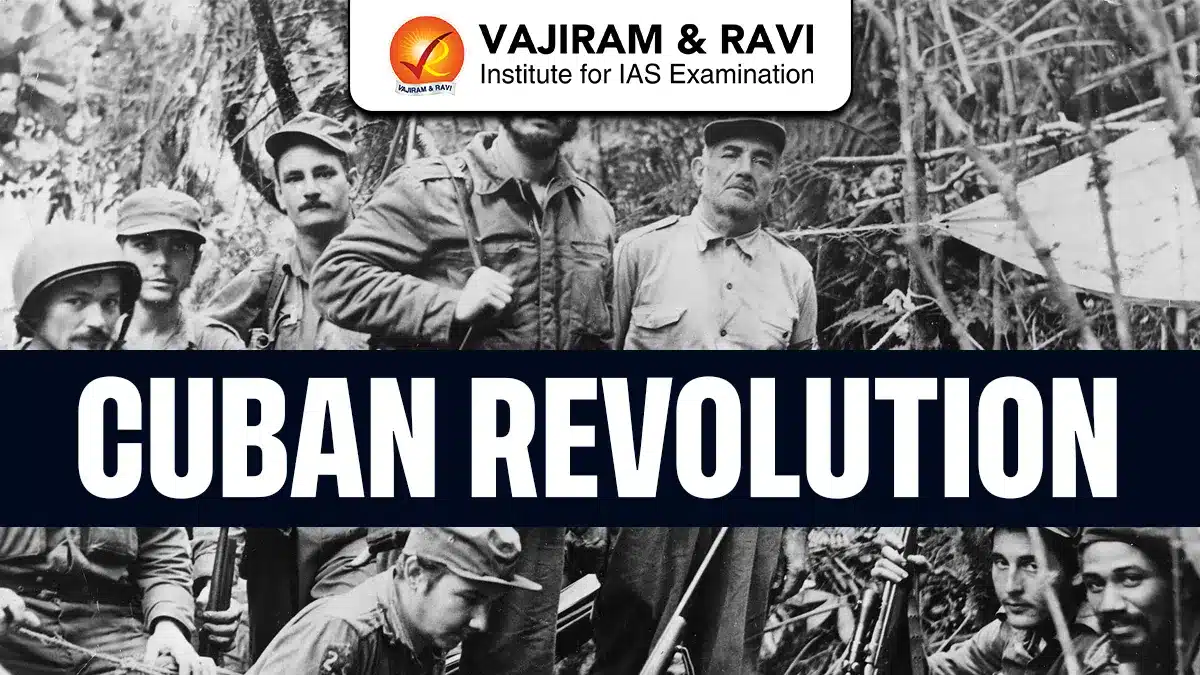
The Cuban Revolution was a major military and political event that took place between 1952 and 1959. It resulted in the overthrow of the dictator Fulgencio Batista and the rise of a new government led by Fidel Castro. The revolution started as a fight for democracy but eventually turned Cuba into a Marxist-Leninist state. It fundamentally changed Cuba’s relationship with the United States and became a symbol of resistance across Latin America. Today, the date of the first attack, July 26, is celebrated in Cuba as the "Day of the Revolution."

26th of July Movement

The 26th of July Movement (M-26-7), also called- “The Movement”, was a revolutionary organization founded by Fidel Castro and his supporters while in detention following the failed 1953 attack on the Moncada Barracks. Named after the date of that initial assault, the movement reorganized in Mexico and later conducted guerrilla warfare from the Sierra Maestra mountains. It eventually became the primary political and military force that toppled the Batista dictatorship in 1959, later reforming into the Communist Party of Cuba in 1965.

Cuban Revolution Background

Before the Cuban Revolution, Cuba was a Republic struggling with deep seated issues that made the population ready for a major change.

  • Since independence in 1902, political participation had been used by elites for wealth accumulation through bribes and illegal contracts.
  • United States businesses owned most of Cuba's industry and the American government supported Batista because he protected their financial interests.
  • While sugar prices boomed, the majority of Cubans suffered from high unemployment, limited water infrastructure and poor living conditions.
  • After his 1952 coup, Batista used violence, torture and censorship to suppress anyone who opposed his corrupt rule.

Cuban Revolution Historical Timeline

The Cuban Revolution followed a specific timeline from the first failed attack to the final victory and the shift to communism.

  • July 26, 1953: Fidel Castro leads a failed attack on the Moncada Barracks; he is captured and sentenced to prison.
  • May 15, 1955: Batista grants amnesty to political prisoners; the Castro brothers are released and flee to Mexico to reorganize.
  • November 1956: The rebels return to Cuba aboard the yacht Granma, escaping into the Sierra Maestra mountains to begin guerrilla warfare.
  • December 31, 1958: Rebel forces successfully topple the government and Batista flees the country as the revolution reaches its climax.
  • October 1965: The revolutionary government officially reforms into the Communist Party of Cuba, establishing a one party Marxist-Leninist system.

Cuban Revolution Events

Key battles and political moves defined the success of the 26th of July Movement against the far more numerous government soldiers.

  • Moncada Barracks Assault: The first armed blow against Batista; although 61 rebels were killed or executed, it sparked the nationwide revolt.
  • Trial Speech: Fidel Castro’s four hour trial speech- “History Will Absolve Me” laid out his grievances and turned him into a patriotic hero.
  • Guerrilla Warfare: Based in the Sierra Maestra, rebels conducted urban sabotage and covert recruitment to transform into a cohesive fighting force.
  • Granma Expedition: An amphibious deployment from Mexico that, despite being met with gunfire, successfully landed the core revolutionary leaders back in Cuba.
  • The Fall of Havana: In early 1959, the revolution spread throughout the island, leading to the liberation of Cuba from US influence.

Cuban Revolutionary Leaders

The Cuban Revolution was driven by a core group of individuals who brought different strategic and ideological strengths to the movement.

  • Fidel Castro: The primary leader and lawyer who founded "The Movement" and became the most prominent figure of the new government.
  • Raúl Castro: Fidel’s brother who was a key military commander and helped lead the attack on the Moncada Barracks in 1953.
  • Ernesto "Che" Guevara: An Argentine revolutionary who met the Castros in Mexico; he became a brilliant strategist and symbol of the revolution.
  • Abel Santamaría: Castro’s second-in-command during the Moncada attack; he was captured, tortured and executed by Batista’s government on the same day.

Cuban Revolution Outcomes

Winning the war was only the beginning, as the new government quickly moved to change every aspect of Cuban society. The key outcomes of the Cuban Revolution has been listed below:

  • Nationalization: The government seized control of industries previously owned by US businesses, especially sugar plantations and other local natural resources.
  • Political Consolidation: Castro dismantled Batista’s government, centralized the press and suppressed remaining rebellions, such as those in the Escambray Mountains.
  • The Cuban Emigration: Authoritarianism and economic challenges led many Cubans to flee the country, primarily moving to the United States.
  • Foreign Interventions: Cuba began intervening in foreign conflicts across Africa, the Middle East and Southeast Asia to spread its revolutionary ideas.

Cuban Revolution Impacts

The Cuban Revolution had ripples that damaged international relations and served as a blueprint for other movements in Latin America.

  • Damaged US-Cuba Relations: Relations were severely damaged after nationalization and remain strained today, despite the "Cuban thaw" attempts in the 2010s.
  • Cold War Violence: Cuba became the "ideological heart" of Latin America’s Cold War, deepening political divides across the entire Western Hemisphere.
  • Regional Symbolism: It served as a successful blueprint for revolution, inspiring dissent in some states while causing conservative regimes to crack down.
  • Marxist-Leninist State: The revolution transformed Cuba's economy and civil society, making it the first communist nation in the Americas.

Cuban Revolution FAQs

Q1: Who led the Cuban Revolution?

Ans: It was led by Fidel Castro, his brother Raúl Castro and the famous Argentine revolutionary Che Guevara.

Q2: Why did the Cuban Revolution happen?

Ans: The rebels wanted to overthrow the dictator Fulgencio Batista, who led a corrupt and violent government supported by the US.

Q3: What was the "26th of July Movement"?

Ans: This was the revolutionary group founded by Fidel Castro. It was named after their first failed attack on military barracks.

Q4: How did the rebels win in the Cuban Revolution?

Ans: After arriving on the yacht Granma, the rebels hid in the Sierra Maestra mountains and used guerrilla warfare to defeat the army.

Q5: How did the Cuban Revolution change Cuba?

Ans: The revolution turned Cuba into a communist state, nationalized all industries and caused a long lasting conflict with the United States.

Behramji Malabari (1853-1912), Biography, Author, Social Reforms

Behramji Malabari

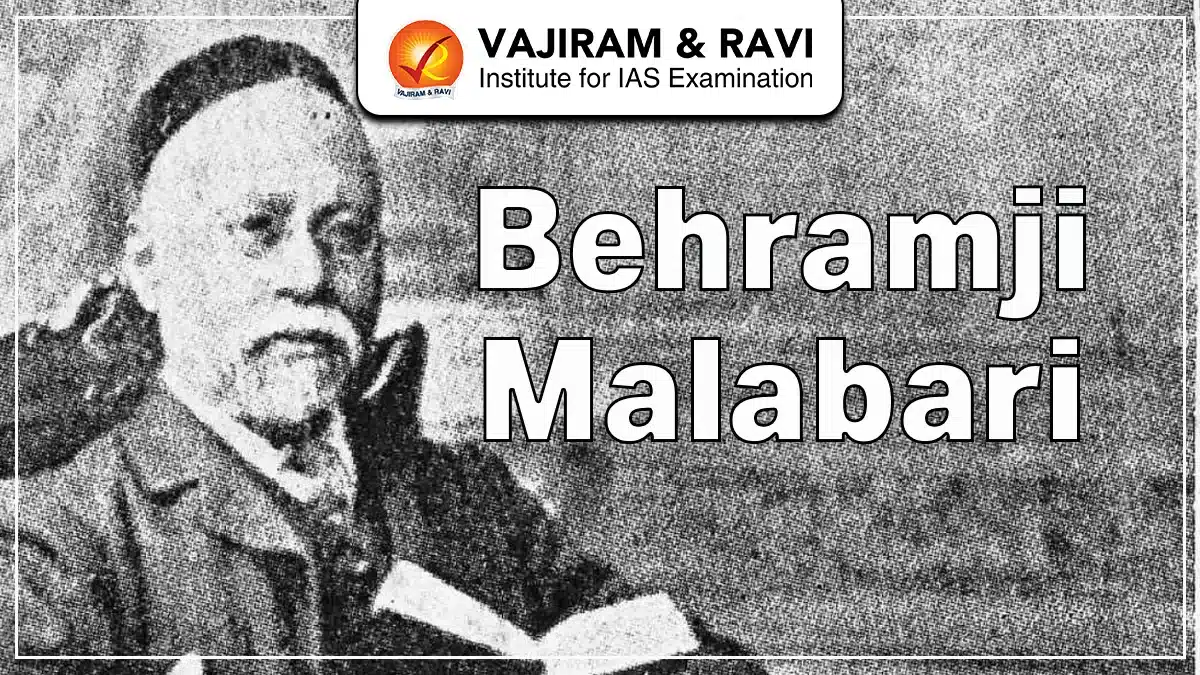
Behramji Merwanji Malabari was one of the most influential Indian social reformers, writers and public intellectuals of the late nineteenth century. He emerged as a powerful voice against deeply rooted social evils, especially child marriage and enforced widowhood during British Rule. Through journalism, poetry, public campaigns and international advocacy, Malabari connected Indian social reform debates with British liberal opinion, making women’s rights a central public issue. His work combined moral conviction, factual argument and sustained public engagement to challenge orthodox practices.

Behramji Malabari Biography

Behramji Malabari was born on 18 May 1853 in Baroda, present day Vadodara, Gujarat, into a Parsi family. His father, Dhanjibhai Mehta, worked as a clerk in the Baroda State administration and died when Behramji was only six or seven years old. After his father’s death, his mother Bhikhibai moved him to Surat, where he received early education at an Irish Presbyterian mission school, exposing him to Western education and liberal ideas. 

He was later adopted by Merwanji Nanabhai Malabari, a businessman trading in sandalwood and spices from the Malabar Coast, from whom he derived the surname “Malabari.” He later shifted to Bombay, the administrative and commercial hub of western India, where his public life as a writer, editor and reformer fully developed. Malabari died on 12 July 1912 at Simla, leaving behind a lasting intellectual and social legacy.

Behramji Malabari Author Career

Behramji Malabari used literature and journalism as primary tools to influence public opinion and policy debates on Indian society and reforms. Through his writing, activism and institution building, he laid a strong intellectual and moral foundation for later social reform movements.

  • Early Gujarati Poetry: He published a volume of Gujarati poems in 1875, reflecting social sensitivity, moral concerns and early reformist thinking shaped by both Indian tradition and Western liberal thought.
  • English Literary Recognition: His book The Indian Muse in English Garb published in 1877 attracted attention in Britain from figures like Alfred Tennyson, Max Müller and Florence Nightingale, giving him international literary credibility.
  • Satirical Social Writing: In 1882, he published Gujarat and the Gujaratis, a socially observant and mildly satirical work that analyzed customs, behavior and social attitudes and went through five editions.
  • Journalistic Leadership: In 1880, he acquired and edited the English language daily Indian Spectator for nearly twenty years, shaping liberal Indian opinion on reform and governance.
  • Collaborative Editorial Work: From 1883, he jointly edited Voice of India with Dadabhai Naoroji and William Wedderburn, linking Indian reform debates with British political circles.
  • Later Editorial Contributions: In 1901, he became editor of the monthly East and West, holding the position until shortly before his death, continuing dialogue between Indian and Western reform thinkers.
  • Travel and Reform Writing: His book The Indian Eye on English published in 1893 documented his three visits to England, analyzing British society through an Indian reformer’s perspective across four editions.

Behramji Malabari Social Reforms

Behramji Malabari’s reform work focused on women’s rights, legal protection for minors and challenging orthodox interpretations of religious customs.

  • Campaign Against Child Marriage: In 1884, he published Notes on Infant Marriage and Enforced Widowhood and circulated it to nearly 4,000 influential Indians and Englishmen, strongly condemning early marriage.
  • Advocacy on Widow Remarriage: He criticized the prohibition of widow remarriage, blaming rigid priestly interpretations and social monopolies for enforcing lifelong suffering on widowed women.
  • Role in Public Debate: His writings triggered a nationwide debate lasting over seven years, making child marriage and widowhood central social issues discussed across newspapers and public platforms.
  • Rukhmabai Case Intervention: In 1885, he actively wrote editorials on the Rukhmabai case, where a young woman was ordered by court to return to her husband, highlighting women’s lack of consent.
  • Age of Consent Act Influence: His sustained agitation contributed significantly to the passage of the Age of Consent Act of 1891, which raised the legal age for sexual consent for girls in British India.
  • British Public Mobilization: He uniquely mobilized British public opinion through reformist networks, influencing colonial lawmakers by presenting Indian social reform as a moral responsibility.
  • Engagement with Scholars: He collaborated with Max Müller to translate the Hibbert Lectures into Gujarati, promoting reinterpretation of Hindu scriptures to counter orthodox misuse.
  • Balanced Nationalism: Though not formally aligned with political organizations, he maintained close ties with leaders like Dadabhai Naoroji while keeping reform work independent of party politics.

Behramji Malabari's Seva Sadan

Seva Sadan represented Behramji Malabari’s practical commitment to social welfare beyond advocacy and legislation.

  • In 1908, he co-founded Seva Sadan in Bombay with Diwan Dayaram Gidumal to support women abandoned or exploited by society.
  • The institution focused on women who were deserted, widowed, or socially ostracized, providing them safety and dignity.
  • Seva Sadan offered basic education and vocational training to help women become self reliant and economically independent.
  • It provided access to healthcare and welfare services at a time when women’s medical needs were largely neglected.
  • Unlike charity based models, Seva Sadan aimed at long term rehabilitation and social reintegration of women.
  • It became a model for organized women centric social welfare institutions in early twentieth century India.
  • The initiative reflected Malabari’s belief that social reform required both legal change and institutional support for affected individuals.

Behramji Malabari FAQs

Q1: Who was Behramji Malabari?

Ans: Behramji Malabari was an Indian social reformer, writer and journalist known for campaigning against child marriage and enforced widowhood.

Q2: When and where was Behramji Malabari born?

Ans: He was born on 18 May 1853 in Baroda, present-day Vadodara, Gujarat, during British rule in India.

Q3: Why is Behramji Malabari famous in Indian history?

Ans: He is famous for his major role in influencing the Age of Consent Act of 1891 and advocating women’s rights.

Q4: What was Behramji Malabari’s role in journalism?

Ans: He edited newspapers like Indian Spectator, Voice of India and East and West to promote social reform ideas.

Q5: What was Seva Sadan founded by Behramji Malabari?

Ans: Seva Sadan, founded in 1908, was an institution providing education, medical care and rehabilitation to destitute women.

Khan Abdul Ghaffar Khan, Early Life, Role in Freedom Struggle

Khan Abdul Ghaffar Khan

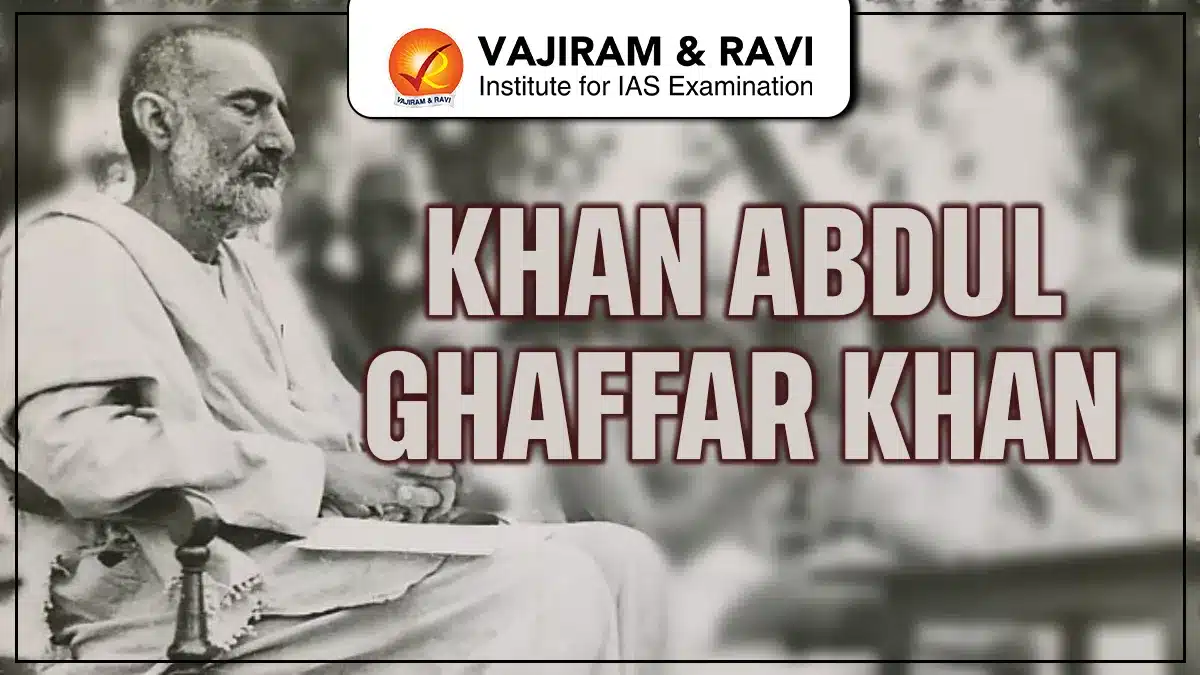
Khan Abdul Ghaffar Khan, popularly known as Frontier Gandhi or Badshah Khan, was one of the most remarkable leaders of India’s freedom movement. A close associate of Mahatma Gandhi, he dedicated his life to non-violence, social reform, and the upliftment of the Pashtun community. His unwavering commitment to peace and justice made him a unique figure in the history of India’s independence struggle. This article provides a detailed overview of Khan Abdul Ghaffar Khan’s life, ideology, contributions, and legacy.

Khan Abdul Ghaffar Khan's Early Life

Khan Abdul Ghaffar Khan was born on 6 February 1890 in Utmanzai village of the North-West Frontier Province (now in Pakistan). He belonged to a well-off Pashtun family and received modern as well as traditional education. From an early age, he was deeply concerned about social backwardness, illiteracy, and injustice among his people.

  • His father, Khan Bahadur Behram Khan, was a respected tribal leader who emphasized discipline and social responsibility.
  • Ghaffar Khan received early education in missionary schools, where he was exposed to modern ideas, rational thinking, and social reform.
  • He was deeply disturbed by the backwardness, illiteracy, and internal divisions among the Pashtun community.
  • Despite being offered a position in the British Indian Army, he refused, as he opposed colonial rule and racial discrimination.
  • From a young age, he believed that education and moral reform were the only means to uplift society.
  • His early experiences shaped his lifelong commitment to peaceful resistance, social service, and nation-building.
  • These formative years laid the foundation for his later association with Mahatma Gandhi and the freedom movement.

Role in India’s Freedom Struggle

Khan Abdul Ghaffar Khan played a significant role in India’s freedom struggle by mobilizing the Pashtun population against British rule through non-violent means. He was inspired by Mahatma Gandhi, and he joined the Indian National Congress and became a prominent leader in the North-West Frontier Province.

  • Actively participated in the Non-Cooperation Movement (1920–22), spreading nationalist ideas among Pashtuns.
  • Became a close associate of Mahatma Gandhi and adopted the philosophy of non-violence and civil disobedience.
  • Played a crucial role in organizing mass movements in the North-West Frontier Province, a region traditionally known for armed resistance.
  • Led protests against British policies and unjust laws, facing repeated arrests and imprisonment.
  • Actively participated in the Civil Disobedience Movement (1930) and supported the Salt Satyagraha.
  • Opposed repressive British actions, including the brutal firing on peaceful protesters at Qissa Khwani Bazaar (1930).
  • Took part in the Quit India Movement (1942), openly demanding an end to British rule.
  • Worked consistently to promote Hindu-Muslim unity and national integration during the freedom struggle.

Khudai Khidmatgar Movement (Red Shirts)

The Khudai Khidmatgar Movement was launched by Khan Abdul Ghaffar Khan in 1929 to organize the Pashtun community against British rule through non-violent means. Its members, known as the Red Shirts, took an oath of peace, discipline, and service to humanity. The movement aimed at social reform, promotion of education, and eradication of social evils among Pashtuns. It played a major role during the Civil Disobedience Movement, especially in the North-West Frontier Province. Despite severe British repression, including the Qissa Khwani Bazaar massacre (1930), the movement remained firmly committed to Gandhian non-violence.

Philosophy of Non-Violence and Gandhian Influence

Khan Abdul Ghaffar Khan strongly believed in non-violence as a moral and political force and adopted it as the core principle of his struggle against British rule.

  • He accepted Ahimsa (non-violence) as the most powerful weapon against injustice and oppression.
  • Strongly influenced by Gandhian principles of truth, self-discipline, and civil disobedience.
  • Believed that Islam preached patience, tolerance, and peace, making non-violence compatible with faith.
  • Applied Gandhian methods in the North-West Frontier Province, a region known for armed resistance.
  • Emphasized moral strength over physical force in political struggles.
  • Encouraged his followers to remain peaceful even during severe British repression.
  • Earned the title “Frontier Gandhi” for his unwavering commitment to non-violence.

Opposition to Partition and Political Stand

Khan Abdul Ghaffar Khan strongly opposed the Partition of India in 1947, believing it would divide communities and weaken national unity. He supported a united, secular India and felt that the interests of the Pashtun people were ignored during the partition process.

  • He firmly opposed the creation of Pakistan, as he believed it was imposed without the consent of the Pashtun population.
  • He criticized the Congress leadership for accepting Partition despite earlier promises of unity.
  • Advocated for autonomy and democratic rights for Pashtuns within a united India.
  • After Partition, he faced political repression and imprisonment in Pakistan for his views.
  • Continued to follow non-violence and constitutional methods despite persecution.

Khan Abdul Ghaffar Khan Contributions After Independence

After India’s independence, Khan Abdul Ghaffar Khan continued his lifelong mission of promoting peace, democracy, and social justice. Despite facing political suppression in Pakistan, he remained committed to non-violence and worked for the rights and welfare of the Pashtun people.

  • Opposed authoritarian rule in Pakistan and demanded democratic rights and provincial autonomy for Pashtuns.
  • Founded and supported movements aimed at social reform, education, and political awareness.
  • Spent nearly 15 years in imprisonment or house arrest due to his political beliefs.
  • Continued to advocate peaceful coexistence between India and Pakistan.
  • Remained loyal to Gandhian principles even while facing political isolation and hardship.
  • Recognized internationally as a symbol of peaceful resistance and moral courage.
  • Awarded the Bharat Ratna in 1987, becoming the first non-Indian recipient of India’s highest civilian honor.

Khan Abdul Ghaffar Khan FAQs

Q1: Who was Khan Abdul Ghaffar Khan?

Ans: He was a freedom fighter, social reformer, and close associate of Mahatma Gandhi, known for promoting non-violence among Pashtuns.

Q2: Why was he called Frontier Gandhi?

Ans: He was called Frontier Gandhi because he followed Gandhian principles while working in the North-West Frontier Province.

Q3: What was the Khudai Khidmatgar Movement?

Ans: It was a non-violent movement launched to oppose British rule and reform Pashtun society.

Q4: Did Khan Abdul Ghaffar Khan oppose Partition?

Ans: Yes, he strongly opposed the partition of India and advocated unity.

Q5: When was he awarded the Bharat Ratna?

Ans: He was awarded the Bharat Ratna in 1987 for his contributions to India’s freedom struggle.

UPSC Daily Quiz 20 January 2026

UPSC Daily Quiz

[WpProQuiz 72]

UPSC Daily Quiz FAQs

Q1: What is the Daily UPSC Quiz?

Ans: The Daily UPSC Quiz is a set of practice questions based on current affairs, static subjects, and PYQs that help aspirants enhance retention and test conceptual clarity regularly.

Q2: How is the Daily Quiz useful for UPSC preparation?

Ans: Daily quizzes support learning, help in revision, improve time management, and boost accuracy for both UPSC Prelims and Mains through consistent practice.

Q3: Are the quiz questions based on the UPSC syllabus?

Ans: Yes, all questions are aligned with the UPSC Syllabus 2025, covering key areas like Polity, Economy, Environment, History, Geography, and Current Affairs.

Q4: Are solutions and explanations provided with the quiz?

Ans: Yes, each quiz includes detailed explanations and source references to enhance conceptual understanding and enable self-assessment.

Q5: Is the Daily UPSC Quiz suitable for both Prelims and Mains?

Ans: Primarily focused on Prelims (MCQ format), but it also indirectly helps in Mains by strengthening subject knowledge and factual clarity.

G4 (Severe) Geomagnetic Storm

Geomagnetic Storms

Why in News?

A powerful G4 (Severe) Geomagnetic Storm, caused by solar activity, has lit up the night skies with spectacular auroras visible across multiple continents.

About Geomagnetic Storms

  • A geomagnetic storm is a major disturbance of Earth's magnetosphere that occurs when there is a very efficient exchange of energy from the solar wind into the space environment surrounding Earth.
  • These storms result from variations in the solar wind that produce major changes in the currents, plasmas, and fields in Earth’s magnetosphere.
  • The solar wind conditions that are effective for creating geomagnetic storms are sustained (for several hours) periods of the high-speed solar wind and a southward-directed solar wind magnetic field (opposite the direction of Earth’s field) at the dayside of the magnetosphere.
  • The largest such storms are associated with solar coronal mass ejections (CMEs), where a billion tons or so of plasma from the sun, with its embedded magnetic field, arrives at Earth. 
  • Effects:
    • It results in intense currents in the magnetosphere, changes in the radiation belts, and changes in the ionosphere, including heating the ionosphere and an upper atmosphere region called the thermosphere
    • These storms can heat the ionosphere, causing beautiful auroras on earth.
    • Because the ionosphere is heated and distorted during storms, long-range radio communication that relies on sub-ionospheric reflection gets affected.
    • Ionospheric expansion due to these storms can increase satellite drag and make their orbits difficult to control.
    • Satellite electronics can be damaged through the buildup and discharge of static-electric charges.
    • It can disrupt global navigation systems.
    • It can create harmful geomagnetic-induced currents (GICs)in the power grid and pipelines.

What is Solar Wind?

  • It is a continual stream of protons and electrons from the sun's outermost atmosphere, the corona
  • These charged particles breeze through the solar system at speeds ranging from around 250 miles (400 kilometers) per second to 500 miles (800 km) per second, in a plasma state.
  • Solar magnetic field is embedded in the plasma and flows outward with the solar wind.
  • Different regions of the Sun produce solar wind of different speeds and densities. 

When the solar wind reaches Earth, it sends a flurry of charged particles into the magnetosphere and along Earth's magnetic field lines, towards the poles.

Geomagnetic Storms FAQs

Q1: What are Coronal Mass Ejections (CMEs)?

Ans: Coronal Mass Ejections (CMEs) are huge bursts of solar wind and magnetic fields released from the Sun’s corona into space.

Q2: Can CMEs harm humans on Earth?

Ans: CMEs themselves do not directly harm humans on Earth’s surface because of the protection offered by our atmosphere and magnetic field, but they can disrupt satellites, power systems, and communication networks.

Q3: How are geomagnetic storms classified?

Ans: They are classified from G1 (minor) to G5 (extreme) based on intensity.

Kaziranga Elevated Corridor Project, Objectives, Significance

Kaziranga Elevated Corridor Project

Why in News?

Recently, the Prime Minister, during his Assam visit, laid the foundational stone of the Kaziranga Elevated Corridor of worth over 6,950 Crore in Kaliabor, Assam. During the Programme, two new Amrit Bharat Express trains were also flagged off.

About the Kaziranga Elevated Corridor Project

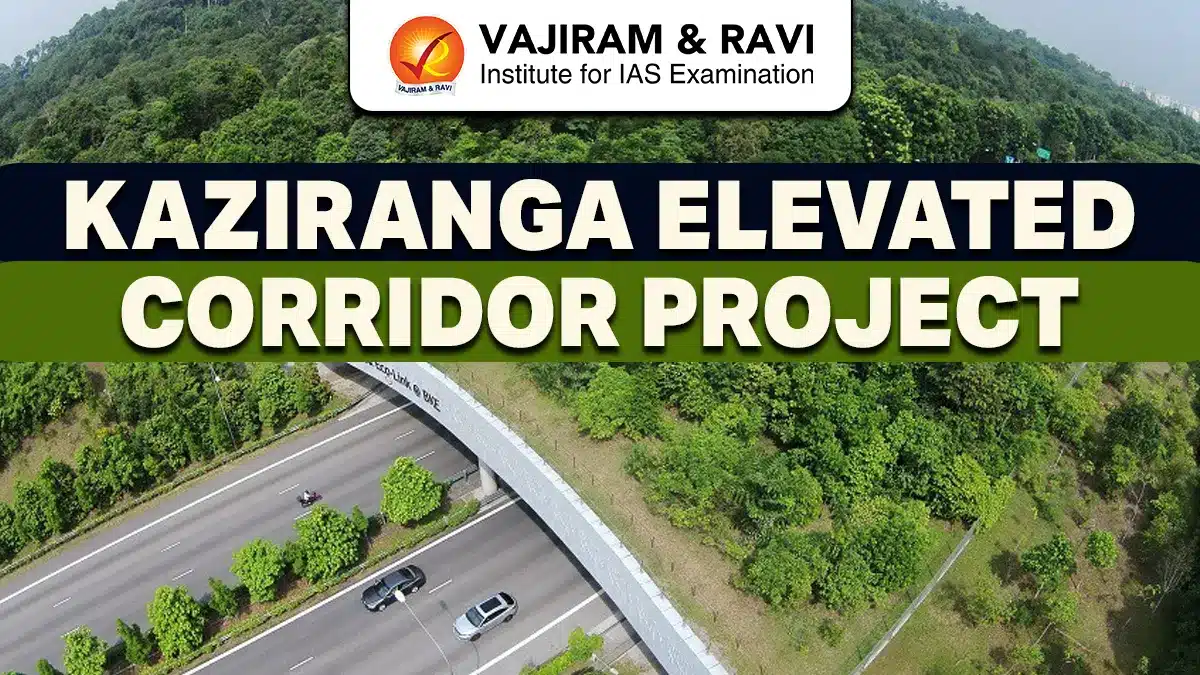
Kaziranga Elevated Corridor Project is a four-lane 86 km long environment-friendly highway project that will pass through the Kaziranga National Park and widen the existing NH-7155 from two to four lanes. It will enhance the connectivity and people’s movement while protecting the biodiversity and the environment.

  • Vision:  To enhance the connectivity across upper Assam, while protecting the rich biodiversity of the region.
  • Location: The project will connect the Nagaon, Kharbi Anglong and Golaghat districts of Upper Assam.
  • The project will ensure uninterrupted movements of the animals, lessen the human-wildlife conflicts and will enhance the road safety.
  • The project will features 35km of Elevated corridor that will pass through the Kazirang Park, 21 km of Bypass section and 30 km of further widening of the two lane highway section of NH-715 to four lanes.

Kaziranga Elevated Corridor Project Objectives

The objectives of the Kaziranga Elevated Corridor Project is given below:

  • Ensure free flow of people and wildlife, and material.
  • Reduce the human-wildlife conflicts.
  • Strengthen road safety and reduce travel and accident rates.
  • Improve the connectivity of the upper Assam, specifically Dibrugarh and Tinsukia.
  • It will support growing passenger and freight traffic.
  • The bypasses will decongest the towns, improve urban mobility and enhance the quality of rural and local residents.
  • The project will be developed on an Engineering Procurement and Construction (EPC) mode.

Kaziranga Elevated Corridor Project Significance

  • Protect the UNESCO world heritage site while also ensuring the development of the region.
  • Promote tourism with sustainable development principles and will also generate employment opportunities for the local and the youths.
  • It will further protect the one-horned Rhino, the flagship specie of Kaziranga National Park.
  • During the monsoon the park gets flooded, which force the wildlife movement through the highway leading to congestion and mostly the human-animal conflict, thus the project will ensure a safer movement for both the wildlife and the people.

About Kaziranga National Park

  • Kaziranga National Park is located between the Brahmaputra River and the Karbi Hills of Assam, spread over an area of 42,996 Hectares.
  • In 1985, it was designated as a UNESCO World Heritage site.
  • It is the home of the world’s most one-horned rhinos.
  • It is the single largest undisturbed area in the Brahmaputra valley floodplains.
  • Covered with tall and dense elephant grasses and inhabitates the Gangetic River dolphin, Tigers, Eastern swamp deer, Elephant, Hoolock gibbon etc.
  • The River Diffalu, a tributary of the Brahmaputra flows through the Park.
  • Kaziranga is known for successful anti-poaching measures, rhino census programs, and strict protection strategies that have significantly increased wildlife populations.
  • Annual floods of the Brahmaputra enrich the soil, maintain wetlands, and help in seed dispersal, playing a critical role in the park’s ecological balance.
  • The park and surrounding areas are culturally important, with indigenous communities historically relying on the landscape for sustenance and integrating traditional ecological knowledge in conservation practices.

Kaziranga Elevated Corridor Project FAQs

Q1: What is the Kaziranga Elevated Corridor Project?

Ans: It is an 86 km elevated highway in Assam designed to improve connectivity while allowing safe wildlife movement underneath.

Q2: Where is the corridor located?

Ans: It runs along the Kaliabor–Numaligarh section near Kaziranga National Park in Assam.

Q3: Why is the project important?

Ans: It reduces wildlife-vehicle collisions, protects migration routes, and improves regional road connectivity.

Q4: Who benefits from the project?

Ans: Wildlife, local communities, and tourists accessing Kaziranga National Park.

Q5: How does it protect wildlife?

Ans: Vehicles move on elevated roads while animals use underpasses and open green areas safely.

Arab Spring, Origin, Major Events and Uprisings, Aftermath

Arab Spring

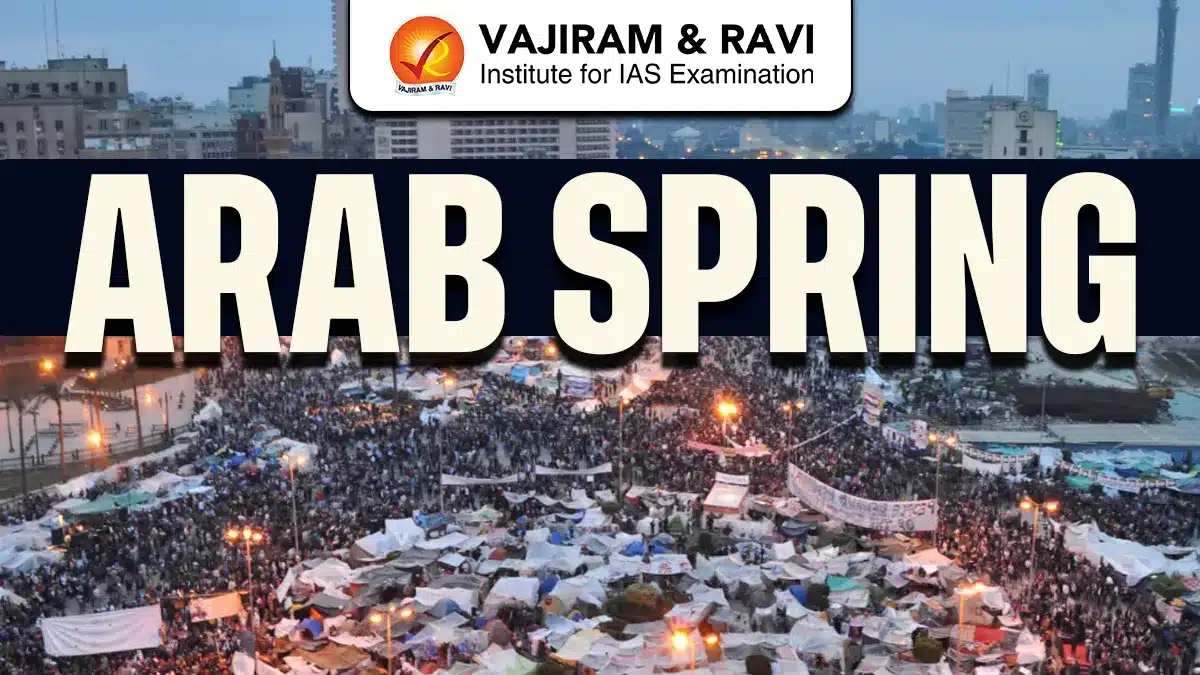
The Arab Spring was a series of anti-government protests and uprisings across the Arab world in the early 2010s, aimed at achieving democracy and social justice. It began in Tunisia when street vendor Mohamed Bouazizi set himself on fire, inspiring mass protests in other countries. Major uprisings occurred in Egypt, Libya, Syria, Yemen, Bahrain, and Morocco, leading to regime changes, civil wars, and political instability. The aftermath, known as the Arab Winter, brought prolonged conflicts, humanitarian crises, and regional instability that continue to affect the Middle East and North Africa.

Arab Spring Origin

The Arab Spring began in December 2010 with the self-immolation of Tunisian street vendor Mohamed Bouazizi, who protested the harassment of authorities. This act ignited the Jasmine Revolution in Tunisia, inspiring mass protests across the Arab world. Citizens demanded political freedom, social justice, and an end to authoritarian rule.

  • Trigger Event: Mohamed Bouazizi set himself on fire in protest against police harassment and denial of permits.
  • Immediate Outcome: Sparked the Jasmine Revolution in Tunisia; mass protests in the capital, Tunis.
  • Political Impact: President Zine El Abidine Ben Ali fled Tunisia after ruling for 20 years.
  • Regional Influence: Inspired uprisings in Egypt, Libya, Syria, Yemen, Bahrain, and Morocco.
  • Main Demands: Greater democracy, political participation, social justice, and human rights reforms.
  • Significance: Highlighted the role of individual acts of defiance in mobilizing mass movements.

Major Events and Uprisings of Arab Spring

The Arab Spring saw widespread protests, uprisings, and armed conflicts across the Middle East and North Africa, starting from Tunisia and spreading to Egypt, Libya, Syria, Yemen, and other nations. While some countries achieved short-term political changes, others descended into civil wars and prolonged instability. The movements were marked by mass mobilization, regime changes, and regional unrest.

  • Tunisia: Jasmine Revolution led to President Zine El Abidine Ben Ali fleeing the country; paved the way for democratic reforms.
  • Egypt: Protests in Tahrir Square ousted President Hosni Mubarak in 2011; early democratic gains were reversed after the 2013 military coup led by Abdel Fattah el-Sisi.
  • Libya: Colonel Muammar Qaddafi overthrown during a civil war in 2011; executed by opposition forces; ongoing factional conflicts and humanitarian crises followed.
  • Syria: Protests escalated into a civil war; millions displaced; rise of ISIS in northeastern Syria; Bashar al-Assad remains in power.
  • Yemen: Protests triggered civil war, leading to destruction of infrastructure and ongoing tribal and political conflicts.
  • Bahrain & Morocco: Bahrain faced violent crackdowns; Morocco introduced limited constitutional reforms.
  • Impact on Civilians: Millions of refugees fled to neighboring countries and Europe; widespread violence and disruption of daily life.
  • Regional Significance: Showed the power of grassroots activism, but also the fragility of political transitions in authoritarian contexts.

Aftermath of the Arab Spring

The aftermath of the Arab Spring, often called the “Arab Winter,” brought widespread instability, violence, and political uncertainty across the Middle East and North Africa. While some countries like Tunisia experienced democratic reforms, others like Egypt, Libya, Syria, and Yemen faced civil wars, authoritarian resurgence, and humanitarian crises.

  • Tunisia achieved democratic elections and political reforms, considered a relative success.
  • Egypt saw early democratic gains reversed after the 2013 military coup; Abdel Fattah el-Sisi returned the country to authoritarian rule.
  • Libya descended into civil war between rival factions, leaving civilians vulnerable to violence and shortages.
  • Syria’s civil war continues; Bashar al-Assad remains in power; ISIS rise and fall caused further instability.
  • Yemen’s protests escalated into prolonged civil war, destroying infrastructure and creating a humanitarian crisis.
  • Regional impact included rising sectarianism and proxy wars, notably between Iran and Saudi Arabia.
  • Global consequences involved refugee flows to Europe and disruptions in trade and security.
  • The Arab Spring highlighted the difficulty of democratic transitions in authoritarian regimes.

Arab Spring FAQs

Q1: What caused the Arab Spring?

Ans: The Arab Spring was triggered by political, social, and economic grievances, including high unemployment, corruption, lack of political freedom, and rising population pressures.

Q2: Which countries experienced uprisings due to the Arab Spring?

Ans: Major countries affected included Tunisia, Egypt, Libya, Syria, Yemen, Bahrain, and Morocco.

Q3: What was the trigger event of the Arab Spring?

Ans: The self-immolation of Tunisian street vendor Mohamed Bouazizi in December 2010 sparked mass protests in Tunisia, inspiring uprisings across the Arab world.

Q4: What was the outcome of the Arab Spring in Tunisia?

Ans: Tunisia saw the removal of President Zine El Abidine Ben Ali and successful democratic elections, making it one of the few relative successes of the Arab Spring.

Q5: What were the effects of the Arab Spring in Egypt?

Ans: Egypt’s protests led to the ouster of President Hosni Mubarak in 2011. However, democratic gains were reversed after the 2013 military coup, bringing Abdel Fattah el-Sisi to power.

MeToo Movement, Origin, Objectives, Impact, Criticism

MeToo Movement

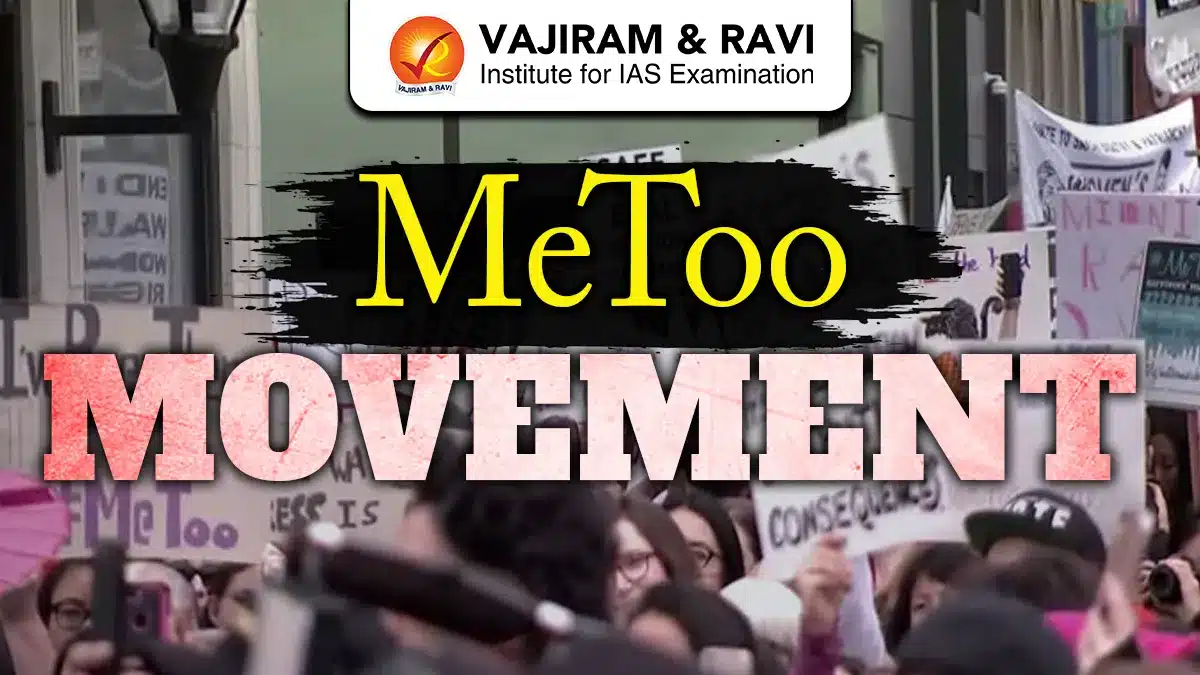
The MeToo Movement is a global social movement that aims to raise awareness about sexual harassment, sexual assault, and workplace misconduct, especially against women. It encouraged survivors to speak up about their experiences and exposed the deep-rooted culture of silence, power imbalance, and gender inequality in society. Over time, the movement has played a crucial role in reshaping conversations around consent, dignity, and accountability across the world, including India.

MeToo Movement Origin

  • The MeToo Movement was founded in 2006 by Tarana Burke, a social activist from the United States.
  • The term “Me Too” was initially used to support young women and girls from marginalized communities who had experienced sexual abuse.
  • The main purpose of the movement was to create solidarity among survivors and help them understand that they were not alone.
  • For several years, the movement worked at a community level without wide public attention.
  • In October 2017, the movement gained global recognition when actress Alyssa Milano encouraged women to use the hashtag #MeToo on social media.
  • Millions of women across countries shared their experiences of sexual harassment, assault, and workplace misconduct using the hashtag.
  • The movement quickly spread beyond the entertainment industry to media, corporate offices, politics, education, and sports.
  • In India, the #MeToo Movement gained momentum in 2018, when women journalists and professionals accused influential personalities of sexual misconduct.
  • The Indian wave of #MeToo brought national attention to workplace safety, gender equality, and the need for strict implementation of sexual harassment laws.
  • The movement transformed from a social media campaign into a global call for accountability, dignity, and justice for women.

MeToo Movement Objectives

The main objectives of the MeToo Movement are:

    • To give voice to survivors of sexual harassment and assault
    • To break the culture of silence and fear surrounding sexual abuse
    • To promote accountability for perpetrators irrespective of their position or influence
    • To ensure safer workplaces through awareness and institutional reforms
    • To empower women and marginalized groups to speak up without fear of retaliation
  • To promote gender equality and dignity at work

Legal Framework Related to Sexual Harassment in India

India has a strong legal framework to address sexual harassment, especially at the workplace. The major laws and provisions include:

  1. Sexual Harassment of Women at Workplace (Prevention, Prohibition and Redressal) Act, 2013
  • Popularly known as the POSH Act, it provides protection against sexual harassment at the workplace and mandates:
  • Every organization with 10 or more employees must constitute an Internal Complaints Committee (ICC).
  • Time-bound inquiry and redressal mechanism
  • Protection of complainant’s identity
  • Penalties for non-compliance by employers
  1. Vishaka Guidelines (1997)

Issued by the Supreme Court, these guidelines laid the foundation for workplace safety laws in India until the POSH Act was enacted.

  1. Bhartiya Nyaya Sanhita (BNS) Provisions
  • Sexual Harassment: IPC Section 354A is replaced by BNS Section 75, with clearer and gender-sensitive language focusing on dignity and consent.
  • Assault on Women: IPC Section 354 becomes BNS Section 74, retaining punishment but strengthening protection of women’s dignity.
  • Stalking & Cyber Crimes: IPC Section 354D is replaced by BNS Section 78, explicitly covering cyberstalking and digital surveillance.
  • Voyeurism: IPC Section 354C becomes BNS Section 77, expanding scope to include online circulation of private images.
  • Insult to Modesty: IPC Section 509 is replaced by BNS Section 79, covering online abuse and obscene communication.

Impact of MeToo Movement on Society and Workplace Culture

  • Increased Awareness: The movement created mass awareness about sexual harassment, consent, and inappropriate workplace behavior.
  • Empowerment of Survivors: Victims gained confidence to speak out against abuse without fear or shame.
  • Stronger Workplace Policies: Organizations strengthened POSH compliance, ICC functioning, and internal grievance mechanisms.
  • Accountability of Powerful Individuals: Influential persons in media, politics, and corporate sectors were held accountable for misconduct.
  • Cultural Shift in Attitudes: Reduced victim-blaming and increased emphasis on dignity, respect, and gender sensitivity.
  • Legal and Institutional Reforms: Encouraged stricter implementation of sexual harassment laws and workplace safety norms.

Challenges and Criticism

  • Lack of Due Process: Allegations made on social media sometimes bypass legal investigation, raising concerns about fairness and natural justice.
  • Possibility of False Accusations: Critics argue that misuse of the movement can harm reputations and careers without proper verification.
  • Fear of Retaliation: Many victims hesitate to report harassment due to fear of job loss, social stigma, or professional backlash.
  • Limited Reach: The movement largely benefited urban and educated women, while rural and informal sector workers remain underrepresented.
  • Weak Implementation of Laws: Despite strong legal provisions, poor enforcement and inactive Internal Complaints Committees reduce effectiveness.
  • Social Media Trial Culture: Public naming and shaming sometimes leads to media trials instead of lawful judicial processes.

Way Forward

  • Strict implementation of the POSH Act must be ensured with regular monitoring of Internal Complaints Committees in all organizations.
  • Awareness and gender-sensitization programs should be made mandatory to promote respectful workplace culture.
  • Strong protection mechanisms are needed to safeguard complainants and witnesses from retaliation or victimization.
  • Time-bound and transparent inquiry procedures should be followed to ensure justice while maintaining due process.
  • Legal awareness and access to grievance redressal must be expanded to the unorganized and rural workforce.
  • A balanced approach focusing on accountability, fairness, and cultural change is essential for the long-term success of the MeToo Movement.

MeToo Movement FAQs

Q1: What is the MeToo Movement?

Ans: The MeToo Movement is a global social movement against sexual harassment and sexual assault, encouraging survivors to speak out and seek justice.

Q2: Who started the MeToo Movement?

Ans: The movement was started in 2006 by Tarana Burke, an American social activist, to support survivors of sexual violence.

Q3: When did the MeToo Movement gain global attention?

Ans: It gained worldwide attention in 2017, after the hashtag #MeToo went viral on social media following allegations against Hollywood producer Harvey Weinstein.

Q4: When did the MeToo Movement begin in India?

Ans: In India, the MeToo Movement gained momentum in 2018, especially in media, film, and corporate sectors.

Q5: What is the main objective of the MeToo Movement?

Ans: Its main objective is to raise awareness about sexual harassment, empower survivors, ensure accountability, and promote safe workplaces.

Minsk Agreement, Background, Objectives, Significance

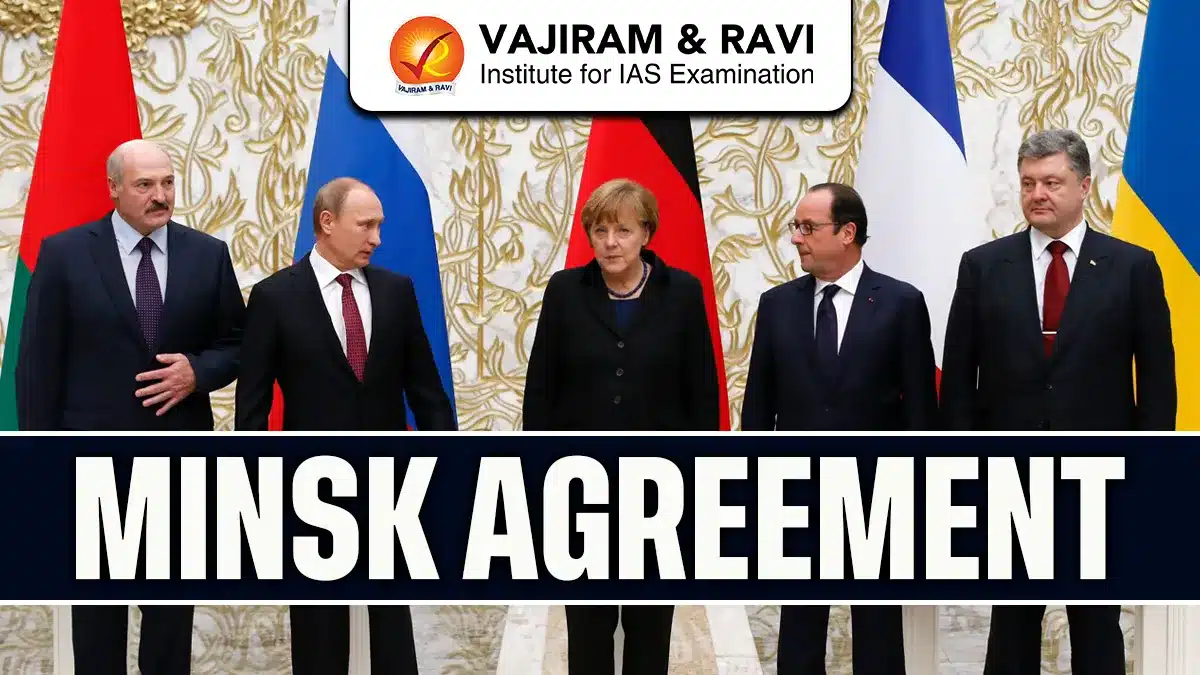
Minsk Agreement

The Minsk Agreement refers to a set of peace agreements signed to end the armed conflict in eastern Ukraine between Ukrainian forces and Russian-backed separatists. These agreements became one of the most important diplomatic efforts in Europe after the Cold War and gained global attention again after Russia’s invasion of Ukraine in February 2022.

What Are the Minsk Agreements?

The Minsk Agreements were two peace deals signed in 2014 and 2015 in Minsk, the capital of Belarus. Their main aim was to stop fighting in the Donbas region of eastern Ukraine, where pro-Russian separatists had declared independence in the Donetsk and Luhansk regions. These agreements were negotiated by:

  • Ukraine
  • Russia
  • OSCE (Organization for Security and Cooperation in Europe)
  • Separatist representatives of Donetsk and Luhansk

Read about: Paris Agreement

Minsk Agreement Background

The Minsk Agreement emerged after the outbreak of armed conflict in eastern Ukraine in 2014, following Russia’s annexation of Crimea and the rise of pro-Russian separatist movements in Donetsk and Luhansk.

  • In 2014, Ukraine faced political instability after the removal of President Viktor Yanukovych during the Euromaidan protests.
  • Russia annexed Crimea soon after, escalating tensions with Ukraine and the West.
  • Pro-Russian separatists declared independence in the Donetsk and Luhansk regions.
  • Heavy fighting broke out between Ukrainian forces and separatist groups backed by Russia.
  • Thousands of civilians were killed and displaced, creating a humanitarian crisis.
  • To stop the conflict, negotiations were initiated involving Ukraine, Russia, OSCE, and later France and Germany.
  • These efforts resulted in the signing of the Minsk Agreements in 2014 and 2015 to restore peace and stability in eastern Ukraine.

Minsk I Agreement (2014) Objectives

The Minsk I Agreement, signed in September 2014, was the first major attempt to end the armed conflict in eastern Ukraine between Ukrainian forces and Russian-backed separatists. 

  • To establish an immediate bilateral ceasefire between Ukrainian forces and separatist groups.
  • To ensure monitoring and verification of the ceasefire by the OSCE.
  • To promote decentralisation of power in Ukraine, granting special self-governance to certain areas of Donetsk and Luhansk.
  • To create security zones along the Ukraine–Russia border under OSCE supervision.
  • To ensure the release of hostages and illegally detained persons.
  • To grant amnesty to individuals involved in the conflict, excluding serious crimes.
  • To initiate inclusive national dialogue for political reconciliation.
  • To improve the humanitarian situation in the conflict-affected Donbas region.
  • To conduct early local elections in accordance with Ukrainian law.
  • To ensure the withdrawal of illegal armed groups, military equipment, and foreign fighters from Ukrainian territory.

Read about: Shimla Agreement

Minsk II Agreement (2015) An Updated Peace Plan

The Minsk II Agreement, signed in February 2015, was a renewed diplomatic effort to end the ongoing conflict in eastern Ukraine after the failure of the first Minsk Agreement. It was negotiated under the Normandy Format, with mediation by France and Germany, and involved Ukraine, Russia, and representatives of the Donetsk and Luhansk regions. 

Provisions of the Minsk II Agreement

  • Implementation of an immediate and comprehensive ceasefire in the conflict zone.
  • Withdrawal of heavy weapons by both sides to create a security buffer zone.
  • Monitoring and verification by the OSCE to ensure compliance.
  • Initiation of dialogue on interim self-government for Donetsk and Luhansk in accordance with Ukrainian law.
  • Granting of special status to certain areas of eastern Ukraine.
  • Amnesty and pardon for participants involved in the conflict.
  • Exchange of hostages and prisoners on an “all for all” basis.
  • Provision of humanitarian assistance to affected civilians.
  • Restoration of social and economic links, including pensions and public services.
  • Ukraine to regain control of its international borders after political reforms.
  • Withdrawal of foreign armed formations, mercenaries, and military equipment.
  • Constitutional reforms in Ukraine, focusing on decentralisation of power.
  • Strengthening the role of the Trilateral Contact Group (Ukraine–Russia–OSCE) to oversee implementation.

Why Did the Minsk II Agreement Fail?

The Minsk II Agreement (2015) was designed to bring lasting peace to eastern Ukraine, but it ultimately failed due to political, military, and strategic disagreements between the parties involved. Despite international support, the agreement remained largely unimplemented on the ground.

Major Reasons for the Failure of Minsk II

  • Lack of Mutual Trust: Ukraine and Russia consistently accused each other of violating the ceasefire, making cooperation impossible.
  • Disagreement Over Sequence of Implementation: Ukraine wanted control of its international border first, while Russia insisted on political reforms and autonomy for Donbas before border control.
  • Continued Ceasefire Violations: Fighting never completely stopped, especially in Donetsk and Luhansk, undermining confidence in the agreement.
  • Ambiguous Provisions: Several clauses were vaguely worded, allowing both sides to interpret them differently, especially regarding autonomy and elections.
  • Russia’s Strategic Interests: Russia viewed Minsk II as a tool to limit Ukraine’s NATO ambitions and maintain influence over Ukrainian politics.
  • Weak Enforcement Mechanism: The OSCE had no military power to enforce compliance and could only monitor violations.
  • Lack of Political Consensus in Ukraine: Many Ukrainians opposed granting special status to separatist regions, seeing it as a threat to sovereignty.
  • External Geopolitical Tensions: Growing tensions between Russia and Western countries further reduced chances of successful implementation.

Minsk Agreement Significance

  • The Minsk Agreements played a crucial role in temporarily reducing large-scale violence in eastern Ukraine and preventing the immediate escalation of the conflict into a full-scale international war.
  • They provided a diplomatic framework for dialogue between Ukraine and Russia with the involvement of international mediators such as France, Germany, and the OSCE.
  • The agreements highlighted the importance of multilateral diplomacy in resolving regional conflicts, even though their implementation remained weak.
  • Minsk Agreements brought global attention to the security challenges in Eastern Europe and exposed the fragility of post–Cold War peace arrangements.
  • They demonstrated the limitations of peace agreements that lack strong enforcement mechanisms and mutual political trust.
  • The process underlined the strategic importance of Ukraine in European and global geopolitics.
  • The failure of the agreements eventually contributed to the outbreak of the Russia-Ukraine war in 2022, reshaping global security dynamics.

Minsk Agreement FAQs

Q1: What is the Minsk Agreement?

Ans: The Minsk Agreement refers to two peace agreements signed in 2014 and 2015 to end the conflict between Ukraine and Russian-backed separatists in the Donbas region.

Q2: How many Minsk Agreements were signed?

Ans: Two agreements were signed – Minsk I in 2014 and Minsk II in 2015.

Q3: Why were the Minsk Agreements signed?

Ans: They were signed to stop fighting in eastern Ukraine, ensure a ceasefire, and find a political solution to the conflict between Ukraine and separatist regions.

Q4: Who were the parties involved in the Minsk Agreements?

Ans: Ukraine, Russia, the OSCE, and representatives of Donetsk and Luhansk, with France and Germany acting as mediators.

Q5: What was the main aim of the Minsk Agreements?

Ans: The main aim was to restore peace, ensure ceasefire, decentralise power in Ukraine, and reintegrate the conflict regions peacefully.

Parakaempferia Alba

Parakaempferia Alba

Parakaempferia Alba Latest News

A new species of ginger, Parakaempferia alba, has been discovered in the Siang Valley of Arunachal Pradesh.

About Parakaempferia Alba

  • It is a new species of Zingiberaceae (ginger family).
  • It was discovered in the Siang Valley of Arunachal Pradesh.
  • The plant was found in the Miglung area of East Siang District at an altitude of 150–400 meters, growing along shaded streambanks in humid, sandy soil. 

Key Facts about Zingiberaceae

  • Zingiberaceae, the ginger family of flowering plants, is the largest family of the order Zingiberales, containing about 56 genera and about 1,300 species. 
  • These aromatic herbs grow in moist areas of the tropics and subtropics, including some regions that are seasonably dry.
  • Members of the family are perennials that frequently have sympodial (forked) fleshy rhizomes (underground stems). 
  • They may grow to 6 metres (20 feet) in height. 
  • A few species are epiphytic—i.e., supported by other plants and having aerial roots exposed to the humid atmosphere.
  • Many species are economically valuable for their spices and perfume. 
    • The dried thick rhizome of turmeric (Curcuma longa) is commonly ground for culinary, medicinal, and cosmetic uses. 
    • The seeds of Elettaria cardamomum are the source of cardamom. 
    • Ginger is obtained from the fresh or dried rhizomes of Zingiber officinale, and a number of ornamental gingers are grown for their attractive flowers and foliage.
    • Several species of shellflower (Alpinia) are cultivated as ornamentals.

Source: NET

Parakaempferia Alba FAQs

Q1: What is Parakaempferia alba?

Ans: It is a newly discovered plant species belonging to the Zingiberaceae (ginger) family.

Q2: Where was Parakaempferia alba discovered?

Ans: It was discovered in the Siang Valley of Arunachal Pradesh.

Q3: In which climatic regions are Zingiberaceae plants commonly found?

Ans: They are found mainly in tropical and subtropical regions, including seasonally dry areas.

Q4: What type of underground stem is common in Zingiberaceae plants?

Ans: They commonly have sympodial, fleshy rhizomes.

United Nations Economic and Social Council

United Nations Economic and Social Council

United Nations Economic and Social Council Latest News

The Economic and Social Council (ECOSOC) will commemorate its 80th anniversary by holding a special event on 23 January 2026.

About United Nations Economic and Social Council

  • It was established by the Charter of the United Nations in 1945 as one of the six principal organs of the United Nations.
  • It is responsible for the direction and coordination of the economic, social, humanitarian, and cultural activities carried out by the UN.
  • Decisions are taken by a simple majority vote. The presidency of ECOSOC changes annually.
  • Members: It has 54 members, which are elected for three-year terms by the General Assembly.
  • Headquarter: New York (USA).

Functions of United Nations Economic and Social Council

  • It is responsible for coordinating the social and economic fields of the organization, specifically in regards to the 14 specialized agencies, the five regional commissions under its jurisdiction and eight functional commissions.
  • It also serves as a central forum to discuss international social and economic issues.
  • It formulates policy recommendations addressed to the member states and the United States system.
  • It has been at the centre of global progress, advancing the principles of the United Nations Charter and promoting international cooperation on economic, social, cultural, educational, health and related issues.

Source: UN

United Nations Economic and Social Council FAQs

Q1: How many members are there in ECOSOC?

Ans: 54 members

Q2: What is the primary function of ECOSOC?

Ans: To promote economic and social development

INS Sudarshini

INS Sudarshini

INS Sudarshini Latest News

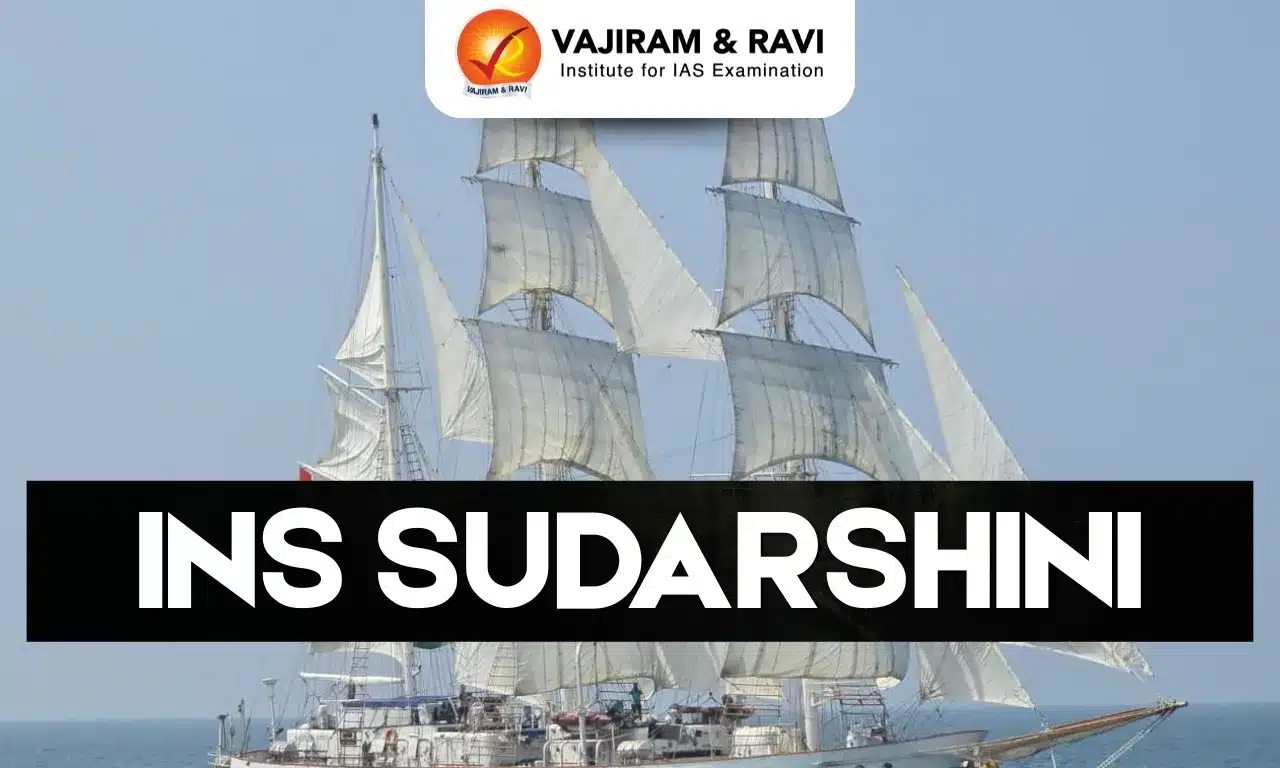
The Indian Navy’s Sail Training Ship INS Sudarshini will embark on the flagship voyage of Lokayan 26, a 10-month transoceanic expedition.

About INS Sudarshini

  • It is an indigenously built Sail Training Ship (STS).
  • It was built by Goa Shipyard Limited and based at Kochi, Kerala under the Southern Naval Command of the Indian Navy. 
  • It was successfully built and was commissioned on 27 Jan. 2012.
  • The aim of using such ships is to make sailors sea-friendly, as they are taught how to survive alone at sea, understand rough weather conditions and train themselves to become good sailors.

Features of INS Sudarshini

  • Sudarshini is a three-masted barque.
  • It is capable of operations under sail or power.
  • It has a very high endurance and can be deployed at sea continuously for a period of twenty days.

What is Lokayan 26?

  • It is a 10-month transoceanic expedition where the ship will sail over 22,000 nautical miles, visiting 18 foreign ports across 13 countries.
  • During this journey INS Sudarshini participates in prestigious international tall-ship events – Escale à Sète, in France, and SAIL 250, in New York, USA. 
  • Also Indian Navy and Indian Coast Guard trainees will undergo intensive sail training, gaining invaluable experience in long-range ocean navigation.

Source: PIB

INS Sudarshini FAQs

Q1: What is INS Sudarshini?

Ans: A sail training ship

Q2: Who built INS Sudarshini?

Ans: Goa Shipyard Limited

Sela Lake

Sela Lake

Sela Lake Latest News

Two tourists from Kerala drowned after the frozen surface of Sela Lake in Arunachal Pradesh’s Tawang district gave way recently.

About Sela Lake

  • Sela Lake, also known as Paradise Lake, is a glacial lake located near Sela Pass in Tawang district, Arunachal Pradesh.
    • Sela Pass is a crucial mountain pass connecting the Tawang region with the rest of Arunachal Pradesh.
  • It lies at an altitude of 13,700 feet (4,170 meters) and is surrounded by snow-clad mountains.
  • Its crystal-clear waters reflect the peaks around it, offering a stunning view.
  • The lake is usually frozen all winter because of its very cold temperatures (below zero).
  • The lake and its surroundings have limited vegetation because of the altitude. 
  • Locals and Buddhist monks consider Sela Lake a sacred site.
  • It is one of the 101 sacred lakes in the Tawang region, each with its own spiritual story.

Source: TELE

Sela Lake FAQs

Q1: What type of lake is Sela Lake?

Ans: It is a glacial lake.

Q2: Where is Sela Lake located?

Ans: It is located near Sela Pass in Tawang district, Arunachal Pradesh.

Q3: Why is Sela Pass important?

Ans: It is a crucial mountain pass connecting the Tawang region with the rest of Arunachal Pradesh.

Q4: At what altitude is Sela Lake situated?

Ans: It lies at an altitude of 13,700 feet (4,170 metres).

Q5: What happens to Sela Lake during winter?

Ans: The lake is usually frozen throughout winter due to sub-zero temperatures.

India International Conference on Democracy and Election Management (IICDEM) 2026

India International Conference on Democracy and Election Management (IICDEM) 2026

India International Conference on Democracy and Election Management (IICDEM) 2026 Latest News

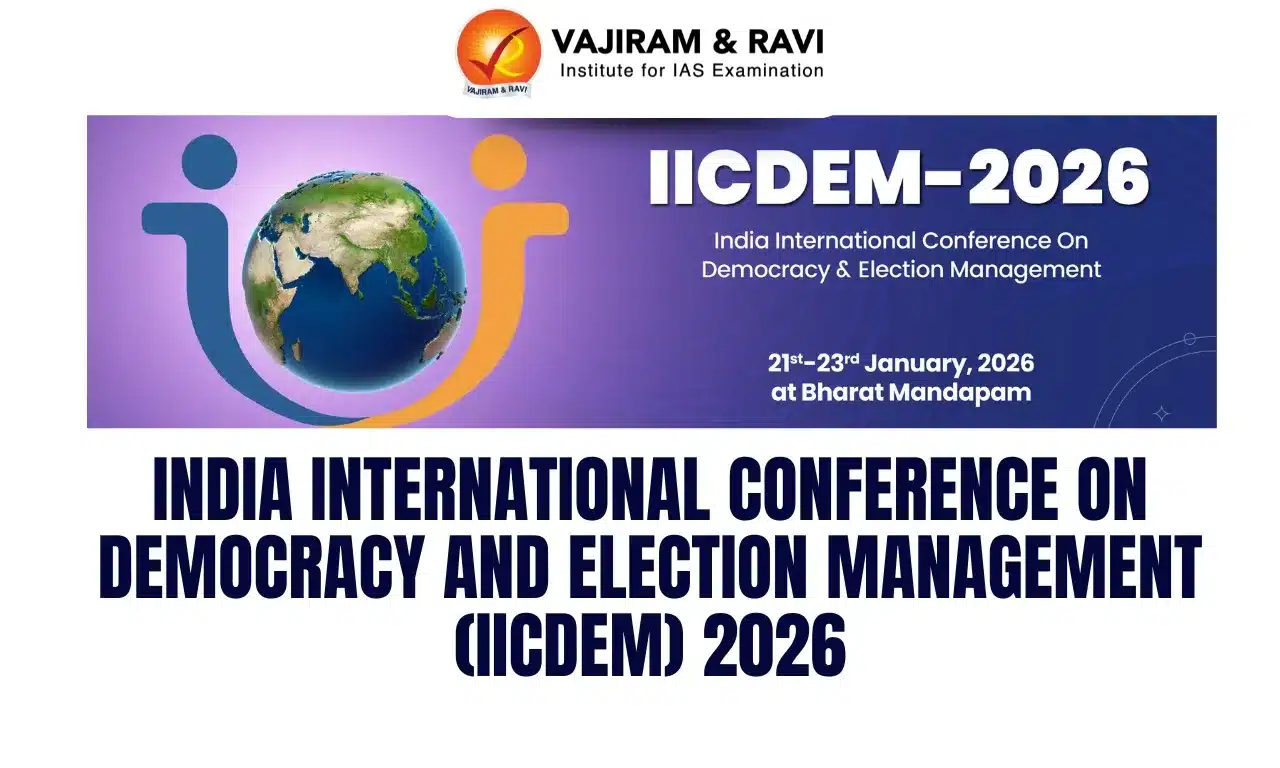
The Election Commission of India (ECI) will host the inaugural India International Conference on Democracy and Election Management (IICDEM) 2026 at Bharat Mandapam in the national capital.

About India International Conference on Democracy and Election Management (IICDEM) 2026

  • The 3-day conference, starting on the 21st of January, will be held at Bharat Mandapam, New Delhi.
  • It is being organised by the India International Institute of Democracy and Election Management (IIIDEM) under the aegis of the Election Commission of India (ECI). 
  • IICDEM 2026 is poised to be the largest global conference of its kind hosted by India in the field of democracy and election management. 
  • Nearly 100 international delegates, representing over 70 countries from across the world, are expected to participate. 
  • Representatives of international organisations, foreign missions in India, and academic and practicing experts in the electoral domain will also take part.
  • The programme will feature a mix of general and plenary sessions of Election Management Bodies (EMBs).
  • These discussions will focus on global electoral challenges, international electoral standards, and innovations and best practices in election processes.
  • As part of the conference, 36 thematic groups will conduct detailed deliberations. 
    • These groups will be led by Chief Electoral Officers of States and Union Territories and supported by national and international academic experts. 
  • During the event, the ECI will also formally launch ECINET, ECI’s one-stop digital platform for all election-related information and services.
  • An exhibition highlighting the scale and complexity of conducting elections in India will run alongside the conference. 
  • The exhibition will also showcase recent initiatives undertaken by the ECI to strengthen electoral roll preparation and the conduct of elections. 
  • Additionally, the docuseries “India Decides”, which documents the conduct of the Lok Sabha 2024 elections, will be screened on the opening day of IICDEM 2026.

Key Facts about India International Institute of Democracy & Election Management (IIIDEM)

  • IIIDEM is the dedicated training, academic & resource arm of the Election Commission of India (ECI). 
  • Established in 2011, the Institute was conceived to train, prepare, and equip election officials and other stakeholders for delivery of free, fair, credible, and error-free elections.
  • It is a global knowledge and capacity-building centre dedicated to advancing democratic governance and strengthening electoral integrity.
  • IIIDEM is one of the few institutions in the world which is not only involved in the training and capacity building of its electoral officials, but also caters to the requirements of Election Management Bodies (EMBs) the world over.
  • IIIDEM has a team of senior experts and professionals to run its academic and research programmes. 
  • It holds domestic and international courses and training programmes that are residential and non-residential.
  • Earlier, the IIIDEM was housed in the premises of the ECI. Now, the Institute is functioning from a full-fledged campus at Dwarka (Delhi).

Source: DDN

India International Conference on Democracy and Election Management (IICDEM) 2026 FAQs

Q1: Which institution is organising India International Conference on Democracy and Election Management (IICDEM) 2026?

Ans: It is being organised by the India International Institute of Democracy and Election Management (IIIDEM).

Q2: Where will India International Conference on Democracy and Election Management (IICDEM) 2026 be held?

Ans: It will be held at Bharat Mandapam, New Delhi.

Q3: Why is India International Conference on Democracy and Election Management (IICDEM) 2026 considered significant?

Ans: It is poised to be the largest global conference of its kind in democracy and election management hosted by India.

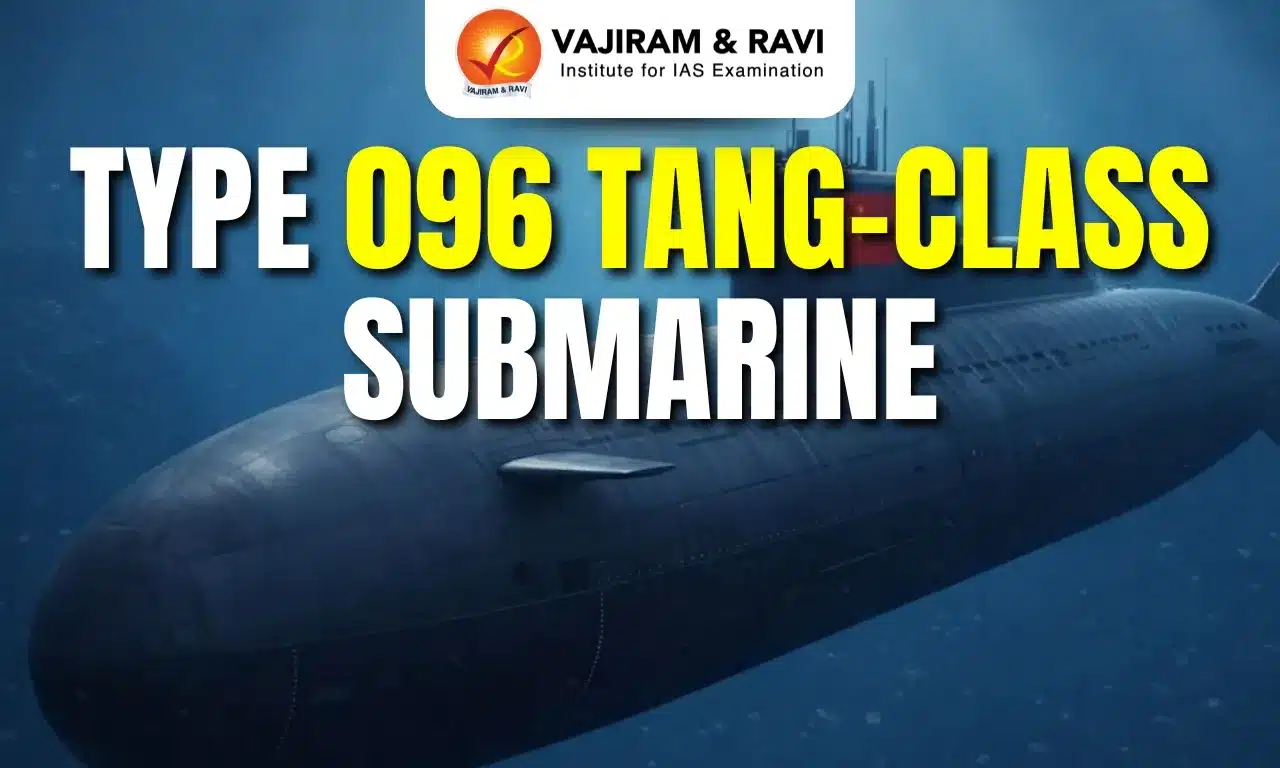
Type 096 Tang-Class Submarine

Type 096 Tang-Class Submarine

Type 096 Tang-Class Submarine Latest News

China has unveiled the most significant upgrade to its undersea nuclear capability with the unveiling of the Type 096 Tang-Class ballistic missile submarine recently.

About Type 096 Tang-Class Submarine

  • The Type 096 (NATO reporting name of Tang-class) submarine is China’s next-generation nuclear-powered ballistic missile submarine (SSBN).
  • It is bigger, stealthier, and armed with longer-range missiles than its predecessors.

Type 096 Tang-Class Submarine Features

  • It will displace around 20,000 tons when submerged, placing it in the same weight class as the U.S. Navy’s Ohio-class submarines.
  • It is said to have raft-mounted machinery, hull isolation systems, and a propulsion design that minimizes acoustic signatures during patrols.
  • These features are aimed at making the sub harder to detect in contested waters.
  • The vessel's pressurized water-cooled nuclear reactor powers a single shaft via a steam turbine arrangement.
  • Modern power plant elements and improved vibration dampening technologies are said to enhance submerged speed and stealth performance.
  • The submarine is expected to carry between 16 and 24 JL-3 submarine-launched ballistic missiles (SLBMs), each capable of ranges exceeding 10,000 to 12,000 kilometers and equipped with multiple independently targetable reentry vehicles (MIRVs).
  • It can also launch wire-guided, high-speed Yu-6 torpedoes with a range of over 29 km.

Source: WION

Type 096 Tang-Class Submarine FAQs

Q1: What is the Type 096 Tang-class submarine?

Ans: It is China’s next-generation nuclear-powered ballistic missile submarine (SSBN).

Q2: What is the approximate submerged displacement of the Type 096 Tang-class submarine?

Ans: It displaces around 20,000 tons when submerged.

Q3: What design features improve the stealth of the Type 096 Tang-class submarine?

Ans: Raft-mounted machinery, hull isolation systems, and low-noise propulsion design.

Q4: Type 096 Tang-class submarine carries which ballistic missile?

Ans: It is expected to carry between 16 and 24 JL-3 submarine-launched ballistic missiles (SLBMs).

C-DOT’s Cell Broadcast Solution

C-DOT’s Cell Broadcast Solution

C-DOT’s Cell Broadcast Solution Latest News

 Recently, the Centre for Development of Telematics (C-DOT) has been conferred the  “SKOCH Award-2025” for its Cell Broadcast Solution (CBS). 

About C-DOT’s Cell Broadcast Solution

  • It is an indigenous disaster and emergency alert platform.
  • It is designed to enable near real-time dissemination of life-saving information to citizens in affected areas through cellular networks.
  • It is developed by the Centre for Development of Telematics (C-DOT).

Features of Cell Broadcast Solution

  • It provides an automated integration between government emergency alert dissemination platforms and the telecom networks of the country for instant information delivery to the affected citizens.
  • It supports 2G, 3G, 4G, 5G Technologies.
  • It is designed to support varied geographic & demographic scenarios.
  • It integrates multiple disaster alert generation agencies, including the India Meteorological Department, the Central Water Commission for floods, Indian National Centre for Ocean Information Services, and Forest Survey of India.
  • It also brings together mobile service providers for message delivery, State Disaster Management Authorities and the National Disaster Management Authority for alert approval and disaster response.
  • It enables geo-targeted, multi-hazard alerts with support for 21 Indian languages.

Significance of C-DOT’s Cell Broadcast Solution

  • It significantly enhances the efficiency of disaster risk reduction and management efforts.
  • It aligns with the United Nations’ Early Warnings for All programme, the International Telecommunication Union’s Common Alerting Protocol.

Source: PIB

C-DOT’s Cell Broadcast Solution FAQs

Q1: What is C-DOT's Cell Broadcast Solution?

Ans: A indigenous emergency alert system

Q2: What is the primary purpose of C-DOT's Cell Broadcast Solution?

Ans: To disseminate emergency alerts

Saltwater Crocodile

Saltwater Crocodile

Saltwater Crocodile Latest News

According to the Odisha state forest and environment department pilot drone-based survey, the saltwater crocodiles population has increased in the state.

About Saltwater Crocodile

  • It is the largest and heaviest of all living reptiles in the world.
  • Other Names: Estuarine crocodile, Indo-Pacific crocodile, marine crocodile, sea crocodile, or informally as saltie.
  • It is an opportunistic hypercarnivorous apex predator.
  • Habitat: It inhabits saltwater habitats and brackish wetlands, rivers and mangroves.
  • Distribution: It is found in India’s east coast, Southeast Asia and the Sundaic region and northern Australia and Micronesia.
    • In India, these are distributed in Odisha and West Bengal and the coastal areas of the Andaman and Nicobar Islands.
    • Odisha has India’s largest population of saltwater crocodiles in its natural habitat.

Features of Saltwater Crocodile

  • They are solitary creatures, especially when it comes to adult males. 
  • They are highly territorial, with large male saltwater crocodiles often controlling extensive stretches of rivers, estuaries, or coastlines.
  • Conservation Status: It is categorized  as ‘Least Concern’ under the IUCN Red List.

Source: TH

Saltwater Crocodile FAQs

Q1: What is the scientific name of the Saltwater Crocodile?

Ans: Crocodylus porosus

Q2: Where is the Saltwater Crocodile primarily found?

Ans: Saltwater coastal habitats and brackish water

Vadhavan Port

Vadhavan Port

Vadhavan Port Latest News

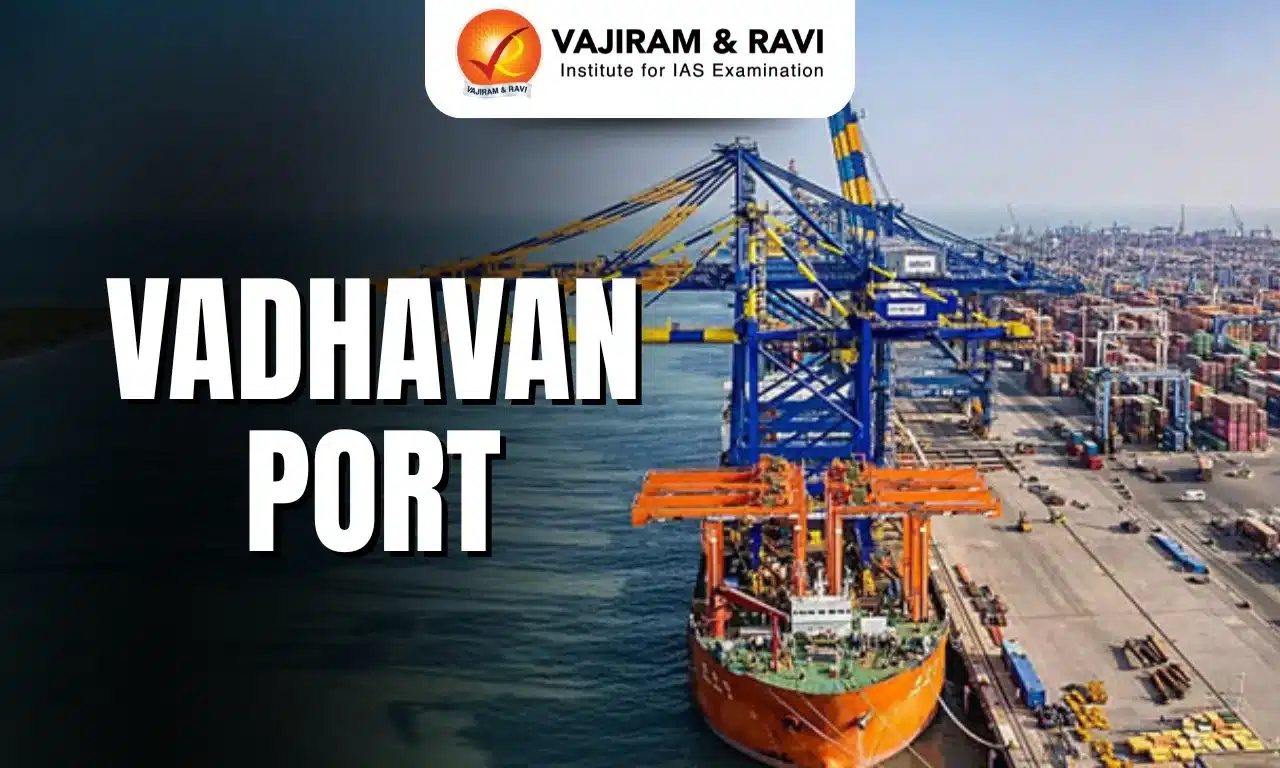
Around 20,000 residents of Palghar district recently took out a protest march on Monday against the proposed Vadhavan port and a slew of other infrastructure projects, citing environmental damage.

About Vadhavan Port

  • It is a proposed new port 140 km north of Mumbai on the coast of Maharashtra in the Palghar District.
  • It is being developed as an all-weather greenfield deep-draft major port.
  • Vadhvan offers a natural depth of 20 meters, making it ideal for large container and bulk vessels. 
  • The project will be constructed by Vadhavan Port Project Limited (VPPL), a special purpose vehicle (SPV) formed by Jawaharlal Nehru Port Authority (JNPA) and Maharashtra Maritime Board (MMB) with a shareholding of 74% and 26%, respectively. 
  • The total project cost, including the land acquisition component, is Rs.76,220 Crore. 
  • Scheduled to be finished by 2034, it is projected to be among the top 10 ports in the world.
  • The port will comprise nine container terminals, each 1000 meters long; four multipurpose berths; including the coastal berth, four liquid cargo berths, a Ro-Ro berth, and a Coast Guard berth. 
  • The project involves the reclamation of 1,448 hectares of area in the sea and the construction of 10.14 km of offshore breakwater and container/cargo storage areas.
  • The Project will create a cumulative capacity of 298 million metric tons (MMT) per annum, including around 23.2 million TEUs (twenty-foot equivalents) of container handling capacity.
  • The strategic location of Vadhavan Port provides it with a unique edge. 
    • Situated just 12 km from the Dedicated Rail Freight Corridor and 22 km from the Mumbai-Vadodara Expressway, the port will connect seamlessly to industrial centers across Maharashtra, Gujarat, and beyond.
    • The capacities created will also aid EXIM trade flow through IMEEC (India Middle East Europe Economic Corridor) and INSTC (International North South Transportation Corridor).

Source: IE

Vadhavan Port FAQs

Q1: What is Vadhavan Port?

Ans: It is a proposed all-weather greenfield deep-draft major port.

Q2: Where is Vadhavan Port located?

Ans: It is located in Palghar district of Maharashtra, about 140 km north of Mumbai, on the Arabian Sea coast.

Q3: Why is Vadhavan Port suitable for large vessels?

Ans: Because it has a natural depth of about 20 metres, ideal for large container and bulk ships.

Q4: What is the total estimated cost of the Vadhavan Port project?

Ans: The total project cost is ₹76,220 crore, including land acquisition.

Daily Editorial Analysis 20 January 2026

Daily Editorial Analysis

Calling Out the ED’s Actions, the Media Trials

Context

  • The episode involving film-producer Akash Bhaskaran and the Directorate of Enforcement (ED) in 2024–25 illustrates a conflict between investigative power and judicial scrutiny.
  • Raids on Bhaskaran’s home were accompanied by leaks, allegations of a ₹1000-crore scam, and media spectacle built around seized devices and purported messages.
  • Hashtags and memes amplified accusations long before any formal establishment of wrongdoing.
  • When challenged in court, the raids were deemed illegal, all proceedings were stayed, and the ED issued an unconditional apology.
  • The Supreme Court later halted broader action, warning that the ED was violating federal principles and crossing all limits

The Inversion of Legal Process

  • The Prevention of Money Laundering Act (PMLA) mandates that offenses be derivative, requiring an identifiable predicate crime that generates illicit proceeds.
  • Recent enforcement patterns reveal a reversed sequence: accusations of money laundering arise first, followed by attempts to locate an underlying offense to justify prior action.
  • This inversion expands discretionary power and collapses the distinction between suspicion and proof.
  • The PMLA equips the ED with sweeping authority. Under its provisions, individuals may be summoned without knowing whether they are witnesses or accused; properties may be attached provisionally; and arrests may occur without warrant under subjective reason to believe.
  • Bail restrictions invert the presumption of innocence, compelling the accused to demonstrate non-culpability.
  • These powers were originally justified in contexts such as terror financing, drug trafficking, and organised crime, yet their increasing use against political actors, state ministers, and private citizens has altered their institutional character.

Media Performance and the Construction of Guilt

  • Media outlets frequently act as accelerants, amplifying raids and leaks into spectacles of pre-judgment.
  • In the Bhaskaran case, visuals of seized devices, WhatsApp chats, and alleged luxury goods circulated widely.
  • Private news channels and online creators produced an environment in which allegations gained the status of fact without verification.
  • Sensational reporting, particularly when derived from leaks, transforms investigatory acts into public indictments.
  • This pattern contributes to media trials, reputational punishment, and political pressure irrespective of judicial outcome. Retractions rarely follow and exonerations seldom receive equal coverage.
  • Citizens are left consuming narratives that blend investigation, accusation, and entertainment in ways that weaken the rule of law and degrade standards of verification.

Institutional Misuse, Selectivity, and Credibility Crisis

  • Multiple ED officers have been arrested on charges of extortion and bribery, including cases in Rajasthan, Tamil Nadu, Mumbai, and Odisha.
  • Suspension orders and brief press releases have followed, but no structural reform has emerged.
  • Such incidents erode claims of moral authority and enable judicial doubt regarding whether the PMLA is used to secure convictions or to prolong incarceration.
  • Political selectivity further fuels distrust. High-profile raids on West Bengal Chief Minister Mamata Banerjee, I-PAC offices, and Tamil Nadu Minister K.N. Nehru coincided with electoral or political tensions.
  • Letters alleging scams were leaked to the press before adjudication, shaping public opinion and inducing reputational damage. Critics argue that such tactics convert anti-corruption enforcement into political theatre, stressing optics over evidence.
  • The agency’s invocation of Article 32 in the Supreme Court, even as it is accused of arbitrary conduct, underscores a double standard.

Democratic Stakes and Constitutional Guardrails

  • Robust anti-corruption enforcement remains essential to the integrity of financial markets.
  • However, when coercive power becomes arbitrary, it threatens democratic norms. The ED’s trajectory shows how extraordinary powers, if unchecked, can mutate into a form of state overreach.
  • Each baseless case normalises weakened procedural safeguards; each media spectacle corrodes public trust in institutions; each selective investigation invites retaliation rather than reform.
  • Courts currently represent the primary check on excess. The Supreme Court’s review of the Vijay Madanlal Choudhary judgment will determine whether PMLA powers require recalibration.
  • Yet episodic interventions cannot replace durable institutional guardrails.

Conclusion

  • An effective framework for combating financial crime must balance investigative authority with constitutional restraint.
  • When agencies exercise extraordinary powers without transparency, judicial oversight becomes the last defence against arbitrary state action.
  • Media sensationalism and political selectivity further erode public confidence, weakening both institutions and democratic culture.
  • Restoring equilibrium requires reforms that defend accountability without sacrificing the rule of law.

Calling Out the ED’s Actions, the Media Trials FAQs

Q1. What legal issue is central to concerns about the ED’s functioning?
Ans. The central legal issue concerns the inversion of due process under the PMLA and the erosion of the presumption of innocence.

Q2. How did the courts respond to the Bhaskaran case?
Ans. The courts held the raids to be illegal, stayed further proceedings, and compelled the ED to return seized materials.

Q3. What role did the media play in the controversy?
Ans. The media amplified allegations through unverified leaks and sensational coverage, shaping public opinion before judicial review.

Q4. Why has the ED’s credibility come under scrutiny?
Ans. The ED’s credibility has been damaged by allegations of political selectivity and corruption among its own officers.

Q5. What is required to restore balance in anti-corruption enforcement?
Ans. Restoring balance requires legal reform, judicial oversight, accountable media practices, and adherence to constitutional limits.

Source: The Hindu


In A Changing World, It is Small Tables, Big Dividends

Context

  • India’s decision to host the European Union’s institutional leadership as chief guests at the 2026 Republic Day parade signals a shift beyond symbolism toward bloc-level engagement.
  • As bilateral diplomacy grows more complex—marked by persistent neighbourhood challenges and friction with major powers like the US and China—India’s strategic openings may lie elsewhere.
  • The coming year presents “diplomatic white spaces”: global issues that demand coordination but lack credible leadership.
  • By building coalitions and focusing on priorities it can sustain, India can help shape rules and deliver global public goods in these leadership gaps.
  • This article highlights how India’s diplomacy in 2026 is shifting from headline bilateralism to leveraging “diplomatic white spaces”, where leadership gaps exist and small, focused coalitions can deliver results that large forums increasingly cannot.

Europe as India’s First Diplomatic Test

  • The presence of Ursula von der Leyen and António Luís Santos da Costa at the 2026 Republic Day parade signals renewed momentum in India–EU ties.
    • Ursula von der Leyen currently serves as the President of the European Commission.
    • António Luís Santos da Costa currently serves as the President of the European Council.
  • The focus is the long-pending India–EU Free Trade Agreement, where engagement must be with the European Union as a whole, not just individual capitals.
  • This partnership goes beyond tariffs. It involves rules on market access, data protection, competition, and sustainability.
  • If India treats the deal as a way to reduce risks, it gains better access to European markets, a place in new global value chains, and some protection from US trade pressures.
  • However, stricter compliance costs for Indian firms are inevitable. The opportunity exists because Europe wants to cut dependence on China and manage uncertainty from the US. India must act fast, as such diplomatic windows do not stay open for long.

BRICS: A Political Test for India

  • BRICS in 2026 is larger but less focused. New members want different outcomes at different speeds.
  • This raises a basic question: what should BRICS do, and can India help give it direction?
  • Many members seek a stronger Global South voice and fairer development finance. But the group’s purpose is contested.
  • As chair in 2026, India can push BRICS toward practical results by using New Development Bank guarantees and tools that turn statements into action.
  • India must also manage risks. U.S. tariff threats against countries seen as aligning with BRICS raise costs.
  • India gains little from anti-West rhetoric or de-dollarisation drives that could deter Western capital and technology. Reform, not rejection, should be India’s line.

The Quad: Turning Capability into Public Goods

  • The Quad is another diplomatic white space. If India hosts a Quad leaders’ summit, it could welcome Donald Trump, adding political weight and higher expectations.
  • The Quad’s work on maritime awareness and resilient ports matters to Indian Ocean countries that want help without being pulled into rivalries. India can add value by turning Quad capabilities into shared services others can use.
    • India’s rapid response during Operation Sagar Bandhu after Cyclone Ditwah in Sri Lanka showed how flexible assets can deliver help without drama.
  • Success will depend on the U.S. managing trade disputes without harming wider cooperation.

Limits of Big Forums

  • Large global forums face strain. The United Nations remains vital for legitimacy but is weak at delivery when major powers disagree. Real outcomes are shifting to smaller coalitions that can act.
  • The G20 shows similar stress. Political disputes and agenda narrowing risk sidelining Global South priorities and reducing inclusiveness.

The Big Picture for 2026

  • India’s momentum in 2026 will come from filling leadership gaps.
  • Europe is about standards, BRICS about practical delivery, and the Quad about public goods.
  • Turning these white spaces into working arrangements is India’s real opportunity.

India’s Strategic Choice in a Fragmented World

  • The AI Impact Summit in Delhi in February 2026 offers India a chance to bring governments, companies, and researchers together where interests overlap.
  • As the US experiments with new forums, including a proposed “Board of Peace,” India will need to be selective about where it invests diplomatic energy.
  • An invitation for India to join Pax Silica, a US-led group focused on AI and semiconductor supply chains, shows how quickly new platforms are emerging.
  • In a divided world, influence will not come from the biggest forums but from smaller, workable coalitions. India’s strength in 2026 will lie in choosing the right tables—and making them deliver results.

In A Changing World, It is Small Tables, Big Dividends FAQs

Q1. Why is the EU’s presence at India’s 2026 Republic Day significant?

Ans. It signals India’s move toward bloc-level diplomacy, focusing on EU-wide trade, data, and sustainability rules rather than relying only on bilateral ties.

Q2. What makes Europe a key diplomatic opportunity for India in 2026?

Ans. Europe seeks to reduce dependence on China and hedge against U.S. uncertainty, opening space for India in value chains despite higher compliance requirements.

Q3. Why is BRICS described as a political test for India?

Ans. BRICS has expanded but lost focus. As chair, India must steer it toward practical delivery while avoiding anti-West rhetoric that could hurt investment prospects.

Q4. How can India add value through the Quad?

Ans. India can turn Quad capabilities in maritime awareness and ports into shared services, helping regional states without forcing them into great-power rivalries.

Q5. Why are smaller coalitions more important than big forums today?

Ans. Large bodies like the UN and G20 struggle with divisions, while smaller coalitions can act faster, coordinate better, and deliver tangible global public goods.

Source: TH

Daily Editorial Analysis 20 January 2026 FAQs

Q1: What is editorial analysis?

Ans: Editorial analysis is the critical examination and interpretation of newspaper editorials to extract key insights, arguments, and perspectives relevant to UPSC preparation.

Q2: What is an editorial analyst?

Ans: An editorial analyst is someone who studies and breaks down editorials to highlight their relevance, structure, and usefulness for competitive exams like the UPSC.

Q3: What is an editorial for UPSC?

Ans: For UPSC, an editorial refers to opinion-based articles in reputed newspapers that provide analysis on current affairs, governance, policy, and socio-economic issues.

Q4: What are the sources of UPSC Editorial Analysis?

Ans: Key sources include editorials from The Hindu and Indian Express.

Q5: Can Editorial Analysis help in Mains Answer Writing?

Ans: Yes, editorial analysis enhances content quality, analytical depth, and structure in Mains answer writing.

Greenland Claim: How U.S. Move Could Reshape Arctic Politics

Greenland Claim

Greenland Claim Latest News

  • An American military takeover of Greenland, which increasingly looks possible, would involve multiple contradictions.
  • It would undermine U.S. commitments to sovereignty and international law, strain NATO unity, alarm Canada and Europe, and hand Russia a propaganda victory in the Arctic.

NATO at Risk: The Greenland Contradiction

  • Any American military move into Greenland would strike at the heart of North Atlantic Treaty Organization (NATO). 
  • NATO’s credibility rests on Article 5 — collective defence — which assumes external aggression, not one member violating another’s territorial integrity. 
  • A U.S. action against Denmark, which administers Greenland, would create an unprecedented crisis the alliance was never designed to handle.

Denmark’s Sacrifice and the Irony of Article 5

  • The contradiction is stark. Denmark was among the first to invoke Article 5 after the 9/11 attacks, standing firmly with the United States. 
  • Danish troops fought alongside U.S. forces in Afghanistan, suffering heavy losses. 
  • A U.S. incursion into Greenland would nullify this shared history and hollow out NATO’s moral foundation.

A Gift to Russia and China

  • Such a move would directly benefit Vladimir Putin, who has long sought to fracture NATO unity and divert Western focus from Ukraine. 
  • Ironically, an action justified as countering Russian influence in the Arctic would weaken the very alliance designed to contain Moscow.

The Strategic Argument Falls Apart

  • Strategically, the move makes little sense. 
  • The U.S. already has extensive rights in Greenland under a 1951 treaty and once operated 17 bases there, most of which were voluntarily shut down by Washington itself. 
  • These facilities could be reactivated without violating sovereignty.

The Real Arctic Pressure Point

  • While Donald Trump has pointed to rising Russian and Chinese activity in the Arctic, U.S. defence assessments show the real pressure point lies near Alaska, not Greenland. 
  • Pentagon briefings and the 2024 Arctic Strategy highlight infrastructure degradation and increased China–Russia cooperation in waters off Alaska.
  • In effect, a Greenland misadventure would weaken NATO, empower adversaries, distract from Ukraine, and undermine U.S. credibility — all while addressing the wrong Arctic problem in the wrong place.

The Backers Behind the Greenland Push

  • The idea of acquiring Greenland has moved beyond speculation. The White House has not ruled out a military option, while officials have spoken of discussions with European officials about a possible purchase. 
  • However, Denmark, which administers Greenland, has made it clear the territory is not for sale. 
  • The issue is now so politically sensitive in Copenhagen and Nuuk that any attempt at a commercial deal could bring down the Danish government.

Trump’s Domestic Constituencies

  • Support for the Greenland idea appears to come from several figures close to Donald Trump. 
  • Tech investor Peter Thiel has floated the idea of a libertarian, post-nation settlement in a place like Greenland
  • Elon Musk has shown interest in the territory’s rare earth resources. 
  • Billionaire Ronald Lauder is reported to have first raised the Greenland idea with Trump. 
  • Trump himself is said to view the move through a real-estate lens, consistent with his business instincts.

Canada’s Security Anxiety

  • The country most alarmed by a potential annexation is Canada. 
  • U.S. control of Greenland would effectively hem Canada in, intensifying security concerns. 
  • This has triggered a debate within Canada about revisiting its non-nuclear stance, with experts urging the country to confront difficult questions about national defence.

Nuclear Domino Effect

  • The implications could extend far beyond North America. 
  • If NATO were to fracture over Greenland, countries such as Germany and Poland might reconsider nuclear options, as could South Korea and Japan. 
  • A Greenland takeover could thus spark a wider nuclear arms race, reshaping global security in unpredictable ways.

Source: IE | BBC

Greenland Claim FAQs

Q1: Why is the Greenland claim controversial within NATO?

Ans: The Greenland claim involves one NATO member violating another’s territory, a situation NATO’s collective defence framework was never designed to handle.

Q2: How could the Greenland claim benefit Russia?

Ans: The Greenland claim could fracture NATO unity, weaken Western focus on Ukraine, and hand President Vladimir Putin a strategic propaganda victory.

Q3: Why is Canada particularly concerned about the Greenland claim?

Ans: U.S. control over Greenland would geographically hem in Canada, intensifying security fears and triggering debates over nuclear deterrence.

Q4: Is Greenland strategically essential for the U.S.?

Ans: No. The U.S. already holds extensive rights under a 1951 treaty, making the Greenland claim strategically unnecessary.

Q5: What wider risks could the Greenland claim trigger?

Ans: The Greenland claim could encourage nuclear debates in Europe and Asia, risking a broader arms race and global instability.

Celebrity Endorsement Liability: Kerala HC Sets Clear Limits

Celebrity Endorsement Liability

Celebrity Endorsement Liability Latest News

  • The Kerala High Court has set aside consumer proceedings against actor Mohanlal, holding that a brand ambassador cannot be held liable for a company’s alleged unfair trade practices unless there is a clear, direct link between the endorsement and the consumer’s transaction.
  • The ruling arose from complaints against Manappuram Finance, where borrowers claimed they were charged higher interest rates than advertised. 
  • The court clarified the boundary between promotional activity and transactional responsibility, emphasizing that mere appearance in advertisements does not create consumer liability for endorsers.

Background: The Gold Loan Dispute

  • The case arose from gold loans taken by two borrowers in Thiruvananthapuram. They had initially pledged gold with Catholic Syrian Bank at 15% interest. 
  • In 2018, Manappuram Finance took over the loans after a bank manager allegedly promised a lower interest rate.
  • The borrowers claimed they were influenced by advertisements featuring actor Mohanlal, who was Manappuram Finance’s brand ambassador at the time. 
  • They alleged that the advertised interest rate was lower than what was eventually charged.

Consumer Complaint and Claims

  • When the borrowers tried to close the loan and retrieve their gold, Manappuram allegedly demanded a higher interest rate. 
  • They approached the District Consumer Disputes Redressal Commission, alleging deficiency in service and unfair trade practices. 
  • They sought a refund of excess interest and compensation of ₹25 lakh.

Mohanlal Made a Party to the Case

  • Along with Manappuram Finance and its manager, Mohanlal was named as an opposite party solely because of his appearance in the advertisements. 
  • Mohanlal raised a preliminary objection, arguing that he had no role in the loan transaction, no interaction with the borrowers, and no control over interest rates.

Consumer Fora’s Initial View

  • Mohanlal contended that being a brand ambassador did not make him a service provider. 
  • However, relying on the definition of “endorsement” under the Consumer Protection Act, 2019, the District Commission rejected his objection and held the complaint maintainable. 
  • The State Consumer Commission later declined to rule on this issue at the revision stage.

Legal Provisions on Endorsements Examined by the Court

  • The court examined Section 2(18) of the Consumer Protection Act, which gives a broad meaning to “endorsement”. 
  • It covers any message or depiction that may lead consumers to believe an advertisement reflects the opinion or experience of the person featured. 
  • Section 2(47) similarly defines “unfair trade practice” widely, including false representations about price or quality.

Where Endorsers Are Specifically Mentioned

  • The term “endorser” appears explicitly only in Section 21 of the Act. 
  • This provision deals with false or misleading advertisements and empowers the Central Consumer Protection Authority to impose penalties on manufacturers and endorsers, including fines and temporary bans on endorsements.
  • Section 21(5) provides a safeguard for endorsers. 
  • It protects them from liability if they have exercised due diligence to verify the truthfulness of the claims made in the advertisement.

Limits of Endorser Liability in Consumer Disputes

  • Crucially, the Act does not refer to endorsers in provisions dealing with consumer complaints on deficiency of service or unfair trade practices before consumer commissions. 
  • The Kerala High Court held that this omission was deliberate, noting that endorser liability is confined to proceedings under Section 21 alone.

Role of the 2022 Misleading Advertisement Guidelines

  • The court also considered the 2022 guidelines issued by the Central Consumer Protection Authority. 
  • While these define endorsers and require due diligence, the court clarified that they operate within the scope of Section 21 and do not expand endorser liability to all consumer disputes.

What the Kerala High Court Held

  • Kerala HC noted that Mohanlal’s role was confined to appearing in advertisements as a brand ambassador.

No Direct Link to the Transaction

  • The court examined the consumer complaint to identify any direct connection between the actor and the borrowers’ gold loan transaction. 
  • It found only two references to Mohanlal: his status as brand ambassador and an assurance allegedly given by the company’s manager referring to advertisements featuring him. This, the court held, was insufficient.

Liability Cannot Be Presumed

  • The pleadings did not show that Mohanlal persuaded the borrowers, participated in the loan transaction, or made any assurance to them. 
  • The assurance, as pleaded, came solely from the company’s manager. 
  • Therefore, the court ruled that no liability for unfair trade practice or deficiency of service could be fixed on the actor.
  • The court clarified that merely falling within the definition of an “endorser” does not attract liability
  • A direct and specific link between the endorser and the consumer transaction must be established to fasten responsibility.

Company, Not Endorser, Answerable

  • Even if advertisements formed part of the background facts, an unfair trade practice arises when the service provider fails to deliver what was advertised. 
  • On the pleadings, that failure could only be attributed to Manappuram Finance, not the endorser.

Source: IE | SCCO

Celebrity endorsement liability FAQs

Q1: What did the Kerala HC rule on celebrity endorsement liability?

Ans: The court held that celebrity endorsement liability arises only with a direct link between the endorser and the consumer transaction.

Q2: Why was Mohanlal removed from the consumer case?

Ans: There was no evidence that Mohanlal influenced the loan transaction or assured interest rates, limiting celebrity endorsement liability.

Q3: Which law governs celebrity endorsement liability?

Ans: Celebrity endorsement liability is governed mainly under Section 21 of the Consumer Protection Act, dealing with misleading advertisements.

Q4: Can endorsers be liable for deficiency of service?

Ans: No. The court ruled that celebrity endorsement liability does not extend to deficiency of service unless direct involvement is proven.

Q5: What remedy remains available to consumers?

Ans: Consumers may pursue misleading advertisement claims under Section 21 before the competent authority, not through general consumer disputes.

India–UAE Relations – Strategic Defence Partnership amid West Asia Turbulence

India–UAE Relations

India-UAE Relations Latest News

  • Against the backdrop of escalating geopolitical tensions in the West Asia/Gulf region—including conflicts in Gaza, Yemen, and unrest in Iran—India and the United Arab Emirates (UAE) have further deepened their Comprehensive Strategic Partnership. 
  • During the brief visit of UAE President Sheikh Mohamed bin Zayed Al Nahyan (MBZ) to New Delhi, the two countries signed a Letter of Intent (LoI) for a bilateral Strategic Defence Partnership.

Key Outcomes and Agreements

  • Strategic defence partnership:
    • Letter of Intent signed to work towards a framework agreement, which builds on regular bilateral military exercises, exchange of Service Chiefs, and defence-industrial cooperation.
    • India clarified that the partnership is a natural evolution, not a response to any specific conflict, and it does not imply Indian military involvement in Gulf conflicts.
  • Trade and economic cooperation: Target to double bilateral trade to $200 billion by 2032, which stands at $100 billion (FY 2024–25), due to momentum driven by India–UAE Comprehensive Economic Partnership Agreement (CEPA, 2022).
  • Energy cooperation:
    • 10-year LNG Supply Agreement between HPCL (Hindustan Petroleum Company Ltd) and ADNOC (Abu Dhabi National Oil Company Gas) will allow the purchase of 0.5 MMPTA LNG by HPCL from ADNOC over 10 years starting from 2028.
    • The agreement makes the UAE India’s second-largest LNG supplier, reinforcing India’s energy security.
  • Civil nuclear cooperation:
    • Exploration of partnership in large nuclear reactors, Small Modular Reactors (SMRs), nuclear safety, and operations and maintenance.
    • This will be enabled by India’s SHANTI Act (Sustainable Harnessing and Advancement of Nuclear Energy for Transforming India).
  • Space cooperation: LoI between IN-SPACe (India) and UAE Space Agency to integrate space ecosystem, joint missions, commercial space services, and promote Start-ups and high-skilled employment.
  • Digital and financial cooperation:
    • Proposal for Digital/Data Embassies to protect sovereign data, plan to interlink national payment platforms for faster cross-border payments.
    • Support for initiatives like Bharat Mart, Virtual Trade Corridor, and Bharat–Africa Setu.
  • Counter-terrorism and financial security: Reaffirmed zero tolerance for terrorism, including cross-border terrorism. Commitment to cooperation under FATF counter-terror financing, and anti-money laundering.
  • Investment and institutional cooperation: Establishment of House of India in Abu Dhabi, UAE companies (FAB, DP World) offices at GIFT City. LoI between Gujarat and UAE for Dholera Special Investment Region.

Geopolitical Backdrop and What the Visit of UAE President Signify

  • West Asia churn:
    • Growing US–Israel–Iran tensions, 
    • Saudi Arabia–UAE divergence over Yemen, 
    • Enhanced Saudi–Pakistan defence cooperation (2025 defence pact), and 
    • Gaza conflict and US-led peace initiatives (India being invited to the ‘Board of Peace for Gaza’ by the US).
  • Significance of the visit:
    • It signals India’s strategic autonomy and balanced diplomacy in West Asia, reinforcing India’s multi-alignment approach amid rivalries among Gulf partners.
    • It highlights UAE’s importance as a key energy supplier, investment partner and host of the Indian diaspora.

India-UAE Relations

  • Background: Diplomatic ties began in the 1970s, but relations transformed into a "Comprehensive Strategic Partnership" after the Indian PM's 2015 visit, accelerating cooperation in trade, investment, and strategic areas. 
  • Key pillars:
    • Economic and trade: UAE is India's 3rd largest trading partner and 2nd largest export destination. The CEPA aims to boost non-oil trade to $100 billion by 2030. UAE is a major investor in India (infrastructure, energy, AI, fintech).
    • Strategic and defense: Both are part of I2U2 Group, and have deep defense cooperation with joint exercises (Desert Eagle, Gulf Star-1).
    • People-to-people and cultural:
      • Indians are the largest expatriate community (3.5-4.3 million) in the UAE.
      • Cultural milestones like the BAPS Temple in Abu Dhabi and expanding Indian educational presence (IIM Ahmedabad, IIFT campuses).
    • Energy security: UAE provides strategic oil reserves for India. 

Challenges for India and Way Ahead

  • Risk of perception of alignment: Maintain strategic autonomy and issue-based partnerships. For example, actively leveraging CEPA and Gulf capital for Make in India and Atmanirbhar Bharat.
  • Managing relations simultaneously: With UAE, Saudi Arabia, Iran, Israel, US. Deepen geo-economic engagement (trade, energy, digital, space).
  • Challenges of defence cooperation: Ensuring defence cooperation does not dilute India’s non-entanglement policy. Institutionalise defence cooperation without operational entanglements.
  • Regional instability and maritime insecurity: Continue diplomatic engagement to support de-escalation in West Asia.

Conclusion

  • The India–UAE Strategic Defence Partnership marks a maturation of bilateral ties from transactional engagement to a multi-dimensional strategic relationship. 
  • Amid volatility in West Asia, India has carefully balanced its interests by strengthening cooperation with the UAE while reaffirming its commitment to peace, stability, and strategic autonomy. 
  • The outcomes underscore India’s evolving role as a credible, non-aligned yet influential stakeholder in the Gulf region—an approach crucial for safeguarding its energy security, diaspora interests, and geopolitical relevance.

Source: TH | IE

India–UAE Relations FAQs

Q1: How does the India–UAE Strategic Defence Partnership reflect its strategic autonomy approach?

Ans: It strengthens defence cooperation while avoiding military entanglement.

Q2: What is the significance of the $200-billion trade target between India and the UAE?

Ans: The target consolidates CEPA gains by deepening geo-economic integration, trade diversification.

Q3: Why is the HPCL–ADNOC LNG agreement strategically important for India’s energy security?

Ans: It ensures long-term LNG supply, reduces import volatility and makes the UAE India’s second-largest LNG supplier.

Q4: How does India–UAE cooperation in space and nuclear technology align with India’s development priorities?

Ans: It supports clean energy transition, advanced technology access, start-ups, and high-skilled employment.

Q5: What is the geopolitical relevance of India–UAE ties amid rising Saudi–Pakistan defence cooperation?

Ans: The partnership enhances India’s diplomatic leverage, safeguards diaspora and energy interests.

Environmental Protection Fund Rules – Explained

Environmental Protection

Environmental Protection Latest News

  • The Union government has notified detailed rules governing the utilisation of the Environmental (Protection) Fund, created from penalties imposed under key environmental laws. 

Background of the Environmental (Protection) Fund

  • The Environmental (Protection) Fund has been created to ensure that penalties imposed for violations of environmental laws are channelled back into environmental restoration, pollution control, and sustainability-related activities. 
  • The legal basis for the fund was laid under the Jan Vishwas Act, 2023, which decriminalised several minor environmental offences while retaining monetary penalties to ensure regulatory compliance.
  • The fund draws resources from penalties levied under major environmental legislations, including laws related to air pollution, water pollution, and the Environment (Protection) Act, 1986
  • The notified rules provide clarity on how this fund will be credited, administered, audited, and utilised for specific environmental purposes, addressing long-standing concerns regarding the effective use of environmental penalties.

Objectives of the Environmental (Protection) Fund

  • The primary objective of the Environmental (Protection) Fund is to convert regulatory penalties into tangible environmental outcomes. The rules seek to:
    • Strengthen pollution prevention, control, and mitigation mechanisms
    • Support remediation of environmentally contaminated sites
    • Promote research and adoption of clean and green technologies
    • Enhance the institutional capacity of environmental regulatory bodies
  • By doing so, the fund aligns with the broader principle of “polluter pays,” ensuring that environmental damage leads to corrective and restorative action rather than remaining a purely punitive measure.

Permitted Areas of Fund Utilisation

  • The notified rules specify 11 broad categories of activities for which the Environmental (Protection) Fund can be used. These include:
    • Prevention, control, and mitigation of air, water, and soil pollution
    • Remediation and restoration of contaminated and degraded environmental sites
    • Installation, operation, and maintenance of environmental monitoring equipment
    • Development of laboratory infrastructure for environmental testing and compliance
    • Capacity building of regulatory institutions and technical personnel
    • Research and innovation in clean technologies and sustainable practices
    • Development of Information Technology (IT)-enabled systems for environmental monitoring
  • These provisions aim to ensure that fund utilisation directly contributes to improving environmental quality and regulatory effectiveness rather than being diverted for unrelated purposes.

Administrative Structure and Fund Management

  • The rules clearly outline the institutional framework for administering the Environmental (Protection) Fund. 
  • The Union Ministry of Environment, Forest and Climate Change will be the primary authority for administering the fund, or it may notify any other competent body for this purpose.
  • To ensure decentralised yet coordinated implementation:
    • Dedicated Project Management Units (PMUs) will be created at both central and state levels
    • Penalties collected will be credited to the fund following a standardised procedure
    • The Central Pollution Control Board (CPCB) will develop and maintain an online portal for managing fund-related processes
  • This digital interface will serve as a common platform for coordination among central ministries, state governments, pollution control boards, and other stakeholders.

Distribution of Funds Between Centre and States

  • A significant feature of the rules is the transparent sharing mechanism between the Centre and States. According to the notified provisions:
    • 75% of the penalty amount collected will be transferred to the Consolidated Fund of the concerned State
    • 25% of the amount will be retained by the Centre for national-level environmental initiatives
  • This arrangement recognises that most environmental violations and remediation activities are local in nature, while also enabling the Centre to fund large-scale or cross-cutting environmental projects.

Accountability and Audit Mechanisms

  • To strengthen transparency and public accountability, the rules mandate robust oversight mechanisms. 
  • The Comptroller and Auditor General of India (CAG) will audit the Environmental (Protection) Fund periodically. 
  • This audit requirement is crucial to prevent misuse, underutilisation, or diversion of environmental penalty funds.
  • Further, the online portal managed by the CPCB will act as a monitoring tool, enabling real-time tracking of fund allocation, utilisation, and project outcomes. 
  • Together, these measures aim to enhance public trust in environmental governance.

Significance for Environmental Governance in India

  • The notification of these rules marks an important shift in India’s environmental regulatory approach. 
  • Instead of treating penalties merely as revenue, the framework institutionalises their use for environmental improvement. 
  • It also complements the decriminalisation approach adopted under the Jan Vishwas Act by ensuring that monetary penalties have a corrective and restorative purpose.
  • For India, which faces persistent challenges related to pollution, waste management, and ecological degradation, the Environmental (Protection) Fund can serve as a critical financial instrument to bridge regulatory gaps and support sustainable development goals.

Source: TOI | IE

Environmental Protection FAQs

Q1: What is the Environmental (Protection) Fund?

Ans: It is a fund created from penalties imposed under environmental laws to support pollution control, remediation, and clean technology initiatives.

Q2: Which law enabled the creation of the Environmental (Protection) Fund?

Ans: The fund was provided for under the Jan Vishwas Act, 2023.

Q3: How are penalties distributed between the Centre and States?

Ans: Seventy-five percent of the penalty amount goes to the State, while 25% is retained by the Centre.

Q4: Who audits the Environmental (Protection) Fund?

Ans: The Comptroller and Auditor General of India audits the fund.

Q5: What types of activities can the fund be used for?

Ans: It can be used for pollution control, environmental remediation, monitoring infrastructure, capacity building, and clean technology research.

Chile

Key Facts about Chile

Chile Latest News

Recently, wildfires raged across central and southern Chile which left at least 18 people dead, scorched thousands of acres of forest and destroyed.

About Chile

  • Location: It is located in the southwestern part of South America.
  • It occupies a long, narrow coastal land strip wedged between the Andes Mountains to the east and the South Pacific Ocean to the west.
  • Bordering Countries: It is bordered by Peru to the north, Bolivia to the northeast and Argentina to the east and by the Drake Passage to the south.
  • Capital City: Santiago

Geographical Features of Chile

  • Climate: Temperate; desert in north; Mediterranean in central region; cool and damp in south.
  • Desert: Atacama Desert which is the driest non-polar desert in the world is in Chile.
  • Major River: Loa River
  • Volcano: Ojos del Salado which is the World’s highest active volcano and 2nd highest peak in South America (6,880 m).
  • It is located along the Pacific Ring of Fire.
  • Natural Resources: It is the world’s largest copper and Lithium producer. Other resources include molybdenum, iron ore, timber, hydropower, and precious metals.

Source: IE

Chile FAQs

Q1: Which desert is located in northern Chile?

Ans: Atacama Desert

Q2: What is the capital of Chile?

Ans: Santiago

Enquire Now