Cotton Textile Industry in India, Features, Initiatives, Status

Cotton Textile Industry in India

The Cotton Textile Industry in India is a major pillar of the manufacturing sector, connecting agriculture, industrial production, employment and international trade. As one of the oldest modern industries, it supports millions of farmers and workers while contributing to GDP, exports and the growth of Micro, Small and Medium Enterprises (MSMEs).

Cotton Textile Industry in India

India is the world's second largest producer of textiles and garments and ranks sixth in global textile exports. The Cotton Textile Industry in India covers the entire value chain, from cotton cultivation and ginning to spinning, weaving, processing and garment manufacturing. It contributes around 2.3% to GDP and provides direct employment to over 45 million people.

Cotton Textile Industry in India Features

The Cotton Textile Industry in India has a diverse production structure, extensive raw material availability and a strong presence of traditional and modern manufacturing units.

  • Integrated Value Chain: The industry covers cotton cultivation, fibre processing, spinning, weaving, knitting, dyeing and garment manufacturing, connecting agricultural production with domestic consumption and international textile markets.
  • MSME Based Structure: Nearly 80% of the textile value chain operates through MSME clusters, making small scale enterprises important contributors to production, employment and regional industrial development.
  • Major Cotton Producing Zones: Cotton cultivation is concentrated in three agro climatic zones: Northern (Punjab, Haryana and Rajasthan), Central (Gujarat, Maharashtra and Madhya Pradesh) and Southern (Telangana, Andhra Pradesh and Karnataka).
  • Major Industrial Centres: Mumbai, Ahmedabad, Coimbatore, Kanpur and Kolkata are important textile hubs. Mumbai is traditionally known as the Cottonopolis of India.
  • Diverse Production: India produces cotton textiles alongside man made fibre (MMF) products, jute, silk and woollen textiles, supporting a diversified domestic manufacturing base.
  • Foreign Investment: The sector permits 100% Foreign Direct Investment (FDI) through the automatic route, encouraging investment in manufacturing, technology and infrastructure.

Status of Cotton Textile Industry in India 2026

India maintains a significant global position in cotton cultivation, textile manufacturing and exports, although productivity and export competitiveness require improvement.

  • Global Cotton Position: India ranks first in cotton cultivation area, accounting for approximately 37-38% of global acreage and second in cotton production and consumption, contributing around 20-24% of global output.
  • Cotton Production: Provisional cotton production stood at 290.91 lakh bales in 2025-26, against domestic consumption of 328 lakh bales, indicating a gap between domestic availability and industrial demand.
  • Economic Contribution: The textile sector contributes approximately 2.3% to India's GDP, 11% to manufacturing Gross Value Added (GVA), 13% to industrial production and 12% to exports.
  • Employment Generation: The industry directly employs over 45 million people, while the cotton value chain supports approximately 6 million farmers, making it an important source of rural and industrial livelihoods.
  • Market Size: India's textile and apparel domestic market was valued at approximately US$ 157 billion in FY26, growing at around 7% CAGR.
  • Export Performance: India ranks sixth globally in textile and apparel exports. Cotton textiles generated over US$ 9.3 billion in FY26 exports, while total textile and apparel exports, including handicrafts, reached US$ 8.75 billion during April-July 2026.

Cotton Textile Industry in India Government Initiatives

Government interventions focus on improving cotton productivity, modernising manufacturing, attracting investment and strengthening India's position in global textile markets.

  • PM MITRA Parks Scheme: The scheme aims to develop seven integrated textile parks with modern infrastructure and facilities covering the entire textile value chain, from fibre production to finished garments.
  • Production Linked Incentive (PLI) Scheme: With an approved outlay of ₹10,683 crore, it promotes manufacturing of man made fibre apparel, MMF fabrics and technical textiles to strengthen domestic production and exports.
  • National Technical Textiles Mission (NTTM): The mission promotes research, innovation and domestic manufacturing of technical textiles, targeting ₹86,680 crore in technical textile exports.
  • Mission for Cotton Productivity: This five year mission aims to improve cotton yields through climate resilient, pest resistant and high yielding varieties, with special emphasis on Extra Long Staple (ELS) cotton.
  • SAMARTH Scheme: The initiative focuses on skill development and capacity building among workers in the textile sector to improve workforce productivity and employability.
  • Kasturi Cotton Bharat: This initiative promotes Indian cotton through quality certification, branding and traceability using QR based certification and blockchain technology to improve its international competitiveness.
  • 100% FDI through Automatic Route: Foreign investment is permitted up to 100% through the automatic route, facilitating capital inflows, technology transfer and expansion of textile manufacturing facilities.
  • 5F Framework: The government's vision of Farm to Fibre to Factory to Fashion to Foreign aims to integrate the entire textile value chain and strengthen India's global manufacturing and export position.

Cotton Textile Industry in India Significance

The Cotton Textile Industry in India has considerable economic, agricultural and social importance, supporting industrialisation, employment generation, exports and regional development.

  • Agricultural Industrial Linkage: It connects cotton farmers with ginning, spinning, weaving and garment manufacturing units, creating a strong linkage between agriculture and industrial development.
  • Employment Generation: The industry provides livelihoods to over 45 million people, particularly in labour intensive activities, including spinning, weaving, processing and garment production.
  • Contribution to GDP: Its contribution of approximately 2.3% to GDP and 11% to manufacturing GVA makes it an important component of India's industrial economy.
  • Export Earnings: Textile and apparel exports generate foreign exchange and strengthen India's participation in international trade, with cotton textiles forming an important export segment.
  • MSME Development: The presence of specialised textile clusters encourages entrepreneurship, decentralised manufacturing and regional industrial development, particularly in states with strong textile production networks.
  • Value Addition: Processing domestic cotton into yarn, fabrics and garments increases the value of agricultural produce and creates opportunities across different stages of manufacturing.
  • Rural Development: Cotton cultivation supports approximately 6 million farmers, while associated processing and trading activities generate additional employment and economic opportunities in rural areas.

Cotton Textile Industry in India Challenges

Despite its strong production base, the Cotton Textile Industry in India faces structural, technological and competitiveness related constraints that require coordinated policy interventions.

  • Low Cotton Productivity: India's cotton yields remain below those of major global producers. Around 62% of cultivated cotton area is rain fed, increasing dependence on monsoons and exposure to climate variability.
  • Pest and Climate Vulnerability: Pink bollworm attacks, irregular rainfall and changing climatic conditions adversely affect cotton production, fibre quality and farmers' incomes.
  • Fragmented Supply Chain: Geographical separation between ginning, spinning, weaving and processing increases transportation costs and reduces the efficiency of the cotton to garment value chain.
  • Outdated Technology: Several traditional mills operate with older machinery and relatively low labour productivity, affecting production efficiency and their ability to compete with technologically advanced manufacturers.
  • High Production Costs: Expensive energy, raw materials and quality compliance requirements increase manufacturing costs, particularly for MSMEs and man made fibre producers.
  • Global Competition: India faces strong competition from China, Vietnam and Bangladesh, which benefit from integrated supply chains, competitive production costs and favourable trade arrangements.
  • Sustainability Concerns: Rising environmental compliance requirements, limited textile waste recycling and the growing need for sustainable sourcing increase operational and transition costs for smaller enterprises.

Way Forward

  • Improve Cotton Productivity: Promote high yielding, climate resilient and pest resistant cotton varieties, along with modern agronomic practices, to improve per hectare productivity and reduce dependence on imports.
  • Strengthen the Value Chain: Develop integrated manufacturing clusters that bring ginning, spinning, weaving, processing and garment production closer together to reduce logistics costs and improve competitiveness.
  • Modernise MSMEs: Encourage technology upgradation, automation, improved machinery and easier access to finance to enhance productivity and strengthen small scale textile enterprises.
  • Promote Extra Long Staple Cotton: Increase domestic production of ELS cotton to improve fibre quality, reduce import dependence and meet the requirements of high value textile manufacturing.
  • Diversify into Technical Textiles: Expand research, innovation and manufacturing in technical textiles and man made fibres to reduce excessive dependence on conventional cotton based products.
  • Improve Export Competitiveness: Leverage Free Trade Agreements (FTAs), simplify export procedures and strengthen global market access to improve India's position in international textile trade.
  • Adopt Sustainable Manufacturing: Promote renewable energy, textile waste recycling, resource efficient production and traceability to meet evolving international environmental standards.

Cotton Textile Industry in India FAQs

Q1: What is the importance of the Cotton Textile Industry in India?

Ans: The cotton textile industry contributes approximately 2.3% to India's GDP, provides direct employment to over 45 million people and connects cotton cultivation with manufacturing, exports and MSME development.

Q2: Which state is the largest producer of Cotton in India?

Ans: Gujarat is one of India's leading cotton producing states, along with Maharashtra and Telangana. These states form an important part of the country's central and southern cotton growing regions.

Q3: What are the major Cotton Textile centres in India?

Ans: Mumbai, Ahmedabad, Coimbatore, Kanpur and Kolkata are major cotton textile centres. Mumbai is traditionally known as the Cottonopolis of India.

Q4: What are the major government schemes for the Cotton Textile Industry in India?

Ans: Major initiatives include PM MITRA Parks, the Production Linked Incentive Scheme, National Technical Textiles Mission, Mission for Cotton Productivity, SAMARTH and Kasturi Cotton Bharat.

Q5: What are the major challenges faced by the Cotton Textile Industry in India?

Ans: The major challenges include low cotton productivity, dependence on rainfall, pest attacks, fragmented supply chains, outdated machinery, high production costs, international competition and rising sustainability requirements.

Political Theory, Meaning, Nature, Scope, Types, Evolution

Political Theory

Political Theory is a branch of political science that studies political ideas, concepts, values and institutions. It explains how political systems function, how power is exercised and how society should be governed. It focuses on fundamental concepts such as justice, liberty, equality, rights, democracy and sovereignty. Political theory helps us understand the relationship between individuals, society and the state while providing a foundation for building a just, inclusive and democratic society. 

What is Political Theory?

Political Theory is a branch of political science that deals with the systematic study of political ideas, concepts, values, institutions and human behaviour. It examines how political systems function, how power is exercised and how society should be organised to promote justice, liberty, equality and human welfare.

The term Political originates from the Greek word Polis, meaning city-state. Political theory is concerned not only with understanding existing political arrangements but also with evaluating them and suggesting ways to establish a better political order.

  • Normative Dimension: Political theory examines what political institutions and society ought to be. It focuses on ethical and moral questions related to justice, liberty, equality, individual rights and good governance.
  • Empirical Dimension: It studies how political systems, institutions and individuals actually function through observation, evidence, data collection and scientific analysis.
  • Conceptual Dimension: Political theory helps clarify the meaning of fundamental political concepts such as power, authority, sovereignty, democracy and citizenship, which may have different interpretations.
  • Political and Social Relationships: It examines the relationship between individuals, society and the state, including the distribution of power, allocation of resources and protection of individual freedoms.
  • Understanding Political Power: Political theory studies how power is acquired, exercised and justified, while also examining the mechanisms necessary to prevent its misuse.

Definition of Political Theory by Different Scholars

Scholar Perspective on Political Theory

George Sabine

Political theory involves the systematic investigation of political problems, covering factual, causal and value-based aspects of political life.

Andrew Hacker

Political theory combines political science and political philosophy to provide a comprehensive understanding of politics.

David Held

Political theory is a collection of concepts, values and generalisations that help interpret and evaluate political arrangements.

Andrew Heywood

Political theory is the analytical branch of political science concerned with conceptual and normative questions.

Rajeev Bhargava

Political theory examines the moral foundations of political practices and whether the exercise of political power can be justified.

Andrew Vincent

Political theory is a continuing intellectual tradition in which political concepts are reinterpreted by successive generations.

Difference Between Political Theory, Political Science, Political Philosophy, Political Thought and Political Ideology

Political theory, political science, political philosophy, political thought and political ideology are closely related but differ in their objectives, methods and areas of study. While some focus on understanding political behaviour and institutions, others examine ethical values, historical ideas and political action.

Term Meaning and Focus Method of Study Examples

Political Theory

Systematic study of political concepts, values and institutions. It explains and evaluates political life.

Philosophical reasoning and empirical analysis.

John Rawls' theory of justice and David Easton's systems theory.

Political Science

Studies political institutions, government, power and political behaviour, with an emphasis on how politics actually functions.

Observation, surveys, statistical analysis and comparison.

Electoral studies and voting behaviour.

Political Philosophy

Examines the moral and ethical foundations of politics, focusing on what an ideal political system should be.

Logical reasoning, philosophical arguments and ethical evaluation.

Plato's Republic and Rawls' original position.

Political Thought

Refers to political ideas and opinions developed by thinkers and societies during different historical periods.

Historical, descriptive and contextual analysis.

Gandhi's writings, Machiavelli's ideas and Constituent Assembly Debates.

Political Ideology

A structured set of political beliefs and principles that guides political action, mobilisation and social change.

Persuasion, advocacy and political mobilisation.

Liberalism, Marxism, feminism and fascism.

Nature and Scope of Political Theory

The nature and scope of political theory have expanded significantly over time. Earlier, political theory primarily focused on the state, government and ideal political institutions. Today, it also examines social relationships, individual behaviour, identity, inequality and emerging global challenges.

Nature of Political Theory

  • Normative Nature: Political theory examines ethical principles and political values to determine what constitutes a just and desirable society. It evaluates political institutions based on principles such as fairness, liberty, equality and human dignity.
  • Empirical Nature: It uses scientific observation, surveys, statistical analysis and factual evidence to understand political behaviour, institutional functioning and governance processes.
  • Analytical Nature: Political theory systematically analyses and clarifies political concepts such as sovereignty, authority, legitimacy and democracy, helping individuals understand their meaning and practical implications.
  • Historical Nature: It examines political ideas within their historical, social and economic contexts. This helps explain how political institutions and theories have evolved in response to changing circumstances.
  • Interdisciplinary Nature: Political theory draws knowledge from philosophy, history, sociology, economics, psychology and law to develop a broader understanding of political life.
  • Critical Nature: It critically evaluates existing political systems, institutions and power structures to identify inequalities, injustices and weaknesses in governance.
  • Dynamic Nature: Political theory continuously evolves in response to social movements, technological developments, changing political conditions and emerging challenges such as climate change and artificial intelligence.

Scope of Political Theory

  • State and Government: Political theory studies the origin, nature, objectives and functions of the state, along with different forms of government and their relationship with citizens.
  • Power and Authority: It examines how political power is distributed, exercised and legitimised within society, including the role of both formal institutions and informal social structures.
  • Political Values: The discipline explores fundamental values such as justice, liberty, equality, rights and human dignity, which provide the foundation for democratic governance.
  • Political Institutions: It studies the structure, functioning and relationships of institutions such as legislatures, executives, judiciaries, political parties and pressure groups.
  • Political Obligation: Political theory examines why individuals should obey the state, what makes political authority legitimate and under what circumstances citizens may resist unjust laws.
  • Political Ideologies: It studies major political ideologies such as liberalism, socialism, Marxism, feminism and conservatism to understand their influence on political institutions and social organisation.
  • Political Behaviour: The scope includes voting patterns, public opinion, political participation, leadership, political culture and the role of individuals and groups in decision-making.
  • Contemporary Political Issues: Political theory addresses emerging concerns such as multiculturalism, identity politics, environmental justice, gender discrimination, globalisation and technological governance.

Evolution of Political Theory

The evolution of political theory reflects the changing understanding of politics, governance, power and human society. It has developed from ancient philosophical discussions about the ideal state into a modern discipline combining ethical reasoning, scientific research and practical political analysis.

Major Stages in the Evolution of Political Theory

  • Ancient Period: Greek philosophers such as Plato and Aristotle laid the foundations of political theory by examining justice, citizenship, ethical governance and the ideal state. Aristotle regarded politics as a master science concerned with achieving the good life for society.
  • Medieval Period: Political theory was largely influenced by religion and theology. Thinkers such as St. Augustine and Thomas Aquinas examined the relationship between divine authority, political institutions, morality and governance.
  • Renaissance Period: Niccolò Machiavelli introduced a more realistic understanding of politics by distinguishing political power from traditional morality. His ideas focused on statecraft, political leadership and the practical exercise of power.
  • Enlightenment Period: Thinkers such as Thomas Hobbes, John Locke and Jean-Jacques Rousseau developed social contract theories, emphasising individual rights, political consent, liberty and the legitimate authority of the state.
  • Behavioural Period: During the twentieth century, scholars such as Charles Merriam, David Easton and Robert Dahl promoted scientific methods to study actual political behaviour, moving beyond traditional philosophical and institutional approaches.
  • Post-Behavioural Period: Emerging in the late 1960s, post-behaviouralism emphasised the need to combine scientific research with ethical values, social relevance and practical solutions to political problems.
  • Contemporary Period: Modern political theory has expanded to include social justice, feminism, multiculturalism, deliberative democracy, post-colonialism, identity politics and environmental sustainability.

Decline of Political Theory

During the 1950s and 1960s, several political scholars argued that traditional political theory had lost its relevance due to excessive philosophical speculation and the growing dominance of scientific approaches.

In 1956, Peter Laslett declared that political philosophy was temporarily dead, while Alfred Cobban argued that political theory had become disconnected from practical political problems.

David Easton identified four major reasons for the decline of political theory:

  • Historicism: Political scholars became excessively dependent on interpreting historical political ideas rather than developing new theories capable of addressing contemporary political challenges.
  • Moral Relativism: The growing emphasis on scientific objectivity led scholars to neglect moral and ethical values, weakening the normative foundations of political theory.
  • Hyperfactualism: Political researchers focused heavily on collecting facts, statistics and empirical data without developing meaningful theoretical explanations or addressing larger political questions.
  • Confusion Between Science and Theory: Excessive importance was given to scientific techniques and research methods, while the broader purpose of understanding and improving political life was neglected.
  • Rise of Logical Positivism: Logical positivists questioned the scientific validity of moral and normative statements because such statements could not be directly verified through observation.
  • End of Ideology Thesis: Scholars such as Daniel Bell and Seymour Martin Lipset argued that major ideological conflicts were declining, reducing the perceived need for traditional political theorising.

Resurgence of Political Theory

Political theory experienced a significant revival during the 1960s and 1970s, as scholars recognised that empirical research alone could not resolve fundamental questions concerning justice, liberty, equality and political legitimacy.

  • John Rawls: His influential work A Theory of Justice (1971) revived normative political theory through concepts such as the original position and veil of ignorance, providing a systematic framework for understanding social justice.
  • David Easton: In 1969, Easton introduced post-behaviouralism, emphasising that political research should focus on relevance, action and social change rather than scientific techniques alone.
  • Isaiah Berlin: Berlin argued that political theory would remain relevant because human values and political objectives often conflict, and scientific evidence alone cannot resolve these disagreements.
  • Hannah Arendt: She highlighted the importance of political participation, public life, collective action and individual freedom in maintaining a vibrant political community.
  • Jürgen Habermas: Habermas contributed to the revival of political theory through his emphasis on democratic deliberation, rational communication and public participation in decision-making.
  • Emergence of New Political Debates: Feminism, multiculturalism, environmentalism, communitarianism and post-colonialism expanded political theory by addressing concerns related to identity, inequality and social justice.

The resurgence demonstrated that political theory had not disappeared. Instead, it had undergone a transformation that brought together philosophical reasoning, ethical values and empirical research.

Types of Political Theory

Political theory includes various approaches that help scholars understand political institutions, ideas, behaviour and power relations. These approaches are broadly classified into traditional, modern and contemporary approaches to political theory.

Traditional Approaches to Political Theory

Traditional approaches primarily concentrate on political philosophy, historical developments, constitutional frameworks and formal political institutions.

  • Normative or Philosophical Approach: It examines the ideal political system, focusing on justice, morality, liberty, equality and political obligation. Major thinkers include Plato, Aristotle, Leo Strauss and John Rawls. Its main limitation is the difficulty of scientifically verifying philosophical arguments.
  • Historical Approach: It studies political ideas within their historical, social, economic and political contexts. Thinkers such as George Sabine, Machiavelli and Quentin Skinner emphasised the importance of historical context in understanding political theories.
  • Legal Approach: It examines political institutions through constitutional provisions, laws, legal principles and authority. John Austin and A.V. Dicey are prominent contributors. However, it often overlooks informal political influences and social realities.
  • Institutional Approach: It focuses on the structure, organisation, powers and functioning of political institutions such as legislatures, executives, judiciaries and political parties. James Bryce and Herman Finer were major contributors to this approach.

Limitations: Traditional approaches often focus excessively on formal institutions and philosophical principles while neglecting actual political behaviour, informal power structures and social influences. Scholars such as Charles Merriam, David Easton and Robert Dahl criticised traditional approaches for their lack of scientific rigour, empirical evidence and explanatory power. James Bryce also emphasised the importance of factual evidence over abstract philosophical speculation. 

Modern Approaches to Political Theory

Modern approaches developed primarily to make the study of politics more scientific, systematic and evidence-based.

  • Empirical Approach: It studies political phenomena through observation, surveys, data collection and scientific analysis, focusing on how political systems actually function rather than how they should function.
  • Behavioural Approach: It examines the actual political behaviour of individuals and groups, including voting patterns, political attitudes and public opinion. Major contributors include Charles Merriam, Harold Lasswell, David Easton and Robert Dahl.
  • Systems Approach: Developed by David Easton, it views politics as a continuous process in which public demands and support are converted into authoritative decisions and government policies.
  • Structural-Functional Approach: Associated with Gabriel Almond and Bingham Powell, it examines political structures and their essential functions, including political recruitment, interest aggregation, rule-making and implementation.
  • Sociological Approach: It explores how social factors such as caste, class, religion and culture influence political participation, behaviour and the distribution of power.
  • Post-Behavioural Approach: Introduced by David Easton in 1969, it combines scientific research with ethical values, social responsibility and practical action to address real-world political and social problems.

David Easton's Eight Principles of Behaviouralism

David Easton identified eight intellectual foundations of behaviouralism to establish a more systematic and scientific approach to political research.

  • Regularities: Political behaviour follows certain recurring patterns that can be identified and used to develop generalisations and theories.
  • Verification: Political theories and research findings should be tested against observable evidence to establish their reliability and validity.
  • Techniques: Researchers should use systematic and reliable methods, such as surveys, interviews and statistical tools, to collect and interpret political information.
  • Quantification: Political behaviour should be measured and expressed in numerical terms wherever possible to improve the accuracy of research.
  • Value Neutrality: Empirical explanations should be distinguished from personal opinions, ethical judgements and political preferences to maintain scientific objectivity.
  • Systematisation: Political research should be guided by coherent theoretical frameworks rather than merely collecting unrelated facts and information.
  • Pure Science: The primary objective of scientific research should be to understand and explain political phenomena before applying the findings to practical problems.
  • Integration: Political science should incorporate knowledge and research methods from other social sciences, including sociology, economics and psychology.

David Easton's Systems Approach

The Systems Approach explains how political institutions interact with society and respond to public demands through laws, policies and administrative decisions.

  • Inputs: Inputs include public demands for welfare, security, rights and participation, along with support provided through tax payments, obedience to laws and participation in government programmes.
  • Conversion Process: Political institutions process public demands and available resources through discussions, negotiations and decision-making mechanisms.
  • Outputs: Outputs refer to the authoritative decisions, laws, government programmes and public policies produced by the political system.
  • Feedback: Citizens respond to government decisions and policies, generating new demands and expectations that influence future political decision-making.
  • Environment: The political system operates within a broader social, economic and cultural environment that continuously influences its functioning.

The approach provides a useful framework for understanding political stability and policymaking. However, critics argue that it gives insufficient attention to political conflicts, structural inequalities and revolutionary changes.

Post-Behaviouralism and the Credo of Relevance

David Easton introduced Post-Behaviouralism in 1969 as a response to the excessive emphasis on scientific techniques and value-neutral research under behaviouralism.

  • Relevance: Political research should address important social and political problems such as poverty, discrimination, inequality, war and injustice.
  • Action: Political scholars should use their knowledge to contribute towards social improvement rather than limiting themselves to academic research.
  • Substance Before Technique: The importance of a political problem should take priority over the technical perfection of research methods.
  • Importance of Values: Ethical principles and human values should be recognised as essential elements of political inquiry and policymaking.
  • Social Responsibility: Political scientists have a responsibility to protect democratic values and contribute towards positive social transformation.

Post-behaviouralism did not completely reject behavioural methods. Instead, it sought to make scientific political research more socially relevant and practically useful.

Difference Between Behaviouralism and Post-Behaviouralism

Behaviouralism emphasises the scientific and empirical study of political behaviour, while post-behaviouralism combines scientific research with ethical values, social relevance and practical action.

Basis Behaviouralism Post-Behaviouralism

Emergence

Gained prominence during the 1940s and 1950s.

Emerged in 1969 as a response to the limitations of behaviouralism.

Major Thinkers

Charles Merriam, Harold Lasswell, David Easton and Robert Dahl.

David Easton.

Primary Focus

Actual political behaviour of individuals and groups.

Contemporary political and social problems.

Nature

Scientific, empirical and analytical.

Scientific, normative and action-oriented.

Objective

Understanding and explaining political phenomena.

Applying political knowledge to address social problems.

Research Methodology

Observation, surveys, quantification and statistical analysis.

Combines scientific methods with ethical reasoning and practical action.

Facts and Values

Emphasises the separation of facts and values.

Recognises the importance of both facts and values.

Role of Political Scientists

Objective observers and researchers of political behaviour.

Socially responsible scholars contributing to social transformation.

Research Priority

Scientific accuracy and methodological rigour.

Substance and social relevance before technical perfection.

Approach to Social Change

Primarily focuses on understanding existing political realities.

Actively encourages social improvement and political change.

Core Principles

Regularities, verification, quantification and value neutrality.

Relevance, action, ethical values and social responsibility.

Contemporary Approaches to Political Theory

Contemporary approaches examine wider political concerns, including economic inequality, gender discrimination, cultural diversity, identity and changing power structures. They include both longstanding critical traditions and more recent theoretical developments.

  • Marxist Approach: Based on the ideas of Karl Marx and Friedrich Engels, it examines politics through class conflict, economic structures and resource ownership. Antonio Gramsci expanded this approach through cultural hegemony, explaining how dominant groups maintain power through cultural and social influence.
  • Feminist Approach: It examines patriarchy, gender inequality and women's exclusion from political institutions. It also challenges the public-private divide by highlighting power relations within families and society.
  • Post-Colonial Approach: It challenges Western dominance in political thought and examines the experiences of formerly colonised societies. Thinkers such as Edward Said, Frantz Fanon and Gayatri Chakravorty Spivak highlighted colonialism's lasting impact on politics, culture and identity.
  • Postmodern Approach: Associated with Michel Foucault, Jacques Derrida and Jean-François Lyotard, it questions universal political theories and explores how knowledge, language and social practices shape political power.
  • Rational Choice Approach: It explains political behaviour through individual preferences, interests and rational decision-making, focusing on how political actors weigh expected costs and benefits.
  • New Institutional Approach: It examines how formal institutions, informal rules, established practices and social norms influence political behaviour and decision-making.
  • Contextual Approach: Associated with Quentin Skinner and J.G.A. Pocock, it emphasises understanding political ideas within their historical, linguistic and social contexts.
  • Comparative Political Theory: It examines political traditions across different societies and civilisations, recognising non-Western political thought and challenging the universal applicability of European political experiences.

Difference Between Normative and Empirical Political Theory

Basis Normative Political Theory Empirical Political Theory

Meaning

Examines what political life ought to be.

Examines how political life actually functions.

Primary Focus

Justice, morality, liberty and equality.

Political behaviour, institutions and processes.

Methodology

Philosophical reasoning and ethical arguments.

Observation, surveys and statistical analysis.

Objective

Establishing a just and desirable political order.

Explaining and understanding political phenomena.

Major Thinkers

Plato, Aristotle, John Rawls and Leo Strauss.

Charles Merriam, David Easton and Robert Dahl.

Limitations

Difficult to verify through scientific observation.

May overlook moral values and ethical concerns.

Contemporary political theory recognises that normative and empirical approaches are complementary, as understanding political realities is necessary for developing practical and ethically justified solutions.

Major Concepts of Political Theory

Political theory examines several fundamental concepts that form the foundation of political institutions, individual rights, democratic governance and the relationship between citizens and the state.

  • State: The state is an organised political community consisting of a defined territory, population, government and sovereignty. It maintains law and order, protects rights and performs various administrative and welfare functions.
  • Power: Power refers to the ability of individuals, groups or institutions to influence the behaviour, actions and decisions of others. Political theory examines how power is acquired, distributed and exercised within society.
  • Authority: Authority refers to the legitimate exercise of power that is recognised and accepted by individuals. Unlike coercive power, authority derives its strength from legitimacy, consent or established rules.
  • Sovereignty: Sovereignty refers to the supreme authority of the state over its territory and population, along with its independence from external control. It is a fundamental characteristic of modern states.
  • Liberty: Liberty refers to the freedom of individuals to think, express themselves and pursue their interests without unjust restrictions, while respecting the rights and freedoms of others.
  • Equality: Equality emphasises equal status, rights and opportunities for all individuals, irrespective of their social, economic, religious or cultural backgrounds. It forms an essential foundation of democratic societies.
  • Justice: Justice concerns the fair treatment of individuals and the equitable distribution of rights, opportunities, responsibilities and resources. It includes social, economic, political and legal dimensions.
  • Rights: Rights are recognised claims, freedoms and protections that enable individuals to live with dignity and develop their potential. They also provide safeguards against arbitrary and unjust exercises of political power.
  • Democracy: Democracy is a system of governance based on popular participation, representation, political equality and accountability. It enables citizens to influence government decisions and participate in public affairs.
  • Citizenship: Citizenship refers to membership of a political community that provides individuals with certain rights, duties and responsibilities. It encourages active participation in democratic and social life.
  • Legitimacy: Legitimacy refers to the recognised and justified exercise of political authority. A legitimate government derives its authority from accepted principles, established laws or the consent of the people.
  • Political Obligation: Political obligation examines the moral and political responsibilities of citizens towards the state, including the duty to obey legitimate laws and the circumstances under which resistance may be justified.
  • Right to Property: Political theory examines the ownership, distribution and regulation of property, including debates surrounding private ownership, collective ownership and economic justice.
  • Political Ideology: Political ideology refers to an organised system of political beliefs and principles that influences political action, governance, economic policies and social transformation.

Importance of Political Theory

The importance of political theory lies in its ability to explain political institutions, evaluate governance systems and provide intellectual foundations for establishing a just, democratic and inclusive society.

  • Understanding Political Institutions: Political theory helps individuals understand the structure, functioning and objectives of governments, political institutions and their relationship with citizens.
  • Clarification of Political Concepts: It provides a systematic understanding of fundamental concepts such as liberty, justice, equality, sovereignty and democracy, encouraging informed political participation.
  • Protection of Individual Rights: Political theory emphasises human dignity, fundamental freedoms and constitutional protections while preventing discrimination, exploitation and misuse of political authority.
  • Strengthening Democratic Governance: It promotes democratic values, public participation, political accountability and informed citizenship, ensuring the effective functioning of democratic institutions.
  • Promotion of Social Justice: Political theory examines social discrimination, economic exploitation and structural inequalities, providing a foundation for policies aimed at building a more equitable and inclusive society.

Relevance of Political Theory in Contemporary Society

Political theory remains highly relevant in contemporary society because modern governments face complex challenges related to democracy, human rights, economic inequality, technological development and environmental sustainability. It provides both ethical principles and analytical tools to address these challenges.

  • Democracy and Majoritarianism: Political theory examines the balance between majority rule and minority rights, emphasising constitutional safeguards, political accountability and protection of individual freedoms.
  • Social and Economic Inequality: Theories of distributive justice, equality and welfare provide frameworks for addressing poverty, unequal wealth distribution, unemployment and limited access to essential resources.
  • Human Rights and Social Justice: Political theory promotes universal human rights, equal citizenship and individual dignity while addressing discrimination, exploitation and social exclusion.
  • Gender Equality: Feminist political theory highlights patriarchy, structural gender inequalities and inadequate political representation, encouraging policies that ensure equal rights and opportunities.
  • Climate Justice and Sustainability: Political theory examines the equitable distribution of environmental responsibilities, historical accountability, intergenerational justice and sustainable development.
  • Artificial Intelligence and Governance: Political theory addresses emerging concerns related to data privacy, algorithmic bias, surveillance and accountability in AI-driven governance and policymaking.

Relevance of Political Theory in India

Political theory holds particular significance in India due to its constitutional democracy, diverse social structure, historical experiences and continuing challenges related to inequality and inclusive development.

  • Constitutional Democracy: Political theory provides a foundation for understanding justice, liberty, equality, fraternity and secularism enshrined in the Indian Constitution.
  • Ambedkar's Concept of Social Democracy: Dr. B.R. Ambedkar emphasised that political democracy cannot survive without social democracy. His ideas remain relevant in addressing caste discrimination, social inequality and political exclusion.
  • Gandhian Political Thought: Mahatma Gandhi's Hind Swaraj explores self-governance, political morality and modern civilisation, offering valuable perspectives on ethical politics and alternative development models.
  • Caste and Political Participation: Rajni Kothari's studies highlight how caste influences political mobilisation, electoral participation and the distribution of political power in Indian democracy.
  • Indigenous Political Thought: Kautilya's Arthashastra and M.N. Roy's Radical Humanism contribute to understanding Indian political traditions, statecraft, political morality and individual freedom beyond Western frameworks.
  • Social Inclusion and Equality: Feminist and Dalit-Bahujan perspectives highlight the exclusion of marginalised communities and provide theoretical foundations for affirmative action, social justice and inclusive governance.

Political Theory FAQs

Q1: What is Political Theory?

Ans: Political theory is a branch of political science that studies political ideas, values, institutions, power and human behaviour.

Q2: What is the nature and scope of Political Theory?

Ans: Political theory is normative, empirical, analytical and interdisciplinary. Its scope includes the state, government, political institutions, rights and political behaviour.

Q3: What are the major approaches to Political Theory?

Ans: The major approaches are classified into traditional, modern and contemporary approaches, including normative, behavioural, Marxist and feminist approaches.

Q4: What is the difference between Political Theory and Political Science?

Ans: Political theory focuses on political concepts, values and their evaluation, while political science broadly studies political institutions, governance and political behaviour.

Q5: What is the difference between Behaviouralism and Post-Behaviouralism?

Ans: Behaviouralism emphasises scientific research and value neutrality, while post-behaviouralism focuses on social relevance, ethical values and practical action.

UPSC Daily Quiz 26 November 2026

UPSC Daily Quiz

[WpProQuiz 305]

UPSC Daily Quiz FAQs

Q1: What is the Daily UPSC Quiz?

Ans: The Daily UPSC Quiz is a set of practice questions based on current affairs, static subjects, and PYQs that help aspirants enhance retention and test conceptual clarity regularly.

Q2: How is the Daily Quiz useful for UPSC preparation?

Ans: Daily quizzes support learning, help in revision, improve time management, and boost accuracy for both UPSC Prelims and Mains through consistent practice.

Q3: Are the quiz questions based on the UPSC syllabus?

Ans: Yes, all questions are aligned with the UPSC Syllabus 2025, covering key areas like Polity, Economy, Environment, History, Geography, and Current Affairs.

Q4: Are solutions and explanations provided with the quiz?

Ans: Yes, each quiz includes detailed explanations and source references to enhance conceptual understanding and enable self-assessment.

Q5: Is the Daily UPSC Quiz suitable for both Prelims and Mains?

Ans: Primarily focused on Prelims (MCQ format), but it also indirectly helps in Mains by strengthening subject knowledge and factual clarity.

Multiple Star Systems, Types, Formation, Characteristics, Examples

Multiple Star Systems

Multiple Star Systems are groups of two or more stars held together by gravity and orbiting a common centre of mass. Unlike our Solar System, which has only one star, many stellar systems in the universe contain multiple stars. These include binary, triple and higher multiple star systems, some of which also host planets. The study of multiple star systems helps scientists understand star formation, stellar evolution, gravitational interactions and the formation of planetary systems. 

What are Multiple Star Systems?

Multiple Star Systems are groups of two or more stars that are gravitationally bound and orbit around a common centre of mass, known as the barycentre. Unlike our Solar System, which has only one star (the Sun), many stellar systems in the universe contain two or more stars.

  • Gravitational Bond: The stars are held together by mutual gravitational attraction.
  • Stellar Composition: These systems may contain stars of different sizes, masses, temperatures and stages of evolution.
  • Orbital Arrangement: Stars follow different orbital patterns depending on their masses and gravitational interactions.
  • Planetary Systems: Multiple star systems can also host planets orbiting one or more stars.
  • Example: Alpha Centauri, the closest stellar system to our Solar System, consists of three stars.

Types of Multiple Star Systems

Multiple star systems are classified based on the number of stars, their orbital arrangements and physical interactions.

  • Binary Star Systems: These consist of two stars orbiting a common centre of mass. They are the simplest type of multiple star system.
    • Visual Binaries: Two stars that can be individually observed through telescopes.
    • Eclipsing Binaries: Systems in which one star periodically passes in front of another, causing changes in observed brightness.
    • Interacting Binaries: Systems in which stars exchange material due to gravitational attraction.
  • X-ray Binaries: These contain a compact stellar object, such as a neutron star or black hole, that draws material from its companion star. This material becomes extremely hot and produces X-rays.
  • Triple Star Systems: These consist of three gravitationally bound stars, usually arranged as a close binary pair orbited by a distant third star. Alpha Centauri is a prominent example.
  • Higher Multiple Star Systems: These contain four or more stars, generally arranged in hierarchical orbital patterns. For example, TYC 7037-89-1 is a sextuple star system consisting of three eclipsing binary pairs.
  • Optical Double Stars: These appear close together when viewed from Earth but are physically distant and not gravitationally bound. Therefore, they are not true multiple star systems.

Formation of Multiple Star Systems

Multiple star systems generally form during the gravitational collapse of large clouds of gas and dust, known as molecular clouds.

  • Gravitational Collapse: A cloud of gas and dust contracts under its own gravity.
  • Cloud Fragmentation: During collapse, the rotating cloud breaks into several smaller, dense regions.
  • Protostar Formation: These dense regions gradually develop into individual protostars, which eventually become stars.
  • Gravitational Interaction: Newly formed stars remain gravitationally connected and orbit around their common centre of mass.
  • Hierarchical Arrangement: Systems containing several stars often develop hierarchical orbital structures that help maintain long-term stability.
  • Stellar Evolution: Closely orbiting stars may exchange material, leading to phenomena such as novae, supernovae and stellar mergers.

Significance of Multiple Star Systems in Astronomy

Multiple star systems are important for understanding stellar formation, evolution, planetary systems and extreme astronomical phenomena.

  • Determining Stellar Properties: Observations of binary stars help astronomers calculate stellar masses, sizes, orbital characteristics and compositions.
  • Understanding Stellar Evolution: These systems provide insights into the different stages of a star's life cycle and the effects of mass transfer between stars.
  • Exoplanet Discovery: Multiple star systems help scientists understand how planets form and survive in complex gravitational environments.
  • Formation of Heavy Elements: The merger of two neutron stars can produce heavy elements such as gold, platinum and iodine.
  • Study of Extreme Phenomena: X-ray binaries help researchers understand black holes, neutron stars, pulsars, accretion disks and thermonuclear explosions.
  • Understanding Gravitational Interactions: Higher multiple star systems provide valuable insights into orbital dynamics and the long-term stability of complex stellar systems.

Multiple Star Systems FAQs

Q1: What are Multiple Star Systems?

Ans: Multiple star systems are groups of two or more stars gravitationally bound together and orbiting a common centre of mass.

Q2: What are the different types of Multiple Star Systems?

Ans: The major types include binary star systems, X-ray binaries, triple star systems and higher multiple star systems.

Q3: How are Multiple Star Systems formed?

Ans: They generally form when large clouds of gas and dust undergo gravitational collapse and fragment into multiple dense cores.

Q4: What is the difference between binary and triple star systems?

Ans: A binary star system contains two gravitationally bound stars, while a triple star system contains three.

Q5: What is an example of a Multiple Star System?

Ans: Alpha Centauri, the closest stellar system to our Solar System, is a triple star system.

International Day Against Child Marriage 2026, Background, Significance

International Day Against Child Marriage 2026

International Day Against Child Marriage 2026 highlights the global commitment to eliminating child, early and forced marriage as a violation of human rights. Observed on 27 November, the day promotes gender equality, girls' education, child protection and coordinated efforts to end this harmful social practice by 2030.

International Day Against Child Marriage 2026 Latest News

In September 2026, the United Nations General Assembly designated 27 November as the International Day for the Elimination of Child, Early and Forced Marriage. In 2026, India also marks two years of its Bal Vivah Mukt Bharat campaign, launched to achieve a child marriage free nation by 2030. The second anniversary will be observed through a national event at Vigyan Bhawan, New Delhi, promoting coordinated action against child marriage.

International Day Against Child Marriage 2026

International Day Against Child Marriage is observed annually on 27 November following the adoption of UN General Assembly Resolution on 4 September 2026. It aims to eliminate child, early and forced marriage globally, in line with SDG Target 5.3, by 2030.

International Day for the Elimination of Child, Early and Forced Marriage is observed to strengthen global action against marriages involving children and adolescents. The observance promotes awareness, stronger legal frameworks, access to education and healthcare and the empowerment of girls to make independent decisions about their lives.

International Day Against Child Marriage 2026 Background

The United Nations established this International Day for the Elimination of Child, Early and Forced Marriage observance to strengthen international cooperation, accountability and awareness against harmful marriage practices.

  • UN General Assembly Resolution: On 4 September 2026, the United Nations General Assembly adopted Resolution A/RES/80/309, formally designating 27 November as the international observance.
  • Human Rights Recognition: The resolution recognises child, early and forced marriage as practices that violate human rights and disproportionately affect women and girls, particularly those facing vulnerable circumstances.
  • International Cooperation: It encourages countries to develop comprehensive national strategies, strengthen legal protection, improve girls' education and healthcare and ensure opportunities for married girls to resume their education.

What is Child Marriage?

Child Marriage refers to any formal marriage or informal union involving an individual below 18 years of age. It affects both girls and boys, although girls experience its consequences disproportionately. The practice restricts childhood, education, personal autonomy and opportunities for healthy development.

Under India's Prohibition of Child Marriage Act, 2006, a child is defined as:

  • A male who has not completed 21 years of age.
  • A female who has not completed 18 years of age.

A marriage involving either party below the prescribed legal age falls within the definition of child marriage under the Act.

Status of Child Marriage in India 2026

India has recorded a decline in Child Marriage prevalence, although the practice continues to affect girls' education, health and socioeconomic development.

  • NFHS 6 Data (2023-24): Around 20.1% of women aged 20-24 years were married before completing 18 years, indicating the continued prevalence of the practice.
  • Comparison with NFHS 5: The prevalence declined from 23.3% in 2019-21 to 20.1% in 2023-24, representing a reduction of 3.2 percentage points.
  • International Context: Approximately 12 million girls worldwide are married before turning 18 every year, while an estimated 650 million women and girls alive in 2026 experienced childhood marriage.
  • Regional Progress: Dadra and Nagar Haveli and Daman and Diu recorded a 10.1 percentage point decline, followed by Andaman and Nicobar Islands (7.4 points), Assam (6.5 points), Bihar (6.2 points) and Tripura (6.1 points).
  • National Campaign Progress: Bal Vivah Mukt Bharat has conducted 6.85 lakh awareness programmes, reached 12.47 crore participants and registered 42.01 lakh pledges against child marriage.

Child Marriage Challenges

Child Marriage persists because of interconnected economic, social and institutional barriers that require sustained legal enforcement and community level interventions.

  • Poverty and Economic Insecurity: Financial difficulties encourage some families to arrange early marriages to reduce household responsibilities, while economic vulnerability increases children's exposure to exploitation and coercion.
  • Gender Inequality: Patriarchal attitudes, discriminatory practices and the lower social value assigned to girls reinforce early marriage and restrict their independence, education and decision making opportunities.
  • Educational Barriers: School dropouts, inadequate educational infrastructure, distance from secondary schools and limited access to opportunities increase the vulnerability of adolescent girls to early marriage.
  • Social and Cultural Norms: Traditional practices, community expectations and concerns surrounding family honour often influence marriage decisions, making it difficult to challenge the practice through legislation alone.
  • Weak Law Enforcement: Inadequate institutional capacity, under reporting, limited awareness of legal remedies and insufficient preventive intervention allow child marriages to continue despite existing legal prohibitions.
  • Health and Psychological Consequences: Early pregnancy increases maternal health risks, while forced relationships expose children to gender based violence, emotional distress, exploitation and long term psychological harm.
  • Intergenerational Poverty: Interrupted education, limited employment opportunities and financial dependence restrict economic mobility, allowing gender inequality and poverty to continue across successive generations.

Child Marriage Eradication Initiatives

India and international organisations have adopted legislative, educational and institutional measures to prevent child marriage and protect affected children.

  • Prohibition of Child Marriage Act, 2006: The Act replaced the Child Marriage Restraint Act, 1929, establishing stronger provisions to prohibit child marriage and provide legal protection and relief to affected individuals.
  • Child Marriage Prohibition Officers (CMPOs): Appointed under Section 16 of the Act, these officers prevent child marriages, collect evidence, counsel communities, create awareness and support legal action against offenders.
  • Supreme Court Framework (2024): In Society for Enlightenment and Voluntary Action v. Union of India, decided on 18 October 2024, the Court emphasised dedicated CMPOs, coordinated institutional mechanisms, awareness programmes and technology enabled reporting.
  • Beti Bachao Beti Padhao (2015): Launched on 22 January 2015, the initiative promotes the survival, protection and education of girls through awareness generation, community mobilisation and behavioural change.
  • Bal Vivah Mukt Bharat Campaign (2024): Launched on 27 November 2024 by the Ministry of Women and Child Development, the campaign aims to eliminate child marriage through legal enforcement, public participation and community mobilisation by 2030.
  • Bal Vivah Mukt Bharat Portal: The digital platform facilitates child marriage reporting, access to CMPO details, monitoring of awareness activities and online pledges, strengthening transparency and institutional accountability.
  • International Frameworks: The Convention on the Rights of the Child (1989), CEDAW (1979) and SDG Target 5.3 provide international commitments for protecting children and eliminating discriminatory marriage practices.

International Day Against Child Marriage 2026 Significance

The International Day Against Child Marriage observance strengthens global commitment towards protecting childhood, promoting gender equality and ensuring that every child has opportunities for education, health and development.

  • Protection of Human Rights: The day highlights the need to protect children's rights to education, health, equality, personal freedom and development against harmful marriage practices.
  • Promotion of Gender Equality: It encourages the elimination of discriminatory social norms that disproportionately affect girls and restrict their participation in educational, economic and social activities.
  • Achievement of SDG 5.3: The observance supports the 2030 Agenda for Sustainable Development, particularly Target 5.3, which calls for eliminating child, early and forced marriage by 2030.
  • Strengthening Institutional Accountability: It encourages governments, civil society and international organisations to improve legal enforcement, monitoring mechanisms, survivor support and coordinated preventive interventions.
  • Education and Empowerment: The day reinforces the importance of quality education, healthcare, economic opportunities and community participation in enabling girls to make independent decisions about their futures.

International Day Against Child Marriage 2026 FAQs

Q1: When is International Day Against Child Marriage 2026 observed?

Ans: International Day Against Child Marriage 2026 is observed on 27 November 2026 to promote global action against child, early and forced marriage.

Q2: Who declared 27 November as the International Day Against Child Marriage?

Ans: The United Nations General Assembly declared 27 November as the International Day for the Elimination of Child, Early and Forced Marriage through Resolution A/RES/80/309, adopted on 4 September 2026.

Q3: What is the legal age of Marriage in India?

Ans: Under the Prohibition of Child Marriage Act, 2006, the minimum age for Marriage in India is 18 years for females and 21 years for males.

Q4: What is the Bal Vivah Mukt Bharat campaign and when was it launched?

Ans: Bal Vivah Mukt Bharat is a national campaign launched by the Ministry of Women and Child Development on 27 November 2024. It aims to eliminate child marriage in India by 2030 through legal enforcement, awareness and community participation.

Q5: What is the SDG Target for eliminating child marriage?

Ans: SDG Target 5.3 aims to eliminate all harmful practices, including child, early and forced marriage and female genital mutilation, by 2030 under Goal 5 on Gender Equality.

Malthusian Theory of Population, Assumptions, Neo Malthusianism

Malthusian Theory of Population

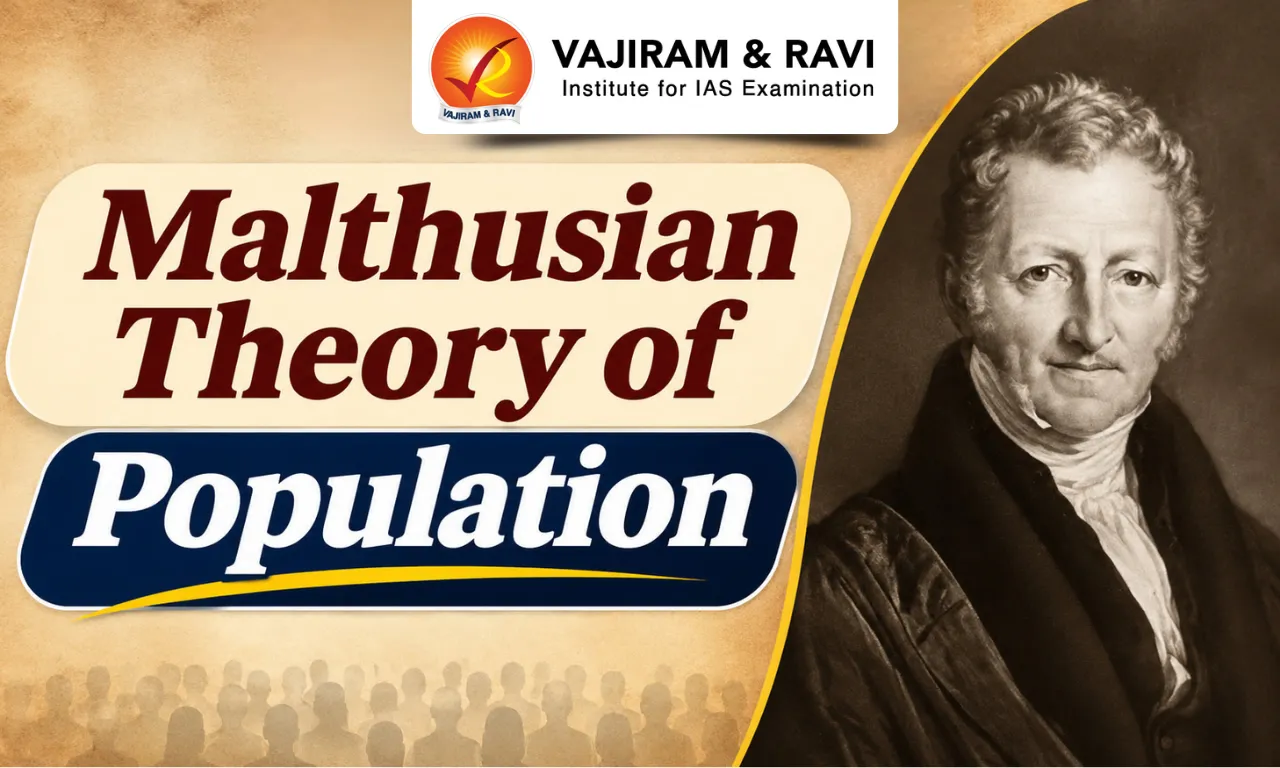
The Malthusian Theory of Population, proposed by Thomas Robert Malthus in 1798, explains the relationship between population growth and food availability. It argues that population can increase faster than food production, creating pressure on resources and resulting in poverty, famine and disease. The theory remains important for understanding population resource relationships.

What is Malthusian Theory of Population?

The Malthusian Theory of Population states that population increases in a geometric progression, whereas food production grows in an arithmetic progression. According to Malthus, this imbalance eventually creates a gap between population and subsistence, controlled through preventive and positive checks.

Malthusian Theory of Population Features

Thomas Robert Malthus (1766-1834), an English economist, explained his population theory in An Essay on the Principle of Population (1798). Its major features include:

  • Two Fundamental Assumptions: Malthus considered food essential for human survival and believed that sexual attraction would remain nearly constant. These assumptions formed the foundation of his argument about continuous population growth.
  • Geometric Growth of Population: According to Malthus, population doubles approximately every 25 years when unchecked, following a geometric progression of 1, 2, 4, 8, 16 and 32.
  • Arithmetic Growth of Food Supply: Food production increases by relatively fixed quantities because agricultural expansion faces limitations, particularly in land availability. Its progression follows 1, 2, 3, 4 and 5, making it slower than population growth.
  • Increasing Population-Food Gap: Malthus illustrated the growing imbalance through mathematical ratios. After 200 years, population and food supply would reach 256:9, increasing to 4096:13 after 300 years.
  • Preventive Checks: These checks reduce population growth by lowering birth rates. Malthus advocated moral restraint through delayed marriage and sexual abstinence, while considering contraception morally unacceptable.
  • Positive Checks: These increase mortality when population exceeds available subsistence. Famines, epidemics, wars and natural calamities act as positive checks by reducing population through increased deaths.
  • Three Fundamental Propositions: Malthus argued that population remains limited by subsistence, increases whenever food availability improves unless controlled and faces checks through moral restraint, vice and misery.
  • Opposition to Poor Laws: Malthus opposed government relief under the Poor Laws, arguing that financial assistance could encourage larger families without proportionately increasing food production, thereby aggravating poverty.

What is Neo Malthusianism?

Neo Malthusianism represents the modern development of Malthusian ideas, emphasising population control to protect resources and the environment. Unlike Malthus, its supporters accept contraception, family planning and reproductive choices as important measures for controlling population growth and reducing pressure on natural resources.

Criticisms of the Malthusian Theory

The Malthusian Theory has faced criticism because technological progress, demographic changes and improvements in agricultural productivity have challenged its central predictions.

  • Technological Advancement: Agricultural innovations, including irrigation, chemical fertilisers and high yielding seeds, have significantly increased food production. The Green Revolution demonstrates how technology can overcome limitations in agricultural productivity.
  • Boserup's Theory: Ester Boserup, in The Conditions of Agricultural Growth (1965), argued that population pressure encourages agricultural innovation and intensive farming. Thus, population growth can stimulate food production rather than merely threaten it.
  • Sen's Entitlement Approach: Amartya Sen, in Poverty and Famines (1981), explained that famine can result from people's inability to access food, even when adequate supplies exist. His analysis included the Bengal Famine of 1943.
  • Demographic Transition: Malthus underestimated the possibility of declining fertility. Improvements in education, income, healthcare and urbanisation have reduced birth rates across several countries despite improvements in living standards.
  • Neglect of Contraception: Malthus did not recognise contraception as an acceptable population control measure. Modern family planning enables individuals and couples to make informed reproductive choices and regulate family size.
  • Unrealistic Growth Ratios: The assumption that food production necessarily follows arithmetic progression lacks consistent empirical support. Agricultural output has increased substantially in several periods, challenging his fixed mathematical projections.

Significance of the Malthusian Theory

Despite its limitations, the Malthusian Theory established an important foundation for studying population dynamics, resource availability, environmental sustainability and economic development.

  • Foundation of Population Studies: Malthus provided one of the earliest systematic explanations of population growth and its relationship with food availability, encouraging further research into demographic patterns and resource distribution.
  • Influence on Evolutionary Theory: Charles Darwin acknowledged that reading Malthus's work in 1838 influenced his understanding of natural selection. Alfred Russel Wallace was also influenced by the idea of competition for survival.
  • Development of Demography: The theory encouraged systematic examination of birth rates, death rates and population resource relationships, contributing to the development of modern demographic studies.
  • Development of Neo Malthusian Thought: Later thinkers, including Paul Ehrlich and the Club of Rome, extended population resource concerns to environmental degradation and resource limitations. The Limits to Growth (1972) reflected these broader concerns.
  • Influence on Population Policies: Concerns regarding population growth and resource availability influenced family planning programmes and population control policies across several countries, making population stabilisation an important development policy objective.

Malthusian Theory of Population Relevance to India

India's demographic and agricultural experience provides an important perspective on the Malthusian Theory of Population, particularly regarding fertility, food security and sustainable resource management.

  • Population Growth: India's population increased from approximately 36 crore in the 1951 Census to 121 crore in 2011. The UNFPA State of World Population 2026 Report of November 2026 estimates it at 147.66 crore.
  • Declining Fertility Rate: According to the SRS Statistical Report 2024, India's Total Fertility Rate declined from 5.2 in 1971 to 1.9 in 2024, falling below the replacement fertility level of 2.1.
  • Birth and Death Rates: The SRS 2024 reports a Crude Birth Rate of 18.3 per 1,000 population and a Crude Death Rate of 6.4. Higher births than deaths continue to contribute to population growth.
  • Regional Fertility Differences: Population growth varies considerably across Indian states. According to SRS Statistical Report 2024, Bihar recorded the highest Total Fertility Rate of 2.9, while Tamil Nadu recorded 1.3, reflecting different demographic transitions.
  • Growth in Food Production: India's foodgrain production is estimated at a record 376.56 million tonnes in 2025-26, compared with 357.73 million tonnes in 2024-25 and 265.05 million tonnes in 2013-14.
  • Role of the Green Revolution: Introduced during the mid 1960s, the Green Revolution promoted high yielding varieties of wheat and rice, irrigation and fertilisers. It substantially increased agricultural productivity and strengthened India's foodgrain self sufficiency.
  • National Food Security Act, 2013: The Act provides subsidised foodgrain entitlements to up to 75% of the rural and 50% of the urban population, addressing food accessibility and distribution alongside production.
  • Population Policy: India's national family planning programme began in 1952. The National Population Policy 2000 emphasised achieving replacement level fertility and stabilising the population by 2045.
  • Census 2027: India's Census 2027 will be its first digital census. Population enumeration is planned for February 2027.

Malthusian Theory of Population FAQs

Q1: Who proposed the Malthusian Theory of Population?

Ans: Thomas Robert Malthus, an English economist, proposed the Malthusian Theory of Population in 1798 through his work An Essay on the Principle of Population.

Q2: What is the main principle of the Malthusian Theory of Population?

Ans: The theory states that population grows geometrically, while food production increases arithmetically. This difference creates pressure on food resources and leads to population control mechanisms.

Q3: What are the preventive and positive checks in the Malthusian Theory?

Ans: Preventive checks reduce birth rates through delayed marriage and moral restraint, whereas positive checks increase death rates through famine, epidemics, wars and natural calamities.

Q4: What is the difference between Malthusianism and Neo Malthusianism?

Ans: Malthusianism emphasises natural population checks and moral restraint, whereas Neo Malthusianism supports modern contraception, family planning and reproductive choices to control population growth.

Q5: Why is the Malthusian Theory criticised in modern times?

Ans: The theory is criticised for underestimating technological progress, agricultural innovations, fertility decline and modern family planning. Increased food production and improvements in demographic conditions have challenged its original predictions.

Scheme for Enhancement of Construction and Infrastructure Equipment Manufacturing Ecosystem

Scheme for Enhancement of Construction and Infrastructure Equipment Manufacturing Ecosystem

Scheme for Enhancement of Construction and Infrastructure Equipment Manufacturing Ecosystem Latest News

The Union Cabinet, chaired by the Prime Minister of India has approved the "Scheme for Enhancement of Construction and Infrastructure Equipment (CIE) Manufacturing Ecosystem" with a financial outlay of Rs.11,000 crore. 

About Scheme for Enhancement of Construction and Infrastructure Equipment Manufacturing Ecosystem

  • It is to be implemented by the Ministry of Heavy Industries (MHI).
  • It aims to incentivize domestic manufacturing of
    • Construction and Infrastructure Equipment (CIE) and its component
    • To establish a dedicated CIE testing facility in the country, thereby enhancing self-reliance and positioning India as a key player in the Global CIE market.
  • Time Period: The duration of the scheme will be eight years, from financial year 2026-27 to 2033-34.
  • Components
    • Sales-linked Incentive: Incentives will be provided on the incremental sales value of eligible CIE equipment and components to approved applicants across two categories – eligible OEMs and Component Manufacturers.
      • Graded Incentive rates range from 13% to 8% of incremental sales value over a five-year period.
    • Grant for CIE Testing Facility: A grant of up to Rs.375 crore, in the nature of Viability Gap Funding, for setting up a dedicated CIE testing facility.

Source: PIB

Scheme for Enhancement of Construction and Infrastructure Equipment Manufacturing Ecosystem FAQ's

Q1: Scheme for Enhancement of Construction and Infrastructure Equipment Manufacturing Ecosystem is implemented by which ministry?

Ans: Ministry of Heavy Industries

Q2: What is the aim of Scheme for Enhancement of Construction and Infrastructure Equipment Manufacturing Ecosystem ?

Ans: To establish a dedicated CIE testing facility in the country, thereby enhancing self-reliance and positioning India as a key player in the Global CIE market.

ICGS Sujay Concludes Three-Day Visit to Sri Lanka’s Trincomalee Port

ICGS Sujay

ICGS Sujay Latest News

Recently, Indian Coast Guard Ship (ICGS) Sujay concluded its three-day visit to Trincomalee, Sri Lanka.

About ICGS Sujay

  • It is a Samarth-class Offshore Patrol Vessel.
  • Sujay, meaning ‘Great Victory’ is the last of the series of six new Offshore Patrol Vessels (OPV).
  • Built By: It is 105 metres long, designed and built indigenously by Goa Shipyard Ltd.
  • Key Features
    • It is fitted with 30 mm CRN 91 Gun and state of the art navigational and communication equipment, sensors and machinery.
    • The ship is designed to carry one twin engine light helicopter and five high speed boats, including two quick reaction inflatable boats, for swift boarding operations, search and rescue, law enforcement and maritime patrol.

Source: PIB

ICGS Sujay FAQs

Q1: What is ICGS Sujay ?

Ans: It is a Samarth-class Offshore Patrol Vessel.

Q2: Which organisation built ICGS Sujay ?

Ans: It is 105 metres long, designed and built indigenously by Goa Shipyard Ltd.

Estates Management Scheme: Cabinet Approves Postal Infrastructure Modernisation Plan

Estates Management Scheme

Estates Management Scheme Latest News

The Union Cabinet chaired by the Prime Minister of India has approved the proposal of the Department of Posts for the continuation of the Estates Management Scheme.

About Estates Management Scheme

  • It is the Central Sector Scheme.
  • The scheme aims to comprehensively transform and modernize the estates infrastructure of the Department of Posts.
  • It focuses heavily on the construction, re-construction, renovation, uniform branding of post offices and residential colonies, along with the preservation of India’s heritage postal buildings.
  • Implementation Timeline: It is scheduled for phased implementation over a five-year horizon, starting from FY 2026-27 through FY 2030-31.

Components of the Estates Management Scheme

  • New Construction: Building 190 departmental postal buildings on vacant departmental plots to replace currently rented spaces and eliminate rental liabilities.
  • Re-construction Demolishing and rebuilding 50 dilapidated departmental postal structures to ensure long-term structural safety.
  • Renovation & Branding Upgrading and establishing uniform branding across 2,550 departmental SubPost Offices as per SPA guidelines.
  • Rented Post Office Upgrades: Upgrading and uniformly branding 2,500 post offices operating out of rented premises.
  • Heritage Preservation: Restoring and preserving 20 landmark heritage postal buildings to safeguard the historical legacy of the department.
  • Allied & Inclusive Activities: Implementing sustainable features (Solar power, Rainwater Harvesting) and universal accessibility infrastructure (ramps, Braille signage) under the Sugamya Bharat Abhiyan, alongwith gender-focused additions like ladies toilets and feeding rooms.
  • Integrated Technology Center: Setting up a permanent physical infrastructure for the Centre for Excellence in Postal Technology (CEPT) in Bengaluru to drive Advanced Postal Technology (APT) services and support the indigenous Opensource Tech Stack.

Source: PIB

Estates Management Scheme FAQs

Q1: What is the Estates Management Scheme?

Ans: The scheme aims to comprehensively transform and modernize the estates infrastructure of the Department of Posts.

Q2: What is the time period of Estates Management Scheme?

Ans: It is scheduled for phased implementation over a five-year horizon, starting from FY 2026-27 through FY 2030-31.

Beddome’s Bronzeback: New Tree Snake Species Identified in Western Ghats After Taxonomic Confusion

Beddome's bronzeback

Beddome's bronzeback Latest News

Scientists recently described a new tree snake species, Beddome's bronzeback, from the Western Ghats.

About Beddome's bronzeback

  • It is a newly identified species of tree snake from the Western Ghats.
  • Scientific Name: Dendrelaphis beddomei 
  • It has been named after Colonel Richard Henry Beddome (1830–1911) in recognition of his contributions to the study of biodiversity in the Western Ghats, particularly reptiles and amphibians.  
  • The discovery resolves a longstanding taxonomic confusion with the closely related large-eyed bronzeback (Dendrelaphis grandoculis). 
  • The two species differ in several physical characteristics, including tongue colour, scale counts, and body markings.
    • The Beddome's bronzeback has a red or pink tongue, while the large-eyed bronzeback has a black or dark-grey tongue.
    • The newly described species also frequently displays a white stripe or a series of spots along the lower sides of its body and sometimes prominent black blotches on its back. These features are absent in the large-eyed bronzeback.
    • It has a longer loreal scale, located between the eye and nostril, and a smaller second postocular scale, situated behind the eye.
    • The number of paired scales beneath its tail can reach 168, compared with fewer than 133 in the large-eyed bronzeback.
  • Different Habitat Preferences:
    • The large-eyed bronzeback primarily inhabits evergreen and semi-evergreen rainforests at elevations between 300 and 1,260 metres above sea level.
    • Beddome's bronzeback, by contrast, favours lower elevations on the western, windward slopes of the Western Ghats. It has been recorded at elevations ranging from 44 to 1,038 metres.
    • It occurs predominantly in secondary forests, forests along waterways, and agricultural landscapes, including rubber and areca nut plantations.
    • Distribution modelling suggests that the new species is most likely to occur in parts of the central Western Ghats, particularly between Puttur and Jog Falls in Karnataka.
    • Other potentially suitable habitats extend from Wayanad in Kerala to Uttara Kannada in Karnataka.
    • The large-eyed bronzeback, meanwhile, is predicted to occur across a wider stretch of the Western Ghats, including several mountainous regions in southern and central parts of the range.

News: DTE

Beddome's bronzeback FAQs

Q1: What is Beddome's bronzeback?

Ans: It is a newly identified species of tree snake from the Western Ghats.

Q2: What is the scientific name of Beddome's bronzeback?

Ans: Dendrelaphis beddomei.

Q3: Why was Beddome's bronzeback named after Colonel Richard Henry Beddome?

Ans: In recognition of his contributions to the study of biodiversity in the Western Ghats, particularly reptiles and amphibians.

Q4: What is the tongue colour of Beddome's bronzeback?

Ans: Red or pink.

Q5: Which distinctive body markings are frequently found on Beddome's bronzeback?

Ans: A white stripe or a series of spots along the lower sides of its body, sometimes accompanied by prominent black blotches on its back.

Cyrtodactylus bossmit and Cyrtodactylus kremicola: Two New Gecko Species Discovered in Meghalaya

Two New Species of Geckos

New Species of Geckos Latest News

Two new species of geckos named Cyrtodactylus bossmit and Cyrtodactylus kremicola have been recently discovered in the limestone cave systems of Meghalaya, taking the number of recognised species of the genus in the state to nine.

About Cyrtodactylus bossmit and Cyrtodactylus kremicola

  • They are two new species of cave-dwelling bent-toed geckos.
  • They were discovered in the limestone cave systems of Meghalaya’s Khasi and Jaintia Hills.
  • The discovery takes the number of recognised species of the genus in the state to nine. 
  • The first species, Cyrtodactylus bossmit, commonly known as the Bossmit bent-toed gecko, has been named after Shillong’s iconic wooden bus, ‘Bossmit’.
    • It was recorded at Maw Tynghiang Cave in Nongnah village of the South-West Khasi Hills. 
    • It is also known from other locations across the Khasi Hills. 
  • The second species, Cyrtodactylus kremicola, commonly known as the Krem bent-toed gecko, derives its name from the Khasi word ‘krem’, meaning cave. 
    • It was identified at Rupasor Cave in the Syndai village of the West Jaintia Hills district.  
    • It is currently known only from this locality and is associated with limestone outcrops, caves, rock crevices and surrounding forest vegetation. 
  • Both are moderately sized geckos, with maximum recorded body lengths of 81.7 mm for C. bossmit and 83.6 mm for C. kremicola.

News: TP

Two New Species of Geckos FAQ's

Q1: Which two new species of cave-dwelling bent-toed geckos were recently discovered in Meghalaya?

Ans: Cyrtodactylus bossmit and Cyrtodactylus kremicola.

Q2: In which type of geological formations were Cyrtodactylus bossmit and Cyrtodactylus kremicola discovered?

Ans: Limestone cave systems.

Q3: After what has Cyrtodactylus bossmit been named?

Ans: Shillong's iconic wooden bus, 'Bossmit'.

Q4: In which cave was Cyrtodactylus bossmit first recorded?

Ans: It was recorded at Maw Tynghiang Cave in Nongnah village of the South-West Khasi Hills.

Q5: In which cave was Cyrtodactylus kremicola identified?

Ans: It was identified at Rupasor Cave in the Syndai village of the West Jaintia Hills district.

Indian Vulture: Two Released Birds Travel Over 1,000 Km from Melghat to Bhopal

Indian vulture

Indian Vulture Latest News

Recently, a seven-year-old female Indian vulture, released into the wild at Melghat Tiger Reserve, made a halt in Latur’s Ausa taluka after clocking 10,767 km.

About Indian Vulture

  • It is also called the long-billed vulture, is a bird of prey native to Asia.
  • It is part of a group called ‘’Old World vultures’’. 
  • They belong to the Accipitridae family, which includes eagles and hawks.
  • Distribution: These are native to India, Pakistan, and Nepal.
  • Habitat: They are usually found in savannas and other open habitats around villages, cities, and near cultivated areas.
  • Features
    • It is a bulky medium-sized bird. Females of this species are smaller than males.
    • They have a small, mostly bald head with few feathers. 
    • It has a long, featherless neck, dark eyes, and a long, yellowish beak.  
    • Its large wingspan allows it to fly long distances while using minimal energy. 
  • Conservation Status: It is classified as ‘Critically Endangered’ under the IUCN Red List.

Source: TOI

Indian Vulture FAQs

Q1: Where do we find Indian Vulture?

Ans: These are native to India, Pakistan, and Nepal.

Q2: What is the IUCN status of Indian Vulture?

Ans: It is classified as ‘Critically Endangered’ under the IUCN Red List.

Nocte Community Celebrates 58th Chalo Loku Festival in Arunachal Pradesh

Nocte Community

Nocte Community Latest News

The Nocte community of Arunachal Pradesh recently celebrated its 58th Central Chalo Loku Festival at Khonsa, headquarters of Tirap district.

About Nocte Community

  • They are one of the major indigenous tribal communities of Arunachal Pradesh.
  • They are primarily distributed in the Patkai hills of the Tirap district of Arunachal Pradesh. 
  • Ethnically related to the Konyak Naga, their origins can be traced back to the Hukong Valley in Myanmar, where they migrated from between 1670 and 1700. 
  • Society:
    • The nocte society is based on patrilineal principles. 
    • The basic unit of the Nocte tribe is the clan. It is organized under a chief known as "Lowang" who controls a village. 
    • The chief and his descendents form a separate class called "Lowang Jat" while the commoners are called "Sana Jat". 
    • Marriage in the same clan is strictly prohibited. 
  • Livelihood:
    • The Nocte tribe’s traditional economy is shifting cultivation, hunting, gathering, and fishing. 
    • Since the last two decades some of them have started wet or permanent cultivation. In this cultivation paddy, millet, arum, tapioca, and a few local pulses are grown. 
    • They also earn money by making and selling goods made from bamboo, cane, and other natural materials. 
  • Religion: The Nocte were followers of Theravada Buddhism and Animism, although they have adopted Hinduism (particularly Vaishnavism) since the 18th century, under the influence of Shri Shankardeva. 
  • Festivals:
    • Their main festival is Chalo Loku which is a harvest festival that is celebrated in the month of October-November annually; right after the harvest of the paddy field, and before the start of the new Jhum cultivation. 
    • Other agricultural festivals include Oriah and Ronghoan.

News: DE

Nocte Community FAQs

Q1: Nocte community resides in which Indian state?

Ans: Arunachal Pradesh

Q2: In which region of Arunachal Pradesh is the Nocte community primarily distributed?

Ans: Patkai Hills of Tirap district.

Q3: What is the traditional village chief of the Nocte community called?

Ans: Lowang.

Q4: What are the traditional livelihood activities of the Nocte community?

Ans: Shifting cultivation, hunting, gathering and fishing.

Q5: What is the main festival of the Nocte community?

Ans: Their main festival is Chalo Loku which is a harvest festival that is celebrated in the month of October-November annually.

Ranganathittu Bird Sanctuary: Migratory Birds Arrive Two Weeks Early to Breed

Ranganathittu Bird Sanctuary

Ranganathittu Bird Sanctuary Latest News

Migratory birds that usually visit Ranganathittu Bird Sanctuary in Srirangapatna taluk, Mandya district, in the first week of December have started arriving two weeks early to breed.

About Ranganathittu Bird Sanctuary

  • It is located in the Mandya district near Srirangapatna, Karnataka. 
  • Situated on a cluster of small islands along the Kaveri River, it is spread over an area of 0.67 sq.km. 
  • It is also known as the "Pakshi Kashi of Karnataka"
  • It was designated on 15 February 2022 as a protected Ramsar site, making it the first Ramsar site in Karnataka.  
  • History:
    • Ranganathittu's islets were formed when an embankment across the Cauvery River was built between 1645 and 1648 by the then-king of Mysore, Kanteerava Narasimharaja Wadiyar. 
    • These islets, originally numbering 25, soon started attracting birds. 
    • The ornithologist Salim Ali observed that the islets formed an important nesting ground for a large variety of birds and persuaded the king of Mysore to declare the area a protected area in 1940. 
  • Flora: It is covered with dense broadleaf forests, consisting of Arjun trees (Terminalia arjuna), bamboo groves, and Pandanus trees.
  • Fauna: 
    • It is home to approximately 170 bird species, making it a significant breeding and nesting ground. 
    • Some of the regularly breeding birds include the painted stork, Asian openbill stork, common spoonbill, woolly-necked stork, black-headed ibis, lesser whistling duck, Indian shag, stork-billed kingfisher, egrets, cormorants, Oriental darter, spot-billed pelican, and various herons.
    • The islands are host to numerous small mammals, including bonnet macaque, smooth-coated otter, colonies of flying fox, and common small mammals such as common palm civet and Indian grey mongoose. 
    • Additionally, there is a population of monitor lizards. 
    • The mugger crocodile, or marsh crocodile, is a common inhabitant of the riverine reed beds, and Ranganathittu has the largest freshwater crocodile population in Karnataka state.

News: DH

Ranganathittu Bird Sanctuary FAQs

Q1: Where is Ranganathittu Bird Sanctuary located?

Ans: Mandya district, near Srirangapatna in Karnataka.

Q2: Along which river is Ranganathittu Bird Sanctuary located?

Ans: Kaveri (Cauvery) River.

Q3: When was Ranganathittu Bird Sanctuary designated as a Ramsar site?

Ans: 15 February 2022.

Q4: Which types of forests are predominantly found in Ranganathittu Bird Sanctuary?

Ans: Dense broadleaf forests.

Q5: Which renowned Indian ornithologist played a key role in the protection of Ranganathittu Bird Sanctuary?

Ans: Salim Ali.

Lake Kariba: Rising Zambezi Inflows Bring Relief After Years of Drought

Lake Kariba

Lake Kariba Latest News

A herd of elephants has surprised wildlife enthusiasts after being spotted swimming approximately 7 kilometres across Lake Kariba in Zimbabwe recently.

About Lake Kariba

  • It is located in central Africa, along the border between Zambia and Zimbabwe.
  • It is the world’s largest artificial lake and reservoir by volume and the fourth largest by surface area. 
  • It is located on the Zambezi River, about halfway between the river’s source and mouth.  
  • It can be found 1300 kilometers upstream from the Indian Ocean.
  • It is over 220 kilometers long and up to 40 kilometers in width. It covers an area of 5,200 sq.km.
  • Lake Kariba was filled between 1958 and 1963 after the completion of the Kariba Dam, which flooded the Kariba Gorge on the Zambezi River, approximately 250 miles below Victoria Falls. 
    • The Kariba Dam consists of a double-arch wall. 
    • The dam wall is 128 m high and 617 m (2029 feet) long when measured along the horizontal arch of the wall. 
    • It provides considerable electric power to both Zambia and Zimbabwe and supports a thriving commercial fishing industry.
  • The creation of the lake resulted in the displacement of approximately 57,000 Tonga people from their ancestral settlements in Zambia and Zimbabwe.
  • The lake encompasses a total of 102 islands, including well-known ones like Chete Island and Spurwing Island.
    • Spanning approximately 2,800 acres or 1,200 hectares, Chete Island holds the distinction of being the largest single landmass in the lake. 
    • It boasts the world's largest expanse of protected, undeveloped wetlands and hosts the largest single population of African elephants. 

News: MC

Lake Kariba FAQs

Q1: Where is Lake Kariba located?

Ans: Along the border between Zambia and Zimbabwe in Central Africa.

Q2: Lake Kariba is located on which river?

Ans: Zambezi River.

Q3: Which lake is the world's largest artificial lake and reservoir by volume?

Ans: Lake Kariba.

Q4: Which gorge was flooded during the formation of Lake Kariba?

Ans: Kariba Gorge on the Zambezi River.

Q5: Which indigenous community was displaced during the creation of Lake Kariba?

Ans: The Tonga community.

Parts of Indian Constitution, Check All 25 Parts Subject, Key Details

Parts of Indian Constitution

The Constitution of India, adopted in 1950, originally consisted of 395 Articles, 22 Parts, and 8 Schedules. Over time, through amendments, its scope has expanded to address emerging needs of governance and society. Today, the Constitution contains 448 Articles, 25 Parts, and 12 Schedules.

The Parts of Indian Constitution serve as the backbone, organizing its provisions into broad themes such as fundamental rights, directive principles, governance structure, and emergency provisions. Later additions like Part IXA (Municipalities), Part IXB (Co-operative Societies), and Part XIVA (Tribunals) highlight the evolving nature of constitutional law in India.

It’s also important to note that when new Articles or Parts are inserted, they are numbered alphabetically (like Article 21A) to maintain the document’s structure without disrupting the original sequence.

Parts of Indian Constitution 

The Constitution of India is not just a legal document but also the supreme law of the land. It lays down the framework of governance by defining the roles of people in positions of authority and clearly outlining the limitations on their power. At the same time, it secures the rights, powers, procedures, and duties of both the government and the citizens.

What makes it unique is its emphasis on the supremacy of the Constitution itself, rather than the supremacy of the legislature. This ensures that every law and every action of the government remains within the constitutional framework.

To understand this structure better, here’s an overview of the Parts of the Indian Constitution presented in a table:

Parts of Indian Constitution Overview

Particulars

Details

Constitution formed on

26th November 1949

Parts of Indian Constitution Originally

22 Parts

Parts of Indian Constitution at Present

25 Parts

New Parts added in Constitution

  • Part IX A of the Constitution was inserted by the Constitution (74th Amendment) Act, 1992. It contains provisions for local self government at the urban level.
  • Part IXB of the Constitution grants constitutional status to co-operative societies and contains provisions for their democratic functioning. It was inserted by the Constitution (97th, Amendment) Act, 2011.
  • Part XIVA of the Indian Constitution provides for the appointment of tribunals for administrative and other disputes. It was not a part of the Constitution of India 1950, but was added by the Constitution (Forty-second Amendment) Act, 1942.

List of Parts of Indian Constitution

The Indian Constitution is a written document that serves as the supreme law of the land. It was drafted by the Constituent Assembly, with key contributions from leaders like Dr. B.R. Ambedkar, Rajendra Prasad, and Jawaharlal Nehru, and came into effect on January 26, 1950.

To ensure clarity and proper governance, the Constitution is divided into distinct sections that address specific subjects. Over time, it has expanded and now consists of 25 Parts, each focusing on different aspects of governance, rights, and duties.

List of Parts of Indian Constitution

Parts and Subject

Articles

Part I - The Union and its Territories

1 - 4

Part II - Citizenship

5 -11

Part III - Fundamental Rights

12 - 35

Part IV - Directive Principles of State Policy

36 - 51

Part IV A - Fundamental Duties

51A

Part V - The Union

52 - 151

Part VI - The States

152 - 237

Part VII - The States in Part B of First Schedule

238 [Repealed]

Part VIII - The Union Territories

239 - 242

Part IX - The Panchayats

243 - 243O

Part IXA - The Municipalities

243P - 243ZG

Part IXB - The Co-operative Societies

243ZH - 243ZT

Part X - The Scheduled and Tribal Areas

244 - 244A

Part XI - Relation between the Union and the States

245 - 263

Part XII - Finance, Property, Contracts and Suits

264 - 300A

Part XIII - Trade, Commerce and Intercourse within the territory of India

301 - 307

Part XIV - Services Under the Union and the States

308 - 323

Part XIVA - Tribunals

323A - 323B

Part XV - Elections

324 - 329A

Part XVI - Special provisions relating to certain classes

330 - 342

Part XVII - Official language

343 - 351

Part XVIII - Emergency Provisions

352 - 360

Part XIX - Miscellaneous

361 - 367

Part XX - Amendment of the Constitution

368

Part XXI - Temporary, Transitional and Special Provisions

369 - 392

Part XXII - Short Title, Commencement, Authoritative Text in Hindi and Repeals

393 - 395

Parts of Indian Constitution Details

The Constitution of India is the supreme law of the land. It was adopted on 26 January 1950 and originally contained 395 Articles, 22 Parts, and 8 Schedules. Today, through amendments, it has expanded to 448 Articles, 25 Parts, and 12 Schedules.

Each Part of the Constitution deals with a specific subject - from Union and State structures to rights, duties, emergency provisions, and governance frameworks. 

Parts of Indian Constitution Details

Part

Articles Covered

Subject / Theme

Brief Explanation

Part I

Articles 1 - 4

The Union and its Territory

Defines India as a Union of States; regulates formation of new states and alteration of boundaries.

Part II

Articles 5 - 11

Citizenship

Lays down provisions for citizenship at the commencement of the Constitution and rules for acquisition/termination.

Part III

Articles 12 - 35

Fundamental Rights

Guarantees six categories of Fundamental Rights to citizens, inspired by the US Bill of Rights.

Part IV

Articles 36 - 51

Directive Principles of State Policy (DPSP)

Guidelines for the State to establish a just society; non-justiciable but fundamental to governance.

Part IVA

Article 51A

Fundamental Duties

Lists 11 duties of citizens, added by the 42nd Amendment (1976) on recommendation of Swaran Singh Committee.

Part V

Articles 52 - 151

The Union

Deals with the Union Government - Executive (President, PM, Council of Ministers), Parliament, and Judiciary.

Part VI

Articles 153 - 237

The States

Deals with State Governments - Governors, State Legislature, and High Courts.

Part VII

[Repealed]

States in Part B

Dealt with Part B states; repealed by the 7th Amendment (1956).

Part VIII

Articles 239 - 242

Union Territories

Provides for administration of Union Territories by the President through Administrators.

Part IX

Articles 243 - 243O

The Panchayats

Establishes Panchayati Raj system (73rd Amendment, 1992) for rural local self-government.

Part IXA

Articles 243P - 243ZG

The Municipalities

Establishes urban local bodies (74th Amendment, 1992) with structure, powers, and responsibilities.

Part IXB

Articles 243ZH - 243ZT

Co-operative Societies

Provides for regulation and management of co-operatives (97th Amendment, 2011).

Part X

Articles 244 - 244A

Scheduled and Tribal Areas

Deals with administration of Scheduled Areas (Fifth Schedule) and Tribal Areas (Sixth Schedule).

Part XI

Articles 245 - 263

Relations between the Union and States

Lays down legislative, administrative, and financial relations between the Centre and States.

Part XII

Articles 264 - 300A

Finance, Property, Contracts, and Suits

Covers distribution of revenues, borrowing powers, property rights, and legal suits involving government.

Part XIII

Articles 301 - 307

Trade, Commerce, and Intercourse

Ensures freedom of trade and commerce across India; modeled on Australian Constitution.

Part XIV

Articles 308 - 323

Services under Union and States

Covers recruitment, conditions of service, and role of Public Service Commissions.

Part XIVA

Articles 323A - 323B

Tribunals

Provides for Administrative Tribunals and other tribunals for speedy justice (42nd Amendment, 1976).

Part XV

Articles 324 - 329A

Elections

Deals with conduct of elections; empowers Election Commission of India.

Part XVI

Articles 330 - 342

Special Provisions for Certain Classes

Safeguards for SCs, STs, and Anglo-Indians, including reservation of seats.

Part XVII

Articles 343 - 351

Official Language

Declares Hindi in Devanagari script as official language; provides for use of English and development of regional languages.

Part XVIII

Articles 352 - 360

Emergency Provisions

Provides for National Emergency, President’s Rule, and Financial Emergency.

Part XIX

Articles 361 - 367

Miscellaneous

Covers protection of President/Governors, privy purses, interpretation of Constitution, etc.

Part XX

Article 368

Amendment of the Constitution

Provides the procedure for constitutional amendments - flexible yet rigid.

Part XXI

Articles 369 - 392

Temporary, Transitional, and Special Provisions

Deals with temporary and special provisions for certain states and union territories.

Part XXII

Articles 393 - 395

Short title, Commencement, Authoritative Text, Repeals

Specifies short title, date of commencement, authoritative text in Hindi, and repeals of previous laws.

Parts of Indian Constitution FAQs

Q1: Are there 22 or 25 parts in the Indian Constitution?

Ans: Originally, the Constitution had 22 parts, but after subsequent amendments and additions, it now has 25 parts.

Q2: Why is part 7 removed?

Ans: Part 7 dealt with Part-B states. After the 7th Constitutional Amendment, 1956, Part-B states were merged with others, making this part redundant, so it was repealed.

Q3: What is part 8 of the Indian Constitution?

Ans: Part 8 (Articles 239-242) deals with Union Territories, their administration, governance, and special provisions.

Q4: What are the articles 1, 2, 3, 4, 5 of the Constitution?

Ans: Article 1 - India, that is Bharat, is a Union of States, Article 2 - Admission/establishment of new States, Article 3 - Formation of new States and alteration of areas/boundaries, Article 4 - Laws under Articles 2 & 3 not amendments under Article 368, Article 5 - Citizenship at the commencement of the Constitution.

Q5: How to remember 25 parts of the Indian Constitution?

Ans: Use a mnemonic chain technique. For example: “The Union’s State Needs Citizenship, Directive Policies, Emergency Provisions, Panchayati Raj, Tribunals...” linking each part in order with keywords.

Mahua: TRIFED Develops Nutra Beverage to Boost Tribal Incomes

Mahua

Mahua Tree Latest News

In Madhya Pradesh's Bhimpur block, tribal communities that once extracted their own oil from mahua (Madhuca longifolia) began depending on makret-bought resources.

About Mahua Tree

  • It is a medium-sized deciduous tree that grows to a height of 16–20 metres, predominantly found in the forests of Central India.
  • Mahua is revered as a “Tree of Life” among tribal communities and is considered sacred.
  • Distribution: It is commonly found in West Bengal, Odisha, Chhattisgarh, Jharkhand, Bihar, parts of Northern and Central India, and also in Maharashtra, Gujarat, Telangana, Tamil Nadu, and Kerala.
  • Nutritional and Economic Role: The flowers are consumed raw or sun-dried and are highly nutritious. They are traditionally fermented to produce a strong alcoholic drink, which is a major source of livelihood for tribal families.
  • Livelihood Support
    • Its flowers, leaves, fruits, seeds, and even fruit shells are used in everyday tribal practices, including funeral rites.
    • The collection and processing of Mahua flowers support tribal economies, offering food security, employment, and income generation, especially for women collectors.
  • Ecological importance
    • Mahua’s night-blooming, strong-smelling flowers attract bats, aiding in pollination and seed dispersal.
    • Sloth bears and other forest animals also feed on its flowers, showing its importance in the forest food web.

Source: DTE

Mahua Tree FAQs

Q1: Where do we find Mahua Tree?

Ans: It is commonly found in West Bengal, Odisha, Chhattisgarh, Jharkhand, Bihar, parts of Northern and Central India.

Q2: What is the ecological significance of Mahua Tree?

Ans: Mahua’s night-blooming, strong-smelling flowers attract bats, aiding in pollination and seed dispersal.

Operation Black Tornado 2008, 26/11 Mumbai Terror Attack

Operation Black Tornado was India's large scale counter terrorism mission launched to end the 26/11 Mumbai terror attacks of November 2008. The operation was conducted by the National Security Guard (NSG), also known as the "Black Cats". It involved clearing multiple hostage locations, eliminating terrorists, rescuing civilians and securing buildings from explosives. It remains one of the most complex urban counter terror operations undertaken in India and significantly reshaped the country's security preparedness.

26/11 Terror Attack Anniversary 2026

As part of the 26/11 Mumbai Terror Attack Anniversary observances on November 26th 2026, NSG Mumbai is organising a memorial and pledge ceremony under the #NEVEREVER theme at the Gateway of India. The programme will honour martyrs, survivors and victims through memorial displays, floral tributes and a Living Memorial. Students will also participate in pledge-taking activities promoting peace, vigilance and national security.

What is Operation Black Tornado 2008?

Operation Black Tornado 2008 was the codename given to the NSG operation launched against the terrorists involved in the 26/11 Mumbai attacks. The mission focused on neutralising the attackers, rescuing hostages with minimum casualties, capturing terrorists wherever possible and ensuring that all targeted locations were completely cleared of explosives before security forces withdrew. The operation concluded on 29 November 2008 after nearly three days of continuous combat across multiple locations.

26/11 Mumbai Terror Attack

The 26 November 2008 Mumbai Terror Attack (26/11) was a coordinated assault carried out by 10 Lashkar e Taiba terrorists who entered Mumbai through the Arabian Sea after departing from Karachi and hijacking an Indian fishing trawler. They targeted prominent locations including the Taj Hotel, Nariman House, Chhatrapati Shivaji Terminus (CST) and other places. The attacks lasted from 26 to 29 November 2008, killing around 175 people, including nine terrorists, while more than 300 others were injured. Ajmal Kasab was the only terrorist captured alive.

Operation Black Tornado Background

Operation Black Tornado was launched after coordinated terrorist attacks paralysed Mumbai and created an unprecedented hostage situation across several high profile locations.

  • History of attacks: Mumbai had witnessed several major terrorist attacks since the 1993 serial bomb blasts, including bomb explosions between 1993 and 2006 that caused hundreds of deaths and thousands of injuries.
  • Sea route infiltration: Ten terrorists travelled from Karachi through the Arabian Sea, hijacked an Indian fishing trawler, killed its crew and reached South Mumbai using inflatable boats under the cover of darkness.
  • Multiple strategic targets: Terrorists attacked the Taj Mahal Palace Hotel, Oberoi-Trident Hotel, Nariman House, CST railway station, Leopold Cafe, Cama Hospital, Metro Cinema area and other locations almost simultaneously.
  • Hostage crisis: Hundreds of guests, hotel staff and visitors were trapped inside luxury hotels and Nariman House, requiring specialised hostage rescue operations by elite counter terror forces.
  • Need for specialised intervention: Mumbai Police initially responded but faced heavily armed terrorists equipped with AK 47 rifles, grenades and explosives, making NSG deployment essential.

Operation Black Tornado Launch 2008

Operation Black Tornado 2008 involved simultaneous operations across several unfamiliar urban locations under extremely challenging combat conditions.

  • Primary objectives: The major objective was to neutralise every terrorist, capture any survivor if possible, minimise hostage casualties and ensure no explosives remained inside the buildings.
  • Simultaneous operations: Teams were deployed to the Taj Hotel, Oberoi-Trident Hotel and Nariman House together.
  • Specialised support: NSG deployed dog squads to locate bodies of neutralised terrorists, helping confirm that cleared sections no longer contained active attackers.
  • CST and city attacks: Two terrorists attacked Chhatrapati Shivaji Terminus using AK 47 rifles and grenades, killing 58 civilians before moving towards Cama Hospital and later confronting police.
  • Capture of Ajmal Kasab: During a gun battle after the CST attack, one terrorist was killed while Ajmal Kasab was captured alive after Assistant Police Sub Inspector Tukaram Omble sacrificed his life while disarming him.
  • Mission completion: By the evening of 28 November and final clearance on 29 November, all terrorists had been neutralised except Ajmal Kasab, bringing Operation Black Tornado to a successful conclusion.

Operation Black Tornado Outcomes and Aftermath

Operation Black Tornado transformed India's counter terrorism framework and led to major security, legal and institutional reforms after the attacks.

  • Operation success: Nine terrorists were killed during the operation while Ajmal Kasab became the only surviving attacker captured alive, providing crucial information about the conspiracy.
  • Human losses: Around 175 people lost their lives, including civilians, police personnel and NSG commandos, while more than 300 people suffered injuries during the three day attack.
  • Property damage: Fire, explosions and gunfire caused property losses exceeding one billion US dollars, while Mumbai also suffered major economic disruption during the attacks.
  • Kasab Trial: Ajmal Kasab faced trial on 86 charges including murder, conspiracy and waging war against India, was convicted in 2010 and executed at Yerwada Jail on 21 November 2012.
  • Further investigations: Investigations later identified the involvement of David Headley, Tahawwur Rana, Zabiuddin Ansari alias Abu Hamza and other conspirators connected with the planning of the attacks.
  • Security reforms: The attacks resulted in strengthening anti terror laws, creation of the National Investigation Agency (NIA), expansion of coastal security and establishment of Maharashtra's Force One.
  • International impact: The attacks severely affected India-Pakistan Relations, intensified global counter terror cooperation and exposed the international network supporting Lashkar e Taiba operations.
  • Memorials and remembrance: Annual tributes, candlelight ceremonies and memorial events continue to honour victims and security personnel, while Nariman House was developed as a memorial known as Nariman Light House.

Operation Black Tornado Leaders

Operation Black Tornado highlighted exceptional courage by security personnel whose leadership and sacrifice became defining features of the mission.

  • Major Sandeep Unnikrishnan: The NSG officer displayed exceptional bravery during the Taj Hotel rescue while attempting to save fellow Commando Sunil Yadav. Before making his final assault, he reportedly told his team, "Do not come up, I will handle them." He was martyred during the operation and was posthumously awarded the Ashok Chakra for his extraordinary courage.
  • Hawaldar Gajender Singh Bisht: He led the assault inside Nariman House, was the first commando to enter after breaching operations and laid down his life during the encounter.
  • Hemant Karkare: The Chief of the Mumbai Anti Terrorism Squad led the response after the CST attack and was martyred while pursuing terrorists near Cama Hospital.
  • Ashok Kamte: The Additional Commissioner of Police joined the pursuit of terrorists after receiving distress information and sacrificed his life during the gun battle.
  • Vijay Salaskar: The renowned encounter specialist fought alongside senior police officers during the operation and was martyred while confronting the terrorists.
  • Tukaram Omble: The Assistant Police Sub Inspector displayed extraordinary courage by physically overpowering Ajmal Kasab despite sustaining fatal injuries, making Kasab's capture possible. He was posthumously awarded the Ashoka Chakra, India's highest peacetime gallantry award.
  • Vishnu Dattaram Zende: The railway announcer at Chhatrapati Shivaji Terminus repeatedly alerted passengers to evacuate, helping save numerous lives during the attack.

Operation Black Tornado 2008 FAQs

Q1: What was Operation Black Tornado 2008?

Ans: Operation Black Tornado was the National Security Guard (NSG) counter terrorism mission launched from 26 to 29 November 2008 to eliminate terrorists, rescue hostages and secure key locations during the 26/11 Mumbai terror attacks.

Q2: Why was Operation Black Tornado launched?

Ans: Operation Black Tornado was launched after 10 Lashkar e Taiba terrorists carried out coordinated attacks across multiple locations in Mumbai, creating a large scale hostage and terror situation.

Q3: Which organisation conducted Operation Black Tornado 2008?

Ans: Operation Black Tornado was conducted by the National Security Guard (NSG), India's elite counter terrorism force popularly known as the Black Cats.

Q4: Who were the heroes of Operation Black Tornado of 26/11?

Ans: Major Sandeep Unnikrishnan, Hawaldar Gajender Singh Bisht, Tukaram Omble, Hemant Karkare, Ashok Kamte, Vijay Salaskar and Vishnu Dattaram Zende are among the most remembered heroes for their courage during the 26/11 Mumbai terror attacks and Operation Black Tornado.

Q5: Why are the 2008 Mumbai attacks called 26/11?

Ans: The attacks are commonly called 26/11 because they began on 26 November 2008 and continued for nearly three days until security forces completed Operation Black Tornado on 29 November.

Salient Features of Indian Constitution, Length, Source, Criticisms

Salient Features of Indian Constitution

The Salient Features of Indian Constitution highlight the unique principles, institutions and values that shape the democratic system of India. It combines elements of federalism, parliamentary government, fundamental rights, directive principles, secularism and an independent judiciary within a single constitutional framework. These features ensure political stability and national unity while addressing the diverse needs of the country’s people.

What are the Salient Features of Indian Constitution?

The Indian Constitution is the lengthiest in the world. The framers of the Constitution intentionally incorporated much details to avoid ambiguity, legal uncertainty, or future controversies. In contrast to the United States where a federal Constitution exists alongside individual state constitutions, India adopted a single, unified Constitution to address the country’s vast size, social and cultural diversity, and administrative complexity. This also led to the inclusion of several temporary and special provisions to modify the unique needs of different regions and communities.

The Salient Features of Indian Constitution include:

Major Salient Features of Constitution of India

The key Salient Features of Indian Constitution have been explained below:

Lengthiest Written Constitution in the World

The Constitution of India is the most detailed and lengthiest written constitution in the world. Constitutions are generally classified into two types: written and unwritten. The Constitution of the United States is an example of a written constitution, while the Constitution of the United Kingdom is largely unwritten. Its framework was significantly influenced by various constitutional sources and laws across world, which contributed many structural and administrative provisions. India also follows a single Constitution for both the Union and the states, unlike some federal countries, making it more comprehensive and detailed in nature. Initially it contained only 395 Articles given under 22 Parts and 8 Schedules. However after several amendments the constitution now consists of 448 Articles under 25 Parts and 12 Schedules.

The key factors contributing to the vast length Salient Features of Indian Constitution are:

  • Geographical and Social Diversity: India’s vast territory and diverse population required detailed constitutional provisions to address regional, cultural, linguistic and social differences effectively.
  • Influence of Government of India Act 1935: Many constitutional provisions were adapted from the Government of India Act that significantly increased constitutional content.
  • Single Constitution for Union and States: Unlike some federations, India adopted one Constitution for both the Centre and states, requiring extensive provisions covering all levels of government.
  • Detailed Centre-State Relations: The Constitution contains elaborate provisions on legislative and administrative relations between the Union and states, ensuring clarity in federal governance.
  • Safeguards and Welfare Objectives: Detailed Fundamental Rights and Directive Principles were included to protect minorities, Scheduled Castes, Scheduled Tribes, Backward Classes and promote social welfare.
  • Extensive Administrative Provisions: Matters relating to citizenship, official language, government services, electoral machinery and administration were incorporated to ensure smooth governance and avoid confusion.

Constitution Inspired by Various Global Sources

The Indian Constitution has borrowed several important features from the constitutions of different countries as well as from the Government of India Act 1935. Nearly 250 provisions of the Constitution were adapted from the Government of India Act alone. During the drafting process, Dr. B. R. Ambedkar noted that the Constituent Assembly carefully examined and studied various constitutions across the world to identify the best constitutional practices. These provisions were then modified to suit India’s social, political, and administrative requirements. The major sources from which different constitutional features were adopted are listed in the table below.

Drawn from Various Sources
Source Borrowed

Government of India Act, 1935

Federal Scheme, Office of Governor, Judiciary, Public Service Commissions, Emergency Provisions, Administrative Details

British Constitution

Parliamentary Government, Rule of Law, Legislative Procedure, Single Citizenship, Cabinet System, Prerogative Writs, Parliamentary Privileges, Bicameralism

US Constitution

Fundamental Rights, Independence of Judiciary, Judicial Review, Impeachment of President, Removal of Supreme Court and High Court Judges, Post of Vice-President

Irish Constitution

Directive Principles of State Policy, Nomination of Members to Rajya Sabha, Method of Election of President

Canadian Constitution

Federation with a Strong Centre, Vesting of Residuary Powers in the Centre, Appointment of State Governors by the Centre, Advisory Jurisdiction of Supreme Court

Australian Constitution

Concurrent List, Freedom of Trade, Commerce, and Inter-course, Joint Sitting of Two Houses of Parliament

Weimar Constitution of Germany

Suspension of Fundamental Rights During Emergency

Soviet Constitution (USSR, now Russia)

Fundamental Duties, Ideal of Justice (Social, Economic, and Political) in Preamble

French Constitution

Republic and Ideals of Liberty, Equality, and Fraternity in Preamble

South African Constitution

Procedure for Amendment of Constitution, Election of Members of Rajya Sabha

Japanese Constitution

Procedure Established by Law

Also Check- Sources of Indian Constitution

Balanced Mix of Rigidity and Flexibility

Constitutions are generally classified into two categories: rigid and flexible. A rigid constitution, such as that of the United States, can be amended only through a special and often complicated procedure, making constitutional changes more difficult. In contrast, a flexible constitution, like that of the United Kingdom, can be amended through the ordinary law making process of the legislature. The Indian Constitution combines features of both systems. Some of its provisions can be amended under Article 368 by a simple parliamentary majority, while others require a special majority and, in certain cases, approval from at least half of the state legislatures. This unique amendment process creates a balance between stability and adaptability, making the Indian Constitution both rigid and flexible in nature.

Federal Structure with a Strong Central Government

India follows a federal system that divides powers between the Union and States while maintaining a strong and effective central government.

  • The Constitution establishes a dual polity with separate governments at the Union and State levels, ensuring governance at both national and regional levels while maintaining constitutional balance.
  • It contains key federal features such as division of powers, written Constitution, constitutional supremacy, independent judiciary, bicameralism and a rigid amendment process for certain provisions.
  • Despite being federal, the Constitution grants greater authority to the Union Government, making the Centre stronger than the States in legislative, administrative and financial matters.
  • The term “Federation” is not used in the Constitution. Article 1 describes India as a “Union of States,” emphasizing national unity and constitutional integration.
  • The expression “Union of States” signifies that the Indian Federation was not created through an agreement among states and no state can secede from it.
  • India follows a single Constitution for the entire country, unlike federations such as the United States where individual states can have separate constitutions.
  • Emergency provisions enable the Centre to assume greater control over states during crises, allowing the federal system to function almost as a unitary system when required.
  • Article 312 empowers Parliament to create All India Services that serve both the Union and States, strengthening administrative coordination across the country.
  • State Governors are appointed by the President under Article 155, while constitutional authorities like the Election Commission and Comptroller and Auditor General also operate under central constitutional arrangements.
  • Due to its federal structure combined with strong centralising features, India is often described as “quasi federal,” “federal in form but unitary in spirit,” and a federation with a centralising tendency.

Parliamentary System of Governance

The Parliamentary System of Governance in India is based on the British model and operates at both Union and State levels.

  • India follows the Parliamentary System instead of the American Presidential System, ensuring democratic governance through elected representatives at both the Centre and the States.
  • The system is based on the presence of a nominal executive and a real executive, where actual governing powers are exercised by elected leaders.
  • The President at the Centre and the Governor in States act as constitutional heads, while real executive authority rests with the Prime Minister and Chief Minister.
  • The party or coalition securing a majority in the legislature forms the government and exercises executive powers according to constitutional provisions.
  • The Council of Ministers is collectively responsible to the legislature and remains in office only as long as it enjoys legislative confidence.
  • Ministers are generally members of the legislature, ensuring close coordination between law making and executive functions within the parliamentary framework.
  • Articles 74 and 75 establish the parliamentary system at the Centre, providing for a Council of Ministers headed by the Prime Minister.
  • Articles 163 and 164 provide for a Council of Ministers in States, headed by the Chief Minister to aid and advise the Governor.
  • The Lok Sabha and State Legislative Assemblies can be dissolved when necessary, enabling fresh elections and ensuring democratic accountability.
  • Unlike Britain’s sovereign Parliament and hereditary monarchy, India has a Constitution bound Parliament and an elected republican head of state.

Balance Between Parliamentary Authority and Judicial Review

India follows a balanced constitutional system that combines parliamentary authority with judicial review to protect democracy and constitutional governance.

  • The British system is based on parliamentary sovereignty, where Parliament is supreme and can make or change laws without judicial interference.
  • The American system follows judicial supremacy, where courts possess extensive powers to review laws and invalidate unconstitutional legislative actions.
  • The framers of the Indian Constitution carefully combined both models to create a balanced relationship between the legislature and judiciary.
  • The Supreme Court of India has the power of judicial review and can strike down laws that violate constitutional provisions.
  • Parliament enjoys constituent powers and can amend a major portion of the Constitution through the prescribed constitutional amendment procedure.
  • Unlike the United States, the Indian Supreme Court exercises comparatively limited judicial review powers within the constitutional framework.
  • Article 21 of the Indian Constitution follows the principle of “Procedure Established by Law” rather than the American concept of “Due Process of Law.”
  • This constitutional arrangement prevents excessive concentration of power in either Parliament or the judiciary, ensuring institutional balance.
  • The system enables Parliament to perform legislative functions effectively while allowing courts to safeguard constitutional values and citizens’ rights.

Also Check: Difference Between Procedure Established by Law and Due Process of Law

Supremacy of Rule of Law

Rule of Law is one of the most significant Salient Features of Indian Constitution that ensures that a country is governed by laws, guaranteeing justice, equality, accountability and protection against arbitrary authority.

  • Rule of Law establishes the supremacy of law, ensuring that no individual, public authority, institution or government body is above the legal framework of the country.
  • It is a fundamental feature of a democratic system that prevents arbitrary decision making and promotes fair, transparent and accountable governance at every level.
  • The concept reflects society’s values, customs and collective wisdom developed over generations, making it both a legal principle and a social ideal.
  • Rule of Law is rooted in the belief that people should be governed by established laws rather than the will or power of any individual.
  • It maintains a proper balance between rights and powers, protecting individual freedoms while ensuring that the State functions effectively for society’s welfare.

Integrated and Independent Judicial System

India has an integrated and independent judicial system that ensures uniform justice, protects constitutional values, safeguards rights and upholds law.

  • The Supreme Court stands at the apex of the judicial hierarchy, followed by High Courts, district courts and subordinate courts, creating a unified system across India.
  • A single judicial structure administers and enforces both Union and State laws, ensuring consistency, legal uniformity and equal access to justice throughout the country.
  • The judiciary interprets the Constitution and laws, ensuring that legislative, executive, administrative, judicial and quasi-judicial authorities function within constitutional limits and legal boundaries.
  • Indian courts possess the authority to examine governmental actions and determine whether they comply with constitutional provisions and the basic structure of governance.
  • The judiciary acts as the balance wheel of Indian federalism by resolving disputes between governments and maintaining harmony within the federal framework.
  • Protection of Fundamental Rights is a core responsibility of the judiciary, preventing unlawful encroachment by any organ of government and ensuring constitutional safeguards.
  • Citizens can directly approach the Supreme Court under Article 32 and High Courts under Article 226 for enforcement of Fundamental Rights through writ jurisdiction.
  • The Supreme Court functions as the highest court of appeal, guardian of the Constitution and protector of citizens’ rights, ensuring constitutional supremacy.
  • Judges of the Supreme Court and High Courts enjoy constitutional safeguards, including security of tenure, fixed service conditions and protection from arbitrary removal.
  • Articles 124 and 217 prescribe a special removal procedure for judges on grounds of incapacity or misbehaviour, strengthening judicial independence and impartiality.

Protection of Fundamental Rights 

Fundamental Rights are one of the most important features of the Indian Constitution and are provided to citizens under Part 3 of the Constitution of India. The Constitution guarantees six Fundamental Rights that form the foundation of democracy, individual freedom, equality, and justice in India. These rights protect the dignity, liberty, and autonomy of every citizen and cannot be taken away merely by public opinion or ordinary legislative action. By safeguarding essential freedoms and legal protections, Fundamental Rights help uphold the principles of constitutional democracy and ensure that citizens can live with equality, security, and respect under the law.

Fundamental Rights
Rights Articles

Right to Equality

14-18

Right to Freedom

19-22

Right against Exploitation

23-24

Right to Freedom of Religion

25-28

Cultural and Educational Rights

29-30

Right to Constitutional Remedies

32

Directive Principles of State Policy

Directive Principles of State Policy guide governments in creating laws and policies that promote welfare, justice, equality and development. Dr. Ambedkar referred to DPSP as the Novel Feature of the constitution of India.

  • Contained in Part 4 (Articles 36-51), DPSPs serve as constitutional directions for the Union and State governments while framing laws and public policies.
  • Inspired by the Instrument of Instructions in the Government of India Act 1935, these principles outline the vision of a welfare oriented social and economic order.
  • Article 36 defines “State” in DPSPs with the same meaning as Article 12, covering authorities responsible for implementing constitutional governance.
  • DPSPs are classified into Socialistic, Gandhian and Liberal Intellectual principles, reflecting the Constituent Assembly’s broad vision for national progress and public welfare.
  • Unlike Fundamental Rights, DPSPs are non justiciable and cannot be enforced by courts, yet they remain fundamental to governance and law making.
  • The Supreme Court in Kesavananda Bharati Case and Minerva Mills Case affirmed that DPSPs and Fundamental Rights are complementary, together advancing justice, dignity, equality and inclusive development.

Fundamental Duties of Citizens

The original Constitution of India did not contain any provision related to the Fundamental Duties of citizens. 

  • To strengthen civic responsibility and national commitment, the Fundamental Duties were incorporated through the 42nd Constitutional Amendment Act 1976, based on the recommendations of the Swaran Singh Committee. 
  • This amendment added 10 Fundamental Duties that every Indian citizen is expected to follow.
  • Later, the 86th Constitutional Amendment Act 2002 introduced an 11th Fundamental Duty. 
  • While Fundamental Rights provide citizens with guaranteed legal entitlements and protections, Fundamental Duties outline the moral, civic, and constitutional responsibilities that citizens are expected to perform for the welfare, unity and development of the nation.

Secularism of the Indian State

The Constitution of India establishes a Secular System of Government, which means the State does not favour, endorse or promote any particular religion. At the same time, Indian secularism is not anti-religion, as it recognises and respects the religious diversity of the country. The core principle of Secularism in India is to ensure equal respect, equal protection and equal treatment for all faiths under the law. It requires the government to remain neutral in religious matters while safeguarding the rights and freedoms of people belonging to every religion. Thus, secularism in the Indian Constitution is based on neutrality rather than indifference and on equality rather than preference for any specific faith.

Universal Adult Franchise

Universal Adult Franchise is a key feature of the Indian democratic system that grants every citizen aged 18 years and above the right to vote in Lok Sabha and State Assembly elections, irrespective of caste, race, religion, gender or economic status. This principle ensures political equality by giving all eligible citizens an equal voice in the electoral process. Initially, the voting age was 21 years, but it was reduced to 18 years through the 61st Constitutional Amendment Act, expanding electoral participation and strengthening democratic representation across the country.

Single Citizenship for All Indians

The Indian Constitution provides for a federal system of government with powers divided between the Union and the States, but it follows the principle of single citizenship. 

  • Under this system, every citizen is recognized solely as an Indian citizen, irrespective of the state or territory in which they are born or reside. 
  • As a result, all citizens enjoy equal political and civil rights throughout the country without any discrimination based on their place of residence. 
  • Single citizenship strengthens national unity by ensuring a common identity for all Indians. 
  • The Constitution also does not permit dual citizenship; and if an Indian citizen voluntarily acquires the citizenship of another country, their Indian citizenship is automatically terminated.

Constitutional Independent Institutions

The Constitution of India establishes several Independent Constitutional Bodies beyond the legislative, executive and judicial organs of the Union and State governments. 

  • These institutions act as important pillars of India’s democratic system by ensuring transparency, accountability, merit-based recruitment and free governance. 
  • The Election Commission is responsible for conducting free and fair elections across the country. 
  • The Comptroller and Auditor General (CAG) of India audits the accounts of the Central and State Governments to ensure financial accountability. 
  • The Union Public Service Commission (UPSC) conducts examinations for recruitment to All India Services and higher Central Services and advises the President on disciplinary matters. 
  • Similarly, a State Public Service Commission (SPSC) is established in every state to conduct recruitment examinations for state services and to advise the Governor on disciplinary matters, thereby strengthening the administrative framework of the country.

Emergency Powers and Provisions 

Emergency Provisions in the Indian Constitution enable the President and Central Government to respond effectively during extraordinary national situations.

  • Purpose of Emergency Provisions: The framers of the Constitution included emergency provisions to address situations where normal governance becomes ineffective, ensuring protection of India’s sovereignty, unity, integrity, security, democratic system and constitutional framework.
  • National Emergency (Article 352): A National Emergency can be proclaimed during war, external aggression, or armed rebellion, allowing the Central Government to exercise extensive powers for national security and governance.
  • State Emergency (Articles 356 and Article 365): President’s Rule can be imposed when constitutional machinery fails in a state or when a state fails to comply with directions issued by the Central Government.
  • Financial Emergency (Article 360): A Financial Emergency may be declared when India’s financial stability or credit is threatened, enabling the Centre to take necessary measures to restore economic control.
  • Constitutional Basis of Emergency Provisions: Emergency provisions are detailed under Articles 352, 354 and 360 of the Constitution, empowering the President to handle extraordinary situations through special constitutional mechanisms.
  • Impact on Federal Structure: During an emergency, India’s federal system temporarily shifts towards a more unitary structure, with the Central Government acquiring greater authority and control over state administration.

Three-Tier Democratic Governance System

The Indian Constitution initially provided a two-tier governance structure, defining the organisation, powers, functions and responsibilities of the Central Government and State Governments.

  • The 73rd and 74th Constitutional Amendment Acts 1992 introduced a third tier of government, namely local government, a feature rarely found in constitutions worldwide.
  • The 73rd Amendment granted constitutional status to Panchayats as rural local governments by inserting Part IX and the Eleventh Schedule into the Constitution.
  • Through Part IX and the Eleventh Schedule, Panchayats received formal constitutional recognition, strengthening democratic decentralisation and local self-governance in rural areas.
  • The 74th Amendment granted constitutional status to Municipalities as urban local governments by inserting Part IX A and the Twelfth Schedule into the Constitution.
  • Through Part IX-A and the Twelfth Schedule, Municipalities became constitutionally recognised urban local bodies, ensuring structured governance and administration in urban areas.

Constitutional Recognition of Co-operative Societies

The 97th Constitutional Amendment Act, passed in 2011, gave cooperative societies constitutional status and protection. It empowered Parliament to make laws for multi-state cooperatives, while state legislatures were given the authority to regulate those operating within their own states.

Judicial Review

Judicial Review is a fundamental feature of the Indian Constitution that ensures all laws and government actions remain consistent with constitutional principles and Fundamental Rights. 

  • Article 13 empowers courts to examine both past and future legislation and declare any law unconstitutional if it violates Fundamental Rights or the basic structure of the Constitution. 
  • The Supreme Court, through the landmark cases of Kesavananda Bharati vs. State of Kerala (1973) and Minerva Mills vs. Union of India (1980), affirmed that judicial review is part of the Constitution’s basic structure and cannot be removed through constitutional amendments. 
  • Judicial review is further protected under Articles 32, 136, 226 and 227. 
  • However, courts generally do not interfere in policy matters unless a decision is arbitrary, unreasonable, violates statutory provisions, or infringes legal rights, a principle reiterated in Monarch Infrastructure vs. Commissioner, Ulhasnagar Municipal Corporation (2000). 
  • Key judicial review judgments include Marbury vs. Madison (1803), which established judicial review in the United States and A.K. Gopalan vs. State of Madras (1950), which recognised limited judicial review of preventive detention laws.

Separation of Power

India follows the principle of Separation of Functions rather than a rigid Separation of Powers as seen in the United States. 

  • Although the Doctrine of Separation of Powers is not fully implemented, the Indian Constitutional System establishes an effective mechanism of Checks and Balances among the legislature, executive and judiciary. 
  • This framework prevents the concentration of power in any one organ of the government and helps maintain constitutional governance. 
  • A key feature of this arrangement is the Power of the Judiciary to review legislative actions and invalidate laws enacted by the legislature if they are found to be unconstitutional. 
  • Thus, the system of checks and balances safeguards the supremacy of the Constitution and ensures that all state institutions function within their prescribed constitutional limits.

Criticisms of Indian Constitution

The Indian Constitution is comprehensive and influential, yet scholars and critics have raised concerns regarding various Salient Features of Indian Constitution including structure, functioning, amendments, rights and governance provisions.

  • Length and Complexity: With approx. 450 Articles, numerous Parts, Schedules and amendments, the Constitution is among the world's lengthiest. Its detailed and intricate framework often makes understanding constitutional provisions challenging for ordinary citizens.
  • Rigidity and Frequent Amendments: Some provisions, especially those concerning the federal structure and Fundamental Rights, require a special parliamentary majority for amendment. Despite this rigidity, the Constitution has undergone more than one hundred amendments since adoption.
  • Federalism with Unitary Features: Although India follows a federal system, significant powers remain with the Union government. Article 356, central control over All India Services and other provisions have led critics to view Indian federalism as unitary in practice.
  • Parliamentary System Concerns: India adopted the Westminster style parliamentary model where the executive is accountable to the legislature. Critics argue that this arrangement has sometimes contributed to coalition politics, political instability and leadership changes at the national level.
  • Limitations on Fundamental Rights: The Constitution guarantees six Fundamental Rights, but these are subject to reasonable restrictions. Judicial interpretations and legislative actions have occasionally narrowed the practical scope of equality, freedom of expression and related rights.
  • Non Justiciable Directive Principles: The Directive Principles of State Policy seek to promote social and economic justice. However, because they are non justiciable and unenforceable in courts, their effectiveness and practical implementation are often questioned.
  • Emergency Provisions and Misuse Risks: Emergency provisions allow the Union government to exercise extraordinary powers, including suspension of Fundamental Rights and President’s Rule. Their potential misuse became evident during the 1975-77 Emergency when civil liberties were significantly restricted.
  • Criticism of Constitutional Origins: Critics have described the Constitution as borrowed, a copy of the Government of India Act 1935, un-Indian, anti-Indian or un-Gandhian. Supporters counter that borrowed features were carefully adapted, major innovations were added, Indian aspirations were reflected and several Gandhian principles were accommodated.
  • Legalistic Nature of the Constitution: The Constitution is sometimes called a “Paradise of the Lawyers” because of its detailed legal language. Defenders argue that such precision is necessary to ensure clarity, consistency, interpretation and effective constitutional enforcement.
Other Related Posts
Directive Principles of State Policy Federalism in Indian Polity
Uniform Civil Code Sarkaria Commission
Fundamental Duties Punchhi Commission
Ordinance Making Power of President Inter State Council
Prime Minister of India Fiscal Federalism
Fundamental Rights Rule of Law
Citizenship Emergency in India


Salient Features of Indian Constitution FAQs

Q1: What are the Salient Features of Indian Constitution?

Ans: The Indian Constitution is federal in structure, parliamentary in nature, with a written document, fundamental rights, directive principles, secularism, and an independent judiciary.

Q2: Who is considered the chief architect of the Indian Constitution?

Ans: Dr. B.R. Ambedkar, the Chairman of the Drafting Committee, is regarded as the chief architect of the Indian Constitution.

Q3: Is the Indian Constitution rigid or flexible?

Ans: It is a blend of rigidity and flexibility some parts require a special majority for amendment, while others can be changed by a simple majority.

Q4: How is the Indian Constitution federal in nature?

Ans: It divides powers between the Centre and States through three lists in the Seventh Schedule, ensuring a federal system with a strong central government.

Q5: Why is India called a secular country under the Constitution?

Ans: India has no official state religion, and the Constitution guarantees equal treatment of all religions by the state, promoting religious freedom and harmony.

Fundamental Rights of Indian Constitution, Articles, Features, Importance, Judgements

Fundamental Rights of Indian Constitution

What are Fundamental Rights?

Fundamental Rights are basic rights guaranteed under Part III (Articles 12–35) of the Constitution of India to protect individual liberty, equality and dignity. Inspired by the US Bill of Rights and the ideals of the Magna Carta, they safeguard individuals against arbitrary State action.

They are called fundamental because they are essential for individual development and democratic governance. They are justiciable, allowing individuals to approach the courts for their enforcement, and are often described as the Magna Carta of India.

Features of Fundamental Rights of the Indian Constitution

The Fundamental Rights enshrined in Part III of the Indian Constitution have the following key features:

  • Available to Citizens and Non-Citizens: Some Fundamental Rights are available only to Indian citizens, while others are available to all persons, including foreigners and legal entities such as corporations and companies.
  • Not Absolute: Fundamental Rights are subject to reasonable restrictions imposed by the State, as permitted by the Constitution. Courts determine whether such restrictions satisfy constitutional requirements, balancing individual liberty with the interests of society.
  • Protection Against State and Private Action: Fundamental Rights generally protect individuals against arbitrary State action. However, certain rights, such as those under Articles 15(2), 17, 23 and 24, also operate against private individuals.
  • Negative and Positive in Nature: Some Fundamental Rights impose limitations on the powers of the State, while others confer protections, freedoms or privileges on individuals.
  • Justiciable: Fundamental Rights are enforceable through courts. Individuals can seek judicial remedies when these rights are violated.
  • Guaranteed by the Supreme Court: The Supreme Court acts as the ultimate constitutional protector of Fundamental Rights. Under Article 32, individuals can directly approach the Supreme Court for their enforcement. High Courts also have the power to enforce these rights under Article 226.
  • Can Be Amended: Fundamental Rights are not unalterable. Parliament can amend them through a constitutional amendment under Article 368, provided the amendment does not violate the Constitution’s Basic Structure Doctrine.
  • Suspension During a National Emergency: The enforcement of certain Fundamental Rights may be affected during a National Emergency. Article 20 and Article 21 cannot be suspended through a Presidential Order under Article 359. Article 19 is affected under Article 358 only during an Emergency declared on the grounds of war or external aggression, subject to constitutional conditions.
  • Subject to Certain Constitutional Provisions: Articles 31A, 31B and 31C provide specific protections to certain laws against challenges based on Fundamental Rights, subject to constitutional limitations and judicial review.
  • Special Provisions for Security Forces: Under Article 33, Parliament may restrict or abrogate the application of Fundamental Rights to members of the armed forces, forces charged with maintaining public order, intelligence organisations and certain related services to ensure the proper discharge of their duties and maintenance of discipline.
  • Restrictions During Martial Law: Under Article 34, Parliament may indemnify persons for acts performed in connection with the maintenance or restoration of order in an area where martial law was in force, and validate related actions, subject to the constitutional provision. Martial law is distinct from a National Emergency.
  • Direct and Indirect Enforceability: Many Fundamental Rights can be enforced directly, while some require legislation to give them effect. Under Article 35, Parliament has exclusive legislative power over certain specified matters relating to Fundamental Rights, ensuring uniformity across the country.

Fundamental Rights of the Indian Constitution

The Constitution originally provided seven categories of Fundamental Rights. However, the 44th Constitutional Amendment Act, 1978 removed the Right to Property from this list, leaving six categories. The Right to Property is now a constitutional right under Article 300A.

Fundamental Right Constitutional Articles
Right to Equality Articles 14–18
Right to Freedom Articles 19–22 and Article 21A
Right Against Exploitation Articles 23–24
Right to Freedom of Religion Articles 25–28
Cultural and Educational Rights Articles 29–30
Right to Constitutional Remedies Article 32

Fundamental Rights of Indian Constitution Articles 

The Fundamental Rights of the Indian Constitution are enshrined in Part III, covering Articles 12 to 35. They are grouped into six broad categories and protect individual liberty, equality, dignity and religious and cultural freedoms.

1. Right to Equality (Articles 14-18)

The Right to Equality ensures equal treatment under the law and prohibits discrimination on specified grounds.

  • Article 14: Guarantees equality before the law and equal protection of the laws to all persons.
  • Article 15: Prohibits the State from discriminating against citizens on grounds of religion, race, caste, sex or place of birth, while permitting specified affirmative-action measures.
  • Article 16: Guarantees equality of opportunity for citizens in matters of public employment, subject to constitutionally permitted reservations and other exceptions.
  • Article 17: Abolishes untouchability and prohibits its practice in any form.
  • Article 18: Abolishes titles, except military and academic distinctions, and restricts the acceptance of titles and certain foreign presents or offices under specified conditions.

2. Right to Freedom (Articles 19-22, along with Article 21A)

The Right to Freedom protects essential civil liberties and safeguards individuals against certain forms of arbitrary State action.

  • Article 19: Guarantees six freedoms to citizens: speech and expression, peaceful assembly, association or unions, movement, residence and profession or occupation. These freedoms are subject to constitutionally permitted reasonable restrictions.
  • Article 20: Protects individuals against retrospective criminal punishment, double jeopardy and compelled self-incrimination.
  • Article 21: Protects life and personal liberty, except according to a procedure established by law. Judicial interpretation has expanded its scope to include rights such as privacy and dignity.
  • Article 21A: Provides free and compulsory education to children aged 6–14 years, in the manner determined by law.
  • Article 22: Provides safeguards against arrest and detention, including the right to be informed of the grounds of arrest and to consult a legal practitioner, subject to specified exceptions. It also regulates preventive detention.

3. Right Against Exploitation (Articles 23-24)

These provisions prohibit specific forms of exploitation and protect human dignity.

  • Article 23: Prohibits human trafficking, begar and other similar forms of forced labour.
  • Article 24: Prohibits the employment of children below 14 years in factories, mines or other hazardous employment.

4. Right to Freedom of Religion (Articles 25-28)

These rights protect religious freedom while allowing the State to regulate certain secular activities and maintain public order.

  • Article 25: Guarantees freedom of conscience and the right to profess, practise and propagate religion, subject to public order, morality, health and other constitutional provisions.
  • Article 26: Gives religious denominations the right to manage their religious affairs, subject to public order, morality and health.
  • Article 27: Prohibits compelling a person to pay taxes specifically appropriated for promoting or maintaining a particular religion.
  • Article 28: Regulates religious instruction and worship in educational institutions, with different rules depending on how the institution is established or maintained.

5. Cultural and Educational Rights (Articles 29-30)

These rights protect cultural diversity and the educational interests of minorities.

  • Article 29: Protects the right of any section of citizens with a distinct language, script or culture to conserve it. It also prohibits specified forms of discrimination in admission to State-maintained or State-aided educational institutions.
  • Article 30: Gives religious and linguistic minorities the right to establish and administer educational institutions of their choice, subject to constitutional provisions.

6. Right to Constitutional Remedies (Article 32)

Article 32 guarantees the right to approach the Supreme Court for the enforcement of Fundamental Rights. Dr. B. R. Ambedkar described Article 32 as the “heart and soul” of the Constitution, as it provides an effective remedy when Fundamental Rights are violated.

The Court can issue five types of writs:

  • Habeas Corpus: Protects against unlawful detention.
  • Mandamus: Directs a public authority to perform a public duty.
  • Prohibition: Prevents a lower court or tribunal from exceeding its jurisdiction.
  • Certiorari: Allows a higher court to quash an order of a lower court or tribunal in appropriate cases.
  • Quo Warranto: Challenges the legal authority of a person holding a public office.

High Courts can also issue writs under Article 226, including for purposes beyond the enforcement of Fundamental Rights.

Status of Right to Property 

The Right to Property is no longer a Fundamental Right in India. It was removed from Part III by the 44th Constitutional Amendment Act, 1978, and is now a constitutional right under Article 300A.

Article 300A states that no person shall be deprived of their property except by authority of law. This means the State cannot take away a person’s property without legal authority.

Fundamental Rights Available to Citizens and Foreigners

Fundamental Rights differ in their applicability: some are available only to Indian citizens, while others are available to all persons, including foreigners, subject to constitutional exceptions.

Fundamental Rights available only to Indian citizens

Fundamental Rights available to citizens and foreigners*

Article 15: Prohibition of discrimination on specified grounds

Article 14: Equality before law and equal protection of laws

Article 16: Equality of opportunity in public employment

Article 20: Protection in respect of conviction for offences

Article 19: Six freedoms, including speech, assembly, association, movement, residence and profession

Article 21: Protection of life and personal liberty

Article 29: Protection of the language, script and culture of sections of citizens

Article 21A: Right to free and compulsory education for children aged 6–14

Article 30: Rights of religious and linguistic minorities to establish and administer educational institutions

Article 22: Protection against arrest and detention, subject to constitutional exceptions


Article 23: Prohibition of human trafficking and forced labour


Article 24: Prohibition of child employment in factories, mines and hazardous employment


Article 25: Freedom of conscience and religion


Article 26: Freedom to manage religious affairs


Article 27: Freedom from taxes specifically appropriated for promoting a particular religion


Article 28: Freedom from religious instruction or worship in specified educational institutions, subject to constitutional conditions


Other Important Constitutional Provisions Related to Fundamental Rights

  • Article 12: Defines the term “State” for Part III.
  • Article 13: Provides that laws inconsistent with Fundamental Rights are void to the extent of the inconsistency.
  • Articles 33–35: Deal with Parliament’s power to modify the application of rights to specified forces and services, provisions relating to martial law, and Parliament’s exclusive legislative power over certain specified matters.

Supreme Court Judgments Related to Fundamental Rights of the Indian Constitution

The Supreme Court of India has played a crucial role in interpreting and protecting Fundamental Rights. Several landmark judgments have clarified their scope, strengthened individual liberty and defined the limits of Parliament’s power to amend the Constitution.

  • Kesavananda Bharati v. State of Kerala (1973): The Supreme Court established the Basic Structure Doctrine, holding that Parliament can amend Fundamental Rights under Article 368 but cannot alter the basic structure of the Constitution.
  • Maneka Gandhi v. Union of India (1978): The Court expanded the interpretation of Article 21 (Right to Life and Personal Liberty). It held that the procedure depriving a person of life or personal liberty must be just, fair and reasonable. It also strengthened the interconnected interpretation of Articles 14, 19 and 21.
  • Minerva Mills v. Union of India (1980): The Court reaffirmed the Basic Structure Doctrine and struck down provisions of the 42nd Constitutional Amendment that attempted to make Parliament’s amending power unlimited. It also emphasised the need to maintain a balance between Fundamental Rights and Directive Principles of State Policy.
  • Indra Sawhney v. Union of India (1992): Popularly known as the Mandal Commission case, the Court upheld the implementation of 27% reservation for Other Backward Classes (OBCs) in central government jobs, subject to conditions. It recognised the exclusion of the creamy layer and generally limited reservations to 50%, subject to exceptional circumstances. The judgment primarily interpreted Article 16, which guarantees equality of opportunity in public employment.
  • Vishaka v. State of Rajasthan (1997): The Court laid down guidelines to prevent and address sexual harassment of women at the workplace in the absence of specific legislation. The judgment drew upon Articles 14, 15, 19(1)(g) and 21, linking workplace safety and dignity with Fundamental Rights. These guidelines operated until Parliament enacted the relevant legislation in 2013.
  • I.R. Coelho v. State of Tamil Nadu (2007): The Court held that laws placed in the Ninth Schedule after 24 April 1973, the date of the Kesavananda Bharati judgment, are subject to judicial review if they damage the basic structure of the Constitution by violating Fundamental Rights that form part of that structure.
  • Justice K.S. Puttaswamy (Retd.) v. Union of India (2017): A nine-judge Constitution Bench unanimously recognised the Right to Privacy as a Fundamental Right, protected primarily under Article 21 and other freedoms guaranteed by Part III. The judgment affirmed that privacy is essential to individual liberty and dignity.
  • Navtej Singh Johar v. Union of India (2018): The Court read down Section 377 of the Indian Penal Code to decriminalise consensual sexual relations between adults of the same sex. It emphasised equality, dignity, privacy and personal autonomy under Articles 14, 15, 19 and 21.
  • Shreya Singhal v. Union of India (2015): The Court struck down Section 66A of the Information Technology Act, 2000, holding it unconstitutional for violating Article 19(1)(a), the freedom of speech and expression. The judgment is significant for protecting online expression against vague and overly broad restrictions.
  • D.K. Basu v. State of West Bengal (1997): The Court laid down safeguards to be followed during arrest and detention to prevent custodial abuse. The judgment strengthened protections associated with Articles 21 and 22, particularly the right to life, personal liberty and safeguards against arbitrary arrest and detention.

These judgments demonstrate how judicial interpretation has expanded the practical meaning of Fundamental Rights and helped maintain constitutional limits on legislative and executive power.

Importance of Fundamental Rights of Indian Constitution

Fundamental Rights are essential to the functioning of India's constitutional democracy.

  • Protection of liberty: They safeguard freedoms and personal autonomy.
  • Promotion of equality: They prohibit specified forms of discrimination and support constitutional equality.
  • Prevention of arbitrary rule: They limit the powers of the State and strengthen the rule of law.
  • Protection of human dignity: They provide safeguards against exploitation and arbitrary deprivation of liberty.
  • Preservation of diversity: They protect religious freedoms and cultural and educational interests.
  • Access to justice: They allow individuals to seek judicial remedies when their rights are violated.

Fundamental Rights of Indian Constitution FAQs

Q1: Are there 6 or 7 fundamental rights in India?

Ans: There are six fundamental rights that include right to equality, right to freedom, right against exploitation, right to freedom of religion, cultural and educational rights, and right to constitutional remedies.

Q2: What are the fundamental rights from article 14 to 32?

Ans: Right to equality (Article 14–18) Right to freedom (Article 19–22) Right against exploitation (Article 23–24) Right to freedom of religion (Article 25–28).

Q3: Who is called the father of fundamental rights?

Ans: Sardar Vallabhbhai Patel considered as the father of Fundamental rights in India.

Q4: What is the Article 14 to 18?

Ans: Right to Equality is the Article 14 to 18.

Q5: What is Article 51A G?

Ans: Article 51A (g) places a duty on the citizens of India to protect and improve the natural environment and have compassion for all living creatures.

India-US Trade – US Proposes 25% Section 301 Tariff on India

Section 301

Section 301 Latest News

  • The Office of the United States Trade Representative (USTR) has proposed tariffs of up to 25% on Indian goods under Section 301, dropping to 17% if India signs a trade agreement with the US.

Background

  • The proposal follows the US Supreme Court's ruling that struck down the Trump administration's reciprocal tariffs. 
  • The USTR then opened two Section 301 investigations as an alternative route to keep tariff pressure on trading partners (including India).
  • One probe covered about a hundred countries over forced labour-related export violations. 
  • The other examined 16 economies, including Japan, the EU and South Korea, over "structural excess capacity".
  • Structural excess capacity means under-utilised industrial capacity sustained by government policies that encourage firms to maintain or expand it inefficiently. This can push down prices and hurt US industries.
  • The USTR has found India's practices "unreasonable" and actionable under Section 301 of the Trade Act of 1974. 
  • It will seek public comment and hold a hearing before the action is finalised.

What the USTR Has Proposed

  • Tariffs of up to 25% on all Indian goods, net of existing Section 301 tariffs, with exemptions for certain goods.
  • The duties may be adjusted for other Section 301 and Section 232 actions.
  • If India concludes an Agreement on Reciprocal Trade that addresses the findings, the rate would be 17%.
  • The new tariffs will not be stacked on existing sector-specific tariffs.
  • A separate 10% tariff on goods made with inputs produced through forced labour had already been proposed.

Why India Was Selected

  • The US cites five areas it considers harmful: 
    • industrial plans to expand manufacturing, insufficient labour protections, financial repression policies, persistent market-access barriers, and failure to tackle global excess capacity, including through imports and FDI from non-market economies.
  • It says these practices limit opportunities for US exporters, hurt American manufacturing, jobs and investment, and raise economic security risks.
  • Concerns are flagged most strongly in healthcare (pharmaceuticals and medical devices), steel, solar energy and ICT.

How India Compares With Others

  • According to the Global Trade Research Initiative (GTRI), 17% gives India a 1 percentage point edge over Bangladesh, Cambodia, Indonesia, Malaysia and Thailand (18% deal rate), and a 3-point edge over Vietnam and China (20% deal rate).
  • Without a deal, India faces up to 25%, plus the risk that an adverse USTR ruling could bring further duties or import quotas.
  • China faces the steepest rates, with up to 45% reported on some goods.

Timeline of Tariffs on India

  • August 2025: The US imposed 50% duties on India.
  • February 2026: This was reduced to 18%.
  • Supreme Court ruling: Reciprocal tariffs held illegal, leaving India with low tariffs like other countries.
  • June 2026: The US imposed 10% on India, lower than the 12.5% proposed in March, after India's DGFT prohibited imports of forced-labour goods.

Trade Deal Status

  • No deal has been announced despite repeated claims that talks are in the final stage. 
  • The US Secretary of State Marco Rubio recently said the two sides are weeks away and 99% of the work is done.
  • India has insisted on a comparative tariff advantage over China and ASEAN competitors, and officials say the US assured them of this.
  • Sticking points include US demands for GM product exports and access for dairy. 
  • Union Commerce Minister Piyush Goyal said that India will not allow GM products or dairy from animals fed calf-meat products.
  • These Section 301 tariffs would replace the reciprocal tariffs as the legal basis for the deal.

Significance for India

  • Higher landed costs could erode export competitiveness, squeeze margins and affect manufacturing investment, particularly in steel, solar, pharmaceuticals and electronics.
  • The scrutiny of Make in India, PLI and Atmanirbhar Bharat schemes has wider implications for India's manufacturing strategy.
  • Industry experts say the 17% option underscores the need to expedite talks. They suggest leveraging India's growing FTA network, exploring other export markets and diversifying supply chains.
  • Also, they argue that the dual-rate structure is bait to extract one-sided concessions, with the threat of "Graham tariffs" of up to 100% still looming. 
  • Experts have urged the Union Government to reject the deal and answer the allegations sector by sector.

Source: IE | TOI

Section 301 FAQs

Q1: What tariff has the US proposed on India?

Ans: Up to 25% on all Indian goods, net of existing Section 301 tariffs, with exemptions for certain goods.

Q2: How can India get the lower 17% rate?

Ans: By concluding an Agreement on Reciprocal Trade with the US that is responsive to the USTR's findings.

Q3: Why is the US targeting India?

Ans: The USTR says India's industrial policies, labour protections, financial repression, market barriers and handling of excess capacity burden US commerce.

Q4: Is the tariff final?

Ans: No. The USTR will take public comments and hold a hearing before finalising the action.

Q5: How does India's rate compare with competitors?

Ans: The 17% deal rate is below Bangladesh, Cambodia, Indonesia, Malaysia and Thailand (18%) and Vietnam and China (20%).

Toilet Poverty in India: How Inadequate Sanitation Limits Women’s Economic Participation

Toilet Poverty in India

Toilet Poverty in India Latest News

  • Access to adequate, safe public toilets is not merely a sanitation issue — it is a precondition for economic participation, especially for women and marginalised groups. 
  • Despite being linked to the fundamental right to life under Article 21, public toilets in India's metropolitan cities remain poor in both quality and quantity. 
  • This raises important questions about the real-world impact of the Swachh Bharat Mission (SBM), launched in 2014, and whether India's sanitation infrastructure is truly inclusive.

The Problem: Poor Quality, Unsafe Public Toilets

  • A survey-based study of public toilets for women and queer people in Kolkata reveals stark findings:
    • Inadequate toilet access costs street vendors nearly 10% of their earnings.
    • Most respondents reported: 
      • Lack of cleanliness and lighting.
      • Broken door bolts, compromising privacy.
      • Incidents of sexual harassment by male guards or locals.
  • Access to quality public toilets, like other public infrastructure (schools, hospitals), is shaped by the socio-economic status of a neighbourhood — poorer areas face worse infrastructure.

Introducing the Concept of "Toilet Poverty"

  • Experts borrow from a Western poverty-measurement framework: a household is considered poor in a particular dimension when a significant share of income goes toward accessing a basic service. 
  • Example: In the UK, households spending 10% or more of income on energy are classified as "energy-poor."
  • Applying this logic, most women street vendors in Kolkata can be termed "toilet-poor" — losing a significant share of earnings simply to access safe sanitation.
  • Without addressing such basic social services, tapping India's demographic dividend to achieve the vision of Viksit Bharat becomes structurally impossible.

Women's Low Economic Participation: The Larger Picture

  • India faces a significant challenge in mobilising women's economic and social participation: 
    • Female Labour Force Participation (FLFP) in sub-Saharan Africa exceeds 60%.
    • In urban India, FLFP has remained around 23-25% in most years — far lower by global standards.
    • The 2023-24 survey recorded a sudden jump in FLFP, driven mainly by rural women — but this may reflect distress-driven participation rather than genuine empowerment.

Barriers Women Face in the Workforce

  • Social and cultural norms place the burden of household chores, cooking, cleaning, and caregiving exclusively on women, leaving little time for paid work.
  • Women who do join the workforce often face additional penalties: 
    • Unsafe and insufficient public toilets.
    • Unsafe commuting conditions.
    • Unfriendly workplaces.
    • Lower wages than men for similar work.
  • These overlapping barriers create a socio-psychological complexity that discourages women from entering or remaining in the labour market.

Spatial Inequality Compounds the Problem

  • The study found that public toilets are particularly inadequate — in both quality and quantity.
  • This spatial disparity means poor women bear a disproportionately higher infrastructure-related penalty compared to others, deepening existing inequalities.
  • Since casual and self-employed workers' earnings are already at subsistence levels and have remained stagnant for a decade, such added penalties can strongly discourage women's labour force participation altogether.

The Way Forward: Social Policy as Economic Strategy

  • India must capitalise on underutilised resources, particularly women's labour, to realise the vision of Viksit Bharat — this depends critically on building inclusive public infrastructure.
  • A key policy gap: policymakers rarely treat social policies as tools for economic growth, when in fact the evidence suggests the opposite.
  • Global evidence: Most developed countries expanded women's labour force participation — and thereby their economies — only after significantly increasing fiscal spending on social policies. 
    • Example: Subsidised childcare and elderly care free up women's time for paid work.
    • High-income OECD countries spent about 22% of GDP on social policies in 2021.
  • Such spending is fiscally self-sustaining: as more women enter the workforce, the economy grows, consumption rises, and government tax revenues increase — creating a virtuous cycle.

Conclusion

  • Toilet access is far more than a civic amenity — it is a determinant of who gets to participate in India's economy. 
  • Until gender-sensitive public infrastructure becomes a fiscal priority rather than an afterthought, India's demographic dividend, and its dream of becoming a Viksit Bharat, will remain only partially realised.

Source: TH

Toilet Poverty in India FAQs

Q1: What does toilet poverty mean in the Indian context?

Ans: Toilet poverty in India describes the economic burden faced by people spending significant income or losing earnings to access safe, adequate sanitation.

Q2: How does inadequate public sanitation affect women street vendors?

Ans: Toilet poverty in India costs women street vendors nearly 10% of their earnings, while unsafe facilities compromise privacy, hygiene and personal security.

Q3: How does toilet poverty affect women's labour force participation?

Ans: Toilet poverty in India discourages women's workforce participation by increasing financial burdens, limiting mobility and exposing workers to unsafe or inadequate facilities.

Q4: Why does spatial inequality worsen sanitation-related gender disparities?

Ans: Toilet poverty in India disproportionately affects women in poorer neighbourhoods, where inadequate public infrastructure imposes greater economic and safety-related penalties.

Q5: How can social policies help address toilet poverty in India?

Ans: Addressing toilet poverty in India requires gender-sensitive infrastructure, subsidised childcare, elderly care and greater public investment to enable women's economic participation.

Sustainable Aviation Fuel in India: Meeting the CORSIA Deadline

Sustainable Aviation Fuel

Sustainable Aviation Fuel Latest News

  • Indian Oil Corporation's (IOC) move to commercialise Sustainable Aviation Fuel (SAF) marks India's first serious step toward building a domestic alternative to conventional Aviation Turbine Fuel (ATF). 
  • This comes as the mandatory second phase of the Carbon Offsetting and Reduction Scheme for International Aviation (CORSIA) becomes effective from January 2027, bringing a wider set of international airlines — including Indian carriers — under binding carbon-offsetting obligations.

What Is CORSIA?

  • CORSIA, adopted in October 2016 by the International Civil Aviation Organisation (ICAO), is a global market-based mechanism to address carbon dioxide emissions from international aviation.
  • It operates in three phases: 
    • Pilot phase: 2021–23
    • First phase: 2024–26
    • Second phase: 2027–35 (mandatory)
  • Objective: Achieve carbon-neutral growth in international aviation — airlines must offset emissions exceeding prescribed baselines using eligible carbon credits, while encouraging cleaner technologies, operational efficiencies, and SAF adoption.
  • India's position: India opted out of the voluntary phases; offsetting obligations for Indian carriers begin only in January 2027. 
  • The applicable emissions baseline for 2024–35 is 85% of 2019 emissions.
  • Since January 2019, India's international operators have monitored and reported fuel/emissions data to the Directorate General of Civil Aviation (DGCA), which forwards this to ICAO.

The Financial Stakes for India

  • An August 2026 ICCT (International Council on Clean Transportation) estimate projects Indian carriers could face cumulative offsetting needs of 31.8 million tonnes of CO₂ between 2027-35.
  • Compliance cost scenarios: 
    • With adequate carbon-credit availability: approximately $781 million.
    • Under a tighter supply scenario: could rise to as much as $2.6 billion.

India's Growing Aviation Footprint

  • Rising disposable incomes, especially among an expanding middle class, are driving strong demand from first-time flyers (as per PricewaterhouseCoopers).
  • As per the IATA World Air Transport Statistics 2025, India handled 218.2 million passengers, ranking sixth among the world's largest aviation markets.
  • India's commercial fleet of roughly 800 aircraft is expected to more than double, backed by orders for around 1,000 aircraft.

IOC's SAF Production Pipeline

  • IOC's Panipat facility plans to produce 35,000 tonnes of SAF annually, using used cooking oil as feedstock — sufficient to meet India's initial 1% blending target for international flights in 2027.
  • In August 2025, IOC became the first Indian firm to secure International Sustainability and Carbon Certification (ISCC) CORSIA certification for SAF production.
  • As part of diversification, IOC is developing an alcohol-to-jet SAF facility with U.S.-based LanzaJet, targeting an annual capacity of 86,800 tonnes, to be completed by March 2028.

India's SAF Blending Roadmap

  • The Union government has set clear blending targets for international flights:
    • 1% from 2027
    • 2% from 2028
    • 5% by 2030
  • The Ministry of Civil Aviation convened an inter-ministerial and industry-level meeting in July 2026 to review preparedness, covering: 
    • A national SAF registry
    • Carbon accounting and traceability
    • Certification
    • Developing a CORSIA-compliant carbon market framework

Learning from Global SAF Leaders

  • Finland's Neste: ~1.5 million tonnes annual capacity (used cooking oil, animal-fat waste) — among the world's largest producers.
  • U.S.'s LanzaJet: 10 million gallons annual capacity.
  • Italy's ENI: 400,000 tonnes annual capacity.
  • Spain's Repsol: 250,000 tonnes of renewable fuels.
  • Indonesia's Pertamina: Produced its first SAF batch from used cooking oil at its Cilacap refinery in 2025.

Key Challenges for India

  • Feedstock availability is among the biggest obstacles: 
    • Large-scale collection of used cooking oil, maintaining quality consistency, and ensuring traceability across fragmented supply chains remains difficult.
    • Farm residues offer an alternative, but face competing uses, high collection costs, and seasonal availability issues.
  • Economics: SAF is generally more expensive than conventional ATF. 
    • Without falling production costs or financial incentives, airlines operating on thin margins may struggle to absorb higher blending requirements — costs could eventually be passed on to consumers.
  • Certification rigor: SAF must meet both technical specifications and CORSIA sustainability criteria. India needs robust lifecycle emissions assessment, independent verification, and a transparent registry to prevent double-counting — elements India's proposed SAF framework has factored in.

The Way Forward

  • An integrated SAF ecosystem — bringing together refiners, airlines, airports, agricultural organisations, waste-management agencies, and financial institutions — is essential. 
  • Key enablers include:
    • Long-term offtake agreements
    • Predictable blending targets
    • Incentives for feedstock collection
    • Investment in production technologies

Conclusion

  • India stands at a critical juncture: building indigenous SAF capacity isn't just about climate compliance, but about securing competitive advantage in the world's fastest-growing aviation market. 
  • Success will hinge on solving the feedstock-economics puzzle through coordinated action across government, industry, and finance — turning a regulatory deadline into a long-term strategic opportunity.

Source: TH

Sustainable Aviation Fuel FAQs

Q1: What is the significance of CORSIA for Sustainable Aviation Fuel in India?

Ans: CORSIA makes carbon-offsetting mandatory for Indian international carriers from January 2027, increasing the importance of Sustainable Aviation Fuel in India.

Q2: What are India's Sustainable Aviation Fuel blending targets?

Ans: Sustainable Aviation Fuel in India will follow blending targets of 1% in 2027, 2% in 2028 and 5% by 2030 for international flights.

Q3: What is IOC's contribution to Sustainable Aviation Fuel in India?

Ans: IOC's Panipat facility plans to produce 35,000 tonnes annually using used cooking oil, supporting initial blending requirements for Sustainable Aviation Fuel in India.

Q4: What are the major challenges facing Sustainable Aviation Fuel in India?

Ans: Sustainable Aviation Fuel in India faces feedstock shortages, high production costs, fragmented collection networks and the need for rigorous sustainability certification.

Q5: How can India strengthen its Sustainable Aviation Fuel ecosystem?

Ans: Sustainable Aviation Fuel in India requires coordinated investment, long-term offtake agreements, predictable blending targets, feedstock incentives and collaboration among industry stakeholders.

National Constitution Day of India 2026, Samvidhan Diwas, History, Significance

National Constitution Day of India

National Constitution Day of India 2026, also known as Samvidhan Divas, is observed every year on 26 November to commemorate the adoption of the Indian Constitution. The day honours the vision of the Constituent Assembly and reinforces the role of constitutional values in shaping India’s democracy. It also aims to promote constitutional literacy among citizens, especially students and public servants. The detailed article on the Constitution Day of India has been shared below.

National Constitution Day of India 2026

National Constitution Day of India, observed on 26 November, commemorates the adoption of the Indian Constitution in 1949 and honours the work of the Constituent Assembly. This year marks the 77th Anniversary of National Constitution Day of India (Samvidhan Divas). The Constitution’s drafting was an extensive process that lasted 2 years, 11 months, and 17 days, from 9 December 1946 to 26 November 1949. The day highlights the vision of Dr. B.R. Ambedkar and other framers who shaped India’s democratic foundations. It also promotes awareness of constitutional values, rights, duties, and the importance of safeguarding democratic principles.

National Constitution Day of India History

National Constitution Day was officially designated on 19 November 2015, when the Government of India decided to commemorate 26 November 1949, the date on which the Constitution was adopted. Prior to 2015, the day was observed informally as Law Day by legal institutions. The renaming highlighted the need to recognise the Constitution’s transformative impact on India’s socio-political fabric. The celebration pays tribute to Dr. B.R. Ambedkar and the Constituent Assembly for laying India’s democratic foundation.

  • Adopted by the Constituent Assembly on 26 November 1949.
  • Enforced on 26 January 1950, marking the birth of the Republic.
  • Declared officially as Constitution Day in 2015 to honour Dr. B.R. Ambedkar’s 125th birth anniversary year.
  • Earlier known as Law Day, celebrated primarily by legal bodies.

National Constitution Day of India (Samvidhan Diwas) Significance

National Constitution Day holds deep symbolic and educational importance, as it reaffirms India's commitment to democracy, liberty, equality, justice, and fraternity. It encourages citizens to understand the Constitution not as a legal document alone but as a living guide shaping governance and rights.

Why Constitution Day Matters

  • Raises awareness about Fundamental Rights, Duties, and Directive Principles.
  • Reinforces commitment to constitutional supremacy and democratic governance.
  • Pays homage to Dr. B.R. Ambedkar, the principal architect of the Constitution.
  • Encourages study of key values like secularism, federalism, equality, and rule of law.

National Constitution Day of India Drafting Timeline

The drafting of the Indian Constitution was a monumental process that spanned 2 years, 11 months, and 17 days, beginning with the Constituent Assembly’s first meeting on 9 December 1946 and culminating in its adoption on 26 November 1949. A major milestone was the creation of the Drafting Committee under the chairmanship of Dr. B.R. Ambedkar on 29 August 1947, which prepared the foundational text of the Constitution. The final draft was placed before the Assembly for detailed debate and scrutiny on 4 November 1948, marking the beginning of intensive discussions. The Constitution was finally adopted on 26 November 1949 and came into full effect on 26 January 1950, celebrated today as Republic Day.

National Constitution Day of India Drafting Timeline
Event Date

Formation of Constituent Assembly

Nov-Dec 1946

First meeting of the Constituent Assembly

9 December 1946

Dr. Rajendra Prasad elected as President of the Assembly

11 December 1946

Formation of Drafting Committee under Dr. B.R. Ambedkar

29 August 1947

Presentation of Draft Constitution

4 November 1948

Adoption of Constitution by the Constituent Assembly

26 November 1949

Enforcement of Constitution / Republic Day

26 January 1950

Constitutional Values Highlighted on Constitution Day of India

Constitution Day serves as a reminder of the core values enshrined in the Preamble, which guide India’s democratic, ethical, and governance framework. These values shape the relationship between the State and the citizen while promoting justice, equality, liberty, and national unity.

  • Justice - Ensuring social, economic, and political fairness for all citizens.
  • Liberty - Protecting freedom of thought, expression, belief, faith, and worship.
  • Equality - Guaranteeing equal rights, opportunities, and dignity for every individual.
  • Fraternity - Promoting national unity, integrity, and brotherhood across communities.
  • Secularism - Upholding religious neutrality and respect for all faiths.
  • Democracy - Ensuring participation, representation, and accountability in governance.
  • Rule of Law - Establishing supremacy of law over arbitrary power.

National Constitution Day & Republic Day Differences

National Constitution Day marks the adoption of the Indian Constitution on 26 November 1949, focusing on awareness of constitutional values and citizen duties. In contrast, Republic Day on 26 January 1950 celebrates the enforcement of the Constitution, symbolising India’s transition to a sovereign republic with a public holiday and national celebrations. The detailed key differences between Constitution Day & Republic Day have been shared below in the table.

National Constitution Day & Republic Day Difference
Feature Constitution Day (26 Nov) Republic Day (26 Jan)

Purpose

Marks adoption of the Constitution

Marks enforcement of the Constitution

Declared as

Constitution Day (2015)

National Festival

Focus

Awareness of constitutional values

Celebration of India becoming a Republic

Type of Holiday

Not a public holiday

National public holiday

Activities

Preamble reading, debates, lectures

Parade, awards, cultural displays


National Constitution Day of India FAQs

Q1: Why is National Constitution Day celebrated on 26 November?

Ans: It is celebrated to mark the adoption of the Indian Constitution by the Constituent Assembly on 26 November 1949.

Q2: Who announced Constitution Day in India?

Ans: The Government of India declared it in 2015, during Dr. B.R. Ambedkar’s 125th birth anniversary year.

Q3: What is the difference between Law Day and Constitution Day?

Ans: Earlier, 26 November was observed informally as Law Day by legal institutions; after 2015, it became Constitution Day to promote broader constitutional awareness.

Q4: Is Constitution Day a public holiday?

Ans: No, Constitution Day is not a public holiday but is widely observed in government institutions and educational establishments.

Q5: What activities are conducted on Constitution Day?

Ans: Activities include Preamble reading, essay competitions, seminars, judicial workshops, pledge ceremonies, and awareness campaigns on rights and duties.

Daily Editorial Analysis 26 November 2026

Daily-Editorial-Analysis

Take Constitutional Patriotism to the People

Context

  • Every November 26, Constitution Day in India, Opposition leaders, civil rights activists and citizens display pocket-sized copies of the Constitution as a symbol of resistance against majoritarianism and democratic erosion.
  • However, symbolic displays alone cannot protect constitutional democracy.
  • Although civil society and democratic political forces have transformed the Constitution into a symbol of resistance, they have failed to develop and popularise the philosophy of constitutional patriotism.

Defining Constitutional Patriotism

  • Meaning and Principles

    • Constitutional patriotism means that citizens' primary loyalty should be directed towards constitutional principles rather than religion, ethnicity, ancestry or cultural identity.
    • It promotes national unity through democracy, equality, human rights and the rule of law.
  • Intellectual Foundations

    • Its intellectual foundations emerged in post-war Germany through three prominent thinkers:
      • Karl Jaspers: In The Question of German Guilt (1946), he rejected ethnic nationalism and argued that Germany's political reconstruction required individual conscience, reason and the rule of law.
      • Dolf Sternberger: He formally introduced constitutional patriotism, arguing that patriotism should express affection for democratic institutions and freedom rather than an abstract national identity.
      • Jürgen Habermas: He expanded the concept during the 1980s, maintaining that pluralistic societies must achieve integration through shared commitments to human rights, popular sovereignty and democratic procedures, rather than cultural uniformity.

The Scale of the Challenge in India

  • Electoral Majoritarianism versus Constitutionalism

    • This creates a fundamental distinction between electoral majoritarianism and constitutional democracy.
    • Electoral victories provide political legitimacy but cannot justify violations of fundamental rights or minority protections.
    • Democracy requires not merely majority rule but also constitutional limitations and protection of vulnerable communities.
  • Autocratic Legalism and Democratic Erosion

    • Contemporary concerns arise from the use of parliamentary majorities, legal amendments and administrative power to weaken democratic safeguards.
    • This phenomenon, known as autocratic legalism, involves dismantling democratic institutions through formally legal mechanisms.
    • Opposition parties and civil society organisations that restrict their response to parliamentary objections, court petitions and symbolic protests risk confronting a deep ideological challenge through procedural methods alone.
  • Competing Visions of National Belonging

    • The competing visions are fundamentally different.
    • Constitutional patriotism defines belonging through equal citizenship, individual dignity and universal rights.
    • In contrast, ethno-religious nationalism prioritises religious identity, ancestry and cultural assimilation, potentially reducing minorities to conditional citizens.
    • India's constitutional framework must ensure that national belonging is determined by citizenship and constitutional commitments rather than conformity to a particular religious or cultural identity.

Lessons from the Weimar Republic

  • The experience of the Weimar Republic offers an important historical warning.
  • India's Constituent Assembly considered its weaknesses while discussing constitutional safeguards.
  • Weimar demonstrated that laws alone cannot protect democracy when citizens and institutions lack a strong commitment to republican values.
  • Democratic institutions can be weakened when groups exploit constitutional freedoms and legal procedures to undermine the principles on which democracy rests.

The Way Forward: Move to the Field

  • Beyond Academic and Legal Discourse

    • Constitutional patriotism is often considered an academic concept confined to constitutional scholars, courts and intellectual discussions.
    • Critics argue that constitutional principles lack the emotional appeal of religious and ethnic nationalism.
    • However, this limitation arises when constitutional values remain trapped in legal terminology rather than becoming part of everyday social life.
  • Building Grassroots Constitutional Consciousness

    • Various ideological and political organisations have developed extensive grassroots networks through community activities, social services and village-level mobilisation.
    • These structures cultivate collective belonging through continuous social engagement.
    • Conversely, secular and democratic forces have frequently restricted constitutional advocacy to courtroom litigation, parliamentary debates and occasional protests.
    • Constitutional patriotism must therefore move beyond courtrooms into fields, factories, workplaces and neighbourhood assemblies.
  • Connecting Constitutional Values with Everyday Struggles

    • Social justice: Protecting marginalised communities against caste discrimination.
    • Workers' rights: Ensuring fair wages, safe working conditions and dignity.
    • Gender equality: Securing equal opportunities and protection against discrimination.
    • Minority rights: Guaranteeing equal citizenship irrespective of religious identity.
    • Individual dignity: Making constitutional protections accessible to every citizen.
    • When Dalit families receive protection against caste violence or workers challenge exploitation through legal safeguards, constitutional values become lived experiences.
    • The Constitution consequently emerges as an instrument of social transformation rather than merely a legal document.

Conclusion

  • India's constitutional democracy cannot be protected through symbolic gestures and legal procedures alone.
  • The Constitution must become a living social commitment supported by constitutional patriotism, secularism, social justice and equal citizenship.
  • Democratic forces must develop an inclusive grassroots movement that connects constitutional principles with people's everyday experiences.

Take Constitutional Patriotism to the People FAQs

Q1. What is constitutional patriotism?

Ans. Constitutional patriotism means loyalty to constitutional values rather than religion, ethnicity or cultural identity.

Q2. Who developed the concept of constitutional patriotism?

Ans. Karl Jaspers, Dolf Sternberger and Jürgen Habermas were its prominent intellectual contributors.

Q3. What lesson does the Weimar Republic offer?

Ans. The Weimar Republic demonstrates that laws alone cannot protect democracy without a strong commitment to republican values.

Q4. What is autocratic legalism?

Ans. Autocratic legalism refers to the weakening of democratic institutions through formally legal mechanisms.

Q5. How can constitutional patriotism be strengthened in India?

Ans. Constitutional patriotism can be strengthened through grassroots mobilisation, civic education, social justice and awareness of fundamental rights.

Source: The Hindu


On Cultivating Constitutional Morality

Context

  • Constitution Day, celebrated on November 26, provides an opportunity to reflect on the vision and principles underlying the Indian Constitution.
  • The Constituent Assembly sought to establish a democratic republic founded on justice, liberty, equality and fraternity.
  • However, the success of a Constitution depends not merely on its written provisions but also on the commitment of the state and citizens to uphold its fundamental values.

The Constituent Assembly and the Making of the Constitution

  • The Constituent Assembly was established under the Cabinet Mission Plan of 1946.
  • It initially comprised 299 members, representing British Indian provinces and princely states.
  • Its first meeting took place on December 9, 1946.
  • After nearly three years of deliberations, the Assembly adopted the Constitution on November 26, 1949.
  • Since 2015, this date has been celebrated as Constitution Day.
  • Although certain provisions came into force immediately, the Constitution largely became operational on January 26, 1950, commemorating Poorna Swaraj Day, observed in 1930.
  • The Assembly's achievement was not merely the creation of a legal document but the establishment of a democratic political order based on popular sovereignty, individual freedoms and institutional accountability.

Core Facets

  • Constitution and Constitutionalism

    • A Constitution is a legal document defining the structure, powers and responsibilities of government.
    • However, its mere existence does not guarantee democracy, as authoritarian regimes also possess constitutions.
    • Constitutionalism, in contrast, ensures that governmental powers remain restricted by constitutional provisions.
    • Its essential principles include:
      • Rule of law, ensuring equality before law.
      • Separation of powers among the legislature, executive and judiciary.
      • Checks and balances to prevent concentration of authority.
      • Protection of fundamental rights and individual freedoms.
      • Judicial review, enabling courts to invalidate unconstitutional laws.
    • Part III of the Indian Constitution embodies these principles by guaranteeing Fundamental Rights and restricting arbitrary state action.
  • Constitutional Morality: Beyond Legal Compliance

    • Constitutional morality requires adherence to the constitutional ideals of justice, liberty, equality and fraternity, even when they conflict with majority opinion or traditional social practices.
    • The Supreme Court has reinforced these values through several landmark judgments:
      • Kesavananda Bharati Case (1973): Established the Basic Structure Doctrine, limiting Parliament's amending power.
      • Puttaswamy Case (2017): Recognised privacy as a fundamental right.
      • Indian Young Lawyers Association Case (2018): Addressed gender equality and women's entry into the Sabarimala temple.
      • Navtej Singh Johar Case (2018): Decriminalised consensual homosexual relations between adults.
    • These judgments demonstrate the importance of protecting individual dignity and rights against discriminatory practices and majoritarian pressures.

Ambedkar’s Vision and the Foundations of Constitutional Democracy

  • Ambedkar’s Vision of Constitutional Morality

    • B.R. Ambedkar emphasised that constitutional morality was indispensable for democracy.
    • Drawing upon George Grote, he argued that constitutional morality is not a natural sentiment but must be consciously cultivated.
    • Ambedkar warned that Indian democracy was merely a top-dressing on an essentially undemocratic social structure. He identified three major threats to its survival.
  • Three Fundamental Threats to Democracy

    • First, political hero-worship

      • Excessive devotion to political leaders encourages personality cults, weakens democratic institutions and may eventually lead to dictatorship.
    • Second, social and economic inequality

      • Political equality cannot remain sustainable alongside deep socioeconomic inequalities.
      • Such contradictions may generate discontent and threaten democratic stability.
    • Third, abandonment of constitutional methods

      • Political and social objectives must be pursued through constitutional means.
      • Unconstitutional methods undermine democratic institutions and create conditions of anarchy.
    • Achievements of Indian Democracy

      • Despite these challenges, Indian democracy has demonstrated considerable resilience through regular elections, peaceful transfers of power and representative institutions.
      • Governments have also undertaken initiatives promoting social justice, economic development and political participation.
      • Constitutional methods have largely remained the foundation of public governance.

Challenges to the Constitution

  • Challenges Arising from State Functioning

    • First, majoritarianism

      • Electoral victories are sometimes interpreted as unrestricted political authority.
      • However, democratic majorities cannot override fundamental rights or constitutional limitations.
    • Second, politicisation of constitutional institutions

      • Institutions responsible for democratic accountability must function independently and impartially.
      • Their politicisation weakens public confidence and institutional credibility.
    • Third, administrative expediency

      • Political convenience and administrative efficiency sometimes take precedence over fairness, transparency and accountability, weakening the rule of law.
  • Challenges Arising from Society and Citizenry

    • Constitutional morality also faces challenges within society.
    • Religious, caste and linguistic identities sometimes encourage traditional practices that contradict equality, dignity and fraternity.
    • Furthermore, weak civic consciousness and inadequate public responsibility encourage individuals and groups to prioritise sectional interests over collective welfare.
    • Constitutional values must therefore become part of everyday social behaviour.

Conclusion

  • The success of Indian democracy depends on effective constitutional governance and the cultivation of constitutional morality.
  • The government must uphold fundamental rights, institutional independence and accountability, while citizens must embrace their constitutional responsibilities.
  • Educational institutions, families and civil society organisations have an important role in promoting constitutional values.

On Cultivating Constitutional Morality FAQs

Q1. When was the Indian Constitution adopted and enforced?

Ans. The Constitution was adopted on November 26, 1949, and largely came into force on January 26, 1950.

Q2. What is the difference between a Constitution and constitutionalism?

Ans. A Constitution is a legal document defining governmental powers, whereas constitutionalism ensures that these powers remain limited.

Q3. What is constitutional morality?

Ans. Constitutional morality means upholding the constitutional values of justice, liberty, equality and fraternity, even against majoritarian or traditional pressures.

Q4. What three threats to democracy did Dr. B.R. Ambedkar identify?

Ans. Ambedkar identified political hero-worship, social and economic inequality, and abandonment of constitutional methods as major threats to democracy.

Q5. How can constitutional morality be strengthened in India?

Ans. Constitutional morality can be strengthened through responsible governance, independent institutions, civic awareness and respect for fundamental rights.

Source: The Hindu


Constitution at 77 - From Constitutional Promises to Citizen-Centric Governance

Context

  • November 26 marks the adoption of the Indian Constitution in 1949.
  • The Constitution is an instrument of social transformation, emphasising on the importance of constitutional morality, citizens' duties and democratic accountability.
  • Therefore, Constitution Day provides an opportunity to revisit the vision of the Constituent Assembly and assess how effectively constitutional ideals of justice, liberty, equality and fraternity are being translated into citizens' everyday lives.

Constitution - An Instrument of Social Transformation

  • India's Constitution draws upon its civilisational traditions while establishing a modern democratic framework suited to its diversity.
  • Constitutional scholar Granville Austin described it as a social document, reflecting its commitment to social and economic justice.
  • It enables social mobility by ensuring that an individual's future is not determined by their circumstances of birth.
  • The Constitution Day (November 26) was officially instituted in 2015 to deepen public engagement with constitutional values, particularly among youth.

Translating Constitutional Ideals into Ground Realities

  • The constitutional vision becomes meaningful when rights and opportunities reach the most disadvantaged sections.
  • For example,

    • The governance initiatives like PM Awas Yojana ensures dignity and social justice through access to pucca housing.
    • Ujjwala Yojana ensures equality and well-being by giving freedom from indoor air pollution.
    • Ayushman Bharat gives right to health and dignity through financial protection against healthcare costs.
    • MUDRA, PM-SVANidhi ensures economic justice through credit access for small entrepreneurs.
    • UPI and digital public infrastructure (DPI) ensures inclusivity through wider access to economic opportunities.
  • According to a World Bank (WB) report, nearly 50 crore Indians have moved out of poverty.
  • Such interventions seek to convert constitutional promises into tangible improvements in human dignity and living standards.

Constitutional Amendments - Reshaping Governance and Inclusion

  • 3 amendments as significant milestones:

    • 101st Constitutional Amendment (2016): Introduced GST, strengthening the framework of cooperative fiscal federalism.
    • 102nd Amendment (2018): Granted constitutional status to the National Commission for Backward Classes (NCBC).
    • 103rd Amendment (2019): Introduced up to 10% reservation for Economically Weaker Sections (EWS), extending affirmative action to economically disadvantaged sections outside existing reservation categories.
  • Other initiatives:

    • Constitution in 22 languages: Making the Constitution accessible in all languages listed in the Eighth
    • Bharatiya Nyaya Sanhita (BNS), 2023: Replaced the colonial-era Indian Penal Code (IPC), 1860, reflecting a shift towards a citizen-centric criminal justice framework.

Kartavya (Duty) - Completing the Rights-Duties Framework

  • The Constitution must be strengthened not merely through institutional mechanisms but also through responsible citizenship.
  • The idea of Kartavya emphasises collective responsibility towards society and the nation.
  • Movements such as Swachh Bharat, water conservation and environmental protection demonstrate the importance of citizen participation.
  • Fundamental Rights and Fundamental Duties must complement each other to sustain constitutional democracy.

Constitutional Challenges - Lessons from History

  • Misuse of constitutional provisions and institutions:

    • First Amendment, 1951: Its timing (barely months before India’s 1st general election) proves that it was intended to influence the electoral process and stifle public opposition.
    • 38th and 39th Amendments: Curtailment of judicial scrutiny and protection of executive decisions.
    • 42nd Amendment, 1976: Curtailment of judicial review and alteration of institutional balance during Emergency.
    • Article 356: Repeated misuse to dismiss elected State governments.
    • Articles 370 and 35A: Special constitutional arrangements in J&K; their abrogation in 2019 marked a major constitutional change.
  • Other concerns:

    • Naxalism: Violence and extremist control prevented vulnerable tribal communities from accessing constitutional rights and democratic institutions.
    • Reservation debate: Concerns regarding changes to the existing framework of affirmative action.
    • Women's representation: It stresses the need to translate constitutional equality into adequate political representation for women.
    • Opposition's role: Disruption of legislative processes weakens parliamentary democracy. A constructive Opposition is essential for accountability and informed debate.

The Way Forward - Constitution as a Compass for Viksit Bharat 2047

  • Constitutional morality: Uphold constitutional principles beyond narrow political interests.
  • Institutional accountability: Protect judicial independence, federalism and legislative oversight.
  • Inclusive development: Ensure equitable access to education, healthcare, livelihoods and opportunities.
  • Democratic participation: Strengthen the role of citizens, civil society and a constructive Opposition.
  • Civic responsibility: Promote constitutional awareness and the spirit of Fundamental Duties among citizens, particularly youth.

Conclusion

  • The strength of the Indian Constitution lies not merely in its text but in its effective implementation.
  • As India moves towards Viksit Bharat 2047, the guiding principles of India First in thought and Kartavya in action must be complemented by constitutional morality, institutional integrity and inclusive development.
  • Only then can the Constitution remain a living instrument of social transformation.

Constitution at 77 FAQs

Q1. Why is the Indian Constitution described as a social document?

Ans. It seeks to transform society through social, economic and political justice.

Q2. How do welfare schemes translate constitutional ideals into reality?

Ans. Schemes like PMAY, Ujjwala and Ayushman Bharat translate dignity, equality into tangible improvements in citizens' lives.

Q3. What is the significance of the 101st, 102nd and 103rd Constitutional Amendments?

Ans. They strengthened fiscal federalism through GST, empowered backward classes and extended affirmative action to EWS.

Q4. How does the misuse of constitutional provisions threaten Indian democracy?

Ans. It undermines fundamental freedoms, judicial independence, federalism and democratic accountability.

Q5. Why must Fundamental Duties complement Fundamental Rights in India?

Ans. Rights ensure individual freedoms, while duties promote civic responsibility.

Source: IE

Daily Editorial Analysis 2026 FAQs

Q1: What is editorial analysis?

Ans: Editorial analysis is the critical examination and interpretation of newspaper editorials to extract key insights, arguments, and perspectives relevant to UPSC preparation.

Q2: What is an editorial analyst?

Ans: An editorial analyst is someone who studies and breaks down editorials to highlight their relevance, structure, and usefulness for competitive exams like the UPSC.

Q3: What is an editorial for UPSC?

Ans: For UPSC, an editorial refers to opinion-based articles in reputed newspapers that provide analysis on current affairs, governance, policy, and socio-economic issues.

Q4: What are the sources of UPSC Editorial Analysis?

Ans: Key sources include editorials from The Hindu and Indian Express.

Q5: Can Editorial Analysis help in Mains Answer Writing?

Ans: Yes, editorial analysis enhances content quality, analytical depth, and structure in Mains answer writing.

Role of Press in Indian Freedom Movement, Challenges, other Details

Role of Press in Indian Freedom Movement

The Role of Press in Indian freedom movement was extremely important in spreading freedom ideas across India. The press played a crucial role by spreading political awareness, shaping public opinion, and mobilising people against colonial rule. In an era without modern communication tools, newspapers and journals became a powerful medium to connect freedom fighters with the masses. The press helped Indians understand British policies, expose colonial exploitation, and develop a sense of national unity and identity.

Role of Press in Indian Freedom Movement

The Role of Press in Indian freedom movement was very important in spreading political awareness, exposing colonial policies, and mobilising public opinion against British rule.

  • Awareness against colonial exploitation: The Indian press created awareness about the exploitative economic and administrative policies of British rule. Publications such as Payam-e-Azadi encouraged people to stand against colonial injustice and highlighted the hardships faced by common people.
  • Platform for nationalist leaders: Leaders such as Mahatma Gandhi used Young India and Harijan to promote non-violence, social equality and self-reliance. Revolutionary groups like the Ghadar Party used Hindustan Ghadar to mobilise Indians living abroad.
  • Mobilisation of mass movements: The press played an important role in organising public opinion during major freedom struggle movements such as the Swadeshi movement, Non-Cooperation movement and Civil Disobedience movement led by Mahatma Gandhi. Newspapers helped spread calls for boycott, protests and nationalist participation.
  • Promotion of social reform movement: The press helped spread awareness against social evils such as sati, caste discrimination, child marriage. For Example, Raja Ram Mohan Roy used his newspaper Sambad Kaumudi to strongly criticise the practice of sati, helping change public opinion against it and paving the way for its abolition in 1829. 
  • Promotion of culture and nationalism: Newspapers like Kesari and Maharatta, edited by Bal Gangadhar Tilak, promoted Indian culture, art and traditions and contributed to a cultural renaissance.
  • Connecting different regions: Vernacular newspapers such as Mathrubhumi and Utkal Dipika helped reach semi-literate populations and connected local problems with the national freedom struggle.
  • Reach to rural areas: Newspapers were not limited to cities. They were read and discussed in villages, libraries and community gatherings, helping nationalist ideas reach remote populations.
  • Voice of women: Print media became an important platform for women to express their social problems, emotions and opposition to injustice in society. Rassundari Devi wrote Amar Jiban, describing her life struggles and experiences. Social reformers like Tarabai Shinde and Pandita Ramabai used writing to strongly criticise gender discrimination, caste restrictions and the poor social condition of women. 
  • Exchange of political ideas: Newspapers like The Hindu and The Statesman helped nationalist workers share political ideas across regions. International events also influenced nationalist sentiment. For example, news of Japan’s victory over Russia encouraged anti-colonial thinking.
  • Opposition to British authoritarianism: Indian newspapers criticised colonial policies. Leaders like Surendranath Banerjee were even jailed for writing critical editorials.

Challenges Faced by Press in India

The British government tried to control the press because it feared the spread of nationalist ideology. Several censorship laws were introduced. 

Censorship of Press Act 1799

  • It was the first act passed in the direction of imposing restrictions on the Indian press.
  • It was passed by Richard Wellesley, who was the Governor-General of India at the time. 
  • The Act was passed to restrict the French people from spreading any news that was against the British government. 
  • It also imposed a restriction on all the newspapers and journals that would not be published without first getting approval from the British government. 
  • All the magazines, journals, pamphlets, books, and newspapers were covered under this act after a modification in 1807. 

Licensing Regulation Act 1823

  • This ordinance was passed in 1823 by Adams, who was the Governor-General then. 
  • This act was primarily focused on the Indian newspapers or those that were at least edited by Indians. 
  • According to the Licensing Regulation, if any newspaper were published without a license, it would be considered a serious criminal violation. 
  • Publications like Mirat-ul-Akhbar of Raja Rammohan Roy were stopped under these rules.

Metcalfe Act or Press Act 1835

  • The Press Act or the Metcalfe Act came to be known as the liberator of the press.
  • The act revoked the License Regulations of 1823. It enabled the press to be more liberal, which contributed to the development of the press in India to a great extent. 
  • The main requirement of the Metcalfe Act was that the printer of the publisher of the newspaper must provide all details regarding the place of publication. If the instructions are not followed, the newspaper shall be stopped from publishing. 

Licensing Act 1857

  • The act was passed by Lord Canning, the Governor-General of India at the time. 
  • Any new publications were supposed to be published or printed only with the permission of the Government.

Vernacular Press Act 1878

  • It was passed during the viceroyalty of Lord Lytton.
  • It gave the colonial government power to monitor and control vernacular newspapers.
  • District magistrates were authorised to require publishers to provide security deposits.
  • If a newspaper published content considered “seditious” by the government, the deposit could be confiscated.
  • The decision of the magistrate was final, and there was no provision for judicial appeal.
  • The Act was specifically targeted at newspapers published in Indian languages and did not apply to the English press.

Registration Act, 1867

  • The Metcalfe act of 1835 was repealed by the Registration Act of 1867.
  • The name of the printer, publisher, and place of publication were now required to be included in the print media, and a copy was required to be submitted to the government.

Newspaper (Incitement to Offences) Act, 1908

  • The Newspaper (Incitement to Offense) Act of 1908 empowered magistrates to seize press property that published objectionable material likely to incite murder or violent acts.
  • Extremist nationalist activity during and after the Swadeshi movement of 1906 prompted this act.

Indian Press Act, 1910

  • This act was a revision of the Vernacular Act, which empowered local governments to demand a security at registration from the printer/publisher and forfeit/deregister an offending newspaper, and the printer of a newspaper was required to submit two copies of each issue to local governments.

During the Second World War, pre-censorship was imposed under the Defense of India Rules. The penalty of imprisonment was increased to five years through amendments to the Press Emergency Act.  Furthermore, the Official Secrets Act was amended to provide a maximum penalty of death or transportation for the publication of information likely to be useful to the enemy. 

Conclusion

The Role of Press in the Indian freedom movement was crucial in spreading nationalism, exposing colonial rule, and mobilising public opinion. Despite censorship, the press remained a strong medium of resistance and helped lay the foundation of democratic values in independent India.

Role of Press in Indian Freedom Movement FAQs

Q1: Why was the press important in the Indian freedom movement?

Ans: The press was important because it spread political awareness, exposed British exploitation, promoted nationalism and helped freedom fighters communicate with the masses.

Q2: Which newspapers played a major role in spreading nationalist ideas?

Ans: Newspapers like Kesari, Maharatta, Young India, Harijan, Mathrubhumi, Utkal Dipika, The Hindu and The Statesman played important roles.

Q3: How did the British control the press?

Ans: The British introduced laws such as the Censorship of Press Act (1799), Vernacular Press Act (1878), Press Act (1910) and Newspaper (Incitement to Offences) Act (1908) to restrict nationalist writings.

Q4: What was the role of vernacular newspapers?

Ans: Vernacular newspapers helped reach semi-literate and rural populations and connected local issues with the national freedom movement.

Q5: Who is called the “liberator of the Indian press”?

Ans: Lord Metcalfe is called the liberator of the Indian press because the Press Act of 1835 relaxed earlier restrictions on newspapers.

Enquire Now