The Economic Survey 2025-26 describes India’s growth as “the envy of the world,” supported by strong macroeconomic fundamentals such as a healthy banking system, stable foreign exchange reserves, and a comfortable current account balance.
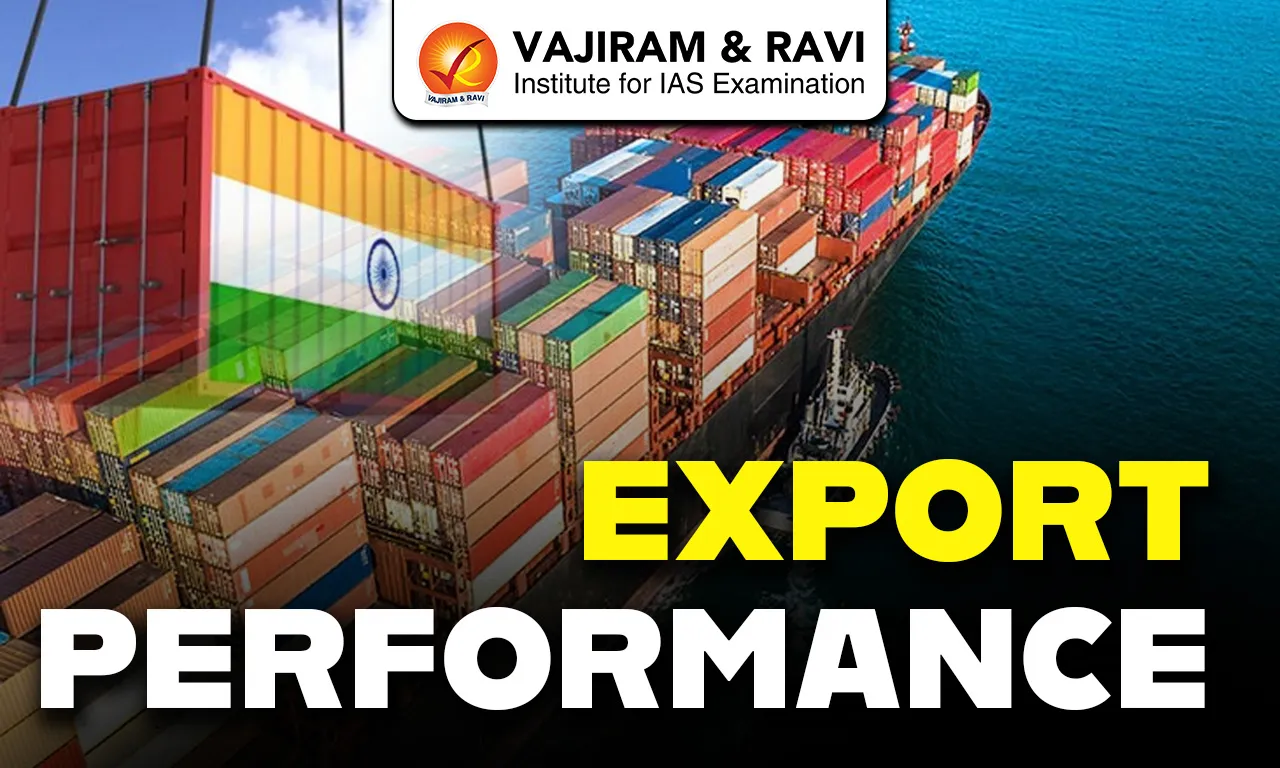
A major factor behind this momentum is the strengthening of India’s Export Performance. While many economies are still dealing with slow recovery, supply chain disruptions, and geopolitical tensions, India’s Export Performance has shown steady growth.
India’s Export Performance: Overall Growth Trends
- India’s Export Performance has remained strong after the pandemic, reflecting the country’s economic resilience.
- India’s Export Performance grew by around 6.15%, even as the global economy faced uncertainty and trade disruptions.
- India’s total exports (goods and services) reached about USD 720.76 billion between April 2025 and January 2026.
- Services exports reached USD 387.5 billion in FY25, creating a trade surplus of USD 188.8 billion.
- India ranks among the top 5 countries in export product diversity and top 3 in trade partner diversity, which strengthens India’s Export Performance against global shocks.
- Multiple sectors such as electronics, petroleum products, pharmaceuticals, textiles, automobiles, and defence are contributing to the steady rise in India’s Export Performance.
India’s Export Performance in Key Sectors
Petroleum Products
- India has developed a strong refining capacity and has emerged as the seventh-largest exporter of refined petroleum products globally.
- The country is also among the top five refining nations in the world, supported by modern infrastructure and strategic geographic location.
Electronics Exports
Electronics has become one of the fastest-growing sectors in India’s Export Performance.
- Electronic goods moved from the seventh-largest export category in FY22 to the third-largest in FY25.
- India is the world's second-largest mobile phone manufacturer, with more than 300 manufacturing units operating today compared to just two units in 2014.
- Smartphones are a major driver of India’s Export Performance. In the first five months of FY 2025-26, smartphone exports crossed ₹1 lakh crore, showing a 55% increase compared to the previous year.
Pharmaceutical and Chemical Exports
- India’s pharmaceutical sector continues to strengthen India’s Export Performance.
- India ranks as the world’s third-largest pharmaceutical producer by volume and the eleventh largest by value, with the sector recording an annual turnover of ₹4.72 lakh crore in FY25.
- India ranks 11th globally in pharmaceutical exports by value, accounting for about 3% of the global market.
- Exports of medical devices have also expanded significantly, increasing from USD 2.5 billion in FY21 to USD 4.1 billion in FY25.
- India is often called the “Pharmacy of the World ,” as it plays a crucial role in ensuring access to cost-effective generic drugs.
Textile and Apparel Exports
- India is the sixth-largest exporter of textiles and apparel globally, holding around 4% share in global exports in this segment.
- Exports of textiles and apparel increased from USD 35.87 billion in FY24 to USD 37.75 billion in FY25, reflecting steady demand for Indian garments, fabrics, and handicrafts in international markets.
Automobile Exports
Automobile manufacturing has become an important component of India’s Export Performance.
- India has emerged as a major exporter of two-wheelers, passenger vehicles, and commercial vehicles.
- Automobile exports increased from 4.13 million units in FY21 to 5.36 million units in FY25, reflecting growing global demand for India-manufactured vehicles.
Defence Exports
A notable transformation in India’s Export Performance has been witnessed in the defence sector.
- Defence exports reached a record ₹23,622 crore in FY 2024-25, compared to less than ₹1,000 crore in 2014.
- Indian defence equipment is now exported to over 100 countries, demonstrating the growing global confidence in India’s defence manufacturing capabilities.
Services Exports
Services exports remain a major pillar of India’s Export Performance.
- In FY25, India’s services exports reached an all-time high of USD 387.5 billion, generating a trade surplus of USD 188.8 billion.
- The growth of information technology services, financial services, consulting, and digital platforms continues to strengthen India’s global presence in the services sector.
Expanding Trade Partnerships and Market Access
Another major factor contributing to India’s Export Performance is the diversification of trading partners.
- Over the past three years, India has signed nine Free Trade Agreements covering 38 countries, providing access to markets representing nearly 70% of global GDP.
- These agreements are designed to reduce trade barriers, expand market access for Indian goods and services, and strengthen the long-term stability of India’s Export Performance.
Policy Initiatives Strengthening India’s Export Performance
Several government initiatives have played a crucial role in supporting India’s Export Performance.
Production-Linked Incentive (PLI) Schemes
Production-Linked Incentive (PLI) Scheme was first launched in 2020 to encourage companies to manufacture more products in India and increase exports.
- PLI Scheme for Automobile and Auto Components: This scheme promotes the manufacturing of high-value Advanced Automotive Technology (AAT) vehicles and components. It aims to attract investment and make India a global hub for advanced automobile manufacturing. By September 2025, the scheme had attracted investments of around ₹35,657 crore, strengthening the automobile sector and contributing to India’s Export Performance.
- PLI for Bulk Drugs: India has traditionally depended on imports for important pharmaceutical inputs such as Active Pharmaceutical Ingredients (APIs), Key Starting Materials (KSMs), and drug intermediates. The PLI scheme for bulk drugs encourages domestic production of these critical materials. It has created an annual manufacturing capacity of about 55,000 metric tonnes for 26 essential products, which supports pharmaceutical exports and improves India’s Export Performance.
Export Promotion Mission (EPM)
The Export Promotion Mission (EPM) is a major initiative approved with an outlay of ₹25,060 crore for the period 2025-26 to 2030-31. The mission aims to strengthen the overall export ecosystem, improve access to affordable trade finance, and prepare Indian businesses to compete in global markets. It operates through two sub-schemes: Niryat Protsahan and Niryat Disha.
Key interventions under the mission include:
- E-Commerce Credit Assistance: This provides financial support to exporters selling through digital platforms. Businesses can access credit facilities of up to ₹50 lakh for domestic e-commerce exports and up to ₹5 crore for overseas expansion, supported by government guarantees.
- TRACE (Trade Regulations, Accreditation and Compliance Enablement): This initiative helps exporters meet international regulatory standards. It reimburses 60-75% of compliance costs, with a maximum limit of ₹25 lakh per exporter annually.
- FLOW (Facilitating Logistics, Overseas Warehousing and Fulfilment): FLOW supports Indian exporters in setting up overseas warehouses and distribution networks. The scheme provides support of up to 30% of approved project costs.
- LIFT (Logistics Interventions for Freight and Transport): This scheme helps exporters from districts with lower export activity by reimbursing up to 30% of freight costs, with a cap of ₹20 lakh per exporter annually.
- INSIGHT (Integrated Support for Trade Intelligence and Facilitation): INSIGHT focuses on improving market research, trade intelligence, and exporter capacity building by funding 50-100% of project costs.
Semiconductor and Electronics Manufacturing Initiatives
Strengthening high-technology manufacturing is another major focus area for improving India’s Export Performance.
- Electronics Component Manufacturing Scheme (ECMS): Notified in 2025 with an outlay of ₹40,000 crore, this scheme promotes domestic manufacturing of key electronic components. It aims to integrate India’s electronics industry with global value chains, thereby increasing exports of electronics products.
- India Semiconductor Mission (ISM) 2.0: Announced in the Union Budget 2026-27, this initiative focuses on building India’s semiconductor ecosystem. It promotes industry-led research, technology development, and skill creation in areas such as chip fabrication, assembly, testing, and semiconductor design.
- Customs and Taxation Measures: The Union Budget 2026-27 also introduced several customs duty reductions to support domestic manufacturing. Duties were reduced on aviation components, lithium-ion cell manufacturing inputs, and defence-related parts. These measures lower production costs and help industries become more competitive in global markets, thereby supporting India’s Export Performance.
Sector-Specific Export Promotion
The government has also introduced targeted initiatives for emerging sectors.
- PM E-DRIVE Scheme: This scheme encourages the adoption and manufacturing of electric vehicles, including electric two-wheelers, three-wheelers, e-trucks, and e-ambulances. It also supports the development of charging infrastructure, which strengthens India’s electric mobility industry and its export potential.
- Scheme to Promote Manufacturing of Electric Passenger Cars (SMEC): This initiative promotes domestic production of electric cars for both domestic consumption and exports, helping India enter the global electric vehicle market.
- Defence Export Promotion: India is also focusing on expanding defence exports.
- Defence Acquisition Procedure (DAP) 2020 and Defence Procurement Manual (DPM) 2025 aim to promote transparency, faster procurement, innovation, and self-reliance in defence manufacturing.
- Two major industrial clusters - the Uttar Pradesh Defence Industrial Corridor and the Tamil Nadu Defence Industrial Corridor have attracted investments of more than ₹9,145 crore as of October 2025. These corridors are expected to increase defence production and exports, contributing to India’s Export Performance.
Infrastructure and Ecosystem Development
To support industrial growth and exports, the Union Budget 2026-27 announced new infrastructure initiatives such as Rare Earth Corridors, Chemical Parks, and the Biopharma SHAKTI programme. These initiatives aim to strengthen supply chains and support high-value manufacturing sectors.
Services Export Promotion
Apart from goods exports, India is also witnessing strong growth in services exports.
- The rapid expansion of Global Capability Centres (GCCs), supported by tax incentives in Special Economic Zones (SEZs), has strengthened India’s position in the global services sector.
- Additionally, India ranks second globally in AI skill penetration, which supports growth in technology and digital services exports.
Together, these initiatives are helping expand manufacturing capacity, strengthen supply chains, and improve global competitiveness ultimately supporting long-term growth in India’s Export Performance.
Challenges Affecting India’s Export Performance
Despite the positive trends, India’s Export Performance faces several structural and global challenges.
- Rising protectionism and tariffs in major economies pose a significant risk. For example, tariff increases by the United States in 2025 affected sectors such as textiles, steel, and seafood exports.
- Non-tariff barriers, including complex documentation requirements and strict rules of origin under trade agreements. These barriers often increase compliance costs for exporters.
- The European Union’s Carbon Border Adjustment Mechanism (CBAM) will impose carbon-based taxes on products such as steel, aluminium, and cement, potentially affecting the competitiveness of Indian exports.
- Geopolitical tensions and supply chain disruptions particularly in energy-supplying regions can increase production and shipping costs for Indian exporters.
- Competition from countries such as Vietnam and Bangladesh in labour-intensive sectors like textiles and footwear also adds pressure on India’s Export Performance.
Steps Needed to Strengthen India’s Export Performance
To sustain long-term growth in India’s Export Performance, several policy steps are necessary.
- Simplifying export procedures: To maintain long-term growth in India’s Export Performance, the government needs to make export procedures simpler through digital platforms and better coordination among regulatory agencies.
- Improving logistics infrastructure: Investment in dedicated freight corridors, modern ports, and better transport networks can reduce export costs and make India’s Export Performance more competitive globally.
- Focus on sustainability standards: As global trade is increasingly linked with climate regulations, India must develop carbon accounting systems and green financing options so exporters can meet environmental standards and sustain India’s Export Performance.
- Strengthening manufacturing capacity: Expanding advanced manufacturing through industrial corridors and production incentive schemes will help increase production and support India’s Export Performance.
- Promoting digital trade and e-commerce: Encouraging digital trade platforms and e-commerce exports can help small and medium enterprises reach international markets, further improving India’s Export Performance.
India’s Export Performance FAQs
Q1: How has India’s Export Performance grown recently?
Ans: In the post-pandemic period, India’s Export Performance has remained strong, with total exports reaching about USD 720.76 billion between April 2025 and January 2026.
Q2: Which sectors contribute the most to India’s Export Performance?
Ans: Major sectors include electronics, petroleum products, pharmaceuticals, textiles, automobiles, defence equipment, and services such as IT and consulting.
Q3: What government initiatives support India’s Export Performance?
Ans: Key initiatives include Production-Linked Incentive (PLI) schemes, the Export Promotion Mission (EPM), India Semiconductor Mission 2.0, and infrastructure initiatives such as defence industrial corridors and rare earth corridors.
Q4: What are the main challenges affecting India’s Export Performance?
Ans: Major challenges include global protectionism, non-tariff trade barriers, the EU’s Carbon Border Adjustment Mechanism (CBAM), supply chain disruptions, and competition from countries such as Vietnam and Bangladesh.
Q5: Why is India’s Export Performance important for the economy?
Ans: A strong India’s Export Performance helps increase foreign exchange earnings, create jobs, expand manufacturing, and strengthen India’s position in global trade.