Money Multiplier, Meaning, Mechanism, Factors, Significance

Money Multiplier

The money multiplier is a key concept in macroeconomics and banking that shows how an initial deposit can generate a multiple increase in the total money supply through repeated rounds of bank lending.

Money Multiplier Meaning

Money Multiplier refers to the total amount of money that can be created in the economy from an initial deposit or currency issued by the central bank.

Money Multiplier = 1/Reserve Ratio. Where the Reserve Ratio (or Cash Reserve Ratio) is the fraction of deposits that banks are required to keep as reserves.

Money” here does not mean only the currency notes. “Money” here refers to the aggregate money supply, that is, the total stock of money supply which includes the currency with the Public and Demand and Time Deposits with the Banks.

“Multiplier” here does not mean that the actual currency gets multiplied. “Multiplier” here means that the “Aggregate money supply” increases due to the initial ”currency” printed by the RBI.

Mechanism of Money Multiplier

The money multiplier works through the fractional reserve banking system:

  • Banks receive deposits from the public.
  • Banks keep a fraction of deposits as reserves (as mandated by the RBI) and lend the rest.
  • The loaned money is spent and redeposited into banks, which again retain a fraction and lend the remainder.
  • This cycle continues, expanding the aggregate money supply multiple times relative to the initial deposit.

Example:

Suppose the RBI prints ₹100 and deposits it in banks. Banks are required to keep 10% as reserves (₹10) and can lend out ₹90. The ₹90 loan is spent and deposited back into the banking system. Banks now keep 10% (₹9) and lend ₹81. This process continues, creating new deposits again and again.

Total money supply = Initial deposit × Money Multiplier

  • Money Multiplier = 1 ÷ Reserve Ratio = 1 ÷ 0.10 = 10
  • So, ₹100 × 10 = ₹1,000 total money supply

Factors Affecting the Money Multiplier

The Money Multiplier is influenced by several economic and banking factors that determine how effectively deposits can be converted into a larger money supply in the economy.

  • Currency Deposit Ratio: Currency Deposit Ratio is the proportion of money people hold in the form of cash with themselves. Lower the currency deposit ratio, higher the Money Multiplier. 
  • Reserve Ratio: Lower the reserve Ratio of banks, higher the Money Multiplier 
  • Credit creation: Higher the credit creation, higher the Money Multiplier 
  • Banking habits of people: Higher the banking habit of people (i.e., more people depositing money in banks rather than holding cash), higher the Money Multiplier.
  • Reverse repo deposits with RBI: An increase in reverse repo deposits with the RBI reduces the funds available for banks to lend, thereby lowering the money multiplier and slowing the expansion of the total money supply.

Money Multiplier Significance

  • Credit Creation: Enables banks to provide loans, stimulating investment and consumption.
  • Monetary Policy Tool: Helps the RBI control liquidity, inflation, and economic growth.
  • Economic Growth: By increasing money supply, it supports business expansion, job creation, and overall economic activity.
  • Policy Planning: Guides the central bank in managing reserve requirements and regulating the financial system.

UPSC CSE Previous Year Question

Q. The money multiplier in an economy increases with which one of the following? [2019]

(a) Increase in the cash reserve ratio

(b) Increase in the banking habit of the population

(c) Increase in the statutory liquidity ratio

(d) Increase in the population of the country

Answer (b) Increase in the banking habit of the population

Money Multiplier FAQs

Q1: What is the Money Multiplier?

Ans: The Money Multiplier is a concept in macroeconomics that shows how an initial deposit or currency issued by the central bank can generate a multiple increase in the total money supply through repeated rounds of bank lending.

Q2: How is the Money Multiplier calculated?

Ans: It is calculated as the inverse of the reserve ratio, i.e., Money Multiplier = 1 ÷ Reserve Ratio, where the reserve ratio is the fraction of deposits banks are required to keep as reserves.

Q3: How does the Money Multiplier work?

Ans: The Money Multiplier works through the fractional reserve banking system. Banks lend a portion of deposits while keeping a fraction as reserves.

Q4: What factors affect the Money Multiplier?

Ans: The Money Multiplier is influenced by the reserve ratio, currency-deposit ratio, banking habits of the public, credit creation by banks, and reverse repo operations with the central bank, which reduce funds available for lending.

Q5: Why is the Money Multiplier important?

Ans: It is significant because it enables credit creation, supports economic growth, helps the central bank regulate liquidity and inflation, and guides policy planning by linking monetary base changes to the broader money supply.

UNIGME Report 2025, Key Findings, India’s Performance

UNIGME Report 2025

India has emerged as a key contributor to global progress in reducing child mortality, according to the latest United Nations Inter-agency Group for Child Mortality Estimation (UNIGME) Report 2025. The report highlights India’s sustained and large-scale efforts in improving child survival outcomes, particularly across neonatal and under-five mortality indicators.

UNIGME Report 2025 Key Findings

The UN Inter-Agency Group for Child Mortality Estimation (UNIGME) 2025 report highlights global trends in child and newborn deaths, identifies leading causes, and recognises India’s notable progress in reducing under-five and neonatal mortality.

Global Findings

  • In 2024, an estimated 4.9 million children died before the age of five worldwide, including 2.3 million newborns. Most of these deaths were preventable with proven, low-cost interventions and access to quality healthcare.
  • Newborn deaths account for nearly half of all under-five deaths, reflecting slower progress in preventing deaths around the time of birth.
  • While global under-five deaths have fallen by more than half since 2000, the rate of reduction has slowed by over 60% since 2015.
  • Leading causes of newborn deaths were complications from preterm birth (36%), and complications during labour and delivery (21%). Infections, including neonatal sepsis and congenital anomalies, were also important causes.
  • Beyond the first month, infectious diseases, including malaria, diarrhoea, and pneumonia were major killers. Malaria remained the single largest killer in this age group (17%), with most deaths occurring in endemic areas of sub-Saharan Africa. 
  • The UN report found that in 2024, about 2.1 million young people aged 5-24 years died. For younger children, infections and accidents were the main causes. In teenagers, the risks change: girls aged 15-19 mostly died by self-harm, while boys mostly died in road accidents.
  • For the first time, the UN report counted deaths caused directly by severe malnutrition. In 2024, over 1 lakh children aged 1-59 months (about 5% of all young children deaths) died from it. The number is actually higher because malnutrition makes children weak and more likely to die from other common illnesses.
  • In 2024, sub-Saharan Africa accounted for 58% of all under-five deaths. 
  • 60 countries are at risk of missing the SDG under-5 mortality target, and 66 are at risk of missing the neonatal target.

The report calls on governments, donors, and partners to make child survival a political and financing priority, focus resources on the highest-burden regions, and invest in primary health care systems. It notes that every dollar invested in child survival can generate up to twenty dollars in social and economic benefits.

Findings related to South Asia

  • The Southern Asia region has witnessed a 76% decline in under-five deaths since 1990 and 68% decline since 2000. 
  • The region’s under-five mortality rate has fallen significantly from 92 deaths per 1,000 live births in 2000 to nearly 32 in 2024. 
  • This sharp reduction is largely driven by countries like India through targeted public health interventions, improved institutional delivery systems, and expanded immunization coverage.
  • Across Southern Asia Neonatal deaths declined by nearly 60% since 2000 and Mortality in children aged 1–59 months declined by over 75%.
  • While Southern Asia still accounts for nearly 25% of global under-five deaths, the region has made one of the fastest reductions globally, positioning India as a leader among high-burden countries.

India’s Performance

India has made remarkable progress in improving child survival outcomes, as highlighted in the latest UN Inter-agency Group for Child Mortality Estimation (UNIGME) report.

  • India’s Under-5 Mortality Rate (U5MR) has fallen from 127 deaths/1,000 live births in 1990 to 26.6 in 2024.
  • India’s Neonatal Mortality Rate (NMR) has declined by nearly 70% from 57 deaths per 1,000 live births in 1990 to 16.7 in 2024.
  • India’s under-five mortality rate (U5MR) is now below the Southern Asia regional average of 32.8.
  • The report notes that India is among the first few countries globally to set targets and release operational guidelines on stillbirth surveillance.

Key Drivers of India’s Progress

India's scaling up of interventions such as the Universal Immunisation Programme, facility-based newborn care, and Integrated Management of Neonatal and Childhood Illnesses has significantly improved survival rates.

  • Janani Suraksha Yojana (JSY) and Janani Shishu Suraksha Karyakram (JSSK) have increased institutional deliveries, reduced preventable maternal and newborn deaths.
  • Special Newborn Care Units (SNCUs), Newborn Stabilisation Units (NBSUs), Mother-Newborn Care Units (MNCUs) have expanded access and improved the quality of newborn care.
  • Tele-SNCU hub-and-spoke model and District Early Intervention Centres (DEICs) have improved reach in remote areas.
  • India is among the first countries to release operational guidelines on stillbirth surveillance.

Despite progress, challenges remain:

  • In 2024, 386,000 of 615,000 under-five deaths (63%) occurred in the neonatal period (first 28 days).
  • India’s NMR of 16.7 remains above the SDG target of 12 per 1,000 live births.
  • Meeting the SDGs will require the country to roughly double its pace of progress on newborn survival.
  • Major causes of neonatal deaths include preterm birth complications, birth asphyxia, and infections, which require quality antenatal care, skilled birth attendance, and newborn care services that are unevenly distributed.

 About UNIGME

  • The United Nations Inter-agency Group for Child Mortality Estimation (UN IGME) was formed in 2004.
  • Objective: To share data on child mortality, improve methods for child mortality estimation, report on progress towards child survival goals, and enhance country capacity to produce timely and properly assessed estimates of child mortality.
  • The UN IGME is led by the United Nations Children’s Fund (UNICEF) and includes the World Health Organization (WHO), the World Bank Group and the United Nations Population Division of the Department of Economic and Social Affairs as full members.
  • UNIGME’s independent Technical Advisory Group (TAG) and Core Stillbirth Estimation Group (CSEG), comprised of leading academic scholars and independent experts in demography and biostatistics, provide guidance on estimation methods, technical issues, and strategies for data analysis and data quality assessment.
  • UN IGME updates its child mortality estimates annually after reviewing newly available data and assessing data quality. 

UNIGME Report 2025 FAQs

Q1: What is the UNIGME Report 2025?

Ans: The UNIGME Report 2025 is the latest assessment by the United Nations Inter-agency Group for Child Mortality Estimation, which tracks global trends in child and newborn deaths, identifies leading causes, and evaluates country-level progress, including India’s achievements.

Q2: How many children died globally in 2024?

Ans: An estimated 4.9 million children under five died worldwide in 2024, including 2.3 million newborns.

Q3: What are the main causes of child and newborn deaths?

Ans: Newborn deaths are largely due to preterm birth complications, labour and delivery complications, infections, and congenital anomalies. For older children, infectious diseases like malaria, diarrhoea, and pneumonia are major killers.

Q4: What does the UNIGME Report 2025 say about India?

Ans: India has made remarkable progress in child survival. Its under-five mortality rate fell from 127 per 1,000 in 1990 to 26.6 in 2024, and neonatal mortality dropped from 57 to 16.7 per 1,000.

Q5: What challenges remain for India?

Ans: The majority of under-five deaths still occur in the neonatal period. India’s neonatal mortality rate remains above the SDG target, and achieving further reductions requires faster progress in newborn care, quality antenatal services, and equitable healthcare access.

Topography, Major Landforms, Processes, Features

Topography

Topography is a core concept in physical geography that explains the shape, structure, and arrangement of the Earth’s surface. From towering mountains to flat plains and deep ocean floors, topography helps us understand how land is formed, how it changes over time, and how it influences human life.

What is Topography?

Topography refers to the detailed study and description of the physical features of a particular area, including its elevation, slope, relief, and landforms. It not only includes natural features like mountains, rivers, and valleys but also man-made features such as roads, dams, and settlements.

Major Landforms in Topography

Major landforms are the large natural features of the Earth’s surface that define the physical character of a region. These landforms are formed over millions of years through internal (tectonic) and external (erosional and depositional) processes.

1. Mountains

  • Mountains are high, steep landforms with sharp peaks and rugged terrain.
  • They are mainly formed by tectonic forces such as folding, faulting, and volcanic activity.
  • Mountains have high elevation (generally above 600 meters) and extreme climatic conditions.
  • They act as natural barriers affecting climate, wind patterns, and rainfall (orographic rainfall).
  • Source of many important rivers due to snow and glacier melt.
  • Rich in biodiversity but have sparse population due to harsh conditions.

2. Plateaus

  • Plateaus are elevated flat-topped regions, often called “tablelands.”
  • Formed due to volcanic activity, uplift of Earth’s crust, or erosion of mountains.
  • They have steep sides and relatively level surfaces on top.
  • Rich in minerals like coal, iron, and petroleum, making them important for mining.
  • Climate can vary from dry to moderate depending on location.
  • Less densely populated compared to plains but economically significant.

3. Plains

  • Plains are broad, flat, and low-lying areas with gentle slopes.
  • Formed mainly by deposition of sediments by rivers, wind, or glaciers.
  • Extremely fertile due to alluvial soil, making them ideal for agriculture.
  • Densely populated due to availability of water, fertile land, and easy transport.
  • Suitable for building infrastructure like roads, cities, and industries.
  • Examples include river plains, coastal plains, and floodplains.

4. Valleys

  • Valleys are low-lying areas between hills or mountains.
  • Usually formed by the action of rivers (V-shaped valleys) or glaciers (U-shaped valleys).
  • Fertile and suitable for agriculture due to deposition of sediments.
  • Often have rivers flowing through them, providing water resources.
  • Important for human settlements and transport routes in mountainous regions.
  • Can be narrow or wide depending on the erosional process.

5. Deserts

  • Deserts are dry regions with very low rainfall (less than 25 cm annually).
  • Characterized by sandy or rocky terrain with sparse vegetation.
  • Formed due to climatic conditions and wind erosion processes.
  • Features include sand dunes, rocky plateaus, and salt flats.
  • Extreme temperature variations between day and night.
  • Sparse population due to lack of water and harsh living conditions.

6. Coastal Landforms

  • Coastal landforms are found along the margins of oceans and seas.
  • Formed by the action of waves, tides, and currents.
  • Include features like beaches, cliffs, deltas, estuaries, and lagoons.
  • Deltas are fertile and suitable for agriculture (e.g., river deltas).
  • Coastal areas are important for trade, fishing, and tourism.
  • Highly dynamic and prone to erosion, cyclones, and sea-level changes.

Processes Shaping Topography

The Earth’s surface is continuously modified by natural forces that operate both from within and outside the planet. These processes shape, reshape, and transform landforms over time, creating the diverse topography we see today.

1. Endogenic Processes (Internal Forces)

  • Endogenic processes originate from within the Earth due to heat and pressure in the interior.
  • They are responsible for the creation of major landforms like mountains, plateaus, and continents.
  • These processes are generally slow but can sometimes be sudden and destructive.

Diastrophism (Crustal Movements):

  • Includes folding (formation of fold mountains) and faulting (cracks in Earth’s crust).
  • Leads to uplift, subsidence, and deformation of the Earth’s surface.

Volcanism:

  • Movement of magma from the interior to the surface.
  • Forms volcanic mountains, lava plateaus, and igneous rocks.

Earthquakes:

  • Sudden release of energy due to movement of tectonic plates.
  • Causes cracks, displacement, and changes in landforms.

2. Exogenic Processes (External Forces)

Exogenic processes operate on the Earth’s surface and are driven by solar energy and gravity. They wear down high landforms and fill low-lying areas, leading to leveling of the surface.

Weathering:

  • Breakdown of rocks in situ (without movement).
  • Types: Physical (temperature changes), Chemical (reaction with water/air), Biological (plants and organisms).

Erosion:

  • Removal and transportation of weathered materials.
  • Agents include rivers, wind, glaciers, and sea waves.

Deposition:

  • Settling down of eroded materials in new locations.
  • Leads to formation of plains, deltas, beaches, and sand dunes.

3. Fluvial Processes (River Action)

Rivers are among the most dominant geomorphic agents that continuously modify the Earth’s surface through erosion, transportation, and deposition. Their action varies across the upper, middle, and lower courses, creating diverse landforms.

Erosion by Rivers:

  • Occurs mainly in the upper course where velocity is high.
  • Types include hydraulic action, abrasion, attrition, and solution.
  • Leads to vertical erosion, deepening river valleys.

Transportation of Sediments:

  • Rivers carry materials in four ways: traction (rolling), saltation (bouncing), suspension (fine particles), and solution (dissolved minerals).

Deposition by Rivers:

  • Occurs when river velocity decreases, especially in plains and at river mouths.
  • Results in fertile landforms beneficial for agriculture.

Key Features Formed:

  • V-shaped Valleys: Narrow valleys formed due to vertical erosion in youthful rivers.
  • Gorges and Canyons: Deep, narrow valleys with steep sides formed due to intense downcutting.
  • Floodplains: Flat, fertile areas formed by deposition during floods.
  • Levees: Natural embankments formed by sediment deposition along river banks.
  • Meanders: S-shaped bends formed due to lateral erosion and deposition.
  • Oxbow Lakes: Crescent-shaped lakes formed when meanders are cut off.
  • Deltas: Triangular deposits at river mouths where rivers meet seas or lakes.

4. Aeolian Processes (Wind Action)

Wind is a significant geomorphic agent in arid and semi-arid regions where vegetation is sparse and loose sediments are abundant. It shapes landscapes through erosion, transportation, and deposition.

Erosion by Wind:

  • Deflation: Removal of loose particles, lowering the land surface.
  • Abrasion: Sand particles carried by wind polish and wear down rocks.

Transportation Mechanisms: Suspension (fine dust), saltation (bouncing sand), and surface creep (rolling particles).

Deposition by Wind: Occurs when wind velocity decreases or obstacles are encountered.

Key Features Formed:

  • Sand Dunes:
    • Barchans: Crescent-shaped dunes formed in one-directional wind.
    • Longitudinal Dunes: Parallel dunes formed due to bidirectional winds.
  • Loess Deposits: Fine, fertile wind-blown sediments deposited over large areas.
  • Deflation Hollows: Depressions formed due to removal of surface particles.
  • Desert Pavements: Surfaces covered with coarse particles after finer ones are removed.

5. Glacial Processes

Glaciers are powerful agents of erosion and deposition in cold regions, moving slowly under gravity and reshaping landscapes over long periods.

Erosion by Glaciers:

  • Plucking: Ice pulls away rock fragments from the surface.
  • Abrasion: Rocks embedded in ice scrape and polish the surface.

Transportation:

  • Glaciers carry large amounts of debris (till) within, on, and beneath the ice.

Deposition:

  • Occurs when glaciers melt, leaving behind sediments.

Key Features Formed:

  • U-shaped Valleys: Broad valleys with flat floors formed by glacial erosion.
  • Cirques: Bowl-shaped depressions where glaciers originate.
  • Aretes: Sharp ridges formed between two cirques.
  • Moraines: Deposits of glacial debris (lateral, medial, terminal).
  • Fjords: Deep, narrow sea inlets formed when glacial valleys are submerged.

6. Coastal (Marine) Processes

Coastal processes involve the continuous interaction of sea waves, tides, and currents with land, leading to both erosion and deposition along coastlines.

Erosion by Waves:

  • Hydraulic action, abrasion, and corrosion break down coastal rocks.
  • Strongest along high-energy coastlines.

Transportation:

  • Longshore drift moves sediments along the coast.

Deposition:

  • Occurs in low-energy zones where wave energy decreases.

Key Features Formed:

  • Sea Cliffs: Steep rock faces formed due to wave erosion.
  • Wave-cut Platforms: Flat surfaces at the base of cliffs.
  • Beaches: Deposits of sand and pebbles along the shore.
  • Spits: Narrow landforms projecting into the sea due to sediment deposition.
  • Sea Arches and Stacks: Formed by erosion of coastal rocks.
  • Estuaries: River mouths where freshwater mixes with seawater.
  • Lagoons: Shallow water bodies separated from the sea by sandbars.

7. Mass Wasting (Mass Movement)

Mass wasting refers to the downward movement of weathered materials under the direct influence of gravity, without the involvement of transporting agents like rivers or wind.

  • Primary Cause: Gravity, often assisted by water, earthquakes, or human activities.
  • Triggering Factors: Heavy rainfall, earthquakes, deforestation, slope instability.

Types of Mass Wasting:

Landslides:

  • Rapid movement of large masses of rock or soil down slopes.
  • Common in mountainous regions and during heavy rainfall.

Rockfalls:

  • Sudden fall of rock fragments from steep cliffs.
  • Occur due to weathering and gravity.

Soil Creep:

  • Very slow, gradual movement of soil downhill.
  • Almost imperceptible but continuous.
  • Mudflows and Debris Flows:
  • Rapid flow of water-saturated soil and debris.
  • Highly destructive and often triggered by heavy rains.

Topography FAQs

Q1: What is topography?

Ans: Topography is the study of the physical features of the Earth’s surface, including elevation, slope, relief, and landforms.

Q2: What are the main elements of topography?

Ans: The main elements are elevation, slope, relief, and aspect, which together describe the shape and structure of land.

Q3: What are major landforms in topography?

Ans: Major landforms include mountains, plateaus, plains, valleys, deserts, and coastal landforms.

Q4: How are landforms formed?

Ans: Landforms are formed through internal processes (tectonic movements, volcanism) and external processes (weathering, erosion, deposition).

Q5: What is the difference between endogenic and exogenic processes?

Ans: Endogenic processes originate inside the Earth and build landforms, while exogenic processes act on the surface and wear them down.


Ramakrishna Paramahamsa (1836-1886), Biography, Philosophy

ramakrishna paramahamsa

Ramakrishna Paramahamsa was born on 18 February 1836 in Kamarpukur, Bengal. By birth he was known as Gadadhar Chattopadhyaya. He was a major spiritual leader of 19th century India. He lived a deeply devotional life centered on Goddess Kali and became widely known for his direct spiritual experiences. His teachings focused on religious harmony, simple devotion and realization of God through multiple paths, influencing Indian thought and global spirituality through his disciples.

Ramakrishna Paramahamsa Biography

Ramakrishna Paramahamsa was born into a poor Brahmin family. Ramakrishna’s father Khudiram Chatterjee and mother Chandramani Devi were known for their religious values. Despite limited formal education, he gained spiritual knowledge through epics, observation and practice. He married Sarada Devi who later served as his spiritual companion. He served as a priest at the Dakshineswar Kali Temple, where his intense devotion to Goddess Kali attracted many followers. His disciple Swami Vivekananda, carried his teachings worldwide and established the Ramakrishna Mission in 1897. He also inspired other leaders including Keshab Chandra Sen. 

Ramakrishna Paramahamsa Philosophy

Ramakrishna Paramahamsa explained spiritual unity and direct God realisation through simple practices and real life experiences across religions. His teachings include:

  • Religious Unity: He taught that all religions like Hinduism, Islam and Christianity lead to one ultimate truth, rejecting sectarian divisions and encouraging harmony among followers of different faiths.
  • Devotion to Kali: He practiced intense worship of Goddess Kali, considering her the supreme reality and demonstrated Bhakti as a powerful path to achieve spiritual enlightenment.
  • Multiple Paths: He followed Tantra, Vaishnavism, Bhakti and Advaita Vedanta, proving through practice that different spiritual paths can equally lead to realization of God.
  • Service to Humanity: He believed serving humans is equal to serving God, as every individual carries divine presence, making social service a spiritual duty.
  • Teaching Documentation: His teachings were recorded by Mahendranath Gupta in Sri Sri Ramakrishna Kathamrita, later translated as “The Gospel of Sri Ramakrishna” in 1942.
  • Global Legacy: His ideas spread worldwide through the Ramakrishna Mission, founded in 1897, influencing spiritual thought in India, America and Europe.

Ramakrishna Paramahamsa Death

Ramakrishna Paramahamsa fell seriously ill in early 1885 with throat disease which was later identified as cancer. He passed away on 16 August 1886. Before death, he guided Swami Vivekananda to lead disciples. After his death, followers formed the first monastery at Baranagar, starting the Ramakrishna Order.

Ramakrishna Paramahamsa FAQs

Q1: Who was Ramakrishna Paramahamsa?

Ans: Ramakrishna Paramahamsa was a 19th century Indian spiritual leader from Bengal known for his devotion to Goddess Kali and teachings on religious unity.

Q2: What was the original name of Ramakrishna Paramahamsa?

Ans: His original name was Gadadhar Chattopadhyaya, and he was born on 18 February 1836 in Kamarpukur, Bengal.

Q3: What are the major teachings of Ramakrishna Paramahamsa?

Ans: He taught that all religions are different paths leading to the same truth and emphasized harmony among all faiths.

Q4: Who was the most famous disciple of Ramakrishna Paramahamsa?

Ans: His most famous disciple was Narendra Nath Datta, later known as Swami Vivekananda, who spread his teachings globally.

Q5: Which book records Ramakrishna Paramahamsa’s Teachings?

Ans: His teachings were recorded by Mahendranath Gupta in “Sri Sri Ramakrishna Kathamrita,” later translated as “The Gospel of Sri Ramakrishna.”

Desert Ecosystem, Types, Domains, Climate, Significance

Desert Ecosystem

A desert ecosystem is a type of natural environment that is characterized by very low rainfall, extreme temperatures, and limited vegetation. These regions are generally dry and have harsh living conditions. Despite these challenges, deserts support specially adapted plants and animals that can survive with very little water. Deserts are found in different parts of the world and are broadly classified into hot and cold deserts based on their temperature.

Desert Ecosystem

  • A desert ecosystem is a natural system where living organisms (plants, animals, microbes) interact with non-living elements like soil, air, temperature, and water in very dry conditions.
  • It is found in regions that receive very little rainfall (usually less than 50 cm per year) and experience extreme temperatures either very hot or very cold.
  • Deserts are considered the driest terrestrial ecosystems on Earth, which is why they have low biodiversity compared to other ecosystems like forests or grasslands.
  • Despite harsh conditions, the plants and animals present are highly adapted to survive with limited water and extreme climate.

Desert Ecosystem Types

The different types of desert ecosystems have been classified below in detail:

Hot Desert

  • Hot deserts are found in tropical and subtropical regions where there is very little rainfall and very high temperatures. They are usually located on the western sides of continents between 15° and 30° latitudes due to dry air and high-pressure conditions.
  • The climate is extremely harsh, with very hot days and cold nights, showing a large difference in temperature within a single day. Rainfall is very low, generally less than 25 cm per year. The soil is sandy, dry, and often salty, with very little ability to hold water.
  • Plants in these regions are mostly drought-resistant (xerophytic) such as cactus, acacia, and date palms. Animals like camels, reptiles, foxes, and hyenas are adapted to survive with very little water.
  • A major example is the Sahara Desert, the largest hot desert in the world, where temperatures can reach up to 50°C during the day.

Cold Desert

  • Cold deserts are found in higher altitudes or temperate regions, often in the interior of continents or in rain-shadow areas where mountains block rainfall.
  • These deserts have a very cold and dry climate, with most precipitation falling as snow. They experience extreme winters and cool summers, with a large annual temperature range. Strong cold winds are also common.
  • Vegetation includes grasses, shrubs, and small trees like juniper and birch. Animals such as the Snow Leopard, Bactrian camel, and Tibetan wolf are adapted to these conditions.
  • An important example is Ladakh, which is known as India’s cold desert. It lies at a high altitude and has very low temperatures and dry conditions throughout the year.

Desert Ecosystem Six Biogeographic Domains

Deserts across the world are grouped into different biogeographic domains based on their location, climate, and ecological features. There are six main desert regions:

  • Australian Deserts: These deserts are located in the interior of Australia and are extremely dry. They have very low population density, often less than one person per square kilometre, making them some of the least populated deserts in the world.
  • Afrotropical Deserts: These deserts are found mainly in Sub-Saharan Africa and also extend into parts of the Arabian Peninsula. Human activities have put pressure on these ecosystems, especially in regions like Madagascar and the Horn of Africa.
  • Indo-Malay Region: This region includes deserts like the Thar Desert and areas around the Indus Valley. It has a high human population, and human impact on the environment is quite strong. It is also known as the Oriental region.
  • Neotropical Deserts: These deserts are spread across South America, Central America, and the Caribbean.A large portion lies in South America, but only a small part (about 6%) is protected, which raises concerns for conservation.
  • Nearctic Deserts: These are found in North America, covering a large area.
  • Due to urban development, especially in cities like Phoenix, human population and activities are increasing in these desert regions.
  • Palearctic Domain: This is the largest desert domain in the world, covering about 63% of all desert areas. It includes famous deserts like the Sahara Desert. These deserts are known for their extreme dryness and difficult terrain, and in some areas, there are mountains, basins, and varied landscapes.

Desert Ecosystem Climate

  • Desert regions experience extreme temperature variations between day and night. During the day, temperatures become very high because there is very little moisture in the atmosphere. This lack of moisture means that the sun’s rays directly reach the surface without much obstruction, causing intense heating of the ground.
  • The Earth’s surface absorbs this heat and then warms the surrounding air. However, deserts cannot retain this heat effectively. At night, the situation reverses the heat stored during the day and is quickly radiated back into the atmosphere.
  • As a result, temperatures drop rapidly after sunset, and desert nights become very cold. In some cases, temperatures may even fall below 0°C.

Desert Ecosystem Precipitation

  • Precipitation in deserts varies between hot deserts and cold deserts.
  • Hot deserts receive very little rainfall, usually around 15 cm per year. The rain is irregular and unpredictable, often coming in short, heavy bursts.
  • Cold deserts, on the other hand, receive slightly more precipitation. Instead of rain, much of it falls as snow during winter. They also receive some rainfall in the spring season. On average, total precipitation in cold deserts ranges from 15 to 26 cm per year.

Desert Ecosystem Seasons

  • During the summer season, temperatures are very high, usually ranging from 30°C to 49°C. Rainfall is extremely low or almost absent during this time. Because of the intense heat, evaporation is much higher than precipitation, which makes the environment even drier.
  • In contrast, winter temperatures are much cooler, generally ranging between 10°C and 20°C. Compared to summer, some deserts may receive slightly more precipitation in winter, especially in the form of light rain (in hot deserts) or snow (in cold deserts).

Desert Ecosystem Soil

  • In any ecosystem, the type of soil plays an important role in deciding what kind of plants can grow there. Different plants need different soil conditions to survive.
  • In deserts, the soil is generally dry, sandy, and rocky. It contains very little organic matter and lacks important nutrients like nitrogen and phosphorus, which are essential for plant growth. Due to very low rainfall, the soil cannot retain moisture for long.
  • Because of these poor conditions, the soil is not suitable for the growth of large plants or trees. As a result, big trees are usually absent in desert regions.
  • However, some plants have adapted to survive in such harsh conditions. These include cacti, thorny bushes, and small shrubs, which have special features like deep roots, thick stems to store water, and reduced leaves to minimize water loss.

Desert Ecosystem Flora

  • Desert ecosystems receive very little rainfall and experience large temperature differences between day and night. These harsh conditions make it difficult for most plants to survive.
  • However, some plants have adapted very well to this environment. As a result, deserts still support a variety of specially adapted vegetation. Common types of plants found in deserts include cacti, small shrubs, succulents, and grasses.
  • These plants have unique adaptations such as:
    • Thick stems to store water (e.g., cacti)
    • Deep or widespread roots to absorb water quickly
    • Small or no leaves to reduce water loss
    • Waxy coating on leaves or stems to prevent evaporation

Desert Fauna

  • Desert ecosystems have very little water and extreme temperatures, making survival difficult for animals. However, many animals have adapted to live in these harsh conditions.
  • Common desert animals include rabbits and wild cats. Among wild cats, mountain lions and bobcats are often found in desert regions.
  • Reptiles are very common in deserts because they can survive with less water. These include snakes such as rattlesnakes, coral snakes, and king snakes, and lizards like horned lizards, banded geckos, and tree lizards. Horned lizards are unique because they mainly feed on ants and beetles and have spines and horns for protection.
  • Birds are also well adapted to desert life. Some common desert birds include the roadrunner, vulture, and golden eagle.

Desert Ecosystem  Adaptations

Adaptations in Desert Plants

  • Desert plants have developed special features (adaptations) to survive in very hot and dry conditions.
  • One of the most important adaptations is water storage. Many plants, like cacti, store water in their thick stems or leaves so they can survive for long periods without rain. They also have a waxy coating on their surface, which helps reduce water loss.
  • Some desert plants have very long roots (taproots) that go deep into the ground to reach underground water. Others have shallow roots that spread widely to quickly absorb rainwater when it falls.
  • Many plants also have small leaves or no leaves at all. This reduces the loss of water through evaporation. In some cases, leaves are modified into spines (like in cactus) which also help protect the plant from animals.
  • Certain desert plants can become dormant (inactive) during very dry periods and start growing again when it rains.
  • For example, the cactus is well adapted to desert life. It can grow tall, store large amounts of water, and live for many years even in extreme conditions.
  • Another example is the Mugma Tree, which has small upward-growing leaves. These leaves act like a funnel during rainfall, directing water towards the base of the plant, where it is absorbed by its roots.
  • Additional Adaptations
    • Some plants open their stomata at night to reduce water loss (CAM photosynthesis)
    • Seeds of some plants remain inactive for years and grow only after rainfall
    • Light-colored surfaces help reflect sunlight

Adaptations in Desert Animals

  • Desert animals survive in very harsh conditions such as extreme heat during the day, cold nights, and very little water availability. To live in such an environment, they have developed special adaptations.
  • One of the most important adaptations is water conservation. Many desert animals can survive for long periods without drinking water. For example, the camel can go for many days without water because it stores fat in its hump, which can be converted into energy and water.
  • Camels also have several physical adaptations:
    • Long legs that keep their body away from the hot sand
    • Thick fur that protects them from heat during the day and cold at night
    • Closable nostrils to prevent sand from entering
    • Long eyelashes to protect their eyes from dust and sunlight
    • Wide, padded feet that help them walk on sand without sinking
  • Many desert animals are nocturnal, meaning they are active at night when temperatures are lower. This helps them avoid the extreme daytime heat.
  • Animals like the desert fox survive by living in burrows. Burrowing helps them stay cool during the day and protects them from predators.
  • The desert fox also has large ears, which help in releasing excess body heat. Its light-colored fur reflects sunlight and provides camouflage in the sandy environment.
  • Reptiles such as snakes and lizards are common in deserts because they can survive with very little water. They get most of their moisture from the food they eat.
  • Some animals, like the kangaroo rat, can survive without drinking water at all. They obtain water from seeds and produce very little urine to conserve water.
  • Many desert animals show behavioral adaptations such as:
    • Panting to reduce body heat
    • Hiding in shade or burrows during the hottest part of the day
    • Becoming inactive (aestivation) during extremely dry conditions
  • Some animals also migrate seasonally to areas with better conditions when food and water are scarce.
  • Desert animals often have light-colored bodies, which help reflect sunlight and keep their bodies cooler.

Desert Ecosystem Significance

  • Desert ecosystems support a wide variety of plants and animals. Even though conditions are harsh, many unique species live here and are specially adapted to survive.
  • These plants and animals are interdependent. They form food chains and food webs, which help in maintaining the ecological balance of the desert.
  • Desert soils contain microorganisms like bacteria, which play an important role in nutrient cycling. Some of these bacteria can store carbon dioxide (CO₂), helping the desert act as a carbon sink and reducing the amount of CO₂ in the atmosphere.
  • Deserts are rich in mineral resources such as natural gas, oil, and valuable minerals. These resources are important for economic development and energy production.
  • Deserts have unique landforms such as sand dunes, rocky plateaus, and oases. These features make deserts geographically important and interesting to study.
  • The presence of oases supports human settlements and agriculture in otherwise dry regions by providing water and fertile land.

Desert Ecosystem FAQs

Q1: What is a desert ecosystem?

Ans: A desert ecosystem is a natural environment with very low rainfall, extreme temperatures, and limited vegetation, where plants and animals are specially adapted to survive in dry conditions.

Q2: What are the main types of deserts?

Ans: Deserts are mainly of two types: Hot deserts – very high temperatures and low rainfall and Cold deserts – low temperatures with snowfall and dry conditions

Q3: Why do deserts have extreme temperatures?

Ans: Deserts have very little moisture in the air, so heat is absorbed quickly during the day and lost rapidly at night, causing very hot days and cold nights.

Q4: What kind of soil is found in deserts?

Ans: Desert soil is dry, sandy, and rocky, with very little organic matter and nutrients, making it unsuitable for large plants.

Q5: What types of plants are found in deserts?

Ans: Deserts mainly have cacti, shrubs, succulents, and grasses that are adapted to conserve water through features like thick stems and small leaves.

Indira Point, Location, Connectivity, Indira Point Lighthouse

Indira Point

Indira Point is the southernmost point of India, located in the Nicobar district on Great Nicobar Island in the Andaman and Nicobar Islands. It lies in Great Nicobar tehsil and was earlier called Pygmalion Point and Parsons Point before being renamed in honour of former Prime Minister Indira Gandhi in 1985 after her visit in 1984.

Indira Point Features

Indira Point is a remote coastal location with strategic, geographical and historical importance due to its position and past events. The key features of the Southernmost Point of India are:

  • Location: It is situated on Great Nicobar Island in the Nicobar district of the Andaman and Nicobar Islands, forming the southernmost tip of India near the Indian Ocean.
  • Nearby Distance: Indira Point lies about 145 km from Rondo Island of Indonesia and around 163 km south of Little Andaman, highlighting its proximity to international maritime boundaries.
  • Administrative Status: The area falls under Laxmi Nagar panchayat in Great Nicobar tehsil, making it a small but significant administrative unit in the Nicobar district.
  • Connectivity: The region connects to mainland India via Port Blair, with access through helicopter services, inter island boats and a planned 56 km road from Campbell Bay to Indira Point.
  • Strategic Importance: India and Indonesia are jointly upgrading Sabang Port to secure the channel between Great Nicobar Island and Rondo Island, located about 612 km from Indira Point.
  • Tsunami Impact: The 2004 tsunami caused heavy destruction, submerging land and leading to loss of 16-20 families and four scientists studying leatherback turtles near the lighthouse.
  • Demographic Features: According to the 2011 census, only 4 households remain with a population of 27 males and an effective literacy rate of 85.19%, showing limited population after the disaster.
  • Natural Attractions: The region includes Galathea National Park and coastal areas known for marine biodiversity, especially turtle habitats, making it ecologically significant.

Indira Point Lighthouse

The Indira Point Lighthouse was commissioned on 30 April 1972 and stands as India’s southernmost lighthouse. It is located near South Bay and serves as an important navigation point. After the 2004 Indian Ocean earthquake, the land subsided by about 4.25 metres, leaving the lighthouse partially submerged and marking a major geographical change.

Indira Point FAQs

Q1: Where is Indira Point located?

Ans: Indira Point is located on Great Nicobar Island in the Nicobar district of the Andaman and Nicobar Islands and is the southernmost point of India.

Q2: What was the old name of Indira Point?

Ans: It was earlier known as Pygmalion Point and Parsons Point before being renamed in honour of Indira Gandhi in 1985.

Q3: When was the Indira Point Lighthouse built?

Ans: The lighthouse was commissioned on 30 April 1972 and serves as India’s southernmost navigation structure.

Q4: How did the Indira Point Lighthouse Submerged?

Ans: The 2004 tsunami caused land subsidence of about 4.25 metres and led to loss of lives, including local families and scientists.

Q5: Why is Indira Point strategically important?

Ans: Its location near international sea routes and close to Indonesia makes it important for monitoring maritime movement and strengthening regional security cooperation.

Denudation, Types, Factors Affecting, Chronology, Measurement

Denudation

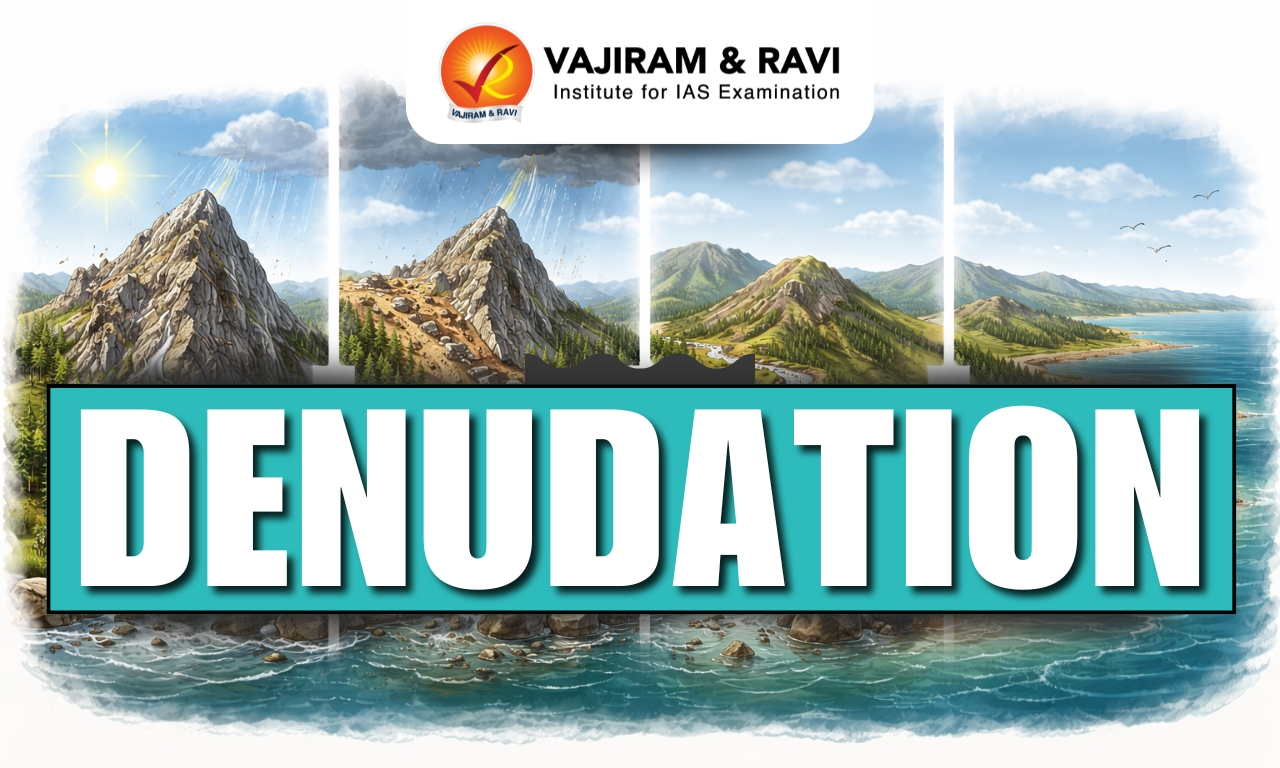
Denudation is the overall process that lowers the Earth’s surface by removing rock, soil and dissolved materials through agents like water, wind, ice and waves. It combines weathering, erosion and mass wasting, reducing relief over time. While erosion involves transport, Denudation represents the total effect of all surface lowering processes acting together.

Denudation Process Classification

Denudation operates through interconnected external processes that progressively break, move and deposit Earth materials across landscapes over time. The types of process under Denudation are:

  1. Weathering: Weathering breaks rocks in place without movement, through mechanical, chemical and biological actions. Processes like frost wedging, carbonation, oxidation, hydration and root activity weaken rocks, preparing material for further removal and reducing structural strength of surface layers.
  2. Mass Movement: Mass movement shifts weathered material downslope under gravity without external agents. Slow forms like soil creep and solifluction act gradually, while rapid events such as landslides, mudflows, debris avalanches and slumps quickly transport large volumes of material.
  3. Erosion (Transportation): Erosion removes and carries weathered material by agents like rivers, glaciers, wind and waves. Fluvial erosion dominates globally, while glacial erosion shapes valleys and wind erosion transports fine particles forming dunes and desert landforms.
  4. Deposition: Deposition occurs when transporting agents lose energy and drop sediments, forming features like floodplains, deltas, beaches and moraines. It redistributes eroded material and contributes to new landform development, balancing erosion in geomorphic systems.

Factors Affecting Denudation

Denudation rates vary widely due to natural conditions and human influence, controlling how fast landscapes are worn down globally.

  • Climate: Climate controls Denudation through rainfall, temperature and weathering intensity. High rainfall increases chemical weathering, while freeze thaw cycles dominate cold regions, accelerating rock breakdown and enhancing erosion rates significantly.
  • Lithology: Rock type determines resistance to Denudation. Hard rocks resist erosion, while soft or soluble rocks like limestone weather quickly through carbonation, leading to rapid landscape changes and formation of features like caves.
  • Topography: Steep slopes increase gravitational force, accelerating mass movement and erosion. Flat surfaces experience slower Denudation, while mountainous regions like active plate margins show rapid landscape lowering due to intense geomorphic activity.
  • Tectonic Activity: Uplift exposes fresh rocks to surface processes, increasing Denudation. In active regions, uplift and Denudation may occur simultaneously, with orogeny rates often exceeding Denudation rates by several times except in highly active zones.
  • Biosphere: Plants, animals and microorganisms influence Denudation by breaking rocks physically and chemically. Root growth widens cracks, while microbial activity produces acids that enhance chemical weathering and mineral breakdown.
  • Human Activity: Activities like deforestation, mining, agriculture and dam construction accelerate Denudation by disturbing soil and vegetation. Human induced soil loss up to 0.5 meters can increase Denudation rates by nearly 30 percent in affected regions.

Denudation Chronology

Denudation chronology reconstructs landscape evolution by analyzing past and present geomorphic processes and their sequential development over geological time.

  • Definition: Denudation chronology is the study of landscape evolution over time by analyzing erosion, weathering, transportation and deposition to understand how Earth’s surface has been gradually modified.
  • Process: It reconstructs past landscapes by examining sediments, drainage patterns, erosion surfaces and tectonic events, using the idea that present processes help explain past geomorphic changes.
  • Significance: It helps explain how mountains, valleys and plains developed over long geological periods, giving insight into the continuous shaping and lowering of Earth’s surface.
  • Impact: It shows how Denudation reduces elevation and relief, influencing landform development, river systems and long term surface stability across different regions.
  • Uses: It is used to identify past erosion cycles, study drainage evolution, understand tectonic activity and estimate long term changes in landscapes based on available geological evidence.
  • Limitations: It is partly uncertain because old landforms are often modified or destroyed and lack of precise geological data makes dating erosion surfaces and reconstructing original landscapes difficult.

Denudation Measurement

Denudation is measured as surface lowering, usually in centimeters per 1000 years. It is analysed using field observations and advanced techniques like stream load analysis and cosmogenic isotopes. These methods estimate how quickly landscapes wear down, though assumptions like uniform erosion and environmental variability can influence accuracy across regions.

Denudation FAQs

Q1: What is Denudation?

Ans: Denudation is the overall process of lowering the Earth’s surface through weathering, erosion, mass movement and deposition by natural agents like water, wind, ice and waves.

Q2: How is Denudation measured?

Ans: It is measured as surface lowering in centimeters per 1000 years using methods like stream load analysis, sediment study and cosmogenic isotope techniques such as 10Be and 26Al.

Q3: What are the main processes of Denudation?

Ans: The main processes include weathering (rock breakdown), mass movement (downslope movement), erosion (transport) and deposition (settling of materials in new locations).

Q4: Which factor most strongly controls Denudation rates?

Ans: Climate plays the strongest role, as rainfall, temperature and freeze thaw cycles directly influence chemical weathering, erosion intensity and overall landscape transformation.

Q5: What is Denudation Chronology?

Ans: Denudation Chronology studies the historical sequence of landscape evolution by analyzing erosion surfaces, drainage patterns and geological evidence to reconstruct past geomorphic changes.

Guillotine Procedure, Meaning, Origin, Process, Purpose

Guillotine Procedure

The Lok Sabha passed the Demands for Grants of various ministries for 2026-27 by approving an expenditure of over Rs 53 lakh crore without discussion by applying the guillotine.

Guillotine Procedure Meaning and Origin 

The term “Guillotine” comes from the French Revolution, where it referred to a device used for execution, symbolising a quick and decisive end. In parliamentary language, the word is used in a similar sense to mean bringing a discussion to a sudden close.

In India’s parliamentary framework, the “guillotine procedure” is used to ensure the timely passage of financial business, particularly during the Budget session. It refers to the process of putting all remaining Demands for Grants to vote at once, without further discussion, on the last allotted day for their consideration.

It is widely used in the Lok Sabha and State Legislative assemblies during the Budget Session, typically on the last scheduled day for discussion on demands for grants.

Constitutional and Procedural Basis

The Guillotine procedure is not explicitly mentioned in the Constitution. At the Parliament level, it is derived from the Rules of Procedure and Conduct of Business in Lok Sabha, which are framed under the authority of Article 118(1) of the Constitution. In State Legislative Assemblies, it is governed by the Rules of Procedure of the respective State Legislature, framed under Article 208(1) of the Constitution.

Guillotine Procedure Process

  • After the Union Budget is presented, Parliament usually goes into a three-week recess. During this period, Departmentally Related Standing Committees (DRSCs) scrutinize the Demands for Grants of various ministries and prepare reports. 
  • Once Parliament reassembles, the Business Advisory Committee (BAC) schedules discussions on the Demands for Grants, given the limitation of time. The House cannot take up the expenditure demands of all Ministries; thus, the BAC identifies important Ministries for discussions usually the Ministries of Home, Defence, External Affairs, Agriculture etc. 
  • Members move Cut Motions to reduce demands, these include policy cuts, economy cuts, and token cuts, as a means of controlling the executive. 
  • On the last day of the days allotted for discussion and voting on the demands for grants, the Speaker puts all the remaining demands to vote and disposes them whether they have been discussed by the members or not. This is known as the “Guillotine.” 
  • After the Guillotine is applied, the Finance Bill and Appropriation Bill are passed, authorizing expenditure from the Consolidated Fund of India.

Guillotine Procedure Purpose

Guillotine Procedure serves the following core purposes in Indian Parliament:

  • To pass all undiscussed Demands for Grants on the last day of Budget discussion.
  • To ensure timely Budget passage before March 31st deadline.
  • To prevent financial paralysis of the government.
  • To avoid filibustering and deliberate delays by opposition.
  • Ensures timely completion of financial business and continuity of governance

Difference between Guillotine Procedure and Bill “in din”

Sometimes, the Lok Sabha or Rajya Sabha may pass a bill without discussion due to disruptions from legislators. This is called passing a Bll “in din”. While guillotine is a formal process to fast track voting, the “in din” is a call taken by the Chair when a discussion is not possible due to ruckus. Also, guillotine is specifically used in financial business.

Guillotine Procedure Critical Evaluation

The Guillotine Procedure has both functional strengths and democratic limitations.

Functional Strength

  • It is essential for fiscal efficiency. Without it, Parliament may fail to approve expenditure in time, leading to administrative paralysis. 
  • It provides certainty and stability to the budgetary process.

Democratic Limitations

  • It leads to curtailment of parliamentary scrutiny, as many Demands for Grants are passed without discussion.
  • It weakens executive accountability, as Members of Parliament are denied adequate opportunity to examine and question government spending.
  • It dilutes the deliberative character of Parliament, reducing financial control to a procedural formality rather than a substantive exercise of oversight.

Therefore, while the Guillotine enhances procedural efficiency and fiscal certainty, it also raises concerns about the quality of legislative oversight

Way Forward

There is a need to balancing efficiency with effective parliamentary oversight through: 

  • Better Time Allocation: Ensure more time for discussion of Demands for Grants so that more ministries are examined.
  • Strengthening DRSCs: Enhance the role of Departmentally Related Standing Committees for detailed scrutiny of expenditure.
  • Improving Parliamentary Functioning: Reduce disruptions and ensure focused debates on financial business.
  • Prioritising Financial Oversight: Give greater importance to budget discussions to uphold Parliament’s control over public finances.

Guillotine Procedure FAQs

Q1: What is the Guillotine Procedure?

Ans: The Guillotine Procedure is a parliamentary mechanism to put all remaining Demands for Grants to vote at once, without further discussion, usually on the last day of Budget consideration, ensuring timely passage of financial business.

Q2: Is the Guillotine Procedure mentioned in the Constitution?

Ans: No, it is not in the Constitution. It is derived from the Rules of Procedure and Conduct of Business in the Lok Sabha and respective State Legislative Assemblies.

Q3: How does the Guillotine Procedure work?

Ans: After ministries’ Demands for Grants are partially discussed, the Speaker puts all undiscussed demands to vote on the last day, followed by passing the Finance and Appropriation Bills to authorize expenditure.

Q4: What are the main purposes of the Guillotine Procedure?

Ans: Its core purpose is to ensure timely Budget passage, prevent filibustering, maintain continuity of governance, and provide certainty and stability in the fiscal process.

Q5: How is Guillotine Procedure different from passing a bill “in din”?

Ans: Unlike the Guillotine, which is a formal process for financial business, a bill “in din” is an exceptional, fast-tracked passage of any bill without discussion due to disruptions or urgency, decided at the discretion of the Chair.

Communism, Origin, Types, Characteristics, Advantages

Communism

Communism is a transformative ideology that seeks to restructure society by prioritizing equality and collective welfare over individual ownership. Emerging during the industrial era, it challenged the growing economic disparities and exploitation of labor. Over time, it developed into multiple forms with distinct approaches to governance and economic organization. Its principles, features, and impacts remain highly relevant in understanding modern political and economic debates.

What is Communism?

Communism is a political and economic system where all property and resources are owned collectively rather than by individuals. It was developed by Karl Marx and Friedrich Engels to promote equality in society. The main aim of communism is to create a classless society where there is no rich or poor. In this system, people contribute according to their ability and receive according to their needs. Over time, communism has influenced various countries and political movements across the world.

Communism Origin

Communism originated in the 19th century as a response to the inequalities created by industrial capitalism in Europe. The modern concept was systematically developed by Karl Marx and Friedrich Engels, especially through their work The Communist Manifesto. The ideology was influenced by earlier socialist thinkers and the harsh conditions faced by workers during the Industrial Revolution. It is based on the theory of class struggle between the bourgeoisie and the proletariat, aiming to establish equality. Communism later gained practical shape after events like the Russian Revolution, spreading to different parts of the world.

Communism Types

Communism has evolved into different forms based on how leaders and thinkers adapted its core ideas to real-world conditions. These variations reflect differences in strategy, leadership style, and the role of the state in achieving a classless society.

  • Marxism: The foundational theory by Karl Marx, which argues that no economic class should dominate another. It is based on the principle that individuals should contribute according to their ability and receive according to their needs, aiming for a classless society.
  • Marxism-Leninism: Developed by Vladimir Lenin, this became the dominant communist ideology in the 20th century. It adapts Marxism to practical governance, emphasizing a vanguard party and forming the ideological base of the Soviet Union.
  • Trotskyism: Proposed by Leon Trotsky, it advocates for permanent international revolution and criticizes centralized control under Stalin. It emphasizes a true proletarian dictatorship based on workers’ participation.
  • Luxemburgism: Based on the ideas of Rosa Luxemburg, it opposes the concept of strict centralization and promotes democratic participation of the working class in revolutionary movements.
  • Maoism: Developed by Mao Zedong, it emphasizes the role of peasants in revolution. It introduced concepts like the Mass Line, Cultural Revolution, and criticism of Soviet-style dominance.
  • Left Communism: A group of radical communist views that claim to be more strictly Marxist than Leninism. While supporting the Russian Revolution, they opposed the methods of the Bolsheviks.
  • Council Communism: Originating in countries like Germany and Netherlands, it promotes workers’ councils as the basis of governance rather than political parties.
  • Anarchist Communism: Led by thinkers like Mikhail Bakunin and Peter Kropotkin, it seeks the complete abolition of both the state and capitalism, favoring voluntary cooperation and decentralized systems.
  • Eurocommunism: A Western European adaptation that emerged in the 1970s–80s, focusing on democratic methods and distancing itself from Soviet-style authoritarianism.
  • Religious Communism: A form of communism inspired by religious teachings such as Christianity, Buddhism, or Hinduism, advocating equality, shared resources, and community-based living without private property.

Communism Characteristics

Communism is defined by a set of core features that aim to establish a classless and equal society by restructuring economic and social systems. These characteristics are largely derived from the ideas of Karl Marx and were later implemented in various forms across countries like the Soviet Union and China.

  • Collective Ownership of Means of Production: All major resources such as land, factories, and industries are owned collectively by the state or society, not by individuals.
  • Classless Society: Communism aims to eliminate divisions between rich and poor, creating a society where all individuals have equal status.
  • Abolition of Private Property: Private ownership of capital goods is removed to prevent wealth concentration and exploitation.
  • Planned Economy: Economic activities like production, distribution, and pricing are controlled by a central authority to ensure fairness and stability.
  • Focus on Social Welfare: Basic needs such as healthcare, education, housing, and employment are guaranteed by the state.
  • Elimination of Exploitation: Workers are not exploited for profit, as surplus value is shared collectively rather than owned by capitalists.
  • Centralized Political Control: Decision-making is often concentrated in a single party or central authority to maintain uniformity in policies.
  • Economic Equality: Income and wealth are distributed more evenly among citizens to reduce inequality.
  • Limited Consumer Choice: Since production is planned, individuals may have fewer options in goods and services compared to market economies.
  • Emphasis on Collective Good: The needs of society as a whole are prioritized over individual interests.
  • State Control Over Resources: Natural and economic resources are managed by the government to ensure equitable usage.
  • Ideological Uniformity: Often promotes a single political ideology, limiting opposition to maintain system stability.

Communism Advantages

Communism offers several potential benefits by focusing on equality, social welfare, and collective ownership of resources. 

  • Economic Equality: Reduces the gap between rich and poor by distributing wealth more evenly across society.
  • Basic Needs Guaranteed: Ensures access to essential services like food, housing, healthcare, and education for everyone.
  • Elimination of Exploitation: Workers are not exploited by private owners, as production is controlled collectively.
  • Full Employment: The state provides jobs to all, reducing unemployment and economic insecurity.
  • Social Welfare Focus: Greater emphasis on public welfare rather than profit-making.
  • Price Stability: Government control over prices helps prevent inflation and extreme market fluctuations.
  • Stronger Social Unity: Promotes cooperation and collective responsibility among citizens.

Communism Disadvantages

Despite its ideals, communism has several limitations, especially in practical implementation, as seen in countries like Russia and China.

  • Lack of Individual Freedom: People may have limited freedom in choosing jobs, businesses, or lifestyles.
  • No Incentive to Work Hard: Equal distribution of rewards can reduce motivation and productivity.
  • Centralized Power: Concentration of authority can lead to authoritarian rule and misuse of power.
  • Economic Inefficiency: Absence of competition may result in poor quality goods and lack of innovation.
  • Limited Consumer Choice: Planned production restricts variety and availability of goods.
  • Suppression of Innovation: Lack of personal rewards can discourage creativity and technological advancement.
  • Bureaucratic Delays: Decision-making through central planning can be slow and inefficient.
  • Historical Failures: Some communist systems have faced economic stagnation and political repression.

Communism FAQs

Q1: What is communism in simple terms?

Ans: Communism is a system where all property and resources are owned collectively, and wealth is distributed equally among people.

Q2: Who is known as the father of communism?

Ans: Karl Marx is known as the father of communism, along with Friedrich Engels who co-developed the theory.

Q3: What is the main goal of communism?

Ans: The main goal is to create a classless and stateless society where everyone has equal access to resources and opportunities.

Q4: Is communism the same as socialism?

Ans: No, socialism is considered a transitional phase, while communism is the final stage where complete equality and no state exist.

Q5: Which countries follow communism today?

Ans: Countries like China, Cuba, Vietnam, and North Korea follow forms of communism.

Autumn Season, Months, Features, Reasons, Regional Variations

Autumn Season

Seasons are natural divisions of the year based on climate, temperature and sunlight patterns caused by Earth’s revolution and axial tilt of about 23.5°. There are four main seasons- spring, summer, autumn and winter, each with distinct characteristics. These seasonal cycles regulate weather, ecosystems, agriculture and human activities across different regions of the world.

Autumn Season

The Autumn Season is also called Fall Season. It is the transitional season between summer and winter marked by cooling temperatures and shorter days. It usually occurs from September to November with regional variations depending on the latitudes. It represents maturity, harvest and preparation for winter dormancy in natural systems.

Autumn Season Features

Autumn Season shows visible environmental and climatic changes affecting temperature, vegetation, daylight duration and biological activities across different ecosystems globally. The key highlighting features of this season are:

  • Months of Autumn: In the Northern Hemisphere, autumn includes September, October and November, while in the Southern Hemisphere it occurs during March, April and May due to opposite seasonal cycles.
  • Temperature Decline: During autumn, solar radiation decreases gradually, leading to a steady drop in temperature. Early days remain mild, but conditions become colder as the season progresses toward winter.
  • Shorter Daylight Duration: Due to Earth’s axial tilt, daylight hours reduce and nights become longer. This shift continues until the winter solstice, affecting biological rhythms and daily temperature variation.
  • Autumnal Equinox: Autumn begins with the equinox when the Sun is directly above the equator, making day and night nearly equal across the globe.
  • Leaf Colour Transformation: Deciduous trees stop chlorophyll production, revealing pigments like carotenoids and anthocyanins. This causes leaves to turn yellow, orange, red and brown, creating distinct seasonal landscapes.
  • Leaf Shedding: Trees shed leaves to reduce water loss and conserve energy during upcoming cold months when soil moisture becomes limited and photosynthesis slows down significantly.
  • Stable Weather Conditions: Many regions experience clear skies, dry air and stable atmospheric conditions, making autumn one of the most comfortable and less extreme weather periods annually.
  • Increased Precipitation: In some regions, especially maritime and monsoon influenced areas, rainfall increases during autumn, helping recharge water sources before winter begins.

Reason behind Autumn Season

Autumn Season occurs due to Earth’s tilt and revolution, altering solar radiation distribution and causing seasonal climatic transitions between summer heat and winter cold.

  • Earth’s Axial Tilt: The Earth is tilted at about 23.5°, causing unequal sunlight distribution. During autumn, the hemisphere gradually tilts away from the Sun, reducing heat received.
  • Change in Solar Angle: Sun rays strike the Earth at a lower angle during autumn, spreading energy over a larger area and decreasing surface temperature significantly.
  • Shift in Solar Declination: The Sun’s apparent position moves from the Tropic of Cancer toward the equator, reducing solar intensity in the respective hemisphere.
  • Atmospheric Transition: Cooling of land and air leads to reorganization of atmospheric systems, marking the gradual shift from summer convection to winter stability.

Autumn Season Regional Variation

Autumn Season characteristics vary across regions depending on climate, latitude and environmental conditions as highlighted below:

  • Temperate Regions: Autumn is most distinct in regions like North America, Europe and East Asia, where clear leaf colour change, harvest cycles and moderate cooling are observed prominently.
  • Tropical Regions: In tropical areas, autumn is less defined and seasonal changes are mainly based on wet and dry cycles rather than temperature variations.
  • Polar Regions: In high latitudes, autumn is very short with rapid decrease in sunlight and temperature, quickly leading to long and harsh winter conditions.
  • Mediterranean Climate: Autumn marks the return of rainfall after dry summers, triggering new vegetation growth and restoring soil moisture levels.
  • Northern Hemisphere Pattern: Autumn occurs from September to November with clear cooling, shorter days and preparation for winter across continents.
  • Southern Hemisphere Pattern: In countries like Australia and South America, autumn occurs from March to May with similar features but reversed seasonal timing.

Autumn Season Significance

Autumn Season plays a vital role in ecosystems, agriculture and human activities by supporting nutrient cycles, harvest processes and seasonal economic and cultural practices.

  • Ecological Role: Falling leaves decompose and enrich soil with organic matter, supporting nutrient cycling and enhancing microbial activity essential for ecosystem sustainability.
  • Plant Adaptation: Plants reduce photosynthesis and store nutrients in roots, preparing for winter dormancy and ensuring survival during low temperature and limited sunlight conditions.
  • Animal Behaviour: Many animals migrate to warmer regions, while others hibernate or store food, adapting to reduced food availability and colder climate.
  • Agricultural Importance: Autumn is the main harvest season for crops like wheat, rice, maize, apples, grapes and root vegetables. It marks the end of the growing cycle.
  • Hydrological Impact: Increased rainfall and reduced evaporation help recharge groundwater and maintain water balance before winter season begins.
  • Climatic Transition: Autumn stabilizes atmospheric systems, with jet streams shifting and cyclonic activity increasing, preparing the climate for winter conditions.
  • Cultural Significance: Many festivals like Thanksgiving, Mid-Autumn Festival, Chuseok, Dussehra and Diwali are linked to harvest and seasonal transition.
  • Economic Activities: Tourism increases in regions known for autumn foliage, while agriculture driven economies benefit from harvest output and related trade activities.
  • Environmental Indicator: Changes in autumn timing and temperature patterns act as indicators of climate change, affecting ecosystems, crop cycles and seasonal biodiversity patterns.

Autumn Season FAQs

Q1: What is Autumn Season?

Ans: Autumn is the transition season between summer and winter marked by falling temperatures, shorter days, leaf shedding, crop harvesting and preparation of plants and animals for upcoming cold conditions.

Q2: When does Autumn Season occur?

Ans: In the Northern Hemisphere, autumn occurs from September to November, while in the Southern Hemisphere it occurs from March to May due to opposite seasonal patterns on Earth.

Q3: Why do leaves change colour in Autumn Season?

Ans: Leaves change colour because chlorophyll breaks down due to reduced sunlight, revealing pigments like carotenoids and anthocyanins, which produce yellow, orange and red shades.

Q4: What is the main cause of Autumn Season?

Ans: Autumn occurs due to Earth’s axial tilt of about 23.5°, which reduces sunlight intensity and duration as a hemisphere tilts away from the Sun.

Q5: Why is Autumn Season important for agriculture?

Ans: Autumn is important as it is the main harvest season when crops mature and are collected, marking the end of the growing cycle and supporting food supply.

Consumer Justice Report 2026, Status, Challenges, Key Findings

Consumer Justice Report 2026

The India Justice Report (IJR) released its Consumer Justice Report 2026 in March 2026, the first comprehensive, data-driven assessment of India’s three-tiered consumer dispute redressal system covering District, State, and National Consumer Disputes Redressal Commissions under the Consumer Protection Act, 2019. It highlights structural weaknesses, rising pendency, and institutional gaps affecting timely justice for consumers.

About the Consumer Justice Report 2026

  • The Consumer Justice Report 2026 is published by the India Justice Report (IJR), a collaboration of DAKSH, Commonwealth Human Rights Initiative, Common Cause, Centre for Social Justice, Vidhi Centre for Legal Policy, and TISS-Prayas.
  • It assessed 11 indicators across five themes - Human Resources, Gender Diversity, Workload, Infrastructure, and Budgets, scoring each on a scale of 1-10 using the geometric mean to reduce distortion from outliers.
  • Data was collected from RTI responses of 35 State Consumer Dispute Redressal Commissions, parliamentary questions, and 28.57 lakh case records from 2010 to 2024 from CONFONET/e-Jagriti.
  • The study covered 19 large and mid-sized states and 9 small states (ranked separately), assessed 7 Union Territories (not ranked), and examined 51 district commissions in state capitals in detail.

Consumer Justice Report 2026 Key Findings

Rising Case Pendency:

  • The report reveals a sharp rise in pending cases and mounting vacancies, severely weakening the consumer grievance redressal framework, far exceeding the statutory timelines of three to five months.
  • Case pendency has risen steeply between 2020 and 2024 by 21%, with the number of cases increasing to more than 5.15 lakh from around 88,000

Delayed Disposal:

  • Section 38(7) of CPA 2019 mandates disposal within 3 to 5 months of notice. In reality, 35% of all pending SCDRC cases have remained unresolved for more than three years.
  • States like Kerala, Jharkhand, and Jammu & Kashmir had 70%-80% of cases pending beyond three years. 
  • Among the states, the highest proportion of cases pending for over three years was observed in Kerala at 79.2%, followed by Jharkhand and Jammu & Kashmir at 70.8% each, and Uttar Pradesh at 61.8%.

Institutional Vacancies:

  • About half of the State Consumer Disputes Redressal Commissions (SCDRCs) and one-third of district commissions were functioning without a president.
  • Nearly 40% of sanctioned member posts were vacant. 
  • In several States, including Tamil Nadu, Arunachal Pradesh and Himachal Pradesh, SCDRCs had no members at all
  • Among the large and mid-sized states, only Bihar and Haryana filled both member and president posts.

Gender Representation: 

  • The Consumer Protection (Appointment) Rules, 2020 mandate a minimum of one woman in every commission.
  • Women’s share in SCDRC presidents and members declined from 35% (2021) to 29% (2025), touching a five-year low of 23.2% in 2024.
  • In 2024, only Delhi and Sikkim had a woman SCDRC president.
  • Jharkhand maintained an all-male SCDRC staff throughout the period.
  • Nine of 20 SCDRCs failed to meet their own state’s statutory women’s reservation quota for staff appointments.
  • Women constitute just 26% of total SCDRC staff.

Sectoral Complaints

  • The report highlights that consumer grievances are concentrated in sectors like insurance, housing, and banking.
  • It reflects systemic grievance-handling failures in three sectors with direct daily impact on ordinary citizens. It signals the need for sectoral regulators (IRDAI, RBI, RERA) to strengthen their first-mile grievance redressal rather than channeling all disputes to consumer courts.

Limited Use of Mediation

  • Alternative dispute resolution mechanisms are underutilized, slowing case disposal.
  • Across 21 SCDRCs, only 163 trained mediators were empanelled in 2025.
  • Large, high-caseload commissions in states such as Andhra Pradesh, Karnataka, Rajasthan, and Delhi reported having no trained mediators.
  • Only 134 cases were referred to mediation across nine state commissions over four years (2022-March 2025), with a settlement rate of just 20%.
  • Lok Adalat referrals fell 70%  from 1,463 cases (2022) to 446 cases (2024)  despite a 2022 Ministry announcement promising Lok Adalat-led clearance drives.

State-wise Performance

  • Among large states, Andhra Pradesh recorded the highest case disposal, with only 4.8% of cases pending beyond three years. 
  • In contrast, Telangana ranked lowest among large states despite a high disposal rate, due to gaps in leadership and insufficient coverage. 
  • Meghalaya emerged as the top-performing small state, while Tamil Nadu achieved the highest clearance rate of 114.6%.
  • States such as Kerala, Jharkhand, and Jammu and Kashmir have 70%-80% of cases pending beyond three years.

Budget allocations: 

  • Total budget allocations for 21 SCDRCs increased 52% over four years, reaching ₹686 crore, but average utilisation was 85%.
  • Jharkhand reduced its budget by 47% despite rising caseloads.
  • Uttarakhand overutilised its budget by 512% due to under-allocation.
  • Karnataka received the highest allocation (₹53.71 crore) and Bihar the lowest (₹3.18 crore), showing misalignment with caseload.

Low Data Transparency:

  • Data transparency remains weak. As of June 2025, only 20 out of 35 SCDRCs had an official website, and only three commissions had uploaded annual reports online. Nine major states did not provide long-pendency data, making it difficult to assess the true scale of the problem.

Challenges Identified

The Consumer Justice Report 2026 highlights several factors that have significantly weakened India’s consumer grievance redressal system:

  • Lack of transparency in case disposal.
  • High pendency of cases, undermining consumer confidence.
  • Operational inefficiencies due to vacancies and weak staffing.
  • Declining gender representation in leadership positions.
  • Limited use of mediation and alternative dispute resolution mechanisms.

Recommendations

Consumer Justice Report 2026 calls for urgent reforms, including time-bound appointments, improved staffing, better budget utilisation, and greater reliance on alternative dispute resolution to address mounting pendency.

  • Enforce strict timelines for appointments and link grants to compliance.
  • Allocate budgets based on caseload, filings, and district coverage.
  • Build the mediation ecosystem with training centres, empanelment standards, and referral quotas.
  • Ensure one commission per district with central support for smaller states.
  • Strengthen sectoral grievance handling at IRDAI, RBI, and RERA.
  • Improve gender representation beyond the statutory minimum.
  • Mandate monthly data uploads for vacancies, pendency, and budget utilisation.

Consumer Justice Report 2026 FAQs

Q1: What is the Consumer Justice Report 2026?

Ans: The Consumer Justice Report 2026 is the first comprehensive, data-driven assessment of India’s three-tiered consumer dispute redressal system under the Consumer Protection Act, 2019.

Q2: Who prepared the Consumer Justice Report 2026?

Ans: The report was published by the India Justice Report (IJR), a collaboration of DAKSH, Commonwealth Human Rights Initiative, Common Cause, Centre for Social Justice, Vidhi Centre for Legal Policy, and TISS-Prayas.

Q3: What methodology was used in the Consumer Justice Report 2026?

Ans: The report assessed eleven indicators across five themes - Human Resources, Gender Diversity, Workload, Infrastructure, and Budgets , scoring them on a scale of 1–10 using geometric mean.

Q4: What are the main findings of the Consumer Justice Report 2026?

Ans: The report found that pending cases rose by 21% between 2020 and 2024, with 35% of State Commission cases unresolved for over three years, far exceeding statutory timelines. Institutional vacancies are high, gender representation is declining, and alternative dispute resolution mechanisms are underutilized.

Q5: What challenges does the Consumer Justice Report 2026 identify?

Ans: The report identifies lack of transparency, high pendency, operational inefficiencies due to vacancies, declining gender representation, and limited use of mediation as key factors undermining India’s consumer grievance redressal system.

Northernmost Point of India, Location, Indira Col & Strategic Importance

Northernmost Point of India

The northernmost point of India is located in the Union Territory of Ladakh, in a remote and mountainous region near the Karakoram Range. It is known as Indira Col, and lies close to the Siachen Glacier, one of the highest and coldest battlefields in the world. This area is extremely difficult to access due to harsh weather and rugged terrain, but it holds great strategic importance for India.

About Northernmost Point of India

  • India’s northernmost point is Indira Col, located in the high mountains of the Karakoram Range in Ladakh. It lies in a very remote and extremely cold region near the Siachen Glacier.
  • Indira Col West is a high mountain pass situated at an altitude of about 5,988 metres (19,646 feet) on the Indira Ridge. 
  • It is located near the meeting point of India, Pakistan, and China, along the boundary between the Indian-controlled Siachen Glacier and the Chinese-controlled Trans-Karakoram Tract, both of which are part of the disputed Kashmir region, making it strategically very important.
  • Nearby is Indira Col East, which lies around 2.4 km east of Indira Col West at a height of 5,764 metres (18,911 feet). It is also known as the main Indira Col.
  • One important feature of this region is that the Actual Ground Position Line (AGPL) which marks the positions of Indian and Pakistani troops in the Siachen area ends near Indira Col.
  • Terrain and Accessibility: The region is extremely difficult to access due to heavy snow, glaciers, and harsh weather. The northern side (towards China) is much steeper and harder to climb, while the southern side (towards India) is comparatively easier, though still very challenging.

Northernmost Point of India Location and Strategic Importance

  • Control over Siachen Region: Indira Col lies close to the Siachen Glacier, which is one of the most strategic areas for India. Controlling this region helps India maintain a strong military presence in the northernmost part of the country.
  • Junction of Key Regions: It is located near the meeting point of India, Pakistan, and China. This makes it a critical point for monitoring activities in all three directions, especially in a disputed area.
  • End Point of AGPL: The Actual Ground Position Line (AGPL), which marks the deployment of Indian and Pakistani forces ends near Indira Col. Holding this position gives India a clear advantage in defining ground realities in the Siachen sector.
  • Check on China-Pakistan Link: Indira Col is close to the region connecting China and Pakistan (Trans-Karakoram Tract). Its control helps India keep a watch on strategic cooperation between the two countries.
  • High Altitude Advantage: Being located at a very high altitude, it offers a natural military advantage. Though difficult to maintain, it provides better observation and defensive strength.
  • National Security and Border Protection: Overall, controlling Indira Col strengthens India’s border security, territorial integrity, and strategic depth in a highly sensitive region.

Northernmost Point of India FAQs

Q1: What is the northernmost point of India?

Ans: India’s northernmost point is Indira Col, located in Ladakh.

Q2: Where is Indira Col located?

Ans: It is in the Karakoram Range, near the Siachen Glacier.

Q3: What are Indira Col East and West?

Ans: They are two nearby mountain passes - East (lower) and West (higher).

Q4: Why is Indira Col strategically important?

Ans: It helps India monitor borders and maintain control in a sensitive region.

Q5: What is the AGPL and its link to Indira Col?

Ans: The AGPL marks India-Pakistan troop positions and ends near Indira Col.

BRICS vs QUAD, Key Differences, Objectives, Members & India’s Role

BRICS vs QUAD

In today’s globalized world, countries often come together in groups to pursue common interests and strengthen cooperation. Two such important groupings are BRICS and the Quadrilateral Security Dialogue (QUAD). These platforms reflect different ways in which nations collaborate to deal with global economic and strategic challenges. BRICS vs QUAD has been discussed in detail in this article.

BRICS vs QUAD

The BRICS and the Quadrilateral Security Dialogue (QUAD) are two major international groupings. The two groupings differ significantly in their purpose and approach, BRICS mainly promotes economic growth and cooperation among emerging economies, whereas QUAD focuses on security, strategy, and stability in the Indo-Pacific region. The table below provides a clear comparison of their key features.

BRICS vs QUAD

Aspect

BRICS

Quadrilateral Security Dialogue (QUAD)

Meaning

A group of major emerging economies of the world

An informal strategic partnership focused on security and regional stability

Origin of Name

Term BRIC was coined in 2001 by Jim O'Neill

Idea proposed in 2007 by Shinzo Abe

Formation

First meeting in 2006; regular summits since 2009

Formed in 2007 as a dialogue among four countries

Members

Brazil, Russia, India, China, South Africa, Iran, Egypt, Ethiopia, UAE, Saudi Arabia and Indonesia (2025)

India, USA, Japan, Australia

Nature

Formal group with structured meetings and institutions

Informal group (not a formal organization)

Main Focus

Economic growth, development, and global cooperation

Security, strategic cooperation, and regional stability

Key Objective

Promote economic cooperation and give more voice to developing countries

Ensure a free, open, and inclusive Indo-Pacific region

Important Initiative

New Development Bank (2014) for infrastructure funding

Malabar Exercise for joint naval cooperation

Geographical Focus

Global (focus on emerging economies worldwide)

Indo-Pacific region

Additional Role

Works on trade, climate change, and development issues

Focuses on maritime security, disaster relief, and supply chains

About BRICS

  • The term BRIC was first used in 2001 by economist Jim O'Neill for Brazil, Russia, India, and China.
  • The group started meeting formally in 2006, and the first summit took place in 2009.
  • In 2010, South Africa joined, and BRIC became BRICS.
  • Over time, the group expanded further (often called BRICS), adding countries like Egypt, Iran, and UAE.
  • Main Aim: To make global governance more inclusive and provide alternatives to Western-dominated systems.
  • Structure: BRICS works on three main areas
    • Political and security cooperation
    • Economic and financial cooperation
    • Cultural and people-to-people connections
  • Global Presence: BRICS countries together represent nearly half of the world’s population, about 40% of global GDP, and a significant share of global trade.
  • India’s BRICS Presidency 2026: Brazil has officially handed over the presidency of BRICS to India for the year 2026. India’s leadership is built around four key ideas - Resilience, Innovation, Cooperation, and Sustainability. These pillars show India’s focus on growth, stability, and long-term development.

India’s BRICS Presidency Significance

  • Reforming Global Institutions: India supports improving global institutions like the International Monetary Fund, World Bank, and United Nations Security Council rather than replacing them. The aim is to make them more fair and less dominated by Western countries.
  • Voice of the Global South: India is trying to act as a bridge between developed and developing nations. It wants to represent the concerns of the Global South and promote a more balanced, multipolar world.
  • Digital Public Infrastructure (DPI): India is promoting its digital systems (like Aadhaar and UPI) as models that other developing countries can adopt for faster and inclusive growth.
  • Strategic Autonomy: India continues to maintain a balanced approach working with Western countries as well as maintaining relations with countries like China, without depending too much on any one side.

Strengths of BRICS

  • Strong Economies: Together, BRICS economies are very large and contribute heavily to global growth.
  • Huge Population Base: With around 3.5 billion people, these countries have a massive market and workforce.
  • Rich in Natural Resources: They have large reserves of oil, gas, minerals, and agricultural resources.
  • Growing Technology Sector: Countries like India and China are making rapid progress in technology, innovation, and research.
  • Global Influence: BRICS plays an important role in raising the voice of developing nations in global discussions.
  • Increasing Trade and Cooperation: Trade among BRICS countries is growing, helping them tackle shared challenges together.

Importance of BRICS for India

  • Economic Benefits: India benefits from financial support through institutions like the New Development Bank, which funds infrastructure projects.
  • Platform for Global Reform: India uses BRICS to push for fair representation in global financial institutions.
  • Cultural and Educational Exchange: BRICS promotes interaction among people, students, and researchers, strengthening relationships.

About QUAD

  • The Quadrilateral Security Dialogue (QUAD) was formally shaped in 2007 under the leadership of Japan’s then Prime Minister Shinzo Abe.
  • It consists of four countries - India, Australia, Japan, and the United States.
  • QUAD is not a formal alliance like NATO. Instead, it is an informal strategic partnership made up of maritime democracies that share common values and interests.
  • Purpose: The main goal of QUAD is to promote a free, open, stable, and inclusive Indo-Pacific region. Together, these four democracies aim to contribute positively to global peace, stability, and development.
  • Vision: In 2023, QUAD released its Vision Statement titled “Enduring Partners for the Indo-Pacific”, highlighting long-term cooperation and commitment in the region.
  • Key Meetings: QUAD leaders meet regularly through
    • Annual Leaders’ Summits
    • Foreign Ministers’ Meetings
  • Global Presence: Together, QUAD countries represent:
    • About 24% of the world’s population
    • Around 35% of global GDP
    • Nearly 18% of global trade

India’s Role in the QUAD

  • India plays an important and balanced role in the Quadrilateral Security Dialogue (QUAD), which includes India, the US, Japan, and Australia. Its role is not just about security, but also about economic growth, technology, and regional stability.
  • Security and Defence Cooperation: India works closely with other QUAD countries to improve security in the Indo-Pacific region. Joint military exercises like the Malabar Exercise help India strengthen its naval power and coordination with partners.
  • Free and Open Indo-Pacific: India supports the idea of a free, open, and inclusive Indo-Pacific. This means ensuring that sea routes remain open for trade and are not dominated by any single country. It also helps India balance China’s growing influence in the region.
  • Linking with India’s Own Initiatives: India has tried to connect QUAD’s goals with its own policies like:
    • SAGAR (Security and Growth for All in the Region)
    • Indo-Pacific Oceans Initiative
    • These focus on peaceful use of oceans and regional cooperation.
  • Economic and Technology Cooperation: QUAD is increasingly focusing on areas like
    • Secure supply chains
    • 5G and emerging technologies
    • Digital infrastructure
  • Humanitarian Assistance and Disaster Relief: India plays a key role in providing help during natural disasters like cyclones and earthquakes. It is often one of the first responders in the region.
  • Promoting Regional Stability: Through QUAD, India works with like-minded countries to maintain peace and stability. It also gives India a stronger voice in regional and global matters.

Challenges Faced by QUAD

Even though QUAD is important, it faces several challenges:

  • No Formal Structure: Unlike organizations like NATO, QUAD is informal, so decisions may take longer.
  • Unequal Responsibilities: Member countries differ in military power and economic strength, leading to imbalance.
  • Different Partnerships:
    • India has strong ties with Russia and groups like SCO
    • Australia and Japan have strong trade links with China
  • Different Approaches to China: All members are cautious about China, but their strategies are not the same.
  • “Asian NATO” Concern: Some people worry QUAD could turn into a military alliance, increasing tensions in the region.

Challenges Before India

India faces several challenges in managing its role in global groups like BRICS and the Quadrilateral Security Dialogue (QUAD), especially in today’s complex global situation.

  • Weakening Role of Global Institutions: The influence of bodies like the United Nations Security Council is declining. Conflicts such as the Russia-Ukraine war and the Israel-Gaza crisis have shown that international rules are often ignored. At the same time, closer ties among countries like Russia, China, Iran, and North Korea make it harder to push for reforms in global institutions.
  • Rising Influence of China: China’s power is increasing not just in Asia but globally. In regions like the Indo-Pacific, especially the South China Sea, tensions are rising. Smaller regional groups like ASEAN are struggling to respond effectively, which creates challenges for India’s strategic interests.
  • QUAD Being Seen as “Asian NATO”: China often criticizes QUAD and portrays it as a military alliance similar to NATO. This creates suspicion and increases regional tensions, even though QUAD is officially not a military bloc.
  • Mixed Signals from Other Countries: Some QUAD members and even European countries continue to maintain strong economic ties with China. This makes it difficult to maintain a united approach towards China within the group.
  • India’s Close Relations with Russia: India has traditionally maintained strong ties with Russia and prefers diplomatic solutions, especially in conflicts like the Ukraine war. However, this balanced approach can sometimes create friction with Western countries, who expect stronger alignment.
  • Expansion of BRICS: India has been cautious about expanding BRICS, as adding more members may reduce its influence within the group. Earlier, even Russia showed hesitation about expansion.

BRICS vs QUAD

Q1: What is the main difference between BRICS and (QUAD)?

Ans: BRICS focuses on economic cooperation and development among emerging countries, while QUAD focuses on security and strategic issues, especially in the Indo-Pacific region.

Q2: Why was BRICS formed?

Ans: BRICS was formed to promote economic cooperation among emerging economies and to make global institutions more fair and inclusive, reducing Western dominance.

Q3: What is the main objective of QUAD?

Ans: The main aim of QUAD is to ensure a free, open, and stable Indo-Pacific region, with secure sea routes and balanced regional power.

Q4: Why is India’s BRICS Presidency in 2026 important?

Ans: India’s presidency is important because it focuses on reforming global institutions, promoting Global South interests, digital development, and maintaining strategic balance in global politics.

Q5: How does QUAD benefit India?

Ans: QUAD helps India in strengthening defence cooperation, improving technology and supply chains, ensuring maritime security, and increasing its global influence.

Monthly Current Affairs March 2026 for UPSC Prelims and Mains

Monthly Current Affairs March 2026

Monthly Current Affairs March 2026 constitute a vital component of the UPSC Civil Services Examination preparation strategy. Current affairs refer to significant national and international developments taking place across diverse domains such as polity, economy, society, culture, environment, science, technology and sports. A structured understanding of Monthly Current Affairs March 2026 helps aspirants stay updated with relevant events and align their preparation effectively for both Prelims and Mains stages of the examination.

Monthly Current Affairs March 2026

Monthly Current Affairs March 2026 play a crucial role in strengthening conceptual clarity and analytical ability. To assist aspirants systematically, Vajiram & Ravi publish the Monthly Current Affairs Magazine- The Recitals, along with Daily Prelims Pointers, Mains Articles, Editorial Analysis and The Analyst - Newspaper Analysis Video. These resources bring together important updates from authentic platforms such as PIB, Yojana, Kurukshetra, The Hindu, Indian Express, Economic Times and Down to Earth. The information is presented in a simplified format using text explanations, charts, tables and infographics to ensure better comprehension and efficient revision.

Monthly Current Affairs March 2026 for Prelims & Mains

The coverage of Monthly Current Affairs March 2026 includes Daily Prelims Pointers, Mains Articles and Editorial Analysis prepared by experienced faculty members. These are updated daily on the official website and are largely based on content from The Hindu and The Indian Express. Prelims Pointers provide crisp, fact oriented notes tailored for objective questions, while Mains Articles focus on in depth analysis to improve answer writing skills. Additionally, The Analyst - Newspaper Analysis Video offers a detailed breakdown of key news developments, accompanied by concise handouts summarizing essential points in bullet format for quick revision.

UPSC March Current Affairs 2026

On a daily basis, the platform releases ten Prelims Pointers, four Mains Articles and three Editorial Analyses to ensure complete coverage of important issues throughout the month. Aspirants are also provided with a Daily MCQ Quiz and The Analyst - Newspaper Analysis Video to promote regular practice and strengthen conceptual understanding. 

Below is the structured list of links to Daily Prelims Pointers, Mains Articles, Editorial Analyses and The Analyst Videos for March 2026:

Monthly Current Affairs March 2026
March 2026 Date Prelims Pointers Mains Articles Editorial Analysis The Analyst - Newspaper Analysis Video

1 March 2026

Link

Link

To be Updated

Link

2 March 2026

Link

Link

Link

Link

3 March 2026

To be Updated

Link

Link

To be Updated

4 March 2026

To be Updated

To be Updated

To be Updated

To be Updated

5 March 2026

Link

Link

Link

To be Updated

6 March 2026

Link

Link

Link

Link

7 March 2026

Link

Link

Link

Link

8 March 2026

Link

Link

To be Updated

Link

9 March 2026

Link

Link

Link

Link

10 March 2026

Link

Link

Link

Link

11 March 2026

Link

Link

Link

Link

12 March 2026

Link

Link

Link

Link

13 March 2026

Link

Link

Link

Link

14 March 2026

Link

Link

Link

Link

15 March 2026

Link

Link

Link

Link

16 March 2026

Link

Link

Link

Link

17 March 2026

Link

Link

Link

Link

18 March 2026

Link

Link

Link

Link

19 March 2026

Link

Link

Link

Link

20 March 2026

To be Updated

To be Updated

To be Updated

To be Updated

21 March 2026

To be Updated

To be Updated

To be Updated

To be Updated

22 March 2026

To be Updated

To be Updated

To be Updated

To be Updated

23 March 2026

To be Updated

To be Updated

To be Updated

To be Updated

24 March 2026

To be Updated

To be Updated

To be Updated

To be Updated

25 March 2026

To be Updated

To be Updated

To be Updated

To be Updated

26 March 2026

To be Updated

To be Updated

To be Updated

To be Updated

27 March 2026

To be Updated

To be Updated

To be Updated

To be Updated

28 March 2026

To be Updated

To be Updated

To be Updated

To be Updated

29 March 2026

To be Updated

To be Updated

To be Updated

To be Updated

30 March 2026

To be Updated

To be Updated

To be Updated

To be Updated

31 March 2026

To be Updated

To be Updated

To be Updated

To be Updated

Importance of Monthly Current Affairs March 2026 for UPSC Aspirants

Monthly Current Affairs March 2026 remain fundamental to UPSC CSE preparation as they reflect recent developments influencing governance and policy making. Spanning subjects such as polity, economy, social issues, environment and technology, they enhance an aspirant’s awareness and analytical capabilities. Mastering these updates strengthens both factual accuracy for Prelims and analytical depth required for Mains.

Assessing Awareness and Contemporary Understanding

Monthly Current Affairs March 2026 evaluate more than simple recall of facts. They test an aspirant’s ability to interpret developments, understand their broader context and analyze potential outcomes. This process develops critical thinking and helps build a well rounded understanding of national and global dynamics, which is central to civil services preparation.

Bridging Static Knowledge with Current Developments

March 2026 Current Affairs serve as a connecting link between static syllabus topics and real time events. Policy reforms, international meetings and socio economic transformations can be integrated with subjects like history, geography, polity and economics. This linkage improves conceptual clarity and enhances the quality of structured answers in the Mains examination.

Dynamic Character of UPSC Preparation

The evolving nature of Monthly Current Affairs March 2026 makes consistent revision essential. Unlike static subjects, current events change daily and require regular monitoring. This dynamic aspect keeps aspirants engaged, encourages adaptability and ensures preparedness for unpredictable questions in the examination.

Relevance to Administrative Responsibilities

Monthly Current Affairs March 2026 also reflect practical governance challenges and policy decisions that future civil servants must understand. These topics often form the basis of discussion during the Interview stage, where aspirants are assessed on their awareness, balanced judgment and analytical reasoning regarding contemporary national and international matters.

Monthly Current Affairs March 2026 FAQs

Q1: How should aspirants cover Monthly Current Affairs March 2026 effectively?

Ans: By regularly reading newspapers, revising monthly magazines and practicing answer writing based on current topics.

Q2: Why are Monthly Current Affairs important for UPSC CSE?

Ans: They connect static subjects with ongoing developments and are essential for Prelims, Mains and Interview preparation.

Q3: What is included in Vajiram & Ravi Prelims Pointers?

Ans: They consist of concise, exam oriented notes on daily current affairs prepared specifically for UPSC Prelims revision.

Q4: Which newspapers are most useful for Current Affairs preparation?

Ans: The Hindu and The Indian Express are widely recommended for reliable and syllabus focused coverage.

Q5: How can aspirants organize current affairs notes for quick revision?

Ans: By summarizing key issues in bullet form and arranging them according to the General Studies syllabus for systematic revision.

UPSC Daily Quiz 20 March 2026

[WpProQuiz 119]

UPSC Daily Quiz FAQs

Q1: What is the Daily UPSC Quiz?

Ans: The Daily UPSC Quiz is a set of practice questions based on current affairs, static subjects, and PYQs that help aspirants enhance retention and test conceptual clarity regularly.

Q2: How is the Daily Quiz useful for UPSC preparation?

Ans: Daily quizzes support learning, help in revision, improve time management, and boost accuracy for both UPSC Prelims and Mains through consistent practice.

Q3: Are the quiz questions based on the UPSC syllabus?

Ans: Yes, all questions are aligned with the UPSC Syllabus 2025, covering key areas like Polity, Economy, Environment, History, Geography, and Current Affairs.

Q4: Are solutions and explanations provided with the quiz?

Ans: Yes, each quiz includes detailed explanations and source references to enhance conceptual understanding and enable self-assessment.

Q5: Is the Daily UPSC Quiz suitable for both Prelims and Mains?

Ans: Primarily focused on Prelims (MCQ format), but it also indirectly helps in Mains by strengthening subject knowledge and factual clarity.

El Nino, Formation, Global Climate Effects & Monsoon

El Nino

El Nino is a natural climate phenomenon in which the surface water of the central and eastern Pacific Ocean becomes warmer than usual. This warming disrupts normal weather patterns across the world, leading to extreme events such as droughts, floods, and heatwaves. 
The term “El Nino” means “The Little Boy” in Spanish, as it was first noticed by fishermen near South America around Christmas time. It is part of a larger climate system called the El Nino-Southern Oscillation (ENSO), which also includes its opposite phase, La Nina.

El Nino Formation

El Nino develops when the normal ocean-atmosphere system of the Pacific Ocean gets disturbed due to changes in wind patterns and heat distribution, leading to large-scale climatic impacts across the globe.

  • Weakening of Trade Winds: The easterly trade winds, which normally push warm water toward the western Pacific, lose strength or may even reverse direction.
  • Eastward Movement of Warm Water: Warm surface water accumulated near Asia and Australia starts flowing back toward the central and eastern Pacific Ocean.
  • Reduction in Upwelling: The usual rise of cold, nutrient-rich water along the western coast of South America decreases significantly, affecting ocean productivity.
  • Increase in Sea Surface Temperature (SST): The central and eastern Pacific Ocean experience abnormal warming, which is the core feature of El Nino.
  • Shift in Convection Zone: The region of rising warm air and cloud formation moves eastward, changing rainfall patterns across the Pacific.
  • Disturbance in Atmospheric Circulation: The Walker Circulation weakens or shifts, disrupting the balance between ocean and atmosphere.
  • Change in Pressure Systems: The pressure difference between the eastern and western Pacific reduces, influencing global wind systems.
  • Alteration of Jet Streams: The Pacific jet stream shifts its path, affecting weather patterns in different parts of the world.

Also Read: Primary Winds

El Nino and Indian Monsoon

El Nino has a strong and often negative impact on the Indian monsoon, which is crucial for agriculture, water supply, and the overall economy. When El Nino develops, the warming of the Pacific Ocean weakens the monsoon circulation over India, leading to reduced rainfall and increased chances of drought.

  • Weak Monsoon Winds: El Nino reduces the strength of southwest monsoon winds, leading to less moisture transport toward India.
  • Deficient Rainfall: Many regions experience below-normal rainfall, especially during strong El Nino years.
  • Increased Drought Risk: Lower rainfall increases the chances of drought, particularly in central and northwestern India.
  • Rise in Temperature: Reduced cloud cover and rainfall lead to higher temperatures and heatwave conditions.
  • Agricultural Impact: Crop yields decline due to insufficient water, affecting food production and farmer income.
  • Water Scarcity: Reservoir levels, groundwater, and rivers receive less recharge, causing water shortages.
  • Regional Variability: While most areas face deficit rainfall, some regions may still receive normal or even excess rain due to local factors.

Global Impact of El Nino

El Nino significantly alters global weather systems by redistributing heat and moisture across the Pacific Ocean. This leads to widespread climatic disturbances such as floods, droughts, and temperature extremes in different parts of the world.
eastern Pacific Ocean.

  • Australia and Indonesia: Face severe drought conditions and increased risk of forest fires due to reduced rainfall.
  • North America: Southern regions (like California) may receive heavy rainfall, while northern areas experience warmer winters.
  • Asia: Countries like India may face weak monsoon and drought-like conditions, while Southeast Asia also sees reduced rainfall.
  • Africa: Eastern Africa often receives above-normal rainfall causing floods, while Southern Africa may experience drought.
  • Global Temperature Rise: El Nino years are generally warmer, contributing to short-term global warming spikes.
  • Marine Ecosystem Impact: Reduced upwelling affects fish populations, especially along the South American coast.
  • Coral Bleaching: Warmer ocean temperatures lead to widespread coral bleaching events in tropical oceans.
  • Cyclone/Hurricane Patterns: Decreases Atlantic hurricanes but may increase cyclone activity in the Pacific.
  • Agriculture Impact: Crop yields decline in drought-affected regions, while floods damage crops elsewhere.
  • Water Resources: Causes water scarcity in some regions and excess water in others, disrupting supply systems.
  • Economic Losses: Leads to global economic impacts due to damage to agriculture, fisheries, and infrastructure.

El Nino FAQs

Q1: What is El Nino?

Ans: El Nino is a climate phenomenon in which the central and eastern Pacific Ocean becomes warmer than normal, affecting global weather patterns.

Q2: What causes El Nino?

Ans: It is mainly caused by the weakening or reversal of trade winds, which allows warm water to move eastward across the Pacific Ocean.

Q3: How often does El Nino occur?

Ans: El Nino typically occurs every 2 to 7 years as part of the El Niño–Southern Oscillation (ENSO) cycle.

Q4: What is the difference between El Nino and La Nina?

Ans: El Nino involves warming of Pacific waters, while La Niña involves cooling, leading to opposite weather effects.

Q5: How does El Nino affect India?

Ans: It usually weakens the monsoon, leading to less rainfall, drought conditions, and higher temperatures.

Hypercapnic Hypoxia in Mangroves

Hypercapnic Hypoxia

Hypercapnic Hypoxia in Mangroves Latest News

A new study revealed that most mangrove sites are already experiencing mild or severe hypercapnic hypoxia.

About Hypercapnic Hypoxia in Mangroves

  • Hypercapnic Hypoxia is a high CO₂ and low oxygen state.
  • It pushes estuaries into a stressful chemical state.
  • It mostly occurs during low tide, at low-salinity sites and in warm tropical regions.
  • Causes: Rising Co2 level due to climate change and Temperature Increase
  • Impact Hypercapnic Hypoxia on Biodiversity
    • It threatens fish nurseries in mangrove ecosystems
    • It reduces biodiversity and habitat quality for fish
    • Impacts fisheries and livelihoods of millions
    • It shifts mangrove species composition away from large reef-associated species.

What are Mangroves?

    • Mangroves are salt-tolerant trees and shrubs that grow in coastal intertidal zones, primarily in tropical and subtropical regions.
    • These unique ecosystems thrive in saline or brackish waters, withstanding harsh environmental conditions such as tidal fluctuations, high salinity, and low oxygen levels in the soil.
    • Mangrove forests act as a crucial buffer between land and sea, providing habitat for various marine and terrestrial species.

Source: DTE

Hypercapnic Hypoxia in Mangroves FAQs

Q1: What is the impact of hypercapnic hypoxia on mangrove fish nurseries?

Ans: Reduced biodiversity

Q2: What causes hypercapnic hypoxia in mangroves?

Ans: Rising CO₂ levels due to climate change

Adipose Tissue

Adipose Tissue

Adipose Tissue Latest News

Recently, scientists highlighted that adipose tissue (fat) is not only a passive storage site for excess calories but acts as metabolic and endocrine organ.

About Adipose Tissue

  • Adipose tissue, otherwise known as body fat, is a connective tissue that extends throughout the body.
  •  It's found under skin (subcutaneous fat), between internal organs (visceral fat) and even in the inner cavities of bones (bone marrow adipose tissue).

Types of Adipose Tissue

  • White adipose tissue
    • It is the most abundant type of fat in adults, and it stores energy in the form of triglycerides
    • Functions:
      • It releases hormones like leptin that reduce appetite, as well as adiponectin, which regulates insulin and blood sugar levels.
      •  It also cushions organs, insulates against heat loss and acts as a metabolic buffer, safely storing excess lipids.
      • They contribute to insulin resistance, fatty liver disease and cardiovascular risk.
  • Brown adipose tissue (Fat)
    • It is specialized to burn energy.
    • Brown adipose cells are packed with mitochondria and contain a protein called UCP1 that allows them to convert chemical energy directly into heat.
  • Beige fat cells
    • These cells arise within white fat depots under certain conditions – such as cold exposure or specific hormonal signals.
    • They acquire some of the heat-producing properties of brown fat.

Source: TH

Adipose Tissue FAQs

Q1: What is the role of brown adipose tissue?

Ans: To generate heat

Q2: What is the primary function of adipose tissue?

Ans: To store energy as fat

World Happiness Report

World Happiness Report

World Happiness Report Latest News

According to a U.N.-backed World Happiness report 2026, heavy social media use is harming young people’s well-being in many countries.

About World Happiness Report

  • It is the world’s foremost publication on global wellbeing and how to improve it.
  • Published by: It is an annual report published by the University of Oxford’s Wellbeing Research Centre in partnership with Gallup, the UN Sustainable Development Solutions Network
  • It asks people to rate their life on a 0-10 scale, from the worst possible life (0) to the best possible life (10).
  • Country rankings were based on answers given by around 100,000 people in 140 countries and territories who were asked to rate their own lives. 
  • Factors for evaluation of happiness ranking
    • GDP per capita
    • Life expectancy
    • Social support
    • Freedom to make life choices
    • Generosity
    • Perceptions of corruption

Highlights of World Happiness Report 2026

  • Top 5 Happiest Countries: Finland, Iceland, Denmark, Cosata Rica, Sweden.
  • Unhappy Countries: Afghanistan, Sierra Leone, Malawi, Zimbabwe
  • India improved its ranking from 126th in 2024 to 118th in 2025.

Source: TH

World Happiness Report FAQs

Q1: What is India's rank in the World Happiness Report 2026?

Ans: 116th

Q2: Which country topped the World Happiness Report 2026 for the 9th consecutive year?

Ans: Finland

South Shetland Island

South Shetland Island

South Shetland Island Latest News

According to the German Research Centre for Geosciences (GFZ) a magnitude 6.7 earthquake struck the South Shetland Islands of Antarctica.

About South Shetland Island

  • Location: The South Shetland Islands are a remote archipelago located about 120 kilometers (75 miles) north of the Antarctic Peninsula.
  • The South Shetland Islands are often called the jewel in Antarctica’s crown.
  • It was first discovered in 1819 by British mariner William Smith
  • Formation: The islands were formed by volcanic activity, and some of the islands are still active today.
  • The most well-known is Deception Island, which has a large, flooded caldera.
  • More than 80% of the land area is covered by permanent ice.
  • There are no permanent residents on this island.
  • Some countries maintain small teams at research stations, depending on the season.
  • Fauna
    • Birds: Gentoo, Chinstrap, Adélie and even a couple of Macaroni Penguins breed on the islands.
    • Mammals: The marine mammals consist of species such as Crabeater Seal, Leopard Seal, Weddell Seal, Fin Whale, Humpback Whale, and the Southern Right Whale.

Source: IT

South Shetland Island FAQs

Q1: What type of climate do the South Shetland Islands have?

Ans: Polar

Q2: Where are the South Shetland Islands located

Ans: North of the Antarctic Peninsula.

RELIEF Scheme

RELIEF Scheme

RELIEF Scheme Latest News

Recently, the Government of India has approved the RELIEF (Resilience & Logistics Intervention for Export Facilitation) scheme to support exporters facing severe maritime disruptions in West Asia. 

About RELIEF Scheme

  • It is aimed at supporting Indian exporters affected by extraordinary freight escalation, heightened insurance premiums and war-related export risks arising from disruptions in the Gulf and wider West Asia maritime corridor.
  • It is a time-bound and targeted intervention launched under the Export Promotion Mission (EPM).

Features of RELIEF Scheme

  • Enhanced Risk Coverage (Past Shipments): Exporters with existing ECGC cover for shipments between 14 February and 15 March 2026 receive up to 100% risk coverage for additional conflict-linked losses.
  • Support for Prospective Exports: For shipments planned between 16 March and 15 June 2026, the government supports up to 95% risk coverage to maintain exporter confidence.
  • MSME Reimbursement: Non-insured MSME exporters can claim up to 50% reimbursement (capped at ₹50 lakh per exporter) for extraordinary freight and insurance surcharges incurred during the initial disruption month.
  • Regional Scope: Applies to all consignments destined for or transshipped through the UAE, Saudi Arabia, Kuwait, Israel, Qatar, Oman, Bahrain, Iraq, Iran, and Yemen.
  • Operational Reliefs: Includes waivers of storage and dwell time charges at ports and procedural relaxations for stranded cargo coordinated by the IMG.
  • Real-time Monitoring: ECGC will maintain a dashboard-based system for tracking claims and fund utilization, with periodic reviews by the EPM Steering Committee.
  • Implementation: By ECGC Ltd

Source: PIB

RELIEF Scheme FAQs

Q1: What is the RELIEF Scheme?

Ans: A scheme to provide relief to exporters impacted by the West Asia crisis

Q2: What is the total outlay of the RELIEF Scheme?

Ans: ₹497 crore

Approved List of Models and Manufacturers (ALMM) Framework

Approved List of Models and Manufacturers (ALMM) Framework

Approved List of Models and Manufacturers (ALMM) Framework Latest News

Recently, the Ministry of New and Renewable Energy has introduced ALMM List-III for ingots and wafers, which will come into effect from the 1st of June, 2028.

About Approved List of Models and Manufacturers (ALMM) Framework

  • It is a quality-and-reliability framework that ensures solar equipment used in the country's solar projects meet the domestic manufacturing standards.
  • It was introduced under the Approved List of Models and Manufacturers (ALMM) Order, 2019.
  • Nodal Ministry: Ministry of New and Renewable Energy (MNRE), Government of India.

Features of Approved List of Models and Manufacturers (ALMM) Framework

  • Tier Structure: ALMM shall consist of LIST-I, specifying models and manufacturers of Solar PV Modules and LIST-II, specifying models and manufacturers of Solar PV Cells and List-III includes ingots and wafers.
  • Only the models and manufacturers included in ALMM are eligible for use in Government Projects under Government Schemes & Programmes, Net-Metering Projects, installed in the country, including Projects set up for sale of electricity to Government.
  • Grandfathering Provisions: Projects already in the pipeline or those with bids submitted before the cut-off date (7 days after the first list is published) are protected to avoid disruption.
  • Domestic Content Requirement (DCR): This order reinforces and does not dilute existing DCR provisions under current MNRE schemes.

Source: News On Air

Approved List of Models and Manufacturers (ALMM) framework FAQs

Q1: Which ministry introduced the ALMM framework?

Ans: Ministry of New and Renewable Energy (MNRE)

Q2: What is the primary objective of the ALMM framework?

Ans: To ensure quality and reliability of solar panels in India

Irul Tribe

Irul Tribe

Irul Tribe Latest News

Masi Magam, an auspicious day in the Tamil calendar holds significance for the Irular community which is deeply tied to their culture and collective identity.

About Irul Tribe

  • They are a Dravidian ethnic group; they reside in the Nilgiri Mountains of the Western Ghats, spread across Tamil Nadu and Kerala.
  • They are one of India’s oldest indigenous communities.
  • They are classified under the Particularly Vulnerable Tribal Groups” category in Tamil Nadu.
  • They also call themselves Erlar or Poosari, while their neighbours refer to them as Eralollu, Irulas, Shikari and Pujari.

Society of Irul Tribe

  • Language: They speak Irula, which is related to Dravidian languages like Tamil and Kannada.
  • Religious Beliefs: The Irula people don’t have a definite god for them. They are pantheists who make provision for the presence of spirits in humans and objects.
    • Their main deity is a virgin goddess called Kanniamma, who is deeply associated with the cobra. 
  • Settlements: Irula houses are built together in small settlements or villages called mottas
    • The mottas are usually situated on the edges of steep hills and are surrounded by a few dry fields, gardens, and forests or plantations.
  • The Irula community is traditionally associated with healing, traditional medicine, and catching poisonous snakes. 
  • Economy: Cattle production is another source of income. In the forests they collect wild resources like honey, frankincense, firewood and the like. 
  • Traditional Knowledge: Irulas’ knowledge of snakes and snake venom is legendary. They can even locate snakes based on their tracks, smell, and droppings.

Source: TH

Irul Tribe FAQs

Q1: What language does the Irul Tribe speak?

Ans: Irula

Q2: What is the primary occupation of the Irul Tribe?

Ans: Snake and rat catching, and honey collection

Sathyamangalam Tiger Reserve

Sathyamangalam Tiger Reserve

Sathyamangalam Tiger Reserve Latest News

Recently, the Tamil Nadu government has informed the Madras High Court that illegal resorts operating in the eco-sensitive zone of Sathyamangalam Tiger Reserve (STR) have been locked and sealed.

About Sathyamangalam Tiger Reserve

  • Location: It is located in the state of Tamil Nadu.
  • It is nestled at the junction of the Eastern and the Western Ghats in the Nilgiri Biosphere Reserve
  • It is contiguous with the Mudumalai Tiger Reserve, Bandipur Tiger Reserve (Karnataka), and BR Tiger Reserve and Wildlife Sanctuary (Karnataka).
  • Terrain: The terrain is hilly and undulating with altitude ranging between 750 m and 1649 m.
  • Climate: It is subtropical and dry.
    • The summers are hot and dry; the monsoons are wet and cooler, with river flooding.
  • Rivers: Some of the prominent rivers in the region include the Bhavani, Moyar, and Noyyal rivers.
  • Tribal Communities: It is home to several indigenous tribal communities, including the Irula and Kurumba tribes.
  • Vegetation: It consists of southern tropical dry thorn forests, mixed deciduous forests, semi-evergreen forests, and riparian forests.
  • Flora: It includes teak, sandalwood, bamboo, Terminalia, and Albizia, alongside medicinal plants and shrubs that support both wildlife and local communities.
  • Fauna: The major species are Elephant, Tiger, Panther, Sloth bear, Gaur, Black Buck, Spotted deer, Wild boar, Black napped hare, Common langur Nilgiri langur, Striped neck mongoose, and Bonnet macaque.

Source: NIE

Sathyamangalam Tiger Reserve FAQs

Q1: Where is the Sathyamangalam Tiger Reserve located?

Ans: Tamil Nadu

Q2: What is unique about Sathyamangalam Tiger Reserve's location?

Ans: It is located at the junction of the Eastern and Western Ghats

Climate Resilient Infrastructure, Meaning, Features, Indian Context

climate resilient infrastructure

Climate Resilient Infrastructure is becoming essential as global temperatures rise rapidly and extreme weather intensifies worldwide. The United Nations warns that the 1.5°C threshold may be crossed within 15 years, increasing risks for countries like India. Strengthening infrastructure systems is crucial to protect lives, economies and ecosystems from unavoidable climate impacts.

Climate Resilient Infrastructure

Climate Resilient Infrastructure refers to systems designed to withstand, adapt to, and recover from climate related shocks like floods, heatwaves, and storms. It integrates climate adaptation and mitigation approaches, ensuring long term sustainability, reduced economic losses, and improved resilience of communities, while supporting development even under changing climate conditions.

Also Read: Climate of India

Climate Resilient Infrastructure Features

Climate Resilient Infrastructure ensures systems survive climate shocks and maintain functionality through design, planning, and technology integration across sectors effectively.

  • Risk Anticipation: Infrastructure is planned using climate projections, considering future risks like floods, heatwaves, and sea level rise to reduce long term damage.
  • Durability: Materials and designs are strengthened to withstand extreme conditions such as high temperatures, heavy rainfall, and cyclones, ensuring longer service life.
  • Adaptive Design: Infrastructure allows modifications over time, enabling upgrades as climate risks evolve, ensuring flexibility without complete reconstruction.
  • Redundancy Systems: Backup systems like alternative power, water, and transport networks ensure continued functioning during climate disruptions or disasters.
  • Early Warning Integration: Infrastructure is linked with real time weather monitoring and early warning systems to reduce risks and enhance disaster preparedness.
  • Nature based Solutions: Use of mangroves, wetlands, and green infrastructure helps reduce flooding, erosion, and heat stress while protecting biodiversity.
  • Resource Efficiency: Systems focus on efficient water use, energy conservation, and waste reduction to reduce environmental stress and improve sustainability.
  • Rapid Recovery Capacity: Infrastructure is designed to restore services quickly after disasters, minimizing downtime and economic losses.

Also Read: Climate Change

Climate Resilient Infrastructure in India

India is advancing Climate Resilient Infrastructure through policies, programs, and investments, but faces financial, technological, and governance challenges in implementation.

  • India ranked sixth most affected globally (1993-2022) with losses over $180 billion, highlighting urgent need for resilient infrastructure systems.
  • Global warming already reached 1.1°C, making extreme events inevitable despite mitigation, increasing stress on infrastructure systems across sectors.
  • Over 80% urban population lives in hazard prone areas; adaptation costs may reach $295 billion annually by 2050 globally.
  • Extreme weather affected 4.07 million hectares in 2024, with 84% increase from 2023, showing infrastructure gaps in irrigation and crop protection.
  • WHO projects 250,000 additional deaths annually by 2030s due to climate impacts, requiring resilient hospitals and health systems.
  • Climate change may displace 216 million people globally by 2050, increasing demand for resilient housing and urban infrastructure.
  • India’s National Action Plan on Climate Change includes eight missions and supported 30 projects.
  • Jal Jeevan Mission provided tap connections to 11.95 crore rural households, improving resilience against water stress and climate variability.
  • CDRI Initiative: Coalition for Disaster Resilient Infrastructure with DoT developed telecom resilience framework, covering 0.77 million towers, five states, enabling risk assessment, coordination and uninterrupted connectivity during disasters.
  • One-third coastline vulnerable to erosion across 7,500 km length, threatening infrastructure, livelihoods, and settlements.
  • Cities like Delhi crossed 46°C in 2024, showing need for heat  resilient buildings, cooling systems, and urban planning reforms.
  • Himalayan glacial lakes increased by 10.81% (2011-2024), raising risk of floods and threatening downstream infrastructure systems.

Climate Resilient Infrastructure FAQs

Q1: What is Climate Resilient Infrastructure?

Ans: Climate Resilient Infrastructure refers to systems designed to withstand extreme weather, adapt to climate changes, and recover quickly, ensuring continuous functioning and reduced economic and social losses.

Q2: What is the need of Climate Resilient Infrastructure?

Ans: It helps reduce disaster losses, protects lives and livelihoods, ensures economic stability, and supports sustainable development amid increasing climate risks and extreme weather events.

Q3: How does climate adaptation differ from mitigation?

Ans: Adaptation focuses on adjusting to climate impacts like floods or droughts, while mitigation aims to reduce greenhouse gas emissions to limit future global warming.

Q4: What are key examples of Climate Resilient Infrastructure?

Ans: Examples include flood resistant roads, heat resilient buildings, efficient irrigation systems, renewable energy networks, and early warning systems for disasters.

Q5: What challenges does India face in building Climate Resilient Infrastructure?

Ans: India faces financial gaps, weak climate data systems, rapid urbanization, water stress, and limited adaptive capacity, making large scale resilient infrastructure development difficult.

Daily Editorial Analysis 20 March 2026

Daily-Editorial-Analysis

New GDP Series, Charting the Path Ahead

Context

  • The release of a new Gross Domestic Product (GDP) series with the base year updated to 2022–23 marks a significant milestone in India’s national accounting system.
  • Announced on February 27, 2026, by the Ministry of Statistics and Programme Implementation, this revision responds to a long-standing need for more accurate and contemporary economic measurement.
  • By replacing the outdated 2011–12 base year, the new series aims to present a more realistic picture of the Indian economy while incorporating methodological improvements aligned with global standards.

Overview of the New GDP Estimates

  • According to the revised series, India’s GDP at current prices is estimated at ₹261.18 lakh crore for 2022–23, ₹289.84 lakh crore for 2023–24, and ₹318.07 lakh crore for 2024–25.
  • These figures are slightly lower, by approximately 3-4%, than earlier estimates based on the previous series, indicating a recalibration rather than a drastic revision of economic size.
  • Sectoral composition remains broadly stable, with the tertiary (services) sector dominating at 52.9%, followed by the secondary (industrial) sector at 25.8%, and the primary (agriculture) sector at 21.4% in 2024–25.
  • Notably, the manufacturing sector demonstrates strong growth, recording real Gross Value Added (GVA) increases of 12.7% in 2023–24 and 9.3% in 2024–25.
  • On the demand side, private final consumption expenditure continues to be the primary driver, contributing around 56% of GDP.

Key Methodological Improvements

  • Introduction of Several Methodological Refinements
    • First, the segregation of multi-activity enterprises allows for a more precise allocation of GVA across different business activities.
    • Previously, entire GVA was attributed to a firm’s principal activity, which often distorted sectoral contributions.
    • Second, the adoption of differentiated scaling factors based on firm size improves the estimation of contributions from non-reporting companies.
    • Third, the expanded inclusion of Limited Liability Partnerships (LLPs) ensures broader coverage of economic activity within the corporate sector.
  • Upgradation of the Estimation of the Household Sector’s GVA
    • Instead of relying on extrapolations from a fixed base year, the new series uses annual data on GVA per worker from the Annual Survey of Unincorporated Sector Enterprises (ASUSE), combined with employment estimates from the Periodic Labour Force Survey (PLFS).
    • This shift allows for more dynamic and responsive measurement of informal sector contributions.
  • Wider Use of Double Deflation
    • Further improvements include the wider use of double deflation and volume extrapolation methods to estimate real GVA, aligning India’s practices with international statistical standards.
    • The incorporation of data from the Household Consumption Expenditure Survey (HCES 2022–23) also strengthens the estimation of private consumption, particularly for essential goods with stable demand patterns.

Persistent Structural Challenges

  • Despite these advancements, several challenges remain. One major issue lies in allocating national-level GVA of private corporations across states to derive Gross State Value Added (GSVA).
  • Since company-level data from the Ministry of Corporate Affairs is not geographically disaggregated, state-level estimates rely on proxies such as the Annual Survey of Industries (ASI) and Goods and Services Tax (GST) data.
  • However, the ASI suffers from a limited sampling frame, covering only a fraction of manufacturing entities.
  • This discrepancy can lead to inaccurate state-level allocations, thereby affecting the reliability of regional GDP figures.
  • Expanding the ASI frame using MCA and GST databases, or conducting dedicated surveys of active firms, could help address this limitation.

Volatility in Household Sector Estimates

  • Another area of concern is the volatility observed in estimates of GVA per worker derived from ASUSE.
  • Significant year-to-year fluctuations in certain industries and states raise questions about data reliability.
  • Although the use of a three-year moving average has been suggested as a corrective measure, it may not fully resolve underlying inconsistencies.
  • A more robust solution could involve redesigning the ASUSE using a rotating panel approach, similar to the PLFS.
  • Such a design would ensure continuity in sampling and improve the stability of estimates over time.

Conclusion

  • The introduction of the 2022–23 GDP base year represents a substantial step forward in improving the accuracy and credibility of India’s national accounts.
  • Enhanced methodologies, better data integration, and alignment with global standards make the new series a more reliable indicator of economic performance.
  • However, challenges related to state-level allocation and data volatility, particularly in the household sector, highlight the need for continued refinement.
  • Ultimately, strengthening survey frameworks like the ASI and ASUSE, along with leveraging administrative data sources more effectively, will be crucial in further enhancing the quality of GDP and GSDP estimates.
  • The new series, while a significant improvement, should thus be viewed as part of an ongoing process of statistical evolution.

New GDP Series, Charting the Path Ahead FAQs

Q1. What is the purpose of introducing the new GDP series with base year 2022–23?
Ans. The new GDP series aims to provide a more accurate and updated measure of India’s economic performance.

Q2. How has the size of the economy changed under the new GDP estimates?
Ans. The revised GDP estimates are slightly lower by about 3–4% compared to the previous series.

Q3. Which sector contributes the most to India’s GDP?
Ans. The tertiary (services) sector contributes the largest share to India’s GDP.

Q4. What is a major improvement in the new GDP methodology?
Ans. A major improvement is the better allocation of GVA across different activities of multi-activity enterprises.

 Q5. What is a key challenge in estimating state-level GDP?
Ans. A key challenge is accurately distributing national corporate GVA across states due to limited location-specific data.

Source: The Hindu


AI-Powered Tax Governance in India and Its Challenges

Context

  • A persistent challenge in India’s fiscal system is its low tax-GDP ratio and widespread tax evasion.
  • Between 2001 and 2022, the ratio averaged 16.36%, among the lowest for emerging economies, while about 4.3% of revenue is lost annually due to evasion.
  • With the rise of Artificial Intelligence (AI) in governance, India has begun leveraging technology to improve tax administration.
  • The Income Tax Department’s Project Insight (PI) represents a major step toward strengthening revenue mobilisation, enhancing voluntary compliance, and ensuring fairness in enforcement.

The Architecture and Benefits of Project Insight

  • Launched in 2017 and fully operational by 2019, Project Insight is designed to improve tax compliance and reduce high-risk evasion.
  • Its core component, the Income Tax Transaction Analysis Centre (INTRAC), uses data analytics and AI to process information from banking systems, financial institutions, property records, GST filings, and high-value transactions.
  • This creates a 360-degree taxpayer profile, enabling authorities to detect mismatches between declared income and actual financial behaviour.
  • The Compliance Management Centralized Processing Centre complements this system by encouraging behavioural compliance through the NUDGE strategy (Non-intrusive Usage of Data to Guide and Enable).
  • Taxpayers receive reminders via SMS or email to correct discrepancies, allowing them to file revised returns voluntarily. This reduces reliance on coercive enforcement.
  • AI-driven tax systems offer multiple benefits. They enable accurate risk profiling, help prioritise cases based on scale and complexity, and automate routine processes, increasing efficiency.
  • They also improve taxpayer services through chatbots, timely assistance, and fraud prevention mechanisms. Overall, AI enhances both enforcement capability and user experience.

Measurable Outcomes and Global Context

  • Project Insight has delivered significant outcomes. Since 2020–21, over one crore revised returns have generated an additional ₹11,000 crore.
  • Targeted NUDGE campaigns have led to substantial corrections in foreign income and overseas assets disclosures, with high compliance rates. Similarly, campaigns addressing false tax deductions resulted in corrections worth ₹963 crore and additional tax payments of ₹410 crore.
  • Administrative efficiency has improved, with refund processing time reduced from 93 to 17 days.
  • AI tools have also uncovered large-scale evasion, including ₹70,000 crore in suppressed restaurant sales through methods such as invoice deletion and data manipulation.
  • These outcomes demonstrate the effectiveness of big data and AI in identifying sophisticated fraud.
  • Globally, countries like Australia, Italy, the United Kingdom, and the United States have adopted similar systems, confirming the relevance of AI-driven tax governance.
  • India’s approach aligns with these international practices, positioning it as a leader in digital public administration.

Concerns and Structural Risks

  • The first concern is data quality; AI systems depend heavily on accurate data, but complex financial situations, such as irregular income or joint family finances, can generate false positives, placing the burden on taxpayers to justify legitimate transactions.
  • Second, algorithmic bias is a significant issue. AI models trained on historical data may reinforce existing socio-economic disparities, leading to unequal targeting.
    • Experiences like the Dutch childcare benefits scandal illustrate the dangers of biased systems.
  • Third, the lack of explainability and due process raises questions of fairness.
    • Taxpayers must understand why they are flagged, how decisions are made, and have access to a transparent appeal mechanism.
    • The absence of a clear human-in-the-loop system for critical decisions can undermine trust.
  • Fourth, concerns about data privacy and cybersecurity are critical. The aggregation of sensitive financial data increases vulnerability to breaches and misuse.
  • Finally, institutional gaps persist; India lacks an AI ombudsperson, formal algorithmic audits, and systems for reporting false-positive rates or appeal outcomes. Without these safeguards, accountability remains limited.

Conclusion

  • Project Insight demonstrates the transformative potential of AI in improving tax governance, enhancing compliance, and boosting revenue.
  • However, its long-term success depends on balancing technological efficiency with transparency, accountability, and fairness.
  • Robust safeguards, including independent oversight, better data governance, and clear legal frameworks, are essential.
  • Strengthening trust between taxpayers and authorities is critical to sustaining compliance.
  • India must ensure that its transition to AI-driven systems promotes not just efficiency, but also equity and justice, creating a model of ethical AI governance in public finance.

AI-Powered Tax Governance in India and Its Challenges FAQs

Q1. What is a major tax challenge in India?
Ans. A major tax challenge in India is the low tax-GDP ratio and high levels of tax evasion.

Q2. What is the purpose of Project Insight?
Ans. Project Insight aims to improve tax compliance and strengthen revenue mobilisation using AI and data analytics.

Q3. How does the NUDGE strategy help taxpayers?
Ans. The NUDGE strategy helps taxpayers by sending reminders to correct discrepancies and file revised tax returns.

Q4. What is one key benefit of using AI in tax administration?
Ans. One key benefit of using AI is that it improves risk profiling and helps detect tax evasion more effectively.

Q5. What is a major concern associated with AI-based tax systems?
Ans. A major concern is that algorithmic bias and lack of transparency may lead to unfair treatment of taxpayers.

Source: The Hindu


Institutional Erosion - Crisis of Trust and the Future of Indian Democracy

Context

  • Recent political developments — a no-confidence motion against the Lok Sabha Speaker and a notice to impeach the Chief Election Commissioner — reflect deeper systemic concerns rather than isolated political confrontations.
  • These events signal a growing trust deficit in democratic institutions, raising critical questions about the health of India’s constitutional democracy.

Beyond Individuals - The Institutional Question

  • The issue transcends individual incumbents and highlights structural concerns, like,
    • Inability of institutions to rise above personalities.
    • Erosion of institutional autonomy and neutrality.
    • Failure of office-holders to act as custodians of constitutional boundaries.
    • Weak engagement between ruling party and Opposition.
  • The core issue is not misconduct of individuals, but the decline of institutional credibility and public trust.

Trust and Suspicion - The Democratic Balance

  • Democracy operates on a delicate balance between -
    • Role of suspicion: Citizens and institutions must scrutinize power-holders, preventing authoritarian tendencies.
    • Role of trust: Trust means that there is a generalised or diffuse belief that -
      • Power-holders will exercise power with restraint,
      • Power will be exercised in an answerable manner and
      • The intent in exercise of power is generally free of mala fide.
    • Trust is the foundation (where contestation and competition are seen as natural and neutrality of institutions protect such contestation), while suspicion is the mechanism (work only on the presupposition that citizens trust institutions).
    • When trust erodes, the basis of democratic politics can easily be undermined - in other words, democracy weakens.

Manifestations of the Trust Deficit

  • Declining institutional autonomy: For example, investigative agencies accused of political misuse, and constitutional watchdogs seen as underperforming.
  • Judiciary under scrutiny: Allegations of judicial abdication, and defensive institutional responses indicate sensitivity to criticism.
  • Perception of institutional capture: Increasing belief that institutions are being hollowed out, politically aligned, and are unable to maintain even symbolic neutrality.

Debate on Opposition and Public Criticism

  • Criticism of Opposition: Expected to be “non-confrontational”, the Opposition is accused of undermining institutions.
  • Counter-argument: The Opposition's role is to question and hold power accountable. Public criticism is essential for democratic transparency. Suppressing dissent leads to conformism, not stability.

Centralisation of Power - Three Structural Tendencies

  • Delegitimisation of Opposition: Opposition is often portrayed as anti-national or irrelevant, weakening democratic competition.
  • Misinterpretation of electoral mandate: Electoral victory seen as a carte blanche, a popular mandate for reshaping institutions and to carve out a new political culture.
  • Expansion of state control:
    • Attempt to merge party, state, and society. Marginalisation of independent scholarship, civil society, and alternative narratives.
    • This leads to a homogenised political space, undermining pluralism.

Challenges and Way Forward

  • Erosion of institutional neutrality: Rebuilding institutional autonomy, by ensuring independence of Election Commission, Judiciary, investigative agencies.
  • Weakening of checks and balances: Strengthening accountability mechanisms - Parliamentary oversight, transparent appointments and functioning.
  • Growing polarisation and distrust: Enhancing public trust - Through transparency, responsiveness, and rule-based governance.
  • Decline of democratic norms and conventions: Restraining majoritarian tendencies - Electoral mandates does not signify unlimited power, it is for upholding constitutional morality.
  • Narrative control and reduced critical thinking: Promoting democratic culture - Encourage pluralism, debate, and critical inquiry.
  • Marginalisation of Opposition and civil society: Revitalising Opposition’s role - Recognise dissent as legitimate and necessary.

Conclusion

  • The current political developments are symptoms of a deeper malaise — a systemic trust deficit in democratic institutions.
  • Democracy cannot function on suspicion alone; it requires a foundational belief in institutional integrity.
  • If institutions fail to remain neutral and autonomous, the very architecture of democracy risks erosion.
  • Rebuilding trust is not merely a political necessity but a constitutional imperative to safeguard India’s democratic future.

Institutional Erosion FAQs

Q1. How does the concept of trust and suspicion together sustain a democratic system?

Ans. Democracy survives on institutional trust for legitimacy and citizen suspicion for accountability, ensuring balanced exercise of power.

Q2. What are the key manifestations of the trust deficit in democratic institutions in India?

Ans. Declining autonomy of institutions, perceived political misuse, judicial criticism, and erosion of neutrality reflect the trust deficit.

Q3. What is the impact of delegitimising the Opposition on democratic governance?

Ans. It weakens accountability, reduces political competition, and undermines democratic checks and balances.

Q4. Why is the misinterpretation of electoral mandates a threat to constitutional democracy?

Ans. Treating electoral victory as absolute authority enables institutional erosion and bypasses constitutional limits on power.

Q5. What are the measures to restore public trust in democratic institutions?

Ans. Ensuring institutional autonomy, strengthening accountability, promoting dissent, and upholding constitutional morality can rebuild trust.

Source: IE

Daily Editorial Analysis 20 March 2026 FAQs

Q1: What is editorial analysis?

Ans: Editorial analysis is the critical examination and interpretation of newspaper editorials to extract key insights, arguments, and perspectives relevant to UPSC preparation.

Q2: What is an editorial analyst?

Ans: An editorial analyst is someone who studies and breaks down editorials to highlight their relevance, structure, and usefulness for competitive exams like the UPSC.

Q3: What is an editorial for UPSC?

Ans: For UPSC, an editorial refers to opinion-based articles in reputed newspapers that provide analysis on current affairs, governance, policy, and socio-economic issues.

Q4: What are the sources of UPSC Editorial Analysis?

Ans: Key sources include editorials from The Hindu and Indian Express.

Q5: Can Editorial Analysis help in Mains Answer Writing?

Ans: Yes, editorial analysis enhances content quality, analytical depth, and structure in Mains answer writing.

Methane

Methane

Methane Latest News

Recent satellite data processed by Carbon Mapper shows that 15 of the world’s top 25 methane emission sites in 2025 from the oil and gas sector were in Turkmenistan.

About Methane

  • Methane is a potent greenhouse gas, responsible for about 30% of the global temperature rise since the Industrial Revolution.
  • Its atmospheric concentration is now 2.5 times higher than in the preindustrial era and is rising faster than other greenhouse gases.
  • It is the primary component of natural gas and a byproduct of fossil fuel exploration.
  • It is 86 times more efficient at trapping heat over a 20-year-period than carbon dioxide.
  • Major Sources: The three major anthropogenic sources of methane emissions are  agriculture, energy, and waste sectors.
  • Methane Characteristics
    • It is a colourless, odourless, and highly flammable gas, also known as marsh gas.
    • Although it remains in the atmosphere for a shorter period — about 12 years — than carbon dioxide,
    • It traps far more heat in the near term, making it a key driver of short-term climate change, contributing 28 times more to global warming than carbon dioxide for every tonne.

Source: DTE

Methane FAQs

Q1: Which sector is the largest contributor to anthropogenic methane emissions?

Ans: Agriculture

Q2: What is the primary component of natural gas?

Ans: Methane

Ras Laffan Attack: How Ras Laffan Attack Threatens India’s Energy Security

Ras Laffan Attack

Ras Laffan Attack Latest News

  • Iranian missiles struck Ras Laffan Industrial City, Qatar — home to the world's biggest LNG facility — hours after Israel hit South Pars, the world's largest natural gas field shared between Iran and Qatar. 
  • The attack has major implications for global LNG supply and India's energy security.

The Attack & Its Escalation

  • Israel struck South Pars gas field; Iran retaliated by targeting energy infrastructure in Saudi Arabia (Samref refinery, Yanbu), Kuwait, and Qatar's Ras Laffan.
  • Ras Laffan accounts for roughly one-fifth of global LNG supply — its production, liquefaction, and export units are all concentrated there.
  • Brent crude, already above $100/barrel, briefly hit $119 before settling at ~$112 — about 50% above pre-war levels.
  • Qatar had already suspended LNG production earlier this month following a smaller attack; the latest strikes caused sizable fires and extensive damage.

Why Ras Laffan Strike Matters

  • Unclear how long gas output will take to normalise even if the war stops. 
  • Concerns have moved upstream to production and supply infrastructure, not just transit routes. 
  • US President Trump stated Washington had no advance knowledge of the Israeli attack and warned Israel against further strikes on South Pars, threatening to "blow up the entirety" of South Pars if Qatar's LNG facilities were attacked.
  • Strategic Importance of Ras Laffan
    • Ras Laffan accounts for roughly one-fifth of global LNG supply.
    • Disruptions here directly affect global LNG flows and energy security.
    • Qatar had already suspended production temporarily after earlier attacks.

Why Ras Laffan Matters for India

  • India imports ~88% of crude oil and ~50% of its gas needs
  • Qatar supplies ~one-third of India's LPG and nearly half of its LNG
  • Earlier disruptions were limited to Strait of Hormuz shipping delays; now, physical damage to processing facilities makes recovery far slower and uncertain

India's LNG Dependency

  • Qatar is India's largest LNG source — India depends on LNG for roughly half its natural gas demand.
  • Over two-fifths of India's LNG comes from Qatar, almost entirely from Ras Laffan.
  • In 2024–25, India imported 27 million tonnes of LNG; 11.2 million tonnes (41.4%) came from Qatar.
  • QatarEnergy's production capacity is 77 million TPA, expanding to ~81 million TPA by 2025.

Impact on Long-Term Gas Contracts

  • India's major energy firms hold long-term supply agreements with Qatar:
    • Petronet LNG imports about 7.5 million tonnes per annum (MTPA)
    • GSPC imports around 1 MTPA
    • GAIL imports smaller volumes
  • India consumes ~189 MMSCMD of natural gas but produces only ~90 MMSCMD domestically. 
  • Gulf import disruptions and force majeure declarations are now squeezing the gap.

Broader Economic Implications for India

  • Rising fuel costs may increase inflation and fiscal pressure.
  • Government and oil companies may have to absorb price shocks.
  • LPG shortages and delays indicate early signs of domestic stress.

Qatar as a Trade Partner — Added Stakes

  • Bilateral trade touched $14 billion+ in 2024–25, dominated by energy
  • India imports LNG, LPG, and petrochemicals; exports cereals, machinery, and metals
  • A prolonged conflict risks disrupting both energy supply and trade balance

India Diversifying Away from the Gulf

  • Previously, ~60% of LPG imports came from Qatar, UAE, Saudi Arabia, and Kuwait. India is now sourcing from: US, Norway, Canada, Algeria, and Russia
  • This reduces geopolitical risk but raises costs due to longer shipping routes.

Source: IE | ToI | TSG

Ras Laffan Attack FAQs

Q1: What is the Ras Laffan attack and why is it important?

Ans: The Ras Laffan attack refers to Iranian missile strikes on Qatar’s LNG hub, disrupting global gas supply and raising concerns over energy security and geopolitical stability.

Q2: How does the Ras Laffan attack affect India?

Ans: Ras Laffan attack affects India because it depends heavily on LNG imports from Qatar, risking supply disruptions, higher prices, and pressure on industries and households.

Q3: Why is Ras Laffan critical for global LNG supply?

Ans: Ras Laffan produces about one-fifth of global LNG, making it a key hub; disruptions there significantly impact global energy markets and supply chains.

Q4: What are the economic impacts of the Ras Laffan attack?

Ans: The Ras Laffan attack may increase fuel prices, inflation, fiscal burden, and trade imbalances, while also affecting long-term energy contracts and industrial production.

Q5: How is India reducing dependence after the Ras Laffan attack?

Ans: India is diversifying energy imports from countries like the US and Russia, though this increases costs and logistics challenges compared to Gulf-based supplies.

SC Maternity Leave Adoption Case: SC Maternity Leave Adoption Ruling Explaine

SC Maternity Leave Adoption

SC Maternity Leave Adoption Latest News

  • The Supreme Court of India struck down a rule that denied maternity leave to government employees adopting children over three months of age, ruling it unconstitutional and discriminatory. 
  • The bench of Justices J.B. Pardiwala and R. Mahadevan delivered the verdict recently in the case Hamsaanandini Nanduri v. Union of India case.

Background of the Case

  • The Maternity Benefit Act, 1961 and its successor, the Code on Social Security, 2020, were amended to include adoption-related benefits within their scope. 
    • Section 60(4) of the Social Security Code, 2020 restricted leave to adoptions of children under 3 months.
  • However, petitioners argued that the three-month age cap was "artificial and violative of Article 14" — the right to equality under the law. 
  • The government defended the cap by saying women adopting older children could use crèche facilities instead; this argument was rejected by the Court.

What the Court Said

  • The bench noted children raised in institutions often develop emotional bonds with caregivers there. 
  • Going beyond biology, the court relied on the meaning of "maternity" as the "state of being a mother" — not limited to childbirth only. 
  • Research was cited showing that caregiving is crucial for a child's emotional development.

Impossible Criteria — Key Legal Findings

  • Under the Juvenile Justice (Care and Protection of Children) Act, 2015 and central adoption regulations, a child cannot be placed for adoption until they have been declared "legally free" — a process that takes time.
  • The bench held that "by the time the child is legally placed with the adoptive mother, the statutory age limit would, in most cases, stand exhausted" — calling the benefit "largely inoperative in practice."
  • Under Article 14, a classification between two groups is valid only if it rests on a real, meaningful distinction. The court found neither condition satisfied here.
  • Article 14 also protects the right to life and personal liberty; the court said it includes a right to reproductive autonomy extending beyond biological parenthood.
  • It argued that the right to autonomy, dignity, and bodily integrity cannot be denied to adoptive mothers.
  • The bench also noted that adoption is an equally valid exercise of reproductive autonomy under Article 21, and not secondary to biological parenthood.

Purpose of Maternity Benefits

  • The court broke down the purpose of maternity leave into two components:
    • Biological care — time to develop an emotional bond between mother and child
    • Integration into the family — for adoptive mothers, the first two months are legally spent holding the order, making the mandatory two-month window too narrow to consider
  • The court pointed to the "Wollstonecraft Dilemma" — the tension between enabling women to work while also expecting them to participate equally in paid work. 
    • Wollstonecraft Dilemma highlights tension between women's equality at work and caregiving responsibilities
  • It described parenthood as "not a solitary function performed by one parent but a shared responsibility."

Significance of the Verdict

  • Principle of Equality and Non-Discrimination - The Court stressed that adoptive mothers must receive equal treatment as biological mothers. Denying maternity benefits based on age of the child amounts to discrimination against adoptive families.
  • Recognition of Adoptive Parenthood - The judgment acknowledges that adoption involves emotional, psychological, and caregiving responsibilities similar to biological parenting. It reinforces the idea that family structures are diverse and must be treated equally under law.

Broader Legal and Social Significance

  • Strengthens women’s rights and workplace equality.
  • Promotes adoption as a socially supported institution.
  • Aligns with constitutional values of dignity, equality, and social justice.

Source: IE | DTE

SC Maternity Leave Adoption FAQs

Q1: What is the SC maternity leave adoption ruling?

Ans: SC maternity leave adoption ruling struck down age limits for adoptive mothers, ensuring equal maternity benefits regardless of the child’s age at adoption.

Q2: Why did the Supreme Court remove the age limit?

Ans: The Court held the age restriction violated Article 14, as it created arbitrary classification and denied equal rights to adoptive mothers compared to biological mothers.

Q3: How does the ruling interpret maternity?

Ans: The ruling defines maternity as the state of being a mother, extending beyond childbirth to include adoption and caregiving responsibilities essential for child development.

Q4: What constitutional principles are involved?

Ans: The SC maternity leave adoption judgment is based on equality, dignity, and reproductive autonomy under Articles 14 and 21 of the Constitution.

Q5: What is the significance of the SC maternity leave adoption case?

Ans: The ruling strengthens women’s rights, promotes adoption, ensures workplace equality, and recognises diverse family structures within India’s legal and constitutional framework.

Transfer of Officials During Elections by the EC – Explained

Transfer of Officials

Transfer of Officials Latest News

  • The Election Commission’s transfer of senior officials during Assembly elections has triggered controversy, with West Bengal Chief Minister raising concerns over “unilateral” actions. 

Role of the Election Commission in Conducting Elections

  • The Election Commission of India (ECI) is a constitutional body responsible for conducting free and fair elections under Article 324 of the Constitution
  • It has wide-ranging powers to supervise, direct, and control elections to Parliament, State Legislatures, and the offices of President and Vice-President.
  • To ensure neutrality in administration, the ECI takes several measures during elections, including:
    • Deployment of central forces
    • Enforcement of the Model Code of Conduct (MCC)
    • Transfer or replacement of officials involved in election duties
  • These steps aim to maintain a level playing field for all political parties.

Model Code of Conduct and Administrative Control

  • The Model Code of Conduct (MCC) comes into force as soon as the election schedule is announced.
    • It lays down guidelines for political parties and candidates
    • It restricts the misuse of official machinery
    • It ensures that government officials act impartially
  • Once the MCC is in effect, the Election Commission increases its oversight over administrative machinery, including civil and police officials.

Legal Basis for Transfer of Officials

  • The power of the Election Commission to transfer officials during elections is derived from statutory provisions.
  • Section 13CC of the Representation of the People Act, 1950
    • This provision states that officials involved in election work are deemed to be on deputation to the Election Commission.
    • During this period, they are under the control, superintendence, and discipline of the ECI.

Supreme Court and Institutional Clarification

  • There were earlier disputes regarding the extent of ECI’s control over officials. In the 1990s, the issue was taken to the Supreme Court.
  • A settlement clarified that the ECI has the authority to transfer officials and replace them in case of perceived bias or dereliction of duty.
  • This legal clarity forms the basis for the Commission’s actions during elections.

Practice of Transfers During Elections

  • The transfer of officials during elections is not a new practice.
    • It is done to remove officers perceived to be close to any political party
    • It helps ensure neutrality in election administration
    • It is applied across states during both the Assembly and the Lok Sabha elections
  • For example, similar actions were taken during the 2024 General Elections, where several senior officials were transferred across states.

News Summary

  • Following the announcement of the Assembly election schedules, the Election Commission initiated a series of transfers.
  • In West Bengal, at least 21 senior IAS and IPS officers were transferred. This included key positions such as Director General of Police (DGP), Chief Secretary and the Kolkata Police Commissioner.
  • Election Commission’s Justification
    • The ECI stated that the objective of these actions is to ensure:
      • Free and fair elections
      • A fear-free environment
      • Prevention of inducement and misuse of authority

Concerns Raised by West Bengal Government

  • The West Bengal Chief Minister expressed strong objections to the transfers. Key concerns included:
    • Transfers were described as “sweeping” and “unilateral”
    • Lack of consultation with the State government
    • Absence of specific allegations or misconduct against the officers
  • The Chief Minister argued that traditionally, the Commission consults the State and seeks a panel of officers before making such decisions. 

Legal Position on Consultation

  • While consultation with State governments is often practised, it is not legally mandatory.
    • The law gives the ECI overriding authority during elections
    • Officers on election duty are directly accountable to the Commission
  • Thus, the Commission can act independently if required.

Significance of the Issue

  • Ensuring Free and Fair Elections
    • Transfers help prevent bias and ensure that officials do not influence electoral outcomes.
  • Federal Tensions
    • The issue highlights tensions between the Central authority (Election Commission) and the State governments.
    • Such conflicts are common during politically sensitive elections.
  • Administrative Neutrality
    • The neutrality of the bureaucracy is crucial for democratic functioning.
    • Frequent transfers, however, may raise concerns about administrative stability.

Source: IE

Transfer of Officials FAQs

Q1: What gives the Election Commission power to transfer officials?

Ans: Section 13CC of the Representation of the People Act, 1950 places election officials under ECI control.

Q2: When do such transfers usually take place?

Ans: Transfers are carried out after the Model Code of Conduct comes into force.

Q3: Why does the Election Commission transfer officials?

Ans: To ensure neutrality and prevent bias in election administration.

Q4: Is consultation with State governments mandatory?

Ans: No, consultation is a practice but not a legal requirement.

Q5: Is this practice new?

Ans: No, transferring officials during elections is a long-standing practice in India.

Enquire Now