Tribal Advisory Council (TAC), Features, Functions, Significance

Tribal Advisory Council (TAC)

The Tribal Advisory Council (TAC) is an important constitutional body established to ensure the welfare and advancement of Scheduled Tribes in India. It acts as a bridge between tribal communities and the state government by providing advice on key issues. The council plays a significant role in protecting tribal interests, especially in Scheduled Areas and helps in shaping policies related to social, economic and cultural development of tribal populations.

Tribal Advisory Council (TAC) Background

The Tribal Advisory Council (TAC) originates from constitutional provisions aimed at safeguarding tribal interests in Scheduled Areas.

  • Origin: The concept of TAC is derived from the Fifth Schedule of the Constitution, which mandates its establishment in states having Scheduled Areas.
  • Historical Context: The Fifth Schedule was adopted in September 1949 to address administration and control of tribal areas, ensuring autonomy and protection of tribal rights over land and resources.
  • Applicability: TAC is compulsory in states with Scheduled Areas and can also be established in states having Scheduled Tribes even without Scheduled Areas, if directed by the President.
  • Coverage of States: TACs have been constituted in 10 states with Scheduled Areas: Andhra Pradesh, Telangana, Chhattisgarh, Gujarat, Himachal Pradesh, Jharkhand, Madhya Pradesh, Maharashtra, Odisha and Rajasthan.
  • Extension to Other States: States like West Bengal, Tamil Nadu and Uttarakhand, though lacking Scheduled Areas, have also formed TACs, ensuring no mandated state remains without such a council.

Tribal Advisory Council (TAC) Features

The Tribal Advisory Council (TAC) has defined structural and constitutional features that ensure representation and functioning focused on tribal welfare.

  • Establishment Criteria: TAC must be established in every state having Scheduled Areas and may also be formed in states with Scheduled Tribes if the President directs its formation.
  • Constitutional Basis: It is established under Paragraph 4 of the Fifth Schedule under the Article 244(1), making it a constitutionally mandated advisory body for tribal welfare.
  • Composition: TAC consists of not more than 20 members, ensuring a compact and focused advisory structure to address tribal issues effectively at the state level.
  • Representation Rule: As nearly as possible, three-fourths of the members must be representatives of Scheduled Tribes in the State Legislative Assembly, ensuring strong tribal representation.
  • Filling Vacancies: If sufficient ST representatives are not available in the Legislative Assembly, remaining seats are filled by other members belonging to Scheduled Tribes.
  • Appointment and Structure: The Governor has the authority to determine the number of members, mode of appointment and appoint the Chairman and supporting staff of the council.
  • Regulatory Powers of Governor: The Governor can frame rules regarding the conduct of meetings, procedures and other incidental matters necessary for smooth functioning of the council.

Tribal Advisory Council (TAC) Functions

The Tribal Advisory Council (TAC) primarily acts as an advisory body focusing on tribal welfare and development in states.

  • Advisory Role: The core function of TAC is to advise on matters related to the welfare and advancement of Scheduled Tribes when such issues are referred by the Governor.
  • Welfare Oriented Mandate: TAC addresses issues such as socio-economic development, land rights, cultural preservation and access to resources for tribal communities.
  • Governor Centric Functioning: The council functions under the direction of the Governor, who decides which matters should be placed before it for advice and consultation.
  • Policy Input Mechanism: TAC provides inputs on policy decisions impacting Scheduled Tribes, ensuring that tribal perspectives are included in governance processes.
  • Link with PESA Act 1996: TAC plays an indirect role in supporting implementation of provisions like self governance in Scheduled Areas through Gram Sabhas under the Panchayat Extension to Scheduled Areas (PESA) Act.
  • Cultural Protection: The council advises on preserving tribal traditions, customs and social practices, preventing external interference in their cultural identity.
  • Land and Resource Safeguards: TAC helps in advising on protection of tribal land rights, including issues related to land acquisition, transfer and use of natural resources.

Tribal Advisory Council (TAC) Significance

The Tribal Advisory Council (TAC) holds crucial importance in ensuring inclusive governance and protection of tribal communities.

  • TAC acts as a constitutional mechanism to ensure that tribal interests are formally integrated into state governance and policy making processes.
  • By including majority ST representatives, TAC ensures that tribal communities directly participate in decisions affecting their lives and development.
  • The council serves as a link between the government and tribal populations, improving communication and addressing grievances effectively.
  • TAC contributes to balanced development by focusing on the socio-economic upliftment of historically marginalized tribal communities.
  • Through its advisory role, TAC supports decentralized governance and complements institutions like Gram Sabhas in Scheduled Areas.
  • It plays a key role in safeguarding land rights, cultural heritage and traditional practices of tribal communities against exploitation.
  • TAC ensures that state policies are sensitive to tribal needs, particularly in areas like education, health, livelihood and natural resource management.
  • TAC strengthens the broader constitutional framework for tribal administration under the Fifth Schedule, ensuring continuous oversight and advisory support.
  • By advising on welfare measures, TAC indirectly promotes accountability in governance related to Scheduled Tribes and Scheduled Areas. 

Tribal Advisory Council (TAC) FAQs

Q1: What is the Tribal Advisory Council (TAC)?

Ans: Tribal Advisory Council is a constitutional body established to advise on welfare and advancement of Scheduled Tribes in states, especially those having Scheduled Areas.

Q2: Under which constitutional provision is the Tribal Advisory Council (TAC) established?

Ans: TAC is established under Paragraph 4 of the Fifth Schedule read with Article 244(1) of the Constitution of India.

Q3: What is the maximum strength of a Tribal Advisory Council (TAC)?

Ans: A Tribal Advisory Council can have a maximum of 20 members, with about three-fourths being Scheduled Tribe representatives from the State Legislative Assembly.

Q4: Which states have Tribal Advisory Council (TAC)?

Ans: TACs exist in 10 Scheduled Area states including Andhra Pradesh, Jharkhand and Odisha and also in West Bengal, Tamil Nadu and Uttarakhand without Scheduled Areas.

Q5: What is the main function of the Tribal Advisory Council (TAC)?

Ans: The main function of TAC is to advise the Governor on matters related to the welfare and advancement of Scheduled Tribes in the state.

Opium Wars (1839-1860), Origin, Major Consequences

Opium Wars

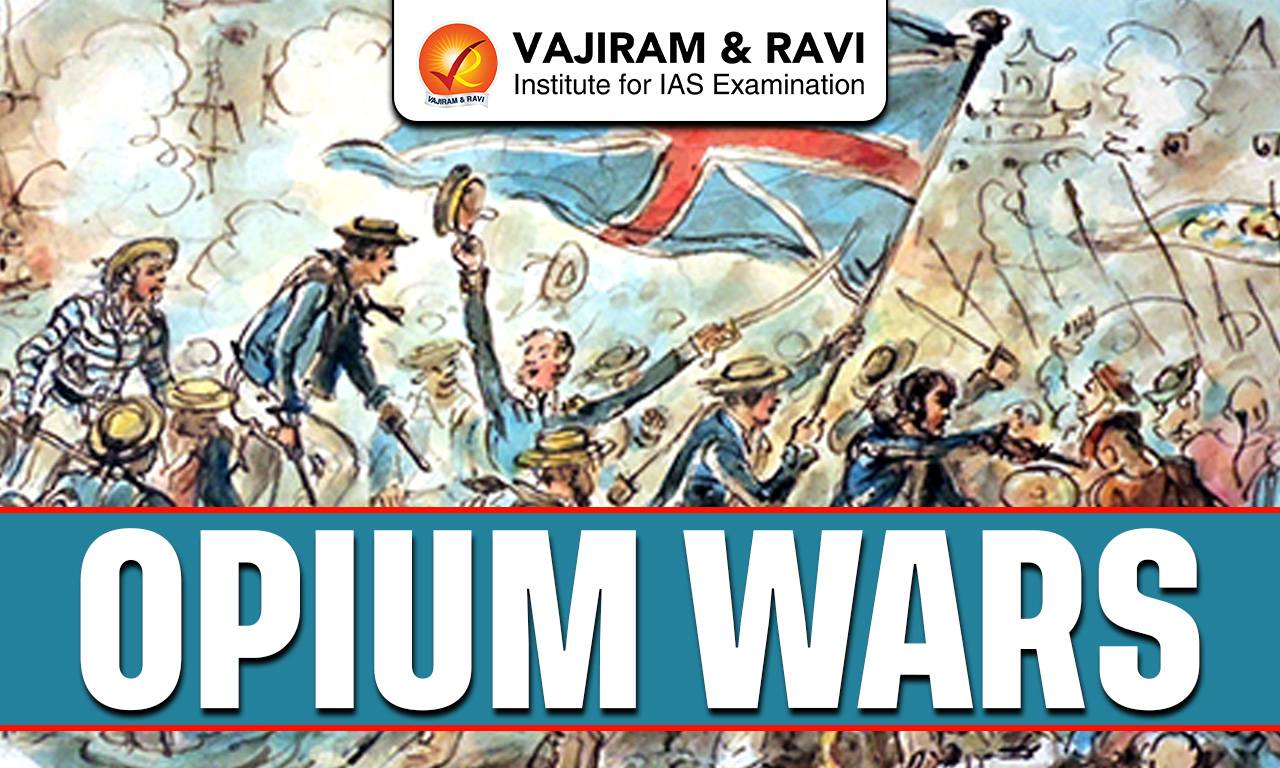
The Opium Wars were two major conflicts fought in the 19th century between the Qing Dynasty of China and Western powers, mainly Britain and later France. These wars were not just about trade; they reflected a clash between Chinese sovereignty and European imperialism.

The First Opium War (1839-1842) and the Second Opium War (1856-1860) ended in decisive defeats for China. As a result, China was forced to sign unequal treaties, open its markets, and give up territory. These wars played a key role in weakening imperial China and shaping modern Chinese history.

Opium Wars Origin

The Opium Conflict began due to growing trade tensions between China and Britain, especially over the illegal opium trade and economic imbalance. British efforts to profit from opium sales in China led to widespread addiction and strong resistance from the Qing rulers.

  • Trade Imbalance Between China and Britain
    • China exported tea, silk, and porcelain in large quantities to Britain.
    • Britain had very little to sell in return, leading to a heavy outflow of silver.
    • To correct this imbalance, Britain turned to opium as a profitable trade commodity.
  • Expansion of Opium Cultivation in India
    • After the Battle of Plassey, the British East India Company gained control over Bengal.
    • Large-scale opium production was started in India under British supervision.
    • Indian farmers were often forced to grow opium instead of food crops.
  • Illegal Smuggling of Opium into China
    • Opium was officially banned in China, yet British traders smuggled it through coastal regions like Canton (Guangzhou).
    • Local middlemen and corrupt Chinese officials helped sustain the illegal trade.
    • By the 1830s, opium imports had increased drastically, worsening the situation.
  • Social and Economic Impact in China
    • Large sections of the population became addicted to opium.
    • Productivity declined, and social disorder increased.
    • Massive outflow of silver weakened the Chinese economy.
  • Chinese Government’s Opposition
    • The Jiaqing Emperor and later rulers banned opium consumption and trade.
    • Strict laws were introduced, but enforcement remained weak due to corruption.
  • Immediate Trigger: Action by Lin Zexu
    • In 1839, Lin Zexu was appointed to eliminate the opium trade.
    • He confiscated and destroyed over 20,000 chests of opium at Humen.
    • This strong action directly challenged British interests and led to war.

First Opium War (1839-1842)

The First Opium War was fought between China’s Qing Dynasty and Britain due to disputes over the illegal opium trade. The conflict began after Lin Zexu destroyed large quantities of opium in 1839. Britain, with its superior naval power, defeated China in a series of battles. The war ended with the Treaty of Nanking, forcing China to open ports and cede Hong Kong to Britain.

Second Opium War (1856-1860)

The Second Opium War was fought between China and Western powers, mainly Britain and France, over trade rights and diplomatic relations. The conflict began after the “Arrow Incident,” which Britain used as a pretext to attack China. With superior military strength, the allies captured major cities, including Beijing, and forced China into submission. The war ended with the Treaty of Tientsin and the Convention of Peking, which legalized the opium trade and opened more Chinese ports to foreign powers.

Major Consequences of the Opium Wars

Severe Weakening of the Qing Dynasty

  • Continuous military defeats exposed the inefficiency of the Qing administration.
  • Public trust in rulers declined due to corruption and inability to resist foreign powers.
  • The dynasty gradually lost control over both internal and external affairs.

Beginning of the “Century of Humiliation”

  • The Opium Wars marked the start of a long period of foreign domination in China.
  • China was repeatedly forced into unequal agreements with Western nations and Japan.
  • National pride and sovereignty were deeply affected.

Imposition of Unequal Treaties

  • Treaties like the Treaty of Nanking and Treaty of Tientsin heavily favored foreign powers.
  • China had to pay large indemnities and grant special privileges to foreigners.
  • These treaties limited China’s control over its own trade and laws.

Loss of Territory

  • China ceded Hong Kong to Britain permanently.
  • Other foreign powers gained control over key coastal areas and influence zones.
  • Territorial concessions weakened China’s strategic position.

Opening of Treaty Ports

  • Several Chinese ports such as Shanghai and Canton were opened for foreign trade.
  • Foreign merchants gained direct access to Chinese markets.
  • These ports became centers of foreign economic and cultural influence.

Legalization of the Opium Trade

  • Despite earlier bans, China was forced to legalize opium import and trade.
  • This worsened addiction and social problems across the country.
  • The economy continued to suffer due to silver outflow.

Extraterritorial Rights to Foreigners

  • Foreign citizens were not subject to Chinese laws in treaty ports.
  • They were tried under their own country’s legal system.
  • This reduced China’s judicial sovereignty.

Opium Wars FAQs

Q1: What were the Opium Wars?

Ans: The Opium Wars were two conflicts (1839–1842 and 1856–1860) fought between China’s Qing Dynasty and Western powers, mainly Britain and France, over trade rights and the opium trade.

Q2: What caused the Opium Wars?

Ans: The main cause was Britain’s illegal opium trade in China and China’s efforts to stop it. Trade imbalance, silver outflow, and strict Chinese laws against opium also contributed to the conflict.

Q3: Who fought in the Opium Wars?

Ans: The wars were primarily fought between Qing China and Britain. In the Second Opium War, France also joined Britain, with support from other Western nations.

Q4: What was the Treaty of Nanking?

Ans: It was the agreement that ended the First Opium War in 1842, forcing China to cede Hong Kong, open ports for trade, and pay heavy compensation to Britain.

Q5: What was the Treaty of Tientsin?

Ans: It was a treaty that ended the Second Opium War, requiring China to open more ports, allow foreign diplomats in Beijing, and legalize the opium trade.

16th Constitutional Amendment Act 1963, Provisions, Significance

16th Constitutional Amendment Act

The 16th Constitutional Amendment Act, officially known as Constitution (Sixteenth Amendment) Act 1963, was enacted on 5th October 1963 to strengthen the sovereignty and integrity of India in response to rising concerns of regionalism and secessionist tendencies. Based on recommendations of the National Integration Council, it introduced key changes in fundamental rights and constitutional oaths. The amendment aimed to ensure that public representatives and institutions remained committed to preserving national unity and constitutional values.

16th Constitutional Amendment Act Provisions

The 16th Constitutional Amendment Act introduced specific constitutional changes to safeguard sovereignty and ensure allegiance to the Union through legal and institutional mechanisms.

  • Amendment to Article 19: The Act amended clauses (2), (3) and (4) of Article 19 by inserting the words “sovereignty and integrity of India” as a ground for imposing reasonable restrictions on freedoms under Article 19(1)(a), (b) and (c).
  • Restriction on Fundamental Rights: It empowered the State to impose reasonable restrictions on freedom of speech and expression, peaceful assembly and association in the interest of sovereignty and integrity of India, strengthening national security concerns.
  • Amendment to Article 84: The amendment substituted clause (a) of Article 84 to mandate that every candidate for Parliament must take an oath or affirmation before a person authorized by the Election Commission.
  • Amendment to Article 173: Similar changes were made in Article 173, making it compulsory for candidates contesting State Legislature elections to take an oath affirming allegiance to the Constitution as prescribed in the Third Schedule.
  • Changes in Third Schedule: The amendment revised forms of oath in the Third Schedule by inserting the phrase “that I will uphold the sovereignty and integrity of India” in multiple oath formats including Forms I, III, IV, V, VII and VIII.
  • Oath for Parliamentary Candidates: A new format of oath was introduced for candidates contesting elections to Parliament, requiring them to affirm true faith and allegiance to the Constitution and commitment to sovereignty and integrity.
  • Oath for Members of Parliament: Members of Parliament were required to take an oath stating allegiance to the Constitution, commitment to sovereignty and integrity and faithful discharge of their duties upon entering office.
  • Oath for State Legislature Candidates: Candidates contesting elections to State Legislative Assemblies and Councils were also required to take a similar oath affirming their commitment to constitutional values and national unity.
  • Oath for State Legislature Members: Members elected to State Legislatures had to affirm their allegiance to the Constitution and uphold sovereignty and integrity while faithfully discharging their official duties.
  • Applicability to Public Offices: The amendment extended oath requirements to Union and State Ministers, Judges of the Supreme Court and High Courts and the Comptroller and Auditor General of India, ensuring uniform constitutional commitment.

16th Constitutional Amendment Act Significance

The 16th Constitutional Amendment Act played a critical role in reinforcing national unity and constitutional discipline by addressing threats to India’s sovereignty through legal and institutional safeguards.

  • The amendment explicitly added “sovereignty and integrity of India” as a constitutional ground, making it legally enforceable to curb activities threatening national unity and prevent secessionist movements.
  • By modifying Article 19, it balanced individual freedoms with national interests, ensuring that fundamental rights are exercised within limits that protect the unity and integrity of the country.
  • Mandatory oath provisions ensured that all public representatives and constitutional authorities formally commit to preserving sovereignty and integrity, strengthening accountability and constitutional morality.
  • The amendment directly addressed concerns raised by the Committee on National Integration and Regionalism, which highlighted risks posed by regional and separatist tendencies in the early 1960s.
  • By revising the Third Schedule, the amendment ensured uniformity in oath taking across various constitutional positions, reinforcing a shared commitment to constitutional values and national integrity.
  • Requiring candidates to take an oath before elections ensured that individuals entering the political system acknowledge their responsibility toward the Constitution and the unity of India from the outset.
  • The amendment reinforced the idea that democratic rights and institutions must operate within the framework of national unity, thereby strengthening the stability of the constitutional system.
  • The primary objective of the amendment was to make it constitutionally difficult for any region or group to advocate secession, thereby preserving the indivisible nature of the Union of India.

16th Constitutional Amendment Act FAQs

Q1: What was the main objective of the 16th Constitutional Amendment Act 1963?

Ans: The main objective was to protect the sovereignty and integrity of India by enabling the State to impose reasonable restrictions on certain fundamental rights and ensuring commitment through constitutional oaths.

Q2: Which Articles were amended by the 16th Constitutional Amendment Act?

Ans: The amendment modified Article 19, Article 84, Article 173 and made changes to the Third Schedule related to oath and affirmation.

Q3: What change was made in Article 19 through the 16th Constitutional Amendment Act?

Ans: The words “sovereignty and integrity of India” were added as a ground for imposing reasonable restrictions on freedoms like speech, assembly and association.

Q4: What was the significance of the 16th Constitutional Amendment Act in the Third Schedule?

Ans: The Third Schedule was amended to include an oath requiring candidates, members and officials to uphold the sovereignty and integrity of India.

Q5: When did the 16th Constitutional Amendment Act come into force?

Ans: The Act was enacted on 5th October 1963 during the Fourteenth year of the Republic of India.

89th Constitutional Amendment Act 2003, Provisions, Significance

89th Constitutional Amendment Act

The 89th Constitutional Amendment Act 2003, officially called the Constitution (Eighty ninth Amendment) Act 2003, was enacted on 28th September 2003 in the 54th Year of the Republic of India to amend the Constitution. This amendment aimed to strengthen institutional mechanisms for safeguarding the interests of Scheduled Castes and Scheduled Tribes by restructuring existing provisions. It introduced key constitutional changes by modifying Article 338 and inserting a new Article 338A to create separate commissions.

89th Constitutional Amendment Act Provisions

The amendment introduced structural changes by separating institutions for Scheduled Castes and Scheduled Tribes, ensuring focused governance and protection of their rights.

  • Commencement: The Act came into force on a date notified by the Central Government in the Official Gazette.
  • Amendment of Article 338: Article 338 was revised to exclusively deal with the National Commission for Scheduled Castes by changing its marginal heading and removing references to Scheduled Tribes from clauses (5), (9) and (10).
  • Composition of NCSC: The National Commission for Scheduled Castes consists of a Chairperson, Vice Chairperson and three other Members, with service conditions and tenure determined by the President through rules.
  • Insertion of Article 338A: A new Article 338A was inserted to establish the National Commission for Scheduled Tribes as a separate constitutional body for addressing tribal concerns independently.
  • Composition of NCST: The National Commission for Scheduled Tribes includes a Chairperson, Vice Chairperson and three other Members appointed by the President under warrant and seal, with defined service conditions.
  • Appointment and Authority: The Chairperson, Vice Chairperson and Members of the Commission are appointed by the President and the Commission has the authority to regulate its own procedures.
  • Duties of NCST: The Commission investigates safeguards for Scheduled Tribes, inquires into complaints, participates in development planning and evaluates socio-economic progress under Union and State governments.
  • Reporting Mechanism: The Commission submits annual and special reports to the President, who places them before Parliament along with action taken reports and reasons for non acceptance of recommendations.
  • State Level Reporting: Reports concerning states are forwarded to respective Governors who present them before State Legislatures with explanations on action taken or proposed measures.
  • Civil Court Powers: The Commission has powers of a civil court including summoning persons, examining witnesses, receiving evidence, requisitioning documents and issuing commissions for examination.
  • Policy Consultation Requirement: The Union and State Governments are required to consult the Commission on all major policy matters affecting Scheduled Tribes, ensuring institutional participation in governance.

89th Constitutional Amendment Act Significance

The 89th Constitutional Amendment Act marked a major shift in governance by creating specialized institutions to address distinct socio-economic and cultural issues of Scheduled Castes and Scheduled Tribes.

  • The Act separated the earlier National Commission for Scheduled Castes and Scheduled Tribes into two independent bodies, enabling focused attention on distinct issues faced by each group.
  • By establishing the National Commission for Scheduled Tribes, the amendment ensured dedicated monitoring of safeguards and targeted socio-economic development for tribal communities.
  • The bifurcation reduced administrative burden and improved efficiency by allowing each commission to concentrate on specific constitutional responsibilities without overlapping functions.
  • The amendment complemented the creation of the Ministry of Tribal Affairs in October 1999, ensuring coordinated policy implementation for Scheduled Tribes at the national level.
  • It acknowledged that Scheduled Tribes differ geographically and culturally from Scheduled Castes, requiring separate policy approaches and institutional mechanisms for effective governance.
  • The amendment enhanced constitutional safeguards by empowering the new commission to investigate complaints, monitor rights and recommend measures for protection and welfare.
  • The reporting system to the President, Parliament and State Legislatures increased transparency and accountability in implementing welfare measures for Scheduled Tribes.
  • Granting civil court powers to the Commission strengthened its authority to enforce compliance, gather evidence and ensure proper investigation into violations of tribal rights.
  • Mandatory consultation with the Commission ensured that tribal perspectives are incorporated into major policy decisions, promoting inclusive governance and development.
  • The amendment laid the foundation for a stronger institutional framework that continues to guide policy, protection and advancement of Scheduled Tribes in India. 

89th Constitutional Amendment Act FAQs

Q1: What is the 89th Constitutional Amendment Act 2003?

Ans: It is a constitutional amendment enacted on 28th September 2003 to restructure provisions related to Scheduled Castes and Scheduled Tribes by creating separate commissions for each.

Q2: What was the main purpose of the 89th Amendment Act?

Ans: The main purpose was to bifurcate the National Commission for Scheduled Castes and Scheduled Tribes into two separate bodies for better focus and effective functioning.

Q3: Which Articles were affected by the 89th Amendment Act?

Ans: The Act amended Article 338 and inserted a new Article 338A in the Constitution to establish separate commissions for Scheduled Castes and Scheduled Tribes.

Q4: Which commission was created under Article 338A?

Ans: Article 338A established the National Commission for Scheduled Tribes as a separate constitutional body to safeguard tribal interests.

Q5: Why was a separate commission for Scheduled Tribes created?

Ans: A separate commission was created because Scheduled Tribes have distinct geographical, cultural and socio-economic issues that require focused attention and specialized policy measures.

Protectionism, Objectives, Types, Advantages, Disadvantages

Protectionism

Protectionism is an economic policy in which a country protects its domestic industries from foreign competition by using tools like tariffs, quotas, and subsidies. Governments adopt protectionism to support local businesses, create jobs, and reduce dependence on imports.

For example, developing countries often use protectionist policies to help new industries grow, while developed countries may use them to protect strategic sectors like agriculture or defense.

Protectionism Objectives

The main goals of protectionism include:

  • Protect Domestic Industries: Shield local businesses from foreign competition
  • Promote Employment: Encourage job creation within the country
  • Reduce Trade Deficit: Limit imports and increase exports
  • Encourage Industrial Growth: Help infant industries develop
  • National Security: Protect key industries like defense and energy
  • Revenue Generation: Earn income through tariffs and duties

Types of Protectionism

Protectionism includes different government measures used to restrict imports and support domestic industries. These tools help countries control trade, protect local businesses, and strengthen their economy.

1. Tariffs (Import Duties)

  • Taxes imposed on imported goods to make them more expensive
  • Encourages consumers to prefer domestic products
  • Generates revenue for the government
  • Can be specific tariffs (fixed amount per unit) or ad valorem tariffs (percentage of value)
  • Widely used tool in international trade policies

2. Import Quotas

  • Limit on the quantity of goods that can be imported
  • Prevents market flooding by foreign products
  • Helps stabilize domestic prices
  • Ensures domestic producers get a fair market share
  • May lead to black marketing if demand exceeds supply

3. Subsidies

  • Financial assistance provided by the government to domestic industries
  • Lowers production costs and increases competitiveness
  • Helps exporters sell goods at lower prices globally
  • Common in sectors like agriculture, manufacturing, and exports
  • Can create unfair competition in global markets

4. Import Licensing

  • Requires official permission to import certain goods
  • Government controls which goods and how much can be imported
  • Helps regulate sensitive or essential commodities
  • Reduces unnecessary or luxury imports
  • Can increase bureaucratic delays and corruption risks

5. Standards and Regulations (Non-Tariff Barriers)

  • Includes quality, safety, and environmental standards
  • Ensures only safe and high-quality products enter the market
  • Often used to indirectly restrict imports
  • Includes packaging, labeling, and health regulations
  • May act as hidden trade barriers 

6. Voluntary Export Restraints (VERs)

  • Agreements where exporting countries voluntarily limit exports
  • Usually imposed under pressure from importing countries
  • Helps protect domestic industries without formal tariffs
  • Common in industries like automobiles and steel
  • Reduces trade conflicts to some extent

7. Anti-Dumping Duties

  • Anti-Dumping Duties are imposed when foreign goods are sold below market price (dumping)
  • Protects domestic industries from unfair competition
  • Helps maintain fair pricing in the market
  • Investigated and imposed by government authorities
  • Common in steel, chemicals, and electronics sectors

Protectionism in the Recent Terms

In today’s global economy, protectionism is no longer limited to traditional tools like tariffs and quotas; it has evolved into a strategic policy used for economic security, climate goals, and geopolitical influence.

1. Donald Trump and “America First” Tariff Policies

  • The United States has adopted aggressive protectionist measures under the “America First” approach.
  • High tariffs reportedly up to 125% on Chinese goods and 25% on imports from countries like India and Canada, have been used as economic pressure tools.
  • These policies aim to reduce dependence on foreign imports, especially from rivals like China.
  • Focus on reshoring industries (bringing manufacturing back to the US) to boost domestic employment.
  • Trade policy is increasingly linked with geopolitical strategy, including sanctions and energy-related decisions (e.g., penalties linked to Russian oil imports).

2. Carbon Border Adjustment Mechanism (CBAM) by the European Union

  • The European Union has introduced CBAM as a climate-based protectionist tool.
  • It imposes carbon tariffs on imports of goods like steel, aluminum, cement, and fertilizers.
  • Aims to protect EU industries from competitors in countries with weaker environmental regulations.
  • Encourages global industries to adopt cleaner and sustainable production methods.
  • Although presented as a climate initiative, it acts as a non-tariff barrier affecting developing countries’ exports.

3. Protectionism in India and “Aatmanirbhar Bharat”

  • India has increased import duties to protect domestic industries and farmers.
  • In 2024, import duties on edible oils were raised from 5.5% to 27.5% to support local farmers.
  • Higher tariffs have also been imposed on electronics and machinery to boost domestic manufacturing.
  • These measures align with the Aatmanirbhar Bharat Abhiyan, which focuses on self-reliance.
  • The goal is to reduce import dependence, promote “Make in India,” and strengthen local industries.

Advantages of Protectionism

Protectionism helps countries protect their domestic industries from foreign competition and supports economic self-reliance. It is especially useful for developing economies aiming to strengthen local production and employment.

  • Protection of Domestic Industries: Safeguards local businesses from cheap foreign imports, allowing them to survive and grow in a competitive market.
  • Infant Industry Development: New and emerging industries get time to develop without facing strong international competition, helping them become stable and efficient.
  • Employment Generation: Encourages domestic production, which increases job opportunities and reduces unemployment in the country.
  • Reduction in Trade Deficit: Limits imports and promotes domestic production, helping improve the balance of trade.
  • National Security Protection: Protects key sectors like defense, agriculture, and energy, ensuring the country is not dependent on foreign nations for essential goods.
  • Encouragement of Local Production: Promotes “buy local” culture, boosting domestic manufacturing and small-scale industries.
  • Revenue Generation for Government: Tariffs and duties on imports provide an important source of income for the government.
  • Protection from Dumping: Prevents foreign companies from selling goods at extremely low prices to eliminate domestic competition.
  • Economic Stability During Crisis: Helps countries maintain stability during global economic downturns by reducing external dependency.

Disadvantages of Protectionism

While protectionism helps safeguard domestic industries, it also creates several economic inefficiencies. Excessive protection can harm consumers, reduce competition, and slow overall economic growth.

  • Higher Prices for Consumers: Import restrictions and tariffs increase the cost of foreign goods, leading to higher prices in the domestic market.
  • Limited Consumer Choice: Fewer imported goods reduce variety, leaving consumers with limited options and sometimes lower-quality products.
  • Inefficiency of Domestic Industries: Lack of foreign competition may make local industries less efficient, innovative, and cost-effective.
  • Risk of Trade Wars: Other countries may impose retaliatory tariffs, leading to trade conflicts that harm global trade relations.
  • Slower Economic Growth: Reduced competition and innovation can slow down long-term economic development.
  • Misallocation of Resources: Resources may be diverted to less efficient industries that survive only due to government protection.
  • Negative Impact on Exports: Retaliatory measures by other countries can reduce a nation’s exports and harm export-oriented industries.
  • Encouragement of Corruption and Bureaucracy: Policies like import licensing and quotas may increase red tape and create opportunities for corruption.

Protectionism FAQs

Q1: What is protectionism?

Ans: Protectionism is an economic policy in which a government restricts imports using tools like tariffs, quotas, and subsidies to protect domestic industries.

Q2: Why do countries use protectionism?

Ans: Countries use protectionism to protect local industries, create jobs, reduce trade deficits, and ensure national security in key sectors.

Q3: What is the difference between protectionism and free trade?

Ans: Protectionism restricts imports to protect domestic industries, while free trade allows goods and services to move freely across borders with minimal restrictions.

Q4: Is protectionism good or bad?

Ans: Protectionism has both advantages and disadvantages. It helps domestic industries grow but can lead to higher prices, reduced competition, and trade conflicts.

Q5: What is an example of protectionism?

Ans: Imposing high import duties on foreign goods (like electronics or agricultural products) to encourage people to buy domestically produced goods is a common example.

Northern Black Polished Ware, Features, Historical Significance

Northern Black Polished Ware

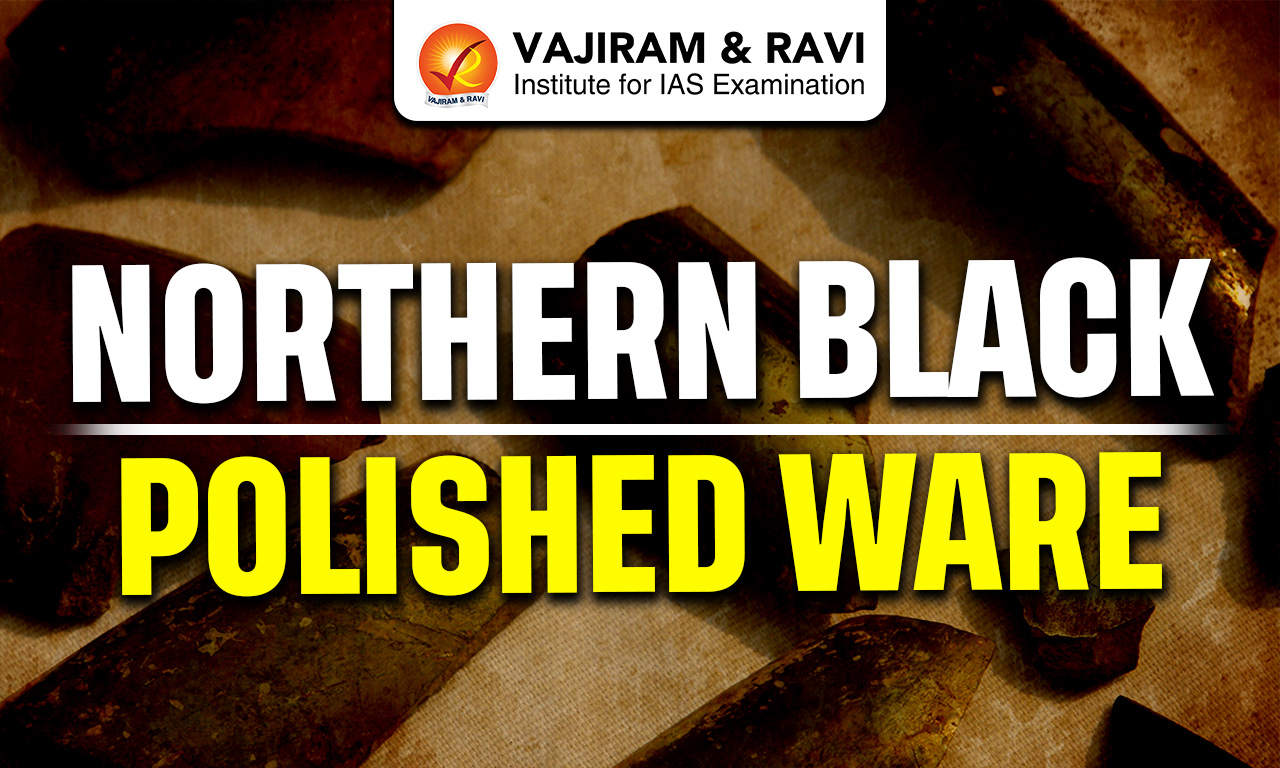
Northern Black Polished Ware is a fine and glossy type of ancient pottery known for its smooth, shiny surface, often looking almost like glass. It was used during a time when cities were growing and society was becoming more advanced in India. This pottery was usually used by richer people and is often linked with early urban life. It is important because it shows a high level of skill in pottery-making and helps us understand the development of society and economy in ancient India.

About Northern Black Polished Ware

  • Meaning: Northern Black Polished Ware (NBPW) is a very fine and glossy type of ancient pottery known for its shiny, mirror-like surface. It is considered one of the most advanced and luxurious pottery types of ancient India.
  • Time Period: NBPW belongs to the Iron Age and is generally dated between 700 BCE to 200 BCE. An earlier stage called proto-NBPW existed between 1200–700 BCE. It reached its peak between 500-300 BCE, during the time of the Mahajanapadas and the Mauryan Empire.
  • Region / Distribution: NBPW has been found across many important urban centres of ancient India. Major sites include Hastinapur, Mathura, Ayodhya, Varanasi, Kaushambi (Uttar Pradesh); Vaishali, Rajgir, Pataliputra (Bihar); and Ujjain, Vidisha (Madhya Pradesh). It is also found at sites like Taxila and Charsada (Pushkalavati) in present-day Pakistan. This wide distribution shows its connection with major cities and trade centres.
  • Cultural Association: NBPW is strongly associated with the rise of urbanization in northern India, the growth of powerful states known as the Mahajanapadas, and later the expansion of the Mauryan Empire. It reflects a more developed and organized society with cities, trade, and social hierarchy.
  • Features: This pottery is extremely fine, thin, and smooth, with a highly polished and shiny surface that often looks like glass. The most common colour is jet black, but shades like brownish black, bluish black, golden, and pink are also found. Its superior quality makes it stand out from earlier pottery types.
  • Types: NBPW is mainly classified into two types:
    • Monochrome: This is the most common type, usually in a single colour (mostly black), with a very smooth and glossy finish. About 90% of NBPW belongs to this category.
    • Bi-chrome: This type is less common and shows a combination of two colours while maintaining the same fine quality and shine.
  • Technique: NBPW was made using a fast potter’s wheel, which helped create very thin and uniform vessels. It was fired at very high temperatures and then carefully polished to achieve its shiny surface. This required great skill and advanced knowledge of pottery-making techniques.
  • Uses:NBPW was mainly used as tableware, such as bowls, dishes, and serving vessels. It was not commonly used for everyday rough work but for serving and dining, especially by the richer sections of society.
  • Social Aspect: This pottery is often found in urban and elite settings, suggesting that it was used by the wealthier classes. Its presence indicates social stratification, where richer people had access to better and more luxurious goods.
  • Economic and Urban Significance: NBPW is closely linked with the growth of cities, trade, and markets. Its wide distribution shows the existence of trade networks and specialization in craft production. It reflects a strong and organized economy during that time.
  • Significance: Northern Black Polished Ware is very important because it represents the highest level of pottery development in ancient India. It shows advances in technology, craftsmanship, and urban life. It also helps historians understand the rise of cities, the growth of powerful kingdoms, and the existence of social divisions in early historic India.

Northern Black Polished Ware FAQs

Q1: What is Northern Black Polished Ware (NBPW)?

Ans: NBPW is a fine and glossy type of ancient pottery known for its smooth, shiny, mirror-like surface and high quality.

Q2: What is the time period of NBPW?

Ans: It belongs to the Iron Age, generally dated between 700 BCE to 200 BCE, with its peak around 500-300 BCE.

Q3: Where was NBPW mainly found?

Ans: It has been found in major ancient cities like Hastinapur, Varanasi, Pataliputra, Vaishali, Ujjain, and Taxila, showing its wide distribution.

Q4: What are the main features of NBPW?

Ans: It is thin, smooth, highly polished, and shiny, usually black in colour, with a glass-like finish.

Q5: What are the types of NBPW?

Ans: There are two types: monochrome (single colour, mostly black) and bi-chrome (combination of two colours).

Famous Personalities of India in Science & Technology, Contributions

Famous Personalities of India in Science & Technology

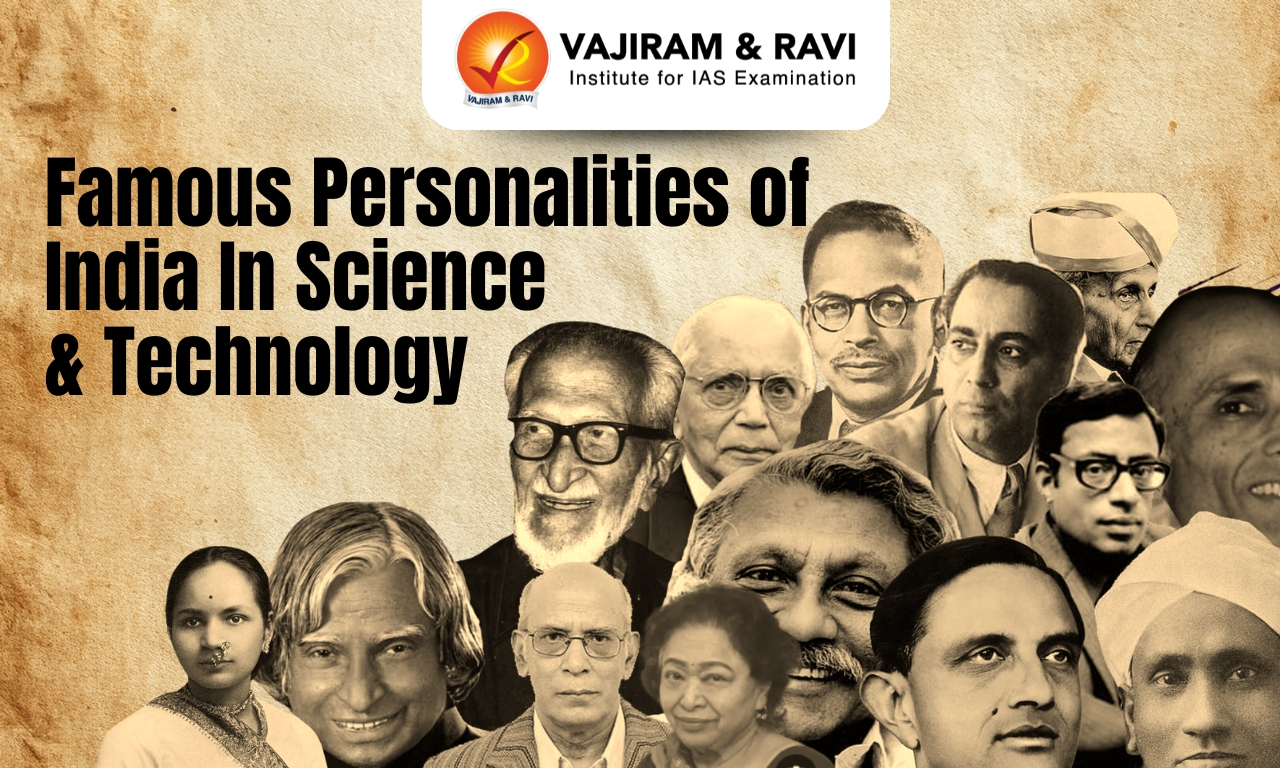
One of the oldest civilizations in the world, the Indian civilization has a strong tradition of science and technology. In the early period, Indians made important discoveries in mathematics, astronomy, and medicine, which laid a strong foundation for future knowledge. In modern times, Indian scientists have made significant progress in fields like space technology, nuclear science, agriculture, and information technology. Together, these contributions have played an important role in the growth of science both in India and across the world.

Famous Personalities of India in Science & Technology in Ancient and Early Medieval India

India has a rich scientific heritage, with important contributions from ancient and medieval times: 

Baudhayana

  • Baudhayana was one of the earliest Indian mathematicians associated with the Sulba Sutras, which were texts dealing with geometric rules for constructing Vedic altars.
  • He made an important contribution by stating a principle equivalent to the Pythagorean Theorem, showing that the square of the diagonal is equal to the sum of the squares of the sides.

Pingala

  • Pingala was a Vedic scholar who wrote the Chandahsastra, a treatise on Sanskrit prosody.
  • He introduced the concept of binary numbers (0 and 1), which later became the foundation of modern computer systems.
  • He also described patterns similar to the Fibonacci sequence in poetic meter analysis.

Kanad

  • Kanad was an ancient philosopher who developed the Vaisheshika school of thought.
  • He proposed an early atomic theory, suggesting that matter is made up of indivisible particles called “anu.”
  • His ideas anticipated modern atomic theory long before John Dalton.

Sushruta

  • Sushruta was a pioneering surgeon of ancient India and is often called the father of surgery.
  • In his work Sushruta Samhita, he described detailed surgical procedures, including plastic surgery, cataract operations, and wound treatment.
  • The text also lists over a hundred surgical instruments, demonstrating the systematic development of surgical science in ancient India.
  • His systematic approach to surgery, use of instruments, and emphasis on training and hygiene demonstrate the advanced state of medical science in ancient India.

Charaka

  • Charaka was a leading physician and a major contributor to Ayurveda, the traditional system of Indian medicine.
  • His text Charaka Samhita explains diagnosis, treatment, and prevention of diseases in a detailed and systematic way.
  • He emphasized preventive healthcare, balanced diet, and lifestyle, showing a holistic understanding of health and medicine.

Aryabhata

  • Aryabhata stands as one of the greatest mathematicians and astronomers of ancient India
  • In his work Aryabhatiya, he proposed that the Earth rotates on its axis, challenging prevailing geocentric beliefs. 
  • He calculated the value of pi with remarkable accuracy and made significant contributions to trigonometry, including the introduction of sine functions. 
  • His explanation of eclipses as natural astronomical phenomena rather than supernatural events marked a shift toward scientific reasoning. 

Brahmagupta

  • Brahmagupta made major contributions to mathematics and astronomy through his work Brahmasphutasiddhanta.
  • He defined zero as a number and gave rules for arithmetic operations involving zero and negative numbers.
  • His work influenced the Islamic world and later European mathematics.

Bhaskara II

  • Bhaskara II, also known as Bhaskaracharya, was a leading mathematician of medieval India.
  • His works Lilavati and Bijaganita deal with arithmetic, algebra, and geometry in a clear and systematic manner.
  • He introduced early ideas related to calculus, such as concepts of change and motion, showing advanced mathematical thinking.

Madhava of Sangamagrama

  • Madhava was the founder of the Kerala School of Mathematics, one of the most advanced mathematical traditions in medieval India.
  • He developed infinite series for trigonometric functions like sine and cosine.
  • His work anticipated ideas of calculus much before they appeared in Europe.

Famous Personalities of India in Science & Technology in Modern India

Famous Personalities of India in Science & Technology in Modern India have played a crucial role in advancing scientific knowledge and driving technological progress, contributing significantly to both national development and global innovation.

Srinivasa Ramanujan

  • Ramanujan was a self-taught mathematical genius who made remarkable contributions to number theory and infinite series.
  • His collaboration with G.H. Hardy brought international recognition to his work.
  • Many of his discoveries continue to influence modern mathematics even today.

C. V. Raman

  • C.V. Raman was a distinguished physicist who discovered the Raman Effect, explaining how light changes when it passes through a medium.
  • This discovery earned him the Nobel Prize in Physics in 1930.
  • It led to the development of Raman Spectroscopy, widely used in science and industry.

Satyendra Nath Bose

  • S.N. Bose made a major contribution to quantum mechanics through Bose-Einstein statistics.
  • His work led to the classification of particles called bosons.
  • This concept is fundamental to understanding the behavior of matter at the quantum level.

Meghnad Saha

  • Meghnad Saha developed the Saha Ionization Equation, which explains how elements behave at high temperatures.
  • This helped scientists understand the composition of stars.
  • His work remains essential in astrophysics.

Homi J. Bhabha

  • Homi J. Bhabha is regarded as the architect of India’s nuclear programme.
  • He established major scientific institutions such as the Tata Institute of Fundamental Research and played a key role in the Atomic Energy Commission.
  • His vision focused on the peaceful use of nuclear energy for development, laying the institutional and technological foundation for India’s nuclear capabilities.

Jagadish Chandra Bose

  • Jagadish Chandra Bose was a pioneering Indian scientist who made significant contributions to both physics and plant physiology.
  • In the field of radio science, he conducted early experiments on microwave transmission and developed devices for wireless communication.
  • In plant physiology, he proved through experiments that plants respond to external stimuli such as light, heat, and electricity, similar to living organisms.
  • He invented the crescograph, an instrument capable of measuring very small movements in plant growth, which provided scientific evidence of plant sensitivity.

Vikram Sarabhai

  • Vikram Sarabhai is known as the father of the Indian space programme.
  • He founded the Indian Space Research Organisation and promoted the use of space technology for communication, weather forecasting, and rural development.
  • His vision ensured that India’s space programme focused on practical applications for national development rather than prestige alone.

A. P. J. Abdul Kalam

  • A.P.J. Abdul Kalam played a central role in India’s missile and space programmes, earning the title “Missile Man of India.”
  • He contributed to the development of satellite launch vehicles and led the Integrated Guided Missile Development Programme (IGMDP).
  • He also played a key role in India’s nuclear tests and later became the President of India, inspiring youth toward science and innovation.

M. S. Swaminathan

  • M.S. Swaminathan is known as the father of the Green Revolution in India.
  • He introduced high-yielding varieties of wheat and rice, significantly increasing agricultural productivity.
  • His work transformed India from a food-deficit nation into a food-surplus country and ensured long-term food security.

C. N. R. Rao

  • C.N.R. Rao is one of the world’s leading materials scientists, with contributions to solid-state chemistry and nanotechnology.
  • His research has advanced the understanding of materials used in electronics, energy storage, and superconductors.
  • He has also played an important role in shaping India’s science policy and promoting research and innovation.

Har Gobind Khorana

  • He decoded the genetic code and won the Nobel Prize in Medicine (1968).
  • He contributed to understanding DNA and protein synthesis.
  • His work laid the foundation for biotechnology.

Famous Personalities of India in Science & Technology FAQs

Q1: Who among Indian scientists first proposed that the Earth rotates on its axis?

Ans: Aryabhata proposed that the Earth rotates on its axis and explained eclipses scientifically.

Q2: Which ancient Indian text is associated with surgery and medical practices?

Ans: The Sushruta Samhita by Sushruta is associated with surgical procedures and medical training.

Q3: Who defined zero as a number and gave rules for its operations?

Ans: Brahmagupta formally defined zero and explained arithmetic operations involving it.

Q4: Which Indian scientist is associated with the Raman Effect?

Ans: C. V. Raman discovered the Raman Effect and won the Nobel Prize in Physics in 1930.

Q5: Who is known as the father of the Indian space programme?

Ans: Vikram Sarabhai is regarded as the father of the Indian space programme.

Painted Grey Ware, Features, Culture and Historical Significance

Painted Grey Ware

Painted Grey Ware is a type of ancient pottery known for its smooth grey colour and simple painted designs, usually in black. It was used by early communities in India and shows a clear improvement in pottery-making skills. The pots were well-made, light, and neatly designed, reflecting a more developed and settled way of life. This pottery is important because it helps us understand the culture and daily life of people in ancient times.

About Painted Grey Ware

  • Meaning: Painted Grey Ware (PGW) is an ancient pottery style recognized by its fine grey finish and neat black designs, mostly in geometric shapes. It reflects the improvement and growing skill in pottery-making during early Indian times.
  • Time Period: PGW belongs to the Iron Age in India and is generally dated between 1200 BCE to 600-500 BCE. This was a period when society was becoming more settled and organized, with important technological developments.
  • Region / Distribution: It is mainly found in the western Gangetic plain and the Ghaggar-Hakra valley, covering regions of present-day Haryana, Uttar Pradesh, Punjab, and Rajasthan. Many important archaeological sites like Hastinapur and Ahichchhatra have yielded PGW pottery, showing its wide spread.
  • Cultural Association: PGW is associated with early village and town settlements, indicating the beginning of urban life. It is also linked with the use of iron tools, domestication of horses, and crafts like ivory working, which show economic and social development. Some historians also connect PGW culture with the later Vedic period due to similarities in region and lifestyle.
  • Features: PGW pottery is thin, light, and well-made, showing better craftsmanship than earlier pottery types. It has a smooth grey surface and is usually decorated with black painted designs such as lines, dots, spirals, circles, and other geometric shapes. Some pieces also include simple designs of plants and animals.
  • Technique: Most of the pottery was made using the potter’s wheel, which helped in creating uniform shapes and smooth surfaces. It was fired at high temperatures in a controlled environment, which gave it strength and the typical grey colour. The improved firing technique shows better knowledge and skill of ancient potters.
  • Shapes and Structure: The pots generally have simple and functional shapes with flat bases, making them easy to place and use. Common forms include bowls, dishes, vases, and storage containers. The design focuses more on usefulness and neat finishing rather than heavy decoration.
  • Decoration: The decoration is mainly done with black paint on the grey surface, usually in geometric patterns. In some cases, polychrome designs (more than one colour) are also found. The neat and consistent patterns show a high level of skill and artistic sense.
  • Special Types: Some perforated pots (pots with small holes) have been discovered. These were likely used for special purposes such as straining liquids or preparing food and beverages.
  • Production: PGW pottery was often mass-produced using the wheel, which means many pieces look similar. This shows some level of organization, specialization of labour, and control in production, leaving less room for individual creativity.
  • Lifestyle and Economy: People of the PGW culture lived in settled villages and early towns, practiced agriculture, and used iron tools, which improved farming and daily activities. The presence of both simple and high-quality pottery suggests economic differences in society, with some people having access to better goods.
  • Uses: PGW was mainly used as tableware, such as bowls and dishes for eating and serving food. Some fine-quality pottery may have been used by wealthier sections or for special occasions.
  • Significance: Painted Grey Ware is very important because it shows the transition to a more advanced and organized society in ancient India. It reflects developments in technology (especially iron use), settlement patterns, and social structure. It also helps historians understand the cultural changes during the later Vedic period and the early stages of urbanization in the Gangetic region.

Also Read: Indian Paintings

Painted Grey Ware FAQs

Q1: What is Painted Grey Ware (PGW)?

Ans: Painted Grey Ware is a fine type of ancient pottery with a smooth grey surface and simple black painted designs, mostly geometric.

Q2: What is the time period of PGW?

Ans: It belongs to the Iron Age in India, generally dated between 1200 BCE to 600-500 BCE.

Q3: Where was PGW mainly found?

Ans: It is mainly found in the western Gangetic plain and the Ghaggar-Hakra valley, including areas of Haryana, Uttar Pradesh, Punjab, and Rajasthan.

Q4: What are the main features of PGW?

Ans: It is thin, smooth, well-made, and decorated with black painted geometric patterns on a grey surface.

Q5: How was PGW made?

Ans: It was mostly wheel-made and fired at high temperatures in a controlled environment, giving it strength and a uniform grey colour.

Unification of Italy, Historical Background, Foundations, Phases

Unification of Italy

The Unification of Italy, known as the Risorgimento (meaning “resurgence”), was one of the most important political developments of nineteenth-century Europe. It transformed the Italian peninsula from a collection of fragmented states, foreign-controlled territories, and papal domains into a unified nation-state. The process formally began with the proclamation of the Kingdom of Italy in 1861 and was completed in 1870 with the annexation of Rome. However, unification was not a sudden event; it was a gradual and complex process shaped by ideological movements, diplomatic strategies, wars, and popular participation.

Historical Background Italy Before Unification

In the early nineteenth century, Italy was not a unified nation but a fragmented region divided into multiple states after the Congress of Vienna. The objective of European powers was to restore monarchies and suppress the spread of nationalism that had emerged after the French Revolution and the rule of Napoleon Bonaparte. As a result, Italy was split into several political units such as: 

  • The progressive Kingdom of Piedmont-Sardinia in the northwest,
  • The conservative and economically backward Kingdom of the Two Sicilies in the south, and 
  • The Papal States in central Italy under the authority of the Pope. 
  • Smaller states like Parma, Modena, and Tuscany remained under Austrian influence, while Lombardy-Venetia was directly controlled by Austria. 

Ideological Foundations of Unification of Italy 

The movement for Italian unification was shaped by powerful intellectual and political ideas that emerged in the nineteenth century. 

  • Nationalism played a central role by promoting the belief that people sharing a common language, culture, and history should form a single nation. 
  • Liberalism further strengthened this movement by demanding constitutional government, individual rights, and political freedom. 
  • At the same time, Romanticism contributed by reviving interest in Italy’s glorious past, particularly the legacy of ancient Rome and the Renaissance, thereby fostering a sense of shared identity. 

Leaders like Giuseppe Mazzini were instrumental in spreading these ideas and mobilising people towards the goal of a united Italy.

Phases of Unification of Italy

The unification of Italy was a gradual and multi-stage process that unfolded over several decades, involving revolutionary movements, diplomatic strategies, and military actions led by different leaders and forces.

Phase I Revolutionary Nationalism (1830s-1848)

The initial phase of unification was marked by revolutionary efforts led by nationalist leaders. 

  • Giuseppe Mazzini founded Young Italy in 1831 with the aim of creating a unified, republican Italy based on popular sovereignty. His movement inspired widespread nationalist sentiment, but most uprisings failed due to lack of organisation, military strength, and external support. 
  • The Revolutions of 1848 further intensified the struggle, with uprisings occurring across Italy. 
  • However, the Kingdom of Piedmont-Sardinia, led by Charles Albert, was defeated by Austria. 

These failures demonstrated that unification could not be achieved through revolutionary action alone and required strong leadership and international alliances.

Phase II Diplomatic and Political Strategy (1852-1861)

A decisive shift occurred under the leadership of Count Camillo di Cavour, the Prime Minister of Piedmont-Sardinia. He adopted a pragmatic approach by modernising the economy, strengthening the military, and pursuing diplomatic alliances. Cavour secured the support of Napoleon III through the Plombières Agreement, which led to a war against Austria in 1859. As a result, Lombardy was annexed, and several central Italian states joined Piedmont through plebiscites. 

This phase marked the success of diplomacy and statecraft over purely revolutionary methods.

Phase III Popular Movement and Military Action (1860)

The next phase was characterised by mass participation and military action led by Giuseppe Garibaldi. 

  • In 1860, he launched the Expedition of the Thousand and successfully captured Sicily and southern Italy. His campaign gained support from local populations and rapidly weakened Bourbon rule. Despite being a committed republican, Garibaldi chose to hand over his conquered territories to Victor Emmanuel II, placing national unity above personal ideology. This act ensured the consolidation of Italy under a constitutional monarchy.

Phase IV Final Unification (1861-1870)

The process of unification was completed in stages after the initial formation of the Kingdom of Italy in 1861.

  • Venetia was incorporated in 1866 following Austria’s defeat in the Austro-Prussian War. 
  • The final step came in 1870 when Rome was annexed after French troops withdrew during the Franco-Prussian War. 
  • With Rome becoming the capital, the political unification of Italy was finally completed, marking the end of the Risorgimento.

Factors Responsible for Unification of Italy

The success of Italian unification was due to the interaction of several important factors:

  • Rise of Nationalism and Romanticism: Writers and intellectuals promoted a shared cultural identity based on language, history, and heritage. Nationalism became a powerful emotional force that united people across regions.
  • Impact of the French Revolution and Napoleon: Revolutionary ideas such as liberty, equality, and popular sovereignty spread across Italy. Napoleonic reforms also introduced administrative unity, which inspired future unification efforts.
  • Economic Factors: Political fragmentation created barriers to trade and industrial development. The emerging middle class supported unification to create a unified economic system and remove internal tariffs.
  • Role of Leadership: Mazzini inspired the nationalist movement ideologically, Cavour used diplomacy and statecraft, and Garibaldi contributed through military action and mass mobilization.
  • Role of Foreign Powers: France played a crucial but inconsistent role, supporting Italy against Austria but also limiting its ambitions. Britain’s indirect support and Prussia’s later alliance also contributed significantly.

Challenges in the Unification of Italy 

Despite its success, the unification process faced several major challenges:

  • Austrian Control: Austria’s dominance in northern Italy was the biggest obstacle and required military confrontation to overcome.
  • Opposition of the Papacy: The Pope resisted unification as it threatened his authority over the Papal States, creating a major political and religious challenge.
  • Internal Ideological Conflicts: Differences between republicans (like Mazzini) and monarchists (like Cavour) created divisions within the movement.
  • Piedmontization of Italy: Unification is often criticized as an expansion of Piedmont-Sardinia. The new Italian state adopted Piedmont’s laws, administration, and taxation system without considering regional differences. This led to resentment, particularly in southern Italy, where people viewed unification as domination rather than liberation. The resulting unrest led to widespread brigandage, reflecting resistance against the new state.
  • Regional Imbalances: The north was more industrialized, while the south remained agrarian and underdeveloped, leading to long-term inequality known as the “Southern Question.”
  • Limited Popular Participation: Unification was largely driven by elites, with limited involvement of the masses, which weakened national integration.

Impact of the Unification of Italy

The unification had both positive and negative consequences:

  • Political Unity: Italy emerged as a unified nation-state, ending centuries of fragmentation and foreign domination.
  • Change in European Power Balance: Austria’s influence declined, and Italy became a new power in European politics.
  • Spread of Nationalism: Italian unification inspired similar movements, especially the unification of Germany.
  • Economic Integration: A unified market was established, promoting trade and development, though disparities persisted.
  • Church-State Conflict: The annexation of Rome created tensions with the Catholic Church, leading to the “Roman Question.”
  • Incomplete Nation-Building: Political unity did not automatically create social unity. As rightly observed by Massimo d’Azeglio, “We have made Italy; now we must make Italians.” This highlights the challenge of creating a common national identity among diverse populations.

Unification of Italy FAQs

Q1: What is the Unification of Italy?

Ans: The Unification of Italy refers to the process through which the fragmented Italian states were brought together into a single nation-state between 1815 and 1870, known as the Risorgimento.

Q2: Who were the main leaders of the Unification of Italy?

Ans: The Unification of Italy was led by Giuseppe Mazzini, Count Camillo di Cavour, Giuseppe Garibaldi, and Victor Emmanuel II, each contributing through ideology, diplomacy, and military action.

Q3: What were the main causes of the Unification of Italy?

Ans: The Unification of Italy was driven by nationalism, liberal ideas, economic needs for a unified market, and opposition to Austrian domination and political fragmentation.

Q4: What were the major challenges in the Unification of Italy?

Ans: The Unification of Italy faced challenges such as Austrian control, opposition from the Papacy, regional inequalities between north and south, and limited participation of the common people.

Q5: What was the impact of the Unification of Italy?

Ans: The Unification of Italy led to the creation of a unified nation-state, changed the balance of power in Europe, inspired other nationalist movements, but also left issues like regional imbalance and weak national integration unresolved.

Black and Red Ware (BRW), Technique and Historical Significance

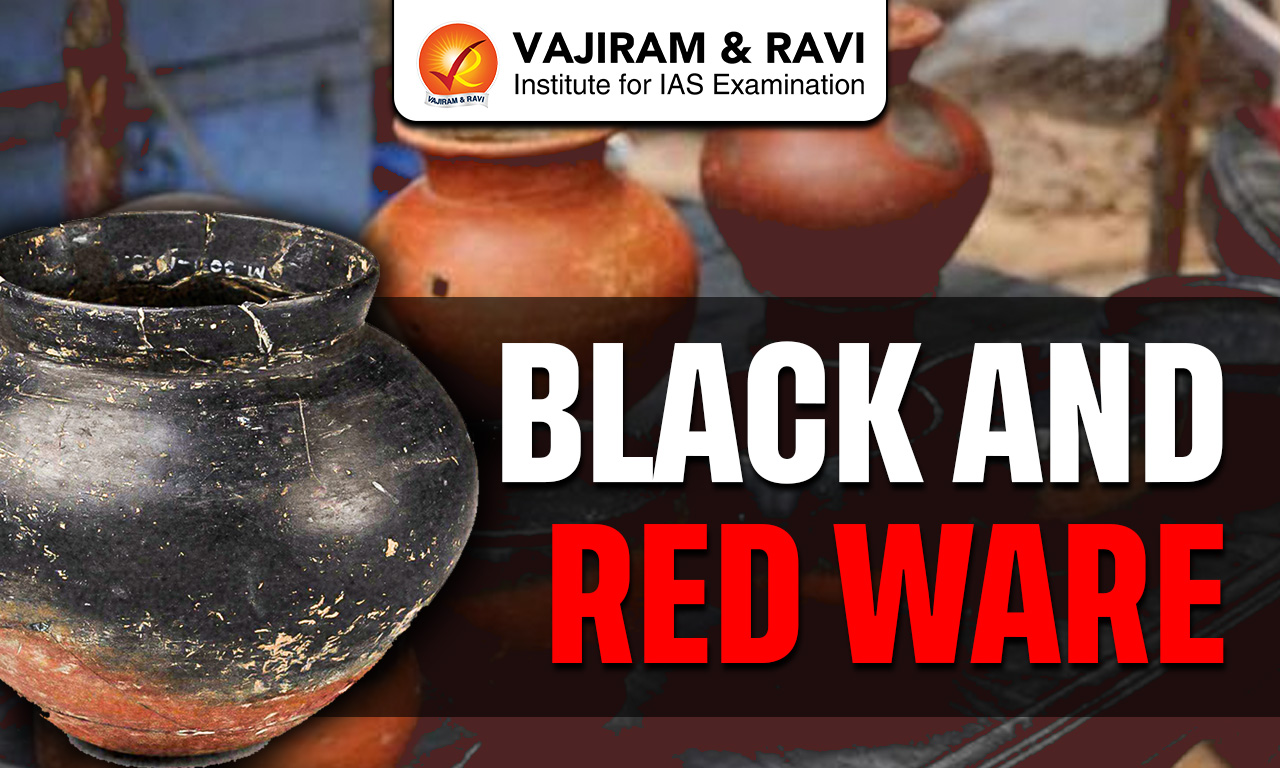
Black and Red Ware

Black and Red Ware is an ancient type of pottery known for its unique two colours black on the inside and red on the outside. It was commonly used by early communities in India and shows the gradual improvement in pottery-making techniques. This pottery is important because it helps us understand the daily life and skills of people in ancient times.

About Black and Red Ware

  • Meaning: Black and Red Ware (BRW) is a type of ancient pottery that is easily identified by its two colours black on the inside and rim, and red on the outside. This colour combination was not accidental but created through a special firing process.
  • Time Period: BRW has a very long history in India. It first appeared in the Neolithic period and continued through the Harappan phase, Bronze Age, Iron Age, megalithic period, and even into the early historical period. This shows that it remained in use for many centuries.
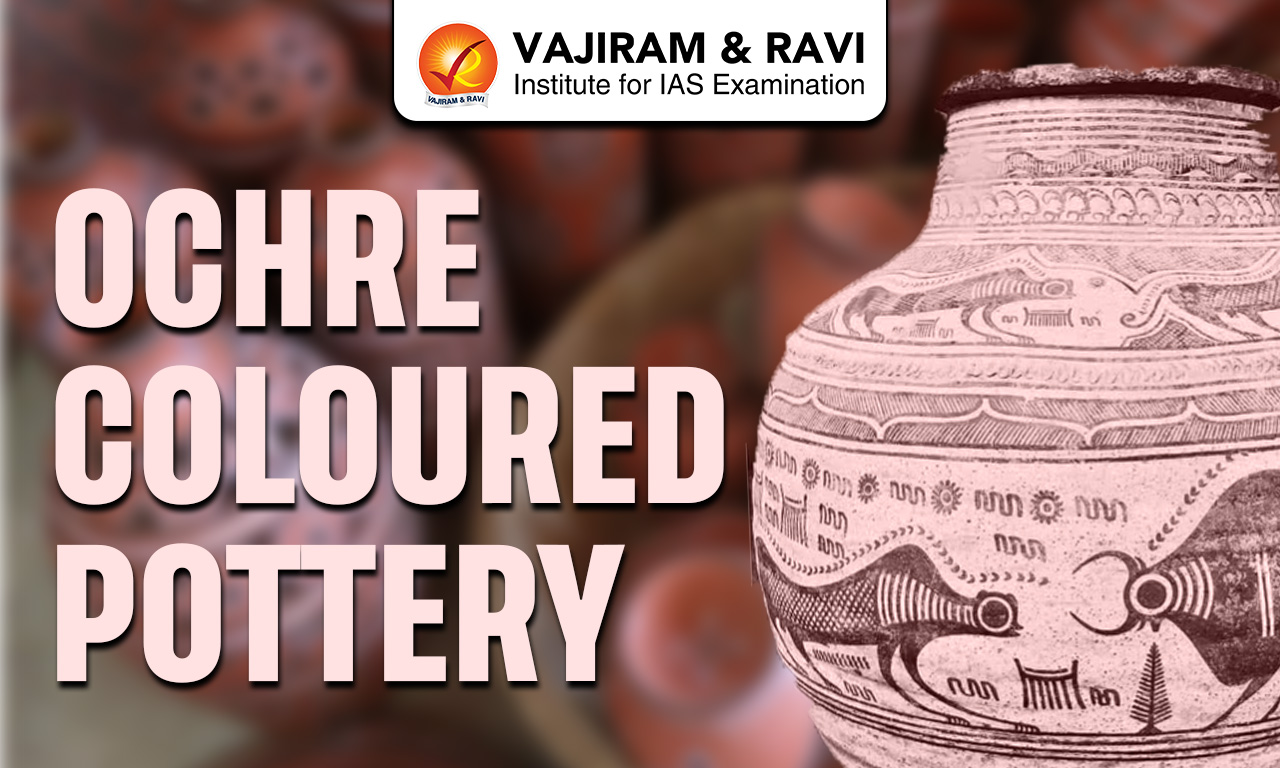
  • Region / Distribution: It has been found across a wide area of India, including Rajasthan, Gujarat, Madhya Pradesh, Uttar Pradesh, Bihar, and parts of South India. In the western Ganga plain (western Uttar Pradesh), it is dated around 1450–1200 BCE. In this region, it came after Ochre Coloured Pottery (OCP) and was later replaced by Painted Grey Ware (PGW).
  • Cultural Association: BRW is connected with several ancient cultures. One important example is the Ahar-Banas culture of Rajasthan, where this pottery was often decorated with white painted linear designs. Its presence in different regions shows that many communities adopted and adapted this pottery style.
  • Features: BRW is known for its distinct two-colour appearance. The pots are generally well-shaped, medium to fine in quality, and stronger than earlier handmade pottery. Some pieces are plain, while others have simple painted designs. The surface is often smooth, and the pottery shows better control in shaping and firing.
  • Technique: The two colours were produced by a special firing method. During firing, the pot was placed in such a way that the inside received less oxygen (which turned it black), while the outside was exposed to more oxygen (which turned it red). This shows that ancient potters had developed a good understanding of firing techniques and kiln control.
  • Lifestyle and Economy: The people associated with BRW were mainly settled agricultural communities. They practiced subsistence farming, growing crops like rice, barley, and legumes. This indicates a stable lifestyle with dependence on agriculture rather than hunting alone.
  • Associated Findings: Excavations at BRW sites have revealed many other objects, such as ornaments made of shell, copper, carnelian, and terracotta. This shows that people were skilled not only in pottery but also in making jewellery and using different materials, indicating trade and craft specialization.
  • Uses: BRW was mainly used for everyday household purposes such as cooking, storing food and water, and serving meals. Some decorated pieces might also have been used for special or ritual purposes.
  • Significance: Black and Red Ware is very important for understanding ancient Indian history. It shows the development of pottery-making techniques, improvement in firing methods, and growing craftsmanship. It also reflects the lifestyle, agriculture, and cultural practices of early communities. Most importantly, it helps historians trace the transition between different cultural phases, such as from OCP to PGW in certain regions.

Also Read: Indus Valley Civilization

Black and Red Ware FAQs

Q1: What is Black and Red Ware (BRW)?

Ans: Black and Red Ware is an ancient type of pottery with two colours-black on the inside and rim, and red on the outside, created through a special firing technique.

Q2: What is the time period of BRW?

Ans: It was used from the Neolithic period and continued through the Harappan, Bronze Age, Iron Age, megalithic, and early historical periods.

Q3: Where was BRW mainly found?

Ans: It has been found across many parts of India, including Rajasthan, Gujarat, Madhya Pradesh, Uttar Pradesh, Bihar, and South India.

Q4: What are the main features of BRW?

Ans: It has a distinct two-colour appearance, smooth surface, good shape, and is stronger than earlier pottery, with some pieces having simple painted designs.

Q5: How was BRW made?

Ans: It was made using a special firing technique where the inside received less oxygen (turning black) and the outside received more oxygen (turning red).

Judaism, Origin, Evolution, Core Beliefs, Sacred Texts, Commandments

Judaism

Judaism is one of the oldest living religions in the world, with a history of nearly 4,000 years. It is regarded as the earliest of the Abrahamic religions, influencing Christianity and Islam. It is a monotheistic religion, based on the belief in one supreme God who revealed himself through prophets such as Abraham, Isaac, Jacob, Moses and Solomon.

Origin and Evolution of Judaism

  • Judaism began nearly 4,000 years ago in the Middle East with the Hebrew people, making it one of the oldest monotheistic religions.
  • Its origin is linked to Abraham, who is regarded as the founder of Judaism because he introduced the idea of one God (monotheism) at a time when most societies believed in many gods.
  • God made a special agreement with Abraham called the Covenant, promising that his descendants would become a great nation and live in the Promised Land.
  • Abraham’s son Isaac and grandson Jacob (Israel) continued this tradition, and their descendants came to be known as the Israelites.
  • A major turning point was the Exodus, led by Moses, who freed the Israelites from slavery in Egypt.
  • At Mount Sinai, Moses received the Ten Commandments, which became the foundation of Jewish laws, ethics, and religious practices.
  • The Israelites later settled in Canaan and established a kingdom under King David, followed by King Solomon, who built the First Temple in Jerusalem.
  • Over time, invasions by the Assyrians, Babylonians, and Romans led to the destruction of temples and forced Jews to disperse across different regions, known as the Diaspora.
  • During the Diaspora, Judaism evolved from a temple-based religion to a community-centered faith, with synagogues and rabbis playing a central role.
  • Despite persecution and hardships, Jews preserved their religious beliefs, traditions, and cultural identity, making Judaism a resilient and enduring religion that continues to exist today.

Core Beliefs of Judaism

Judaism is a monotheistic religion that teaches the existence of one all-powerful God who guides human life and has a special covenant with the Jewish people. It emphasizes moral living, following God’s laws, and maintaining a strong sense of community, while looking forward to the coming of the Messiah. Key Beliefs of Judaism:

  • Belief in One God: Jews believe in a single, all-powerful God who created the universe and guides human history.
  • Covenant with God: God has a special agreement with the Jewish people, giving them responsibilities and promising to protect them.
  • Importance of the Torah: The Torah, including the Ten Commandments, contains God’s laws and teachings that guide daily life.
  • Ethical Living: Jews are expected to act morally, do good deeds, help others, and follow God’s commandments.
  • Prophets and Divine Guidance: God communicates with humans through prophets, who teach and guide people according to God’s will.
  • Belief in the Messiah: Most Jews believe that a future Messiah will come to bring peace, justice, and restore the world.
  • Community and Worship: Jews worship in synagogues, observe holy days, and maintain traditions that strengthen their identity and faith.

Sacred Texts of Judaism

Judaism has a rich collection of sacred texts that guide religious beliefs, ethical practices, and daily life. The texts are considered both a spiritual and legal foundation for Jewish communities, helping preserve traditions and teachings across generations. Main Sacred Texts:

  • Torah: The most important Jewish text, also called the Pentateuch, contains the first five books of the Hebrew Bible. It includes laws, moral guidance, and the history of the Jewish people from creation to the death of Moses. The Torah is read regularly in synagogues from scrolls kept in the holy ark.
  • Tanakh (Hebrew Bible): This is the complete Hebrew Bible, consisting of three parts:
    • Torah (Law) – as described above.
    • Nevi’im (Prophets) – writings of the prophets that guide Jews in moral, spiritual, and social matters.
    • Ketuvim (Writings) – includes poetry, history, philosophy, and songs, such as Psalms, Proverbs, and Job.
  • Talmud: A key text of Rabbinic Judaism, the Talmud records discussions and interpretations of Jewish law by rabbis. It has two parts Mishnah (written collection of oral laws) and Gemara (commentary on the Mishnah, explaining and expanding the laws)
  • Other Texts: Later writings, such as the Mishneh Torah and Shulchan Aruch, provide detailed guidance on daily life and law. Works by philosophers like Maimonides, including the 13 Articles of Faith, further explain Jewish beliefs.

Together, these texts form the foundation of Judaism, shaping religious practice, ethical behavior, and community life for Jewish people worldwide.

The Ten Commandments of Judaism 

The Ten Commandments are central ethical laws in Judaism. They include principles such as:

  • Worship only one God and avoid idol worship.
  • Do not misuse the name of God.
  • Observe the Sabbath as a holy day.
  • Respect parents and elders.
  • Avoid immoral acts such as murder, theft, adultery, and false testimony.
  • Do not covet the possessions of others.

These commandments form the moral and legal foundation of Jewish life.

Judaism Religious Practices and Rituals

Judaism emphasizes daily practice along with belief. Important practices include:

  • Observance of Shabbat, a weekly day of rest from Friday evening to Saturday evening.
  • Worship in synagogues, led by spiritual leaders known as rabbis.
  • Observance of dietary laws (Kashrut), regulating permissible food.
  • Life-cycle rituals such as circumcision, coming-of-age ceremonies, marriage, and mourning rites.

Judaism Festivals and Holy Days

Jewish festivals commemorate historical events and spiritual themes. Major festivals include:

  • Passover, which celebrates the liberation of Israelites from Egypt.
  • Rosh Hashanah, marking the beginning of the Jewish year.
  • Yom Kippur, the holiest day, focused on repentance and fasting.
  • Hanukkah, celebrating the rededication of the Temple.

Sects (Denominations) within Judaism

Judaism has diversified into several sects due to differences in interpretation.

Major sects include:

  • Orthodox Judaism: Orthodox Jews strictly follow traditional laws (Halakhah) and believe that the Torah is the unchangeable word of God.
  • Reform Judaism: Reform Judaism emphasizes ethical values over strict rituals and allows adaptation to modern society.
  • Conservative Judaism: This sect takes a middle path, preserving traditions while allowing gradual change through interpretation.
  • Reconstructionist Judaism: This views Judaism as an evolving civilization and allows flexibility in beliefs and practices.
  • Humanistic Judaism: This emphasizes Jewish culture and history without focusing on belief in God.

Judaism in the Modern World

Today, Judaism is practiced by millions of people worldwide, primarily in Israel and the United States. The establishment of Israel in 1948 marked a significant moment in Jewish history, providing a homeland after centuries of diaspora.

Modern Judaism faces challenges such as assimilation, identity preservation, and geopolitical conflicts, but it continues to evolve while maintaining its core traditions.

Judaism FAQs

Q1: What is Judaism?

Ans: Judaism is one of the world’s oldest monotheistic religions, originating nearly 4,000 years ago among the Hebrew people. It is based on the belief in one God who revealed himself through prophets and sacred texts, guiding moral and religious life.

Q2: Who is considered the founder of Judaism?

Ans: Abraham is regarded as the founder of Judaism. God made a covenant with him, promising that his descendants would become a great nation and live in the Promised Land.

Q3: What are the core beliefs of Judaism?

Ans: Judaism teaches belief in one God, the importance of the covenant, ethical living, adherence to the Torah, guidance through prophets, and the future coming of the Messiah.

Q4: What are the sacred texts of Judaism?

Ans: The main sacred texts include the Torah (the first five books of the Hebrew Bible), the Tanakh (Hebrew Bible), and the Talmud, which contains rabbinic interpretations and discussions of Jewish law. Other texts, such as Mishneh Torah and writings by Maimonides, further explain beliefs and practices.

Q5: What are the Ten Commandments in Judaism?

Ans: The Ten Commandments are central ethical laws that guide Jewish life, including worshiping only one God, observing the Sabbath, respecting parents, and avoiding acts such as murder, theft, adultery, false testimony, and coveting others’ possessions.

UPSC Daily Quiz 9 April 2026

UPSC Daily Quiz

[WpProQuiz 132]

UPSC Daily Quiz FAQs

Q1: What is the Daily UPSC Quiz?

Ans: The Daily UPSC Quiz is a set of practice questions based on current affairs, static subjects, and PYQs that help aspirants enhance retention and test conceptual clarity regularly.

Q2: How is the Daily Quiz useful for UPSC preparation?

Ans: Daily quizzes support learning, help in revision, improve time management, and boost accuracy for both UPSC Prelims and Mains through consistent practice.

Q3: Are the quiz questions based on the UPSC syllabus?

Ans: Yes, all questions are aligned with the UPSC Syllabus 2025, covering key areas like Polity, Economy, Environment, History, Geography, and Current Affairs.

Q4: Are solutions and explanations provided with the quiz?

Ans: Yes, each quiz includes detailed explanations and source references to enhance conceptual understanding and enable self-assessment.

Q5: Is the Daily UPSC Quiz suitable for both Prelims and Mains?

Ans: Primarily focused on Prelims (MCQ format), but it also indirectly helps in Mains by strengthening subject knowledge and factual clarity.

Ochre Coloured Pottery (OCP), Culture and Historical Significance

Ochre Coloured Pottery

Ochre Coloured Pottery is an early type of pottery known for its light reddish or ochre colour. It was mainly used by early farming communities and is considered one of the simpler forms of pottery in ancient India. The pots were usually not very strong and were made using basic techniques, showing that pottery-making skills were still developing at that time.

About Ochre Coloured Pottery

  • Meaning: Ochre Coloured Pottery (OCP) is an early type of pottery from the Bronze Age, known for its light reddish or ochre colour. It gets this colour because of poor firing techniques, which give it a dull and uneven appearance.
  • Time Period: It is generally dated between 2000-1500 BCE, placing it in the later phase of the Bronze Age in India.
  • Region / Distribution: It was mainly found in the Indo-Gangetic Plain, especially in areas from eastern Punjab to northeastern Rajasthan and western Uttar Pradesh, showing its spread across early settlement regions.
  • Cultural Association: OCP shows similarities with both the Late Harappan culture and the early Vedic culture, which means it represents a transitional phase between these two important cultural periods.
  • Features: It is usually light red or ochre in colour, has a rough and porous texture, and appears weak and poorly fired, indicating that pottery-making techniques were still developing. The edges of broken pieces (sherds) are often worn out due to weathering.
  • Technique: The pottery was made using simple methods with low firing temperatures and less control over the kiln, which resulted in fragile and unevenly coloured pots.
  • Decoration: Although mostly plain, some OCP pieces were decorated with simple black painted bands or incised (carved) patterns, showing early attempts at artistic expression.
  • Association with Copper Hoards: OCP is often found along with copper hoards, which include copper tools, weapons, and sometimes human-shaped (anthropomorphic) figures, suggesting the presence of metal-using communities.
  • Uses: It was mainly used for basic daily purposes such as storage, cooking, and household activities, reflecting the simple lifestyle of early agricultural communities.
  • Significance: OCP is important because it helps us understand a transitional cultural phase in Indian history, showing the shift from the Indus Valley traditions to early Vedic society. It also provides evidence of early farming settlements and developing technology in pottery and metal use.

Also Read: Manamadurai

Ochre Coloured Pottery FAQs

Q1: What is Ochre Coloured Pottery (OCP)?

Ans: Ochre Coloured Pottery is an early Bronze Age pottery known for its light reddish or ochre colour, formed due to low and uneven firing techniques.

Q2: What is the time period of OCP?

Ans: It is generally dated between 2000-1500 BCE, belonging to the later phase of the Bronze Age in India.

Q3: Where was OCP mainly found?

Ans: It was mainly found in the Indo-Gangetic Plain, especially in eastern Punjab, northeastern Rajasthan, and western Uttar Pradesh.

Q4: What are the main features of OCP?

Ans: It has a light ochre colour, rough and porous texture, weak structure, and weathered edges, showing less advanced pottery-making techniques.

Q5: What techniques were used to make OCP?

Ans: It was made using simple methods with low firing temperatures and limited control over the kiln, resulting in fragile pottery.

Pottery Tradition in India, History, Types and Cultural Significance

Pottery Tradition in India

Pottery is one of the oldest crafts in India, practiced for thousands of years. It involves shaping clay into useful items like pots and utensils, as well as decorative pieces. Made by hand or on a wheel and then fired in a kiln, pottery reflects the creativity and traditions passed down through generations. Even today, it remains an important part of daily life and cultural heritage.

About Pottery Tradition in India

  • Pottery is one of the oldest and most continuous crafts in India. It began in prehistoric times when early humans started using clay to make vessels for storing food and water. Evidence from sites like Mehrgarh shows that pottery was practiced as early as the Neolithic period. Over time, pottery developed from simple handmade objects to highly refined and artistic creations.
  • Pottery is not only useful in daily life but also very important for understanding history. Different styles, shapes, and designs of pottery help historians and archaeologists learn about the lifestyle, economy, and culture of people in different periods, especially where written records are not available.

Evolution of Pottery Tradition in India

  • Prehistoric Period (Neolithic Age)
    • This is the earliest stage of pottery making in India.
    • Pottery was mostly handmade without the use of advanced tools.
    • The pots were simple, rough, and mainly used for daily purposes like cooking and storage.
    • In the later part of this period, the potter’s wheel (foot wheel) began to be used, which improved the shape and finishing of pots.
    • Firing techniques were basic, so pottery was not very strong.
  • Chalcolithic Age
    • Pottery became more advanced and diversified in this period.
    • Different pottery traditions developed, showing regional variations.
    • Common types included:
    • Black and Red Ware
    • Black-on-Red Ware
    • Ochre Coloured Pottery
    • Pottery began to be decorated with simple painted designs and patterns.
    • The quality of clay and firing techniques improved, making pottery stronger and more durable.
  • Indus Valley Civilization
    • Pottery reached a high level of development during the Indus Valley Civilization.
    • Pots were made using the wheel and were well-shaped, symmetrical, and finely finished.
    • Pottery was often decorated with geometric designs, animals, birds, and symbolic motifs.
    • Different types of pottery included:
    • Black-on-Red Ware
    • Painted Grey Ware
    • Polished and burnished wares
    • Pottery was used for various purposes such as storage, cooking, trade, and even burial practices.
    • The large-scale production of pottery shows organized craftsmanship and specialization of labour.
  • Vedic Period
    • New types of pottery appeared, such as:
    • Painted Grey Ware (PGW)
    • Northern Black Polished Ware (NBPW)
    • Pottery styles became more refined and region-specific.
    • These pottery types help historians understand the settlement patterns and lifestyle of people during this period.
  • Mauryan Period
    • Pottery techniques became more advanced and standardized.
    • The potter’s wheel was widely used across regions.
    • Northern Black Polished Ware (NBPW) became highly popular, known for its shiny, smooth, and glossy surface.
    • Pottery showed better finishing, uniformity, and high-quality firing techniques.
  • Post-Mauryan Period (Kushan Age)
    • During the Kushan Empire, pottery continued to develop.
    • Red polished ware with stamped or molded designs became common.
    • Both fine decorative pottery and sturdy everyday pottery were produced.
    • There was an increase in regional styles and artistic expression.
  • Gupta Period
    • Pottery during the Gupta Empire reached a high level of artistic excellence.
    • Red Ware became the most distinctive and widely used type.
    • Pots were well-fired, smooth, and often decorated.
    • Archaeological findings show advanced craftsmanship and aesthetic sense.
  • Kushan Period Pottery:
    • During the time of the Kushan Empire, pottery-making saw major development.
    • Important pottery sites are found in Bengal and North India.
    • This period introduced new styles and techniques in ceramic craft.
    • The most characteristic feature was red polished ware with stamped designs.
    • Pottery showed better finishing and decorative patterns.
    • Along with fine pottery, simple and sturdy red ware was also widely produced.
    • These were mainly used for daily household purposes.
  • Medieval Period
    • This period saw the development of regional pottery traditions across India.
    • Glazed pottery was introduced due to Persian and Islamic influence.
    • Pottery became more decorative along with its functional use.
    • Different regions developed their own unique styles, designs, and techniques.
  • Modern Period
    • Pottery continues to be an important craft in India today.
    • It exists in both traditional and modern forms.
    • Traditional pottery is still practiced in villages using simple tools and methods.
    • Modern pottery includes ceramics, studio pottery, and machine-made products.
    • Pottery is also promoted as a handicraft industry and plays a role in cultural tourism and art.

Elements of Pottery Analysis

To study and understand pottery, three main elements are considered:

  • Fabric
    • Fabric refers to the physical material and texture of pottery.
    • It depends on:
    • Type of clay used
    • Materials mixed with clay (like sand or grit)
    • Firing technique (oxidation or reduction)
    • It helps in identifying the origin and quality of pottery.
  • Form (Shape)
    • The structure or shape of pottery is very important.
    • A pot generally has four parts: Base, Body, Neck and Rim
    • The shape indicates its function, such as storage, cooking, or ritual use.
  • Decoration
    • Decoration includes designs, patterns, and surface finishing.
    • It can be: Painted, Carved, Polished or burnished
    • Decorative styles reflect the culture, beliefs, and artistic skills of the people.

Important Pottery Types in India

  • Black and Red Ware (BRW)
    • Meaning: Black and Red Ware is a type of pottery characterized by its dual colour appearance, where the inner surface and rim are black while the outer surface is red, produced through a special firing technique.
    • Features: It has a distinctive two-colour pattern, is generally wheel-made, medium to coarse in texture, and shows clear control over firing conditions, indicating improved craftsmanship.
    • Technique: This pottery was made using a controlled firing process in which oxygen was restricted inside the vessel (turning it black) and allowed outside (turning it red), showing an understanding of firing technology.
    • Distribution: It has been widely found across regions such as Rajasthan, Gujarat, Madhya Pradesh, and the Ganga valley, indicating its extensive use in ancient India.
    • Uses: It was mainly used for everyday purposes such as cooking, storage, and household activities, making it a functional type of pottery.
    • Significance: It reflects advancements in pottery-making techniques and represents a transition from simple handmade pottery to more developed and controlled production methods.
  • Black-on-Red Ware
    • Meaning: Black-on-Red Ware refers to pottery that has a red base surface decorated with black painted designs, combining both utility and artistic expression.
    • Features: It is well-fired, smooth, and decorated with black designs such as geometric patterns, lines, and sometimes animal figures, showing aesthetic development.
    • Technique: The pot was first shaped and fired, after which black mineral-based paint was applied to create decorative patterns on the red surface.
    • Distribution: This type of pottery is commonly found in Chalcolithic sites across western and central India, indicating regional cultural traditions.
    • Uses: It was used for both daily household purposes and decorative or ritual purposes, showing a blend of utility and art.
    • Significance: It highlights the development of artistic skills and cultural expression, reflecting the growing importance of decoration in pottery.
  • Ochre Coloured Pottery (OCP)
    • Meaning: Ochre Coloured Pottery is a type of pottery that has a light reddish-brown or ochre colour, often associated with early agricultural communities.
    • Features: It is generally fragile, poorly fired, and has a surface that sometimes leaves colour on touch, indicating less advanced firing techniques.
    • Technique: It was made using simple methods with low firing temperature and less control over the process, resulting in weaker pottery.
    • Distribution: It is mainly found in the Ganga-Yamuna Doab region, suggesting its association with early settlements in this area.
    • Uses: It was used for basic domestic purposes such as storage and daily household activities.
    • Significance: It helps in understanding early cultural phases before more advanced pottery traditions and provides insights into pre-Harappan and early Iron Age societies.
  • Painted Grey Ware (PGW)
    • Meaning: Painted Grey Ware is a fine quality grey pottery decorated with black painted designs, commonly associated with the later Vedic period.
    • Features: It has a smooth grey surface, is thin and well-fired, and is decorated with simple black designs such as lines, dots, and geometric patterns.
    • Technique: It was made using the potter’s wheel and fired at high temperatures in a controlled environment, resulting in fine and durable pottery.
    • Distribution: It is mainly found in the Ganga-Yamuna region, including areas of present-day Haryana, Uttar Pradesh, and Punjab.
    • Uses: It was primarily used as tableware such as bowls and dishes, and is often associated with higher sections of society.
    • Significance: It indicates technological advancement, improved living standards, and is closely linked with the later Vedic culture and early urban development.
  • Northern Black Polished Ware (NBPW)
    • Meaning: Northern Black Polished Ware is a highly refined pottery known for its shiny, glossy black surface and is considered one of the finest pottery types of ancient India.
    • Features: It is very fine, thin, and has a mirror-like polished surface, usually black or dark grey in colour, reflecting high craftsmanship.
    • Technique: It was produced using advanced firing and polishing techniques, requiring great skill and control, making it one of the most sophisticated pottery forms.
    • Distribution: It is mainly found in the northern parts of India, especially in the Ganga plains, associated with early historic urban centres.
    • Uses: It was used as luxury tableware and is often linked with elite and urban classes, indicating higher social status.
    • Significance: It represents a high level of technological and artistic development and is considered a marker of urbanization, economic growth, and the Mauryan period.

Pottery in India Significance

  • Cultural Significance: Pottery reflects the cultural traditions, beliefs, and artistic expressions of different regions, as its designs, shapes, and patterns represent local customs and heritage passed through generations.
  • Historical Significance: Pottery acts as a key source for understanding ancient history, especially in the absence of written records, helping historians reconstruct past societies, timelines, and ways of life.
  • Economic Significance: It indicates the level of economic development and trade, as large-scale production and variety of pottery suggest specialization of labour and organized economic activity.
  • Technological Significance: The evolution of pottery-making techniques, such as the use of the wheel, firing methods, and polishing, shows the advancement of skills and technology over time.
  • Archaeological Significance: Pottery is one of the most important materials found in excavations, helping in dating sites, identifying cultural phases, and understanding regional variations.

Pottery Tradition in India FAQs

Q1: What is pottery and why is it important in India?

Ans: Pottery is the craft of shaping clay into useful and decorative items, and it is important in India because it reflects cultural traditions and helps in understanding the history and lifestyle of ancient societies.

Q2: What is the earliest evidence of pottery in India?

Ans: The earliest evidence of pottery in India is found at Mehrgarh, dating back to the Neolithic period.

Q3: How did pottery evolve in India over time?

Ans: Pottery evolved from simple handmade vessels in the Neolithic age to advanced, wheel-made, well-fired, and decorated pottery in later periods like the Indus Valley, Mauryan, and Gupta periods.

Q4: What are the main types of pottery found in ancient India?

Ans: Important types include Black and Red Ware, Black-on-Red Ware, Ochre Coloured Pottery, Painted Grey Ware (PGW), and Northern Black Polished Ware (NBPW).

Q5: What are the key elements used to analyze pottery?

Ans: The three main elements are fabric (material and texture), form (shape and structure), and decoration (designs and surface treatment).

Great Depression 1929-1939, History, Causes, Measure, Impact

Great Depression

The Great Depression was a worldwide economic downturn that began in 1929 and continued until about 1939. It was the longest and most severe crisis experienced by the industrialized Western world, causing drastic declines in output, widespread unemployment and deep deflation. It originated in the United States and quickly spread across countries, reshaping economic systems, policies and institutions while creating large scale social and economic distress across societies.

Great Depression Historical Background

The Great Depression began as a normal recession in 1929 but soon intensified into a deep global crisis affecting production, employment and prices across nations.

  • Early Economic Decline: The downturn started in the summer of 1929 in the United States and worsened by late 1929, continuing until early 1933 with rapid fall in output and prices.
  • Sharp Fall in Output: Industrial production in the United States declined by 47%, while real GDP fell by nearly 30%, showing the extreme depth of the economic collapse.
  • Severe Deflation: Wholesale prices declined by about 33% between 1929 and 1933, indicating a period of intense deflation affecting purchasing power and economic stability.
  • Massive Unemployment: The unemployment rate exceeded 20% at its peak in the United States, reflecting large scale job losses and economic hardship across industries and regions.
  • Global Spread: The depression affected almost every country, with severe impacts in the United States and Europe, while countries like Japan and parts of Latin America experienced relatively milder downturns.
  • Variation Across Countries: Great Britain faced prolonged stagnation before entering depression in 1930, while France experienced delayed but significant declines between 1933 and 1936.
  • Commodity Price Collapse: Prices of key commodities such as coffee, cotton, silk and rubber fell by nearly half between 1929 and 1930, affecting primary producers globally.
  • Recovery Phase: The United States began recovery in 1933 with GDP growth averaging 9% annually between 1933 and 1937, though full recovery was achieved only by 1942.

Great Depression Causes

The Great Depression resulted from multiple interconnected economic and financial factors that reduced demand, production and global economic stability.

  • Decline in Aggregate Demand: The fundamental cause was a sharp fall in spending, which reduced production as businesses faced rising inventories and falling consumer demand.
  • Stock Market Crash of 1929: Stock prices fell by 33% between September and November 1929, triggered by panic selling on “Black Thursday” and collapse of investor confidence.
  • Monetary Contraction: The money supply in the United States declined by 31% between 1929 and 1933, reducing liquidity and worsening deflation and economic contraction.
  • Banking Panics: Four waves of banking crises between 1930 and 1933 led to failure of one-fifth of U.S. banks, disrupting credit availability and financial stability.
  • Federal Reserve Policies: High interest rates and limited intervention by the Federal Reserve worsened economic decline and failed to prevent collapse of the banking system.
  • Gold Standard System: The gold standard transmitted economic decline globally by forcing countries to maintain fixed exchange rates, leading to worldwide monetary contraction.
  • International Lending Decline: Reduction in U.S. foreign lending in 1928 and 1929 caused credit shortages in countries like Germany and Latin America, deepening global downturn.
  • Protectionist Policies: The Smoot-Hawley Tariff Act of 1930 increased tariffs, leading to retaliatory trade restrictions and decline in international trade and global demand.

Great Depression Impacts

The Great Depression had far reaching economic, social and institutional consequences, affecting both developed and developing economies worldwide.

  • Output Collapse: Real output fell sharply across countries, with industrial production declining significantly, especially in the United States and Europe.
  • High Unemployment: Unemployment levels rose drastically, exceeding 20% in the United States and reaching similarly high levels in several other economies.
  • Price Deflation: Most industrialized countries experienced price declines of 30% or more, reducing incomes and increasing real debt burdens.
  • Banking System Collapse: Large scale bank failures destroyed savings and reduced lending, further weakening economic activity and investment across sectors.
  • Decline in Trade: International trade contracted significantly due to falling demand and protectionist policies, reducing global economic integration.
  • Financial Instability: Banking crises in countries like Austria, Germany and Hungary created widespread financial disruptions and loss of investor confidence.
  • Social Hardship: The depression caused extreme human suffering, including poverty, reduced incomes and economic insecurity for millions of people globally.
  • Structural Changes: It led to major changes in economic policy, institutions and macroeconomic theory, reshaping the role of governments in managing economies.

Great Depression Global Measures

Countries adopted various policy measures to recover from the crisis, focusing on monetary expansion, financial reforms and abandoning restrictive systems.

  • Abandonment of Gold Standard: Many countries left the gold standard, allowing monetary expansion and flexible exchange rates, which supported economic recovery.
  • Monetary Expansion: Increased money supply helped reduce deflation and encouraged spending, playing a crucial role in reviving economic activity.
  • Banking Reforms: Governments introduced measures to stabilize banks, including inspections and closures of weak institutions to restore public confidence.
  • Interest Rate Adjustments: Central banks modified interest rates to stimulate borrowing and investment, although earlier high rates had worsened the crisis.
  • International Recovery Variation: Countries like Britain recovered after leaving gold standard in 1931, while others like France experienced delayed recovery until 1938.
  • Public Policy Changes: Governments adopted new macroeconomic policies focused on demand management and economic stabilization to prevent future crises.
  • Increased Government Role: The depression led to greater state intervention in economic management, including regulation of financial institutions and markets.
  • Gradual Global Recovery: Recovery occurred at different times across countries, with most economies improving after 1933, though full recovery took several years.

Great Depression Impacts on India

The Great Depression significantly affected the Indian economy, particularly agriculture, trade and rural livelihoods under colonial rule.

  • Fall in Agricultural Prices: Prices of agricultural commodities declined sharply, reducing income of Indian farmers and weakening rural economic conditions.
  • Increased Rural Distress: Farmers faced heavy losses as falling prices were not matched by reductions in land revenue, increasing financial pressure on rural households.
  • Gold Outflow: Large quantities of gold flowed from India to Britain, with about 1600 ounces per day reaching Bombay port in 1931 to support the British economy.
  • Trade Decline: Global contraction in trade reduced demand for Indian exports, affecting sectors dependent on international markets and commodity trade.
  • Debt Burden on Farmers: Farmers struggled to repay loans due to falling incomes, leading to increased indebtedness and economic vulnerability.
  • Colonial Economic Policies: British policies did not adequately adjust taxation, worsening economic conditions and limiting recovery for Indian producers.
  • Decline in Living Standards: Reduced income and employment opportunities led to deterioration in living conditions, particularly in rural areas.
  • Integration with Global Economy: India’s close link with global markets made it vulnerable to international price fluctuations and economic shocks during the depression. 

Great Depression FAQs

Q1: What was the Great Depression?

Ans: The Great Depression was a severe global economic crisis from 1929 to 1939, marked by falling output, high unemployment and deflation across major economies.

Q2: What was the reason for the Great Depression?

Ans: The crisis was triggered by the Black Thursday and the broader stock market crash of 1929, which led to panic selling and collapse in investment and demand.

Q3: How severe was the economic decline during the Great Depression?

Ans: In the United States, industrial production fell by 47%, GDP declined by 30% and unemployment exceeded 20% at its peak.

Q4: How did the Great Depression spread globally?

Ans: The gold standard system and international trade linkages transmitted the U.S. downturn to other countries, causing global deflation, reduced output and economic contraction.

Q5: What was one major impact of the Great Depression on India?

Ans: India faced falling agricultural prices, rising land revenue burden and increased rural indebtedness, forcing many farmers to sell assets like gold to survive.

Robert Oppenheimer 1904-1967, Contributions, Manhattan Project

Robert Oppenheimer

Robert Oppenheimer was an American theoretical physicist and science administrator who played a decisive role in shaping modern nuclear science. He became widely known as the director of the Los Alamos Laboratory during the development of the atomic bomb. His life reflects the complex interaction between scientific innovation, political authority and moral responsibility in the twentieth century.

Robert Oppenheimer Biography

Robert Oppenheimer was born on April 22nd, 1904 in New York into a wealthy German immigrant family in New York City and showed exceptional academic brilliance from an early age. He studied at Harvard University, excelling in physics, chemistry and classical languages and later pursued doctoral research at the University of Göttingen under Max Born, receiving his PhD in 1927. He worked with leading physicists like Niels Bohr and P.A.M. Dirac, later teaching at the University of California, Berkeley and the California Institute of Technology. He died on February 18th, 1967, in New Jersey, at the age of 62 due to throat cancer.

Robert Oppenheimer Contributions

Oppenheimer made major contributions to theoretical physics, particularly in quantum theory, astrophysics and nuclear science during the early twentieth century. Some of his major contributions are:

  • Quantum Theory Research: Oppenheimer worked extensively on quantum mechanics and relativity during the 1920s and 1930s, focusing on energy interactions of subatomic particles like electrons, positrons and cosmic rays, contributing to foundational theoretical developments.
  • Astrophysical Discoveries: He conducted pioneering research on neutron stars and black holes, helping establish early theoretical understanding of gravitational collapse and dense stellar objects long before observational confirmation became possible.
  • Scientific Integration: Oppenheimer played a key role in linking quantum mechanics with astrophysics, encouraging interdisciplinary applications and expanding the scope of theoretical physics beyond traditional boundaries during a transformative scientific era.
  • Institutional Role: He served as director of the Institute for Advanced Study, Princeton (1947-1966), where he guided research across disciplines and influenced leading scientists, including future Nobel Prize winners.
  • Advisory Influence: As chairman of the General Advisory Committee of the Atomic Energy Commission (1947-1952), he advised on nuclear policy, including opposition to hydrogen bomb development due to ethical and strategic concerns.

Manhattan Project 

The Manhattan Project marked Oppenheimer’s most significant contribution, where he led efforts to develop the world’s first atomic bomb during World War II.

  • Appointment and Leadership: In 1942, he was appointed scientific director of the Manhattan Project and tasked with establishing a secret laboratory at Los Alamos, New Mexico, coordinating thousands of scientists, engineers and military personnel.
  • Trinity Test (July 16, 1945): The first atomic bomb test occurred at Alamogordo, New Mexico, producing an explosion equivalent to 15,000 20,000 tons of TNT, marking the beginning of the nuclear age.
  • Hiroshima Bombing: On August 6, 1945, the Uranium based bomb “Little Boy” destroyed Hiroshima, killing about 70,000 instantly and over 100,000 by year end, demonstrating unprecedented destructive capability.
  • Nagasaki Bombing: On August 9, 1945, the Plutonium bomb “Fat Man” devastated Nagasaki with a force of 21,000 tons of TNT, killing about 40,000 instantly and causing widespread destruction.
  • World War II: The atomic bombings contributed to Japan’s surrender on September 2, 1945, effectively ending World War II and establishing nuclear weapons as decisive strategic tools.
  • Ethical Realisation: Oppenheimer later reflected on the moral consequences of nuclear weapons, famously recalling a line from the Shreemad Bhagavad Gita, highlighting the ethical dilemma faced by scientists involved in destructive innovations.
  • Post War Influence: After the war, he became a key adviser on nuclear policy and advocated for international control of atomic energy to prevent nuclear arms race and global destruction.
  • Recognition and Legacy: In 1963, he received the Enrico Fermi Award for contributions to theoretical physics and leadership, symbolizing partial rehabilitation after years of political exclusion.

Robert Oppenheimer FAQs

Q1: Who was J. Robert Oppenheimer?

Ans: Robert Oppenheimer was an American theoretical physicist known as the “father of the atomic bomb” for leading the Manhattan Project during World War II.

Q2: What was Oppenheimer’s role in the Manhattan Project?

Ans: He served as the scientific director of the Manhattan Project and led the Los Alamos Laboratory, where the first atomic bombs were designed and developed.

Q3: When was the first atomic bomb tested?

Ans: The first atomic bomb test, called the Trinity Test, was successfully conducted on July 16, 1945, in New Mexico under Oppenheimer’s leadership.

Q4: What position did Oppenheimer hold after World War II?

Ans: After the war, he became director of the Institute for Advanced Study in Princeton and served as chairman of the Atomic Energy Commission’s General Advisory Committee.

Q5: When did J. Robert Oppenheimer die?

Ans: Robert Oppenheimer died on February 18, 1967, in Princeton, New Jersey, at the age of 62 due to throat cancer.

Zoroastrianism, History, Philosophy, Rise, Decline

Zoroastrianism

Zoroastrianism is one of the oldest surviving religions in the world, originating in ancient Persia (modern-day Iran). It is widely regarded as one of the earliest monotheistic faiths, emphasizing the worship of one supreme God and a strong moral code based on truth and righteousness.

For centuries, Zoroastrianism flourished as the state religion of powerful Persian empires, shaping political, cultural, and religious life across West and Central Asia. Today, although its followers are limited in number, the religion continues to survive, especially in Iran and India, where its followers are known as Parsis.

Foundations of Zoroastrianism

Zoroastrianism was founded by the prophet Zoroaster (Zarathustra), whose life remains historically uncertain. Most scholars place him between 1500 BCE and 600 BCE, making him one of the earliest religious reformers in human history.

Zoroaster’s teachings were based on divine revelations from Ahura Mazda, the all-powerful creator who represents truth, order, and goodness.

Sacred Literature

  • The teachings are preserved in the Avesta
  • The oldest portion, called the Gathas, contains hymns believed to be composed by Zoroaster himself
  • The Avesta includes:
    • Ritual texts
    • Prayers and hymns
    • Ethical and philosophical teachings

Also Read : Buddhism

Core Philosophical Ideas

  • Belief in One Supreme God (Monotheism): Zoroastrianism centers on the worship of Ahura Mazda, who represents truth, light, wisdom, and creation. He is the ultimate source of all goodness.
  • Cosmic Dualism (Good vs Evil): The universe is seen as a battlefield between good and evil forces:
    • Good: Ahura Mazda
    • Evil: Angra Mainyu
  • Free Will and Moral Choice: Humans have the freedom to choose between right and wrong. Every individual is responsible for their actions and contributes to the victory of good over evil.
  • Principle of Asha (Truth and Order): Asha represents truth, righteousness, and cosmic order. Living according to Asha means following honesty, justice, and moral discipline.
  • Ethical Triad (Moral Code): The core teaching is based on:
    • Good Thoughts (Humata)
    • Good Words (Hukhta)
    • Good Deeds (Hvarshta)
  • Concept of Afterlife and Judgment: After death, the soul is judged based on its deeds. The righteous go to heaven, while the wicked face punishment.
  • Final Judgment and Salvation: Zoroastrianism believes in a future savior (Saoshyant) who will bring the final victory of good over evil, followed by resurrection and purification of the world.
  • Purity and Respect for Nature: Natural elements like fire, water, earth, and air are considered sacred. Pollution of these elements is strictly avoided.
  • Role of Humanity in Cosmic Order: Humans are not passive; they actively help Ahura Mazda by living morally and fighting evil through righteous actions.
  • Optimistic Worldview: Unlike many ancient religions, Zoroastrianism believes that good will ultimately triumph over evil, ensuring hope and moral purpose.

Also Read: Jainism

Rise of Zoroastrianism under Persian Empires

Zoroastrianism rose to prominence as it became closely associated with powerful Persian dynasties, transforming from a regional faith into a major state-supported religion that influenced governance, culture, and society.

  • Adoption under the Achaemenid Empire (6th-4th Century BCE): Zoroastrianism gained royal patronage under the Achaemenid Empire, especially during the reigns of Cyrus the Great and Darius I. It became the guiding philosophy of administration and kingship.
  • Principle of Asha in Governance: Persian rulers governed based on Asha (truth, order, and justice), promoting fairness, law, and moral rule across the empire.
  • Policy of Religious Tolerance: Unlike many ancient empires, rulers like Cyrus allowed conquered people to practice their own religions freely, which helped maintain stability and respect for Zoroastrian values.
  • Expansion through Imperial Growth: As the Persian Empire expanded across Asia, Egypt, and parts of Europe, Zoroastrian ideas spread widely, influencing diverse populations.
  • Continuation under the Parthian Empire: The religion remained influential during the Parthian Empire, although it was less centralized and coexisted with other belief systems.
  • Institutionalization under the Sassanian Empire: Zoroastrianism reached its peak under the Sassanian Empire (3rd–7th century CE):
    • Became the official state religion
    • Development of a strong priesthood (Magi)
    • Construction of fire temples across the empire
    • Compilation and preservation of religious texts like the Avesta
  • Royal Support and Religious Authority: Kings were seen as protectors of the faith, and religion was closely linked with political power, strengthening both institutions.
  • Cultural and Intellectual Influence: Zoroastrianism shaped Persian art, architecture, law, and philosophy, leaving a lasting impact on ancient civilizations.
  • Spread via Trade Routes: Through networks like the Silk Road, Zoroastrian beliefs and practices reached Central Asia and beyond.

Zoroastrian Symbols and Beliefs

Zoroastrianism is a ritual-rich and symbolically deep religion that emphasizes purity, moral discipline, and devotion to divine truth. Its practices are designed to maintain harmony between humans, nature, and the spiritual world.

Religious Symbols

  • Faravahar: The most recognized symbol, depicting a winged figure. It represents the human soul, moral progress, and the choice between good and evil.
  • Sacred Fire: Fire is the central symbol of purity, truth, and divine light. It is not worshipped as a god but respected as a symbol of Ahura Mazda.
  • Water (Aban): Water symbolizes life, purity, and cleansing. It is treated with great respect and never polluted.
  • Cypress Tree: Considered a symbol of eternal life and resilience, often associated with Zoroastrian heritage.

Worship and Daily Rituals

  • Fire Temple Worship: Zoroastrians worship in fire temples, where a sacred flame is kept burning continuously. These temples serve as spiritual centers for prayer and rituals.
  • Daily Prayers (Kusti Ritual): Devotees perform prayers several times a day, tying and untying a sacred thread called the Kusti around their waist while reciting prayers.
  • Navjote Ceremony (Initiation): This is the initiation ritual through which a child is formally inducted into the faith. The child wears:
    • Sudreh (sacred shirt)
    • Kusti (sacred thread)
  • Festivals and Celebrations: Important festivals include:
    • Nowruz (New Year) – Celebrates renewal and spring
    • Seasonal festivals linked to nature and agriculture

Funeral and Death Rituals

  • Concept of Purity after Death: Dead bodies are considered impure, and special care is taken to avoid contamination of natural elements.
  • Sky Burial Practice: Traditionally, bodies are placed in Tower of Silence (Dakhma):
    • Exposed to sunlight and birds (vultures)
    • Prevents pollution of earth and fire
  • Modern Adaptations: In places where this practice is restricted, some Zoroastrians adopt burial or cremation with modifications.

Decline of Zoroastrianism

Zoroastrianism, once the dominant religion of ancient Persia, gradually declined after the 7th century CE due to major political, social, and religious changes. The fall of imperial support and the rise of new powers significantly reduced its influence in its homeland.

  • Arab-Islamic Conquest of Persia (7th Century CE): The defeat of the Sassanian Empire between 633-651 CE marked a turning point. With the establishment of Islamic rule, Zoroastrianism lost its position as the state religion.
  • Loss of Royal Patronage: Earlier Persian rulers had actively supported Zoroastrianism. After the fall of the Sassanian Empire, this support disappeared, weakening religious institutions and priesthood.
  • Imposition of Jizya (Religious Tax): Zoroastrians were required to pay a special tax (Jizya) as non-Muslims, which created economic pressure and encouraged conversion to Islam.
  • Social and Political Pressures: Zoroastrians faced restrictions in administration, public life, and religious practices, making it difficult to sustain their traditional way of life.
  • Gradual Conversion to Islam: Over time, many Zoroastrians converted to Islam for social mobility, economic relief, and security, leading to a steady decline in population.
  • Decline of Religious Institutions: Fire temples were destroyed, abandoned, or converted, and the authority of the priestly class (Magi) diminished.

Zoroastrianism FAQs

Q1: What is Zoroastrianism?

Ans: Zoroastrianism is one of the world’s oldest monotheistic religions, founded by Zoroaster in ancient Persia. It emphasizes the worship of Ahura Mazda, the supreme god, and teaches the importance of truth, righteousness, and moral choice.

Q2: Who is Zoroaster?

Ans: Zoroaster (also called Zarathustra) is the prophet and founder of Zoroastrianism. He received divine revelations from Ahura Mazda and taught people to live morally, choose good over evil, and uphold justice (Asha).

Q3: What is the holy book of Zoroastrianism?

Ans: The primary scripture is the Avesta, which includes hymns (Gathas), prayers, rituals, and philosophical teachings.

Q4: What are Zoroastrian places of worship?

Ans: Zoroastrians worship in fire temples (Atash Behram), where an eternal flame is kept burning. Fire represents purity and the presence of Ahura Mazda.

Q5: What is a Tower of Silence (Dakhma)?

Ans: A Dakhma is a circular structure used for sky burials, where Zoroastrians expose the dead to natural elements and vultures. This practice avoids polluting sacred elements like earth, water, and fire.

Knowledge Economy, Meaning, Features, Importance, Challenges

Knowledge Economy

A Knowledge Economy refers to an economic system where growth is primarily driven by the production, distribution, and use of knowledge and information. In this economy, human intelligence, innovation, education, and technology become the key factors of productivity rather than traditional resources like land, labor, and capital.

Knowledge Economy Features

The knowledge economy has several distinctive characteristics that differentiate it from traditional economies:

  • Human Capital as Core Asset: Skilled and educated individuals are the backbone of economic growth. Talent and expertise are more valuable than physical resources.
  • Role of Technology: Information and Communication Technology (ICT), artificial intelligence, and digital tools play a crucial role in production and services.
  • Innovation-Driven Growth: Continuous innovation, research, and development (R&D) are essential for competitiveness and sustainability.
  • Information-Based Activities: Economic activities focus on data processing, knowledge sharing, and information services.
  • Global Connectivity: Digital platforms enable businesses to operate globally, reducing geographical barriers.
  • Intellectual Property Importance: Patents, copyrights, and trademarks become valuable economic assets.
  • Service-Oriented Economy: Growth shifts from manufacturing to services like IT, finance, education, and consulting.

Components of Knowledge Economy

The components of a Knowledge Economy are the essential pillars that support innovation, productivity, and sustainable growth. These components ensure that knowledge is created, shared, and effectively used in economic activities.

  • Education and Human Capital Development
    • Focuses on building a skilled, knowledgeable, and adaptable workforce.
    • Emphasizes quality education, vocational training, and higher education.
    • Encourages critical thinking, creativity, and problem-solving skills.
    • Promotes lifelong learning to keep pace with technological changes.
    • Develops expertise in emerging fields like AI, data science, and digital technologies.
  • Innovation and Research System
    • Includes universities, research institutions, and innovation hubs.
    • Promotes investment in Research and Development (R&D).
    • Encourages collaboration between industry, academia, and government.
    • Supports startups, incubation centers, and new technologies.
    • Helps in the creation of patents, inventions, and new business models.
  • Information and Communication Technology (ICT) Infrastructure
    • Provides high-speed internet, digital networks, and communication systems.
    • Enables easy access to information and global connectivity.
    • Supports digital platforms, e-commerce, and online services.
    • Facilitates remote work, digital learning, and cloud computing.
    • Strengthens data storage, processing, and cybersecurity systems.
  • Economic and Institutional Regime
    • Refers to government policies, laws, and regulations supporting growth.
    • Ensures ease of doing business and promotes entrepreneurship.
    • Protects intellectual property rights (IPR) like patents and copyrights.
    • Encourages foreign investment and global trade.
    • Maintains transparency, stability, and efficient governance systems.
  • Innovation Culture and Entrepreneurship
    • Promotes risk-taking, creativity, and new ideas.
    • Encourages startup ecosystems and business incubation.
    • Supports funding opportunities like venture capital and angel investment.
    • Motivates individuals to convert ideas into marketable products.
    • Builds a competitive and dynamic economic environment.
  • Knowledge Dissemination and Access to Information
    • Ensures free flow of information across sectors and regions.
    • Encourages open access to research, data, and learning resources.
    • Promotes digital literacy among citizens.
    • Reduces information asymmetry in markets.
    • Helps in faster decision-making and innovation diffusion.

Government Schemes Supporting Knowledge Economy

The Government of India has launched several schemes and programs to promote a knowledge-based economy by focusing on digital infrastructure, skill development, innovation, and entrepreneurship. These initiatives aim to transform India into a globally competitive, technology-driven nation.

1. Digital India Programme

  • Launched in 2015, aiming to transform India into a digitally empowered society.
  • Over 850+ million internet users in India, boosting digital participation.
  • BharatNet project targets 6 lakh+ villages with broadband connectivity.
  • Platforms like DigiLocker and e-Governance improve transparency and service delivery.

2. Skill India Mission

  • Launched in 2015 to train over 40 crore people by 2022 (target).
  • PMKVY has trained 1.4+ crore candidates in various skills.
  • Focus on industry-relevant skills like AI, robotics, and data analytics.
  • Helps reduce unemployment and enhances workforce productivity.

3. Startup India Initiative

  • Launched in 2016 to promote innovation and startups.
  • India has 1 lakh+ DPIIT-recognized startups (2025 approx.).
  • India is the 3rd largest startup ecosystem globally.
  • Fund of Funds with ₹10,000 crore corpus supports startups.

4. National Education Policy (NEP) 2020

  • Aims to increase Gross Enrolment Ratio (GER) to 50% by 2035.
  • Promotes digital platforms like DIKSHA and SWAYAM.
  • Focus on multidisciplinary and skill-based education.
  • Encourages research through the National Research Foundation (NRF).

5. Atal Innovation Mission (AIM)

  • Over 10,000+ Atal Tinkering Labs established in schools.
  • Supports Atal Incubation Centres (AICs) for startups.
  • Encourages innovation among students and entrepreneurs.
  • Promotes problem-solving and design thinking skills.

6. Make in India

  • Launched in 2014 to boost manufacturing and innovation.
  • Focus sectors include electronics, automobiles, defense, and IT.
  • Increased FDI inflows to $80+ billion annually (recent years).
  • Encourages technology-driven production and job creation.

7. National Digital Literacy Mission (NDLM)

  • Aims to make 6 crore rural households digitally literate.
  • Focus on basic computer and internet skills.
  • Helps citizens access online government services.
  • Reduces digital divide between rural and urban areas.

8. India Stack (Digital Infrastructure)

  • Includes Aadhaar (over 1.3 billion enrollments).
  • UPI handles 10+ billion transactions per month (2025 approx.).
  • Enables paperless and cashless economy.
  • Supports fintech innovation and financial inclusion.

9. Software Technology Parks of India (STPI)

  • Established in 1991 to promote IT exports.
  • IT/ITeS exports crossed $200+ billion (2023-24).
  • Provides incubation and infrastructure for startups.
  • Strengthens India’s global IT leadership.

10. India Semiconductor Mission (ISM)

  • Launched in 2021 with an outlay of ₹76,000 crore.
  • Aims to develop a complete semiconductor ecosystem in India.
  • Supports chip manufacturing, design, and display fabrication units.
  • Reduces dependence on imports and boosts high-tech manufacturing. 

Knowledge Economy Challenges

The knowledge economy, while offering innovation and growth, also faces several structural and technological challenges. These challenges can slow down inclusive development and limit the full potential of knowledge-driven growth.

  • Digital Divide – Unequal access to internet, digital devices, and technology creates a gap between urban and rural populations, limiting participation in the knowledge economy.
  • Skill Gap – There is a mismatch between the skills possessed by the workforce and the skills demanded by modern industries, especially in advanced technologies.
  • Unemployment and Job Displacement – Automation and artificial intelligence are replacing routine jobs, leading to job losses among low-skilled workers.
  • High Cost of Education and Training – Quality education and skill development require significant investment, making it difficult for economically weaker sections to access opportunities.
  • Data Security and Privacy Concerns – Increasing reliance on digital platforms exposes individuals and organizations to cyberattacks, data breaches, and misuse of personal information.
  • Brain Drain – Skilled professionals often migrate to developed countries for better opportunities, leading to loss of talent in developing nations.
  • Rapid Technological Changes – Constant advancements in technology require continuous upskilling, making it challenging for individuals and businesses to keep pace.
  • Weak Research and Development (R&D) – Many countries lack sufficient investment in research and innovation, which slows down technological progress.
  • Intellectual Property Issues – Weak protection of patents and copyrights discourages innovation and leads to misuse of ideas and knowledge.
  • Economic Inequality – Benefits of the knowledge economy are often concentrated among highly skilled individuals, increasing income inequality.

Knowledge Economy FAQs

Q1: What is a Knowledge Economy?

Ans: A knowledge economy is an economic system where growth is driven by knowledge, information, technology, and skilled human resources rather than traditional factors like land and labor.

Q2: What are the main components of a Knowledge Economy?

Ans: The main components include education and human capital, innovation and research systems, information and communication technology (ICT) infrastructure, and supportive government policies.

Q3: Why is the Knowledge Economy important?

Ans: It increases productivity, promotes innovation, creates high-skilled jobs, improves global competitiveness, and supports sustainable economic development.

Q4: What are examples of Knowledge Economy sectors?

Ans: Major sectors include information technology (IT), artificial intelligence, biotechnology, education, financial services, and research and development.

Q5: What is the role of education in a Knowledge Economy?

Ans: Education helps develop skilled human capital, encourages critical thinking, and equips individuals with the knowledge needed for innovation and technological advancement.

Exercise Cyclone 2026

Exercise Cyclone 2026

Exercise Cyclone 2026 Latest News

Recently, the Indian Army contingent has departed for Egypt to participate in the Exercise, Cyclone – IV to be held in Anshas, Egypt.

About Exercise Cyclone 2026

  • It is a joint special force exercise held between India – Egypt.
  • It is the fourth edition of this exercise.
  • It is an annual event conducted alternatively in India and Egypt. 
  • Participating Forces: The Indian contingent, comprising 25 personnel from Special Forces units, will train alongside their Egyptian counterparts in a realistic operational environment.
  • Aim: It aims to enhance joint mission planning capabilities and improve interoperability through the exchange of best practices in special operations.
  • The participating troops will undertake a series of training activities focused on special operational tactics, techniques and procedures in desert and semi-desert terrain.
  • The joint exercise will also facilitate mutual exchange of professional expertise and provide an opportunity to strengthen bonds of camaraderie.

Source: PIB

Exercise Cyclone 2026 FAQs

Q1: What is Exercise Cyclone?

Ans: A joint special forces exercise between India and Egypt

Q2: Where was the 3rd edition of Exercise Cyclone held?

Ans: Mahajan Field Firing Range, Rajasthan, India

Makhana

Makhana

Makhana Latest News

The exports of makhana (fox nuts) have been adversely affected by the ongoing West Asia war, owing to a huge drop in the demand and prices of the commodities.

About Makhana

  • It is also known as Foxnut, is the dried edible seed of the prickly water lily or gorgon plant (Euryale ferox). 
  • The edible part of the Makhana plant consists of small, round seeds that have an outer layer ranging from black to brown. This has led to it being referred to as the ‘Black Diamond.’
  • Makhana plant is considered as native of South-East Asia and China, but distributed to almost every part of the world.
  • Required climatic conditions
    • It is grown in stagnant perennial water bodies like ponds, land depressions, oxbow lakes, swamps and ditches.
    • It is a plant of tropical and subtropical climate.
    • Temperature: 200C to 350 C
    • Annual rainfall: 100 cm to 250 cm
    • Soil: Smooth loamy soil
  • In India it is mainly distributed in the states of Bihar, West Bengal, Manipur, Tripura, Assam, Jammu & Kashmir, Odisha, Rajasthan, Madhya Pradesh & Uttar Pradesh.
    • Bihar in India is the leading state in its production and processing.
  • It is a product approved under the Union government’s One District One Product scheme.

Benefits of Makhana

  • It is a kind of hydrophyte used both as drug and food which exhibits much application and development prospects in the fields of medicine, food and economy.
  • Makhana possessed high nutritional value and many medical and health protection effects.

Source: NIE

Makhana FAQs

Q1: Which state is the primary producer of Makhana in India?

Ans: Bihar

Q2: What is the scientific name of Makhana?

Ans: Euryale ferox

Food Safety and Standards Authority of India

Food Safety and Standards Authority of India

Food Safety and Standards Authority of India Latest News

Recently, official sources said that the Food Safety and Standards Authority of India (FSSAI) has conducted nearly 4 lakh inspections across food establishments in 2025-26.

About Food Safety and Standards Authority of India

  • It has been established under the Food Safety and Standards Act, 2006.
  • Mandate: FSSAI is responsible for setting food standards, regulating the manufacture, storage, distribution, sale, and import of food, and ensuring the availability of safe and wholesome food for human consumption. 
  • Nodal Ministry: Ministry of Health and Family Welfare, Government of India.

Functions of Food Safety and Standards Authority of India

  • Standards Development: It formulates standards for various food products, ensuring they are safe for consumption.
  • Food Safety Management Systems: It provides guidelines for businesses to implement effective food safety management practices.
  • Licensing and Registration: FSSAI manages the licensing process for food businesses, ensuring they comply with food safety regulations.
  • Surveillance and Monitoring: Regular inspections and audits are conducted to assess compliance with food safety standards.
  • Consumer Awareness: Initiatives to educate the public about food safety, hygiene, and nutrition are a key focus area.
  • Accreditation: The FSSAI is also responsible for the accreditation of food testing laboratories throughout India.

Source: DD News

Food Safety and Standards Authority of India FAQs

Q1: What is the primary objective of FSSAI?

Ans: To ensure food safety and standards

Q2: Under which ministry does FSSAI operate?

Ans: Ministry of Health and Family Welfare

Arogya Van Initiative

Arogya Van Initiative

Arogya Van Initiative Latest News

Recently, the National Highways Authority of India (NHAI) has announced a new initiative called ‘Arogya Van.

About Arogya Van Initiative

  • It is a new initiative to develop thematic medicinal tree plantations on vacant land parcels along the National Highways.
  • It aims to enrich biodiversity along the National Highways by introducing medicinal tree species that support pollinators, birds and microfauna, thereby strengthening ecosystem resilience.
    • In the first phase an action plan has been formulated covering 17 land parcels along different National Highway projects in the states of Madhya Pradesh, Haryana, Delhi-NCR, Andhra Pradesh, Gujarat, Karnataka, Odisha, Tamil Nadu, Rajasthan, Maharashtra and Chhattisgarh.  
  • Under this tree species with established medicinal properties have been identified and will be planted at land parcels as per suitability to the respective agro-climatic zones.
  • Priority: Priority will be given to land parcels near toll plazas, wayside amenities, interchanges, cloverleaf junctions and other prominent stretches along National Highways
  • Nodal Ministry: Ministry of Road Transport & Highways

Source: PIB

Arogya Van Initiative FAQ's

Q1: What is the Arogya Van Initiative?

Ans: A thematic plantation of medicinal trees along national highways

Q2: Which organization launched the Arogya Van Initiative?

Ans: National Highways Authority of India

Cornstarch

Cornstarch

Cornstarch Latest News

Recently, researchers reported that at an extreme speed, the cornstarch mixture behaves like a liquid first before becoming tougher.

About Cornstarch

  • It is a substance produced through wet milling of corn (Zea mays).
  • Wet milling separates the components of corn kernels, which consist primarily of protein, fibre, starch, and oil.
  • Once separated, the starch is dried, forming a white powder called cornstarch.
  • Cornstarch is high in carbohydrates but lacking in vitamins, protein, fibre, and minerals, making it one of the least nutritionally dense components of corn.

Applications of Cornstarch

  • It absorbs moisture, however, making it useful as a thickener and anticaking agent in food products.
  •  It is used in certain oral medications, where it facilitates the disintegration of capsules and tablets.
  • It may be used as a substitute for wheat flour in gluten-free foods and as a substitute for baby powder.
  • It is used in food processing, papermaking, and the production of industrial adhesives; it is also a component of many cosmetics and oral pharmaceutical products.
  • It has been used as a lubricant in surgical gloves.

Source: TH

Cornstarch FAQs

Q1: What is cornstarch primarily used for?

Ans: Food thickening, Cosmetics and Biofuel production

National Quantum Mission

National Quantum Mission

National Quantum Mission Latest News

The Union Minister said that India has successfully demonstrated a 1,000-kilometre quantum communication network under the National Quantum Mission, marking a major breakthrough in secure communication technologies.

About National Quantum Mission

  • It was launched by the Department of Science & Technology with a total outlay of Rs.6003 crore for a period from 2023-24 to 2030-31.
  • It is aiming to seed, nurture and scale up scientific and industrial R&D and create a vibrant & innovative ecosystem in Quantum Technology (QT).
  • It is one of the nine initiatives under the Prime Minister’s Science Technology Innovation Advisory Council (PMSTIAC).
    • Implementation Strategy
    • It is being implemented by establishing four Thematic Hubs (T-Hubs) across leading institutions in India and each T-Hub will follow the Hub-Spoke-Spike model.
    • The mission focuses on 4 key areas
      • Quantum Computing: Led by the Indian Institute of Science (IISc) Bengaluru
      • Quantum Communication: It is led by the Indian Institute of Technology (IIT), Madras in association with the Centre for Development of Telematics, New Delhi
      • Quantum Sensing & Metrology: It is spearheaded by the Indian Institute of Technology (IIT), Bombay
      • Quantum Materials & Devices: It is coordinated by the Indian Institute of Technology (IIT), Delhi.

Source: PIB

National Quantum Mission FAQs

Q1: When was the National Quantum Mission approved?

Ans: 2023

Q2: What is the primary objective of the National Quantum Mission?

Ans: To establish secure communication channels

Mount Semeru

Mount Semeru

Mount Semeru Latest News

Recently,  Mount Semeru in Indonesia erupted multiple times and sent thick columns of ash up to 1,100 metres above its summit.

About Mount Semeru

  • Location: It is located in East Java, Indonesia. 
  • It is one of the most active volcanoes in Indonesia. 
  • It is positioned within a subduction zone, where the Indo-Australian plate subducts beneath the Eurasia plate.
  • At 3,676 metres (12,060 feet), it is the highest peak on Java Island and sits on the Pacific “Ring of Fire”.
  • It lies at the southern end of a volcanic massif extending north to the Tengger caldera.
  • Summit topography is complicated by the shifting of craters from NW to SE.
  • Semeru, also known as Mahameru, has erupted numerous times in the past 200 years.
  • It is known for its regular ash explosions that typically occur at intervals of 10-30 minutes.
  • It is part of the Pacific Ring of Fire, where the meeting of continental plates causes high volcanic and seismic activity.

Source: NH

Mount Semeru FAQs

Q1: Where is Mount Semeru located?

Ans: East Java, Indonesia

Q2: What is the primary hazard associated with Mount Semeru's eruption?

Ans: Lava flows, Pyroclastic flows and Ash fall

Lead

Lead

Lead Latest News

A study by Toxics Link, a Delhi-based research and advocacy group, has found high levels of lead contamination in soil near battery recycling units across Delhi-NCR.  

About Lead

  • It is a naturally occurring element found in small amounts in the earth’s crust.
  • Properties
    • It is a soft, silvery white or grayish metal in Group 14 (IVa) of the periodic table.
    • Lead has a bright lustre and is a dense, ductile, very soft, highly malleable, bluish-white metal that has poor electrical conductivity.
    • It is also highly resistant to corrosion and because of this property is used to contain corrosive liquids (e.g. sulphuric acid).
  • Occurrence: It is usually found in ore with zinc, silver and copper and is extracted together with these metals.
  • The main lead mineral is galena (PbS). Other common varieties include cerussite (PbCO3) and angelsite (PbSO4).
  • Uses of Lead
    • The principal use of lead is for lead-acid batteries for vehicles, backup emergency systems, the telecoms sector and fork lift trucks.
    •  Lead is also used in rolled and extruded products, compounds in the glass and plastics industries, shot and ammunition and for radiation shielding. 

Lead Impact on Human Health

  • It is highly toxic to humans and the environment.
  • Exposure to lead can affect multiple body systems and is particularly harmful to young children and women of child-bearing age.
  • Lead is distributed to the brain, liver, kidney and bones. It is stored in the teeth and bones, where it can accumulate over time.

Source: TH

Lead FAQ's

Q1: What is lead poisoning?

Ans: A condition caused by excessive lead in the body

Q2: Where is lead commonly found?

Ans: In the earth's crust, soil and dust.

Trade Receivables Discounting System

Trade Receivables Discounting System

Trade Receivables Discounting System Latest News

Recently, the Reserve Bank of India proposed to drop the due diligence requirement for MSMEs to onboard TReDS platforms to promote ease of doing business for micro, small and medium enterprises.

About Trade Receivables Discounting System

  • It is an electronic platform for facilitating the financing/discounting of trade receivables of Micro, Small, and Medium Enterprises (MSMEs) through multiple financiers. 
  • These receivables can be due from corporates and other buyers, including Government Departments and Public Sector Undertakings (PSUs).
  • Purpose: To allow MSME sellers to discount invoices raised against major corporations, which helps them manage their working capital demands. The platform enables MSMEs to receive payments more quickly.
  • Participants
    • Sellers, buyers, and financiers are the participants on a TReDS platform.
    • Only MSMEs can participate as sellers in TReDS.
    • Corporates, Government Departments, PSUs, and any other entity can participate as buyers in TReDS.
    • Banks, NBFC – Factors, and other financial institutions, as permitted by the RBI, can participate as financiers in TReDS.
    • RBI has not made it compulsory for any buyer, seller, or financier to participate in TReDS. 
  • The Government has made it compulsory for certain segments of companies to mandatorily register as buyers on the TReDS platform(s). 

Source: TH

Trade Receivables Discounting System FAQs

Q1: What is TReDS?

Ans: A platform for discounting trade receivables

Q2: What is the primary objective of TReDS?

Ans: To facilitate MSMEs in getting funds against their receivables

Indian Council of Agricultural Research

Indian Council of Agricultural Research

Indian Council of Agricultural Research Latest News

Recently, the Indian Council of Agricultural Research (ICAR) has established a high-level Special Task Force (STF) to formulate mitigating strategies for the agricultural sector. 

About Indian Council of Agricultural Research

  • It is an autonomous organisation under the Department of Agricultural Research and Education (DARE), Ministry of Agriculture and Farmers Welfare, Government of India. 
  • Background: It was established on 16 July, 1929 as a registered society under the Societies Registration Act, 1860.
    • It was started in pursuance of the report of the Royal Commission on Agriculture.
  • It is the apex body for coordinating, guiding, and managing research and education in agriculture, including horticulture, fisheries, and animal sciences, throughout the country.
  • It is responsible for guiding research institutes and universities in agriculture, horticulture, fisheries, and animal sciences.
  • Mandate: ICAR’s primary mandate focuses on the thematic areas of Crop Science, Horticultural Science, Natural Resource Management, Agricultural Engineering, Animal Science, Fisheries Science, Agricultural Education and Agricultural Extension.
    • The ICAR has played a pioneering role in ushering in the Green Revolution and subsequent developments in agriculture in India through its research and technology development. 
  • It has played a major role in promoting excellence in higher education in agriculture. 
  • It is engaged in cutting-edge areas of science and technology development and its scientists are internationally acknowledged in their fields.
  • Headquarters: New Delhi. 

Source: PIB

Indian Council of Agricultural Research FAQs

Q1: What is the primary objective of ICAR?

Ans: To enhance agricultural research and education

Q2: Under which ministry does ICAR operate?

Ans: Ministry of Agriculture and Farmers Welfare

League of Nations, History, Structure, Success, Failure, Legacy

League of Nations

The League of Nations was an international organization established in 1920 after World War I to maintain global peace and prevent future wars. It aimed to resolve disputes through discussion, cooperation, and collective security among nations. Although it achieved success in humanitarian work and settling minor conflicts, it failed to stop major aggression in the 1930s. Its failure eventually led to the creation of the United Nations in 1945.

League of Nations Objectives

The League of Nations was established with the primary goal of ensuring global peace and preventing future wars through cooperation and diplomacy. It aimed to replace military conflict with dialogue and collective action.

  • Maintain International Peace and Security: The League sought to prevent wars by resolving disputes peacefully and discouraging aggression through collective security.
  • Promote Disarmament: It encouraged countries to reduce their military strength and arms production to minimize the chances of war.
  • Peaceful Settlement of Disputes: Nations were urged to settle conflicts through negotiation, arbitration, and legal procedures instead of war.
  • Collective Security System: An attack on one member was considered an attack on all, ensuring joint action against aggressors.
  • Improve Global Welfare: Focused on better labor conditions, public health, and humanitarian issues through various agencies.
  • Supervise Mandated Territories: Managed former colonies of defeated nations until they were ready for self-governance.

League of Nations History

The League of Nations was established in 1920 after the devastation of the World War I as part of the Treaty of Versailles to maintain global peace. It functioned as the first international organization for dispute resolution but declined in the 1930s and was replaced by the United Nations in 1946.

  • Establishment (1920): Formally created on 10 January 1920 under the Treaty of Versailles to prevent future wars through collective security.
  • Headquarters: Located in Geneva, Switzerland, serving as the center for international diplomacy.
  • Initial Membership: Began with 42 founding members and expanded to 58 countries by 19347-35.
  • Early Success (1920s): Successfully resolved minor disputes and promoted cooperation in health, labor, and refugee welfare.
  • Absence of Major Powers: The United States never joined, weakening its global authority from the beginning.
  • Major Crises in the 1930s: Failed to stop aggressive actions such as the Japanese invasion of Manchuria and Italian invasion of Abyssinia.
  • Withdrawal of Members: Key countries like Germany and Japan withdrew, further weakening the League.
  • Decline and Ineffectiveness: Lack of enforcement power and unity led to failure in preventing global conflicts.
  • Dissolution (1946): Officially dissolved after World War II, transferring responsibilities to the United Nations.

League of Nations Structure

The League of Nations had a structured system of institutions to maintain peace and promote cooperation after World War I. It included main organs and specialized agencies that worked together to resolve disputes and address global issues.

  • Assembly: Included all member nations, each with one vote, and met annually to discuss global matters.
  • Council: Executive body handling peace and security issues, consisting of permanent and non-permanent members.
  • Secretariat: Administrative body responsible for daily operations, reports, and coordination.
  • Permanent Court of International Justice: Settled legal disputes and provided advisory opinions on international law.
  • Health Committee: Worked to control diseases and improve global health conditions.
  • Disarmament Commission: Promoted reduction of weapons to prevent future wars.
  • Mandates Commission: Supervised former colonies until they were ready for independence.
  • Refugee Commission: Assisted refugees and displaced persons with relief and resettlement.
  • Slavery Commission: Worked towards ending slavery and human trafficking globally.

Success of the League of Nations

The League of Nations achieved notable success in resolving minor disputes and promoting international cooperation, especially during the 1920s after World War I. Although it failed in preventing major wars, its humanitarian and diplomatic efforts laid the groundwork for the modern United Nations.

  • Peaceful Settlement of Disputes: Successfully resolved conflicts like the Aaland Islands dispute between Finland and Sweden and the Upper Silesia dispute between Germany and Poland.
  • Prevention of Small Wars: Intervened in conflicts such as the Greece–Bulgaria dispute (1925), preventing escalation into larger wars.
  • Humanitarian Work: Helped millions of refugees and prisoners of war return to their home countries and provided relief support.
  • Health Improvements: Controlled the spread of deadly diseases like typhus and worked to improve global public health systems.
  • Labor Reforms: Improved working conditions, wages, and working hours through international cooperation and standards.
  • Control of Slavery and Human Trafficking: Took steps to abolish slavery and reduce exploitation in various parts of the world.
  • Management of Mandated Territories: Supervised former colonies of defeated powers and guided them toward self-governance.
  • Promotion of International Cooperation: Encouraged dialogue and diplomacy among nations, reducing tensions in many regions.

Failure of the League of Nations

The League of Nations ultimately failed to achieve its main goal of maintaining global peace, especially during the 1930s when aggressive expansion by powerful nations went unchecked. Its weaknesses became evident as it could not prevent the outbreak of World War II, leading to its eventual collapse and replacement by the United Nations.

  • Absence of Major Powers: The United States never joined, reducing the League’s authority and global influence from the beginning.
  • Lack of Military Power: The League had no independent armed force, so it could not enforce its decisions or take action against aggressor nations.
  • Unanimous Decision-Making: Important decisions required agreement from all members, causing delays and weakening effectiveness.
  • Failure to Stop Aggression: Could not prevent major events such as:
    • Japanese invasion of Manchuria
    • Italian invasion of Abyssinia
  • Withdrawal of Key Members: Powerful countries like Germany and Japan left the League, weakening its strength.
  • Weak Enforcement of Sanctions: Economic sanctions imposed by the League were often ineffective and not strictly followed by member states.
  • Dominance of Britain and France: The League was largely controlled by United Kingdom and France, leading to bias and lack of trust among other nations.
  • Focus on National Interests: Member countries prioritized their own interests over collective security, reducing cooperation.
  • Slow and Inefficient Response: The League often reacted too late to crises, allowing situations to worsen.
  • Failure to Prevent Global War: Its inability to control rising militarism and aggression directly contributed to the outbreak of World War II.

League of Nations FAQs

Q1: What was the League of Nations?

Ans: The League of Nations was the first international organization established in 1920 to maintain global peace and prevent conflicts after World War I through cooperation and diplomacy.

Q2: Why was the League of Nations formed?

Ans: It was formed to prevent future wars, promote disarmament, and encourage peaceful resolution of disputes among countries.

Q3: Who proposed the League of Nations?

Ans: The idea was proposed by Woodrow Wilson in his Fourteen Points Plan (1918).

Q4: Why did the League of Nations fail?

Ans: It failed due to lack of military power, absence of major countries like the United States, slow decision-making, and inability to stop aggression.

Q5: When was the League of Nations established?

Ans: It was officially established on January 10, 1920, under the Treaty of Versailles.

Chinese Revolution, Background, Course, Key Leaders, Outcomes

Chinese Revolution

The Chinese Revolution, also called the Xinhai Revolution, was a major turning point in China’s history. It ended the rule of the Qing Dynasty and led to the establishment of a republic, ending over 2,000 years of imperial rule.

Chinese Revolution Background and Causes

By the late 19th and early 20th centuries, the Qing Dynasty had become very weak and faced many internal and external problems.

  • Weak and Inefficient Rule: The Qing rulers, who were of Manchu origin, were seen as outsiders by many Chinese people. Over time, the administration became corrupt and inefficient. After the death of Empress Dowager Cixi in 1908, there was no strong leadership. The new emperor Puyi was a child, and the regent failed to manage the country properly.
  • Foreign Interference and Defeats: China suffered humiliating defeats in wars such as the Opium Wars and conflicts with Japan. These defeats forced China to sign unequal treaties, give away territory, and allow foreign powers to control trade and resources. This created anger among the people and reduced trust in the Qing government.
  • Economic Problems: Heavy taxation, rising population, unemployment, and poverty made life difficult for common people. Natural disasters and lack of proper reforms worsened the situation. Economic hardship increased dissatisfaction with the ruling dynasty.
  • Rise of Nationalism and Revolutionary Ideas: Educated Chinese, students, and reformers began to spread new ideas like nationalism, democracy, and republicanism. Revolutionary groups, inspired by Western political ideas, wanted to end monarchy and establish a modern government.
  • Failure of Reforms: The Qing government attempted reforms, such as the Self-Strengthening Movement and late constitutional reforms, but these efforts were too slow and ineffective. They failed to solve the deep-rooted problems.
  • Immediate Cause - Railway Controversy: In 1911, the Qing government decided to nationalize railway lines and take foreign loans to complete them. This angered local investors, especially in Sichuan, who had invested their money. Protests turned into revolts, which triggered the revolution.

Chinese Revolution Course

  • The Chinese Revolution began with the Wuchang Uprising on 10 October 1911, which marked the formal start of the revolution.
  • The uprising began when a secret revolutionary plot was accidentally discovered by Qing authorities. Fearing arrest, soldiers in Wuchang decided to revolt against the Qing Dynasty. They quickly took control of important locations such as the arsenal, government offices, and communication centers.
  • The success of the Wuchang revolt inspired other regions. Within a short time, the uprising spread rapidly to different parts of China. Province after province began to declare independence from Qing rule.
  • By the end of 1911, nearly 14 provinces had broken away from the Qing government. This showed that the central authority had weakened significantly. The rapid spread of the revolution was mainly due to widespread dissatisfaction among the people, who were already unhappy with corruption, foreign influence, and poor governance under the Qing rulers.

Also Read: Iranian Revolution

Chinese Revolution Key Leaders

  • Sun Yat-sen: Sun Yat-sen was the main leader of the revolution. He promoted the idea of the Three Principles of the People- nationalism, democracy, and people’s livelihood. Although he was not present at the start of the uprising, he later returned to China and was elected provisional president at Nanjing.
  • Yuan Shikai: Yuan Shikai was a powerful general. The Qing government called him to suppress the revolt, but he used the situation to his advantage. Instead of fully supporting the Qing, he negotiated with both sides and played a key role in ending the monarchy.

End of the Qing Dynasty

  • As the Chinese Revolution spread across the country, the Qing Dynasty gradually lost control over its provinces. Many regions declared independence, and the authority of the central government weakened rapidly.
  • At this crucial stage, Yuan Shikai played a key role. Instead of fully supporting the Qing rulers, he entered into negotiations with the revolutionaries. He realized that the monarchy could not survive and chose to support a political settlement.
  • As a result, on 12 February 1912, the young emperor Puyi formally abdicated the throne. This brought an official end to the Qing Dynasty and also ended the long-standing system of imperial rule in China.
  • To maintain unity and avoid further conflict, Sun Yat-sen agreed to step down from his position as provisional president. Yuan Shikai was then made the new president of China. After this, a provisional constitution was introduced to establish a republican system, and the capital of the new government was shifted to Beijing.

Chinese Revolution Outcomes

  • End of Monarchy: The Chinese Revolution ended more than 2,000 years of imperial rule in China. With the abdication of Puyi, the Qing Dynasty came to an end.
  • Establishment of a Republic: China became a republic, introducing modern ideas like democracy and constitutional government. Leaders like Sun Yat-sen played an important role in shaping this new system.
  • Political Instability: The new government was weak. Yuan Shikai tried to gain more power and even become emperor. After his death, China faced warlord rule and instability.
  • Social and Political Changes: The revolution promoted ideas like nationalism, democracy, and modernization. It also weakened traditional systems and encouraged new thinking in society.

Chinese Revolution FAQs

Q1: What was the Chinese Revolution (1911-12)?

Ans: The Chinese Revolution was a major uprising that ended the rule of the Qing Dynasty and established a republic in China, ending over 2,000 years of monarchy.

Q2: What were the main causes of the Chinese Revolution?

Ans: The main causes included weak leadership, foreign interference, economic problems, rise of nationalism, and failure of reforms. The immediate cause was the railway controversy in 1911.

Q3: How did the Chinese Revolution begin?

Ans: The revolution started with the Wuchang Uprising on 10 October 1911, when soldiers revolted against the Qing government. The revolt quickly spread across China.

Q4: Who were the key leaders of the revolution?

Ans: Sun Yat-sen was the main revolutionary leader who became provisional president, while Yuan Shikai played a key role in ending the monarchy and later became president.

Q5: How did the Qing Dynasty come to an end?

Ans: On 12 February 1912, Emperor Puyi abdicated the throne after negotiations led by Yuan Shikai, officially ending the Qing Dynasty.

US Iran Ceasefire: Key Impacts of US Iran Ceasefire on Global Stability

US Iran Ceasefire

US Iran Ceasefire Latest News

  • A ceasefire between the United States and Iran was announced by former US President Donald Trump shortly before his stated deadline, with Iran’s Foreign Minister Seyed Abbas Araghchi agreeing soon after. 
  • The move followed a public appeal by Pakistan’s Prime Minister Shehbaz Sharif to de-escalate tensions. 
  • Coming 39 days into the conflict, the ceasefire marked a significant step back from escalation, especially after strong threats regarding Iran’s energy infrastructure and the Strait of Hormuz, bringing temporary relief to the international community.

US-Iran Ceasefire: Key Takeaways

  • Trump Steps Back from Escalation
    • US President Trump displayed strong brinkmanship through threats and aggressive rhetoric during the conflict, but gradually moved towards de-escalation with phased pauses in military action.
    • The ceasefire is tied to Iran’s agreement to reopen the Strait of Hormuz, which Trump considers a major strategic win, especially in the absence of direct military support from European allies.
    • Post-ceasefire, Trump indicated a softer stance, expressing willingness to work with Iran and support reconstruction efforts, signalling a shift towards cooperation and reduced tensions.
  • Iran’s Strategic Leverage: Control of the Strait of Hormuz
    • Iran’s control over the Strait of Hormuz—through which nearly one-fifth of global energy flows pass—disrupted global oil markets, driving prices up despite the U.S. not directly depending on this route.
    • The Strait became Iran’s strongest strategic lever, allowing it to expand the conflict into the energy and economic domains of Gulf countries while sustaining pressure despite attacks on its infrastructure and nuclear facilities.
    • Iran permitted selective passage of ships, reportedly charging around $2 million per vessel, a system informally dubbed the “Ayatoll booth.”
    • Iran’s reopening of the Strait for two weeks reflects a temporary de-escalation, creating space for negotiations while maintaining leverage over future developments.
  • Iran’s Maximalist Peace Terms: Negotiation Challenges Ahead
    • Iran has presented a comprehensive 10-point plan, including demands for non-aggression commitments, control over the Strait of Hormuz, acceptance of uranium enrichment, lifting of all sanctions, termination of UN resolutions, compensation, and US troop withdrawal.
    • Key Iranian demands—especially sanctions relief and non-aggression guarantees—have remained consistent throughout earlier negotiations with US representatives.
    • The breadth and intensity of these demands make the negotiations highly challenging, requiring significant diplomatic effort to reconcile differences and reach a final agreement.
  • Pakistan’s Emerging Role as a Mediator in the Ceasefire
    • Pakistan has significantly elevated its diplomatic profile by playing a central role in brokering the ceasefire between the United States and Iran. 
    • Islamabad is now seeking to institutionalise this role by hosting further negotiations, branding them as the “Islamabad Talks,” and inviting both sides for continued dialogue. 
    • Behind the scenes, Pakistan’s military leadership is reported to have engaged with key US and Iranian figures to shape the agreement. 
    • While other actors, including China, may have contributed, Pakistan is positioning itself as the primary facilitator of peace, amid differing views within the US and its allies on whether to accept the deal.
  • Relief For the Region
    • The 39-day conflict has had a devastating impact across the region, with the death toll exceeding 3,000, including heavy casualties in Iran, Lebanon, Gulf countries, Israel, and among US military personnel. 
    • Iran’s retaliatory strikes on countries hosting American bases disrupted the relative stability of Gulf nations such as the UAE, Saudi Arabia, Qatar, and Oman.
    • Continuous missile and drone attacks targeted critical infrastructure, severely affecting economic and social stability.
    • In this context, the two-week ceasefire offers a crucial window for negotiations, with Gulf countries particularly seeking a durable peace to reduce economic disruption and restore regional stability.

Impact on India: Economic Strain and Strategic Relief

  • Energy Crisis and Economic Impact - The conflict disrupted oil and gas supplies from the Gulf, on which India depends for about 60% of its energy needs, raising concerns about economic slowdown and growth stability.
  • Relief from Ceasefire and Strait Reopening - The ceasefire and reopening of the Strait of Hormuz provide major relief, as India had managed to receive only a limited number of shipments during the conflict period.
  • Diplomatic Undercurrents - While Pakistan’s role as a mediator has drawn attention, India has officially welcomed the ceasefire and expressed hope for lasting peace, without acknowledging Pakistan’s involvement.
  • Impact on Indian Citizens - The conflict affected Indian nationals, with eight deaths reported and concerns for nearly one crore Indians in the Gulf, who contribute significantly to remittances.
  • Broader Strategic Concerns - India highlighted the wider disruption to global energy supply and trade networks, emphasising the importance of free navigation through the Strait of Hormuz for economic stability.

Source: IE | IE

US Iran ceasefire FAQs

Q1: What is the US Iran ceasefire?

Ans: US Iran ceasefire is a two-week agreement to halt hostilities, reopen the Strait of Hormuz, and create space for negotiations after a prolonged regional conflict.

Q2: Why is the US Iran ceasefire important?

Ans: US Iran ceasefire is important because it reduces global energy disruptions, stabilises oil markets, and prevents further escalation in a strategically critical region.

Q3: How did Iran gain leverage in the US Iran ceasefire?

Ans: Iran used control over the Strait of Hormuz, affecting global oil supply, to pressure negotiations and secure concessions during the US Iran ceasefire.

Q4: What role did Pakistan play in US Iran ceasefire?

Ans: Pakistan acted as a mediator in the US Iran ceasefire, facilitating dialogue between both sides and positioning itself as a key diplomatic player.

Q5: How does US Iran ceasefire affect India?

Ans: US Iran ceasefire benefits India by stabilising energy supplies, reopening trade routes, and reducing economic risks caused by disruptions in Gulf oil and gas flows.

FBR in India: How FBR Strengthens India’s Nuclear Energy Strategy

FBR

FBR Latest News

  • India’s Prototype Fast Breeder Reactor (PFBR) at Kalpakkam achieved criticality on April 6, 2026, marking a key milestone in its nuclear programme.
  • While “criticality” is often seen as a major achievement, it is not the final goal but actually the initial stage of reactor operation. 
  • It represents the beginning of a controlled nuclear chain reaction, signalling progress but not completion of the project.

Criticality in Nuclear Reactors

  • Criticality occurs when a nuclear reactor achieves a self-sustaining chain reaction, where each fission event releases neutrons that trigger further fission in surrounding nuclei. 
  • Engineers carefully control fuel composition, neutron movement, and reactor temperature to maintain this state. 
  • While criticality indicates a stable and controlled reaction, it does not mean the reactor is ready for commercial operation. 
  • After reaching criticality, the reactor is run at low power for extended periods to ensure all parameters remain within design limits before progressing to higher operational stages.

Conventional PHWRs and Their Limitations

  • Most of India’s nuclear reactors are Pressurised Heavy Water Reactors (PHWRs) that use natural uranium, which contains 99.3% uranium-238 and 0.7% uranium-235
  • Neutrons are slowed using a moderator to enable uranium-235 fission, producing heat, a small amount of plutonium, and more neutrons
  • However, PHWRs are inefficient, as only about 1% of the fuel is utilised before becoming unusable.

Working of Fast Breeder Reactors 

  • Fast Breeder Reactors (FBRs) are significantly more efficient, with a fuel utilisation rate of around 10% or more. 
  • Unlike PHWRs, FBRs primarily use plutonium as fuel and do not rely on slowing down neutrons.
  • The reactor core is surrounded by a blanket of depleted uranium. When fast neutrons strike this blanket, uranium is converted into plutonium, which can be reprocessed and reused as nuclear fuel.
  • Plutonium-based fuel undergoes fission using fast neutrons, releasing more fast neutrons that continue the process. 
  • This creates a system where the reactor not only generates energy but also produces additional fuel, enhancing efficiency.

India’s Three-Stage Nuclear Programme and FBRs

  • India’s nuclear programme, conceived by Homi Bhabha, is structured in three stages to achieve long-term energy security. 
  • In the first stage, Pressurised Heavy Water Reactors (PHWRs) use natural uranium to generate electricity while producing plutonium and depleted uranium as by-products. 
  • In the second stage, Fast Breeder Reactors (FBRs) utilise this plutonium and depleted uranium to generate more energy and produce additional plutonium. 
  • In the final stage, advanced reactors will use plutonium and thorium to produce electricity, leveraging India’s abundant thorium reserves. 
  • FBRs act as a crucial bridge between the initial uranium-based phase and the final thorium-based cycle, enabling self-sufficiency in nuclear power.

Challenges in Developing Fast Breeder Reactors 

  • Technical Complexity and Delays - Developing FBRs has proven far more difficult than anticipated. India’s Prototype PFBR faced significant challenges during construction despite being designed and executed by specialised institutions.
  • Use of Liquid Sodium Coolant - FBRs use liquid sodium as a coolant, which improves heat transfer and avoids the need for high pressure. However, sodium reacts violently with air and water, requiring perfectly sealed systems and strict leak detection, making operations complex and costly compared to water-cooled reactors.
    • Japan’s Monju reactor suffered a sodium leak and fire, leading to eventual shutdown.
    • France’s Superphénix reactor was closed due to technical problems and high costs.
    • Russia continues to operate a limited number of FBRs, showing technical feasibility.
  • Economic and Public Acceptance Issues - Although technically feasible, FBRs are not yet economically viable and have struggled to gain public acceptance. High costs and safety concerns remain major barriers.
  • Need for Strong Safety and Oversight - FBRs require rigorous monitoring, engineering precision, and a strong safety culture, making their successful operation dependent on both technological capability and institutional discipline.

India’s Approach to Fast Breeder Reactors 

  • Strategic Focus on Long-Term Fuel Security - India’s pursuit of FBRs is driven by its three-stage nuclear programme, which aims to ensure long-term energy security by efficiently utilising available nuclear resources.
  • State-Driven and Insulated Governance Structure - India’s nuclear sector is largely state-controlled, with the Department of Atomic Energy (DAE) reporting directly to the Prime Minister’s Office. This structure has enabled continuity of nuclear projects across political cycles.
  • Limited Accountability and Transparency Issues - The insulated decision-making framework has reduced scrutiny. Projects have faced delays and cost overruns, with accountability diffused across agencies. The PFBR’s cost rose from ₹3,500 crore to ₹6,800 crore, alongside multiple deadline extensions.

Source: TH | AJ

FBR FAQs

Q1: What is FBR in India?

Ans: FBR in India refers to fast breeder reactors that use plutonium fuel and produce more fuel, improving nuclear efficiency and supporting long-term energy security goals.

Q2: Why is FBR important for India?

Ans: FBR is important because it acts as a bridge in India’s three-stage nuclear programme, enabling better fuel utilisation and supporting the transition to thorium-based energy systems.

Q3: How does FBR work?

Ans: FBR uses fast neutrons and plutonium fuel to generate energy while converting depleted uranium into more plutonium, creating a self-sustaining and efficient nuclear fuel cycle.

Q4: What are the challenges of FBR?

Ans: FBR faces challenges like high costs, technical complexity, sodium coolant risks, delays, and limited economic viability, making its widespread adoption difficult.

Q5: What is the future of FBR in India?

Ans: FBR development in India will depend on successful PFBR operation, improved safety systems, fuel cycle infrastructure, and economic feasibility for long-term nuclear expansion.

Iranian Revolution 1979, History, Causes, Leaders, Impacts

Iranian Revolution

The Iranian Revolution (1978-1979) was a major political transformation that led to the overthrow of Shah Mohammad Reza Pahlavi and the establishment of an Islamic Republic under Ayatollah Ruhollah Khomeini. The revolution occurred between 7 January 1978 and 11 February 1979, and replaced a pro Western monarchy with a theocratic system. The revolution was unique due to its relatively non violent nature and its profound impact on Iran’s political structure, ideology and global geopolitical position.

Iranian Revolution Historical Background

Iranian Revolution history reflects monarchy, foreign influence and socio-religious mobilisation shaping political developments over decades.

  • Pahlavi Monarchy and Modernisation: Mohammad Reza Pahlavi ruled from 1941 to 1979 and introduced the White Revolution in 1963, including land reforms, industrialisation, women’s rights expansion and education reforms, which modernised society but disrupted traditional power structures.
  • Role of Shia Clergy: The Shia ulema historically influenced Iranian society, evident during the 1891 Tobacco Protests where clergy led boycotts forced cancellation of British concessions, demonstrating religious authority over political decisions.
  • Foreign Intervention and 1953 Coup: Prime Minister Mohammad Mossadegh nationalised oil but was overthrown with CIA and MI6 support in 1953, restoring the Shah and increasing anti Western sentiment among Iranians.
  • Authoritarian Governance and SAVAK: The Shah’s regime suppressed dissent through SAVAK, a secret police accused of torture and surveillance, while one party dominance weakened democratic institutions and political participation.
  • Westernisation and Cultural Tensions: Rapid Westernisation policies replaced Islamic cultural norms, creating resistance among clergy, rural elites and traditional classes who viewed reforms as threats to Iranian identity.

Iranian Revolution Causes

Multiple political, economic, cultural and international factors combined to create widespread dissatisfaction and revolutionary mobilisation leading to the Iranian Revolution.

  • Political Repression: Lack of democratic institutions, concentration of power in monarchy and suppression of opposition created widespread dissatisfaction and delegitimised the Shah’s authority among intellectuals and common citizens.
  • Economic Inequality: Oil boom of the 1970s led to uneven growth, rising inflation, unemployment and widening income gaps, increasing frustration among urban workers, middle classes and youth populations.
  • Cultural and Religious Opposition: Secularisation and Western lifestyle influences triggered fears of erosion of Islamic identity, leading to mobilisation by Shia clerics under Ayatollah Khomeini advocating cultural revival.
  • Anti Western Sentiment: Close ties with the United States and Israel created perception of the Shah as a Western puppet, intensifying nationalist resentment and anti imperialist attitudes.
  • Social Discontent and Urbanisation: Rapid urbanisation expanded intelligentsia and working classes, both of whom became politically active and critical of the regime’s policies and governance failures.

Iranian Revolution Events

The Iranian Revolution unfolded through protests, strikes and political developments that ultimately dismantled the monarchy.

  • January 1978 Protests in Qom: Demonstrations began after criticism of Khomeini in a newspaper, leading to clashes with police and deaths, which triggered nationwide protests and mobilisation.
  • Nationwide Demonstrations and Strikes: Protests spread across cities with funeral processions becoming mass demonstrations, while oil sector strikes crippled the economy and weakened state authority.
  • Death of Mostafa Khomeini: The mysterious death of Khomeini’s son in 1977, believed by many to involve SAVAK, intensified public anger and strengthened revolutionary momentum.
  • Shah Leaves Iran January 1979: Facing uncontrollable unrest, the Shah fled Iran and armed forces declared neutrality, effectively ending monarchical rule and creating a power vacuum.
  • Khomeini’s Return and Final Overthrow: Khomeini returned on 1 February 1979 and by 11 February, rebel forces defeated loyalist troops, marking the collapse of the Pahlavi regime.

Iranian Revolution Leaders

Key figures from religious and political spheres played crucial roles in mobilising support and shaping the outcomes of the Iranian Revolution.

  • Ayatollah Ruhollah Khomeini: The central leader who opposed the Shah’s reforms, mobilised masses from exile and established the doctrine of Velayat-e-Faqih, becoming Supreme Leader after the revolution.
  • Mohammad Reza Shah Pahlavi: The last Shah whose policies of modernisation, authoritarian governance and Western alignment triggered widespread opposition leading to his eventual exile.
  • Mohammad Mossadegh: Former Prime Minister whose 1953 overthrow symbolised foreign intervention, contributing to long term distrust of Western powers among Iranians.
  • Shia Clergy and Ulema: Religious leaders organised protests, guided ideological direction and played a major role in mobilising masses through mosques and religious networks.
  • Secular Intellectuals and Leftists: Various groups including nationalists and leftists supported the anti Shah movement but were later sidelined by clerical leadership after the revolution.

Iranian Revolution Impacts

The Iranian Revolution reshaped Iran’s political system, society and international relations with long term global implications.

  • Establishment of Islamic Republic: A referendum in April 1979 established Iran as an Islamic Republic, with a constitution based on Velayat-e-Faqih giving supreme authority to the Supreme Leader.
  • U.S. Embassy Hostage Crisis: In 1979, Iranian students seized the U.S. Embassy in Tehran, holding 52 diplomats hostage for 444 days, leading to severed diplomatic relations with the United States.
  • Iran-Iraq War 1980-1988: Initiated by Saddam Hussein, the war lasted eight years, caused heavy casualties and strengthened revolutionary nationalism and consolidation of clerical power.
  • Domestic Transformation: Islamisation of legal and education systems, creation of Islamic Revolutionary Guard Corps, suppression of opposition and increased role of religion in governance marked internal restructuring.
  • Regional and Global Impact: Iran shifted from pro Western monarchy to anti Western state, supported Shia movements, intensified Sunni-Shia rivalry and influenced conflicts in Iraq, Syria, Lebanon and Yemen.
  • Long Term Significance: The revolution established a durable theocratic system, redefined religion state relations, inspired political Islam movements globally and continues to shape global geopolitics and security debates. 

Iranian Revolution FAQs

Q1: What was the Iranian Revolution?

Ans: The Iranian Revolution (1978-1979) was a political movement that overthrew Shah Mohammad Reza Pahlavi and established an Islamic Republic under Ayatollah Ruhollah Khomeini.

Q2: What were the main causes of the Iranian Revolution?

Ans: The revolution was caused by political repression, economic inequality, cultural opposition to Westernisation and strong anti Western sentiments among the Iranian population.

Q3: Who was the main leader of the Iranian Revolution?

Ans: Ayatollah Ruhollah Khomeini was the central leader who mobilised mass support and became the Supreme Leader after the establishment of the Islamic Republic.

Q4: What major event followed the Iranian Revolution in 1979?

Ans: The U.S. Embassy Hostage Crisis (1979-1981), where 52 American diplomats were held hostage for 444 days, significantly impacted Iran-U.S. relations.

Q5: What was the global impact of the Iranian Revolution?

Ans: It transformed Iran into an anti Western Islamic state, intensified regional conflicts, influenced political Islam globally and reshaped geopolitics in West Asia.

Land Inequality in India – Distribution, Patterns and Key Findings

Land Inequality

Land Inequality Latest News

  • A recent study by the World Inequality Lab highlights significant land concentration in rural India. 

Land Distribution in India

  • Land ownership in India, particularly in rural areas, has historically been unequal due to colonial land systems, socio-economic hierarchies, and agrarian structures.
  • Despite land reforms after independence, disparities persist in ownership patterns. Land is a crucial asset in rural India as it determines income, social status, and access to credit.
  • Broadly, land distribution can be classified into:
    • Large landholders controlling significant agricultural land. 
    • Small and marginal farmers owning limited land. 
    • Landless households dependent on wage labour. 
  • This unequal distribution has direct implications for poverty, agricultural productivity, and rural development.

Key Features of Land Inequality

  • Land inequality in India is measured using indicators such as land share concentration and the Gini coefficient.
  • The Gini coefficient reflects inequality, where a higher value indicates greater disparity. 
  • Major features include:
    • High concentration of land among a small percentage of households. 
    • Large proportion of rural households being landless. 
    • Regional variations influenced by historical and institutional factors.

News Summary

  • As per a recent study, the top 10% of rural households in India own 44% of total land, while about 46% of rural households are landless. 
  • The study, based on data from the Socio-Economic Caste Census (2011), covered around 650 million individuals across 270,000 villages in major Indian states. 
  • The concentration is even sharper at higher levels, with the top 5% owning 32% and the top 1% owning 18% of total land. 
  • State-wise analysis shows wide variation. Bihar records the highest land concentration, with the top household owning up to 20.1% of land, while Uttar Pradesh shows relatively lower concentration at 7.3%. 
  • Punjab has the highest landlessness at 73%, despite being an agriculturally advanced state. Meanwhile, Rajasthan and Uttar Pradesh show relatively lower levels of landlessness compared to Bihar and Madhya Pradesh. 
  • The Gini coefficient analysis reveals that Kerala has the highest inequality (around 90), followed by Bihar, Punjab, Tamil Nadu, and West Bengal. Karnataka and Rajasthan have comparatively lower inequality levels. 
  • The study notes that although 46% of households are landless, among those owning land, the average landholding size is 6.2 hectares. A significant portion of land is concentrated in small holdings, but control remains skewed. 
  • The largest landholder in a village controls about 12.4% of land on average, and in nearly 3.8% of villages, a single landlord owns more than half of the land. 
  • The report also identifies key drivers of inequality. Agricultural suitability and market access together explain about 18.3% of the variation in land inequality. Areas with better agro-ecological conditions tend to have higher land concentration. 
  • Social factors also play a role. Regions with higher Scheduled Caste populations exhibit higher inequality due to increased landlessness. 
  • Proximity to infrastructure such as towns, highways, and railway stations is associated with higher inequality, indicating that development alone does not automatically reduce disparities. 
  • Historical factors remain crucial. Areas under the zamindari system show higher inequality, while former princely states have relatively lower inequality due to lower landlessness. 

Implications of Land Inequality

  • Persistent land inequality has wide-ranging consequences.
    • It reinforces rural poverty and limits upward mobility. 
    • It affects agricultural productivity due to fragmented holdings and unequal access to resources. 
    • It creates social tensions and deepens caste-based disparities. 
  • Further, high landlessness reduces access to institutional credit and government benefits, thereby perpetuating economic exclusion.

Way Forward

  • Addressing land inequality requires a multi-pronged approach.
    • Strengthening land reforms and tenancy rights. 
    • Digitisation and transparency in land records. 
    • Promoting cooperative farming and land pooling. 
    • Enhancing access to credit and agricultural inputs for small farmers. 
  • Policy focus should also include social equity and targeted interventions for vulnerable communities.

Source: IE

Land Inequality FAQs

Q1: What percentage of rural households are landless in India?

Ans: About 46% of rural households are landless.

Q2: How much land is owned by the top 10% households?

Ans: The top 10% rural households own 44% of total land.

Q3: Which state shows the highest land inequality?

Ans: Kerala has the highest Gini coefficient, indicating high inequality.

Q4: What is the average size of landholding in India?

Ans: The average landholding size is about 6.2 hectares among landowners.

Q5: What historical factor increases land inequality?

Ans: The zamindari system contributes to higher land inequality.

Wodeyar Dynasty, History, Rulers, and Contributions in Mysore

Wodeyar Dynasty

The Wodeyar Dynasty was a royal family that ruled the region of Mysore in South India for many centuries. It started as a small local kingdom and gradually became stronger over time. The rulers of this dynasty played an important role in developing their region and maintaining stability.

History of the Wodeyar Dynasty

  • The Wodeyar Dynasty was founded in 1399 by Yaduraya Wodeyar, who ruled Mysore under the Vijayanagara Empire until 1423. After him, his successors continued to rule, but the kingdom remained small and under the control of the Vijayanagara Empire for a long time.
  • After the fall of the Vijayanagara Empire in 1565, Mysore became independent and remained so until 1799. During this period, Raja Wodeyar I expanded the kingdom and strengthened its position. In 1610, he shifted the capital from Mysore to Srirangapatna, which was naturally protected by the Kaveri River.
  • Later rulers like Kanthirava Narasaraja I expanded the kingdom further, reaching areas like Trichy. The kingdom reached its peak under Chikka Devaraja Wodeyar, who improved administration by dividing the state into departments and introducing a proper taxation system.
  • From 1760 to 1799, the Wodeyar rulers had very little real power. The actual control was in the hands of military leaders like Hyder Ali and his son Tipu Sultan, who expanded the kingdom but also fought wars with the British East India Company.
  • In 1799, Tipu Sultan was defeated and killed in the Battle of Srirangapatna. After this, the Wodeyar rulers were restored to the throne, but with a smaller kingdom under British control.
  • During the reign of Krishnaraja Wadiyar III (1799-1868), Mysore came under British influence. Later rulers like Krishnaraja Wadiyar IV and Jayachamarajendra Wadiyar continued to rule under the British system until India became independent.

Wodeyar Dynasty Significance

  • The Wodeyar Dynasty played an important role in the history of Mysore and South India. It is known for its long rule, stability, and contributions to culture and development.
  • One of its main contributions was providing stable and continuous governance for many centuries. Even during difficult times, the rulers helped maintain order and administration in the region.
  • The dynasty also contributed to the growth of the kingdom by expanding its territory and strengthening its administration, especially under rulers like Chikka Devaraja Wodeyar.
  • The Wodeyar rulers were great supporters of art, music, literature, and architecture. They helped make Mysore an important cultural center, especially for Carnatic music and traditional learning.
  • Another important aspect was their role during the British period. Even though they ruled under British control, they helped in the development of education, public works, and administration, making Mysore one of the better-governed princely states.

Wodeyar Dynasty FAQs

Q1: What was the Wodeyar Dynasty?

Ans: The Wodeyar Dynasty was a royal family that ruled the region of Mysore in South India for several centuries and contributed to its development and stability.

Q2: Who founded the Wodeyar Dynasty?

Ans: The dynasty was founded in 1399 by Yaduraya Wodeyar.

Q3: Under which empire did the early Wodeyar rulers serve?

Ans: In the early period, they ruled under the Vijayanagara Empire as subordinate rulers.

Q4: When did Mysore become independent?

Ans: Mysore became independent after the fall of the Vijayanagara Empire in 1565.

Q5: Who were the important rulers of the Wodeyar Dynasty?

Ans: Important rulers included Raja Wodeyar I, Kanthirava Narasaraja I, and Chikka Devaraja Wodeyar.

Daily Editorial Analysis 9 April 2026

Daily-Editorial-Analysis

Jan Vishwas 2.0 is All About Trust-Based Compliance

Context

  • The passage of the Jan Vishwas (Amendment of Provisions) Bill, 2026 marks a significant milestone in India’s regulatory evolution.
  • It reflects a deliberate and forward-looking policy shift from punitive enforcement toward facilitative governance.
  • By embedding trust, proportionality, and efficiency into the compliance framework, the reform signals a departure from the historical over-reliance on criminal sanctions and aligns India’s regulatory philosophy with contemporary economic needs.

Key Features of Jan Vishwas (Amendment of Provisions) Bill, 2026

  • From Criminalisation to Facilitation

    • In recent years, India’s reform agenda has increasingly focused on the decriminalisation of minor business-related offences.
    • Excessive criminalisation, particularly of technical and procedural lapses such as delays in filings or clerical errors, had created a climate of compliance anxiety.
    • This not only discouraged entrepreneurship but also diverted judicial and administrative resources away from serious offences.
    • The Jan Vishwas framework addresses this imbalance by promoting voluntary compliance over fear-driven adherence.
    • It recognises that most procedural violations lack malicious intent and are better addressed through civil penalties or administrative mechanisms rather than criminal prosecution.
  • A Continuum of Reform

    • The 2026 Bill builds upon the foundation laid by the Jan Vishwas (Amendment of Provisions) Act, 2023, which decriminalised 183 provisions across 42 Central Acts.
    • This earlier reform significantly reduced compliance burdens and improved both the ease of doing business and the ease of living.
    • Expanding this trajectory, the 2026 legislation, often referred to as Jan Vishwas 2.0, proposes amendments to 784 provisions across 79 Central Acts, with 717 provisions being decriminalised.
    • This scale of reform underscores a systematic effort to rationalise the statute book by eliminating obsolete provisions and enhancing regulatory coherence.
  • Stakeholder Engagement and Policy Design

    • Sustained engagement between government, industry bodies, and experts has ensured that decriminalisation does not dilute regulatory objectives.
    • Organisations such as the Confederation of Indian Industry have played a crucial role in shaping the policy by highlighting the disproportionate nature of criminal liability for minor infractions.
    • The advocacy extended beyond decriminalisation to structural reforms, including the transition from court-imposed fines to administrative penalties.
    • This shift introduces greater predictability, proportionality, and efficiency in enforcement, while also enabling time-bound resolution of cases.
  • Toward Trust-Based Governance

    • The Bill also introduces mechanisms such as improvement notices and proportionate penalties, reinforcing the principle of trust-based regulation.
    • This approach acknowledges that compliance is more effectively achieved in an environment that is transparent, predictable, and fair.
    • However, the success of this ambitious reform will depend on its implementation.
    • Strengthening institutional capacity, ensuring uniform enforcement, and providing clear guidance to stakeholders will be critical in translating legislative intent into practical outcomes.

The Core of the Jan Vishwas 2.0: A Paradigm Shift in Regulatory Philosophy

  • At its core, the Jan Vishwas 2.0 represents a philosophical transformation in governance.
  • It moves from a regime rooted in suspicion and punishment to one based on trust and economic rationality.
  • Importantly, the reform maintains stringent penalties for serious offences involving public safety, environmental protection, and national priorities, thereby preserving the integrity of enforcement.
  • The introduction of graded enforcement mechanisms, such as warnings and reduced penalties for first-time violations, further reflects a nuanced understanding of compliance behaviour.
  • This is particularly beneficial for micro, small, and medium enterprises (MSMEs), which often face disproportionate compliance burdens.

Implications for the Judiciary

  • One of the most immediate and tangible benefits of the reform is its potential to reduce judicial backlog.
  • With nearly 50 million cases pending in Indian courts, many involving minor procedural violations, the decriminalisation of such offences can significantly ease court congestion.
  • By shifting these matters to administrative adjudication, the reform allows courts to focus on more serious cases, thereby improving overall judicial efficiency.

Conclusion

  • The Jan Vishwas (Amendment of Provisions) Bill, 2026 represents a decisive step toward modernising India’s regulatory framework.
  • By prioritising trust, proportionality, and economic efficiency, it will create a more conducive environment for business and governance alike.
  • Ultimately, the reform reinforces a fundamental principle: sustainable compliance is best achieved not through coercion, but through clarity, fairness, and trust.

Jan Vishwas 2.0 is All About Trust-Based Compliance FAQs

Q1. What is the main objective of the Jan Vishwas (Amendment of Provisions) Bill, 2026?
Ans. The main objective of the Bill is to promote trust-based regulation by reducing reliance on criminal penalties for minor offences.

Q2. How does the 2026 Bill build on the Jan Vishwas (Amendment of Provisions) Act, 2023?
Ans. The 2026 Bill expands the earlier reform by decriminalising a larger number of provisions across more Central Acts.

Q3. Why is decriminalisation of minor offences important?
Ans. Decriminalisation is important because it reduces compliance burden and encourages voluntary adherence to rules.

Q4. What role did the Confederation of Indian Industry play in the reform?
Ans. The Confederation of Indian Industry contributed by advocating for the removal of criminal penalties for minor procedural lapses.

Q5. How can the Bill help the judiciary?
Ans. The Bill can help the judiciary by reducing court congestion through shifting minor cases to administrative mechanisms.

Source: The Hindu


West Asia Crisis - Emerging Great Power Contest and its Implications for India

Context

  • The interim cessation of hostilities in West Asia has raised hopes for restoring global flows of energy, trade, capital, and mobility.
  • However, the conflict has deepened a global polycrisis—marked by United Nations Security Council (UNSC) paralysis, rising stagflation risks, and 363 million people slipping into food insecurity.
  • Simultaneously, West Asia has become a key arena of US–China great power competition, reshaping the global order.

US Strategy - Reordering the Global Balance of Power

  • Key features

    • Forced re-hemisphering (rooted in the Monroe Doctrine): The war in West Asia, pressures against Latin American nations like Cuba, and circumscribing security guarantees.
    • Recalibration of global norms: Tariffs on over 70 nations, withdrawal from 66 international organisations and treaties, and resource colonisation.
    • Power projection in various theatres: Kinetic action in India’s strategic backyard, the Russia-Ukraine war, and an enhanced $1.5 trillion military budget.
    • Political engineering: Support for populist-autocratic to effect regime changes.
  • Strategic objective

    • Each disruption frees American resources for the Indo-Pacific theatre to counter China.

Energy Geopolitics - Weaponisation of Supply Chains

  • US approach

    • The global energy crisis was partly engineered to choke China’s supply lines by targeting Venezuela and Iran, two of China’s petro-state partners.
    • Similarly,
      • The damage caused to 40 energy assets across West Asia,
      • The Strait of Hormuz blockade (taking 8-10 million barrels per-day),
      • The lack of alternative routes (Houthi blockades at Bab el-Mandeb), and
      • Port terminal strikes.
    • US gains:
      • A 40% drop in Russian oil exports, benefiting the US.
      • The US leveraged domestic natural gas reserves, and access to Venezuelan resources.
      • It secured a $750 billion energy export deal with Europe.

China’s Resilience - Energy Security and Diversification

  • Key strengths

    • Vast reserves: 1.4 billion barrels of oil, and LNG reserves of 60 billion cubic metres.
    • Energy mix:7% from renewables (solar, wind, and hydro).
    • Strong pipeline diplomacy: The Kazakhstan-China oil pipeline, Russia's ESPO pipeline, and the Turkmenistan-China gas pipeline.
    • Continued imports: For instance, 1.5 million barrels/day from Iran.
    • Future push: China’s 15th Five Year Plan promises to add 46 GW through nuclear power.
  • Key takeaways

    • China remains largely insulated from engineered energy shocks due to diversification and long-term planning.

Currency Geopolitics - Dollar vs Yuan

  • US actions

    • Operation Absolute Resolve: It was partly designed to curb Venezuelan plans to “free itself from the dollar” (by trading in non-dollar currencies).
    • Operation Epic Fury: Target Iran’s non-dollar trade and signal to others (e.g., Saudi Arabia).
  • Outcomes

    • Limited success: Due to Iran’s strategy to shift oil trade settlement to yuan.
    • Global trends: Rise in yuan-denominated trade (now >50% of China’s trade), decline in US dollar share in global reserves, and increased gold stockpiling and reduced US Treasury holdings.
  • Constraints on Yuan: Lack of global trust in China’s financial system.
  • Implication: Slow but steady erosion of dollar dominance, though not immediate replacement.

Structural Challenges for the Global Order

  • Breakdown of multilateralism (UNSC ineffectiveness).
  • Rise of geo-economic fragmentation.
  • Increasing energy insecurity.
  • Weaponisation of trade and finance.
  • Growing food insecurity and inequality.

Implications for India

  • Opportunities: High “Nelson Complexity Index” refineries can process heavy crude (e.g., Venezuelan oil), and can potentially emerge as a refining hub.
  • Risks: Overdependence on the US for strategic balancing against China, energy security, and exposure to global supply chain shocks.

Way Forward for India

  • Strategic autonomy: Avoid excessive alignment with any one bloc (especially the US).
  • Energy security: Expand Strategic Petroleum Reserves (SPR); diversify energy imports; and scale up renewable energy (solar, wind), and nuclear energy capacity.
  • Diplomatic reset: Rebuild ties with extended neighbourhoods (West Asia, Central Asia, Africa), and adopt multi-alignment strategy.
  • Domestic political consensus: Involve Opposition in foreign policy formulation. Avoid politicisation of foreign policy for electoral gains.

Conclusion

  • The West Asia crisis underscores the emergence of a fragmented, competitive global order defined by great power rivalry, energy geopolitics, and currency contestation.
  • For India, navigating this landscape requires a careful balance of strategic autonomy, energy resilience, and diplomatic pragmatism.
  • A unified national approach will be crucial to leverage opportunities while mitigating risks in this evolving world order.

West Asia Crisis FAQs

Q1. How has the West Asia conflict reinforced great power competition in the emerging global order?

Ans. It has turned the region into a theatre of US–China rivalry through energy geopolitics, strategic alignments, etc.

Q2. What is the role of energy geopolitics in shaping US–China strategic rivalry?

Ans. Energy supply disruptions and sanctions have been used by the US to constrain China, while China’s diversification has ensured resilience.

Q3. Why has China remained relatively insulated from global energy disruptions?

Ans. Due to diversified energy sources, robust pipeline networks, and long-term investments in renewables and nuclear energy.

Q4. What are the emerging trends in global currency politics?

Ans. Increasing yuan-based trade, reserve diversification, and gold accumulation indicate a gradual erosion of dollar dominance.

Q5. What strategic approach should India adopt in the evolving global order shaped by great power rivalry?

Ans. India should pursue strategic autonomy, diversify energy sources, and strengthen multi-aligned diplomacy.

Source: IE


The Other Side of Sport — Mastering Manufacturing

Context

  • Sports in India are expanding beyond cricket, with athletes like Neeraj Chopra and Lakshya Sen highlighting growing diversity.
  • The sports ecosystem includes not just athletes and viewership but also sports goods manufacturing, an important yet often overlooked sector.
  • This sector is labour-intensive and plays a key role in the economics of sport.
  • A report by NITI Aayog and the Foundation for Economic Development (FED) titled “Realising the export potential of the sports equipment manufacturing market in India” examines this sector.
  • Despite strong cultural engagement with sports, India contributes only 5% to the $50 billion global sports equipment trade.
  • This gap is due not to lack of capability, but structural issues limiting the sector’s growth potential.
  • This article highlights the overlooked role of sports goods manufacturing in India’s sports ecosystem, examining structural challenges, cost disadvantages, and policy gaps while outlining strategies to unlock its global export potential.

India’s Sports Equipment Industry: Diversity and Challenges

  • Concentrated Yet Fragmented Manufacturing Base

    • India’s sports equipment manufacturing is geographically concentrated in centres like Jalandhar and Meerut, which account for over 80% of output.
    • The sector is dominated by MSMEs engaged in labour-intensive production, which sustains traditional skills but limits scalability, technology adoption, and global brand development.
  • High Product Diversity and Policy Challenges

    • The industry is highly diverse, with different sports equipment requiring distinct raw materials, machinery, and techniques.
    • This diversity complicates policy design, often resulting in generic measures that fail to address category-specific needs.
  • Cost Disadvantage and Competitiveness Issues

    • Indian manufacturers face an average 15% cost disadvantage compared to competitors like China and Pakistan.
    • Higher input costs, inefficient logistics, and lack of scale reduce export competitiveness and weaken pricing power in global markets.

Core Issues in India’s Sports Equipment Industry

  • Limited Access to Advanced Inputs and Technology

    • High-performance sports equipment requires specialised materials and precision tools, many of which are not produced domestically or are available only at small scale.
    • Import duties on these inputs and advanced machinery raise production costs, making it difficult for MSMEs to invest in technology upgrades and diversify products.
  • Structural and Logistical Constraints

    • Manufacturing is concentrated in northern India, increasing logistics costs for exports through distant ports.
    • Rising land prices, fragmented infrastructure, and regulatory delays further reduce efficiency, disproportionately affecting financially weaker firms.
  • Certification and Compliance Barriers

    • Global markets demand strict quality standards, but India lacks sufficient certified facilities.
    • Manufacturers rely on expensive European testing labs, with costs ranging from ₹5 lakh to ₹50 lakh per stock keeping unit (SKU).
    • Lengthy certification processes delay market entry and hinder innovation.
  • Weak Demand and Branding Challenges

    • India has struggled to build globally recognised sports brands beyond cricket.
    • Limited marketing, few international partnerships, and lack of athlete-brand linkages restrict global demand.
    • As a result, firms remain focused on low-value contract manufacturing instead of developing their own brands.

Reform, Support, Upgrade: Pathway for India’s Sports Equipment Industry

  • Policy Reforms and Fiscal Support

    • Addressing sectoral challenges requires rationalising import duties on specialised inputs and machinery to improve competitiveness.
    • The report recommends targeted fiscal support, including export incentives, assistance with certification costs, and support for participation in global trade platforms.
  • Leveraging Industrial Strengths for Upgradation

    • India can utilise its strengths in technical textiles, footwear, plastics, and light engineering to upgrade sports goods manufacturing.
    • This can help scale production, adopt new technologies, and shift towards high-value, performance-oriented equipment.
  • Building Testing and Certification Infrastructure

    • Establishing internationally recognised testing and certification centres is essential to reduce compliance costs, speed up product launches, and position India as a standards-setting player.
  • Strengthening Domestic Supply Chains and Branding

    • Investing in local production of advanced materials like composites and performance fabrics can reduce import dependence.
    • Simultaneously, developing strong domestic brands through coordinated efforts involving athletes, federations, and government is crucial.
  • Demand Creation and Strategic Opportunities

    • Strategic procurement linked to upcoming international sporting events can boost short-term demand and promote Indian products globally.
    • A shift from contract manufacturing to brand ownership is necessary for long-term growth.
  • Opportunity for Transformation

    • With rising domestic sports participation, changing global supply chains, and opportunities from hosting major events, India has the potential to transform into a global leader.
    • Achieving this requires a strategic and well-executed transition to large-scale, advanced manufacturing.

Conclusion

  • India’s sports manufacturing sector holds strong potential, but realising it requires structural reforms, technological upgrades, and strategic branding to move from low-value production to global leadership.

The Other Side of Sport — Mastering Manufacturing FAQs

Q1. Why is sports goods manufacturing important in India’s sports ecosystem?

Ans. Sports goods manufacturing is a labour-intensive sector that supports the economics of sports, contributing to production, employment, and the overall growth of the sports industry.

Q2. What is the key finding of the NITI Aayog and FED report?

Ans. The report highlights that India contributes only 0.5% to global sports equipment trade despite strong capabilities, mainly due to structural inefficiencies and cost disadvantages.

Q3. What are the major challenges faced by Indian manufacturers?

Ans. Key challenges include high input costs, limited access to advanced materials, logistical inefficiencies, certification barriers, and lack of global brand development.

Q4. Why do Indian firms face a cost disadvantage globally?

Ans. Indian firms face a 15% cost disadvantage due to higher input prices, inefficient logistics, limited scale, and import duties on specialised materials and machinery.

Q5. What reforms are needed to boost the sector?

Ans. Reforms include reducing import duties, providing fiscal incentives, building certification infrastructure, strengthening domestic supply chains, and promoting global branding through coordinated efforts.

Source: TH

Daily Editorial Analysis 9 April 2026 FAQs

Q1: What is editorial analysis?

Ans: Editorial analysis is the critical examination and interpretation of newspaper editorials to extract key insights, arguments, and perspectives relevant to UPSC preparation.

Q2: What is an editorial analyst?

Ans: An editorial analyst is someone who studies and breaks down editorials to highlight their relevance, structure, and usefulness for competitive exams like the UPSC.

Q3: What is an editorial for UPSC?

Ans: For UPSC, an editorial refers to opinion-based articles in reputed newspapers that provide analysis on current affairs, governance, policy, and socio-economic issues.

Q4: What are the sources of UPSC Editorial Analysis?

Ans: Key sources include editorials from The Hindu and Indian Express.

Q5: Can Editorial Analysis help in Mains Answer Writing?

Ans: Yes, editorial analysis enhances content quality, analytical depth, and structure in Mains answer writing.

Global Heat Health Information Network, Objectives, Activities, Initiatives

Global Heat Health Information Network

The Global Heat Health Information Network (GHHIN) is a voluntary, member-driven global platform that works to reduce the growing health risks associated with extreme heat. It brings together scientists, policymakers, and practitioners to strengthen preparedness, improve knowledge sharing, and promote coordinated action in the face of rising temperatures due to climate change.

About Global Heat Health Information Network

The Global Heat Health Information Network is a voluntary, member-driven global platform focused on reducing the health risks of extreme heat in the context of climate change.

  • It was launched in 2016 by the World Health Organization and the World Meteorological Organization, along with the National Oceanic and Atmospheric Administration.
  • The Network brings together scientists, policymakers, practitioners, and institutions to improve preparedness and response to heat-related health risks.
  • Its core aim is to protect populations from preventable health impacts of extreme heat, especially in vulnerable regions.
  • It acts as a global knowledge-sharing platform, providing research, case studies, and policy guidance on heat-health management.
  • GHHIN promotes the development of Heat Action Plans (HAPs) and supports early warning systems that combine weather forecasts with health advisories.
  • It organizes global and regional forums, training programmes, and knowledge exchanges to build capacity among stakeholders.

Global Heat Health Information Network Vision and Core Objectives 

The vision of the Global Heat Health Information Network is to improve the capacity of professionals, organizations, and governments to protect populations from the preventable health impacts of extreme ambient heat, and this by: 

  • Creating a common space to promote evidence-driven interventions, shared-learning, co-production of information, synthesis of priorities, and capacity building that can empower multi-disciplinary actors to take more effective and informed life-saving preparedness and planning measures.
  • Being a catalyst, knowledge broker and forum for facilitating exchange and identifying needs of the most vulnerable

Global Heat Health Information Network Structure

Global Heat Health Information Network functions as a voluntary and flexible global network rather than a formal treaty-based institution. Its operations are coordinated by a Technical Support Unit hosted at the World Meteorological Organization in Geneva, which manages activities, partnerships, and knowledge dissemination. The Network draws strength from its wide range of partners, including UN agencies, national meteorological services, public health institutions, universities, and private sector actors. Financial support is provided through government and philanthropic contributions, with a trust fund managed under WMO, ensuring sustained functioning and global outreach.

Five Pillars of Integrated Heat Health Action

The approach of Global Heat Health Information Network is grounded in five interrelated pillars that provide a comprehensive framework for addressing heat risks. 

  • The first pillar focuses on partnerships and capacity building, strengthening collaboration across sectors and enhancing the capabilities of institutions and individuals from local to global levels.
  • The second pillar emphasizes heat vulnerability and impact science, improving the understanding of risk factors through data, research, and monitoring to identify populations most at risk.
  • The third pillar relates to extreme heat services, which include forecasting, early warning systems, and climate services that support timely decision-making and anticipatory action.
  • The fourth pillar highlights interventions, promoting the implementation of evidence-based policies, infrastructure solutions, and public health measures to reduce heat exposure and risks.
  • The fifth pillar centers on communication and outreach, ensuring that heat-related risks are effectively communicated through targeted awareness, advocacy, and knowledge-sharing initiatives.

Global Heat Health Information Network Major Activities and Initiatives

Global Heat Health Information Network undertakes a wide range of activities to enhance global preparedness and response. 

  • It organizes global and regional heat health forums, which serve as platforms for dialogue and knowledge exchange, with the first forum held in Hong Kong in 2018. 
  • The Network also conducts training programmes, masterclasses, and learning exchanges to build capacity among stakeholders. 
  • It provides extensive knowledge resources through its online platform, including country profiles, synthesis reports, and inventories of Heat Action Plans. 
  • Additionally, it engages in science-to-policy processes, collaborative campaigns, and communication initiatives to ensure that research findings translate into effective public policies and community-level actions.

Global Heat Health Information Network FAQs

Q1: What is the Global Heat Health Information Network?

Ans: The Global Heat Health Information Network is a voluntary, member-driven global platform that brings together scientists, policymakers, and practitioners to reduce health risks caused by extreme heat and improve preparedness in the context of climate change.

Q2: When was the Global Heat Health Information Network established and by whom?

Ans: The Global Heat Health Information Network was established in 2016 by the World Health Organization, World Meteorological Organization, and the National Oceanic and Atmospheric Administration.

Q3: What is the main objective of the Global Heat Health Information Network?

Ans: The primary objective of the Global Heat Health Information Network is to strengthen the capacity of governments and institutions to protect populations from preventable health impacts of extreme heat through evidence-based policies and coordinated action.

Q4: How does the Global Heat Health Information Network function?

Ans: The Global Heat Health Information Network functions as a flexible global network coordinated by a Technical Support Unit hosted at the World Meteorological Organization, enabling collaboration among international organizations, governments, and research institutions.

Q5: What are the key activities of the Global Heat Health Information Network?

Ans: The Global Heat Health Information Network undertakes activities such as organizing global heat health forums, conducting training and learning exchanges, publishing knowledge resources like Heat Action Plans and reports, and promoting science-to-policy engagement.

India’s Fisheries Sector, Significance, Government Initiatives, Challenges

India’s Fisheries Sector

The fisheries sector in India encompasses all activities related to the production, processing, and marketing of fish and other aquatic resources. It includes marine fisheries, which involve fishing in the seas and oceans, including coastal and deep-sea fishing, and inland fisheries, which cover rivers, lakes, reservoirs, and ponds, including both wild capture and freshwater aquaculture. 

Aquaculture, or fish farming, forms a major part of the sector, with techniques like pond, tank, and cage culture, often integrated with crops or livestock. The sector also includes shrimp and crustacean farming, fish processing and value addition such as freezing, canning, and packaging, and supporting infrastructure like cold storage, harbors, landing centers, and fishing vessels.

Overall, the fisheries sector covers the entire chain from capture and cultivation to processing, marketing, and allied services, making it a critical component of India’s food security, livelihood generation, and economy.

India’s Fisheries Sector Status

  • India is the second-largest fish-producing nation in the world, contributing about 8% of global fish output
  • Fisheries provide employment to nearly three crore people, particularly in coastal and rural communities.
  • It contributes 7.43% to Agricultural GVA, the highest among agriculture and allied sectors.

Significance of India’s Fisheries Sector

The fisheries sector is a vital pillar of India’s economy, contributing to food security, employment generation, export earnings, and livelihoods for millions of fishers, particularly in coastal and rural regions. 

  • Food and Nutritional Security: Provides high-quality protein, essential fatty acids, vitamins, and minerals, contributing significantly to the nutritional needs of rural and coastal populations.
  • Employment Generation: Supports the livelihoods of around 3 crore people, including fishers, aquaculture farmers, processors, transporters, and market workers, especially in coastal and inland regions.
  • Economic Contribution: Accounts for 7.43% of Agricultural Gross Value Added, the highest among allied sectors, underlining its importance in the rural economy.
  • Export Earnings: India is a major exporter of shrimp and marine products, earning ₹62,408 crore in FY 2024-25, enhancing foreign exchange inflows and global competitiveness.
  • Rural and Inclusive Development: Promotes livelihoods in marginalised coastal and inland communities, including women-led collectives and Fish Farmer Producer Organizations (FFPOs), supporting inclusive growth and entrepreneurship.
  • Sustainable Development: Aligns with SDG 14 – Life Below Water, by promoting responsible fisheries, aquaculture sustainability, and ecosystem conservation.

India’s Fisheries Sector Government Initiatives 

Total fish production increased from 95.79 lakh tonnes in FY 2013-14 to 197.75 lakh tonnes in FY 2024–25, representing a 106% growth over a decade. This was made possible through several government policies and programs aimed at boosting production, modernising aquaculture, supporting fishers, and improving exports.

Blue Revolution: 

  • The Blue Revolution, launched in 2015, seeks to increase fish production and strengthen the fisheries value chain across inland and marine sectors by enhancing productivity, expanding infrastructure, and promoting modern practices. 
  • To build on these efforts and further advance post-harvest management, traceability, fisher welfare, and market linkages, the Government launched the Pradhan Mantri Matsya Sampada Yojana(PMMSY) in 2020 to accelerate the sector’s transformation.

National Policy on Marine Fisheries (NPMF): 

  • The National Policy on Marine Fisheries (NPMF), 2017 provides a comprehensive framework for sustainable development, management, and conservation of India’s marine fisheries. 
  • Its key objectives include promoting responsible fishing practices, conserving resources, and safeguarding ecosystems in the Exclusive Economic Zone (EEZ) and along the coastline. 
  • The policy emphasizes fisher welfare, ensuring safety at sea, insurance, housing, and health facilities, alongside improving infrastructure such as landing centres, fishing harbours, cold chains, and processing units. 
  • It encourages scientific research, technology adoption, modern fishing methods, and capacity building to enhance productivity and sustainability. 
  • Additionally, NPMF supports market development, value addition, and export competitiveness, while establishing a robust regulatory and institutional framework for monitoring and compliance. 

Pradhan Mantri Matsya Sampada Yojana (PMMSY): 

  • The Pradhan Mantri Matsya Sampada Yojana (PMMSY), with a budget of ₹2,500 crore for 2026-27, focuses on the entire fisheries value chain, including ponds, reservoirs, fish transport, cold storage, processing units, and retail markets.
  • It also promotes modern technologies such as Recirculatory Aquaculture Systems (RAS), which recycle water and allow high-density fish farming, and Bio-floc technology, which converts waste into feed and improves water quality.
  •  As of March 2026, 12,081 RAS units and 4,205 Bio-floc units have been approved, along with over 23,000 hectares of pond area, 52,000 reservoir cages, and 6,896 retail markets, showing strong progress in sustainable and technology-driven fisheries development.

Pradhan Mantri Matsya Kisan Samridhi Sah-Yojana (PM-MKSSY): 

  • The Pradhan Mantri Matsya Kisan Samridhi Sah-Yojana (PM-MKSSY) is a Central Sector sub-scheme under the PMMSY, operational across all States and Union Territories from 2023–24 to 2026–27 with a total outlay of ₹6,000 crore. 
  • The scheme aims to transform the fisheries sector by promoting formalisation, insurance coverage, access to institutional finance, and quality assurance across the fisheries value chain. 
  • It also strengthens traceability, market integration, and risk mitigation, helping fishers, aquaculture farmers, and allied stakeholders become part of a more organised, transparent, and sustainable sector.

Kisan Credit Card (KCC) scheme: 

  • The Kisan Credit Card (KCC) scheme has been an important tool for financial inclusion in India’s agrarian economy. 
  • Since 2019, its coverage has been expanded to include fisheries, animal husbandry, and dairy, enabling timely and affordable access to working capital for fishers and allied stakeholders. 
  • The government has increased the lending limit from ₹2 lakh to ₹5 lakh, improving access to credit for fishers, farmers, processors, and others. 
  • As per the Economic Survey 2024-25, the scheme has benefited 4.39 lakh fishers, provided insurance to 3.3 million people, and supported an average of 7.44 lakh fisher families during lean periods, highlighting its role in stabilising incomes, enhancing resilience, and integrating fishers into organised markets.

Fisheries and Aquaculture Infrastructure Development Fund (FIDF): 

  • The Fisheries and Aquaculture Infrastructure Development Fund (FIDF), launched in 2018-19 and extended until March 2026, aims to strengthen infrastructure in marine and inland fisheries and promote sustainable growth. 
  • The scheme provides a credit guarantee of up to ₹12.50 crore and an interest subvention of up to 3%, enabling fishers and entrepreneurs to access low-cost loans at a minimum rate of 5% per year. 
  • As of January 2026, FIDF has approved 225 projects worth ₹6,685.78 crore, including fishing harbours, landing centres, and processing units, mobilising ₹754.50 crore from private investment.
  • Completed projects have created safe landing and berthing facilities for over 8,100 fishing vessels, increased fish landings by 1.09 lakh tonnes, benefited around 3.3 lakh fishers, and generated nearly 2.5 lakh direct and indirect employment opportunities, reflecting significant progress in building modern fisheries infrastructure.

National Fisheries Digital Platform (NFDP): 

  • The National Fisheries Digital Platform (NFDP), launched in September 2024 under PM-MKSSY, aims to promote digital governance and formalisation in the fisheries and aquaculture sector. 
  • It provides digital identities for fishers, fish farmers, cooperatives, enterprises, and other value chain stakeholders, while building a centralized database to improve transparency, streamline service delivery, and support data-driven policymaking. 
  • The platform functions as a single-window system, enabling access to institutional credit, aquaculture insurance, traceability, and performance-linked incentives, while also supporting the strengthening of fisheries cooperatives and training initiatives. 
  • As of March 2026, NFDP has registered over 30.60 lakh stakeholders, integrated 12 banks, and facilitated 217 loan disbursements, advancing formalisation, financial inclusion, and efficiency across India’s fisheries sector.

National Marine Fisheries Census (MFC) 2025: 

  • The National Marine Fisheries Census (MFC) 2025, launched on 31st October 2025, marks a major step toward fully digital and georeferenced data collection in India’s fisheries sector. 
  • Using custom mobile applications like VyAS-NAV, VyAS-BHARAT, and VyAS-SUTRA, the Census enabled real-time, geo-tagged enumeration, immediate data verification, and continuous field monitoring. 
  • For the first time, it has generated detailed socio-economic profiles of fisher households, covering aspects such as income, insurance status, access to credit, and participation in government schemes, providing a strong foundation for evidence-based planning and policy-making in fisheries development.

Mission-Driven Reservoir Development and Fisheries Value Chain Expansion: 

  • India has one of the world’s largest inland reservoir networks, covering approximately 31.5 lakh hectares, providing significant potential to expand inland fisheries. 
  • Under Mission Amrit Sarovar, the government has developed 68,827 water bodies, including 1,222 integrated with fisheries activities, promoting fish culture, livelihood diversification, and aquatic ecosystem enhancement as of February 2026. 
  • Future plans include the development of 500 more reservoirs and Amrit Sarovars to strengthen the fisheries value chain across coastal and inland regions. 
  • These initiatives aim to enhance market linkages and value addition by involving startups, women-led collectives, and Fish Farmer Producer Organizations (FFPOs), fostering inclusive growth, entrepreneurship, and sustainable fisheries-based livelihoods.

Sustainable Governance of Marine Fisheries and EEZ Resources:

India’s extensive coastline of over 11,099 km and an Exclusive Economic Zone (EEZ) of around 24 lakh sq km support the livelihoods of more than 50 lakh fishers across 13 maritime States and Union Territories. Marine fisheries form a key part of the blue economy, contributing to both export earnings and national nutritional security. 

  • To ensure sustainable use of aquatic resources, the government notified the Rules and Guidelines for Sustainable Harnessing of Fisheries in the EEZ and High Seas (2025), creating a regulatory framework aligned with sustainability and international standards. 
  • Policy measures such as duty-free status for catch landed abroad and treated as exports aim to improve price realisation and global competitiveness, while traceability and compliance safeguards prevent misuse. 
  • The Marine Products Export Development Authority (MPEDA) further supports sustainable growth through quality assurance, market facilitation, capacity building, and ecological stewardship, strengthening long-term resource security and fisher livelihoods.

Further, the Union Budget 2026–27 has proposed the highest-ever annual allocation of ₹2,761.80 crore for the fisheries sector, highlighting its growing policy priority. Of this total outlay, ₹2,530 crore is earmarked for implementation through targeted schemes, including financial assistance, capital subsidies, insurance coverage, capacity-building initiatives, infrastructure development, and welfare support mechanisms designed to directly benefit fishers and fish farmers.

Challenges in India’s Fisheries Sector

India’s fisheries sector, despite significant growth and policy support, faces multiple challenges that limit productivity, sustainability, and the welfare of fishers. Addressing these issues is critical to ensure long-term resilience, inclusive growth, and global competitiveness. 

  • Illegal, Unreported, and Unregulated (IUU) Fishing: Exacerbates overfishing and undermines sustainability.
  • Inadequate Infrastructure and Technology: Outdated vessels, gear, and limited cold storage reduce productivity.
  • Climate Change and Environmental Degradation: Rising temperatures, ocean acidification, and pollution impact fish stocks.
  • Socio-Economic Issues: Low incomes, limited credit/insurance, and gender disparities increase fisher vulnerability.
  • Market Access and Value Chain Inefficiencies: Weak post-harvest handling and poor market linkages reduce profitability.

Way Forward for India’s Fisheries Sector

To sustain growth and improve resilience, India’s fisheries sector requires targeted interventions in technology, infrastructure, governance, and socio-economic empowerment. These measures will strengthen productivity, market access, and sustainability across marine and inland fisheries.

  • Strengthen Infrastructure: Expand cold chains, ice plants, landing centres, and processing facilities to reduce post-harvest losses.
  • Promote Modern Aquaculture Technology: Encourage adoption of Recirculatory Aquaculture Systems (RAS), Bio-floc, and sustainable fishing practices.
  • Enhance Financial Inclusion: Improve access to credit, insurance, and risk-mitigation schemes for fishers and aquaculture farmers.
  • Sustainable Resource Management: Implement EEZ and inland water regulations to prevent overfishing and conserve ecosystems.
  • Digital Governance and Traceability: Expand platforms like NFDP for transparency, efficient service delivery, and market integration.
  • Capacity Building and Skill Development: Train fishers, promote entrepreneurship, and empower women and marginalized communities.
  • Strengthen Market Linkages and Export Competitiveness: Promote value addition, quality standards, and compliance with international trade norms.

India’s Fisheries Sector FAQs

Q1: What is the current status of India’s fisheries sector?

Ans: India is the second-largest fish producer globally, with 197.75 lakh tonnes in 2024–25, employing nearly three crore people and contributing 7.43% to Agricultural GVA.

Q2: What are the key government initiatives in fisheries?

Ans: Schemes like PMMSY, PM-MKSSY, Kisan Credit Card for Fisheries, FIDF, and NFDP focus on boosting production, infrastructure, technology adoption, financial inclusion, and fisher welfare.

Q3: Why is the fisheries sector significant for India?

Ans: It supports food security, livelihoods, rural development, exports, and sustainable aquatic resource management.

Q4: What are the major challenges in India’s fisheries sector?

Ans: Challenges include IUU fishing, outdated infrastructure and technology, climate change impacts, socio-economic vulnerabilities, and weak market linkages.

Q5: What is the way forward for India’s fisheries sector?

Ans: Focus on modern aquaculture, infrastructure development, financial inclusion, sustainable resource management, digital governance, skill development, and stronger market linkages.


Warsaw Pact, Background, Membership, Objectives, Role, Decline

Default Image

The Warsaw Pact, formally known as the Warsaw Treaty Organization, was a political and military alliance established on 14 May 1955 by the Soviet Union and its Eastern European allies. It emerged during the Cold War as a direct response to the formation of NATO and symbolised the deep ideological and strategic divide between the socialist and capitalist blocs. While presented as a collective defence arrangement, the Pact largely functioned as an instrument through which the Soviet Union consolidated its control over Eastern Europe and maintained a unified military front against the West.


Warsaw Pact Historical Background and Formation

The origins of the Warsaw Pact can be traced to the geopolitical reconfiguration of Europe after the Second World War. The continent was divided into two rival camps, with Western Europe aligning with the United States and Eastern Europe coming under Soviet influence. In the years immediately following the war, the Soviet Union secured its position by entering into bilateral treaties with Eastern European countries, thereby establishing a network of allied socialist states.

The immediate trigger for the formation of the Warsaw Pact was the inclusion of West Germany into NATO in May 1955. This development raised serious concerns in the Soviet Union, which feared the revival of German militarism under Western influence. In response, the Soviet leadership sought to formalise a multilateral alliance that would not only counterbalance NATO but also bind Eastern European countries more closely to Moscow. The treaty was signed in Warsaw, marking the beginning of a structured military alliance within the Eastern bloc.

Warsaw Pact Membership and Structure

  • The Warsaw Pact initially consisted of the Soviet Union, Poland, East Germany, Czechoslovakia, Hungary, Romania, Bulgaria, and Albania. 
  • These countries formed a geographically contiguous bloc in Eastern Europe and were governed by socialist regimes aligned with Soviet ideology. 
  • Although Albania later withdrew in 1968 and East Germany exited in 1990, the alliance remained a key feature of Cold War politics for over three decades.

Organisationally, the Pact was structured around a Political Consultative Committee, which served as the highest decision-making body, and a unified military command led by a Soviet Supreme Commander. While these institutions suggested a framework of collective decision-making, in practice the Soviet Union exercised overwhelming control over both political and military affairs. This imbalance highlighted the hierarchical nature of the alliance, where smaller states had limited autonomy.

Warsaw Pact Objectives

The objectives of the Warsaw Pact were shaped by the strategic, military, and ideological needs of the Soviet Union during the Cold War, aiming to ensure security, maintain influence over Eastern Europe, and counter Western alliances.

  • Collective Defence: The Pact aimed to ensure that any external attack on a member would be treated as an attack on all, thereby providing mutual security guarantees.
  • Counterbalance to NATO: It sought to maintain military parity with the Western alliance and prevent strategic dominance by NATO.
  • Consolidation of Soviet Control: The Pact institutionalised Soviet political and military dominance over Eastern Europe, limiting the autonomy of member states.
  • Military Coordination: It promoted joint planning, training, and standardisation of military equipment and doctrine among member countries.
  • Diplomatic Leverage: The alliance strengthened the Soviet Union’s position in global negotiations by presenting it as the leader of a unified bloc.

Key Features of the Warsaw Pact

The Warsaw Pact was characterised by a highly centralised and Soviet-dominated structure, combining military integration with strong political and ideological control over member states.

  • Soviet Dominance: Although presented as a collective alliance, decision-making was largely controlled by the Soviet Union, reflecting unequal power relations.
  • Unified Military Command: A centralised command structure led by a Soviet commander ensured coordinated military strategies and operations.
  • Stationing of Soviet Troops: Soviet military forces were deployed across member states, enabling direct control and rapid intervention if required.
  • Ideological Alignment: All members followed socialist systems aligned with Soviet ideology, ensuring political conformity within the bloc.
  • Interventionist Approach: The Pact allowed intervention in member states to suppress dissent and maintain socialist regimes, as seen in multiple instances.

Warsaw Pact Role and Major Interventions

The Warsaw Pact played a crucial role in maintaining Soviet authority in Eastern Europe, often through direct military intervention. 

  • In 1956, when Hungary experienced a popular uprising demanding political reforms and independence from Soviet control, Warsaw Pact forces intervened to suppress the movement and restore a pro-Soviet government.
  • In 1968, the reformist movement in Czechoslovakia, known as the Prague Spring, sought to introduce liberal policies and greater freedom. The Soviet Union, along with other Pact members, launched a military intervention to halt these reforms and reassert control. This action led to the articulation of the Brezhnev Doctrine, which justified intervention in socialist countries to preserve communism.
  • In Poland, during the early 1980s, the rise of the Solidarity movement posed a challenge to communist rule. Although direct military intervention was avoided, the threat of Warsaw Pact involvement played a significant role in pressuring the government to impose martial law. 

These events demonstrate that the Pact was frequently used as a tool to suppress dissent and maintain political stability within the Eastern bloc.

Decline of the Warsaw Pact

The decline of the Warsaw Pact began in the 1980s as a result of both internal and external factors. Economically, many Eastern European countries were experiencing stagnation and inefficiency, which weakened the foundations of socialist systems. Politically, there was a growing demand for democratic reforms and greater autonomy, leading to widespread unrest.

The policies of Mikhail Gorbachev, particularly Glasnost and Perestroika, further accelerated this decline by reducing Soviet control over its satellite states. By the late 1980s, a wave of democratic revolutions swept across Eastern Europe, leading to the collapse of communist governments. The fall of the Berlin Wall in 1989 symbolised the end of division in Europe and marked a turning point in the Cold War.

As member states began to distance themselves from Soviet influence, the Warsaw Pact gradually lost its relevance and effectiveness.

Dissolution of the Warsaw Pact

The Warsaw Pact formally came to an end in 1991. Its military structures were dissolved in March of that year, followed by the official disbandment of the alliance in July 1991. This coincided with the collapse of the Soviet Union, which removed the central pillar of the alliance. The dissolution marked the end of the Cold War military bloc system and signalled a major shift in global geopolitics.

Warsaw Pact Significance

The significance of the Warsaw Pact lies in its central role in shaping Cold War geopolitics, maintaining Soviet influence in Eastern Europe, and contributing to the global balance of power.

  • Symbol of Bipolar World Order: It represented the division of the world into two rival blocs led by the United States and the Soviet Union.
  • Instrument of Soviet Control: The Pact enabled the Soviet Union to maintain political and military dominance over Eastern Europe for decades.
  • Role in Global Security: It contributed to the balance of power and deterrence, preventing direct conflict between superpowers despite high tensions.
  • Impact on Cold War Dynamics: The alliance intensified the arms race and ideological confrontation between East and West.
  • Post-Cold War Legacy: Its dissolution led to NATO expansion and a restructured European security system, marking a shift to a new global order.
Enquire Now